CHAPTER THE FIRST
Reading edition
ON THE STUDY OF BRIDGES AND ROADS
I
GENERAL VIEWS
A pontist, or devotee of bridges, ought to be envied and pitied; his work is marvellously attractive, but he cannot hope to learn even a twentieth part of the discoverable history which has circulated along highways. Indeed, the history goes back to a time that preceded the descent of man; a primal time when every bridge was made by Nature, and when footpaths and tracks were the runs and spoor of wild animals, many of which were huge enough to plough their way through deep jungles and to trample wide paths through the undergrowth of virgin forests. There were eight or nine sorts of natural bridge (p. 113), and they were all useful to the many quadrupeds that travelled far in their search for prey and forage. To meditate on this fact is to visualise many probable happenings; vivid pictures live before the mind’s eye, and in one I see how a full-grown Iguanodon, after gorging all day in a ravaged weald, was overcome by the sleep of glutted hunger as he tried to cross a big fallen tree that bridged a chasm near by his lair under a rock-shelter; and a flock of little bright birds came and settled on the seventy feet of body and tail, just to pick up vermin. Why not? Life everywhere has fed on lives; something has died, and suffered a resurrection of vitality, whenever appeased hunger has renewed the health of an organism; and this picture of an edacious Iguanodon and his bird friends attracts me for two reasons: it reminds me that bridges throughout their history have circulated strife, and it represents the perpetual law of battle that rules creatively over all living creatures, like foul manure over gardens and harvest fields.
A pontist, then, must try to see clearly, under a form of visual conception, what part his subject played in the earliest war of organic life, when natural bridges aided the first animals not only to hunt over great territories, but to migrate from their first homes into lands very far away. In the second chapter we shall try to feel the inspiring pressure of events which must have acted during the descent of man on a brain remarkable for its imitative faculties. Perhaps we can get into imaginative touch with our earliest ancestors; perhaps we can find in ourselves a vestige of their aboriginal nature; and then we shall know, by a sympathy which we shall not question, how each natural bridge helped them in their wanderings, and became a model to be copied, and adapted, and improved.
Such is the beginning of our enviable studies, but their end is never reached. Not even the long days and years of Hilpa and Shalum, in Addison, where antediluvian seconds endure about as long as our trivial minutes, would be enough for a complete study of bridges and roads, viewed as inestimable servants to the commonweal of mankind. A complete study would follow their evolution through eight world-wide subjects: architecture, civil engineering, antiquarian research, the development of trade and commerce from primitive barter, social wayfaring, war and its red tragedies, the longevity of barbaric customs, usages, traditions, and the ups and downs of fortune in the slow fever called progress, whose clinical thermometer has been tribal and national enterprise, and whose gradual effects on the temperature of bodies civil have produced many withering crises fatal to civilizations.
These eight subjects are vastly intricate as well as world-wide. In scope they are infinite, if we compare their magnitude with the brief seasons of our perishable days. Let us then ask ourselves a question: How much may we expect to learn about bridges and roads, the distributive agents of all human aims and ambitions? Suppose we live to be threescore years and ten, and suppose we work gladly for eight hours a day from the age of fifteen to that of seventy; encouraged by perfect health, and so delighted with our work that we rescue Sunday from a sabbatarian inertia, and lose no time at all by being drudges to the holiday mania. For a pontist never need be idle; not only has he a thousand problems to reconsider, but in all his walks and rides he is a wayfarer with his hobby. When he feels cocksure he can visit a detestable railway bridge and drink the wormwood of pessimism; and when for a whole week he has tried in vain to follow a devious fact through all its golf-ball antics from bunker to bunker, let him go to a classic bridge such as the Puente Trajan over the Tagus at Alcántara; or let him be as a delighted pupil to Turner’s Walton Bridges or to Brangwyn’s magnificent vision of the Pont St. Bénezét at Avignon.
From time to time, also, after paying his rates and taxes, a pontist should recall to memory the rare great “finds” which his long research has unburied. To enjoy a “find” properly is to feel sure that one has made a gallant entry into El Dorado. Never shall I forget the elation that came to me when at the same moment I came upon two wondrous facts: first, that Nature had created lofty arched bridges, like the Rock Bridge in Virginia and the Pont d’Arc over the Ardèche[1] in France; next, that the earliest archways in handicraft were copied from Nature’s models, and copied with a plodding mimicry, for they were built not with converging archstones, but with courses of stone laid horizontally, just as Nature in stratified rocks had put one flat layer upon another (p. 155). To discover facts of this kind is a joy that keeps the heart youthful. Study is not a friend to the Income Tax, but it puts trouble out of mind, a true Nepenthe. Even aged scientists at the Pasteur Institute grow young and merry when they isolate a virulent microbe which for a long time has baffled their curiosity. Yes, research ought to be very popular; in its companionship any person of sense may learn gladly as an “old boy” from his fifteenth year to the seventieth, working daily for eight thorough hours.
How many hours in all would be given to study and thought? In fifty-five years there are twenty thousand and seventy-five days; these we multiply by eight and behold! we have been sedulously youthful for 160,600 hours. Here is a record of industry; it may be unexampled until centenarians become as frequent as M. Metchnikoff wants them to be; and yet, after all, is it a great record? Great it may be in its relation to human weakness, but it means only a trivial apprenticeship to any vocation that lures the mind with illimitable open fields. Our happy toil is nothing more than a gleaner, but it should keep us from being prigs—little students overfed on a little knowledge and too foolish to feel ignorant. What Sir Clifford Allbutt has told the public about the immaturity of modern science is true also of the study of bridges and roads; here, too, knowledge is often hollow while ignorance has a solid weight, even among men who are not content with current formulas. “In every direction we seem to travel but a very short way before we are brought to a stop; our eyes are opened to see that our path is beset with doubts, and that even our best-made knowledge comes but too soon to an end. In every chapter arises problem after problem to beckon us on to farther investigation; yet this way and that we are so baffled by darkness and ignorance that to choose one of these problems for attack, one which is likely to repay his labour, is often beyond the scope of a junior candidate.”[2]
Not that a young man should be very humble in his choice of a problem, for it is with students as with empire makers, who would do very little if a bold indiscretion were unfruitful. Let us have faith in the sunburnt cockiness of extreme youth. When it hunts the far horizon as if mirages of self-deception were the butterflies of ambition, easy to catch and easy to preserve, it is guided by the genius of research; and certainly it has done far more for the world than will ever be done by a reasoning caution that looks too far ahead.
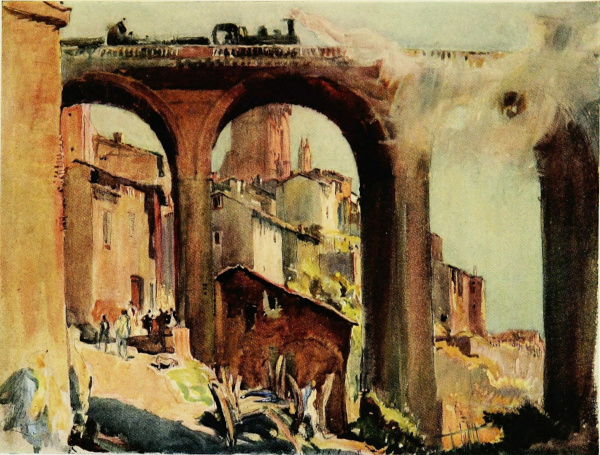
RAILWAY BRIDGE AT ALBI IN FRANCE
About five-and-twenty years ago, when I began in my leisure time to be a pontist, a good old slippered antiquary gave me some hints on what he called “a discreet fervour in the study of bridges.” I was to choose an English county, perhaps Derbyshire, and for eight or nine years I was to live all day long with the bridges, getting them photographed from many points of view, and recovering bits of their stories from dusty old records and forgotten muniment chests. Then a clay-cold book in two volumes was to be written, with a frigid zeal for the accuracy of minute data, and with enough glacial footnotes on every page to strike terror into that general reader who does generally read. No thought at all was to be given to the public, whose vulgar mind had neglected the many antiquaries who had told the historic truth unflinchingly, with a desperate effort to be impartial, unemotional, and yet effective also, like icebergs. I told my adviser that his ideals were those of a studious millionaire. He could afford to write without heart and to be pleased with a bad circulation; could afford also to forget that old English bridges, though at times as charmingly rustic as the Robin Hood Ballads, were not great masterpieces of art, like a good many old bridges on the Continent. If I invited readers to dine with me on Brazil nuts, unaided by nutcrackers, how in the world could I expect to receive company? But argument was useless. The antiquary had two homes—himself and the past, and in both he lived as a rapt dreamer. I see him still, a lean and dusty figure, unkempt, unwashed, for he “hated immersion” like Dr. Johnson. His favourite aim—and he never realised it—was to put a spade tenderly against a human skull buried in Pliocene deposits. “I would sooner do that,” he declared one evening, “than be married to all the prettiest women in England—girls, not widows, of course.” Courage was not his forte—except in one pugnacious habit which he shared with most antiquaries: not only did he love facts with a zeal that was always ready to defend them, but he regarded every fact as a big truth.
The old man would say to me, for instance, “Hunt in the Middle Ages for common but shining truths about roads and bridges. Ah yes! There’s the fact that many bridges were property owners; their landed estates were sometimes inconsiderable, to be sure, like the noble parks of Lilliput; but each estate, whether large or small, was a great truth in the history of bridges. And I like to remember the good folk who in their wills bequeathed money to their favourite bridges, like Count Neville, who in 1440 left twenty pounds to ‘Ulshawe Bridge,’ near Middleham. Now and then the testator was a skinflint, like John Danby, who in 1444 left in his will a beggarly six and eightpence to ‘Warleby Bridge.’ Yes, and he was rash enough to die unrepentant. Another man, a notable merchant in his day, Roger Thornton, of Newcastle, was clever enough to save himself from oblivion, a merchant’s destiny, by leaving a hundred marks to the Tyne Bridge in his native town—a bridge, by the way, that needed much renovation. But Thornton in his charity struck a hard bargain: the hundred marks would not be paid unless the ‘mair and ye comyns’ released the testator from certain actions at law! Thornton died in 1429; and to show you that the beautiful truth which I am illustrating was not then historically juvenile, I will mention an earlier fact from the life of a Newcastle citizen, John Cooke by name, who in 1379 bequeathed twenty marks to the fortified bridge at Warkworth.”
The old man gossiped quaintly about his “truths,” but when he wrote about them he was legal in profuse entanglements. Then it seemed to him that truth could not be protected by too many fortifications. Had he looked upon facts as facts, mere things which had happened and which had no future, his antiquarian knowledge would have been less arid. But he belonged to a school of pedants—the same school which either kills antiquarian magazines or enables them to live obscurely on unpaid contributions. That a man’s lifework should be futile to the public, a mere cemetery where facts lie buried like fossils in a rock, is pitiful; yet antiquaries are very proud of their barren labour. Scarcely one of them understands that a fact, however entertaining, has no value to thought unless it is a useful item in a mass of corroborative evidence; and even then it can be nothing more than a fact, a thing to illustrate the perpetual action of an absolute truth, or the increasing worth of a given hypothesis, or the general belief in a given theory. Two or three facts that confirm each other justify a guess, a random “shot,” or a vague suspicion; an important collection of such facts, if it continues to grow, gives validity to a hypothesis; and when from many sources as various as they are many new facts are added year after year to the collection, until at last the cumulative evidence holds the field with the best judges, then we know that the hypothesis has been developed into a theory, the highest form of mobile knowledge in the realms of Thought. But a theory is not absolute truth, of course; it is a harbour where Knowledge rests while Thought is on the high seas, a Columbus, searching for new worlds.
From a guess to a theory; this, then, is the architecture of constructive growth that research and revision build with facts; and if we as pontists wish to think clearly and humanely, we must use facts as a means to a worthy end, as architects employ their materials. One by one facts are to us what a few slates and tiles are to a builder, but Thought collects them, and then with care and inspiration she builds with them as she builds with stones and bricks and timber. In her work, moreover, there is nothing little when she does little things admirably; but when her devotees go away from her and parade guesswork as theory and fact as truth, we should ask them whether brick-kilns are houses and stone quarries cathedrals. To-day, unhappily, most people exalt facts into truths, and very often the great word “theory” is a journalistic term for any supposition that is loose or wayward or foolish. Thus, “Mrs. Jones has a mere theory that her husband is hard at work when he remains in town after office hours.”
From the life of bridges we may draw a great many conjectures, suppositions, speculations, suggestions, fancies, ideas; and here and there we find some attractive hypotheses, notably those that concern the introduction of pointed arches into French bridges, and of ribbed arches into English bridges. Are there any truths, any useful and necessary things that repeat and confirm themselves age after age? Yes. There are some technical truths that belong for all time to the mechanics of bridge building; the world can employ them for ever, and always with the same good results, if engineers and architects work competently. There is also a great social truth in the life of bridges and roads; namely, that types of society are as old as their systems of circulation, just as women and men are as old as their arteries. So the condition of a body social can be judged accurately if we examine with care its landways and waterways. In Spain, for example, where the genius of modernity is inactive, and where fine bridges represent many dead social states, Roman, Moorish, Mediæval, and Renaissance, the past reigns over the highways, sometimes as an inspiration, as in the great and vast bridge at Ronda, but usually as a mournful historian. Even in those parts of Spain where trade endeavours to be modern, workmen have time enough to be honest craftsmen; their metal bridges are not uncouth, and their stone bridges are charmed with hints taken from classic models. They do not “progress,” for they keep far off from that spirit of trade which regards the lies of advertising as proofs of a pushful honour. From a modern standpoint, then, Spain does not live except as a dim reflexion of her long ago.
A pontist has few theories to consider, only two, indeed, and these are sisters. Let me introduce you to them.
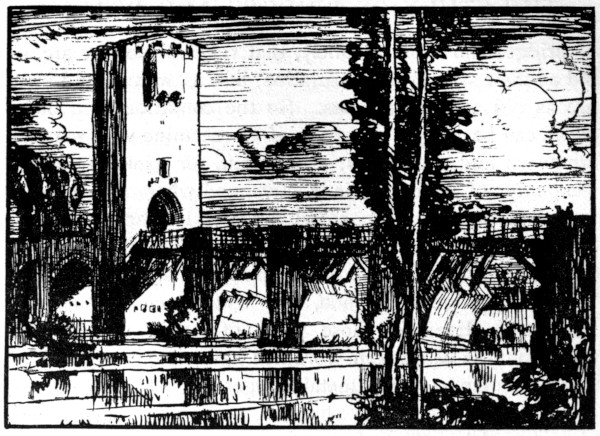
A BROKEN WAR-BRIDGE OF THE XIII CENTURY, AT NARNI IN ITALY; REPAIRED WITH WOOD
II
STRIFE AND HISTORIC BRIDGES
The first theory sets thought astir on the necessity of having landways and waterways which in all respects are fitted to distribute the many functional activities of military and civil life. It is not enough that a complex type of society should have many intricate systems of circulation for its multiform traffic. The weakest points in each system ought to be regarded as danger zones in the strategy of national defence, so it is a duty to protect them from attack, and the protection should be as complete as the military arts can make it, age after age. Now the most vulnerable points in a system of landways are the long bridges by which roads and railways are conducted across wide chasms, and deep valleys, and perilous waterways. Yet in England, and in other countries also, neither roads nor railways are defended; indeed, modern bridges are not only unfortified, but as sensitive to bombs as elephants are to large bullets. Why has the world forgotten that a powerful nation whose bridges were cut would be like a giant whose arteries were severed? As the suffragettes burnt down Yarmouth pier, so a conspiracy of civil disorder, acting in accordance with a well-formed plan, could in a night, with a few sappers, cripple a vast railway, by blowing up the main strategic bridges. I am giving a chapter to this urgent subject, most engineers having evaded with equal zest the charm of beauty and the security of our food supplies. At a time when the nations overarm themselves for war, tradesmen and engineers have erected ugly bridges for an imagined peace; but now that the art of flying threatens civilization from overhead and from all around, like a new Satan, the public attitude to highways cannot remain lethargic. Willingly or unwillingly, we must recall and renew those principles of defensive war with the help of which bridges were safeguarded by the Romans and also in the Middle Ages. Frank Brangwyn has painted many aged fortified bridges, making a most varied selection; and in each of these historic pictures he illustrates the attitude of old times to the theory of pontine defence.
The apathy of the public has been unintelligent, but not unintelligible, because bridges and roads are so ordinary, so very trite, that we who use them every day do not think of their supreme influence on the nation’s health and safety. They belong to that realm of custom where truths fall asleep in truisms and facts in platitudes. To understand a thing that seems obvious, or “inevitable,” is among the problems that genius alone can solve in a complete way. Dr. Johnson believed that men and women could marry ugliness without being in the least intrepid, because custom would soon teach them not to know the difference between good looks and bad. As custom dulls our minds even in family life, where affection is most watchful, we cannot be surprised that common roads and bridges are too evident to be seen intelligently.
Very few persons love a bridge until it is gone, or until it has been put out of action by Napoleon’s “whiff of gunpowder.” Then a victorious army may be brought to a standstill, like Wellington’s, in Spain, when the retreating French blew up an arch of the colossal Roman bridge at Alcántara, so that for some long days the unfordable Tagus might protect their rearguard. It was no easy task to repair the bridge with a netting of ropes that carried planks; and when the British army crossed the gap on this makeshift footway, Wellington knew that the Devil was not the only archfiend in human affairs.
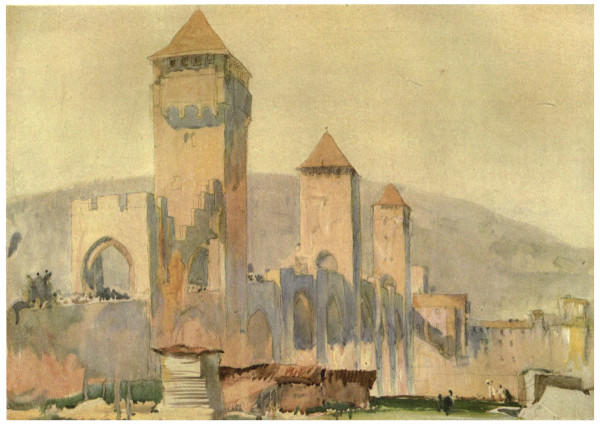
PONT VALENTRÉ AT CAHORS IN FRANCE: THE FORTIFIED GATES AND TOWERS. SEE ALSO THE SECOND PICTURE
Yes, believe me, it is worth while to think of the highways and byways. Try to imagine, for instance, what it has cost in suffering and in death to make fit for use all the traffic arteries and veins that nourish and sustain life in the bodies civil of the world. How long would it take to explore the myriads of rambling footpaths? Could this work be done in two hundred years by a thousand Stanleys? How many lives have been lost in making roads through forests and fens and over mountains? in the construction of railways? in the building of bridges? in the slow cutting of canals? The Suez Canal was a long campaign of stricken fields in the war of trade enterprise;[3] and the Panama Canal has reaped lives as quickly as minor battles reap them. If we could see in a form of visual conception all the sacrifice of life that civilizations have offered to progress on the historic landways and waterways, how terrified we should be! Even the hospitals and sick-beds of humanity have not had a more scaring pathos than that which has accompanied the more peaceable enterprises of mankind.
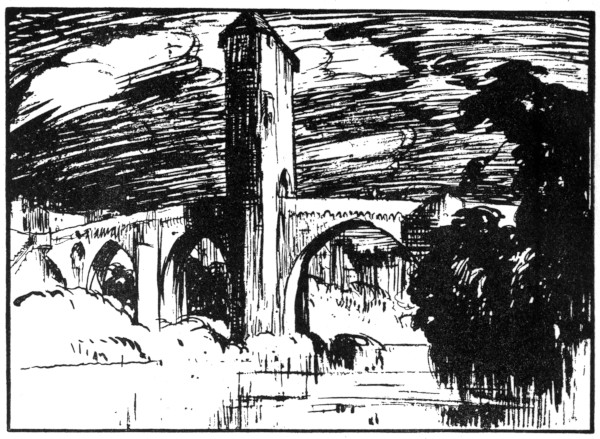
A WAR-BRIDGE OF THE XIV CENTURY AT ORTHEZ IN FRANCE
This reflexion brings us to the second theory that has a home in the life of bridges and roads. Other homes it has also, a vast number of them, for this theory belongs to the law of battle, the universal law of strife. In so far as the lower organisms are concerned, this law seems to be as permanent as the sun; we have no reason to suppose that its rule will ever be relaxed among birds, beasts, fishes, insects, or among other forms of life, such as competitive trees in a wood; but mankind is an eternal mystery, and none can say into what civilization of symphonic harmony the human race may be evolved by gradual improvements in the crowded struggle for existence. A hundred thousand years hence the competitions of human life may be like harmonious rivalries between notes in music, or like the wondrous orchestration that unites into a symphony of benign health all the communities of cells in a sound body. “All for Each, Each for All” is the social rule that Nature administers in her cellular civilizations; and she punishes with disease and death the bodies that rebel against her rule by developing harmful egotisms. Yet mankind has stereotyped a very different social rule, “Each for All, yet Each for Himself”; and what right have we to believe that this egotism, so long inherited, and continuously active, can change its nature gradually, till at last it will be as philharmonic as the cellular commonwealths forming a strong human body? At present this appears to be very improbable, but impossible we dare not call it, since every type of society is free to improve its own lot. So the law of strife in human affairs appeals to us not as a truth destined to last till doomsday, like the strife of carnivorous hunger, but as a theory which human life has not yet contradicted, but which in course of time may be tempered into a social art—a competitive harmony favourable to everybody. Yet even then, no doubt, inequalities of mind will be active in accordance with Nature’s law of infinite variation.
Meanwhile, however, we have to accept history as mankind has made it. Strife has reigned everywhere; even the test of efficiency has been—not the survival of the finest natures, but—the survival of the least unfitted for a long battle against bad environments. Very often the delicate have the best characters and the most alert brains; and in times past the delicate died from hardships by myriads. Consider also the innumerable wars; slaughter and success have tried to go hand-in-hand together as boon companions. Every road through history is a changing procession of armies; every ancient bridge has a long story of battles. Indeed, bridges and roads have circulated all the many phases of strife that men have employed in civil rivalries, in mercantile competitions, in generative migrations, in roadside adventures with footpads and cut-throats, in fateful invasions, and in those missionary conquests which have given to religions their rival empires.
No one knows how many invasions were broken up by the forests and fens of England before the Romans came with their colonising methods, and linked their scattered camps together by means of paved highways, great roads destined to be used for many centuries, and by many raids and armies. The earliest prehistoric tribes came along a bridge of land by which England was united to France; they found in their course some of the nature-made bridges (p. 114), and the spoor and tracks of formidable animals, such as the mastodon and the mammoth. Much later invasions, also prehistoric, must have come over the sea in boats, for the bridge of land had the history of most bridges, the water swallowed it up; but every boat may be regarded as a floating bridge which is moved from place to place, so that a pontist when he studies the sea-borne invasions keeps in touch with his favourite subject. On their arrival in England the later prehistoric colonists found that most of the nature-made bridges had been copied, and that a great many footpaths and tracks rambled from settlements to watering-places and through the forests where huntsmen risked their lives in a sport of habit.
The men of the Bronze Period were supplanted in Europe by a race more powerful, whose clenched fists needed larger sword-handles; it was a race of manly and swaggering nomads, strong and fierce; and yet, as Darwin believed, their success in the war of life may have been aided still more by their superiority in the arts. Can we fix a date for the introduction of bronze into the British Isles? Here is a matter of opinion; but, according to Sir John Evans, the most likely date is separated from the Christian era by about 1400 years, perhaps 200 years less. Iron belongs to a much later time. Probably, in the fourth century B.C., it was known as a metal in South Britain; and about a century later it began to supersede bronze in the manufacture of cutting implements.[4]
Then, as now, England waited for great discoveries to be imported. Many British tribes were hermits of convention, willing drudges to a routine of fixed habits and customs. For example, the highest form of prehistoric bridge-building, the lake-village, came to England not earlier than the Bronze Age, and we shall see (p. 137) that a lake-village, with its late Celtic handicrafts, existed at Glastonbury when in its neighbourhood the Romans were at work. But I do not wish to imply that no British tribe had any alertness. As Cæsar found out to his cost, there were Britons with an enterprising conservatism, whose war-chariots were managed with a skilful bravery. This wheeled traffic postulates a good road here and there, with bridges over some deep rivers; and to this supposition two facts must be added: the war-chariots were small, and their wheels were primitive, so in a wet climate they would have been useless on unmended tracks. Let us infer, then, that the Roman conquest of England was aided by some British landways which were genuine roads, valued for their service and kept in repair. Is not this implied also by the circulation of Druidism from its venerated heart in Anglesey? There is no evidence better than that of a just inference from known events, for events cannot lie, whereas the eye-witness can, and very often he does.
Again, to think of the aggression which has travelled along roads and over bridges, is to think also of the five phases through which civilization has evolved many times. During the first phase a new home is won by invasion; and during the second phase the new home is extended by invasions, and efforts are made to co-ordinate the separated parts by improving their intercommunications. Then civil and economic competitions not only multiply, but become too active in the body social; wealth breeds wealth, and poverty, poverty. So the classes grow discordant, and put too much strain on each other, just as diseased lungs poison the strongest heart, or as virile hearts rupture weak arteries. Here is the fourth phase; it means a gradual disintegration brought about partly by the economic war, partly by a relaxing faith in stern duties and in patriotism. Amusement becomes a passion, even a mania, and discontent seethes under the fool-fury of the merry-making. Then comes the gradual break-up or downfall, which may be hastened by invasions from a younger and more militant country. Each phase may be a long development, sometimes delayed by events, and sometimes hurried; and the final phase may be postponed for a long time when the strife of poverty is relieved by constant emigration. Human gunpowder does not explode if it is shipped to a happier country where a day’s work brings comfort enough for three days. But the main point is this: that civilizations have travelled always in the same direction and ended always in a break-up, just as great rivers have flowed always toward their destiny in the sea, though all have changed their beds many times and widened their valleys.
When we meditate on the part played by bridges and roads in the rise and fall of ambitious nations, we should choose a fit environment, such as a Roman bridge crippled by three forms of war: floods, winds, and human strife. France has three or four Roman bridges of this kind, but let us take an Italian example. Brangwyn has chosen the Ponte Rotto, at Rome, and the great ruins of the bridge at Narni. It was Augustus Cæsar who erected Narni Bridge, in order to join two hills together across the valley of the Nera, on the Flaminian Way, in the Sabine country. There were four arches of white marble, and the finest one had a span of 142 feet. The others varied much in breadth.[5] The Romans plumbed the river and chose the best natural foundations for their piers; stability was more to them than a sequence of uniform arches. At the present time only one arch remains; but under its great vault, as you stand on the left bank, you will feel alone with the pity and terror that history brings to those who see past events as clearly as painters behold their concepts.
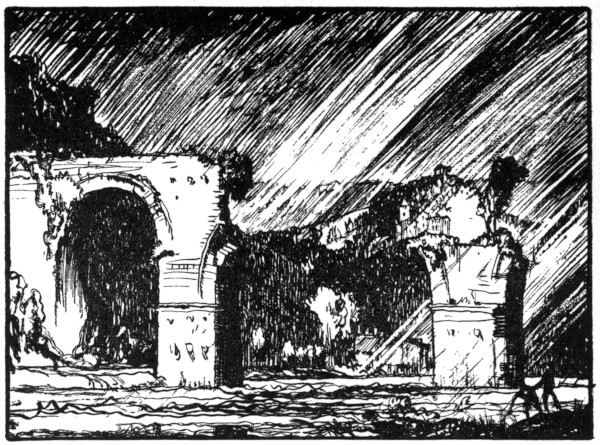
RUINS OF THE GREAT ROMAN BRIDGE OVER THE NERA AT NARNI, ITALY
Under this arch at Narni many types of society have passed, with their customs, religions, fears, hopes, ambitions, predatory trades and pillaging armies; have passed one after the other, and vanished. Tempus edax devoured them; and now they are studied in relics of their arts and crafts, their mute historians. What permanent social good did they do? Ought we to be as forgetful of them as they were of their buried generations? Do they merit any praise at all? They were proud, of course, and looked upon change as abiding progress, yet the more they altered the more their egotism was the same thing, either intensified and developed, or slackened and degraded; for the ruling motive powers of their life were but variations of the aboriginal war between the enfeebled and the strengthened. The social rule tried to prove that “Each for All, yet Each for Himself,” was the only sane doctrine for men to be guided by in their civil competitions. Everybody had to do much for the commonweal, but yet he was taught to believe that astuteness, even more than upright ability, would enable him to gain control over a number of slaves, or serfs, or servants, whose lot would be what he thought fit to make it. This habitual struggle for Dominion over others was a friend to the fortunate classes only: it bred microbes in the body social and produced fever and disruption. Is it surprising that civilizations withered away? Their autopsies have a horrible sameness; but from their mute historians—their books, pictures, sculpture, potteries, bridges, roads, and other relics of a lasting communism—we learn to have faith in useful work done thoroughly. In all that endures there is some altruism. Who would care a fig for ancient Greece if all her mute historians had perished with her incompetent social order?
The Middle Ages exist for us, not in records of their freebooting social aims, but in the work done by a few men of genius and their pupils and assistants. More than one mediæval century is represented by a few churches, a few castles, a few bridges, a few books, a damaged house here and there, and some weapons, tools, and furniture. All else in the story of its life is tragic and sinister, a wild pilgrimage whose shrines are battlefields and whose ranks are visited periodically by the plague.
Again, what are we as pontists to say about the fallen master of many Christian periods, the Roman genius, whose architecture and road-making were copied? The Roman baths were not copied, of course, for a clean body was not regarded as sacred in a Christian way; but the Roman bridges, roads, aqueducts, were favourite models for imitation. Many a ruler, from Charlemagne to the Moorish zealots in Spain, not only valued their service, but restored them carefully. Mediæval architects invented very little in bridge-building; their first work tried to recover the lost Roman art; and then, little by little, they added some ideas to their acquired knowledge. Here and there they equalled the Romans, as in the great bridges at Montauban and Cahors, which Brangwyn has painted with a vigorous enjoyment; but in most of their efforts the design was either too rustic or too lubberly, so ponderous was the technical inspiration. Far too often their ideal of strength was a mere man-at-arms, brave but underbred. Rivers were obstructed by immense piers, for instance, by which spates were turned into dangerous inundations; and footways along bridges were so narrow that safety recesses for pedestrians had to be built out from the parapets into the piers. Even in exceptions to this rule of ungainliness, as in much Spanish workmanship, architects were overapt to make the use of bridges a tiring penance that wayfarers could not avoid. Thus the bridge over the Sella at Cángas de Onis has a lofty footway shaped like a gable; to-day it is little used, for the climbing exercise that it offers to everybody is put out of vogue by a modern bridge, its neighbour and rival. In brief, many gabled bridges in Spain[6] were made narrow enough to be useless to wheeled traffic and friendly to pack mules; friendly in a mediæval manner, for a seasoning of peril was added to their inconvenience. Most of them are without parapets; and when their rivers flood into roaring spates, and across their giddy pathways a gale sweeps eagerly, an Alpinist can enjoy a mad crossing, after dark, between dinner and bedtime.
Frank Brangwyn has drawn for us, with as much fidelity as vigour, one of the finest gable bridges, the Puente de San Juan de las Abadesas at Gerona. This bridge has a great historic interest. The Moors left in Spain a peculiar grace of style which native architects often united to their own qualities—a haughty distinction and a lofty ambition. Consider the immense nave in Gerona Cathedral, a glorious pointed arch not less than seventy-three feet from side to side, almost double the width of Westminster nave. It belongs to the fifteenth century, yet in the magic of its youthful hope it proves that its architect, Guillermo Boffiy, was a child of the thirteenth. And the great central arch of the Gerona bridge has in it some of the soaring courage that transcends all expectation in the cathedral nave[7].
Yet this gabled bridge, though very spacious and attractive, has less charm than its rival at Orense, in Gallicia, a noble monument 1319 feet long, built in 1230 by Bishop Lorenzo, and repaired in 1449 by Bishop Pedro de Silva. The six arches differ in size, yet their combination is symmetrical; four are gracefully pointed, and the finest one rises above the Miño to a height of a hundred and thirty-five feet, and its brave span, a hundred and fifty-six feet from pier to pier, is the widest of any in Spain.[8]
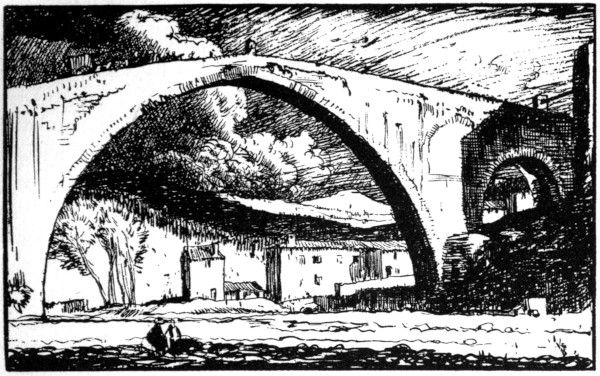
PUENTE DE SAN JUAN DE LAS ABADESAS AT GERONA, SPAIN
It is commonly supposed that gable bridges were invented by the genius of Gothic architecture. Yet Marco Polo found them in China, [9] and the Roman bridge of two arches at Alcantarilla is hog-backed. Usually the Romans liked a flat road over a river, though it was easier and less expensive to build a steep bridge from low embankments. But the bridge at Alcantarilla, about twenty miles below Seville, is quite steep enough to be the forerunner of all the gable bridges erected in Spain.[10]
There is little in stone bridge building that the Romans did not discover. To this day their aqueducts and bridges are models of thoroughness, and apologise nobly for a civilization that rambled through wonderful achievements into a gradual suicide. While arenas for barbaric sports were being built at a great expense, and while most of the Roman roads circulated war, did many persons guess that their imperial genius in handicraft would outlive their statesmanship by hundreds of years? Who knows why Rome very often squandered her energy on the least fruitful phases of strife, neglecting those benign phases out of which intellectual vigour ought to have come, age after age, in a continuous zeal for research, and revision, and improvement? She neglected science, for instance, and her bad example was followed by the mediæval Church. Not a mind had any inkling of the fact that the brightest hopes for mankind would emerge from science, like medicinal plants from dry seeds. Innumerable millions died from ignorance because Pasteur and Lister were not evolved until the races of man were perhaps a million years old. In the creeping progress of humanity the dead have been mocked by every good discovery; there has been nothing so cruel as a healing success, for it has ever been too late by thousands of years.
To visualise this truth in the strife of man is a great trial to any mind; but yet it is the one thing that a pontist cannot evade without being disloyal to his honour as a student, since he knows that strife has ruled over the tremendous drama which has had for its theatres the highways and byways, and for its actors the races of man, continuously at odds with one another. If this truth had to be deleted from the drama, then I, for one, would not be a student of roads and bridges. As well read the Greek tragedians after deleting all the passions that make for contests and crises.
So let us try to get nearer and nearer to strife, the most active genius in the life of our subject. Why has it set tribe against tribe, nation against nation, class against class, tradesman against tradesman, intellect against intellect? Must we clear from our minds all the shibboleths of modern idealism? and feel pity for the supergood when they chatter to us about their isles of dreams, their unsubstantial fairy places, where “cosmic conscience” reigns with “the universal brotherhood of man,” and where “everlasting peace” promises never to be effete and sterile? When a Wellington of Finance erects a Peace Palace, at The Hague or elsewhere, are we to be glad that the pomp of irony did not leave the world when Gibbon died? Should we gain anything at all if we were bold enough to condemn the whole past life of the human race? Ought we to pass with Carlyle from democratic hopes into hero worship, and thence into a hot-brained conviction that faith in mankind is impossible? Are we to suppose that man has transformed into instincts the worst habits he has acquired, so that his ultimate destiny upon earth will be determined by his attitude to these instincts? Will he obey them or will he try to conquer them?
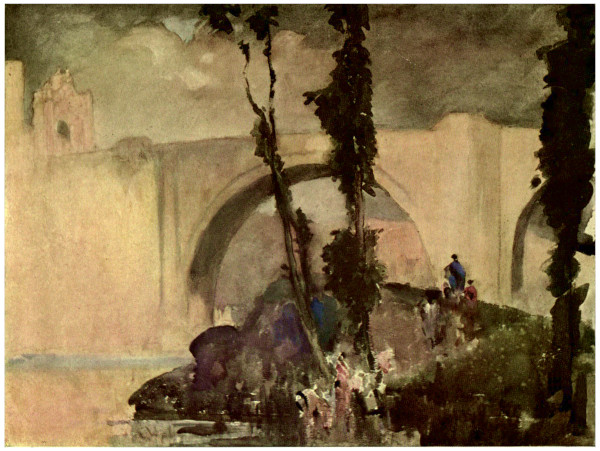
A GREAT SPANISH BRIDGE, THE ALCÁNTARA AT TOLEDO. MAINLY THE WORK OF ARCHBISHOP TENORIO, A.D. 1380; FORTIFIED BY ANDRES MANRIQUE, A.D. 1484. ON THIS SITE A ROMAN BRIDGE WAS DESTROYED IN A.D. 871
Again, is there a glint of hope in the hysterical words that came to Charles Dickens when he wrote as follows, after a visit to Chillon?—“Good God, the greatest mystery in all the earth, to me, is how or why the world was tolerated by its Creator through the good old times, and wasn’t dashed to fragments.” You see, Dickens understood the terror of strife, but he made no effort to be calm with Darwin, who knew that the evolution of man could not have happened if nascent humanity had been unfit to endure the sufferings of its daily contests both against Nature’s violence and against a terrible fauna. Thus a pitiless character was thrust upon primitive man by the environment in which unlimited strife worked his development; and what the ages have evolved only a long future can amend in another evolution. What Dickens called unpardonable cruelty was to the distant past what strikes are to our own time, a weapon, a phase of war, approved by public opinion; and let us remember also that the cruelties which a hard life has bred, and turned into customs, have not shown an egotism fiercer than that primal necessity which has compelled life among the species to feed on lives. Dickens himself, while writing his condemnation of the past, was nourished by the death of many living things; was in himself a mysterious alembic that transmuted food, slain life, into benign health and action. Had he been logical in his feelings toward strife he would have had mercy on those forms of life that feed mankind; in other words, he would have died of hunger rather than be cruel; but, naturally, the manifestations of strife hateful to him were those that happened to be far off from his needs and sympathies. Yet he ought to have seen in the national efforts of his time that strife, though easy to rebel against, is woefully difficult to improve, since even kindness of heart when shown in promiscuous charities may unseat from their thrones in the public mind many good racial qualities, doing as much harm as ever was done by mediæval brutality.
“Let me think” should be everybody’s motto; nothing less than arduous thinking can save us from the cant and the sentimentalism which at the present time enfeebles England.[11] Let me give you an example. Yesterday I was talking to a friend about the mediæval battle-bridge. Putting before him Frank Brangwyn’s excellent sketch in water-colour of Parthenay Bridge, I said: “This fortified gateway belongs to the thirteenth century, and through its machicolations red-hot stones and boiling oil were poured down many times upon the head and shoulders of an attack. The gateway was built between 1202 and 1226, not without help from English money, for the Josselin-Larchêveques of Parthenay were allies of the Anjou Plantagenets, who gave us English kings; but a few years later our English troops were driven from Parthenay by Louis IX, called St. Louis. Can’t you imagine the assault? Would you care to rush that gateway in a thirteenth-century manner?”
My friend, a Quaker, was scandalised. “Rush the gateway?” he cried. “Red-hot stones and boiling oil! What imbecile savagery! Thank goodness, we are not savages now; life has improved wonderfully. To-day most men of sense fear war, and those who don’t fear it scorn it for moral reasons.”
“Are you sure?” I asked. “Do you really believe that the history of this old war-bridge is more strifeful than the industrialism of to-day? Is it an act of peace when a trust ‘corners’ some article of food, or when a limited liability concern kills all competition from little neighbours, whose wives and families can’t get rid of hunger because business has failed? Those who attacked the bridge at Parthenay were armour-clad, while those who suffer in trade wars from the greed of co-operative egotisms have usually no self-defence, as their capital is small. Don’t you see, then, that from machicolated towers to millionaire tradesmen is but an evolution in social strife? Chivalry did try to put some generous feeling into mediæval warfare; and how much feeling of chivalry do you expect to find in the battles of industry? Are the strategic victories of finance more humane than were the politics of the Black Prince? Do they harm the defeated less, or more? And can you explain, old chap, why it is that Quakers, Jews, Hindus, though they fight for money with an astuteness that never flinches, prattle about peace after office hours? Their ideal of peace includes all warfare except that which employs battleships and big battalions. Myself, I would sooner lead an attack against the Porte St. Jacques on Parthenay Bridge than be opposed in trade by a wealthy firm of shrewd Quakers, whose great skill in the combats of trade would soon ruin me. I shouldn’t have a chance of doing credit to myself in a dangerous adventure.”
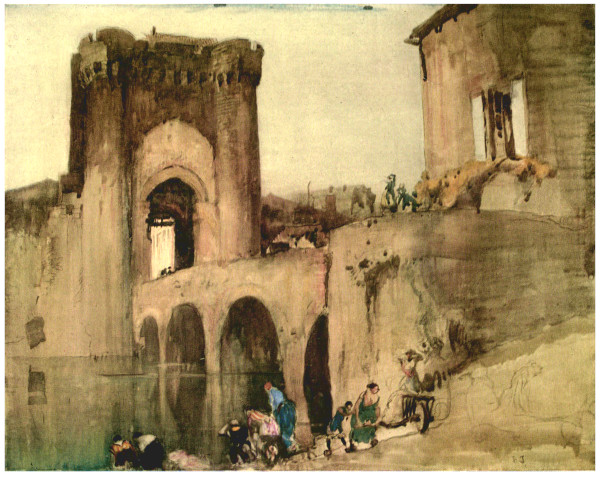
A WAR-BRIDGE OF THE MIDDLE AGES AT PARTHENAY IN FRANCE
There is nothing more odious than the modern cant about peace. But a pontist soon learns that strife of every sort is a phase of war. Indeed, whether roads and bridges aid a pilgrimage of the sick, or an army of Crusaders, or a primitive migration, or the ramblings of charity, or the enterprise of monasteries; whether they help a mediæval pope at Avignon to thwart the land-hunger of a French king, or enable modern life to turn industrialism into a world-wide Armageddon whose scouts are lying advertisements; whatever they do or have done their history brings us in touch with the same human motive, a desire to win victories. James Martineau went so far as to picture the strife as absolutely barbaric. He said: “The battle for existence rages through all time and in every field; and its rule is to give no quarter—to despatch the maimed, to overtake the halt, to trip up the blind, and drive the fugitive host over the precipice into the sea.” Tennyson also went too far when he wrote about strife; too far, because he did no more than skim along the surface of a primordial truth, by which man’s history has been made a part of Nature’s. From Tennyson we gain no help at all; he tells us merely “that hope of answer or redress” must come from “behind the veil.” In his opinion Nature cares for nothing, so careless is she of the single life, and so ready to let a thousand types go. Yet her realms teem with miracles of contentious life, and I cannot think of any great extinct species that I should care very much to meet in a country walk. I do not wish to hob-nob with the Iguanodon, for instance. When John Stuart Mill complains that “nearly all the things which men are hanged or imprisoned for doing to one another are Nature’s everyday performances,” he forgets the far-reaching harm that men can do within the tolerance of “Old Father Antic, the Law”; and, besides this, he forgets to explain how a world of organisms ruled by hunger and thirst and passion, and dependent on innumerably various climates, could be other than Providence has decreed.
To talk as Mill did is to imply that Nature sins against us, and against herself, when she allows any species to grow completely unfit for the gift of life. Yet her aim is to protect life from the suicidal fertility of lives, so that the whole economy of Nature demands death in the highest interests of the future. When we die we do an act of charity to our children and grandchildren; for if each of us lived to be active at ninety, the world would need a much smaller population of young people. It is our frail tenure of life that renders a high birthrate necessary; and progress gains more from the enterprise of vigorous youth than from the too cautious knowledge of old age. So I do not understand the pother raised by Mill and others over the benign discipline of death that Nature wields as a servant of the Eternal.
Believe me, a pontist can never solve even one problem in the law of battle if he lets himself be scared into a revolt against natural forces; scared by the incessant tragedy that each day’s little trip along the highways of history brings in a challenging manner before his mind’s eye. He must try to protect himself with humour and irony and scorn, as Thackeray tried to save himself from a feminine heart. The main point is that he should learn to live outside himself; then self-pity will not be his troublesome guide through the labyrinths of strife.
Cardinal Newman asks us to believe that human life has been terrible—“a vision to dizzy and appal”—because mankind has been punished by God for some aboriginal sin too abominable for mercy and forgiveness. This doctrine is completely dark and horrible. If it were illumined on one side only, like the moon, it would invite the companionship of thought, but it gives no light whatever. Indeed, it implies that no civilization has been free to improve its own lot and to get progressive reason from the large brain of man. To blame God for our own follies—to say that our social acts are wild and foolish because we are being punished by Heaven for a sin of ignorance committed by man in the babyhood of the human race—what is this but a charge of illimitable cruelty against the Creator? Besides, we learn from the much nobler doctrine of evolution that human nature, despite all her wilful fondness for wrong actions, has crept up and up from a very low beginning, in an ascent continually wonderful, though infinitely slow and tragical. The accumulated progress excites in me as much awe as I should feel in the presence of a resurrection from the dead. Indeed, what is evolution but a vast drama of resurrections, by means of which base forms of life have become gradually better? Can anyone suppose that Milton, had he been a contemporary of Darwin, would have turned from the endless hopes that evolution ought to inspire, just to dally with fallen angels and with an errant couple in the Garden of Disobedience? And can we suppose that Newman would have written his famous page on the doctrine of original sin, had he not turned his back on modern thought and knowledge?
Amid the doubts and difficulties that trouble this meditation on strife, just a few things are bright and clear-eyed, like illumined windows which on dark nights cause jaded tramps to feel less their lone wayfaring; and these things I have watched for years in the life of bridges, where their activity never ceases. It is clear enough, for instance, that custom and convention have acted as narcotics on the mind, sending reason to sleep. This explains why human strife has never turned to the best use the great opportunities that each generation has inherited. To custom and convention, mankind has owed the social rule which has sown the seed of death in every civilization; the rule of illogic and discord, “Each for All, yet Each for Himself.” Let us see this rule in operation on the highways, taking care to note how it has inflamed egotism and deadened both the sense of honour and the spirit of citizenship.
The just and beautiful principle that every man lives by his mother the State, and that he must do good for the benefit of the commonweal, was enforced upon mediæval landowners by the trinoda necessitas, or triple obligation, which among other duties made the upkeep of roads and bridges a general charge on all owners of the English soil. Not even the religious houses were exempted, though the State favoured them in other ways. But the second principle of the social rule—“Each for Himself”—interfered constantly with the first principle, bringing trouble after trouble into the administration of the highways, as into all other useful and necessary things. Landowners transferred their duties to their tenants, and very often the tenants made negligence a habit, until at last the Law and the Church became equally active for the people’s benefit. Again and again bishops offered “forty days’ indulgence to all who would draw from the treasure that God had given them valuable and charitable aid towards the building and repair” of a poor bridge ruined by neglect, or of some quagmire which had been a decent road.[12] It happened in the year 1318 that the Law pottered into action because a timber bridge at Old Shoreham, in Sussex, had been scandalously ill-used by those who were responsible for its upkeep. Half of it had fallen into the river. Year after year an evident crime against the State had gone on publicly, yet no one had taken steps to make the dangerous condition of the bridge a subject for legal enquiry and punishment. The village grumbled, of course, but grumblers have never had any initiative of their own; unless a man of action has come to be their conscience and their leader, they have done nothing. Their energy has evaporated in talk, like steam from a boiling pan. It was not until the bridge had fallen that the village hummed intelligently like a hive of bees, and set itself to work. What could be done then? Who was the landowner? No less a person than the Archbishop of Canterbury. Are we then to believe that in 1318 a Primate of England scamped his public duty? Was his attitude to a timber bridge inferior to that of the high priests of ancient Rome, who called themselves pontifices because they built and repaired the Pons Sublicius, a bridge of stakes at the foot of Mount Aventine?[13] The sheriff and his officers had a different question to consider; they would wish to know whether the Archbishop had been an astute man of the world, whether he had made his tenants responsible to the trinoda necessitas. If not, then he and the Law were in a fix, and peasants over their ale would guffaw with malice. But enquiries proved that his Grace was a canny landlord; the tenants alone ought to have mended the bridge; and so the Law was free to act with a vigour that common folk knew too well.
Its agent was the bailiff, good Simon Porter, and Porter set out at once to collect money from the tenants. If any tenant either declined to pay his share or was unable to pay it, then the bailiff put his hand on some marketable property, perhaps a few sheep, or a cow, or “a gaggle of geese.” The necessary thing was to take enough; never an easy thing to do in the country, as no one cared to pay a fair price for escheated live stock. The peasant has ever been at heart a pawnbroker. But Simon Porter had no reason to look upon his troublesome work as a high office of trust important enough to keep his name alive for six hundred years. It was when he met Hamo de Morston, a truculent fellow, that Simon entered into history. Hamo de Morston was a logical egoist, he fought for his own hand only, trying to use the State at a trivial cost to himself; but now this amusement, after prospering for years, brought him suddenly face to face with legal pains and penalties—a thing most irritating to a bad temper. So Hamo refused to pay; and his fury was terrific when Porter confiscated a horse. Even then he was not defeated, for he set lawyer against lawyer, and one day a petition was sent by him to King Edward II. The rascal was a good fighter, but his appeal to the supreme authority failed; the bailiff’s action was approved, and Hamo had costs to pay.
As for the bridge, it was repaired, and repaired very well. Twenty years ago it was in use, a shaggy and venerable structure, not yet crippled by old age. Then certain highwaymen, popularly known as road officials, visited Old Shoreham, and there they tried to prove that a bridge admired by landscape painters was unfit for a commercial time. The poor bridge! At this moment it has no charm at all; not only is it dull, it is neat in a shabby way—a discord in good surroundings, like bankruptcy at a wedding breakfast. So we pass from Hamo de Morston to our own roadway officials, and find ourselves in the presence of a public bridge injured by public servants. To Hamo we can give a little sympathy, he fought for his creed of self and paid costs, whereas highway boards have never been fined for spoiling old bridges. Perhaps they do not hate venerable architecture, but they belong to a system of public service that is ill-equipped for its work, receiving neither criticism from the newspaper press nor supervision from county committees of independent architects.
That the State has been wronged by these public servants is known to all artists and antiquarians; also the fact is advertised by the great many hideous railway bridges that demean towns and blemish the country. In this matter, as in others, the State must defend her own just rights, so as to get by compulsion what a free egotism has declined to give—efficiency and good taste. It is possible that England has not suffered a great deal more than the Continent; for even in France, despite the excellent administration of the Ponts et Chaussées, crimes against noble bridges have been committed, as when the second ancient bridge at Cahors was lost in a storm of local party politics. But England happens to be poor in great old bridges, whereas the Continent is rich; we cannot afford to lose even the modest little ballads of arched stone which have resisted floods for many generations, while working as necessary drudges in the making of England. Trivial they are when compared with the bridges of Isfahan or with many of those in France and Spain, but yet they are hallowed by time, and they mimic the gentle rusticity of English landscapes. It is a crime to spoil them, because modern bridges for heavy traffic can be built at a lesser cost near by the little mute historians.
To the Scotch, on the other hand, many a fine old brig is a Burns of the highways; and this sentiment for history and for sylvan poetry has kept from the cruel hands of industrialism some very attractive single-arched bridges, and some long bridges also, notably the rhythmical Brig of Stirling, which Brangwyn has chosen as an example of quiet good taste in mediæval civic architecture. The Brig of Stirling is a Scotch citizen of the dour old school, but warmed with an undercurrent of that kindly emotion which even the canniest Scot is glad to show off when he is away from business. I am inclined to think that not even a militant suffragette would have folly enough to attack the Scotch brigs; she would be fascinated by their names, and this would keep her out of mischief. Such a name as the Brig o’ Doon is music combined with a racial vigour. No weak people would have invented it, and no dull people could have retained such a poetic name.
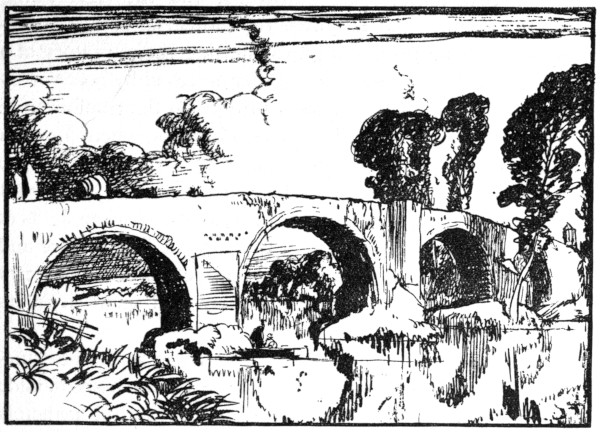
THE OLD WAR-BRIDGE OF STIRLING
The Irish also are fond of bridges, like the true unspoiled Welsh. As late as a century ago Irish peasants were pious in their attitude to any bridge that crossed a dangerous river; they saluted it reverently because of its friendliness to poor wayfarers, and because good thoughts come from simple hearts. As for the Welsh, thanks partly to their Celtic blood and partly to the waywardness of their rivers, they have been known as pontists for a very long time. In the romantic hills their bridges seem to belong to Nature herself, so lovingly have they been united to the spirit of ancestral landscapes; whereas the industrial parts of Wales make the bridges of trade into vile objects, as if beauty has no right to a home where money is earned out of coal mines, and ironworks, and the debilitating factory system. Far too often the industrial bridge everywhere is like an ill-used highway uniting the purgatory of a seared district to some hell or other invented by poets or by priests. There are many such bridges in the Staffordshire Black Country, and in the scarred Potteries, where an ebon meanness lives with jerry-builders, and where puny drab children take from the present generation the youth that endures. What would a Dante think in the stricken fields of industrialism? And why is it that only a person here and there, after compelling himself to leave the atmosphere of custom, sees our industrial war clearly, and views it in its relation to the body social?
The truth is that our creed of self has become instinctive; we cannot without an effort live for an hour outside our personal interests; and thus the beautiful principle “Each for All” has to be kept alive by a host of active laws that encircle us with compulsion. Where there is no compulsion we are governed by our preferences. If we like bridges, for instance, we try to protect them from ill-usage; but if they are indifferent to us we care not a straw when engineers add half a dozen uncouth viaducts to the many other misdeeds which they have thrust upon the State. Instead of regarding all bad public work as a sin against the commonweal, we let ourselves be ruled by the creed of self even in our best efforts to serve the State properly.
Is our egotism better or worse than that of the Middle Ages? This seems to be a matter of opinion. Thorold Rogers believed that mediævalism in a good many respects was kinder than our industrialism; and the late Russel Wallace regarded “our social environment as a whole, in relation to our possibilities and our claims,” as “the worst that the world has ever seen.” On the other hand, a great scientist from his laboratory has told us that “the sun rises on a better world every morning.” Gracious! If the sun could speak to us about his complete knowledge of mankind, if he did not obey the law of silence that rules over the greatest motive-powers and creative agents, our conjectures would be less wayward, for sunrays would whisper into our ears the story of the most evil civilization in the whole strife of mankind. In this matter the sun would be authoritative; but how can we poor mortals expect to see the whole past truly when we are half blind to the significance of our own social life? Besides, it is enough for us to see how one civilization has differed from another, and how in many respects all human life has been like the sky, always the same elementally, but never quite the same in colour and form, and in the effects of strife.
A pontist, as he journeys through present-day England, sees very clearly the difference between our commercial time and the past; for industrialism is plainly out of joint with that which is normal in organic growth, and its workmen are conscious of the unstable energy bred and frittered away by hurry and speed-worship. Consider those dread “hives of industry” where trade bridges are makeshifts, and where the jerry-built villa or cottage is repeated thousands of times, and always in mean streets. Do they not bear witness to the feeling of insecurity from which our age suffers? I shall be told that many things are very well made, as in the case of battleships, motor-cars, engines, steamships, guns, rifles, artillery, surgical instruments, expensive clothes, implements for games, and gigantic metal bridges; but in this good craftsmanship, tradesmen are thorough because they dare not be slipshod; they fear to turn out work that would endanger human life, and business would fail if they angered the specialists of luxury and of sport. Where they are free from restraint, as in work for ordinary households, tradesmen manufacture trash and prosper. In fact, the quicksands of cheapness are to most people in England what cheese in a trap is to mice, or what seasonable bait is to fish. So widespread is the feeling of insecurity that the poorer classes do not think it worth while to buy enduring goods and chattels. Instead of practising a thrift that would hand on furniture to their grandchildren, they say, “Never mind; perhaps these things may last our time.” And this dull pessimism in the creed of self is the most wretched phase of strife that a pontist has to connect with the circulation of trade enterprise.
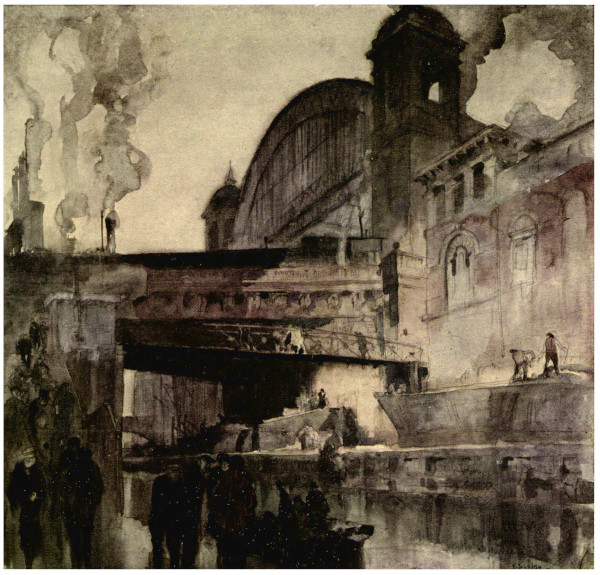
CANNON STREET RAILWAY BRIDGE, LONDON
Even the prehistoric tribes wanted to be remembered by their posterity, so they built enduring barrows or set up cromlechs to their ancestor-worship, this being their spiritual bond between past and present and future. In the Middle Ages also, though disease and filth and bloodshed made life as uncertain as a game of chance, the social egotism that built and purchased for itself had faith in the future, and claimed and got full value for its money. In fact, from nearly all specimens of mediæval handicraft we may learn why the peoples of Europe survived terrible crises and bred men of genius to represent them for ever. In each race, and particularly in ours, there was a wonderful endurance, certainly based on the creed of self, but admirable all the same, like the tough elasticity of yew timber. The ruling egotism was honest in nearly all its private work, but when it was expected to be equally thorough as a public servant, then a habit of dishonesty appeared in handicrafts, sometimes to be followed by new laws or by threatening proclamations. Again and again the conscription of the archery laws was imperilled by bowyers and fletchers and merchants, who formed “rings” and flooded the markets with nefarious work to be sold at high prices. Certain bridges, also, and notably the one at Berwick-on-Tweed, fell so often that the supervision of town authorities must have been exceedingly lax. On this point, M. Jusserand says:—“London Bridge itself, so rich, so useful, so admired, had frequent need of reparation, and this was never done until danger was imminent, or even till catastrophe had happened. Henry III granted the farm of the bridge revenues to his ‘beloved wife,’ who neglected to maintain the bridge, appropriating to herself without scruple the rents of the building; none the less did the king renew his patent at the expiration of the term, that the queen might benefit ‘from a richer favour.’ The outcome of these favours was not long to wait; soon it was found that the bridge was in ruins, and to restore it the ordinary resources were not enough; it was necessary to send collectors throughout the country to gather offerings from those willing to give. Edward I begged his people to hasten (January, 1281), the bridge would give way if they did not send prompt assistance; and he ordered the archbishops, bishops, all the clergy, to let his collectors address the people with ‘pious exhortations’ that the subsidies should be given without delay. But the money thus urgently needed arrived too late; the catastrophe had already happened, a ‘sudden ruin’ befell the bridge, and to repair this misfortune the king established a special tax upon the passengers, merchandise and boats (February 4, 1282), which tax was enacted again and a new tariff put into force on May 7, 1306....”
What were the citizens doing while Henry III and his dear wife ruined the bridge by confiscating her revenues? Did they believe that everybody’s affair was nobody’s business, and that they would be asked to mend the bridge if they drew attention to her condition? As to Edward I, he kept his hand away from his own pocket, and personated charity that for ever begs. “Each for Himself” was a policy that suited Edward; and his orders to the clergy proved that he knew it to be a policy which his loyal subjects followed as a habit. Hence the “pious exhortations,” with indulgences also, we may rest assured. The whole story is pitifully ironic. London had no other bridge over the Thames, yet the people looked on while a king and his wife played the part of bridge wreckers. Some protest there must have been, for London Bridge—a great street of timber houses—was more populous than many a village; and the tenants, like other Englishmen of those days, had no wish to be plunged into cold water. According to Stow’s “Annals,” five arches fell, so many houses also were lost, perhaps with their inmates.
M. Jusserand believes that during the Middle Ages our English highways fared no better than London Bridge. His verdict runs thus: “Though there were roads, though property was burdened with obligatory services for their upkeep, though laws every now and again recalled their obligations to the possessors of the soil, though from time to time the private interest of lords and of monks, in addition to the public interest, suggested and directed repairs, yet the fate of a traveller in a fall of snow or in a thaw was very precarious. The Church might well have pity on the wayfarer; and him she specified, together with the sick and the captive, among those unfortunates whom she recommended to the daily prayers of pious souls.”
There is a great deal of evidence to justify this verdict, but evidence in history depends on its choice; and in Thorold Rogers there are other facts that leave England with some efficient mediæval roads, along which horsemen could travel rapidly. Perhaps Rogers may have set too much store by his data; but when we study all the evidence, when we balance it carefully, and visualise all its pictures of well-tested negligence and crime, one thing is beyond all doubt: that the social rule, “Each for All, yet Each for Himself,” was a national catastrophe. Its first principle had a very precarious life, though incessant compulsion tried to drive it home to the people’s fear of revengeful laws; whereas the second principle—“Each for Himself”—was so popular as a creed that even the divine mysteries beyond death were assailed by egoists, who thought they could buy a place in heaven by giving lands and goods to the Church, no matter what harm they had done in a brief life upon earth. Study Erasmus in his wayfaring letters, and you will breathe the atmosphere of the Middle Ages.
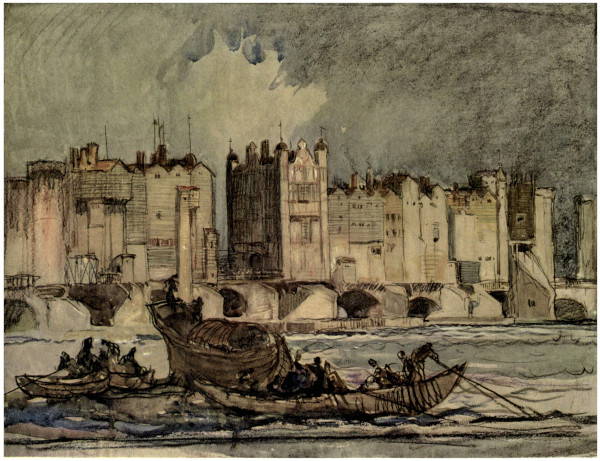
OLD LONDON BRIDGE, BEGUN BY PETER COLECHURCH IN 1176, AND FINISHED BY A FRENCHMAN, CALLED ISEMBERT, IN THE YEAR 1209
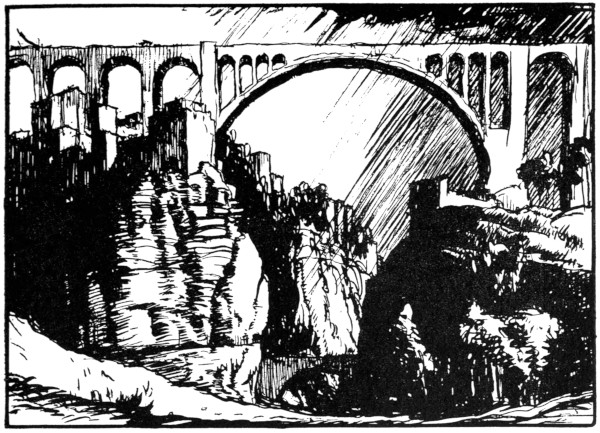
PONT SIDI RACHED AT CONSTANTINE, ALGERIA. BUILT IN 1908-1912
The span of the great arch is 70 metres. The work illustrates the longevity of custom and convention, being inspired partly by Roman aqueducts and partly by the two famous bridges over the Tech at Céret, in France, one of which dates from the year 1321. The span of its great arch is 45m. 45cm.
III
CUSTOM AND CONVENTION
Yet a pontist must be exceedingly careful when his tramps through any period bring him in touch with ethical problems. He should try to live on the highways of history, not in order to pass judgments on vice and on crime, but because he wants to see clearly, under the form of visual conception, why social concord and equity have never fared well, even the best forms of civilization being only half-educated barbarisms that allow their strife to be drilled by a vast number of active laws. These phases of compulsion go on increasing, yet they fail to resolve into harmony those rapacious egotisms that compete against each other in the body social like microbes in living tissues. As soon as a pontist understands his wayfaring through history, as soon as he feels at home in the general atmosphere of the human drama, he is glad to be a realist; then nothing that societies do or have done seems unexampled and inexplicable. To him, for example, the infanticide practised age after age by savage tribesmen is not more terrible than the death of babies in the slums of civilized towns, or than the degradation brought before his mind by the alert philanthropy that saves little English children from cruelties. To him, again, the slaughter on a great battlefield is not more woeful than the annual sacrifice of lives in street accidents, and railway smashes, and mine disasters, and sea tragedies; as well as in games and sports, in nursing the sick, and in all trades and professions. He is not scared by the fact that the sum of human life is war, but he is scared by the primordial customs and conventions that make the incessant war infinitely less humane than it could be and ought to be. So a pontist in his attitude to history is a sociologist, and not an abstract moralist. Each body social and its systems of circulation are to him what patients are to medical students in a hospital; he has to learn to be attentive to all disease and to make his diagnoses thoughtfully. Even then frequent mistakes will occur. One thing he must regard as his clinical thermometer: it is the truth that civilizations in their intercourse with right and wrong have been governed by habits and customs and conventions, which have caused most men to be other men; so that most human actions, whether studied in old history or in the current routine of living, are mere quotations from other human actions, instead of being like original ideas in a well-ordered composition. In other words, the ordinary human brain has tried to be automatic, as if to be in harmony with the rest of the vital organs.
Now the architecture of bridges, like that of huts and houses and cottages, never fails to keep before our minds the awful slowness of each reluctant advance from custom to custom, and from convention to convention. I have no words to describe the terror that comes to me when I find in daily use a type or species of bridge so aboriginal in its poor workmanship that a forerunner not only similar to it, but as rudely effective, may well have been employed by the earliest Flint Men, whose delight in imitation was stimulated by all the bridges which Nature had created. Even more, at this moment in England, and even in busy Lancashire, where to-day’s machinery abounds, there are primitive bridges which are not even primitively structural; bridges which need in their making not more thought than is given to a difficult sneeze when we are troubled by a cold (p. 60). When I look at them and think of the myriads of generations which in different parts of the world have used bridges akin to these, I am so awed with fear that I feel like a baby Gulliver in a new Brobdingnag where everlasting conventions are impersonated by brainless giants whose bodies are too vast for my eyes to focus. Often, too, I say to myself: “In the presence of this dreadful conservatism, this inept mimicry that endures unruffled by a thought for many thousands of years, you are as futile as a single microbe would be on a field of battle. Or imagine that the microbe is in Westminster Abbey, and that it has a blurred sense that makes it dimly conscious of all the many historic things there gathered together; then you have a figure of yourself in your relation to the mingled good and bad in history. For the Abbey shows in its architecture that convention, though a bane to ordinary minds, is the grammar of progress to the rare men of genius who from time to time shake the world free from its bondage to fixed customs and routines, and compel it to move on to other routines and customs, where it will dawdle until other geniuses come out of the dark and find in new mother-ideas a compulsive force that works a new liberation.”
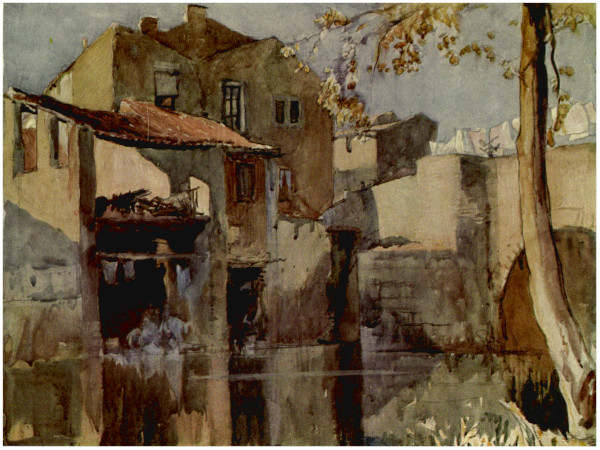
OLD BRIDGE OVER THE CLAIN, NEAR POITIERS
This, indeed, is the only encouragement that I am able to perceive when I watch in history the periodical strife between inveterate conventions and the mother-ideas of genius. In the case of bridges, for example, the first mother-ideas were those that enabled a primitive craftsman here and there to copy with success the least difficult of Nature’s models. What this man achieved was repeated by his tools, the ordinary men of his tribe; then other tribes got wind of the discovery and began to make similar bridges, until at last several conventions were formed, and they became widespread and stereotyped. When a convention was very simple and also effective for a given purpose, no one wished to see it developed, so it entered that domain of infertile mimicry where stone tools and weapons remained unpolished for years to be reckoned by scores of thousands. If experience had shown that chipped flint in a rough state would neither cut wood nor break human skulls, then at an early date polishing would have been found out by a savage of genius who yearned to prove that his invention could be made useful; but rough-hewn stones were rudely efficient, so mankind settled itself in a routine and plodded on and on automatically. And thus it was also in the case of many primitive bridges which became so firmly fixed in conventions that now they seem to be contemporary with nearly all the ages of human strife. Not in any other way can we explain their present use by many Europeans, as well as by the natives of Asia, and Africa, and America (p. 145). On the other hand, when a primeval bridge did not serve its purpose efficiently, when it was useless in tribal wars and dangerous in rainy seasons, then a mother-idea paid it a visit from time to time, as we shall see in the next chapter.
Whence the idea came we do not know. It entered a mind that was ready to receive it, coming unbidden from a place unknown like an abiding quest from a spirit world. The mind that welcomed the idea was neither masculine nor feminine, it was both, a thing androgynous, for genius has ever been a single creative agent with a double sex. The tools with which genius has worked—the selected traditions and conventions, the acquired knowledge, the original observation, and the handicrafts of social life—have ever been plain enough, of course; but to see and admire tools is not to understand the advent of those imperishable ideas which not only transform history, but turn all ordinary men into their mimics and mechanics. For instance, whenever we light a candle or a fire we obey the genius of a Palæolithic savage, who, with sparks beaten from flint into some inflammable grass or moss or fluff from cocoons, brought into the world the earliest missionaries, artificial light and heat. Similarly, whenever we walk across a timber bridge, whether old or new, we are servants to the earliest savage who with a stone axe cut down a tree, causing it to fall from bank to bank of a river or chasm. Delete from history even two mother-ideas—the invention of wheels, for example, and the evolution of arched bridges from Nature’s models—and how many civilizations would you cancel? Omit from the annals of our “modern democracy” not more than three mother-ideas: the discovery of steam as a motive-power, the discovery of microbes, and the use of metal in bridge building. In a twinkling we go back to the middle of the eighteenth century, when hospitals were cesspools, [14] when surgery and medicine were wild empirics, when travellers in stage-coaches longed for the general Turnpike Act (a boon delayed till 1773), and when England was unspoiled by jerry-builders and a factory system. A pontist, then, if he understands his subject, looks upon genius as the solar system of human societies, hence he cannot be a willing servant to any mob-rule or mob-worship.
On the contrary, he would gladly see in every town a fine church dedicated to the men and women of genius who with great mother-ideas have tried to better the strife of human adventure. For two reasons I used the phrase “have tried to better.” In the first place, the constituents of new knowledge, when mingled with the old customs and conventions, lose much of their good invariably; and, next, the amalgam thus formed may become explosive. At this moment we see in our new art, the art of flying, how precarious is the charity that mother-ideas bring into the battlefields of competition. What aeroplanes can do in war is already the only consideration that the mother-idea of mechanical flight receives from the most alert minds; and very soon military engineers will be called upon to invent bomb-proof covers for every strategic bridge which cannot be displaced by a tunnel. So we compel airmanship to torment us with visions of wrecked cities, when she ought to delight us with bird’s-eye views of happier countries.
In brief, the more we study mother-ideas the more clearly we perceive that they in themselves are phases of strife, for they have power to do harm as well as good. Providence for ever tries to quicken the inept human mind, since no blessing is granted to us without its attendant bane. Electricity has dangers of its own, so has fire; Pasteurism has dangers of its own, so has food; radium is curative and very perilous, like the sea or the sun; and all other good things ask us to pick our way with care between danger and utility.
The most tragic element of all in human indiscretion is the mindless routine which has deadened the brain of ordinary men. There is in Lancashire, for example, a charming valley where six or seven old bridges make a few minutes’ walk a very long pilgrimage through the history of primitive conventions. Wycollar the valley is called, and antiquaries and pontists ought to go there at once, but not in motor-cars that devour topography as well as miles. One bridge is exceedingly low in the scale of thought and skill; indeed, no prehistoric tool or weapon stands below it. Even the Adam of Evolution, if he ever lived in rock-strewn places, had common sense enough probably to choose a flat stone and to lay it across a deep rivulet, so as to save his children from danger. Such is the most primeval of the Wycollar bridges: three schoolboys could make a smaller one between two April showers. For the stone is not a huge slab ten feet long by four wide, such as we find not far from Fernworthy Bridge, Dartmoor; nor is it like the single slab over the Walla Brook on Dartmoor. It is a long lintel-stone, and in eight or nine strides a little girl would cross it easily.[15] If the stone were new, and also alone in the valley, no one would think more of it than of a plank used as a temporary bridge; but the stone is very old, and lintel-bridges are ancient customs in the valley of Wycollar. If Nature once in a century allowed bridges to tell their tales, I should expect two of the Wycollar historians to trace their lineage through a great many ancestors until at last they came to a time when the first nomads hacked their way with flint axes through the undergrowth of Lancashire forests, and cursed in primitive words or sounds at the virile brambles whose thorns were sharper than pointed flints.
The second bridge of lintel-stones at Wycollar is a simple adaptation from one of Nature’s bridges, the bridge of stepping-stones littered over the beds of rivers by earthquakes and floods. When the stepping-stones are long you turn them on end and use them as piers; when they are short and squat you pile them up into piers; then lintel-stones are put from pier to pier, and from pier to each bankside. Here is the A B C of primitive bridge-making with slabs, boulders, and fragments of rock. It needs very much less mother-wit than that which enabled primitive men to survive innumerable hardships, and to breed and rear those true artists who in Palæolithic times, about 50,000 years ago, [16] turned a good many European caves into the first public art galleries, famous for their rock-paintings and for their sculpture and engravings. Thus the Altamira Cavern, near Santander, in Northern Spain, and the La Madeleine cave in the Dordogne (about eighty miles east of Bordeaux), are among the prehistoric museums, or art galleries, which have given us work very far in advance of the Wycollar lintel-bridges; so far, indeed, that trees and shrubs in the valley ought to blush with shame by keeping autumn tints in their leaves all the year round. This hint from Dame Nature might awaken some little self-reproach in the Lancashire weavers and peasants whose heavy clogs clatter day after day over the lintel-stones, wearing them into troughs where rainwater collects pretty pictures from the sky.
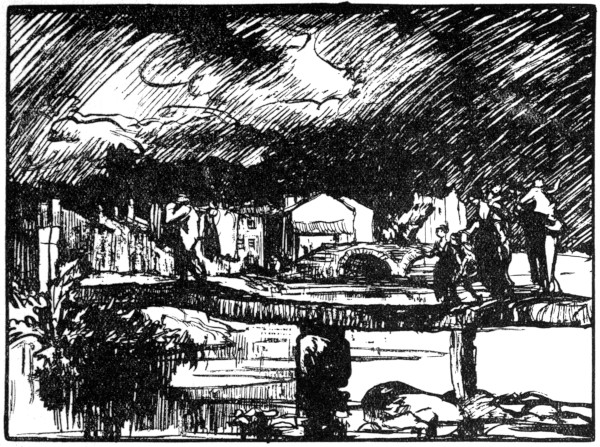
IN THE VALLEY OF WYCOLLAR, LANCASHIRE: THE WEAVERS’ BRIDGE
Not long ago a busy official mind in the neighbourhood was troubled by one of the bridges at Wycollar, named the Weavers’ Bridge, a dull-witted primitivity made with three lintel-stones and two rough piers in the water. Though the busy official mind was troubled it did not suggest that the bridge should be put under glass and kept with as much care as the perfect skeleton of a mastodon would receive; nor did it wish to build a successor in the cheapest style of industrial metal-work. No; what the official mind advertised as a fortunate inspiration was a foolish little act of commonplace vandalism. It set a mason to chisel out of existence the trough worn in the lintel-stones by generations of clog-wearers! I have two photographs, now historic, in which the trough can be seen distinctly; but the poor weavers have no such consolation. Their ancestors’ work has to be done all over again, and they know that their great-grandchildren will find in the lintel-stones not a trough but a vague hollow scarcely deep enough to hold a few raindrops. Mr. Sargisson wrote to tell me this pathetic story of a crisis in antiquarianism. But it is fair to add that the busy official mind was content with one foolish act; it spared the rude pillar on the left bank, though this rough stone looks like a small menhir and completes the primeval bridge.
And now let us look at the survival of convention under a form that is even more distressing. Is it true that in many times and lands human beings have been sacrificed not to bridges, but to the spirits of floods and storms which have been feared as destroyers of bridges? One good reference to this question will be found in Francis M. Crawford’s “Ave Roma Immortalis.” The most venerated bridge in ancient Rome was the Pons Sublicius, whose history dated from the time of Ancus Marcius, who reigned twenty-four years—B.C. 640-616. In much later times, long after the good fight that made Horatius Cocles famous for ever, strange ceremonies and superstitions lingered around the Pons Sublicius. On the Ides of May, which were celebrated on the fifteenth of the month, Pontiffs and Vestals came in solemn state to the bridge, accompanied by men who carried thirty effigies representing human bodies. The effigies were made of bulrushes, and one by one they were thrown into the Tiber, while the Vestals sang hymns or the priests chanted prayers. What did this rite signify? A tradition popular in Rome taught children to believe that the effigies took the place of human beings, once sacrificed to the river in May. This tradition is attacked by Ovid, “but the industrious Baracconi quotes Sextus Pompeius Festus to prove that in very early times human victims were thrown into the Tiber for one reason or another, and that human beings were otherwise sacrificed until the year of the City 657, when, Cnæus Cornelius Lentulus and Publius Licinius Crassus being consuls, the Senate made a law that no man should be sacrificed thereafter.”
It is possible, if not, indeed, probable, that the effigies were made at first in order to placate the common people who were indignant over the loss of a festival. We can imagine what would be said to-day if Cup-finals were stopped by Act of Parliament; and the Romans, in their fool-fury over “sport” at second-hand, were always glad to appease their curiosity with shows of bloodshed. Further, in the folk-lore of later times bridges and rivers are connected with the primitive rite of killing women and men as a sacrifice to evil spirits. This dread tradition is related now in the Asiatic provinces of Turkey, as I learn from Sir Mark Sykes, whose “Dar-Ul-Islam” is a book for pontists to read. It was at Zakho that Sir Mark heard the following legend:—
“Many years ago workmen under their master were set to build the bridge; three times the bridge fell, and the workmen said, ‘The bridge needs a life.’ And the master saw a beautiful girl, accompanied by a bitch and her puppies, and he said, ‘We will give the first [life] that comes by.’ But the dog and her little ones hung back, so the girl was built alive into the bridge, and only her hand with a gold bracelet upon it was left outside.
“At the foot of this bridge I found the local Agha, Yussuf Pasha, superintending the collection of the sheep-tax, in which as a large landowner he has an interest.”
Try to visualise in all their details these pictures, passing from to-day’s tax-gatherer, a Pasha Lloyd George, into the drama of a very terrible superstition. The workmen can be fitted with fairly good primitive characters, for they do not suggest the sacrifice of a life until the bridge has fallen thrice. As to their master, he is a fiend, since he acts upon their suggestion at once, unmoved by the girl’s beauty and the frisking springtime that accompanies her. A little dead hand—and a gleaming bracelet—and the masons chanting at their work, as bridge-builders chant now in Persia: so the drama ends, or so it would end if we could not unite it with a similar legend known almost everywhere in Europe.
Why in the Turkish story the workmen say, “The bridge needs a life,” I do not know. Their superstition goes away from the river and its evil spirits, and from those other demons, which in olden times made winds so variable. Are we then to suppose that men have defiled the charity of bridges with bad spirits other than those that live in wilted conventions and in modern engineers? I prefer to believe that a bridge that fell three times would muddle the superstition of any workman. In fact, there are many bridges which superstition—not modesty in men—has given to the Devil, and as a rule they have been connected with the same legend, or bogie tale. Mr. Baring-Gould takes a great interest in the bridges ascribed to the Devil, and writes about them as follows in his “Book of South Wales”:—
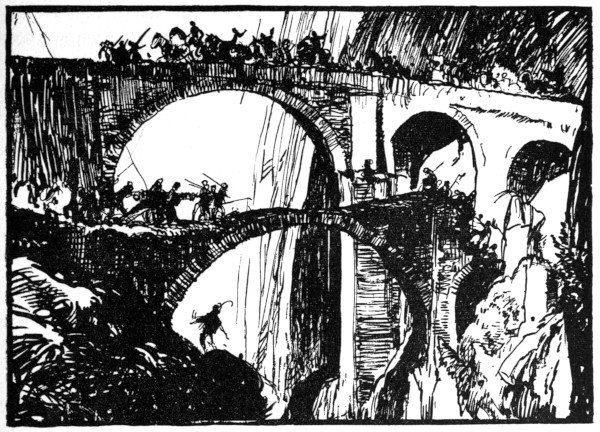
PONT DU DIABLE, ST. GOTTHARD PASS
“The Devil’s Bridge is twelve miles from Aberystwyth; it is over the Afon Mynach just before its junction with the Rheidol[17].... The original bridge was constructed by the monks of Strata Florida, at what time is unknown, but legend says it was built by the Devil.
Old Megan Llandunach, of Pont-y-Mynach, Had lost her only cow; Across the ravine the cow was seen, But to get it she could not tell how.
“In this dilemma the Evil One appeared to her cowled as a monk, and with a rosary at his belt, and offered to cast a bridge across the chasm if she would promise him the first living being that should pass over it when complete. To this she gladly consented. The bridge was thrown across the ravine, and the Evil One stood bowing and beckoning to the old woman to come over and try it. But she was too clever to do that. She had noticed his left leg as he was engaged on the construction, and saw that the knee was behind in place of in front, and for a foot he had a hoof.
In her pocket she fumbled, a crust out tumbled, She called her little black cur; The crust over she threw, the dog after it flew, Says she, ‘The dog’s yours, crafty sir!’
“Precisely the same story is told of S. Cadoc’s Causeway in Brittany; of the bridge over the Maine at Frankfort, and of many and many another.
“How comes it that we have an almost identical tale in so many parts of Europe? The reason is that in all such structures a sacrifice was offered to the Spirits of Evil who haunted the place. When a storm came down on the sea, Jonah had to be flung overboard to allay it. When, in the old English ballad, a ship remained stationary, though all sails were spread, and she could make no headway, the crew ‘cast the black bullets,’ and the lot falls to the captain’s wife, and she is thereupon thrown overboard. Vortigern sought to lay the foundations of his castle in the blood of an orphan boy. A dam broke in Holland in the seventeenth century; the peasants could hardly be restrained from burying a living child under it, when reconstructed, to ensure its stability.[18]
“When the [Cistercian] monks of Strata Florida threw the daring arch over the chasm, they so far yielded to the popular superstition as to bury a dog beneath the base of the arch, or to fling one over the parapet.”
There! We have followed a superstition—a vile convention in ignorance and cowardice—from the Pons Sublicius in Ancient Rome to the Pont-y-Mynach in South Wales; and the best we can say of it is that in Pagan Rome it went from human victims to effigies of men and women, while in Christian times it passed from human victims to dogs.[19] Mr. Baring-Gould has told us that in bridges, and “in all such structures, a sacrifice was offered to the Spirits of Evil who haunted the place.” Yet it was not in a structure—a finished building—that Vortigern wished to offer his sacrifice; he “sought to lay the foundations of his castle in the blood of an orphan boy,” so his aim was to placate the Spirits of Evil before his castle was built. As to his conception of the spiritual agencies to be appeased, it would mingle his own passions with the fears bred by his primitive fanaticism. For, as Darwin says, “savages would naturally attribute to spirits the same passions, the same love of vengeance or simplest form of justice, and the same affections which they themselves felt.”