A BOOK FOR A RAINY DAY
Reading edition
The Reader is requested to keep in mind that those events which I relate of myself when “mewling in my nurse’s arms,” and until my fourth year, were communicated to me by my parents, and that my statements from that period are mostly from my own memory;—Miranda proved to Prospero that she recollected an event in her fourth year.
1766.
My father informed me, that in the evening of the 23rd of June 1766, which must have been much about the time when Marylebone Gardens echoed the melodious notes of Tommy Lowe,[2] and whilst there was The Devil to Pay at Richmond with Mr. and Mrs. Love,[3] my mother, on returning from a visit to her brother, Mr. Edward Tarr,[4] became so seriously indisposed, that she most strenuously requested him to allow her to return home in a hackney coach, whilst he went to Jermyn Street for Dr. Hunter.[5] Upon that gentleman’s arrival at my father’s door, No. 7, in Great Portland Street,[6] Marylebone, he assisted the nurse in conveying my mother and myself to her chamber. Although I dare not presume to suppose that the vehicle in which I was born had been the equipage of the great John Duke of Marlborough, or Sarah his Duchess, at all events I probably may be correct in the conjecture that the hack was in some degree similar to those introduced by Kip, in his Plates for Strype’s edition of Stowe.[7]
Hackney chairs were then so numerous, that their stands extended round Covent Garden, and often down the adjacent streets;[8] these vehicles frequently enabled physicians to approach their patients in a warm state. The forms of those to which I allude are also given in Kip’s prints above mentioned; and who knows but that they, in their turn, have conveyed Voltaire from the theatre to his lodging in Maiden Lane?[9]
That sedans were of ancient use I make no doubt, as I find one introduced in Sir George Staunton’s Embassy to China.[10] Pliny has stated that his uncle was much accustomed to be carried abroad in a chair.[11] My parents, after a fireside debate, agreed that I should have two Christian names: John, after my grandfather, a Shropshire clothier, whose bust, modelled by my father, was one of the first publicly exhibited by the Associated Artists in 1763, before the establishment of the Royal Academy;[12] and Thomas, to the honour of our family, in remembrance of my great-uncle, Admiral Smith, better known under the appellation of “Tom of Ten Thousand,”[13] of whom I have a spirited half-length portrait, painted by the celebrated Richard Wilson, the landscape painter, previous to his visiting Rome, when he resided in the apartments on the north side of Covent Garden, which had been occupied first by Sir Peter Lely, and afterwards by Sir Godfrey Kneller.[14] From this picture there is an excellent engraving in mezzotinto, by Faber.
I have heard my mother relate, that when at Greenwich this year for the benefit of her health, an aged pie and cheesecake woman lived there, who was accompanied through the town by a goose, who regularly stopped at her customer’s door, and commenced a loud cackling; but that whenever the words “Not to-day” were uttered, off it waddled to the next house, and so on till the business of the day was ended. My mother also remarked, that when ladies walked out, they carried nosegays in their hands, and wore three immense lace ruffle cuffs on each elbow.[15]
In the month of March, this year, died Mary Mogg, at Oakingham, the woman who gave rise to Gay’s celebrated ballad of “Molly Mogg.”[16]
In all ages there has been a fashion in amusements, as well as in dress: grottoes, which were numerous round London, appear by the advertisements to have been places of great resort, but above all Finch’s, in St. George’s Fields, was the favourite. The following is a copy of one of the musical announcements:—
“6th of May, 1766.
“Mr. Houghton and Mr. Mitchell’s Night.
“At Finch’s Grotto Garden, This Day, will be performed a Concert of Vocal and Instrumental Music. Singing as usual.
“N.B. For that Night only, the Band will be enlarged. Tickets to be had at the Bar of the Gardens. Admittance One Shilling.”[17]
1767.
Being frequently thrown into my cradle by the servant, as a cross little brat, the care of my tender mother induced her to purchase one of Mr. Burchell’s anodyne necklaces, so strongly recommended by two eminent physicians, Dr. Tanner, the inventor, and Dr. Chamberlen, to whom he had communicated the prescription; and it was agreed by most of my mother’s gossiping friends, that the effluvia arising from it when warm acted in so friendly a manner, that my fevered gums were considerably relieved.[18]
Go-carts, the old appendages of our nurseries, continuing in use, I was occasionally placed in one; and as its advantages have been noticed in my work entitled Nollekens and his Times, I shall now only refer the reader for its form to Number 186 of “Rembrandt’s Etchings;”[19] that being similar, as my father informed me, to those used in London in my infantine days.[20]
The cradle having of late years been in a great degree superseded by what is called a cot,[21] and its shape not being remarkable, I shall for a moment beg leave to deal in a foreign market, in order to gratify the indefatigable organ of inquisitiveness of some of my readers, who may wish to know in what sort of cradle Stratford’s sweet Willy slumbered. Possibly it might in some respects have accorded with the representation of one in a small plate by Israel Von Meckenen,[22] and this conjecture is not improbable, as that plate was engraved about the sixteenth century; and it is well known that in most articles of furniture, as well as dress, we had long borrowed from our continental neighbours, whether good, bad, or indifferent. It gives me great pleasure to observe that, owing to the vast improvements made by our draughtsmen for English upholsterers, in every article of domestic decorative furniture, England has now little occasion to borrow from other nations.
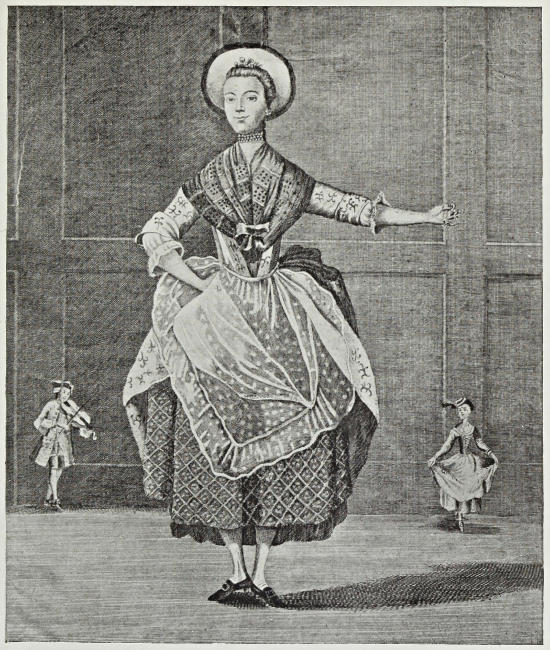
NANCY DAWSON
“See how she comes to give surprise With joy and pleasure in her eyes.” Old Song, “Nancy Dawson”
Nancy Dawson, the famous hornpipe dancer, died this year, May 27th, at Hampstead; she was buried behind the Foundling Hospital, in the ground belonging to St. George the Martyr, where there is a tombstone to her memory, simply stating, “Here lies Nancy Dawson.” Every verse of a song in praise of her, declares the poet to be dying for Nancy Dawson; and its tune, which many of my readers must recollect, is, in my opinion, as lively as that of “Sir Roger de Coverley.” I have been informed that Nancy, when a girl, set up the skittles at a tavern in High Street, Marylebone.[23] Sir William Musgrave, in his Adversaria (No. 5719), in the British Museum, says that “Nancy Dawson was the wife of a publican near Kelso, on the borders of Scotland.”[24]
1768.
At the age when most children place things on their heads and cry “Hot pies!” I displayed a black pudding upon mine, which my mother, careful soul, had provided for its protection in case I should fall. This is another article mentioned in Nollekens and his Times; and having there stated that Rubens, in a picture at Blenheim, had painted one on the head of a son of his, walking with his wife Elenor,[25] and as the mothers of future days may wish to know its shape, I beg to inform them that there is an engraving of it by MacArdell. But as the receipt for a pet pudding would be of little use to the maker were one ingredient omitted, it would be equally difficult to produce a similar black pudding to mine, were I not to state that it was made of a long narrow piece of black silk or satin, padded with wadding, and then formed to the head according to the taste of the parent, or similar to that of little Rubens.[26]
In this year the Royal Academy was founded, consisting of members who had agreed to withdraw themselves from various clubs, not only in order to be more select as to talent, but perfectly correct as to gentlemanly conduct. It would have been a valuable acquisition to the History of the Fine Arts in England, had Mr. Howard favoured us with the Rise and Progress of the Royal Academy.[27]
Perhaps no one could have been more talked of than Mr. Wilkes, particularly on May 10th, when a riot took place on account of his imprisonment.[28] His popularity was carried to so great an extent, that his friends in all classes displayed some article on which his effigy was portrayed, such as salad or punch bowls, ale or milk jugs, plate, dishes, and even heads of canes. The squib engravings of him, published from the commencement of his notoriety to his silent state when Chamberlain of London, would extend to several volumes. Hogarth’s portrait of him, which by the collectors was considered a caricature, my father recommended as the best likeness.
The following memoranda respecting Henry Fuseli, R.A., are extracted from the Mitchell Manuscripts in the British Museum. The letter is from Mr. Murdock, of Hampstead, to a friend at Berlin, dated Hampstead, 12th June 1764:—
“I like Fuseli very much; he comes out to see us at times, and is just now gone from this with your letter to A. Ramsay, and another from me. He is of himself disposed to all possible economy; but to be decently lodged and fed, in a decent family, cannot be for less than three shillings a day, which he pays. He might, according to Miller’s wish, live a little cheaper; but then he must have been lodged in some garret, where nobody could have found their way, and must have been thrown into ale-houses and eating-houses, with company every way unsuitable, or, indeed, insupportable to a stranger of any taste; especially as the common people are of late brutalised.
“Some time hence, I hope, he may do something for himself; his talent at grouping figures, and his faculty of execution, being really surprising.”
In the same volume, in a letter dated Hampstead, 12th Jan. 1768, the same writer says to the same friend—
“Fuseli goes to Italy next spring, by the advice of Reynolds (our Apelles), who has a high opinion of his genius, and sees what is wanting to make him a first-rate.”[29]
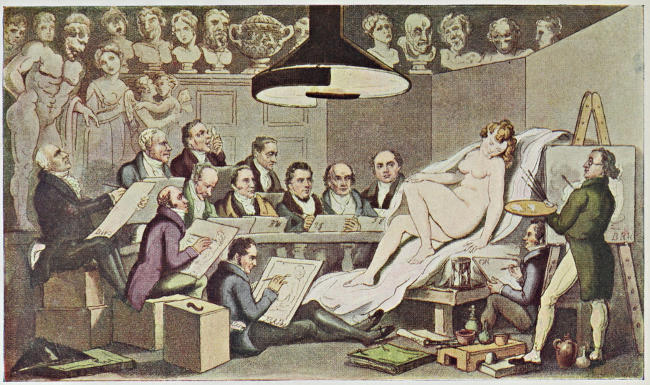
R.A.’S REFLECTING ON THE TRUE LINE OF BEAUTY AT THE LIFE ACADEMY, SOMERSET HOUSE.
In another, dated Hampstead, 13th December 1768: “Fuseli is still here; but proposes to set out for Italy as soon as his friends can secure to him fifty pounds yearly, for a few years. Dr. Armstrong,[30] who admires his genius, has taxed himself at ten pounds, and has taken us in for as much more; and indeed it were shameful that such talents should be sunk for want of a little pecuniary aid.”
The ladies this year wore half a flat hat as an eye-shade.
1769.
Lord North, in a letter addressed to Sir Eardley Wilmot from Downing Street, bearing date this year, April 1st, says—
“My friend Colonel Luttrell having informed me that many persons depending upon the Court of Common Pleas are freeholders of Middlesex, etc., not having the honour of being acquainted with you himself, desires me to apply to you for your interest with your friends in his behalf. It is manifest how much it is for the honour of Parliament, and the quiet of this country in future times, that Mr. Wilkes should have an antagonist at the next Brentford election; and that his antagonist should meet with a respectable support. The state of the country has been examined, and there is the greatest reason to believe that the Colonel will have a very considerable show of legal votes, nay, even a majority, if his friends are not deterred from appearing at the poll. It is the game of Mr. Wilkes and his friends to increase those alarms, but they cannot frighten the candidate from his purpose; and I am very confident that the voters will run no risk. I hope, therefore, you will excuse this application. There is nothing, I imagine, that every true friend of this country must wish more than to see Mr. Wilkes disappointed in his projects; and nothing, I am convinced, will defeat them more effectually, than to fill up the vacant seat for Middlesex, especially if it can be done for a fair majority of legal votes.
“I am, Sir, with the greatest truth and respect, your most faithful, humble servant,
“North.”
The Judge, in his answer, dated on the following day, observed, “It would be highly improper for me to interfere in any shape in that election.” (See the Wilmot Letters, in the British Museum.)[31]
This year ladies continued to walk with fans in their hands.
1770.
Most of the citizens who had saved money were very fond of retiring to some country-house, at a short distance from the Metropolis, and more particularly to Islington, that being a selected and favourite spot. Charles Bretherton, Jun., made an etching, from a drawing by Mr. Bunbury,[32] of a Londoner, of the above description, whose waistcoat-pockets were large enough to convey a couple of fowls from a City feast home to his family. The print is entitled, “The Delights of Islington,” and bears the following inscription at the top:—
WHEREAS my new Pagoda has been clandestinely carried off, and a new pair of Dolphins taken from the top of the Gazebo, by some Bloodthirsty Villains; and whereas a great deal timber has been cut down and carried away from the Old Grove, that was planted last Spring, and Pluto and Proserpine thrown into my Basin: from henceforth, Steel Traps and spring guns will be constantly set for the better extirpation of such a nest of villains,
By me, Jeremiah Sago.
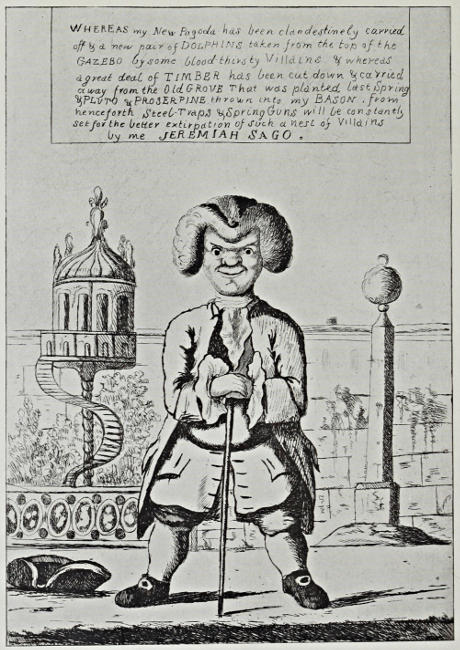
“THE DELIGHTS OF ISLINGTON”
On a garden notice-board, in another print, also after Bunbury, published at the same time, is inscribed,
THE NEW PARADISE.
No Gentlemen or Ladies to be admitted with nails in their shoes.[33]
For the information of the collectors of Bunbury’s prints, I beg to state that there is in Mrs. Banks’s collection of visiting cards, etc., in the British Museum, a small etching said to have been his very first attempt when at Westminster School. It represents a fellow riding a hog, brandishing a birch-broom by way of a baster, with another at a short distance, hallooing.
As Mr. Walpole is silent as to Jonathan Richardson’s place of interment, the biographical collector will find the following inscription in the burial-ground behind the Foundling Hospital, belonging to the parish of St. George the Martyr:—
Elizabeth Richardson, Died 24th Dec. 1767, Aged 74 years. Jonathan Richardson, Died 10th June, 1771, Aged 77; both of this parish.[34]
1771.
The gaiety during the merry month of May was to me most delightful; my feet, though I knew nothing of the positions, kept pace with those of the blooming milkmaids, who danced round their garlands of massive plate, hired from the silversmiths to the amount of several hundreds of pounds, for the purpose of placing round an obelisk, covered with silk fixed upon a chairman’s horse. The most showy flowers of the season were arranged so as to fill up the openings between the dishes, plates, butter-boats, cream-jugs, and tankards. This obelisk was carried by two chairmen in gold-laced hats, six or more handsome milkmaids in pink and blue gowns, drawn through the pocket-holes, for they had one on either side: yellow or scarlet petticoats, neatly quilted, high-heeled shoes, mob-caps, with lappets of lace resting on their shoulders; nosegays in their bosoms, and flat Woffington hats, covered with ribbons of every colour. But what crowned the whole of the display was a magnificent silver tea-urn which surmounted the obelisk, the stand of which was profusely decorated with scarlet tulips. A smart, slender fellow of a fiddler, commonly wearing a sky-blue coat, with his hat profusely covered with ribbons, attended; and the master of the group was accompanied by a constable, to protect the plate from too close a pressure of the crowd, when the maids danced before the doors of his customers.[35]
One of the subjects selected by Mr. Jonathan Tyers, for the artists who decorated the boxes for supper-parties in Vauxhall Gardens,[36] was that of Milkmaids on May-day. In that picture (which, with the rest painted by Hayman and his pupils, has lately disappeared) the garland of plate was carried by a man on his head; and the milkmaids, who danced to the music of a wooden-legged fiddler, were extremely elegant. They had ruffled cuffs, and their gowns were not drawn through their pocket-holes as in my time; their hats were flat, and not unlike that worn by Peg Woffington, but bore a nearer shape to those now in use by some of the fish-women at Billingsgate. In Captain M. Laroon’s Cries of London, published by Tempest, there is a female entitled “A Merry Milkmaid.”[37] She is dancing with a small garland of plate upon her head; and from her dress I conclude that the Captain either made his drawing in the latter part of King William III.’s reign, or at the commencement of that of Queen Anne.
1772.
My dear mother’s declining state of health urged my father to consult Dr. Armstrong,[38] who recommended her to rise early and take milk at the cowhouse. I was her companion then; and I well remember that, after we had passed Portland Chapel, there were fields all the way on either side. The highway was irregular, with here and there a bank of separation; and that when we had crossed the New Road, there was a turnstile (called in an early plan, which I have seen since, “The White House”), at the entrance of a meadow leading to a little old public-house, the sign of the “Queen’s Head and Artichoke”: it was much weather-beaten, though perhaps once a tolerably good portrait of Queen Elizabeth. The house was reported to have been kept by one of Her Majesty’s gardeners.[39]
A little beyond a nest of small houses contiguous, was another turnstile opening also into fields, over which we walked to the Jew’s Harp House, Tavern and Tea Gardens.[40] It consisted of a large upper room, ascended by an outside staircase, for the accommodation of the company on ball nights; and in this room large parties dined. At the south front of these premises was a large semicircular enclosure with boxes for tea and ale drinkers, guarded by deal-board soldiers between every box, painted in proper colours. In the centre of this opening were tables and seats placed for the smokers. On the eastern side of the house there was a trapball-ground; the western side served for a tennis-hall; there were also public and private skittle-grounds. Behind this tavern were several small tenements, with a pretty good portion of ground to each. On the south of the tea-gardens a number of summer-houses and gardens, fitted up in the truest Cockney taste; for on many of these castellated edifices wooden cannons were placed; and at the entrance of each domain, of about the twentieth part of an acre, the old inscription of “Steel-traps and spring-guns all over these grounds,” with an “N.B. Dogs trespassing will be shot.”
In these rural retreats the tenant was usually seen on Sunday evening in a bright scarlet waistcoat, ruffled shirt, and silver shoe-buckles, comfortably taking his tea with his family, honouring a Seven-Dial friend with a nod on his peregrination to the famed Wells of Kilburn. Willan’s farm,[41] the extent of my mother’s walk, stood at about a quarter of a mile south; and I remember that the room in which she sat to take the milk was called “Queen Elizabeth’s Kitchen,” and that there was some stained glass in the windows.
On our return we crossed the New Road; and, after passing the back of Marylebone Gardens,[42] entered London immediately behind the elegant mansions on the north side of Cavendish Square. This Square was enclosed by a dwarf brick wall, surmounted by heavy wooden railing. Harley Fields had for years been resorted to by thousands of people, to hear the celebrated Mr. George Whitefield, whose wish, like that of Wesley, when preaching on execution days at Kennington Common, was to catch the ears of the idlers. I should have noticed Kendall’s farm,[43] which in 1746 belonged to a farmer of the name of Bilson, a pretty large one, where I have seen eight or ten immense hay-ricks all on a row; it stood on the site of the commencement of the present Osnaburg Street, nearly opposite the “Green Man,” originally called the “Farthing Pie House.”[44]
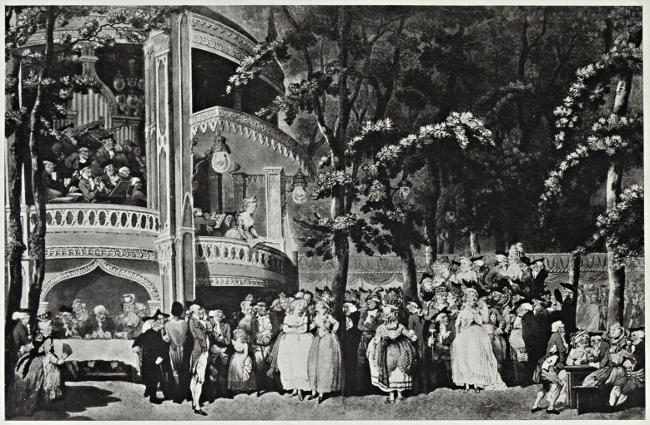
“SING TANTARARA—VAUXHALL! VAUXHALL!”
To the honour of our climate, which is often abused, perhaps no country can produce instances of longevity equal to those of England of this year, viz.:—at 100, 2; 101, 5; 102, 6; 103, 3; 105, 4; 106, 3; 107, 4; 108, 5; 109, 4; 110, 2; 111, 2; 112, 3; 114, 1; 118, 1; 125, Rice, a cooper in Southwark; 133, Mrs. Keithe, at Newnham, in Gloucestershire; 138, the widow Chun, at Ophurst, near Lichfield.[45]
1773.
The “Mother Red-cap,” at Kentish Town, was a house of no small terror to travellers in former times. This house was lately taken down, and another inn built on its site; however, the old sign of “Mother Red-cap” is preserved on the new building. It has been stated that Mother Red-cap was the “Mother Damnable” of Kentish Town in early days; and that it was at her house the notorious “Moll Cut-purse,” the highway-woman of the time of Oliver Cromwell, dismounted and frequently lodged.[46]
As few persons possess so retentive a memory as myself, I make no doubt that many will be pleased with my recollections of the state of Tottenham Court Road at this time. I shall commence at St. Giles’s churchyard, in the northern wall of which there was a gateway of red and brown brick. Over this gate, under its pediment, was a carved composition of the Last Judgment, not borrowed from Michael Angelo, but from the workings of the brain of some ship-carver.[47] This was and is still admired by the generality of ignorant observers, as much as Mr. Charles Smith[48] the sculptor’s “Love among the Roses” is by the well-informed; and, perhaps, a more correct assertion was never made than that by the late worthy Rev. James Bean,[49] when speaking of an itinerant musician, “that bad music was as agreeable to a bad ear as that of Corelli or Pergolesi was to persons who understood the science.”
At this gate stood for many years an eccentric but inoffensive old man called “Simon,” some account of whom will be found in a future page. Nearly on the site of the new gate, in which this basso relievo has been most conspicuously placed, stood a very small old house towards Denmark Street, tottering for several years whenever a heavy carriage rolled through the street, to the great terror of those who were at the time passing by.
I must not forget to observe that I recollect the building of most of the houses at the north end of New Compton Street (Dean Street and Compton Street, Soho, were named in compliment to Bishop Compton, Dean of St. Paul’s, who held the living of St. Anne), and I also remember a row of six small almshouses, surrounded by a dwarf brick wall, standing in the middle of High Street.[50]
On the left-hand of High Street, passing on to Tottenham Court Road, there were four handsomely finished brick houses, with grotesque masks on the key-stones above the first-floor windows, probably erected in the reign of Queen Anne. These houses have lately been rebuilt without the masks; fortunately my reader may be gratified with a sight of such ornaments in Queen Square, Westminster.[51] There is a set of engravings of masks, of a small quarto size, considered as the designs of Michael Angelo; and in the sale of Mr. Moser, the first keeper of the Royal Academy, which took place at Hutchinson’s in 1783, were several plaster casts, considered to be taken from models by him. The next object of notoriety is a large circular boundary stone, let into the pavement in the middle of the highway, exactly where Oxford Street and Tottenham Court Road meet in a right angle. When the charity boys of St. Giles’s parish walk the boundaries, those who have deserved flogging are whipped at this stone, in order that, as they grow up, they may remember the place, and be competent to give evidence should any dispute arise with the adjoining parishes. Near this stone stood St. Giles’s Pound.[52] Two old houses stood near this spot on the eastern side of the street, where the entrance gates of Meux’s brewery have been erected: between the second-floor windows of one of them the following inscription was cut in stone: “Opposite this house stood St. Giles’s Pound.” This spot has been rendered popular by a song, attributed to the pen of a Mr. Thompson, an actor of the Drury Lane Company:
“On Newgate steps Jack Chance was found, Bred up near St. Giles’s Pound.”[53]
The ground behind the north-west end of Russell Street was occupied by a farm occupied by two old maiden sisters of the name of Capper. They wore riding-habits, and men’s hats; one rode an old grey mare, and it was her spiteful delight to ride with a large pair of shears after boys who were flying their kites, purposely to cut their strings; the other sister’s business was to seize the clothes of the lads who trespassed on their premises to bathe.[54]
From Capper’s farm were several straggling houses; but the principal part of the ground to the “King’s Head,” at the end of the road, was unbuilt upon. The “Old King’s Head” forms a side object in Hogarth’s beautiful and celebrated picture of the “March to Finchley,” which may be seen with other fine specimens of art in the Foundling Hospital, for the charitable donation of one shilling.
I shall now recommence on the left-hand side of the road, noticing that on the front of the first house, No. 1, in Oxford Street, near the second-floor windows, is the following inscription cut in stone: Oxford Street, 1725. In Aggas’s plan of London, engraved in the beginning of the reign of Queen Elizabeth, the commencement of this street is designated “The Waye to Uxbridge”; farther on in the same plan the highway is called “Oxford Road.” Hanway Street, better known by the vulgar people under the name of Hanover Yard, was at this time the resort of the highest fashion for mercery and other articles of dress. The public-house, the sign of the “Blue Posts,” at the corner of Hanway Street, in Tottenham Court Road, was once kept by a man of the name of Sturges, deep in the knowledge of chess, upon which game he published a little work, as is acknowledged on his tombstone in St. James’s burial-ground, Hampstead Road.[55] From the “Blue Posts” the houses were irregularly built to a large space called Gresse’s Gardens, thence to Windmill Street, strongly recommended by physicians for the salubrity of the air. The premises occupied by the French charity children were held by the founders of the Middlesex Hospital, which were established in 1755, where the patients remained until the present building was erected in Charles Street. Colvill Court, parallel with Windmill Street northward, was built in 1766; and Goodge Street,[56] farther on, was, I conjecture, erected much about the same time. Mr. Whitefield’s chapel was built in 1754, upon the site of an immense pond, called The Little Sea. This pond, so called, is inserted in Pine and Tinney’s plan of London, published in 1742, and also in the large one issued by the same persons in 1746.[57] Beyond the chapel[58] the four dwellings, then called “Paradise Row,” almost terminated the houses on that side. A turnstile opened into Crab-tree Fields.[59] They extended to the “Adam and Eve” public-house, the original appearance of which Hogarth has also introduced into his picture of the “March to Finchley.” It was at this house that the famous pugilistic skill of Broughton and Slack was publicly exhibited, upon an uncovered stage, in a yard open to the North Road.[60]
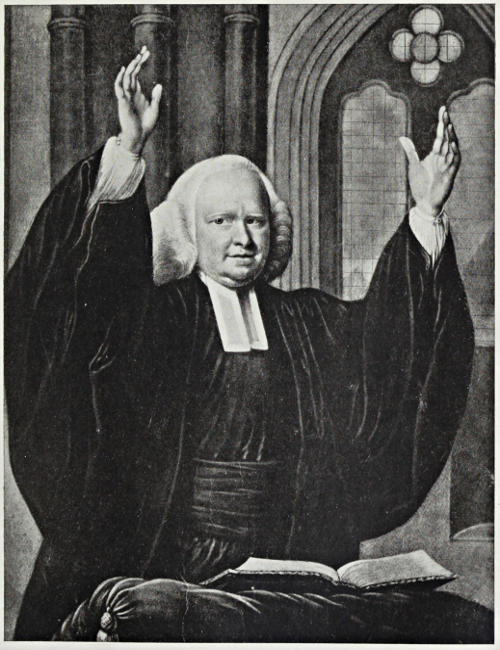
GEORGE WHITEFIELD
“Fain would I die preaching.”
The rare and beautiful etching of the before-mentioned picture by Hogarth was the production of Luke Sullivan,[61] a native of Ireland, but how he acquired his knowledge of art I have not been able to learn; most probably he was of Dame Nature’s school, where pupils can be taught gratis the whole twenty-four hours of every day as long as the world lasts. Sullivan’s talents were not confined to the art of engraving; he was, in my humble opinion, the most extraordinary of all miniature painters. I have three or four of his productions, one of which was so particularly fine, that I could almost say I have it on my retina at this moment. It was the portrait of a most lovely woman as to features, flesh, and blood. She was dressed in a pale green silk gown, lapelled with straw-coloured satin; and in order to keep up a sweetness of tone, the artist had placed primroses in her stomacher; the sky was of a warm green, which blended harmoniously with the carnations of her complexion; her hair was jet, and her necklace of pearls.
Lord Orford, whose early attachment to the sleepy-eyed beauties of King Charles II.’s Court, and those with the lascivious leer of that of Louis XIV., as may be inferred by their numerous portraits in the cabinets at Strawberry Hill, would no doubt have preferred his favourites, Cooper and Petitot—names eternally, and many times unjustly, extolled by the admirers of their works to the injury of our artists, whose talents equal, if not surpass, those of every country put together, in, I think I may say, every branch of the fine arts. Upon this too general opinion of the pre-eminence of Petitot, I have now and then had a battle with Mr. Paul Fischer, the miniature painter, who certainly has produced some most highly finished and excellent likenesses of the Royal Family and several persons of fashion, particularly of King George IV. and Sir Wathen Waller, Bart.[62]
Notwithstanding Tottenham Court Road was so infested by the lowest order, who kept what they called a Gooseberry Fair,[63] it was famous at certain times of the year, particularly in summer, for its booths of regular theatrical performers, who deserted the empty benches of Drury Lane Theatre, under the mismanagement of Mr. Fleetwood,[64] and condescended to admit the audience at sixpence each. Mr. Yates, and several other eminent performers, had their names painted on their booths.
The whole of the ground north from Capper’s farm, at the back of the British Museum, so often mentioned as being frequented by duellists, was in irregular patches, many fields with turnstiles. The pipes of the New River Company were propped up in several parts to the height of six and eight feet, so that persons walked under them to gather watercresses, which grew in great abundance and perfection, or to visit the “Brothers’ Steps,” well known to the Londoners. Of these steps there are many traditionary stories; the one generally believed is, that two brothers were in love with a lady, who would not declare a preference for either, but coolly sat upon a bank to witness the termination of a duel, which proved fatal to both. The bank, it is said, on which she sat, and the footmarks of the brothers when pacing the ground, never produced grass again. The fact is that these steps were so often trodden that it was impossible for the grass to grow. I have frequently passed over them; they were in a field on the site of Mr. Martin’s chapel, or very nearly so, and not on the spot as communicated to Miss Porter, who has written an entertaining novel on the subject.[65]
Aubrey, in his Miscellanies, states: “The last summer, on the day of St. John Baptist (1694), I accidentally was walking in the pasture behind Montague House; it was twelve o’clock. I saw there about two or three and twenty young women, most of them well habited, on their knees very busie, as if they had been weeding. I could not presently learn what the matter was; at last a young man told me that they were looking for a coal under the root of a plantain to put under their heads that night, and they should dream who would be their husbands. It was to be found that day and hour.”[66]
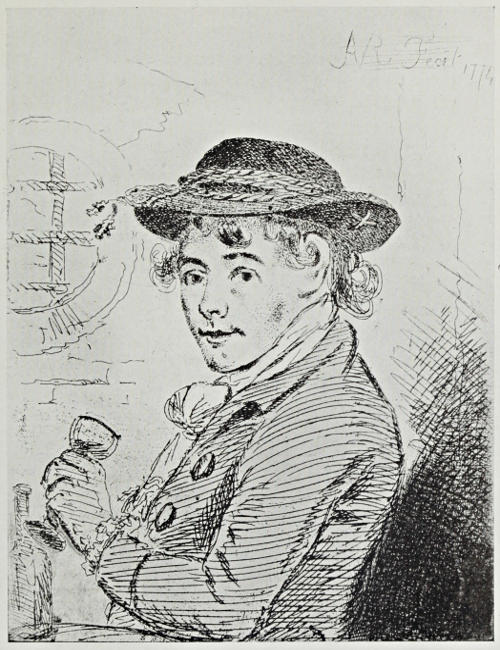
JOHN RANN
“Sixteen String Jack.”
1774.
I well remember when, in my eighth year, my father’s playfellow, Mr. Joseph Nollekens, leading me by the hand to the end of John Street, to see the notorious terror of the king’s highways, John Rann, commonly called Sixteen-string Jack, on his way to execution at Tyburn, for robbing Dr. Bell, Chaplain to the Princess Amelia, in Gunnesbury Lane. The Doctor died a Prebendary of Westminster. It was pretty generally reported that the sixteen strings worn by this freebooter at his knees were in allusion to the number of times he had been acquitted. Fortunately for the Boswell illustrators, there is an etched portrait of him; for, be it known, thief as he was, he had the honour of being recorded by Dr. Johnson.[67] Rann was a smart fellow, a great favourite with a certain description of ladies, and had been coachman to Lord Sandwich, when his Lordship resided in the south-east corner-house of Bedford Row. The malefactor’s coat was a bright pea-green; he had an immense nosegay, which he had received from the hand of one of the frail sisterhood, whose practice it was in those days to present flowers to their favourites from the steps of St. Sepulchre’s church, as the last token of what they called their attachment to the condemned,[68] whose worldly accounts were generally brought to a close at Tyburn, in consequence of their associating with abandoned characters. On our return home, Mr. Nollekens, stooping close to my ear, assured me that, had his father-in-law, Mr. Justice Welch, been high constable, we could have walked all the way to Tyburn by the side of the cart.[69]
At this time houses in High Street, Marylebone, particularly on the western side, continued to be inhabited by families who kept their coaches, and who considered themselves as living in the country, and perhaps their family affairs were as well known as they could have been had they resided at Kilburn.[70] In Marylebone, great and wealthy people of former days could hardly stir an inch without being noticed; indeed, so lately as the year 1728, the Daily Journal assured the public that “many persons arrived in London from their country-houses in Marylebone”; and the same publication, dated October 15th, conveys the following intelligence:—
“The Right Hon. Sir Robert Walpole comes to town this day from Chelsea.”
The following lines were inserted by the late Sir William Musgrave, in his Adversaria (No. 5721):—
“Sir Robert Walpole in great haste Cryed, ‘Where’s my fellow gone?’ It was answered by a man of taste, ‘Your fellow, Sir, there’s none.’”
One Sunday morning my mother allowed me, before we entered the little church[71] in High Street, Marylebone, to stand to see the young gentlemen of Mr. Fountayne’s boarding-school cross the road, while the bell was chiming for sacred duties. I remember well a summer’s sun shone with full refulgence at the time, and my youthful eyes were dazzled with the various colours of the dresses of the youths, who walked two and two, some in pea-green, others sky-blue, and several in the brightest scarlet; many of them wore gold-laced hats, while the flowing locks of others, at that time allowed to remain uncut at schools, fell over their shoulders. To the best of my recollection, the scholars amounted to about one hundred. As the pleasurable and often idle scenes of my schoolboy days are pictured upon my retina whenever Crouch End, or the name of my venerable master, Norton,[72] are mentioned, and as others may feel similar delight with respect to the places at which they received their early education, I shall endeavour to gratify a few of my readers by a description of the house and playground of Mr. Fountayne’s academy. For this purpose it may not be irrelevant to notice something of the antiquity of that once splendid mansion, in which so many persons have passed their early and innocent hours.
Topographers who mention Marylebone Park inform us that foreign ambassadors were in the time of Queen Elizabeth and James I. amused there by hunting, and that the oldest parts of this school were the remains of the palace in which they were entertained. The earliest topographical representation which I am enabled to instance, is a drawing made by Joslin, dated 1700, formerly in the possession of his Grace the Duke of Buckingham, of which I published an etching. It comprehends the field-gate and palace, its surrounding walls and adjacent buildings in Marylebone to the south-west, including a large mansion, which in all probability had been Oxford House, the grand receptacle of the Harleian Library. Fortune, I am sorry to say, has not favoured me with the power of continuing the declining history of the palace to the period at which it became an academy, nor can I discover the time in which Monsieur de la Place first occupied it.[73] A daughter of De la Place married the Rev. Mr. Fountayne,[74] whose name the school retained until its final demolition in 1791, at which period I remember seeing the large stone balls taken from the brick piers of the gates.
Of this house, when a school, I recollect a miserably executed plate by Roberts, probably for some magazine; there is also a quarto plate displaying a knowledge in perspective, engraved by G. T. Parkyns, from a drawing by J. C. Barrow;[75] but the most interesting, and I must consider the most correct, are four drawings made by Michael Angelo Rooker,[76] formerly in my possession, but now in the illustrated copy of Pennant’s London in the British Museum.[77] These have enabled me to insert the following description of a few parts of the mansion. The first drawing is a view of the principal and original front of the palace, or manor-house, with other buildings open to the playground; it was immediately within the wall on the east side of the road, then standing upon the site of the present Devonshire Mews. This house consisted of an immense body and two wings, a projecting porch in the front, and an enormously deep dormer roof, supported by numerous cantilevers, in the centre of which there was, within a very bold pediment, a shield surmounted by foliage with labels below it. The second drawing exhibits the back, or garden front, which consisted of a flat face with a bay window at each end, glazed in quarries;[78] the wall of the back front terminated with five gables. In the midst of some shrubs stands a tall, lusty gentleman dressed in black, with a white Busby-wig and a three-cornered hat, possibly intended for the figure of the Rev. Mr. Fountayne, as he is directing the gardener to distribute some plants. The third drawing, which is taken from the hall, exhibits the grand staircase, the first flight of which consisted of sixteen steps; the hand-rails were supported with richly carved perforated foliage, from its style, probably of the period of Inigo Jones. The fourth drawing consists of the decorations of the staircase, which was tessellated. This mansion was wholly of brick, and surmounted by a large turret containing the clock and bell. Mr. Fountayne was noticed by Handel as well as Clarke, the celebrated Greek scholar.[79] These gentlemen frequently indulged in musical parties, which were attended by persons of rank and worth, as well as fashion and folly.
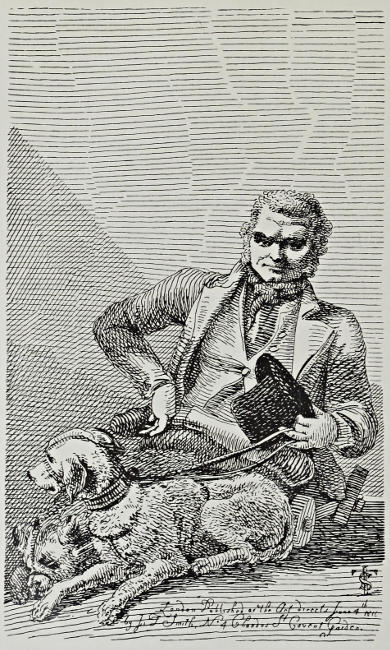
LONDON BEGGARS
ETCHED BY J. T. SMITH
John Mac Nally … “well known about Parliament Street, and the Surrey foot of Westminster Bridge.”
Mrs. Fountayne was a vain, dashing woman, extremely fond of appearing at Court, for which purpose, as was generally known, she borrowed Lady Harrington’s jewels.[80] Indeed, her passion for display was carried to such an extreme, that she kept her carriage, and that without the knowledge of her husband, by the following artful manœuvre. As the scholars were mostly sons of persons of title and large fortunes, she professed to have many favourites, who had behaved so well that she was often tempted to take them to the play, which so pleased the parents that they liberally reimbursed her in the coach and theatrical expenses, though she actually obtained orders upon those occasions from her friend Mrs. Yates, by which contrivance she was enabled to keep the vehicle in which they were conveyed to the theatres; Mrs. Yates,[81] however, was amply repaid for her orders by the number of tickets which Mrs. Fountayne prevailed on the parents of the scholars to take at her benefits.[82]
Previous to a consultation of physicians respecting the doubtful case of a young gentleman boarder, one of Mr. Fountayne’s daughters overheard something like the following dialogue by placing herself behind the window hangings:—Doctor: “You look better.”—“Yes, sir; I now eat suppers, and wear a double flannel jacket.” At this time the lady behind the curtains tittered. “Hark! what noise is that?” interrogated an old member of Warwick Lane’s far-famed college.[83] “Oh,” said another of the faculty, “it’s only the sneezing of a cat.” After this, instead of saying a word about magnesia, Gaskin’s powder, or oil of sweet almonds, they resumed their conversation upon their indulgences, and finally ended with some severe philippic upon Lord North’s administration. This occupied a considerable portion of their time before the house-apothecary (who had called them in) was questioned as to what he had given the patient. His draught being perfectly consistent with the college pharmacopœia, they all agreed that he could not do better than repeat it as often as he thought proper; and thus the important consultation ended.
In the hall of this house was a parrot, so aged that its few remaining feathers were for years confined to its wrinkled skin by a flannel jacket, which in very cold weather received an additional broadcloth covering of the brightest scarlet, so that Poll, like the Lord Mayor, had her scarlet days. Poll, who had been long accustomed to hear her mistress’s general invitation to strangers who called to inquire after the boarders, relieved her of that ceremony by uttering, as soon as they entered, “Do pray walk into the parlour and take a glass of wine!” but this she finally did with so little discrimination, that when a servant came with a letter or a card for her mistress, or a fellow with a summons from the Court of Conscience, he was greeted by the bird with equal liberality and politeness.
In this year the houses of the north end of Newman Street commanded a view of the fields over hillocks of ground now occupied by Norfolk Street,[84] and the north and east outer sides of Middlesex Hospital garden-wall were entirely exposed. From the east end of Union Street, where Locatelli the sculptor subsequently had his studio,[85] the ground was very deep; and much about that spot, more to the east, stood a cottage with a garden before it, with its front to the south. This was kept by John Smith, one of Mr. Wilton the sculptor’s oldest labourers; immediately behind this cottage was a rope-walk, which extended north to a considerable distance under the shade of two magnificent rows of elms. Here I have often seen Richard Wilson the landscape painter and Baretti walk.[86] At the right-hand side of this rope-walk there was a pathway on a bank, commencing from the site of the foundation of the present workhouse, belonging to St. Paul’s, Covent Garden. This house was then planned out, and finished in the ensuing year, according to the date on its western front.
The bank extended northwards to the “Farthing Pie House,” now the sign of the “Green Man,” and was kept by a person of the name of Price, a famous player on the salt-box.[87] Of this highly respectable publican there is an excellent mezzotinto engraving by Jones, after a picture by Lawranson. It commanded views of the old “Queen’s Head and Artichoke,” the old “Jew’s-Harp House,” and the distant hills of Highgate, Hampstead, Primrose, and Harrow. I was then in my eighth year, and frequently played at trap-ball between the above-mentioned sombre elms.
The south and east ends of Queen Anne[88] and Marylebone Streets were then unbuilt, and the space consisted of fields to the west corner of Tottenham Court Road; thence to the extreme of High Street, Marylebone Gardens, Marylebone Bason, and another pond called Cockney-ladle.[89]
I recollect the building of the north side of Marylebone Street, the whole of that portion of Portland Street north of Portland Chapel, the site of Cockney-ladle, Duke Street, Portland Place, and the greatest part of Harley Street, Wimpole Street, and Portland Place, and Devonshire Place when Marylebone Bason was the terror of many a mother.[90] Of this Bason Chatelain executed a spirited etching, of a quarto size, which is now considered by the topographical collectors a great rarity. The carriage and principal entrance to Marylebone Gardens was in High Street; the back entrance was from the fields, beyond which, north, was a narrow, winding passage, with garden-palings on either side, leading into High Street. In this passage were numerous openings into small gardens, divided for the recreation of various cockney florists, their wives, children, and Sunday smoking visitors. These were called the “French Gardens,” in consequence of having been cultivated by refugees who fled their country after the Edict of Nantes.[91] I well remember my grandmother taking me through this passage to Marylebone Gardens, to see the fireworks, and thinking them prodigiously grand. As the following notices of Marylebone Gardens have given me no small pleasure in collecting, and as they afford more information of that once fashionable place of recreation than has hitherto been brought together, or perhaps known to any other individual, I without hesitation offer my gleanings[92] to the reader, chronologically arranged, commencing with Pepys’s visit in
1668.—“When we abroad to Marrowbone, and there walked in the garden; the first time I ever was there, and a pretty place it is.”[93]
1691.—Long’s bowling-green at the “Rose,” at Marylebone, half a mile distant from London, is mentioned in the London Gazette, January 11.[94]
1718.—“This is to give notice to all persons of quality, ladies and gentlemen, that there having been illuminations in Marybone bowling-greens on his Majesty’s birthday every year since his happy accession to the throne; the same is (for this time) put off till Monday next, and will be performed, with a consort of musick, in the middle green, by reason there is a Ball in the gardens at Kensington with illuminations, and at Richmond also.” (See the Daily Courant, Thursday, May 29.)
1738-9.—Mr. Gough enlarged the gardens, built an orchestra, and issued silver tickets at 12s. for the season, each ticket to admit two persons. From every one without a ticket 6d. was demanded for the evening; but afterwards, as the season advanced, the admission was 1s. for a lady and gentleman. The gardens were open from six till ten.
1740.—An organ, built by Bridge, was added to the band, admittance 6d. each; but afterwards, when the new room was erected, the admission was increased to 1s.
1741. May 23.—A grand martial composition of music was performed by Mr. Lampe, in honour of Admiral Vernon, for taking Carthagena.
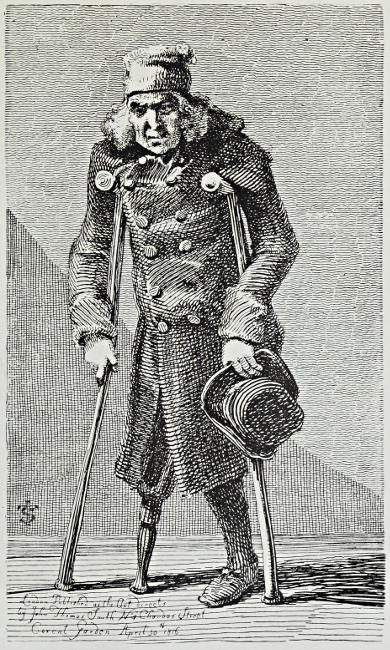
LONDON BEGGARS
ETCHED BY J. T. SMITH
“A silver haired man of the name of Lilly.”
1742.—The proprietor of the Mulberry Garden, Clerkenwell, indulged in the following remarks upon five places of similar amusement:—
“Ruckhoult has found one day and night’s alfresco in the week to be inconvenient.[95]
“Ranelagh House, supported by a giant, whose legs will scarcely support him.[96]
“Mary le Bon Gardens down on their marrow-bones.
“New Wells at low water.[97]
“At Cuper’s the fire almost out.”[98] (See the Daily Post, July 28.)
1743.—The holders of Marybone Garden tickets let them out at reduced prices for the evening. Ranelagh tickets were also advertised to be had at Old Slaughter’s Coffee-house at 1s. 3d. each, admitting two persons. Vauxhall tickets were likewise to be had at the same place at 1s. each, admitting two persons. (See the Daily Advertiser for April 23.)
1744.—Miss Scott was a singer, Mr. Knerler played the violin, and Mr. Ferrand an instrument called the Pariton.[99]
1746.—Robberies were now so frequent and the thieves so desperate, that the proprietor of the gardens was obliged to have a guard of soldiers to protect the company to and from London. The best plan of the gardens has been given in Plate I. of Rocque’s Plan of London, published in 1746.
1747.—Miss Falkner, singer;[100] Henry Rose, first violin; and Mr. Philpot, organist.—Admittance to the garden, 6d.; to the concert, 2s.
1748.—Miss Falkner, singer. No persons to be admitted to the balls unless in full dress.
1749.—It appears by the advertisements that dress-balls and concerts were the only amusements of this year.
1750.—Miss Falkner, Mr. Lowe, and Master Phillips, were the singers.
1751.—John Trusler was sole proprietor of the Gardens.[101] Singers, Miss Falkner, Master Phillips, and Master Arne. On the 30th of August there was a ball; and as the road had been repaired, coaches drove up to the door—a ten-and-sixpenny ticket admitted two persons. The doors opened at nine o’clock.
1752.—Miss Falkner and Mr. Wilder singers.
1753.—The Public Advertiser of May 25, June 20, September 10 and 24, states that the gardens were much more extensive by taking in the bowling-green, and considerably improved by several additional walks; that lights had been erected in the coach-way from Oxford Road, and also on the footpath from Cavendish Square to the entrance to the gardens; and that the fireworks were splendid beyond conception. A large sun was exhibited at the top of a picture, a cascade, and shower of fire, and grand air-balloons (perhaps these were the first air-balloons in England) were also most magnificently displayed; and likewise that red fire was introduced. This is the earliest instance of Red fire I have been able to meet with. Mrs. Chambers and Master Moore were singers.
1756.—Two rooms were opened for dinner-parties. Trusler, the proprietor of the gardens, was a cook.
1757.—Mr. Thomas Glanville, Mr. Kear, Mr. Reinhold, and Mr. Champneys were singers.
1758.—The Gardens opened on May the 16th; the singers were, Signora Saratina, Miss Glanvil, and Mr. Kear. No persons were admitted to the ball-rooms without five-shilling tickets, which admitted a gentleman and two ladies; and only twenty-six tickets were delivered for each night. Mr. Trusler’s son produced the first burletta that was performed in the Gardens; it was entitled “La Serva Padrona,” for which he only received the profits of the printed books.[102]
1759.—The Gardens were opened for breakfasting; and Miss Trusler made the cakes. Mr. Reinhold and Mr. Gaudrey were the singers.
1760.—The Gardens, greatly improved, opened on Monday, May 26th, with the usual musical entertainments. The Gardens were opened also every Sunday evening after five o’clock, where genteel company were admitted to walk gratis, and were accommodated with coffee, tea, cakes, etc.
The following announcement appears in the Daily Advertiser of May 6th, this year:—
“Mr. Trusler’s daughter begs leave to inform the Nobility and Gentry, that she intends to make Fruit-Tarts during the fruit Season; and hopes to give equal satisfaction as with the rich Cakes, and Almond Cheesecakes. The Fruit will always be fresh gathered, having great quantities in the Garden; and none but Loaf Sugar used, and the finest Epping Butter. Tarts of a Twelvepenny size will be made every day from One to Three o’clock; and those who want them of larger sizes to fill a Dish, are desired to speak for them, and send their dish or the size of it, and the Cake shall be made to fit.
“The Almond Cheesecakes will be always hot at one o’clock as usual; and the rich Seed and Plum-cakes sent to any part of the town, at 2s. 6d. each. Coffee, Tea, and Chocolate, at any time of the day; and fine Epping Butter may also be had.”[103]
1761.—An excellent half-sheet engraving, after a drawing made by J. Donowell, published this year, represents Marybone Gardens, probably in their fullest splendour. The centre of this view exhibits the longest walk, with regular rows of young trees on either side, the stems of which received the irons for the lamps at about the height of seven feet from the ground. On either side this walk were latticed alcoves: on the right hand of the walk, according to this view, stood the bow-fronted orchestra with balustrades, supported by columns. The roof was extended considerably over the erection, to keep the musicians and singers free from rain. On the left hand of the walk was a room, possibly for balls and suppers. The figures in this view are so well drawn and characteristic of the time, that I am tempted to recommend the particular attention of my reader to it.
The Gardens were opened gratis this year, and the organ was played while the company took their tea.
1762.—The Gardens were in fine order this year, and visited by the Cherokee Kings—admittance sixpence.[104] Mr. Trusler took care to keep out improper company; Miss Trusler continued to make the cakes.
1763.—The Gardens were taken by the famous Tommy Lowe,[105] who engaged Mrs. Vincent, Mrs. Lampe, Jun., Miss Mays, Miss Hyat, Miss Catley, and Mr. Squibb, as singers.
August 12th, Mr. Storace had a benefit;[106] the singers were, Brother Lowe, Miss Catley, Miss Smit, and Miss Plenius. Music. Mr. Samuel Arnold. A large room was cleared in the great house for the brethren to dress in.
Miss Catley’s night was on the 16th of August. Tickets were sold at Miss Catley’s, facing the Gardens.[107]
1764.—The Gardens opened on the 9th May; singers, Mr. Lowe, Mrs. Vincent, Mrs. Lampe, Jun., Miss Moyse, Miss Hyat, and Mr. Squibb. Mr. Trusler left the Gardens this year, and went to reside in Boyle Street, where his daughter continued to make her cakes, etc.
Mr. Lowe returned public thanks to the nobility and gentry for patronising the Gardens.
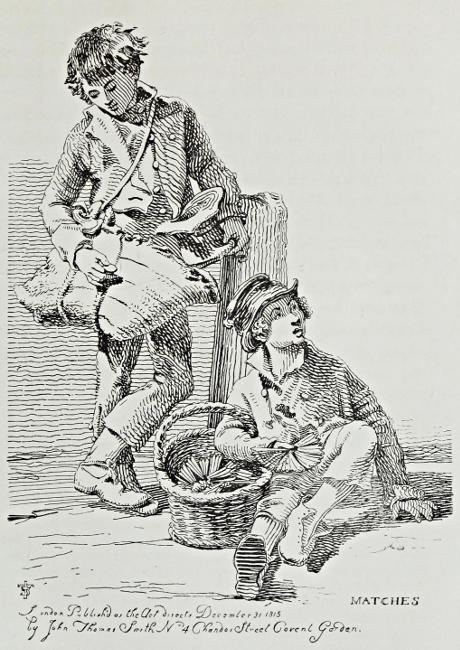
LONDON STREET MERCHANTS: MATCH BOYS
ETCHED BY J. T. SMITH
This year a stop was put to tea-drinking in the Gardens on Sunday evenings.
Mr. Lowe offered a reward of ten guineas for the apprehension of any highwayman found on the road to the Gardens.[108]
1765.—This year, Mrs. Collett, Miss Davis, and Mrs. Taylor were the singers.
1766.—£1, 11s. 6d. was the subscription for two persons for the season. The doors opened on the 1st of May, at six o’clock, and the Gardens closed on the 4th of October, for the season. The principal singers were, Tommy Lowe, Taylor, Raworth, Vincent, and Miss Davis. I have an engraving of a Subscription Ticket, inscribed “No. 222, Marybone, admit two, 1766.” As this ticket is adorned by two palm-branches, surmounted with two French-horns, and has also a music book, I conclude it must have been used on a concert night. This year an exhibition of bees took place in the Gardens, and the public were again accommodated with tea at eightpence per head.
1767.—Mrs. Gibbons was a singer there this season.
1768.—Lowe gave up the Gardens, declaring his loss in the concern to have been considerable.[109]
Mr. Phillips, a singer, in the announcement of his benefit this season, states that tickets were to be had at his house, the “Ring and Pearl,” St. Martin’s Court; and also at Young Slaughter’s Coffee-house, in St. Martin’s Lane. The following are the titles of a few of the Marybone Garden songs of this year:—
Young Colin.
Dolly’s Petition.
The Invitation.
The Rose.
The Moth.
Polly.
A Hunting Song.
Jockey—a favourite Scotch song.
Freedom is a real Treasure.
Jenny charming, but a Woman.
Oh, how vain is every Blessing.
Damon and Phillis.
The composers of the above songs were Heron and James Hook (father of Theodore Hook); the singers, Reynoldson, Taylor, and Miss Froud. During the time I was collecting the titles of these and other songs, I noticed an immense number which were dedicated to Chloe. Of this I took the titles of no fewer than thirty-five published between the years 1724 and 1740. Why to Chloe? I have no Stephen Weston now to apply to.[110] Dibdin tells us, when praising the good ship Nancy, that Nancy was his wife, and that being the fact, accounts for the number of songs he has left us of his “Charming Nan.”[111]
[1769.—In this year, omitted by Smith, the Gardens were taken over by Dr. Samuel Arnold, the musician. The years 1769-73 were their best period.]
1770.—On June 18th, there was a concert of vocal and instrumental music. First violin, and a concerto, by Mr. Barthelemon; concerto organ, Mr. Hook. The fireworks were under the direction of Signor Rossi. The principal singers this season were, Mr. Reinhold, Mr. Bannister,[112] Mrs. Thompson, Mrs. Barthelemon, and Master Cheney. The music by Signor Pergolesi,[113] with alterations and additional songs by Mr. Arnold. In July, an awning was erected in the garden for the better accommodation of the visitors; and books of the performance were sold at the bar, price sixpence.
1771.—Mr. Bannister, Mrs. Thompson, Miss Catley, and the highly respected Mrs. John Bannister (then Miss Harper) were the singers of this year.
1772.—This season the singers were, Mr. Bannister, Mr. Reinhold, Mrs. Calvert, Mrs. Forbes, Mrs. Cartwright, and Mrs. Thompson. Music by Signor Giardani,[114] Mr. Hook, and Mr. Arnold.
For the convenience of the visitors, coaches were allowed to stand in the field before the back entrance. Mr. Arnold was indicted at Bow Street for the fireworks.[115] Torré, the fire-worker, divided the receipts at the door with the proprietor.
1773.—Proposals were issued for a subscription evening to be held every Thursday during the summer, for which tickets were delivered to admit two persons. The Gardens were opened for general admission three evenings in the week only. On Thursday, May 27th, Acis and Galatea was performed, in which Mr. Bannister, Mr. Reinhold, Mr. Phillips, and Miss Wilde were singers. Signor Torré, the fire-worker, was assisted by Monsieur Caillot of Ranelagh Gardens.
On Friday, September 15th, Dr. Arne conducted his celebrated catches and glees. On the 16th of September, Mr. Clitherow was the fire-worker, for the benefit of the waiters, who parted with their unsold tickets at the doors of the Gardens for whatever they could get. Mr. Winston was in possession of an impression of an admission ticket for this season.
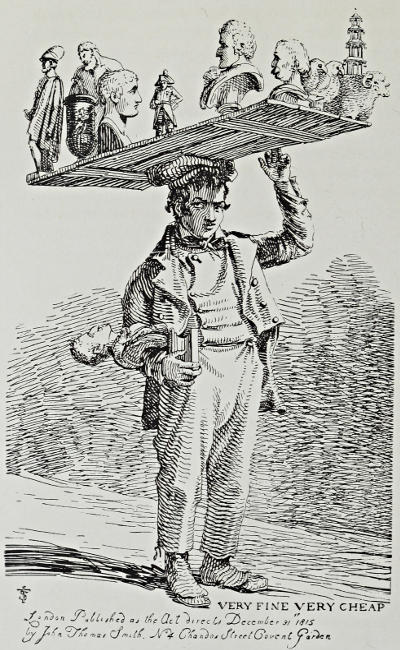
LONDON STREET MERCHANTS: IMAGES
ETCHED BY J. T. SMITH
1774.—The Gardens opened on May 20th. The principal singers were, Mr. Dubellamy, Miss Wewitzer (sister of the dramatic performer), and Miss Trelawny. The Gardens were opened this year on Sunday evenings for walking recreation, admittance sixpence. The receipts of one evening were at the Town-gate £10, 7s. 6d., at the Field-gate £11, 7s.[116] This year Signor Torré, one of the fire-workers of the Gardens, had a benefit; the admission was 3s. 6d.[117] Signor Caillot was then also a fire-worker in the Gardens; and I find by two shop-bills, in Miss Banks’s collection in the British Museum, that Benjamin Clitherow and Samuel Clanfield had also been employed as fire-workers.
Doctor Kenrick delivered his lectures on Shakspeare in these Gardens this year.[118]
1775.—After frequent inquiries, and a close examination of the newspapers of this year, I could not find any advertisement like those of preceding times with singing and fireworks. The Gardens are thus mentioned during the first part of the season, in the Morning Chronicle and London Advertiser of Monday, May 29th:—
“AT MARYBONE GARDENS,
To-morrow, the 30th instant, will be presented
THE MODERN MAGIC LANTERN,
“In three Parts, being an attempt at a sketch of the Times in a variety of Caricatures, accompanied with a whimsical and satirical Dissertation on each Character.
By R. Baddeley, Comedian.[119]
“BILL OF FARE.
Exordium.
PART THE FIRST.
A Sergeant at Law.
Andrew Marvel, Lady Fribble.
A bilking Courtesan.
A Modern Widow.
A Modern Patriot.
A Duelling Apothecary, and
A Foreign Quack.
PART THE SECOND.
A Man of Consequence.
A Hackney Parson.
A Macaroni Parson.
A Hair-dresser.
A Robin Hood Orator.
Lady Tit for Tat.
An Italian Tooth-drawer
High Life in St. Giles’s.
A Jockey, and
A Jew’s Catechism.
And Part the Third will consist of a short Magic Sketch called
“Punch’s Election.
“Admittance 2s. 6d. each, Coffee or Tea included. The doors to be opened at seven, and the Exordium to be spoken at eight o’clock.
“Vivant Rex et Regina.”
At the foot of Mr. Baddeley’s subsequent bills the Gardens are announced to be still open on a Sunday evening for company to walk in. Some of the papers of this year declare, under Mr. Baddeley’s advertisements, that “no person going into the Gardens with subscription tickets will be entitled to tea or coffee.”
The next advertisement was on Tuesday, June 20th.
“MARYBONE GARDENS.
This Evening will be delivered
A LECTURE ON MIMICRY,
BY GEORGE SAVILLE CARY.[120]
In which will be introduced
“A Dialogue between Small Cole and Fiddle-stick; Billy Bustle, Jerry Dowlas, and Patent; with the characters of Jerry Sneak in Richard the Third, Shylock in Macbeth, Juno in her Cups, Momus in his Mugs, and the Warwickshire Lads. To conclude with a dialogue between Billy Buckram and Aristophanes, in which Nick Nightingal, or the Whistler of the Woods, will make his appearance, as he was lately shown at the Theatre Royal, in the character of a Crow.
“Admittance 2s. 6d., coffee or tea included.
“The Lecture will be repeated To-morrow, Thursday, and Saturday.”
“June 21st.
MARYBONE GARDENS.
This Evening will be delivered
A LECTURE ON MIMICRY,
by
GEORGE SAVILLE CARY.
“After a new Poetical Exordium, a variety of THEATRICAL DELINEATIONS will be introduced.
“Mr. Fiddle-stick, Mr. Small Coal, Mrs. Artichoke, Mrs. H—l—y; Bustle the Bookseller; Mr. Patent, Mr. G——k; Jerry Sneak, Richard III., Mr. W——; another Richard, Mr. S—th; Shylock, in Macbeth, M—n—.
“‘What, alas! shall Orpheus do?’ Sig. M—ll—o; ‘Juno in her Cups,’ Miss C—t—y; ‘The Early Horn,’ Mr. M. D—— B——y; ‘This is, Sir, a Jubilee,’ Mr. B—n—r; ‘Where, Which, and Wherefore,’ Sig. L—at—ni; ‘Within my Breast,’ Mr. V.; ‘Sweet Willy O,’ Mrs. B—d—y; ‘The Mulberry Tree,’ M—k—r; ‘Ye Warwickshire Lads,’ Mr. V. and Mr. D.
Scene in Harlequin’s Invasion, Mr. D——d, Mr. P——ns, and Mr. B—n—by.
Othello, Mr. B——y; Nurse, Mrs. P——t; Cymbeline, Mr. H——st; Iachimo, Mr. P——r; Mr. Posthumous, Mr. R——h; Pantomime, Mr. F——t and Mr. W——n.[121]
The Doors to be opened at Seven o’clock, and to begin at Eight.
“Admittance 2s. 6d. each, coffee or tea included.
“The Lecture will be repeated to-morrow and Saturday next.”
“June 23rd.
MARYBONE GARDENS.
“By Virtue of a Licence from the Board of Ordnance, a
MOST MAGNIFICENT FIREWORK
will be exhibited on Tuesday next at
MARYBONE GARDENS,
In honour of His Majesty’s Birthday.
“Further particulars will be advertised on Monday next.”
“Indeed, Sir!” is the general exclamation of a passenger in a stage coach, whenever any one observes that he had seen Garrick perform; at least, such an observation has fallen from many of my fellow-travellers, when I have asserted that I had had the pleasure of seeing that great actor. On the 25th of November, 1775, my father first took me to a play, and it was with one of Mr. Garrick’s orders, when he performed in The Alchemist.[122]
1776.—Marylebone Gardens opened this year on the 11th of May, by authority. The “Forge of Vulcan” was represented.[123] On the 16th of the same month the Fantoccini was introduced; on June 3rd Breslaw exhibited his sleight of hand, and also his company of singers, upon which occasion handbills were publicly distributed. Admittance 2s.[124] On the 25th Mrs. Stuart had a ball, and Signor Rebecca (well known for his productions at the Pantheon) painted some of the transparencies.[125]
Subscription tickets to the Gardens were issued at £1, 11s. 6d. to admit two persons every evening of performance. The Gardens were opened on Sunday evenings, with tea, coffee, and Ranelagh rolls. Caillot was the fire-worker this season.
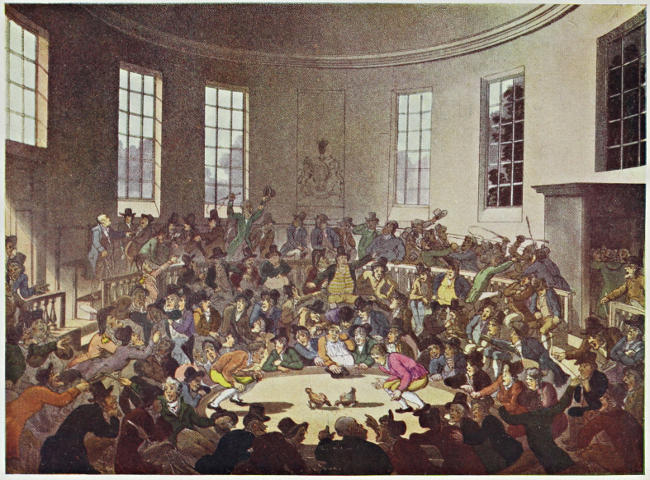
THE ROYAL COCKPIT, WESTMINSTER
This, as well as the preceding year, was particularly famous for the breed of Canary birds, consisting of Junks, Mealies, Turncrowns, and the Swallow-throats. They were all “fine in feather and full in song,” and could sing in the highest perfection many delightful strains, such as the nightingale’s, titlark’s, and woodlark’s, by candle-light as well as day. The breeders lived in Norwich, Colchester, Ipswich, etc. The sellers in London were principally publicans, and those most in vogue kept the signs of the “Queen’s Arms,” Newgate Street; the “Green Dragon,” Narrow Wall, Lambeth; the “Crown and Horse-shoe,” Holborn; the “Wheatsheaf,” Fleet Market; the “Marquis of Granby,” Fleet Market; the “Old George,” Little Drury Lane; and the “Black Swan,” Brown’s Lane, Spitalfields.[126]
It appears by the various advertisements from the numerous owners of cockpits, that the cruel sport of cock-fighting afforded high amusement this year to the unfeeling part of London’s inhabitants. Of the number of cockpits half a dozen will be quite enough to be recorded on this page.
1. The “Royal Cockpit,” in the Birdcage Walk, St. James’s Park. This Royal Cockpit afforded Hogarth characters for one of his worst of subjects, though best of plates.
2. In Bainbridge Street, St. Giles’s.
3. Near Gray’s Inn Lane.
4. In Pickled-Egg Walk.
5. At the New Vauxhall Gardens, in St. George’s in the East.
6. That at the “White Horse,” Old Gravel Lane, near Hughes’s late riding-school, at the foot of Blackfriars Bridge.[127]
Disputes having frequently occurred as to the characters in which Garrick last appeared, by persons not sufficiently in possession of documents at hand to enable them to decide their controversies, I am induced to conclude that such disputants will be pleased to see a statement of the nights of his acting, the titles of the plays in which he performed, and the names of the characters which he represented, as well as those of the principal actresses who performed with him during the last year of his appearance on the stage. The original play-bills of the time, collected by the late Dr. Burney, now in the British Museum, have enabled me to give this information in the following chronological order:—
Nights of Acting. Title of Play. Names of Characters.
Jan. 18. The Alchemist. Abel Drugger, Mr. Garrick. (Doll Common, by Mrs. Hopkins.)
20. The Discovery Sir Anthony Branville. (Lady Flutter, by Mrs. Abington.)
22. Ditto. Ditto.
24. Ditto. Ditto.
26. Ditto. Ditto.
29. Ditto. Ditto.
30. The Provoked Wife Sir John Brute. (Lady Brute, by Miss Younge.)
31. Ditto. Ditto.
Feb. 3. Zara Lusignan. (Zara, by Miss Younge.)
5. The Provoked Wife Sir John Brute. (Lady Brute, by Miss Younge.)
7. The Discovery Sir Anthony Branville. (Lady Flutter, by Mrs. Abington.)
9. Every Man in his Humour. Kitely. (Mrs. Kitely, Mrs. Greville.)
12. Much Ado about Nothing. Benedict. (Beatrice, by Mrs. Abington.)
14. Rule a Wife and have a Wife. Leon. (Estifania, by Mrs. Abington.)
March 6. Zara Lusignan. (Zara, by Miss Younge.)
7. Zara Lusignan. (Zara, by Miss Younge.)
April 11. The Alchemist. Abel Drugger. (Doll Common, by Mrs. Hopkins.)
16. Much Ado about Nothing. Benedict. (Beatrice, by Mrs. Abington.)
25. Every Man in his Humour. Kitely. (Mrs. Kitely, by Mrs. Greville.)
27. Hamlet Hamlet. (Ophelia, by Mrs. Smith.)
30. The Provoked Wife. Sir John Brute. (Lady Brute, Miss Younge.)
May 2. Rule a Wife and have a Wife. Leon. (Estifania, Mrs. Abington)
7. The Stratagem. Archer. (Mrs. Sullen, Mrs. Abington.)
9. Much Ado about Nothing. Benedict. (Beatrice, by Mrs. Abington.)
13. King Lear King Lear. (Cordelia, Miss Younge.)
16. The Wonder Don Felix. (Violante, by Mrs. Yates.)
21. King Lear King Lear. (Cordelia, by Miss Younge.)
23. The Suspicious Husband. Ranger. (Mrs. Strickland, Mrs. Siddons; Clarinda, Mrs. Abington.)
27. King Richard the Third. King Richard. (Lady Anne (first time), Mrs. Siddons.)
30. Hamlet Hamlet. (Ophelia, by Mrs. Smith.)
31. The Suspicious Husband. Ranger. (Mrs. Strickland, Mrs. Siddons; Clarinda, Mrs. Abington.)
June 1. Ditto. Ditto.
3. King Richard the Third. King Richard. (Lady Anne, by Mrs. Siddons.)
5. King Richard the Third. King Richard. (Lady Anne, by Mrs. Siddons.) By command of their Majesties.
8. King Lear King Lear. (Cordelia, Mrs. Younge.)
10. The Wonder Don Felix. (Violante, by Mrs. Yates.)[128]
Notwithstanding it has been said that Mr. Garrick spoke slightingly of Mrs. Siddons’s talents, the above list incontrovertibly proves that he considered her powers sufficiently great to appear in principal characters with him no fewer than six nights of the last nine in which he performed.
I shall now subjoin a similar list of Mrs. Siddons’s nights of performance at Drury Lane Theatre, during the last year of Mr. Garrick’s acting.[129]
Jan. 13, 15, 17. Epicœne, or The Silent Woman (as a Collegiate Lady).
Feb. 1, 2, 3. The Blackamoor Washed White.
Between Feb. 15 and April 18 (22 nights). The Runaway (as Miss Morley).
May 23. The Suspicious Husband (as Mrs. Strickland).
24. The Runaway (as Miss Morley).
27. King Richard the Third (as Lady Anne).
31. The Suspicious Husband (as Mrs. Strickland).
June 1.
3. King Richard the Third (as Lady Anne).
5. Ditto. Ditto. By command of their Majesties.
Of six plays of which there were no bills in the Burney collection, I was enabled to add instances of the performance of Mrs. Siddons on those nights from a portion of that truly rare and valuable library purchased by Government of the late Dr. Burney’s son for the British Museum.
Ladies this year wore goloshes, four distinct falls of lace from the hat to the shoulders, and rolled curls on either side of the neck: they continued to carry fans.[130]
1777.
I remember well that in an autumn evening of this year, during the time my father lived in Norton Street,[131] going with him and his pupils on a sketching party to what is now called Pancras Old Church; and that Whitefield’s Chapel in Tottenham Court Road, Montague House, Bedford House, and Baltimore House,[132] were then uninterruptedly seen from the churchyard, which was at that time so rural that it was only enclosed by a low and very old hand-railing, in some parts entirely covered with docks and nettles. I recollect also that the houses on the north side of Ormond Street commanded views of Islington, Highgate, and Hampstead, including in the middle distance Copenhagen-house, Mother Red-cap’s, the Adam and Eve, the Farthing Pie House, the Queen’s Head and Artichoke, and the Jew’s Harp House.[133]
Early in this year Spiridione Roma,[134] who had cleaned the pictures of the Judges then hanging in Guildhall, published a prospectus for Bartolozzi’s print from the portrait of Mary Queen of Scots in Drapers’ Hall, said to have been painted by Zucchero.[135]
1778.
At this period I began to think there was something in a prognostication announced to my dear mother by an old star-gazer and tea-grouter,[136] that, through life, I should be favoured by persons of high rank; for, in this year, Charles Townley, Esq. (the collector of the valuable marbles which now bear his name in the British Museum), first noticed me when drawing in Mr. Nollekens’ studio, and pouched me half a guinea to purchase paper and chalk.[137] This kindness was followed up by Dr. Samuel Johnson, who was then sitting for his bust. The Doctor, after looking at my drawing, then at the bust I was copying, put his hand heavily upon my head, pronouncing “Very well, very well.” Here I frequently saw him, and recollect his figure and dress with tolerable correctness. He was tall, and must have been, when young, a powerful man: he stooped, with his head inclined to the right shoulder: heavy brows, sleepy eyes, nose very narrow between the eye-brows, but broad at the bottom; lips enormously thick; chin, wide and double. He wore a stock and wristbands; his wig was what is called a “Busby,” but often wanted powder. His hat, a three-cornered one; coats, one a dark mulberry, the other brown, inclining to the colour of Scotch snuff, large brass or gilt buttons; black waistcoat and small-clothes—sometimes the latter were corduroy; black stockings, large easy shoes, with buckles; his gait was wide and awkwardly sprawling; latterly he used a hooked walking-stick, in consequence of his having saved the life of a young man as he was crossing from Queenhithe to Bankside.
One of the Doctor’s sticks of this shape brought me into a scrape. It was given to me by the late William Tunnard, Esq., of Bankside;[138] he received it from his friend Mr. Perkins;[139] it was one of many that the Doctor kept at Thrale’s. This stick I promised to my worthy and liberal friend the Rev. James Beresford, of Kibworth, Market Harborough;[140] but, alas! when I went to “stick-corner” somebody had walked it off. However, if this page should meet the eye of its present possessor, I hope, even should the “Bannister” I now rest upon be deemed useless by Time’s sandy-glass, his conscience may order the Johnsonian relic to be delivered to the above-named gentleman, whose property I declare it unquestionably to be. My present strong stick, named “Bannister,” was given to me when afflicted with the gout, by a fellow-sufferer, universally known under the friendly appellation of “Honest Jack.”
I once saw him follow a sturdy thief, who had stolen his handkerchief in Grosvenor Square, seize him by the collar with both hands, and shake him violently, after which he quickly let him loose; and then, with his open hand, gave him so powerful a smack on the face, that sent him off the pavement staggering.
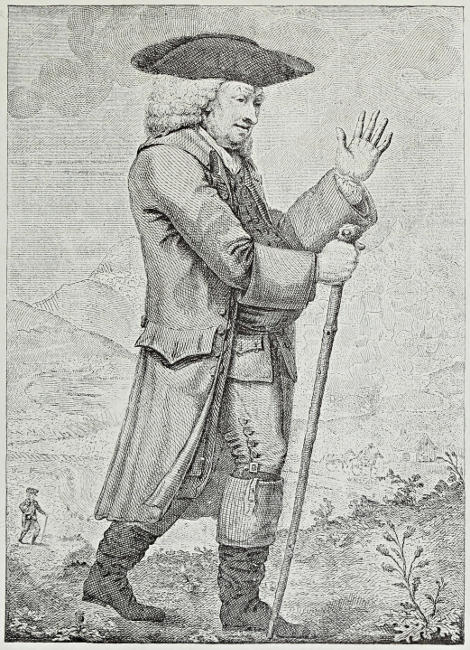
DR. SAMUEL JOHNSON
“Pockets which might have almost held the two volumes of his folio dictionary.”
Ladies appeared for the first time in riding-habits of men’s cloth, only descending to the feet; they also walked with whips like short canes, with a thong at the end. The elderly ladies continued to wear goloshes. Fans were in general use.
For the honour of female genius, be it here recorded, that, in the Ladies’ Pocket-book, published this year, an engraved group of nine whole-length female figures was published, viz. Miss Carter, Mrs. Barbauld, Angelica Kauffman, Mrs. Sheridan, Mrs. Lenox, Mrs. Montague, Miss More, Mrs. Macaulay, and Mrs. Griffith, each lady in the character of a Muse. Four Pocket-books appeared this year, entitled Ladies’ Pocket-book, Ladies’ own Memorandum Book, Ladies’ Annual Journal, and Ladies’ Complete Pocket-book.[141]
1779.
On Monday, February 1st, Taylor, the facetious pupil of Frank Hayman, and the old friend of Jonathan Tyers, lifted Nollekens’ studio door-latch, put in his head, and announced, “For the information of some of the sons of Phidias, I beg to observe, that David Garrick is now on his way to pay his respects to Poet’s Corner. I left him just as he was quitting the boards of the Adelphi.”[142] I am now employing the exact words he made use of, though certainly the levity was misapplied on so solemn an occasion.
I begged of my father, who then carved for Mr. Nollekens, to allow me to go to Charing Cross to see the funeral pass, which he did with some reluctance. I was there in a few minutes, followed him to the Abbey, heard the service, and saw him buried.[143]
Mr. Garrick died on the 20th of January, in the back room of the first floor, in his house in the Adelphi. The ceiling of the drawing-room was painted by Zucchi: the subject, Venus attired by the Graces. The chimneypiece in this room is said to have cost £800.[144]
On a night when Mr. Garrick was acting the part of Lear, one of the soldiers who stood on the stage blubbered like a child. Mr. Garrick, who was as fond of a compliment as most men, when the play was over, sent for the man to his room, and gave him half a crown. It was the custom formerly for two soldiers to stand on the stage during the time of performance, one at either end of the proscenium.
This year the Grotto Garden, Rosamond Row, near the London Spa, was kept by Jackson, a man famous for grottoes and fireworks. He had made great additions to it, viz. a new Mounted Fountain, etc. The admittance was sixpence.[145]
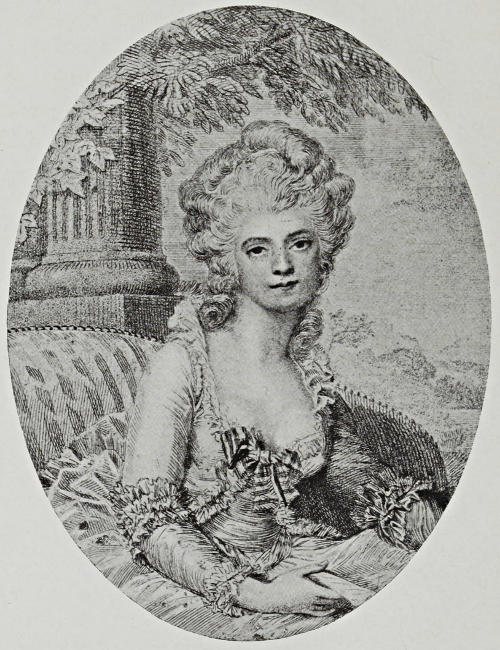
“PERDITA” ROBINSON
“She imprinted a kiss on my cheek, and said, ‘There, you little rogue.’”
J. T. Smith
1781.
Although I could model and carve a little, I longed to be an engraver, and wished much to be placed under Bartolozzi, who then lived in Bentinck Street, Berwick Street.[146] My father took me to him, with a letter of introduction from Mr. Wilton, the sculptor. Mr. Bartolozzi, after looking at my imitations of several of Rembrandt and Ostade’s etchings, declared that he should have been glad some years previous to take such a youth, but that, in consequence of ill-treatment from some of his pupils, he had made up his mind to take no more. The Bishop of Peterborough (Dr. Hinchliffe),[147] one of my father’s patrons, then prevailed on Sherwin to let me in at half-price; and under his roof I remained for nearly three years. Here I saw all the beautiful women of the day; and, being considered a lively lad, I was noticed by several of them. Here I received a kiss from the beautiful Mrs. Robinson.
This impression was made upon me nearly as I can recollect in the following way:—It fell to my turn that morning, as a pupil, to attend the visitors, and Mrs. Robinson came into the room singing. She asked to see a drawing which Mr. Sherwin had made of her, which he had placed in an upper room. When I assured her that Mr. Sherwin was not at home, “Do try to find the drawing of me, and I will reward you, my little fellow,” said she. I, who had seen Rosetta, in Love in a Village, the preceding evening, hummed to myself, as I went upstairs, “With a kiss, a kiss, and I’ll reward you with a kiss.”
I had no sooner entered the room with the drawing in my hand, than she imprinted a kiss on my cheek, and said, “There, you little rogue.” I remember that Mrs. Darby, her mother, accompanied her, and had brought a miniature, painted by Cosway, set in diamonds, presented by a high personage, of whom Mrs. Robinson spoke with the highest respect to the hour of her dissolution.[148] The colour of her carriage was a light blue, and upon the centre of each panel a basket of flowers was so artfully painted, that as she drove along it was mistaken for a coronet.[149]
1782.
Early in the month of December, this year, Sherwin painted, engraved, and published a glorious portrait of Mrs. Siddons, in the character of the Grecian Daughter. That lady sat in the front room of his house, St. James’s Street. I obeyed Mr. Sherwin’s orders in raising and lowering the centre window-curtains, the shutters of the extreme ones being closed for the adjustment of that fine light and shade upon her face which he has so beautifully displayed in the print. This print, in consequence of a purse having been presented to Mrs. Siddons by her admirers in the profession of the Law, was dedicated to “The Gentlemen of the Bar.”[150]
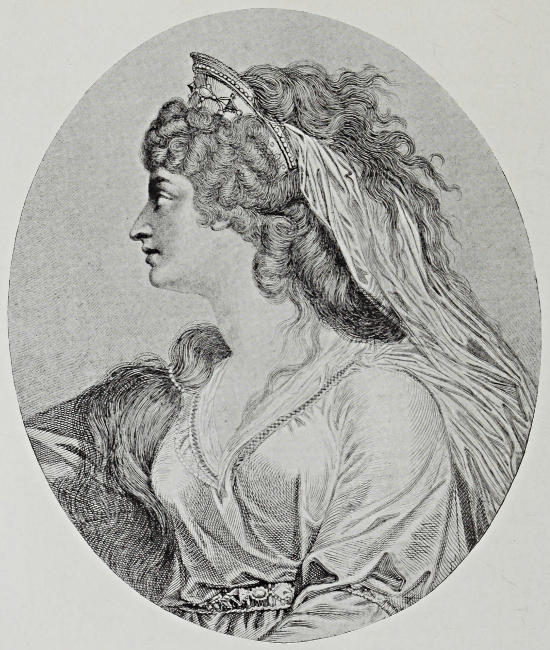
MRS. SIDDONS
“A glorious portrait.”
By the liberality of my amiable friend, William Henderson, Esq.,[151] I am in possession of a cast taken by Lochee, the modeller, from the face of this wonderful actress, which I intend leaving to that invaluable gallery of theatrical portraits, so extensively formed by that favourite offspring of Nature, Charles Mathews,[152] Esq., at Kentish Town; but should that collection ever be dispersed, which I most heartily trust it never will be, then I desire that it may go to the Green-room of Drury Lane Theatre. To this bequest I subscribe my name,
Witnesses to this my declaration,
John Thomas Smith.
John Bannister.
— Harley.[153]
1783.
One of the numerous subjects which I drew this year for Mr. Crowle,[154] was the old brick gateway entrance to St. Giles’s churchyard, then standing opposite to Mr. Remnent’s timber-yard, in which drawing I introduced the figure of old Simon, a very remarkable beggar, who, together with his dog, generally took their station against one of the gate-piers. This man, who wore several hats, at the same time suffered his beard to grow, which was of a dirty yellow-white. Upon his fingers were numerous brass rings. He had several waistcoats, and as many coats, increasing in size, so that he was enabled by the extent of the uppermost garment to cover the greater part of the bundles, containing rags of various colours; and distinct parcels with which he was girded about, consisting of books, canisters containing bread, cheese, and other articles of food; matches, a tinder-box, and meat for his dog; cuttings of curious events from old newspapers; scraps from Fox’s Book of Martyrs, and three or four dog’s-eared and greasy thumbed numbers of the Gentleman’s Magazine.
From these and such like productions he gained a great part of the information with which he sometimes entertained those persons who stopped to look at him.
When I knew him,—for he was one of my pensioners,—he and his dog lodged under a staircase in an old shattered building called “Rats’ Castle,” in Dyot Street, mentioned in Nollekens and his Times as that artist’s rendezvous to discover models for his Venuses. Dyot Street has disappeared, and George Street is built on its site.[155] His walks extended to the entrances only of the adjacent streets, whither he either went to make a purchase at the baker’s or the cook’s shops. Rowlandson drew and etched him several times; in one instance Simon had a female placed before him, which the artist called “Simon and Iphigenia.” There is a large whole-length print of him, published by John Seago, with the following inscription:—
Simon Edy, born at Woodford, near Thrapston, Northamptonshire, in 1709: died May 18, 1783.[156]
Respecting his last dog, for he had possessed several, which wicked boys had beguiled from him, or the skinners of those animals had snatched up, the following anecdote is interesting:—A Smithfield drover, whose dog’s left eye had been much injured by a bullock, solicited Simon to take him under his care till he got well. The mendicant cheerfully consented, and forthwith, with a piece of string, confined him to his arm; and when, by being more quiet, he had regained his health sufficiently to resume his services to his master, old Simon, with the most affectionate reluctance, gave him up, and was obliged to content himself with the pleasure of patting his sides on a market-day, when he followed his master’s drove to the slaughter-house in Union Street. These tender and stolen caresses from the hand which had bathed his wound, Rover would regularly stop to receive at St. Giles’s porch, and then hastily run to get up with the bullocks. Poor Simon, after missing the dog as well as his master for some weeks, was one morning most agreeably surprised to see the faithful animal crouch behind his feet, and with an uplifted and sorrowful eye, for he had entirely lost the blemished one, implore his protection by licking his beard, as a successor to his departed and lamented keeper. Rover followed Simon, according to Dr. Gardner’s idea, to “his last and best bedroom”;[157] or, according to Funeral Weever,[158] his “bed of ease.” Shortly before Simon’s death, I related to Mrs. Nollekens several instances of Rover’s attachment. “I think, Sir,” observed that lady, “you once told me that he had been a shepherd’s dog from Harrow-on-the-Hill. I don’t like a shepherd’s dog: it has no tail,[159] and its coat is as rough as the bristles of a cocoanut. No, Sir, my little French dog is my pet.” However, fortunately for poor Simon, the Hon. Daines Barrington[160] was present when Dr. Johnson’s Pekuah[161] made this silly remark, for he never after passed the kind-hearted mendicant without giving him sixpence. There was an elegy printed for poor Simon, with a woodcut portrait of him.
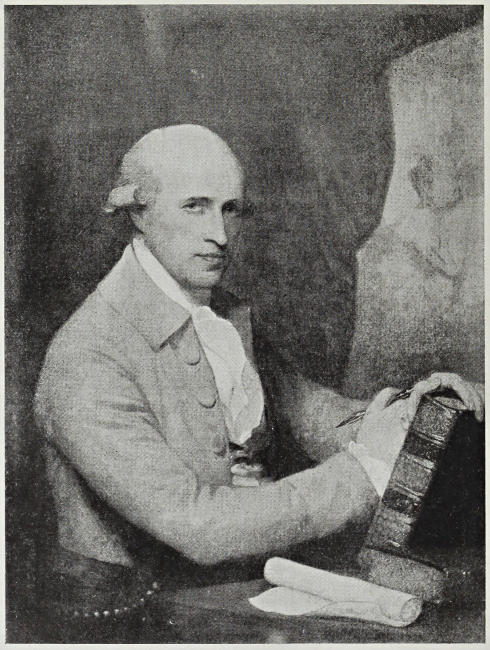
BENJAMIN WEST, P.R.A.
“Sir, I was once a Quaker, and have never left their principles.”
Ugly and deficient in sight and tail as Rover certainly was, it is also as equally unquestionable that Simon never had occasion to carry him to Fox Court, St. James’s Street, for the recovery of his health, under the direction of Dr. Norman,[162] the canine physician, so strenuously recommended upon all occasions by George Keate, the poet,[163] and far-famed connoisseur. No, poor Rover was kept in health by being allowed to range the streets from six till nine, the hours in which the nightly stealers of the canine race, and the dexterous of all dentists, were on their way to Austin’s, at Islington,[164] to dispose of their cruel depredations upon many a true friend to the indigent blind, “to whom the blackbird sings as sweetly as to the fairest lady in the land.”
1784.
Mr. West, to whom I had sat for the head of St. John in his picture of the Last Supper, for the altar of St. George’s Chapel, Windsor,[165] frequently engaged me to bid for him at auctions, an honour also occasionally conferred on me for similar services by Sir Joshua Reynolds. It was during one of these commissions in this year, that the late Richard Wyatt, Esq., of Milton Place, Egham, Surrey, noticed me; he was then starting as a collector of pictures, prints, and drawings.[166] That gentleman kindly invited me to his house, and not only introduced me to his amiable family, but to his most intimate neighbours. He allowed me the use of a horse, to enable me more readily to visit the beauties of Windsor Park and Forest, the scenery of which so attracted and delighted me, that during one month’s stay I made nearly one hundred studies. The two Sandbys were visitors to my patron; and to Thomas, then Deputy Ranger of Windsor Great Park, a situation given to him by his Royal Highness William, Duke of Cumberland (Thomas Sandby had been engineer draughtsman to his Royal Highness at the battle of Culloden), I am indebted for my knowledge of lineal perspective. The Misses Wyatt were delightful persons, and much noticed at the Egham Balls, for one or two of which occasions I had the pleasure of painting butterflies on a muslin dress, and also imitating the “Sir Walter Raleigh,” the “Pride of Culloden,” and other curious and rare carnations, on tiffany, for their bouquets, which were then scented and much worn.
I was here introduced to Viscount Maynard, to whom Mr. Wyatt had been guardian. His Lordship married the celebrated Nancy Parsons,[167] and was a most spirited draughtsman of a horse. Among other gentlemen, I was also introduced to the late Sir Richard Colt Hoare, Bart.,[168] and the late Rev. George Huddesford,[169] of Oxford, Kett’s satirist, and the witty author of poems entitled Salmagundi, dedicated to Mr. Wyatt. Several of these I have often heard him most humorously sing, particularly those of “the renowned History and rare Achievements of John Wilkes.” The chorus ran thus:—
“John Wilkes he was for Middlesex, They chose him knight of the shire; And he made a fool of Alderman Bull, And call’d Parson Horne a liar.”
“The Barber’s Nuptials,” which may be seen in the Elegant Extracts, and almost every other collection of fugitive poetry, was also written by him.[170]
Mr. Huddesford had studied under Sir Joshua Reynolds, and had copied many of the President’s pictures with tolerable ability, with an intention of pursuing the arts, but his master-talent was more conspicuously displayed in compositions of fruit, in which his representations of ripe and melting peaches, and the rich transparent grape, were inimitable. The late Sir George Beaumont, Bart., with whom Mr. Huddesford had been extremely intimate, was in possession of a remarkably fine specimen by him, which the worthy baronet frequently allowed to be copied.
Huddesford, after the death of Warton, chalked on the walls of the College—
“The glorious sun of Trinity is set, And nothing left but farthing-candle Kett.”[171]
He published The Elements of General Knowledge, which were called, at Oxford “The Elements of General Ignorance”; and his last work, Emily, procured him the name of Emily Kett. His supposed resemblance to a horse was the occasion of much academical waggery:—his letter-box was often filled with oats; and when he wished to have his portrait taken, he was sent to the famous Stubbs,[172] the horse painter, who, on receiving him, and expecting to hear whether his commission was to be for a filly or a colt, was much surprised to find Kett pompously announce that he expected the likeness to be in full canonicals.
Samuel Woodforde (afterwards a Royal Academician)[173] was employed by Mr. Wyatt, in consequence of an introduction by Sir Richard Colt Hoare, Bart., to paint trees and landscapes on the panels of his drawing-room, mostly from scenes in Windsor Park and Forest. Mr. Wyatt was one of Opie’s early friends. He painted for that gentleman several of the Burrell and Hoare family; indeed, he was instrumental in bringing that artist out of his humble and modest lodging in Orange Court, Leicester Fields,[174] to his house in Queen Street, next door to that for many years occupied by that comic and most exemplary child of Nature, the late Miss Pope,[175] whose inimitable acting as Miss Allscrip, in The Heiress, not only delighted the public, but was deservedly complimented by its author, General Burgoyne, who at one time lived in Hertford Street, May Fair, in the house that had been inhabited by Lord Sandwich, and subsequently by R. B. Sheridan and Mr. Dent.[176]
This year, Mr. Flaxman, who then lived in Wardour Street, introduced me to one of his early patrons, the Rev. Henry Mathew, of Percy Chapel, Charlotte Street, which was built for him;[177] he was also afternoon preacher at St. Martin’s-in-the-Fields. At that gentleman’s house, in Rathbone Place, I became acquainted with Mrs. Mathew and her son, the late John Hunter’s favourite pupil. With that gentleman, in his youthful days, I had many an innocent frolic. I was obliged to him in several instances, and can safely say no one could excel him as an amiable friend, a dutiful son, or excellent husband. At Mrs. Mathew’s most agreeable conversaziones I first met the late William Blake,[178] the artist, to whom she and Mr. Flaxman had been truly kind. There I have often heard him read and sing several of his poems. He was listened to by the company with profound silence, and allowed by most of the visitors to possess original and extraordinary merit. A time will come when the numerous, though now very rare, works of Blake (in consequence of his taking very few impressions from the plates before they were rubbed out to enable him to use them for other subjects) will be sought after with the most intense avidity.[179] He was considered by Stothard and Flaxman (and will be by those of congenial minds, if we can reasonably expect such again) with the highest admiration. These artists allowed him their most unqualified praise, and were ever anxious to recommend him and his productions to the patrons of the Arts; but alas! they were not so sufficiently appreciated as to enable Blake, as every one could wish, to provide an independence for his surviving partner Kate, who adored his memory. The late Sir Thomas Lawrence has been heard to declare that England would be for ever immortalized by the productions of Sir Joshua Reynolds, Flaxman, and Stothard.
Mrs. Mathew was not only a great encourager of musical composers, particularly the Italians, but truly kind to young artists. She patronized Oram, Loutherbourg’s assistant: he was the son of Old Oram, of the Board of Works, an artist whose topographical pictures possess considerable merit, and whose name is usually introduced in picture catalogues under the appellation of “Old Oram.”[180]
Mr. Flaxman, in return for the favours he had received from the Mathew family, decorated the back parlour of their house, which was their library, with models (I think they were in putty and sand) of figures in niches, in the Gothic manner; and Oram painted the window in imitation of stained glass; the bookcases, tables, and chairs were also ornamented to accord with the appearance of those of antiquity.
Rathbone Place, at this time, entirely consisted of private houses, and its inhabitants were all of high respectability. I have heard Mrs. Mathew say that the three rebel lords, Lovat, Kilmarnock, and Balmerino, had at different times resided in it; and that she had also been informed that the floor of her parlours, which is now some steps above the street, was even with the floor of the recess under the front pediment of St. Paul’s Cathedral.
1785.
Many a summer’s evening, when I have been enjoying Runnymede, and its far surrounding variegated meadows, from the wooden seat of Cooper’s Hill (upon which were engraven numerous initials of lovers, and the dates of their eternal vows), little did I think that in my future days it would be in my power to state that I had made drawings of most of the parish churches as well as family mansions which were then in view, for the topographical collections of the Duke of Roxborough, Lord Leicester, the Hon. Horace Walpole, Mr. Bull, Mr. Storer, Dr. Lort, Mr. Haughton James, Mr. Crowle, and Sir James Winter Lake, Bart.[181] Several of these, which have since been distributed, I now and then meet with in the portfolios of more modern illustrators, and they bring to my recollection some truly pleasing periods. It was in the old house at Ankerwycke that I was introduced by Lady Lake to Lady Shouldham. It was at Old Windsor that I dined with Mrs. Vassal, and at Staines Bridge with the beautiful Miss Towry, since Lady Ellenborough. It was at Chertsey I was first introduced to Mr. Douglas, Colonel St. Paul, and those truly kind-hearted characters, Mr. Fox and Mrs. Chamberlain Clark. At Staines I was benefited by the skill of Dr. Pope;—at Harrow made known to Dr. Drury;—at Southgate to Alderman Curtis;—at Trent Park to Mr. Wigston;—at Forty Hill, Enfield, to the antiquary Gough;—at Bull’s Cross to the facetious Captain Horsley, brother to the Bishop of Rochester, and the Boddams;—at the “Firs,” Edmonton, to my ever-to-be-revered friend the late Sir James Winter Lake, Bart.;—at Weir Hall to the benevolent and highly esteemed Mr. Robert Jones, Mr. Webster and his friendly son;—at Bruce Castle to Mr. Townsend;—at Tottenham to Mr. John Snell, and to Mr. Samuel Salt. This gentleman informed me that he was one of the four who buried Sterne.[182] Of the friendly inhabitants of these houses, and many others to whom I had the pleasure of being known, within the extensive view from Cooper’s Hill, very few are now living.
During the Races on Runnymede, I have often seen their late Majesties George the Third and Queen Charlotte driving about in an open four-wheeled chaise, enjoying the pleasures of the course on equal terms with the visitors. I remember to have been spoken to three times by his Majesty; once on a very foggy morning at a stile near Clewer, when I stepped back to give a gentleman, who had nearly approached it in the adjoining field, the preference of coming over first; but upon his saying, “Come over, come over,” I knew the voice to be the King’s, consequently I took off my hat, and obeyed. His Majesty observed in his quick manner, when getting over, “A thick fog, thick fog.” Another time, when I was drawing an old oak in Windsor Park, the King and Queen drove very near me in their chaise, and one of his Majesty’s horses shied at my paper; upon which the King called out to me, “Shut your book, sir, shut your book!”