A BOOK FOR A RAINY DAY (continued 2)
Reading edition
The last time I was noticed by the King, I must say his Majesty appeared to be a little startled, as well he might. It was under the following circumstances. Wishing to make a drawing of one of the original stalls in St. George’s Chapel, Windsor, before they were finally taken down, a shilling prevailed upon one of the workmen to lock me in during his dinner-hour. However, it so happened that his Majesty, who frequently let himself into the Chapel at that time to look at the progress of the works, did not perceive me, as I stood in a corner, but on his return from the altar, he asked, “Who are you, sir? Oh! you startled my horse in the park the other day. What are you about?” I then held up my drawing; and his Majesty, who must have noticed my embarrassment, did me the honour to say, “Very correct; I believe you are at Mr. Wyatt’s,—a very good man;—I have a high regard for him and all his family.”
During the time I was studying the scenery of Windsor Park, Mr. Thomas Sandby, who was busily engaged in placing the numerous stones to form the representation of rocks and caverns at the head of the Virginia Water, in Windsor Park, frequently dug for stones in Bagshot Heath. Fortunately he discovered one of an immense size, which he thought would afford him a massive breadth in his composition, but it was so large he was under the necessity of breaking it with gunpowder; however, fortune favoured his design by blowing it into two nearly equal parts, so that he was enabled to join them on their destined spot to great advantage as to general effect. This was Mr. Thomas Sandby’s second attempt at the water-head;[183] he had in the first instance failed by using only sand and clay, for which failure that worthy man was not only nicknamed “Tommy Sandbank,” but roughly scourged by the throng of Huddesford, who composed a song upon the occasion, from which I have selected the following verses:—
1. When Tom was employ’d to construct the Pond Head, As he ponder’d the task, to himself thus he said: “Since a head I must make, what’s a head but a noddle? So I think I had best take my own for a model.” Derry down, etc. 2. Then his work our projector began out of hand, The outside he constructed with rubbish and sand; But brains on this head had been quite thrown away, Those he kept for himself, so he lined it with clay. 5. But the water at length, to his utter dismay, A bankruptcy made, and his head ran away;— ’Twas a thick head for certain; but, had it been thicker, No head can endure that is always in liquor. 12. Hence, by way of a Moral, the fallacy’s shown Of the maxim that two heads are better than one;— For none e’er was so scurvily dealt with before, By the head that he made and the head that he wore. Derry down, etc.
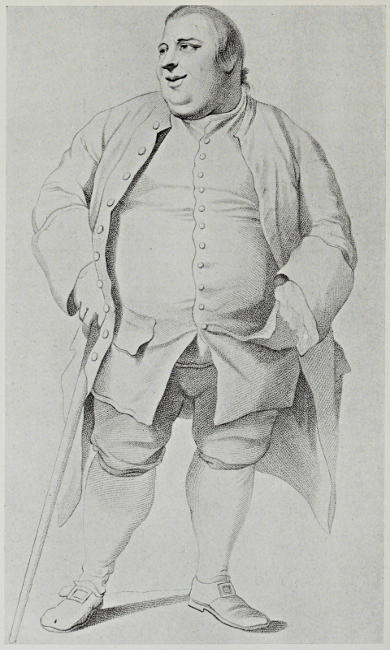
FRANCIS GROSE
“A chiel’s amang ye takin’ notes.”
For many years the back parlour of the “Feathers”[184] public-house (a sign complimentary to its neighbour, Frederick, Prince of Wales, who inhabited Leicester House), which stood on the side of Leicester Fields, had been frequented by artists, and several well-known amateurs. Among the former were Stuart,[185] the Athenian traveller; Scott,[186] the marine painter; old Oram, of the Board of Works;[187] Luke Sullivan,[188] the miniature painter, who engraved that inimitable print from Hogarth’s picture of the “March to Finchley,” now in the Foundling Hospital; Captain Grose,[189] the author of Antiquities of England, History of Armour,[190] etc.; Mr. Hearne,[191] the elegant and correct draughtsman of many of England’s Antiquities (so beautifully engraved by his amiable friend Byrne), Nathaniel Smith, my father, etc. The amateurs were Henderson, the actor; Mr. Morris, a silversmith; Mr. John Ireland, then a watchmaker in Maiden Lane, and since editor of Boydell’s edition of Dr. Trusler’s work, Hogarth Moralized; and Mr. Baker, of St. Paul’s Churchyard, whose collection of Bartolozzi’s works was unequalled.[192] When this house, the sign of the “Feathers,” was taken down to make way for Dibdin’s Theatre, called the “Sans Souci,” several of its frequenters adjourned to the “Coach and Horses” public-house in Castle Street, Leicester Fields; but in consequence of their not proving customers sufficiently expensive for that establishment, the landlord one evening venturing to light them out with a farthing candle, they betook themselves to Gerard Street, and thence to the “Blue Posts” in Dean Street, where the club dwindled into two or three members, viz. Edridge, the portrait draughtsman; Alexander, of the British Museum; and Edmunds, the upholsterer, who had been undertaker to the greater part of the club.[193]
Mr. Baker, the gentleman before mentioned, being a single man, and sometimes keeping rather late hours, was now and then accompanied by a friend half way home, by way of a walk. It was on one of these nights, that, just as he and I were approaching Temple Bar, about one o’clock, a most unaccountable appearance claimed our attention,—it was no less an object than an elephant, whose keepers were coaxing it to pass through the gateway. He had been accompanied by several persons from the Tower Wharf with tall poles, but was principally guided by two men with ropes, each walking on either side of the street, to keep him as much as possible in the middle on his way to the menagerie, Exeter Change; to which destination, after passing St. Clement’s Church, he steadily trudged on with strict obedience to the commands of his keepers. I had the honour afterwards of partaking of a pot of Barclay’s Entire with this same elephant, which high mark of his condescension was bestowed when I accompanied my friend the late Sir James Winter Lake, Bart., to view the rare animals in Exeter Change—that gentleman being assured by the elephant’s keeper that if he would offer the beast a shilling, he would see the noble animal nod his head and drink a pot of porter. The elephant no sooner had taken the shilling, which he did in the mildest manner from the palm of Sir James’s hand, than he gave it to the keeper, and eagerly watched his return with the beer. The elephant then, after placing his proboscis to the top of the tankard, drew up nearly the whole of the then good beverage. The keeper observed, “You will hardly believe, gentlemen, but the little he has left is quite warm;” upon this we were tempted to taste it, and it really was so. This animal was afterwards disposed of for the sum of one thousand guineas.[194]
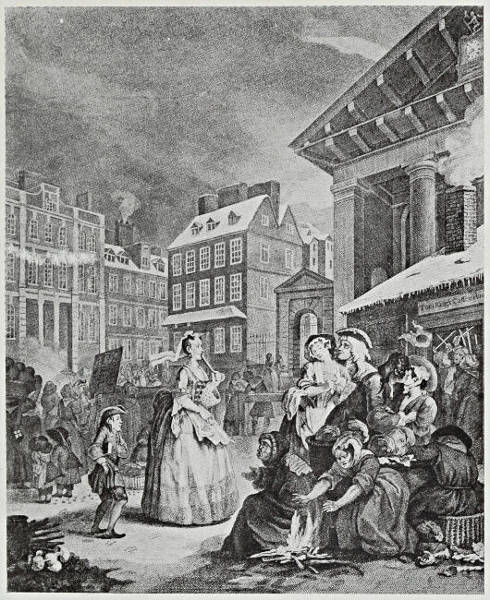
COVENT GARDEN THROUGH HOGARTH’S EYES
“The first square inhabited by the great.”
J. T. Smith
1786.
Possibly the present frequenters of print sales may receive some little entertainment from a description of a few of the most singular of those who constantly attended the auctions during my boyish days. The elder Langford, of Covent Garden, introduced by Foote as Mr. Puff, in his farce of The Minor,[195] I well remember; yet by reason of my being obliged to attend more regularly the subsequent evening sales at Paterson’s and Hutchins’s—next-door-neighbour auctioneers, on the north side of King Street, Covent Garden,[196] I am better enabled to speak to the peculiarities of their visitors than those of Mr. Langford.
It was in 1783, during the sales of the extensive collection of Mr. Moser, the first keeper of the Royal Academy,[197] and Mr. Millan, bookseller at Charing Cross,[198] that I noticed the following remarkable characters. I shall, however, first endeavour to describe the person of Paterson, a man much respected by all who really knew him; but perhaps by none with more sincerity than Doctor Johnson, who had honoured him by standing godfather to his son Samuel, and whom he continued to notice as he grew up with the most affectionate regard, as appears in the letters which the doctor wrote in his favour to his friends Sir Joshua Reynolds and Mr. Humphrey, printed by Boswell.[199] Mr. Paterson was in height about five feet eight inches, and stooped a little in the shoulders. When I first knew him, he was a spare man, and wore a powdered clubwig, similar to that worn by Tom Davies, the bookseller and biographer of Garrick, of whom there is an engraved portrait. Paterson was really a walking library, and of manners precisely coinciding with the old school. I remember that by a slight impediment in his speech, he always pronounced the letter R as a V; for instance, Dart’s History of Canterbevy, and a dromedary, he pronounced a dwammedavy; notwithstanding this defect, he publicly lectured on the beauties of Shakspeare.
Mr. Gough,[200] the Editor of Camden’s Britannia, was the constant frequenter of his book-sales. This antiquary was about the same height as the auctioneer, but in a wig very different, as he wore, when I knew him, a short shining curled one. His coat was of “formal cut,” but he had no round belly; and his waistcoat and smallclothes were from the same piece. He was mostly in boots, and carried a swish-whip when he walked. His temper I know was not good, and he seldom forgave those persons who dared to bid stoutly against him for a lot at an auction: his eyes, which were small and of the winky-pinky sort, fully announced the fretful being. As for his judgment in works of art, if he had any it availed him little, being as much satisfied with the dry and monotonous manner of Old Basire,[201] as our late President West was with the beautiful style of Woollett and Hall.
Dr. Lort,[202] the constant correspondent of Old Cole,[203] was a man of his own stamp, broad and bony, in height nearly six feet, of manners equally morose, and in every respect just as forbidding. His wig was a large Busby, and usually of a brown appearance, for want of a dust of powder. He was chaplain to the Duke of Devonshire; and as he wore thick worsted stockings, and walked anyhow through the mud, considered himself in no way obliged to give the street-sweepers a farthing. He had some wit, however, but it was often displayed in a cowardly manner, being mostly directed towards his little opponent, Doctor Gossett,[204] who was unfortunately much afflicted by deformity, and of a temper easily roused by too frequent a repetition of threepenny biddings at Paterson’s. Paterson sold his books singly, and took threepence at a bidding.
Hutchins was about five feet nine inches, but in appearance much shorter by reason of his corpulency. His high forehead, when compared with a perpendicular, was at an angle of forty-five. He was what Spurzheim would call a simple honest man: his wife was of the same build, but most powerfully possessed the organ of inquisitiveness, which induced her to be a constant occupant of a pretty large and easy chair, by the side of the fire in the auction-room, in order that she might see how business was going on. Mr. and Mrs. Hutchins appeared so affectionately mutual in all their public conclusions, that Caleb Whitefoord, the witty wine-merchant, one of the print-sale visitors, attempted to flourish off the following observation as one of his invention: “You see,” said he to Captain Baillie, “Cocker is not always correct; one and one do not in this instance make two.”[205]
Caleb Whitefoord[206] was what is usually called a slight-built man, and much addicted when in conversation to shrug up his shoulders. He had a thin face, with little eyes; his deportment was gentlemanly, though perhaps sometimes too high for his situation in life. His dress, upon which he bestowed great attention, was in some instances singular, particularly in his hat and wig, which were remarkable as being solitary specimens of the Garrick School. He considered himself a first-rate judge of pictures, always preferring those by the old masters, but which he endeavoured to improve by touching up; and when in this conceited employment, I have frequently seen him fall back in his chair, and turn his head from one shoulder to the other, with as much admiration of what he had done, as Hogarth’s sign-painter of the Barley-mow in his inimitable print of Beer Street.
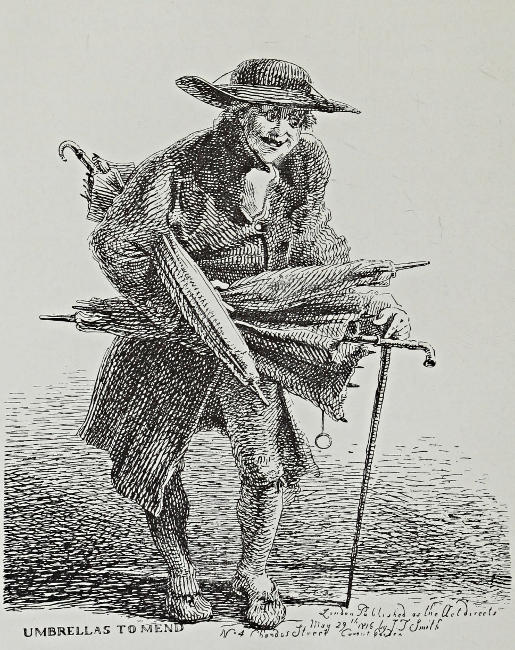
LONDON STREET MERCHANTS: UMBRELLAS TO MEND
ETCHED BY J. T. SMITH
Captain William Baillie[207] was also an amateur in art; he suffered from an asthma, which often stood his friend by allowing a lengthened fit of coughing to stop a sentence whenever he found himself in want of words to complete it. When not engaged in his duties as a commissioner of the Stamp Office, he for years amused himself in what he called etching; but in what Rembrandt, as well as every true artist, would call scratching. He could not draw, nor had he an eye for effect. To prove this assertion, I will “end him at a blow,” by bringing to my informed reader’s recollection the captain’s execrable plate, which he considered to be an improvement upon Rembrandt’s “Three Trees.” Mr. West classed him amongst the conceited men.—“Sir,” said the venerable President, “when I requested him to show me a fine impression of Rembrandt’s Hundred Guilder print, he placed one of his own restored impressions before me, with as much confidence as my little friend Edwards[208] attempts to teach Perspective in the Royal Academy.” Captain Baillie commonly wore a camlet coat, and walked so slowly and with such measured steps, that he appeared like a man heavily laden with jack-boots and Munchausen spurs; and whenever he entered an auction-room, he generally permitted his cough to announce his arrival.
Mr. Baker,[209] an opulent dealer in lace, was nightly to be found bidding for the choicest impressions, which he seldom allowed any antagonist, however powerful, to carry away. He was well-proportioned, and though sometimes singular in his manner, and too negligent in his dress, was a most honourable man.
Mr. Woodhouse, of Tokenhouse Yard, was also a bidder for fine things; he did not possess so much of the milk of human kindness as Mr. Baker; indeed, his manners were at times a little repulsive, although he had been many years principal cashier in Sir George Prescott’s banking-house. He was an extensive collector of Cipriani’s drawings.[210]
Mr. Musgrave,[211] of Norfolk Street, frequently attended auctions of prints, but particularly those of pictures; he was an accomplished gentleman in his address, and most feelingly benevolent in his actions. His figure was short, his features pleasing, and he seldom went abroad without a rose in his button-hole. When I state that no man could have had fewer enemies, I think even the descendants of “Vinegar Tom”[212] will never haunt my bedside.
There was another truly polite and kind-hearted attendant at Hutchins’s sales, Mr. Pitt, of Westminster. The manners of this gentleman were precise, and he wore a large five-story white wig.
The next collector at this period was Mr. Wodhull,[213] the translator of Euripides. He was very thin, with a long nose and thick lips; of manners perfectly gentlemanly. The great singularity of his appearance arose, perhaps, from his closing his coat from the first button, immediately under his chin, to the last, nearly extending to the bottom of his deep-flap waistcoat-pockets. He seldom spoke, nor would he exceed one sixpence beyond the sum which he had put down in his catalogue, to give for the articles he intended to bid for; and though he frequently went away without purchasing a single lot, or even speaking to any one during the whole evening, he always took off his hat, and bowed low to the company before he left the auction-room.
Mr. Rawle, an accoutrement-maker, then living in the Strand, was a visitor: he was the friend of Captain Grose, and the executor of Thomas Worlidge,[214] the etcher. In his early days he had collected many curious and valuable articles. His cabinets contained numerous interesting portraits in miniature of Elizabethan characters. He was a professed Commonwealth man, and possessed many of the Protector’s, or, according to some writers, the usurper’s letters. He also prided himself upon having the leathern doublet, sword, and hat in which Oliver dissolved the Parliament, and showed a helmet that he could incontrovertibly prove had belonged to him. He likewise frequently expatiated for a considerable time upon a magnificent wig, which he said had been worn by that Merry Monarch, King Charles the Second.[215] This singular character never would allow more than a halfpenny-worth of vegetables to be put upon his table, though they were ever so cheap; and when they were above his price, he went without.[216]
Another singular character of the name of Beauvais, who at one time had flourished at Tunbridge Wells as a miniature-painter,[217] attended the evening auctions. This man, who was short and rather lumpy in stature, indeed nearly as wide as he was high, was a native of France, and through sheer idleness became so filthily dirty in his person and dress, that few of the company would sit by him. Yet I have seen him in a black suit with his sword and bag, in the evening of the day on which he had been at Court, where for years he was a constant attendant. This “Sack of Sand,” as Suett the actor generally called him, sat at the lower end of the table; and as he very seldom made purchases, few persons ventured to converse with him. He frequently much annoyed Hutchins by the loudest of all snoring; and now and then Doctor Wolcot would ask him a question, in order to indulge in a laugh at his mode of uttering an answer, which Peter Pindar declared to be more like the gobbling of a turkey-cock than anything human. He lived in a two-pair-of-stairs back room in St. James’s Market; and, after his death, Hutchins sold his furniture. I recollect his spinet, music-stool, and a few dog’s-eared sheets of lessons sold for three-and-sixpence.
Mr. Matthew Mitchell,[218] the banker, frequently joined these parties, and seldom went away without a purchase of prints under his arm. He was extremely well-proportioned, and walked in what I have often heard the ladies of the old school style a portly manner. He was remarkable for a width of chin, which was full as large as Titus Oates’s, and a set of large white teeth. His features altogether, however, bespoke a good-natured and liberal man. This gentleman was very kind to me when I was a boy, and I never hear his name mentioned but with unspeakable pleasure.
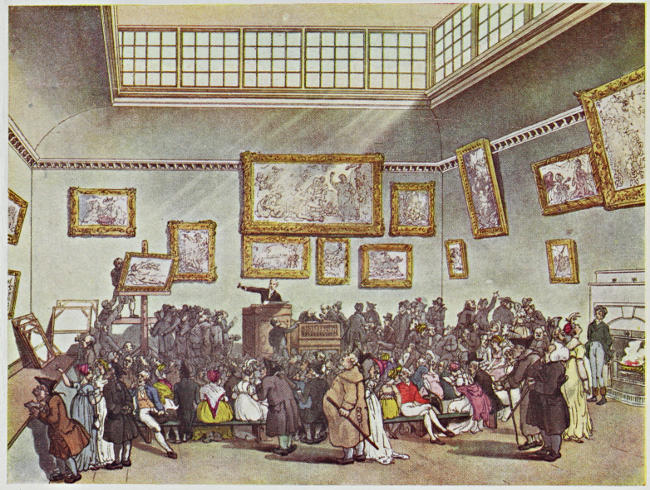
CHRISTIE’S AS “RAINY DAY” SMITH KNEW IT
Mr. Mitchell had a most serious antipathy to a kitten. He could sit in a room without experiencing the least emotion from a cat; but directly he perceived a kitten, his flesh shook on his bones, like a snail in vinegar. I once relieved him from one of these paroxysms, by taking a kitten out of the room; on my return he thanked me, and declared his feelings to be insupportable upon such an occasion. Long subsequently I asked him whether he could in any way account for this agitation. He said he could not, adding that he experienced no such sensations upon seeing a full-grown cat; but that a kitten, after he had looked at it for a minute or two, in his imagination grew to the size of an overpowering elephant.
At this period Hogarth’s prints were in such high request, that whenever anything remarkable appeared, it was stoutly contested: for Mr. Packer, of Combe’s Brewhouse, was one of the most enterprising of the Hogarth collectors. This gentleman, though his manners sometimes appeared blunt, was highly respected by all who really knew him: it was at this time he became my friend.[219]
He was tall, of good proportion, and well-favoured. He had his peculiarities in dress, particularly as to his hat, which was an undoubted original. Mr. Packer’s opponents in Hogarth prints were two persons, one of the name of Vincent, a tall, half-starved-looking man, who walked with a high gilt chased-headed cane (he had been a chaser of milk-pots, watch-cases, and heads of canes, and he always walked with this cane as a show-article), and the other of the name of Powell, better known under the appellation of “Old black wig.”
Henderson, the player,[220] who was also a collector of Hogarth’s works, seldom made his appearance on these boards—John Ireland being his deputy-manager.[221]
I must not omit to mention another singular but most honourable character, of the name of Heywood, nicknamed “Old Iron Wig.” His dress was precise, and manner of walking rather stiff. He was an extensive purchaser of every kind of article in art, particularly Rowlandson’s drawings; for this purpose he employed the merry and friendly Mr. Seguier,[222] the picture-dealer, a schoolfellow of my father’s, to bid for him.
I shall now close this list by observing that my early friend and fellow-pupil, Rowlandson, who has frequently made drawings of Hutchins and his print-auctions, has produced a most spirited etching, in which not only many of the above-described characters are introduced, but also most of the printsellers of the day. There is another, though it must be owned very indifferent, plate, containing what the publisher called “Portraits of Printsellers,” from a monotonous drawing by the late Silvester Harding, whose manner of delineation made persons appear to be all of one family, particularly his sleepy-eyed and gaudily-coloured drawings of ladies.
1787.
At this time my mimic powers induced Delpini the clown,[223] who had often been amused with several of my imitations of public characters, to mention me to Mr. John Palmer,[224] who, after listening to my specimens, promised me an engagement at the Royalty Theatre, which was then erecting; but as that gentleman was too sanguine, and failed in procuring a licence, I, as well as many other strutting heroes, was disappointed.
After this my friends advised me to resume the arts; and, with the usual confidence of an unskilful beginner, I at once presumed to style myself “drawing-master.” However, my slender abilities, or rather industry, were noticed by my kind patrons, who soon recommended me to pupils, and by that pursuit I was enabled, with some increase of talent, to support myself for several years. It is rather extraordinary that mimicry with me was not confined to the voice, for I could in many instances throw my features into a resemblance of the person whose voice I imitated. Indeed, so ridiculous were several of these gesticulations, that I remember diverting one of my companions by endeavouring to look like the various lion-headed knockers as we passed through a long street. Skilful, however, as I was declared to be in some of my attempts, I could not in any way manage the dolphin knockers in Dean Street, Fetter Lane. Their ancient and fish-like appearance was certainly many fathoms beyond my depth; and as much by reason of my being destitute of gills, and the nose of that finny tribe, extending nearly in width to its tremendous mouth, I was obliged to give up the attempt.
When first I saw these knockers, which were all of solid brass, seventeen of the doors of the four-and-twenty houses in Dean Street were adorned with them, and the good housewives’ care was to keep them as bright as the chimney-sweeper’s ladle on May-day. As my mind from my earliest remembrance was of an inquisitive nature, my curiosity urged me to learn why this street, above all others, was thus adorned; and my inquiry was, as I then thought, at once answered satisfactorily.
This ground and the houses upon it belong to the Fishmongers’ Company, was the answer returned by one of the oldest inhabitants; and the heraldic reader will recollect that the arms of that worshipful and ancient body are dolphins. Not being satisfied with this assertion, however, I went to Fishmongers’ Hall, and was there assured that the Company never had any property in Dean Street, Fetter Lane. On the 17th of May, 1829, I visited this street in order to see how many of my brazen-faced acquaintances exposed themselves, and I found that Dean Street was nearly as deficient in its dolphin knockers as a churchyard is of its earliest tombstones, for out of seventeen only three remained.[225]
In the commencement of this year I took lodgings in Gerrard Street, and acquiesced in the regulations of my landlady; one of the principal of which was, that I never was to expect to be let in after twelve o’clock, unless the servant was apprised of my staying out later, and then she was to be permitted to sit up for me. Being in my twenty-first year, of a lively disposition, and moreover fond of theatrical representations, I did not at all times “remember twelve”; for although Mrs. Siddons sounded it so emphatically upon my ear, I could never quit the theatre till half an hour after. My finances at this period being sometimes too slender to afford an additional lodging for the night, and not often venturing to expose myself to insult, or the artful and designing, by perambulating the city, unless the moon invited me, I fortunately hit upon the following expedient, which not only sheltered me from rain, but afforded me a seat by the fireside. I either used to go to the watch-house of St. Paul, Covent Garden, or that of St. Anne, Soho; so, having made myself free of both by agreeing with the watch-house keeper to stand the expense of two pots of porter upon every nocturnal visit, I was enabled to see what is called “life and human nature.”
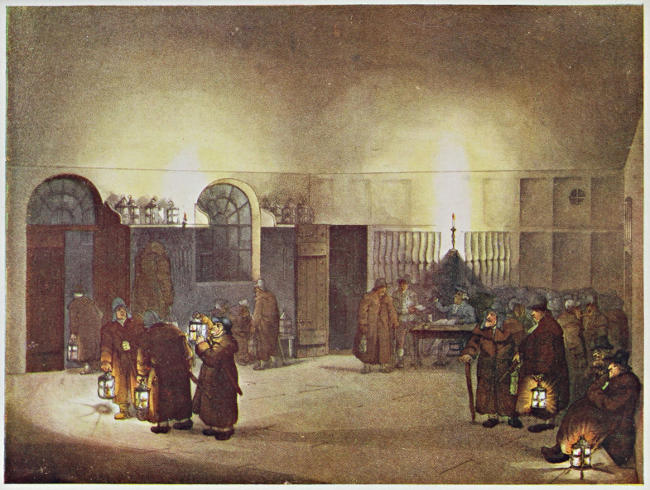
A LONDON WATCH HOUSE
One of the curious scenes witnessed upon a more recent occasion afforded me no small amusement. Sir Harry Dinsdale, usually called Dimsdale, a short, feeble little man, was brought in to St. Anne’s watch-house, charged by two colossal guardians of the night with conduct most unruly. “What have you, Sir Harry, to say to all this?” asked the Dogberry of St. Anne. The knight, who had been roughly handled, commenced like a true orator, in a low tone of voice, “May it please ye, my magistrate, I am not drunk; it is languor. A parcel of the bloods of the Garden have treated me cruelly, because I would not treat them. This day, Sir, I was sent for by Mr. Sheridan to make my speech upon the table at the Shakspeare Tavern, in Common Garden; he wrote the speech for me, and always gives me half a guinea, when he sends for me to the tavern. You see I didn’t go in my Royal robes; I only put ’um on when I stand to be member.” Constable—“Well, but Sir Harry, why are you brought here?” One of the watchmen then observed, “That though Sir Harry was but a little shambling fellow, he was so upstroppolus and kicked him about at such a rate, that it was as much as he and his comrade could do to bring him along.” As there was no one to support the charge, Sir Harry was advised to go home, which, however, he swore he would not do at midnight without an escort. “Do you know,” said he, “there’s a parcel of raps now on the outside waiting for me.”
The constable of the night gave orders for him to be protected to the public-house opposite the west end of St. Giles’s Church, where he then lodged. Sir Harry hearing a noise in the street, muttered, “I shall catch it; I know I shall.” “See the conquering hero comes” (cries without). “Ay, they always use that tune when I gain my election at Garrett.”
Although many of my readers may recollect Sir Harry Dinsdale, yet it may be well for the information of others to state who and what he was. Before I commence his history, however, I should observe that the death of Sir Jeffery Dunstan, a dealer in old wigs, who had been for many years returned member for Garrett, first gave popularity to Harry Dinsdale, who, from the moment he stood as candidate, received mock knighthood, and was ever after known under the appellation of “Sir Harry.”[226] There are several portraits of this singular little object, by some called “Honeyjuice,” as well as of his more whimsical predecessor, Sir Jeffery Dunstan, better known as “Old Wigs.” Sir Harry exercised the itinerant trade of a muffinman in the afternoon; he had a little bell, which he held to his ear, smiling ironically at its tingling. His cry was “Muffins! muffins! ladies come buy me! pretty, handsome, blooming, smiling maids.” Flaxman the sculptor, and Mrs. Mathew, of blue-stocking memory, equipped him as a hardware man, and as such I made two etchings of him.
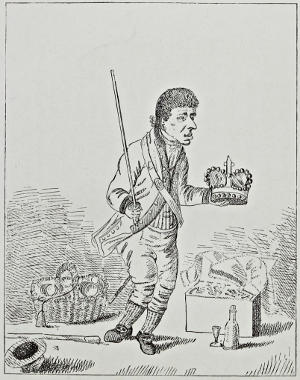
SIR HARRY DINSDALE
MAYOR OF GARRAT AND EMPEROR ANTI-NAPOLEON
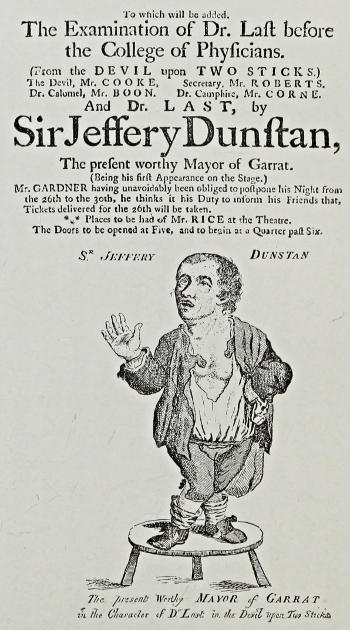
SIR JEFFERY DUNSTAN
“His first appearance on any stage.”
Many a time when I had no inclination to go to bed at the dawn of day, I have looked down from my window to see whether the author of the Sublime and Beautiful had left his drawing-room, where I had seen that great orator during many a night after he had left the House of Commons, seated at a table covered with papers, attended by an amanuensis who sat opposite to him.[227] Major Money, who had nearly been lost at sea with his balloon, at that time lodged in the same house. Of the Major’s perilous situation at sea, the elder Reinagle made a spirited picture, of which there is an engraving.[228]
In this year I had the honour for the first time of exhibiting at the Royal Academy. My production was a portrait of the venerable beech-tree which stood within memory at a short distance from Sand-pit Gate, in Windsor Forest, and which tree has been so admirably painted by West. This picture, which measures five feet in height and seven in length, was sold by auction at Mr. West’s house, in May 23rd, 1829. My drawing, as well as many of my studies made from that delightful display of forest scenery, was highly finished in black chalk; it was purchased by the late Earl of Warwick, who was not only an admirable draughtsman himself, but kind to young artists. By that nobleman I was introduced to the Hon. F. Charles Greville [the Earl’s brother and a Vice-President of the Royal Society], whose taste for the Fine Arts is too well known to need any eulogium from me.[229] This gentleman gave Cipriani above one hundred guineas for an elaborate drawing of the famous Barberini vase, brought to England by Sir William Hamilton.[230] Several learned writers have given their conjectures as to the subject so beautifully sculptured on this vase; but I understand that nothing has been adduced as yet that sufficiently elucidates it. This vase is deposited in the British Museum.
This grey and silver beech was the loftiest in the forest, and particularly beautiful when the sun shone upon its ancient limbs; his capacious and hollow trunk, with a small additional hut, afforded accommodation for a woodman, his wife, four children, a sow and a numerous litter of pigs. This happy family retreat, which had frequently been noticed by King George III., was at last unavoidably obliged, from the symptoms it exhibited of falling, to submit to the woodman’s axe—that woodman whose family had weathered many a storm, and had been screened from the scorching sunbeams under its majestic branches, several of which, by reason of its “bald and high antiquity,” had not issued foliage for many a summer. The King, however, who never suffered the humblest of his subjects whose industry he had noticed, to sigh under calamity, ordered a snug, neat brick cottage to be built for the honest occupant and his dependents, which was erected in the same forest, and at as short a distance as possible from the former residence.
One curious and interesting discovery resulted from the demolition of this venerable tree. The woodman, who had allowed the smoke from his peat-piled fire to pass through one of the hollow limbs of the tree for several years without sweeping it, had, by accumulated incrustations, produced a mass of the finest brown colour, resembling the present appearance of that used by Rembrandt, so much coveted by the English artists. The discovery was made by Mr. Paul Sandby, who was fortunately passing at the time the timber was on the ground, who immediately secured a tolerable quantity to enable him to prove that the smoke from forest fuel, united with the heated branch of a hollow and aged beech, produced the finest bistre: his son, the present Mr. Sandby, gave me a lump of it, which I presented to the late Sir George Beaumont.[231] Having mentioned this bistre to several Roman artists, they informed me that a strong decoction of the sap of the ilex, or evergreen oak, produces a colour nearly similar; and of this I have had satisfactory proof. These, and suchlike bistres, would be much safer for the artist to use than that called sepia, which is made from the ink of the cuttle-fish, which, being a marine production, ever retains its saline and pernicious qualities, as may be seen in several of the numerous drawings made by Guercino, where the colour has left a blot, which has completely eaten through the paper. However, after all the trials of our experimentalists to match the present tint of Rembrandt’s drawings, and however pleasingly ingenious their discoveries have been, still I am inclined to believe that much, if not the whole, of the effect of old drawings is owing to that produced by time; and in this idea I am borne out by a small drawing which the ever-to-be-revered Flaxman made with a pen in common writing-ink: he drew it when I was a lad, and it is now a deep rich brown. May we not also fairly conclude, from the brown tint of most of our old manuscripts, that time has thus operated upon the ink? if so, the question is, what will the future colour of that which we now use in imitation, consisting of many ingredients, be, after fifty-five years, the elapsed time since I received my drawing from the kind hand of Flaxman? It is a curious fact, however, that the ink used by the ancient Egyptians on nearly two hundred specimens of the written inscriptions on papyrus collected by Mr. Salt,[232] now in the British Museum, are as jet a black as Cozens’s[233] blotting-ink, or Day and Martin’s far-famed blacking.
1788.
Although not considered an Adonis by the ladies, yet most of those to whom I had the pleasure to be known, noticed me as a favourite, and by some my appearance in company was cordially greeted. “Friend Thomas,” asked one, “pray what play didst thou see last night?” With this appellation I was frequently addressed, in consequence of my mother having been a member of the Society of Friends. “Love’s Labour Lost,” being my answer to the pre-engaged fair one, uttered perhaps with a smile, she was induced to rejoin, “If you had not hitherto been so blind a son of Venus, you would not have lost my smiles.” After this rebuke, my pursuit became brisker, and I at last fixed my heart upon my first wife.[234] Upon becoming a Benedict, I partly recovered the use of my senses, gave up my clubs, dissolved many connections, and in order to be faithful to my pledge, “to love and to cherish,” I applied myself steadily to my etching-table, and commenced a series of quarto plates, to illustrate Mr. Pennant’s truly interesting account of our great city (entitled Some Account of London), which I dedicated to my patron, Sir James Winter Lake, Bart.
Sir James was a governor of the Hudson’s Bay Company,—a situation, it is well known, he filled with credit to himself as well as the satisfaction of every one connected with that highly-respected body. Sir James most kindly invited me to take a house near him at Edmonton, where I had the honour, for the space of seven years, of enjoying the steady friendship of himself and family. Lady Lake, who then retained much of her youthful beauty, by her elegance of language and extreme affability charmed every one. To clever people of every description she was kind, and benevolent to the poor.
The Lake family consisted of Sir James, his lady, their sons, James, Willoughby, Atwill, and Andrew,—their daughters, Mary, Charlotte, and Anne.[235] Their residence, which had long been their family mansion, was distant about a mile from the Angel Inn, and was called “The Firs,” in consequence of the approach to the house being planted on either side with double rows of that tree.
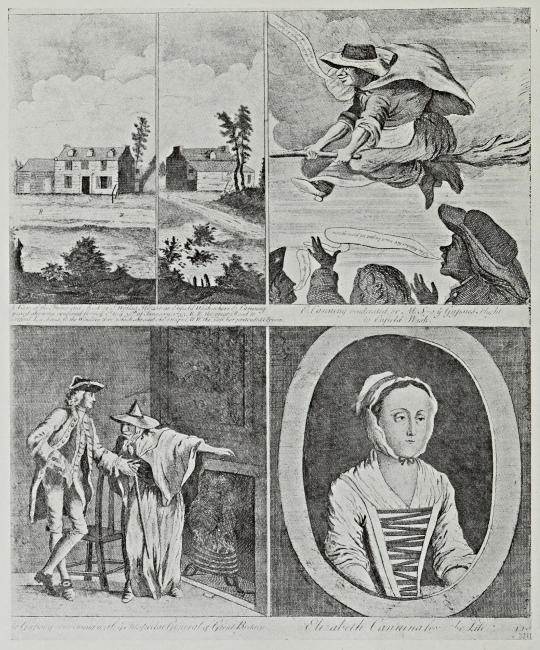
ELIZABETH CANNING
“For my own part, I am not at all brought to believe her story.”
Horace Walpole
1789.
This year proved more lucrative to me than any preceding, for at this time I professed portrait painting both in oils and crayons; but, alas! after using a profusion of carmine, and placing many an eye straight that was misdirected, before another season came, my exertions were mildewed by a decline of orders, owing not only to the salubrity of the air of Edmonton, but to the regularity of those who had sat to me, for they would neither die nor quit their mansions, but kept themselves snug within their King-William iron gates and red-brick-crested piers, so that there was no accommodation for new-comers; nor would the red land-owners allow one inch of ground to the Tooley Street Camomile Cottage builders.[236] However, I experienced enough to convince me that, had I diverged along the cross-roads towards the Bald-faced Stag, the highway to the original Tulip-tree at Waltham Abbey, or the green lanes to Hornsey Wood House, I might have considerably increased my income; but this would have been impossible without a conveyance. Nevertheless, as it was, the reader will hardly believe that my marches of fame were far more extensive than those of Major Sturgeon;[237] his were confined to marches and counter-marches, from Ealing to Acton, and from Acton to Ealing, next-door neighbours: now, my doves took a circuitous flight from Tottenham to “Kicking Jenny” at Southgate; then to Enfield, ay, even to its very Wash, rendered notorious by Mary Squires and Bet Canning;[238] thence over Walton’s famed river Lea: thence up to Chingford’s ivy-mantled tower; down again, crossing the Lea with the lowing herd, to Tottenham High Cross, finishing where they put up on the embattlements of the once noble Castle of Bruce.
It was in the centre of the above vicinities, at “Edmonton so gay,” the rendezvous of Shakspeare’s merry devil,[239] that I profiled, three-quartered, full-faced, and buttoned up the retired embroidered weavers, their crummy wives, and tightly-laced daughters. Ay, those were the days! my friends of the loom, as Tom King declared in the prologue to Bon Ton, when Mother Fussock could ride in a one-horse chaise, warm from Spitalfields, on a Sunday![240]
1790.
Many a rural walk have I and my beloved enjoyed, accompanied by our uninvited, playful, tailed butterfly-hunter, through the lonely honeysuckled lanes to the “Widow Colley’s,” whose nut-brown, mantling home-brewed could have stood the test with that of Skelton’s far-famed Elyn—the ale-wife of England, upon whose October skill Henry VIII.’s Poet Laureate sang.[241] Sometimes our strolls were extended to old Matthew Cook’s Ferry, by the side of the Lea, so named after him, and well known to many a Waltonian student. Matthew generally contrived to keep sixteen cats, all of the finest breed, and, as cats go, of the best of tempers, all of whom he had taught distinct tricks; but it was his custom morning and evening to make them regularly, one after the other, leap over his hands joined as high as his arms could reach: and this attention to his cats, which occupied nearly the whole of his time, afforded him as much pleasure as Hartry, the cupper in May’s Buildings,[242] and his assistant could receive in phlebotomizing, in former days, above one hundred customers on a Sunday morning, that being the only leisure time the industrious mechanic could spare for the operation.
Melancholy as Cook’s Ferry is during the winter, it is still more so in the time of an inundation, when it is almost insupportable; and had not Matty enjoyed the society of his cats, who certainly kept the house tolerably free from rats and mice, at the accustomed time of a high flood he must have been truly wretched. In this year, during one of these visitations, in order to gratify my indefatigable curiosity, I visited him over the meadows, partly in a cart and partly in a boat, conducted by his baker and Tom Fogin, his barber. We found him standing in a washing-tub, dangling a bit of scrag of mutton before the best fire existing circumstances could produce, in a room on the ground floor, knee-deep in water, whilst he ever and anon raised his voice to his cats in the room above, where he had huddled them for safety.
The baker, after delivering his bread in at the window, and I, after fastening our skiff to the shutter-hook, waited the return of Fogin, who had launched himself into a tub to shave Matthew, who had perched himself on the coroneted top of a tall Queen Anne’s chair, and drawn his feet as much under him as possible, and then, with the palms of his hands flat upon his knees to keep the balance true, was prepared to suck in Fogin’s tales in the tub during his shave. Tom retailed all the scandal he had been able to collect during the preceding week from the surrounding villages; how Dolly alias Matthew Booth, a half-witted fellow, was stoutly caned by old John Adams, the astronomical schoolmaster, for calling him “a moon-hauler,”—how Mr. Wigston trespassed on Miss Thoxley’s waste,—of the sisters Tatham being called the “wax dolls” of Edmonton, whose chemises Bet Nun had declared only measured sixteen inches in diameter,—of old Fuller, the banker, riding to Ponder’s End with a stone in his mouth to keep it moist, in order to save the expense of drink,—upon Farmer Bellows’s and old Le Grew’s psalm-singing,—of Alderman Curtis and his Southgate grapery, and of his neighbour, a divine gentlem—man, I had very nearly called him, who had horsewhipped his wife.
1791.
I remember on a midsummer morn of this year making one of a party of pleasure, consisting of the worthy baronet Sir James Lake, the elder John Adams,[243] schoolmaster of Edmonton, Samuel Ireland,[244] author of the Thames, Medway, etc. We started from my cottage at Edmonton, and took the road north. The first house we noticed was an old brick mansion at the extreme end of the town, erected at about the time of King Charles I., opposite butcher Wright’s. This dilapidated fabric was let out in tenements, and the happiest of its inmates was a gay old woman who lived in one of its numerous attics. She gained her bread by spinning, and as we ascended she was singing the old song of “Little boy blue, come blow me your horn” to a neighbour’s child, left to her care for the day. “Well, Mary,” quoth the a-b-c-darian, “you are always gay; what is your opinion of the lads and lasses of the present time, compared with those of your youthful days?” “I’ faith,” answered Mary, “they are pretty much the same.” She was then considerably beyond her eightieth year. We then proceeded to Ponder’s End, where I conducted my fellow-travellers to a field on the left, behind the Goat public-house, to see “King Ringle’s Well,” but why so called even Mr. Gough has declared he was unable to discover.[245]
The next place we visited consisted of extensive moated premises, called “Durance,” on the right of the public road. This house, as tradition reported, had been the residence of Judge Jeffreys; and here it is said that he exercised some severities upon the Protestants.[246]
We then returned through Green Street; and at a cottage we discovered an Elizabethan door, profusely studded with flat-headed nails. This piece of antiquity Samuel Ireland stopped to make a drawing of, which circumstance I beg the reader will keep in mind, as it will be mentioned hereafter. We then, after descanting upon the beauties of Waltham Cross, proposed to visit the father of the Tulip-trees, an engraving of which appeared in Farmer’s History of Waltham Abbey.[247] We looked in vain for a portion of King Harold’s tomb. There were remains of it in Strutt’s early days: he made a drawing of them. Our next visit was to a small ancient elliptic bridge in a field a little beyond the pin-manufactory; this bridge has ever been held as a great curiosity, and one of high antiquity. As we returned through Cheshunt, we rummaged over a basket of old books placed at the door of the barber’s shop, where Sir James Lake bought an excellent copy of Brooke’s Camden’s Errors for sixpence, and also an imperfect copy of Burton’s Anatomy of Melancholy, for the sake of a remarkably fine impression of a portrait of its author on the title-page. After dining at the Red Lion, we visited another old moated mansion, the property of Dr. Mayo, said to have been originally a house belonging to Cardinal Wolsey, or in which he had at one time resided.[248] After crossing a drawbridge, and passing through the iron gates, the gardener ushered us into a spacious hall, and showed us a curiously constructed chair, in which he said the Cardinal’s porter usually sat. Of this singular chair above mentioned I made a drawing, and had the honour to furnish the late Marquis of Lansdowne with a copy, to enable his Lordship to have a set made from it. In an adjoining room was a bedstead and furniture, considered to be that in which the Cardinal had slept; it was of a drab-coloured cloth, profusely worked over with large flowers in variously coloured silks. We were then conducted to an immense room filled with old portraits. I recollect noticing one in very excellent preservation of Sir Hugh Myddelton, with an inscription on the background totally differing from the one by Cornelius Janssen, engraved by Vertue.[249] Thus ended this pleasant excursion.
1792.
That Vandyke did not possess that liberal patron in King Charles I. which his biographers have hitherto stated, is unquestionably a fact, which can be proved by a long bill which I have lately seen (by the friendly indulgence of Mr. Lemon[250] and his son), in the State Paper Office, docketed by the King’s own hand. For instance, the picture of his Majesty dressed for the chase (which I conjecture to be the one engraved by Strange),[251] for which Vandyke had charged £200, the King, after erasing that sum, inserted £100; and down in proportion, nay, in some instances they suffered a further reduction. Of several of the works charged in the bill, which his Majesty marked as intended presents to his friends, I recollect one of two that were to be given to Lord Holland was reduced to the sum of £60. Other pictures in the bill the King marked with a cross, which is explained at the back by Endymion Porter, that as those were to be paid for by the Queen, the King had left them for her Majesty to reduce at pleasure.
That a daughter of Vandyke was allowed a pension for sums owing by King Charles I. to her father, is also true, as there is a petition in consequence of its being discontinued still preserved in the State Paper Office, in which that lady declares herself to be plunged into the greatest distress, adding that she had been cheated by the purchaser of her late father’s estate, who never paid for it.[252]
It would be the height of vanity in me to offer anything beyond what the author of The Sublime and Beautiful has said of Sir Joshua Reynolds, who died this year at his house in Leicester Square.[253] As Mr. Burke’s character of this most powerful of painters may not be in the possession of all my readers, I shall here reprint it.[254]
“The illness of Sir Joshua Reynolds was long, but borne with a mild and cheerful fortitude, without the least mixture of anything irritable or querulous, agreeably to the placid and even tenor of his whole life.
“He had, from the beginning of his malady, a distinct view of his dissolution; and he contemplated it with that entire composure which nothing but the innocence, integrity, and usefulness of his life, and unaffected submission to the will of Providence, could bestow. In this situation he had every consolation from family tenderness, which his own kindness to his family had indeed well deserved.
“Sir Joshua Reynolds was, on very many accounts, one of the most memorable men of his time. He was the first Englishman who added the praise of the elegant arts to the other glories of his country. In taste, in grace, in facility, in happy invention, and in the richness and harmony of colouring, he was equal to the great masters of the renowned ages. In portrait he was beyond them; for he communicated to that description of the art, in which English artists are the most engaged, a variety, a fancy, and a dignity derived from the higher branches, which even those who professed them in a superior manner did not always preserve, when they delineated individual nature. His portraits remind the spectator of the invention of history and the amenity of landscape. In painting portraits, he appeared not to be raised upon that platform, but to descend to it from a higher sphere. His paintings illustrate his lessons; and his lessons seem to be derived from his paintings. He possessed the theory as perfectly as the practice of his art. To be such a painter, he was a profound and penetrating philosopher.
“In full happiness of foreign and domestic fame, admired by the expert in art, and by the learned in science, courted by the great, caressed by sovereign powers, and celebrated by distinguished poets, his native humility, modesty, and candour never forsook him, even on surprise or provocation, nor was the least degree of arrogance or assumption visible to the most scrutinising eye, in any part of his conduct or discourse.
“His talents of every kind, powerful from nature, and not meanly cultivated by letters—his social virtues in all the relations and in all the habitudes of life—rendered him the centre of a very great and unparalleled variety of agreeable societies, which will be dissipated by his death. He had too much merit not to excite some jealousy, too much innocence to provoke any enmity. The loss of no man of his time can be felt with more sincere, general, and unmixed sorrow. ‘Hail! and farewell!’”
The following letter was addressed to me by my worthy friend Colonel Phillips:[255]—
“Dear Sir,—If it was not for having you older than your friends would wish you, I should be glad you had been of the party, where I heard an argument between Dr. Johnson and Sir Joshua Reynolds, on the wonderful power of the human eye. Dr. Johnson made a quotation which I do not remember. ‘Sir,’ said Sir Joshua, in reply, ‘that divine effect is produced by the parts appertaining to the eye, and not from its globe, as is generally supposed; the skull must be justly proportioned.’
“Mrs. Cholmondeley.[256]—‘My dear Sir Joshua, was there nothing in the magic of Garrick’s eye? its comicality. The Duke of Richmond, the Duke of Dorset, and young Sheridan[257] have superb eyes; but I don’t know what effect they would have on the stage.’
“Sir Joshua.—‘Little or none, Madam; the great beauty of the Duke of Richmond’s eye proceeded from its fine and uncommon colour, dark blue, which would be totally lost on the stage, the light being constantly either too high or too low. Garrick’s eye, unaccompanied by the action of his mouth, would not fascinate. When you are near a person, a pretty woman for instance, and have a good light, the contraction and expansion of the pupilla, which bids defiance to our art, is delightful; it is more perceptible in fine grey and light blue eyes, than in any other colour. We, however, cannot deny the majestic look of the Belvedere Apollo, though unassisted by iris, pupil, eye-lashes, or colour.’
“Dr. Johnson.—‘Sir, a tiger’s eye, and, I am told, a snake’s, will intimidate birds, so that they will drop from trees for its prey, without using their wings.’
“After Dr. Johnson had quaffed about twenty-four cups of tea, he gave a blow of considerable length from his mouth, drew his breath, and said, ‘Sir, I believe you are right, it is but rational to suppose so: I wish that rogue Burke was here.’
“I am sorry, my dear Sir, that my memory is not better, so as to give you verbatim what passed. I feel like a person giving evidence in a court, trammelled by the apprehension of saying too much, or, as a late friend of mine said, ‘remembering a great many circumstances that never happened;’ and I only write this to show my readiness to comply with any request you could possibly make of your obliged friend,
“M. Phillips.”
“If you ask how it comes, the faithful Bossy was not present; Bossy was not always producible after dinner.”
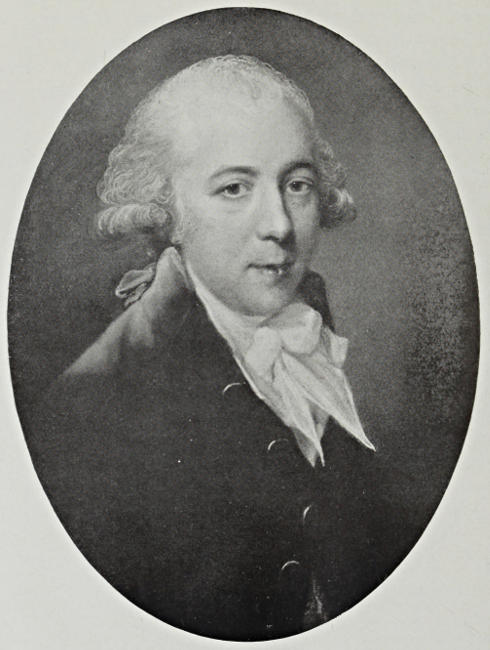
RICHARD BRINSLEY SHERIDAN
“Tell Lady Besborough that my eyes will look up to the coffin-lid as brightly as ever.”
“Wednesday, 27th March.
ROYAL BUN HOUSE, CHELSEA,
GOOD FRIDAY.
No Cross Buns.
“Mrs. Hand respectfully informs her friends, and the public, that in consequence of the great concourse of people which assembled before her house at a very early hour, on the morning of Good Friday; by which her neighbours (with whom she has always lived in friendship and repute) have been much alarmed and annoyed; it having also been intimated, that to encourage or countenance a tumultuous assembly at this particular period, might be attended with consequences more serious than have hitherto been apprehended; desirous, therefore, of testifying her regard and obedience to those laws by which she is happily protected, she is determined, though much to her loss, not to sell Cross Buns on that day, to any person whatever;—but Chelsea Buns as usual.
“Mrs. Hand would be wanting in gratitude to a generous public, who, for more than fifty years past, have so warmly patronised and encouraged her shop, to omit so favourable an opportunity of offering her sincere acknowledgments for their kind favours; at the same time, to assure them she will, to the utmost of her power, endeavour to merit a continuance of them.”[258]
1794.
The origin of wooden tessellated floors having been a subject of much inquiry among many of my friends, I here insert a copy of an advertisement introduced in a catalogue of books, published 1676, under the licence of Roger L’Estrange.[259]
“There is now in the press, and almost finished, that excellent piece of architecture,[260] written by Andrea Palladio, translated out of Italian, with an Appendix, touching Doors and Windows, by Pierre le Muet, Architect to the French King: translated out of French, by G. R.; also Rules and Demonstrations, with several designs for the framing any manner of Roofs, either above pitch, or under pitch, whether square or bevel; never published before; with designs of Floors of Variety of small pieces of Wood, lately made in the Palace of the Queen-Mother, at Somerset House—a curiosity never practised in England.
“The third Edition, corrected and enlarged, with the new model of the Cathedral of St. Paul’s as it is now building.”
The floors of the oldest parts of the British Museum,[261] retained specimens of this tessellated work, until they were removed on the construction of the new building.
1795.
Having often heard my father expatiate upon the extraordinary talents of Keyse,[262] the proprietor of Bermondsey Spa, as a painter, I went one July evening to Hungerford, and engaged “Copper Holmes”[263] to scull me to “Pepper Alley Stairs”; from thence I proceeded to the gardens. This I was the more anxious to accomplish, as that once famed place of recreation was most rapidly on the decline. I entered under a semicircular awning next to the proprietor’s house, which I well remember was a large wooden-fronted building, consisting of long square divisions, in imitation of scantlings of stone. My surprise was great, for no one appeared, but three idle waiters, and they were clumped for the want of a call. The space before the orchestra, which was about a quarter the size of that of Vauxhall, was in the centre, totally destitute of trees, the few that these gardens could then boast of being those planted close to the fronts of the surrounding boxes of accommodation, as a screen to prevent the public from overlooking the gardens.
My attention was attracted by a board with a ruffled hand, within a sky-blue painted sleeve, pointing to the staircase which led “To the Gallery of Paintings.” In this room I at first considered myself as the only spectator; and as the evening sun shone brilliantly, the refraction of the lights gave me a splendid and uninterrupted view of the numerous pictures with which it was closely hung, each of which had just claims to my attention, as I found myself frequently walking backwards to enjoy their deceptive effects. When I had gone round the gallery, which by the bye was oblong, and in size similar to that of the Academician, J. M. W. Turner, in Queen Anne Street, I voluntarily recommenced my view, but, in stepping back to study the picture of the Green-stall, “I ask your pardon,” said I, for I had trodden upon some one’s toes; “Sir, it is granted,” replied a little thick-set man, with a round face, arch look, closely curled wig, surmounted by a small three-cornered hat, put very knowingly on one side, not unlike Hogarth’s head in his print of the Gates of Calais. “You are an artist, I presume; I noticed you from the end of the gallery when you first stepped back to look at my best picture. I painted all the objects in this room from nature and still life.” “Your Greengrocer’s Shop,” said I, “is inimitable; the drops of water on that Savoy appear as if they had just fallen from the element. Van Huysum could not have pencilled them with greater delicacy.” “What do you think,” said he, “of my Butcher’s Shop?” “Your pluck is bleeding fresh, and your sweetbread is in a clean plate.” “How do you like my bull’s eye?” “Why it would be a most excellent one for Adams or Dollond[264] to lecture upon. Your knuckle of veal is the finest I ever saw.” “It’s young meat,” replied he; “any one who is a judge of meat can tell that from the blueness of its bone.” “What a beautiful white you have used on the fat of that South Down leg! or is it Bagshot?”[265]
“Yes,” said he, “my solitary visitor, it is Bagshot; and as for my white, that is the best Nottingham, which you or any artist can procure at Stone and Puncheon’s, in Bishopsgate Street Within. Sir Joshua Reynolds,” continued Mr. Keyse, “paid me two visits. On the second, he asked me what white I had used; and when I told him, he observed, ‘It is very extraordinary, Sir, how it keeps so bright; I use the same.’ ‘Not at all, Sir,’ I rejoined: ‘the doors of this gallery are open day and night; and the admission of fresh air, together with the great expansion of light from the sashes above, will never suffer the white to turn yellow. Have you not observed, Sir Joshua, how white the posts and rails on the public roads are, though they have not been repainted for years?—that arises from constant air and bleaching.’
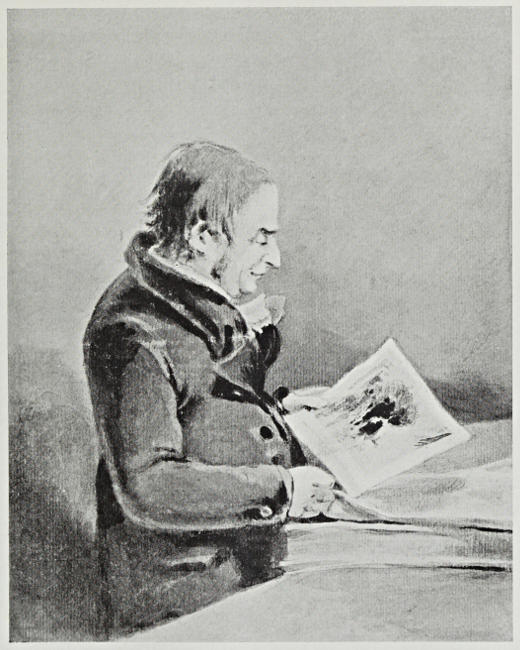
J. M. W. TURNER, R.A.
FROM A WATER-COLOUR SKETCH BY J. T. SMITH
“Come,” said Mr. Keyse, putting his hand upon my shoulder, “the bell rings, not for prayers, nor for dinner, but for the song.” As soon as we had reached the orchestra, the singer curtsied to us, for we were the only persons in the gardens. “This is sad work,” said he, “but the woman must sing according to our contract.” I recollect that the singer was handsome, most dashingly dressed, immensely plumed, and villainously rouged; she smiled as she sang, but it was not the bewitching smile of Mrs. Wrighten,[266] then applauded by thousands at Vauxhall Gardens. As soon as the Spa lady had ended her song, Keyse, after joining me in applause, apologised for doing so, by observing that, as he never suffered his servants to applaud, and as the people in the road (whose ears were close to the cracks in the paling to hear the song), would make a bad report if they had not heard more than the clapping of one pair of hands, he had in this instance expressed his reluctant feelings.
As the lady retired from the front of the orchestra, she, to keep herself in practice, curtsied to me with as much respect as she would had Colonel Topham been the patron of a gala night.[267] “This is too bad,” again observed Keyse; “and I am sure you cannot expect fireworks!” However, he politely asked me to partake of a bottle of Lisbon, which upon my refusing, he pressed me to accept of a catalogue of his pictures.
Blewitt[268] (who at that time lived in Bermondsey Square), the scholar of Jonathan Battishill,[269] was the composer for the Spa establishment. The following verse is the first of his most admired composition,—“In lonely cot by Humber’s side.”
My old and worthy friend Joseph Caulfield,[270] Blewitt’s favourite pupil, of whom he learned thorough bass, related to me the following anecdote of a musical composer, as told him by his master:—“When I was going upstairs,” said Blewitt, “to the attics, where one of my instructors lived (for I had many), I hesitated on the second-floor landing-place, upon hearing my master and his wife at high words. ‘Get you gone!’ said the lofty paper-ruffled composer, ‘retire to your apartments!’ This command of her lord she did not immediately obey; however, in a short time after, I heard the clattering of plates against the wall, and upon entering the room, I discovered that the lady had retired, but not before she had covered the whitewashed wall profusely with the unbroiled sprats.”
“I was at a musical party,” continued my friend Joseph, “at Lord Sandwich’s,[271] in Hertford Street, Mayfair, when, among other specimens of the best masters, I heard Battishill’s beautiful composition of
“Amidst the myrtles as I walk, Love and myself thus entered talk, ‘Tell me,’ said I, in deep distress, ‘Where I may find my Shepherdess.’”[272]
Upon expressing my pleasure at hearing the above performed in so superior a style, his Lordship told me he had written a sequel, which he thus repeated:—
“Love said to me, ‘Thou faithful swain, Thy search in myrtle groves is vain; Examine well thy noblest part, Thou’lt find her seated in thy heart.’”
It appears that in poetry, as well as in painting and prints, and also in dwellings, decorations, and dress, there has ever been a fashion for a time. Battishill was the composer of that justly celebrated glee, commencing with “Underneath this myrtle shade.” Myrtles, after having had a great run, were succeeded by Cupid’s darts; and that little rogue Love played old gooseberry with the hearts of Chloes and Colins, Robins and Robinets; then the ever-blooming lasses of Patterdale and Richmond Hill attracted our giddy notice. These were succeeded by “Bacchus in green ivy bound,” giving “Joy and pleasure all around.” After that, moonlight meetings were preferred, and “Buy a broom, ladies,” was continually dinning our ears “through and through.”
1796.
In the summer of this year, the late John Wigston, Esq., then of Millfield House, Edmonton, having repeatedly expressed a wish to see the famous George Morland before he commenced a collection of his pictures, I having been known to that child of nature in my boyish days, offered to introduce them to each other.[273] Morland then resided in Charlotte Street, Fitzroy Square, in the house formerly inhabited by Sir Thomas Apreece. He received us in the drawing-room, which was filled with easels, canvases, stretching-frames, gallipots of colour, and oil-stones; a stool, chair, and a three-legged table were the only articles of furniture of which this once splendid apartment could then boast. Mr. Wigston, his generous-hearted visitor, immediately bespoke a picture, for which he gave him a draft for forty pounds, that sum being exactly the money he then wanted; but this gentleman had, like most of that artist’s employers, to ply him close for his picture.
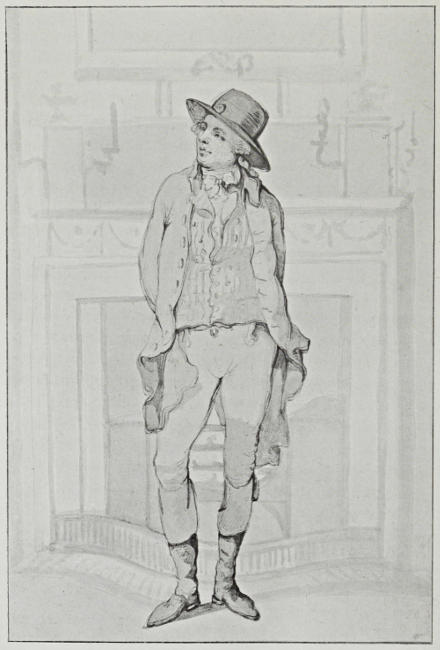
GEORGE MORLAND
“There! go back and tell the pawnbroker to advance me five guineas more upon it.”
As Mrs. Wigston had a great desire to see Morland, he was invited to take a day’s sport with the hounds, which the artist accepted, with a full assurance of punctuality. However, as usual with that eccentric man, he only arrived time enough for dinner, accompanied by eight of those persons denominated his friends. Mrs. Wigston, an elegant and most accomplished lady, was in consequence deprived of a sight of this far-famed genius. I was deputed by my honoured friend Mr. Wigston to take Mrs. Wigston’s abdicated chair, and carved for this pretty set, consisting of persons unaccustomed to sit at such a table. Our worthy host soon discovered their strong propensity for spirituous liquors, three of them even during dinner, instead of taking wine, of which there were many sorts on the table, calling for a glass of brandy. After hearing several jokes and humorous songs from some of the party, George Morland declared he must go, having an engagement with Mrs. Laye, and other friends, at “Otter’s Pool.”[274]
When Morland and his party entered the stable-yard, the following altercation took place between Mr. Wigston and his groom.
Mr. Wigston.—“Bring out these gentlemen’s horses.”
Groom.—“Horses, horses! they’ll find ’um at the ‘Two Jolly Brewers.’ Horses, indeed!”
Mr. Wigston.—“And why, Sir, were they sent there?”
Groom.—“Why, I would not suffer such cattle to come near your stud; for I never saw such a set-out in my life!”
The party accordingly betook themselves to the “Brewers”; but upon our return to the honest though rough diamond of a groom, he observed that it was past two o’clock, and that the dog ought to have been let loose two hours ago!
1797.
Although my mother continued till the time of her death in the habit of the Society of Friends, and my father followed most of the popular Methodists, I, from my earliest days of reflection, gave a preference to the Established Church of England. Notwithstanding this, my inquisitiveness now and then induced me to hear celebrated preachers of every sect. I remember one Sunday morning in this year, after intending to enter some church on my way to dine with my great-aunt on Camberwell Green, my ears were most agreeably greeted with the swelling pipes of the Surrey Chapel organ.[275] Why, thinks I to myself, should not I hear Rowland Hill? Surely it must be now full twenty years since I saw him in Moorfields, at my last visit to the Tabernacle. In I accordingly went; and though a smile with me was always deemed highly indecorous during divine worship, yet the truth must out; I could not help sometimes laughing—as heartily, though not so loudly, I hope, as all of us when led into the enjoyment of Momus’s strongest fits by the inimitable Mathews.
No sooner was the sermon over and the blessing bestowed, than Rowland electrified his hearers by vociferating, “Door-keepers, shut the doors!” Slam went one door; bounce went another; bang went a third; at last, all being anxiously silent as the most importantly unexpected scenes of Sir Walter Scott could make them, the pastor, with a slow and dulcet emphasis, thus addressed his congregation:—“My dearly beloved, I speak it to my shame, that this sermon was to have been a charity sermon, and if you will only look down into the green pew at those—let me see—three and three are six, and one makes seven, young men with red morocco prayer-books in their hands, poor souls! they were backsliders, for they went on the Serpentine River, and other far distant waters, on a Sabbath; they were, however, as you see, all saved from a watery grave. I need not tell ye that my exertions were to have been for the benefit of that benevolent institution the Humane Society.—What! I see some of ye already up to be gone; fie! fie! fie!—never heed your dinners; don’t be Calibans, nor mind your pockets. I know that some of ye are now attending to the devil’s whispers. I say, listen to me! take my advice, give shillings instead of sixpences; and those who intended to give shillings, display half-crowns, in order not only to thwart the foul fiend’s mischievousness, but to get your pastor out of this scrape; and if you do, I trust Satan will never put his foot within this circle again. Hark ye! I have hit upon it; ye shall leave us directly. The Bank Directors, you must know, have called in the dollars; now, if any of you happen to be encumbered with a stale dollar or two, jingle the Spanish in our dishes; we’ll take them, they’ll pass current here. Stay, my friends, a moment more. I am to dine with the Humane Society on Tuesday next, and it would shock me beyond expression to see the strings of the Surrey Chapel lay dangle down its sides like the tags upon Lady Huntingdon’s servants’ shoulders. Now, mind what I say, upon this occasion I wish for a bumper as strenuously as Master Hugh Peters did, when he recommended his congregation in Broadway Chapel to take a second glass.” It is recorded that when he found the sand of his hour-glass had descended, he turned it, saying, “Come, I know you to be jolly dogs, we’ll take t’other glass.”[276] I understand that Rowland Hill is not made up of veneer, but of solid well-seasoned stuff, with a heart of oak, and ever willing to exercise kindness to his fellow-creatures, upon the system of my friend Charles Lamb.[277]
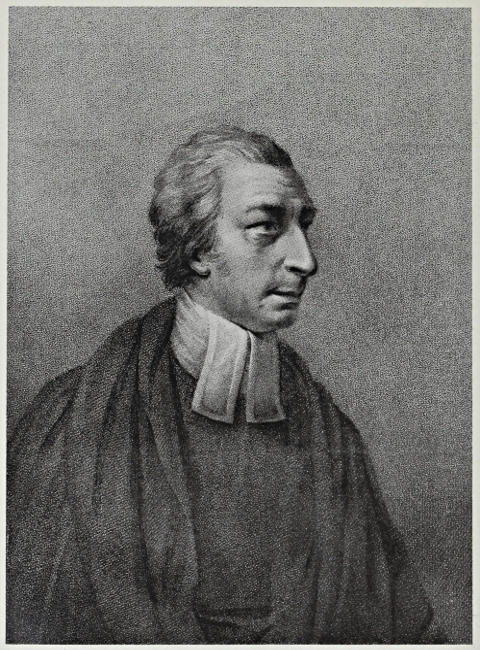
ROWLAND HILL
“His ideas come red hot from the heart.”
Sheridan
In May this year I applied to my worthy friend, Mr. John Constable, now a Royal Academician, for any particulars which he might be able to procure respecting Gainsborough, he being also a Suffolk man; and I had the pleasure of receiving the following letter:—
“East Bergholt, 7th May, 1797.
“Dear Friend Smith,—If you remember, in my last I promised to write again soon, and tell you what I could about Gainsborough. I hope you will not think me negligent when I inform you that I have not been able to learn anything of consequence respecting him: I can assure you it is not for the want of asking that I have not been successful, for indeed I have talked with those who knew him. I believe in Ipswich they did not know his value till they lost him. He belonged to something of a musical club in that town, and painted some of their portraits in a picture of a choir; it is said to be very curious.
“I heard it was in Colchester; I shall endeavour to see it before I come to town, which will be soon. He was generally the butt of the company, and his wig was to them a fund of amusement, as it was often snatched from his head and thrown about the room, etc.; but enough of this. I shall now give you a few lines verbatim, which my friend Dr. Hamilton, of Ipswich, was so good as to send me; though it amounts to nothing, I am obliged to him for taking the commission.
“‘I have not been neglectful of the inquiries respecting Gainsborough, but have learned nothing worth your notice. There is no vale or grove distinguished by his name in this neighbourhood. There is a place up the river-side where he often sat to sketch, on account of the beauty of the landscape, its extensiveness, and richness in variety, both in the fore and back grounds. It comprehended Bramford and other distant villages on one side; and on the other side of the river extended towards Nacton, etc. Friston alehouse must have been near, for it seems he has introduced the Boot signpost in many of his best pictures. Smart and Frost[278] (two drawing-masters in Ipswich) often go there now to take views; whether they be inspired from pressing the same sod with any of this great painter’s genius, you are a better judge than I am. Farewell.’
“This, my dear friend, is the little all I have yet gained, but though I have been unsuccessful, it does not follow that I should relinquish my inquiries. If you want to know the exact time of his birth, I will take a ride over to Sudbury, and look into the register.[279] There is an exceeding fine picture of his painting at Mr. Kilderby’s, in Ipswich.
“Since I last wrote to you I have made another attempt at etching; have succeeded a little better, but yet fall very short. I shall send you an impression soon.
“I doubt there is nothing in my last parcel of cottages worth your notice; am obliged to you for the little sketch after Hobbima. I understand the present exhibition is a very good one; I understand Sir G. Beaumont excels. My friend Gubbins informs me that you have finished Lady Plomer’s Palace,[280] and that you have made a sketch from the fire in the Minories; surely it must have put our friend C——h to the rout.[281] Thine sincerely,
“John Constable.”
Mrs. Pope, the actress, died this year in Half Moon Street, Piccadilly, and was buried in the cloisters of Westminster Abbey.[282]
Being anxious to add something more to the memory of this amiable character, I applied to her surviving husband; when that gentleman very obligingly favoured me with the following copy of a record, which he made soon after her death:—
“The best of women and the best of wives drew her last breath at half-past two o’clock on Wednesday morning, the 15th of March, 1797.
“Her illness lasted about seven weeks; her complaint palsy, beginning in her head, and depriving her of the use of her left hand. Her death was an awful lesson; her loss irreparable.”[283]
In the room with the bow-window on the first-floor of the same house, Mr. Pope[284] produced some excellent portraits in crayons, of persons of the first fashion, many of them little inferior in every respect to those of the celebrated Francis Cotes;[285] the inimitable whole-length portrait of Grattan, of which there is an engraving, will be a lasting and mutual record of the artist and patriot. The following letter, given to me by my late worthy friend Dr. Mathew, was written by Mrs. Pope, to her friend Mrs. Mathew, of Rathbone Place:—
“Dublin, July 6th.
“I flatter myself that my ever loved and most highly esteemed friends will be pleased to receive the assurance of my health, and to know that I am in the possession of as much comfort as my mind is capable to receive out of England. Thank God, all things as yet go on well, and the exertions of business do not seem to do that injury to my health which I had great reason to fear. We have acted six nights, Jane Shore first, a very great house, well received, and Pope’s speech to Gloster twice repeated, which I think proves in a great degree the loyalty of the people.
“Gloster’s speech, thus:—
“‘What if some patriot for the public good Should vary from your scheme,—new mould the State? “‘Hastings.—Curse on the innovating hand that ’tempts it! Remember him, the villain, righteous Heaven, In thy great day of vengeance: blast the traitor And his pernicious counsels; who for wealth, For power, the pride of greatness, or revenge, Would plunge his native land in civil wars.’
“It is impossible to describe the effect this speech had on the audience. I think you would have been gratified to have heard it; it is the first time a speech in a tragedy was ever repeated. Perhaps it proves the loyalty of this city. I hear there are sad doings in the country parts of Ireland; I trust we shall meet with nothing of it: we stay in Dublin all this month, then go to Cork. Our second characters were Mr. and Mrs. Beverley, highly esteemed and greatly spoken of; third, Belvidera and Jaffier—with good success. Their last new play, How to grow Rich, twice; and yesterday Elizabeth and Essex, which, by the way, Pope acted well. Next week Columbus. I count the nights, though now I trust I shall be able to go through them all. So much for myself.
“And now, my friends, let me beg that you will favour me with a little account of yourselves. I ardently wish to hear that you are all well and happy, in the full possession of that true felicity, which your goodness of heart so justly merits. God bless you both! Mr. Pope unites with me in respectful remembrance to the Baron, and affectionate esteem to the whole family, particularly in respect and affection to Mrs. and Miss Mathew. Adieu: I don’t like to leave off, and yet I hardly think you can read what I have already written.
“Ever your most affectionate
“E. Pope.”
1798.
This year, in consequence of the death of Mr. Green,[286] who had been drawing-master to Christ’s Hospital, I stood candidate for the situation; and, though I was unsuccessful, my testimonials being so flattering, I cannot withstand the temptation of printing them, whatever may be said by my enemies, who may not be able to produce anything half so honourable.
“May 10th, 1798.
“We whose names are subscribed, having seen specimens of drawings by John Thomas Smith, are of opinion that he is qualified for the office of drawing-master in the school of Christ’s Hospital.
I not only think him qualified as an artist, but greatly to be respected as a man.
Benjamin West, Prest. R.A.
Being not personally acquainted with Mr. J. T. Smith, I have examined his performances, and I think him well qualified for the above office.
J. F. Rigaud, R.A.
I have known him from a child, and think him an honest man and well qualified for the office.
Joseph Nollekens, R.A.
I have long been acquainted with Mr. J. T. Smith’s merits as a good artist and a worthy man.
John Flaxman, Jun., Sculptor, Associate R.A.; R.A. of Florence and Carrara.
We subscribe to the above opinion.—
W. Beechey, R.A. elect.
W. Hamilton, R.A.
Thomas Stothard, R.A.
John Russell, R.A.
J. Bacon, R.A.
T. Banks, R.A.
James Barry, R.A., Professor of Painting.
John Opie, R.A.
R. Cosway, R.A.
James Northcote, R.A.
Jos. Farington, R.A.
Richard Westall, R.A.
Henry Fuseli, R.A.
H. Copley, R.A.
I have long known Mr. Smith as an artist and respectable man, and believe him to be perfectly capable of filling the office he solicits with honour.
P. Reinagle, A.
We subscribe to the above opinion.
Francis Bartolozzi, R.A.
Richard Collins.
Caleb Whitefoord.
We have known Mr. Smith for upwards of fourteen years, and we have found him an able drawing-master to our daughter, whose drawings he has never touched upon; a practice too often followed by drawing-masters in general: and we believe him to be a truly valuable member of society, as a husband, father, and good man.
James Winter Lake.
Jessy Lake.
We can never subscribe our names with greater satisfaction, than in signifying the very high opinion we have of Mr. Smith, both as to his talents and character.
James Lake.
Atwill Lake.
I fully subscribe to the above opinion,
Richard Wyatt, Milton Place.
I believe Mr. Smith to be a very deserving man, and well qualified for the situation he is ambitious of obtaining.
John Charles Crowle.
Thomas Allen has a great respect for Mr. Smith, both as a man and an artist.
Joseph Williamson, A.M., Vicar of St. Dunstan in the West.
I am personally acquainted with Mr. J. T. Smith, and esteem him one of the best of men.
John Boydell, Alderman.
I am happy to bear testimony to the character of Mr. Smith as a man, and to find him so highly respected as an artist.
T. Thomson.
I have long known Mr. Smith to be an ingenious artist, an able instructor, and a benevolent and honest man.
John Cranch.
I have known Mr. Smith many years, and believe him very capable of filling the office of drawing-master to Christ’s Hospital with credit to himself and advantage to the charity.
Henry Howard.
J. Swainson.
T. Whittingham.
J. Nixon, Basinghall Street.
Henry Smith, Drapers’ Hall.
Alex. Lean Smyth, the Hudson’s Bay Company.
Arthur Ball, }
John Broome, } Hudson’s Bay House
George Whitehead, Cateaton Street.
Providence, which placed me next door to Mr. J. T. Smith for several years, made me intimately acquainted with a faithful husband, an affectionate father, and an honest man.
Charles Gower, M.D.”
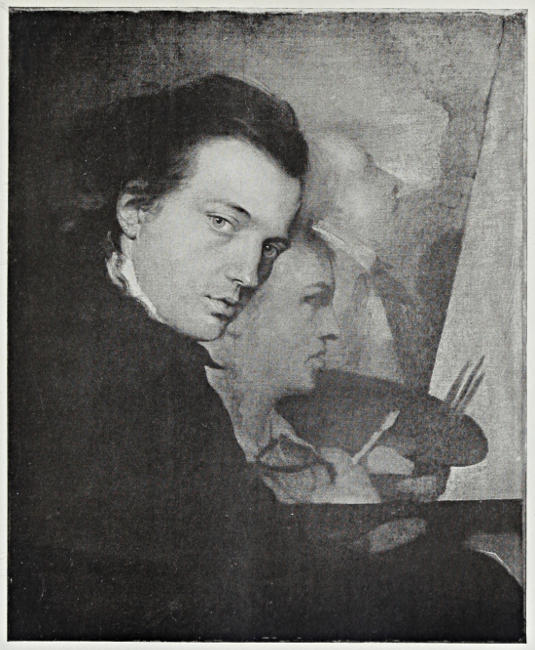
JAMES BARRY, R.A.
“I reflect with horror upon such a fellow as I am, and with such a kind of art, with house-rent to pay and employers to look for.”
1799.
On the 4th of August this year, died at his mansion in Rutland Square, Dublin, the Right Hon. James, Earl of Charlemont,[287] who was born 18th of August, 1728. This gentleman was truly a nobleman, for he was one of the greatest patrons of the fine arts this country could boast of. He was the great friend of Hogarth; bought many of his pictures, particularly that most elegant performance so justly celebrated under the title of “The Lady’s Last Stake,” so admirably engraven by Mr. Cheesman.[288] The following is a copy of an original letter given to me by a late worthy friend; it is addressed to the late Sir Lawrence Parsons, Bart.,[289] and written by Lord Charlemont within eight months of his Lordship’s death.
“Dublin, 12th Jan., 1799.
“My dear Sir Lawrence,—As nothing has ever affected me with more painful astonishment than the shameful apathy and consequent silence of the country at the present desperate crisis of our fate as a nation, so have I experienced few more real pleasures than in having found, by the public papers, that a meeting of your county, at least, has been called; a pleasure which, though principally derived from my ardent zeal for the public service, is still further increased by my friendship for you, as I am too well acquainted with your sentiments to doubt for a moment that such call has been in the highest degree satisfactory and flattering to your feelings. Neither can I entertain the slightest apprehension that the result of any meeting of Irishmen will be other than the firm and spirited condemnation of a measure, replete with every disgrace and danger in their country. Never, indeed, were my beloved countrymen so forcibly called upon as at the present emergency, maturely to form their opinions and to speak aloud the dictates of their hearts. Their ancestors call upon them from their graves to preserve those national rights which they have transmitted to them. Their children from their cradles, with mute but prevailing eloquence, beseech them to protect and to defend their birthrights; and, with a more awful voice, their country calls upon them not by their silence to betray her dearest interests, or by their supineness to leave her enslaved whom they found free! Thus invoked, is it possible that Irishmen should remain silent?
“But surely I need dwell no longer upon a subject with which you are so much better acquainted; and, indeed, the state of my health, and particularly of my eyes, is such as to render it impossible for me to write more.—I must therefore, however unwillingly, conclude by assuring you that I am, and ever shall be, my dearest Parsons, your most faithful and truly affectionate
“Charlemont.”
In this year, James Barry, the painter of those mighty pictures on the walls of the great room of the Society of Arts, received a severe blow by having his name erased from those of the Royal Academicians by King George III., who believed what had been represented respecting the Professor’s conduct in the Royal Academy.[290]
“Buckingham Street, Fitzroy Square.
“Dear Sir,—Permit me to thank you for the satisfaction of having seen that curious monument of English antiquity, St. Stephen’s Chapel, Westminster, when the ancient architecture and painting were discovered by the removal of the modern wainscot, which formed the interior of the House of Commons.
“Notwithstanding this branch of antiquity has never been my particular pursuit, I am highly gratified to see such materials in the general history of art rescued from oblivion by publication, for which, Sir, we are indebted to your zeal and industry, as some of the interesting pictures were effaced soon after their discovery, by ignorant curiosity; in addition to the careless and ruinous manner in which the discovery itself was made, of which circumstances I complained to several persons on the spot, particularly to the Rev. Mr. Brand,[291] Secretary to the Antiquarian Society.
“As the best testimony I can give to the fidelity and ability of your publication, give me leave to subscribe my name for a copy of the work, and to offer such assistance as I can give, in general observations on the arts of design, when St. Stephen’s Chapel was in its splendour.
“I remain, dear Sir, with great regard, your much obliged
“John Flaxman.”
The admission of one hundred additional members into the House of Commons, arising from the union with Ireland, obliged Mr. Wyatt to cut away the side-walls of the room internally, in order to make recesses for two extra benches.[292]
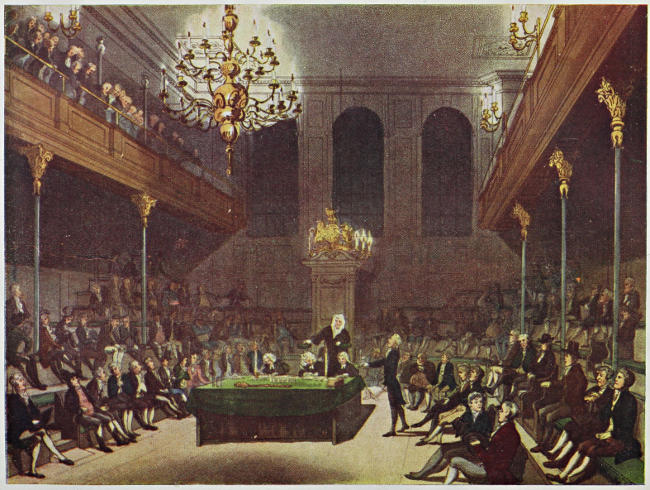
THE OLD HOUSE OF COMMONS
1801.
In the autumn of this year I passed a most agreeable day with the Hon. Hussey Delaval,[293] at his house near Parliament Stairs.[294] This learned and communicative gentleman, among whose works that on Colours is generally considered the most interesting, was as friendly to me, as the jealousy of that well-known odd compound of nature, my antagonist, John Carter,[295] who was of our party, would allow; for with that artist’s opinions as to Gothic architecture, Mr. Delaval so entirely coincided, that he employed him to provide the ornamental decorations of his house, which were mostly in putty mixed with sand, and in some instances cast from the decorations of several Gothic structures, particularly Westminster Abbey. This house was originally fire-proof, the floors being of stone or composition, and the window-sashes of cast iron, but since the death of Mr. Delaval, wood has been substituted for the sashes and other parts.
The apartments are ten in number, besides small offices. The lower rooms consist of two halls: in the north wall of the first are three pretty Gothic recesses for seats, for servants or persons in waiting; the second hall is filled with Gothic figures placed upon brackets under canopies. The chimney-piece and other parts of the dining-parlour looking over the Thames, are decorated in a similar manner; the kitchen is on the same floor towards the north. The staircase leading to the first-floor is a truly tasteful little specimen, not equalled by anything at Strawberry Hill, which, by reason of Mr. Bentley’s[296] fancy mouldings interfering so often with parts which are really chaste, must be considered a mule building. The drawing-room and library also look over the water. On the same floor are two bed-chambers towards the west; above which are two attics, with a door opening upon the embattled leads over the drawing-room. Upon these leads we took our wine—attended by female servants only, as Mr. Delaval never would allow a man-servant to enter the house, but with messages—and here enjoyed the glowing, Cuyp-like effect of the sun upon west-country barges laden either with blocks of stone or fresh-cut timber, objects ever picturesque on the water. Mr. Delaval was so pleased with this scenery, and the pencil of my friend G. Arnald, Associate of the Royal Academy, that he bespoke two pictures of him, Views up and down the River, the figures in which, by the order of Mr. Delaval, were painted by his friend G. F. Joseph, A.R.A. They were exhibited at Somerset House.[297]
1802.
How often do we find peculiar attachments and propensities in the minds of persons of reported good understanding. Within my time, many men have indulged most ridiculously in their eccentricities. I have known one who had made a pretty large fortune in business, get up at four o’clock in the morning and walk the streets to pick up horseshoes which had been slipped in the course of the night, with no other motive than to see how many he could accumulate in a year. I also remember a rich soap-boiler who never missed an opportunity of pocketing nails, pieces of iron hoops, and bits of leather, in his daily walks; and these he would spread upon a large walnut-tree three-flapped dining-table, with a similar view to that of the above-mentioned gentleman. This wealthy citizen would often put on a red woollen cap, in shape like those worn by slaughter-house men, and a waggoner’s frock, in order to stoke his own furnace; after which, he would dress, get into his coach, and, attended by tall servants in bright blue liveries, drive to his villa, where his hungry friends were waiting his arrival.
The allusion to these peculiarities, which certainly are harmless, will serve by way of prelude to a more extraordinary one. The late Duke of Roxburgh,[298] whose wonderful library will ever be spoken of with the highest delight by bibliomaniacs, had an attachment to the portraits of malefactors as closely as Rowland Hill to his petted toad. I made many drawings of such characters for his Grace during their trials or confinement; that which I made this year, was of Governor Wall, whose trial produced much discussion.[299] Having been deprived of admission at the Old Bailey on the day of his trial, I went to the Duke, and he immediately wrote to a nobleman high in power, for an order to admit me to see the unfortunate criminal in the condemned cell, which application was firmly, and, in my humble opinion, very properly, refused. I walked home, where I found Isaac Solomon waiting to show me some of his improved black-lead pencils. Isaac, upon hearing me relate to my family the disappointment I had experienced, assured me that he could procure me a sight of the Governor, if I would only accompany him in the evening to Hatton Garden, and smoke a pipe with Dr. Forde, the Ordinary of Newgate,[300] with whom he said he was particularly intimate. Away we trudged; and, upon entering the club-room of a public-house, we found the said Doctor most pompously seated in a superb masonic chair, under a stately crimson canopy placed between the windows. The room was clouded with smoke, whiffed to the ceiling, which gave me a better idea of what I had heard of the Black Hole of Calcutta than any place I had seen. There were present at least a hundred associates of every denomination; of this number, my Jew, being a favoured man, was admitted to a whispering audience with the Doctor, which soon produced my introduction to him.
“Man’s life is all a mist, and in the dark our fortunes meet us.” Standing beneath a masonic lustre, the Doctor immediately recognised me as a friend of John Ireland, but more particularly of his older crony, Atkinson Bush; he requested me to take a pipe, to me a most detestable preliminary. He then whispered, “Meet me at the felon’s door at the break of day.” There I punctually applied, but, notwithstanding the order of the Doctor, I found it absolutely necessary, to protect myself from an increasing mob, to show the turnkey half-a-crown, who soon closed his hand and let me in. I was then introduced to a most diabolical-looking little wretch, denominated “the Yeoman of the Halter,” Jack Ketch’s head man. The Doctor soon arrived in his canonicals, and with his head as stiffly erect as a sheriff’s coachman when he is going to Court, with an enormous nosegay under his chin, gravely uttered, “Come this way, Mr. Smith.”
As we crossed the Press-yard a cock crew; and the solitary clanking of a restless chain was dreadfully horrible. The prisoners had not risen. Upon our entering a stone-cold room, a most sickly stench of green twigs, with which an old round-shouldered, goggle-eyed man was endeavouring to kindle a fire, annoyed me almost as much as the canaster fumigation of the Doctor’s Hatton Garden friends.
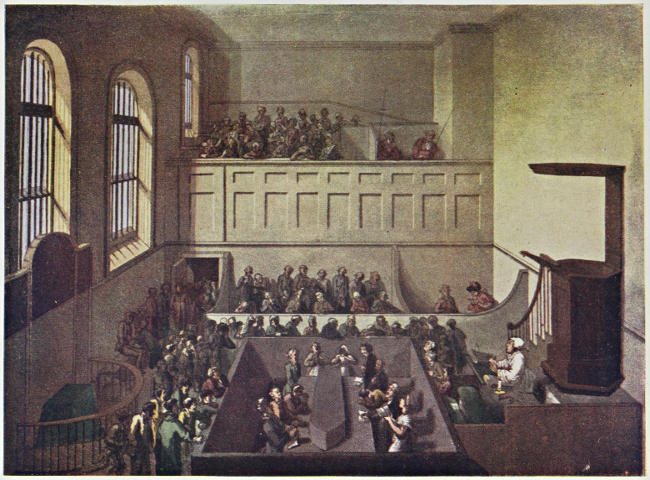
NEWGATE CHAPEL ON THE EVE OF SEVERAL EXECUTIONS
The prisoner entered. He was death’s counterfeit, tall, shrivelled, and pale; and his soul shot so piercingly through the port-holes of his head that the first glance of him nearly petrified me. I said in my heart, putting my pencil in my pocket, God forbid that I should disturb thy last moments! His hands were clasped, and he was truly penitent. After the Yeoman had requested him to stand up, “he pinioned him,” as the Newgate phrase is, and tied the cord with so little feeling, that the Governor, who had not given the wretch the accustomed fee, observed, “You have tied me very tight;” upon which Dr. Forde ordered him to slacken the cord, which he did, but not without muttering. “Thank you, Sir,” said the Governor to the Doctor, “it is of little moment.” He then observed to the attendant, who had brought in an immense iron shovelful of coals to throw on the fire, “Ay, in one hour that will be a blazing fire;” then, turning to the Doctor, questioned him: “Do tell me, Sir: I am informed I shall go down with great force; is it so?” After the construction and action of the machine had been explained, the Doctor questioned the Governor as to what kind of men he had at Goree. “Sir,” he answered, “they sent me the very riffraff.” The poor soul then joined the Doctor in prayer; and never did I witness more contrition at any condemned sermon than he then evinced.
The sheriff arrived, attended by his officers, to receive the prisoner from the keeper. A new hat was then partly flattened on his head; for, owing to its being too small in the crown, it stood many inches too high behind. As we were crossing the Press-yard, the dreadful execrations of some of the felons so shook his frame, that he observed, “the clock had struck;” and, quickening his pace, he soon arrived at the room where the sheriff was to give a receipt for his body, according to the usual custom. Owing, however, to some informality in the wording of this receipt, he was not brought out so soon as the multitude expected; and it was this delay which occasioned a partial exultation from those who betted as to a reprieve, and not from any pleasure in seeing him executed. For the honour of England, I may say we are not so revengeful as some of our Continental neighbours have been; as Mrs. Cosway[301] assured me that she was in the room with David, then esteemed the first painter in Paris, at the time that he and Robespierre were in power; and that when the Reporter, from the guillotine, came in to announce eighty as the number of persons executed that morning, David, in the greatest possible rage, exclaimed, “No more!”