A BOOK FOR A RAINY DAY (continued 3)
Reading edition
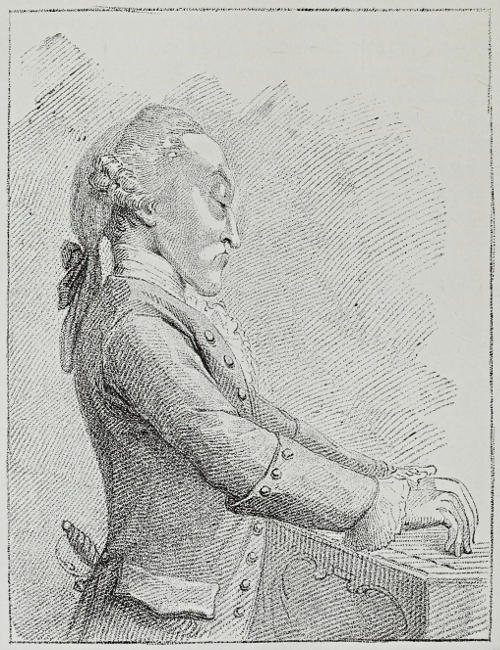
DR. ARNE
HE COMPOSED “RULE BRITANNIA”
After the execution, as soon as I was permitted to leave the prison, I found the Yeoman selling the rope with which the malefactor had been suspended, at a shilling an inch; and no sooner had I entered Newgate Street, than a lath of a fellow, past threescore years and ten, who had just arrived from the purlieus of Black Boy Alley,[302] woe-begone as Romeo’s apothecary, exclaimed,—“Here’s the identical rope at sixpence an inch.” A group of tatterdemalions soon collected round him, most vehemently expressing their eagerness to possess bits of the cord. It was pretty obvious, however, that the real business of this agent was to induce the Epping butter-men to squeeze in with their canvas bags, which contained their morning receipts in Newgate market.[303] A little further on, at the north-east corner of Warwick Lane, stood “Rosy Emma,” exuberant in talk, and hissing-hot from Pie Corner,[304] where she had taken her morning dose of gin and bitters; and as she had not waited to make her toilet, was consequently a lump of heat.
“Now, my readers, I have been told, Love wounds by heat, and Death by cold; Of size she would a barrow fill, But more inclining to sit still.”
Possibly she might have been a descendant of Orator Henley, and I make no doubt at one time passionately admired by her Henry. I can safely declare, however, that her cheeks were purple, her nose of poppy-red or cochineal.
“The lady was pretty well in case, But then she’d humour in her face; Her skin was so bepimpled o’er, There was not room for any more.”
Her eyes reminded me of Sheridan’s remark on those of Dr. Arne, “Like two oysters on an oval plate of stewed beet-root.”[305] I regretted most exceedingly, while she was cutting her rope and twisting her mouth, that most of her once-famed ivories had absconded; but it gave me inexpressible delight to see that her lips were not at all chapped. If Emma’s lips had been ever so deeply cracked, she could not have benefited by my friend “Social Day” Coxe’s[306] Conservatoria, as it was not then sold.
Emma in her tender blossom, I understand, assisted her mother in selling rice-milk and furmety to the early frequenters of Honey Lane market; and in the days of her full bloom, new-milk whey in White Conduit Fields, and at the Elephant and Castle. She must have been, as to her outward charms, during her highest flattery, little inferior to the beautiful Emma Lyon;[307] but in her last stage, perhaps not altogether unlike the heroine so voluptuously portrayed by my late highly talented friend, the Rev. George Huddesford, in his poem entitled “The Barber’s Nuptials.”[308] Rosy Emma, for so she was still called, was the reputed spouse of the Yeoman of the Halter, and the cord she was selling as the identical noose was for her own benefit. This was, according to the delightful writer, Charles Lamb,
“For honest ends, a most dishonest seeming.”[309]
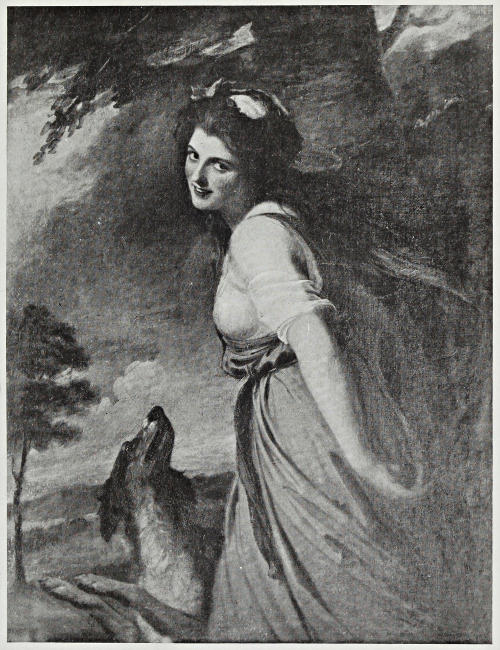
LADY HAMILTON AS A BACCHANTE
“Romney! expert infallibly to trace … The mind’s impression too on every face.” Cowper
Now, as fame and beauty ever carry influence, Emma’s sale was rapid; had she been as lamentable as a Lincolnshire goose after plucking-time, “Misery’s Darling,” or like Alecto when at the entrance of Pandemonium, she would have had a sorry sale.[310] This money-trapping trick, steady John, the waiter at the Chapter Coffee-house, assured me was invariably put in practice whenever superior persons or notorious culprits had been executed. Then to breakfast, but with little or no appetite; however, after selecting one of Isaac Solomon’s H.B.’s, I made a whole-length portrait of the late Governor by recollection, which Dr. Buchan, the flying physician of the “Chapter”[311] frequenters, and several of the Pater-Noster vendors of his Domestic Medicine, considered a likeness; at all events, it was admitted into the portfolio of the Duke, with the following acknowledgment written on the back: “Drawn by memory.”
1803.
About this time, in order to see human nature off her guard, I agreed with a good-tempered friend of mine, one of Richard Wilson’s scholars, to perambulate Bartholomew Fair, which we did in the evening, after taking pretty good care to leave our watches at home. Our first visit was to a show of wild beasts, where, upon paying an additional penny, we saw the menagerie-feeder place his head within a lion’s mouth.
Our attention was then arrested by an immense baboon, called General Jacko, who was distributing his signatures as fast as he could dip his pen in the ink, to those who enabled him to fill his enormous craw with plums, raisins, and figs. The next object which attracted our notice was a magnificent man, standing, as we were told, six feet six inches and a half, independent of the heels of his shoes. The gorgeous splendour of his Oriental dress was rendered more conspicuous by an immense plume of white feathers, which were like the noddings of an undertaker’s horse, increased in their wavy and graceful motion by the movements of the wearer’s head.
As this extraordinary man was to perform some wonderful feats of strength, we joined the motley throng of spectators at the charge of “only threepence each,” that being vociferated by Flockton’s[312] successor as the price of the evening admittance.
After he had gone through his various exhibitions of holding great weights at arm’s-length, etc., the all-bespangled master of the show stepped forward, and stated to the audience that if any four or five of the present company would give, by way of encouraging the “Young Hercules,” alias the “Patagonian Samson,” sixpence apiece, he would carry them all together round the booth, in the form of a pyramid.
With this proposition my companion and myself closed; and after two other persons had advanced, the fine fellow threw off his velvet cap surmounted by its princely crest, stripped himself of his other gewgaws, and walked most majestically, in a flesh-coloured elastic dress, to the centre of the amphitheatre, when four chairs were placed round him, by which my friend and I ascended, and, after throwing our legs across his lusty shoulders, were further requested to embrace each other, which we no sooner did, cheek-by-jowl, than a tall skeleton of a man, instead of standing upon a small wooden ledge fastened to Samson’s girdle, in an instant leaped on his back, with the agility of a boy who pitches himself upon a post too high to clear, and threw a leg over each of our shoulders; as for the other chap (for we could only muster four), the Patagonian took him up in his arms. Then, after Mr. Merryman had removed the chairs, as he had not his full complement, Samson performed his task with an ease of step most stately, without either the beat of a drum, or the waving of a flag.
I have often thought that if George Cruikshank, or my older friend Rowlandson, had been present at this scene of a pyramid burlesqued, their playful pencils would have been in running motion, and I should have been considerably out-distanced had I then offered the following additional description of our clustered appearance. Picture to yourself, reader, two cheesemonger, ruddy-looking men, like my friend and myself, as the sidesmen of Hercules, and the tall, vegetable-eating scarecrow kind of fellow, who made but one leap to grasp us like the bird-killing spider, and then our fourth loving associate, the heavy dumpling in front, whose chaps, I will answer for it, relished many an inch thick steak from the once far-famed Honey Lane market,[313] all supported with the greatest ease by this envied and caressed Pride of the Fair, to whose powers the frequenters of Sadler’s Wells also bore many a testimony.
In the year 1804, Antonio Benedictus Van Assen engraved a whole-length portrait of this Patagonian Samson, at the foot of which his name was thus announced, “Giovanni Baptista Belzoni.” This animated production was executed at the expense of the friendly Mr. James Parry, the justly celebrated gem and seal engraver, of Wells Street, Oxford Street.
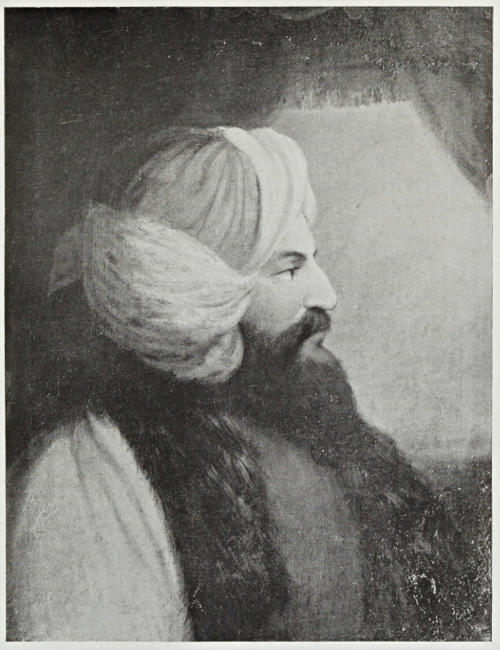
GIOVANNI BAPTISTA BELZONI
“Belzoni is a grand traveller, and his English is very prettily broken.”
Lord Byron
After the close of Bartholomew Fair, this Patagonian was seen at that of Edmonton, exhibiting in a field behind the Bell Inn, immortalised by Cowper in his “Johnny Gilpin;” and I have been assured that, so late as 1810, at Edinburgh, he was, during his exhibition in Valentine and Orson, soundly hissed for not handling his friend the bear, at the time of her death, in an affectionate manner. Several years rolled on, and he was nearly forgotten in England, until the year 1820, and then many people recognised in the Egyptian traveller Belzoni the person who had figured away at fairs, as I have stated. The following anecdotes, in private circulation, of this extraordinary man may not be considered wholly uninteresting.
He was a native of Padua, and educated in order to become a profound monk; but, during the frenzy of war, being noticed by the French army, in consequence of his commanding figure, to be admirably well calculated for a fugleman, prudently avoided seizure for so deadly a service, by getting together what few things time would permit him, and so left Rome. I should have stated to the reader that, upon his arrival in London in the year 1803, he walked into Smithfield during Bartholomew Fair time, where he was seen by the master of a show, who, it is said, thus questioned his Merry Andrew:—“Do you see that tall-looking fellow in the midst of the crowd? he is looking about him over the heads of the people as if he walked upon stilts; go and see if he’s worth our money, and ask him if he wants a job.” Away scrambled Mr. Merryman down the monkey’s post, and, “as quick as lightning,” conducted the stranger to his master, who, being satisfied of his personal attractions, immediately engaged, plumed, painted, and put him up.
The reader will readily conceive that a man like Belzoni, seriously educated for the duties of the Church, and accustomed to associate with people of good manners, could with no little reluctance endure the vulgar society his pecuniary circumstances alone compelled him to associate with. However, after the expiration of nine years, in the course of which time he had married and saved money, he and his wife were enabled to visit Portugal, Spain, and Malta, from which place they embarked for Egypt. Fortunately for Belzoni, the wife he had chosen more than equally shared his numerous dangers, by spiritedly joining in all his enterprises, which some of my readers will recollect are most delightfully described by herself in what she styles “A Trifling Account,” printed at the end of her husband’s Travels in Egypt, Nubia, etc.[314]
As most of my readers have perused this work, I shall only state that, shortly after the arrival of Belzoni and his wife in England, my friend Dr. Richardson,[315] the traveller, who had been kind to them in every possible way when in Egypt, introduced me to them when they lodged in Downing Street, Westminster. Here I not only had great pleasure in seeing my steady supporter again, but enjoyed most pleasantly the conversation I had with his enterprising partner, whose sensible and intrepid cast of features well accorded with her artless, unsophisticated, and interesting “Trifling Account,” to which I have alluded.
In 1784, when Sir Ashton Lever petitioned the House of Commons for a lottery for his museum, Mr. Thomas Waring made the following declaration before the Committee to whom the petition was referred:—“That he had been manager of Sir Ashton’s collection ever since it had been brought to London in the year 1775; that it had occupied twelve years in forming; and that there were upwards of twenty-six thousand articles. That the money received for admission amounted, from February 1775 to February 1784, to about £13,000, out of which £660 had been paid for house-rent and taxes.” Sir Ashton Lever proposed that his whole museum should go together, and that there should be 40,000 tickets at one guinea each.[316]
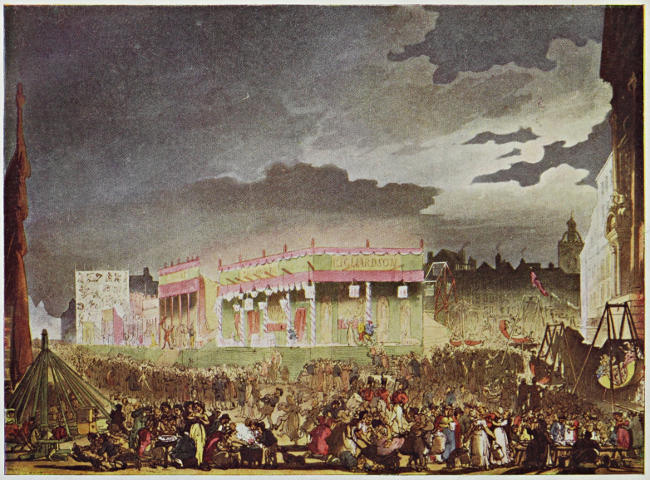
BARTHOLOMEW FAIR
Few people would believe that so lately as this year, the Duke of Dorset, Lord Winchilsea, Lord Talbot, Colonel Tarleton, Mr. Howe, Mr. Damer, Hon. Mr. Lennox, and the Rev. Mr. Williams played at cricket in an open field near White Conduit House.[317] Who could have conjectured that Du Val’s Lane, branching from Holloway, within memory so notoriously infested with highwaymen that few people would venture to peep into it even in mid-day, should, in 1831, be lighted with gas?[318]
In 1784, Nathaniel Hillier’s[319] collection of prints was sold by Christie: they were well selected as to impression, but much deteriorated in value by Mr. Hillier’s attachment to strong coffee, with which he had stained them. It has been acknowledged by one of the family that, what with the expense of staining, mounting, and ruling, his collection only brought them one-fifth of the cost of the prints in the first instance.
Dr. Samuel Johnson also died this year [1784]; during the time the surgeon was engaged in opening his body, Sir John Hawkins, Knight, was in the adjoining room seeing to the weighing of the Doctor’s tea-pot, in the presence of a silversmith, whom Sir John, as an executor, had called upon to purchase it.[320]
1805.
“Mr. Townley presents his compliments to Mr. West, and requests that, when he sees Mr. Lock[321] at his house, he will be so good as to deliver to him the packet sent herewith, containing two prints from Homer’s head,—Mr. T. not knowing where Mr. Lock lives in town. The drawing representing the ‘Triumphs of Bacchus’ by Rubens,[322] in the eighth night’s sale at Greenwood’s, differing much from the bas-relief in the Borghese Villa, from which Caracci is supposed to have composed his picture of that subject in the Farnese Gallery,[323] Mr. T. has no intention to bid for it.
“Park St., Westminster, 21st Feb. 1787.”
“My dear Sir,—I return you many thanks for your kind information respecting the sale of the marbles at the late Lord Mendip’s house at Twickenham.[324] Had I been there and in spirits, the fine Oriental alabaster vase would not have been sold so cheap, and would probably have come to Park Street. I should also have probably purchased the medallion of an elderly man over a chimney-piece. I shall be glad to find out who bought it, and at what price. I should also have liked the ancient fountain. Pray, what was it sold for, and who bought it?
“I mean to take a farewell look at the robaccia at Wilton, to verify my former notes on that collection.
“I flatter myself that many bad symptoms of my long disorder begin to abate, though it still, I feel, has strong hold upon me. I shall remain here about a fortnight longer, then return to Park Street.
“If you will give me the pleasure of a line from you, you may direct to me, No. 36, Milsom Street, Bath. I am, sir, ever most faithfully yours, etc.
“C. Townley.
“Bath, 36, Milsom Street, 11th June 1802.”
1806.
In the month of June this year, the late Atkinson Bush,[325] then of Great Ormond Street, brought to my house Mr. Parton, vestry-clerk of St. Giles’s-in-the-Fields, with a view to obtain such particulars of that parish as I was acquainted with, he being then busily engaged in collecting materials for its history. In the course of conversation, I was astonished to find that it was his intention to have a plan of the parish engraved for his work, purporting to have been taken between the years twelve and thirteen hundred, a period more than two centuries and a half earlier than Aggas’s plan of London, and from which I could not help observing that in my opinion he had most glaringly borrowed. When he assured me he had not, my request was then to know his authority for producing such a plan, but for that question he was not provided with an answer, nor did he appear to be willing to be probed by further interrogatories. To my great astonishment, when Mr. Parton’s book made its appearance, I not only found this plan professing to be between the years twelve and thirteen hundred so minutely made out, with every man’s possession in the parish most distinctly attributed, but every plot of garden so neatly delineated, with the greatest variety of parterres, walks with cut borders, as if the gardener of William III. or Queen Anne had then been living. As Mr. Parton omitted to give any authority for the introduction of so wonderfully early a piece of ichnography, I applied to several leading men in the parish of St. Giles, but could gain no intelligence whatever respecting it: so much for this plan of St. Giles’s parish, as produced by Mr. Parton.[326]
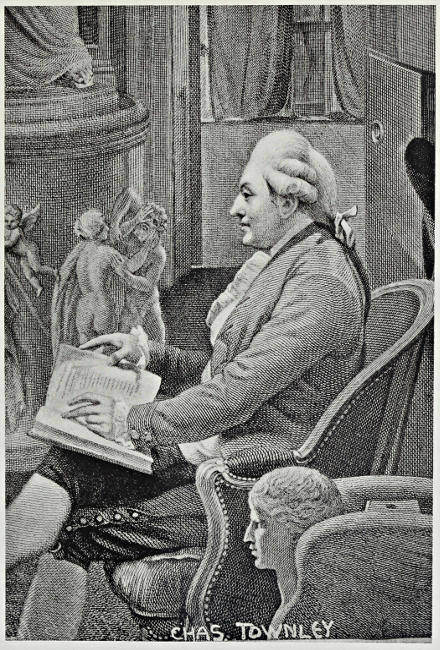
“The Townley Marbles.”
1807.
On the 7th of November of this year, aged 65, died at Rome the celebrated Angelica Kauffmann, who was appointed a member of the Royal Academy by King George III. at its foundation.[327] That she was a great favourite with the admirers of art may be inferred by the numerous engravings from her productions by Bartolozzi and the late William Wynn Ryland.[328] Her pictures are always tasteful, and often well composed, clearly and harmoniously coloured, and extremely finished with a most delicate but spirited pencil. Indeed, her talents were so approved by her brother Academicians, that those gentlemen allotted her compartments of the ceiling in their council-chamber at Somerset Place for decoration, in which most honourable and pleasing task she so well acquitted herself, that her performances are the admiration of every visitor, but more particularly those who possess the organ of colour. She etched numerous subjects; the best impressions are those before the plates were aqua-tinted.
When I was a boy, my father frequently took me to Golden Square to see her pictures, where she and her father had for many years resided in the centre house on the south side. There are several portraits of her, but none so well-looking as that painted by Sir Joshua Reynolds, of which there is an engraving by Bartolozzi.
Angelica Kauffmann was a great coquette, and pretended to be in love with several gentlemen at the same time.[329] Once she professed to be enamoured of Nathaniel Dance;[330] to the next visitor she would divulge the great secret that she was dying for Sir Joshua Reynolds. However, she was at last rightly served for her duplicity by marrying a very handsome fellow personating Count de Horn. With this alliance she was so pleased, that she made her happy conquest known to her Majesty Queen Charlotte, who was much astonished that the Count should have been so long in England without coming to Court. However, the real Count’s arrival was some time afterwards announced at Dover; and Angelica Kauffmann’s husband turned out to be no other than his valet de chambre. He was prevailed upon subsequently to accept a separate maintenance.[331] After this man’s death she married Zucchi, and settled in Rome. During her residence there, she was solicited by the artists in general, but more particularly by the English, to join them in an application to this country for permission to bring their property to England duty free; and as I possess the original letter which that lady wrote to Lord Camelford[332] upon the subject, I cannot refrain from inserting it.
“My Lord,—I do not know, if by having lived several years in England, and having the honour to be a R.A., I may be sufficiently entitled to join with the artists of Great Britain in their request, or better to say, in returning thanks to your Lordship for patronising them in a point so very essential, which is to assist them in obtaining the free importation of their own studies, models, or designs, collected for their improvement during their own stay abroad.
“The heavy duty set upon articles of that nature causes that the artist, whose circumstances do not permit him to pay perhaps a considerable sum, must either be deprived of what he keeps most valuable, or buy his own works at the public sale at the Custom House. This I have myself experienced on my coming to England,—and I mention it here, in consequence of the opinion of some of my friends, who think that my assertion, added to what other artists may have reported to that purpose, may be of some use to obtain their object.
“I heard from Dr. Bates,[333] and Mr. Reveley,[334] the architect, how very much your Lordship is inclined to support the earnest supplication drawn up by some of the artists, which proves your Lordship to be a protector of the fine arts, and of those who profess them. Consequently I have some reason to hope that I may not be judged too impertinent for addressing these lines to you. I have the honour to be, with the greatest respect, my Lord, your Lordship’s most obliged humble servant,
“Angelica Kauffmann.
“Trinità de’ Monti, the 26th Dec. 1787.”
This year, my laborious work, entitled Antiquities of Westminster, was delivered to its numerous and patient subscribers.[335] The following congratulatory letter is one of the many with which I have been honoured by its extensive and steady friends:—
“Lichfield Cathedral Close, Thursday, 2nd July 1807.
“Mr. White[336] presents his best respects to Mr. Smith. His precious little box, from some unaccountable delay in Cambridge, did not arrive till yesterday evening, accompanied by a letter, which receives this early acknowledgment. Though Mr. White has not had leisure to inspect critically the literary portion of Mr. Smith’s elegant and splendid volume, yet his whole time since it came has been occupied in studying and admiring its numerous, accurate, and highly finished engravings, which alone give it a superiority to any book of art’s illustration which Mr. White can at present recollect. Mr. Smith’s offer of a few loose prints is peculiarly kind and acceptable; and Mr. White so far avails himself of it.
“Mr. White cannot refrain expressing his concern and astonishment, that Mr. Smith should have experienced so bitter a recession from friendly promises and assistance, as Mr. H. obliged him to feel; at the same time, the candid and unequivocal statement which Mr. Smith has made, must exonerate him from the world’s reproof, and account for the long protraction of the work. Mr. White cannot but indulge the hope, that so noble an addition to our architectural antiquities, so admirable an elucidation of every precedent history of London, will most amply remunerate the pocket, though no success can recompense that anxiety of mind which Mr. Smith has undergone. The beautiful Cathedral of Lichfield has been recently ornamented with some very fine ancient painted windows, from the dissolved convent near Lille. If Mr. Smith would publish them in colours, Mr. White thinks that the subscription would fill rapidly; and if Mr. Smith would but come down and look at them, Mr. White would be happy in extending every accommodation, and rendering every assistance to him. When the windows are known, the plan will be certainly adopted by other artists of inferior competency.”
1808.
On the first of November this year, George Dance, the Royal Academician, signed the dedication page of his first volume of portraits of eminent men drawn in pencil, with parts touched lightly with colour from life, and engraved by William Daniell, A.R.A., now a Royal Academician (he died 1837), consisting of thirty-six in number. The second volume, which also contained thirty-six in number, was published in 1814.[337]
Fuseli, when viewing several of these portraits, was heard by one of Mr. Dance’s sitters to make the following observations upon the likenesses. Of Benjamin West he said, “His eye is like a vessel in the South Sea,—I can just spy it through the telescope;” of that of Joseph Wilton the sculptor, he observed, “How simple are the thinking parts of this man’s head, and how sumptuous the manducatory;” of that of James Barry he made the following declaration, “This fellow looks like the door of his own house;” of that of Northcote he exclaimed, “By Cot, he is looking sharp for a rat;” and of that of Sir William Chambers, he observed, drawling out his words, “What a grate, heavy, humpty-dumpty, this leaden fellow is.”[338]
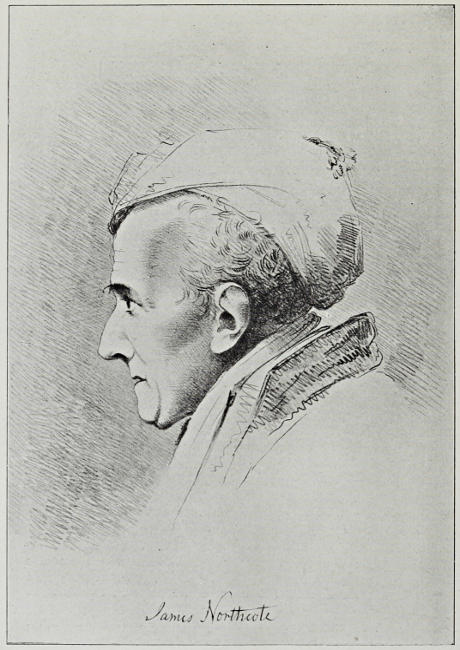
JAMES NORTHCOTE, R.A.
“By Cot, he is looking out sharp for a rat.”
Fuseli
In this sort of wit Fuseli had a formidable force of gunnery, and his shot seldom missed its destination; however, it cannot shatter the above work, as most of the portraits are of worthies too well known even to need it necessary to engrave their names under them.
The greater portion of these likenesses are highly valuable to the illustrators of Boswell’s Life of Johnson, and, indeed, most of the modern biographical publications.
1809.
I cannot more pleasantly close this year than by inserting a copy of one of John Bannister’s bills for his Budget;[339] and as the original is now an extreme rarity, I conclude that some of those “gude folks” who witnessed the delightful humour displayed by that gifted son of Thespis, may possibly be better enabled to recollect how much they giggled twenty-three years ago.
“Oh the days when I was young!”
The type of the long lines in the original bill, which is of a small folio size, being too small to be read without spectacles, I have necessarily, in some instances, been obliged to increase the number of lines in the following copy.
“THEATRE, IPSWICH.
POSITIVELY FOR ONE NIGHT ONLY.
Patronised by their Majesties, Before whom Mr. Bannister had the honour of performing, At the Queen’s House, Frogmore.
The Public are most respectfully informed, On Wednesday, the 29th of November, 1809, Will be presented,
A Miscellaneous Divertisement, With considerable vocal and rhetorical variations, called
BANNISTER’S BUDGET; Or, An Actor’s Ways and Means!
Consisting of Recitations and Comic Songs; Which will be sung and spoken by Mr. Bannister, of the late Theatre Royal, Drury Lane.
“The above Divertisement is entirely new; the prose and verse which compose it having been written expressly for the occasion of Mr. Bannister’s Tour, by Messrs. Colman, Reynolds, Cherry, T. Dibdin, C. Dibdin, Jun., and others.
The whole of the Entertainment has been arranged and revised by Mr. Colman.
The songs (which Mr. Reeve, Jun., will accompany on the pianoforte,) are principally composed by Mr. Reeve.
Prospectus of the Divertisement.
“Part I.—Exordium.—Mr. Bannister’s Interview with Garrick.—Garrick’s Manner attempted by Mr. Bannister in a Shaving Dialogue.—Mr. Doublelungs in the Clay-pit.—Macklin’s advice to his Pupils.—The Ship’s Chaplain, and Jack Haulyard, the Boatswain; or, Two Ways of Telling a Story.—Sam Stern.—The Melodramaniac, or Value of Vocal Talent.—Mr. and Mrs. O’Blunder, or, Irish Suicide!
“Part II.—Superannuated Sexton.—Original Anecdotes of a late well-known eccentric Character.—Trial at the Old Bailey.—Cross-Examination.—Counsellor Garble.—Barrister Snip-snap.—Serjeant Splitbrain.—Address to the Jury.—Simon Soaker, and Deputy Dragon.
“Part III.—Club of Queer Fellows!—President Hosier.—Speech from the Chair.—Mr. Hesitate.—Mr. Sawney Mac Snip.—Musical Poulterer.—Duet between a Game Cock and a Dorking Hen.—Mr. Molasses.—Mr. Mimé.—Monotony exemplified.—Mr. Kill-joy, the Whistling Orator.—Susan and Strephon.—Budget closed.
Rotation of Comic Songs to be introduced on this particular occasion.
“IN PART I.
Vocal Medley.
Captain Wattle and Miss Roe (by particular desire).
Tom Tuck’s Ghost.
Song in Praise of Ugliness!
The Debating Society.
“IN PART II.
The Deserter; or, Death or Matrimony.
Miss Wrinkle and Mr. Grizzle,
and
The Tortoiseshell Tom Cat.
“IN PART III.
THE TRAGEDY OF OTHELLO; or, Fine Fleecy Hosiery.
The Marrow-fat Family.
Jollity Burlesqued, and
Beggars and Ballad-singers.
The doors to be opened at six o’clock, and to begin precisely at seven. Boxes, Upper Circle, 4s.; Lower Circle, 3s.; Pit, 2s., Gallery, 1s.
N.B. Care has been taken to have the Theatre well aired.”
1810.
My reader will find by the following copy of a paper written by the Rev. Stephen Weston, B.D.,[340] and read at the Society of Antiquaries’ meeting, 25th January 1810, that the term Swan-hopping is to be considered a popular error.
“It appears in the Swan-rolls, exhibited by the Right Honourable Sir Joseph Banks, that the King’s were doubly marked, and had what was called two nicks, or notches. The term, in process of time, not being understood, a double animal was invented, unknown to the Egyptians and Greeks, with the name of the Swan with Two Necks. But this is not the only ludicrous mistake that has arisen out of the subject, since Swan-upping, or the taking up of Swans, performed annually by the Swan companies, with the Lord Mayor of London at their head, for the purpose of marking them, has been changed by an unlucky aspirate into Swan-hopping, which is not to the purpose, and perfectly unintelligible.”[341]
1811.
In the summer of this year, the Earl of Pembroke allowed me to copy a picture at Wilton, painted by the celebrated architect, Inigo Jones. It is a view of Covent Garden in its original state, when there was a tree in the middle. The skill with which he has treated the effect is admirable.
There is also, in that superb mansion, a companion picture of Lincoln’s Inn Fields by the same artist.
1812.
The political career of John Horne Tooke, Esq., is well known, and the fame of his celebrated work, entitled the Diversions of Purley, will be spoken of as long as paper lasts.
In the year 1811 a most flagrant depredation was committed in his house at Wimbledon by a collector of taxes, who daringly carried away a silver tea and sugar caddy, the value of which amounted, in weight of silver, to at least twenty times more than the sum demanded, for a tax which Mr. Tooke declared he never would pay. This gave rise to the following letter:—
“TO MESSRS. CROFT AND DILKE.
“Gentlemen,—I beg it as a favour of you, that you will go in my name to Mr. Judkin, attorney, in Clifford’s Inn, and desire him to go with you both to the Under Sheriff’s Office, in New Inn, Wych Street.
“I have had a distress served upon me for taxes, at Wimbledon, in the county of Surrey.
“By the recommendation of Mr. Stuart, of Putney, I desire Mr. Judkin to act as my attorney in replevying the goods; and I desire Mr. Croft and Mr. Dilke to sign the security-bond for me that I will try the question.
“Pray show this memorandum to Mr. Judkin.
“John Horne Tooke.
“Wimbledon, May 17th, 1811.”
As Mr. Croft and Mr. Dilke were proceeding on the Putney Road, they met the tax-collector with the tea-caddy under his arm, on his way back with the greatest possible haste to return it, with an apology to Mr. Tooke,—that being the advice of a friend. The two gentlemen returned with him, and witnessed Mr. Tooke’s kindness when the man declared he had a large family.[342]
On the 18th of March this year (1812), Mr. Tooke died, at his house at Wimbledon. He was put into a strong elm shell. The coffin was made from the heart of a solid oak, cut down for the purpose. It measured six feet one inch in length; in breadth at the shoulders, two feet two inches; the depth at the head, two feet six inches; and the depth at the feet, two feet four inches. This enormous depth of coffin was absolutely necessary, in consequence of the contraction of his body. His remains were conveyed in a hearse and six, to Ealing, in Middlesex, attended by three mourning coaches with four horses to each. It was Mr. Tooke’s wish to have been buried in his own ground; but to this the executors very properly made an objection.[343]
1813.
At the sale of the effects of the Rev. William Huntington (vulgarly called the “Coal-heaver”), which commenced on the 22nd of September, and continued for three following days, at his late residence, Hermes Hill, Pentonville, one of his steady followers purchased a barrel of ale, which had been brewed for Christmas, because he would have something to remember him by.[344]
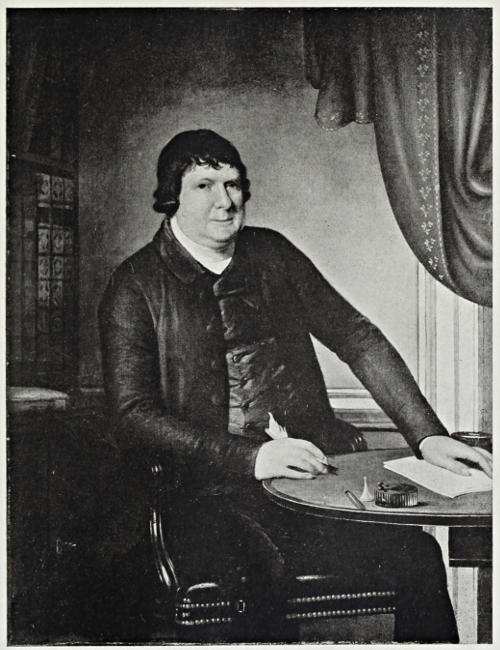
WILLIAM HUNTINGTON (S.S.)
“I cannot get D.D. for want of cash, therefore I am compelled to fly to S.S., by which I mean Sinner Saved.”
1814.
Mr. John Nixon, of Basinghall Street, gave me the following information respecting the Beefsteak Club. Mr. Nixon, as Secretary, had possession of the original book. Lambert’s Club was first held in Covent Garden Theatre, in the upper room, called the “Thunder and Lightning;” then in one even with the two-shilling gallery; next in an apartment even with the boxes; and afterwards in a lower room, where they remained until the fire. After that time, Mr. Harris insisted upon it, as the playhouse was a new building, that the Club should not be held there. They then went to the Bedford Coffee-house next door. Upon the ceiling of the dining-room they placed Lambert’s original gridiron, which had been saved from the fire. They had a kitchen, a cook, and a wine-cellar, etc., entirely independent of the Bedford Coffee-house. When the Lyceum, in the Strand, was rebuilt, Mr. Arnold fitted up a room for the Beefsteak Club, where it remained until the late fire.
The society held at Robins’s room was called the “Ad Libitum” Society, of which Mr. Nixon had the books; but it was a totally different society, quite unconnected with the Beefsteak Club.[345]
1815.
One of the biographers of Mrs. Abington, the first actress who played the part of Lady Teazle in the School for Scandal, and so justly celebrated in characters of ladies in high life, states that she died on the 1st of March 1815, in her 84th year. Another informs us that she died on the 4th; but neither of the writers say where she died, or where she was buried; on inquiry, I found that she died at Pall Mall.[346] Of all the theatrical ungovernable ladies under Mr. Garrick’s management, Mrs. Abington, with her capriciousness, inconsistency, injustice, and unkindness, perplexed him the most. She was not unlike the miller’s mare, for ever looking for a white stone to shy at. And though no one has charged her with malignant mischief, she was never more delighted than when in a state of hostility, often arising from most trivial circumstances, discovered in mazes of her own ingenious construction.[347]
Mrs. Abington, in order to keep up her card-parties, of which she was very fond, and which were attended by many ladies of the highest rank, absented herself from her abode to live incog. For this purpose she generally took a small lodging in one of the passages leading from Stafford Row, Pimlico,[348] where plants are so placed at the windows as nearly to shut out the light, at all events, to render the apartments impervious to the inquisitive eye of such characters as Liston represented in Paul Pry. Now and then she would take the small house at the end of Mount Street, and there live with her servant in the kitchen, till it was time to reappear; and then some of her friends would compliment her on the effects of her summer’s excursion.
“Adelphi, November 9.
“Mr. Garrick’s compliments to Mrs. Abington, and has sent her on the other side a little alteration (if she approves it, not else) of the epilogue, where there seems to be a patch: it should, he believes, run thus:—
“Such a persecution! ’Tis the great blemish of the constitution! No human laws should Nature’s rights abridge, Freedom of speech, our dearest privilege; Ours is the wiser sex, though deemed the weaker, I’ll put the Question, if you’ll cheer me, Speaker. “Suppose me now bewig’d, etc.[349]
“Mrs. A. is at full liberty to adopt this alteration or not. Had not our house overflowed last night in a quarter of an hour, from the opening of Covent Garden had suffered much. As it was, there was great room in the pit and gallery at the end of the third act.
“Much joy I sincerely wish you at your success in Lady Bab. May it continue till we both are tired, you with playing the part, and I with seeing it.
“Mrs. Abington, 62, Pall Mall.”
TO RICHARD COSWAY, ESQ., R.A.
“I have found another letter, which you will see is part of the history I took the liberty of troubling you with. I cannot express how much I am obliged to you for your goodness and friendly confidence in telling me what you had heard of this trumpery matter, as it has given me an opportunity of convincing you, in some little degree, that my conduct stands in no need of protection, nor can at any time subject me to fears from threatful insinuations of necessitous adventurers. I am, Sir, your very much obliged and humble servant,
“F. Abington.”
TO RICHARD COSWAY, ESQ., R.A.
“Mrs. Abington will feel herself most extremely mortified indeed if she has not some hope given her that Mr. and Mrs. Cosway will do her the very great honour of coming to her benefit this evening.
“She has been able to secure a small balcony in the very midst of persons of the first rank in this country, which she set down in the name of Mrs. Cosway, till she hears further; it holds two in front, and has three rows holding two upon each, so that Mr. Cosway may accommodate four other persons after being comfortably seated with Mrs. Cosway.
“February 10th. Nine o’clock.”
“Adelphi, December 8th.
“Dear Madam,—I altered the beginning of your epilogue, merely for your ease and credit. I leave it wholly to your own feelings to decide what to speak or what to reject. I find the epilogue is liked, and therefore I would make it as tolerable as possible for you. I assure you, upon my word, that if you please yourself, you will please me. In my hurry I find, looking over the lines this afternoon, that I have made a false chime. I have made directed and corrected to chime, which will not do: suppose them thus,
“Does not he know, poor soul, to be detected Is what you hate, and more to be corrected.—
or thus:—
“Does not he know, in faults to be detected Is what you hate, and more to be corrected.[350]
“I most sincerely wish you joy of your friend’s success. The comedy will be in great vogue.
“I am, Madam, your very humble Servant,
“D. Garrick.”
Bad pen, and gouty fingers, Poor Anacreon, thou growest old![351]
“Pall Mall, November 4th, 1794.
“Mrs. Abington begs leave to present her compliments to Mr. Webster, and to assure him that she feels perfectly ashamed of the trouble which she has repeatedly given him, and is now about to give him; but, indeed, she has so much dependence upon the goodness of his heart, as well as of his understanding, that she flatters herself he will forgive her committing herself to him, upon matters which require more sense as well as more management than falls to the share of the generality of her acquaintance. The enclosed letter will explain to Mr. Webster the nature of Mrs. Abington’s present difficulty, as he will see she is in danger of losing the fine picture which has been for near six years in the hands of Mr. Sherwin, for the purpose of making a print from it. There is not one moment to be lost, if Mr. Webster will have the goodness to undertake the business; and she begs of him not to mention the matter further.
“The picture is the property of Mrs. Abington, and given by Sir Joshua Reynolds to Mr. Sherwin at his own particular request, that Sir Joshua would favour him so far as to let him have the preference of the many artists who, at the time the picture was painted, applied for it to engrave a plate from it.
“Mrs. Abington begs leave to present her kindest love and regards to Mrs. Webster, and flatters herself that the whole family are perfectly well.
“She has this moment heard that all the armaments will now end in peace.
“To John Webster, Esq., Duke Street, Westminster.”
As Sherwin’s plate from this beautiful picture was published by the late Mr. John Thane,[352] on February 1st, 1791, and as Mrs. Abington’s letter to Mr. Webster is dated November 4th, 1794, it appears that the engraver retained it nearly four years after the plate was finished; so that, according to Mrs. Abington’s date, it must have been upwards of two years in hand.
My old friend, Mr. Thomas Thane, son of the publisher, who is now in possession of the plate, kindly gave me impressions of it in three states. The first is a great rarity: a proof before any letters, and the reduction of the plate. The second is after the sides of the plate had been reduced, with the names of the painter, engraver, and publisher, perfectly engraved, and the name of Roxalana slightly etched. The third and last state is, after the etched name Roxalana has been taken out and engraved higher in the plate, to make room for some lines of poetry.
At page 70 of the Wilmot Letters in the British Museum is the following letter, addressed by the Hon. Horace Walpole to Mrs. Abington the actress:—
“Paris, September, 1771.
“If I had known, Madam, of your being at Paris, before I heard it from Colonel Blaquière,[353] I should certainly have prevented your flattering invitation, and have offered you any services that could depend on my acquaintance here. It is plain I am old, and live with very old folks.”[354]
Further on the same writer observes:—
“I have not that fault at least of a veteran, the thinking nothing equalled to what they admired in their youth. I do impartial justice to your merit, and fairly allow it not only equal to that of any actress I have seen, but believe the present age will not be in the wrong, if they hereafter prefer it to those they may live to see. Your allowing me to wait on you in London, Madam, will make me some amends for the loss I have had here; and I shall take an early opportunity of assuring you how much I am, Madam, your most obliged humble servant,
“Horace Walpole.”
“Madam,—You may certainly always command me and my house. My common custom is to give a ticket for only four persons at a time; but it would be very insolent in me, when all laws are set at nought, to pretend to prescribe rules. At such times there is a shadow of authority in setting the laws aside by the legislature itself; and though I have no army to supply their place, I declare Mrs. Abington may march through all my dominions at the head of as large a troop as she pleases;—I do not say, as she can muster and command, for then I am sure my house would not hold them. The day, too, is at her own choice; and the master is her very obedient humble servant,
“Hor. Walpole.
“Strawberry Hill, June 11, 1780.”
Mrs. Abington to Mrs. Jordan.
“No. 19, Eton Street, Grosvenor Place,
“January 6th, 1807.
“I beg leave, dear Madam, to make my grateful acknowledgments for the favour of your kind remembrance. Your ticket with those of dear Miss Betsworth, and the Miss Jordans, was sent to my present habitation on New Year’s day.
“I have not slept in London since I came from the Wealds of Kent, where I passed my summer upon a visit to Sir Walter and Lady Jane James, and their lovely family.[355] It is near a grand scene of Gothic magnificence, called Bayham Abbey, a seat of Lord Camden’s, the brother of Lady Jane. In their peaceful retreat and accomplished society, I have very much recovered my health and spirits, and hope to have the happiness of seeing you soon, as I am now looking for something to inhabit in London. In the meantime, if you, dear Madam, or the Miss Jordans, will do me the honour of calling at my present abode, which are two rooms, where I keep my clothes and trumpery, I shall be much flattered; and beg you to accept the compliments of the season, and a sincere wish that you may see many, many returns, with every happiness you are so well entitled to expect. Adieu, my dearest Madam. Be pleased to make my compliments to the ladies, and believe me your most obliged, etc.,
“F. Abington.”[356]
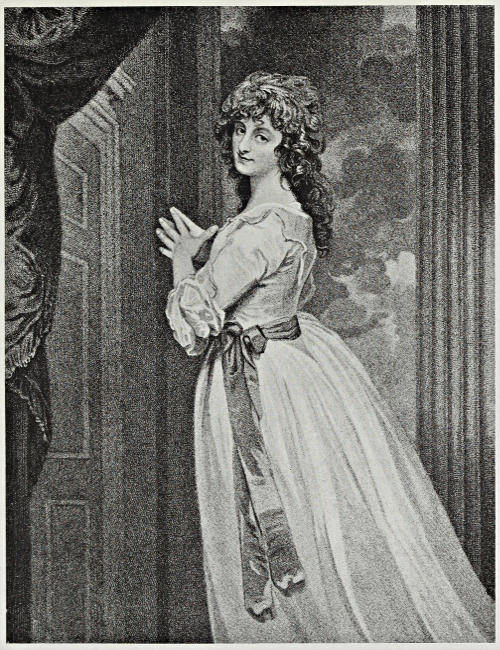
MRS. JORDAN
“The very sound of the little familiar word bud from her lips … was a whole concentrated world of the power of loving.”—Leigh Hunt
1816.
As a playful relaxation from my former more serious applications, I commenced my work of the most remarkable London Beggars, with biographical sketches of each character.[357] By this publication I gained more money than by all my antiquarian labours united. Her late Majesty, Queen Charlotte, and the Princess Elizabeth, much encouraged their publicity; but I must acknowledge that my greatest success was owing to the warm and friendly exertions of the late Charles Cowper,[358] Esq., of the Albany, a gentleman whose memory must be dear to every one who had the pleasure of knowing him.
Much about this time, the Print Room of the British Museum was closed, in consequence of the death of the highly talented Mr. William Alexander, when several friends exerted their interest to procure me the situation of Keeper, an appointment which, I hope, I have held with no small benefit to that National Institution, and with credit to myself. The interest required to obtain this appointment may be conceived, when the number of candidates is considered. The following letter was written by his Grace the late Archbishop of Canterbury to one of his Grace’s relations:—
“Addington, Sept. 16th, 1816.
“My dear Madam,—With such interest as Mr. J. T. Smith possesses, I am astonished he should think it worth while to waste his strength in pursuit of such a trifling office as that which is now vacant in the Museum.
“It is impossible to resist the testimony which your Ladyship, and many others, have borne to his merits and qualifications. He certainly shall have my vote; and I have reason to believe he will have the votes of the other two principal Trustees, to whom the appointment belongs.
“C. Cantuar.”[359]
1817.
Perhaps the only gala day now which gladdens the heart of the loyal spectator, is the one afforded by Thomas Doggett, comedian, on the 1st of August, to commemorate the accession of the House of Brunswick. This scene is sure to be picturesque and cheerful, should the glorious sun, “that gems the sea, and every land that blooms,” reflect the pendent streamers of its variegated show, in the quivering eddies of Father Thames’s silver tide. At what time Mr. Thomas Doggett was born, I am ignorant. All I have been able to glean of him is, that Castle Street, Dublin, has been stated as the place of his birth; and that he had the honour of being the founder of our water games. Colley Cibber, speaking of him, says, “As an actor he was a great observer of Nature; and as a singer he had no competitor.” He was the author of the Country Wake, a comedy, and was a patentee of Drury Lane Theatre until 1712; and my friend, Mr. Thomas Gilliland,[360] in his work entitled The Dramatic Mirror, states his death to have taken place on the 22nd of September 1721.
In 1715, the year after George I. came to the throne, Doggett, to quicken the industry and raise a laudable emulation in our young men of the Thames, whereby they not only may acquire a knowledge of the river, but a skill in managing the oar with dexterity, gave an orange-coloured coat and silver badge, on which was sculptured the Hanoverian Horse, to the successful candidate of six young watermen just out of their apprenticeship, to be rowed for on the 1st of August, when the current was strongest against them, starting from the “Old Swan,” London Bridge, to the “Swan” at Chelsea. On the 1st of August 1722, the year after Doggett’s death, pursuant to the tenor of his will, the prize was first rowed for, and has been given annually ever since.[361]
“They gripe their oars; and every panting breast Is raised by turns with hope, by turns with fear deprest.”
This gratifying sight I have often witnessed; and the never-to-be-forgotten Charles Dibdin considered it so pleasing a subject, that in 1774 he brought out at the Haymarket Theatre a ballad opera, entitled The Waterman, or the First of August. In this piece, Tom Tug, the hero, is in love with a gardener’s daughter, before whom he sings,
“And did you not hear of a jolly young waterman, Who at Blackfriars’ Bridge used for to ply; And he feathered his oars with such skill and dexterity, Winning each heart, and delighting each eye,” etc.
Poor Tug, who considered himself slighted for another lover, whom the girl of his heart appeared to prefer, after declaring that he would go on board a man-of-war to cast away his care, sings a song, of which the following is the first verse:—
“Then farewell, my trim-built wherry, Oars and coat and badge farewell! Never more at Chelsea ferry Shall your Thomas take a spell,” etc.
However, Tom rowed for Doggett’s Coat and Badge, which he had an eye upon, in order to obtain the girl, if possible, by his prowess. She was seated at the Swan, and admired the successful candidate before she discovered him to be her suitor Thomas, then
“Blushed an answer to his wooing tale.”
The part of Tom Tug was originally performed by Charles Bannister, and esteemed so great a favourite, that Mr. Garrick selected the entertainment of The Waterman, to follow the comedy of The Wonder, on the evening of his last performance on the stage.[362] Had the author of The Waterman, when composing that little entertainment, suspected that the Plague’s blood-red bills of
“Lord, have mercy upon us,”
had been fixed upon this house, the Swan, his Muse most likely would have whispered, “You must not sadden these scenes.” Pepys, in his Diary, made the following entry:—
“April 9th, 1666.—Thinking to have been merry at Chelsey, but being come almost to the house, by coach, near the water-side, a house alone, I think the Swan, a gentleman walking by called to us to tell us that the house was shut up of the sickness.”
1818.
It is scarcely possible for any person, possessing the smallest share of common observation, to pass through ten streets in London, without noticing what is generally denominated a character, either in dress, walk, pursuits, or propensities. As even my enemies are willing to give me credit for a most respectful attention to the ladies, I hope they will not in this instance impeach my gallantry, because I place the fair sex at the head of my table of remarks, as to the eccentricity of some of their dresses. Miss Banks,[363] the sister of Sir Joseph, was looked after by the eye of astonishment wherever she went, and in whatever situation she appeared. Her dress was that of the Old School; her Barcelona quilted petticoat had a hole on either side for the convenience of rummaging two immense pockets, stuffed with books of all sizes. This petticoat was covered with a deep stomachered gown, sometimes drawn through the pocket-holes, similar to those of many of the ladies of Bunbury’s time, which he has introduced in his prints. In this dress I have frequently seen her walk, followed by a six-foot servant with a cane almost as tall as himself.
Miss Banks, for so that lady was called for many years, was frequently heard to relate the following curious anecdote of herself. After making repeated inquiries of the wall-vendors of halfpenny ballads for a particular one which she wanted, she was informed by the claret-faced woman, who strung up her stock by Middlesex Hospital-gates, that if she went to a printer in Long Lane, Smithfield, probably he might supply her Ladyship with what her Ladyship wanted. Away trudged Miss Banks through Smithfield, “all on a market-day”; but before she entered Mr. Thompson’s shop, she desired her man to wait for her at the corner, by the plumb-pudding stall. “Yes, we have it,” was the printer’s answer to the interrogative. He then gave Miss Banks what is called a book, consisting of many songs. Upon her expressing her surprise when the man returned her eightpence from her shilling, and the great quantity of songs he had given her, when she only wanted one,—“What, then!” observed the man, “are you not one of our chanters? I beg your pardon.”
It has been stated that this lady and Lady Banks, out of compliment to Sir Joseph, who had been deeply engaged in the production of wool, had their riding-habits made of his produce, in which dresses those ladies at one period upon all occasions appeared. Indeed, so delighted was Miss Banks with this overall-covering, that she actually gave the habit-maker orders for three at a time,—and they were called Hightum, Tightum, and Scrub. The first was her best, the second her second best, and the third her every-day one.
I have been informed that once, when Miss Banks and her sister-in-law visited a friend with whom they were to stay several days, on the evening of their arrival they sat down to dinner in their riding-habits. Their friend had a large party after dinner to meet them, and they entered the drawing-room in their riding-habits. On the following morning they again appeared in their riding-habits; and so on, to the astonishment of every one, till the conclusion of their visit.
Being in possession of an immense number of tradesmen’s tokens current at this time, I left them in Soho Square, with a note begging Miss Banks’s acceptance of any she might want. After a few hours, her footman’s knock at my door announced the arrival of Miss Banks, who entered the parlour holding up the front of her riding-habit with both hands, the contents of which she delivered upon the table, at the same time observing “that she considered herself extremely obliged to me for my politeness, but that, extraordinary as it might appear, out of so many hundred there was not one that she wanted.”
Although Miss Banks displayed great attention to many persons, there were others to whom she was wanting in civility. I have heard that a great genius, who had arrived a quarter of an hour before the time specified upon the card for dinner, was shown into the drawing-room, where Miss Banks was putting away what are sometimes called rattle-traps.[364] When the visitor observed, “It is a fine day, Ma’am,” she replied, “I know nothing at all about it; you must speak to my brother upon that subject when you are at dinner.” Notwithstanding the very singular appearance of Miss Banks, she was in the prime of life, a fashionable whip, and drove four-in-hand.
Mrs. Carter,[365] the translator of Epictetus, was also singular in her dress. Her upper walking-garment, in the latter part of her life, which was cut short, was more like a bed-gown than anything else. The last time I met this benevolent lady was in 1801, at Mrs. Dards’s exhibition,[366] an immense collection of artificial flowers made entirely by herself with fish-bones, the incessant labour of many years. I remember, in the course of conversation, Mrs. Dards observed, “No one can imagine the trouble I had in collecting the bones for that bunch of lilies of the valley; each cup consists of the bones which contain the brains of the turbot; and from the difficulty of matching the sizes, I never should have completed my task had it not been for the kindness of the proprietors of the London, Free-Masons’, and Crown and Anchor Taverns, who desired their waiters to save all the fish-bones for me.”
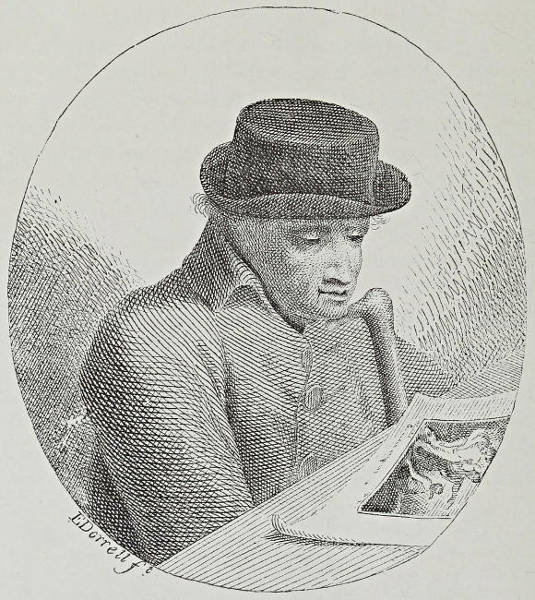
HENRY CONSTANTINE JENNINGS (OR NOEL)
“… barring his eccentricities.”
This ingenious person distributed a card embellished with flowers and insects, upon which was engraven the following advertisement:—
No. 1, Suffolk Street, Cockspur Street.
“Mrs. Dards begs leave to inform her friends in particular, and the public in general, that after a labour of thirty years, she has for their inspection and amusement opened an exhibition of shell-work, consisting of a great variety of beautiful objects equal to nature, which are minutely described in the catalogue. Likewise is enabled to gratify them
“With bones, scales, and eyes, from the prawn to the porpoise, Fruit, flies, birds, and flowers, oh, strange metamorphose!”
“Open from ten to six in the summer,—from ten to four in the winter.
“Admittance 1s. Catalogue 6d.”
Mr. Jennings,[367] latterly known as Constantine Noel, barring his eccentricities, was an accomplished gentleman, a traveller of infinite taste, and one of the most liberal and entertaining companions imaginable. Mr. Noel’s figure was short, thin, and much bent by age; and he was very singular in his dress. The crown of his hat fitted his head as close as a pitch-plaster; his coat was short, of common cloth, and, like Mr. Wodhull’s, regularly buttoned up from his waist to his chin. His stockings were not striped blue and white, like those of Sir Thomas Stepney,[368] but of pepper-and-salt mixture, and of worsted. He stepped astride in consequence of the bowness of his legs, and generally attracted notice by striking his walking-stick hard on the stones with his right arm fully extended, while his left hung swinging low before him. He wore thick-sole shoes, with small buckles, and seldom showed linen beyond the depths of his stock.
My father, who knew him well, used to relate the annexed anecdote. Mr. Noel one day, when at the corner of Rathbone Place, close to Wright’s, the intelligent grocer, finding himself rather fatigued, called repeatedly to the first coachman, who, after laughing at him for some time, increased the insult by observing, “A coach, indeed! a coach! who’s to pay for it?”
“You rascal,” exclaimed Mr. Noel, clenching his stick in the position of chastisement, “why don’t you come when I call, Sir; I’ll make an example of you, I will.”
The coachman continued laughing, till a gentleman accosted Mr. Jennings thus:—“My worthy friend, what is all this about?”
The coachman was immediately curbed; and when Mr. Noel’s friend had parted with him, by shaking his hand in the coach, the coachman, touching the front of his hat, wished to know of his honour “Where to?”
“I’ll give you a pretty dance,” replied Mr. Noel; “drive me to h——, you rascal; to Whitechapel, and from thence to Hyde Park Corner. I’ll take care it shall be long enough before you get any dinner, you rascal, I will.” Then, with a nod and a smile to the assembled crowd, he declared, to their no small amusement, “I’ll punish him.”
Dr. Burges, of Mortimer Street, whose singular figure has been etched by Gillray, under which he wrote, “From Warwick Lane,” was one of the last men who wore a cocked-hat and deep ruffles. What rendered his appearance more remarkable, he walked on tiptoe.[369]
It was the regular custom of Mr. Alderman Boydell, who was a very early riser, at five o’clock, to go immediately to the pump in Ironmonger Lane. There, after placing his wig upon the ball at the top of it, he used to sluice his head with its water. This well-known and highly respected character,[370] who has done more for the British artists than all the print-publishers put together, was also one of the last men who wore the three-cornered hat commonly called “Egham, Staines, and Windsor.”
I recollect another character, a bricklayer, of the name of Pride, of Vine Street, Piccadilly, who wore the three-cornered hat commonly called “The Cumberland Cock.”[371]
1822.
In October this year the venerable Mrs. Garrick departed this life, when seated in her armchair in the front drawing-room of her house in the Adelphi. She had ordered her maid-servants to place two or three gowns upon chairs, to determine in which she would appear at Drury Lane Theatre that evening, it being a private view of Mr. Elliston’s improvements for the season. Perhaps no lady in public and private life held a more unexceptionable character. She was visited by persons of the first rank; even our late Queen Charlotte, who had honoured her with a visit at Hampton, found her peeling onions for pickling. The gracious Queen commanded a knife to be brought, saying, “I will peel some onions too.” The late King George IV. and King William IV., as well as other branches of the Royal Family, frequently honoured her with visits.
In the course of conversation with Mrs. Garrick (to whom I had been introduced by the late Dr. Burney), that lady expressed a wish to see the collection of Mr. Garrick’s portraits, which the Doctor had most industriously collected. After the honourable trustees had purchased the Doctor’s library, which contained ten folio volumes of theatrical portraits, I reminded Mrs. Garrick of her wish, in consequence of which I received the following letter:—
“Mr. Beltz[372] presents his compliments to Mr. Smith, and is desired by his respected friend Mrs. Garrick to acquaint him, in answer to the favour of his letter of the 12th inst., that she proposes (unless she should hear from Mr. Smith that it will be inconvenient to him) to do herself the pleasure of calling on him at the British Museum on Tuesday next, between twelve and one, for the purpose of inspecting the prints of Mr. Garrick, to which Mr. Smith refers.
“Heralds’ College, Aug. 18th, 1821.”
On the appointed morning Mrs. Garrick arrived, accompanied by Mr. Beltz. She was delighted with the portraits of Mr. Garrick, many of which were totally unknown to her. Her observations on some of them were extremely interesting, particularly that by Dance, as Richard III.[373] Of that painter she stated, that Mr. Garrick, who had been the artist’s best friend and benefactor, behaved in the most dirty manner in return; for in the course of his painting the picture Mr. Garrick had agreed to give him two hundred guineas for it. One day at Mr. Garrick’s dining-table, where Dance had always been a welcome guest, he observed that Sir Watkin Williams Wynn,[374] who had seen the picture, spontaneously offered him three hundred guineas for it. “Did you tell him it was for me?” questioned Mr. Garrick. “No, I did not.” “Then you mean to let him have it?” Garrick rejoined. “Yes, I believe I shall,” replied the painter. “However,” observed Mrs. Garrick, “my husband was very good; he bought me a most handsome looking-glass, which cost him more than the agreed price of the picture; and that was put up in the place where Dance’s picture was to have hung.” Mrs. Garrick being about to quit her seat, said she should be glad to see me at Hampton. “Madam,” said I, “you are very good; but you would oblige me exceedingly by honouring me with your signature on this day.” “What do you ask me for? I have not taken a pen in my hand for many months. Stay, let me compose myself; don’t hurry me, and I will see what I can do. Would you like it written with my spectacles on, or without?” Preferring the latter, she wrote “E. M. Garrick,” but not without some exertion.
“I suppose now, Sir, you wish to know my age. I was born at Vienna, the 29th of February, 1724, though my coachman insists upon it that I am above a hundred. I was married at the parish of St. Giles at eight o’clock in the morning, and immediately afterwards in the chapel of the Portuguese Ambassador, in South Audley Street.”
A day or two after Mrs. Garrick’s death, I went to the Adelphi, to know if a day had been fixed for the funeral. “No,” replied George Harris, one of Mrs. Garrick’s confidential servants; “but I will let you know when it is to take place. Would you like to see her? she is in her coffin.” “Yes, I should.” Upon entering the back room on the first-floor, in which Mr. Garrick died, I found the deceased’s two female servants standing by her remains. I made a drawing of her, and intended to have etched it. “Pray, do tell me,” looking at one of the maids, “why is the coffin covered with sheets?” “They are their wedding sheets, in which both Mr. and Mrs. Garrick wished to have died.” I was informed that one of these attentive women had incurred her mistress’s displeasure by kindly pouring out a cup of tea, and handing it to her in her chair. “Put it down, you hussey; do you think I cannot help myself?” She took it herself, and a short time after she had put it to her lips, died. This lady continued her practice of swearing now and then, particularly when any one attempted to impose upon her. A stonemason brought in his bill with an overcharge of sixpence more than the sum agreed upon; on which occasion he endeavoured to appease her rage by thus addressing her:—“My dear Madam, do consider”—“My dear Madam! What do you mean, you d—— fellow? Get out of the house immediately. My dear madam, indeed!!”
On the following day I received the promised letter, by the post.
“Sir,—The funeral is fixed to leave the Adelphi Terrace soon after ten o’clock to-morrow morning. Mrs. Garrick’s carriage, the Dowager Lady Amherst’s, Dr. Maton’s, and Mr. Carr’s[375] are the only carriages that will join the funeral. Your obedient servant,
“George Harris,
“Servant to Mrs. Garrick.”
On the day of the funeral, Miss Macauley,[376] the authoress, wishing to see this venerable lady interred, placed herself under my protection; but when we arrived at the Abbey, we were refused admittance by a person who observed, “If it be your wish to see the waxwork, you must come when the funeral’s over, and you will then be admitted into Poets’ Corner, by a man who is stationed at the door to receive your money.”
“Curse the waxwork!” said I; “this lady and I came to see Mrs. Garrick’s remains placed in the grave.”—“Ah, well, you can’t come in; the Dean won’t allow it.” As soon as the ceremony was over, we were admitted for sixpence at the Poets’ Corner, and there we saw the earth that surrounded the grave, and no more, as we refused to pay the demands of the showmen of the Abbey. Surely this mode of admission to see the venerable structure, and the monuments put up there at a most liberal expense by the country, as memorials of departed worth, is an abominable disgrace to the English Government.[377]
Being disappointed in a sight of the burial, I applied to my friend, the Rev. Thomas Rackett, one of Mrs. Garrick’s executors, for a list of those persons who attended the funeral.
IN THE FIRST COACH.
Christopher Philip Garrick, and Nathan Egerton Garrick, great-nephews of David Garrick; the Rev. Thomas Rackett, and George Frederick Beltz, Esq., Lancaster Herald, Executors of Mrs. Garrick’s will.
IN THE SECOND COACH.
Thomas Carr, Esq., Mrs. Garrick’s solicitor; and Mrs. Carr.
IN THE THIRD COACH.
Mr. James Deane, Agent to Mr. Carr, frequently employed by Mrs. Garrick; Mr. Freeman, of Spring Gardens, Mrs. Garrick’s apothecary.
Thomas Rackett.[378]
December 4th, 1827.
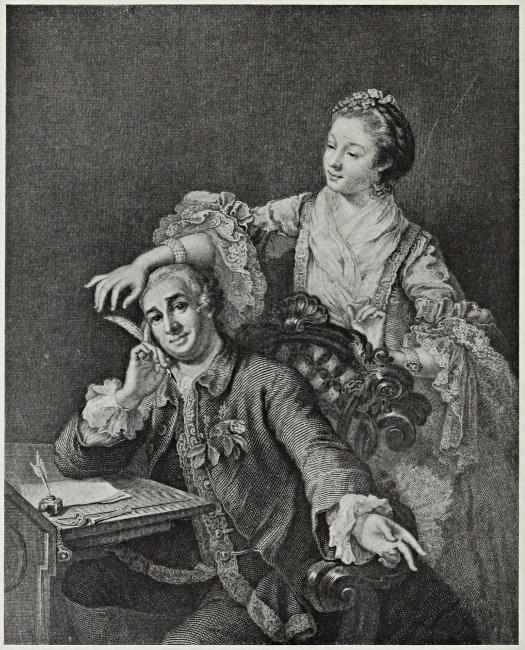
THE GARRICKS
“The fops that join to cry you down Would give their ears to get her.” Edward Moore on Garrick’s Marriage
As Mr. Garrick was married by his friend, the celebrated Dr. Francklin,[379] who at that time had a chapel in Great Queen Street, I was anxious to ascertain whether the ceremony took place there or at the parish church. I therefore applied to my friend, the Rev. Charles M’Carthy, who favoured me with the following certificate:—
June 22, 1749. David Garrick, of St. Paul, Covent Garden; and Eva Maria Violetti, of St. James’s, Westminster.
T. Franklin.
C. M’Carthy, Curate and Reg.[380]
1823.
In 1822, to the disgrace of the Antwerp picture collectors, notwithstanding their professed zeal for the protection of high works of art, they allowed the most precious gem, their boasted corner-stone, to be carried away from their city. However, to the great honour of Mr. Smith, the picture-dealer, it was secured for England.
This corner-stone, which had been coveted by most of the amateurs in the world, was no less a treasure than the picture known under the appellation of the “Chapeau de Paille,”[381] by Rubens, which had been in the Lunden’s, and then the Steir’s family, from the time it was sold after the painter’s death, to the 29th of July, 1822, the day on which it was brought to auction for the benefit of the last possessor’s family.
When the auctioneer ordered the doors of the case in which it was kept to be thrown open, every person took off his hat, and greeted the picture with loud and repeated cheerings. After the company had, for some time, gratified their eyes, the doors were locked and biddings commenced, the company remaining uncovered till the bidders were silent. It was then knocked down for the sum of thirty-two thousand seven hundred florins, to a foreigner displaying an orange ribbon, hired by the real purchaser, Mr. Smith, who suspected that if an Englishman had offered to bid, he would have brought down a direful opposition. When it was discovered that it was to be conveyed to England, the Antwerpers not only shed tears, but followed it to Mr. Smith’s place of residence, expressing the strongest desire to take their farewell look. Mr. Smith, not willing to risk its safety, gave a seaman five guineas to convey it on shipboard by night, and saw it safely landed on British ground.
Upon its arrival in London, King George IV. commanded a sight of it; and on the morning of Tuesday, September 3rd, Mr. Smith had it conveyed from his house in Marlborough Street, to Carlton Palace, where it was placed in the King’s dressing-room, the King keeping the key of the case, that only private friends might see it. After the expiration of a fortnight, the picture was returned; and in the month of March, 1823, it was publicly exhibited at Stanley’s rooms. The Right Hon. Sir Robert Peel became its liberal purchaser and protector. This picture is painted on oak, and has been joined at the lower part across the hands, and there is every reason for believing that Rubens painted it in the frame, as the ground was unpainted upon, within the width of the rabbit.
The popular report respecting this picture is, that it was the portrait of Elizabeth Lunden, a young woman to whom Rubens was particularly partial, who died of the small-pox, to the great grief of the painter.
In this year I find the following letter in my album:—
“My dear Sir,—Your desire to know the place of my nativity, the profession for which I was intended, my first appearance on the stage, and in town. This both honours and gratifies me, inasmuch as your request places my name with men of genius and education, the persons of all others I am most ambitious to be found with.
“The city of Bristol gave me birth, in 1778.[382] I was brought up an artist, which profession I quitted for studies more congenial to my feelings. Immortal Shakspeare wrought the change, and his great contemporaries added fuel to flame. Notwithstanding this mighty stimulus, in the year 1798 I made my first attempt, in the part of young Hob, in Hob in the Well,[383] in a town in Radnorshire, the theatre a barn in the environs; the receipts seven shillings; my share sevenpence. I removed from this luxury to the Stafford Company, thence to the York Theatre, where I succeeded my friend Mathews, and in which situation I remained seven years.
“October 12th, 1809, I made my début in London, in the Theatre Royal, Lyceum, with the Drury Lane Company. The devouring element had destroyed that magnificent pile Old Drury, which caused the professors to employ that place of refuge. The pieces I selected for the terrific ordeal, were The Soldier’s Daughter and Fortune’s Frolic;[384] the characters, Timothy Quaint and Robin Roughhead. The public were infinitely more kind than my negative merits deserved; and with gratitude I acknowledge, that up to the present period, their bounty very far exceeds the humble ability of their devoted servant, and your true friend,
“Edward Knight.[385]
“Theatre Royal, Drury Lane,
“Garden Cottage, Covent Garden, ground chambers,
“Nov. 15th, 1823.”
1824.
The following notice is written in my album this year, by Major Cartwright:—
“John Cartwright, born at Marnham, near Tuxford, in the county of Nottingham, on the 17th of September, 1740, old style, corresponding with the 28th, new style. In the year 1758 he entered the naval service, under the command of Lord Howe; was promoted to a lieutenancy in September, 1762, and continued on active service until the spring of 1771. Then retiring to recruit his health, he remained at Marnham till invited by his old Commander-in-chief, in the year 1775 or 1776; but not approving of the war with America, he declined accepting the proffered commission. About the same time he became Major of the regiment of Nottinghamshire Militia, then for the first time raised in that county, in which he served seventeen years.
“When George III. arrived at the year of the Jubilee, a naval promotion of twenty Lieutenants to the rank of Commanders, and the name of J. C. standing the twentieth on the list, he was commissioned as a Commander accordingly.
“In the year 1802 he published The Trident, a work in quarto, having for its object to promote that elevation of character which can alone preserve the vital spirit of a navy, as well as to furnish an inexhaustible patronage of the arts.
“John Cartwright, residing in Burton Crescent, 26th Jan., 1824.”
The Major died on the 23rd of September this year, at his house in Burton Crescent, at the venerable age of eighty-four.[386]
1825.
An author, in whose real character I was for many years deceived, frequently importuned me to caricature literary females. But this malicious advice, being repugnant to my feelings, I never could listen to, nor is it my intention even to make public a memory-sketch now in my possession of the adviser, when he was stooping over and pretending to kiss the putrid corpse of him a portion of whose vast property he is in possession of, and, I was going to say, happily enjoys.[387] Profoundly learned as the person above alluded to considers himself to be, the reader will, after perusing the following lines, written purposely for my album, be convinced that jealousy towards the fair sex must be that man’s master-passion.
IMPROMPTU LINES BY MISS BENGER, ON THE PAUCITY OF INFORMATION RESPECTING THE LIFE AND CHARACTER OF SHAKSPEARE.
Lives there, redeemed from dull oblivion’s waste, One cherished line that Shakspeare’s hand has traced? Vain search! though glory crowns the poet’s bust, His story sleeps with his unconscious dust. Born—wedded—buried! Such the common lot, And such was his. What more? almost a blot! Even on his laurelled head with doubt we gaze; And fancy best his lineaments portrays. Thus like an Indian deity enshrined, In mystery is his image; whilst the mind To us bequeathed, belongs to all mankind. Yet here he lived; his manly high career Of strange vicissitude, was measured here. Not his the envied privilege to hail The Eternal City! or in Tempe’s vale Breathe inspiration with luxurious sighs, And dream of Heaven beneath unclouded skies. His sphere was bounded, and we almost trace His daily haunts, where he was wont to chase Unwelcome cares, or visions fair recall; His breath still lingers on the cloistral wall, With gloom congenial to his spirit fraught; And thou, O Thames, his lonely sighs hast caught. When one, the rhyming Charon of his day, Who tugged the oar, yet conned a merry lay, Full oft unconscious of the freight he bore, Transferred the musing bard from shore to shore. Too careless Taylor! hadst thou well divined The marvellous man to thy frail skiff consigned, Thou shouldst have craved one tributary line, To blend his glorious destiny with thine! Nor vain the prayer!—who generous homage pays To genius, wins the second meed of praise.[388]
The much-famed Cup, carved from Shakspeare’s Mulberry-tree, lined with, and standing on a base of silver, with a cover surmounted by a branch of mulberry leaves and fruit, also of silver-gilt, which was presented to Mr. Garrick on the occasion of the Jubilee at Stratford-upon-Avon, was sold by Mr. Christie on May the 5th, 1825,[389] who addressed the assembly nearly in the following words, for the recollection of which I am obliged to the memory of my worthy friend, Henry Smedley, Esq.:[390]—
“Though this is neither the age nor the country in which relics are made the objects of devotion, yet that which I am now to submit to you must recall to your recollection the Stratford Jubilee, when the pilgrims to the shrine of Avon were actuated by a zeal as fervent as could have been exhibited either at Loretto or Compostella. Let me then entreat a liberal bidding, when I invoke you by the united names of Shakspeare and of Garrick. I perceive that this little Cup is now submitted to eyes well accustomed to appreciate the most exquisite treasures of ancient arts; and that the rough and natural bark of the mulberry-tree is regarded with as much veneration as the choicest carving of Cellini or Fiamingo.”
After one hundred guineas had been bid, Mr. Christie added, “I was wishing that I had some of Falstaff’s sack here, with which I might fill the Cup, and pledge this company, so as to invigorate their biddings; but I think I may say now that at least there is no want of spirit among them.”
1826.
The term busby, now sometimes used when a large bushy wig is spoken of, most probably originated from the wig denominated a buzz, frizzled and bushy. At all events, we are not satisfied that the term busby could have arisen, as many persons believe, from Dr. Busby, Master of Westminster School, as all his portraits either represent him with a close cap, or with a cap and hat.[391]
During a most minute investigation of a regular series of English portraits, which I was led into by a friend, in order, if possible, to clear up this point, I was induced to look for the origin of wigs in England, and their various sorts and successions, by commencing at the time of William the Conqueror. In this search I was not able to find any representation of wigs earlier than those worn by King Charles II.[392] upon his Restoration, in proof of which I refer the reader to Faithorne’s numerous portraits of that monarch, and he will find that that sort of wig continued to be worn, with very little deviation, by succeeding kings till George II.’s time, with whom it ended. The Merry Monarch, it has been stated, followed the fashion of wearing a wig from Louis XIV.,[393] with whom that custom commenced with the kings of France. The Duke of Burgundy wore a wig.
King George III. commenced his reign with wearing his own hair dressed and powdered in the style of Woollett’s beautiful engraving of his Majesty,[394] after a picture painted by Ramsey. King George III. wore a wig, in the latter part of his reign, made from one of those worn by Mr. Duvall, one of the masons of the Board of Works, with which shape his Majesty was much pleased.
The line in Pope,
“Eternal buckle takes in Parian stone,”
alludes to the wig carved on the monument of Sir Cloudesley Shovel in Westminster Abbey.[395]
This sort of wig, which received the appellation of “A Brown George,” was also worn by several persons of rank, particularly the late Earl of Cremorne.[396] Townsend, a Bow-street officer, condescendingly noticed by the King, thought proper to wear a wig of this kind, in which he appeared at the morning service in Westminster Abbey.
It is worthy of observation, that in the reign of King Charles II. the Lord Mayors of London followed his Majesty’s example, by wearing wigs precisely of the same make, and equal to those worn by the Royal Family, the highest courtiers, and persons of the first eminence in official capacities. Nay indeed, Sir Edmund Berry Godfrey, a wood and coal-monger, wore wigs of this shape, perhaps because he was a Justice of the Peace within the King’s Court. The same kind of wig, equally deep, but with curls rather looser and more tastefully flowing, was also worn by the following high literary characters in the reigns of Charles II., James II., William III., and Queen Anne:—Waller, Dryden, Addison, Steele, Congreve, Vanbrugh, Butler, Rowe, Prior, Wycherley, etc.[397] Of these, perhaps the two last-mentioned were the most foppish in their wigs, particularly Wycherley, from whom the sets of large and beautifully engraven combs of the finest tortoise-shell are named. With these combs (which were carried in cases in their pockets) the wearers of wigs adjusted their curls, ruffled and entangled by the wind. These combs are held as curiosities by many of our old families. The last I saw was in the possession of the friendly Dr. Meyrick, author of The History of Armour. I have somewhere read that Wycherley, who was esteemed one of the handsomest men of his day, was frequently seen standing in the pit of the theatre combing and adjusting the curls of his wig, whilst in lolling conversation with the first ladies of fashion in the boxes.[398] Most of Sir Godfrey Kneller’s portraits were painted in this flowing wig, particularly that celebrated series entitled Queen Anne’s Admirals.[399] These pictures were lately moved by command of King George IV. from Hampton Court Palace to the Nautical Gallery in Greenwich Hospital, where they are placed to the highest advantage among numerous other portraits of England’s naval victors.
The actors at this time wore immense wigs, particularly Bullock, Penkethman, etc.; Cibber’s was in moderation. It must here be observed, that I now allude to their private wigs; their state wigs were, as they are now, purposely caricatured to please the galleries.[400] I believe that the first wig worn by an English divine was that of John Wallis,[401] engraved by Burghers, and published at Oxford in the year 1699; it was profusely curled, but not so deep over the shoulders as those of statesmen.
There were many singular, and, indeed, learned characters whose wigs were peculiarly shaped, such, for instance, as that of Bubb Doddington, Lord Chesterfield, and the Duke of Newcastle. MacArdell’s print of Lord Anson, after a picture by Sir Joshua Reynolds, was, I have every reason to think, the first of the shape erroneously called the Busby. This sort, Dr. Samuel Johnson, Armstrong, Hunter, the Rev. George Whitfield, Lord Monboddo, etc., wore in their latter years.
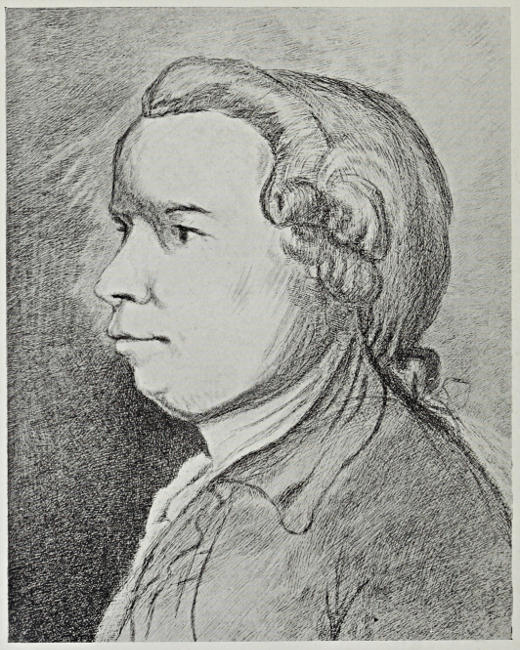
DR. OLIVER GOLDSMITH
“The fellow took me for a tailor.”
The earliest engraved portraits of Dr. Johnson exhibit a wig with five rows of curls, commonly called “a story wig.”[402] Among the old dandies of this description of wig we may class Mr. Saunders Welch, Mr. Nollekens’ father-in-law—he had nine storeys. So was that worn by Mr. Nathaniel Hillier,[403] an extensive print-collector, as is represented in an engraved portrait of that gentleman. Dr. Goldsmith’s wig was small and remarkably slovenly, as may be seen by Bretherton’s etching. Sir Joshua’s portrait of him is without a wig. Mr. Garrick’s wigs (I mean his private ones) were three in number,—the first is engraved by Wood, published in the year 1745; the second is by Sherwin, engraved for Tom Davies; the last is from a private plate by Mrs. Solly, after a drawing by Dance. I will leave off here with the wig, and give a few instances of the tails. These perhaps originated with the Chinese, but the first specimen of a tail, which I have hitherto been able to procure, to which a date can be given, is in Sherwin’s print of Frederick, King of Prussia.[404]
1827.
The Londoners, but more particularly the inhabitants of Westminster, who had been for years accustomed to recreate within the chequered shade of Millbank’s willows, have been by degrees deprived of that pleasure, as there are now very few trees remaining, and those so scanty of foliage, by being nearly stript of their bark, that the public are no longer induced to tread their once sweetly variegated banks.[405]
Here, on many a summer’s evening, Gainsborough, accompanied by his friend Collins, amused himself by sketching docks and nettles, which afforded the Wynants and Cuyp-like effects to the foregrounds of his rich and glowing landscapes. Collins resided in Tothill Fields, and was the modeller of rustic subjects for tablets of chimneypieces in vogue about seventy years back. Most of them were taken from Æsop’s Fables, and are here and there to be met with in houses that have been suffered to remain in their original state. I recollect one, that of the “Bear and Bee-hives,” in the back drawing-room of the house formerly the mansion of the Duke of Ancaster on the western side of Lincoln’s Inn Fields.[406]
Millbank, which originally extended with its pollarded willows from Belgrave House[407] to the White Lead Mills at the corner of the lane leading to “Jenny’s Whim,” afforded similar subjects to those selected by four of the old rural painters; for instance, the boat-builders’ sheds on the bank, with their men at work on the shore, might have been chosen by Everdingen;[408] the wooden steps from the bank, the floating timber, and old men in their boats, with the Vauxhall and Battersea windmills, by Van Goyen;[409] the various colours of the tiles of the cart-sheds, entwined by the autumnal tinged vines, backed with the most prolific orchards, with the women gathering the garden produce for the ensuing day’s market, would have pleased Ruysdael;[410] and the basket-maker’s overhanging smoking hut, with a woman in her white cap and sunburnt petticoat, dipping her pail for water, might have been represented by the pencil of Dekker.[411] It was within one of the Neat House Gardens[412] near this bank that Garnerin’s kitten descended from the balloon which ascended from Vauxhall Gardens in the year 1802.[413] This descent is thus handed down in a song attributed to George Colman the younger, entitled
Puss in a Parachute. Poor puss in a grand parachute Was sent to sail down through the air, Plump’d into a garden of fruit, And played up old gooseberry there. The gardener, transpiring with fear, Stared just like a hundred stuck hogs; And swore, though the sky was quite clear, ’Twas beginning to rain cats and dogs. Mounseer, who don’t value his life, In the Thames would have just dipped his vings, If it vasn’t for vetting his vife, For vimen are timbersome things: So at Hampstead he landed her dry; And after this dangerous sarvice, He took a French leave of the sky, And vent back to Vauxhall in a Jarvis.
1828.
Most willingly would I have resigned all the pleasures I ever enjoyed, save that of my wedding-day, to have joined the throng of enthusiastics in art, who assembled at Nuremberg this year, to do homage to the memory of that morning star in art, Albert Dürer. Of the many descriptions of the proceedings upon that glorious occasion, none gave me higher delight than that of Mr. L. Schutze,[414] of Carlsruhe, an artist of very considerable abilities, who, upon my requesting him to favour me with an account, goodnaturedly complied with my wishes, but with all the diffidence of one who had not long written in the English language.
“At the festival which took place in Nuremberg, 1828, on the 6th and 7th of April, the month on which Albert Dürer died three hundred years before, some pupils of Cornelius in Munich, intended to paint some transparent sceneries, the most interesting ones, taken from his life, and to exhibit them at the Festival. For this purpose they gave notice to the magistrates and to the artists that they would arrive on the 28th of March. The magistrates and artists were quite satisfied with this offer, and resolved to welcome them some miles from Nuremberg. Two gentlemen of consideration offered their coaches, with four horses, and the most part of the artists took post-coaches, all with four horses. One gentleman, Mr. Campe,[415] a very clever man, and member of the Artists’ Society, who led the procession, which consisted of eight coaches with about thirty artists, took a barrel with wine in his coach, and also a very old and interesting pitcher, which was presented to A. Dürer by one of his particular friends. About eight miles from Nuremberg, in Reichersdorf, we stopped at the inn, intending to wait for the artists from Munich. Mr. Campe ordered a good breakfast, and put up his barrel and golden pitcher. Scarcely was all prepared, and the breakfast ready, when we saw the artists arrive (we called them ‘Cornelians,’ after the name of their master[416]), with a flag and green branches in their caps, and merry singing. A loud vivat was the first expression of welcome; they were quite astonished to find there so great a company. We now invited them to come in, and to take refreshments after their fatigues. The first proceeding was now to fill the pitcher with wine, and to drink their health. There were about thirty-six artists from Munich. After having made some speeches, having taken the breakfast, and emptied the barrel, we, all quite refreshed and pleased, took place in our chair-waggons, into which we invited also the Cornelians, and rode back to Nuremberg.
“At the old castle we all descended from our waggons, and saw the old building, which is so very interesting in the history of Germany. Then we went down to the house of Albert Dürer, where all the strangers who arrived entered their names in a book. Several gentlemen of consideration had offered to give lodging to some of the strange artists, which was accepted with great pleasure by them. Many others of them had free lodging in the inns. The magistrates paid all their necessaries during their stay. Every day artists and strangers arrived, and the house of Albert Dürer was the place of meeting. The Cornelians began to paint their transparencies: they had drawn the sketches for them already in Munich. There were seven pictures; they represented, firstly, Albert Dürer coming in receiving instructions from Wohlgemuth; secondly, his marriage ceremony; thirdly, the Banquet in Utrecht; fourthly, the Goddess of Art crowns Albert Dürer and Raphael; fifthly, Dürer on board ship; sixthly, the death of Dürer’s mother; seventhly, Dürer’s death. We artists in Nuremberg painted Dürer’s figure, and several allegories and writings, about sixty feet high altogether, also transparencies, which we intended to exhibit on the road, opposite his house.
“Cornelius and many of the first artists from Munich, and from other parts of Germany, arrived, and Dürer’s house was always crowded: certainly a very interesting time to make acquaintance with artists from several parts of the continent, and also to see again old friends. The 6th of April, in the morning at six o’clock, we went altogether to the grave of Albert Dürer. It was very bad weather, all the night, much snow was falling, and a very disagreeable wind blew. When we arrived at the grave, and the musicians, who were with us, began to play, and we began to sing, the sun at once appeared and looked friendly down upon us. We sang three songs with accompaniments of instruments; and then a speech was made, after which we went home. Scarcely were we arrived there, when it again began to snow, and it was very disagreeable all the day.
“After noon, at half past six o’clock, an Oratorium composed by Schneider,[417] took place in the Town-house. Mr. Schneider came himself from Dessau, two hundred and fifty miles from Nuremberg, to direct it. In the Town-house may still be seen a triumphal procession, painted on the wall by Albert Dürer. On one side the musicians were placed, and opposite to them the seven transparencies were exhibited; they were beautifully finished and pleased everybody.
“After the oratorium a splendid supper took place, where all the artists took part, and also several gentlemen of consideration. Mr. Campe distributed to those present some printed poems and books, containing interesting tales or descriptions of clever men, contemporaries of Albert Dürer. Then there were music and dancing.
“On the 7th, at nine in the morning, there was a meeting in the Town-house; all the artists were dressed in black, and had flat hats and swords, except the strangers. The magistrates distributed medals with Dürer’s portrait. At half past eleven o’clock the procession began:—the magistrates, the two burgomasters, the clergymen, many officers, and all the artists, about three hundred persons together. The military with music made a line in the streets through which the procession passed. The King was expected, but did not come. In the Milk-market (now called Albert Dürer’s Place) the procession commenced; some speeches were made, then the foundation-stone of a monument to Albert Dürer was laid, and trumpets and cymbals resounded. Then all was finished, and all went home. At two o’clock a brilliant dinner took place in the Court of Bavaria, accompanied by music; and several poems and songs were distributed, and the poor were not forgotten,—a rich collection being made for them. In the theatre, the play called Albert Dürer was performed; and then our great transparency was illuminated, and on the house where Albert Dürer was born, and likewise where he had lived during the latter part of his life, several inscriptions were illuminated. A procession with flambeaux and fireworks ended the festival-day. Some of the richest inhabitants arranged dinners and suppers, and other rejoicings, to honour the artists. The magistrates ordered also a very brilliant supper on the last evening, before the artists parted, and bade them farewell.
“L. Schutze.”
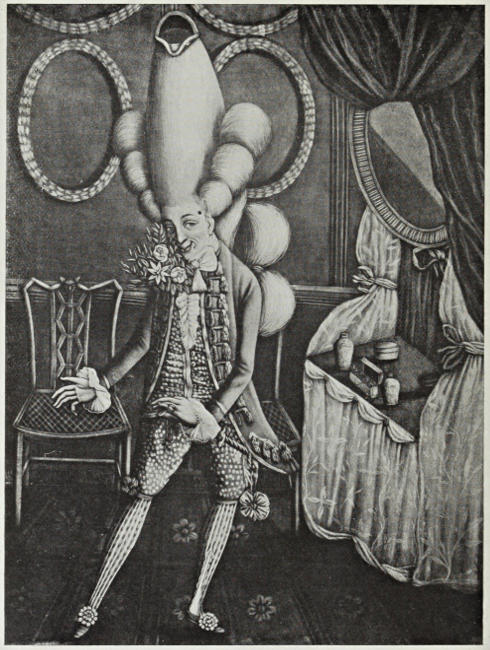
THE WIG IN ENGLAND
A MACARONI READY FOR THE PANTHEON
For the following dates I am indebted to Albert Dürer’s Diary, contained in the Foreign Quarterly Review for January 1833, a work replete with most interesting information. Albert Dürer was born in 1471; his father taught him the goldsmith’s craft. In 1486 he was bound for three years to Michael Wohlgemuth, an engraver on wood. He was married to Agnes, an un-lamb-like daughter of Hans Frey. He died on the 6th of April, 1528, of a decline. His wife, an avaricious shrew, “gnawed him to his very heart,—he was dried up to a faggot.”[418] Little did Albert Dürer think, particularly from the period of his unhappy marriage to the hour of his dissolution, when he was only fifty-seven years of age, that such honours would be paid to his memory.
The following letter is perhaps worth insertion here:—
“Queen Street, Mayfair,
“Dec. 22, 1828.
“My dear Sir,—Shortly after my return from Rome, in 1798, I espied a bust in Rosso Antico, lying under a counter at a broker’s shop, in Great Portland Street. I recognised its antiquity; it was a Faun, large as life, in the best style of art. I bought it for the trifling sum of £1. I had it in my study many months. During this period, I often assisted Nollekens in the architectural department of his monuments, receiving no thanks; but an invitation one day, as we talked Italian together. On accidentally mentioning my antique Faun, he came to see it, and was so struck with its beauty, that he would never rest till he got it out of my hands. He succeeded, by offering me some models of his own, and ten pounds. Wishing to oblige him, I let him have the bust, and he sent me two miserable models not much higher than my thumb, of a Bacchus and Ariadne, since broken to pieces.