A BOOK FOR A RAINY DAY (continued 4)
Reading edition
“This bust was in the collection at his sale, and it was knocked down by Christie to the Duke of Newcastle for a hundred and sixty pounds.
“With great respect, ever yours truly,
“Charles Heathcote Tatham.”[419]
The following letter is curious:—
“In the winter of 1815, making a tour of the Netherlands, I was in Bruges when the well-known statue, or rather group, of the ‘Virgin and Child,’ by Michael Angelo Buonarotti, which had been carried from the church of Notre Dame to Paris, was restored, in a packing-case, to that church. On this occasion a procession of the priests and officers of the church, and of some of the municipal officers, took place; and a Mass was celebrated. About a month afterwards, I was again in Bruges, and saw this fine work of art replaced in its former situation, on the altar of one of the small chapels. It is, indeed, a wonderful work.
“I was about the same period in Antwerp, and was present when the pictures which had been taken to Paris, arrived in carriages, and were escorted into the city by an English regiment, then in garrison there (either the 15th or 25th of infantry), preceded by the band of that regiment playing ‘God save the King,’ and accompanied by the members of the Academy of Antwerp, and the magistracy of the city. I own I felt all the pride of an Englishman at seeing these works of art, which British valour had regained, thus restored to the places from whence they had been pillaged.
“Stephen Porter.[420]
“Temple, Feb. 5, 1828.”
In July, I went to Hungerford Stairs to gain what information I could respecting “Copper Holmes.” A waterman, whose face declared he had seen a few liberal days, accosted me with the usual question, “Oars, sculler?” I shook my head; but, upon a nearer approach, asked him the following question, “How long has Copper been dead?” “There sits his widow at that window mending her stockings,” said he; “we’ll go and put it to her.”
On approaching her the waterman said, “This gentleman wants to know how long Copper has been dead?” “How do you do?” said I, “your husband has often in my early days rowed me to Pepper Alley.” “He died,” said the woman (who retained enough in her care-worn features to induce me to believe she had been pretty), sticking her needle on her cap, “he died, poor fellow, on the 3rd of October, 1821, and a better man never trod shoe-leather. He was downright and honest, and what he said he would do, he did. I had been his wife two-and-twenty years; but he married me after he left the Ark. His first wife lived in the Ark with her children.” “What vessel had the Ark been?” “She had been a Westcountryman, and it cost him altogether (with her fittings-up with sheets of copper) one hundred and fifty pounds, and that gave him the name of ‘Copper Holmes.’ His Christian name was Thomas. Ay, Sir, his lawsuit with the City crippled him:[421] but I will say this for him, his Majesty had not a better subject than poor Copper.” While she uttered this declaration, both her eyes, which were seriously directed to her nose, were moistened with the tears of affectionate memory, which induced me to turn to my new acquaintance the waterman, and ask where he was buried? “In the Waterman’s churchyard, Sir, under the pump-pavement on the south side of St. Martin’s church.[422] Lord bless you! don’t you know the Waterman’s burying-ground? I could take you to the spot where fifty of us have been buried.” “What was his age?” “Sixty-six when he died.”
After parting with the widow, I requested the master of the ceremonies to allow his man to ferry me over to the King’s Head Stairs, Lambeth Marsh. “He shall,” said Charles Price; “and I’ll go with you, too.” The waggish, though youthful countenance of the lad employed to bring in our boat, revived the pleasure Mathews had afforded me in his description of Joe Hatch,[423] and induced me to inquire after the waterman whose look, voice, and manner he had borrowed for that inimitable representation. “George Heath, you mean, Sir,” answered the boy; “Of Strand Lane,” observed Price; “Heath is his real name. Lord bless ye, he’s a good-hearted fellow! Why, I have often known him put his hand in his pocket and relieve a fellow-creature in distress.”
This mention of Hatch induced me to question Price as to the Halfpenny Hatch,[424] where Astley had first rode,[425] before he took the ground at the foot of Westminster Bridge, on which the present Amphitheatre stands. Before Price could answer, as we had made the shore, “You will find the Halfpenny Hatch (for it still remains, though in a very ramshackled state) at the back of St. John’s Church, Waterloo Road, at the end of Neptune Place,” I was told upon my landing by a little chubby, shining, red-faced woman, in what was formerly called a mob-cap. Thither I went, and to my great surprise found the Halfpenny Hatch in a dell, by reason of the earth being raised for the pavement of the adjacent streets.[426] Field was the name of the person who occupied the house; and, only a few years ago, money was received for the accommodation of the public who chose to go through the hatch. It was built subsequent to the year 1771, by Curtis, the famous botanist,[427] whose name it still retains; but the original Hatch-house, Mrs. Field informed me, was still standing at the back of the present one.
The ground belonging to the Halfpenny Hatch was freehold, of about seven acres, and sold by the Curtis family to Messrs. Basing, Atkins, and Field, for the sum of £3500. They disposed of it in about six months afterwards to Mr. Roupell, the present owner, for the sum of £8000.[428] Being determined to take a sketch of the remains of this vine-mantled Halfpenny Hatch, I took water at Strand Lane Stairs[429] on the following evening, where I found George Heath busily engaged in his boat. Upon seeing a poor chimney-sweeper who descended the steps with me, he stood up and cried out, “I tell you what, Sir Cloudesley Shovel, although you are a miller, depend upon it, I’ll dust your jacket for the injury you have done my vessel.” A ferryman observed, “His wife was gone to take a walk up Highgate Hill.” “A strainer,” observed George Heath. During the time occupied in sketching, William Field, who lives in the Hatch, pointed out part of the gate which had received a bullet, supposed to have been aimed by some scoundrel at the elder Mr. Curtis, who providentially escaped, though the ball, which came from a considerable distance, passed only a few inches above his head.
1829.
On the 25th of July, 1829, being on my way to the great Sanctuary, my pleasure was inconceivable upon observing that the intended repairs of Whitehall Chapel had commenced. The scaffolding was erected before its street-front, and the masons had begun their restorations at the south corner, strictly according with the fast decaying original.[430] “Well,” said I to my respected friend, Mr. Henry Smedley, whose house I had entered just as the chimes of the venerable Abbey and St. Margaret’s had agreed to complete their quarters for nine, “I am delighted to find that Inigo’s beautiful front of Whitehall is in so fair a way of recovery.”[431]
Bonington’s drawings, held at a respectful distance from the butter-dish, were the next topic of conversation.[432] “I agree with you,” observed my friend, “they are invaluable; even his slightest pencil-touches are treasures. I have shown you the studies from the figures which surround Lord Norris’s monument in the Abbey; have they not all the spirit of Vandyke?[433] Ay, that drawing of the old buildings seems to be your favourite; what a snug effect, and how sweetly it is coloured!—there never was a sale of modern art so well attended.”
After taking boat at the Horse Ferry for Vauxhall,—for the reader must be informed that Mr. Smedley and myself had an engagement to pass the day with Mr. William Esdaile, on Clapham Common,[434]—I asked the waterman some questions as to “Copper Holmes.” He could not speak correctly as to the time of his death, but said that he had been much reduced by the lawsuit he had with the City about his barge. “Yes, that I know,” said I; “and it certainly was a nuisance on the banks of the Thames, and also an encroachment upon the City’s rights and privileges.”
On arriving at Mr. Esdaile’s gate, Mr. Smedley remarked that this was one of the few commons near London which had not been enclosed.[435] The house had one of those plain fronts which indicated little, but upon ascending the steps I was struck with a similar sensation to those of the previous season, when first I entered this hospitable mansion. If I were to suffer myself to utter anything like an ungrateful remark, it would be that the visitor, immediately he enters the hall, is presented with too much at once, for he knows not which to admire first, the choice display of pictures which decorate the hall, or the equally artful and delightful manner in which the park-like grounds so luxuriantly burst upon his sight. Mr. Esdaile entered the library during our admiration of its taste of design and truly pleasing effect.
The walls are painted with a subdued red, a colour considered by most artists best calculated to relieve pictures, particularly those with broad gold frames. The first picture which attracted our notice was the upper one of two upon the easel nearest the window. The subject is a Virgin and Child, attributed to Albert Dürer, though I must own the style is so elegantly sweet, with so little of the German manner, that I should have considered it the work of a high Italian master. The upper one of the two pictures on the correspondent easel near the bookcase, is from the exquisite pencil of Adrian Ostade; it was the property of Monsieur de Calonne,[436] at whose auction Mr. Esdaile purchased it when he became a collector of pictures.
It would be highly presumptuous in me to attempt to describe the pictures from so cursory a view. Suffice it to say, they are chiefly of the first class; and I cannot charge the possessor with an indifferent specimen. Wilson and Gainsborough were honoured with two of the best places in this room, which commands a most beautiful view of the grounds. In passing to the best staircase, our eyes were attracted by the works of Rubens, Ruysdael, Salvator Rosa, etc. I was highly gratified with the standing of the colours of one of the rich landscapes from the easel of my old and worthy friend, George Arnald, A.R.A. This picture was originally purchased by my revered patron, Richard Wyatt, of Milton Place, Egham, at whose sale Mr. Esdaile bought it. Two sumptuously rich and large dishes of Oriental china, with their stands, occupy the corners of the staircase, which leads to several chambers; the walls of the left-hand one of which are adorned with drawings, framed and glazed, by Cipriani and Bartolozzi; but more particularly with several architectural ruins by Clerisseau, in his finest manner. On the north side of this room stands a magnificent japan glazed case, which contains specimens of the Raphael ware and Oriental porcelain, with two richly adorned alcoves, with figures of Gibbon the historian, and his niece, manufactured at Dresden.
In Mr. Esdaile’s bedroom are other specimens of curious porcelain, of egg-shell plates, cups and covers of the dragon with five claws, and two exquisite black and mother-o’-pearl flower-pots, from the collection of the Duchess-Dowager of Portland. On the top of a curiously wrought cabinet, in the drawing-room below stairs, stand three dark rich blue vases of Sèvres, and two vases of deep blue, embossed with gold leaves, from the Chelsea manufactory. These articles, with a curious figure of Harlequin set in precious stones, the body of which is formed of an immense pearl, were purchased by Mr. Esdaile at the sale of her late gracious Majesty Queen Charlotte. The lower parts of the japan case in the upper room are filled with drawings; so are two other cases which stand on the western side of the room, made purposely for their reception.
The first drawings of our repast this day (for it would take twenty to see the whole) were those by the inimitable hand of Rembrandt, many of which were remarkably fine, one particularly so, of a man seated on a stile near some trees, which appear to have been miserably affected by a recent storm. This drawing is slight, and similar in manner to the artist’s etching, called by some collectors the “Mustard Print.” One of the drawings with landscapes on both sides is remarkably curious, as they are drawn with what is called “the Metallic Pen”; it is certainly the first specimen of the kind I have seen. The Ostade drawings were our next treat, two of which the artist etched; one is the long print of a merry-making on the outside of an alehouse, penned and washed; the other is of the backgammon-players, completely finished in water-colours. At this time the servant announced nooning; after which Mr. Smedley requested to see Hogarth’s prints, in order to report to Mr. Standly[437] the rarities in Mr. Esdaile’s collection. In this, however, we were disappointed, as it did not contain any which that gentleman did not possess.
On our return to Mr. Esdaile’s room, we were indulged with several of Hogarth’s drawings. A volume containing numerous drawings by Wilson was then placed on the table. “Bless me,” said I, “here is the portrait of my great-uncle, Tom of Ten Thousand.”[438] This is the identical drawing thus described by Edwards:—“It may, however, be asserted, that he drew a head equal to any of the portrait-painters of his time. A specimen of which may be seen by a drawing, now in the possession of J. Richards, Esq., R.A.,[439] which is the portrait of Admiral Smith, and which was drawn before Wilson went abroad. It is executed in black and white chalk, as large as life, upon brown French paper, and is treated in a bold, masterly manner; but this is not a work which can authorise the critic to consider him as superior to the other portrait-painters of his day.”[440]
This drawing was made by Wilson, before he commenced the picture which I am now in possession of, so well engraved in mezzotinto by Faber. Of these inestimable drawings, which are mostly in black chalk, stumped, perhaps the most interesting are those for Celadon and Amelia, and the Niobe. Valuable and truly epic as these specimens certainly are, I must say, for my own part, I should give the preference to the book containing those by Gainsborough, of rustic scenery. I had seen many of them before, in the possession of the artist, Colonel Hamilton, Mr. Nassau, and Mr. Lambert. Two that were possessed by the latter, are stamped with Gainsborough’s initials in gold.
Dr. Richardson,[441] Mr. Esdaile’s son-in-law, having arrived, and dinner being announced, we gave up these fascinating sources of pleasure, for that which would enable us to enjoy them another day.
The Doctor, with his accustomed elegance of manners, delighted us during our repast with some most interesting observations made during his travels; after which, Flora invited us to the garden, where Mr. Esdaile had, with his usual liberality, allowed her to display some of her most rare as well as picturesque sweets. On our return from the enchanting circuit of the grounds, our general conversation was on the pleasures we had received; and, indeed, so delighted were we with the entertainment of the day, that we talked of little else till our arrival at Westminster Bridge.
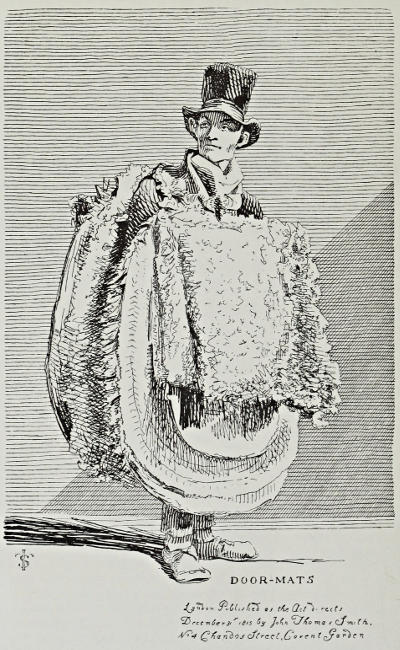
LONDON STREET MERCHANTS: DOOR-MATS
ETCHED BY J. T. SMITH
Beautiful and truly valuable as Mr. Esdaile’s drawings unquestionably are, it would not only be considered an impeachment upon my judgment, but a conviction of the deepest injustice towards that wonderful collection so classically formed by Sir Thomas Lawrence, were I not unequivocally to state, that this latter is by far the most choice, as well as extensive, of any I have yet seen or heard of, and perhaps it may be stated with equal truth, ever formed. What catalogue can boast so formidably of Michael Angelo, Raphael, Claude, Rubens, and Rembrandt?[442] Surely none; for I have seen those of Sir Peter Lely, the Duke of Argyle, and Hudson,[443] at the last of whose sales the immortal Sir Joshua employed me as one of his bidders, his pupil Mr. Score[444] was another. It would be assuming too much, to attempt a description of the individual and high importance of the productions of all the four above-mentioned masters, possessed by the liberal President.
As prospective pleasures are seldom realised, a truth many of my readers must acknowledge, and being determined never to colour a picture at once, but to await the natural course of events,[445] I on the 3rd of August started with my wife for Hampton Court, not only to see the present state of that palace, but to notice the sort of porcelain remaining there, without fixing upon any further plan for the completion of the day’s amusement.
King William III., who took every opportunity of rendering these apartments as pleasing to him as those he had left in the house in the Wood, introduced nothing by way of porcelain, beyond that of delf, and on that ware, in many instances, his Majesty had W. R., surmounted by the crown of England, painted on the fronts. Of the various specimens of this clumsy blue and white delf, displayed in the numerous rooms of this once magnificent palace, the pride of Wolsey and splendour of Henry VIII., the eight large pots for the reception of King William III.’s orange-trees, now standing in her Majesty’s gallery, certainly have claims to future protection. As for the old and ragged bed-furniture, it is so disgraceful to a palace, that, antiquary as I in some degree consider myself, I most heartily wish it in Petticoat Lane. In passing through the rooms, I missed the fine whole-length picture of Admiral Nottingham,[446] and also the thirty-four portraits of the Admirals. The guide informed me that they were presented by our present King, William IV., to the Painted Hall at Greenwich. “A noble gift,” said I, “but where can they put them up?” In order to take some refreshment, we entered the parlour of the “Canteen,” that being the sign of the suttling-house of the Palace. During our stay, Legat’s[447] fine engraving from Northcote’s forcibly effective picture of the “Death of the Princes in the Tower,” which honoured the room, caught the attention of one of two other visitors to the Palace. “Bless me,” said he, “are those brutes going to smother those sweet babes? Why, they are as beautiful as the Lichfield children.”[448] The observation was not made to me, and as the subject has been too often mentioned, I shall forbear saying more about it.
As my wife and I were strolling on, in order to secure places for our return to London in the evening, I ventured to pull the bell at Garrick’s Villa, and asked for permission to see the temple in which Roubiliac’s figure of Shakspeare had originally been placed.[449] Mr. Carr, the present proprietor of the estate, received us with the greatest politeness. Upon expressing a hope that my love for the fine arts would plead my apology for the intrusion, he assured me it would afford him no small pleasure to walk with us to the lawn. “Do sit down, for a tremendous storm appears to be coming on; we must wait a little.” His lady, of most elegant manners, at this moment entered the room and cordially joined in her husband’s wishes to gratify our curiosity, observing that, if we pleased, she would show us the house. This offer was made in so delightful a manner, that we were truly sensible of the indulgence.
Upon returning to a small room which we had passed through from the hall, “Ah! ah!” said I, “you are curious in porcelain, I see,—the crackle. What fine Dresden! I declare here is a figure of Kitty Clive, as the Fine Lady in Lethe, from the Chelsea manufactory.”[450] There is an engraving of this by Moseley, with the landscape background etched by Gainsborough. This figure of Mrs. Clive, which was something less than a foot in height, was perfectly white, and one of a set of celebrated characters, viz., John Wilkes; David Garrick, in Richard the Third; Quin, in Falstaff; Woodward, in the Fine Gentleman; the Duke of Cumberland, etc. Most of these were characteristically coloured, and are now and then to be met with.[451]
“How you enjoy these things!” observed Mrs. Carr. “This is the drawing-room; the decorated paper is just as it was in Mr. Garrick’s time; indeed, we have had nothing altered in the house. I never enter this room without regretting the enormous expense we were obliged to incur, in taking down a great portion of the roof, owing to a very great neglect in the repairs of the house during Mrs. Garrick’s time. Fortunately it was discovered just as we took possession of the premises, or the consequences might have been fatal.” “Your grounds are beautiful,” observed my wife. “Yes,” said Mrs. Carr, “and several of the trees were planted by Mrs. Garrick; that mulberry-tree was a sucker from Shakspeare’s tree at Stratford; that tulip-tree was one of her planting, and so was the cedar. Now you shall see our best bed-room.” The end of this room which contains the bed is divided from the larger portion by a curtain suspended across the ceiling, which gives it the appearance of a distinct drawing-room, for the comfort of a visitor, if indisposed. “We will now go to Mr. and Mrs. Garrick’s bed-room.” Notwithstanding the lowness of the ceiling, the room still carries an air of great comfort. Here we were again gratified with a display of some choice specimens of Oriental porcelain.
We then descended to the dining-room, in which were portraits of the Tracy family. On one side of the chimneypiece hangs a half-length picture of Mrs. Garrick, holding a mask in her right hand. This was painted by Zoffany,[452] before her marriage, who was one of her admirers; over the sideboard hangs a portrait of Tom Davies, the author of the Life of Garrick, who had been his steadfast friend.[453] We then returned to the bow-room, in which we were first received; from thence we entered the library, and were then shown Mr. Garrick’s dressing-table. On our return to the bow-room, I asked Mr. Carr in what part of the house Hogarth’s Election pictures had hung. “In this,” said he; “one on either side of the fireplace.”[454]
The rain still continuing, our amiable shelterers insisted on our staying dinner, as it was impossible to see the Temple in such a storm. We accepted this hospitable invitation; and in the course of conversation Mrs. Carr assured us that we were not only seated upon the sofa frequently occupied by Dr. Johnson, but also the identical cover. “Now, Mrs. Smith, I will show you my Garrick jewels, which Mr. Carr, in consequence of a disappointment I received, by their not being left to me by will, according to Mrs. Garrick’s repeated promises, most liberally purchased for me at the price fixed upon them by Messrs. Rundell and Bridge; for I must inform you that the intimacy of my family with Mrs. Garrick was of thirty years’ standing, and that lady and I were inseparable.” The first treasure produced was a miniature of Mr. Garrick, set in brilliants; the second, a rich bracelet of pearls, containing the hair of Mr. and Mrs. Garrick. Mrs. Carr politely presented my wife and myself with impressions of a profile of Mr. Garrick, contemplating the features of Shakspeare.
After dinner was announced, and in the course of taking our wine, I thanked our worthy hosts for their hospitality. “This house,” said Mr. Carr, “was ever famous for it. Dr. Johnson has frequently knocked up Mr. and Mrs. Garrick at a very late hour, and would never go to bed without a supper.”[455] I asked his opinion as to the truth of the anecdote related by Lee Lewis concerning Mrs. Garrick’s marriage. “There certainly is,” he replied, “a mystery as to who her father was.” Mrs. Carr observed that, after Mrs. Garrick had read Lewis’s assertions, she, with her usual vivacity, exclaimed, “He is a great liar; Lord Burlington was not my father, but I am of noble birth.”
“Is it true,” I asked, “that Lord Burlington gave Mr. Garrick £10,000 to marry her?”
“No, nor did Mrs. Garrick ever receive a sum of money from Lord Burlington: she had only the interest of £6000, and that she was paid by the late Duke of Devonshire.”[456]
The rain now subsided; and as we passed through the passage cut under the road, Mrs. Carr stopped where Mrs. Garrick had frequently stood, while she related the following anecdote. ‘Capability Brown,’[457] was consulted as to the communication of these grounds with those by the water. Mr. Garrick had an idea of having a bridge to pass over the road, similar to the one at Pain’s Hill;[458] but this was objected to by Capability Brown, who proposed to have a tunnel cut. Mr. Garrick at first did not like that idea; but Dr. Johnson observed, “David! David! what can’t be over-done may be under-done.”[459]
As we entered the Temple, instead of seeing a vacant recess, we were agreeably surprised to find that the present owner had occupied it by a cast of Roubiliac’s statue of Shakspeare, most carefully taken by Mr. Garrard,[460] similar to the one with which he furnished the late Mr. Whitbread for the hall of Drury Lane Theatre. On our return to the villa, we were shown a small statue of Mr. Garrick, in the character of Roscius; but by whom it was modelled I was not able to learn. The following inscription was placed under the plinth:—“This figure of Garrick was given to Mr. Garrard, A.R.A., by his widow, and is now respectfully presented to Mrs. Carr, to be placed in Garrick’s Villa, July 14, 1825.”
In the bow-room, in which we again were seated, is a portrait of Mr. Hanbury Williams, and also two drawings of Mr. and Mrs. Garrick, by Dance, of which there are lithographic engravings by Mrs. Solly, the daughter of the Rev. Mr. Racket, with impressions of which that lady honoured me for my wife’s illustrated copy of the Life of Dr. Johnson. Mrs. Solly also favoured me with a sight of a pair of elegant garnet bracelets, which had been left to her by Mrs. Garrick. The bell, Nollekens’s old friend, announced the arrival of the stage, and we took our departure.
On the following morning, taking advantage of the Museum vacation allowed to officers of that establishment, and feeling an inquisitive inclination to know in what way the portraits of the admirals had been disposed of in Greenwich Hospital, I went thither, where I found a display of great taste in the distribution of the pictures which adorn the Painted Hall of that national and glorious institution. Many of my readers will recollect that in second editions of works errors are usually corrected. Such, I understand, has been the case in the hanging of the pictures in this splendid gallery; for, in the first instance, numerous small and also indifferent subjects were hung at the top of the room, and the spectator was told that this arrangement was merely to produce uniformity, until a period arrived when larger and better productions could occupy their places. The liberality of King William IV., who gave no fewer than fifty-five pictures, in addition to the very valuable presents made by the Governors of the British Institution, enabled Mr. Seguier, keeper of the royal collection, to display his best taste in the re-arrangement.
All the small pictures have been taken away, and a most judicious display of whole-length portraits, the size of life, occupy their spaces. Modern artists must not only be pleased with the truly liberal manner in which their works are here exhibited, but will rejoice in having an opportunity of retouching and improving their pictures, from the manner in which the light falls upon them—an advantage always embraced in large edifices by the old masters, but perhaps more particularly by Rubens, who, it is well known, worked upon his performances after they had been elevated to their respective destinations. I must own, without a wish to cast the least reflection upon the works of other modern artists displayed in this gallery, that the noble picture of the Battle of Trafalgar, painted by Arnald, the Associate of the Royal Academy, at the expense of the Governors of the British Institution, at present arrests most powerfully the attention.
As I was admiring the dignity of the Hampton Court admirals, who never appeared to such advantage, a well-known voice whispered over my shoulder, “You are not aware, perhaps, that Vandevelde painted the sea-distances in those pictures?” “No,” answered I; “that is a very interesting fact;” adding that “I could not believe Kneller to have been the painter of all the heads.” Mr. Seguier rejoined, “Dahl, in my opinion, painted some of them.”[461] In the course of conversation he gave me no small pleasure by observing that he had read my work of Nollekens and his Times.—“I can answer as to the truth of nine-tenths of what you have asserted,” said he, “having known the parties well.”
Upon leaving this interesting gallery, a pleasing thought struck me, that if a volume of naval history, commencing with the early ballads in the Pepysian Library, and ending with the delightful compositions of Dibdin, were printed, and given to every collier’s apprentice as a reward for his good behaviour, it might create in him that spirit of emulation which, when drafted from his vessel, would induce him to defend the long-famed wooden walls of Old England most undauntedly. Humble as the versification of these our old ballads may justly be considered, yet I have frequently seen the tear of gratitude follow the melody of Incledon while singing the song of “Admiral Benbow.”[462]
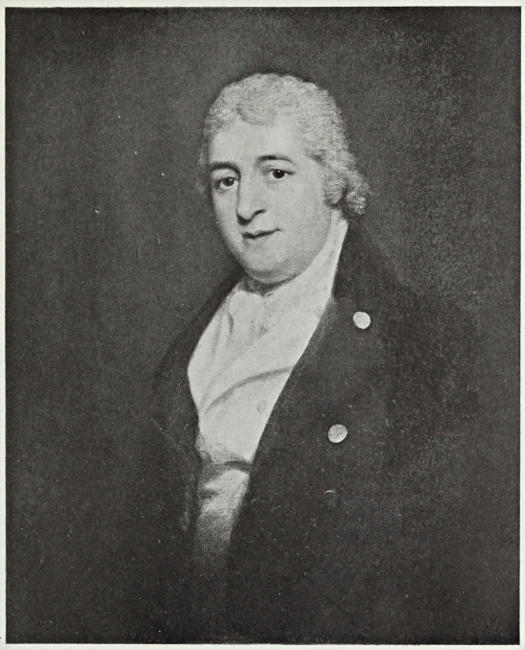
CHARLES DIBDIN
“He found a voice for the British sailor.”
Tom Taylor
“What, upon the old trot, Master?” observed a funny-mover,[463] as I descended the rotten old stairs of Hungerford Market. “Will you make one with us? I know you don’t mind where you steer.” We had hardly made Chelsea Reach, when one of our crew noticed a foundered freshman, who had most ingeniously piloted himself into a cluster of osiers, in order to adjust his cravat, as a lady in our boat was to meet him that evening in Vauxhall Gardens. Our steersman, who was fond of a bit of fun, thus assailed him, “I say, Maty, why you’re water-logged there; you put me in mind of the Methodist parson who ran adrift last Saturday nearly in the same place: he made a pretty good thing of it.” “Ay,” observed a dry old fresh-water passenger in our boat, “I saw the fellow; and when the Battersea gardeners[464] quizzed him, he attempted to stand up like a poplar; but the wind operating upon his head, it hung like a bulrush. However, when he was seated, instead of advising them to make ready for simpling-time, or bespattering them with low language, he exercised his pulpit volubility in favour of vegetables, declaring that for years he had lived upon them, and insisted that every young person of every climate should eat nothing else, strengthening this opinion with the following quotation from Jeremy Taylor, who declared that ‘a dish of lettuce and a clear fountain would cool all his heats.’ After this he most strenuously advised them to ask more money for their pecked fruit than they had been accustomed to receive, observing, that they should keep Shakspeare’s caution in mind, ‘Beware all fruit but what the birds have pecked.’[465] At the close of his address, a descendant of old Mother Bagley, called ‘The King of Spades,’ proposed to his men not only to join him in all their coppers, but to fresh-water the poor fellow’s boat, for which he thanked them, and declared that he was almost ready to float in his own perspiration; but that he, like Sterne’s[466] ‘Starling,’ could not get out. The Mortlake boys soon gave him three cheers, and away he scuttled like an eel towards Limehouse Hole, sticking as close to his boat as a toad to the head of a carp.”
At this the lady simpered. “Bless your heart, fair one,” observed the narrator, addressing the lady who was destined for Vauxhall Gardens, “you never saw such a skeleton as this vegetable-eater. As for his complexion, it was for all the world like—what shall I say?”
“Perhaps a Queen Anne’s guinea,” observed our waterman, “that they used to let into the bottom of punch-ladles”—many of which were frequently to be seen in the pawnbrokers’ windows in Wapping.
“As for his voice during his preaching,” rejoined our entertaining companion, “no lamb’s could be more innocent.”
As we were tacking about, the wind standing fair to drop the lady at Vauxhall-stairs, our old weathergage, the waterman, who reminded me of Copper Holmes, thus addressed a lopped Chelsea Pensioner:—“I say, old Granby,[467] people say that he who loves fighting is much more the sexton’s friend than his own.” “Ay, Master Smelter,” answered the corporal, “we are all alive here, and, like the Greenwich boys, willing to fight again; Old England for ever!”
I then requested the waterman to put me on shore, in order to visit Chelsea College, purposely to see what had been done with my friend Ward’s allegorical picture of the Triumph of the Duke of Wellington. The Right Hon. Noblemen and Gentlemen, Governors of the British Institution, wishing to perpetuate the memory of the noble victory on the plains of Waterloo, they, with their accustomed liberality to the fine arts, commissioned James Ward, Esq., R.A., to paint an allegorical picture worthy a place in the Hall of that glorious establishment, Chelsea Hospital. Having heard that Mr. Ward’s picture had been hung up, I went thither, but, to my utter astonishment, found it not only suspended without a frame (just as a showman in a fair would put out his large canvas to display “the true and lively portraiture” of a giant, the Pig-faced Lady, or the Fire-eater), but with its lower part projecting over a gallery, just like the lid of a kitchen salt-box; so that the upper and greater half, being on an inclined plane, had copiously received the dust, and doubtless, if it be allowed to accumulate, the Duke’s scarlet coat will undergo a brick-dust change, and his cream-coloured horses become the dirtiest of all the drabs.
If this picture be considered worth preserving, why expose it so shamefully to injury by suffering it to hang as it does? If, on the contrary, why not at once consign it to the waters of oblivion, by casting it into Chelsea Reach? Mr. Ward’s superior talents have been in numerous instances acknowledged by some of the best judges.
Descending Villiers Street on one of my peregrination mornings, a tremendous storm obliged me to request shelter of Mrs. Scott, the wife of the present keeper of York Terrace, and successor of Hugh Hewson, a man who declared himself to be the genuine character famed by Dr. Smollett in The Adventures of Roderick Random, under the appellation of Hugh Strap.[468] Here I met with a young man whose father had attended Hewson’s funeral, who informed me that Hugh had been frequently known to amuse the ambulators of that walk by recapitulating the enterprising events which had taken place during his travels with the Doctor. Hugh, who had for years followed the trade of a hairdresser, was buried in St. Martin’s-in-the-Fields, and his funeral was attended by three generations.
On my way towards Hungerford Stairs, my organ of inquisitiveness was arrested by two carvings in stone, of a wheatsheaf and sickles, let into either side of the north-end houses in the alley leading to the “The Swan.” A waterman informed me that the south portion of Hungerford Market was originally allotted for the sale of corn, but I have since learned that that device is the crest of the Hungerford family. “Pray now,” said I to my oracle, “do enumerate the signs of Swans remaining on the banks of the Thames, between London and Battersea Bridges.” “Why, let me see, Master, there’s the Old Swan at London Bridge, that’s one;—there’s the Swan in Arundel Street, two;—then ours here, three;—the Swan at Lambeth, that’s down, though;—well then, the Old Swan at Chelsea, but that has long been turned into a brewhouse, though that was where our people rowed to formerly, as mentioned in Doggett’s Will; now they row to the sign of the New Swan beyond the Physic Garden; we’ll say that’s four;—then there’s the two Swan signs at Battersea, six.”[469]
Next evening, away I trudged to take water with George Heath (Mathews’s Joe Hatch) at Strand Lane. “I find the Swan to be your usual sign up the river,” said I.
“Why, yes,” replied George; “I don’t know what a coach, or a waggon and horses, or the high-mettled racer have to do with our river. Bells now, bells, we might have bells, because the Thames is so famous for bells.” Bless me, thought I, how delighted would my old friend Nollekens have been, had he heard this remark!
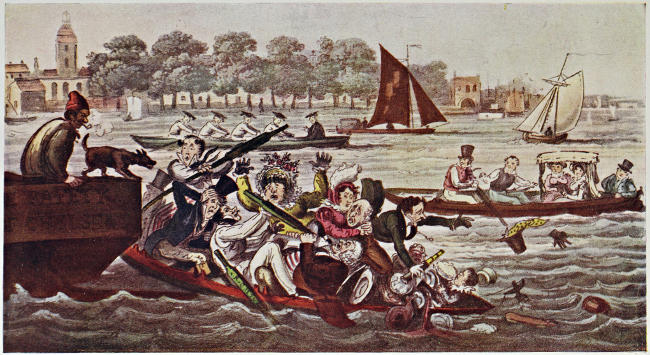
A PLEASURE PARTY ON THE THAMES
“You like bells, then, Master Heath?”
“Oh yes! I was a famous ringer in my youth, at St. Mary Overies. They are beautiful bells; but of all the bells give me Fulham; oh, they are so soft, so sweet![470] St. Margaret’s are fine bells; so are St. Martin’s; but after all, Fulham for my money, I say. I forget where you said I was to take you to, Master?”
“Row me to Hungerford,” said I.
Here I alighted, and then went round to Wood’s coal-wharf, at the foot of Northumberland Street,[471] where the said Mr. Wood dwells in the very house in which Sir Edmund Berry Godfrey resided, who was strangled in Somerset House.[472] Sir Edmund Berry was a woodmonger, and became the court justice. In this appointment he was so active, that during the time of the Great Plague, 1665, which continued to rage in 1666, upon the refusal of his men to enter a pest-house, to bring out a culprit who had furnished a thousand shops with at least a thousand winding-sheets stolen from the dead, he ventured in alone, and brought the wretch to justice. In Evelyn’s interesting work on medals, the reader will find that four were struck, commemorative of Sir Edmund Berry Godfrey’s death; and in addition to the elaborately engraved portraits noticed by Granger, he will also find an original picture of him in the waiting-room adjoining the vestry of St. Martin’s-in-the-Fields, where he was interred, and his funeral sermon preached by Dr. Lloyd.[473]
In a little work published in 1658, entitled The Two Grand Ingrossers of Coals, viz. the Woodmonger and the Chandler,[474] the reader will find the subtle practices of the coal-vendors shortly after that article was in pretty general use.
It is curious to observe how fond Horace Walpole, and indeed all his followers, have been of attributing the earliest encouragement of the fine arts in England to King Charles I. That is not the fact; nor is that Monarch entitled, munificent as he was, to that degree of praise which biographers have thought proper to attribute to him as a liberal patron; and this I shall immediately prove. King Henry VIII. was the first English Sovereign who encouraged painting, in consequence of Erasmus introducing Hans Holbein to Sir Thomas More, who showed his Majesty specimens of that artist’s rare productions. Upon this the king most liberally invited him to Whitehall, where he gave him extensive employment, not only in decorating the panels and walls of that palace with portraits of the Tudors, as large as life, but with easel pictures of the various branches of his family and courtiers, to be placed over doors and other spaces of the state chambers.
Holbein may be recorded as the earliest painter of portraits in miniature, which were mostly circular, and all those which I have seen were relieved by blue backgrounds. He was also the designer and draughtsman of numerous subjects for the use of the court jewellers, as may be seen in a most curious volume preserved in the print-room of the British Museum, many of which are beautifully coloured. Holbein must have been a most indefatigable artist, for he was not only employed to paint that fine picture of King Henry granting the charter to the Barber-Surgeons,[475] now to be seen in Barbers’ Hall, Monkwell Street,[476] that in Bridewell of King Edward VI. granting the charter to the citizens of London,[477] but numerous portraits for the Howards, and other noble families; indeed, the quantity of engravings from the burin of Hollar and other artists, from Holbein’s works, prove that painter to have been just as extensively employed as Vandyke.
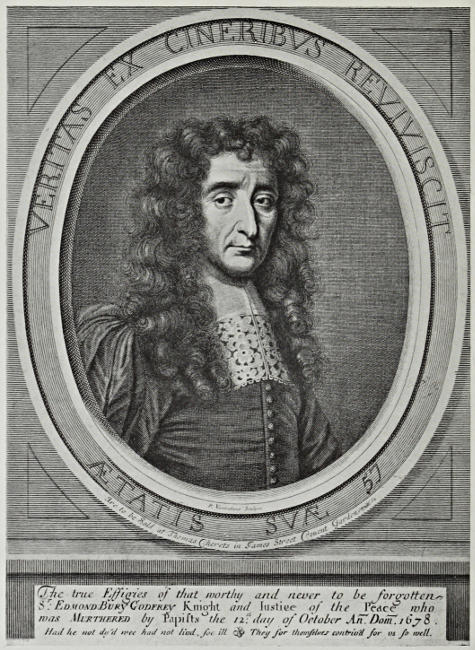
SIR EDMUND BERRY GODFREY
“He was esteemed the best Justice of Peace in England.”
Burnet
King Charles I., it is stated, became possessed of numerous portraits drawn by Holbein, of several personages of the crown and court of King Henry VIII., from characters high in office, to Mother Jack,[478], considered to have been the nickname of Mrs. Jackson, the nurse of Prince Edward. These interesting drawings, it is said, the King parted with for a picture; but how they again became the property of the Crown, I am uninformed. However, true it is that they were discovered in Kensington Palace, and taken from their frames and bound in two volumes. During Mr. Dalton’s[479] librarianship he etched many of them in his coarse and hurried manner. Since then Mr. Chamberlaine,[480] his successor, employed Mr. Metz[481] to engrave one or two as specimens of an intended work, but Mr. Bartolozzi’s manner being considered more likely to sell, that artist was engaged to produce the present plates, which certainly are far from being facsimiles of Holbein’s drawings, which I have seen. Many of this master’s invaluable pictures are engraved and published in the work entitled Portraits of Illustrious Personages of Great Britain; accompanied by the biographical lucubrations of Edmund Lodge, Esq.[482]
The liberality of the brothers Paul and Thomas Sandby, Royal Academicians, will be remembered by every person who had the pleasure of being acquainted with them; but more particularly by those who benefited by their disinterested communications and cheering encouragement in their art. For my own part, I shall ever consider myself indebted to them for a knowledge of lineal perspective. By their indefatigable industry, the architecture of many of the ancient seats of our nobility and gentry will be perpetuated; and I may say, but for the very accurate and elaborate drawings taken by Paul from Old Somerset House gardens, exhibiting views up and down the river, much of the Thames scenery must have been lost.[483] The view up the river exhibits the landing-stairs of Cuper’s Gardens, and that part of the old palace of Whitehall then inhabited by the Duchess of Portland, upon the site of which the houses of that patron of the arts, Lord Farnborough,[484] and other noblemen and gentlemen, have recently been erected. The one down the river displays an uninterrupted view of the buildings on either side to London Bridge, upon which the houses are seen, by reason of Blackfriars Bridge not then being erected. These drawings are in water-colours, and are preserved in the thirteenth volume of Pennant’s interesting account of London, magnificently illustrated, and bequeathed to the print-room of the British Museum by the late John Charles Crowle, Esq.[485]
Should my reader’s boat ever stop at York Watergate,[486] let me request him to look up at the three upper balconied windows of that mass of building on the south-west corner of Buckingham Street. Those, and the two adjoining Westminster, give light to chambers occupied by that truly epic historical painter, and most excellent man, Etty, the Royal Academician, who has fitted up the balconied room with engravings after pictures of the three great masters, Raphael, Nicholas Poussin, and Rubens.
The other two windows illumine his painting-room, in which his mind and colours resplendently shine, even in the face of one of the grandest scenes in Nature, our river Thames and city edifices, with a most luxuriant and extensive face of a distant country, the beauties of which he most liberally delights in showing to his friends from the leads of his apartments, which, in my opinion, exhibit the finest point of view of all others for a panorama. The rooms immediately below Mr. Etty’s[487] are occupied by Mr. Lloyd, a gentleman whose general knowledge in the graphic art, I and many more look up to with the profoundest respect. The chambers beneath Mr. Lloyd’s are inhabited by Mr. Stanfield,[488] the landscape-painter, whose clear representations of Nature’s tones have raised the scenic decorations of Drury Lane Theatre to that pinnacle of excellence never until his time attained, notwithstanding the productions of Lambert, Richards, nay, even Loutherbourg. Mr. Stanfield’s easel pictures adorn the cabinets of some of our first collectors, and are, like those of Callcott, Constable, Turner, Collins, and Arnald, much admired by the now numerous publishers of little works, who unquestionably produce specimens of the powers of England’s engravers, which immeasurably out-distance the efforts of all other countries.
However, although I am willing to pass the highest encomiums on the landscape-engraver for his Liliputian labours, I am much afraid, in the course of time, we shall have productions smaller still; and that the diminutive size of a watch-paper, measuring precisely in diameter one inch, two-eighths, and one-sixteenth, will be the noblest extent of their labours. To men of their talent (and there are several among these pigmy burinists), I will venture, now I am upon the silver streams of noble Father Thames, to lead their attention to Woollett’s Fishery, but more particularly to West’s La Hogue, and then let them ask themselves this question: Would it not redound more to our glory to be master of equal excellence in the grand style in which those works are produced, than to contribute too long to the illustrations of scrapbooks only? Yes, gentlemen, I think you would say so. Let me endeavour, then, to arrest your gravers from this blinding of the public, by reducing your works to so deplorable a nicety, that by-and-by you will find yourselves totally blind. Why not, as talent is not wanting, prove to the collectors that England has more Woolletts than one? It is true there are several at present engaged in engraving plates from the fine old pictures in the National Gallery, who have my cordial good wishes for their success; yet I trust that, after that task is at an end, they will, with a considerable augmentation to their numbers, pay a becoming respect so justly due to modern painters of their own country, whose works in historical subjects, as well as portraits and landscape, extinguish unquestionably those of foreign powers; and I may say, with equal truth, equal most of those of the old schools. Such a publication, however successful their present one may be, I can answer for it would be patronised by the noblemen and gentlemen of England with redoubled liberality, and in such tasks the engravers will have the opportunity of producing finer things by the more powerful, and indeed inestimable advantage of having their progressive proofs touched upon by the painters themselves.
“Pull away, my hearty” (for I was again in a boat).—“To Westminster, Master?”—“Ay, to Westminster.”
Being now in view of the extensive yards which for ages have been occupied by stone and marble merchants, “Ay,” said I, “if these wharfs could speak, they, no doubt, like the Fly, would boast of their noble works. Was it not from our blocks that Roubiliac carved his figures of Newton, the pride of Cambridge, and that of Eloquence, in Westminster Abbey; Bacon’s figure of Mars, now in Lord Yarborough’s possession; Rossi’s Celadon and Amelia, and Flaxman’s mighty figure of Satan, in the Earl of Egremont’s gallery at Petworth; as well as three-fourths of Nollekens’s numerous busts, which, according to whisperings, have only been equalled by Chantrey? And then, has not our Carrara been conveyed to the studios of Westmacott and Baily?[489]”
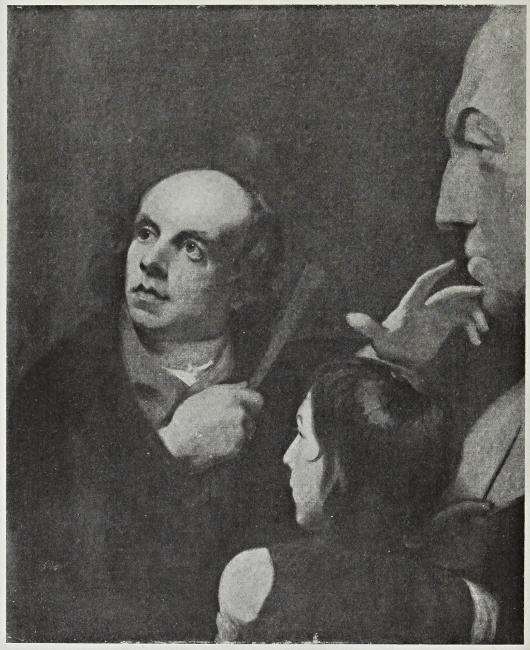
JOHN FLAXMAN R.A.
“This little man cuts us all out in sculpture.”
Bankes
After the truly interesting information the print-collectors have received from the pen of Mr. Ottley,[490] a gentleman better qualified than any I know to speak on works of art, more particularly those of the ancient schools of Italy, it would be the highest audacity in me to offer my own observations, however conversant my friends are pleased to consider me on those subjects. All I shall therefore now add to Mr. Ottley’s valuable stock of knowledge are the following circumstances, which occurred respecting that beautiful impression in sulphur, taken from a pax, engraved by Tomaso Finiguerra, before the said impression was so liberally purchased by the Duke of Buckingham, who has most cheerfully afforded it an asylum at Stowe. It has been for many years in the Print-Room of the British Museum.[491]
Mr. Stewart favoured me, at my earnest request, with the following statement of the fortunate manner in which he secured this unique and inestimable production as a treasure for England.
“The sulphur cast, from the celebrated pax of ’Maso Finiguerra, came into my hands in the following manner:—The Cavalier Seratti, in whose valuable collection it originally existed, was captured in going from Cagliari to Leghorn, and carried to Tunis, where he resided, I believe, for one or two years; but, dying in captivity, the Dey of Tunis took possession of the whole of his property. Such part of it as was not of any intrinsic value was sold to a party of Jews, who brought it over to Malta with a view of sending it to Great Britain for sale. This took place about the commencement of 1804. The property coming from Barbary was of course placed in the lazaretto. While there the plague broke out in the island, and it was a full year before the property was liberated. The Jews by this time had become apprehensive, owing to the numerous obstacles they had encountered in the realisation of their projects; and my friend the Abbate Bellanti, librarian to the Government Library, with a view to retain the collection in his native island, induced a Maltese merchant to make the Jews such an offer for the whole of the Seratti collection as they at last accepted. The merchant, however, retracted; and the abbot, after having made himself responsible for the bargain towards the Jews, found himself in an unpleasant predicament. In this dilemma he applied to me, and I readily engaged to fulfil the agreement which the merchant had forfeited. The sulphur in question formed the object of a separate bargain. I paid the value of £15 for it. I was very unfortunate in the transmission of my collection to England, two ships having been cast away in the Channel in November, 1815, both with a considerable portion of my property on board. I was more successful with the third portion, which arrived in 1816; in this was the sulphur cast. I never would have parted with it but for the above accident, whereby at that time I was much straitened in my circumstances.
“The sulphur I sold to Mr. Colnaghi for £150, which I thought a low price at the time for such an interesting and unique curiosity, indispensable for illustrating and fixing the date of the invention of the art of engraving (as it is now called). This sulphur, with the print preserved at Paris, and the pax of Finiguerra himself, preserved at Florence, together with the entry in the journal of the Goldsmiths’ Company, also preserved at Florence, showing the date of the completion of the pax to be 1452, form altogether an irrefragable chain of proof which must satisfy the most sceptical. By a memorandum in Seratti’s own handwriting, which is amongst my papers (but having been sent from Bombay to Liverpool, I have not yet got), it appears that he purchased the sulphur from a painter, who bought it with a heap of other trinkets at the stall of a petty dealer in Florence: and on acquiring it Seratti compared it with the pax itself, and ascertained it to be the genuine work of Finiguerra.
“I may add a few observations of my own, not altogether irrelevant to the subject.
“The silver vessel, or pax, generally enclosed some relic, and was kissed by the congregation or other individuals in token of devotion; and the Count Seratti mentions that the one of which this sulphur is in part a facsimile, is very much worn by this repeated act of devoutness. The word pax appears to be a corruption of pyxis, a box; and we have in Shakspeare a pyx of little value. The engraving was usually filled up with a metallic mixture of a dark composition, which, being fused by the action of fire, became incorporated with the vessel itself. This process was called Niello, or Anniello, Niellare, or Anniellare; hence our anneal, the term probably derived from nigellum, or perhaps even from Mêl, the Indian term for black, and applied to indigo, by which name that dye was originally known in Europe, and it was probably used in the composition before alluded to. The term anniello, and the purpose to which these pyxes were applied, is further illustrative of a passage in Shakspeare, which I believe has hitherto puzzled commentators. It is this:—Hamlet accuses his uncle of having dispatched his father ‘unhousel’d, unanointed, unanneal’d;’ it alludes to the custom in Catholic countries of offering relics preserved in their pyxes to be kissed after extreme unction.
“I shall be happy to communicate any further particulars respecting this interesting vestige of art which may be required of me, in as far as I am able.
“J. Stewart.
“2nd May, 1829.”
1830.
The glowing evening of the 16th of July added lustre to the enchanting grounds of William Atkinson, Esq. of Grove End, Paddington;[492] and perhaps, if I were to assert that few spots, if any, excel in the variety of its tasteful walks and unexpected recesses, I should not outstep the verge of truth.
The villa was designed by Mr. Atkinson, with his usual attention to domestic comfort; the grounds were peculiarly manured under his direction, and the rarest trees and choicest plants he could procure from all the known parts of the globe were planted by his own hand, and that too in the course of the last twelve years. On the knolls the antiquary will find sculpture from Carthage; and in the silent trickling dells the mineralogist specimens of the varieties of English stone, imbedded in the most picturesque strata. The delightful surprise of the spectator is beyond belief, particularly on turning back to view his trodden path, when that sun which fired the mind of Claude sparkles among the gently waving branches from climes he may never visit. Upon my observing to Mrs. Atkinson that in this meandering retreat my mind would be instantly soothed, that lady then recalled to my recollection Allan Ramsay’s Gentle Shepherd, by repeating the following lines:
“How wholesome is’t to breathe the vernal air, And all the sweets it bears, when void of care.”[493]
Here the Waltonian, too, will find a seat, and view the canal—
“Kissing with eddies soft the bordering grass.”
My thanks are here offered to my friend Mr. West,[494] late of Drury Lane Theatre, now a professor of music, for the kind loan of an imperfect copy (which he met with at a stall) of a work of rarity, of which I have not been able to hear of another copy. It is not mentioned by Watt, and, what is more remarkable, the Rev. Hartwell Horne,[495] of the British Museum, never heard of it. It is a small quarto, bearing the following title:—
“THE POST ANGEL, OR, UNIVERSAL ENTERTAINMENT.
“London: printed, and to be sold by A. Baldwin, near the Oxford Arms, in Warwick Lane, 1702, where is to be had the first and second volume, or any single month, from January, 1701, to this time; price of each, one shilling.”[496]
Page 191 of the third volume affords the admirers of wax effigies the following information:—
“TO THE EDITOR.
“Sir,—You having promised to give an account of the curiosities of art, as well as the wonders of nature, I thought it would oblige the public to acquaint you that the effigies of his late Majesty, King William III., of glorious memory, is curiously done to the life in wax, dressed in coronation robe, with so majestic a mien that nothing seems wanting but life and motion, as persons of great honour upon the strictest view have with surprise declared. Likewise the effigies of several persons of quality, with a fine banquet, and other curiosities in every room, passing to and from the King’s apartment, are all to be seen at Mrs. Goldsmith’s, in Green Court, in the Old Jury, London.”
From the following flummery bespattered on this wax-worker by the editor of the Post Angel, I may, with the greatest probability, conclude that his substance was just as vulnerable as that of many of the hirelings who feed themselves by puffing what they denominate “the fine arts,” and that he had no objection to a dozen of port, had it been ever so crusted.
“The Observator” states that “the ingenuity of man hath found out several ways to imitate Nature, and represent natural bodies to the eye by sculpture, picture, carving, waxwork, etc.; and though some of the ancients were famed for this art, as Zeuxis and Apelles, yet our last ages have outstripped them, and made considerable improvements, as may be easily discernible to those who are skilled in antiquities, and have observed the rude and coarse pieces of the ancients. Those that question the truth of this, need but step to that famous artist, Mrs. Goldsmith, in the Old Jewry, whose workmanship is so absolute (in the effigies which she has made of his late Majesty), as it admits of no correction. She also made the late Queen, the Duke of Gloucester, to the general satisfaction of a great number of the nobility and gentry. I am not for the Hungarian’s wooden coat of mail, the work of fifteen years; nor Myrmeride’s coach with four horses, so little that you might hide them under a fly’s wing: these are but a laborious loss of time, an ingenious profusion of one of the best talents we are entrusted with; but this effigy of his late Majesty has taken up but a small part of Mrs. Goldsmith’s time, and yet it is made with so much art, that nothing seems wanting but life and motion. I own,” continues this time-server, “’tis little wonder to see a picture have motion; but Mrs. Goldsmith is such a person (as all will own that see this effigy which she has made of King William), that she has almost found the secret to make even dead bodies alive.”
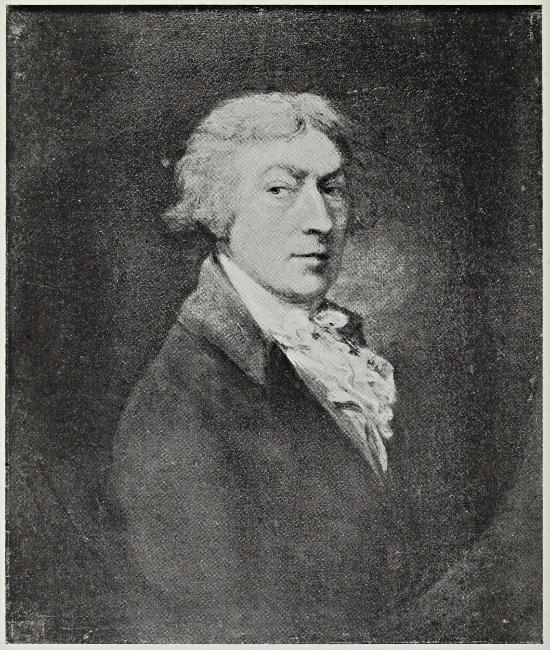
THOMAS GAINSBOROUGH, R.A.
“We are all going to heaven, and Van Dyck is of the company.”
His dying words
1832.
“You are never idle,” observed my old, OLD, very OLD friend John Taylor,[497] as he entered my parlour on the 3rd of November, in his ninety-third year: “bless me, how like that is to your father! Well, Howard is a very clever fellow! Pray now, do tell me, did your father know Churchill? My friend Jonathan Tyers introduced me to him in Vauxhall Gardens much about the time Hogarth represented him as a bear with a pot of porter.[498] I think, to the best of my recollection, the print was brought out in 1763. Mr. Tyers asked Mr. Churchill what he thought of it. ‘Oh!’ said he, ‘it is a silly thing, Sir. I should have thought Hogarth had known better.’” I then requested Mr. Taylor to describe Mr. Churchill’s dress for Vauxhall Gardens. “Oh! not as a clergyman, not in black, as he appeared in the pit of the theatre. Let me see: his coat was blue, edged with a narrow gold lace; a buff waistcoat; but I won’t be certain whether that was laced or not—I rather think it was not. He had black silk small-clothes, white silk stockings, small silver shoe-buckles, and a gold-laced three-cornered hat.”
“Did you know Gainsborough, Sir?” “Oh! I remember him; he was an odd man at times. I recollect my master Hayman coming home after he had been to an exhibition, and saying what an extraordinary picture Gainsborough had painted of the Blue Boy; it is as fine as Vandyke.”[499] “Who was the Blue Boy, Sir?” “Why, he was an ironmonger, but why so called I don’t know. He lived at the corner of Greek and King Streets, Soho; an immensely rich man.” “Did you know Mrs. Abington?” “Oh yes; she was a most delightful actress of women of fashion, though she made herself very ridiculous by attempting the part of Scrub.[500] Mr. Hoole, when he heard she was to play the character that evening, sent for a chair and went to see her; but he said it was so truly ridiculous, that he was quite disgusted. Ay, I see you have got Nollekens’s bust of Dr. Johnson. I made two drawings of him when I was at Oxford: one was for Sir Robert Chambers,[501] who married the pretty Miss Wilton, that went to India; who had the other, I can’t immediately say. I remember the Doctor asked me what countryman I was.—‘A Londoner, Sir, a Londoner.’ ‘And where born?’ ‘In the parish of Ethelburga, in Bishopsgate Within.’ It is a very small church; but my father and mother[502] were buried there, though I suppose, by this time, there’s nothing of them left. My friend Jonathan Tyers took milk and water for upwards of twenty years at his meals, though he very well knew what a good glass of wine was, as well as any man in England. Ay, and a fine haunch of venison, too. Many and many a time I have dined with him in the gardens, when I was making the drawing for Boydell, of Hayman’s picture of the Admirals. Mr. Tyers gave very excellent dinners, I must say.”
The truly skilful manner in which Mr. John Seguier has proceeded with the pictures painted by Rubens, which adorn the ceiling of Whitehall Chapel, will, I hope, prove a lasting record of his success in picture-cleaning. When first I ascended the scaffold, my astonishment was beyond conception at the enormous size of the objects. The children are more than nine feet, and the full-grown figures from twenty to twenty-five in height. The pictures were in a most filthy and husky state. However, it afforded me infinite delight to hear Mr. Seguier declare, that he firmly believed he should be able to remove Cipriani’s washy colouring completely; and that he expected to find that of Rubens in its pristine state. Upon my seeing these pictures on the floor, after they had been cleaned,[503] I found his predictions verified, and can now, by the judicious nourishment afforded to the canvas, announce their effect to be truly glorious. Every precaution has been taken, under the able direction of Sir Benjamin Clarke Stevenson, to render the roof impervious to the most inveterate weather, so that posterity, in all probability, may long enjoy the beauties of these masterpieces of art.
“Upper Gower Street, Bedford Square, 16th November 1832.
“My dear Sir,—As I am desirous to make your valuable collection of letters from bygone professional characters complete, gratify me by accepting the accompanying original communication from Mrs. Abington to Mrs. Jordan.[504] It will call to your remembrance the period when that skilful and excellent man, John Bannister, delighted the town by his performances; whose retirement from public life in June, 1815 (after thirty-seven years of hard and honest service), opened the doors of Old Drury to a young aspirant for histrionic honours in the person of your humble servant.
“I need not here enumerate all the advantages derived from a constant association with such an artist as John Bannister. An uninterrupted friendly intercourse of many years manifested the sincerity in which he penned the following note to me a short time after my appearance at Drury Lane Theatre:—
“‘65 Gower Street, Dec. 30, 1815.
“‘My dear Sir,—I have been confined to my room more than three weeks with the gout; but I am now recovering, though slowly. Early next week, will you favour me with a visit in Gower Street? It will please me to give you all the information and gratification in my power, and to converse with you personally about theatrical matters.
“‘You are my successor, and I beg leave to say that I do not know any person more calculated to tread in my shoes. I sincerely hope you may never have occasion for the gouty ones! I remain, my dear Sir, yours sincerely,
“‘John Bannister.’[505]
“‘To J. P. Harley, Esq., Theatre Royal, Drury Lane.’
“And now, my dear Sir, with every sincere hope for your continued health and happiness, believe that I am very truly yours,
“J. P. Harley.[506]
“To John Thomas Smith, British Museum.”
1833.
Mrs. Piozzi, in her anecdotes of Dr. Johnson, speaking of Porridge Island, says it “is a mean street in London, filled with cook-shops, for the convenience of the poorer inhabitants; the real name of it I know not, but suspect that it is generally known by to have been originally a term of derision.”
Porridge Island consisted of a nest of old rat-deserted houses, lately forming narrow alleys south of Chandos Street, and east of St. Martin’s church, which were originally occupied by numerous cooks for the accommodation of the workmen engaged in erecting the said church.[507]