ADVERTISEMENT TO THE AMERICAN EDITION. (continued 6)
Reading edition
Arabia, it is well known, is divided by geographers into three separate regions, called Arabia Petræa, Arabia Deserta, and Arabia Felix.
The first, or Arabia Petræa, is the north-western division, and is bounded on the north by Palestine and the Dead Sea, on the east by Arabia Deserta, on the south by Arabia Felix, and on the west by the Heroopolitan branch of the Red Sea and the Isthmus of Suez. The greater part of this division was more exclusively the possession of the Midianites, or land of Midian; where Moses, having fled from Egypt, married the daughter of Jethro, and spent forty years keeping the flocks of his father-in-law: no humiliating occupation in those days, and particularly in Midian, which was a land of shepherds; the whole people having no other way of life than that of rearing and tending their flocks, or in carrying the goods they received from the east and south into Phenicia and Egypt. The word flock, used here, must not convey the idea naturally entertained in our own country of sheep only, but, together with these or goats, horned cattle and camels, the most indispensable of animals to the Midianite. It was a mixed flock of this kind which was the sole care of Moses, during a third part of his long life; in which he must have had abundance of leisure, by night and by day, to reflect on the unhappy condition of his own people, still enduring all the rigours of slavery in Egypt. It was a similar flock also which the daughters of Jethro were watering when first encountered by Moses; a trifling event in itself, but important in the history of the future leader of the Jews; and showing, at the same time, the simple life of the people among whom he was newly come, as well as the scanty supply of water in their country, and the strifes frequently occasioned in obtaining a share of it. Through a considerable part of this region, the Israelites wandered after they had escaped from Egypt; and in it were situated the mountains Horeb and Sinai. Beside the tribes of Midian, which gradually became blended with those of Ishmael, this was the country of the Edomites, the Amalekites, and the Nabathæi, the only tribe of pure Ishmaelites within its precincts. But all those families have long since been confounded under the general name of Arabs. The greater part of this district consists of naked rocks and sandy and flinty plains; but it contained also some fertile spots, particularly in the peninsula of Mount Sinai, and through the long range of Mount Seir.
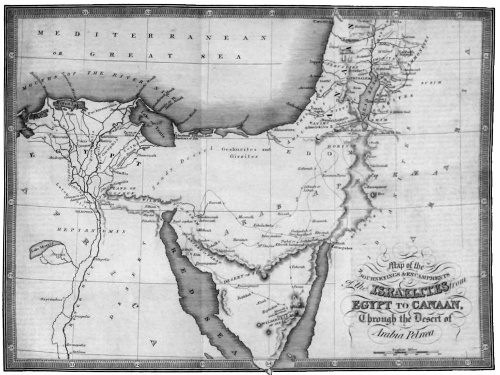
Map of the JOURNEYINGS & ENCAMPMENTS of the ISRAELITES from EGYPT to CANAAN Through the Desert of Arabia Petræa
The second region, or Arabia Deserta, is bounded on the north and north-east by the Euphrates, on the east by a ridge of mountains which separates it from Chaldea, on the south by Arabia Felix, and on the west by Syria, Judea, and Arabia Petræa. This was more particularly the country first of the Cushites, and afterward of the Ishmaelites; as it is still of their descendants, the modern Bedouins, who maintain the same predatory and wandering habits. It consists almost entirely of one vast and lonesome wilderness, a boundless level of sand, whose dry and burning surface denies existence to all but the Arab and his camel. Yet, widely scattered over this dreary waste, some spots of comparative fertility are to be found, where, spread around a feeble spring of 77brackish water, a stunted verdure, or a few palm trees, fix the principal settlement of a tribe, and afford stages of refreshment in these otherwise impassable deserts. Here, with a few dates, the milk of his faithful camel, and perhaps a little corn, brought by painful journeys from distant regions, or plundered from a passing caravan, the Arab supports a hard existence, until the failure of his resources impels him to seek another oasis, or the scanty herbage furnished on a patch of soil by transient rains; or else, which is frequently the case, to resort, by more distant migration, to the banks of the Euphrates; or, by hostile inroads on the neighbouring countries, to supply those wants which the recesses of the desert have denied. The numbers leading this wandering and precarious mode of life are incredible. From these deserts Zerah drew his army of a million of men; and the same deserts, fifteen hundred years after, poured forth the countless swarms, which, under Mohammed and his successors, devastated half of the then known world.
The third region, or Arabia Felix, so denominated from the happier condition of its soil and climate, occupies the southern part of the Arabian peninsula. It is bounded on the north by the two other divisions of the country; on the south and south-east by the Indian Ocean; on the east by part of the same ocean and the Persian Gulf; and on the west by the Red Sea. This division is subdivided into the kingdoms or provinces of Yemen, at the southern extremity of the peninsula; Hejaz, on the north of the former, and toward the Red Sea; Nejed, in the central region; and Hadramant and Oman, on the shores of the Indian Ocean. The four latter subdivisions partake of much of the character of the other greater divisions of the country, though of a more varied surface, and with a larger portion capable of cultivation. But Yemen seems to belong to another country and climate. It is very mountainous, is well watered with rains and springs, and is blessed with an abundant produce in corn and fruits, and especially in coffee, of which vast quantities are exported. In this division were the ancient cities of Nysa, Musa or Moosa, and Aden. This is also supposed to have been the country of the queen of Sheba. In Hejaz are the celebrated cities of Mecca and Medina.
Arabia Felix is inhabited by a people who claim Jotkan for their father, and so trace their descent direct from Shem, instead of Abraham and Ham. They are indeed a totally different people from those inhabiting the other quarters, and pride themselves on being the only pure and unmixed Arabs. Instead of being shepherds and robbers, they are fixed in towns and cities; and live by agriculture and commerce, chiefly maritime. Here were the people who were found by the Greeks of Egypt enjoying an entire monopoly of the trade with the east, and possessing a high degree of wealth and consequent refinement. It was here, in the ports of Sabæa, that the spices, muslins, and precious stones of India, were for many ages obtained by the Greek traders of Egypt, before they had acquired skill or courage sufficient to pass the straits of the Red Sea; which were long considered by the nations of Europe to be the produce of Arabia itself. These articles, before the invention of shipping, or the establishment of a maritime intercourse, were conveyed across the deserts by the Cushite, Ishmaelite, and Midianite carriers. It was the produce partly of India, and partly of Arabia, which the travelling merchants, to whom Joseph was sold, were carrying into Egypt. The balm and myrrh were probably Arabian, as they are still the produce of the same country; but the spicery was undoubtedly brought farther from the east. These circumstances are adverted to, to show how extensive was the communication, in which the Arabians formed the principal link: and that in the earliest ages of which we have any account, in those of Joseph, of Moses, of Isaiah, and of Ezekiel, “the mingled people” inhabiting the vast Arabian deserts, the Cushites, Ishmaelites, and Midianites, were the chief agents in that commercial intercourse which has, from the most remote period of antiquity, subsisted between the extreme east and west. And although the current of trade is now turned, caravans of merchants, the descendants of these people, may still be found traversing the same deserts, conveying the same articles, and in the same manner as described by Moses!
The singular and important fact that Arabia has never been conquered, has already been cursorily adverted to. But Mr. Gibbon, unwilling to pass by an opportunity of cavilling at revelation, says, “The perpetual independence of the Arabs has been the theme of praise among strangers and natives; and the arts of controversy transform this singular event into a prophecy and a miracle in favour of the posterity of Ishmael. Some exceptions, that can neither be dissembled nor eluded, render this mode of reasoning as indiscreet as it is superfluous. The kingdom of Yemen has been successively subdued by the Abyssinians, the Persians, the Sultans of Egypt, and the Turks; the holy cities of Mecca and Medina have repeatedly bowed under a Scythian tyrant; and the Roman province of Arabia embraced the peculiar wilderness in which Ishmael and his sons must have pitched their tents in the face of their brethren.” But this learned writer has, with a peculiar infelicity, annulled his own argument; and we have only to follow on the above passage, to obtain a complete refutation of the unworthy position with which it begins: “Yet these exceptions,” says Mr. Gibbon, “are temporary or local; the body of the nation has escaped the yoke of the most powerful monarchies: the arms of Sesostris and Cyrus, of Pompey, and Trajan, could never achieve the conquest of Arabia; the present sovereign of the Turks may exercise a shadow of jurisdiction, but his pride is reduced to solicit the friendship of a people whom it is dangerous to provoke, and fruitless to attack. The obvious causes of their freedom are inscribed on the character and country of the Arabs. Many ages before Mohammed, their intrepid valour had been severely felt by their neighbours, in offensive 78and defensive war. The patient and active virtues of a soldier are insensibly nursed in the habits and discipline of a pastoral life. The care of the sheep and camels is abandoned to the women of the tribe; but the martial youth, under the banner of the emir, is ever on horseback and in the field, to practise the exercise of the bow, the javelin, and the scimitar. The long memory of their independence is the firmest pledge of its perpetuity; and succeeding generations are animated to prove their descent, and to maintain their inheritance. Their domestic feuds are suspended on the approach of a common enemy; and in their last hostilities against the Turks, the caravan of Mecca was attacked and pillaged by four score thousand of the confederates. When they advance to battle, the hope of victory is in the front, in the rear the assurance of a retreat. Their horses and camels, who in eight or ten days can perform a march of four or five hundred miles, disappear before the conqueror; the secret waters of the desert elude his search; and his victorious troops are consumed with thirst, hunger, and fatigue, in the pursuit of an invisible foe, who scorns his efforts, and safely reposes in the heart of the burning solitude. The arms and deserts of the Bedouins are not only the safeguards of their own freedom, but the barriers also of the happy Arabia, whose inhabitants, remote from war, are enervated by the luxury of the soil and climate. The legions of Augustus melted away in disease and lassitude; and it is only by a naval power that the reduction of Yemen has been successfully attempted. When Mohammed erected his holy standard, that kingdom was a province of the Persian empire; yet seven princes of the Homerites still reigned in the mountains; and the vicegerent of Chosroes was tempted to forget his distant country and his unfortunate master.”
Yemen was the only Arabian province which had the appearance of submitting to a foreign yoke; but even here, as Mr. Gibbon himself acknowledges, seven of the native princes remained unsubdued: and even admitting its subjugation to have been complete, the perpetual independence of the Ishmaelites remains unimpeached. For this is not their country. Petra, the capital of the Stony Arabia, and the principal settlement of the Nabathæi, it is true, was long in the hands of the Persians and Romans; but this never made them masters of the country. Hovering troops of Arabs confined the intruders within their walls, and cut off their supplies; and the possession of this fortress gave as little reason to the Romans to exult as the conquerors of Arabia Petræa, as that of Gibraltar does to us to boast of the conquest of Spain.
The Arabian tribes were confounded by the Greeks and Romans under the indiscriminate appellation of Saracens; a name whose etymology has been variously, but never satisfactorily, explained. This was their general name when Mohammed appeared in the beginning of the seventh century. Their religion at this time was Sabianism, or the worship of the sun, moon, &c; variously transformed by the different tribes, and intermingled with some Jewish and Christian maxims and traditions. The tribes themselves were generally at variance, from some hereditary and implacable animosities; and their only warfare consisted in desultory skirmishes arising out of these feuds, and in their predatory excursions, where superiority of numbers rendered courage of less value than activity and vigilance. Yet of such materials Mohammed constructed a mighty empire; converted the relapsed Ishmaelites into good Musselmen; united the jarring tribes under one banner; supplied what was wanting in personal courage by the ardour of religious zeal; and out of a banditti, little known and little feared beyond their own deserts, raised an armed multitude, which proved the scourge of the world.
Mohammed was born in the year 569, of the noble tribe of the Koreish, and descended, according to eastern historians, in a direct line from Ishmael. His person is represented as beautiful, his manners engaging, and his eloquence powerful; but he was illiterate, like the rest of his countrymen, and indebted to a Jewish or Christian scribe for penning his Koran. Whatever the views of Mohammed might have been in the earlier part of his life, it was not till the fortieth year of his age that he avowed his mission as the Apostle of God: when so little credit did he gain for his pretensions, that in the first three years he could only number fourteen converts; and even at the end of ten years his labours and his friends were alike confined within the walls of Mecca, when the designs of his enemies compelled him to fly to Medina, where he was favourably received by a party of the most considerable inhabitants, who had recently imbibed his doctrines at Mecca. This flight, or Hegira, was made the Mohammedan æra, from which time is computed, and corresponds with the 16th of July, 622, of the Christian æra. Mohammed now found himself sufficiently powerful to throw aside all reserve; declared that he was commanded to compel unbelievers by the sword to receive the faith of one God, and his prophet Mohammed; and confirming his credulous followers by the threats of eternal pain on the one hand, and the allurements of a sensual paradise on the other, he had, before his death, which happened in the year 632, gained over the whole of Arabia to his imposture. His death threw a temporary gloom over his cause, and the disunion of his followers threatened its extinction. Any other empire placed in the same circumstances would have crumbled to pieces; but the Arabs felt their power; they revered their founder as the chosen prophet of God; and their ardent temperament, animated by a religious enthusiasm, gave an earnest of future success, and encouraged the zeal or the ambition of their leaders. The succession, after some bloodshed, was settled, and unnumbered hordes of barbarians were ready to carry into execution the sanguinary dictates of their prophet; and, with “the Koran, tribute, or death,” as their motto, to invade the countries of the 79infidels. During the whole of the succeeding century, their rapid career was unchecked; the disciplined armies of the Greeks and Romans were unable to stand against them; the Christian churches of Asia and Africa were annihilated; and from India to the Atlantic, through Persia, Arabia, Syria, Palestine, Asia Minor, Egypt, with the whole of northern Africa, Spain, and part of France, the impostor was acknowledged. Constantinople was besieged; Rome itself was plundered; and nothing less than the subjection of the whole Christian world was meditated on the one hand and tremblingly expected on the other.
All this was wonderful; but the avenging justice of an incensed Deity, and the sure word of prophecy, relieve our astonishment. It was to punish an apostate race, that the Saracen locusts were let loose upon the earth; and the countries which they were permitted to ravage were those in which the pure light of revelation had been most abused. The eastern church was sunk in gross idolatry; vice and wickedness prevailed in their worst forms; and those who still called themselves Christians trusted more to images, relics, altars, austerities, and pilgrimages, than to a crucified Saviour.
About a hundred and eighty years from the foundation of Bagdad, during which period the power of the Saracens had gradually declined, a dreadful reaction took place in the conquered countries. The Persians on the east, and the Greeks on the west, were simultaneously roused from their long thraldom, and, assisted by the Turks, who, issuing from the plains of Tartary, now for the first time made their appearance in the east, extinguished the power of the caliphate, and virtually put an end to the Arabian monarchy in the year 936. A succession of nominal caliphs continued to the year 1258: but the provinces were lost; their power was confined to the walls of their capital; and they were in real subjection to the Turks and the Persians until the above year, when Mostacem, the last of the Abbassides, was dethroned and murdered by Holagou, or Hulaku, the Tartar, the grandson of Zingis. This event, although it terminated the foreign dominion of the Arabians, left their native independence untouched. They were no longer, indeed, the masters of the finest parts of the three great divisions of the ancient world: their work was finished; and returning to the state in which Mohammed found them three centuries before, with the exception of the change in their religion, they remained, and still remain, the unconquered rovers of the desert.
It is not the least singular circumstance in the history of this extraordinary people, that those who, in the enthusiasm of their first successes, were the sworn foes of literature, should become for several ages its exclusive patrons. Almansor, the founder of Bagdad, has the merit of first exciting this spirit, which was encouraged in a still greater degree by his grandson Almamon. This caliph employed his agents in Armenia, Syria, Egypt, and at Constantinople, in collecting the most celebrated works on Grecian science, and had them translated into the Arabic language. Philosophy, astronomy, geometry, and medicine, were thus introduced and taught; public schools were established; and learning, which had altogether fled from Europe, found an asylum on the banks of the Tigris. Nor was this spirit confined to the capital: native works began to appear; and by the hands of copyists were multiplied out of number, for the information of the studious, or the pride of the wealthy. The rage for literature extended to Egypt and to Spain. In the former country, the Fatimites collected a library of a hundred thousand manuscripts, beautifully transcribed, and very elegantly bound; and in the latter, the Ommiades formed another of six hundred thousand volumes; forty-four of which were employed in the catalogue. Their capital, Cordova, with the towns of Malaga, Almeria, and Murcia, produced three hundred writers; and seventy public libraries were established in the cities of Andalusia. What a change since the days of Omar, when the splendid library of the Ptolemies was wantonly destroyed by the same people! A retribution, though a slight one, was thus made for their former devastations; and many Grecian works, lost in the original, have been recovered in their Arabic dress. Neither was this learning confined to mere parade, though much of it must undoubtedly have been so. Their proficiency in astronomy and geometry is attested by their astronomical tables, and by the accuracy with which, in the plain of Chaldea, a degree of the great circle of the earth was measured. But it was in medicine that, in this dark age, the Arabians shone most: the works of Hippocrates and Galen had been translated and commented on; their physicians were sought after by the princes of Asia and Europe; and the names of Rhazis, Albucasis, and Avicenna are still revered by the members of the healing art. So little, indeed, did the physicians of Europe in that age know of the history of their own science, that they were astonished, on the revival of learning, to find in the ancient Greek authors those systems for which they thought themselves indebted to the Arabians!
The last remnant of Arabian science was found in Spain; from whence it was expelled in the beginning of the seventeenth century, by the intemperate bigots of that country, who have never had any thing of their own with which to supply its place. The Arabians are the only people who have preserved their descent, their independence, their language, and their manners and customs, from the earliest ages to the present times; and it is among them that we are to look for examples of patriarchal life and manners. A very lively sketch of this mode of life is given by Sir R. K. Porter, in the person and tribe of an Arab sheik, whom he encountered in the neighbourhood of the Euphrates. “I had met this warrior,” says Sir R. K. P., “at the house of the British resident at Bagdad; and came, according to his repeated wish, to see him in a place more consonant with his habits, the tented field; and, as he expressed it, ‘at the head of his children.’ 80As soon as we arrived in sight of his camp, we were met by crowds of its inhabitants, who, with a wild and hurrying delight, led us toward the tent of their chief. The venerable old man came forth to the door, attended by his subjects of all sizes and descriptions, and greeted us with a countenance beaming kindness; while his words, which our interpreter explained, were demonstrative of patriarchal welcome. One of my Hindoo troopers spoke Arabic; hence the substance of our succeeding discourse was not lost on each other. Having entered, I sat down by my host; and the whole of the persons present, to far beyond the boundaries of the tent, (the sides of which were open,) seated themselves also, without any regard to those more civilized ceremonies of subjection, the crouching of slaves, or the standing of vassalage. These persons, in rows beyond rows, appeared just as he had described, the offspring of his house, the descendants of his fathers, from age to age; and like brethren, whether holding the highest or the lowest rank, they seemed to gather round their common parent. But perhaps their sense of perfect equality in the mind of their chief could not be more forcibly shown, than in the share they took in the objects which appeared to interest his feelings; and as I looked from the elders or leaders of the people, seated immediately around him, to the circles beyond circles of brilliant faces, bending eagerly toward him and his guest, (all, from the most respectably clad to those with hardly a garment covering their active limbs, earnest to evince some attention to the stranger he bade welcome,) I thought I had never before seen so complete an assemblage of fine and animated countenances, both old and young: nor could I suppose a better specimen of the still existing state of the true Arab; nor a more lively picture of the scene which must have presented itself, ages ago, in the fields of Haran, when Terah sat in his tent door, surrounded by his sons, and his sons’ sons, and the people born in his house. The venerable Arabian sheik was also seated on the ground with a piece of carpet spread under him; and, like his ancient Chaldean ancestor, turned to the one side and the other, graciously answering or questioning the groups around him, with an interest in them all which clearly showed the abiding simplicity of his government, and their obedience. On the smallest computation, such must have been the manners of these people for more than three thousand years; thus, in all things, verifying the prediction given of Ishmael at his birth, that he, in his posterity, should ‘be a wild man,’ and always continue to be so, though ‘he shall dwell for ever in the presence of his brethren.’ And that an acute and active people, surrounded for ages by polished and luxurious nations, should from their earliest to their latest times, be still found a wild people, dwelling in the presence of all their brethren, (as we may call these nations,) unsubdued and unchangeable, is, indeed, a standing miracle: one of those mysterious facts which establish the truth of prophecy.” But although the manners of the Arabians have remained unaltered through so many ages, and will probably so continue, their religion, as we have seen, has sustained an important change; and must again, in the fulness of time, give place to a faith more worthy of the people.
St. Paul first preached the Gospel in Arabia, Gal. i, 17. Christian churches were subsequently founded, and many of their tribes embraced Christianity prior to the fifth century; most of which appear to have been tinctured with the Nestorian heresy. At this time, however, it does not appear that the Arabians had any version of the Scriptures in their own language, to which some writers attribute the ease with which they were drawn into the Mohammedan delusion; while the “Greeks, Syrians, Armenians, Abyssinians, Copts, and others,” who enjoyed that privilege, were able to resist it.
ARAM, the fifth son of Shem, Gen. x, 22. He was the father of the Syrians, who from him were called Aramæans, or Aramites.
ARARAT, a mountain of Asia, in Armenia, on which the ark of Noah rested after the cessation of the deluge. Concerning the etymology of the name, Dr. Bryant observes, that it is a compound of Ar-Arat, and signifies “the mountain of descent,” being equivalent to הר־ירר, of the Hebrews. Of the precise situation of this mountain, different accounts have been given. Some have supposed that it was one of the mountains which divide Armenia on the south from Mesopotamia, and that part of Assyria inhabited by the Curds, from whom those mountains took the name of Curdue, or Cardu; by the Greeks denominated Gordyæi. It is called by the Arabs Al-Judi, and also Thamanin. In confirmation of this opinion, it is alleged that the remains of the ark were to be seen on these mountains; and it is said, that Berosus and Abydenus both declare, that such a report existed in their time. Epiphanius pretends, if we may credit his assertion, that the relics of the ark were to be seen in his day; and we are farther told, that the emperor Heraclius went from the town of Thamanin, up the mountain Al-Judi, and saw the place of the ark. Others maintain, that mount Ararat was situated toward the middle of Armenia, near the river Araxes, or Aras, about twelve miles from it, according to Tournefort, above two hundred and eighty miles distant from Al-Judi, to the north-east. Ararat seems to be a part of that vast chain of mountains called Caucasus and Taurus; and upon these mountains, and in the adjacent country, were preserved more authentic accounts of the ark than in almost any other part of the world. The region about Ararat, called Araratia, was esteemed among the ancients as nearly a central part of the earth; and it is certainly as well calculated as any other for the accommodation of its first inhabitants, and for the migration of colonies, upon the increase of mankind. The soil of the country was very fruitful, and especially of that part where the patriarch made his first descent. The country also was very high, though it had fine plains and valleys 81between the mountains. Such a country, therefore, must, after the flood, have been the soonest exsiccated, and, consequently, the soonest habitable.
The mountain which has still the name of Ararat, has retained it through all ages. Tournefort has particularly described it, and from his account it seems to consist chiefly of freestone, or calcareous sandstone. It is a detached mountain in form of a sugar loaf, in the midst of a very extensive plain, consisting of two summits; the lesser, more sharp and pointed; the higher, which is that of the ark, lies north-west of it, and raises its head far above the neighbouring mountains, and is covered with perpetual snow. When the air is clear, it does not appear to be above two leagues from Erivan, and may be seen at the distance of four or five days’ journey. Its being visible at such a distance, however, is ascribed not so much to its height, as to its lonely situation, in a large plain, and upon the most elevated part of the country. The ascent is difficult and fatiguing. Tournefort attempted it; and, after a whole day’s toil, he was obliged, by the snow and intense cold, to return without accomplishing his design, though in the middle of summer. On the side of the mountain that looks toward Erivan, is a prodigious precipice, very deep, with perpendicular sides, and of a rough, black appearance, as if tinged with smoke.
The summit of Ararat has never been reached, though several attempts have been made; and if the ark rested on the summit, it is certain that those who have spoken of its fragments being seen there in different ages, must have been imposed upon. It is, however, not necessary to suppose that the ark rested upon either of its tops; and that spot would certainly be chosen which would afford the greatest facility of descent. Sir Robert Ker Porter is among the modern travellers who have given us an account of this celebrated mountain:--“As the vale opened beneath us in our descent, my whole attention became absorbed in the view before me. A vast plain, peopled with countless villages; the towers and spires of the churches of Eitch-mai-adzen, arising from amidst them; the glittering waters of the Araxes, flowing through the fresh green of the vale; and the subordinate range of mountains, skirting the base of the awful monument of the antediluvian world. It seemed to stand a stupendous link in the history of man, uniting the two races of men before and after the flood. But it was not until we had arrived upon the flat plain, that I beheld Ararat in all its amplitude of grandeur. From the spot on which I stood, it appeared as if the hugest mountains of the world had been piled upon each other, to form this one sublime immensity of earth, and rock, and snow. The icy peaks of its double heads rose majestically into the clear and cloudless heavens; the sun blazed bright upon them; and the reflection sent forth a dazzling radiance, equal to other suns. This point of the view united the utmost grandeur of plain and height. But the feelings I experienced while looking on the mountain, are hardly to be described. My eye, not able to rest for any length of time upon the blinding glory of its summits, wandered down the apparently interminable sides, till I could no longer trace their vast lines in the mists of the horizon; when an inexpressible impulse, immediately carrying my eye upward again, refixed my gaze upon the awful glare of Ararat; and this bewildered sensibility of sight being answered by a similar feeling in the mind, for some moments I was lost in a strange suspension of the powers of thought.”
The separate peaks are called Great and Little Ararat, and the space between them is about seven miles. “These inaccessible summits,” continues Sir R. K. Porter, “have never been trodden by the foot of man since the days of Noah, if even then; for my idea is, that the ark rested in the space between these heads, and not on the top of either. Various attempts have been made in different ages to ascend these tremendous mountain-pyramids, but in vain: their form, snows, and glaciers, are insurmountable obstacles: the distance being so great from the commencement of the icy region to the highest points, cold alone would be the destruction of any person who should have the hardihood to persevere. On viewing mount Ararat from the northern side of the plain, its two heads are separated by a wide cleft, or rather glen, in the body of the mountain. The rocky side of the greater head runs almost perpendicularly down to the north-east, while the lesser head rises from the sloping bottom of the cleft, in a perfectly conical shape. Both heads are covered with snow. The form of the greater is similar to the less, only broader and rounder at the top; and shows to the north-west a broken and abrupt front, opening, about half way down, into a stupendous chasm, deep, rocky, and peculiarly black. At that part of the mountain, the hollow of the chasm receives an interruption from the projection of minor mountains, which start from the sides of Ararat like branches from the root of a tree, and run along, in undulating progression, till lost in the distant vapours of the plain.” Dr. Shuckford argues that the true Ararat lies among the mountains of the north of India; but Mr. Faber has answered his reasoning, and proved by a comparison of geographical notices incidentally mentioned in the Old Testament, that the Ararat of Armenia is the true Ararat.
ARCHANGEL, according to some, means an angel occupying the eighth rank in the celestial order or hierarchy; but others reckon it a title only applicable to our Saviour; Jude 9; Dan. xii, 1; 1 Thess. iv, 16. On this point Bishop Horsley has the following observations:--“It has been for a long time a fashion in the church to speak very frequently and familiarly of archangels as beings of an order with which we are perfectly well acquainted. Some say there are seven of them. Upon what solid ground that assertion stands, I know not; but this I know, the word ‘archangel’ is not to be found in any one passage of the Old Testament: in the New Testament it occurs twice, 82and only twice. One of the two passages is in the First Epistle to the Thessalonians; where the Apostle, among the circumstances of the pomp of our Lord’s descent from heaven to the final judgment, mentions ‘the voice of the archangel;’ the other passage is in the Epistle of St. Jude, where the title of archangel is coupled with the name of ‘Michael the archangel.’ This passage is so remarkably obscure that I shall not attempt to draw any conclusion from it but this, which manifestly follows, be the particular sense of the passage what it may: since this is one of the two texts in which alone the word ‘archangel’ is found in the whole Bible; since in this one text only the title of archangel is coupled with any name; and since the name with which it is here coupled is Michael; it follows undeniably that the archangel Michael is the only archangel of whom we know any thing from holy writ. It cannot be proved from holy writ, and, if not from holy writ, it cannot be proved at all, that any archangel exists but the one archangel Michael, and this one archangel Michael is unquestionably the Michael of the book of Daniel.
“I must observe by the way, with respect to the import of the title of archangel, that the word, by etymology, clearly implies a superiority of rank and authority in the person to whom it is applied. It implies a command over angels; and this is all that the word of necessity implies. But it follows not, by any sound rule of argument, that, because no other superiority than that of rank and authority is implied in the title, no other belongs to the person distinguished by the title, and that he is in all other respects a mere angel. Since we admit various orders of intelligent beings, it is evident that a being highly above the angelic order may command angels.
“To ascertain, if we can, to what order of beings the archangel Michael may belong, let us see how he is described by the Prophet Daniel, who never mentions him by that title; and what action is attributed to him in the book of Daniel and in another book, in which he bears a principal part.
“Now Daniel calls him ‘one of the chief princes,‘ or ‘one of the capital princes,’ or ‘one of the princes that are at the head of all:’ for this I maintain to be the full and not more than the full import of the Hebrew words. Now we are clearly got above the earth, into the order of celestials, who are the princes that are first, or at the head of all? Are they any other than the three persons in the Godhead? Michael, therefore, is one of them; but which of them? This is not left in doubt. Gabriel, speaking of him to Daniel, calls him ‘Michael your prince,’ and ‘the great prince which standeth for the children of thy people;‘ that is, not for the nation of the Jews in particular, but for the children, the spiritual children, of that holy seed the elect people of God; a description which applies particularly to the Son of God, and to no one else; and in perfect consistence with this description of Michael in the book of Daniel, is the action assigned to him in the Apocalypse, in which we find him fighting with the old serpent, the deceiver of the world, and victorious in the combat. That combat who was to maintain? in that combat who was to be victorious, but the seed of the woman? From all this it is evident, that Michael is a name for our Lord himself, in his particular character of the champion of his faithful people, against the violence of the apostate faction and the wiles of the devil.” To this opinion there is nothing irreconcilable in the “voice of the archangel” mentioned in 1 Thess. iv, 16: since the “shout,” the “voice,” the “trump of God,” may all be the majestic summons of the Judge himself. At the same time we must feel that the reasoning of Bishop Horsley, though ingenious, is for from being conclusive against the existence of one or more archangels.
ARCHBISHOP, a bishop of the first class, who superintends the conduct of other bishops. Archbishops were not known in the east till about the year 320; and though there were some soon after this, who had the title, yet it was only a personal honour, by which the bishops of considerable cities were distinguished. It was not till of late that archbishops became metropolitans, and had suffragans under them. Athanasius appears to have been the first who used the title archbishop, which he gave occasionally to his predecessor. Gregory Nazianzen, in like manner, gave it to Athanasius; not that either of them was entitled to any jurisdiction, or even any precedency, in virtue of this title. Among the Latins, Isidore Hispalensis is the first who speaks of archbishops.
ARCHELAUS, son of Herod the Great, and Maltace, his fifth wife. Herod having put to death his sons Alexander, Aristobulus, and Antipater, and expunged out of his will Herod Antipas, whom he had declared king, he substituted Archelaus, and gave Antipas the title of tetrarch only. After the death of Herod, Archelaus ordered that king’s will to be read, wherein he, Archelaus, was declared king, on condition that Augustus consented. Hereupon the assembly cried, “Long live king Archelaus!” and the soldiers promised the same fidelity to him as they had shown to his father. Archelaus buried his father magnificently, came to Jerusalem, and there mourned seven days, according to custom. He then gave a splendid entertainment to the people, went to the temple, harangued the multitude, promised them good treatment, and declared he would not assume the title of king till the emperor had confirmed it, A. M. 4001; B. C. 3. The people, notwithstanding, tumultuously demanded the execution of those who advised Herod to slay certain zealots, who had pulled down a golden eagle from one of the temple gates. They also required Archelaus to divest Joazar of the high priesthood; and they vehemently reproached the memory of the late king. Archelaus sent troops to suppress the mutineers, and killed near three thousand of them about the temple. After this he embarked at Cæsarea for Rome, to procure from Augustus the confirmation of Herod’s will. Antipas, his 83brother, went to Rome likewise, to dispute his title, pretending that Herod’s first will should be preferred to his last, which he alleged to have been made by him when his understanding was not sound.
The two brothers, Archelaus and Antipas, procured able orators to display their pretensions before the emperor; and when they had done speaking, Archelaus threw himself at Augustus’s feet. Augustus gently raised him, said he would do nothing contrary to Herod’s intention or his interest, but refused to decide the affair at that time. Some time afterward, the Jews sent a solemn embassy to Rome, to desire Augustus would permit them to live according to their own laws, and on the footing of a Roman province, without being subject to kings of Herod’s family, but only to the governors of Syria. Augustus heard them, and likewise heard Archelaus in reply; then broke up the assembly without declaring himself. After some days, he sent for Archelaus, gave him the title, not of king, but of ethnarch, with one moiety of the territories which his father Herod had enjoyed; promising him the crown likewise, if his good conduct deserved it. Archelaus returned to Judea, and, under pretence that he had countenanced the seditious against him, he deprived Joazar of the high priesthood, and gave that dignity to his brother Eleazar. He governed Judea with so much violence, that, after seven years, the chiefs of the Samaritans and Jews accused him before Augustus. The emperor immediately sent for his agent at Rome, and without condescending to write to Archelaus he commanded the agent to depart instantly for Judea, and order Archelaus to Rome, to give an account of his conduct. On his arrival at Rome, the emperor called for his accusers, and permitted him to defend himself; which he did so insufficiently, that Augustus banished him to Vienne, in Gaul, where he continued in exile to the end of his life. See Antipas.
ARCHI-SYNAGOGUS, the ruler of a synagogue. See Synagogue.
ARCHITRICLINUS, ἀρχιτρίκλινος, generally translated steward, signifies rather the master or superintendent of the feast; “one,” says Gaudentius, “who is the husband’s friend, and commissioned to conduct the order and economy of the feast.” He gave directions to the servants, superintended every thing, commanded the tables to be covered, or to be cleared of the dishes, as he thought proper: whence his name, as regulator of the triclinium, or festive board. He also tasted the wine, and distributed it to the guests. The author of Ecclesiasticus thus describes this office, xxxii, 1, 2: “If thou be made the master of a feast, lift not thyself up, but be among them as one of the rest: take diligent care of them, and so sit down. And when thou hast done all thy office, take thy place, that thou mayest be merry with them, and receive a crown for the well ordering of the feast.” This office is mentioned, John ii, 8, 9, upon which Theophylact remarks: “That no one might suspect that their taste was vitiated by having drunk to excess, so as not to know water from wine, our Saviour orders it to be first carried to the governor of the feast, who certainly was sober; for those who on such occasions are intrusted with this office, observe the strictest sobriety, that they may be able properly to regulate the whole.”
AREOPAGUS, the high court at Athens, famed for the justice of its decisions; and so called, because it sat on a hill of the same name, or in the suburbs of the city, dedicated to Mars, the god of war, as the city was to Minerva, his sister. St. Paul, Acts xvii, 19, &c, having preached at Athens, was carried before the Areopagites, as “a setter forth of strange gods.” On this occasion he delivered that fine sermon which is in substance recorded in Acts xvii. Dionysius, one of the judges, was converted; and the Apostle was dismissed without any farther trouble.
ARGOB, a canton lying beyond Jordan, in the half tribe of Manasseh, and in the country of Bashan, one of the most fruitful on the other side of Jordan. In the region of Argob there were sixty cities, called Bashan-havoth-Jair, which had very high walls and strong gates, without reckoning many villages and hamlets, which were not inclosed, Deut. iii, 4–14; 1 Kings iv, 13. But Argob was more peculiarly the name of the capital city of the region of Argob, which Eusebius says was fifteen miles west of Gerara.
ARIANS, this ancient sect, was unquestionably so called from Arius, a presbyter of Alexandria, in the early part of the fourth century. It is said that he aspired to episcopal honours; and after the death of Achilles, in A. D. 313, felt not a little chagrined that Alexander should be preferred before him. Whether this circumstance had any influence on his opinions, it is impossible to say; but one day, when his rival (Alexander) had been addressing the clergy in favour of the orthodox doctrine, and maintaining, in strong and pointed language, “that the Son of God was co-eternal, co-essential, and co-equal with the Father,” Arius considered this as a species of Sabellianism, and ventured to say, that it was inconsistent and impossible, since the Father, who begat, must be before the Son, who was begotten: the latter, therefore, could not be absolutely eternal. Alexander at first admonished Arius, and endeavoured to convince him of his error; but without effect, except that he became the more bold in contradiction. Some of the clergy thought their bishop too forbearing, and it is possible he felt his inferiority of talent; for Arius was a man of accomplished learning, and commanding eloquence; venerable in person, and fascinating in address. At length Alexander was roused, and attempted to silence Arius by his authority; but this not succeeding, as the latter was bold and pertinacious, Alexander, about the year 320, called a council of his clergy, by whom the reputed heretic was deposed and excommunicated. Arius now retired into Palestine, where his talents and address soon made a number of converts; and among the rest, the celebrated Eusebius, bishop 84of Nicomedia, and other bishops and clergy of those parts, who assembled in council, and received the excommunicated presbyter into their communion. Eusebius also, having great interest with Constantia, the sister of Constantine, and wife of Licinius, recommended Arius to her protection and patronage; through which, and by his own eloquent letters to the clergy in various parts, his system spread with great rapidity, and to a vast extent. The emperor Constantine, who had no great skill in these matters, was grieved to see the Christian church (but just escaped from the red dragon of persecution) thus torn by intestine animosity and dissensions; he therefore determined to summon a general council of the clergy, which met at Nice, A. D. 325, and contained more than 300 bishops. Constantine attended in person, and strongly recommended peace and unanimity. Athanasius was the chief opponent of the Arians. Both parties were willing to subscribe to the language of the Scriptures, but each insisted on interpreting for themselves. “Did the Trinitarians,” says Mr. Milner, “assert that Christ was God? The Arians allowed it, but in the same sense as holy men and angels are styled gods in Scripture. Did they affirm that he was truly God? The others allowed that he was made so by God. Did they affirm that the Son was naturally of God? It was granted: Even we, said they, are of God, ‘of whom are all things.’” At length the Athanasians collected a number of texts, which they conceived amounted to full proof of the Son being of one and the same substance with the Father; the Arians admitted he was of like substance, the difference in the Greek phrases being only in a single letter,--ὁμοούσιος, homoousios and ὁμοιούσιος, homoiousios. At length the former was decreed to be the orthodox faith, and the Nicene creed was framed as it remains at this day so far as concerns the person of the Son of God, who is said to be “begotten of his Father before all worlds; God of God, Light of Light, very God of very God, begotten, not made, of one substance with the Father, by whom all things were made,” &c.
Arius was now excommunicated. The sentence of the council pronounced against him and his associates was followed by another of the emperor, whereby the excommunicated persons were condemned to banishment, that they might be debarred the society of their countrymen whom the church had judged unworthy to remain in her communion. Soon after which, Eusebius of Nicomedia, and Theognis of Nice, being found to continue their countenance and protection to the Arian cause, to communicate with those whom they had anathematized, and to concur in those sentiments which they had condemned by their subscriptions; they were both subjected to the same penalty of exile by the emperor, and were actually deposed, (as we learn from Athanasius,) and had successors ordained to their sees, though history is silent as to the council by which this was done. But such was the good nature and credulity of Constantine, that these men, by their usual artifices, easily imposed upon him, and brought him to such a full persuasion of their agreement with the Nicene faith, that in about three years’ time they were not only recalled from banishment, but restored to their sees, and to a considerable degree of interest at court. Their thorough attachment to the cause of Arius, and their hatred of Athanasius, who had so vigorously withstood them in the council, and was now advanced to the see of Alexandria, made them watchful of every opportunity to defeat the decisions of the council.
In the meantime one who wished well to their designs, and whom Constantia had upon her death bed recommended to the emperor, did so far prevail upon the easy credulity of Constantine, by complaining that Arius had been misrepresented, and differed nothing in his sentiments from the Nicene fathers, that the indulgent emperor recalled him from his banishment, and required him to exhibit in writing, a confession of his faith. He did this in such terms as, though they admitted of a latent reservation, yet bore the appearance of being entirely catholic; and therefore not only gave satisfaction to the emperor, but even offended some of his own followers, who from that time forth separated from him. The discerning Athanasius was not so easily imposed upon as Constantine; but, well assured of the heretic’s prevarication, was resolute in refusing to admit him to communion, whom the Nicene council had so openly condemned. Upon this the emperor sent for Arius to Constantinople, and insisted upon his being received into communion, by Alexander, bishop of that city. However, on the day before this was to have taken place, Arius died suddenly from a complaint in his bowels. Some attributed this to poison; others to the judgment of God. The emperor did not long survive; and Constantius, his successor, became warmly attached to the Arian cause, as were all the court party. Successive emperors took different sides, and thus was the peace of the church agitated for many years, and practical religion sacrificed alternately to the dogmas or the interests of one party or the other; and each was in turn excommunicated, fined, imprisoned, or banished. Constantius supported Arianism triumphantly, Julian laughed at both parties, but persecuted neither, Jovian supported the Nicene doctrine. Valentinian, and his brother Valens, took contrary sides; the former supporting Athanasianism in the west, and the latter Arianism in the east; so that what was orthodoxy at Rome was heresy at Constantinople, and vice versa. The Arians themselves were not unanimous, but divided into various shades of sentiment, under their respective leaders; as Eusebians, Eudoxians, Acasians, Aëtians, &c; but the more general distinction was into Arians and Semi-Arians; the former sinking the character of the Son of God into that of a mere creature, while the latter admitted every thing but the homoousian doctrine, or his absolute equality with the Father. After this period we hear little of Arianism, till it was revived in England in the beginning of the last century by the eccentric Mr. Whiston, by Mr. Emlyn, and 85Dr. Samuel Clarke. The latter was what may be called a high or Semi-Arian, who came within a shade of orthodoxy; the two former were low Arians, reducing the rank of our Saviour to the scale of angelic beings--a creature “made out of nothing.” Since this time, however, both Arians and Socinians are sunk into the common appellation of Unitarians, or rather Humanitarians, who believe our Saviour (as Dr. Priestley expresses it) to be “a man like themselves.” The last advocates of the pure Arian doctrine, of any celebrity, were Mr. Henry Taylor, (under the signature of Ben Mordecai,) and Dr. Richard Price, in his “Sermons on the Christian Doctrine.” It may be proper to observe, that the Arians, though they denied the absolute eternity of the Son, strongly contended for his preëxistence, as the Logos, or the Word of God, “by whom the worlds were made;” and admitted, more or less explicitly, the sacrifice which he offered for sin upon the cross.
ARIEL, the capital city of Moab, frequently mentioned in Scripture, Ezra viii, 16. See Moab.
ARIMATHEA, or RAMAH, now called Ramlè, or Ramla, a pleasant town, beautifully situated on the borders of a fertile and extensive plain, abounding in gardens, vineyards, olive and date trees. It stands about thirty miles north-west of Jerusalem, on the high road to Jaffa. At this Rama, which was likewise called Ramathaim Zophim, as lying in the district of Zuph, or Zoph, Samuel was born, 1 Sam. i. This was likewise the native place of Joseph, called Joseph of Arimathea, who begged and obtained the body of Jesus from Pilate, Matt. xxvi, 57. There was another Ramah, about six miles north of Jerusalem, in a pass which separated the kingdoms of Israel and Judah, which Baasha, king of Israel, took and began to fortify; but he was obliged to relinquish it, in consequence of the alliance formed between Asa, king of Judah, and Benhadad, king of Syria, 1 Kings xv. This is the Ramah, supposed to be alluded to in the lamentation of Rachel for her children.
ARISTARCHUS, spoken of by St. Paul in his Epistle to the Colossians, iv, 10, and often mentioned in the Acts of the Apostles. He was a Macedonian, and a native of Thessalonica. He accompanied St. Paul to Ephesus, and there continued with him during the two years of his abode in that place, sharing with him in all the dangers and labours of the ministry, Acts xix, 29; xx, 4; xxvii, 2. He was near losing his life in a tumult raised by the Ephesian silversmiths. He left Ephesus with the Apostle, and went with him into Greece. From thence he attended him into Asia; from Asia into Judea, and from Judea to Rome.
ARK, arca, denotes a kind of floating vessel built by Noah, for the preservation of himself and family, with several species of animals during the deluge. The Hebrew word by which the ark is expressed, is תבה or תיבה, the constructive form of תבה, which is evidently the Greek θίβη; and so the LXX render the word in Exod. ii, 3, where only it again occurs. They also render it κιβωτὸν; Josephus, λαρνάκα; and the Vulgate, arcam; signifying an ark, coffer, or chest. Although the ark of Noah answered, in some respects, the purpose of a ship, it is not so certain that it was of the same form and shape. It has been inconclusively argued by Michaelis and some others, that if its form had not been like that of a ship, it could not have resisted the force of the waves; because it was not intended to be conducted, like a ship, from one place to another, but merely “to float on the surface of the waters,” Gen. vii, 17. It appears to have had neither helm, nor mast, nor oars; but was merely a bulky capacious vessel, light enough to be raised aloft with all its contents, by the gradual rise of the deluge. Its shape, therefore, was of little importance; more especially as it seems to have been the purpose of Providence, in this whole transaction, to signify to those who were saved, as well as to their latest posterity, that their preservation was not in any degree effected by human contrivance. The ark in which Moses was exposed bears the same name; and some have thought that both were of the same materials. With respect to the etymology of the Hebrew word, the most rational seems to be that of Clodius, who derives it from the Arabic word תאה, “he collected,” from which is formed תבה, or תיבה, denoting a place in which things are collected. Foster deduces it from two Egyptian words, thoi, “a ship,” and bai, “a palm tree branch”; and such ships are still to be seen not only in Egypt, but in India and other countries; particularly in some isles of the Pacific Ocean.
To the insufficiency of the ark to contain all the creatures said to have been brought into it, objections have, at different times, been made. Bishop Wilkins and others have learnedly discussed this subject, and afforded the most satisfactory answers. Dr. Hales proves the ark to have been of the burden of forty-two thousand four hundred and thirteen tons; and asks, “Can we doubt of its being sufficient to contain eight persons, and about two hundred or two hundred and fifty pair of four-footed animals, (a number to which, according to M. Buffon, all the various distinct species may be reduced,) together with all the subsistence necessary for a twelvemonth, with the fowls of the air, and such reptiles and insects as cannot live under water?” All these various animals were controlled by the power of God, whose special agency is supposed in the whole transaction, and “the lion was made to lie down with the kid.”
Whether Noah was commanded to bring with him, into the ark, a pair of all living creatures, zoologically and numerically considered, has been doubted. During the long period between the creation and the flood, animals must have spread themselves over a great part of the antediluvian earth, and certain animals would, as now, probably become indigenous to certain climates. The pairs saved must therefore, if all the kinds were included, have travelled from immense distances. But of such marches no intimation is given in the history; and this seems to render it probable that the animals which Noah was “to bring with him” into the ark, were the animals clean and unclean of the country in which he dwelt, and which, from 86the capacity of the ark, must have been in great variety and number. The terms used, it is true, are universal; and it is satisfactory to know, that if taken in the largest sense there was ample accommodation in the ark. Nevertheless, universal terms in Scripture are not always to be taken mathematically, and in the vision of Peter, the phrase ϖάντα τὰ τετράποδα τῆς γῆς,--all the four-footed beasts of the earth, must be understood of varii generis quadrupedes, as Schleusner paraphrases it. Thus we may easily account for the exuviæ of animals, whose species no longer exist, which have been discovered in various places. The number of such extinct species probably has been greatly over-rated by Cuvier; but of the fact, to a considerable extent, there can be no doubt. It is also to be observed that the presumptive evidence of the truth of the fact of the preparation of such a vessel, and of the supernatural circumstances which attended it, is exceedingly strong. It is, in truth, the only solution of a difficulty which has no other explanation; for as a universal deluge is confirmed by the general history of the world, and by a variety of existing facts and monuments, such a structure as the ark, for the preservation and sustenance of various animals, seems to have been absolutely necessary; for as we can trace up the first imperfect rudiments of the art of ship building among the Greeks, there could be no ships before the flood; and, consequently, no animals could have been saved. Nay, it is highly improbable that even men and domestic animals could be saved, not to mention wild beasts, serpents, &c, though we should admit that the antediluvians had shipping, unless we should suppose, also, that they had a divine intimation respecting the flood, such as Moses relates; but this would be to give up the cause of infidelity. Mr. Bryant has collected a variety of ancient historical relations, which show that some records concerning the ark had been preserved among most nations of the world, and in the general system of Gentile mythology. Abydenus, with whom all the eastern writers concur, informs us that the place of descent from the ark was Armenia; and that its remains had been preserved for a long time. Plutarch mentions the Noachic dove, and its being sent out of the ark. Lucian speaks of Deucalion’s going forth from the ark, and raising an altar to God. The priests of Ammonia had a custom, at particular seasons, of carrying in procession a boat, in which was an oracular shrine, held in great veneration: and this custom of carrying the deity in an ark or boat was in use also among the Egyptians. Bishop Pococke has preserved three specimens of ancient sculpture, in which this ceremony is displayed. They were very ancient, and found by him in Upper Egypt. The ship of Isis referred to the ark, and its name, “Baris,” was that of the mountain corresponding to Ararat in Armenia. Bryant finds reference to the ark in the temples of the serpent worship, called Dracontia; and also in that of Sesostris, fashioned after the model of the ark, in commemoration of which it was built, and consecrated to Osiris at Theba; and he conjectures that the city, said to be one of the most ancient in Egypt, as well as the province, was denominated from it, Theba being the appellation of the ark. In other countries, as well as in Egypt, an ark, or ship, was introduced in their mysteries, and often carried about in the seasons of their festivals. He finds, also, in the story of the Argonauts several particulars, that are thought to refer to the ark of Noah. As many cities, not in Egypt only and Bœotia, but in Cilicia, Ionia, Attica, Phthiotis, Cataonia, Syria, and Italy, were called Theba; so likewise the city Apamea was denominated Cibotus, from κιϐωτος, in memory of the ark, and of the history connected with it. The ark, according to the traditions of the Gentile world, was prophetic; and was regarded as a kind of temple or residence of the deity. It comprehended all mankind, within the circle of eight persons, who were thought to be so highly favoured of Heaven that they at last were reputed to be deities. Hence in the ancient mythology of Egypt, there were precisely eight gods; and the ark was esteemed an emblem of the system of the heavens. The principal terms by which the ancients distinguished the ark were Theba, Baris, Arguz, Aren, Arene, Arni, Laris, Boutas, Bœotus, and Cibotus; and out of these they formed different personages. See Deluge.
ARK OF THE COVENANT, a small chest or coffer, three feet nine inches in length, two feet three inches in breadth, and two feet three inches in height; in which were contained the golden pot that had manna, Aaron’s rod, and the tables of the covenant, Num. xvii, 10; Heb. ix, 4. This coffer was made of shittim wood, and was covered with a lid, called the mercy seat, Exod. xxv, 17–22, &c, which was of solid gold, at the two ends whereof were two figures, called cherubim, looking toward each other, with expanded wings, which, embracing the whole circumference of the mercy seat, met in the middle. The whole, according to the rabbins, was made out of the same mass, without any of the parts being joined by solder. Over this it was that the Shechinah, or visible display of the divine presence in a luminous cloud rested, both in the tabernacle and in the temple, Lev. xvi, 2; and from hence the divine oracles were given forth by an audible voice, as often as God was consulted in behalf of his people. Hence it is that God is said in Scripture to dwell between the cherubim, on the mercy seat, because there was the seat or throne of the visible appearance of his glory among them, 2 Kings xix, 15; 2 Chron, xiii, 6; Psalm lxxx, 1, &c; and for this reason the high priest appeared before the mercy seat once every year, on the great day of expiation, at which time he was to make his nearest approach to the divine presence, to mediate and make atonement for the whole people of Israel. On the two sides of the ark there were four rings of gold, two on each side, through which staves, overlaid with gold, were put, by means whereof they carried it as they marched through the wilderness, &c, on the shoulders of the Levites, Exod. xxv, 13, 14; xxvii, 5. After the passage of the Jordan, the ark continued for 87some time at Gilgal, from whence it was removed to Shiloh. From this place the Israelites carried it to their camp, where, in an engagement with the Philistines, it fell into their hands. The Philistines, having gotten possession of the ark, carried it in triumph to one of their principal cities, named Ashdod, and placed it in the temple of Dagon, whose image fell to the ground and was broken. The Philistines also were so afflicted with emerods, that they afterward returned the ark with various presents; and it was lodged at Kirjath-Jearim, and afterward at Nob. David conveyed it to the house of Obededom, and from thence to his palace at Zion; and lastly, Solomon brought it into the temple which he had built at Jerusalem. It remained in the temple till the times of the last kings of Judah, who gave themselves up to idolatry, and even dared to place their idols in the holy temple itself. The priests, being unable to bear this profanation, took the ark and carried it from place to place, to preserve it from the hands of those impious princes. Josiah commanded them to bring it back to the sanctuary, and it was accordingly replaced, 2 Chron. xxxv, 3. What became of the ark at the destruction of the temple by Nebuchadnezzar, is a dispute among the rabbins. Had it been carried to Babylon with the other vessels of the temple, it would, in all probability, have been brought back with them at the close of the captivity. But that this was not the case, is agreed on all hands; whence it is probable that it was destroyed with the temple.
The ark of the covenant was, as it were, the centre of worship to all those of the Hebrew nation who served God according to the Levitical law; and not only in the temple, when they came thither to worship, but every where else in their dispersions through the whole world; whenever they prayed, they turned their faces toward the place where the ark stood, and directed all their devotions that way, Dan. vi, 10. Whence the author of the book of Cosri, justly says, that the ark, with the mercy seat and cherubim, were the foundation, root, heart, and marrow of the whole temple, and all the Levitical worship performed therein; and, therefore, had there been nothing else wanting in the second temple but the ark only, this alone would have been a sufficient reason for the old men to have wept when they remembered the first temple in which it stood; and for the saying of Haggai, ii, 3, that the second temple was as nothing compared with the first; so great a share had the ark of the covenant in the glory of Solomon’s temple. However, the defect was supplied as to the outward form, for in the second temple there was also an ark of the same dimensions with the first, and put in the same place; but it wanted the tables of the law, Aaron’s rod, and the pot of manna; nor was there any appearance of the divine glory over it; nor any oracles delivered from it. The only use that was made of it was to be a representation of the former on the great day of expiation, and to be a repository of the Holy Scriptures, that is, of the original copy of that collection of them made by Ezra after the captivity; in imitation of which the Jews, in all their synagogues, have a like ark or coffer in which they keep their Scriptures.
For the temple of Solomon a new ark was not made; but he constructed cherubim in the most holy place, which were designed to give additional state to this most sacred symbol of God’s grace and mercy. These cherubim were fifteen feet high, and were placed at equal distance from the centre of the ark and from each side of the wall, so that their wings being expanded, the two wings which were extended behind touched the wall, and the other two met over the ark and so overshadowed it. When these magnificent cherubim were finished, the ark was brought in and placed under their wings, 2 Chron. v, 7–10.
The ark was called the ark of the covenant, because it was a symbol of the covenant between God and his people. It was also named the ark of the testimony, because the two tables which were deposited in it were witnesses against every transgression.
ARM. As it is by this member of the body that we chiefly exert our strength, it is therefore used in Scripture for an emblem of power. Thus God is said to have delivered his people from Egyptian bondage “with a stretched-out arm,” Deut. v, 15; and he thus threatens Eli the high priest, “I will cut off thine arm, and the arm of thy father’s house,” 1 Sam. ii, 31; that is, I will deprive thee and thy family of power and authority.
ARMAGEDDON, a place spoken of, Rev. xvi, 16, which literally signifies “the mountain of Mageddon,” or “Megiddo,” a city situated in the great plain at the foot of Mount Carmel, where the good prince Josiah received his mortal wound, in the battle against Necho, king of Egypt. At Armageddon, the three unclean spirits coming out of the dragon’s mouth shall gather together the kings of the earth, to the battle of the great day of God Almighty, Rev. xvi, 13, 14; where the word Armageddon, according to Mr. Pool, does not signify any particular place, but is used in allusion to Megiddo, mentioned Judges v, 19, where Barak overcame Sisera with his great army, and where Josiah was slain, 2 Kings xxiii, 30. If so, the term must have been a proverbial one for a place of destruction and mourning.
ARMENIA, a considerable country of Asia, having Colchis and Iberia on the north, Media on the east, Mesopotamia on the south, Pontus and Cappadocia on the west, and the Euphrates and Syria on the south-west. Armenia is often confounded with Aramæa, the land of Aram or Syria; but they are totally different. Armenia, which is separated from Aram by Mount Taurus, was so denominated from Ar-Men, the mountainous country of Meni or Minni, the people of which country are mentioned under this name by Jeremiah, when summoning the nations against Babylon.
The people of this country have in all ages maintained a great similarity of character, partly commercial and partly pastoral. They have, in fact, in the northern parts of the Asiatic 88continent, been what the Cushites and Ishmaelites were in the south, tenders of cattle, living on the produce of their flocks and herds, and carriers of merchandize between the neighbouring nations; a part living at home with their flocks, and a part travelling as merchants and dealers into distant countries. In the flourishing times of Tyre, the Armenians, according to Ezekiel, xxvii, 14, brought horses and mules to the markets of that city; and, according to Herodotus, they had a considerable trade in wine, which they sent down the Euphrates to Babylon, &c. At the present day, the Armenians are the principal traders of the east; and are to be found in the capacity of merchants or commercial agents all over Asia, a patient, frugal, industrious, and honest people, whose known character for these virtues has withstood the tyranny and extortions of the wretched governments under which they chiefly live.
The religion of the Armenians is a corrupt Christianity of the sect of Eutyches; that is, they own but one nature in Jesus Christ. Their rites partake of those of the Greek and Latin churches, but they reject the idolatries of both. It is indeed a remarkable instance of the firmness of this people, that while the surrounding nations submitted to the religion as well as the arms of the Turks, they have preserved the purity of their ancient faith, such as it is, to the present day. It cannot be supposed but that the Turks used every effort to impose on the conquered Armenians the doctrines of the Koran. More tolerant, indeed, than the Saracens, liberty of conscience was still not to be purchased of them but by great sacrifices, which for three centuries the Armenians have patiently endured, and exhibit to the world an honourable and solitary instance of a successful national opposition of Christianity to Mohammedanism.
ARMENIAN CHURCH, a branch, originally, of the Greek church, residing in Armenia. They probably received Christianity in the fourth century. Mr. Yeates gives the most recent account of them:--
“Their whole ecclesiastical establishment is under the government of four patriarchs; the first has his residence in Echmiadzin, or Egmiathin, near Irivan; the second, at Sis, in the lesser Armenia; the third, in Georgia; and the fourth, in Achtamar, or Altamar, on the Lake of Van; but the power of the two last is bounded within their own diocesses, while the others have more extensive authority, and the patriarch of Egmiathan has, or had, under him eighteen bishops, beside those who are priors of monasteries. The Armenians every where perform divine service in their own tongue, in which their liturgy and offices are written, in the dialect of the fourth or fifth centuries. They have the whole Bible translated from the Septuagint, as they say, so early as the time of Chrysostom. The Armenian confession is similar to that of the Jacobite Christians, both being Monophysites, acknowledging but one nature in the person of Christ; but this, according to Mr. Simon, is little more than a dispute about terms; few of them being able to enter into the subtilties of polemics.
“In the year 1664, an Armenian bishop, named Uscan, visited Europe for the purpose of getting printed the Armenian Bible, and communicated the above particulars to Mr. Simon. In 1667, a certain patriarch of the lesser Armenia visited Rome, and made a profession of faith which was considered orthodox, and procured him a cordial reception, with the hope of reconciling the Armenian Christians to the Roman church; but, before he got out of Italy, it was found he had prevaricated, and still persisted in the errors of his church. About this time, Clement IX, wrote to the king of Persia, in favour of some Catholic converts in Armenia, and received a favourable answer; but the Armenian church could never be persuaded to acknowledge the authority of Rome.
“They have among them a number of monasteries and convents, in which is maintained a severe discipline; marriage is discountenanced, though not absolutely prohibited; a married priest cannot obtain promotion, and the higher clergy are not allowed to marry. They worship in the eastern manner, by prostration: they are very superstitious, and their ceremonies much resemble those of the Greek church. Once in their lives they generally perform a pilgrimage to Jerusalem; and in 1819, the number of Armenian pilgrims was thirteen hundred, nearly as many as the Greeks. Dr. Buchanan, however, says, ‘Of all the Christians in central Asia, they have preserved themselves most free from Mohammedan and Papal corruptions.’”
ARMIES. In the reign of David, the Hebrews acquired such skill in the military art, together with such strength, as gave them a decided superiority over their competitors on the field of battle. David increased the standing army, which Saul had introduced. Solomon introduced cavalry into the military force of the nation, also chariots. Both cavalry and chariots were retained in the subsequent age; an age, in which military arms were improved in their construction, the science of fortification made advances, and large armies were mustered. From this period, till the time when the Hebrews became subject to the Assyrians and Chaldeans, but little improvement was made in the arts of war. The Maccabees, after the return of the Hebrews from the captivity, gave a new existence to the military art among them. But their descendants were under the necessity of submitting to the superior power of the Romans.
Whenever there was an immediate prospect of war, a levy was made by the genealogists, Deut. xx, 5–9. In the time of the kings, there was a head or ruler of the persons, that made the levy, denominated השוטר, who kept an account of the number of the soldiers, but who is, nevertheless, to be distinguished from the generalissimo, הסופר, 2 Chron. xxvi, 11. Compare 2 Sam. viii, 17; xx, 25; 1 Chron. xviii, 16. After the levy was fully made out, the genealogists gave public notice, that the following 89persons might be excused, from military service, Deut. xx, 5–8: 1. Those who had built a house, and had not yet inhabited it. 2. Those who had planted a כרס, that is, an olive or vine garden, and had not as yet tasted the fruit of it; an exemption, consequently, which extended through the first five years after such planting. 3. Those who had bargained for a spouse, but had not celebrated the nuptials; also those who had not as yet lived with their wife, for a year. 4. The faint-hearted, who would be likely to discourage others, and who, if they had gone into battle, where, in those early times, every thing depended on personal prowess, would only have fallen victims.
At the head of each rank or file of fifty, was the captain of fifty. The other divisions consisted of a hundred, a thousand, and ten thousand men, each one of which was headed by its appropriate commander. These divisions ranked in respect to each other according to their families, and were subject to the authority of the heads of those families, 2 Chron. xxv, 5; xxvi, 12, 13. The centurions, and chiliarchs or captains of thousands, were admitted into the councils of war, 1 Chron. xiii, 1–3; 1 Sam. xviii, 13. The leader of the whole army was denominated אל־שרהצכא, the captain of the host. The genealogists, (in the English version, officers,) according to a law in Deut. xx, 9, had the right of appointing the persons who were to act as officers in the army; and they, undoubtedly, made it a point, in their selections, to choose those who are called heads of families. The practice of thus selecting military officers ceased under the kings. Some of them were then chosen by the king, and in other instances the office became permanent and hereditary in the heads of families. Both kings and generals had armour bearers, נשא כלים. They were chosen from the bravest of the soldiery, and not only bore the arms of their masters, but were employed to give his commands to the subordinate captains, and were present at his side in the hour of peril, 1 Sam. xiv, 6; xvii, 7. The infantry, the cavalry, and the chariots of war were so arranged, as to make separate divisions of an army, Exod. xiv, 6, 7. The infantry were divided likewise into light-armed troops, גדודים, and into spearmen, Genesis xlix, 19; 1 Samuel xxx, 8, 15, 23; 2 Sam. iii, 22; iv, 2; xxii, 30; Psalm xviii, 30; 2 Kings v, 2; Hosea vii, 1. The light-armed infantry were furnished with a sling and javelin, with a bow, arrows, and quiver, and also, at least in latter times, with a buckler. They fought the enemy at a distance. The spearmen, on the contrary, who were armed with spears, swords, and shields, fought hand to hand, 1 Chron. xii, 24, 34; 2 Chron. xiv, 8; xvii, 17. The light-armed troops were commonly taken from the tribes of Ephraim and Benjamin, 2 Chron. xiv, 8; xvii, 17. Compare Gen. xlix, 27; Psalm lxxviii, 9.
The art of laying out an encampment appears to have been well understood in Egypt, long before the departure of the Hebrews from that country. It was there that Moses became acquainted with that mode of encamping, which, in the second chapter of Numbers, is prescribed to the Hebrews. In the encampment of the Israelites, it appears that the holy tabernacle occupied the centre. In reference to this circumstance, it may be remarked, that it is the common practice in the east, for the prince or leader of a tribe to have his tent pitched in the centre of the others; and it ought not to be forgotten, that God, whose tent or palace was the holy tabernacle, was the prince, the leader of the Hebrews. The tents nearest to the tabernacle were those of the Levites, whose business it was to watch it, in the manner of a Pretorian guard. The family of Gershom pitched to the west, that of Kehath to the south, that of Merari to the north. The priests occupied a position to the east, opposite to the entrance of the tabernacle, Num. i, 53; iii, 21–38. At some distance to the east, were the tribes of Judah, Issachar, and Zebulon; on the south were those of Reuben, Simeon, and Gad; to the west were Ephraim, Manasseh, and Benjamin; to the north, Dan, Asher, and Napthali. The people were thus divided into four bodies, three tribes to a division; each of which divisions had its separate standard, דגל. Each of the large family associations likewise, of which the different tribes were composed, had a separate standard, termed, in contradistinction from the other, אות; and every Hebrew was obliged to number himself with his particular division, and follow his appropriate standard. Of military standards, there were,--1. The standard, denominated דגל; one of which pertained to each of the four general divisions. The four standards of this name were large, and ornamented with colours in white, purple, crimson, and dark blue. The Jewish Rabbins assert, (founding their statement on Genesis xlix, 3, 9, 17, 22, which in this case is very doubtful authority,) that the first of these standards, namely, that, of Judah, bore a lion; the second, or that of Reuben, bore a man; that of Ephraim, which was the third, displayed the figure of a bull; while that of Dan, which was the fourth, exhibited the representation of cherubim. They were wrought into the standards with embroidered work. 2. The standard, called אות. The ensign of this name belonged to the separate classes of families. 3. The standard, called נס. This standard was not, like the others, borne from place to place. It appears from Num. xxi, 8, 9, that it was a long pole, fixed into the earth. A flag was fastened to its top, which was agitated by the wind, and seen at a great distance, Jer. iv, 6, 21; li, 2, 12, 27; Ezek. xxvii, 7. In order to render it visible, as far as possible, it was erected on lofty mountains, and was in this way used as a signal, to assemble soldiers. It no sooner made its appearance on such an elevated position, than the war-cry was uttered, and the trumpets were blown, Isaiah v, 26; xiii, 2; xviii, 3; xxx, 17; xlix, 22; lxii, 10–13.
Before battle the various kinds of arms were put into the best order; the shields were anointed, and the soldiers refreshed themselves by taking food, lest they should become weary 90and faint under the pressure of their labours, Jer. xlvi, 3, 4; Isaiah xxi, 5. The soldiers, more especially the generals and kings, except when they wished to remain unknown, 1 Kings xxii, 30–34, were clothed in splendid habiliments, which are denominated, בהדרי-קדש, the sacred dress, Psalm cx, 3. It was the duty of the priests, before the commencement of the battle, to exhort the Hebrews to exhibit that courage which was required by the exigency of the occasion. The words which they used were as follows:--“Hear, O Israel; ye approach this day unto battle against your enemies; let not your hearts faint; fear not, and do not tremble; neither be ye terrified, because of them. For the Lord your God is he that goeth with you, to fight for you against your enemies, to save you,” Deut. xx, 2, &c. The last ceremony, previous to an engagement, was the sounding of the sacred trumpets by the priests, Num. x, 9, 10; 2 Chron. xiii, 12–14; 1 Macc. iii, 54.
ARMINIANISM, strictly speaking, is that system of religious doctrine which was taught by Arminius, professor of divinity in the university of Leyden. If therefore we would learn precisely what Arminianism is, we must have recourse to those writings in which that divine himself has stated and expounded his peculiar tenets. This, however, will by no means give us an accurate idea of that which, since his time, has been usually denominated Arminianism. On examination, it will be found, that in many important particulars, those who have called themselves Arminians, or have been accounted such by others, differ as widely from the nominal head and founder of their sect, as he himself did from Calvin, and other doctors of Geneva. There are, indeed, certain points, with regard to which he has been strictly and uniformly followed by almost all his pretended adherents; but there are others of equal or of greater importance, dogmatically insisted on by them, to which he unquestionably never gave his sanction, and even appears to have been decidedly hostile. Such a distinction, obvious as it must be to every attentive reader, has yet been generally so far overlooked, that the memory of Arminius is frequently loaded with imputations the most unreasonable and unjust. He is accused, by the ignorant and the prejudiced, of introducing corruptions into the Christian church, which he probably never thought of, and which certainly have no place in his works. And all the odium which his followers have from time to time incurred by their varied and increasing heterodoxy, has been absurdly reflected upon him, as if he could be responsible for every error that may be sent abroad under the sanction of his name. Whatever be the number or the species of these errors, and in whatever way they may be associated with his principles, it is fair to the character of Arminius, and useful to the interests of religious truth, to revert to his own writings as the only source from which we ought to derive information concerning the Arminian scheme; and by doing so, it may be discovered, that genuine unadulterated Arminianism is not that great and dangerous heresy which among a certain class of Christians it is too often represented to be.
Arminianism, in its proper sense, is to be considered as a separation from Calvinism, with regard to the doctrines of unconditional election, particular redemption, and other points necessarily resulting from these. The Calvinists held that God had elected a certain portion of the human race to eternal life, passing by the rest, or rather dooming them to everlasting destruction; that God’s election proceeded upon no prescience of the moral principles and character of those whom he had thus predestinated, but originated solely in the motions of his free and sovereign mercy; that Christ died for the elect only, and therefore that the merits of his death can avail for the salvation of none but them; and that they are constrained by the irresistible power of divine grace to accept of him as their Saviour. To this doctrine, that of Arminius and his legitimate followers stands opposed. They do not deny an election; but they deny that it is absolute and unconditional. They argue, that an election of this kind is inconsistent with the character of God, that it destroys the liberty of the human will, that it contradicts the language of Scripture, and that it tends to encourage a careless and licentious practice in those by whom it is believed. They maintain that God has elected those only who, according, not to his decree, but to his foreknowledge, and in the exercise of their natural powers of self-determination, acting under the influence of his grace, would possess that faith and holiness to which salvation is annexed in the Gospel scheme. And those who are not elected are allowed to perish, not because they were not elected, but merely and solely in consequence of their infidelity and disobedience; on account, indeed, of which infidelity and disobedience being foreseen by God, their election did not take place. They hold, that Christ died for all men in the literal and unrestricted sense of that phrase; that his atonement is able, both from its own merit, and from the intention of him who appointed it, to expiate the guilt of every individual; that every individual is invited to partake of the benefits which it has procured; that the grace of God is offered to make the will comply with this invitation, but that this grace may be resisted and rendered ineffectual by the sinner’s perversity. Whether true believers necessarily persevered, or whether they might fall from their faith, and forfeit their state of grace, was a question which Arminius left in a great measure unresolved, but which was soon determined by his followers in this additional proposition, that saints may fall from the state of grace, in which they are placed by the operation of the Holy Spirit. This, indeed, seems to follow as a corollary, from what Arminius maintained respecting the natural freedom and corruption of the will, and the resistibility of divine grace.
It may now be proper to mention some tenets with regard to which Arminianism has been much misrepresented.misrepresented. If a man hold that 91good works are necessary to justification; if he maintain that faith includes good works in its own nature; if he reject the doctrine of original sin; if he deny that divine grace is requisite for the whole work of sanctification; if he speak of human virtue as meritorious in the sight of God; it is very generally concluded, that he is an Arminian. But the truth is, that a man of such sentiments is properly a disciple of the Pelagian and Socinian schools. To such sentiments pure Arminianism is as diametrically opposite as Calvinism itself. The genuine Arminians admit the corruption of human nature in its full extent. They admit, that we are justified by faith only. They admit, that our justification originates solely in the grace of God. They admit, that the procuring and meritorious cause of our justification is the righteousness of Christ. Propter quam, says Arminius, Deus credentibus peccatum condonat, eosque pro justis reputat non aliter atque si legem perfectè implevissent. [For the sake of which God pardons believers, and accounts them as righteous precisely as if they had perfectly obeyed the law.] They admit in this way, that justification implies not merely forgiveness of sin, but acceptance to everlasting happiness. Junctam habet adoptionem in filios, et collationem juris in hereditatem vitæ eternæ. [It has connected with it adoption to sonship, and the grant of a right to the inheritance of eternal life.] They admit, in fine, that the work of sanctification, from its very commencement to its perfection in glory, is carried on by the operation of the Holy Spirit, which is the gift of God by Jesus Christ. So sound, indeed, are the Arminians with respect to the doctrine of justification, a doctrine so important and essential in the opinion of Luther, that he scrupled not to call it, articulus ecclesiæ stantis vel cadentis; [the article with which the church stands or falls;] that those who look into the writings of Arminius may be disposed to suspect him of having even exceeded Calvin in orthodoxy. It is certain, at least, that he declares his willingness to subscribe to every thing that Calvin has written on that leading subject of Christianity, in the third book of his Institutes; and with this declaration the tenor of his writings invariably corresponds.
The system of Arminius, then, appears to have been the same with that which was generally maintained in the reformed churches at that time; except in so far as the doctrine of the divine decrees was concerned. But the most eminent of those who became Arminians, or ranked among his professed followers, by embracing and avowing his peculiar tenets with respect to election and redemption, soon began to depart widely from the other tenets of his theological creed. They adopted views of the corruption of man, of justification, of the righteousness of Christ, of the nature of faith, of the province of good works, of the necessity and operations of grace, that are quite contrary to those which he had entertained and published. Many of them, in process of time, differed more or less from one another, on some or all of these points. And so diversified are the forms which Arminianism, as it is called, has assumed in the course of its progress, that to describe precisely what it has been since the synod of Dort, or what it is at the present day, would be a most difficult, if not an impossible, task. Even the confession of faith, which was drawn out for the Arminians by Episcopius, and is to be found in the second volume of his works, cannot be referred to as a standard. It was composed merely to counteract the reproach of their being a society without any common principles. It is expressed chiefly in the words and phrases of Scripture, to which, of course, every one would annex his own meaning. Beside, no person, not even a pastor, was obliged, by any form, to adhere strictly to it; but every one was left entirely at liberty to interpret its language in the manner that was most agreeable to his own private sentiments. Accordingly, so various and inconsistent are their opinions, that could Arminius peruse the unnumbered volumes which have been written as expositions and illustrations of Arminian doctrine, he would be at a loss to discover his own simple system, amidst that heterogeneous mass of error with which it has been rudely mixed; and would be astonished to find, that the controversy which he had conscientiously introduced, had wandered far from the point to which he had confined it, and that with his name dogmas were associated, the unscriptural and dangerous nature of which he had pointed out and condemned.