ADVERTISEMENT TO THE AMERICAN EDITION. (continued 37)
Reading edition
After a captivity of seventy years, the Jews, who had been the subjects of Judah, having received permission from Cyrus to return to their native country, not only occupied the former territories of that kingdom, but extended themselves over great part of what had belonged to the ten tribes of the kingdom of Israel; and then, for the first time, gave the name of Judea to the whole country over which they had again established their dominion. The same name was given to that kingdom as possessed by Herod the Great under the Romans; but, in the enumeration of the provinces of the empire, it was recognised only by the name of Palestine. All traces of its ancient division among the twelve tribes were now abolished, and it was distributed into four provinces; namely, Judea Proper in the south, Galilee in the north, Samaria in the centre, and Peræa on the east of the river Jordan. Judea Proper, situated in 31° 40´ north latitude, was bounded on the north by Samaria, on the west by the Mediterranean, on the east by the river Jordan, on the south by Arabia Petræa; and comprised the ancient settlements of Judah, Benjamin, Dan, and Simeon, with Philistia and Idumea. It is divided by Josephus into eleven toparchies, and by Pliny into ten; but these subdivisions are little noticed by ancient writers, and their boundaries are very imperfectly ascertained. The principal places in the north-east quarter of the province were Jerusalem, the capital, which was entirely destroyed in the reign of Hadrian, and replaced by a new city named Ælia, a little farther north, which is now the site of the modern Jerusalem; Jericho, the city of palm trees, about nineteen miles eastward of Jerusalem, and eight from the river Jordan; Phaselis, built by Herod in memory of his brother, fifteen miles north-west of Jericho; Archelais, built by Archelaus, ten miles north of Jericho; Gophna, fifteen miles north of Jerusalem, in the road to Sichem; Bethel, twelve miles north of Jerusalem, originally called Luz; Gilgal, about one mile and a half from Jericho; Engeddi, a hundred furlongs south south-east of Jericho, near the northern extremity of the Dead Sea; Masada, a strong fortress built by Judas Maccabeus, the last refuge of the Jews after the fall of Jerusalem; Ephraim, a small town westward of Jericho; Anathoth, a Levitical town, nearly four miles north of Jerusalem. In the south-east quarter of the province were situated Bethlehem, or Ephrath, about six miles south from the capital; Bethzur, now St. Philip, a strong place on the road to Hebron, ten miles south of Jerusalem; Ziph, a small town between Hebron and the Dead Sea; Zoar, at the southern extremity of the Dead Sea, near the situation of Sodom; Hebron, formerly Kirjath-arba, a very ancient town in a hilly country, twenty-five miles south of the capital; Arad, about twenty-four miles southward from Hebron, and near the Ascensus Avrabim, or Scorpion Mountains, on the border of Arabia Petræa; and Thamar, on the southern limit of the province, near the south extremity of the Dead Sea. In the north-west quarter were Bethshemesh, or Heliopolis, a Levitical city, about ten miles west of the capital; Rama, six miles north from Jerusalem; Emmaus, a village eight miles north north-west from Jerusalem, afterward called Nicopolis, in consequence of a victory gained by Vespasian over the revolted Jews; Bethoron, a populous Levitical city on the road to Lydda, a few miles north-west of Emmaus; Kirjath-jearim, on the road to Joppa, nine miles westward from the capital; Lydda, now Lod, and called by the Greeks Diospolis, about twelve miles east of Joppa; Ramla, supposed to be the same as Arimathea, about five miles south-west of Lydda; Joppa, a maritime town, now Jaffa, about twelve leagues north-west of Jerusalem; Jabne, a walled sea-port town between Joppa and Azotus; and Ekron, a town on the north boundary of the Philistines. In the south-west quarter of Judea were Gath, about twenty miles west from Jerusalem, near to which were the city of Eleutheropolis, a flourishing place in the second century; Makkedah, a strong place, eight miles north-east from 552Eleutheropolis; Bersabe, or Beersheba, about twenty-six miles south from Eleutheropolis; Gerar, between Beersheba and the sea coast; Azotus, or Ashdod, to the west of Eleutheropolis, within a few miles of the sea, and the seat of a bishop in the first ages of the Christian church; Ascalon, a considerable maritime town, above forty-three miles south-west of Jerusalem; Gaza, fifteen miles southward from Ascalon; and Raphia, between Gaza and Rhinocurura, remarkable for a great battle in its neighbourhood, in which Philopater, king of Egypt, defeated Antiochus, king of Syria.
Samaria, lying between Judea and Galilee, in 32° 15´ north latitude, extended along the sea coast from Joppa to Dora, and along the river Jordan from the rivulet of Alexandrium to the southern extremity of the sea of Tiberias; comprehending the territory of the tribe of Ephraim, of the half tribe of Manasseh, and part of Issachar. Its principal cities were Samaria, the capital of the kingdom of Israel, north of Sichem, and equally distant from Jordan and the sea coast, afterward named Sebaste by Herod, in honour of Augustus; Jezrael, or Esdraelon, about four leagues north from Samaria; Sichem, or Sychar, called by the Romans Neapolis, eight miles south of Samaria, in a valley between the mountains Gerizim and Ebal; Bethsan, called by the Greek writers Scythopolis, about twenty miles north-east of Sichem; Cæsarea of Palestine, anciently called Turris Stratonis, greatly enlarged by Herod, and long the principal city of the province, about nineteen leagues north north-west from Jerusalem; Dora, now Tartura, nine miles north from Cæsarea, on the road to Tyre; Apollonia, now Arzuf, on the sea coast, twenty-two miles south of Cæsarea; and Hadadrimmon, afterward called Maximianopolis, about seventeen miles eastward of Cæsarea.
Galilæa, in 33° north latitude, bounded on the south by Samaria, on the west by the Mediterranean, on the north by Syria, on the east by the river Jordan and the lake Gennesareth, comprehended the possessions of Asher, Naphtali, and Zabulon, with part of the allotment of Issachar. The northern division of the province was thinly inhabited by Jews, and was sometimes called Galilee of the Gentiles; but the southern portion was very populous. Its principal towns were Capernaum, at the northern extremity of the lake of Gennesareth; Bethsaida, a considerable village a few leagues south of Capernaum; Cinnereth, south of Bethsaida, rebuilt by Herod Antipas, and named Tiberias; Tarichæa, a considerable town at the efflux of the river Jordan from the sea of Tiberias, thirty stadia south from the town of Tiberias; Nazareth, two leagues north-west of Mount Tabor, and equally distant from the lake of Gennesareth and the sea coast; Arbela, six miles west of Nazareth; Sepphoris, or Dio-Cæsarea, now Sefouri, a large and well fortified town, about five leagues north north-west of Mount Tabor; Zabulon, a strong and populous place, sixty stadia south-east of Ptolemais; Acre, or Accon, seven miles north from the promontory of Carmel, afterward enlarged and called Ptolemais by Ptolemy I., of Egypt, and in the time of the crusades distinguished by the name of Acre, the last city possessed by the Christians in Syria, and was taken and destroyed by the Sultan Serapha, of Egypt, in 1291; Kedes, or Cydissus, a Levitical city at the foot of Mount Panium, twenty miles south-east of Tyre; Dan, originally Laish, on the north boundary of the Holy Land, about thirty miles south-east of Sidon; Paneas, near to Dan, or, according to some, only a different name for the same place, was repaired by Philip, son of Herod the Great, and by him named Cæsarea, in honour of Augustus, with the addition of Philippi, to distinguish it from the other town of the same name in Samaria; Jotapata, the strongest town in Galilee, about four leagues north north-east of Dio-Cæsarea; and Japha and Gischala, two other fortified places in the same district.
Peræa, though the name would denote any extent of country beyond Jordan, is more particularly applied to that district in 32° north latitude, which formerly composed the territories of Sihon, the Amorite, and Og, king of Bashan; extending from the river Arnon (which flows through an extensive plain into the Dead Sea) to the mount of Gilead, where the Jordan issues from the sea of Tiberias; and which fell to the lot of the tribes of Reuben and Gad, and the half tribe of Manasseh. This province was about sixty miles from north to south, and forty from east to west. The principal places were Penuel, on the left of the Jabbok, which forms the northern border of the country; Succoth, on the banks of the Jordan, a little farther south; Bethabara, a little below Succoth, where was a place of passage over the river; Amathus, afterward named Assalt, a strong town below the influx of the torrent Jazer; Livias, between Mount Nebo and the northern extremity of the Dead Sea, a town which was so named by Herod, in honour of Livia, the wife of Augustus; Machærus, a citadel on a steep rock, south of Livias, near the upper end of the Dead Sea; Lasa, or Calle-rhoe, celebrated for its hot springs, between Machærus and the river Arnon; Herodium, a fort built by Herod a few miles farther inland, as a protection against the Moabites; Aroer, a town of Moab, seven leagues east of the Dead Sea; Castra Amonensia, a Roman station, supposed to be the ancient Mephoath, seven leagues north-east of Aroer; Hesbon, or Esbus, the capital of Sihon, anciently famed for its fish pools, seven leagues east from the Jordan, three from Mount Nebo, and nearly in the centre of the province; Madaba, now El-Belkaa, three leagues south-east of Hesbon; Jazer, or Tira, a Levitical city on a small lake, five leagues north-east of Hesbon. To the south of Peræa lies a territory called Moabites, the capital of which was Rabbath-Moab, afterward named Areopolis; and to the south-west of which was Charac-Moab, 553or Karak, a fortress on the summit of a hill, at the entrance of a deep valley.
To the north of Peræa were situated several districts, which, as forming part of the kingdom of Judea under Herod the Great, require to be briefly noticed in this account; and which do properly come under the general name of Peræa, as being situated on the eastward of the river Jordan. These were Galaadites, or Gileadites, in 32° 20´ north latitude, now Zarca, east from Jordan, and north from the Jabbok; containing the cities of Ramoth-Gilead, Mahanaim, Jabesh-Gilead, at the foot of Mount Gilead. Batanæa, anciently Basan, now Bitinia, in 32° 25´ north latitude, formerly celebrated for its oaks and pastures, was situated to the north of Galaadites, and contained the cities of Adrea, or Edrei, Astaroth, and Bathyra. Gaulonitis, a narrow strip of land between Batanæa and the shore of the sea of Tiberias, stretching northward to Mount Hermon, and containing Gamala, a strong town near the southern extremity of the sea of Tiberias; Argob, between this sea and Mount Hippos; Julias, supposed to be the same as Chorazin, and by others to be Bethsaida; and Seleuca, a fortified place on the east border of Lacus Samochonitis. Auranitis, or Ituræa, a mountainous and barren tract north of Batanæa, and bounded on the west by a branch of Mount Hermon, contained Bostra, or Bozra, about fifty miles east from the sea of Tiberias, bordering on Arabia Petræa, afterward enlarged by Trajan, and named Trajana Bostra; and Trachonitis, in 33° 15´ north latitude, between Hermon and Antilibanus, eastward from the sources of Jordan, and containing Baalgad, Mispah, Paneas, or Cæsarea Philippi, and Ænos, nearly twenty-five miles east of Panæas, and as far south south-west of Damascus. There remains to be noticed the Decapolis, or confederation of ten cities in the last mentioned districts, which having been occupied during the Babylonish captivity by Heathen inhabitants, refused to adopt the Mosaic ritual after the restoration of the Jews, and found it necessary to unite their strength against the enterprises of the Asmonean princes. One of them, namely, Scythopolis, already described in the account of Samaria, was situated to the west of Jordan; but the other nine were all to the east of that river, namely, Gadara, or Kedar, a strong place on a hill, the capital of Peræa in the time of Josephus, about sixty stadia east from the sea of Tiberias, and much frequented for its hot baths: Hippos, sometimes called Susitha, thirty stadia north-west of Gadara; Dium, or Dion, of which the situation is unknown, but conjectured by D’Anville to have been about seven leagues eastward from Pella, a considerable town supplied with copious fountains, on the river Jabbok, fourteen miles south-east of Gadara, and celebrated as the place to which the Christians retired, by divine admonition, before the destruction of Jerusalem; Canatha, south-east of Cæsarea, and between the Jordan and Mount Hermon; Garasa, afterward Jaras, three leagues north-east from the upper extremity of the sea of Tiberias, and much noted during the crusades; Rabbath-Ammon, the capital of the Ammonites, south-east of Ramoth, and near the source of the Jabbok, on the confines of Arabia, afterward called Philadelphia by Ptolemy Philadelphus, from whom it had received considerable improvements, of which the ruins are still visible; Abila, four leagues east from Gadara, in a fertile tract between the river Hieromax and Mount Gilead; and Capitolais, a town in Batanæa, five or six leagues east north-east of Gadara.
Judea, Wilderness of, a wild and desert country along the southern course of the river Jordan, east of Jerusalem; that which by St. Matthew is called the wilderness of Judea, being described by St. Luke as “all the country about Jordan;” from whence this wilderness extended southward along the western side of the Dead Sea. This is a stony and desolate region, of hopeless sterility, and most savage aspect; consisting almost entirely of disordered piles of rocks, and rocky mountains. This was the wilderness in which John first preached and baptized, and into which our Lord, after his own baptism, was led by the Spirit to be tempted, Matthew iv; Luke iv. Here, also, the mountain was situated which formed the scene of one of the most striking parts of this temptation. Maundrell describes this region as a most miserable, dry, and barren place; consisting of high rocky mountains, so torn and disordered, as if the earth had here suffered some great convulsion. Mr. Buckingham, who visited the same part in 1816, says, “As we proceeded to the northward, we had on our left a lofty peak of the range of hills which border the plain of the Jordan on the west, and ended in this direction the mountains of Judea. This peak is considered to be that to which Jesus was transported by the devil during his fast of forty days in the wilderness; ‘after which he was an hungered.’ Nothing can be more forbidding than the aspect of these hills; not a blade of verdure is to be seen over all their surface, and not the sound of any living being is to be heard throughout all their extent. They form, indeed, a most appropriate scene for that wilderness in which the Son of God is said to have dwelt with the wild beasts, ‘while the angels ministered unto him.’”
JUDGES is applied to certain eminent persons chosen by God himself to govern the Jews from the time of Joshua till the establishment of the kings. For the nature and duration of their office, and the powers with which they were invested, see Jews. The judges were not ordinary magistrates, but were appointed by God on extraordinary occasions; as to head the armies, to deliver the people from their enemies, &c. Salian has observed, that they not only presided in courts of justice, but were also at the head of the councils, the armies, and of every thing that concerned the government of the state; though they never assumed the title either of princes, governors, or the like.
Salian remarks seven points wherein they 554differed from kings: 1. They were not hereditary. 2. They had no absolute power of life and death, but only according to the laws, and dependently upon them. 3. They never undertook war at their own pleasure, but only when they were commanded by God, or called to it by the people. 4. They exacted no tribute. 5. They did not succeed each other immediately, but after the death of one there was frequently an interval of several years before a successor was appointed. 6. They did not use the ensigns of sovereignty, the sceptre or diadem. 7. They had no authority to make any laws, but were only to take care of the observance of those of Moses. Godwin, in his “Moses and Aaron,” compares them to the Roman dictators, who were appointed only on extraordinary emergencies, as in case of war abroad, or conspiracies at home, and whose power, while they continued in office, was great, and even absolute. Thus the Hebrew judges seem to have been appointed only in cases of national trouble and danger. This was the case particularly with respect to Othniel, Ehud, and Gideon. The power of the judges, while in office, was very great; nor does it seem to have been limited to a certain time, like that of the Roman dictators, which continued for half a year; nevertheless, it is reasonable to suppose, that, when they had performed the business for which they were appointed, they retired to a private life. This Godwin infers from Gideon’s refusing to take upon him the perpetual government of Israel, as being inconsistent with the theocracy.
Beside these superior judges, every city in the commonwealth had its elders, who formed a court of judicature, with a power of determining lesser matters in their respective districts. The rabbies say, there were three such elders or judges in each lesser city, and twenty-three in the greater. But Josephus, whose authority has greater weight, speaks of seven judges in each, without any such distinction of greater and less. Sigonius supposes that these elders and judges of cities were the original constitution settled in the wilderness by Moses, upon the advice given him by Jethro, Exod. xviii, 21, 22, and continued by divine appointment after the settlement in the land of Canaan; whereas others imagine that the Jethronian prefectures were a peculiar constitution, suited to their condition while encamped in the wilderness, but laid aside after they came into Canaan. It is certain, however, that there was a court of judges and officers, appointed in every city, by the law of Moses, Deut. xvi, 18. How far, and in what respects, these judges differed from the elders of the city, it is not easy to ascertain; and whether they were the same or different persons. Perhaps the title elders may denote their seniority and dignity; and that of judges, the office they sustained. The lower courts of justice, in their several cities, were held in their gates, Deut. xvi, 15. Each tribe had its respective prince, whose office related chiefly, if not altogether, to military affairs. We read also of the princes of the congregation, who presided in judiciary matters. These are called elders, and were seventy in number, Num. xi, 16, 17, 24, 25. But it does not appear whether or not this consistory of seventy elders was a perpetual, or only a temporary, institution. Some have supposed that it was the same that afterward became famous under the appellation of sanhedrim; but others conceive the institution of the seventy elders to have been only temporary, for the assistance of Moses in the government, before the settlement in the land of Canaan; and that the sanhedrim was first set up in the time of the Maccabees. See Sanhedrim.
Judges, Book of, a canonical book of the Old Testament, containing the history of the Israelitish judges, of whom we have been speaking in the preceding article. The author is not known. It is probable the work did not come from any single hand, being rather a collection of several little histories, which at first were separate, but were afterward collected by Ezra or Samuel into a single volume; and, in all likelihood, were taken from the ancient journals, annals, or memoirs, composed by the several judges. The antiquity of this book is unquestionable, as it must have been written before the time of David, since the description, Judges i, 21, was no longer true of Jerusalem after he had taken possession of it, and had introduced a third class of inhabitants of the tribe of Judah. Eichorn acknowledges that it does not bear the marks of subsequent interpolation. Dr. Patrick is of opinion that the five last chapters are a distinct history, in which the author gives an account of several memorable transactions, which occurred in or about the time of the judges; whose history he would not interrupt by intermixing these matters with it, and therefore reserved them to be related by themselves in the second part, or appendix.
JUDGMENT, Day of, is that important period which shall terminate the present dispensation of grace toward the fallen race of Adam, put an end to time, and introduce the eternal destinies of men and angels, Acts xvi, 31; 1 Cor. xv, 24–26; 1 Thess. iv, 14–17; Matt. xxv, 31–46. It is in reference to this solemn period that the Apostle Peter says, “The heavens and the earth which now exist are by the word of God reserved in store unto fire, against the day of judgment, and perdition of ungodly men,” 2 Peter iii, 7. Several eminent commentators understand this prophecy as a prediction of the destruction of Jerusalem. In support of their interpretation, they appeal to the ancient Jewish prophecies, where, as they contend, the revolutions in the political state of empires and nations are foretold in the same forms of expression with those introduced in Peter’s prediction. The following are the prophecies to which they appeal:--Isaiah xxxiv, 4, where the destruction of Idumea is foretold under the figures of dissolving the host of heaven, and of rolling the heaven together as a scroll, and of the falling down of all their host as the leaf falleth off from the vine. Ezekiel xxxii, 7, where the 555destruction of Egypt is described by the figures of covering the heaven, and making the stars thereof dark; and of covering the sun with a cloud, and of hindering the moon from giving her light. In Joel ii, 10, the invasion of Judea by foreign armies is thus foretold: “The earth shall quake before them; the heavens shall tremble; the sun and the moon shall be dark, and the stars shall withdraw their shining.” And in verses 30, 31, the destruction of Jerusalem by the Romans is thus predicted: “I will show wonders in the heavens and in the earth, blood, and fire, and pillars of smoke. The sun shall be turned into darkness, and the moon into blood, before the great and terrible day of the Lord come.” God, threatening the Jews, is introduced saying, “In that day I will cause the sun to go down at noon, and I will darken the earth in the clear day,” Amos viii, 9. The overthrow of Judaism and Heathenism is thus foretold: “Yet once and I will shake the heavens and the earth, and the sea and the dry land,” Haggai ii, 6. Lastly: our Lord, in his prophecy of the destruction of Jerusalem, has the following expressions: “After the tribulation of those days shall the sun be darkened, and the moon shall not give her light, and the stars shall fall from heaven, and the powers of heaven shall be shaken,” Matt. xxiv, 29.
Now it is remarkable that, in these prophecies, none of the prophets have spoken, as Peter has done, of the entire destruction of this mundane system, nor of the destruction of any part thereof. They mention only the rolling of the heavens together as a scroll, the obscuring of the light of the sun and of the moon, the shaking of the heavens and the earth, and the falling down of the stars: whereas Peter speaks of the utter destruction of all the parts of this mundane system by fire. This difference affords room for believing that the events foretold by the prophets are different in their nature from those foretold by the Apostle; and that they are to be figuratively understood, while those predicted by the Apostle are to be understood literally. To this conclusion, likewise, the phraseology of the prophets, compared with that of the Apostle, evidently leads: for the prophetic phraseology, literally interpreted, exhibits impossibilities; such as the rolling of the heavens together as a scroll; the turning of the moon into blood, and the falling down of the stars from heaven as the leaf of a tree. Not so the apostolic phraseology: for the burning of the heavens, or atmosphere, and its passing away with a great noise; and the burning of the earth and the works thereon, together with the burning and melting of the elements, that is, the constituent parts of which this terraqueous globe is composed; are all things possible, and therefore may be literally understood; while the things mentioned by the prophets can only be taken figuratively. This, however, is not all. There are things in the Apostle’s prophecy which show that he intended it to be taken literally. As, 1. He begins with an account of the perishing of the old world, to demonstrate against the scoffers the possibility of the perishing of the present heavens and earth. But that example would not have suited his purpose; unless, by the burning of the present heavens and earth, he had meant the destruction of the material fabric. Wherefore, the opposition stated in this prophecy between the perishing of the old world by water, and the perishing of the present world by fire, shows that the latter is to be as real a destruction of the material fabric as the former was. 2. The circumstance of the present heavens and earth being treasured up and kept, ever since the first deluge, from all after deluges, in order to their being destroyed by fire at the day of judgment, shows, we think, that the Apostle is speaking of a real, and not of a metaphorical, destruction of the heavens and earth. 3. This appears, likewise, from the Apostle’s foretelling that, after the present heavens and earth are burned, new heavens and a new earth are to appear, in which the righteous are for ever to dwell. 4. The time fixed by the Apostle for the burning of the heavens and the earth, namely, the day of judgment and punishment of ungodly men, shows that the Apostle is speaking, not of the destruction of a single city or nation during the subsistence of the world, but of the earth itself, with all the wicked who have dwelt thereon. These circumstances persuade us that this prophecy, as well as the one recorded, 2 Thess. i, 9, is not to be interpreted metaphorically of the destruction of Jerusalem; but should be understood literally of the general judgment, and of the destruction of our mundane system.
But “it is appointed unto men once to die, and after death the judgment.” These two events are inseparably linked together in the divine decree, and they reciprocally reflect importance on each other. Death is, indeed, the terror of our nature. Men may contrive to keep it from their thoughts, but they cannot think of it without fearful apprehensions of its consequences. It was justly to be dreaded by man in his state of innocence; and to the unrenewed man it ever was, and ever will be, a just object of abhorrence. The Gospel of Jesus Christ, which has brought life and immortality to light, is the only sovereign antidote against this universal evil. To the believer in Christ, its rough aspect is smoothed, and its terrors cease to be alarming. To him it is the messenger of peace; its sting is plucked out; its dark valley is the road to perfect bliss and life immortal. To him, “to live is Christ, and to die is gain,” Phil. i, 21. To die! speaking properly, he cannot die. He has already died in Christ, and with him: his “life is hid with Christ in God,” Romans vi, 8; Col. iii, 3.
With this conquest of the fear of death is nearly allied another glorious privilege resulting from union with the Redeemer; that, when he shall appear, we may have confidence, and “not be ashamed before him at his coming,” 1 John ii, 28. Were death all that we have to dread, death might be braved. But after death there is a judgment; a judgment attended with 556circumstances so tremendous as to shake the hearts of the boldest of the sons of nature. Then “men shall seek death, and shall not find it; and shall desire to die, and death shall flee from them,” Rev. ix, 6. Then shall come indeed an awful day; a day to which all that have preceded it are intended to be subservient; when the Lord shall appear in the united splendour of creating, of governing, and of judicial majesty, to finish his purposes respecting man and earth, and to pronounce the final, irreversible sentence, “It is done!” Rev. xxi, 6. Nothing of terror or magnificence hitherto beheld,--no glory of the rising sun after a night of darkness and of storm,--no convulsions of the earth,--no wide irruption of waters,--no flaming comet dragging its burning train over half the heaven, can convey to us an adequate conception of that day of terrible brightness and irresistible devastation. Creation then shall be uncreated. “The heavens shall pass away with a great noise, and the elements shall melt with fervent heat; the earth also, and the works that are therein, shall be burned up,” 2 Peter iii, 10. The Lord shall be revealed from heaven in flaming fire, 2 Thess. i, 7, 8, arrayed in all the glory of his Godhead, and attended by his mighty angels, Matt. xvi, 27; xxv, 31. All that are in the grave shall hear his voice, and shall come forth, John v, 28, 29. Earth and sea shall give up the dead which are in them. All that ever lived shall appear before him, Rev. xx, 12, 13. The judgment shall sit; and the books shall be opened, Dan. vii, 10. The eye of Omniscience detects every concealment by which they would screen from observation themselves, or their iniquity. The last reluctant sinner is finally separated from the congregation of the righteous, Psalm i, 5; and inflexible justice, so often disregarded, derided, and defied, gives forth their eternal doom! But to the saints this shall be a day of glory and honour. They shall be publicly acknowledged by God as his people; publicly justified from the slanders of the world; invested with immortal bodies; presented by Christ to the Father; and admitted into the highest felicity in the immediate presence of God for ever. These are the elevating, the transporting views, which made the Apostle Paul speak with so much desire and earnest expectation of the “day of Christ.”
JUSTICE is in Scripture taken for that essential perfection in God, whereby he is infinitely righteous and just, both in himself and in all his proceedings with his creatures, Psalm lxxxix, 14. 2. That political virtue which renders to every man his due; and is first, distributive, which concerns princes, magistrates, &c, Job xxix, 14; secondly, communicative, which concerns all persons in their dealings one with another, Gen. xviii, 19.
Justice, Administration of. According to the Mosaic law, there were to be judges in all the cities, whose duty it was likewise to exercise judicial authority in the neighbouring villages; but weighty causes and appeals went up to the supreme judge or ruler of the commonwealth, and, in case of a failure here, to the high priest, Deut. xvii, 8, 9. In the time of the monarchy, weighty causes and appeals went up, of course, to the king, who, in very difficult cases, seems to have consulted the high priest, as is customary at the present day among the Persians and Ottomans. The judicial establishment was reorganized after the captivity, and two classes of judges, the inferior and superior, were appointed, Ezra vii, 25. The more difficult cases, nevertheless, and appeals, were either brought before the ruler of the state, called פחה, or before the high priest; until, in the age of the Maccabees, a supreme, judicial tribunal was instituted, which is first mentioned under Hyrcanus II. This tribunal is not to be confounded with the seventy-two counsellors, who were appointed to assist Moses in the civil administration of the government, but who never filled the office of judges. See Sanhedrim.
Josephus states, that in every city there was a tribunal of seven judges, with two Levites as apparitors, and that it was a Mosaic institution. That there existed such an institution in his time, there is no reason to doubt, but he probably erred in referring its origin to so early a period as the days of Moses. (See Judges.) This tribunal, which decided causes of less moment, is denominated in the New Testament κρίσις, or the judgment, Matt. v, 22. The Talmudists mention a tribunal of twenty-three judges, and another of three judges; but Josephus is silent in respect to them. The courts of twenty-three judges were the same with the synagogue tribunals, mentioned in John xvi, 2; which merely tried questions of a religious nature, and sentenced to no other punishment than “forty stripes save one,” 2 Cor. xi, 24. The court of three judges was merely a session of referees, which was allowed to the Jews by the Roman laws; for the Talmudists themselves, in describing this court, go on to observe, that one judge was chosen by the accuser, another by the accused, and a third by the two parties conjunctly; which shows at once the nature of the tribunal.
The time at which courts were held, and causes were brought before them for trial, was in the morning, Jer. xxi, 12; Psalm ci, 8. According to the Talmudists, it was not lawful to try causes of a capital nature in the night; and it was equally unlawful to examine a cause, pass sentence, and put it in execution on the same day. The last particular was very strenuously insisted on. It is worthy of remark, that all of these practices, which were observed in other trials, were neglected in the tumultuous trial of Jesus, Matt. xxvi, 57; John xviii, 13–18. The places for judicial trials were in very ancient times the gates of cities, which were well adapted to this purpose. (See Gates.) Originally, trials were every where very summary, excepting in Egypt; where the accuser committed the charge to writing, the accused replied in writing, the accuser repeated the charge, and the accused answered again, &c, Job xiv, 17. 557It was customary in Egypt for the judge to have the code of laws placed before him, a practice which still prevails in the east. Moses interdicted, in the most express and decided manner, gifts or bribes, which were intended to corrupt the judges, Exod. xxii, 20, 21; xxiii, 1–9; Lev. xix, 15; Deut. xxiv, 14, 15. Moses also, by legal precautions, prevented capital punishments, and corporal punishments which were not capital, from being extended, as was done in other nations, both to parents and their children, and thus involving the innocent and the guilty in that misery which was justly due only to the latter, Exod. xxiii, 7; Deut. xxiv, 16; Dan. vi, 24.
The ceremonies which were observed in conducting a judicial trial, were as follows: 1. The accuser and the accused both made their appearance before the judge or judges, Deut. xxv, 1, who sat with legs crossed upon the floor, which was furnished for their accommodation with carpet and cushions. A secretary was present, at least in more modern times, who wrote down the sentence, and, indeed, every thing in relation to the trial; for instance, the articles of agreement that might be entered into previous to the commencement of the judicial proceedings, Isaiah x, 1, 2; Jer. xxxii, 1–14. The Jews assert that there were two secretaries, the one being seated to the right of the judge, who wrote the sentence of not guilty, the other to the left, who wrote the sentence of condemnation, Matt. xxv, 33–46. That an apparitor or beadle was present, is apparent from other sources. 2. The accuser was denominated in Hebrew שטן, or the adversary, Zech. iii, 1–3; Psalm cix, 6. The judge or judges were seated, but both of the parties implicated stood up, the accuser standing to the right hand of the accused: the latter, at least after the captivity, when the cause was one of great consequence, appeared with hair dishevelled, and in a garment of mourning. 3. The witnesses were sworn, and, in capital cases, the parties concerned, 1 Sam. xiv, 37–40; Matt. xxvi, 63. In order to establish the charges alleged, two witnesses were necessary, and, including the accuser, three. The witnesses were examined separately, but the person accused had the liberty to be present when their testimony was given in, Num. xxxv, 30; Deut. xvii, 1–15; Matt. xxvi, 59. Proofs might be brought from other sources; for instance, from written contracts, or from papers in evidence of any thing purchased or sold, of which there were commonly taken two copies, the one to be sealed, the other to be left open, as was customary in the time of Jerom, Jer. xxxii, 10–13. 4. The parties sometimes, as may be inferred from Prov. xviii, 18, made use of the lot in determining the points of difficulty between them, but not without a mutual agreement. The sacred lot of Urim and Thummim was anciently resorted to, in order to detect the guilty, Joshua vii, 14–24; 1 Sam. xiv; but the determination of a case of right or wrong in this way was not commanded by Moses. 5. The sentence, very soon after the completion of the examination, was pronounced; and the criminal, without any delay, even if the offence were a capital one, was hastened away to the place of punishment, Joshua vii, 22, &c; 1 Sam. xxii, 18; 1 Kings ii, 23.
A few additional remarks will cast some light upon some passages of Scripture: the station of the accused was in an eminent place in the court, that the people might see them, and hear what was alleged against them, and the proofs of it, together with the defence made by the criminals. This explains the reason of the remark by the Evangelist Matthew, concerning the posture of our Lord at his trial: “Jesus stood before the governor;” and that, in a mock trial, many ages before the birth of Christ, in which some attention was also paid to public forms, Naboth was set on high among the people, 1 Kings xxi, 9. The accusers and the witnesses also stood, unless they were allowed to sit by the indulgence of the judges, when they stated the accusation, or gave their testimony. To this custom of the accusers rising from their seats, when called by the court to read the indictment, our Lord alludes in his answer to the scribes and Pharisees, who expressed a wish to see him perform some miracle: “The queen of the south shall rise up in the judgment with this generation, and shall condemn it,” Matt. xii, 42. According to this rule, which seems to have been invariably observed, the Jews who accused the Apostle Paul at the bar of Festus the Roman governor, “stood round about,” while they stated the crimes which they had to lay to his charge, Acts xxv, 7. They were compelled to stand as well as the prisoner, by the established usage of the courts of justice in the east. The Romans often put criminals to the question, or endeavoured to extort a confession from them by torture. Agreeably to this cruel and unjust custom, “the chief captain commanded Paul to be brought into the castle, and bade that he should be examined by scourging,” Acts xxii, 24. It was usual, especially among the Romans, when a man was charged with a capital crime, and during his arraignment, to let down his hair, suffer his beard to grow long, to wear filthy, ragged garments, and appear in a very dirty and sordid habit; on account of which they were called sordidati. When the person accused was brought into court to be tried, even his near relations, friends, and acquaintances, before the court voted, appeared with dishevelled hair, and clothed with garments foul and out of fashion, weeping, crying, and deprecating punishment. The accused sometimes appeared before the judges clothed in black, and his head covered with dust. In allusion to this ancient custom, the Prophet Zechariah represents Joshua, the high priest, when he appeared before the Lord, and Satan stood at his right hand to accuse him, as clothed with filthy garments, Zech. iii, 3. After the cause was carefully examined, and all parties impartially heard, the public crier, by command of the presiding magistrate, 558ordered the judges to bring in their verdict. The most ancient way of giving sentence, was by white and black sea shells, or pebbles. This custom has been mentioned by Ovid in these lines:--
Mos erat antiquis, niveis atrisque lapillis,
His damnare reos, illis absolvere culpa.
“It was a custom among the ancients, to give their votes by white or black stones; with these they condemned the guilty, with those acquitted the innocent.” In allusion to this ancient custom, our Lord promises to give the spiritual conqueror “a white stone,” Rev. ii, 17; the white stone of absolution or approbation. When sentence of condemnation was pronounced, if the case was capital, the witnesses put their hands on the head of the criminal, and said, “Thy blood be upon thine own head.” To this custom the Jews alluded, when they cried out at the trial of Christ, “His blood be on us and on our children.” Then was the malefactor led to execution, and none were allowed openly to lament his misfortune. His hands were secured with cords, and his feet with fetters; a custom which furnished David with an affecting allusion, in his lamentation over the dust of Abner: “Thy hands were not bound, nor thy feet put in fetters,” 2 Sam. iii, 34; that is, he was put treacherously to death, without form of justice.
2. Executions in the east are often very prompt and arbitrary, when resulting from royal authority. In many cases the suspicion is no sooner entertained, or the cause of offence given, than the fatal order is issued; the messenger of death hurries to the unsuspecting victim, shows his warrant, and executes his orders that instant in silence and solitude. Instances of this kind are continually occurring in the Turkish and Persian histories. When the enemies of a great man among the Turks have gained influence enough over the prince to procure a warrant for his death, a capidgi, the name of the officer who executes these orders, is sent to him, who shows him the order he has received to carry back his head; the other takes the warrant of the grand signior, kisses it, puts it on his head in token of respect, and then, having performed his ablutions and said his prayers, freely resigns his life. The capidgi, having strangled him, cuts off his head, and brings it to Constantinople. The grand signior’s order is implicitly obeyed; the servants of the victim never attempt to hinder the executioner, although these capidgis come very often with few or no attendants. It appears from the writings of Chardin, that the nobility and grandees of Persia are put to death in a manner equally silent, hasty, and unobstructed. Such executions were not uncommon among the Jews under the government of their kings. Solomon sent Benaiah as his capidgi, or executioner, to put Adonijah, a prince of his own family, to death; and Joab, the commander-in-chief of the forces in the reign of his father. A capidgi likewise beheaded John the Baptist in prison, and carried his head to the court of Herod. To such silent and hasty executioners the royal preacher seems to refer in that proverb, “The wrath of a king is as messengers of death; but a wise man will pacify it,” Prov. xvi, 14: his displeasure exposes the unhappy offender to immediate death, and may fill the unsuspecting bosom with terror and dismay, like the appearance of a capidgi; but by wise and prudent conduct a man may sometimes escape the danger. From the dreadful promptitude with which Benaiah executed the commands of Solomon on Adonijah and Joab, it may be concluded that the executioner of the court was as little ceremonious, and the ancient Jews, under their kings, nearly as passive, as the Turks or Persians. The Prophet Elisha is the only person on the inspired record who ventured to resist the bloody mandate of the sovereign; the incident is recorded in these terms: “But Elisha sat in his house, and the elders sat with him; and the king sent a man from before him; but ere the messenger came to him, he said to the elders, See how this son of a murderer hath sent to take away mine head? Look ye, when the messenger cometh, shut the door and hold him fast at the door; is not the sound of his master’s feet behind him?” 2 Kings vi, 32. But if such mandates had not been too common among the Jews, and in general submitted to without resistance, Jehoram had scarcely ventured to despatch a single messenger to take away the life of so eminent a person as Elisha.
Criminals were at other times executed in public; and then commonly without the city. To such executions without the gate, the Psalmist undoubtedly refers in this complaint: “The dead bodies of thy saints have they given to be meat unto the fowls of the heaven; the flesh of thy saints unto the beasts of the earth; their blood have they shed like water round about Jerusalem, and there was none to bury them,” Psalm lxxix, 2, 3. The last clause admits of two senses: 1. There was no friend or relation left to bury them. 2. None were allowed to perform this last office. The despotism of eastern princes often proceeds to a degree of extravagance which is apt to fill the mind with astonishment and horror. It has been thought, from time immemorial, highly criminal to bury those who had lost their lives by the hand of an executioner, without permission. In Morocco, no person dares to bury the body of a malefactor without an order from the emperor; and Windus, who visited that country, speaking of a man who was sawn in two, informs us, that his body must have remained to be eaten by the dogs if the emperor had not pardoned him; an extravagant custom to pardon a man after he is dead; but unless he does so, no person dares bury the body. To such a degree of savage barbarity it is probable the enemies of God’s people carried their opposition, that no person dared to bury the dead bodies of their innocent victims.
In ancient times, persons of the highest rank and station were employed to execute the sentence of the law. They had not then, as we have at present, public executioners; 559but the prince laid his commands on any of his courtiers whom he chose, and probably selected the person for whom he had the greatest favour. Gideon commanded Jether, his eldest son, to execute his sentence on the kings of Midian; the king of Israel ordered the footmen who stood around him, and who were probably a chosen body of soldiers for the defence of his person, to put to death the priests of the Lord; and when they refused, Doeg, an Edomite, one of his principal officers. Long after the days of Saul, the reigning monarch commanded Benaiah, the chief captain of his armies, to perform that duty. Sometimes the chief magistrate executed the sentence of the law with his own hands; for when Jether shrunk from the duty which his father required, Gideon, at that time the supreme magistrate in Israel, did not hesitate to do it himself. In these times such a command would be reckoned equally barbarous and unbecoming; but the ideas which were entertained in those primitive ages of honour and propriety, were in many respects extremely different from ours. In Homer, the exasperated Ulysses commanded his son Telemachus to put to death the suitors of Penelope, which was immediately done. The custom of employing persons of high rank to execute the sentence of the law, is still retained in the principality of Senaar, where the public executioner is one of the principal nobility; and, by virtue of his office, resides in the royal palace.
JUSTIFICATION, in common language, signifies a vindication from any charge which affects the moral character; but in theology it is used for the acceptance of one, by God, who is, and confesses himself to be, guilty. To justify a sinner, says Mr. Bunting, in an able sermon on this important subject, is to account and consider him relatively righteous; and to deal with him as such, notwithstanding his past actual unrighteousness, by clearing, absolving, discharging, and releasing him from various penal evils, and especially from the wrath of God, and the liability to eternal death, which, by that past unrighteousness, he had deserved; and by accepting him as if just, and admitting him to the state, the privileges, and the rewards of righteousness. Hence it appears that justification, and the remission or forgiveness of sin, are substantially the same thing. These expressions relate to one and the same act of God, to one and the same privilege of his believing people. Accordingly, St. Paul clearly uses justification and forgiveness as synonymous terms, when he says, “Be it known unto you, therefore, men and brethren, that through this man is preached unto you the forgiveness of sins: and by him all that believe are justified from all things, from which ye could not be justified by the law of Moses,” Acts xiii, 38, 39. Also in the following passage: “To him that worketh not, but believeth on him that justifieth the ungodly, his faith is counted for righteousness. Even as David also describeth the blessedness of the man, unto whom God imputeth righteousness without works, saying, Blessed are they whose iniquities are forgiven, and whose sins are covered. Blessed is the man to whom the Lord will not impute sin,” Rom. iv, 5–8. Here, the justification of the ungodly, the counting or imputation of righteousness, the forgiveness of iniquity, and the covering and non-imputation of sin, are phrases which have all, perhaps, their various shades of meaning, but which express the very same blessing under different views. But (1.) the justification of a sinner does not in the least degree alter or diminish the evil nature and desert of sin. For we know “it is God,” the holy God, “that justifieth.” And he can never regard sin, on any consideration, or under any circumstances, with less than perfect and infinite hatred. Sin, therefore, is not changed in its nature, so as to be made less “exceedingly sinful,” or less worthy of wrath, by the pardon of the sinner. The penalty is remitted, and the obligation to suffer that penalty is dissolved; but it is still naturally due, though graciously remitted. Hence appear the propriety and duty of continuing to confess and lament even pardoned sin with a lowly and contrite heart. Though released from its penal consequences by an act of divine clemency, we should still remember that the dust of self-abasement is our proper place before God, and should temper our exultation in his mercy by an humbling recollection of our natural liability to his wrath. “I will establish my covenant with thee, and thou shalt know that I am the Lord: that thou mayest remember, and be confounded, and never open thy mouth any more because of thy shame, when I am pacified toward thee for all that thou hast done, saith the Lord God,” Ezek. xvi, 62, 63. (2.) The account which has been given of justification, if correct, sufficiently points out the error of many of the Roman Catholic divines, and of some mystic theologians, who seem to suppose that to be justified is to be, not reckoned righteous, but actually made righteous, by the infusion of a sanctifying influence, producing a positive and inherent conformity to the moral image of God. This notion confounds the two distinct though kindred blessings of justification and regeneration. The former, in its Scriptural sense, is an act of God, not in or upon man, but for him, and in his favour; an act which, abstractedly considered, to use the words of Dr. Barrow, “respects man only as its object, and translates him into another relative state. The inherent principle of righteousness is a consequent of this act of God; connected with it, but not formally of it.” (3.) The justification extends to all past sins; that is, to all guilt contracted previously to that time at which the act of justification takes place. In respect of this, it is, while it remains in force, a most full, perfect, and entire absolution from wrath. “All manner of sin” is then forgiven. The pardon which is granted is a “justification,” not merely from some things, from many things, from most things, but “from all things,” Acts xiii, 39. God does not justify us, or pardon our innumerable offences, by degrees, but at once. As by the law of works 560he is cursed, who “continueth not in all things” which that law enjoined, so he who is truly absolved by the Gospel is cleared from all and every thing which before stood against him; and “there is no condemnation to them that are in Christ Jesus.” Well may that Gospel which reveals and offers such a benefit be termed a “great salvation!” (4.) Another remark, which it may not be unnecessary to make, is, that justification, however effectual to our release from past guilt, does not terminate our state of probation. It is not irreversible, any more than eternal. As he who is now justified was once condemned, so he may in future come again into condemnation, by relapsing into sin and unbelief, although at present “accepted in the Beloved.” Thus Adam, before transgression, was in a state of favour; but as he had not then fulfilled, to the end of his probation, the righteousness of that law under which he was placed, his ultimate and final acceptance was not absolutely certain. His privilege, as one accepted of God, might be forfeited, and was actually forfeited, by his subsequent sin. Now our own justification or pardon only places us, as to this point, in similar circumstances. Though ever so clearly and fully forgiven, we are yet on our trial for eternity, and should “look to ourselves, that we lose not the things which we have gained.” That justification may for our sin be reversed, appears from our Lord’s parable of the two debtors, in which one who had obtained the blessing of forgiveness is represented as incurring the forfeiture of it by the indulgence of an unforgiving spirit toward his fellow servant, Matt. xviii, 23–35. Let us therefore “watch and pray, that we enter not into temptation.”
2. The immediate results of justification are (1.) The restoration of amity and intercourse between the pardoned sinner and the pardoning God. For, “being justified by faith, we have peace with God,” and, consequently, unforbidden access to him. The matter and ground of God’s controversy with us being then removed by his act of gracious absolution, we become the objects of his friendship. “Abraham believed God, and it was imputed to him for righteousness; and he was” immediately “called the friend of God,” Jas. ii, 23; and so are all those who are similarly justified. This reconciliation, however, does not extend to their instant and absolute deliverance from all those evils which transgression has entailed on man. They are still liable, for a season, to affliction and pain, to temporal suffering and mortality. These are portions of the original curse from which their justification does not as yet release them. But it entitles them to such supports under all remaining trouble, and to such promises of a sanctifying influence with it, as will, if embraced, “turn the curse into a blessing.” Whom the Lord loveth, he may still chasten, and in very faithfulness afflict them. But these are acts of salutary discipline, rather than of vindictive displeasure. His friendship, not his righteous hostility, is the principle from which they all proceed; and the salvation, not the destruction, of the sufferer is the end to which they are all directed. (2.) Another immediate result of justification is the adoption of the persons justified into the family of God, and their consequent right to eternal life of body and soul. God condescends to become not only their Friend, but their Father; they are the objects not merely of his amicable regard, but of his paternal tenderness. And, admitted to the relation of children, they become entitled to the children’s inheritance; for, “if children, then heirs; heirs of God, and joint heirs with Christ; if so be that we suffer with him, that we may be also glorified together,” Rom. viii, 17. (3.) With these results of justification is inseparably connected another, of the utmost value and importance; namely, the habitual indwelling of the Holy Spirit. “Christ hath redeemed us from the curse of the law, being made a curse for us; that the blessing of Abraham might come on the Gentiles through Jesus Christ; that we might receive the promise of the Spirit through faith,” Gal. iii, 13, 14. “Because ye are sons, God hath sent forth the Spirit of his Son into your hearts,” Gal. iv, 6. With the remission of sins, St. Peter also connects, as an immediate result, as a distinct but yet a simultaneous blessing, “the gift of the Holy Ghost,” Acts ii, 38. And in the fifth verse of this chapter, the Holy Ghost is said to be given to those who are justified by faith. Of this indwelling the immediate effects are, (i.) Tranquillity of conscience. For he testifies and manifests to those in whom he dwells their free justification and gracious adoption. The spirit which such persons have received is “not the spirit of bondage to fear, but the Spirit of adoption, whereby we cry, Abba, Father. The Spirit itself beareth witness with our spirit that we are the children of God,” Rom. viii, 15, 16. (ii.) Power over sin; a prevailing desire and ability to walk before God in holy obedience. No sooner is the Holy Spirit enthroned in the heart, than he begins to make all things new. In his genuine work, purity is always connected with consolation. Those to whom he witnesses their freedom from condemnation he also enables to “walk, not after the flesh, but after the Spirit,” Rom. viii, 1. (iii.) A joyous hope of heaven. Their title results from the fact of their adoption; their power to rejoice in hope, from the Spirit’s testimony of that fact. “We, through the Spirit, wait for the hope of righteousness by faith,” and “abound in hope, through the power of the Holy Ghost,” Gal. v, 5; Rom. xv, 13.
3. To have a complete view of the method by which justification and all its consequent blessings are attained, we must consider the originating, the meritorious, and the instrumental cause of justification. (1.) The originating cause is the grace, the free, undeserved, and spontaneous love of God toward fallen man. He remembered and pitied us in our low estate; for his mercy endureth for ever. “After that the kindness and love of God our Saviour toward man appeared, not by works 561of righteousness which we have done, but according to his mercy he saved us. The grace of God bringeth salvation,” Titus ii, 11; iii, 4, 5. We are “justified freely by his grace,” Rom. iii, 24. But God is wise, and holy, and just, as well as merciful and gracious. And his wisdom determined, that, in order to reconcile the designs of his mercy toward sinners with the claims of his purity and justice, those designs should be accomplished only through the intervention of a divine Redeemer. We are justified “through our Lord Jesus Christ,” Rom. i, 5. (2.) Our Lord Jesus Christ is the sole meritorious cause of our justification. All he did and all he suffered in his mediatorial character may be said to have contributed to this great purpose. For what he did, in obedience to the precepts of the law, and what he suffered, in satisfaction of its penalty, taken together, constitute that mediatorial righteousness, for the sake of which the Father is ever well pleased in him. Now, in this mediatorial righteousness all who are justified have a saving interest. It is not meant that it is personally imputed to them in its formal nature or distinct acts; for against any such imputation there lie insuperable objections both from reason and from Scripture. But the collective merit and moral effects of all which the Mediator did and suffered are so reckoned to our account when we are justified, that, for the sake of Christ and in consideration of his obedience unto death, we are released from guilt, and accepted of God. From this statement of the meritorious cause of justification, it appears that while our pardon is, in its origin, an act of the highest grace, it is also, in its mode, an act most perfectly consistent with God’s essential righteousness, and demonstrative of his inviolable justice. It proceeds not on the principle of abolishing the law or its penalty; for that would have implied that the law was unduly rigorous, either in its precepts or in its sanctions. But it rests on the ground that the law has been magnified and vindicated, and that its penalty, or sufferings, which were fully equivalent to that penalty in a moral view, when the dignity of the sufferer is considered, have been sustained by our voluntary Substitute. Thus “grace reigns through righteousness,” not at the expense of righteousness. “Now, the righteousness of God without the law is manifested, being witnessed by the law and the prophets; even the righteousness of God which is by faith of Jesus Christ unto all and upon all them that believe: being justified freely by his grace, through the redemption that is in Christ Jesus; whom God hath set forth to be a propitiation through faith in his blood, to declare his righteousness for the remission of sins that are past, through the forbearance of God; to declare, I say, at this time his righteousness; that he might be just, and the justifier of him which believeth in Jesus,” Romans iii, 21–26. (3.) As to the instrumental cause of justification, the merit of the blood of Jesus does not operate necessarily so as to produce our pardon as an immediate and unavoidable effect, but through the instrumentality of faith. The faith by which we are justified is present faith, faith actually existing and exercised. We are not justified by to-morrow’s faith foreseen; for that would lead to the Antinomian notion of justification from eternity, a notion which to mention is to confute. We are not justified by yesterday’s faith recorded or remembered; for that would imply the opinion that justification is irreversible. The justification offered in the Scriptures is a justification upon believing, in which we are never savingly interested until we believe, and which continues in force only so long as we continue to believe. On all unbelievers the wrath of God abides. The atonement of Jesus was indeed accepted, as from him, at the time when it was offered; but it is not accepted, as for us, to our individual justification, until we individually believe, nor after we cease to believe. The OBJECT of justifying faith may be inferred from what has been before said, as to the originating and meritorious causes of justification. It has respect, in general, to all that Christ is set forth in the Gospel as doing or suffering, by the gracious appointment of the Father, in order to our redemption and pardon. But it has respect, in particular, to the atoning sacrifice of Christ, as exhibited by divine authority in the Scriptures, and as attested to be acceptable and sufficient by his resurrection from the dead, and by his mediatorial exaltation at the right hand of God. The acts or exercises of this faith seem to be three; or rather, that faith which is required in order to our justification is a complex act of the mind, which includes three distinct but concurrent exertions of its powers. It includes, (1.) The assent of the understanding to the truth of the testimony of God in the Gospel; and especially to that part of it which concerns the design and efficacy of the death of Jesus as a sacrifice for sin. (2.) The consent of the will and affections to this plan of salvation; such an approbation and choice of it as imply a renunciation of every other refuge, and a steady and decided preference of this. Unbelief is called a disallowing of the foundation laid in Zion; whereas faith includes a hearty allowance of it, and a thankful acquiescence in God’s revealed method of forgiveness. (3.) From this assent of the enlightened understanding, and consent of the rectified will, to the evangelical testimony concerning Christ crucified, results the third thing, which is supposed to be implied in justifying faith; namely, actual trust in the Saviour, and personal apprehension of his merits. When, under the promised leading and influence of the Holy Ghost, the penitent, sinner thus confidently relies and individually lays hold on Christ, then the work of justifying faith is complete; then, and not till then, he is immediately justified. On the whole, it may be said that the faith to which the privilege of justification is annexed, is such a belief of the Gospel, by the power of the Spirit of God, as leads us to come to Christ, to receive Christ, to trust in Christ, and to commit the keeping of our souls into his hands, in humble 562confidence of his ability and his willingness to save us.
The grand doctrine of the Reformation was that of justification by faith, and was therefore held by all the Lutheran and Reformed churches. The Papists assert that man’s inherent righteousness is the meritorious cause of his justification; many Protestant divines have endeavoured to unite the two, and have held that men are justified by faith and good works; and others have equally departed from the opinions of the earliest reformers on the subject of justification, in representing it as resulting from the imputation of Christ’s active and passive righteousness to those that believe, instead of confining the imputation to the moral consequence and effect of both. In other words, that which is reckoned to us in our justification for righteousness is our faith in Christ’s merits, and that not because of any intrinsic value in faith; but only for the sake of those merits. In a mere moral sense man’s sin or righteousness is imputed to him, when he is considered as actually the doer of sinful or of righteous acts. A man’s sin or righteousness is imputed to him in its legal consequence, under a government of rewards and punishments; and then to impute sin or righteousness signifies, in a legal sense, to reckon and to account it, to acquit or condemn, and forthwith to punish, or to exempt from punishment. Thus Shimei entreats David, that he would “not impute folly to him,” that is, that he would not punish his folly. In this sense, too, David speaks of the blessedness of the man whose “transgression is forgiven,” and to whom the Lord “imputeth not sin,” that is, whom he forgives, so that the legal consequence of his sin shall not fall upon him. This non-imputation of sin, to a sinner, is expressly called the “imputation of righteousness, without works;” the imputation of righteousness is, then, the non-punishment, or the pardon of sin; and if this passage be read in its connection, it will also be seen, that by “imputing” faith for righteousness, the Apostle means precisely the same thing: “But to him that worketh not, but believeth on him that justifieth the ungodly, his faith is counted for righteousness; even as David also describeth the man to whom God imputeth righteousness without works, saying, Blessed is the man whose iniquities are forgiven, and whose sins are covered. Blessed is the man to whom the Lord imputeth not sin.” This quotation from David would have been nothing to the Apostle’s purpose, unless he had understood the forgiveness of sins, and the imputation of righteousness, and the non-imputation of sin, to signify the same thing as “counting faith for righteousness,” with only this difference, that the introduction of the term “faith” marks the manner in which the forgiveness of sin is obtained. To have faith imputed for righteousness, is nothing more than to be justified by faith, which is also called by St. Paul, “being made righteous,” that is, being placed by an act of free forgiveness, through faith in Christ, in the condition of righteous men, in this respect, that the penalty of the law does not lie against them, and that they are the acknowledged objects of the divine favour. See Faith.
KADESH-BARNEA, a station of the Israelites, to which they returned again after thirty-eight years, is said to be in the wilderness of Zin, Num. xiii, 21; xx, 1; Deut. xxxii, 51; but in the wilderness of Paran, Num. xii, 16. In the Itinerary it is simply called Rithmah, “the wilderness.” Dr. Hales observes, that Wells, Shaw, the authors of the “Universal History,” &c, have greatly perplexed and obscured the geography of this Itinerary, by supposing that there were two places of this name distinct from each other. They consider the latter of them as situated on the western side of Mount Hor, toward the land of Canaan, and thus confound it with that Kadesh in the land of the Philistines, where Abraham sojourned, Gen. xvi, 13; xx, 1. But that it lay on the east side of Mount Hor, is evident; for why should Moses send messengers from Kadesh to the king of Edom, requesting permission to pass through his territories in the way to Canaan, if they were already at the verge of Palestine, Num. xx, 14? This application, however, was necessary if his territories were situated between Canaan and the Israelites. The true situation of Kadesh is ascertained beyond a doubt, from its lying between Mount Hor and Ezion-Geber, on the Elanitic Gulf, Num. xxxiii, 35–37.
KADMONITES, ancient inhabitants of the land of Canaan, whose habitation was beyond Jordan, to the east of Phenicia, Gen. xv, 19. The Kadmonites were descended from Canaan, the son of Ham. It has been conjectured that the celebrated Cadmus, the founder of Thebes in Bœotia, was originally a Kadmonite; and that his wife, Hermione, was so named from Mount Hermon.
KEDAR. This name signifies black in the original; and hence Bochart concludes that it refers to a people or tribe of Arabs who were more than others burned by the sun; but none of the Arabs are black. The name is also supposed to refer to the black tents made of felt, which are still in use; and Cant. i, 5, is quoted in support of this usage of the word: “I am black, but comely as the tents of Kedar.” But the Arabic root is by some said to signify power and dignity. Kedar was the second son of Ishmael, whose family probably became more numerous, or more warlike, than those of his brethren, and so took precedence of name. This latter supposition appears probable from the manner in which they are mentioned by Isaiah, xxi, 16, 17, who speaks of “the glory of Kedar,” and “the archers and mighty men of Kedar.” Their flocks are also spoken of by the same Prophet, Isaiah lx, 7, together with those of Nebaioth, whose tribe or family both shared and outlived the glory of Kedar.
KEDRON, a small brook which, rising near Jerusalem, runs through the valley on the east of the city, between it and the Mount of Olives. Descending into the valley from St. Stephen’s 563gate, the traveller comes to the bed of the brook Kedron, which is but a few paces over. This brook is stated by Pococke to have its rise a little way farther to the north, but its source does not appear to have been ascertained. Like the Ilissus, it is dry at least nine months in the year; its bed is narrow and deep, which indicates that it must formerly have been the channel for waters that have found some other and probably subterranean course. There is now no water in it, except after heavy rains. A bridge is thrown over it a little below the gate of St. Stephen; and they say, that when there is water, unless the torrent swells much, which very rarely occurs, it all runs under ground to the north of this bridge. The course of the brook is along the valley of Jehoshaphat, to the south-west corner of the city, and then turning to the south, it runs to the Dead Sea.
KENITES, people who dwelt westward of the Dead Sea, and extended themselves pretty far into Arabia Petræa; for Jethro, the priest of Midian, and father-in-law to Moses, was a Kenite, Judges i, 16; 1 Chron. ii, 55; 1 Sam. xv, 6. When Saul was sent to destroy the Amalekites, the Kenites, who had joined them, perhaps by compulsion, were ordered to depart from them, that they might not share in their fate; and the reason assigned was, that they “showed kindness to the children of Israel when they came up out of Egypt,” 1 Sam. xv, 6. Which, according to the margin of our Bible, is to be understood of the father-in-law of Moses and his family. From the story of Jethro, who is expressly said to be a Midianite, they appear to have retained the worship of the true God among them; for which, and their kindness to the Israelites when passing their country, they were spared in the general destruction of the nations bordering on Canaan. Of these Kenites were the Rechabites, the Tirathites, the Shimeathites, and the Suchathites, mentioned in 1 Chron. ii, 55, whose chief office was that of scribes. (See Rechabites.) Balaam, when invited by Balak, king of Moab, to curse Israel, stood upon a mountain, whence he addressed the Kenites, and said, “Strong is thy dwelling place, and thou puttest thy nest in a rock; nevertheless, the Kenite shall be wasted until Ashur shall carry thee away captive,” Num. xxiv, 21, 22. The Kenites dwelt in mountains and rocks almost inaccessible. They were conquered and carried into captivity by Nebuchadnezzar. After Saul the Kenites are not mentioned; but they subsisted, being mingled among the Edomites and other nations of Arabia Petræa.
KENIZZITES, an ancient people of Canaan, whose land God promised to the descendants of Abraham, Gen. xv, 19. It is thought that this people dwelt in the mountains south of Judea.
KETURAH, the name of Abraham’s second wife. Abraham married Keturah, when he was one hundred and forty years of age, and by her he had six sons, Zimram, Jokshan, Medan, Midian, Ishbak, and Shuah. Some chronologers, as Bishop Clayton, Hallet, &c, thinking it improbable that Abraham should marry again at such an advanced age, have dislocated the chronology of this period, by supposing that Abraham took Keturah as a concubine, in consequence of his wife Sarah’s barrenness, even before he left Charran; and that Keturah’s children were among the souls born to him and Lot during their residence in that country. But it seems evident from the whole tenor of the history, that Abraham was childless until the birth of Ishmael, Gen. xv, 2, 3; that he had no other son than Ishmael when he received the promise of Isaac, Gen. xvii, 18; and that Isaac and Ishmael jointly, as his eldest sons, celebrated his funeral, Gen. xxv, 9. His second marriage, at the age of one hundred and forty years, shows his faith in the divine promise, that he should be “a father of many nations;” for which purpose his constitution might be miraculously renewed, as Sarah’s was. Beside, Abraham himself was born when his father Terah was one hundred and thirty years of age. Abraham settled the sons of Keturah in the east country of Arabia, near the residence of Ishmael.
KEY is frequently mentioned in Scripture, as well in a natural as in a figurative sense. The keys of the ancients were very different from ours; because their doors and trunks were closed generally with bands, and the key served only to loosen or fasten these bands in a certain manner. In a moral sense key has many significations: “And the key of the house of David will I lay upon his shoulder: so he shall open, and none shall shut; and he shall shut, and none shall open,” Isaiah xxii, 22,--he shall be grand master and principal officer of his prince’s house. Christ promises to St. Peter, that he should first open the gate of his kingdom, both to Jew and Gentile, in making the first converts among them, Matt. xvi, 19. It is observable that no supremacy is here given to St. Peter; as the power of binding and loosing belonged equally to all the Apostles, Matt. xviii, 18. The term binding and loosing was customarily applied by the Jews to a decision respecting doctrines or rites, establishing which were lawful and which unlawful. (See Bind.) And it may also denote, to bind with sickness, and to loose by restoring to health. Jesus Christ says that he has the key of death and hell, Rev. i, 18; that is, it is in his power to bring to the grave, or to deliver from it; to appoint to life or to death.
KIBROTH HATAAVAH, one of the encampments of the Israelites in the wilderness, Numbers xi, 34, 35.
KID, גדי, the young of the goat. Among the Hebrews the kid was reckoned a great delicacy; and appears to have been served for food in preference to the lamb. (See Goat.) It continues to be a choice dish in the neighbouring countries. “After drinking,” says Salt, “café à la Sultane, as it is termed by French writers, hookahs were offered to us; and soon afterward, to my great surprise, dinner was announced. We accordingly retired with the dola of Aden to another apartment, 564where a kid, broiled and cut into small pieces, with a quantity of pillaued rice, was served up to us, agreeably to the fashion of the country. No people in the world is more straitened than the Abyssinians with respect to the necessaries of life: a little juwarry bread, a small quantity of fish, an adequate supply of goat’s and camel’s milk, and a kid on very particular occasions, constitute the whole of their subsistence. As soon as we arrived at the village of Howakil, a very neat hut was prepared for me; and as the evening was far advanced, I consented to stay for the night. Nothing could exceed the kindness of these good people; a kid was killed, and a quantity of fresh milk was brought and presented in straw baskets made of the leaves of the doom tree, seared over with wax, a manufacture in which the natives of these islands particularly excel.” The village of Engedi, situate in the neighbourhood of Jericho, derives its name from the Hebrew word עין, a fountain, and גדי, a kid. It is suggested by the situation among lofty rocks, which, overhanging the valleys, are very precipitous. A fountain of pure water rises near the summit, which the inhabitants called Engedi, “the fountain of the goat,” because it is hardly accessible to any other creature.
KINGDOM, in Scripture, is a term of frequent occurrence, and variously applied. Thus we read of the kingdom of God, Psalm ciii, 19; Dan. iv, 3; or his universal empire and dominion over all creatures; in reference to which it is said, “Jehovah is a great God, and a great King above all gods,” Psalm xcv, 3. “His throne is established in the heavens, and his kingdom ruleth over all.” Again: we frequently read in the evangelists of the kingdom of heaven; a phrase, says Dr. Campbell, in which there is a manifest allusion to the predictions in which the dispensation of the Messiah was revealed by the prophets in the Old Testament, particularly by Daniel, who mentions it as “a kingdom which the God of heaven would set up, and which should never be destroyed,” Dan. ii, 44. The same prophet also speaks of it as a kingdom to be given, with glory and dominion over all people, nations, and languages, to one like unto the Son of man, Dan. vii, 13, 14. And the Prophet Micah, speaking of the same era, represents it as a time when Jehovah, having removed all the afflictions of his people, would reign over them in Mount Zion thenceforth even for ever, Micah iv, 6, 7. According to the prophecy of Daniel, this kingdom was to take place during the existence of the Roman empire, the last of the four great monarchies that had succeeded each other, Dan. ii, 44. And as it was set up by the God of heaven, it is, in the New Testament, termed “the kingdom of God,” or “the kingdom of heaven.” It was typified by the Jewish theocracy, and declared to be at hand by John the Baptist, and by Christ and his Apostles also in the days of his flesh; but it did not come with power till Jesus rose from the dead and sat down on the right hand of the Majesty on high, Acts ii, 32–37. Then was he most solemnly inaugurated, and proclaimed King of the New Testament church, amidst adoring myriads of attendant angels, and “the spirits of just men made perfect.” Then were fulfilled the words of Jehovah by the Psalmist David, “I have set my King upon my holy hill of Zion,” Psalm ii, 6. This is that spiritual empire to which he himself referred when interrogated before Pontius Pilate, and in reference to which he said, “My kingdom is not of this world,” John xviii, 36, 37. His empire, indeed, extends to every creature; for all authority is committed into his hands, both in heaven and on earth,” and he is head over all things to the church;” but his kingdom primarily imports the Gospel church, which is the subject of his laws, the seat of his government, and the object of his care; and, being surrounded with powerful opposers, he is represented as ruling in the midst of his enemies. This kingdom is not of a worldly origin, or nature, nor has it this world for its end or object. It can neither be promoted nor defended by worldly power, influence, or carnal weapons, but by bearing witness unto the truth, or by the preaching of the Gospel with the Holy Ghost sent down from heaven. Its real subjects are only those who are of the truth, and hear Christ’s voice; for none can enter it but such as are born from above, John iii, 3–5; nor can any be visible subjects of it, but such as appear to be regenerated, by a credible profession of faith and obedience. Its privileges and immunities are not of this world, but such as are spiritual and heavenly; they are all spiritual blessings in heavenly things in Christ Jesus, Ephesians i, 3.
KINGS. This word does not always imply the same degree of power, nor the same degree of importance; nor does it imply the magnitude of the dominion or territory of these officers. In Scripture many persons are called kings, whom we should rather denominate chiefs or leaders; and many single towns, or, at most, together with their adjacent villages, are said to have had kings. Not aware of this lower sense of the word king, or unwilling to adopt it, many persons have been embarrassed by the following passage: Moses commanded us a law,--he was king in Jeshurun,” Deut. xxxiii, 4, 5, or king among the Israelites; that is, he was the principal among the assembly of the superiors of the Israelites. Some refer this to Jehovah. Moses was the chief, the leader, the guide of his people, fulfilling the duties of a king; but he was not king in the same sense as David or Solomon was afterward. This remark reconciles the following observation: These kings reigned in Edom, before there reigned any king over the children of Israel,” Gen. xxxvi, 31; for Moses, though he was king in an inferior sense, did not reign, in the stronger sense, over the children of Israel, their constitution not being monarchical under him. Beside, we find in Joshua, that almost every town in Canaan had its king; and we know that the territories of these towns must have been very inconsiderable, Joshua xii, 9–24. Adonizedek, himself no very powerful king, mentions seventy kings whom he had subdued and mutilated.
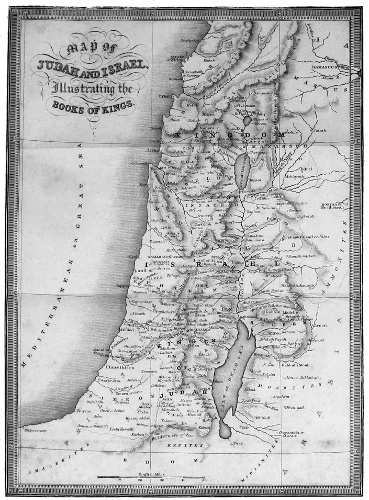
MAP OF JUDAH AND ISRAEL. Illustrating the BOOKS OF KINGS.
565Kings, Books of. The first book of Kings commences with an account of the death of David, and contains a period of a hundred and twenty-six years, to the death of Jehoshaphat; and the second book of Kings continues the history of the kings of Israel and Judah through a period of three hundred years, to the destruction of the city and temple of Jerusalem by Nebuchadnezzar. These two books formed only one in the Hebrew canon, and they were probably compiled by Ezra from the records which were regularly kept, both in Jerusalem and Samaria, of all public transactions. These records appear to have been made by the contemporary prophets, and frequently derived their names from the kings whose history they contained. They are mentioned in many parts of Scripture; thus 1 Kings xi, 41, we read of the book of the Acts of Solomon, which is supposed to have been written by Nathan, Ahijah, and Iddo, 2 Chron. ix, 29. We elsewhere read that Shemaiah the prophet, and Iddo the seer, wrote the Acts of Rehoboam, 2 Chron. xii, 15; that Jehu wrote the Acts of Jehoshaphat, 2 Chron. xx, 34; and Isaiah those of Uzziah and Hezekiah, 2 Chron. xxvi, 22; xxxii, 32. We may therefore conclude, that from these public records, and other authentic documents, were composed the two books of Kings; and the uniformity of their style favours the opinion of their being put into their present shape by the same person.
KISHON. That ancient river, the river Kishon,” falls into the bay of Acre, and has its source in the hills to the east of the plain of Esdraelon, which it intersects. Being enlarged by several small streams, it passes between Mount Carmel and the hills to the north, and then falls into the sea at this point. In the condition we saw it, says Maundrell, its waters were low and inconsiderable; but in passing along the side of the plain, we discerned the tracts of many lesser torrents, falling down into it from the mountains, which must needs make it swell exceedingly upon sudden rains, as doubtless it actually did at the destruction of Sisera’s host.
KISS, a mode of salutation, and token of respect, which has been practised in all nations. It was also in ordinary use among the Jews; hence Judas in this way saluted his Master. But there was also the kiss of homage, as one of the ceremonies performed at the inauguration of the kings of Israel. The Jews called it the kiss of majesty. Psalm ii, 12, seems to be an allusion to this. St. Paul speaks frequently of the kiss of peace, which was in use among believers, and was given by them to one another as a token of charity and union, publicly in their religious assemblies, Heb. xiii, 24. Kissing the feet is in eastern countries expressive of exuberant gratitude or reverence.
KITE, איה, Lev. xi, 14; Deut. xiv, 13; Job xxviii, 7. Bochart supposes this to be the bird which the Arabians call the ja-jao, from its note; and which the ancients named æsalon, the merlin,” a bird celebrated for its sharp-sightedness. This faculty is referred to in Job xxviii, 7, where the word is rendered vulture.” As a noun masculine plural, איים, in Isaiah xiii, 22; xxxiv, 14; and Jer. 1, 39, Bochart says that jackals are intended; but, by the several contexts, particularly the last, it may well mean a kind of unclean bird, and so be the same with that mentioned above.
KOHATH, the second son of Levi, and father of Amram, Izhar, Hebron, and Uzziel, Gen. xlvi, 11; Exod. vi, 18. Kohath’s family was appointed to carry the ark and sacred vessels of the tabernacle, while the Israelites marched through the wilderness, Num. iv, &c.
KORAH was the son of Izhar, of the race of Levi, and father of Asher, Elkanah, and Aliasaph, and head of the Korites, a celebrated family among the Levites. Korah, being dissatisfied with the rank he held among the sons of Levi, and envying the authority of Moses and Aaron, formed a party against them, in which he engaged Dathan, Abiram, and On, with two hundred and fifty of the principal Levites, Num. xvi, 1–3, &c. Korah, at the head of the rebels, went to Moses and Aaron, and complained that they alone arrogated to themselves all the authority over the people of the Lord. Moses falling with his face on the earth, answered them as follows: Tomorrow, in the morning, the Lord will discover who are his. Let every one of you take, therefore, his censer, and to-morrow he shall put incense into it, and offer it before the Lord; and he shall be acknowledged priest whom the Lord shall choose and approve.” The next day, Korah, with two hundred and fifty of his faction, presenting themselves with their censers before the Lord, the glory of the Lord appeared visibly over the tabernacle, and a voice was heard to say, Separate yourselves from among this congregation, that I may consume them in a moment.” Upon this, Moses and Aaron, falling with their faces to the ground, said, O God, the God of the spirits of all flesh, shall one man sin, and wilt thou be wroth with all the congregation?” And the Lord said unto Moses, Command all the people to depart from about the tents of Korah, Dathan, and Abiram.” When, therefore, the people were retired, Moses said, If these men die the common death of all men, then the Lord hath not sent me; but if the earth open and swallow them up quick, ye shall know that they have blasphemed the Lord.” As soon as he had spoken, the earth opened from under their feet, and swallowed them up with what belonged to them. There was one thing which added to this surprising wonder, and which was, that when Korah was thus swallowed up in the earth, his sons were preserved from his misfortunes. We know not the exact year in which the death of Korah and his companions happened. The sons of Korah continued as before to serve in the tabernacle of the Lord. David appointed them their office in the temple, to guard the doors, and sing the praises of God. To them are ascribed several psalms, which are designated by the name of Korah; as the forty-second, forty-fourth to the forty-ninth, eighty-fourth to the eighty-seventh; in all, eleven psalms.
566LABAN, the son of Bethuel, grandson of Nahor, brother to Rebekah, and father of Rachel and Leah, Gen. xxviii, 2, &c. Of this man, the first thing we hear is his entertainment of Abraham’s servant when he came on his errand to Rebekah. Hospitality was the virtue of his age and country. In his case, however, it seems to have been no little stimulated by the sight of “the ear ring and the bracelets on his sister’s hands,” which the servant had already given her, Gen. xxiv, 30; so he speedily made room for the camels. He next is presented to us as beguiling that sister’s son, who had sought a shelter in his house, and whose circumstances placed him at his mercy, of fourteen years’ service, when he had covenanted with him for seven only; endeavouring to retain his labour when he would not pay him his labour’s worth, himself devouring the portion which he should have given to his daughters, counting them but as strangers, Gen. xxxi, 15. Compelled, at length, to pay Jacob wages, he changes them ten times, and, in the spirit of a crafty, griping worldling, makes him account for whatever of the flock was torn of beasts or stolen, whether by day or night. When Jacob flies from this iniquitous service with his family and cattle, Laban still pursues and persecutes him, intending, if his intentions had not been overruled by a mightier hand, to send him away empty, even after he had been making, for so long a period, so usurious a profit of him.
LACHISH, a city of Palestine, Joshua x, 23; xv, 39. Sennacherib besieged Lachish, but did not make himself master of it. From thence it was that he sent Rabshakeh against Jerusalem, 2 Kings xviii, 17; xix, 8; 2 Chron. xxxii, 9.
LAMAISM, the religion of the people of Thibet. The Delai Lama, Grand Lama,” is at once the high priest, and the visible object of adoration, to this nation, to the hordes of wandering Tartars, and to the prodigious population of China. He resides at Patoli, a vast palace on a mountain near the banks of the Burampooter, about seven miles from Lahasse. The foot of the mountain is surrounded by twenty thousand lamas, or priests, in attendance on their sovereign pontiff, who is considered as the viceregent of the Deity on earth; and the remote Tartars are said to regard him absolutely as the Deity himself, and call him God, the everlasting Father of heaven. They believe him to be immortal, and endowed with all knowledge and virtue. Every year they come up from different parts to worship, and make rich offerings at his shrine. Even the emperor of China, who is a Mantchou Tartar, does not fail in acknowledgments to him in his religious capacity; and entertains in the palace of Pekin an inferior lama, deputed as his nuncio from Thibet. The grand lama is only to be seen in a secret place of his palace, amidst a great number of lamps, sitting cross-legged on a cushion, and decked all over with gold and precious stones; while, at a distance, the people prostrate themselves before him, it being not lawful for any so much as to kiss his feet. He returns not the least sign of respect, nor ever speaks, even to the greatest princes; but only lays his hand upon their heads, and they are fully persuaded that they thereby receive a full forgiveness of their sins. The Sunniasses, or Indian pilgrims, often visit Thibet as a holy place; and the lama entertains a body of two or three hundred in his pay. Beside his religious influence and authority, he is possessed of unlimited power throughout his dominions, which are very extensive. The inferior lamas, who form the most numerous as well as the most powerful body in the state, have the priesthood entirely in their hands, and, beside, fill up many monastic orders, which are held in great veneration among them. The whole country, like Italy, abounds with priests; and they entirely subsist on the rich presents sent them from the utmost extent of Tartary, from the empire of the great mogul, and from almost all parts of the Indies. The opinion of the orthodox among the Thibetians is, that when the grand lama seems to die, either of old age or infirmities, his soul, in fact, only quits a crazy habitation to enter another, younger and better; and is discovered again in the body of some child, by certain tokens, known only to the lamas, or priests, in which order he always appears. Almost all the nations of the east, except the Mohammedans, believe the metempsychosis, or transmigration of the soul, as the most important article of their faith; especially the inhabitants of Thibet and Ava, the Peguans, the Siamese, the greater part of the Chinese and Japanese, and the Monguls and Kalmucks. According to their doctrine, the soul no sooner leaves her old habitation than she enters a new one. The delai lama, therefore, or rather the god Foe or Fuh, residing in the delai lama, passes to his successor; and he being a god, to whom all things are known, the grand lama is therefore acquainted with every thing which happened during his residence in his former bodies. This religion, which was early adopted in a large part of the globe, is said to have been of three thousand years’ standing; and neither time, nor the influence of men, has had the power of shaking the authority of the grand lama. This theocracy, which extends as fully to temporal as to spiritual concerns, is professed all over Thibet and Mongalia; is almost universal in Greater and Less Bucharia, and several provinces of Tartary; has some followers in the kingdom of Cashmere, in India; and is the predominant religion of China.