ADVERTISEMENT TO THE AMERICAN EDITION. (continued 48)
Reading edition
There are two points in dispute on the subject of oracles; namely, whether they were human, or diabolical machines; and whether or not they ceased upon the publication or preaching of the Gospel. Most of the fathers of the church supposed that the devil issued oracles; and looked on it as a pleasure he took to give dubious and equivocal answers, in order to have a handle to laugh at them. Vossius allows that it was the devil who spoke in oracles; but thinks that the obscurity of his answers was owing to his ignorance as to the precise circumstances of events. That artful and studied obscurity in which the answers were couched, says he, showed the embarrassment the devil was under; as those double meanings they usually bore provided for their accomplishment. Where the thing foretold did not happen accordingly, the oracle, forsooth, was misunderstood. Eusebius has preserved some fragments of a philosopher, called Œnomaus; who, out of resentment for his having been so often fooled by the oracles, wrote an ample confutation of all their impertinencies: When we come to consult thee,” says he to Apollo, “if thou seest what is in futurity, why dost thou use expressions that will not be understood? Dost thou not know, that they will not be understood? If thou dost, thou takest pleasure in abusing us; if thou dost not, be informed of us, and learn to speak more clearly. I tell thee, that if thou intendest an equivoque, the Greek word whereby thou affirmedst that Crœsus should overthrow a great empire was ill chosen; and that it could signify nothing but Crœsus’s conquering Cyrus. If things must necessarily come to pass, why dost thou amuse us with thy ambiguities? What doest thou, wretch as thou art, at Delphi? employed in muttering idle prophecies!” But Œnomaus is still more out of humour with the oracle, for the answer which Apollo gave the Athenians, when Xerxes was about to attack Greece with all the strength of Asia. The Pythian declared, that Minerva, the protectress of Athens, had endeavoured in vain to appease the wrath of Jupiter; yet that Jupiter, in complaisance to his daughter, was willing the Athenians should save themselves within wooden walls; and that Salamis should behold the loss of a great many children, dear to their mothers, either when Ceres was spread abroad, or gathered together. Here Œnomaus loses all patience with the god of Delphi. This contest,” says he, “between father and daughter is very becoming the deities! It is excellent, that there should be contrary inclinations and interests in heaven. Poor wizard, thou art ignorant whose the children are that Salamis shall see perish; whether Greeks or Persians. It is certain they must be either one or the other; but thou needest not to have told so openly, that thou knewest not which. Thou concealest the time of the battle under those fine poetical expressions, ‘either when Ceres is spread abroad, or gathered together;’ and wouldest thou cajole us with such pompous language? Who knows not, that if there be a sea fight, it must either be in seed time or harvest? It is certain it cannot be in winter. Let things go how they will, thou wilt secure thyself by this Jupiter, whom Minerva is endeavouring to appease. If the Greeks lose the battle, Jupiter proved inexorable to the last; if they gain it, why then Minerva at length prevailed.”
It is a very general opinion among the more learned, that oracles were all mere cheats and impostures; either calculated to serve the avaricious ends of the Heathen priests, or the political views of the princes. Bayle says positively, they were mere human artificers, in which the devil had no hand. He was strongly supported by Van Dale and Fontenelle, who have written expressly on the subject. Father Balthus, a Jesuit, wrote a treatise in defence of the fathers with regard to the origin of oracles; but without denying the imposture of the priests, often blended with the oracles. He maintains the intervention of the devil in some predictions, which could not be ascribed to the cheats of the priests alone. The Abbé Banier espouses the same side of the question, and objects that oracles would not have lasted so long, and supported themselves with so much splendour and reputation, if they had been merely owing to the forgeries of the priests. Bishop Sherlock, in his Discourses concerning the Use and Intent of Prophecy,” expresses his opinion, that it is impious to disbelieve the Heathen oracles, and to deny them to have been given out by the devil; to which assertion, Dr. Middleton, in his Examination,” &c, replies, that he is guilty of this impiety, and that he thinks himself warranted to pronounce from the authority of the best and wisest of the Heathens themselves, and the evidence of plain facts, which are recorded of those oracles, as well as from the nature of the thing itself, that they were all mere imposture, wholly invented and supported by human craft, without any supernatural aid or interposition whatsoever. He alleges, that Cicero, speaking of the Delphic oracle, the most revered of any in the Heathen world, declares, that nothing was become more contemptible, not only in his days, but long before him; that Demosthenes, who lived about three hundred years earlier, affirmed of the same oracle, in a public speech to the people of Athens, that it was gained to the interests of King Philip, an enemy to that city; that the Greek historians tell us, how, on several other occasions, it had been corrupted by money, to serve the views of particular persons and parties, and the prophetess sometimes had been deposed for bribery and lewdness; that there were some great sects of philosophers, who, on principle, disavowed the authority of all oracles; agreeably to all which Strabo tells us, that divination in general and oracles had been in high credit among the ancients, but in his days were treated with much contempt; lastly, that Eusebius also, the great historian of the primitive church, declares, that there were six hundred writers among the Heathens themselves who had publicly 722written against the reality of them. Plutarch has a treatise on the ceasing of some oracles; and Van Dale, a Dutch physician, has a volume to prove they did not cease at the coming of Christ; but that many of them ceased long before, and that others held till the fall of Paganism, under the empire of Theodosius the Great, when Paganism being dissipated, these institutions could no longer subsist. Van Dale was answered by a German, one Mœbius, professor of theology at Leipsic, in 1685. Fontenelle espoused Van Dale’s system, and improved upon it in his History of Oracles;” and showed the weakness of the argument used by many writers in behalf of Christianity, drawn from the ceasing of oracles. Cicero says, the oracles became dumb in proportion as people, growing less credulous, began to suspect them for cheats. Plutarch alleges two reasons for the ceasing of oracles: the one was Apollo’s chagrin; who, it seems, took it in dudgeon to be interrogated about so many trifles. The other was, that in proportion as the genii, or demons, who had the management of the oracles, died, and became extinct, the oracles must necessarily cease. He adds a third and more natural cause for the ceasing of oracles; namely, the forlorn state of Greece, ruined and desolated by wars; for, hence, the smallness of the gains let the priests sink into a poverty and contempt too bare to cover the fraud. That the oracles were silenced about or soon after the time of our Saviour’s advent, may be proved, says Dr. Leland, in the first volume of his learned work on The Necessity and Advantage of Revelation,” &c, from express testimonies, not only of Christian but of Heathen authors. Lucan, who wrote his Pharsalia” in the reign of Nero, scarcely thirty years after our Lord’s crucifixion, laments it as one of the greatest misfortunes of that age, that the Delphian oracle, which he represents as one of the choicest gifts of the gods, was become silent.
Non ullo sæcula dono
Nostra carent majore Deum, quam Delphica sedes
Quod sileat.
Pharsal. lib. v, 111.
Of all the wants with which the age is curst,
The Delphic silence surely is the worst.”
Rowe.
In like manner, Juvenal says,
Delphis oracula cessant,
Et genus humanum damnat caligo futuri.
Sat. vi, 554.
Since Delphi now, if we may credit fame,
Gives no responses, and a long dark night
Conceals the future hour from mortal sight.”
Gifford.
Lucian says, that when he was at Delphi, the oracle gave no answer, nor was the priestess inspired. This likewise appears from Plutarch’s treatise, why the oracles cease to give answers, already cited; whence it is also manifest, that the most learned Heathens were very much at a loss how to give a tolerable account of it. Porphyry, in a passage cited from him by Eusebius, says, The city of Rome was overrun with sickness, Æsculapius and the rest of the gods having withdrawn their converse with men; because since Jesus began to be worshipped, no man had received any public help or benefit from the gods.” With respect to the origin of oracles, they were probably imitations, first, of the answers given to the holy patriarchs from the divine presence or Shechinah, and secondly, of the responses to the Jewish high priest from the mercy seat: for all Paganism is a parody of the true religion.
ORDINATION, the act of conferring holy orders, or of initiating a person into the ministry of the Gospel, by prayer and with or without the laying on of hands. In the church of England, ordination has always been esteemed the principal prerogative of bishops; and bishops still retain the function as a mark of their spiritual sovereignty in their diocess. Without ordination no person can receive any benefice, parsonage, vicarage, &c. A person must be twenty-three years of age, or near it, before he can be ordained deacon, or have any share in the ministry; and full twenty-four before he can be ordained priest, and by that means be permitted to administer the holy communion. A bishop, on the ordination of clergymen, is to examine them in the presence of the ministers, who in the ordination of priests, but not of deacons, assist him at the imposition of hands; but this is only done as a mark of assent, not because it is thought necessary. In case any crime, as drunkenness, perjury, forgery, &c, is alleged against any one that is to be ordained, either priest or deacon, the bishop ought to desist from ordaining him. The person to be ordained is to bring a testimonial of his life and doctrine to the bishop, and to give an account of his faith in Latin; and both priests and deacons are obliged to subscribe to the thirty-nine articles. In the ancient discipline there was no such thing as a vague and absolute ordination; but every one was to have a church, whereof he was to be ordained clerk or priest. In the twelfth century the bishops grew more remiss, and ordained without any title or benefice. The council of Trent, however, restored the ancient discipline, and appointed that none should be ordained but those who were provided with a benefice; which practice still obtains in the church of England.
The reformed held the call of the people the only thing essential to the validity of the ministry; and teach, that ordination is only a ceremony, which renders the call more august and authentic. Accordingly the Protestant churches of Scotland, France, Holland, Switzerland, Germany, Poland, Hungary, Denmark, &c, have no episcopal ordination. For Luther, Calvin, Bucer, Melancthon, &c, and all the first reformers and founders of these churches, who ordained ministers among them, were themselves presbyters, and no other. And though in some of these churches there are ministers called superintendents, or bishops, yet these are only primi inter pares, the first among equals; not pretending to any superiority of orders. Having themselves no other orders than what either presbyters gave them, or what was given them as presbyters, they can convey no other to those they ordain. 723On this ground the Protestant Dissenters plead that their ordination, though not episcopal, is the same with that of all the illustrious Protestant churches abroad; and object, that a priest ordained by a popish bishop should be received into the church of England as a valid minister, rightfully ordained; while the orders of another, ordained by the most learned religious presbyter, which any foreign country can boast, are pronounced not valid, and he is required to submit to be ordained afresh. In opposition to episcopal ordination, they urge that Timothy was ordained by the laying on of the hands of the presbytery, 1 Tim. iv, 14; that Paul and Barnabas were ordained by certain prophets and teachers in the church of Antioch, and not by any bishop presiding in that city, Acts xiii, 1–3; and that it is a well known fact, that presbyters in the church of Alexandria ordained even their own bishops for more than two hundred years in the earliest ages of Christianity. They farther argue, that bishops and presbyters are in Scripture the same, and not denominations of distinct orders or offices in the church, referring to Phil. i, 1; Titus i, 5, 7; Acts xx, 27, 28; 1 Peter v, 1, 2. To the same purpose they maintain, that the superiority of bishops to presbyters is not pretended to be of divine, but of human, institution; not grounded on Scripture, but only upon the custom or ordinances of this realm, by the first reformers and founders of the church of England; nor by many of its most learned and eminent doctors since. See Stillingfleet’s Irenicum, in which the learned author affirms and shows this to be the sentiment of Cranmer, and other chief reformers both in Edward VI. and Queen Elizabeth’s reign, of Archbishop Whitgift, Bishop Bridges, Lee, Hooker, Sutcliff, Hales, Chillingworth, &c. Moreover, the book entitled, the Institution of a Christian Man,” subscribed by the clergy in convocation, and confirmed by parliament, owns bishops and presbyters by Scripture to be the same. Beside, the Protestant Dissenters allege, that if episcopal ordination be really necessary to constitute a valid minister, it does not seem to be enjoined by the constitution of the church of England; because the power of ordination which the bishops exercise in this kingdom, is derived entirely and only from the civil magistrate; and he authoritatively prescribes how, and to whom ordination is to be given: that if an ordination should be conducted in other manner and form than that prescribed by him, such ordination would be illegal, and of no authority in the church. Accordingly the bishop at the ordination of the candidate asks, Are you called according to the will of our Lord Jesus Christ, and the due order of this realm?” The constitution and law of England seem to know nothing of uninterrupted lineal descent, but considers the king vested, by act of parliament, or the suffrage of the people, with a fulness of all power ecclesiastical in these realms, as empowering and authorizing bishops to ordain: and this power of ordination was once delegated to Cromwell, a layman, as vicegerent to the king. They farther think it strange, that the validity of orders and ministrations should be derived, as some have contended, from a succession of popish bishops; bishops of a church, which, by the definition of the nineteenth article of the church, can be no part of the true visible church of Christ, and bishops, likewise, who consider the Protestant clergy, although ordained by Protestant bishops, as mere common unconsecrated laymen.
On reviewing the whole of this controversy, says Dr. Watts, that since there are some texts in the New Testament, wherein single persons, either Apostles, as Paul and Barnabas, ordained ministers in the churches, or evangelists, as Timothy and Titus; and since other missions or ordinations are intimated to be performed by several persons, namely, prophets, teachers, elders, or a presbytery, Acts xiii, 1; 1 Timothy iv, 14; since there is sometimes mention made of the imposition of hands in the mission of a minister, and sometimes no mention is made of it; and since it is evident that in some cases popular ordinations are and must be valid without any bishop or elder,--I think none of these differences should be made a matter of violent contest among Christians; nor ought any words to be pronounced against each other by those of the episcopal, presbyterian, or independent way. Surely all may agree thus far, that various forms or modes, seeming to be used in the mission or ordination of ministers in primitive times, may give a reasonable occasion or colour for sincere and honest searchers after truth to follow different opinions on this head, and do therefore demand our candid and charitable sentiments concerning those who differ from us. Among the Wesleyan Methodists, the ordination of their ministers is in the annual conference, with a president at its head, and is by prayer without imposition of hands. The latter they hold to be a circumstance of ordination, not an essential. They sometimes therefore use it, and at others omit it. The missionaries sent out by that body, if not previously ordained by the conference, are set apart by a few senior ministers; and ordinarily in this case, the service of the church of England, with some alterations, is used, with imposition of the hands of the ministers present.
OSSIFRAGE, פרס, Lev. xi, 13; Deut. xiv, 12. Interpreters are not agreed on this bird; some read vulture,” others the black eagle,” others the falcon.” The name peres, by which it is called in Hebrew, denotes to crush, to break;” and this name agrees with our version, which implies the bone-breaker,” which name is given to a kind of eagle, from the circumstance of its habit of breaking the bones of its prey, after it has eaten the flesh: some say also, that he even swallows the bones thus broken. Onkelos uses a word which signifies naked,” and leads us to the vulture: indeed, if we were to take the classes of birds in any thing like a natural order in the passages here referred to, the vulture should follow the eagle as an unclean bird. The Septuagint interpreter also renders vulture; and 724so do Munster, Schindler, and the Zurick versions.
OSTRICH, יענה; in Arabic neamah; in Greek ϛρȣθοκάμηλος, the camel bird; and still in the east, says Niebuhr, it is called thar edsjammel, the camel bird,” Lev. xi, 16; Deut. xiv, 15; Job xxx, 29; Isaiah xiii, 21; xxxiv, 13; xliii, 20; Jer. 1, 39; Lam. iv, 3; Micah i, 8; רננים, Job xxxix, 13. The first name in the places above quoted is, by our own translators, generally rendered owls.” “Now it should be recollected,” says the author of Scripture Illustrated,” “that the owl is not a desert bird, but rather resides in places not far from habitations, and that it is not the companion of serpents; whereas, in several of these passages, the joneh is associated with deserts, dry, extensive, thirsty deserts, and with serpents, which are their natural inhabitants. Our ignorance of the natural history of the countries which the ostrich inhabits has undoubtedly perverted the import of the above passages; but let any one peruse them afresh, and exchange the owl for the ostrich, and he will immediately discover a vigour of description, and an imagery much beyond what he had formerly perceived.” The Hebrew phrase בת היענה, means the daughter בת היענה of vociferation,” and is understood to be the female ostrich, probably so called from the noise which this bird makes. It is affirmed by travellers of good credit, that ostriches make a fearful, screeching, lamentable noise.
Ostriches are inhabitants of the deserts of Arabia, where they live chiefly upon vegetables; lead a social and inoffensive life, the male assorting with the female with connubial fidelity. Their eggs are very large, some of them measuring above five inches in diameter, and weighing twelve or fifteen pounds. These birds are very prolific, laying forty or fifty eggs at a clutch. They will devour leather, grass, hair, stones, metals, or any thing that is given to them; but those substances which the coats of the stomach cannot act upon pass whole. It is so unclean an animal as to eat its own ordure as soon as it voids it. This is a sufficient reason, were others wanting, why such a fowl should be reputed unclean, and its use as an article of diet prohibited. The ostrich,” says M. Buffon, was known in the remotest ages, and mentioned in the most ancient books. How indeed could an animal so remarkably large, and so wonderfully prolific, and peculiarly suited to the climate as is the ostrich, remain unknown in Africa, and part of Asia, countries peopled from the earliest ages, full of deserts indeed, but where there is not a spot which has not been traversed by the foot of man? The family of the ostrich, therefore, is of great antiquity. Nor in the course of ages has it varied or degenerated from its native purity. It has always remained on its paternal estate; and its lustre has been transmitted unsullied by foreign intercourse. In short, it is among the birds what the elephant is among the quadrupeds, a distinct race, widely separated from all the others by characters as striking as they are invariable.” “On the least noise,” says Dr. Shaw, “or trivial occasion, she forsakes her eggs, or her young ones; to which perhaps she never returns; or if she does, it may be too late either to restore life to the one, or to preserve the lives of the others. Agreeably to this account the Arabs meet sometimes with whole nests of these eggs undisturbed: some of them are sweet and good, others are addle and corrupted; others again have their young ones of different growth, according to the time, it may be presumed, they have been forsaken of the dam. The Arabs often meet with a few of the little ones no bigger than well grown pullets, half starved, straggling and moaning about like so many distressed orphans for their mother. In this manner the ostrich may be said to be hardened against her young ones as though they were not hers; her labour, in hatching and attending them so far, being vain, without fear, or the least concern of what becomes of them afterward. This want of affection is also recorded, Lam. iv, 3, ‘the daughter of my people is become cruel, like ostriches in the wilderness;’ that is, by apparently deserting their own, and receiving others in return.” Natural affection and sagacious instinct are the grand instruments by which providence continues the race of other animals: but no limits can be set to the wisdom and power of God. He preserveth the breed of the ostrich without those means, and even in a penury of all the necessaries of life. Notwithstanding the stupidity of this animal, its Creator hath amply provided for its safety, by endowing it with extraordinary swiftness, and a surprising apparatus for escaping from its enemy. They, when they raise themselves up for flight, laugh at the horse and his rider.” They afford him an opportunity only of admiring at a distance the extraordinary agility and the stateliness likewise of their motions, the richness of their plumage, and the great propriety there was in ascribing to them an expanded quivering wing. Nothing certainly can be more entertaining than such a sight, the wings, by their rapid but unwearied vibrations, equally serving them for sails and oars; while their feet, no less assisting in conveying them out of sight, seem to be insensible of fatigue.
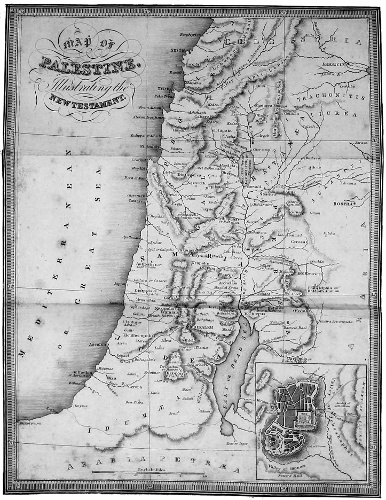
MAP OF PALESTINE. Illustrating the NEW TESTAMENT.
OWL. There are several varieties of this species, all too well known to need a particular description. They are nocturnal birds of prey, and have their eyes better adapted for discerning objects in the evening or twilight than in the glare of day. 1. כוס, Lev. xi, 17; Deut. xiv, 16; Psalm cii, 6, is in our version rendered the little owl.” Aquila, Theodotion, Jerom, Kimchi, and most of the older interpreters, are quoted to justify this rendering. Michaëlis, at some length, supports the opinion that it is the horned owl. Bochart, though with some hesitation, suspected it to be the onocrotalus, a kind of pelican, because the Hebrew name signifies cup, and the pelican is remarkable for a pouch or bag under the lower jaw; but there are good reasons for supposing that bird to be the קאת of the next verse. Dr. Geddes thinks this bird the cormorant; and as it begins the list of water fowl, and is mentioned always in 725the same contexts with קאת, confessedly a water bird, his opinion may be adopted. 2. קאת, Lev. xi, 17; Deut. xiv, 16; Isaiah xxxiv, 11. In the two first places our translators render this the great owl,” which is strangely placed after the little owl, and among water birds. Our translators,” says the author of Scripture Illustrated,” “seem to have thought the owl a convenient bird, as we have three owls in two verses.” Some critics think it means a species of night bird, because the word may be derived from נשף, which signifies the twilight, the time when owls fly about. But this interpretation, says Parkhurst, seems very forced; and since it is mentioned among water fowls, and the LXX. have, in the first and last of those texts, rendered it by ἴβις, the ibis, we are disposed to adopt it here, and think the evidence strengthened by this, that in a Coptic version of Lev. xi, 17, it is called ip or hip, which, with a Greek termination, would very easily make ιβις. 3. קפון, which occurs only in Isaiah xxxiv, 15, is in our version rendered the great owl.” 4. לילית, Isa. xxxiv, 14, in our version the screech owl.” The root signifies night; and as undoubtedly a bird frequenting dark places and ruins is referred to, we must admit some kind of owl.
A place of lonely desolation, where
The screeching tribe and pelicans abide,
And the dun ravens croak mid ruins drear,
And moaning owls from man the farthest hide.
OX, בקר, in Arabic bœkerre and bykar, the male of horned cattle of the beeve kind, at full age, when fit for the plough. Younger ones are called bullocks. Michaëlis, in his elaborate work on the laws of Moses, has proved that castration was never practised. The rural economy of the Israelites led them to value the ox as by far the most important of domestic animals, from the consideration of his great use in all the operations of farming. In the patriarchal ages, the ox constituted no inconsiderable portion of their wealth. Thus Abraham is said to be very rich in cattle, Gen. xxiv, 35. Men of every age and country have been much indebted to the labours of this animal. So early as in the days of Job, who was probably contemporary with Isaac, the oxen were ploughing, and the asses were feeding beside them,” when the Sabeans fell upon them, and took them away. In times long posterior, when Elijah was commissioned to anoint Elisha, the son of Shaphat, prophet in his stead, he found him ploughing with twelve yoke of oxen, 1 Kings xix, 19. For many ages the hopes of oriental husbandmen depended entirely on their labours. This was so much the case in the time of Solomon, that he observes, in one of his proverbs, Where no oxen are, the crib is clean,” or rather empty; but much increase is by the strength of the ox,” Prov. xiv, 4. The ass, in the course of ages was compelled to bend his stubborn neck to the yoke, and share the labours of the ox; but still the preparation of the ground in the time of spring depended chiefly on the more powerful exertions of the latter. When this animal was employed in bringing home the produce of the harvest, he was regaled with a mixture of chaff, chopped straw, and various kinds of grain, moistened with acidulated water. But among the Jews, the ox was best fed when employed in treading out the corn; for the divine law, in many of whose precepts the benevolence of the Deity conspicuously shines, forbad to muzzle him, and, by consequence, to prevent him from eating what he would of the grain he was employed to separate from the husks. The ox was also compelled to the labour of dragging the cart or wagon. The number of oxen commonly yoked to one cart appears to have been two, Num. vii, 3, 7, 8; 1 Sam. vi, 7; 2 Sam. vi, 3, 6.
The wild ox, תאן, Deut. xiv, 5, is supposed to be the oryx of the Greeks, which is a species of large stag.
PADAN-ARAM, called also Sedan-Aram in Hosea; both names denoting Aram or Syria the fruitful, or cultivated, and apply to the northern part of Mesopotamia, in which Haran or Charran was situated. See Mesopotamia.
PAGANS, Heathens, and particularly those who worship idols. The term came into use after the establishment of Christianity, the cities and great towns affording the first converts. The Heathens were called Pagans, from pagus, a village,” because they were then found chiefly in remote country places; but we use the term commonly for all who do not receive the Jewish, Christian, or Mohammedan religions.
PAINTING THE FACE, 2 Kings ix, 30. See Eyes.
PALESTINE, taken in a limited sense, denotes the country of the Philistines or Palestines, including that part of the land of promise which extended along the Mediterranean Sea, from Gaza south to Lydda north. The LXX. were of opinion that the word Philistiim, which they generally translate Allophyli, signified strangers,” or men of another tribe. Palestine, taken in a more general sense, signifies the whole country of Canaan, the whole land of promise, as well beyond as on this side Jordan, though pretty frequently it is restrained to the country on this side that river; so that in later times the words Judea and Palestine were synonymous. We find, also, the name of Syria Palestina given to the land of promise, and even sometimes this province is comprehended in Cœlo-Syria, or the Lower Syria. Herodotus is the most ancient writer we know that speaks of Syria Palestina. He places it between Phenicia and Egypt. See Canaan.
PALM TREE, תמר, Exodus xv, 27, &c. This tree, sometimes called the date tree, grows plentifully in the east. It rises to a great height. The stalks are generally full of rugged knots, which are the vestiges of the decayed leaves; for the trunk of this tree is not solid, like other trees, but its centre is filled with pith, round which is a tough bark full of strong fibres when young, which, as the tree grows old, hardens and becomes ligneous. 726To this bark the leaves are closely joined, which in the centre rise erect; but, after they are advanced above the vagina which surrounds them, they expand very wide on every side the stem; and, as the older leaves decay, the stalk advances in height. The leaves, when the tree has grown to a size for bearing fruit, are six or eight feet long, are very broad when spread out, and are used for covering the tops of houses, &c. The fruit, which is called date, grows below the leaves in clusters and is of a sweet and agreeable taste. The learned Kæmpfer, as a botanist, an antiquary, and a traveller, has exhausted the whole subject of palm trees. The diligent natives,” says Mr. Gibbon, celebrated, either in verse or prose, the three hundred and sixty uses to which the trunk, the branches, the leaves, the juice, and the fruit, were skilfully applied.” “The extensive importance of the date tree,” says Dr. E. D. Clarke, is one of the most curious subjects to which a traveller can direct his attention. A considerable part of the inhabitants of Egypt, of Arabia, and Persia, subsist almost entirely upon its fruit. They boast also of its medicinal virtues. Their camels feed upon the date stone. From the leaves they make couches, baskets, bags, mats, and brushes; from the branches, cages for their poultry, and fences for their gardens; from the fibres of the boughs, thread, ropes, and rigging; from the sap is prepared a spirituous liquor; and the body of the tree furnishes fuel. It is even said that from one variety of the palm tree, the phœnix farinifera, meal has been extracted, which is found among the fibres of the trunk, and has been used for food.”
In the temple of Solomon were pilasters made in the form of palm trees, 1 Kings vi, 29. It was under a tree of this kind that Deborah dwelt between Ramah and Bethel, Judges iv, 5. To the fair, flourishing, and fruitful condition of this tree, the psalmist very aptly compares the votary of virtue, Psalm xcii, 12, 13, 14:--
The righteous shall flourish like a palm tree.
Those that are planted in the house of Jehovah,
In the courts of our God, shall flourish;
In old age they shall still put forth buds,
They shall be full of sap and vigorous.
The palm tree is crowned at its top with a large tuft of spiring leaves about four feet long, which never fall off, but always continue in the same flourishing verdure. The tree, as Dr. Shaw was informed, is in its greatest vigour about thirty years after it is planted, and continues in full vigour seventy years longer; bearing all this while, every year, about three or four hundred pounds’ weight of dates. The trunk of the tree is remarkably straight and lofty. Jeremiah, speaking of the idols that were carried in procession, says they were upright as the palm tree, Jer. x, 5. And for erect stature and slenderness of form, the spouse, in Canticles vii, 7, is compared to this tree:--
How framed, O my love, for delights!
Lo, thy stature is like a palm tree,
And thy bosom like clusters of dates.
On this passage Mr. Good observes, that “the very word tamar, here used for the palm tree, and whose radical meaning is ‘straight,’ or ‘upright,’ (whence it was afterward applied to pillars or columns, as well as to the palm,) was also a general name among the ladies of Palestine, and unquestionably adopted in honour of the stature they had already acquired, or gave a fair promise of attaining.”
A branch of palm was a signal of victory, and was carried before conquerors in the triumphs. To this, allusion is made, Rev. vii, 9: and for this purpose were they borne before Christ in his way to Jerusalem, John xii, 13. From the inspissated sap of the tree, a kind of honey, or dispse, as it is called, is produced, little inferior to that of bees. The same juice, after fermentation, makes a sort of wine much used in the east. It is once mentioned as wine, Num. xxviii, 7; Exodus xxix, 40; and by it is intended the strong drink, Isaiah v, 11; xxiv, 9. Theodoret and Chrysostom, on these places, both Syrians, and unexceptionable witnesses in what belongs to their own country, confirm this declaration. This liquor,” says Dr. Shaw, which has a more luscious sweetness than honey, is of the consistence of a thin syrup, but quickly grows tart and ropy, acquiring an intoxicating quality, and giving by distillation an agreeable spirit, or arâky, according to the general name of these people for all hot liquors, extracted by the alembic.” Its Hebrew name is שכר, the σικερα of the Greeks; and from its sweetness, probably, the saccharum of the Romans. Jerom informs us that in Hebrew any inebriating liquor is called sicera, whether made of grain, the juice of apples, honey, dates, or any other fruit.”
This tree was formerly of great value and esteem among the Israelites, and so very much cultivated in Judea, that, in after times, it became the emblem of that country, as may be seen in a medal of the Emperor Vespasian upon the conquest of Judea. It represents a captive woman sitting under a palm tree, with this inscription, Judea capta;” [Judea captivated;] and upon a Greek coin, likewise, of his son Titus, struck upon the like occasion, we see a shield suspended upon a palm tree, with a Victory writing upon it. Pliny also calls Judea palmis inclyta, renowned for palms.” Jericho, in particular, was called the city of palms,” Deut. xxxiv, 3; 2 Chron. xxviii, 15; because, as Josephus, Strabo, and Pliny, have remarked, it anciently abounded in palm trees. And so Dr. Shaw remarks, that, though these trees are not now either plentiful or fruitful in other parts of the holy land, yet there are several of them at Jericho, where there is the conveniency they require of being often watered; where, likewise, the climate is warm, and the soil sandy, such as they thrive and delight in. Tamar, a city built in the desert by Solomon, 1 Kings ix, 18; Ezekiel xlvii, 19; xlviii, 28, was probably so named from the palm trees growing about it; as it was afterward by the Romans called Palmyra, or rather Palmira, on the same account, from palma, a palm tree.”
727PALMER WORM, גום, Joel i, 4; Amos iv, 9. Bochart says that it is a kind of locust, furnished with very sharp teeth, with which it gnaws off grass, corn, leaves of trees, and even their bark. The Jews support this idea by deriving the word from גוז or גזן, to cut, to shear, or mince. Notwithstanding the unanimous sentiments of the Jews that this is a locust, yet the LXX. read κάμπη, and the Vulgate eruca, a caterpillar;” which rendering is supported by Fuller. Michaëlis agrees with this opinion, and thinks that the sharp cutting teeth of the caterpillar, which, like a sickle, clear away all before them, might give name to this insect. Caterpillars also begin their ravages before the locust, which seems to coincide with the nature of the creature here intended.
PALSY. See Diseases.
PAMPHYLIA, a province of Asia Minor which gives name to that part of the Mediterranean Sea which washes its coast, Acts xxvii, 5. To the south it is bounded by the Mediterranean, and to the north by Pisidia; having Lycia to the west, and Cilicia to the east. Paul and Barnabas preached at Perga, in Pamphylia, Acts xiii, 13; xiv, 24.
PANTHEISM, a doctrine into which some of the sages of antiquity fell by revolting at the monstrous absurdities of Polytheism. Not knowing the true God as an infinite and personal subsistence, a cause above and distinct from all effects, they believed that God was every thing, and every thing God. This monstrous, and in its effects immoral, notion, is still held by the Brahmins of India.
PAPER REED, גמא, Exod. ii, 3; Job viii, 11; Isaiah xviii, 2; xxxv, 7. When the outer skin, or bark, is taken off, there are several films, or inner pellicles, one within another. These, when separated from the stalk, were laid on a table artfully matched and flatted together, and moistened with the water of the Nile, which, dissolving the glutinous juices of the plant, caused them to adhere closely together. They were afterward pressed, and then dried in the sun, and thus were prepared sheets or leaves for writing upon in characters marked by a coloured liquid passing through a hollow reed. The best papyrus was called ἱερατικὴ, or paper of the priests. On this the sacred documents of Egypt were written. Ancient books were written on papyrus, and those of the New Testament among the rest. In the fourth century however these sacred writings are found on skins. This was preferred for durability; and many decayed copies of the New Testament, belonging to libraries, were early transferred to parchment. Finally came paper, the name of which was taken from the Egyptian reed; but the materials of which it was fabricated were cotton and linen. See Bulrush and Book.
PAPHOS, a celebrated city of Cyprus, lying on the western coast of the island, where Venus (who from hence took the name of Paphia) had her most ancient and most famous temple; and here the Roman proconsul, Sergius Paulus, resided, whom St. Paul converted to Christianity, Acts xiii, 6.
PARABLE, ϖαραβολή, formed from ϖαραβάλλειν, to oppose or compare, an allegorical instruction, founded on something real or apparent in nature or history, from which a moral is drawn, by comparing it with some other thing in which the people are more immediately concerned. (See Allegory.) Aristotle defines parable, a similitude drawn from form to form. Cicero calls it a collation; others, a simile. F. de Colonia calls it a rational fable; but it may be founded on real occurrences, as many parables of our Saviour were. The Hebrews call it משל, from a word which signifies either to predominate or to assimilate; the Proverbs of Solomon are by them also called >משלים, parables, or proverbs.
Parable, according to the eminently learned Bishop Lowth, is that kind of allegory which consists of a continued narration of a fictitious or accommodated event, applied to the illustration of some important truth. The Greeks call these αἶνοι, allegories, or apologues; the Latins, fabulæ, or fables;” and the writings of the Phrygian sage, or those composed in imitation of him, have acquired the greatest celebrity. Nor has our Saviour himself disdained to adopt the same method of instruction; of whose parables it is doubtful whether they excel most in wisdom and utility, or in sweetness, elegance, and perspicuity. As the appellation of parable has been applied to his discourses of this kind, the term is now restricted from its former extensive signification to a more confined sense. But this species of composition occurs very frequently in the prophetic poetry, and particularly in that of Ezekiel. If to us they should sometimes appear obscure, we must remember, that, in those early times when the prophetical writings were indited, it was universally the mode throughout all the eastern nations to convey sacred truths under mysterious figures and representations. In order to our forming a more certain judgment upon this subject, Dr. Lowth has briefly explained some of the primary qualities of the poetic parables; so that, by considering the general nature of them, we may decide more accurately on the merits of particular examples.
It is the first excellence of a parable to turn upon an image well known and applicable to the subject, the meaning of which is clear and definite; for this circumstance will give it perspicuity, which is essential to every species of allegory. If the parables of the sacred prophets are examined by this rule, they will not be found deficient. They are in general founded upon such imagery as is frequently used, and similarly applied by way of metaphor and comparison in the Hebrew poetry. Examples of this kind occur in the parable of the deceitful vineyard, Isaiah v, 1–7, and of the useless vine, Ezek. xv; xix, 10–14; for under this imagery the ungrateful people of God are more than once described; Ezek. xix, 1–9; xxxi; xvi; xxiii. Moreover, the image must not only be apt and familiar, but it must be also elegant and beautiful in itself; since it is the purpose of a poetic parable, not only to 728explain more perfectly some proposition, but frequently to give it some animation and splendour. As the imagery from natural objects is in this respect superior to all others, the parables of the sacred poets consist chiefly of this kind of imagery. It is also essential to the elegance of a parable, that the imagery should not only be apt and beautiful, but that all its parts and appendages should be perspicuous and pertinent. Of all these excellencies, there cannot be more perfect examples than the parables that have been just specified; to which we may add the well known parable of Nathan, 2 Sam. xii, 1–4, although written in prose, as well as that of Jotham, Judges ix, 7–15, which appears to be the most ancient extant, and approaches somewhat nearer to the poetical form. It is also the criterion of a parable, that it be consistent throughout, and that the literal be never confounded with the figurative sense; and in this respect it materially differs from that species of allegory, called the continued metaphor, Isaiah v, 1–7. It should be considered, that the continued metaphor and the parable have a very different view. The sole intention of the former is to embellish a subject, to represent it more magnificently, or at the most to illustrate it, that, by describing it in more elevated language, it may strike the mind more forcibly; but the intent of the latter is to withdraw the truth for a moment from our sight, in order to conceal whatever it may contain ungrateful or reproving, and to enable it secretly to insinuate itself, and obtain an ascendency as it were by stealth. There is, however, a species of parable, the intent of which is only to illustrate the subject; such is that remarkable one of the cedar of Lebanon, Ezek. xxxi; than which, if we consider the imagery itself, none was ever more apt or more beautiful; or the description and colouring, none was ever more elegant or splendid; in which, however, the poet has occasionally allowed himself to blend the figurative with the literal description, verses 11, 14–17; whether he has done this because the peculiar nature of this kind of parable required it, or whether his own fervid imagination alone, which disdained the stricter rules of composition, was his guide, our learned author can scarcely presume to determine.
In the New Testament, the word parable is used variously: in Luke iv, 23, for a proverb, or adage; in Matt. xv, 15, for a thing darkly and figuratively expressed; in Heb. ix, 9, &c, for a type; in Luke xiv, 7, &c, for a special instruction; in Matt. xxiv, 32, for a similitude or comparison.
PARADISE, according to the original meaning of the term, whether it be of Hebrew, Chaldee, or Persian derivation, signifies, a place enclosed for pleasure and delight.” The LXX., or Greek translators of the Old Testament, make use of the word paradise, when they speak of the garden of Eden, which Jehovah planted at the creation, and in which he placed our first parents. There are three places in the Hebrew text of the Old Testament where this word is found, namely, Neh. ii, 8; Cant. iv, 13; Eccles. ii, 5. The term paradise is obviously used in the New Testament, as another word for heaven; by our Lord, Luke xxiii, 43; by the Apostle Paul, 2 Cor. xii, 4; and in the Apocalypse, ii, 7. See Eden.
PARAN, Desert of, a great and terrible wilderness” which the children of Israel entered after leaving Mount Sinai, Num. x, 12; Deut. i, 19; and in which thirty-eight of their forty years of wandering were spent. It extended from Mount Sinai on the south, to the southern border of the land of Canaan on the north; having the desert of Shur, with its subdivisions, the deserts of Etham and Sin, on the west, and the eastern branch of the Red Sea, the desert of Zin and Mount Seir, on the east. Burckhardt represents this desert, which he entered from that of Zin, or valley of El Araba, about the parallel of Suez, as a dreary expanse of calcareous soil, covered with black flints.
PARTRIDGE, קדא, 1 Samuel xxvi, 20; Jer. xvii, 11; ϖέρδιξ, Ecclus. xi, 30. In the first of these places David says, The king of Israel is come out to hunt a partridge on the mountains;” and in the second, The partridge sitteth,” on eggs, and produceth,” or hatcheth, not; so he that getteth riches, and not by right, shall leave them in the midst of his days, and at his end shall be contemptible.” This passage does not necessarily imply that the partridge hatches the eggs of a stranger, but only that she often fails in her attempts to bring forth her young. To such disappointments she is greatly exposed from the position of her nest on the ground, where her eggs are often spoiled by the wet, or crushed by the foot. So he that broods over his ill-gotten gains will often find them unproductive; or, if he leaves them, as a bird occasionally driven from her nest, may be despoiled of their possession. As to the hunting of the partridge, which, Dr. Shaw observes, is the greater, or red-legged kind, the traveller says: The Arabs have another, though a more laborious, method of catching these birds; for, observing that they become languid and fatigued after they have been hastily put up twice or thrice, they immediately run in upon them, and knock them down with their zerwattys, or bludgeons as we should call them.” Precisely in this manner Saul hunted David, coming hastily upon him, putting him up incessantly, in hopes that at length his strength and resources would fail, and he would become an easy prey to his pursuer. Forskal mentions a partridge whose name in Arabic is kurr; and Latham says, that, in the province of Andalusia in Spain, the name of the partridge is churr; both taken, no doubt, like the Hebrew, from its note.
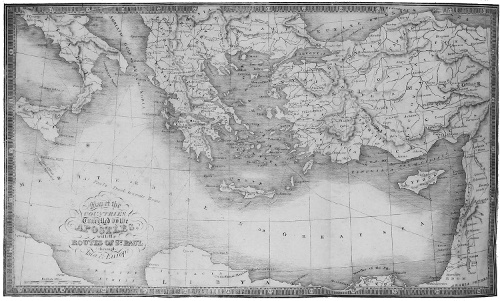
Map of the COUNTRIES Travelled by the APOSTLES with the ROUTES OF ST. PAUL through Asia & Europe
PASSOVER, פסח, signifies leap, passage. The passover was a solemn festival of the Jews, instituted in commemoration of their coming out of Egypt; because the night before their departure the destroying angel that slew the first-born of the Egyptians passed over the 729houses of the Hebrews without entering them, because they were marked with the blood of the lamb, which, for this reason, was called the paschal lamb. The following is what God ordained concerning the passover: the month of the coming out of Egypt was after this to be the first month of the sacred or ecclesiastical year; and the fourteenth day of this month, between the two evenings, that is, between the sun’s decline and its setting, or rather, according to our reckoning, between three o’clock in the afternoon and six in the evening, at the equinox, they were to kill the paschal lamb, and to abstain from leavened bread. The day following, being the fifteenth, reckoned from six o’clock of the preceding evening, was the grand feast of the passover, which continued seven days; but only the first and seventh days were peculiarly solemn. The slain lamb was to be without defect, a male, and of that year. If no lamb could be found, they might take a kid. They killed a lamb or a kid in each family; and if the number of the family was not sufficient to eat the lamb, they might associate two families together. With the blood of the lamb they sprinkled the door posts and lintel of every house, that the destroying angel at the sight of the blood might pass over them. They were to eat the lamb the same night, roasted, with unleavened bread, and a sallad of wild lettuces, or bitter herbs. It was forbid to eat any part of it raw, or boiled; nor were they to break a bone; but it was to be eaten entire, even with the head, the feet, and the bowels. If any thing remained to the day following it was thrown into the fire, Exod. xii, 46; Num. ix, 12; John xix, 36. They who ate it were to be in the posture of travellers, having their reins girt, shoes on their feet, staves in their hands, and eating in a hurry. This last part of the ceremony was but little observed; at least, it was of no obligation after that night when they came out of Egypt. During the whole eight days of the passover no leavened bread was to be used. They kept the first and last day of the feast; yet it was allowed to dress victuals, which was forbidden on the Sabbath day. The obligation of keeping the passover was so strict, that whoever should neglect it was condemned to death, Num. ix, 13. But those who had any lawful impediment, as a journey, sickness, or uncleanness, voluntary or involuntary, for example, those who had been present at a funeral, &c, were to defer the celebration of the passover till the second month of the ecclesiastical year, the fourteenth day of the month Jair, which answers to April and May. We see an example of this postponed passover under Hezekiah, 2 Chron. xxx, 2, 3, &c.
The modern Jews observe in general the ceremonies practised by their ancestors in the celebration of the passover. While the temple was in existence, the Jews brought their lambs thither, and there sacrificed them; and they offered their blood to the priest, who poured it out at the foot of the altar. The paschal lamb was an illustrious type of Christ, who became a sacrifice for the redemption of a lost world from sin and misery; but resemblances between the type and antitype have been strained by many writers into a great number of fanciful particulars. It is enough for us to be assured, that as Christ is called our passover;” and the Lamb of God,” without spot,” by the sprinkling of whose blood” we are delivered from guilt and punishment; and as faith in him is represented to us as eating the flesh of Christ,” with evident allusion to the eating of the paschal sacrifice; so, in these leading particulars, the mystery of our redemption was set forth. The paschal lamb therefore prefigured the offering of the spotless Son of God, the appointed propitiation for the sins of the whole world; by virtue of which, when received by faith, we are delivered from the bondage of guilt and misery; and nourished with strength for our heavenly journey to that land of rest, of which Canaan, as early as the days of Abraham, became the divinely instituted figure.
PATMOS, a small rocky island in the Ægean Sea, about eighteen miles in circumference; which, on account of its dreary and desolate character, was used by the Roman emperors as a place of confinement for criminals. To this island St. John was banished by the Emperor Domitian; and here he had his revelation, recorded in the Apocalypse.
PATRIARCHS. This name is given to the ancient fathers, chiefly those who lived before Moses, as Adam, Lamech, Noah, Shem, &c, Abraham, Isaac, Jacob, the sons of Jacob, and heads of the tribes. The Hebrews call them princes of the tribes, or heads of the fathers. The name patriarch is derived from the Greek patriarcha, head of a family.”
PAUL was born at Tarsus, the principal city of Cilicia, and was by birth both a Jew and a citizen of Rome, Acts xxi, 39; xxii, 25. He was of the tribe of Benjamin, and of the sect of the Pharisees, Phil. iii, 5. In his youth he appears to have been taught the art of tent making, Acts xviii, 3; but we must remember that among the Jews of those days a liberal education was often accompanied by instruction in some mechanical trade. It is probable that St. Paul laid the foundation of those literary attainments, for which he was so eminent in the future part of his life, at his native city of Tarsus; and he afterward studied the law of Moses, and the traditions of the elders, at Jerusalem, under Gamaliel, a celebrated rabbi, Acts xxii, 4. St. Paul is not mentioned in the Gospels; nor is it known whether he ever heard our Saviour preach, or saw him perform any miracle. His name first occurs in the account given in the Acts of the martyrdom of St. Stephen, A. D. 34, to which he is said to have consented, Acts viii, 1: he is upon that occasion called a young man; but we are no where informed what was then his precise age. The death of St. Stephen was followed by a severe persecution of the church at Jerusalem, and St. Paul became distinguished among its enemies by his activity and violence, Acts viii, 3. Not contented with displaying his hatred to the Gospel in Judea, he obtained authority from the high priest to go to Damascus, 730and to bring back with him bound any Christians whom he might find in that city. As he was upon his journey thither, A. D. 35, his miraculous conversion took place, the circumstances of which are recorded in Acts ix, and are frequently alluded to in his epistles, 1 Cor. xv, 9; Gal. i, 13; 1 Tim. i, 12, 13.
Soon after St. Paul was baptized at Damascus, he went into Arabia; but we are not informed how long he remained there. He returned to Damascus; and being supernaturally qualified to be a preacher of the Gospel, he immediately entered upon his ministry in that city. The boldness and success with which he enforced the truths of Christianity so irritated the unbelieving Jews, that they resolved to put him to death, Acts ix, 23; but, this design being known, the disciples conveyed him privately out of Damascus, and he went to Jerusalem, A. D. 38. The Christians of Jerusalem, remembering St. Paul’s former hostility to the Gospel, and having no authentic account of any change in his sentiments or conduct, at first refused to receive him; but being assured by Barnabas of St. Paul’s real conversion, and of his exertions at Damascus, they acknowledged him as a disciple, Acts ix, 27. He remained only fifteen days among them, Gal. i, 18; and he saw none of the Apostles except St. Peter and St. James. It is probable that the other Apostles were at this time absent from Jerusalem, exercising their ministry at different places. The zeal with which St. Paul preached at Jerusalem had the same effect as at Damascus: he became so obnoxious to the Hellenistic Jews, that they began to consider how they might kill him, Acts ix, 29; which when the brethren knew, they thought it right that he should leave the city. They accompanied him to Cæsarea, and thence he went into the regions of Syria and Cilicia, where he preached the faith which once he destroyed, Gal. i, 21, 23.
Hitherto the preaching of St. Paul, as well as of the other Apostles and teachers, had been confined to the Jews; but the conversion of Cornelius, the first Gentile convert, A. D. 40, having convinced all the Apostles that to the Gentiles, also, God had granted repentance unto life,” St. Paul was soon after conducted by Barnabas from Tarsus, which had probably been the principal place of his residence since he left Jerusalem, and they both began to preach the Gospel to the Gentiles at Antioch, A. D. 42, Acts xi, 25. Their preaching was attended with great success. The first Gentile church was now established at Antioch; and in that city, and at this time, the disciples were first called Christians, Acts xi, 26. When these two Apostles had been thus employed about a year, a prophet called Agabus predicted an approaching famine, which would affect the whole land of Judea. Upon the prospect of this calamity, the Christians of Antioch made a contribution for their brethren in Judea, and sent the money to the elders at Jerusalem by St. Paul and Barnabas, A. D. 44, Acts xi, 28, &c. This famine happened soon after, in the fourth or fifth year of the Emperor Claudius. It is supposed that St. Paul had the vision, mentioned in Acts xxii, 17, while he was now at Jerusalem this second time after his conversion.
St. Paul and Barnabas, having executed their commission, returned to Antioch; and soon after their arrival in that city they were separated, by the express direction of the Holy Ghost, from the other Christian teachers and prophets, for the purpose of carrying the glad tidings of the Gospel to the Gentiles of various countries, Acts xiii, 1. Thus divinely appointed to this important office, they set out from Antioch, A. D. 45, and preached the Gospel successively at Salamis and Paphos, two cities of the isle of Cyprus, at Perga in Pamphylia, Antioch in Pisidia, and at Iconium, Lystra, and Derbe, three cities of Lycaonia. They returned to Antioch in Syria, A. D. 47, nearly by the same route. This first apostolical journey of St. Paul, in which he was accompanied and assisted by Barnabas, is supposed to have occupied about two years; and in the course of it many, both Jews and Gentiles, were converted to the Gospel.
Paul and Barnabas continued at Antioch a considerable time; and while they were there, a dispute arose between them and some Jewish Christians of Judea. These men asserted, that the Gentile converts could not obtain salvation through the Gospel, unless they were circumcised; Paul and Barnabas maintained the contrary opinion, Acts xv, 1, 2. This dispute was carried on for some time with great earnestness; and it being a question in which not only the present but all future Gentile converts were concerned, it was thought right that St. Paul and Barnabas, with some others, should go up to Jerusalem to consult the Apostles and elders concerning it. They passed through Phenicia and Samaria, and upon their arrival at Jerusalem, A. D. 49, a council was assembled for the purpose of discussing this important point, Gal. ii, 1. St. Peter and St. James the less were present, and delivered their sentiments, which coincided with those of St. Paul and Barnabas; and after much deliberation it was agreed, that neither circumcision, nor conformity to any part of the ritual law of Moses, was necessary in Gentile converts; but that it should be recommended to them to abstain from certain specified things prohibited by that law, lest their indulgence in them should give offence to their brethren of the circumcision, who were still very zealous for the observance of the ceremonial part of their ancient religion. This decision which was declared to have the sanction of the Holy Ghost, was communicated to the Gentile Christians of Syria and Cilicia by a letter written in the name of the Apostles, elders, and whole church at Jerusalem, and conveyed by Judas and Silas, who accompanied St. Paul and Barnabas to Antioch for that purpose.
St. Paul, having preached a short time at Antioch, proposed to Barnabas that they should visit the churches which they had founded in different cities, Acts xv, 36. Barnabas readily consented; but while they were preparing for 731the journey, there arose a disagreement between them, which ended in their separation. In consequence of this dispute with Barnabas, St. Paul chose Silas for his companion, and they set out together from Antioch, A. D. 50. They travelled through Syria and Cilicia, confirming the churches, and then came to Derbe and Lystra, Acts xvi. Thence they went through Phrygia and Galatia; and, being desirous of going into Asia Propria, or the Proconsular Asia, they were forbidden by the Holy Ghost. They therefore went into Mysia; and, not being permitted by the Holy Ghost to go into Bithynia as they had intended, they went to Troas. While St. Paul was there, a vision appeared to him in the night: There stood a man of Macedonia, and prayed him, saying, Come over into Macedonia, and help us.” St. Paul knew this vision to be a command from Heaven, and in obedience to it immediately sailed from Troas to Samothracia, and the next day to Neapolis, a city of Thrace; and thence he went to Philippi, the principal city of that part of Macedonia. St. Paul remained some time at Philippi, preaching the Gospel; and several occurrences which took place in that city, are recorded in Acts xvii. Thence he went through Amphipolis and Apollonia to Thessalonica, Acts xvii, where he preached in the synagogues of the Jews on three successive Sabbath days. Some of the Jews, and many of the Gentiles of both sexes, embraced the Gospel; but the unbelieving Jews, moved with envy and indignation at the success of St. Paul’s preaching, excited a great disturbance in the city, and irritated the populace so much against him, that the brethren, anxious for his safety, thought it prudent to send him to Berea, where he met with a better reception than he had experienced at Thessalonica. The Bereans heard his instructions with attention and candour, and having compared his doctrines with the ancient Scriptures, and being satisfied that Jesus, whom he preached, was the promised Messiah, they embraced the Gospel; but his enemies at Thessalonica, being informed of his success at Berea, came thither, and, by their endeavours to stir up the people against him, compelled him to leave that city also. He went thence to Athens, where he delivered that discourse recorded in Acts xvii. From Athens, Paul went to Corinth, Acts xviii, A. D. 51, and lived in the house of Aquila and Priscilla, two Jews, who, being compelled to leave Rome in consequence of Claudius’s edict against the Jews, had lately settled at Corinth. St. Paul was induced to take up his residence with them, because, like himself, they were tent makers. At first he preached to the Jews in their synagogue; but upon their violently opposing his doctrine, he declared that from that time he would preach to the Gentiles only; and, accordingly, he afterward delivered his instructions in the house of one Justus, who lived near the synagogue. Among the few Jews who embraced the Gospel, were Crispus, the ruler of the synagogue, and his family; and many of the Gentile Corinthians hearing believed, and were baptized.” St. Paul was encouraged in a vision to persevere in his exertions to convert the inhabitants of Corinth; and although he met with great opposition and disturbance from the unbelieving Jews, and was accused by them before Gallio, the Roman governor of Achaia, he continued there a year and six months, teaching the word of God.” During this time he supported himself by working at his trade of tent making, that he might not be burdensome to the disciples. From Corinth St. Paul sailed into Syria, and thence he went to Ephesus: thence to Cæsarea; and is supposed to have arrived at Jerusalem just before the feast of pentecost. After the feast he went to Antioch, A. D. 53; and this was the conclusion of his second apostolical journey, in which he was accompanied by Silas; and in part of it, Luke and Timothy were also with him.
Having made a short stay at Antioch, St. Paul set out upon his third apostolical journey. He passed through Galatia, and Phrygia, A. D. 54, confirming the Christians of those countries; and thence, according to his promise, he went to Ephesus, Acts xix. He found there some disciples, who had only been baptized with John’s baptism: he directed that they should be baptized in the name of Jesus, and then he communicated to them the Holy Ghost. He preached for the space of three months in the synagogue; but the Jews being hardened beyond conviction, and speaking reproachfully of the Christian religion before the multitude, he left them; and from that time he delivered his instructions in the school of a person called Tyrannus, who was probably a Gentile. St. Paul continued to preach in this place about two years, so that all the inhabitants of that part of Asia Minor heard the word of the Lord Jesus, both Jews and Greeks.” He also performed many miracles at Ephesus; and not only great numbers of people were converted to Christianity, but many also of those who in this superstitious city used incantations and magical arts, professed their belief in the Gospel, and renounced their former practices by publicly burning their books. Previous to the disturbance raised by Demetrius, Paul had intended to continue at Ephesus till Titus should return, whom he had sent to inquire into the state of the church at Corinth, 2 Cor. xii, 18. He now thought it prudent to go from Ephesus immediately, Acts xx, A. D. 56; and having taken an affectionate leave of the disciples, he set out for Troas, 2 Cor. ii, 12, 13, where he expected to meet Titus. Titus, however, from some cause which is not known, did not come to Troas; and Paul was encouraged to pass over into Macedonia, with the hope of making converts. St. Paul, after preaching in Macedonia, receiving from the Christians of that country liberal contributions for their poor brethren in Judea, 2 Cor. viii, 1, went to Corinth, A. D. 57, and remained there about three months. The Christians also of Corinth, and of the rest of Achaia, contributed to the relief of their brethren in Judea. St. Paul’s intention was to have sailed from Corinth into Syria; but being 732informed that some unbelieving Jews, who had discovered his intention, lay in wait for him, he changed his plan, passed through Macedonia, and sailed from Philippi to Troas in five days, A. D. 58. He stayed at Troas seven days, and preached to the Christians on the first day of the week, the day on which they were accustomed to meet for the purpose of religious worship. From Troas he went by land to Assos; and thence he sailed to Mitylene; and from Mitylene to Miletus. Being desirous of reaching Jerusalem before the feast of pentecost, he would not allow time to go to Ephesus, and therefore he sent for the elders of the Ephesian church to Miletus, and gave them instructions, and prayed with them. He told them that he should see them no more, which impressed them with the deepest sorrow. From Miletus he sailed by Cos, Rhodes, and Patara in Lycia, to Tyre, Acts xxi. Finding some disciples at Tyre, he stayed with them several days, and then went to Ptolemais, and thence to Cæsarea. While St. Paul was at Cæsarea, the Prophet Agabus foretold by the Holy Ghost, that St. Paul, if he went to Jerusalem, would suffer much from the Jews. This prediction caused great uneasiness to St. Paul’s friends, and they endeavoured to dissuade him from his intention of going thither. St. Paul, however, would not listen to their entreaties, but declared that he was ready to die at Jerusalem, if it were necessary, for the name of the Lord Jesus. Seeing him thus resolute, they desisted from their importunities, and accompanied him to Jerusalem, where he is supposed to have arrived just before the feast of pentecost, A. D. 58. This may be considered as the end of St. Paul’s third apostolical journey.
St. Paul was received by the Apostles and other Christians at Jerusalem with great joy and affection; and his account of the success of his ministry, and of the collections which he had made among the Christians of Macedonia and Achaia, for the relief of their brethren in Judea, afforded them much satisfaction; but not long after his arrival at Jerusalem, some Jews of Asia, who had probably in their own country witnessed St. Paul’s zeal in spreading Christianity among the Gentiles, seeing him one day in the temple, endeavoured to excite a tumult, by crying out that he was the man who was aiming to destroy all distinction between Jew and Gentile; who taught things contrary to the law of Moses; and who had polluted the holy temple, by bringing into it uncircumcised Heathens. This representation did not fail to enrage the multitude against St. Paul; they seized him, dragged him out of the temple, beat him, and were upon the point of putting him to death, when he was rescued out of their hands by Lysias, a Roman tribune, and the principal military officer then at Jerusalem. What followed,--his defence before Felix and Agrippa,--his long detention at Cæsarea, and his appeal to the emperor, which occasioned his voyage to Rome, are all circumstantially stated in the latter chapters of the Acts. Upon his arrival at Rome, St. Paul was committed to the care of the captain of the guard, A. D. 61. The Scriptures do not inform us whether he was ever tried before Nero, who was at this time emperor of Rome; and the learned are much divided in their opinion upon that point. St. Luke only says, Paul was suffered to dwell by himself with a soldier that kept him. And Paul dwelt two whole years in his own hired house, and received all that came in unto him, preaching the kingdom of God, and teaching those things which concern the Lord Jesus Christ, with all confidence, no man forbidding him.” During his confinement he converted some Jews resident at Rome, and many Gentiles, and, among the rest, several persons belonging to the emperor’s household, Phil. iv, 22.
The Scripture history ends with the release of St. Paul from his two years’ imprisonment at Rome, A. D. 63; and no ancient author has left us any particulars of the remaining part of this Apostle’s life. It seems probable, that, immediately after he recovered his liberty, he went to Jerusalem; and that afterward he travelled through Asia Minor, Crete, Macedonia, and Greece, confirming his converts, and regulating the affairs of the different churches which he had planted in those countries. Whether at this time he also preached the Gospel in Spain, as some have imagined, is very uncertain. It was the unanimous tradition of the church, that St. Paul returned to Rome, that he underwent a second imprisonment there, and at last was put to death by the Emperor Nero. Tacitus and Suetonius have mentioned a dreadful fire which happened at Rome in the time of Nero. It was believed, though probably without any reason, that the emperor himself was the author of that fire; but to remove the odium from himself, he chose to attribute it to the Christians; and, to give some colour to that unjust imputation, he persecuted them with the utmost cruelty. In this persecution St. Peter and Paul suffered martyrdom, probably, A. D. 65; and if we may credit Sulpitius Severus, a writer of the fifth century, the former was crucified, and the latter beheaded.
St. Paul was a person of great natural abilities, of quick apprehension, strong feelings, firm resolution, and irreproachable life. He was conversant with Grecian and Jewish literature; and gave early proofs of an active and zealous disposition. If we may be allowed to consider his character independent of his supernatural endowments, we may pronounce that he was well qualified to have risen to distinction and eminence, and that he was by nature peculiarly adapted to the high office to which it pleased God to call him. As a minister of the Gospel, he displayed the most unwearied perseverance and undaunted courage. He was deterred by no difficulty or danger, and endured a great variety of persecutions with patience and cheerfulness. He gloried in being thought worthy of suffering for the name of Jesus, and continued with unabated zeal to maintain the truth of Christianity against its bitterest and most powerful enemies. He was the principal instrument under Providence of spreading the Gospel among the Gentiles; and we have seen that 733his labours lasted through many years, and reached over a considerable extent of country. Though emphatically styled the great Apostle of the Gentiles, he began his ministry, in almost every city, by preaching in the synagogue of the Jews; and though he owed by far the greater part of his persecutions to the opposition and malice of that proud and obstinate people, whose resentment he particularly incurred by maintaining that the Gentiles were to be admitted to an indiscriminate participation of the benefits of the new dispensation, yet it rarely happened in any place, that some of the Jews did not yield to his arguments, and embrace the Gospel. He watched with paternal care over the churches which he had founded; and was always ready to strengthen the faith, and regulate the conduct of his converts, by such directions and advice as their circumstances might require.
The exertions of St. Paul in the cause of Christianity were not confined to personal instruction: he also wrote fourteen epistles to individuals or churches which are now extant, and form a part of our canon. These letters furnish evidence of the soundness and sobriety of his judgment. His caution in distinguishing between the occasional suggestions of inspiration, and the ordinary exertions of his natural understanding, is without example in the history of enthusiasm. His morality is every where calm, pure, and rational; adapted to the condition, the activity, and the business of social life, and of its various relations; free from the overscrupulousness and austerities of superstition, and from, what was more perhaps to be apprehended, the abstractions of quietism, and the soarings or extravagancies of fanaticism. His judgment concerning a hesitating conscience, his opinion of the moral indifferency of many actions, yet of the prudence and even the duty of compliance, where non-compliance would produce evil effects upon the minds of the persons who observed it, are all in proof of the calm and discriminating character of his mind; and the universal applicability of his precepts affords strong presumption of his inspiration. What Lord Lyttleton has remarked of the preference ascribed by St. Paul to rectitude of principle above every other religious accomplishment, is weighty: Though I speak with the tongues of men and of angels, and have not charity, I am become as sounding brass, or a tinkling cymbal,” &c, 1 Cor. xiii, 1–3. Did ever enthusiast prefer that universal benevolence, meant by charity here, (which, we may add, is attainable by every man,) to faith, and to miracles, to those religious opinions which he had embraced, and to those supernatural graces and gifts which he imagined he had acquired, nay, even to the merit of martyrdom? Is it not the genius of enthusiasm to set moral virtues infinitely below the merit of faith; and of all moral virtues to value that least which is most particularly enforced by St. Paul, a spirit of candour, moderation, and peace? Certainly, neither the temper nor the opinions of a man subject to fanatic delusions are to be found in this passage. His letters, indeed, every where discover great zeal and earnestness in the cause in which he was engaged; that is to say, he was convinced of the truth of what he taught; he was deeply impressed, but not more so than the occasion merited, with a sense of its importance. This produces a corresponding animation and solicitude in the exercise of his ministry. But would not these considerations, supposing them to have been well founded, have holden the same place, and produced the same effect, in a mind the strongest and the most sedate? Here, then, we have a man of liberal attainments, and in other respects of sound judgment, who had addicted his life to the service of the Gospel. We see him in the prosecution of his purpose, travelling from country to country, enduring every species of hardship, encountering every extremity of danger, assaulted by the populace, punished by the magistrates, scourged, beaten, stoned, left for dead; expecting, wherever he came, a renewal of the same treatment, and the same dangers; yet, when driven from one city, preaching in the next; spending his whole time in the employment; sacrificing to it his pleasures, his ease, his safety; persisting in this course to old age, unaltered by the experience of perverseness, ingratitude, prejudice, desertion; unsubdued by anxiety, want, labour, persecutions; unwearied by long confinement; undismayed by the prospect of death. Such was St. Paul; and such were the proofs of Apostleship found in him.”
The following remarks of Hug on the character of this Apostle are equally just and eloquent: This most violent man, having such terrible propensities, whose turbulent impulses rendered him of a most enterprising character, would have become nothing better than a John of Gishala, a blood-intoxicated zealot, εμπνεων απειλης και φονου, breathing out threatenings and slaughter, Acts ix, 1, had not his whole soul been changed. The harsh tone of his mind inclined him to the principles of Pharisaism, which had all the appearance of severity, and was the predominant party among the Jews. Nature had not withholden from him the external endowments of eloquence, although he afterward spoke very modestly of them. At Lystra he was deemed the tutelar god of eloquence. This character, qualified for great things, but, not master of himself from excess of internal power, was an extreme of human dispositions, and, according to the natural course, was prone to absolute extremities. His religion was a destructive zeal, his anger was fierceness, his fury required victims. A ferocity so boisterous did not psychologically qualify him for a Christian nor a philanthropist; but, least of all, for a quietly enduring man. He, nevertheless, became all this on his conversion to Christianity, and each bursting emotion of his mind subsided directly into a well regulated and noble character. Formerly hasty and irritable, now only spirited and resolved; formerly violent, now full of energy and enterprising: once ungovernably refractory 734against every thing which obstructed him, now only persevering; once fanatical and morose, now only serious; once cruel, now only firm; once a harsh zealot, now fearing God; formerly unrelenting, deaf to sympathy and commiseration, now himself acquainted with tears, which he had seen without effect in others. Formerly the friend of none, now the brother of mankind, benevolent, compassionate, sympathizing; yet never weak, always great; in the midst of sadness and sorrow manly and noble; so he showed himself at his deeply moving departure from Miletus, Acts xx: it is like the departure of Moses, like the resignation of Samuel, sincere and heart-felt, full of self-recollection, and in the midst of pain full of dignity. His writings are a true expression of this character, with regard to the tone predominant in them. Severity, manly seriousness, and sentiments which ennoble the heart, are interchanged with mildness, affability, and sympathy: and their transitions are such as nature begets in the heart of a man penetrated by his subject, noble and discerning. He exhorts, reproaches, and consoles again; he attacks with energy, urges with impetuosity, then again he speaks kindly to the soul; he displays his finer feelings for the welfare of others, his forbearance and his fear of afflicting any body: all as the subject, time, opposite dispositions, and circumstances require. There prevails throughout in them an importuning language, an earnest and lively communication. Rom. i, 26–32, is a comprehensive and vigorous description of morals. His antithesis, Rom. ii, 21–24; 2 Cor. iv, 8–12; vi, 9–11; ix, 22–30; his enumerations, 1 Cor. xiii, 4–10; 2 Cor. vi, 4–7; 2 Tim. iii, 1–5; Eph. iv, 4–7; v, 3–6; his gradations, Romans viii, 29, 30; Titus iii, 3, 4; the interrogations, exclamations, and comparisons, sometimes animate his language even so as to give a visible existence to it. That, however, which we principally perceive in Paul, and from which his whole actions and operations become intelligible, is the peculiar impression which the idea of a universal religion has wrought upon his mind. This idea of establishing a religion for the world had not so profoundly engrossed any soul, no where kindled so much vigour, and projected it into such a constant energy. In this he was no man’s scholar; this he had immediately received from the Spirit of his Master; it was a spark of the divine light which enkindled him. It was this which never allowed him to remain in Palestine and in Syria, which so powerfully impelled him to foreign parts. The portion of some others was Judea and its environs: but his mission was directed to the nations, and his allotment was the whole of the Heathen world. Thus he began his career among the different nations of Asia Minor, and when this limit also became too confined for him, he went with equal confidence to Europe, among other nations, ordinances, sciences, and customs; and here likewise he finally with the same indefatigable spirit circulated his plans, even to the pillars of Hercules. In this manner Paul prepared the overthrow of two religions, that of his ancestors, and that of the Heathens.
PEACOCK, תוכיים, 1 Kings x, 22; 2 Chron. ix, 21; a bird distinguished by the length of its tail, and the brilliant spots with which it is adorned; which displays all that dazzles in the sparkling lustre of gems, and all that astonishes in the rainbow. The peacock is a bird originally of India; thence brought into Persia and Media. Aristophanes mentions Persian peacocks; and Suidas calls the peacock the Median bird. From Persia it was gradually dispersed into Judea, Egypt, Greece, and Europe. If the fleet of Solomon visited India, they might easily procure this bird, whether from India itself, or from Persia; and certainly the bird by its beauty was likely to attract attention, and to be brought among other rarities of natural history by Solomon’s servants, who would be instructed to collect every curiosity in the countries they visited.
PEARL, a hard, white, shining body, usually roundish, found in a shell fish resembling an oyster. The oriental pearls have a fine polished gloss, and are tinged with an elegant blush of red. They are esteemed in the east beyond all other jewels.
PELAGIANS, a sect that arose in the fifth century. Pelagius was a British monk, of some rank, and very exalted reputation. He, with his friend Celestius, travelled to Rome, where they resided very early in the fifth century, and opposed with warmth certain received notions respecting original sin, and the necessity of divine grace. What reception their doctrines met with at Rome does not appear; but their virtue excited general approbation. On the approach of the Goths, they retired to Africa, where Celestius remained, with a view of gaining admittance as a presbyter into the church of Carthage. Pelagius proceeded to Palestine, where he enjoyed the favour and protection of John, bishop of Jerusalem. But his friend and his opinions met with a very different reception from St. Augustine, the celebrated bishop of Hippo. Whatever parts were visited by these unorthodox friends, they still asserted their peculiar opinions; and they were gradually engaged in a warm contest, in the course of which they were probably led to advance more than had originally occurred to them. In contending for the truth of their doctrines, they are said to have asserted, that mankind derived no injury from the sin of Adam; that we are now as capable of obedience to the will of God as he was; that, otherwise, it would have been cruel and absurd to propose to mankind the performance of certain duties, with the sanction of rewards, and the denunciation of punishments; and that, consequently, men are born without vice, as well as without virtue.” Pelagius is charged also with having maintained, that it is possible for men, provided they fully employ the powers and faculties with which they are endued, to live without sin;” and though he did not deny that external grace, or the doctrines and motives of the Gospel, are necessary, yet 735he is said to have rejected the necessity of internal grace, or the aids of the divine Spirit. He acknowledged, that the power we possess of obeying the will of God, is a divine gift;” but asserted, that the direction of this power depends upon ourselves; that natural death is not a consequence of the sin of Adam, but of the frame of man; and that Adam would have died, though he had not sinned.” Isidore, Chrysostom, and Augustine strenuously opposed these opinions; and the latter procured their condemnation in a synod held at Carthage in 412. They were, however, favourably received at Rome, and Pope Zozimus was at the head of the Pelagian party: but his decision against the African bishops, who had opposed Pelagianism, was disregarded by them, and the pontiff yielded at length to their reasonings and remonstrances, and condemned the men whom he had before honoured with his approbation. The council of Ephesus likewise condemned the opinions of Pelagius and Celestius; and the Emperor Honorius, in 418, published an edict, which ordained that the leaders of the sect should be expelled from Rome, and their followers exiled. Some of the Pelagians taught that Christ was a mere man, and that men might lead sinless lives, because Christ did so; that Jesus became Christ after his baptism, and God after his resurrection; the one arising from his unction, the other from the merit of his passion. The Pelagian controversy, which began with the doctrines of grace and original sin, was extended to predestination, and excited continual discord and division in the church. It must however be recollected, that we are acquainted with the sentiments of Pelagius only through the medium of his opponents; and that it is probable that they were much misrepresented. See Augustine.
The followers of the truly evangelical Arminius, or those who hold the tenet of general redemption with its concomitants, have often been greatly traduced, by the ignorant among their doctrinal opponents, as Pelagians, or at least as Semi-Pelagians. It may therefore serve the cause of truth to exhibit the appropriate reply which the Dutch Arminians gave to this charge when urged against them at the synod of Dort, and which they verified and maintained by arguments and authorities that were unanswerable. In their concluding observations they say, “From all these remarks a judgment may easily be formed at what an immense distance our sentiments stand from the dogmatical assertions of the Pelagians and Semi-Pelagians on the grace of God in the conversion of man. Pelagius, in the first instance, attributed all things to nature: but we acknowledge nothing but grace. When Pelagius was blamed for not acknowledging grace, he began indeed to speak of it, but it is evident that by grace he understood the power of nature as created by God, that is, the rational will: but by grace we understand a supernatural gift. Pelagius, when afterward pressed with passages of Scripture, also admitted this supernatural grace; but he placed it solely in the external teaching of the law: though we affirm that God offers his word to men, yet we likewise affirm that he inwardly causes the understanding to believe. Subsequently Pelagius joined to this external grace that by which sins are pardoned: we acknowledge not only the grace by which sins are forgiven, but also that by which men are assisted to refrain from the commission of sin. In addition to his previous concessions Pelagius granted, that the grace of Christ was requisite beside the two kinds which he had enumerated; but he attributed it entirely to the doctrine and example of Christ that we are aided in our endeavours not to commit sin: we likewise admit that the doctrine and example of Christ afford us some aid in refraining from sin, but in addition to their influence we also place the gift of the Holy Spirit with which God endues us, and which enlightens our understandings, and confers strength and power upon our will to abstain from sinning. When Pelagius afterward owned the assistance of divine power inwardly working in man by the Holy Spirit, he placed it solely in the enlightening of the understanding: but we believe, that it is not only necessary for us to know or understand what we ought to do, but that it is also requisite for us to implore the aid of the Holy Spirit that we may be rendered capable of performing, and may delight in the performance of, that which it is our duty to do. Pelagius admitted grace,--but it has been a question with some whether he meant only illumination, or, beside this, a power communicated to the will;--he admitted grace, but he did this only to show that by means of it man can with greater ease act aright: we, on the contrary, affirm that grace is bestowed, not that we may be able with greater ease to act aright, (which is as though we can do this even without grace,) but that grace is absolutely necessary to enable us to act at all aright. Pelagius asserted, that man, so far from requiring the aid of grace for the performance of good actions, is, through the powers implanted in him at the time of his creation, capable of fulfilling the whole law, of loving God, and of overcoming all temptations: we, on the contrary, assert that the grace of God is required for the performance of every act of piety. Pelagius declared, that by the works of nature man renders himself worthy of grace: but we, in common with the church universal, condemn this dogma. When Pelagius afterward himself condemned this tenet, he understood by grace, partly natural grace, which is antecedent to all merit, and partly remission of sins, which he acknowledged to be gratuitous; but he added, that through works performed by the powers of nature alone, at least through the desire of good and the imperfect longing after it, men merit that spiritual grace by which they are assisted in good works: but we declare, that men will that which is good on account of God’s prevenience or going before them by his grace, and exciting within them a longing after good; otherwise grace would no longer be grace, because it would not be gratuitously 736bestowed, but only on account of the merit of man.” That many who have held some tenets in common with the true Arminians have been, in different degrees, followers of Pelagius is well known; but the original Arminians were in truth as far from Pelagian or Semi-Pelagian errors, granting the opinions of Pelagius to be fairly reported by his adversaries, as the Calvinists themselves. This is also the case with the whole body of Wesleyan Methodists, and of the cognate societies to which they have given rise, both in Great Britain and America.
PELICAN, קאת, Lev. xi, 18; Deut. xiv, 17; Psa. cii, 7; Isa. xxxiv, 11; Zeph. ii, 14; a very remarkable aquatic bird, of the size of a large goose. Its colour is a grayish white, except that the neck looks a little yellowish, and the middle of the back feathers are blackish. The bill is long, and hooked at the end, and has under it a lax membrane, extended to the throat, which makes a bag or sack, capable of holding a very large quantity. Feeding her young from this bag has so much the appearance of feeding them with her own blood, that it caused this fabulous opinion to be propagated, and made the pelican an emblem of paternal, as the stork had been before chosen, more justly, of filial affection. The voice of this bird is harsh and dissonant, which some say resembles that of a man grievously complaining. David compares his groaning to it, Psalm cii, 7.