Zoological Illustrations,
Reading edition
OR
ORIGINAL FIGURES AND DESCRIPTIONS
OF
NEW, RARE, OR INTERESTING
ANIMALS,
SELECTED CHIEFLY FROM THE CLASSES OF
Ornithology, Entomology, and Conchology,
AND ARRANGED ON THE PRINCIPLES OF
CUVIER AND OTHER MODERN ZOOLOGISTS.
BY
WILLIAM SWAINSON, F.R.S., F.L.S.,
MEMBER OF THE WERNERIAN SOCIETY OF EDINBURGH, ETC.
VOL. III.

London:
PRINTED BY JAMES MOYES, GREVILLE STREET;
FOR BALDWIN, CRADOCK, AND JOY, PATERNOSTER-ROW; AND W. WOOD, STRAND.
1822-3.
PREFACE.
In concluding the last volume of these Illustrations, I may be allowed to express the satisfaction I feel, at the favourable manner in which the work has been received, both in this country and on the continent.
Several objections have been urged, even by sensible writers, against miscellaneous works on Zoology. First, that they range over the whole animal kingdom, without completing the history of any one tribe. Secondly, that their authors, while professing to illustrate only what is new or little known, intrude a large proportion of subjects to be found in all the common natural histories. And thirdly, that this rapid mode of publishing new discoveries, is an infringement on the right, and is detrimental to the labours, of those naturalists who direct their attention to one particular branch. These objections, however, are not unanswerable; for, in the first place, these miscellanies should more properly be considered as graphic illustrations, or collections of figures, wherein the efforts of the artist, aided by scientific knowledge, are called forth, to complete, by his pencil, the more minute and detailed descriptions which should proceed from the pen of the monographer. The most perfect works in the science are undoubtedly those which unite the labours of both; but, in proportion as this perfection is attained, the general utility of such works is diminished. They become so enormously expensive, that they are only to be seen in universities and princely libraries; for the most part inaccessible to the naturalist, and nearly unknown to the public at large. The works of Le Vaillant, Desmarest, Vieillot, Ferussac, and several others, published in France and Germany, are of this description; and while in one sense they have considerably benefitted the science, they have in another proved very detrimental to its general diffusion. No sensible naturalist will risk his fame, by giving his observations to the world, without knowing what has been done by those who have preceded him;—until, in fact, he has proper materials to work upon. He knows that these sumptuous authors should be consulted; he has not the means of so doing; and he relinquishes his purpose in despair. Such has been the result in two or three instances which I could mention: and the power of materially extending the bounds of science is thus confined to those favoured few, who are so fortunate as to possess, or to have the power of consulting, those splendid publications.
The second objection is well grounded; but in whatever degree it may apply elsewhere, I trust the following pages will evince my anxiety to render the work replete with subjects hitherto unknown or unrecorded; and my own collections, in most cases, have given me ample means for examining and comparing both the genera and species of nearly all the subjects I have attempted to illustrate.
In several instances my opinions will be found to differ from those of many celebrated naturalists of the day; but I have endeavoured to put the reader in possession of the reasons which have led to the conclusions I have adopted. This is but justice towards those who have preceded me, and to the great body of naturalists, by whom such questions will ultimately be decided. The age is past wherein the ipse dixit of a great name was enough to check all inquiries after truth. Assertions must now be proved before they are admitted: and those writers who lay before the public tribunal of science their facts, their arguments, and their deductions, can alone hope to have their opinions generally adopted.
The third and last objection is as new as it is singular; and has been urged against Miscellanies in general by an anonymous French writer.[1] However an author may feel annoyance or disappointment, that another should be the first to publish discoveries, which he fancies belong exclusively to himself, he surely has no title to complain. The field of Nature is open to the inquiries of all. In her domain there are not yet established any scientific preserves.[2] If occupation or indolence does not permit one labourer to make known his discoveries, is another (who perhaps unconsciously has been working on the same ground) to hide the knowledge he has gained? This is surely a principle at once illiberal and unjust. At this time, there is not perhaps a single department of Zoology which is not employing the attention of more than one writer. It is to the honour, and to the lasting benefit of science, that it should be so: and although a great part of the new objects collected during my travels in Europe and Brazil have recently been made public by MM. Temminck and Godart, I feel rejoiced that this has been done by such distinguished men.
I have been induced to enter (perhaps too fully) into a general defence of Zoological miscellanies, from the opinion I entertain of their great utility. First, in diffusing a general knowledge, and exciting a taste for such pursuits among the great mass of readers; and secondly, as being a prompt and interesting channel of communicating new discoveries to the scientific world. Their periodical appearances and comparative cheapness renders them of easy access to the student; and, if well conducted, they unite all that is essential from the pen and the pencil.
Several foreign journals have noticed the appearance of these Illustrations, and generally in such terms as to stamp a value on their contents. One of these, however,[3] contains several misrepresentations, which have doubtless escaped the notice of the editor; and which, therefore, it may be as well to explain in this place. The writer in this journal, while noticing my Illustrations, seems to have mixed up with it criticisms intended for another periodical miscellany,[4] to which this has, perhaps, given birth, and which professes to be on a similar plan. He states that these Illustrations are to be completed in sixty numbers, making five volumes. No such declaration, to my knowledge, has ever been made, although such is the averred plan of the Naturalist's Repository. The reviewer goes on to state: "Il suit pour l'Entomologie et la Conchologie la classification surannée de Linnæus." This is not a very respectful mode of speaking of the labours of the greatest naturalist whom his age produced; but the proposition is a total mistake; the charge is refuted by almost every page of my work; and, what is rather extraordinary, by the very quotations of the reviewer. In reply to the regret expressed, "que l'auteur n'indique pas toujours les ouvrages les plus récens," I should have been thankful had he subjoined what works these were; as I do not find, in the monthly lists of the Bulletin, any one which I have not consulted or referred to, if connected with the objects here described.[5] M. de Ferussac's work has been regularly cited, but his Prodromus I have never been able to procure, either in England or Paris.
And here I cannot refrain from adverting to the great number of Zoological publications which have appeared in this country during the last three years; a number far exceeding in proportion that of any period in the annals of the science. Dr. Horsfield has commenced a beautiful work on the Animals of Java; and Mr. Sowerby is prosecuting his Genera of Shells with much zeal, and with increased ability. Both these appear periodically. They are conducted on the modern principles of science, and do credit to their authors. The Naturalist's Repository, before alluded to, likewise appears monthly, but is carried on according to the Linnæan system, pure and unadulterated. All these, however, unite in showing how rapidly the taste for such works has increased. Added to these, a new quarterly Journal, exclusively devoted to Zoology, has been announced, and, if conducted on liberal principles, its utility will be very great.
But nothing, perhaps, has more fully evinced the state of public feeling on this point among men of enlightened minds, than the discussions which have arisen on the present state of the British Museum. It is a subject on which I might be tempted to say much, did I not feel, that among those who do not know me, I might be suspected of interested or unworthy motives. But from the retirement of a country life, I may now be allowed perhaps to say a few words. It is indeed most true, that, in the Zoological department, this institution is a full century behind the rest of Europe; I might almost add, of America. But the fault is deep-rooted; and does not spring from the person (whoever he may be) to whom this overwhelming charge is given. It is ridiculous to suppose that the exertions of any one person (however great his talents, his zeal, and his assiduity,) are sufficient to discharge the duties of so complicated an office. Such a supposition implies the expectation of a moral impossibility; and so long as such a Herculean task is allotted him, so long will the Museum continue, with little alteration, in its present state. Where we have one Zoologist, the museums of Paris, Berlin, and Vienna have many; each is charged with the care of one particular branch; and, by their united efforts, the whole is displayed to the examination of the scientific, and to the view of the public. Each professor has thus leisure to prosecute the most important objects of his duty; i. e. to examine, compare, and describe, to detect analogies, to investigate affinities, and to give to the world the fruits of his studies. To France more particularly this honour is due. And what has been the result? Why, that Paris has become the Zoological university of Europe; and that the principles which have emanated from it, are now considered the only true ones by which Nature is to be studied.
It is not my object to attach reproach to any body of men collectively, or to any one individually; but truth is not to be concealed. Every writer who has the advancement of his favourite study at heart, is bound (however feebly) to advocate its cause. The truth of the preceding remarks cannot be questioned; and it remains with those in power, to consider well, whether such a state of things is consistent with the honour and reputation of the country; with the justice due to those great men who founded the institution; and to the expectations of the public, by whom it is supported.
Warwick, October, 1823.
Pl. 120
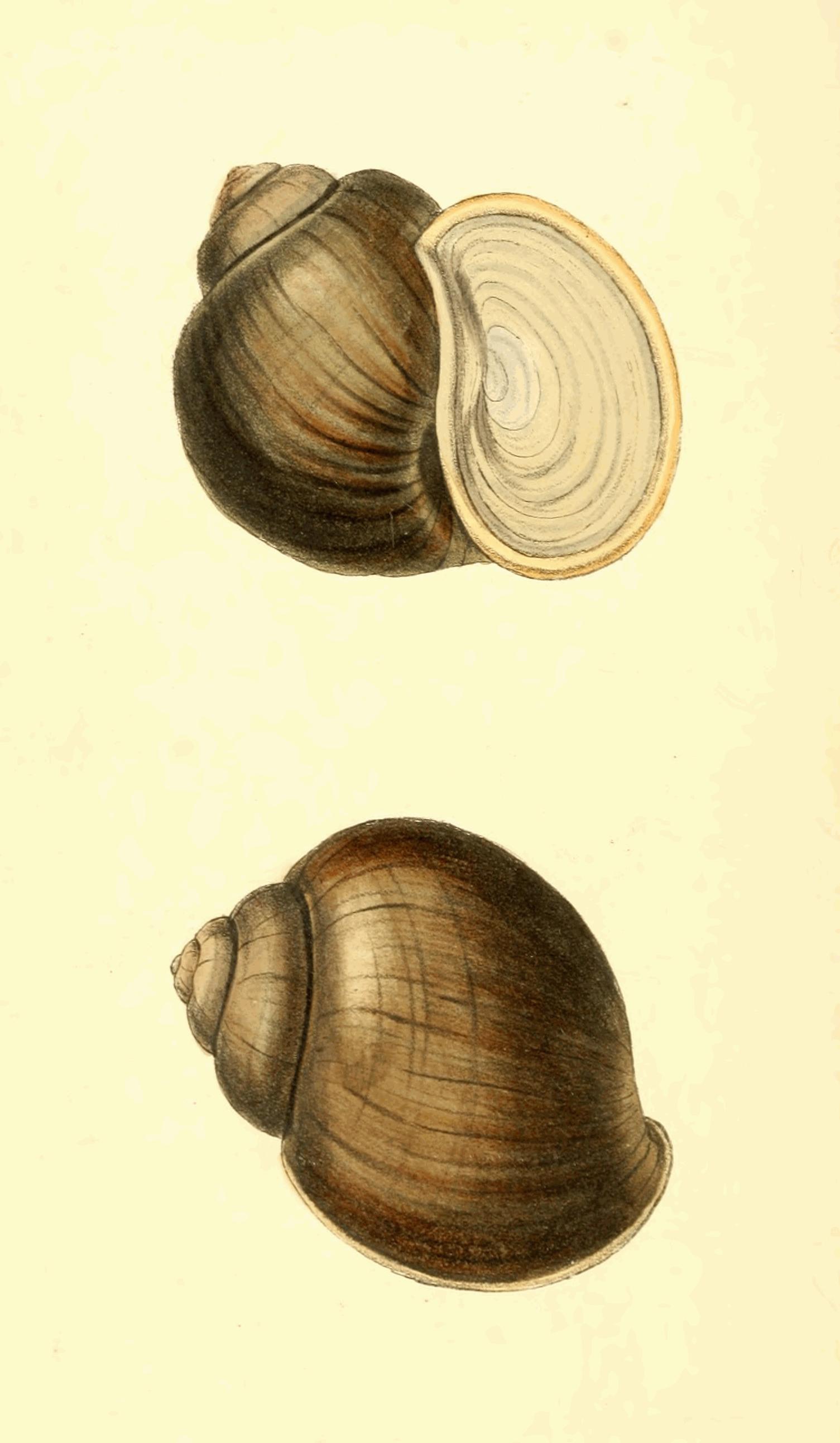
AMPULLARIA corrugata,
Wrinkled Apple Snail.
Generic Character.—See Pl. 103.
Specific Character.
A. testâ globosâ, corrugatâ, olivaceâ; spiræ prominentis, acutæ, anfractibus ventricosis; aperturæ margine crasso, fulvo, sulcato; umbilico parvo, juxta labii interioris mediam posito; operculo testaceo.
Shell globose, wrinkled, olive; spire prominent, acute, the whorls ventricose; margin of the aperture thick, fulvous, grooved; umbilicus small, linear, near the middle of the inner lip; operculum shelly.
Helix Ampullacea. Linn. Gmelin, p. 3626.
Ampullaria rugosa. Sowerby, Genera of Shells, fas. 4. fig. 1. 2.
The annexed figures of this hitherto undefined species will clearly show its distinction from Amp. globosa, (pl. 119); and the specific characters now framed for these two shells, will, I think, sufficiently distinguish them from each other.
In comparison with A. globosa, this (even in the young state) is a wrinkled, not a smooth shell, having the umbilicus placed near the middle, not towards the base, of the inner lip: the spiral whorls are elevated and ventricose, not depressed, and slightly convex; and the basal volution, instead of being very wide on the upper part, (near the suture,) is widest only in the middle. In young shells, the wrinkles and the marginated aperture are less defined. When divested of its epidermis, the colour is blueish white, with a few narrow bands of obscure purple. A specimen in my own collection has the epidermis so thin, that the colours beneath it are very conspicuous. The mouth inside is dark chesnut, with blackish bands; the margin being pale yellow and slightly reflected. The umbilicus, both in this and in A. globosa, is small and contracted, while in the real A. rugosa Lam. (Helix urceus Lin.) it is very large, round, and deep. This latter shell, also, differs from both of the former, by having a thin, and not a margined aperture.
Mr. Sowerby appears the only writer who has figured this shell, which he has mistaken for the A. rugosa of Lamarck. I am informed by Mr. Humphreys it is a native of India.
Pl. 121
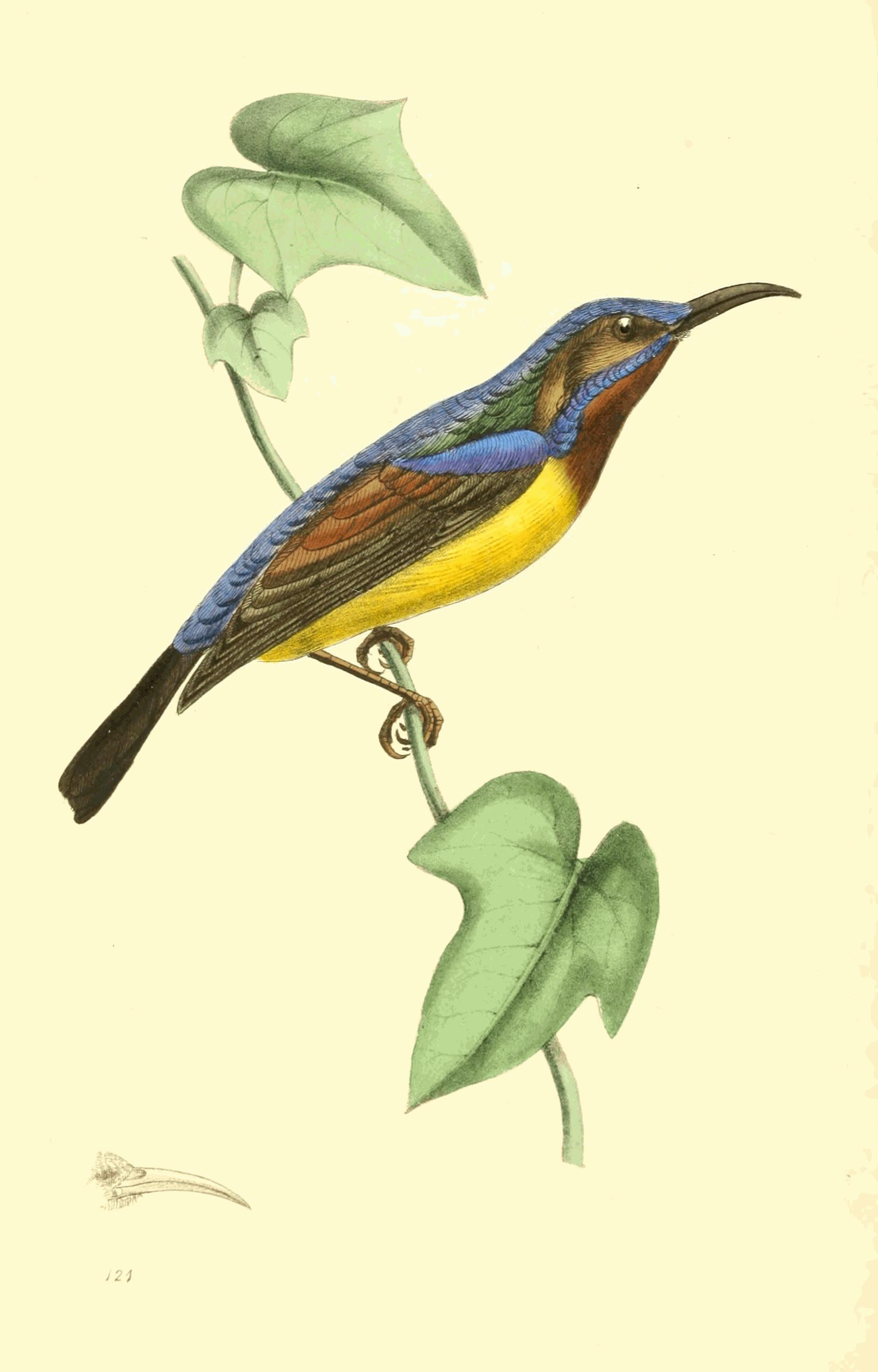
CINNYRIS Javanica,
Javanese Creeper.
Generic Character.—See Pl. 95.
Specific Character.
C. supra nitidè purpureo-ærata, subtus olivaceo-crocea; scapulis, uropygio, strigâque laterali a rostro ad pectus descendente nitidè violaceis; jugulo castaneo; caudâ nigra.
Above glossy metallic purple; beneath olive yellow; scapulars, rump, and lateral stripe from the bill to the breast, shining violet; throat chesnut; tail black.
Nectarinia Javanica. Horsfield in Linn. Tran. vol. 13. i. p. 167.
Under the full conviction that nature has defined, in the most complete manner, the geographic limits of the various tribes of birds subsisting on vegetable juices, I am particularly anxious to rectify any mistakes that may shake this hypothesis, in which I find myself supported, in the fullest manner, by the opinion of Professor Temminck, in the last edition of his Manuel.
Dr. Horsfield, in his account of the birds of Java, describes two species under the names of Nectarinia Javanica and Pectoralis. It happens, however, that specimens of both these birds are in my own cabinet, and have enabled me to ascertain that they are both decided species of Cinnyris, perfectly agreeing with the characters laid down by Cuvier, Temminck, and myself, for this group. It is difficult to say how this oversight has occurred, because Dr. H., just before, introduces the genus Cinnyris, and describes under it two new species. In short, no doubt remains in my own mind, that Cinnyris is a genus as strictly confined to the tropical latitudes of the old, as Nectarinia is to the new world.
The figure is the size of life; the outline of the bill will illustrate the generic characters, of which one of the most important is the nostrils. Nothing can exceed the richness and variety of tints with which this splendid little creature is ornamented; particularly on the head, which is glossed alternately with lilac, sea-green, and violet, and appears as if covered with some metallic substance; the blue on the wings, back, and edges of the tail is very deep, shining, and glossed with purple; all the wing-feathers are edged with olive, and some of the lesser quills with chesnut.
Pl. 122
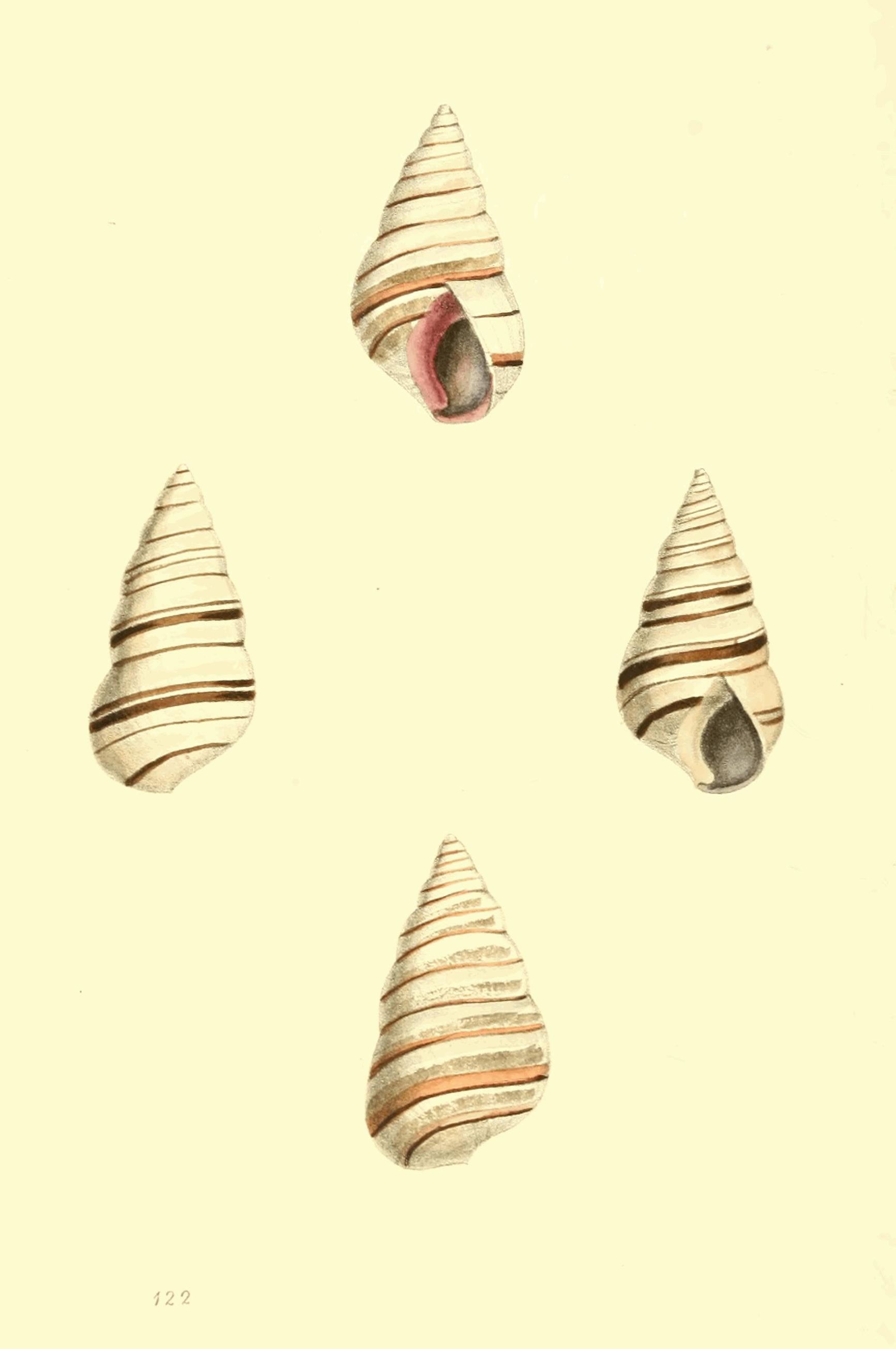
ACHATINA virginea, var.
Common Striped Achatina, var. 2 and 3.
Generic Character.—See Pl. 30.
Specific Character.
A. testâ elongatâ, fasciis numerosis nigris, viridibus et flavis ornatâ; anfractûs basalis latitudine altitudinem superante; aperturâ rotundatâ; labio exteriore integro; basi profundè emarginatâ.
Var. 2. testâ fasciis fuscis ornatâ; labio interiore albo.
Var. 3. testâ fasciis rufis ornatâ; labio interiore roseo.
Shell elongated, with crowded bands of black, green, and yellow; basal volution broader than high; aperture rounded; outer lip entire; base deeply notched.
Bulla virginea. Gm. 3429. Chemnitz, 9. t. 117. f. 1000, 1. Dill. 491.
Bulimus virgineus. Brug. p. 363.—Lister, 15. 10. Seba, t. 40. f. 38. Ferrusac, pl. 120. f. 3, 4, 5.
Var. 2. Shell banded with brown; inner lip white. Ferrusac, t. 120. f. 2.
Var. 3. Shell banded with rufous; inner lip rosy. Chemnitz, 10. 173. f. 1682, 1683, (reversed.)
The shell generally known as the Ach. virginea (Bulla virginea Lin.) is so common, that few collectors do not possess it. The varieties, however, of this species are rare, and differ so remarkably in their colouring, as to require illustration. Several kindred species of this family I have already described; and on the same principle of establishing specific distinctions from formation instead of colour, I shall now endeavour to point out those characters which are common, more or less, to all the varieties of this species, and which distinguish it from its allies. A. virginea may be known by the comparative shortness of the basal whorl, which in general is broader than high; the margin of the outer lip is entire, and sloping in an oblique direction; the aperture is wide, and nearly round; the lower part of the columella takes a concave direction, and between its base and that of the outer lip is a very deep notch. The basal whorl is so broad that the shell, if placed on a table with its mouth downwards, will remain erect.
Both these and the two next varieties are in Mr. Dubois' cabinet. Their locality is unknown; but my young friend, Mr. Frederick Parkes, has recently sent me shells of the common variety, found by himself near Kingston, Jamaica.
Pl. 123
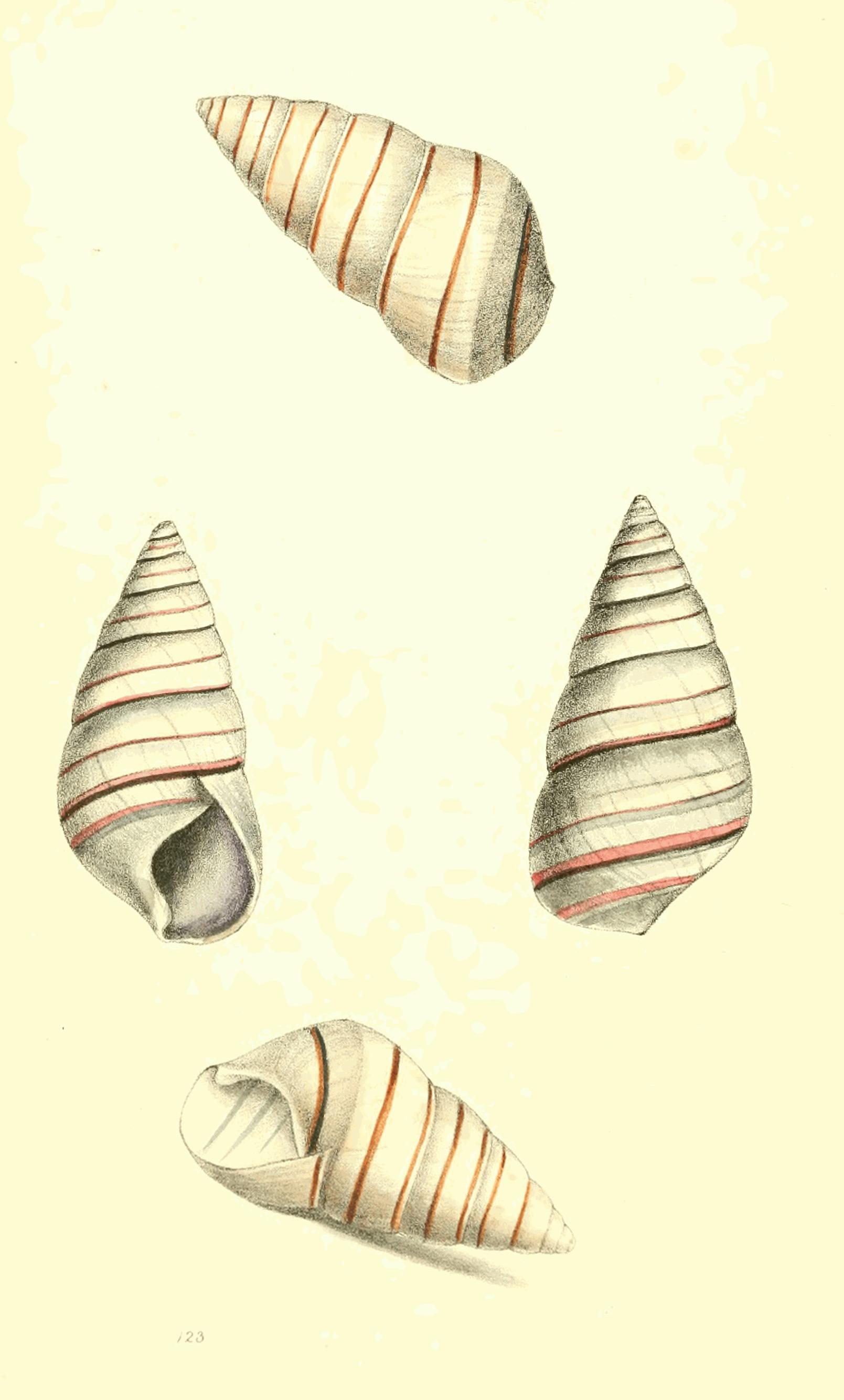
ACHATINA virginea, var. 3 and 4.
Generic Character.—See Pl. 30.
Specific Character.—See Pl. 122.
A. virginea, var. 3. testâ ampliore, albescente, fasciis rufis nigrisque ornatâ; aperturâ purpureâ; labio interiore albo.
Var. 4. testâ ampliore, albâ, fasciis 3 angustis, fuscis ornatâ; aperturâ labioque interiore albis; anfractu basali medio subcarinato.
A. virginea, var. 3. Shell larger, whitish, with rufous and black bands, aperture purple; inner lip white. Middle figures.
Var. 4. Shell larger, white, with three narrow brown bands; aperture and inner lip white; basal whorl in the middle slightly carinated. Upper and lower figures.
The two varieties of A. virginea on this plate, are still more removed from the type of the species than those last figured; they are both much larger in size, and var. 4 presents a slight difference of formation, in having the basal volution somewhat carinated round the middle; but as in every other essential character it agrees with the rest, I have refrained from separating it as a distinct species.
The four varieties I have now illustrated of Ach. virginea, tend to establish, in a very complete manner, the correctness of the principles on which I have framed the specific characters of this genus; here are four shells, with a total difference in the colouring of each, yet all agreeing in the same formation. It should be observed likewise, that A. pallida, figured at pl. 41 of this work, and A. virginea, var. 4, are nearly the same in colour, while in formation they are completely at variance. I do not think it has been hitherto remarked, that the elegant green lines which ornament the common variety, are only external; they resemble, in this respect, the epidermis of other shells, for they may be taken off by a knife without any injury to the enamel. M. Ferrusac has figured several other varieties in his beautiful work on Land Shells.
Pl. 124
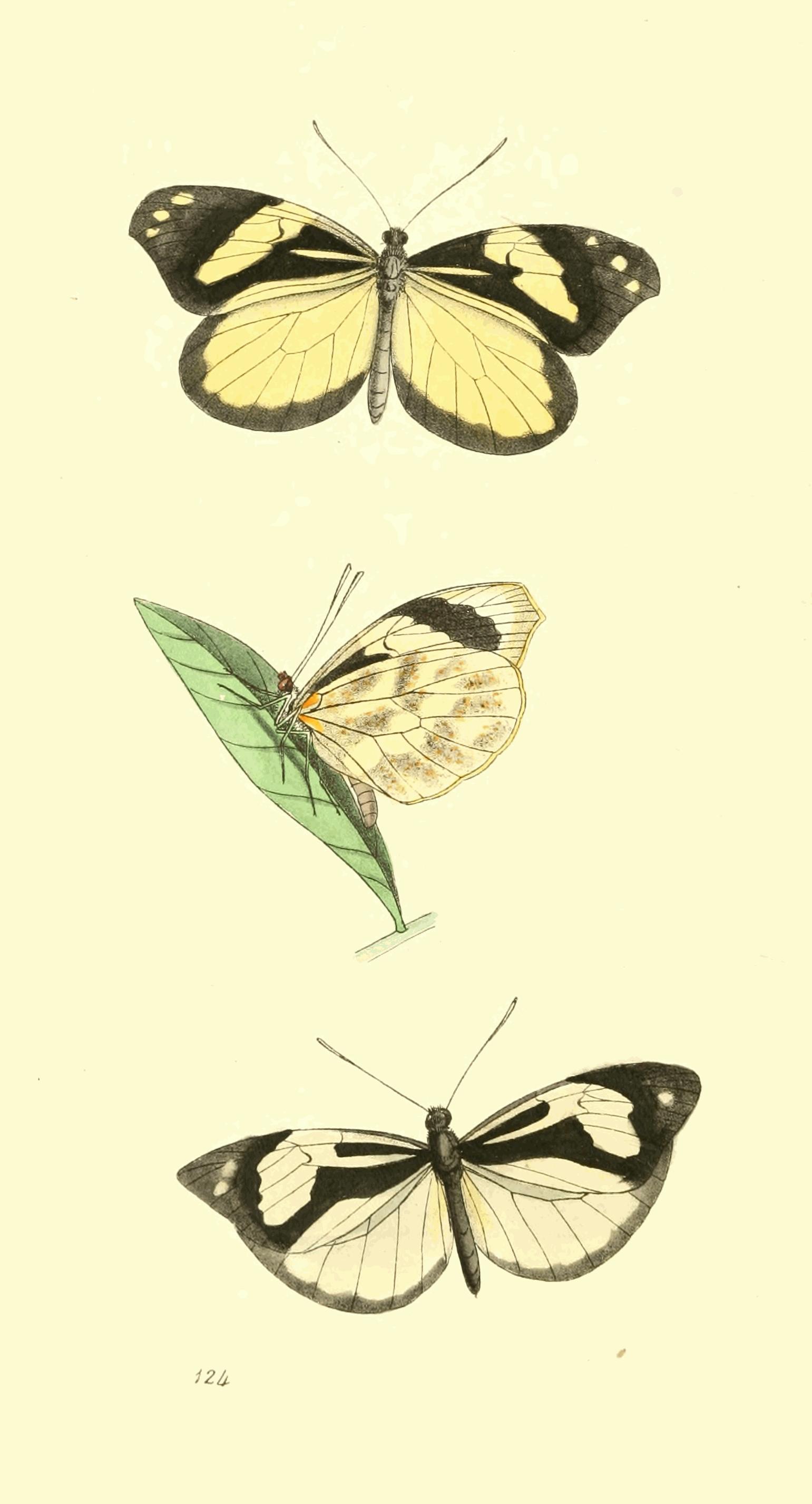
LICINIA Crisia.
Generic Character.—See Pl. 15.
Specific Character.
A. mas. Alis anticis falcato-acuminatis, fuscis, fasciâ mediâ margineque postico flavo; posticis infra flavescentibus colore griseo variis, basi maculis 4 fulvis.
Fem. Alis infra albentibus colore griseo variis; anticis integris, supra fuscis, fasciâ mediâ margineque postico albentibus; posticarum basi maculis 4 fulvis.
Male. Anterior wings angulated, brown, with a central band and hind margin yellow; posterior beneath yellowish marbled with grey, base with 4 fulvous spots.
Female. Anterior wings entire, above brown, with a central band and hind margin whitish; all the wings beneath whitish marbled with grey; base of the posterior with 4 fulvous spots.
Pieris Crisia. Godart. En. Méth. p. 197. Male. Drury, v. 3. pl. 37. f. 1. 2?
The extraordinary difference existing between the sexes of exotic Lepidoptera, and particularly among the Butterflies, (Papilionidæ Lin.) is a subject which hitherto has received but little attention; nor am I aware of any entomological writer who has described those characters which absolutely distinguish the sexes: characters which, I am persuaded, will hereafter be found of the first importance in a natural arrangement of these insects. But in the prosecution of this desirable object, the naturalist, as far as regards foreign Lepidoptera, will have to encounter serious obstacles; many individuals must be examined of each species, and some of these dissected. It falls to the lot of few to pursue their inquiries in the native regions of these insects. Collections in this country are very few, and some of these are not always open to the scientific labourer; neither can specimens be sacrificed for dissection, where there are not more than two or three individuals of a species.
This is in general a very rare insect; observed for the first time by Dr. Langsdorff and myself early in June (the tropical autumn), in a wood adjoining the Organ Mountains at Rio de Janeiro. From its local abundance, we were able to ascertain the sexes. The two upper figures are of the female, and the lower of the male insect.
Pl. 125
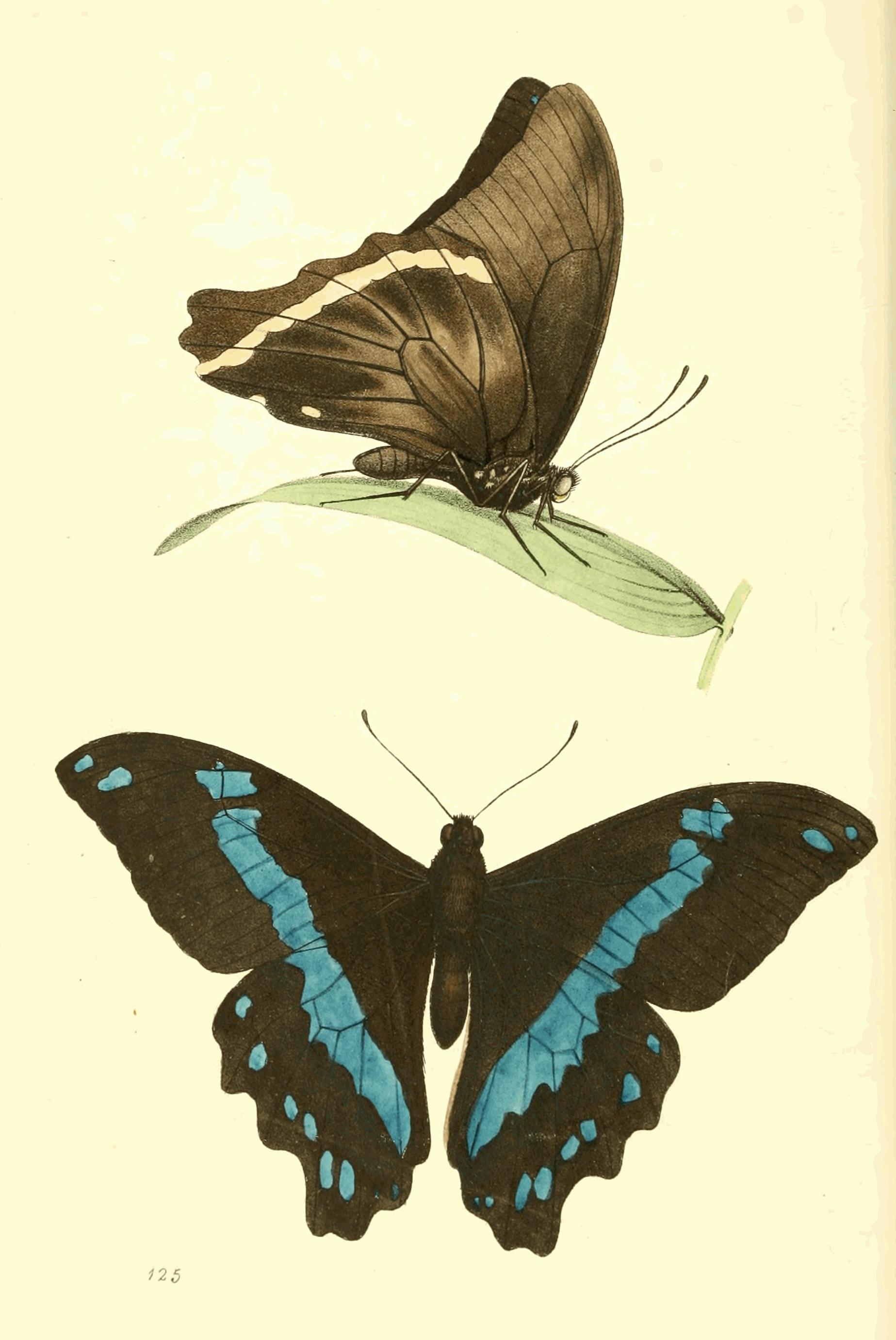
PAPILIO Nerius.
Generic Character.—See Pl. 92.
Specific Character.
P. (Gr. Ecaud.) Alis nigris, fasciâ communi maculisque viridibus; posticis dentatis breviter caudatis; his subtùs fasciâ subargenteâ, marginali, nervis divisâ. Godart.
P. (Gr. Ecaud.) Wings black, with spots and a common band of green; posterior wings dentated, obsoletely tailed, beneath with a silvery marginal band, divided by the nerves.
P. Nireus. Fab. Sys. Ent. 3. p. 36. Godart Ency. Méth. 9. 1. p. 48. Drury 2. pl. 4. fig. 1. 2. Cramer, p. 187. A. B. (mas.) pl. 378. F. G. (fem.)
I have figured this insect, principally because it will fully illustrate the first section (a.) in the arrangement of this beautiful family proposed at plate 92. The two divisions there adopted, after the manner of Linnæus, (Græci et Trojani) I am fully aware, are purely artificial; but the facility this distribution will give to the student, in searching after a particular species, is so obvious, that it need hardly be pointed out.
I have only had the opportunity of examining the individual from which the figure was taken. It is a male, having the anal valves rather lengthened and obtuse, with a small hook between them, which projects from the last segment of the abdomen. This circumstance proves the error of Cramer, in having mistaken the sexes of this species, both of which he seems to have figured. That which I apprehend is the female (Cramer, pl. 378, fig. F. G.) I have not myself seen. The blue-green on the upper surface of the wings is very resplendent and changeable, and the palpi and thorax beneath are covered with numerous whitish spots.
On the under side of the inferior wings, near their base, is a paler band, rayed with the nerves, and in some lights shining with a pale silvery reflection.
Mr. Smeathman sent this species from Sierra Leone, in Africa, to Mr. Drury. The locality, therefore, of India, given by Linnæus and Fabricius, must be incorrect.
Pl. 126
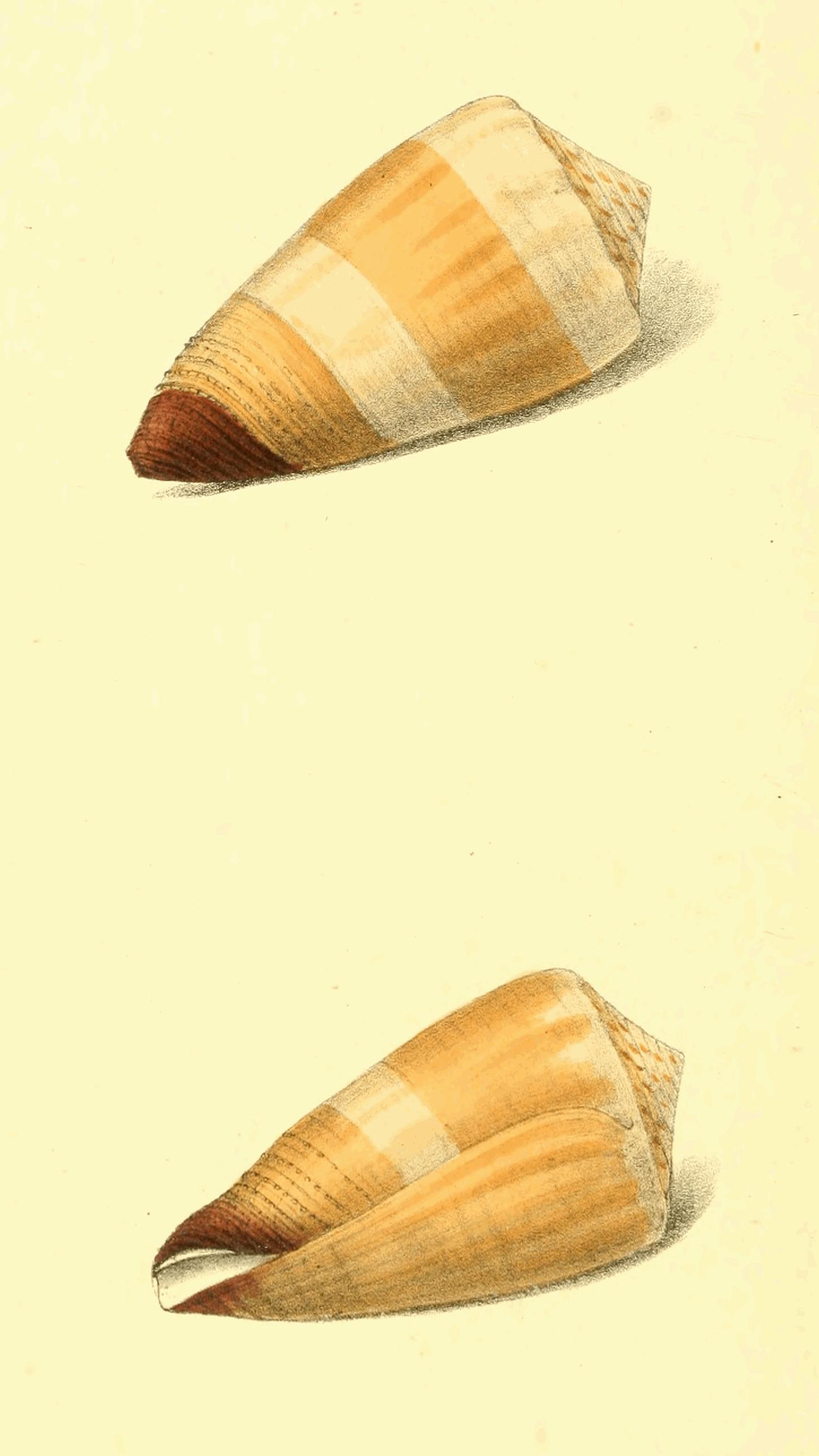
CONUS vitulinus, var.
Orange Fox Cone,
Brown-tipp'd variety.
Generic Character.—See Pl. 65.
Specific Character.
C. testâ fulvâ seu fuscâ, fasciis 2 interruptis ornatâ; spiræ brevis, levatæ, conicæ, maculatæ anfractibus concavis, subgranosè striatis; basi granosâ, albâ.
Var. testâ flavescente, fasciis obscuris, subalbidis ornatâ; basi rufâ. (Fig. nos.)
Shell fulvous or brown, with 2 interrupted white bands; spire short, elevated, conic, spotted, volutions concave with subgranulated striæ; base granulated, white.
Conus vitulinus. Brug. p. 648. Lamarck. Ann. 15. p. 265. Knorr. vol. 5. tab. 1. fig. 4 (optimè). Dillwyn 377.
Lam. Syst. 7. p. 467. 55.
Var. Shell yellowish, with obscure whitish bands; the base rufous.
I received this very uncommon shell from the Island of Amboyna; and although in size and colour it is widely different from the usual appearance of C. vitulinus, I have no hesitation in considering it as a remarkable variety only of that species.
C. vitulinus in general is a small shell. The best representation of it I have seen is given by Knorr; an author not in general very accurate in his figures. It varies considerably in colour, and approaches very near to C. vulpinus Lam. from which it principally differs in having an elevated, though short, spire, instead of one nearly flat: the base is granulated, and generally white; C. vulpinus also has the body whorl carinated and thickest round the upper margin, whereas, in Vitulinus, it is gently swelled in the middle.
M. Lamarck is, I think, mistaken in the synonyms of this shell, which is represented in the Ency. Méth. plate 326, fig. 2 and 4.. The shell at fig. 8. appears to me as the granulated variety of C. vulpinus.
Inhabits the Asiatic Ocean.
Pl. 127
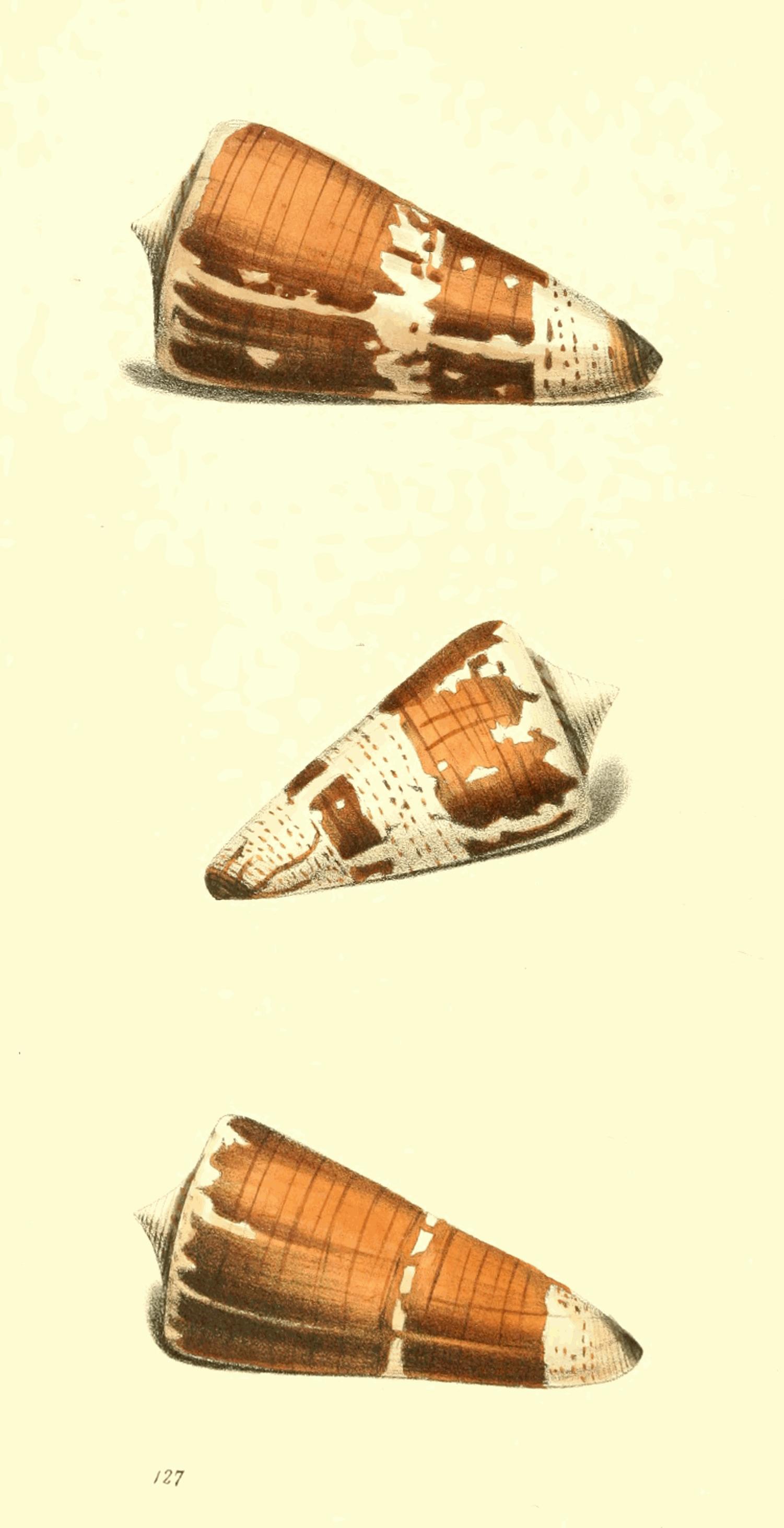
CONUS Maldivus,
Spanish Admiral Cone.
Generic Character.—See Pl. 65.
Specific Character.
C. testâ lævi, posticè gracili ferrugineâ, maculis albis subtrigonis, cingulisque numerosis fuscis, albo punctatis, ornatâ; basi nigrâ; spiræ brevis apice acuto, anfractibus lævibus, planis.
Shell smooth, posterior end slender, ferruginous, with angular white spots, and white bands dotted with brown; base black; spire short, tip acute, the whorls smooth and flat.
C. Maldivus. Brug. (1789.) p. 644. Lam. Ann. v. 15. p. 264.
C. Jaspideus. Humphreys in Mus. Cal. (1797) p. 12. No. 185.
Conus Generalis. Var. B. Dillwyn. 539. 11.
Lam. Syst. 7. p. 465. 50.
Var. 1. Band in the middle narrow; upper figure. Ency. Méth. pl. 325. fig. 6.
Var. 2. Band broader; lower figure.
Var. 3. Band very broad, with dotted transverse lines; middle figure.
Seba. pl. 54. fig. 11. 12. Ency. Méth. pl. 325. fig. 5. 7.
The general similarity existing between the Spanish Admiral, and two other cones, figured in this work, I have before alluded to; it has been placed by the Linnæan writers as a variety of C. Generalis, from which, however, it invariably differs, in being a much thicker shell, with a shorter spire, and the whorls without any concavity. The colour of the two species varies considerably in different individuals, but C. Maldivus is always destitute of the dark brown longitudinal stripes at the top of the body whorl, peculiar to C. Generalis; the white bands are either broken into somewhat triangular spots, or are banded with minute dots; these triangular white spots are sometimes scattered in other parts of the shell, and the white band in the middle varies much in breadth; of all the varieties I have yet seen, the middle figure is that which makes the nearest approach to C. Generalis.
The very applicable name given to this shell by Mr. Humphreys, in the Museum Calonnianum, I should have adopted, had not Bruguiere previously affixed to it that of Maldivus, as being a native of the Maldivian Islands.
Pl. 128
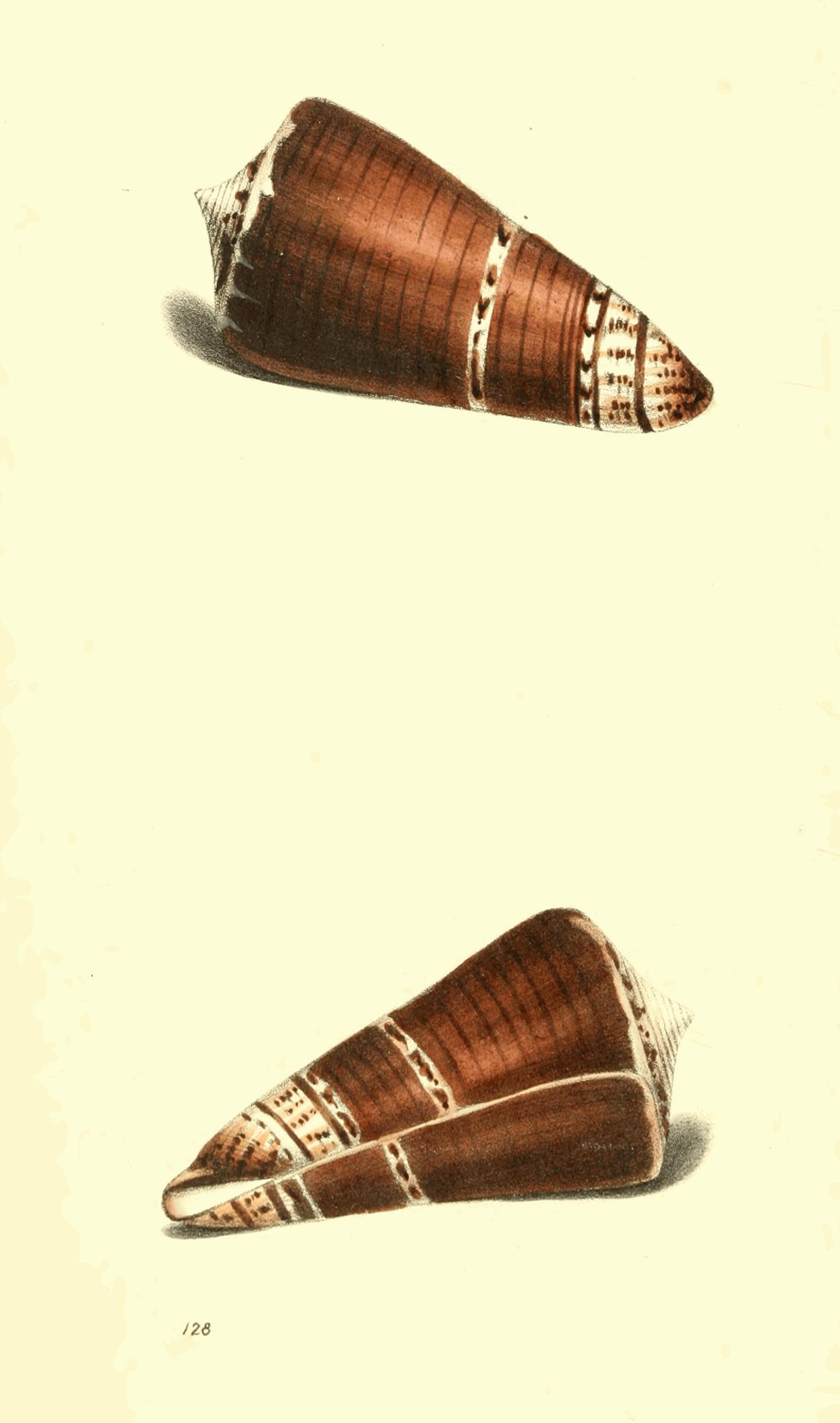
CONUS Maldivus, var.
Spanish Admiral Cone,
Chesnut variety.
Generic Character.—See Pl. 65.
Specific Character.—See Pl. 127.
Conus Maldivus. Var. B. testâ castaneâ, fasciâ albescente mediâ angustâ ornatâ; anfractûs basalis basi et margine albis.
Var. B. Chesnut, with a narrow whitish band in the middle; base and margin of the body whorl white.
As a further illustration of the last plate, I have been induced to figure this very rare variety, from a specimen I met with at Mrs. Mawe's. In the disposition of its markings, it approaches near to the shell represented in the Ency. Méth. plate 325, f. 6, but the white band in the middle is narrower, and quite destitute of the circular dotted lines there expressed.
No shells require a greater accuracy of delineation than the Cones, particularly in expressing the peculiarity in the form and sculpture of their spires. I am well persuaded that a great number of the mistakes committed by authors have originated in the wretched figures contained in Favanne's work, and in the early volumes of Martini. Those of Favanne are generally so loose and inaccurate, (although remarkably well engraved,) that I do not wish, by quoting, to make them any authority; and most of the Cones figured by Martini are equally bad.
Bruguiere and Lamarck have both given the character of spirâ canaliculatâ to this species, which is altogether a mistake. The spiral whorls are all but perfectly flat, and the suture is quite closed up, although sometimes uneven; originating, as in many other shells, either from the inequalities of growth, or from an accidental sea-break, which the animal may have repaired.
Pl. 129
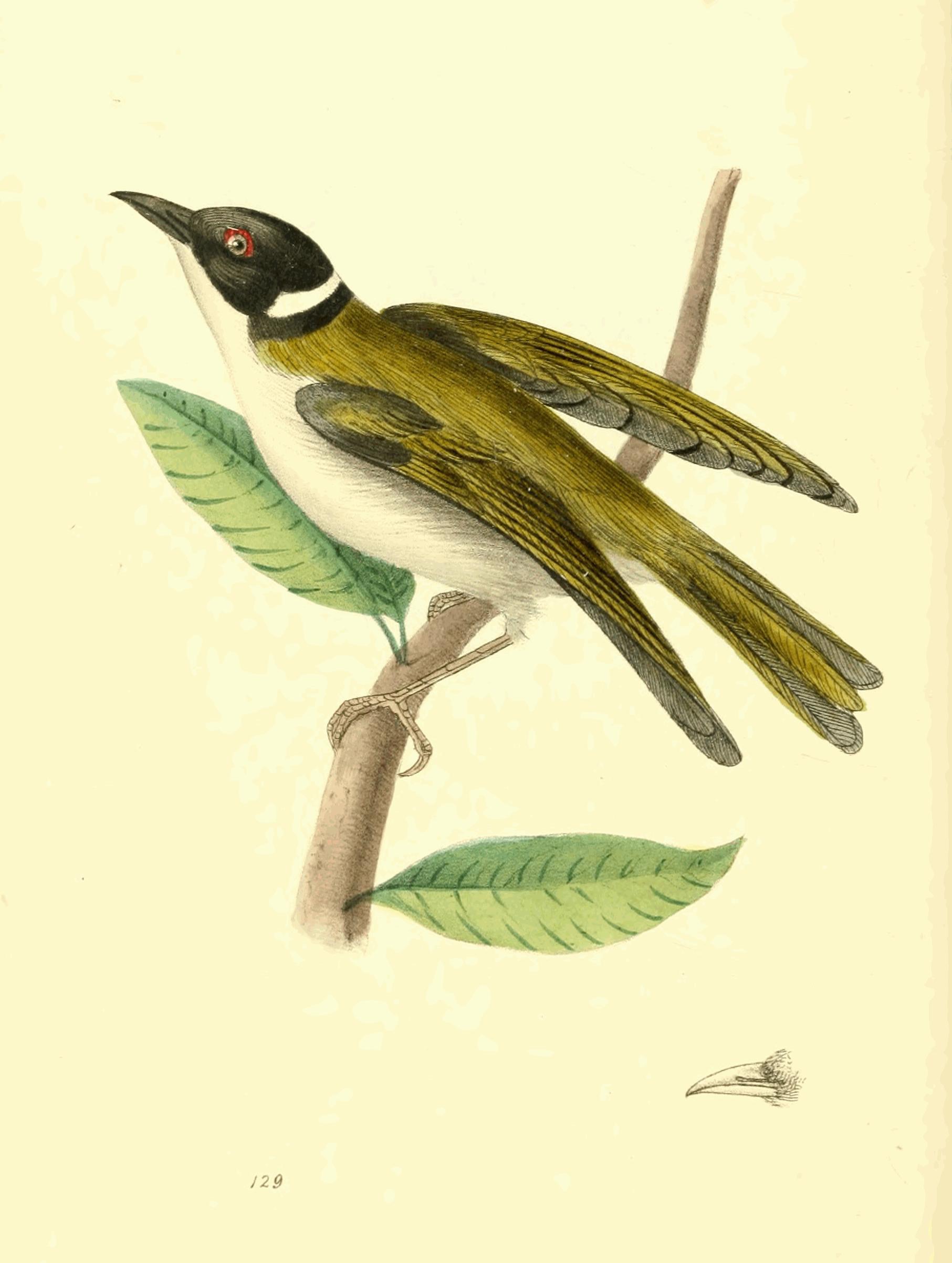
MELLIPHAGA torquata,
White-collared Honeysucker.
Generic Character.—See Pl. 43.
Specific Character.
M. olivaceo-fulvâ, infra albâ; capite auribusque nigris; torque nuchali lunato, albo; superciliorum cute rubrâ.
Fulvous olive, beneath white; head and ears black; nape with a white crescent, skin of the eyebrows red.
Black-crowned Honeysucker. Lewin's Birds of N. Holland, pl. 24.
An elegant, though not a richly coloured bird; remarkable for the bright red of the skin above the eyes, and the milk-white collar at the back of the head. It is from New Holland, and, like others of its tribe, derives its nourishment chiefly from the nectar of flowers; as more particularly mentioned in my first observations on this genus at pl. 43.
The figure is of the natural size: excepting the crown and sides of the head (which are deep black), the whole upper plumage is olive yellow: the shoulders, quills, and tail brown; the two latter margined with olive, but the exterior quills with white: the throat, breast, and collar round the nape pure white; skin of the eyebrows red.
The Lunated Creeper of Dr. Shaw (Le Fuscalben of Vieillot, Certh. pl. 61. p. 122.) is, I apprehend, a distinct species. It is described as being cinnamon brown above, with a bright red spot of feathers behind the eye. In the temperate climate of New Holland, that variation from the usual colouring of particular species, so frequent in tropical birds, is seldom met with; neither can these two birds be sexes of one species, because Lewin, who wrote on the spot, particularly remarks that the female of this is like the male; he further adds, it is found near Paramatta, and the Hawkesbury river, in thick bushy woods.
Lewin's figure is so excellent, that I should not again have represented this bird, had not the plate been prepared previous to the publication of his work. The outline figure of the bill will show more clearly the uncommon length of the nostrils, a character which is peculiar to this genus.
Pl. 130, 131
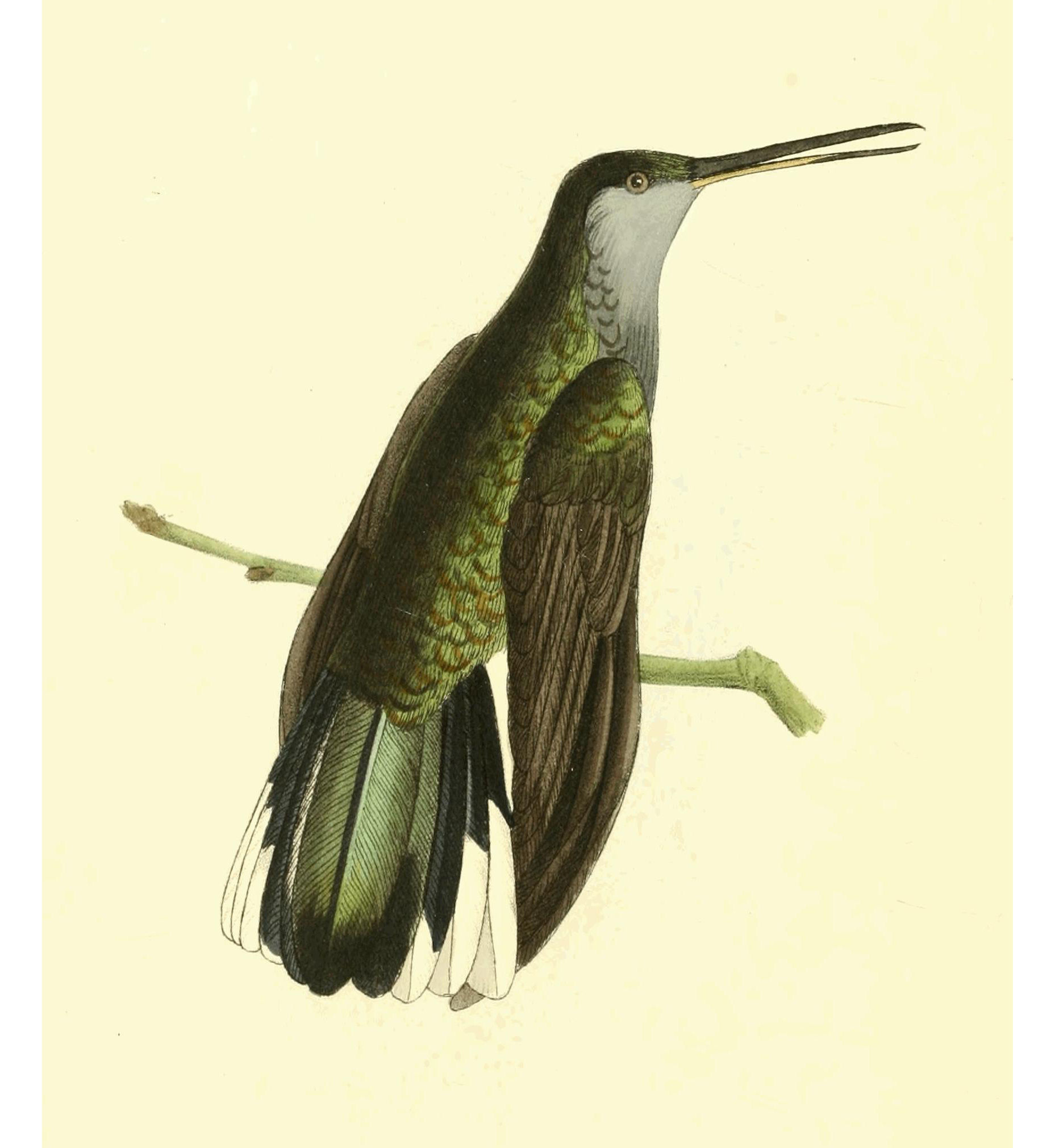
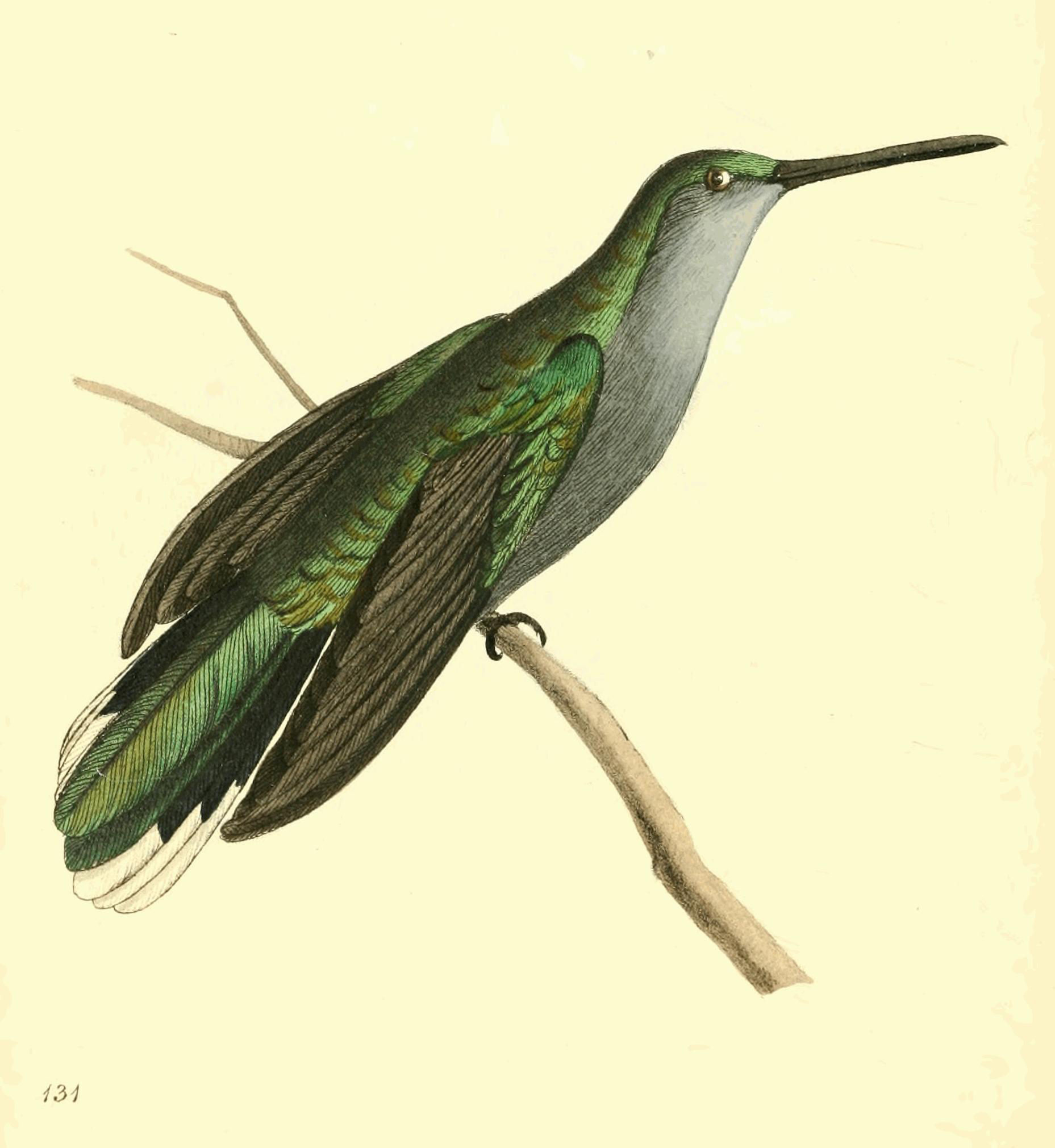
TROCHILUS latipennis,
Grey Sickle-winged Humming Bird,
Male and Female.
Generic Character.—See Pl. 82.
Specific Character.
T. viridi-aureus, subtus canus; remigum primorum (in maribus) scapis dilatato-incurvatis; rectricium pennis 4 mediis viridibus apice nigro, lateralibus albis basi nigrâ; rostro vix recto.
Golden green, beneath grey; greater quills (in the male) with the shafts dilated and incurved. Four middle tail-feathers green tipped with black, lateral feathers white with a black base; bill nearly straight.
T. latipennis. Lath. In. Orn. 1. p. 310. Gen. Zool. 8. 1. 318.
T. campylopterus. Gm. Sys. Nat. 499. n. 65.
L'O. mouche à larges tuyaux. Vieillot Ois. D'or. p. 21. p. 59.
Broad-shafted H. Bird. Lath. Syn. v. 2. p. 765. Gen. Zool. 8. 318.
The opinion I expressed on the unusual formation of the wings in two species of Humming-birds, figured at pl. 83 and 107, appears to receive the fullest confirmation from the birds here represented. One of these (pl. 131) is clearly the T. latipennis, or Broad-shafted Humming-bird of authors; while the other presents not the slightest difference except in the shafts of the quills, which, instead of being thickened and dilated, are of the ordinary size.
Not having myself dissected these birds, I cannot decidedly say they are male and female; but I think no reasonable doubt can remain that such is the fact, and that these singular quill-feathers are characteristic only of the male sex.
Both the birds are represented the size of life, and may be included in one description: the upper plumage obscure blueish green, glossed with a coppery or golden tinge and shaded with brown, the plumage beneath entirely grey; ears and sides of the neck the same, the latter with some spots of greenish. Tail large, even, and broad; the two middle feathers green, tipt (in the male) with blackish; the next pair black, with the base green, and the extreme points whitish; the remainder black, with their ends more or less white. Wings violet brown, the shafts of the three outer quills, in the male, dilated and compressed, but simple in the female. Said to inhabit Cayenne. Although the bill of this species is all but straight, it belongs naturally to the curved-bill division.
Pl. 132
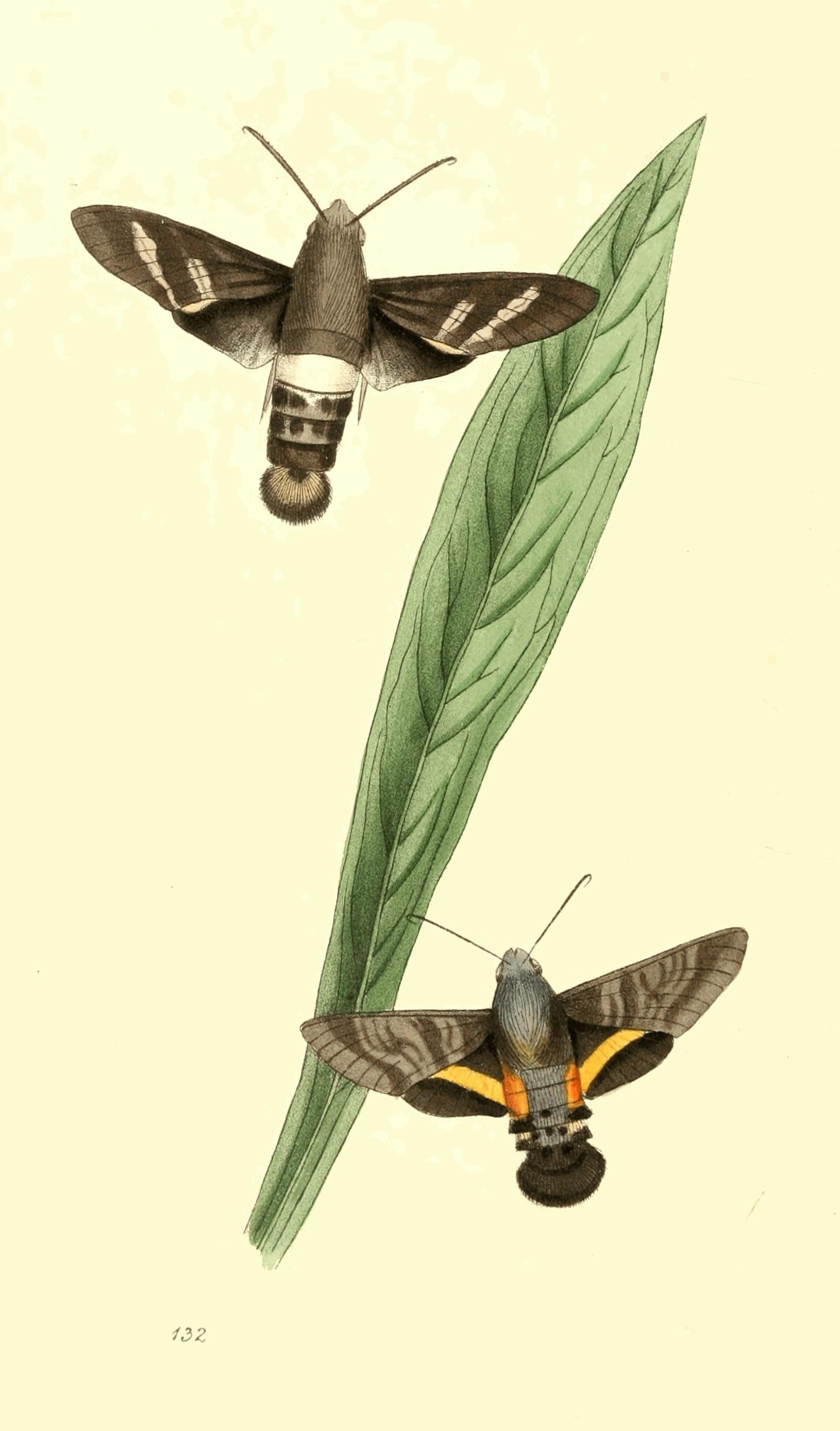
MACROGLOSSUM annulosum,
Upper figure
Generic Character.—See Pl. 64.
Specific Character.
M. alis nigris, anticis fasciis 2 hyalinè maculatis ornatis; abdominis nigri, segmento tertio niveo.
Wings black, anterior with two bands of hyaline spots; abdomen black, the third segment snowy.
An elegant insect; so closely allied to Sphinx Tantalus, Lin. (Drury, v. 1. pl. 26. f. 5.) as to excite a doubt if it should be considered as a separate species. Drury's figure and description, however, of that insect, induce me to think they are most probably distinct. S. Tantalus is without the two bands of hyaline spots, and is much smaller in size.
In this insect are three small, white, snowy dots, on the sides of the lower segments of the abdomen, and the same beneath: the anal segment is grey; with the margin, and spot in the middle, black. Inhabits Brazil, but is a rare insect.
MACROGLOSSUM fasciatum,
Lower figure.
M. alis nigricantibus, anticis fusco variis, posticis strigâ aurantiacâ centrali ornatis; thorace griseâ; corporis lateribus, maculis aurantiacis, nigris et pallidè fulvis insignibus; antennis gracilibus; unco producto.
Wings blackish, anterior variegated with brown, posterior with a central orange stripe; thorax grey, sides of the body with orange, black, and pale yellow spots; antennæ slender, hook lengthened.
Sphinx ceculus. Cramer, pl. 146. f. G.
This is another Brazilian species, much more frequent than the last. In Cramer, at pl. 146, g. is figured an insect under the name of Ceculus, which no author appears to have quoted; but which (miserably inaccurate as it is), I have no doubt the artist intended as a representation of this insect; particularly as Cramer's description, though short, is very applicable. The colours beneath are uniform dark brown; the thorax, legs, and base of the wings, whitish; near the exterior margin of the superior wings is a small white dot, and two others on each side of the middle segments of the body.
Pl. 133
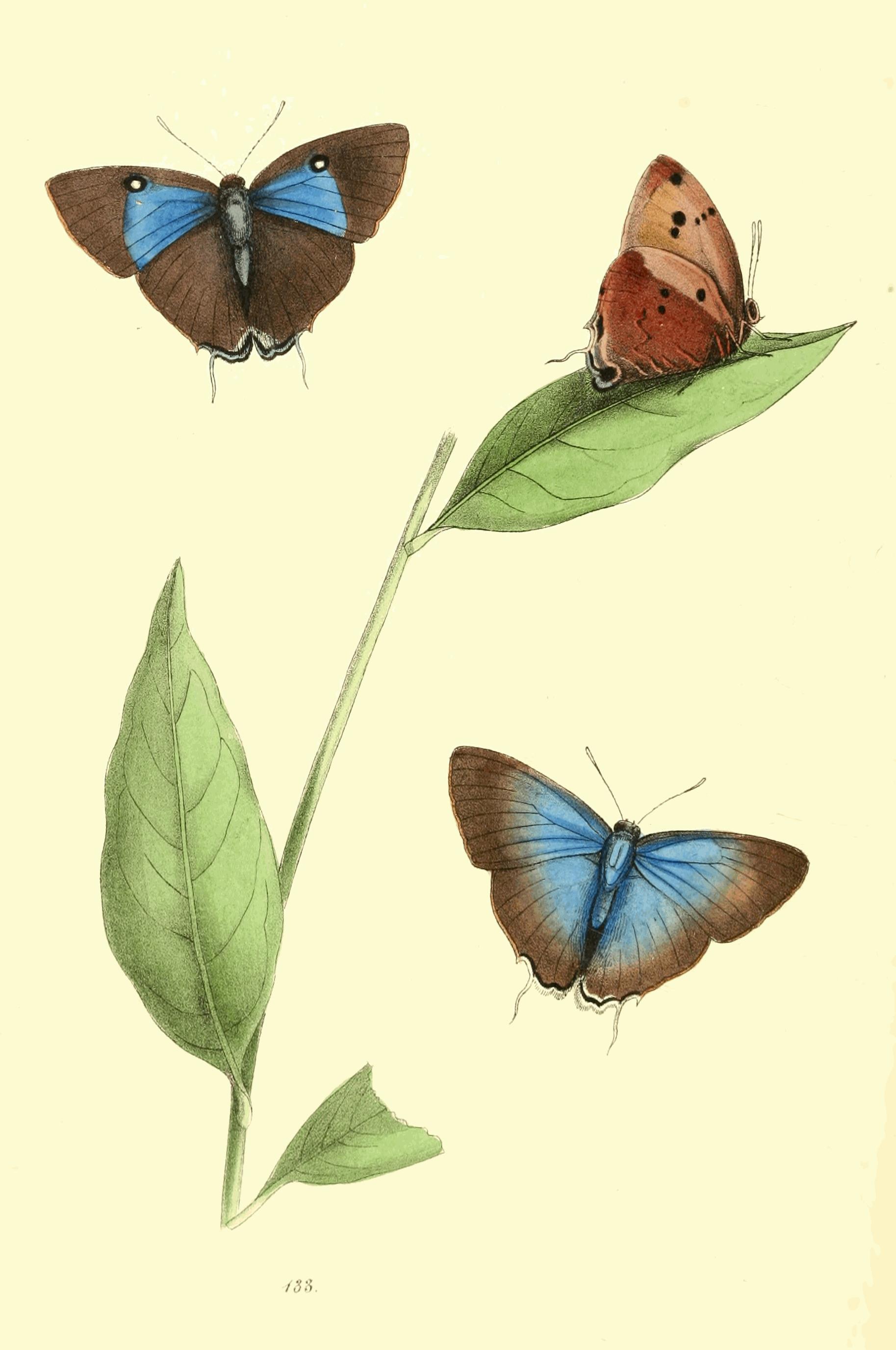
THECLA Macaria,
Chesnut-spotted Hair-Streak.
Generic Character.—See Pl. 69.
Specific Character.
T. alis supra fuscis; anticis ad basin cæruleis, infra ferrugineis, punctis 2 mediis nigris ornatis; posticis infra castaneis, anticè pallidioribus, maculo nigro ad basin ornatis.
Wings above brown; anterior blue at the base, beneath ferruginous, with two central black spots; posterior beneath chesnut, paler on the fore part, with a black spot near the base.
I have selected this insect as one of the rarest among a vast number of species of this elegant tribe, collected during my travels in Brazil. Two specimens of the male, and one of the female insect, were captured in the woods near Pernambuco, in lat. 8° 12′ S.
The male insects, in the majority of the Hair-Streaks, have either a velvet or eye-like spot in the middle of the anterior wings, adjoining their outer margin; these spots are without lustre, and frequently appear as if caused by being rubbed: the colours, likewise, on the upper surface of the wings in the males, generally differ from those of the females.
Wings brown; anterior, with the half next the base blue; central spot blackish, enclosing an obscure eye-like spot margined with grey, the pupil black with a white dot. Posterior wings two-tailed; exterior tail very short, interior lengthened; anal angle two-lobed, margin whitish. Anterior wings beneath, pale chesnut brown, tips chesnut; in the middle are two black dots, one of which is small; above these are three others, which form a short transverse line united to the margin. Posterior wings beneath, dark chesnut; with two central blackish dots in the middle; below are two undulated brown lines, parallel to the posterior margin; the anterior margin pale, with a large black dot near the base; anal angle, clouded with grey and tipt with a black spot: another spot is also at the base of the exterior tail. In the female, all the wings above are brown, with a pale blue base; but the under surface, except in being paler, resembles that of the male.
Pl. 134
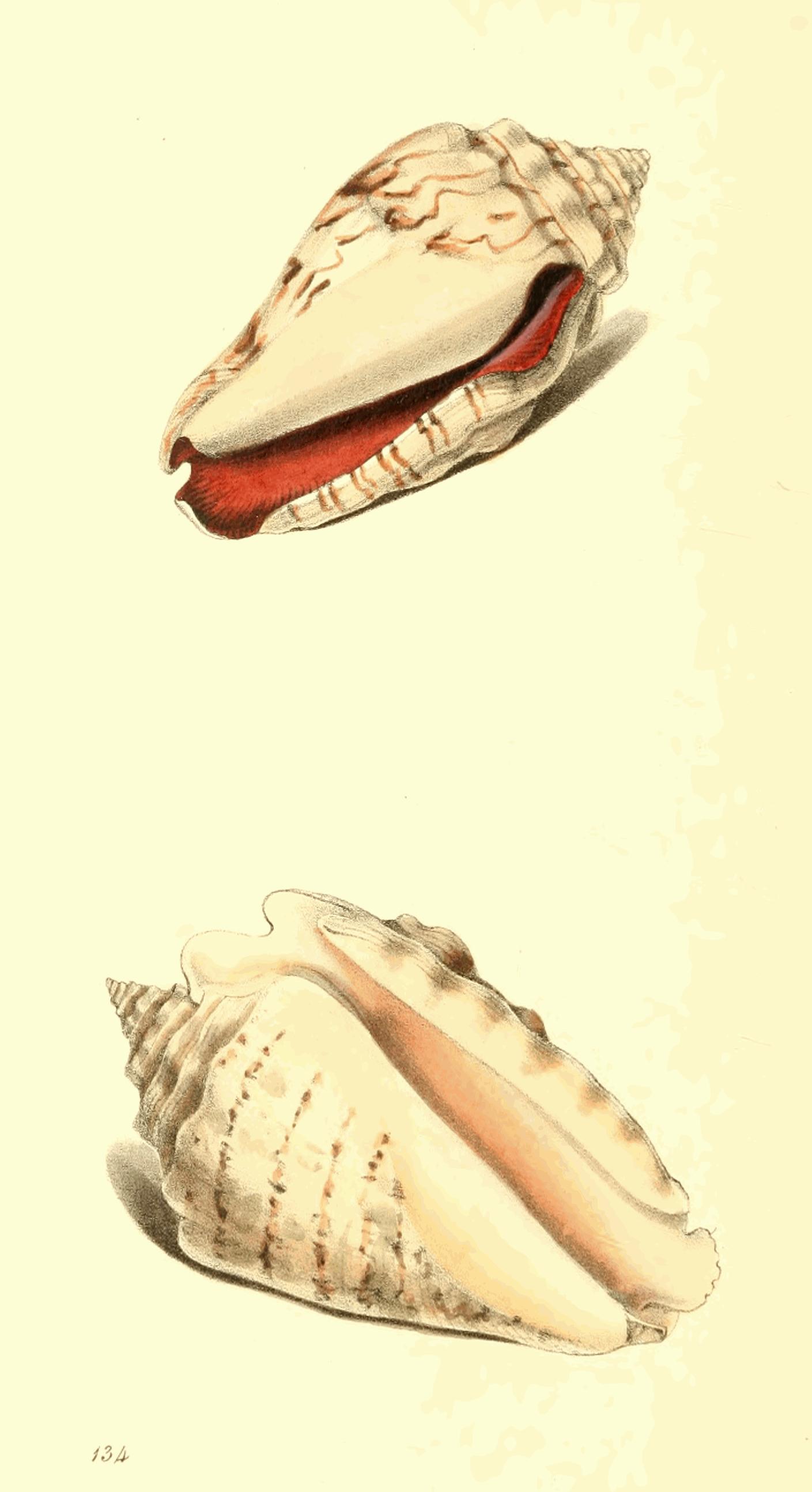
STROMBUS exustus,
Burnt, or Purple-mouthed Strombus—(Upper figure.)
Generic Character.—See Pl. 10.
Specific Character.
S. testâ nodosâ; labio interiore albo, lævi; labii exterioris inflexi, supra sinuati, intus purpureo-atri, striati; lobo basali edentulo.
Shell nodulous; inner lip smooth, whitish; outer lip inflected, above sinuated, within striated, blackish purple; basal lobe not toothed.
Young. S. papilio. Chem. x. t. 158. f. 1510, 11. Dillw. 661. 120. 11.
Adult. Strombus exustus. Humphreys in Mus. Cal. p. 38. n. 714.
S. lentiginosus. Martini, iii. t. 80. f. 825, 826. Gmelin. 3510. (var. β.) Dillwyn. 660.
Seba, t. 52. f. 17. 18. Knorr. 3. t. 26. f. 2. 3?
Specimens now before me prove that the S. papilio of Chemnitz is a young shell of S. exustus, a species named by Mr. Humphreys in the Calonne Catalogue, and described in his own manuscripts. In a young state, the aperture is smooth and nearly white, but when full grown, the outer lip is strongly striated, and the aperture reddish purple, dark red, or reddish chesnut: the outer lip is but slightly sinuated above, and the basal lobe never toothed, as in the next species. Inhabits the island of Haynam, in the East Indies, and is very rare.
Described by Lamarck (Syst. 7. p. 211) under the name of S. Papilio. The first of these names, however, has the right of priority. (See Mus. Cal. 1797.) The figures of Martini, tom. 3. tab. 8. f. 825, 826, clearly represent this species; although Lamarck has quoted them for S. lentiginosus.
STROMBUS lentiginosus,
Tuberculated Strombus
S. testâ nodosâ; labii exterioris supra rotundati ad spiram annexi, profundè bilobati, margine crasso inflexo, sub-nodoso; lobo basali dentato; aperturâ lævi.
Shell nodulous, outer lip above rounded, attached to the spire, deeply bilobated, margin thick, inflexed, slightly nodulous; basal lobe toothed; aperture smooth.
Young. Seba, t. 62. f. 37. 40. optimè. Martini, 3. t. 89. f. 871. t. 91. f. 891. 892? Lister, 893. 12?
Adult. S. lentiginosus. Gmelin, 3510. Dillwyn. 660. Martini, 3. t. 81. f. 827, 828.
Seba, 62. f. 11. 30. (optimè.) Lister, 861. 18. Gualt. 32. f. A.
Lam. Syst. 7. p. 203. Knorr, 3. tab. 13, f. 2. Lamarck has omitted to quote any of the figures representing the young shells of this and the following species.
This common shell requires little description, and is only introduced to contrast more fully the difference between these two species: the upper part of the lip has two deep notches, which form three prominent lobes; the basal lobe is toothed, similar to the Pteroceræ: the aperture (in those shells from the East Indies) is light pink inside. A large and fine variety comes from the Mauritia islands, having the mouth within pale golden yellow.
Pl. 135
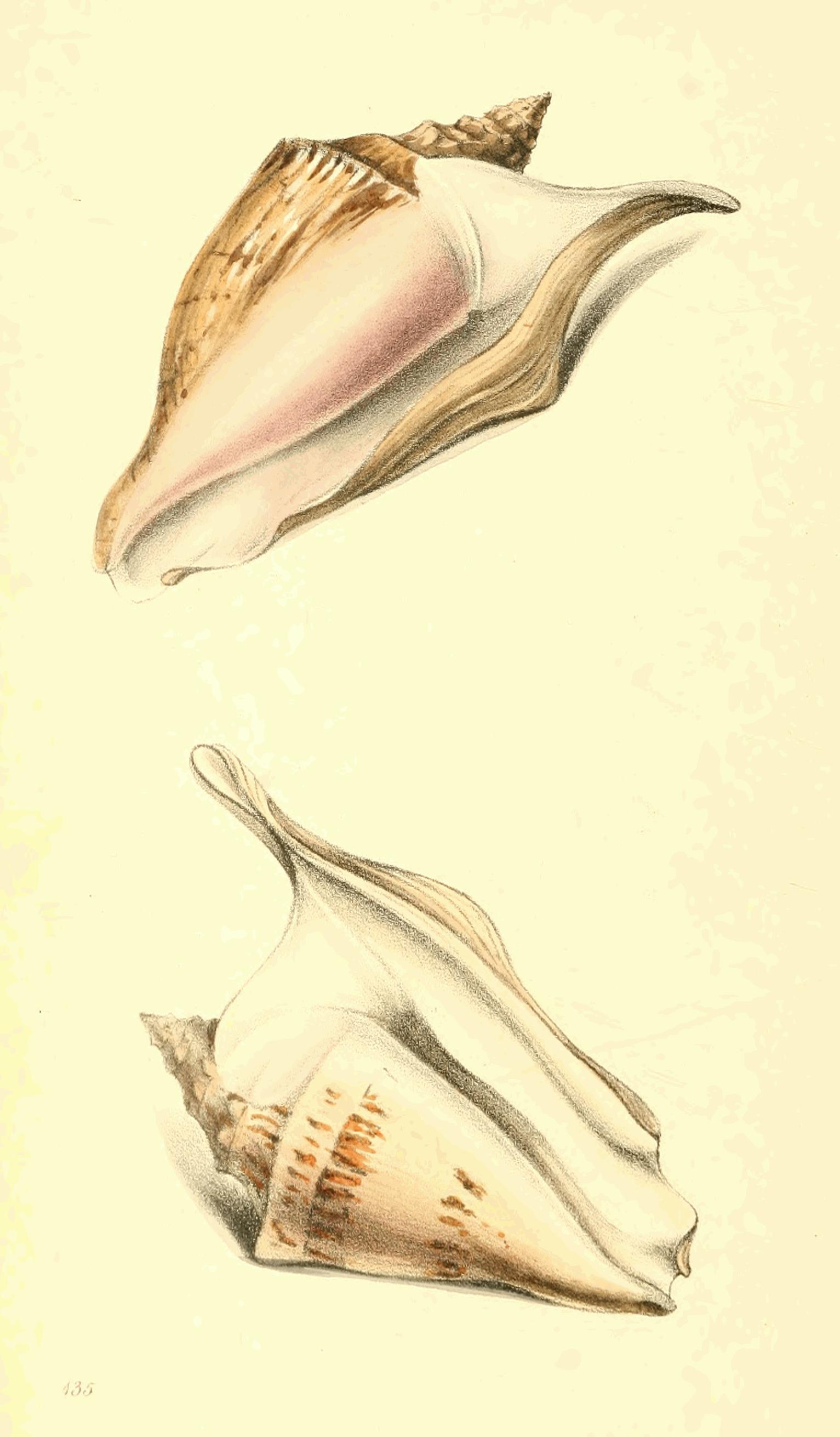
STROMBUS tricornis,
Horned Strombus.
Generic Character.—See Pl. 10.
Specific Character.
S. testâ ponderosâ, nodis longitudinaliter compressis armatâ; labio exteriore inflexo, margine crasso, suprà attenuato et ultra spiram producto; canali truncato.
Shell ponderous, with longitudinally compressed nodules; outer lip inflexed, the margin thick, above attenuated and produced beyond the spire; channel truncated.
In young stages of growth.
Seba, pl. 62. f. 36, 10. Martini 3. tab. 91. f. 890. tab. 85. f. 847.
Lam. Syst. 7. p. 201.
Var. A. Shell whitish, outer lip much produced. Upper figure. Martini, vol. 3. tab. 84. f. 844, 845. Sw. Ex. Conch. part 4.
Var. B. Shell varied with chesnut, outer lip shorter. Lower figure. Ency. Méth. t. 408. f. 1. t. 409. f. 2. Martini, 3. tab. 84. f. 843. Lister, 871. f. 25. 873. f. 29.
Martini was the first conchological writer who separated this species from the Strombus Gallus of Linnæus; under which name are included three shells, so remarkably different from each other, that they hardly possess a single character in common.
The original name of Linnæus I have retained to that species figured by Seba, tab. 62. fig. 1 and 2, and by myself in Exotic Conchology, Part 4.
Strombus tricornis, although figured, has never yet, I believe, been defined.
Two varieties of this shell are met with; one having the attenuated process of the lip much produced, the margins folded inward, and the tip somewhat spatulate, or spoon-shaped: the colour of this variety is generally white, slightly varigated with brown stripes or irregular spots. A very fine specimen of this variety, having these characters remarkably developed, is in my own cabinet, and is figured in Exotic Conchology, part 4. The second variety has the process of the lip shorter, and the margins not folded; the colour usually brownish, richly clouded and variegated with chesnut; the aperture within is tinged with pale red or rosy; but that of the other variety is pure white. I believe this species inhabits the coasts of America; it is a heavy shell, and sometimes measures seven inches in extreme length.
Pl. 136
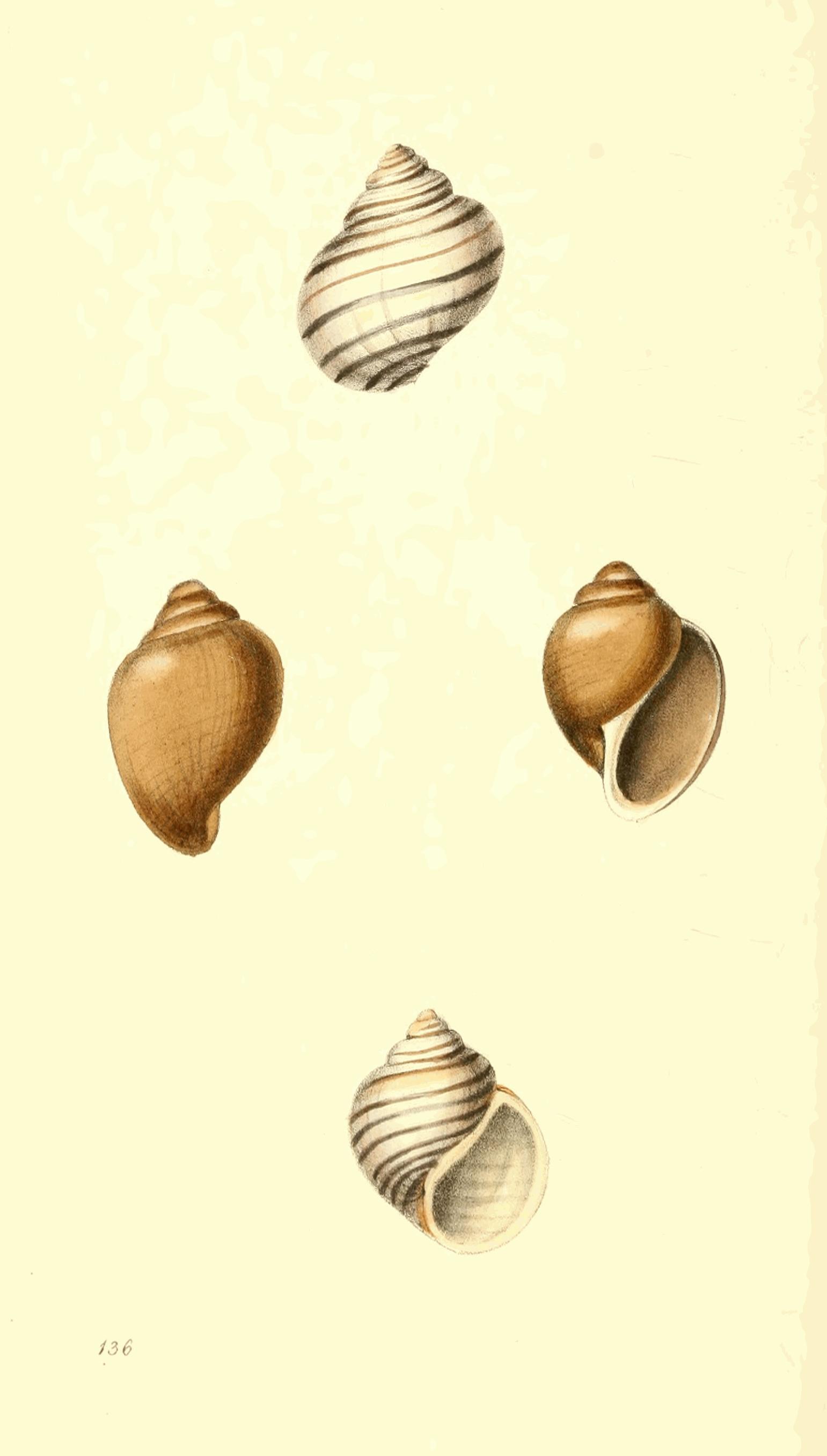
AMPULLARIA crassa,
Thick Apple Snail,
Upper and lower figures.
Generic Character.—See Pl. 103.
Specific Character.
A. testâ globosâ, lævi, (sub epidermide) albâ, fasciis fuscis ornatâ; spiræ levatæ apice obtuso; aperturæ margine albo, crasso; umbilico caret.
Shell globose, smooth, beneath the epidermis white with brown bands; spire elevated, tip obtuse; margin of the aperture thick, white; umbilicus none.
Martini 9. t. 128. f. 1135.
A distinct species, well characterised by the absence of the umbilicus, the situation of which is indicated only by a slight depression: the margin of the aperture all round is thickened, and white; but, from no groove being discernible, I suspect the operculum may be horny. The only specimen I have, is divested of the epidermis; it is obviously an old shell; and appears to agree with the figure of Martini, also taken from an uncoated specimen.
AMPULLARIA oblonga,
Oblong Apple Snail
A. testâ oblonga, lævi, tenui, fuscâ; spirâ levatâ, crassâ, obtusâ; aperturæ elongatæ basi contractâ; umbilico vix obsoleto.
Shell oblong, smooth, thin, brown; spire elevated, thick, obtuse; aperture lengthened, base contracted; umbilicus nearly obsolete.
A rare, and undescribed shell, presenting a singular deviation from the general globose form of the Ampullariæ. The inner lip is wanting on the upper part of the aperture, and on the lower is thin, white, and reflected over the umbilicus, which is nearly obsolete.
Both these shells were in the late Mrs. Bligh's collection, without any habitat being affixed to them.
Pl. 137
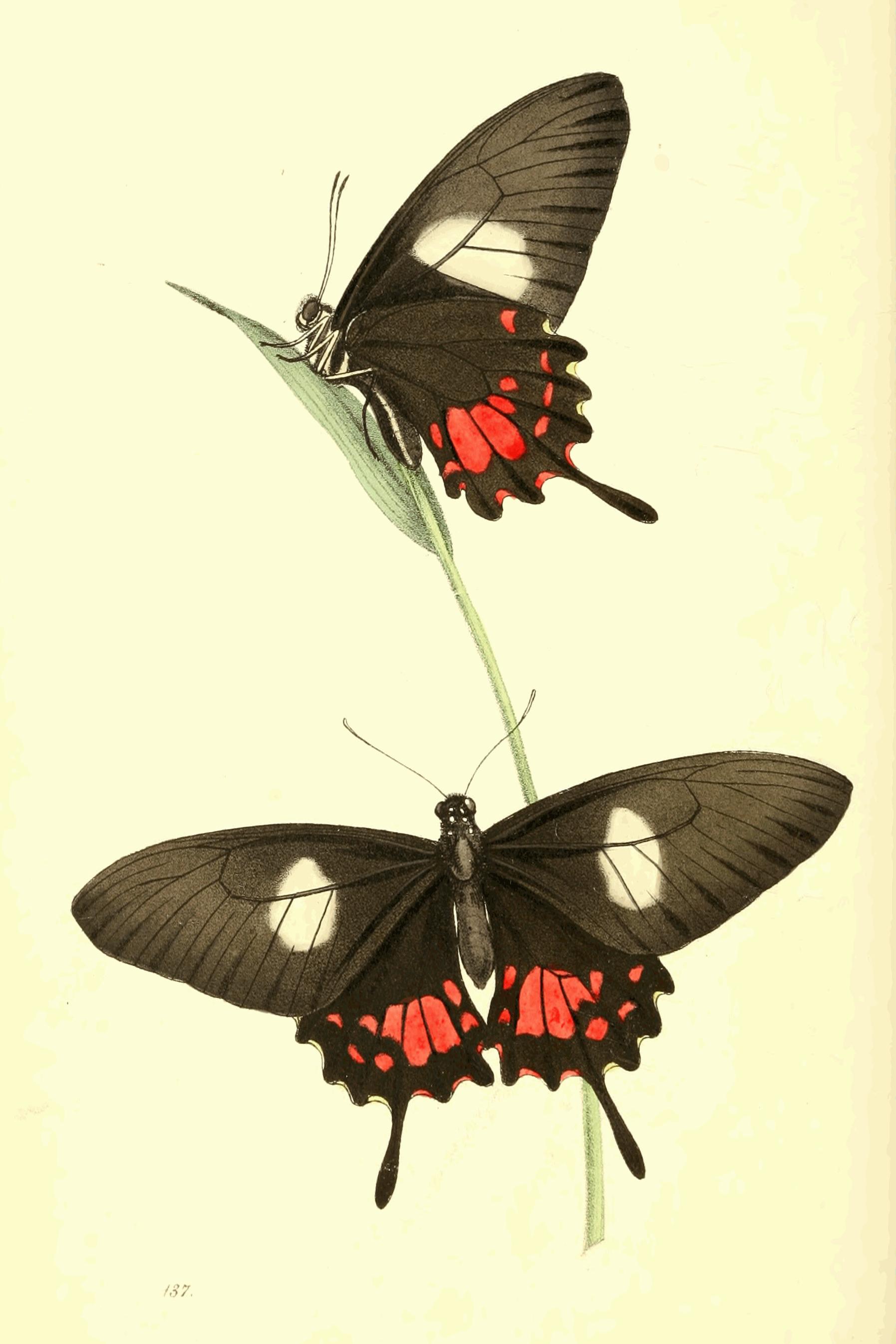
PAPILIO Polybius.
Generic Character.—See Pl. 92.
Specific Character.
P. alis nigris; anticis maculo albo centrali; posticis dentato-caudatis maculo rubro centrali nervis diviso; abdomine strigâ laterali; thorace punctis flavis subtùs, ornatis.
P. (Tr. caud.) wings black; anterior with a central spot of white; posterior dentated and tailed, with a central red spot, divided by the nerves; stripe on each side the abdomen and spots on the thorax beneath, yellow.
An insect neither described nor figured by any author. To my liberal friend, Dr. Langsdorff, I am indebted for the two specimens in my own cabinet, collected by himself in the interior of Minas Geraes, or the Diamond district of Brazil. I am not aware of the insect having been found in any other part of that vast country.
An unusual character is presented in this species, alone sufficient to distinguish it from any other contained in the division to which it belongs. This consists in the thorax beneath being spotted with yellow, and the body, on each side of the under surface, having a narrow yellow stripe; the basal margin of the inferior wings is also yellow. Strictly speaking, these yellow spots would remove it from the section Trojani, but it would then be improperly separated from P. Lysithoüs, Agavus, and others to which it is, in every respect, closely allied.
Pl. 138
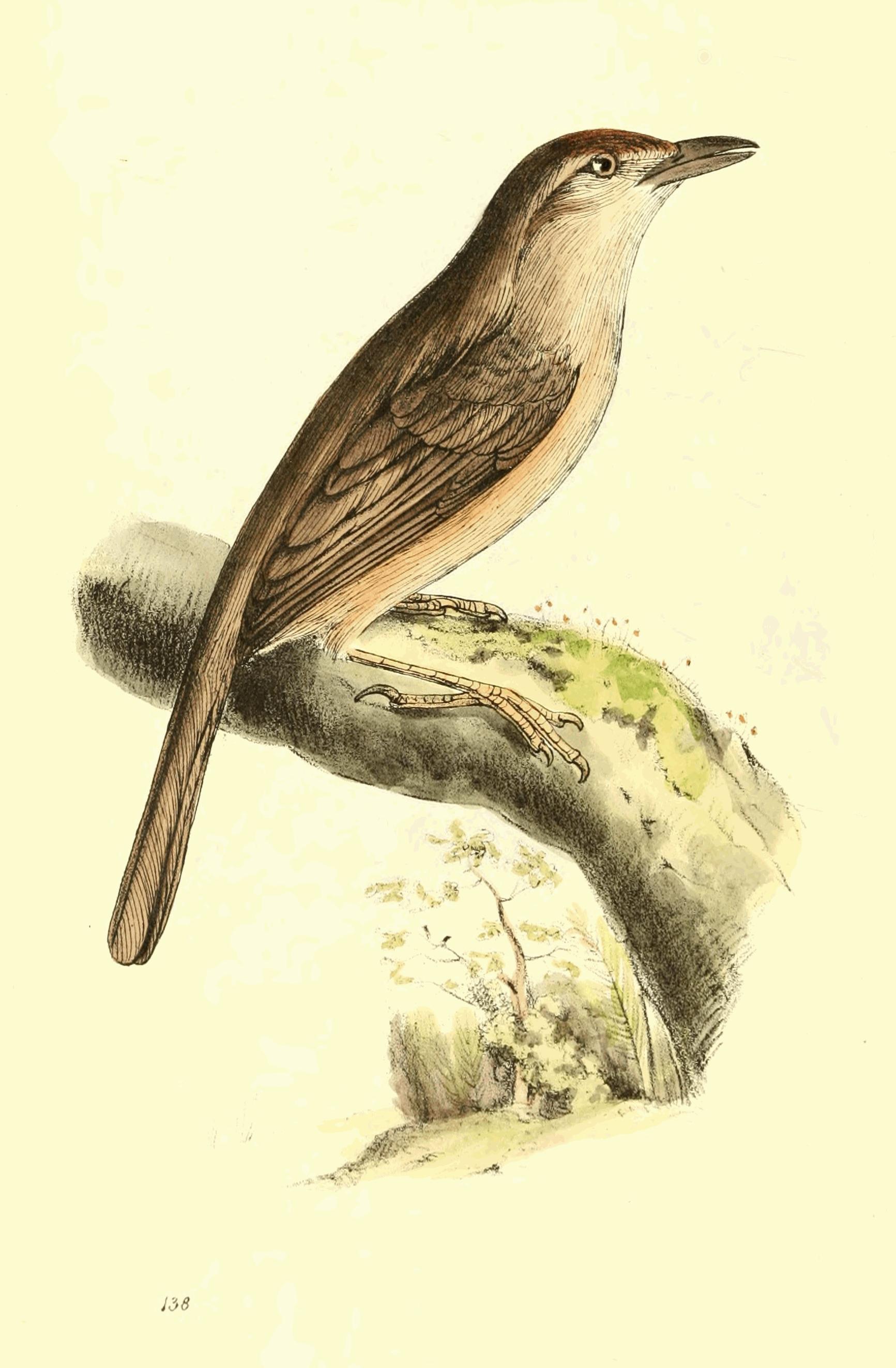
MALURUS garrulus,
Noisy Soft-tail Warbler.
Generic Character.
Rostrum validius, breve, totum valdè compressum, altius quam latius, culmine prominente plumas frontales dividente et ad apicem aliquandò emarginatum, vix incurvo. Nares basales membranâ tectæ, aperturâ laterali. Alæ brevissimæ, rotundatæ, remigum 3 primorum longitudine proximorum 4 longitudinem superante. Cauda plerumque longa, cuneata, radiis mollibus, decompositis. Pedes validi, digito exteriore ad digiti medii basin annexo. Hallux validus.
Ob. Rostri basi vibrissis setaceis sparsis instructâ. Tem.
Bill rather strong, short, much compressed its whole length, higher than broad, the ridge prominent, dividing the frontal feathers, and bent at the tip, which is sometimes notched. Nostrils basal, covered by a membrane, the aperture lateral. Wings very short, rounded, the three first quills shorter than the four next. Tail generally long, cuneated, the radii soft and decomposed. Legs strong; the outer toe connected to the base of the middle toe. Hind claw strong.
Ob. Base of the bill with setaceous hairs. Temminck.
Generic Types—Turdus brachypterus. Lath. Le Flûteur. Vail. Ois. d'Af. 3. pl. 112. f. 2. Le Capolier. Do. pl. 129. pl. 130. f. 1.
Specific Character.
M. fuscus, infrà albescentibus; plumis frontalibus rigidis, acuminatis, rufis; strigis ante et pone oculos albescentibus; caudâ mediocri, rotundatâ.
M. brown, beneath whitish, feathers on the front of the head rigid, pointed, and rufous; lines before and behind the eye whitish: tail moderate, rounded.
The colours of this bird are altogether plain; but it is remarkable for its very singular nest, which is so large, as to form a feature in the woodland scenery of Bahia, the only part of Brazil where I observed it: the nest is built in low trees, formed externally of dried sticks, without any neatness, and is usually three or four feet long, resembling at a distance a thick twist of bean stalks thrown in the branches by accident: sometimes two of these nests appear as if joined together, and there is an opening on the side, besides one at the top. The sexes are generally seen near the nest, uttering a shrill, incessant, monotonous chirp, particularly in the morning and evening. I never could bring myself to tear one of their nests to pieces, merely to see its construction.
All the birds of this genus are stated by Professor Temminck to be natives either of the old world, or of the southern hemisphere; but the observations I have made, lead me to think otherwise. Two of the generic types M. Temminck has given, are the same as those I have selected; these birds are now before me; the other (Le Capolier,) is so like the species here figured, that (judging from Le Vaillant's plate) they might easily pass for the same bird. Two other species, with characters perfectly resembling M. garrulus, are likewise found in Brazil.
From a consideration, therefore, of the affinities and habits of these birds, I conceive they may constitute a very natural genus, closely allied to Sylvia, having very compressed bills, short wings, russet coloured plumage, with soft and generally long tails, and building rather large and cylindrical nests. On the other hand, if the whole of the birds mentioned by P. Temminck are retained in the genus, I apprehend it will become entirely artificial; inasmuch as it will include not only the birds above mentioned, but the Motacilla superba, and a large non-descript bird from New Holland, the size of a thrush, which in habit, though not in characters, resembles a shrike.
M. Vieillot first proposed this genus, but his definition is so short and obscure, that little can be gained from it.
The slight sketch in the distance, introduced in the plate, will give some idea of the singular nest of this bird.
Pl. 139
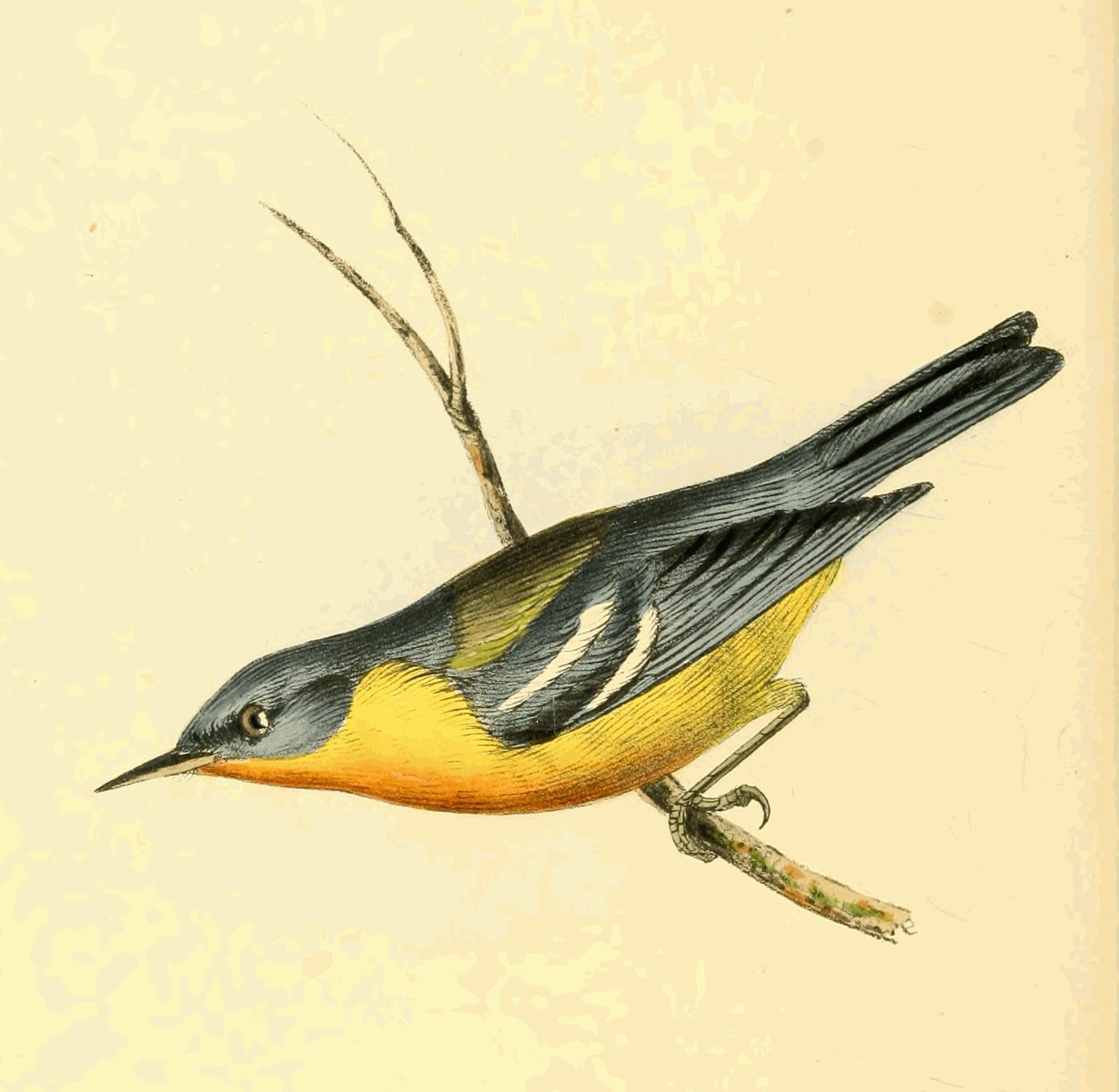
SYLVIA plumbea,
Grey-backed Warbler.
Generic Character.
Rostri recti, tenuis, basi altiore quam latiore, mandibulâ superiori aliquando emarginatâ, inferiori rectâ. Nares basales, laterales, membranâ partim tectæ. Crura longiora digito medio, qui digito exteriori ad basin annectitur. Ungue posteriore mediocri, digito posteriore breviore et arcuato. Remigum pinnâ primâ brevissimâ aliquando caret. Tectrices remigibus multo breviores. Temm.
Bill straight, slender, base higher than broad; superior mandible sometimes notched, the inferior straight. Nostrils basal, lateral, partly covered by a membrane. Legs longer than the middle toe, which is united to the exterior toe at the base; hinder claw moderate, shorter than the toe, and curved. Wings; the first quill very short, or wanting, greater covers much shorter than the quills. Temminck.
Generic Types—Turdus arundinaceus. Lath. Sylvia locustella. Luscinia. Trochilus. Regulus. (Temminck.)
Specific Character.
S. cæruleo-grisea, infra aurea; dorso olivaceo; tectricium apicibus albis.
Blue grey, beneath golden yellow; back olive; wing-covers tipt with white.
There is an elegance of shape, and a harmony of colouring, in the Warblers, that render these delicate little birds very interesting. The species are exceedingly numerous, and are spread over most parts of the world; several abound in our own woods and hedges, and the "sacred bird" of our childhood, the Robin Redbreast, is among the number. That now before us is a native of Brazil, from whence it was received by Mr. Leadbeater; I never met with it myself. The first quill feather is hardly shorter than the three next, which are all of equal length; the tail-feathers are even, and rather pointed; their colour black, margined with grey; the two outer with a white spot on the inner web; the under wing and tail-covers white.
I have made no material alteration in Prof. Temminck's definition of this overgrown genus, being convinced it might lead to confusion, while the generality of the birds composing it remain so little known.
This bird greatly resembles the female of S. pusilla of Wilson (yellow-backed Warbler, Latham), yet differs in having the belly golden yellow instead of white: I was told, moreover, that this was a male bird: the one inhabits North, and the other South America. Latham's description of his yellow-backed Warbler, I should think, is not quite accurate; as he only alludes to one white bar on the wing covers, whereas both Wilson and Vieillot say there are two.
Pl. 140
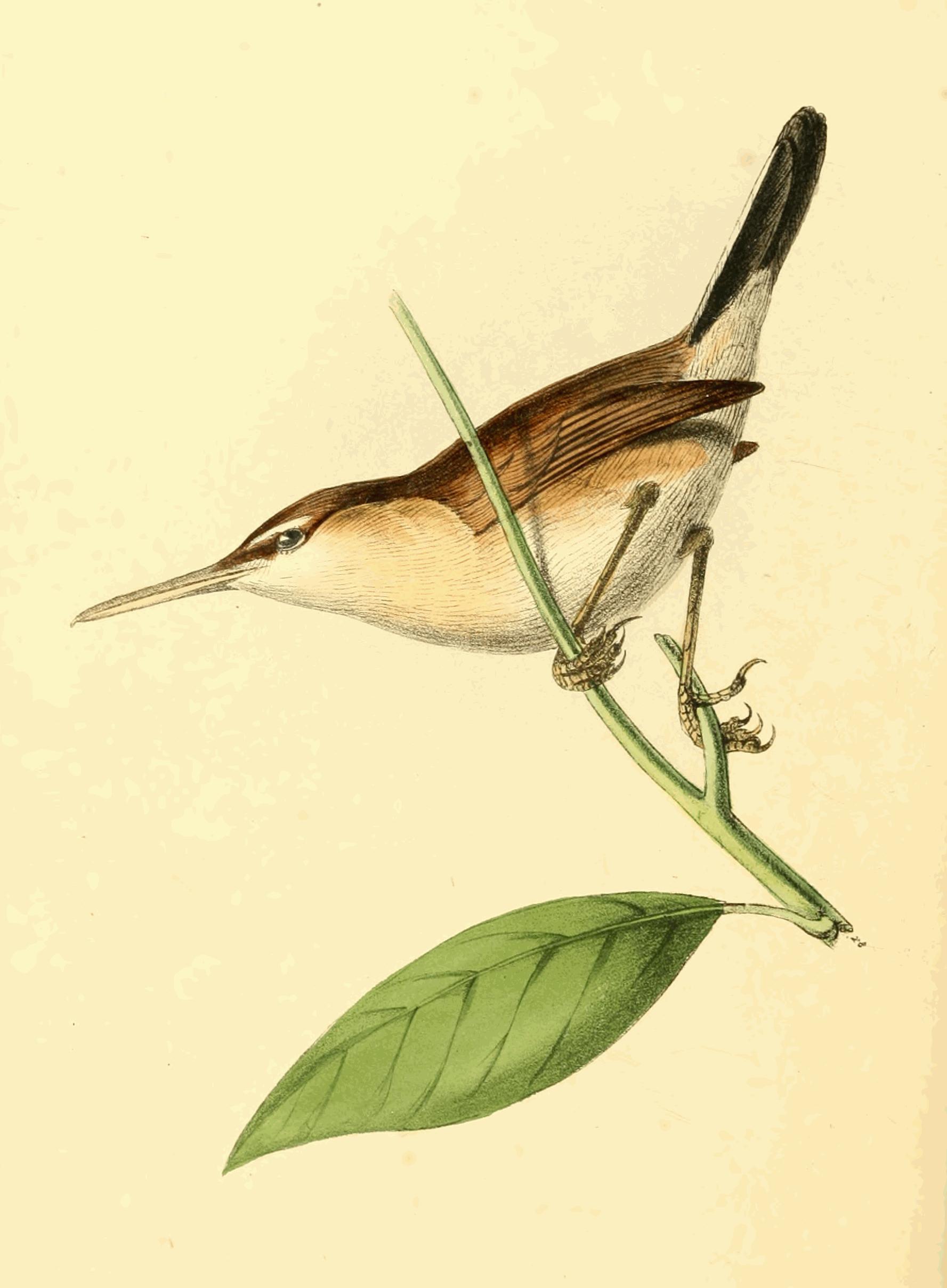
TROGLODYTES rectirostris,
Straight-billed Wren.
Troglodytes. Ray. Cuvier. Vieillot. Sylvia. Latham. Temminck.
Generic Character.
Rostrum curvatum, rarò rectum, lateribus compressis; apice vix emarginato. Nares basales. Alæ brevissimæ, rotundatæ, remigum majorum 3 exteriorum longitudine quartæ longitudinem superante, cæteris paribus et vix remigibus minoribus longioribus. Rectrices breves, fasciculatæ, erectæ. Hallux digito medio brevior. Plumæ fuscæ.
Bill curved; rarely straight, the sides compressed, the tip slightly notched. Nostrils basal. Wings remarkably short, rounded, the three exterior greater quills shorter than the fourth; the remainder of equal length, and hardly longer than the lesser quills. Tail-feathers weak, short, fasciculated, and generally carried erect. Hind toe shorter than the middle toe. Plumage brown.
Generic Types Motacillæ troglodytes et furva. Gm. Certhiæ familiaris, palustris, et Caroliniana. Wilson, Am. Orn.
Specific Character.
T. fuscus, jugulo pectoreque pallidioribus; mento nigricante; corpore medio niveo; rectricibus angustis, nigris; mandibulæ superiore apice adunco.
Brown; throat and breast paler; chin blackish, middle of the body snowy, feathers of the tail black and narrow; tip of the upper mandible hooked.
This singular little bird agrees more in its general character with Troglodytes, than with any other established genus; yet with this its similitude is but slight. Anxious, nevertheless, to avoid what might hereafter prove an unnecessary innovation, I have placed it with the Wrens, under the distinguishing name of rectirostris; although I am more inclined to think it constitutes a distinct genus.
Troglodytis, originally instituted as a genus by our illustrious countryman Ray, has been adopted both by M.M. Cuvier and Vieillot. Professor Temminck, on the contrary, has included it with Sylvia; an immense genus, already burthened with more species than are rightly understood, or that really belong to it.
Figure the natural size. Bill straight, triangular at the base, the sides compressed, tip of the upper mandible bent down and notched; nostrils large, lengthened, covered by a membrane, which (except at the base,) is naked; the aperture terminal, near the edge of the bill, narrow, and oblong: the feathers on the rump and flanks remarkably long; the three fore toes slender, and all connected at their base as far as the first joint: tail even, and longer than the generality of Wrens, the feathers very narrow, weak, and deep black. Plumage above light or reddish brown; sides of the head, neck, breast, and body, the same, but tinged with fulvous; the chin and upper part of the throat blackish, but the margin of the feathers partly white: lower part of the throat and breast dusky: middle of the body pure white; under wing covers, inside margin of the quills, and edge of the shoulders, white.
Mr. Leadbeater favoured me with this bird, which he received from Brazil.
The comparative length of the bill in this genus, (leaving the present bird out of consideration,) offers no generic distinction, because it varies greatly in different species. Some of those found in Brazil have the bill nearly double the length of the common European Wren.
Pl. 141
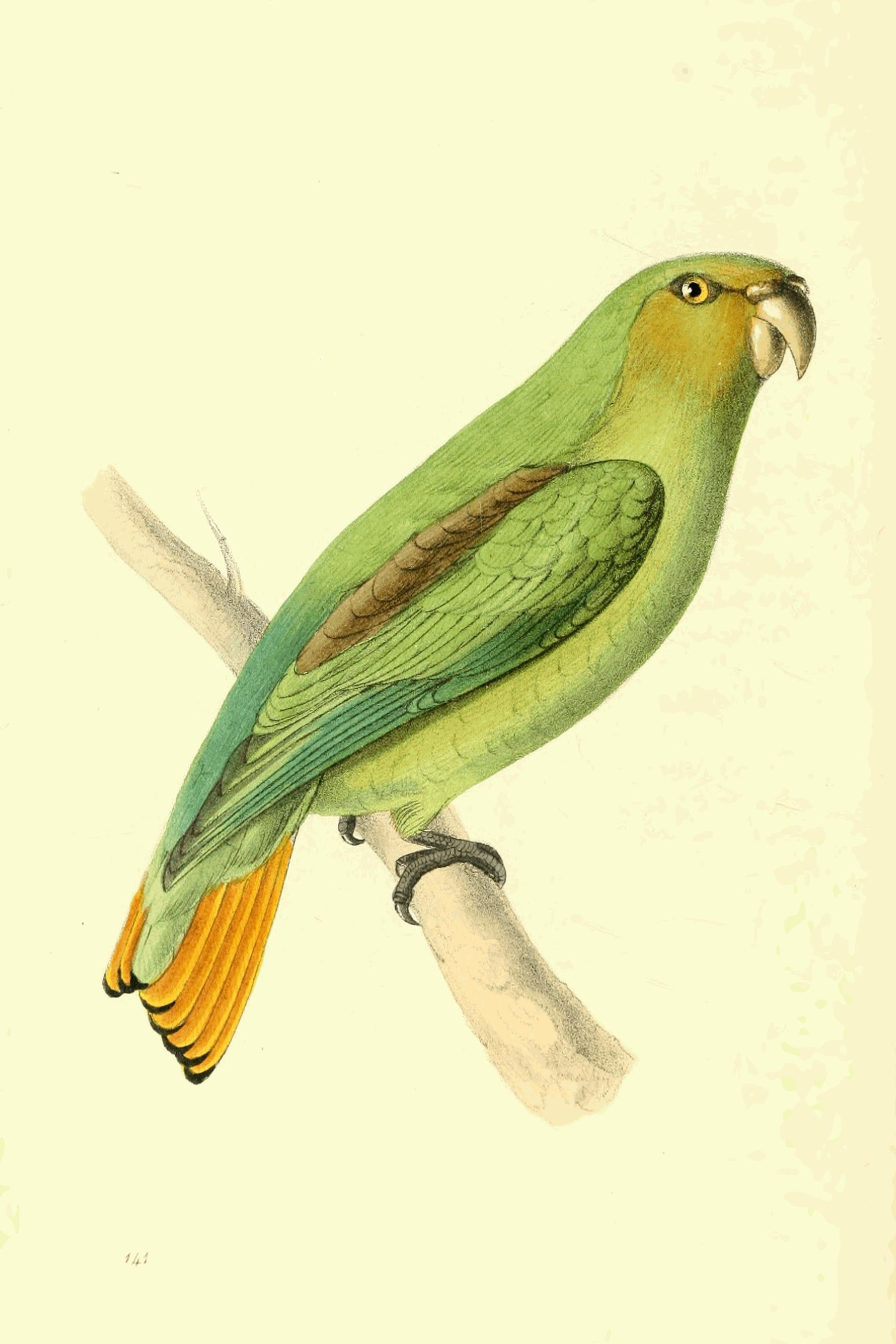
PSITTACUS chryseürus,
Golden-tailed Parrot.
Generic Character.—See Pl. 1.
Specific Character.
P. nitidè viridis; fronte genisque fulvo colore tinctis; rectricium brevium, parium, pennis mediis viridibus, cæteris aureis, omnium apicibus nigris.
Shining green; front and sides of the head tinged with fulvous; tail short, even, tipt with black, the two middle feathers green, the rest golden.
I was fortunate in procuring both sexes of this very rare bird in the vicinity of Pernambuco, being the only individuals I ever met with in Brazil: they appeared as if tired from a long flight, which led me to suppose they had migrated from the interior towards the coast. I do not find the species noticed by any writer, nor have I seen it in any collection.
The total length is six inches and a half; the plumage generally of a rich emerald green, rather obscure on the top and sides of the head, but very bright on the back and rump, where it is tinged with blue; the feathers round the base of the bill, front, and sides of the head, are tinged with buff colour; the scapulary feathers (protecting the base of the wings and lesser quills) are chocolate brown, the quills themselves black, margined externally with green and internally with olive. The most beautiful part of the bird is the tail, which is short and even, each feather having the tips margined by a narrow line of black, the middle pair being green, and all the rest of a rich golden yellow colour; the under plumage and wing covers are nearly of as deep a green as the wings, but on the flanks there is a tinge of olive.
Pl. 142
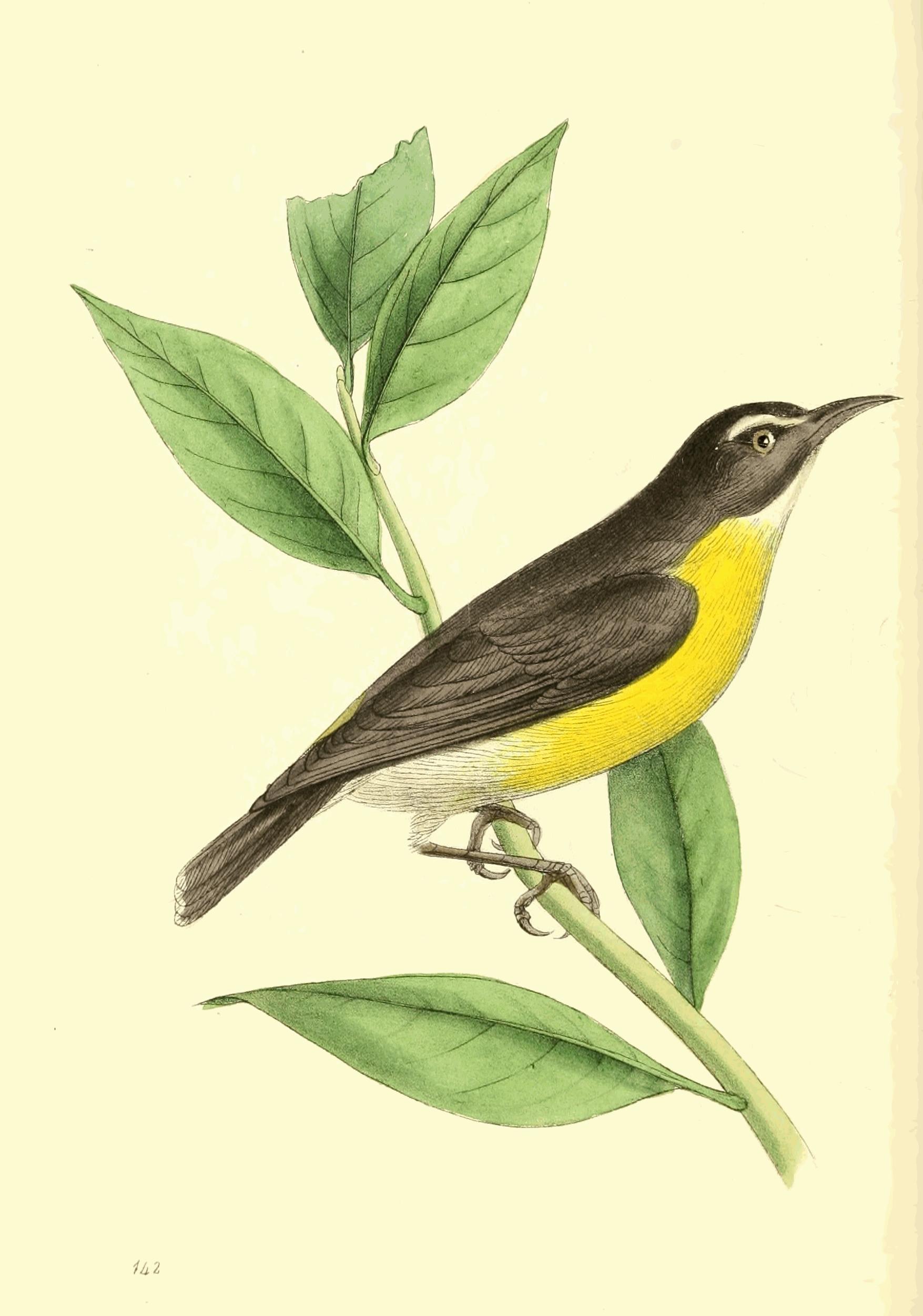
NECTARINIA flaveola, var.
Yellow-bellied Nectarinia.
Generic Character.—See Pl. 117.
Specific Character.
N. nigricans, infrà flava; mento, superciliis rectriciumque trium exteriarum apicibus, albis; fasciâ uropygiali olivaceâ.
Blackish brown; beneath yellow; chin, eyebrows, and tips of the three outer tail-feathers white; band on the rump olive.
Certhia flaveola. Gmelin, 479. Lath. Ind. Orn. v. 1. p. 297. Gen. Zool. v. 8. p. 248. Turton, p. 297.
Certhia, No. 33. Brisson. Orn. v. 6. App. p. 117. Syn. 2. p. 19.
Black and yellow Creeper. Edwards, pl. 122. pl. 362. Lath. Syn. v. 2. p. 737. Gen. Zool. v. 8. p. 248. Turton. p. 297.
Le Guit-Guit Sucrier. Vieill. Ois. Dor. Certh. pl. 51. p. 102.
This pretty little bird, under different varieties of plumage, appears to be scattered over the greatest part of tropical America, and is one of the most common of its tribe. The best, and indeed the only detailed account of its economy, is given by M. Vieillot; who remarks, that its nest is suspended on the tops of those tall climbing plants, which, in those countries, form a matting over the most lofty trees: the entrance to the nest is at the bottom; the interior is divided into two compartments, in one of which only the young are contained. It feeds both on small insects, and the nectar of flowers. All the above synonyms refer to the different varieties authors have enumerated of this species. Most of these have a white spot at the base of the exterior quills; others vary in having the throat entirely black; and some again have a yellow rump; but none of these agree with the variety here figured, which I believe came from Trinidad. Probably a more perfect knowledge of these supposed varieties will show they contain two or three distinct species.
Notwithstanding the shortness of the bill, this is a decided Nectarinia, according to a natural, but not an artificial arrangement. It forms, in some degree, a passage from the shining coloured Nectariniæ of America, to the short-billed Melliphagæ of the southern hemisphere. On a future occasion I shall offer more detailed observations on the genus Dicæum of Cuvier.
The figure is the size of life; and, with the specific character, renders a further description unnecessary.
Pl. 143
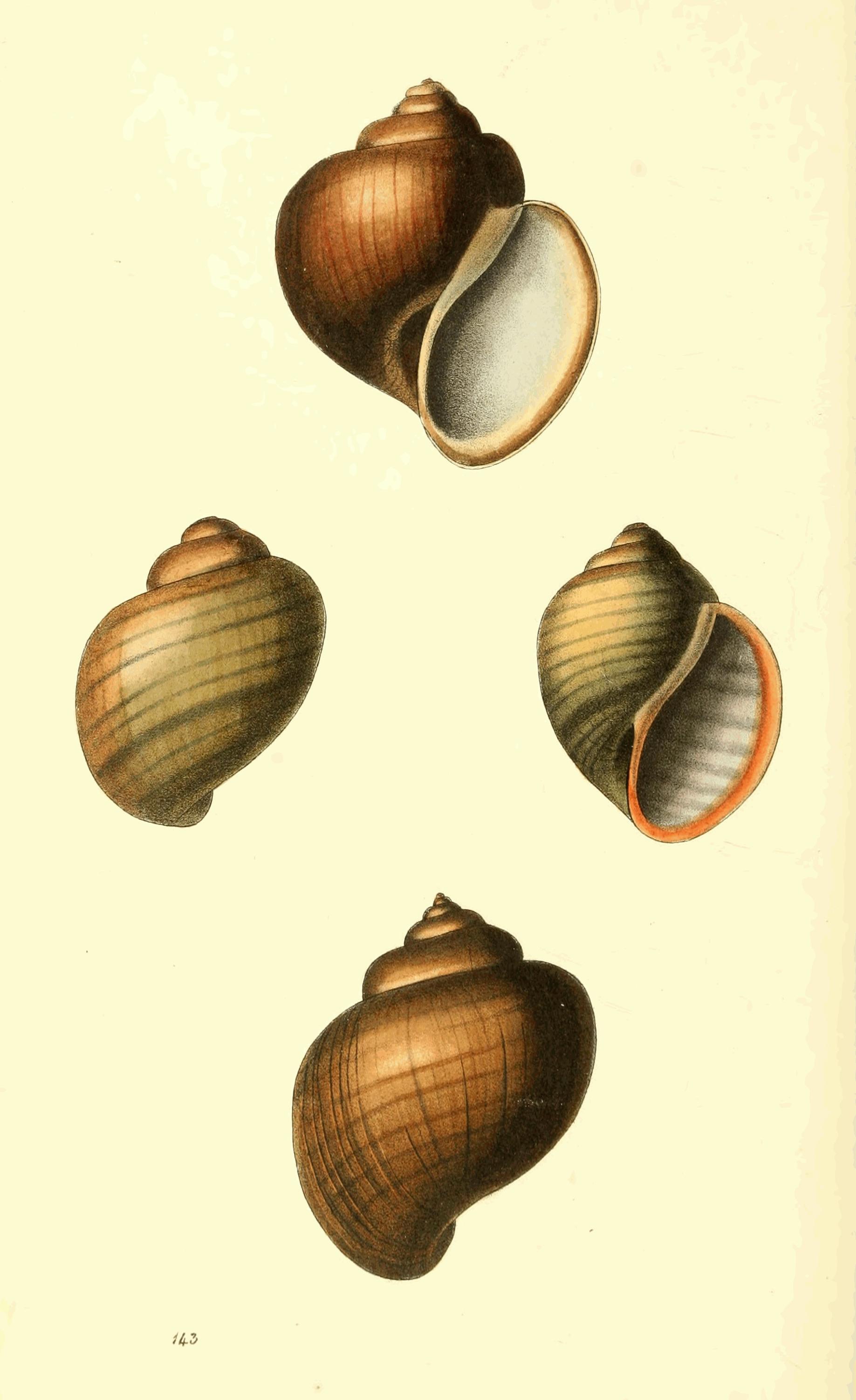
AMPULLARIA sordida,
Brown Apple Snail f. 1. 2.
Generic Character.—See Pl. 103.
Specific Character.
A. testâ globosâ, ferrugineâ, lineis transversis subcarinatis instructâ aperturæ margine tenui; umbilico magno; operculo corneo?
Shell globose, ferruginous, with obsolete transverse subcarinated lines; margin of the aperture thin; umbilicus large; operculum horny?
The only species of Ampullaria with which this may be confounded is A. fasciata, p. 103, in comparison with which it is a more globose shell, the aperture narrower, and the spire more obtuse; the umbilicus is larger, round, and not contracted; the suture is not sunk, the shell is not banded with coloured lines, nor is the surface smooth; on the contrary, it is marked with transverse, obscurely carinated lines; while the shell is uniform brown, the aperture within is white, margined with brown.
AMPULLARIA puncticulata
Oval, punctured Apple Snail
A. testâ ovatâ, subtilissimè punctatâ; spirâ obtusâ; labii exterioris margine, interiorisque basi rufis, incrassatis; operculo corneo?
Shell oval, minutely punctured, spire obtuse; margin of the exterior lip within, and base of the inner lip thick and rufous; operculum horny?
This and A. oblonga are the only species I am yet acquainted with, whose form is not globose. It never grows to a size much larger than the figure; the whole shell is marked by fine longitudinal striæ, and transverse lines of minute dots, discernible only by the aid of a common magnifier; the aperture within is brownish flesh-colour; the margin is strong and reddish, and, within that of the outer lip, is a thickened rim; which, should the operculum be testaceous, may supply the place of the groove for its reception observable in A. globosa and corrugata. The localities of both these species are unknown to me.
Pl. 144
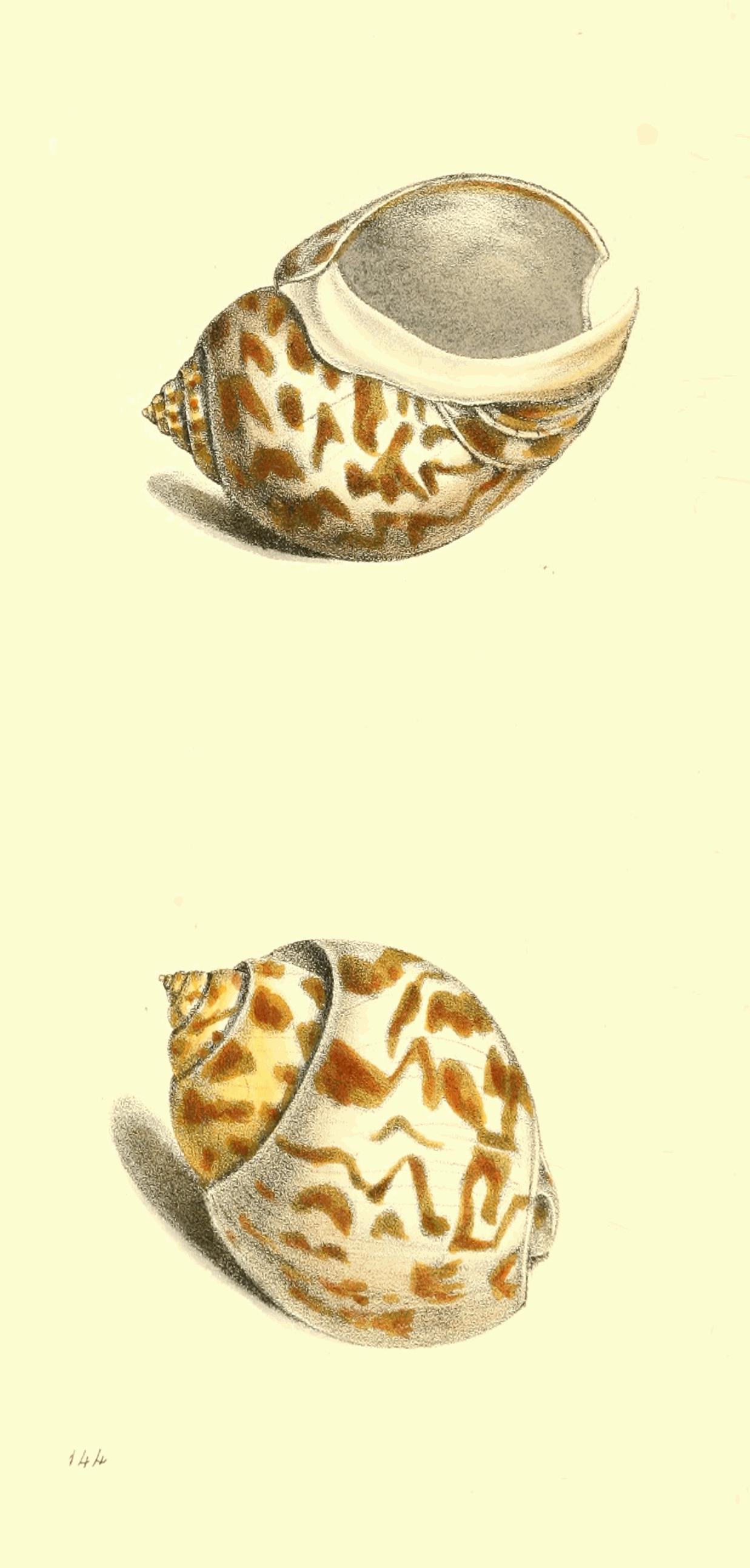
EBURNA Valentiana,
Arabian Eburna.
Generic Character.
Testa turrita, lævis, nitida, umbilicata, basi truncatâ, emarginatâ. Aperturæ angulus superior internè canaliculatus. Animal marinum.
Shell turrited, smooth, polished, umbilicated, base truncated, emarginate. Upper angle of the aperture with an internal channel. Animal marine.
Generic Type Buccinum Spiratum Lin.
Specific Character.
E. testâ ventricosâ, maculatâ; aperturæ longitudine spiræ longitudinem superante; spirâ anfractibus 5 convexis, suturis alveatis; basi balteo concavo cinctâ.
Shell ventricose, spotted; spire shorter than the aperture, of five convex volutions; suture channelled; base with a concave belt.
Eburna Valentiana. Sw. Appendix to Bligh Cat. p. 6. lot 904.
Few species are known of Eburnæ, and these are neither well defined, nor correctly figured.
The species selected by most authors as the type of this genus is Buccinum glabratum of Linnæus, a shell which, as it unites the characters of Eburna and Ancilia, should not have been chosen for this purpose. Types of genera are alone intended to represent the usual appearance of those characters on which the genus has been founded; they should therefore be selected from such species only, as represent these characters in their perfect development.
E. Valentiana was first characterized by myself, in the Appendix to the Bligh Collection. It was brought from the Red Sea by Lord Valentia, in honour of whom it is named. The very short spire and concave belt at the base, easily distinguish this shell from E. spirata.
Pl. 145
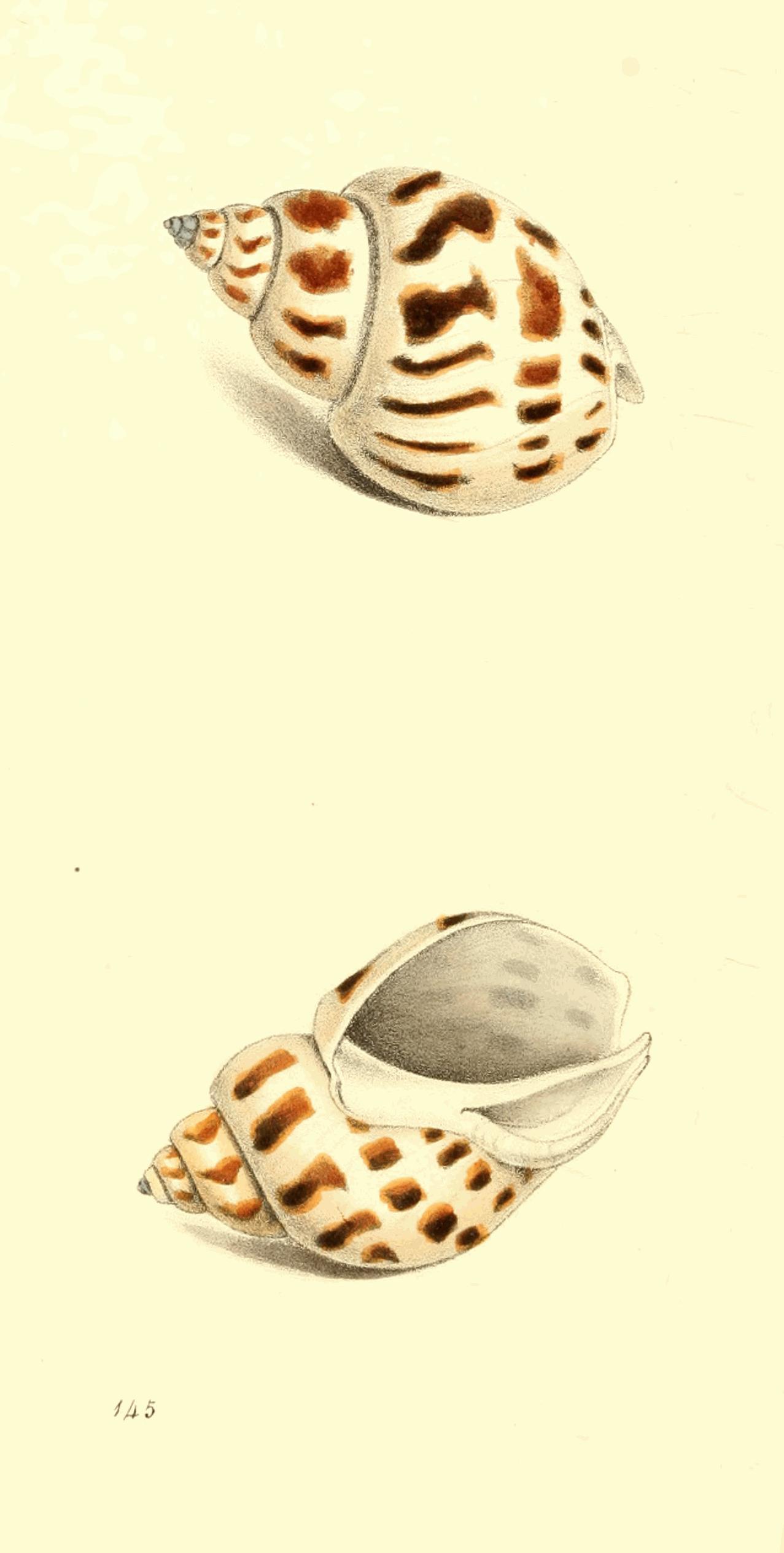
EBURNA tessellata,
Tessellated Eburna.
Generic Character.—See Pl. 144.
Specific Character.
E. testâ maculis fuscis seu purpureis tessellatis fasciatâ; suturâ vix canaliculatâ; anfractuum marginibus convexis.
Shell with bands of tessellated brown or purple spots; suture slightly channelled; margin of the volutions convex.
Buccinum Spiratum. var. Linn. Gmelin, 3487. Dill. 620. Brug. p. 262. 26. Turton, 4. p. 400. var. 2.
Lister, 981. 41. (bad.) Seba, t. 73. f. 25. 26. Martini, 4. pl. 122. 1120. 1121.
E. Arcolata, Lam. Syst. 7. p. 282. 4.
A shell hitherto placed as a variety of E. spirata, (Buccinum spiratum, Lin.) but from which I am disposed to consider it as specifically distinct. The channel or sulcation round the suture of each whorl is very slight, and the adjoining margin obtuse and convex; whereas in E. spirata the channel is broad and deep, having the margin sharply carinated: so far the essential characters of the two shells are at variance; but their difference in colour is so obvious that no one can mistake them.
The form of the umbilicus in this species appears to be constant: it is wide, deep, placed near to the upper angle of the aperture, and margined externally by a convex belt. With the exception of Seba's figures, (which, through the carelessness of the engraver, are reversed,) not a tolerable representation of this shell can be found; for those given by the authors above named, are almost too inaccurate for citation. It inhabits the Indian Ocean.
Pl. 146
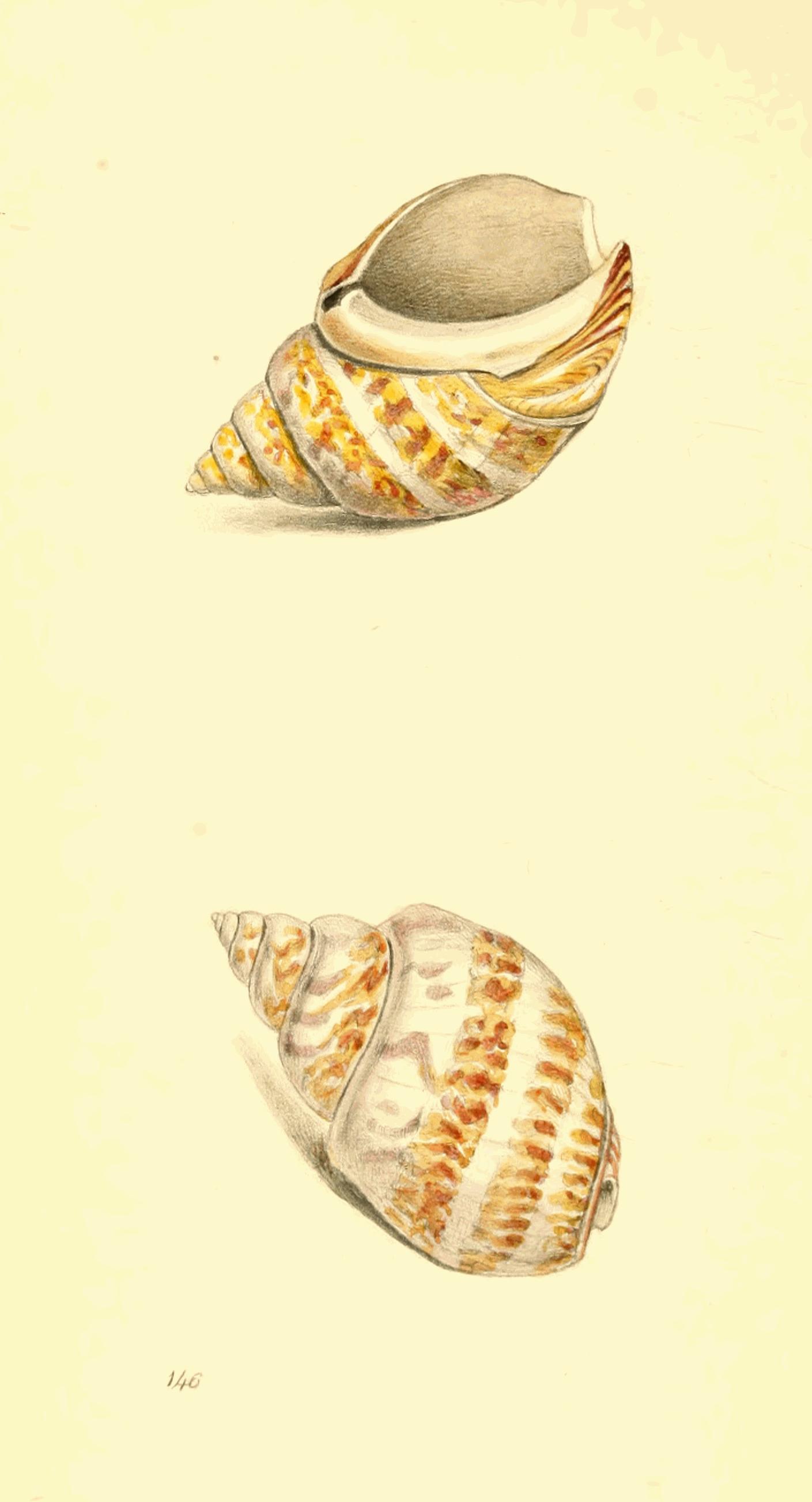
EBURNA Pacifica,
South Sea Eburna.
Generic Character.—See Pl. 144.
Specific Character.
E. testâ ventricosâ, maculis fulvis fasciisque albis ornatâ; spiræ angustæ, acutæ, suturis integris.
Shell ventricose, with fulvous spots and white bands; spire slender, acute; suture entire.
Eburna Pacifica. Swainson, Appendix to Bligh Cat. p. 6. lot 904.
Eburna lutosa? Ency. Méth. pl. 401. f. 4.
E. lutosa? Lam. Syst. 7. 282. 5.
A delicate and rather uncommon shell: first defined in the Appendix I subjoined to the Catalogue of the Bligh collection, dispersed by auction last spring. Mrs. Mawe informs me she has received this, along with other shells, from the Pacific Ocean.
A species at once distinguished by the entire suture and narrow-pointed spire; the inner lip is very thick, with a longitudinal sulcation near the umbilicus.
Whether this is the shell represented in the Ency. Méth. at pl. 401, f. 4, admits of doubt: a short description would have explained the characters, but not one word is said about it. I have already adverted to this novel mode of creating species at pl. 31. If authors will not be at the trouble of defining new species, they have no right to expect their names should be adopted by subsequent and more laborious writers, to whom they leave the more scientific task, of defining characters and collating synonyms.
Pl. 147
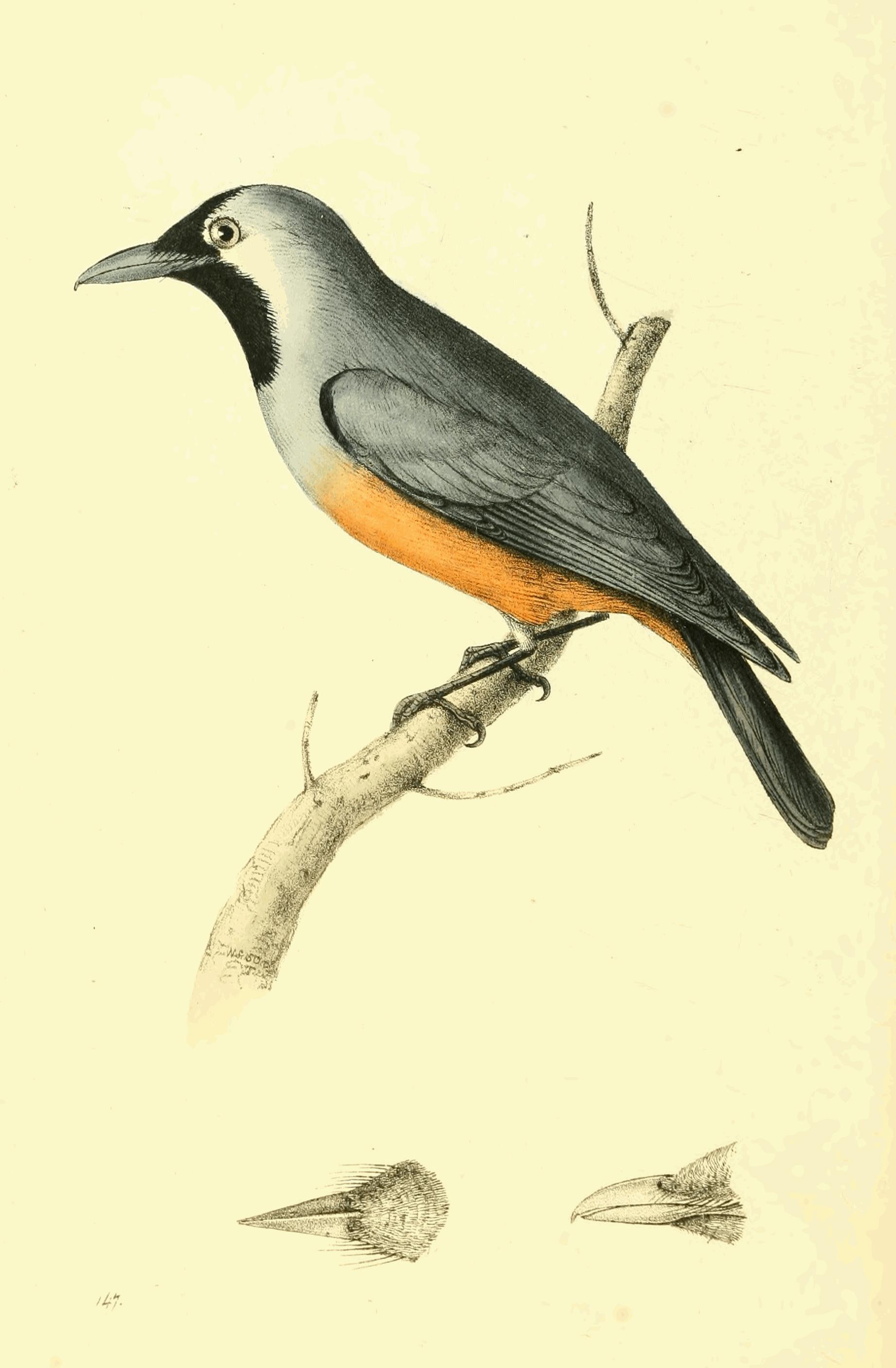
MUSCIPETA carinata,
Keel-billed Flycatcher.
Generic Character.—See Pl. 116.
Specific Character.
M. plumbea, infrà ferruginea; fronte juguloque nigris; temporibus albentibus; rostri culmine carinato.
Plumbeous; body beneath ferruginous; front and throat black; sides of the head whitish; top of the bill carinated.
Mr. Brookes, the celebrated anatomist, first drew my attention to this singular bird; the peculiarity of the bill suggested to us the idea of creating a genus for its reception; but a closer comparison of its other characters with several of the exotic Muscipetæ induces me, at least for the present, to associate it with those birds. The Flycatchers, as they now stand in the works of Latham, Shaw, and other Linnæan writers, undistinguished even by sections or subdivisions, present a mass of confusion, which renders the search after an individual, in this immense genus, almost hopeless.
Total length, six inches and a half; front, throat, and margin of the shoulders, deep black; the whole upper plumage is of a delicate lead colour, which is paler on the breast, and nearly white on the sides of the head and neck; body and inner wing covers rufous; the first quill is half the length of the second, which is rather shorter than the three next; feet slender, weak, and short; the outer toe united, the inner cleft. The bill at the base is triangular, but not elevated; the sides compressed; the culmin, or top, is sharp, elevated, and curved; the tip of both mandibles notched: nostrils simple, small, round, without a membrane, and partly hid by the thick-set frontal feathers, and lengthened setaceous bristles round the bill. These parts are delineated on the plate of their natural size; and must form the basis of any future generic alteration in the arrangement of this bird. The figure was from a specimen belonging to Mr. Brookes; since which, I have received two others from New Holland.
Pl. 148
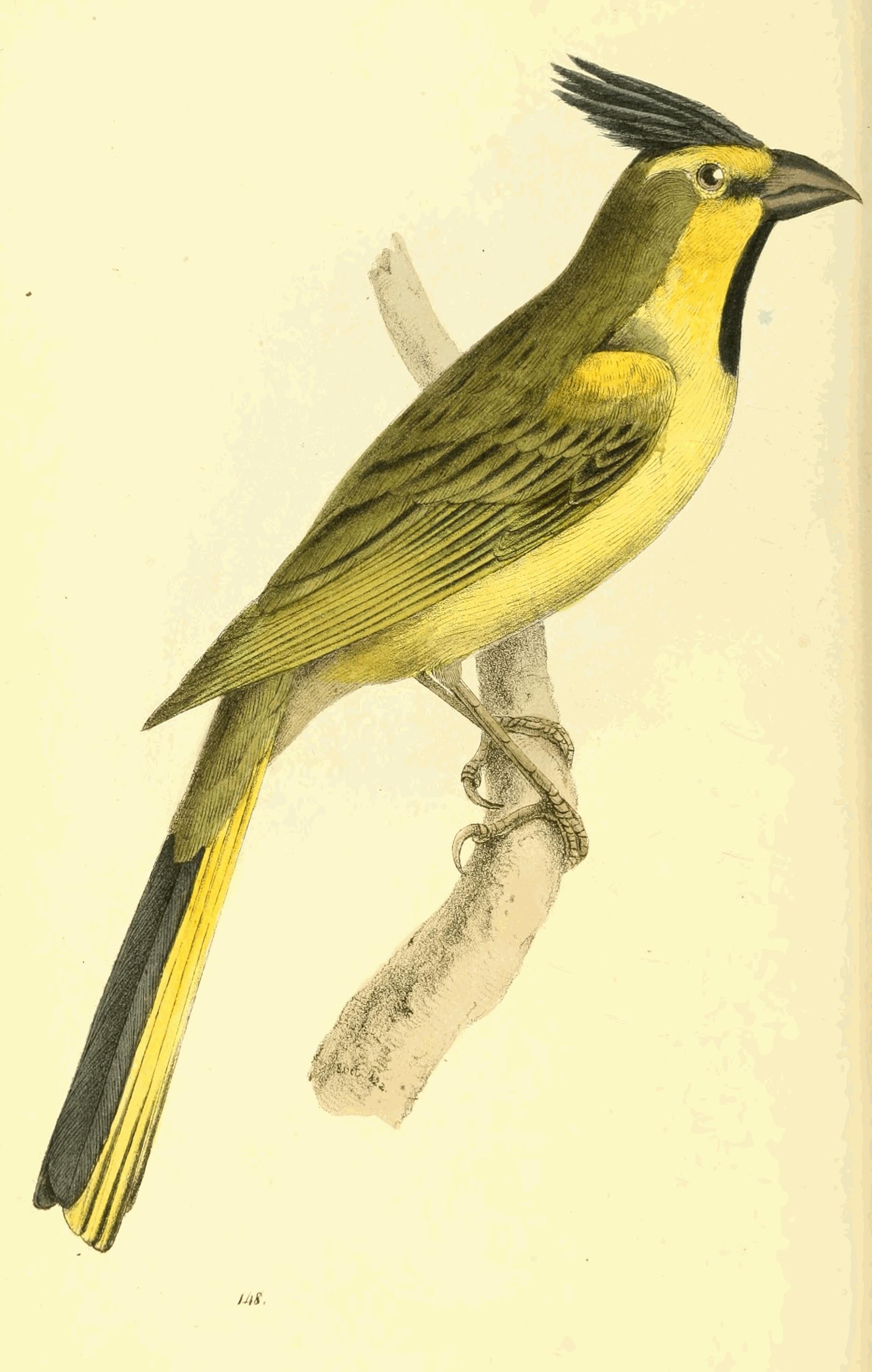
EMBERIZA cristata,
Crested Bunting.
Generic Character.
Rostrum breve, conicum, compressum, basi aliquatenus hians, mandibulâ superiore inflexâ, inferiore superiorem magnitudine superantem. Nares basales, rotundi, basi plumulis obtectâ. Pedes sedentes, digitis tribus anticis basi divisis, halluce plerumque brevi, curvo, aliquando recto.
Ob. Remigum pennâ primâ brevi, secundâ tertiâque longissimis.
Bill short, strong, conic, compressed; the base slightly gaping; upper mandible inflexed; under mandible largest. Nostrils basal, round, covered at the base by small feathers. Feet sitting, the three anterior toes divided at the base; the hind claw in general short and curved, in some species straight.
Ob. The first quill of the wings shorter than the second and third, which are the longest.
Generic Types (Temminck) i. Emb. citrinella. miliaria Lin. ii. Em. nivalis. Fring. Lapponica.
Specific Character.
E. olivacea, infrà flavescens; capite cristato; jugulo nigro; strigâ oculari, scapulis rectricibusque lateralibus flavis.
Olive, beneath yellowish, head crested; throat black; eye stripe, shoulders, and lateral tail feathers, yellow.
The elegant crest of narrow-pointed feathers on the head of this new bird, at once distinguishes it from all others of the same family. Mr. Brookes favoured me with the individual here described; it was purchased alive at one of the Brazilian ports; but I strongly suspect it had been first brought from Africa, by some one of the slave ships. The figure is of the natural size; down the shaft of each feather on the back is a black line; the tail is rather long, and even; the two middle feathers black; the rest pure yellow, with black shafts, and brown exterior terminal margins; the upper mandible of the bill is sinuated; the base not gaping, but with a few incumbent bristles.
I have taken the authority of Professor Temminck for the accuracy of the generic types of this genus under its present modification.
Pl. 149
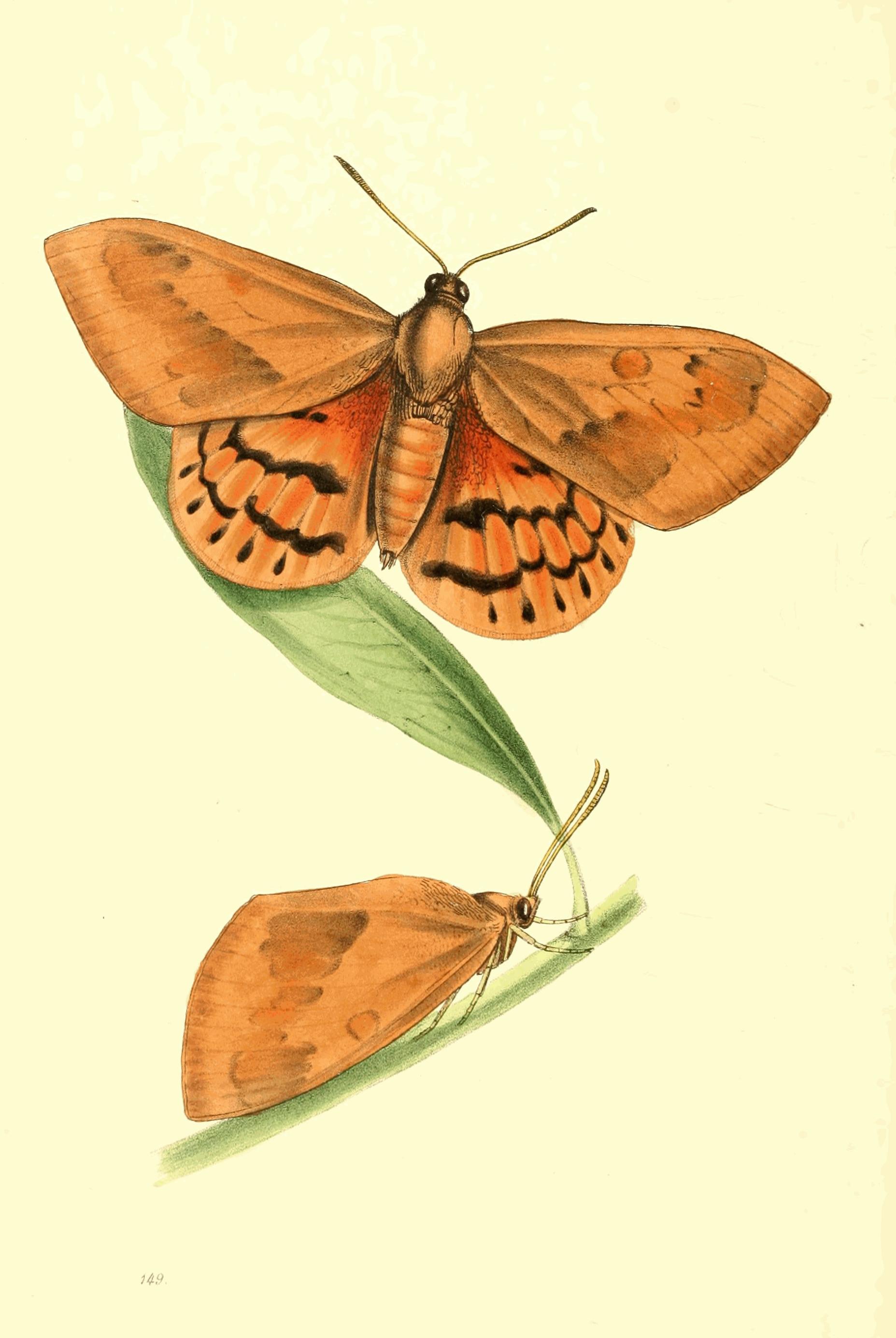
CASTNIA Fabricii,
Red underwing Day-moth.
Generic Character.
Antennæ clavatæ, clavo elongato, cylindraceo, fusiformi, ad apicem unco brevi, acuto armato. Palpi breves, graciles, haud prominentes, articulo ultimo nudo, obliquè verticales. Vertex ocellatus? ocello oculum juxta utrumque posito.
Obs. Caput parvum; alarum basis squamis conspicuis, elongatis imbricata.
Antennæ clubbed; club elongated, rounded, fusiform, ending in a short acute hook. Palpi short, slender, not projecting beyond the front, the last joint naked, obliquely vertical. Crown with a small ocellus? adjoining each eye.
Ob. Head small: base of the wings covered with conspicuous, lengthened, imbricate scales.
Specific Character.
C. alis anticis, suprà ferrugineis; posticis rufis, fasciis 3 undatis, nigris, masculis ovatis interstinctis, ornatis.
Anterior wings above ferruginous; posterior rufous, with three waved bands of black, between which are imperfect oval spots.
The insects of this genus form one of the most singular groups among the Lepidoptera; they are few in number, and confined to the tropical regions of America; flying only during the meridian heat, and then with incredible rapidity: they frequent the narrow inlets of thick forests, occasionally resting, far above the ground, on the trunks of trees. The species here figured is very rare, and came from the Diamond district of Brazil: it is named after the illustrious entomologist who first founded the genus. The bases of the wings beneath are furnished, in the male, with a spiral socket and horny spring, similar to those of the Phalænidæ.
Pl. 150
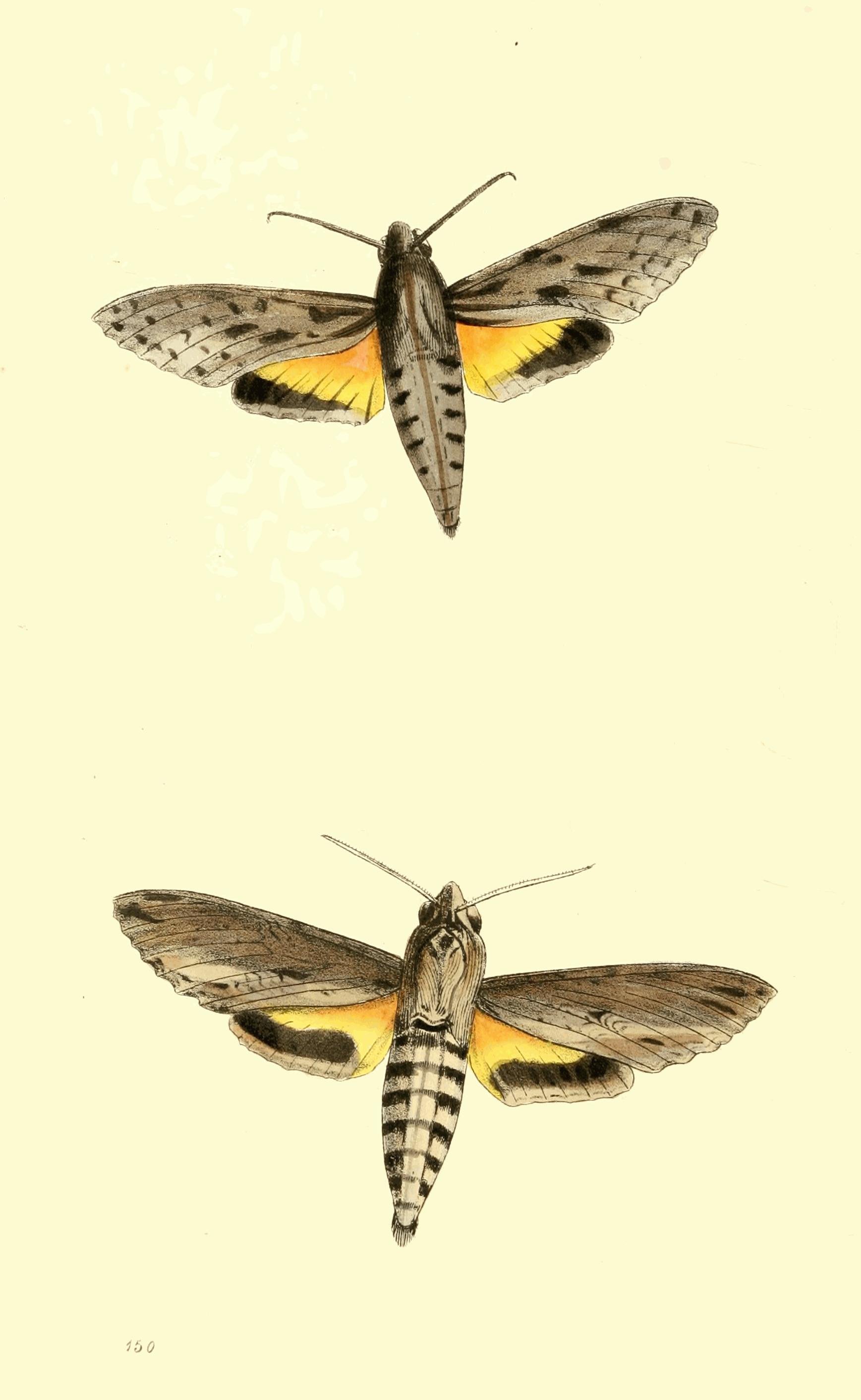
SPHINX fasciata.
Generic Character.—See Pl. 81.
Specific Character.
S. alis anticis subdentatis, suprà fuscis, margine postico strigâ pallidâ ornato; posticis fulvis, margine nigro; abdomine annuloso, annulis nigris, interruptis, interstitiis albis.
Anterior wings subdentated, above brown, posterior margin with a pale stripe; posterior wings fulvous, margin black; body with black interrupted rings, the interstices white.
This approaches so near to the Sphinx Alope of Drury, that it is not without hesitation I have ventured to separate them; it will, however, be seen, that neither in his figure or description is any notice taken of the pale testaceous band on the superior wings; the body likewise is described as "encircled with rings of brown and dark ash colour;" in this, the rings are black, on nearly a white ground: the under sides of the superior wings, in Drury's insect, "are spotted along their external edges with long yellowish spots;" in this, they are uniform pale brown. These differences (greatly strengthened by his figure) induce me to consider them as distinct; particularly as both insects appear to have come from Jamaica: the upper side of the antennæ are white, the lower brown. Cramer's figure of S. Alope affords little or no clue to illustrate the question.
SPHINX Leachii.
S. alis anticis subdentatis, griseo-fuscis, maculis mediis 3 nigris; posticis fulvis, margine nigro; abdomine griseo, annulis nigris, interruptis.
Anterior wings subdentated, greyish brown, with three medial black spots; posterior fulvous, margin black; abdomen grey, with interrupted black rings.
I cannot reconcile this with any one species described by Fabricius; at the anal angle of the lower wings, is a pale greyish spot, with two short blackish lines: I have named it in honour of that laborious and eminent zoologist, Dr. Leach; who presented me with the specimen here figured.
The upper figure is of Sphinx Leachii, and the under of S. fasciata.
Pl. 151
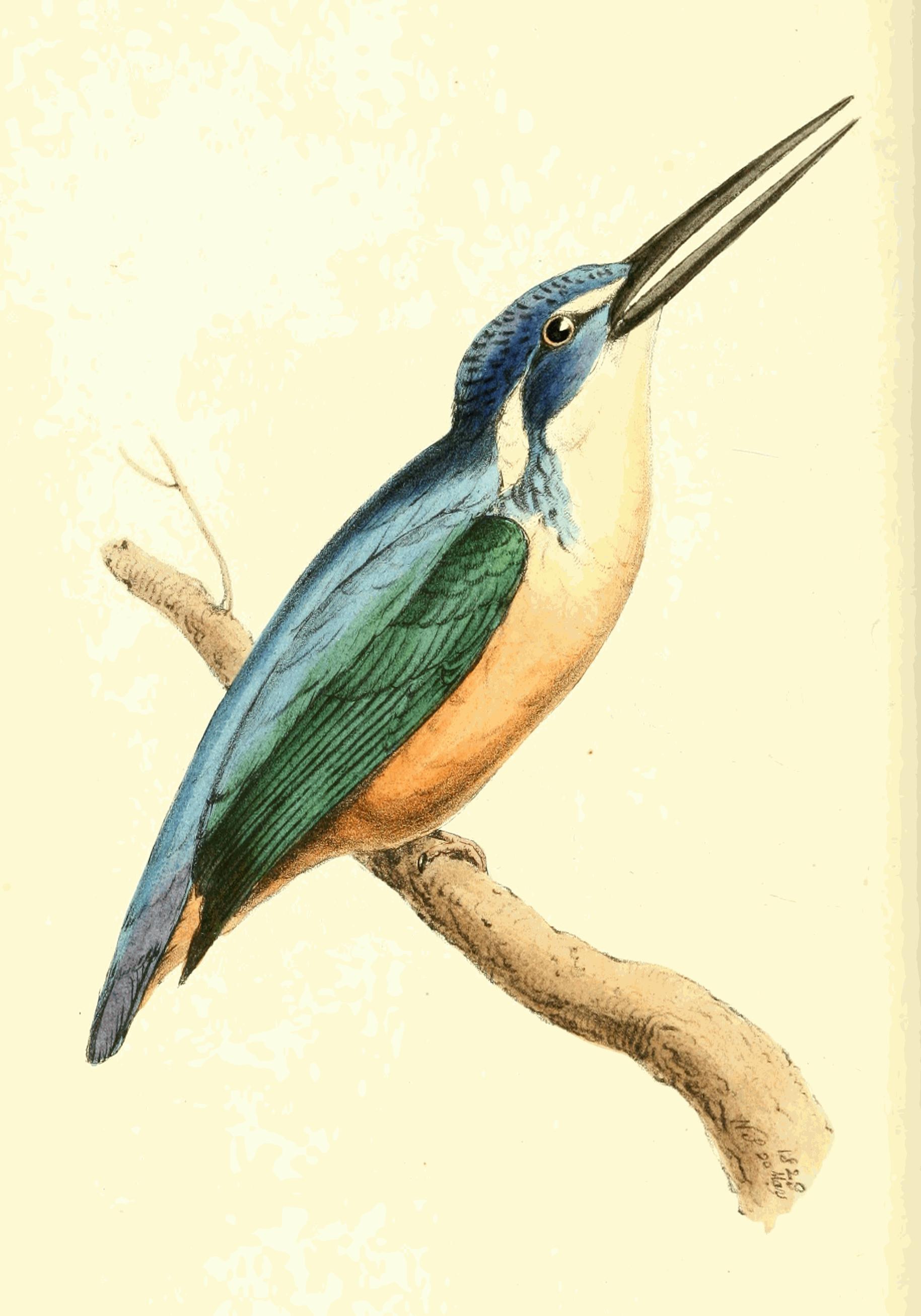
ALCEDO semitorquata,
Half-collared Kingsfisher.
Generic Character.—See Pl. 26.
Specific Character.
A. cæruleo-viridis, infrà ochracea; capite cyaneo, lineis nigris transversis ornato; dorso nitidè cæruleo; pectore torque cæruleo-viridi interrupto insigni.
Bluish green, beneath buff colour; head blue, with transverse black lines; back shining light blue; breast with an interrupted blue-green collar.
In a small collection of birds, procured on the borders of the Great Fish River of the Cape, I met with this new and elegant Kingsfisher. I was fortunate in detecting in the same parcel several other unknown and interesting birds; which I hope to record and illustrate in this work, particularly as they have since been sent to a foreign museum. This species considerably exceeds the size of the Asiatic Kingsfisher, being nearly eight inches and a half long: the bill is black, two inches from the gape, and one and three quarters from the base of the nostrils: head blue, the crown crossed by dusky black lines; hind head somewhat crested, the sides deep and rich mazarine blue; ears and sides of the neck greenish blue, the latter having a stripe of white; the blue on the sides of the neck advances on the breast in the shape of a half-formed collar: wings and scapula covers bluish green, with lighter spots on the tip of each of the wing covers; down the back is a stripe of vivid light blue, similar to the common Kingsfisher: tail dark-blue, edged with greenish, the base black. The plumage beneath, from the chin to the end of the throat, white; changing on the breast to pale fawn colour, which deepens to ferruginous on the body, under tail covers, and thighs: legs red: between the bill and eye a dusky white line.
Pl. 152
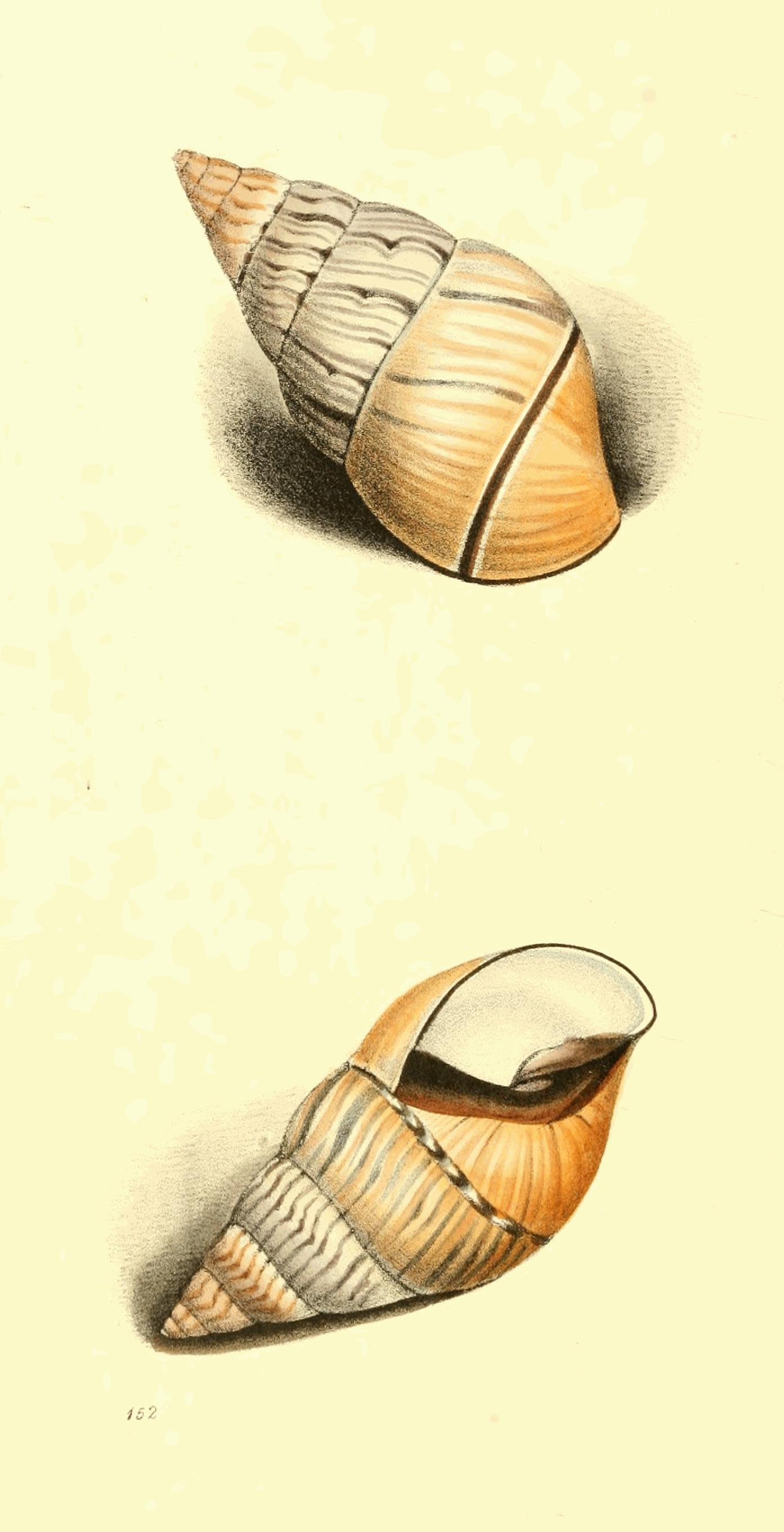
ACHATINA melastoma,
Black-mouthed Achatina.
Generic Character.—See Pl. 30.
Specific Character.
A. testâ strigis longitudinalibus, nebulosis, purpureis ornatâ; spirâ elongatâ; labio exteriore castaneo-nigro; columellâ crassâ, gibbâ; basi integrâ.
Shell with clouded purple longitudinal stripes; spire lengthened; inner lip chesnut-black; columella thickened, gibbous; base entire.
Helix regina. Ferussac Moll. liv. 19. pl. 119.
Var. (reversed.) A. perversa. Zool. Illust. vol. 1. pl. 30.
I have not the least doubt that this shell is specifically the same with that figured at Plate 30 of this work: it has only recently come under my inspection, and I therefore hasten to give a further illustration of this beautiful species, and to substitute a new specific character, which will be applicable to both varieties.
Although much more ventricose than the reverse variety, this has the same unusual formation of that part of the columella seen at the base of the mouth, where it is very thick, and appears as if swelled: the epidermis, in this specimen, obscures the white ground colour of the shell. I have seen also another variety, even more slender than that at Plate 30, and with the aperture not reversed. These new facts point out the necessity of the specific name of perversa being changed to one more applicable.
The figure is from a specimen lent to me by Mr. Dubois, and is probably from Brazil.
Pl. 153
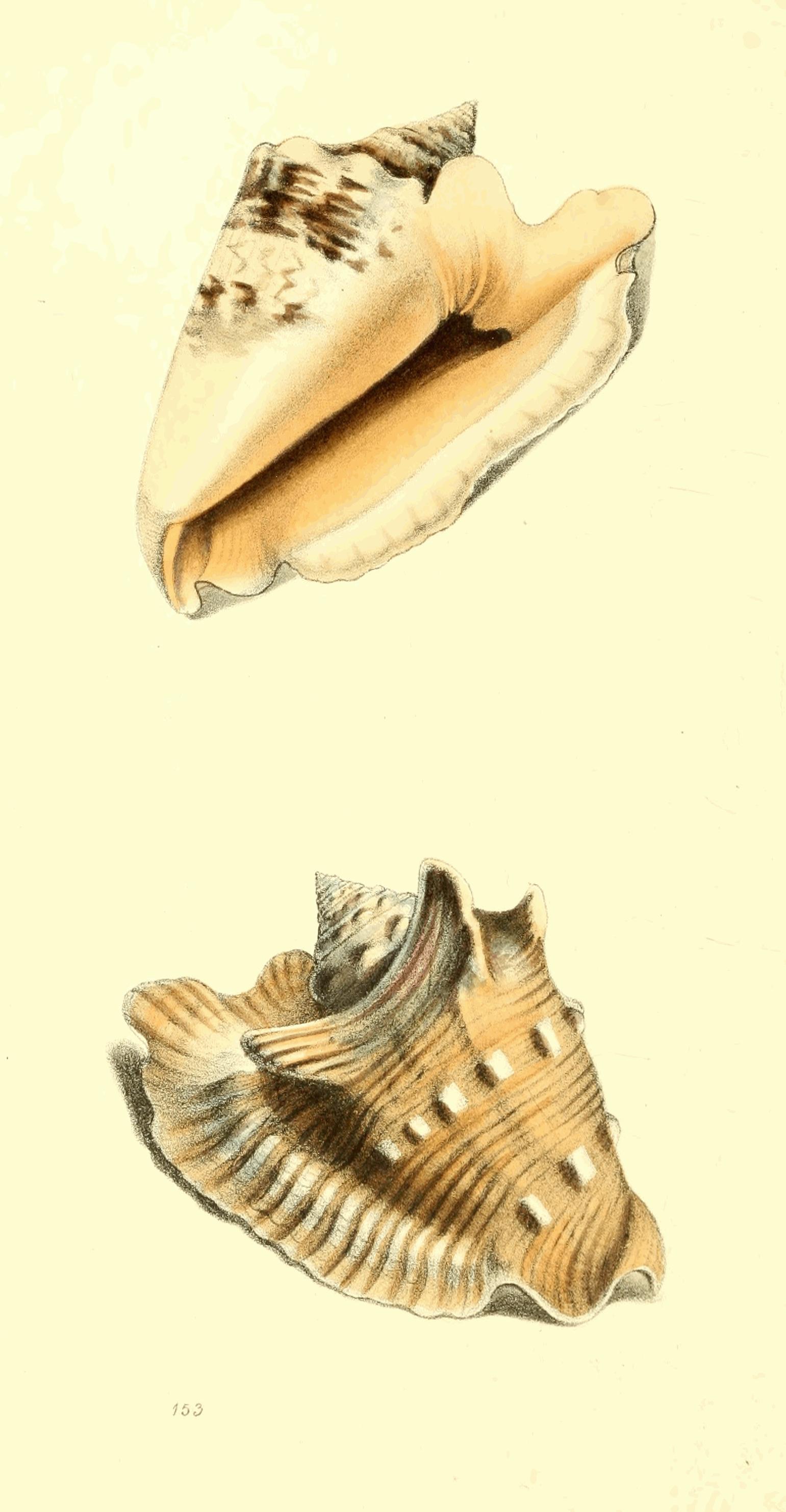
STROMBUS lobatus,
Lobed, or Brindled Strombus.
Generic Character.—See Pl. 10.
Specific Character.
S. testâ nodulosâ; spirâ brevi, inermi; labio exteriore suprâ repando, bilobo, margine crasso, reflexo; aperturâ lævi, rubescente; canale brevi.
Shell nodulous; spire short, unarmed; outer lip above spreading, two-lobed, margin thick, reflected; aperture smooth, reddish; channel short.
Seba, tab. 62. f. 4. 5. (optimè) 9. 12. 14. 15. 27. tab. 63. f. 6. Mart. 3. tab. 83. f. 836, 837. Gualt. tab. 32. f. F. Knorr 3. tab. 11. f. 1-6. tab. 29. f. 8.
Strombus Gallus, (β) Gmelin, 3511. 11. S. Raninus, Gmelin, 3511. 10.
S. bituberculatus, Lam. Syst. 7. p. 202. 6
It will appear extraordinary, that this very common shell should have been unknown to Linnæus; and still more, that no other systematic writer should have noticed it, excepting Gmelin, by whom it is placed as a variety of S. gallus, although his S. raninus is obviously made from a bad figure in Knorr of this same shell. On referring to Mr. Dillwyn's account of S. gallus, I find all the references of Gmelin to this shell expunged; and a note at the head of the genus states, that S. raninus is undeserving of notice; thus every trace of the shell, in this work, is altogether lost.
The two lobes at the top of the outer lip form a strong and peculiar distinction of this species: the colour of the mouth is variable; though usually tinged with pink, it is often reddish, or red blended with yellow, and sometimes nearly white; within the upper part of the aperture, round the inner lip, are one or two strong plaits, with sulcated grooves on each side; and near the lobe at the base of the outer lip, the aperture has a few obsolete striæ: the nodules on the body whorl are triangular, and the two nearest the lip are, in general, very large: the channel (or base) is short, and turned up in an oblique direction.
Found, in great abundance, in various parts of the West India seas.
Pl. 154
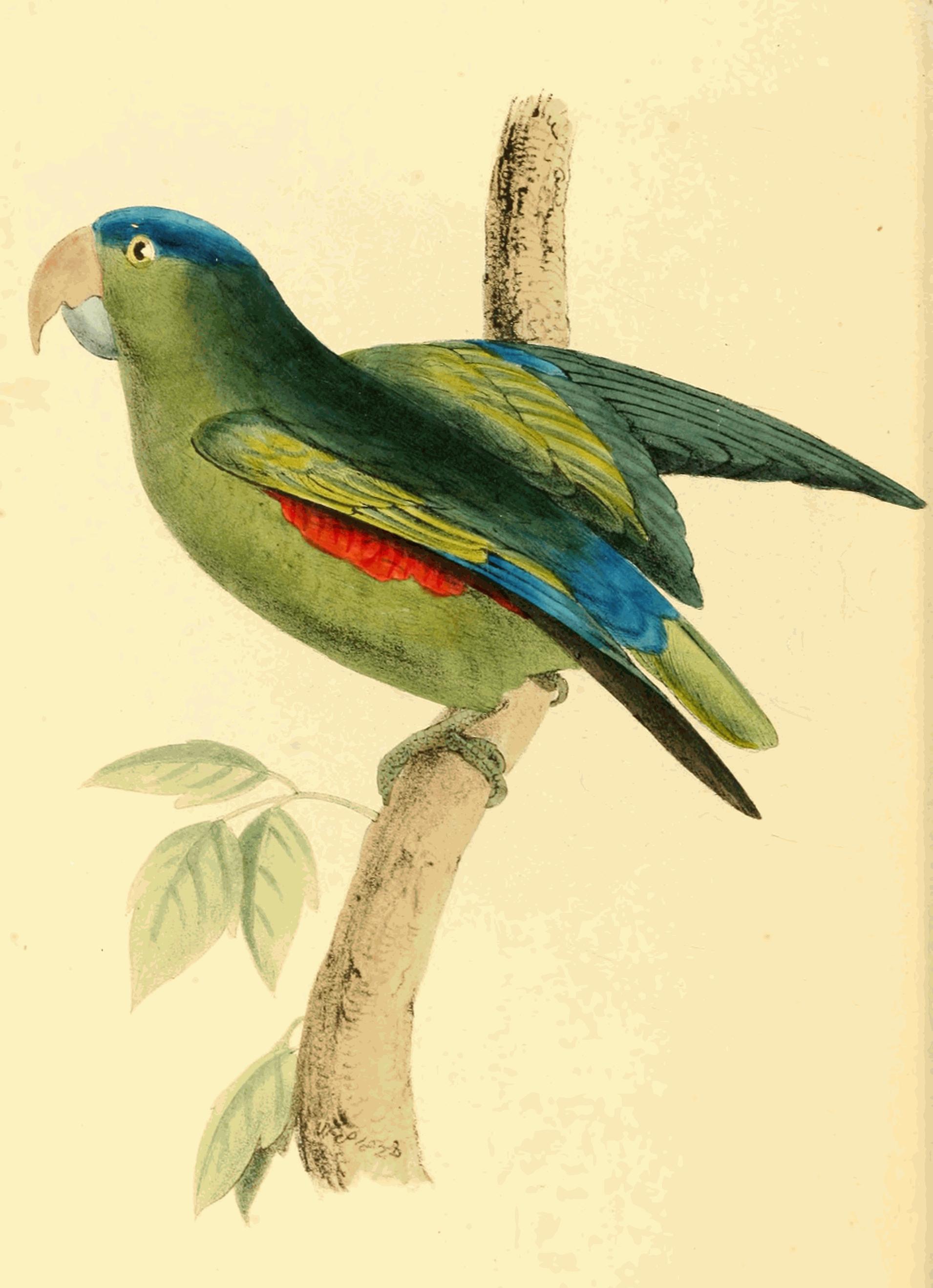
PSITTACUS Malaccensis,
Blue-rumped Parrot.
Generic Character.—See Pl. 1.
Specific Character.
P. viridis; vertice uropygioque nitidè cæruleis; tectricibus interioribus, corporisque lateribus coccineis; caudâ flavescente; rostro magno, dentato.
Green; crown and rump sapphire blue; inner wing covers and sides of the body crimson; tail yellowish; bill large, toothed.
P. Malaccensis. General Zoology, vol. 8. 2. p. 554.
Blue-rumped Parrakeet. Lath. Syn. Sup. 1. p. 66.
I think this may be the bird described (according to Latham) by Sonnerat, under the name of Petite perruche de Malacca, and from which both Latham and Shaw have framed their account of the Blue-rumped Parrot. On comparing their descriptions with the following, some differences and omissions will be found, but not sufficient, I think, to justify the idea of this being a distinct species: I have, as yet, seen only one specimen (and that not perfect) of this rare and little known bird.
Total length six inches; bill unusually large and strong, being three quarters of an inch (in a straight line) long, and nearly the same in height at the base; upper mandible with a sharp tooth in the middle, and reddish orange; under mandible violet grey; front and crown of the head violet blue, changing to blackish green on the back, and greyish green on the sides of the head, neck, and breast; body and vent green; rump and upper tail covers vivid azure blue; spurious wings greenish blue; wing covers dark but bright green, margined more or less with yellowish; quills blue green, their inner webs black; under wing covers and sides of the body crimson; tail short, even, the two middle feathers above green, the rest yellow with green edges and black shafts; beneath, these feathers are all yellow, the shafts white; the wings, for the size of the bird, are very long, measuring four inches and a half.
Pl. 155
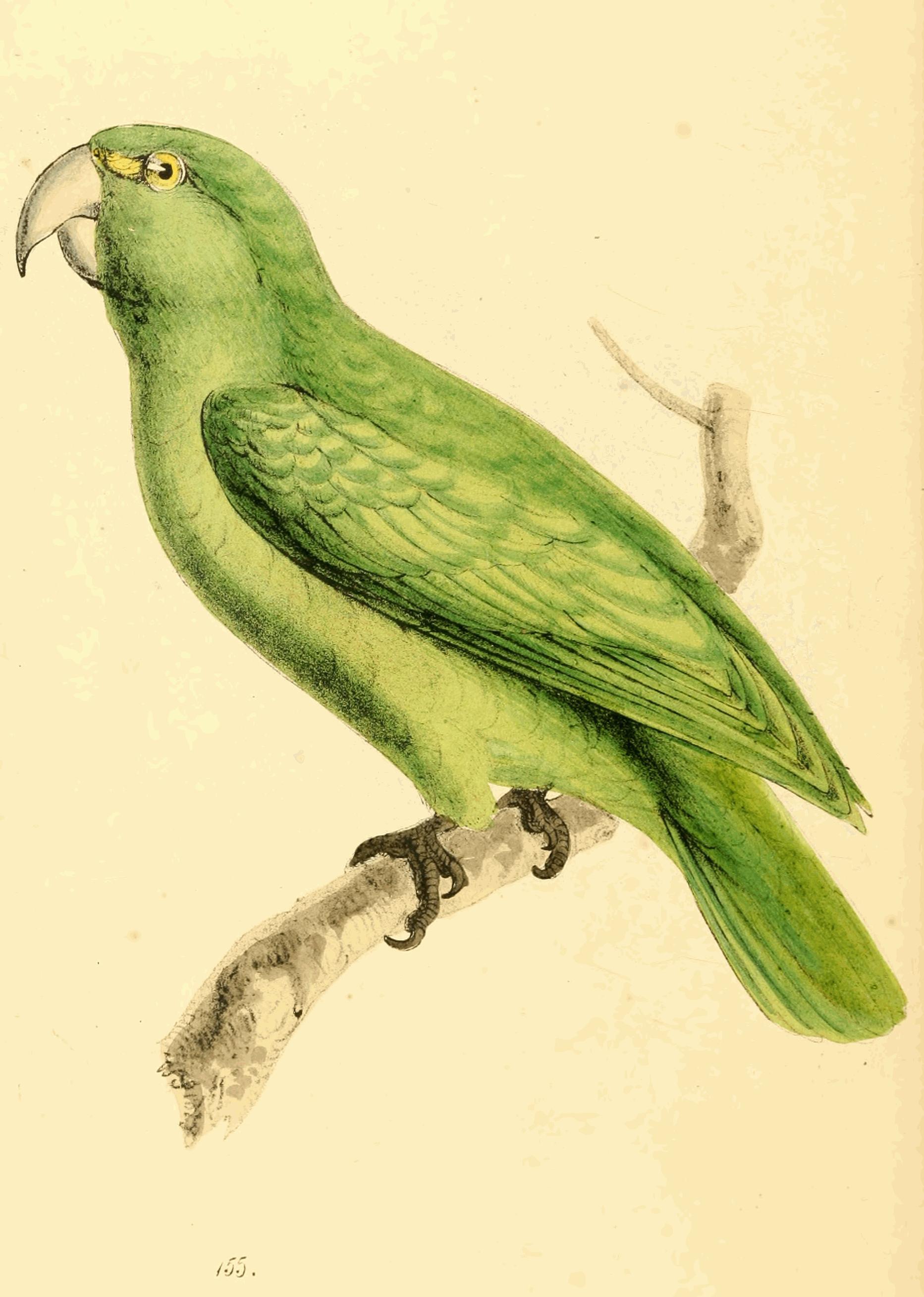
PSITTACUS viridissimus,
Green Parrot.
Generic Character.—See Pl. 1.
Specific Character.
P. pallidè viridis; pennis infrà nitidè thalassinis; tegminum, remigum, scapulariumque marginibus flavescentibus; lineâ ante-oculari flavâ; rectricium basi rubrâ.
Pale green, quills beneath changeable sea-green; wing covers, quills and scapulars margined with yellowish; before the eye a yellow line; base of the tail feathers red.
The uniform green which pervades the plumage of this Parrot, induces me to think it may, possibly, be the female of some other species; a few pale red feathers, close to the axilla, and the faint red on the tail feathers, appear to strengthen this supposition. Among those species which are recorded, this approaches nearest to Latham's Green Parrakeet; but the figure this writer quotes, (Pl. Enl. 837.) is at variance both with his description, and with the bird now before us; it may, therefore, be considered as undescribed.
Total length nine inches; bill pale; upper mandible three-quarters of an inch long, the margin undulated. The whole plumage is of a beautiful and delicate green, darkest above; with a tinge of blue on the crown, spurious wings, and greater quills; the orbits are naked, between which and the eye is a blackish line, bordered above by another of pure yellow; all the wing covers and quills are margined with yellowish. The colour of the inferior side of the quills is a pale but beautiful blue green, reflecting brighter tints of the same colour, when held in certain lights; the under side of the tail has likewise these reflections, but above is yellowish, with a dusky red spot at the base of each lateral feather: under the wings there are three or four dull red feathers; feet pale.
This bird is in my own collection, and is the only one I have as yet seen; neither am I acquainted with its native country.
Pl. 156
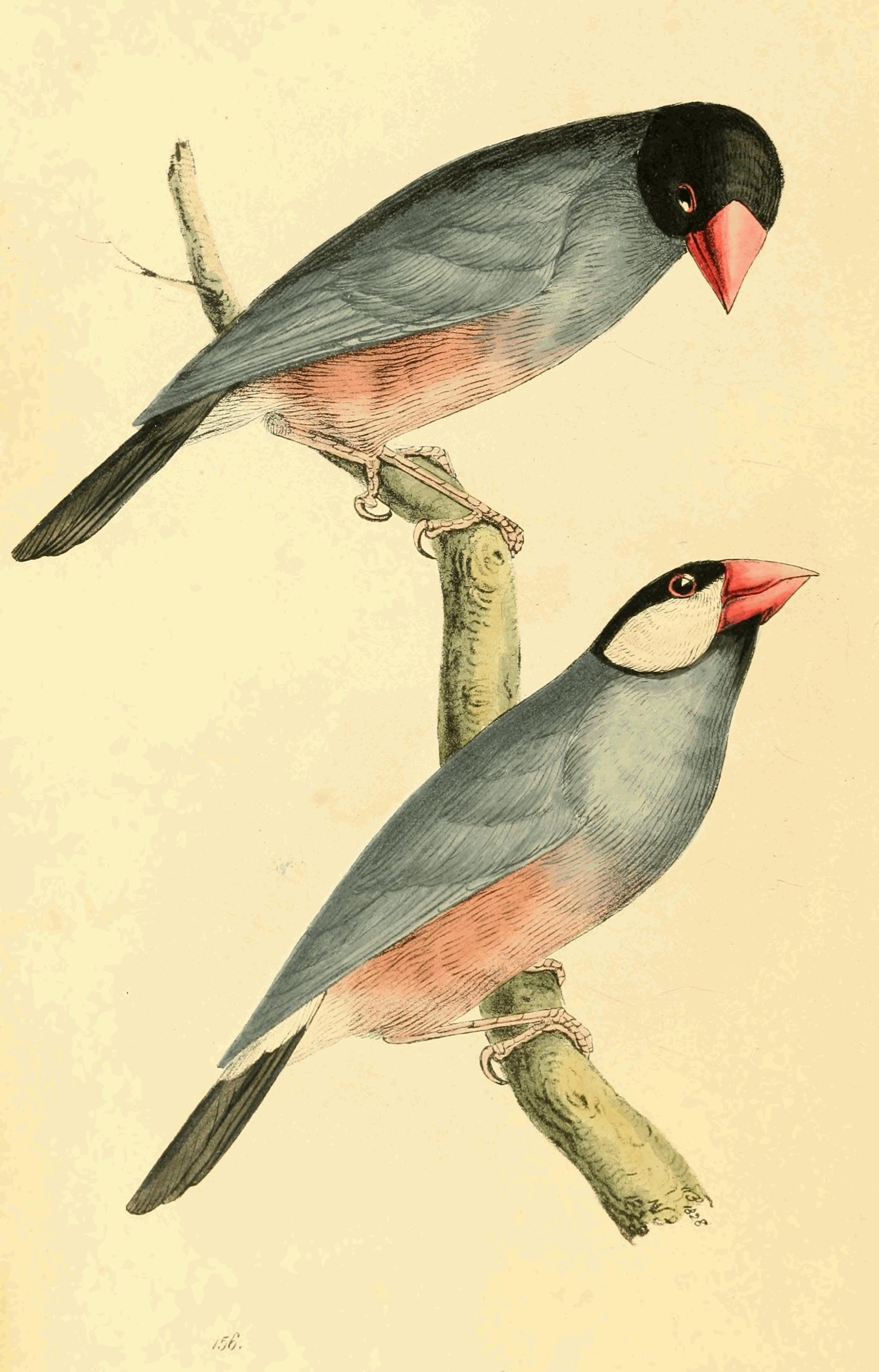
FRINGILLA oryzivora,
Paddy bird, Rice bird, or Java Sparrow.
Generic Character.
Rostrum breve, validum, crassum, rectum, conicum; mandibulæ; superioris gibbæ apice vix inflexo, integro; culminis convexi basi angulatâ. Nares basales, rotundæ, pone culminis basin positæ, plumulis vix obtectæ. Pedes sedentes. Alæ breves.
Bill short, strong, thick, straight, conic; upper mandible swelled, the tip slightly inflexed, entire; culmine convex, the base angulated. Nostrils basal, round, placed behind the base of the culmine, and partially covered by the frontal feathers. Feet sitting. Wings short.
Generic Types. Loxiæ Javensis, Braziliana. Emberiza principalis, cicris. Tanagria cærulea, &c. (Temminck.)
Specific Character.
F. cana; capite caudâque nigris; rostro rubro; crisso roseo-albente; auribus (in maribus) niveis.
Lead-coloured; head and tail black; bill red; belly obscure rosy; ears (in the male) snowy.
Loxia oryzivora. Gm. I. 302. Lath. Ind. Orn. 1. 380. Gen. Zool. 9. 2. 316. Brisson, 1. 374. 7.
Java Grosbeak. Lath. Syn. 3. 129. Supp. 151. Gen. Zool. 9. 316. pl. 51.
This elegant bird has been so distorted, in the representations given of it by the older ornithologists, that little apology is thought necessary for introducing more accurate figures of both sexes in this publication. It is said to inhabit the Cape and various parts of India, causing much damage to the rice plantations, and is frequently brought to this country alive. The figure is of the size of life, the bill bright red, but whitish towards the tip; it is very strong, thickened round the basal margins, and forms a sharp angle between the frontal feathers: the nostrils are small, round, and placed behind the thick margin of the bill, and not on its outer surface. Legs flesh-coloured; the orbits are said to be red in the live bird.
I have followed the example of Illiger and Temminck in uniting the greatest part of the Linnæan Loxiæ and Fringillæ under the latter genus, retaining only the Cross-bills under the former.
Pl. 157
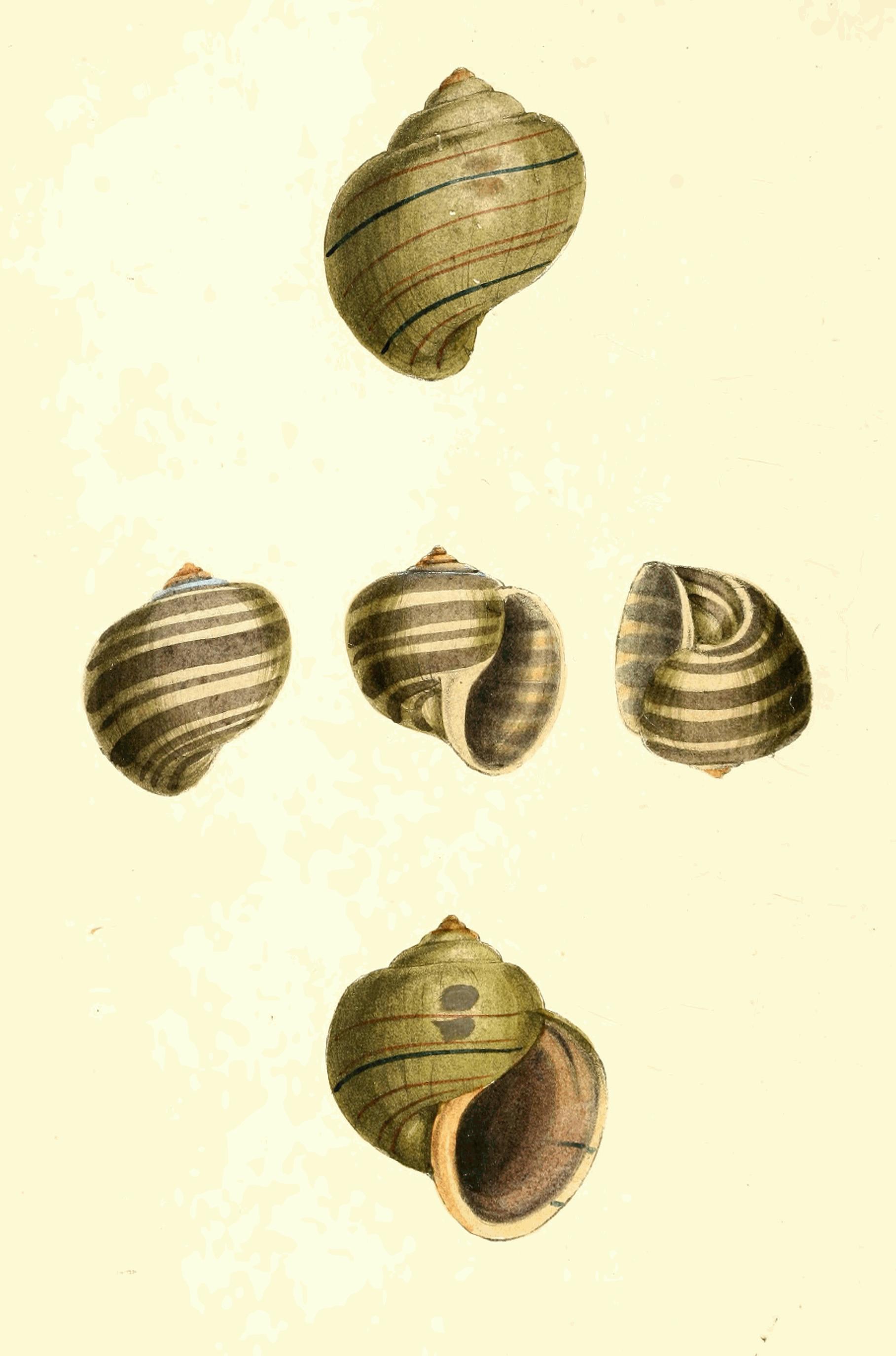
AMPULLARIA effusa,
Ribbon Apple Snail.
Generic Character.—See Pl. 103.
Specific Character.
A. testâ globosâ, lævi, fasciis purpureo-fuscis cinctâ; spirâ depressâ, apice prominente; aperturâ angustâ; umbilico magno, profundo; columellâ obsoletâ.
Shell globose, smooth, with purple brown bands; spire depressed, the tip prominent; aperture narrow; umbilicus large, deep; pillar obsolete.
Helix glauca. Linn. Dillw. 918. Helix ampullucea, (var. γ) Gmelin, 3626. Bulimus effusus. Brug. p. 296. No. 1.
Lister, 129. 29. Seba, tab. 38. f. 39. tab. 40. f. 3. 4. 5. (optimè.) Martini, 9. tab. 129. f. 1144-5. Knorr, 4. tab. 5. f. 3.
Lam. Syst. 6. 2. p. 178. 5.
I concur with Mr. Dillwyn in believing that this shell is the Helix glauca of Linnæus; but, as it is now removed to another genus, I think no real advantage would result from continuing its original specific name; particularly as the identity may be questioned by others, without a chance of the question ever being settled: the adoption of the specific names given to species slightly or incorrectly described by the older naturalists, inevitably tends to increase the original obscurity, in all cases where the point cannot be cleared up. A. effusa may be distinguished from all others by the columella being nearly obsolete; this part existing only in the two terminal whorls of the spire. This species therefore forms a transition to the Planorbes: there is a variety, with narrower stripes, double the size of that here figured.
AMPULLARIA luteostoma,
Yellow-mouthed Apple Snail.
A. testâ globosâ, striatâ, olivaceâ, lineis remotis fuscis fasciatâ; spirâ levatâ, apice acuto; aperturâ effusâ intus marginatâ; umbilico magno.
Shell globose, striated, olive, with remote transverse brown lines, spire elevated, the tip acute; aperture wide, within margined; umbilicus large.
The umbilicus of this shell is not so deep as the last, but is larger than in any other known species; the columella is likewise perfect, and the aperture is wider and more oblique than in A. effusa.
Pl. 158
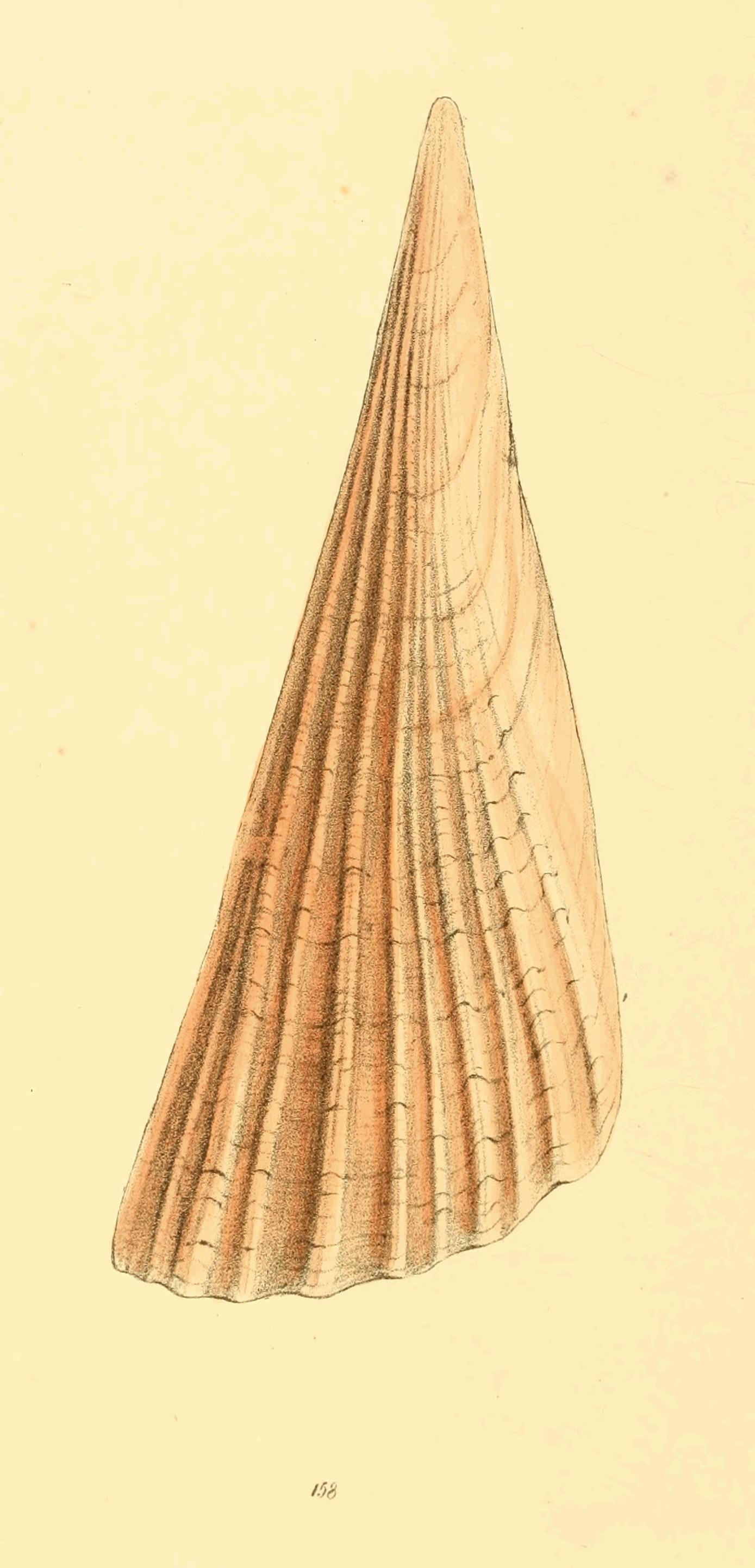
PINNA bullata, (var.)
Rufous Pinna.
Generic Character.
Testa longitudinalis, cuneiformis, æquivalvis, apice hians, basi acutâ; natibus rectis. Cardo lateralis, edentulus. Ligamentum marginale, lineare, prælongum subinternum.—Lamarck, Sys. vol. vi. p. i. p. 129.
Shell longitudinal, wedge-shaped, equivalve, the valves gaping; the umbones straight, pointed. Hinge lateral, without teeth. Ligament marginal, linear, very long, subinternal.
Generic Types. Pinnæ rudis. Pectinata. Muricata. Linn. Pennant, &c.
Specific Character.
P. testâ tenui, pellucidâ, rufâ, æquilaterâ, striis remotis, sulcatis, transversim squamiferis, subspinosis; marginibus lateralibus rectis; margine inferiore obliquè truncato.
Shell thin, pellucid, rufous, equilateral, with remote sulcated striæ, crossed by transverse scales and obtuse spines; lateral margins straight; inferior margin obliquely truncate.
P. bullata. Gmelin, p. 3367. Gualt. tab. 79. f. c. Chemnitz. 8. tab. 87. f. 769. Knorr, 2. 23. f. 1.
P. marginata. Lam. Sys. 6. p. 132. 7.
I have little doubt that this shell is a smooth variety of the Pinna bullata of Gmelin, and the P. marginata of Lamarck; both these authors refer to the same figure in Gualtieri, but both also have overlooked that of Chemnitz, above quoted, as well as Knorr's, which latter, although it represents the shell nearly smooth (similar to that here figured), I apprehend is only a variety. No doubt therefore having existed as to Gmelin's bullata, M. Lamarck had no plea for altering its specific name to marginata. I have consequently recorded it under Gmelin's name.
The Pinnæ are rather numerous, although many of the species remain in obscurity; they attach themselves to rocks, deep in the sea, by a silky byssus. It has been commonly stated, that gloves and stockings are fabricated in the Mediterranean from this byssus, as articles of commerce; such, however, is not now the case; though articles, so fabricated, are sometimes shown in Naples and Sicily as subjects of curiosity.
Pinna bullata is, I believe, found in the West Indies. The vaulted spires on this and other species, easily fall off; and become, therefore, a very uncertain specific character.
Pl. 159
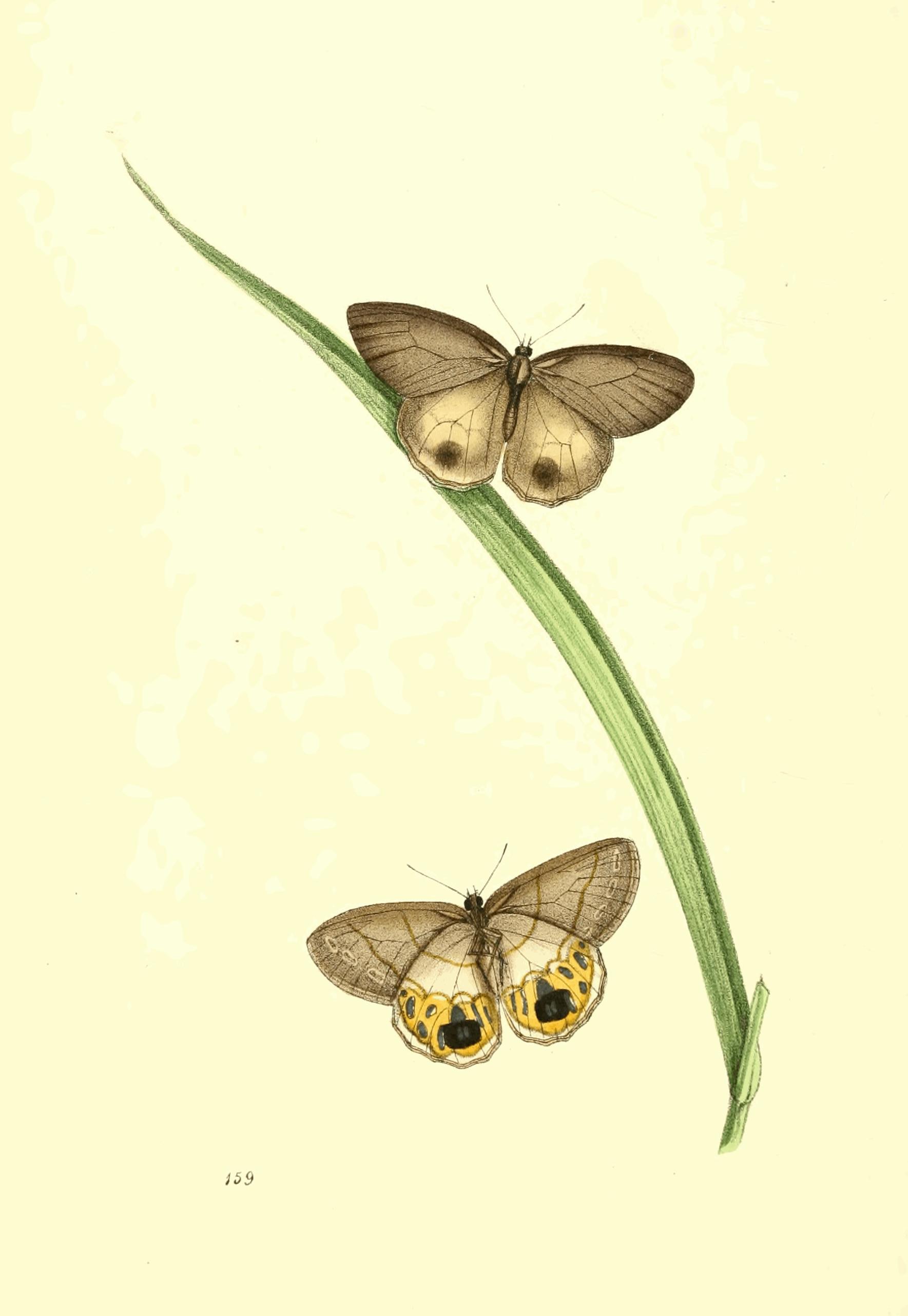
SATYRUS argenteus.
Generic Character.
Antennæ mediocres, clavo elongato, gracili. Palpi porrecti, compressi, vix recurvi, remoti, pilis ciliatis, longis, hirsutissimi; articulo ultimo elongato, nudo, gracili, acuto. Alæ posticæ orbiculares, integræ, rarò dentatæ.
Antennæ moderate, the club lengthened and slender. Palpi porrected, compressed, slightly recurved, remote, with long ciliated hairs; the last joints long, naked, slender, acute. Posterior wings orbicular, entire, rarely dentated.
Generic Types. Pap. Hyperanthus, Galathea, Semele, &c. Lin.
Specific Character.
S. alis fuscis; posticarum disco suprà flavescente, maculis 2 fuscis fucato, infrà albente, margine postico fulvo, maculis 2 atris guttisque 7-8 argenteis ornato.
Wings brown; posterior above with a yellowish disk and two brown spots, beneath whitish, the hind margin fulvous, with two black spots and 7-8 silver dots.
Without being ornamented by rich or vivid colouring, this is, nevertheless, one of the most chastely beautiful little butterflies found in Brazil. I met with it very plentifully in a small wood not far distant from Cashoera, on the western extremity of St. Salvador's bay: to this particular spot it seemed confined, for I never saw a single specimen in any other part of Brazil.
No colouring can imitate the richness of the silvery spots on the under wings, which appear embossed, or as if solid drops of silver had fallen on the insect when it first emerged into life. The two sexes are perfectly similar.
The insects of this genus are usually brown, with dark or paler shadings, and eye-like spots on their upper or under wings. They principally inhabit the woods of tropical regions, and the hedge sides and lanes of European countries; this circumstance probably induced Latreille to change their name from Hipparchia (Fabricius) to Satyrus; which, although an innovation on the rules of nomenclature, may in this instance be allowed.
Pl. 160
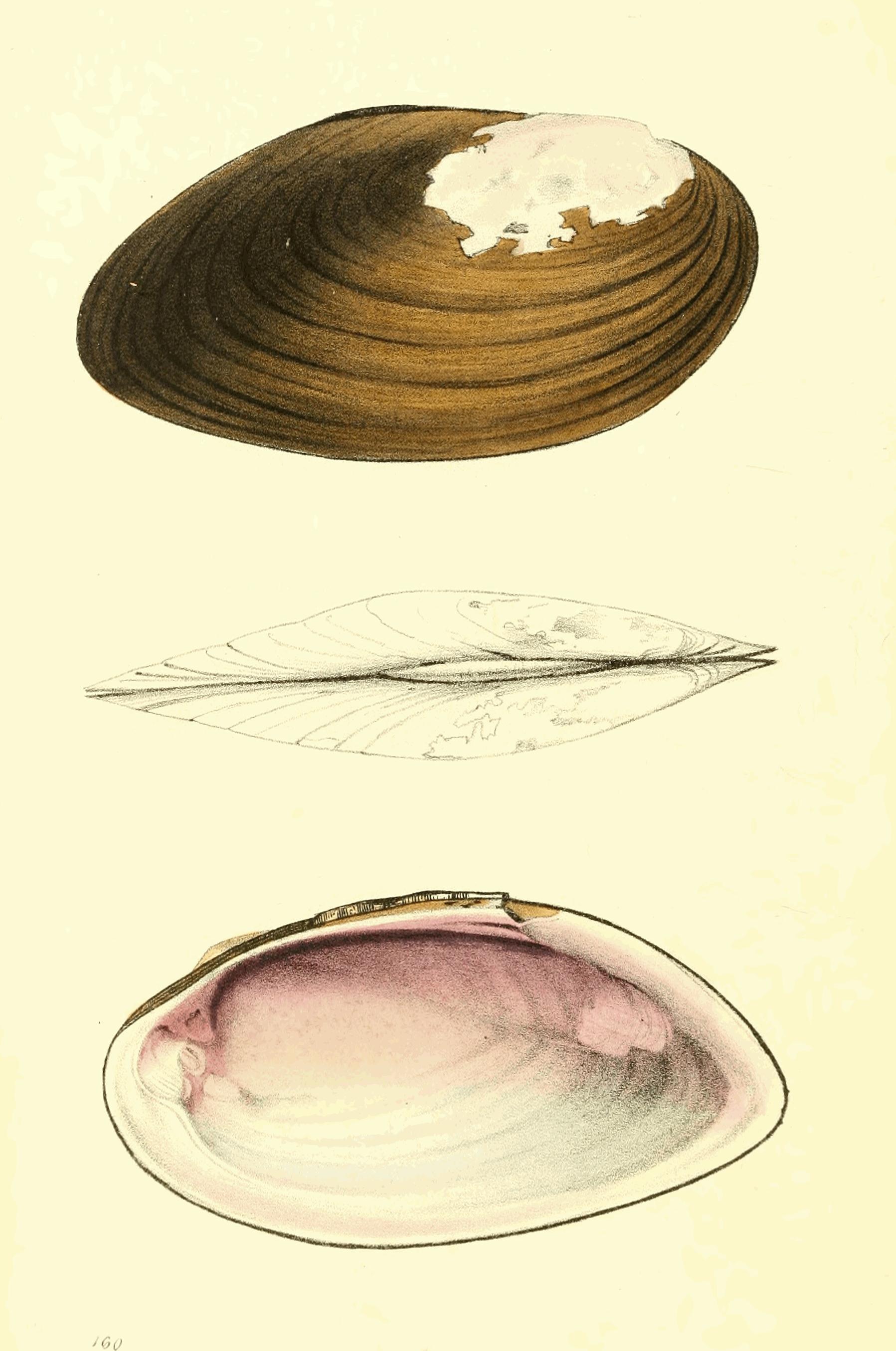
ANODON purpurascens,
Purple Anodon, or Horse Mussel.
Generic Character.—See Pl. 96.
Specific Character.
A. testâ transversim oblongâ, crassâ, depressâ, intus purpurascente, laminâ cardinali crassâ, truncatâ, dente lamellari in utrâque valvâ supposito; umbonibus retusis.
Shell transversely oblong, thick, depressed, within purple; hinge plate thick, truncate, with an obsolete lamellar tooth in each valve; umbones retuse.
This is an entirely new and very rare shell, remarkable for its shape and internal colour; it is also highly interesting, as exhibiting the generic characters of Anodon, blended (in some degree) with those of Unio: according to the principles of Lamarck, it might therefore be made into a genus; but I feel convinced too much importance has already been attached by that naturalist and his followers to the hinge of bivalve shells; and that the nomenclature of the science is burthened with genera, trivial in themselves, bewildering to the scientific, and unintelligible to the student.
From having paid some attention to the Fluviatile Bivalves, and possessing a most extensive collection of specimens, I am clearly of opinion that no permanent characters will be found sufficient to retain either the genera Dipsas (Leach), Hyria (Lamarck), or Alasmodonta of Say, much less that of Damaris (Leach), and another, whose name I forget, made by Dr. Turton from the same shell as Leach's Damaris, viz. Mya Margaritifera of Linnæus. In fact, the line of demarcation between Unio and Anodon appears to rest on the first possessing cardinal teeth, and the latter having none.
I have several valves (in different stages of growth), and one perfect specimen of this shell; they were sent to me from the back settlements of North America.
Pl. 161
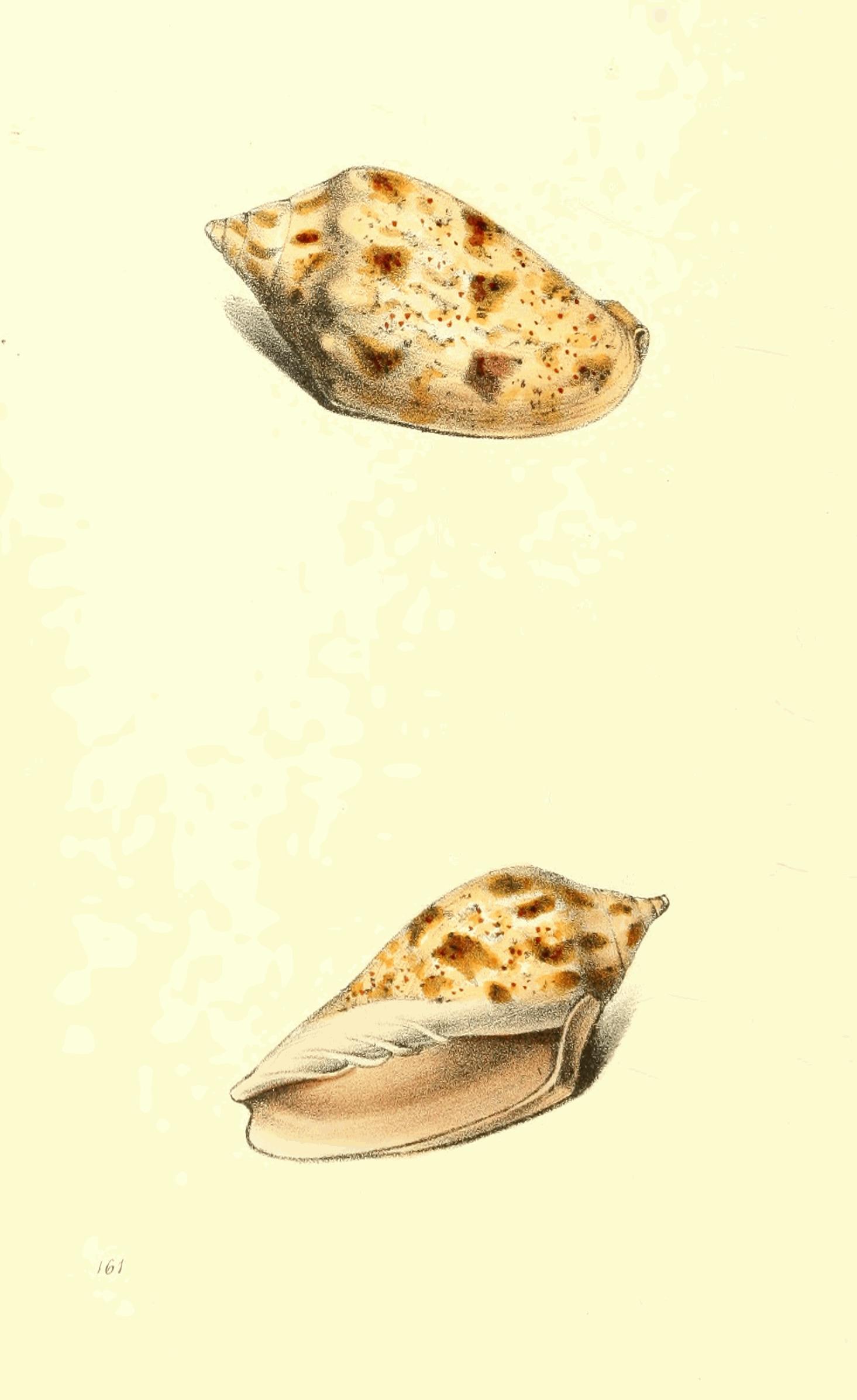
VOLUTA punctata,
Red-dotted Volute.
Generic Character.
Testa ovata. Spira aperturâ brevior, apice papillari. Basis truncata, emarginata. Columella plicata, plicis inferioribus majoribus.
Shell ovate. Spire shorter than the aperture, the tip papillary. Base truncated, emarginate. Pillar plaited, the inferior plaits generally largest.
Generic Types. Volutæ Olla, Imperialis, Pacifica, &c.
Specific Character.
V. testâ ovatâ, subfusiformi, tuberculatâ, pallidè rubellâ fasciis 2 maculatis, rubris, punctis minutis interstinctis; columellâ 4 plicatâ.
Shell ovate, subfusiform, tuberculated, flesh-coloured, with two bands of red spots interspersed with minute dots; pillar 4 plaited.
In "Exotic Conchology," I have commenced, and intend to complete, a copious illustration of this noble family of shells; which (if the simile be admissible) may be termed the nobles of testaceous animals, with as much truth as Linnæus has called Palms the princes of the vegetable world. The Volutes, indeed, are imposing shells; both from their size, rarity, and their rich (but not gaudy) colouring; and it is not improbable that the value of a choice collection of the principal species, would be equal to their own weight in solid gold.
The species now under consideration is only known from an injured specimen in Mr. Dubois' cabinet; although much rubbed on one side, it presents on the other a true pattern of its original markings; the margin of the outer lip, and the tip of the spire, are both injured; yet, notwithstanding these defects, there are abundant characters remaining to evince its total dissimilarity from any other recorded species.
I have preferred subjoining only the essential generic characters of this genus, as most intelligible to students; particularly as its natural characters are fully detailed in the first part of "Exotic Conchology."
Pl. 162
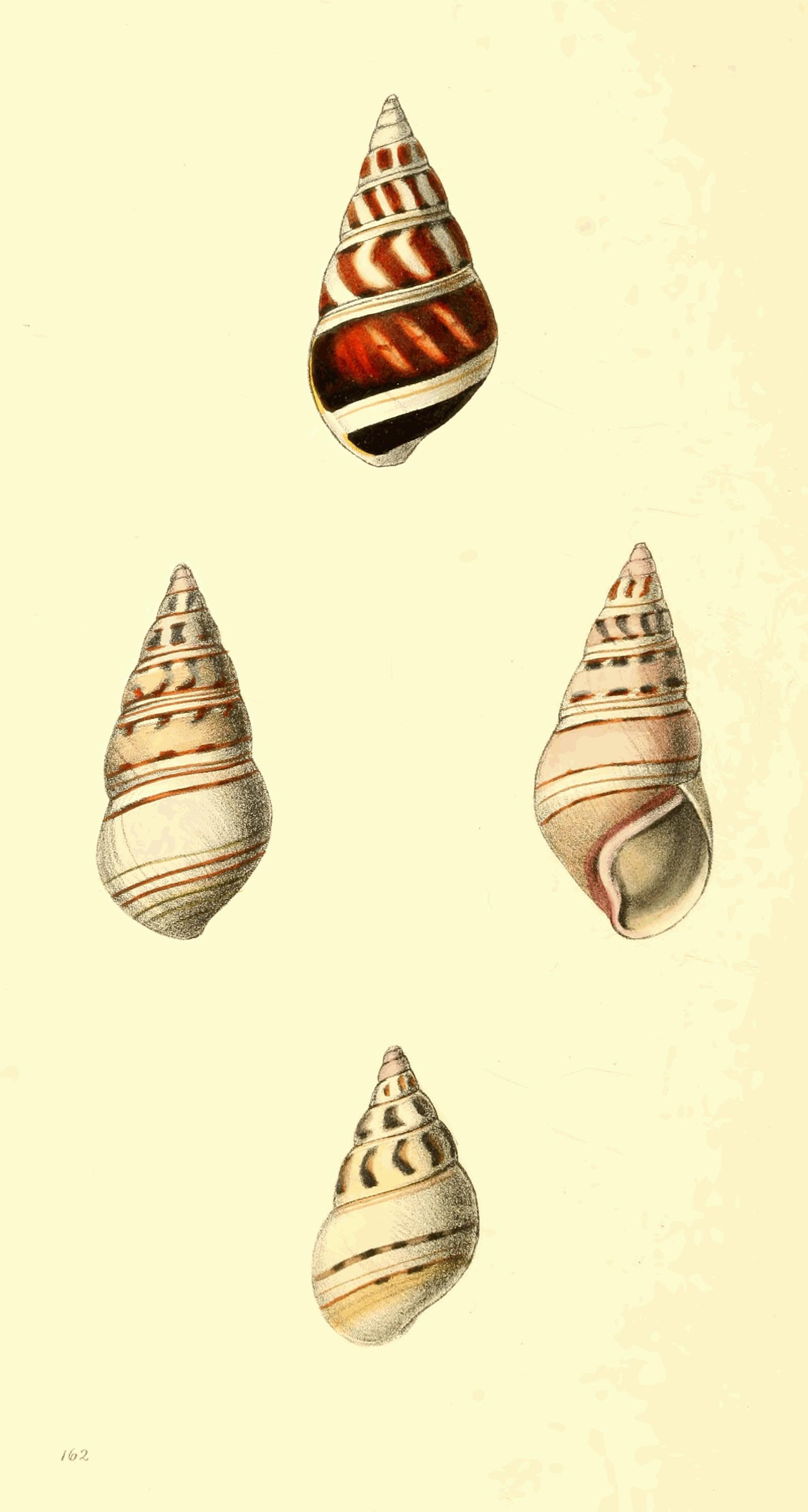
ACHATINA fasciata, (var.)
Banded Achatina, (3 varieties.)
Generic Character.—See Pl. 30.
Specific Character.—See Pl. 74.
(Young.) Aperturâ basi integrâ. Base of the aperture entire.
Ach. pallida. Zool. Ill. vol. 1. pl. 41.
Since the first illustration of this elegant species appeared, at plate 74 of this work, I have had the means of ascertaining a very extraordinary circumstance which takes place in the progressive growth of the young shell to the adult state; and that is the change effected in the form and termination of the pillar or columella. In the noble collection of shells formed by the late Earl of Tankerville, there is a numerous series of this species; from these I have ascertained, that in the young shells the base of the columella unites with the termination of the outer lip, making the aperture entire, similar to the lengthened Helices; but, as the shell advances in growth, the base of the columella becomes thick, detached, as it were, from the marginal rim, so as to produce an intervening notch, and thus gives the old and the young shell not only an appearance of being distinct species, but of belonging to separate genera. From these facts, I have drawn the conclusion, that Achatina pallida (pl. 41), is but the young shell (having the margin of the aperture as yet entire) of Achatina fasciata; and the three additional varieties now figured, will, I hope, prove an interesting addition to the history of this species.
Pl. 163
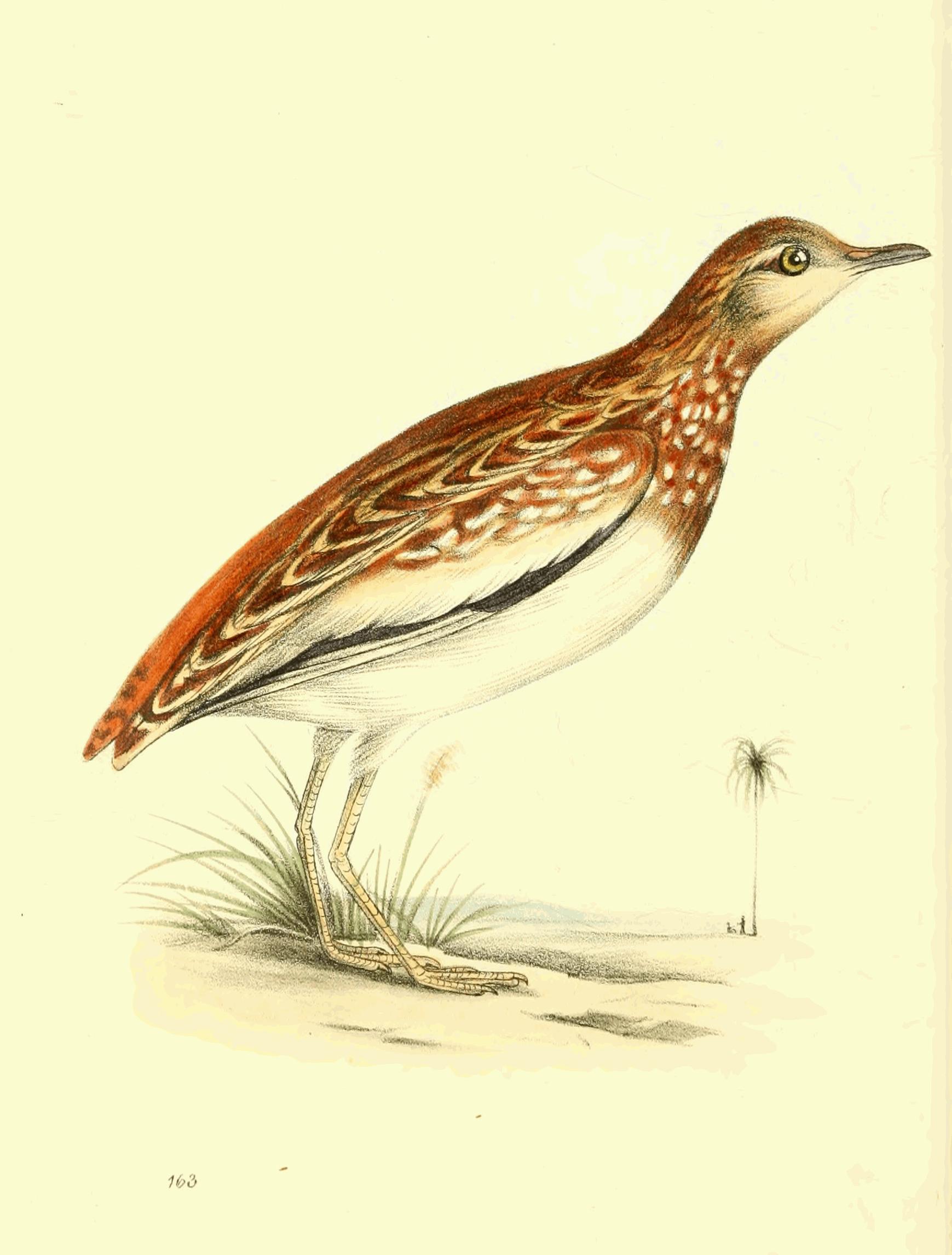
HEMIPODIUS nivosus,
White-spotted Turnix.
Generic Character.
Rostrum mediocre, gracile, rectum, valdè compressum culmine levato, ad apicem sub-incurvo. Nares laterales, lineares, sulcatæ, membranâ convexâ corneâ vix tectæ, aperturâ fissâ, elongatâ. Pedes longi, digitis tribus anticis divisis. Halluce caret. Cauda brevissima tectricibus obtecta. Alæ mediocres.
Bill moderate, slender, straight, much compressed, culmen elevated, towards the tip slightly incurved. Nostrils lateral, linear, sulcated, partially covered by a convex horny membrane, the aperture narrow and elongated; legs long, with three toes before, divided at their base. Hind toe none. Tail very short, concealed by the covers. Wings moderate.
Generic Type. Perdix nigricollis. Lath.
Specific Character.
H. supra ferrugineo varius; mento albescente; jugulo pectoreque pallidè ferrugineis, maculis albis, nitidis, ornatis; corpore albo; uropygio caudæque tectricibus superioribus rufis, immaculatis.
Above varied with ferruginous; chin whitish; throat and breast pale ferruginous, with white shining spots; body white; rump and upper tail-covers rufous, unspotted.
H. nivosus. Swainson, in Tilloch's Phil. Magazine, vol. 60. p. 353.
I have represented this delicate little bird of its natural size; which is so small, as scarcely to equal that of a Lark. The Turnix inhabits the sandy deserts of Africa and India, and seems to form a race of pigmy Bustards, all the species yet discovered (fourteen in number) being very diminutive. Little is known of their habits in a state of nature, further than that they migrate, and fly with great rapidity. The specific character will distinguish H. nivosus as a species; and I have already given a more detailed description of it in the Journal above quoted. Mr. Leadbeater received it from Senegal.
Pl. 164
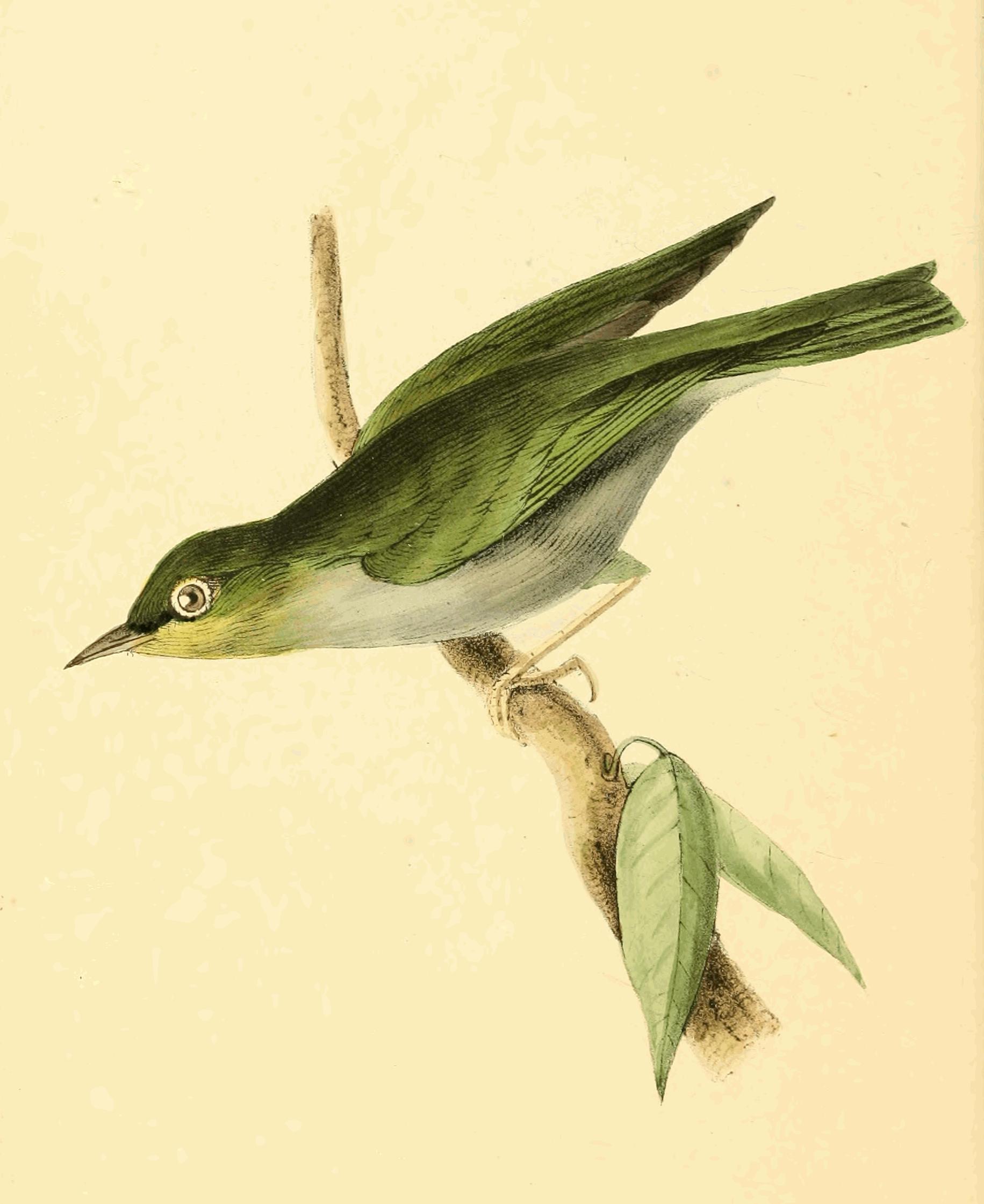
SYLVIA annulosa,
White-eyed Warbler.
Generic Character.—See Pl. 139.
Specific Character.
S. olivaceo-viridis, infrà albescens; jugulo flavescente; palpebris plumis niveis insignibus.
Olive-green, beneath whitish; throat yellowish; eyes encircled by a ring of snowy feathers.
Sylvia Madagascariensis. Lath. Ind. Orn. 2. 533. Gm. 1. 981.
White-eyed Warbler. Lath. Gen. Syn. 4. 475. Gen. Zool. 10. 2. 720.
Ficedula Madagascariensis minor. Briss. Ois. 4. p. 498. t. 28. f. 2. (male.) Briss. Orn. 1. 446.
Le Figuier Tcheric, Le Vaill. Ois. d'Af. 3. pl. 132.
A delicate ring of snow-white feathers encircles the eyes of this pretty bird. It is far from being peculiar to Madagascar (as Dr. Latham's name of Madagascariensis would seem to imply), but is spread over a wide extent of the eastern hemisphere; being found both in the Isle of France, the Cape of Good Hope, and Madras. The name, therefore, is peculiarly inapplicable; but this is not all: for we find that the same author, a few pages after, has given this identical name to another very different bird; the same error is transferred into Shaw's Zoology.
Figure, the size of life: colour above, olive green; ears and sides of the head the same: chin, throat, and under tail covers yellow; breast cinereous, changing to dusky brown on the flanks; the middle of the body whitish; between the eye and bill a velvet-black line, which forms a partial margin to the snowy feathers of the eyelids; wings and tail dusky black, margined with olive.
Very indifferent figures of both sexes will be found in Vaillant's African birds; from his description it seems to be a gregarious species. I regret not being able, at this moment, to refer to the work.
Pl. 165
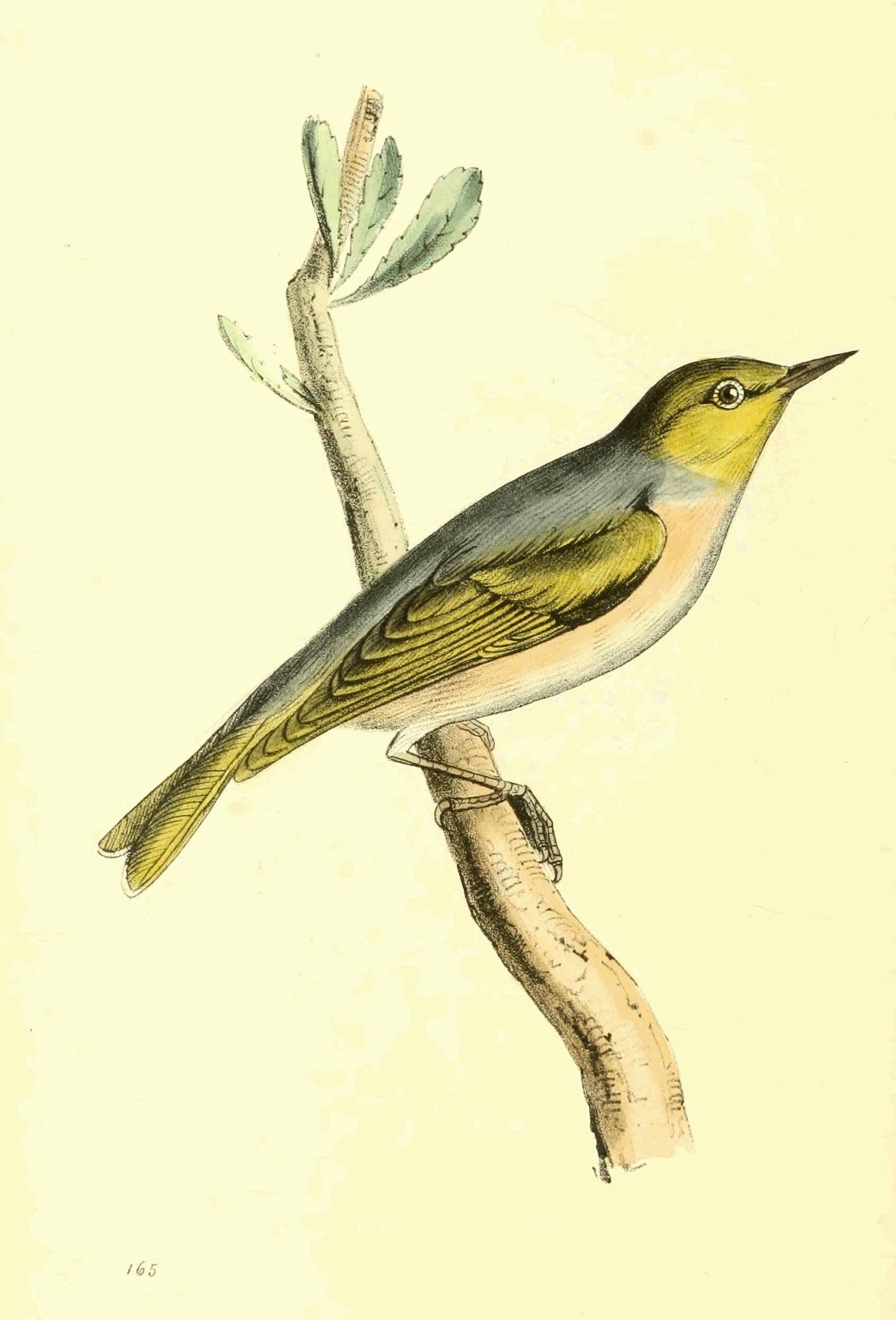
SYLVIA annulosa, (var. β.)
White-eyed Warbler.
Generic Character.—See Pl. 139.
Specific Character.
S. suprà cinerea, infrà albescens, capite, alis uropygioque olivaceo-flavis; jugulo flavescente; palpebris plumis niveis insignibus.
Above cinereous, beneath whitish; head, wings, and rump, olive yellow; throat yellowish; eyes encircled by a ring of snowy feathers.
On first receiving this bird from New Holland, I was inclined to think it a distinct species from the African White-eyed Warbler; but further consideration has led me to adopt a different opinion: it is true that I am unacquainted with any one land bird which is common to both countries, and much weight should be attached to the geographic distribution both of families and species. These two birds, however, differ in their colour, and somewhat in their size. On the other hand, the White-eyed Warbler, as before observed, is found both in Africa and India; and is, therefore, probably migratory. Nature, moreover, is not bound by laws to which there are no exceptions; and the leading points of resemblance between these birds are very strong. On the whole, therefore, I am inclined to consider them as varieties of one species, forming a solitary exception to the general dissimilarity between the birds of Africa and those of New Holland.