Zoological Illustrations, (continued 2)
Reading edition
Size of the Wood Wren: the head and ears are olive yellow, changing to brighter yellow on the chin, and part of the throat; the neck and back cinereous, graduating to yellowish olive on the rump and upper tail covers; wings the same, the inside of the quills blackish; sides of the throat cinereous; body and under tail covers whitish; the sides tinged with ferruginous; the stripe between the bill and eye is more brown than black; and the white feathers round the eye, not so conspicuous as in the African variety.
Pl. 166
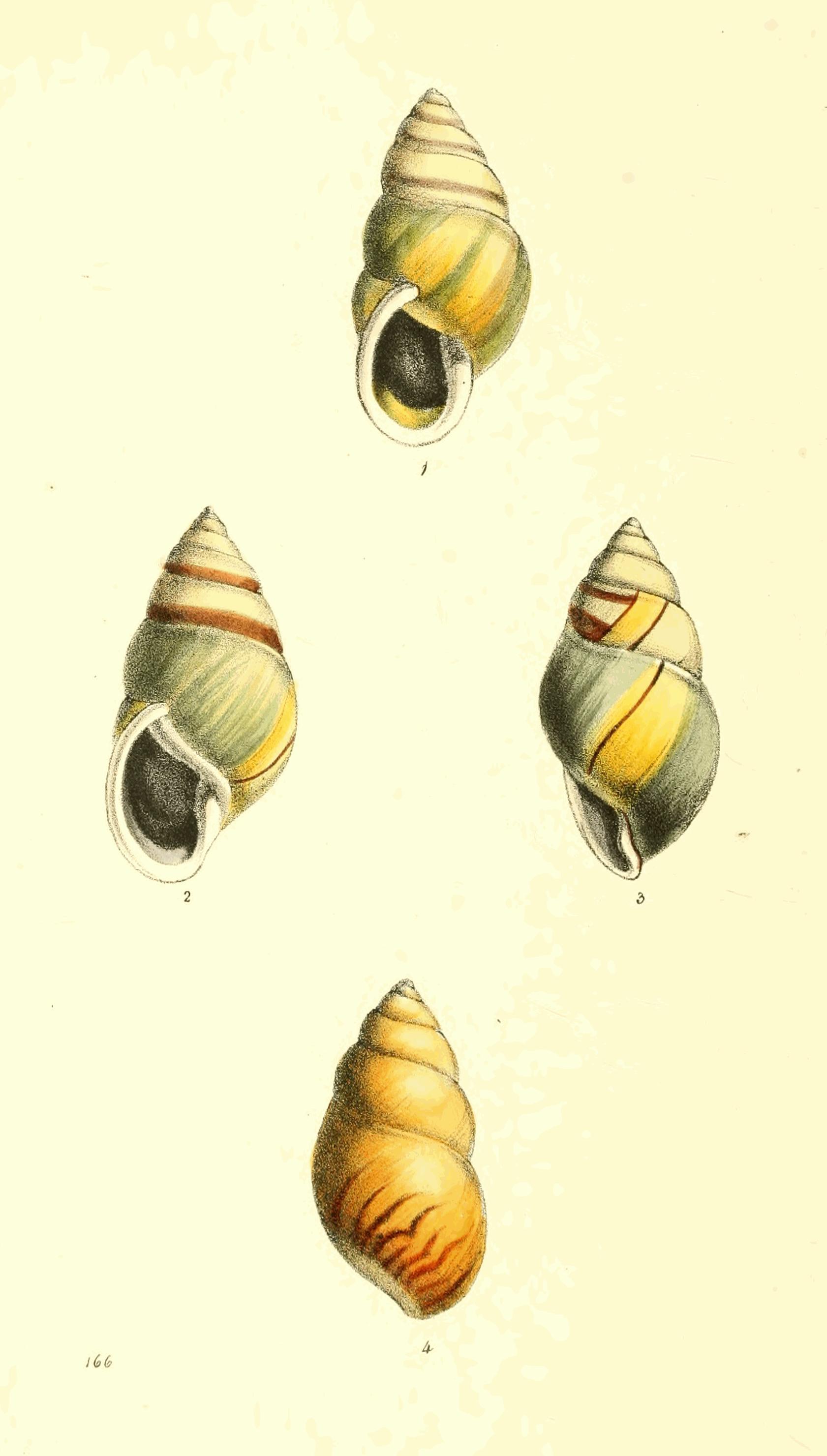
BULIMUS citrinus, (var.)
Citron Bulimus, (3 varieties.)

Generic Character.—See Pl. 4.
Specific Character.—See Pl. 46.
Varieties.
A. Yellow, with black lines. Zool. Ill. pl. 46.
B. Yellow, with black lines and chesnut stripes. Zool. Ill. p. 47.
C. Yellow, variegated with green; inner lip obsolete. Fig. 1. B. virescens. Sw. Bligh Cat. p. 13.
D. Green, striped with yellow; inner lip white. Fig. 2. 3.
E. Orange, with flame-coloured waved stripes. Fig. 4.
F. Pale yellow, with brown waved stripes.
Lam. Syst. 6. 2. p. 178. 5.
The beautiful shells here selected as a further illustration of the Citron Bulimus not only show the great variability of the species, but clearly prove that B. virescens is, as I suspected, only a variety of B. citrinus. In the shell at fig. 1. the upper part of the inner lip (like that described in the Bligh Appendix), is entirely wanting; although it bears, in every other respect, the appearance of a full-grown shell; the umbilicus likewise is open; but in the shell at fig. 2. and 3. the inner lip is quite perfect, and consequently folds over the umbilicus; thus the connexion between the green and yellow varieties is completely established.
I have subjoined a slight arrangement of the principal varieties; and have only further to observe, that the specific character I first proposed, appears to me the only one by which this species may be truly distinguished.
Since the description of B. aureus at pl. 47 was written, I have seen several other specimens; all of which tend to confirm my belief that it is distinct from B. citrinus.
Pl. 167
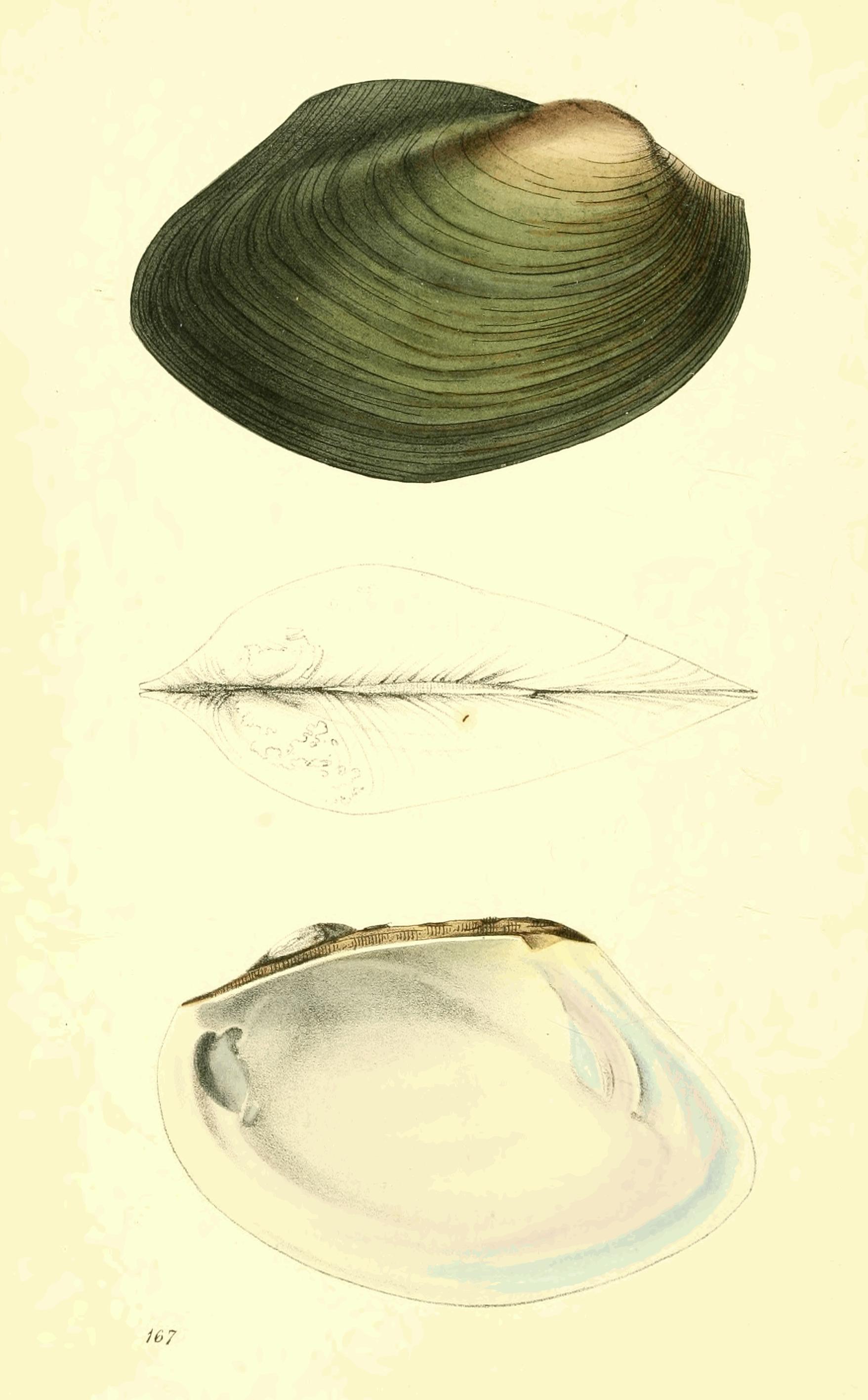
ANODON crassus,
Thick Anodon, or Horse Mussel.
Generic Character.—See Pl. 96.
Specific Character.
A. testâ ovatâ, latâ, crassa; margine cardinali subarcuato, extremitate utrâque angulatâ alatâ; umbonibus prominentibus, apicibus retusis.
Shell oval, broad, thick; hinge margin subarcuated, the extremities winged and angulated; umbones prominent, the tips retuse.
It is only recently that travellers have directed their attention to the less attractive shells of distant regions; and our cabinets now begin to be enriched by the numerous land and fresh-water species of those countries. Among these new acquisitions, the fresh-water bivalves appear the most extraordinary in their formation, and the most numerous in species. Of the Anodons, it may be doubted whether the great Linnæus was acquainted with more than three or four species; Lamarck enumerates fifteen, but a much greater number have passed under my own examination.
The species now illustrated is very peculiar; it is a strong, thick shell; in form resembling Hyria corrugata, Lamarck; having both extremities winged and compressed; the umbonial slope[6] elevated, and somewhat angulated; the umbones thick and prominent, but obtuse, or nearly truncate, at their apex; the outside of the shell of a dark grass-green colour, and nearly smooth, excepting at the posterior side, which is marked by sulcated striæ following the lines of growth; the inside is opaque and whitish, with rich iridescent margins: the muscular impressions deep, and the hinge margin quite smooth.
I know of no other specimen than one in Mr. Dubois' collection, and am altogether unacquainted with its locality; although its habit leads me to think it is from South America.
Pl. 168
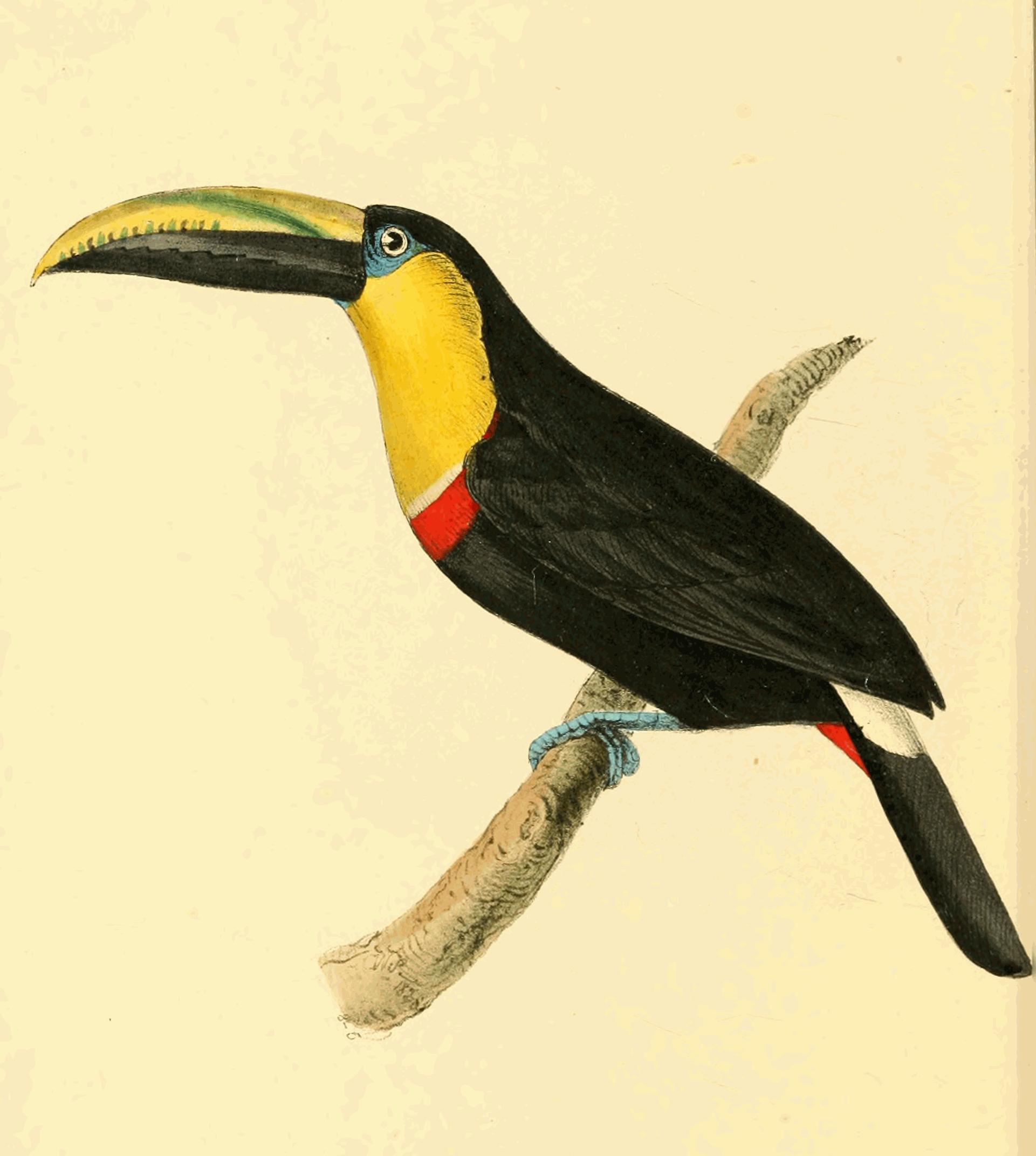
RAMPHASTOS ambiguus,
Doubtful Toucan.
Generic Character.—See Pl. 45.
Specific Character.
R. niger; jugulo flavo; mandibulæ superioris parte superiore flavâ, transversè maculatâ, strigâ viridi obliquè divisâ; mandibulâ inferiore nigrâ.
Black; throat yellow, upper mandible black, the upper half yellow, with an oblique green stripe and transverse spots; the under mandible black.
The obscurity with which modern ornithologists have described these remarkable birds, would have induced me, long ago, to have attempted a more perfect account of all the species in this work; but as this might have been considered, by some, an infringement on the miscellaneous plan on which it was commenced, I feel obliged to confine myself only to their occasional illustration.
The species now selected is one I have never seen; but I have no doubt of its existence, and little of the accuracy of its delineation. I before alluded to several drawings of Toucans which had come to my hands, executed by an unknown artist: among them is a figure of that now published; with a note subjoined, stating it was drawn "from the bird just dead." The other drawings of the same artist represent several of the common species, and their accuracy is presumptive evidence that this also is represented correctly. The singular colouring of the bill at once separates it from all known species; and for its further history, we must trust to the exertions of those travellers, visiting South America, who may feel an interest in illustrating these singular birds.
I more than once heard, when in Brazil, of a Blue Toucan; but it was said to be very rare, and I never was fortunate enough to meet with one.
Pl. 169
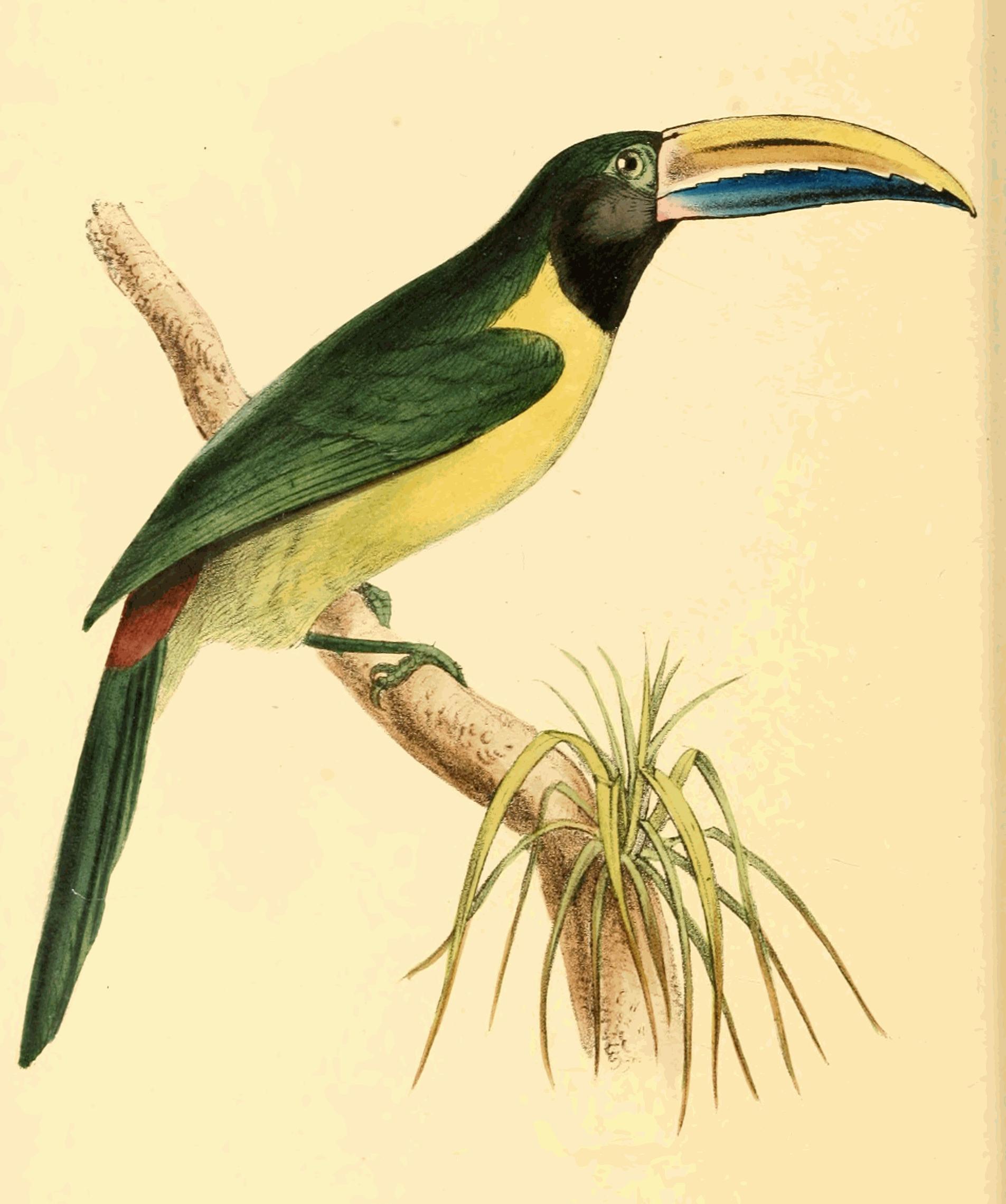
PTEROGLOSSUS viridis,
Green Aracari, (male.)
Generic Character.—See Pl. 44.
Specific Character.
P. nigro virescens; capite juguloque nigris, fœminæ castaneis; corpore flavo; rostro serrato, tomiis albis, mandibulâ superiore aurantiacâ, lineâ longitudinali, laterali, mediâ, nigrâ, mandibulâ inferiore cæruleâ.
Blackish green; head and neck black (in the female chesnut), body yellow; bill toothed, the margins white, upper mandible orange, with a black longitudinal line; lower mandible blue.
Ramphastos viridis. Linn. Gmelin, 1. p. 353. Lath. Ind. Orn. 1. 138. Gen. Zool. 8. 2. p. 370.
Green Toucan. Lath. Syn. 1. 331.
Tucana Cayanensis viridis. Briss. Ois. 4. 423. pl. 33. f. 1. Id. Orn. 2. 162. Pl. Enl. 727. mas. 728. fœm.
This is a common bird, known to the older ornithologists; but here introduced, for the purpose of representing the vivid colours which ornament the bill of the live bird: the figures likewise above referred to are so very loosely drawn, that a more correct representation of the species appeared desirable. A remarkable character pervades all the Aracaris, (with the exception of P. sulcatus, pl. 44,) the head and throat being black in the male, and chesnut or grey in the female birds; the bills also of the latter are always the smallest; that of the Green Aracari is larger, thicker, and more curved than in any other species; the serratures strong and unequal; the top, and upper half of the superior mandible, pure yellow; the lower half orange; these colours being divided by a slender isolated black line; the under mandible blue, with the base rosy; its general plumage bears a resemblance to several other species. Dr. Latham says the orbits are yellow; this, however, is a mistake, for both the orbits and irides are grass-green; this writer likewise refers to Edwards, pl. 329, for this bird; which plate, in fact, represents a Toucan, and is that bird which I have described and figured under the name of R. carinatus, pl. 45.
I believe this species is confined to the northern parts of South America. Mr. Charles Edmonston brought home fine specimens from Demerara; they were preserved with so much skill, that the colours of the bill almost retained their primitive brightness; Le Vaillant, I believe, has figured this bird; but I have not, at this time, access to his valuable book.
Pl. 170
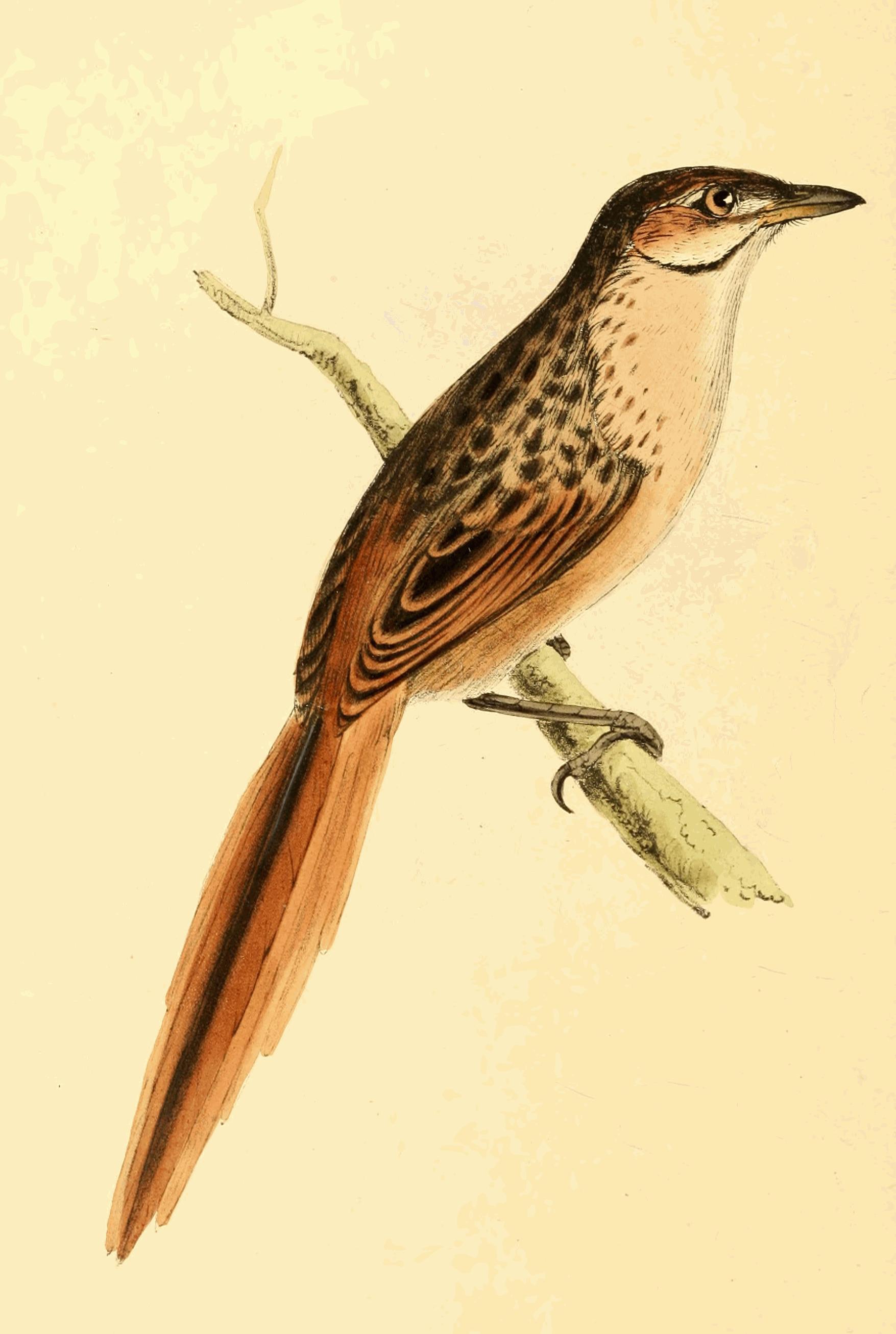
MALURUS Africanus,
African Soft-tail.
Generic Character.—See Pl. 170.
Specific Character.
M. suprà rufescens, strigis nigris varius; genis mentoque albentibus, strigâ nigrâ intermediâ; rectricibus attenuatis, nigris, rufo marginatis.
Above rufous brown with black stripes; sides of the head and chin whitish, divided by a black stripe; tail feathers attenuated, black, the margins rufous.
Motacilla Africana. Gmelin, 1. p. 958.
Sylvia Africana. Lath. Ind. Orn. 2. p. 518. Gen. Zool. 10. 2. p. 615.
African Warbler. Lath. Syn. 4. p. 436.
Curruca nævia. C. B. Spei. Brisson. Ois. 3. p. 390. tab. 22. f. 2. Orn. 1. p. 419.
Le Fluteur. Vaill. Ois. d'Afrique.
Le Vaill. Ois. d'Af. 3. pl. 112. f. 2.
The characters of Malurus, together with a few observations on the birds composing it, I have already given at plate 170 of this work. Yet as the species are scattered in several distinct genera of the Linnæan school, I have here represented that which may be termed the type of the genus, as instituted by Professor Temminck, and as modified by myself. On comparing the characters of Timalia (a new genus of Dr. Horsfield's) with those of Malurus, they will be found to designate one and the same group of birds. Indeed, the minute and interesting details, which Dr. Horsfield has given, put the question almost beyond doubt, and lead me to conclude, that the Doctor was not aware, at the time, that his genus was already recorded.
This bird is not uncommon at the Cape of Good Hope. The notes of the male (according to M. Le Vaillant) are soft and agreeable, much resembling those of a flute; the shortness of the wings renders its flight very low. The figure is of the natural size; and the bird has been so well described by Brisson and Latham, that it is needless to repeat what they have said; the figures both of Le Vaillant and Brisson are by no means accurate. The tail feathers are delicate and transparent; and those of the whole body very soft, with detached webs or radii, similar to Dr. Horsfield's Timalia pileata, and gularis.
Pl. 171
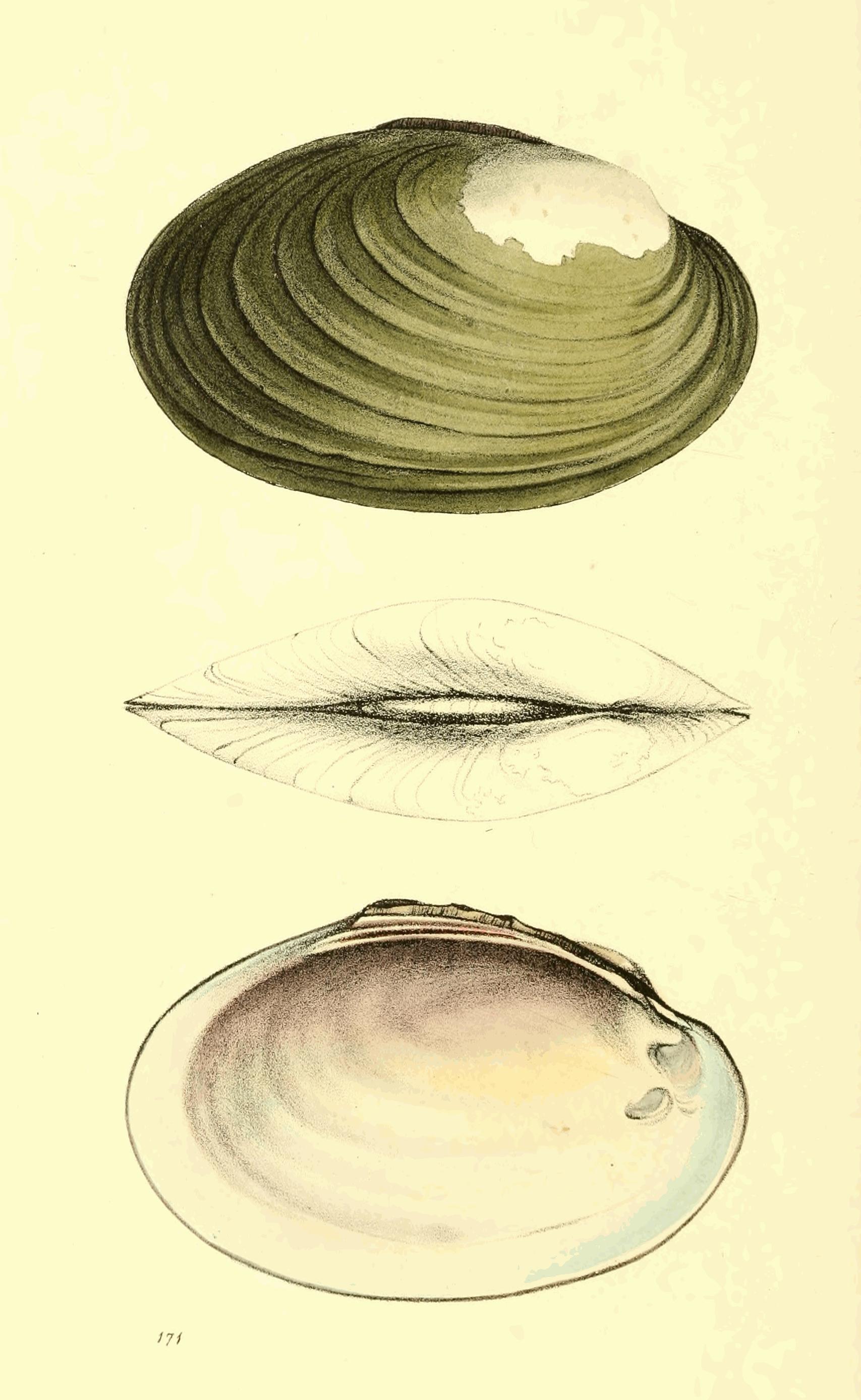
UNIO fragilis.
Fragile River Mussel.
Generic Character.—See Pl. 58.
Specific Character.
U. testâ transversim ovatâ, tenui, intùs purpurascente; dentibus cardinalibus tuberculatis, sub-obsoletis.
Shell transversely oval, thin, within purple; cardinal teeth tuberculated, nearly obsolete.
Most fresh water bivalves are remarkably destitute of that variety of colouring, which diversifies the exterior of marine shells, and renders their distinction comparatively easy. A uniform olive green, or brown tint, pervades all the fluviatile genera; their specific distinctions rest on characters which frequently require long and perplexing descriptions, but which can be explained by the artist with ease and precision. It follows, therefore, that accurate figures of these shells are more particularly wanted; for, although Lamarck has described so many, the short descriptions which he has given, and the want of figures to elucidate them, render it impossible to determine accurately one half of the species which he has enumerated.
Unio fragilis is principally distinguished by the cardinal teeth: those in the right valves are 2; short, obtuse, and nearly obsolete, more resembling tubercles, than the crenated or striated teeth of this genus. The left valve has one tooth rather sharper. In young shells the ligamental margin is nearly straight, and its extremity somewhat angulated; but old shells lose these appearances, and become perfectly oval. In both stages of growth the shell is very thin, convex, and the inside (near the umbones) purple. The slight development of the cardinal teeth brings this shell nearer to the genus Anodon, than any other Unio which I have seen.
It inhabits the rivers of North America, and was sent to me by Professor Rafinesque.
Pl. 172
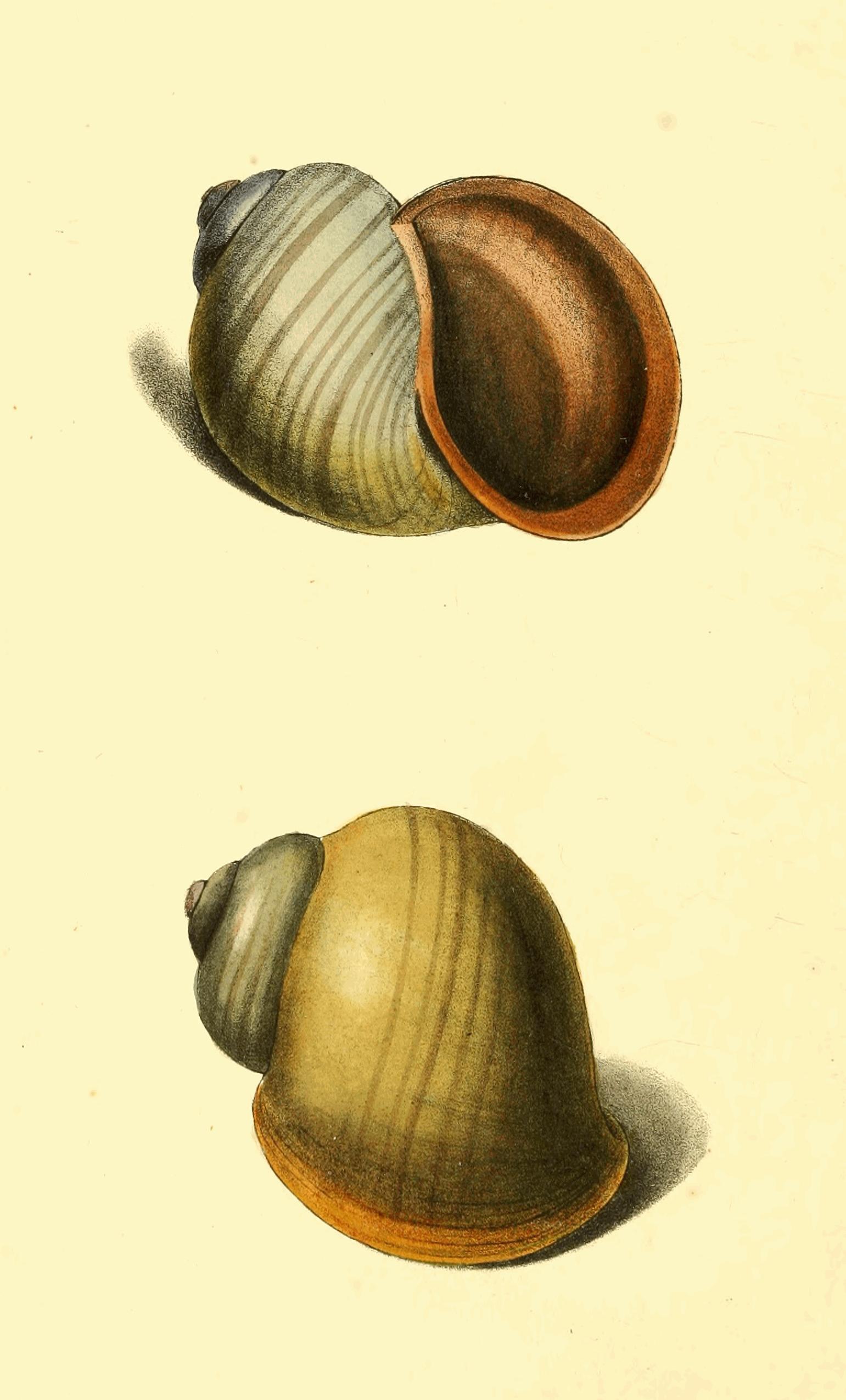
AMPULLARIA reflexa,
Purple Apple Snail.
Generic Character.—See Pl. 103.
Specific Character.
A. testâ ovato-globosâ, lævi; spirâ ventricosâ, obtusâ, sub epidermide purpureâ; aperturâ nigro-purpurascente; labio exteriore tenui, margine reflexo.
Shell ovate-globose, smooth; spire ventricose, obtuse; beneath the epidermis, purple; aperture blackish purple; outer lip thin, the margin reflected.
Knorr, vol. 5. pl. 5. f. 2. (uncoated.)
Ampullaria reflexa. Swainson, in Tilloch's Ph. Mag. vol. 61. p. 377.
The only record that I can find (in the works of the old writers) for this Ampullaria, is the figure by Knorr above quoted; it is obviously drawn from an uncoated specimen, although I have seen instances, where the blackish purple on the spire was so intense, as to obscure the thin epidermis which covered it. The peculiar character of the species, and in which it differs from all others, is in the outer margin of the lip; which is thin, rather spread out, and slightly reflected; the form of the shell resembles A. fasciata, but the spire, instead of being pointed, is obtuse; the umbilicus, likewise, is smaller and more concealed. From the absence of a groove round the aperture, I conclude the operculum is horny.
The size varies; perfect shells are in my possession much smaller than the figure, and I have seen others much larger, and with the aperture more chesnut than purple.
I am not acquainted with its locality.
Pl. 173
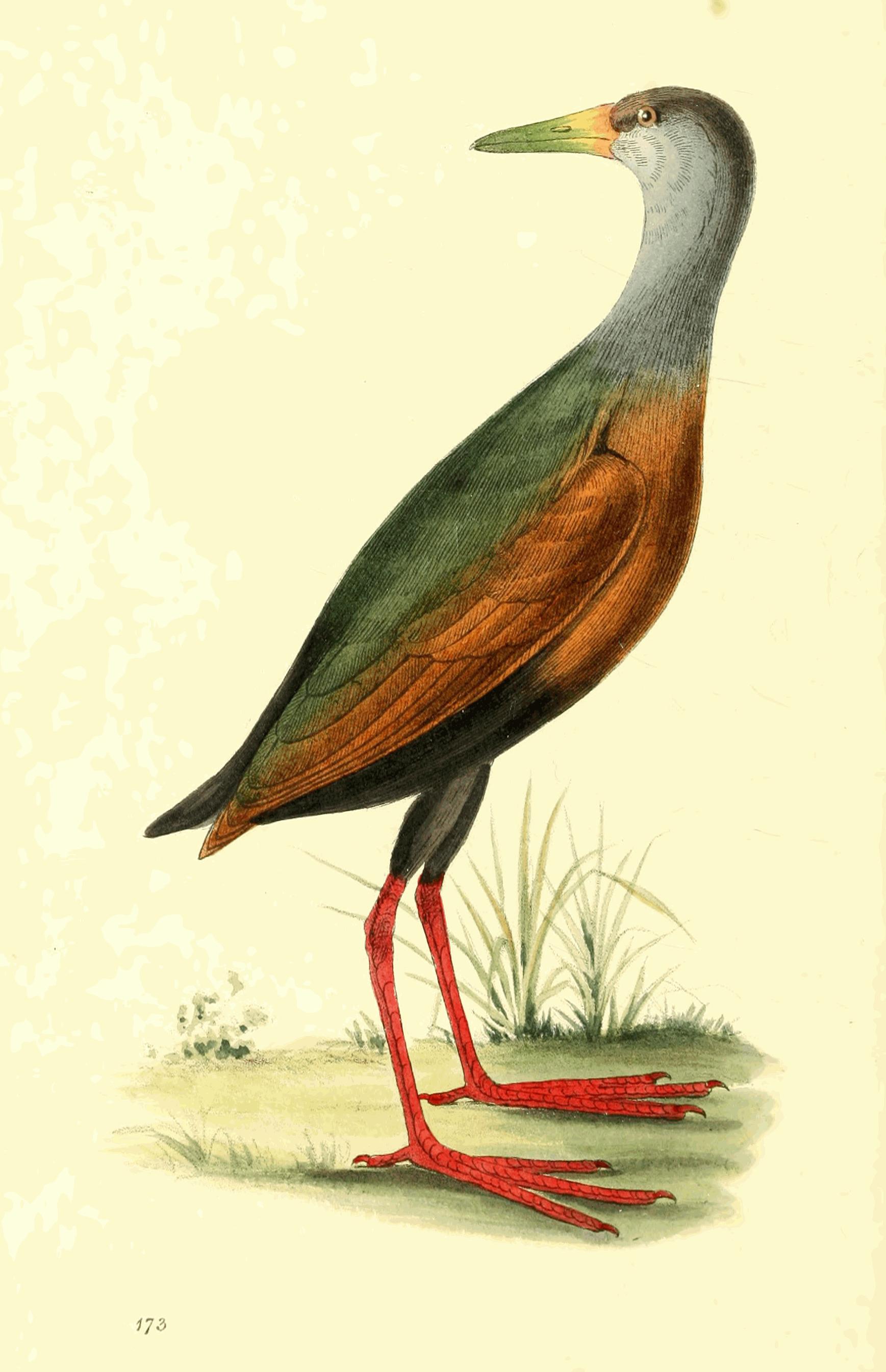
GALLINULA ruficollis, var.
Black-bellied Gallinule var.
Generic Character.
Gallinula. Briss. Cuv. Tem. Lath. Fulica, Rallus. Linn. Crex. Illiger.
Rostrum capite brevius, valdè compressum, conicum, rectum, apice compresso, mandibulâ inferiore angulatâ. Nares sulcatæ, membranâ obtectæ; aperturâ magnâ, oblongâ, perviâ, vix mediâ. Pedes elongati, grallarii, genibus nudis, digitis gracilibus tribus, halluce mediocri.
Bill shorter than the head, much compressed, conic, straight, the tips compressed, inferior mandible angulated. Nostrils sulcated, covered by a membrane; aperture large, oblong, pervious, nearly medial. Feet long, wading, knees naked, fore toes three, long, slender, hind toe (or thumb) short.
Generic type. Rallus porzana. Linn.
Specific Character.
Gall. ruficollis var. A? Olivaceo-fusca; cervice cinereâ; pectore, abdomine, alisque rufis; crisso, uropygio, caudâque nigris; tectricibus interioribus rufis, nigro-fasciatis; pedibus rubris.
Olive brown; neck cinereous; breast, body, and wings rufous; belly, rump, and tail black; interior wing covers rufous, banded with black; legs red.
Fulica ruficollis. Gmelin, 1. p. 700. Turton, 1. p. 423.
Gallinula ruficollis. Lath. Ind. Orn. 2. 767.
Black-bellied Gallinule. Lath. Syn. 1. p. 253.
This is one of the largest water hens found in Brazil, where it is very rare. I am indebted to Dr. Langsdorff for the only specimen which I brought from that country. It differs considerably from the Black-bellied Gallinule of Latham, yet, perhaps, not sufficiently to record it as a distinct species.
Total length fifteen inches and a half; bill one and a half; the base (in the dead bird) orange, the other half green; frontlet none; the crown and nape are grey brown, the sides cinereous, and the throat whitish; the neck both above and beneath for about two thirds its length is lead-coloured; it then changes to rufous, which spreads over the breast, body, wing covers, and greater quills; the lower part of the neck above, with the back, scapulars, and lesser quills, brownish olive; the belly, thighs, tail, and rump black; the inner wing covers are remotely barred with black; legs (in the live bird) red.
Latham describes the Black-bellied G. as seventeen inches long; the bill two inches; the quills greenish brown, with rufous margins; the fore part of the neck and breast bright rufous; and the flanks with black bands.
Pl. 174
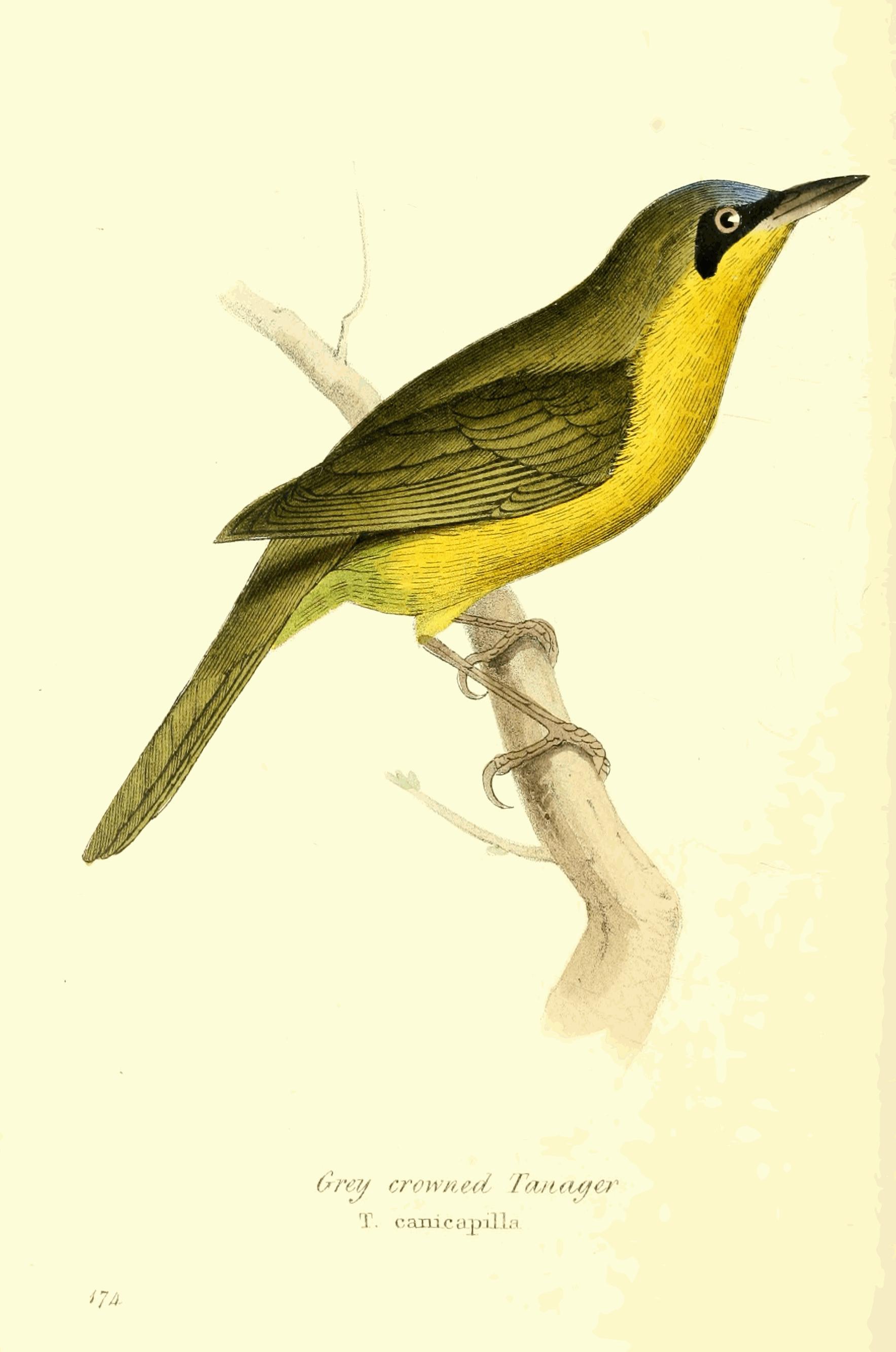
TANAGRA canicapilla,
Grey-crowned Tanager.
Generic Character.
Rostrum breve, validum, conicum, basi trigonâ, lateribus compressis, culmine levato, mandibulâ superiore ad apicem deflexâ et emarginatâ, inferioris brevioris rectæ basi crassâ, ambarum marginibus inflexis. Nares parvæ, basi plumosâ, aperturâ rotundatâ, nudâ. Alæ mediocres.
Bill short, strong, conic, base trigonal, sides compressed, culmin elevated, upper mandible towards the tip deflexed and notched, under mandible shorter and straight, the base thick, the margins of both inflexed. Nostrils small, the base feathered, the aperture round, naked. Wings moderate.
Generic Types. Tanagra Jacapa, tricolor. Motacilla velia. Lin. Pipra musica. Lin.
Specific Character.
T. olivaceo-viridis, infrà flava; vertice cinereo, strigâ oculari auribusque nigris; rostro gracili.
Olive green, beneath yellow; crown cinereous, eye stripe and ears black; bill slender.
The Tanagers are a numerous, and, in general, a beautiful tribe, including some of the most richly coloured birds of America; to which continent modern ornithologists consider they are exclusively confined.
M. Temminck proposes to unite with the Tanagers, several birds scattered in the Linnæan Genera of Lanius, Loxia, Fringilla, Pipra, and Motacilla. This view of the subject, it may not be superfluous to add, is in perfect unison with my own. In fact, I had meditated a similar arrangement; but the appearance of M. Temminck's work rendered the publication of my own remarks no longer necessary. The bird here figured belongs to that division which forms a transition to the Sylviæ, from which they are readily distinguished by the thickened base of the under mandible. It is not uncommon in the West Indies; but I cannot find it described either among the Tanagers, Finches, or Warblers of the Linnæan school: in this, however, I may possibly be mistaken. It is represented the size of life, and is sufficiently distinguished by its specific character.
Pl. 175
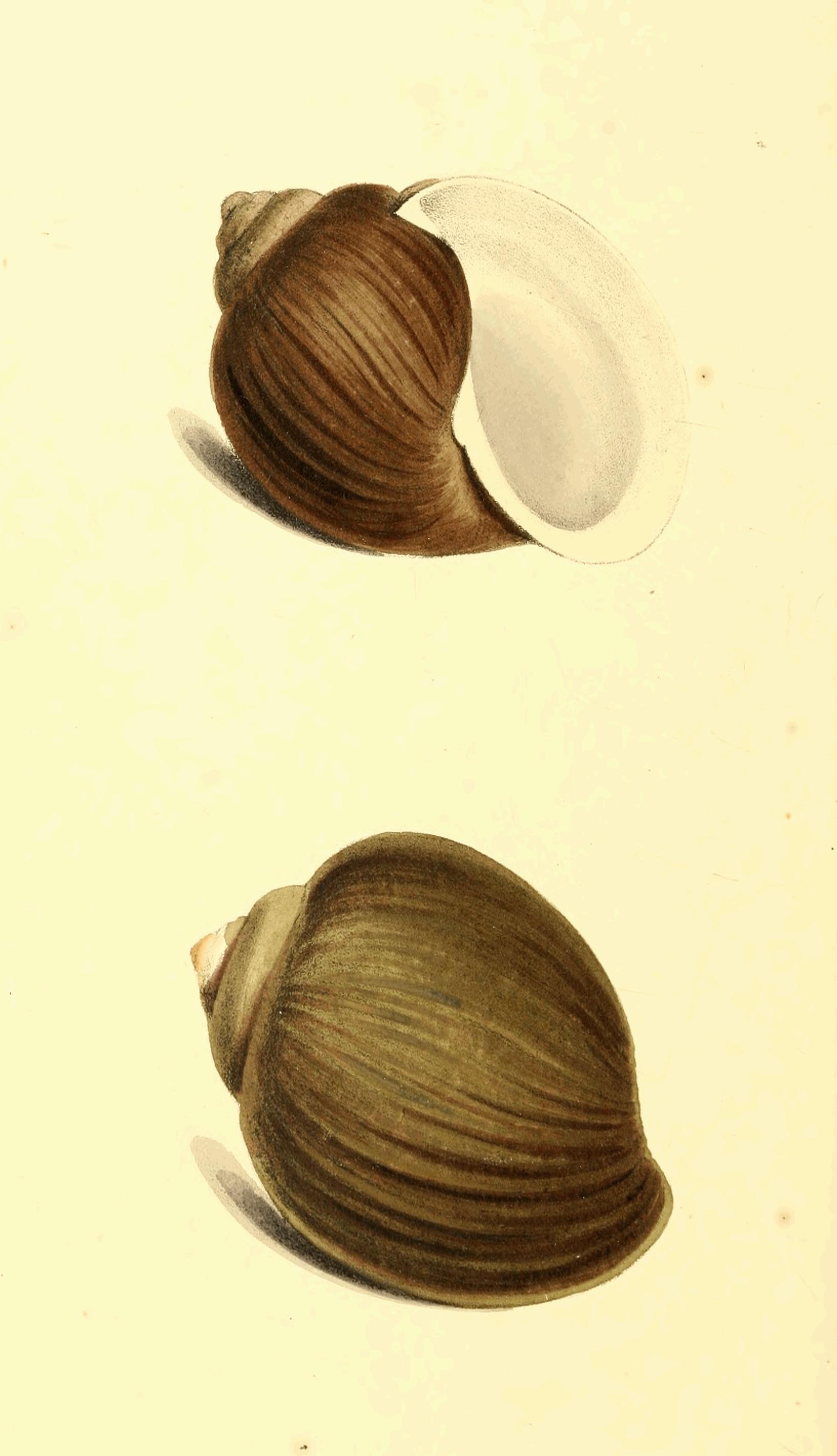
AMPULLARIA leucostoma,
White-mouthed Apple Snail.
Generic Character.—See Pl. 98.
Specific Character.
A testâ ovatâ, rugosâ, epidermide olivaceo-fuscâ; labio exteriore tenui; aperturâ albâ; umbilico vix clauso.
Shell oval, wrinkled; epidermis olive-brown; outer lip thin; aperture white; umbilicus nearly closed.
In prosecuting my illustrations of this genus, I have carefully examined all the specimens in the cabinets of my friends, and have added many to my own. These materials have thrown some additional light on those species which I have already described, and have enabled me to detect several others altogether new. Among the latter is the shell here figured, and which is so rare, that I know but one example of it in this country. Its form is more oval than that of A. rugosa, from which it is likewise distinguished by a very small umbilicus, nearly concealed by the inner lip; the wrinkles are numerous and unequal, the spire pointed, and the aperture milk-white.
Since my remarks on the Planorbis cornu-arietis of Lamarck were published, it has been discovered that the shell is furnished with an operculum: one of these is in the possession of Mr. Sowerby: thus what was a matter of doubt becomes a fact, and affords the only substantial argument for terming it an Ampullaria. On the other hand, its affinities to Planorbis (marked by its discoid, depressed form, and the total absence of the pillar,) remain in no degree impaired. The weight of argument on both sides now appears to be so equal, that it is a matter of no moment whether this shell be placed in the system at the end of the Ampullariæ, or at the commencement of the Planorbes. To the generality of conchologists, the latter collocation would appear the most simple; but, on the whole, I incline more to the propriety of considering it the terminal species of the Ampullariæ, or that which marks their transition (as I before observed) to the Planorbes.
Pl. 176
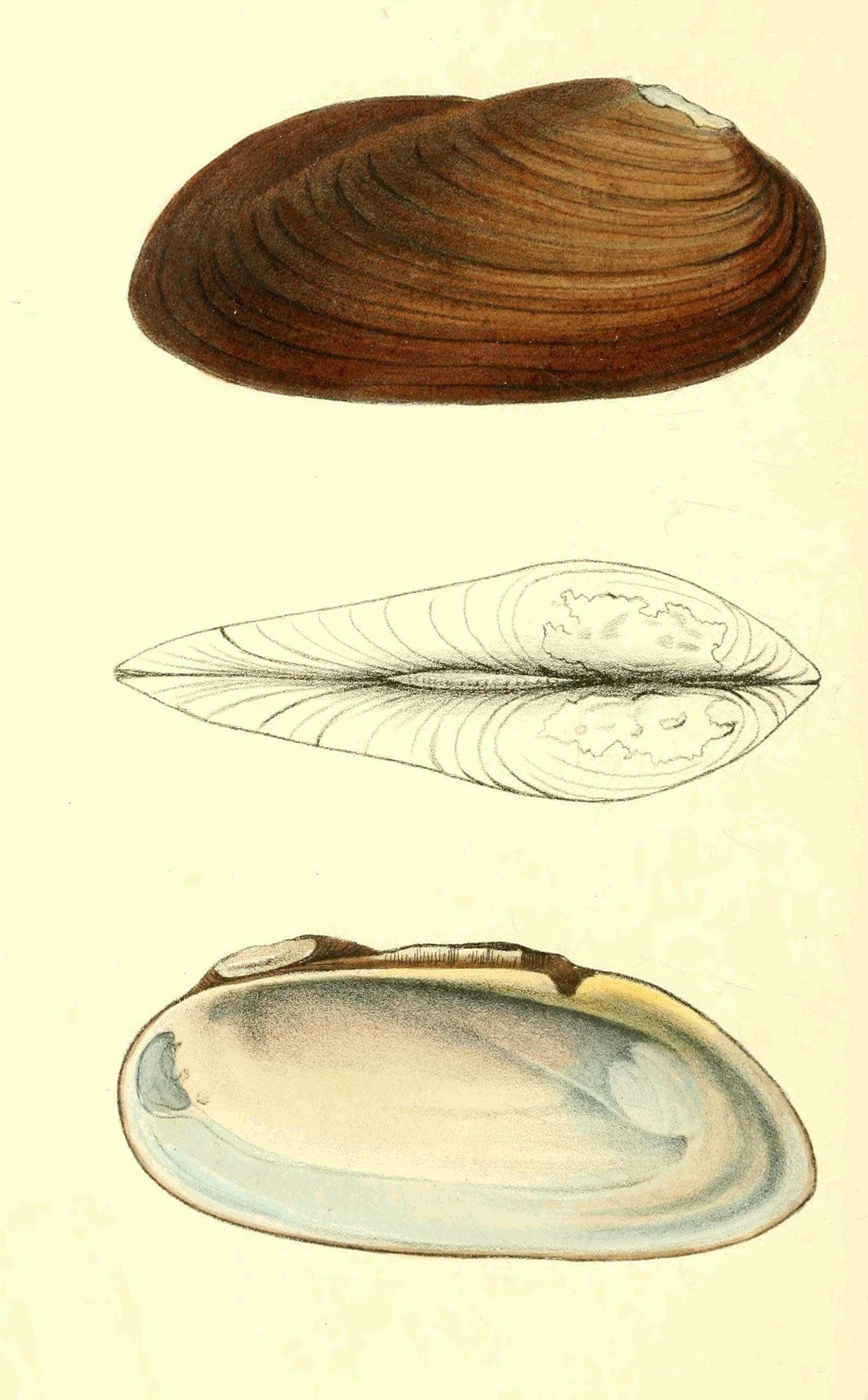
ANODON elongatus,
Lengthened Anodon.
Generic Character.—See Pl. 96.
Specific Character.
A. testâ transversim oblongâ, crassâ, anticè compressâ, extremitate utrâque rotundatâ; umbonibus valdè prominentibus, crassis; laminâ cardinali convexâ.
Shell transversely oblong, thick, anteriorly compressed, both extremities rounded; umbones very prominent, thick; hinge-plate convex.
This extremely rare shell bears not the least resemblance to any which Lamarck has described, or with which I am acquainted. It was formerly in the late Mr. Forster's collection, and is now in the possession of Mrs. Mawe. Its form is like that of Unio ovatus (Mya ovata of Montague), but it is a much thicker and stronger shell; the posterior end is greatly compressed, but round; the umbones convex, remarkably thick, and deeply eroded; the inside pearly and iridescent, with a strong flesh-coloured tinge; the ligamental or hinge-plate is perfectly smooth, and rather convex; the muscular impressions are deep.
One valve of the specimen above alluded to (the only one I have seen), is uncoated, and beautifully iridescent. Its country is unknown—but I think it may prove a native of the South American rivers.
Pl. 177
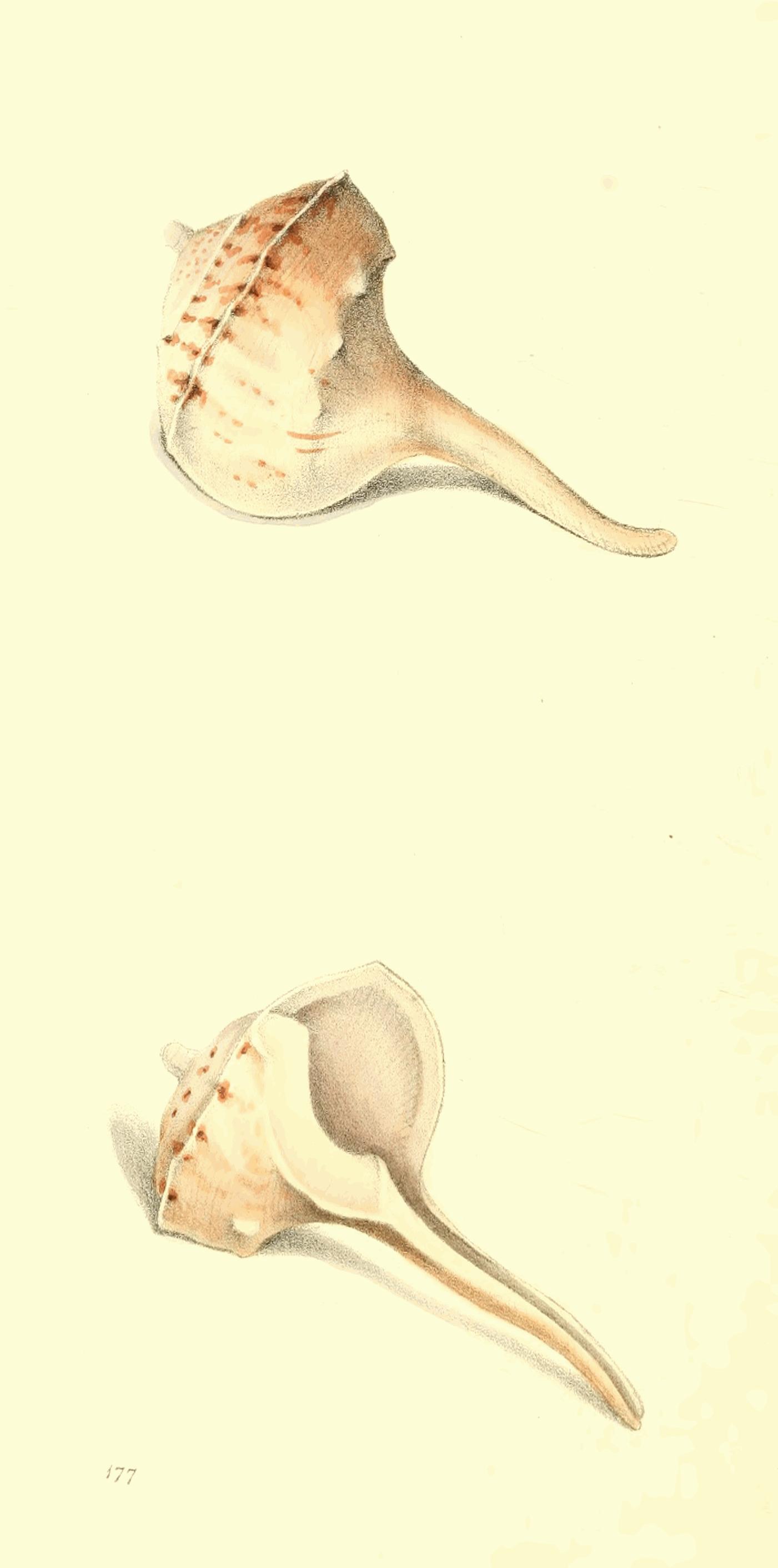
TURBINELLUS spirillus,
Carinated Turnip Shell.
Generic Character.
Testa pyriformis vel fusiformis, sub-ponderosa. Apex papillosus. Columella plicata. Labium interius margine dilatatum. Canalis elongatus, rectus.
Shell pear-shaped or fusiform, heavy. Apex papillary. Pillar plaited. Interior lip with the margin dilated. Canal lengthened, straight.
Generic Type. Voluta Pyrum. Lin.
Specific Character.
T. pyriformi; spirâ depressâ, apice prominente; anfractu basali carinato; labio interiore dilatato, albo; columellæ basi plicatâ.
Shell pear-shaped; spire depressed, apex prominent; basal whorl carinated, interior lip dilated, white; base of the pillar one-plaited.
Murex spirillus. Gmelin, 3544. Dillwyn, 721.
Martini, 3. tab. 115. f. 1069. Knorr, 6. tab. 24. f. 3.
Pyrula Spirillus. Lam. Syst. 7. p. 142.
In assigning a situation, under the modern system, to the Murex spirillus of Linnæus, no genus appears to me more adapted for its reception than that of Turbinellus. These shells were formerly blended with the Linnæan Volutes, but are now detached from them as a distinct genus. The most striking peculiarity consists in the prolongation of the base into a long and straight canal; they possess, in common with the Volutes, a papillary spire, and, in general, their surface is smooth. There are, however, other shells classed by the French conchologists with this genus, from their having a plaited columella; in these, the apex of the spire is acute, the base truncated, and the outside rough with nodules or obtuse spines; characters so greatly at variance, and so very distinct from those first mentioned, that it becomes questionable whether these latter shells should not rather be classed as a distinct group: in fact, they are much more nearly allied to Mitra and Cancellaria, which have acute spires, sculptured volutions, and truncate bases, than to the smooth Turbinelli, which differ so strikingly in all these particulars.
This shell is common to many parts of the Indian Ocean; and, like most of the smooth Turbinelli, has the inner lip dilated.
Pl. 178
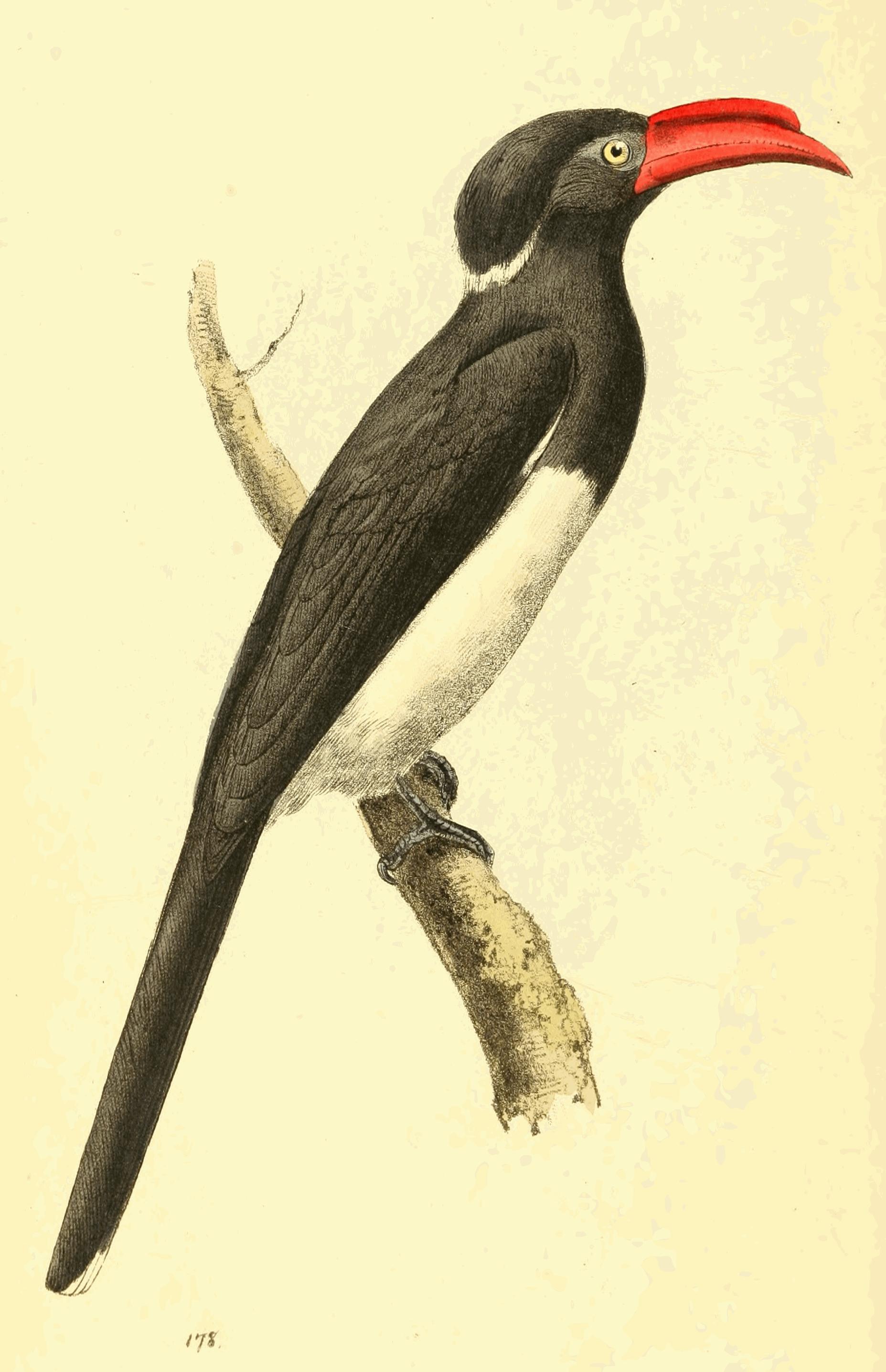
BUCEROS coronatus,
Coronated Hornbill.
Generic Character.
Rostrum elongatum, crassum, inane, deflexum, marginibus obtusè crenatis, epithemate inani, formâ vario, in mandibulam superiorem imposito. Nares basales, ovatæ, (lingua brevis, angusta, acuta. Illiger.) Pedes gressorii.
Bill elongated, thick, hollow, deflexed, the margins obtusely crenated, with excrescences of various forms placed on the upper mandible. Nostrils basal, oval. Tongue short, narrow, pointed. Feet gressorial.
Generic Types. B. Rhinoceros, bicornis. Linn.
Specific Character.
B. niger, abdomine, striâ utrinque occipitali, apiceque rectricium albis; rostro subcristato, (carinato,) rubro. Shaw.
Black Hornbill, with the abdomen, stripe on each side of the nape, and tip of the tail white. Bill slightly crested, (carinated,) and red.
Le Calao Couronné mâle. Le Vaill. Ois. d'Af. vol. v. p. 117. pl. 234.
Buceros coronatus, Coronated Hornbill. Shaw in Gen. Zool. 8. p. 35.
The bills of these birds present a more uncouth appearance than even those of the Toucans; many species having knobs or excrescences which seem to grow out of the bill itself, and give a strange appearance to the bird. The whole tribe are natives only of the tropical parts of Africa and Asia; feeding on animal substances, either living or dead.
Le Vaillant discovered this bird in Caffraria; congregating in flocks of near 500, along with crows and vultures, over the remains of slaughtered elephants. It frequents forests, perching on high, and generally withered trees; it likewise destroys insects.
The specimen now before me is about the size of a magpie; the white collar only surrounds the back of the head, and is not well defined; the carinated process on the bill ends abruptly, and not gradually, as seen in Le Vaillant's figure; the margins are obtusely crenated, the tail even, and the two middle feathers entirely black.
Pl. 179
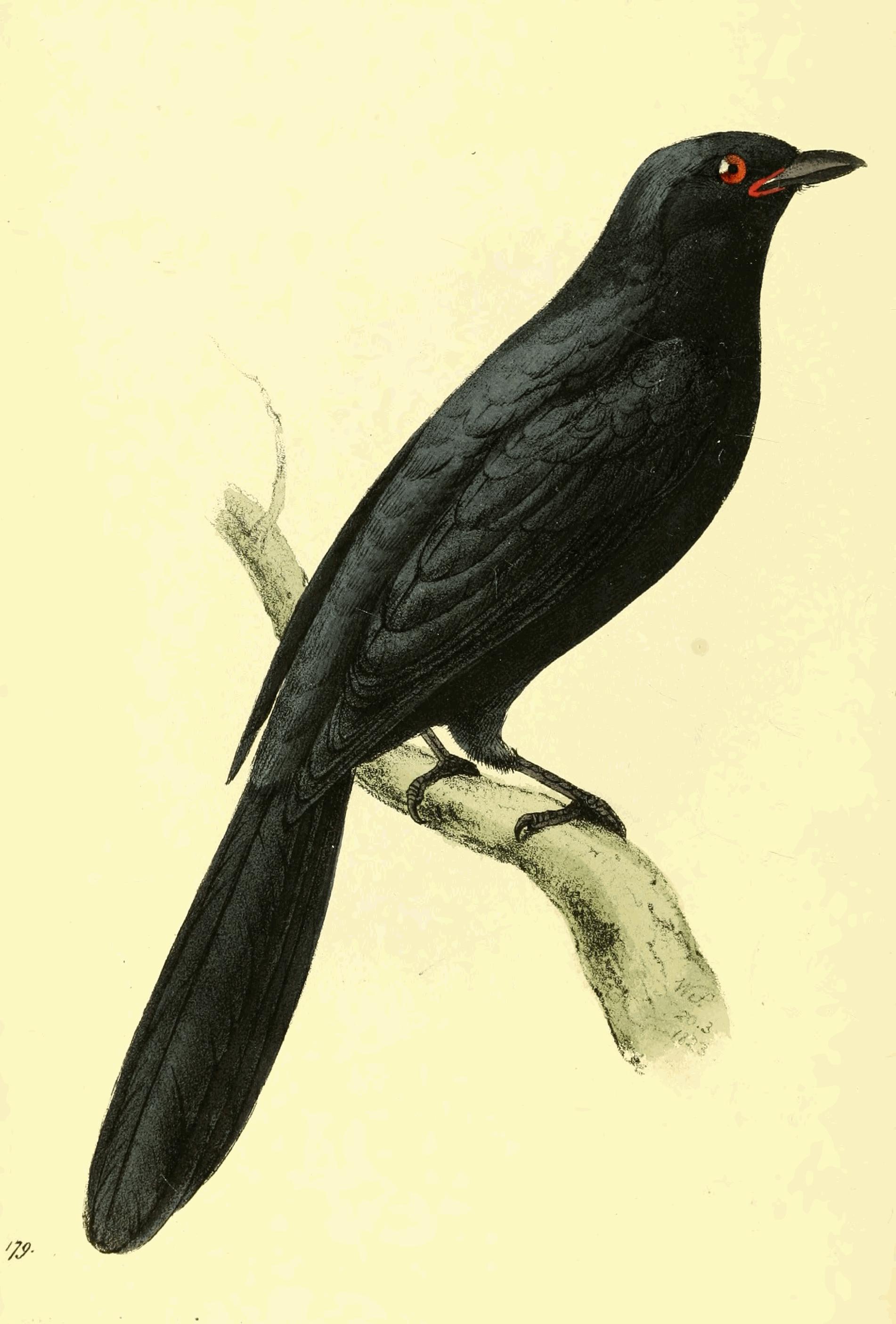
MUSCIPETA labrosa,
Red-lipped Flycatcher.
Generic Character.—See Pl. 116.
Specific Character.
M. nitidè nigra; rictu labroso, rubro; cruribus infra genua plumatis.
Glossy black; gape margined by a red skin; legs feathered beyond the knees.
This bird, though unattractive in its colours, is nevertheless very remarkable. It may be almost said to have lips; for round the gape, at each angle of the mouth, is a narrow loose skin; perfectly naked, and rather projecting. This singularity is increased by its colour in the live bird; which, by a note attached to the specimen, is stated to be of a beautiful red. It seems a species hitherto unknown, and was found near the Great Fish River of Southern Africa.
The figure is rather less than the natural size; the whole plumage deep black; glossed with bluish green in every part but the quill and tail feathers; the quills inside are grey, margined with olive; the first of these is very short, the second and third shorter than the fourth, and the two next are nearly of equal length. The tail has ten feathers, and is even, except the two outer pair, which are progressively shorter. The bill rather thick and strong, the culmine not very apparent, the upper mandible strongly notched, the under but slightly; the nostrils are hid by thickset incumbent feathers, mixed with hairs; these cover the aperture, which is rather large, round, and encircled by a narrow membrane. The legs are very short, the three fore-toes united as far as the first joint, the hind-toe short; the claws of all are small, and the sole of the foot perfectly flat, like the Bee-eaters. I have been minute in noting these characters, because, although the bird will stand at present in the great family of the Flycatchers, there is no doubt they will hereafter be divided into distinct groups.
Pl. 180
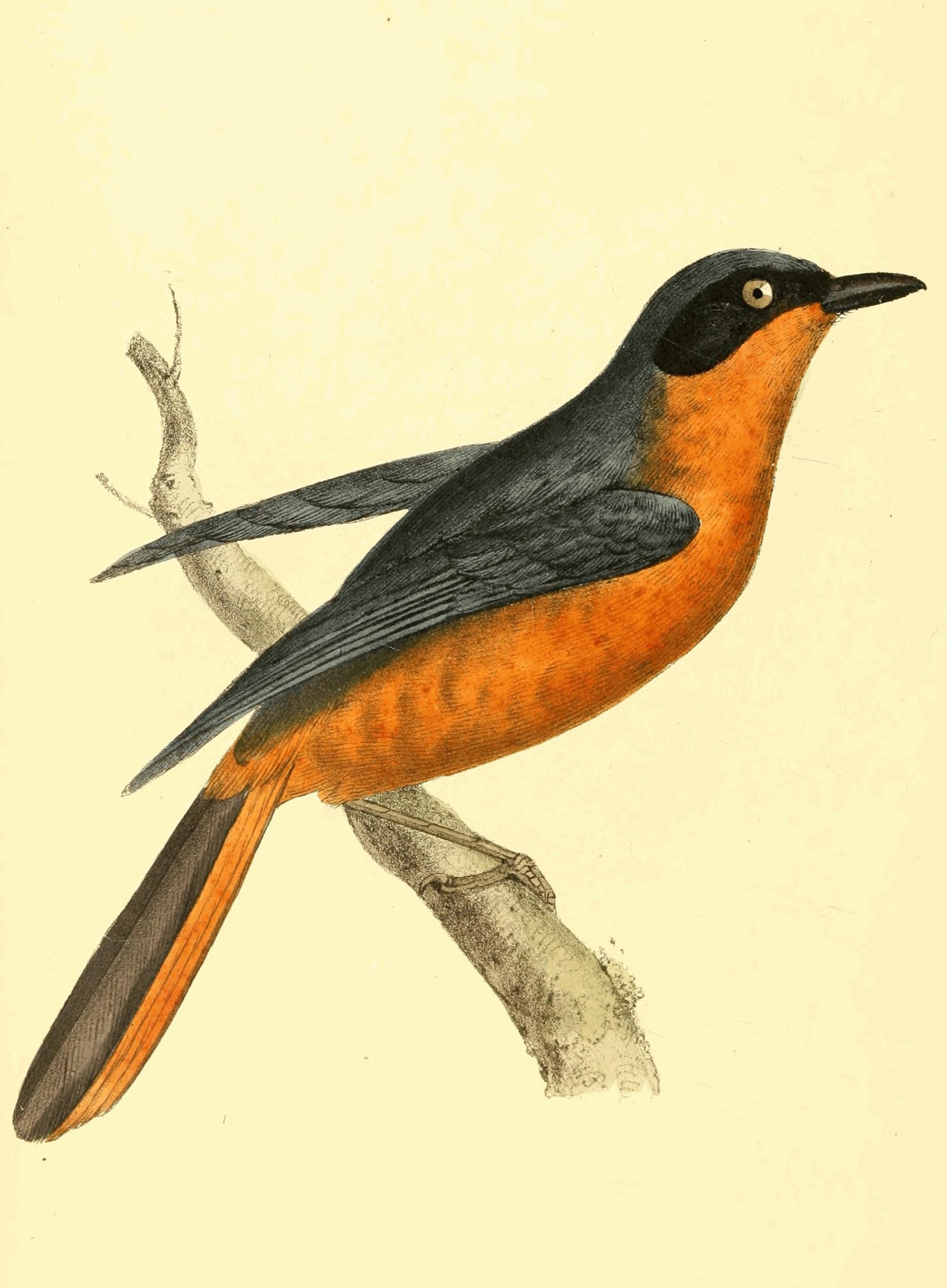
TURDUS vociferans,
Calling Thrush.
Specific Character.
T. cinereus, infrà ferrugineus; temporibus auribusque nigris; caudæ rotundatæ pennis mediis nigris, lateribus ferrugineis.
Cinereous, beneath ferruginous; ears and sides of the head black; tail rounded, middle feathers black, lateral feathers ferruginous.
Le Réclammeur. Le Vaill. Ois. d'Af. tom. 3. p. 33, pl. 104.
I can find no account of this bird in any writer besides Le Vaillant, who discovered it during his travels in Southern Africa. He says the note of the male bird is loud and melodious, and is heard in the morning and evening from the highest branches of lofty trees; the sexes being usually seen together. Le Vaillant relates an amusing anecdote, which well illustrates the peculiar note of the male:—One of his Dutch Hottentots, by name Piet, having shot a female, its mate continued to fly around him, uttering its cry, which so much resembled the Dutch words of Piet myn vrow, (or, 'Peter—my wife,') that the poor lad (perfectly astonished) took to his heels, and vowed never more to handle a gun.
Length seven inches and a half; the upper plumage is dark cinereous: on each side the head is a stripe of black, which encircles the eye, and forms a patch on the ears: the whole of the under plumage is clear ferruginous yellow or bright buff colour; the rump and lateral tail feathers the same, the middle pair being entirely black; the next pair has likewise a narrow margin of the same colour: quills and wing-covers dusky brown, with pale cinereous margins. Tail rounded: legs pale: irides hazel: bill rather small and black, compressed the whole length, and having weak bristles at its base.
This bird obviously belongs to the Thrushes; but as I have not yet defined the extent of the genus to my own satisfaction, I refrain at present from proposing its characters.
Pl. 181
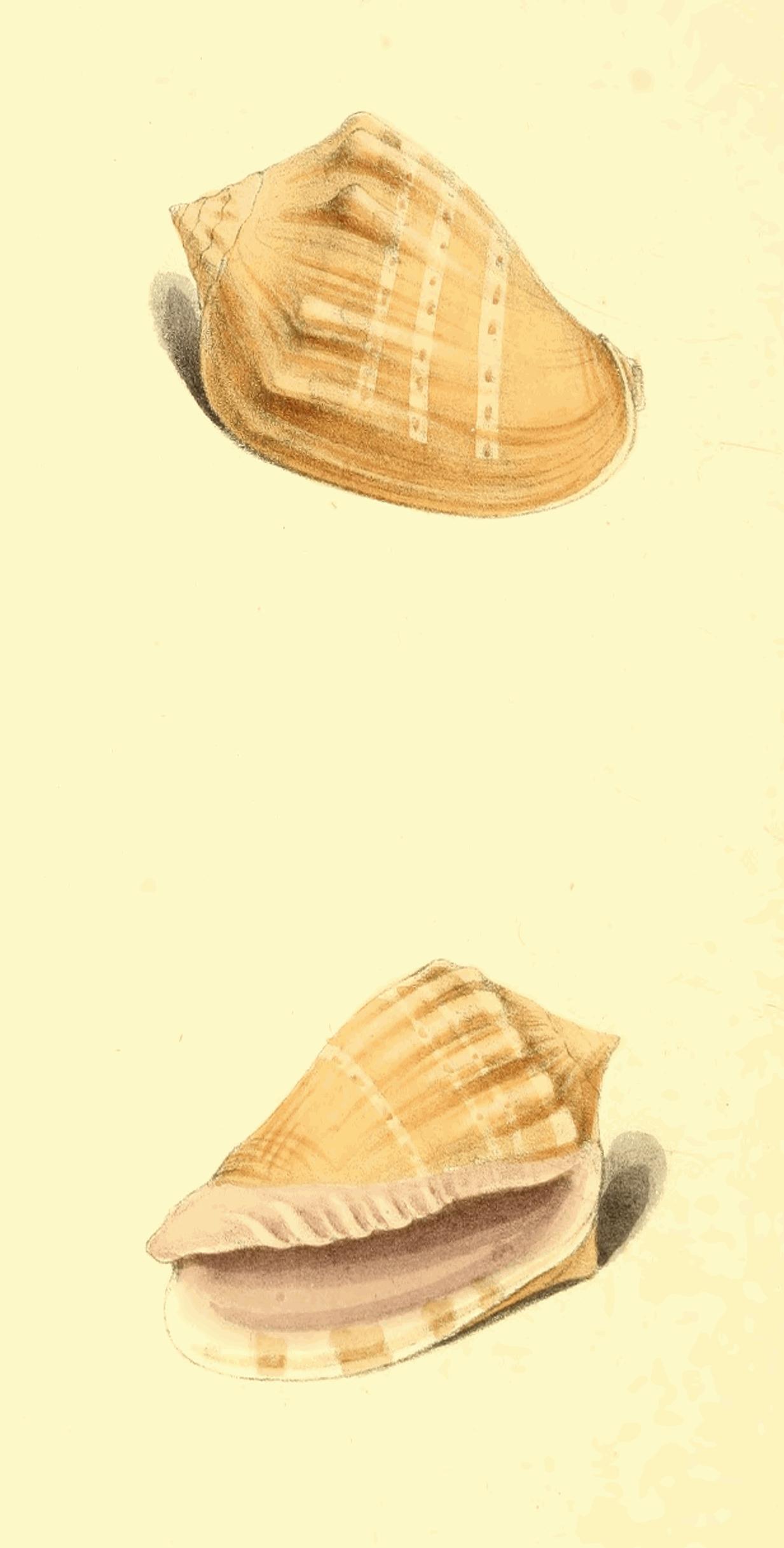
VOLUTA Pusio,
Dwarf Volute.
Generic Character.—See Pl. 161.
Specific Character.
V. testâ ovato-obtusâ, flavescente, fasciis pallidis, maculis fulvis interstinctis cinctâ; anfractu basali obtusè nodoso; spirâ brevissimâ, acutâ; columellâ incrassatâ, multiplicatâ.
Shell ovate-obtuse, yellowish, with pale bands and fulvous spots; body whorl crowned by compressed obtuse nodules; spire very short, acute; pillar thickened with many plaits.
Voluta Pusio. Swainson, in Tilloch's Ph. Journal, vol. 61. p. 378.
Lamarck's recent account of this genus, in the last volume of his Animaux, contains but two species in addition to those long ago described by him in the Annales du Mus.; thus omitting many of those new Volutes which of late years have been discovered. On the other hand, this naturalist has created five species from the varieties of V. musica Lin. resting their characters on colour, bands, and the number of the lesser or spurious plaits on the pillar. It requires no argument to prove that these principles of distinction are the most uncertain he could have chosen; scarcely two specimens of V. musica being found alike. These supposed species must, therefore, again merge into one.
The shell before us has more important characters; the body whorl is quite smooth, but crowned by compressed truncated nodules; the spire remarkably short, and the tip acute; in other respects it approaches to V. virescens Sol. (Polyzonalis Lam.) and to V. fulva Lam. I have neither of these shells at present before me; but if Lamarck's description of them, and the figures which he has cited, be correct, I have no doubt they are but one species; V. polyzonalis being the smooth, and V. fulva being the nodulous variety of Solander's V. virescens. In fact, Lamarck says both shells are transversely striated.
V. pusio is a shell of the greatest rarity, and is described from a specimen in the collection of my friend Mr. Broderip. Its form is perfect, but its colours are somewhat faded.
Pl. 182
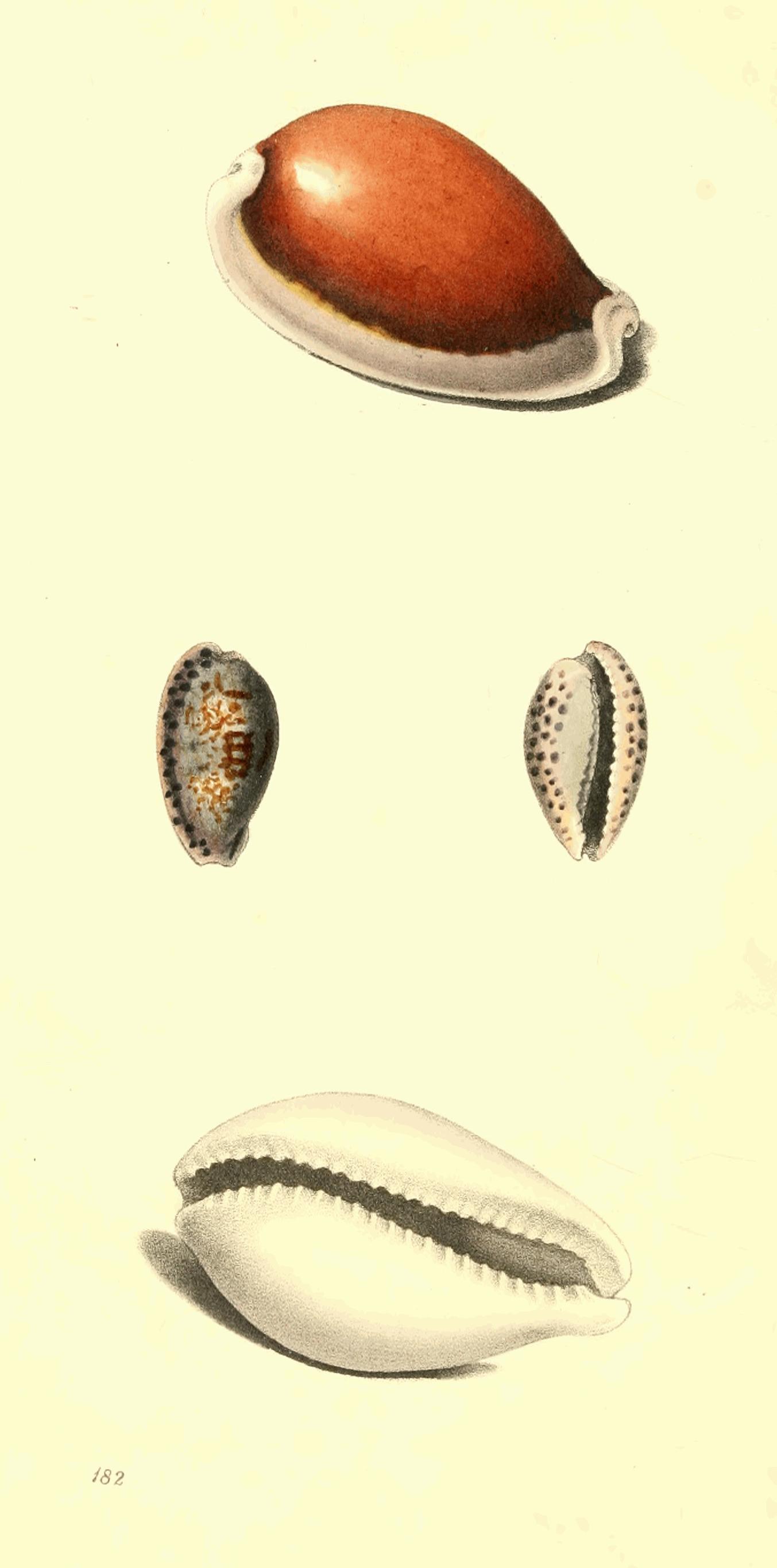
CYPRÆA spadicea,
Chesnut Cowry.
Generic Character.—See Pl. 111.
Specific Character.
C. testâ ovatâ, oblongâ, immaculatâ; dorso rufo; ventre albo; lateribus lividis.
Shell ovate-oblong, unspotted; the back reddish chesnut; belly white; sides livid.
C. spadicea. Swainson, in Tilloch's Ph. Mag. vol. 61. p. 376.
In shape and general aspect this shell somewhat resembles C. onyx; but its colours are so peculiar, that it cannot be mistaken for that or any other known species: the under side (or belly) is convex and pure white; the sulcations between the teeth of the aperture wide, short, and but faintly marked; the sides livid, tinged with flesh colour. Three specimens have fallen under my observation; one of which, being young, showed the internal colour of the back to be dull purple; they were all received by Mrs. Mawe from the South Seas.
CYPRÆA sanguinolenta
(Middle figures.)
C. testâ ovato-oblongâ, dorso punctis fuscis, nebulosis, obsito; lateribus incarnato-violaceis, lividè guttatis; ventre depresso.
Shell ovate-oblong, the back clouded, and dotted with brown; sides flesh-coloured violet, with dark livid spots; belly depressed.
C. testâ ovato-oblongâ, cinereo-cærulescente, fulvo vel fusco fasciatâ, lateribus incarnato-violaceis, sanguineo-punctatis. Lam. Syst. 7. p. 396.
C. sanguinolenta. Gmelin, 3406. Turton, 4. p. 335. Dill. 445. Martini, 1. t. 26. f. 265, 266. Ency. Meth. pl. 356. f. 12.
C. purpurascens. Sw. in Tilloch's Ph. Mag. 61. p. 376.
Gmelin and Lamarck have both described the lateral spots on this shell as blood-red. Their descriptions in other respects are loose, and the figures by Martini so bad, that it is with some doubt I have here placed my purpurascens as a variety of Gmelin's sanguinolenta. The back of the shell is minutely freckled with brown; the under part (or belly) is flattened; the spots on the sides dark livid purple, and the base of the aperture effuse. It is, I believe, a native of Southern Africa.
GENERAL INDEX
OF
LATIN AND ENGLISH NAMES
TO
VOL. III.
IN THE ORDER OF PUBLICATION.
Pl. Pl.
Ampullaria corrugata 120 Wrinkled Apple-snail 120
Cinnyris Javanica 121 Javanese Creeper 121
Achatina virginea, var. 1 and 2 122 Common striped Achatina 122
ditto, var. 3 and 4 123 ditto 123
Licinia Crisia 124 Licinia Crisia 124
Papilio Nerius 125 Papilio Nerius 125
Conus vitulinus, var. 126 Orange fox Cone 126
maldivus 127 Spanish-Admiral Cone 127
ditto chesnut, var. 128 ditto chesnut, var. 128
Melliphaga torquata 129 White-collared Honeysucker 129
Trochilus latipennis, male 130 Grey sickle-winged H. Bird 130
ditto, female 131 ditto, female 131
Macroglossum annulosum 132 Macroglossum annulosum 132
fasciatum ib. fasciatum ib.
Thecla Macaria 133 Chesnut-spotted Hair-streak 133
Strombus exustus 134 Burnt-mouthed Strombus 134
lentiginosus ib. Tuberculated Strombus ib.
tricornis 135 Horned Strombus 135
Ampullaria crassa 136 Thick Apple-snail 136
oblonga ib. Oblong ditto ib.
Papilio Polybius 137 Papilio Polybius 137
Malurus garrulus 138 Noisy Soft-tail Warbler 138
Sylvia plumbea 139 Grey-backed Warbler 139
Troglodytes rectirostris 140 Straight-billed Wren 140
Psittacus chryseürus 141 Golden-tailed Parrot 141
Nectarinia flaveola 142 Yellow-bellied Nectarinia 142
Ampullaria sordida 143 Brown Apple-snail 143
puncticulata ib. Oval, punctured ditto ib.
Eburna Valentiana 144 Arabian Eburna 144
tessellata 145 Tessellated ditto 145
Pacifica 146 South Sea ditto 146
Muscipeta carinata 147 Keel-billed Flycatcher 147
Emberiza cristata 148 Crested Bunting 148
Castnia Fabricii 149 Red underwing Day-moth 149
Sphinx fasciata 150 Sphinx fasciata 150
Leachii ib. Leachii ib.
Alcedo semitorquata 151 Half-collared Kingsfisher 151
Achatina melastoma 152 Black-mouthed Achatina 152
Strombus lobatus 153 Lobed or brindled Strombus 153
Psittacus Malaccensis 154 Blue-rumped Parrot 154
Psittacus viridissimus 155 Green Parrot 155
Fringilla oryzivora 156 Paddy-bird, or Java Sparrow 156
Ampullaria effusa 157 Ribbon Apple-snail 157
luteostoma ib. Yellow-mouthed ditto ib.
Pinna bullata 158 Rufous Pinna 158
Satyrus argenteus 159 Satyrus argenteus 159
Anodon purpurascens 160 Purple Anodon 160
Voluta punctata 161 Red-dotted Volute 161
Achatina fasciata, var. 162 Banded Achatina, 3 var. 162
Hemipodius nivosus 163 White-spotted Turnix 163
Sylvia annulosa 164 White-eyed Warbler 164
ditto, var. β 165 Ditto, New Holland variety 165
Bulimus citrinus 166 Citron Bulimus, 3 var. 166
Anodon crassus 167 Thick Anodon 167
Ramphastos ambiguus 168 Doubtful Toucan 168
Pteroglossus viridis 169 Green Aracari (male) 169
Malurus Africanus 170 African Soft-tail 170
Unio fragilis 171 Fragile River-mussel 171
Ampullaria reflexa 172 Purple Apple-snail 172
Gallinula ruficollis, var. 173 Black-bellied Gallinule 173
Tanagra canicapilla 174 Grey-crowned Tanager 174
Ampullaria leucostoma 175 White-mouthed Apple-snail 175
Anodon elongatus 176 Lengthened Anodon 176
Turbinellus spirillus 177 Carinated Turnip-shell 177
Buceros coronatus 178 Coronated Hornbill 178
Muscipeta labrosa 179 Red-lipped Flycatcher 179
Turdus vociferans 180 Calling Thrush 180
Voluta pusio 181 Dwarf Volute 181
Cypræa spadicea 182 Cypræa spadicea 182
sanguinolenta ib. sanguinolenta ib.