THE LAST PHASE
G. C. (Graeme Chamley) Wynne translation
When the 4th Division and von Winckler’s Guard Division were sent forward on the 9th November into the northern part of the fighting line, formerly occupied by the XV Corps, the II Bavarian Corps, from the heights of St. Eloi it had just stormed, was able to look right down on Ypres. The orders of the Sixth Army commander, dated the 7th and 8th November, had given all the necessary instructions for the employment of the new units. The 4th Infantry Division and von Winckler’s Guard Division were placed under the commander of the Guard Corps, General Baron von Plettenberg, and were to be called Plettenberg’s Corps. The XV Corps and Plettenberg’s Corps formed the Army Group Linsingen.[100]
The task set the troops of General von Linsingen was ‘to drive back and crush the enemy lying north of the canal (Comines-Ypres); the main weight of the attack is to be delivered by the left wing. The Army Group Fabeck is to maintain its positions west of the canal, its task being to continue pressing forward and at the same time to support the attack of the left wing of the Army Group Linsingen, by as powerful enfilade fire as possible from its right flank batteries.’ The decisive attack was to begin on the 10th November, when another strong reinforcement of engineers would have arrived. All the other units of the Sixth Army and the whole of the Fourth Army were also, according to arrangement, to attack on this day with increased energy, so that the enemy should be allowed no rest, and held to his positions along the whole front.
On the stroke of 7 A.M. the Fourth Army advanced to the attack. This tenth day of November was to be a famous one in its history. The sectors of attack for each of the Corps remained, generally speaking, the same, except that the left wing of the XXVII Reserve Corps had been closed in slightly to the north. Strengthened by the Guard Jäger Battalion, a Guard Machine-Gun Detachment[101] and the 9th Machine-Gun Detachment, this Corps was to advance towards the Polygon Wood.
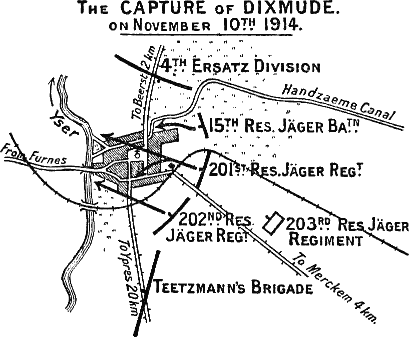
The orders for the XXII Reserve Corps ran as follows: ‘The XXII Reserve Corps[102] in co-operation with the Marine Division will secure the Yser canal front, and will take Dixmude.’ Immediately north of Dixmude the 4th Ersatz Division was in position, with the 43rd Reserve Division to the east and south, the two divisions together making a semicircle of steel round the objective. This time our troops were determined to take the town so stubbornly defended by the French infantry. The enemy fully realised the importance of this bridge-head. Besides holding a strong German force always in the vicinity, it covered the canal-crossing nearest to Calais. On the 9th its garrison was further reinforced by the arrival of fresh French troops.
The rain of the previous days had made the ground over which the attack on Dixmude was to be carried out very heavy going. The Handzaeme canal, running east and west, divides it into two parts, the northerly one being particularly swampy and difficult to cross. The main attack had therefore to be made from the east and south-east on a comparatively narrow front. The town itself comprised both modern and obsolete fortifications, but the first strongholds of the defenders were the railway buildings and cemetery situated to the east of it. The railway embankment had been transformed into a very strong defensive position, and a heavy fire was expected from it when we advanced from the high embankments of the Yser. Under the cover of darkness the division was able to push its front line to an assault position within two hundred yards of the enemy, and at dawn on the 10th the artillery bombardment began. Our heaviest guns took part and countless shells from our Minenwerfer did their utmost to break down the enemy’s resistance. By 7.40 A.M. our first attempt to take the enemy’s advanced positions had failed, and another artillery bombardment against his obstacles and flanking posts was ordered. At 9.30 A.M. the advanced stronghold at the cemetery was stormed. Our infantry had scarcely got into position there before the artillery observers arrived to direct the fire of their batteries from the front line on to the next strong point. The artillery bombardment lasted throughout the morning until 1 P.M. when the general assault was ordered. The infantry, with detachments of sappers carrying hand-grenades and various material useful in an assault, had worked its way forward close up to the line of obstacles.
The 201st Reserve Infantry Regiment advanced rapidly at first by frontal attack. North of it, the 15th Reserve Jäger Battalion under Captain Hameln worked forward across the deep marshes between the canal and the railway. The 202nd Reserve Infantry Regiment came under a heavy enfilade fire from the Yser embankment, and at 1.30 P.M. orders were issued for the Corps reserve under Colonel Teetzmann, consisting of a few battalions of the 43rd Reserve Division and of the 4th Ersatz Division, to be brought up into the line. Its task was to help carry forward the attack of the 202nd Regiment against the railway embankment, and to secure the left flank of the advance. The nearer the attack approached to the town, the more desperate became the resistance of its defenders. The gallant commander of the 201st Reserve Regiment, General von Seydewitz, always in the front line encouraging his men, was killed leading the attack just as his regiment and the Jäger entered the devastated town at about 3.30 P.M. Our well-directed artillery fire had cleared the front at the critical moment, and the enemy withdrew to the flanks of and behind Dixmude, but did not cease to offer resistance. He held the railway embankment south of the town with particular tenacity. Even when this had been finally stormed, the 202nd Regiment had to continue the fight, with heavy loss, among the burning houses in the southern part of the town, until the 201st Regiment by a wheel southwards were able to give assistance. Teetzmann’s brigade in its attack on the Yser embankment, to protect the flank of the division, had meanwhile reached the river. Thence it pressed on towards the bridges west of the town, so that the enemy’s retreat was threatened. In spite of this, however, he gave nothing up without a struggle, and every block of houses had to be captured: in fact the street fighting that ensued was hardly less bitter and terrible than at Wytschaete and Messines.
During the struggle in Dixmude, the French artillery fired into the place regardless of friend or foe, and both suffered alike. The fight was still raging among the houses at the northern exit, where von Beerst was only making slow progress with the advanced detachments of the 4th Ersatz Division, when our reserves were assembled in the market-square to deliver the final blow. The French infantry and Marine Fusiliers put up a desperate defence, but finally had to give way, for though not numerically superior, the offensive spirit of the German troops overcame all resistance. It was not until the west bank of the canal had been reached, that the mass of the enemy put up another defence.
Dixmude was captured, and the French had been driven back across the canal. A combined counter-attack by Belgians, Zouaves and French, which began during the evening and continued into the night, was unable to alter the situation, and though Dixmude in consequence was under the heaviest fire, our troops held their ground. Weak detachments of the 4th Ersatz Division were even able to cross the river north of the town under cover of darkness, though the extreme swampiness of the ground prevented them carrying their success any further. The enemy had prepared the bridges, west of Dixmude, for demolition some time before and had constructed strong positions along the west bank of the Yser. These were especially good, as the ground there is higher and overlooks that on the east bank. Our artillery had therefore to make another preparatory bombardment. The spoils taken at Dixmude were considerable, and in spite of the fact that the British assert that the Allies only lost a few hundred men, we took in prisoners alone 17 officers and 1400 men.[103]
Our allied enemies had also been driven back over the canal, south of Dixmude, on the 10th November. The XXIII Reserve Corps had made a successful attack on Noordschoote and through Bixschoote against Het Sas. A long and bitter struggle took place for the high ground south-west of Bixschoote; but by evening the canal had been reached along almost its whole length between Noordschoote and Bixschoote, whilst about a brigade of the 45th Reserve Division and weak detachments of the 46th had crossed it. The inundation had however gradually extended southwards as far as this district, and put any far-reaching extension of this success out of the question. The XXIII Reserve Corps took prisoner about 1000 men and captured a considerable number of machine-guns in this operation.
The reinforced III Reserve Corps had had a particularly hard fight on both sides of Langemarck. Throughout the 9th November and during the following night the French delivered heavy attacks there and had been everywhere repulsed. Rows of corpses lay in front of the III Reserve Corps, on the left wing of which the 9th Reserve Division, now affiliated to the Fourth Army, had been brought up into the line. Making every use of the element of surprise, General von Beseler had ordered the assault to begin at 6.30 A.M. Punctually at this moment, as dawn was breaking, the bugles sounded the attack. On the right wing the 44th Reserve Division pushed forward till close up to Het Sas, taking prisoner 14 officers and 1154 men. The official despatch, in reporting this advance, says: ‘West of Langemarck our young regiments advanced against the enemy’s front line singing “Deutschland, Deutschland über alles,” and captured it.’ The left wing of the division hung a good way back, as the 5th Reserve Division on its left was unable to push on so rapidly. It had broken into the enemy’s first position, but its eastern wing was completely held up in front of Langemarck. The 6th Reserve Division had attacked the place from north and east, without being able to take it. Documents discovered afterwards prove that the enemy had concentrated strong forces here for a big attack that he himself intended to make on the 10th, and these were now defending every yard of ground with the utmost determination. The 9th Reserve Division had at first made good progress in the direction of St. Julien, but it came under a heavy cross-fire, and was thereby compelled to give up a large part of the ground gained. General von Beseler therefore decided to pull out the main body of the 9th Reserve Division, and move it to his right wing, where the 44th and 5th Reserve Divisions had had a decided success in the direction of Het Sas.
After the first line of trenches had been taken, the attack of the XXVI and XXVII Reserve Corps was very soon held up by wire entanglements which had not been destroyed by our guns, and by a second line of trenches provided with every modern device. The XXVII Reserve Corps spent most of the day in making such disposition of its forces as would enable it to give the utmost support to the Army Group Linsingen, which was getting ready to attack further south on the morrow.
In the Army Group Linsingen, however, the preparations of Plettenberg’s Corps for an offensive on the morning of the 10th were not sufficiently advanced to allow it to take place on that day. Further, the dense autumn mists prevented the necessary reconnaissances. With the concurrence of General von Linsingen, and after arrangement with the neighbouring troops, General Baron von Plettenberg therefore decided to attack on the 11th November. On the front of Deimling’s (XV) Corps the 10th November, up to four in the afternoon, was spent in a preparatory artillery bombardment; especially good work was done by means of heavy enfilade fire from the south, carried out by a massed group of artillery consisting of three batteries of heavy howitzers, three batteries of mortars, a battery of 10-cm. guns and a battery of long 15-cm. guns, all under the orders of Colonel Gartmayr, commanding the 1st Bavarian Field Artillery Regiment. After the bombardment both divisions of the Corps advanced to the attack and, in co-operation with the II Bavarian Corps fighting on the high ground of St. Eloi, were able to gain some hundreds of yards.
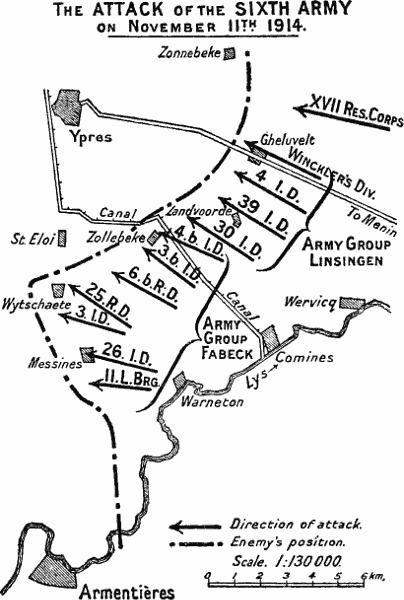
On the 11th November the combined offensive of the Fourth Army and the Army Groups Linsingen and Fabeck took place. The remainder of the Fourth and Sixth Armies continued their attacks. The great efforts made by the Fourth Army on the 10th had considerably weakened it, and further handicapped by a heavy rain-storm which beat in the faces of the attacking troops, no special success was gained by it on the 11th; nevertheless the enemy was everywhere held to his ground and prevented from transferring any troops to other parts of the front. On the extreme right wing the Marine Division made a successful attack on Nieuport, capturing several hundred prisoners. At the same time the Guard Cavalry Division, affiliated to the Fourth Army, was sent up to the Yser, in order to relieve part of the 4th Ersatz Division, which went into Army Reserve. On the left wing of the Army, the XXVI and XXVII Reserve Corps worked their way towards the hostile positions by sapping, whilst the units on the extreme south flank of the XXVII Reserve Corps attacked in close co-operation with Plettenberg’s Corps.
On the 11th, in pouring rain, the Army Groups Linsingen and Fabeck began the last phase of this severe and terrible struggle for Ypres; and it was destined to fix the general line on which the opposing armies were to remain rooted till the spring of 1915.
Von Winckler’s Guard Division fought on the right wing of the Army Group Linsingen, and for us the day was to be a historic, though costly one. In former wars the Guard had always been in the heat of the fray at its most critical stages, and the sons were to show themselves worthy of their fathers. The spirit of Frederick the Great and the glory of St. Privat shone again on the battlefield of Ypres. The British speak of the attack of the Guard as a most brilliant feat of arms.
Before the infantry of the Division could come into immediate contact with the enemy, a broad zone had to be crossed under his artillery fire: through the hail of shell the pride and iron discipline of the Guard brought its regiments unshaken. At 7.30 A.M. the German batteries opened, and a furious bombardment continued for two and a half hours, and then the infantry attack began. It struck against two divisions of the I British Corps, a war experienced foe, whose fighting methods were well adapted to the country.[104] The artillery preparation however had been a thorough one, and in spite of the enemy’s superiority in numbers the advance made good progress, so that shortly after 10 A.M. the strong position along the southern edge of the Polygon Wood was in the possession of the 3rd Guard Regiment.[105]
At the same time the butt ends and bayonets of H.M. the Emperor’s 1st Guard Regiment had forced a way through the wire entanglements and trenches in front of Verbeck farm, and it was taken in the first assault. The regiment had thereby captured an excellent position from which to support the right wing of the attack.[106] Led by its fearless commander, Prince Eitel Friedrich of Prussia, it then pressed on without a moment’s delay into the wood north-west of the farm. Meanwhile the 3rd Guard Regiment was still engaged along the southern edges of the woods west of Reutel, with its front facing north, and it put in its last reserves to help forward the left wing of the 54th Reserve Division.
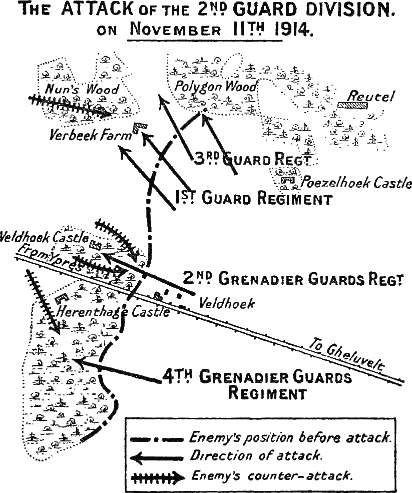
At 10 A.M., on the last artillery salvo, the battalions of the 4th Guard Brigade advanced to the assault on both sides of the Ypres-Gheluvelt main road, and they took the front British trenches in their stride.
The Emperor Francis’ 2nd Guard Grenadier Regiment attacked from Veldhoek against the corner of the Herenthage Wood, north of the Ypres-Gheluvelt road, and took its edge. The wood itself gave the infantry endless trouble, for it was impossible to see a yard ahead in its thick undergrowth, which was over six feet high.[107] Suddenly at a few paces’ distance, machine-guns would open on our troops from behind a bush or a tree-trunk. Thus the task set the Grenadiers proved to be an extremely difficult one, the more so as they had lost many of their officers and N.C.O.’s in the first rush across the open. Nevertheless, the defence-works inside the wood were quickly taken one after another, but more strong points protected by wire entanglements untouched by our artillery fire were encountered. The Fusilier Battalion forced its way through to the château of Veldhoek, which was surrounded by a marsh and an impenetrable hedge. The men were trying to work their way one by one through the latter by cutting gaps in it, when suddenly a deafening roar of rifle and machine-gun burst upon them. It came from the château on their right, from some flanking trenches on their left, and from trees behind the line. A number of the few remaining officers fell, and finally the battalion had to retire a short distance in order to reorganise. But it soon came forward once more, and the companies pressed on till they were close up to the château itself, when another annihilating fusillade was opened on them from all sides. Simultaneously the British made a flank attack along the hedge in order to cut off the men who had got through. Machine-guns firing from trees and from the château windows completely stopped any communication with them. Very few only of these foremost troops, who were commanded by Captain von Rieben, succeeded in getting away. Those who did were assembled by Captain Baron von Sell at the eastern edge of the wood and were, with part of the 1st Battalion, led forward again to the relief of the Fusiliers who were surrounded. The attack of Captain von Sell developed however into small isolated combats, and though the boldest followed their leader nearly up to the château again, they were received there with such heavy fire from right and left that it appeared that they would have to retire again and reorganise. Before this could be carried out, a British counter-attack was launched; but our men, disorganised and mixed up as they were, held fast to their ground and stopped the attack, although at first both their flanks were in the air.[108]
Queen Augusta’s 4th Guard Grenadier Regiment, advancing south of the main road, at once suffered such heavy losses that the first two attacks made no headway. When however part of the regiment near the main road pushed forward along it, echeloned behind its sister-regiment on the right, and then turned southwards, the advance made good progress, and a firm footing was gained in Herenthage Wood south of the road. The reverses met with by the Emperor Francis’ 2nd Grenadiers unfortunately enabled the British to bring such a heavy enfilade fire to bear on Queen Augusta’s 4th Grenadiers, that their advance had to be stopped.[109]
At 5 P.M. German Guard troops had a tussle with the British Guards. The King’s Liverpool Regiment made a counter-attack from the Nun’s Wood (Nonne Bosch) against the extreme left of the 1st Guard Foot Regiment and the northern wing of the 2nd Guard Grenadiers. The point of attack was well chosen, and took both the regiments in flank, for the 1st Guard Infantry Brigade was at this time heavily engaged, and held up in the woods (Polygon Wood and the eastern part of the Nonne Bosch), with its front facing north, and the 2nd Guard Grenadier Regiment, having spent all its energies against the château of Veldhoek, lay with its front facing west.[110] However, the British troops ran into their own artillery fire near the Nonne Bosch, and the attack broke up and came to a standstill in front of our thin and scattered lines. Any further advance on the 11th November by our Guard troops north of the road was now out of the question.
In the southern part of the Herenthage Wood the 4th Infantry Division pushed on, though here too great difficulties were encountered. Deep trenches, broad obstacles, and enfilade machine-gun fire combined to make our progress slow, especially on the right wing.
The XV Corps in close co-operation with the left wing of the Pomeranians gained ground in the woods near and around Zwarteleen; the capture of Hill 60 near Zwarteleen was of exceptional importance. From this elevation another direct view over the country round Ypres was obtained.
South of the canal the II Bavarian Corps with much thinned ranks stormed forward again. The bit of wood north-east of Wytschaete, which had already changed hands several times, was now taken by it. The heavy artillery again rendered invaluable services. Several strong hostile counter-attacks were held up chiefly owing to the way in which at the critical moment our guns always protected the infantry lines by a barrage.
In the area near Wytschaete, the 11th November was the day of the heaviest fighting. In the woods north of it, Bavarians and Hessians pressed forward together, slowly but surely. A French battery and four machine-guns were taken by the 168th Infantry Regiment at a farm about 150 yards north of Wytschaete, but the guns were so firmly embedded in the sodden ground, that they could not be got away by the infantry. When the buildings were evacuated again, owing to the heavy fire of the French on them, the guns, made unserviceable by us, remained as a neutral battery between the lines. It must be recorded here that in the fight for one single farm the Hessians took prisoners belonging to three different regiments, a fact that proves what masses the enemy had put in to the fight on the Ypres front, and to what an extent he had to concentrate his units to ward off our attacks.
On and to the west of the Messines ridge the line remained almost unaltered during the 11th November. The very severe effect of the enemy’s artillery fire from Mount Kemmel on this front and the enfilade fire of artillery and machine-guns from Ploegsteert Wood compelled our men to remain in their trenches.
Taken as a whole the operations on the 11th November were a great success. A series of brilliant feats, many of which it has been impossible even to mention in this short account, far less adequately describe, gave us unchallenged possession of positions from which any concentration of the enemy near Ypres could be seen, and immediately opened on by artillery. It is true, however, that no break through of the enemy’s lines had been accomplished: his numerical superiority and, more especially, the strength of his positions held up our offensive. The weather conditions, storm and rain, had also contributed towards the result.[111]
The furious character of the fighting on the 11th November did not abate on the following day, but on the whole the situation remained unaltered. The general character of the operations on the entire front of the Fourth and Sixth Armies was now changed, and sapping was eventually resorted to, though here and there successes in open warfare were gained. For instance the XXII Reserve Corps managed to strengthen its detachments across the Yser at Dixmude, and on the 12th the 201st Reserve Infantry Regiment, under Major Baron von Wedekind, stormed the enemy’s defences opposite it on the western bank of the Yser, and held them under great difficulties. Constant rain had filled the badly constructed trenches with mud so that our troops had to support the enemy’s bombardment and resist his counter-attacks lying in the open.
At Bixschoote the enemy again attempted strong counter-attacks, but they were stopped largely by the muddy state of the country. On the 14th November there was a recrudescence of severe fighting. Owing to the misty weather our relieving troops occupied a reserve position instead of the original front line; by the time the error was discovered, our watchful opponents were already in the front German position. Our men, however, gave them no rest there, for their honour would not suffer the surrender in this manner of their success of the 10th November. Without waiting for any orders from higher authority or for reinforcements they attacked and retook the strong position on the rising ground south-west of Bixschoote. On the front of the Sixth Army Herenthage Wood was completely taken by the Guard on the 14th November after severe hand-to-hand fighting.[112] After the artillery had prepared the way as far as was possible in that difficult and wooded neighbourhood, the infantry, whose fighting spirit was by no means damped by the events of the 11th November, advanced to the assault. In the château of Herenthage a large number of British snipers surrendered. The XV Corps had another success in the wooded district of Zwarteleen after being reinforced by Hofmann’s composite Division. A strong system of trenches and dug-outs were taken, as well as a large number of prisoners.
On the 13th November the Park of Wytschaete was captured from the French by the Pomeranians and Bavarians. A counter-attack, in which the French advanced against our positions shouting, ‘Don’t shoot,’ in German, cost them heavy losses; and the Bavarians, whose tempers were roused by this treachery, drove them back to their original positions.
On the 20th November the farm 150 yards north of Wytschaete, for which such a severe fight had been made on the 11th, was finally captured by us. We thereby obtained a position in the Wytschaete salient which, although overlooked from Mount Kemmel, gave us such a commanding view of all the ground between Mount Kemmel and the Wytschaete-Messines ridge that surprise attacks by the enemy in this district were now out of the question.[113] On the rest of the Flanders front only small fights took place, and on the 17th November the commander of the Fourth Army decided to give up any idea of continuing the offensive; a decision to which he was compelled by the low fighting strength of his troops and the bad autumn weather, which was affecting their health.[114] The frequent downpours of rain during November had caused a constant rising of the water-level, and it became urgently necessary to provide regular reliefs for the troops, for they were worn out by the constant fighting under such bad weather conditions. Clear signs of exhaustion in the enemy’s ranks on the front opposite the Fourth and Sixth Armies were also noticed. This permitted our gallant Fourth Army gradually to construct a good line of trenches and erect wire entanglements. As soon as these were completed rest-billets were allotted further to the rear and the men found quiet and pleasant quarters in the villages of Flanders untouched by war, with a not unfriendly population. The German General Staff fully concurred in the decision of the commander of the Fourth Army made on the 17th November. They at the same time expressed the hope that the Army would be prepared to hold its positions even against superior hostile forces. This expectation was completely fulfilled by the Fourth Army, and although at that time there were four and one-half French Corps, as well as the 25,000 Belgian troops, opposed to the forces of Duke Albert of Würtemburg, they never obtained a success of any consequence.
The threat against our right flank ceased soon afterwards. British monitors appeared a few times towards the end of November off the roadstead of Ostend. They bombarded the canal exit and our positions near by: but their fire was as ineffective as before. The ‘glorious’ activities of the British Grand Fleet along the Flanders coast came to a speedy end as soon as our ill-famed sea-rats, the U-boats, began to put in an appearance there.[115]
The developments on the front of the Sixth Army during the second half of November 1914 were similar to those of the Fourth Army. For some time the sapping was continued, but from the 20th onwards strong detachments were taken from it and entrained for the Eastern Front, where General von Hindenburg was able, in the fighting round Lodz, to bring the Russian steam-roller to a standstill, and finally make it roll back again.
From this time onwards the line of demarcation between the Fourth and Sixth Armies was the Comines-Ypres canal.