James Barnes (continued 4)
Reading edition
Here were confined six thousand prisoners, and here were suffered hardships without number. There would be scarcely space to tell of the prison life, but some there were there who had been immured so long that they had almost forgotten that they had lived anywhere else. They had become so resigned to the lot of a prisoner of war, that they had begun to doubt if they should ever see their own beautiful country again. From the upper windows of the prisons, the view above the walls was nothing but a stretch of bleak, rolling country, treeless and barren—the Dartmoor heaths. The inmates had formed a government among themselves; as was done in most military prisons, many worked at their trades, as well as they could; they had markets in which they sold their wares; they had theatrical companies, which served to keep up their spirits, and lighten the dreary hours; but there was one thought in the hearts of all: the day when they should receive their liberty. Many were never to see that day.
There was a young sailor confined in the prison building known as No. 5. His strong constitution and his youth had kept him in a fair state of health for one who had been so long in close confinement, for he had been captured in a privateer in the first year of the war. Many times had he thought of his far-away home on the hills above the old town of Salem. He was popular with his fellow-prisoners, and had been a leader among them in their sports and pastimes. George Abbott was his name. He was but six and twenty years of age, and yet he had followed the sea for over twelve. When he had been captured there had been taken with him a young lad of but eighteen, who had run away from a comfortable home and a loving family, to enlist on board the privateer, but he was not of the tough fibre of which the sailor should be made, and since his arrival in prison he had been gradually succumbing to the effects of his long imprisonment. Between Abbott and this young man there had grown up a deep affection. The sailor had shielded the landsman from much of the rough treatment of the forecastle while on board ship, and now that they were prisoners together, they had been constant companions; but it was plain to see that the younger of the two would not last long enough to see the dawn of liberty unless it came quickly. He had grown so weak that by the middle of February, 1815, it was expected by all that every day he would be taken from the prison buildings and sent to the Depot Hospital, from which, alas, few ever returned. But Abbott nursed him carefully, and watched over him with all the care of an elder brother, trying to be always cheerful.
March came, and with it the gloomy mists that rose from all around settled down on the gloomy heaths, shrouding the prison buildings in impenetrable clouds. It was hard to keep either dry or warm. Those fortunates who owned little stoves would huddle around their handful of fire, but the prisons being unheated and unprovided with chimneys, the stoves were very small, their little pipes being led out of the windows.
Lying in a hammock that had been swung low, so that its occupant almost lay upon the floor, was the young landsman. He stretched out his hand toward the roughly made brazier of sheet iron, and so thin were they that they looked more like claws than the fingers of a human being.
"Lord help us and deliver us," he murmured.
"Hallo, Harvey," cried a voice, breaking in upon his prayer. "I didn't expect to be so long. We've waited a long time, but here it is, my lad, and now let's begin. Shall I pitch in first? I ain't much of a reader."
He held aloft in his hand a copy of a smudgy, dog-eared book, smirched and torn by constant handling.
"We've been waiting our turn on this for three weeks, now. Sam Jordan, he promised to get it for me though, and so he did."
"What's the name?" inquired the pinched-faced lad in the hammock.
"It's R-a-s-s-e-l-a-s," was the response. "I dunno how to pronounce it, but they say as how it's good reading. Say the word, and I'll fire away."
He flung himself down on the floor and opened the pages. It was storming hard outside, and the rain beat against the roof and poured from the gutters down on the stone courtyard. There was just enough light to see the print, if one was not afraid of ruining one's eyes, and Abbott began:—
"'Ye who listen with credulity to the whispers of fancy and pursue'——" He had read as far as the first half-page, when suddenly the sick man put out his hand and touched him on the shoulder.
"Listen," he said hoarsely, "what's that going on below?"
Some one on the floor beneath had given a loud staccato whoop. It was followed by another, and then by an increasing murmur of voices. The sailor had risen to his knees and dropped the book.
"Some skylarking or tomfoolery," he said; "or perhaps it's the Rough Alleys," he added.
The "Rough Alleys" was the name given to the gangs of hard customers and those of the lower order of prisoners who had been compelled by their more circumspecting and better behaved companions to mess by themselves, and to generally toe the mark, as much as possible. Occasionally, however, they would break out in some sort of raid or riot that would require suppressing, and it was to this habit of theirs that Abbott referred. But this time he was mistaken.
"Listen to that!" he cried, all at once springing to an erect position. A roaring, rousing cheer came up from below, and then from the other buildings they heard it echoed.
The invalid arose from his hammock.
"Stay here," cried Abbott; "I'll fetch the news to you."
He hastened to the head of the stone stairway. A breathless man dressed in fantastic rags met him half-way up.
"What's the row, Simeon?" asked Abbott, in excitement.
"Heard the news, messmate?" the man cried in answer. "Heard the news? There's peace between America and England!"
There came a strange sound from the head of the stairs. The young prisoner had heard the words, and Abbott was just in time to catch him in his arms as he plunged forward senseless.
What had these men expected? These prisoners who had danced and sung and gone wild with delight and joy at the message that had been brought to them that bleak March day? Why, liberty at once. They were going to return to their homes. It was freedom! And did they get it? Listen! There is more to tell. Here begins the story:—
Of course it was not to be supposed that the British government should at once set these prisoners free, as one might set free birds from a cage by opening the door and allowing them to fly. It was a grave question what was to be done with them, and there is no use denying the fact that the United States, or at least its representative in England, was in a great measure responsible for what subsequently occurred. Ten days went by, and there was nothing done. In that space of time the men's spirits sank to zero. Had their country deserted them? Had their fellow-citizens forgotten them? It was past believing that such things could be. And it was just at this time that there was most complaint, arising from the quality of the bread and the insufficiency of the food supplied by the prison authorities. The Governor of the Depot, as it was called by the English, was a Captain Shortland, a man so well hated and despised by those under him that if murderous looks had the power to kill, he would long ago have been under the sod. Many of the prisoners, as they had caught glimpses of him, had longed to sink their fingers into his throat, and now they hated him worse than ever before. In the beginning of the second week information was sent the rounds of the prison, that the delay was occasioned by the difficulty that the representative of the United States government found in obtaining cartels, or vessels, to bring the released ones back to their own again. But the delay was bitter.
The poor sick boy had rallied a little during the first days after the arrival of the news of peace. Probably he supposed that he would be released at once, but as the days dragged on, and there were no signs of any change in their condition, he sank again into the unfortunate path of the men who slowly died because they had no hope.
From a condition of joyousness, the majority of the prisoners had relapsed into sullen anger—anger at their own country, and an increased hatred for the red coats who guarded them. Among so many prisoners of all classes there were, of course, men of all kinds and character: there were the ignorant and degraded, and those who could well lay claim to education and enlightenment. Harvey Rich, who was now so weak that he could scarcely totter from his hammock to the head of the stairway, had been prepared to enter Harvard College, when he had caught the fever of adventure and had run away to sea. At the request of the inmates of Prison No. 5, he had drawn up a letter addressed to Mr. B.—— (the American agent), requesting him to make all haste; and, at least, if he could do no more, to secure to them an additional supply of provisions, or make a monthly allowance of some kind to save the men from actual starvation. Anxiously was an answer awaited, but none came.
One day late in the month, when, for a wonder, the sun was shining brightly, there was a strange group gathered near one of the open windows on the top floor of Prison No. 5. Propped up by blankets, so as to get as much of the sunshine that came in at the grated window as possible, was Harvey Rich. Beside him sat the young seaman, and squatted on the floor near by was a remarkable-looking human being. His face was black, his dark hair was shorn close to his head, and a bandage made of a torn bandanna handkerchief was pushed up on his forehead. At first glance, one would have taken him for a negro, although his features showed no trace of African descent. The torn shirt that he wore was unloosed and open at the bosom. The skin which showed through from underneath was fair and white. Every now and then he would give a nervous start and look back over his shoulder.
"They almost had you last night, Simeon," said Abbott to the half-black man.
"Yes," returned the other; "I thought my jig was up, for sure; but, confound it! now that there is peace, I don't see why they wish to hound me any more. 'Tis that brute,—Shortland. He's angry at his lack of success as a man-catcher. I'd like to get my hands upon him,—only once, just once,—that's all."
Abbott happened to look out of the window at this instant.
"Egad!" said he, "your friends are out again."
From the grated bars, a view of the neighboring courtyard could be obtained. There was a sight that, when seen, used to make the prisoners' blood boil hotly. Three men, heavily manacled, were walking with weak steps to and fro along the narrow space enclosed between the high brick walls. The clanking of their chains could be heard as they moved. But as if this were not enough, beside them walked three sentries, with bayonets fixed. For half an hour each day, they made this sorrowful parade. It was their only glimpse of the sky and the sunlight, their one breath of fresh air during the twenty-four; and, as soon as it was over, they were hustled back to their place of confinement,—a dungeon known as the Cachet,—where no light could penetrate, and the only air that reached them was through the shaft of a disused chimney. No wonder that their eyes blinked and the tears rolled down their cheeks when they emerged into God's bright sunlight. No wonder that their haggard, pale faces grew each day more deathlike. These men were being killed by inches. For what crime? It will be shown. The man whom Abbott had addressed as "Simeon" had crawled to the window and was peeping cautiously out. A wild curse broke from him, as he viewed the sight.
"Look at poor Whitten," he said; "take note of him; he's not for long. He used to tell me that he knew that he was going mad. He's that already. See the poor devil jabbering."
He gave a shudder. It was only six weeks since he had walked to and fro in that same courtyard. There was a grated gateway at one end. It came within a few feet of the archway at the top. A silent crowd of prisoners were gathered there, closely watching the unfortunates. Well did they all remember the day when there were four of them; that day when, just as the prisoners turned, in following the footsteps of the sentries, one of them had left his companions, and, making a great leap of it, had clambered up the iron gate, and, manacled as he was, had thrown himself down among them.
Immediately they had carried him into one of the prison houses, where they had filed and removed his shackles, and had since hidden and protected him at great cost and sacrifice. Many of their privileges had been withdrawn because they would not give up this man; they had been routed out at night by files of soldiers; they had been counted and mustered, over and over again, and yet, among the many thousand who knew where Simeon Hays was hiding, there was not one so base as to betray him, not one to point the directing finger. All honor to them. Many were the disguises that Simeon had been forced to assume. He had been a mulatto mess-cook, speaking with the French accent of Louisiana; he had appeared as a black-faced yawping Sambo, who had cracked guffawing jokes on the heads of the searchers; he had passed a day and a night in a coffin-like space between the floor-beams, when they had him cornered, and yet they had not caught him.
And for what crime were these men treated thus? For a crime that was never proved against them. They had been taken by a British frigate from a recaptured prize, and shortly afterward the vessel had been found to be on fire. These men had been accused of attempting to blow up the ship and her company, and when they were sent to Dartmoor they were under sentence to close confinement. Here was Shortland's opportunity. His cruel and vindictive spirit rejoiced in carrying out the order, and it chagrined him deeply that one should have made his escape, and every day he attempted to locate his hiding-place and return him to the prison—to the torture of the dreaded Cachet.
Soon the half-hour's breathing space had expired, and the manacled ones had been withdrawn from sight. The prisoners flocked to their buildings for their midday meal. Hays, who had descended to the courtyard, had made all haste to return to No. 5, where he was then supposed to be hiding, although, owing to his bold disposition, he oftentimes made the range of the lot; and as he passed by the open space on this day, although he did not know it, a turnkey recognized him, and soon those in No. 5 Prison were alarmed by the cry "The guard is coming! Lie low, lie low!" But they found that the entrances were held by a squad of armed soldiers, and that this time Hays appeared certain to be apprehended. But search here or there, the soldiers could not find him. Many times had they stepped over his hiding-place in the floor.
Captain Shortland, who had been afraid to enter the building to personally conduct the search, remained outside with a strong guard. The disappointed officer reported at last that he was unsuccessful.
"Why don't you drive them from the building, then?" Shortland thundered.
"They are sailors, sir, and will not be driven by soldiers, they say. They seem to treat the whole affair as a great joke, laughing and scampering ahead of my men, and paying no attention to my orders."
"Run them through then," Shortland returned. "A little cold steel will teach a serviceable lesson!"
At this minute one of the turnkeys approached.
"I beg your pardon, sir," he said, saluting; "if you let me turn the men out in the usual manner, I think they will leave quietly, but you must withdraw the soldiers."
Reluctantly, Shortland gave the order, and the red coats filed out, drawing up in line, behind which he carefully placed himself. The turnkey entered the building alone. He had been an old boatswain in the service, and drawing a silver whistle from his pocket he piped all hands. Then in a stentorian voice he ordered the prisoners into the yard. They all obeyed, crowding out to the number of one thousand or more, and they filed past the soldiers in a compact body. One of the last to leave the building was Harvey Rich. He tottered down, alone, and joined the crowd, that stood packed in a sullen body, crowded within a few paces of the handful of soldiers, who stood with their muskets cocked and ready. Soon the officer returned from his fruitless search.
"The man cannot be found, sir," he said.
Shortland swore viciously.
"Turn them back in the building, then," he roared, "and keep them there without water. That will fetch them to their senses.—Back through that doorway, all of you," pointing with the heavy stick which he always carried, for he was a gouty man.
But the prisoners had heard his threat, and not one of them moved a step. There was a large trough of clear water in the yard, to which they had free access. The weather was warm and clear. Suddenly one of them stepped forward. All eyes turned upon him. It was George Abbott.
"We will not return there, under those conditions," he said loudly. "We will stay here, and die, first, every man Jack of us."
A movement began among the prisoners. They crowded in closer in the narrow space, and a murmur as of a subdued cheer arose among them. Shortland was furious.
"Seize that man," he cried; "seize him! He shall go without bread and water both."
No one moved.
"You cowards," he muttered. "I'll do it myself, then; make way here!"
He crowded through the file of soldiers and approached the sailor, who was standing there calmly, with folded arms. But before he had taken three short steps, something most unexpected happened. Harvey Rich, who was standing but a few feet away, stooped swiftly and picking up a loosened bit of the stonework of the courtyard, he hurled it full at Shortland's head. It would have killed him had it struck him, but it only grazed his cheek. Shortland halted and retreated hurriedly.
"Fire on them," he cried. "Take aim and fire."
Thirty or forty muskets were brought to the shoulder. But the young officer in command of the detachment kept his senses. Calmly he walked out to the front. He knocked up the muzzles with his unsheathed sword.
"Steady," he said. "As you were."
Shortland flung an oath at him, and turning to the red coats he screeched at the top of his voice:—
"Fire, you rascals, fire!"
Again the officer sprang forward and threw up the points of the muskets again.
"As you were; steady, men."
That cool authoritative tone saved a frightful scene; for had the volley been delivered at such close range, there is no telling how much slaughter had followed. But mark this: there would have been enough men left to strew the dismembered bodies of the red coats about the yard with no other weapons but their naked hands!
Shortland, stamping and fuming in anger, turned upon his heel, and hastened out through the gate. Immediately, the Lieutenant called his men to a shoulder arms, and marched them after him, he himself remaining until the last of the squad had passed under the archway. Then he drew a thankful breath. One or two of the sailors nearest the entrance saluted him. Gravely he touched his heavy bearskin hat. There was not a cheer or a sound of the usual merriment that might have accompanied the discomfiture of the "lobster backs." Every one had been too much impressed with the seriousness of the matter in hand. Yet, there was no one to chide Rich for his impetuous action. Silently they all returned to the prison, and once more Simeon Hays emerged from his hiding-place.
This night news was brought to the prisoners that the United States government was going to allow them the sum of seven shillings sixpence per head in addition to their rations given them by the Crown; also the news was circulated that the first cartel would start the following week, and the detachment of those going in her would be read at the morning's muster. The names were to be taken in alphabetical order. Again there followed great rejoicing in all of the prison buildings. Men whose names began with the first letters of the alphabet were in high spirits. They were congratulated and made much of; while the poor chaps who were to tail off the list were correspondingly depressed. A rather important occurrence took place on this night, also. Simeon Hays, who, as a special treat and in honor of the occasion, had washed the smut from his face, had been recognized and taken. Poor fellow, before his friends could interfere, he had been hurried off to the confinement of the Cachet. Before this news had circulated through the building, Rich and Abbott had held a long conversation. The former was objecting strenuously and earnestly to a proposition that the young sailor had made.
"I cannot think of such a thing," he remonstrated. "It would not be right——"
Abbott interrupted him, "What is the use, mess-mate, of talking about right, in such a case?" He lowered his voice, "Do you think I could go out and look any man square up and down if I left ye here? You've got to do it."
Rich shook his head weakly, "I can't think of doing such a thing," he murmured.
"We'll stow all further conversation," was the reply, and with that he got up and left Rich alone.
The next morning, in each prison, a number of names were read off until two hundred had been called. Abbott's was the first read in Prison No. 5. The lucky ones were told to get their dunnage ready and report at the prison entrance at half past ten. At the hour named, all were there.
"George Abbott," called out the officer in charge of the guard-room.
"Here," answered a weak voice, and to the surprise of those who knew him, Harvey Rich stepped forward. A moment later, and he had passed forth into the free air outside.
Abbott answered to his friend's name at the roll-call, and thereafter passed by the name of Rich. They would come to his name on the list some day, he reasoned, and he knew well enough that another week or so of prison life would have finished his young friend for good and all.
On the 3d of April, owing to the prison authorities trying to change the fare from soft bread to hardtack, there was a small riot among the prisoners, which, however, resulted in their obtaining their object by breaking down the barriers and raiding the bread-room. This did not increase Shortland's good humor, nor did the taunts levelled at the soldiery tend to improve the feeling existing between them and the triumphant sailors. On the sixth of the month, it was fine, clear weather, and the prisoners were put in good spirits by the news that Hays and his companions, the word of whose condition had reached higher ears than Shortland's, had been liberated and had left the prison. From all the various yards there was shouting and singing. The morning's "Liberty Party," as the sailors called the lucky ones who were to start for America, had been seen off, with rousing cheers. Those left behind were trying to amuse themselves by games and horseplay. A score or more were playing ball against the cross-wall dividing the barrack yard of the soldiers from that of No. 7. In some way, the ball, thrown by a careless hand, sailed across the barrier and fell almost at the feet of a sentry on the opposite side.
"Hi, there, Johnny Bull! heave it back to us," requested one of the men, through the iron grating. The sentry paid no attention, and soon there was a clamoring crowd surrounding the opening, beseeching the imperturbable red coat in all sorts of terms to "Be a good fellow, and toss back the ball."
"Just heave it over, Johnny," called one. "Don't you think you're strong enough?"
The sentry whirled angrily. "Come and get it, if you want it," he said.
"Can we?" shouted a half-dozen voices.
"I won't touch it," the sentry responded. With that, he resumed his beat, cursing the ball players for "a lot of troublesome Yankee blackguards."
Half laughing, the sailors had loosened one of the stones close against the wall, and by luck found that the ground was soft and yielding. The mortar, too, they were able to remove easily, and with such objects as they could pick up to help them, they fell to burrowing like rabbits. The sentry, who did not know what was going on, or how his words had been taken up, was surprised when suddenly he saw a man's head and shoulders appear at the base of the wall on his side.
"The prisoners are digging out!" he roared, firing his musket.
At once, the soldiers on the walls began firing, forming into squads and keeping up a constant shooting as long as any prisoners were in sight. Those in the central yard, known as the Market, not knowing the reason for the fusilade, and wondering why the alarm bell was ringing, did not retreat into their buildings; and the first thing they knew, Shortland himself appeared, entering the big gate at the head of a company of soldiers with fixed bayonets. They advanced at a double-quick step, the prisoners were so crowded together that they could not escape. Some, not seeing why they should be charged in this fashion, stood their ground. Shortland had lost all control of himself.
"Halt! Aim!" And before the astounded victims knew what was going to happen, he had given the word to fire.
A crashing volley sounded. When the smoke cleared away, wounded and dying men filled the yard. The rest, panic-stricken, had retreated into the buildings. Seven were killed and fifty-six were wounded! Poor Abbott, who had been trying to urge his comrades to hasten, was among the first to fall, shot through the lungs. As no one told of his exchange of names, he was buried under the name he had assumed, Harvey Rich. And what of the real owner of that name? Alas, he, poor fellow, also, did not live to see his home in the New Hampshire hills, for he died at sea not long after the cartel in which he was returning had set sail. He was sent overboard in the sailor's canvas shroud, and the name "George Abbott" was stricken from the list of liberated ones. Few knew the truth, and, perhaps, few there were who cared.
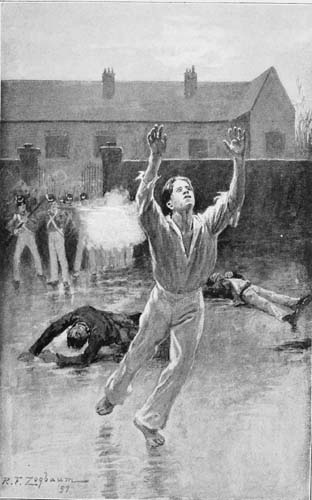
The deadly volley.
THE RIVAL LIFE-SAVERS
It was February, the year after the war. The month had been cold and stormy. Frequent and sudden squalls had kept everybody on the alert. For over two months the United States frigate Macedonian (she once had H.M.S. prefixed to her name, by the way) had been facing the bad weather, that had ranged from the Bermudas as far to the eastward as the Bay of Biscay. It was blowing great guns on this particular morning, and blowing with that promise of thick weather that seamen learn to recognize so readily. Not two miles away an English frigate was seen coming grandly along as she shortened sail.
It did not require the aid of the falling barometer or the sight of the thick black clouds gathering to the northeast, to prove that they were in for it again.
Two men were on the Macedonian's main topgallant yard. They were trying to spill the wind out of the sail that was standing straight up above their heads like a great balloon.
"Confound this business, anyhow," grunted the older man. "Did you ever see such an evil-acting bit of rag in your life?" He pounded into the struggling canvas, as if he could sink his blunt fingers in the folds and obtain a better grasp. But the wind had firm hold on it, and had filled it so taut that it was struggling and moving like the body of a living thing.
"Hold hard!" suddenly exclaimed the younger man; "I see what's the matter." Just the second before he spoke, the leech of the topgallant sail had caught over the end of the yard arm. He lay out on the yard to clear it, his loosened hair and his big collar flapping across his face.
The elder man shouted something to him, probably in warning; but the sails were making such a thunder of it that his words could not be heard. When the leech was cast loose, the yard gave a heavy pitch, the sail gave a jump that tore it from the hands of the men nearer inboard, and the young fellow, whose balance was upset by the sudden movement, lost his hold and fell back with a sudden cry of fright. He caught at one of the beckets as he slipped; but it carried away, and down he went, striking the water within a few feet of the frigate's side.
The officer of the deck, who had been roaring up angry imprecations to the "lazy lubbers" on the yard to "make haste and get in that sail," jumped back toward the wheel. Carrying the press of canvas she was then under, the Macedonian was making not far from thirteen or fourteen knots, and almost directly before the wind. It was no laughing matter to bring her up all standing, as it were; and though men were jumping here and there, hauling and heaving with the added strength that comes from the dread cry "Man overboard!" it was almost five minutes before the great ship had headed up, and during that time she had left the spot where the poor lad had gone down, by a mile and more. The Lieutenant, when he had given his first order, had thrown overboard one of the boat's gratings, and this had been followed by one of the chicken coops on the forecastle. With the squall coming down upon her, and the stiff wind increasing every minute, the Macedonian lurched up and down, almost burying her nose in the roaring, tumbling sea. Every one was on deck.
"'Tis no use trying to lower away a boat now, Mr. Edwards," observed Captain Stewart. "'Twould be only risking the lives of brave men. Stand by for a few minutes and keep sharp lookout." Although it was blowing hard, the air was filled with a thick, gray mist, and the sky now appeared to close down upon the water. It was a lonely, fearful place for a man to be out there in the waste of the waters, fighting for his life. It was a lonely, fearful feeling for men to have who must leave him there. And they all knew him well; they liked him, for he was a cheerful, laughing lad. The old sailor who had been on the yard arm with him had descended to the deck. He was telling it breathlessly to the men gathered about him.
"Why," said he, "I hollers to him to be careful when the sail fetched away. It was just as if the yard tried to fling him off like that." He snapped his fingers at arm's length.
A man who was standing on one of the anchor-flukes well forward suddenly pointed out to leeward. The English frigate, that had been last seen holding a course due west, was now, evidently, engaged in making all snug for the coming blow. She had heaved to, and was now lying with topsail aback, rearing and plunging,—sometimes pitching down until her hull was completely hidden in the hollows of the seas. The mist had blown away. A clear, shadowless, distance-killing light succeeded it. It was hard to tell whether the frigate was two miles off, or whether she was a little toy boat in the near perspective. But the heaving water that lay between the ships, crossed with its lines of white, rolling foam, was no toy thing. It had an angry, spiteful look. It was pitiless, and yet had lost the dread that it held when hidden in the treacherous half-gloom of the mist.
But why had the English frigate come up into the wind? All hands had rushed to the side. It was almost as if they had forgotten the frightful cause of their own delaying. Soon all was understood. There was a tiny, white speck drifting to the southward of the English vessel. It would heave to the top of a great sea and disappear again.
"One of their boats is out!" roared the man who was standing forward, using his hands for a trumpet.
The officers on the quarter-deck had now sighted both the vessel and the little object far astern of her. The First Lieutenant was squinting through the glass and talking excitedly.
"Egad, sir, I can make it out; there's a man clinging to a cask or something just to leeward of that cutter. There are eight good men in that boat, I can tell you," he added, "but I think they have lost sight of him."
The lashings of the whaleboat, which most American vessels carried, had been cast loose some time before. The Captain touched the Lieutenant on the arm.
"He's as near to us as he is to them; call away the whaleboat," he said quietly; and then, turning to a young, boyish-looking officer,—one of the senior midshipmen,—he said, "Mr. Emmett, you will go with her."
"Clear away the bowlines!" roared the Lieutenant. "Man the after-braces! Be lively, lads—lower away!"
With a cheer, the men of the crew—picked oarsmen and ex-whalemen they were—Nantucket and New Bedford fellows—jumped to the side. The long, narrow boat was lowered with half her crew in her. The other half slid down the falls. Mr. Edwards leaned over the side, holding his hat on with both his hands.
"Mr. Emmett," cried he, "you bring back that man; don't let the Britishers beat you!"
The midshipman looked up, touched his cap, and grinned.
The man handling the steering-oar was a grizzled, hawk-nosed down-easter. Many a time had he brought his boat up to the side of a whale when the seas were running high, and when it would have appeared that a small boat could not have lived, much less fight the greatest, strongest beast to be found on all this earth.
The excitement of the moment cut into the blood of the oarsmen. They were going down with the wind, and they fairly jumped the boat from one wave-crest to the other. But occasionally, as a heavier sea would come up astern of them, they would race down and lag for an instant in the hollow until lifted by the next.
The tall Yankee must have been reminded of the time when he raced with the other rival boats in order to get fast with the harpoon first, for he began encouraging in the old whaleman fashion:—
"Give way, my lads, give way! A long, steady stroke now! Do ye love gin? A bottle of gin to the best man!" forgetting that he was no longer the first mate of the old Penobscot. "Oh, pile it on while you have breath! pile it on! On with the beef, my bullies!"
The men, with set teeth and straining backs, were catching together beautifully, despite the fact that the wind threatened to twist the oars out of their grasp. The little middy, sitting in the stern sheets, had folded his arms; but he was swinging backward and forward to every lift and heave, with the same strange grin upon his face. And now the steersman caught sight of the English boat as she hove up to the top of a great wave. It was plain that they had lost sight of the object they were seeking. "Oars!" cried the steersman. The men ceased rowing, and watched him with anxious and nervous eyes, waiting for the word to get down to it again.
"There he is, Mr. Emmett! about a half a mile away there, sir, almost dead ahead! And egad, they see him too!" for just as he had spoken the English sweeps had caught the water with a plash.
Once more the boat-steerer's tongue was set awagging. It was a race now down the two sides of a triangle; a fair race and a grand one.
"Every devil's imp of you pull! No talking; lay back to it! Now or never!" yelled the steerer.
The heavy English cutter, with her eight men at the oars, had caught the fever too, and the five rowers in the Yankee boat had work cut out for them. The midshipman was now standing up, balancing himself easily, with his legs spread wide apart.
"We'll have that man, my lads!" he shrieked. "Only think he's ours, and there's no mistake, he will be ours! Give way, give way! Now we have him!"
The man could now plainly be seen, clinging to the top of the chicken coop.
"It's Brant, of the starboard watch, sir," said the steersman, leaning over. "Harkee, he sees us."
It appeared as if both boats would arrive at the same moment, when suddenly a most surprising thing occurred. The man waved his hand, and leaving the small but buoyant raft that had supported him, he plunged head first into the water and struck out for the whaleboat hand over hand. The bow oar leaned over and caught him by the back of the shirt. A quick heave, and he was landed between the thwarts.
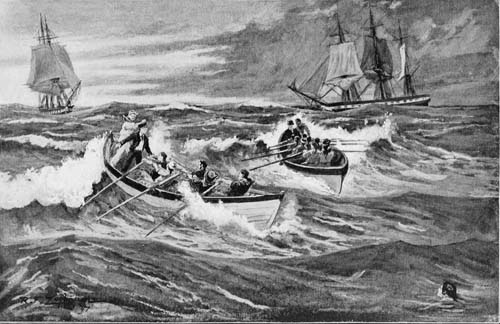
"'Now we have him, lads!'"
"I hated to spoil a good race, messmates," he panted, "or I'd come off to you before."
The English cutter was now alongside. The men in the two boats were looking at one another curiously.
"Thank you very much for your trouble," cried Midshipman Emmett, taking off his hat, and having to shout his words very slowly and distinctly in order for them to be heard.
"Nothing at all, I assure you, sir," came the answer from the young man in the other boat. "We saw the whole thing happen, and would have been glad to pick him up for you. This is Mr. Farren of the Hebe."
"This is Mr. Emmett of the Macedonian. Good day!"
"Good day!"
The stern way of the English vessel had carried her well to leeward of the boats; the frigate had come about, and was slowly bearing down to pick the whaleboat up. Amid great cheering she was hoisted in at the davits. The hero of the occasion saluted the quarter-deck and walked forward through the crowd, whose anxiety had now changed to merriment. At last he saw the old sailor who had been on the main topsail-yard with him.
"Bill," said he, "what was you sayin' when I left the yard to umpire that thar race?"
RANDOM ADVENTURES
The newspapers published during the War of 1812, granted even that they were vastly prejudiced of course, contained so much of thrilling interest, and so much that is now forgotten, that a complete file, for instance, of "Niles's Register" is a mine of wealth to a student of the times. Every week a stirring chapter was added to the records of Yankee ships and Yankee sailors. Fabulous sums were paid in prize money, fortunes were made often in a single venture.
One of the luckiest cruises of the war, so far as rich returns are concerned, was made by a little squadron of four vessels that sailed from Boston on October 8th under the command of Commodore Rogers. It consisted of the President, the United States, and the Congress frigates, and the Argus sloop of war. Five days after sailing the United States and the Argus became separated from the others in a gale of wind, and afterwards cruised on their own account. On the 15th, the President captured the British packet Swallow, having on board two hundred thousand dollars in specie—a rich haul, indeed. On the 31st of the month, the Congress captured a South Sea ship loaded with oil that was being convoyed by an English frigate, the Galatea; the latter made off and left her consort to her fate. The President, on the 25th of October, captured the fine English frigate Macedonian, and sent her safely into New London harbor. After taking one or two smaller prizes, the President and Congress sailed into Boston the last of December, having covered over eight thousand miles. The landing of the money taken from the Swallow and the other prizes was made quite a function. It was loaded into several large drays, and escorted from the Navy Yard to the bank by the crews of the frigates and a detachment of marines, "drums beating and colors flying," as an old-time account has it. The gold dust and specie amounted to the value of three hundred thousand dollars, besides the value of the vessels taken.
But the little Argus, under the command of Captain Sinclair, had some adventures worth the telling, before she returned to port laden with the fruits of war. After parting company with the squadron, she laid her course for the coast of Brazil, then one of the most profitable cruising grounds, although the waters swarmed with British war vessels. From Cape St. Roque to Surinam she sailed and there made two prizes; thence she cruised through the West Indies and hovered in the vicinity of the Bermudas; afterwards she went as far north as Halifax along the coast before she turned her head towards home.
The Argus must have been a nimble vessel, for, according to her logbook, she had escaped imminent capture a score of times, owing to her speed and capacity for sailing close on the wind. Once she had fallen in with a British squadron of six sail, two of them being ships of the line. For three days and nights they pursued her closely. One of the big fellows, proving to be a very fast sailer, outstripped the others, and twice was almost within gunshot. On the fourth day the Argus came up with a large English merchant ship about sunset. The wind had shifted so as to give her the windward gage of the pursuing battle-ship. In full sight of her, and of the others that were distant some ten or twelve miles, the Argus captured the merchantman; and, under cover of the dark, stormy night that shut down, she made her escape with her prize. After a cruise of ninety-six days, she put into the harbor of New York. The actual value of the prizes she had captured amounted to upwards of two hundred thousand dollars—more than enough to pay for her original cost three times over.
But to leave the deeds of the regular navy and take up those of a few of the private armed vessels: less is known of their doings, of course; they should be given a separate volume to themselves in writing the history of our wars with England—and the volume is yet unwritten, but some day it may be. Bravely they fought, often against odds, and more than once they contributed to the defence of our coast in cooperation with the regular navy and the land forces. Take operations of the English blockading squadron under Admiral Warren that was sent to close up the waters of the Chesapeake. Many were the times that the privateers eluded his watch-dogs and sailed in and out through his fleet, and more than once did he have a chance to test their metal. The schooner Lottery, of Baltimore, mounting six guns and having a crew numbering but thirty-five, in February, 1813, was attacked by nine large British boats containing over two hundred and forty armed men. For an hour and a half the privateer stood them off, and before she was finally captured, she had killed more of the enemy than her own crew numbered! The privateer Dolphin, also hailing from Baltimore, was taken after the same heroic defence, and Admiral Warren must have found such work to be rather uncomfortable experience. The United States schooner Asp, three guns and twenty-one men, was pursued up a shallow creek by a detachment of boats from the English fleet; and, after beating off her pursuers for some time, she was taken by superior numbers and upon her capture was set on fire. But the Americans, who had retreated to shore, returned and succeeded in extinguishing the flames and saving their vessel. A remarkable thing in connection with the presence of the English fleet in the Chesapeake was the attempt to blow up the flagship Plantagenet with a torpedo. The news that Americans were working upon such a line of invention had filled the English with dread and horror, they declared that any one captured while engaged in such a work would be hanged at once without a trial, for they denounced such methods of warfare as "crimes against humanity." But this did not deter an adventurous projector by the name of Mix from trying to rid the bay of its unwelcome visitors. For a long time he had been at work perfecting a "new explosive engine of great destructive powers," and on the 18th of July, at midnight, he dropped down with the tide alone in a small rowboat, and, when within forty fathoms of the Plantagenet, he put his torpedo into the water with the intention of having it drift with the tide athwart the flagship's bows. But an alert sentry on one of the guard boats discovered him and hailed; Mix drew his infernal machine into his boat and escaped. Every night for a week the inventor tried his luck, but was spied before he could complete his preparations, and was forced to draw off. But once he so frightened the English officers that they made sail and shifted their anchorage, and upon another occasion the flagship let go a pell-mell broadside, and threw up rockets and blue lights to ascertain the whereabouts of the lone adventurer.
On the night of the 24th Mix came very near to accomplishing his purpose, and a contemporary printed account gives such a vivid description of it that it is well worth quoting: "When within one hundred yards the machine was dropped into the water, and at the same moment the sentinel cried, 'All's well,' the tide swept it towards the vessel, but it exploded a few seconds too soon. A column of water full fifty feet in circumference was thrown up thirty or forty feet. Its appearance was a vivid red tinged with purple at the sides. The summit of the column burst with a tremendous explosion, and fell on the deck of the Plantagenet in torrents, while she rolled into the yawning chasm below and nearly upset." Then the account shortly remarks, "She, however, received but little injury." But this early attempt at waging submarine warfare made the British exceedingly weary of anchoring in our ports, which was to our advantage.
But to leave this digression and return to the privateers again: justice has not been done them, as we have said. But to take the names of a few and tell of their experiences is perhaps a good idea. Well known were they to the public eighty odd years ago. For instance, the schooner Atlas, of nineteen guns, that sailed from Philadelphia soon after war was declared with England—she was famous! Her captain's name was David Moffat, and he was a fearless commander and a "right good seaman." The Chronicle and the Naval Temple, published in 1816, give each a short account of one of his encounters with the enemy; to quote from the latter:—
"On the third of August at eight a.m., the Atlas discovered two sail, for which she bore away. At eleven o'clock the action was commenced with a broadside and musketry. She continued engaged with both ships till noon, when the smaller one struck her colors. The Atlas then directed the whole of her fire against the large ship, when the small one, although her colors were down, renewed her fire on the Atlas, which had to recommence firing on her; in a few minutes every man was driven from her decks. Twenty minutes past twelve the large ship struck. Possession was immediately taken of both of them. One proved to be the ship Pursuit, Captain Chivers, of four hundred and fifty tons, sixteen guns, and thirty-five men. The other was the ship Planter, Captain Frith, of two hundred and eighty tons, twelve guns, and fifteen men." They proved to be richly laden, and with both of them in her wake the Atlas started for home; she had lost but two men killed and five wounded. The Pursuit arrived safe in port on the same day as the privateer, but the Planter was recaptured off the cape of the Delaware.
The privateer Decatur under command of Captain Divon, after a long and severe fight, captured a schooner of the English service that mounted fifteen guns—over twice as many as the Decatur carried. The Saratoga of New York, Captain Aderton, took the Morgania, a British packet of eighteen guns, off Surinam, and in the action both vessels were nearly dismantled. The Comet, of Baltimore, had a running fight with three English merchant-men and a Portuguese sloop of war; she beat off the latter, who officiously interfered, and compelled all three of the Englishmen to strike their colors. The Young Eagle took two British ships at once—one quite as large and as powerful as she was. The Montgomery, Captain Upton of Boston, mounting twelve guns, fought yard arm to yard arm with a fine sloop of war belonging to the English navy, mounting twenty guns. The Surinam, for that was her name, gave up the fight, and, much crippled, put in at Barbadoes. They were rare good fighters—these privateers.
But perhaps one of the strangest adventures was that of the Young Teazer—what a saucy, impudent name for a vessel; but, according to account, it suited her to a nicety. Captain Dobson of New York was part owner and commander, and while cruising off Halifax he was chased by a large armed ship, the Sir John Sherbroke. As she kept gaining steadily, Dobson headed his own vessel straight for Halifax harbor; he passed the lighthouse, and as he did so hoisted up English colors over the American in order to lead his pursuer to suppose he was an English prize. As if in disgust at having wasted so much time, the Sir John Sherbroke hove about and put to sea, and as soon as she was at a safe distance, Dobson hauled down his misleading colors and did likewise, successfully escaping.
The journals of the time are crowded with adventures such as these, and the few here referred to have been selected merely at random. But they give an idea of the adventurous spirit and daring enterprise of the Yankee tars and captains.
On Many Seas.
THE LIFE AND EXPLOITS OF A YANKEE SAILOR.
BY
FREDERICK BENTON WILLIAMS,
EDITED BY HIS FRIEND,
WILLIAM STONE BOOTH.
12mo. Cloth. $1.50.
COMMENTS OF THE PRESS.
"Every line of this hits the mark, and to any one who knows the forecastle and its types the picture appeals with the urgency of old familiar things. All through his four hundred and more pages he is equally unaffected and forcible, equally picturesque. To go through one chapter is to pass with lively anticipation to the next. His book is destined to be remembered."—New York Tribune.
"The book reads like a romance, but is at the same time realistic history, before which the fancy ships and the fancy sailors of the novelist are pale and faded."—Baltimore Sun.
"The charm of the book is its simplicity and truth. The author, as I happen to know, can spin thrilling yarns by the hour, and this book of his is simply one long yarn of his life. A seaman every inch of him, he writes as only a sailor can. No landsman, no amateur yachtsman, could write a book like this. The entire book bears the stamp of truth, and in this age of literary shams that is a crowning merit."—New York Herald.
THE MACMILLAN COMPANY,
66 FIFTH AVENUE, NEW YORK.
THE WORKS OF
Captain Marryat.
With an Introduction to each volume by David Hannay, and 40 Illustrations by an Eminent Artist.
Printed on Antique Paper, uniformly bound in Cloth. 12mo. $1.50 each.
Japhet in Search of a Father. Illustrated by Henry M. Brock.
Jacob Faithful. Illustrated by Henry M. Brock.
Peter Simple. Illustrated by J. Ayton Symington.
Midshipman Easy. Illustrated by Fred Pegram.
The King's Own. Illustrated by F. H. Townsend.
The Phantom Ship. Illustrated by H. R. Millar.
Poor Jack. Illustrated by Fred Pegram.
Snarleyyow. Illustrated by H. R. Millar.
Masterman Ready. Illustrated by Fred Pegram.
Frank Mildmay. Illustrated by H. R. Millar.
The Pirate and the Three Cutters. Illustrated by E. J. Sullivan.
Newton Forster. Illustrated by E. J. Sullivan.
THE MACMILLAN COMPANY,
66 FIFTH AVENUE, NEW YORK.