James Barnes (continued 2)
Reading edition
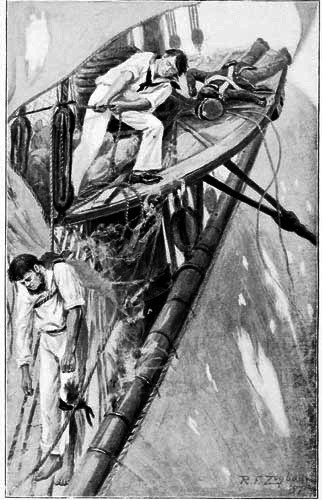
"Carefully he lowered away."
"Come out of that, you fool!" somebody shouted at him from below; but he did not pause. A round shot whizzed by his elbow. A musket-ball carried away a ratline above his head, just as he reached forward. He felt as if a hot flame had licked across his shoulder, and in an instant more his white shirt was white no longer, and was clinging to his back. But it was nothing but a graze, and, undaunted, he kept on ascending. He hauled himself into the top. There lay a dead marine, shot through the temple. Now he bent over the prostrate sailor. Yes, he was alive! Roberts was breathing faintly. Despite the interest and excitement of the action men were watching him from below. But he must work fast if he was to save a life—a bullet at any time might complete the work already begun. He tried to lift the heavy figure on to his shoulders, but found he could not. But good fortune! One of the halliards had been shot away aloft, and hung dangling across the yard. McGovern saw the opportunity. Passing the bitter end of it around Roberts' body, close underneath the arms, he made it fast. Then passing the rest of it through the shrouds he gave first a heave that swung the prostrate figure clear of the blood-stained top, and then carefully he lowered away until at last the body reached the deck.
Somehow the musket-balls had stopped their humming through the upper rigging, and even the firing of the Wasp had slackened, as McGovern, reaching for one of the stays, rode down it safely and reached the deck. And now occurred a thing that has been unchronicled, and yet has had its parallel in many instances of history. A cheer arose, a strong, manly cheer,—it came from across the water; it preceded by an instant the roaring of the hoarse voices close about him. But McGovern's ear had caught it.
"Hark!" he cried, pushing his way forward to reach his station. "Hark, they're cheerin'! They must have thought we've struck. We'll show 'em!" He picked up his sponge again.
Now the firing became incessant. Steadily as the blows of a hammer were delivered the telling shots from the Wasp's port divisions. The flames of powder scorched the enemy's bows. All at once there came a crash. The jibboom of the Englishman swept across the deck, tearing away the shrouds and braces, and then with a heave and a lurch the vessels came together, grinding and crunching with a sound of splintering and tearing of timbers as they rolled in the heavy sea.
There was not a man on board the Wasp that did not expect to see the English sailors come swarming over the bow of their vessel, and drop down to fight in the old-fashioned way, hand to hand and eye to eye. But there must have been some delay. For an instant there was a silence except for the ripping of the Englishman's bow against the Wasp's quarter. But the red-crossed flag was still flying.
Captain Jones saw his opportunity. The enemy lay in so fair a position to be raked that some of the Wasp's guns extended through her bow ports. The men, who, without waiting for orders had caught up cutlasses and boarding-pikes, were ordered back to their stations, and at such close quarters the broadside that followed shattered the enemy's topsides as might an explosion on her 'tween decks. Two guns of the after division, loaded with round and grape, swept her full length.
But some of the more impetuous of the crew had not heard, or perhaps had not heeded the order to return to their stations. Jack Lange had made a great leap of it, and had caught the edge of the Englishman's netting. As an acrobat twists himself to circle his trapeze, he swung himself by sheer strength on to the bowsprit, and gaining his feet, he stood there an instant, then he jumped over the bulwarks on to the enemy's deck and disappeared. The handful of men who had sought to follow his leadership had all failed their object, for a slant of the wind had hove the two vessels so far apart that they were almost clear of the tangle of shrouds and top-hamper that had made them fast. But one man had made a spring of it and had caught the bight of one of the downhauls that was hanging free. Hand over hand he hauled himself up to the nettings, and after considerable difficulty—for he was all but exhausted—he succeeded in getting his body half-way across the bulwarks, and then with a lurch he disappeared. During all this, not a shot had been fired. Every one had watched with anxiety the strange boarding party of two. What would be the outcome of it? Suddenly, as the sails that had been tearing and flapping, filled, and the noise subsided, a strange sound came down from the direction of the other vessel. It was like a great chorused groan—the mingling of many voices in a note of agony! Then with a crash they met again, the English ship fouling hard and fast in the Wasp's mizzen rigging. Lieutenant Biddle, followed by a score of armed boarders, jumped upon the bulwarks and endeavored to reach the other vessel and be the first on board. In this he would have succeeded had not little Midshipman Baker caught his officers coat-tails and endeavored to emulate his eagerness. But at last the Lieutenant and his followers gained the deck, there to be witness of a wonderful sight.
There was a wounded man limply leaning against the wheel. Three officers were huddled near the taffrail—but one was able to stand upon his feet; the other two were badly wounded. Jack Lange and McGovern the Coward had possession of the ship. But somehow, overcome by the sight, they had not left the forecastle, and it was Lieutenant Biddle's own hand that lowered away the flag.
His Majesty's sloop of war Frolic was a prize. Frightful had been the carnage! But twenty of the English crew were fit for duty. She was a charnel ship. The Wasp had lost but five men killed, and but five men wounded. Among the latter was Bill Roberts. Although he was shot three times, the surgeon declared that he would live.
To and fro the boats plied busily. The Frolic's masts fell shortly after she had been boarded, and now every effort was made to repair damages and take care of the many wounded and the dying.
Every one talked about McGovern, he who had been the Coward; he who had cringed to the loblolly boys, and who had taken orders from the ward-room steward; who had washed dishes and dodged blows; he was the hero of the day. And how did he take all this new glory, the admiring glances and the remarks of his messmates? Not as a vainglorious seeker of reputation, not as a careless daredevil who had risked recklessly his life for the mere excitement; but as a cool-headed, brave-hearted man, who while there was yet work to do found no time to think of what had been done. He was reincarnate, as if during the fire and smoke, when the hand of death was everywhere, the spirit to do, and dare, had been born within him. Forgotten had been the red scars of the disgracing cat that seared his back. Here was his chance to show what was in him; to even up matters with the power that had almost crushed his soul. Every shot from the Wasp's side made his heart beat with joy. The born fighter had been awakened. He craved for more, and animated by this feeling he went about his work with a half-delirious strength that made him accomplish the task of two men. All eyes were on him. His officers had marked him.
"Sail ho!" called down one of the men who was clearing away the wreckage aloft. "Sail ho! off the starboard bow."
Driven by the strong breeze that had blown throughout the morning a great sail was bearing down, looming larger and larger every minute. The Wasp cleared for action. The Frolic, aided by the little jury masts that had been hastily rigged, was ordered to bear away to the southward before the wind. The Wasp, wounded and bedraggled as she was, bore up to meet the oncomer.
Slowly the great shape rose out of the water, sail by sail. A tier of guns! another! and a third!—a seventy-four! With two ridges of white foam playing out from her broad bow, she bowled along and passed so close that her great yard arms almost overshadowed the little wounded sloop. There came the sound of a single gun, and at this imperious order the Wasp's flag fluttered to the deck. It had not needed this sight of the red cross curling and uncurling across the white expanse of new sail to mark her as one of the great guard ships of old England. English she was from truck to keelson, and long before she fired that disdainful shot the gunners of the Wasp had put out their smoking matches.
And McGovern had watched her come with an ever-changing expression in his eyes. His face, flushed with excitement and victory, had paled. Once he had started as if to run below and hide. There was something familiar in those towering masts and that gleaming white figurehead, and as she sailed on to retake the little Frolic, McGovern was compelled to hold fast to the bitts to prevent himself from falling. The ports were crowded with jeering faces. The quarter-deck rail was lined with laughing officers, in cocked hats and white knee-breeches. Under her stern gallery he read the word Poictiers! From that he glanced up at the main yard arm. Men had swung there at the end of a rope—yes, he had once seen a convulsive, struggling figure black against the sky. Men would swing there again! The maxim that 'a deserter has no defence' recurred to him. He glanced about. Close by was a chain-shot, two nine-pound solid shot connected by a foot of heavy links. Like one afraid of being seen, he skulked across the deck as he had skulked in the days before. He reached the side where part of the bulwarks had been torn away, and crouching there he passed the end of his heavy belt through a link of the chain, and without a sound lurched forward, all huddled up, and struck sideways in the water.
THE SCAPEGOAT
It was a famous dinner party that Captain William Bainbridge, Commander of the Charlestown Navy Yard, gave on the night of the 31st of May, 1813. In those days gentlemen sat long at a table; they knew good wines when they tasted them, and if they drank a great deal at a sitting, they sipped slowly.
The cloth had been removed, and upon the shining mahogany rested two or three cut-glass decanters filled with the best Madeira. Captain Bainbridge sat at the head of the table, in a high-backed oaken chair; he was dressed in a blue uniform coat, with the gold-braided lapels thrown back over his wide chest. In his snow-white shirt frill there nestled a sparkling jewel given to him by the Sultan of Turkey, upon the occasion when Bainbridge had brought the old frigate George Washington into the harbor of Constantinople and there for the first time displayed the flag of the United States.
The candles had burned low in the candelabra, a silence had fallen upon the company; it was evident that something had interrupted the easy flow of wit and conversation. Captain James Lawrence, the guest of the evening, was in full uniform, with epaulets and great gold buttons as big as half-dollars. He sat opposite Captain Bainbridge, with both elbows on the table, cracking walnuts and eating them as if to stave off hunger; his face was flushed, and a frown was on his brow. A young man of not more than twenty, with a gleaming mass of gold braid on his left shoulder, the mark of the lieutenant, had the next seat to him; he was nervously drumming on the table with his finger-nails. Occasionally he would glance from Lawrence to Bainbridge, and then at the two other officers who were sitting there in constrained silence.
Well did they all know how easy it was for the word to be spoken that would fire the smouldering mine, and change what had been a jovial gathering to the prologue of a tragedy. Men had to be careful how they spoke in those days. There could never be any brawling or careless flying of words; courtesy and gallantry limited their power of personal offence; but epithets or implications once given expression could not easily be withdrawn. Men who had been friends and who had fought for the same cause would, with the stilted hat-tipping and snuff-offering fashion of the time, meet one another in the gray of morning under God's sky and do one another to the death.
At last Lawrence spoke.
"Are you not judging me harshly in this matter, sir?" he said. "You say you doubt my caution." His gaze shifted from the brilliant jewel in Bainbridge's breast to the frank, manly face above.
"Your caution; yes, Captain," was the return; "your courage, my dear sir, never."
Lawrence cracked another walnut with a loud report. "Surely in my little affair with the Peacock you have granted that I used judgment; and in regard to the distribution of prize money, which has not seemed to suit our mutual views——"
Bainbridge interrupted him. "That is a question apart from our present discussion, sir," he said. "I pray that you will postpone it. But I can only say for the benefit of all concerned that I do not doubt an easy adjustment. For what you decide must perforce be agreeable to me."
"You are my senior——"
"And for that reason I have taken the opportunity, as you have brought up the subject, to express my opinions. I cannot order you; it is outside my province or my wish. Before the company you have brought up this matter, and for that reason I have discussed it. Every one must agree that the Department authorities at Washington have treated you most unhandsomely. Had you been given the command of the Constitution, as was first intended and promised you, and were she in a condition to put to sea, I should say nothing but what would encourage you to exercise despatch."
"Ah, if I but had the Constitution and her crew," put in Lawrence, with a sigh; "if I but had them." Suddenly he brought his strong, clenched fist down upon the table with a crash: "Then this English captain would not be flaunting his flag at the harbor mouth, daring me to come on and fight him; shaming us all here where we lie at anchor! The Chesapeake is ready!"
"Ah, but she is the Chesapeake," interrupted Bainbridge.
"True enough; but why not give me the chance to wipe the stain from off her name?" He suddenly arose, and leaning across the table spoke quickly and vehemently. "Order two hundred of the Constitution's men on board of her, and I will sail out and give battle to-morrow! I doubt not, nor do I fear the consequences. I ask this of you as a proof of friendship."
In his excitement, Lawrence upset one of the tall wine-glasses. It tinkled musically, and, reaching forward, he filled it to the brim, and Bainbridge waited until this had been done.
"I cannot grant your request, Captain Lawrence," he said quietly at last. "Your ship is in no condition to go out and fight at the moment. She has a green crew. Her running-gear has not been tested."
"Then let me go into the yard and call for volunteers!" Lawrence interrupted hotly.
"I cannot prevent you taking men who are not busily employed; but I shall not order men from work. 'Twould be sanctioning your action."
The mine was on the point of being fired; the fatal word was trembling on Lawrence's lips. The boy lieutenant half rose from his chair; but Lawrence controlled himself with an effort. He may have realized how senseless it would have been to impute to William Bainbridge lack of courage. He may have thought of the wicked consequence of such a speech. But he was obstinate. His nature was not one to be thwarted easily. Throwing back his shoulders and looking around the table, he raised the brimming wine-glass to his lips.
"Then, here's to the success of the Chesapeake!" he blurted, and drained it to the bottom. "I shall go out and fight this fellow to-morrow," he added sullenly. "You gentlemen," turning to the others, who were all officers of his luckless ship, "shall share with me the honor." Turning, he walked to the side of the room and picked up his cloak and heavy bullion-edged cocked hat.
"Sir, to you good evening."
Bainbridge was about to speak; but on second thought he remained silent and bowed slowly. Without a word Lawrence, followed by three of his officers, left the room. The young Lieutenant lingered. His face had flushed when his captain had spoken the word "glory," and yet the calm, dispassionate judgment of Bainbridge had appealed to him. He was a beautiful lad, this officer, with long-lashed eyes like those of a young girl. His light brown hair curled softly over his white forehead. One would expect nothing but laughter and song from those lips, and it needed the strong, square-cut jaw to give the note of decision and character to his face. It redeemed it from being too classical; too beautifully feminine. He loved James Lawrence, his commander, and truly a boy's love for a man who excites his admiration is much like a woman's in its tenderness and devotion. Lawrence had been a father to him, or better, an elder brother, for the Chesapeake's commander was but thirty-two years of age.
Young William Cox had been much at Captain Bainbridge's house since the Chesapeake had dropped her anchor in the Charles River, and the Commandant had watched with approval the mutual attraction that existed between the young officer and the beautiful Miss Hyleger, who was the sister of Bainbridge's wife. He probably knew what was going through the young man's mind. As he followed after the others Bainbridge stopped him.
"Good night, James; may God watch over you. You will do your duty; of that I am well assured."
"Thank you, sir," the lad returned, flushing as he took Bainbridge's hand in both of his.
When left alone, the Commodore sat there in his great armchair, and on his face was a great shadow of sorrow.
Lawrence did not go on board his ship that night; but Lieutenant Ludlow, Mr. White, the sailing-master, and Lieutenants Cox and Ballard repaired on board at once to make ready for the approaching conflict. All night long James Lawrence walked alone under the trees in the river park, and at early dawn, still dressed in his resplendent uniform, with his silk stockings and white knee-breeches, he made his appearance at the Navy Yard. Some sixty men responded to his call. But the older sailors wagged their heads. It was not necessary. Ah, that was it! Had it been a case of do or die, there was not a man who would not have thrown down his work and jumped at the chance to fight. But the Chesapeake! she was an unlucky vessel. Sailors avoided her. Her crew was riffraff in a measure; men not wanted on other ships; many of foreign birth; Portuguese and Spaniards; a few Danes, and without doubt some renegade servants of King George.
As the morning mist cleared away from the water, there in the offing was the English frigate that had been hovering and flaunting her challenging flag for the past three days.... Boston was all agog with the news. The whole city had flocked to the water front. Before nine o'clock the Chesapeake was surrounded by a flotilla of small craft. Men cheered themselves hoarse. Flags floated from the buildings, and women waved handkerchiefs from the docks. But yet, some of the wise ones wagged their heads.
The bulwarks and top sides of the Chesapeake had been freshly painted, and the paint was not yet dry. As her crew stretched out the new yellow hempen running-gear, they smudged everything with the pigment. There was no time to be careful; it was a hurly-burly haste on every hand. The officers were reading the lists of the men at the guns. They did not know them by name or sight, and were trying to impress their faces on their minds at this short notice. There was bawling and hauling and shouting and confusion. How different from the clockwork methods on board the Constitution! But at last everything was as ready as it could be. Lawrence, after his sleepless night, pale but nerved to tension by excitement, came from the cabin. As he looked down the deck, his spirits must have sunk. Things were not shipshape—at this very instant he may have regretted that he had formed the decision to go out and fight. But it was too late to withdraw! He gave the orders, and, to the tune of Yankee Doodle, they began getting in the anchor. The pilot was on board, standing beside the helmsman. Lawrence went back to his cabin and wrote a letter that has only recently been given to the public. It was addressed to James Cox, the uncle of young Lieutenant Cox, of his own ship. The whole tone of the missive displays the despondent attitude of mind under which Lawrence was now laboring. The postscript that he added, after referring to the possibility of his untimely end, reads as follows:—
"10 a.m. The frigate is in plain sight from our decks, and we are now getting under way."
It was the last sentence he ever penned. As soon as he had sealed the letter he came on deck and delivered it to the pilot, who left the ship within half an hour.
Now came the ordeal. The small boats that had surrounded the vessel were being left behind as she gained headway. But some of the faster sailers among them managed to keep pace, and cheer after cheer sounded. A crew of rowers in a whaleboat kept abreast of the Chesapeake's bows, shouting words of encouragement to the crew. But the men did not appear eager. The officers could not help but notice it, and the impression must have been most heart breaking.
"Muster the crew," Lawrence ordered at last, turning to young Ludlow; "I will say a few words to them." The men gathered in the waist, whispering and talking among themselves.
"James," said Lawrence, to Lieutenant Cox, before he began to make the customary address that a ship's captain in those days made before going into action,—"James, I know that I can trust you—you will do your duty." The young man at his side touched his cap. "You will find me here, sir," he replied, "unless my duty is elsewhere." Lawrence stepped a few feet forward.
"Men of the Chesapeake," said he, "it is our good fortune to be able to answer the call that our country has made upon our honor. We will answer it with our lives if necessary. Do your duty; fight well and nobly. Your country's eyes are on you, and in her heart she thanks you in advance. Yonder British frigate must return under our lee. Let no shots be wasted. To your stations."
There was some low grumbling off to one side of the deck. A black-visaged, shifty-eyed fellow came pushing to the front. A double allowance of grog had been already served; but many of the men had been imbibing freely, owing to the proximity of the shore and the ease with which liquor could be obtained. The man strode out before the crowd and stopped within a few paces of the Captain. He spoke in broken English. Lawrence listened in anger and almost in despair. The man complained in insolent tones that he and his messmates had not been paid some prize money due them now a long time. Lawrence's hand sought the hilt of his sword. He would have run the fellow through as he well deserved, did he not see that among the crew he numbered many followers. Their surly looks and gestures proved their evil temper. The man declared that unless he and thirty of the others were paid at once they would decline to fight.
Here was mutiny at the outset! A fine state of affairs to exist on board a vessel going to fight a battle.... There was nothing for it but to acquiesce. He could not treat the cur as he deserved.
"Take these men to the cabin and pay them what they say is due them," said Lawrence, bitterly. There was not money enough on board the ship, and he was forced to go to the cabin himself, and sign due bills for the amount. And all this time the enemy was in the offing prepared and eager.
The English frigate hauled her wind and put out to sea as she saw the Chesapeake approach. Her flag was flying, and now Lawrence unfurled his. At the main and mizzen and at the peak he flew the Stars and Stripes, while at the fore he displayed the motto flag: "Free trade and sailors' rights." On the two vessels sailed over the bright, sunlit sea. The day was almost without a cloud. One or two small sailing vessels still followed in the Chesapeake's wake. At four p.m. she fired a challenging gun.
There were no seamen of the good old school that could not if they had seen the English ship but admire her. With calm precision the Shannon—for it was well known who she was—braced back her maintopsails and hove to. In silence the two manœuvred. At every point the English vessel had the better of it. Which would fire first? There was one moment when the Chesapeake had the advantage. Owing to her clumsiness more than to her agility, she came about within pistol-shot distance under the enemy's stern. But her commander held his fire. A minute more and they were on even terms, sailing in dead silence beside one another, nearing all the time—who would have thought that they were craving each other's blood? The orders on board one ship could be heard on board the other. The word "Ready" was passed at the same moment; but the discharge of the Englishman's broadside preceded that of the Chesapeake by a perceptible moment. How well those guns must have been trained! Every one was double shotted and heavily charged. The Chesapeake quivered from the shock. In that second, in the time it takes a man to catch his breath, the whole aspect of affairs had changed. Mr. White, the sailing-master, was immediately killed; Mr. Ballard, the Fourth Lieutenant, was mortally wounded. Ten sailors fell dead to the decks. Twenty-three were badly hurt. The bulwarks were crushed in, and the cabin was torn to pieces.
"Steady!" roared Lawrence. "Steady, boys, have at them!"
There was a marine with a musket in one of the Englishman's tops. He was aiming at the resplendent figure in gold epaulets, carefully as one aims at a target, and at last he pulled the trigger. Lawrence fell down on one knee; but leaning against the companionway, he pulled himself erect again. Not an expression or exclamation came from him; but his white knee breeches were streaked and stained with red. Nearer yet the two ships drifted. Their crashing broadsides scorched each other. The Englishmen cheered, and the Yankees answered them—the volunteers from the Charlestown yard were giving a good account of themselves. But several times the Chesapeake yawed and fell off her course as if she had lost her head, like a man dizzy from a blow that deadens the brain. And good reason why: three men in succession were shot away from her wheel. The expert riflemen placed in the Shannon's mizzentop were doing their work well. A puff of wind took the American all aback, she fell off and swung about. Her anchor caught in the Shannon's after port. And now not a gun could be brought to bear! Whole gun's crews left their places and plunged down the companionway to the deck below. But the Shannon was taking advantage of her opportunity. Charges of grape and canister raked and swept the decks.
Lawrence looked in despair at the frightful havoc. He knew what now would happen. Every minute he expected to see the English boarders come tumbling on board. Lieutenant Cox had been sent below to take charge of the second division. Lawrence looked for an officer. The only one in sight was Lieutenant Ludlow. Had it not been for his uniform no one would have known him. He was blood and wounds from head to foot. He could not stand erect, and was dragging himself about the deck, one useless leg trailing behind him.
"The bugler! call the bugler!" thundered Lawrence. "To repel boarders on the spar-deck! Where is the after-guard?"
Ludlow fell, better than clambered, down the main-hatch. "Pass the word for the bugler!" he cried. "Boarders away!" But the bugler could not be found. And good reason why. He was down in the deep hold hiding amid the stores. Young Lieutenant Cox heard the order. "Boarders away!" he shouted. As he started to rally his men and rush up from below, he was met by the crowd fleeing from the terrible slaughter that was taking place above. But at last he managed to work his way up the companion ladder. He too was wounded and bleeding—a splinter had gashed him in the neck and another in the shoulder. What a sight he saw! Lawrence, his beloved friend, his idol, weakly holding fast to one of the belaying-pins, still repeating his fruitless cry for the men to rally on the deck. As Cox leaped toward him a second bullet from the mizzentop struck the captain in the abdomen—Cox caught him as he fell. Lawrence grasped his hand.
"Don't give up the ship!" he cried weakly. "Don't give up the ship!" He placed one arm about the boy's shoulder. He was so young; he loved his leader so much. He was faint from loss of blood. It was his first action. Never before had he seen dying men, or listened to the groans and shrieks of the wounded. Who would expect him to break away from that last fond grasp that had not relaxed? He did not know that he was now commander! Almost carrying his wounded leader, he staggered down the ladder to where the surgeon and his mates were busy at their direful work. He did not see, just as he left the deck, the English boarders headed by their own Captain, the brave and gallant Broke, spring over the railing. He did not know that he and the wounded Ludlow were the only officers now left to handle ship.... As the surgeon hastened to Lawrence's side, Cox knelt down upon one knee. He could not control the tears of sorrow and bitterness. The whole scene of the previous night flashed through his mind. Lawrence, his beloved, eager for glory, now shattered with the hand of death upon him. The Captain released the boy's hand.
"You are a brave lad, James," he said. "But stay here no longer, though I would have you with me."
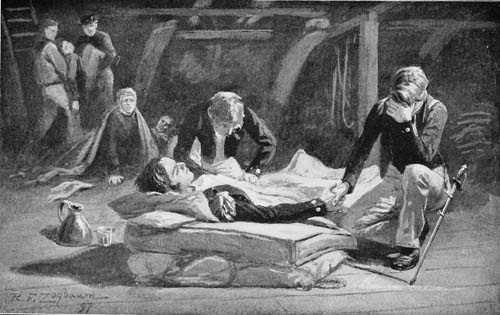
"'Stay here no longer—though I would have you with me.'"
There was more rushing and shouting from the decks above. Cox hastened up as fast as his weakened limbs would carry him. It was hand to hand now; cutlasses plying, men stabbing on the decks, growling and grovelling in their blood like fighting dogs. There was a party making an onslaught toward the bows. Cox drew his sword and joined them. The first thing he knew, they were slashing at him with their heavy blades. They were Englishmen! He did not know his own crew by sight. The firing had stopped; the summer breeze was blowing the smoke away. But what a sight and what a sound! The battered, reddened hulls, and the groans that rose in chorus! Of the further details there is little to relate. Poor Ludlow was killed at last by a cutlass in the hands of a British sailor; for after the flag had been hauled down, a second action had been started by a hot-headed boy firing at a British sentry placed at the gangway. The English, by mistake, had hoisted the captured flag uppermost, but it was soon discovered and hauled down again—the fight was over. The Chesapeake has been reckoned one of England's dearest prizes.
The sorrowful news of her defeat was carried quickly into Boston. The wise ones wagged their heads again. At the house of the Commandant of the navy yard at Charlestown, Bainbridge paced the room alone, deep lines of grief marking his rugged face, and on the floor above, a young girl lay insensible, for the word as first brought was that with the other officers James Cox had had his death. Captain Broke, the Englishman, had fought a gallant, manly fight, all honor to him! He was badly wounded, and, like poor Lawrence, it was thought that he would die. The latter, when he had heard the firing cease, had said to the surgeon:—
"Run to the deck. Tell them not to strike the colors! While I live they shall wave!" Brave Lawrence! They were the last words he ever spoke. Although he lingered four long suffering days, not a sound passed his lips. Broke, on the contrary, was raving in a delirium, and these were the words he kept repeating—words he must have spoken before the action had begun:—
"See the brave fellow! How grandly he brings his ship along! How gallantly he comes to action!"
Ah, how Halifax rejoiced when the Shannon sailed in there with a Yankee frigate under her lee. How the guns boomed, and how the city went mad with joy! And how England rejoiced, and the "Thunderer" thundered and the king clapped his hands! And how much they made of it! How proudly they preserved every relic of the captured ship! How they cherished her figurehead and exhibited her logbook! And they builded her timbers into an old mill, where they can show them to you to-day, scarred with cannon shot.
Yes, and how America lamented! Aye, and grew angry in her distress and cried for vengeance! Many times during the trial which followed in the investigation of the causes for the vessel's loss and capture, must have young James Cox wished that he were dead, that it had been he the British cutlasses and musket-balls had hacked to pieces. The navy had lost a ship in single combat,—the press and the authorities did not like that,—some one must suffer. What excuse was there that could hold good? said they—the great public which clamored for a reason. And so in the flush of the hot feeling he was sentenced by court martial; sentenced and disgraced. The charge of cowardice was disproved. From that he was exonerated—he had been wounded. But why had he not cut down the men as they left their guns? (one man against fifty, forsooth!) Why had he left the deck and gone below? Why had he stayed for one moment's time at the side of his dying friend and leader? And so he was made the scapegoat, although if he had been six men or ten, he could not have prevented what had happened. What is the use of "ifs"? The best ship had won. But when the trial was over, two hearts were broken. The young officer was execrated by those that did not know, and yet who talk and write. Could he dare just then to ask a woman's hand?
The navy pitied him, the scapegoat of the Chesapeake. How he petitioned to be given a chance to win back his fair name, and how often it was denied him! The members of the court that sentenced him wrote kindly letters almost without exception. But even the brave Decatur did not dare to help him—public opinion is more formidable to face than an armed ship. And so James Cox, maybe in the hope that an honorable death would visit him, shouldered a musket and fought as a common soldier in the ranks on land.
And when the war was over, he sought refuge in the new country of the west, where perhaps they would not know. And there he lived and died; died an old man, honored and respected by his neighbors. But those that loved him marvelled at one thing; he never smiled. And even his grandchildren (for he married late in life) knew not that he had once been a gay young lieutenant with a shining epaulet on his left shoulder. They never heard that he had started one fine June day to find glory and fame; and that death had come near to him but passed him by, which he had more than once regretted bitterly.
After he had been laid to rest letters and papers were found showing that to the last he had been trying to have his name placed back upon the navy lists. But if they were too angry to listen before in their deep chagrin, they were too busy now; they had other things to think about. And people who wrote history, aye and taught it in the schools, did not search dispassionately for what had occurred to view the facts. They took the feverish verdict of the times and applied adjectives to his conduct that were out of place; some called it "pusillanimous"—"cowardly." We can look at things differently now, and judge them for their worth. There is proof enough to clear his name, so be it cleared if these few words can help to do it.
THE LOSS OF THE VIXEN
On the 22d of October, 1812, at nine a.m., the United States brig Vixen crossed St. Mary's bar outward bound for a cruise to the southward. It was not expected that she would be absent from home waters for more than a month. Her commander was George W. Reed, a good officer, although he had had little experience in actual warfare. The hundred and ten men under his immediate command had trust in his judgment and were all animated with a hope of coming in again with one of the enemy under their lee, or at least they trusted that they should be fortunate enough to make one or two rich captures and return with prize money to their credit. As one of the Vixen's crew wrote: "All hands were in high health and spirits, and filled with the idea of soon returning with some fruit of the consequence of the war."
Day after day the Vixen sailed on and saw one sail after another; but owing to her having been well to the leeward in every case she had been unable to bring any to close quarters. On the tenth morning after her departure a sail was descried, and this time it so happened that the little brig was well to the windward. Setting every stitch of her canvas, she made after the stranger. Judging from all reports, the Vixen's intentions must have been better than her powers of putting them into practice; for if her legs had been faster, so to speak, the expectations of her crew might have been answered, and this story (which is nothing but a record of events, however) would never have had a chance to be written. So it is safe to draw the conclusion that she was not as fast as many of our little vessels were at this period of our naval history.
While chasing the strange sail, another was perceived to be bearing down from the northwest. This put another face on the matter. The Vixen hauled her wind and waited. As it was perceived the second stranger was undoubtedly armed and was a large brig, Reed called his men together as was the custom and made the following little speech:—
"Now, my lads, there she is; I expect every man to stand to his guns. Don't fire a gun until you are within pistol shot; take good aim and show her fair play."
As the vessel came on without raising her flag, she fired a broadside of round and grape, which, however, served no other purpose than to churn the water into foam some distance ahead of the Vixen's bow. The latter returned the compliment, and planted a double-shotted eighteen-pound charge in her antagonist's hull, above the sternpost. Again the stranger fired and missed, although at musket-shot distance.
Now, odd to relate, the unknown ran up signals, which, not understanding, Captain Reed replied to with an assortment of grape. At this the signals came down and the Spanish colors went up in their place. Bitter was the disappointment; she was to be no costly prize, after all. Seeing there was some difficulty on board of her, Captain Reed lowered a boat, and ascertained that she was a Spanish brig of fourteen guns from Havana, bound for Cadiz. Finding out that she only had two or three men slightly wounded, Captain Reed went on his way, after regretting that the "mistake" had occurred. However, in the log there was entered on this day that "owing to the good chance for target practice the morning had not been spent amiss."
For just one month everything seemed to run away from the poor little Vixen. The men were getting discouraged. They would see a convoy, most probably made up of rich merchantmen, somewhere off to leeward, and then a fog would shut down, and when it cleared away nothing would be seen but an expanse of empty horizon. With nothing done, and a sorry and disappointed crew, she was within two days' sail of St. Mary's, in the state of Maryland, when as luck would have it the man at the masthead reported a sail on the starboard beam.
Much better would it have been for the little Vixen if the fog had closed down or a contrary wind had sprung up, or had she gone about her business and made for home as soon as possible. It was just daylight in the morning. Steering-sails were set on both sides as she was headed out again to meet the stranger, who had evidently not observed her presence. By six o'clock it was made out that the unknown was a frigate and no less. This was more than the Vixen had bargained for. With all her canvas standing as it was, she tacked ship and hauled up on the wind, which was extremely light. But the frigate proved herself to be a good one at going; she had set all of her light canvas that she could, and it was a caution the way she came down upon the little brig.
Although it is only a preliminary to the story, which has another side than that of the amusing, one cannot read an extract from the Vixen's log without feeling inclined to smile. Therefore to quote: "At ten, finding the chase gained on us, increasingly, commenced starting water out of the fore and main holds to lighten the brig. At eleven dead calm; out sweeps and continued rowing without intermission until twelve. Slow work; but we had now gained some advantage over the chase. Then a breeze springing up we quickly lost it. In sweeps, and to lighten the brig still more, hove every article, in and under the boats, overboard. Stationed hands by the anchors to cut them away when ordered. Half past twelve p.m., discharged all the shot from the racks. At one, cut away both anchors. At two p.m., the chase still gaining, hove two elegant brass nine-pounders after the anchors. Chase still gained. Broached all the water in the casks, hove over all our broadside guns, and everything that seemed to carry weight. Finding that in despite of our exertions the Vixen would not sail an inch faster than her old gait, we now had the melancholy satisfaction of knowing our capture was a certainty. But we were determined to use every exertion to avoid it. Thus we commenced manœuvring with the sails, which kept the men on the jump and had only the effect of putting off the capture for an hour or two. At three p.m., all her guns were visible, at half past, coming up, hand over hand, she gave us a shot which fell short. A few minutes later another was sent which went between our foremast and mainmast. Answered by running up our colors and firing a musket to windward. The chase having English colors up, and as it would have been madness to engage her, we fired another shot to leeward and hauled our colors down. At four p.m., she ranged alongside."
And now, strange to say, all those on board the brig were astonished to see that the frigate had the word "Constellation" painted on her stern. The crew of the Vixen looked at each other in astonishment. Had there been another mistake? But there was something unmistakably English about the cut of her jib, and the red coats of a party of marines who were scrambling down into a boat which she had lowered plainly showed her character. Besides this, Captain Reed knew well that the Yankee Constellation was aground in the mud-flats of the James River, where she stayed during the war.
The officer, who was soon on board, with his seamen and marines, informed Captain Reed and his lieutenants that the Vixen was a prize to His Britannic Majesty's frigate Southampton, thirty-six guns, Sir James Lucas Yeo, commander. At once Captain Reed entered the English boat and went on board the frigate. As he rode close under the stern he saw that the word "Constellation" had been painted on a wide strip of canvas, tacked neatly over the name "Southampton." He did not ask the reason for this; it was easy to guess. If she happened to put in to one of the small harbors along the coast, it would conceal successfully her identity. Probably Sir James did not know that the real Constellation was fast in the mud-flat.
Sir James was a gentleman and a nobleman by action as well as by birth, and his very first doing proved it. He came forward to meet Captain Reed and lifted his hat in a courtly salute; Captain Reed presented the hilt of his sword in token of surrender.
"No, no, sir," spoke up the Captain of the Southampton. "I cannot accept this from you; and I wish to commend you, sir, upon the skill you displayed in endeavoring to save your vessel. My ship is a very fast one."
"And mine a very slow one," put in Captain Reed.
"But I am sure you did everything that any one could do to get speed out of her."
"We hove everything overboard but our top sides and scantlings," returned Reed.
The officers standing about smiled, for the Vixen's frantic endeavors to escape had been watched closely through the glass.
The kindness shown to the brig's commander was extended in every way to the other officers and to the crew also. As the frigate was very crowded, but seventy of the Vixen's men were transferred to her. The other forty were kept as prisoners on board their own vessel. Every man was allowed to take his dunnage, and the prisoners on board the Southampton were given the run of the forward and main holds, although the hatchways were closely guarded by armed sentinels. Excepting for the confinement, which was absolutely necessary, of course, and which was in direct accordance with the rules of war, the prisoners suffered no inconvenience. Twice a day in details of twenty they were permitted to be on deck to enjoy the fresh air. The Southampton's crew were already on short allowance, owing to their having been at sea for some length of time, and the dole allowed the Americans was almost, if not quite, equal to that given the Englishmen. The officers were treated with the greatest of politeness and civility, and Captain Reed dined daily with Sir James in the cabin. All hands voted him a fine man and gentleman, and that he was a naval officer was proved conclusively enough by his actions subsequently when at the head of the British operations on the Lakes.
Five days after the capture the weather was fine, but a small sea was running. The Southampton, under easy sail, was leading, and crowding on all she could carry; the Vixen managed to keep within signalling distance of her. In three or four days every one expected to be anchored safe in Jamaica.
It was about half past eleven on a bright starry night when the lookout forward suddenly gave the cry, "Land ho!" A line of breakers could be seen about two miles to the westward, and above them the shores of a little island, at its highest point but twelve or fourteen feet above the water. Evidently the sailing-master of the frigate was out of his course. He probably had not allowed for the drift of one of those strange Gulf currents which have caused the destruction of many a fine ship.
The Southampton was put about in a hurry, and as she was such a good sailer and was so quick in manœuvring, no danger was apprehended, and she jogged along to the eastward to escape the proximity of the shoals. The Vixen was following her and taking in some of her sail as the wind commenced to blow much fresher. At twelve o'clock the sky had darkened, and it was difficult for one vessel to distinguish the other, although in the early part of the evening, by the aid of the moon and stars, everything had been visible. The mid-watch was just coming on, when, with a sudden shock, the Southampton struck on a sunken ledge of rocks; but she slid over the first, tearing the sheathing from her hull and wedging herself firmly in at the stern. Immediately a gun was fired to warn the Vixen, that was following in the wake; and also to be a signal of distress, as the greatest consternation prevailed now on board the frigate—that was leaking badly. But the usual ill fortune of the Vixen pursued her. At first she hove to and shortened sail, preparing to come to the frigate's assistance. Just as she was about to heave to the second time and lower a boat, she struck with such a vicious force that her bows drove high out of water, she was stove in completely, and all the prisoners, who had been wondering what was going on, now terrified and in great fear of immediate death, rushed up on deck to see a strange sight. It was pitch dark; the waves were breaking on every hand, and off the port bow the big frigate could be seen hard and fast, signalling in great distress.
Her position, in fact, was much worse than that of the brig, for she was filling and settling rapidly. Everything was being done that knowledge and good seamanship could suggest or direct. The top-gallant yards and masts were sent down, and top-masts were struck; and notwithstanding the sea was very rough, two boats were lowered, and although one was crushed against the vessel's side, the other set out to search for a safe passage through the reef. On board the Vixen the boats had been called away, and the American and English crews were mingled, but without confusion. A Yankee sat beside John Bull on a thwart, and deeming that their own vessel was in no immediate danger, but that the Southampton was about to sink, they started to act the part of life-savers and rescue as many of the frigate's crew as they could. There was no thought of their being enemies, no observance of the differences between prisoners and captors; all sought to act for the cause of humanity and to save human life. But they had not proceeded far from the side of the brig when they were called back in a hurry. The Vixen had slipped from her firm position on the jagged rock and was surely sinking. So instead of being a rescue party to others they found they had all they could do to save themselves. But every man was taken off and brought on board of the Southampton.
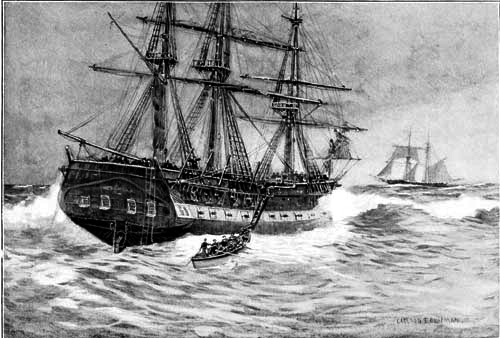
"Everything was done that good seamanship could direct."
Daylight was waited for most anxiously, and when it came, a dreary prospect was before the ship-wrecked ones. Not far away was a low island that was pronounced at once to be the island of Conception. Nothing but the topgallant masts of the Vixen showed above the water, as she had sunk during the night. The Southampton's pumps had been kept going for six hours. But she was so badly bilged, and the water was gaining so fast, that her hours were numbered. With a rising sea there was immediate danger of her going to pieces, and in her crowded condition the consequent loss of life would have been too terrible to think of. It was a row of about ten miles from the reef on which the ship lay to the distant low-lying, sandy shore. All the boats were made ready, a raft was built and floated alongside, and the boatswain, obeying orders from the quarter-deck, began bawling: "Away there, you Vixens, away!" So the prisoners were to go first; but since the vessels had struck they had not been treated as prisoners at all. They had obeyed Sir James's orders as though they were members of his own crew, and they had not been shown the slightest evidences of bad blood or ill feeling on the part of the ordinary seamen. Before the day was over all the crew had been transferred to the island, and a boatload of provisions had been safely landed. Sir James and his officers spent the first night on board ship; but on the following morning, as she showed all evidences of a speedy breaking up, a tent was made for him on shore.
A strange life now followed. The great lack felt upon the island was that of proper drinking-water. Conches and shellfish and land-crabs there were in plenty. The four hundred odd men who now found themselves marooned on this island far removed from the usual course of trade, and but seldom visited, had to depend upon a small pond for their drinking-supply. If this should be exhausted, their position would be perilous in the extreme. Two boats had been despatched to summon aid if possible. One to see if there were not some cruiser at Cat Island, with orders to proceed to Nassau, and the other to make for the island of Exhuma.
A little settlement composed of tents and wig-wams made from ship's wreckage soon grew up. Friend and foe mingled together in hunting for conches, or in sports to while away the time.
After a week a small vessel arrived from Cat Island, for the message calling for help had been received, bringing eighteen sheep and a quantity of meal, and the skipper showed where there was hidden a well which the mariners had failed to discover. An empty hogshead was sunk, and a sign-post erected on which was cut "The Southampton's Well, November, 1812." For many years it stood there. The sheep did not last long, and soon resort was had again to the conches. On the eighth of December, three English vessels arrived, the Caledonia, a cutter, Rolla, privateer, and the government brig Rhodian. Captain Sir James Yeo made a speech to his crew and their "guests," which was the term he used in referring to the Vixens, in which he thanked the latter for their assistance, their cheerfulness and good behavior, and he stated that he would do everything in his power to help get them exchanged, or provide them with a cartel to take them to their own country on their arrival at Jamaica, whither they were bound. Then, forming into a ragged company, arm in arm, Yankee sailors and British tars marched out from their little settlement, a fifer at their heads playing The Girl I Left Behind Me. Leaving their little island to the mercies of the half-breed wreckers whose small craft swarmed about, they sailed away. The rescued "guests" were prisoners again.
IN THE HARBOR OF FAYAL
On the lake front at Chicago during the World's Fair, close by the entrance to the long walk that led out to the marvellously constructed imitation battle-ship, the Illinois, rested an old iron muzzle-loader. It was a clumsy-looking piece of ordnance compared to the shining, complicated bits of machinery that compose the batteries of a modern war-ship. It looked very out of date and harmless, and people who did not know its history passed it by with hardly a second glance. But yet this old gun had taken more white men's lives in battle than all the great modern breech-loaders on the fleets of Europe combined to-day. It was but nine or ten feet long and threw a solid ball twenty-four pounds in weight. A small inscription on a metal plate told the inquisitive that the gun was the "Long Tom," from the privateer General Armstrong, that had been sunk in the harbor of Fayal, in September of the year 1814; that it had subsequently been raised and presented by the Portuguese government to the United States. There were some who knew the story, for it had been told many times, and long years ago the country rang with it. Every one then knew the main facts of the incident, and because of a long controversy in the courts owing to claims that arose from the action for indemnity against the Portuguese government, the matter was kept alive up to a very recent date. But an unfamiliar story in connection with a well-known fact may not be amiss, and this is a tale of the harbor of Fayal that perhaps few have heard before.
But to get to the telling of it, it is necessary to recount a good deal of what is recorded history.
The General Armstrong was a privateer brig outfitted at New York. She was owned in part by a New York merchant, a Mr. Havens, and in part by her commander, Samuel C. Reid, and a better sailor never stood in sea-boots. She was not a big ship; but her armament had been skilfully chosen. Her crew of picked men had been drilled man-of-war fashion. She mounted eight long nine-pounders, four on a side, and amidships she carried the big twenty-four-pounder before referred to. Her First Lieutenant was a Mr. Alexander O. Williams, a very young man, but a thorough and practical seaman; her Second was named Worth; her Third Lieutenant's name was Johnson; her crew, all Americans, numbered ninety souls all told. Among them was an active, handsome fellow, named William Copeland. He was down on the privateer's books as able seaman; but before the General Armstrong had been two weeks at sea, Copeland was promoted for meritorious conduct in an action with a British armed schooner, that was sent home as a prize, to be quarter gunner. It was Reid and himself that squinted along the black barrel of the old Long Tom, when she fought in the harbor of Fayal.
It was the 26th day of September that the General Armstrong cast anchor there. The weather had been very fine, and Captain Reid, very proud of his vessel, had done everything to make her look smart and tidy. Her rigging was all tuned up to concert pitch; her decks were as white as sand and holystone could make them, and the men, contrary to the habit of most privateers, were dressed in suits of white duck and blue. The American Consul, John D. Dabney, felt a thrill of pride as he saw the man-of-war fashion with which the General Armstrong came to anchor. As the long white gig came rolling up to the pier, and the men boated their oars, Mr. Dabney recognized that the officer sitting in the stern sheets was an old friend of his.
"Ah, Captain Reid," he exclaimed. "Glad to see you. My compliments to you on the appearance of your vessel. I thought at first that she must be one of the regular navy; in fact, I took her for the Enterprise."
"Well, I flatter myself that she is quite as shipshape," returned Captain Reid. "And I have to work my crew pretty hard to keep from showing how well satisfied I am with them. I tell you, Dabney, it isn't every man that has had such a fine lot of fellows under him. As to my success so far, it has been fair enough; but I'd really like to measure distances and exchange a few shots with some of His Majesty's little fellows."
"You have come to a good place to look for them," Dabney returned. "It is seldom that a week passes without having one or more of them drop anchor in the roads."
Chatting together in this friendly fashion, the two gentlemen went up into the town. It was late in the evening before Reid came to the water-front to signal for his boat. Dabney was still with him. They walked down to the end of the pier, and Reid suddenly pointed:—
"By Jupiter!" he exclaimed, "here we come," and following his finger Dabney saw three big vessels lazily moving along before the slight wind, toward the harbor entrance. Their earlier approach had been hidden by the headlands.
The harbor of Fayal is surrounded by hills, on the slopes of which the town is built, and the bay extends in a semicircle with two wide-reaching arms. The water runs deep into the shore. The sun was setting in the calm evening sky, and there was scarce enough movement on the surface of the bay to catch the red reflections. Dabney turned to Captain Reid after the first long look.
"English, or else I'm much mistaken," he said quietly.
"Not the least doubt of it in my mind," Reid returned, "and if there was more of a wind, by Jove, I'd try to get out of this.... Do you think it is safe to stay?"
"It is a neutral port," Dabney returned, "and Portugal and England have been such friends, that I do not think John Bull would take advantage of his position here. In my opinion they will respect the neutrality."
"Well, they won't catch me napping," Reid returned, as he stepped into the gig; and after requesting the Consul's presence at dinner on the following evening, he gave the order to shove off, and pulled away for his vessel.
Mr. Williams, the First Lieutenant, met him at the gangway. "You have observed our friends yonder?" he asked, pitching his thumb over his shoulder. "I wish we were out of here."
"So do I," Reid returned, "but we must make the best of it."
It was a beautiful sight to see the great square-rigged ships come to anchor. Forward and aft all hands were on deck watching the English men-of-war perform the manœuvre.
"Well done!" exclaimed William Copeland, the quarter gunner, turning to a group of his messmates. "It takes an Englishman or a Yankee to make a vessel behave as if she were alive. By Davy's locker!" he exclaimed suddenly, "I know that nearest ship; it's the Plantagenet, I'll bet my prize money. Good cause have I to remember her; she picked me up in the North Sea and I served three years in her confounded carcass. Three wicked, sweating years, my lads."
"Where did you leave her, Bill?" asked one of the seamen standing near him.
"At Cape Town, during the war against the Dutch. I'll spin the yarn to you some day. My brother and I were took at the same time. The last I seed of him was when we lowered ourselves out of the sick bay into the water to swim a good three miles to the whaler—that was three years ago."
"Do you reckon he was drownded, Bill?"
"Reckon so. Leastways I haven't heard from him, poor lad!"
Further talk was interrupted by an order from the quarter-deck calling away the first cutter to carry a stream anchor in towards shore in order to warp the brig close under the walls of the "castle" a little battery of four or five guns that commanded the inner harbor. Captain Reid's suspicions had been awakened by seeing a boat put off from the shore, and noticing that one of the frigates was getting up her anchor preparatory to drawing in nearer. In less than half an hour he was moored stem and stern so close under the walls of the little fort that he could have hurled a marline-spike against the walls from his own quarter-deck. As it grew darker he could see from the flashing of lights that the English vessels were holding communication with one another, and occasionally across the water would come the sound of creaking blocks or the lilt of a pipe. He knew well enough that such goings on were not without some object, and calling all of his officers aft they held a short consultation. It was exactly eight o'clock in the evening. From shore there came a sound of fiddles and singing. Although Captain Reid had promised the men liberty that evening, owing to the position of affairs the order had been rescinded, but nevertheless there was some grumbling in the forecastle; for if a sailor doesn't grumble when he gets a chance, he is not a sailor.
"I'll be shot if I can see why the old man won't let us ashore," growled a sturdy young topman. "D'ye hear them fiddles, Jack? Can't you see the señoritas adancin'? My heels itch for the touch of a springy floor and my arm has a crook to it that would just fit a neat young waist. Do you remember—"
"Stow your jaw, Dummer," broke in a heavy voice half angrily. "And you too, Merrick, clap a stopper on it," turning to another of the malcontents. "Hush now, listen all hands.... Oars! can't ye hear 'em? And muffled too, by the Piper! Pass the word below; all hands!" With that William Copeland ran aft to the quarter-deck. Captain Reid met him at the mast.
"Their boats are coming, sir," Copeland whispered excitedly; "five or six of 'em, I should judge."
"Are the broadside guns ready?"
"Aye, aye, sir, and double-shotted; two of them with grape and canister."
"How's the Long Tom?"
"Ready to speak for himself, sir," Copeland replied with a touch of pride, for the big gun was his especial pet.
The three lieutenants had now grouped close together. "See that the magazine is opened, Mr. Worth, and Mr. Williams call the men to their stations quietly. They will try to come in on the port hand most probably. Gentlemen, to your stations. No firing until you get the word from the quarter-deck, and stop all talking on the ship."
Even the sentry, patrolling his beat on the castle walls, did not hear or notice anything extraordinary on board the privateer, so silently were the orders followed out. The moon was struggling to pierce through the thin, filmy clouds that obscured her light. It was one of those nights when objects appear suddenly out of the invisible and take shape with distinctness close to hand. But every one could hear the sounds now.
"Thrum, thrum, thrum," the swing of oars; despite that the rhythm was muffled and subdued.
Reid was leaning over the rail with a night glass aimed in the direction of the frigate. A figure hurried to his side. It was Lieutenant Williams. "We can see them from for'ard, sir," he said breathlessly. "Everything is ready, and there's surely some mischief afoot."
"Yes, I can see them now; four of them, chock a block with men," Reid returned, closing the glass with a snap. "Now stand by, all hands, for orders." Then raising his voice, he shot the following question out into the semi-darkness: "On board the boats, there! There is no landing here. Keep away from our side."
The rowing ceased; but it was only an instant and then it began again.
"I warn you to come no nearer!" shouted Reid. "You do so at your peril."
Four dark shapes were now visible without the aid of any glass. The plash of the oars could be heard as they caught the water. Reid just noticed the figure of William Copeland bending over the breech of the Long Tom, whose muzzle extended across the bulwarks.
"Keep off or I shall fire!" he warned for the third time. There came an answer to this clear enough to be heard by every man standing at the guns.
"Give way, lads, together."
"Fire!" roared Reid, in a voice that must have been heard distinctly along the shore. The reply was a scarlet burst of flame and a crash that sent the echoes up the hills. It stopped the fiddles in the dance-house; it set the drums and bugles rolling and tooting in the fortress, and the American Consul, sitting over his coffee on the public square, jumped to his feet, and ran, followed by a clamoring crowd, to the pier-head.
From the direction of the boats came a confusion of orders following the broadside. Groans and shrieks for help arose from the darkness. Some spurts of flame came quickly and several musket-balls whistled over the Armstrong's deck. Then the loud report of a heavy boat gun, and a groan and cry followed immediately from the brig's forecastle.
All was silent now except for the sound of plashing in the water and some groans and muffled cries. Reid was about to hail when he saw three men hurrying aft with a heavy burden in their arms.
"It's Mr. Williams, sir; he's shot in the head, and Dummer, of the forward division, sir, is killed," one of them said gruffly. Poor Dummer! He would dance no more with the señoritas—there were to be no more liberty parties for him.
Reid's intention of lowering away a boat faded from his mind. There would be more of the same sort of work before long; that he knew well. One of the boats had been sunk, for the wreck came drifting in close to the brig's side. The other three could be heard making off to the ships, their rowing growing fainter every minute. Lieutenants Worth and Johnson came aft to report.
"We are in for it, gentlemen," said Reid; "but they won't cut this vessel out without more discussion on the subject. The idea of such treachery in a friendly harbor! They received their just deserts." His anger got the better of him for an instant, and he could say no more. "Poor Williams!" he murmured at last. "Is he badly hurt?"
"He is mortally wounded, sir, I am afraid," Mr. Johnson returned.
"A good friend and a fine officer gone," put in Lieutenant Worth. "So much for this night's work."
"Do not fear; there'll be more of it, and we'll have our hands full," Reid continued. "Mr. Johnson, you will see that the boarding-nettings are spread, and load the midship gun with lagrange and a star shot. Have pikes and cutlasses ready."
"Are you going ashore, sir, to see the commander of the fort? He surely should protect us?" asked Mr. Worth.
"We need count no longer on him," was Reid's rejoinder. "We will have to do our own protecting. See that every musket and pistol is loaded and laid handy and, stay," he added, "cut away the bulwarks just abaft the gangway and bring two of those starboard guns across the deck. We will need them all, to my way of thinking."
The crowds gathered on the shore could hear the sounds of preparation. From the English squadron also came a babble of orders and movement. The lights were doubled in number. Every port shone brightly. The moon had now risen until objects could be seen quite plainly.
"They are preparing for an attack in force," Reid said, handing the glass to Mr. Johnson, who had already seen that the boarding-nettings had been spread above the railing. The men forward were busy setting some spare spars to act as booms to keep the boats from gaining the vessel's bows. Time passed swiftly. At twelve o'clock the oars began again. But they were not muffled now! "Click, clock," they came onward with a rush. Voices could be heard urging the rowers to more exertion, as if they were racing crews out for a practice spin. Reid was levelling the glass.
"Ten, twelve, thirteen, fourteen—fourteen boats loaded to the guards," he said. "God's love, there must be four hundred men: they mean to take us if they can." He looked down at his own little deck. He had less than ninety now; but they were ninety stout, good fellows who would not flinch. In the rays of the battle lanterns and the pale light of the moon, Captain Reid saw that they were ready to fight their last fight maybe.
It was no time to make a speech; but the men could hear every word he said without gathering nearer. "Lads," he said, "reserve your fire until you get the word from me. Don't waste a single shot, and remember this: aim low.... Copeland!"
"Aye, aye, sir!"
"Cover that leading boat."
"Aye, aye, sir!"
A big pinnace or barge, holding perhaps eighty men, was heading the flotilla by almost a hundred feet. The grinding of a handspike on the deck broke the silence, as the Long Tom was slewed about to bear upon her.
"Handsomely now, men," cajoled Copeland. "Handsomely; that's well."
The great boat was rowing in directly on that gun as if towed by a line. She was heading on to death and destruction!
Consul Dabney, standing with the anxious crowd on the shore, held his breath.
Was Reid going to submit to be taken without striking another blow? Not much. With a long flare of flame that leaped from the Armstrong's side, arose a great shout from the spectators.
The bow of the pinnace was stove in, and she pitched forward into the water like an angry bull brought to his knees by a rifle shot. Men absolutely boiled out of her. The moonlit water was dotted with black objects; some threshing with their arms, others silent and motionless. There came a rattling reply of small-arms from the boats, and the long nines answered them. The action was on in earnest. No one can gainsay the courage that was displayed by the attacking force. They were Englishmen; it is not necessary to say more. The firing became incessant. The men on the Armstrong had scarce time to reload their guns. They would snatch up a pistol here and a musket there and fire out at the water that was crisscrossed with the red flashes of the answering shots. More than once a boat had reached the side. On two occasions men had sprung to the bulwarks, and clung to the boarding-nettings until shot away. Every now and then the Long Tom would let go a half-bucketful of grape and scrap iron, hurling death into the boats. Every one of the privateer's crew seemed gifted with four arms. From one point of attack to another they chased about the deck. It seemed as if she numbered three times her complement. Bill Copeland was fighting like a demon. Twice had he run along the top of the bulwarks, exposed to every aim. Suddenly he saw that one of the boats had worked around to the starboard side. Giving the alarm, and followed by a half-score of the after-guard, he ran across to meet this unexpected danger. One of the men who followed him caught up a twenty-four-pound solid shot in his arms as he ran. Another followed his example. Both shot crashed through the bottom of the boat, and a volley was poured down into them. But three or four of the men had already reached the chains.
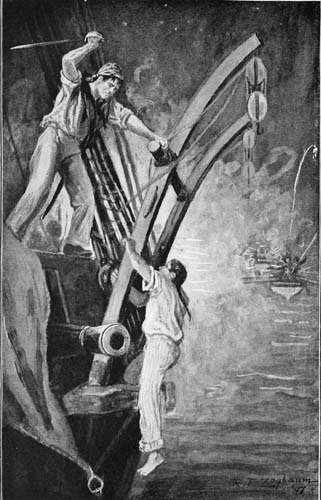
"There was a figure crawling up below him."
Copeland sprang to the bulwarks with his cutlass in his hand. There was a figure crawling up below him. Leaning forward, he made a quick stroke that would have severed the man's throat had he not leaned back suddenly and avoided it. Again he drew back his sharpened cutlass for the death blow, and then he saw that the fellow was unarmed. Something stayed his hand; he bent still further forward, and just as the Englishman was about to fall back into the water, he grasped him by the wrist.
"My God, Jed!" he cried, and exerting all his strength he dragged his prisoner over the rail on to the deck. Those who had time to witness it, saw a curious sight. There was Bill Copeland holding fast to another man, their arms on each other's shoulders.
"Jed, don't ye know me?" Bill was crying; "but, Lord love ye lad, you're wounded." A shudder went through him as he realized how close he had been to sending home that fatal thrust. The man with a pigtail down his back leaned forward weakly.
"I'm hurted bad, Bill," he said. "But go on and fight; leave me alone; egad, you've whipped 'em." Sure enough, the firing had now slackened. Four or five of the boats had retreated beyond gun shot. They were all that could do so unaided.
"Cease firing!" ordered Captain Reid, hastening about the deck. "Cease firing here! They have given up. Where is Mr. Johnson?" he roared, pushing his way into a group of men who were about to reload one of the nine-pounders. He had to cuff his way amongst them to make them desist. "Where is Mr. Johnson?" he repeated.
"He's wounded, sir."
"And Mr. Worth is wounded too, sir," put in another man. "I helped him below myself."
As suddenly as the action had begun it had ended. By the light of a lantern Captain Reid glanced at his watch. It was forty minutes since the first gun had been fired. He looked about his decks. Although they were littered with loose running-gear, handspikes, cutlasses, and muskets, at the sight his heart gave a great bound of joy. There were no mangled figures or pools of slippery blood. It seemed hardly possible.
But from the wreckage in the water came groans and cries. He looked over the side. There lay, rocking, two broken boats filled with huddled figures, some moving weakly.
"Here!" he shouted to some of the men. "Bear a hand; save all we can."
It was a sudden transition, this, from taking life to saving it; but the men turned to with a will. In one of the boats twelve dead bodies were found, and but seventeen of her crew had escaped with their lives, and they were all badly wounded. Of the four hundred men who had commenced that bold attack, only one-half returned to the ships unhurt. Reid hurried down into the cockpit. It seemed past believing. But two of his men, including the brave Williams, had been killed, and but seven wounded! This is history.
But a sight he saw attracted the Captain's attention. It was Bill Copeland sitting on the deck, with his arms about a pale figure whose head lay in Copeland's lap. The resemblance between the men was striking.
"What have we here?" asked Captain Reid.
"My brother, sir," Copeland returned.
"Your brother!"
"Aye, sir; from the Plantaganet. He was the only one who got on board of us!"
The man spoke with an accent of pride, and the wounded one opened his eyes.
"Bill, here, he hauled me on board," he said.
When the surgeon found time to attend to Copeland's wounds, he pronounced them not to be of a dangerous character, and the man was soon made comfortable.
All night long, the Armstrong's people slept beside their guns, but there was no evidence of any further intention to attack on the part of the British. The Carnation, which was the nearest of the vessels to the privateer, had her boats out at daybreak. All day long they kept carrying their dead on shore. From the Rota there were seventy funerals! But the Armstrong was not left unmolested. At eight o'clock the Carnation began firing at close range. For a few minutes, Captain Reid replied with some effect. But resistance was useless, and at nine he ordered all hands into the boats, and made for the shore, every one arriving there in safety. He had bored a large hole in the Armstrong's bottom, but before she sank, two boats from the Carnation rowed out to her, and the English set her on fire.... The inhabitants of the town, all of whose sympathies were with the Americans, did everything in their power to assist the wounded, and many were the indignant protests against the action of Captain Lloyd, the English senior officer.
It now came to light that Mr. Dabney had complained to the commander of the Castle as soon as the firing had begun the previous night, and that the Portuguese commander had written a letter to Lloyd, but the latter's reply had been only a menacing insult. So angry were the English at the fearful drubbing they had received, that they insisted upon the government officials delivering the crew of the Armstrong up to them, upon the ground that there were deserters among them. There existed, between Portugal and England, a treaty that demanded the return of prisoners accused of high treason, and Captain Lloyd, by claiming that deserters were guilty of this crime, had a technical right for examination of the American refugees.... But hearing the danger they were in, Captain Reid and his men, after securing some arms, barricaded themselves in a small stone church, back in the country, where they dared the Englishmen to come and take them. It was a difficult position for them to maintain. If Captain Lloyd's statement was correct, then the Portuguese government was bound to hand them over as deserters, or place themselves in a bad position with England. After a long deliberation, Reid consented to have his men submit to an examination. They were all arrested, and brought to town, and not a single deserter was found among them!
But what of Copeland, the wounded prisoner? He lay hidden in one of the houses of a friendly Portuguese, and his name was probably reported on the Plantagenet's books as "missing." On the 28th of the month, two British sloops of war, the Thais and Clypso, came into port, and were immediately sent back to England with the British wounded. The two Copeland brothers returned to the United States, with the rest of the Armstrong's crew, and both served in the navy for the rest of the war.
The owners of the Armstrong attempted for many years to obtain redress for the loss of their ship. Again and again were they put off and denied. But in this year, 1897, some money was received, and strange to say, was paid to the widow of the owner, Mr. Havens. She died but a short time ago, at the age of ninety-eight, at Stamford, Connecticut.
THE ESCAPE OF SYMINGTON
Captain Myron Symington was a long-legged Yankee. There was no mistaking him for anything else but an out-and-out downeaster. As to the length of his underpinning, that was apparent also. When seated, he did not appear above the average height; but when erect he stood head and shoulders above the crowd, so of course it was in his legs. Symington spoke English with a lazy drawl, and conversation ebbed from him much after the manner that smoke issues from a tall chimney on a perfectly still day—it rolled forth in slow volumes. But Symington's French was very different; he could be clearly understood, for he spoke it well; but he discharged every word like a pistol shot, and he paused between each sentence as if he had to load and prime, and cast loose for the next.
Since the beginning of the war Symington had not been to America. But he had sent many messages thither; and although his headquarters were at Brest when ashore, and the English Channel and the Bay of Biscay when afloat, his name had become well known in the United States, and he had done a thriving international business on his own account—which may require some explaining.
The little privateer Rattler (of which he was owner and commander) had sent home no less than twenty vessels that had been snapped up when almost under the guns of England's coastwise fortresses. Whenever he needed provisioning or recruiting, Symington would make for one of the French ports, run the blockade that the English had established the whole length of the coast, drop his anchor in the harbor, and then get anything he chose for the mere asking for it; for Symington's name was as good and in fact better than the promise of some governments. Years before the outbreak of the war Symington had commanded the fastest and luckiest Yankee craft engaged in the European trade that sailed from Baltimore or Boston. He was a good seaman, it was reputed that he was immensely wealthy, and many believed also that he possessed some charm or fetich that insured success. Certainly it had crowned his endeavors to divert the direction of Great Britain's proper freight ships.
Symington was sitting at a table in one of the cafés off the Rue Bonaparte in the city of Brest, and he had just finished a very heavy noonday meal. Suddenly glancing up, he saw a man go past the door leading from the hallway into the garden. Lengthening himself to his full height by a succession of jerks, in a couple of strides he had caught the man by the elbow and almost pulled him back into the room.
"Just back, ain't ye, Captain Edgar?" he drawled.
"Post haste," the man replied, "from Paris."
"Any news?"
"Well, I should say there was. By Hickey, Captain, Napoleon's jig is up! Already the people are showing the white cockade, and those who yet fly the tricolor have the other in their pocket."
"So!" exclaimed Symington, prolonging the syllable until it sounded like a yawn; "then our friends the English will have a finger in the pie in short order. It is a shame that they will have to break up such a harmless and profitable business, this Channel cruising."
It was April of the year 1814. Europe had completed the humiliation of the little great man who had come nigh to conquering her, unaided. And as soon as the last of his ramparts were down, any one with common sense could see what would be the outcome of it all. The exiled King, Louis the Eighteenth, who had been hiding in London, would be placed upon the throne! To Great Britain more than to any other power he would owe his translation from debt, poverty, and seclusion to position, affluence, and a crown. From being England's enemy, France would become her ally. Could it be expected of her to continue to harbor in her ports those ocean pests, the Yankee privateers, who had compelled England to give the services of two-thirds of her fighting force to convoying and guarding her merchant fleets?
Symington and his friend, the short man, seated themselves at a table and continued the conversation.
"I'd put to sea to-morrow if I had enough of a crew to work the old Siren," said the little Captain. "I had hard enough work getting into port after manning all my prizes. But if I could get four more good hands, I'd have enough."
"There are just fourteen men-o'-war and three battle-ships off the harbor mouth, and what chance would ye have of gettin' through this open weather?" grumbled Symington. "We'll have to wait until we get a good blow out of the southeast; that'll scatter 'em, and then, by Hick, we can make a try for it. Two weeks longer, and we'll probably have no show."
"I'll be startin' for Boston town some dark night this week, Captain Symington, just as soon as I get men enough to handle the Siren's main sheet, as I told ye."
"And I, too, Captain Edgar, as soon as I get enough hands to get up the Rattler's anchor. But I'll choose my weather, sir!"
After a few words more the two skippers shook hands and left the café, each bound to the waterfront by a different direction. It was certainly a peculiar position that the Yankee craft found themselves occupying about this time in European waters. Sometimes they would be in a port where lay eight or ten half-dismantled frigates, and over twice as many smaller cruisers and merchantmen belonging to the Empire, all cooped up and kept in there by four or five English sloops of war, or perhaps a guard ship of fifty or sixty guns patrolling up and down the harbor mouth. On the other side of the water, however, the English had succeeded in blockading but one American frigate, the Constellation, early in the war. Afterwards for a few months they hemmed in the United States, the Macedonian, and the little Hornet in the harbor of New London; but what would not the United States have given to have possessed those thousands of idle guns that lay in the French naval stations? She would have manned the helms, spread the sails, and put those great hulks into motion. She might even have done a little "fleet sailing" on her own account.
But there was some excuse for France. Napoleon had depleted his seacoasts to fill his armies. There were not sufficient able seamen to answer the demand, and besides, so long had the French run away from the English at sea, that a thirty-eight-gun frigate of the Empire had been known to escape a meeting with a British twenty-gun sloop by turning tail and making off. The French flag was a rarity afloat. So every time the Yankee privateers entered or left a port it was necessary to run the blockade that the British had established at the entrance. As this was the state of the home ports also, they had become quite used to it. Seldom or never were they caught in the act.
But the day came, as the Yankee captains had agreed it would, when Napoleon succumbed entirely. Out came the white cockades; the tricolor disappeared. No longer was it "the Emperor," but "the King," and the first request that England made was that the Yankee shipping in French ports should be confiscated and the privateers detained. Great was the consternation of the skippers; some who had crews sufficient in number to man their vessels put to sea instanter and were taken in by the Channel squadron forthwith. Others remained waiting for the weather to thicken and trusting that King Louis would hesitate long enough to give them a chance for life. But the order came at last. The privateers were to be allowed to leave the harbor any time they found a chance to do so; but before they left, the French King, who was holding fast to his rickety throne, and was merely kept in place by the supporting arms of England, Russia, and Germany, issued a decree. It was to the effect that the vessels should sail unarmed; that their broadsides should be taken from them, their cutlasses and small-arms removed, and thus shorn of their teeth and claws, they should be allowed to depart. As every merchantman, almost without exception, in those days carried at least four or five guns handy on the spar deck, this decree was equivalent to presenting them to any English vessel that might get range of them. Before the order could be executed more of the vessels got to sea, and not a few were gobbled up at once by the English cruisers; some were forced to put back again, and only one or two ever reached the shores of America.
The day the news arrived early in May, Captain Edgar was one of the first to get his anchor in and make out past the headland as soon as dusk had settled. In a few minutes Symington, also, although his vessel was very short-handed, was getting up his mainsail, and he too would have sailed no doubt, had there not suddenly arisen a sound of firing from the offing. Of course there being now peace between France and England, it was possible for the English ships to anchor beside the Americans if they had chosen to do so, and in fact in some of the harbors so penned in were the privateers, that, as one captain expressed it, "they would have to sail across the deck of a seventy-four to escape to sea." England had respected the neutrality of the French ports thus far; but if an American vessel was seen preparing to get under way, she would be watched carefully, and if not accompanied by an English ship, her going out would be signalled to the blockaders off the shore. As the cannonading was kept up for so long a time, Captain Symington supposed, or at least hoped, that the Siren had escaped her enemies. Perhaps the confusion that followed would be a good moment for him to take advantage of, and he determined to sail out at once.
But it was not to be; for hardly had he got under way when he was boarded by a cutter filled with armed men, under the command of a Frenchman, dressed in a voluminous coat and a huge cocked hat, who described himself in a breathless sentence as "Monsieur le Capitaine Georges Binda, Inspector of the Port for His Majesty, King Louis." But a few months previously he had been at Napoleon's beck and call, having been one of the recruiting officers of the district.
Captain Symington's expostulations were of no avail, although owing to his peculiar manner of speech, they appealed to the whole harbor.
His long twelve-pounder was taken from him, and his neat little battery of carronades, six on a side, were confiscated also. Before noon of the next day the Rattler had been changed from a tiger cat to a harmless kitten.
The discomforting news also arrived that Captain Edgar had been blown out of the water, after he had almost succeeded in getting past the English line. This was most disheartening, and that very day many of the Americans, despairing of ever getting free, attempted to dispose of their ships by sale. But not so with Symington. He determined not to give up until compelled to; to hold out until the very last minute.