James Barnes (continued 3)
Reading edition
The Rattler was light in ballast, and in trim for fast sailing. There were enough men now on board of her to handle her at a pinch, and she could have shown a clean pair of heels to any one of the English cruisers then afloat. Although not altogether a beauty to look at, for she was a comparatively old vessel, she was marvellously quick in stays, and came about like a sharpie. In pointing, too, she was a marvel, and once given the windward gage she could choose her own distance. No man could sail the Rattler the way Symington could, and no skipper ever knew the capacities or character of his craft better than did the lank Yankee. She was his pet; why give her up to be sailed by a lubberly Frenchman? The very first chance he saw he was going to take. It arrived no later than the second evening after the despoiling.
The moon came up early in the morning; but about an hour or so before the time for her appearance a soft gray fog blew in from the sea. At first the great outline of a British troop-ship close alongside on the Rattler's port hand disappeared gradually. Then the numerous anchor lights and the lanterns of the town that had been twinkling brightly in the darkness became but hazy blurs of light through the thickening mist. But when the moon began to cast her silvery light, a marvellous thing happened that caused the second mate, who was on watch, to hurry down into the cabin and call Captain Symington to the deck. The rays of moonlight in the fog caused an opaque, impenetrable veil to surround the ship. So thick was it, that the sensation was as if a white cloth had been tied across the eyes. The masts disappeared a few feet above the deck. If one turned around, it was impossible to tell in which direction the vessel extended. The Rattler lay but a few hundred feet astern of a big French brig that was anchored with a stream anchor over her side to keep her from swinging in toward a point of rocks which was surmounted by a small battery. As soon as Captain Symington reached the deck he stepped across to the bulwarks, and lowering himself down as far as he could go by the chains he perceived what often happens in thick weather: the fog was lifted some feet from the surface of the water, and close to the water objects could be discerned at some distance. There was not wind enough to sail; to use the sweeps would have called down on him a fleet of armed small craft in an instant! Well he knew that rather than see him escape, the transport would go afoul of him and try to explain matters afterwards.
Now Captain Symington had a remarkably retentive memory. It was said that he never had to look at a chart more than twice; that he could take a vessel over shoals where he had been only once before, and that, years previously. Now this gift stood him in good stead. Just ahead of him lay the big French brig. Within a cable's length of her, a large French man-of-war, but half dismantled; beyond, an English sloop; then two more vessels. Once outside of them, and there was nothing to prevent him from gaining the mouth of the harbor! How was it to be done? The fog might last for two or three hours, and yet again it might disappear at any moment. But Symington was not discouraged; a brilliant idea came to him; the crew were called into the cabin, and there by the dim light of a lantern Captain Symington explained his plan.
The men listened in astonishment. Many stories of wonderful escapes had they heard, and many adventures had they been through; but such a bold plan of action they had never heard proposed before.
When all hands returned to the deck, there was not a sound. Although having almost to feel their way, a light new cable was brought up and flaked neatly up and down the deck. Then Captain Symington took the end of it into the stern sheets of his gig, which was silently dropped into the water, and with four men pulling at the carefully muffled oars he made off from beneath the bows, heading for the big French brig, the cable noiselessly paying out into the water over the Rattler's bows. It did not take him long to make fast to the moorings of the brig. This done, he waited anxiously.
"They are heaving away now, sir," whispered one of the men in the bow of the boat. Sure enough, the cable had tautened under the strain that was being put upon it. Symington at first feared that some attention might be attracted on board the Frenchman; but there came no sound, and he knew that his people on board the Rattler had silently slipped moorings and that she had way upon her.
On board the privateer's deck, barefooted men were walking away with the cable over their shoulders and causing their light vessel to come boldly along through the water. At a certain length from where the cable was to be made fast, a bit of marline had been tied, and when this came inboard the orders were to 'vast heaving, belay, and drop the anchor that had been only "hove short"; that is, lifted from the sand. Soon this point was reached. Symington, cast loose, came on board; a second cable was prepared and spliced to the first, and off he started to make fast to the next vessel lying farther out.
And thus did Symington warp himself beyond the mouth of the inner harbor to a place where he considered it safe enough to get out his sweeps. Manning these, for an hour and more he kept at it. But it was dangerous work. The tides were going down, and although he kept the lead going, he might run on one of the sand-bars at any moment. That he was well out of the channel he knew to a certainty. So at last he dropped anchor, silently, and patiently waited for the fog that had saved him so far, to clear up enough for him to get his bearings.
Toward daylight a slight breeze sprang up, and to his alarm Symington found that a stretch of low beach was under his lee, and it behooved him well to work the Rattler farther out. Getting sail enough up to enable him to trip his anchor, he drew away from shore. Slowly the fog closed down upon him again quite as thick as it had been some hours previously; but all at once the First Mate, who was forward, cried out in fright:—
"Starboard your helm! Hard a starboard!"
The Rattler's bow fell off a few points, and at that instant there came the shock of a collision, followed by a hail in good sea-faring English, seemingly from up in the air.
"What are you doing there? What vessel is that?" Then there was some bawling and much noise of movement and another hail in a voice that had not yet spoken.
"On board that vessel! answer me, or I'll blow you out of the water!"
By this time Captain Symington was firing off his explosive French sentences, which, as it is impossible to give their full force even in the language in which they were spoken, we will translate.
"Who are you and what are you doing here? Answer."
"The Cigalle of Havre. I try to get into the harbor here."
There came a laugh from the direction of the strange vessel. "Strange sort of weather for a Frenchman to be sailing in, sir," some one observed. "More than likely one of the Yankees trying to get out."
That was exactly what Captain Symington was trying to do, but the collision with the stranger had carried away his port cathead, and with it the anchor had gone to the bottom. By the effect of this unfortunate accident, and the force of the tide, which was now against her, the Rattler's head was swung around again, and before anything could prevent it, she once more went afoul of the big vessel, whose decks towered higher than her cross-trees. There she hung, under the other's lee, while the English commander, sometimes in French and sometimes in English, was cursing Symington for a clumsy Frenchman and threatening to send a shot on board of him.
It was daylight almost and the wind was freshening. Clearer and clearer the outlines of the great vessel could be seen.
She was an English seventy-four, that, trying to make the harbor, had been headed off by darkness and had anchored in the roads.
In ten minutes after the breeze began to blow, the air was free from mist. There was no use in trying to indulge in any deception now. The character of the small vessel had been discovered by the big one. A crowd of laughing officers lined the rail, and on her gallery appeared a number of ladies bound most probably for the new court of the new King. The wind was off shore. From the shrilling of whistles and babbling of orders it was seen that the battle-ship was getting under way. A man in gold lace leaned out over the rail and said in an off-hand manner:—
"On board the Yankee there! Keep under our lee and return to the harbor, or we'll sink you instantly; play no tricks, if you value your safety. Mark you that."
Why it was that the Englishman did not drop a boat and put a prize crew on board the Rattler, it might be hard to guess. Symington feared that this would happen, and, although he gave no answer to the imperious order, he set about obeying it with every evidence of haste and alacrity.
But such clumsy work had never been seen before on board a Yankee privateer. Often in naval actions in the old sailing days, when orders were blared through a speaking-trumpet, and not given by little electric bells and signals, as now we have them, the "rule of contrary" was passed in order to deceive the enemy who might overhear and thus anticipate.
"Hard a port" meant "hard a starboard." A vessel that was supposed to be on the point of luffing would bear away, sheets flying.
Now, on board the Rattler, although no such order had been passed, the men had understood well enough the whispered word. It is a well-known fact that the fore-and-aft rig was best understood in America, where it had really been brought to perfection. The English, after they had captured a vessel of the Rattler's class, never succeeded in getting the same sailing qualities out of her, and the upshot of it was that they generally changed her rigging and cut down her masts and sail plan. But no crew was ever clumsier than was the privateer's on this occasion. They tumbled over one another, they got the halliards twisted, they pretended to be breaking their backs in getting in the anchor when they were not lifting a pound, and all the time the First Mate was running hither and thither like the busy man at the circus, chattering a jargon made up of scraps of Portuguese, Dutch, and Spanish, while above all the confusion, Captain Symington's explosive French adjectives rang out like snaps of a whip.
There had not been the least doubt in the English officers' minds a moment since that the little vessel they were looking down upon was an American; but now they were somewhat puzzled, and the whole scene was so laughable that very soon the taffrail was lined again with a tittering crowd, who discussed, in very audible tones, their varying opinions.
But lazily the great ship was swinging about with a great creaking of yards and flapping of sails. Soon she was moving through the water. A few minutes later and the Rattler was in her wake, and Captain Symington, who certainly did not look French, despite his wonderful vocabulary, made a proud and elaborate bow, and lifted his great beaver hat to the ladies who were now on the quarter-deck enjoying the sight.
But if the English officers had been puzzled at first and amused afterwards, there was one person on board H.M.S. Ajax who had enjoyed the same sensations in a more intensified fashion. He was looking out of one of the stern ports on the lower gun-deck. A short, thickset man, who did not belong to the battle-ship's company, for he was a prisoner. It was Captain Edgar, and it was the Ajax that had picked up the Siren in a sinking condition after she had sustained the fusillade of two nights previously. But every foot the Rattler sailed brought her further into the harbor and lessened the ultimate chances for escape. But that there was a plan in Captain Symington's mind, Edgar did not doubt. He knew that the Rattler was as handy as a whip, and he kept his eyes open for any sudden development. He did not have to wait long; there came an unexpected shift of the wind more to the southward just as the Ajax was slowly heaving about to go off on the other tack. It caught her all aback; the great sails clattered, and her headway stopped. She had missed stays.
It is no laughing matter for a big ship to have this happen to her when approaching a harbor or nearing shallow water. At once the boatswain's whistle began piping away; orders were shouted, and there was trouble below and aloft.
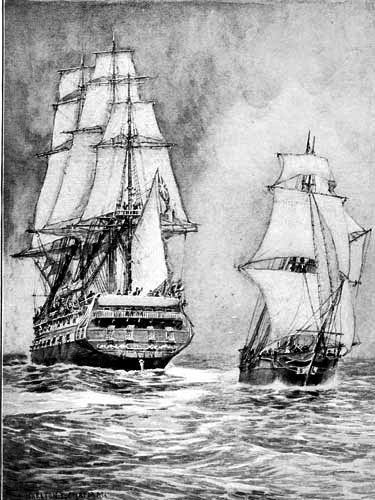
"She came about like a peg-top."
But what happened to the clumsily handled craft astern? She was immediately under the port galleries, within half a cable's length, doddering along under foresail and mainsail. At the first sign of what had occurred to the battle-ship there ensued a transformation scene.
Have you ever seen an unwilling dog accompanying its master on a walk? how he sneaks close at the heels, watching his chance when the attention is not directed to him? How suddenly he turns tail, and after a few cautious movements that bring him beyond the reach of stick or arm, he breaks into a run at full speed, disdaining call or whistle, and puts back for home? That is exactly what the Rattler did. Scarcely had the canvas of the Ajax begun the ominous fluttering that showed the change of the wind's direction, than the privateer swung off to meet it.
Slowly at first and then with a rush she came about like a peg top. Without an order being given, out broke the great foresail, the topsails dropped from the gaskets and were sheeted home, and with a lurch to leeward the Rattler stretched out back over her course for the harbor entrance, setting her flying kites as she bowled along!
So busy was everybody on board the three-decker, who had troubles of her own to look after, that no one noticed the sudden manœuvre of the privateer; no one except one of the ladies who happened to be the wife of the Admiral, for the Ajax was a flagship. She, after a minute, succeeded in attracting the attention of one of the lieutenants, who with the rest had gone forward to the break of the poop and was watching what was going on below and above him.
"The little ship," she inquired innocently, "where is she going?"
The officer turned and immediately had to beg the lady's pardon most abjectly, for he broke forth into an oath.
"Tricked, after all!" he exclaimed, grasping one of his companions by the arm and pointing.
But there was one other person who had noticed all these goings on. It was the prisoner on the lower spar-deck.
"You can soak me for a squilgee if that weren't neat," he chuckled, and then lifting his hands to his cheeks, he roared out something through the port.
The Rattler's Captain, who was at the wheel, had jumped as if the Ajax had suddenly whirled about and let fly a broadside at him, for he heard the words as plain as could be.
"Good-by, Captain Symington! Give my regards to all at home!"
He recognized his old friend Edgar's voice, and it gave him a thrill of pleasure to know that he was alive even if he was a prisoner.
The Ajax was still in stays; but her commander found time to fire his battery of stern-chasers, the balls whistling harmlessly past the Rattler's stern, missing her widely. In reply to this Captain Symington again lifted his old beaver hat.
Far away to the leeward were the sails of the blockading squadron. Attracted by the firing of the Ajax, they flew their little flags and crowded on their canvas. But by this time the Rattler had doubled the point and was making out into the dancing waters of the Channel. And who was going to touch her where she had sea-room? As if anxious to have everything understood, Symington raised his ensign. The English captain, who had been forced to boxhaul his great vessel in order to avoid running on the shoals, cursed beneath his breath. One of the ladies turned to the Admiral's wife.
"I wonder why we did not start after her, Madame?" she asked.
"Oh, because we couldn't turn round quick enough, I suppose," she rejoined. Then turning to her spouse she asked:—
"Was not that it, Sir John?"
"Yes, my dear," responded the Admiral, grimly; "that was just it."
Down below, Captain Edgar had not yet recovered from his laughing fit; and when he and Captain Myron Symington met again, as they did many times afterwards, they used to laugh over it together.
THE NARRAGANSETT
"Twenty of those confounded Yankees give me more trouble than three decks full of Frenchmen," remarked Captain Brower of the prison-ship Spartan, one of the fleet of dismantled battle-ships that thronged the harbor of Plymouth, England.
Lieutenant Barnard, commanding the neat little sloop of war Sparrow, then on the guard station, laughed.
"They are troublesome beggars, sure enough," he said; "but the funny thing is that they behave almost exactly the way our fellows do, or at least would under the same circumstances; that I verily believe."
"Well, such insolence and impudence I never saw in my life," returned Brower. "I shall be glad when I get rid of this last batch and will rest easy when they have been sent ashore to Dartmoor. You should have seen the way they behaved about two weeks ago. Let me see, it was the evening of the fourth, I believe. In fact the whole day through they were at it—skylarking and speech-making and singing."
It was July, 1814. Many vessels in the government service of Great Britain, returning from America, or from the high seas, brought into Plymouth crews of American vessels, and not a few of the troops captured about the Lakes and on the Canadian frontier had been brought over also. They were usually kept on board one of the prison hulks for three or four months; sometimes it was a year or more before they were transferred to the military prisons, the largest of which was situated at Dartmoor, and the second in size at Stapleton, not far from the town of Gloucester. Although the prison-ships and the prisons themselves were crowded with Frenchmen, the Yankees were three or four times as much trouble to control and to command. When they were not planning to escape, they were generally bothering the sentinels, drawing up petitions, or having some row or other, if only for the fun of turning out the guard.
"I wish somebody else had this position," grumbled Captain Brower, pouring out a glass of port. "I don't think that I was made for it. When I am left alone, I am liable to become too lenient, and when I am angered, perhaps I may be too hasty.... At any rate, I wish some one else was here in my place.... I had to laugh the other day, though; you know old Bagwigge of the Germanicus, here alongside, what a hot-tempered, testy old fellow he is? Well, the other day he was walking up and down his old quarter-deck, and about fourscore of my Yankee prisoners were up on deck for air and exercise. Suddenly they began singing. Now, I don't object to that; if they'd never do anything worse, I'd be happy. They've only cut four holes through different parts of this ship, and once well-nigh scuttled her; but never mind; to go on: Bagwigge, he walks to the side and shouts across to my vessel: 'Hi, there! you confounded Yankees! avast that everlasting row.' I didn't see that it was any of his business, as it was on my own ship; but the Yankees—I wish you had seen them, Barnard, upon my soul."
"What did they do? Slanged him, I suppose, terrible."
"Well, you see," continued Captain Brower, "the potatoes had just been given out for the use of the prison mess cooks, and three big baskets of them lay there on the deck. One of the Yankees threw a potato that caught old Captain B. fair and square on the side of his head, capsizing his hat and nearly fetching away his ear. 'You insolent villains!' he cried, almost jumping up on the rail, 'I'll make you sweat your blood for this.' Well, ha, ha, not only one potato was thrown this time, but about half a bushel. I' faith, but those rascals were good shots. Old Bagwigge, he was raked fore and aft. Turning, he ran for it, and dove in the cabin."
The younger man laughed. The officer about whom the tale had been told was not popular in the service. He had had no Americans on board his prison hulk, and the Frenchmen who were temporarily his guests trembled at his frown and cringed at his gesture. He was an overbearing, hot-tempered martinet, and was hated accordingly. But this was not the end of Captain Brower's story, and as soon as the Lieutenant had stopped laughing, he resumed:—
"Let me go on, for I haven't finished yet. When Bagwigge returned, he had with him a file of marines. Up he marches 'em, and the Yankees greeted them with a cheer, and then seeing that the Captain was going to speak to them, they desisted to let him talk.
"'Now,' he said, 'you impudent scoundrels, below with you; every mother's son of you, or I'll——' He hadn't got any farther than that when the same fellow who threw the first potato hit him again. He was only about forty feet away, you know, and with such force was the vegetable thrown that it nearly took his head off his shoulders. 'Fire!' he roared. 'Fire at them!' I doubt whether the marines could have taken aim, they were so busy dodging potatoes, and as for Bagwigge himself, he was jumping, bubbling, and sizzling like a blob of butter in a skillet. I rushed forward and jumped on to the forecastle rail.
"'If you dare fire, Captain Bagwigge,' I cried, 'you'll swing for it!' At this, he dove down the companionway again, with his marines after him. I turned to the prisoners and ordered them below, where they went readily enough. As to Bagwigge, I don't suppose that I'll hear from him again; I hope that he will attend to his own vessel and leave mine alone."
All this conversation, or at least the relation of Captain Brower's story, had taken place in the Spartan's cabin, and when the two officers left, a detail of the prisoners was on the deck, walking briskly back and forth under the eyes of armed sentries, who guarded the gangways and patrolled narrow board walks, raised some two or three feet above the hammock-nettings.
"Do you see that tall, brown fellow, there?" asked Captain Brower, pointing. "He is the one who did such sharp shooting with the potatoes."
"A strange-looking creature, surely," responded the Commander of the Sparrow. "He looks a half-tamed man. Well, I wish you less trouble and all success. Good day to you; I have to return to my ship."
Brower turned and went back into his cabin. Although he did not know it, and would have denied it if he had been told the truth, he was exactly the man for the position, for he was just and painstaking, humane and careful. Although there had been all sorts of attempts to escape formulated among the Yankees, and almost carried into successful execution, Brower had not lost a single prisoner, and his presence among them could restore order and quell a disturbance better than the parading of a file of soldiers.
They were a strange lot, these captives. They came from all walks of life, and from every sort of place. Raw militiamen, who had been surrendered by Hull (the army Hull, mark you, not the brave Commodore), privateersmen, captured in all sorts of crafts and dressed in all fashions, but now principally in rags, and men-of-warsmen who had given themselves up while serving on board English ships rather than fight against their country. These last held themselves rather aloof from the others and messed by themselves. Poor devils, they had never had the satisfaction, even, of having struck a blow. They had turned from one kind of slavery to another; that was all.
The tall, odd-looking figure that Captain Brower had pointed out, belonged to the wildest mess on the orlop deck. His appearance might, perhaps, be called startling; he was far from ill-looking, with straight aquiline features, deep-set and quick black eyes that could laugh or look cruel almost at the same moment. His teeth were beautifully white and even, and although he was not heavy or compact looking, he was as strong almost as any two other men on board the ship. He spoke English without an accent, but with an odd form and phrasing that would have attracted attention to him anywhere. His clear skin was the color of new copper sheathing, and his straight black hair that was gathered sailor fashion into a queue was as coarse as a horse's mane. The grandson of a chief he was, a descendant of the line of kings that had ruled the Narragansett tribes—a full-blooded Indian. But he rejoiced in no fine name. A sailor before the mast he had been since his sixteenth year, and he had appeared on the books of the privateer brig Teaser as John Vance, A.B. It is a wrong supposition that an Indian will never laugh or that he is not a fun-maker. John Vance was constantly skylarking, and he was a leader in that, as he was in almost all the games of skill or strength. Every one liked him, and to a certain extent he was feared, for a tale was told in which John and a knife figured extensively. The flash that would come into his eye gave warning often when the danger limit was being approached, yet he was popular, and even the detested marine guard treated him with some deference. In the last attempt to escape, the Narragansett had been captured after he had swum half-way to the shore and had dived more than twenty times to escape musket-balls from the guard-ships. Suddenly the order came "Prisoners below"—and the ship-bell struck eight sonorous strokes. As the last four or five men left the deck, the Indian touched one of them upon the shoulder.
"Watch me," he said, "and say nothing."
There was a narrow door in a bulkhead close to the companionway, but out of reach unless there was something like a box or barrel on which to stand. It was closed by a padlock thrust through two iron staples. As John descended, he caught the combing of the hatch and drew himself up to a level with his chin. Holding himself there with one arm, he reached forward and caught the padlock in his brown, sinewy fingers. Slowly he turned his hand. The iron bent and gave a little. A grin crossed his face. Swinging himself forward, he landed on a man's shoulders beneath him, and with a wild warwhoop he tumbled a half-dozen down the rest of the ladder, and they sprawled in a heap on the deck. Disdaining to notice the half-humorous curses, he sprang to his feet. Three other men who belonged to his mess followed him.
"Can you do it, Red?" asked one.
"Yes, surely," John replied. "So I can to-night."
The whole of the gun-deck forward of the forecastle hatch had been divided, by a strong partition, into a sort of storeroom. There was one entrance into it from above from the topgallant forecastle, where part of the marine guard were stationed, and the other opening onto the hatchway, to be used in case of emergency.
It was just past the midnight watch when four stealthy figures crept out from the shadows into the light of the dingy lantern that hung at the foot of the companionway. At night there was only one sentry stationed there, and he generally sat halfway up the ladder, and it was impossible for the prisoners to tell without crossing the dead-line that was drawn at night whether he was asleep or not. This was the risk that had to be undertaken; for if the man should see any one pass beneath that old rope that was drawn across the deck, he would have a right to fire. If the fellow was asleep, yet to gain the deck above, the venturesome prisoner would have to pass within arm's length of him.
Perhaps John Vance had inherited from his long line of red ancestors the peculiar knack of moving without sound, the art of crawling on his belly like a snake, perhaps he had a acquired it by constant practice since he had been a prisoner. For it was his boast, and one that had been proved to be true, that contrary to rules he had visited every part of the ship, and after hours; as has been told, he had been retaken a number of times when just on the point of making good his escape.
The three seamen who accompanied him on this occasion could see the legs of the sentry from the knee down, as he sat on the steps of the ladder leading to the berth-deck above. They could also see the butt of his musket as it rested beside him. Vance had disappeared in the black shadow that lay along the starboard side, and now the watchers saw a curious thing take place. The sentry's musket suddenly tilted forward, as if of its own volition, and then disappeared backward into the darkness, without a sound, much in the manner of a vanishing slide in a magic lantern. The man's legs did not move.
"He is asleep," whispered Ned Thornton to Bill Pratt.
"He's asleep," reiterated Bill Pratt to Gabe Sackett, who made the fourth one of the "constant plotters," as they were termed by the other prisoners.
But in one minute that sentry was seen to be very wide awake indeed. That is, if movement signified wakefulness. His legs shot out in two vicious and sudden kicks. A hand, with wide-spread, reaching fingers, stretched out as if searching for the missing musket. The man wriggled from one side to another and floundered helplessly, with his body half-way off the edge of the ladder. But not one sound did he utter!
"Red's got hold of him," croaked Thornton, and with the assurance of hunters who had watched their quarry step into the trap that held him fast, they stepped forward without fear or caution.
It was as Thornton had said. The poor sentry's head was wedged against the steps. Around his throat were clasped the fingers of two sinewy, bronze-colored hands that held the victim as closely and in as deadly a clasp as might the strap of the Spanish garrote. The scene was really horrible. Sackett leaned about the edge of the ladder, and then he saw what a wonderful thing the Narragansett had done. The combing of the hatchway was fully six feet from where the sentry sat. Below yawned the black abyss into the mid-hold. Across this Vance had been forced to lean, balancing himself with one hand when he relieved the sentry of his musket, and then springing forward he had caught him from behind, about the throat. There the Indian hung as a man might hang over the mouth of a well. No wonder the unfortunate marine had been unable to cry out!
"Let go of him, Red," whispered Gabe. "You've choked him enough." The Indian stretched out one of his feet and hooked it over the hatch combing. With a supple movement and without a stumble, he stood erect upon the deck. The sentry would have plunged over into the hold, had not the two others grasped him firmly by the shoulders. They carried him to one side and laid him in the deep shadow against a bulkhead. He was breathing, but insensible.
The rest of the escape can be told in a few words: The lock of the door leading into the storeroom was wrenched away, and noiselessly the four entered, closing it behind them. They had been just in time, for they could hear, on the deck above, the new watch coming on. A port on one side of the storeroom was guarded by three flimsy iron bars. There was enough light outside from the young moon to show the direction of the opening.
Vance bent the irons double at the first attempt. They were almost twenty feet above the water, for the old hulk floated high. But everything seemed working for the furtherance of their plan. There was a new coil of rope on the deck, and looking out of the port right beneath them, they could see a ship's dingy with the oars in it. Sackett slid down first; the other two followed, and Vance remained until the last. No sooner had he made the boat in safety than a great hubbub and confusion sounded through the ship. There came a sharp blare of a bugle, the rolling of the alarm drum, and they could hear the slamming of the heavy hatches that prevented communication from one part of the vessel to the other. The prisoners, cooped up below, knew what it all meant. Some one was out, and there in the pitch darkness they fell to cheering.
But to return to the "constant plotters," in the dingy: they had made but a dozen boat's-lengths when they were discovered, for there was light enough to see objects a long distance across the water. There came a quick hail, followed by a spurt of flame.
"Lord!" Pratt, who was pulling stroke oar with Sackett alongside of him, groaned; "I caught that in the shoulder." One of his arms drooped helplessly, but he continued rowing with the other.
"Let go," grunted Sackett; "I can work it alone—lie down in the stern sheets."
There were three or four vessels, mostly prison or sheer hulks, to be passed before they gained the shore. From each one there came a volley. Poor Sackett received a ball through his lungs and fell into the bottom of the boat, bleeding badly. And now the boats were after them!
Vance and Thornton pulled lustily at the oars; but the others gained a foot in every four. The dingy was splintered by the hail of musket-balls. One of the prison hulks—the last they had to pass—let go a carronade loaded with grape. It awoke the echoes of the old town. So close was the charge delivered that it had hardly time to scatter, and churned the water into foam just astern of the little boat as if some one had dumped a bushel of gravel stones into the waters of the harbor. Not three hundred feet ahead of the foremost pursuing boat, the dingy's keel grated on the shingle.
The Narragansett sprang out, Thornton after him. Sackett could not be raised. Pratt, holding his wounded and disabled arm, staggered up the incline towards some stone steps leading to the roadway above. But he had hardly reached the foot when there came another shot. He fell face downward and made no attempt to rise. Sackett and he would join in no more plots; but Vance and Thornton were now running down a side street.
They dodged about a corner into an alley; crossed a small common, and just as they reached the other side they ran, bows on, into a heavy cloaked figure, who, seeing their haste, hailed them peremptorily, and sprang a huge rattle, making much the same noise that a small boy does when he runs down a picket fence with a stick. Thornton was laboring ahead like a wherry in a tideway. But the Indian was striding along like a racehorse, with the easy, springing gait inherited from his own father, "Chief Fleetfoot," who, if the story told be true, could run down a red deer in the woods. He turned to assist his comrade by taking hold of him and giving him a tow. But as he did so, Thornton's foot struck a round stone and he fell forward, and lay there groaning.
"Run on, Red! run on!" he cried breathlessly. "I've broken a leg; something's carried away in my pins; on with you!"
"Come you with me too," answered the Narragansett, pulling Thornton to his feet with one hand; but the poor lad groaned and fell again.
"Run ahead, curse you!" he said. "Don't stay here and be taken!"
The watchman's rattle had attracted the notice of the people in the houses. Windows were opened and heads were thrust forth, and from about a corner came another cloaked figure carrying a lantern, and a big pike was in his hand.
There was nothing else to do, and, obeying Thornton's angry order, the Indian struck out again into his long distance-covering gait. Which way he ran it made little matter to him. He did not know the country; he had no plans; but the feel of the springy earth beneath his feet was good to him. The sight of the stars shining through the branches of the trees overhead—for he had soon reached the open country and left the town behind him—made him breathe the air in long, deep breaths, and tempted him to shout. It was freedom; liberty! The dim moonlight softened everything, and to his mind he seemed to be flying. He passed by great stone archways leading to private parks and great estates. Twice he had avoided little hamlets of thatched cottages. Once he had run full speed through the streets of a little village, and had been hailed by the watchman, who sprang his harmless rattle. But it was growing light. He must find some place to hide, for travel during the daytime he knew he could not. Leaping a fence, he made his way into an adjoining field and lay down, panting, beneath some bushes.
Soon cocks began to crow; daylight widened; a bell in an ivy-covered tower tolled musically. Insects commenced their morning hum; birds twittered, and people moved out to their toil. From his hiding-place the Narragansett watched the unusual sight. In a field below him—for he lay at the top of a small hill—he could see some men and women working in a field of grain. One of the girls had placed a basket beneath the shade of a bush. The Indian was hungry. It required little trouble to snake himself through the grass and secure the contents of the little hamper, a loaf of bread and a large piece of cheese. Then he carefully replaced the cover and stole back to his former hiding-place. Soon he observed, in the road below him, a man riding along at a fast gait; he pulled in his horse and shouted something to the workers in the field. This done, he rode at top speed into the village. Very soon another horseman appeared, and soon quite a little band of them, among whom was a mounted soldier or two, and three or four in the pink coats of the hunting-field.
But near footsteps sounded. A man in leather gaiters, with a fowling-piece over his shoulder, was coming down a little path from some deep woods on the right. A setter dog played in front of him. The man was reading a freshly printed notice. The ink was smeared from handling. The man spelled it out aloud. "Escaped from the hulks; a dangerous prisoner; a wild American Indian; ten pounds reward," and much more of it.
All of a sudden the dog stopped; then with a short bark, he sprang forward. At the same instant the gamekeeper dropped the printed notice that had been handed to him but a minute previously by a horseman on the road. Surely he could not be mistaken, something had dodged down behind yonder hedge; and as the setter sprang forward, barking viciously, a strange figure arose, a man with a copper-colored face, and streaming, unkempt, black locks; he wore big gold ear-rings, and he was clad in a torn canvas shirt and trousers, with a sailor's neckerchief around his throat. The dog was bounding forward when suddenly the figure raised its arm. No cricketer that ever played on the village green could throw with such unerring force. A large stone struck the dog and took the fight out of him. Yelping, he sneaked back to his master's heels. The startled gamekeeper raised his gun and fired. Whether it was because of his sudden fright or the quickness with which the agile figure dropped at the flash, the charge whistled harmlessly through the leaves. But the sound of the shot had attracted the attention of the people in the fields. A cry arose, as a weird figure broke from the bushes and dashed down the hill, making for the woods.
"Gone away! gone away! whoop, hi!"—the view hallo of the huntsman.
A man in a red coat had sighted the chase. He leaped a fence, and four or five other horsemen followed. Soon there came the shrill yelping of the dogs as they found the plain trail of the barefoot man running for his life.
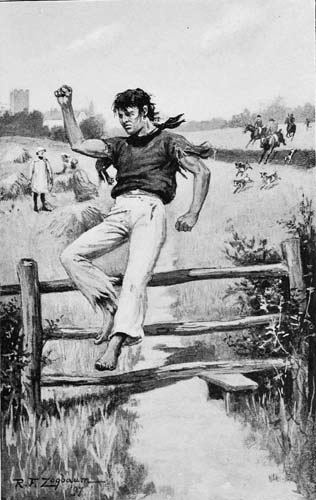
"Over fence and hedge."
It was a great run, that man-hunt, and one remembered to this day. Over fence and hedge, across ditch and stream, the Narragansett led them. No trained hurdler that ever ran across country in the county of Devonshire could have held the pace that Vance kept up. Twice he threw them off the scent by running up a stream and doubling on his tracks. But the whole countryside was out and after him. The dogs were gaining on him swiftly, and at last at the foot of a great oak they had him cornered. He fought them off with a broken branch, and soon the pack surrounded him in a yelping circle, not daring to come nearer.
Up came the huntsmen. They halted at some distance and talked among themselves. Who among them was brave enough to go up and lay hold of this strange wild man? They called off the dogs and waited for the soldiers. Eight or ten yokels and some farmer folks joined the gaping crowd. Five men appeared with muskets, and one with a long coil of rope. But all this time the Narragansett had stood there with his back against an oak tree, with a sneer on his thin lips. They talked aloud as to how they should capture him. Some were for shooting him down at once; but as yet no one had addressed a word to him direct. Surely, he must speak an outlandish foreign tongue! Suddenly, the fugitive took a step forward and raised his hand.
"Englishmen," he said, "listen to me."
All started back in astonishment. Why, this wild man spoke their own language!
"Who is the chief here? Who is the captain?" Every one looked at a middle-aged man astride a sturdy brown cob. He was the Squire, and magistrate of the neighborhood.
"Well, upon my soul," he began, "I suppose——"
But the Narragansett interrupted him. "To you I give myself," he said, advancing. He glanced at the others with supreme contempt. As he came forward, he held out his hand, and involuntarily the man on horseback stretched forth his. It was a strange sight, that greeting. The crowd gave way a little, and three or four mounted dragoons came tearing up hill. They stopped in astonishment.
"You gave us a good run," said the Squire, with some embarrassment, not knowing what to say.
"You are too many; I am your prisoner," was the answer.
No one laid hands on him. Walking beside the Squire's horse down to the road, followed by the gaping, gabbling crowd, who still, however, kept aloof, the Narragansett walked proudly erect. When he reached the highway, he turned. There was a cart standing there. The Squire dismounted from his horse and spoke a few words to the driver. Then he mounted to the seat. John Vance sprang up beside him. At a brisk pace they started down the road towards Portsmouth, the soldiers and the horsemen trailing on behind them. At the landing where the boat from the old Spartan met them—for a horseman had ridden on with the news—was waiting a sergeant of marines. He advanced with a pair of handcuffs.
"None of that!" exclaimed the Squire. "This man has given me his word."
"The word of a chief's son," put in the Narragansett. The two men shook hands again; then proudly John Vance stepped into the boat, and unmanacled sat there in the stern sheets.
In twenty minutes he was once more down in the close, foul-smelling 'tween decks.
The only notice taken of the Narragansett's break for liberty was the fact that he was numbered among the next detail bound for Dartmoor; but the tradition of the man-hunt of Squire Knowlton's hounds, and its curious ending, lives in Devonshire to-day.
FIGHTING STEWART
An old sailor sat on the Constitution's forecastle, with his back against the carriage of one of the forward carronades. He was skilfully unwinding a skein of spun yarn which he held over his two bare feet, while at the same time he rolled the ball deftly with his stubby, jointless fingers. A young boy, not over fourteen years of age, lay sprawled flat on the deck beside him, his chin supported in the hollows of his two hands, his elbows on the deck.
"It comes all along o' drinkin' rum, says I," went on the old sailor, continuing some tale he had been telling. "That, I claims, is the reason for many unfortunate doin's; and that is why all them men I was tellin' you about was eat by the cannibals."
"I don't see as it made any difference," broke in the boy, "except perhaps in the taste. If they were bent on going where they did, they'd have been eaten anyhow, wouldn't they?"
"As to that," returned the old sailor, "I contradict ye. Rum sometimes makes a fellow want to fight when it's a tarnel sight braver to run; that is, upon some occashuns."
"Some folks get so they can't even wiggle, let alone run," observed the boy. "I saw our bo'sun——"
"Don't speak uncharitable of your neighbors, son," observed the old man. "All I can say is that I don't take no stock in grog; thereby being' the peculiarest man in the service, I dessay. I've seen lessons, as I was tellin' ye. You see, all those friends of mine would been livin' to-day if they hadn't taken on cargoes of that thar African wine. Yes, they got to suppose that they could lick about twenty times their weight of black niggers, and so they started in, and never come back. But I, not drinkin' nothin', jes' kep' by the boat, an' when them savages come after me, I warn't there. Had a terrible time gettin' off to the ship all alone; but I done it, an' thar's the best temperance lecture I know of. I got a hull lot of texts out of the Good Book; but most people won't listen to 'em; leastways on board of this ship."
"I reckon you are the only man what don't take his grog here," said the boy.
"That I be," returned the old sailor, "and, by Sal, I'm proud of it! 'No, thankee, messmate,' says I when it comes around, 'I don't need that to keep my chronometer goin'.' Then they all laughs generally, and calls me a fresh-water moss-back. Some day 'an I'll git even with 'em."
Old Renwick, although somewhat of a butt of the crew, was respected nevertheless because of his being a good seaman, and because he also had made a record for himself in the old days during the war with France and the adventurous times with Preble in the Mediterranean. He was a great favorite with Captain Stewart, then the Commander of the old frigate, and by him he had been promoted to the position of quartermaster. He would never have succeeded in qualifying for the position of boatswain or for any higher grade than that which he now held, for the simple reason that the old fellow was too lenient in his discipline and too ready to condole with the faults of others except where rum was concerned.
It was Renwick's greatest delight to secure a solitary and attentive listener and spin a long yarn to him. He spoke without the usual profane punctuation,—the habit of most seamen,—and when off watch he read his Bible most assiduously. He had had many adventures in his forty-four years at sea, and his memory being a most retentive one, it required little excuse for him to start on a long mental peregrination through the laden fields of his memory.
Many were the occasions when the boy found time to become Renwick's solitary auditor. The lad was bright, and this was but his second voyage at sea. He was one of those children who, although born inland and away from the smell of the ocean, still must inherit from their ancestors the keen desire to seek adventures and see strange countries—he dreamed of ships and the deep. Once firmly rooted, this feeling never dies; despite hardships, wrecks, and disasters, the sailor returns to his calling.
The boy had never seen an action. But he had rejoiced with the rest at America's many victories; he had joined with the crowd that had followed the parading sailors in New York after Hull's great victory, and he had peeped in at the window of the hotel upon the occasion of the dinner given to Decatur and to Bainbridge and to the Guerrière's conqueror—all this while on a visit to the city from his home in the mountains of New Jersey. And thus inflamed with the idea, he had run away to sea, and had made his first voyage, eight or ten months previous to the opening of the story, in a little privateer that had an uneventful cruise and returned to port after taking two small prizes that had offered no resistance. His entering on board the Constitution had been with the permission of his parents, who saw that the only way to hold him from following his bent would be to keep him at home forever under their watchful eyes.
A great war-ship is a small floating world, and, like the world, the dangers that beset a young man starting alone on his career are many. There are the good and the bad, the leaders and the led; the people who lift up others, and those who lean. It was rather well for the boy that he had met with old Renwick and conceived a friendship for him. From the old sailor the lad had learned much. He was an expert at tying knots already, and he had learned to hand, reef, and steer after a fashion on board the privateer schooner. The royal yards on a man-of-war are always manned by boys, because of their agility and lightness. This boy was a born topman; he exulted in the sense of freedom that comes to one when laying out upon a swaying yard; the bounding exhilaration of the heart, the exciting quickening of the pulse as the great mass describes arcs of huge circles as the vessel far below swings and rises through the seas.
The attention of the officers had been called to him more than once, and if there was a ticklish job aloft above the cross-trees, the boy was sent to perform it. On one occasion he had excited a reprimand for riding down a backstay head foremost, the First Lieutenant observing, and speaking to him thus: "While that would do for a circus, it wasn't the thing for shipboard." But he was a perfect monkey with the ropes, and nothing delighted him better than scampering up the shrouds, or shinning to the main truck to disengage the pennant halliards. He used to sing, in his shrill, high voice, even when struggling to get in the stiffened canvas in a gale.
On the 20th of February (the year was 1815) the First Lieutenant made the early morning inspection of the ship. He had hoped that the clouds and thickness that had prevailed for a few days would disappear, for it seemed as if for once "Old Ironsides" was pursued by the demon of bad luck in the way of weather. At one p.m., after a fruitless attempt to catch a glimpse of the sun for a noonday sight, the clouds broke away and the breeze freshened. The boy and his companions jumped at the orders to "shorten sail and take in the royals." Quickly they climbed the shrouds, passed one great yard after another in their upward journey, and came at last to the royals. The boy was first. He looked down at the narrow deck below him, and at the curved surfaces of the billowing sails. It seemed as if his weight alone would suffice to overturn the vessel. The lightness and delicacy of the entire fabric were never so apparent to him. He could see his companions crawling up, their faces lifted, and panting from their exertions. The sunlight cast dark blue shadows on the sails below. Two great ridges of foam stretched out from the Constitution's bows. The taut sheets had begun to hum under the stress of the increasing breeze. The boy began to chant his strange song—a song of pure exhilaration.
With so many light kites flying, something might carry away at any moment, however, and he heard the officer of the deck shout up for them to hasten. Then he let his eyes rove toward the horizon line as he took his position in the bunt.
Far away against the sky where the clouds shut down upon the water, he saw a speck of white! Leaning back from the yard, he drew a long breath; those on deck stopped their work for an instant, the officer took a step sideways in order the better to see the masthead.
"Sail ho!" clear and distant had come down from the royal yard.
"Where away?" called the officer, making a trumpet of his hands.
"Two points off the larboard bow, sir," was the reply.
"Clew up and clew down," was now the order. The steersman climbed the wheel, and with a great bone in her teeth the Constitution hauled her wind and made sail in chase of the distant stranger. In a quarter of an hour she was made out to be a ship, and then came the cry a second time: "Sail ho!" There was another vessel ahead of the first! A half an hour more, and both were discovered to be ships standing close-hauled, with their starboard tacks on board. At eight bells in the afternoon they were in plain sight from the deck, little signal flags creeping up and down their halliards—ship fashion, they were holding consultation. Then the weathermost bore up for her consort, who was about ten miles distant and to leeward; and crowding on everything she could carry again, the Constitution boiled along after her. The lower, topmast, topgallant, and royal studding-sails were thrown out, and hand over hand she overhauled them.
The boy was aloft again. He had caught the fever of excitement that even the old hands felt, as they saw that the magazine was open and that powder and shot were being dealt out for the divisions. The half-ports to leeward had to be kept closed to prevent the water from flooding the decks.
The boy stayed after the other youngsters had descended. He could feel the royal mast swaying and whipping like a fishing-rod—the stays were as tight as the strings of a fiddle. They felt like iron to the grasp; they had narrowed under the tension. The wind in the deep sails below played a sonorous bass to the high treble of their singing. The ship was murmuring like a hive, now and then creaking as she lurched under the pressure.
How it happened the boy never knew; but as suddenly as winking there came a report as of a cannon aloft; the main royal, upon the yard of which he was leaning, flew off, and caught by the tacks and sheets, fell down across the yard below. The main-topgallant mast had been carried clean away. No one, not even the boy himself, knew how it all occurred. Perhaps he had laid hold of one of the reef points. Perhaps he had made a lucky jump. But there he lay in the bight made by the folds of the royal, softly resting against the bosom of the sail below, unhurt, but slightly dizzy. From the hamper of wreckage above hung one of the loosened clew-lines. The end of it reached down to the cross-trees. Reaching forth, the young topman tested it, and seeing it would hold, emerged from his hanging nest, and swinging free for an instant, managed with his monkey-like powers to lay hold of a stay and reach the shrouds. There was a cheer from below, as he sprang to the deck, and this time there was no reprimand.
The loss of her upper sails appeared to impede the speed of the frigate but little. It would not be long now before the bow-chasers might be expected to begin. The men were mustered on the deck. Along came the stewards and the mess-men with the customary grog.
The officers all this time had been busy surveying the two ships. An hour ago they had been pronounced to be English.
Old Renwick grumbled as he watched the men pour down the half pannikin of scalding liquor.
"Well, here's to us," chuckled a tall, red-nosed sailor, emptying the stuff down his throat as if it had been spring water. "Here's to us, and every stick in the old ship."
"We ought to get double allowance," put in another man just before it was his turn to take his portion. "There are two of 'em to fight, which makes me twice as thirsty. Here's to the best thing in the world,—grog."
Quartermaster Renwick did not like to hear all this, and overcome by a sudden impulse, he stepped out from behind the bitts. There were two buckets full of the strong-smelling drink resting on the deck. With a sweep of his foot he upset them both! A howl of rage went up from all sides. One of the men loosened a belaying-pin and advanced threateningly. The old sailor stood his ground.
"Avast this 'ere swillin', lads," he said; "there shall be no Dutch courage on board this ship." He folded his arms and stood looking at the angry crowd. The First Lieutenant had observed the whole occurrence, and immediately gave the order to beat to quarters. The boy, thinking that his old friend was about to be attacked, had jumped to his side. But his station in action was on the forecastle, where he was powder-monkey for the two forward guns.
The call to quarters and the rolling of the drum had stopped any trouble that might have arisen owing to the quartermaster's sudden action, but the men were surly, and it would have been hard for him if they could have reached him unseen.
Every second now brought the Constitution closer to the enemy. Never could the boy forget his sensations as he saw the gunners bend down and aim the forward gun on the larboard bow. The smoke from the shot blew back through the port. The gun next to it now spoke, but both balls fell short, and neither of the ships replied.
They were both ably handled, and their commanders had now reached some understanding as to the conduct of the action; for when the Constitution was yet a mile's distance from them they passed near enough to one another to speak through the trumpet.
The beginning of an action at sea, before the blood is heated by the sight of carnage and the ear accustomed to the strange sounds and the indifference to danger has grown over the consciousness of self, is the most exciting moment. There is a sense of unreality in the appearance of the enemy. If he is coming bravely up to fight, there is no hatred felt for him. Men grow intensely critical at such moments, strange to say. They admire their opponent's skill, although they are inclined to smile exultantly if they perceive he is making missteps. Captain Stewart and his officers, grouped at the side, were discussing calmly the probable designs of the enemy.
"Egad! They are hauling by the wind, and they are going to wait for us," said Stewart.
"They are not going to run, at any event," observed the First Lieutenant. "They are tidy-looking sloops of war, sir!"
In five minutes both the English vessels had made all sail, close-hauled by the wind, with the plain intention of trying to outpoint the frigate.
"No, you don't, my friends," remarked Stewart to himself. "Not if I know my ship."
The crew, who were watching the oncomers, shared his sentiment, for they knew that the Constitution was not to be beaten on that point of sailing; and the strangers soon noticed this, also, for they shortened sail and formed on a line at about half a cable's length apart. Not a shot had been fired since the two bow guns had given challenge, but now the time had come, the huge flag of the Constitution went up to the peak, and in answer both ships hoisted English ensigns. Scarce three hundred yards now separated the antagonists. The English ships had started cheering. It was the usual custom of the Anglo-Saxon to go into battle that way. Quartermaster Renwick called for three cheers from the Constitution's men, but they had not forgotten, at least some of them, his upsetting of the grog. His unpopularity at that present moment was evident, for few answered the call, and thus silently the men at the guns waited for the word to fire.
The boy was half-way down the companion ladder when it came. There was a great jar the whole vessel's length. A deafening explosion, and the fight was on!
For fifteen minutes it was hammer and tongs. Broadside after broadside was exchanged, and then it was noticed that the English had begun to slacken their return; and now they suddenly were silent. A strange phenomenon here took place. As all the combatants were close-hauled and the wind was light, a great bank of opaque sulphurous smoke had gathered all about them. The Constitution ceased firing, also; for although the enemy was within two hundred yards' distance, not a sight of either ship could be seen. They were blotted out; their condition and their exact positions were unknown. Not a gun was fired for three minutes, and then the smoke cleared away.
"Here they are!" cried Stewart, and his exclamation was drowned with a broadside, for the gunners of the Constitution had discovered that the headmost ship was just abreast of them and but a hundred feet away. The sternmost was luffing up with the intention of reaching the Constitution's quarter. The smoke from the big guns had hidden everything again, but orders were now coming fast from the quarter-deck. Men were hastening aloft, and others were tailing on to the braces, tacks, and sheets. The main and mizzen top-sails were braced aback against the mast, and slowly the Constitution began to move stern foremost through the water. It was as if nowadays the order had come to reverse the engines at full speed. All the sailors saw the importance of this act. They were cheering now, and they had good right to do so. Instead of finding herself on the larboard side and in good position for raking, the English vessel was in a very bad position. It must have astonished her commander to find himself so unexpectedly confronted, but he was directly beneath the Constitution's guns again. There was no help for it. He was forced to receive her fire. The big sloop of war, which had been deserted so unceremoniously, kept on making a great hubbub, aiming at the place where she supposed the Yankee frigate yet to be.
To repeat all the details of the rest of the struggle would be but to recount a tale filled with the detailed working of a ship and nautical expressions, but it is safe to state that never was a vessel better handled, and never did a captain win a title more honestly than did Charles Stewart the sobriquet of "Fighting Stewart."
It was ten minutes of seven in the evening when the first English vessel struck her flag. She proved to be His Britannic Majesty's sloop of war Cyane, under the command of Captain Gordon Falcon, a gallant officer, and one who had earned distinction in the service. His ship, that he had fought bravely, mounted thirty-four guns. He was so overcome with emotion at having to surrender, that he could scarcely return Captain Stewart's greeting when he came on board, for he had entered the fight declaring that he was going to receive the Yankee's sword. As soon as he had placed a prize crew on board the Cyane, Stewart headed the Constitution for the other sloop of war, who was doing her best to get away. So fast did he overhaul her that the Levant—for that was her name—turned back to meet her big opponent, and bravely prepared to fight it out. But it was no use, and after some firing and manœuvring Captain George Douglass struck his colors, as his friend Falcon had been forced to do some time earlier.
But what of old Renwick and the boy? They lay below in the cockpit—the old man with a shattered leg and the hero of the royal yard with a bad splinter wound across his chest. Men forget their wounds in moments of great mental excitement; since he had been brought below, the quartermaster had been following every movement of the ship as if he had been on deck.
"We are luffing up," he would say. "Ah! there we go, we headed her that time! By tar, my hearties, we will win the day! Hark to 'em! Hear 'em bark!" And so he kept it up, regardless of the fact that his shattered leg was soon to be taken off; and all of the thirteen wounded men there under the surgeon's care listened to him, and when the news came down that the first vessel had struck, Renwick called for cheers, and they were given this time with a will!
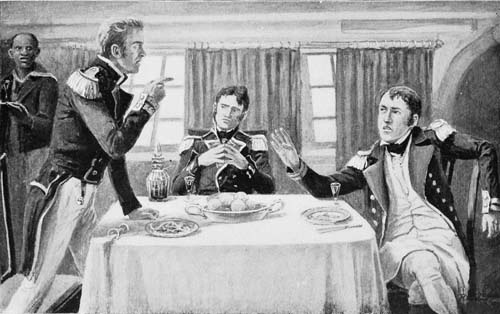
"A discussion that grew more heated every moment."
Three or four days after the fight, Captain Stewart was dining in his cabin, and as usual his guests were the English captains, who had not yet entirely recovered from the deep chagrin incident to their surrender. How it started, no one exactly knew. It is not on record which of the gentlemen was at fault for the beginning of the quarrel, but they were fighting their battles over again in a discussion that grew more heated every moment. Suddenly one of the officers, jumping to his feet, accused the other of being responsible for what he termed "the unfortunate conclusion of the whole affair." Hot words were exchanged. Stewart, who, of course, had his own opinions on the matter in question, said nothing, until at last he perceived that things might be going too far, and it was time for him to interfere. Smiling blandly, and looking from one of the angry men to the other, he spoke as follows:—
"Gentlemen, there is only one way that I see, to decide this question,—to put you both on your ships again, give you back your crews, and try it over."
This ended the argument, but the story went the rounds of the ship, and one of the lieutenants in writing to a brother officer described the incident in those exact words.
Quartermaster Renwick survived the loss of his leg, and he used to relate the story of how and where he lost it to the youngsters who would gather about his favorite bench fronting the Battery seawall.
The boy recovered also, and he served his country until they laid him on the shelf after the Civil War was over. Very nearly forty years had he passed in the navy, where he grew to be a great hand at yarn-spinning, and was much quoted, for he linked the service back to the days of wind and sail, although he had lived to see the era of steam and steel. His favorite story of them all was of the old Constitution and how she behaved under the command of "Fighting Stewart."
TWO DUELS
"Oh, Bainbridge, you're going ashore with us, aren't you?"
At these words a young man who was walking up and down the frigate's quarter-deck turned quickly. He was dressed in the same uniform as the one who had just asked the question,—that of a midshipman of the American navy.
"Not if you are starting at once, Raymond," he replied. "I won't be off duty for a quarter of an hour. Is the boat ready?"
"Not yet—maybe you will have time—have you asked for leave?"
"I have that right enough, but I can't be in two places at once. I'd like to go, though, if I could."
"It's too bad; all the fellows were counting on your coming." And Midshipman Raymond left the quarter-deck, and strolled forward to the mast, where five or six other middies were waiting, all dressed in their best uniforms, with rows of polished brass buttons, and neat little dirks swung at their left hips by slender chains. They were impatient at the delay. Every one wished to be ashore, as it was the intention to dine together and afterwards to attend a concert at the Malta Theatre; for the Constitution was lying at anchor just off the town, and not far from the walls of the heavy fortifications that make the island England's greatest stronghold in the Eastern Mediterranean—second in importance among her possessions only to the impregnable Gibraltar.
"I hear Carlotti is going to sing to-night," observed one of the midshipmen knowingly, interrupting the chorus of grumblings at the slowness of the shore boat in returning. "She's great," he added.
"How do you know?" asked a short tow-headed reefer; "you never heard her."
"No, but Bainbridge has, and he told me."
"Wish Bainbridge was going with us——"
"So do we all," was the chorus to this, and just at this moment the ship's bell clanged the hour, and the one to whom they referred ran past them. He paused at the head of the ladder.
"I'll be up in a minute; don't you fellows go without me."
With these words he jumped below, and running into the steerage, he slammed open the lid of his chest and shifted into his best uniform in "presto change" fashion. He was just in time to hasten down the ladder and leap into the boat as she shoved off from the side. There were two lieutenants going ashore, and they don't wait for tardy midshipmen.
"Quick work, Joseph," said Middy Raymond, laying his hand on Bainbridge's knee.
"Rather," was the panted reply. "Do I look shipshape? Feels as if I'd forgotten something."
"All ataunto—far as I can see."
Joseph Bainbridge was a younger brother of Commodore William Bainbridge, and like him he had gifts of popularity. He possessed a magnetic personality that attracted to him the notice of both officers and men, and a bold, adventurous spirit that won their admiration. Added to this was the fact that he was tall and strong, and conceded to be the handsomest young officer in the service.
When the boat drew up at the pier, the middies flocked off by themselves, and the two young lieutenants fell behind.
"You didn't hear the lecture,—the lecture the old man gave us while you were below, Bainbridge," said Midshipman Raymond. "Phew! but he piled it on thick in telling us how to behave ourselves. Any one might think that we were going ashore to offer challenges right and left to all the British army."
"What do you mean?" asked Bainbridge, slipping his arm through his friend's, and looking down at him, for he stood head and shoulders above the other youngsters.
"Why, just this," was the response. "The old man" (in this manner was the Commodore referred to) "says that there are plenty of fire-eating, snap-shooting 'eight-paces' chaps, just longing for a chance to pick a quarrel with a Yankee officer; and as he told us it took two to make trouble, he said he would hold us responsible if there was any row. We will have to mind our tacks and sheets. He expects us to be blind to all ugly looks, and deaf to all remarks, I suppose. Besides, we are all under promise to return by the last boat, that leaves at eleven o'clock."
"Well," observed the tall midshipman, laughing, "there seems to be no great hardship in that; we have some hours before us. Let's turn in here and get our grub—then, ho for the theatre!"
The crowd of laughing young fellows entered a café, and seated themselves quietly at a corner table. But their entrance had been observed. A group of officers, in scarlet coats and gilt braid and shoulder knots, gazed insolently at them.
"Young Yankee puppies," observed one, turning to his companions.
"Rather airy,—I should say breezy," was the rejoinder.
Before long, the fun grew fast and furious at the middies' table; laughter and even the snatch of a song broke from them. Pretty soon one of the English officers arose—the one who had first noticed their presence. He walked over to their table, and rapped on the edge with the hilt of his sword.
"Less noise, less noise here!" he said.
Bainbridge was about to spring to his feet, when Raymond restrained him. "Have a care," he said softly.
No one noticed the Englishman's presence, and slightly abashed he returned to his seat. But he covered his confusion with an air of bravado. "Taught 'em a lesson," he sniggered.
In a few minutes the whole party had adjourned to the play-house.
Carlotti sang her best, every one was enjoying the music and anxious for more, when the curtain fell on the first act. The Constitution lads applauded so long that one might have thought they wished to have the whole thing over again, which they would have liked exceedingly. But seeing at last that the prima donna would not respond,—she had been out five times,—the lads arose and strutted into the lobby in a body.
"There's that officious Britisher," said Bainbridge, nodding his head toward a group of scarlet coats that stood blocking up a doorway.
"Oh, I just heard about him," put in one of the smallest reefers. "He's Tyrone Tyler, the dead shot,—I overheard some one pointing him out. He's killed eleven men, they say."
The officer in question was tall and exceedingly slender, and he might have been called good-looking if it were not for the insolent eyes, the leering mouth, and arrogant chin that made him so conspicuous. He made some remark that caused the others to laugh as he put up his eyeglass and stared into the faces of the Yankee middies. Some reddened and dropped their glances, but Bainbridge returned the stare with interest. The Englishman frowned and let his glass fall from his eye.
"Care for cub-hunting, Twombly?" he inquired of a red-faced man at his elbow. "Here's a chance for you!"
The midshipmen heard this, but said nothing, and soon they were all lost in the theatre crowd.
During the next intermission all kept their seats but Raymond and Bainbridge, who again strolled out. The taller lad, who looked some years older than his age, which was but nineteen, attracted some attention; many looks of admiration were thrown at him as he passed through the lobby. Suddenly he collided with somebody, who pushed him off.
"Beg pardon," said Bainbridge, making way.
There was no reply, and the lad's handsome brows contracted as he saw the evil face of Captain Tyrone Tyler smiling sneeringly at him. In the course of a few minutes they met again, and once more came together.
"Beg pardon, sir."
The words had a peculiar intonation this time. They were spoken in the tone of voice one uses when compelled to move something that may disturb another. Bainbridge lifted the infantry captain past with a firm grasp on both his elbows. He moved him as easily as one might lift a lashed hammock to one side.
"Beg pardon, sir," said he again.
The officer grew livid, and had it not been that some one grasped his arm, he would have struck the midshipman across the face. But Bainbridge and Raymond moved quickly away.
As they turned to leave the hall after the performance was over the word was brought that Tyler and three others were waiting at the entrance. After a consultation it was agreed that it would be best to remain, and avoid a meeting if possible. So talking in low voices, the midshipmen stayed on until warned by the dimming lights that the place was being closed. At last a plan was settled on. Bainbridge, who was eager to go out first, was persuaded to remain with Raymond, and follow shortly after the others had left. They singled out, and when the last two stepped past the door, Tyler was still waiting.
"Now for the training," said he, stepping forward. As he spoke he put one elbow in Bainbridge's face, and with the other grasped for his collar.
But he reckoned wrongly. The middy ducked quickly and picked up his cap that had been pushed off by the blow. Then he straightened himself.
"You are a cowardly bully," he said calmly. "But I understand you. My card, sir; I am at your service."
As he spoke, he extended a bit of engraved pasteboard. Captain Tyler took it, handed it to one of his friends, and gave his name, adding:—
"I trust that you will meet me on the beach under the west fort to-morrow morning at nine o'clock."
"Can you make it earlier?"
"Certainly; at eight, then."
The Englishman laughed as he moved off with his companions.
"Be on hand, my young monkey jacket; I should hate to be turned out so early for nothing."
"Never fear," was Bainbridge's return.
"Oh, Joseph, what have you done?" wailed little Raymond, suddenly. "They will never let you off the ship, and we've broken orders, and are in a frightful mess."
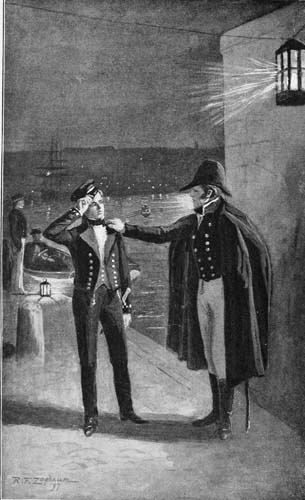
"'I observed it,' said the Lieutenant."
"I'm not going on board again, Sammy; I'm to meet that bully, and I will do it. It's either disgrace or death, and I'm reckless now. But run along, you; leave me to myself."
"I shall stay if you do," replied Raymond, stoutly. "It will never be said that——"
"Come, young gentlemen, 'tis about time you were making for the boat. Commodore Preble's orders were very strict; don't forget them."
The speaker was a tall, graceful young man, wrapped in a long watch-cloak. It was Stephen Decatur, the First Lieutenant, and the idol of the ship. He descended the few steps from the entrance to the lobby, and continued as he acknowledged the midshipmen's salute:—
"Come, let's all be moving—stir your stumps now, Mr. Raymond."
As they reached the archway of the pier, Bainbridge held back.
"Come, Mr. Bainbridge, a word with you," said Decatur, taking the lad kindly by the arm. He was but five or six years the senior, but his manner was almost fatherly. "Have you anything to tell me?"
"Yes, sir. I have broken orders."
"I observed it," said the Lieutenant. "Have you anything else to say."
"Yes, sir; unless you insist, I'd rather stay on shore to-night."
"You will return to the ship."
"Very good, sir."
In silence the party was rowed back, and in silence they climbed the side and came on deck.
Then the First Lieutenant spoke. "Mr. Bainbridge, wait on deck here until my return."
"What's up, Raymond?" asked the lads as soon as they had gone below to the steerage where they swung their hammocks. "Did Bainbridge have a row, after all? What's going to happen?"
"Don't ask me," was the reply; "you know as much as I do." Raymond concluded that it was best to keep mum on the subject, and with this he tumbled into his hammock.
Bainbridge waited up on deck for half an hour. He had not the least idea what was going to be done with him. But he was grieving bitterly. If he did not meet the Englishman, he was disgraced,—his name was known, "he owed it to the honor of the service"; for that was the way the code was established. But how could he have disobeyed the order of Decatur to proceed on board ship? That would have been impossible, also. Yet, strange to say, he did not regret his action, and he had not once felt a thrill of fear. True, Tyler was a noted man-killer, but that did not worry Bainbridge in the least. He may have been a fatalist, but that was not the only reason: he knew without bragging that he was a good shot.
Suddenly he heard some one approaching. He lifted his despondent head out of his hands. Was he going to be called into the cabin to take a rating from the fiery tongue of the Commodore. Could he stand that!
"Mr. Bainbridge."
"Yes, sir."
"Commodore Preble's orders are for me to go on shore to-morrow at seven thirty in the morning. By the way, you will go with me——"
"Oh, thank you, sir," interrupted the midshipman, his voice breaking; "thank you."
"I shall attend to everything, if you will allow me the honor."
Bainbridge put out his hand; Decatur took it without a word.
The next morning, on a narrow stretch of beach, there was a curious little gathering, or, better, two separate groups: one composed of five men talking together, and at a few paces' distance two silent figures.
The five men were conversing in whispers.
"Nevertheless, I intend doing it," said the tall slender man who was in the centre. "Do you see the button at his throat? A Yankee more or less does not count."
"Are you ready, gentlemen?"
The others stepped back, and there stood two tall figures fronting one another: each held a long heavy pistol in the right hand. The faces of the men were pale, but the midshipman was just as cool as his experienced opponent; a determined gleam was in his light blue eyes.
The officer who had last spoken began counting, and then there came a flash and one report. The pistols had been discharged at the same instant.
Bainbridge reeled slightly, and passed his hand about his throat.
"I am all right," he said calmly.
"Thank God! Then let's be off," was Decatur's sole return.
Lying on the sand was Tyler "the dead shot," the surgeon fumbling at his chest. Decatur and the midshipman raised their hats as they passed by.
So much for the first duel; now for the sequel. In this modern day we can scarcely imagine the complaisant attitude assumed by press and public towards such happenings as this. Were they less careful of human life, or did they view matters in such a different light that their perceptions were altogether blunted? No, not that exactly; many men fought duels who did not believe in the resort to arms at all. They were compelled to by the deluded custom of the times. Few men were brave enough to refuse a challenge. But one thing, a man who was known to have figured on the field of honor, sooner or later found himself there again, and generally it was once too often.
The second duel to be told about here, has a slight connection with the first, and yet belongs more properly to history. Commodore William Bainbridge, who was one of Decatur's most intimate friends, was grateful indeed for the manner in which he had stood by his brother, and when Decatur stood in need of some one to do the same thing by him, it was but natural that he should turn to Bainbridge.
But now to get back to history: Stephen Decatur had, against his will, been one of the members of the court martial that had sentenced Commodore Barron to suspension from the navy for five years because of the affair of the Chesapeake and the Leopard. Barron had gone abroad, and was in England when the War of 1812 was declared. His period of suspension ended shortly after the declaration, but he did not return to America until over a year had elapsed; and then presenting himself without explanation, he demanded the command of an important ship. Decatur used every effort to prevent his securing active employment, taking the ground, as he explained in a letter written to Barron himself, that the latter's conduct "had been such as to forever bar readmission into the service." He disclaimed any feeling of personal enmity, but was firm in his opposition. For years this was the state of affairs; the correspondence between Barron and Decatur grew more bitter and ironical, and at last it culminated thus:—
Writes Barron on the sixteenth of January, 1820, dated Norfolk:—
Sir: Your letter of the 29th ultimo, I have received. In it you say that you have now to inform me that you shall pay no further attention to any communications that I may make to you, other than a direct call to the field; in answer to which I have only to reply that whenever you will consent to meet me on fair and equal grounds, that is, such as two honorable men may consider just and proper, you are at liberty to view this as that call. The whole tenor of your conduct to me justifies this course of proceeding on my part. As for your charges and remarks, I regard them not, particularly your sympathy. You know no such feeling. I cannot be suspected of making the attempt to excite it.
I am, sir, yours, etc.,
James Barron.
To this, Decatur replied as follows:—
Washington, Jan. 24, 1820.
Sir: I have received your communication of the 16th, and am at a loss to know what your intention is. If you intend it as a challenge, I accept it, and refer you to my friend, Commodore Bainbridge, who is fully authorized to make any arrangements he pleases as regards weapons, mode, or distance. Your obedient servant,
Stephen Decatur.
And so the fatal meeting was arranged. Captain Elliot, Barron's representative, and Bainbridge chose Bladensburg, a beautiful spot within driving distance of the Capitol, as the duelling ground. Letters describing contemporary events give such vivid pictures of past scenes, that it is well to quote entire the letter of Samuel Hambleton, one of Decatur's closest friends, who was present. This letter was written shortly after the meeting had taken place.
Washington, March 22, 1820.
... This morning, agreeably to his request, I attended Commodore Bainbridge in a carriage to the Capitol hill, where I ordered breakfast at Beale's hotel for three persons. At the moment it was ready, Commodore Decatur, having walked from his own house, arrived and partook of it with us. As soon as it was over he proceeded in our carriage towards Bladensburg. At breakfast he mentioned that he had a paper with him that he wished to sign (meaning his will), but that it required three witnesses, and as it would not do to call in any third person for that purpose he would defer it until we arrived at the ground. He was quite cheerful, and did not appear to have any desire to take the life of his antagonist; indeed, he declared he would be very sorry to do so. On arriving at the valley half a mile short of Bladensburg we halted and found Captain Elliot standing in the road on the brow of the hill beyond us. Commodore Bainbridge and myself walked up and gave him the necessary information, when he returned to the village. In a short time Commodore Barron, Captain Elliot, his second, and Mr. Lattimer arrived on the ground, which was measured (eight long strides) and marked by Commodore Bainbridge nearly north and south, and the seconds proceeded to load. Commodore Bainbridge won the choice of stands, and his friend chose that to the north, being a few inches lower than the other.
On taking their stands, Commodore Bainbridge told them to observe that he should give the words quick—"Present; one, two, three," and they were not, at their peril, to fire before the word "one" nor after the word "three" was pronounced. Commodore Barron asked him if he had any objections to pronouncing the words as he intended to give them. He said he had not, and did so.
Commodore Barron, about this moment, observed to his antagonist that he hoped, on meeting in another world, they would be better friends than they had been in this; to which Commodore Decatur replied, "I have never been your enemy, sir." Nothing further passed between them previous to the firing. Soon after Commodore Bainbridge cautioned them to be ready, crossed over to the left of his friend, and gave the words of command precisely as before; and at the word "two" they both fired so nearly together that but one report was heard.
They both fell nearly at the same instant. Commodore Decatur was raised and supported a short distance, and sank down near to where Commodore Barron lay; and both appeared to think themselves mortally wounded. Commodore Barron declared that everything had been conducted in the most honorable manner, and told Commodore Decatur that he forgave him from the bottom of his heart. Soon after this, a number of gentlemen coming up, I went after our carriage and assisted in getting him into it; where, leaving him under the care of several of his intimate friends, Commodore Bainbridge and myself left the grounds, and, as before agreed to, embarked on board the tender of the Columbus at the Navy Yard. It is due to Commodore Bainbridge to observe that he expressed his determination to lessen the danger to each by giving the words quick, with a hope that both might miss and that then their quarrel might be amicably settled.
Samuel Hambleton.
Commodore Bainbridge told of hearing the following conversation as Decatur and Barron lay beside each other bleeding on the ground.
"Barron," said the Commodore, "we both, I believe, are about to appear before our God. I am going to ask you one question. Answer it if you feel inclined.... Why did you not return to America upon the outbreak of hostilities with England?"
Barron was suffering great agony, but he turned and spoke clearly in a low tone. "Decatur, I will tell you what I expected never to tell a living man. I was in an English prison for debt!"
"Ah, Barron," returned Decatur, "had I known that, had any one of your brother-officers known it, the purse of the service would have been at your disposal, and you and I would not have been lying here to-day."
"Had I known you felt thus," answered Barron, "we would have no cause to be here."
Sad words these, sad unfortunate words, because they came too late. Poor Decatur! he died at half past ten o'clock that night. When he was struck by the ball which lodged in his abdomen, he is said to have spoken thus, "I am hurt mortally, and wish that I had fallen in defence of my country." Yes, that was his great sorrow; he saw the uselessness of it all.
So much for the code duello, so much for false pride and extreme ideas of what should touch one's honor. Can we think that such things really happened, and so short a time ago! Have we not reason to rejoice that it is all over? That people no longer start at the sound of shots in shady lanes, run across tragedies on lawns or in tavern courtyards? There is just another word or so to add that points a stronger moral and rounds up the chapter: Joseph Bainbridge fell also in a duel. He, alas, had many of them; but like all the rest, there was a last one. The public mourned many times because good men were lost for causes in which the nation had no interest and that could have been passed by with a wave of the hand. A sad history that of "the field of honor."
DARTMOOR
The word "Dartmoor" means little to the ear of the American of this generation, for it is the name of a town on the bleak open stretches back from the sea in Devonshire. But during our war with England, and for a long time afterward, the word "Dartmoor" brought up much the same kind of recollections that "Andersonville" or "Libby" does to-day. It was the prison where England kept in confinement those unfortunates that the fate of war had thrown upon her hands. It was a safe seclusion, indeed, and for the better explanation of the story that is to be told here, it might be well worth the while to tell in a few words what manner of place it was. Surrounding an enclosure, circular in shape, and containing about eight acres, was a high stone wall, where the sentries patrolled their beats, where they could look down into the courtyards of the gloomy prison buildings some twenty feet below them. The enclosure was divided into three partitions, by walls that crossed the main space diagonally, and through which there were grated gateways leading from one department to the other. The buildings, seven in number, radiated from a common point like wheel spokes. They were built of brick, with small iron-barred windows, and in the entrance archway, leading from one yard to another (each building had a separate yard), there were always stationed after sunset two armed sentries with primed muskets. While the occupants of any one building had access to all parts of it and to the others during the daytime, it was difficult, indeed, to make a journey, or pay a visit, after nightfall.