VIII.
Reading edition
A TALK WITH AUNT LIZZIE.
"I can show you the spot where the hyacinth wild Hangs out her bell blossoms of blue, And tell where the celandine's bright-eyed child Fills her chalice with honey-dew,— The purple-dyed violet, the hawthorn and sloe, The creepers that trail in the lane, The dragon, the daisy, and clover-rose, too, And buttercups gilding the plain." Edward Capern.
After the boys had started for Charley Foster's, the little girls went upstairs into what was once the nursery, where Tom and Katey kept all their toys and books and learned their lessons; in fact it was still the children's room.
Katey showed her cousins her various belongings, and said, "I'm afraid I have not anything so pretty to show you as Tom's birds' eggs. I thought I would make a collection of wild flowers and leaves, and press them and fasten them on to paper. So I began with the leaves of the forest trees, and here they are."
The children looked through the sheets, on which were pressed the leaves of the oak, the elm, the birch, the willow, and many others besides, all so different in shape.
"The leaves are very well," said Katey, "but not the flowers. I soon left off pressing them, for the poor flowers looked so wretched, so unlike the living ones, that I did not care to go on."
"I have felt just the same about some of the things in the museums in London," said Mary. "They may interest grown-up people, but not us. They are so dried and withered, that they don't give you much of an idea of what they were in life. Who would ever guess what a man was like by seeing a mummy? and some of the things are no better than mummies."
"I am very fond of flowers," said Katey: "they look lovely in their own places where they grow, but just like mummies, as you say, dried up and stuck upon paper."
"I'll tell you what: we are going to have tea on the lawn, and after tea we'll ask mother to show us some sketches she has made of wild flowers. Now they do give you a real notion of the flowers themselves."
Katey went to the window, and said, "Oh! there is Sarah bringing out the table for tea already. Let us go downstairs into the garden."
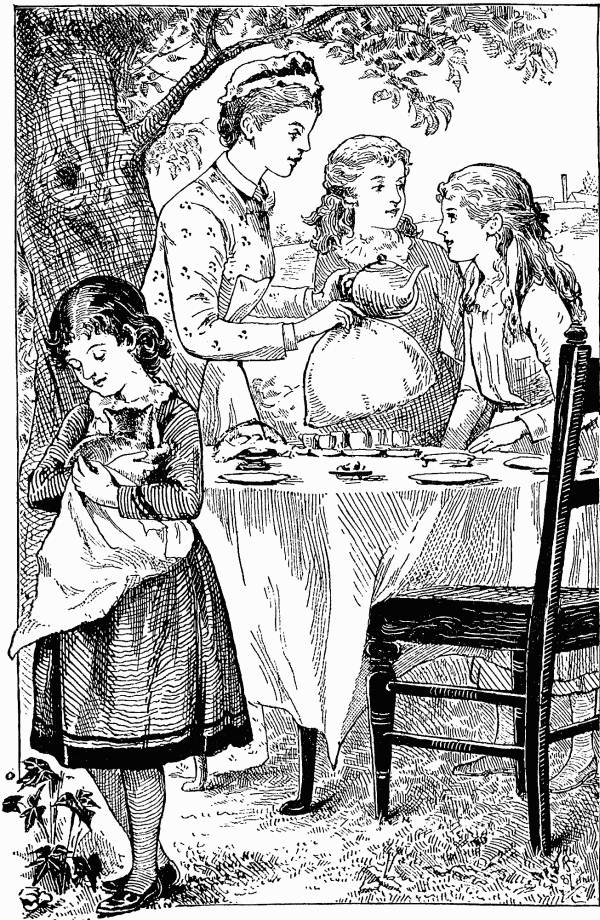
So they all went down to watch Sarah lay the cloth, and put the bread and butter and cake on the table, then the milk and sugar, and last of all she brought the teapot.
"Here comes Aunt Lizzie," said Annie; and all the children joined in the request that when tea was over she would show them her paintings of flowers.
"To be sure I will," she said; "and we will look at them out of doors as soon as the tea-table is cleared."
"I do like having tea out of doors," said Annie; "we can never have it in London, however hot it is."
THE TEA ON THE LAWN. Page 82.
"We cannot have it for very long in the country either," said Aunt Lizzie, "because our weather is so changeable. Sometimes we have cold winds with bright sunshine, or it rains, or the grass is damp. Still, during the long summer days we can frequently manage it; but it is not always summer even in the country."
"Do the woods seem very dreary to you in the winter, aunt?"
"No; I have known and loved them all my life, and they have a very different look in winter from what they have in summer."
"But they look so bare when the leaves are gone," said Annie.
"Yes; but you can see the shapes of the trunks and branches, down to the little twigs. You can tell the name of the tree from its skeleton, for each has its own form—the sturdy oak, the stiff poplar, the drooping willow, and the elegant silver birch. You should see them after a fall of snow. Each tree bears the weight of snow after a different fashion—like itself.
"In fact the woods during a bright hard frost are as good as Fairyland. The brown dead oak leaves lying on the ground are fringed all round the edges with what looks like small diamonds sparkling in the sun. The frost takes every blade of grass, every twig and straw, and covers them with glittering crystal, and the whole air is clear and bright."
"We have some very beautiful days in winter," said Katey.
"Yes," said her mother; "calm, still, cloudless days—like midsummer, only of course colder. Not very often, it is true, but occasionally.
"I was walking on one such day till I came to what had been the private road leading to a gentleman's house. The house itself was old and uninhabited, and the way to it was open. I walked along, and the trees on either side of it were bare, sparkling with frost and looking like other trees outside. Presently I came to a bend in the road, and saw that on both sides the space was planted with evergreen shrubs and trees, and some of the trees were very tall. There were evergreen oaks, and pines, and firs, and plenty of the large-leaved ivy. It seemed as if I had walked from midwinter into midsummer. The bright sun was shining, the air was still, the sky a cloudless blue, and all the trees were green! I stood still to enjoy the sight, then I walked on for a very short way, when another sharp turn of the road brought me back to the wintry landscape of bare trees and more open country. That sight can be seen any winter now."
"I thought the country was dull in winter," said Mary.
"We have dull days, rainy days, and dark days; but then, although Nature is so quiet, she is still alive, and there are always changes going on.
"I knew a gentleman, who is dead now, but he lived to be very old. For a very great many years he always took one walk, at a certain hour every Sunday morning, all the year through. It was a very ordinary country walk—through the little town, up by the side of a fir plantation, along hedge-rows and scattered houses, over a stile into a long ploughed field generally planted with turnips for cattle, then over another stile, through winding lanes that led to farm-houses and at last came out into the public road.
"It interested him to watch the changes week after week—the first appearing of buds in the spring time, their growth during the week, then the bursting of the leaves. Then there was the white blossom of the black-thorn, which comes before the leaves; then that of the white-thorn or 'May;' the silvery blossom of the willow tree; and the yellow catkins of the hazel, called by country children 'lamb-tails.' Then came the wild flowers of very early spring, till, as the weeks went on, their bloom was over with summer and autumn. Now the hedges were red with hips and haws. At last the leaves fell, and winter came once more.
"Besides all these changes there were the birds to notice—when they first came back to England after their winter absence, when the cuckoo was first heard, and many other things as well.
"You may take the same walk fifty-two times a year, year after year, as he did, and yet no two walks will be alike.
"Now Sarah shall clear the table and I will fetch my portfolio of sketches."
When Aunt Lizzie returned she said, "These are all wild flowers here.—You know that one?"
"Why, yes, it is a primrose. We should know what a primrose was like better by this than by the dried ones. Why, aunt! you have painted a whole lot of them growing just as they do grow."
"Yes; I like, if I can, to paint the flowers in their natural places, besides taking a single flower and painting it the size of life. Look at that wild rose-bush mixed with bramble in that piece of hedge; underneath it I have painted a small spray of roses and buds."
"What is that pretty little flower?" asked Annie; "I don't remember ever having seen one like it."
"It is the wood-sorrel; a very lovely little thing it is too. It is common in woods and shady places; but the flowers are almost over now."
"We have some roots of it in the shrubbery, and I saw one flower in bloom there this morning," said Katey.
"Well, you may all go and look at it, if you like." So the children scampered away to look at the small pale, drooping flower.
"What pretty leaves it has!" said Mary. "I have brought one with me; it looks like a cluster of leaves in one."
"Yes; the bright, transparent leaves and stems are very delicate. These leaves will frequently fold up, if knocked, like the leaves of a sensitive plant. You can look for a plant in the woods and try it. The leaves, too, have a very acid taste."
"I see a violet root. I like violets because of their sweet smell," said Annie.
"I like what are called dog-violets too," said her aunt. "They have no smell at all, but they grow all the summer through, in hedges and in grass, in such large quantities that the turf often looks like an embroidered carpet.
"The flower is very similar to the scented violet, only it is of a pale grayish blue. I have painted two roots side by side, one of the scented, one of the dog-violet; also a specimen of the white violet, which is not so common as that of the dark kind, but its smell is quite as delicious."
The children were delighted to recognize, among others, sketches of daisies, cowslips, buttercups, wood-anemones, wild hyacinths, forget-me-nots, eyebright, red and white clover, and many kinds of flowering grasses and graceful fern leaves.
"What is that?" they said, as they saw something that looked curious but not pretty.
"That is one of the sketches I took in Cornwall two or three miles from the Land's End. It is a poor, unhappy furze-bush, covered with dodder. The dodder is what is called a parasitical plant; that is, a plant that lives entirely on another. There are several kinds of dodders: some live entirely on flax, some on nettles, but those that stick to clover and furze-bushes are the most common in this country.
"When the seed of a dodder dropped into the ground begins to grow, it feels about for the kind of plant it wants to live upon: if it cannot find it, it dies.
"This furze dodder, you see, has found what it wanted, and, having done so, began at once to coil its pink thread-like stem on that of the furze. Now it had gained its footing, and threw out a great many more fine stems in all directions, after the fashion of strawberry runners, rooting as it grew. There are thousands of little dodder plants sucking the life out of the furze. I have seen many of the bushes quite smothered, and even killed, by this unpleasant and greedy plant.
"When you are older, if you study the ways of plants, you will find them quite as interesting as those of animals. They have to get their living; and some, like the dodder, prefer to get it at the expense of another; and others resort to all kinds of plans to keep themselves and their kinds alive.
"The acid of the pretty wood-sorrel is a poison, so nothing will eat it; and the buttercups growing in meadows are untouched by cattle, because of the poison in their leaves and stems.
"I might tell you of many other plants that live in safety because they are defended by poison, or thorns, or prickles, or some peculiar shape. The leaves of the common holly are only prickly on the lower branches, where it needs protection from browsing cattle.
"Then there are wonderful contrivances for keeping not only the single plant but its kind alive, which you will learn one day.
"There are plants which bear seeds in very great numbers, like the field-poppy, so that some of them are sure to survive. The winds carry other seeds to great distances, because they have beautiful feathery down attached to them, which causes them to be easily blown about—such as thistle and dandelion seeds.
"Birds, too, are great seed-sowers: they eat the wild fruits which contain the seed. These fruits are generally red or black, so as to attract birds to them. Among the red ones are hips, the fruit of the wild rose; and haws, which contain the seed of the white-thorn. Among the black are blackberries, the fruit of the bramble; and sloes, which are like a very small hard plum. The birds eat these, and drop the seed which is inside of the fruit on to the ground."
Then Sarah came into the room to say that Jane had come from Woodside to take the children back.
"We must wait for Jack," said Mary.
"Yes," said Aunt Lizzie. "I daresay the boys will be home directly. Why, here they are.—How hot you look, Jack!"
"It is so warm to night, aunt, and we have walked fast. We've had a splendid time of it at Charley Foster's, and we stayed till the last minute, so we hurried home at last." Where-upon Jack drew out his pocket-handkerchief to wipe his hot face, forgetting all about the little frogs. The loose knot slipped, and you may guess what happened. The frogs, delighted to get out of Jack's warm pocket, were soon hopping about the room.
"What have you there, Jack? what does this mean?" asked Aunt Lizzie. But she could not help laughing, for she knew what odd things boys will do.
Jack explained to her how he had caught the young frogs to put into the Woodside pond, that he might watch them there.
"Well, you must catch them again," said his aunt, "and I will give you a paper bag to carry them in, only you need not suppose that there are no frogs in grandpapa's pond. Charley's pond is large and shaded, while the Woodside pond is small and open; and the weather has been very dry lately, so the frogs have kept in the soft mud at the bottom. You will see plenty of young frogs after the next shower of rain hopping about the edges of that pond."