III.
Reading edition
TOM'S BIRDS' EGGS.
"The goldfinch, and blackbird, and thrush, Are brimful of music and glee; They have each got a nest in some bush, And the rook has built his on a tree." Bernard Barton.
About a mile off, at the other end of the wood, was a village, which joined an old town so closely that they seemed to be only one place.
The old town was quiet now; but it had been a very busy place many years ago, in the old coach days. I cannot tell you how many coaches daily ran through it, or changed horses at the different inns, on their way from London to towns in distant parts of England.
Now the railway had stopped every coach, and in the valley, through these very woods, the trains rushed along, panting and puffing as if they were running a race with Time.
Fortunately, the trains ran through a tunnel at this spot, so the beauty of the woods was not disturbed.
There was a large green belonging to the village, on the edge of which lived the children's aunt Lizzie, who had married a doctor. She had two children—Tom, who was eleven years old, and Katey, who was nine. They went to school daily in the adjoining town, so they were unable to see much of their cousins, excepting upon half-holidays, as it was now school time.
But you must not suppose that Jack and his sisters did nothing but play during this long visit. As soon as they had settled down, grandmamma engaged a young lady to come to teach them for about two hours every morning. Woodside was too far from the town for the children to go to school with their cousins. When they were at home they went to a kindergarten school, where they learned in the wisest and pleasantest fashion.
TOM SHOWING THE REDBREAST'S EGGS. Page 29.
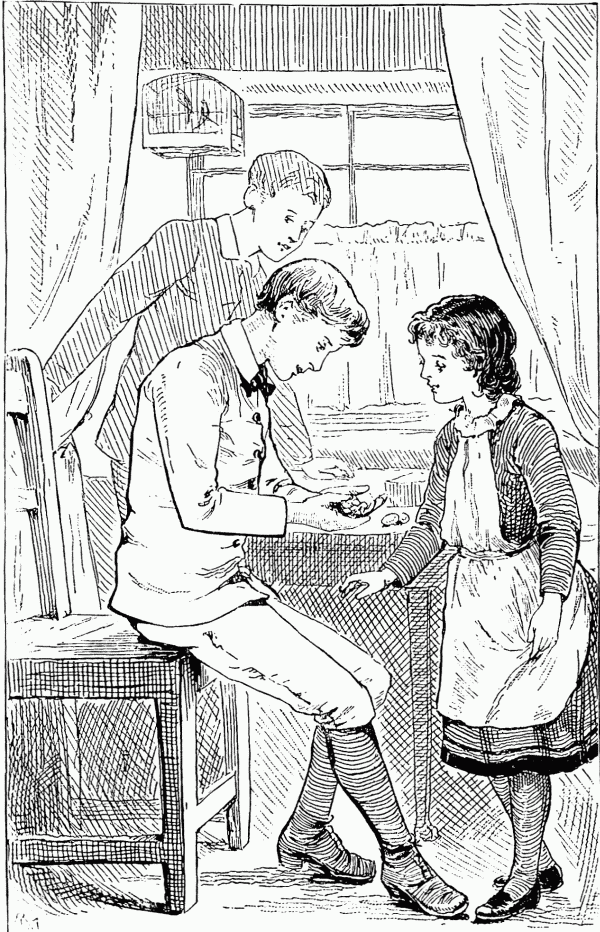
The children always looked forward to the half-holidays, when they either went up to their cousins' home, or Tom and Katey came down to them.
One Saturday afternoon, when they went to the green, Tom showed them his collection of birds' eggs. He kept them in shallow boxes full of bran, so that they should not get broken, for he was very careful over them.
Tom's mother told him never to take more than one egg from each nest, unless there were a great many, as there are in wrens' nests, so that the mother bird might not grieve.
"Please show us a robin redbreast's egg," said little Annie.
Tom took two or three from under the bran, and showed her the eggs, which were yellowish-gray mottled with red-brown.
"Mrs. Redbreast has not nearly so red a breast as Robin," he said.
"I suppose you have plenty of sparrows' eggs," said Mary, "they are such common birds."
"Yes; here they are. They are rather large for the size of the bird; they are spotted and streaked all over with gray and brown."
"What a lovely pale greenish-blue egg that is!" exclaimed Mary.
"Yes, that it is," said Tom; "and it belongs to a dear little brown bird—the hedge-sparrow. It is not at all the same kind of bird as the house-sparrow, for it is one of the warblers. It is a prettier bird, and has prettier eggs than the common sparrow. He builds his nest very early, before the hedges are covered with leaves; so his nest often gets stolen. He is one of the birds that stay in England all through the winter.—These speckled eggs of a bluish-gray belong to the linnet, which has a very sweet song, although not very powerful.—These belong to the chaffinch; they, you see, are greenish-purple spotted with brown. See here! I have a nest made by this bird."
"It is perfectly lovely," said Mary.
"It is, indeed; it is one of the most beautiful of all the birds' nests—such a nice round shape, and so firm that it does not easily fall to pieces. Inside it is lined with hair and feathers, and downy things, which make it ever so soft. Just put your finger inside, Annie, and feel it. Outside it is made of moss, fine dry grass, and wool, all matted together, and covered all over with the lichen which grows on the trunks and branches of trees. It is often very difficult to find this bird's nest, it looks so exactly like the part of a tree."
"Have you a blackbird's egg?" asked Jack. "I know his note, for it is clear and louder than that of most of the other birds."
"Yes, here are some. You see they are of a bluish-green colour, with dark blotches; and very pretty they are too.—Those blue eggs with a few black spots on them belong to the thrush. You must have heard the thrushes singing about grandpa's garden; there are plenty of them there."
"I'm afraid you haven't a cuckoo's egg, Tom," said Annie.
"I am so lucky as to have one, Annie. It is very small for the size of the bird, and not particularly pretty. You see it is a dull-looking egg, whitish, with pale-brown markings. This particular egg was taken from the nest of a hedge-sparrow; but cuckoos' eggs have been found in the nests of many other birds—robin's, and skylark's, and chaffinch's, linnet's, blackbird's, and wren's, and many more besides."
"Why does not the cuckoo build a nest for herself?" asked Annie.
"Nobody seems to know why she doesn't; but there's the fact. When the cuckoo has laid an egg, she carries it in her wide, gaping mouth, and puts it into the nest of another bird that she has chosen for it. When the egg is hatched, the young cuckoo grows so fast that he wants all the nest to himself. He turns the other young birds that have been hatched with him out of the nest, and the true parents of these little birds have to spend all their time in feeding the cuckoo. It takes a great deal to feed him, because he grows so fast, and is so much larger than they are. They don't seem to mind it though.—Those pale-green eggs with dark-brown spots belonged to a rook's nest in the elm-tree at the bottom of the garden. There's a curious story about those rooks down there, for they have not been there long. There is an old rookery belonging to the Rectory close by our house; and one day the rooks from there came to our elm-tree. It was in the spring. At last they came frequently, and chattered, and cawed, and flew round and round, as if they did not know what to do about building their nests in it. By-and-by their visits ceased, and they built their nests as usual in the Rectory trees. That very summer, during one still night, a large branch, almost a third of the elm-tree, fell to the ground. The rooks seemed to know that the tree was not safe, and so they would not build in it. That was two years ago; and this spring they have begun to build, and there are several nests now in our elm-tree. It is most interesting to watch the ways of rooks; they seem to have a lot of business on hand. There is another rookery in the town, in the garden of Mrs. Cross, a friend of my mother's. Rooks always leave the town rookeries for the country as soon as their young ones are able to fly. Now Mrs. Cross noticed that her rooks, after they had gone to the fields, always came back each morning quite early to look after their nests. They stayed a little while to talk over matters; then they flew back again to the fields. One very stormy morning she noticed that instead of the whole flock coming and alighting, one solitary rook ventured through the wind and rain, flying round and round the trees without settling, and then flew back again to the others to give his report that all was right in the old home."
"What clever birds they must be!" said Mary.
"They are," said Tom. "There are lots of stories about rooks, but what I have told you happened under our very eyes.—I have a sparrow-hawk's egg here, white, spotted with brown. It was given to my father by a man for me. There are not many of these birds about here."
"Oh," said Jack, "I wish I could get a collection of birds' eggs!"
"It is almost too late in the season now," said Tom. "Still, you might get some from late nests. I can spare you some from mine, to make a beginning. I know a young fellow, who lives about a half-mile off, who has a large collection of eggs. We'll go and see him one Saturday afternoon. He is sure to have some to give away, for he is always adding to his store, and he is very good-natured."