IV.
Reading edition
JACK AND THE GARDENER.
"Oh! fie upon you, little birds, To eat up all our cherries! Why don't you go into the woods And dine upon the berries?"—C. H.
A few days after Tom had shown his cousins his collection of birds' eggs, Jack, as he was coming away from a visit to Lion, passed by the end of the potting-shed. The gardener was in there, and he called out, "Master Jack, I've got something for you in here."
Jack went into the shed, and the gardener fumbled about on a shelf till he found what he was looking for.
"There," he said, "is a thrush's nest; I thought you'd like it. I took it out of one of the trees in the orchard. It has got four pretty eggs in it."
JACK AND THE THRUSH'S NEST. Page 36.
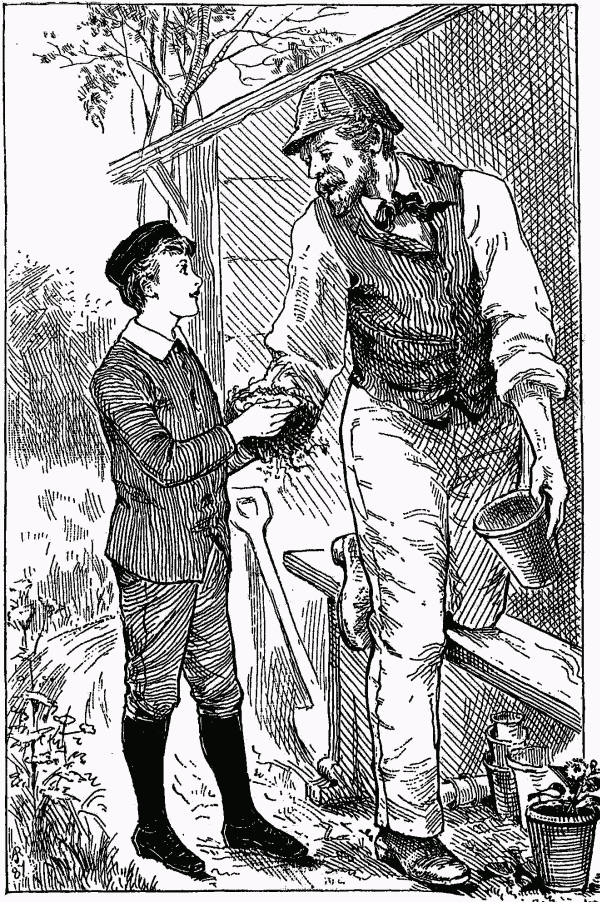
"Oh," said Jack, "how splendid! What a treasure! It does seem a shame, though, to take it from the birds."
His delight soon got the better of his scruples, especially when he heard the gardener say,—
"There are too many birds about here already. Missus does encourage them so, that they are as bold as possible. I can tell you, Master Jack, who gets most of the cherries. It is not us that does; it's them birds, especially the thrushes and blackbirds. I'm up early, and I see; and I hear 'em too before I'm up. There they are, at the fruit as soon as 'tis light. They have their breakfasts hours before you get yours. One wouldn't grudge them a few cherries now and again; but to clear the trees as they do is downright greediness, I say. And I wouldn't be hard on them for taking a few currants, for we have plenty of them; but they just go and strip off the largest and reddest of them, and leave the stalk hanging, and that's all that's left of a fine bunch. Then as to the pease—you like pease, don't you, Master Jack? your grandpa's uncommon fond of 'em—well, I have to sow the pease pretty thick, or, I'll warrant ye, we shouldn't have a tidy row come up at all. I have to dodge about with netting and scarecrows to keep what we do get; for I hate a patchy row, I do. Last winter was a very cold season. I don't know how you found it in London, Master Jack, but here there was a long hard frost for three weeks. We'd had a good deal of rain; then it turned to snow, and froze and snowed again till the snow lay pretty thick all over the ground. Then it cleared up, and the sun shone; but the sun hasn't much power at that time of the year, so it did not melt the snow. It was bitter cold by day, and worse at night. The birds that eat grubs and insects could not get any food at all. So your grandma had a big lump of fat put into a piece of coarse netting, and it was hung up in a likely place—the long branch of a tree—where the birds could get well at it. You should have seen the poor creatures pecking away! It was soon gone, and we had to put more lumps into the net before the frost went. I thought to myself it was almost a pity to try to save their lives; it was just a natural way of getting rid of a lot of them. They do say that dying by cold is an easy way—it's like going to sleep; so I'm not wishing any great harm to the little things. And now, Master Jack, how do you think these birds paid back your grandma for all her kindness? Why, as soon as ever the frost was gone, and the weather became warmer, and the yellow crocuses came into bloom, if these very birds, or some of them at least, did not slit the flowers all to pieces with their bills—that's what they did. The ground was covered with bits of flowers.—Do you know Mrs. Jones who lives on the green, Master Jack?"
"No," he said; "I don't."
"Well, she's a great friend of your grandma's; but she is not over-strong, and doesn't get out in the winter. She likes to have the birds about her, and she fed them on her lawn with crumbs and pieces; and her fine bed of crocuses in front of her windows was just spoiled. It was mostly the yellow ones that they tore to shreds; and the primroses too—there was hardly one fit to pick. The starlings and the sparrows were the worst; they did a lot of mischief."
"Oh," said Jack, "perhaps they were after insects, or something they wanted to eat. I don't believe they meant to do any harm."
"Perhaps not," said the gardener; "but the crocuses were spoiled all the same. You know, Master Jack, I'm about the place summer and winter, and I see a lot. Now, if there's one thing more than another that I hate about a garden, it's cats. They do trample down things and spoil the beds. As this house is lonesome rather, we don't get much of that pest, I'm glad to say; and then Smut is not a sociable cat. But I'll tell you of a curious thing that happened to him one day. There was a pair of thrushes who had built their nest in the laurel hedge at the bottom of the garden next to the field. You know, Master Jack, there's a broad gravel path along the garden side of the hedge. One day, just as the young birds were able to get out of the nest, the young cat at my cottage close by walked into this garden, where, of course, she'd no business; but there she was in that gravel path, and she saw one of the birds and caught it. I saw her with it. The thrushes scolded her, flew at her with a sharp, angry cry, and puss was soon off the premises. The next day, Mr. Smut was walking along this gravel path, enjoying the sunshine in a quiet way, never thinking of birds, for he's a deal too lazy to put himself out of the way to catch anything. I've tried him with a mouse, but he never put out a paw to touch it. He blinked at it in the most unconcerned way, and didn't show the least bit of interest in it. Well, as I said, Smut was walking along, when out flew the thrushes from the hedge, swooped down upon him, pounced on his back, pecked his head, and screeched at him, till poor Smut was quite dazed. They fairly chased him out of that part of the garden. You would have laughed to have seen sober old Smut take to his legs as fast as he could run. The robins, too, soon afterwards began the same game, and would stand and scold within two or three yards of the cat, if he was asleep in the garden. I have often seen them sit just over him, and scold him till he woke up and came indoors. As to the gravel path by the thrushes' nest, Smut never came into that path again all the summer through. Smut's a deal too particular," added the gardener; "but I have heard of another cat that was almost as bad. The house-maid told me that in one of her places there was a fine tabby cat, or rather a good-sized kitten, which would never eat anything in the kitchen, and was so particular in his ways that he was called 'Sir Thomas.' At dinner time he had a trick of jumping up as quick as lightning just when any one was going to put his food into his mouth with his fork. He would give the fork a knock with his paw, so that the meat tumbled off; which he ate before one could see what had happened! Such behaviour was not to be borne; so Sir Thomas was always turned out of the room at dinner time. He was a good mouser, and foraged well for himself out of doors. One day he ate some poisoned meat, at least it was supposed he did so. He became so thin, and his fur came off; so he had to be killed, and that was the end of Sir Thomas."
"I hope poor Smut won't come to any harm," said Jack. "I should have liked to see the birds chasing him, though. I wonder the thrush wasn't afraid of getting on to a cat's back."
"Why, the bird was safe enough; Smut couldn't reach it, and he was almost frightened out of his senses. You know animals, when they have their young to take care of or their lives to defend, can do things which seem contrary to their nature. Birds don't make their perches on cats' backs, except for very good reasons.
"I heard of a dreadful thing that happened once," said the gardener, lowering his tone. "There was a cat—it was a half-wild one—and some boys had a dog that was very fond of worrying cats. They set this dog on to the poor cat, expecting to see a fight. But puss made a clean jump on to the dog's back, and fixed herself there. Lifting up first one front paw, then the other, she beat and scratched the dog's head terribly. The boys then wanted to get the dog away, but they durst not touch either of them—the cat would have flown at them; besides, they were cowards, as cruel people always are. Then a gentleman came up, and he got a pitchfork, and secured the poor beasts, and they were both killed. At least the dog was, for certain. Now that's a fact," said the gardener.
REYNARD HARD PUSHED. Page 45.
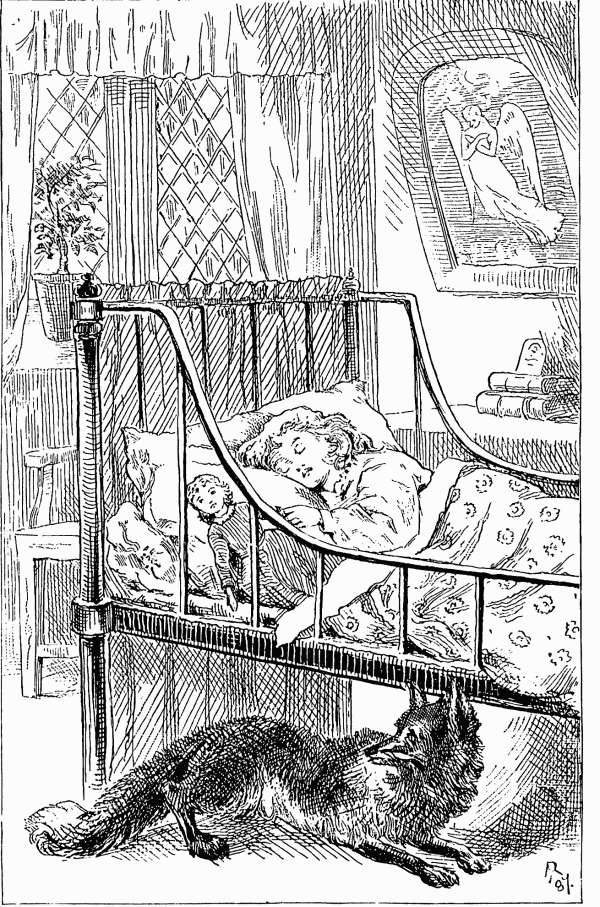
"I can tell you another curious thing," added he; "it's about a fox this time. It didn't happen anywhere about here, but in a part of the country where there's a deal of hunting going on. This poor fox was being hunted, and away he went through woods, over ploughed land and meadows, the pack of hounds and the huntsmen in full cry after him, when they came to a small village. Up the street ran the fox, the dogs at his heels, when he saw the open door of a house and ran inside, up the stairs, and crouched under a cot where a little child lay fast asleep! The mistress of the house saw the fox rush in, and she instantly shut the front door, as she knew she would have the whole pack of hounds in her house. As it was, two dogs, a little in front of the others, rushed past her through the hall into the kitchen, then into the yard; so they at once shut the kitchen door, and the dogs just missed the fox. There was a sight all round the house; the dogs were just mad to get in, and trampled down the flower-beds—for there was no keeping them out of the front garden—making such a yelling and barking as you never heard. At last one of the huntsmen came into the house, caught the fox, and carried him away in a bag. The next day a gentleman sent his gardener to put the garden straight again, after the dogs; but the crocuses, which were just showing nicely for bloom, were quite spoiled. They sent the fox's brush—that's his tail, you know—to the mistress. I've been inside this very house, and seen where the fox went to hide himself. It's not the way of the creatures that live in the woods to come into houses, but the poor fox was hard drove; he was.
"But now, Master Jack, I've finished my job in this shed, and I must go."