Volume 3 / Part 1 — WOMEN OF THE WESTERN EMPIRE
Reading edition
I
THE WOMEN OF THE GOSPEL NARRATIVE
The study of the early Christian women takes up a phase of the history of woman which is peculiar to itself. It is, in a sense and to a degree, out of historical sequence. It deals with a subject in which ideas and spiritual forces, rather than the effect of racial development, are brought into view. It presents difficulties all its own, for the reason that not only historical facts about which there can be no contention must be mentioned, but also theories of a more or less controversial nature. We shall endeavor, however, as far as is possible, to confine ourselves to the recapitulation of well-authenticated historical developments and to a dispassionate portrayal of those feminine characters who participated in and were influenced by the new doctrines of early Christianity.
In writing of the women who were the contemporaries and the acquaintances of the Founder of Christianity the difficulty is very greatly enhanced by the fact that everything related to the subject is not only regarded as sacred, but is also enshrined in preconceptions which are held by the majority of people with jealous partiality. Our source of information is almost exclusively the Bible; and to deal with Scriptural facts with the same impartiality with which one deals with the narrative of common history is well-nigh impossible. There are few persons who are exempt from a prejudicial leaning, either in favor of the supernatural importance of every Scriptural detail or in opposition to those claims which are commonly based upon the Gospel history. We hear of the Bible being studied merely as literature, a method most highly advantageous to a fair understanding of its meaning and purport, but possible only to some imaginary, educated person, unacquainted with the Christian religion and totally unequipped with theological conceptions. That which is true of the Bible as literature is also applicable to the Scripture considered as history.
Yet we shall endeavor to bear in mind that we are not writing a religious book, and that this is not a treatise on Church history; it is ordinary history and must be written in ordinary methods. Consequently, in order to do this subject justice and to treat it rightly, we must endeavor to remove the women mentioned in the Gospels as far as possible from the atmosphere of the supernatural and to see in them ordinary persons of flesh and blood, typifying the times as well as the circumstances to which they belonged. Though they played a part in an event the most renowned and the most important in the world's history, yet they were no more than women; in fact, they were women so commonplace and naturally obscure, that they never would have been heard of, were it not for the Character with whom they were adventitiously connected. A memorial has been preserved, coeval, and coextensive with the dissemination of the Gospel, of the woman who anointed Christ; but solely on account of the greatness of the Object of her devotion.
Our purpose in this chapter is to ascertain what manner of women they were who took a part in the incomparable event of the life of Christ, what their part was in that event, and how it affected their position and their existence.
The whole history of the Jewish race and all the circumstances relating thereto abundantly justify the application to the Jews of the term "a peculiar people." A branch of the great Semitic division, in many ways they were yet most radically distinguished from every other part of the human family. By many centuries of inspired introspection they had developed a religion, a racial ideal, and national customs which entirely differentiated them from all other Eastern peoples. The Jew is one of the most remarkable figures in history. First there is his magnificent contribution to religion and world-modifying influences, so wonderfully disproportionate to his national importance; then there is the marvellous persistency of his racial continuity.
That which set apart the Jews from other nations was mainly their religion. These peculiar people, inhabiting at the time of Christ a small tract of country scarcely larger than Massachusetts, deprived of national autonomy, being but a second-class province of the Roman Empire, nevertheless presumed to hold all other races in contempt, as being inferior to themselves. This religious arrogance, manifesting itself in a vastly exaggerated conception of the superiority, both of their origin and of their destiny, surrounded the Jews with an impenetrable barrier of reserve. That national pride which in other peoples is based on the memory of glorious achievements on the battlefield, on artistic renown, or on commercial importance, found its support among the Jews in their religious history, in their divinely given pledges, and in laws of supernatural origin. And indeed they were a race of religious geniuses; they were as superior in this respect as were the Greeks in the realm of art and the Romans in that of government.
These facts, which are so universally acknowledged as to need no further reference here, warrant a closer study of the manner of life of the ancient Jewish women than that to which we can afford space.
In the Gospel narrative women hold a large place. As is natural, a very great deal of the grace and beauty of the record of Christ's life is owing to the spirit and presence of the feminine characters. This the Evangelists have ungrudgingly conceded. There does not seem to have been the least inclination to minimize the part played by women; indeed, their attitude toward Christ is by inference, and greatly to their credit, contrasted with that of the men. The women were immediately and entirely won to Christ's cause. They sat at His feet and listened with gratitude to the gracious words which He spake; they brought their children to be blessed by Him; they followed Him with lamentations when He was led away to death. There were among their number no cavillers, no disbelievers, none to deny or betray. When the enemies of Jesus were clamoring for His death and His male disciples had fled, it was to the women He turned and said: "Daughters of Jerusalem, weep not for me, but weep for yourselves, and for your children." Well might the instincts of the Daughters of Jerusalem incline them to sympathize with the work and suffering of the Man of Nazareth, for it is incontrovertible that no other influence seen in the world's history has done so much as Christianity to raise the condition of woman.
The position of woman in Palestine, though much inferior to that of man, was far superior to that which she occupied in other Oriental nations. Jewish law would not permit the wife to fall to the condition of a slave, and Israelitish traditions contained too many memories of noble and patriotic women for the sex to be held otherwise than in honor. A nation whose most glorious records centred around such characters as Sara, Miriam, Deborah, Esther, and Susanna could but recognize in their sex the possibility of the sublimest traits of character. Moreover, every Hebrew woman might be destined to become the mother of the long hoped for Messiah, and the mere possibility of that event won for her a high degree of reverence.
At the same time, the Jewish women, like those of all other ancient nations, were held in rigid subordination; nor was there any pretence made of their equality with men before the law. A man might divorce his wife for any cause: a woman could not put away her husband under any circumstances. A Jewish woman could not insist on the performance of a religious vow by which she had bound herself, if her husband or her father made objection. Yet, from the earliest times, the property rights of Israelitish women were very liberal. In the Book of Numbers it is recorded how Moses decreed that "If a man die, and have no son, then ye shall cause his inheritance to pass unto his daughter. And if he have no daughter, then ye shall give his inheritance unto his brethren." But tribal rights had to be considered. Possessions were not to be alienated from one tribe to another. Hence it was also decreed that "Every daughter that possesseth an inheritance in any tribe of the children of Israel, shall be wife unto one of the family of the tribe of her father, that the children of Israel may enjoy every man the inheritance of his fathers." In the time of Christ, however, this restriction on marriage was unnecessary, ten of the tribes not having returned from the Captivity. The house at Bethany where Jesus was entertained belonged to Martha; and we read of wealthy women following Him and providing for His needs out of their own private fortunes. In the early days, among the Hebrews, marriage by purchase from the father or brothers had been the custom; but in the time of which we are writing a dowry was given with the bride, and she also received a portion from the bridegroom.
The inferior position of Jewish women is frequently referred to in the rabbinical writings. A common prayer was: "O God, let not my offspring be a girl: for very wretched is the life of women." It was said: "Happy he whose children are boys, and woe unto him whose children are girls." Public conversation between the sexes was interdicted by the rabbis. "No one", says the Talmud, "is to speak with a woman, even if she be his wife, in the public street." Even the disciples, accustomed as they were to seeing the Master ignore rabbinical regulations, "marvelled" when they found Him talking with the woman of Sychar. One of the chief things which teachers of the Law were to avoid was multiplying speech with a woman. The women themselves seem to have acquiesced in this degrading injunction. There is a story of a learned lady who called the great Rabbi Jose a "Galilean Ignoramus," because he had used two unnecessary words in inquiring of her the way to Joppa. He had employed but four.
By the Jews women were regarded as inferior not only in capacity but also in nature. Their minds were supposed to be of an inferior order and consequently incapable of appreciating the spiritual privileges which it was an honor for a man to strive after. "Let the words of the Law be burned," says Rabbi Eleazar, "rather than committed to women." The Talmud says: "He who instructs his daughter in the Law, instructs her in folly." In the synagogues women were obliged to sit in a gallery which was separated from the main room by a lattice.
Yet it is scarcely to be supposed that in everyday Jewish life the pharisaical maxims quoted above were adhered to with any great degree of strictness. Especially in Galilee, where there was much more freedom than in the lower province, it may well be imagined that there existed a wide difference between these arrogant "counsels of perfection" and the common practice. There is no doubt that the rabbis and the scribes observed the traditions to the minutest letter; but inasmuch as in these days it would be misleading to delineate the common life of a people by the enactments found on their statute books, we are justified in concluding that ordinary existence in ancient Palestine was not nearly such a burdensome absurdity as the rabbinical law sought to make it. Human nature will not endure too great a strain. At any rate, we can but believe that, subordinate as she may have been, the Jewish woman found ample opportunity to assert herself. The rabbi may have scorned to multiply speech with his wife on the street, but doubtless there were occasions which compelled the husband to endure a multiplicity of speech on the part of his wife at home. It was not without experience that the wise man could say: "A continual dropping on a very rainy day and a contentious woman are alike."
The sayings of the scribes, which are derogatory to the female sex, are abundantly offset by many injunctions of an opposite nature which are found in the sacred and in the expository writings of the Jews. One of the first things drilled into the mind of a young Hebrew was that his prosperity in the land depended wholly upon his observance of the law that he should "honor his father and his mother." The virtuous woman portrayed by King Lemuel was still the ideal in the time of Christ: "Her sons rise up and praise her; her husband also extols her." The declaration in the book of Proverbs that "the price of a virtuous woman is set far above that of rubies" is not to be understood in the sense of irony. "Honor your wife, that you may be rich in the joy of your home," says the Talmud; and there was a proverb: "Is thy wife little? then bow down to her and speak." The Son of Sirach said: "He that honoreth his mother is as one that layeth up treasure ... and he that angereth his mother is cursed of God."
As among all other Eastern peoples, the education of Jewish girls was greatly neglected; but it can hardly be said that they were losers on that account. They were simply saved a great deal of profitless labor which fell upon their brothers. The learning of the Jews, so far as higher education was concerned, did not add much either to the grace or the enjoyment of life. It was pedantry of the driest and dreariest kind. It consisted of interminable glosses upon the Law and of the "traditions of the elders." It exercised no faculties of the mind excepting the memory and such powers of reasoning as are employed in subtle casuistry. There was in it nothing of art or science, or even of history, except Jewish history. Greek learning was abhorred by the strictly orthodox. They said the command was that a man's study should be on the Law day and night; if anyone therefore could find time between day and night he might apply it to Gentile literature. There were schools in abundance; but they are spoken of only in relation to boys. In the fundamental moral precepts, however, and in the highest national ideals, the Jewish girls were no less thoroughly trained than were their brothers. Ozias testified to Judith, who with feminine strategy and masculine courage overthrew Holophernes: "This is not the first day wherein thy wisdom is manifested; but from the beginning of thy days all the people have known thy understanding, because the disposition of thy heart is good." Of the chaste Susanna it was said that, her parents being righteous, they taught their daughter according to the Law of Moses. Timothy owed his early training to his mother Eunice and his grandmother Lois. The Israelitish mother, in the dawn of her children's intelligence, carefully taught them the lore of the ancient Scriptures and instructed them in the principal tenets of the Jewish faith. There never existed another nation that cared so thoroughly for the training of its young in the doctrines of morality and in those national memories which are efficacious in the perpetuation of an ardent patriotism. In all this the girls were privileged equally with the boys. As Edersheim says: "What Jewish fathers and mothers were; what they felt towards their children; and with what reverence, affection, and care the latter returned what they had received, is known to every reader of the Old Testament. The relationship of father has its highest sanction and embodiment in that of God towards Israel; the tenderness and care of a mother in that of the watchfulness and pity of the Lord over his people."
Religion was the breath of Jewish life. It is absolutely impossible to touch on Hebrew history, customs, or ideals, in any period or to any extent, and not to come into contact with Hebrew religion. This, as we know, was full of burdensome ritual and formalities; the Law, with all its elaborate ramifications, governed the minutiae of daily existence. Yet it is again necessary to be careful not to judge too broadly of Jewish life by the rules which the Talmud shows were laid down by the rabbis. The Pharisees, who made the formalities of religion their one business in life, could observe all the multitudinous feasts and fasts, all the ritual of washings, and bear in mind the innumerable possibilities of breaking the Sabbath--such, for example, as accidentally treading on a ripe ear of grain, which would be the act of threshing; but that the common people lived thus straitly is impossible of belief, and for this reason they were held in contempt by the strictest sect. How some of these troublesome laws related to the women is suggested by Edersheim; "A woman (on the Sabbath) must not wear such headgear as would require unloosing before taking a bath, nor go out with such ornaments as could be taken off in the street, such as a frontlet, unless it is attached to the cap, nor with a gold crown, nor with a necklace or nose-ring, nor with rings, nor have a pin in her dress. The reason for this prohibition of ornaments was, that in their vanity women might take them off to show them to their companions, and then, forgetful of the day, carry them, which would be a 'burden.' Women were also forbidden to look in the glass on the Sabbath, because they might discover a white hair and attempt to pull it out, which would be a grievous sin; but men ought not to use looking-glasses even on weekdays, because this was undignified. A woman may walk about her own court, but not in the street, with false hair."
These are only instances of regulations which were so numerous as severely to tax the memory of those who did little else but study to observe them. We are sure that they could not have characterized the common Jewish life; yet there was not a man, however loose in conduct or humble of birth, who was not well versed in the moral precepts of Moses and in the exalted national ideals of the Prophets. In the cases--and they were many--where this wisdom was not justified of her children, the punctilious observance of outward forms, conjoined with the most extreme arrogance of race, laid the Jew open to the contempt of both Greek and Roman. Yet there was enough latent impetus and genuine religious life in Israel to form the basis of that Christianity which was destined to overreach Greek philosophy and to revolutionize Rome; and there are many indications in the Gospels that the credit for the incalculable service of preserving alive the smouldering embers of piety must, to a predominant degree, be awarded to the mothers and daughters of Israel. Elizabeth, no less than Zacharias her husband, was a type of many who "walked in all the commandments and ordinances of the Lord, blameless." There was also one Anna whose devotion was so great that she seemed to make the temple her constant home. Nevertheless, in religion, as in other things, the Jewish women, as all of their sex in the ancient world, were obliged to be content with an inferior position. In the great temple at Jerusalem they were allowed to occupy only the second court: to the Court of Israel, where their male relatives worshipped, they could not penetrate. They had no occasion, however, to complain of lack of space, for in this Court of the Women there was room for over fifteen thousand persons; and, for their convenience, the priests had very considerately placed therein the treasury chests. It was here that the poor widow whom Christ eulogized cast in her "two mites." In this court also was Solomon's Porch, where the Master, recognizing no inequality, taught both sexes alike. In the synagogues, the women of Palestine were obliged to occupy as inconspicuous a position as possible, and on the way thither it was required of them that they should take the back and less frequented streets, in order that the minds of the men might not be diverted from sacred meditations by their presence. This bit of hypocritical phariseeism not only indicates the inferior plane which women were supposed to occupy, but also that, however honored they may have been as wives and mothers, they enjoyed no portent of that chivalry which afterward grew from and was fostered by Christianity.
The existence of the Jewish woman was by no means secluded. She was allowed to mingle freely in outdoor life. She accompanied her family on their journeys to the great festivals which were held in Jerusalem. Indeed, we read of Galilean women following Jesus into Judæa, evidently unescorted by male relatives. Females also entertained mixed companies in their own homes. It is probable, however, that there was more freedom of movement among the lower-class women than was enjoyed by their sisters of high degree. While the former dwelt in mean and small houses, in which there was little possibility of seclusion, the latter had large and luxurious homes, with great interior courts and special apartments for their own use. The luxuriousness of these wealthy women rivalled that of Rome itself. We read of one Martha, the wife of a high priest, who, when she went to the temple, had carpets laid from her house to the door of the temple. Upon the poorer women were imposed the hardships of labor: "two women grinding at the mill" was a common sight in every home.
In that momentous drama the leading figure of which was the Son of Man, women of greatly varying character and position played a part. There were Herodias, and Procla, the wife of Pilate: these were the highest ladies in the land; there were Martha of Bethany, and Joanna, the wife of Herod's steward, representing the middle class; Mary, the mother of Jesus, from among the poor; and Mary of Magdala, from among a class of women who were numerous in Palestine, one of whom the Gospel designates as "a woman who was a sinner."
Of the two first mentioned little may be said in this connection, as they were far from being Christian women, though the wife of Pilate earned for herself the respect of all succeeding generations by pleading for the life of Jesus.
Herodias is connected with this story only on account of the cruel determination with which she sought and compassed the death of John the Baptist. The grand-daughter of Herod the Great, she inherited not only his impetuous ambition, but also his ferocity. She had been married to Herod Philip, her uncle. This son of the first Herod was a wealthy private resident of Jerusalem; but Herodias could not be content to stand aside as a mere spectator of the brilliant game of governing. So she seized the opportunity which the presence of Antipas in her house, by her husband's hospitality, gave her to begin an intrigue, which ended in her marital union with the tetrarch. By this conduct she trampled on Jewish law and offended the people. Not that the severing of the marriage bonds was a thing unusual among the Jews; indeed, the facilities for divorce were exceedingly liberal. A man could put away his wife for the most trifling cause. "If anyone," said the rabbis, "see a woman handsomer than his wife, he may dismiss his wife and marry that woman." It was considered ample cause for divorce if a wife went out without her veil. The disciples of Hillel even went so far as to hold that if a woman spoiled her husband's dinner, by burning or over salting it, sufficient cause was given him, if he so chose, to put her away. This is the point of the question with which the Pharisees came to try Christ. "Is it lawful," said they, "for a man to put away his wife for every cause?" So, then, that which shocked the Jews and caused them to agree with John in his denunciation of Herod was not that the latter divorced his first wife, the daughter of Aretas, but that he took Herodias, she not having been put away by her husband, Philip. Here is some very remarkable moral sophistry. It would have been right, in the sight of Jewish law, for Herod and Philip to have exchanged wives, after legally divorcing them for any cause which might have seemed to them proper; but there was no law, nor was there any conceivable wrong, which could give Herodias the right to leave her husband of her own free will. Women could not gain divorce. So, according to the Jewish idea, the fault of Herod consisted solely in the fact that Philip had not yet seen fit to release Herodias. Whether or not John the Baptist concurred with the ideas of his time on this subject we do not know; but the One who came after him put marriage on a far higher basis and restricted divorce to its essential cause.
Herodias plotted and achieved John's destruction perhaps as much on account of her fear of the effect of his influence upon Herod's ambitious projects as because of her resentment at his charges against herself. She was determined that Herod should be a king, like her brother Agrippa; but the latter was a great favorite with Caligula, and when his letters were presented to the emperor at the same time that Herod appeared, in obedience to the importunities of his wife, to press his suit, the husband of Herodias was deposed and exiled to Lyons. The only praiseworthy thing that Herodias ever did, so far as is known, was on this occasion. Caligula wished to allow her to retain her own fortune, and told her that "it was her brother who prevented her being put under the same calamity with her husband." This was her reply: "Thou, indeed, O emperor, actest after a magnificent manner, and as becomes thyself in what thou offerest me; but the kindness which I have for my husband hinders me from partaking of the favor of thy gift; for it is not just that I, who have been made a partner in his prosperity, should forsake him in his misfortunes." Thereupon Caligula sent her into banishment with Herod, and gave her estate to Agrippa.
Our curiosity is greatly aroused, but in no degree satisfied, regarding another woman who dwelt at Jerusalem in the time of Christ. Pilate, the Roman procurator, had taken his wife with him to Judæa. Tradition has it that she there became a proselyte to the Jewish faith. This is by no means unlikely, for throughout the Roman world were found women who had become converts to the religion of Zion; Josephus, by his own experience, shows that at a later date even Poppæa, the wife of Nero, was extremely partial to the Jews. The Greek Church even goes further, and places Procla in its calendar of saints. Though there is no evidence extant of her having become a Christian, it need not be considered a thing impossible; indeed, it is extremely reasonable to suppose that, having endeavored to save the life of Jesus, the wonderful religious movement which succeeded His death could not have been unknown or without interest to Procla. At any rate, certain it is that she had some knowledge of Jesus, that she was to no small degree disposed in his favor, and that Pilate's wish to balk the priests in their designs on Christ's life was, in a large measure, the result of his wife's influence. But Pilate was caught with the argument that to save the Prisoner would be a sign of disloyalty to Cæsar. This incident is the most prominent instance that history affords of the unwisdom of opposing masculine ratiocinations to feminine moral intuitions.
We now turn to those women of the Gospels who were the acknowledged friends of Jesus and of the founders of Christianity. The central figure is, of course, the Blessed Mother--Mary, honored by Christians above all the daughters of the earth and adored by many millions as the Queen of Heaven; and yet how inadequate, how meagre is the veritable knowledge we possess of this immortal woman! Never has human imagination so magnificently triumphed as in the evolution of the concept of the Blessed Virgin; never has fond adoration built so marvellous an ideal upon so scanty a foundation of assured reality. A moderate-sized page would contain all that is vouchsafed regarding her in the Gospels, yet who ever disputed the claim for Mary that she is the highest representative of all that is purest and most beautiful in womanhood. This much is not a dogma of any church, but a universal feeling. This prevailing conception of the character of Mary has grown out of the conviction of what must have been the moral worth of the one fitted to bear and rear the Son of Man; and it has also resulted to a large degree from that strong human love for motherhood which seeks a perfect example on which to expend itself. The Blessed Virgin is womanhood idealized. She is the personification of all feminine beauty, both of soul and body; she is the perfect expression of the poet's highest inspiration and the artist's noblest dream. We cannot help wishing, however, that more were known of the home life of Mary; the desire to place the beautiful figure of the Representative Mother in the varied settings of common feminine life is irresistible, but this can only be done by means of what little we know of the manners and customs of her people and time.
As has been said, the sources of information about the Mother of Jesus are the four Gospels. In addition to these, there are the apocryphal Christian writings; but these are of too late origin and contain too many manifestly absurd accounts to warrant credence, except where they are corroborated by the Evangelists. The latter say nothing whatever of Mary's direct parentage. She was an offspring of the regal line, that of David; for though it is most probable that the puzzling genealogies of Matthew and Luke are those of her husband, Joseph, there are many reasons for believing that he and Mary were blood relations. Their home was at Nazareth, a beautiful hill town of Galilee, noted for the comeliness of its women. At the end of the sixth century, Antoninus Martyr remarked that the Jewish women of Nazareth were not only fairer but also more affable to Gentiles than were the other women of Palestine, and modern travellers inform us that both these characteristics are still preserved. Geikie says: "The free air of their mountain home seems to have had its effect on the people of Nazareth. Its bright-eyed, happy children and comely women strike the traveller, and even their dress differs from that of other parts.... That of the women usually consists of nothing but a long blue garment tied in round the waist, a bonnet of red cloth, decorated with an edging or roll of silver coins, bordering the forehead and extending to the ears, reminding one of the crescent-shaped female head-dress worn by some of the Egyptian priestesses. Over this, a veil or shawl of coarse white cotton is thrown, which hangs down to the waist, serving to cover the mouth, while the bosom is left exposed, for Eastern and Western ideas of decorum differ in some things.... In a country where nothing changes, through age after age, the dress of to-day is very likely, in most respects, the same as it was two thousand years ago, though the prevailing color of the Hebrew dress, at least in the better classes, was the natural white of the materials employed, which the fuller made even whiter."
We are not informed on the authority of the Gospels as to Mary's age when she was espoused to Joseph the carpenter. The apocryphal Gospel of Mary states that she was fourteen, while the Protevangelion places her age at twelve, which is in accordance with the custom of the East, where girls mature much earlier than with us. The betrothal consisted of mutual promises and the exchange of gifts in the presence of chosen witnesses, followed by the engaged couple ceremonially tasting of the same cup of wine, and was ended with a benediction pronounced by a priest or a rabbi. After these solemn espousals the relation between Mary and Joseph was as sacred as though marriage had really taken place; the only difference was that the couple did not yet live together. The woman was not allowed to withdraw from the contract, and the man could not fail to fulfil his promise unless he gave her a formal bill of divorcement for cause, as in the case of marriage; the laws relating to adultery were also applicable. Yet many months might intervene between the date of the betrothal and that of the marriage.
What took place during this interval in the life of the Virgin is a mystery which it would be a vain attempt to investigate. If it be judged of from a purely rationalistic standpoint, there are no historical and no scientific data which will enable us to do otherwise than simply discredit the accounts of the Nativity, as they are given by Matthew and Luke. On the other hand, if the narrative of Christ's birth is accepted with that reverent faith which has endured through nineteen centuries of Christendom, and has been and still is held by men of unrivalled intellect, there is nothing more to be said than the language of worship and wonder. We may well regret that John and Mark, or at least one of the epistolary writers, did not corroborate the testimony of the two first-named Evangelists; the scant importance Mary seems to have acquired in the Apostolic Church may appear inconsistent with the stupendous nature of her experiences; yet here is no subject for vain reasoning; we stand before a mystery which belongs wholly to the realm of faith. The science of Christology demands the acceptance of this supernatural event. But it is as little within the province of this book to defend the faith as it is to apply the canons of Higher Criticism to the writings of the New Testament.
In the picture which the Scriptures give us of Mary there is no touch so human as that which represents her, at the first intimation of the coming of her Son, hastening southward to confer with her cousin Elizabeth. To a woman must the news first be whispered, before it gains the observation of the man to whom she is espoused; and not to the gossips of Nazareth, but to her holy and sober-minded kinswoman alone could Mary impart her hopes and her fears. Poetic expression was a Jewish woman's birthright; Miriam, Deborah, Hannah, and Judith, each had magnified the Lord with a song; let Mary also, in the assurance that her Offspring is to be the Messiah long foretold, voice the exultation of her soul in like manner. "Behold, from henceforth, all generations shall call me blessed.... He hath put down the mighty from their seats, and exalted them of low degree."
Augustus Cæsar sent forth an edict that all the world should be taxed. It was an act of which we should have known little and thought less, had it not marked the occasion of the birth of Him to whom the world will never cease to pay a tribute of homage.
In the birth of Jesus, the mystery of motherhood is glorified, nay, almost deified. Mankind needed that also. The pagan world had always sought to satisfy feelings which are deep rooted in the human heart by conceiving of maternity under the form of a divine personality. A religion which does not, in some way, recognize in its object the loving kindness and the painful solicitude of the mother heart cannot survive. Mary is a symbol of that natural tender reverence and supreme confidence which motherhood inspires. The shepherds knelt before her in the stable which the necessities of poverty made the scene of her lying-in, for the inestimable graces of the mother depend not upon wealth or earthly splendor. The Wise Men from the East brought their gifts, for there is no greater wisdom than that which pays its homage before the babe at its mother's breast.
In the one great experience of maternity Mary's greatness ends, so far as the records show. Did she settle down to all appearances as an ordinary Nazareth housewife? Did she bear to Joseph other children? To many, the latter question seems like sacrilege; and yet there is nothing of authority written to the contrary.
Tradition has it that Joseph died early in their married life. Mary then was dependent for her support upon her Son's labors. Did He refrain from His chief calling until He was thirty years of age in order that He might know not only common toil but also filial duty in the support of the mother? Was it to consult on some family business that His mother and His brethren stood outside the house where He was teaching, being desirous to speak with Him? All these questions are to us unanswerable; but it surely does not detract from the sacredness of the pictures to infuse into it every possible element of human interest.
The Gospels turn their light once more, and for the last time, on Mary. It reveals her at the foot of the Cross. Each of the Synoptists tells us that many women followed Him out of Galilee; by John alone is Mary mentioned as being present at the Crucifixion. "When Jesus saw his mother, and the disciple standing by whom he loved, he saith unto his mother, 'Woman, behold thy son.' Then saith he to the disciple, 'Behold thy mother.' And from that hour that disciple took her unto his own home." Why was this so if Mary had other living sons? John, who it is probable was her own sister's son, would immediately lead the Mother away from the terrible scene, where a sword was also piercing her own soul, to a place where she could await the announcement of the end. The fact that there is no record of an appearance to Mary after the Resurrection must be accounted for by the belief that her faith did not need this, in its assurance that death could not conquer her divine Son.
Nevertheless, the paucity of the reference to Mary in the New Testament, after the Nativity, is perplexing. For the other legends concerning her history and character, which have been cherished by a very large portion of Christendom, we are wholly indebted to what are known as the Apocryphal Gospels. These consist of writings which were extant, in some cases, before the present New Testament books were selected as being alone authentic, but were not deemed of sufficient worth to be included in the canon. There is The Gospel of the Birth of Mary. In the very early ages this book was supposed to be the work of Saint Matthew. Many ancient Christians believed it to be authentic and genuine, and Jerome, who lived in the fourth century, quotes it entire. Another book, of the same description, known as the Protevangelion of Saint James, is mentioned by writers equally ancient. Then there is the Gospel of the Infancy. This, we are told, was accepted by the Gnostic Christians as early as the second century; but it is full of manifest absurdities, outrageous even to the most compliant credulity. A fair sample of its stories--not including the miraculous, which are exceedingly puerile--is the one which relates that at the circumcision of Jesus an old Hebrew woman took the part that was severed "and preserved it in an alabaster-box of old oil of spikenard. And she had a son who was a druggist, to whom she said, 'Take heed thou sell not this alabaster-box of spikenard-ointment, although thou shouldst be offered three hundred pence for it.' Now this is that alabaster-box which Mary the sinner procured, and poured forth the ointment out of it upon the head and the feet of our Lord Jesus Christ, and wiped it off with the hairs of her head."
The Gospel of Mary has been made the basis of much serious belief in regard to the Blessed Virgin, and especially have Christian artists drawn from its pages suggestions for their subjects. We will summarize the account it gives of the Mother of Jesus. "The blessed and ever glorious Virgin Mary, sprung from the royal race and family of David, was born in the city of Nazareth, and educated at Jerusalem, in the temple of the Lord. Her father's name was Joachim, and her mother's Anna. The family of her father was of Galilee and the city of Nazareth. The family of her mother was of Bethlehem. Their lives were plain and right in the sight of the Lord." Nevertheless, for twenty years they suffered what, in the eyes of the Jews, was one of the greatest of misfortunes: they were childless. Joachim is taunted with this fact by Issachar, the high priest. The good man, being much confounded with the shame of such reproach, retired to the shepherds who were with the cattle in their pastures; for he was not inclined to return home, lest his neighbors, who were present and heard all this from the high-priest, should publicly reproach him in the same manner. Thereupon an angel appears to him and informs him that his wife Anna shall bring forth a daughter, and that they shall call her Mary. "She shall, according to your vow, be devoted to the Lord from her infancy, and be filled with the Holy Ghost from her mother's womb; she shall neither eat nor drink anything that is unclean, nor shall her conversation be without among the common people, but in the temple of the Lord; that so she may not fall under any slander or suspicion of anything that is bad." The angel also appears to Anna, giving her the like information. "So Anna conceived, and brought forth a daughter, and, according to the angel's command, the parents did call her name Mary."
"And when three years were expired, and the time of her weaning complete, they brought the Virgin to the temple of the Lord with offerings. And there were about the temple, according to the fifteen Psalms of degrees, fifteen stairs to ascend. For the temple being built on a mountain, the altar of burnt-offering, which was without, could not be come near but by stairs; the parents of the blessed Virgin and infant Mary put her upon one of these stairs; but while they were putting off their clothes, in which they had travelled, and according to custom putting on some that were more neat and clean, in the mean time the Virgin of the Lord in such a manner went up all the stairs one after another, without the help of any to lead or lift her, that anyone would have judged from hence that she was of perfect age. Thus the Lord did, in the infancy of his Virgin, work this extraordinary work, and evidence by this miracle how great she was like to be hereafter. But the parents having offered up their sacrifice, according to the custom of the law, and perfected their vow, left the Virgin, with other virgins in the apartments of the temple, who were to be brought up there, and they returned home."
Mary, we are told, was ministered unto by angels until her fourteenth year, and preserved from all suspicion of evil, so that "all good persons, who were acquainted with her, admired her life and conversation. At that time the high-priest made a public order, that all the virgins who had public settlements in the temple, and were come to this age, should return home; and as they were now of a proper maturity, should, according to the custom of their country, endeavor to be married." This, Mary refuses to do, she having vowed her virginity to the Lord. Then the high priest convenes a meeting of the chief persons of Jerusalem to seek counsel from Heaven in this matter. A voice from the mercy-seat directs that all the men of the family of David who were marriageable and not married should bring their staves to the altar, "and out of whatsoever person's staff after it was brought, a flower should bud forth, and on the top of it the Spirit of the Lord should sit in the appearance of a dove, he should be the man to whom the Virgin should be given and be betrothed."
Among the rest there was a man named Joseph, of the house and family of David, and a person very far advanced in years, who drew back his staff, when everyone besides presented his. Joseph, however, was clearly pointed out, in the manner described, as being the chosen man. "Accordingly, the usual ceremonies of betrothing being over, he returned to his own city of Bethlehem, to set his house in order, and make the needful provisions for the marriage. But the Virgin Mary, with seven other virgins of the same age, who had been weaned at the same time, and who had been appointed to attend her by the priest, returned to her parents' house in Galilee." Then follows an account of the Annunciation, similar to that given by Saint Luke, but somewhat elaborated. "Then Mary, stretching forth her hands, and lifting her eyes to heaven, said, 'Behold the handmaid of the Lord. Let it be unto me according to thy word.'"
CHRIST AND THE DAUGHTER OF JAIRUS After the painting by Albert Keller.
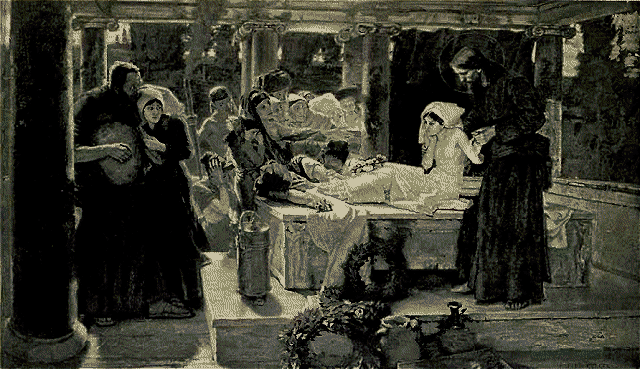
The ready faith of the Gospel women is illustrated by many narratives of miracles wrought in their behalf. The faith of Martha and Mary was rewarded by the restoration to life of their brother Lazarus. There was the woman whom physicians could not cure, yet her faith led her to touch the hem of the Master's garment, and she was made whole. To the widow of Nain, as she accompanied the dead body of her son to its sepulchre, was given that son restored to life. The despised Syrophenician woman proved her humility and her faith, and her daughter was made whole. Christ's commiseration was manifested notably to woman, though not exclusively, as we see in the case of the raising of the daughter of Jairus in answer to the father's faith.
In the Protevangelion all this is recited, but at greater length. It is there said of Mary that, while she lived in the temple, "all the house of Israel loved her." It is related also of her that she was chosen by the priests to weave the purple veil for the temple. In this writing, Mary is described as having received the announcement of the angel as she went to the spring to draw water. There is also a curious passage in which Joseph is represented as telling the experiences which came to him as he went to seek a midwife in the village of Bethlehem. "As I was going," he says, "I looked up into the air, and I saw the clouds astonished, and the fowls of the air stopping in the midst of their flight. And I looked down toward the earth, and saw a table spread, and working people sitting around it, but their hands were upon the table, and they did not move to eat. They who had meat in their mouths did not eat. They who lifted their hands up to their heads did not draw them back; and they who lifted them up to their mouths did not put anything in; but all their faces were fixed upwards. And I beheld the sheep dispersed, and yet the sheep stood still. And the shepherd lifted up his hand to smite them, and his hand continued up. And I looked unto a river, and saw the kids with their mouths close to the water, and touching it, but they did not drink."
Notwithstanding all that is said in these ancient writings in the attempt to do her honor, we must conclude that the glory of the halo which beautifies the head of the real Mary is derived by reflection from the moral splendor of her Son. Of what intrinsic greatness of soul she was possessed it is difficult for us to surmise from the slight attention given to her in the Gospels. Yet she rightly holds her position as woman idealized. We need such a poetic creation as Mary; and her place at the head of all the daughters of earth is the more secure and effective because her figure in authentic history is but a shadowy outline. The ideal woman whom all mankind loves and reverences as Virgin, Mother, and Saint, is objectified by concentrating in Mary of Nazareth all possible feminine grace, beauty, and purity.
Let us turn now to another Mary who, in the Gospel history, achieved a fame hardly less renowned than that of her great namesake: Mary of Magdala, out of whom Christ cast seven devils. Magdala was a town on the lake of Galilee, as notorious for its profligacy as it was famous for its wealth, derived from the manufacture of dyes. Mary's affliction was doubtless as much of a moral as of a mental nature; it may refer to the abandonment of immoral excess into which she was driven by her passionate nature. The Jews at the time of Christ were wont to ascribe every form of evil, physical and also spiritual, to the agency of demons, who were supposed to have the power of taking possession of human beings as a habitation. The tradition of the Church has always identified Mary Magdalene with the woman who, in Simon's house, anointed Christ's feet with ointment, after washing them with her tears. Still, it must be confessed that there is no certain foundation for this belief. On this point, Archdeacon Farrar says: "The Talmudists have much to say respecting her--her wealth, her extreme beauty, her braided locks, her shameless profligacy, her husband Pappus, and her paramour Pandera; but all that we really know of the Magdalene from Scripture is that enthusiasm of devotion and gratitude which attached her, heart and soul, to her Saviour's service. In the chapter of Saint Luke which follows the account of her anointing the Lord's feet in the Pharisee's house she is mentioned first among the women who accompanied Jesus in his wanderings, and ministered to him of their substance; and it may be that in the narrative of the incident at Simon's house her name was suppressed, out of that delicate consideration which, in other passages, makes the Evangelist suppress the original condition of Matthew."
Mary Magdalene's great part in the Gospel history was at the Resurrection. To her ardent love and intense imagination, enabling her to visualize Him who, though dead, she could not relinquish, rationalists ascribe the inception of the doctrine of the Resurrection. According to this theory, as Mary of Nazareth brought Jesus into the world, so through Mary of Magdala His risen Spirit was born into the Church. But this is not the faith of Christendom; nor can the testimony of the Gospels be reasonably disposed of in this manner. To the Magdalene was given the supreme honor of receiving the first greeting of her risen Lord; and her testimony is the chief cornerstone of the most comforting doctrine of Christianity.
The gospel narrative gives a prominent place to woman,--as a believer in Christ, as His devoted follower and constant ministrant, and also as a faithful and unswerving witness to His wondrous works. The ready faith of the Gospel women is illustrated by many narratives of miracles wrought in their behalf. The faith of Martha and Mary was rewarded by the restoration to life of their brother Lazarus. There was the woman whom physicians could not cure, yet her faith led her to touch the hem of the Master's garment and she was made whole. To the widow of Nain, as she accompanied the dead body of her son to its sepulchre, was given that son restored to life. The despised Syrophenician woman proved her humility and her faith, and her daughter was made whole. Christ's commiseration was manifested notably to woman, though not exclusively, as we see in the case of the raising of the daughter of Jairus in answer to the father's faith. In the life of Christ, the supernal event in the world's history, woman's influence and activity were not less than man's; but, unlike his, her part was marked by unalloyed purity, magnanimity, and faithfulness.
II
THE WOMEN OF THE APOSTOLIC AGE
THE leaven of Christianity worked speedily and powerfully in raising woman to a position of greater honor in the estimation of the adherents of the new religion. In regard to mental and spiritual relations, it put her at once upon an equal footing with men, which was an entirely new development in human thought. We have seen how, even in Judaism,--the purest religion and the highest moral system known to the world previous to the coming of Christ,--woman held an inferior position and was debarred from many of its privileges, though not from its moral responsibilities. According to the Levitical code, when a man made an offering of any person of his family to the Lord, the value of a male was estimated at fifty shekels, while that of the female was put at thirty shekels; and, as in all cases where an arbitrary comparison is instituted between men and women, this computation was independent of the possession or lack of personal excellences. The mere undeveloped manhood in an otherwise worthless individual gave him, in Jewish estimation, a two-fifths superiority over the noblest woman. The very stupidity of this is an indication that sex can hardly have been designed by the Creator as a basis on which to found the right to the majority either of the duties or the privileges of human life. Under the new dispensation Paul says: "There can be neither Jew nor Greek; there can be neither bond nor free; there can be no male and female: for ye are all one man in Christ Jesus." That the Apostle forbade women from taking part in the public ministrations in the congregation is still regarded, by the majority of people, as being harmonious with the natural fitness of things; and in those times at least, when the education of women was so terribly neglected, it was a measure absolutely necessary to the preservation of decency.
Of the new life opened to women in Christianity, Renan truly says: "The women were naturally drawn toward a community in which the weak were surrounded by so many guarantees." Their position in the society was then humble and precarious; the widow in particular, despite several protective laws, was the most often abandoned to misery, and the least respected. Many of the doctors advocated the not giving of any religious education to women. The Talmud placed in the same category with the pests of the world the gossiping and inquisitive widow, who passed her life in chattering with her neighbors, and the virgin who wasted her time in praying. The new religion created for these disinherited unfortunates an honorable and sure asylum. Some women held most important places in the Church, and their houses served as places of meeting. As for those women who had no houses, they were formed into a species of order, or feminine presbyterial body, which also comprised virgins, who played so capital a role in the collection of alms. Institutions which are regarded as the later fruit of Christianity--congregations of women, nuns, and sisters of charity--were its first creations, the basis of its official strength, the most perfect expression of its spirit.
The Christian Church is described, as it existed in the earliest germ, in the fourteenth verse of the first chapter of Acts: "These (the eleven Apostles) all continued with one accord in prayer and supplication, with the women, and Mary the mother of Jesus, and with his brethren." The women referred to were those faithful ones who followed Jesus from Galilee and ministered to him of their substance; those who went early to the tomb on Easter morning, to perform the last offices of affection, and found the sepulchre empty: Mary Magdalene, Salome the mother of John and James, Joanna, and "the other Mary." But these are no more mentioned by name in the New Testament; nor is even the mother of Jesus again referred to, except in that impersonal manner in which Saint Paul speaks of Christ as "born of a woman." A large and prominent place was held by women in the life of Jesus, but those same women are not accorded a corresponding importance in the history of the founding of the Church. It is a new set of names that we encounter in Apostolic history; converts from heathendom, and those who labored with the Apostle to the Gentiles. The records allow the women of the Gospels to fall into obscurity; but they will never pass out of human memory as a galaxy which surrounded the Bright and Morning Star.
As yet the Church had not developed an organization, except that the Twelve--the place of Judas having been filled--were recognized as leaders by virtue of their having been chosen by Christ. The rest, women equally with men, were simply believers. Even the Apostles had no plan, no foresight of future development. Officers were created only as conditions arose which required them. At first the Church was simply a communistic family, bound together in holy love by a common enthusiasm. The ordinary conventions of society were for the time suspended; men and women lived together in the free communion of a great family. Their time was almost wholly spent in prayer and the work of conversion; the ordinary avocations of life were almost entirely discontinued. The community was supported out of a common stock, which was daily replenished by the proceeds of the sale of the possessions of converts. No one called his own anything that he had; they held all in common. Their number was too great for a common table, but they met in large parties at each other's houses, none suffering disparagement on account of condition or sex. Each evening meal was a commemoration of the Last Supper of Christ with his disciples. This briefly enduring prototype of a perfect human society contained in itself the prophecy of all that Christianity would do for woman through all the slow development of the ages. In the community of the Jerusalem Christians she was neither a slave nor a subordinate. The burden of the daily provision, which still falls so heavily on the vast majority of women, was here rendered extremely light, for all helped each and each helped all. Equal fellowship also in the great spiritual possession caused all the marks of woman's inferiority to vanish, and the sexes freely mingled in a pure and noble companionship.
But this perfect type of society was not destined long to endure. It appeared only for a brief season, barely sufficient to intimate what human life might be, if governed by the Spirit of Jesus; and then a woman was accessory to a deed which showed that the ideal was as yet far too high for a practical and prudent world. Sapphira and Ananias had sold their possession and had laid a part of the price at the Apostles' feet, under the pretence that they were devoting their all. "Tell me," said Saint Peter, "did ye sell the land for so much?" "Yes," answered Sapphira, faithful to the conspiracy she had entered into with her husband, "that was the amount." "Ye have agreed together to lie unto God," said the Apostle. "The feet of them who have buried thy husband are at the door; they shall carry thee out also." And she immediately "gave up the ghost." And the young men carried her out and buried her by her husband. The description of the burying seems to indicate that it was done as quietly as possible, probably so as not to attract the attention of the people. But great fear of the power of the Apostles seized those who heard the rumor of these happenings. It is not a pleasant story, and it jars on a conscience in which the memory of the Gospel teaching is fresh and vivid. Yet the Church was not so strong in itself but that it needed to resort to drastic measures in order to protect itself from covetous hypocrisy within, more to be feared than violent persecution from without. As to the pathological cause of the death of Sapphira and her husband, no explanation is given. In the market place of a town in Wiltshire, England, there is a remarkable stone monument, which was erected by the corporation to commemorate a "judgment" which took place on the spot many years ago. According to the lengthy inscription engraved upon the column, three women had agreed to purchase a certain quantity of flour, each contributing her share of the price. A dispute arose, owing to one having declared that she had paid her part, though the amount could not be accounted for. Being accused of trying to cheat, she exclaimed that she wished she might fall dead if she were not telling the truth. She immediately fell to the ground and expired, whereupon the money was found upon her person. Those who caused the inscription to be written for the warning of future marketers believed it to be a "judgment." Doubtless it was the effect of excitement upon a pathological condition of the heart. The comparison between this case and that of Sapphira and Ananias is weakened only by the strange fact that husband and wife should, on the same day, meet death in this remarkable manner. It is perhaps worthy of notice that Herodias and Sapphira are the only women mentioned by name in the New Testament against whom anything discreditable is charged.
As the number of believers increased in Jerusalem, trouble was encountered in regard to the daily provision. The communistic plan of living was by no means rigidly insisted upon, as is shown by the fact that Peter admits that Ananias was not obliged to make an offering of the whole or even of a part of the price of his possession. Converts were added too rapidly, and their organization was too loose for the perfecting of any economical system. We see, however, the congregation making careful provision for the indigent by a daily distribution.
There were in Jerusalem many Hellenistic Jews; that is, those who were reared in foreign countries or were born of parents so reared. The Palestinian Jew affected a distinct superiority over these. This seems to have been allowed to result in a slight showing of ill will between the native and foreign-born Jews who accepted Christ. The latter found cause to complain that their widows were neglected in the daily distribution; this seems to indicate that the widows were supported out of the revenues of the Church, a fact which quickly resulted in their being considered in the service of the Church. We find the widows early mentioned in a sort of corporate capacity. In the account of the raising of Dorcas, who was probably herself of this condition of life, it is said that Peter called "the saints and the widows." From this narrative we are led to infer that the manufacture of garments for the poor was recognized as the contribution of these women to the corporate activity of the Church. It was the inception of a distinctly female order in the Christian ministry.
In order that there should be no cause for complaint on the ground mentioned above, the Apostles instructed the whole body of believers to select from their number seven men, to whom should be intrusted the charitable work of the Church. These men were not deacons, in the sense in which this term has come to be applied, nor are they thus termed anywhere in the Acts of the Apostles. The office remained, but the duties changed; after the breaking up of the Christian community in Jerusalem by persecution, these "deacons" devoted themselves to the more attractive work of preaching, and from this time the ministry of good works fell naturally into the hands of the women.
Very early in the history of the Church there came into existence an order of female deacons, or deaconesses. It is more particularly in the Gentile congregations planted by Paul that we find this institution. In his Epistle to the Romans, among many other matters of a personal interest, we find the Apostle saying: "I commend unto you Phoebe our sister, who is a deaconess of the church that is at Cenchreas;" and he requests them to receive her worthily of the saints and to assist her in whatsoever matter she may have in hand, for that she "hath been a succorer of many, and of mine own self." It is extremely probable that Phoebe was the bearer of this letter to the Romans. She may have been travelling to the city on affairs of her own, or it may be that Paul is referring to some commission from the Church which had been imparted to her by word of mouth.
He also sends greeting to Tryphaena and Tryphosa, who, with Persis, were probably deaconesses serving the church at Rome. Euodias and Syntyche, who are mentioned in the Epistle to the Philippians, were, there is every reason to believe, in this same order of the ministry. The Apostle testifies to the earnest cooperation in his work for which he is indebted to these two women; but from his exhortation that they "be of the same mind," we may infer that there was some disagreement among them. Absolute harmony was not always maintained, even among the saints of the early Church. Saintliness has never yet been able entirely to eradicate from human nature all that is unseemly; and it is more than likely that if it were only possible for us to gain an intimate and personal knowledge of the conditions which prevailed in the Apostolic Church, we should not be greatly discouraged by a comparison of those days with our own times. The glamour of extraordinary holiness which succeeding centuries have thrown over that age was not perceptible to Paul. The lapse of time is of itself sufficient to idealize, and even to apotheosize, remarkable personages who in reality were not without their weaknesses.
What were the precise duties of these female servants we do not know. In the uncrystallized organism of early Christianity it is likely that their field of activity was not closely defined. From the Apostle's rule we know that they did not take part in the public ministrations. "Let the women," says he, "keep silence in the churches." In his idea of Christianity, the family is the unit, with the man as the responsible head. "If they would learn anything, let them ask their own husbands at home; for it is shameful for a woman to speak in the church." And yet, in what he says in the eleventh chapter of his first Epistle to the Church at Corinth, he seems to admit that the women have the right both to pray and prophesy in the congregation. But it may be the Apostle is judging the question not as per se, but in accordance with the prevailing ideas of his time. He who was "all things to all men," in order to win them, concluded that it was the duty of women to keep silent rather than to arouse prejudice by trampling on custom and thus endangering the success of the Gospel. The women of the Corinthian Church seem to have abandoned the traditions of their time and people in this respect and were in the habit of praying and prophesying in the congregation, and, moreover, without the customary veil. In regard to this last-mentioned departure, Paul is emphatic: "Every woman praying or prophesying with her head unveiled dishonoreth her head. Judge ye among yourselves, is it seemly that a woman pray unto God unveiled?" On this subject Dr. McGiffert comments as follows: "The practice, which was so out of accord with the custom of the age, was evidently a result of the desire to put into practice Paul's principle that in Christ all differences of rank, station, sex, and age are done away. But Paul, in spite of his principle, opposed the practice. His opposition in the present case was doubtless due in part to traditional prejudice, in part to fear that so radical a departure from the common custom might bring disrepute upon the Church, and even promote disorder and licentiousness. But he found a basis for his opposition in the fact that by creation the woman was made subject to the man. Paul's use of such an argument from the natural order of things, when it was a fundamental principle with him that in the spiritual realm the natural is displaced and destroyed, must have sounded strange to the Corinthians; and Paul himself evidently felt the weakness of the argument and its inconsistency with his general principles, for he closed with an appeal to the custom of the churches: 'We have no such custom, neither have the churches of God,' therefore you have no right to adopt it. This was the most he could say. Evidently he was on uncertain ground."
Those same restrictive traditions, which prevented the deaconesses from taking part in public instruction or ministering in the congregation, rendered their service imperatively necessary in many of the private activities of the Christian Church. They instructed female catechumens in the first principles of the new religion; they prepared them for baptism, and by their attendance disarmed inimical criticism when this sacrament was administered to women. To their hands was committed the ministry of mercy. They relieved the sick, instructed the orphans, consoled their sisters when in trouble, encouraged those who were condemned to martyrdom, and were the official embodiment of that characteristic fraternalism in the early Church which induced even their heathen enemies to exclaim: "How these Christians love."
It was not essential that a woman appointed to the office of a deaconess should be free to devote her whole time to the service of the Church. The two slave girls whom Pliny examined by torture upon the rack, and of whom he wrote to the Emperor Trajan, were very probably deaconesses. The order was composed of virgins who were tried and trained by a life of chastity and devotion and finally set apart to the office at the mature age of forty; or--and this was more commonly the case--of devout and sober-minded widows. In all probability Paul is referring to this order in that which he says of widows in his first letter to Timothy. There he writes: "Let none be enrolled as a widow under threescore years old, having been the wife of one man, well reported of for good works; if she hath brought up children, if she hath used hospitality to strangers, if she hath washed the saints' feet, if she hath relieved the afflicted, if she hath diligently followed every good work. But younger widows refuse: for when they have waxed wanton against Christ, they desire to marry; having condemnation, because they have rejected their first faith. And withal they learn also to be idle, going about from house to house; and not only idle, but tattlers also and busybodies, speaking things which they ought not. I desire therefore that the younger women marry, bear children, rule the household, give none occasion to the adversary for reviling."
It is very remarkable that we seem to be left to infer from the above that the Apostle's indictment as to idling, tattling, gadding, and meddling is not to be charged against widows of over threescore.
Some students have held that the passage quoted above refers, not to deaconesses, but to a sort of female presbyters, like those who in the age succeeding that of the Apostles had a certain oversight over the widows and orphans of the congregations. On the other hand, Neander, the ecclesiastical historian, considers that the widows referred to were simply those who depended upon the Church for support and were consequently expected to manifest their worthiness by an example of special devoutness. But it is hardly believable that the Christian conscience would have refused such assistance to widows under sixty years of age or to those who had married the second time and had been again widowed. The probabilities are in favor of the view that all indigent and unfortunate Christian females were tenderly cared for by the charity which abounded in the Apostolic Church; but from those widows who had arrived at the age of sixty, and had shown themselves to be fitted for such an office by especial devotion to good works and by their approved trustworthiness, certain ones were enrolled for the service of the Church in the order of deaconesses.
Thus one of the earliest effects of Christianity was to introduce into its own society, in every city, an order of women who were looked up to with respect and veneration and intrusted with power and authority such as no women had previously enjoyed, except in the almost unique instances of the vestals at Rome and the prophetesses among the ancient Germans. This could not fail to raise the whole sex in general respect, as well as in its own estimation.
As we have already noticed, the order of deaconesses did not consist exclusively of widows; it was, however, confined to those females who were free from all matrimonial obligations.
In the early Church, celibacy was held in exceeding high regard. Other qualifications being equal, virginity greatly increased a woman's reputation for sanctity. It is true that it is not until post-apostolic times that we find this condition of life exalted to the contradiction both of the laws of nature and the dictates of reason; but the foundation for the belief that the virgin life is superior to the married state was unquestionably laid by Paul himself. While he readily admits that marriage is honorable, he, at the same time, enthusiastically recommends celibacy to those who are able to persevere in continence. To the Corinthians he wrote: "He that giveth [a daughter] in marriage doeth well; but he that giveth her not in marriage doeth better." Whence arose this idea of the moral superiority of virginity? Surely not from Judaism; for among the Jews an unmarried woman was regarded as being to the greatest degree unblessed. Nor did it come from paganism; for though there were vestal devotees of the deities, the materialism which governed Greek and Roman religion entirely precluded any belief in a moral inferiority as resulting from the rightful intercourse of the sexes. In the rebound from the materialism of paganism, Christianity swung the thought of its adherents to the opposite extreme. The body was considered as hopelessly corrupt until regenerated by the resurrection. It is a dead weight, retarding the development and the triumph of the spirit; its natural functions are tainted with evil and should be ignored and mortified so far as necessity will permit. The contemplation of the terrible licentiousness which characterized paganism gave a great bias to the views of the early Christians on this subject. The asceticism of celibacy seemed to them an easier way to escape the contamination of the world than that which led through the honorable path of married life.
In the seventh chapter of Paul's first letter to the Corinthians he is wholly on the side of celibacy, though he was far too reasonable a man not to recognize the possibility of purity in marriage. "I say to the unmarried and to widows, it is good for them if they abide even as I. But if they have not continency, let them marry." It is very probable that the Apostle was a widower; for very few Jews of his time lived without marrying to the age which we may reasonably suppose he had attained before his conversion. He also says: "Now concerning virgins I have no commandment of the Lord; but I give my judgment, as one that hath obtained mercy of the Lord to be faithful." We are to understand this mercy of which he speaks, not as referring to any deliverance from past marital encumbrances, but to the gift of faithfulness. Then he says that in view of the present distress from persecution, while it is good to be married, it is at least not less good to be single. "But and if thou marry, thou hast not sinned; and if a virgin marry, she hath not sinned. Yet such shall have tribulation in the flesh, and I would spare you." The tribulation he speaks of refers to the double portion of the "present distress" to which the married would be subject. His principal argument in favor of the unwedded state is that those who remain in it are enabled to devote themselves more completely to the service of God.
But there was no sign in the Apostolic Church of that morbid enthusiasm for virginity which fills the pages of the post-Nicene writers. We know that Peter was married; and there is evidence that he took his wife with him on his missionary journeys. "Have we not," says Paul, "power to lead about a sister, a wife, as well as other apostles, and the brothers of the Lord, and Cephas?" Tradition also informs us that Peter had a daughter whose name was Petronilla. The Apostle Philip had three daughters. Eusebius quotes from a letter written by Polycrates, who was bishop of the church at Ephesus, to Victor, Bishop of Rome, in which he says: "Philip, one of the twelve Apostles, sleeps in Hierapolis, and his two aged virgin daughters. Another of his daughters, who lived in the Holy Spirit, rests at Ephesus." Eusebius also in the same passage speaks, on the authority of Proculus, of "four prophesying daughters of Philip;" but it is most likely that he here confounds the deacon Philip with the apostle of the same name. From Acts we learn that the former had four daughters who prophesied and labored with their father at Cæsarea in Palestine.
Paul, in his Epistles, gives the names of about eighty friends and disciples; about twenty more are referred to in the Acts of the Apostles. Quite a large proportion of these are women, to whom the Apostle sends kindly greeting. His mention of them is always in the terms of respectful regard, and never merely complimentary or carefully polite. To many of these women he was deeply indebted for the care with which they had ministered to his comfort as he journeyed to and fro on his missionary tours; the names of some of them were treasured in his memory as those of zealous and valued fellow laborers in the cause of the Gospel. In both these relations, and also, perhaps, in that of his dearest female friend, stood Priscilla, the wife of Aquila. She is the most frequently mentioned of all the women of the Apostolic Church, but always in conjunction with her husband. These people were Jews whose home was at Rome, but owing to the edict by which Claudius banished from the city all of their nationality they were living in Corinth when Paul first met them. In the Acts of the Apostles we learn that he was drawn to them because they were tent-makers like himself. "He abode with them and they wrought.... And he reasoned in the synagogue every Sabbath." In this picture is seen the whole simple machinery of apostolic missions. Paul's first inquiry in Corinth is for a man of his own trade. He hears of Priscilla and Aquila, and at once finds with them a welcome both to lodging and also employment. Their work was such as could be readily carried on in the room which served for a lodging, and required but little in the way of implements, so that they could freely and easily move from one city to another. The work probably consisted in the making of tent cloth. This material was of goats' hair, which was plaited into strips, these being joined together. We see the three sitting together, and, with hands busy at the monotonous toil, which was not exacting in the matter of attention, reasoning of the things pertaining to the kingdom of God. It was probably thus that the conversion of this husband and wife was brought about. Then on the Sabbath they would repair to the Jewish synagogue, where Paul would in public expound the new and strange doctrine. We can imagine how Priscilla would prepare for that week-end preaching. There would be no Jewess within her circle of acquaintances but would receive notice, with the admonition not to fail to be present. It is the inception of the "woman's auxiliary" in missionary work; but how simple was this first propaganda!
There was no board of managers either to hamper or advise; the workers were responsible only to the spirit that moved within them. There were no collections, nor any hindrance for lack of funds. Paul, Aquila, and Priscilla labored with their own hands, and they were free and enabled to go everywhere preaching the Gospel. The result of their work was that in Corinth, the city devoted to a lustful worship and exemplifying the worst corruptions of paganism, there was to be seen a band of men and women whose lives were glorified and purified by devotion to the teachings of Jesus.
It is noteworthy that the name of Priscilla is placed in the book of Acts, and also elsewhere, before that of her husband. Possibly this may indicate that she was of a higher rank or a nobler family; but we prefer to think that it is a tribute and a testimony to her zeal and greater prominence in the Church. It is not unlikely that Aquila was known as the husband of the successful female missionary Priscilla.
When the Apostle left Corinth these two fellow workers accompanied him as far as Ephesus. There he left them, with affectionate promises to return. Priscilla and Aquila settled in Ephesus for a time, and an opportunity was afforded them to perform a service for the Church, the effect of which it is impossible for us now to estimate. Apollos was a great name in the Apostolic Church. He came to have a large following among the Corinthian Christians; and he was probably the author of the Epistle to the Hebrews. This man, who is described as "eloquent and mighty in the Scriptures," was by Priscilla and her husband brought to a full knowledge of the Gospel.
When Paul was writing his first letter to the Corinthians he included greetings from Priscilla and Aquila, and also "from the church that is in their house," indicating that the home of this couple was the meeting place of the Christians of Ephesus. He again mentions them in his letter to the Romans: "Greet Priscilla and Aquila, my helpers in Christ Jesus, who for my life laid down their own necks; unto whom not only I give thanks, but also all the churches of the Gentiles." It is impossible to ascertain what was the instance here referred to of their devotion to him; perhaps it relates to the experience of the Apostle when he "fought with beasts at Ephesus."
There dwelt in the Macedonian city of Philippi a woman named Lydia, who had come there from Thyatira. She was engaged in the business of selling purple, whether the color itself or garments so dyed cannot be determined; but as women of that time were often employed in the manufacture of drugs and chemicals, it is likely that she prepared that dye which was so popular in the ancient Roman world. She had become a convert to Judaism. There seem to have been few Jews in Philippi, for it is evident that they had no synagogue, but were in the habit of meeting in the open air, on the banks of the river Strymon. Lydia, like many of the women of her time, was an earnest seeker after religious truth. When Paul came to Philippi, on the first Sabbath he went to the place of prayer, "and spake unto the women which resorted thither." This is a remarkable expression, inasmuch as it seems to indicate that only women were present, an extremely unusual congregation in the ancient world. But Paul, unlike the Jewish rabbis, did not deem a gathering of women unworthy of his most solicitous efforts. Lydia justified his exertions, for she became a convert to Christianity and was baptized with her whole household. She was a person of considerable means. The selling of purple was a very remunerative business. In gratitude for the new light which she had received, and desirous to learn more of the Gospel, Lydia importuned the Apostle and his friends to take up their abode in her house, which, at least for the time, became the gathering place of the church in Philippi.
There is no possibility of overestimating the debt that Christianity owes to the fostering care of the early female converts. Its story has never been written from the standpoint of the women; if it could be so written, it would be seen that the labors of love which were accomplished by the feminine nature were no less fruitful than those which are recorded of the more public masculine activities.
While Paul was in Philippi, he encountered another woman, of a station and occupation very different from that of Lydia. She was a slave girl, who was in all probability what is known nowadays as a clairvoyant. The people believed that she was inspired by the Pythian Apollo. The narrative in the Acts of the Apostles says that she "was possessed of a spirit of divination," and that "she brought her masters much gain by soothsaying." There seems to have been a company or syndicate which, by means of the mysterious powers of this girl, traded upon the superstitions of the people. But Christianity was in opposition to this form of spiritualism. The girl, we are told, followed Paul and his friends and gave loud testimony to their divine mission. Very likely she heard the Apostle's preaching, and received an impression that resulted, owing to the peculiar condition of her mind, in an acute perception of the true character of the missionaries. Paul, however, had no desire to be introduced by any such medium as this. He exorcised the evil spirit which, according to Jewish notions, possessed the damsel; that is, by the influence of suggestion probably, he freed the girl from the thraldom of the abnormal condition of mind which had hitherto made her doubly a slave.
While we are engaged with the subject of Paul's female converts and acquaintances, it ought not to seem out of place if we give a little notice to that remarkable piece of literature which was popular in the early Church, and is known as the Acts of Paul and Thecla. It is certain that the main facts set forth in this legend were credited by such prominent ancient writers and theologians as Cyprian, Eusebius, Augustin, Gregory Nazianzin, Chrysostom, and Severus Sulpitius. Chrysostom especially gives a very clear indication of his belief in the story of Paul and Thecla. Basil of Seleucia wrote the history of Thecla in verse. Baronius, Archbishop Wake, and also the learned Grabe consider the facts as being authentic history. On the other hand, Tertullian says that it was forged by a presbyter of Asia, who confessed that he invented the account out of respect for Paul. And again, it is held that The Acts of Paul and Thecla, as we have it, is not the original book of the early Christians.
At any rate, even though it be nothing more than an imaginative creation, inasmuch as an account of Thecla and her companionship with Paul was extant early as the second century, as is proved by its being mentioned by Tertullian, it is surely worthy of attention for it shows, at a time so contiguous, how the age of the Apostles was pictured.
The scene is laid in the beginning at Iconium, whither Paul had fled from Antioch in Pisidia, as is related in the thirteenth chapter of the Acts of the Apostles. There he is received by Onesiphorus and Lectra his wife. In their house the Apostle preaches. At a window in a nearby house sits the young maiden Thecla. She hears Paul's words, and is so captivated by his discourse that nothing can tear her away. As her mother says, she is there continuously, "like a spider's web fastened to the window." At this rather long range the Gospel teaching takes effect in her heart, and she becomes a convert to Christianity. Her mother and Thamyris, her lover, endeavor by various means to divert her mind from these things; but it is all in vain. Thamyris, chagrined because the maiden no longer loves him, procures the arrest and imprisonment of Paul. Thecla, by bribing the jailers with her ear-rings and silver looking-glass, procures admittance to the prison, where she is still more firmly established in the faith.
On being found by her relatives, and refusing to marry Thamyris, she is ordered to be burned at the stake; but in a miraculous manner the fire is extinguished and Thecla is preserved. In the meantime, Paul, being banished from the city, takes refuge with Onesiphorus and his family, in a cave. There Thecla finds him, and begs to be allowed to accompany him in his travels. They go on to Antioch, where Alexander, a magistrate, falls in love with Thecla's beauty, and because she resists his advances she is condemned to be thrown to the wild beasts.
While she is waiting for the day on which her sentence is to be executed, Thecla implores the governor that she may be preserved from the unchaste designs of Alexander. To this end the governor gives her into the charge of Trifina, a noble matron of the city. The maiden gains not only the affection of Trifina, but also the sympathy of all the women who learn of her unfortunate fate. When the time comes for her to be thrown to the beasts, they refuse to attack her; and even though she is tied to wild bulls, she is miraculously saved. Alarmed by this wonder, the magistrate releases her, and she is adopted by Trifina.
"So Thecla went with Trifina, and was entertained there a few days, teaching her the word of the Lord, whereby many young women were converted; and there was great joy in the family of Trifina. But Thecla longed to see Paul, and enquired and sent everywhere to find him; and when at length she was informed that he was at Myra, in Lycia, she took with her many young men and women; and putting on a girdle, and dressing herself in the habit of a man, she went to him to Myra, and there found Paul preaching the word of God.
"Then Paul took her, and led her to the house of Hermes; and Thecla related to Paul all that had befallen her in Antioch, insomuch that Paul exceedingly wondered, and all who heard were confirmed in the faith, and prayed for Trifina's happiness. Then Thecla arose, and said to Paul, 'I am going to Iconium.' Paul replied to her, 'Go, and teach the word of the Lord.' But Trifina had sent large sums of money to Paul, and also clothing by the hands of Thecla, for the relief of the poor."
After this no further mention is made of the Apostle. Thecla returns to Iconium, where she endeavors to convert her mother, but with no success. Taking up her abode in the cave where she first talked with Paul, she lives a virgin life and attains to a great age, doing many marvellous works and acquiring a great fame for sanctity.
This is a brief summary of the story which, whether it be fact or fancy, was devoutly believed by many of the earliest Fathers of the Church.
The Apostle to the Gentiles wrote: "Not many wise after the flesh, not many mighty, not many noble are called." The Gospel of the Galilean Carpenter found an eager reception chiefly among the humble; the names of Lydia and Priscilla are those of workingwomen. Some of the names of women that Paul mentions in his Epistles are those of bondservants. His acquaintances in the houses of the great were among the menials. But Christianity ennobled those to whom it came. We know nothing of Chloe of Corinth, of Claudia of Rome, of Euodias, of Syntyche, of Persis, of Phoebe, or of Damaris, except that they were among the first workers, the charter members of the Church; their names are engraved ineffaceably upon the foundations of the Faith. In an especial manner these women were working for the uplifting of their sex. They were pioneers who first ventured in that movement which inevitably brings enlargement of life for all womankind.
Yet Christianity was not wholly without its witnesses among the women of the higher ranks of society. If Acte, Nero's freedwoman, really were a Christian,--and it is strange that such a tradition should have arisen without a foundation in fact,--she could not have been without an influence upon the noble ladies with whom she was thrown into contact. Pomponia Græcina was brought to trial for embracing a foreign religion. This, in after ages, was believed to be Christianity; and it is certainly possible that Sienkievicz's splendid portrayal of her as a Christian matron is not wholly beside the mark.
A little later, in the time of Domitian, we know that Christianity invaded the imperial household. Domatilla, the niece of the emperor and the wife of the noble Flavius Clemens, was an avowed Christian, and for the sake of her faith was banished to the island of Pandataria, which had been made the prison of women of far different character.
III
THE ERA OF PERSECUTION
Persecution of the early Christians was preordained by some of the most prominent and essential qualities of human nature. Every new habit of thought is at first looked upon with dislike. Political and religious innovations are especially regarded with disfavor, because their promulgation necessarily involves the disadvantage of official adherents of prevailing systems, as well as the causing of that most disagreeable form of mental irritation which follows upon the breaking in upon the inertia of long-established prejudices.
Christianity was calculated to arouse determined opposition both from the political and also the religious forces of the empire. It was looked upon as a menace to the state and a dishonor to the gods. Rome was extremely tolerant of new religions, and its policy was to allow the people of its widely diversified conquests to retain their traditional forms and objects of worship; but the Roman deities must not know disrespect, and the most fair-minded emperors could comprehend no reason, except a treasonable one, why subjects should scruple to render obedience to the statutes commanding that divine honors should be paid to their imperial selves. But the very genius of Christianity necessitated absolute intolerance of other religious cults. The worshippers of Cybele or Isis had not the least objection to paying their devotions to Vesta on the way to their own favorite temple; the women who besought Mars for the victory of their husbands, absent with the legions, freely offered incense before the statue of the emperor who sent forth those legions; but, for the Christians, to give Christ a place among the national deities was to do Him the greatest dishonor and to commit mortal sin, and to burn a handful of incense before the statue of the emperor was wicked idolatry and entailed the forfeiture of eternal salvation. Their missionary zeal compelled them to manifest the contempt in which they held the pagan gods, and thus the Christians laid themselves open to the charge of atheism as well as to that of treason. As Gibbon says: "By embracing the faith of the Gospel the Christians incurred the supposed guilt of an unnatural and unpardonable offence. They dissolved the sacred ties of custom and education, violated the religious institutions of their country, and presumptuously despised whatever their fathers had believed as true, or had reverenced as sacred." And inasmuch as the religion of the state was a part of the constitution of the state, their resolute rejection of it marked them, in the eyes of the rulers, as enemies of the state.