Volume 3 / Part 1 — WOMEN OF THE WESTERN EMPIRE (continued 2)
Reading edition
As the history of martyrdom is in almost every instance written by the friends of the sufferers, the motive of the persecutors is usually represented as wanton cruelty, while in fact it frequently was the case that the civil magistrate honestly deemed himself to be carrying out necessary precautions for the welfare of society. This assertion, which tends to the defence of the credit of human nature, can confidently be made in regard to most cases of official persecution. "Revere the gods in everyway according to ancestral laws," said Maecenas to Augustus, "and compel others so to revere them. Those, however, who introduce anything foreign in this respect, hate and punish, not only for the sake of the gods,--want of reverence toward whom argues want of reverence toward everything else,--but because such, in that they introduce new divinities, mislead many also to adopt foreign laws. Thence come conspiracies and secret leagues which are in the highest degree opposed to monarchy." Julius Paulus laid down as a fundamental principle in Roman law: "Such as introduce new religions, whose bearing and nature are not understood, by which the minds of men are disquieted, should, if they are of the higher ranks, be transported; if of the lower, be punished with death." To a Roman the state was everything; individual liberty could only run in such courses as were parallel with the policy of the state. Those who retained a sincere belief in the ancient deities worshipped them as the patrons and guardians of the imperial destinies; the philosophical sceptics were no less inclined to insist upon that worship as a thing of political necessity, a means of binding the unintelligent in loyalty to the government.
In view of this, it is not to be wondered at that the contemptuous attitude which the Christians manifested to the ancient religions seemed to some of the wisest Romans to be nothing other than a stubborn fanaticism, concealing a hateful antagonism to society. Their meetings, which persecution necessarily made secret, were believed to be treasonable; their resolute isolation from the common amusements, which were deeply tainted with vice, caused them to be stigmatized as haters of mankind; the mystery which surrounded their worship provided a ready acceptance for the popular slander that in their secret gatherings the worst atrocities were perpetrated. To such men as Trajan and Marcus Aurelius, all this seemed a spreading evil to be determinedly stamped out.
On the other hand, it is true that the persecution of the Christians was taken advantage of to minister to the lust for spectacles of blood and agony which degraded the ancient world. There were the lions waiting; there were Christians who deserved death: why waste so good an opportunity to make a characteristic "Roman holiday."
We are appalled at the remembrance of civilized savagery which could delight in the sight of helpless women and tender maidens torn by beasts or writhing in the fire; and yet, almost equal cruelty, though not perpetrated in the same spirit, has been witnessed at so recent a date, and at the hands of "Christians," that we can hardly with a good grace reproach paganism for its atrocities of this kind. The potential "devilishness" which is in human nature is surely one of its prime mysteries.
In the literature of Christian martyrdom it is frequently assumed that there were ten general persecutions; but, as Mosheim says, this number is not verified by the ancient history of the Church. For if, by these persecutions, such only are meant as were singularly severe and universal throughout the Empire, then it is certain that these amount not to the number above mentioned. And if we take the provincial and less remarkable persecutions into the account, they far exceed it. The idea that the Church was to suffer ten great calamities arose from an interpretation of certain passages of Scripture, particularly one in Revelations.
In these days of gentler manners and easier faith, we are hardly more amazed at the cruelties which were enacted to abolish Christianity than we are astonished at the fortitude with which its adherents endured them. Never did punishment so signally fail as a deterrent. The Church grew most rapidly when to be a Christian almost certainly ensured martyrdom. It is a marvellous history, that of the three hundred years of struggle between Christianity and paganism, in which all earthly considerations were abandoned for a conception of morality and for a faith in the existence of a life beyond the grave. The same spirit has always characterized Christianity, but never with such enduring persistence or with such success as in the early days.
In the records of this struggle it is abundantly shown that women were not spared, nor did they bear their part with less honor or courage than the men. It was in the Church as it has been in all history: while the government and the superior fame are awarded to one sex, equality in the opportunity and in the endurance of suffering are not denied to the other. The weaker sex has never been inferior in the ability to bear pain, or in the courage to go cheerfully to a martyr's death. It was no more common for women under the stress of torture to relinquish their faithfulness than for men. In the enthusiasm born of their hope in the Gospel, it was as much the wont of young virgins to meet the lion's eye without flinching as it was that of wise and venerable bishops.
The first principal persecution took place under Nero. There is no sign of any general edict by him against the Christians; so it is probable that the severities in this reign were confined to Rome. It is even doubtful if Nero cherished any purpose of suppressing Christianity. He found the Christians the most convenient victims for a charge of burning the city; so he satisfied the people by affixing the guilt to these hated sectaries, and at the same time amused the idle Roman populace by an unusual exhibition.
There is no mention of the names of those who suffered under the imperial actor; but there is no doubt there were many women in the number. Doubtless, some of those women to whom Paul sent greeting and gave other mention in his Epistle suffered at this time. Though their names are not recorded in the chronicles of martyrdom, the blood of many of the Apostle's feminine friends at Rome helped to cement the foundation of the Church. Of all the tragedies witnessed by the City of the Seven Hills, in which women had taken a part, none was so significant as this. The wives and daughters of kings, consuls, and emperors had met death in the pursuit of ambitious projects. To them the fatal violence of tyrants meant hopeless failure; to these Christian women, who belonged to the lowest walks of society, it meant glorious success. When those died, their ambitions ended; when these perished, the faith which they so bravely confessed was only made stronger by their sufferings.
It is not unlikely that Poppæa, the wife of Nero, may have played an important part in this persecution. The Christians encountered as bitter opposition from the Jews as from the heathen. The fellow countrymen of Paul frequently succeeded in stirring up the animosity of the rulers against him and the other teachers of the new religion. While, as a rule, they themselves were extremely obnoxious to the Romans, it happened that at this time they had a powerful friend in the wife of the tyrant. Josephus relates how Poppæa befriended him, and he is enthusiastic in his praise of her "religious nature." So it may very likely have been--as the gifted author of Quo Vadis? describes--that the accusation of firing the city was fastened upon the Christians by the instrumentality of the Jews, and that Nero found a readier access to this welcome expedient through the counsel of Poppæa.
No description could be more vivid, or more trustworthy,--seeing that his prejudice is entirely against the Christians,--than that given by Tacitus of the cruelties perpetrated by Nero upon the followers of Christ. "He inflicted the most exquisite tortures on those men (we know from other evidence that there was no discrimination in regard to sex in these sufferings) who, under the vulgar appellation of Christians, were already branded with deserved infamy. They derived their name and origin from Christ, who in the reign of Tiberius had suffered death by the sentence of Pontius Pilate. For a while this dire superstition was checked; but it again burst forth; and not only spread itself over Judæa, the first seat of this mischievous sect, but was even introduced into Rome, the common asylum which receives and protects whatever is impure, whatever is atrocious. The confessions of those who were seized discovered a great multitude of their accomplices, and they were all convicted, not so much for the crime of setting fire to the city as for their hatred of human kind. They died in torments, and their torments were embittered by insult and derision. Some were nailed on crosses; others sewn up in skins of wild beasts, and exposed to the fury of dogs; others again, smeared over with combustible materials, were used as torches to illuminate the darkness of the night. The gardens of Nero were destined for the melancholy spectacle, which was accompanied with a horse-race, and honored with the presence of the emperor, who mingled with the populace in the dress and attitude of a charioteer. The guilt of the Christians deserved indeed the most exemplary punishment, but the public abhorrence was changed into commiseration, from the opinion that those unhappy wretches were sacrificed, not so much to the public welfare as to the cruelty of a jealous tyrant." Gibbon, commenting on this passage, adds the reflection that in the strange revolutions of history those same gardens of Nero have become the site of the triumph and abuse of the persecuted religion. Where the first Roman followers of the Galilean Carpenter suffered for their confession, the successors of Peter exert a world-embracing hierarchical sway and a power far surpassing that of the greatest emperor.
No nation besides Rome ever systematically turned the torture of criminals into a popular pastime; but there the people had become so accustomed to the butchery of human beings in the public games that nothing was so welcome as a new device for heightening the effect of agonized death throes, except a large supply of judicially condemned men and women on whom to prove it. Nero had good reason to be well assured that he would not incur the displeasure of the people by condemning the Christians to the circus and the amphitheatre.
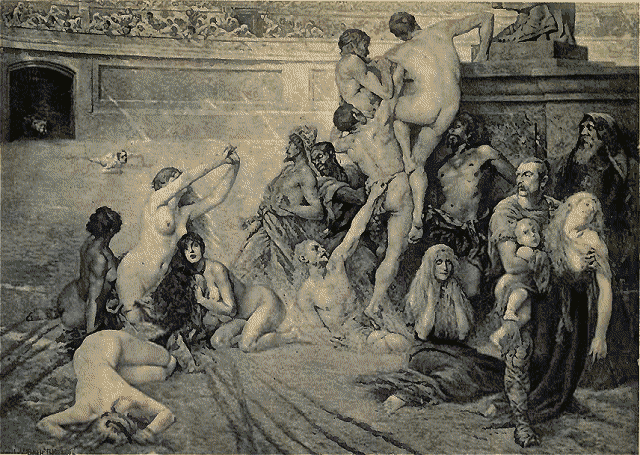
They were arrested in great numbers and crowded into a prison the loathsomeness of which was itself a horrible torture. A holiday was appointed so that the whole populace might be regaled by the sufferings of these men and women. The orgy of cruelty which ensued seems beyond the power of human nature to witness, much less to inflict. It is with great reason that the early Christians looked upon Nero as the Antichrist, the one representing in his nature the infinity of opposition to the Saviour. From none of those horrors were women exempt. Like the men they were crucified; they were covered with the skins of wild beasts and mangled by dogs; and, their garments being dipped in pitch, they were converted into living torches to light the gardens at night. Clement of Rome also tells us that many Christian women were made to play the part of the Danaids and of Dirce. It was the custom to give realistic representation to mythological subjects by compelling criminals to take the part of the victim of the tragedy. Consequently, the women who represented Dirce were tied to the horns of a wild bull and dragged about the arena until they were dead. The well-known piece of ancient sculpture known as the Farnese Bull is the original tragedy pictured in stone. An inscription in Pompeii indicates that this exhibition was a common sight in the arena, women who were condemned being frequently put to death in this manner. No point likely to add to the effect of the scene was sacrificed to decency. The shame at being exposed naked, which would humiliate a Christian maiden even at the moment of impending death, simply afforded an element of jocularity to the tragedy in the eyes of that barbarous Roman multitude.
Doubtless the imperial author of these scenes took more pleasure in them than did any of his subjects. Renan thus pictures him: "As he was nearsighted, he used to put to his eye on such occasions a concave lens of 'emerald,' which served him as an eyeglass. He liked to exhibit his connoisseurship in matters of sculpture; it is said that he made brutal remarks on his mother's dead body, praising this point and criticising that. Living flesh quivering in a wild beast's jaw, or a poor shrinking girl, screening herself by a modest gesture, then tossed by a bull and cast in lifeless fragments on the gravel of the arena, must exhibit a play of form and color worthy of an artist-sense like his. Here he was, in the front row, on a low balcony, in a group of vestals and curule magistrates,--with his ill-favored countenance, his short sight, his blue eyes, his curled light-brown hair, his cruel mouth, his air like a big silly baby, at once cross and dull, open-mouthed, swollen with vanity, while brazen music throbbed in the air, turned to a bloody mist. He would, no doubt, inspect with a critic's eye the shrinking attitudes of these new Dirces; and I imagine he found a charm he had never known before in the air of resignation with which these pure-hearted girls faced their hideous death."
Were these poor women, as they awaited in prison their doom, comforted and encouraged by the presence of the Apostle charged to "feed my lambs"? We do not know. But the firmness and constancy with which they endured trials so horrible even unto death bespeak the marvellous effect of the early enthusiasm of the Christian faith. These women were in the vanguard of the Christian army which first met the deadly force of heathen opposition; and because they did not flinch, but bore the pains of martyrdom for their faith, that faith ultimately triumphed and filled the world with its light. For more than two hundred years, however, the women who embraced this faith were to live in the daily dread of the terrible cry: "The Christians to the lions."
After the death of Nero, for a time the Church was, comparatively speaking, unmolested; though as Christianity was increasing in strength, it was regarded with greater hatred on the part of the general populace. Ugly stories began to be set afloat referring to the practices of this new sect. Later on it came to be believed that its adherents were in the habit of feasting, in their secret gatherings, on the body of a newborn child. This feast was said to be followed by an entertainment in which men and women abandoned themselves to the most abominable and promiscuous licentiousness. These charges, absurd as they were, served to obliterate any ray of pity which otherwise might have visited the minds of their persecutors.
In the year 81, Domitian, whom Tertullian describes as "of Nero's type in cruelty," succeeded Titus on the imperial throne. Influenced by his suspicion of all organizations, and also by the refusal of the Jewish people to pay the capitation tax which was designed to provide for the finishing of the Capitol, he instituted a persecution of the Jews, which, for want of better knowledge on the part of the Romans, could not fail to involve the Christians. His own niece, Domitilla, who had been married to his cousin Flavius Clemens, was an avowed Christian, though up to this time the faith had made few converts among the high and mighty. Domitian banished her to the Island of Pandataria, and put to death her husband, probably on the same charge. They were accused rather vaguely of atheism and Jewish manners; but it seems probable that the Church has made no mistake in placing them among her first sufferers. This persecution by Domitian is counted as the second in the list of ten; but, though many besides Domitilla were put to death, it hardly seems possible that the persecution could have become very general, for only a few months after it began Domitian was assassinated by a freedman belonging to Domitilla, who, as Gibbon remarks, surely had not embraced the faith of his mistress.
The reign of the Emperor Trajan was, in many respects, marked by the greatest prosperity and the best administration that Rome ever enjoyed; but his strict government and close supervision, combined with his loyalty to the ancient traditions, made that reign an era of severity for the Christians. Pliny was governor of Bithynia and Pontus, and thence he wrote to the emperor informing him that the Christians were gaining headway everywhere, so much so that the temples of the gods were being forsaken by the people of all classes. He desired advice as to how he should proceed. By the application of torture to two maidservants who held the office of deaconesses in the local church he had elicited the information--for the learning of which, doubtless, torture was entirely unnecessary--that "the whole sum of their error consisted in this, that they were wont, at certain times appointed, to meet before day, and to sing hymns to one Christ their God. They also agreed among themselves to abstain from all theft, murder, and adultery; to keep their faith, and to defraud no man: which done, they departed for that time, and afterwards resorted again to take a meal in companies together, both men and women, and yet without any act of evil."
To this Trajan replied that the Christians should not be sought after, nor should anonymous accusations be received; but when they were brought before the magistrate they should be punished. A most inconsistent decision; for, as Tertullian pointed out, if they deserved to be punished when caught, they ought also to be sought after as guilty.
In the legends of the martyrs there is an account of a widow named Symphrosa who, with her seven sons, suffered death by the command of Trajan. They refused to sacrifice to the gods at his behest. First, the mother was tortured by being hung up for some time in the temple of Hercules by the hair of the head, and then drowned; afterward, her sons were by various means tortured and put to death.
We now come to the time of the philosophic emperor, Marcus Aurelius. During the reign of his predecessor, Antoninus Pius, the Christians were generally left to practise and propagate their religion in peace. Consequently, the Gospel made rapid inroads upon paganism; so much so that the latter was stirred to a more bitter opposition than had ever before been instituted. At the first glance it appears a difficult problem in moral philosophy to explain how so wise and righteous a ruler as Marcus Aurelius could bring himself to persecute so cruelly an inoffensive people like the Christians. But in the first place it must be remembered that ecclesiastic history of that time, as we have it, is very uncertain; in fact, it is greatly distorted and exaggerated. There are good reasons for believing that what is called a general persecution was confined largely to the one province of Gaul. Then it is very likely that the emperor knew but little of the character of the Christians or of the nature of their doctrines; that he held an unfavorable opinion of them is shown by his own words. It also seems to be the fact that he issued no new edict against them; but the rescript of Trajan was still in force, which was to the effect that Christians, when accused in legal form, and failing to recant, should be punished. Marcus Aurelius simply allowed this rule to be enforced by the magistrates. He saw in the Christians only stubborn recalcitrants against the established government. Whatever may have been the amount of the emperor's direct responsibility in the matter, during his reign the flame of persecution again burst out; and among many others, some women won lasting fame by the glorious constancy and courage of their martyrdom.
One of the most illustrious was Felicitas, a Roman lady of good family and the mother of seven sons. It was the policy of the magistrates not to punish unnecessarily, but to endeavor to win those who were accused to an acknowledged abandonment of their faith. In this case the judge deemed it the more efficacious method to proceed against the mother first, in the hope that in winning her to change her religion, he would have less trouble with her sons; but neither promises of freedom nor threats of total destruction of herself and her family could prevail. Then he caused each son to be brought before him separately, and endeavored both by menaces and persuasion to turn them from their allegiance. Felicitas, however, had too thoroughly instilled into her sons' minds the principles upon which her own faith and courage were founded; they were unanimous in their steadfastness. The consequence was that the mother was doomed to see her offspring executed one by one; and at last, her resolution being invincible even before this terrible trial, Felicitas herself was beheaded.
The brunt of the persecution which took place in the reign of Marcus Aurelius was borne by the Christians of Gaul, particularly those of Lyons and Vienne. We possess a good description of these sufferings in a letter which has been preserved by Eusebius, and which was sent by the survivors of these devoted churches to their brethren in the other parts of the empire. "The greatness of the tribulation in this region," says the epistle, "and the fury of the heathen against the saints, and the sufferings of the blessed witnesses, we cannot recount accurately, nor indeed could they possibly be recorded. For with all his might the adversary fell upon us, giving us a foretaste of his unbridled activity at his future coming. He endeavored in every way to practise and exercise his servants against the servants of God, not only shutting us out from houses and baths and markets, but forbidding any of us to be seen in any place whatever. But the grace of God led the conflict against him, and delivered the weak, and set them as firm pillars, able through patience to endure all the wrath of the Evil One."
The letter goes on to relate how the heathen servants of many of the Christians were arrested, and, through fear of suffering the same dreadful tortures which they saw visited upon the believers, testified falsely that the Christians were wont to indulge in the most atrocious practices. This was believed by the common people, with the result that all pity was extirpated from their breasts, and they hunted the Christians with a rage which could only be likened to that of wild beasts.
One of the most renowned of the sufferers on this occasion was the slave Blandina, "through whom Christ showed that things which appear mean and obscure and despicable to men are with God of great glory.... For while we all trembled, and her earthly mistress, who was herself also one of the witnesses, feared that on account of the weakness of her body she would be unable to make a bold confession, Blandina was filled with such power as to be delivered and raised above those who were torturing her by turns from morning until evening in every manner, so that they acknowledged that they were conquered, and could do nothing more to her. And they were astonished at her endurance, as her entire body was mangled and broken; and they testified that one of these forms of torture was sufficient to destroy life, not to speak of so many and so great sufferings. But the blessed woman, like a noble athlete, renewed her strength in her confession; and her comfort and recreation and relief from the pain of her sufferings was in exclaiming, 'I am a Christian, and there is nothing vile done by us.'"
All this torture seems to have taken place in the examination of Blandina before the tribunal; for we read how, later, she with others was taken to the amphitheatre to be exposed to the wild beasts, a spectacle having been arranged in order that the people might be regaled with the sight of the Christians' sufferings. At this exhibition the people themselves decided as to what forms of cruelties the victims should endure, shouting out their demands for the fiery stake or the beasts, as their horrible fancies dictated.
Blandina was suspended on a cross, and there left to the mercy of any of the numerous wild beasts prowling around the arena that might choose to attack her. But on this occasion she was left unmolested; and the sight of her, hanging from the stake and thus reminding them of the Master they served, as well as the prayers she continually offered, so heartened her comrades that they were the better enabled to meet their death with a good courage.
The memory of Blandina has justly been preserved through all these centuries as one of the bravest and best in the noble "army of martyrs." No doctor of theology ever bore more effective testimony to the faith; no Christian soldier ever contended more earnestly for the cause; no philosopher ever advanced a stronger argument in evidence of the truth of religion than this poor slave woman who thus suffered in the bloody arena where Christianity fought and conquered seventeen centuries ago. Women were not allowed by the law of the Church to teach in the assembly; but Blandina, from her rostrum of pain which was set up in the amphitheatre at Lyons, by her faith which could enable her to forget her own misery in the desire to cheer other sufferers, preached such a sermon as sentences of polished eloquence can never emulate.
We cannot better finish our account of this great martyr than by quoting the description of her end as it is given in the letter mentioned above. "On the last day of the contests, Blandina was again brought in, with Ponticus, a boy about fifteen years old. They had been brought every day to witness the sufferings of the others, and had been pressed to swear by the idols. But because they remained steadfast and despised them, the multitude became furious, so that they had no compassion for the youth of the boy nor respect for the sex of the woman. Therefore, they exposed them to all the terrible sufferings and took them through the entire round of torture, repeatedly urging them to swear, but being unable to effect this; for Ponticus, encouraged by his sister so that even the heathen could see that she was confirming and strengthening him, having nobly endured every torture, gave up the ghost. But the blessed Blandina, last of all, having, as a noble mother, encouraged her children and sent them before her victorious to the King, endured herself all their conflicts and hastened after them, glad and rejoicing in her departure as if called to a marriage supper; rather than cast to wild beasts. And, after the scourging, after the wild beasts, after the roasting seat, she was finally enclosed in a net, and thrown before a bull. And after being tossed about by the animal, but feeling none of the things which were happening to her, on account of her hope and firm hold upon that which had been entrusted to her, and her communion with Christ, she also was sacrificed. And the heathen themselves confessed that never among them had a woman endured so many and such terrible tortures."
The horrible circumstances attending the persecution at Lyons seem to have been largely instigated by the fury of the ungovernable mob; there are indications that the trial of Christians was oftentimes carried on in strict conformity with legal measures, and also with some show of pity on the part of the judges. The punishments in cases like these were no less severe; but there is some, comfort in thinking, inasmuch as the persecutors were members of the human race like ourselves, that they felt bound by their consciences to proceed to these extreme measures in the endeavor to put down what they believed to be a dangerous innovation. To understand persecution rightly, it is necessary not only to sympathize with the sufferers, but also, so far as is possible, to take the viewpoint of the persecutors. It is only in comparatively recent times that barbarities in legal proceedings have been discontinued. Age has not yet destroyed all the implements of torture that were considered part of the necessary furniture of a European prison. Far down in Christian times, the examination of a prisoner was considered to be very properly and justly facilitated by the application of thumbscrews and iron boots. Even our own memory is not entirely lacking in incidents where water has been used to the great discomfort of a prisoner, with the object of expediting his confession. Hence, it would be absurd to expect to find a Roman magistrate of the second century after Christ contenting himself with expostulating with those whom the laws, the traditions, and the customs of his country condemned. This failing, he would naturally try a stronger argument.
This is illustrated in the cases of the renowned martyrs Perpetua and Felicitas. These were ladies of Carthage, who suffered during the reign of Severus. Perpetua was only a learner in the Christian faith, not yet having been baptized. She was young, married, and possessed a still stronger tie to existence in the young infant which she carried in her arms. Her father, by whom she was greatly beloved, visited her in prison and endeavored to persuade her to renounce Christianity. Failing in his arguments and entreaties, he even exercised the parental right which the law of his day gave him to chastise his daughter; but he could elicit no word of decision from her other than: "God's will must be done."
While in the prison she was baptized, and was thus still more strongly fortified to meet the trial which was before her. At her examination we have such a picture as is indicated above. The judge entreated her to have compassion on her father's tears, on her infant's helplessness, as well as on her own life. He pointed out to her the cruel position in which she was placed by her religion, and used this as an argument against it. But it all availed nothing. She was returned to the prison to await the day of execution. Her companion in this direful anticipation was Felicitas, a married woman who was about to become a mother. This Christian woman also, on being brought before the procurator, had been entreated by him to have pity upon herself and her condition; but she had replied that his compassion was useless, since no thought of self-preservation could induce her to be unfaithful to her religion. While in the prison she gave birth to a girl, which was adopted by a Christian woman who as yet was free.
On the day of their execution, Perpetua and Felicitas were taken to the amphitheatre and stripped of their clothing; but on this occasion, however lacking the people may have been in the quality of mercy, they at least showed some feelings of decency, for they requested that the women might be allowed to have their garments. The two martyrs were then exposed to the fury of an enraged bull. The animal attacked them both; but as neither of them was mortally wounded, an officer despatched them with his sword.
The authorities doubtless congratulated themselves that by the death of these poor women the hated religion was by so much reduced; but "the blood of the martyrs was the seed of the church," and by the courage of its martyrs more people were incited to investigate the new faith than by their sufferings were deterred from following it. In fact, there are instances on record that the constancy of the Christians in their sufferings bore immediate fruit in the conversion of the spectators; where those who came to revile shared in the end the death of those they helped to persecute. The most noted example of this kind is that of Potamiana, who suffered under the emperor Severus. Rufinus says that she was a disciple of Origen. We are also informed by Palladius that she was a slave, and that her condemnation originated in the passion of her master. Angered by her steadfast refusal to submit to his desires, he accused her to the judges as a Christian, and bribed them to endeavor to break her resolution and afterward return her to himself; but their tortures proved as ineffectual as his persuasions. At last, being sentenced to death, she was given in charge of Basilides, an officer of the army, to be led to the place of execution. On the way thither, when the people sought to annoy her by insult and abuse, Basilides drove them back, and, probably more by his actions than by words, manifested for her much kindness and pity. Eusebius says that Potamiana, "perceiving the man's sympathy for her, exhorted him to be of good courage, for she would supplicate her Lord for him after her departure, and he would soon receive a reward for the kindness he had shown her. Having said this, she nobly sustained the issue, burning pitch being poured, little by little, over various parts of her body, from the soles of her feet to the crown of her head. Such was the conflict endured by this famous maiden."
Shortly after this, Basilides, being requested by his fellow soldiers to take an oath, refused; and he gave it as his reason that it was not lawful for him to swear, he being a Christian. At first they thought he was jesting; but as he persistently affirmed it, they took him before the judge, with the result that the next day he was beheaded. He was reported to have said that for three days after her martyrdom Potamiana stood by him night and day, and that she placed a crown upon his head, telling him that she had besought the Lord for him and had obtained what she asked, which was that he should soon be with her.
In the year 250 the Emperor of Rome was Decius. During his brief reign he instituted one of the severest persecutions that the Church was called upon to endure. Yet there is reason to believe that this emperor was a man of superior character and high principles. Alarmed at the corruption that prevailed in the empire, he sought to restore the ancient customs and to strengthen the primitive religion. As a means deemed by him necessary to this end, he endeavored to extirpate Christianity. This was the first persecution in which the attempt was universally made to destroy the Church. This persecution was consequently far more terrible than any which had preceded it. Fortunately, the reign of Decius lasted only two years; but during that time vast numbers of Christians were put to death, and the women were as little spared as they had been on former occasions. There is no need of recounting their individual sufferings, as it would simply be a repetition of the horrors described above.
In the meantime, the Church had greatly changed in its character. It had grown sufficiently strong to compete with paganism even in point of numbers. During the periods of peace there were taken into its fold a great many who were not strongly grounded in the faith, nor had they the mind to endure in the time of persecution. Consequently, when it came to the trial, great numbers would return to a formal practice of heathen worship, with the purpose in mind of returning to the Church after the storm had passed over. These often obtained certificates from the magistrates to the effect that they had made the required recantation. The Church had also begun to define its creed with metaphysical nicety of expression, with the consequence that many discussions arose and numerous heretical sects came into being. The heathen, however, did not discriminate; therefore, the heretical had their martyrs as well as the orthodox; and there is no proof that the former were less ready to die for their faith than the latter. But, to show the jealousy which variety in religious opinion will engender, it is recorded that even when members of the various sects of Christians were suffering martyrdom together, they refused to recognize each other.
By this time also the doctrine of the superior sanctity of virginity had become firmly established in the Church. It was probably owing to this that, in the later persecutions, we frequently find reference made to women being threatened with unchaste attacks on their persons with the sole purpose of driving them to the abjuring of their religion. Gibbon, referring to this, speaks of it in the following manner: "It is related that pious females, who were prepared to despise death, were sometimes condemned to a more severe trial, and were called upon to determine whether they set a higher value upon their religion or upon their chastity. The youths to whose licentious embraces they were abandoned received a solemn exhortation from the judge to exert their most strenuous efforts to maintain the honor of Venus against the impious virgin who refused to burn incense on her altars. Their violence, however, was commonly disappointed, and the seasonable interposition of some miraculous power preserved the chaste spouses of Christ from the dishonor of even an involuntary defeat. We should not indeed neglect to remark that the more ancient as well as authentic memorials of the Church are seldom polluted with these extravagant and indecent fictions."
There is no doubt that the monks of later times did waste their leisure in fabricating such miraculous interposition; but there surely is a flippancy in the tone of what is above quoted, as indeed in Gibbon's whole treatment of the persecution of the early Christians, which is not worthy of the great historian.
CHRISTIANS IN THE ARENA After the painting by L. P. de Laubadère.
Were these poor women, as they awaited in prison their doom, comforted and encouraged by the presence of the Apostle charged to "feed my lambs"? We do not know. But the firmness and constancy with which they endured trials so horrible even unto death bespeak the marvellous effect of the early enthusiasm of the Christian faith. These women were in the vanguard of the Christian army which first met the deadly force of heathen opposition; and because they did not flinch, but bore the pains of martyrdom for their faith, that faith ultimately triumphed and filled the world with its light. For more than two hundred years, however, the women who embraced this faith were to live in the daily dread of the terrible cry: "The Christians to the lions."
Eusebius informs us that "the women were no less manly than the men in behalf of the teaching of the Divine Word, as they endured conflicts with the men, and bore away equal prizes of virtue. And when they were dragged away for corrupt purposes, they surrendered their lives to death rather than their bodies to impurity." He instances the case of a woman and her two daughters, whom Chrysostom, in an oration in their honor, names as Domnina, Bernice, and Prosdose. These women, being as beautiful in their persons as they were virtuous in their minds, were threatened during the Diocletian persecution with violation. While the guard was taking them back to the place from which they had fled to avoid this danger, they took advantage of a moment in which they were not watched to throw themselves into the river, where they found safety in death. Another case was that of the wife of the prefect of Rome. Maxentius, the emperor, being seized with a passionate desire for her, sent officers to bring her to the palace. The lady begged time in which to adorn herself for the occasion. This being granted, as soon as she found herself alone, she stabbed herself, so that the messengers going to her room found nothing but her dead body. These instances are recorded with great admiration by both Eusebius and Chrysostom, showing that the leaders of the early Church deemed it less prejudicial to a woman's salvation for her to take her own life than to suffer even the involuntary defilement of her body.
The reign of Diocletian and his colleagues saw the final struggle between Christianity and paganism. It was a bloody conflict for the Christians; and yet, though they refrained from resisting evil with material weapons, they conquered. Women in great numbers were again faithful unto death. Some were for the time frightened from their allegiance to Christ; for the pure precepts were becoming increasingly diluted with worldliness as well as superstition. Among these women were the wife and daughter of Diocletian, Prisca and Valeria. These had become converts to the faith; but when the edict was published against the Christians, they sacrificed to the traditional gods. It availed them little, however; for they gained only a few years of most distressful life at the cost of the martyr's crown. In the end the violent death came to them without the honor, for in the year 314 Licinius caused them to be beheaded and their bodies thrown into the sea. They had committed no fault of which any evidence is left; and for several years they had suffered from the loss of their property and from the hardships of exile. Diocletian was still alive, but could render them no aid, as he had abdicated the throne and was now busying himself solely in growing vegetables. Licinius was mistakenly supposed to be a friend to Christianity; Constantine had become its champion. But, as Victor Duruy says: "Notwithstanding celestial visions and marvellous dreams, these men were destitute of heart, and their faith, if they had any, was without influence upon their conduct. Their cruelty was universally commended; in reference to all these murders, the Christian preceptor of a son of Constantine utters a cry of triumph. The inspiration of the gentle Galilean Teacher was replaced by that of the implacable Jehovah of the Mosaic law." The tables had turned; Christianity was now in power; the heretofore persecuted soon set out on the way to become the persecutors.
IV
SAINT HELENA AND THE TIME OF CONSTANTINE
At last we see Christianity triumphant. What has been an obscure but hated and persecuted sect now becomes the dominant religion in the Empire; the people who had hidden underground in the Catacombs are now the favorites of the palace. It had been a conflict between spiritual forces and carnal weapons, between patient propagandism and vindictive conservatism; on one side, invincible missionary zeal joined with undefensive submission, on the other, senseless misrepresentation and cruel persecution. But what can overcome the idea for which men and women are ready to die? It was a conflict in which, on the Christian part, women were as well fitted to engage as were men. The exalted purity of Christian maidens was as effective in setting at naught the counsels of the ungodly as were the elaborate arguments of the apologists; the blood of believing matrons was as fertile for the increase of the Church as was that of bishops and presbyters. The followers of Christ clung to the Cross and conquered.
At the same time, victory did not come without heavy loss to the Church. In this loss, however, must not be reckoned the lives of the martyrs. The men and women who sacrificed themselves to the Cause were considered to have won thereby, not mere fame, but the enjoyment of celestial glory in a conscious eternal life; and their death was always repaid to the Church by an increase of a hundred-fold. But as the Church gained in extension, it lost in intention. The organization, the religion, the name won; but the spirit, the inner principles of Christianity lost. In this sense the victory was much in the nature of a compromise. Christianity became the faith of the Empire; but the Empire did not adopt for its rule the pure precepts of Christ. Constantine's court worshipped the Nazarene; but Constantine's conduct was not superior to that of many of his heathen predecessors. The ancient religion was superstitious, and it is not possible to contend that the religion of Helena was free from that fault. The women of an older Rome were greatly subject to frailties of the flesh, and like scandals were by no means uncommon in the palaces of Christian emperors. It is not difficult to match Agrippina and Poppæa in the history of Rome after the Council of Nicæa. The religious revolution which took place in the world was much more rapid in respect to theory than it was in practice.
This is the history of all evolutions of the ideal. The first missionaries are exalted by their enthusiasm above common nature; they soar to the clouds. The martyrs are not restrained by any of the ties of various sorts which bind humanity; they despise the flesh. But their converts partake of their spirit in a lesser degree; as these increase, a growing proportion of them realize that for them life must continue to be very much what it always has been. It is not possible for all to maintain themselves in an intense and eager quest for the ideal. The heroic leaders may attain the empyrean, but the multitude must drag on the ground, thankful if at the most they can keep their feet; for, be our ideals what they may, in reality the chief business of life is living.
Again, as in all other movements, when the Church began to grow in popularity, numbers came within her pale whose minds were more attracted by her philosophy than their hearts were affected by her principles. Consequently the Christians were early divided on matters of theological opinion. There were all shades of variation in belief, and each distinction of faith meant a sect more or less divided from the common body of Christians. And it must be admitted that very quickly, even before the fires of persecution had been quenched, there appeared that bitterness which has always characterized and disgraced theological differences in the Church. The leaders of orthodoxy began to deprecate deviations from the common rule of faith with greater severity than they did lapses from fundamental morality. The Church consequently lost much of its pristine influence, which had been so successful in purifying the lives of the Christians. Metaphysical dogmas were exalted at the expense of holy deeds, and it became possible for corrupt rulers to be lauded as defenders of the faith and for unchaste women to receive those ecclesiastical privileges which formerly had been but grudgingly restored to those who had done no more than burn a handful of incense on the altar of Venus to save themselves from martyrdom.
In the letter of the bishops against Paul of Samosata, who was Metropolitan of Antioch about the year 290, he is charged with conniving at the institution of the subintroduçtæ,--that is, women who were pledged to virginity and who yet were so intrepid as to take up their abode in the houses of clergy who also professed celibacy. The idea of this proceeding seems to have been that the constant presence of temptation, which the people were supposed to believe was always overcome, enhanced the victory achieved by these champions of purity. The leaders of the Church, however, looked with disfavor upon this hazardous method of demonstrating the power of the new religion; but Paul of Samosata seems not only to have allowed this practice, but to have been himself far from careful to avoid suspicious appearances. The bishops, in their letter referred to above, complain thus: "We are not ignorant how many have fallen or incurred suspicion through the women whom they have thus brought in. So that, even if we should allow that he commits no sinful act, yet he ought to avoid the suspicion which arises from such a thing, lest he scandalize some one, or lead others to imitate him. For how can he reprove or admonish another not to be too familiar with women ... when he has sent one away already, and now has two with him, blooming and beautiful, and takes them with him wherever he goes." Paul was probably not so black as he was thus painted by his enemies; especially is this likely, seeing that his patroness was Zenobia, the queen of Palmyra, who was remarkably careful in her conduct. But the point we wish to establish is found in the admission made by the bishops that, since Paul was a heretic, they had no concern about his conduct. In a note on this, Dr. McGiffert remarks: "We get here a glimpse of the relative importance of orthodoxy and morality in the minds of the Fathers. Had Paul been orthodox, they would have asked him to explain his course, and would have endeavored to persuade him to reform his conduct; but since he was a heretic it was not worth while. It is noticeable that he is not condemned because he is immoral, but because he is heretical. The implication is that he might have been even worse than he was in his morals and yet no decisive steps taken against him, had he not deviated from the orthodox faith." All this goes to show that, after Christianity was established as the dominant religion of the empire, the life of women as well as of men was less changed by the effect of their new devotions than those devotions were altered in their form and direction. Though a new heaven was proclaimed, the new earth had not yet come into being. "The sweet reasonableness" of the Gospel was beclouded by speculation; the primitive holiness degenerated into a sickly asceticism; for half-converted pagans, the early saints served in the place of the old divinities; and human nature still remained capable of most of the vices to which it had formerly been addicted.
Yet the ideal is never without its witnesses. Very early there arose within the Church the movement known as Montanism, which endeavored to reproduce the ancient purity by an exaggerated rigidity of discipline and the early simplicity of the Church by a stern opposition to ecclesiasticism. This movement carries an interest relative to our subject, inasmuch as two women held a prominent place as its founders. The three original prophets of the sect were Montanus, Priscilla, and Maximilla. The former of the two women was so influential in the movement that its adherents are frequently spoken of as Priscillianists. The two women were ladies of noble birth who left their husbands in order to attach themselves to Montanus. They believed themselves to be the mediums of the divine Comforter promised by Christ. It was their habit to fall into ecstasies, in which condition they would prophesy. They claimed that their teaching was divinely inspired and consequently infallible. According to them, all gross offenders were to be excommunicated, and never afterward readmitted to the fold of the Church. Celibacy was encouraged by them, all worldly amusements were to be eschewed, and they greatly increased the number of the fasts.
Of Priscilla and Maximilla, Dr. McGiffert says: "They were regarded with the most profound reverence by all Montanists. It was a characteristic of this sect that they insisted upon the religious equality of men and women; that they accorded just as high honor to the women as to the men, and listened to their prophecies with the same reverence. The human person was but an instrument of the Spirit, according to their view, and hence a woman might be chosen by the Spirit as his instrument just as well as a man, the ignorant as well as the learned. Tertullian, for instance, cites, in support of his doctrine of the materiality of the soul, a vision seen by one of the female members of his church, whom he believed to be in the habit of receiving revelations from God."
These people were reactionaries; they rebelled against the spirit of laxity, worldliness, and officialdom which was fast taking hold of the Church. Their prophesying women were simply a revival of what had been common in Apostolic times, when the daughters of Philip were prophetesses. But order had been evolved in the ecclesia. In fact, out of the numerous forms of evangelical activity that existed in the original unsettled condition of the Church, three orders had been established, in none of which were women represented. Moreover, the female friends of Montanus seem to have been rather unconvincing in regard to their prophecies. Maximilla declared that after her there would be no other prophet, intimating that the end of the world was about to take place, a prediction as common among such enthusiasts as it is hazardous in its nature. She also prophesied that wars and anarchy were near at hand, which, as an anonymous writer quoted by Eusebius found no difficulty in showing, was clearly false. With a jubilation which, under the circumstances, was not unwarranted, he cries: "It is to-day more than thirteen years since the woman died, and there has been neither a partial nor general war in the world; but rather, through the mercy of God, continued peace even to the Christians." From this time, any attempt, on the part of women or men, to revive the gift of prophecy after the apostolic manner was always classed with heresy, schism, and other works of the devil, which it was the duty of the faithful zealously to cast out.
During the many and long intermissions during which the Christians were not persecuted, the Church steadily grew in prominence and in social standing. Before the time of Diocletian, large and handsome edifices had been erected in many places for the use of Christian worship. The doctrines therein taught were no longer unknown to the rulers and chief men of paganism; the faith was no longer the possession almost solely of bondservants and the lowly. Among its conquests were men and women of high position; even the imperial family was now and again strongly suspected of contributing friends to the new religion. Prisca and Valeria, the wife and daughter of Diocletian, were certainly catechumens, though they sacrificed to the heathen deities when the emperor gave his edict for persecution. The world was not to see a Roman empress playing the tragic part of a martyr to Christianity.
Of the time immediately preceding the persecution of Diocletian, Eusebius says: "It is beyond our ability to describe in a suitable manner the extent and nature of the glory and freedom with which the word of piety toward the God of the universe, proclaimed to the world through Christ, was honored among all men, both Greeks and barbarians. The favor shown our people by the rulers might be adduced as evidence; as they committed to them the government of provinces, and on account of the great friendship which they entertained toward their doctrine, released them from anxiety in regard to sacrificing. Why need I speak of those in the royal palaces, and of the rulers over all, who allowed the members of their households, wives and children and servants, to speak openly before them for the divine word and life, and suffered them almost to boast of the freedom of their faith?"
Thus it came to pass that Christianity grew to be a power which must be reckoned with in the state; all the more so, since, as the historian just quoted admits, many of the motives, influences and usages natural to the world began to be adopted in the Church. It is really doubtful whether the persecution under Diocletian was at all instigated by any animosity on the part of the rulers toward Christian principles. The Church was looked upon as a great party in the state, opposed to traditional conditions, and, while not yet strong enough to be courted, was too numerous to be tolerated. Constantine saw the futility of endeavoring to extirpate the Church, even if his disposition could have allowed him to resort to such cruel measures, and--it is not uncharitable to his memory to say it--he shrewdly concluded to attach this vigorously growing power to himself.
Before we enter upon the study of the character and time of a woman to whose influence the political triumph of Christianity was probably very largely due, it will not be out of place to notice a little more closely the unfortunate career of Valeria, the daughter of Diocletian. She has previously been referred to as a Christian who, with Prisca, her mother, saved herself from martyrdom by sacrificing, though very reluctantly, to the pagan deities. By her father, Diocletian, she had been given in marriage to Galerius, who at that time was made Cæsar and was afterward to become emperor. In every way she proved herself a most estimable wife; and although her courage was not equal to the endurance of martyrdom, her Christian principles beautified her life with the graces of virtue and charity. Having no children of her own, she adopted Candidianus, the illegitimate son of her husband, and evinced toward him all the affection of a real mother. After the death of Galerius, the great fortune, no less than the personal attractions, of Valeria aroused the desires of Maximin, his successor. This Maximin was the most licentious man that ever disgraced the imperial throne, and to attain preeminence among such competitors required a monster of sensuality. His eunuchs catered to his passions by forcing from their homes wives and virgins of the noblest families; any sign of unwillingness on the part of these victims was regarded as treason and punished accordingly. During his reign, the custom arose that no person should marry without the emperor's consent, in order that he might in all nuptials act the part of prægustator.
The fate of Valeria is best described in the words of Gibbon: "He [Maximin] had a wife still alive; but divorce was permitted by the Roman law, and the fierce passions of the tyrant demanded an immediate gratification. The answer of Valeria was such as became the daughter and widow of emperors; but it was tempered by the prudence which her defenceless condition compelled her to observe. She represented to the persons whom Maximin had employed on this occasion, 'that, even if honor could permit a woman of her character and dignity to entertain a thought of second nuptials, decency at least must forbid her to listen to his addresses at a time when the ashes of her husband and his benefactor were still warm, and while the sorrows of her mind were still expressed by her mourning garments. She ventured to declare that she could place very little confidence in the professions of a man whose cruel inconstancy was capable of repudiating a faithful and affectionate wife.' On this repulse the love of Maximin was converted into fury; and as witnesses and judges were always at his disposal, it was easy for him to cover his fury with an appearance of legal proceedings, and to assault the reputation as well as the happiness of Valeria. Her estates were confiscated, her eunuchs and domestics devoted to the most inhuman tortures, and several innocent and respectable matrons, who were honored with her friendship, suffered death, on a false accusation of adultery. The empress herself, together with her mother Prisca, was condemned to exile; and as they were ignominiously hurried from place to place before they were confined to a sequestered village in the deserts of Syria, they exposed their shame and distress to the provinces of the East, which, during thirty years, had respected their august dignity. Diocletian [who before this had abdicated his throne and was therefore powerless] made several ineffectual efforts to alleviate the misfortunes of his daughter; and, as the last return that he expected for the imperial purple, which he had conferred upon Maximin, he entreated that Valeria might be permitted to share his retirement at Salona, and to close the eyes of her afflicted father. He entreated; but as he could no longer threaten, his prayers were received with coldness and disdain; and the pride of Maximin was gratified in treating Diocletian as a suppliant, and his daughter as a criminal.
"The death of Maximin seemed to assure the empresses of a favorable alteration in their fortune. The public disorders relaxed the vigilance of their guard, and they easily found means to escape from the place of their exile, and to repair, though with some precaution, and in disguise, to the court of Licinius. His behavior, in the first days of his reign, and the honorable reception which he gave to young Candidianus, inspired Valeria with secret satisfaction, both on her own account and on that of her adopted son. But these grateful prospects were soon succeeded by horror and astonishment; and the bloody executions which stained the palace of Nicomedia sufficiently convinced her that the throne of Maximin was filled by a tyrant more inhuman than himself. Valeria consulted her safety by a hasty flight, and, still accompanied by her mother, Prisca, they wandered above fifteen months through the provinces, concealed in the disguise of plebeian habits. They were at length discovered at Thessalonica; and as the sentence of their death was already pronounced, they were immediately beheaded, and their bodies thrown into the sea. The people gazed on the melancholy spectacle; but their grief and indignation were suppressed by the terrors of a military guard. Such was the unworthy fate of the wife and daughter of Diocletian. We lament their misfortunes, we cannot discover their crimes." It is by no means unlikely, judging from the character of these women, that if the true facts were known, though they were not martyrs in the accepted sense of the word, it would be seen that they suffered for their Christianity, being induced by its principles to refuse their consent to such conduct as would have gained the favor of their persecutors. There have been many more martyrs for the substance of Christianity than there have been for its form; and doubtless there were not a few women, in the times of which we are writing, who would have sacrificed on pagan altars, but who would not have defiled their consciences with acts which paganism excused.
In the preceding pages of this chapter, we have attempted to indicate the fact that, while Christianity was growing in numbers and influence, its effect upon the moral conditions of the world was not so great as might be expected by a student who confines his attention to its doctrines, rather than to an investigation of the character of the men and women who made the history of that time. As has already been said, the material and political triumph of Christianity was in reality a moral compromise with the world. If the faithful practice of the teachings and the humble following of the example of Christ had been rigidly insisted upon as the sine qua non of membership in the Church, it is doubtful if Constantine would have proved a better friend to the Church than was Trajan. Nevertheless, the fact that Constantine did find himself able to favor the Christian religion, without incurring any mental discomfort in the pursuit of his own ideas, rendered it possible for earnest believers in Christ to devote themselves to their faith in perfect security.
How large a share may be rightfully imputed to Helena of the honor of influencing her son's mind to the support of Christianity it is impossible to determine, but that some credit is due to her in this respect the nature of the circumstances warrants us in believing. In any case, Helena was so important a figure in early Church history that her life and doings were a favorite theme for the chroniclers of her time and a welcome opportunity for the legendists of the mediaeval age. These latter have so glorified her ancestry and confused the place of her birth that it is entirely impossible to harmonize their statements with those of the former. As an example of the legends of the Middle Ages we give the account of her as it is found in Hakluyt's Voyages and quoted by Dr. McGiffert in his Prolegomena to Eusebius's Constantine the Great. "Helena Flavia Augusta, the heire and only daughter of Coelus, sometime the most excellent king of Britaine, by reason of her singular beautie, faith, religion, goodnesse, and godly Maiestie (according to the testimonie of Eusebius) was famous in all the world. Amongst all the women of her time there was none either in the liberall arts more learned, or in the instruments of musike more skilfull, or in the divers languages of nations more abundant than herselfe. She had a naturall quicknesse of wit, eloquence of speech, and most notable grace in all her behaviour. She was seen in the Hebrew, Greek, and Latin tongues. Her father (as Virumnius reporteth) had no other childe, ... Constantius had by her a sonne called Constantine the great, while hee remained in Britaine ... peace was granted to the Christian churches by her good meanes. After the light and knowledge of the Gospel, she grew so skilfull in divinity that she wrote and composed divers bookes and certaine Greek verses also, which (as Ponticus reporteth) are yet extant... went to Jerusalem... lived to the age of fourscore yeeres, and then died at Rome the fifteenth day of August, in the yeere of oure redemption 337.... Her body is to this day very carefully preserved at Venice." As the learned author of the Prolegomena says, this is "a matter-of-fact account of things which are not so."
There is another story, to the effect that Helena was the daughter of a nobleman of Treves. While on a pilgrimage to Rome she was seen by Emperor Constantius, and he, falling in love with her beauty, caused her to be detained in the city until after her companions had returned home. The result was disastrous to Helena's character as a virgin. To assuage her grief, the emperor presented her with an ornament of precious stones and his ring. She continued to remain in Rome with the son that was born to her, allowing it to be understood that her husband was dead. Constantine, her son, grew up to be a young man of remarkably fine presence and unusual parts. These qualities in him attracted the attention of some rich merchants, who conceived the project of palming him off on the Emperor of the Greeks as the son of the Roman emperor, so that the former might accept him as a son-in-law.
This scheme was successful, and after a time the merchants reembarked for Rome, taking with them the princess as Constantine's wife, and also much treasure, which presumably was the object of the adventure. One night they went ashore on a little island, and in the morning the young people awoke to find that they were deserted. Constantine then confessed to the princess the fraud that had been practised upon her; but she magnanimously declared that she was satisfied with him as her husband, whatever his family might be. After some days of privation, they were rescued by passing voyagers and taken on to Rome. There, with the treasure which the princess had managed to retain, they purchased an inn, and, with Helena's assistance, supported themselves by its means. Constantine became so famous through his prowess at tournaments that he attracted the attention of the emperor, who refused to believe that he was of low extraction. Helena was sent for, and, after much questioning, she at last confessed as to who she and her son really were. The truth of her statement was confirmed by the ring which Constantius had given her. The emperor then caused the merchants to be put to death and their property given to Constantine. A treaty was made with the Greek emperor, and Constantine was recognized as the heir to the whole Empire. This story may be regarded as a sort of Middle Age historical novel, the history being metamorphosed without stint in order to enhance the interest of the tale.
The old chroniclers, such as Henry of Huntington, Geoffrey of Monmouth, and Pierre de Langtoft, assert that Helena was the daughter of Duke Coel of Colchester, who became King of Britain. She was the most beautiful and cultivated woman of her time-the attribute of beauty is always awarded to women who have been so fortunate as to become legendary. The most interesting thing about this story is the fact that modern students have identified Duke Coel, the alleged father of Helena, with "Old King Cole," who was the "merry old soul" immortalized in the Mother Goose rhymes.
Let us now turn to what may be seriously regarded as history and therein ascertain what may be known of the life and character of the empress-mother Helena. It must be taken as a well-established fact that her father, so far from being either a king or a duke of Britain, was indeed an innkeeper at Drepanum, a town on the Gulf of Nicomedia. The story suggested by this circumstance is the commonplace one of a soldier in the service of the emperor Aurelian passing a brief sojourn at the hostelry in Drepanum, and, with the proverbially quick susceptibility of the men of his calling, falling in love with the daughter of his host. The necessary negotiations were easy, for a man like Constantius was an unusual catch for a girl in the position of Helena. No time was lost over preliminaries; in fact, the marriage was so little noted that some historians claim that it never took place at all. These hold that Helena was never anything more than the concubine of Constantius; but the fact that Diocletian insisted upon her divorce proves that she was legally married. That, as is often stated, the birth of Constantine took place before the marriage of Helena may not be untrue. Some have found a support for this allegation in the fact that "he first established that natural children should be made legitimate by the subsequent marriage of their parents." From the fact that a number of places lay claim to the honor of being the birthplace of Constantine, it would seem that Helena accompanied her husband in the wanderings consequent to the profession of a soldier. Gibbon thinks that the historians who award this distinction to Naissus, in Dacia, are the best authorities, though later writers think it rightly belongs to Drepanum, the home of Helena. This place was afterward called Helenopolis by Constantine, in honor of his mother.
Theodoret seems to have thought that Helena gave her son a Christian education, while, on the other hand, we are plainly told by Eusebius that she was indebted to Constantine for her knowledge of Christianity. It is very easy to entertain a doubt of both these theories. If Helena was a Christian when Constantine was a child, and if she trained him in that belief, his after conduct shows extremely unsatisfactory results of a mother's teaching. Constantine certainly did not withdraw his support and patronage from the ancient religion until he was past forty years of age; and it is well known that he delayed his baptism until near the end of his life, so as to enjoy the advantage of its purifying effect at the latest possible moment. These cumulative circumstances render us exceedingly sceptical of the possibility of so zealous a convert as was Helena resulting from so indifferent a teacher as was Constantine.
When his son was eighteen years old, Constantius was promoted to the rank of Cæsar. This majesty, however, Helena was not allowed to share with her husband. The innkeeper's daughter was displaced by a more advantageous match with Theodora, the daughter of the Augustus Maximian. Later on, Fausta, another daughter of Maximian, was married to Constantine, and thus Theodora was made sister-in-law to her own stepson. Such intricate matrimonial alliances were not uncommon among rulers, where the main object is to conserve the family prestige.
How Helena consoled herself in her humiliation, or in what way she occupied herself during the interval between her divorce and the accession of Constantine, we do not know. As is the wont with women in such circumstances who are no longer young, she turned her thoughts to religion. It was most probably at this time that Helena became a Christian openly, though she may have been friendly to the Church while she was still the wife of Constantius.
In the year 306 Constantius died. He left three sons and three daughters, who had been born to him by his second wife Theodora; but the son of Helena, a mature man and an experienced soldier, was immediately promoted by the army from the Cæsarship to the Empire of the West. It is much to his credit that in that age when family ties were no safeguard against inhuman treatment by close but stronger relatives, who sought to secure themselves in the possession of a throne, Constantine nobly cared for the children of the woman for whose sake his own mother had been repudiated. Unfortunately for his reputation, he was not always so humane.
The three half-sisters of the emperor were Constantia, Anastasia, and Eutropia. This is perhaps as good a place as any in which to glance at the history of these women, who did not greatly affect the course of events. Constantia married the Emperor Licinius. She was greatly beloved by Constantine, and at times seemed to wield some influence over his decisions, not sufficient, however, to save the life of her husband or that of her young son. It was during the magnificent festivities occasioned by her marriage at Milan that the two emperors made the first proclamation of religious liberty that was ever heard in an imperial edict by the subjects of Rome. "Religious liberty," they said, "should not be denied, but it should be granted to every man to perform his duties toward God according to his own judgment." Licinius, however, did not live up to this decision, nor was he loyal to his brother-in-law in other matters. Civil war followed, in which Constantine was victorious, and through his victory he became sole emperor. Constantia pleaded for the life of her husband, and gained from her brother the promise that he should suffer no severer punishment than banishment; but, notwithstanding this brotherly pledge of mercy, a motive was soon discovered which seemed to justify the death of Licinius. Gibbon remarks: "The behavior of Constantia, and her relation to the contending parties, naturally recall the remembrance of that virtuous matron who was the sister of Augustus and the wife of Antony." In later years, when Constantine had become the arbiter of the theological disputes which rent the newly established Church and had banished Arius for his heresy, Constantia again acted the part of peacemaker and, on her deathbed, warned the emperor to "consider well lest he should incur the wrath of God and suffer great temporal calamities, since he had been induced to condemn good men to perpetual banishment." It was probably largely owing to these good offices that Arius was recalled. Notwithstanding her indulgent attitude toward heretics, Constantia seems to have been a woman of genuine Christian feeling, honoring her faith by the nobility of her life, a comment which cannot justly be passed upon all the Christian princesses of her time.
Anastasia, the second sister of Constantine, was married to Bassianus, a man of high position, who, on being favored with this imperial alliance, was further promoted to the rank of Cæsar. He was later discovered in a conspiracy against Constantine and put to death. Further than this there is nothing noteworthy to be told of Anastasia. Eutropia was espoused to Nepotianus. Of her history there is nothing remarkable recorded except that after the death of her great brother she was slain with her son, who in Rome had headed the rebellion against the usurpation of Magnentius.
We will return now to the court of Constantine, where we shall find his mother installed in great honor and dignity and not without an influence of her own. Whatever may have been the faults of her son, Helena had no cause to complain of any lack of duty on his part toward herself.
The court of Constantine, nominally Christian though it was, exhibited the same characteristics of jealousy and intrigue as had the palaces of the pagan emperors. Before his marriage with Fausta, the emperor had, like his father, contracted a "left-handed" marriage, in his case with a woman named Minervina, whom he repudiated for the sake of an alliance which policy dictated. Some authors, seem to insinuate, as in the case of Helena, that there was no marriage in the legal sense; but the testimony rather points to the contrary. However this may have been, Crispus, the son of Minervina, was retained by his father and brought up as a legitimate heir to the purple. This naturally resulted, on the part of Fausta, in jealousy for the rights of her own children. This whole story is deeply shrouded in mystery, as is the wont with the domestic affairs of court; but the few rays of historical light which do penetrate the gloom reveal to us nothing but a horrible intricacy of moral turpitude. The murder of Crispus by the order of his father was the outcome. Some ancient writers accuse Fausta of indulging an unchaste passion for her stepson and of bringing about his death in revenge for his disappointing her desires. They represent her as charging the young man with an attempt of which his innocence was in reality the cause of her malice toward him; but it is more likely that her fear of his standing in the way of her own sons was the motive for bringing about his downfall. Whether innocent or guilty, Crispus perished, for Constantine, whatever may have been his religion, was as implacably cruel as Tiberius. He even put to death the twelve-year-old son of his favorite sister Constantia, for no other reason than that the lad's existence might prove an injury to his own sons.
But, as Victor Duruy writes, "the tragedy was not yet ended. In the imperial palace lived Helena, the aged mother of the emperor, a rough-mannered, energetic woman, to whom the murder of Crispus was a horrible crime. Repudiated by Constantius Chlorus, she had seen the imperial title and honors pass to a rival; when policy expelled Minervina, as it had driven out herself, from an emperor's dwelling, this similarity in misfortune attached her to the son whom that daughter-in-law had borne to Constantine, and who was to grow up with a stepmother in his father's house. Helena watched over the boy with anxiety, and toward the children of Fausta she felt the same aversion that the latter manifested toward Crispus. Between these two women, no doubt, a mutual hatred existed. How did Helena succeed in making Fausta appear the author of abominable machinations? This we do not know; but we have the fact that, by order of Constantine, the empress was seized by her women, shut up in a hot bath, and smothered."
It must be admitted, however, that all the information that we have on this subject is very hazy. The treatment which the ancient authors gave to the reputation of Fausta depended very considerably upon their purpose of either eulogizing or denouncing Constantine. While some justify him by declaring that the empress was discovered in the arms of a slave of the stables,--a most incredible story as told of a middle-aged empress,--others speak of her as the most divine and pious of empresses. There is in existence a bronze medallion showing a portrait of Fausta; the strongly marked Grecian features are those of a woman who is evidently fully conscious of the dignity which pertained to "the daughter, wife, sister, and mother of emperors."
After these tragedies had taken place, it is not surprising that Helena decided to make a pilgrimage to Jerusalem, this being considered, even in times so early, as one of the most effective of moral purgatives. It is asserted that she was directed by dreams to repair to Jerusalem and there search for the Holy Sepulchre. The difficulty of this task was so great that there need be no wonder that the ancient chroniclers believed that she was divinely led. The place of the tomb had been covered with earth, and a temple to Venus erected thereupon. This, Helena caused to be destroyed; and, after much excavating, the sacred cave was found. What emotion, what pious promptings she must have then felt as she stood where, a little over three centuries earlier, the trembling feet of the holy women of Galilee had halted as they fearfully wondered how they should remove the great stone from the mouth of the Sepulchre, when lo! the stone was removed, the entrance was open, and before them stood an angel all in white who announced to them that the Lord had arisen!
Some authorities assert that, believing the Jewish inhabitants possessed definite knowledge that would solve her difficulties, she determined to secure it by the means usually employed by Christians in dealing with reluctant Jews. First, she commanded that all the Jewish rabbis should be assembled. They came in great fear, suspecting that the object of her visit was to find the Cross. The whereabouts of this precious relic they knew; but they had pledged themselves not to reveal it, even under torture. When they would not satisfactorily answer Helena's questions, she commanded that they should all be burned. This sufficiently overcame their resolution to induce them to deliver up Judas, their leader, saying that he could give the desired information. At first he was obstinate; but Helena gave him the choice of either telling what he knew or of being starved to death. Six days of total abstinence was sufficient to bring him to terms. He was conducted to the place which he indicated; and after prayer by the Christians, there occurred an earthquake, and a beautiful perfume filled the air, because of which Judas was converted. Then he set to digging vigorously, and at a depth of twenty feet came upon three crosses. But how to know which was the cross of the Saviour was the next puzzle to be solved. Macarius, the Bishop of Jerusalem, was equal to the occasion. According to Socrates: "A certain woman of the neighborhood, who had long been afflicted with disease, was now just at the point of death; the bishop therefore arranged that each cross should be brought to the dying woman, believing that she would be healed on touching the precious Cross. Nor was he disappointed in his expectation: for the two crosses having been applied which were not the Lord's, the woman still continued in a dying state; but when the third, which was the true Cross, touched her, she was immediately healed, and recovered her former strength."
Helena then set Judas to work at searching for the nails. They were found shining like gold. These, with the larger portion of the Cross, she sent to Constantine. The nails he converted into bridle-bits, and the wood of the Cross he secretly enclosed in his own statue, which was set up in the forum at Constantinople.
Helena erected a magnificent church on the site of the Holy Sepulchre, calling it New Jerusalem. She also built a Christian temple at Bethlehem, and still another on the Mount of the Ascension.
Sozomen tells us that "during her residence at Jerusalem, she assembled the sacred virgins at a feast, ministered to them at supper, presented them with food, poured water on their hands, and performed other similar services customary to those who wait upon guests." It is no wonder that the Christian devotees of celibacy came to believe that virginity conferred upon them a rank superior to that obtained from nobility of birth.
It is also recorded of Helena that she not only enriched churches, but that she liberally supplied the necessities of the poor, and released prisoners and those condemned to labor in the mines. Sozomen writes: "It seems to me that so many holy actions demanded a recompense; and indeed, even in this life, she was raised to the summit of magnificence and splendor; she was proclaimed Augusta; her image was stamped on golden coins, and she was invested by her son with authority over the imperial treasury to give it according to her judgment. Her death, too, was glorious; for when, at the age of eighty, she departed this life, she left her son and her descendants masters of the Roman world. And if there be any advantage in such fame--forgetfulness did not conceal her though she was dead--the coming age has the pledge of her perpetual memory; for two cities are named after her, the one in Bithynia, and the other in Palestine. Such is the history of Helena."
Of the fact that Helena is rightly regarded as a prominent character in the history of women there can be no question; that she was the mother of Constantine and the first avowed Christian empress is enough to warrant this opinion. Her virtue and charity may also be regarded as unimpeachable. Her canonization as a saint, however, is founded upon her alleged discovery of the Cross. Apart from the other difficulties which a sceptical mind may find in this story, there is the fact that Eusebius, who in the lifetime of Constantine wrote the account of Helena's journey to Jerusalem, makes no mention whatever of the Cross, notwithstanding his recital of the appearing of the sacred sign to the emperor and its adoption as the Roman ensign. But the legend, be it true or false, has highly glorified the name of Helena in the religious history of the world.
V
POST-NICENE MOTHERS
It requires a considerable amount of imagination, coupled with a facility for overlooking untoward historical facts, to enable one to draw an honest and at the same time an entirely pleasing picture of the Church in the fourth and fifth centuries. And yet this may rightly be looked upon as the heroic age of Christianity; it was the period of the Church's greatest victories. It is true that, emerging from the sickening asceticism and rising above the theological squabbles of the time, are mighty men and women of didactic and also of moral renown. "There were giants in those days." Nevertheless, the average moral character of the "Christian" Empire was raised such a slight degree above that of the pagan regime that it is barely perceptible in the records of history. Both Constantine and Constantius stained their palaces with the blood of their innocent relatives. The populace still gloated over gladiatorial combats. Courtesans were licensed in order that their trade might help to replenish the imperial treasury. The rigor of slavery was somewhat softened; yet if a man beat his bondservant to death, he was considered to be acting within his right, providing that he declared that the killing was not in his intention. For offences which to-day are treated with great leniency, slave women were then punished by having melted lead poured down their throats. Moreover, it was during the first centuries of the Christian state that the fetters of feudalism were forged, by which the poor were bound down to their hopeless wretchedness. Of the artisans the law said: "Let them not dare to aspire to any honor, even if they might deserve it, the men who are covered with the filth of labor, and let them remain forever in their own condition."
The leaven of Christian morality was present in the lump of traditional social conditions; but it had not yet begun to work extensively. Nineteen centuries have produced only the immature results we see at present. The evolution of human kindliness is slow, though, as we may believe, inevitable. A learned and lively English writer of the beginning of the last century, referring to those Church doctors who would have the world venerate the Nicene period as the ideal age of Christianity, says that if "they could but be blindfolded (if any such precaution, in their case, were needed) and were fairly set down in the midst of the pristine Church, at Carthage, or at Alexandria, or at Rome, or at Antioch, they would be fain to make their escape, with all possible celerity, toward their own times and country; and that thenceforward we should never hear another word from them about 'venerable antiquity' or the holy Catholic Church of the first ages. The effect of such a trip would, I think, resemble that produced sometimes by crossing the Atlantic, upon those who have set out, westward, excellent Liberals, and have returned, eastward, as excellent Tories."
There never has come to the world an opportunity to make substantial and unusual progress in its moral development, but that there have been plenty to turn the newly-acquired wisdom into foolishness. The great opportunity in the history of Christianity came in the century marked by the Nicene Council and in that succeeding it.
With the exception of the interlude during the reign of the reactionist Julian, Christianity was the established religion of the Empire. It was popular; the whole world was becoming Christian. Wealth poured into the Church: kings and princes came into its pale bringing their presents. The learned men of the world were the champions of the religion of Jesus. But truly judging from its moral effect on the age, the Church "knew not the day of her visitation." However much honor we may owe them for settling the faith of Christianity, it must be acknowledged that the Nicene and post-Nicene Fathers spent their strength in advocating and glorifying an unnatural virginity--a pitiable substitute for a higher social morality and purer morals for the ordinary individual. Without a first-hand acquaintance with those ancient writers, it is impossible to conceive to what a degree the idea of celibacy was exalted in their teachings. It overshadowed everything else. It overturned every establishment of reason. It vitiated all the pure springs of life. It proceeded on the assumption that everything that is natural is monstrously evil. Gibbon is too indulgent when, as it were with a smile of careless contempt, he thus characterizes this maudlin asceticism: "The chaste severity of the Fathers, in whatever related to the commerce of the two sexes, flowed from the same principle: their abhorrence of every enjoyment which might gratify the sensual, and degrade the spiritual nature of man. It was their favorite opinion, that if Adam had preserved his obedience to the Creator, he would have lived forever in a state of virgin purity, and that some harmless mode of vegetation might have peopled Paradise with a race of innocent and immortal beings. The use of marriage was permitted only to his fallen posterity, as a necessary expedient to continue the human species, and as a restraint, however imperfect, on the natural licentiousness of desire. The hesitation of the orthodox casuists on this interesting subject betrays the perplexity of men unwilling to approve an institution which they were compelled to tolerate."
If it did not inspire sadness to discover that human minds, of intelligence above the average, can be capable of such fatuity, it would provoke one to laughter to read the Fathers as they gravely asseverate that they do not consider marriage as being necessarily sinful--providing that it were not committed more than once. Jerome, who was the great advocate of monasticism in the early Church, says that virginity is to marriage what the fruit is to the tree, or what the grain is to the chaff. Seizing upon Christ's parable of the sower, he asserts that the thirty-fold increase refers to marriage; the sixty-fold applies to widows, for the greater the difficulty in resisting the allurements of pleasure once enjoyed the greater the reward; but by the hundred-fold the crown of virginity is expressed. Was there no one to suggest to him that in the natural expectation of increase his order is reversed? As a sample of the turgid rodomontade with which those Fathers of the Church induced the women of their time to sacrifice, for the glory of God, the duties of wifehood and motherhood which the Creator ordained that they should perform, we will quote from Cyprian at length: "We come now to contemplate the lily blossom; and see, O thou, the virgin of Christ! see how much fairer is this thy flower, than any other! look at the special grace which, beyond any other flower of the earth, it hath obtained! Nay, listen to the commendation bestowed upon it by the Spouse himself, when he saith--Consider the lilies of the field (the virgins) how they grow, and yet I say unto you that Solomon in all his glory was not arrayed like one of these! Read therefore, O virgin, and read again, and often read again, this word of thy Spouse, and understand how, in the commendation of this flower, he commends thy glory. In the glory of Solomon you are to understand that, whatever is rich and great on earth, and the choicest of all, is prefigured; and in the bloom of thy lily, which is thy likeness, and that of all the virgins of Christ, the glory of virginity is intended.... Virginity hath indeed a twofold prerogative, a virtue which, in others, is single only; for while all the Church is virgin in soul, having neither spot, nor wrinkle; being incorrupt in faith, hope, and charity, on which account it is called a virgin, and merits the praise of the Spouse, what praise, think you, are our lilies worthy of, who possess this purity in body, as well as in soul, which the Church at large has in soul only! In truth, the virgins of Christ are, as we may say, the fat and marrow of the Church, and by right of an excellence altogether peculiar to themselves, they enjoy His most familiar embraces."
The effect of this senseless exaltation of virginity, and of persuading great numbers of maidens to forswear the pleasures and the duties of matrimony, in the conviction that they thereby rendered themselves far more pleasing to God than were their mothers and married sisters, was unquestionably injurious to the morals of the time. The result was as bad for the "lilies" themselves as it was for the women who elected to abide on the natural, but despised, plane for which the Almighty intended them. Too many of the former gave scandalous proof that their ambition for virginal sanctity was unequalled by their steadfastness in the contest. Nature has a way, when insulted, of making reprisals. The writings of the Fathers are full of lamentations and exhortations which indicate that the youthful female saints of their time found it one thing to aspire to the glory of virginity and quite another to live consistently with its character. All were not satisfied with the indemnification provided by the joys of conscious holiness for the loss of those pleasures which they denied themselves by their vows. Very early there sprang up among the celibates of the Church a fashion of choosing spiritual companions, the choice usually being made from among the opposite sex. The canons of many of the first councils dealt with the agapetæ who professed to be the spiritual sisters of the unmarried clergy. Even in the days of persecution this had become prevalent; Cyprian wrote severe strictures on the custom, but did not succeed in bringing about its abolishment. Jerome speaks of it in unrestrained terms: "How comes this plague of the agapetæ to be in the Church? Whence come these unwedded wives, these novel concubines, these prostitutes, so I will call them, though they cling to a single partner? One house holds them, and one chamber. They often occupy the same couch, and yet they call us suspicious if we fancy anything amiss. A brother leaves his virgin sister; a virgin, slighting her unmarried brother, seeks a brother in a stranger. Both alike profess to have but one object, to find spiritual consolation from those not their kin.... It is on such that Solomon in the Book of Proverbs heaps his scorn. 'Can a man take fire in his bosom,'" he says, '"and his clothes not be burned?'" These insurrections of nature continued until Church celibacy became a fully organized system and the women devoted to perpetual virginity were shut away in convents; even then, if all reports be true, the enemy, though cast down, was not effectually destroyed.