Volume 3 / Part 2 — WOMEN OF THE EASTERN EMPIRE (continued 3)
Reading edition
Romanus and Zoe were never an affectionate couple. He devoted himself strictly to affairs of state and looked with indifference upon the many intrigues of his amorous spouse, who, like Queen Elizabeth, believed herself to be the mistress of all hearts. But one of these amours, perhaps, cost him his life.
The royal consorts had turned the management of the palace largely over to eunuchs. One of these, John the Paphlagonian, became very powerful, and, as he was precluded from the imperial title himself, sought to raise a brother to that high honor. This brother, Michael, had begun life as a goldsmith and money changer, but his brother appointed him to a place in the imperial household. Owing to his personal beauty and graceful and dignified manners, he soon became the favorite chamberlain to his royal mistress. Unfortunately, however, he was subject to sudden and violent attacks of epilepsy. This, instead of repelling Zoe, merely aroused her pity, and she fell in love with her handsome servant and carried on an amorous intrigue with him. Romanus was duly informed of his wife's conduct, but remained indifferent to it and probably deemed the accusation untenable because of the epilepsy of Michael. Zonaras, an ancient chronicler, tells the story that in the night the emperor frequently called Michael to rub his feet when he was in bed with Zoe. And he naively adds: "Who can refrain from supposing that the hands of the young valet-de-chambre did not find an opportunity of touching also the feet of the empress?" During the last two years of his life, Romanus was afflicted with a wasting disease and rumor had it that it was due to a slow poison administered either by Zoe, or by the eunuch John, who wished to bring about his brother's elevation. At any rate, in his dying moments, before the breath had left his body, the empress quitted his bedside to take measures with John the Paphlagonian for placing her epileptic paramour on the throne.
The moment Romanus III. ceased to live, Zoe called an assembly of the officers of state in the palace and invested Michael IV. with the diadem and the purple robe. He was straightway proclaimed Emperor of the Romans, and was formally seated beside Zoe on the vacant throne. The patriarch Alexius was filled with disgust at this flagrant display of contempt for decency, but for reasons of state and to avoid greater scandal, he celebrated the marriage between the empress and her paramour. "Thus a single night saw the aged Zoe the wife of two emperors, a widow and a bride, and Michael a menial and a sovereign."
Michael was twenty-eight when he wedded Zoe at the age of fifty-four and ascended the throne. In spite of his humble origin, he showed himself a capable ruler, and succeeded in repelling some of the enemies of the Empire. But his usefulness was hindered by his epileptic fits and by the unfriendly attitude of his subjects who regarded his disease as evidence of the divine wrath because of his ingratitude toward his benefactor, Romanus. He became a hopeless invalid before the age of thirty-six, and, when he felt his end approaching, he renounced the world and all the vanities of imperial station, and retired to the monastery of Saint Anarghyras where he became a monk. He died on December 10, 1041, after a reign of seven years and eight months.
After the death of her second husband, the irrepressible Zoe at first attempted to carry on the Empire alone, with the assistance of the eunuchs of her household, but the prevailing aversion to female sovereignty and her own disinclination to be without companionship of the male sex led her to a realization of the necessity of giving the Empire a male sovereign. The alternative which presented itself was whether she should adopt a son or marry a husband. Having twice experienced matrimonial bliss, but never having tasted the joys of filial devotion, for the sake of a new sensation Zoe adopted the former expedient.
She selected for the honor another Michael, the nephew of her late husband, but, as she was aware of his volatile character, she made him take a solemn oath, before conferring on him the crown, that he would ever regard her as his benefactress and treat her as his mother. Michael was ready enough to promise everything, and the diadem was placed on his head.
But as soon as he was established in power, Michael V. revealed his meanness of soul, and showed both insolence and ingratitude toward the woman through whom he had attained his elevation. He finally carried his insolence so far that he banished the empress Zoe to Prince's Island and compelled her to adopt the monastic habit. But this base act was more than the people could stand. Their fury burst through every restraint. The mob paraded the streets and proclaimed the reign of Michael at an end. They threatened to seize him and scatter his bones abroad like dust. An assembly was held in the church of Saint Sophia, to which the aged Theodora was brought from the monastery of Petrion, and she was proclaimed joint empress with her sister Zoe. In the meantime, Michael, alarmed at the rapid and overwhelming spread of the sedition, had Zoe brought back to the palace, and endeavored to pacify the people by persuading her to appear on a balcony overlooking the Hippodrome. But it was impossible for him to stem the current of the popular fury. The palace was stormed, and three thousand people were killed in the conflict which followed. Michael saved his life by escaping to the monastery of Studion; his eyes were finally put out, and he passed the rest of his days in the garb of a monk.
Zoe immediately entered upon the duties and responsibilities of power, of which for a time she had been deprived, and she endeavored to force her sister back into religious retirement; but the Senate and people insisted upon the joint reign of the two sisters. But this singular union lasted less than two months. In temperament and in interests the two sisters were antipodal. Different factions were their support, the clerical party favoring the devout Theodora, and the worldlings the volatile Zoe. For a time, the twain appeared always side by side at the meetings of the Senate and at the courts of justice. Unlike Zoe, Theodora showed great aptitude for public business, and took pleasure in performing her administrative duties.
Zoe's plots against her sister being frustrated, and recognizing that Theodora was rapidly gaining the ascendency, she bethought herself of taking a third husband, to whom she might resign the throne and thus deprive her sister of the influence she was rapidly acquiring.
Hence, at the advanced age of sixty-two, Zoe began to cast about for a third husband, in spite of the canons of the Church, which forbade a third marriage. Her thoughts first turned to a powerful nobleman, Constantine Dalasennus, whom her father had once chosen for her in her earlier years, and about whom her recollections cast a halo of romance. But in place of the gallant hero of her imagination she found she had summoned to the palace for an interview a stern old gentleman, who strongly expressed his disapprobation of the existing imperial system; who censured in unmeasured terms the vices of the court, and who took no pains to conceal his contempt for her own questionable conduct. Such a spouse would have been a most excellent antidote for the prevailing corruption of the Empire, but Zoe had no desire to submit to the control of so severe a master, and she quickly made up her mind to look elsewhere.
A former lover, Constantine Artoclinas, then became the object of her matrimonial designs. But he already had a wife, who was not of the self-sacrificing disposition of the wife of Romanus. As soon as she heard of the honor to which Zoe destined her husband, Constantine Artoclinas fell ill and did not long survive. It was the general opinion that his wife had poisoned him, either through jealousy of Zoe, or because she felt an aversion to passing the rest of her days in a convent. Zoe, however, was readily consoled.
She again selected an old admirer, Constantine Monomachus, whom Michael IV. had banished to Mitylene because of his attentions to the empress, but who had been recalled on the accession of Zoe and Theodora and appointed to a high official position in Greece. An imperial galley was despatched with a royal courier to notify him of the new dignity that awaited him, and to bring him back to Constantinople. Upon his arrival he was invested with the imperial robes. His marriage with Zoe was performed by one of the clergy, for the patriarch Alexius declined to officiate at the third marriage of the empress, which in this case was doubly uncanonical, as both Zoe and Constantine had been twice married.
The choice made by Zoe is a sad commentary on the immorality of the age. The life and character of Constantine X. show the utter lack of moral principle which prevailed in the court circles. After he had buried two wives, Constantine Monomachus had won the affections of a beautiful and wealthy young widow called Sclerena, who openly became his mistress and accompanied him in his exile to Mitylene. Yet, in the eyes of the orthodox, her position as mistress was more respectable, as being less uncanonical than if she had become his third wife. As Sclerena had stood by him in the days of his adversity, Constantine insisted upon her sharing with him his prosperity, and when he assumed the purple he bargained with Zoe that he should retain his mistress, a condition to which Zoe in her shamelessness agreed. Hence, "the people of Constantinople were treated to the singular spectacle of an Emperor of the Romans making his public appearance with two female companions dignified with the title of Empress, one as his wife, the other as his mistress."
Sclerena was officially saluted with the title of Augusta, and possessed a rank equal to that of Theodora, whose relative importance had been reduced by the advent of the Emperor Constantine X. She held a court of her own and was installed in apartments of the imperial palace.
Owing to her beauty and her elegant manners she gathered about her a brilliant court circle, which in its sumptuousness and ostentation contrasted greatly with the dull ceremony and sombre atmosphere of the apartments of the elderly sisters, Zoe and Theodora. Sclerena's disposition, too, was amiable and winning, and she was admired for the constancy with which she had clung to her lover in the days of his misfortune. Constantine, in return for her self-sacrificing devotion when he was an impoverished exile, sought to repay her by the most lavish expenditure of the public funds. Her apartments were made the most elegant and luxurious in the city, and her toilettes were the envy of all the aristocratic ladies of Constantinople.
Though Constantine showed in every way his partiality for his mistress, it did not disturb the domestic tranquillity of the imperial household. Zoe and Sclerena lived on the best of terms, and the utter absence of jealousy in the aged wife is less remarkable than her utter shamelessness.
The moral feelings of the people, however, were not so completely corrupted as those of their superiors. They resented the lavish expenditures of the public moneys upon the concubine of the emperor, and they also resented the insult thus put upon their empress. They felt that the lives of the aged sisters, the only survivors of the Macedonian house, could not be safe in a palace where vice reigned supreme, and where secret murders had so often occurred.
The incensed populace raised a sedition on the feast of the Forty Martyrs, when it became the duty of the emperor to walk in solemn procession to the church of Our Saviour in Chalke, whence he proceeded on horseback to the church of the Martyrs. As the procession was about to move from the palace, a cry was raised: "Down with Sclerena; we will not have her for empress! Zoe and Theodora are our mothers--we will not allow them to be murdered!" The mob then sought to lay hands on the emperor to tear him in pieces, but the tumult was quieted by the sudden appearance of Zoe and Theodora on the balcony and the people were dispersed without serious damage being done.
The Empress Zoe died in 1050, at the age of seventy. Constantine X. survived to the year 1055. He, before the end came, was anxious to name his successor, but as soon as Theodora heard of the attempt of her brother-in-law to deprive her of the throne, she hastened to the palace, where the Senate was quickly convened, and presented herself as the lawful empress. With universal acclamation, Theodora was proclaimed sole sovereign of the Empire.
Though seventy-five years of age when she became sole ruler of the destinies of the Eastern Empire, Theodora exhibited great vigor of character and her short reign was a fortunate period for the Byzantines, owing to her attention to public business and the freedom from external conflicts. To preserve power in her own hands, Theodora presided in person at the meetings of the Cabinet and the Senate, and heard appeals as supreme judge in civil cases. Her long monastic life had developed in her the narrow views and acrimonious passions of a recluse, but an ascetic spirit was a relief after the sensual performances of the court of Constantinople. Even at the advanced age of seventy-six, Theodora felt so robust that she looked forward to a long life. The monks flattered her with prophecies that she was to reign for many years. But in the midst of her plans, she was suddenly attacked by an intestinal disorder that speedily brought her to the grave. Theodora was the last scion of a family which had upheld with glory the institutions of the Empire for nearly two centuries, and had secured to its subjects a degree of internal tranquillity and commercial prosperity far greater than that enjoyed during the same period by any other portion of the human race. "And with her, expired the race of Basil, the Slavonian groom, and the administrative glory of the Byzantine Empire, on the 30th of August, 1057."
BYZANTINE INTERIOR, NINTH CENTURY From a water-color by S. Baron, after a restoration by P. Bénard.
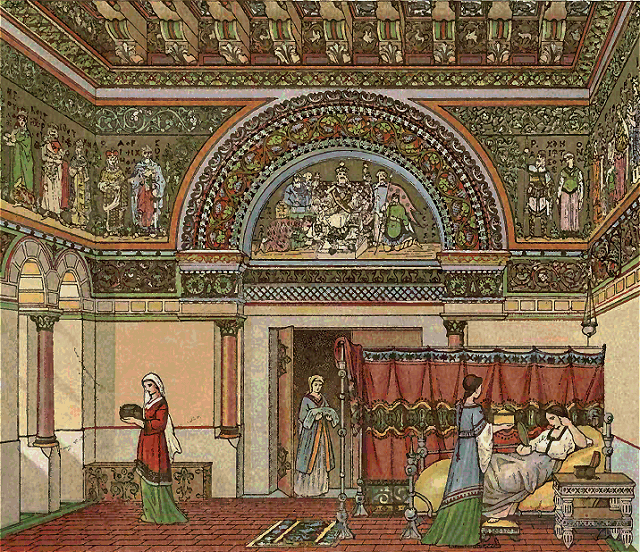
In this period military exigencies did not permit of numerous apartments. We find the great room, the place of reunion, a sumptuously decorated apartment, in which also the meals were served and the bed was placed. The floor was of bricks, and the apartment was warmed by hot air supplied from a hypocaustum, placed below the floor, and admitted through a painted iron grating. The wall decorations presented an infinite variety of beautifully executed mouldings and scroll designs of flowers and foliage, common to the Byzantine manner. The furniture of the room was sober in style. The bed was shaped and ornamented somewhat like a modern sofa. A curtain on sliding rings served to screen from draughts, as well as to separate beds. In this room the lady received her guests.
What a contrast is offered between the empresses of these later centuries and the great names of the earlier period, Eudoxia and Pulcheria and Eudocia and the great Theodora! We have fallen on evil times; and in the general corruption, woman has degenerated. During the remaining centuries which it falls to our lot to consider, we shall find that the chronicles of women continue to exhibit the downward march of womanhood, until with the utter debasement of woman, the fabric of society gives way, and all is darkness in the history of the sex.
We have had a glimpse of the luxury with which the Empress Eudoxia surrounded herself in her palace on the Bosporus, and our curiosity and interest may be satisfied concerning the domestic surroundings of a woman of rank during the period of the Byzantine decadence. The only truly original Christian art, down to the eleventh century, was the Byzantine; it dominated both Christian and pagan artists. In the period to which we refer, military exigencies did not permit of numerous apartments. We find the great room, the place of reunion, a sumptuously decorated apartment, in which also the meals were served and the bed was placed.
This chief room showed little constructive quality, but it was superbly decorated. The square, heavy door was usually contrived below a relieving arch, whose archivolt was richly charged with sculptured and painted ornaments; the twin windows were supported by a pied-droit or on small columns. The flat walls rarely had a real projecting entablature; the ends of joists were simulated by cornices resting on consoles or modillions; the architrave and the frieze were only a painted effect. The floor was of bricks. Chimneys were not yet used, and the apartment was warmed by hot air supplied from a hypocaustum, placed within the walls or below the floor, and admitted through a painted iron grating.
The wall decorations presented an infinite variety of beautifully executed mouldings and scroll designs of flowers and foliage, common to the Byzantine style. A prominent feature of the mural decoration was the numerous figures, in stiff attitudes, draped with garments falling in meagre folds, and decked with abundant fringes and precious stones, after the Oriental fashion; close to these figures were placed groups of Greek letters.
The furniture of the room was sober in style. The bed was shaped and ornamented somewhat like a modern sofa. The occupant reclined rather than lay on it, for the cushions were heaped up increasingly toward the head of the bed. It was customary to sleep without garments, the only covering being an ample sheet. A curtain on sliding rings was indispensable; it served to screen from draughts, as well as to separate beds; moreover, it supplemented the scanty furniture of the room.
Over the bed was a lighted lamp. This was invariably used, for darkness was dreaded, and it was believed that the light kept off evil spirits and prevented baleful apparitions. In this room the great lady of our period received her guests; here intrigues were plotted; here she partook of her repasts, waited upon by her many serving-maids; here she passed, indeed, most of her life.
XIV
THE PRINCESSES OF THE COMNENI
With the end of the Macedonian house in 1057, all the elements of discord in the Byzantine Empire seemed to have been loosed. Civil war and foreign invasions rapidly succeeded one another, and the empire hastened to its doom. But the downward progress was for a time checked by the rise of the Comneni, a prominent family, who controlled the destinies and exerted a paramount influence over the career of the Byzantine government for over a century, in fact, until its overthrow by the Latin Crusaders in 1204. In the chronicles of the Comneni, its princesses played a notable though not always creditable role; and the undercurrent of Byzantine history for a century and a half was determined largely by woman's influence and woman's artifice.
Of the great families whose names appear on every page of the Byzantine history of the eleventh and twelfth centuries, that of the Comneni is by far the most illustrious. The hypothesis that the Comneni were an ancient Roman house which followed Constantine from Old Rome to New Rome must be given up: so important an item in the family glories of the house would not have been passed over in silence by Anna Comnena and her husband in their historical works. We must accept the testimony of a contemporary, Psellus, that the family was of Greek or Thracian origin, and derived its name from the ancestral seat, the village of Comne in the valley of the Torniga, near the site of the city of Adrianople.
The first of the line prominent in Byzantine annals was the illustrious Manuel Comnenus, who, under Basil II., aided in settling the troubled condition of the East and in reestablishing the Empire on a firm footing. As a result of his labors for the state, Manuel acquired vast estates in Cappadocia, and, from this time, his family ranked as one of the wealthiest and most aristocratic houses of the Byzantine nobility.
Manuel, upon his deathbed, left his two sons, Isaac and John, to the care and the gratitude of his sovereign. The two lads were carefully educated in all the learning and trained in all the manly accomplishments of the day; and their brotherly love became the subject of comment in an age when self-seeking was the most salient characteristic of the aristocratic class. When they attained manhood, both made brilliant marriages which greatly increased the lustre of their family name: Isaac married a captive princess of Bulgaria, and John wedded Anna Dalassena, the daughter of the patrician Dalassenus, nicknamed Charon from the number of enemies he had sent to the infernal regions. Isaac was fated to die childless and his wife is unknown to fame, but Anna, the wife of John, was destined to be the most remarkable woman of her house.
The Empress Theodora, in her last days, had nominated Michael VI.,--Stratioticus,--an aged and decrepit veteran, as her successor; but his elevation was resented by the soldiers, who plotted and successfully carried through a conspiracy by which Michael was dispossessed and Isaac Comnenus, at that time the most popular general of the East, was elevated to the throne. But the usurpation was not attended with the blessings of heaven: Isaac was stricken with disease before he had reigned a full year, and retired to a monastery to die, abdicating the throne and selecting his brother John as his successor. For some unaccountable reason, and much to the chagrin of his wife Anna, whose ambitions were distinctly imperial, John declined the honor, and persisted in his refusal in spite of the entreaties of his wife and relatives, and with a seeming blindness to the welfare of the state. Possibly he felt that a curse rested upon a dynasty which had usurped the throne. Constantine Ducas, another Cappadocian patrician, was then selected; during his reign of seven troubled years he proved himself to be a sorry administrator. His empress, Eudocia Makremvolitissa, and Anna Dalassena are the two dominating personalities who determined the tenor of court intrigue and largely influenced the course of the events of this period. Anna most intensely hated Ducas and all his house, for they were occupying a throne which she thought should have been retained in her own family; and her relations with the empress were those of rivalry or of friendship, in proportion as Eudocia was acting in sympathy with or in opposition to her husband's family.
Constantine XI.--Ducas--was as intensely partisan as Anna; and when he found his end approaching, he wished above all things to assure the elevation of his three children, Michael, Andronicus, and Constantine. Constantine was well aware of the dangers which his dynasty would incur should the empress marry a second time; before conferring upon her the regency of the Empire, he therefore exacted from her a most solemnly attested promise that under no circumstances would she take a second husband. This important document was deposited in the hands of the patriarch, John Xiphilinus. Constantine made the Senate, also, take an oath never to acknowledge any other emperor than one of his own children. Feeling that he had bound his wife by irretrievable bonds, and that every precaution had been taken to assure the implicit fulfilment of his wishes, Constantine breathed his last with a contented mind.
But Eudocia soon discovered the need of a strong arm for the protection of her own rights and those of her sons. A woman of executive gifts, she was also devoted to literary pursuits, and her knowledge of history had taught her with how much reluctance the Byzantines submitted to the sovereignty of a woman. She recalled, too, the experience of the Empress Theophano, who had found prudent guardians for her sons, Basil II. and Constantine IX., in the persons of the soldiers Nicephorus II. and John I., though she was appalled by the vices of this empress, who had married and murdered the first and been scorned by the second guardian. Furthermore, threatening invasions and domestic unrest proved the need of a soldier as her colleague in the Empire. Love came to the assistance of reason, and Eudocia determined to break her vows and to take a second husband.
Romanus Diogenes, the most daring and popular general of the Empire, had been convicted of treason for participation in a conspiracy against her children's throne, and was then in prison awaiting sentence of death from Eudocia as regent. The latter, however, became enamored of her distinguished captive, and his beauty and valor convinced her that he was destined to share with her the throne. The army was clamoring for his release; and when he received a full pardon from the empress-regent, it at first created no suspicion of her romantic designs. The Seljukian Turks were at that time overrunning Cappadocia and it was necessary that the army should be under the control of an able and a daring general. Romanus was therefore raised from the scaffold to the headship of the army.
Before the empress could take any further step toward carrying out her matrimonial intentions, it was necessary to secure possession of the document which evidenced her pledge to her husband that she never would contract a second marriage. Feminine diplomacy enabled her to accomplish this delicate task; and the lack of principle and high moral character in the patriarch caused him to fall readily into the net laid for him by Eudocia.
Xiphilinus at first urged upon her emissary the sanctity of the oath the empress had taken, and the sacred nature of the trust he had assumed; but when it was whispered in his presence that his own brother was destined for the high honor, the patriarch's scruples were relaxed, and he yielded--out of proper regard, as he alleged, for the welfare of the state. He resigned the important paper into the empress's hand, and at her solicitation proposed and carried through a measure in the Senate, favoring her second marriage, and in addition released the senators from their vow never to recognize as emperor any other than a son of Constantine. Great was the confusion of the credulous patriarch when he realized that he had been outwitted by the clever woman, who, when her plans were fully matured, made an official proclamation that she had selected Romanus IV.,--Diogenes,--the most brilliant general of the Empire, to share with her the throne and to act as guardian to her sons.
Her choice was the occasion of much satisfaction to the army and the people, but caused jealousy and dissension in the imperial household. John Ducas, the late emperor's brother, held the rank of Cæsar and was the natural guardian of his nephews; he at once began to conspire for the overthrow of Romanus and the retirement of Eudocia.
The new emperor at once assumed his duties of warding off the enemies of the Empire, and engaged in a deadly conflict with the Seljukian Turks. Though at first successful, his army was finally routed and almost annihilated, and Romanus himself was taken captive, on the fatal field of Manzikert, 1071,--a decisive battle that marked the beginning of the end of Byzantine history and presaged the final conquest of Constantinople by the Turks. Romanus's capture produced a revolution at court. John Ducas seized the reins of government, ostensibly in the interests of Michael VII., son of Constantine; and when Romanus, having been released by his gallant foe, returned to Constantinople, Ducas had him seized and blinded and left to die through neglect. Eudocia was forced to retire to a monastery and take the veil; there she devoted herself to literary labors. She is reputed to be the author of a learned work, still extant, entitled Ionia, a species of historical and mythological dictionary. The last public appearance of the hapless Eudocia was on the occasion of the funeral of the valiant Romanus, which she was permitted to celebrate in an imposing manner.
A period of anarchy followed the cruel death of Romanus, and there were at one time no less than six pretenders to the throne. Throughout this trying period John Ducas maintained his power as regent, relinquishing his regency only when his ward, Michael VII., became of age and asserted his rights. Michael was fortunate in the choice of his empress, Princess Maria, daughter of the King of Iberia, whose beauty and grace are celebrated by the historian Anna Comnena. When her husband was overthrown and slain by the rebel Nicephorus Botaniates, Maria married the latter, with the hope of securing the throne for her child and the regency for herself. And from this time on her story is closely interwoven with that of the Comneni princesses, to whom we now return.
John Comnenus died soon after Constantine Ducas, leaving to the widowed Anna the task of bringing up a large family of eight children,--Manuel, Isaac, Alexius, Adrian, Nicephorus, Maria, Eudocia, and Theodora. But Anna was equal to the task, and deserves to be ranked among the great mothers of the world. She gave herself up to the proper education of her sons and daughters, and to the promotion of their political advancement. She could never console herself for the loss of an imperial crown through the weakness of her husband, and all her tireless energy was directed toward recovering her lost opportunity and reaching the throne through the elevation of one of her sons. What is recounted of her shows that she was a woman of extraordinary intelligence, inexhaustible energy, remarkable political astuteness, and inordinate ambition.
After performing political services of great merit, Manuel, the eldest, died at an early age. The mother sought to make her sons Isaac and Alexius men who could show themselves capable of performing every task imposed upon them in the high station they were destined to acquire; and the proof of the influence she exerted in the formation of their characters is seen not only in their high attainments, but also in the ascendency she retained over Alexius when he had reached the throne.
Owing to her undying hatred of the house of Ducas, Anna attached herself to the party of the Empress Eudocia and Romanus, and, being then in high favor at court, she married her daughter Theodora to Romanus's son Constantine. The revolution made by John Ducas to the advantage of himself and his ward, Michael VII., upset all the well-laid plans of Anna Dalassena; and the fall of Romanus marked for a time the end of the favor of the Comneni. Anna showed her firmness of character by remaining faithful to the cause of the dethroned emperor. Her correspondence with him was detected, and she was exiled, with her children, to one of the Prince's Isles. Her exile did not last long, however, for she was recalled and restored to favor; and Michael VII. brought about the marriage of Isaac, the eldest son since the death of Manuel, to Irene, daughter of an Alanian prince, and cousin-german to the Empress Maria.
Meanwhile, another matrimonial scheme was being matured, which was not at all in accordance with the wishes of Anna and the empress. John Ducas, from the monastery to which he had retired, projected the marriage of his grand-daughter Irene, with Alexius Comnenus, who was rapidly growing in promise and influence, and was already giving evidence of his political astuteness and diplomacy. Alexius gladly welcomed an alliance which would unite the two most powerful families of Constantinople in his interest, but his patrician mother opposed any affiliation with the rival house, and hated the very name of Ducas. The Empress Maria also had plans for Alexius, with which she feared this alliance would interfere, and at first threatened open opposition. But Alexius won his point with his usual cleverness. Anna finally yielded to his persuasion, and the empress gave her reluctant consent. The result of the union was that Alexius at once became the most powerful of the younger nobles at the court.
The next step in his career was also determined by the profound wisdom or wily caprice of a woman. To the surprise of her friends and consternation of her enemies, the Empress Maria adopted Alexius as her son. Anna Dalassena in all probability had a hand in this move for the elevation of her house, but it is difficult to see what was the motive of the empress, who had a young son, Constantine, whom she wished to succeed to the purple. Perhaps she felt the need of a strong hand to support the claims of herself and her son against her second husband, the usurper Nicephorus Botaniates. Perhaps she was captivated by the manly vigor and personal charms of the young man, and wished to play with Alexius the rôle of Theophano with Zimisces. It is impossible to state her motive, but the step was the first move toward the final overthrow of her house and the succession of the Comneni.
Alexius had now all the reins of power in his hands, and a revolution against Botaniates ensued. The usurper was overthrown and Alexius was proclaimed emperor by the army. At first Constantine, the son of the Empress Maria and Michael VII., was associated with him on the throne, though still in his minority. Anna Dalassena and Maria, dreading the ascendency of Irene Ducas, wife of Alexius, plotted to prevent her coronation as empress, but the patriarch, who was a partisan of the house of Ducas, defeated their intrigues; a few days after Alexius assumed the purple, Irene, with imposing ceremonies, was crowned empress.
Alexius well knew how to gain over to his support and utilize for his schemes the intriguing women who were about him. He had a profound respect for the political sagacity of his mother and during the earlier years of his reign her word exerted a deep influence on the course of government. When he was called away from Constantinople by the wars that demanded his personal attention, he left his mother as regent during his absence.
The first offspring of the union of Alexius and Irene was a daughter, Anna Comnena. She was in her infancy affianced to Constantine, and the two were regarded as heirs to the throne, much to the delight of the ex-Empress Maria. In the ceremonies of the court, the names of Constantine and Anna immediately followed those of Alexius and Irene.
Finally, in 1088, the empress bore a son, the third of her children. The joy of Alexius was unbounded. Seeing the possibility of his son carrying on the dynasty and perpetuating the name of Comnenus, Alexius determined to set aside the claims of Constantine and his eldest daughter. An estrangement with Maria Ducas followed. In 1092, John in his fourth year was proclaimed emperor, and Constantine was deprived of his rights. The rupture between Alexius and Maria was a source of enmity to the reigning house. Chagrined at the failure of her plans, and at the usurpation of one to whom she had shown every kindness, the ex-empress took part in a conspiracy against Alexius. But the plot was exposed in time, and all who were engaged in it were severely punished, except the ex-empress, who was permitted by her adopted son to go into peaceful retirement.
Constantine, though no longer associated on the throne, was still affianced to Anna, but an early death removed him from the scene of action and the intrigues of the court. In 1097, Anna was married to Nicephorus Bryennius, scion of a noble house. The mother, Anna Dalassena, continued for some time to be a powerful factor at court, but, becoming unpopular and realizing that she was losing her hold on her imperial son, she finally followed the usual custom of retiring to a monastery.
Thus the ex-Empress Maria and Anna--the real founder of the fortune of her house--found in religious retirement and meditation a life of peace and tranquillity after the turmoils of revolutions and the intrigues of imperial politics. The one had seen the failure of her plans and the downfall of her house; the other could look with pride upon the full fruition of her plots for the elevation of the Comneni.
The reign of Alexius I.,--Comnenus,--occupies a considerable place not only in Byzantine, but, also, in general history. It inaugurated a new era in the relations between the East and the West, between the Greek and the Latin, both in affairs of Church and state, and the events of which the tragic expedition of 1204 was the climax had their beginning in the days when the courtiers of Alexius revelled with the companions of Godfrey of Bouillon. Equally important is this reign from the point of view of the Byzantine Empire; it put an end to the anarchy of the eleventh century, it established a dynasty which restored much of the territory that weak rulers had lost, and for over a century it preserved the tottering Empire from its inevitable fall. It was a period in which woman's influence was marked, and its record is well known to us because of the literary skill of Anna Comnena. This imperial princess is the first woman in the world's annals to write an extended history. Both in learning and in personality she has won a place among the notable women of the world, and hers is the last great name in the chronicles of Byzantine womanhood.
In the comprehensive education which Anna received, we have a view of the literary prominence of the Comnenic epoch. She had the best masters the Empire afforded, and in her childhood she exhibited a phenomenal capacity for learning. Her teachers gave her thorough training in the works of classical authors. She read Homer, Herodotus, Thucydides, Aristophanes, the Tragedians and Polybius under suitable guidance, and without assistance mastered the writings of the church fathers. She studied with avidity ancient mythology, geography, history, rhetoric, and dialectic, and was also versed in Platonic and Aristotelian philosophy. It was in history, however, that she found her chief delight, and she early conceived the idea of composing a work in honor of her father's reign.
We have already mentioned the incidents of her childhood. Anna never forgave her brother John for supplanting her, and this disappointment of her tender years largely influenced the course of her later life. She was devoted to Maria, the mother of her first betrothed, and no doubt imbibed from her much of the ambition and hatred which were the marked characteristics of her career in politics. Her empress-mother, Irene, also exhibited a marked partiality for her eldest daughter, to the disparagement of her son, whom Alexius had destined for the throne. Irene was a beautiful and intriguing princess of much natural ability, and stood in awe of the greater learning of her daughter. The two became companions in intrigue and diplomacy, and worked together for the promotion of their own interests, against the schemes of Alexius and John. Anna was married at a tender age to Nicephorus Bryennius. He was the representative of one of the most aristocratic and powerful families of Constantinople, and exhibited much ability both in authorship and statecraft, but he seems mediocre and colorless by the side of his spouse.
Walter Scott laid the scene of his Count Robert of Paris in the Constantinople of this period, and he presents an interesting picture of Anna as a devotee of the Muses, and of the principal heroes and heroines who figure in the intrigues of the court at this time:
"It was an apartment of the palace of the Blaquemal, dedicated to the especial service of the beloved daughter of the Emperor Alexius, the Princess Anna Comnena, known to our times by her literary talents, which record the history of her father's reign. She was seated, the queen and sovereign of a literary circle, such as the imperial princess, Porphyrogenita (or born in the sacred purple chamber itself), could assemble in those days, and a glance round will enable us to form an idea of her guests or companions.
"The literary princess herself had the bright eyes, straight features and comely and pleasing manners which all would have allowed to the emperor's daughter, even if she could not have been, with severe truth, said to have possessed them. She was placed upon a small bench, or sofa, the fair sex here not being permitted to recline, as was the fashion of the Roman ladies. A table before her was loaded with books, plants, herbs, and drawings. She sat on a slight elevation, and those who enjoyed the intimacy of the princess, or to whom she wished to speak in particular, were allowed during such sublime colloquy to rest their knees on the little dais or elevated place where her chair found its station, in a posture half standing, half kneeling. Three other seats, of different heights, were placed on the dais, and under the same canopy of state which overshadowed that of Princess Anna.
"The first, which strictly resembled her own chair in size and convenience, was one designed for her husband, Nicephorus Bryennius. He was said to entertain or affect the greatest respect for his wife's erudition, though the courtiers were of the opinion that he would have liked to absent himself from her evening parties more frequently than was particularly agreeable to the Princess Anna and her imperial parents. This was partly explained by the private tattle of the court, which averred that the Princess Anna Comnena had been more beautiful when she was less learned; and that, though still a fine woman, she had somewhat lost the charms of her person as she became enriched in her mind.
"To atone for the lowly fashion of the seat of Nicephorus Bryennius, it was placed as near to his princess as it could possibly be edged by the ushers, so that she might not lose one look of her handsome spouse, nor he the least particle of wisdom which might drop from the lips of his erudite consort.
"Two other seats of honor or, rather, thrones--for they had footstools placed for the support of the feet, rests for the arms, and embroidered pillows for the comfort of the back, not to mention the glories of the outspreading canopy--were destined for the imperial couple, who frequently attended their daughter's studies, which she prosecuted in public in the way we have intimated. On such occasions, the Empress Irene enjoyed the triumph peculiar to the mother of an accomplished daughter, while Alexius, as it might happen, sometimes listened with complacence to the rehearsal of his own exploits in the inflated language of the princess, and sometimes mildly nodded over her dialogues upon the mysteries of philosophy, with the Patriarch Zosimus, and other sages."
Scott's description gives a graphic presentation of the Princess Anna and of her relations with the various members of her family; and if we add the heir to the throne, her younger brother John, for whom she had profound contempt in spite of his many virtues, we have the group about whom revolve the narrative of her history and the chief events of her life.
It is not necessary for us to enter into the story of the First Crusade, and of the incidents of the intercourse of Franks and Greeks, which Anna tells so graphically in her history; but before calling attention to the literary qualities and historical value of her work, we must note those events which unfolded her character and, in her later years, brought about her exclusive devotion to literature.
Owing to his duplicity and lack of confidence in men, Alexius made his wife and his learned daughter his confidantes and his advisers in many of the affairs of State, and frequently utilized their services in gaining his ends. Both the imperial ladies were apt pupils in the school of political intrigue, and, in the last years of the emperor, endeavored to utilize their influence over him to the detriment of the heir-apparent and the elevation of Anna and her husband, the Cæsar Nicephorus. They accordingly formed a plot, during Alexius's last illness, to dispossess the eldest son John, that the three might share the government among them.
The empress introduced soldiers into the palace, and in the closing hours of the emperor's life sought to prevail on him to pronounce the words which would bring about the change in the succession. But the astute emperor realized his son's eminent fitness to wear the crown, and was not in sympathy with the ambitions of his learned but unscrupulous daughter. To all the entreaties of the empress he but cast his eyes heavenward and remarked on the vanities of human greatness. Despairing and enraged, the empress at last hastily left the room with a parting thrust at her imperial consort, which might fitly have been inscribed as an epitaph on his tomb: "You die as you lived--a hypocrite!" Meanwhile, during her absence, John entered the room, and, with the tacit consent of his dying father, removed from his finger the signet which gave him command of all the forces of the palace; and crushing, in their inception, the plots of the empress and her daughter, he was solemnly crowned the moment his father breathed his last.
John proved to be the most amiable character that ever occupied the Byzantine throne. But all his virtues did not suffice to quell the malice and disappointed ambition of his imperial sister. In spite of the failure of the first conspiracy, the Princess Anna, "whose philosophy would not have refused the weight of a diadem," entered into another plot to dispossess her brother--already secure in the confidence of courtiers and subjects--and to elevate her husband, whom she felt sure of ruling. As John was already on the throne, however, the only way by which he could be disposed of was to have his eyes put out or to resort to the still worse crime of secret assassination. When her mild and gentle husband recoiled at the thought of such cruelty, Anna made to him the memorable response that Nature had mistaken the two sexes and had endowed him with the soul of a woman, contemptuously contrasting what she termed his feminine weakness with her own manly inhumanity.
This conspiracy, however, was also revealed before it had made any serious headway, and John deemed it necessary to confiscate his sister's wealth in order to make further intrigues impossible. He caused the Princess Anna to retire to a convent and bestowed her luxuriously furnished palace on his favorite minister, Axouchus. But the noble nature of Axouchus recoiled at being benefited by the princess's fall, and thought more of turning the situation to the emperor's advantage than of enriching himself. Accordingly, he suggested to the emperor that it would be better policy to ward off the malice of his enemies by restoring the palace to Anna, and seeming to ignore her futile plots. John felt the prudence of the advice, and impressed by the unselfish devotion of his friend,--a quality most rare in late Byzantine times,--replied in like spirit: "I should, indeed, be unworthy to reign if I could not forget my anger as readily as you forget your interest." Anna was reinstated in her palace.
But little is known of the rest of Anna Comnena's life. Tiring finally of the vanities of court life, disappointed in all her intrigues for absolute power, and becoming ever more absorbed in her literary undertakings, she seems to have voluntarily sought the life of the cloister and to have spent the last decades of her career in peaceful retirement, engaged on her monumental work. She survived her brother John, who died in 1143, and was still at work on her history in 1145. The date of her death is unknown.
The great work of Anna Comnena is entitled the Alexiad, and is one of the most important works in the voluminous collection of the Byzantine historians. In fifteen books, it narrates the history of Alexius Comnenus; and is a completion and continuation of a work in four books, left by her husband, Nicephorus Bryennius. The first two books of Anna's work treat of the rise into power of the Comneni house, and of the early life of Alexius; the remaining thirteen are devoted to the events of his reign.
The work of Anna, as a contribution to historical literature, has very decided deficiencies. In spite of her professed love of truth, her filial vanity tempts her at all times to put her father and her family in the best light. The very title, Alexiad suggests rather an epos--a poem in prose--than a serious historical work, and emphasizes its epideictic tendency. As a woman, she is impressed with the concrete rather than the abstract, and describes brilliant state functions, church festivals, imposing audiences and the like with much more familiarity and enthusiasm than she displays in her treatment of the underlying causes and inner connections of events. But with all their faults, these memoirs are an authoritative account of a brilliant and important epoch, and of a ruler who for his military sagacity and political shrewdness ranks among the great personages of the Middle Ages.
The human traits of the author reveal themselves in every chapter of her work. Anna possessed a womanly weakness for gossip and slander, and mingles her praise of the other prominent women of her time with a tincture of disparagement that must often be attributed to feminine jealousy. She possessed considerable wit and irony, but was intensely vain of her rank, her Greek origin and especially of her literary attainments. Nor must we fail to note the vaulting ambition of this otherwise attractive woman, an ambition which made her untrue to her brother and a conspirator against his throne and his life.
Anna Comnena realized that the chief censure of her work at the hands of contemporaries and of posterity would be the charge of partiality, and against this she seeks to defend herself in a striking passage:
"I must still once more repel the reproach which some may bring against me, as if my history were composed merely according to the dictates of the natural love for parents which is engraved on the hearts of children. In truth, it is not the effect of that affection which I bear to mine, but it is the evidence of matters of fact, which obliges me to speak as I have done. Is it not possible that one can have at the same time an affection for the memory of a father and for truth? For myself, I have never directed my attempt to write history otherwise than for the ascertainment of the matter of fact. With this purpose I have taken for my subject the history of a worthy man. Is it just, then, by the single accident of his being the author of my birth, his quality of my father ought to form a prejudice against me, which would ruin my credit with my readers? I have given, upon other occasions, proofs sufficiently strong of the ardor which I had for the defence of my father's interests, which those that know me can never doubt; but, on the present, I have been limited by the inviolable fidelity with which I respect the truth, which I should have felt conscious to have veiled, under pretence of serving the renown of my father."
The authoress felt assured that a number of disturbances of nature and mysterious occurrences as interpreted by the soothsayers, foreboded the death of Alexius; thus she claimed for her father the indications of consequence, which were regarded by the ancients as necessary intimations of the sympathy of nature with the removal of great characters--from the world. During his latter days, the emperor was afflicted with the gout. Weakened in body, and gradually losing his native energy, he once responded to the empress, when she spoke of how his deeds would be handed down in history: "The passages of my unhappy life call rather for tears and lamentations than for the praises you speak of." Finally asthma came to the assistance of the gout, and the prayers of monks and clergy, as well as the lavish distribution of alms, failed to stay the progress of the disease. At length passed away the Emperor Alexius, who, with all his faults, was one of the best sovereigns of the Eastern Empire.
His learned daughter, in the greatness of her grief, threw aside the reserve of literary eminence, and burst into tears and shrieks, tearing her hair, and defacing her countenance, while the Empress Irene cut off her hair, changed her purple buskins for black mourning shoes, and, casting from her her princely robes, put on a robe of black. "Even at the moment when she put it on," adds Anna, "the emperor gave up the ghost, and in that moment the sun of my life set."
Anna continues to express her lamentations at her loss, and upbraids herself that she survived her father, "that light of the world"; Irene, "the delight alike of the East and of the West"; and, also, her husband, Nicephorus. "I am indignant," she adds, "that my soul, suffering under such torrents of misfortune, should still deign to animate my body. Have I not been more hard and unfeeling than the rocks themselves; and is it not just that one who could survive such a father and a mother and such a husband should be subjected to the influence of so much calamity? But let me finish this history, rather than any longer fatigue my readers with my unavailing and tragical lamentation!" The history then closes with the following couplet:
"The learned Comnena lays her pen aside, What time her subject and her father died."
Taking it all in all, the best appreciation of the Alexiad is that of Gibbon, who thus characterizes the qualities of the work:
"The life of the Emperor Alexius has been delineated by a favorite daughter, who was inspired by a tender regard for his person and a laudable zeal to perpetuate his virtues. Conscious of the just suspicion of her readers, Anna Comnena repeatedly protests that, besides her personal knowledge, she has searched the discourse and writings of the most respectable veterans; that after an interval of thirty years, forgotten by, and forgetful of, the world, her mournful solitude was inaccessible to hope and fear; and that truth, the naked perfect truth, was more dear and sacred than the memory of her parent. Yet instead of the simplicity of style and narrative which wins our belief, an elaborate affectation of rhetoric and science betrays, in every page, the vanity of the female author.
"The genuine character of Alexius is lost in a vague constellation of virtues; and the perpetual strain of panegyric and apology awakens our jealousy to question the veracity of the historian and the merit of the hero. We cannot, however, refuse her judicious and important remark that the disorders of the times were the misfortune and the glory of Alexius; and that every calamity which can afflict a declining empire was accumulated in his reign by the justice of heaven and the vices of his predecessors.... The reader may possibly smile at the lavish praise which his daughter so often bestows on a flying hero; the weakness or prudence of his situation might be mistaken for a want of personal courage; and his political arts are branded by the Latins with the names of deceit and dissimulation...."
The story of the remaining princesses of the Comneni family is merely the mirroring of feminine beauty and frailty; and its sad chronicle goes to show that the Empire was deservedly hastening to its doom because the stamina sufficient to keep it alive was lacking.
John Comnenus was succeeded by his younger son Manuel, a renowned warrior about whose name have gathered many of the romances of chivalry. He was twice married, first to the virtuous Bertha of Germany, and, after her decease, to the beautiful Maria, a French or Latin princess of Antioch. Bertha had a daughter, who was destined for Bela, a Hungarian prince educated at Constantinople under the name of Alexius and looked upon as the heir-apparent. But his rights were set aside when Maria had a son named Alexius, who was in the direct line of male succession. Notwithstanding the virtues of his queens, Manuel, who was so valiant in war, showed himself in peace a licentious voluptuary. "No sooner did he return to Constantinople than he resigned himself to the arts and pleasures of a life of luxury: the expense of his dress, his table and his palace, surpassed the measure of his predecessors, and whole summer days were idly wasted in the delicious isles of the Propontis in the incestuous love of his niece, Theodora."
Manuel had a cousin, Andronicus, who was even more of a voluptuary than he--one whose career as a soldier of fortune and as a heartless roué marks him as the Byzantine Alcibiades. He indulged his favorite passions, love and war, without any regard to divine or human law. His lofty stature, manly strength and beauty, and dare-devil manner were so seductive that three ladies of royal birth fell victims to his charms. His mistresses shared his company with his lawful wife, and divided his affections with a crowd of actresses and dancing girls. He was a partaker of the pleasures, as well as of the perils, of Manuel; and while the emperor lived in public incest with his niece Theodora, Andronicus enjoyed the favors of her sister Eudocia. So enamored was she of her handsome lover, and so shameless in her conduct, that she gloried in the title of his mistress, and accompanied him to his military command in Cilicia. Upon his return, her brothers sought to expiate her infamy in the blood of Andronicus, but, through Eudocia's aid, he eluded his enemy. Proving treacherous, however, to the emperor, he was imprisoned for a long period in a tower of the palace at Constantinople, where his faithful wife shared his imprisonment and assisted him in making his escape.
Andronicus was later given a second command on the Cilician frontier. While here, he made a conquest of the beautiful Philippa, sister of the Empress Maria, and daughter of Raymond of Poitou, the Latin Prince of Antioch. For her sake, he deserted his station and wasted his time in balls and tournaments; and to his love the frail princess sacrificed her innocence, her reputation, and the offer of an advantageous marriage. The Emperor Manuel, however, urged on by his consort, resented this violation of the family honor, and recalled Andronicus from his infamous liaison. The indiscreet princess was left to weep and repent of her folly; and Andronicus, deprived of his post, gathered together a band of adventurers of like spirit and undertook a pilgrimage to Jerusalem. With bold effrontery, he declared himself a champion of the Cross; and his beauty, gallantry, and professions of piety captivated both king and clergy. The Latin King of Jerusalem invested the Byzantine prince with the lordship of Berytus, on the coast of Phoenicia. In his neighborhood there dwelt the young and handsome queen, Theodora,--the daughter of his cousin Isaac, and great-grand-daughter of the Emperor Alexius,--who was widow of Baldwin III., King of Jerusalem. Because of her beauty, her talents, and her prudence, Theodora enjoyed the respect and admiration of all the Latin nobles. Andronicus became deeply enamored of his fair cousin, and she, returning his passion with equal ardor, became the third royal victim of his lust. So debased was the state of society among the Latin Christians--which was the case at Constantinople also--that the cousins carried on their amours with little affectation of secrecy. The Emperor Manuel being again enraged by the disgrace to the family name through the moral fall of another Comneni princess, Andronicus had to flee for his life, and Theodora accompanied him in his flight. She and her two illegitimate children were later captured and sent to Constantinople. Andronicus finally sought forgiveness from the emperor, and such was his charm that he was pardoned; he returned to Constantinople, and soon began the career of intrigue which eventually placed him on the throne.
Upon the death of Manuel, the Empress Maria acted as regent for her son Alexius II., a lad of thirteen. Her prime minister was Alexius Comnenus, a grandson of John II. Maria's beauty and charm of manner gave her considerable power over the young nobility. In the conflicts of the nobles she warmly espoused the cause of her prime minister, and it was believed that a criminal attachment existed between them. The young emperor's sister Maria, with the Cæsar, her husband, attempted to drive the prime minister from power by a popular uprising. In the turmoil and chaos that followed, all eyes turned toward Andronicus. The voluptuary and adventurer responded to the call, and entered the city to be enthroned, alleging that it was his purpose to deliver the young emperor from evil counsellors. Cruelty was now added to his other serious crimes. The Princess Maria and her husband, the Cæsar, were poisoned; the Empress Maria, on a charge of treason, was condemned to death, and strangled; and Alexius II., the legitimate heir to the throne, was deposed and subjected to the same form of death as his unfortunate mother. The tyrant kicked the body of the innocent youth as it lay before him, and addressed it with a sneer: "Thy father was a knave, thy mother a whore, and thyself a fool!"
Owing to debauchery and crime, the family of the Comneni had degenerated. Through the nobility and greatness of its women in an earlier period, it had risen to the height of power; and through the debasement and weakness of its women, it finally fell. Andronicus was the last of the line--the most heinous monster that ever sat on the Byzantine throne. But his career in crime was cut short. The people rose up against the author of so many assassinations. Isaac Angelus, a nobleman, accused of treason, resisted arrest, and fled to Saint Sophia. A mob gathered and took his side against the mercenaries of Andronicus. The tyrant himself was seized and torn to pieces, and the Angeli succeeded the Comneni on the throne of Constantinople.
Isaac and Alexius Angelus, the two emperors whose reign occupied the years 1185-1204, between the fall of Andronicus and the conquest of Constantinople by the Crusaders, were the two most feeble and despicable creatures who ever occupied the imperial throne. Euphrosyne, the empress of Alexius, however, was a woman of strong personality, though of licentious ways, and, as the last of the Byzantine empresses before the fall of Constantinople, she exhibited the strength as well as the weakness of that long line of self-asserting princesses whom we have been considering.
Owing to the idle disposition of her worthless husband, Euphrosyne assisted in conducting the business of the Empire; and so masterful was she that no minister dared take any step without her approval. Gibbon considers that there was no greater indication of the degradation of society at this time than that the proudest nobles of the Empire, members of the celebrated families of Comnenus, Ducas, Palæologus, and Cantacuzenus, contended for the honor of carrying Euphrosyne on her litter at public ceremonies. Her influence over the nobility was due to her beauty, her talents and her aptitude for business. But her inordinate vanity, reckless extravagance, and flagrant licentiousness brought great scandal upon the Empire even in those vicious times, and frequently led to violent quarrels with Alexius. Finally, the jealousy of the emperor at her licentious conduct lost all bounds. Alexius ordered her paramour to be assassinated, and the female slaves and the eunuchs of her household were put to the torture. The beautiful and accomplished Euphrosyne was compelled to leave the palace, and, like so many imperial dames noted for their devotion or their license, was immured in a convent.
The court, however, soon missed her talents and energy; Alexius himself was not equal to the ordinary duties of his office; the courtiers were unrestrained in their peculations, and nowhere was there a restraining hand. Euphrosyne was recalled to save the dynasty, and, with even more than her former insolence, she entered once more upon a career of extravagance and shame. While her energy and skill in the affairs of state won admiration, her lavish expenditures of the public funds excited the dismay of the few thoughtful men of the day. The crowd enjoyed the splendid spectacle of her hunting parties and applauded their empress as she rode along on her richly caparisoned steed, with a falcon perched on her gold-embroidered glove, but such extravagances were but hastening the end of the doomed city.
The rest of the story is but too quickly told. Alexius III.,--Angelus,--had, by a clever coup d'état, displaced his brother Isaac; Alexius IV., son of Isaac, implored outside aid, and gave the marauders of the fourth Crusade an excuse to attack the city. Alexius III. fled for his life, and Alexius IV., after a brief reign, was caught and strangled by the usurper, Alexius Ducas. The Crusaders assaulted and sacked Constantinople when Alexius V., Ducas, the last of the emperors, fled in a galley by night, taking with him the Empress Euphrosyne and her daughter Eudocia whom he had married. He was afterward captured, tried for the murder of the young Alexius, and suffered death by being hurled from the top of a lofty pillar.
The end of Euphrosyne and her daughter Eudocia is not known. The latter had already had a sufficiently tragical history. Eudocia had first been married to Simeon, King of Servia, who later abdicated the throne and retired to a monastery. His son Stephen, enamored of the beauty of his young stepmother, married her. Later, a disgraceful quarrel arose. Eudocia was divorced by her second husband and, almost naked, was expelled from the palace.
In her desperate condition, abandoned by all, she would probably have perished had not Fulk, the king's brother, taken pity on her and sent her back to Constantinople. Alexius Ducas, who had already divorced two wives, was willing enough to wed the daughter of Euphrosyne, and after his execution the hand of the accommodating Eudocia was bestowed on Leo Sguros, the chief of Argos, Nauplia, and Corinth.
The stories of Euphrosyne and Eudocia are a sufficient confirmation of the corrupt state of society in the latter days of the Comneni and the Angeli. Andronicus and his mistresses, and Euphrosyne and her daughter, are no exaggerated types of the higher classes of the Empire. The clergy had grown indifferent to the licentiousness of the age, and many bishops and patriarchs were themselves venal and degraded. The people were too ready to follow in the footsteps of the higher classes. Therefore, through the loss of womanly virtue and manly strength, the Empire was on the verge of ruin.
Thus fell, on April 13, 1204, Constantinople--"The eye of the world, the ornament of nations, the fairest sight on earth, the mother of churches, the spring whence flowed the waters of faith, the mistress of orthodox doctrine, the seat of the sciences, draining the cup mixed for her by the hand of the Almighty, and consumed by fires as devouring as those which ruined the five Cities of the Plain."
XV
WOMANHOOD OF THE BYZANTINE DECADENCE
The Byzantine Empire had fallen with its capital Constantinople, and the Latin Empire of Romania had taken its place. But the rule of the Franks was too weak to take an abiding hold on the provinces, and, after a brief and flickering existence, 1204-1261, it passed away, and a Greek dynasty was once more established in New Rome. While the Ottoman power was gaining strength, the Greek Empire was suffered to exist; but in the course of two centuries, through internal corruption and mismanagement, Byzantine dominion ceased to be an effective force in the world's affairs, and the city of Constantine easily fell a prey to the Mohammedan forces.
Though the Crusaders had captured the capital, the provinces refused to recognize the dominion of the Franks, and three Greek kingdoms were carved out of the remains of the Byzantine Empire by adventurous spirits who had left Constantinople rather than fall victims to the Western conquerors. Theodore Lascaris, the last to strike a blow for the doomed city, founded across the straits, out of the province of Bithynia, the empire of Nicæa, though his rights to royal power lay merely in his strong right arm and in his having married the daughter of the imbecile Alexius III. Alexius Comnenus, grandson of Andronicus I., had betaken himself to the eastern frontier of the Empire, and, chiefly through the glamour of his name, had made for himself, out of the long strip of coast land at the south-east corner of the Black Sea, a kingdom that was destined to carry on an independent existence for nearly three hundred years as the empire of Trebizond. Furthermore, Michael Angelus, a cousin of Alexius III., became "despot" of Epirus and later conquered the Latin kingdom of Thessalonica. Finally, after the Greek empire of Nicæa had enjoyed a steady growth for over half a century, during which it absorbed the kingdom of Thessalonica, Michael Palæologus, the usurper of the Nicene throne, succeeded in wresting Constantinople from its Latin rulers, and established anew the Byzantine Empire, under the dynasty of the Palæologi.
In the stories of the dynasties of these various kingdoms we have not many glimpses into the history of woman, but wherever feminine names are mentioned woman is found to be exerting her customary influence over the affairs of state and the destinies of empires.
The dynasty of Theodore Lascaris was handed down through his daughter Irene, whose husband succeeded to the throne as the Emperor John III. The Empress Irene was much beloved because of her amiable character and domestic virtues, and there is preserved a beautiful incident of the affection she inspired in a young maiden. John Asan, the King of Bulgaria, had formed an alliance with John III. through the betrothal of his daughter Helena to Theodore, the heir-apparent to the Nicene throne. Highly esteeming the virtues of the Empress Irene, the Bulgarian king had sent the young Helena to be educated under her care. Later, when the alliance between the emperor and the king was broken off, Asan sent for his daughter, with the request that she return to Bulgaria. John III. scorned to retain his son's betrothed as a hostage, and suffered the attendants to arrange her departure. But when the maiden ascertained that she was not to return to her dear mother the empress, her grief was inconsolable. Her tears and lamentations over the separation and her praises of the Nicene queen at length excited the serious displeasure of her father, and he had to threaten her with severe punishment if she did not cease to weep and mourn for her Greek mother. But her love for Irene was greater than the fear of punishment, and, in spite of the censure and the blandishments of her parent, she could never reconcile herself to the loss of the happy hours at the side of the virtuous and gifted empress. During Irene's lifetime John was uniformly successful, extending the bounds of his dominion and winning the love and devoted admiration of his subjects. But, after her death, another woman led him into evil ways.
John married as his second wife, in her twelfth year, the Princess Anna, natural daughter of the Emperor Frederick II. of Germany. Anna had brought in her train, as directress of her court, a beautiful Italian lady, Marchesina by name. The Emperor John fell violently in love with his child-wife's chief attendant. Marchesina soon received the honors conferred in courts on the recognized mistress of the sovereign, and was permitted to wear the dress reserved for members of the imperial family. Public opinion severely censured the emperor for his conduct, and one of the prominent bishops of the day, Nicephorus Blemmidas by name, found occasion to give Marchesina a severe rebuke. Blemmidas had so beautifully embellished the church of the monastery of which he was abbot, that it was frequently visited by members of the court. One day, while the abbot was conducting divine service in the chapel, the imperial mistress passed by with her attendants, and made up her mind to enter. But when Blemmidas heard of her approach, he at once ordered the doors to be closed, declaring that never with his permission should an adulteress enter the sanctuary. Marchesina, incensed at so severe a rebuke, so publicly inflicted, hurried back to the palace, threw herself at the feet of her imperial lover, and implored him to avenge on the abbot the insult he had put upon her. But John was not regardless of public opinion, and, recognizing the mistake he had made, merely said in response to Marchesina's entreaties: "The abbot would have respected me, had I respected myself."
Woman, too, was in large measure the cause of the overthrow of the dynasty of Lascaris, and the usurpation of Michael Palæologus, scion of one of the most influential families of Constantinople. Theodore II., who succeeded his father John, grew testy and superstitious in his old age, and had reason to suspect the cunning and able Michael who was rapidly winning the popular favor. But Michael was undoubtedly spurred on to action against the dynasty by Theodore's outrageous conduct toward his sister Martha. The latter had a beautiful daughter who had been most tenderly reared as became her rank. To the surprise of all, the emperor ordered the family to bestow her in marriage on one of his pages, Valanidiotes. Though beneath the maiden in rank, the page succeeded in winning the affection of the highborn damsel, and the family were consenting to the union, when the emperor capriciously changed his mind, and compelled a betrothal between the maiden and a man of her own rank. A report that this marriage was not consummated led the superstitious emperor to suspect that both this event and a malignant attack of his disease were due to some charm practised by the mother.
In his vexation and rage, he ordered Martha, though connected by birth with the imperial family, to be enclosed in a sack with a number of cats, which were from time to time pricked with pins that they might torture the unfortunate lady. Martha was brought into court with the sack thus bound about her neck, and was examined concerning her supposed witchcraft, but the suspicious tyrant could extract nothing from her on which to base a condemnation.
This unseemly action was an offence Michael could never forgive. From this time he began assiduously to plot against the throne. The story of his usurpation and of his cruelty toward the rightful emperor, the young lad, John IV.,--Ducas,--does not concern us here. Suffice it to say that he ascended the throne of Nicæa as Michael VIII.,--Palæologus,--and was fortunate enough to capture the city of Constantinople and revive the Greek Empire there. Through the Empire of Nicæa the thread of tradition was unbroken, and from 1261 on we have once more a Byzantine Empire.
The history of this concluding period, 1261-1453, embracing the dynasty of the Palæologi, is the most degrading portion of the national annals. Michael is renowned for being the restorer of the Eastern Empire, but his throne was gained through baseness and cruelty, and he left to his descendants a heritage of vice and crime of such a nature that the Empire survived for a century or two not because of its intrinsic worth, but because the Ottomans were not yet ready to seize it. It is a period notable for the absence of literary taste, of patriotic feeling, of political honesty, of civil liberty. The emperors are, as a rule, immoral and capricious men, utterly selfish in their aims and their pursuits, and each one leaves the Empire somewhat weaker than he found it.
The new Empire of Constantinople and that of Trebizond existed side by side, and frequent intermarriages took place between the royal families. By studying conjointly the annals of the Palæologi and the Comneni we become acquainted with a number of the princesses of these royal houses, and can form some idea of the character of Greek womanhood in this age of decadence, and of the social life of the times as it affects woman's position and aspirations.
The women of the two rival houses appear, as a rule, superior in character, judgment, and virtue to the men, and this difference between the males and females of the imperial families is so marked, that we would fain know more of the system of education for women which produced an effect so singular and so uniform. It must have been due to the fact that in spite of the general demoralization, the life of the convents in which the princesses were trained was pure and uplifting, the methods of instruction thorough, the discipline severe; while the clergy who had in charge the education of the princes were so bent on their own preferment and the acquirement of political power, that they aimed rather at gaining an ascendency over their imperial wards than in imparting the instruction which would have made them great rulers.
The only empress of the Palæologi, however, to gain supreme power and to win a place in history, was of foreign birth. Anne of Savoy, by the nomination of her dying husband, Andronicus III. (1328-1341), and the custom of the Empire, was made regent of her son, John V., Palæologus, a lad of nine years. Her reign was made memorable through her struggles with a powerful courtier, who aroused civil war and ascended the throne for a time as John VI., Cantacuzenus (1347-1354).
Byzantine etiquette required the widowed empress to weep for nine days beside the body of her deceased husband, who was laid out in state in the monastery of the Guiding Virgin, whither he had retired when death was near and where he assumed the habit and the devotions of a monk. But John Cantacuzenus, the grand domesticos and first minister of the Empire, was bent on playing the rôle of earlier usurpers, and during her absence determined to establish himself in the imperial palace as guardian of the emperor. The empress, recognizing the danger of infringement on the rights of her child, deemed it necessary to shorten the period of mourning to three days, and returned to the palace to assert her authority as regent. Then began a course of intrigue between the two parties. Cantacuzenus instituted a rebellion against the regent, and by his followers was crowned and invested with the imperial robe. Under the guidance of the patriarch and the grand duke Apocaucus, the Empress Anne adopted forceful measures to intimidate the partisans of the rebels. Among the interesting women of this period was Theodora, the mother of Cantacuzenus, a woman of preeminent virtue and talent, far superior in ability and moral force to her son. But against her the vengeance of Anne was chiefly directed. The aged lady was thrown into prison by order of the regent, and was subjected to great cruelty and privations until death came to her relief. The young emperor, John V., was solemnly crowned. Apocaucus was appointed prime minister, and a vigorous war was prosecuted against the rebels, who were threatened with extermination. To save his cause Cantacuzenus treacherously turned to the common enemy, the Turk, and sacrificing his daughter Theodora on the altar of his ambition gave her in marriage to Orkhan, and sent her to dwell at Brusa, as a member of the Sultan's harem. All the religious people of the day were incensed at this violation of common decency and lack of paternal feeling, but the tone of morality was too low to cause serious opposition.
Meanwhile, there was discord in the palace. The Empress Anne fell out with her chief supporter. She had a violent quarrel with the patriarch. Her prime minister Apocaucus was assassinated. Through the aid of his Turkish ally Cantacuzenus was successful. The empress-regent showed a determination to defend herself in the palace, but her partisans were less courageous than she, and she was compelled to submit. But Cantacuzenus was as wily as he was ambitious. Recognizing the strength of his opponents, after he himself had been crowned emperor, he determined on the marriage of his daughter Helena with the young heir-apparent, and agreed to associate John V. with him on the throne when he reached the age of twenty-five. The children, for John was only fifteen and Helena thirteen, were betrothed and wedded with great ceremony, and then received the crown, and the courtiers and people were entertained by the rare spectacle of two emperors and three empresses seated on their thrones.
"The strange spectacle delighted the gazers; but it was not viewed without some feeling of contempt, for it was generally known that the imperial crowns were bright with false pearls and diamonds; that the robes were stiffened with tinsel; that the vases were of brass, not gold; and instead of the rich brocade of Thebes, the hangings were of gilded leather."
Cantacuzenus deserves to rank with the two Angeli as the third of the great destroyers of the Eastern Empire. Through civil wars he depleted its resources; and by introducing the Turk into his dominions, he paved the way for the final downfall. Fortunately, John V. asserted himself at the age of twenty-four; Cantacuzenus was tonsured and placed in a monastery where he passed the rest of his days in literary labors. In native gifts and force of character, and in her checkered history, the Empress Anne of Savoy deserves a place by the side of the earlier self-asserting empresses of Constantinople.
The tale of the last hundred years of the Byzantine Empire is a mere bit of local history, and no longer forms an important warp in the woof of the annals of Christendom. Women there were who were deserving of a better destiny, but they are naturally obscured in the general demoralization. The Mussulman might have taken Constantinople seventy-five years earlier. The end came on May 29,1453. The city was captured by Mohammed II., and Constantine XIII., the last of the Cæsars, the worthy scion of degenerate sires, fell in the breach. Mohammed proceeded quickly to convert Constantinople from a Christian into a Turkish capital. The city was sacked. The Byzantine women were sold into slavery, or became wives or concubines of the conquerors and passed the rest of their days in a Turkish harem. And, from this date, for centuries the life of Greek womanhood under Turkish domination was passed in oppression and obscurity.
The fragment of the Greek Empire known in the history of the Middle Ages as the Empire of Trebizond was the creation of accident. A young man descended from the worst tyrant of Constantinople, but of an illustrious name which retained the glamour inspired by the founder of the Comneni dynasty, grasped the sovereignty of a most important commercial centre, and his descendants continued to hold it until overwhelmed by the all-conquering power of the Turk. The Empire of Trebizond possesses unique grandeur in the romances of the West: the beauty of its princesses was a theme of universal praise; its reputed wealth and splendor excited the cupidity of Venetian and Genoese merchants. But it was, after all, an insignificant kingdom, which owed its strength merely to the weakness of surrounding peoples; and whose ostentatious court ceremonials were but an attempt to keep up the traditions of the Byzantine Empire and of the Comneni family in more prosperous days.
Shortly after the assassination of Andronicus by Isaac II., --Angelus,--his son Manuel, with other members of his family, met a similar fate. Manuel was survived by two sons, Alexius and David, the former a little lad of four. The boys were concealed for a time, and were brought up in obscurity in Constantinople, where faithful friends gave them an education worthy of their station. At the time when the Crusaders captured the city, Alexius escaped, raised an army, and took possession of Trebizond, then one of the most important commercial seats on the borders of the Black Sea. The surrounding province gladly recognized him as the lawful sovereign of the Roman Empire, and the Comneni dynasty was continued through him for two and a half centuries or more. To mark the legitimacy of his claim, and to prevent confusion with the rival family of Alexius III.,--Angelus,--Alexius assumed the designation of "Grand-Comnenus," and by this title the family was known until its extermination.
The earlier years of the Empire of Trebizond were notable chiefly for the efforts of its rulers to retain and extend their power, which was circumscribed by the stronger empire of Nicæa. After the latter had been merged into the restored Byzantine Empire with Constantinople as its capital, Trebizond was still strong enough to maintain an independent existence. A league was formed between the reigning sovereigns, Michael VIII.,--Palæologus,--of Constantinople, and John II., then Emperor of Trebizond, through the espousal of the latter to Michael's youngest daughter, Eudocia, who was destined to show herself one of the best and most capable of the Palæologi princesses.
The ceremony was solemnized with great ostentation on September 12, 1282. The question of precedence was an important one, as the Trebizond government had considered itself the direct successor of the Empire of the Cæsars. But through this marriage the wily monarch of Constantinople gained the advantage; for John on this occasion laid aside the title of "Emperor of the Romans," to be henceforth reserved exclusively for the sovereign of the city of the Golden Horn, while that of Trebizond assumed the title of "Emperor of all the East, Iberia, and Perateia." Furthermore, the inhabitants of the city saw in the respective marriage robes a certain inferiority of the Trebizontine monarch to the family of his wife; for while the robes of John were embellished with single-headed eagles, the bride appeared in a dress covered with double-headed eagles to mark her rank in the Empire of the East and West as a princess of the Palæologi, born in the purple chamber.
John and his royal bride had not been long settled on the throne when he experienced a sudden and unexpected discomfiture at the hands of an aspiring sister. Theodora, the oldest child of Manuel I. by his marriage with Roussadan, an Iberian princess, jealous of the popularity of her sister-in-law, and proud of the superiority of Comneni traditions to those of the usurper of Constantinople, availed herself of the party intrigues of the nobles, and the popular dissensions in the capital, to assemble an army, surprise her imperial brother, and mount the throne. Her glory was of brief duration, but the existence of coins bearing her name and effigy demonstrates that her power was stable and that she was fully recognized as a sovereign of the Empire. No clue exists which enables us to determine how Theodora obtained the throne or how she was at length driven from power, but John appears to have finally recovered his throne and capital and to have expelled the ambitious princess.
During succeeding years the influence of Byzantine womanhood and the relations between the two kingdoms continued prominent. John died in 1297, leaving two sons, Alexius II. and Michael. The former succeeded his father at the age of fifteen, and was placed under the guardianship of his mother Eudocia's brother, the Byzantine emperor Andronicus II. Andronicus ordered his ward, the young emperor of Trebizond, though an independent sovereign prince, to marry Irene, the daughter of a Byzantine subject, Choumnus, one of his favorite ministers. But the idea of a Comnenus marrying below his station was offensive both to Alexius and his people. In obedience to the blood within his veins, and in contempt of his guardian's command, Alexius rejected the proposed mesalliance, and married the daughter of an Iberian prince.
The young married couple presented a beautiful example of conjugal tenderness and devotion, but this did not soften the hard heart of the guardian. Andronicus even went so far as to endeavor, to make the Greek Church declare the marriage null and void on the ground that it had been contracted by a union without the consent of his guardian. But the patriarch and clergy, sympathizing with the lovers, and alarmed at the ludicrous position in which they would be placed, took advantage of the interesting condition of the bride to refuse to gratify the spleen of the chagrined emperor.
At this time also, Eudocia, the mother of Alexius, who was in partial durance in the imperial palace at Constantinople, saw an opportunity of obtaining her freedom and of returning to her dominions. Her brother Andronicus was offended with her because she had rejected his proposal to form a second marriage with the Krai of Servia.
She persuaded her brother that her influence over her son, who was devotedly attached to her, would have far more weight in making the young emperor agree to a divorce than the sentence of an ecclesiastical tribunal whose authority he was able to decline; and to this end she obtained her brother's permission to return to Trebizond. Upon arriving at her son's court Eudocia was so much impressed with the conjugal fidelity of her son Alexius that she at once approved of his conduct, and supported him in his determination to resist the tyrannical pretensions of his guardian. Eudocia is an excellent example of the superiority of the Palæologi women over their weaker and more selfish brothers. In every situation, even in her months of exile from her dominions, she maintained herself with dignity, and in her careful rearing of her son and regard for his interests she exhibited motherly traits of a high order.
In the next generation there was also an alliance between the royal families of the two kingdoms. The emperor Basilius, second son of Alexius II., married Irene Palæologina, the natural daughter of Andronicus III. of Constantinople. Basilius had no legitimate issue, but falling in love with a beautiful lady of Trebizond, also named Irene, he made her his mistress and conferred on her every possible honor. She bore him four children. To insure the succession of one of his natural sons, Basilius in 1339 persuaded or forced the clergy to celebrate a public marriage with his Trebizontine mistress, though there is no evidence that he obtained a divorce from his lawful wife Irene, beyond his own decree. He died suddenly in the April following his marriage to his mistress.
Irene Palæologina, who was, in spite of his second nuptials, universally regarded as the lawful wife of Basilius, was suspected of having hastened his end; and her unfaithful husband had certainly tried the soul of the proud lady. At any rate she was prepared for the sad event, and had already organized a faction which placed her on the throne, as the second independent Empress of Trebizond.
This promptitude in profiting by her husband's death, was worthy of the first Empress Irene in Byzantine history, and gave just ground for suspicion. But in considering an age when it was usual for people to circulate calumnious reports against their rulers, the evidence should be strong before we condemn the Palæologi princess. However, the flagrant immorality of the court circles, and the lightness of character of Irene herself, as well as her conduct after the event, tended to give credibility to the rumor.
Irene, as soon as she was safely established on the throne, sent off her rival of Trebizond and the two sons of Basilius to Constantinople where her father Andronicus detained them as hostages for the tranquillity of her empire. A strong party of the nobility, however, who had hoped to gain wealth and power through the favor of the Trebizontine Irene, whom they purposed to make regent during the minority of her children, were chagrined at the success of the schemes of the Palæologi princess, and at once began to plan her downfall. Two great parties arose, and the little empire was once more disturbed by the turmoil of civil war. Irene, with all her daring, was, like her father, of a gay and thoughtless disposition, and did not fully realize the danger of her situation. She recognized, however, that a second husband would strengthen her cause; and she urged her father Andronicus to send her a husband chosen from among the Byzantine nobles, who could aid her in repressing the factions which threatened her throne. Andronicus gave a favorable reception to Irene's ambassadors, but died before he had time seriously to attend to her request. The light-minded Irene consoled herself during the delay by falling in love with the grand domesticos of her palace. But this bit of favoritism only divided her own court into factions and strengthened the cause of her enemies.
A new storm now burst over the head of the thoughtless empress. Another woman, whose title to rule was far stronger than that of Irene, appeared to claim the throne. Anna, called Anachoutlon, was the eldest daughter of the Emperor Alexius II. She had in early womanhood taken the veil, and until this time had lived in seclusion. The opposition party searched out her retreat and persuaded her to quit her monastic dress and escape to Lazia, where she was proclaimed Empress of Trebizond, as the nearest legitimate heir of her brother Basilius. All the provincials united in demanding the sovereignty of a member of the house of Grand-Comnenus in preference to the usurpation of a Palæologi princess, who was planning to marry a foreigner. The popular demand for the rule of a scion of the house of Grand-Comnenus gave Anna a triumphal march to the capital, and with but little opposition she was admitted within the citadel and universally recognized as the lawful empress. Irene was dethroned after a troubled reign of one year and four months. Three weeks later Michael Grand-Comnenus, second son of John II. and Eudocia, who had been selected at Constantinople as a suitable husband of Irene, arrived on the scene, to find the change of sovereignty. The Empress Anna was surrounded by a cabal of powerful chiefs, who determined to keep the reins of power in their hands. She graciously received her kinsman, but he was later treacherously seized and imprisoned by Anna's partisans. Irene was sent on, under suitable escort, to Constantinople, to pass the rest of her life in retirement. The treatment of Michael aroused the fury of many adherents of the house of Grand-Comnenus. Another upheaval followed. John III., son of Michael, was brought over from Constantinople, and proclaimed emperor by a constantly growing faction. The hapless Anna, who had doubtless ofttimes regretted giving up the peaceful life of the monastery for the troubles and cares of a crown, was taken prisoner in the palace, and was immediately strangled. She had occupied the throne hardly more than a year.
The next period of importance in our study of Trebizontine princesses is that covered by the long reign--1349-1390--of Alexius III., the second son of Basilius by Irene of Trebizond. His wife was also a Byzantine princess, Theodora, the daughter of Nicephorus Cantacuzenus, brother of the emperor John V., Cantacuzenus, whose stormy career of opposition to Anne of Savoy we have already noticed. Theodora bore to Alexius a number of beautiful daughters, whom he utilized when they became of marriageable age to form alliances with his powerful neighbors, both Mohammedan and Christian. His eldest daughter, Eudocia, Alexius first wedded to the Emir Tadjeddin, who had gained possession of the important district of Limnia; after Tadjeddin was slain in a quarrel with a neighboring emir, the beautiful and accomplished princess became the wife of the Byzantine emperor, John V. That aged monarch had chosen her to be the bride of his son, the emperor Manuel II.,--Palæologus; but when she arrived at Constantinople for the celebration of the nuptials, her beauty and grace so powerfully captivated the decrepit old debauchee that he set aside the inclinations of his son, who was also enamored of his prospective bride, and married the young widow himself.