WOMEN IN THE FINE ARTS
Reading edition
Aarestrup, Marie Helene. Born at Flekkefjord, Norway, 1829. She made her studies in Bergen, under Reusch; under Tessier in Paris; and Vautier in Düsseldorf. She excelled in genre and portrait painting. Her "Playing Child" and "Shepherd Boy" are in the Art Union in Christiania; the "Interior of Hotel Cluny" and a "Flower Girl" are in the Museum at Gottenburg.
Abbatt, Agnes Dean. Bronze medal, Cooper Union; silver medal, Massachusetts Charitable Mechanics' Association. Member of American Water Color Society.
[No reply to circular.]
Abbema, Mme. Louise. Officer of the Mérite des Arts; honorable mention, Salon of 1881; bronze medal, Paris Exposition, 1900; Hors Concours, 1903, at Exposition of Limoges. Born at Étampes, 1858. Pupil of Chaplin, Henner, and Carolus-Duran. She exhibited a "Portrait of Sarah Bernhardt," 1876; "The Seasons," 1883; "Portrait of M. Abbema," 1887; "Among the Flowers," 1893; "An April Morning," 1894; "Winter," 1895, etc.
This artist has also executed numerous decorations for ceilings and decorative panels for private houses. Her picture of "Breakfast in the Conservatory" is in the Museum of Pau.
Mme. Abbema illustrated "La Mer," by Maizeroy, and has contributed to the Gazette des Beaux-Arts and several other Parisian publications.
At the Salon of the Artistes Français, 1902, she exhibited the "Portrait of Pierre," and in 1903 a portrait of the Countess P. S.
Mme. Abbema wears her hair short, and affects such absolute simplicity in her costume that at first sight she reminds one of a charming young man. In no other direction, however, is there a masculine touch about this delightful artist. She has feminine grace, a love for poetry, a passion for flowers, which she often introduces in her pictures; she has, in short, a truly womanly character, which appears in the refinement and attractiveness of her work.
[No reply to circular.]
Abbott, Katherine G. Bronze medal, Paris Exposition, 1900; honorable mention, Buffalo Exposition, 1901.
[No reply to circular.]
Achille-Fould, Mlle. Georges. Medal, third class, Versailles, 1888; honorable mention, Paris Salon, 1894; medal, third class, 1895; medal, second class, 1897; Hors Concours; bronze medal at Paris Exposition, 1900. Officer of Public Instruction; member of the Société des Artistes Français. Born at Asnières (Seine). Pupil of Cabanel, Antoine Vollon, and Léon Comerre.
A painter of figure subjects and portraits. Several of her works are in private collections in the United States. Among these are the "Flower-Seller," the "Knife-Grinder," "M. de Richelieu's Love Knots," exhibited in the Salon of 1902, and "Going to School."
"The Dull Season" is in London; "Cinderella" and many others in Paris.
This artist, when still in short skirts, sent her first picture, "In the Market Place," to the Salon of 1884. She is most industrious, and her history, as she herself insists, is in her pictures. She has been surrounded by a sympathetic and artistic atmosphere. Her mother was an art critic, who, before her second marriage to Prince Stirberg, signed her articles Gustave Haller. Her home, the Château de Bécon, is an ideal home for an artist, and one can well understand her distaste for realism and the professional model.
"M. de Richelieu's Love Knots" is very attractive and was one of the successes of 1902. He is a fine gentleman to whom a bevy of young girls is devoted, tying his ribbons, and evidently admiring him and his exquisite costume. The girls are smiling and much amused, while the young man has an air of immense satisfaction.
At the Salon of 1903 Mlle. Fould exhibited "La Chatouilleuse"—Tickling—and "Nasturtiums." The first shows a young woman seated, wearing a décolleté gown, while a mischievous companion steals up behind and tickles her neck with a twig. It is less attractive than many of this artist's pictures.
In 1890 Mlle. Fould painted a portrait of her stepfather, and for a time devoted herself to portraits rather than to the subjects she had before studied with such success. In 1893 she painted a portrait of Rosa Bonheur, in her studio, while the latter paused from her work on a large picture of lions. This portrait presents the great animal painter in a calm, thoughtful mood, in the midst of her studio, surrounded by sketches and all the accessories of her work. In the opinion of many who knew the great artist most intimately this is the best portrait of her in existence.
Mlle. Fould, at different periods, has painted legendary subjects, at other times religious pictures, but in my judgment the last were the least successful of her works.
Her "Cinderella" is delightful; the two "Merry Wives of Windsor," sitting on the basket in which Falstaff is hidden, and from which he is pushing out a hand, is an excellent illustration of this ever-amusing story, and, indeed, all her pictures of this class may well be praised.
To the Exposition of 1900 she sent an allegorical picture, called "The Gold Mine." A young woman in gold drapery drops gold coins from her hands. In the background is the entrance to a mine, lighted dimly by a miner's lamp, while a pickaxe lies at the feet of the woman; this picture was accorded a bronze medal.
Adam, Mme. Nanny. First prize from the Union of Women Painters and Sculptors, Paris. Medal from the Salon des Artistes Français, and "honors in many other cities." Member of the Société des Artistes Français. Born at Crest (Drôme). Her studies were made under Jean Paul Laurens. Her pictures called "Calme du Soir" and "Le Soir aux Martignes" are in private collections. "Les Remparts de la Ville Close, Concarneau," exhibited at the Salon Artistes Français in 1902, was purchased by the French Government. In 1903 she exhibited "June Twilight, Venice," and "Morning Fog, Holland."
Adelsparre, Sophie Albertine. Born in Oland 1808-62. In Stockholm she received instruction from the sculptor Ovarnström and the painter Ekman; after her father's death she went to Paris and entered the atelier of Cogniet, and later did some work under the direction of her countrymen Wickenberg and Wahlbom. She had, at this time, already made herself known through her copies of some of the Italian masters and Murillo. Her copy of the Sistine Madonna was placed by Queen Josephine in the Catholic church at Christiania. After her return from Dresden where she went from Paris, she painted portraits of King Oscar and Queen Josephine. In 1851, having received a government scholarship, she went to Munich, Bologna, and Florence, and lived three years and a half in Rome, where she was associated with Fogelberg, Overbeck, and Schnetz, and became a Catholic. During this time she copied Raphael's "Transfiguration," now in the Catholic church at Stockholm, and painted from life a portrait of Pius IX. for the castle at Drottningholm. She also painted a "Roman Dancing Girl" and a "Beggar Girl of Terracina."
Ahrens, Ellen Wetherald. Second Toppan prize, Pennsylvania Academy of Fine Arts. Second prize and silver medal, Carnegie Institute, Pittsburg, 1902. Member of the Pennsylvania Academy, the Plastic Club, and the Pennsylvania Society of Miniature Painters. Born in Baltimore. Studied at Boston Museum of Fine Arts under Grundmann, Champney, and Stone; Pennsylvania Academy under Thomas Eakins; Drexel Institute under Howard Pyle.
Many of her portraits are in private hands. That called "Sewing," a prize picture, will be in the St. Louis Exhibition. Her portrait of Mr. Ellwood Johnson is in the Pennsylvania Academy. That of Mary Ballard—a miniature—was solicited for exhibition by the Copley Society, Boston.
Miss Ahrens is also favorably known as a designer for stained-glass windows.
Alcott, May—Mme. Nieriker. Born in Concord, Massachusetts, 1840-79. A sister of the well-known author, Louisa M. Alcott. This artist studied in the Boston School of Design, in Krug's Studio, Paris, and under Müller. She made wonderful copies of Turner's pictures, both in oil and water colors, which were greatly praised by Ruskin and were used in the South Kensington Art Schools for the pupils to copy. Her still-life and flower pictures are in private collections and much valued.
She exhibited at the Paris Salon and in the Dudley Gallery, London, and, student as she still was, her works were approved by art critics on both sides of the Atlantic, and a brilliant future as an artist was foretold for her. Her married life was short, and her death sincerely mourned by a large circle of friends, as well as by the members of her profession who appreciated her artistic genius and her enthusiasm for her work.
Alexander, Francesca. Born in Florence, Italy. Daughter of the portrait painter, Francis Alexander. Her pen-and-ink drawing is her best work. The exquisite conceits in her illustrations were charmingly rendered by the delicacy of her work. She thus illustrated an unpublished Italian legend, writing the text also.
Mr. Ruskin edited her "Story of Ida" and brought out "Roadside Songs of Tuscany," collected, translated, and illustrated by this artist. A larger collection of these songs, with illustrations, was published by Houghton, Mifflin & Co., entitled "Tuscan Songs."
Alippi-Fabretti, Quirina. Silver medal at Perugia in 1879; honorary member of the Royal Academy in Urbino and of the Academy of Fine Arts in Perugia. Born in Urbino, 1849. She was the daughter of the jurisconsult Luigi Alippi. She studied drawing and painting in Rome with Ortis and De Sanctis. Following her father to Perugia in 1874, whither he had been called to the Court of Appeals, she continued her study under Moretti. She married Ferdinando Fabretti in 1877. She made admirable copies of some of the best pictures in Perugia, notably Perugino's "Presepio" for a church in Mount Lebanon, Syria. She was also commissioned to paint an altar-piece, representing St. Stephen, for the same church. Her interiors are admirable. She exhibited an "Interior of the Great Hall of the Exchange of Perugia" in 1884, at Turin. She painted two interior views of the church of San Giovanni del Cambio in Perugia, and an interior of the vestibule of the Confraternity of St. Francis. Her other works, besides portraits, include an "Odalisk," an "Old Woman Fortune-teller," and a "St. Catherine."
Allingham, Helen. Honorable mention at Paris Exhibition, 1900; silver medal from Brussels Exhibition, 1901; bronze medal from the Columbian Exhibition, Chicago. Member of the Royal Society of Painters in Water Colors, London. Born near Burton-on-Trent, 1848. Began the study of art at fourteen, in Birmingham School of Art, where she remained about five years, when she entered the schools of the Royal Academy, where instruction is given by the Royal Academicians in turn. In 1868 she went to Italy.
Her first exhibition at the Royal Academy occurred in 1874, under the name Helen Patterson; her pictures were "Wait for Me" and "The Milkmaid." Since that time Mrs. Allingham has constantly exhibited at the Academy and many other exhibitions.
Her pictures are of genre subjects, chiefly from English rural life and landscapes. She has also been successful as an illustrator for the Graphic, the Cornhill Magazine, and other publications. Her water-color portraits of Carlyle in his later years are well known. She introduced his cat "Tib" into a portrait taken in his Chelsea garden.
Among her most ambitious works are the "Young Customers," the "Old Men's Garden, Chelsea Hospital," the "Lady of the Manor," "Confidences," "London Flowers," and others of kindred motives.
The "Young Customers," water-color, was exhibited at Paris in 1878. When seen at the Academy in 1875, Ruskin wrote of it: "It happens curiously that the only drawing of which the memory remains with me as a possession out of the Old Water-Color Exhibition of this year—Mrs. Allingham's 'Young Customers'—should be not only by an accomplished designer of woodcuts, but itself the illustration of a popular story. The drawing with whatever temporary purpose executed, is forever lovely; a thing which I believe Gainsborough would have given one of his own paintings for—old-fashioned as red-tipped dresses are, and more precious than rubies."—Notes of the Academy, 1875.
Alma-Tadema, Lady Laura Therese. Gold medal at International Art Exhibition, Berlin, 1876; medal at Chicago, 1893; second-class medal at Paris Exhibition, 1900. Born in London. From early childhood this artist was fond of drawing and had the usual drawing-class lessons at school and also drew from the antique in the British Museum. Her serious study, however, began at the age of eighteen, under the direction of Laurenz Alma-Tadema.
Her pictures are principally of domestic scenes, child-life, and other genre subjects. "Battledore and Shuttlecock" is an interior, with a graceful girl playing the game, to the amusement of a young child sitting on a nurse's lap. The room is attractive, the accessories well painted, and a second girl just coming through the door and turning her eyes up to the shuttlecock is an interesting figure.
Of quite a different character is the picture called "In Winter." The landscape is very attractive. In a sled, well wrapped up, is a little girl, with a doll on her lap; the older boy—brother?—who pushes the sled from behind, leaning over the child, does his part with a will, and the dignified and serious expression on the face of the little girl in the sled indicates her sense of responsibility in the care of the doll as well as a feeling of deep satisfaction in her enjoyable outing.
Among the more important pictures by Lady Alma-Tadema are "Hush-a-Bye," "Parting," in the Art Gallery at Adelaide, New South Wales, "Silent Persuasion," "The Carol," and "Satisfaction." Her picture in the Academy Exhibition, 1903, a Dutch interior with a young mother nursing "The Firstborn," was much admired and was in harmony with the verse,
Lie on mother's knee, my own, Dance your heels about me! Apples leave the tree, my own. Soon you'll live without me."
Amen, Madame J. Honorable mention, Paris, 1901.
[No reply to circular.]
Anguisciola, Lucia. A pupil of her sister Sofonisba, painted a life-size portrait of Piermaria, a physician of Cremona. It is in the gallery of the Prado, Madrid, and is signed, "Lucia Angvisola Amilcares. F. Adolescens."
Lucia's portrait of her sister Europa is at Brescia. Some authorities believe that the small portrait in the Borghese Gallery is by Lucia, although it has been attributed to Sofonisba.
Vasari relates that Europa and a younger sister, Anna Maria, were artists. A picture of the Holy Family, inscribed with Europa's name, was formerly in the possession of a vicar of the church of San Pietro; it was of far less merit than the works of her sisters.
Anguisciola, Sofonisba. Born in Cremona, about 1539. Daughter of the patrician, Amilcare Anguisciola, whose only fame rests on the fact that he was the father of six daughters, all of whom were distinguished by unusual talents in music and painting. Dear old Vasari was so charmed by his visit to their palace that he pronounced it "the very home of painting and of all other accomplishments."
Sofonisba was the second daughter. The actual date of her birth is unknown, but from various other dates that we have concerning her, that given above is generally adopted. She was educated with great care and began her study of drawing and painting when but seven years old, under the care of Bernardino Campi, the best artist of the five Campi of Cremona. Later she was a pupil of Bernardino Gatti, "il Sojaro," and in turn she superintended the artistic studies of her sisters.
Sofonisba excelled in portraits, and when twenty-four years old was known all over Italy as a good artist. Her extraordinary proficiency at an early age is proved by a picture in the Yarborough collection, London—a portrait of a man, signed, and dated 1551, when she was not more than twelve years old.
When presented at the court of Milan, then under Spanish rule, Sofonisba was brought to the notice of Philip II., who, through his ambassador, invited her to fill the office of court painter at Madrid. Flattering as this invitation must have been to the artist and her family, it is not surprising that she hesitated and required time for consideration of this honorable proposal.
The reputation of the ceremonious Spanish court, under its gloomy and exacting sovereign, was not attractive to a young woman already surrounded by devoted admirers, to one of whom she had given her heart. The separation from her family, too, and the long, fatiguing journey to Spain, were objections not easily overcome, and her final acceptance of the proposal was a proof of her energy and strength of purpose.
Her journey was made in 1560 and was conducted with all possible care for her comfort. She was attended by two noble ladies as maids of honor, two chamberlains, and six servants in livery—in truth, her mode of travelling differed but little from that of the young ladies of the royal family. As she entered Madrid she was received by the king and queen, and by them conducted to the royal palace.
We can imagine Sofonisba's pleasure in painting the portrait of the lovely Isabella, and her pictures of Philip and his family soon raised her to the very summit of popularity. All the grandees of Madrid desired to have their portraits from her hand, and rich jewels and large sums of money were showered upon her.
Gratifying as was her artistic success, the affection of the queen, which she speedily won, was more precious to her. She was soon made a lady-in-waiting to her Majesty, and a little later was promoted to the distinguished position of governess to the Infanta Clara Eugenia.
That Sofonisba fully appreciated her gentle mistress is shown in her letter to Pope Pius IV., who had requested her to send him a portrait of the queen. She wrote that no picture could worthily figure the royal lady, and added: "If it were possible to represent to your Holiness the beauty of the Queen's soul, you could behold nothing more wonderful."
The Pope bestowed rich gifts on Sofonisba, among which were sacred relics, set with gems. He also wrote an autograph letter, still in existence, in which he assured her that much as he admired her skill in painting, he had been led to believe this the least of her many gifts.
Sofonisba soon gained the approval of the serious and solemn King, for while Philip was jealous of the French ladies of the court and desired Isabella to be wholly under Spanish influence, he proposed to the artist a marriage with one of his nobles, by which means she would remain permanently in the Queen's household. When Philip learned that Sofonisba was already betrothed to Don Fabrizio de Monçada—a Sicilian nobleman—in spite of his disappointment he joined Isabella in giving her a dowry of twelve thousand crowns and a pension of one thousand.
It would seem that one who could so soften the heart and manners of Philip II. as did Queen Isabella, must have had a charm of person and character that no ordinary mortal could resist. One is compelled to a kindly feeling for this much-hated man, who daily visited the Queen when she was suffering from smallpox. In her many illnesses he was tenderly devoted to her, and when we remember the miseries of royal ladies whose children are girls, we almost love Philip for comforting Isabella when her first baby was not a son. Philip declared himself better pleased that she had given him a daughter, and made the declaration good by devotion to this child so long as he lived.
Isabella, in a letter to her mother, wrote: "But for the happiness I have of seeing the King every day I should find this court the dullest in the world. I assure you, however, madame, that I have so kind a husband that even did I deem this place a hundredfold more wearisome I should not complain."
While Sofonisba was overwhelmed with commissions in Spain, her sisters were far from idle in Cremona. Europa sent pictures to Madrid which were purchased for private collections, and a picture by Lucia is now in the Gallery of the Queen at Madrid.
When the time for Sofonisba's marriage came she was sorry to leave her "second home," as she called Madrid, and as Don Fabrizio lived but a short time, the King urged her return to Spain; but her desire to be once more with her family impelled her to return to Italy.
The ship on which she sailed from Sicily was commanded by one of the Lomellini, a noble family of Genoa, with whom Sofonisba fell so desperately in love that she offered him her hand—which, says her biographer, "he accepted like a generous man." Does this mean that she had been ungenerous in depriving him of the privilege of asking for what she so freely bestowed?
In Genoa she devotedly pursued her art and won new honors, while she was not forgotten in Madrid. Presents were sent her on her second marriage, and later the Infanta Clara Eugenia and other Spaniards of exalted rank visited her in Genoa. Her palace became a centre of attraction to Genoese artists and men of letters, while many strangers of note sought her acquaintance. She contributed largely to the restoration of art and literature to the importance that had been accorded them in the most brilliant days of Genoese power.
We have not space to recount all the honors conferred on Sofonisba, both as a woman and an artist. She lived to an extreme old age, and, although she lost her sight, her intellect was undimmed by time or blindness. Vandyck, who was frequently her guest, more than once declared that he "was more benefited by the counsels of the blind Sofonisba than by all his studies of the masters of his art!" From a pupil of Rubens this was praise indeed!
The chief characteristics of Sofonisba's painting were grace and spirit. Her portrait of herself when at her best is in possession of the Lomellini. A second is the splendid picture at Althorpe, in which she is represented as playing the harpsichord. One can scarcely imagine a place in which a portrait would be more severely tested than in the gallery of the Earl of Spencer, beside portraits of lovely women and famous men, painted by master artists. Yet this work of Sofonisba's is praised by discerning critics and connoisseurs. Of the other portraits of herself, that in the Uffizi is signed by her as "of Cremona," which suggests that it was painted before she went to Spain. That in the Vienna Gallery is dated 1551, and inscribed Sophonisba Anguissola. Virgo. Sc. Ipsam Fecit. Still another, in which a man stands beside her, is in the Sienna Gallery. He holds a brush in his hand, and is probably one of her masters.
Her portrait of her sisters playing chess, while an old duenna looks on, was in the collection of Lucien Bonaparte and is said to be now in a private gallery in England. Her religious pictures are rare; a "Marriage of St. Catherine" is in the gallery at Wilton House.
She painted several pictures of three of her sisters on one canvas; one is in the National Museum of Berlin, and a second, formerly in the Leuchtenberg Gallery, is in the Hermitage at Petersburg. A small Holy Family, signed and dated 1559, belonged to the art critic and author, Morelli.
One regrets that so remarkable a woman left no record of her unusual experiences. How valuable would be the story of Don Carlos from so disinterested a person. How interesting had she told us of the bal masqué, given by Isabella in the fashion of her own country, when Philip condescended to open the ball with the Queen; or of the sylvan fêtes at Aranjuez, and of the gardens made under the direction of Isabella. Of all this she has told us nothing. We glean the story of her life from the works of various authors, while her fame rests securely on her superiority in the art to which she was devoted.
Ancher, Anna Kristine. Genre painter, won high praise at Berlin in 1900 for two pictures: "Tischgebet," which was masterly in its smoothness and depth of expression, and "Eine blinde Frau in ihrer Stube," in which the full sunlight streaming through the open window produced an affecting contrast. She was born at Skagen, 1859, the daughter of Erik Brondum, and early showed her artistic tendencies. Michael Ancher (whom she married in 1880) noticed and encouraged her talent, which was first displayed in small crayons treating pathetic or humorous subjects. From 1875-78 she studied with Khyn, and later more or less under the direction of her husband. She has painted exclusively small pictures, dealing with simple and natural things, and each picture, as a rule, contains but a single figure. She believes that a dilapidated Skagen hovel may meet every demand of beauty. "Maageplukkerne"—"Gull plucking"—exhibited in 1883, has been called one of the most sympathetic and unaffected pieces of genre painting ever produced by a Danish artist.
An "Old Woman of Skagen," "A Mother and Child," and "Coffee is Ready" were among the most attractive of her pictures of homely, familiar Danish life. The last represents an old fisher, who has fallen asleep on the bench by the stove, and a young woman is waking him with the above announcement.
"A Funeral Scene" is in the Copenhagen Gallery. The coffin is hung with green wreaths; the walls of the room are red; the people stand around with a serious air. The whole story is told in a simple, homely way.
In the "History of Modern Painters" we read: "All her pictures are softly tender and full of fresh light. But the execution is downright and virile. It is only in little touches, in fine and delicate traits of observation which would probably have escaped a man, that these paintings are recognized as the work of a feminine artist."
Antigna, Mme. Hélène Marie. Born at Melun. Pupil of her husband, Jean Pierre Antigna, and of Delacroix. Her best works are small genre subjects, which are excellent and much admired by other artists.
In 1877 she exhibited at the Paris Salon "On n'entre pas!" and the "New Cider"; in 1876, an "Interior at Saint Brieuc" and "A Stable"; in 1875, "Tant va la cruche à l'eau," etc.
Appia, Mme. Thérèse. Member of the Society of the Permanente Exposition of the Athénée, Geneva. Born at Lausanne. Pupil of Mercié and Rodin at Paris.
Mme. Appia, before her marriage, exhibited at the Paris Salon several years continuously. Since then she has exhibited at Turin and Geneva.
She has executed many portrait busts; among them are those of M. Guillaume Monod, Paris, Commander Paul Meiller, and a medallion portrait of Père Hyacinthe, etc.
Argyll, Her Royal Highness, the Princess Louise, Duchess of. This artist has exhibited her work since, 1868. Although her sketches in water-color are clever and attractive, it is as a sculptor that her best work has been done. Pupil of Sir J. E. Boehne, R.A., her unusual natural talent was carefully developed under his advice, and her unflagging industry and devotion to her work have enabled her to rival sculptors who live by their art.
Her busts and lesser subjects are refined and delicate, while possessing a certain individuality which this lady is known to exercise in her direction of the assistant she is forced to employ. Her chief attainment, the large seated figure of Queen Victoria in Kensington Gardens, is a work of which she may well be proud.
Of this statue Mr. M. H. Spielmann writes: "The setting up of the figure, the arrangement of the drapery, the modelling, the design of the pedestal—all the parts, in fact—are such that the statue must be added to the short list of those which are genuine embellishments to the city of London."
The Duchess of Argyll has been commissioned to design a statue of heroic size, to be executed in bronze and placed in Westminster Abbey, to commemorate the colonial troops who gave up their lives in South Africa in the Boer war.
Arnold, Annie R. Merrylees. Born at Birkenhead. A Scotch miniature painter. Studied in Edinburgh, first in the School of Art, under Mr. Hodder, and later in the life class of Robert Macgregor; afterward in Paris under Benjamin-Constant.
Mrs. Arnold writes me that she thinks it important for miniature painters to do work in a more realistic medium occasionally, and something of a bolder character than can be done in their specialty. She never studied miniature painting, but took it up at the request of a patroness who, before the present fashion for this art had come about, complained that she could find no one who painted miniatures. This lady gave the artist a number of the Girls' Own Journal, containing directions for miniature painting, after which Mrs. Arnold began to work in this specialty. She has painted a miniature of Lady Evelyn Cavendish, owned by the Marquis of Lansdowne; others of the Earl and Countess of Mar and Kellie, the first of which belongs to the Royal Scottish Academy; one of Lady Helen Vincent, one of the daughter of Lionel Phillips, Esquire, and several for prominent families in Baltimore and Washington. Her work is seen in the exhibitions of the Royal Academy, London.
In 1903 she exhibited miniatures of Miss M. L. Fenton, the late Mrs. Cameron Corbett, and the Hon. Thomas Erskine, younger son of the Earl of Mar and Kellie.
Ashe, Margaret L.
[No reply to circular.]
Assche, Amélie van. Portrait painter and court painter to Queen Louise Marie of Belgium. She was born in 1804, and was the daughter of Henri Jean van Assche. Her first teachers were Mlle. F. Lagarenine and D' Antissier; she later went to Paris, where she spent some time as a pupil of Millet. She made her début at Ghent in 1820, and in Brussels in 1821, with water-colors and pastels, and some of her miniatures figured in the various exhibitions at Brussels between 1830 and 1848, and in Ghent between 1835 and 1838. Her portraits, which are thought to be very good likenesses, are also admirable in color, drawing, and modelling; and her portrait of Leopold I., which she painted in 1839, won for her the appointment at court.
Assche, Isabel Catherine van. She was born at Brussels, 1794. Landscape painter. She took a first prize at Ghent in 1829, and became a pupil of her uncle, Henri van Assche, who was often called the painter of waterfalls. As early as 1812 and 1813 two of her water-colors were displayed in Ghent and Brussels respectively, and she was represented in the exhibitions at Ghent in 1826, 1829, and 1835; at Brussels in 1827 and 1842; at Antwerp in 1834, 1837, and 1840; and at Lüttich in 1836. Her subjects were all taken from the neighborhood of Brussels, and one of them belongs to the royal collection in the Pavilion at Haarlem. In 1828 she married Charles Léon Kindt.
Athes-Perrelet, Louise. First prize and honorable mention, class Gillet and Hébert, 1888; class Bovy, first prize, 1889; Academy class, special mention, 1890; School of Arts, special mention, hors concours, 1891; also, same year, first prize for sculpture, offered by the Society of Arts; first prize offered by the Secretary of the Theatre, 1902. Member of the Union des Femmes and Cercle Artistique. Born at Neuchâtel. Studies made at Geneva under Mme. Carteret and Mme. Gillet and Professors Hébert and B. Penn, in drawing and painting; M. Bovy, in sculpture; and of various masters in decorative work and engraving. Has executed statues, busts, medallion portraits; has painted costumes, according to an invention of her own, for the Theatre of Geneva, and has also made tapestries in New York. All her works have been commended in the journals of Geneva and New York.
Austen, Winifred. Member of Society of Women Artists, London. Born at Ramsgate. Pupil of Mrs. Jopling-Rowe and Mr. C. E. Swan. Miss Austen exhibits in the Royal Academy exhibitions; her works are well hung—one on the line.
Her favorite subjects are wild animals, and she is successful in the illustration of books. Her pictures are in private collections. At the Royal Academy in 1903 she exhibited "The Day of Reckoning," a wolf pursued by hunters through a forest in snow. A second shows a snow scene, with a wolf baying, while two others are apparently listening to him. "While the wolf, in nightly prowl, bays the moon with hideous howl," is the legend with the picture.
Auzon, Pauline. Born in Paris, where she died. 1775-1835. She was a pupil of Regnault and excelled in portraits of women. She exhibited in the Paris Salon from 1793, when but eighteen years old. Her pictures of the "Arrival of Marie Louise in Compiègne" and "Marie Louise Taking Leave of her Family" are in the Versailles Gallery.
Babiano y Mendez Nuñez, Carmen. At the Santiago Exposition, 1875, this artist exhibited two oil paintings and two landscapes in crayon; at Coruña, 1878, a portrait in oil of the Marquis de Mendez Nuñez; at Pontevedra, 1880, several pen and water-color studies, three life-size portraits in crayon, and a work in oil, "A Girl Feeding Chickens."
Baily, Caroline A. B. Gold medal, Paris Exposition, 1900; third-class medal, Salon, 1901.
[No reply to circular.]
Baker, Elizabeth Gowdy. Medal at Cooper Union. Member of Boston Art Students' Association and Art Workers' Club for Women, New York. Born at Xenia, Ohio. Pupil of the Cooper Union, Art Students' League, New York School of Art, Philadelphia Academy of Fine Arts, Cowles Art School, Boston; under Frederick Freer, William Chase, and Siddons Mowbray.
This artist has painted numerous portraits and has been especially successful with pictures of children. She has a method of her own of which she has recently written me.
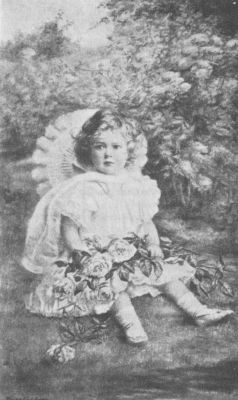
A PORTRAIT
Elizabeth Gowdy Baker
She claims that it is excellent for life-size portraits in water-colors. The paper she uses is heavier than any made in this country, and must be imported; the water-colors are very strong. Mrs. Baker claims that in this method she gets "the strength of oils with the daintiness of water-colors, and that it is beautiful for women and children, and sufficiently strong for portraits of men."
She rarely exhibits, and her portraits are in private houses.
Bakhuyzen, Juffrouw Gerardina Jacoba van de Sande. Silver medal at The Hague, 1857; honorary medal at Amsterdam, 1861; another at The Hague, 1863; and a medal of distinction at Amsterdam Colonial Exhibition, 1885. Daughter of the well-known animal painter. From childhood she painted flowers, and for a time this made no especial impression on her family or friends, as it was not an uncommon occupation for girls. At length her father saw that this daughter, Gerardina—for he had numerous daughters, and they all desired to be artists—had talent, and when, in 1850, the Minerva Academy at Groningen gave out "Roses and Dahlias" as a subject, and offered a prize of a little more than ten dollars for the best example, he encouraged Gerardina to enter the contest. She received the contemptible reward, and found, to her astonishment, that the Minerva Academy considered the picture as belonging to them.
However, this affair brought the name of the artist to the knowledge of the public, and she determined to devote herself to the painting of flowers and fruit, in which she has won unusual fame. There is no sameness in her pictures, and her subjects do not appear to be "arranged"—everything seems to have fallen into its place by chance and to be entirely natural.
Gerardina Jacoba and her brother Julius van de Sande Bakhuyzen, the landscape painter, share one studio. She paints with rapidity, as one must in order to picture the freshness of fast-fading flowers.
Johan Gram writes of her: "If she paints a basket of peaches or plums, they look as if just picked by the gardener and placed upon the table, without any thought of studied effect; some leaves covering the fruit, others falling out of the basket in the most natural way. If she paints the branch of a rose-tree, it seems to spring from the ground with its flowers in all their luxurious wantonness, and one can almost imagine one's self inhaling their delightful perfume. This talented artist knows so well how to depict with her brush the transparency and softness of the tender, ethereal rose, that one may seek in vain among a crowd of artists for her equal.... The paintings are all bright and sunny, and we are filled with enthusiasm when gazing at her powerful works."
This artist was born in 1826 and died in 1895. She lived and died in her family residence. In 1850, at Groningen, she took for her motto, "Be true to nature and you will produce that which is good." To this she remained faithful all her days.
Baldwin, Edith Ella. Born at Worcester, Massachusetts. Studied in Paris at Julian Academy, under Bouguereau and Robert-Fleury; at the Colarossi studios under Courtois, also under Julius Rolshoven and Mosler.
Paints portraits and miniatures. At the Salon of the Champ de Mars she exhibited a portrait in pastel, in 1901; at exhibitions of the Society of American Artists in 1898 and 1899 she exhibited miniatures; also pictures in oils at Worcester, 1903.
Ball, Caroline Peddle. Honorable mention at Paris Exhibition, 1900. Member of the Guild of Arts and Crafts and of Art Students' League. Born at Terre Haute, Indiana. Pupil at the Art Students' League, under Augustus St. Gaudens and Kenyon Cox.
This sculptor exhibited at Paris a Bronze Clock. She designed for the Tiffany Glass Company the figure of the Young Virgin and that of the Christ of the Sacred Heart.
A memorial fountain at Flushing, Long Island, a medallion portrait of Miss Cox of Terre Haute, a monument to a child in the same city, a Victory in a quadriga, seen on the United States Building, Paris, 1900, and also at the Buffalo Exhibition, 1901, are among her important works.
Bañuelos, Antonia. At the Paris Exposition of 1878 several portraits by this artist attracted attention, one of them being a portrait of herself. At the Exposition of 1880 she exhibited "A Guitar Player."
Barrantes Manuel de Aragon, Maria del Cármen. Member of the Academy of San Fernando, Madrid, 1816. This institution possesses a drawing by her of the "Virgin with the Christ-Child" and a portrait in oil of a person of the epoch of Charles III.
Bashkirtseff, Marie. Born in Russia of a noble family. 1860-84. This remarkable young woman is interesting in various phases of her life, but here it is as an artist that she is to be considered. Her journal, she tells us, is absolutely truthful, and it is but courteous to take the story of her artistic career from that. She had lessons in drawing, as many children do, but she gives no indication of a special love for art until she visits Florence when fourteen years old, and her love of pictures and statues is awakened. She spent hours in galleries, never sitting down, without fatigue, in spite of her delicacy. She says: "That is because the things one loves do not tire one. So long as there are pictures and, better still, statues to be seen, I am made of iron." After questioning whether she dare say it, she confides to her readers: "I don't like the Madonna della Sedia of Raphael. The countenance of the Virgin is pale, the color is not natural, the expression is that of a waiting-maid rather than of a Madonna. Ah, but there is a Magdalen of Titian that enchanted me. Only—there must always be an only—her wrists are too thick and her hands are too plump—beautiful hands they would be on a woman of fifty. There are things of Rubens and Vandyck that are ravishing. The 'Mensonge' of Salvator Rosa is very natural. I do not speak as a connoisseur; what most resembles nature pleases me most. Is it not the aim of painting to copy nature? I like very much the full, fresh countenance of the wife of Paul Veronese, painted by him. I like the style of his faces. I adore Titian and Vandyck; but that poor Raphael! Provided only no one knows what I write; people would take me for a fool; I do not criticise Raphael; I do not understand him; in time I shall no doubt learn to appreciate his beauties. The portrait of Pope Leo X.—I think it is—is admirable, however." A surprising critique for a girl of her age!
When seventeen she made her first picture of any importance. "While they were playing cards last night I made a rough sketch of the players—and this morning I transferred the sketch to canvas. I am delighted to have made a picture of persons sitting down in different attitudes; I copied the position of the hands and arms, the expressions of the countenance, etc. I had never before done anything but heads, which I was satisfied to scatter over the canvas like flowers."
Her enthusiasm for her art constantly increased. She was not willing to acknowledge her semi-invalidism and was filled with the desire to do something in art that would live after her. She was opposed by her family, who wished her to be in fashionable society. At length she had her way, and when not quite eighteen began to study regularly at the Julian Academy. She worked eight and nine hours a day. Julian encouraged her, she rejoiced in being with "real artists who have exhibited in the Salon and whose pictures are bought," and declared herself "happy, happy!" Before long M. Julian told her that she might become a great artist, and the first time that Robert-Fleury saw her work and learned how little she had studied, and that she had never before drawn from a living model, he said: "Well, then, you have extraordinary talent for painting; you are specially gifted, and I advise you to work hard."
Her masters always assured her of her talent, but she was much of the time depressed. She admired the work of Mlle. Breslau and acknowledged herself jealous of the Swiss artist. But after a year of study she took the second prize in the Academy, and admitted that she ought to be content.
Robert-Fleury took much interest in her work, and she began to hope to equal Breslau; but she was as often despondent as she was happy, which no doubt was due to her health, for she was already stricken with the malady from which she died. Julian wondered why, with her talent, it was so difficult for her to paint; to herself she seemed paralyzed.
In the autumn of 1879 she took a studio, and, besides her painting, she essayed modelling. In 1880 her portrait of her sister was exhibited at the Salon, and her mother and other friends were gratified by its acceptance.
At one time Mlle. Bashkirtseff had suffered with her eyes, and, getting better of that, she had an attack of deafness. For these reasons she went, in the summer of 1880, to Mont-Dore for treatment, and was much benefited in regard to her deafness, though not cured, and now the condition of her lungs was recognized, and what she had realized for some time was told to her family. She suffered greatly from the restrictions of her condition. She could not read very much, as her eyes were not strong enough to read and paint; she avoided people because of her deafness; her cough was very tiresome and her breathing difficult.
At the Salon of 1881 her picture was well hung and was praised by artists. In the autumn of that year she was very ill, but happily, about the beginning of 1882, she was much better and again enthusiastic about her painting. She had been in Spain and excited admiration in Madrid by the excellence of her copy of "Vulcan," by Velasquez. January 15th she wrote: "I am wrapped up in my art. I think I caught the sacred fire in Spain at the same time that I caught the pleurisy. From being a student I now begin to be an artist. This sudden influx of power puts me beside myself with joy. I sketch future pictures; I dream of painting an Ophelia. Potain has promised to take me to Saint-Anne to study faces of the mad women there, and then I am full of the idea of painting an old man, an Arab, sitting down singing to the accompaniment of a kind of guitar; and I am thinking also of a large affair for the coming Salon—a view of the Carnival; but for this it would be necessary that I should go to Nice—to Naples first for the Carnival, and then to Nice, where I have my villa, to paint it in open air."
She now met Bastien-Lepage, who, while he was somewhat severe in his criticism of her work, told her seriously that she was "marvellously gifted." This gave her great pleasure, and, indeed, just at this time the whole tone of the journal and her art enthusiasm are most comforting after the preceding despairing months. From this time until her death her journal is largely occupied with her health, which constantly failed, but her interest in art and her intense desire to do something worthy of a great artist—something that Julian, Robert-Fleury, and, above all, Bastien-Lepage, could praise, seemed to give her strength, and, in spite of the steady advance of the fell tuberculosis from which she was dying, she worked devotedly.
She had a fine studio in a new home of the family, and was seized with an ardent desire to try sculpture—she did a little in this art—but that which proved to be her last and best work was her contribution to the Salon of 1884. This brought her to the notice of the public, and she had great pleasure, although mingled with the conviction of her coming death and the doubts of her ability to do more. Of this time she writes: "Am I satisfied? It is easy to answer that question; I am neither satisfied nor dissatisfied. My success is just enough to keep me from being unhappy. That is all."
Again: "I have just returned from the Salon. We remained a long time seated on a bench before the picture. It attracted a good deal of attention, and I smiled to myself at the thought that no one would ever imagine the elegantly dressed young girl seated before it, showing the tips of her little boots, to be the artist. Ah, all this is a great deal better than last year! Have I achieved a success, in the true, serious meaning of the word? I almost think so."
The picture was called the "Meeting," and shows seven gamins talking together before a wooden fence at the corner of a street. François Coppée wrote of it: "It is a chef d'oeuvre, I maintain. The faces and the attitudes of the children are strikingly real. The glimpse of meagre landscape expresses the sadness of the poorer neighborhoods."
Previous to this time, her picture of two boys, called "Jean and Jacques," had been reproduced in the Russian Illustration, and she now received many requests for permission to photograph and reproduce her "Meeting," and connoisseurs made requests to be admitted to her studio. All this gratified her while it also surprised. She was at work on a picture called "Spring," for which she went to Sèvres, to paint in the open.
Naturally she hoped for a Salon medal, and her friends encouraged her wish—but alas! she was cruelly disappointed. Many thought her unfairly treated, but it was remembered that the year before she had publicly spoken of the committee as "idiots"!
People now wished to buy her pictures and in many ways she realized that she was successful. How pathetic her written words: "I have spent six years, working ten hours a day, to gain what? The knowledge of all I have yet to learn in my art, and a fatal disease!"
It is probable that the "Meeting" received no medal because it was suspected that Mlle. Bashkirtseff had been aided in her work. No one could tell who had originated this idea, but as some medals had been given to women who did not paint their pictures alone, the committee were timid, although there seems to have been no question as to superiority.
A friendship had grown up between the families Bashkirtseff and Bastien-Lepage. Both the great artist and the dying girl were very ill, but for some time she and her mother visited him every two or three days. He seemed almost to live on these visits and complained if they were omitted. At last, ill as Bastien-Lepage was, he was the better able of the two to make a visit. On October 16th she writes of his being brought to her and made comfortable in one easy-chair while she was in another. "Ah, if I could only paint!" he said. "And I?" she replied. "There is the end to this year's picture!"
These visits were continued. October 20th she writes of his increasing feebleness. She wrote no more, and in eleven days was dead.
In 1885 the works of Marie Bashkirtseff were exhibited. In the catalogue was printed François Coppée's account of a visit he had made her mother a few months before Marie's death. He saw her studio and her works, and wrote, after speaking of the "Meeting," as follows:
"At the Exhibition—Salon—before this charming picture, the public had with a unanimous voice bestowed the medal on Mlle. B., who had been already 'mentioned' the year before. Why was this verdict not confirmed by the jury? Because the artist was a foreigner? Who knows? Perhaps because of her wealth. This injustice made her suffer, and she endeavored—the noble child—to avenge herself by redoubling her efforts.
"In one hour I saw there twenty canvases commenced; a hundred designs—drawings, painted studies, the cast of a statue, portraits which suggested to me the name of Frans Hals, scenes made from life in the open streets; notably one large sketch of a landscape—the October mist on the shore, the trees half stripped, big yellow leaves strewing the ground. In a word, works in which is incessantly sought, or more often asserts itself, the sentiment of the sincerest and most original art, and of the most personal talent."
Mathilde Blind, in her "Study of Marie Bashkirtseff," says: "Marie loved to recall Balzac's questionable definition that the genius of observation is almost the whole of human genius. It was natural it should please her, since it was the most conspicuous of her many gifts. As we might expect, therefore, she was especially successful as a portrait painter, for she had a knack of catching her sitter's likeness with the bloom of nature yet fresh upon it. All her likenesses are singularly individual, and we realize their character at a glance. Look, for example, at her portrait of a Parisian swell, in irreproachable evening dress and white kid gloves, sucking his silver-headed cane, with a simper that shows all his white teeth; and then at the head and bust of a Spanish convict, painted from life at the prison in Granada. Compare that embodiment of fashionable vacuity with this face, whose brute-like eyes haunt you with their sadly stunted look. What observation is shown in the painting of those heavily bulging lips, which express weakness rather than wickedness of disposition—in those coarse hands engaged in the feminine occupation of knitting a blue and white stocking!"
Bauck, Jeanna. Born in Stockholm in 1840. Portrait and landscape painter. In 1863 she went to Dresden, and studied figure work with Professor Ehrhardt; later she moved to Düsseldorf, where she devoted herself to landscape under Flamm, and in 1866 she settled in Munich, where she has since remained, making long visits to Paris, Venice, and parts of Switzerland. Her later work is marked by the romantic influence of C. Ludwig, who was for a time her instructor, but she shows unusual breadth and sureness in dealing with difficult subjects, such as dusky forests with dark waters or bare ruins bordered with stiff, ghost-like trees. Though not without talent and boldness, she lacks a feeling for style.
Bauerlé, Miss A.
[No reply to circular.]
Baxter, Martha Wheeler.
[No reply to circular.]
Beale, Mary. 1632-97. This artist was the daughter of the Rev. Mr. Cradock. She married Mr. Beale, an artist and a color-maker. She studied under Sir Peter Lely, who obtained for her the privilege of copying some of Vandyck's most famous works.
Mrs. Beale's portraits of Charles II., Cowley, and the Duke of Norfolk are in the National Portrait Gallery, London, and that of Archbishop Tillotson is in Lambeth Palace. This portrait was the first example of an ecclesiastic represented as wearing a wig instead of the usual silk coif.
Her drawing was excellent and spirited, her color strong and pure, and her portraits were sought by many distinguished persons.
Several poems were written in praise of this artist, in one of which, by Dr. Woodfall, she is called "Belasia." Her husband, Charles Beale, an inferior artist, was proud of his wife, and spent much time in recording the visits she received, the praises lavished on her, and similar matters concerning her art and life. He left more than thirty pocket-notebooks filled with these records, and showed himself far more content that his wife should be appreciated than any praise of himself could have made him.
Beaury-Saurel, Mme. Amélie. Prize of honor at Exposition of Black and White, 1891; third-class medal, Salon, 1883; bronze medal, Exposition, 1889. Born at Barcelona, of French parents. Pupil of Julian Academy. Among her principal portraits are those of Léon Say, Félix Voisin, Barthélemy Saint-Hilaire, Mme. Sadi-Carnot, Coralie Cohen, Princess Ghika, etc. She has also painted the "Two Vanquished Ones," "A Woman Physician," and a "Souvenir of a Bull-Fight," pastel, etc.
This artist has also contributed to several magazines. At the Salon of the Artistes Français, 1902, she exhibited a portrait and a picture of "Hamlet"; in 1903 a picture, "In the Train." Mme. Beaury-Saurel is also Mme. Julian, wife of the head of the Academy in which she was educated.
Beaux, Cecilia. Mary Smith prize at the Pennsylvania Academy of Fine Arts, 1885, 1887, 1891, 1892; gold medal, Philadelphia Art Club, 1893; Dodge prize, National Academy of Design, 1893; bronze medal, Carnegie Institute, 1896; first-class gold medal, $1,500, Carnegie Institute, 1899; Temple gold medal, Pennsylvania Academy, 1900; gold medal, Paris Exposition, 1900; gold medal, (?) 1901. Associate of National Academy of Design, member of Society of American Artists, associate of Société des Beaux-Arts, Paris. Born in Philadelphia. Studied under Mrs. T. A. Janvier, Adolf van der Weilen, and William Sartain in Philadelphia; under Robert-Fleury, Bouguereau, and Benjamin-Constant, in Paris.
Her portraits are numerous. In 1894 she exhibited a portrait of a child at the Exhibition of the Society of American Artists, which was much admired and noticed in the Century Magazine, September, 1894, as follows: "Few artists have the fresh touch which the child needs and the firm and rapid execution which allows the painter to catch the fleeting expression and the half-forms which make child portraits at once the longing and the despair of portrait painters. Miss Beaux's technique is altogether French, sometimes reminding me a little of Carolus Duran and of Sargent; but her individuality has triumphed over all suggestions of her foreign masters, and the combination of refinement and strength is altogether her own."
Seven years later, in the International Studio, September, 1901, we read: "The mention of style suggests a reference to the portraits by Miss Cecilia Beaux, while the allusion to characterization suggests at the same time their limitation. The oftener one sees her 'Mother and Daughter,' which gained the gold medal at Pittsburg in 1899 and the gold medal also at last year's Paris Exposition, the less one feels inclined to accept it as a satisfactory example of portraiture. Magnificent assurance of method it certainly has, controlled also by a fine sobriety of feeling, so that no part of the ensemble impinges upon the due importance of the other parts; it is a balanced, dignified picture. But in its lack of intimacy it is positively callous. One has met these ladies on many occasions, but with no increase of acquaintanceship or interest on either side—our meetings are sterile of any human interest. So one turns with relief to Miss Beaux's other picture of 'Dorothea and Francesca'—an older girl leading a younger one in the steps of a dance. They are not concerned with us, but at least interested in one another; and we can attach ourselves, if only as outsiders, to the human interest involved.
"These pictures suggest a moment's consideration of the true meaning of the term 'style' as applied to painting. Is it not more than the mere ableness of method, still more than the audacity of brush work, that often passes for style? Is it possible to dissociate the manner of a picture from its embodiment of some fact or idea? For it to have style in the full sense of the word, surely it must embody an expression of life as serious and thorough as the method of record."—Charles H. Caffin.
In the International Studio of March, 1903, we read: "The portrait of Mrs. Roosevelt, by Miss Cecilia Beaux, seemed to me to be one of the happiest of her creations. Nothing could exceed the skill and daintiness with which the costume is painted, and the characterization of the head is more sympathetic than usual, offering a most winsome type of beautiful, good womanhood. A little child has been added to the picture—an afterthought, I understand, and scarcely a fortunate one; at least in the manner of its presentment. The figure is cleverly merged in half shadow, but the treatment of the face is brusque, and a most unpleasant smirk distorts the child's mouth. It is the portrait of the mother that carries the picture, and its superiority to many of Miss Beaux's portraits consists in the sympathy with her subject which the painter has displayed."—Charles H. Caffin.
A writer in the Mail and Express says: "Miss Beaux has approached the task of painting the society woman of to-day, not as one to whom this type is known only by the exterior, but with a sympathy as complete as a similar tradition and an artistic temperament will allow. Thus she starts with an advantage denied to all but a very few American portrait painters, and this explains the instinctive way in which she gives to her pictured subjects an air of natural ease and good breeding."
Miss Beaux's picture of "Brighton Cats" is so excellent that one almost regrets that she has not emulated Mme. Ronner's example and left portraits of humans to the many artists who cannot paint cats!
[No reply to circular.]
Beck, Carol H. Mary Smith prize at Pennsylvania Academy of Fine Arts, 1899. Fellow of above Academy and member of the Plastic Club, Philadelphia. Born in Philadelphia. Studied in schools of Pennsylvania Academy, and later in Dresden and Paris.
Miss Beck paints portraits and her works have been frequently exhibited. Her portraits are also seen in the University of Pennsylvania, in the Woman's Medical College, Philadelphia, in Wesleyan College, at the capitols of Pennsylvania and New Jersey, and other public places, as well as in many private homes.
Miss Beck edited the Catalogue of the Wilstach Collection of Paintings in Memorial Hall, Fairmount Park, Philadelphia.
Beckington, Alice.
[No reply to circular.]
Beernaerts, Euphrosine. Landscape painter. In 1873 she won a medal at Vienna, in 1875 a gold medal at the Brussels Salon, and still other medals at Philadelphia (1876), Sydney (1879), and Teplitz (1879). She was made Chévalier de l'Ordre de Léopold in 1881. Mlle. Beernaerts was born at Ostend, 1831, and studied under Kuhner in Brussels. She travelled in Germany, France, and Italy, and exhibited admirable landscapes at Brussels, Antwerp, and Paris, her favorite subjects being Dutch. In 1878 the following pictures by her were shown in Paris: "Lisière de bois dans les Dunes (Zélande)," "Le Village de Domburg (Zélande)," and "Intérieur de bois à Oost-Kapel (Holland)." Other well-known works are "Die Campine" and "Aus der Umgebung von Oosterbeck."
Begas, Luise Parmentier. Born in Vienna. Pupil of Schindler and Unger. She travelled extensively in Europe and the Orient, and spent some time in Sicily. She married Adalbert Begas in 1877 and then established her studio in Berlin. Her subjects are landscape, architectural monuments, and interiors. Some of the latter are especially fine. Her picture of the "Burial Ground at Scutari" was an unusual subject at the time it was exhibited and attracted much attention.
Her rich gift in the use of color is best seen in her pictures of still life and flowers. In Berlin, in 1890, she exhibited "Before the Walls of Constantinople" and "From Constantinople," which were essentially different from her earlier works and attracted much attention. "Taormina in Winter" more nearly resembled her earlier pictures.
Fräulein Parmentier also studied etching, in which art Unger was her instructor. In her exquisite architectural pictures and landscapes she has represented Italian motives almost exclusively. Among these are her views of Venice and other South Italian sketches, which are also the subjects of some of her etchings.
Belle, Mlle. Andrée. Member of the Société Nationale des Beaux Arts. Born in Paris. Pupil of Cazin. Paints in oils and pastels, landscapes especially, of which she exhibited seventeen in June, 1902. The larger part of these were landscape portraits, so to speak, as they were done on the spots represented with faithfulness to detail. The subjects were pleasing, and the various hours of day, with characteristic lighting, unusually well rendered.
At the Salon des Beaux Arts, 1902, this artist exhibited a large pastel, "A Halt at St. Mammès" and a "Souvenir of Bormes," showing the tomb of Cazin. In 1903 she exhibited a pastel called "Calvary," now in the Museum at Amiens, which has been praised for its harmony of color and the manner in which the rainbow is represented. Her pictures of "Twilight" and "Sunset" are unusually successful.
Benato-Beltrami, Elisabetta. Painter and sculptor of the nineteenth century, living in Padua since 1858. Her talent, which showed itself early, was first developed by an unknown painter named Soldan, and later at the Royal Academy in Venice. She made copies of Guido, Sassoferrato and Veronese, the Laokoon group, and the Hercules of Canova, and executed a much-admired bas-relief called "Love and Innocence." Among her original paintings are an "Atala and Chactas," "Petrarch's First Meeting with Laura," a "Descent from the Cross" for the church at Tribano, a "St. Sebastian," "Melancholy," a "St. Ciro," and many Madonnas. Her pictures are noble in conception and firm in execution.
Benito y Tejada, Benita. Born in Bilboa, where she first studied drawing; later she went to Madrid, where she entered the Escuela superior. In the Exposition of 1876 at Madrid "The Guardian" was shown, and in 1881 a large canvas representing "The First Step."
Bernhardt, Sarah. In 1869 this famous actress watched Mathieu-Meusnier making a bust. She made her criticisms and they were always just. The sculptor told her that she had the eye of an artist and should use her talent in sculpture. Not long after she brought to him a medallion portrait of her aunt. So good was it that Mathieu-Meusnier seriously encouraged her to persevere in her art. She was fascinated by the thought of what might be possible for her, took a studio, and sent to the Salon in 1875 a bust, which attracted much attention. In 1876 she exhibited "After the Tempest," the subject taken from the story of a poor woman who, having buried two sons, saw the body of her last boy washed ashore after a storm. This work was marvellously effective, and a great future as a sculptress was foretold for the "divine Sara." At the Salon of 1878 she exhibited two portrait busts in bronze.
This remarkable woman is a painter also, and exhibited a picture called "La jeune Fille et la Mort." One critic wrote of it: "Sarah's picture shows very considerable feeling for color and more thought than the vast majority of modern paintings. The envious and evil speakers, who always want to say nasty things, pretend to trace in the picture very frequent touches of Alfred Stevens, who has been Sarah's master in painting, as Mathieu-Meusnier was in sculpture. However that may be, Sarah has posed her figures admirably and her coloring is excellent. It is worthy of notice that, being as yet a comparative beginner, she has not attempted to give any expression to the features of the young girl over whose shoulder Death is peeping."
One of the numerous ephemeral journals which the young and old jeunesse of the Latin Quarter is constantly creating has made a very clever caricature of the picture in a sort of Pompeian style. Death is represented by the grinning figure of Coquelin ainé. The legend is "'La Jeune Fille et la Mort,' or Coquelin ainé, presenting Sarah Bernhardt the bill of costs of her fugue." In other words, Coquelin is Death, handing to Sarah the undertaker's bill—300,000 francs—for her civil burial at the Comédie Française.
Bethune, Louise. This architect, whose maiden name was Blanchard, was born in Waterloo, New York, 1856. She studied drawing and architecture, and in 1881 opened an office, being the first woman architect in the United States. Since her marriage to Robert A. Bethune they have practised their art together. Mrs. Bethune is the only woman holding a fellowship in the American Institute of Architects.
[No reply to circular.]
Beveridge, Kühne. Honorable mention in Paris twice. Born in Springfield, Illinois. Studied under William R. O'Donovan in New York, and under Rodin in Paris.
Among her works are a statue called "Rhodesia," "Rough Rider Monument," a statue called "Lascire," which belongs to Dr. Jameson, busts of Cecil Rhodes, King Edward VII., Grover Cleveland, Vice-President Stevenson, Joseph Jefferson, Buffalo Bill, General Mahon, hero of Mafeking, Thomas L. Johnson, and many others.
Miss Beveridge was first noticed as an artist in this country in 1892, when her busts of ex-President Cleveland and Mr. Jefferson called favorable attention to her.
In 1899 she married Charles Coghlan, and soon discovered that he had a living wife at the time of her marriage and obtained a divorce. Before she went to South Africa Miss Beveridge had executed several commissions for Cecil Rhodes and others living in that country.
Her mother is now the Countess von Wrede, her home being in Europe, where her daughter has spent much time. She has married the second time, an American, Mr. Branson, who resides at Johannesburg, in the Transvaal.
Biffin, Sarah. 1784-1850. It seems a curious fact that several persons born without arms and hands have become reputable artists. This miniature painter was one of these. Her first teacher, a man named Dukes, persuaded her to bind herself to live in his house and give her time to his service for some years. Later, when the Earl of Morton made her acquaintance, he proved to her that her engagement was not legally binding and wished her to give it up; but Miss Biffin was well treated by the Dukes and preferred to remain with them.
The Earl of Morton, however, caused her to study under Mr. Craig, and she attained wonderful excellence in her miniatures. In 1821 the Duke of Sussex, on behalf of the Society of Arts, presented her with a prize medal for one of her pictures.
She remained sixteen years with the Dukes, and during this time never received more than five pounds a year! After leaving them she earned a comfortable income. She was patronized by George III. and his successors, and Queen Victoria and the Prince Consort were her generous patrons, as well as many other distinguished persons.
After the death of the Earl of Morton she had no other friend to aid her in getting commissions or selling her finished pictures, and she moved to Liverpool. A small annuity was purchased for her, which, in addition to the few orders she received, supported her until her death at the age of sixty-six. Her miniatures have been seen in loan collections in recent years. Her portrait of herself, on ivory, was exhibited in such a collection at South Kensington.
Bilders, Marie. Family name Van Bosse. Born in Amsterdam, 1837; died in Wiesbaden, 1900. Pupil of Van de Sande-Bakhuyzen, Bosboom, and Johannes W. Bilders. Settled in Oosterbeck, and painted landscapes from views in the neighborhood. This artist was important, and her works are admired especially by certain Dutch artists who are famous in all countries. These facts are well known to me from good authority, but I fail to find a list of her works or a record of their present position.[1]
[1]
See Supplement.
Bilinska, Anna. Received the small gold medal at Berlin in 1891, and won distinguished recognition at other international exhibitions in Berlin and Munich by her portraits and figure studies. She was born in Warsaw in 1858, and died there in 1893. She studied in Paris, where she quickly became a favorite painter of aristocratic Russians and Poles. Her pictures are strong and of brilliant technique.
Biondi, Nicola. Born at Capua, 1866. This promising young Italian painter was a pupil of the Institute of Fine Arts in Naples. One of her pictures, called "Una partita," was exhibited at Naples and attracted much attention. It was purchased by Duke Martini. Another, "Ultima Prova," was exhibited in Rome and favorably noticed.
Blau, Tina. Honorable mention in Paris, 1883, for her "Spring in the Prater." Her "Land Party" is in the possession of the Emperor of Austria, and "In Spring-time" belongs to the Prince Regent of Bavaria. This talented landscape painter was born in Vienna, 1847. She was a pupil of Schäffer in Vienna, and of W. Lindenschmitt in Munich. After travelling in Austria, Holland, and Italy, she followed her predilection for landscape, and chose her themes in great part from those countries. In 1884 she married Heinrich Lang, painter of battle scenes (who died in 1891), and she now works alternately in Munich and Vienna. In 1890 she gave an exhibition of her pictures in Munich; they were thought to show great vigor of composition and color and much delicacy of artistic perception. Her foreign scenes, especially, are characterized by unusual local truth and color. Among her best works are "Studies from the Prater in Vienna," "Canal at Amsterdam," "Harvest Day in Holland," "The Arch of Titus in Rome," "Street in Venice," and "Late Summer."
Bloch, Mme. Elisa. Honorable mention, 1894. Officer of public instruction, Commander of the Order of the Liberator; Chevalier of the Order of the Dragon of Annam. Born at Breslau, Silesia, 1848. Pupil of Chapu. She first exhibited at the Salon of 1878, a medallion portrait of M. Bloch; this was followed by "Hope," the "Golden Age," "Virginius Sacrificing his Daughter," "Moses Receiving the Tables of the Law," etc. Mme. Bloch has made numerous portrait busts, among them being the kings of Spain and Portugal, Buffalo Bill, C. Flammarion, etc.
At the Salon of the Artistes Français, 1903, Mme. Bloch exhibited a "Portrait of M. Frédéric Passy, Member of the Institute."
Boccardo, Lina Zerbinah. Rome.
[No reply to circular.]
Boemm, Ritta. A Hungarian artist. Has been much talked of in Dresden. She certainly possesses distinguished talents, and is easily in the front rank of Dresden women artists. Her gouache pictures dealing with Hungarian subjects, a "Village Street," a "Peasant Farm," a "Churchyard," exhibited at Dresden in 1892, were well drawn and full of sentiment, but lacking in color sense and power. She works unevenly and seems pleased when she succeeds in setting a scene cleverly. She paints portraits also, mostly in pastel, which are spirited, but not especially good likenesses. What she can do in the way of color may be seen in her "Village Street in Winter," a picture of moderate size, in which the light is exquisite; unfortunately most of her painting is less admirable than this.
Boissonnas, Mme. Caroline Sordet. Honorable mention at the Salon of Lyons, 1897. Member of the Exposition Permanente Amis des Beaux-Arts, Geneva. Born in Geneva. Pupil of the School of Fine Arts, Geneva, under Prof. F. Gillet and M. E. Ravel.
This artist paints portraits principally. She has been successful, and her pictures are in Geneva, Lausanne, Vevey, Paris, Lyons, Marseilles, Dresden, Naples, etc.
Bompiani-Battaglia, Clelia. Born in Rome, 1847. Pupil of her father, Roberto Bompiani, and of the professors in the Academy of St. Luke. The following pictures in water-colors have established her reputation as an artist: "Confidential Communication," 1885; the "Fortune-Teller," 1887; "A Public Copyist," 1888; and "The Wooing," 1888.
Bonheur, Juliette—Mme. Peyrol. Born at Paris. Sister of Rosa Bonheur, and a pupil of her father. Among her pictures are "A Flock of Geese," "A Flock of Sheep Lying Down," and kindred subjects. The last-named work was much remarked at the Salon of 1875. In 1878 she exhibited "The Pool" and "The Mother's Kiss."
Mme. Peyrol was associated with her famous sister in the conduct of the Free School of Design, founded by Rosa Bonheur in 1849.
Bonheur, Marie Rosalie. 1822-99. Member of Antwerp Institute, 1868. Salon medals, 1845, 1848, 1855, 1867; Legion of Honor, 1865; Leopold Cross, 1880; Commander's Cross, Royal Order of Isabella the Catholic, 1880. Born in Bordeaux. She was taught drawing by her father, who, perceiving that she had unusual talent, permitted her to give up dressmaking, to which, much against her will, she had been apprenticed. From 1855 her fame was established; she was greatly appreciated, and her works competed for in England and the United States, as well as in European countries.
Her chief merit is the actual truthfulness with which she represented animals. Her skies might be bettered in some cases—the atmosphere of her pictures was sometimes open to question—but her animals were anatomically perfect and handled with such virility as few men have excelled or even equalled. Her position as an artist is so established that no quoted opinions are needed when speaking of her—she was one of the most famous women of her century.
Her home at By was near Fontainebleau, where she lived quietly, and for some years held gratuitous classes for drawing. She left, at her death, a collection of pictures, studies, etchings, etc., which were sold by auction in Paris soon after.
Her "Ploughing in the Nivernais," 1848, is in the Luxembourg Gallery; "The Horse Fair," 1853, is seen in the National Gallery, London, in a replica, the original being in the United States, purchased by the late A. T. Stewart. Her "Hay Harvest in the Auvergne," 1855, is one of her most important works. After 1867 Mlle. Bonheur did not exhibit at the Salon until 1899, a few weeks before her death.
One must pay a tribute to this artist as a good and generous woman. She founded the Free School of Design for Girls, and in 1849 took the direction of it and devoted much of her valuable time to its interests. How valuable an hour was to her we may understand when we remember that Hamerton says: "I have seen work of hers which, according to the price given, must have paid her a hundred pounds for each day's labor."
The story of her life is of great interest, and can be but slightly sketched here.
She was afoot betimes in the morning, and often walked ten or twelve miles and worked hard all day. The difficulty of reaching her models proved such a hindrance to her that she conceived the idea of visiting the abattoirs, where she could see animals living and dead and study their anatomy.
It is not easy to imagine all the difficulties she encountered in doing this—the many repulsive features of such places—while the company of drovers and butchers made one of the disagreeables of her pursuits. Her love for the animals, too, made it doubly hard for her to see them in the death agony and listen to their pitiful cries for freedom.
In all this experience, however, she met no rude or unkind treatment. Her drawings won the admiration of the men who watched her make them and they treated her with respect. She pursued her studies in the same manner in the stables of the Veterinary School at Alfort and in the Jardin des Plantes.
At other times she studied in the country the quiet grazing herds, and, though often mistaken for a boy on account of the dress she wore, she inspired only admiration for her simplicity and frankness of manner, while the graziers and horse-dealers respectfully regarded her and wondered at her skill in picturing their favorite animals. Some very amusing stories might be told of her comical embarrassments in her country rambles, when she was determined to preserve her disguise and the pretty girls were equally determined to make love to her!
Aside from all this laborious study of living animals, she obtained portions of dead creatures for dissection; also moulds, casts, and illustrated anatomical books; and, in short, she left no means untried by which she could perfect herself in the specialty she had chosen. Her devotion to study and to the practice of her art was untiring, and only the most engrossing interest in it and an indomitable perseverance, supplemented and supported by a physically and morally healthful organization, could have sustained the nervous strain of her life from the day when she was first allowed to follow her vocation to the time when she placed herself in the front rank of animal painters.
A most charming picture is drawn of the life of the Bonheur family in the years when Rosa was making her progressive steps. They lived in an humble house in the Rue Rumfort, the father, Auguste, Isidore, and Rosa all working in the same studio. She had many birds and a pet sheep. As the apartment of the Bonheurs was on the sixth floor, this sheep lived on the leads, and from time to time Isidore bore him on his shoulders down all the stairs to the neighboring square, where the animal could browse on the real grass, and afterward be carried back by one of the devoted brothers of his mistress. They were very poor, but they were equally happy. At evening Rosa made small models or illustrations for books or albums, which the dealers readily bought, and by this means she added to the family store for needs or pleasures.
In 1841, when Rosa was nineteen years old, she first experienced the pleasures, doubts, and fears attendant upon a public exhibition of one's work. Two small pictures, called "Goats and Sheep" and "Two Rabbits," were hung at the Salon and were praised by critics and connoisseurs. The next year she sent three others, "Animals in a Pasture," "A Cow Lying in a Meadow," and "A Horse for Sale." She continued to send pictures to the Salon and to some exhibitions in other cities, and received several bronze and silver medals.
In 1845 she sent twelve works to the Salon, accompanied by those of her father and her brother Auguste, who was admitted that year for the first time. In 1848 Isidore was added to the list, exhibiting a picture and a group in marble, both representing "A Combat between a Lioness and an African Horseman." And, finally, the family contributions were completed when Juliette, now Madame Peyrol, added her pictures, and the works of the five artists were seen in the same Exhibition.
In 1849 Rosa Bonheur's "Cantal Oxen" was awarded the gold medal, and was followed by "Ploughing in the Nivernais," so well known the world over by engravings and photographs. When the medal was assigned her, Horace Vernet proclaimed her triumph to a brilliant assemblage, and also presented to her a magnificent vase of Sèvres porcelain, in the name of the French Government. This placed her in the first rank of living artists, and the triumph was of double value to her on account of the happiness it afforded her father, to see this, his oldest child, of whose future he had often despaired, taking so eminent a place in the artistic world.
This year of success was also a year of sorrow, for before its end the old Raymond had died. He had been for some time the director of the Government School of Design for Girls, and, being freed from pecuniary anxiety, he had worked with new courage and hope. After her father's death Rosa Bonheur exhibited nothing for two years, but in 1853 she brought out her "Horse Fair," which added to her fame.
She was perfectly at home in the mountains, and spent much time in the huts of charcoal burners, huntsmen, or woodcutters, contented with the food they could give her and happy in her study. Thus she made her sketches for "Morning in the Highlands," "The Denizens of the Mountains," etc. She once lived six weeks with her party on the Spanish side of the Pyrenees, where they saw no one save muleteers going and coming, with their long lines of loaded mules. Their only food was frogs' legs, which they prepared themselves, and the black bread and curdled milk which the country afforded. At evening the muleteers would amuse the strangers by dancing the national dances, and then repose in picturesque groups just suited to artistic sketching. In Scotland and in Switzerland, as well as in various portions of her own country, she had similar experiences, and her "Hay-Making in Auvergne" proves that she was familiar with the more usual phases of country life. At the Knowles sale in London, in 1865, her picture of "Spanish Muleteers Crossing the Pyrenees," one of the results of the above sojourn in these mountains, sold for two thousand guineas, about ten thousand dollars. I believe that, in spite of the large sums of money that she received, her habitual generosity and indifference to wealth prevented her amassing a large fortune, but her fame as an artist and her womanly virtues brought the rewards which she valued above anything that wealth could bestow—such rewards as will endure through centuries and surround the name of Rosa Bonheur with glory, rewards which she untiringly labored to attain.
Bonsall, Elizabeth F. First Toppan prize, and Mary Smith prize twice, at Pennsylvania Academy of Fine Arts. Member of Plastic Club, Philadelphia. Born at Philadelphia. Studied at the above-named Academy and in Paris; also at the Drexel Institute, Philadelphia, under Eakins, Courtois, Collin, and Howard Pyle.
Miss Bonsall is well known for her pictures of cats. She illustrated the "Fireside Sphinx," by Agnes Repplier. Her picture of "Hot Milk" is in the Pennsylvania Academy; her "Suspense," in a private gallery in New York.
An interesting chapter in Miss Winslow's book, "Concerning Cats," is called "Concerning Cat Artists," in which she writes: "Elizabeth Bonsall is a young American artist who has exhibited some good cat pictures, and whose work promises to make her famous some day if she does not 'weary in well-doing.'"
Miss Bonsall has prepared a "Cat Calendar" and a "Child's Book about Cats," which were promised to appear in the autumn of 1903.
Bonsall, Mary M. First Toppan prize at Pennsylvania Academy of Fine Arts. Member of the Plastic Club, Philadelphia. Studied at above academy under Vonnoh, De Camp, William Chase, and Cecilia Beaux.
This artist paints portraits, which are in private hands.
Bonte, Paula. Born in Magdeburg, 1840, and from 1862 to 1864 was a pupil of Pape in Berlin. She travelled and studied in Northern Italy and Switzerland, and from these regions, as well as from Northern Germany, took her subjects. She has exhibited pictures at various exhibitions, and among her best works should be mentioned: "The Beach at Clovelly in Devonshire," "From the Bernese Oberland," "The Riemenstalden Valley," etc.
Boott, Elizabeth. Born in Cambridge. Miss Boott was one of those pupils of William M. Hunt to whom he imparted a wonderful artistic enthusiasm, energy, and devotion. After studying in Boston she studied in Paris under Duveneck—whom she afterward married—and under Couture. Her subjects were genre, still-life, and flowers, and were well considered. Among her genre pictures are "An Old Man Reading," an "Old Roman Peasant," and a "Girl with a Cat." When in Italy she painted a number of portraits, which were successful. Miss Brewster, who lived in Rome, was an excellent critic, and she wrote: "I must say a few words about a studio I have lately visited—Miss Boott's. I saw there three very fine portraits, remarkable for strength and character, as well as rich coloring: one of Mr. Boott, one of Bishop Say, and the third of T. Adolphus Trollope, the well-known writer and brother of the novelist, Anthony Trollope. All are good likenesses and are painted with vigor and skill, but the one of Mr. Trollope is especially clever. Trollope's head and face, though a good study, are not easy to paint, but Miss Boott has succeeded to perfection. His head and beard are very fine. The face in nature, but for the melancholy, kindly look about the eyes and mouth, would be stern; Miss Boott has caught this expression and yet retained all the firm character of the countenance. It is remarkable that an artist who paints male heads with such a vigorous character should also give to flowers softness, transparency, and grace. Nothing can be more lovely than Miss Boott's flower studies. She has some delicious poppies among wheat, lilies, thistles. She gets a transparency into these works that is not facile in oil. A bunch of roses in a vase was as tender and round and soft-colored as in nature. Among all the many studios of Rome I do not know a more attractive one than Miss Boott's."
Bortolan, Rosa. Born at Treviso. She was placed in the Academy at Venice by her family, where she had the benefit of such masters as Grigoletti, Lipparini, Schiavoni, and Zandomeneghi. She early showed much originality, and after making thorough preliminary studies she began to follow her own ideas. She was of a mystical and contemplative turn of mind, and a great proportion of her work has been of a religious nature. Her pictures began to attract attention about 1847, and she had many commissions for altar-pieces and similar work. The church of Valdobbiadene, at Venice, contains "San Venanziano Fortunatus, Bishop." "Saint Louis" was painted as a commission of Brandolin da Pieve; "Comte Justinian Replying to Bonaparte in Treviso" was a subscription picture presented to Signor Zoccoletto. Portraits of the Countess Canossa-Portalupi and her son, of Luigia Codemo, and of Luigi Giacomelli are thought to possess great merit; while those of Dr. Pasquali (in the Picture Gallery at Treviso) and Michelangelo Codemo have been judged superior to those of Rosalba Carriera and Angelica Kauffmann. Her sacred pictures, strong and good in color, are full of a mystical and spiritual beauty. Her drawing is admirable and her treatment of detail highly finished.
Borzino, Leopoldina. Milanese water-color painter. Has shown excellent genre pictures at various exhibitions. "The Holiday" and the "Return from Mass" were both exhibited and sold at Rome in 1883; "The Way to Calvary" was seen at Venice in 1887. "The Rosary," "Anguish," and "Going to the Fountain" are all distinguished by good color as well as by grace and originality of composition.
Bouguereau, Mme. Elizabeth Jane. See Gardner.
Boulanger, Mme. Marie Elizabeth. Medals at the Paris Salon in 1836 and 1839. Born in Paris, 1810. Her family name was Blavot, and after the death of M. Boulanger she married M. Cavé, director of the Academy of the Beaux-Arts. Her picture of "The Virgin in Tears" is in the Museum of Rouen; and "The Children's Tournament," a triptych, was purchased by the Government.
Bourrillon-Tournay, Mme. Jeanne. Medal of the second class at Exposition Universelle at Lyons; silver medal at Versailles; honorable mention at Paris Salon, 1896; the two prizes of the Union des Femmes Peintres et Sculpteurs—les Palmes Académique, 1895; the Rosette of an Officer of the Public Instruction in 1902. Member of the Société des Artistes Français, of the Union des Femmes Peintres et Sculpteurs, and of the Association de Baron Taylor. Born at Paris, 1870. Pupil of Ferdinand Humbert and G. C. Saintpierre.
This artist paints portraits, and among them are those of a "Young Girl," which belongs to the general Council of the Seine; one of the Senator Théophile Roussel, of the Institute, and a portrait of an "Aged Lady," both purchased by the Government; one of M. Auguste Boyer, councillor of the Court of Cassation, and many others.
At the Salon des Artistes Français, 1902, Mme. Bourrillon-Tournay exhibited two portraits, one being that of her mother; in 1903, that of M. Boyer and one of Mme. B.
Bowen, Lota. Member of Society of Women Artists, London, the Tempera Society, and the "91" Art Club. Born at Armley, Yorkshire. Studied in Ludovici's studio, London; later in Rome under Santoro, and in the night classes of the Circolo Artistico.
Her pictures are principally landscapes, and are chiefly in private collections in England. Among the most important are "On the Venetian Lagoons," "Old Stone Pines, Lido, Venice," "Evening on Lake Lugano," "Evening Glow on the Dolomites," "The Old Bird Fancier," "Moonrise on Crowborough, Sussex." All these have been exhibited at the Academy.
"Miss Lota Bowen constantly receives most favorable notices of her works in magazines and journals. She is devotedly fond of her art, and has sought subjects for her brush in many European byways, as well as in North Africa, Turkey, and Montenegro. She paints portraits and figure subjects; has a broad, swinging brush and great love of 'tone.' Miss Bowen has recently built a studio, in Kensington, after her own design. She is in London from Christmas time to August, when she makes an annual journey for sketching."
Bozzino, Candida Luigia. Silver medal at Piacenza. Born at Piacenza, 1853. Pupil of her father. Her portrait of Alessandro Manzoni was her prize picture. The "Madonna of the Sacred Heart of Jesus" was painted on a commission from the Bishop of Piacenza, who presented it to Pope Pius IX.; after being exhibited at the Vatican, it was sent to the Bishop of Jesi, for the church of Castelplanio. Other celebrated works of hers are a "Holy Family," the "Madonna of Lourdes," and several copies of the "Viâ Crucis," by Viganoni.
In 1881 this artist entered the Ursuline Convent at Piacenza, where she continues to paint religious pictures.
Bracken, Julia M. First prize for sculpture, Chicago, 1898; appointed on staff of sculptors for the St. Louis Exposition. Member of Arts Club, Western Society of Artists, Municipal Art League, and Krayle Workshop, Chicago. Born at Apple River, Ill., 1871. Pupil of Chicago Art Institute. Acted as assistant to Lorado Taft, 1887-92. Was much occupied with the decorations for the Columbian Exposition, and executed on an independent commission the statue of "Illinois Welcoming the Nations." There are to be five portrait statues placed in front of the Educational Building at St. Louis, each to be executed by a well-known artist. One of these is to be the work of Miss Bracken, who is the only woman among them. Miss Bracken has modelled an heroic portrait statue of President Monroe; beside the figure is a globe, on which he points out the junction of the Mississippi and Missouri rivers.
[No reply to circular.]
Bracquemond, Mme. Marie. Pupil of Ingres. A portrait painter, also painter of genre subjects. At the Salon of 1875 she exhibited "The Reading"; in 1874 "Marguerite." She has been much occupied in the decoration of the Haviland faience, a branch of these works, at Auteuil, being at one time in charge of her husband, Félix Bracquemond. In 1872 M. Bracquemond was esteemed the first ceramic artist in France. An eminent French critic said of M. and Mme. Bracquemond: "You cannot praise too highly these two artists, who are as agreeable and as clever as they are talented and esteemed."
Mme. Bracquemond had the faculty of employing the faience colors so well that she produced a clearness and richness not attained by other artists. The progress made in the Haviland faience in the seventies was very largely due to Mme. Bracquemond, whose pieces were almost always sold from the atelier before being fired, so great was her success.
Brandeis, Antoinetta. Many prizes at the Academy of Venice. Born of Bohemian parents in Miscova, Galitza, 1849. Pupil of Iavurek, of Prague, in the beginning of her studies, but her father dying and her mother marrying again, she was taken to Venice, where she studied in the Academy several years under Grigoletti, Moja, Bresolin, Nani, and Molmenti. Although all her artistic training was received in Italy and she made her first successes there, most of her works have been exhibited in London, under the impression that she was better understood in England.
Annoyed by the commendation of her pictures "as the work of a woman," she signed a number of her canvases Antonio Brandeis. Although she painted religious subjects for churches, her special predilection is for views of Venice, preferably those in which the gondola appears. She has studied these in their every detail. "Il canale Traghetto de' San Geremia" is in the Museum Rivoltella at Trieste. This and "Il canale dell' Abbazia della Misericordia" have been much commended by foreign critics, especially the English and Austrians. Other Venetian pictures are "La Chiese della Salute," "Il canale de' Canalregio," and "La Pescaria."
Breslau, Louisa Catherine. Gold medal at Paris Exposition, 1889; gold medal at Paris Exposition, 1900. Chevalier of the Legion of Honor, 1901. Member of the Société Nationale des Beaux-Arts. A Swiss artist, who made her studies at the Julian Academy under Robert-Fleury.
She has painted many portraits. Her picture "Under the Apple-Tree" is in the Museum at Lausanne; the "Little Girls" or "The Sisters" and the "Child Dreamer"—exhibited at Salon, 1902—are in the Gallery of the Luxembourg; the "Gamins," in the Museum at Carpentras; the "Tea Party," at the Ministry of the Interior, Paris.
At the Salon of 1902 Mlle. Breslau exhibited six pictures, among which were landscapes, two representing September and October at Saint-Cloud; two of fruit and flowers; all of which were admired, while the "Dreamer" was honored with a place in the Luxembourg. In the same Salon she exhibited six pictures in pastel: four portraits, and heads of a gamin and of a little girl. The portrait of Margot is an ideal picture of a happy child, seated at a table, resting her head on her left hand while with the right she turns the leaves of a book. A toy chicken and a doll are on the table beside her. In the Salon of 1903 she exhibited five pictures of flowers and another called the "Child with Long Hair."
I was first interested in this artist by the frequent references to her and her work in the journal of Marie Bashkirtseff. They were fellow-pupils in the Julian Academy. Soon after she began her studies there Marie Bashkirtseff writes: "Breslau has been working at the studio two years, and she is twenty; I am seventeen, but Breslau had taken lessons for a long time before coming here.... How well that Breslau draws!"
"That miserable Breslau has composed a picture, 'Monday Morning, or the Choice of a Model.' Every one belonging to the studio is in it—Julian standing between Amalie and me. It is correctly done, the perspective is good, the likenesses—everything. When one can do a thing like that, one cannot fail to become a great artist. You have guessed it, have you not? I am jealous. That is well, for it will serve as a stimulus to me."