WOMEN IN THE FINE ARTS (continued 2)
Reading edition
"I am jealous of Breslau. She does not draw at all like a woman."
"I am terrified when I think of the future that awaits Breslau; it fills me with wonder and sadness. In her compositions there is nothing womanish, commonplace, or disproportioned. She will attract attention at the Salon, for, in addition to her treatment of it, the subject itself will not be a common one."
The above prophecy has been generously fulfilled. Mlle. Breslau is indeed a poet in her ability to picture youth and its sweet intimacies, and she does this so easily. With a touch she reveals the grace of one and the affectations of another subject of her brush, and skilfully renders the varying emotions in the faces of her pictures. Pleasure and suffering, the fleeting thought of the child, the agitation of the young girl are all depicted with rare truthfulness.
Brewster, Ada Augusta.
[No reply to circular.]
Brickdale, Miss Eleanor Fortescue.
[No reply to circular.]
Bricci or Brizio, Plautilla. Very little is known of this Roman artist of the seventeenth century, but that little marks her as an unusually gifted woman, since she was a practical architect and a painter of pictures. She was associated with her brother in some architectural works in and near Rome, and was the only woman of her time in this profession.
She is believed to have erected a small palace near the Porta San Pancrazio, unaided by her brother, and is credited with having designed in the Church of San Luigi de' Francesi the third chapel on the left aisle, dedicated to St. Louis, and with having also painted the altar-piece in this chapel.
Bridges, Fidelia. Associate of the National Academy of Design in 1878, when but three other women were thus honored. Born in Salem, Massachusetts. Studied with W. T. Richards in Philadelphia, and later in Europe during one year. She exhibited her pictures from 1869 in Philadelphia, New York, and Boston. Her subjects were landscapes and flowers. In 1871 she first painted in water-colors, which suited many of her pictures better than oils. She was elected a member of the Water-Color Society in 1875. To the Philadelphia Exposition, 1876, she sent a "Kingfisher and Catkins," a "Flock of Snow Birds," and the "Corner of a Rye-Field." Of the last a writer in the Art Journal said: "Miss Bridges' 'Edge of a Rye-Field,' with a foreground of roses and weeds, is a close study, and shows that she is as happy in the handling of oil colors as in those mixed with water."
Another critic wrote: "Her works are like little lyric poems, and she dwells with loving touches on each of her buds, 'like blossoms atilt' among the leaves."
Her pictures are in private collections, and are much valued by their owners.
Brooks, Maria.
[No reply to circular.]
Brownscombe, Jennie. Pupil of the National Academy and the Art Students' League, New York, and of Henry Mosler in Paris.
Paints genre subjects, among which are: "Love's Young Dream," "Colonial Minuet," "Sir Roger de Coverly at Carvel Hall," "Battle of Roses," etc.
The works of this artist have been reproduced in engravings and etchings, and are well known in black and white. Her water-colors, too, have been published in photogravure.
Miss Brownscombe exhibits at many American exhibitions and has had her work accepted at the Royal Academy, London.
Browne, Matilda. Honorable mention at Chicago, 1893; Dodge prize at National Academy of Design, 1899; Hallgarten prize, 1901. Born in Newark, New Jersey. Pupil of Miss Kate Greatorex; of Carleton Wiggins, New York; of the Julian Academy, Paris; of H. S. Birbing in Holland, and of Jules Dupré on the coast of France. When a child this artist lived very near Thomas Moran and was allowed to spend much time in his studio, where she learned the use of colors.
She exhibited her first picture at the National Academy of Design when twelve years old, and has been a constant contributor to its exhibitions since that time; also to the exhibitions of the American Water-Color Society.
Her earliest pictures were of flowers, and during several years she had no teacher. At length she decided to study battle painting, and, after a summer under Carleton Wiggins, she went abroad, in 1890, and remained two years, painting in the schools in winter and out of doors in summer. Miss Browne exhibited at the Salon des Beaux-Arts in 1890, and many of her works have been seen in exhibits in this country. The Dodge prize was awarded to a picture called "The Last Load," and the Hallgarten prize to "Repose," a moonlight scene with cattle. Her pictures are in private collections.
Brown, Mrs. Agnes—Mrs. John Appleton Brown. Born in Newburyport. This artist paints in oils. Her subjects are landscapes, flowers, and still life. She has also painted cats successfully.
I have a winter landscape by Mrs. Brown which is unusually attractive and is often admired. She sends her works to the exhibitions of the Boston Art Club and to some exhibitions in New York.
Browne, Mme. Henriette. Born at Paris; 1829-1901. Pupil of Chaplin. The family name of this artist was Bouteiller, and she married M. Jules de Saux, but as an artist used the name of an ancestress. Her pictures of genre subjects very early attracted attention, especially in 1855, when she sent to the Salon "A Brother of the Christian School," "School for the Poor at Aix," "Mutual Instruction," and "Rabbits." Her works were popular and brought good prices. In 1868 "The Sisters of Charity" sold for £1,320.
In 1878 she exhibited "A Grandmother" and "Convalescence." Her Oriental scenes were much admired. Among these were "A Court in Damascus," "Nubian Dancing Girls," and a "Harem in Constantinople." Mme. Browne was also skilful as an engraver.
T. Chasrel wrote in L'Art: "Her touch without over-minuteness has the delicacy and security of a fine work of the needle. The accent is just without that seeking for virile energy which too often spoils the most charming qualities. The sentiment is discreet without losing its intensity in order to attract public notice. The painting of Mme. Henriette Browne is at an equal distance from grandeur and insipidity, from power and affectation, and gathers from the just balance of her nature some effects of taste and charm of which a parvenu in art would be incapable."
The late Rev. Charles Kingsley wrote of the picture of the "Sisters of Charity," of the sale of which I have spoken, as follows: "The picture which is the best modern instance of this happy hitting of this golden mean, whereby beauty and homely fact are perfectly combined, is in my eyes Henrietta Browne's picture of the 'Sick Child and the Sisters of Charity.' I know not how better to show that it is easy to be at once beautiful and true, if one only knows how, than by describing that picture. Criticise it, I dare not; for I believe that it will surely be ranked hereafter among the very highest works of modern art. If I find no fault in it, it is because I have none to find; because the first sight of the picture produced in me instantaneous content and confidence. There was nothing left to wish for, nothing to argue about. The thing was what it ought to be, and neither more nor less, and I could look on it, not as a critic, but as a learner only."
This is praise indeed from an Englishman writing of a Frenchwoman's picture—an Englishman with no temptation to say what he did not think; and we may accept his words as the exact expression of the effect the picture made on him.
Brune, Mme. Aimée Pagès. Medal of second class at Salon of 1831; first class in 1841. Born in Paris. 1803-66. Pupil of Charles Meynier. Painted historical and genre subjects. In 1831 she exhibited "Undine," the "Elopement," "Sleep," and "Awakening." In 1841 a picture of "Moses." She painted several Bible scenes, among which were the "Daughter of Jairus" and "Jephthah's Daughter."
Buechmann, Frau Helene. Her pictures have been seen at some annual exhibitions in Germany, but she is best known by her portraits of celebrated persons. Born in Berlin, 1849. Pupil of Steffeck and Gussow. Among her portraits are those of Princess Carolath-Beuthen, Countess Brühl, Prince and Princess Biron von Kurland, and the youngest son of Prince Radziwill. She resides in Brussels.
Butler, Mildred A. Associate of the Royal Society of Painters in Water-Colors and of the Society of Lady Artists. Pupil of Naftel, Calderon, and Garstin. Has exhibited at the Royal Academy and New Gallery. Her picture called the "Morning Bath," exhibited at the Academy in 1896, was purchased under the Chantry Bequest and is in the Tate Gallery. It is a water-color, valued at £50.
Miss Butler exhibited "A Corner of the Bargello, Florence," at the London Academy in 1903.
[No reply to circular.]
Butler, Lady Elizabeth. Born in Lausanne about 1844. Elizabeth Southerden Thompson. As a child this artist was fond of drawing soldiers and horses. She studied at the South Kensington School, at Florence under Bellucci, and in Rome. She worked as an amateur some years, first exhibiting at the Academy in 1873 her picture called "Missing," which was praised; but the "Roll-Call," of the following year, placed her in the front rank of the Academy exhibitors. It was purchased by the Queen and hung in Windsor Castle. She next exhibited the "Twenty-Eighth Regiment at Quatre Bras," the "Return from Inkerman," purchased by the Fine Art Society for £3,000. This was followed by kindred subjects.
In 1890 Lady Butler exhibited "Evicted," in 1891 the "Camel Corps," in 1892 "Halt in a Forced March," in 1895 the "Dawn of Waterloo," in 1896 "Steady the Drums and Fifes," in 1902 "Tent Pegging in India," in 1903 "Within Sound of the Guns."
In 1869 she painted a religious picture called the "Magnificat." In water-colors she has painted "Sketches in Tuscany" and several pictures of soldiers, among which are "Scot's Grays Advancing" and "Cavalry at a Gallop."
Lady Butler has recently appeared as an author, publishing "Letters from the Holy Land," illustrated by sixteen most attractive drawings in colors. The Spectator says: "Lady Butler's letters and diary, the outcome of a few weeks' journeyings in Palestine, express simply and forcibly the impressions made on a devout and cultivated mind by the scenes of the Holy Land."
In 1875 Ruskin wrote in "Notes of the Academy": "I never approached a picture with more iniquitous prejudice against it than I did Miss Thompson's—'Quatre Bras'—partly because I have always said that no woman could paint, and secondly because I thought what the public made such a fuss about must be good for nothing. But it is Amazon's work this, no doubt of it, and the first fine pre-Raphaelite picture of battle we have had; profoundly interesting, and showing all manner of illustrative and realistic faculty.... The sky is most tenderly painted, and with the truest outline of cloud of all in the Exhibition; and the terrific piece of gallant wrath and ruin on the extreme left, when the cuirassier is catching round the neck of his horse as he falls, and the convulsed fallen horse, seen through the smoke below, is wrought through all the truth of its frantic passion with gradations of color and shade which I have not seen the like of since Turner's death."
The Art Journal, 1877, says: "'Inkerman' is simply a marvellous production when considered as the work of a young woman who was never on the field of battle.... No matter how many figures she brings into the scene, or how few, you may notice character in each figure, each is a superb study."
Her recent picture, "Within Sound of the Guns," shows a company of mounted soldiers on the confines of a river in South Africa.
[No reply to circular.]
Cameron, Katherine. Member of the Royal Scottish Society of Painters in Water-Colors; Modern Sketch Club, London; Ladies' Art Club, Glasgow. Born in Glasgow. Studied at Glasgow School of Art under Professor Newbery, and at the Colarossi Academy, Paris, under Raphael Collin and Gustave Courtois.
Her pictures are of genre subjects principally, and are in private collections. "'The Sea Urchin,'" Miss Cameron writes, "is in one of the public collections of Germany. I cannot remember which." She also says: "Except for my diploma R. S. W. and having my drawings sometimes in places of honor, usually on the line, and often reproduced in magazines, I have no other honors. I have no medals."
In the Magazine of Art, June, 1903, her picture of a "Bull Fight in Madrid" is reproduced. It is full of action and true to the life of these horrors as I have seen them in Madrid. Doubtless the color is brilliant, as the costumes of the toreadors are always so, and there are two in this picture. This work was displayed at the exhibition of the Royal Scottish Academy, June, 1903—of which a writer says: "A feeling for color has always been predominant in the Scottish school, and it is here conspicuously displayed, together with a method of handling, be it in the domain of figure or landscape, which is personal to the artist and not a mere academic tradition."
In the Studio of May, 1903, J. L. C., who writes of the same exhibition, calls this picture "admirable in both action and color."
Carl, Kate A. Honorable mention, Paris Salon, 1890; Chevalier of the Legion of Honor, 1896; honorable mention, Paris Exposition, 1900. Associé de la Société Nationale des Beaux-Arts. Born in New Orleans. Pupil of Julian Academy and of Courtois in Paris.
This artist's name has been made prominent by the fact of her being selected to paint a portrait of the Empress of China. Miss Carl has frequently exhibited at the Salon. In 1902 she sent portraits in both oil and water-colors. One of these works, called "Angelina," impresses one as a faithful portrait of a model. She is seated and gracefully posed—the face is in a full front view, the figure turned a little to one side and nude to the waist, the hands are folded on the lap and hold a flower, a gauze-like drapery falls about the left shoulder and the arms, but does not conceal them; the background is a brocade or tapestry curtain.
I have seen a reproduction only, and cannot speak of the color. The whole effect of the picture is attractive. For the purpose of painting the portrait of the Chinese Empress, Miss Carl was assigned an apartment in the palace. It is said that the picture was to be finished in December, 1903, and will probably be seen at the St. Louis Exhibition.
[No reply to circular.]
Carlisle, Mistress Anne. Died in 1680. Was a favorite artist of King Charles I. It is said that on one occasion the King bought a quantity of ultramarine, for which he paid £500, and divided it between Vandyck and Mistress Carlisle. Her copies after the Italian masters were of great excellence.
She painted in oils as well as in water-colors. One of her pictures represents her as teaching a lady to use the brush. When we remember that Charles, who was so constantly in contact with Vandyck, could praise Mistress Carlisle, we must believe her to have been a good painter.
Mistress Anne has sometimes been confounded with the Countess of Carlisle, who was distinguished as an engraver of the works of Salvator Rosa, etc.
Carpenter, Margaret Sarah. The largest gold medal and other honors from the Society of Arts, London. Born at Salisbury, England. 1793-1872. Pupil of a local artist in Salisbury when quite young. Lord Radnor's attention was called to her talent, and he permitted her to copy in the gallery of Longford Castle, and advised her sending her pictures to London, and later to go there herself. She made an immediate success as a portrait painter, and from 1814 during fifty-two years her pictures were annually exhibited at the Academy with a few rare exceptions.
Her family name was Geddis; her husband was Keeper of the Prints and Drawings in the British Museum more than twenty years, and after his death his wife received a pension of £100 a year in recognition of his services.
Her portraits were considered excellent as likenesses; her touch was firm, her color brilliant, and her works in oils and water-colors as well as her miniatures were much esteemed. Many of them were engraved. Her portrait of the sculptor Gibson is in the National Portrait Gallery, London. A life-size portrait of Anthony Stewart, miniature painter, called "Devotion," and the "Sisters," portraits of Mrs. Carpenter's daughters, with a picture of "Ockham Church," are at South Kensington.
She painted a great number of portraits of titled ladies which are in the collections of their families. Among the more remarkable were those of Lady Eastnor, 1825; Lady King, daughter of Lord Byron, 1835; Countess Ribblesdale, etc.
Her portraits of Fraser Tytler, John Girkin, and Bonington are in the National Portrait Gallery, London. In the South Kensington Gallery are her pictures of "Devotion—St. Francis," which is a life-size study of Anthony Stewart, the miniature painter; "The Sisters," "Ockham Church," and "An Old Woman Spinning."
Carpentier, Mlle. Madeleine. Honorable mention, 1890; third-class medal, 1896. Born in Paris, 1865. Pupil of Bonnefoy and of Jules Lefebvre at the Julian Academy. Since 1885 this artist has exhibited many portraits as well as flower and fruit pieces, these last in water-colors. In 1896 her pictures were the "Communicants" and the "Candles," a pastel, purchased by the city of Paris; "Among Friends" is in the Museum of Bordeaux.
At the Salon of the Artistes Français, 1902, Mlle. Carpentier exhibited a picture called "Reflection," and in 1903 a portrait of Mme. L. T. and the "Little Goose-Herders."
Carriera, Rosalba, better known as Rosalba. Born in Venice 1675-1757—and had an eventful life. Her artistic talent was first manifested in lace-weaving, which as a child she preferred before any games or amusements. She studied painting under several masters, technique under Antonio Balestra, pastel-painting with Antonio Nazari and Diamantini, and miniature painting, in which she was especially distinguished, was taught her by her brother-in-law, Antonio Pellegrini, whom she later accompanied to Paris and London and assisted in the decorative works he executed there.
Rosalba's fame in Venice was such that she was invited to the courts of France and Austria, where she painted many portraits. She was honored by election to the Academies of Rome, Bologna, and Paris.
This artist especially excelled in portraits of pretty women, while her portraits of men were well considered. Among the most important were those of the Emperor Charles, the kings of France and Denmark, and many other distinguished persons, both men and women.
The Grand Duke of Tuscany asked for her own portrait for his gallery. She represented herself with one of her sisters. Her face is noble and most expressive, but, like many of her pictures, while the head is spirited and characteristic, the rest of the figure and the accessories are weak. A second portrait of herself—in crayons—is in the Dresden Gallery, and is very attractive.
While in England Rosalba painted many portraits in crayon and pastel, in which art she was not surpassed by any artist of her day.
Her diary of two years in Paris was published in Venice. It is curious and interesting, as it sets forth the customs of society, and especially those of artists of the period.
Returning to Venice, Rosalba suffered great depression and was haunted by a foreboding of calamity. She lived very quietly. In his "Storia della Pittura Veneziana," Zanetti writes of her at this time: "Much of interest may be written of this celebrated and highly gifted woman, whose spirit, in the midst of her triumphs and the brightest visions of happiness, was weighed down by the anticipation of a heavy calamity. On one occasion she painted a portrait of herself, the brow wreathed with leaves which symbolized death. She explained this as an image of the sadness in which her life would end."
Alas, this was but too prophetic! Before she was fifty years old she lost her sight, and gradually the light of reason also, and her darkness was complete.
An Italian writer tells the following story: "Nature had endowed Rosalba with lofty aspirations and a passionate soul; her heart yearned for the admiration which her lack of personal attraction forbade her receiving. She fully realized her plainness before the Emperor Charles XI. rudely brought it home to her. When presented to him by the artist Bertoli, the Emperor exclaimed: 'She may be clever, Bertoli mio, this painter of thine, but she is remarkably ugly.' From which it would appear that Charles had not believed his mirror, since his ugliness far exceeded that of Rosalba! Her dark eyes, fine brow, good expression, and graceful pose of the head, as shown in her portrait, impress one more favorably than would be anticipated from this story."
Many of Rosalba's works have been reproduced by engravings; a collection of one hundred and fifty-seven of these are in the Dresden Gallery, together with several of her pictures.
Cassatt, Mary. Born in Pittsburg. Studied in Pennsylvania schools, and under Soyer and Bellay in Paris. She has lived and travelled much in Europe, and her pictures, which are of genre subjects, include scenes in France, Italy, Spain, and Holland.
Among her principal works are "La tasse de thé," "Le lever du bébé," "Reading," "Mère et Enfant," and "Caresse Maternelle."
Miss Cassatt has exhibited at the Paris Salon, the National Academy, New York, and various other exhibitions, but her works are rarely if ever exhibited in recent days. It is some years since William Walton wrote of her: "But in general she seems to have attained that desirable condition, coveted by artists, of being able to dispense with the annual exhibitions."
Miss Cassatt executed a large, decorative picture for the north tympanum of the Woman's Building at the Columbian Exhibition.
A writer in the Century Magazine, March, 1899, says: "Of the colony of American artists, who for a decade or two past have made Paris their home, few have been more interesting and none more serious than Miss Cassatt.... Miss Cassatt has found her true bent in her recent pictures of children and in the delineation of happy maternity. These she has portrayed with delicacy, refinement, and sentiment. Her technique appeals equally to the layman and the artist, and her color has all the tenderness and charm that accompanies so engaging a motif."
In November, 1903, Miss Cassatt held an exhibition of her works in New York. At the winter exhibition of the Philadelphia Academy, 1904, she exhibited a group, a mother and children, one child quite nude. Arthur Hoeber described it as "securing great charm of manner, of color, and of grace."
Cattaneo, Maria. Bronze medal at the National Exposition, Parma, 1870; silver medal at Florence, 1871; silver medal at the centenary of Ariosto at Ferrara. Made an honorary member of the Brera Academy, Milan, 1874, an honor rarely conferred on a woman; elected to the Academy of Urbino, 1875. Born in Milan. Pupil of her father and of Angelo Rossi.
She excels in producing harmony between all parts of her works. She has an exquisite sense of color and a rare technique. Good examples of her work are "The Flowers of Cleopatra," "The Return from the Country," "An Excursion by Gondola." She married the artist, Pietro Michis. Her picture of the "Fish Market in Venice" attracted much attention when it appeared in 1887; it was a most accurate study from life.
Charpentier, Constance Marie. Pupil of David. Her best known works were "Ulysses Finding Young Astyanax at Hector's Grave" and "Alexander Weeping at the Death of the Wife of Darius." These were extraordinary as the work of a woman. Their size, with the figures as large as life, made them appear to be ambitious, as they were certainly unusual. Her style was praised by the admirers of David, to whose teaching she did credit. The disposition of her figures was good, the details of her costumes and accessories were admirably correct, but her color was hard and she was generally thought to be wanting in originality and too close a follower of her master.
Charretie, Anna Maria. 1819-75. Her first exhibitions at the Royal Academy, London, were miniatures and flower pieces. Later she painted portraits and figure subjects, as well as flowers. In 1872 "Lady Betty Germain" was greatly admired for the grace of the figure and the exquisite finish of the details. In 1873 she exhibited "Lady Betty's Maid" and "Lady Betty Shopping." "Lady Teazle Behind the Screen" was dated 1871, and "Mistress of Herself tho' China Fall" was painted and exhibited in the last year of her life.
Chase, Adelaide Cole. Member of Art Students' Association. Born in Boston. Daughter of J. Foxcroft Cole. Studied at the School of the Museum of Fine Arts, under Tarbell, and also under Jean Paul Laurens and Carolus Duran in Paris; and with Vinton in Boston.
Mrs. Chase has painted portraits entirely, most of which are in or near Boston; her artistic reputation among painters of her own specialty is excellent, and her portraits are interesting aside from the persons represented, when considered purely as works of art.
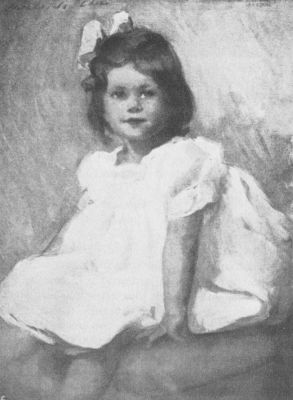
From a Copley Print.
A PORTRAIT
Adelaide Cole Chase
A portrait called a "Woman with a Muff," exhibited recently at the exhibition of the Society of American Artists, in New York, was much admired. At the 1904 exhibition of the Philadelphia Academy Mrs. Chase exhibited a portrait of children, Constance and Gordon Worcester, of which Arthur Hoeber writes: "She has painted them easily, with deftness and feeling, and apparently caught their character and the delicacy of infancy."
Chauchet, Charlotte. Honorable mention at the Salon, 1901; third-class medal, 1902. Member of the Société des Artistes Français and of l'Union des femmes peintres et sculpteurs. Born at Charleville, Ardennes, in 1878. Pupil of Gabriel Thurner, Benjamin-Constant, Jean Paul Laurens, and Victor Marec. Her principal works are "Marée"—Fish—1899, purchased for the lottery of the International Exposition at Lille; "Breton Interior," purchased by the Society of the Friends of the Arts, at Nantes; "Mother Closmadenc Dressing Fish," in the Museum of Brest; "Interior of a Kitchen at Mont," purchased by the Government; "Portrait of my Grandmother," which obtained honorable mention; "At the Corner of the Fire," "A Little Girl in the Open Air," medal of third class.
The works of Mlle. Chauchet have been much praised. The Petit Moniteur, June, 1899, says: "Mlle. Chauchet, a very young girl, in her picture of a 'Breton Interior' shows a vigor and decision very rare in a woman." Of the "Marée," the Dépêche de Brest says: "On a sombre background, in artistic disorder, thrown pell-mell on the ground, are baskets and a shining copper kettle, with a mass of fish of all sorts, of varied forms, and changing colors. All well painted. Such is the picture by Mlle. Chauchet."
In the Courrier de l'Est we read: "Mlle. Chauchet, taking her grandmother for her model, has painted one of the best portraits of the Salon. The hands, deformed by disease and age, are especially effective; the delicate tone of the hair in contrast with the lace of the cap makes an attractive variation in white."
In the Union Républicaine de la Marne, H. Bernard writes: "'Le retour des champs' is a picture of the plain of Berry at evening. We see the back of a peasant, nude above the blue linen pantaloons, with the feet in wooden sabots. He is holding his tired, heavy cow by the tether. The setting sun lights up his powerful bronzed back, his prominent shoulders, and the hindquarters of the cow. It is all unusually strong; the drawing is firm and very bold in the foreshortening of the animal. The effect of the whole is a little sad; the sobriety of the execution emphasizes this effect, and, above all, there is in it no suggestion of the feminine. I have already noticed this quality of almost brutal sincerity, of picturesque realism, in the works of Mlle. Chauchet who successfully follows her methods."
Chaussée, Mlle. Cécile de.
[No reply to circular.]
Chéron, Elizabeth Sophie. Born in Paris in 1648. Her father was an artist, and under his instruction Elizabeth attained such perfection in miniature and enamel painting that her works were praised by the most distinguished artists. In 1674 Charles le Brun proposed her name and she was elected to the Academy.
Her exquisite taste in the arrangement of her subjects, the grace of her draperies, and, above all, the refinement and spirituality of her pictures, were the characteristics on which her fame was based.
Her life outside her art was interesting. Her father was a rigid Calvinist, and endeavored to influence his daughter to adopt his religious belief; but her mother, who was a fervent Roman Catholic, persuaded Elizabeth to pass a year in a convent, during which time she ardently embraced the faith of her mother. She was an affectionate daughter to both her parents and devoted her earnings to her brother Louis, who made his studies in Italy.
In her youth Elizabeth Chéron seemed insensible to the attractions of the brilliant men in her social circle, and was indifferent to the offers of marriage which she received; but when sixty years old, to the surprise of her friends, she married Monsieur Le Hay, a gentleman of her own age. One of her biographers, leaving nothing to the imagination, assures us that "substantial esteem and respect were the foundations of their matrimonial happiness, rather than any pretence of romantic sentiment."
Mlle. Chéron's narrative verse was much admired and her spiritual poetry was thought to resemble that of J. B. Rousseau. In 1699 she was elected to the Accademia dei Ricovrati of Padua, where she was known as Erato. The honors bestowed on her did not lessen the modesty of her bearing. She was simple in dress, courteous in her intercourse with her inferiors, and to the needy a helpful friend.
She died when sixty-three and was buried in the church of St. Sulpice. I translate the lines written by the Abbé Bosquillon and placed beneath her portrait: "The unusual possession of two exquisite talents will render Chéron an ornament to France for all time. Nothing save the grace of her brush could equal the excellencies of her pen."
Pictures by this artist are seen in various collections in France, but the larger number of her works were portraits which are in the families of her subjects.
Cherry, Emma Richardson. Gold medal from Western Art Association in 1891. Member of above association and of the Denver Art Club. Born at Aurora, Illinois, 1859. Pupil of Julian and Delécluse Academies in Paris, also of Merson, and of the Art Students' League in New York.
Mrs. Cherry is a portrait painter, and in 1903 was much occupied in this art in Chicago and vicinity. Among her sitters were Mr. Orrington Lunt, the donor of the Library of the Northwestern University, and Bishop Foster, a former president of the same university; these are to be placed in the library. A portrait by Mrs. Cherry of a former president of the American Society of Civil Engineers, Mr. O. Chanute, is to be placed in the club rooms of the society in New York. It has been done at the request of the society.
An exhibition of ten portraits by this artist was held in Chicago in 1903, and was favorably noticed. Mrs. Cherry resides in Houston, Texas.
Clement, Ethel. This artist has received several awards from California State fair exhibits, and her pastel portrait of her mother was hung on the line at the Salon of 1898. Member of San Francisco Art Association and of the Sketch Club of that city. Born in San Francisco in 1874. Her studies began in her native city with drawing from the antique and from life under Fred Yates. At the Cowles Art School, Boston, and the Art Students' League, New York, she spent three winters, and at the Julian Academy, Paris, three other winters, drawing from life and painting in oils under the teaching of Jules Lefebvre and Robert-Fleury, supplementing these studies by that of landscape in oils under George Laugée in Picardie.
Her portraits, figure subjects, and landscapes are numerous, and are principally in private collections, a large proportion being in San Francisco. Her recent work has been landscape painting in New England. In 1903 she exhibited a number of pictures in Boston which attracted favorable attention.
Cohen, Katherine M. Honorary member of the American Art Association, Paris, and of the New Century Club, Philadelphia. Born in Philadelphia, 1859. Pupil of School of Design, Pennsylvania Academy of Fine Arts, and of St. Gaudens at Art Students' League; also six years in Paris schools.
This artist executed a portrait of General Beaver for the Smith Memorial in Fairmount Park. She has made many portraits in busts and bas-reliefs, as well as imaginary subjects and decorative works. "The Israelite" is a life-size statue and an excellent work.
Collaert, Marie. Born in Brussels, 1842. Is called the Flemish Rosa Bonheur and the Muse of Belgian landscape. Her pictures of country life are most attractive. Her powerful handling of her brush is modified by a tender, feminine sentiment.
I quote from the "History of Modern Painters": "In Marie Collaert's pictures may be found quiet nooks beneath clear sky-green stretches of grass where the cows are at pasture in idyllic peace. Here is to be found the cheery freshness of country life."
Coman, Charlotte B. Bronze medal, California Mid-Winter Exposition, 1894. Member of New York Water-Color Club. Born in Waterville, N. Y. Pupil of J. R. Brevoort in America, of Harry Thompson and Émile Vernier in Paris. This artist has painted landscapes, and sent to the Philadelphia Exposition in 1876 "A French Village"; to the Paris Exposition, 1878, "Near Fontainebleau." In 1877 and 1878 she exhibited in Boston, "On the Borders of the Marne" and "Peasant House in Normandy."
[No reply to circular.]
Comerre-Paton, Mme. Jacqueline. Honorable mention, 1881; medal at Versailles; officer of the Academy. Born at Paris, 1859. Pupil of Cabanel. Her principal works are: "Peau d'Ane, Hollandaise," in the Museum of Lille; "Song of the Wood," Museum of Morlaix; "Mignon," portrait of Mlle. Ugalde; the "Haymaker," etc.
Cookesley, Margaret Murray. Decorated by the Sultan of Turkey with the Order of the Chefakat, and with the Medaille des Beaux Arts, also a Turkish honor. Medal for the "Lion Tamers in the Time of Nero." Member of the Empress Club. Born in Dorsetshire. Studied in Brussels under Leroy and Gallais, and spent a year at South Kensington in the study of anatomy. Mrs. Cookesley has lived in Newfoundland and in San Francisco. A visit to Constantinople brought her a commission to paint a portrait of the son of the Sultan. No sittings were accorded her, the Sultan thinking a photograph sufficient for the artist to work from. Fortunately Mrs. Cookesley was able to make a sketch of her subject while following the royal carriage in which he was riding. The portrait proved so satisfactory to the Sultan that he not only decorated the artist, but invited her to make portraits of some of his wives, for which Mrs. Cookesley had not time. Her pictures of Oriental subjects have been successful. Among these are: "An Arab Café in the Slums of Cairo," much noticed in the Academy Exhibition of 1895; "Noon at Ramazan," "The Snake-Charmer," "Umbrellas to Mend—Damascus," and a group of the "Soudanese Friends of Gordon." Her "Priestess of Isis" is owned in Cairo.
Among her pictures of Western subjects are "The Puritan's Daughter," "Deliver Us from Evil," "The Gambler's Wife." "Widowed" and "Miss Calhoun as Salome" were purchased by Maclean, of the Haymarket Theatre; "Death of the First-Born" is owned in Russia; and "Portrait of Ellen Terry as Imogen" is in a private collection.
"Lion Tamers in the Time of Nero" is one of her important pictures of animals, of which she has made many sketches.
Cooper, Emma Lampert. Awarded medal at World's Columbian Exposition, 1893; bronze medal, Atlanta Exposition, 1895. Member of Water-Color Club and Woman's Art Club, New York; Water-Color Club and Plastic Club, Philadelphia; Woman's Art Association, Canada; Women's International Art Club, London.
Born in Nunda, N. Y. Studied under Agnes D. Abbatt at Cooper Union and at the Art Students' League, New York; in Paris under Harry Thompson and at Delécluse and Colarossi Academies.
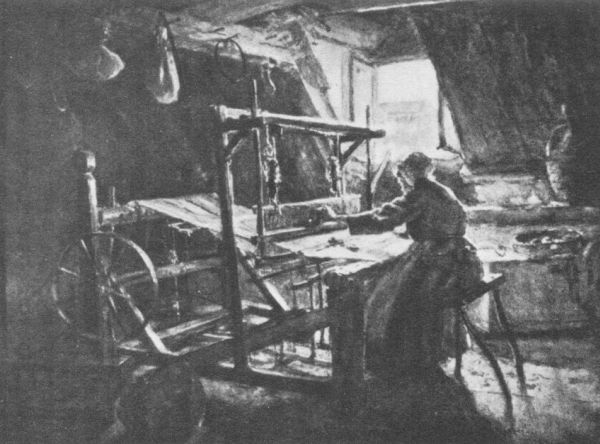
A CANADIAN INTERIOR
Emma Lampert Cooper
Mrs. Cooper's work is principally in water-colors. After several years abroad, in the spring of 1903 she exhibited twenty-two pictures, principally of Dutch interiors, with some sketches in English towns, which last, being more unusual, were thought her best work. Her picture, "Mother Claudius," is in the collection of Walter J. Peck, New York; "High Noon at Cape Ann" is owned by W. B. Lockwood, New York; and a "Holland Interior" by Dr. Gessler, Philadelphia. Of her recent exhibition a critic writes: "The pictures are notable for their careful attention to detail of drawing. Architectural features of the rich old Gothic churches are faithfully indicated instead of blurred, and the treatment is almost devotional in tone, so sympathetic is the quality of the work. There is a total absence of the garish coloring which has become so common, the religious subjects being without exception in a minor key, usually soft grays and blues. It is indeed in composition and careful drawing that this artist excels rather than in coloring, although this afterthought is suggested by the canvasses treating of secular subjects."—Brooklyn Standard Union.
Corazzi, Giulitta. Born at Fivizzano, 1866. Went to Florence when still a child and early began to study art. She took a diploma at the Academy in 1886, having been a pupil of Cassioli. She is a portrait painter, and among her best works are the portraits of the Counts Francesco and Ottorino Tenderini, Giuseppe Erede, and Raffaello Morvanti. Her pictures of flowers are full of freshness and spirit and delightful in color. Since 1885 she has spent much time in teaching in the public schools and other institutions and in private families.
Correlli, Clementina. Member of the Society for the Promotion of the Fine Arts, in Naples. Born in Lesso, 1840. This artist is both a painter and a sculptor. Pupil of Biagio Molinari, she supplemented his instructions by constant visits to galleries and museums, where she could study masterpieces of art. A statue called "The Undeceived" and a group, "The Task," did much to establish her reputation. They were exhibited in Naples, Milan, and Verona, and aroused widespread interest.
Her pictures are numerous. Among them are "St. Louis," "Sappho," "Petrarch and Laura," "Romeo and Juliet," "Hagar and Ishmael in the Desert," "A Devotee of the Virgin," exhibited at Turin in 1884; a series illustrating the "Seasons," and four others representing the arts.
Cosway, Maria. The artist known by this name was born Maria Hadfield, the daughter of an Englishman who acquired a fortune as a hotel-keeper in Leghorn, which was Maria's birthplace. She was educated in a convent, and early manifesting unusual artistic ability, was sent to Rome to study painting. Her friends there, among whom were Battoni, Raphael Mengs, and Fuseli, found much to admire and praise in her art.
After her father's death Maria ardently desired to become a nun, but her mother persuaded her to go to England. Here she came under the influence of Angelica Kauffman, and devoted herself assiduously to painting.
She married Richard Cosway, an eminent painter of miniatures in water-colors. Cosway was a man of fortune with a good position in the fashionable circles of London. For a time after their marriage Maria lived in seclusion, her husband wishing her to acquire the dignity and grace requisite for success in the society which he frequented. Meantime she continued to paint in miniature, and her pictures attracted much attention in the Academy exhibitions.
When at length Cosway introduced her to the London world, she was greatly admired; her receptions were crowded, and the most eminent people sat to her for their portraits. Her picture of the Duchess of Devonshire in the character of Spenser's Cynthia was very much praised. Cosway did not permit her to be paid for her work, and as a consequence many costly gifts were made her in return for her miniatures, which were regarded as veritable treasures by their possessors.
Maria Cosway had a delicious voice in singing, which, in addition to her other talent, her beauty, and grace, made her unusually popular in society, and her house was a centre for all who had any pretensions to a place in the best circles. Poets, authors, orators, lords, ladies, diplomats, as well as the Prince of Wales, were to be seen in her drawing-rooms. A larger house was soon required for the Cosways, and the description of it in "Nollekens and His Times" is interesting:
"Many of the rooms were more like scenes of enchantment pencilled by a poet's fancy, than anything perhaps before displayed in a domestic habitation. Escritoires of ebony, inlaid with mother-of-pearl, and rich caskets for antique gems, exquisitely enamelled and adorned with onyx, opals, rubies, and emeralds; cabinets of ivory, curiously wrought; mosaic tables, set with jasper, blood-stone, and lapis-lazuli, their feet carved into the claws of lions and eagles; screens of old raised Oriental Japan; massive musical clocks, richly chased with ormulu and tortoise-shell; ottomans superbly damasked; Persian and other carpets, with corresponding hearth-rugs bordered with ancient family crests and armorial ensigns in the centre, and rich hangings of English tapestry. The carved chimney-pieces were adorned with the choicest bronzes and models in wax and terra-cotta. The tables were covered with Sèvres, blue Mandarin, Nankin, and Dresden china, and the cabinets were surmounted with crystal cups, adorned with the York and Lancaster roses, which might have graced the splendid banquets of the proud Wolsey."
In the midst of all this fatiguing luxury, Maria Cosway lost her health and passed several years travelling in Europe. Returning to London, she was again prostrated by the death of her only daughter. She then went to Lodi, near Milan, where she founded a college for the education of girls. She spent much time in Lodi, and after the death of her husband established herself there permanently. A goodly circle of friends gathered about her, and she found occupation and solace for her griefs in the oversight of her college.
She continued her painting and the exhibition of her pictures at the Royal Academy. She made illustrations for the works of Virgil, Homer, Spenser, and other poets, and painted portraits of interesting and distinguished persons, among whom were Mme. Le Brun and Mme. Récamier. The life and work of Maria Cosway afford a striking contradiction of the theory that wealth and luxury induce idleness and dull the powers of their possessors. Hers is but one of the many cases in which a woman's a woman "for a' that."
At an art sale in London in 1901, an engraving by V. Green after Mrs. Cosway's portrait of herself, first state, brought $1,300, and a second one $200 less.
Coudert, Amalia Küssner. Born in Terre Haute, Indiana. This distinguished miniaturist writes me that she "never studied." Like Topsy, she must have "growed." By whatever method they are produced or by whatever means the artist in her has been evolved, her pictures would seem to prove that study of a most intelligent order has done its part in her development.
She has executed miniature portraits of the Czar and Czarina of Russia, the Grand Duchess Vladimir, King Edward VII., the late Cecil Rhodes, many English ladies of rank, and a great number of the beautiful and fashionable women of America.
Coutan-Montorgueil, Mme. Laure Martin. Honorable mention, Salon des Artistes Français, 1894. Born at Dun-sur-Auron, Cher. Pupil of Alfred Boucher.
This sculptor has executed the monument to André Gill, Père Lachaise; that of the Poet Moreau, in the cemetery Montparnasse; bust of Taglioni, in the foyer of the Grand Opera House, Paris; bust of the astronomer Leverrier, at the Institute, Paris; a statue, "The Spring," Museum of Bourges; "Sirius," in the Palais of the Governor of Algiers. Also busts of Prince Napoleon, General Boulanger, the Countess de Choiseul, the Countess de Vogué, and numerous statuettes and other compositions.
At the Salon, Artistes Français, 1903, she exhibited "Fortune" and "A Statuette."
Cowles, Genevieve Almeda. Member of the Woman's Art Club, New York; Club of Women Art Workers, New York; and the Paint and Clay Club of New Haven. Born in Farmington, Connecticut, 1871. Pupil of Robert Brandagee; of the Cowles Art School, Boston; and of Professor Niemeyer at the Yale Art School.
Together with her twin sister, Maud, this artist has illustrated various magazine articles. Also several books, among which are "The House of the Seven Gables," "Old Virginia," etc.
Miss G. A. Cowles designed a memorial window and a decorative border for the chancel of St. Michael's Church, Brooklyn. Together with her sister, she designed a window in the memory of the Deaconess, Miss Stillman, in Grace Church, New York City. These sisters now execute many windows and other decorative work for churches, and also superintend the making and placing of the windows.
Regarding their work in the Chapel of Christ Church, New Haven, Miss Genevieve Cowles writes me: "These express the Prayer of the Prisoner, the Prayer of the Soul in Darkness, and the Prayer of Old Age. These are paintings of states of the soul and of deep emotions. The paintings are records of human lives and not mere imagination. We study our characters directly from life."
These artists are now, November, 1903, engaged upon a landscape frieze for a dining-room in a house at Watch Hill.
Miss Genevieve Cowles writes: "We feel that we are only at the beginning of our life-work, which is to be chiefly in mural decoration and stained glass. I desire especially to work for prisons, hospitals, and asylums—for those whose great need of beauty seems often to be forgotten."
Cowles, Maud Alice. Twin sister of Genevieve Cowles. Bronze medal at Paris Exposition, 1900, and a medal at Buffalo, 1901. Her studies were the same as her sister's, and she is a member of the same societies. Indeed, what has been said above is equally true of the two sisters, as they usually work on the same windows and decorations, dividing the designing and execution between them.
Cox, Louise—Mrs. Kenyon Cox. Third Hallgarten prize, National Academy of Design; bronze medal, Paris Exposition, 1900; silver medal at Buffalo, 1901; medal at Charleston, 1902; Shaw Memorial prize, Society of American Artists, 1903. Member of Society of American Artists, and an associate of the Academy of Design. Born at San Francisco, 1865. Studies made at Academy of Design, Art Students' League, under C. Turner, George de Forest Brush, and Kenyon Cox.
Mrs. Cox paints small decorative pictures and portraits, mostly of children. The Shaw prize was awarded to a child's portrait, called "Olive." Among other subjects she has painted an "Annunciation," the "Fates," and "Angiola," reproduced in this book.
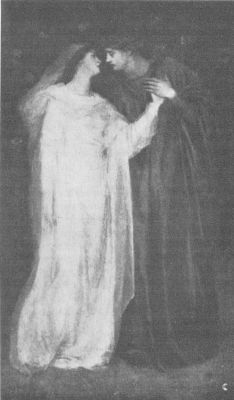
From a Copley Print.
ANGIOLA
Louise Cox
A writer in the Cosmopolitan says: "Mrs. Cox is an earnest worker and her method is interesting. Each picture is the result of many sketches and the study of many models, representing in a composite way the perfections of all. For the Virgin in her 'Annunciation' a model was first posed in the nude, and then another draped, the artist sketching the figure in the nude, draping it from the second model. The hands are always separately sketched from a model who has a peculiar grace in folding them naturally."
Mrs. Cox gives her ideas about her picture of the "Fates" as follows: "My interpretation of the Fates is not the one usually accepted. The idea took root in my mind years ago when I was a student at the League. It remained urgently with me until I was forced to work it out. As you see, the faces of the Fates are young and beautiful, but almost expressionless. The heads are drooping, the eyes heavy as though half asleep. My idea is, that they are merely instruments under the control of a higher power. They perform their work, they must do it without will or wish of their own. It would be beyond human or superhuman endurance for any conscious instrument to bear for ages and ages the horrible responsibility placed upon the Fates."
Crespo de Reigon, Asuncion. Honorable mention at the National Exhibition, Madrid, 1860. Member of the Academy of San Fernando, 1839. Pupil of her father. To the exhibition in 1860 she sent a "Magdalen in the Desert," "The Education of the Virgin," "The Divine Shepherdess," "A Madonna," and a "Venus." Her works have been seen in many public exhibitions. In 1846 she exhibited a miniature of Queen Isabel II. Many of her pictures are in private collections.
Cromenburch, Anna von. In the Museum of Madrid are four portraits by this artist: "A Lady of the Netherlands," which belonged to Philip IV.; "A Lady and Child," "A Lady with her Infant before Her," and another "Portrait of a Lady." The catalogue of the Museum gallery says: "It is not known in what place or in what year this talented lady was born. She is said to have belonged to an old and noble family of Friesland. At any rate, she was an excellent portrait painter, and flourished about the end of the sixteenth century. The Museo del Prado is the only gallery in Europe which possesses works signed by this distinguished artist."
Dahn-Fries, Sophie. Born in Munich. 1835-98. This artist was endowed with unusual musical and artistic talent. After the education of her only son, she devoted herself to painting, principally of landscape and flowers. After 1868, so long as she lived she was much interested in Frau von Weber's Art School for Girls. In 1886, when a financial crisis came, Mme. Dahn-Fries saved the enterprise from ruin. She exhibited, in 1887, two pictures which are well known—"Harvest Time" and "Forest Depths."
Damer, Mrs. Anne Seymour. Family name Conway. 1748-1828. She was a granddaughter of the Duke of Argyle, a relative of the Marquis of Hertford, and a cousin of Horace Walpole. Her education was conducted with great care; the history of ancient nations, especially in relation to art, was her favorite study. She had seen but few sculptures, but was fascinated by them, and almost unconsciously cherished the idea that she could at least model portraits and possibly give form to original conceptions.
Allan Cunningham wrote of her thus: "Her birth entitled her to a life of ease and luxury; her beauty exposed her to the assiduity of suitors and the temptations of courts; but it was her pleasure to forget all such advantages and dedicate the golden hours of her youth to the task of raising a name by working in wet clay, plaster of Paris, stubborn marble, and still more intractable bronze."
Before she had seriously determined to attempt the realization of her dreams, she was brought to a decision by a caustic remark of the historian, Hume. Miss Conway was one day walking with him when they met an Italian boy with plaster vases and figures to sell. Hume examined the wares and talked with the boy. Not long after, in the presence of several other people, Miss Conway ridiculed Hume's taste in art; he answered her sarcastically and intimated that no woman could display as much science and genius as had entered into the making of the plaster casts she so scorned.
This decided her to test herself, and, obtaining wax and the proper tools, she worked industriously until she had made a head that she was willing to show to others. She then presented it to Hume; it has been said that it was his own portrait, but we do not know if this is true. At all events, Hume was forced to commend her work, and added that modelling in wax was very easy, but to chisel in marble was quite another task. Piqued by this scant praise she worked on courageously, and before long showed her critic a copy of the wax head done in marble.
Though Hume genuinely admired certain portions of this work, it is not surprising that he also found defects in it. Doubtless his critical attitude stimulated the young sculptress to industry; but the true art-impulse was awakened, and her friends soon observed that Miss Conway was no longer interested in their usual pursuits. When the whole truth was known, it caused much comment. Of course ladies had painted, but to work with the hands in wet clay and be covered with marble dust—to say the least, Miss Conway was eccentric.
She at once began the study of anatomy under Cruikshanks, modelling with Cerrachi, and the handling of marble in the studio of Bacon.
Unfortunately for her art, she was married at nineteen to John Darner, eldest son of Lord Milton, a fop and spendthrift, who had run through a large fortune. He committed suicide nine years after his marriage. It is said that Harrington, in Miss Burney's novel of "Cecilia," was drawn from John Damer, and that his wardrobe was sold for $75,000—about half its original cost!
Mrs. Damer was childless, and very soon after her husband's death she travelled in Europe and renewed her study and practice of sculpture with enthusiasm. By some of her friends her work was greatly admired, but Walpole so exaggerated his praise of her that one can but think that he wrote out of his cousinly affection for the artist, rather than from a judicial estimate of her talent. He bequeathed to her, for her life, his villa of Strawberry Hill, with all its valuables, and £2,000 a year for its maintenance.
Mrs. Damer executed many portrait busts, some animal subjects, two colossal heads, symbolic of the Thames and the Isis, intended for the adornment of the bridge at Henley. Her statue of the king, in marble, was placed in the Register Office in Edinburgh. She made a portrait bust of herself for the Uffizi Gallery, in Florence. Her portrait busts of her relatives were numerous and are still seen in private galleries. She executed two groups of "Sleeping Dogs," one for Queen Caroline and a second for her brother-in-law, the Duke of Richmond. Napoleon asked her for a bust of Fox, which she made and presented to the Emperor. A bust of herself which she made for Richard Payne Knight was by him bequeathed to the British Museum. Her "Death of Cleopatra" was modelled in relief, and an engraving from it was used as a vignette on the title-page of the second volume of Boydell's Shakespeare.
Those who have written of Mrs. Darner's art have taken extreme views. They have praised ad nauseam, as Walpole did when he wrote: "Mrs. Darner's busts from life are not inferior to the antique. Her shock dog, large as life and only not alive, rivals the marble one of Bernini in the Royal Collection. As the ancients have left us but five animals of equal merit with their human figures—viz., the Barberini Goat, the Tuscan Boar, the Mattei Eagle, the Eagle at Strawberry Hill, and Mr. Jennings' Dog—the talent of Mrs. Damer must appear in the most distinguished light."
Cerrachi made a full length figure of Mrs. Damer, which he called the Muse of Sculpture, and Darwin, the poet, wrote:
"Long with soft touch shall Damers' chisel charm, With grace delight us, and with beauty warm."
Quite in opposition to this praise, other authors and critics have severely denied the value of her talent, her originality, and her ability to finish her work properly. She has also been accused of employing an undue amount of aid in her art. As a woman she was unusual in her day, and as resolute in her opinions as those now known as strong-minded. Englishwoman as she was, she sent a friendly message to Napoleon at the crisis, just before the battle of Waterloo. She was a power in some political elections, and she stoutly stood by Queen Caroline during her trial.
Mrs. Damer was much esteemed by men of note. She ardently admired Charles Fox, and, with the beautiful Duchess of Devonshire and Mrs. Crewe, she took an active part in his election; "rustling their silks in the lowest sinks of sin and misery, and in return for the electors' 'most sweet voices' submitting, it is said, their own sweet cheeks to the salutes of butchers and bargemen." She did not hesitate to openly express her sympathy with the American colonies, and bravely defended their cause.
At Strawberry Hill Mrs. Damer dispensed a generous hospitality, and many distinguished persons were her guests; Joanna Baillie, Mrs. Siddons, Mrs. Garrick, and Mrs. Berry and her daughters were of her intimate circle.
She was fond of the theatre and frequently acted as an amateur in private houses. She was excellent in high comedy and recited poetry effectively. Mrs. Damer was one of the most interesting of Englishwomen at a period of unusual excitement and importance.
When seventy years old she was persuaded to leave Strawberry Hill, and Lord Waldegrave, on whom it was entailed, took possession. Mrs. Damer then purchased York House, the birthplace of Queen Anne, where she spent ten summers, her winter home being in Park Lane, London.
She bequeathed her artistic works to a relative, directed that her apron and tools should be placed in her coffin, and all her letters destroyed, by which she deprived the world of much that would now be historically valuable, since she had corresponded with Nelson and Fox, as well as with other men and women who were active in the important movements of her time. She was buried at Tunbridge, Kent.
Dassel, Mrs. Herminie, whose family name was Borchard. Daughter of a Prussian gentleman, who, having lost his fortune, came to the United States in 1839. His children had enjoyed the advantages of education and of an excellent position in the world, but here, in a strange land, were forced to consider the means of their support. Herminie determined to be a painter, and in some way earned the money to go to Düsseldorf, where she studied four years under Sohn, all the time supporting herself. Her pictures were genre subjects introducing children, which found a ready sale.
She returned to America, determined to earn money to go to Italy. In a year she earned a thousand dollars, and out of it paid some expenses for a brother whom she wished to take with her. Herminie was still young, and so petite in person that her friends were alarmed by her ambitions and strenuously opposed her plans. However, she persevered and reached Italy, but unfortunately the Revolution of 1848 made it impossible for her to remain, and she had many unhappy experiences in returning to New York.
Her pictures were appreciated, and several of them were purchased by the Art Union, then existing in New York. Soon after her return to America she married Mr. Dassel, and although she had a large family she continued to paint. Her picture of "Othello" is in the Düsseldorf Gallery. Her painting of "Effie Deans" attracted much attention.
Mrs. Dassel interested herself in charities and was admired as an artist and greatly respected as a woman. She died in 1857.
Dealy, Jane Mary—Mrs. W. Llewellyn Lewis. Silver medal at Royal Academy School and prize for best drawing of the year. Member of Royal Institute of Painters in Water-Colors. Born in Liverpool. Studied at Slade School and Royal Academy School. Has exhibited several years at the Royal Academy Exhibition and Institute of Painters in Water-Colors.
In 1901 her picture, "A Dutch Bargain," was etched and engraved. "Hush-a-Bye Baby" and "Good-by, Summer," have been published by Messrs. De la Rue et Cie. She has successfully illustrated the following children's books: "Sixes and Sevens," "The Land of Little People," "Children's Prayers," and "Children's Hymns."
To the Academy Exhibition of 1903 Mrs. Lewis sent "On the Mountain-side, Engelberg."
De Angelis, Clotilde. This Neapolitan artist has made a good impression in at least two Italian exhibitions. To the National Exposition, Naples, 1877, she sent "Studio dal Vero" and "Vallata di Porrano," showing costumes of Amalfi. Both her drawing and color are good.
Debillemont-Chardon, Mme. Gabrielle. Third-class medal, Salon, 1894; honorable mention at Paris Exposition, 1900; second-class medal, Salon, 1901. This miniaturist is well known by her works, in which so much grace, freshness, skill, and delicacy are shown; in which are represented such charming subjects with purity of tone and skilful execution in all regards, as well as with an incomparable spirit of attractiveness.
This artist is one of the three miniaturists whose works have a place in the Museum of the Luxembourg. She has had many pupils, and by her influence and example—for they endeavor to imitate their teacher—she has done much to improve and enlarge the style in miniature painting.
De Haas, Mrs. Alice Preble Tucker. Born in Boston. Studied at the Cooper Union and with M. F. H. de Haas, Swain Gifford, William Chase, and Rhoda Holmes Nicholls. Painter of water-color pictures and miniatures.
Her pictures are in private hands in Washington, New York, and Boston.
The following article written at the time of an exhibition by Mrs. de Haas gives a just estimate of her work:
"Mrs. de Haas is especially devoted to the painting in water-color of landscape and sea views, for which the Atlantic coast affords such a wide and varied range. A constant and keen observer of Nature, she has seized her marvellous witchery of light and color, and reproduced them in the glow of the moonlight on the water when in a stormy mood, and the silvery gleam has become an almost vivid orange tint. She is most happy in the tender opalescent hues of the calm sea and the soft sky above, while the little boats seem to rock quietly on the water, barely stirred by the unruffled tide beneath.
"The sunset light is a never-failing source of variety and beauty, and Mrs. de Haas has found a most attractive subject in the steeple of the old church in York Village—whose graceful curves are said to have been designed by Sir Christopher Wren—as it rises above the soft mellow glow of the sky or is pictured against the dark clouds.
"In another mood the artist paints the low rocks among the reeds, with the breakers playing about them, while the distant sea stretches out to a horizon, with dark, stormy clouds brooding over the solitary waste. A remarkable union of the beauty of land and water is produced by a foreground of brilliant fancy flowers relieved by a scrubby tree in the background, with the faint responsive touch of yellow in the clouds over a calm sea, where gentle motion is only indicated by the little boat floating on its surface.
"The schooners on the Magnolia Shore with Norman's Woe in the distance suggest alike the tragic story of the past and the present beauty, for now the sea is calm and the sails are drying in the sun after the storm is over.
"Many other pictures might be mentioned—a quaint old house at Gloucester, a view of Ten Pound Island, with its picturesque surroundings, and the familiar beach, with Fort Head at York Harbor. As a specimen of landscape I would mention a picturesque group of trees at Gerrish Island, full of sunshine.
"But Mrs. de Haas has added another most attractive style of art to her resources, and her miniatures, besides their charm of simplicity of treatment and delicacy of coloring, are said to have the merit of faithful likeness to their originals. Of course portraits, being painted on commission, are not generally available for exhibition, but Mrs. de Haas has a few specimens of her work which warrant all that has been said in their praise.
"One is a charming picture of a child, which for beauty of delineation and delicacy of tinting recalls the memory of our greatest of miniature painters, Malbone.
"Another is the portrait of the artist's father, and is represented with such truth of nature and so much vitality of expression and character as at once to give rise to the remark, 'I must have known that man, he seems so living to me.'"
De Kay, Helena—Mrs. R. Watson Gilder. This artist has exhibited at the National Academy of Design, New York, since 1874, flower pieces and decorative panels. In 1878 she sent "The Young Mother." She was the first woman elected to the Society of American Artists, and to its first exhibition in 1878 she contributed "The Last Arrow," a figure subject, also a portrait and a picture of still-life.
[No reply to circular.]
Delacroix-Garnier, Mme. P. Honorable mention, Salon des Artistes Français; medal at Exposition, Paris, 1900, for painting in oils; and a second medal for a treatise on water-colors. Member of the Société des Artistes Français, of the Union of women painters and sculptors, and vice-president from 1894 to 1900. Pupil of Henry Delacroix in painting in oils and of Jules Garnier in water-colors.
Mme. Delacroix-Garnier has painted numerous portraits; among them those of the Dowager Duchess d'Uzès, Jules Garnier, and the Marquis Guy de Charnac, the latter exhibited at the Salon des Artistes Français, 1903. At the same Salon in 1902 she exhibited the portrait of J. J. Masset, formerly a professor in the Paris Conservatory.
Among her pictures are the "Happy Mother," "Temptation," "Far from Paris," "Maternal Joys," and in the Salon des Artistes Français, 1903, "Youth which Passes."
Delasalle, Angèle. Honorable mention, Salon des Artistes Français, 1895; third-class medal, 1897; second-class medal, 1898; travelling purse, 1899; Prix Piot, of the Institute, 1899; silver medal, Paris Exposition, 1900. Member of the Société des Artistes Français, the Société Nationale des Beaux-Arts, Société des prix du Salon et boursiers de voyage de la Société Nationale. Born in Paris. Pupil of Jean Paul Laurens and Benjamin-Constant.
Her picture of "Diana in Repose" is in the collection of Alphonse de Rothschild; "Return from the Chase," a prehistoric scene, purchased by the Government; "The Forge," in the Museum of Rouen, where is also a "Souvenir of Amsterdam." Portrait of Benjamin-Constant and several other works of Mlle. Delasalle are in the Luxembourg; other pictures in the collections Demidoff, Coquelin, Georges Petit, etc.
At the Salon des Artistes Français, 1902, this artist exhibited the portrait of M. Constant and the "Roof-Maker." At the Salon des Beaux-Arts, 1903, "The Park at Greenwich," "The Pont Neuf," "On the Thames," and a portrait in oils; and in water-colors, "The Coliseum, Rome," "A Tiger Drinking," "A Lion Eating," "Head of a Lion," "The Forge," etc.
In the Magazine of Art, June, 1902, B. Dufernex writes of Mlle. Delasalle essentially as follows: This artist came into notice in 1895 by means of her picture of "Cain and Enoch's Daughters." Since then her annual contributions have demonstrated her gradual acquirement of unquestionable mastery of her art. Her characteristic energy is such that her sex cannot be detected in her work; in fact, she was made the first and only woman member of the International Association of Painters under the impression that her pictures—signed simply A. Delasalle—were the work of a man. Attracted by the dramatic aspects of human nature, she finds congenial subjects in the great efforts of humanity in the struggle for life. Her power of observation enables her to give freshness to hackneyed subjects, as in "La Forge." The attitudes of the workmen, so sure and decided, turning the half-fused metal are perfect in the precision of their combined efforts; the fatigue of the men who are resting, overwhelmed and stupefied by their exhausting labor, indicates the work of a profound thinker; whilst the atmosphere, the play of the diffused glow of the molten metal, are the production of an innate colorist. Her portrait of Benjamin-Constant represents not only the masterful man, but is also the personification of the painter. The attentive attitude, discerning eye, the openness of the absorbing look, the cerebral mask where rests so much tranquil power, the impressive shape of the leonine face, all combine to make the painting one of the finest portraits of the French school.
She has a perfect and rare knowledge of the art of drawing and a faculty for seizing the character of things. Mlle. Delasalle exhibited her pictures at the Grafton Gallery, London, in 1902.
Delorme, Berthe. Medals at Nîmes, Montpellier, Versailles, and London. Member of the Société des Artistes Français. Born at Paris. Pupil of A. Chaplin.
Mlle. Delorme has painted a great number of portraits, which are in the hands of her subjects. Her works are exhibited in the Salon au Grand Palais. In 1902 she exhibited a "Portrait of Mlle. Magdeleine D."
Demont-Breton, Virginie. Paris Salon, honorable mention, 1880; medals of third and second class, 1881, 1883; Hors Concours; gold medal at Universal Exposition, Amsterdam, 1883; Paris Expositions, 1889 and 1900, gold medals; medal of honor at Exposition at Antwerp; Chevalier of the Legion of Honor and of the Belgian Order of Leopold; officer of the Nichan Iftikhar, a Turkish order which may be translated "A Sign of Glory"; member and honorary president of the Union des femmes peintres et sculpteurs de France, of the Alliance Feminine, of the Alliance Septentrionale; fellow of the Royal Academy, Antwerp; member of the Société des Artistes Français; member of the committee of the Central Union of Decorative Arts and of the American National Institute; member of the Verein der Schriftstellerinnen und Künstlerinnen of Vienna; one of the founders of the Société Populaire des Beaux-Arts and of the Société de bienfaisance l'Allaitement Maternel, etc. Born at Courrière, Pas de Calais, 1859. Pupil of her father, Jules Breton.
The works of this artist are in a number of museums and in private collections in several countries. "La Plage" is in the Gallery of the Luxembourg, "Les Loups de Mer" in the Museum of Ghent, "Jeanne d'Arc at Domrémy" in a gallery at Lille; other pictures are in New York, Minneapolis, and other American cities; also in Berlin and Alexandria, Egypt.
At the Salon des Artistes Français, in 1902, Mme. Demont-Breton exhibited a picture of "Les Meduses bleues." The fish were left on the beach by the retreating water, and two nude children, a boy and a girl, are watching them with intense interest. The children are very attractive.
At the Salon of 1903 she exhibited "Seaweed." A strong young fisherwoman, standing in the water, draws out her net filled with shells, seaweed, and other products of the sea, while two nude children—again a boy and a girl—are selecting what pleases them in the mother's net.
At the exhibition of Les Femmes Peintres et Sculpteurs, in February, 1903, Mme. Demont-Breton exhibited the "Head of a Young Girl," which attracted much attention. Gray and sober in color, with a firmly closed mouth and serious eyes denoting great strength of character, it is admirably studied and designed and proves the unusual excellence of the art of this gifted daughter of Jules Breton. At the Exposition of Limoges, May to November, 1903, Mme. Demont-Breton was pronounced hors concours in painting.
Dickson, Mary Estelle. Honorable mention, Paris Salon, 1896; bronze medal, Paris Exposition, 1900; honorable mention, Buffalo Exposition, 1901; third-class medal, Paris Salon, 1902.
[No reply to circular.]
Diéterle, Mme. M.
[No reply to circular.]
Dietrich, Adelheid. Born in Wittemberg, 1827. Daughter and pupil of Edward Dietrich, whose teaching she supplemented by travel in Italy and Germany. She made her home in Erfurt after her journeys and painted flower and fruit subjects. Her pictures were of forest, field, and garden flowers. They are much valued by their owners and are mostly in private collections.
Dietrichsen, Mathilde—née Bonneire. Born in Christiania, 1847. When but ten years old she began the study of art at Düsseldorf, under the direction of O. Mengelberg and Tideman. When but fifteen she married, at Stockholm, the historian of art, Dietrichsen. She travelled extensively, visiting Germany, France, Italy, and Greece. She passed three years in Rome. Her pictures show refined, poetic feeling as well as good taste and humor.
Dillaye, Blanche. Silver medal at Atlanta Exposition, 1895; medal at American Art Society, 1902. Member of New York and Philadelphia Water-Color Clubs, American Women's Art Association, Paris; first president of Plastic Club, Philadelphia. Pupil of Philadelphia Academy of Fine Arts; has also studied in Europe.
This artist makes a specialty of etching, and the medal she received at Atlanta was for a group of works in that art. She paints in water-colors, and has exhibited at the principal American exhibitions, in London, and in both Paris Salons. Her etchings have been widely noticed. At an early age she showed talent, and preferring etching as a mode of expression, she soon became noted for the qualities which have since made her famous, and is one of the best known among a group of women etchers. Her work, exhibited at the New York Etching Club, is conspicuous on account of its strength, directness, and firmness, allied to delicacy of touch.
"In Miss Dillaye's work one sees the influence of her wanderings in many lands; the quaintness of Holland landscapes, the quiet village life in provincial France, the sleepy towns in Norway, and the quietude of English woods."—Success, September, 1902.
Dina, Elisa. A Venetian figure and portrait painter. Is known through the pictures she has shown at many Italian exhibitions. At Venice, in 1881, she exhibited a graceful, well-executed work called "Caldanino della Nonna." "Di Ritorno dalla Chiesa" appeared at Milan in the same year. The latter, which represented a charming young girl coming out of church, prayer-book in hand, is full of sentiment. She sent to Turin, in 1884, "Popolana," which was much admired. Her portraits are said to be exceedingly life-like.
Dringlinger, Sophie Friedericke. Born in Dresden, 1736; died 1791. Pupil of Oeser in Leipzig. In the Dresden Gallery are seven miniatures by her of different members of the Dringlinger family. The head of this house was John Melchior Dringlinger, court jeweller of Augustus the Strong.
Dubourg, Victoria—Mme. Fantin-Latour. Honorable mention, Paris Salon, 1894; medal third class, 1895; picture in Gallery of Luxembourg, 1903. Member of the Société des Artistes Français. Born in Paris, 1840. Studies made at the Museum of the Louvre.
Mme. Dubourg has exhibited her works at the Salons regularly since 1868, and her pictures are now seen in the Museums of Grenoble and Pau, as well as in many private collections. Her subjects are of still life.
At the Salon of the Artistes Français, in 1902, Mme. Dubourg exhibited a "Basket of Flowers."
Dubray, Charlotte Gabrielle. Born at Paris, and was the pupil of her father, Gabriel Vital-Dubray. In 1874 she exhibited at the Salon a marble bust of a "Fellah Girl of Cairo"; in 1875, a silvered bronze bust called the "Study of a Head," in the manner of Florence, sixteenth century; in 1876, "The Daughter of Jephthah Weeping on the Mountain," a plaster statue, a bust in bronze, and "A Neapolitan"; in 1877, "The Coquette," a bust in terra-cotta, and a portrait bust, in bronze, of M. B.
Ducoudray, Mlle. M. Honorable mention, 1898; honorable mention, Paris Exposition, 1900. At the Salon des Artistes Français, in 1902, this sculptor exhibited "Mon Maître Zacharie Astruc," and in 1903, "En Bretagne."
[No reply to circular.]
Dufau, Clémentine Hélène. Awards from the Salon, Bashkirtseff prize, 1895; medal third class, 1897; travelling purse, 1898; medal second class, 1902; Hors Concours; silver medal, Paris Exposition, 1900. Picture in the Luxembourg, 1902. Member of the Société des Artistes Français and of the Società Heleno Latina, Rome. Born at Quinsac (Gironde).
Studies made at Julian Academy, under Bouguereau and Robert-Fleury. Mlle. Dufau calls her works illustrations and posters, and gives the following as the principal examples:
"Fils des Mariniers," in Museum of Cognac; "Rhythme," "Dryades," "Automne," a study, Manzi collection; "Espagne," "Été," Behourd collection; "Automne," Gallery of the Luxembourg. The latter is a decorative work of rare interest. At the Salon of 1903 Mlle. Dufau exhibited two works—"La grande Voix" and "Une Partie de Pelotte, au Pays basque." The latter was purchased by the Government, and will be hung in the Luxembourg.
Duhem, Marie. Officer of the Academy, 1895; member of the Société Nationale des Beaux-Arts; medal at the Paris Exposition, 1900; diploma of honor at Exposition of Women Artists, London, 1900. Born at Guemps (Pas-de-Calais). Has had no masters, has studied and worked by herself.
Her pictures are in several museums: "The Communicants," at Cambrai; "Easter Eve," at Calais; "Death of a White Sister," at Arras, etc. The picture of St. Francis of Assisi was exhibited at the Salon of the Beaux-Arts, 1903. The saint, with a large aureole, is standing in the midst of a desolate landscape; his left hand raised, as if speaking—perhaps to some living thing, though nothing is revealed in the reproduction in the illustrated catalogue of the Salon.
The other exhibits by Mme. Duhem are flower pictures—jonquils and oranges, chrysanthemums and roses. In 1902 she exhibited "The House with Laurels" in water-colors, and in oils "The High Road" and "The Orison." The first is a scene at nightfall and is rendered with great delicacy and refinement.
Dupré, Amalia. Corresponding member of the Academy of Fine Arts, Florence, and of the Academy of Perugia. Born in Florence, 1845. Pupil of her father, Giovanni Dupré, who detected her artistic promise in her childish attempts at modelling. She has executed a number of notable sepulchral monuments, one for Adèle Stiacchi; one for the daughter of the Duchess Ravaschieri, in Naples, which represents the "Madonna Receiving an Angel in her Arms"; it is praised for its subject and for the action of the figures. "A Sister of Charity" for the tomb of the Cavaliere Aleotti is her work, and for the tomb of her parents, at Fiesole, she reproduced "La Pietà," one of her father's most famous sculptures.
For the facade of the Florence Cathedral she made a statue of "Saint Reparata," and finished the "San Zenobi" which her father did not live to complete.
She has a wide reputation in Italy for her statues of the "Young Giotto," "St. Peter in Prison," and "San Giuseppe Calasanzio."
Durant, Susan D. This English sculptor was educated in Paris, and died there in 1873. She first exhibited at the Royal Academy in 1847. She was the teacher of the Princess Louise, and executed medallion portraits and busts of many members of the royal family of England. Her works were constantly exhibited at the Royal Academy. The Art Journal, March, 1873, spoke of her as "one of our most accomplished female sculptors." Her bust of Queen Victoria is in the Middle Temple, London; the "Faithful Shepherdess," an ideal figure, executed for the Corporation of London, is in the Mansion House. Among her other works are "Ruth," a bust of Harriet Beecher Stowe, and a monument to the King of Belgium, at Windsor.
D'Uzès, Mme. la Duchesse. Honorable mention, Paris Salon, 1889. Born in Paris, 1847. Pupil of Bonnassieux and Falguière. The principal works of this artist are "Diana Surprised," in marble; "Saint Hubert," in the church of the Sacré-Coeur; the same subject for a church in Canada; "The Virgin," a commission from the Government, in the church at Poissy; "Jeanne d'Arc," at Mousson; the monument to Émile Augier, the commission for which was obtained in a competition with other sculptors; and many busts and statuettes.
In the spring of 1903, at the twenty-second exhibition of the Society of Women Painters and Sculptors, the Duchesse d'Uzès exhibited a large statue of the Virgin which is to be erected in the church of St. Clothilde. It is correct anatomically and moulded with great delicacy.
Earl, Maud. A painter of animals, whose "Early Morning" was exhibited at the Royal Academy in 1885, and has been followed by "In the Drifts," "Old Benchers," "A Cry for Help," etc. In 1900 she exhibited "The Dogs of Death"; in 1901, "On Dian's Day."
Miss Earl has painted portraits of many dogs on the Continent and in Great Britain, notably those belonging to Queen Victoria and to the present King and Queen.
This artist exhibits in the United States as well as in the chief cities of England, and has held private exhibitions in Graves' Galleries. In 1902 her principal work was "British Hounds and Gun-Dogs." Many of her pictures have been engraved and published in both England and the United States. Among them are the last-named picture, "Four by Honors," "The Absent-Minded Beggar," and "What We Have We'll Hold."
[No reply to circular.]
Egloffstein, Countess Julia. Born at Hildesheim. 1786-1868. This painter of portraits and genre subjects belonged to a family of distinction in the north of Germany. She was a maid of honor at the court of Weimar. Her pictures were praised by Cornelius and other Munich artists. Her portrait of Goethe, in his seventy-seventh year, is in the Museum at Weimar. She also painted portraits of Queen Theresa Charlotte of Bavaria and of the Grand Duchess of Saxe-Weimar. Her picture of "Hagar and Ishmael in the Desert" is well known in Germany.
Egner, Marie. Pupil of Schindler in Vienna. She has exhibited her pictures at the exhibitions of the Vienna Water-Color Club. In 1890 an exquisite series of landscapes and flowers, in 1894 "A Mill in Upper Austria," in gouache, and in 1895 other work in the same medium, confirming previous impressions of her fine artistic ability.
Eisenstein, Rosa von. Born in Vienna, 1844. This artist is one of the few Austrian women artists who made all her studies in her native city. She was a pupil of Mme. Wisinger-Florian, Schilcher, C. Probst, and Rudolf Huber. Her pictures are of still-life. She is especially fond of painting birds and is successful in this branch of her art.
Ellenrieder, Anna Marie. Born at Constance. 1791-1863. A pupil of Einsle, a miniaturist, and later of Langer, in Munich. In Rome, where this artist spent several years, she became a disciple of Overbeck. Returning to Switzerland, she received the appointment of Court painter at Baden in 1829.
Her works are portraits and pictures of historical subjects, many of the latter being Biblical scenes. Among her best works are the "Martyrdom of Saint Stephen," in the Catholic church at Carlsruhe; a "Saint Cecilia," a "Madonna," and "Mary with the Christ-Child Leaving the Throne of Heaven" are in the Carlsruhe Gallery. "Christ Blessing Little Children" is in the church at Coburg. Among her other works are "John Writing his Revelation at Patmos," "Peter Awaking Tabitha," and "Simeon in the Temple."
Her religious subjects sometimes verge on the sentimental, but are of great sweetness, purity, and tenderness. She was happier in her figures of women than in those of men. She also made etchings of portraits and religious subjects in the manner of G. F. Schmidt.
Emmet, Lydia Field. Medal at Columbian Exhibition, Chicago, 1893; medal at Atlanta Exhibition, 1895; honorable mention at Pan-American Exposition, Buffalo, 1901. Member of the Art Students' League and Art Workers' Club for Women. Born at New Rochelle, New York. Studied at Art Students' League under Chase, Mowbray, Cox, and Reid; at the Julian Academy, Paris, under Robert-Fleury, Giacomotti, and Bouguereau; at the Shinnecock School of Art under W. M. Chase; at Académie Vieté, Paris, under Collin, and in a private studio under Mac Monnies.
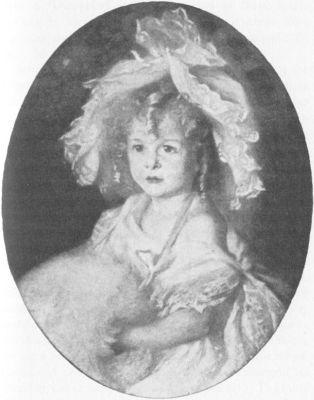
From a Copley Print.
DOROTHY
Lydia Field Emmet
Miss Emmet has painted many portraits, which are in private hands in New York, Chicago, Boston, and elsewhere. She executed a decorative painting for the Woman's Building at Chicago which is still in that city.
Emmet, Rosina—Mrs. Arthur Murray Sherwood. Silver medal, Paris Exposition, 1889; the Art Department medal, Chicago, 1893; bronze medal, Buffalo, 1901. Member of the Society of American Artists, American Water-Color Society, New York Water-Color Club. Born in New York City. Studied two years under William M. Chase and six months at Julian Academy, Paris.
Miss Emmet exhibited at the National Academy of Design, in 1881, a "Portrait of a Boy"; in 1882, a "Portrait of Alexander Stevens" and "Waiting for the Doctor"; in 1883, "Red Rose Land" and "La Mesciana"; her picture called "September" belongs to the Boston Art Club. The greater number of her works are in private collections.
Escallier, Mme. Éléonore. Medal at Salon, 1868. A pupil of Ziegler. A painter of still-life whose pictures of flowers and birds were much admired. "Chrysanthemums," exhibited in 1869, was purchased by the Government. "Peaches and Grapes," 1872, is in the Museum at Dijon; and in 1875 she executed decorative panels for the Palais de la Légion d'Honneur.
Esch, Mathilde. Born at Kletten, Bohemia, 1820. Pupil of Waldmüller in Vienna. She also studied a long time in Düsseldorf and several years in Paris, finally settling in Vienna. She painted charming scenes from German and Hungarian life, as well as flowers and still-life. Most of her works are in private galleries.
Esinger, Adèle. Born in Salzburg, 1846. In 1874 she became a student at the Art School in Stuttgart, where she worked under the special direction of Funk, and later entered the Art School at Carlsruhe, where she was a pupil of Gude. She also received instruction from Hansch. Her pictures are remarkable for their poetic feeling; especially is this true of "A Quiet Sea," "The Gollinger Waterfall," and "A Country Party."
Eyck, Margaretha van. In Bruges, in the early decades of the fifteenth century, the Van Eycks were inventing new methods in the preparation of colors. Their discoveries in this regard assured them an undying fame, second only to that of their marvellous pictures.
Here, in the quaint old city—a large part of which we still describe as mediæval—in an atmosphere totally unlike that of Italy, beside her devout brothers, Hubert and Jan, was Margaretha. When we examine the minute detail and delicate finish of the pictures of Jan van Eyck, we see a reason why the sister should have been a miniaturist, and do not wonder that with such an example before her she should have excelled in this art. The fame of her miniatures extended even to Southern Italy, where her name was honorably known.
We cannot now point to any pictures as exclusively hers, as she worked in concert with her brothers. It is, however, positively known that a portion of an exquisite Breviary, in the Imperial Library in Paris, was painted by Margaretha, and that she illustrated other precious and costly manuscripts.
She was held in high esteem in Bruges and was honored in Ghent by burial in the Church of St. Bavo, where Hubert van Eyck had been interred. Karl van Mander, an early writer on Flemish art, was poetically enthusiastic in praise of Margaretha, calling her "a gifted Minerva, who spurned Hymen and Lucina, and lived in single blessedness."
A Madonna in the National Gallery in London is attributed to Margaretha van Eyck.
Facius, Angelika. Born at Weimar. 1806-87. This artist was distinguished as an engraver of medals and gems. Pupil of her father, Friedrich Wilhelm Facius. Goethe recommended her to Rauch, and in 1827 she went to Berlin to study in his studio. Under her father's instruction she engraved the medal for the celebration at Weimar, 1825, of the jubilee of the Grand Duke Charles Augustus. Under Rauch's direction she executed the medal to commemorate the duke's death. In 1841 she made the medal for the convention of naturalists at Jena.
After Neher's designs, she modelled reliefs for the bronze doors at the castle of Weimar.
Farncomb, Caroline. Several first prizes in exhibitions in London, Toronto, Montreal, and Ottawa. Member of Women's Art Club, London, Ontario. Born near Toronto, Canada. Pupil of Mr. Judson and Mlle. van den Broeck in London, Canada, and later of William Chase in New York. Now studying in Paris.
Fassett, Cornelia Adèle. 1831-1898. Member of the Chicago Academy of Design and the Washington Art Club. Born in Owasco, New York. Studied water-color painting in New York under an English artist, J. B. Wandesforde. Pupil in Paris of Castiglione, La Tour, and Mathieu. Her artistic life was spent in Chicago and Washington, D. C.
She painted numerous portraits in miniature and a large number in oils. Among those painted from life were Presidents Grant, Hayes, and Garfield; Vice-President Henry Wilson; Charles Foster, when Governor of Ohio, now in the State House at Columbus, Ohio; Dr. Rankin, president of Howard University, Washington; and many other prominent people of Chicago and Washington.
Her chief work and that by which she is best remembered hangs in the Senate wing of the United States Capitol. No picture in the Capitol attracts more attention, and large numbers of people view it daily. It is the "Electoral Commission in Open Session." It represents the old Senate Chamber, now the Supreme Court Room, with William M. Evarts making the opening argument. There are two hundred and fifty-eight portraits of notable men and women, prominent in political, literary, scientific, and social circles. Many of these were painted from life.
The Arcadian, New York, December 15, 1876, in speaking of this picture, says: "Mr. Evarts is addressing the court, and the large number of people present are naturally and easily grouped. There is no stiffness nor awkwardness in the positions, nothing forced in the whole work. There are, in the crowd, ladies in bright colors to relieve the sombreness of the black-coated men, and the effect of the whole picture is pleasing and artistic, aside from its great value as an historical work."
The Washington Capital, March 17, 1878: "Mrs. Fassett's 'Electoral Commission' gives evidence of great merit, and this illustration in oil of an historical event in the presidential annals of the country, by the preservation of the likenesses in groups of some of the principal actors, and a few leading correspondents of the press, will be valuable. This picture we safely predict will be a landmark in the history of the nation that will never be erased. It memorizes a most remarkable crisis in our life, and perpetuates, both by reason of its intrinsic value as a chapter of history and its intrinsic worth as an art production, the incident it represents and the name of the artist."
In the Washington Star, October, 1903, an article appeared from which I quote as follows: "On the walls of the beautiful tessellated corridor of the eastern gallery floor of the Senate wing of the Capitol at Washington, just opposite the door of the caucus room of the Senate Democrats, hangs a large oil painting that never fails to attract the keenest curiosity of sightseers and legislators alike. And for good reason: that painting depicts in glowing colors a scene of momentous import, a chapter of American political history of graver consequence and more far-reaching results than any other since the Civil War. The printed legend on the frame of the picture reads:
"'The Florida case before the electoral commission, February 5, 1877. Painted from life sittings in the United States Supreme Court room by Cornelia Adèle Fassett.'"
"The painting belongs to Congress, having been purchased from the artist for $15,000. As you face the picture the portraits of two hundred and fifty-eight men and women, who, twenty-six years ago, were part and parcel of the legislative, executive, judicial, social, and journalistic life of Washington, look straight at you as if they were still living and breathing things, as, indeed, many of them are. As a work of art the picture is unique, for each face is so turned that the features can easily be studied, and the likenesses of nearly all are so faithful as to be a source of constant wonder and delight."—David S. Barry, in Pearson's Magazine.
Fauveau, Félicie de. Second-class medal at Florence in 1827, when she made her début by exhibiting a statue, "The Abbot," and a group, "Queen Christine and Monaldeschi." Born in Florence, of French parents, about 1802. For political reasons she was forced to leave Florence about 1834, when she went to Belgium, but later returned to her native city.
Among her best works are "St. George and the Dragon," bronze; the "Martyrdom of St. Dorothea," "Judith with the Head of Holofernes," "St. Genoveva," marble, and a monument to Dante.
Her works display a wonderful skill in the use of drapery and a purity of taste in composition. She handled successfully the exceedingly difficult subject, a "Scene between Paolo and Francesca da Rimini."
Faux-Froidure, Mme. Eugénie Juliette. Honorable mention at Salon, 1898; the same at the Paris Exposition, 1900; third-class medal at Salon, 1903; first prize of the Union of Women Painters and Sculptors, 1902; chevalier of the Order Nichan Iftikar; Officer of Public Instruction. Member of the Association of Baron Taylor, of the Société des Artistes Français, of the Union of Women Painters and Sculptors, and of the Association of Professors of Design of the City of Paris. Born at Noyen (Sarthe). Pupil of P. V. Galland, Albert Maignan, and G. Saintpierre.
Mme. Faux-Froidure's pictures are principally of fruit and flowers, and three have been purchased by the Government. One, "Raisins" (Grapes), is in the Museum at Commerey; a second, "Hortensias" (Hydrangeas), is in the Museum of Mans; the third, which was in the Salon of 1903, has not yet been placed. In 1899 she exhibited a large water-color called "La Barque fleurie," which was much admired and was reproduced in "L'Illustration." Her water-color of "Clematis and Virginia Creeper" is in the Museum at Tunis. In the summer exhibition of 1903, at Évreux, this artist's "Peonies" and "Iris" were delightfully painted—full of freshness and brilliancy, such as would be the despair of a less skilful hand.
At the Limoges Exposition, May to November, 1903, Mme. Faux-Froidure was announced as hors concours in water-colors.
La Société Français des Amis des Arts purchased from the Salon, 1903, two water-colors by Mme. Faux-Froidure—"Roses" and "Loose Flowers," or "Jonchée fleurie."
Her pictures at the Exposition at Toulouse, spring of 1903, were much admired. In one she had most skilfully arranged "Peaches and Grapes." The color was truthful and delicate. The result was a most artistic picture, in which the art was concealed and nature alone was manifest. A second picture of "Zinnias" was equally admirable in the painting of the flowers, while that of the table on which they were placed was not quite true in its perspective.
Of a triptych, called the "Life of Roses," exhibited at the Salon des Artistes Français, 1903, Jules de Saint Hilaire writes: "Mme. Faux-Froidure was inspired when she painted her charming triptych of 'Rose Life.' In the compartment on the left the roses are twined in a crown resembling those worn in processions; in the centre, in all its dazzling beauty, the red rose, the rose of love, is enthroned; while the panel on the right is consecrated to the faded rose—the souvenir rose, shrivelled, and lying beside the little casket which it still perfumes with its old-time sweetness."
Fischer, Clara Elizabeth. Born in Berlin, 1856. Studied under Biermann six years, and later under Julius Jacob. Her pictures are portraits and genre subjects. Among the latter are "What Will Become of the Child?" 1886; "Orphaned," "In the Punishment Corner," and "Morning Devotion."
Fischer, Helene von. Born in Bremen, 1843. She first studied under a woman portrait painter in Berlin; later she was a pupil of Frische in Düsseldorf, of Robie in Brussels, and of Hertel and Skarbina in Berlin.