WOMEN IN THE FINE ARTS (continued 3)
Reading edition
She makes a specialty of flowers, fruit, and still-life; her fruit and flower pieces are beautiful, and her pictures of the victims of the chase are excellent.
Flesch-Brunnengen, Luma von. Born in Brünn in 1856. In Vienna she worked under Schöner, the interpreter of Venetian and Oriental life, and later in Munich she acquired technical facility under Frithjof Smith. Travels in Italy, France, and Northern Africa furnished many of her themes—mostly interiors with figures, in which the entering light is skilfully managed. "The Embroiderers," showing three characteristic figures, who watch the first attempt of their seriously earnest pupil, is full of humor. In sharp contrast to this is a "Madonna under the Cross," exhibited at Berlin in 1895, in which the mother's anguish is most sympathetically rendered. "Devotion," "Shelterless," and the "Kitchen Garden" are among the paintings which have won her an excellent reputation as a genre painter.
Fleury, Mme. Fanny.
[No reply to circular.]
Focca, Signora Italia Zanardelli. Silver medal at Munich, 1893; diploma of gold medal at Women's Exhibition, London, 1900. Member of Società Amatorie Pittori di Belle Arti, of the Unione degli Artisti, and of the Società Cooperativa, all in Rome.
Born in Padua, 1872. Pupil of Ottin in Paris, and of the Academy of Fine Arts in Rome.
The principal works of this sculptor are a "Bacchante," now in St. Petersburg; "Najade," sold in London; "The Virgin Mother," purchased by Cavaliere Alinari of Florence; portrait of the Minister Merlo, which was ordered by the Ministry of Public Instruction. Many other less important works are in various Italian and foreign cities.
Signora Focca is a professor of drawing in the Normal Schools of Rome.
Foley, Margaret E. A native of New Hampshire. Died in 1877. Without a master, in the quiet of a country village, Miss Foley modelled busts in chalk and carved small figures in wood. At length she made some reputation in Boston, where she cut portraits and ideal heads in cameo. She went to Rome and remained there. She became an intimate friend of Mr. and Mrs. Howitt, and died at their summer home in the Austrian Tyrol.
Among her works are busts of Theodore Parker, Charles Sumner, and others; medallions of William and Mary Howitt, Longfellow, and Bryant; and several ideal statues and bas-reliefs.
In a critical estimate of Miss Foley we read: "Her head of the somewhat impracticable but always earnest senator from Massachusetts—Sumner—is unsurpassable and beyond praise. It is simple, absolute truth, embodied in marble."—Tuckerman's Book of the Artists.
"Miss Foley's exquisite medallions and sculptures ought to be reproduced in photograph. Certainly she was a most devoted artist, and America has not had so many sculptors among women that she can afford to forget any one of them."—Boston Advertiser, January, 1878.
Fontaine, Jenny. Silver medal, Julian Academy, 1889; silver medal at Amiens Exposition, 1890 and 1894; honorable mention, Paris Salon, 1892; gold medal at Rouen Exposition, 1893; third-class medal, Salon, 1896; bronze medal, Paris Exposition, 1900. Officer of the Academy, 1896; Officer of Public Instruction, 1902. Member of the Société des Artistes Français, Paris; Société de l'Union Artistique, du Pas-de-Calais, at Arras; corresponding member of the Academy of Arras. Pupil of Jules Lefebvre and Benjamin-Constant.
Mlle. Fontaine paints portraits only—of these she has exhibited regularly at the Salons for sixteen years. Among her sitters have been many persons of distinction, both men and women.
At the Salon of 1902 she exhibited her own portrait; in 1903, portraits of MM. Rene et Georges D. The Journal des Arts, giving an account of the exhibition at Rheims, summer, 1903, says: "The portraits here are not so numerous as one might expect, but they are too fine to be overlooked. Mlle. Jenny Fontaine has, for a long time, held a distinguished place as a portraitiste in our Salons, and two of her works are here: a portrait of a young girl and one of General Jeanningros."
Fontana, Lavinia. Born in Bologna, 1552. Her father was a distinguished portrait painter in Rome in the time of Pope Julius III., but the work of his daughter was preferred before his own. She was elected to the Academy of Rome, while her charms were extolled in poetry and prose.
Pope Gregory XIII. made her his painter-in-ordinary. Patrician ladies, cardinals, and Roman nobles contended for the privilege of having their portraits from her hand. Men of rank and scholars paid court to her, but, with a waywardness not altogether uncommon, she married a man who was even thought to be lacking in sense.
One of her two daughters was blind of one eye, and her only son was so simple that the loungers in the antechamber of the Pope were accustomed to amuse themselves with his want of wit. She is said to have died of a broken heart after the death of this son, and her portrait of him is considered her masterpiece.
Her own portrait was one of her most distinguished works, and though it is in possession of her husband's family, the Zappi, of Imola, it may be judged by an engraving after it in Rossini's "History of Italian Painting."
Many portraits by Lavinia Fontana are in the private collections of Italian families for whom they were painted. In the Gallery of Bologna there is a night-scene, the "Nativity of the Virgin," by her, and in the Escorial is a Madonna lifting a veil to regard the sleeping Jesus, while SS. Joseph and John stand near by.
In the churches of San Giacomo Maggiore and of the Madonna del Baracano, both in Bologna, are Fontana's pictures of the "Madonna with Saints." In Pieve di Cento are two of her works—a "Madonna" and an "Ascension." It is said that several pictures by this artist are in England, but I have failed to find to what collections they belong.
Lavinia Fontana was a distinguished woman in a notable age, and if, in translating the tributes that were paid her by the authors of her day, we should faithfully render their superlatives, these writings would seem absurd in their exaggerations, and our comparatively cold adjectives would be taxed beyond their power of expression.
Fontana, Veronica. Born in 1576. A pupil of Elisabetta Sirani, who devoted herself to etching and wood-engraving. She is known from her exceedingly fine, delicate portraits on wood and etchings of scenes from the life of the Madonna.
Foord, Miss J. A painter of plants and flowers, which are much praised. An article in the Studio, July, 1901, says: "Miss Foord, by patient and observant study from nature, has given us a very pleasing, new form of useful work, that has traits in common; with the illustrations to be found in the excellent botanical books of the beginning of the nineteenth century." After praising the works of this artist, attention is called to her valuable book, "Decorative Flower Studies," illustrated with forty plates printed in colors.
[No reply to circular.]
Foote, Mary Hallock. Born in Milton, New York. At New York School of Design for Women this artist studied anatomy and composition under William Rimmer, and drawing on wood and black and white under William J. Linton. Mrs. Foote is a member of the Alumni of the School of Design.
Her illustrations have been exhibited by the publishers for whom they were made. In the beginning her work was suited to the taste and custom of the time. She illustrated the so-called "Gift Books" and poems in the elaborate fashion of the period. Later she was occupied principally in illustrations for the Century Company and Houghton, Mifflin & Co. Mrs. Foote writes that Miss Regina Armstrong—now Mrs. Niehaus—in a series of articles on "Women Illustrators of America," whom she divided into classes, placed her with the "Story-Tellers."
Forbes, Mrs. Stanhope. Mr. Norman Gastin, in an article upon the work of the Royal Academician, Stanhope Forbes, in the Studio, July, 1901, pays the following tribute to the wife of the artist, whose maiden name was Elizabeth Armstrong:
"Mrs. Stanhope Forbes's work does not ask you for any of that chivalrous gentleness which is in itself so derogatory to the powers of women. As an artist she stands shoulder to shoulder with the very best; she has taste and fancy, without which she could not be an artist. But what strikes one about her most is summed up in the word 'ability.' She is essentially able. The work which that wonderful left hand of hers finds to do, it does with a certainty that makes most other work look tentative beside hers. The gestures and poses she chooses in her models show how little she fears drawing, while the gistness of her criticism has a most solvent effect in dissolving the doubts that hover round the making of pictures."
[No reply to circular.]
Forti, Enrica. Rome.
[No reply to circular.]
Fortin de Cool, Delfina. Third-class medal, Madrid, 1864, for the following works reproduced on porcelain: the "Conception" of Murillo, the "Magdalen" of Antolinez, and the portrait of Alonso Cano by Velazquez; also a portrait on ivory of a young girl.
This artist, who was French by birth, was a pupil of her father. For paintings executed in the imperial works at Sèvres, she was awarded prizes at Blois, Besançon, Rouen, Perigueux, and Paris.
Foulques, Elisa. Born in Pjatigorsk, in the Caucasus. She came under Italian influence when but four years old, and was taken to Naples. At the Institute of the Fine Arts she was a pupil of Antoriello, Mancinelli, Perrisi, and Solari. She received a diploma when leaving the Institute. Her picture, "Mendica," was exhibited in Naples, 1886; "Un ultimo Squardo" and "Sogno," 1888. In London, in 1888, "Tipo Napoletano," "Studio dal vero," and "Ricordi" were exhibited. Since 1884 this artist has taught drawing in the Municipal School for Girls in Naples, and has executed many portraits in oil, as well as numerous pastels and water-colors. Among her later works are "La Figlia del Corsaro," "Chiome nere," "Una Carezza al Nonno," and "Di Soppiatto."
Frackleton, Susan Stuart. Medal at Antwerp Exposition, 1894; at Paris Exposition, 1900. Founder and first president of National League of Mineral Painters; member of Park and Outdoor Association. Born at Milwaukee, 1848. Pupil of private studios in Milwaukee and New York.
Mrs. Frackleton's gas-kilns for firing decorated china and glass are well known; also her book, "Tried by Fire," a treatise on china painting. As a ceramic artist she has exhibited in various countries, and has had numerous prizes for her work. She declined the request of the Mexican Government to be at the head of a National School of Ceramic Decoration, etc. She is also a lecturer on topics connected with the so-called arts and crafts.
Freeman, Florence. Born in Boston. 1836-1883. Pupil of Richard S. Greenough in Boston and of Hiram Powers in Florence, Italy. After a year in Florence she went to Rome, where she made her home. Among her works are a bust of "Sandalphon," which belonged to Mr. Longfellow, bas-reliefs of Dante, and a statue of the "Sleeping Child."
She sent to the Exhibition in Philadelphia, 1876, a chimney-piece on which were sculptured "Children and the Yule-Log and Fireside Spirits." This was purchased by Mrs. Hemenway, of Boston.
"Her works are full of poetic fancy; her bas-reliefs of the seven days of the week and of the hours are most lovely and original in conception. Her sketches of Dante in bas-reliefs are equally fine. Her designs for chimney-pieces are gems, and in less prosaic days than these, when people were not satisfied with the work of mechanics, but demanded artistic designs in the commonest household articles, they would have made her famous."—The Revolution, May, 1871.
French, Jane Kathleen. Member of the Water-Color Society of Ireland. Born in Dublin. Studied in Brussels under M. Bourson, and in Wiesbaden under Herr Kögler. Miss French is a miniaturist and exhibited at the Royal Academy, London, in 1901, a case of her works which she was later specially invited to send to an exhibition in Liverpool, and several other exhibits.
The last two years she has exhibited in Ireland only, as her commissions employ her time so fully that she cannot prepare for foreign expositions.
Freyberg, Baroness Marie Electrine. Elected to the Academy of St. Luke, 1822. Born in Strassburg. 1797-1847. Daughter and pupil of the landscape painter, Stuntz. After travelling in France and Italy, making special studies in Rome, she settled in Munich. She painted historical and religious subjects, and a few portraits. "Zacharias Naming the Little St. John" is in the New Picture Gallery, Munich; in the same gallery is also a portrait called the "Boy Playing a Flute"; in the Leuchtenberg Gallery, Petersburg, is her "Three Women at the Sepulchre." She painted a picture called the "Glorification of Religion through Art" and a "Madonna in Prayer." She also executed a number of lithographs and etchings.
Friedländer, Camilla. Born in Vienna, 1856. She was instructed by her father, Friedrich Friedländer. Among her numerous paintings of house furniture, antiquities, and dead animals should be especially mentioned her picture in the Rudolfinum at Prague, which represents all sorts of drinking-vessels, 1888. Some critics affirm that she has shown more patience and industry than wealth of artistic ideas, but her still-life pictures demanded those qualities and brought her success and artistic recognition.
Friedrich, Caroline Friederike. Born in Dresden. 1749-1815. Honorary member of Dresden Academy. In the Dresden Gallery is a picture by this artist, "Pastry on a Plate with a Glass of Wine," signed 1799.
Friedrichson, Ernestine. Born in Dantzig, 1824. Pupil of Marie Wiegmann in Düsseldorf, and later of Jordan and Wilhelm Sohn. While still a student she visited Holland, Belgium, England, and Italy. Her favorite subjects were scenes from the every-day life of Poles and Jews.
Her best pictures were sold to private collectors. Among these are "Polish Raftsmen Resting in the Forest," 1867; "Polish Raftsmen before a Crucifix," 1869; "A Jew Rag-picker," 1870; "The Jewish Quarter in Amsterdam on Friday Evening," 1881; "A Goose Girl," 1891.
Fries, Anna. Silver medal at Berne, 1857; two silver medals from the Academy of Urbino; silver medal at the National Exposition by Women in Florence. Honorary member of the Academy Michael Angela, Florence, and of the Academy of Urbino. Born in Zürich, 1827. She encountered much opposition to her desire to study art, but her talent was so manifest that at length she was permitted to study drawing in Zürich, and her rapid progress was finally recognized and she was taken to Paris, where the great works of the masters were an inspiration to her. She has great individuality in her pictures, which have been immoderately praised. She visited Italy, and in 1857 went to Holland, where she painted portraits of Queen Sophia and the Prince of Orange. She returned to Zürich and was urged to remain in Switzerland, but she was ambitious of further study, and went again to Florence. She there painted a portrait of the Grand Duchess Marie of Russia. She turned her attention to decorative painting, and her success in this may be seen in the facades of the Schmitz villa, the Schemboche establishment, and her own home. When we consider the usual monotony of this art, the charming effects which Mme. Fries has produced make her distinguished in this specialty.
Frishmuth, Harriet Whitney.
[No reply to circular.]
Fritze, Margarethe Auguste. Born in Magdeburg, 1845. This genre painter worked first in Bremen, and went in 1873 to Munich, where she studied with Grützner and Liezen-Meyer. The most significant of her pictures is "The Little Handorgan-Player with His Monkey." She has also executed many strong portraits, and her painting is thought to show the influence of A. von Kotzebue and Alexander Wagner. In 1880 she spent some time in Stuttgart, and later settled in Berlin.
Froriep, Bertha. Born in Berlin, 1833. Pupil of Martersteig and Pauwels in Weimar. This artist's pictures were usually of genre subjects. Her small game pictures with single figures are delightful. She also painted an unusually fine portrait of Friedrich Rückert. At an exhibition by the women artists of Berlin, 1892, a pen study by Fräulein Froriep attracted attention and was admired for its spirit and its clear execution.
Frumerie, Mme. de. Honorable mention at the Salon des Artistes Français in 1893 and 1895. Born in Sweden, she studied in the School of Fine Arts in Stockholm. There she gained a prize which entitled her to study abroad during four years.
She has exhibited her works in Paris, and to the Salon of Les Femmes Peintres et Sculpteurs, in February, 1903, she contributed a bust of Strindberg which was a delightful example of life-like portraiture.
Fuller, Lucia Fairchild. Bronze medal, Paris Exposition, 1900; silver medal, Buffalo Exposition, 1901. Member of the Society of American Artists and of the American Society of Miniature Painters. Born in Boston. Studied at the Cowles Art School, Boston, under Denis M. Bunker, and at the Art Students' League, New York, under H. Siddons Mowbray and William M. Chase.
Mrs. Fuller is a most successful miniature painter. Among her principal works are "Mother and Child," in the collection of Mrs. David P. Kimball, Boston; "Girl with a Hand-Glass," owned by Hearn; and "Girl Drying Her Feet," for which the medal was given in Paris.
Mrs. Fuller's miniatures are portraits principally, and are in private hands. Some of her sitters in New York are Mrs. J. Pierpont Morgan and her children, Mrs. H. P. Whitney and children, J. J. Higginson, Esq., Dr. Edwin A. Tucker, and many others.
Gaggiotti-Richards, Emma. Historical and portrait painter, of the middle of the nineteenth century, is known by her portrait of Alexander von Humboldt (in possession of the Emperor William II.) and by her portrait of herself before her easel. Her historical paintings include "The Crusader" and a "Madonna."
Galli, Emira. Reproduces with great felicity the customs of the lagoons, the boys and fishermen of which she represents with marvellous fidelity. She depicts not only characteristics of features and dress, but of movement. "Giovane veneziana" and "Ragazzo del Popolo" were exhibited at Turin in 1880, and were much admired. "Il Falconiere" was exhibited at both Turin and Milan. "Un Piccolo Accattone" has also been accorded warm praise.
Gardner, Elizabeth Jane. Honorable mention, Paris Salon, 1879; gold medal, 1889; hors concours. Born in Exeter, New Hampshire, 1851, her professional life has been spent in Paris, where she was a pupil of Hugues Merle, Lefebvre, and M. William A. Bouguereau, whom she married.
[No reply to circular.]
Garrido y Agudo, Maria de la Soledad. Born in Salamanca. Pupil of Juan Peyró. She exhibited two works at the National Exposition, 1876—a portrait and a youth studying a picture. In 1878 she sent to the same exposition "The Sacrifice of the Saguntine Women." At the Philadelphia Exposition, 1876, she exhibited her "Messenger of Love." Her "Santa Lucia" is in the church of San Roque de Gardia.
Gasso y Vidal, Leopolda. Honorable mention, 1876. Prizes, 1876, for two works sent to the Provincial Exposition of Leon. Member of the Association of Authors and Artists, 1876. Born in the Province of Toledo. Pupil of Manuel Martinez Ferrer and Isidoro Lozano. At Madrid, in 1881, she exhibited "A Pensioner," "A Beggar," a portrait of Señorita M. J., and a landscape; in 1878, "A Coxcomb," "Street Venders of Ávila," and a landscape; and in 1881, at an exhibition held by D. Ricardo Hernandez, were seen a landscape and a portrait of D. Lucas Aguirre y Juarez.
Geefs, Mme. Fanny Isabelle Marie. Born at Brussels. 1814-1883. Wife of the sculptor, Guillaume Geefs. A painter of portraits and genre subjects which excel the historical pictures she also painted. Her "Assumption of the Virgin" is in a church at Waterloo; "Christ Appearing to His Disciples," in a church at Hauthem. "The Virgin Consoling the Afflicted" was awarded a medal in Paris, and is in the Hospital of St. John at Brussels. The "Virgin and Child" was purchased by the Belgian Government. Her portraits are good, and among her genre subjects the "Young Mother," the "Sailor's Daughter," and "Ophelia" are attractive and artistic in design and execution.
Gelder, Lucia van. Born in Wiesbaden. 1864-1899. This artist was the daughter of an art dealer, and her constant association as a child with good pictures stimulated her to study. In Berlin she had lessons in drawing with Liezenmayer, and in color with Max Thedy. She was also a constant student at the galleries. She began to work independently when eighteen, and a number of her pictures achieved great popularity, being reproduced in many art magazines. "The Little Doctor," especially, in which a boy is feeling, with a grave expression of knowledge, the pulse of his sister's pet kitten, has been widely copied in photographs, wood-engravings, and in colors. She repeated the picture in varying forms. She died in Munich, where she was favorably known through such works as "The Village Barber," "Contraband," "The Wonderful Story," "At the Sick Bed," and "The Violin Player," the last painted the year before her death.
Gentileschi, Artemisia. 1590-1642. A daughter of Orazio Gentileschi, whom she accompanied to England when he was invited to the court of Charles I. Artemisia has been called the pupil, and again the friend, of Guido Reni. Whatever the relation may have been, there is no doubt that the manner of her painting was influenced by Guido, and also by her study of the works of Domenichino.
Wagner says that she excelled her father in portraits, and her own likeness, in the gallery at Hampton Court, is a powerful and life-like picture. King Charles had several pictures from her hand, one of which, "David with the Head of Goliath," was much esteemed. Her "Mary Magdalene" and "Judith with the Head of Holofernes" are in the Pitti Palace. The latter work is a proof of her talent. Lanzi says: "It is a picture of strong coloring, of a tone and intensity which inspires awe." Mrs. Jameson praised its execution while she regretted its subject.
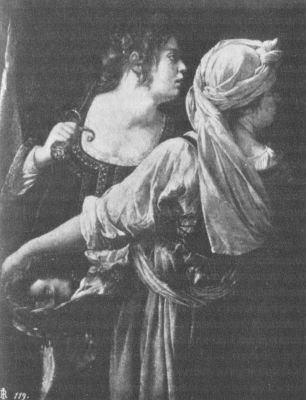
Alinari, Photo.
In the Pitti Gallery, Florence
JUDITH WITH THE HEAD OF HOLOFERNES
Artemisia Gentileschi
Her picture of the "Birth of John the Baptist," in the Gallery of the Prado, is worthy of attention, even in that marvellous collection, where is also her "Woman Caressing Pigeons." The Historical Society of New York has her picture of "Christ among the Doctors."
After her return to Italy from England, this artist was married and resided in Naples. Several of her letters are in existence. They tell of the manner of her life and give an interesting picture of Neapolitan society in her day.
Gessler de Lacroix, Alejandrena—known in art circles as Madame Anselma. Gold medal at Cadiz, 1880. Honorary member of the Academy of Cadiz. She has spent some years in Paris, where her works are often seen in exhibitions. Her medal picture at Cadiz was an "Adoration of the Cross." One of her most successful works is called "The Choir Boys."
Giles, Miss—Mrs. Bernard Jenkin. This sculptor exhibited a life-size marble group, called "In Memoriam," at the Royal Academy in 1900, which attracted much attention. It was graceful in design and of a sympathetic quality. At an open competition in the London Art Union her "Hero" won the prize. In 1901 she exhibited an ambitious group called "After Nineteen Hundred Years, and still They Crucify." It was excellent in modelling, admirable in sentiment, and displayed strength in conception and execution.
Ginassi, Caterina. Born in Rome, 1590. This artist was of noble family, and one of her uncles, a Cardinal, founded the Church of Santa Lucia, in which Caterina, after completing her studies under Lanfranco, painted several large pictures. After the death of the Cardinal, with money which he had given her for the purpose, Caterina founded a cloister, with a seminary for the education of girls.
As Abbess of this community she proved herself to be of unusual ability. In her youth she had been trained in practical affairs as well as in art, and, although she felt that "the needle and distaff were enemies to the brush and pencil," her varied knowledge served her well in the responsibilities she had assumed, and at the head of the institution she had founded she became as well known for her executive ability as for her piety.
Little as the works of Lanfranco appeal to us, he was a notable artist of the Carracci school; Caterina did him honor as her master, and, in the esteem of her admirers, excelled him as a painter.
Girardet, Berthe. Gold medal at the Paris Exposition, 1900; honorable mention, Salon des Artistes Français, 1900; ten silver medals from foreign exhibitions. Member of the Société des Artistes Français and the Union des femmes peintres et sculpteurs. Born at Marseilles. Her father was Swiss and her mother a Miss Rogers of Boston. She was a pupil for three months of Antonin-Carlès, Paris. With this exception, Mme. Girardet writes: "I studied mostly alone, looking to nature as the best teacher, and with energetic perseverance trying to give out in a concrete form all that filled my heart."
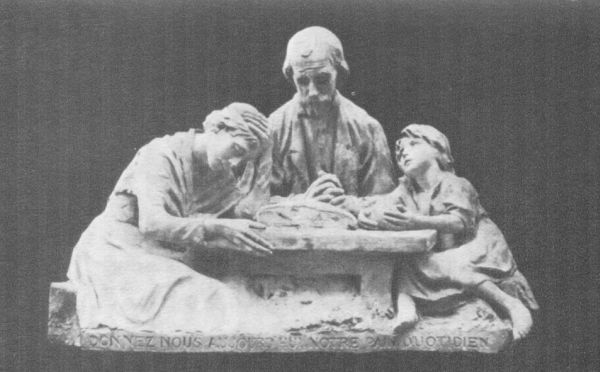
GIVE US THIS DAY OUR DAILY BREAD
Berthe Girardet
Among her works are: "L'Enfant Malade," bought by the city of Paris and placed in the Petit Palais des Champs Élysées; a group called the "Grandmother's Blessing," purchased by the Government and placed in a public museum; the bust of an "Old Woman," acquired by the Swiss Government and placed in the Museum of Neuchâtel; a group, the "Madonna and Child," for which the artist received the gold medal; and two groups illustrating the prayer, "Give us this day our daily bread." Also portrait statues and busts belonging to private collections.
At the Salon des Artistes Français, 1902, Mme. Girardet exhibited the "Grandmother's Blessing" and "L'Enfant Malade." At the same Salon, 1903, the two groups illustrating the Lord's Prayer.
A writer, G. M., in the Studio of December, 1902, writes: "Prominent among the women artists of the day whose talents are attracting attention is Mme. Berthe Girardet. She has a very delicate and very tender vision of things, which stamps her work with genuine originality. She does not seek her subjects far from the life around her; quite the reverse; and therein lies the charm of her sculpture—a great, sincere, and simple charm, which at once arouses one's emotion. What, for instance, could be more poignantly sad than this 'Enfant Malade' group, with the father, racked with anxiety, bending over the pillow of his fragile little son, and the mother, already in an attitude of despair, at the foot of the bed? The whole thing is great in its profound humanity.
"The 'Bénédiction de l'Aïeule' is less tragic. Behind the granddaughter, delightful in her white veil and dress of a première communicante, stands the old woman, her wrinkled face full of quiet joy. She is thinking of the past, moved by the melancholy of the bells, and she is happy with a happiness with which is mingled something of sorrow and regret. It is really exquisite. By simple means Mme. Berthe Girardet obtains broad emotional effects. She won a great and legitimate success at the Salon of the Société des Artistes Français."
Gleichen, Countess. Bronze medal at Paris Exposition, 1900. Honorable member of Royal Institute of Painters in Water-Colors, of Royal Society of Painter Etchers. Sculptor. Pupil of her father, Prince Victor of Hohenlohe, and of the Slade School, London; also of Professor Legros. She has exhibited regularly at the Royal Academy since 1893.
In 1895 she completed a life-size statue of Queen Victoria for the Victoria Hospital, Montreal. The Queen is represented in royal robes, with one child asleep on her knee, while another, with its arm in a sling, stands on the steps of the throne. Shortly before the Queen's death she gave sittings to Countess Gleichen, who then executed a bust of her majesty, now at the Cheltenham Ladies' College. The Constitutional Club, London, has her bust of Queen Alexandra, which was seen at the Academy in 1895. Her "Satan" attracted much attention when exhibited in 1894. He is represented as seated on a throne composed of snakes, while he has scales and wings and is armed like a knight. In 1899 her statue of "Peace" was more pleasing, while a hand-mirror of jade and bronze was much admired both in London and Paris, where it was seen in the Exposition of 1900. In 1901 she executed a fountain with a figure of a nymph for a garden in Paris; a year later, a second fountain for W. Palmer, Esq., Ascot. She has made a half-length figure of Kubelik. Her sculptured portraits include those of Sir Henry Ponsonby, Mme. Calvé, Mrs. Walter Palmer, and a bust of the late Queen, in ivory, which she exhibited in 1903.
Gleichen, Countess Helena.
[No reply to circular.]
Gloag, Isobel Lilian. Born in London, the daughter of Scotch parents. Her early studies were made at St. John's Wood Art School, preparatory to entering the School of the Royal Academy, but the conservative and academic training of these institutions so displeased her that she went to the Slade School. Ill health compelled her to put aside all plans for regular study, and she entered Ridley's studio for private instruction, following this with work at the South Kensington Museum. After still further study with Raphael Collin in Paris, she returned to London and soon had her work accepted at the Royal Academy. Miss Gloag is reported as saying that women have little sense of composition, a failing which she does not seem to share; in this respect and as a colorist she is especially strong. "Rosamond," in which the charming girl in a purple robe, sitting before an embroidery frame, is startled by the shadow of Queen Eleanor bearing the poisoned cup, displays these qualities to great advantage. The leafy bower, the hanging mantle, show great skill in arrangement and a true instinct for color. "The Magic Mantle," "Rapunzel," and the "Miracle of the Roses" have all—especially, the first named—made an impression; another and strikingly original picture, called the "Quick and the Dead," represents a poorhouse, in the ward of which is a group of old women surrounded by the ghosts of men and children. Miss Gloag has also made some admirable designs for stained-glass windows. She has been seriously hampered by ill health, and her achievements in the face of such a drawback are all the more remarkable.
Godewyck, Margaretta. Born at Dort, 1627. A pupil of the celebrated painter, Nicholas Maas. She excelled as a painter of flowers, and was proficient in both ancient and modern languages. She was called by authors of her time, "the lovely flower of Art and Literature of the Merwestrom," which is a poetical way of saying Dordrecht!
Golay, Mary—Mme. Speich Golay. Silver medal at Geneva Exposition, 1896; eighteen medals and rewards gained in the Art Schools of Geneva, and the highest recompense for excellence in composition and decoration. Member of the Amis des Beaux-Arts, Geneva; Société vaudoise des Beaux Arts, Lausanne. Born in Geneva and studied there under Mittey for flower painting, composition, and ceramic decoration; under Gillet for figure painting.
Mme. Golay has executed a variety of pictures both in oil and water-colors. In an exhibition at the Athénée in Geneva, in the autumn of 1902, she exhibited two pictures of sleep, which afforded an almost startling contrast. They were called "Sweet Sleep" and the "Eternal Sleep." The first was a picture of a beautiful young woman, nude, and sleeping in the midst of roses, while angels watching her inspire rosy dreams of life and love. The roses are of all possible shades, rendered with wonderful freshness—scarlet roses, golden roses—and in such masses and so scattered about the nude figure as to give it a character of purity and modesty. The flesh tints are warm, the figure is supple in effect, and the whole is a happy picturing of the sleep and dream of a lovely young woman who has thrown herself down in the carelessness of solitude.
It required an effort of will to turn to the second picture. Here lies another young woman, in her white shroud, surrounded with lilies as white as her face, on which pain has left its traces. In the artistic speech of the present day, it is a symphony in white. The figure is as rigid as the other is supple; it is frightfully immovable—and yet the drawing is not exaggerated in its firmness. Certainly these contrasting pictures witness to the skill of the artist. Without doubt the last is by far the most difficult, but Mme. Golay has known how to conquer its obstacles.
A third picture by this artist in the exhibition is called the "Abundance of Spring." Mme. Golay's reputation as a flower painter has been so long established that one need not dwell on the excellence of the work. A writer in the Geneva Tribune exclaims: "One has never seen more brilliant peonies, more vigorous or finer branches of lilacs, or iris more delicate and distinguished. How they breathe—how they live—how they smile—these ephemeral blossoms!"
Gonzalez, Inés. Member of the Academy San Carlos of Valencia. In the expositions of 1845 and 1846 in that city she was represented by several miniatures, one of which, "Dido," was much admired. Another—the portrait of the Baron of Santa Barbara—was acquired by the Economic Society of Valencia. In the Provincial Museum is her picture of the "Two Smokers."
Granby, Marchioness of. Replies as follows to circular: "Lady Granby has been written about by Miss Tomlinson, 20 Wigmore Street, London, W. And I advise you if you really want any information to get it from her. V. G."
I was not "really" anxious enough to be informed about Lady Granby—who drops so readily from the third person to the first—to act on her advice, which I give to my readers, in order that any one who does wish to know about her will be able to obtain the information!
Grant, Mary R. This sculptor studied in Paris and Florence, as well as in London, where she was a pupil of J. H. Foley, R.A. She has exhibited at the Royal Academy since 1870. She has executed portraits of Queen Victoria, Georgina, Lady Dudley, the Duke of Argyll, Mr. C. Parnell, M.P., and Sir Francis Grant, P.R.A.
Her memorial work includes a relief of Dean Stanley, Royal Chapel, Windsor; and a relief of Mr. Fawcett, M.P., on the Thames Embankment. The late Queen gave Miss Grant several commissions. In Winchester Cathedral is a screen, on the exterior of Lichfield Cathedral a number of figures, and in the Cathedral of Edinburgh a reredos, all the work of this artist. At the Royal Academy, 1903, she exhibited a medallion portrait in bronze.
Gratz, Marie. Born at Karlsruhe, 1839. This portrait painter was a pupil of Bergmann, and later of Schick and Canon. Among her best-known portraits are those of Prince and Princess Lippe-Detmold, Princess Hohenlohe-Langenburg, Prince Wittgenstein, the hereditary Princess Reuss, and Princess Biron von Kurland.
Gray, Sophie de Butts. First honor, Maryland Institute; second honor, World's Fair, New Orleans; gold medal, Autumn Exhibition, Louisville, 1898; first and second premiums, Nelson County Fair, 1898.
[No reply to circular.]
Greatorex, Eliza. In 1869 Mrs. Greatorex was elected associate member of the National Academy, New York, and was the first woman member of the Artists' Fund Society of New York. Born in Ireland. 1820-1897. Studied under Witherspoon and James and William Hart in New York; under Lambinet in Paris; and at the Pinakothek in Munich. Mrs. Greatorex visited England, Paris, Italy, and Germany, spending a summer in Nuremberg and one in Ober-Ammergau.
Among her most important works are "Bloomingdale," which was purchased by Mr. Robert Hoe; "Château of Madame Cliffe," the property of Dykeman van Doren; "Landscape, Amsterdam"; pictures of "Bloomingdale Church," "St. Paul's Church," and the "North Dutch Church," all painted on panels taken from these churches.
Mrs. Greatorex illustrated the "Homes of Ober-Ammergau" with etchings, published in Munich in 1871; also "Summer Etchings in Colorado," published in 1874; and "Old New York from the Battery to Bloomingdale," published in 1875. Eighteen of the drawings for the "Old New York" were at the Philadelphia Exhibition, 1876.
Greenaway, Kate. Member of the Royal Institute of Painters in Water-Colors, 1890. Born in London. 1846-1901. Her father was a well-known wood-engraver. Miss Greenaway first studied her art at the South Kensington School; then at Heatherley's life class and at the Slade School. She began to exhibit at the Dudley Gallery in 1868.
Her Christmas cards first attracted general attention to her as an artist. Their quaint beauty and truthful drawing in depicting children, young girls, flowers, and landscape soon made them more popular than the similar work of other artists. These cards sold by thousands on both sides of the Atlantic and secured consideration for any other work she might do.
She soon made illustrations for Little Folks and the London News. In 1879 "Under the Window" appeared, and one hundred and fifty thousand copies were sold; it was also translated into French and German. The "Birthday Book," "Mother Goose," and "Little Ann" followed and were accorded the heartiest welcome. It is said that for the above four toy books she received $40,000. Wherever they went—and they were in all civilized countries—they were applauded by artists and critics and loved by all classes of women and children. One can but hope that Kate Greenaway realized the world-wide pleasure she gave to children.
The exhibition of her works at the Gallery of the Fine Arts Society, since her death, was even more beautiful than was anticipated. The grace, delicacy, and tenderness with which her little people were created impressed one in an entire collection as no single book or picture could do.
It has been said that "Kate Greenaway dressed the children of two continents," and, indeed, her revival of the costumes of a hundred years ago was delightful for the children and for everybody who saw them.
Among her papers after her death many verses were found. Had she lived she would doubtless have acquired the courage to give them to the world. She was shy of strangers and the public; had few intimates, but of those few was very fond; the charm of her character was great—indeed, her friends could discover no faults in her; her personality and presence were as lovely to them as were her exquisite flowers.
Greene, Mary Shepard. Third-class medal, 1900, second-class medal, 1902, at Salon des Artistes Français. Her picture of 1902 is thus spoken of in Success, September of that year:
"'Une Petite Histoire' is the title of Miss Mary Shepard Greene's graceful canvas. The lithe and youthful figure of a girl is extended upon a straight-backed settle in somewhat of a Récamier pose. She is intently occupied in the perusal of a book. The turn of the head, the careless attitude, and the flesh tints of throat and face are all admirably rendered. The diaphanous quality of the girlish costume is skilfully worked out, as are also the accessories of the room. Miss Greene's work must commend itself to those who recognize the true in art. Technical dexterity and a fine discrimination of color are attributes of this conscientious artist's work. She has a rare idea of grace and great strength of treatment.
"Miss Greene's canvas has a charm all its own, and is essentially womanly, while at the same time it is not lacking in character. Hailing from New England, her first training was in Brooklyn, under Professor Whittaker, from whom she received much encouragement. Afterward she came under the influence of Herbert Adams, and, after pursuing her studies with that renowned artist, she went to Paris, where she was received as a pupil by Raphael Collin. She has exhibited at Omaha, Pittsburg, and at the Salon. Her first picture, called 'Un Regard Fugitif,' won for her a medal of the third class."
[No reply to circular.]
Grey, Mrs. Edith F. Member of the Society of Miniaturists, Royal Institute of Painters in Water-Colors, Bewick Club, and Northumbrian Art Institute, Newcastle-on-Tyne. Born at the last-named place, where she also made her studies in the Newcastle School of Art, and later under private masters in London.
Mrs. Grey has exhibited miniatures and pictures in both oils and water-colors at the Royal Society of British Artists, the Royal Academy, the Royal Institute of Painters in Water-Colors, and the exhibitions at Liverpool, Manchester, and York. Since 1890 she has continuously exhibited at the Academy of the Royal Institute, London, except in 1895 and 1902.
Mrs. Grey was fortunate in having the first picture she sent to London sold, and has continued to find purchasers for her exhibited works, which are now in many private collections and number about one hundred and fifty. "Empty," a child study in oils, 1897, and a water-color, "A Silver Latch," 1900, are among her important works.
To the Academy Exhibition, 1903, she sent a picture of "Nightfall, Cullercoats," and a portrait of "Lily, daughter of Mrs. J. B. Firth."
Guild, Mrs. Cadwallader. I quote from the Boston Transcript a portion of an article relative to this sculptor, some of whose works were exhibited in Boston in 1903:
"In spite of the always suspected journalistic laudations of Americans abroad, in spite of the social vogue and intimacy with royalty which these chronicle, the work of Mrs. Guild shows unmistakable talent and such a fresh, free spirit of originality that one can almost accept the alleged dictum of Berlin that Mrs. Guild 'is the greatest genius in sculpture that America has ever had.'
"The list of Mrs. Guild's works executed abroad include a painting belonging to the very beginning of her career, of still-life in oils, which was accepted and well hung at the Royal Academy in London; but it is in Berlin that she has been especially successful. To her credit there are: A bust of her royal highness the Princess Christian of Schleswig-Holstein; Mr. Gladstone, in marble and bronze; G. F. Watts, in bronze, for the 'Permanent Manchester Art Exhibition'; Mr. Peter Brotherhood, inventor of a torpedo engine, in marble and bronze, which held the place of honor at the Royal Academy the year of its exhibition; Princess Henry of Prussia, in marble; her highness Princess Helena of Saxe-Altenburg; his excellency the Baron von Rheinbaben, minister of finance; his excellency Dr. Studt, minister of education in art; Prof. Dr. Henry Thode, of the Heidelberg University; Hans Thoma and Joachim, the violinist; Felix Weingartner; statuette of her royal highness Princess Henry with her little son Prince Henry."
[No reply to circular.]
Gunther-Amberg, Julie. Born in Berlin, 1855. Daughter and pupil of Wilhelm Amberg; later she studied under Gussow. She painted attractive scenes of domestic life, the setting for these works often representing a landscape characteristic of the shore of the Baltic Sea. Among these pictures are "Schurr-Meer," "The Village Coquette," "Sunday Afternoon," "At the Garden Gate," and "Harvest Day in Misdroy." In 1886 this artist married Dr. Gunther, of Berlin.
Guyon, Maximiliènne. Medal of third class, Paris salon, 1888; honorable mention and medal of third class at Exposition Universelle, 1889; travelling purse, 1894—first woman to whom the purse was given; bronze medal, Paris Exposition, 1900; gold medal at Exposition of Black and White, Paris; medal in silver-gilt at Amiens. Mme. Guyon is hors concours at Lyons, Versailles, Rouen, etc. Member of the Société des Artistes Français, Société des Aquarellistes Français, and of the Société des Prix du Salon et Boursiers de Voyage. Born at Paris. Pupil of the Julian Academy under Robert-Fleury, Jules Lefebvre, and Gustave Boulanger.
Mme. Guyon is a successful portrait painter, and her works are numerous. Among her pictures of another sort are the "Violinist" and "The River." In the Salon des Artistes Français, 1902, she exhibited two portraits. In 1903 she exhibited "Mending of the Fish Nets, a scene in Brittany," and "A Study." The net-menders are three peasant women, seated on the shore, with a large net thrown across their laps, all looking down and working busily. They wear the white Breton caps, and but for these—in the reproduction that I have—it seems a gloomy picture; but one cannot judge of color from the black and white. The net is well done, as are the hands, and the whole work is true to the character of such a scene in the country of these hard-working women.
Mme. Guyon is much esteemed as a teacher. She has been an instructor and adviser to the Princess Mathilde, and has had many young ladies in her classes.
In her portraits she succeeds in revealing the individual characteristics of her subjects and bringing out that which is sometimes a revelation to themselves in a pronounced manner. Is not this the key to the charm of her works?
Haanen, Elizabeth Alida—Mme. Kiers. Member of the Academy of Amsterdam, 1838. Born in Utrecht. 1809-1845. Pupil of her brother, Georg G. van Haanen. The genre pictures by this artist are admirable. "A Dutch Peasant Woman" and "The Midday Prayer of an Aged Couple" are excellent examples of her art and have been made familiar through reproductions.
Hale, Ellen Day. Medal at exhibition of Mechanics' Charitable Association. Born in Worcester, Massachusetts. Pupil of William M. Hart and of Dr. Rimmer, in Boston, and of the Julian Academy, Paris.
Her principal works are decorative. The "Nativity" is in the South Congregational Church, Boston; "Military Music," decorative, is in Philadelphia. She also paints figure subjects.
Hallowell, May. See Loud.
Halse, Emmeline. This artist, when in the Royal Academy Schools, was awarded two silver medals and a prize of £30. Her works have been accepted at the Academy Exhibitions since 1888, and occasionally she has sent them to the Paris Salons. Born in London. Studied under Sir Frederick Leighton, at Academy Schools, and in Paris under M. Bogino.
Miss Halse executed the reredos in St. John's Church, Notting Hill, London; a terra-cotta relief called "Earthward Board" (?) is in St. Bartholomew's Hospital, London; a relief, the "Pleiades," was purchased by the Corporation of Glasgow for the Permanent Exhibition; her restoration of the "Hermes" was placed in the British Museum beside the cast from the original.
This artist has made many life-size studies of children, portraits in marble, plaster, and wax, in all sizes, poetical reliefs, and tiny wax figures.
Hammond, Gertrude Demain. Several prizes at the School of the Royal Academy, 1886, 1887, and in 1889 the prize for decorative design; bronze medal at Paris Exposition in 1900. Member of Institute of Painters in Water-Colors. Born at Brixton. After gaining the prize for decorative design Miss Hammond was commissioned to execute her design, in a public building. This was the third time that such a commission was given to a prize student, and the first time it was accorded to a woman.
More recently Miss Hammond has illustrated books and magazines; in 1902 she illustrated the "Virginians" in a new American edition of Thackeray's novels. At the Academy, 1903, she exhibited "A Reading from Plato."
Harding, Charlotte. George W. Childs gold medal at Philadelphia School of Design for Women; silver medal at Women's Exposition, London, 1900. Born in Newark, New Jersey, 1873. Pupil of Philadelphia Academy of Fine Arts and School of Design for Women. In the latter was awarded the Horstman fellowship. Miss Harding is an illustrator whose works are seen in a number of the principal magazines.
Hart, Letitia B. Dodge prize, National Academy of Design, 1898. Born in New York, 1857. Pupil of her father, James M. Hart, and Edgar M. Ward.
Her principal works are "The Keepsake," "Unwinding the Skein," "In Silk Attire," and "The Bride's Bouquet."
Havens, Belle. Awarded third Hallgarten prize at National Academy of Design, winter of 1903. Born in Franklin County, Ohio. Studied at Art Students' League, New York, and at Colarossi Atelier, Paris. In New York Miss Havens was directed by William Chase, and by Whistler in Paris. In Holland she studied landscape under Hitchcock, and a picture called "Going Home" was accepted at the Salon and later exhibited at the Philadelphia Academy; it is owned by Mr. Caldwell, of Pittsburg.
Mr. Harrison N. Howard, in Brush and Pencil, writing of the exhibition of the National Academy of Design, says: "'Belle Havens' the 'Last Load' is part and parcel with her other cart-and-horse compositions, commonplace and prosaic in subject, but rendered naturally and forcefully and with no small measure of atmospheric effect. The picture is not one of the winsome sort, and it doubtless makes less appeal to the spectator than any other of the prize-winners."
Hazleton, Mary Brewster. First Hallgarten prize, 1896; first prize travelling scholarship, School of Museum of Fine Arts, Boston, 1899; honorable mention, Buffalo, 1901.
[No reply to circular.]
Hedinger, Elise. Family name Neumann. Born in Berlin, 1854. Pupil of Hoguet, Hertel, and Gussow in Berlin, and of Bracht in Paris. In recent years she has exhibited in Berlin and other cities many exquisite landscapes and admirable pictures of still-life, which have been universally praised.
Heeren, Minna. Born in Hamburg; living in Düsseldorf. In the Gallery at Hamburg is her "Ruth and Naomi," 1854; other important works are "The Veteran of 1813 and His Grandson, Wounded in 1870," "The Little Boaster," "A Troubled Hour of Rest," etc.
Helena. A Greek painter of the fourth century B. C. Daughter of Timon, an Egyptian. She executed a picture of the "Battle of Issus," which was exhibited in the Temple of Peace, in the time of Vespasian, 333 B. C.
Herbelin, Mme. Jeanne Mathilde. Third-class medal, Paris Salon, 1843; second class, 1844; and first class, 1847, 1848, and 1855. Born in Brunoy, 1820. A painter of miniatures. One of these works by Mme. Herbelin was the first miniature admitted to the Luxembourg Gallery.
Hereford, Laura. 1831-1870. This artist is distinguished by the fact that she was the first woman to whom the schools of the Royal Academy were opened. She became a pupil there in 1861 or 1862, and in 1864 sent to the Exhibition "A Quiet Corner"; in 1865, "Thoughtful"; in 1866, "Brother and Sister"; and in 1867, "Margaret."
Herman, Hermine von. Born in Komorn, Hungary, 1857. Studied under Darnaut in Vienna, where she made her home. She is a landscape painter and is known through her "Evening Landscape," "Spring," "Eve," and a picture of roses.
Heustis, Louise Lyons. Member of Art Workers' Club for Women and the Art Students' League. Born in Mobile, Alabama. Pupil of Art Students' League, New York, under Kenyon Cox and W. M. Chase; at Julian Academy, Paris, under Charles Lasar.
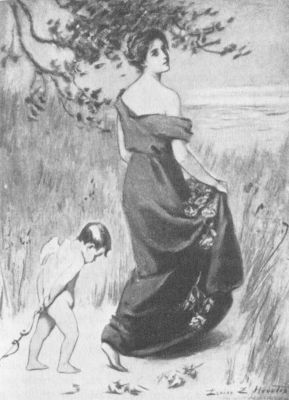
From a Copley Print.
THE DEPARTURE OF SUMMER
Louise L. Heustis
A portrait painter. At a recent exhibition of the Society of American Artists, Miss Heustis's genre portrait called "The Recitation" was most attractive and well painted. She has painted portraits of Mr. Henry F. Dimock; Mr. Edward L. Tinker, in riding clothes, of which a critic says, "It is painted with distinction and charm"; the portrait of a little boy in a Russian blouse is especially attractive; and a portrait of Miss Soley in riding costume is well done. These are but a small number of the portraits by this artist. She is clever in posing her sitters, manages the effect of light with skill and judgement, and renders the various kinds of textures to excellent advantage.
As an illustrator Miss Heustis has been employed by St. Nicholas, Scribner's, and Harper's Magazine.
Hill, Amelia R. A native of Dunfermline, she lived many years in Edinburgh. A sister of Sir Noel and Walter H. Paton, she married D. O. Hill, of the Royal Scottish Academy. Mrs. Hill made busts of Thomas Carlyle, Sir David Brewster, Sir Noel Paton, Richard Irven, of New York, and others. She also executed many ideal figures. She was the sculptor of the memorial to the Regent Murray at Linlithgow, of the statue of Captain Cook, and that of Dr. Livingstone; the latter was unveiled in Prince's Gardens, Edinburgh, in 1876, and is said to be the first work of this kind executed by a woman and erected in a public square in Great Britain.
"Mrs. Hill has mastered great difficulties in becoming a sculptor in established practice."—Mrs. Tytler's "Modern Painters."
"Mrs. Hill's Captain Cook—R. Scottish Academy, 1874—is an interesting figure and a perfectly faithful likeness, according to extant portraits of the great circumnavigator."—Art Journal, April, 1874.
Hills, Laura Coombs. Medal at Art Interchange, 1895; bronze medal, Paris Exposition, 1900; silver medal, Pan-American Exposition, 1901; second prize, Corcoran Art Gallery, Washington, D. C, 1901. Member of Society of American Artists, Women's Art Club, New York, American Society of Miniature Painters, and Water-Color Club, Boston. Born in Newburyport, Massachusetts. Studied in Helen M. Knowlton's studio and at Cowles Art School, Boston, and at Art Students' League, New York.
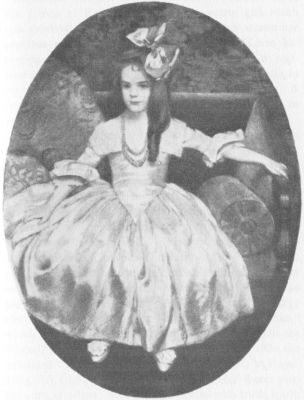
MINIATURE OF PERSIS BLAIR
Laura Coombs Hills
Miss Hills is a prominent and successful miniaturist, and her numerous pictures are in the possession of her subjects. They are decidedly individual in character. No matter how simple her arrangements, she gives her pictures a cachet of distinction. It may be "a lady in a black gown with a black aigrette in her hair and a background of delicate turquoise blue, or the delicate profile of a red-haired beauty, outlined against tapestry, the snowy head and shoulders rising out of dusky brown velvet; but the effect is gem-like, a revelation of exquisite coloring that is entirely artistic."
"An attractive work," reproduced here, "may be called a miniature picture. It is a portrait of a little lady, apparently six or seven years old, in an artistic old-fashioned gown, the bodice low in neck and cut in sharp point at the waist line in front; elbow sleeves, slippers with large rosettes, just peeping out from her dress, her feet not touching the floor, so high is she seated. Her hair, curling about her face, is held back by a ribbon bandeau in front; one long, heavy curl rests on the left side of her neck, and is surmounted by a big butterfly bow. The costume and pose are delightful and striking at first sight, but the more the picture is studied the more the face attracts the attention it merits. It is a sweet little girl's face, modest and sensible. She is holding the arm of her seat with a sort of determination to sit that way and be looked at so long as she must, but her expression shows that she is thinking hard of something that she intends to do so soon as she can jump down and run away to her more interesting occupations."
Hinman, Leana McLennan.
[No reply to circular.]
Hitz, Dora. Born at Altdorf, near Nuremberg, 1856. During eight years she worked under the direction of Lindenschmit, 1870-1878. She was then invited to Bucharest by the Queen of Roumania, "Carmen Sylva." Here the artist illustrated the Queen's poem, "Ada," with a series of water-color sketches, and painted two landscapes from Roumanian scenery. Between 1883 and 1886 she made sketches for the mural decoration of the music-room at the castle of Sinoia. Later, in Brittany and Normandy, she made illustrations for the fisher-romances of Pierre Loti. At Berlin, in 1891-1892, she painted portraits, and then retired to Charlottenburg. Her exhibition of two beautiful pictures in gouache, at Dresden, in 1892, brought her into notice, and her grasp of her subjects and her method of execution were much commended.
Fräulein Hitz could not stem the "classic" art creed of Berlin, where the "new idealism" is spurned. She ventured to exhibit some portraits and studies there in 1894, and was most unfavorably criticised. At Munich, however, in 1895, her exhibition was much admired at the "Secession." Again, in 1898, she exhibited, in Berlin, at the Union of Eleven, a portrait of a young girl, which was received with no more favor than was shown her previous works. In the same year, at the "Livre Esthetique," in Brussels, her pictures were thought to combine a charming grace with a sure sense of light effects, in which the predominating tone was a deep silver gray. A portrait by this artist was exhibited at a Paris Salon in 1895.
Hoffmann, Felicitas. Born in Venice, she died in Dresden, 1760. Pupil of Rosalba Camera. There are four pictures in the Dresden Gallery attributed to her—"St. George," after Correggio; "Diana with an Italian Greyhound," after Camera; "Winter," a half-length figure by herself; and her own portrait. Her principal works were religious subjects and portraits.
Hoffmann-Tedesco, Giulia. Prize at the Beatrice Exposition, Naples. Born at Wurzburg, 1850. This artist has lived in Italy and made her artistic success there, her works having been seen in many exhibitions. Her prize picture at Naples was called "A Mother's Joy." In 1877 she exhibited in the same city "Sappho" and "A Mother," which were much admired; at Turin, 1880, "On the Water" and "The Dance" were seen; at Milan, 1881, she exhibited "Timon of Athens" and a "Sunset"; at Rome, 1883, "A Gipsy Girl" and "Flowers." Her flower pictures are excellent; they are represented with truth, spirit, and grace.
Hogarth, Mary. Exhibits regularly at the New English Art Club, and occasionally at the New Gallery. Born at Barton-on-Humber, Lincolnshire. Pupil of the Slade School under Prof. Fred Brown and P. Wilson Steer.
Miss Hogarth's contribution to the exhibition of the New English Art Club, 1902, was called "The Green Shutters," a very peculiar title for what was, in fact, a picture of the Ponte Vecchio and its surroundings, in Florence. It was interesting. It was scarcely a painting; a tinted sketch would be a better name for it. It was an actual portrait of the scene, and skilfully done.
Hormuth-Kollmorgen, Margarethe. Born at Heidelberg, 1858. Pupil of Ferdinand Keller at Carlsruhe. Married the artist Kollmorgen, 1882. This painter of flowers and still-life has also devoted herself to decorative work, mural designs, fire-screens, etc., in which she has been successful. Her coloring is admirable and her execution careful and firm.
Hosmer, Harriet G. Born in Watertown, Massachusetts, 1830. Pupil in Boston of Stevenson, who taught her to model; pupil of her father, a physician, in anatomy, taking a supplementary course at the St. Louis Medical School.
Since 1852 she has resided in Rome, where she was a pupil of Gibson. Two heads, "Daphne" and "Medusa," executed soon after she went to Rome, were praised by critics of authority. "Will-o'-the-Wisp," "Puck," "Sleeping Faun," "Waking Faun," and "Zenobia in Chains" followed each other rapidly.
Miss Hosmer made a portrait statue of "Maria Sophia, Queen of the Sicilies," and a monument to an English lady to be placed in a church in Rome. Her "Beatrice Cenci" has been much admired; it is in the Public Library at St. Louis, and her statue of Thomas H. Benton is in a square of the same city.
For Lady Ashburton Miss Hosmer made her Triton and Mermaid Fountains, and a Siren Fountain for Lady Marian Alford.
Houston, Caroline A.
[No reply to circular.]
Houston, Frances C. Bronze medal at Atlanta Exposition; honorable mention at Paris Exposition, 1900. Member of the Water-Color Club, Boston, and of the Society of Arts and Crafts. Born in Hudson, Michigan, 1851. Studied in Julian Academy under Lefebvre and Boulanger.
A portrait painter whose pictures are in private hands. They have been exhibited in Paris, London, Naples, New York, Philadelphia, and Boston.
Mrs. Houston writes me: "I have not painted many pictures of late years, but always something for exhibition every year." She first exhibited at Paris Salon in 1889, in London Academy in 1890, and annually sends her portraits to the Boston, New York, and Philadelphia Exhibitions.
Hoxie, Vinnie Ream. Born in Madison, Wisconsin, 1847. This sculptor was but fifteen years old when she was commissioned to make a life-size statue of Abraham Lincoln, who sat for his bust; her completed statue of him is in the rotunda of the Capitol at Washington. Congress then gave her the commission for the heroic statue of Admiral Farragut, now in Farragut Square, Washington. These are the only two statues that the United States Government has ordered of a woman.
This artist has executed ideal statues and several bust portraits of distinguished men. Of these the bust of Ezra Cornell is at Cornell University; that of Mayor Powell in the City Hall of Brooklyn, etc.
Hudson, Grace. Gold medal at Hopkins Institute, San Francisco; silver medal at Preliminary World's Fair Exhibition of Pacific States; and medals and honorable mention at several California State exhibitions. Born in Potter Valley, California. Studied at Hopkins Art Institute, San Francisco, under Virgil Williams and Oscar Kunath.
Paints genre subjects, some of which are "Captain John," in National Museum; "Laughing Child," in C. P. Huntington Collection; "Who Comes?" in private hands in Denver, etc.
Mrs. Hudson's pictures of Indians, the Pomas especially, are very interesting, although when one sees the living article one wonders how a picture of him, conscientiously painted and truthful in detail, can be so little repulsive—or, in fact, not repulsive at all. At all events, Mrs. Hudson has no worthy rival in painting California Indians. If we do not sympathize with her choice of subjects, we are compelled to acknowledge that her pictures are full of interest and emphasize the power of this artist in keeping them above a wearisome commonplace.
Her Indian children are attractive, we must admit, and her "Poma Bride," seated in the midst of the baskets that are her dower, is a picture which curiously attracts and holds the attention. Her compositions are simple, and it can only be a rare skill in their treatment that gives them the value that is generally accorded them by critics, who, while approving them, are all the time conscious of surprise at themselves for doing so, and of an unanswered Why? which persists in presenting itself to their thought when seeing or thinking of these pictures.
Hulbert, Mrs. Katherine Allmond. Born in Sacramento Valley, California. Pupil of the San Francisco School of Design under Virgil Williams; National Academy of Design, New York, under Charles Noel Flagg; Artist Artisan Institute, New York, under John Ward Stimson.
This artist paints in water-colors and her works are much admired. Among the most important are "The Stream, South Egremont," which is in a private gallery in Denver; "In the Woods" belongs to Mr. Whiting, of Great Barrington; and "Sunlight and Shadow" to Mr. Benedict, Albany, New York.
Mrs. Hulbert is also favorably known as an illustrator and decorative designer.
Hunter, Mary Y. Four silver medals at Royal Academy Schools Exhibitions; diploma for silver medal, Woman's International Exhibition, Earl's Court, London. Member of Society of Painters in Tempera. Born in New Zealand. Studied at Royal Academy Schools.
The following list of the titles of Mrs. Hunter's works will give an idea of the subjects she affects: "Dante and Beatrice," "Joy to the Laborer," "An Italian Garden," "Where shall Wisdom be Found?" and the "Roadmenders," in Academy Exhibition, 1903.
The only work of Mrs. Hunter's that I have seen is the "Dante and Beatrice," Academy, 1900, and the impression I received leads me to think an article in the Studio, June, 1903, a just estimate of her work. It is by A. L. Baldry, who writes: "In the band of young artists who are at the present time building up sound reputations which promise to be permanent, places of much prominence must be assigned to Mr. J. Young Hunter and his wife. Though neither of them has been before the public for any considerable period, they have already, by a succession of notable works, earned the right to an amount of attention which, as a rule, can be claimed only by workers who have a large fund of experience to draw upon. But though they have been more than ordinarily successful in establishing themselves among the few contemporary painters whose performances are worth watching, they have not sprung suddenly into notice by some special achievement or by doing work so sensational that it would not fail to set people talking. There has been no spasmodic brilliancy in their progress, none of that strange alternation of masterly accomplishment and hesitating effort which is apt at times to mark the earlier stages of the life of an artist who may or may not attain greatness in his later years. They have gone forward steadily year by year, amplifying their methods and widening the range of their convictions; and there has been no moment since they made their first appeal to the public at which they can be said to have shown any diminution in the earnestness of their artistic intentions.
"The school to which they belong is one which has latterly gathered to itself a very large number of adherents among the younger painters—a school that, for want of a better name, can be called that of the new Pre-Raphaelites. It has grown up, apparently, as an expression of the reaction which has recently set in against the realistic beliefs taught so assiduously a quarter of a century ago. At the end of the seventies there was a prevailing idea that the only mission of the artist was to record with absolute fidelity the facts of nature.... To-day the fallacy of that creed is properly recognized, and the artists on whom we have to depend in the immediate future for memorable works have substituted for it something much more reasonable.... There runs through this new school a vein of romantic fantasy which all thinking people can appreciate, because it leads to the production of pictures which appeal, not only to the eye by their attractiveness of aspect, but also to the mind by their charm of sentiment.... It is because Mr. Young Hunter and his wife have carried out consistently the best principles of this school that they have, in a career of some half-dozen years, established themselves as painters of noteworthy prominence. Their romanticism has always been free from exaggeration and from that morbidity of subject and treatment which is occasionally a defect in the work of young artists. They have kept their art wholesome and sincere, and they have cultivated judiciously those tendencies in it which justify most completely the development of the new Pre-Raphaelitism. They are, indeed, standing examples of the value of this movement, which seems destined to make upon history a mark almost as definite as that left by the original Brotherhood in the middle of the nineteenth century. By their help, and that of the group to which they belong, a new artistic fashion is being established, a fashion of a novel sort, for its hold upon the public is a result not of some irrational popular craze, but of the fascinating arguments which are put into visible shape by the painters themselves."
Hyatt, Harriet Randolph—Mrs. Alfred L. Mayer. Silver medal at Exposition in Atlanta, Georgia, 1895. Member of National Art Club, New York. Born at Salem, Massachusetts. Studied at Cowles Art School and with Ross Turner; later under H. H. Kitson and Ernest L. Major.
Among this artist's pictures are "Shouting above the Tide," "Primitive Fishing," "The Choir Invisible," etc.
The plaster group called the "Boy with Great Dane" was the work of this artist and her sister, Anna Vaughan Hyatt, and is at the Bureau of the Society for the Prevention of Cruelty to Animals, in New York.
Hyatt, Anna Vaughan. Member of the Copley Society, Boston. Born in Cambridge, Massachusetts. Studied nature at Bostock's Animal Arena, Norumbega Park, and at Sportsman's Exhibition. Criticism from H. H. Kitson.
The principal works of this artist are the "Boy with Great Dane," already mentioned, made in conjunction with her sister; a "Bison," in a private collection in Boston; and "Playing with Fire."
In November, 1902, Miss Hyatt held an exhibition of her works, in plaster and bronze, at the Boston Art Club. There were many small studies taken from life.
Hyde, Helen. Member of the Art Association, San Francisco. Born in Lima, New York, but has lived so much in California that she is identified with that State, and especially with San Francisco. She made her studies in San Francisco, Philadelphia, New York, and Paris, where she was a pupil of Felix Regamy and Albert Sterner. She then went to Holland, where she also studied. On her return to San Francisco she became so enamoured of the Oriental life she saw there that she determined to go to Japan to perfect herself in colored etching. Miss Hyde devoted herself to the study she had chosen during three years. She lived in an old temple at Tokio, made frequent excursions into the country, was a pupil of the best Japanese teachers, adapted herself to the customs of the country, worked on low tables, sitting on the floor, and so gained the confidence of the natives that she easily obtained models, and, in a word, this artist was soon accorded honors in Japanese exhibitions, where her pictures were side by side with those of the best native artists.
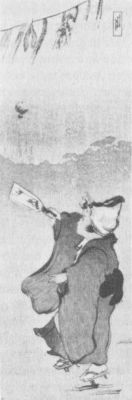
CHILD OF THE PEOPLE
Helen Hyde
Miss Hyde has made a visit to America and received many commissions which decided her to return to Japan. A letter from a friend in Tokio, written in October, 1903, says that she will soon return to California.
Ighino, Mary. A sculptor residing in Genoa. Since 1884 she has exhibited a number of busts, bas-reliefs, and statues. At Turin in the above-named year she exhibited a group in plaster, "Love Dominating Evil." She is especially successful in bas-relief portraits; one of these is of the Genoese sculptor, Santo Varin. She has also made a bust of Emanuele Filiberto; and in terra-cotta a bust of Oicetta Doria, the fifteenth-century heroine of Mitylene. She has executed a number of decorative and monumental works, and receives many commissions from both Italians and foreigners.
Inglis, Hester. This artist lived in the last half of the sixteenth and in the early decades of the seventeenth century. In the Library of Christ Church College, Oxford, there is an example of the Psalms, in French, written and decorated by her, which formerly belonged to Queen Elizabeth. In the Royal Library of the British Museum there is also a "Book of Emblems" from her hand.
Itasse, Jeanne. Honorable mention, Paris Salon, 1888, and the purse of the city of Paris; at Paris Exposition, honorable mention, 1889; travelling purse, 1891; medal at Chicago Exposition, 1893; medal third class, Salon, 1896; medal second class, 1899; silver medal, Paris Exposition, 1900. Member of Société des Artistes Français, Société Libre, Société des prix du Salon et boursiers de voyage. Born in Paris. Pupil of her father.
Several works of this sculptor have been purchased by the Government and are in the Bureaux of Ministers or in provincial museums. A "Bacchante" is in the Museum at Agen; a portrait bust in the Museum of Alger. At the Salon of 1902 Mlle Itasse exhibited a "Madonna"; in 1903, a portrait of M, W.
Mlle Itasse knows her art thoroughly. When still a child, at the age when little girls play with dolls, she was in her father's atelier, working in clay with an irresistible fondness for this occupation, and without relaxation making one little object after another, until she acquired that admirable surety of execution that one admires in her work—a quality sometimes lacking in the work of both men and women sculptors.
Since her début at the Salon of 1886 she has annually exhibited important works. In 1887 her bust of the danseuse, Marie Salles, was purchased by the Government for the Opera; in 1888 she exhibited a plaster statue, the "Young Scholar," and the following year the bust of her father; in 1890 a "St. Sebastian" in high relief; in 1891 an "Egyptian Harpist," which gained her a traveller's purse and an invitation from the Viceroy of Egypt; in 1893 a Renaissance bas-relief; in 1894 the superb funeral monument dedicated to her father; in 1896 she exhibited, in plaster, the "Bacchante," which in marble was a brilliant success and gained for her a second-class medal and the palmes académique, while the statue was acquired by the Government. Mlle. Itasse has also gained official recompenses in provincial exhibitions and has richly won the right to esteem herself mistress of her art.
Jacquemart, Mlle. Nélie. Medals at Paris Salon, 1868, 1869, and 1870. Born in Paris. A very successful portrait painter. Among the portraits she has exhibited at the Paris Salon are those of Marshal Canrobert, General d'Aurelle de Paladines, General de Palikao, Count de Chambrun, M. Dufaure, and many others, both ladies and gentlemen. Her portrait of Thiers in 1872 was greatly admired.
Paul d'Abrest wrote of Mlle. Jacquemart, in the Zeitschrift für bildende Kunst: "One feels that this artist does not take her inspirations alone from the sittings of her subjects, but that she finds the best part of her work in her knowledge of character and from her close study of the personnelle of those whom she portrays."
Janda, Herminie von. Born at Klosterbruch, 1854. Pupil of Ludwig Holanska and Hugo Darnaut. Since 1886 her landscapes have been seen in various Austrian exhibitions. One of these was bought for the "Franzens-Museum" at Brünn, while several others were acquired by the Imperial House of Austria.
Jenks, Phoebe A. Pickering. Born in Portsmouth, New Hampshire, 1849. Mrs. Jenks writes that she has had no teachers.
Her works, being portraits, are mostly in the homes of their owners, but that of the son of T. Jefferson Coolidge, Jr., has been exhibited in the Museum of Fine Arts, Boston, and that of Mrs. William Slater and her son is in the Slater Museum at Norwich.
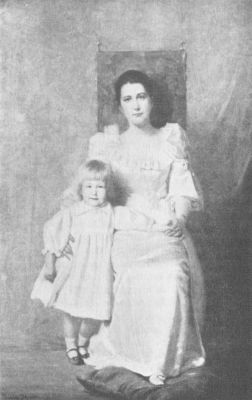
MOTHER AND CHILD
Phoebe Jenks
Mrs. Jenks has been constantly busy in portrait painting for twenty-seven years, and has had no time for clubs and societies. She esteems the fact of her constant commissions the greatest honor that she could have. She has probably painted a greater number of portraits than any other Boston contemporary artist.
Jerichau-Baumann, Elizabeth. 1819-1881. Honorable mention, Paris Salon, 1861. Member of the Academy of Copenhagen. Born in Warsaw. Pupil of Karl Sohne and Stilke, in Düsseldorf. In Rome she married the Danish sculptor Jerichau and afterward lived in Copenhagen. She travelled in England, France, Russia, Greece, Turkey, and Egypt.
Her picture of a "Polish Woman and Children Leaving Their Home, which had been Destroyed," is in the Raczynski Collection, Berlin; "Polish Peasants Returning to the Ruins of a Burnt House," in the Lansdowne Collection, London; "A Wounded Soldier Nursed by His Betrothed," in the Gallery at Copenhagen, where is also her portrait of her husband; "An Icelandic Maiden," in the Kunsthalle, Hamburg. Her picture, "Reading the Bible," was painted for Napoleon III. at his request. Mme. Jerichau painted a portrait of the present Queen of England, in her wedding dress. A large number of her works are in private houses in Copenhagen.
One of her most important pictures was a life-size representation of "Christian Martyrs in the Catacombs." This picture was much talked of in Rome, where it was painted, and the Pope desired to see it. Madame Jerichau took the picture to the Vatican. On seeing it the Pope expressed surprise that one who was not of his Church could paint this picture. Mme. Jerichau, hearing this, replied: "Your Holiness, I am a Christian."
Hans Christian Andersen was an intimate friend in the Jerichau family. He attended the wedding in Rome, and wrote the biographies of Professor and Mme. Jerichau.
Théophile Gautier once said that but three women in Europe merited the name of artists—Rosa Bonheur, Henrietta Brown, and Elizabeth Jerichau; and Cornelius called her "the one woman in the Düsseldorf School," because of her virile manner of painting.
Among her important portraits are those of Frederick VII. of Denmark, the brothers Grimm, and "Hans Christian Andersen Reading His Fairy Tales to a Child."
Mme. Jerichau was also an author. In 1874 she published her "Memories of Youth," and later, with her son, the illustrated "Pictures of Travel."
Jopling-Rowe, Louise. Member of Royal Society of British Artists, Society of Portrait Painters, Pastel Society, Society of Women Artists. Born at Manchester, 1843. Pupil of Chaplin in Paris; also studied with Alfred Stevens.
Since 1871 Mrs. Jopling has been a constant exhibitor at the Royal Academy and other London exhibitions, and frequently also at the Paris Salon.
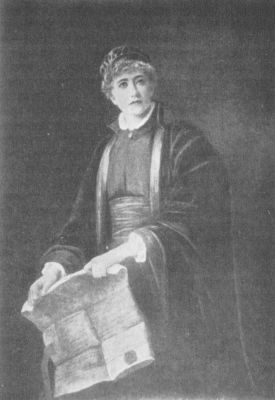
MISS ELLEN TERRY AS "PORTIA"
Louise Jopling Rowe
Her pictures are principally portraits and genre subjects. Her first decided success was gained in 1874, when she exhibited at the Academy the "Japanese Tea Party," and from that time she was recognized as an accomplished artist and received as many commissions as she could execute. The Baroness de Rothschild had been convinced of Mrs. Jopling's talent before she became an artist, and had given her great encouragement in the beginning of her career. The portrait of Lord Rothschild, painted for Lord Beaconsfield, is thought to be her best work of this kind, but its owner would not allow it to be exhibited. Her portrait of Ellen Terry, which hangs in the Lyceum Theatre, was at the Academy in 1883. It is in the costume of Portia. Mrs. Jopling's pastels are of an unusual quality, delicate, strong, and brilliant. Her portraits are numerous, and from time to time she has also executed figure subjects.
Of late years Mrs. Jopling has been much occupied with a School of Painting. The large number of pupils who wished to study with her made a school the best means of teaching them, and has been successful. From the beginning they draw from life, and at the same time they also study from the antique.
Many of her pupils receive good prices for their works, and also earn large sums for their portraits in black and white.
Mrs. Jopling writes: "What I know I chiefly learned alone. Hard work and the genius that comes from infinite pains, the eye to see nature, the heart to feel nature, and the courage to follow nature—these are the best qualifications for the artist who would succeed."
In the Art Journal, July, 1874, I read: "'The Five-o'Clock Tea' is the largest and most important design we have seen from Mrs. Jopling's hand, and in the disposition of the various figures and the management of color it certainly exhibits very remarkable technical gifts. Especially do we notice in this lady's work a correct understanding of the laws of tone, very rare to find in the works of English painters, giving the artist power to bring different tints, even if they are not harmonious, into right relations with one another."
The above-named picture was sold to the Messrs. Agnew, and was followed by "The Modern Cinderella," which was seen at the Paris Exposition in 1878; at the Philadelphia Exposition in 1876 she exhibited "Five Sisters of York."
Mrs. Jopling is also known as the founder and president of the Society of the Immortals. She has written several short tales, some poems, and a book called "Hints to Amateurs."
At the Royal Academy, 1903, she exhibited "Hark! Hark! the Lark at Heaven's Gate Sings," which is a picture of a poor girl beside a table, on which she has thrown her work, and leaning back in her chair, with hands clasped behind her head, is lost in thought.
Joris, Signorina Agnese—pseudonym, Altissimi. Was accorded the title of professor at the Institute of the Fine Arts, Rome, 1881. She was successful in a competition for a position in the Scuole Tecniche, Rome, 1888. Honorable mention, Florence, 1890; same at Palermo, 1891 and 1892; silver medal of first class and diploma of silver medal, Rome, 1899 and 1900. Member of the Società Cooperativa, Rome. Born in the same city, and pupil of the Institute of Fine Arts and of her brother, Cavaliere Professore Pio Joris.
This artist writes that a list of her works would be too long and require too much time to write it. They are in oils, pastel, and water-colors, with various applications of these to tapestries, etc. She also gives lessons in these different methods of painting. In a private collection in New York is her "Spanish Scene in the Eighteenth Century."
She painted a "portrait of the late King Humbert, arranged in the form of a triptych surrounded by a wreath of flowers, painted from some which had lain on the King's bier." She sent this picture to Queen Margharita, "who not only graciously accepted it, but sent the artist a beautiful letter and a magnificent jewel on which was the Royal Cipher."
Kaerling, Henriette. Born about 1832. Daughter of the artist, J. T. Kaerling, who was her principal teacher. She practised her art as a painter of portraits, genre subjects, and still-life in Budapest during some years before her marriage to the pianist Pacher, with whom she went to Vienna. She there copied some of the works of the great painters in the Gallery, besides doing original work of acknowledged excellence. In addition to her excellent portraits, she painted in 1851 "The Grandmother"; in 1852, "A Garland with Religious Emblems"; in 1855, "A Crucifix Wound with Flowers."
Kalckreuth, Countess Maria. Medal at Chicago Exposition, 1893. Member of the Society of Women Artists in Berlin. Born at Düsseldorf. 1857-1897. Much of her artistic life was passed in Munich. Her picture at Chicago was later exhibited at Berlin and was purchased for the Protestant Chapel at Dachau. It represented "Christ Raising a Repentant Sinner"—a strong work, broadly painted. Among her important pictures are "In the Sunshine," "Fainthearted," "Discontented," and several portraits, all of which show the various aspects of her artistic talent.
Kauffman, Angelica. An original member of the London Academy. She was essentially an Italian artist, since from the age of eleven she lived in Italy and there studied her art. Such different estimates have been made of her works that one may quote a good authority in either praise or blame of her artistic genius and attainment.
Kugler, a learned, unimpassioned critic, says: "An easy talent for composition, though of no depth; a feeling for pretty forms, though they were often monotonous and empty, and for graceful movement; a coloring blooming and often warm, though occasionally crude; a superficial but agreeable execution, and especially a vapid sentimentality in harmony with the fashion of the time—all these causes sufficiently account for her popularity."
Alinari, Photo
In the Uffizi, Florence
PORTRAIT OF ANGELICA KAUFFMAN
Painted By Herself
Raphael Mengs, himself an artist, thus esteems her: "As an artist she is the pride of the female sex in all times and all nations. Nothing is wanting—composition, coloring, fancy—all are here."
Miss Kate Thompson writes: "Her works showed no originality nor any great power of execution, and, while sometimes graceful, were generally weak and insipid."
For myself I do not find her worthy of superlative praise or condemnation; one cannot deny her grace in design, which was also creditably correct; her poetical subjects were pleasing in arrangement; her historical subjects lacked strength and variety in expression; her color was as harmonious and mellow as that of the best Italian colorists, always excepting a small number of the greatest masters, and in all her pictures there is a something—it must have been the individuality of the artist—that leads one to entertain a certain fondness for her, even while her shortcomings are fully recognized.
The story of Angelica Kauffman's life is of unusual interest. She was born at Coire, in the Grisons. 1742-1807. Her father, an artist, had gone from Schwarzenburg to Coire to execute some frescoes in a church, and had married there. When Angelica was a year old the family settled in Morbegno, in Lombardy. Ten years later, when the child had already shown her predilection for painting and music, a new home was made for her in Como, where there were better advantages for her instruction.
Her progress in music was phenomenal, and for a time she loved her two arts—one as well as the other—and could make no choice between them. In one of her pictures she represented herself as a child, standing between allegorical figures of Music and Painting.
The exquisite scenery about Como, the stately palaces, charming villas, the lake with its fairy-like pleasure boats, and the romantic life which there surrounded this girl of so impressionable a nature, rapidly developed the poetic element born with her, which later found expression through her varied talents. During her long life the recollections of the two years she passed at Como were among the most precious memories associated with her wandering girlhood.
From Como she was taken to Milan, where she had still better advantages for study, and a world of art was opened to her which far exceeded her most ardent imaginings. Leonardo had lived and taught in Milan, and his influence with that of other Lombard masters stirred Angelica to her very soul.
Her pictures soon attracted the attention of Robert d'Este, who became her patron and placed her in the care of the Duchess of Carrara. This early association with a circle of cultured and elegant men and women was doubtless the origin of the self-possession and modest dignity which characterized Angelica Kauffman through life and enabled her becomingly to accept the honors that were showered upon her.
Her happy life at Milan ended all too soon. Her mother died, and her father decided to return to his native Schwarzenburg to execute some extensive decorative works in that vicinity. In the interior decoration of a church Angelica painted in fresco the figures of the twelve apostles after engravings from the works of Piazetta.
The coarse, homely life of Schwarzenburg was in extreme contrast to that of Milan and was most uncongenial to a sensitive nature; but Angelica was saved from melancholy by the companionship she felt in the grand pine forests, which soothed her discontent, while her work left her little time to pine for the happiness she had left or even to mourn the terrible loss of her mother.
Her father's restlessness returned, and they were again in Milan for a short time, and then in Florence. Here she studied assiduously awhile, but again her father's discontent drove him on, and they went to Rome.
Angelica was now eighteen years old, and in a measure was prepared to profit by the aid and advice of Winckelmann. He conceived an ardent friendship for the young artist, and, though no longer young, and engaged in most important and absorbing research, he found time to interest himself in Angelica's welfare, and allowed her to paint his portrait, to which she gave an expression which proved that she had comprehended the spirit of this remarkable man of threescore years.
While at Rome Angelica received a commission to copy some pictures in Naples. After completing these she returned to Rome, in 1764, and continued her studies for a time, but her interests were again sacrificed to her father's unreasonable capriciousness, and she was taken to Bologna and then to Venice. This constant change was disheartening to Angelica and of the greatest disadvantage to her study, and it was most fortunate that she now met Lady Wentworth, who became her friend and afterward took her to England.
Angelica had already executed commissions for English families of rank whom she had met in various cities of Italy, and her friends hoped that she would be able to earn more money in England than in Italy, where there were numberless artists and copyists. After visiting Paris she went to London, where a brilliant career awaited her, not only as an artist, but in the social world as well.
De Rossi thus describes her at this time: "She was not very tall, but slight, and her figure was well proportioned. She had a dark, clear complexion, a gracious mouth, white and equal teeth, and well-marked features;... above all, her azure eyes, so placid and so bright, charmed you with an expression it is impossible to write; unless you had known her you could not understand how eloquent were her looks."
Her English friends belonged to the most cultivated circles, many of them being also of high rank. Artists united to do her honor—showing no professional envy and making no opposition to her election to the Academy. Many interesting incidents in her association with London artists are related, and it is said that both Fuseli and Sir Joshua Reynolds were unsuccessful suitors for her hand. Miss Thackeray, in her novel, "Miss Angel," makes Angelica an attractive heroine.
The royal family were much interested in her, and the mother of the King visited her—an honor never before accorded to an artist—and the Princess of Brunswick gave her commissions for several pictures.
De Rossi says that her letters at this time were those of a person at the summit of joy and tranquillity. She was able to save money and looked hopefully forward to a time when she could make a home for her unthrifty father. But this happy prosperity was suddenly cut short by her own imprudence.
After refusing many eligible offers of marriage, she was secretly married to an adventurer who personated the Count de Horn, and succeeded by plausible falsehoods in convincing her that it was necessary, for good reasons, to conceal their marriage. One day when painting a portrait of Queen Charlotte, who was very friendly to the artist, Angelica was moved to confide the secret of her marriage to the Queen. Until this time no one save her father had known of it.
Her Majesty, who loved Angelica, expressed her surprise and interest and desired that Count de Horn should appear at Court. By this means the deceit which had been practised was discovered, and the Queen, as gently as possible, told Angelica the truth. At first she felt that though her husband was not the Count de Horn and had grossly deceived her, he was the man she had married and the vows she had made were binding. But it was soon discovered that the villain had a living wife when he made his pretended marriage with Angelica, who was thus released from any consideration for him. This was a time to prove the sincerity of friends, and Angelica was comforted by the steadfastness of those who had devoted themselves to her in her happier days. Sir Joshua Reynolds was untiring in his friendly offices for her and for her helpless old father.
There were as many differing opinions in regard to Angelica Kauffman, the woman, as in regard to the quality of her art. Some of her biographers believed her to be perfectly sincere and uninfluenced by flattery. Nollekens takes another view; he calls her a coquette, and, among other stories, relates that when in Rome, "one evening she took her station in one of the most conspicuous boxes in the theatre, accompanied by two artists, both of whom, as well as many others, were desperately enamoured of her. She had her place between her two adorers, and while her arms were folded before her in front of the box, over which she leaned, she managed to clasp a hand of both, so that each imagined himself the cavalier of her choice."
When Angelica could rise above the unhappiness and mortification of her infatuation for the so-called De Horn, she devoted herself to her art, and during twelve years supported her father and herself and strengthened the friendships she had gained in her adopted land. At length, in 1781, her father's failing health demanded their return to Italy; and now, when forty years old, she married Antonio Zucchi, an artist who had long loved her and devoted himself to her and to her father with untiring affection.
The old Kauffman lived to visit his home in Schwarzenburg and to reach Southern Italy, but died soon after.
Signor Zucchi made his home in Rome. He was a member of the Royal Academy, London, and was in full sympathy with his wife in intellectual and artistic pursuits and pleasures. De Rossi says: "It was interesting to see Angelica and her husband before a picture. While Zucchi spoke with enthusiasm Angelica remained silent, fixing her eloquent glance on the finest portions of the work. In her countenance one could read her emotions, while her observations were limited to a few brief words. These, however, seldom expressed any blame—only the praises of that which was worthy of praise. It belonged to her nature to recognize the beauty alone—as the bee draws honey only out of every flower."
Her home in Rome was a centre of attraction to the artistic and literary society of the city, and few persons of note passed any time there without being presented to her. Goethe and Herder were her friends, and the former wrote: "The good Angelica has a most remarkable, and for a woman really unheard-of, talent; one must see and value what she does and not what she leaves undone. There is much to learn from her, particularly as to work, for what she effects is really marvellous." In his work called "Winckelmann and His Century," Goethe again said of her: "The light and pleasing in form and color, in design and execution, distinguish the numerous works of our artist. No living painter excels her in dignity or in the delicate taste with which she handles the pencil."
In the midst of the social demands on her time in Rome, she continued to devote herself to her art, and Signor Zucchi, hoping to beguile her into idleness, purchased a charming villa at Castel Gondolfo; but in spite of its attractions she was never content to be long away from Rome and her studio.
Thus in her maturer years her life flowed on in a full stream of prosperity until, in 1795, Signor Zucchi died. Angelica survived him twelve years—years of deep sadness. Not only was her personal sorrow heavy to bear, but the French invasion of her beloved Italy disquieted her. Hoping to regain her usual spirits, she revisited the scenes of her youth and remained some time in Venice with the family of Signor Zucchi. Returning to Rome she resumed her accustomed work, so far as her health permitted.
She held fast to the German spirit through all the changes in her life, with the same determination which made it possible, in her strenuous labors, to retain her gentle womanliness. Just before she died she desired to hear one of Gellert's spiritual odes.
She was buried in Sant' Andrea dei Frati, beside her husband. All the members of the Academy of St. Luke attended her obsequies, and her latest pictures were borne in the funeral procession. Her bust was placed in the Pantheon, and every proper tribute and honor were paid to her memory in Rome, where she was sincerely mourned.
Although Angelica lived and worked so long in London and was one of the thirty-six original members of the Royal Academy, I do not think her best pictures are in the public galleries there. Of course many of the portraits painted in London are in private collections. Her pictures are seen in all the important galleries of Europe. Her etchings, executed with grace and spirit, are much esteemed and sell for large prices. Engravings after her works by Bartolozzi are most attractive; numerous as they were, good prints of them are now rare and costly.