Volume 2 — VEGETABLES (PART 1)
Reading edition
IMPORTANCE OF VEGETABLES AS FOOD
VARIETY IN VEGETABLES
1. As understood in cookery, VEGETABLES refer to plants or parts of plants that are used as food. Vegetables may consist of the entire plant, as, for example, the beet; the stem, as asparagus and celery; the root, as carrot and turnip; the underground stem, or tuber, as the white potato and onion; the foliage, as cabbage and spinach; the flower of the plant, as cauliflower; the pods, which hold the seeds of the plant or the seeds themselves, as peas and beans; or that which in reality is fruit, although for table use always considered a vegetable, as the tomato and eggplant.
2. Because of this large assortment, vegetables afford the greatest possible variety in flavor, appearance, texture, quality, and food value. They therefore assume a place of very great importance in the diet of individuals and in the plans of the housewife who has all the meals to prepare for her family. In fact, there is scarcely a meal, except breakfast, at which vegetables are not served. For dinner, they form a part or all of each course in the meal, except, perhaps, the dessert, and occasionally they may be used for this.
Although two or more vegetables are nearly always served in even a simple meal, the use of vegetables in most households is limited to those few varieties which are especially preferred by the family. As a rule, there are a number of other vegetables that would be very acceptable if prepared in certain appetizing ways. An effort should therefore be made to include all such vegetables in the dietary, for they may be used to decided advantage and at the same time they afford variety in the meals. The constant demand for variety in this food makes acceptable new recipes for the preparation of the vegetables already known and information for the use of the unfamiliar kinds.
3. Great variety also exists in the flavor of vegetables, which they derive from their volatile oils; that is, the oils that evaporate rapidly on exposure to the air. In some cases, the flavor is disagreeably strong and must be dissipated, or driven away, in order to make the vegetables agreeable to the taste and to prevent them from disagreeing with those who eat them. In others, the flavor is very mild, so that unless the vegetables are properly prepared the flavor may be almost lost. When the principles relating to the cooking of vegetables are thoroughly understood, little difficulty will be experienced in preparing them so that the flavor is dissipated or retained as the case may require.
4. The food value of vegetables varies as much as do their form and flavor, some of them having almost no food value, others having a great deal, and the remainder varying between these two extremes. The housewife who wishes to provide economically for her family and at the same time give them food that is best suited to their needs, should learn as much of the composition and food value of the various kinds of vegetables as possible. If, besides acquiring this knowledge, she learns a variety of ways in which to prepare each kind, she will find that it is possible to substitute vegetable dishes for the more expensive foods. For instance, it is often possible to substitute a vegetable dish for a meat dish several times a week, but the composition of the vegetable dish must be such that it will really take the place of the meat dish.
5. That it is possible for adults to live on vegetables alone has been proved by vegetarians; that is, persons who exclude meat from the diet. They have shown that all the elements necessary to build and maintain the human body are contained in vegetables, fruits, and cereals, and also that these elements are in such quantity that it is not necessary to supply them in any other way. Even if it is not desired to use such foods exclusively, as much use should be made of them as possible, for they average a lower cost than the high-protein foods, such as eggs, meat, and milk. The use of vegetables, however, need not be restricted to adults, for when properly prepared they may be included to advantage in the diet of very young children. In fact, children should be trained to eat vegetables of all kinds, for such training not only will enable each one to grow up with a correct appreciation for all edible things, but will make the preparation of meals easier for the housewife.
6. Vegetables should receive great care in their preparation, whether the method involved is simple or complicated. Any of the methods of cookery that call for the application of heat may be applied to them, and in many cases they are served without cooking, merely dressing or seasoning being added. Good vegetables may be ruined by improper preparation, while those which are in excellent condition may be improved by the application of the correct methods in their preparation. Vegetables that are inexpensive but highly nutritious should be used when it is necessary to practice economy, because, when they are properly prepared, they form a valuable addition to a meal.
7. All varieties of vegetables are grown almost universally. This fact, together with the facts that they mature at different times during the season, according to the climate in which they are grown, and that most varieties can be conveniently shipped, makes the season in which certain fresh vegetables can be obtained much longer than it formerly was. For instance, very early in the season, long before it is possible to have beans, peas, and other vegetables in the North, they are shipped from the extreme South, and as the season advances, they mature farther and farther north. Therefore, they may be constantly supplied to the northern markets until the time when they mature in that locality.
8. In order not to waste vegetables and to have them in the best possible condition when they are desired for preparation, every housewife should realize that the selection and care of vegetables are also important matters to consider. The selection must be learned by familiarity with them, as well as practice in buying, and the housewife must be guided by the suitability of the vegetables and the money she has to spend for them. The care that must be given to them is determined by the kinds that are purchased, some requiring one kind of care in storage and others entirely different attention.
STRUCTURE, COMPOSITION, AND FOOD VALUE
9. STRUCTURE OF VEGETABLES.--Although vegetables vary greatly in composition and consequently in food value, they are similar so far as physical structure is concerned. In general, they consist of a skeleton framework that is made up of cellulose. Their digestible part is composed of tiny cells having thin walls that confine the actual food material in the form of a liquid or semiliquid. As the vegetables grow old, the cellulose material and the cell walls gradually toughen, with the result that old vegetables are less easily made tender than young ones and are not so agreeable to the taste as those which have not grown hard. The total food value of vegetables, as well as of cereals, meats, and, in fact, all foods, varies with the quantity of water and cellulose they contain. Therefore, the vegetables that contain the least coarse material are the ones that have the highest food value.
10. The green color that characterizes many vegetables is due to a substance called chlorophyl. This substance is essential to the normal growth of plants and is present in the correct amount in only those which are properly exposed to the sunlight. Sufficient proof of this is seen in the case of vegetables that form heads, as, for instance, cabbage and head lettuce. As is well known, the outside leaves are green, while the inside ones are practically white. Since it is exposure to the light that produces the green color, a vegetable or plant of any kind can be bleached by merely covering it in order to keep out the sunlight. This procedure also enables the plants to remain more tender than those which have been allowed to grow in the normal way and become green. For instance, the inside leaves of a head of lettuce are always very much more tender than the green outside leaves. In fact, the center of any kind of plant, that is, the leaves and the stem that appear last, are more tender, possess a lighter color, and have a more delicate flavor than the older ones.
11. PROTEIN IN VEGETABLES.--Taken as a whole, vegetables are not high in protein. Some of them contain practically none of this food substance and others contain a comparatively large amount, but the average is rather low. Vegetables that are high in water, such as lettuce, celery, tomatoes, and cucumbers, contain so little protein that the quantity is not appreciable. Such vegetables as potatoes, beets, carrots, etc. contain slightly larger quantities. Dried vegetables, such as beans, peas, and lentils, contain comparatively large amounts of this substance, and for this reason may be substituted for such high-protein foods as meat and fish.
12. The composition of vegetable protein is only slightly different from that of animal protein. In fact, the experiments of scientists show that animal protein may be readily replaced by vegetable protein. One of these proteins is sometimes called vegetable albumin, but the chief protein of vegetables containing the largest amount of this substance, namely, beans, peas, and lentils, is called legumin, from the term legumes, the name of this class of vegetables. It is generally agreed that vegetable protein is not so digestible as animal protein, but this disadvantage is offset by the fact that it does not bring about so much intestinal trouble as does the protein of animal foods and is less likely to cause disturbances that are usually attributed to foods high in this substance. Vegetable protein is affected by heat in much the same way as other protein.
When any of the dry vegetables high in protein are served at a meal, meat should be eliminated, or the result will be an oversupply of protein. As this condition is not only harmful but wasteful, it is one that should receive proper consideration from the housewife.
13. FAT IN VEGETABLES.--As vegetables as a class are low in protein, so are they low in fat. In the case of some vegetables, the quantity of fat they contain is so small that it is never considered in discussing the food value of these vegetables, while in others slightly larger quantities are to be found. However, on the whole, vegetables are so nearly lacking in this food substance that it is necessary to supply fat in their preparation and in the serving of meals in which they are included. This is done in a variety of ways, depending on the nature of the vegetable. For instance, in order that baked beans may take the place of meat entirely, fat in the form of salt pork is usually added when they are prepared. The pork, of course, also supplies a very small amount of protein, but it is not used with the beans for this purpose. Practically all cooked vegetables are served with butter or with a sauce that contains fat. Green vegetables that require no cooking but are served as a salad, are supplied with fat by the salad dressing that is used with them. The fat varies greatly, depending on the kind of dressing used.
14. CARBOHYDRATES IN VEGETABLES.--When the composition of vegetables is considered chemically, the most striking thing about them is the carbohydrates they contain. It is this that distinguishes this class of foods from animal foods. The carbohydrate of vegetables is found in both its forms, starch and sugar. It is in the form of sugar in many of the vegetables when they are young or immature, but it turns into starch as they mature. This change can be easily observed in the case of peas. As is well known, young green peas are rather sweet because of the sugar they contain, while mature or dried peas have lost their sweetness and are starchy. The sugar that is found in large quantities in such vegetables as peas, carrots, turnips, etc. is largely cane sugar. The starch that vegetables contain occurs in tiny granules, just as it is found in cereals, and is affected by cooking in the same way. The mature vegetables in which the starch has developed, although less tender and less sweet than young ones, have a higher food value. In fact, the carbohydrate that vegetables contain constitutes a large proportion of their food value.
One of the chief sources of starch among vegetables is the potato, in which the starch grains are large and, if properly cooked, easily digested. Irish, or white, potatoes contain very little carbohydrate in the form of sugar, but in the sweet potato much of the carbohydrate is sugar. In either of these two forms--starch and sugar--vegetable carbohydrate is easily digested.
15. MINERAL MATTER, OR ASH, IN VEGETABLES.--The mineral matter in vegetables is found in comparatively large quantities, the average amount being slightly over 1 per cent. The presence of this substance is of great value, because the mineral salts of both fruits and vegetables are essential in the diet of adults in order to keep their health in a normal condition. The mineral salts of vegetables render the blood more alkaline instead of more acid, as do those contained in cereals and meat. A large number of vegetables, particularly those low in food value, such as greens, celery, etc., are very valuable for their mineral salts. In reality, this substance and the cellulose they contain are the things that recommend the use of these vegetables in the diet. Minerals of all kinds are found in solution in the water contained in vegetables, but chief among them are calcium, sodium, iron, phosphorus, and sulphur. Greens and salad vegetables are particularly high in iron, the element that assists in keeping the blood in good condition. These minerals are easily lost if the method of cookery is not planned to retain them.
16. CELLULOSE IN VEGETABLES.--The special use of cellulose, as has already been learned, is to serve as bulk in the food containing it. In vegetables, the cellulose varies greatly as to quantity, as well as to texture and the amount that can be digested. In young vegetables, it is very soft and perhaps digestible to a certain extent, but as they grow older it hardens and they become tough. This fact is clearly demonstrated in the case of beets. Those which are pulled from the garden in the summer and cooked are tender and soft, but those which are allowed to mature in the ground and are then put away for winter are, when cooked in the late winter or early spring, so hard and tough that it is almost impossible to make them soft. The quantity of cellulose that vegetables contain therefore depends largely on their age and condition. Those low in total food value contain, as a rule, larger quantities of it than those high in food value. This is due to the fact that both water and cellulose, which are usually found together in large quantities, help to detract from the fuel, or food, value of foods.
Very young persons or those who are ill sometimes find it impossible to take in its original form a vegetable that contains a large amount of bulk, or cellulose. In such a case, the vegetable may be put through a colander or a sieve in order to break up the cellulose and make it easier to digest. Under ordinary conditions, cellulose should not be avoided, but should be included in large quantities in the diet through the vegetables that are consumed daily.
17. WATER IN VEGETABLES.--The majority of vegetables contain a large quantity of water. Such vegetables as lettuce, cucumbers, tomatoes, etc., which are low in total food value, contain the most water, the average percentage being about 95. The dry vegetables, which are high in food value, average only about 10 per cent. of water. The water that is found in vegetables, whether it is much or little, is contained in cell-like structures surrounded by cellulose, and it holds in solution the mineral salts and much of the nutriment of the vegetables. In addition, the water holds in solution to a certain extent the material that gives vegetables their distinctive flavor. When any of this water is lost in the preparation of vegetables, the substances that it contains are also lost. It is therefore essential that correct methods of preparation be chosen for the cooking of this food, so as to prevent the waste of valuable food materials.
18. DIGESTIBILITY OF VEGETABLES.--The digestibility of vegetables is largely an individual matter; that is, a vegetable that agrees with one person may not agree with another. The fact that there appears to be no apparent reason for such a condition would lead to the conclusion that it is due to the peculiarities of the person. Because of this, it is not fair to make the general statement that a particular vegetable is easy to digest and another one is hard to digest.
The chief cause for difficulty in the digestion of vegetables lies in their volatile oils, which give them their flavor, but which are irritating to many persons. Vegetables having a strong flavor, such as radishes, onions, cucumbers, cabbage, and cauliflower, are the ones that disagree most frequently with persons who eat them; but sometimes the way in which some of them are cooked has more to do with this than the vegetables themselves.
Vegetables containing considerable cellulose and water do not of themselves give trouble in digestion, because they contain practically nothing to digest; but they are sometimes responsible for interfering with the digestion of other foods. Vegetables that are extremely high in starch, such as potatoes, are easily digested by most persons, provided they are properly cooked. For instance, a plain baked potato is easily digested, but the same potato sautéd in fat is more difficult of digestion.
19. TABLE SHOWING COMPOSITION AND FOOD VALUE OF VEGETABLES.--As vegetables vary considerably in the amount of the food substances they contain, so do they differ greatly in their food value. This is clearly shown in Table I, which gives the percentage of the food substances of vegetables, as well as the food value per pound, in calories, that these vegetables contain. The figures in this table are taken from Atwater's Table of American Food Materials, and refer to the edible portion of the material. In the case of several vegetables, no figures are given by this authority, but in the table here presented the percentages and the calories for the vegetables most similar are used. For example, the figures for lettuce are used for endive, as the composition and food value of this vegetable are not included and it resembles lettuce very closely. Constant reference should be made to Table I as progress is make with the study of vegetables and their preparation. Noting the difference in the composition of the different vegetables, as well as the variation in their food value, will be not only interesting but instructive. For instance, when the housewife realizes that lettuce and celery furnish only 85 to 90 calories to the pound, while dried beans and peas average more than 1,700 calories to the pound, she will understand better the place that these foods occupy in the dietary.
TABLE I
COMPOSITION AND FOOD VALUE OF VEGETABLES
VegetableWaterProteinFatCarbohydrateAshFood Value per Pound Calories
Asparagus94.01.8.23.3.7105
Beans, Dried12.622.51.859.63.51,750
Beans, Lima68.57.1.722.01.7570
Beans, Shelled58.99.4.629.12.0740
Beans, String89.22.3.37.4.8195
Beets87.51.6.19.71.1215
Brussels sprouts88.24.71.14.31.7215
Cabbage91.51.6.35.61.0145
Carrots88.21.1.49.31.0210
Cauliflower92.31.8.54.7.7140
Celery94.51.1.13.31.085
Corn75.43.11.119.7.7470
Cucumbers95.4.8.23.1.580
Eggplant92.91.2.35.1.5130
French artichokes92.5.8.25.01.5110
Greens, Dandelion81.42.41.010.64.6285
Greens, Endive94.71.2.32.9.990
Greens, Spinach92.32.1.33.22.1110
Greens, Swiss chard92.32.1.33.22.1110
Greens, Lettuce94.71.2.32.9.990
Greens, Watercress94.71.2.32.9.990
Jerusalem artichokes79.52.62.016.71.0365
Kohlrabi91.12.0.15.51.3145
Lentils, dried8.425.71.059.25.71,620
Mushrooms88.13.5.46.81.2210
Okra90.21.6.27.4.6175
Onions87.61.6.39.9.6225
Parsnips83.01.6.513.51.4300
Peas, Dried9.524.61.062.02.91,655
Peas, Green74.67.0.516.91.0465
Peppers92.91.2.35.1.5130
Potatoes, Irish78.32.2.118.41.0385
Potatoes, Sweet69.01.8.727.41.1570
Radishes91.81.3.15.81.0135
Salsify88.21.1.49.31.0210
Squash, Summer95.4.8.23.1.580
Squash, Winter88.31.4.59.0.8215
Tomatoes94.3.9.43.9.5105
Turnips89.61.3.28.1.8185
PURCHASE AND CARE OF VEGETABLES
PURCHASE OF VEGETABLES
20. As in the case of other foods, the purchase of vegetables in the market requires special knowledge and attention in order that the best value may be obtained for the money expended. The housewife who has a limited amount of money to spend for food does not buy wisely when she purchases vegetables out of season or those which must be shipped long distances. On the other hand, it will be found that vegetables bought in season as well as those which are plentiful in the particular locality in which they are sold, especially if they are perishable vegetables, are lowest in price and are in the best condition for food. Therefore, whether the income is limited or not, it is wisdom on the part of the housewife to buy vegetables that grow in the neighboring region and to purchase them when they are in season.
21. A very important point for the housewife to keep in mind regarding the purchase of vegetables is that their price is determined not by their value as food, but by their scarcity and the demand for them. Take, for example, the case of mushrooms. As shown in Table I, this vegetable is low in food value, containing only 210 calories to the pound, but, if purchased, they are always an expensive food. The high price asked for mushrooms is entirely dependent on their scarcity. If there is much demand in a certain community for a food that is not plentiful in the market, the price of that food always goes up. As in the case of mushrooms, many expensive foods add practically nothing in the way of nourishment, their only value being in the variety of flavor they supply.
22. Furthermore, in order to provide wisely, the person who purchases vegetables for the family should be able to judge whether she is getting full value in food for the money she invests. She cannot always do this with each particular vegetable purchased, but she can buy in such a way that what she purchases will average correctly in this respect. The perishable vegetables should be bought as fresh as possible. No difficulty will be experienced in determining this, for they will soon wither or rot if they are not fresh, but the point is to find out their condition before they are bought. The housewife should be ever on the alert and should examine carefully the vegetables she buys before they are accepted from the grocer or taken from the market. In the case of certain vegetables, it is possible to conceal the fact that they are stale. For instance, the outside leaves of a head of lettuce or endive are sometimes removed and only the bleached center is offered for sale; but this always indicates that the outside leaves were either withered or spoiled or they would not have been taken off.
23. Much of the spoiling of vegetables can be avoided if proper attention is given to them in the market. Food of this kind should be so displayed that it is not exposed to the dirt and dust of the street, nor to flies and other destructive vermin. The practice of displaying vegetables on a stand in front of a store is gradually losing favor with the housewife who understands the sanitary precautions that should be taken with foods. On the other hand, housewives owe it to the merchant not to handle the foods they are going to buy, for the handling of them not only injures them so that they will not keep well, but renders them unfit to be accepted by the next purchaser.
24. The manner in which vegetables are sold should also receive consideration. It has been the custom to sell them by measure, but both housewives and merchants have come to realize that it is fairer to sell them by weight. Experience has shown that a pound is much more likely to be always uniform than is a quart or a peck. This is due to the fact that no two dealers are likely to measure in exactly the same way, even though the measures they use are up to the standard in size. Then, too, especially in the case of vegetables that are of various sizes and shapes, it is impossible to fill a measure properly because of the shape of the vegetables, and so either the housewife often receives short measure or the merchant gives more than the measure requires. All difficulty of this kind is entirely overcome when vegetables are weighed.
CARE OF VEGETABLES
25. PERISHABLE VEGETABLES, that is, those which spoil quickly, are usually bought in small quantities, and so are used up quickly. However, if they are kept on hand for only a day or so, they require a definite amount of care in order to insure the most satisfactory results in their use. To prevent them from spoiling or withering, they should be kept in a cool, damp place until they are needed. The most effective and convenient way in which to accomplish this is to store them in a refrigerator or other similar device. If ice cannot be obtained, the cellar should be utilized. Before vegetables of this kind are put away after being delivered from the market, they should be looked over carefully, and any that are spoiled should be discarded in order to prevent others that they might touch from becoming tainted. As little handling as possible, however, is advantageous, because when such foods become bruised and are then allowed to stand they are likely to spoil very quickly.
26. The less perishable vegetables, commonly called WINTER VEGETABLES because they may be kept through the winter, may be bought in quantity, provided proper storage facilities to prevent them from spoiling are available. Potatoes, in particular, are usually purchased in this way, for, as a rule, they may be obtained at a better price than when bought in small quantities, and then, too, they are a vegetable that most families use nearly every day. If they are bought in quantity, they should first be thoroughly tested, for often a potato looks very well on the outside while its texture and flavor may not be at all in accordance with its appearance. Great care should also be exercised to see that this vegetable, as well as carrots, turnips, parsnips, etc., has not been frosted, for frost ruins them as to texture and keeping qualities.
All such vegetables as these, provided they must be stored for any length of time, keep best in a cold, fairly dry atmosphere. To prevent them from sprouting, the storage room should, if possible, be kept dark, but in case they do sprout, the sprouts should be removed as soon as they are discovered. The best receptacles for the storage of these winter vegetables are bins, a convenient type of which is shown in Essentials of Cookery, Part 2, and the most satisfactory place in which to put such bins is a cellar that has a dirt floor rather than a board or a cement floor.
CLASSIFICATION OF VEGETABLES
27. Because of their difference in physical structure, both as plants or parts of plants, and their variation in chemical composition, it is a rather difficult matter to classify vegetables. The vegetables that are discussed throughout these Sections are therefore not included in any classes, but are arranged alphabetically, a plan that the housewife will find very convenient. However, there are a few general classes whose names and characteristics should be known by the housewife, for an understanding of them will enable her to make a more intelligent use of this food. These classes, together with a brief description of the features that characterize them and the names by which the principal varieties are known, are here given.
28. SUCCULENT VEGETABLES are those which are generally eaten for their appetizing effect and their value as a source of mineral salts and bulk. These vegetables, which get their name from the fact that they are juicy in texture, include the greens, such as spinach, Swiss chard, dandelion, lettuce, etc., also celery, asparagus, cabbage, and all other plants whose green leaves and stems are edible. Succulent vegetables may be cooked, but they are often used as cold relishes or in the making of salads.
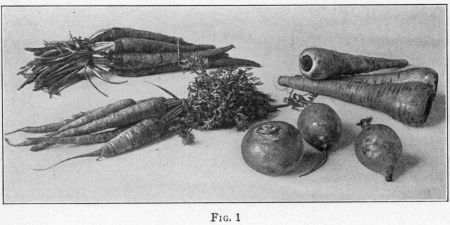
29. ROOT, TUBER, and BULB VEGETABLES form another class. Examples of several well-known roots are shown in Fig. 1, which from left to right are salsify, carrots, turnips, and parsnips. The varieties included in this class are closely related as to food value, and on the whole average much higher in this characteristic than do the succulent vegetables. Irish potatoes and Jerusalem artichokes are examples of tubers; sweet potatoes, beets, radishes, etc., in addition to the vegetables shown in Fig. 1, belong to the roots; and onions and all the vegetables related to the onion, such as garlic, shallots, and leeks, are illustrations of bulbs or enlarged underground stems.
30. FRUIT and FLOWER VEGETABLES form a third class. They present great variety in appearance, structure, and composition. To this class belong cucumbers, eggplant, winter and summer squash, vegetable marrow, tomatoes, peppers, and okra, which are in reality fruits but are used as vegetables. Flower vegetables include California, or French, artichokes, and cauliflower, all of which are in reality the buds of flowers or plants and are eaten for food.
31. LEGUMES form a fourth class of vegetables, and they include all the varieties of beans, peas, and lentils. When these foods are mature and dried, they have the highest food value of all the vegetables. Among the beans are Lima beans, kidney beans, navy, or soup, beans, soy beans, and many others. The peas include the various garden varieties that have been allowed to mature, cow-peas, and many others, some of which are not suitable for human consumption. The lentils occur in numerous varieties, too, but those commonly used are the red, yellow, and black ones. To legumes also belong peanuts, but as they are seldom used as vegetables in cookery, no further mention is made of them in this Section.
VARIETIES OF VEGETABLES AND THEIR PREPARATION
GENERAL METHODS OF PREPARATION AND COOKING
32. PREPARING VEGETABLES FOR COOKING.--Before many vegetables can be cooked, they require a certain amount of preparation, such as washing, soaking, peeling, cutting up into suitable sizes, etc. When they must be peeled, great care should be taken not to remove too much of the vegetable with the skin. Whenever it is possible to do so, vegetables should be cooked in their skins, as there is much less waste of edible material if the skins are removed after cooking. Potatoes that are to be fried, hashed brown, or used for salad and other similar dishes may be boiled in their skins and peeled afterwards just as conveniently as to be peeled first and then boiled. Indeed, this plan is strongly recommended, for it not only saves material that is removed in the peeling but also conserves the mineral salts and the soluble food material, much of which is lost in the water during the cooking.
33. If it is desired to remove the peeling before cooking, it will be found more economical to put the vegetables in water and then scrape off the skins than to cut them off with a knife. This method is especially satisfactory with new potatoes and with such vegetables as carrots, parsnips, salsify, and turnips. The scraping can be accomplished more easily if the vegetables are first plunged into boiling water for a few minutes and then dipped into cold water.
When entire heads of such vegetables as cabbage, cauliflower, Brussels sprouts, etc. are to be cooked, they should be soaked, head down, for at least 1/2 hour in salted water made by adding 1 teaspoon-full of salt to 1 quart of water. This is done in order to remove any bugs or worms that may be lodged in the head. The correct proportion of salt is an important detail of this process, for if salt water that is too strong is used, it will kill the bugs or worms and they will remain in the head.
34. METHODS OF COOKING APPLIED TO VEGETABLES.--The usual methods of cooking applied to vegetables are boiling, steaming, baking, stewing, frying, sautéing, broiling, and roasting. Which one of these to select depends, of course, on the particular kind of vegetable that is to be cooked and the result that is desired, but, if possible, an effort should be made to select an economical method. Starchy vegetables, such as Irish and sweet potatoes, beans, etc., develop a more delicious flavor when they are baked than when they are cooked by any other method of preparation. Steaming is an excellent means of preparing vegetables that must be cooked by moist heat, especially when it is desired that no soluble material be lost, as is often the case in boiling. Frying and sautéing, when applied to vegetables, usually produce a delicious flavor, but often render the vegetables decidedly indigestible. For this reason, vegetables so prepared should seldom if ever be served to children and to persons whose digestion is not good.
35. EFFECT OF COOKING ON VEGETABLES.--The various ways in which cooking affects vegetables should be thoroughly understood by the housewife. In the first place, some methods conserve the food material whereas others waste it. For instance, boiling in water, which is probably one of the most common ways of cooking vegetables, is decidedly advantageous in some respects, but the water dissolves much of the soluble material, such as mineral salts, sugar, etc., found in the vegetables, so that unless some use is made of this water in the cooking of other foods, considerable waste results. On the other hand, steaming and baking permit no loss of food material, and so they should be applied to vegetables whenever it is desired to conserve food substances.
36. The flavors of vegetables are greatly changed during the process of cooking, being increased in some cases and decreased in others. In the case of such strongly flavored vegetables as cabbage, cauliflower, onions, etc., it is advisable to dissipate part of the flavor. Therefore such vegetables should be cooked in an open vessel in order that the flavor may be decreased by evaporation. Vegetables mild in flavor, however, are improved by being cooked in a closed vessel, for all their flavor should be retained. The overcooking of vegetables is sometimes responsible for an increase of a disagreeable flavor.
37. Another feature of vegetables often changed by cooking is their color. For instance, green vegetables do not, upon cooking, always remain green. In many cases, the color may be improved by adding a very small quantity of soda to the water in which the vegetables are cooked. Attention should also be given to the length of time vegetables are subjected to heat, for the overboiling of some vegetables is liable to develop an unattractive color in them. This is particularly the case with cabbage, cauliflower, and Brussels sprouts, which develop not only a strong, disagreeable flavor but also a reddish color when cooked too long.
38. The application of heat to vegetables also has a definite effect on them. By sufficient cooking, the cellulose of vegetables is softened to the extent that it is less irritating and much more likely to be partly digested than that of raw vegetables. The acids of fruits increase upon cooking, and so the acidity of vegetables is increased to a certain extent. Vegetables that contain starch are rendered digestible in no other way than by cooking. On the other hand, the protein material of this food is coagulated by the application of heat, just as the white of an egg or the tissue of meat is coagulated and hardened. However, cooking is the only means of softening the cellulose that surrounds this material.
Still, high-protein foods, such as beans, peas, and lentils, can be much improved if they are cooked in water that is not very hard. The lime in hard water has a tendency to harden them to the extent that they require a much longer time to cook than when soft water is used. These vegetables may be still further softened by the addition of a small quantity of soda to the water in which they are cooked, but care should be taken not to use too much soda, as it will injure the flavor. When soda is used, the vegetable should be parboiled for 10 or 15 minutes in the soda water and then drained and cooked in fresh water. This method, of course, does not apply to vegetables that are cooked in soda water to retain their color.
39. Salt is always added in the cooking of vegetables to season them. In the use of salt, two important points must be borne in mind: first, that it has the effect of hardening the tissues of the vegetable in much the same manner as it hardens the tissues of meat; and, secondly, that it helps to draw out the flavor of the vegetables. These two facts determine largely the time for adding the salt. If an old, tough, winter vegetable is to be prepared, it should be cooked until nearly soft in water that contains no salt, and the salt should be added just before the cooking is finished. When it is desired to draw out the flavor, as, for instance, when vegetables are cooked for soup or stews, the salt should be supplied when the vegetables are put on to cook. Young tender vegetables may be cooked in salt water, but as such water extracts a certain amount of flavor, an effort should be made to use it in the preparation of stews, sauces, and soups.
SAUCES FOR VEGETABLES
40. Vegetables may, of course, be served plain, but they are greatly improved in flavor, nutritive value, and often in appearance by the addition of a well-seasoned sauce. Numerous sauces are used for this purpose, the one to select depending somewhat on the vegetable, the method of cooking employed, and the flavor that is desired. Recipes for the sauces found to be most satisfactory are here given. It will be well to practice the making of these, so as to become familiar with them and thus know just what sauce is meant when reference is made to a particular sauce in the recipes for vegetables. The quantities given in the recipes for sauces will make sufficient sauce to dress the vegetables required for four to six persons. White sauce, which is probably the one that is used oftenest, may be made in various thicknesses, as has been explained previously. However, the medium white sauce has been found to be the one most nearly correct for vegetables and consequently the one most preferred.
MEDIUM WHITE SAUCE
2 Tb. butter
2 Tb. flour
1/2 tsp. salt
Dash of pepper
1 c. milk
Melt the butter and add the flour, salt, and pepper. Pour into this the milk, which has been previously heated, and cook together until the flour thickens completely. Pour over the vegetable, from which the water has been previously drained, and serve.
VEGETABLE SAUCE
2 Tb. butter
2 Tb. flour
1/2 tsp. salt
Dash of pepper
1/2 c. milk
1/2 c. water in which vegetable was cooked
Melt the butter, add the flour, salt, and pepper, and pour into this the heated liquids. Cook until the mixture thickens. Pour over the drained vegetable and serve hot.
DRAWN-BUTTER SAUCE
1/4 c. butter
2 Tb. flour
1/2 tsp. salt
Dash of pepper
1 c. hot water
Melt the butter, add the flour, salt, and pepper, and pour into this the hot water. Boil for a few minutes and serve.
HOLLANDAISE SAUCE
1/3 c. butter
1 Tb. flour
1/4 tsp. salt
1/2 c. boiling water
1 egg yolk
2 Tb. vinegar or lemon juice
Melt the butter, add the flour, salt, and water, and cook until the mixture thickens. While still hot, pour over the slightly beaten egg yolk, beating constantly to prevent curding. Add the vinegar or lemon juice. Serve with vegetables that have been boiled in salt water.
SOUR-CREAM DRESSING
2 Tb. butter
2 Tb. flour
1/2 tsp. salt
Dash of pepper
3/4 c. milk or sweet cream
1/4 c. vinegar
Melt the butter and add the flour, salt, and pepper. Pour into this the heated milk or cream, and allow the sauce to thicken. Then add the vinegar, stirring rapidly, and serve hot.
TOMATO SAUCE
1-1/2 c. stewed tomatoes
1 slice onion
2 Tb. butter
2 Tb. flour
1/2 tsp. salt
Dash of pepper
Heat the tomatoes with the onion and force through a sieve. Melt the butter, add the flour, salt, pepper, and the strained tomatoes. Cook together until thick, remove, and serve hot with a vegetable.
MAÎTRE D'HÔTEL SAUCE
1/3 c. butter
1 Tb. chopped parsley
2 Tb. lemon juice
1/4 tsp. salt
Dash of pepper
Melt the butter and add the chopped parsley, lemon juice, salt, and pepper. Mix well, and allow the whole to boil, but not to brown. Pour over the vegetable and serve.
PARSLEY-BUTTER SAUCE
1/2 c. butter
1 Tb. chopped parsley
1/2 tsp. salt
Dash of pepper
Heat the butter in a saucepan until it is well browned, and then add the parsley, salt, and pepper. Allow the sauce to become hot, but not to boil. This is an excellent sauce to use over new potatoes or diced vegetables, such as turnips or carrots.
ASPARAGUS AND ITS PREPARATION
41. ASPARAGUS is a vegetable that consists of the shoots of the plant, which are eaten before the blossoms develop. It grows quickly and is very tender if the shoots are clipped at just the right time after they appear above the ground. It comes early in the spring, being about the first green vegetable that gets into the local market, but its season is comparatively short. It does not keep long after it is purchased and is better when it is used at once. If asparagus must be kept for any length of time, it should be stored in a cool, damp place.
42. In selecting asparagus, it should be remembered that there are two varieties, one of which is green and the other white. The stems of the green asparagus should be green to the bottom, and should not be hard nor woody where they are cut from the plant. However, if a part of the stems is found to be woody, the hard ends should not be rejected, for the outside may be peeled off and the center used, or the hard ends may be cooked with other vegetables for the making of soup. The white asparagus will have slightly green tips, while the rest of the stem will be white.
Asparagus is one of the succulent vegetables comparatively low in food value. It contains, as Table I shows, only one-fourth as many calories to the pound as potatoes. Its food value, however, may be increased by dressing it with butter after the vegetable has been cooked or by serving with it a sauce made with milk, butter, flour, etc. Then, too, asparagus is sometimes served on toast, which is another means of making a more nutritious dish out of this vegetable.
In its composition, asparagus contains a diuretic, that is, a substance that has an effect upon the kidneys, and that is known as asparagine. Because of the presence of this substance, asparagus is thought to be injurious to those who have kidney trouble, but it need not be avoided except in some forms of this disease.
43. PREPARATION FOR COOKING.--To prepare asparagus for cooking, strip the tiny scales from the sides of the stems by means of a small paring knife. These hold sand and are responsible for the presence of the grit that is sometimes found in a cooked dish of asparagus even when the housewife feels certain that she has washed it as clean as possible. Then wash the stems thoroughly in several cold waters, lifting them out of the water after each washing instead of pouring the water off of them. If the water is poured off the stems, the sand that has been washed from them is likely to remain in the bottom of the pan and mix with the vegetable again.
When the asparagus has been sufficiently washed, it may be used in the full lengths or cut into pieces of any desired length, 1 inch being the size that is usually preferred. If stems are to be cooked whole, it is a good plan to form them into a bunch as when purchased and tie the bunch with a tape or a string. When this is done, the string should, of course, be cut and removed before the asparagus is served. A point to remember about the preparation of this vegetable is that it should always be cooked in boiling, salted water.
44. ASPARAGUS WITH BUTTER DRESSING.--Perhaps the simplest way in which to prepare asparagus is to cook it in salted water and then serve it with a butter dressing. When prepared in this way, it may be served plain, but it becomes more attractive, as well as more nutritious, if it is placed on squares of toast.
For this dish, secure a bunch of fresh, tender asparagus, wash it thoroughly, and then, as desired, cut it into inch lengths or allow it to remain whole. Pour enough boiling water over it to cover well, add salt in the proportion of 1 teaspoonful to each quart of water, and allow it to cook until the stems may be easily pierced with a fork, which in most cases will require not more than from 10 to 15 minutes. The length of the cooking is an important factor with this vegetable, for when it is overcooked its flavor is not so agreeable as when it has had just enough cooking. When the asparagus is done, drain off the water, season with a little more salt and a dash of pepper, and, if it is to be served without toast, add 1 tablespoonful of butter for each bunch cooked, allowing the butter to melt. In case it is to be served on toast, allow a small amount of the liquid in which it was cooked to remain on it, add the butter to this, and, after placing several of the stems or a number of the pieces on the squares of toast, dip a little of the liquid over all.
45. CREAMED ASPARAGUS ON TOAST.--A still more nutritious dish can be prepared from asparagus by combining it with a cream sauce and serving it on toast. The sauce supplies protein and fat and the toast furnishes carbohydrate, substances in which this vegetable is low. Numerous ways of serving this combination may be resorted to, but one of the most attractive methods is illustrated in Fig. 2. As here shown, a small bunch of the stems is slipped through a ring of toast cut by means of round cutters of two sizes. If it is not desired to use toast for this, a ring of lemon rind or pimiento may be substituted, or the ring may be omitted altogether and the stems merely laid in an orderly manner on a square of toast. Also, with this dish, as with the previous one, the asparagus may be cut into inch lengths instead of being cooked whole.
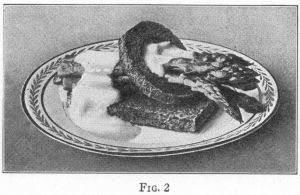
To prepare creamed asparagus, clean it in the manner explained in Art. 43. Then either cut it into inch lengths or allow the stems to remain whole, and cook it in enough boiling salted water to cover it well. While the asparagus is cooking, prepare a medium white sauce. As soon as the asparagus has cooked enough to be pierced with a fork, pour off the water and serve with the sauce in any of the ways already suggested. If the asparagus is left whole, the sauce is poured over it after it is placed on the toast, but when it is cut into small pieces, it is usually combined with the sauce and the creamed vegetable then poured over the toast.
46. SCALLOPED ASPARAGUS.--Another nutritious dish with asparagus as its base is scalloped asparagus. This involves all the ingredients used in creamed asparagus, but to give it still more food value, cheese is also added.
SCALLOPED ASPARAGUS
(
Sufficient to Serve Six
)
1 bunch asparagus
2 Tb. butter
2 Tb. flour
1 c. asparagus stock
1/2 c. milk
1/4 tsp. salt
1 c. buttered cracker crumbs
1/2 c. grated cheese
Clean the asparagus according to the directions given in Art. 43. Cut it into inch lengths and cook in boiling salted water until it is tender enough to be pierced with a fork, and then drain. Prepare a sauce by melting the butter, adding the flour, and pouring into this mixture the heated stock and milk seasoned with the salt. Put a layer of the buttered crumbs in the bottom of a baking dish, and pour half the asparagus over them. Sprinkle the asparagus with one-third the cheese and add another layer of crumbs. Sprinkle this with one-third the cheese. Add the remainder of the asparagus and the crumbs and sprinkle the rest of the cheese on top. Pour the sauce over the entire mixture, place in the oven, and bake until heated thoroughly and the top is slightly browned. Serve from the baking dish.
BEANS AND THEIR PREPARATION
VARIETIES OF BEANS
47. Of all the vegetables commonly used for food, BEANS afford the greatest variety. However, there are two principal classes into which all varieties of this vegetable can be placed, namely, string beans and shell beans. String beans include both the pods and the seeds, and are used when the beans are very young. Shell beans consist of the seeds, which are allowed to mature either partly or entirely and are taken from the shells before cooking. Those which are partly developed are cooked when they are fresh, but the ones that are allowed to mature completely are dried and then stored for use at any time during the year. In some cases, the same variety of beans may be used in the three ways mentioned, while in others certain kinds are raised expressly for one of these purposes.
48. The food value of beans increases as they mature, as will be observed upon reference to Table I. The very young beans, that is, the string beans, which include the pods and all, are comparatively low in food value, being only a little higher than asparagus. To increase the food value of these, fat meat, butter, or other fat is supplied in their cooking, or milk or a cream sauce is added before they are served. Fresh shell beans have much more nutriment than string beans, whereas dried beans are very high in food value. It is this characteristic of dried shell beans that makes them a very good meat substitute.
STRING BEANS
49. VARIETIES OF STRING BEANS.--There are two general varieties of string beans: the yellow ones, which are commonly known as wax beans, and the green ones, which are the ones usually meant when the term string beans is used. Numerous varieties exist among these classes, and some are very much better than others. Many of them have strings, but others are stringless and consequently are easier to prepare. Whatever kind is used should be picked from the vines before the beans are old enough for the pods to develop woody fibers. Otherwise they will not be palatable, for when they have reached this stage it will be impossible to cook them soft.
50. SELECTION AND CARE.--Small, round, rusty-looking spots are common to both string and wax beans; but when such spots are present they must be removed before cooking. As there is considerable waste in the preparation of such beans for the table, it is wise in buying string beans to select those whose surface is not marred with such blemishes. In addition, the beans should be as fresh as can be obtained and crisp and tender enough to snap when the pods are bent in half. Proper attention should be given to them after they are purchased, too. If possible, they should be cooked immediately, but if this cannot be done they should be kept in a cool, damp place to prevent them from becoming limp. However, if they wilt before they can be cooked, they may be freshened by allowing them to stand in cold water for a short time.
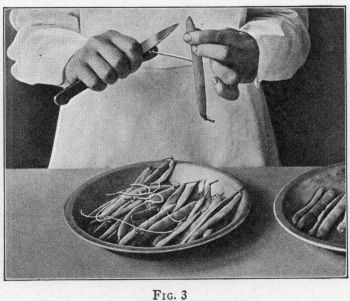
51. PREPARATION AND COOKING.--To prepare beans for cooking, wash them thoroughly in cold water. If the beans are of the stringless variety, cut off the stem and blossom ends; but, in case they have strings, break the ends and strip off the strings together with the ends, as shown in Fig. 3. The beans may then be cooked whole or cut into inch lengths before cooking. If it is desired to cut them, the most convenient way is to place them in an orderly heap on a cutting board and then cut a handful at a time, drawing a sharp knife across them as they are held on the board. Any imperfect portions should be removed before cutting.
52. The cooking of string beans is similar to that of asparagus, except that they require longer cooking. Put them, either whole or cut into a kettle, cover them with boiling water to which has been added 1 teaspoonful of salt to each quart of water, and cook them with the cover on the kettle until they can be easily pierced with a fork. The length of time required to cook them depends on the age of the beans, but usually from 30 minutes to 1 hour will be sufficient. When they are done, drain the water from them, but save it to make sauce for them or to add to soup stock.
53. STRING BEANS IN BUTTER.--String beans, which, of course, include wax beans, may be served with a sauce of some kind, but they are very appetizing when merely drained after cooking and served with melted butter.
To prepare beans in this manner, wash the desired amount, remove the ends and strings, if necessary, and cut into inch lengths. Cook until they are tender and then pour off the water. Add 1 tablespoonful of butter for each four persons to be served, a dash of pepper, and, if they are not salty enough, a little more salt. Allow the butter to melt and serve the beans hot.
54. STRING BEANS WITH SALT PORK.--Those who like the flavor of salt pork will find string beans cooked with a small piece of this meat very appetizing. Besides improving the flavor, salt pork supplies the beans with fat, a food substance in which they are very low.
After washing the beans that are to be cooked in this way, remove the ends and strings, but do not cut into inch lengths. Put the whole beans to cook in boiling water and add 1/4 pound of pork for a sufficient amount of beans for four persons. Cook until the beans are tender, and serve with the pork without removing from the liquid.
55. CREAMED STRING BEANS.--Perhaps the most popular way in which to prepare string or wax beans is to cream them. Not only an appetizing dish, but one whose food value is increased, is the result. The cream sauce served with the beans may be made entirely of milk, but a very satisfactory sauce can be made by using half milk or cream and half liquid in which the beans were cooked. To prepare creamed beans, clean the beans in the usual way and cut them into inch lengths. Put them to cook in boiling salted water and cook until they may be easily pierced with a fork. Pour off the water, but keep it to use in the dressing. To dress a sufficient quantity of beans for four persons, a sauce should be made as follows:
SAUCE FOR CREAMED STRING BEANS
1 Tb. butter
1 Tb. flour
1/4 tsp. salt
Pinch of pepper
1/3 c. rich milk or cream
1/3 c. liquid from beans
Melt the butter in a saucepan and add the flour, salt, and pepper. Pour in the heated liquids and stir until the mixture is smooth and thoroughly cooked. Add the sauce to the beans, heat together, and serve.
56. STRING BEANS WITH SOUR DRESSING.--A dish having an entirely different flavor from those already explained is produced when beans are served with a sour dressing.
To prepare beans in this way, clean a sufficient number according to the directions already given and cut them into inch lengths. Cook them in boiling salted water until they are tender. Pour off the water, but retain 1/2 cupful for the dressing. Make the following sauce, which will dress a sufficient quantity of beans for four persons:
SOUR DRESSING
2 Tb. ham or bacon fat
1 Tb. flour
1/4 c. vinegar
1/2 c. liquid from beans
Melt the fat in a double boiler, add the flour, and into this stir the vinegar and the liquid from the beans. Cook until the mixture thickens and pour over the beans. Reheat and serve.
SHELL BEANS
57. VARIETIES AND FOOD VALUE OF SHELL BEANS.--When beans have matured on the vines to such an extent that the pods are no longer tender enough for human consumption, they are picked and the seeds then used for food. Some are picked before the seeds have entirely matured, and these, which must be young enough to contain considerable moisture, are cooked fresh; others are allowed to mature entirely and are then dried before they are cooked. After being dried, beans keep indefinitely and require no care in storage except that they must not become moist. Numerous varieties of both fresh and dried shell beans are in use, including navy, marrowfat, pinto, and Lima beans.
58. Fresh shell beans average about three times as much food value as string or wax beans. Most of this is carbohydrate in the form of starch, but they also contain considerable protein. Dried shell beans, which are entirely different in flavor and texture from fresh ones, contain still more nutriment, their food value being more than twice that of fresh shell beans and over four times that of potatoes. In the entirely matured bean, which, as has already been mentioned, belongs to the class of vegetables called legumes, the high food value is due to the high percentage of starch and the large amount of protein in the form of legumin, a substance that is an important substitute for other more expensive protein foods. This composition reveals at once the fact that dried shell beans make an excellent food, provided some fat is added to them in their preparation.
59. PREPARATION AND COOKING OF FRESH SHELL BEANS.--With the exception of Lima beans, most of the varieties of fresh shell beans are placed on the market in the pods and must be shelled after they are purchased. Green Lima beans, however, are usually sold shelled. If the beans are purchased in the pods, wash them in cold water before shelling, but if they are bought shelled, wash the shelled beans. Then put them to cook in sufficient boiling water to which has been added 1 teaspoonful of salt for each quart. Allow the beans to cook until they may be easily pierced with a fork. The cooking will probably require from 45 minutes to 1-1/2 hours, depending on the age and variety of the beans.
60. SHELL BEANS DRESSED WITH BUTTER.--Any variety of fresh shell beans may be prepared according to the accompanying recipe, but Lima beans are especially delicious when cooked in this way.
Prepare and cook the beans as directed in Art. 59. When they are sufficiently cooked, pour off the water, season with additional salt, if necessary, and a dash of pepper, and add 1 tablespoonful of butter for each four persons to be served. Allow the butter to melt and serve the beans hot.
61. SHELL BEANS IN CREAM.--Fresh shell beans are especially appetizing when they are dressed with cream. Besides improving the flavor, cream also adds considerable food value, an item that should not be overlooked.
For this dish, prepare and cook the beans in the manner explained in Art. 59. When they are tender, pour off the water and season with additional salt and pepper. Then for each four persons to be served, add 1 tablespoonful of butter and 1/2 cupful of thin cream. Heat the beans well in the cream and serve.
62. BEAN PURÉE.--Persons with whom the coarse skins that must necessarily be eaten with beans disagree, find bean purée very satisfactory. To prepare it, clean and cook the beans in boiling salted water according to the directions given in Art. 59. Then pour off the water and force the beans through a ricer or a sieve. Add sufficient butter, salt, and pepper to season well and serve hot.
63. COOKING OF DRIED SHELL BEANS.--Before dried shell beans of any variety are cooked, look them over very carefully, reject any that are unfit for use, and wash the rest in cold water. They may then be cooked without further preparation, but in order to hasten their cooking and save fuel in their preparation, it is a good plan to moisten them by soaking them in water before cooking. If they are to be soaked, place them in cold water and allow them to remain there for 8 to 12 hours. Then put them on to cook in water to which has been added a small pinch of soda. Parboil the beans in this water until the outside skin begins to crack and then pour off the water. While it is true that a certain amount of mineral salts and perhaps a small percentage of food value are lost in this procedure, because the water that is poured off is too strong to be used for any other purpose, the improvement in the flavor warrants any loss that might occur. After pouring off the water, wash the beans in cold water, add fresh water to continue the cooking, and allow the beans to simmer slowly until they are cooked soft enough to crush between the fingers, but still retain their original shape. Nothing is gained by cooking them rapidly on a hot fire, and considerable fuel is wasted by this practice.
The fireless cooker and the double boiler are excellent utensils for the cooking of dried beans, because they cook the beans at a temperature below boiling point. They therefore cook the beans soft with little difficulty and prevent the protein from becoming hard. The theory of the cooking of protein--that is, the higher the temperature, the harder the coagulation--applies in the cooking of dried beans, just as it does in the cooking of eggs or milk.
64. STEWED NAVY BEANS.--The common small white beans are called navy beans from the fact that they are much used in the navy. These may be prepared in various ways, but the simplest method is to stew them. In the preparation of this dish, as well as any other made from dried beans, it will be well to remember that 1/2 cupful of beans is usually sufficient to serve four persons when they are cooked.
Look over the required amount of beans, reject any that are imperfect, wash thoroughly, and put to soak overnight in cold water. Pour off any water that remains, cover well with boiling water, and add a pinch of soda. Cook slowly until the skins begin to burst. Pour off the water, add fresh hot water and 1 teaspoonful of salt for each quart of water, and allow to simmer until the beans may be easily crushed between the fingers. During this process, the water should cook down until just a sufficient amount to serve with the beans remains. When this is accomplished, add 1-1/2 tablespoonfuls of butter, a dash of pepper, and, if necessary, additional salt. Instead of the butter, ham or bacon fat may be used for seasoning, or a small piece of ham or salt pork may be cooked with the beans and the fat omitted. Serve the beans hot.
65. LIMA BEANS IN CREAM.--Dried Lima beans, when combined with thin cream, make a very appetizing dish. To prepare them in this way, clean, soak, and cook them as explained in Art. 63. When they are soft enough to crush easily between the fingers and the water has boiled down so that practically none remains, add 1/2 cupful of thin cream to a sufficient quantity for four persons. Allow the beans to simmer for a short time in the cream, add additional salt and a dash of pepper for flavoring, and serve.
66. LIMA BEANS EN CASSEROLE.--While the small varieties of dried beans are more commonly baked than the larger ones, Lima beans will be found especially delicious when prepared in a casserole.
LIMA BEANS EN CASSEROLE
(
Sufficient to Serve Six
)
1 c. dried Lima beans
1/4 c. ham or bacon fat
2 c. milk
2 tsp. salt
1/4 tsp. pepper
Soak the beans overnight and then parboil them in soda water. Drain off the water and turn the beans into a baking dish. Add the fat, milk, salt, and pepper. Cover the dish and bake until the beans are soft. Serve hot from the casserole.
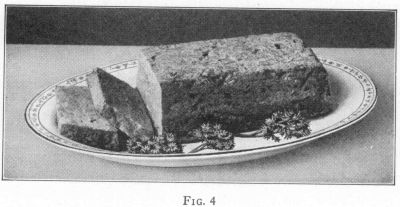
67. LIMA-BEAN LOAF.--If a dish that is not only appetizing, but sufficient in food value to be used as a meat substitute, is desired, Lima-bean loaf, which is illustrated in Fig. 4, should be selected. This is very good when served alone, but it becomes more attractive and at the same time more palatable when a sauce or gravy is added.
LIMA-BEAN LOAF
(
Sufficient to Serve Six
)
1 c. dried Lima beans
2 c. bread crumbs
Milk to moisten crumbs
2 eggs
1 tsp. salt
1/4 tsp. pepper
1/2 tsp. celery salt
2 Tb. butter
Soak the beans overnight and parboil them in soda water. Pour off this water, cook until tender in boiling salted water, and then drain. Moisten the bread crumbs slightly with milk, mix them with the beans, and add the beaten eggs and seasoning. When the entire mixture is well blended, place in a loaf pan, dot the top with the butter, and bake in the oven until nicely browned and quite firm. Turn out on a platter, garnish with parsley, and serve by cutting it into slices, as shown in Fig. 4.
68. BEAN SOUFFLÉ.--Probably the daintiest dish that can be made from dried beans is bean soufflé. This is equally suitable as the main dish for a luncheon or a home dinner. One point to remember about it is that it should be served immediately, for soufflé usually settles when taken from the oven.
BEAN SOUFFLÉ
(
Sufficient to Serve Six
)
1 c. bean pulp
1 tsp. salt
1/8 tsp. pepper
1/4 tsp. celery salt
1 Tb. onion juice
2 eggs
Make the bean pulp by forcing well-cooked beans through a colander or a press. Add all the seasoning and the beaten egg yolks. Beat the egg whites stiff and fold them into the mixture. When well blended, pour into a greased baking dish, or individual dishes, place in a pan containing hot water, and bake in a moderate oven until the soufflé is set, which will require from 30 to 45 minutes. Test by tapping slightly with the finger. If the dent thus made in the soufflé springs back, it is sufficiently baked. Remove from the oven and serve at once.
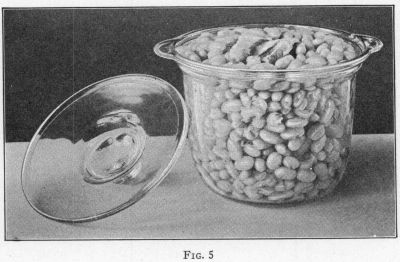
69. BAKED BEANS.--Almost any kind of dried beans may be used for baking. Some persons prefer the small navy beans, which are mentioned in this recipe, whereas others like the larger marrowfat beans or Lima beans. Pinto beans have for some time been taking the place of navy beans, and are found to be a very good substitute. To bake beans successfully, a dish with a tight-fitting cover, such as the one shown in Fig. 5, is required. This is made of heavy glass, but if such a utensil is not available, very satisfactory results can be obtained by using a heavy earthen bowl, crock, or baking dish. To produce the delicious flavor that is agreeable to most persons, beans should be baked a long time. Therefore, as considerable heat is consumed in their cooking, it is a wise plan to prepare more than enough for one meal. They may be served the second time as baked beans, or, if this is not desired, they may be used for various other purposes.
BAKED BEANS
(
Sufficient to Serve Six
)
1 pt. navy beans
2 Tb. molasses
2 tsp. salt
1/2 lb. bacon or salt pork
Soak the beans overnight, parboil in soda water, and drain. Add a sufficient amount of water to cover the beans well, cook until they break open, and then pour with the liquid into a baking dish. If this liquid does not almost cover the beans, add more until it comes nearly to the top. Add the molasses and salt, cut the salt pork into pieces, and distribute these well through the beans, placing a piece or two over the top. The beans should then appear as shown in Fig. 5. Place the cover on the dish and bake in a slow oven for 4 or 5 hours. Remove the cover occasionally, stir the beans carefully so as not to crush nor break them, and add enough water from time to time to keep the beans well moistened. When done, the beans should be light brown in color, but the top should be well browned. Sometimes it will be found necessary to remove the cover in order to brown the beans sufficiently.
70. BEAN CROQUETTES.--Left-over baked beans need never be wasted, for there are numerous uses to which they can be put. If it is not desired to reheat them and serve them again as baked beans, they may be utilized in soup, salads, and sandwiches, or they may be made into soufflé, as explained in Art. 68, or into croquettes according to the accompanying recipe. Bean croquettes may be served plain, but they are much improved by the addition of tomato sauce.
BEAN CROQUETTES
(
Sufficient to Serve Six
)
2 c. cold baked beans
1-1/2 c. bread crumbs
Milk to moisten crumbs
1 egg
1 tsp. salt
Pinch of pepper
To the beans add the bread crumbs slightly moistened with milk. Stir in the egg, beaten, and the salt and pepper. Blend the entire mixture, form into croquettes, and roll in dry crumbs. Bake in the oven until brown, sauté in shallow fat, or fry in deep fat. Place on a platter, garnish with parsley, and serve plain or with tomato sauce.
BEETS AND THEIR PREPARATION
71. BEETS are a root vegetable that comes in two varieties, red and white. The red beets are more popular for cooking than the white ones, and of these the ones that retain their dark-red color after cooking are preferable to any other. The root, however, is not the only part of this plant that is eaten, for the tops are also much used for food. When the tops are to be cooked, the plants are usually not allowed to mature to the extent that the root parts can be used; still, early in the summer, when very small beets are to be had with the tops on, both the tops and the beets may be used. At this age, the beets are very tender and do not require long cooking. If the beets are not eaten when they are young, they are allowed to mature in the ground and are then pulled in the fall and stored for a winter vegetable.
Like other root vegetables, beets contain very little protein and fat, but in their composition is included a fairly large percentage of carbohydrate in the form of sugar. Their total food value is greater than that of string beans, but is considerably less than that of potatoes.
72. SELECTION AND CARE OF BEETS.--When beets are selected as a summer vegetable with the idea of using both the tops and the roots, the tops should be fresh, that is, not withered nor rotted. When the roots are to be used, either as a summer or a winter vegetable, they should have a smooth skin, should contain no blemishes, and, as nearly as possible, should be uniform in size.
Summer beets require about the same care as any other vegetable; that is, they should be kept in a cool, damp place until they are ready to be cooked. If they are at all wilted at that time, they may be freshened by allowing them to stand in a pan of cold water for several hours. Winter beets, however, should be stored in a cool, dark place where they will not freeze. A portion of the cellar that has a dirt floor is a very good place to put the bins containing such vegetables. The woody tissue of beets that are stored increases as the winter advances, so that any beets that remain until spring are rather hard and extremely difficult to cook. In fact, at times it is almost impossible to make them soft enough to serve, but they can be greatly improved by soaking them in cold water for a few hours before cooking them.
73. PREPARATION AND COOKING OF BEETS.--In preparing young beets for cooking, allow an inch or two of the stems to remain on the beets in order to prevent them from bleeding. Of course, from winter beets, the entire stem should be removed, as it will be dried up. Scrub beets of either variety carefully with a vegetable brush until entirely free from dirt. Then, whether they are old or young, put them to cook in boiling water without removing their skins. Allow them to cook until they are soft enough to be pierced with a fork. This is the best way in which to determine when the beets are done, for as the length of time required to cook them depends entirely on their age, no definite time can be stated. As soon as they are sufficiently cooked, pour off the water, allow them to cool enough to handle, and then remove the skins, which will slip off easily.
74. BUTTERED BEETS.--Butter added to beets increases both their nutriment and their flavor. In order to prepare buttered beets, first clean and cook them in the manner just explained. To remove the skins, scrape the beets as thinly as possible, so as not to waste any more than is necessary. Then slice them thin or cut them into 1/2-inch cubes, season well with salt and pepper, and add 1 tablespoonful of butter for each four persons to be served. Allow the beets to heat thoroughly in the butter, and serve hot.
75. BEETS WITH CREAM DRESSING.--If a creamed vegetable is desired, beets to which cream has been added will be very satisfactory. Clean and cook the beets in the manner explained in Art. 73. Then peel, cut into slices, place in a saucepan, and nearly cover with thin cream. Allow them to cook in the cream for a few minutes, season with salt and pepper, and serve.
76. BEETS WITH SOUR DRESSING.--To give variety, beets are sometimes served with a sour dressing. Probably no other vegetable lends itself so well to this sort of preparation as beets, with the result that a very appetizing dish is provided.
BEETS WITH SOUR DRESSING
(
Sufficient to Serve Six
)
6 medium-sized beets
2 Tb. butter
2 Tb. flour
1 tsp. salt
1/8 tsp. pepper
1/4 c. vinegar
1-1/4 c. hot water
Prepare and cook the beets as explained in Art. 73. When tender, drain them, remove the skins, and dice the beets. Make a sauce by melting the butter in a double boiler and adding the flour, salt, pepper, vinegar, and hot water. Cook until the flour thickens the sauce and then pour over the beets. Heat together and serve.
77. BAKED BEETS.--If something entirely different in the way of a vegetable dish is wanted, baked beets will meet with favor. Beets may be baked in a covered baking dish or on the open grate of an oven. A slow fire produces the best results, and as a rule it will take 4 or 5 hours to bake good-sized beets.
Wash thoroughly and dry the desired number of beets. Place them in a baking dish and set in a slow oven or place them on the open grate. Bake until they may be pierced with a fork. Remove from the skins and serve with a sour sauce or merely with salt, pepper, and butter.
78. PICKLED BEETS.--When beets are cooked for any of the recipes that have been given, it will be economy to boil more than will be needed for one meal, for a large number can be cooked with practically the same quantity of fuel as a few. Then the remainder may be pickled by peeling them, cutting them into slices, and pouring over them hot vinegar sweetened slightly and flavored with spice. Pickled beets make an excellent relish and they will keep for an indefinite period.
BRUSSELS SPROUTS AND THEIR PREPARATION
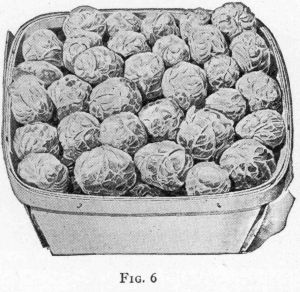
79. BRUSSELS SPROUTS, as shown in Fig. 6, look just like tiny green heads of cabbage. These heads grow along a stem that protrudes above the surface of the ground in much the same way as does the stem to which a head of cabbage is attached. The heads are cut from the stem and then usually packed in quart boxes. It is in such boxes as these that they are found in the markets, where they can be purchased from December until early spring. They are considered a great delicacy because of the fineness of their flavor, which rivals that of cauliflower and, while closely resembling that of cabbage, is much superior to it. In food value, they are somewhat higher than cauliflower, but about equal to beets.
80. COOKING OF BRUSSELS SPROUTS.--To prepare Brussels sprouts for the table, break off the outside leaves from the heads, and then in order to remove any bugs that may be lodged in the heads, allow them to stand in cold salted water for 1 hour or so before cooking. After removing the sprouts from the salted water, pour enough boiling water over them to cover them well, add 1 teaspoonful of salt to each quart of water, and boil without any cover on the kettle until they can be easily pierced with a fork. Care should be taken not to overcook the sprouts, for when they are cooked too long they become red in color and develop a strong flavor.
81. BUTTERED BRUSSELS SPROUTS.--When Brussels sprouts are properly cooked and then seasoned with salt and pepper and flavored with butter, an appetizing dish is the result. To make such a dish for about six persons, prepare and cook 1 quart of Brussels sprouts in the manner just explained. When they are tender, pour off the water, season with additional salt and a dash of pepper, and add 2 tablespoonfuls of butter. Allow the butter to melt over the sprouts and then serve hot.
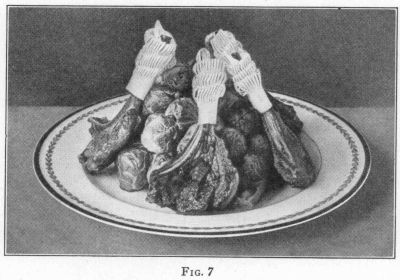
If a more attractive dish is desired, the Brussels sprouts prepared in this way may be combined with French lamb chops, as shown in Fig. 7. Pile up the buttered sprouts in the center of a platter, and then place broiled or sautéd lamb chops, whose ends are trimmed with paper frills, around the sprouts in the manner shown.
82. CREAMED BRUSSELS SPROUTS.--A very satisfactory way in which to prepare Brussels sprouts is to serve a cream sauce over them. This sauce, of course, adds food value, and at the same time greatly improves the flavor of the vegetable.
CREAMED BRUSSELS SPROUTS
(
Sufficient to Serve Six
)
1 qt. Brussels sprouts
2 Tb. butter
2 Tb. flour
1-1/2 c. milk
1 tsp. salt
Dash of pepper
Prepare and cook the sprouts as explained in Art. 80. When they are tender, drain the water from them. Make a white sauce of the butter, flour, milk, salt, and pepper. Pour this over the sprouts, heat together, and serve.
83. SCALLOPED BRUSSELS SPROUTS.--Undoubtedly the most palatable way of preparing Brussels sprouts is to scallop them. The ingredients used in the preparation of this dish add food value, as well as flavor.
SCALLOPED BRUSSELS SPROUTS
(
Sufficient to Serve Six
)
1 qt. Brussels sprouts
3 Tb. butter
2 Tb. flour
1 tsp. salt
2 c. milk
1 c. buttered crumbs
Prepare the sprouts as explained in Art. 80. Cook them in boiling salted water until they are tender, and then drain. Make a white sauce of 2 tablespoonfuls of the butter, flour, salt, and milk. Butter the crumbs by pouring 1 tablespoonful of melted butter over them, stirring until well blended. Place one-fourth of the crumbs in the bottom of a baking dish, add about half of the sprouts, and place another fourth of the crumbs over the sprouts. Add the remaining half of the sprouts and pour the sauce over these. Sprinkle the rest of the crumbs over the top, place in the oven, and bake until the crumbs are brown and the ingredients thoroughly heated.
CABBAGE AND ITS PREPARATION
84. CABBAGE consists of the foliage of the cabbage plant. It is a succulent vegetable with a high flavor; in fact, its flavor is so strong that in many cases it disagrees with persons. However, if cabbage is properly cooked, no apprehension need be felt about eating it, for it can be digested by most persons.
The food value of cabbage is not high, being even less than that of string beans. The greater part of this food value is carbohydrate in the form of sugar, but in order to prepare cabbage so that it has any importance in the meal, considerable quantities of protein, fat, and carbohydrate must be added. In itself, it is valuable for its mineral salts and bulk.
Numerous varieties of cabbage can be procured, but only three are commonly used. These include white cabbage, which is used the most; purple cabbage, which is very dark in color and contains varying shades of red and blue; and Savoy cabbage, which has a large number of green crinkled leaves and is commonly cooked by boiling.
85. SELECTION AND CARE OF CABBAGE.--Heads of cabbage that feel firm and solid to the touch and are rather heavy for their size are the best to select for cooking purposes. This vegetable comes into the market early in the summer and may be had until late in the fall. As it has excellent keeping qualities, it may be stored for use as a winter vegetable. When this is done, the stem and the roots should be allowed to remain on the head, for then the cabbage is less apt to wither. If this precaution is taken and the cabbage is stored in a cool place, no great care is required to keep it in good condition until it is to be cooked unless, of course, it is kept for an abnormal length of time.
86. PREPARATION AND COOKING OF CABBAGE.--To prepare cabbage for cooking, remove the outside leaves and then cut the head that remains into pieces of any desirable size. Whether the cabbage should be left in large pieces or cut very fine depends on the dish that is to be prepared. For the first cutting, be sure to cut the head down through the heart and the stem, so that the part not used will remain intact. This may then be used another time if it is kept cool and moist. In case the cabbage becomes at all wilted, it may be freshened by placing it in cold water a short time before it is to be cooked.
87. Cabbage is a vegetable that has many uses and is eaten both raw and cooked. Numerous opinions exist about the difference in digestibility between raw and cooked cabbage, as well as the best ways in which to cook this vegetable. It may be true that in some cases raw cabbage does not cause the disagreeable effect that cooked cabbage often does, but the reason for this is that cabbage when raw has a milder flavor than when cooked, cabbage generally developing during the cooking a strong flavor that causes trouble. The flavor of cabbage, however, may be dissipated if attention is given to the cooking, so that, when properly prepared, cabbage can be eaten with little fear of indigestion.
88. When cabbage is cooked, it is usually boiled like other vegetables; that is, it is covered well with boiling water to which 1 teaspoonful of salt is added for each quart, and then allowed to boil until it can be easily pierced with a fork. Its cooking differs, however, from that of many vegetables, string beans, for instance, in that it is carried on with the cover removed from the kettle. This plan permits of the evaporation of much of the strong flavor, which arises in the steam and which would otherwise be reabsorbed by the cabbage. Since it is the retention of this flavor, together with long cooking, that causes this vegetable to disagree with persons who eat it, both of these points should be carefully watched. If it is cooked in an open vessel and it is boiled just long enough to be tender, so that when done it is white and fresh-looking and not in any way discolored, an easily digested dish will be the result. Usually cabbage will cook sufficiently in 1/2 hour and often in less time.
89. BOILED CABBAGE.--Although cabbage permits of numerous methods of preparation, plain boiled cabbage finds favor with many persons. Generally, cabbage prepared in this way is merely seasoned with butter and served in a part of the liquid in which it is cooked, but it has a more appetizing flavor if bacon or ham fat is used for seasoning or if a small quantity of ham or salt pork is cooked with it.
To prepare boiled cabbage, remove the outside leaves from a head of cabbage, cut it in half down through the heart, and then cut each half into coarse pieces. Unless it is very fresh, allow it to stand in cold water for at least 1 hour before cooking. Put it into a kettle or a saucepan, cover well with boiling water, and add 1 teaspoonful of salt for each quart of water. If ham or salt pork is to be cooked with the cabbage, put a small piece in the kettle with the cabbage. Allow the cabbage to cook with the cover removed until it is sufficiently tender to be pierced with a fork. Pour off all or a part of the liquid, depending on whether it is to be served dry or in its own liquid, and then, in case it has been cooked alone, add butter or ham or bacon fat for flavor. If not sufficiently seasoned, add pepper and more salt.
90. CREAMED CABBAGE.--When cabbage is to be creamed, it is cut up into fairly fine pieces with a sharp knife. The cream sauce that is added to it provides considerable food value and greatly improves its flavor.
CREAMED CABBAGE
(
Sufficient to Serve Six
)
4 c. finely cut cabbage
2 Tb. butter
2 Tb. flour
1/2 tsp. salt
Dash of pepper
1/2 c. milk or thin cream
1/2 c. liquid from cabbage
Cook the cabbage according to the directions given in Art. 89 until it is tender and then drain the water from it. While it is cooking, melt the butter in a double boiler, add the flour, and stir until smooth. Pour in the heated liquid and season with the salt and pepper. Stir until the flour is thickened and the sauce is smooth. Pour this over the cabbage, heat together for a few minutes, and serve hot.
91. SCALLOPED CABBAGE.--Scalloped cabbage is a particularly appetizing vegetable dish, and, on account of the ingredients used in its preparation, it is more nutritious than some of the other dishes in which cabbage is used.
SCALLOPED CABBAGE
(
Sufficient to Serve Six
)
4 c. cabbage
1 c. buttered crumbs
2 Tb. butter
2 Tb. flour
1 tsp. salt
1/8 tsp. pepper
1 c. milk
1/2 c. liquid from cabbage
Cut the cabbage into very small pieces with a sharp knife or a cabbage chopper. Cook according to the directions given in Art. 89 until nearly tender, and then drain. Spread 1/4 cupful of the buttered crumbs in the bottom of a baking dish, put one-half of the cabbage over this, and then add another 1/4 cupful of the crumbs and the remaining cabbage. Over this pour a white sauce made from the butter, flour, salt, pepper, milk, and liquid from the cabbage. Sprinkle the rest of the crumbs over the top. Bake in a slow oven until the cabbage is thoroughly heated through and the crumbs are browned on top. This baking will complete the cooking of the cabbage. Serve hot.
92. HOT SLAW.--If a slightly sour flavor is desired in a vegetable dish, hot slaw will undoubtedly appeal to the taste.
HOT SLAW
(
Sufficient to Serve Six
)
4 c. cabbage
1 c. water
2 Tb. butter
1 Tb. flour
1/2 tsp. salt
1/3 c. vinegar
1 egg
Slice the cabbage very fine with a sharp knife or a cabbage cutter. Put it in a saucepan, add the water, and allow it to cook until the water is about half evaporated. Melt the butter in a pan and to it add the flour, salt, and vinegar. Then stir the beaten egg in quickly and pour this sauce over the cabbage at once. Allow the mixture to cook until the sauce has thickened, stirring constantly to prevent the curding of the egg. Serve hot.
93. MAKING SAUERKRAUT.--As is well known, sauerkraut is a cabbage preparation that is made by salting finely cut cabbage, packing it tightly, and allowing it to ferment under pressure. This food is made and sold commercially, so that the housewife can usually purchase it in any quantity she desires. However, as it is not at all difficult to make sauerkraut, and as a supply of cabbage in this form provides a valuable article of food during the winter months in households where it is relished, the housewife will do well to prepare enough of this kind of cabbage to vary her meals during the winter. That she may understand how to proceed with the making of sauerkraut and the proper cooking of it, the accompanying directions and recipes are given.
94. For every 10 medium-sized heads of cabbage, measure 2 cupfuls of salt. Cut the heads of cabbage into quarters and shred on a cabbage slicer, or cutter. Place several inches of the shredded cabbage in the bottom of a large crock, and over it sprinkle a layer of salt. Stamp this down with a wooden potato masher or some other similar utensil. Then add another layer of cabbage and salt and stamp this down in the same way. Proceed in this manner until the crock is nearly full. Then place a clean cloth over the cabbage in the crock. On this cloth place a clean board as near the size of the crock as possible, and on the board place a large clean stone or some other weight. When thus filled and weighted down, place the crock in a cool place. The cabbage will then begin to ferment, and it is this fermentation that changes the cabbage into sauerkraut. After a time, juice will form and gradually rise over the top of the board, and on top of this juice will form a scum. Remove this scum at once, and do not allow any to collect at any time after the fermentation of the cabbage ceases. Occasionally, when a supply of sauerkraut is taken from the crock for cooking, replace the cloth by a clean one, but always be sure to put the board and the weight back in place.
95. SAUERKRAUT WITH SPARERIBS.--Persons who are fond of sauerkraut find the combination of sauerkraut and spareribs very appetizing. The spareribs give the cabbage a very pleasing flavor and at the same time supply nourishment to the dish.
SAUERKRAUT WITH SPARERIBS
(
Sufficient to Serve Six
)
1 qt. sauerkraut
2 lb. spareribs
1 tsp. salt
3 c. water
Put the sauerkraut and the spareribs into a kettle and add the salt and water. Allow to simmer slowly for 2 or more hours. If additional water is necessary, add it from time to time. Just before removing from the heat, allow the water to boil down so that what remains may be served with the hot sauerkraut.
96. BAKED SAUERKRAUT.--In the cooking of sauerkraut for the table, pork in one form or another is generally added; in fact, one rarely thinks of sauerkraut except in combination with pork. While boiling is the method that is usually applied to this vegetable, many housewives prefer to bake it, for then the odor does not escape so easily and a flavor that most persons prefer is developed.
BAKED SAUERKRAUT
(
Sufficient to Serve Six
)
2 lb. fresh pork
1 qt. sauerkraut
1 Tb. salt
3 c. water
Cut the pork into several large chunks, and put it with the sauerkraut into a baking dish that has a cover. Add the salt and water, cover the dish and place in the oven. Bake slowly for 2 or 3 hours. Serve hot.
97. SAUTÉD SAUERKRAUT.--If an entirely different way of cooking sauerkraut is desired, it may be sautéd. When nicely browned and served with boiled frankfurters, it is very appetizing.
SAUTÉD SAUERKRAUT
(
Sufficient to Serve Six
)
1 qt. sauerkraut
4 Tb. bacon or ham fat
2 tsp. salt
Steam the sauerkraut over boiling water for about 1 hour. Then melt the fat in an iron frying pan, add the sauerkraut and sprinkle with the salt. Place a cover over the pan and allow the sauerkraut to sauté until it is slightly browned on the bottom. Stir and continue to cook until the entire amount is slightly browned. Serve hot.
CARROTS AND THEIR PREPARATION
98. CARROTS are one of the root vegetables. They are similar in composition to beets, having practically the same total food value, which is for the most part carbohydrate in the form of sugar. Besides being valuable in the diet for their mineral salts and bulk, they add variety to the menu, especially in the winter, for upon maturing they can be kept for a long time if they are properly stored. As tiny young carrots, they are also much used as a summer vegetable, and when cooked whole and served in an attractive way they make a delicious vegetable dish.
99. SELECTION AND PREPARATION.--The selection of carrots is a simple matter, because they keep well and are not likely to be found in a spoiled condition in the market. When small summer carrots are purchased, they should be fresh and should have their tops on. Winter carrots should be as nearly uniform in size as possible and should not be extremely large. Those which are too large in circumference are likely to have a hollow in the center and are not nearly so desirable as thin, solid ones. Carrots of any kind should be uniform in color, and should be without the green portion that is sometimes found on the top near the stem and that is caused by exposure to the light in growing.