"With Wolseley to Kumasi" (continued 6)
Reading edition
“Perhaps a little,” was the answer. “He wanders here and there in search of food, and to keep watch lest these Ashanti men should come to the neighbourhood.”
“Halt!” whispered Dick, suddenly, for he thought he saw a dark object on the bank. “Look there! Is that some one watching us? There! He has moved away.”
They came to a sudden stop, while each peered into the jungle. The native lifted his head to listen, while his white companion stretched out his hand for his rifle and took it across his knees.
“Perhaps a beast of the forest, chief. It was not a man, of that I feel sure. Let us press on, for we might still be seen from the main channel of the river, and see how light it is getting.”
Once more they plunged their paddles into the water and sent the boat ahead, though Dick, who sat in the stern, kept his eyes on the forest. His suspicious were aroused, and he was now keenly alert, for he felt almost sure that he had actually seen a man. Then, too, something told him that they were being watched.
“That was a call, too,” he said to himself suddenly, as the note of a bird came to his ear. “Of course it may have been all right, but I don’t half like it.”
He eased his sword in its sheath, and felt for his revolver, which of late he had carried suspended to his shoulder and between his coat and his shirt. There it was out of the way and out of sight, while he found that he could lay hold of it instantly. In fact, it was an excellent position, for whether in a boat or ashore, the weapon, placed where it was, did not strike against objects when he sat down or moved rapidly. A little later the bend in this stagnant creek came into view, and there was the place where the boats had been secured when he was at the mine. He could see the dark surface of the sluggish stream as it issued from the jungle, and though he peered amidst the trees there was not a man or beast to be seen.
“In a few minutes it will be lighter,” said the native. “Then we will land and search. Perhaps the chief will stay here on the bank while I go in search of my friend.”
Dick thought for a moment. Would it be wise to land, and perhaps have a dozen or more of the enemy upon him? Would it not be wiser to stay aboard and lie off in the stream? That would give him an enormous advantage in case of attack. But suppose Meinheer were near at hand, and he were seen and followed; he would require help. “You shall go ashore first,” he said to the native. “I will wait here, and when you report that all is clear near the landing stage, I will come.”
For a moment it seemed as though the man hardly liked the order, for he looked at his companion doubtfully, and fidgeted. Then he thrust his paddle into the water and shot the boat close to the side.
“In a few moments,” he said. “I shall quickly decide whether there are enemies about.”
He leaped to the bank, giving the boat a push out into the stream, and at once disappeared in the dense jungle. For a little while the crash of twigs and dead boughs told that he was moving, but finally the sounds died down. Once our hero thought he heard the far-off cry of a bird, but he was not sure, and presently his suspicions of danger were set aside by the recurrence of the sounds of some one moving and by the sudden appearance of the native on the bank.
“All is clear,” the man called out. “The forest is empty. Even the white chief is nowhere at hand. But we shall find him soon. It is safe for the chief to land.”
Satisfied now that his suspicions had been groundless, and yet with the ever-present feeling that there might be, and probably was, some danger to be anticipated, Dick drove his paddle into the water, and sent the nose of the boat into the bank. The native caught the rope and dragged at it, while his master leaped ashore, rifle in hand. Then, together, they pulled the boat half way up on the bank, and made the painter fast to a tree. Not till then did Dick observe a figure creeping towards him through the jungle. He gave a startled cry, and lifted his rifle to his shoulder. Then a second figure came into view, and just as he was in the act of pulling his trigger a dozen natives rushed forward from different directions, while the very man whom he had rescued down the river, and who had brought the note from the Dutchman, leaped on his back, and flung his hands over his face. Then commenced a desperate struggle, for Dick realised in a flash that he was the victim of a ruse; that he had been hoodwinked and decoyed to this place. At the thought his usually placid temper broke its bounds, and in an instant he became furious with rage, while his strength, which at all times was of no mean order, became doubled. With a snarl he dropped the rifle, and ere the men charging down upon him could come to close quarters, he had gripped the wrists of the ruffian who had leaped on his back, and torn the hands from his face. Then he swung the man round, and picking him up as if he were a child, flung him with furious energy against a huge cotton tree growing just beside him.
By then the others were at hand, and the contest was continued with desperate earnestness. Dick knew that he was cornered, and across his mind the results of capture passed vividly. In a flash he saw himself a prisoner, led to Kumasi, there to be slaughtered. It was a terrible prospect, and the thought of it increased his desperation. His teeth closed tightly together, not a sound escaped his lips in response to the shouts of the enemy. Then his hand flew to his sword; but he had no time to draw it, for one of the enemy, a tall, lanky Ashanti, was already upon him, rushing into close quarters, and wielding an enormous stake. The weapon was already in the air when Dick saw his danger, and he had barely time to leap aside. Then his instinct caused him to make use of nature’s weapons, and in a trice his right fist flew out and struck the native full on the forehead, sending him staggering back against the tree at the foot of which lay the body of the native who had acted as decoy. There was a third close at hand by now, but nothing daunted the solitary white man sprang at the stake which had dropped to the ground and seized it. Then the conflict went on with renewed energy on his part. With sweeping blows he held the enemy at bay, and as the more venturesome rushed in, the stake went up with a whirl, there was a crash, and another man fell to the ground.
It was not to be such a one-sided contest after all, and in a little while, when he had cleared the natives farther back, Dick hoped to be able to rush for the boat, launch it, and push it from the bank. Then would come the time for his revolver, and he promised himself that he would make good use of it. But he had greater trouble to contend with, for the crash of broken boughs in the forest told him that others were near at hand. Indeed, hardly had he realised the fact that the enemy were about to receive reinforcements, when a number of dusky figures appeared, while a man stepped from behind a huge cotton tree. It was the half-caste, James Langdon, saturnine in appearance, looking thin and wan after his long residence with the Ashantis, and showing on his ugly features the same crafty cunning look as had first aroused our hero’s suspicion and dislike. He, too, bore a stake in his hand and held it poised above his head. With careful eye he aimed it at the young fellow fighting by the bank of the river; then, with a sudden movement he threw it as if it were a spear, and with such deadly aim that it struck the object on the temple.
Dick fell like a log. Had he been an ox that had been struck a true blow with the pole-axe he could not have fallen more swiftly. One instant he stood there, breathing hard, and whirling his club, defiant and by no means conquered, and the next he lay an inert mass at the feet of the rascal who had decoyed him up the river.
“A fine shot!” shouted the half-caste. “On to him, and make his hands and feet fast. Now a pole, and we will carry him. Later, when he has recovered, he shall drag his own body to Kumasi for the sacrifice.”
He stood by with every sign of satisfaction as the natives obeyed his orders, and smiled his cruel smile as the last of the lashings were completed. By this time a pole had been slashed from the underwood, and with a refinement of cruelty for which this race are known, the Ashantis thrust the pole between Dick’s feet and hands, which were held together by the lashings, and prepared to carry him away suspended in that fashion.
“We will look at these comrades of ours,” said James Langdon, as they turned to depart. “Ah, our friend, the white fool, struck true and well. The man is stunned. It will be hours before he recovers. Who will wait with him?”
“And risk the coming of this man’s friends? None of us,” came the answer. “Let him lie, and if he escapes, then he is fortunate. Besides, he has comrades to keep him company.”
He pointed to three others who had been struck down by the stake, and at once the half-caste bent over them.
“They are all hit badly, but will regain their senses, I think,” he said calmly. “Well, let them lie there and recover while we push on. What of this one, though?”
“Dead!” replied the man who had answered his first question. “I saw him thrown against the tree, and heard the crash. His back is broken and also his head. He will never recover.”
“Then fling him into the river and let us be going. After all, he played for a stake, and would have had the bulk of the reward for this fool’s capture. But he bungled it. His fingers should have gripped the neck, for then they could not have been so easily grasped. It is a lesson to us all. Fling him in and pick up your burden.”
None of the men seemed to think that there was anything remarkably inhuman in their action, for to these Ashantis human life was very cheap indeed, and kindness and mercy almost unknown qualities. While a man was alive and possessed of full strength he was a comrade to be respected, for he could take care of himself. Dead, however, or badly injured, he was a nuisance, a positive burden, to be rid of at the first moment; to be robbed and deserted, or to be flung into the nearest stream like a dog. Without a thought, therefore, they picked up the man who had played his part so well and flung him with a loud splash into the stagnant stream. Then, without a second look at their unconscious fellows, they turned, picked up the pole, and went off through the forest in the wake of James Langdon.
When Dick regained his senses an hour later his first feeling was one of extreme anguish in both hands and feet, and very soon the pain caused his scattered wits to return, and led him to discover the cause of his trouble. He was suffering tortures, so much so that the agony swamped all thought of his miserable condition as a captive. He struggled, and begged to be set down.
“Cut his legs adrift, then,” said James Langdon, brutally. “Now place him on his feet and make a creeper fast to his hands. Better still, lash them behind his back instead of in front; then two of you can hold the end of the creeper.”
They threw their prisoner on the ground and cut both lashings. Then they swung him over on to his face and tied his hands behind, making a long creeper fast to the lashing. A moment later they picked him up and placed him on his feet. He staggered and fell at once, his limbs doubling up beneath him.
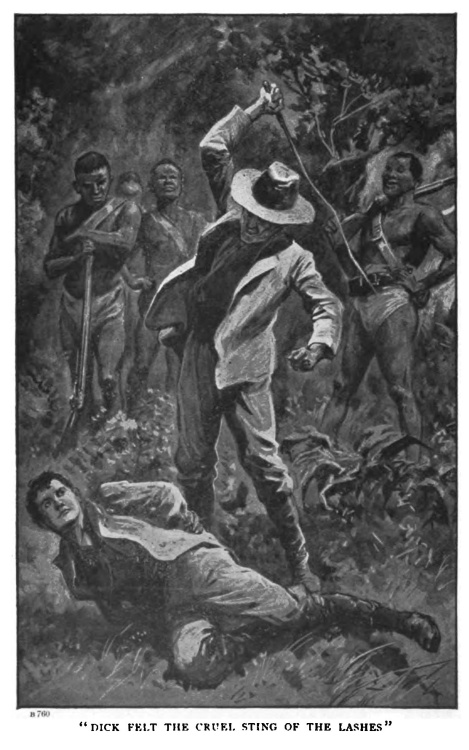
“He won’t stand, then!” cried the half-caste, his cruel nature delighted at the sight of so much suffering, and at the plight in which he saw the son of his old employer. “Set him up again and hold him there. I will thrash him till he changes his tune and agrees to make good use of his legs.”
There was no haste about this ruffian. He drew a sheath knife and went in search of a knotted vine, returning with it, still plying his blade and paring off the small branches attached to it. Then he took his post behind his prisoner.
“Raise him, and stand well aside,” he cried, with a gay laugh. “Now we will see how long it takes us to persuade him.”
Could the prisoner have freed his hands at that moment and managed to reach his tormentor, he would have taken such a grip of his throat that James Langdon’s villainy would have been summarily ended for all time. Dick felt the cruel sting of the lashes as they fell upon his back, across his face, and on his legs and shoulders. But his indignation and rage at such cowardly and dastardly treatment helped to ease the pain. He clenched his fingers, closed his lips firmly, and when he could fixed his gaze upon the ruffian who belaboured him. Then, gradually, as the man tired and his blows lost power, and as the circulation returned to the prisoner’s legs, he gained sufficient strength to stand, and then to hobble.
“See what a good healer I am,” laughed the half-caste. “Others would have rubbed his legs and feet. I use my whip to his back, and the sulky dog is roused. He finds that it will be as well to walk and do as he is bid.”
“And he will find it in him to punish such an act when the time comes,” gasped Dick. “I do not threaten, James Langdon, thief and ruffian. I give you due warning. When the time comes, I will shoot you as if you were a wild beast, without notice and without mercy. Vermin such as you are do not deserve ordinary treatment.”
For a few seconds the half-caste was taken aback, for at heart he was an arrant coward, and the mere mention of what might happen to him was sufficient to shake his nerve. But he had the game in his own hands now, he flattered himself. This time the youth at whose door he laid all his troubles, the need which drove him to live this life in the jungle, the fever which racked him, and a hundred other evils, was securely bound, a prisoner, from whom no danger was to be apprehended. His words were harmless. He was as helpless as a new-born babe.
“When the time comes I shall be prepared,” he said, with a laugh which he vainly endeavoured to make easy and light. “For the present we will advance, and leave threats and chatter till later. Advance, and beat the dog if he shows signs of lagging.”
Had the Ashanti warriors who helped in the capture and who now formed the escort had even hearts of stone they would have pitied their prisoner. The very fact that he had made a very gallant and determined fight for freedom would have aroused their enthusiasm and respect. But these men of Kumasi had long since had all such feelings driven from their breasts. The constant succession of cruelties of the most frightful nature perpetrated at Kumasi had hardened them to all human feeling and misery. They had, every one of them, from the time when they were mere children, been daily witnesses of executions, of unmeaning and ferocious tortures, and of endless bloodshed. Mercy they had never encountered. There was but one punishment for prisoners and evil-doers alike, for the thief, the murderer, and those whose cruel fate had caused them to be born in slavery. The executioners stretched out their greedy and remorseless hands for all, and who could say when their turn would come? Was it remarkable, therefore, that these men marched on before and behind their prisoner, belabouring him when his steps flagged, and shouting oaths at him? And so, in this sorry plight, his feet tingling still, while his hands felt as if the skin would burst, so tight were the lashings, Dick was hurried on through the dark and sombre forest out to the clearing and to the site where had stood the mine stockade. There, as the procession halted, he threw himself on the ground in an exhausted condition, wishing almost that he might die. His thirst was now unbearable, while his head throbbed and ached from the blow he had received. No wonder, too, if he were apathetic, if his fate were now a matter of little concern to him; for his present miseries overshadowed all else.
“Give him some water, and put him in the shade,” ordered the half-caste. “Two of you stand over him with your guns, and if he moves thrash him with the vine. We will teach him how to behave while he is in our hands.”
He glared at his prisoner, who took not the slightest notice of him. But as soon as the water was brought Dick drank it greedily, for he was parched. Then he lay down, his hands still secured behind his back, and very soon, utterly wearied by his night’s work, and by his struggle with the enemy, he fell fast asleep, enjoying a dreamless rest which was of the greatest service to him.
What would have been the feelings of those gallant souls away down the river had they known of the treachery to which their young leader had fallen a victim! Had they but guessed that the fleeing native was only part of a clever plan, laboriously thought out by the half-caste robber whose thefts had driven him to take to the forests, and who, like so many of those who have wronged the man whose salt they have eaten, had turned all his hate and vengeance upon that man or his representative! But how could they guess? It had all been so real. The native boat appearing at dawn, with a shouting mob in full pursuit, as if the light had only then enabled them to discover the runaway. Their shots, falling recklessly about the boat, and the desperate haste of the native himself, his wound and his apparent exhaustion, had all aided in misleading the crew of the launch. They never imagined that their presence in the river had been instantly detected, and that when they lay to for the night, their exact whereabouts had come to the ears of James Langdon and his roving band of free-booters. But that was what had happened.
The half-caste had learned that Dick Stapleton had formerly come up the river, and had been taken back to the sea owing to an attack of fever. His spies, of whom there were many on the coast, had told him how the young fellow fared, and had sent news as soon as preparations for another expedition with the launch had been commenced. Then he had hatched his plot to trap his master’s son, and with fiendish ingenuity had relied upon the gallantry of his dupe to lead him into the net. What was easier than for this man, accustomed to clerical duties, and, as it chanced, acquainted with Meinheer, to scrawl a few letters on a piece of linen, and sign the Dutchman’s name? for he knew well that the fraud in the signature would never be detected. It was a well-planned plot, and had succeeded only too well, though the victim had made a hard fight for his liberty and had given unexpected trouble.
And so while Dick lay there in the shade, fast asleep, the crew of the launch dozed the hours away, knowing well that they could not look for his return till late the following night.
Some few hours after Dick had fallen asleep he was kicked and ordered to stand up.
“We start for Kumasi,” said James Langdon, with a leer, “for the seat of the great King Koffee. There is a prospect before you, young man, and you will have time to think about it. Make sure of him,” he went on, turning to his followers, “for the captive is no longer mine. He belongs to the King, and it will be a bad day’s work for the one whose carelessness results in his escape. Now, march on, and let us push the pace.”
Three days later the procession marched into the town of Kumasi, their prisoner still in their midst, footsore and weary, but with courage undaunted. They passed at once along the principal street, and Dick was astonished to find that it was very wide, that neat huts stood in an orderly line on either side, and that trees grew here and there, offering a welcome shade. The thousands who came to stare and mock at him seemed neat and tidy, though they boasted little clothing, while the whole air of the town was one of prosperity and orderliness. But there was one huge drawback, which attracted the prisoner’s attention the instant he set foot in Kumasi, indeed, even before he reached the town. Where there should have been the pleasantest of breezes there was the most ghastly and nauseating odour of dead men, and as the procession advanced the cause of this became more and more apparent. For Kumasi was like a charnel house. The bodies of the hundreds of poor wretches who were slain were simply thrown into the nearest stagnant stream, or were piled in a narrow grove, the fetish grove, adjacent to the house of execution. In truth, the smell of blood was everywhere, and on every hand dark stains told of its presence. No wonder that he shuddered, while his courage began to evaporate.
“How awful!” he thought. “The place makes one feel deadly sick, and the sights on either side are shocking. If that is to be the end, then the sooner the better. But I am not done yet. I will have a try for freedom, and it may be that I shall succeed. To think I have been made a fool of, and that letter was a forgery. Poor old Meinheer is dead after all.”
Even in the depths of his misery he could think unselfishly of others, of the unfortunate Dutchman whose name had been sufficient to bring his young agent to this plight. A moment later his thoughts were interrupted by James Langdon.
“The lions have had a good view of him,” he laughed, as he nodded to the crowd, who evidently held the half-caste in some awe. “In a little while he shall afford them more sport, and they shall see what sort of a captive I have brought them. Pack him into the hut here, next to mine, and watch him while I go to the King. My servant will see to his food. Cut his lashings and bundle him in.”
A man produced his sword, and the lashings were cut. Then, with the smallest ceremony, Dick was bundled into the hut, a one-roomed erection, smelling evilly, and almost devoid of light. But it was his for the moment, and he revelled in the opportunity it gave him to be alone. He sat down in one corner, feeling weary and sore from head to foot, while the evil smell of the place made him horribly sick. He was faint and giddy, and when at length the food was brought which was to be his evening meal, he pushed it from him.
He was down again with fever. No white man can live in the heart of the Ashanti forests, particularly on the river, without subjecting himself to the risk of incessant fever attacks, and once the malady has been gained, the paroxysms are apt to recur very often. Hardship, privation and excitement generally are sufficient to cause them to return, and it is therefore not wonderful to have to record that Dick Stapleton was again a victim. His teeth chattered, he was miserably cold in spite of the fact that the temperature in this stuffy hut was almost unbearable, and he had no appetite. Indeed, he was soon semi-delirious, and it was not till many weeks had passed that he was himself again. The fever, want of nursing, unsatisfactory foods, and incarceration in the hut did their work too thoroughly, so that on this occasion he was longer in recovering. And when he was stronger, and was allowed to step from the hut, it was to find Kumasi in a ferment, to discover the house of execution fully occupied, and the bodies of fresh victims everywhere. For the British advance had begun. Sir Garnet Wolseley, the energetic and indefatigable worker, was already on the way to the capital of the Ashantis, with a goodly following of troops behind him.
Chapter Eighteen.
King Koffee, the Terrible.
Kumasi was in an uproar. The long, wide street which cut through the heart of the huge town was alive with Ashanti warriors, and with shrieking women and children. There was consternation on every face, and fierce anger at the news which had just come from the river Prahsu.
“Your soldiers have bridged the river and are about to advance,” growled James Langdon, as he threw the door of the prison hut open and accosted Dick. “These fools here think that their fetish will prevail and keep the British back. I know better, for I have seen British troops. They will reach this place, and perhaps give it to the flames. Then they will retire, and as they go we shall fall upon them and cut them to pieces. You need not think that they will find you here. You are a marked man, and, at the last, when the advance still takes place, the Ashantis will offer you to their fetish in the hope that your sacrifice will arrest the enemy. It would have been better for you, Dick Stapleton, had you never interfered with me.”
“And by the look of you, it would have been easier for you had you hanged yourself weeks ago,” answered our hero, calmly, and with a smile which made his captor writhe. “You look as though you were haunted, and I think that you must have had a very miserable time since you left the coast. You are a traitor and a murderer, and you are bound to be caught and punished.”
“Not if I rejoin the British. What if I set you and the other Europeans free! Would you obtain a pardon?”
Dick emphatically shook his head, for he mistrusted this man. More than that, he was wise enough to know that even though James Langdon might desire to do as he said, the Ashantis would never permit such action. A glance at the face of the half-caste was sufficient to show that he was ill at ease. Matters were beginning to look serious for King Koffee and his people, and the very sight of this half-caste, who had urged them to action and to resistance, angered them. They had lost faith in him, and James Langdon knew that at any time the King’s favour might be withdrawn and he himself fall a victim. He turned away with an oath. Then he called for the guard which kept watch over the house, and gave an order. At once Dick was bound and led off down the street, and having reached a wide open space, close to the horrible fetish grove, he was brought to a halt within a few paces of the enormous sacrificial bowl, with its legs in the form of crouching lions, on the edge of which the Ashantis were wont to slay their victims. Never in all his life had he seen such a hideous sight.
“Terrible! terrible!” he murmured. “To think that men could be such brutes! It is horrible!”
He closed his eyes for a little while, and then opened them again as there was a commotion. Then, indeed, he gave a start, for four white men were slowly led into the arena, all strangers to him, and all miserable prisoners like himself. They looked at him sharply, and one of them called out a greeting.
“Sorry to see you here,” he said, with a foreign accent. “How long have you been a prisoner?”
“About six weeks. And you?”
“A year perhaps. We had hoped to be freed by the payment of a ransom. Now I suppose we must wait for the troops if these brutes will allow us. There is never any saying what they may do. To-day there will be a great sacrifice, and we are always dragged here to witness the awful scene. What news?”
He asked the question eagerly, and in a few words Dick narrated how Sir Garnet had landed and commenced operations, and how by now the troops must be at the coast and probably on the march up.
“Then that accounts for this butchery. They are trying to stop the advance, and these poor people have to suffer. Shut your eyes as long as you can, my lad. I’m hardened.”
But Dick could not. He looked on with dilated eyes and shuddered, for the next three hours were indeed too horrible to relate. Some hundreds of wretched slaves and prisoners were ruthlessly slaughtered, while the mob looked on, gloating. But happily for the white prisoners, there was little noise, only an occasional shriek from some waiting victim. The poor wretches were led to the bowl, and knives were thrust through their cheeks so that they could not utter a sound. Then their heads were forced over the edge of the bowl, and with a sweep of the sacrificial knife they were decapitated.
“It’s done with for to-day,” at last said the prisoner who had spoken before, addressing Dick, wearily. “A few score more of these poor people have been killed—men, women and children, and now the last test of all has been carried out. The fetish priests have said that if men who are tied up in the forest and left alone die quickly, the Ashantis will be victorious. If they live for many days the British will succeed. They have put knives through the cheeks of two of the captives and have led them away. It’s all very horrible and very terrible. But never fear, things may come right yet. By the way, who is that sallow dog who fights with the Ashantis and advises them? See him there. He is watching and listening.”
Dick did not answer, for James Langdon suddenly emerged from the crowd, where he had hidden himself the better to watch his prisoner. Now, however, he came forward at a run, and stood in front of the man who had spoken.
“Sallow dog, you call me,” he cried angrily. “I will tell you who I am. I am the one who has so far kept you white men alive, and to me you may look for the order which will bring you here again for execution. That is your answer.”
He scowled at the prisoner and then went off, giving an order as he left the arena. At once the guards closed round the prisoners, and all were marched away, Dick being taken back and flung into his hut. He sat down at once with his back to the wall, and his eyes fixed on the door, and for an hour he hardly stirred a finger. Now and again his eyes moved a little, as the light which streamed beneath the door altered, and the shadow of a passing man crossed it. Otherwise he allowed nothing to disturb his thoughts.
“I will do it,” he said at last, rising to his feet and pacing up and down. “I am strong now, and once away I can live in the forest with ease, for there are plantains everywhere. I will make an attempt this very night, and if I fail, well it will only hasten my death by a very few hours.”
“Food and water. Take it!”
The door was thrown open by the man appointed to feed the captive, and a bundle of plantains tossed into the hut. An earthen pot containing water was set down just inside the hut, and then the door was slammed, for the man was in a hurry. Like all the inhabitants of Kumasi, he was eager to go into the forest to watch the poor wretches tied up there, and to listen to news of the invaders. The guards also, two of whom were set to watch the hut, had their attention distracted on this day, for as Dick peered through the crevices in the door he could see them gossiping with the passers-by, and straying far from the hut. When darkness fell the town was still in a state of agitation, for further news had come of a British victory, and the watch on the hut was even more careless. But the Ashantis had not entirely forgotten their prisoner, as Dick soon discovered. For as he looked out into the wide street, watching the numerous almost nude figures seated about the fires, and the warriors passing to and fro, a gentle grating on the far side of the door warned him that he might expect a visitor. As quick as a flash he crossed the floor and sank to the ground on the far side, where he feigned to be asleep. He had hardly gained this position when the door was burst open, and two men entered, the second bearing a torch.
“Gone! He has escaped! Those dogs have let him go! Ah, no! He is here!”
The half-caste clenched his hands, and turned furiously upon the native bearing the torch, for as he entered, the half light cast by the flame had illuminated only a portion of the hut, and he imagined that the prisoner had gone. Then he caught sight of his figure in the corner, and heaved a sigh of relief.
“Safe!” he exclaimed, with a growl of satisfaction. “Not escaped. That is good. Have we disturbed your sleep?”
Dick looked up wearily, blinking at the light, and then seeing who it was, and pretending that he had only just discovered the presence of his enemy, he rolled over again, treating him with scorn and silence, as was his custom.
For a little while the half-caste and his attendant stared at him thoughtfully, then they turned and left the hut.
“I felt ill at ease,” Dick heard James Langdon mutter; “I fancied that he had escaped, and I came to see for myself. I can sleep peacefully now if I do not dream of these British.”
He clenched his hands again as he moved away, and Dick heard him muttering still as the door was slammed. Then came the sound of his steps, a fierce kick as he pushed open the door of his own abode, and a sharp crash as he swung it to again.
“Sick and weary,” thought Dick. “His conscience is hurting him, or rather, perhaps, he begins to feel the net closing round him. We shall see. I gave him due warning, and if the time comes I will kill him as if he were a fly. Now for business.”
He rose stealthily to his feet and went to the door, where he remained for some minutes staring out into the street, and taking note of the position of his guards. Then he went in succession to some half-dozen tiny peep-holes, which he had diligently bored through the wattle wall of the hut.
“All clear,” he said, with a satisfied chuckle. “It’s quite dark now, and as these people go to bed early the place will soon be quiet. I’ll give the guards a little time to settle down and then I’ll move. This is the side for operations.”
He went to the wall which faced the hut in which dwelt the half-caste and set to work upon it. Slipping his hand into his sleeve, he produced an angular piece of iron, a fragment of a cooking-pot which he had picked up in a corner of the hut. Many an hour had he spent in sharpening an edge of the fragment upon a stone dug up from the dried mud floor, and now it was as keen as a razor. Holding it firmly in his hand, he swept it slowly and in a circle over the wattle wall, his fingers following the cut. Then he repeated the process, very slowly and very carefully, severing the stems one by one. Like all the habitations in Kumasi, the prison in which he was incarcerated was built of wattle, woven roughly together, and plastered with mud to fill the interstices. Thus when he had contrived to cut through the stems a large piece of the wall was freed, with the mud still clinging to it. Dick swung it open very slowly and peeped out. Then he replaced the section, and once more went the round of the hut, peering in all directions. Not a soul was moving, and even the guards had thrown themselves down beside the log fire disconsolately, for the news received that day was most disheartening.
“Not time to move yet,” he thought. “They look quiet enough, but they are not sleepy. I’ll wait a little, and then we’ll see what happens.”
An hour later he swung the section open and stared out. Then he squeezed through the opening and threw himself flat on the ground. Wriggling a few inches along beside the hut he soon obtained an unobstructed view of the street, and could see the twinkle of the dying embers, with, here and there, a figure crouching over them. There were the guards, too, drowsing near one of the fires, their weapons dangling beside them. A dog barked in the distance, and for a little while a number of the curs which infested the streets of the horrible town set up a chorus of responsive howls, which were more than disconcerting. One of the guards stirred, while a man who had been crouching over one of the distant fires, no doubt thinking of the fighting in prospect, rose and sauntered along till he arrived near the hut, where he opened up a conversation on the same old subject.
“They are at the Prahsu, these white dogs,” he said. “What will be our fortune now? What think you, comrade?”
“How should I know or be able to guess?” was the sulky answer. “Go to our fetish men. Or better, be patient for a little. There are the dogs whom we have bound out in the forest. If they die to-morrow we conquer. If not—”
“We die. We shall do that. Listen to one of them groaning. Is that the call of a dying man?”
He held up his hand and pointed across the street, and away across the enclosure where the executions had taken place, to the forest beyond, and as he pointed there came the call of a man in pain, strong and clear, and full of power.
Dick shuddered, while the guards and their visitor became suddenly silent. They had much to think about, and could obtain little comfort from their wise men and soothsayers. The auguries were all against them. Strange things were happening. The tale was abroad that a child had just been born who was able to converse fluently immediately after its birth. Then some falling star had struck the town. And now, the men who had sat so patiently at the coast, were advancing in spite of sacrifices, in spite of a liberal shedding of blood. There was little comfort for the Ashantis. Talking made matters worse. It was better to go to the privacy of one’s own hut and brood alone over the trouble.
Dick heard the stranger bid good-night. Then he watched his figure disappearing. A minute later he was on his feet, creeping across the dark patch of ground intervening between his prison and the next habitation, where James Langdon dwelt.
For a moment we must leave Dick, while we turn to the leader of the British expedition at the coast, and see what arrangements he had made for the difficult task before him. For this campaign was no trifling affair. It was not an ordinary war, wherein battles of great importance might be expected, with open fields for manoeuvring, but a conflict wherein our troops and their leaders would have to engage with many unexpected difficulties, and meet face to face a danger greater than that offered by the enemy. It was bad enough at the coast, where there were cool, fresh breezes on occasion, though to be sure the place had well earned its name of “the white man’s grave,” but up-country, in the forest and jungle, with its numerous swamps, its unhealthy exhalations, its damp heat, and its rotting vegetation, there lurked the germs of fever, the worst form of ague, that fell disease which has slain so many men of our race, and with which it may be rightly said our scientists are only now becoming fully acquainted. Its symptoms, its shivering attacks, its racking fevers they know well, as intimately as they can be known; as also the fact that recurrences take place, that many a man long since returned to England has attacks of jungle fever, or whatever he may care to term it. But the method of transmission of this malady to human beings was not so certain a matter, and few knew then rightly how to battle with it. It was, in fact, the enemy to be contended with, and had any one doubted that, he had only to ask at the coast and sum up the number of men and officers already placed hors de combat on its account. This was first and foremost to be a doctors’ war, and when all available precautions were taken, it became next a war against forest and jungle, and the foes who might be lurking there.
To reach Kumasi was no light undertaking, even if no opposition were to be expected, and the decision to advance upon it by land made the difficulty all the greater. It would be hard to say who was responsible for this, though it would seem that those at home, wholly unacquainted with the coast perhaps, were allowed to have a say in the matter. In any case materials were sent out for erecting a light railway, and were disembarked at great cost and labour. And with what result? It was hard enough to cleave a path thirty inches wide through the jungle and forest, let alone one of five feet; while the necessary transport was not forthcoming. And so the railway material lay where it had been landed, while labourers and carriers were employed from amongst the natives, hundreds of whom had flocked to the town owing to the incursions of the Ashantis. Sappers set them their tasks, and as the weeks crept on a path was hewn through the forest in a direct line to the Prahsu. Sometimes open ground relieved the labour, and here and there stations were formed, and food and ammunition collected. At last the bend of the river was reached, and unhindered by the enemy, who were in the vicinity, the sappers bridged it and laid out a little town for the accommodation of the troops and the small escort sent to defend this advance station. Finally the promised troops came, and the advance commenced. Of the force engaged the bulk may be said to have been British, for our native allies, with few exceptions, proved useless cowards. A few men of the Assim tribe made excellent scouts under Lord Gifford, while other natives did like service. But for fighting the majority were hopeless, and very rightly no dependence was placed upon them. Elsewhere, operating from another quarter, was a larger force of more reliable natives, from the Lagos district, close to Benim, under command of Captain Glover, and though their actions were of little service, a small portion of the force was to be heard of later. They were operating on the Rio Volta, the river forming the boundary between the Gold and Slave Coasts.
It must not be supposed that because the Ashantis, who had invaded the protectorate, hesitated to interfere with the working parties hewing a road to the Prahsu and carrying supplies there, they did not come into conflict with our marines and bluejackets who, in many cases, formed the garrison at the depots which had been formed. Those at Dunquah, a place some twenty-odd miles from the coast, had a smart brush with the enemy, while at Abracampa a huge force of Ashantis, numbering ten thousand at least, suddenly surrounded the post. Like so many of the others, it was but a native village, placed in a small natural clearing, and now roughly fortified. The garrison was a very slender one indeed, and yet in spite of that fact they held the enemy at bay, killing very many of them. Time and again the attacks were repeated, till at length reinforcements arrived, and taking the enemy unawares dispersed them with great slaughter. In the enemy’s camp numerous rifles, guns, umbrellas and war-drums were found, besides evidences of sacrifices. In fact, wherever the Ashantis had been, grim relics were left behind, all of which only added to the keenness of our men to reach Kumasi and put a stop to such barbarities.
And now the prospect was brighter. The second battalion of the Rifle Brigade was already en route, while the Welsh Fusiliers and the Black Watch were a little way in the rear. On the road also were Royal Artillery, Engineers, Marines, surgeons, Commissariat officers, and war correspondents, amongst the last the familiar figure of G.A. Henty, whose name must be well known to thousands and thousands of boys and grown men, and whose active brain created heroes in every country and clime under the sun.
From Cape Coast Castle the troops marched to Inquabin as a first stage, and from there through various stations, all with more or less unpronounceable names, till they came finally to the Prahsu, sixty-nine miles from the sea. There they found Sir Garnet completing his preparations for the march upon Kumasi. The troops had toiled for the most part in single file along the narrow forest tracks, and they knew that the same work was before them. But they did not know what their leaders had taken to heart; that the forest on the far side of the river might and probably did hide thousands of enemies, and that that tract must be crossed, and the town of Kumasi captured within the next fortnight. For already there were not wanting signs that the rains were about to commence, and when they set in tracks through the forests would become swamps and narrow streams great swirling rivers. Worse than all, rain and wet soon play havoc with a man, and in a fever-stricken country, such as the land of Ashanti, predispose to an immediate attack.
Having dealt with the movement of the troops, and shown how Sir Garnet and his men had diligently pushed forward to the Prahsu, and had, by dint of bush fighting, and particularly by their actions at Dunquah and Abracampa, driven the Ashantis from the protectorate, we can now return to Kumasi.
The night was rather dark, but fine. Overhead the stars twinkled, and could be seen through the leaves of the trees which lined the main street. One tree grew in front of each house or hut, and was fetish or sacred. At its roots were placed odd bits of crockery, a rough doll-shaped image, and other objects, all regarded as fetish and likely to lull the anger of the mighty fetish which kept the people in its grip, and which held sway at the execution house and temple to which Dick had been led.
“If it had been raining it would have been better, perhaps,” thought the escaping prisoner. “But I don’t know. All depends on the luck I have. The plan may work well, and our friend may find himself caught in a net of my weaving this time. If so, then I shall not mind the light so much. Now for the chance to enter.”
He had crept across the open space between the two huts, and was now close against the wattle wall behind which James Langdon was sleeping. As he lay at full length Dick could hear the ruffian’s deep breathing, and when a few minutes had passed could catch his mutterings. He stirred, and Dick heard the soft bed of palm-leaves, upon which he lay, rustle at the movement. But our hero made no attempt at escape, nor did he move from his position. He waited, as calmly as he could, though it was hard to smother his excitement and still the thumping of his heart. There was so much to be attempted, and such a terrible ordeal to look forward to if he failed. Across his mind’s eye flashed the memory of that awful scene close to the brass sacrificial bowl. The rows of intended victims, forced to look on at the sacrifice, their hunted looks, and the agony on the face of the one about to be sacrificed. Then there was the mob, with the warriors dancing their wild dance of death and brandishing their weapons; while in the background, smug and complacent, like Nero of old, sat King Koffee, tall and fat, nodding a signal when the moment for execution came. For half an hour, as Dick crouched in the shadow, the memory of the horrid scene flitted continuously before him. Then he stood up suddenly and clenched his hands together.
“I won’t let such things take my pluck away,” he said in a hoarse whisper. “I’ll think of the friends on the river and at the coast. This brute is responsible for all my miseries, and it is his turn to suffer. He has brought me here. Well, he shall help me to return.”
He pulled up the cuffs of his tattered sleeves, as if to prepare for a struggle, then he crept round to the door of the house. There was a native stool there, a heavy article, and he grasped it and lifted it well above his head. Then, without hesitation, he knocked loudly upon the door.
Chapter Nineteen.
Dick Strikes a Blow.
Bang! Dick’s knuckles struck the door of the native hut with a sharp rap, and he repeated the knock immediately. Then he listened eagerly for some sound from the sleeper within. There was no answering call, and nothing to denote that the man was there.
“Fast asleep,” thought Dick. “But he is there, I know, for on the far side I could hear his breathing. I’ll knock again.”
He was in the very act of doing so when out of the corner of his eye he caught sight of one of the drowsy guards who lay beside the dying fire. The man had, apparently, heard the knock, and had sat up now to see what it meant. Then he sauntered towards the prisoner’s hut as if to investigate the matter. The escaping prisoner’s heart stood still, while his wits worked rapidly.
“If I returned and crept through they might discover the opening, and then good-bye to liberty,” he thought. “If I stay here he will see me. I’ll get behind the hut, and if there is an alarm I’ll run for it. Yes, that will be the best plan.”
He watched the guard closely as he rose to his feet, and then silently slid along behind the hut. And as he did so the native strolled towards the place where the half-caste lived and peered at the door. Then he retraced his steps to the prison, and throwing the catch down, stared in. Once more the prisoner held his breath while he tingled with excitement. He stood on his toes, ready at the first alarm to sprint away down the street, while his eye rapidly picked out the most likely path to take. Then he heaved a sigh of relief, relief the like of which none can appreciate but those who have found themselves in similar positions. The guard must have mistaken a shadow, perhaps a portion of the palm-leaf bed, for the prisoner, and been satisfied. He emerged from the hut, and once more sauntered up to the door of the one in which James Langdon lay. As he did so, a sound within told that the sleeper had awakened. He stirred, came to the door and threw it open, staring out at the man suspiciously.
“You knocked?” he exclaimed. “It roused me, but I was heavy with sleep and did not rise at once. What is wrong? You have let the prisoner escape! Dog! You have let him go at the very last moment!”
He sprang from the doorway and gripped the man by the throat, digging his fingers in till the native choked and dropped his musket. His eyes dilated; he struggled with all his might, striking fiercely at the half-caste, and then suddenly became limp. Indeed, when James Langdon released his hold, the man fell helpless to the ground. But it seemed that he was more frightened than hurt, for Dick had long since discovered that all in Kumasi treated the rascal who had decoyed him into captivity with unusual deference, owing perhaps to his friendship with the King, though of late his power had been declining as that of the British rose. The native gasped, held up an arm, and endeavoured to speak, while the half-caste stood over him with the musket as if he would club his brains out with the butt.
“Say he is gone and I will kill you on the spot,” growled the ruffian. “If he is safe, well and good. You shall be uninjured. But why, then, did you knock?”
“Knock! I was lying at the fire keeping watch on the prison when I heard a sound and came to see what it was. Doubtless, some one moved in a neighbouring hut and disturbed me and you also. Then I went to the prison, and found the dog there, fast asleep in his corner.”
“But some one knocked. I swear that. It roused me, I tell you!”
The native rose feebly to his feet and glanced askance at the half-caste.
“It must be as I say,” he ventured. “The sound came from some other hut. In any case, the prisoner is safe.”
He went off to his fire again, muttering beneath his breath, for of late the ruffian who had taken up the cause of the Ashantis had been somewhat curious in his manner. Gathering troubles, perhaps an uneasy conscience, and the ever-present dread of impending punishment, which seemed to come closer and closer in spite of all his efforts, were having their effect. His temper was harsh and easily aroused, he was hard to please, and wore nowadays a haggard look, showing clearly that his sleep was disturbed.
“Dreams! dreams!” growled the sentry, as he took his seat again. “Dreams and the fire-water which he has been drinking. It is said that he and the King sit in the palace of a night, smoking and taking fire-water. No wonder he sees and hears things which do not exist. I have felt the same myself.”
And the same conclusion must have been dawning upon the troubled mind of the rascal standing at his door. He began to wonder whether he had actually heard the knocking, or whether it was another of those dreadful nightmares which had troubled him of late, in which a huge bluejacket, with bristling beard, had stood above him waiting for the word to thrust his cutlass to his heart. He groaned, then stretched his arms and yawned, and turned towards the prisoner’s hut. He walked a few paces in that direction, and, seeming to change his mind and be satisfied with the tale of the sentry, he turned about and entered the hut again. Dick at once stole round to the door, his stool still grasped in his hand.
“I would rather have it like that,” he thought. “He is awake and able to take care of himself. He had a revolver strapped at his belt, and therefore is armed, far better than I am. He shall have a glimpse of me, and then—Well, it is his life or mine, and I have given him warning.”
There was no time to hesitate, and though Dick would have scorned to strike a defenceless man, he had every excuse for making an attack upon this rascal who had so often injured him. He hardened his heart, therefore, and having ascertained that the guard, who had so recently appeared, was seated near the fire some little distance away, and with his back turned in that direction, he slipped up to the door and knocked ever so gently.
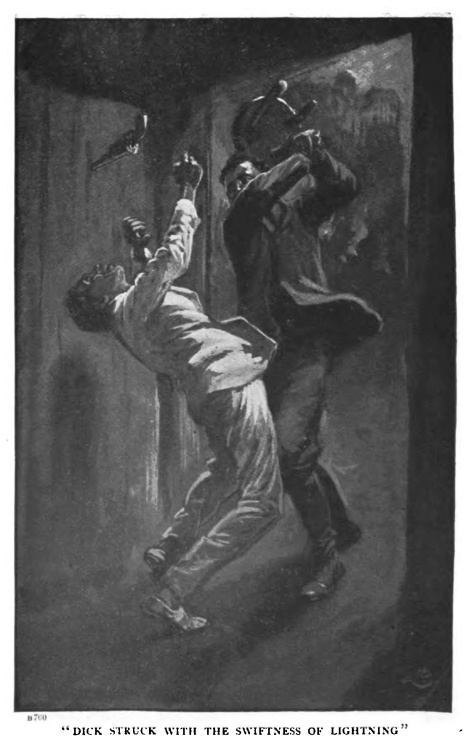
“Again! It is a knock! I am not mistaken. Well!”
James Langdon, boiling over with indignation, and with his fiery temper fully roused, strode to the door revolver in hand and threw it open. Then he fell back a pace in sheer amazement, while he stood for an instant staring at the figure barring his path. Used to the dense darkness of the interior of the native hut, his eyes picked out the features of his prisoner almost instantaneously. It was his turn to gasp this time. The suddenness of the apparition took his breath away and robbed him of his energy. Then, in a flash, he realised that this must actually be his prisoner, the youth to whom he put down all his miseries. A snarl escaped him, and his fingers closed tighter on his weapon. In less than a second he would have had it at Dick’s head and pulled the trigger had not the latter acted. He was satisfied now; he was attacking an armed man who had due and proper warning. Dick struck with the swiftness of lightning, the heavy stool hitting the half-caste across forehead and face and knocking him senseless. But the matter was not finished yet, and as the rascal fell, Dick was swift to follow up his advantage. He clutched at the man and lowered him gently to the floor. Then he took his revolver, and, throwing himself on his knees, peered out at the sentry. The man had turned on his elbow and was looking towards the hut, for he had heard the sound of the blow and he was not quite satisfied.
“Fighting with his shadow,” he growled at length. “It will be a good thing for us when the fire-water kills him, or a British bullet settles his account. But for him I should be sleeping in comfort, and not sitting here, feeling as if I still had his fingers about my gullet. Bah! Let him dreamt. Let him shoot himself if he wishes.”
The fellow expressed little surprise when, some few minutes later, the figure of the half-caste emerged from the hut and stood out in the open. The native watched him through half-closed eyes, while one hand sought for his musket.
“At the risk of my life I will shoot him if he lays a hand on me again,” he said. “But it would lead to certain execution.”
The figure stood lolling against the wall of the hut, with his hat drawn down over his eyes, his collar turned up at his ears, while his hands were sunk in his pockets. He was cold. He shivered and then stamped his feet. A little later he began to pace backward and forward, and as if a sudden thought had occurred to him, went to the door of the prison. He threw it open, glanced in, and then shut and barred the door again with every sign of satisfaction.
“Safe and sound,” he said. “He will not escape the knife of the executioner. You can go. You and your comrade. I cannot sleep, and will keep watch myself.”
Astonishment and delight were written on the features of the guard, but he did not demur. The opportunity to be rid of a hated duty was too good to be ignored, and at once, rousing his comrade, the two went off down the street. And Dick watched them as he lolled there, hands in his breeches pockets. He had taken an enormous risk in acting as he had done, but he felt that it was the surest way to regain his liberty. He argued with much justice that dressed in the clothes of the half-caste he would be taken for that ruffian, while the darkness would hide all deficiencies. As to the voice, he could simulate that. He could speak gruffly, as if the night air affected his throat, while he had sufficient command of the language now to carry the plan out fully. And so far it had succeeded.
“Which means that my escape will probably not be discovered till to-morrow morning. Perhaps not even then. That will give me a start, and with a little luck I shall be able to get well away. Now for food and ammunition.”
He dived into James Langdon’s hut again, and searched for the articles which he required. Some minutes later he reappeared, and having ascertained that the coast was clear, he strode down the wide street of Kumasi, his eyes peering in all directions in search of an enemy. He had arrived at a point only a little distance removed from the opposite end of the town, when a sound suddenly startled him. It was the voice of a man in agony—a deep, heart-rending groan, which brought him to an abrupt halt, and set him listening to its repetition.
“One of the poor beggars whom these ruffians tied up in the forest to die,” he said to himself. “If I could I’d help him. But how can I manage such a thing? I’d not leave this place without trying to rescue the other Europeans if I thought that possible. But it’s not. They are scattered, and the attempt would be fatal. My word! what cruelty!”
The groan came to his ears again, and after it a second, deeper in tone, as though forced from the lips of the wretch who uttered it by the utmost depths of misery and pain. It was horrible! If Dick’s blood had stirred at the sight of the cruelties perpetrated by the executioners, it boiled now at the thought of those two unhappy natives, captives of the Ashantis, who had been tied up in the forest, their cheeks perforated with the knives to hold down the tongue so that they could not talk, and left there to moan and die soon if the fates were to be kind to Kumasi and its King, and to the unfortunate victims also, or to live on in abject suffering for many days, till thirst and starvation brought unconsciousness.
“I’ll go to them,” he said, after a minute’s thought. “I can’t leave this awful place with their groans in my ears. I’ll risk releasing them, and perhaps they may help me.”
His resolution was made and adhered to in spite of the obvious delay and danger it would cause. But he had a soft heart, and could not bear to think of such misery. Turning aside he slipped down between two of the houses and came to a foetid stream, in which, no doubt, lay the bodies of many of yesterday’s victims. He crossed it in safety, standing back a little way and jumping as far as possible into the darkness. Then there were other houses to pass, and another row of dying embers, before none of which could he see a single Ashanti. They were all abed, and the only denizens of this loathsome place who were awake were a few stray mongrel curs, one of which started from its lair beside one of the houses, and hearing the thud of Dick’s feet as he landed on the far side of the stream, set up a loud barking, which was taken up almost instantly by a score of others elsewhere. But suddenly a gruff voice from within one of the huts commanded silence, and the baying ceased.
“Then I can go on,” said Dick. “I thought it was going to lead to more trouble, for if the dogs were to sight me they would follow, making enough noise to awake the whole of the town. Here we are. Here is the forest, and I fancy I am in the right direction.”
It was still very dark, and, in fact, had it not been for the many fires, he would hardly have found his way as he had done. Perhaps he would have blundered against one of the huts, or even come upon some wanderer. Not that he would therefore have been discovered to be an escaping prisoner. He would have carried out his rôle of being the half-caste, and if that failed there was the revolver. But fortune favoured our hero on this occasion, and in a little while he gained the forest and plunged into its black depths. Groping his way blindly through it, striking his shins against fallen boughs and trunks of trees, and sometimes almost breaking his head against similar obstructions, he finally found himself on a native path, along which the way was easy.
“A piece of great luck,” he thought, “and this probably leads to the spot where the poor fellows are imprisoned. I’ll keep along for a little, and then give them a whistle.”
But he had no need to do that, for after a little while, when he had traversed some fifty yards or more, the same miserable groan came to his ear, and gave him indisputable evidence of the proximity of the captives. A few minutes later he was close to them, and, passing to the two trees to which they were bound, ran his hands over their bodies. The miserable natives had been placed some two feet from the ground against the trunks of enormous cotton trees, and their hands and feet had been dragged backwards by means of ropes, and so tightly that they did not slip to the ground. The agony of such a position can be imagined, and if to that be added the torture of two native knives thrust right through the cheeks, some estimate can be obtained of the barbarities practised by the Ashantis, of their insane and meaningless cruelty, and of the urgent need there was for some more enlightened nation to come to the town and stop the practice. Dick slid his hand up to the cheek of the first of the unhappy men, and gently withdrew the knives. Then he spoke to him in low tones.
“Who are you?” he asked, first in Ashanti, and then in the Fanti tongue.
“We are Assims,” came the answer, low and indistinct, for the knives had almost robbed the man of the power of speech. “We were captured months ago and imprisoned at Kumasi. Who are you?”
“A white man from the coast, also a prisoner, till an hour ago. Will you swear to follow me if I set you free?”
There was no mistaking the earnestness of the reply, or the man’s eagerness to be cut free of his lashings.
“Release us, and we shall owe you our lives,” he answered. “We are set here to die, and if you give us life and liberty, we will follow you and fight for you. We are allies of the great white chiefs, and you can trust us.”
Without more ado Dick took one of the ghastly knives and cut the man down, doing the same for his comrade a minute later. Stretching them with all care and gentleness on the ground, he set to work to rub their limbs, for it was not so long ago that he had experienced the cruel result of tight lashings. He had known what it was to feel a tingling in his extremities, and then acute pain, as if feet and hands would burst. And later, when the cords were cut loose, the agony of returning life to his limbs, the inability to move finger or toe or to support his weight. And to cure him the inhuman monster who had borne the name of James Langdon had thrashed him till strength had come. Well, the half-caste was dead. Dick had struck him a blow which had crushed in his skull as if it had been an egg-shell, and thinking of it now as he rubbed the limbs of these poor fellows, he could only rejoice, and congratulate himself that he had done bare justice.
“It was man to man,” he thought. “He deserved his death, and he had due warning. It was not as if I had knocked and then struck him in the darkness of the hut. I gave him a chance, and—well, the best man won. Now, how are you both?”
The poor fellows were trembling with joy, and wept freely. By now they had regained to some extent the use of their hands, and they, too, rubbed at their feet till they were able to stand and hobble a few paces.
“We will wait till you are quite able to walk,” said Dick. “We have far to go to-night, and it will be better to sacrifice a few minutes here than to lose them on the road. Do not hurry. Soon you will be strong again.”
“We are fit to go now,” at last said the spokesman of the two. “Where will the white man turn his face?”
“To the Pra. Our troops are there, and if we can meet them we are safe. Do either of you know the road?”
There was an exclamation from both at once.
“We have marched it time and again,” said one. “As slaves we have accompanied the Ashanti armies, and we can find the road even in the dark. But we must be careful. There are thousands of men about, and if we met them we should be killed.”
“Then you will want weapons. Pick up the knives and tuck them in your waist cloths. Now lead the way. Better still. We will cut a vine and hold on to it. Then there will be no straggling.”
A little later the three set out, the leader setting the direction along the path without a moment’s hesitation.
“It will lead us to the main war road,” he explained, “and after that all will be easy. There is but one way to the Pra, for the forest is too thick for many paths to be cut. Follow, white chief, and I will take you to the river.”
All that night the trio kept on through the forest, their way made easy by the path cut and kept free of undergrowth with constant labour. Now and again they would call a halt, for the two captives whom Dick had rescued were still very feeble, and their feet and ankles were greatly swollen. But it is wonderful what an amount of ill-treatment a native can put up with at times, and how marvellously they recover from the most serious of wounds. True, they have as a rule little stamina, and sickness cuts them down by the hundred. But perhaps because of the life they lead these natives of Africa often show less sensitiveness to pain than do Europeans, and therefore can put up with injuries which with the majority of white men would prove quickly fatal. And so, in spite of the hours that these men had been dangling, they were able to march, for the wounds in the cheeks were of small consequence. When day dawned many miles intervened between themselves and Kumasi.
“We will seek for a hiding place and rest,” said Dick, as the light beneath the trees grew stronger. “As the afternoon comes we can push on again. Let us gather some fruit and have a meal.”
Late on the following afternoon three weary men, one a white youth dressed in tattered clothing which showed signs of much travelling, tottered across the bridge which the engineers had erected across the Prahsu, and made for the hutted camp of the British. On all sides men were bustling to and fro. Natives were carrying bales and boxes on their heads, sailors and soldiers were lolling about the open camp fires, smoking their pipes and yarning, while at the far side of the bridge was a kilted sentry, striding to and fro. He stared at the new-comers, brought his rifle from the slope, and dropped the bayonet level with Dick’s chest.
“Not so fast, me lad,” he said gaily. “Where from? Whom do you want to see? ’Alt, or there’s going to be trouble.”
That brought them up suddenly and set Dick laughing.
“A fine welcome after two months’ absence,” he said. “Sentry, I want to see the Chief of the Staff, and after that Mr Emmett. As for where I’ve come from, Kumasi is the answer. Now, how long have you been here?”
“My business, young feller,” was the reply, when the sentry had recovered from his astonishment at being answered in his own tongue, for Dick might have been of any nationality. “Yer want the chief, do yer? ’Ere, Corporal McVittie, take these fellers to the sergeant of the guard.”
A little later our hero, with his two black companions, was being marched under escort in amongst the huts, and was finally brought to a halt opposite a collection of tents devoted to the use of the leaders of the expedition. There were British officers standing or sitting in front of many of these, while the dress of some showed that they belonged to the Royal Navy. At one end of the line a Welsh Fusilier paced his solitary beat, while a blue-jacket, burly and heavily bearded, did sentry duty at the other end. And it was this latter individual who first recognised the new-comer.
“What’s this!” he gasped, stepping a little way from his beat. “’Ere, sergeant, split me! but that ’ere’s Mr Stapleton! Mr Dick Stapleton! Do yer ’ear me?”
His face flushed red with indignation at the sight presented to him, but discipline was discipline, and already he had said too much. However, before the sergeant of the guard could answer, a number of officers emerged from a tent close by and faced the white youth and natives under escort. There was a loud exclamation of surprise, and in a moment Dick was gripping the hand of the Chief of the Staff, while close to him was Jack Emmett, bronzed with the sun, eagerly waiting for his share in the greeting.
“Bless my life! Dick Stapleton, reported as missing on the river! Where on earth have you come from? And looking so wan and thin, too!”
“From Kumasi, sir. I was taken prisoner, and escaped two nights ago. I brought these two Assims along with me. They had been tied up in the forest to see how long they could live without food and water, I suppose so that the enemy might have some augury of their fortunes. They know the ground perfectly, sir. You asked for that information, and here it is.”
There was a commotion in the camp for more than an hour, and as the night fell, and the men gathered about their huge log fires, every tongue wagged on one story alone. But the noise was greatest where the bluejackets had their quarters, for there reclined the crew of the launch which had returned so disconsolately from their quest up the river. As for Dick, he had been fêted by the officers, and ever since had been engaged with the members of the staff, to whom he gave all his news of Kumasi, and drew sketches of the road leading to the town.
“You have our congratulations,” said the Chief, as he rose to bid him good night, “and I may say that you have done us inestimable service, so much so that, though it is not the usual custom, and is, indeed, an exceptional occurrence, we shall send your name home in our despatches. And now for to-morrow, when we advance. You, with your two natives, will be well in our front with the remaining scouts under Lord Gifford and others. When you come to Kumasi you may find it necessary to fall back on us for support.”
“And if the Ashantis are in the same condition of panic, may I advance, sir?” asked Dick, quietly. “I have every reason for asking the question, for I know roughly the whereabouts of the captives, and if I can get in at an early hour, I may be able to save them.”
“You shall have more men. You shall have your old crew, my lad. I know well that you will lead them discreetly. Save these prisoners for us, and you will have completed some very fine work. There. Off you go, Mr Stapleton. I would willingly keep you and listen to all you have to say, but I see that you are very tired. And besides, we are off at cock-crow tomorrow.”
Once more he shook hands with our hero and nodded adieu. Then he stepped across to the tent occupied by Sir Garnet, and told him of the remarkable occurrence.
“A really gallant and modest lad, General,” he said, feelingly. “I could not be prouder of him had he been my own son.”
When morning dawned on the following day the hutted town was all bustle and hurry, and very soon the bridge over the river resounded to the tramp of many feet, for the punitive army was on the march. The last stage of this short and historic campaign had commenced.
Chapter Twenty.
The Destruction of Kumasi.
Excitement rose high early that morning as the main body of the British force crossed the bridge over the Prahsu and began their invasion of Ashanti proper, for stern fighting was expected. It was known now that the protectorate on the coast side of the river was freed of all enemies, so effective had been the operations carried out by Sir Garnet, and in addition, thanks to the information supplied by Dick and his two men, and by Lord Gifford, one of the most valuable officers in this campaign, it was ascertained for certain that the road on the Ashanti side, as far as a range of hills known as the Adansi range, was also entirely clear. Beyond that the enemy lurked, while there were rumours that large bodies were operating on the flanks, prepared to close in on us.
Not a snap of the fingers did our gallant fellows care for this news. They itched to be at Kumasi, and in their hearts all had registered a vow to strike hard in the interests of mercy. For even the men who had only recently landed, and who had marched directly up-country, had seen sufficient to convince them that it was high time that King Koffee and his barbarians were subjugated. On every road the Ashantis had left their sacrifices, wretched slaves done to death with horrible mutilations, or lashed to trees and left there to die like those two poor fellows at Kumasi. And so every man pressed forward eagerly, keen to reach Kumasi and punish these miscreants, and then eager to return to the coast again, for, despite quinine every morning, and the most rigid adherence to special rules to ward off the fever, that enemy already had a grip of the attacking force.
Dick and his little band, accompanied by Jack Emmett and Johnnie, and with a naval officer in addition, marched in the very centre of the road, wide awake, and keenly searching every bush and every likely bit of cover. As they advanced and the days passed they joined with the troops in many little skirmishes in which they drove the enemy back. At last, at a place known as Amoaful, they gained information that the Ashantis were in full force and sent back the news. Indeed, from tidings which they and Lord Gifford had gathered, there were at least twenty thousand Ashantis barring the path.
“We shall see fighting, chief,” said one of the men whom Dick had rescued. “These Ashantis have chosen well, for look at the bush. We have been crossing land which is more or less open. But here it is very dense, and though there are many paths through it they are hard to follow. If we beat them now they are conquered altogether.”
It was, as he had said, a most difficult piece of country, and on closer inspection it was found that the paths to which the native had alluded were tracks about eight feet wide, down which the rain rushed in torrents in the wet season. As a consequence these paths had sunk considerably, leaving a narrow channel with steep banks, and on either side a dense and almost impenetrable barrier of forest. Yet, from previous experience, it was known that the Ashantis could and would make use of the forest, wriggling their way through it with great rapidity.
It was obvious to all that the critical hour had arrived, and very soon the orders for the advance were issued.
“You will advance and get into touch directly in your front,” said the officer who came to Dick. “Fire steadily, and move on very slowly, as otherwise you may get ahead of the other detachments and run the danger of being cut off. Listen to the bugle calls, and never fire unless you are sure that it is against the enemy. It is so easy to become confused in the bush. Directly behind you will be the Highlanders, the Welsh Fusiliers, some artillery, and a couple of small guns and rocket-troughs. Be sure to notify your position to them. On the left you will have the Naval Brigade, a native regiment, some engineers and rocket-troughs. On the right there will be the remainder of the Naval Brigade, some native levies and detachments of engineers and artillery. There. You have the orders in full, and may advance immediately.”
Dick saluted and went back to his men, and very soon they were engaged with the enemy. As to the other columns they broke into skirmishing order, and went forward at a run till they gained the bush. Then the musketry duel became extremely fierce, the crackle of firearms being incessant. There had been nothing like it in the whole campaign before, for the enclosed woods added to the roar of the rifles. Our troops broke into section, three in advance of each company and one in rear, as a support, and the men soon thrust a passage for themselves through the jungle. But, just as formerly, no enemy was visible. It was a duel of sniders and rockets against guns firing slugs, and our soldiers and sailors had only the smoke and the flashes at which to aim. The air above them was torn with hundreds of pellets, and on every side the leaves and twigs fell like rain, cut and lacerated by the missiles. Men and officers were struck in all directions, and yet they persevered. At first it was very slow work, for the Ashantis clung to their posts in spite of the heavy fire. However, when some two hours had passed, and Dick and his men, who were now joined by the Highlanders, had advanced scarcely more than a hundred yards, a gun and the rocket-troughs came into action, the boom of the latter shaking the forest. They were answered by a perfect babel of shouts and the firing of thousands of guns, showing clearly the strength of the enemy. Then, as the Highlanders pressed forward and the enemy retired, and finally, as the bagpipes struck up, and the gallant Scots got to their legs and charged down the position, the Ashantis broke and ran for their lives. Meanwhile, on the right and left flanks, our flanking parties were being very heavily engaged at close quarters. At length that on the left drove their enemy back, and were able to advance, while on the right the Ashantis, probably ignorant of the fate of their comrades on the other flank, held manfully to their position. Their fire here was terrific, so rapid, in fact, that it was thought that they must have slaves with them ready to hand loaded muskets and reload those discharged. However, as soon as the guns and rockets had got to work the order was given to advance. And now, in a few moments, the scene was changed. Hitherto our men had been fighting more or less silently, their rifles alone breaking the stillness, with an occasional boom of a gun or rocket, or a bugle-call. But as the advance was sounded, and the men plunged into the bush to hunt the enemy from his favourite lair, there was a British cheer, and then the roar of savage natives. The dusky levies whom we had enlisted, and who had done admirably in this action, were now the avengers. They slung their muskets, drew their long knives and native swords, and plunged with shrieks of delight into the forest. And numbers of Ashantis died that day at their hands, thereby paying the penalty of many an atrocity.
The engagement had lasted fully five hours, and during all that time Dick and his little party had kept together, and had fired continuously. Thanks to their previous experience, they were able to undertake this new class of warfare with more knowledge than their comrades. They kept in couples, and each couple retained its touch with that on either side by means of shouting, and in this order they left the tracks, and crept right into the woods.
“Our own side know where we are and what we are doing, so we will hold our fire whenever I signal,” said Dick. “That means advance again some thirty yards, keep close to the ground. Then, when we are quite near the enemy I will whistle, and we will pour in our volleys.”
For an hour it had been impossible to carry out this manoeuvre, but gradually, as the Highlanders drove the enemy farther into the woods, Dick and his men advanced. Their method of attack proved disastrous to the Ashantis, for on several occasions the latter were so occupied with the fire from the Highlanders that they did not notice the silent approach of the sailors, and these men were able to get to quite close quarters. Then Dick’s whistle sounded, a terrific volley was poured in, and at once the whole party were on their feet, charging down upon the enemy.
It was not a matter of surprise, after such a stern engagement, to find that every one of this gallant band was wounded, one sailor being entirely disabled by a slug through his thigh. The remainder had many wounds, but none of them were very serious; and later, when the overworked surgeons had a moment to spare, a few small dressings and strips of plaster were sufficient.
In this battle two hundred and fifty of our force were wounded or killed, the latter numbering, fortunately, only two. The loss of the enemy was very great, though the actual number could not be ascertained, owing to their custom of removing the bodies wherever possible. Still, there were sufficient left in the forest and on the tracks to show that their killed had been very numerous.
“And now for Kumasi,” said Dick, as he and his men threw themselves on the ground and prepared to sleep. “In four days we should be there if the enemy do not stop us. My lads, you’d better pull your belts a little tighter, for the baggage is not up yet, and we have no rations left.”
It was the same with the whole force who had been in the fight; and on that night they lay down supperless, and slept just where they had fought. Dick and his men, however, contrived to fare a little better, for they had the wily Johnnie with them.
“Yo stay still like so,” he said, as he strutted up to his leader. “Johnnie see to food. Plenty in de forest. Soon fetch him.”
He was as good as his word, for very soon he came back with a number of plantains, and, splitting these, roasted them before the fire which had been made at the foot of a cotton tree. The meal was a welcome one, though not so nice as rations would have been on this night. However, the soldier and the sailor alike have to take matters as they come when on service, and the cheery spirits of the men of the navy were not damped in the least.
On the following day the advance again commenced, and four days later, having had one very serious meeting with the Ashantis, commanded by King Koffee in person, the troops arrived within a mile of Kumasi.
“We halt here for half an hour,” said an officer to Dick, as he lay in the bush with his men. “We have had a flag in from King Koffee, and have given him that time to surrender.”
“Then I will creep forward and see that all is clear,” was our hero’s answer. “I have permission to do so from the general.”
“In that case you may advance. But be cautious, Stapleton. There are thousands of the enemy everywhere, and it would be better to have the Highlanders near at hand.”
He left the little party marvelling at the dash of this civilian soldier. But he knew what Dick’s object was, and, with him, feared lest on the arrival of the force, they should find the Europeans massacred. Dick and his gallant little band, led by the natives whom he had rescued from Kumasi, at once took to the forest again, and carefully crept through it on hands and knees. No one ventured to speak a syllable, and whenever it was necessary to issue an order our hero raised his hand, gathered the men close to him, and signalled. And in this way, passing between vast bodies of fleeing Ashantis, who were so intent on procuring their own safety, that they failed to detect the presence of the British, the party came at length to the verge of the pestilential swamp which borders the town on one side. Not till then, perhaps, did the bluejackets fully comprehend the force of the tale which Dick had told them. It was only when they came actually to this spot and saw the awful results of the frequent executions which took place at this loathsome town, that they realised the agony suffered there, and the need there was to put a summary end to it all. Their teeth closed tight, and they gripped their rifles nervously.
“If they’d only stand, the cruel-hearted brutes,” whispered one of the men, “we’d jest give ’em sacrifice. This here place smells of the dead. Pah! I shall be glad when we’re quit of it.”
“Silence! The half-hour is up now, and in a little while we shall hear the bugle for the advance. We will march into the town at once, and shoot down any who oppose us. These natives know where the European prisoners are, and will lead us to them. As each is found, bring him along with us till we come to the last. Ah! That’s the bugle.”
Over the summit of the dense forest the faint notes came, sounding the last advance movement of the troops, and the knell of the blood-stained town of Kumasi. Dick and his men rose to their feet, skirted the marsh, and within ten minutes were in the town. The native guides led them at once to the quarter in which the prisoners were located. Nor were they too soon by any means. For Kumasi was gone mad. Thousands of figures fled through the wide streets to the forest beyond, while a party, some two hundred strong, told off for the purpose, no doubt, by King Koffee, were even then dragging the European captives from the prisons with the intention of conveying them to the temple of sacrifice.
“Charge!” shouted Dick, as he came in sight of the force, and at once, with a mighty cheer, the band of sailors and young officers broke into a run. And as they went, at an order from their leader, they pulled their triggers without lifting their rifles to their shoulders, sending a shower of bullets into the enemy. The Ashantis broke immediately and ran for their lives. Dick and his men at once surrounded the prisoners.
“Good gracious! The last of the prisoners! How did you manage to get away?”
Dick turned to find the very European who had spoken to him when a prisoner in Kumasi, and at once rushed forward to shake him by the hand.
“I cut my way out,” he answered, “and—well, here I am, while the troops are just behind us. We have beaten the Ashantis handsomely, and they are in full flight.”
“While we are safe, thanks to you,” replied the other, gripping Dick’s hand enthusiastically. “I heard the order given to those fellows who have just bolted. They were to take us to the execution hut and kill us. A pleasant prospect from which you have saved us! I thank you for all of my comrades and for myself.”
“Then there are four of you in all?” said Dick, as he counted the prisoners off and shook each by the hand.
“Five,” corrected the other. “The last is ill, poor chap. He lies over here in a hut set by itself. I will lead the way.”
Still accompanied by the sailors, the party of rescued prisoners crossed the street to a hut close to the swamp. And there, a mere skeleton now, after weeks of the terrible African fever, and lying on a bed of palm leaves, was Meinheer Van Somering, hardly recognisable, too weak and ill to speak.
There is little more to tell of Kumasi. Our troops marched in within the hour of Dick’s arrival and occupied the town. On the following day, King Koffee still failing to send in his messengers of peace, the place was burned to the ground, only three houses escaping.