"With Wolseley to Kumasi" (continued 2)
Reading edition
He fell upon the lashings with eagerness, and when Mr Pepson appeared from the cabin, carrying a rifle, Dick had the two boats separated, and had tossed a rope attached to one to the Dutchman.
“Catch, Meinheer!” he shouted, for the burly Dutchman, since he had become fully awake, seemed to be endeavouring to collect his wits. The report of the rifle had brought him languidly to his feet, and now he stared at his two comrades in amazement, wholly unable to understand the need for such bustling, or for so much excitement.
“Bud whad is zis?” he demanded. “Is id ze middle of ze nighd, or—whad?”
“It means that you’ve been asleep when you ought to have been keeping watch,” answered Mr Pepson, bluntly. “Some thieves have cut our boats adrift, and one is being poled away. Don’t stare, Meinheer. Take the rope Dick has thrown and make it fast. Then follow as soon as you have steam. Johnnie, get that fire to blaze.”
He stepped into the native craft and took the pole which Dick offered him.
“Ready?” asked Dick.
A loud splash was the only answer, as Mr Pepson let his pole fall into the water. Dick followed suit, and in a little while they were shooting down the river, which in these parts was sufficiently shallow to allow of poling.
“Keep her in near the bank, sir,” sang out Dick. “It gets deeper out there, and I’ve noticed that the fellow who is poling is sometimes unable to bottom. We are getting nearer already. Can we try a shot?”
“Wait,” was the answer. “We have him in any case. He cannot escape us, and if we only keep him in sight he cannot take our goods. Keep on as we are till we are certain of a shot. If he tries to make to the opposite shore, where all is dense shadow, we will drop our poles and fire together.”
Ten minutes later they had overhauled the runaway to some extent, and when half an hour had passed they judged that they were within easy distance.
“Try a shot,” said Mr Pepson. “Your young eyes are better than mine. Don’t hesitate, my lad. These fellows are rogues and would kill us without a thought. We must teach them a lesson.”
Till that moment our hero would not have thought of hesitating, for he had felt the excitement of the chase, and he realised that he had to do with robbers who no doubt would have no scruples in killing him were he to come upon them. But just then the excitement had lessened somewhat. They were overhauling the chase without a doubt, and the figure poling the runaway boat looked so harmless there in the moonlight. Also he appeared to be unarmed. However, an order was an order, and his duty was plain. He dropped his pole into the bottom of the boat, picked up his rifle, and took a careful sight.
“Sight about the middle of his body—no higher,” said Mr Pepson. “That should find a mark.”
Crash! The report of the rifle set the jungle ringing, while it reverberated along the still surface of the river. Then came a shriek, followed by a shout from the shore. The native who poled the boat staggered and almost fell. Then he recovered himself, answered the shout from the shore, and in an instant had swung the boat’s head round in that direction.
“We have him sure enough,” cried Mr Pepson, for the first time showing some trace of excitement. “He is making for the moonlit side, and cannot escape. At least, the boat and its freight are ours again. Drop the rifle and take to the pole.”
They plunged their long poles into the water and sent the craft dancing after the other. But quick as they were, the boat in advance seemed to shoot across the moonlit stretch, and rapidly gained the bank. Again there was a shout, a dark figure ran out into the river, splashing the water loudly. Then a second followed, while the native who had been aboard threw his pole aside and staggered ashore.
“Heavily hit,” gasped Mr Pepson, for the exertion of poling was beginning to tell upon him. “But I was right. We have the boat, and, after all, what more do we want? Pole easily, Dick, and keep an eye on those fellows. Ah, they seem to have run for it. We have nothing to fear from them at least.”
They pushed their craft gently into the shallows, till they were almost beneath the trees. Then, giving one lusty push, Dick stepped over the side and waded, dragging the boat after him. A minute later both were ashore, and were inspecting the other craft.
“We were just in time,” said Mr Pepson, in tones of the greatest satisfaction. “Another few minutes and they would have got clear away, and then good-bye to the expedition, for a time at any rate. Make her fast, Dick, and keep a watch ashore.”
Well was it for both of them that Dick did as he was told. Indeed, from the moment at which he had leaped into the river and commenced to wade, his suspicions had kept him alert with his eyes fixed upon the jungle and bush into which the three dark figures had disappeared. And now he was to find good cause for his wariness, for, of a sudden, as Mr Pepson took the rope which was made fast to the bows of the runaway, and dragged it towards the craft in which they had undertaken the pursuit, a sharp sound came from the depths of the jungle. It was the snapping of a dried twig, a crisp and startling noise which caused both to look up suddenly.
“They are not so far away, I think,” said Dick, in a low voice. “Wouldn’t it be better if we moved away, sir? We are in the full blaze of the moon’s rays here, while they are in the shadow. That’s how that robber managed to get away from me down at the coast.”
Hardly had the words left his lips when a single shot rang out, startling the silence, while the flash of the weapon lit up the immediate surroundings of the bush, and showed a dozen dark figures perhaps, all in the act of running forward. Dick noticed that in the twinkling of an eye, and heard also the click of the missile as it struck a hanging bough some feet in front of him. Then there was a dull thud, that thud which in the old days of large calibre rifles and heavy bullets told unmistakably of a hit. A second later a heavy splash and a sickening gurgle told the young Englishman the horrid truth. His comrade had been struck and had fallen into the shallow water.
It was a terrifying position, and for a second Dick stood rooted to the spot with consternation. Then his courage returned, and with the memory of that glimpse of charging figures which the flash of the rifle had given him, he stooped, clutched his fallen friend, and staggered to the boat. Half throwing him into it, he leaned across the thwarts, seized his rifle, and extracted a cartridge from the bag. He had still a moment to spare, for the patter of feet and the snap of many a twig told him that the enemy were not yet quite at hand.
“They are bound to kill us both here in the light,” he thought, as the prominence of their position flashed across his brain. “I’ll get into the shadow.”
He had always been noted for his agility, and on this fine night our hero surpassed himself. Fear gave him strength, or else he could hardly have lifted his comrade as he had done. And now the same stimulus seemed to have sharpened his wits. He leaped at the gunwale of the boat and pushed the craft into deeper water. Then with a parting thrust of his leg he scrambled aboard, while the boat, impelled by the push he had given it, shot across the moonlit shadows, and burst its way into the deep shade of an overhanging tree. Dick clutched a bough and arrested its further progress. Then leaning his shoulder against the same friendly limb of the tree, he raised the rifle to his shoulder. There was a chorus of loud shouts, the splash of many feet, and in a second ten dusky figures burst into the full light of the moon and rushed towards the tree which hid their quarry. Not till then did Dick fully realise his danger. He had imagined till now that his foes were natives from the river-banks, thieves who had come out to rob the expedition during the night. But there was one amongst the group charging down upon him who showed that he was mistaken. There was no chance of his being in error, for the brilliant moon lit the scene too well, and showed before him the half-caste James Langdon, who had so recently fled from the coast, carrying Dick’s store of gold with him.
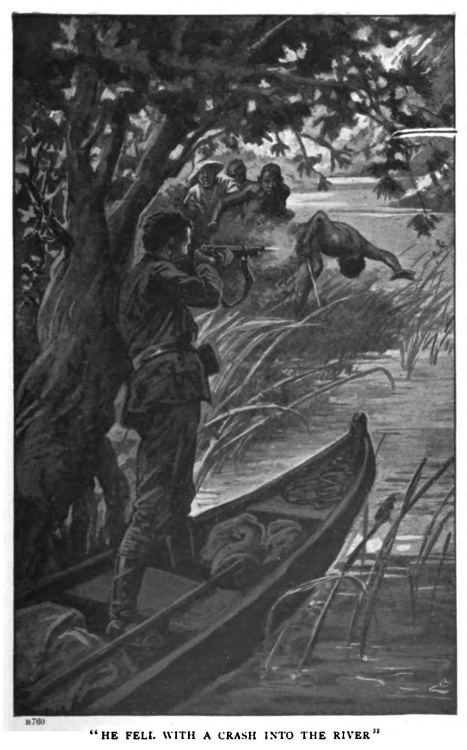
“Then he at least shall suffer now, whatever happens to the others,” exclaimed our hero. Lifting his weapon again he covered the half-caste, waited till he felt sure of his aim, and pressed the trigger. Once again there was a shout, and one of the unfortunate natives who aided the rascally half-caste, leaped high into the air to fall next instant with a splash into the water.
“Rush! He is now unarmed! Cut the dog to pieces!” shouted James Langdon.
There was an ugly gleam in the eyes of the robbers as they heard the shout, and slight though Dick’s knowledge was of the language of these Fantis, he recognised the meaning of the words. Quick as thought he threw his weapon down and drew his revolver. They were close to the tree now, and nothing but the darkness baffled them. But there was their disadvantage, and Dick made the most of it. Singling out the foremost he fired full in his face, and then, ere the report died down, pulled heavily on the bough and dragged himself and the native boat still farther into the shadow. A second later the weapon spoke again, and another of the miscreants fell. But still their commander urged them on.
“Think of the rifles and other goods,” he shouted. “There is only one between you and the prize, and he is only a boy. Rush him! Cut him to the chin! Stand aside and I will lead you. Now, are all ready?”
He turned to look at his men, and waved a native sword overhead to encourage them. Then he peered into the dense shadow and was in the very act of leading a final charge when there was a sudden and unexpected interruption. A single shot rang out from the river, while one of the enemy fell on his face in the water and disappeared from sight.
“Ahoy! Mine friends! Are you zere?” came in the guttural tones of the Dutchman.
“Fire on them,” shouted Dick, levelling his revolver again and sending a shot into the group. “Fire, Meinheer! Drive them off. Mr Pepson is badly wounded.”
An instant later the nose of the steam launch shot into view, some fifty yards from the bank, and Dick caught a glimpse between the leaves of the big tree which sheltered him of the anxious face of Johnnie, peering from over the engine-well, and of the portly figure of the Dutchman, a portion of which was hidden by the cabin aft. He stood there prominent in the rays of the moon, a rifle in his hands, and his short sword attached to his side. Then, as his eye lit again on the group of natives, he lifted the weapon, and hardly had the report of Dick’s revolver died down when there was a flash, and the half-caste who had formerly robbed our hero, and who had now made such an artful attack upon the boats of the expedition, clapped his hand to his thigh and gave vent to a loud bellow. Then he turned and fired a shot at the Dutchman, a shot which flew past in the air, screaming and hissing towards the opposite bank of the river. But long before it could have reached that destination the robber had swung round on his heel, and with a shout of defiance had raced for the shadows. After him Dick sent the remainder of his magazine, while Meinheer Van Somering, when he had recovered from the consternation into which the shriek of the shot had thrown him, followed his example, much to our hero’s trepidation, for the bullets flew on either hand, cutting a shower of leaves from the trees.
“Steady, Meinheer!” he shouted. “You will be hitting us soon. We are here under the tree. I had to seek shelter from the light, for they would have picked us off easily. Bring the launch in and I will wade out to you. I fear that Mr Pepson is seriously hurt.”
Leaping overboard he pushed the boat clear of the tree and of the shadow, and soon had it alongside the launch, for the latter steamed gently into the shallows. Then the leader of the expedition was lifted aboard, the two boats were made fast to the stern of the steamer, and they pushed out into the stream.
“Better make for the far shore,” said Dick. “Then we shall not be treated to long shots.”
“Bud zese wicked robbers, Meinheer,” gasped the Dutchman. “Shall we led zem go free? Shall zey escape?”
“We can do nothing more,” was Dick’s answer, given with decision. “They are gone long ago. The forest has swallowed those who are alive. Let them run, Meinheer, and do not trouble any more about them at the present time. To-morrow, when there is light, we will visit the bank again and see what has happened to them. For the moment let us look to Mr Pepson. Now, Johnnie, steer us for the far side, and when you reach the shadow, come to a stop just inside its edge. Whatever you do, keep steam up, and have the propeller just moving, so that we shall not be drifted down-stream. Now we will light the lamp and see to our friend.”
Without hesitation he took the lead, now that Mr Pepson was incapacitated, for he realised in a moment that Meinheer Van Somering was not to be relied on in such an emergency. Indeed, he had been struck with amazement at the boldness already displayed by his stout friend, for who would have expected, knowing him as they did, that he would have dared to stand there so conspicuously on the deck of the launch and fire upon the robbers? Meinheer Van Somering had gone up in Dick’s estimation. He had proved that he had some store of courage after all. But he lacked self-control. At this moment when he should have been cool and thoughtful, for the danger had passed, he was tramping the deck from end to end, causing the stout launch to heel to either side. And every minute he would halt and stare at the forest which had just been left. At such moments his fist would close round his rifle, while his finger would feel for the trigger.
“Mein word!” he cried. “Bud zey would have killed us! Zey were robbers and murderers. Ah! I shod two of zem. Meinheer Dick, you saw me do id.”
“I saw,” growled our hero, “but we can talk of that later. Come and help with the lamp. Put your rifle down and leave the robbers to take care of themselves. Come, Meinheer, our comrade may be bleeding to death.”
There was a tone of command now in his voice, and at the sound Meinheer dropped his weapon and came aft. Already Dick had been able to find the lamp, and just as the Dutchman reached him he struck a match and lit the wick of the candle.
“Hold the lamp, please,” he said. “Higher, so that I can get a good view. Now, what has happened? I heard the bullet strike heavily. Ah! Thank heaven! He is alive.”
“And zere, I zink, is ze wound. See, Meinheer Dick, zere is blood. Oh, mine poor friend! How he has been hurd!”
“Higher!” commanded Dick, as the Dutchman, forgetful of his request, lowered the lamp. “That is right. Keep it there, please, till I have ripped the coat open. Ah, here is another wound in the head. That will account for his being insensible.”
Together, the Dutchman’s tendency to undue excitement arrested by the coolness displayed by his young companion, they cut the shoulder of the coat away and inspected the wound. Then they went in search of bandages and dressings, for the thoughtful Mr Pepson had included a cabinet of drugs and instruments in the outfit of the expedition. Neither of the two friends who looked to the wounds had had previous experience, but common sense helped them, while the lamp allowed them to read the clearly printed directions contained in the cabinet. They bathed the wounds in the shoulder and the scalp, and applied the dressings. Then they put the arm in a sling, and placed it across the wounded man’s chest.
“He is coming to,” said Dick, after a while. “We will give him a few drops of water. Hold his head so, Meinheer. Now I will pour a little between his lips.”
An hour later their friend was conscious again, and was sitting up with his back leaning against the gunwale.
“I feel dizzy and my head aches dreadfully,” he said, with a plucky smile. “Look in the cabinet, Dick, and you will find something there which will quiet me. Then perhaps I shall get to sleep and be myself to-morrow. Never fear, my friends. The wounds are not so serious, for the gash in my shoulder is merely a flesh wound, and the bone is quite uninjured. As to the scalp wound, I am a fortunate man. I think that the bullet must have glanced from a bough, for I heard a sound just before I was struck. Then it hit my shoulder, and as it flew on just touched my head, glancing from the bone, and hitting me hard enough to stun me. By the way, I was standing in the water. I suppose Dick pulled me out again? That is another debt I owe him.”
“You ought to keep quiet,” was our hero’s answer, as he arrived with a bottle and a glass in his hand. “Here we are, sir. A teaspoonful in a little water, and then silence. There, drink it up, and sleep. We will look to the safety of the boats.”
He held the glass to Mr Pepson’s lips and watched as he feebly drained it, for there was little doubt that the leader was sadly injured, and only his pluck had allowed him to chatter at all. However, he obediently drank the mixture, and seemed to be glad to settle down on the rug which the Dutchman produced. Another rug was thrown over him, a cushion placed under the wounded limb, and the lamp removed from before his eyes. Dick and Meinheer retired to the far end of the launch and stood there chatting in whispers, till, in less than half an hour, the deep breathing of the sufferer told that he was asleep.
All this while the launch, with the boats trailing out behind her, lay in the dense shadow of the river-bank, her propeller barely moving, so that she just held her place in the river. Close at hand could be heard the murmur of the leaves in the forest, the chatter of monkeys, and the call of night birds, arrested a little while ago by the reports of the rifles. And on the other side a fine moonlit vista was displayed. The surface of the river Pra lay spread out in the rays of the pale African orb, while the water rippled and slid down toward the sea, seeming to be particularly peaceful on this lovely night. Looking at its shining surface, and at the wonderful lights and shadows beyond scattered along the face of the jungle, one almost wondered whether the coming of the robbers were not after all a dream. Whether murder and theft had, in fact, been attempted, and whether away on that far shore there actually lay the dark forms of the attacking natives who had lost their lives in the bold and dastardly attempt. But there could be no doubt. As Dick Stapleton stood in his shirt sleeves upon the roof of the tiny cabin, rifle in hand, and cartridge bag about his sturdy shoulders, his eager eyes searched every shadow, and followed every line of river and forest which was illuminated. Suddenly his arm shot out. His figure became rigid, while his finger pointed across the water.
“There is one of the rascals, at any rate,” he said. “He has come to look to his comrades, and no doubt thinks that we are far away by now. See, Meinheer, I could pick him off from here as if he were a bird, and I should be justified. But that’s not the sort of game I like to play. They’re beaten. They’ve had a lesson, and I fancy Master James Langdon will remember it. As for us, I should say that we have had a very narrow escape.”
There was a grunt of approval and acquiescence from Van Somering, a puff of smoke proceeded from his lips, and he growled out a reply.
“Mein friend,” he said, in condescending tones, “we are conquerors, is id nod so? Zen zere is no need to kill more of zese men. Led zem go peacefully while we make ze mosd of ze nighd which remains. Meinheer, id is near ze hour of midnighd. Your wadch should commence now. I will sleeb, for I am weary.”
He seemed to have forgotten the fact that it was his drowsiness which had almost brought disaster to the expedition, and that Dick’s watch should have commenced at nine and ended at twelve. With a grunt he rolled along the deck, leaving our hero in command of the situation.
Chapter Five.
A Question of Importance.
Dick shivered and fidgeted. He tapped the deck gently with his toe, and then got up and clambered to the roof of the tiny cabin again, for he was ill at ease. It was not the chill air of the early morning which made his blood run cold, nor the damp mist which rose on every side from river and jungle, from the stagnant pools lying amidst the roots of giant trees and boulders, and from the mossy margins of the stream, where the eddies played, and the current was still. It was neither of these, for there was no chill in the heart of this African country. The morning was almost as stiflingly hot as the night had been, though the green of the leaves, and the shimmer of the river surface as it met his eye through the thin mist, looked cool and refreshing. Dick was uneasy in his mind. As he had sat the hours of darkness through his thoughts had been busy. Remorse, anguish, bitter self-condemnation had come in turn to torture his mind, and now, as the darkness waned and the light increased, he was constantly on the move, searching the river-bank on the far side.
“There! Yes, that is the tree,” he said, as he pointed to the bush beyond. “I can recognise it, and beneath it lie those poor fellows. I killed them! They are stretched out there cold and stiff, those whom the water does not cover. Oh, it is awful to think about.”
He wrung his hands, while there was a look of anguish on his usually jolly face. Had James Langdon, the rascal who had made the attack in the night which had just passed, been able to see him he would have laughed, for this sturdy young Englishman, looking so strong and active on this early morning, would hardly have dared to lift his rifle. He was suffering the torment of mind which has come to many a thousand young warriors before him. Not because he wished it, but owing to pure accident, he had the blood of fellow beings on his hands. He had killed men. He had seen them fall. He remembered the horrid gurgling sound made by the unhappy wretch who had fallen into the water and sunk to the mud. The hideous noise had haunted him the night through, so that he was unmanned and shivering. His fists were clenched, and his teeth held tight together.
“I killed them,” he murmured.
“And they have themselves to thank,” said a voice at his elbow. “So that’s how the wind blows! Our gallant young agent would rather fall himself and see his comrades massacred than fire on rascals who were ready to murder all. No! No, I did not mean that, my lad. But—look here!”
It was Mr Pepson, standing there on the deck as erect as ever, as if he had received no wound, though the bandages about his head and his shoulder and the blood-stains upon them, showed that he undoubtedly had. But Dick had begun to discover some unsuspected points about this employer of his, and had come to the conclusion that he was possessed of no ordinary pluck and go, though he showed it in his own quiet and unassuming manner, and, in addition, that thin and cadaverous though he seemed to be, yet this trader from Sierra Leone was as hard as nails. He stared at him in amazement, and then flushed at his words.
“Why, you ought to be wrapped in your rug!” he exclaimed sharply. “You are hurt, and need a little nursing.”
“A mere scratch—a flea-bite, I assure you. I have had many worse before this, as you may learn when I tell you a little of my life’s history. But speaking of rugs. That’s what you want, my lad, and a good talking-to besides. Now, listen to me, Dick. I don’t blame you, nor do I smile at your thoughts and feelings, for every decent fellow has them. I remember a ruffian who thought to rob me in South America, many years ago. Yes, I was a youngster little older than you are. I shot him dead, and lay down beside him through the night, because that was the safest place. When the sun came up and showed me that I was alone and that there was no more trouble to fear, I looked at that poor fellow. He was lying on his back, his legs curled up beneath him, and his hands stretched out as if he were asleep. But his white face and the pool beside him told me the awful truth. I bolted. I ran away, Dick. I felt like a murderer, and for days wondered whether I should be tracked. Then I saw the other side. A rancher took me in hand, just as I am doing with you, and he made me see the right side. Why, bless me, the world is filled with honest people and with rogues, and the latter prey upon their fellows. Are the honest men to put up with robbery and violence? Did you agree so easily to James Langdon’s taking your gold? Did you? Come, answer the question.”
Dick was cornered, and began to see the other side of the matter. The sun was coming up, too, and the damp mist was already beginning to disappear. Our surroundings often have an immense effect upon the brightness or otherwise of our thoughts, and our hero, usually so jolly and so genial, had felt the depression common to many who keep watch alone during the dark hours after an action.
“Of course I didn’t,” he answered. “I tried to shoot him, just as I did last night, and he would have richly deserved his fate.”
“Quite so. And these rascals last night deserved theirs, without a doubt. It happened that you were the one to stand between them and their wishes, and they did their utmost to remove you. Theirs was might against right, and right prevailed. They paid the penalty, and here are you grieving because all has happened as it should. Come. No more of this nonsense! Tell me about the action, for, remember, after the moment when we set foot ashore, I know nothing, save that I found myself aboard this launch, with you and Meinheer staring into my face. That reminds me. Where is our fine friend? A precious mess his laziness got us into last night.”
“Turned in and snoring,” said Dick. “Listen!”
Above the ripple of the water and the sough of the wind in the trees the sounds proceeding from the nose of the Dutchman could be distinctly heard.
“He must have his sleep,” laughed Mr Pepson. “Did I not tell you that we must needs rely upon ourselves for protection? He is made for commerce, not for warfare.”
“And yet he did well last night. I’ll tell you what happened.”
They sat down on the tiny roof while Dick told how the bullet had struck his friend, and how the flash had showed him a dozen men rushing down upon them.
“That was an awkward position,” interrupted his friend. “I understand that I was lying in the water. Covered, in fact?”
There was a queer little smile on his lips, and he looked swiftly into Dick’s honest and open face.
“Yes. You had gone below the surface. I was stunned by the mishap. I thought it was all up with us.”
“With me, you mean. You could have bolted. The boat was close at hand.”
Dick flushed to the roots of his hair, and tore his hat from his head as if the weight troubled him. He stared at Mr Pepson in amazement, and then, seeing the smile, smiled back at him.
“You are chaffing me,” he said. “Trying to humbug me. You know well enough that no decent fellow would do that. You wouldn’t. I wasn’t going to desert a comrade who was down and helpless, particularly when there were such ruffians about. So I set to work as quickly as possible.”
“You made up your mind to see the business through?”
“Yes. I was staggered at first. Then I caught you up, not too gently, I fear, and dumped you into the boat. After that I pushed her out and shoved off into the shadow of the trees.”
“Why? What was your reason?”
Mr Pepson was like an inquisitor. He still smiled the same little smile, and still treated his agent to an occasional flash of his brilliant eyes, as if he would probe him to the utmost depth.
“My reason? Oh, we were in the light, you see. The moon was up, and the beggars could pot us easily. They had guns, remember, else you would not have been hit. I reckoned—all of a sudden—I don’t know how it was, quite—that we should be safer there, and so into the shadow I went. Then they occupied our position. I could see to shoot, while they were bothered. Still, they made a fine rush, and things began to look ugly when the launch came into view. Our friend showed his mettle, for he fired at once, and his shot practically ended the engagement. Then we steamed off, and, and—”
“And here we are. And I owe you a life again, Master Dick. Very good. No, I won’t say a word more, save that you tackled the task well. It was an ugly position and you seem to have chosen the only way out. I’m glad, too, that Meinheer put a spoke in their wheel. Now do me the favour of dressing these wounds again, and then we will breakfast. Get the bandages and a looking-glass, for then I shall be able to see the hurts myself, and give an opinion. You see, I am a bit of a surgeon.”
At this moment the blanket beneath which the ample figure of the Dutchman was shrouded stirred and was thrown back, and very soon, yawning and stretching his arms, Meinheer came along the deck. By then Dick had the bandages and fresh dressings, as well as a bowl of water, drawn from the river, and some clean linen to act as a sponge. How different, how lighthearted he looked, for, thanks to his chat with Mr Pepson, and to the other’s common sense, all his worries were dispelled, and he saw things with an eye which was not jaundiced. He had, in fact, reached the stage at which others in a similar position had arrived before. He could see that killing was not a joyous trade, that no ordinary human being lightly undertook it, and only when circumstances made it imperative that he should act so as to protect his own life and that of his friend. Then there was no blame to be attached to the one who had shed the blood of his fellow, so long as he was not a wanton aggressor.
“Here we are,” he called out as he came along. “Good day, Meinheer. Hold the bowl, please, while I get the bandages undone. Ah, here’s the pin. Now, sit up, sir. That’s right. We’ll have it done in a jiffy.”
Very carefully and skilfully he unwrapped the bandages, and presently the dressing was removed from the shoulder. Mr Pepson lifted the glass, arranged it so that he could obtain a clear view, and then grunted.
“Humph!” he said, with one of his inscrutable smiles. “A mere scratch. Take the probe, Dick. Now dip it into that other bowl which has the carbolic in it. That’s the way. Gently put it into the wound. No. Don’t be nervous. I’ll soon shout if it hurts. Press gently towards the other place where the bullet came out. Hah! A mere flesh wound, barely an inch deep. Not even that. I’m lucky! The shoulder is scarcely stiff, and a little rest in a sling will put it right in a week. A schoolboy would laugh at it. Put on fresh dressings and we’ll inspect the head. Lucky that I’m such a surgeon!”
He was as cheery as possible, and thanks to his lightheartedness his friends, who had been looking on and helping in the task with some misgivings, began to feel that their comrade was, after all, not so badly hurt.
“I tell you that it was only the crack on my skull that mattered,” persisted Mr Pepson. “The bullet slipped through my shoulder, a mere wound of the cuticle, and then happened to glance against my scalp and skull. A man can’t stand that. It knocks him stupid. That’s why I fell, and that’s why our young friend had to help me. But it doesn’t explain why he—a mere youngster—pulled me through so well, and why he stuck to me when many another would have bolted to save his own skin. Heh? What did you say, Meinheer?”
“Zat we hab a drasure. Zat Meinheer Dick will be a gread man one of zese days. When he is big like me, when he has grown fine and dall, and, and—ah, yes, sdoud, you call him; yes, when he is sdoud, then he will be one gread, fine man. And he is brave! Yes, I see zad with half one eye, for a brave man knows when he meeds one of ze same.”
“Quite so, Meinheer,” answered Mr Pepson, dryly. “Which reminds me. Dick says that you fired in the nick of time, and turned the tide of the battle. It was a good shot. You did well, and Johnnie also, to bring up the launch just then. But stand aside a little and give me the glass. Hah! Looks nasty, doesn’t it, Dick,” he went on, as the wound on his scalp was exposed, and he noticed our hero wince and turn a little pale at the sight. “Come, come! Looks are the worst part of it. Bathe the wound and cover it again. An Irishman would not give it a second thought. I haven’t even a headache.”
He rose to his feet when the dressing was completed, and walked up and down the deck, looking perhaps a little more sallow than usual. But his spirits were not in the least damped or downcast. Indeed, his two companions had yet to learn that their leader was, in his quiet way, a remarkable man. As hard as nails, as Dick had already observed, cool and courageous, and possessed of a dogged nature which defied the utmost fatigue, which laughed, or rather smiled only, at danger, and which made light of any wound. Meanwhile, Dick and Johnnie were engaged at the furnace door, and presently the aroma of coffee came to the nostrils of the leader and the Dutchman, causing the latter to turn an eager and expectant gaze in that direction.
“By Jobe!” he cried, “bud zad is a scend zad is goat, yes, ver goot. Whad shall we ead zis day?”
His question was answered almost at once, for Johnnie came along the deck bearing a steaming dish, Dick following with the coffee and biscuit. The newspaper was again spread on the roof of the cabin, and all set to work with eagerness.
“And now for future movements. We are a day’s journey from the mouth of the river, and three from the mine,” said Mr Pepson. “The question is whether we should push on alone as we are, or whether we should return. There is no doubt that all our Fanti men were in league with these robbers, and left us at the first opportunity.”
“And would do the same again,” Dick ventured. “If we returned for a second crew, who is to guarantee that they will not behave in a similar manner?”
“That is the very point. We should run that danger. What are your views about this attack during the night?”
He swung round on his elbow and looked keenly at our hero.
“You saw them,” he said. “This precious rascal nearly shot you. How much has he had to do with the matter?”
“More than any one, I think,” was Dick’s answer. “I believe him to be a thorough rogue, and in league with the Ashantis. Inquiries which I made at Cape Coast Castle convinced me that he had been engaged on many occasions in running guns and ammunition to the coast, and sending them up-country. Well, we have heard that there is trouble brewing. The natives at Elmina are in almost open insurrection. Murders have been committed under the eyes of the garrison, and a few white men carried off. In addition, there are tidings that parties of Ashanti warriors are in the neighbourhood of the Pra. It is my opinion that this James Langdon is their spy, that he is watching for them and sending news of the doings at Elmina and Cape Coast Castle to King Koffee. That would have brought him tidings of our expedition, for all in Elmina and along the coast knew of our intentions—”
“While the king of the Ashantis had given us the concession, and had promised that we should be protected,” interposed Mr Pepson. “Not that I will trust his sable majesty’s word. The best protection that we can have will be our rifles. But I interrupted. You think—?”
“That this James Langdon is a spy, and that while engaged in that work he has time to see to other matters. The cargo we carry is valuable. If he could have taken the boats the expedition would have been ruined, and we should have had to return. Then, too, we do not know how much more ambitious the scheme of last night’s attack may have been. They may have arranged to steal the boats and make sure of their prize, then to return and cut our throats. There were sufficient of them, and I fancy that what James Langdon would willingly do, the others would also carry out.”
“Precisely. They would hack us all to pieces. Never you hesitate again to shoot, my lad. Where such rascals have to be dealt with it is as well to press a trigger without delay, remembering that the man who hesitates very often is killed before he has another chance. And you think that this ruffian has been on the lookout for us, and that we are not only fortunate in having our goods secure, but also in having our lives? I believe it. I think the fellow would willingly have had a little private revenge with his booty. He has his knife in you, Dick, because you were the first to discover him, and he will not be more friendly disposed to us, for we are whites, and he is an outcast. To return to the subject of Elmina. I heard about the natives. Perhaps Meinheer can tell us more.”
“Zey are pigs, I dell you. Mein word! Bud do you know zis, mine ver good friend? Zese blacks were once servands. Zey would run, and quick, when ze order was give. Now—now zere is no ordering zem. Zed do nod move. Zey glare ad me, ad me, Meinheer Van Somering. Zey used to sdand and shake, so”—the burly Dutchman let his knees knock together, while he trembled till his fat cheeks quivered—“ver good, now zey laugh, yes zey laugh and run away.”
“All of which points to disaffection and probable mutiny,” said Mr Pepson. “Then it is clear that a second crew from Elmina would be worse than useless. We shall have dangers to face. We can well do that alone.”
“While I am sure that we can manage the launch and the boats, particularly if we tie up before it is dark, and then change our position once the night has fallen.”
“A brilliant idea, Dick, and we will carry it out. Once at the stockade I shall have no fear, for the men are Ashanti gold-diggers, who are not much given to fighting. There are a dozen of them, and I think their loyalty can be controlled by the prospect of gold. You see, they are paid a percentage of what they recover from the soil. Yes, we will push on up-stream and avoid another attack. If there is a moon again we will keep on during the night. Now about those fellows over there. We must go across and see how many are killed, and if any are still living. Meinheer, what do you say?”
The Dutchman did not reply hastily, for he was considering the danger of such an expedition. However, in his heart of hearts, Meinheer was a humane man when his fears were quieted, and he argued that here there could be no danger.
“Good. We will go, Meinheer,” he said. “Ze sooner ze bedder.”
“And as I am the lightest and perhaps the most active, I will land,” added Dick. “Then, in case of an attack, you two can cover me with your rifles. There is no trusting these rascals, particularly when James Langdon commands them.”
A few minutes later the remains of the breakfast had been cleared away, and while the trio smoked their pipes and chatted, Johnnie stoked the furnace, throwing coal upon it till a column of smoke issued from the funnel. Soon the hiss of steam from the escape told that the launch was ready for a move, and at once Mr Pepson stepped to the tiller.
“We’ll leave our boats anchored over here,” he said, “for it would never do to have them over on the far shore and run the risk of attack. In the confusion, if there were need to escape, they would hamper us, and would perhaps be lost. Make them fast together, Dick, and we’ll leave Johnnie in charge.”
Another two minutes saw the launch steaming away from beneath the trees on the eastern side of the Pra, and presently her nose was pushing its way through the reeds and osiers which cropped up here and there on the far side.
Mr Pepson still held the tiller, a rifle beside him, and a cigar between his lips. The bulky form of the Dutchman was stretched out on the deck behind the tiny cabin. His rifle was at his shoulder, and he surveyed the jungle eagerly, treating every dark patch and shadow to a fierce scowl which boded ill for the man who might be lurking there. His finger on such occasions would go to the trigger of his snider till Dick fidgeted and felt uncomfortable, for he was not far from the line of fire. He lay in the bows, a light bamboo in his hands, with which he every now and again sounded the bed of the river to make sure that there was sufficient water. A few minutes’ gliding along in the shadows brought them to the spot where the action of the previous night had taken place, a spot instantly recognised by the figures lying about it. For stretched in the sun were the victims of Dick’s fire, as yet undiscovered by the river alligators. Dick shuddered, and transferred his gaze to the bush. Then, remembering Mr Pepson’s words, he looked again. One poor wretch lay face down in the water, his body already almost covered with drifting mud, while his feet protruded on to the land. Close to him lay a second, still and dark, his limbs stretched to their fullest extent, while some paces away were three more of the attackers, all stark and dead.
“The reward of rascality,” cried Mr Pepson. “A horrid sight, my friends; but then we might have been in their place, and war and battles are always horrid. How’s the depth, Dick? Can you get ashore?”
For answer our hero tried the sounding with his stick again, and then stood up. Taking his rifle he dropped lightly into the water and waded ashore. Then he went to the figures lying about. They were all undoubtedly dead, and a glance satisfied him of that fact. At once he went on towards the bush, which at this point receded somewhat from the river, and presently something attracted his eye. It was a path leading into the forest, a path freshly broken and trodden, the one, no doubt, by which the robbers had fled.
“Leave it,” shouted Mr Pepson. “You would be in the middle of the jungle, where all is dark, and we could not help you. Come back. We have learned all that we desired. There are five killed here, and one whom you shot in the first boat. But one moment. Do any of these fellows belong to our runaway crew?”
Dick retraced his steps slowly, and reluctantly looked at the bodies again. There was not the slightest doubt that they were the very men who had come from Elmina—all, in fact, save one, whose face was strange.
“Then James Langdon had others with him,” thought Dick. “Somehow, I don’t know why, I feel misgivings about that man. His memory haunts me. What if he attacked us again!”
What if our hero had known that the ruffian whose name he mentioned was at that very moment within little more than a stone’s-throw! That James Langdon had come down to the river-bank that morning, having left his lair in the forest just as the launch steamed away from her anchorage of the previous night! That he had watched with the eagerness and stealth of a fox, and had rubbed his hands with delight as he saw the son of the master he had robbed drop into the water! For this half-caste forgot that he himself was to blame for the existence which he now led, for the discomforts which he had now to put up with. He placed all the blame on Dick’s shoulders.
“There he is!” he growled, as Dick waded towards the shore. “But for his coming to the coast I should have been able to remain there, still unsuspected, and there, living in a good house, I could still have done this work for King Koffee. And I could have gained riches more quickly. But we shall see. Ah! he is ashore. If he steps nearer I will shoot him like a bird.”
He crouched in the underwood, while his hand went to the pouch at his waist. A growl of anger and disgust escaped him, for the revolver which he had carried was not there. He had no weapon but a large sheath-knife, which he carried at his hip.
“It will do as well, and it is silent,” he said to himself. “He is coming. The young fool will walk into the trap, and this time I will not be flurried. He shall come on without a suspicion, and when he has passed me I will leap on his back and there will be an end of the matter.”
His ferrety eyes gleamed with malice. He spat on the hand which was to hold the knife, and then gripped it with all his strength. His limbs arranged themselves till the man was poised on the tips of his toes and fingers, till he sat crouched in a position to spring upon the back of his unsuspecting foe. Then came the voice of the leader. Dick stared into the jungle till the half-caste thought he must be seen. Then he retired to the launch, inspected the faces of the slain, and went aboard.
“My luck!” growled James Langdon. “But the chance will come again. Oh, yes, my friend, Dick Stapleton, you will be sorry one of these days. As for the men who have engaged you as their agent, they are fools. It would be better for them if they had never met you.”
He glared at the launch and her passengers as she steamed away, and still continued to stare at them till they reached the far side of the Pra; for a thought had struck this ruffian.
“Why not?” he asked himself. “They will be alone. There will be gold in plenty. Why should I not have my share of that or take all that they possess? If I have failed this time I shall succeed at the next attempt.”
The thought pleased him immensely, for his face lightened, the scowl left his forehead, and for a moment James Langdon looked as if he were not the villain he had proved himself to be. But he would not have deceived Dick Stapleton. Had our hero been able to see him there in the bush, he would have suspected the mischief that was brewing, and the misgivings which now filled his mind would have been vastly increased. As it was, he and his friends went on their way up the river, and their adventure of the night almost forgotten in the passing scenes, and in anticipation of the pleasures before them.
Chapter Six.
Forest Dangers.
Two days passed without event as the steam launch made her way up the river Pra, and each day the stream narrowed. Indeed, the expedition was approaching the bifurcation of the river, and so far had not come upon the tributary which they were to ascend.
“We shall know it by two enormous cotton trees, one of which has fallen against the other,” sang out Mr Pepson that evening, as the anchor was dropped, and the trio sat down to their meal. “Remember, two cotton trees, one of which is supported by its fellow. Is that not the description, Meinheer?”
“Good. Id is zad. I have never seen him, bud I know. Meinheer Dick shall hear how I come do find zis place. A native run away to Elmina and draw a map in ze sand wiz his doe. He said, ‘over zere, plendy of gold, and mines close do ze riber.’”
“And you brought the tale to me,” interrupted Mr Pepson, “with the result that we sent an agent, and after getting his report we obtained a concession, and set native gold-diggers to work. That’s the secret of this mine, Dick. It’s so close to the river that one can take machinery there, and the winding gear we have brought, though small, will be sufficient to tell us whether it is worth our while to bring more. Transport is the main difficulty in this country, and if we have a river, why—”
“Zere is moch gold for all,” burst in Meinheer. “Wid a riber we can reach ze mine and can dake our goods. Zen ze ground is clear. Id is rocky soil, and ze fever is nod gread.”
“Which reminds me. We must take precautions,” said Mr Pepson. “I have brought ample supplies of quinine, and we must take a few grains every day. It is the only thing for an Englishman, or for any white man. But that is not the only precaution we must take against malaria. I have not lived in Sierra Leone all these years, nor travelled in many another fever-haunted country, without learning what to avoid. The cause of the fever is too doubtful for me to attempt to make a statement, but supposing it is the water, as the doctors say, then we must avoid unboiled or unfiltered water; and boiled water is certainly the safest. We must sleep off the ground, clear of the mists, and must choose the highest spot. If the stockade is well posted, all will be right. If not, we will rebuild it. Then there are the mosquitoes. Some, a few only, whose numbers are steadily growing, say that these insects convey the germ of malaria. (This is now an accepted fact.) Very good. We will keep them away as far as possible by the use of curtains at night. Last of all, the man who exercises in the cool of the morning and evening, who avoids the direct rays of the sun at midday, and who eats and drinks lightly, stands a far better chance than does the one who is lazy, and who is apt to indulge too much. Pass the biscuit, Dick, and light up if you care to do so, Meinheer.”
According to their usual custom, a custom suggested by Dick, the launch kept her steam in till darkness had fallen, and then, as soon as the anchor had been hoisted, she ran farther up the river, and put over to the opposite shore. That done, she was anchored again, fires were banked, and the party settled for the night, the watch being taken in turn. On the following day, after half an hour’s run, Meinheer Van Somering gave vent to a shout of delight.
“Mein friends!” he cried, as he danced on the deck till the steamer heeled. “Zose are ze drees. Look you. Two, and one lies on ze ozer. Ah, yes, Meinheeren, and ze riber is zere also. We are proud men do-day!”
“We are lucky, you mean,” answered Mr Pepson. “Who ever heard of an expedition setting off to find a tributary which runs into a river of this size some days’ journey from its outlet, a tributary the mouth of which is hidden almost by jungle, and is marked only by two cotton trees. However, there it is, and now we are but a few miles from the landing-stage. Let’s push on. It’s hot and close here, and the sky is overcast.”
They turned the nose of the launch for the narrow tributary, and steamed slowly into it for there was no saying when they might encounter a sunken bough or some other obstacle. On either hand now were trees, the dense forest, while at the base of this forest grew a network of trailing plants. Every variety of vine was there, and amongst them the one which produces rubber. Yams were seen in abundance, while orchids and other plants hung from the trees in festoons, their blooms illuminating many a dull patch. The banks were composed of slimy ooze and mud, and from these, as the boats trailed past, an occasional loathsome form was seen to waddle, and an alligator splashed into the water.
“Gentlemen to whom it is well to give the right of way,” laughed the leader. “They will do us no harm, but I should be fearful if we were to be upset. Now, how far do we steam?”
“Five or six mile, Meinheer. You will know when we reach ze road, for zere is a liddle place to land. Oh yes, zere is no difficuldy.”
“Then the sooner we reach the place the better,” exclaimed Mr Pepson. “I don’t like the look of the weather. This is hardly the season for rains, but it looks as if we were in for a torrent.”
An hour later a tiny staging was seen on the left bank of the stream, for the river was little more now. Indeed, in most places, the trees actually met overhead, while the dense foliage made the place so dark that dusk might have been falling. But in spite of the shelter obtained from the rays of the sun, the heat was intense. At the point where the staging appeared there was a break in the trees, and, as they drew opposite it, they saw that it had been erected at a point where another stream, a tiny tributary, emerged from the forest. Along its bank there was a path, while its mouth seemed to have been widened.
“All of which shows that we have a thoughtful agent,” said Mr Pepson, as he put the helm over. “Back her, Johnnie. Steady. Ahead a little.”
Very easily and gently the four craft were brought into the tributary, their painters being made fast to the trees which came close to the bank. Then the party landed and looked about them.
“Zis is hod, mein friends,” grunted the Dutchman, as he stood panting in his shirt sleeves. “I do nod wish for zis walk in ze foresd.”
“While I shall be glad to get it over,” said Mr Pepson, with emphasis, casting an eye overhead as he did so. “I tell you we are in for a storm, and that is hardly a pleasant prospect in such a place.”
Dick wondered why, for the mass of the forest which hemmed them in on every side seemed ample to protect them from any harm which might come from a storm. But no doubt his leader had had experience and knew, and at his words he slung his rifle, took a bag of cartridges, and prepared to march. Johnnie, too, leapt to the shore, for there was no longer any need to leave a guard, and within a few minutes the party was en route for the gold-mine.
Almost for the first time in his experience, Dick marched by a forest road, a track cut through the heart of the jungle, and he began to realise what were the difficulties of transport in this remarkable country. For the path was barely wide enough to admit one single man, and the great girth of the Dutchman often brought him into difficulties. It bore signs of having been cut some weeks before, for the marks of knives and hatchets were often to be seen. But in spite of the care taken in clearing it, parts were already practically impassable; for vines and other creepers had grown across it. However, a few sweeps from Mr Pepson’s sword cut them clear, and the party were able to advance. They wound here and there, following the track, which deviated so as to avoid large trees and very thick brush. At times they sank to their knees in marsh land, while on several occasions they leaped or waded across streams quietly trickling through the jungle. It was all very new and very strange, and our hero could have enjoyed it more had it not been for the heat. It was intensely hot and muggy. Not a leaf stirred, and not a sound came to them save the creak of an occasional bough, and the crack of twigs which lay underfoot. Bird and beast life seemed to have departed. Mr Pepson shook his head and hurried on.
“Better reach the open as soon as we can,” he said. “This is no place for a man once the storm breaks. Listen! It is coming.”
The tops of the trees moved while the tangle of leaves rustled. Dick thought he heard an indefinite sound, a distant hum, gradually rising in intensity, but as yet it was so slight that he was uncertain. He halted as Mr Pepson turned round and mopped the perspiration from his face. Then, as he replaced his handkerchief, he looked at his chief and started back. For the leader of the expedition, usually so calm and self-possessed, looked as nearly terrified as Dick imagined it would be possible for him to be. He stared overhead, and stood there listening acutely.
“You hear it?” he asked anxiously. “You hear a moaning sound?”
“I fancy I did a minute or so ago, sir. Wait. Yes. There it is, without a doubt, and it is louder.”
“Id is ze wind, mine frien, I zink,” gasped Meinheer, seating himself on a fallen log.
“The wind! It is the storm. A tornado!” exclaimed Mr Pepson, ominously. “I tell you we are in the greatest danger, and that we must act if we wish to be secure. Look about you, and find a spot where there are very big trees, and numbers of trunks which have fallen.”
He went on all fours and peered into the jungle and up towards the summits of the trees, many of which towered for two hundred feet overhead. And presently, when they had moved on a few yards, Dick’s hand went out and he drew his leader’s attention to a part which seemed to meet his requirements. A glance seemed to satisfy Mr Pepson, for in an instant his sword was out again, and he began to hack a road to the spot with all his strength. There was evidently no time for explanation, that Dick could plainly tell, for the distant hum had now risen to a roar, which seemed much nearer, while the tops of the trees above him rocked and strained in the wind. Then they were still again till another gust caught them. Whatever the danger to be feared, he had known Mr Pepson long enough to be sure that it must be great, else why the haste, why so much anxiety? Whipping out his sword he fell to beside him, and together, with Meinheer following them, his coat over his shoulder, and his handkerchief mopping the perspiration from his face, they fought their way through the jungle till they had reached the spot which Dick had pointed out. And here Mr Pepson threw himself exhausted on the ground, gasping with his exertions, while Dick was glad to sit down. As for Johnnie, he crouched at the foot of a giant cotton tree and cowered there. Dick could see the whites of his eyes, and noticed that he trembled.
“Get in here,” suddenly shouted Mr Pepson. “The very place! It may shelter us.”
He sprang to his feet, and forcing his way through some feet of the tangle, came to a tree of somewhat smaller dimensions as to height, but of enormous girth.
Like all the cotton trees in the forest at that point, the roots of this leviathan barely did more than penetrate the surface of the ground, for it was there that all the moisture lay. Below was a hard stratum which offered opposition, and as a result the roots had spread themselves out over a wide area, while they had risen into the air till there was an archway of large dimensions beneath the tree. Dick had seen the same before, and it had attracted his attention. At Mr Pepson’s shout he tore after him, and presently all four were stretched under the arch. Nor were they a minute too soon, for if there had been a roar before, the noise now was deafening and positively awe-inspiring. The gusts which had up to this caught the tops of the trees seemed now to be concentrated into one enormous blast. The very forest shivered and trembled. The treetops bent and the trunks groaned. Then the storm burst. A sheet of lightning lit up the sky and even penetrated to the forest depths. The roar became even greater, till the volume of sound was positively deafening. And how the trees bent! The one beneath which the party lay trembled and swayed. As Dick’s hand rested on one of the giant roots he could feel it moving under the strain, and wondered whether the huge mass would topple.
Crash! There was a sharp sound as if a cannon of small calibre had been fired, and a mighty tree a few yards away, fractured some feet from its base, came with a thud to the ground. Meinheer hid his face in his hands and groaned, while Johnnie rolled on the ground in terror.
“That was what I feared,” shouted Mr Pepson, now quite calm. “There will be many more before the storm is ended. But I fancy we are safe. They will not always fall so close to us.”
Dick looked out into the jungle, his face calm and grave, though in his heart he felt terribly afraid. For this was something against which one could not battle. The storm would have its way whatever man might do, and to stand there utterly helpless, was trying. All round him he could hear the crash of trees. One fell even closer than the first, and caused him to step backward in alarm, for the mighty trunk was dropping directly towards him, sheering through everything that stood in its way. It lopped the tops from half a dozen cotton trees, and brought two more crashing through the forest with it. Then, as Dick thought that he and his companions must be destroyed, its branches became entangled in those of the tree which sheltered them. Again he felt the vast mass sway. The trunk actually gave out a loud report as if it had cracked. But it was a veteran, and, thanks to its huge girth, was of unusual strength. It stood its ground, and when Dick looked again there was the falling tree held up in midair, with its two victims with it. It was a marvellous escape.
“That is the worst, I should say,” said Mr Pepson, coolly. “It was a narrow shave, I admit, but then I was expecting trouble. We are lucky, I can tell you, and you will realise the fact as we push on again. Ah! here comes the rain. I fancy we may congratulate ourselves.”
They had indeed every cause to be thankful, for their escape had been a narrow one. An hour later, when they emerged from the friendly shelter of the tree and struck out on the path once more, all realised this more fully. For hundreds of giants had fallen. Their trunks lay in every direction, many fantastically supported in mid-air, pillowed on the branches of their fellows.
“That is what one sees all along the coast,” said Mr Pepson, turning his head, “and I am told that some of the caravan routes which pass through this forest toward the interior are often almost completely blocked by fallen trees. It is the weedy youngsters that tumble. They run up swiftly, as straight as a rod, till they overtop the veterans. Then comes a gale, and owing to the nature of the ground and the little hold which their roots give them, they topple over. We’ve had a lesson, Dick. Keep out of forests in future when the wind blows.”
A little later the party emerged into the open, and were delighted to find that there was a very wide clearing, the forest standing back on all sides for more than a mile. And in this space the ground rose steeply, till its crest blotted out the view beyond.
“Rock,” said Meinheer Van Somering, with a chuckle of delight. “Dad was ze report, I zink. We were told dad ze mine was well placed. I agree, Meinheer, for in zis coundry where zere is rock zere is gold.”
At this moment a shout rang out in the silence, and a figure appeared on the crest of the rock.
“Our Dutch agent,” said Mr Pepson. “He is coming down to us, and soon we shall be at the stockade.”
Indeed, within a quarter of an hour the agent had joined them, making his way down the steep rocky hill by a path which was invisible from where they stood.
“Mein word!” exclaimed the Dutchman, as he stared at his agent and watched his agility as he leaped down the steep path. “If zat is ze only way do ze stockade, we shall be dead. Yes, I tell you, we shall die, for who could climb such a blace? Id is too steeb.”
“And happens to be the nearest way,” replied Mr Pepson, reassuringly. “Never fear, Meinheer, there will be an easier way down.”
That the agent was glad to see some white men could not be doubted, for he rushed toward them with a shout, and commenced to greet Meinheer Van Somering volubly. Then he was introduced to the others, and shook hands with an eagerness which showed that for many a week he had had no one there with whom to practise the art.
“Glad to see you, gentlemen,” he cried, in excellent English. “That am I, for it is dull here. When you get to the top I shall show you why. You will see to the right and left trees in one dense mass. To the north and south there is the same. Nothing but trees, and the blue sky overhead. It becomes tiring. But now you are here and I shall have company. Come this way. We can go by the path which I have just followed, or we can skirt round the hill.”
They elected to go by the latter path, for the steep ascent would have been too much for Meinheer. After an hour’s walk they found themselves on the far side of the rocky highland, and there before them lay the stockade, high up on the side of the hill, and within an easy rifle-shot of the forest.
“Trust a man who has been in these forests before to choose the right spot,” said the agent, as he pointed it out. “This is the windward side, and the stockade even under a hot sun is delightfully cool. There is little fever here, and one can cope with it. Mr Dick, you need have no fears for your health. The loneliness is the only thing which will trouble you.”
“I have been thinking about that,” answered Dick, “and I fancy I shall do something to distract my thoughts. Work in the mines or something of the sort. Perhaps help to improve the stockade and make it stronger.”
The agent looked at him in surprise. “Stronger!” he exclaimed. “And why?”
“Because I fancy we might be attacked.”
Our hero felt almost sure that there would be an attempt, for he had not forgotten James Langdon.
“Attack!” he said disdainfully. “The Ashantis will not harm us. They hate these Fanti men, and it is they against whom they war. They are out now with the intention of fighting. Trust King Koffee to keep them away from us, for if we were harmed, what would happen to the payments made to him? As to this fellow, James Langdon, I fancy I have met him. You need not fear him, for he will never come so far. If he is in the service of the king of the Ashantis, he will be on the far bank of the river and miles from here. No, Mr Stapleton, there will be no need to strengthen the post.”
By now they had entered the stockade, and found it to be composed of roughly sawn logs, trimmed with the axe. Here and there a small interval was left for rifles, though it was obvious that the designer of the place expected no trouble. In the centre was a log hut, thatched with long strips of bark, which were pegged down to the timbers beneath. The windows were unglazed, but rough shutters cut from packing boxes were provided.
“Enter, gentlemen,” said the agent, with some signs of pride. “You find yourselves in the salon, the smoking-room, and the bedroom of this house. It is only a rough shanty, sufficient to keep out the heat of the sun, and the rains, when they come.”
“And a fine example of your work,” exclaimed Mr Pepson. “Now, what of the mines? They are close at hand?”
For answer the agent led the way out of the stockade and down the far side of the hill till the party came to the level ground. And here it was seen that a stream flowed, and lost itself a little way on in the forest.
“Everything is nicely within reach,” said the agent. “You will find that the men work in couples, and as there are twelve of them, there are six shafts open. We will go to them.”
They ascended a small rise in front of them, and presently saw some natives working. They were hauling up wooden buckets from the mouths of narrow shafts driven into the ground, and were depositing their contents in a larger receptacle close at hand. At the river-bank Dick noticed a number of troughs of native workmanship, and began to gather the method adopted by the natives in their mining.
“It is all very primitive,” said the agent, “and no doubt we do not abstract all the gold from the soil. A large part gets washed away. Still, considering our methods, we are doing well, and have already a good store of pure metal. Look into one of the shafts. Yes, continue to look till your eyes become accustomed to the darkness down there. That is the man who is working in the tunnel. You can just see his back. He will call out when his bucket is filled, and his friend up here will haul it up. It is slow, but sure, and in time there is a quantity at the top. If the man below comes to harder soil, his friend goes down to the river and washes. If not, he hauls, and at the end of the day the two wash the gold from the soil which they have gathered.”
“But how on earth does the man get down?” asked Dick, for he could see that the hauling tackle was too weak for such a task.
“That again is simplicity itself,” was the reply. “You see that the shaft is barely four feet across. The man carries a kind of narrow spade with which he digs the ground. Well, he places that across the top of the shaft, and lowers his feet till they come to a niche on one wall. There it is. You can see it plainly. With his feet secure he leans back till his shoulders are against the far side of the shaft—in fact, till he is across the cutting in a slanting position. Then he releases the digger and lowers it, placing it in a similar position across the shaft. And so he descends, repeating the movement to the bottom.”
“Primitive, certainly,” agreed Mr Pepson, “and I think it can be improved upon. We have brought hand-winding gear with us, and they will alter matters. The fellow below can lower himself, or get his friend to do so for him. Then the labour of raising the soil will be lightened. That reminds me. We have left our launch and the canoes at the landing-stage. What steps can we take to get our goods here?”
“We will become porters to-morrow,” was the answer. “These Ashanti fellows are good tempered and willing if taken the right way, and you will find that they will undertake the task with pleasure. Leave it to me, sir.”
That night the whole party lay down in the hut within the stockade. On the following day they returned to the river, and with the help of the natives had transferred all their belongings to the hut before darkness fell. But it was a more difficult matter to bring the winding gear through, and almost a week passed before it was in position. By then Dick was beginning to feel that he knew something of the work, and even found that he could make himself understood by the natives.
“I shall have no fears for you when we leave,” said Mr Pepson, one evening as they smoked their pipes outside the hut. “You hit it off well with the natives, and you understand their methods of getting gold. You will store it, check the amounts they obtain, and pay them in gold dust if they require their money. If not, you will show them what they have earned, with the promise that payment will be made at any time. The store of metal you will keep here. Have no fears for it. I don’t believe any one will dare to interfere with you. Now for our movements. I shall wait a little longer till this scalp wound is healed, and then Meinheer, our Dutch agent and I will return to the coast. We shall leave Johnnie and the launch with you, for you will need to send down for stores, and to deposit the gold, and we can return with as much ease by means of one of the boats. Our friend, the agent, tells us that the wind will be set down-stream, and that a sail will carry us to the sea almost as soon as would a propeller. From there to Elmina and Cape Coast Castle is nothing.”
Accordingly, some three weeks later, the party set out, Dick passing with them through the forest to the landing-stage. One by one they shook hands with him and entered the native boat. Meinheer Van Somering swept his hat from his head and gave a deep flourish and bow. Mr Pepson smiled his encouraging smile, while the agent busied himself with the sail.
“Push off!” sang out the leader, and at the shout Dick sent the boat out into the stream. Her head was pointed down towards the river Pra, her sail filled, and within a minute Dick was alone in the forest. His duties had commenced, he was now sole agent for the gold-miners, the only white man in that part of the African forests. He turned on his heel, saw that the launch and the other boats were firmly secured to the bank, and went off with his head in the air, whistling cheerily.
Chapter Seven.
Forewarned is Forearmed.
“I don’t like the news, Johnnie,” said our hero, one day, some weeks later, when he had quite settled down to his duties at the mine. “You say you saw some men encamped five miles and more away. Tell me all about them.”
The native lad, an inhabitant of the coast near Sierra Leone, who had come from that part with Mr Pepson, and who had been left to keep Dick company and to tend to the launch, put the short black pipe which he was smoking into the other corner of his mouth, and turned his eyes up till the whites alone showed, a trick of which he was very fond. He was, in fact, a comical-looking fellow. Short and square for a native, with woolly hair, and a few stray wisps of beard at his chin, he was dressed in a much patched pair of breeches, with ragged edges, the tags hanging about his naked toes. These same breeches were suspended from his shoulders by an ancient pair of braces, a gift from Dick himself, while a soiled and disreputable jacket, smeared with many a patch of grease, was over his back, serving for shirt as well as coat. He held a rifle in his hand, and the state of his feet showed that he had just come in from the forest.
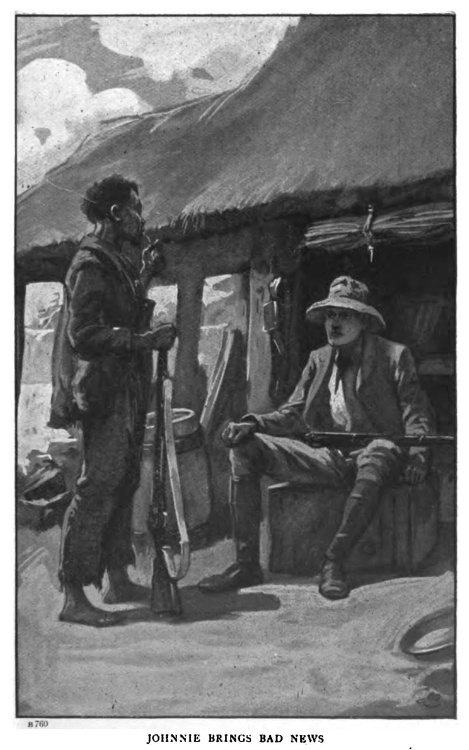
“Me go dere, as you say,” he said, taking the pipe from his mouth. “Me look for something to eat, for massa want fresh meat. And then me see smoke. ‘Dat strange,’ say Johnnie. On de coast where me lib noting wrong in dat. Fires eberywhere. Smoke all de time. But here—”
Again his eyes turned up as if to show that this smoke was a matter for astonishment.
“Exactly so. Here one would feel surprised and alarmed. Go on.”
“Den Johnnie tink, and say, ‘dese surely bad men, not like Johnnie,’ so me start to run ’way. Den me creep back, and soon me see better. Dere ten, tirty, yes, fifty big native, all wid sword and gun, and dey sit round de fire cookin’ and eatin’. Me look for dat scoundrel, dat white man who attack us below. But no, he not dere. Den me come ’way and tell massa.”
It was serious news, and for a long while our hero was silent. For three weeks he had gone about his work at the mine till he was thoroughly acquainted with it. He had been down each one of the shafts, and had ingratiated himself with the men. It happened that in two of the shafts a rich deposit of nuggets had been come upon, not an uncommon find in the goldfields of Ashanti; and that, together with the increased comfort given by the winding gear, all of which was now in place, had so heartened the miners that he was more than popular amongst them. But he was still haunted with the fear of attack.
“There must be people who know that we are here, practically with no means of defence,” he had said over and over again to himself. “And no doubt the news of a rich find will in time be circulated. What is to prevent a ruffian like James Langdon making a raid upon us? I am here, in charge, and I must take steps.”
That same evening he went to the miners when they had come up from the shafts, and told them the news.
“Our brothers are at war. There is nothing in this camp to alarm us or you,” said their leader, when Dick had made himself understood, a somewhat difficult matter, considering his small knowledge of the language. “The Ashantis will not touch us. The Fantis would if they could, for we are weak, and should fall an easy prey to them. But these were Ashantis.”
“And to-morrow a force of Fantis might come, too,” added Dick. “Then what could we do?”
“We should be killed, the gold would be taken, and there would be an end of the matter.”
“Then as I have no wish to be killed, I suggest that we take steps to protect ourselves,” said Dick. “I have rifles at the stockade for all, and will arrange a signal. You say that you can all shoot. That makes matters better. We will practise to-night. There is a tomtom at the stockade, left there by one of yourselves perhaps. I will beat that as the signal, and all will at once rush to the place, bringing their store of gold with them.”
The miners looked at one another when they heard his words, and then commenced to discuss the matter together; for it was difficult for them to understand the need for such precautions. They had been at this mine for some months now, and they had never been disturbed. At the same time rumour had reached them that their countrymen were at war with the Fantis, and that being the case, the latter would treat them as enemies. There was a big store of gold, the result of the last month’s labour, and that would certainly go. They would be killed, too, and even if they were not, they would lose their wages, now owing for some months.
“We will do as you ask,” said their chief, half an hour later. “There may be need for these precautions, and in that case we may have cause to be glad. On the other hand, the time wasted will be only short, and will not matter. What else shall we do?”
“Make for the stockade, as I have said, and when there we will arrange the method of defence,” answered Dick. “Keep your ears open for the signal.”
He left them, and an hour later, having seen Johnnie again in the meanwhile and instructed him to sound the alarm, he retreated to the stockade with the men, waiting till the last to see how they carried out the movement.
“That will do very well,” he said, as they arrived, panting, in the stockade. “Now for other orders. The last man in throws the doors to and is helped by his friends. That is right. We are now safely behind stout walls, and can fetch our rifles. They are kept in this rack in the hut, and a bag of ammunition is hung to the muzzle of each. Let every one go in and help himself, and then run out to the walls.”
He watched as the miners, a group of intelligent men, carried out his orders. Then as they came hustling from the hut, pushing each other aside in their eagerness, he arrested them with a shout and with uplifted hand.
“Some one will be shot very soon,” he said. “Some of you have already loaded, and guns go off sooner than they are wanted to under these circumstances. We must do things in an orderly manner, and each must have an allotted place. Tell your men off to a loophole apiece, chief,” he shouted. “Now, that is better, and we will practise the move again.”
Several times they carried out the exercise, Dick making them emerge from the stockade, and then, at a beat on the tom-tom, rush in, close the gates, and go in search of their rifles. No man was allowed to load till he was at his loophole, and then the order was that there should be no firing unless the enemy were clearly seen.
“We have a fair store of cartridges,” said Dick, “but we may have to stand a siege. That being the case, we must not throw them away. Now let each man pick out a tree or some object, and aim at it. I’ll give the order to fire.”
By now the miners were beginning to take more than a passing interest in these manoeuvres of their young chief. They had been talking the thing over, and had come to the conclusion that it would be worth while to safeguard their own interests. They had been away from their friends for a long time, and it might be that there was a war of considerable proportions raging, for the Ashantis were at daggers drawn with the Fantis, and took every opportunity of attacking them.
At Dick’s call they poured a volley into space, and looked round for more orders.
“That will do very well for to-day. We will practise again every day, and I want to see that the men at the top of the shaft shout the alarm to their friends below and wait to haul them up. There must be no desertion of comrades.”
Dick was as good as his word, too. The following morning, when he had carefully inspected the surroundings, and had seen that the miners were busily at work, he caused Johnnie to sound the alarm again, and stood in the neighbourhood of the shafts till all the men were up. Then the proceedings of the previous evening were repeated.
“That part of our precautions is arranged,” he said to himself, as he smoked a meditative pipe. “Now I must look to another matter. Johnnie and I must take it in turns to go abroad into the forest.”
It was a wise precaution, and from that day, turn and turn about, he or the native stoker, as soon as breakfast was ended, and while the day was still cool, would take a rifle and stalk away towards the forest. Sometimes they would go towards the river, to see that no one had tampered with the launch, and at others they would make in the opposite direction. But whichever road they followed, they were careful not to penetrate too deeply into the jungle, and to take their bearings before entering the bush.
“We might get lost,” said Dick, “and besides, it is really laborious work cutting a path, however narrow. The main thing is to circle all around the mine, looking for traces of a possible enemy, and, of course, shooting any game we may come upon, for fresh meat is a luxury.”
One day, a week later, when our hero was out on his tramp, and had proceeded a couple of miles from the mine, he suddenly came to a halt, and stood there listening intently, for a sound had come to his ear.
“The tom-tom!” he exclaimed. “I feel sure, and from the direction of the stockade. Can the place be attacked?”
The thought threw him into a fever of apprehension, for supposing an enemy had appeared, and his men were within the stockade, what would happen to them without their leader? They were excellent fellows, but Dick had come to know that, without some one to direct them, they were useless.
“They would be all right for an hour or two if not pressed,” he said. “But if they were rushed by a strong force—well, it would go hard with them. I must return. But can it be that that tom-tom was not from the mine?”
That was another momentous question, and, as he pondered over it, the perspiration poured from his forehead. He turned and retraced his steps at a run, breaking through the jungle in his feverish haste, tearing the vines and brambles aside and lacerating his hands and face with the thorns.
Hark! This time it was another sound that brought him to a standstill. There was the clear, crisp report of a rifle, a distant shout, and then a medley of sounds, the frantic cries of natives, and the sharp snap of answering firearms.
The place, then, was attacked. There could be no doubt about the matter. And he, the leader, was outside the stockade. Dick clenched his hands and ground his teeth with disappointment. He had no fear for himself. He thought last of his own personal safety. A duty had been entrusted to him. He had been placed at the mine to defend it, and he was helpless to direct the men.
“They must hold their own, then,” he gasped. “I cannot get to them yet, and they cannot know where I am. Very well, I will go where I can see what is happening, and then I must be guided by circumstances.”
This time he did not rush through the jungle with such frantic haste. His impetuosity had given way to prudence, and, as he walked, he peered ahead, halting every now and again to make sure that he was not running upon the enemy. As he approached the clearing about the mine the snap of rifles became more audible. It was a spluttering fire now, an occasional shot, and then a succession of reports.
“That is what I like to hear,” he said to himself. “It shows that they are not so closely pressed, and I think that they must be holding their own. If my men were being rushed there would be shouts, and rifles would be fired more frequently. Ah, it is getting lighter, and soon I shall be able to see.”
He crept on all fours now, and presently came to the very edge of the jungle. But from where he was he could only see a fraction of the stockade, and not a soul was in sight. To obtain a full view he must creep round to the far side, where the attack was taking place.
“No doubt they have their camp there,” he thought, “so I must be doubly careful. I’ll slip into the trees again and go cautiously.”
Well was it for him, too, that he took this precaution, for he had progressed only a little way when his keen eye caught sight of some natives out in the open. They carried rifles, and were making for the mines. Ditch watched them as they went to the shafts, and saw two of their number lowered into each. Then there was a shout, and they were hauled up again.
“Looking for possible stragglers,” he thought. “It was a lucky idea to have a signal to recall the men. I suppose Johnnie must have sounded it. Ah, the ruffians are now looking for gold, but there again I fancy they will be disappointed. How I wish I had a dozen men here! I could pick the enemy off easily, and then a rush might drive the rest away.”
By now the natives were retracing their steps, disappointed at their lack of fortune, and at once Dick crawled on again. An hour later he was round at the far side, and had a full view of all that was taking place. A glance showed him that matters were as he had hoped. The timely alarm, the previous training, and the careful instruction which had been given to the miners had resulted in their reaching the stockade in a mass, and in closing the doors on the attackers. Nor were there wanting signs that they had made their presence felt by the enemy, for ten dark figures lay sprawling in the open, some looking as though the men slept, while in other cases the bodies were doubled up in that fantastic position which is seen where men have been killed in the act of charging.
“Showing that our friends held their fire till they were sure of their aim,” said Dick, with a chuckle, his spirits reviving immensely at the sight. “But the attack was a genuine one, for I can see one man close outside the stockade. Perhaps the alarm was only just given in time, and when the miners reached the stockade the enemy were in full chase and close behind them. Ah! They have been making long shots, too.”
His hand went to his trigger suddenly, and he fell on his face in the undergrowth, for he had caught sight of a native some few paces away. He seemed to be leaning against a tree, and was partly in the open. A second glance, however, told that he was dead, for his head lay on his breast, and only the tree which supported him prevented his falling from his knees.
“Looks as though he had knelt to take a shot, and had been killed in the act,” thought Dick. “He will be fired at again, perhaps. One of our men will see him, and not knowing that he has already ceased to be an enemy will fire. It would be safer for me to crawl on a little.”