"With Wolseley to Kumasi" (continued 4)
Reading edition
“A queer way of getting up one’s muscle,” laughed our hero. “Just fancy training for school sports, or a gymnastic competition, in a similar manner! One would be rather soft, and hardly in the best condition.”
“Dere where Johnnie learn to fight,” went on the stoker. “Me go out when me not yet a man, and in de first battle me kill an enemy. He rush so”—he clambered from the well, and demonstrated the method of attack with such energy that the launch rolled—“he make stroke at Johnnie’s head, and miss um mark, golly! by de inch. Den me answer. Me hit wid all de strength wid um club, and he go whop! He fall dead on de ground. Den me take um head, and shout de war cry.”
He made another attempt to bring the last in reality before his master, and set the forests ringing. Dick clapped a hand over his mouth, and pushed him into the well.
“Steady, my lad,” he said. “There may be an Ashanti army within hearing of that call, and then what will happen? Spin your yarn if you wish, but do it quietly. How’s steam?”
A little abashed, but yet glowing with the memory of his victory, the native stepped to the gauge and read off the pressure. Then he shovelled a heap of coal from the bunker.
“Come night, and not see so well,” he said. “Hab plenty ready to run wid.”
About three hours after that, dusk began to fall, and for a little while the fugitives were compelled to lie in close to the bank of the river, for it was densely dark. But the time passed pleasantly enough, for Dick had his pipe alight for the first time since the previous day and as he smoked it, watching the glow of the bowl, and looking across to a similar glow proceeding from the clay gripped between the white teeth of the native, his thoughts returned to the stockade. He went over all the scenes again, his nearness to James Langdon, and the luck he had had then. His successful attempt to reach the stockade, and the desperate fight he had had on the way. And, later, the retreat, with all its numerous incidents. He was still thinking of it when the moon came up in all her splendour, flooding the river till it was almost as light as day. And then, for the first time for many an hour, he looked at himself, and was horrified. His hands were cut and scratched in all directions, as doubtless was his face also. His clothes hung in ribbons about him, while, by the stains upon the breast of his coat and upon his shirt, one would have thought that he had been badly hit. But that he certainly was not; and now he remembered how the wretch who had first attacked him outside the stockade, had fallen under his own sword—fallen against the one who struck the blow.
“Time to move,” he said, springing to his feet. “Steady ahead. More. Let her have it.”
The native grinned. He wiped his hands with a piece of waste extracted from his pocket, and then opened the throttle. And once he had the launch moving at full speed he leaned back in contentment, watching his master with one eye, while with the other he looked at the smoke curling up from his pipe.
An hour later, as they swung round a bend in the river, and came into a long, straight stretch, a cry of amazement escaped them. The water on the left bank was black with native craft, while the hubbub of some thousands of voices came to their ears. But that was as nothing to the shouts which greeted the appearance of the launch when she came into the straight. There was a deafening burst of shouting. Tom-toms and drums were beaten in all directions, while the deep note of many a native war-horn was heard. For crossing the stream was one division of King Koffee’s army, en route for the Fanti country. And of this division, amounting to some ten thousand men, not more than a tenth were on the water, for there were insufficient boats within a radius of many miles to carry more. The passage was being made by detachments, and the first crossing had just commenced. That there were more of the warriors ashore Dick quickly learned, for if there had been shouting from the men on the water, the noise from the jungle was vastly more pronounced. And then the firing commenced, though the launch was beyond the range of the cheap, Birmingham-made guns owned by the natives. Still, the loud reports issuing from the bush were sufficient to show what was happening, while any doubt that there could possibly have been was set at rest by the manner in which the surface of the river was struck and thrashed by the bullets. They splashed in all directions, bullets ricocheting and screaming, slugs and buck-shot of native manufacture dropping heavily into the water, while the numerous pebbles which were fired sank out of sight at once.
Dick smiled grimly, once he had overcome his first feelings of consternation and astonishment. He stretched out from his position at the tiller and caught up a rifle. Another movement and he had three of the weapons at hand, for there was a good supply on board. And while he held the tiller between his knees, he jerked cartridges into the breeches. As for Johnnie, his mouth had opened in one vast expression of astonishment as the natives came into view, and for an instant he had changed colour under the dark pigment of his skin. Then, glancing at his leader, and seeing how he was engaged, the little fellow gripped his pipe the tighter and threw himself upon his shovel. The door of the furnace swung open with a clatter, and Dick heard the grating of the shovel on the narrow iron floor of the engine-well. A flash lit up the stoker’s figure, and Dick caught sight of a roaring fire, quenched a second later with a mass of coal. Then a dense volume of black smoke swept out of the low funnel and went trailing overhead till it merged with the clouds and the trees. He glanced at the pressure gauge, and by the help of the moon saw that it stood at sixty. Johnnie turned to it also and pointed.
“Hab plenty more soon, massa,” he said. “Make water bubble and fizz. Boiler go bur-r-r-r-r wid de pressure. Chimney velly hot. Golly! Look at um!”
“Time to think about a shot or two,” answered Dick, quietly. “Get a couple of rifles and some cartridges, and load. Keep them handy to the engine. Then go on stoking. By the way, have we a fender aboard?”
“Big one forard, sar. Where hab him?”
“Right on the bows, rather low down. Slippy, my lad.”
They had little time for chatter, and both knew it. The native crawled on his hands and knees along the deck, and swung a large rope fender over the bows, securing it on the very stem of the launch. Then he ran back, and the furnace door swung open again. By now the steam pressure had risen to sixty-four, and the needle was slowly jerking up. The funnel vomited even more inky-black smoke, while flames and small particles of coal flew into the air, the latter raining down on the deck. Meanwhile the natives had not been idle, for after the first shouts of surprise, and the salvo of bullets and slugs, the whole mass of canoes had set off across the river to intercept the launch. The consequent confusion can be well imagined. There were then screams and shouts of anger. Boats became locked together, and Dick saw some of the crews striking at one another in their rage and in their anxiety to get clear of their neighbours, and have a share in the capture.
“That gives us a chance,” he said. “If they had started from the outside line there would have been no doubt about the issue. Now it’s touch and go. They may be lined across our way, or they may not. Depends on the crews. As for their firing, I don’t care a rap about it. Those guns don’t carry over-far, and from what I saw at the stockade I should say that at a little more than a hundred yards one would only experience a heavy blow. At fifty the slugs would penetrate. Hullo! I don’t like those beggars.”
As he spoke there was greater commotion amidst the canoes, all of which were now under weigh, while those on the outside, the river side of the fleet, had broken clear of their comrades and were pushing for the centre of the stream. This, however, was not what attracted Dick’s attention, and drew the remark from him. It was the sight of two native craft of larger size which suddenly pushed from the shadow of the bank. They were crammed to overflowing, and carried big crews, who knelt in a line along each side. In the centre stood the warriors, shouting and gesticulating, and fighting their way through the mob. Small consideration did they give to those who were in their way. Dick saw the warriors strike at their comrades with the butts of their firelocks, and watched as more than on of the smaller craft was overturned. Then he sat down and took up a rifle.
“A shot might help,” he said quietly. “How’s steam?”
Johnnie pointed to the indicator and looked proud.
“Hab plenty,” he said. “Stoke um more and perhaps um bust. Plenty steam in de biler.”
“Then get your rifle, and aim at the rowers in the first of those two boats. Don’t leave her alone. Keep on all the while unless you have to stoke again.”
“Not want to. Hab plenty steam and big fire,” answered Johnnie, with a satisfied nod. “Not hab any more coal till half-hour. By den p’raps not hab steamer.”
“Perhaps,” answered Dick, with a smile. “We’re going to see to that. Out with your rifle.”
Still gripping the tiller between his knees, while he sat on the edge of the well, he took a long and careful aim at the first of the paddlers, the one who set the stroke to the boat, and pressed the trigger when the sights were on him. Instantly there was a howl of rage, and the man dropped back on to the rower behind him, while the whole lot came to a halt. But it was only for a quarter of a minute. One of the warriors who stood close by lifted the body and hove it overboard without ceremony. Then he seized the paddle and thrust it into the water. Crack! Dick’s rifle broke the stillness which had followed the shout, and the man who had just knelt crumpled into a mass, the same disorder following.
“Five hundred yards I make it,” said our hero quietly. “Give them a full sight, Johnnie, and aim for the centre of the body. Ah! A good one. I think you hit the side of the boat first, and then the man. They don’t waste time aboard those craft, and human life does not seem to be over-valuable.”
By now the launch and the fleet had sensibly decreased the intervening distance, the latter making directly across the river Pra, while the former raced down the centre of the river. It had become more than ever a question of time, and the thought made Dick redouble his efforts. And thanks to his shooting, the progress of the two war boats was greatly delayed, his bullet singling out the leading paddler every time the place was filled, till there was a panic in that part of the vessel. Then suddenly an unexpected thing happened. The two aboard the launch had taken little notice of the firing which still went on from the bank and from a number of the canoes, and which was of greater danger to the enemy than to them, for the range of the enemy’s firearms was inconsiderable. Now, however, a shot attracted their attention. There was a louder report than usual, and a bullet of large size sped from the fleet, and striking the funnel, bored clean through it, the puncture being plainly discernible by the flames and smoke which instantly emerged. Dick started forward, till he was stretched across the after-well, the tip of the tiller in his hand, and almost at once there was a second shot, followed by a heavy thud behind him, and finally by a splash out in the river. He turned to find the tiller loose in his hand, splintered by the missile, the fracture of the shaft having taken place an inch or two in front of the slot cut for it in the rudder. The steering gear was cut adrift, and as he looked at the shaft in his hand the launch went off her course. She shot to the right, away from the enemy, causing a scream of rage to rise from a thousand throats. Then, as suddenly, she swerved to the other side, till those aboard her were almost rolled into the water. She seemed to see the enemy before her, for she took the bit in her teeth, and, with her propeller thrashing the water behind her, went directly towards them, a bow wave splashing up on either hand. And then the tone of the Ashantis changed. Whatever they were, they were men of courage, and not to be frightened by a monster of this sort speeding down upon them. They had, for the most part, never seen a launch before, and those who had, had probably never seen one in full flight. Yet they did not flinch. They stood in their boats, and such a shout of triumph went up that the woods rang and rang again. Then their guns opened with a vengeance, and a perfect storm of missiles hurtled towards the launch. They did not stop her. She did not seem to notice the bullets splashing on either hand and tumbling on her deck. The launch had got out of hand, and as if she were tired of life and roused to desperation by the pressure of steam which she carried, she went on her mad course, rushing down to doom and destruction.
Chapter Eleven.
Running the Gauntlet.
“That stoking bar, Johnnie! Quick! For your life!”
Dick could not wait to explain, for the situation was one which demanded instant action. When he had recovered from his amazement at the result of the unlucky shot from the forest, and had seen that the tiller was broken, he had no time to reflect that but for the movement which he had made a moment before he would have been killed by the very bullet which had wrought the mischief. Action, instant and effectual, was required, and his eye had at once sought for a substitute. Suddenly he remembered the iron bar used for stoking the fire, and as he shouted for it he prepared to place it in position. With a bound he was on the deck right aft, and kicking the butt of the fractured shaft from behind, shot it out of its socket. Then he gripped the rudder post and twisted it with all his strength, contriving to head the launch for the centre of the stream. Two or three seconds later the native was beside him, and as Dick held the post the bar was pushed into the socket.
“Hab um now! Get over oder side plenty quick. Put um over, massa.”
Dick did so, with a heave which again caused the launch to roll till water spurted through her scuppers, while the two aboard crouched on the deck and held on for their lives. Then he set her on a new course, turning her head diagonally across the stream.
“Get to the rifle,” he said sharply. “And first lay mine here so that I can grip them. That’s right. Crouch in your engine well so as to avoid the bullets. Do you hear? Go!”
Johnnie’s eyes had asked a question. He had as good as said to his master when the caution to sit in the engine well had been given, “And what massa do? He not crouch. Plenty ob cover for Johnnie, but what about massa?” But Dick brushed aside his question with one word, and proceeded to fix the bar between his knees, as he had done with the wooden tiller.
“Let ’em shoot at it again,” he said, “and I guess the bullet won’t do much harm. In any case it was a fluke, and not a bad attempt to pot me. Hah! That got one fellow. I shall have to play with these men.”
As he ran the launch across towards the far bank, slanting her down stream all the while, he had seen that the fleet of canoes was now spread out across the river, and though there were fewer of their boats on the far side, and a narrow opening still remained there, yet the path to the sea was barred. He therefore steered for the far side. But a plan to get free was forming in his brain, and he watched for a chance to carry it out, his eye riveted on the two war canoes.
“It’s those fellows I want to dodge,” he said. “I wonder how we should fare if we ran into one of them.”
He was thinking of charging one, and measured the size of the stout launch against that of each one of the native craft.
“We’re about the same length,” he said, “and as to weight it’s a toss-up. She’s crammed with men, and we’ve engines and a boiler aboard. There’s nothing in it. All depends on how we hit her. All right!”
There was something ominous in those last two words. They meant much, and the quiet way in which the helmsman of the launch looked round, the set expression of his face, showed that he meant to choose well and make the most of his opportunities.
“We’ve steam to drive us, and plenty of it,” he thought. “That gives us an advantage.”
Once more he put up his rifle, and for three or four minutes peppered the enemy. But on this occasion he directed his shots to the boats at the far side of the river, now very close at hand.
On the part of the enemy there had been a wild endeavour to close in as the launch, with her tiller shot away, ran down towards the near bank, and this rush had resulted in some of the craft being upset. Then, as Dick fitted the iron bar and steered away again, a still madder rush was made for the far side. And in this the two war canoes were hardly as successful as they had been. They were too much hampered by their comrades, and so it happened that they were separated widely from one another, one only being well on its way across the stream. The second had barely reached the middle, and as he fired Dick turned his eye to it every now and again.
“We shall have our chance,” he thought. “She’s got away, and as she paddles faster than the smaller fry, she’s leaving an opening behind her. I’ll give her a minute more, and then—”
“See that boat?” he called out to Johnnie. “Well, watch. I shall swing round in a few seconds and steer in behind her. Let her crew know that you have a rifle. Keep at it without ceasing, even after we’ve passed, for I have to work the tiller. Ready? Over she goes!”
He might have been running his launch in a regatta race, so calm was he. There was a smile on his face, for Dick had long got over the sensation of fear which the sight of the enemy had at first caused him. The difficulty with the tiller had roused him, and now, for the life of him, he could only look upon the whole adventure as a race, a race, it is true, which meant life or death for him, but one nevertheless which stirred his blood and brought all the sporting instincts of the Englishman within him to the surface.
“A close thing. Any one’s game!” he said, as he swung the tiller over, and turned the launch on her heel, spinning her round till the water on either side was white with foam. “Now for it!”
The little vessel had obeyed the movement of her new tiller with remarkable celerity. She might have been a torpedo boat by the way in which she behaved. She felt the pull of her rudder, and as if she were a living thing she spun round in a sharp curve, the weight of her engines and deck hamper causing her to roll heavily. Then she righted as she ran, and her nose sought for the narrow opening left in the very centre of the fleet. It was a most exciting moment. The air trembled with shouting, while if there had been a hail of bullets before, there was a torrent now, aimed with all the carelessness of the native, some overhead, some astern, and some even into the middle of comrades. And to these one rifle responded—that of the native stoker. He lay in the engine well, his head nicely clear, and his snider spat out a stinging rain which caused many an enemy to fall in his boat, or overbalance and slip into the river. But though he jerked the cartridges from the breech as rapidly as possible, he could make little impression on the crew of the war vessel. At the first movement of the launch there had been a shout, and as if by magic each one of the paddlers got to his feet and changing round knelt again. Then the paddles dipped and the big craft came surging back.
“She’ll be across our track!” sang out Dick. “Get below, Johnnie. Keep down! look out for those who manage to get aboard the launch.”
At once the native slipped completely into his engine well, where he lay, rifle in hand. As for our hero he could not afford to take cover just yet, for he had to direct the course of the launch. And magnificently he stuck to his post. A slug struck him on the point of the knee as he sat, and caused him anguish. A second, fired at the same close range, thudded against his ribs and dropped to the deck, while another from the same discharge carried away his hat. But he stuck grimly to the tiller. His eye was glued on the war vessel, and he watched her like a cat. She was just beginning to cross his track, but the angle at which she moved would bring the two boats almost alongside one another, and then—
“They would hang on and be aboard before we could look round. No, thank you. We’ll try some other plan.”
The muscles in his steering arm were like steel bands. There was a look of determination on his face. He moved the arm with a sudden jerk, and sent the launch over when she was within thirty feet of the enemy. A second later he was bearing down upon her broadside. Then, indeed, there were shouts. The natives saw their danger and paddled furiously in the vain endeavour to alter their position. But they had no chance, for the steersman aboard the launch, conscious of the superiority which steam gave him, countered every move instantly. It was a matter of seconds. He was within five feet of them, going full speed. The natives saw now that they had no chance of coming alongside, and Dick watched them drop their rifles, draw their swords and crush to the centre of the boat. He moved the tiller again, ever so little, and bore right down upon the huddling group. Then he dived into his well and sat on the boards, one hand still gripping the tiller, while the fingers of the other sought for his revolver.
Crash! The launch shuddered, and stopped on her way. But she had weight behind her, and her frame was of sound construction. Also she was running at full pace, and her propeller never ceased to grip the water. She moved again, rose at the bows for a second or so, and then subsided again, to the accompaniment of shouts and the sounds of splintering wood. Dick heard the scraping as the native boat passed beneath the keel, and there was a gentle thud as the propeller blade struck a portion of the wreck.
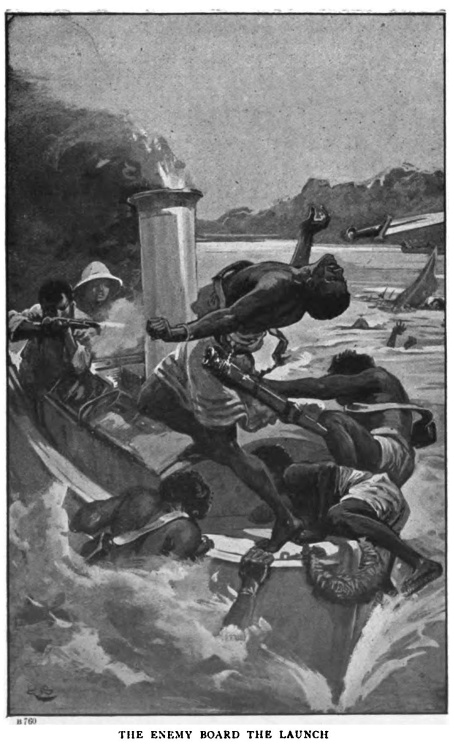
“Right over her! What luck!”
That was all he could say, for other matters engaged his attention. Of the huddled group in the centre of the native boat half a dozen had managed to gain the launch, while their comrades were already far behind struggling in the water. And these men who had been able to reach her had not all contrived to get aboard. Two reached the deck of the steam craft at once, while the remainder clung to her side, and were now clambering up, no easy task considering the speed of the vessel. A rifle cracked and one of the men aboard fell on his face. Then Dick saw Johnnie lift his weapon again and aim. He pressed the trigger as the man leaped to one side. As he opened the breech and stretched out for another cartridge, the native ran at him waving his short sword above his head. Dick’s arm went up from the well, he rested the muzzle of his weapon on the edge, and took a rapid aim. A moment later the Ashanti fell headlong across the boiler, while his sword clattered on the iron floor of the miniature stokehold.
“Soon settle um hash!” shouted Johnnie, as he leaped to the deck and ran forward, armed with his shovel. “Hah! off yo’s go. To de riber wid you.”
He leaned over the side, and one by one he beat the Ashantis into the water. Then he returned to his engine, and our hero heard the furnace door open once more.
“Steady,” he called out with a laugh, which showed the relief he felt. “Go easy, my lad, for we are out of the wood, and must husband coal. How’s the store?”
“Plenty black stone, sar. Steam from here to Cape Coast Castle, I tink. Golly! Um hot!”
He groped in the pocket of his greasy jacket and produced a piece of waste with which he mopped his face. Then he turned his attention to the enemy and put up his rifle. Dick followed suit, and together the shots rang out.
“That’s where the big gun is,” said Dick, as he fired at the second of the two large boats, from which had come the bellow of the large piece which had accounted for the fracture of the tiller. “That fellow has got hold of an elephant gun, I think, and he is making good shooting. Whereabouts is he?”
“You watch, Massa Dick. You see dat man near far end of boat? Dat de feller. You watch um while me pot. See um go splash into de water.”
There was a malicious gleam in Johnnie’s eye, for a second or so before the hopes of escape which filled the minds of the fugitives had been suddenly upset by the boom of the heavy piece owned by the enemy, and by the hum of a bullet along the deck of the launch. There was a steady arm holding the gun, and had they but known it this native was one of King Koffee’s chief marksmen, an old hunter from the interior, who held a high place in the army mainly because of his prowess with the rifle in question. And the boat in which he sat, or knelt, was not so far behind that he was out of range, or even nearly so. Indeed, barely a minute had passed since the launch had overrun the first of the big war boats, and had sent her to the bottom. It was only a few seconds since Johnnie had plied his shovel to such good effect, and the enemy were still at close quarters. Nor were they minded to permit these audacious strangers to escape so easily. A yell, a discordant shriek of indignation had gone up as the launch dashed into and splintered the native craft, and that had been followed by a babel of shouts, by the clash of many a war drum, and the blowing of horns, while instantly the whole fleet had swung round and had followed, their guns pouring slugs after the launch. Dick could see them clearly, the paddlers plying their blades with terrific energy, and the fighting men standing or kneeling, ramming charges into their muzzle-loaders in desperate haste. Then had come that boom followed by the hum of the big bullet.
“Dat de man,” said Johnnie, as he held his rifle to his shoulder. “He just ’bout to stand and fire um gun. See um drop de villain.”
At once our hero’s rifle went to his shoulder, and, having waited to hear the snap of his comrade’s, and note that he had failed to hit the mark, he pressed his trigger gently, holding his weapon as rigidly as the trembling of the launch would allow. Instantly there was an answering report from the native boat, and he felt the breath of the shot as it raged past his cheek and flew on ahead. Then the man who had fired staggered, drew himself up and, holding his huge weapon above his head, toppled and fell like a stone into the river.
“Got um! By gum! but dat a fine shot! Johnnie’s no good. Bad. Velly bad. Hear um shout. No more pills ob dat size come after us.”
“It was a lucky shot and may save our lives. The beggar meant potting us, and there is no doubt that he was a fine shot, and knew his weapon. If one of his bullets had hit either of us I imagine that we should have been killed instantly. It must have been like a young cannon firing a very big charge, for did you see how the recoil shook him?”
The stoker nodded emphatically. “Not like shoot such gun often,” he said. “Make shoulder sore. But what massa do now? Stop here and fire, so as make dem sorry dey get in de way?”
“No, thank you,” was the dry answer. “I have seen enough of these Ashantis to last me for a long time. A more fierce and cruel lot of beggars I never saw before, and you don’t catch me waiting to fight with an army. We might burst a steam-pipe or break a connecting-rod and then where should we be? Look at that beggar lying over the boiler, and think whether you would like to become a prisoner.”
“No, tanks, massa,” grinned Johnnie, casting his eye at the native. “But s’pose we move ’um. Him berry fine feller, but though him dead him not like de heat. Golly! Make ’um hop to put de finger dere, on de biler. Him cook nicely if we leab um.”
Things had occurred so rapidly that neither had given a thought to this matter before, but now that they had killed the most dangerous of their enemies, and the battle with the army of Ashanti had developed into a chase between a steam launch, with ample power, and a fleet of unwieldy boats, they had time to look about them, and to observe their own condition. As the stoker had said, the native who had fallen to Dick’s revolver-shot lay across the boiler, and it was more than hot there, for out in this tropical country there was no great need for lagging (a covering of asbestos and wood, often held in position by sheet iron, and commonly applied to boilers in this country to help to retain their heat, and so make steaming easier), and this launch boiler was exposed to the air and weather. In consequence, the unhappy wretch who had fallen was literally cooking, and Dick was thankful when his dusky companion caught the body by one arm, and dragging it to the side hove it overboard. Johnnie had little sentiment. An enemy was an enemy, whether dead or alive, and he made no secret of his delight that here was another native who had fallen to their weapons.
“Good-bye yo,” he shouted, as the body splashed into the river and sank from sight. “Yo foolish man come aboard dis vessel. Not hab invite to do so, and not wanted, not’t all. So jest yo go’ ’way ’gain. Yo hab self to tank for all dis trouble.”
He turned to Dick with a laugh, which was not lessened when he saw the serious expression on his master’s face. For Dick had his own ideas as to how an enemy should be treated, whether dead or alive, and had the task been his he would have endeavoured to do the work decorously. But he had to admit to himself that one of these Ashantis, when dead, was a repulsive-looking object, and that Johnnie was probably justified.
“What does he care?” he asked himself. “He has, no doubt, still a large share of his savage nature left, and he knows that these men would cut him to pieces when alive if they could capture him. So he treats them, dead or alive, with the same ferocity. Well, we’ve cleared decks, and I’m not sorry. As for those beggars behind, they might just as well stop and save their powder; they cannot hurt us more.”
There was little doubt on this point, for since the native with the big elephant gun had toppled overboard, hardly a shot had reached the launch, though showers of slugs cut up the water in the rear. It was the turn of those aboard the launch to smile and enjoy the situation. As they ran down the stream, with the throttle now half closed, for steam might be wanted for another emergency, they could look back at the fast-receding fleet of boats and take full stock of them. Also they could watch the dusky figures bounding through the bush, some still abreast of the launch or even farther down the stream. They could jeer at the frantic shouts, could wave back jubilantly to the angry signals of the enemy, and they could afford to mock at the men who tore through the jungle, firing aimlessly into the water.
“Good as firework!” laughed the light-hearted Johnnie. “Moon not so bright now, me tink, and de gun go pop! pop! wid a splosh of fire. Fine sight, massa! Make de heart young and gay.”
“Because we have something to be thankful for. But don’t you make any mistake about the action, my lad; it was a close thing, a precious close piece of business, and if it hadn’t been for that gap, why, where should we be? That reminds me. How are we for’ard? What’s the damage?”
The native leaped from his well and went scrambling along the deck, the movement giving cause for an increased outburst of shouting and beating of the drums; for the enemy still watched the retreating launch like cats, hoping against hope that she would stop, that their fetish, to which they sacrificed victims innumerable during the year, would step in in time to arrest the flight and hand over the white man. Presently Johnnie came back with a piece of wood in his hand.
“All dat remain,” he said, with a laugh. “De bow hit right into boat, and brake um. Dis stick to de fender. Noding hurt. Launch same as before, only bullet mark eberywhere, I ’spect.”
“Then we’ll look to ourselves. What damages, Johnnie?”
“Golly! I forget um. Tink soon be killed by dem debils and den no matter. But feel um now. Look dar! Johnnie kill dat man if he catch um! What he want to fire so to spoil de beauty? Johnnie’s wife not like dat ’tall!”
Here was a genuine grievance, and the native made the most of it as he showed Dick his wound. For a slug had struck him on the cheek, just below the orbit, and had lacerated the flesh, so that there was every prospect of much scarring; while the bleeding, as in all face wounds, had been excessive, and his coat and breast were covered with blood.
“An honourable wound,” said Dick, with a chuckle, for this little native amused him vastly, and considering his want of good looks, it was rather amazing to hear him talking of lost beauty. “Honourable scars, Johnnie. You will be able to point to that wound and say to your wife and friends, ‘Johnnie get that when he fight whole Ashanti army. Yes, he hab one man only wid him. He fight army alone and kill plenty. Den he wave de hand and leab.’ How’s that, Johnnie?”
They sat opposite one another now, the enemy almost forgotten, and they laughed till Dick had to hold his sides. For the expression on the stoker’s face as Dick took note of his grievance was ludicrous. He looked surprised and grieved at first, and then utterly indignant. Then, as our hero proceeded with the tale, he saw his point, and commenced to smile.
“Yo make um ache, massa,” he cried. “Yes, Johnnie say all dat. He forget. Dis wound show him to be brave man. He fight whole army, alone. He kill heap. He glad dat man hit um here. Dat man friend of him for life!”
It was natural that the two should make the most of the matter and enjoy it to their heart’s content, for the reader must recollect that a few minutes before death stared them in the face, that for a quarter of an hour the odds against their escape had been desperate, and that during all that time they had been working with hand and brain and fighting at full pressure. And as if the danger had been a stone hung about their necks by a cord, it had dropped now that the cord was cut. They had burst their way through the band swung across the river, and they had killed the most dangerous of their enemies. The relief was immense, and they showed it by giddy laughter, by gripping hands, and by shouting and gesticulating.
“You stuck to me like a good ’un,” said Dick, in grateful tones. “Had you funked we should have been taken. I will report to Mr Pepson.”
“And massa save Johnnie. Look at man me jest throw to de fishes. He kill me sure as egg if massa not fire. Fine shot. Big sportman, massa; and Johnnie say so to all de town when him back. But what part you hit? Look! Blood here and dere, and dere. Eberywhere!”
He held up his hands in consternation, for our hero was indeed in a sorry plight. He had been little better than a scarecrow after his dash through the bush, and his escape from the stockade, and the few hours aboard the launch had not improved matters. He was as black as a sweep, for the soot from the funnel had played upon him as the launch bounded forward, while the perspiration had helped it to adhere. Then he had been struck in no fewer than six places by the slugs of the enemy, and in each case his tattered clothes told the tale. Not that the bleeding had been severe. On the contrary, none of the slugs had penetrated far, and in three of the wounds there was merely a large red bruise, now getting more discoloured. The skin had not been broken, and where there had been penetration it had been so slight that the missiles had fallen out into his clothing. Still one cannot stop a slug without feeling the effect, and Dick felt as if he had been playing a very hard and rough game of football. He limped owing to the wound on his knee. When he breathed he suffered considerable pain, for he had had a hard rap over the ribs, while his shoulders were so stiff from a wound just below the neck that he might well have fallen in the scrum and had half a dozen lusty fellows tumbling on him.
“All’s well that ends well,” he cried cheerily. “And that reminds me that I’m hungry again. I have come to the conclusion that fighting is hungry work. What stores are there, my lad?”
“Find plenty, sar. Massa say tree week ago, ‘yo go down to launch and put dis and dat aboard. Den s’pose nigger come ’long, all right for us. Get to launch and steam ’way. Hab grub to fill de tumock.’ Johnnie plenty hungry, too.”
“Then off you go and lay a spread. I’m ravenous.”
Thanks to the fact that the engine well and the one aft from which the steersman guided the launch were close together, the two comrades, for they were that on this occasion if on no other, were able to see to the management of the launch and enjoy a meal at the same time. The attack they made upon the food which Johnnie brought from the cabin was almost as fierce as that which James Langdon had made upon the stockade. They washed the repast down with good hot coffee, which Johnnie made at the furnace door, drawing water from the river. Then they lounged in the easiest position and smoked, the stoker his short clay, which one so often sees gripped between the shining teeth of negro stokers, and Dick his briar, at peace for the time being with all the world, content with the good fortune which had befallen him.
“I’ve a good report to hand in,” Dick said to himself, as he reflected. “The mine has been disturbed, but that was not my fault, and from what I have heard and seen since, I fancy those at the coast will not be surprised at the news. I rather expect that they will hardly hope to see me again, for these Ashantis seem to have gone out to war rather suddenly some little time ago. But the mines are good for the future, the wages are paid, and the men will return when the time comes, and in addition I have a valuable cargo of gold dust and nuggets. Good! The gains are gold dust, and one steam launch saved. The losses are a stockade and two native boats, one destroyed and sunk up the creek to keep the Ashantis from using her, and the other hidden, useless to us for the time being.”
It was pleasant to think of his success, and he passed the hours till dawn came, wondering what would happen at his meeting with his employers. And as the moon waned the dawn spread over the sky, at first a mere rose pink blush, the promise of a fine day. Then the sun got up and peeped at the wanderers out of the river mist, till it looked like another moon. Three hours later the increasing width of the river warned them that they were now approaching the mouth, and presently they were amidst the sandbanks and upheavals of mud which form its delta. Dick still clasped the iron make-shift tiller in his hand, and looked wearily for the central passage, while Johnnie now and again stoked his furnace and looked mechanically to the indicator and the water-gauge. For they were both utterly done up and weary. They had been awake and active for many hours, and the flight and the fight with the natives had helped to exhaust them. It was therefore with little show of excitement that Dick nodded ahead and pointed to a ship lying off the mouth of the river.
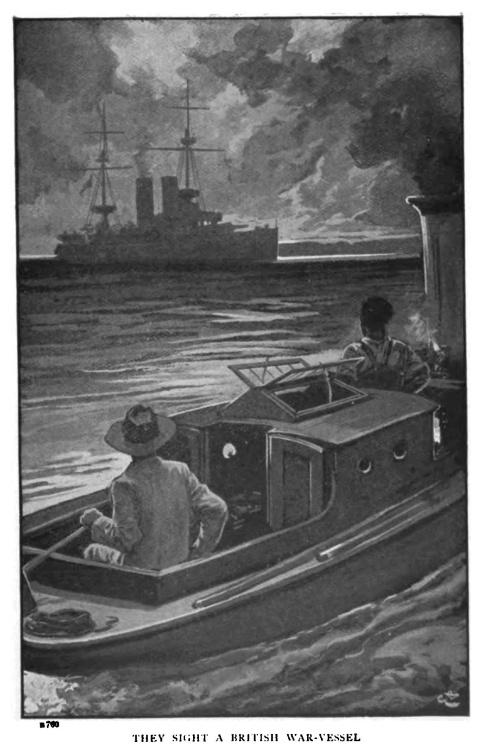
“British war vessel,” he said sleepily. “What’s she doing here?”
“Tink she make signal to us, sar,” said Johnnie after some minutes. “She wave de flag and send dem aloft.”
“And there goes a gun. Looks as though she wanted to speak us. If she’d give us a bed, where we could rest without caring about the launch and our store of gold, I’d be thankful. I’d be asleep in a jiffy if it weren’t for the thought that I’ve a big store aboard, and that it might be stolen. Hullo! It must be a signal for us.”
They were still some little distance from the war vessel, which lay to, at anchor off the coast, rolling with the swell. And as there was no one else about and no other vessel, it seemed more than probable that the flags were meant for the man in command of the launch. But how was Dick to tell when he knew nothing of the signalling code? However, his doubts were soon set at rest, for a figure in white suddenly leaped on to the rail of the vessel, and held a big speaking trumpet to his lips.
“Launch ahoy! Launch ahoy!”
Dick waved his grimy hand.
“Come alongside at once. The Commodore wants to see you. Where are you from? Have you seen any of the enemy?”
“Enemy! Then they did know of the trouble at the coast. Perhaps they had already had a brush with the Ashantis.”
Dick stood up in the well and waved again. Then he steered the launch towards the gangway, while Johnnie, awakening to the fact that he was about to run alongside a man-o’-war, with all its sparkle and polish, managed for a few seconds to summon sufficient energy to look to his engine. He rubbed with energy at the metal work till the launch was almost alongside.
“Stand ready,” cried Dick, sleepily. “Hook on. Steady. Back her. Stop her!”
They were hanging to the broad gangway of the war vessel, while a sea of faces looked down upon them. A British tar, bearded and full of strength, stood in his white ducks at the foot of the ladder, his bare feet splashed in the water, while he stared at the strangers in amazement. Up above Dick caught a fleeting glance of a sentry, all in white, marching to and fro under the awning, and looking as though he would have given much for the privilege of leaving his beat for one glance over the side. Then his eye focussed itself sleepily on two officers leaning over the rail, both with medal ribbons upon their white coats, while one carried his speaking trumpet.
“Where from?” he asked politely. “We’ve recently had a brush with the natives. Can you give us news?”
“They’ve been in the thick of it,” suddenly exclaimed the other. “Look at the young fellow. He’s covered with blood, and the boat’s cut to pieces; the sides are in ribbons. Why, it must be young Stapleton, about whose safety there has been such a commotion.”
“And the fellow’s done, done altogether,” said the other. “Who are you, sir?”
“Dick Stapleton, sir. Just got through from up country. We met a whole army, about to cross the Prahsu. We got through with some difficulty, as they were already afloat. We’re dead beat, sir, but I can’t sleep till my store of gold is looked to. It’s worth something. Can you help?”
Dick was weary and done up. He had realised that long ago, but the need for effort had kept both pluckily at their posts. Now, however, with the all-protecting arm of the British Navy to watch over them, the desire for sleep was irresistible. Their eyes were more than half closed. And they winked suspiciously when they attempted to look at any one object for long.
“Sergeant of the guard! Put a couple of men aboard at once,” came the order. “Mr Hilden, oblige by going down to the launch and making an inventory. Glad to see you, Mr Stapleton. We’ll talk later. Meanwhile come aboard and leave the gold. It shall be well taken care of. Help him up, my man, and bring him along under the awnings.”
A friendly and firm arm helped Dick from the launch, while another tar took Johnnie in charge. Our hero was almost carried to the deck above and was straightway popped into a hammock. Then some one held a glass to his lips. He drank, and at once fell asleep. He had earned a rest and determined to enjoy it.
Chapter Twelve.
In Home Waters.
“’Ello! Awake, me ’earty! Blow me, but you’ve jest slept the clock right round! What time o’ day is it? Nine o’clock, or thereabouts. ’Taint no use a givin’ it to yer in bells, ’cos you ain’t no sailor. You’ve slept the clock round, Mr Stapleton, and you’ve laid there since yesterday mornin’, a-sleepin’ like a infant. ’Twasn’t no use a-tryin’ to stir yer up, though the skipper—the Commodore that is—did ’ave a try. ’E’s jest jumpin’ to get yer news about these darkies. But yer wouldn’t stir. Yer jest kind er growl, and then yer was off agin. Swop me, but yer must ’ave been tired!”
“I was—dead beat,” agreed Dick, looking out from the hammock, and noticing that he was aboard the war vessel, and still lying under an awning. Indeed, at first he could recollect nothing, not even the fight with the Ashantis, to such a point had exhaustion carried him. And now, when he stirred and opened his eyes, it was to see a burly sailor, a British Jack tar, staring at him with a huge smile on his good-humoured face.
“Thet’s jest what the skipper says. He sees it ain’t no use a botherin’ yer, and so ’e jest leaves yer to it. ‘Put a nurse on him,’ he calls out to the chief. ‘See as ’e’s taken care of.’ And so ’ere I am, actin’ kind of nurse. ’Ow do yer feel, Mr Stapleton, sir?”
“Hungry! My word, I am hungry. You say I’ve slept the clock round. Then there’s no wonder that I want something. How’s the launch?”
“Safe and sound, sir, and the gold, too. Swop me, but where did it all come from? You must ’ave been busy to dig all that. But you’re ’ungry. I’ll send down to the gunroom. Officers is ’aving their breakfast, and there’ll be a peck for you.”
He was an amusing fellow, this rough salt, and a capital nurse he had made. He went to the rail of the upper deck, and sang out to the sergeant of the guard, a marine, whose man paced the beat below.
“Mr Stapleton’s compliments,” he called out. “He’s awake and feels mighty hungry.”
Dick heard the sergeant turn away, and then crawled from his hammock. Only then did he look at his clothing and his hands, and he was horrified, for he was still the grimy object he had been when, twenty-four hours before, he had come aboard the vessel. He was stiff and sore all over. He limped to the rails, and looked down on to the lower deck. Scores of marines and sailors were tumbling up, chattering and calling to one another, and amongst them was Johnnie, as lively as a sand-boy, and quite at home with all the crew. Indeed, he was in a small way a hero, and had made the most of his wakeful hours, yarning to the tars. Dick nodded down to him, and returned the salutes of the men as they touched their caps to him. Then he turned red under the grime, for a lusty fellow jumped to the railings and seized his cap.
“Three cheers for Mr Stapleton, the gentleman what’s jest come down the Pra all alone,” he cried. “Three of them, boys, and heartily!”
“Silence, please. Higgens, direct Mr Stapleton to the spare cabin and see to him. Thank you, lads, we like to see a plucky act recognised.”
It was an officer who spoke, and at his word the men gave another cheer and departed, while Dick, still somewhat overcome at the honour done him, followed the mess servant who had appeared, and went down to a cabin. Here he stripped off his rags, and was invited to pass through a narrow doorway to the bath. When he emerged, dripping and feeling wonderfully fresh, there was the mess servant waiting to give him a rub-down, and to help him to dress, for his shoulders were now excessively stiff, while his knee was very painful. He was, in fact, sore all over. But his joy at being amongst friends was great, and he made light of the pain.
“Mr Hilden’s compliments, sir, and he thinks these garments will be about the size. He hopes you will make use of them.”
The servant, who was one of the marines, held out a suit of white, and Dick gladly availed himself of the clothing. There was a complete change of linen also, and when at length he hobbled from the cabin he was looking spruce and neat again—a clean young Englishman, modest of manner, well grown, and with that air of quiet determination which is so common to young men of our race, and which sat so well on him. No one would have thought that this young fellow had been up-country in a responsible position, and that he had so recently had such a tussle with the natives.
“What shall I do with these?” asked the servant, politely, smothering a smile as he pointed to Dick’s discarded rags.
“Throw them overboard, or burn them, please,” was the smiling answer, “and—er—er—”
“James, sir.”
“Well, James, is there anything—?”
“Breakfast waiting, sir. Yes, sir. This way. The officers are waiting.”
He led the way to the gunroom, and in another minute our hero was limping across the polished boards to where a long table was placed between two of the guns. There were a dozen officers there, more or less, and they at once rose to greet him.
“Glad to see you about again, Stapleton,” said one, who looked as if he were the senior. “Let me introduce my friends. Officers of H.M.S. Rattlesnake, Mr Stapleton; Dick Stapleton, I think.”
He said the last with a pleasant smile, while Dick bowed to those present.
“Dick Stapleton, I think,” repeated the officer. “We all know that. The ship rings with the name. That dark fellow of yours has been telling some secrets. Let me congratulate you. It is seldom we hear of such an escape, and it is fine to come across a young fellow who, alone up-country, has been able to hold his own so handsomely. ’Pon my word, you’ve done well.”
Dick went as red as the cummerbund about his waist, and felt horribly confused. Then, at the invitation of the officers, he sat down, and forgetting all else for the moment enjoyed the good things put before him, and the excellent company in which he found himself. For there are none jollier than naval officers, none more hospitable. Their gallantry has long, long ago been proved to all the world.
“As soon as you are ready we will go to the Commodore,” said the officer who had before addressed himself to Dick. “I may say that he is simply itching to hear your news. You see, it’s important. We’ve had a brush with the natives, and it has been a nasty business. There’s a big disturbance going on, and the war has regularly started. We expect Wolseley here very soon—General Sir Garnet Wolseley, you know. A fine soldier, and just the officer for a job of this kind.”
Dick opened his eyes in astonishment. He had already gathered that there was some trouble afoot. Indeed, when he sailed up the Pra with Mr Pepson there had been ugly rumours in the air. Some had warned the members of the expedition that it would be folly to go just then. Others had said that there was always trouble threatening; that it was a condition which had become practically chronic on the Gold Coast, and that King Koffee was always a thorn in the flesh, feared by Fantis and white men alike, and always liable to make a raid on the coast. So it had been for a long while, and he who hesitated to march into the forest on that account was weak. But from his own experience he knew that they had actually gone on the war-path, and now he heard that the Navy had had an action with them.
“And there is to be a regular war?” he asked in amazement. “Sir Garnet Wolseley is coming, and troops, too, I suppose?”
“Yes, there will be troops, and some are already here. It is to be a regular invasion. This fellow, King Koffee, has become too troublesome and too formidable. His men are here on the coast, and the neighbourhood of Elmina is in his hands. We are in a tight corner, and shall remain so till the reinforcements arrive. Then we shall march to Kumasi and burn the wasp out. That’s it precisely, Mr Stapleton. This king thinks that he can dictate terms to the white men. He has a few captives, and thinks that because he beat a white force years ago, he can repeat the process. He wants a lesson, and we’re here to give it to him. Have you finished? Please do not let me hurry you, but if you only knew the anxiety of our Commodore, I think you would forgive any undue haste on our part. Our Commodore has been fretting at the unavoidable delay. Of course you could not help that. Any one could see that you were dog tired. Yes, this way, now up the ladder and along the deck. Sentry, my compliments to the Commodore, and say that I have brought Mr Stapleton.”
A few seconds later the two were ushered into the wardroom of the Rattlesnake, and Dick found himself bowing before the Commodore, J.E. Commerell, V.C., C.B., who came forward to shake him by the hand. There were two other officers present, and it was evident by the expression on their faces that they were eagerly awaiting news from the interior.
“This is a serious business, Mr Stapleton,” said the Commodore, motioning Dick to a seat at the wardroom table. “I heard that you have encountered an Ashanti army, and I have information that they were on their way to attack the Assims, a tribe friendly to ourselves. Tell me all about this meeting, please, and also what other frays you may have had with the enemy; for I have also had mentioned to me the fact that you have had more than one skirmish.”
“I’ll do my best, sir,” answered Dick. “I went up-country some weeks ago with my employers and some Fanti boatmen. Also we took a native stoker, Johnnie, who is here now, and has proved a splendid fellow. We were attacked by Ashanti robbers on the way up, and our Fantis were in league with them. We beat them off and went on to the mine for which we were making. There was a stockade there, and as soon as we had settled matters I was left in charge of the place and of the miners. A few days ago, I cannot exactly remember how many, for after being awake so long and then sleeping the clock round I am rather confused—still, it is only a few days ago that the same leader who had previously attacked our boats, made an attempt to take the stockade, and failed owing to the pluck of the miners and to the watchfulness of Johnnie. But they hemmed us in, and we knew that they expected two hundred Ashantis to reinforce them.”
“You knew? Excuse me, Mr Stapleton, but how could you know that when you were, according to your own description, hemmed in the stockade? Did they shout the news so as to frighten your men?”
The Commodore leaned across the table, and put the question, while he looked closely at his guest. Dick flushed again, for he felt ill at ease in this atmosphere of the wardroom, with officers listening so intently to his words.
“It was through an accident, you see, sir,” he said. “It happened that when the attack was made, I was out in the forest scouting for the enemy, for we had seen a small force in our neighbourhood a little time before.”
“Then you had taken precautions against attack, I imagine?” interrupted the Commodore. “You had set a watch, so as not to be taken unawares?”
“And yet they took me by surprise, sir. They came up from the other side, and as I was in the forest I did not know of their presence till I heard firing. Yes, we had taken precautions. Johnnie was on the watch at the stockade, and the men had been warned, and had been trained as to their action in case of attack. A tom-tom was beaten, and they simply ran to the stockade and banged the door. Then they peppered the enemy, with excellent results.”
“Meanwhile you were in the forest, cut off from your men?”
“Yes, sir. But I managed to creep through during the night, and, thanks to the fact that I can now understand the Ashanti tongue and speak it a little, I learned of these reinforcements on my way through.”
“And you got through without incident?”
“Hardly,” admitted Dick, telling them quietly how he had been followed, and had had to fight for his life, and how he had been rescued when on the point of being dragged away to captivity. “After that we fooled them,” he said easily. “We sent out a party to the front, the direction from which their attack had come, while we made preparations to slink off in the opposite direction. The party retired over the hill with the gold, while I went on firing for a time. We had our launch in hiding in a creek some little distance away, and we got safely aboard her and set off down the river, towing the men in a native boat. Later we paid off our men and hid the boat. Then we steamed down-stream and had the bad luck to meet with an Ashanti army. They peppered us hotly, and, in fact, nearly cut us off. There were two big war boats which were the greatest danger, and aboard one was a native with a big gun, firing a heavy bullet. He shot our tiller away at a critical moment. But we used the stoking rod, and—and here we are.”
“Quite so, Mr Stapleton, here you are,” said the Commodore, with a pleasant little smile. “But you will excuse me. As a naval officer, I would like to hear how it is that you are here at all. You had an army to contend with. They were in boats. There were two large war craft, and a man with an elephant gun, a small cannon in fact. Your tiller was shot away, and I have noticed that your funnel is perforated. Your boat is marked with slugs from bow to stern, and there are some pounds of slugs and pebbles on the decks or embedded in the woodwork. You had one stoker with you. Two for a crew to man the vessel and fight her. This requires a little more explanation.”
Willingly would Dick have escaped further conversation, for the reader must recollect that he was unused to this official atmosphere, and felt more than overawed by the presence of the officers, looking so keen and spruce. However, there were friendly smiles to encourage him, and he blurted out his news.
“Oh, we ran for the far side of the river, firing as we went,” he said. “Then there was a chance. A war boat left a gap behind her and we slipped into it. But they can back their boats by simply turning on their heels and reversing their paddles, and so she came right across us. But we let ’em have it broadside on and crumpled ’em up. A few clung to us or jumped aboard, but we shot one or two, and Johnnie hit the rest over the head with his shovel. Then the fellow with the gun got our range again, and it looked a little nasty for a while. But we shot him, and then—well, here we are.”
There was a hearty laugh at his words and at the obvious confusion under which he laboured. But the Commodore soon straightened his features and again asked a very pertinent question.
“If you please,” he said sweetly, “who are ‘we’? You say ‘we’ all the way through. We left the stockade; we paid the men off; we fitted the stoking bar as a tiller; we steered the launch over the war boat; and we shot the man with the gun when things began to look nasty. Do you mean that you and Johnnie did these things together?”
Then our hero was compelled to give the details, while the perspiration poured from his forehead. For if he was brave, he was undoubtedly modest.
“And now I will tell you what has happened here,” said the Commodore. “But first I must thank you for very valuable information, and at the same time congratulate you on your very plucky conduct. ’Pon my word, gentlemen, we should be delighted had he been one of our service. It would have been a fine feather in our caps to be able to send such a report home to the authorities. But now, my news. You may have seen some of us wearing slings and bandages. We have good reason for doing so, for three weeks ago we went up the river Pra to discuss matters with some of these natives who seemed inclined to be turbulent. They met us in a friendly manner, but higher up, as our boats were being towed closer to the bank and within easy range, an ambush of some thousand natives opened fire upon us. We were in a hopeless condition, for we could not attack, and could hardly retire. But we managed to draw away, and returned to the ship with many poor fellows injured. Later we shelled the town where the ambush had been laid and smashed it to pieces. About the same time some of our men were ill-treated by the natives higher up the river, and I regret to say that in all we lost four of our brave fellows, while twenty of us were wounded, including six officers. However, we are all recovering. But the range was close, and a blow on the ribs is no laughing matter.”
The Commodore moved uneasily, and it was then that Dick noticed an unusual bulging of his coat and shirt, for in these hot parts all wore the lightest clothing. In fact, the Commodore had been very seriously injured by the murderous fire of the natives.
“There has been more trouble since,” went on the Commodore, “but we have not had the worst of it. We have realised that the time for talking has passed, and we have given these unfriendly natives a sample of our wares. We have shelled towns and villages where the people were hostile. But they are that everywhere. The bush swarms with enemies, and there can be no doubt that we are face to face with a war of moderate proportions. In that war, Mr Stapleton, you will be able to play a prominent part, for you can speak both the Fanti and Ashanti dialects, and you have some knowledge of the country. I shall ask you to take a letter to the Lieutenant-Governor at Cape Coast Castle, in which I will repeat what I have just said. But perhaps you would rather not aid the troops; perhaps you will want to return home, in which case Her Majesty’s forces will be the losers.”
“I cannot say, sir,” was the answer. “Till I see my friends and ascertain their wishes I am unable to decide. Indeed, I am not my own master. May I press on at once, for I am anxious to get to them and hand over the gold. Besides, when they hear of this trouble, they will be wondering what has happened to their mine.”
“And I think also to the young manager who was put in charge. Certainly, Mr Stapleton, you are at liberty to push on any time. I have had your launch replenished with coal, and provisions shall be placed aboard her. You will hardly need a crew, I should say, seeing that you have brought her all this way with one man only and have now no enemies to fear. But let me warn you. You must on no account put into Elmina. The neighbourhood is in the hands of the enemy. The Elminas there have proved false, and have thrown in their lot with the enemy. An attack in force was made on the town and beaten off, five hundred of the enemy being killed. You would be fired on, not that that would matter much now, for you must be used to the experience, but it might be awkward. Push straight on for Cape Coast Castle.”
He said the words with a friendly smile and a twinkle of amusement, while he gripped Dick by the hand. There was no doubt, in fact, that he was as impressed with the modestly described tale of Dick’s adventures as were the crew with the lurid accounts which Johnnie had given them. And his comrades in ward and gun rooms endorsed his opinion. It was long since they had met with such pluck and determination, or with one who carried his honours so easily and unconsciously.
“It’s what I like to see,” said the Commodore, as his guest left the cabin. “No side, like some of these civilians of youthful age. No pomposity when speaking of the natives or of men in a lower station. Good sense all through. Politeness and good temper, which show the gentleman; and plenty of grit. My word, Hilden, a fellow in our service would deserve promotion for such conduct.”
Half an hour afterwards there was a commotion aboard the Rattlesnake as Dick prepared to leave. A right hearty farewell was given him, and numerous invitations to come again, such is the geniality and hospitality of the Navy. The sailors and marines had again congregated on the deck, for they love to see an officer who has done well, and never spare their praise where it is merited. And down below, standing in the launch, was Johnnie, waving to his bosom friends above, his short clay pipe gripped between his sharp white teeth, and emitting now the aroma of a different brand of tobacco, the powerful, far-penetrating scent of Navy shag, the smoke which tries the stomach of the raw recruits. Johnnie was unaltered in appearance, save that he had had a wash. A bucket and a piece of soap had transformed him sufficiently, and he stood there below in his old clothing, looking just as he did at the stockade, save that the garments were now more ragged and stained, while there was a huge rent extending up one leg to the knee. The wound on his cheek was there, covered with a piece of strapping, which gave it unusual and ghastly proportions. Johnnie was undoubtedly proud of that wound, and thought no more of lost beauty. He laughed and chattered, and seeing Dick about to descend, called out a final farewell to his late entertainers.
“Golly! you come all to Sierra Leone and see how Johnnie do for yo! Plenty eat, plenty drink, and all berry glad yo come. Dance and sing, play de banjo or flute. Yes, yo come, and Massa Dick be dere to meet yo. S’long, yo boys; glad we meet.”
There was a roar from the deck above.
“So long, cocky. If yer get tired o’ stokin’ that ’ere kettle, jest apply aboard this here ship. Plenty of baccy and grub, cocky, and you’ll be welcome. And, Johnnie,” one of the voices suddenly broke in, silencing the others, “when yer come again with Mr Stapleton, jest remember that quids is scarce aboard this here ship. Jest tip ’im the wink and bring aboard a few of them ’ere bags o’ gold. We could do with a little extry pay and allowances.”
That brought forth another roar, and a cheer as Dick took his place at the tiller, a tiller which now, thanks to the kindness of the Commodore and the skill of the carpenter, had been refitted.
“Cast off!” cried Dick. “Ahead. Let ’er have it. Sound that whistle, Johnnie.”
They went away from the side of the Rattlesnake with a rush, and were soon steaming along the coast, increasing their distance from their late friends rapidly. Then they set their eyes towards Elmina and Cape Coast Castle, which they hoped to reach before night. Presently they sighted the fort at Elmina, with the native town and the expanse of cleared ground, precautions which the Dutch had taken against fever, but which, in spite of the example thus set them, and the crying need, the English had not yet attempted at Cape Coast Castle. Then they steamed on along the coast, rising and falling with the swell, while the music of the surf as it fell on the sandy beach came to their ears. In due course they sighted the huge, irregular erection known as the Castle, and very soon the launch was moored off the beach. Dick signalled for a surf-boat and in half an hour had reached the shore, taking with him his store of gold. There were plenty of native porters about, and he hired six, who at once took up the bags. Then the procession set off, and crossing the bridge which separates the native town from the European settlements, turned its steps towards the house in which Mr Stapleton had lived. No one was out as the party arrived, so Dick had the bags piled on the edge of the verandah. He had a little money with him, and therefore was able to dismiss the carriers. Then he pulled at the bell, while he stood on the verandah keeping guard over the gold. There was a shuffling of feet, and a few seconds later a tall, slim figure emerged from the main room, and gave vent to a cry of amazement.
It was Mr Pepson, gaunter than ever, with signs of suffering written on his face, which now showed the utmost astonishment and delight. Never had Dick seen him so betray his feelings. He almost shed tears, and gripped our hero’s hand so firmly that the fingers ached. Meanwhile Dick noticed that something had happened to his employer, for he wore one arm in a sling, while there was a large strip of plaster at the back of his head.
“Another wound which I owe to the Ashantis,” said Mr Pepson, breaking the silence. “We were attacked and cut up. But sit down. I’m still very weak, and your unexpected return has staggered me. I never hoped to see you alive again, my boy. I have blamed myself over and over again that the desire to obtain gold from this mine should have induced me to place you in such a dangerous position. And you are wounded, too. Why, you are limping, and there are bandages here and there!”
Dick admitted the fact, for the surgeon aboard the Rattlesnake had insisted on dressing his wounds.
“But you, sir, and Meinheer?” he asked. “You were attacked?”
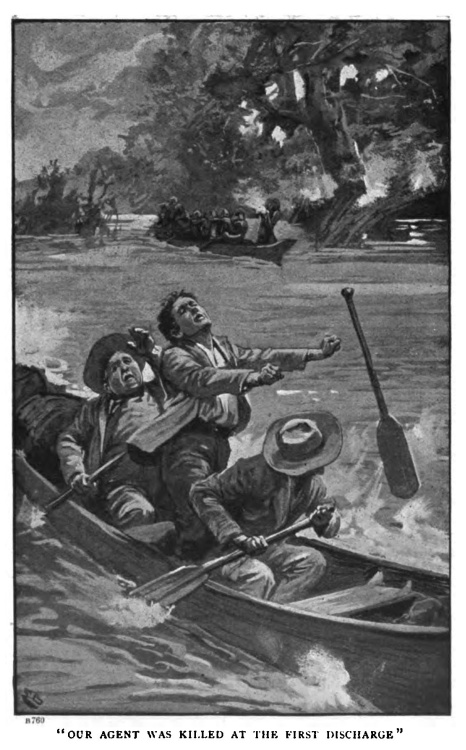
“Treacherously, and I grieve to say that the agent who was returning with us was killed at the first discharge. It was quite near the mouth of the Pra, and we thought that there was nothing more to fear. We made a capital trip of it and everything looked well. Suddenly shots were fired at us from the bush, and a boat pushed out toward us. Our agent, as I have said, was killed at the very first discharge, while I was struck on the head, and was almost stunned. Still I managed to seize a paddle, and Meinheer did the same. We paddled for our lives, with the natives in hot pursuit. I hardly know how it happened afterwards, but think that Meinheer must have been cramped, and endeavoured to change his position. He slipped, fell against the side of the boat, and—well, you know his size and weight—it capsized us instantly, and we were thrown into the river. I never saw him again. He may have clung to the boat and been captured. On the other hand, it is more than probable that he went straight to the bottom. As for myself, I swam for the bank and scrambled ashore, receiving another wound as I left the water. Then I raced on into the bush with those fiends after me, and finally fell exhausted. But they must have given up the chase, for when I regained consciousness there was no one about. I was desperately fagged, but I knew that I should die like a dog if I remained there, so I plunged on through the bush, and finally hit the river. Then I came upon some friendly natives who brought me here. That’s all, my boy, and I am more than grieved to have to narrate it. Poor Meinheer is gone, and if you had been killed also I should have been heart-broken; I thank Heaven that you are safe. Now sit down and tell me how you managed to win through.”
“First of all, what shall be done with these bags?” asked Dick. “They contain gold dust and nuggets. The mine was doing very well, and there were rich finds, so that I have been able to bring you a good return.”
Again there was amazement on Mr Pepson’s face. He gazed at his young agent as though he could not believe his eyes and ears. Then he motioned to him to sit down.
“I care more for your story,” he said. “The gold is nothing to me till I hear that. Sit down, and let me hear all about your doings.”
It was late that night when the two turned in, and on the following morning, when the gold had been safely deposited at the bank, they resumed the conversation, for Dick had a question to put. His heart was in the country, and he desired above all things to see the war through. Besides, the idea of taking part in a campaign fascinated him, and he longed to go up-country to Kumasi with the troops.
Chapter Thirteen.
On Special Service.
“Here is the letter, sir, which the Commodore gave me to carry to the Governor,” said Dick, as he and Mr Pepson took up the conversation of the previous day. “He offered me a post with the expedition which will be sent to Kumasi, and I declined it until I had seen my employers. What are your wishes in the matter?”
“That you should go,” was the prompt reply. “My inclination at first when I returned here was to go back to England at once, for I began to hate this country. But I thought of you, and I stayed on the chance of your turning up. Now I think of Meinheer. I give you full permission to take this post, with the agreement that you still remain my agent, and draw your salary. That will be a retaining fee, for when the war is over I shall want you again. There, you are free to go, and I am sure you will do much for our cause.”
That afternoon Dick appeared at Government House, a familiar place to him, and handed his letter to the Governor, who was delighted to see him.
“Of course we shall be glad to have you,” he said, “and I will send along an official appointment this evening, stating your pay and allowance. For the present there is nothing for you to do, save perhaps to ascertain from the natives what is the present whereabouts of the Ashantis. When Sir Garnet Wolseley arrives he will no doubt have work for you. You look thin and pale. Take a rest, my boy. A white man cannot work for so long out here in the forest without feeling the effects of the climate.”
But Dick Stapleton was young and inclined at times to be foolhardy. He had the objection to remaining still common to every lad of his age. He loathed molly-coddling, and though at times he felt feverish, his stubborn nature would not let him give in, lest he should be thought to be shamming. And so, within a few days of his arrival back at the coast, he was exploring the mouth of the Pra once more, with Johnnie as stoker, and a crew of ten bluejackets from the Rattlesnake, all intent upon a brush with the enemy.
“Pending the arrival of Sir Garnet and the troops, you will do your utmost to obtain tidings of the enemy,” said the Commodore, as he bade farewell to our hero. “And above all, Dick, no meetings with armies, if you please. You have as complete a selection of stores aboard as we could think of, and your crew are all picked men. Make the Rattlesnake your headquarters, returning here with news whenever you can.”
And so Dick set off, in command of an expedition for the first time, and a proud man he felt, too, as he sat at the tiller, with his eye on his fine crew. But he had only ascended a very few miles of the river Pra when he met with an enemy even more dangerous than the Ashantis. One morning, as he sprawled on the deck to eat his breakfast, he was seized with a curious sensation.
“What is there, Johnnie?” he asked listlessly, toying with the pocket fork and knife which all campaigners carry.
“Hot coffee, massa, berry hot; and golly! look at dem tinned sausages! Johnnie take dem from de tin jest now, and look how dey frizzle!”
Dick did look, and on another occasion he would have fallen upon the food with eagerness, for an expedition of any sort encourages a healthy appetite. But this morning, strangely enough, he could not eat. The sight of food sickened him. He pushed his plate away and took to his pipe. Even that did not please him. The taste was all wrong, and he sat down, looking dejected, for the first time for many a day. Then he commenced to shiver, till his teeth rattled together like castanets.
“’E’s got it, sure enough,” whispered one of the salts, an old hand on the coast. “This cruise ’as come to a end, chummies. Look at ’im shiverin’. It’s a bit of bad luck, mates, ’cos ’e was the boy to show us some fun. Beg pardon, sir,” he went on, coming to Dick’s side, “but ain’t yer feeling quite up to it? Let’s feel yer ’and.”
Without further ceremony he took the hand which hung listlessly at his young commander’s side, and put his finger on the pulse, at the wrist, for this tar had had some instruction, and was an intelligent fellow. Then he turned to one of his mates, “Fetch along that ’ere medicine pannier,” he said shortly. “Now, then, open it carefully, and jest lift out that ’ere box. If yer please, sir, jest put this under yer tongue.”
With deft fingers he produced a thermometer from the medicine chest, and placed it in Dick’s mouth. Three minutes later he inspected it, while the look on his jolly face turned to one of concern.
“Are yer cold, sir?” he asked sympathetically.
“No; but awfully hot. I’m burning all over,” was the answer. “And I’m very thirsty.”
“And you’ve got a temperature. Tom Huggins there, ’bout ship; and, Johnnie, let ’er skip till we’re out of the river. The orfficer’s got a go of fever, and sooner he’s aboard the Rattlesnake and at sea the better for him and all of us. I’ll get yer a blanket, sir, and make yer comfortable.”
They were all very good to their young commander, and took care of him as if he were a child, till they reached the open sea and espied the Rattlesnake. An hour later he was lying on the after deck beneath an awning, tossing with fever, and with an orderly from the sick bay told off to keep special watch and ward over him. For Dick had a severe attack. The responsible work at the stockade, the fear of a sudden appearance of the enemy, and the flight had all aided a notoriously bad climate. And at last he was down with malaria, which kept him aboard the ship for a month.
While he is lying there, with plenty of friends about him to see to his welfare, we will step aside for a little while, and review matters at the coast. War, for war’s sake, is seldom waged, except amongst savage tribes. And even with them there is usually some grievance, some cause which leads to the outbreak of hostilities. It may be that more country is desired, that the men of a certain tribe desire to take wives from another, or that some injury done to a nation or a race years and years before has left a feeling of bitterness and a desire for vengeance; a grudge is owed, and is paid back at the first moment when those who have sustained the injury are strong enough to fight. But Britain does not conduct her wars in that manner. The numerous little expeditions and minor campaigns upon which she is so often engaged are almost invariably the direct result of molestation from some race living on her borders.
For years, perhaps, she has patiently suffered the injury, hoping by diplomacy to put an end to the whole trouble. Then, when her patience is exhausted, and diplomacy has failed; or when the aggressors have become still more audacious, she finds that war is necessary, that nothing but armed interference will bring peace to that particular border. Too often her patience and forbearance have been mistaken by an untutored race for weakness, and thus it happens that the foes she has to meet are more numerous than they might have been. However, the history of these small wars is, as a rule, so very similar that one campaign differs only in detail from another. Troops are sent to the part, there is an invasion, and, most likely, severe fighting. Villages are taken and burned, forts are stormed, and men killed and captured. There may be a reverse, for one cannot hope for continued good fortune. But persistence, good training and discipline tell in the end. The tribe is conquered, a fine is levied, and in numerous cases the British Commissioner left to aid in the administration of the country settles down peaceably, and a new order commences to reign. So much so that in time the very race which had been opposed to us begins to see some virtue in our friendship, and when another campaign takes place against some neighbouring chief, old enemies are united in the effort to subdue the common foe.
Britain had had trouble with the men of Ashanti before this time, when Dick Stapleton had been practically the first to have a brush with them. We had crossed swords with the Ashantis more than once, and with varying success; but, unlike other races, these men inhabiting the forest beyond the coast-line had maintained their independence and their bitterness. For they had always a cause for war, and as the reader will see presently, that cause had been increased since we acquired the town and port of Elmina from the Dutch. The Ashantis were at this time a powerful nation, for the most part trained to war, and it will have been gathered that, owing to the fact that there is ample gold in their country, they were a wealthy nation as compared with many others in a similar condition of civilisation. Moreover, the commercial spirit was strong within them. They traded with the interior, and for many years caravans had passed to Kumasi across the country lying still farther from the sea, carrying products of Africa, ivory in large quantities, food-stuffs and cottons, and what was appreciated far more perhaps, slaves in plenty. And in return the men who brought these caravans to Kumasi received gold dust, and the highly prized kola nut. Thus, it will be seen that the Ashantis were unlike many savage races. They were in friendly communication with far-off peoples, and, owing to the peculiar resources of their country, to the gold found there, and mainly to the kola nut, which grows in profusion, and which was then extensively cultivated, they were rich and prosperous. It was only natural that, with money to spend and a coast so near, they should desire to have a port where they could trade with other nations, and through which, in exchange for their surplus gold, they could obtain European goods, and, above all, guns and ammunition. For much wealth brings the desire for more. It engenders a feeling of pride and superiority in the savage breast, and it is hardly to be wondered at that the Ashantis, looking about them and comparing their own degree of comfort and civilisation with that of their less fortunate neighbours, desired to increase their wealth. With guns and powder they could fight, and could conquer neighbouring nations. And with guns they could make sure of a port on the coast.
It will be realised that with her object gained, Ashanti would hardly look favourably upon any nation which attempted to put a stop to her coast trade, and there is no doubt that it was Britain’s determination to arrest the import of guns and ammunition which led to the war which had now commenced. For the reader will recollect that Elmina had just passed into our hands, having been purchased from the Dutch, who had for very many years maintained a trade with the Ashantis. Now, however, Britain, being in possession of this port—if Elmina can be given such a title—determined to put an end to the trade in guns, and indeed to all trade, till matters were satisfactorily settled with the King of Ashanti. For if he had a grievance, so also had we. For years we had been on bad terms, and how, when Ashanti armies were threatening the coast, and a demand was being made for free trade with Elmina, a request on our part met with refusal. King Koffee held certain Europeans as captives, and before we would discuss the question of trade with him, we desired the return of those captives, a request which was refused, a large ransom being demanded. Then followed negotiations, till King Koffee, a despot ruling over an extensive country, and with much hoarded wealth, lost all patience. He was a powerful king, he said to himself, and could put fifty thousand armed and trained men in the field. Why should he take “nay” from a race of white men living on the coast? Why should Ashanti be hemmed within her forests? She was powerful and could eat these white men up.
Promptly the armies were organised, and while Britain still dallied, the King of Ashanti invaded our protectorate. But still Britain held her hand, for this was a native war, and because the Ashantis had attacked the Fantis and other tribes, there was no reason why we should send troops to this notoriously unhealthy coast, and fight their battles. Thus it happened that matters at Cape Coast dragged on, while all trade with the interior ceased.
If the invasion of the protectorate had ended with an attack upon the Fantis and other races, Britain might well have continued her policy of aloofness, for she had nothing to gain by invading Ashanti. She had tried to do so on former occasions, and had failed disastrously. And so she was minded now to leave matters till King Koffee and his armies had settled their quarrel with their neighbours, when perhaps there would be a satisfactory ending to the negotiations, and peace would result. Then trade would be reopened, guns and ammunition excepted, and the white men on the coast would have ample opportunities of reaping a harvest, for, as has been said, Ashanti was a wealthy country. However, matters did not stop at invasion of our protectorate. While Dick was at the mine, looking after the affairs of his employers, the forces of King Koffee attacked Elmina. They induced the natives of that town and other places bought by us from the Dutch, to join them, and Britain suddenly awakened to the fact that the enemy was at her very door, and that they meant to wage war with the white man. If there had been any doubt as to the intentions of the Ashantis, the attacks made by their friends and allies on the boats of the Rattlesnake were sufficiently convincing proofs. It was war, and Britain found herself, as is too often the case, utterly unprepared for it. But she girded on her sword, and preparations were pushed forward so as to enable us to drive the Ashantis back, and march on their capital.
That was the condition of affairs existing when Dick reached the coast, and it was only because of the isolated position of the mine that he had failed to hear earlier of the Ashanti invasion. There were few troops at Cape Coast Castle, and few officers. There were practically no stores, and certainly insufficient to support an expedition. All was being prepared in Britain, while ships were loading every sort of item likely to be serviceable in the coming campaign.
Sir Garnet Wolseley, a brilliant officer, and one of our youngest generals, had been chosen to command, while a staff of officers had been appointed who would help him in the campaign and make success as sure as possible.
And now a few words more before we leave the subject of Ashanti history. Cape Coast Castle was settled by the Portuguese, and was ceded to the Dutch in 1641. In 1655 we captured it, and it was secured to Britain by treaty. Thus, at the time of this outbreak, we had been in possession for more than two hundred years. And what had we done during that time? The reader who is accustomed to the tale of British progress in our Colonies and India, in fact, in any part where men of our race gather, might well expect to find improvement here also. But such was not the case. Cape Coast Castle at this moment was much the same as it had been when we took it from the Dutch. No efforts had been made to clear the forest, and to provide an open space. The town was as unhealthy a place as could well be found. Trade flourished to a certain extent, but might have been vastly improved. And lastly, we might have encouraged the advances of the powerful Ashantis, and thereby gained a vast trade. We might have opened up roads to the interior, and dredged the rivers, thus enabling our own manufactures to find a market, and in place of sending numerous presents to the reigning monarch of Ashanti, with a view to conciliating him, we might very well have made a treaty with him, whereby commerce might have been improved on both sides. Both those who ruled British affairs on the Gold Coast practised a short-sighted policy, with the result that we had come into conflict on at least four occasions with the Ashantis, and on nearly all these occasions the question between the two nations was one of commerce. The powerful Ashantis were impatient of the white man’s interference. We blocked the way to the sea, and the people of Kumasi desired a free opening, by means of which they might exchange home products for guns and other items much in request by them.