WITH THE BRITISH LEGION (continued 7)
Reading edition
"You can't know that, and certainly I have no reason to believe so. If it came to downright hard hitting I fancy I could hold my own against most Spaniards, but in fencing it is a different thing; it is not a question of strength only by a long way."
"Some of the Spaniards are good hardy men, captain, no doubt; but very few of these will be found among the gentry, who pass the day in sleeping, dawdling about, and smoking cigarettes and drinking coffee. Well, I suppose, sir, there is no harm in my going out and taking up a place where I can see what goes on?"
"None at all, Roper; I have no doubt that the count will have a number of his friends to look on. I am sure he expects to run me through without trouble, and he will like to show off his prowess before his friends."
They drove in a carriage to the place fixed upon for the encounter. As Arthur had expected, a score or two of gentlemen had collected near. He spoke to his second, who went up to that of his antagonist and said: "My principal understood that this matter was to be kept private, and that none but ourselves should be informed of it."
This was repeated to the count, who shrugged his shoulders and said: "I mentioned it to a few friends, and no doubt they told others, but it makes no difference whatever."
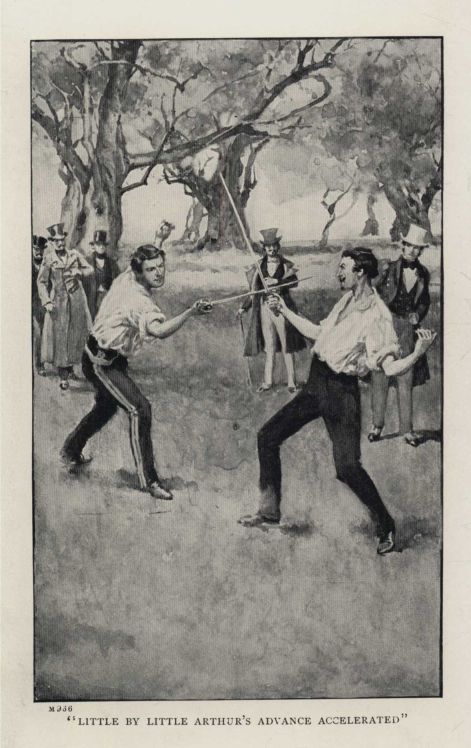
"LITTLE BY LITTLE ARTHUR'S ADVANCE ACCELERATED"
Arthur pressed his lips tightly together when the answer was repeated to him. "You want your performances to be seen, eh?" he muttered. "Perhaps you will be sorry you have got so many witnesses before you have done."
The preliminaries were speedily settled, and the two antagonists removed their coats and waistcoats, and faced each other. The count began with a few preliminary flourishes, intended to show off his swordsmanship, and how lightly he thought of the encounter. He was fully half a head shorter than his antagonist, and the latter's much longer reach would have given him a decided advantage had they been equal in other respects. Arthur stood firmly on guard, contenting himself with putting aside almost contemptuously the other's play. He waited till the count steadied down and began in earnest. Then, to the astonishment of his antagonist, he took the offensive. In vain the latter tried to get within his point; in vain he exerted himself to the utmost, springing in and out; with scarce a movement of his wrist Arthur's point played in a little menacing circle. There were no fierce lunges to be turned aside, no openings left to be taken advantage of. Steadily Arthur advanced, and foot by foot his antagonist had to give way.
In vain the count exerted himself to his utmost. The perspiration streamed from his face, and his expression changed from that of half-contemptuous superiority to rage and uneasiness. Again and again the count felt that his adversary was but playing with him, and that he avoided taking advantage of openings that had been left him. His opponent's face was grave and earnest, but without any other emotion. Little by little Arthur's advance was accelerated. In vain the Spaniard attempted to stand his ground against the menacing point. In spite of his greatest efforts he had to give way, and was driven backwards across the green sward on which the encounter was taking place, till he was close to its boundary. Then there was a sudden wrench, and his sword was sent flying through the air.
Arthur lowered his point, and said in a quiet, deliberate voice that could be heard by all the astonished spectators: "You seem to be a little out of breath, señor; perhaps you would like to wait for three or four minutes before we begin again?"
The count, white with rage and shame, walked and picked up his sword.
"Now, señor," Arthur went on, after a pause of two or three minutes, "we will recommence the affair. Hitherto I have but played with you, now I warn you that I shall run you through the shoulder when I get you to the other side of the field."
Again the singular scene began. In vain the count endeavoured to circle round his foe; in vain he tried to arrest his own steady retreat. Move as he would to change his position, Arthur with his long stride and quick spring always kept in front of him. In a quarter of an hour he was driven back across the field; then for the first time Arthur lunged. His antagonist's sword dropped useless by his side as he ran him through the upper part of the arm and shoulder.
"This may perhaps serve as a lesson to you, count, not to pick quarrels gratuitously with strangers of whose force you are unacquainted. Your life has been in my hands a hundred times had I chosen to avail myself of the openings, but I did not wish seriously to injure you. You have brought a number of gentlemen here to-day to witness your triumph: I trust that they have been amused."
So saying, he turned and walked back to the spot where he had left his clothes, put them on, and entered the carriage with his second, beckoning to Roper, who was standing a short distance away, to get up on the box.
"Truly you have astounded me!" Don Lopez said. "I thought that with your height and length of arm you would give him some trouble, but such an exhibition as this was never seen!" and he burst into a fit of laughter. "The count won't be able to show his face in Madrid again for I know not how long. The wound to his body is nothing, but that to his pride is terrible. He will never hear the end of it. To think that he was driven right across a field as if he had been a pig under a peasant's goad, without a possibility of stopping; that he should have been disarmed and played with, is too funny. Of course, the thing will get about all over Madrid. You will have to be careful, though, Don Arthur, how you go out after dark, or you may find yourself with a dagger between your shoulders. It would scarcely be in human nature for a man to put up with being made a public laughing-stock without trying to get his revenge, and certainly Don Silvio is not, from what I know of him, likely to be an exception to the rule."
"Yes; no doubt I shall have to be careful. I suppose one can buy such a thing as a shirt of link armour in Madrid?"
"Oh, yes! there are plenty of them to be picked up in the shops where they keep old weapons and curiosities; a good one costs money though."
"Money is nothing," Arthur said. "If one gets such a thing one wants to have as good a one, and at the same time as light a one, as money can buy. Would you mind getting one for me, Lopez? I would rather not be seen buying such a thing myself."
"With pleasure. I will make a tour of all the shops where they are likely to keep such things, and pick out the best that I can find for you, and it is hard if I don't manage to get you one by this evening; although I think you are safe for a few days, for were you found stabbed now, everyone would put it down to Don Silvio at once. I should say that he would hardly attempt such a thing in Madrid. You are likely to be in much greater danger when you go off to join the army again."
"Yes, I think that would be the case; but still, I would rather not risk his beginning at once."
"Quite right! I certainly should not if I were in your place."
On reaching his apartments Arthur sat down to breakfast with his friend. Not until the latter had left did Roper make any allusion to the scene he had witnessed.
"Now, Captain Hallett," he said, on returning to the room after letting the visitor out, "what did I tell you it would be? I stayed at a distance and roared with laughter. It was the funniest thing I ever saw--to see him dancing with rage, and you pushing him steadily backwards with scarcely a movement of your sword. It was worse than a fight I once saw in the streets of Liverpool. One of those bullying fellows who stand at the corners of streets and insult passers-by pushed against a quiet-looking chap that was passing him. Well, sir, this happened to be a noted prize-fighter, and the way he gave that fellow pepper was worth walking a good many miles to see. There is no fear of your having to fight another duel while you are out here."
"I think not, Roper; but at the same time I shall have to be careful. When a Spaniard cannot get revenge any other way, sometimes he hires an assassin to put a dagger between his enemy's shoulders."
"Well, sir, I must take to going out with you, and we must not be out after dark."
"I am going to have even a better guard than you would be. I have asked Don Lopez to get me a shirt of mail. People used to wear them a good deal in olden times, and I feel that I shall be all the safer for using one for a bit."
"That will be a good plan, sir; still, at the same time, it might be advisable for me to keep near you. I may as well be doing that as anything else, and if there is to be any sticking with knives I should like to have a hand in it."
"Very well, Roper; at any rate, you can walk with me when I am going anywhere. Of course, I cannot tell always at what hour I may be returning, and I should not like to keep you waiting about for hours."
"Oh, you could tell me the hour before which you would not be leaving, captain, then I would be at hand at that time. I may as well smoke my pipe there as anywhere else. The chances are that I should always find someone to talk to."
Three hours later Leon came in.
"What is this you have been doing?" he said excitedly. "I have been to the club, and nothing else is being talked about but a duel between you and Count Silvio de Mora. They say it was the strangest fight ever seen--that you drove him across the meadow, then disarmed him, and told him to get his breath; then drove him back again; and finally, after sparing him fifty times, you ran him through the shoulder."
"These are about the facts of the case," Arthur replied quietly. "I should have been very glad if nothing had been said about the affair, and I arranged that no one but our seconds and the surgeon should be present. Instead of that, the count chose to tell some thirty or forty of his friends; no doubt he thought to make an example of me. The consequence is, as you say, that the affair has got all over the town, to my great annoyance."
"But what was the quarrel about?"
"It was about a private matter, and I would rather that you did not ask me to tell you more; enough that he forced it upon me."
"But, my dear Arthur, it seems to me that this must affect me. Why should the count have fixed a quarrel upon you? If he had forced one upon me, on account of Mercedes throwing him over a year ago, I should not have been surprised; though I don't know why he should have done so, as he appeared to have taken his dismissal in very good part. Why should he quarrel with you?"
"Because it was his fancy, I suppose, Leon."
"Tut, tut!" the other said warmly. "It seems to me that this is a matter that concerns my family, and I must really ask you, my dear Arthur, to tell me frankly how it occurred."
Arthur sat silent for a minute.
"Well, Leon, I may as well ask you a question now which I should have asked you shortly. I have long loved your sister Mercedes. I have refrained from speaking, for three reasons. In the first place, because I am very young. You have chosen to laugh at me when I said so, but in point of fact I am only twenty."
"Only twenty!" Leon said incredulously; "I have always taken you to be as old as myself."
"And I have told you that I was not so. I repeat, I am not yet twenty, and am therefore only a year older than your sister. The second reason I have regarded as more serious: I am an Englishman, and should necessarily take her home if she married me. In the third place, I was not in a position pecuniarily to ask her to be my wife until I was five-and-twenty and came into my estate. The last of these reasons has ceased to exist by my having received from the queens a present of one hundred thousand crowns for the service I rendered them. I had begged them very strongly not to offer me any reward for that service, but Christina said that it was impossible for them to remain under so great an obligation to me. In spite of that I should have still refused, or, if I found that I could not do so, have handed over the money for the benefit of the poor; but the thought that it would at least remove one of the obstacles that stood in the way of my asking you for your sister's hand, decided me in accepting it, as it would enable me to keep her in a position similar to that which she has held at home, until I come into my estate. That estate was worth at my father's death about one thousand English pounds a year. Then there is, of course, a good house and grounds, and the accumulation of the income during the past ten years will have amounted to a sum which would enable me to double the size of the estate. Therefore, I have only the first two difficulties. It is for you to decide whether these are insuperable. So, Leon, I ask you now for the hand of your sister, and I can promise that, if you grant it and she consents, I will do all in my power to make her happy."
Leon rose and grasped Arthur by the hand. "Nothing can give me greater pleasure, my clear fellow, than to grant the request you have made. I shall, of course, be sorry to lose her, but England is not so far from Spain, and I doubt not that you will bring her over to see us sometimes. I and my sisters may even visit you occasionally in England. There is no one to whom I would so gladly see her united, for you have fairly won her. You saved her from death, and I have ever since hoped that some day you would claim her. As to her feelings I can, of course, say nothing, but I am not altogether blind, and it has long been evident to me that she thinks of no one but you. As to money, it is a secondary matter, though I do not say that it is not an advantage that you should have an income of your own, and not owe everything to her. She has, however, a not inadequate portion, as my mother was an only daughter and a wealthy heiress, and her fortune will be divided between my three sisters: her share would amount roughly to some seven or eight thousand crowns a year. There is but one drawback to the match, and that is the difference of religion. You know how bigoted we Spaniards are; we do not allow any Protestant place of worship to exist, save only the private chapel of your ambassador; and the priesthood will move heaven and earth to prevent this marriage taking place. Indeed, it seems to me that the only plan will be for me to take her to England, and for her to be married there. However, the obstacle is not a serious one in my eyes. That you are a Protestant is amply sufficient to show that there are as good men of one religion as of another. Well, will you come with me at once?"
"I will come this evening, Leon. I would rather it had not been settled to-day, when I have just been engaged in shedding blood. However, that was not my fault. Will you be alone this evening?"
"Yes, so far as I know."
"Then I will come in after dinner. I am more nervous about this than I was before meeting Count Silvio. You see, you have so long made up your mind that I was a man, while I have been thinking, and still feel, that I am only a boy."
"Nonsense, Arthur! you stand over six feet. You have the strength of two ordinary Spaniards. You have accomplished marvels and won the gratitude of queens. It is perfectly ridiculous for you to talk in that way. Well, then, I shall expect you this evening. Mercedes and the girls have gone out this morning, and no doubt she will, in the course of her visits, have heard of your prowess to-day, which will be a good introduction, although I do not think she will be surprised in any way, as her confidence in your abilities to do anything you undertake is absolute."
Don Lopez came in late that afternoon. "I have seen quite a perfect coat of mail," he said. "It was made for a bishop of Toledo who had many enemies, and is a hundred and fifty years old. It is very light, and can withstand any dagger thrust. It is dear: the man wants five hundred crowns for it, and declares that he will not take a penny less."
"Thank you, Lopez! that will suit me admirably. I will give you an order for that sum. Will you ask him to send it round to me in the morning?"
Arthur was very nervous when he started that evening for Count Leon's. He still felt in many respects a boy, and in spite of Leon's report, he felt it hardly possible that Donna Mercedes could have come to love him. He dressed himself in his evening suit with unusual care, but did not start till the last moment. He was shown up into the drawing-room as usual. Mercedes and her two sisters were in the room.
"I have to quarrel with you," the former said laughingly. "I hear that you have been cruelly ill-treating a gentleman in whom I had once great interest;--not only ill-treating him, but turning him into a laughing-stock. Now, señor, I demand that you tell us what it was about, and why you have thus assailed a gentleman to whom, as you know, I was once much attached."
"Were you much attached to him, Donna Mercedes?"
"Well," she said, pouting, "you know I was all but affianced to him."
"By your own wishes, señora?"
"Well, never mind about my own wishes," she said; "it is quite sufficient that I was almost affianced to him. Now I demand from you again a true and complete history how this came about."
"Well," he said, "you can hardly expect, señora, that I should go into particulars of this kind before your sisters--young ladies, who cannot but be horrified by deeds of violence."
Mercedes laughed. "Well, you will tell me some day, won't you, what it was all about, and why you so ill-treated him? I hear that he will not be able to show his face for some time in Madrid."
"I will tell you all that is good for you to learn," he said in a tone of banter. "I know that you must be grieving terribly over it."
"Of course I am, dreadfully!" the girl said. "When I heard how you had been treating him, I almost made up my mind not to speak to you again. Ah! here is Leon, and looking as serious as a judge."
Leon came up to Mercedes, and to her surprise took her by the hand.
"Little sister," he said, "I have a very serious duty to perform. I have had another request for your hand."
The girl turned pale. "You know," she said, "that I do not intend to marry, Leon; I have told you so over and over again."
"That may be so, sister; but I believe that ladies change their minds in these matters not infrequently. The gentleman who is your suitor is not unknown to you. He is of good blood and honourable position. You will, perhaps, anticipate his name. It is the Cavalero Captain Arthur Hallett, a Knight of Isabella of the first class, and a Companion of the order of Fernando the Catholic."
The girl's face, which had been set with a mutinous expression, changed suddenly, a deep wave of colour rushed over her face, and her head drooped.
"He has my willing consent to the alliance, Mercedes; indeed, I know of no one in the world to whom I could so willingly commit you and your happiness."
"I know, señora," Arthur said, "that I am very unworthy of so great a gift, but at least I can promise to do my best to make you happy."
The girl lifted her head suddenly. "Do not say that you are unworthy," she said. "It is I who should say that. Have you not saved me from death? Have you not saved Spain from being ruined? It is I who feel, above all things, honoured by your love."
Then Leon said, with a slight smile: "I don't think that there is any occasion for me to lay my orders upon you on the subject. Take her, Arthur. I can trust her happiness in your hands with a certainty that my confidence will not be abused;" and he gave her hand to Arthur, who bent down and kissed her.
The two younger girls clapped their hands loudly. "Oh, Arthur!" Inez exclaimed, "I shall never call you Don Arthur again. We are pleased! We always knew that Mercedes was fond of you--anyone could have seen that with half an eye, but we did not know what you felt towards her. We are pleased, I cannot tell you how much! I believe we are more pleased than she is."
"Now, you madcap!" her brother said; "suppose you two come in with me to the next room, and let us leave these two young people alone."
"And did you really doubt that I loved you?" Mercedes said a short time afterwards. "I have been so afraid of showing it too much; but after being carried in your arms all that journey, I knew that I could never marry anyone else. If you had not asked for me before you went away, I should have assuredly gone into a convent."
Half an hour later the others returned to the room, and they held a long conversation together. It was finally agreed, in view of the opposition that would be raised by the Spanish clergy on the ground of the difference of religion, that the engagement should be kept quiet for a time, and that things should go on as they were.
"It cannot be many months before this war is over," Leon said, "and you will be returning to England. You will necessarily be away a great deal, and it will avoid much trouble and argument if you assent to the matter being kept quiet."
Both Mercedes and Arthur agreed that it would be better so, as they felt sure that there would be a vehement opposition on the part of the clergy if a member of a noble family contracted a marriage with a heretic.
To Arthur's surprise, when he called next morning, Mercedes, who received him alone, said with a flush, "Good-morning, Arthur!" in English. He looked at her with surprise.
"Do you mean to say that you understand English, Mercedes?"
"I have been learning it for the past year," she said in imperfect English, but with a pretty accent. "I loved you, Arthur, after you had saved me, and so I loved everything English; and as I had plenty of time upon my hands I have spent two hours a day ever since in learning it. I had no difficulty in finding a mistress, for several English families settled in the town after the last war."
"And you thought, perhaps, that it would come in useful, Mercedes?"
"I did not quite like to think that," she said, glancing at him; "but it seemed to me that perhaps, as I loved you so much, you might some day come to love me. I never quite thought so, you know, but I could not help sometimes hoping it. Anyhow, sir, it is quite enough for you that, whatever was the reason, I have learned English; and now, when we are together alone you must always talk it with me. I want to get to speak quite perfectly before I go to England and meet your friends."
"You really talk it very fairly now," he said, "and you must not be in the least afraid that anyone will find fault with you."
"I suppose you have heard," Leon said a few days later, "that Don Silvio is still in Madrid. They say he will see no one."
"I shall feel rather glad when he is gone, Leon. He is evidently a revengeful fellow; that is quite clear by the way in which he fixed a quarrel upon me. He won't do anything himself, but I think he is quite capable of hiring a ruffian to put me out of the way. I know that plenty of unprincipled characters are to be found in the city who would willingly do the job for a few dollars."
"I have no doubt about that, and I was intending to speak seriously to you on the subject. Things are still very quiet, but I dare say Colonel Wylde would send you to one or other of the armies if you were to ask him."
"I am not at all disposed to go until I am obliged to; I am enjoying myself a great deal too much for that. But I have taken precautions. Roper comes with me every evening to your house, and meets me at the door when I go away; and, moreover, I have bought a shirt of mail. It is a splendid example of the best sort of work of that kind. I have put it on the table and tried to drive a knife through it, but, striking with all my force, I simply broke the weapon and did not injure the chain. I put it on now whenever I go out after dark."
"I am very glad to hear it. No amount of strength or bravery can save a man from the hands of an assassin, and a good mail shirt is worth a score of guards, for a man who bides his time will always find a chance sooner or later."
"That is how I look at it, and I can assure you that I am far too happy at the present time to be willing to throw away the smallest chance."
Three days later Don Lopez called at Arthur's rooms.
"I have heard this morning that Don Silvio has gone out of town. Now you will have to look to yourself. So long as he was here I considered that you were safe, for if anything happened to you suspicion would at once fall upon him. Now that he is away, people might suspect as much as they liked, but it would be extremely difficult to bring the matter home to him."
"But I should hardly think he will do anything more in the matter," Arthur said.
"I think quite the contrary," Lopez replied. "If you had simply met him and wounded him, the thing might have passed off quietly. That would have shown that you were the better swordsman, and there would have been an end of it. But you have made him the laughing-stock of the town. It will be a joke against him all his life that he was driven about like a sheep by a man whom he boasted he was going to kill like a dog, and he will never get over it. No one could stand such disgrace with equanimity, but of course it is infinitely worse for a man as proud and as touchy about his family as he is."
"I will look out, but I don't think any precautions will be of much value. If a man wants to stab you, he is sure to find an opportunity sooner or later. However, I have my coat of mail, and I rely more upon that than on any vigilance on my part or on Roper's."
Two days later, when Arthur was returning home from Leon's, two men sprang out from a dark entry and struck at his back. Sharp exclamations broke from them as, instead of their knives burying themselves to the hilt, they struck on a hard substance. Arthur was nearly knocked down by the force of the blows, but, springing round, he seized both men by the throat before they could recover from their surprise. Roper, who was walking some ten paces in the rear, rushed up.
"All right, Roper, I have got them!" Arthur cried, and, squeezing their throats, he dashed their heads together with all his strength two or three times, with the result that as he released his hold they fell to the ground insensible.
"I think we will walk on, Roper. I must have pretty nearly broken their skulls, to say nothing of half-choking them. If we were to give them into custody it would be an endless affair, and I might be kept here for months. They will certainly not repeat the experiment, and whatever attempt Don Silvio may make next, it will not be in the same direction."
The next morning he told Leon of what had happened.
"I don't know whether you did right to let them go, Arthur. There is nothing to prevent this fellow from trying again in some other way."
"Nor would there have been if I had given them into custody. You may be sure that his bribes would be large enough to secure their silence as to who had employed them, and they would simply have declared that they only attacked me to obtain possession of any valuables I might have about me. Don Silvio is rich, and it is a hundred to one that, before the trial came on, the men would have escaped. A hundred pounds would bribe any jailer in Spain. If by accident this failed, he would bribe the judges, so that nothing would ever come out against the villain who set the men on me, and I might be kept dancing attendance on the courts for months."
"That is true enough, Arthur. Still, the matter would be kept hanging over his head, and until it was settled he would be hardly likely to make another attempt upon you. However, we need not discuss it now that you have let the fellows go scot-free."
"I have not let them go scot-free, I can assure you. In the first place I nearly strangled them, and in the second I am by no means sure that I did not fracture their skulls."
"That sort of man has got a very hard skull," Leon answered. "Probably you would have fractured mine if you had dashed it against somebody else's with those muscular arms of yours, but I have doubts whether the head of a professional bravo would not stand even such a blow as that--I won't say with impunity, but at least without any very serious damage."
"Don't say anything to Mercedes about it, it would only fidget her. And I can assure you it does not disquiet me. The mail shirt has indisputably proved that it is knife-proof, and when Don Silvio receives the reports from these two gentlemen he will see that all attempts to dispose of me in that way will be in vain. I give him credit for ingenuity, and it is quite possible he will hit upon some other idea. However, I trust that I shall be able to meet it, whatever it is; and indeed I shall be somewhat interested to see what his next plan may be."
"What do you say, Arthur, to my mentioning this affair at the club, and saying loudly that I have no doubt whatever it is the outcome of your duel with him?"
"My dear Leon, that would simply entail his challenging you, and the man really doesn't fence badly. It was only my superior length of arm and sheer strength that overbore him."
"I could refuse to fight him," Leon said.
"No, I don't think you could, and certainly I should not like you to do so. You and I may feel perfectly convinced that this attack upon me last night was his work, but we have no absolute proof of it. The fact that I beat him in a duel simply shows that I am a much better swordsman than he is, and is no reflection upon his character. So you see, if you were to bring this accusation against him, without having a shadow of real proof, I doubt if you could refuse to meet him. You see, the man has a large circle of friends and relatives, and possesses much influence. You were willing to accept him as a brother-in-law, and although just at present the town has a laugh against him, that would not prevent his friends from rallying round him were you to bring such a terrible accusation against him as that of his setting assassins on me."
"No, I suppose not," Leon said regretfully. "You know, Arthur, I feel more grateful to you than ever, for it is evident now that you not only saved Mercedes from death, but from marriage with a man of whose real character I was altogether ignorant. How grieved I should have been had she been tied to such a man, who would assuredly have shown himself in his true colours sooner or later!"
"Yes, she has certainly had a narrow escape, Leon, though I cannot help thinking that in any case you would have learned more of him before the marriage came off."
Leon shook his head.
"I don't see how I could. He bore a very respectable character, and indeed was thought highly of. That he should have picked a quarrel with you is not altogether unnatural in the circumstances, and really this attempt upon your life is the only thing I have against him. It is a thousand pities now that, instead of treating him as you did, you did not run him through and have done with him."
"I don't know that it has made much difference, Leon. He has, as you say, powerful friends and connections, and whereas, if he had fallen in a duel with yourself or any other noble of his own rank, they would have thought no more of the matter, they would certainly have attempted to avenge his death if I, a foreigner and a heretic, had killed him. The Church counts for a great deal, and I believe he is a very rigid Catholic; therefore the chances are that there would have been a terrible row over it, and I might have had to leave the kingdom, which, in the present circumstances, would be particularly disagreeable to me."
"Well, perhaps you are right," Leon said. "The really unfortunate part of the affair is that he should have taken it into his head to resent the fact that Mercedes did not keep to her resolution of remaining single and perhaps going into a convent."
"But you did not guarantee that she would, Leon?"
"No; but you know, in that letter that you wrote and I signed, we certainly gave him to understand that she broke on the engagement on those terms."
"Yes, that was so. But I imagine that a young lady has the right to change her mind without being called to account for it."
"Yes, that is all very well, but, you see, the gentleman has also some sort of right to resent it. Well, it is useless to say any more about it. You have let the fellows go, and whether for good or evil the matter is concluded as far as they are concerned."
CHAPTER XVII
KIDNAPPED
A priest was sitting at a table in a second-class café when a gentleman entered and came up to the table.
"Good-morning, count!" the priest said. "I received your note asking me to meet you at this place, and here I am."
"Thanks, father!" the other said, as he took a seat beside him and ordered coffee. He waited till it was brought, and then went on: "I wanted to see you about a rather delicate matter that concerns you, and, I may say, the Church."
The priest looked surprised.
"You are, I know," the count went on, "the spiritual adviser of Count Leon de Balen and his family."
"I can hardly say of the count," the priest said with a smile, "for, like too many young noblemen of his age, he does not trouble me with his confessions; but of the ladies, yes."
"May I ask if Donna Mercedes comes very often to confession?"
"Well, my son, unless you ask for some very particular reason, that is a question I should not care to answer."
There was a ring of dissatisfaction in the priest's answer that the count was not slow to notice.
"I have a reason for asking," he said. "You know, father, that I was at one time, I will not say actually betrothed, but very nearly so, to Donna Mercedes. She broke off the affair under the plea that she had made up her mind to remain single and to devote herself to good works."
"So she told me," the priest said, "and I highly approved of her determination."
"May I ask, father, if she has repeated that statement to you of late?"
"She has not come to me frequently of late," the priest said in a tone that showed it was a sore point with him.
"I thought so," the count went on. "Well, father, you can hardly help noticing that for some time past a young English adventurer has been frequently at the house."
The priest nodded.
"He is a friend of her brother's. It is a matter that I have regretted, as I have considered that so close an intimacy with a heretic is not seemly; but this cannot affect Donna Mercedes."
"I should say, father, that it does, very seriously. I have information of what takes place in the house, and I can assure you that if not already engaged, it is certain that Donna Mercedes will be betrothed to this adventurer before long."
The priest uttered an angry exclamation.
"It would be a grave scandal, a terrible scandal," he said, "for the daughter of a noble house to be betrothed to a heretic!"
"And a serious loss to the Church too," the count said smoothly. "If this marriage could be prevented, doubtless she would revert to her previous intention of entering a convent; and I need hardly say that she is an heiress, and that her revenues would be better employed in the Church than by this young heretic."
The priest nodded. The fact was too evident to need argument.
"I have done my best to prevent it," the count went on, "by challenging this young upstart to a duel; but, as you may perhaps have heard, he proved himself the better swordsman. I have, therefore, resolved to lay the matter frankly before you, in order that you may, if you choose, put a stop to what, as you say, would be a grievous scandal."
"I do not see how I could do so," the priest said gloomily. "It would be useless for me to speak to her brother, who is most to blame, for he should not have permitted so close an intimacy to arise. Nor do I think that I should succeed with Donna Mercedes herself. She is, I regret to say, of a somewhat headstrong disposition. I have more than once spoken to her about this strange intimacy between her brother and a gentleman who is at once a foreigner and a heretic, but she has always replied that it was a matter on which I should speak to her brother and not to her, as it was he who had brought him to the house. And once when I tried to press the matter she said, in a tone that was not altogether seemly, that he had saved her life, as of course I had heard--though, for my part, I doubt whether Cabrera would have carried his threat into execution--and that she certainly would not take any step to induce her brother to close his doors to his visits."
"No, father, I did not think for a moment that any persuasions would turn this unhappy girl from the course on which she seems to be bent."
"What, then, do you propose? I am willing to take any steps that would put a stop to this deplorable state of things."
"Well, father, you know that, although some laxity has been shown of late years, the laws against infidelity to the Church are still in force."
"That is so," he said. "But this young man is, it appears, an agent of his government; and though we could assuredly use these laws against a native, we could scarcely put them in force against a commissioner of a friendly country."
"That I foresaw," the count said; "but what cannot be done openly can be done privately. There can be little doubt that if this young adventurer were shut up in a cell in a monastery for a few years, Donna Mercedes, when all trace of him was lost, would revert to her original intention and enter a convent, in which case her property would go to the Church."
The priest was silent for some time.
"It is a daring plan," he said, "one of which I certainly could not approve did I see any other way of saving this unfortunate girl from eternal perdition, which would doubtless befall her. Were she to marry this English stranger, no doubt she would in time adopt his religion. I must think it over. It would be a grave step to take, and if it were to be discovered it might cause a serious scandal; at the same time something might be risked for the sake of this young lady's eternal welfare."
"I do not think that the risk would be worth taking into consideration," the count said. "There must be plenty of cells in your monasteries where he could be confined without the smallest fear of discovery. He would, of course, be well treated; and after Donna Mercedes had taken the veil he might even be released on taking an oath never to divulge where he had been, or to make any complaint as to his treatment. He would, doubtless, be glad enough to regain his liberty on those terms.
"When he disappeared, suspicion would naturally fall upon me, for it is well known that I have great cause of complaint against him. People would say that I had had him quietly removed--a grievous suspicion to have to bear; but I would do so cheerfully in order to save Donna Mercedes from this young adventurer, whom her brother has so foolishly and incautiously allowed to lead her away. I have no doubt that I shall be watched for a long time; but assuredly no suspicion whatever could fall upon the Church of having come to the lady's rescue."
"Certainly her marriage to this heretic would be a terrible scandal," the priest said, "and one to be avoided by every possible means. Well, my son, I will think it over, and will lay the matter before higher authorities. Will you meet me here again in a few days' time, when I shall probably be able to give you an answer?"
"Good, father! I feel at any rate that I have only done my duty in endeavouring to save this young lady, whom I sincerely esteem and respect, although there are no longer any relations between us. It appeared to me that it was a matter in which the Church should interfere; and having now laid it before you, I feel that my conscience is relieved, and that I have no further interest in the matter."
"I see, my son, that your opinion is an entirely disinterested one, and that you are acting simply in the interest of this young lady and of the Holy Church."
The count and the priest met again two days later.
"My son, the matter has been decided upon. I have laid it before my bishop, and he agrees with me that it is incumbent on the Church to take every means to prevent this young lady from going to eternal perdition. The monastery in which this young man shall be confined has been settled upon. Perhaps you can tell us the best way in which he can be secured, for he is assuredly a man of exceptional strength and not likely to suffer himself to be carried away without a severe struggle."
"That is so, father. The matter is not without difficulty," the count said. "After nightfall he never goes out without being attended by a pestilent knave, his servant, and the two could not be overcome without a veritable battle. He must, therefore, be taken in the daytime. If you like, father, I will undertake that part of the business, although it is not to be done without some difficulty and danger. He must be enticed by a fictitious message to some quiet house. Here six men will be waiting for him, and as soon as he enters they will fling themselves upon him and overpower him. They will then bind him, and leave him; then, when it is dark, either a carriage, or a stretcher carried by four lay brothers of the monastery, can come for him and carry him off, it makes but little difference to me whither, and I would rather not know, so that I may be able to swear that I have not seen him since the day we met, and that I am wholly ignorant of his whereabouts. If you will be here every day at this hour, I will come and tell you when the bird is caged."
"So be it, my son, and indeed we shall all feel grateful to you for the service you will have rendered the Church."
The next morning Arthur received the following letter:--
"Señor Hallett, the writer of this letter has become aware of a plot against you and a certain young lady in whom you have a great interest. If you will call on him at twelve o'clock, he will be awaiting you on the second étage of the Number 2 Strada de Barcelona, the first door to the right. He prays you to be silent as to this rendezvous, as his life would be forfeited were it known that he had made this communication to you."
The street was a central one and largely frequented, so no thought entered Arthur's mind that there could be any danger in attending at the rendezvous; and accordingly at a quarter to twelve he left his house, carrying, however, a brace of pistols in his pocket. On arriving at the place indicated, he passed through the open doorway and ascended the stairs to the second floor, then he rang the bell of the door to the right. It was opened by a little old woman.
"Come in, señor," she said; "you are expected."
He entered; she closed the door behind him, and led the way to an inner room. He was about to go in, when there was a rush of footsteps behind him, and four men flung themselves suddenly on to his back, the weight and impetus of the charge throwing him forward on to his face. Before he could recover from his surprise and attempt to struggle, a rope was thrown over his head, pulled down to his elbows, and then tightened, and in a minute he was bound and helpless. He was carried into the room and the knots more securely fastened, his wrists being bound tightly behind his back, and his ankles lashed together. Then two of the men left the room, and the others remained sitting with their knives in their hands.
Arthur cursed his own folly in not having let Roper know where he was going; and yet, as he told himself, it was but natural that, having been informed that the plot affected Mercedes, he should have kept the matter to himself. That he had fallen into the power of Count Silvio he did not doubt for a moment; and yet he thought that, unscrupulous and revengeful as he might be, he would hardly venture to put him to death. Every moment he expected him to appear, but the hours went slowly by. He had been gagged as soon as he was bound, and no effort he had made had sufficed to get the gag from his mouth. From time to time he heard footsteps as people went up and down to the floor above, and if he could have freed his mouth he would have shouted, in spite of the knives with which his guards menaced him. At length the light faded and the room presently became dark.
Half an hour after night had fallen he heard a ring at the bell. One of the guards answered it, and four figures in monks' clothes and with hoods over their heads entered. They brought a stretcher and laid it down beside Arthur, lifted him upon it, and fastened a strap across his shoulders and another across his legs; then they lifted the stretcher and bore him away. He was greatly puzzled by the proceedings. These might be men employed by the count and disguised as monks--he could hardly believe that they were really monks. He was carried for a long time, but as a cloth had been thrown over him, he could form no idea whatever as to the direction in which his bearers were proceeding. When they stopped and knocked at a door, however, he calculated that the journey had occupied at least three hours. They might therefore have come miles from the city, but on the other hand they might have wound about, and so might not be a hundred yards from the place where he was captured. A door opened, and after a pause they moved on again. Then Arthur felt that they were descending some stairs. When they reached the bottom they turned into another door, lowered the stretcher to the ground, and took off the cloth. The ropes that bound Arthur were loosed, a lantern was placed on the floor, and without a word the whole party of monks left the cell and locked the door behind.
Arthur got up at once, picked up the lantern, and examined his prison. It was a cell some ten feet square. At one side was a stone pallet, on which some straw had been thrown, otherwise the floor was perfectly bare. The only window was an opening near the ceiling about a foot long and six inches wide, with two strong bars across it.
"Well," he said to himself, "this certainly looks like a monk's cell, or rather the prison cell of a monastery, and it appears as if I had not fallen into the hands of the count after all. Things are bad enough in all conscience, but even to be in the grip of the Inquisition, which does not, so far as I know, exist now, would be better than to be in the hands of such a scoundrel. Still, it is strange that the Church should have interfered with me. I know how bigoted the clergy are, and how unscrupulous, but I should not have thought that they would have dared to meddle with a British officer. However, I can hardly believe that they will attempt my life; I don't see what good it could do them. I would give a good deal to know what their game is. Well, I suppose it is useless to bother about it at present. I am so stiff both in the wrists and ankles that I can scarcely stand. At any rate, it is civil of them to leave me a light."
In a quarter of an hour the door opened again, and two monks came in. They put a large jug of water and a dish of fried beans on the floor, and retired without speaking.
"Let me think," Arthur said to himself. "This is Friday, so I suppose it is fast day. I hope this is not a sample of their ordinary fare. However, as I have had nothing since breakfast, it is not to be despised."
He ate a hearty meal, and then lay down on the stone bench, and was soon asleep. When he awoke, daylight was shining through the little window, and he got up and looked round again. Certainly the prospect was not a cheering one; the walls were perfectly bare, and broken only by the door and the window. As the cell was twelve feet high, the window was altogether beyond his reach. He would have given a good deal to be able to look out and see whether he was in a town or in the country, and whether or not the window opened into a courtyard. This question was, however, presently settled by the sound of the rumble of distant vehicles. At long intervals one passed the window, and occasionally a foot-passenger went by. Arthur therefore concluded that he was in a town, and was equally certain that the window looked into a quiet and little-frequented street, and was probably level with the pavement. This, however, gave him but little clue to the position of the monastery, for there were, he knew, at least a dozen such buildings in the town. Still, it was something to know that he was within reach of human beings.
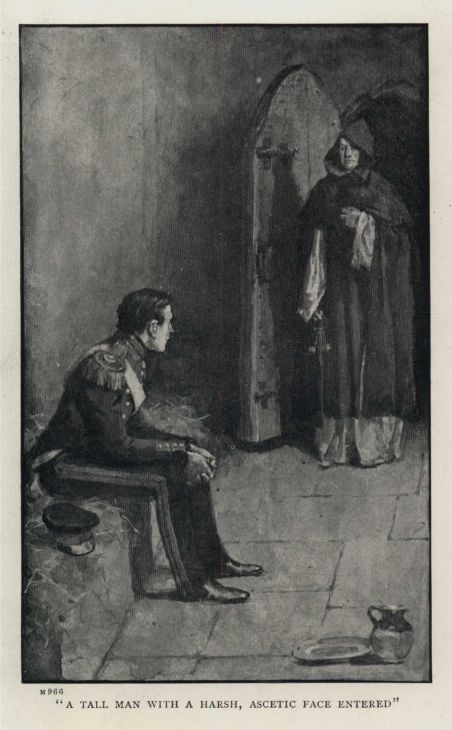
"A TALL MAN WITH A HARSH, ASCETIC FACE ENTERED"
By standing against the opposite wall he could now obtain a glimpse through the window. He saw that the wall of the building must be at least two feet thick. Having made what observations he could, he sat down on his bed and waited for what should come next. Presently his breakfast was brought in; it consisted of bread, some fried meat, and, to his satisfaction, some coffee. An hour later the door opened again, and a tall man with a harsh ascetic face entered.
"You perhaps wonder why you are confined here," he said. "I have come to tell you. You are an obstacle to the designs of the Church. You have seduced the affections of one of her daughters, and in order that she may be saved from perdition, which would be her doom if she were to many a heretic, it has been thought necessary to seclude you here. Doubtless, in time she will recover from the glamour that you have thrown over her, and will deeply regret her passing aberration; will again become an obedient daughter of the Church, and perhaps find a happy refuge in its cloisters. When this takes place you will be released, but not until then. We do not desire to be harsh with you; you may be supplied with books and other indulgences, but a prisoner you will remain until she enters the walls of a cloister."
"I understand, señor," Arthur said quietly; "and perceive that it is the lady's revenues, and not her soul, which are the main object of your care. Well, señor, you have made me a prisoner, but I have sufficient faith in the young lady's affection to believe that until she is absolutely convinced of my death she will not turn her thoughts towards the cloister, and that therefore you are likely to have me on your hands for a very considerable time. At least, I am grateful to you for your offer of books, and shall be glad if you will furnish me with a selection."
"I may say further," the man said, "that you will be instructed in the tenets of our religion, and that should you see the error of your ways and ask to be received into the bosom of the Church, possibly all further objection to your union with the young lady in question may be removed."
Arthur laughed. "Your opinion of my principles must be a very low one if you can suppose that I shall be tempted to abandon them even with such a bait as you have been good enough to hold out."
"Naturally that is your opinion at present," the monk said coldly; "it may alter after a few months of confinement."
"I fancy not, señor; and I warn you that no more serious offence can be committed than the capture and imprisonment of an officer in the British service."
"I am prepared to take that risk, señor, and you are not likely to be released, whatever happens, until matters are arranged. I will now leave you to yourself."
When the door had opened Arthur observed that a number of monks were grouped in the passage outside, evidently prepared to fall upon him should he offer any violence to their prior, or attempt to make his escape.
When the prior had left, Arthur sat down and thought the matter over. The look-out was certainly not bright. He saw that he had very little chance of making his escape from the monastery. It was no doubt a large building, with any number of passages and corridors, in which, if he could escape from the cell, he would simply be lost, so that long before he could find his way to the gate, he would be overtaken and captured again. One thing, however, he might do. No doubt for a short time the two monks who brought him provisions would be accompanied by others, but when they found that he showed no signs of trying to effect his escape, they would become less vigilant. In that case he might possibly overcome these two men, make his escape to the story above, and drop out a note from the window which might be taken to Leon, who would assuredly obtain his release without delay. He could tear a blank page out of one of the books with which he was to be provided, and write a message upon it. His pencil had not been taken from him, nor his pocket-knife.
The days went on. He had no reason to complain of his treatment; the food was good and wholesome; the monks who attended to him brought a can of water daily, carried away his basin and emptied it, and swept out his cell. A mattress and blankets had been substituted for the straw, a supply of such books as he asked for had been brought to him, and it was evident that his captors desired that he should have nothing to complain of save his loss of liberty.
After ten days he resolved to carry his plan into execution. Tearing out a blank leaf carefully, he wrote upon it:
"I am confined in a monastery. I can give no information as to its position save that it is in the town. Apply to regent for an order to search."
He then signed his name, folded up the slip of paper, and on the outside wrote:
"One hundred dollars will be paid by the Count Leon de Balen to anyone who will bring this note to him."
He then waited for a favourable opportunity.
He had, one day when meat was served to him, abstracted the knife and hidden it in his stocking. The monks, when they removed the tray, did not notice that anything was missing, but he observed that on the following day they carefully felt the mattress. By this he guessed that the loss of the knife had not been discovered till that morning. The monks, fearing that they would be blamed for carelessness, had very likely protested that they had brought it as usual into the kitchen with the tray; and had only for their own satisfaction looked to see if it were hidden there. Arthur had taken it without any definite view of using it; but he thought that if this attempt to obtain succour failed, it might come in useful in any future plan he might devise.
Next day, when his attendant monks were bending to place his basin and tray on the floor, he suddenly rushed at them and hurled them both to the ground. Then he hurried out of the cell.
Four monks were standing in the passage. Running at full speed he dashed at them. Two of them were levelled to the ground; he cast the other two aside, and ran on. At the end of the passage was a staircase. Up this he darted, and found himself in a corridor similar to that below. A number of doors opened from it. He turned the handle of one of these, ran across the room to the window, pushed his hands through the bars, and dropped the note. A moment later he heard a bell ring loudly and sharply. Doubtless one of the men he had overthrown had at once run to it, and was giving the alarm, which would send all the monks to the entrance. He had done what he had to do, so he walked quietly downstairs again. Five of the monks were huddled in the passage, and at his approach they took to headlong flight. With a laugh Arthur entered his cell and sat down. Presently a terrified face appeared at the door and looked in.
"Come in," Arthur said cheerfully. "I trust I did not hurt any of you. I merely wished to see whether my muscles were in working order. I find that they are quite right, thank you, and, having ascertained that, have come back to my cell. You can, if you like, shut the door again, for this room is rather draughty when it is open."
The door was immediately shut, and the bolts shot. Arthur wondered what the next move would be. No one came near him for two hours; then to his surprise he heard a grinding sound against the door, and half a minute later the head of an auger appeared. Another hole was made touching the first, then a fine saw was thrust through. This began to work, and presently a piece was cut out of the door some six inches wide and eighteen inches long. After a pause the piece was fitted in again. Next he heard a sound of screws being driven in, and then he saw that hinges had been fastened to the flap, so that it could be opened and closed from the other side at will. Then he heard two bolts fixed to it. The noise went on for some time, and he knew by the sound that two more bolts had been screwed on to the door itself.
He saw at once that the monks intended in future to pass his food in to him, instead of entering his cell. This proved to be the case. The flap was opened and his tray handed in, together with a basin of water. "They are determined that the monks shall not be exposed to assault and battery again," he laughed. "I have evidently given them a scare. Now, I have nothing to do but wait and see if anything comes of my note."
A fortnight of anxious waiting passed. His food, books, and water were handed in regularly, but no one entered his cell. He listened anxiously whenever he heard the slightest stir in the monastery that would tell him that search was being made, but no such sound met his ear. At last he came to the conclusion that his note could never have reached Leon's hands. Being but a scrap of paper, it might have escaped the eyes of passers-by and been trodden in the mud; or again, the prior might at once have suspected the reason of his strange conduct and despatched a monk to pick up the note. Several times he wrote the same message on pieces of paper, rolled them up into a small ball, and threw them through the window in the hope that some passer-by might be attracted by the sight of the pellet, and open it to see what was in it.
Till the end of a fortnight he remained patient, spending most of his time in reading; but when he finally determined that the letter had gone astray, he threw aside his books and decided that he must rely upon himself. It was evident that if he was to escape at all, it must be through the wall under the window. He had read of escapes by prisoners, and some of these had been performed in circumstances at least as difficult as those that confronted him, and with means no better than the knife he had in his possession. Much must, of course, depend upon the thickness of the wall and the materials of which it was built. He could see by the window that it must be at least two feet thick, and if constructed of solid blocks of stone there would be no possibility of getting them out, as his knife was but some six inches long in the blade, so that it would be necessary to wear the wall away into dust. Of course, if there were no other way, this is what he must attempt.
But for the precaution that had been taken to prevent his escape, this would not have been possible, for the monks, when they came in, could not have failed to notice the gradual crumbling away of the wall. There was, however, one other chance. As this was a subterranean, or almost subterranean room, there was not likely to be a vault under it; therefore it was probable that the wall was not continued far under the bottom of his cell. It might be one foot, it might be two, but the solid stonework would not go much deeper; it would rest upon a bed of concrete, or possibly of loose rubble. Once through that, he would probably find nothing but earth between him and the pavement above. These pavements were in most of the side streets mere cobble stones. He therefore set to work now to examine the stones forming the floor. They were about two feet square, and after some consideration he determined that the best to operate upon would be that at the foot of his bed, as this would be hidden from the sight of anyone looking through the trap. His greatest difficulty would be to get rid of the materials that must necessarily be removed. Stones he might manage to clear out by throwing them through the window with sufficient force to carry them across the street; earth, he finally concluded, he would have to dispose of in the same way.
In order to do this, however, he would have to reach the window. Of course, if he were certain that the cell would never be entered, he could pile it up against the wall to the right and left of the door, for the hole was too narrow to admit a head. However, this was a risk that he would not like to run. The excavation would occupy many weeks, possibly many months, and it was hardly likely that so long a time would elapse before a visit was made to his cell. After much thinking he concluded that if he took up two of the slabs, and placed one against the wall and the other upon it, he could just reach the window. Then, by fastening the end of a blanket to one of the bars, he could easily pull himself up by it and throw the mould outside.
This was certain to be slow work, and a few handfuls of soil scattered on the road would not be likely to attract any attention. Examining the floor carefully, he saw that the slabs of stone were by no means even, from which he concluded that they were not laid in cement, probably not even in concrete, but that the ground had been simply smoothed down and the flags laid on it, and perhaps hammered down. The cells had probably not been intended as living rooms, but were used as prisons, perhaps as far back as the days of the Inquisition.
Having once made up his mind and carefully examined the stones, Arthur lay down on the floor and prepared to act. He had just finished his breakfast and handed out the tray as usual, so he would not be disturbed again for at least four hours. He began with his knife to loosen the stone at the foot of his bed, which was on the left-hand side of the cell, and found to his satisfaction that the slabs were laid close together, but not so closely that the knife would not in most places go down between them.
The crevices were filled up with the dust of many years, and it took him till dinner-time to clear this out. He was gratified at finding, however, that while in some places his knife encountered stones when he thrust it deep, at other points he could push it down to the hilt without encountering any obstacle. This showed him that his conjecture was correct. The ground had simply been smoothed down, chips of stone from the building thrown upon it and mixed with the sand, and on this the paving had been laid down. Beyond the fact that his knife went lower than the bottom of the stone, he could not tell how thick the floor was, but he judged that it would probably be three or four inches. It was evident that he could not get this up by the mere leverage of the knife, and he would only break the tool if he attempted it.
This he had expected would be the case, and after the dinner interval he began what he knew would be one of the most tedious parts of the undertaking. It was necessary that he should scrape away part of the stone in order to get his fingers under. His pocket-knife was evidently a better tool for this than the dinner knife he had hitherto used. The slab, so far as he could make out, was a sandstone, but how hard he could not tell. He began by dipping his handkerchief into his basin and letting fall a few drops at the place upon which he intended to operate, namely, next his bed. He started very carefully, giving a sort of rotatory motion to his knife. Gradually the water he had dropped there became a little turbid; this afforded him some encouragement, and he worked steadily on till evening, by which time he had succeeded in removing a piece of the stone an eighth of an inch deep.
After supper he began again, and continued the work far into the night, for he was always furnished with a lamp. At last he had increased the hole to a depth of fully a quarter of an inch, and a width equal to that of his four fingers. Well satisfied with this result, he threw himself on his pallet and slept soundly until the flap was opened and his breakfast tray thrust in. As soon as he had finished his breakfast he set to work again, this time using the knife that had been handed in with his breakfast, and which would not be demanded of him until he returned the tray when he received his dinner. He was glad to make the change, for his hands were blistered badly by the previous day's work, and the smoothness of the dinner knife was a relief to him; besides, he saw that he had already worn away the point of his pocket-knife.
After a fortnight's steady work he had the satisfaction of feeling the knife go through. In two more days he was able to get his hand in. He now cleared out some of the earth at the bottom, and then, putting his hand below the stone, exerted his strength to the utmost, and was delighted to find that it yielded. He laid it down and executed a dance of triumph, which would have astonished the monks had they looked in.
CHAPTER XVIII
ESCAPED
It was evening when Arthur got up the stone, so he put it into its place again after his delight had a little subsided, rubbed some dust into the crevices, and then flung himself down for a long night's sleep. The next morning after breakfast he set to work to remove the dust round the next stone. When he had done this, he made a hole under it with his fingers even more easily than in the case of the first. He then replaced it, and waited until his dinner had been handed in. Having eaten this, he took up the two stones again, laid one upright against the wall under the window, placed the other on the top of it, then took a running jump on to this, at the same moment stretching his arm as high up above his head as he could. To his delight he found that he was able to grasp one of the bars. He got down, took one of the blankets, and, again leaping up, passed an end round the bar and managed to grasp it before he fell backwards.
This pulled the blanket half-way round the bar. He caught hold of both parts when he next sprang up, and was able without difficulty to raise himself until his face was level with the window. The look-out was better than he had expected. In front of him was a street, but on the other side was a piece of waste ground. Nothing could have been handier for his purpose, as the stones and earth thrown on to this would certainly attract no notice. Having taken a good look he lowered himself to the floor, relaid the second stone he had raised, and put the other alongside it so that he could replace it in an instant if he should hear footsteps coming down the passage. Then he took the mattress and bedding off the bench, for he resolved to spread upon the bed all the earth and rubble he got out during the day, as it would be dangerous to throw it out until dark.
After this he set to work with the dinner knife, and it was not long before he had loosened the earth and rubble some inches deep. This he removed, and by night had excavated a hole two feet deep, spreading the rubbish carefully, as he got it out, on the bed. He had not made the hole quite so wide as the stone, in order that this might have a support when it was replaced. Then he hung up one blanket as before, and placed a considerable quantity of the earth in the other blanket and hauled this up to the window, so as to save himself the labour of climbing up afresh with each handful. Listening attentively, so as to be sure that no one was coming along, he flung it with all his force through the window. When he had disposed of all he had brought up he filled the blanket again, and so continued until he had thrown out the whole.
On the following day he not only got out the earth to a greater depth, but was able to push the trench under the adjoining slab, which was in contact with the wall. He got rid of the earth and stones as before. Next morning he worked with renewed vigour, for the result of the day's labour would be to show whether the stone-work was carried down below the level of the floor, or whether the wall rested upon concrete. The third slab came up without difficulty, and, digging down by the wall, to his great satisfaction he found that it rested on a foundation of coarse concrete, which would no doubt be troublesome, but by no means impervious. He soon cleared out the earth and rubble to the same level as the other part of the trench, and after spreading it as usual under his mattress, he began the important task of picking out the concrete. He had not been at work long before he found that in order to get room to use both arms he must widen it out at the end against the wall. This caused a whole day's delay. The cutting of the concrete was toilsome, and it took a week of almost incessant labour to make a passage sufficiently large for him to crawl through. Having ascertained that, as he had expected, the ground beyond this was composed of mixed soil, as that within the wall had been, with fragments of stone, he gave himself a day's rest before proceeding further. It was now six weeks since his imprisonment began, and he felt sure that it would require only three or four days' more work to get to the surface outside.
He wondered what his friends had been doing, and worried greatly about the anxiety that Mercedes would have experienced. This thought indeed had frequently kept him to his work when he would otherwise have desisted, from the fatigue he felt in working in the cramped position which was necessary while getting through the concrete. Roper, too, would be in a terrible way, and Leon would be moving heaven and earth to find some clue to his fate. He wondered what they had been doing, and in what direction they had been searching, for he would have disappeared as suddenly as if the earth had opened and swallowed him, without leaving a single clue.
One thing was certain: suspicion would fall upon Don Silvio. Leon would probably lay the case before the queen regent, and Don Silvio might not impossibly be arrested on the charge of being concerned in his disappearance. He could not help believing that this man was at the bottom of it, for, think how he would, no other reason for his seizure presented itself. Ostensibly he had been imprisoned in order that his connection with Mercedes might be broken off, in which case she might enter a convent, to the great advantage of its revenues. But the knowledge that there was an engagement between them was at present confined to Leon and his sisters, for it had been agreed that it would be much better to keep it quiet until the time approached for their marriage, as Leon felt that the Church would use every effort to prevent this from taking place.
Mercedes might indeed have spoken of it in confession, but it was far more likely that Count Silvio, whose jealousy had been clearly aroused, and who hated him for the result of the duel, had set the Church authorities to work. It was not probable that the prior of the monastery had acted on his own responsibility. It was not a monastery that would benefit by Mercedes' fortune, and mere zeal would scarcely have prompted the prior to take so strong a step as to have him carried off; doubtless, therefore, he was acting under superior authority. Although the Inquisition had died out, and heretics could no longer be tortured or brought to the stake, the Roman Church in Spain was still almost as bigoted as in the olden days, and would assuredly not hesitate to take steps to prevent what would be considered as the backsliding of one of its faith. Knowing the enormous influence the priests still exercised, the measure that had been taken with reference to himself scarcely seemed extraordinary to Arthur, and he resented it rather because he believed that Don Silvio was at the bottom of it than on account of the outrage against himself.
After a rest of thirty-six hours, Arthur set to work as soon as he had eaten his supper. The lamp contained enough oil to burn all night, and it was only by its light that he was able to work. Lying on his stomach in the hole he gradually drove the tunnel forward, being obliged frequently to come out with the earth and rubble as he dug it down. When he had got two feet beyond the wall he turned on his back and, placing the lamp on his chest, began to bring down the earth above him. Luckily the mould was firm and tightly packed, for while there was thus no fear of sudden falls the walls stood upright and the earth dug out like putty. He had not the trouble of taking it out; as it fell he merely pushed it back into the open trench.
By morning he could stand upright to his work. As the bottom of the hole was two feet below the floor he was now some four feet above it. The labour had been very great, and although he had worked stripped to the waist he had suffered much from the heat. He rubbed himself with his blanket, as he had done ever since he began the work, for had he washed the appearance of the water would at once have aroused suspicions that he was engaged upon work of this kind. He dressed again, and was ready to receive his breakfast, and after eating this he went soundly to sleep. He could scarce rouse himself sufficiently to get up and take in his dinner when it came, and putting the tray down he at once went off to sleep again. At five o'clock he woke and ate his dinner, and when his supper arrived he put that by till midnight.
He now set to work with renewed vigour, for if all went well he should be free by morning. He put two of the paving-stones against the sides of his shaft, and, standing upon these, was able to bring down the earth rapidly. When he had dug two feet higher he trod the earth that had fallen firmly down, and placing the stones on these, again mounted on them. By twelve o'clock he could no longer reach overhead, and, measuring from the level of the floor of the cell, found that the cavity was now seven feet above it. He now pulled out the paving-stones, and set to work to dig some holes on each side of the shaft, in which he could place his feet. Having gained another foot by this means he went out, ate his supper, and dressed himself.
He was certain now that he should be out before daybreak. Again he set to work. The earth came down fast under the strokes of his knife. At last, at about four o'clock in the morning, the blade struck against a stone. This he felt was round, and differed altogether from those he had met with embedded in the earth. Gradually he cleared the space beneath it, and then found that a layer of stones closely packed together formed the ceiling of his shaft. He worked with renewed energy until the whole of the earth beneath was cleared away, then he dug two more foot-holes two feet higher than those he had last rested on. Taking his place in these, he pushed with all his force with both hands. The stones gave way at once, and his hands were in the air. In another minute the rest were cleared off, and, putting his hands on the edge of the hole, he hauled himself up and was a free man.
In the joy of his heart he set off to run, but presently steadied down into a walk. It was a quarter of an hour before he came upon a church familiar to him, and he was then able to direct his course to his lodgings. He had a key of the outer door, and, opening this, he felt his way up the stairs until he reached his door. Another key gave him admittance here. Opening the door of the sitting-room, he felt his way to the mantel. Here were always placed a flint and steel and a bundle of slips of rag dipped in sulphur, for although phosphorus matches were rapidly making their way in England, they were as yet unknown in Madrid. At the first blow of the flint against the steel he heard a movement in the next room, and as the sparks flew on to the tinder by the stroke, he heard Roper exclaim "Who is that?" as he jumped out of bed.
"It is I, Roper!"
There was a perfect shout of joy, and then he heard the honest fellow burst into a fit of hysterical sobbing. A moment later the sulphur ignited the tinder, and he lighted a candle. The door of Roper's bedroom was open, and Arthur saw that he had sunk back on to his bed again with his hands before his face. He went in to him and put his hand upon his shoulder.
"Roper, old friend," he said, "compose yourself. Thank God, I am back again safe and sound!"
"The Lord be praised!" Roper said, as, brushing his tears aside, he stood up and grasped Arthur's hands. "It is almost as if you had come back from the dead, sir. I have kept on saying you would return, though I knew in ray heart that I had lost all hope. Why," he said, as they went back to the light, "you are as black as a coal. What has happened to you?"
"It is only honest dirt, Roper. I will go and have a thorough wash, then I will tell you about it;" and he went into his own room, which opened on the other side of the sitting-room. By the time he came back Roper had lighted three more candles, had partly dressed himself, and had got out a bottle of wine and a glass.
"Get out another glass, Roper, and light the fire, then we will sit down and talk it all over. By the way, if you have anything to eat you may as well put it on the table. It is five hours since I have had supper, and I have been doing some hard work since."
Roper hurried away to get the things together while Arthur changed his clothes entirely. Two or three shirts had been handed in each week to him while he was confined in his prison, but he was glad enough of a complete change.
"Now, Roper," he said, as he sat down, "we will eat and talk. In the first place, tell me about my friends."
"The count has been looking for you everywhere, sir. He has had the whole police in search of you. They have got Don Silvio under arrest, but they cannot find out that he was concerned in your disappearance, though nobody has any doubt about it. Miss Mercedes has been ill. She was, I was told, in bed for a month; she is up now, but, as the servants tell me, looking like a ghost. However, I have no doubt she will soon get round, now that you are back.
"The difficulty has been to know where to start looking for you. No one had seen you since you left this house one morning, some two months ago, shortly after breakfast. From that time you had disappeared as if the earth had swallowed you up. I always said, 'The captain will come back if he is alive--bolts and bars won't hold him'. And I really believed so for three or four weeks; but when time went on and there were no signs of you, I began to think that you must have gone under. If you had, I knew it must have been directly you were taken, for before two days had passed Don Silvio had been caught. He was down at his place in the country, and was able to prove that he was there at the date of your capture. Well, they kept him under arrest, thinking that if you did come back you would be able to prove that he had a hand in it somehow."
"I believe he had, Roper, though I may say I have no shadow of proof. Now I will tell you all about it;" and he went into a full history of his capture, of his imprisonment, of his interview with the prior, and of the manner in which he had made his escape.
"You have done well indeed, sir, to get out of that place as you did! If I had been there, I should never have come out again alive. Lord, how you must have worked! So the priests were at the bottom of it after all?"
"Not quite at the bottom; for I have no doubt whatever that Don Silvio put them up to it. No doubt he said to them: 'Here is a young lady of noble family with a fine income. She wants to throw herself away on a Protestant and a foreigner; if you can manage to keep him away from her, she is pretty sure to go into a convent. She said, when she threw me over a year and a half ago, that it was her intention not to marry, but to lead a religious life; therefore if you get her lover removed now, no doubt she will do so.' You see, there were two motives for getting me shut up--one to avoid the grievous scandal of a Catholic lady of good family marrying a heretic, and the second, that of getting possession of her dowry. Well, thank goodness, I have baulked them! Has Colonel Wylde been here?"
"No, sir; he has been up in the north ever since you disappeared."
"Has there been much fighting there?"
"None at all. Maroto turned traitor and sold Don Carlos. He surrendered on condition of a big grant of money. His army dispersed, and Don Carlos has crossed the frontier."
"And Espartero?"
"He has been made Duke of Vittoria, and is still in the north settling things. In the east there has been fighting, but only small affairs, so you have not lost anything that way."
It was seven o'clock in the morning before Arthur had brought his story to a close, and he now said: "You had better go at once across to Count Leon's--I dare say he will be up by this time. Take him aside quietly, and tell him that I am here, and that I leave it to him to break the news to his sister as he thinks best. When he has done so, I will, of course, go round and see her."
Roper returned in half an hour with the count.
"My dear Arthur! My dear Arthur!" the latter exclaimed, as he ran into the room and embraced his friend. "Thank God that you are back again! I had given up all hope, and had no question at all in my mind that you had been murdered quietly by the orders of Don Silvio, and been buried in some obscure spot where your body would never be found. I could not at first believe what your man told me half an hour ago. I fancy I took him by the shoulders and shook him, and told him he was either mad or a liar. At last I was convinced that he was sane, and we hurried off together. We came too fast for talk, but I gathered from him that you had been confined in a monastery."
"Yes, Leon; and except that I was kept a solitary prisoner in a cell, I had nothing much to complain of. I was frankly told by the prior that I should remain there, however long a time it might be, until Mercedes had taken the veil."
"The rascal!" Leon said wrathfully. "That is just what we feared, or at least something like it, when we agreed that your engagement to her had better be kept private for a time. Not, of course, that I ever dreamt that they would attempt to carry you off, but I knew that they would move heaven and earth to break off the match. Now, please tell me all about it."
Arthur again went through the story, and gave his reasons for believing that Don Silvio was at the bottom of it.
"I regard that as certain," Leon said; "but that does not alter the facts. I shall have to take every care of Mercedes; they may try to suppress her as they have tried to suppress you. I have seen Queen Christina several times, and she is intensely interested in your case. We must go and see her this afternoon, and lay all the facts before her, and I shall ask her to take Mercedes under her protection, which I am sure she will do. Even the Church would not venture to drag her from the palace. As to your affair, it will require a good deal of talking over. Of course, if you report what has happened to your government they will kick up a tremendous row about it, but I don't know that that would be of any advantage either to her or to us."
"No, I can quite understand that, Leon; and it is the last thing I should wish to do. As you say, it will require a lot of thinking about and talking over; but at the first blush it certainly seems to me that, now that I have got away without further damage or injury than being shut up for a couple of months, the best policy is to say nothing about it; but, of course, we shall have to consider whether there will be any repetition of it, and still more, whether your sister is likely to suffer any persecution or to incur any risk of being kidnapped. Of course you have not told her yet that I have turned up again?"
"No. She does not get up till ten o clock, and I thought it as well not to disturb her; besides, I really knew nothing about it myself beyond the fact that you had reappeared, and even of that I felt scarcely assured until I saw you myself, for I had not entertained a shadow of hope that you were alive. I will go and break the news to her now. You may come across in half an hour."