WITH THE BRITISH LEGION (continued 2)
Reading edition
"Yes; I think we might as well keep apart. I am more likely to be detected than you, but the risk of discovery would be greater for you than for me. As a relative, it would be thought natural that I should wish to be at the wedding. I might be shot by the Carlists, but my uncle would take my part, and at any rate it would be evident that I did not come as a spy; whereas, if you were caught it would be very awkward for you, though of course I should say that you came as my friend, and had no idea of entering their lines. Still, it would be very awkward; and if you should see that I am taken, I advise you to slip quietly off at once."
Arthur, however, had no intention of remaining any time at the house and waiting till his companion was ready to leave, for the latter would certainly object to share in his own plan of making his way down through the Carlist lines. And as he was going in a way as Sebastian's guest, he could not very well leave him. The house was but a quarter of a mile, his friend had said, from the upper line of the works; and, even if detected, he could, with the advantage of a surprise, easily get there before being overtaken. Not, indeed, that he expected to be pursued. His intention was to slip away quietly soon after getting to the house, and to stroll down to the lines, where it was improbable in the extreme that he would be challenged.
"If by any chance I should not turn up, Sebastian, when you want to come away, you had better go down to the boat and wait there for a quarter of an hour, and then push off. You may not be able to row much, but you could certainly manage to get over to the other side, and then you would only have to let her drift."
"Yes; but there can be no reason why we should not come away together."
"Well, you see, one or other of us may be suspected, and it may be necessary to slip off. I don't say that it is likely at all, but there is nothing like being prepared for all emergencies."
After a quarter of an hour's walk they reached the house. It was, as they had expected, full of officers and friends. The ceremony had just been concluded, and many were going up to the bride and bridegroom offering their congratulations. Music was being played, and servants were handing round refreshments. Sebastian joined those clustered round the newly-married pair, while Arthur mingled with those standing in groups round the room. He had scarcely been there a minute when he noticed that the eyes of two or three of his neighbours were fixed upon him curiously. Wondering why their attention should be attracted to him, he put his hand up to his face, and to his horror found that half his moustache was gone. He had become warm when rowing, and this had doubtless moistened the gum with which he had fastened them on to his lip.
He at once made for the door, but as he left the room he glanced round and saw that three or four of the men who had observed him were speaking together and making after him. The moment he was outside he started to run. He had gone but twenty yards when there was a shout behind him. This unexpected discovery had altogether upset his plans. He had calculated on being able to stroll quietly down into the Carlist lines. Now he would have to exert himself to the utmost to get there before his pursuers, who were close upon him. He ran at the top of his speed, looking round once or twice as he did so. He gained on his pursuers, who, now convinced that there was something wrong, exerted themselves to the utmost to overtake him. As he neared the brow of the hill he could hear talking and laughing in front of him, and soon he came upon a line of fires round which soldiers were gathered. His pursuers now, though he could no longer see them, began to shout loudly, "A spy, a spy! Seize him!"
For a moment or two the talk by the fire ceased, and the men stood listening to the cries. They were therefore unprepared for action when Arthur dashed through them--he had no time to choose a place--and knocked over two or three who endeavoured to grasp him. In a moment he was running down the hill with a hundred men in pursuit. Presently he saw a high embankment ahead of him, which he knew must be the highest point of the defences. He ran up it, and, when he reached the top, jumped. It was a fall of some fifteen feet, but the ground was soft where he alighted, and, picking himself up, he ran on. He had not gone fifty yards when a musket was fired from the top of the embankment. This was followed by a dozen others, and the fire grew into a roar. Evidently the Carlists, in their bewilderment as to what had happened, were firing at random. Presently he came to a wall, which he vaulted over as a number of men ran up.
"What are they firing about?"
"Don't you see it is a Christino surprise?" he said. "Open fire at once, or they will be upon you."
Instantly the men obeyed his orders. Others ran up and joined them, and Arthur strolled quietly away. He met numbers of men running up.
"Hurry up, hurry up!" he said. "The Christinos have attacked us from behind and carried the upper line. Run on! I am on my way to fetch up all the men."
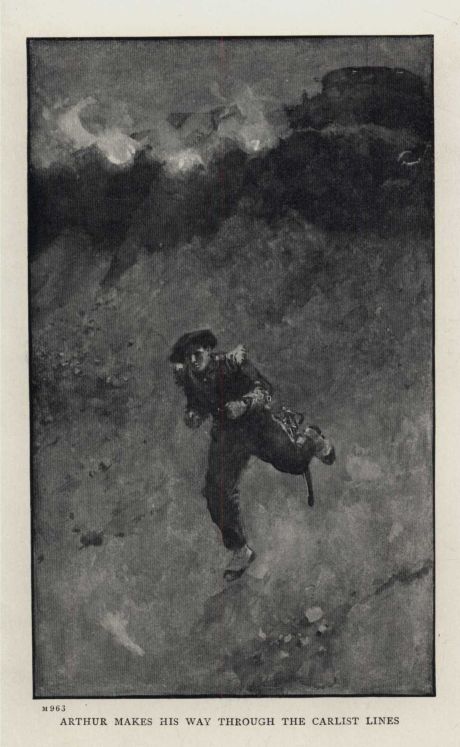
ARTHUR MAKES HIS WAY THROUGH THE CARLIST LINES
In five minutes the fire ceased. Evidently some officer had come down from the upper trenches, and passed word along the lines that the alarm was false. By this time, however, Arthur was some distance down the hill, and had little fear of being discovered. No one, indeed, paid any attention to him. The Carlists were all discussing the meaning of the heavy firing and its sudden cessation. Some officers who had come down from the second line explained that it was all a mistake, and that no one could say how it had arisen. All that they had been able to gather was that someone had run down, that a sudden alarm had been given by somebody, and that the troops had fired wildly. They were enquiring into the matter at the top of the hill; at present it was all a mystery. Arthur spent a couple of hours gradually making his way down, examining the defences and noting their position, seeing in what strength the various loopholed houses were held, until at last he came to the lowest line, a deep trench with a high embankment, and salients thrown out to take any attacking force in flank. Here, as everywhere, he was questioned; but always replied that, as far as he knew, it had been a sudden panic, possibly an attempt by the Christinos to draw their attention to that point while an attack was made below. He therefore enjoined them to be on their guard. He sallied out at an opening in one of the angles made for the outlying pickets to run in, if attacked. He now proceeded very cautiously, and a hundred yards down he saw two figures ahead of him. He walked up to them.
"Is all well?" he asked.
"Everything is quiet in front of us," the men said, "as far as we have heard. But some thought that they heard heavy bodies of men marching this way."
"I am going out some little distance to find out. Be sure that you don't fire at me as I come back."
Without waiting for an answer he went on. He heard one say to the other: "He talks queerly; didn't you notice it?"
"Yes, I thought his language seemed strange. But, you see, he did not speak in Basque, and we don't know much Spanish. Anyhow, we cannot do anything now. We will question him when he comes back again."
Highly satisfied with his success, Arthur walked on until he was challenged by a sentry ahead. He answered in English "A friend!", for he detected at once that the challenger belonged to the Legion.
"And who are you at all?" came from the sentry.
"I am one of your officers," he said. "Lieutenant Hallett. I have been in the Carlist camp."
"Come on, then, and let's have a look at ye. It is a mighty noise that they have been makin' up there."
"Yes; they have been having a scrimmage among themselves." He had now come up to the sentry.
"Well, sor, I can't see yes," the man said; "but it is clear that you are English, and that is good enough for me. Whether you are Lieutenant Hallett or not, I don't know; but I shouldn't be any wiser if I did see you, seeing that I don't know the gentleman. There are half a dozen of the boys down the hill with the sergeant at that house you can just make out fifty yards away. You had best go down to them and explain."
"All right, and good-night!" and Arthur walked on.
Arthur was passed without difficulty through the outposts, and when he reached the town he found that Sebastian had already returned to his own quarters.
"My dear friend," the latter exclaimed, springing to his feet, "I am delighted to see you. I have been in a terrible state of alarm as to your safety. I had just whispered to my cousin who I was, when there was a sudden uproar, and many of the guests ran out of the room suddenly. I looked round in vain for you. There was a general confusion, and five or six minutes later there was the sound of heavy firing, and all the rest of the guests made off in a great hurry. Of course I went out too, and waited till some of the company came back. None of them seemed to know exactly what had happened, but all were of opinion that a spy of some sort had been discovered at the wedding. He had been pursued, had run down through the lines, and a heavy fire had been opened upon him, and none doubted but that he was killed. Curiously enough, the men of the second line of defences had opened fire on those in the upper one. Why, no one knew. It could only be supposed that they believed that a Christino force had captured the upper line of trenches. I did not stop to hear later news, but made off to the boat in hopes of finding you there. I waited a quarter of an hour, as you told me, and then got in and floated down the river. I could not keep her to one side, as you did, and found that it was better to let her go as she liked. Fortunately there was such a stir in the Carlist camp that I passed down the river unobserved, and managed with a good deal of difficulty to get the boat ashore here. I have been back now about half an hour."
"Well, I managed to get through without much difficulty," Arthur said, "and found out a good deal about their defences."
"Now, you had better have a glass of wine and a piece of bread. That is all I can offer you. But as I suppose you did not get any refreshments up there, you must be hungry."
Arthur remained for half an hour, and then left. On the following morning he went after breakfast to his colonel, and told him of the adventure of the previous evening.
"You have done wonderfully well, Hallett, and the information you have gained will be of the greatest importance to us. You had better come across with me to the general at once."
The colonel at first went in alone, but presently he came out again and called Arthur in. "So you have been into the Carlist lines, Mr. Hallett?" the general said. "It was a very plucky action. Please tell me all about it."
Arthur related how, when a Spanish officer had said that he should like to go to the wedding of a cousin, the idea had struck him that if he accompanied him he might obtain some information as to the Carlist lines, and so had encouraged him in the project. He had intended to slip away unnoticed, but unfortunately he was betrayed, as soon as he entered the room, by the loss of a portion of his moustache. He then recounted the whole adventure, and handed in a full report of the Carlist defences which he had that morning written.
The general looked through it. "This is of the greatest importance to us, Mr. Hallett. It is the first authentic information we have received of the position and strength of their lines, and will be of the utmost utility when we attack them, which we shall do before many days. You have certainly used your eyes to advantage. I shall study your report at leisure, and it will be of the greatest use to me in making my dispositions for the attack. I shall certainly not forget the service you have rendered us. It shows that you have a head to plan, and courage and determination to carry your ideas into effect. It shows also that you have made the best use of your time, and have acquired a sufficient knowledge of Spanish to be able to pass as a Spaniard in a short conversation. You have done very well, sir; very well, indeed! And if you go on as you have begun, will certainly rise in the profession you have chosen."
Arthur retired much gratified by the general's commendation. When he told his adventure to his comrades they could at first hardly believe it, until the colonel himself mentioned the fact, and held Arthur up as an example of what even a young officer could accomplish if he chose to go out of the beaten path to devote himself to the study of a language, and to keep his eyes open and take advantage of any opportunity that might present itself. He charged them, however, to say nothing of this outside the regiment, for San Sebastian was full of spies; and if it were known that a British officer had made his way through their lines, they might set to work and make such alterations in their dispositions as would altogether destroy the result of Arthur's observations. Several of the young officers took resolutions to follow Arthur's example and begin the study of Spanish forthwith, but the greater portion said that the chance would probably never occur again, and that it was not worth while to work like niggers when the odds were so great against any good coming from it.
Already, indeed, the greater proportion of officers in the Legion had made up their minds to return home at the expiration of the two years for which they had been sworn in. The treatment the Legion had received--the unnecessary hardships they had to encounter, the breach of faith of the Spanish government in not supplying them with food and keeping them for months in arrear with their pay, and thereby causing a loss of more than a third of their number before they had fired a shot--had sickened them of the whole business. They were ready to fight, but they were not prepared to starve; and had ships of war come to take them home, they would have accepted their release with joy. But few of them had enlisted because they had any great interest in the cause of Queen Isabella. They had joined the Legion from the love of adventure and excitement, so dominant in every Englishman. The six months of delay and neglect had roughly disillusioned them, and most of them regretted bitterly the comfortable homes and the many pleasures they had left behind them. Nevertheless, for the moment they were satisfied. Their sufferings and those of their men had been quickly forgotten, for they had the enemy in front of them, and it was certain that before very long there would be a great fight; and none felt much doubt that, in spite of the strength of the Carlist position, and the number of its defenders, they should get the better of the Spaniards when they came to close quarters.
The prevailing sentiment was: "The beggars have never fought well against either the French or us, and it is not likely that they will begin now. They seem to have fought fairly sometimes against each other, but that is quite a different thing from fighting against us. They are only half-drilled, and our fellows now are almost as well drilled as our line. They don't look much, poor chaps! but they will fight. They are put in the humour for it, and would go at the Christinos just as readily as at the Carlists. They have come to the conclusion that Spaniards are brutes, and the recollection of what they have suffered at their hands will make them fight furiously. It was just the same thing in the Peninsular War. The Spaniards never kept their promises, and our fellows were starving when their men had an abundance of everything. The result was that our troops hated them infinitely worse than the French, and behaved like demons at the capture of Badajos and Ciudad Rodrigo."
The month's stay at San Sebastian did wonders for the Legion. The sailors in our warships, who were filled with pity and horror when they embarked at Santander, never came on shore without bringing presents of tobacco and portions of their own rations for them. The shops were well supplied, and the small amount of pay that the men had received enabled them to buy many little luxuries. As the Legion was at the time supreme there, General Evans was enabled to obtain from the stores a fair amount of food, and the men speedily recovered from the effects of starvation and illness. At last all the preparations were made. From the manner in which the staff-officers rode to and fro with orders, the serving out of ball-cartridge, and other preparations, it became evident that the time for attack was approaching, and the troops rejoiced that they were at last to be called upon to play their part as men.
CHAPTER IV
THE FIRST FIGHT
For some days previous to the 5th of May, plans had been formed for an attack on the enemy's lines. The Carlists had a double line of fortifications. The first of these was half a mile from San Sebastian, and on the heights behind were numerous others, formed principally of steep banks or deep lanes, and breastworks of earth. Behind these, and separated by deep hollows, were other heights similarly fortified but more strongly entrenched, and armed with several batteries. The main road from San Sebastian to Aranez ran through the ground, and was strongly barricaded at various points.
The general's force consisted of five thousand British and fifteen hundred Spanish. All his own troops had not yet come up, and more Spanish troops from Santander were expected; but the general, having seen the manner in which Cordova mismanaged matters, and not being able to depend upon him as a tactician, determined to attack by himself. The evening before the attack was to be made, the various commanding officers addressed the men. All was bustle that night. By three o'clock the whole of the troops moved out of the town. The Light Brigade, under General Reid, consisting of the Rifles, the 3rd, and an irregular Spanish corps called the Chapelgorris, advanced against the enemy's lines near the river. The Irish Brigade, consisting of the 9th, 10th, and 11th under General Shaw, moved against the centre. General Chichester's brigade, comprising that morning the 1st, two companies of the 8th, and eight hundred Spaniards--the 4th, with the remainder of the 8th belonging to this brigade, not being yet landed--attacked the left of the enemy's lines.
The three forces had marched together as far as the convent of St. Bartholemy, and there separated in the directions they were to take. The officers were all on foot, for over such ground it was impossible to advance on horseback. Two hundred yards in front of the convent lay the Carlist pickets, but so noiselessly were the operations carried out that the various divisions reached the posts assigned to them undiscovered.
As Arthur marched along in the darkness he gave a hand in passing to Roper. "Good-bye, old fellow!" he said, "if we are not to meet again; but we may hope to do so in the morning." A squeeze of the hand was exchanged, and he passed on.
It was an anxious time. The red glare of the enemy's picket-fires could be seen in the distance. The morning was dark and wet, and there was perfect stillness as they took up the places assigned to them. Suddenly a Carlist gave a shout of "Qui vive!", which was answered by a shot from one of the Chapelgorris; then there was a shout of "Forward!"
Instantly volleys broke out from the various Carlist pickets. General Evans was in front of the advancing line. His orders were that the men were not to fire, but to advance well up and then charge. The first houses were cleared, and the out-pickets driven in. Then, for daylight was now breaking, the troops began to see the formidable nature of the work before them. The 7th Irish advanced almost without firing a shot. Volley after volley was poured into them, and though they dropped fast, they went steadily on with their colonel at their head. Sweeping forward, they gained the long building called the Windmill Battery, though five hundred Carlists garrisoned the loopholes. A great number of the enemy fell in and about these houses, refusing to surrender as prisoners, but fighting to the last till they were finally driven out. As General Evans came up to them he exclaimed to the 7th, "You are doing nobly, Irishmen!"
On the enemy's right equally severe fighting was carried on; and while the 7th carried the Windmill Battery, the Light Brigade succeeded in establishing themselves near, and driving the enemy from other posts of similar description.
Colonel Tupper was shot through the arm while gallantly leading his regiment, but, lest his officers and men should be discouraged, he threw his cloak around him to hide it, and held on with his regiment two hours longer. When he was again facing a heavy fire, he was shot through the head. On the left, the 1st and two companies of the 8th, under General Chichester, assisted in the assault, but without much help from the Spanish regiments. Colonel Fortescue, of the Rifles, was very conspicuous, being frequently engaged hand-to-hand with the Carlists; cutting his way through bushes, over walls and other obstacles, and dragging his men through when they were sinking in the dirt and mud. The 7th and 9th were repulsed three separate times, but a party of the 10th came up and joined them, led by Colonel Fitzgerald. A stone wall was in front of them, and over this Colonel Fitzgerald sprang with a riding-whip in his hand. Volley after volley was poured upon them, and the men fell as fast as they got over. All the officers who crossed the wall with him fell, but he stood still and ordered his men to come on. His last words were heard by an Irishman, who sprang over the wall saying, "Ye'll not die by yerself, old Charlie!"
There was a rush by the others, and the position was won. The second line of defences had now given way, the only position of importance remaining being the fort of Lugariz. Here the enemy were massed. Men tried to climb up the slippery slope to its foot, but fell or slipped back again. Until nine o'clock the troops were baffled. At this moment the two vessels with the 4th and 8th entered the bay. The boats were instantly launched and the men brought ashore. As they landed they threw their knapsacks down on the sand. The two ships of war opened a storm of ball and shell at the fort. Colonel Godfrey, as soon as he arrived with the two regiments, at once rushed into the thick of the combat. The batteries continued to fire until they were at the foot of the wall. A breach was made and the troops rushed in, but the Carlists for a time still kept up a heavy musketry fire from the rear.
The 3rd made at the same time a determined charge on a fort that had been resolutely defended for a long time. The fight here was very stiff. Fortescue and Swan were both wounded, and Brigadier Reid was shot through the breast. Fourteen field-officers and captains, and double that number of subalterns, were either killed or wounded.
At last all opposition ceased. The Carlists drew off sullenly. The bugles rang out the recall, and the scattered and exhausted troops gathered together in regiments. They had good reason to be proud of themselves. Older soldiers could not have fought more bravely than these men, none of whom had been under fire before. The 6th and 7th Regiments suffered the greatest loss, the number of killed and wounded amounting to more than a quarter of their entire strength. The total loss was seventy-five officers and eight hundred and forty-eight privates. Many of the wounded died after the engagement. Four pieces of artillery were taken.
When the fight was over, Arthur Hallett leant against a wall panting and exhausted. It seemed to him almost like a dream, and he could hardly believe that he had come through the desperate struggle without a scratch. Excepting only when for a time it was brought to a stand-still by Fort Lugariz, the regiment had been incessantly fighting. Now pushing forward, now falling back, now broken up into parties, now gathering together again; sometimes loading and firing as quickly as possible at the walls and houses, from which flashed shot as quickly in return; then dashing over walls and across gardens, storming houses, and driving all before them. There had been an anxious time when they could not struggle up to the foot of the fort, but were forced to lie quiet, to shield themselves as they best could from the fire from its summit until the vessels of war beat down an angle of the wall to make an entrance.
It seemed to him well-nigh impossible that he could have come out of the turmoil alive. He was soon, however, aroused. The bugles were ringing out, and the unwounded men formed up in order that their names could be taken, after which the work of collecting the wounded began in earnest.
"I am glad to see you have come out all right, Hallett," Captain Buller said. "Poor Prince is killed, and I should think pretty nearly half the company. It is the sharpest fight I ever went through. If it had been much sharper there would not have been anyone left to tell the story."
"I am sorry to see that you are hurt, sir."
"My wound is not serious; it was a thrust with a bayonet through the arm. However, I have got my majority. You had got five or six steps before, owing to men being sent home. I should think there must be at least seven or eight vacancies now among the lieutenants. One's only consolation is that it is an ill wind that blows no one good."
As soon as the roll was called, the work of carrying down the wounded began, and Arthur had time to go and look for Roper. To his great satisfaction he found that he also was uninjured. They exchanged a hearty hand-shake.
"We are very fortunate to have both got through it, Roper."
"I am glad indeed," the other said. "I wondered several times how you were faring, but there was very little time for thinking."
"No; we must talk it over with each other when we have leisure. We must help to get all these poor fellows down before we can think of anything else. Well, it is satisfactory that we have had a good fight at last. I had begun to have great doubts whether we were ever going to fight at all."
"Yes; they cannot say any more that the Legion is of no use for fighting. It has been our first chance, and I think we have made the most of it."
Then they separated; and it was late in the afternoon before the work of collecting all the wounded was finished. In the meantime a number of townspeople had been hired to dig graves, and by nightfall all the dead were buried. Some of the troops slept on the ground they had won, the rest marched down into the town; rations were served out, and as soon as these were cooked and eaten all went to sleep. Arthur's regiment was one of those that remained on the hill, and the officers all gathered in one of the houses that had been carried by storm. The bodies of the dead Carlists had been carried out, and fires had been lighted. After they had eaten a meal, Arthur and two other officers started on the rounds to see that the watch were vigilant, for the Carlists had not fallen back far, and might at any moment make an attempt to recover the lost ground. Each of them had two orderlies, and these carried lanterns. The night was dark, and it was next to impossible to make their way about over the broken ground, which was still thickly strewn with dead Carlists. They were heartily glad when, an hour later, they were gathered by the fire.
As they would have to turn out again in another hour they agreed that it was of no use to sleep, and they chatted in low tones of the events of the day. All agreed that it had been worse than they had expected, and that the enemy had fought with great bravery.
"They are sturdy fellows and not to be despised," a captain said. "I certainly did not think they would fight so well. If they had fought like that against the French there would have been no occasion for us to send an army to help them. However, we have a right to be proud of the Legion; they have done gallantly. It is a pity that we have lost something like three thousand men by sickness. It would have made a vast difference if we had had our full force here."
"Anyhow, it was lucky," Arthur said, "that the other two regiments came up in the middle of it, for they had fairly brought us to a stand-still. Well, I suppose it is time for us to turn out again. At any rate it is a consolation that we shall get some sleep to-morrow."
Next day the general sent for Arthur. "I must thank you again," he said, "for the information you gained for us, Mr. Hallett. But for it I don't think we should have managed to win our way so far, for we learnt from it the weak and the strong points, and were able to take several of their most formidable redoubts, which would otherwise, I think, have been more than we could manage. I shall have pleasure in mentioning your name in my report of the action, and shall remember you if anyone is wanted for special service."
"Thank you, sir! I can assure you that I have never thought of such a thing, and only carried out my plan in the hope that I might gain some information which would be useful to you when the time came to attack. I have already been extremely fortunate in obtaining a commission although altogether without interest, and can only hope that in future I may again be able in some way to be of use to you."
Arthur afterwards went to have a chat with Roper. "Well, Roper, we have had our first battle; what did you think of it?"
"I had no time to think about it at all. It was just load and fire, and 'Go at them, lads!', then falling back, and then trying again. It was certainly a good deal worse than I had expected. I don't think that I was frightened. My one idea was that I wanted to get at them."
"That is a good deal like what I felt, Roper. I know I wondered occasionally that I lived through such a storm of musket balls. Sometimes it seemed as if nothing could exist in it."
"All the time I was astonished at the courage the Carlists showed. We had so made up our minds that they would not stand against us for a moment that I was quite taken aback when I found that they were fighting just as hard as ourselves."
"Not quite so hard, Roper," Arthur said. "They fought hard, I admit, but when we got among them with the bayonet we always had the best of it. The beggars could stand bullets, but they did not like steel."
"We lost heavily, sir."
"I am sorry to say that we did. We lost particularly heavily among the officers."
"Yes, sir. Everyone was saying how gallantly they showed the way. I hardly expected some of them to do so well. Of course one has no means of knowing; but there is a sort of general idea that an officer who doesn't look after his men, or seem to take any interest in them, is not the sort of fellow who would lead them well in a fight."
"I don't see why that should be so, Roper. A man may be very kind-hearted, and yet not extraordinarily plucky; while, on the other hand, a pretty hard sort of man may have any amount of courage."
"I suppose that is so, sir; but somehow one seems to think that a man who is a good fellow one way will be a good fellow another."
When off duty some of the officers would often go out for a sail, and one day four of his friends asked Arthur to accompany them.
"I don't think the weather looks very settled," he said; "still, there mayn't be any change till we are back. Anyhow, I am ready to go."
"That is right. You know you understand managing a boat, and that is more than can be said for the rest of us. We don't propose to be out more than two or three hours.
"Well, it makes a change, anyhow. After drill is over, there is little enough to do in the town till the evening; it is all right then. The better class seem to sleep during the day; at any rate, they don't show outside their houses. And though they are friendly enough when you meet them on the promenade, they are very chary of asking you to call, or anything of that sort, except when they have regular receptions."
Accordingly they went down and hired a boat, and put out. A sail was hoisted, and as the wind was dead behind them they ran out merrily. They passed within a quarter of a mile of the men-of-war.
"There is a man on that ship waving his arms and shouting," Arthur said. "I rather think he is shouting to us."
"No; I expect he is shouting to someone on the other ship," one of the others replied.
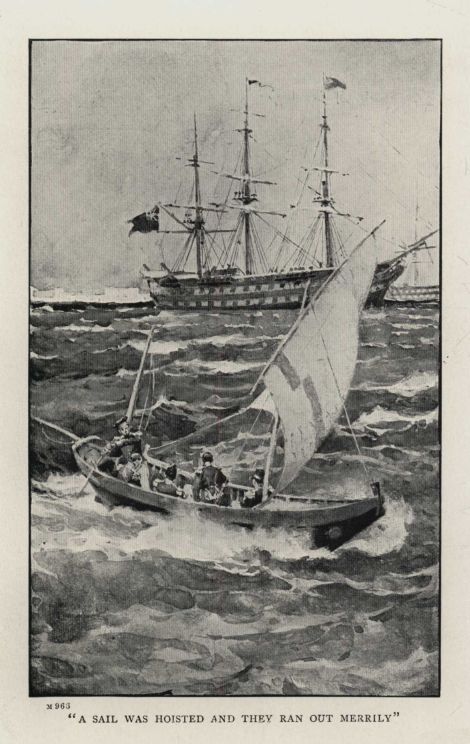
"A SAIL WAS HOISTED AND THEY RAN OUT MERRILY"
They thought no more of it, and kept their course. When they had gone five miles Arthur said: "I think we had better be making for home again. We shall have to beat all the way, and the wind is freshening; besides, I don't like the look of the clouds coming up over the hills."
The others, who were enjoying themselves, said: "Oh, we will go a bit farther; it would be a pity to cut our trip short."
They held on for another couple of miles, and then Arthur said: "I am sure we had better turn. You hardly recognize how hard the wind is blowing; we are running before it, and she keeps on an even keel. You will find matters altogether different when we have once put about."
"Well, turn if you like, Hallett. It really seems a pity."
"Well, before I bring her into the wind we had better let the sail run down and put two reefs into it. I fancy we shall have to reef it close down before we have done."
The others saw by the serious expression on Arthur's face that he was thoroughly in earnest, and they lowered the sail and reefed it. As soon as this was done, Arthur put the helm down and the boat came up into the wind. As she did so, she heeled over so far that one or two of the others grasped the gunwale, fearing that she was going over.
"She is all right at present," Arthur said, as she started off on her new course; "but I wish we were five miles nearer the land. I can see she won't look up very near the wind, and we shall have a long beat before we get in."
Half an hour later the sail was close-reefed, but even under this small spread of canvas she heeled over till her lee-rail was close to the water.
"You were right, Hallett, and we were fools not to follow your advice," one of the others said. "I don't know much about sailing, but I understand enough to see that we have a very tough job before us; and the wind is getting stronger every moment."
Five minutes later Arthur said: "There is a black squall coming across the water. We had better lower the sail altogether till it has passed. I have no very strong hopes, however, that it will be over for some time. There is no break in the clouds, and I have quite lost sight of the shore."
His advice was taken. The mast was lowered and the sail rolled up, and two officers got out oars.
"You had better get them all out," Arthur said; "it is as much as we shall be able to do to keep her head to the storm. Now, all row quietly. The squall will be on us in a couple of minutes; when it comes, you will have to put your whole strength into it. It is fortunate that I am steering with this short oar. If she had had a rudder we should never have kept her straight, for she will be hardly moving through the water."
There was a sudden splash of rain, then a pause, and then it came down in bucketfuls, while the wind literally howled. For a time the exertions of the four rowers, and of Arthur at the steering oar, kept her head straight; but after a quarter of an hour the rowers, unaccustomed to prolonged exertions, began to flag. Arthur changed places with the stroke-oar, and the boat again made a little way; but the advantage gained by his strength was more than counterbalanced by the want of skill of the helmsman, and at the end of five minutes' rowing the boat's head fell off, and the wind caught it and whirled it round.
"Oars in!" Arthur shouted. "I will take the helm again. You four had better sit down in the bottom of the boat. A big sea will be getting up very soon."
"How long is it going to last?" Sinclair said, when they had all crouched at the bottom of the boat.
"It may last two or three days, and the wind could not be in a worse quarter. If it shifts, we might make either the coast of Spain or France; but it is a south-easter, and will blow us right out into the bay. It is lucky you brought those two bottles of wine and that loaf of bread with you; we shall want them badly before we see land again. I wish to goodness we had run in to that man-of-war. I have no doubt at all now that the man was hailing us, and that they were going to caution us against going out farther. However, wishing is useless; we have got to grin and bear it."
"We were fools not to take your advice earlier, Hallett."
"I don't think it would have made much difference," Arthur said. "If we had turned then, we could not have got back before the squall struck us, and we should have been blown out just as we have been now."
He was now sitting in the bottom of the boat also, still holding the steering oar. There was, however, but little to do with it, the boat was running straight before the wind.
"What pace do you think we are going through the water?" Sharman shouted, for they could scarcely hear each other speak.
"About six or seven knots, I should say."
"Then if it goes on for three days we shall be something like five hundred miles out?"
Arthur nodded. "I hope it won't keep on blowing as long as that. Besides, there may be some shift in the wind that would enable us to make either France or Spain. If not, we have only one chance, and that is, we may be picked up by some passing ship."
There was little more talk. They were all sitting close together in the stern, as Arthur said that by so doing the greater draught aft would enable the boat to keep her course dead before the wind without steering. Each felt that it was more cheerful being thus close together, even if there was nothing to talk about.
Sinclair proposed that they should have a little wine to warm themselves, but Arthur at once said: "We must not think of such a thing. We have all had breakfast, and it must last us till to-morrow morning. We may have to eke out the wine for a fortnight; those two bottles are of vital importance to us. As long as it keeps on raining we shall not suffer from thirst. By the way, it would be a good plan to shake out the sail and spread it on the seats with the oars over it, lashed into their places by the sheet. In that way we shall be able to catch the water that runs off it in the baler."
"There is a lot in the bottom."
"Yes, but it is principally sea-water. You had better shift a bit forward. The waves are beginning to break over her stern, and we must keep her more on an even keel."
Night came on. The gale was blowing with unabated force, and the sea was high, but the boat rode easily over it, for she was a large craft, and would have required double the number on board to take her down to her bearings. Fortunately the water was warm, so that while there was not a dry thread on them, they did not suffer from cold. As night came on, they rearranged their sail. They put one of the stretchers across the boat with its ends resting on the gunwale some five feet from the bow. The oars were lashed to this, sloping downward into the bottom of the boat, and over them the sail was fastened, thus making a sort of tent sufficiently large for them all to lie under. All were worn out by the buffeting of the wind, and in spite of the tossing of the boat, the hardness of the boards, and their drenched clothes, they fell asleep before long.
Morning was breaking when they awoke, and there was no change, except that the sea was running much higher. The first thing they did was to bale out the boat. Then a bottle was opened, and a little wine measured out carefully into the wine-glass that had been brought on board. The loaf of bread had been placed in a locker. This had fortunately kept dry. A slice of it was cut off and divided into five portions. It was but a meagre breakfast, but all felt better after it. Pipes and cigars were then lighted, and they began to talk.
"What chance do you think there is of a vessel picking us up, Hallett?"
"I really can't say; but there ought to be a fair chance if the wind is blowing in the same direction as when we started. It would take us out, I should think, pretty well into the course of ships going south. There are, besides, vessels making for Bordeaux and other French ports. It will be hard if we don't run across some of them; and as we have four oars and a sail we should be able to cut them off as they come in. Yes, I think our chances are good. But even now one of us ought always to keep on watch."
The rain had ceased falling, but the air was still thick, and heavy clouds were passing overhead. At one o'clock, however, these began to break, and two hours later the sun shone out brightly.
"That is a comfort," Arthur said. "In the first place it will dry us, in the second place it will cheer us, and in the third it will enable us to see a long way."
He stood up and looked round. "I can see nothing at present," he said. "It is only when we get on the top of a wave that we can see any distance."
About five o'clock in the evening they made out a sail, but it was a long way off, and was already to the west of them; and it was seen at once that it would be absolutely useless to try and row after the ship, as she was running rapidly along, although under a very small amount of canvas. Still, the sight of the vessel cheered them. They had seen one, and there was no reason why they should not see more. They now knew that the wind was blowing more from the south than it had done, and that they were therefore running to the north. This was an advantage, for they would be making rather towards than away from the French coast, and, when the wind fell, might hope to reach it.
The next morning the wind had dropped a good deal. The day was bright and clear, and they allowed themselves a double portion of wine and bread. Then they got the mast up, undid the lashings of the sail, and hoisted it half-way up, making holes in the canvas by which they could put an extra reef in. Under this very reduced canvas they were able to sail comfortably, though all of them had to sit up to windward. The wind had come still more round to the west of south, so they were able to lay their course due east.
"How far are we off land, do you think, Hallett?"
"Well, we have been about sixty-six hours out. By the course we ran the first twenty-four, we made, at six knots an hour, about a hundred and forty-four miles, which would put us, I should say, something like seventy to the nearest point of France. The next twenty-four hours we were running nearly north, so during that time we must have kept about the same distance from the coast. Last night we must have been approaching rather than running away from it. Well, we are now going about four knots through the water. If the wind falls more, and we can put up more sail, we shall walk along a little faster; but until the sea goes down, I don't think we can calculate upon making above five knots. But if we are now, as I suppose, nearly in a line with the mouth of the Loire, we may not be more than thirty or forty miles from the shore; for, although I don't pretend to be particularly well up in geography, I know that the French coast runs out a good deal west till it gets to Brest."
At twelve o'clock Sinclair stood up and looked round. "I can make out a dark line," he said, "over there to the left; it looks to me like land. We should have seen it before but for the sail."
Arthur was as usual steering, but the others all went forward to have a look, and Sinclair took the helm for a minute to allow him to do so.
"That is land certainly," he said. "I should say that it is stretching out towards Brest; but I think we had better keep straight on. It may take us a few more hours to get to shore, but it would save us a lot of travelling if we were to strike the mouth of the Loire instead of Brest. At any rate we are safe now, and can venture upon a slice of bread each and a full glass of wine--a glass and a half in fact; that will still leave us with half a bottle for breakfast to-morrow morning. We may fairly calculate upon being close to land by that time."
The others were rather in favour of running to the land they saw.
"Well, look here," Arthur said: "don't you think that it would be a great deal easier to travel a hundred miles in this boat than to tramp the same distance? Besides, the coast, I believe, is very rocky all the way along there, and we might find a difficulty in landing. My own idea is, that when we do make land, we must go ashore and find out where we are, lay in a good stock of provisions, and start south again. With the wind as it is now, we could very nearly lie our course, and we could certainly do so if the wind goes round a point or two farther. I don't know what money you fellows have, but I have only a dollar or two in my pocket."
All examined their store, and the total only amounted to thirteen dollars.
"Thirteen dollars would go no distance towards taking us down through France. It would not pay for a conveyance a quarter of the distance, to say nothing about food. Even if we walked it, it would hardly pay for our bread and cheese, and we should have to sleep in the open. Then, too, we might have a deal of difficulty in getting into Spain without passports; and if we did get in we should find it almost impossible to make our way to San Sebastian, as several places on the frontier are in the hands of the Carlista. Therefore I shall certainly stick to the boat. If you prefer to tramp you can do so; but I know that before you have gone more than a day's march, you will begin to feel very sorry that you did not take my advice."
"There is a lot in what you say, Hallett," Sharman said, "and I for one shall certainly stick to it."
The others at once agreed to the idea. Arthur, being the only one who knew anything of sailing, had throughout the voyage acted as captain, and the fact that he had carried them through the storm safely had given the others great confidence in him.
"I should say," Arthur went on, "that when we make land we may as well stop for twenty-four hours. The people will probably treat us hospitably as shipwrecked mariners, and put us up and feed us. We shall all be glad of twenty-four hours' rest; and by the time we are ready to start again, the sea will have gone down, and we shall set out like lions refreshed. With a wind anywhere north of east or west, we shall be able to lie our course comfortably; and even if the wind is light we ought to make eighty or a hundred miles a day, and three days will take us easily to San Sebastian."
The sun was just setting when they saw land ahead of them, and by ten o'clock they were close to it, and could make out that it was either an island, or a cape running out into the sea. They sailed to the north side of it. The sea was smooth, so, running the boat ashore, they got out on to a low beach. Walking inland for some distance they threw themselves down in a field, and as the ground was soft in comparison with the boards at the bottom of the boat, they were very soon sound asleep. In the morning they finished the loaf and the wine, and then returned to the beach. Ascending some rising ground, they saw that half a mile along the shore there was a village standing at some little distance from the sea. Towards this place, therefore, they made their way.
As they entered the village they were regarded with looks of astonishment by the natives. They were not in uniform, but their clothes had shrunk considerably in their long drenching. Sharman had lost his cap. All looked faded and bedraggled, and three days' short rations had left its mark on their faces. Sinclair fortunately spoke a little French, and was able to make the villagers understand that they had been blown off the coast of Spain in a storm, and had landed late the previous evening half a mile away. The curés of the village at once took them in, and in a short time they sat down to a hearty meal, to which they did full justice. They told the curé that they intended to start next morning to sail down the coast, and learned from him that the place where they had landed was the island of St. Nazaire, and that they were some twenty miles from the mainland.
"I think you could not do better than sail along the coast," he said. "Once you make the mainland you will find villages and little ports at short distances. At these you can buy anything you want. Of course you will always keep within sight of land, except when you cross the mouth of the Gironde. I don't know how you are off for money, gentlemen, but I shall be happy to supply you with some, which you can send to me when you have an opportunity."
"We are very much obliged to you, sir," Sinclair said, "but we have thirteen dollars between us, which will buy us an ample supply of things for our voyage. We do not intend to land, but shall sail on night and day. Two of us are quite sufficient to manage the boat, and we can sleep by turns."
"Thirteen dollars will be quite enough if you have fine weather and fair winds, but it would not go far if you have to stop."
"I don't think there is any fear of bad winds. There would hardly be two storms one after another at the end of the month of May; but indeed I do not think we should run short of money were we to be eight or nine days on the voyage. The wine is only, I suppose, about sixpence a litre, and if we reckon a litre a day each of wine, and allow half a franc each for bread and as much for meat, our victuals will only cost us a dollar and a half a day, and we could treat ourselves to a franc's worth of fruit and still have enough money to last us a week."
The priest smiled. "Well, sir, at that rate you can no doubt do it comfortably, and I admit that your thirteen dollars will be ample if you make the run in five days, which you certainly will do, unless you get the wind right in your teeth."
They dined at the priest's house, and he provided beds for two of them, and found accommodation for the others in some of the cottages. They did their shopping that afternoon, and arranged to start at daybreak the next morning. This they succeeded in doing, after thanking the good priest very heartily for his hospitality. Many of the villagers had been down on the previous day to look at the boat that had lived through such a gale, and some of the others had now come to see them off. They headed east so as to make the shore as soon as possible, for they agreed that as they would have nothing to guide them in case of thick weather coming on, it was best to make the mainland, and then follow it down at a distance of a mile or so. The wind was blowing now from the north west, and, spreading their full canvas, they ran down rapidly past the island, and three hours after saw the French coast ahead.
They were now in high spirits. They had made a wonderful voyage, and were able to chat gaily over the talk there would be at San Sebastian concerning their disappearance.
"I only hope there won't be another fight before we are back," Arthur said; "that would be horribly annoying. If I were certain of that, I should feel quite happy over our adventure."
The weather continued fine throughout their voyage. The wind was somewhat light, but sufficient to take them along at between four and five miles an hour, and on the evening of the third day after starting they saw the highlands of Spain rising in front of them. On the following morning they ran into the harbour of San Sebastian, where they were hailed as if returning from the grave by their companions, who had given them up for lost.
"We certainly should have been, if it hadn't been for Hallett," Sinclair said. "He kept his wits about him the whole time, got us to rig a shelter, and stuck to the helm as long as steering could do us any good."
The general himself sent for them and heard their account of the voyage.
"Well," he said, "all is well that ends well, and I congratulate you on your marvellous escape. Moreover, you have lost nothing, for there has been no more fighting since you left."
CHAPTER V
A FURIOUS STRUGGLE
The time passed slowly. Skirmishing went on constantly. Both parties worked at their entrenchments. Shots were exchanged by the batteries from time to time. The soldiers were in better spirits, as a certain amount of the pay due was handed to them, and for a time even the grumblers were contented. Drilling went on regularly, and was done smartly and well. Sunday was the great day of the week. Spanish colours were hoisted early, and cannon fired a salute. The church bells began to ring, and every Spaniard, male and female, rich and poor, started by six o'clock for the Cathedral, which was so crowded that very many were forced to kneel outside on the plaza in front of it, the other churches being all taken up as magazines and storehouses. At seven o'clock the service was over, the shopkeepers began to open their stores, and country people and others thronged the great square.
Although firing went on as usual, sports were held down on the sands. When the market was cleared away, the plaza was soon filled with dancers, principally girls, who danced to the guitar. In the crowd were Spanish and English officers, grave dons, all the better class of the town, the women in their black silk dresses and mantillas, peasants, beggars, soldiers, and sailors. Many would stroll to the ramparts and watch the firing till eight o'clock, at which hour the Spaniards all went to bed, and the streets were quiet save for an occasional drunken soldier and the patrol parties.
Then there was another long interval without pay, which caused serious disaffection. Several of the regiments broke into open mutiny, and absolutely refused either to obey orders or to leave their barracks. Some of these mutinies lasted for a fortnight, and were caused partly by want of pay and partly because many of the men believed that they had enlisted only for a year, and, now that the period of their service was drawing to an end, considered that ships should be arriving to take them home.
The officers were greatly puzzled what to do. It was extremely doubtful whether any of the regiments that were still obedient would, if called upon to do so, fire upon the mutineers, and it was morally certain that if they did so the disaffection would be so great that the whole Legion would fall to pieces. The officers went about among the mutineers trying to get them to return to their duty. Some of the regiments were pacified by distributing small sums of money among them, others were reduced by stopping the supply of all rations, and gradually things settled down again.
The desultory fire that had been going on for so many weeks was succeeded, on the 1st of October, by a series of attacks by the Carlists.
Heavy firing broke out at three o'clock in the morning, shot after shot falling in the town, and so well aimed were they that none doubted but that the gunner was one John Wilson, a deserter from the Legion, who had once been in the Royal Artillery. There had been many desertions from time to time, and the Carlists were constantly shouting invitations to our men to come over to them, promising them good pay and good treatment--offers very enticing to men on small rations and no pay.
As the fire broke out columns of Carlist infantry advanced, driving the pickets before them. Some of these threw themselves into houses, and defended themselves against overwhelming numbers. The 3rd Regiment and the Rifles were the first to reach the scene of action, many of them running up in their shirts, or with their tunics all unbuttoned, having leapt to their feet, seized their rifles, and hurried off without a moment's delay. Drums were beating and bugles sounding all over the town, the non-commissioned officers turning the men out as fast as they could.
The officers were riding about and getting the men to fall in. As they arrived they were formed up behind walls and other shelters. The 3rd and the Rifles had checked the Carlist advance. As the 8th Regiment formed up, a cannon shot from the Carlist fort on the Ametza Hill fell close to a group of officers, many of whom were knocked down by the stones thrown up, and then went through the column, killing one man and knocking down half a dozen others. The men, however, laughed and joked among themselves. The next ball went right through the horse of a mounted officer, killed two soldiers behind him, and a woman who was out looking for her husband's body, having just got news that he had been killed.
Our artillery had now come on the scene, and, directed by Colonel Colquhoun, an admirable and scientific officer, soon got the range. He himself levelled one of the cannon at a column of Carlists a mile distant. The ball burst just at the right moment and committed great havoc, and the gunners of the other pieces in the battery, under his instructions, opened such a terrible fire upon the column that it broke and disappeared. He then laid three guns on the Ametza fort. They were fired simultaneously, and to the delight of the soldiers they burst on the parapet, carrying death and confusion among the gunners, and killing, among others, the deserter who had given them so much trouble. Up till ten o'clock the Carlists maintained the offensive, but at that hour the Lancers came on to the field. They charged in gallant style on the south-east side of the Ametza hill, and the Carlists gave way and ran until they reached their breastworks. Here it was impossible for the cavalry to follow, and they at once drew off under a very heavy fire. They then charged again and again at the various parties scattered over the plain, moving in as perfect order as if on parade, and doing great execution. But for the fact that the Spanish entrenchments were so extensive as to afford shelter for the scattered fugitives, the loss inflicted upon them would have been extremely heavy.
The special object of the Carlist attack had been the village and fort of Alza. This was defended by two Spanish regiments, one of the Legion, and a battery, and these repelled the attack with great slaughter.
A dog belonging to the Legion, which had taken part in every fight, always marching at the head of the regiment, distinguished himself greatly in this battle. Strangely enough he never barked except in face of the enemy. He had been twice wounded, and on this occasion, in company with a Spanish friend of his own species, advanced and retreated with the Lancers. They had gone on for some distance, where the balls were flying thick, but during one advance the Spaniard tumbled over and came back hopping on three feet. Briton looked back but would not retreat, and stood barking his defiance at the enemy. Presently a ball slightly wounded him in the throat. He returned to his companion, who was hobbling away, and tried to turn him, and repeatedly offered to lead another charge by advancing a short distance himself. Presently he got another wound on the head. The men lying in shelter called to him, and he came in and got his wound partially dressed, and then at once set off again. His Spanish friend had in the meantime been killed, and Briton, having in vain tried to make him rise, came back to the men and endeavoured to get them to go out and carry his friend in.
The National Guard of San Sebastian turned out well. They had no regular uniform, but carried a bandolier filled with cartridges, and their rifles; and many of their women, who came out with the men, took shelter in the woods and assisted in carrying in the wounded.
General Evans rode about with the greatest coolness through the heavy fire, but although hundreds of bullets were aimed at him he was only hit once through the ear.
So the fight continued all day until night put an end to it. No attempt was made to storm the Spanish position. As General Evans mentioned in his despatches, this could not have been effected without the loss of at least five hundred men, and the capture of the entrenchments would have been dear at the price.
After this battle there was an interval of quiet. Arrangements had been made by General Evans with the Spanish commanders that he would not take the offensive until they were ready to co-operate with him. The force was therefore again set to work to entrench, and as the men received a pint of wine and threepence three-farthings a day in addition to the usual twopence halfpenny, the service was a very popular one. The extra pay sufficed to keep the soldiers from grumbling, and the extra food that they were able to purchase put them into better condition.
One of the well-known figures in the town was General Jauregui. He had been in turn a shepherd, half-soldier, and half-guerrilla; but when the war broke out he raised a body of volunteers for the queen, and soon attained the rank of general. He was not liked by the officers under him, many of whom were nobles, but he was beloved by his men. He had many relations in the ranks, and was not ashamed to sit down and eat and talk with them. He possessed the rare peculiarity in a Spaniard of being fat.
Months passed; and not until the 9th of March did it become known that the advance was to take place the next morning. No secret was made of it, as the general's desire was that the Carlists should gather to resist him, for he wished to strike a heavy blow. Each man was given a peseta (equal to tenpence halfpenny) to buy tobacco and other necessaries, and the shops of the town were crowded all day with British soldiers. A good deal of the money was invested in chocolate, for it was thought probable that the battle would last more than one day, in which case rations would not be served out.
There was no going to bed that night. Fires were kept blazing everywhere, and cooking-pots were hung over them. Extra flints were served out, and new shoes for those in need of them, and men exchanged with each other the addresses of their relations in order that news might be sent to them if they were killed. All night the men sat and joked, until an officer went round and ordered them to fall in quietly. The Spanish regiments had already turned out and taken up their places, some on the glacis and some in close column behind one of the batteries.
As day broke, the men were called to attention, and almost simultaneously the batteries opened fire. A column marched against the Ametza with such resolution that its garrison evacuated it hurriedly, leaving many thousands of rounds of ammunition behind them. The fighting was desperate all along the line. One rocky hill was taken and retaken five times during the day. The terror of the scene was added to by the fact that the furze on the hills caught fire from the explosion of the shells, and many wounded were burned to death. Many of the places were thickly dotted with the red coats of the Legion.
The fight continued all day, and the troops lay down and slept on the ground they had won. Upwards of a thousand had fallen; and the Carlists must have suffered much more severely, for they had been exposed to the fire of artillery while they themselves had no guns in action. The next day passed quietly, the artillerymen being occupied in getting their guns up on to the height they had won. On the second day after the battle, in spite of a pouring rain the advance began again. The artillery cleared the way, turning the Carlists out of the houses they occupied; the troops crossed the river by a bridge of boats, and moved on without serious opposition, and were glad when the order came to halt and occupy the houses of the deserted village.
A little beyond the village there was a hard fight the next day, but at night the troops fell back to the houses they had occupied in the morning. The rain still came down. On the following morning at twelve it cleared. The Carlists lay concealed until the columns got very near to them, and then opened a tremendous fire. At three o'clock the engagement had become general. Some of the troops fired away all their ammunition and then charged with the bayonet, before which weapon the Carlists always fell back, although they would stand against the heaviest musketry fire. The strongest point of defence of the Carlists was the Venta Hill. Round this the battle raged all day, and in the afternoon it was decided to make a final attempt to take it.
The 8th Regiment of the Legion was in camp, and was about to start on the attack when General Evans rode up.
"You cannot go on with your one regiment, Colonel Hogg," he said; "there will be some more up very shortly."
"Oh, allow me, general, to go on!" Colonel Hogg said. "I am sure we can get through the breastwork;" and then, turning to the regiment, which was in close column, said: "Men, would you rather go on by yourselves, or wait for others to come on to help you? We have a chance here that we will not divide with another regiment."
The men answered with a tremendous cheer.
"Go on, then, brave fellows!" General Evans said; and the regiment advanced. The artillery were hard at work, and the scream of the rockets sounded over the din of the musketry and guns. The regiment with a loud cheer emerged from the cover which concealed them, and as they did so a blaze of fire ran along all the enemy's defences. The four mounted officers galloped at their head. Every man cheered as he ran down into a road and then up again through hedges and across broken ground. A storm of bullets swept through them, and the guns on the heights played upon them with grape, but fortunately most of the missiles went overhead. They reached the first barricade. The colonel was the first to mount it, and some others climbed up; but the majority were so out of breath with their shouting and the pace at which they had run that they were forced to pause. The barricade was built of turf, and was too steep to be climbed; but the men set to work to tear it down with their hands, and soon made a passage through which they could pass.
There was no active opposition here, for our guns sent their shells so thickly among the Carlists that it was impossible for them to withstand them. As the 8th poured through, they found the ground nearly covered with dead. The bugles now sounded a halt, but the men were not to be restrained, and eagerly pressed forward till they reached the top of the hill, which the Carlists had evacuated as they neared it. Here a battery of four guns was taken, and the flag flying above them hauled down. In the battery were found two barrels, one of wine and the other of spirits, and a tremendous rush took place. While the men were frantically fighting, there was an explosion and a shout of "There is a mine underneath!", and a frightful rush to got away from the spot took place. In the midst of this a soldier calmly walked forward and filled his canteen and that of two of his comrades. This action considerably reassured the others, and the panic soon abated when it was found that there were no more explosions. It turned out afterwards that the man who had shown such coolness had not been able to get near the casks, and had quietly taken out some of his ammunition from his cartridge-box, laid it on the ground under the feet of those fighting to get at the liquor, and shaken out the fire from his pipe on to it. However, the contents of the casks were soon finished. The regiment was then re-formed, and as it was dark they lay down in the fields. They had won their way thus far, but they had reached their limit.
The news of the fighting had been carried by active men all over the country. It was evident that the farther advance of the Legion would place them in possession of the main road to France, and reinforcements were called up from all sides. Already Evans was opposed by a force far more numerous than his own, and when the news of his advance arrived every Carlist within fifty miles was on the road. Espartero, who was with his army round Bilbao, had promised to march, and General Saarsfield, who commanded another royal army, was also to have moved, so as to occupy the enemy's attention, but neither had done so. The Carlist army had been, a week before, withdrawn from before Saarsfield, and during the night of the 15th, ten thousand men slipped away from the force facing that of Espartero and crossed the mountains to assist their friends.
Espartero himself had ridden, when he heard of the progress that Evans was making, to see with his own eyes how matters were going on. The fighting had again begun, and the Carlists had already been driven back into the town of Hernani, when Don Sebastian, one of the sons of Carlos, arrived with ten thousand infantry and three hundred cavalry. These marched out, column after column, and the vast superiority of numbers enabled them to not only show in force in face of the allied army, but to threaten both its flanks. For a time the Legion and its Spanish allies held their ground firmly, but they had considerably more than twice their number opposed to them, and the flanks were gradually driven in towards the centre. The Rifles, who were on one flank, had fought with obstinate bravery; and on the other, two Irish regiments stubbornly faced an overwhelming force of Carlists, and were engaged in a hand-to-hand fight with them. Colonel Cotter, of the 9th Cork, was conspicuous for his gallantry. Alone he rode repeatedly into the leading Carlist ranks, until he was completely surrounded and fell fighting to the last.
The 6th, 7th, and 8th Regiments, who were in reserve, were soon drawn forward into the fight. The 6th were first called up. The whole of the Carlist cavalry dashed forward to attack the leading company, which alone was available to meet them, but were received with such a tremendous volley that they were driven backward in great confusion, with immense loss. Two howitzers of the Marine Artillery sent showers of grape among them, and of the fine regiment which had advanced, a shattered group of fugitives returned. The Carlists, working round, threatened the artillery, and these were only saved by desperate charges of the Lancers and the staunchness of two companies of the 6th. The Spanish regiments fought but badly, and by their retreat exposed the Legion to a heavy cross-fire, which compelled them to fall back. The 8th, the last regiment of the reserve, who had been lying concealed in a hollow, were then called up. Two hundred of the wounded had been left behind in a large house, and these, as the Carlists advanced, were bayoneted to a man. The 8th went boldly forward, and, answering nobly to Colonel Hogg's call upon them to charge, rushed under a tremendous fire to a wall, on the other side of which a strong force of the Carlists stood, while many were already crossing it.
The 8th dashed forward and bayoneted all who had crossed the wall, and for a time fought the Carlist battalion crowded behind it; but other troops were pushing on both to the right and left, so, threatened on both flanks and with an overpowering force in front, the 8th sullenly fell back. Broken up into parties, they still fought desperately, and were only saved by a furious charge by the Lancers. The Carlists, unprepared for cavalry, broke in confusion, and thus the survivors of the 8th were able to draw off. The regiments of Chapelgorris had distinguished themselves during the day. They had refused to be brigaded with the other Spanish regiments, but fought by the side of the British with the most desperate valour; they were indeed almost annihilated. Nevertheless, the few survivors of these and the 8th nobly beat back an attack of the Carlists. There was a regiment of Royal Marines on the ground, but these were prevented by Lord John Haye, who commanded them, from taking any prominent part in the fight, and they lost but eighteen men wounded and none killed, while the Legion had lost very many hundreds, two or three regiments being almost wiped out. The retreating force passed the height of Venta, which they had so gallantly won four days before, and only halted when they reached the lines they had occupied previous to the 10th.
Arthur had borne his full share in the incidents of that terrible day. He had fought as fearlessly as the best, and had brought the remains of his company out of the fray, his captain being among the many officers who had fallen. So great had been the slaughter that he found himself at the end of the day high in the list of lieutenants. He had received three wounds, but all were slight. He had broken his sword in a hand-to-hand encounter with a Carlist officer, but had ended the fight by striking his opponent full in the face with the pommel, and stretching him senseless on the ground. When they reached the lines he went across to Roper's company, and to his great pleasure found that his friend had escaped with only a bullet through his arm.
"This has been a dreadful day, Mr. Hallett!"
"A terrible day, Roper! Three to one against us, I should say there were."
"But we made a stiff fight of it, sir; and the Legion has a right to be proud of itself. If the Spanish regiments had not given way, I think we might have held our own with them."
"I doubt whether we could in any case, Roper. They were altogether too strong for us. Still, we should have done better if the Spaniards had stood, and might at any rate have retired in good order to the Venta Hill, and held that against any attack the Carlists might have made. I hope I shall never see such fighting again."
"The same here," Roper said. "I think a thousand of us can do fairly well against two thousand of the Carlists; but when it comes to twenty thousand against about four thousand, the odds are too great altogether, for no one can say that the Carlists don't fight well. It was lucky, sir, that the Lancers arrived when they did, for I don't think any of us would have got away alive if it hadn't been for them. I quite made up my mind that we had all got to go down, when they came thundering up."
"It was indeed a most fortunate thing, Roper. During the last part of the day I had been fighting with a musket among the men, for I broke my sword, and pistols are of no use in a fight like that. Well, I am going off now to see if I can be of any good in the hospital; the surgeons must have their hands more than full."
Arthur's offer of aid was thankfully received, and he worked all night, assisting the surgeons by holding the patients while the amputations were being carried out, handing them sponges and hot water, and generally aiding them in their operations. When morning came he was so fatigued that he made his way with difficulty to his quarters in the town, where he flung himself down to snatch a few hours' sleep.
There was a great hush over the camp during the day. Then only, as the men wandered about asking questions concerning missing comrades, did the full extent of the disaster that had befallen them make itself felt. The gaps in the ranks were terrible. Their missing comrades were all gone, for the Carlists had given no quarter. Even if not seriously wounded, all who fell into their hands were either shot or bayoneted by them. It was hard, after having fought their way victoriously for three days, that such a misfortune should befall the Legion! Their one consolation was that every man had done his duty, not one had turned his back to his foe.
The gaps among the officers had been terrible. Several of the regiments had lost all their field-officers; others had suffered greatly. Deep were the execrations upon the Spanish generals, who should have detained the Carlist armies facing them, but who by their lethargy had allowed some twenty thousand men to slip away and join those with whom the Legion had been so successfully engaged; and not a few of the men would willingly have obeyed an order to attack the Spanish regiments, who had deserted them as soon as the fighting began.
At first it was anticipated that the Carlists would take advantage of their success and attempt to capture San Sebastian and there was a general hope that they would do so, for all felt confident that they could resist any attack that might be made. The entrenchments were very formidable, and a number of heavy guns were mounted upon them. The guns of the ships, too, would give their support.
But the Carlists were well satisfied with their success. The greater portion of the troops that had come from Durango, and the force opposed to Espartero had marched away again, leaving only a sufficient number to oppose any further attempt on the part of the defenders of San Sebastian to take the offensive.
Of this, however, there was but little prospect. Scarce three thousand five hundred out of the ten thousand men of the Legion were fit for service; disease and battle had accounted for the rest. Besides, of the two years for which they had enlisted there were but a few months to run. Had they been treated well, by far the greater portion would willingly have remained. At first they had felt but small interest in the struggle in which they had enlisted. Most of them were ne'er-do-weels--men who had been glad to accept any offer with the prospect of giving them a living; the Christinos were no more to them than the Carlists. Now the case was altogether different--the Carlists had become their personal enemies. They would not have come to hate them for their doings in a fair fight. But the fact that they massacred every man who fell into their hands, whether wounded or not, had raised in the minds of the soldiers a feeling of undying hatred and a burning desire for revenge. They had not received the treatment they had a right to expect. They had never been properly fed since they landed; they were still months in arrears of their pay, and then only irregularly received the wretched pittance of twopence halfpenny a day. If the Spanish government had deliberately set themselves to drive the regiments into mutiny, they could not have gone about it better, and it was certain that when the time expired few indeed would consent to remain any longer in the ranks.
The officers were no less indignant than the men. Their pay was nine months in arrear, and those who had no means of their own had only subsisted by the assistance of others better off than themselves. Considering what they went through, it was almost a matter for surprise that the whole Legion did not embrace the offers of the Carlist emissaries, who were constantly at work trying to sap their loyalty to the Christino cause, and go over in a body to the Carlist lines. After the reverses that had befallen them, the Spanish government seemed more indifferent than ever to their sufferings; only very occasionally, ridiculously small amounts were sent to them, sufficient to pay the soldiers a few pesetas apiece. In these circumstances it was not surprising that the drill became slack and discipline relaxed. The officers, deeply indignant, could not bring themselves to be severe upon the soldiers, who suffered even more than themselves, and so took no notice of minor acts of insubordination.
Shortly after the battle Arthur had received his usual quarterly letter from his uncle. "My dear Arthur," it ran, "herewith I enclose order as usual on Messrs. Callao, of San Sebastian, for thirty pounds. We are all very glad to find that you have passed through the last battle without serious wounds. You have been most fortunate in that respect. Your term of service will end in a few months' time, and we trust that at its conclusion you will return home. I am afraid that after the life you have been leading we can hardly hope that you will resume your studies--indeed, it would not be reasonable to expect it. Still, you might travel or otherwise employ yourself a great deal better surely than in getting yourself shot at, and that in a cause which--although no doubt you now feel some interest--cannot affect you in the same way as if you were fighting for your own country.
"According to other accounts, and from letters I have seen from other members of the Legion, you must have been suffering great hardships. No doubt at San Sebastian these have been less cruel than they were at Vittoria; still, they have been severe. You tell us very little about them, and, as I say, it is from other sources that I form this opinion. We are all obliged to you for always writing directly after a battle, for we are in a state of considerable anxiety until we hear from you, as of course no details of casualties are published; and in the interval between the first report of the fighting and the receipt of your letter we are all very unsettled, and your cousins' studies are greatly deranged.
"We all talk and think of you very frequently, and I am afraid that we are inclined to pride ourselves on having a relative who has won his commission and distinguished himself in Spain. Still, my dear lad, I do hope that if the term of service of the Legion is to be extended--and I think that it probably will be--you will not be among those who remain in the service. The risks appear to be enormous. More than half the Legion are by this time either dead or invalided home. I ask you, what can compensate a man for running such risks, especially when, as in your case, he is not driven by straitened circumstances to incur it? You have done well; you have, so to speak, won your spurs. It will be something to look back upon all your life. Surely that is good enough. Your first enlistment was, to my mind, a wild and foolish business; but I own that, annoyed as I then was, I should be still more so were you to repeat the mistake.
"Pray think this over seriously. Remember, pecuniarily you have no need whatever to remain in the Legion. You tell me that you have still most of the money I have sent you lying by. You have but three more years to wait till your majority, when you will receive three hundred pounds a year, and, if necessary, I can add something to this amount.
"Your cousins insist that you must be now almost a man, as you say that you are over six feet, and no doubt the life that you have led must have aged you a good deal and, I hope, taken some of your foolish recklessness out of you. They have asked me to say that they hope you won't bring home a Spanish lady as a wife, and I have assured them that, although I consider you capable of many follies, I feel convinced that you will not commit such a crowning one as that. They and my wife all send their love, and their earnest hopes and prayers, in which I join, that you will come home safe and sound to us.
"I remain, my dear Arthur,
"Your affectionate Uncle."
To this Arthur replied:--
"My dear Uncle,
"Many thanks for your letter and remittance. As to what you say about my continuing my term of service, in the event of the Legion as a whole re-enlisting for a further term, I cannot promise to take any particular course at present. You say that I can have no interest in the cause for which I am fighting. I can assure you that we have a very vivid interest in it. I grant that that was not the case at first, and that we looked upon it in the mere spirit of adventure; but that is all changed. The Carlists are not like civilized enemies; they behave rather like wild beasts. They give no quarter, and every poor fellow who falls into their hands--officer or soldier--is shot or bayoneted at once. Even the wounded are slaughtered ruthlessly.
"Now you can very well imagine the state of fury and hatred excited by such doings. The war has become a war of revenge, and men, when they go into battle, hope that if they are hit it will be by a fatal shot, and not by one which will lay them helpless on the ground, with the certainty of being shot or bayoneted in cold blood unless the Carlists are beaten and we hold the ground on which we have fought. I don't say that this is entirely the fault of the Carlists, for in the early part of the war the Christinos were just as bad, from what I hear. However, that is the state of things now; and if the Legion were but well treated, I think there is scarcely a man who would not willingly extend his term. The fact that I have been promoted is another reason why I might be tempted to go on. Of course it will make no difference to me afterwards whether I hold the rank of lieutenant or colonel at the end of the war; but now that I have gone into the thing I want to see the end of it.
"However, I do not think that you need feel uneasy on that score, for I am convinced that, when the term has expired, the greater part of the Legion will take their discharge. Their treatment has been so scandalous that I believe that if the order was given for the Legion to march to Madrid, fight their way through all obstacles, and hang every member of the government, they would receive it with joy.
"As to what the girls say about a Spanish lady, assure them that though I am really a man in stature and strength I am still a boy at heart, and am no more affected by the pretty graces of some of the Spanish girls than if they were dolls. They are very jolly to chaff with, but certainly, in my case, nothing to make love to. I hope that by the next time I write I shall be able to tell you I have got my company. With love to you all,
"Yours affectionately,
"ARTHUR HALLETT."
CHAPTER VI
A CAPTIVE
"Have you heard that Maltravers is missing, Hallett?" Sinclair asked Arthur one morning as he came out of his quarters.
"Missing? No; how is he missing?"
"That is what nobody seems to know. He was on duty last night, and went along the line a certain distance, and then he seems to have disappeared. An enquiry is being made among the men on duty, but so far there does not seem to be any explanation. He certainly was not shot, for there are no signs of his body. One idea was that he might have been taken suddenly ill, and turned off to come into the town to report himself. I believe a search is being made now on the ground that he would cross, to see if he has fallen there. Of course no one thinks that he could have deserted."