WITH THE BRITISH LEGION (continued 3)
Reading edition
"I should think not," Arthur said. "There are men who grumble so continuously that one would hardly be surprised to hear that they had taken other service, but that was not at all Maltravers' way; he always made the best of everything."
"Well, it is very strange."
The most exhaustive search failed to bring anything to light respecting the missing officer. The sentry at the last post he had visited had observed nothing singular in his manner. The next post was three hundred yards away, but, although it was a dark night, the officer could not have missed his way. There was a sharp drop in the ground beyond the line that he would traverse, and as the route was the same that had been used for many months, it was scarcely possible that anyone could miss it. The idea that Carlists could have come down from their entrenchments, the nearest of which was four hundred yards away, and captured him, without the sound of a struggle reaching the ears of the sentries to the right or left, seemed hardly possible. Some suggested that he might have gone suddenly out of his mind, and wandered down into the town or to the bank of the Urumea, and there fallen in, but this seemed to all to be wildly improbable.
The officer's letters and papers were examined, but nothing whatever was found that could in the slightest support the idea that he had committed suicide. There was nothing to do but to enter his name upon the list of missing, and hope that he would yet turn up some day and explain the mystery.
"It is your turn for the night duty, Hallett," Sinclair said to him three days after the strange disappearance of Maltravers.
"Yes, I know that my turn for duty begins this evening."
"Well, keep a sharp look-out, old fellow; we don't want any more mysterious disappearances in the regiment."
"No; one is more than sufficient. I have been over the ground half a dozen times during the past three days in the hopes of finding some sort of clue, but without the least success. Perhaps as I go round to-night some bright idea may strike me. Of one thing," he said with a laugh, "you may be perfectly sure: that is, that if I don't turn up in the morning it will be neither desertion, suicide, nor insanity."
"No," Sinclair said; "I should certainly never suspect you of any one of the three."
The others laughed. "You certainly did your best to save your life on board that boat, so we will put suicide out of the question. As to desertion and lunacy, I think they may be equally barred. If you are missing, I shall say that the pixies have carried you off."
"Yes; I think you can safely put it down to that."
After mess was over, Arthur took his pistols and sword and started to the house that was used as the rendezvous of the officers on duty for the night, made his usual visit to the outlying posts along a portion of the line some three-quarters of a mile in extent, and returned. A few minutes before twelve he again started on the same tramp, his companion on duty going in the other direction. Nothing unusual happened until he was half-way along; then, as he passed a ruined hut, he suddenly fell, stunned by a heavy blow from behind. He knew nothing for some time, then he felt dimly conscious that he was being carried along. Reviving consciousness showed him that there were two men at his arms and two at his legs, and that a cloak or some other woollen garment was wrapped round and round his head, and something thrust into his mouth. All this was taken in little by little, for his head buzzed and ached from the blow that had fallen upon it.
It was some time before his brain began to work in earnest. Then he gradually came to understand that he was in the hands of the Carlists. These four men must have stolen quietly down from their entrenchments and hidden among the ruins of the hut, struck him to the ground, probably with the butt-end of a musket, and were now carrying him off. Doubtless this was the manner in which Maltravers had also been captured. He knew that to struggle would be absolutely useless; and indeed, from a murmur of talk that went on around him, he judged that he was already in the Carlist lines. He could feel that he was being taken up the hill. After what seemed a very long time, his bearers came to a stop. A door was pushed open, and he was carried through and dropped on the ground. Then he heard the door close and the lock turn. He sat up, and took the muffler from his head and the gag from his mouth. His head ached as if it would split, so, knowing that there was nothing to be done, he rolled up the muffler and, using it as a pillow, dozed off after a time into a heavy sleep. When he awoke, he heard talking outside.
"This is the second five dollars each we have made, Pedro; if we go on like this we shall soon get rich."
"I don't see why we shouldn't," the other said. "As long as the nights are dark, we can always be sure of making our way down unobserved. We may reckon on snatching two or three more before there is a moon, and even then we shall be able to do it when there is rain."
"I don't suppose we can catch many more that way," the other said. "When they find officers keep on disappearing they will send three or four of the men round with them, and then, of course, there will be an end of the business. Still, if we can catch half a dozen more we shall not have done so badly."
As soon as day broke, Arthur sat up and looked round. He had still a splitting headache, and there was a lump as big as an egg where the blow had fallen. His cap lay upon the ground near him, having apparently been thrown in there by the men who had carried him up. His arms had been taken away, and he had no doubt that nothing had been left behind that would leave any indication as to what had befallen him. The hut, which was about twelve feet square, had evidently been inhabited by a peasant. It contained two or three broken pieces of rough furniture, and the floor was littered with odds and ends of old garments, broken crockery, &c. Two little loopholes, about six inches square, admitted a certain amount of light when the door was closed. Looking out of these, he saw that the hut stood on level ground, evidently at the top of the hill. Numbers of Carlists lay on the ground wrapped up in their cloaks.
Two or three small huts and houses were dotted here and there on the plain, the nearest of them being about two hundred yards away. This one had a garden round it, and looked as if it was still inhabited. Like the hut in which he was confined, it was built of stone, and was roofed with slabs of the same material, but was larger and apparently had an upper story or loft.
Having seen this much, he sat down until, by the stir around, he knew that the camp was awake. It was not until, as near as he could guess, nine o'clock--for his watch had been taken away from him--that anyone came near him, though he knew by the talking that there were two sentries at the door. Then he heard the key turn in the lock, and an officer, who by his uniform, he thought, was a colonel, entered. Arthur rose to his feet.
"You are English, sir?" the colonel said.
"I am."
"Why do you fight on the side of the Christinos? We know that you are badly treated by them: you are half-starved and you get no pay. Well, sir, you are a prisoner in our hands; and I need hardly say what your fate will be if you do not accept our terms. If you will enter the service of Don Carlos, you will be well-fed, well-paid, and welcomed as a comrade. It can make no difference to you on which side you fight--Christino or Carlist. You have learned what to expect from them, neglect and suffering; with us you will have neither. We are certain to win in the long run. You will get promotion and honour--the alternative is death! I will leave you till this evening to think over the matter."
He went out, and in a quarter of an hour two soldiers entered bearing a dish of meat and beans, and a large jug of water. Arthur had no appetite; but he took a copious drink, poured some water over his cloak, which he rolled up as a pillow, and lay down on his back, with his head upon it. Its coolness eased the throbbing of his wound. As he lay he thought over his position. "The case is a very bad one," he said to himself. "Certainly I am not going to turn traitor; that needn't be thought of. I have no doubt that the threat of shooting me, if I refuse, will be carried into execution. The question is, whether it will be carried out at once on my refusal, or put off till to-morrow morning. Surely they will give me another twelve hours. If they don't, there is an end of it. There is no possibility whatever of escaping in the daylight; I don't know that there is much chance at night, but there may be a chance. At any rate, I have all day to think it over."
He lay there for some hours, sitting up occasionally to pour more water upon his pillow. The throbbing of his head subsided somewhat, and at one o'clock he sat up and forced himself to eat. "Escape or no escape," he said, "I must keep up my strength." When he had finished his meal he stood up. His head still throbbed, though the pain was much less acute. First he went to the door and examined it: the hinges were strong and rough, the lock was sunk in the woodwork; it was evident that it could not be forced.
"Now," he said to himself, "I have the option of trying to get the screws out of the hinges or cutting round the lock." He felt in his pocket for his knife, and gave an exclamation of disappointment when he found that it was gone. This was a bitter blow. He spent some time looking about the floor in the hopes of finding some piece of iron which he could use for getting out the screws, but although he searched the place most carefully, he could find nothing that would serve his purpose.
The walls of the hut were far too solid to admit of his making a way through them. It might, he thought, be just possible to burrow under them; but he quickly dismissed this idea, for there was no great depth of soil on the rock, and it was almost certain that the foundations of the wall would be carried down to it. He went to one of the little windows, and stood there gazing out vaguely. Presently he saw an old woman come out of the nearest house, cut some vegetables, and go in again. He wondered what they were, and what she was going to have for dinner, hardly knowing what current his thoughts were taking. As he roused himself and looked round, a fresh idea struck him. The walls could not be attacked, the door would defy any efforts that he could make, the floor was altogether unpromising--but there was the roof! A new hope sprung up in his breast as he looked up.
The roof was simply composed of slabs of stone, and although these had been roughly plastered, the lines where one had been laid on another showed clearly. The slabs were from an inch to an inch and a half thick, and about two feet square. The walls of the cabin were about eight feet high, and Arthur could just touch the lowest range of slabs with the tips of his fingers; but he saw at once that the materials within the hut would enable him to reach it easily. There was a rough stool some two feet high; one of its legs was gone, but by propping it against the wall it would stand. He placed it there and mounted upon it. It was a bit shaky, but it held his weight. The top of his head was now but a few inches below the slab, and he had no doubt whatever but that he could raise it. The two sentries, as far as he could tell, were both in front of the cabin, and, considering its structure, it was very improbable that there was one behind. Thus, then, if they gave him until the next morning he could well hope to make his escape.
He was so delighted at this that he hardly felt any longer the pain in his head. It would, of course, be no very easy matter to make his way down through the Carlist lines; but as he had done it before, he might well hope to do it again. "At any rate," he said to himself, "nothing can be done till night, and I may as well sleep till then."
He laid himself down again, this time going to sleep so soundly that he did not hear the guards come in and put some more food down. About six o'clock he awoke, and at once took another meal. Half an hour later the colonel again came in.
"Well, sir, what is your answer?" he said.
"I do not like to turn traitor," he said. "Certainly I have no reason to be very grateful to the Christinos, and if the offer were that I should resign the service I should certainly accept it; but I do not like to fight against my old comrades."
"You would not be called upon to do so," the colonel said; "you would be attached to one of our other armies. We have had a good many deserters from your lines, but we cannot utilize them because they understand so little Spanish and no Basque. We want an officer to lead them. There are plenty to make a strong company, and I will promise you that you shall have their command and shall not be employed here."
"Give me till to-morrow to think it over, sir. You have already taken one of our officers; may I ask what reply he gave?"
"The obstinate fool chose death," the officer said. "I was sorry; but, of course, it had to be done. I trust that you will not be so foolish. At any rate, I will give you till to-morrow morning; but unless you are by that time prepared to accept my offer, your fate will be the same as his."
So saying, he left the hut. Thankful for the respite, Arthur went to one of the little windows and looked out. Numbers of fires were burning, and the Carlist soldiers were gathered round them, some cooking their food, others smoking and talking. The hours passed slowly. Arthur waited to choose a time when the camp was growing quiet, but when there were still some sounds that might deaden any noise he might make. At last the moment arrived when he thought he could attempt to get the stone off, though he did not intend to try to escape till all were asleep. He placed the stool against the wall again, and climbed up, and then pushed with all his strength under one of the slabs. It gave a little. He tried again, and it yielded. Working very carefully, he got the upper end out from underneath the slab above it, then raised it, turned it sideways, and lowered it into the hut.
The talk of the guards outside went on uninterruptedly, and it was evident that no sound had reached their ears. Arthur sat down and waited. Hitherto he had felt no nervousness, but his anxiety now became intense. One of the guards might enter the place. There were no special grounds for fear that this would happen, as hitherto the sentries had only opened the door to bring in his meals; still, they might do so. Again, a soldier who had been chatting with his comrades at one fire might move off to sleep at another, and notice the hole caused by the removal of the slab. This was certainly very improbable on so dark a night; still the thought of the possibility of one or other of the two events taking place kept Arthur's nerves on a strain.
At last everything seemed quiet. The night was perfectly still, save that he could hear an occasional sound of talking and laughter in the trenches lower down the hill, where doubtless a considerable number of the Carlists would remain on watch. At last he felt that the moment had come for making the attempt. He again leant the stool against the wall, put his hands on the edges of the two slabs by the side of the hole, and pulled himself up. Very noiselessly he raised himself higher and higher till he could get his legs over the wall; then he turned, lowered himself by his arms, and dropped. As he did so he rolled over, and with difficulty refrained from uttering a groan. Instead of dropping, as he had expected, on even ground, one of his feet had come on a rough stone lying against the wall, and in the fall he had badly wrenched his ankle.
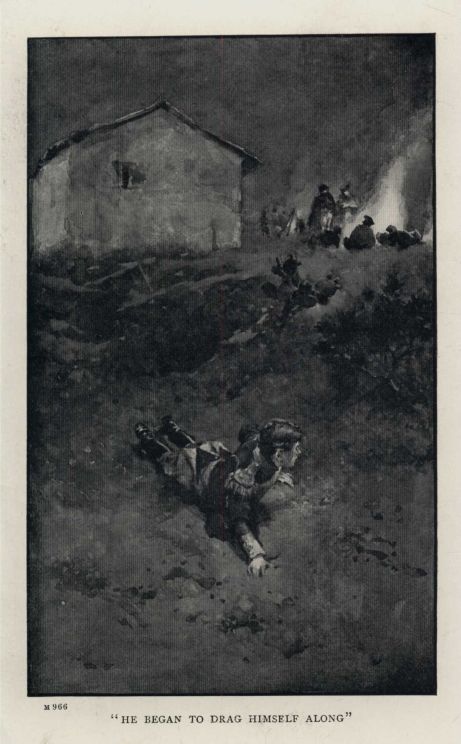
"HE BEGAN TO DRAG HIMSELF ALONG"
He did not attempt to move for a time. The chance of passing down through the Carlist lines was at an end. For fully ten minutes he lay there; then his mind was made up, and, turning over on to his face, he began to drag himself along towards the house he had been looking at during the day. It was his only chance. If he could conceal himself there he might be safe. When his escape was discovered in the morning it would be supposed that he had made his way down through the lines, or had gone out through the rear of the camp and taken to the mountains until he could work his way back to the town. There would certainly be no search for him close to his prison.
It took him nearly half an hour at that slow rate of progression to make his way to the house. When he reached it, he raised himself on to his sound foot, noiselessly lifted the latch, and went in. He closed the door behind him, and sat down against it. Knowing nothing of the interior arrangements, he dared not move for fear of waking the inmates. He therefore remained there motionless, dozing occasionally, until the first dawn of day enabled him to obtain an idea of his surroundings. The room in which he was was unoccupied, but an open door at the back showed where the old woman and whoever might live with her were sleeping. A rough ladder in the opposite corner of the room led up to an open trap-door leading evidently to a loft. This was what he had hoped for, and making his way across to it he pulled himself up the ladder, and found, as he expected, that he was in a low loft. It was half-filled with hay and faggots, and, climbing over these, he laid himself down behind them and lay listening.
In an hour he heard cries of alarm, followed by a great hubbub in the camp, and had no doubt that his escape had been discovered. Presently he heard a stir below, and, listening, made out two voices--one, which was, he had no doubt, that of the old woman whom he had seen, and the other apparently that of an old man, probably her husband. He had taken a long draught of water the last thing before leaving the hut, and had put the remains of the food in his pocket. He now bandaged his ankle as well as he could, and then slept the greater part of the day. Beyond the quiet voices below he heard nothing, which showed that no suspicion existed that he was hidden so close. He was troubled only by the heat during the day, but suffered a good deal from this.
At daybreak the next morning he made his way to the trap-door and looked down. On the table a large jug of water and half a loaf were standing. He crawled down the ladder, took them both, and returned to his hiding-place. An hour later he heard angry talk below. He did not understand Basque, one of the most difficult languages to acquire, but he guessed that the owners were railing over the loss of the jug and bread, and doubtless putting it down to some soldier who had entered after they had gone to sleep, and stolen them. The loss could not have been a heavy one, but the old couple did not get over it all day, but continued to grumble at intervals. To him the proceeds of his theft were invaluable. He was able to keep the bandage round his ankle bathed with cold water, and he calculated that the bread would, with care, last him three days, and that the water would hold out as long.
This proved to be the case. The old man came up once during that time with a large bowl, which he filled out of a sack containing lentils; otherwise, Arthur was altogether undisturbed. At the end of that time the pain in his ankle had abated, but he could feel that it was still very weak, and that he dared not yet attempt to walk on it.
That night he went down and refilled his jug from a pail and carried off a loaf of bread from a cupboard. After possessing himself of these things, he very carefully drew back a bolt of the door. When the old couple awoke he heard them engaged in a furious quarrel. They had missed the bread, and, finding the door unbolted, the old woman had charged her husband with neglecting to fasten it, while he was stoutly maintaining that he had done so, and that she saw him do it. The quarrel lasted with more or less acerbity the whole day. Had Arthur possessed any money he would have placed a copper coin or two on the table to pay for the bread he had taken; but both pockets had been turned inside out by his captors, and he was absolutely penniless.
The loaf lasted for four days, and when it was finished he determined that, although his ankle was still very weak, he would attempt to get away. He was very reluctant to again help himself from the old people's store. It might be at least three days before he could enter the town, although he hoped to be able to accomplish it in one. Still, if his foot should give him trouble he might have to lie up in shelter. However, he contented himself with only taking half a loaf, and at eleven o'clock at night, when everything was quiet, he opened the door and went cautiously out. His object was to get down to the Urumea, which was but a mile and a half off, so, going back from the brow of the hill, to avoid falling in with any sleeping Carlists, he started.
He had gone but a short way when he felt his foot beginning to pain him badly. At first he tried hopping, but he found that the jar of each jump hurt him as much as if he were using the foot, and as he had no knife he could not cut himself a stick. He therefore sat down, and swung himself along on his hands. This was a slow method of progression, and he had to stop frequently to rest his arms and wrists. He soon gave up all idea of being able, as he had hoped, to reach the river and to swim down past the Carlist lines before morning. He kept on, however, till the dawn had begun to break. By this time he could not be more than a quarter of a mile from the river. Crawling into a thick clump of bushes he lay down, and being thoroughly tired out with his exertions he slept till mid-day. When he awoke he ate a large hunch of bread, and then waited until it became dark enough for him to make another move. As soon as night fell he set off. It took him nearly an hour to cross the quarter-mile of broken ground; but at length, to his satisfaction, the bushes ceased and he saw the river twenty yards in front of him.
He had, soon after starting from the cottage, taken the boot off his injured foot and tied it to his waist. He now took off the other and fastened it by its fellow; then he stepped into the river, and found to his satisfaction that the tide was running out. Had it not been so, he must have sat down and waited until the ebb began. After wading for some little distance, he struck out for the centre of the river; then he turned on his back and let himself drift, turning occasionally on to his breast and striking out carefully for a time, so as to get a change of position. Luckily the water was quite warm. Presently he heard the sound of talking, and perceived a glow of light on the stream. He swam across close to the other shore, and saw, as he floated down, the fires of the Carlists stretching in zigzag lines along their entrenchments, rising one above another.
He was confident that, plainly as he could see everything there, the sharpest eye could not discover him so far beyond the circle of light. Still, he did not attempt to swim until he was well beyond the fires; then in a quarter of an hour he knew that he must be within the lines of the Legion. He thought, however, that it would save trouble if he were to land abreast of the town, so he swam on until he reached the bridge that had been thrown across the river. Then he went ashore, having been about two hours in the water. The water appeared to have benefited his ankle, for he found that he could now limp along slowly. Making his way to his quarters he went quietly up to his room and opened his door. A candle was burning there, and Roper was sitting at the table with his head in his hands. He looked up as Arthur entered, and then sprang to his feet with a shout of joy.
"Thank God, you are back! Thank God! I have never quite given you up, sir, although everyone else has. Every evening when I have been off duty I have come and sat here, as I knew that when you came back it would be after dark."
"I am glad indeed to see you, Roper! I have had a very narrow squeak this time--I never want to have as narrow. I will tell you all about it presently."
"Your clothes are all wet, sir."
"Yes. I must change them at once. When I have done that, you must go up to the colonel and report my return. I sprained one of my ankles, and can only just hobble along, and I don't want to put any more strain on it than I can help; so, when I am undressed I will turn in. By the way, I think, before you go off you might cook me something, if there is anything to be had."
"There is nothing here, sir."
"While I am undressing, you might run out and buy me something; cold meat of any sort will do. I have had nothing but bread since I went away, and not much of that."
Arthur was in bed by the time Roper returned.
"I have got some cold meat, bread, and a bottle of wine, sir."
"Thank you, Roper! Put them on that table and draw it to the side of the bed. When you have done that, please go and report my return, and explain why I can't come and do it myself."
He had scarcely finished the meal when the colonel came in.
"Welcome back a thousand times, Hallett! We have all been in a terrible way about you. I hoped for the first two or three days, and insisted that whatever had happened to you, you would get out of it, if there was but the remotest possibility of escape. Now let us know all about it. I supposed you were carried off, as Maltravers was. How it happened we could not find out, but since that time every officer has made his rounds with four men with him, and as a consequence we have had no more disappearances. Now, please tell me all about it."
Arthur told the story at length.
"By Jove, you have done wonderfully well!" the colonel said. "It has been one of the narrowest touches I ever heard of; and if you hadn't sprained your foot you would have been back among us within twenty-four hours of your capture. It was lucky, indeed, that you had particularly noticed that cottage and its occupants during the day, and that the thought struck you to shelter in it. Well, I won't say anything more now; it is ten o'clock, and I am sure you must want a good night's sleep."
"I shall be glad, sir, if, the first thing in the morning, you will send the surgeon round to me. My ankle is not nearly as swollen as it was, and I have no doubt that the few hours I spent in the water did me a lot of good. At the same time, I shall be very glad to have it bandaged, and don't want to be kept in bed by it. Of course I shall be able to ride, but that would be no good for my company work."
"You must leave your company work alone for a week or so. I shall be glad, if you find that you can ride, if you will come round to my quarters at ten o'clock, and I will take you to the general."
The next morning Arthur lay in bed until the surgeon came. While the latter was bandaging his ankle he had to give him a short account of his adventure.
"Well, you got through it well," the surgeon said, "but I should not advise you to try that sort of thing again; you may not be so lucky next time. You have given your ankle a very awkward wrench. I should advise you to avoid any attempt to walk for at least a week or ten days. If you do, you may have to lie up for six weeks."
Roper came in to help Arthur to dress, and to make his breakfast for him. Arthur's servant had been killed in the last fight, and since that time Roper had, whenever he was off duty, installed himself in his place. After breakfast he brought Arthur's horse round, and the latter mounted and rode to the colonel's quarters. That officer's horse was at the door, and he came out at once before Arthur had dismounted.
"Don't get off, Hallett," he said. "Dr. Spendlow has been round here since he left you, and said that you must on no account use your leg for another ten days. He said that if you would obey his orders you might be fit for duty in a fortnight, while if you did not do so, you might be laid up for a long time."
They rode to the general's quarters, which were a quarter of a mile away.
"You must walk in here," the colonel said; "but lean on my arm, and I will take the weight off that foot."
On the colonel sending in his name he was at once admitted. "General," he said, "we are stronger by one officer than I thought we were. Mr. Hallett has returned."
"I am indeed glad to hear it," the general said warmly, and, coming up, he shook Arthur heartily by the hand.
"He must sit down, sir," the colonel said; "at present he has only one available leg."
"Now, Mr. Hallett," the general said when Arthur was comfortably seated, "please give me a full account of what has happened; it may throw light not only upon your disappearance, but on that of Captain Maltravers. Before you begin your story, I should like to ask whether you have seen or heard anything of him'!"
"Yes, sir. I am sorry to say that I did not see him, for he was murdered by the Carlists. The choice was given him to desert to their side or to be killed, and he nobly chose the latter alternative."
"I am sorry indeed," the general said. "He was a fine young fellow, and he died a hero's death. What a terrible war this is--a war to the knife! Indeed, it seems to me more cruel and pitiless every month, in spite of the efforts Colonel Wylde, the British commissioner, is making to persuade both parties to desist from these atrocities. I am afraid that one side is almost as bad as the other. Both declare that they commit these murders by way of reprisals, and I am bound to say that in the early stages of the war the Christinos were nearly as bad, if not as bad, as the Carlists. Since then, however, they have been somewhat better, and have really tried, I think, to keep the Convention, to respect the rules of war and to spare prisoners. They have, it is true, shot a great many, but it has been by way of reprisals for the brutality of the Carlists, and especially of those of Cabrera, who has several times shot women as well as men.
"And now for your story, Mr. Hallett."
Arthur again told his story at length.
"I compliment you highly on your quick-wittedness, Mr. Hallett; it certainly saved your life. And in such a cell as you describe, with two armed guards at the door, it is not one man in fifty who would have thought of escaping through the roof. Not less sharp was it to take at once, crippled as you were, to the only place that offered you shelter. Altogether, it was a remarkably well-planned and well-carried-out affair; and be assured that if any opportunity should occur, I shall take advantage of it to utilize your services. Now, I hope you will obey the doctor's orders and go back to your quarters, and stay there till your ankle is quite well."
This Arthur did; and for the next three or four days held a sort of levee in his quarters, almost all the officers of the Legion coming in to see him and to hear his story, which he became perfectly tired of telling long before the visits were over. His companions in the adventures in the boat were especially pleased to see him, and came in every day to have a chat with him.
"You seem fated to get into adventures, Hallett," Sinclair, said, when he first heard the story. "You get nearly caught as a spy, and manage to make your way through the enemy's lines with a lot of valuable information; you get blown out to sea, and you save us and yourself; and now you get carried off, and threatened with death in twenty-four hours, but make your escape and rejoin. My dear fellow, I am afraid you will at last come to a bad end. It is evident that neither water nor bullet has power over you, and that your exit from this world will be hastened by a collar of hemp."
"I hope not, Sinclair; I shall do my best to avoid it. Hanging seems to be an uncomfortable sort of death, to say nothing of its being strictly unfashionable."
"Well, we shall see," Sinclair said; "but I cannot help thinking that that is what will happen to you. Now, what is your next adventure going to be?"
Arthur laughed. "I must leave that to fate. Two out of my three adventures were certainly not brought on by myself. I was blown out to sea owing to your obstinacy in refusing to turn back when I wanted to. I was certainly carried off this time by no will of my own. So that only what you call the spy business was of my own choosing. I can assure you that I have had enough of adventures, and shall not get into another if I can manage to avoid it."
Ten days later Arthur was reported fit for duty, and was very glad to resume his regular work.
CHAPTER VII
A GREAT CHANGE
One day Colonel Godfrey sent for Arthur. "General Evans is going to send Major Hawkins to Madrid, and has asked me to recommend a young officer to accompany him as his assistant. I have mentioned your name to him, as you speak Spanish fluently, which very few other officers can do. He will probably remain there for some time, and will act as the accredited representative of the Legion. I know that I have undertaken a certain amount of responsibility in recommending so young an officer; but from what I have seen of you, and from the distinguished service you rendered by going into the Carlist camp and obtaining information concerning it, I feel convinced that you will acquit yourself well. You will receive the temporary rank of captain."
"I am greatly obliged to you, sir, for recommending me. I fear that I am very young for such a position."
"You are young, certainly; but a year of campaigning has added some years to your appearance. And as far as height goes, you are half a head taller than the majority of Spaniards. General Evans has asked me to bring you over to him, so we will go at once. Major Hawkins is now with him."
They walked across to the general's house.
"Good-morning, Captain Hallett!" the general said. "I am glad to see that your leg has quite recovered. Your knowledge of Spanish has been of service to us, and now it will be of advantage to yourself. Colonel Godfrey has, I suppose, told you of the mission which I propose for you, namely, to accompany Major Hawkins as his assistant. You will, of course, be under his orders. He also speaks Spanish, but not so fluently as you do. In case of his falling ill or of his being incapacitated, you will carry on his duties. The post will be to some extent a permanent one. The Spanish government pay no attention to my letters, and it is therefore absolutely necessary that I should be represented and my requests urged strongly upon them. My troops are half the time on the edge of starvation, and can get neither pay nor rations. I have written in the strongest manner to them. I think it will be as well for you to go as an officer on my staff. The Spanish think a great deal of dress; Captain Forstairs is going home on sick leave, and will, I have no doubt, be glad to dispose of his uniform for a trifle. If it will be any inconvenience to you to buy it, I will have any sum you require handed over to you from the chest: of course, like other officers, you are some months in arrear with your pay. And indeed, in any case, an allowance will be made for your uniform, unless you should afterwards become a member of the staff."
"Thank you, sir! but I am well supplied with money, and can purchase the articles myself. Should I only use the uniform for a short time, I will, at the conclusion of my mission, hand it into store."
"You will take a servant with you, as it is necessary to keep up a good appearance. Major Hawkins will give you all necessary instructions. He proposes to start to-morrow."
Greatly pleased at his appointment, Arthur first went to Captain Forstairs' quarters and purchased his uniform, getting it complete for a five-pound note. He then went to Roper.
"I am going away on a mission, Roper, and may, for anything I know, remain for some time at Madrid. As you know, my servant was killed the other day, and I want another who can ride."
"I shall be very glad to go with you if you will take me," Roper said.
"But you see you are a non-commissioned officer."
"Oh, I would give up my stripes readily enough if you will take me! I am not very fond of the captain of my company."
"Then in that case I will go across with you and ask him to let you give up your stripes. You are quite sure that you would like it?"
"Quite sure; I am heartily sick of San Sebastian. I am accustomed to riding, and should enjoy the trip greatly."
They went away to the house where the captain was lodging, and Arthur had no difficulty in getting him to consent to the sergeant's resignation, and to give him permission to accompany him. Arthur then bought for Roper a serviceable horse. This done, he went to the major's.
"I have got the uniform, and shall be ready to start in the morning, sir," he said.
"I am glad that you are going with me, Captain Hallett," said the major, who, having been in the Legion since its formation, knew Arthur well. "I am sure we shall get on well together; and as I am rather shaky in my Spanish, it will be of great assistance to have you with me. I may tell you that I am the bearer of a note from General Evans saying that unless money is sent for the pay of his troops he will engage in no further operations. The Spanish army is regularly paid, and there can be no reason why we should not be. More than that, he will withdraw into San Sebastian. We have shown brilliantly enough that we can fight, and we have done more with our small force than Cordova has with his big army. I am convinced that our threat to retire from the struggle will wake them up. At the same time, we must not be too sanguine about our getting through. We shall take the road by Bilbao to Vittoriti. So far it will be plain sailing, but after that I expect we shall find some difficulty, for the Carlists are strongly posted a few miles from the town. I expect we shall have to hire a guide to take us across the mountains. However, we shall have plenty of time to think of that when we get there."
Arthur now went down to the camp of the Lancers, who had arrived a few weeks before. They had had two or three deaths since they came, and on making enquiries Arthur found that he could purchase for a few shillings a Lancer's suit. This he handed to Roper, whom he had taken with him, and he told him to carry the suit back and put it on.
"Your clothes are not fit to be seen in," he said, "and this suit is a very fair one. If you give it a good cleaning to-night it will be quite respectable, and you will look much smarter in it than in that ragged thing."
"It looks pretty bad, certainly, sir, and is none the better for having lost all its buttons; there is hardly a button left in the regiment. When they are hammered down, the natives here take them as coins. They know nothing about money, and I expect these buttons will be passing about as cash long after we have all cleared out of this. I sha'n't know myself in my new rig-out. The man it belonged to has evidently taken care of it. There is only one thing you have forgotten, sir, and that is the saddle."
"Yes, I have forgotten that. Here are three pounds--you had better buy one."
The party started early the next morning and went by boat to Bilbao, slept there, and rode the next day to Vittoria, Here they halted for a day, and, going to head-quarters, obtained the services of a guide to take them across the mountains. On starting on the following morning they at once left the main road, and presently struck up into the hills. The road was extremely bad, and they were forced to go at a walk; the guide, who was mounted on a mule, rode on ahead. They halted for the night at a deserted hut some distance down the descent. Here they took shelter, congratulating themselves that another day's ride would take them to Burgos, where there was a strong garrison. They had brought provisions with them, and, having made a hearty meal, lay down for the night. Next morning they continued their journey, and were near the plains when they saw a party of men hurrying towards them.
"They are Carlists!" the major said. "It is of no use turning back or going up the hill; they would run our horses to death. Look here, Captain Hallett, they will cut us off, that is evident; but we may make our way through them. I will put my papers in my holster. If I fall, snatch them out and carry them on. Now, let us gallop."
Setting spurs to their horses, the four men dashed forward. Half a dozen of the Carlists reached the road before them, but drew back before the impetuosity of the charge, firing their rifles as they did so. Without a halt the little party dashed on at full speed. For a time the Carlists attempted to keep up with them, but were soon left far behind. "I am done for!" the major said, swaying in his saddle. "They hit me as I passed through them. Take the papers and ride on."
"I cannot leave you, sir." And, leaning over, Arthur caught the major as he was falling, and lifted him on to the horse before him. He rode on for another half-mile, by which time the Carlists were out of sight. But his burden had become more and more heavy in his arms, and when he drew his horse up, he found that the major had breathed his last.
"I am hit too, sir," the major's servant said; "I have a bullet in my hip."
"We are not more than ten miles from Burgos now. I am afraid there is no chance of obtaining help until we get there. Roper, bring the major's horse up against mine," for the animal had followed its companions. "That's it. Now tie that head-rope round the major and ride on one side of him, and I will ride on the other. We shall have to walk for the rest of the distance."
It took them three hours to reach the town. Arthur went at once to the citadel and saw the governor. "I have brought with me a major in our army," he said. "He was the bearer of a despatch to your minister of war. We were attacked by a party of Carlists nearly ten miles away, and he was shot. I beg that you will give him a military funeral, as he fell in the cause of your queen. I have also a trooper with me who is severely wounded. I will, with your permission, leave him here in hospital."
"Certainly, sir. The officer shall be buried to-morrow morning. I am grieved indeed that none of my men went up the road this morning. They go up every other day to prevent bands of Carlists from raiding over the country."
The governor invited Arthur to stop in the castle. The body of the major was laid in a room close by, and on the following morning he was buried with military honours.
"I will take the major's horse with me, Roper," Arthur said when all was over; "it is a good horse, and a spare one may be useful. At any rate we may as well keep him."
Accordingly, after thanking the governor for his courtesy they proceeded on their way, Roper leading the spare horse.
"We have begun badly," Arthur said, as they rode from the town. "The major was a brave fellow and a good soldier. It is sad indeed that he should have been killed in a skirmish like this. It leaves me in a very awkward position. However, I must deliver the letter. There are two or three British commissioners out here, and if one of them happens to be at Madrid I shall ask him to present me and to help me on a bit."
"I hope we are not likely to meet with any more of these Carlist chaps."
"I hope not, Roper; but really I don't know anything about it. We got no news at San Sebastian of what was going on elsewhere, but they can hardly be wandering about on the flat country. I fancy they are almost all infantry, in which case they will not care to expose themselves to an attack by cavalry."
They arrived at Madrid without adventure. They put up at the Hotel Principes, and to Arthur's relief found upon enquiry that Colonel Wylde, the chief British commissioner, was at present staying at the hotel. He at once went to his room.
"I have called, sir," he began, after introducing himself, "to ask you if you will be good enough to give me some information as to how I had better proceed. I started from San Sebastian as assistant to Major Hawkins of our Legion. He was the bearer of a letter from General Evans with complaints about pay and provisions. Both officers and men are many months in arrears. Major Hawkins was instructed to inform the ministers of war and finance that unless the money were sent immediately, the general would withdraw the whole of his force into San Sebastian, and take no further part in the fighting. He has sent remonstrance after remonstrance without success and feels that matters can be allowed to drift no longer. The men are in rags and are half-starved. On our way down we were attacked by Carlists, and Major Hawkins was killed. I carried him into Burgos, where he was buried with military honours. I only received my appointment as his assistant on the day before leaving, and beyond the fact that I was to remain here to assist him generally in acting as General Evans's representative, I know nothing of the duties. Considering the importance of the mission, and the absolute necessity that money shall be sent without delay, I have ventured to ask that you will introduce me in the first place to the two ministers to whom I bring letters, and if you will, as far as you can, support his application."
"I will gladly do so, Captain Hallett. Indeed, it is my duty to aid you. I am not charged in any way to interfere with our Spanish Legion, but incidentally anything that is of importance to the general cause would, of course, be of interest to our government. We may at present be called benevolent neutrals. I am well aware that General Evans has sent repeated applications, and that practically no result whatever has come of it. I will therefore not only go with you, as you ask, but I will myself urge upon them the importance of the application, pointing out that by refusing the necessary means to General Evans they are, in fact, breaking the terms upon which that Legion was raised; and that being so, the general would be acting with perfect propriety in withdrawing the troops from the field, and giving permission to all who may choose to leave at once, which would, of course, mean a complete break-up of the Legion.
"They will not wish that. It was humiliating for the Spanish to be forced to hire foreign soldiers to assist them, and no doubt that feeling has driven them to treat the Legion very badly; but at the same time they have themselves been continually in want of money. A considerable proportion of the country is in arms against them, and their resources have been greatly diminished in consequence. This, however, after all, is no excuse for them. They offered certain terms to men to fight for them, and the bargain should have been kept. It was the same in the Peninsular War. We went to fight their battles, and they threw every impediment in our way, starved our men when they themselves had a superabundance of supplies, and so created a hatred far greater than our men felt for the French.
"They are behaving in exactly the same way now; but, so far as our troops are concerned, there is one broad difference. In the first war we fought partly, at any rate, from feelings of patriotism; whereas in the present case, although a few may have gone into it from a feeling of sympathy for the little queen, the great proportion of the Legion are neither more nor less than mercenaries, and would have enlisted as readily for Don Carlos as for Isabella. And now, sir, I will go across to the war office with you. I have myself many times urged that steps should be taken to relieve the necessities of the troops, and I am not at all sorry that General Evans has at last put his foot down."
It was but a short walk across the square, for the hotel faced the war office. On Colonel Wylde sending in his name he was at once admitted.
"Well, Colonel Wylde, what can I do for you?" the minister said cheerfully.
"I have brought across to present to you, señor, Captain Hallett, who has just arrived from San Sebastian with a very important letter from General Evans. He was accompanied by an officer senior to him, but the latter was killed by a party of Carlists as they came along."
The minister looked sharply up at Arthur, who, bowing, handed him the letter. He begged them to be seated, and opened the communication. He frowned heavily, and then with a very evident effort recovered himself.
"The matter shall be seen to," he said. "You know, Colonel Wylde, how straitened our resources are, and that nothing would please us more than to comply with all General Evans's requests. No one can grieve more than I do at the delays that have taken place in complying with his requisitions."
"But, sir," Arthur said, "the Spanish troops are always well fed, though it may be that their pay is sometimes in arrears. Our troops get neither food nor pay. They are in rags, and many of them are barefoot. No single promise that has been made to them since the day they landed has been kept. Nearly a third of their number have died of fever brought on by cold and want, and yet in spite of this they have been ready to fight, while so many of your own generals have held back. You think I am bold, sir? I am urging the cause of some five thousand of my countrymen, who have, confiding in Spanish honour, come out here to fight your battles. If you could go and look at them yourself, sir, and see their condition, you would pity them, and would marvel that they have so long shown patience. Feed them and pay them, and they can be depended upon to carry out their share of the agreement. But assuredly they cannot be depended upon if they are starved."
"I am not surprised, sir," Colonel Wylde said, "that General Evans feels that no more can be done. The officers have been now nine months without their pay, the soldiers six months. More than a third of their number have died or been invalided home; and the heavy list of their killed and wounded in battle speaks for itself of the bravery with which they fought. I must say that I approve of General Evans's decision. He owes it to the men who serve under him, and I cannot but say that the treatment they have received has been a grave scandal and dishonour to the government of Spain. I have myself been four times to Madrid to urge their claim, and absolutely nothing has been done. I consider that General Evans will be amply justified in carrying out his threat."
"The matter shall be seen to at once," the minister said, with an air of frankness. "I will consult my colleague the minister of finance, and will see that money is forwarded very shortly. You can assure your general, señor," he said to Arthur, "that steps shall be taken to comply with his request without delay."
"I will send a message to that effect. My own orders are to remain here until the treasure has been sent off; and that even when that is done I am to stay here as the general's representative to convey his wishes personally to you, until at any rate all arrears of pay have been cleared off. It is not a favour that we are demanding, but a right. I shall do myself the honour of calling upon you every day or two, to ascertain when the convoy with treasure will start. Of course you can refuse me admittance, but General Evans will know what that means."
After a few more words Colonel Wylde and Arthur left the ministry.
"You spoke out straight, Hallett," the British commissioner said with a smile.
"I could not help doing so, sir. The state of the men is pitiful in the extreme. They are scarecrows; they have practically no uniform whatever save their greatcoats, and they are in rags. I should have liked to take the little man by the neck and shake him."
"They are in a bad way themselves," the colonel said. "The court is a perfect nest of intrigue. There are something like half a dozen parties, each with their own nominees to push and their own interests to serve. Large sums are wrung from the people, but they are for the most part absolutely wasted in jobbery. If it were not that the British government have taken the part of Isabella, I should recommend them to stand aside altogether and let the factions fight it out. There are a few honest men on both sides, and the Carlists indeed know what they are fighting for. To the other side it is a matter of indifference who wins, provided they themselves can feather their nests. They are not fighting for the poor little queen, but for their own private interests.
"Well, I know a good many people here now, and shall have much pleasure in introducing you to their houses and making things pleasant for you; for it is evident that if, as you say, you have to stay here until all arrears of pay are received by the Legion, you will assuredly wait for an indefinite time. I am going to a reception this evening at half-past nine, and I shall be very glad to present you there if you will call for me ten minutes earlier."
"Thank you very much, sir! I should be very glad to make the acquaintance of some of the people."
Soon after his return to the hotel Roper came up. "I have seen the horses fed, sir; what is the next job?"
"The next thing will be to get a meal, Roper; I am going to do the same."
"Oh, I have done that, sir, and it was the best meal I have had for some time, I may say since I left England."
"Well, I sha'n't want you any more at present, so I should advise you to take a turn round. Some of the soldiers are sure to get into conversation with you, and as we are likely to be here for some time it is just as well that you should make some friends. You know enough Spanish to get on with; I expect a little will go a long way."
"Is there any chance of our getting our money, sir?"
"I expect we shall get some. Now that the Spaniards see that they have got to do something or let the troops go home, they will pay up enough to keep them quiet for a time. I don't suppose it will be much, but sufficient to keep the wolf from the door at any rate."
"Well, sir, will you mind if I go out in mufti. I picked up for a few shillings some clothes belonging to a Spaniard, who died before I came away. They are respectable sort of clothes, and I thought, if I were going to stop here, that you would let me wear them. In this uniform I should be a sort of show. Everyone would be wondering who I was."
"Certainly, if you like, Roper, and I think it is a very sensible idea. You would be able to stroll about in them without attracting any attention, but at the same time, you know, you would not be able to make friends with the soldiers."
"Oh, I shall get into talk with them, sir; a glass of aguardiente will go a long way with those chaps, and of course I shall let them know that I am a soldier myself."
"Yes, Roper, and there will be the advantage that with you in plain clothes I can walk about with you, which will be a good deal more pleasant for both of us; so if you will change your things while I am at dinner, we can take a turn together afterwards."
"Thank you, sir! I should like that very much. It is a biggish town; I shall feel quite lost in it for a bit."
A few minutes later the bell of the table d'hôte rang. Arthur went down to it. The table was full, and he speedily became engaged in talk with people sitting next to him, who were much interested on finding that he was a British officer. They asked him many questions as to the state of things in the north, about which there were all sorts of contradictory reports. He, on his part, learned something, for he heard that it was generally expected that Cordova was going to be made war minister. After dinner two or three officers came up and spoke to him, and when they heard that he was on General Evans's staff, said that they would be glad if he would smoke a cigar with them. He answered, however, that he was engaged for the evening, but would be very glad to do so on some other occasion. Then he went down and joined Roper, who was standing at the door of the hotel, and walked about with him for a couple of hours.
"What hands these chaps are for cloaks!" the latter said. "In the north I used to think that they wore them to hide their shabby clothes, but it can't be the same here. There is a cold feel about the air, and I should not be sorry to have on one myself. This is evidently the time they stroll about most. The square looked quite empty this morning, and now it is full of people walking up and down."
"Well, Roper, I must be off, for I am going, as I told you, with Colonel Wylde."
It was a large house, and the rooms were very full. When they entered, the colonel at once took Arthur up to the hostess and introduced him.
"What is your news from the front, Captain Hallett?" she asked.
"There has been nothing doing for the past month," he answered. "San Sebastian is very full. The Carlists look at us from a distance, and we look at them."
Then he passed on as another guest came up. Colonel Wylde introduced him to several ladies and gentlemen, and then left him to talk with a personage who was evidently of importance. There was no dancing going on. The refreshments served were of the lightest description.
"This is a change indeed to me," Arthur said. "It seems to be another world almost; to say that we have been living roughly would be but a faint idea of the state of things."
"And how are things getting on up there?"
"It is dull work except when there is a fight, and we know nothing whatever of what passes elsewhere."
"Are all your officers as young as you are?"
"No, madam. I have been exceptionally fortunate, and owe my promotion largely to the fact that I have, since we landed, spent all my spare time in learning Spanish."
"You speak it very well, Captain Hallett."
"I speak it well enough for all practical purposes, señora, and should speak it better still if it were not that the language up in the north differs very widely from that spoken here."
Several cards were left on the following day for Arthur. In the majority of cases these mentioned which day their owners received visitors. On the second day he called on the minister of war, and was told by him that every possible effort was being made, and that he hoped in a few days to send off a portion at least of the sum due.
Arthur then wrote a despatch to General Evans telling him of Major Hawkins's death, and relating his interview with the minister. "I think," he said, "that some money will be sent, but I anticipate that the sum is likely to be exceedingly small. From what I hear, I believe that the government are really very short of money. The minister was evidently much alarmed at your threat to disband the Legion, and he will make every effort to induce you to alter that determination. I shall endeavour to see him every other day, and shall continually repeat my assurances that you are in earnest on the subject. Colonel Wylde is also using his efforts in the same direction. He has been very kind to me, and introduced me to many people."
It was three weeks, however, before a month's pay was despatched, with promises that more, should speedily follow.
By this time Arthur had become quite at home in Madrid. He knew many officers to speak to. Some of these belonged to the garrison; others seemed to have no good cause for being there, but kept up the pretence of being engaged on important business. One of them said to him one day, "We seem a very united family, do we not?"
"Yes; no one would dream, from the appearance of Madrid, that a civil war was going on."
"And yet society is split up into a number of sections, each working secretly against the others. Outwardly there is no sign of this; everyone goes to the receptions and looks smiling and pleasant. Practically everyone doubts everyone else; and there are numbers of well-known Carlists, but they hold their tongues, at any rate in public, and rub shoulders with the men whom they would gladly kill. It is funny, when you are able to look behind the scenes a little. I have no doubt you will be able to do so before long. I saw you chatting, for example, with Señor Durango, a very nice young fellow. There is no doubt that he and his family are all Carlists; but they are well connected, and have plenty of friends among the Christinos.
"I believe two-thirds of the people you meet don't care a snap which party wins. If they are here, of course they profess to be Christinos; if they are away in the provinces, they hold correspondence with Carlists, that they may keep themselves safe whichever side wins.
"Altogether, I consider that the Carlists are more in earnest; the Christinos are the more numerous, simply because they hold the capital and the government. If the Carlists were to gain one great success, it would be the other way. It is a game of self-interest; Don Carlos and Christina are merely counters. Some want governments, others titles, others posts in the ministry, others commands--there is nothing real about it from beginning to end, except for the poor devils of soldiers who have to fight. You will see that in a short time Cordova will retire, and that Espartero will probably take the command; that would be certainly welcome to the army. He is a fine fellow, and if he were allowed he would be able to do great things; but he would no sooner be appointed than a dead-set would be made at him, and he would be hampered in every way. Well, I must be going. I dare say you are wondering what is my motive in staying here. Well, I am trying to get the command of a regiment, and a regiment, if possible, stationed here in the capital. Adieu!" And, throwing his cloak over his shoulder, he sauntered away.
Arthur sat some time thinking. "Well, if the Legion breaks up, which I expect it will do before long, I think I shall stay out here. If I take a lodging and live quietly, I can do on my one hundred and twenty pounds a year. There will be a lot to see, and probably no end of fun. I have got eighty pounds now, so I can a little exceed my allowance. I should certainly like to have some fun again; I have had little enough, goodness knows! since I left England. Besides, if I were to go home now I should have thrown away all the time that I have spent in getting up Spanish. It is funny how they all take me for at least five- or six-and-twenty."
The month's pay had some effect. For a short time the troops were somewhat better off. Arthur had received a letter from General Evans thanking him for obtaining a small proportion of the sum due, and urging him to continue his work. Then he heard that there had been some more fighting, that Irun had been captured by storm, and that several other towns had either been taken or had surrendered. Two months later he received another letter from the general saying that he was going home, and that the Legion was about to be disbanded.
"A small body of about eight hundred men have agreed to remain here to form a new Legion; this may succeed for a time, but I have little doubt that they will be treated in the same way as we have been. However, it will be open for you to join it if you are willing to do so, or you can make your way down to Cadiz and come home by ship from there. I enclose an order on Madrid for forty pounds for yourself and fifteen pounds for your man, which has been lying in the hands of the paymaster here until you should return. Should you wish it, you can, I have no doubt, enter the Christino army with your present rank."
"That is something out of the fire anyhow," Arthur said, as he put the order into his pocket-book. "Well, if the Legion failed, it was not from want of pluck. Out of about six thousand, we have had over two hundred killed and wounded officers and over two thousand three hundred rank and file; so, though we have not achieved anything, we certainly need not be ashamed of our fighting. Besides, at least two thousand five hundred have died in hospital, so that half our strength is accounted for."
Roper shortly afterwards came in.
"The Legion is disbanded, Roper, and it is open to you to go north and embark with the rest, or to go down to Cadiz and take a passage home from there."
"What are you going to do, sir?"
"I am going to stay here in a private capacity; I want to see the end of the thing. I shall make this my head-quarters, and shall ride about and see what goes on. I know a good many officers now, and they can give me letters of introduction to others; and as I have fought for them, no doubt I shall be well received in their army. At any rate, I have no wish to go home at present."
"Can't I stay with you, sir?"
"I should like to have you with me certainly, but I can't afford to pay your wages."
"Well, sir, my food would not come to much, and I like the place, and I like the life, and above all, I like being with you. You must have someone to look after your horse. I don't want to go home empty-handed, and I would certainly a great deal rather not do so, but stop here if you would keep me."
"I would keep you willingly enough, Roper, but the only question is--can I? I must move out of this lodging and find a smaller one. One certainly could live cheaply enough here at the cafés; no one seems to take anything but coffee or chocolate, and a cup seems to last them for hours. From the large number of people one meets at the cafés and sees nowhere else, I should say that they must dine at some cheap place or at their homes. However, we will think it over."
A few days after his arrival at Madrid, Arthur had written home.
"My dear Uncle,
"You will be surprised to see by the heading of this letter that I am at Madrid. But my first piece of news is, that I am now a captain, nominally upon the staff of General Evans, but actually on detached duty, a duty which is likely to keep me here for some time--in fact, until the Legion is disbanded. Therefore you need feel no further anxiety as to my safety. I am here to endeavour to worry the government into sending stores and pay for the Legion. To this end I call upon the minister of war every few days. The first time, he saw me: since then he has always been too busy. I have also called upon the prime minister, and have spoken to him with what he considered indecent warmth, and I don't expect to do much good in the future. However, here I am.
"I am at present in an hotel. The food is good, the bed is soft. I have with me my good friend Roper, of whom I have spoken to you in almost every letter I have written. When the good fellow found that I was coming here, he threw up his sergeant's stripes to accompany me as my servant; it is a great comfort having him with me. I have been made a member of the principal club here, and have already made several acquaintances, so I have no doubt that I shall have a pleasant time. I am not going to tell you about Madrid, because you can, if you choose, find a much better description of it in books than I can give you. Please send the next remittances, which will probably be the last, to some mercantile house here.
"You will be glad to hear that though I failed in getting the arrears of pay for the Legion, I have been informed that I can draw monthly for the pay due to me while here. As living at an hotel is not dear, this and my allowance will suffice very well for my requirements. I have seen Colonel Wylde, the British commissioner, who is a very charming man. Of course he has been doing the very best he can for the Legion, but he is very frequently away with the army. I will explain how it is that I am in charge here on a mission of real importance. Major Hawkins, who was chief of the mission, was killed in a skirmish with the Carlists that we had on our way down. He was a very nice fellow, and I was very sorry at his death. I don't, of course, know yet whether they will send another field-officer to take his place or leave me in charge. I rather hope they won't send one. I don't think they would be wrong to leave it to me, for cheek is very useful in this sort of work, and I flatter myself that I shall stir them up a good deal--more than an older man would be likely to do. Certainly I shall not be inclined to take 'No' for an answer. I will write shortly again.
"With love to you all,
"Your affectionate Nephew."
CHAPTER VIII
A DESPERATE ADVENTURE
As Roper's desire to stay with Arthur remained unchanged, the latter gladly accepted his offer. One of the horses was at once sold, and they removed into smaller lodgings, consisting only of a tiny kitchen, one sitting-room with a fold-up bed in a corner, and a closet just large enough to hold a bed for Roper. Arthur was obliged to buy a suit of dress clothes, some white shirts, and two suits of ordinary clothes. They lived on terms of perfect equality when indoors, except that Roper carried out their simple cooking at breakfast and supper, while in the middle of the day they went to a quiet trattoria in the suburbs; and after a week's experience Arthur found to his satisfaction that, even with the hire of stables and the horse's forage, they were living well within his income.
There was, of course, some surprise among his acquaintances at the substitution of civilian clothes for his uniform. It made no difference, however, in the cordiality of his reception, for he had become by this time a popular character, especially with the ladies, who appreciated his frank boyishness and freedom from formality, so unusual among their own people.
Colonel Wylde had taken a great fancy to the lad, and said to him one day: "I have been thinking over your case, Hallett. Of course I was not empowered to offer you any specific position, but I am permitted to despatch messengers to any point where I may be unable to go myself. I wrote a month since to say that operations were being carried on over so wide a field that I found it impossible to give attention to all points. I stated that an English officer named Captain Hallett had come down here as General Evans's agent. You were now unemployed, and would, I was convinced, prove a valuable assistant; and I asked that I might be permitted to appoint you as my aide, with the same rank as that which you held under General Evans in the Legion. I said that you were well mounted, and that the expense would be so very slight that I strongly recommended your appointment, as I was sure you would gladly act under me without any extra appointments except the pay of your rank and forage allowance for your horses, and the other usual field allowances, which will altogether make your pay about one pound a day. I have to-day received a reply authorizing your appointment with the rank of a captain in the army."
"I am indeed obliged to you, colonel!" Arthur exclaimed in delight. "I would most gladly have placed myself under your orders even without the pay, though I do not say that that will not be acceptable. But I could not get work that I should like better. I cannot tell you how much I am obliged to you."
"I feel that I spoke for myself as well as for you, Captain Hallett. It is impossible for me to keep my eyes everywhere, and you will, in fact, double my utility. There are only two other commissioners out here, a number altogether insufficient to cope with all that is going on. Indeed, very many regrettable things occur owing to a want of supervision. When one or other of us happens to be present, we can insist upon the articles of the convention we brought about between the parties being observed; but if we are not there, a great deal of shooting in cold blood still takes place. You will, of course, have to provide yourself with an undress staff uniform. You can send a tailor here to see mine. It would not do for you to use your own; that is known to be a Christino one; and as you may have to go into the enemy's lines, you must therefore be easily recognized as one of us. You had better get high boots and breeches, and, of course, a cocked hat. These will not cost you anything like so much as they would at home; people work much more cheaply here. By the way, I have larger stables than I require, so you may as well keep your horses there."
"I suppose I may put my man into uniform too, sir; it is more convenient, and would look better."
"Yes, I think so. My own two orderlies belong to the 13th Dragoons; if you like, I will accept him as a recruit in that corps and put him on the pay-sheet; but you must get his uniform."
With renewed thanks Arthur took his leave and hurried back to his rooms.
"I have great news, Roper," he said. "Colonel Wylde has obtained permission for me to act as his assistant, and you are to enlist in the 13th Dragoon Guards so as to ride with me in uniform. So we can shift out of these little lodgings again, and needn't look upon every penny before we spend it."
"That is good news indeed!" Roper exclaimed. "And I shall be more useful to you now, for during the past four months I have learned to talk Spanish quite well, from having been so much in the barracks with the soldiers."
"Well, in the first place we have to be measured for our uniforms, and we are to send the tailor to Colonel Wylde to see the patterns. Then we will look out for lodgings. The two horses are to be taken to the colonel's stables, so that we shall save that expense. The whole thing is entirely his doing, and I am tremendously obliged to him."
Three days later the arrangements were completed; comfortable lodgings were taken, and they had shifted into them. The uniforms had come home and been found satisfactory, and Arthur had reported himself as ready for service.
"I shall be going up to the north again myself," the colonel said. "When I do so, you had better start out for the east. The war is being conducted with great ferocity there, and it is much to be desired that the Conventions agreed to last year shall be enforced, or at any rate, that an effort should be made to enforce them. Cabrera is a brave and skilful commander, but his cruelties are abominable. He was always cruel; but the atrocious action of Nogueras, in causing his mother to be seized and shot, has closed his heart to all feeling of mercy. He shoots women who fall into his hands as well as men; and on one occasion he shot no fewer than eighty-five sergeants in cold blood. I fear greatly that no remonstrances would be of any avail with a man who seems to revel in bloodshed. I do not say that he has not had terrible provocation; and if he were to get hold of Nogueras, I should not blame him if he cut him into small pieces. I do not think, therefore, that it will be of any use your trying to influence him. You may, however, attempt to persuade the various Christino chiefs in Aragon and Valencia. I know that their position is difficult. They are urged by the friends and relatives of the men murdered by the Carlists to make terrible reprisals when they get the opportunity, and in consequence the war is becoming one of extermination. I have no hope that you will be able to do much, but you can at least try. I shall be glad to be able to report, even in one or two instances, that efforts have been made by the Christinos to mitigate the horrors of the struggle."
The next day Arthur again wrote home.
"My dear Uncle,
"I have a wonderfully good piece of news to give you. I told you in my last letter that, now the Legion was disbanded, I intended to stay here for a time on my allowance and savings. Now all this is changed, for Colonel Wylde has obtained for me the appointment of Assistant British Commissioner, with the temporary rank of captain in Her Majesty's service. Isn't that splendid! There is excellent pay and allowances, so I shall be able to live like a fighting cock. This will be my head-quarters, but I shall generally be with one or other of the armies in the field; and it will be, I know, a satisfaction to you all that I shall not be called upon to take any part in the fighting, but shall be merely a spectator of the fray. Now, even you will think that I am not doing wrong in staying in Spain. I am very much at home here, and have many friends and acquaintances, for you know by this time I speak Spanish really like a native.
"The family I am most intimate with is that of Count Leon de Balen. He is a young man of about five-and-twenty, with three young sisters, the eldest of whom is about the age of sixteen. Leon has been in England and speaks English fairly, and is very English in his ways, and doesn't keep his sisters bottled up, as most of these Spaniards do; and I visit there just as I should at any English house where I was intimate. Roper is, of course, with me. He has been nominally enlisted in an English dragoon regiment, and wears the uniform. I am having an English staff uniform made for me, and were you here you would see me swaggering down the streets as if they belonged to me; I really feel as if I were somebody. I hope to hear that you are all pleased, and that even you agree that could not possibly do better for myself than remain here till the end of the war. How long that will be, goodness only knows! I shall be in no hurry, for it is just the life, of all others, to suit me. Love to all.
"Your affectionate Nephew."
In due time the answer arrived:
"My dear Arthur,
"We are all delighted at the receipt of your letter. We should, of course, be extremely glad to have you back with us, but at the same time we cannot but recognize that you could not do better for yourself than you are doing. I do not know that personally I am extraordinarily gratified that you should be holding a commission as captain in Her Majesty's service, and as Assistant British Commissioner in Spain; but I am bound to say that your aunt and cousins seem to be filled with an altogether excessive pride in the position you have gained. The girls have been going about among their friends crowing like little gamecocks, and even your aunt, ordinarily a tranquil and quietly-disposed woman, appears to be quite puffed up.
"However, joking aside, we are all highly gratified--I certainly admit that I myself am highly gratified too--and feel that you could not do better for yourself than remain for three or four years, by which time, I hope, the war will be finished. You will, as you say, see what is going on without running any serious risks; and when you are in Madrid I can quite imagine that, with your official position, you will lead a very pleasant life. I almost feel, Arthur, that you are getting altogether beyond advice, and are now able to go on your own way. I can only say, therefore, that we shall be all very glad to have you back again with us, and I hope that every trace of the unpleasantness which necessarily resulted from our last interview will be altogether forgotten.
"Your affectionate Uncle."
That evening Arthur called at the house of the young Count Leon de Balen. It was one of the houses at which he had become most intimate. The count had little of the reserve and hauteur common to most Spanish nobles. He had from the first taken a great fancy to Arthur, and had made the latter at all times welcome to his house. It had been one of the first to which he had been invited after his arrival at Madrid, and was one of the few which were always open to him.
"I have been taken to task several times," the young man said one day with a laugh, "for inviting a man, and that man a foreigner and a heretic, so familiarly to my house. Two years ago I was for a few mouths with our embassy in London, and I came to like your ways very much. It was very pleasant to be able to make calls at houses without ceremony, and I made many friends. It seemed to me in all respects better, for young people get to know each other and to like each other. Young men and young women in your country meet and talk and dance together, and are good friends, without thinking of marriage; whereas here girls are for the most part shut up until a marriage is arranged for them. Of course I hold, as other people do, that young ladies should not go out alone, and should always be accompanied by a duenna; but in their own house, and under their parents' eyes, I can see no occasion for strictness. I might have some hesitation in giving a young Spaniard a general invitation to my house, because he would not understand it, and would think that I wished to introduce him as a suitor to one of my sisters; but with an Englishman it is different. You laugh and talk with them as if they were your own, and I think it is very good for them, and that they are as pleased to see you as I am."
When, therefore, Arthur had no other engagement he very often went in for a chat in the evening to the young count's, and he was naturally one of the first he told of his new appointment.
"I congratulate you most heartily," Leon said. "I have been wondering, since I heard that your Legion had been disbanded, what you were going to do. I am leaving, as I told you, for one of my country estates near Albacete, with Mercedes, and shall be away about a couple of months. If you chance to be coming that way, I need not say how glad I shall be to see you. Of course you don't know yet where you are likely to go, but it may as well be there as in any other direction. Perhaps you will be back as soon as we shall. I hope so sincerely."
On the day when Colonel Wylde left for the north, Arthur started for Mercia. When out of the town he called Roper up to his side.
"I am heartily glad to be at work again, Roper."
"I am not sorry myself, sir. I have nothing to say against Madrid, but one gets tired of having nothing particular to do, and especially as for the past three or four days, since I have been in this scarlet uniform, everyone has stared at me in the street. I shall get used to it in time, of course, but it is rather trying at first."
"I dare say it is," Arthur laughed. "Of course I don't feel it so much. There is not so much difference between officers' uniforms as between those of private soldiers, at any rate not between undress uniforms. I am a good deal more comfortable in my present dress than I was before, for I could not but see myself that it was getting very small, and I had almost given up wearing it."
"Yes, you keep on growing so. You were a good bit taller than I was when you joined the Legion two years ago, and now you are pretty nearly a head taller. You must be over six feet now, and I see these little Spaniards look up to you as you walk along."
"Yes, I have been rather disgusted at shooting up so. I don't suppose other people notice it; but as I was wanting to look six or seven years older than I am, it was annoying that I should keep on growing. Well, I think I have pretty nearly done now."
They travelled by comfortable stages down to Mercia. Arthur had several interviews with the general in command of the forces there, and received assurances from him that every care should be used to mitigate the horrors of the war, but that such a passion of rage had been excited by the massacres perpetrated by Cabrera that it was all but impossible to keep the people in hand.
"It is to Cabrera himself that you should address yourself, señor," the general said. "We are anxious to prosecute the war in the spirit of civilization, but as long as he persists in carrying it on like a demon it is plainly impossible for us to fight in kid gloves."
"I will go to Cabrera," Arthur said; "even he ought to have satisfied his vengeance for the murder of his mother. Were I in his place I would hunt Nogueras through the country until I found him, but it is simply monstrous that he should continue to take vengeance upon innocent people."
After remaining four days at Mercia, Arthur therefore turned his horse's head north. When he neared Albacete he heard that Cabrera had been making a raid from the Sierra de Val de Meca, and had swept down nearly to the city, harassing the country and carrying off much booty. Arthur was told that Cabrera had attacked and taken the Palazzo of the Count de Balen, so half an hour after entering the town he rode out to enquire after his friend. As they approached the house they saw smoke still rising from it. Putting their horses to a gallop they speedily arrived in front of the house, only, however, to find that it was a mere shell. As Arthur alighted, a man, whom he knew by sight, came out from a small outhouse.