PRIMROSE FAMILY. PRIMULACEÆ.
Reading edition
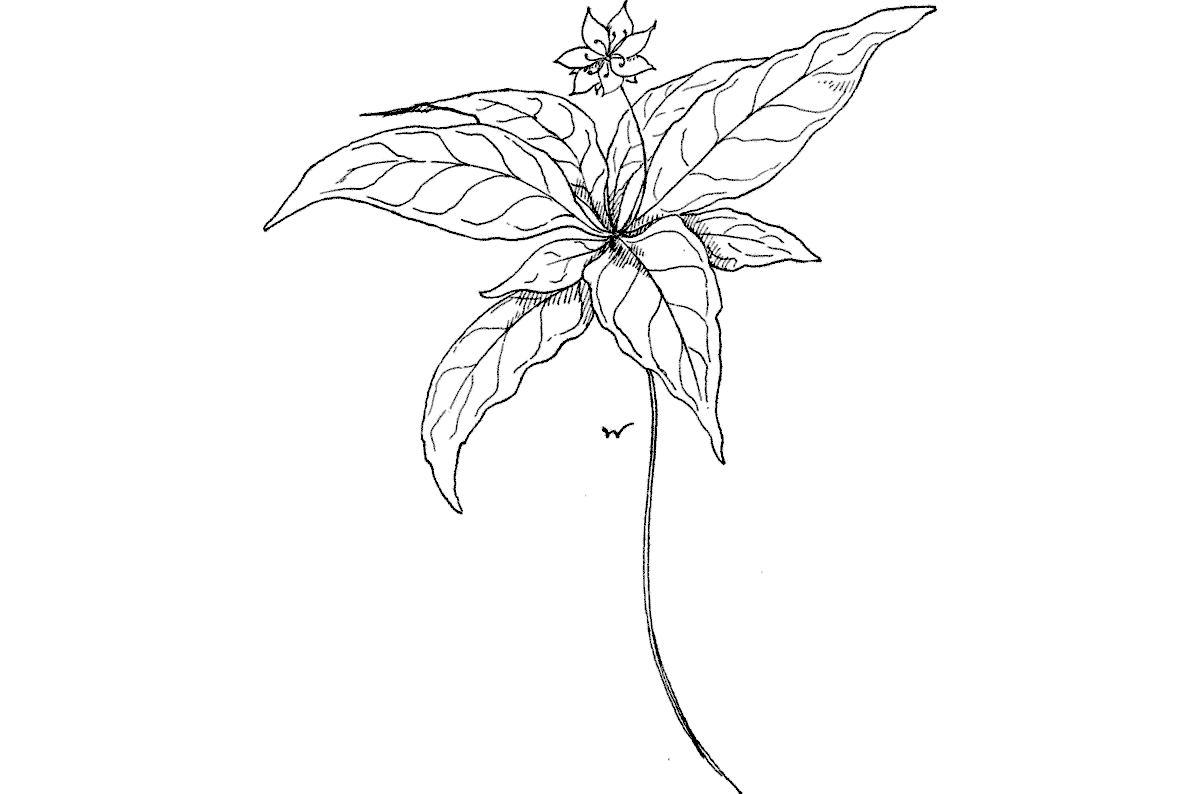
Star-flower.Trientalis Americana.
Star Anemone.
Star-of-Bethlehem.
Chickweed Wintergreen.
Found in moist shade during May.
This very slender and smooth little stalk grows from 3 to 5 inches in height, bears one or two sheath-like leaves near the root, and terminates in a whorl of leaves at the top. It is green, slightly reddish at the foot.
The long leaf is sharp-pointed at both ends, with an entire margin, a thin and delicate texture which shows plainly the pattern-like tracery of the ribs and veins, and a shining surface; the color is a full green. 6, or more, leaves, of unequal size, spread in a whorl upon the summit of the stalk.
The flower has 7 nearly diamond-shaped parts, of a thin texture, and pure white color; they spread flat, their edges just overlapping in a 7-pointed star, the 7 long, and narrow, greenish divisions of the calyx alternating with them; the 10 thread-like stamens are white, with orange tips. A single flower, borne on a slender stem, rises from the whorl of leaves.
The number of the corolla-divisions sometimes varies, but 7 is the usual measure. It is noticeable that the flower-stem is set a trifle underneath the lap of the leaves, causing an inclination of the star to one side. A tiny leaf is found sitting on the stalk just under the leafy canopy.
STAR FLOWER: Trientalis Americana.
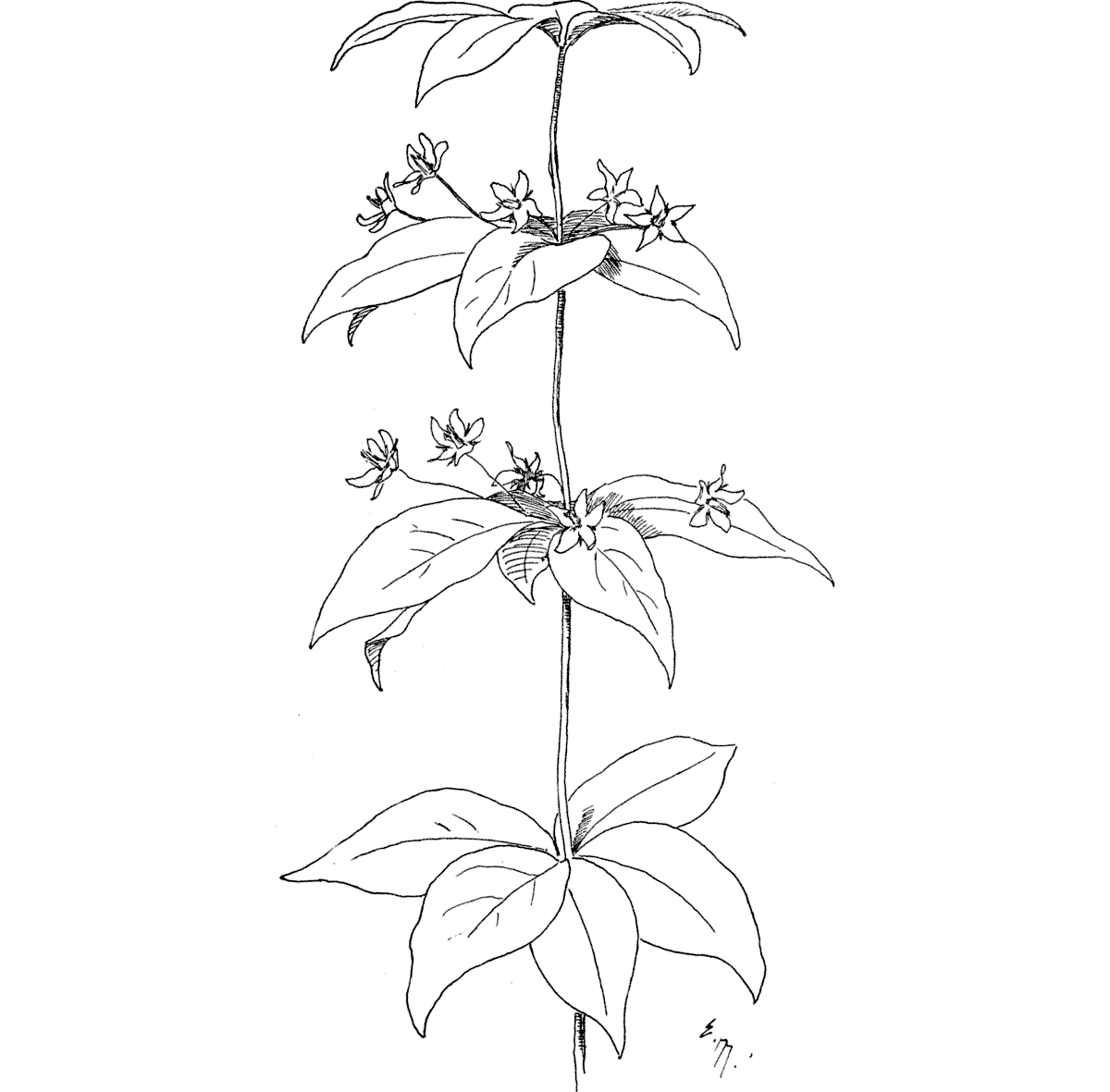
Loosestrife.Lysimachia quadrifolia.
Found in moist grounds, and woods, in June and July.
The single stalk, from 12 to 18 inches in height, is hairy and faintly ridgy, and light green in color.
The leaf is oval and pointed at both ends; from 2 to 3 inches long, with a strong midrib; the upper surface smooth to the touch, the lower hairy, and the color yellow-green. The leaves are set close on the stalk in whorls of fours and fives, with a single pair occurring near the foot of the stalk.
The divisions of the flower are 5, long-pointed, fine in texture, and light yellow, with a few tiny red streaks, and a bright red marking at their base; the 5 erect, pale yellow stamens, tipped with tawny, are united at the foot in a collar; the calyx-parts are 5, narrow, pointed, and light green. The flowers, set on thread-like stems spring from the angles of the leaves,—a flower for each leaf.
As many as six or seven whorls of leaves, four often accompanied by flowers, are found on a single stalk.
LOOSESTRIFE: Lysimachia quadrifolia.
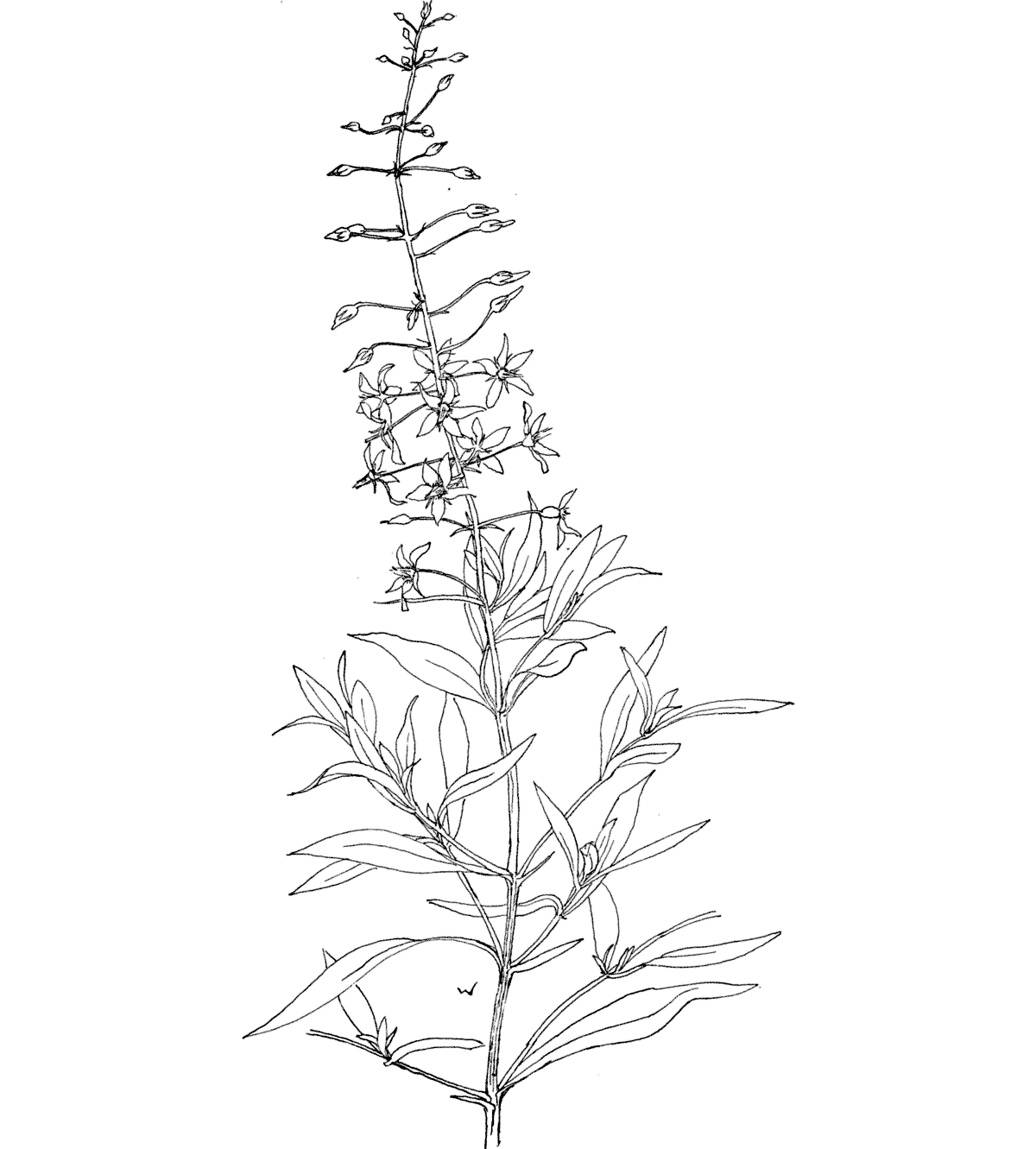
Spike Loosestrife.Lysimachia stricta.
Found in moist lands and fields, in July.
The stalk, from 12 to 18 inches in height, is branching near the top, leafy, and smooth, but grooved beneath the branches; it is hollow, and has a stiff fibre; pale yellow-green.
The long and narrow oval leaf is sometimes 2 and 3 inches long and only ½ an inch in width; its texture is thin, its surface very smooth, and the margin entire. The color is a light yellow-green. The leaves clasp the stalk in pairs, which occur at right angles to each other, and are near together.
The flowers are about half an inch across, otherwise in color and shape exactly resembling L. quadrifolia; they are set on inch long stems, and arranged in irregular rings about the stalk, forming a noticeable feathery spike, 5 or 6 inches in length.
The blossoms open first at the bottom of the spike, several rings flowering at one time. The branches occur in pairs, symmetrically.
SPIKE LOOSESTRIFE: L. stricta.
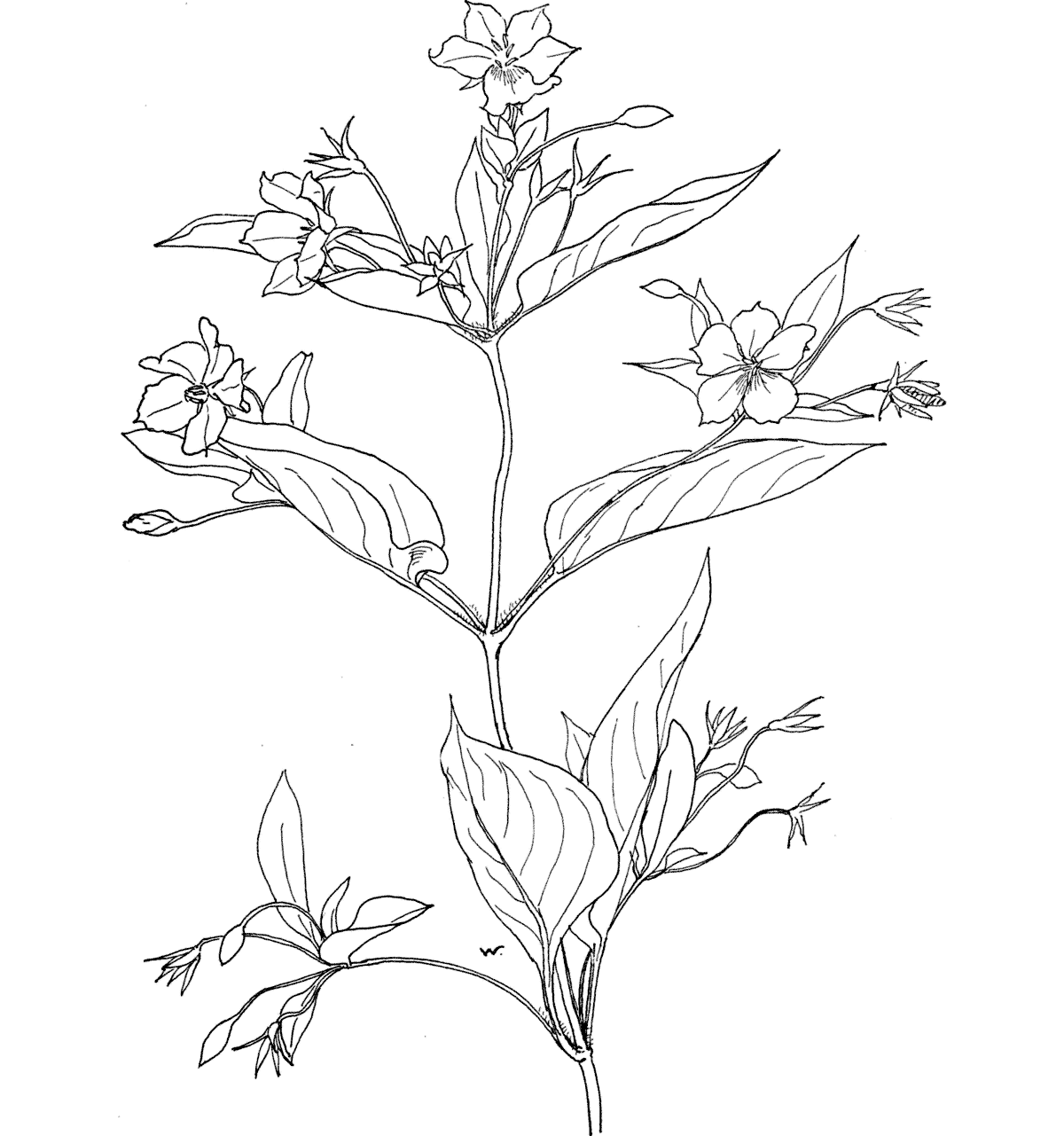
——Steironema ciliatum.
Found in low places, and among shrubby growths, in July.
The single, smooth, 4-angled stalk is from 2 to 3 feet in height, and a shining, light green color, sometimes bronzy.
The leaf is long oval, blunt or very slightly heart-shaped at the base, tapering to a long and very sharp tip; the margin is entire, the ribs noticeable, and the upper surface is velvety to the touch; the color light green. The leaves are set on short stems, which are fringed with erect hairs along their upper edges, and arranged in pairs, the pairs being at right angles to each other.
The rather large corolla has 5 divisions of a rounded oval shape with an abrupt little tip; their outer margin is somewhat puckered, the texture thin, and the color a pure light yellow,—about their bases is a reddish marking that makes a ring in the center of the flower; the 5 erect stamens are straw-color, and the long pistil is green; the calyx is 5-parted, and full green in color. The flowers, on slender foot-stems, are placed by twos and fours on leafy stems, that spring terminally, and from the angles of the leaves.
This handsome plant takes kindly to garden cultivation.
—— Steironema ciliatum.
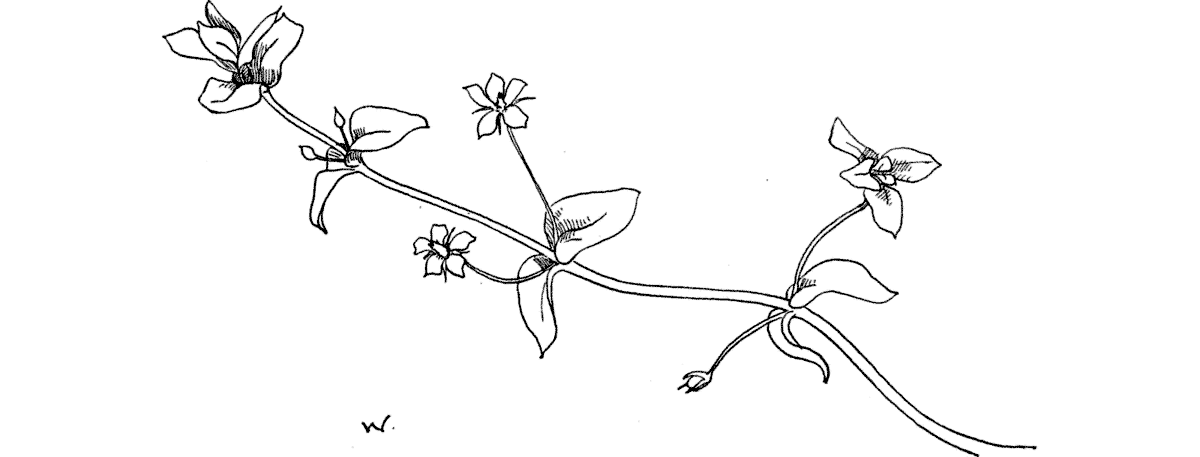
Common Pimpernel.Anagallis arvensis.
Poor Man’s Weather Glass.
Found in waste places and sandy soil, from June to September.
The several stems of this spreading plant lie upon the ground in a close mat; they are square, the sides being twisted; smooth, shining, and light green. They are commonly about 6 inches in length, but vary somewhat.
The small oval leaf is widest at the base, entire, weak and loose in texture, and dull green, the under side speckled with faint purple dots. The leaves occur in pairs at regular intervals.
The pretty little flower is very variable in color; its 5-parted and round-pointed corolla is purple, blue or white sometimes, but most commonly is orange-red with a violet ring in the center, while the collar which unites the 5 white stamens (they have yellow tips) is red-violet—a curious color combination. The calyx is 5-parted, shallow, and green. The flowers, on thread-like stems, occur in pairs, springing from the angles of the leaves along the stalk.
The lowest buds open first; the blossoms last but a day,—they do not often spread in overcast weather, nor open until the sun is shining full, and they close by four o’clock in the afternoon. This habit causes the folk-name, which is more surely applicable to the plant when it grows by the sea, for though it is found inland in a flourishing condition, it is never acclimated thoroughly enough to adjust its reckoning with the weather, and is continually making false forecasts in its calculations.
COMMON PIMPERNEL: Anagallis arvensis.