COMPOSITE FAMILY. COMPOSITÆ.
Reading edition
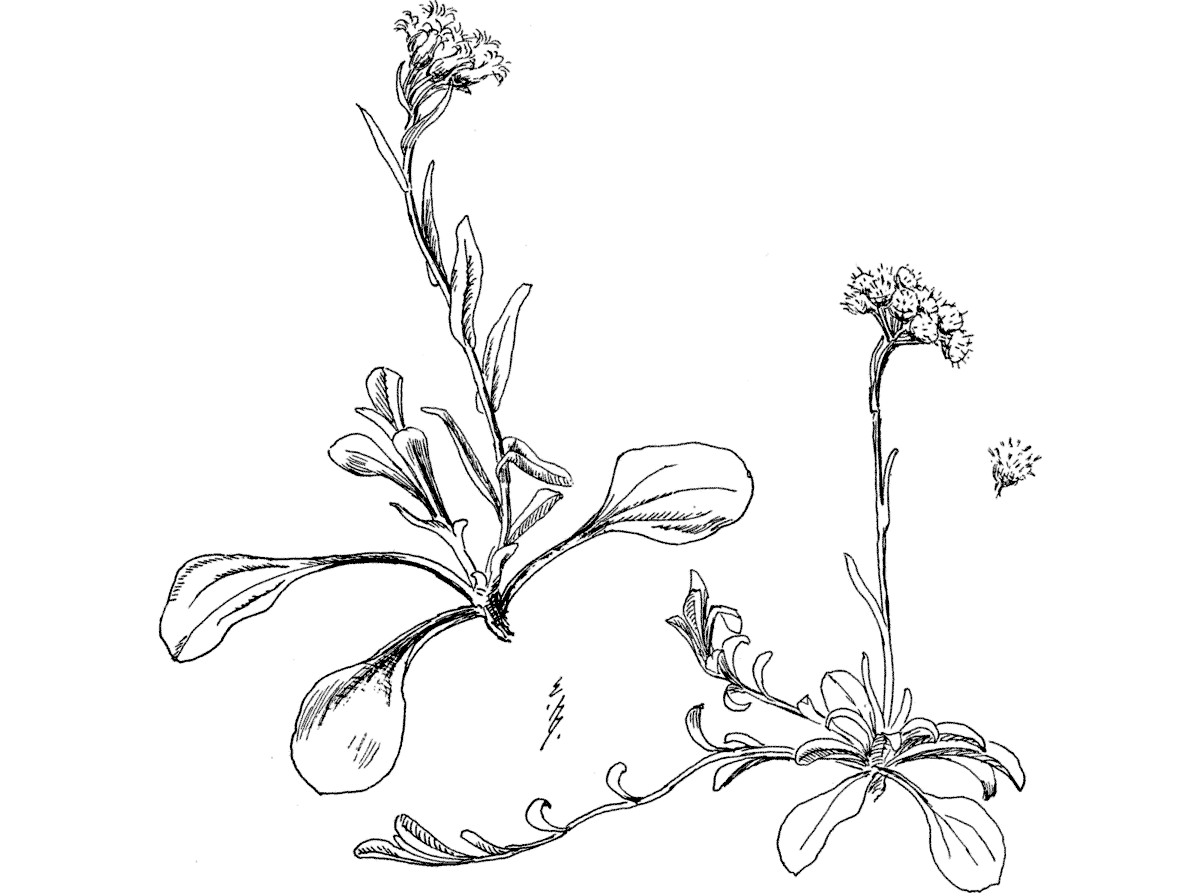
Plantain-leaved Everlasting.Antennaria plantaginifolia.
Spring Everlasting.
Pussy-toes.
Found in light soil, meadows, and uplands, in April and May.
The short, leafy stalk, covered with a silvery wool, runs on the ground, and is from 3 to 10 inches in height. Pale green in color.
The small, broad-oval leaf is rounded at the tip, 3-ribbed, of a tough fibre, and, when young, covered with a silky white wool. It is set on a short, margined stem. In color, light grayish-green.
The flowers are gathered in small heads,—the stamen-bearing and pistil-bearing flowers growing on different plants. The pistil-bearing heads are like little bundles of silky threads, silvery white; the stamen-bearing heads are more rounded in shape, and of a creamy-white color, the tawny stamens being tipped with orange. The heads are set in pale green, urn-shaped, small cups, on short foot-stems, forming a little group on the top of the flower-stem.
Spring Everlasting spreads rapidly by runners sent out from the main plant, and its grave prettiness does not save it from being considered a troublesome pest by the farmer looking for good grass pasturage for his herd.
PLANTAIN-LEAVED EVERLASTING: Antennaria plantaginifolia.
Dandelion.Taraxacum officinale.
Found, during April and May, in every sunny meadow, lawn, and grassy road.
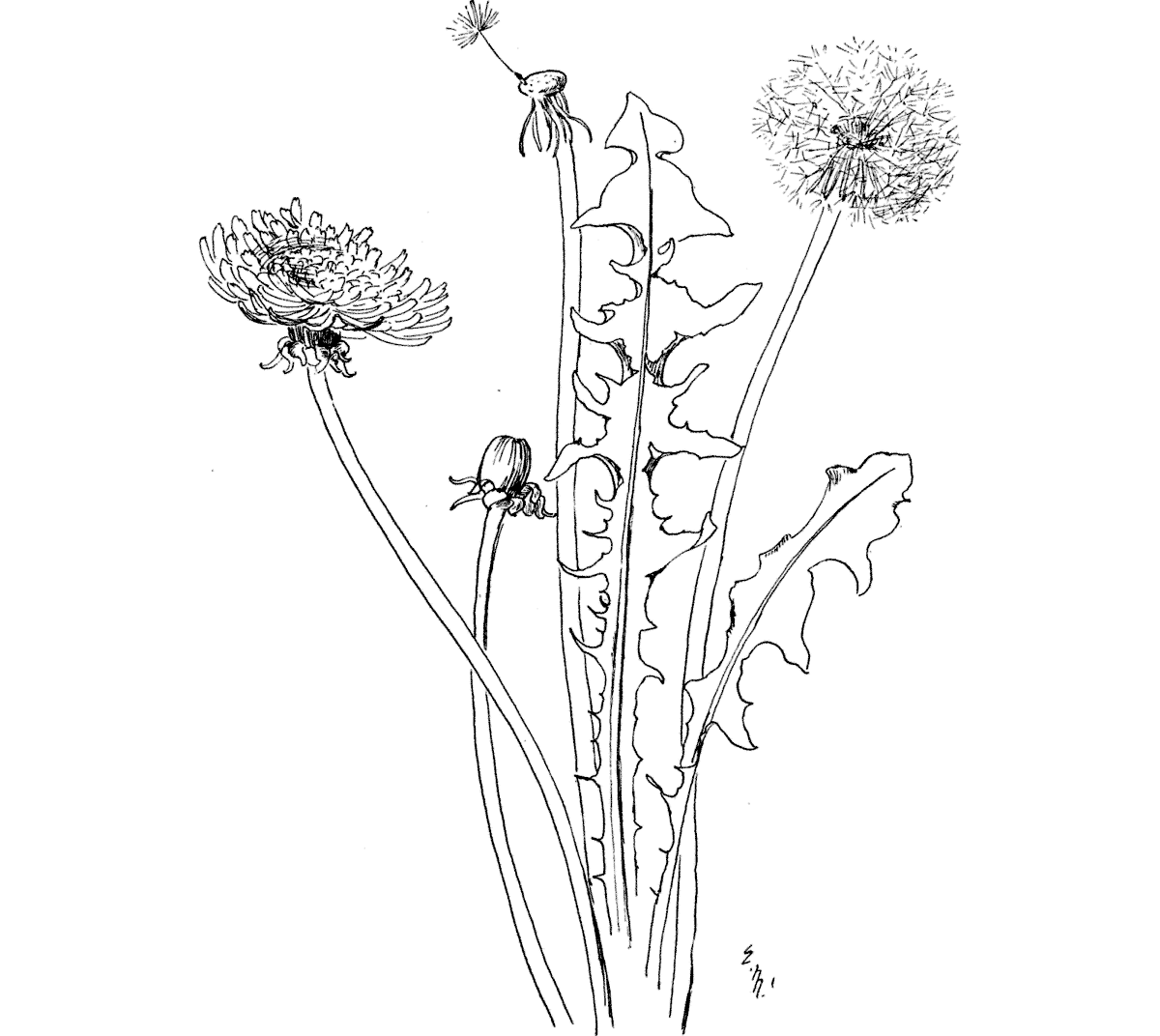
The leaves, and the flowers on stems which vary from 3 or 4 to 12 inches in height, rise from the root.
The long and narrow leaf is often and irregularly cut, the notches generally pointing backwards, and the margin is also sharply toothed; the texture is close, the surface is smooth, and the midrib is wide; the edge is wavy. In color, grass green, the midrib pale. Many leaves grow in a rosette-like cluster from the root,—the flower buds held in the center.
The small “strap-shaped” flowers, with their notched ends, are gathered in overlapping rows, to form a large circular head; in color they are a brilliant orange-yellow, the central flowers deeper in tint. The head is confined in a cup of many narrow, dark green, leafy bracts, and set on long, smooth, elastic stems, which are hollow, and juicy with a bitter-flavored milk.
The seed-globe of the Dandelion is a favorite with children, by whom it is named a “clock”; its seeds are furnished with feathery plumes, which serve as wings to waft them abroad. The flower-stem too is easily split when plucked, and curls into enchanting spirals that no youthful taste may resist. When cut off short by the cruel lawn-mower, these generous plants put forth fresh golden discs close to the ground within the leaves.
DANDELION: Taraxacum officinale.
Coltsfoot.Tussilago Farfara.
Found in moist meadows, on banks, and brooksides in May.
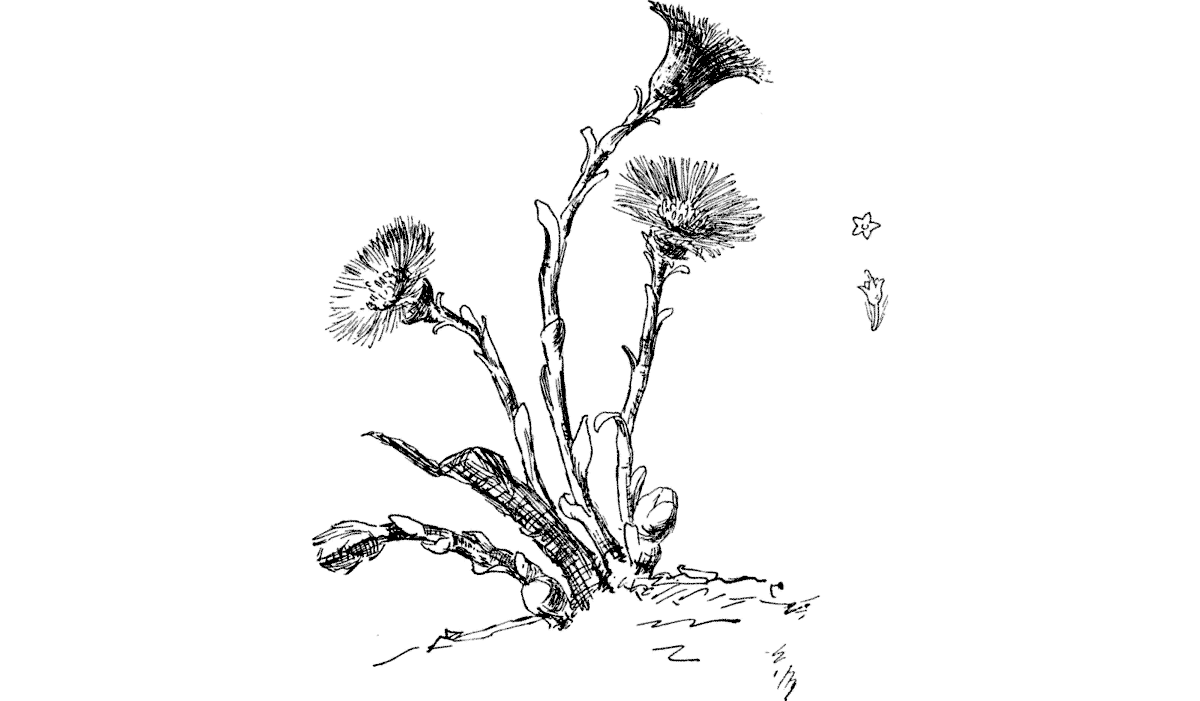
The flowers and leaves grow from the root, about 4 or 6 inches high.
The leaf appears some time after the flowers; it is large, rounding, with a heart-shaped base, the margin slightly broken by small rounded points, and with strong ribs radiating from the base; it is exceptionally fine in texture, and the upper side is possessed of a silky smoothness, the lower side being soft woolly (the new leaves are very woolly). They grow from the root on stout, half-round stems, that are dull purplish-red in color, and often covered with a loose white wool; the leaves are a fine cool green, silvery beneath.
The small flowers are grouped in dandelion-like heads, with many fine fringy rays; all colored alike a bright yellow. The head is held in a deep, leafy cup that is green strongly tinged with reddish-brown; it grows on a stout, grooved, roughish stem, which bears several, small, brownish scales; it rises from the ground before the leaves.
The Coltsfoot, introduced from England, has become thoroughly naturalized here. Its blossoms bear a certain superficial resemblance to the Dandelion, though really different in habits of growth. The leaves are truly decorative, growing thickly in large spaces, and forming a mosaic of green tiles close down to the brook’s edge.
COLTSFOOT: Tussilago Farfara.
Robin’s Plantain.Erigeron bellidifolius.
Found in meadows and fields, during May and June.
The stalk (from 8 to 18 inches high) is single, and sparingly leafy; grooved, and slightly hairy. Color, light green.
The long, narrow leaf, with a tapering tip, and a partly-clasping base, has a taut midrib which fulls the blade; its margin is sparsely notched (except that of the upper leaves), and the surface is slightly hairy. The color is green, with a paler midrib. The arrangement is alternate, and at long intervals.
The disc flowers are very small, and in color greenish-yellow; set in a flat-topped head, surrounded by many long rays, like a finely cut fringe, which are blue or pinkish-lavender. The cup is hemispherical, and green. The heads form a flat-topped terminal cluster.
Robin’s Plantain grows in communities among tall grasses, swaying gracefully on its long stalks as the breeze sweeps over the field. This is apparently the only one of its class that is distinguished by an attractive folk-name of its own,—all the rest are Daisy Fleabanes.
ROBIN’S PLANTAIN: Erigeron bellidifolius.
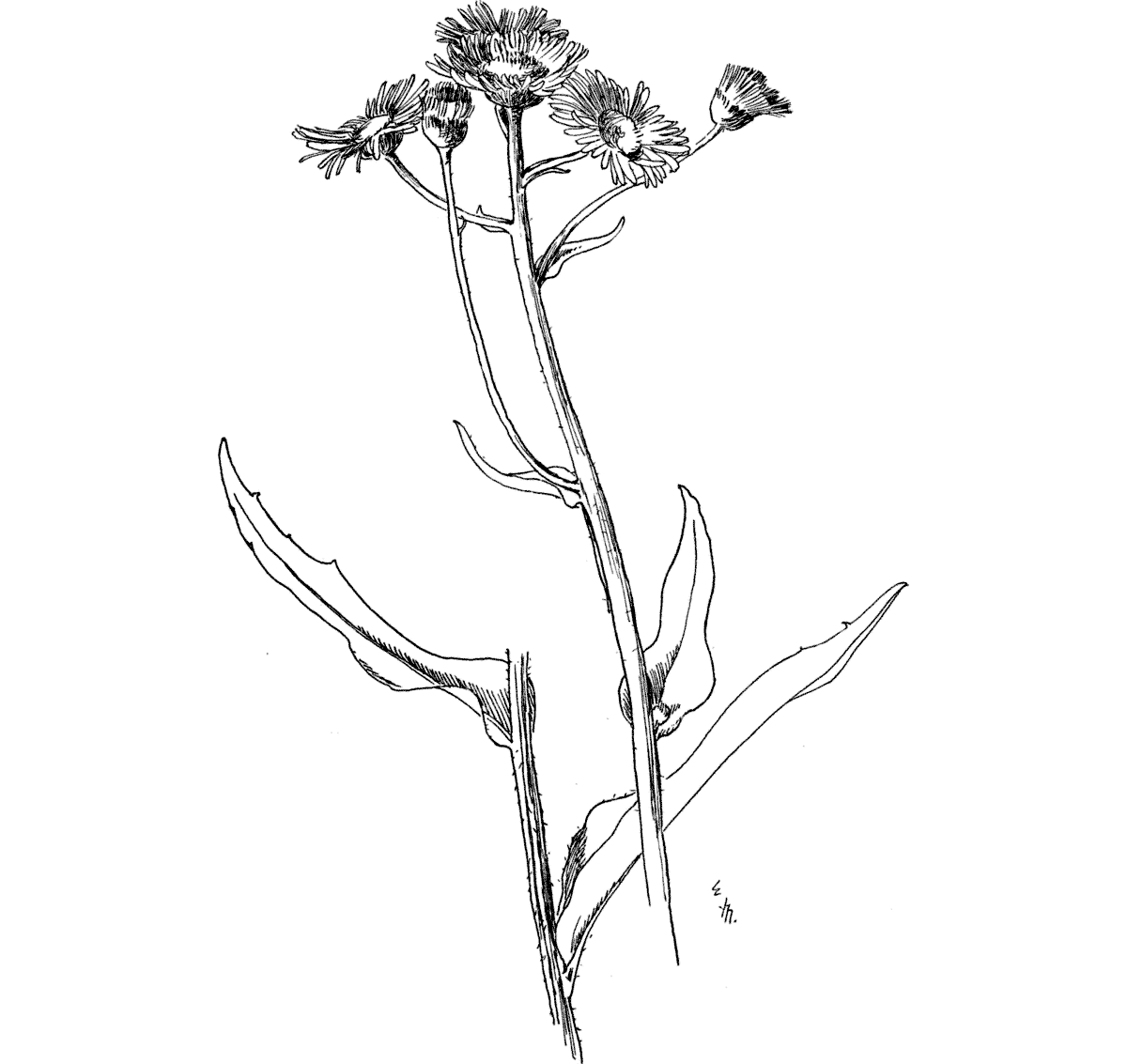
Daisy Fleabane.Erigeron Philadelphicus.
Found in meadows and roadsides during June.
The simple, and leafy, stalk grows from 2 to 8 feet high; it is rather slender, finely grooved or lined, and a little hairy. In color a light green.
The root-leaves are very long, the others decrease in size as they mount the stalk; they are long and narrow, with sparsely and irregularly notched margins (sometimes only one to a leaf), and a firm texture,—smooth to the touch. The color is green. They clasp the stalk partly, and occur alternately.
The disc flowers form a small flat button, which is at first greenish, and later changes to yellowish-orange; the rays are many, fine and fringy in appearance, and varying in color from white to pink. The cup is light green. The flower heads grow in somewhat flat-topped clusters on the top of the stalk, upon limber stems which are inclined to droop.
This Fleabane follows Robin’s Plantain in the succession of June flowers, and bears a general resemblance to the other plants of its genus, which renders it difficult to distinguish individually from its fellows.
DAISY FLEABANE: E. Philadelphicus.
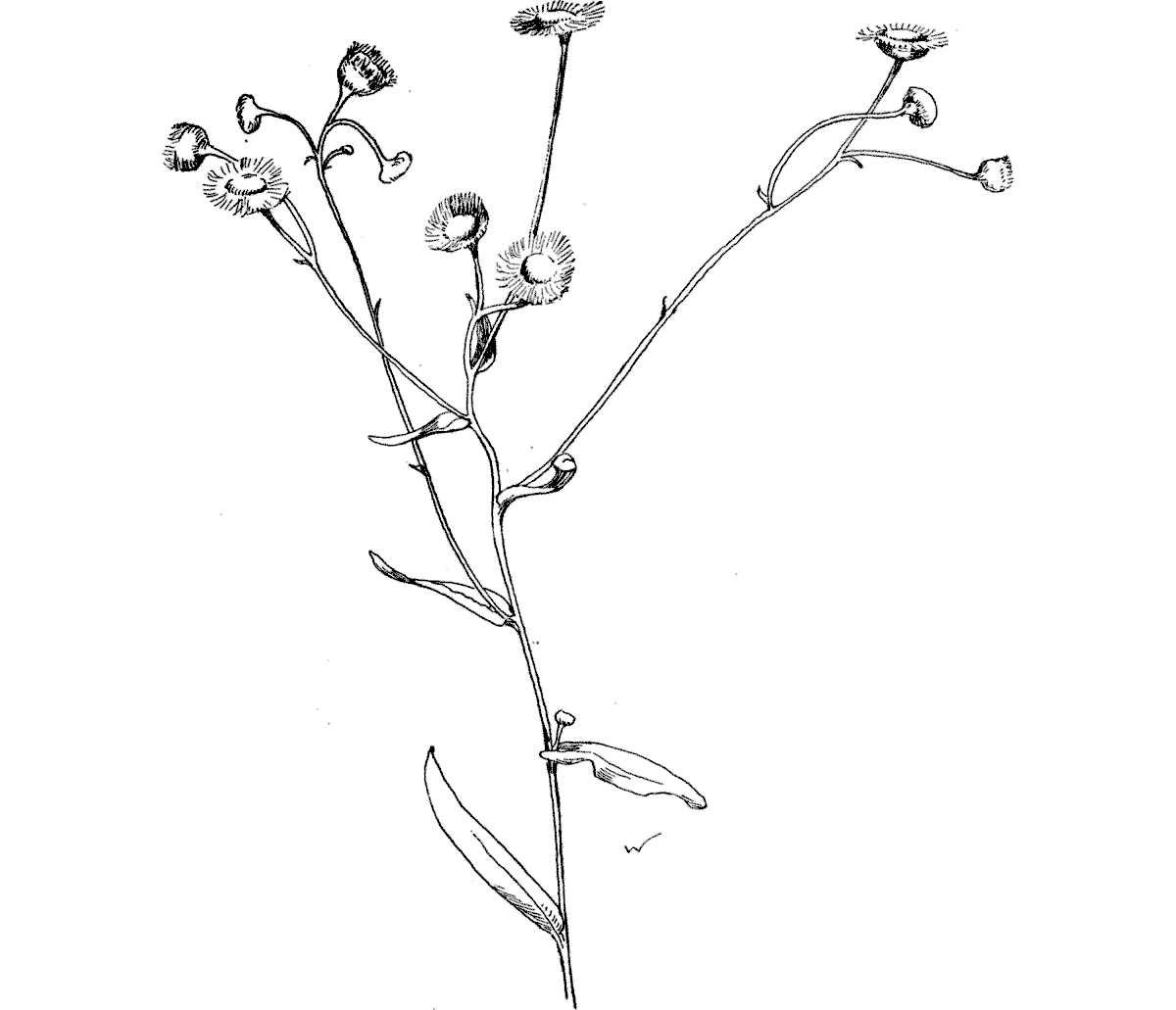
Golden Rag-wort.Senecio aureus.
Squaw-weed.
Found in May or June in pasture lands.
The stalk, which grows from 1 to 8 feet high, is single, somewhat rigid in bearing, leafy, hollow, and woody-fibred, with a grooved surface. Its color is green, with dull brown streaks.
The lower leaves are simple, and round or heart or lyre-shaped, with toothed margins, and are set on long stems; the upper leaves are long and narrow, their margins deeply cleft, and are set upon the stalk, partly clasping it. The texture is thin, and surface smooth. A rich green in color.
The bloom is small, of a deep orange hue; it is gathered in a close head, surrounded by 6 to 14 short rays, which have slightly notched tips, are of fine texture, and are an absolute orange-yellow color. The heads are set in a smooth, deep cup, of a yellow-green color tipped with red; they are arranged, on long slender stems, in a loose terminal cluster.
Occasionally the flower-stems bear thread-like leaves; sometimes the grooved stalk is slightly twisted. The leafage is inclined to curl, and with its fine deep notches presents a feathery appearance. The foot-tuft of leaves is interesting in arrangement.
GOLDEN RAGWORT: Senecio aureus.
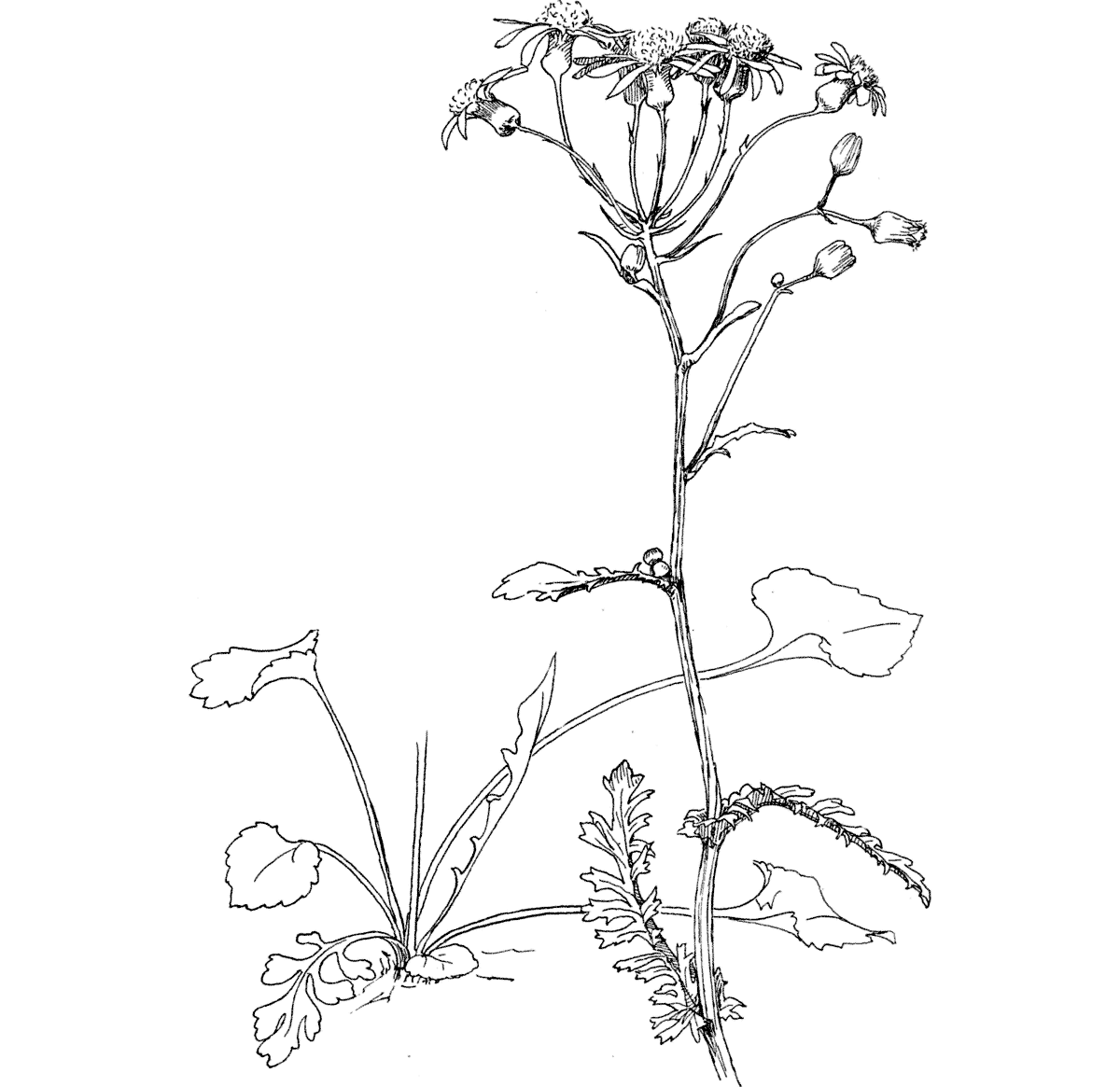
May-weed.Anthemis Cotula.
Pigstye Daisy (Mass.).
Dog Fennel.
Found through the summer, from May to October, growing about buildings, or in waste places.
The stalk is seldom a foot in height, branching in a bushy fashion, and very leafy; it is slender but tough-fibred, and smooth. In color light green.
The leaf is small and indeterminate in shape, it is cut so deeply and irregularly as to present an aspect of being all fringed margin and no leaf; the midrib is strong, and the texture coarse. Color, light green. The leaves are set alternately and close together upon the stalk or branch.
The flowers are small and yellow, arranged in a flat disc, surrounded by a sparse number of oblong, notched, white rays. The leafy cup, which holds the flower-head, is dry and husk-like. The heads are terminal, and single.
This is a plant of communal habit, and profusely flowering. It has a trick of folding down its rays at night, and is a great sluggard about spreading them in the morning. After the rays age and fall, the disc becomes cone-shaped. “It has taken up its place by the roadside, close to the ruts—in bad taste.” (Thoreau’s Journal for June 25, 1852.)
MAY-WEED: Anthemis Cotula.
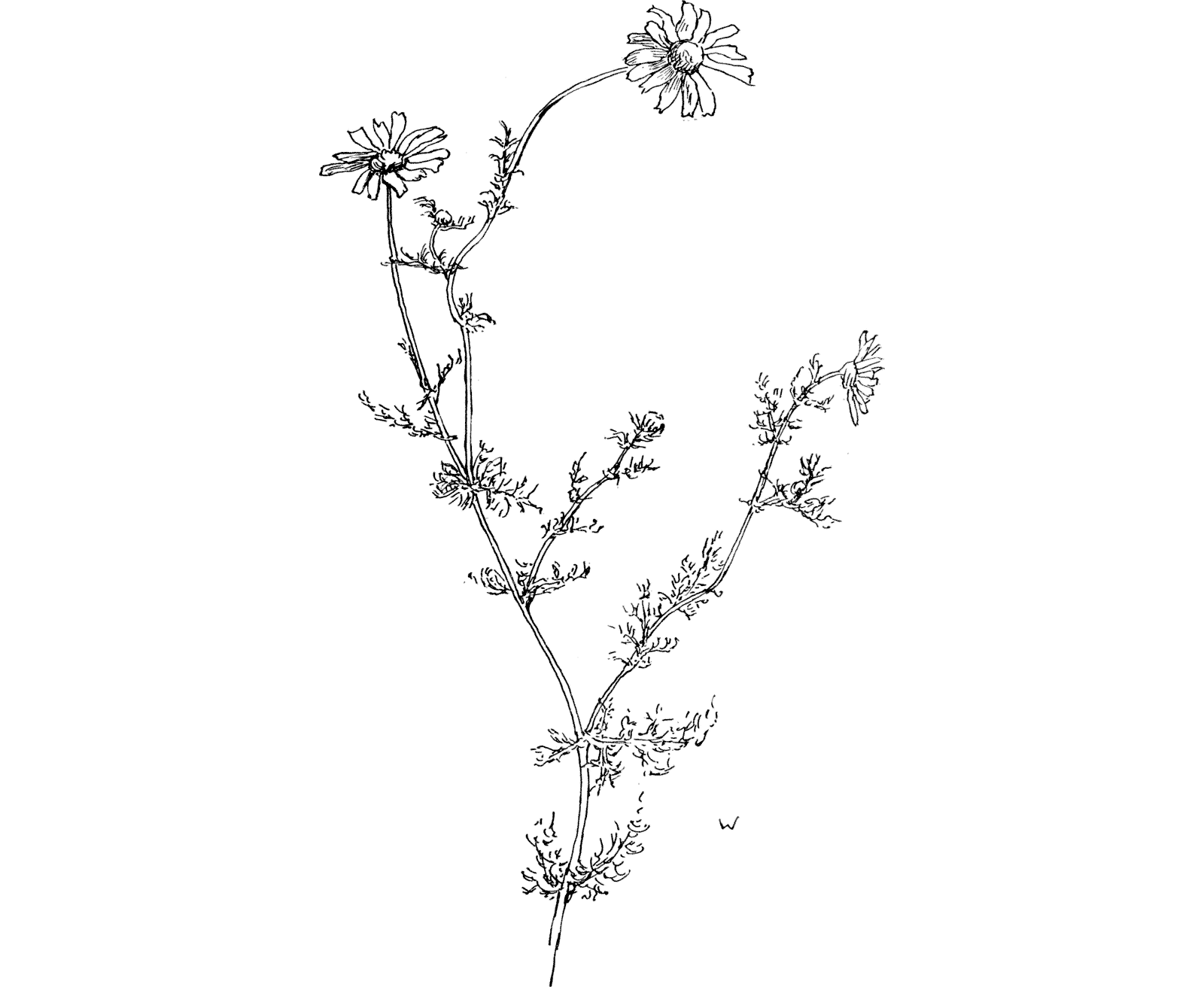
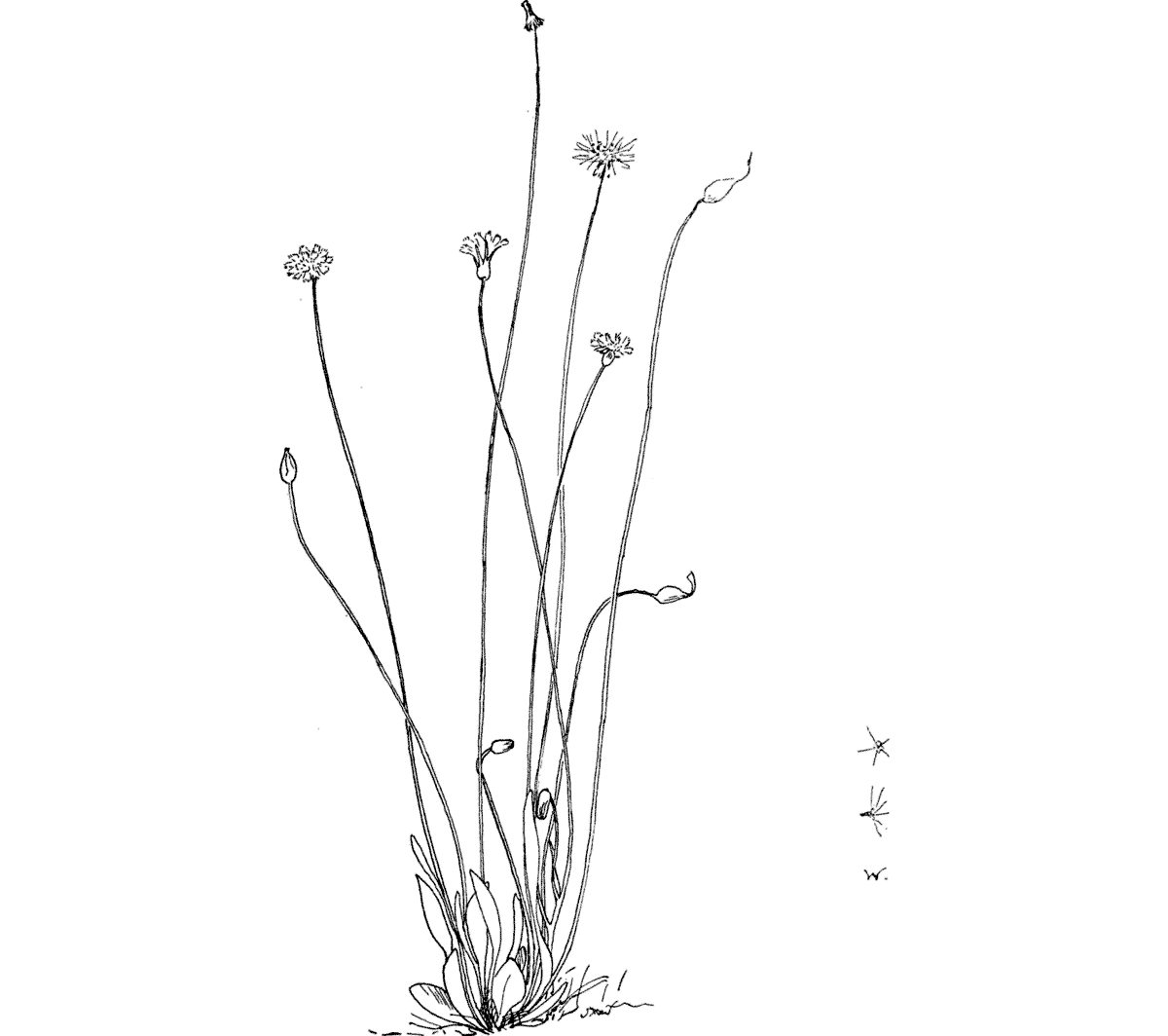
Dwarf Dandelion.Krigia Virginica.
Found from May to August on sandy banks and roadsides, and in pastures.
The several flower-stems rise from a mat of root-leaves; they vary from 3 to 10 inches in height, and are very slender, hairy, and green.
The earlier leaf is round, with an entire margin, and set on a very short stem; the later is oblong and narrow, with a sometimes notched margin, and scattering hairs upon the edge, and a thin texture. The color is light green. Later in the season a few slender leaves are found on the flower-stems.
The flowers are all ray flowers, 12 to 20 in number, small, with very finely-notched tips; rich orange, yellow in color. The cup which holds the head is small and tubular; its spreading row of tips is a little shorter than the rays; green in color.
The dark seed with its 5 or 7 rounded scales and an equal number of long thread-like white bristles is a charming feature of this delicate little plant. Sometimes the flower-stems fork, and bear two heads.
DWARF DANDELION: Krigia Virginica.
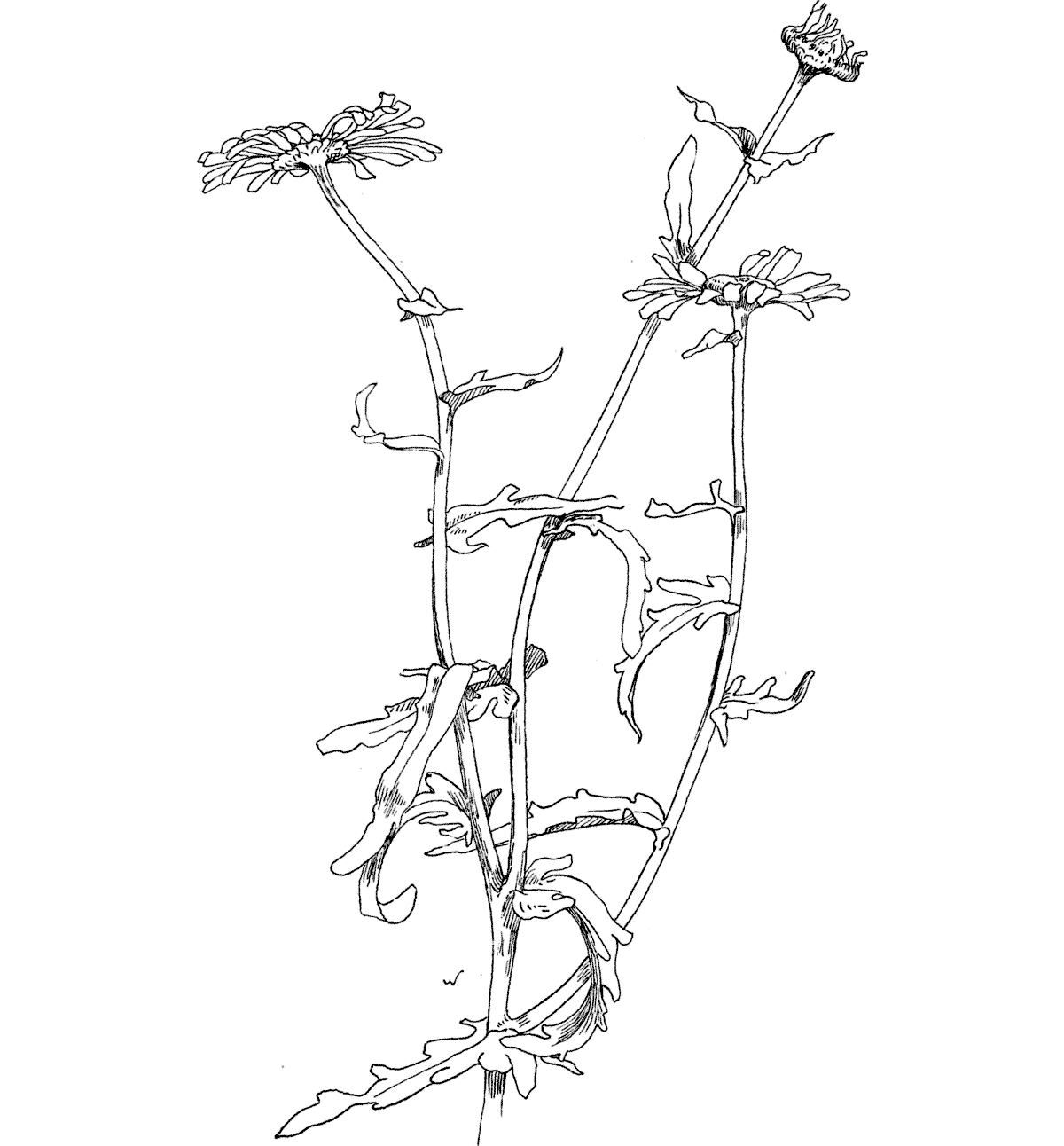
Ox Eye Daisy.Chrysanthemum Leucanthemum.
White Weed.
Bull’s Eye.
Found from June to October in fields, meadows, and roadsides, growing most abundantly in poor soil.
The stalk, whose height varies from 10 to 18 inches, is often single but sometimes sparsely branching, and bears but few leaves; it is of a tough fibre, sometimes grooved, and smooth. Light green in color.
The root-leaves are round-tipped, infrequently cut, and are set on stems; the upper leaves are very irregular in shape, and capriciously cleft or cut; the margins are entire, the texture tough, and the midrib strong. They clasp the stalk at intervals, alternately. Green in color.
The flowers are small, tubular, and yellow; they are packed evenly in a disc shaped liked a flat button (it becomes more conical with maturity), surrounded by a single row of about 25 rays. These rays are noticeably long, of a fine texture; pure white in color. The flower-head is supported by a mat of green taper-pointed bracts, whose tips are often rusty; it is set singly on the summit of the stalk.
This sturdy colonizer, the farmer’s pest and children’s delight, frequently usurps a whole field, where it thrives and blooms till frost-time in spite of draughts or flood. Double Daisies and conical-shaped discs are occasionally found, besides other variations from the regular order. The leafage is interesting, and individual in gesture.
OX EYE DAISY: Chrysanthemum Leucanthemum.
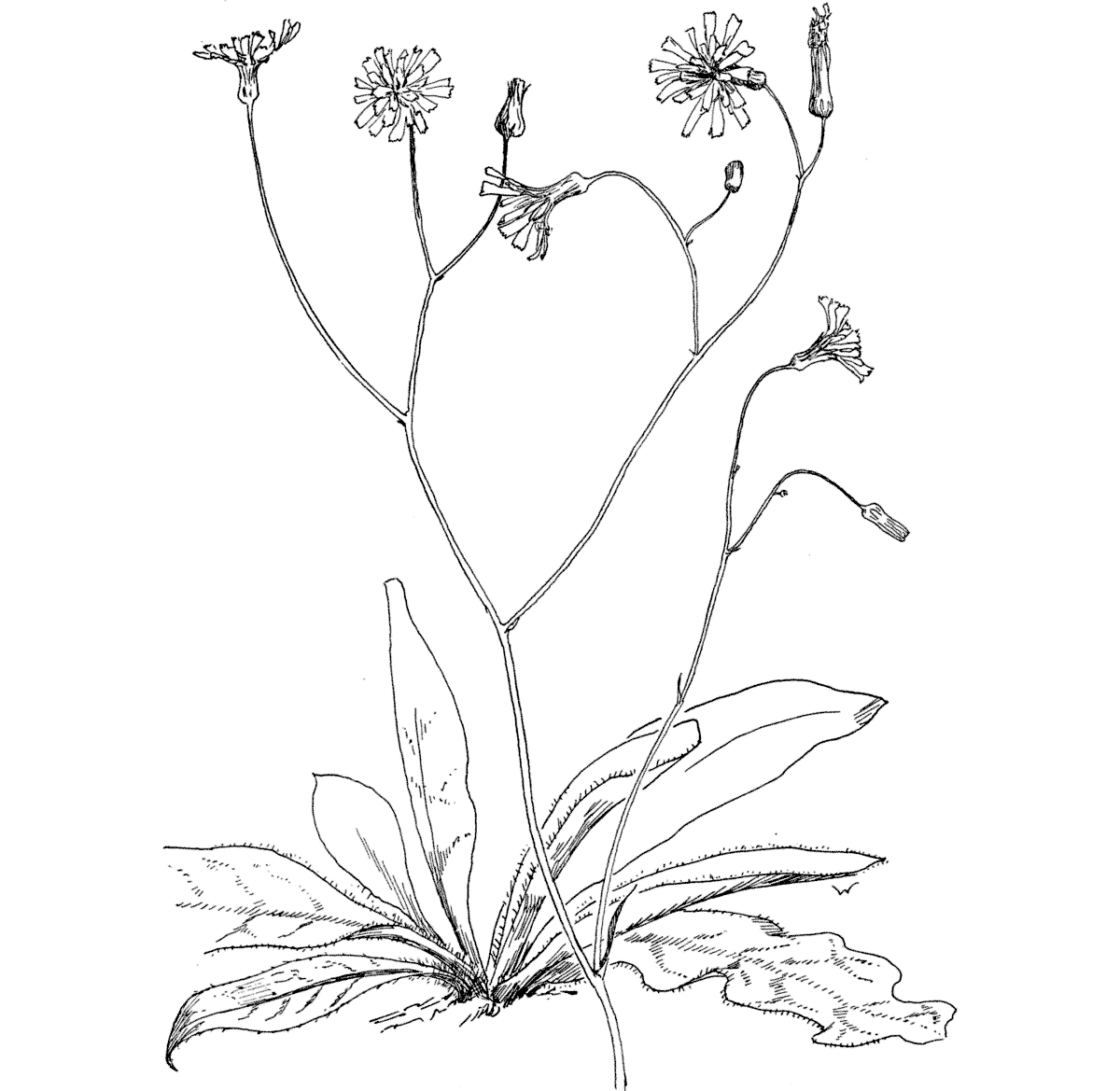
Early Hawkweed.Hieracium venosum.
Rattlesnake-weed.
Found in June in the shade of dry woods, or on barren hilltops and pastures.
The flower-stem springs from a rosette of foot-leaves; it grows from 1 to 2 feet high, bears but one leaf midway, and is smooth and shining. Of a light green color, with flecks of crimson at the leaf, and near the foot.
The foot-leaf is large (from 1 to 3 inches long), a long oval with a pointed tip, the midrib is wide, flat, and hairy, the prolonged base, or short stem, is partly clasping; the margin is entire and fringed with gray hairs, the texture is leathery. In color a dull light green, while the edge, ribs, and underside are red-purple. The single leaf on the flower-stem is long, narrow, and smooth; of a dull green color.
The flower is like a ribbon (or “strap-shaped”) with a finely notched tip; of fine texture, and smooth. The color is a bright Dandelion yellow. 20 or more of these flowers are arranged in a spreading head, enclosed in a leafy light green cup, whose tips are tawny-red. The heads are set on long, slender stems, which fork from the main stem, with a tiny leaf sitting at the point of junction.
This jaunty plant, though found in the open, likes also the shade, where yet it never fails to swing its yellow heads out towards the sunshine. Sometimes the foot-leaves are wanting, and the flower-stem rises from the bare ground.
EARLY HAWKWEED: Hieracium venosum.
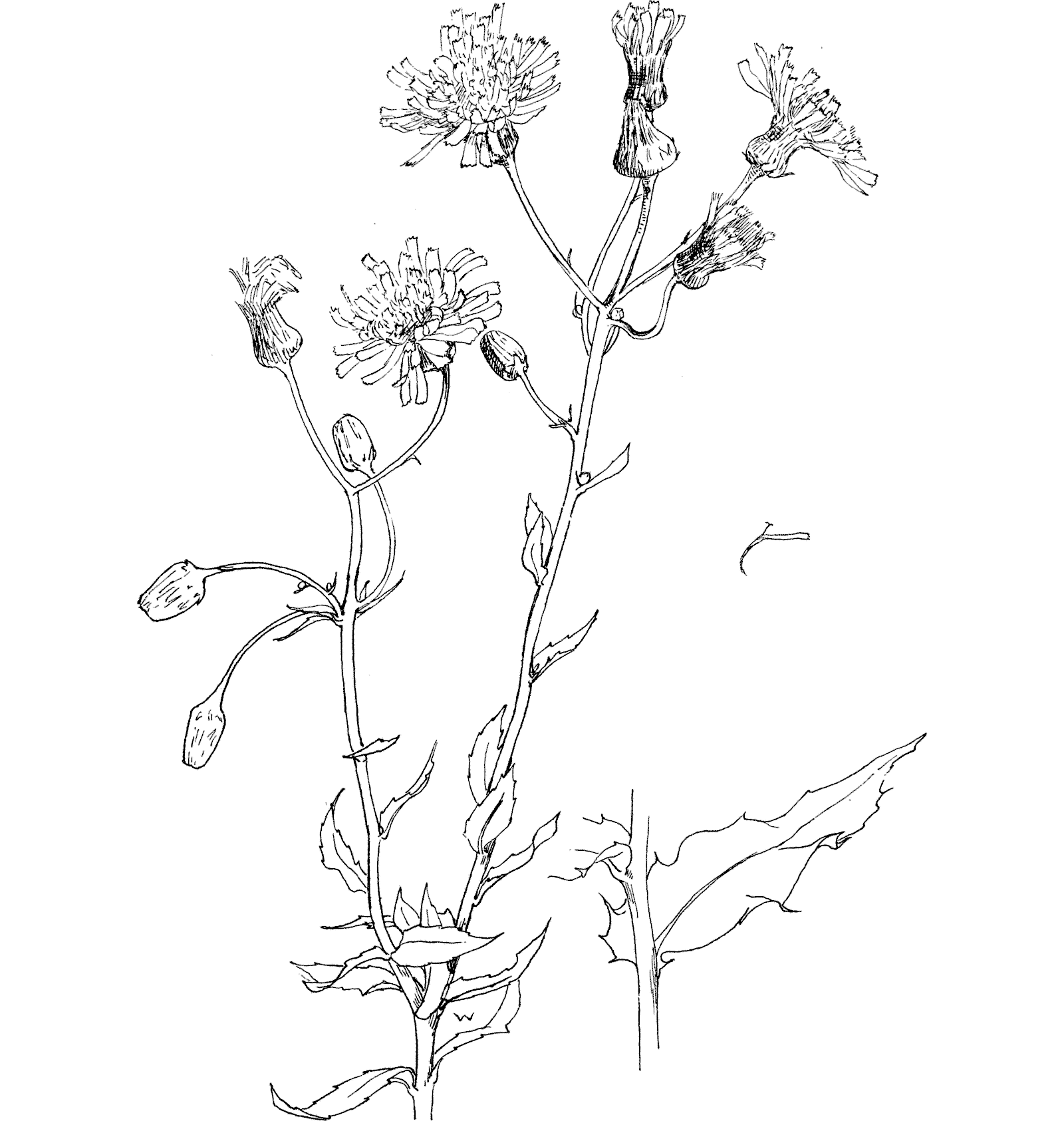
Canada Hawkweed.Hieracium Canadense.
Found, during August and September, growing along roads and thickets in dry shade.
The stalk, which grows to 2 or 3 feet high, is simple at first, but branches above, and is leafy; it is round, hard-fibred, smooth—but downy near the flowers. In color a light green, pale near the foot.
The leaf is a long lance shape, pointed at the tip and broad at the base, with a prominent strong midrib, the margin sparingly and sharply toothed; of a firm texture, and smooth. The color is a medium green, silvery underneath, the midrib light. It is set close upon the stalk, slightly clasping it; the arrangement is alternate. The length of the lowest leaves (sometimes 4 inches) decreases gradually, to that of a tiny thread at the spring of the flower-stems.
The flowers are finely notched at the tip; of a bright pure yellow color. The noticeably protruding two-tipped pistil is tawny-gray. The flower-head is large and spreading; its green cup is smooth and close-folded. The heads, on slender, downy, green stems, each of which bears a single leaf, are arranged in a loose terminal cluster.
Like all the Hawkweeds the Canada loves not solitude, but grows in gay encampment along a shaded road, where travellers welcome its strong absolute yellow, that is yet tempered to pleasing softness of tint by the many little gray pistils.
CANADA HAWKWEED: H. Canadense.
Tawny Hawkweed.Hieracium aurantiacum.
Found in June, in open fields and roadways.
The flower-stem rises from a rosette of foot-leaves; it bears one or two leaves near the-ground, is slender, round, grooved, and hairy. The hairs are dark enough to somewhat obscure the green color of the stem.
The leaf is long oval, with an irregular margin, and strong midrib; the texture is coarse, and both upper and under surfaces are covered by long gray hairs. The color is green, with a lighter midrib. One or two leaves occur upon the flower-stems,—they are smaller than the others.
The tip of the slender “strap-shaped” flower is more finely fringed than is usual with the Hawkweeds. In color an orange-red, or tawny, rather dark in hue, while the pistil is bright yellow. The cup is green, with many dark tawny hairs. The heads are set on short stems in a terminal cluster.
This is the flower commonly known in England by the folk-name of “Grim the Collier,” because of the dark and hairy aspect of its blossoms; the hairs near the flower-heads are of noticeable length and modify their color perceptibly. It is to be noted that the heads are composed of fewer colors than most of the common Hawkweeds. The plumy seeds are of a yellow-gray color and very pretty. Although the botanical calendar places the flowering time of the Tawny in June, personal observation has only noted it in the autumn; during middle September it is to be found in full bloom in northern Vermont.
TAWNY HAWKWEED: H. aurantiacum.
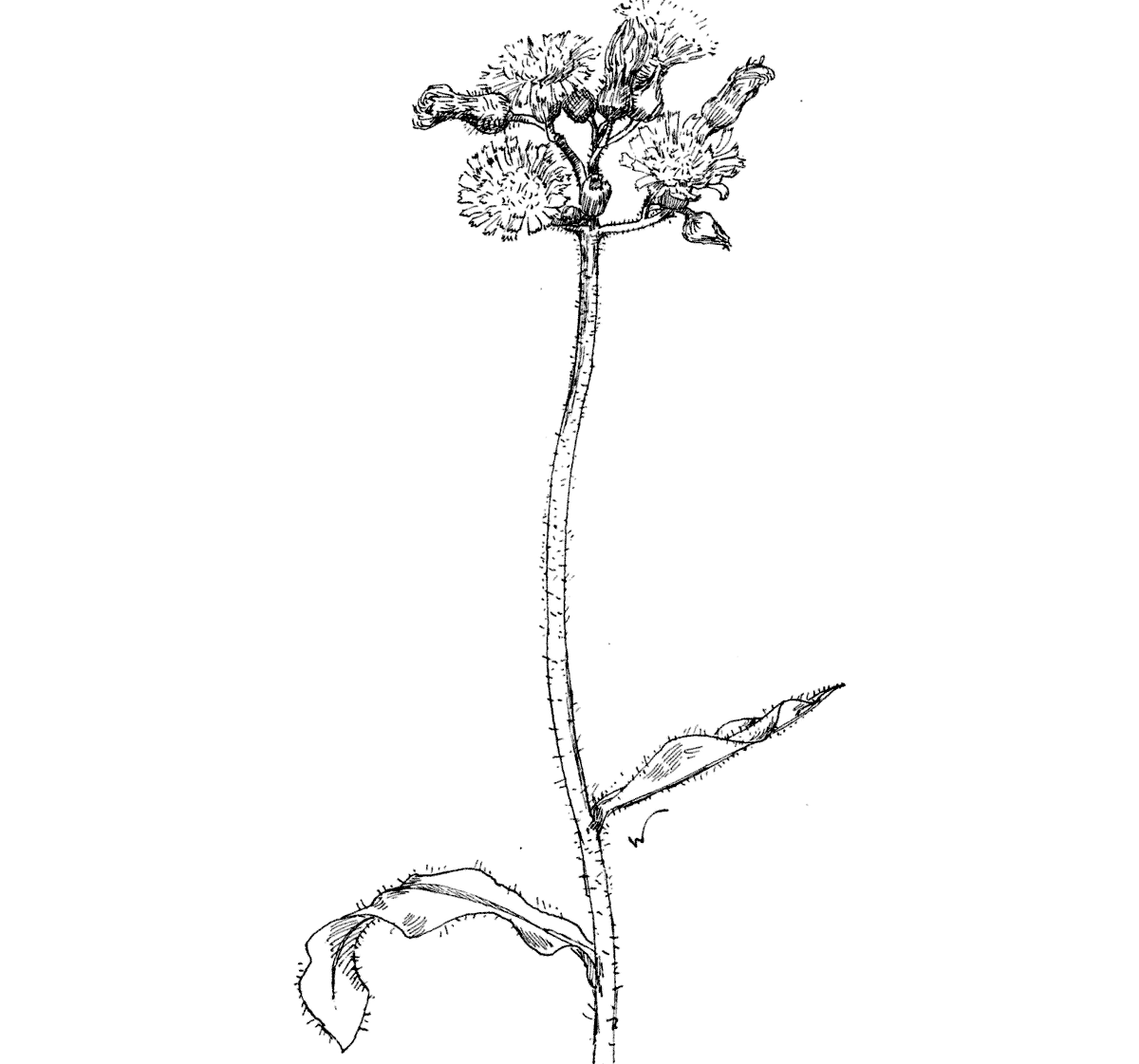
Hairy Hawkweed.Hieracium Gronovii.
Found, in August and September, in dry pasture lands.
The stalk branches only for the flowers, and varies from 12 to 16 inches in height; it is round, and slender, roughened by short small hairs, and is somewhat zigzag in manner of growth. Of a green or reddish-purple color.
The leaf is oval, pointed at both ends, with an entire margin, and strong midrib; both surfaces are rough and woolly. The color is green. The lower leaves are sometimes 4 inches in length, and narrow. The leaves are set immediately upon the stem, at long intervals.
The flowers are slightly notched at the tip. A strong yellow color. The cup is vase-shaped, hairy; and green. The heads are set on slender, rough-hairy stems, and arranged in a terminal cluster; a small leaf occurs at the junction of the stems.
The blossoms open only in the broad sunlight, and when plucked wilt quickly, thus losing their chief charm, a jaunty carriage.
HAIRY HAWKWEED: H. Gronovii.
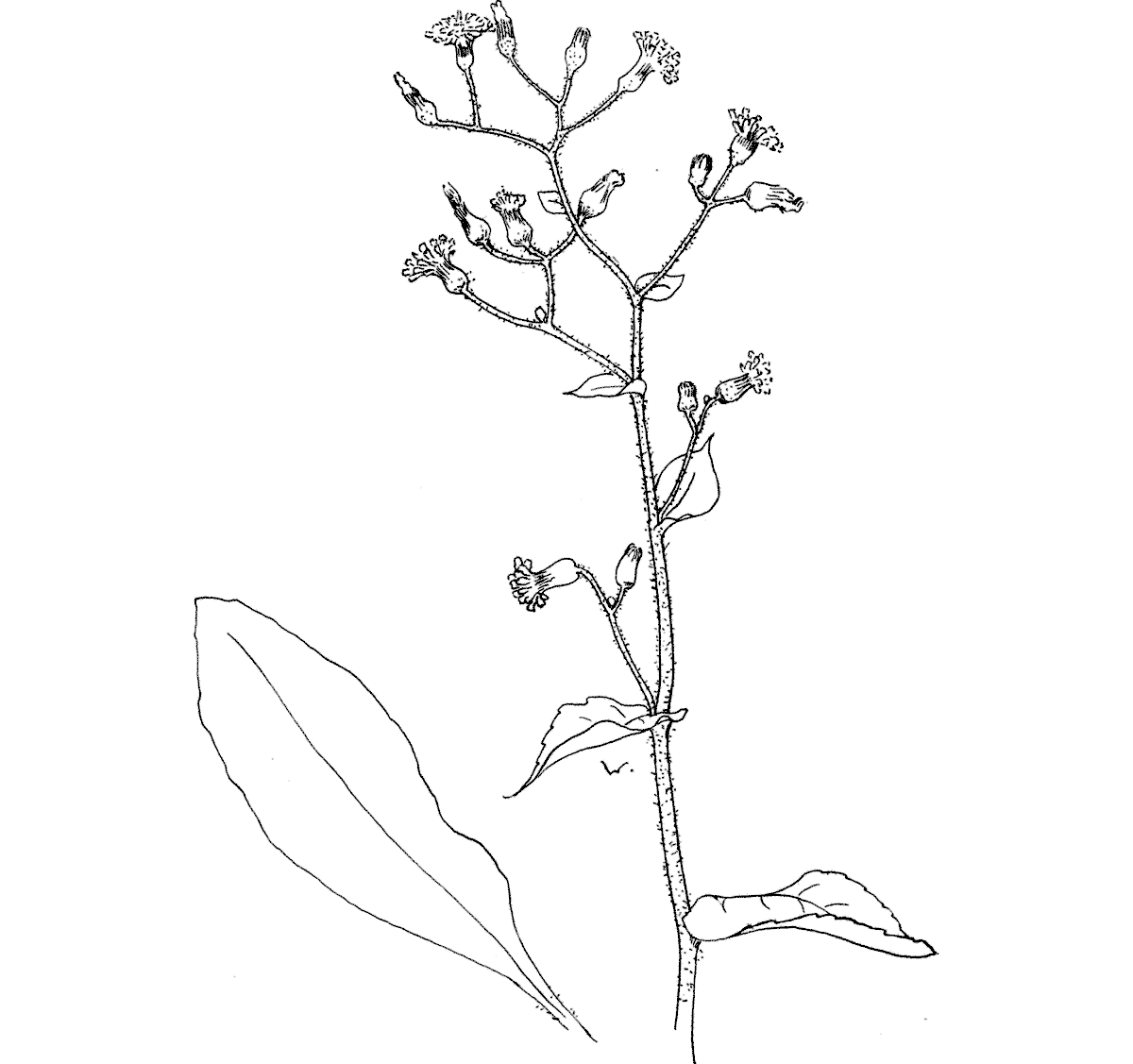
Wild Lettuce.Lactuca hirsuta.
Found on waysides, and edges of thickets, in July.
The simple leafy stalk grows to be 3 or 4 or 5 feet high; it is hollow, and large, with a strong fibre, a thick, milky and bitter juice, and a tough skin whose surface is somewhat hairy. The color is usually a dark purplish-red.
The long leaf is deeply cut, or lobed, even almost to the wide midrib,—the lobes pointing toward the base of the leaf,—the tip taper-pointed; the upper leaves are slightly or not at all lobed; the surface is smooth above, sometimes hairy on the underside of the midrib. The arrangement is alternate, the leaves partly clasping the stalk. In color a full green, the midrib of the lower leaves a dark reddish-purple.
The minute flowers are collected in small heads, set in vase-shaped green cups; their color varies from a light, dull lavender, to a dingy white. The heads grow in branching clusters from the summit of the stalk.
The stout, tall, dark red stalk and broadly veined leaves make this a conspicuous inhabitant of the roadside; its small flowers however do not seem to fulfil the promise put forth by this vigorous growth. The dark brown, flattened seeds have fine, white, dandelion-like plumes.
WILD LETTUCE: Lactuca hirsuta.
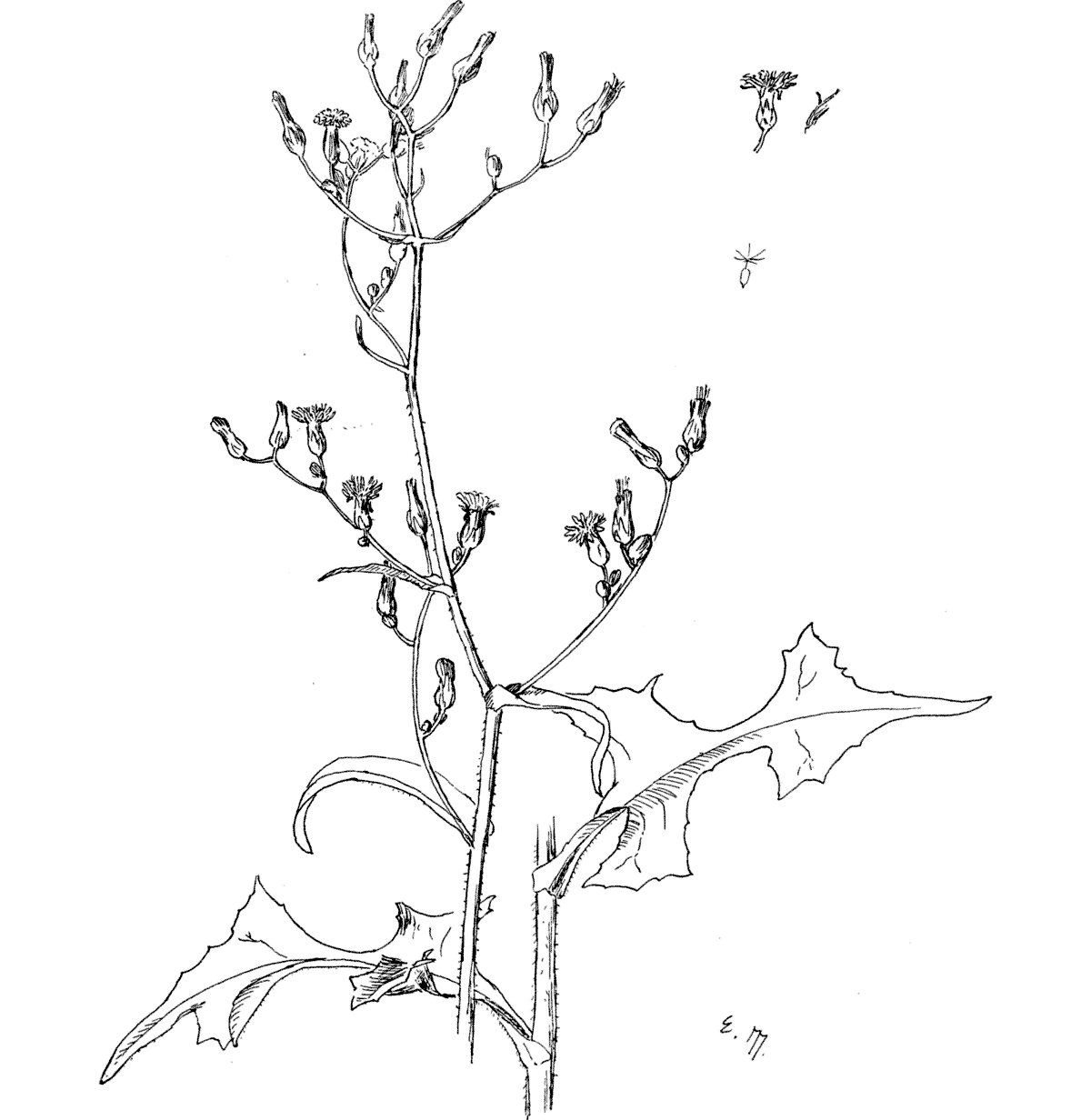
Wormwood.Artemisia Absinthium.
Found during July and August along roads and lanes.
The stalk grows from 2 to 3 feet high, and is branching, and shrubby; its fibre is strong, it is slightly grooved, and silky to the touch. In color silvery green.
The rather small leaf is often divided to the midrib, the divisions being long and narrow; the surface is smooth, with fine silky hairs. Color, silvery green. The leaves are set upon the stalk in clusters, alternately; they have an aromatic scent.
The flowers are very minute, of a pale yellowish-green color, and clustered in small hemispherical heads, in pale green cups; their heads, nodding along the sides of the slender branchlets, form long terminal spires.
This Artemisia, though escaped from the garden, has taken most kindly and naturally to the common road, where its light silvery sheen renders it quite distinct from the surrounding growths. It has an agreeable pungent odor, resembling that of the Chrysanthemum, though much stronger, and it is very bitter to the taste.
WORMWOOD: Artemisia Absinthium.
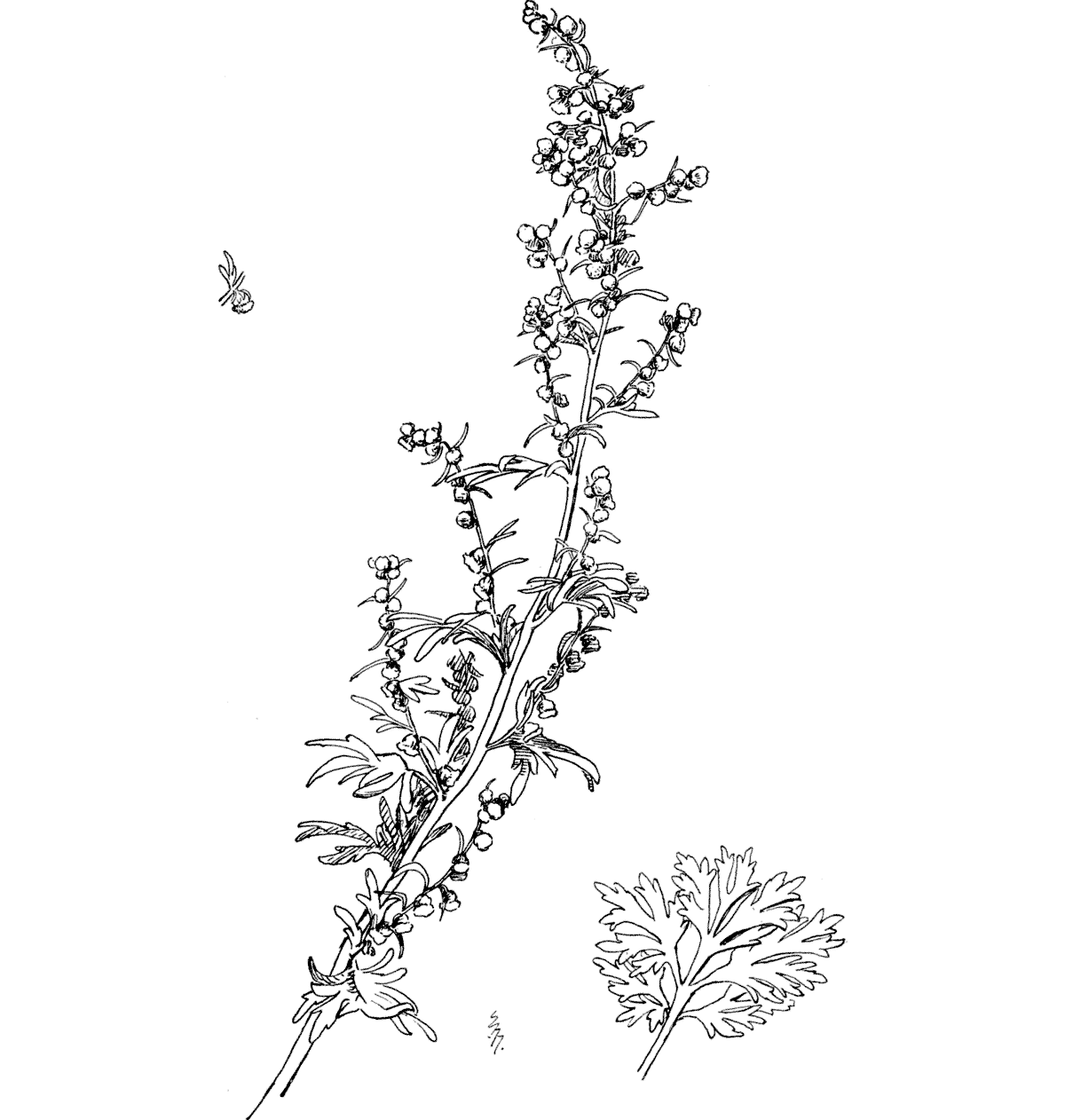
Tansy.Tanacetum vulgare.
Found in July and August, chiefly along walls and fences, although occasionally in fields.
The stout and sturdy stalk, which grows to be sometimes 4 feet high, is branching and leafy, tough-fibred, round and smooth. Of a rich, light green color.
The large and long leaf is so deeply cleft into many narrow, oblong divisions, and the margin is so regularly toothed, that it bears the appearance of a curly feather; the vigorous curving midrib is an important feature; its texture is coarse, and it is pungently odorous. The color is a full, rich, dark green.
The flowers are very small, of a strong, full yellow, tending slightly toward green; packed tightly into a flat head, like a button with a little dent in the middle. The heads, enclosed in a shallow, yellow-green leafy cup, are set on slender, light green stems, and arranged in large, loose terminal clusters.
Growing in thickly-settled communities the Tansy plant forms a well known member of the roadside tenantry with its noble dark foliage, luxuriant and usually free from blight, and strong stalks topped profusely by the flower clusters, whose yellow is toned to a remarkable harmony with green. On a hot day the smell of the Tansy may be perceived at a considerable distance. “In the spring time are made with the leaves hereof, newly sprung up, and with eggs, cakes or Tansies, which be pleasant in taste, and goode for the stomacke,” says Gerarde, and echoes of rules for Tansy-cakes come to us from the records of early New England house-wives.
TANSY: Tanacetum vulgare.
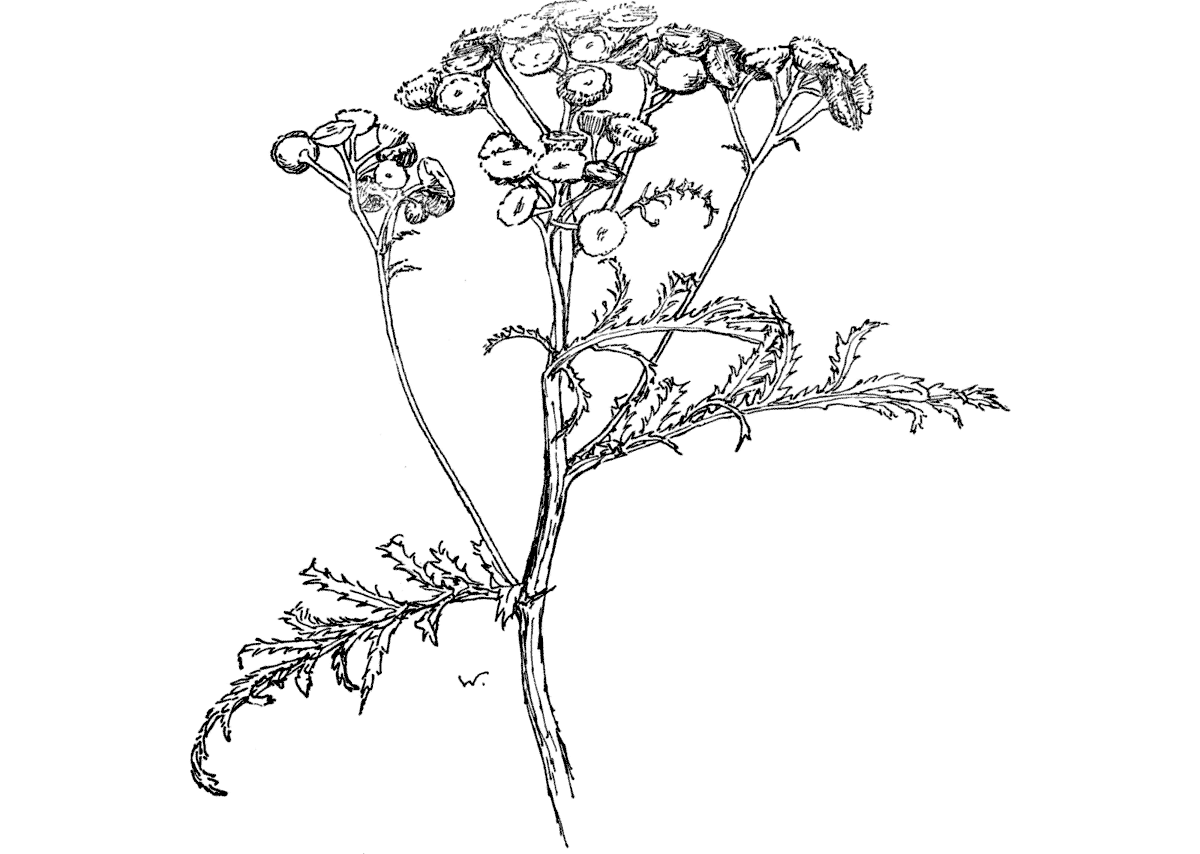
Black-Eyed Susan.Rudbeckia hirta.
Cone Flower.
Coreopsis.
“Yellow Daisy.”
Golden Jerusalem (N. H.)
Found in sunny meadows and grass fields during July and August in great profusion.
The stalk (from 1 to 2 feet high) is very erect, sometimes bears branches, and is sparingly leafy; it is strong-fibred, coarse-textured, and hairy. The color, light green, is often brownish near the foot.
The leaf is long and narrow, with a fine-pointed tip, and an entire margin; the texture is loose, and the surface rough. The color is yellow-green. It slightly clasps the stalk. The leaves are arranged sparsely and alternately.
The minute flowers, of a rich, deep purple-brown color, are packed smoothly and closely in a cone-shaped head, the base of which is surrounded by a single row of 12 or 15 rays; these rays are over an inch long, and are sometimes one-half wide, they are blunt-pointed with a notched top, their texture is silken and faintly shows the veins, and their color is of a noble full yellow. The head is set upon a mat made of a double row of overlapping, small, green parts, and is borne singly on the summit of the stalk, or branch.
A ruthless invader of mowing lots where it makes a brilliant patch of color that may be discerned from afar, the farmer wages war on this handsome flower. It is not unusual to find it indulging in odd variations upon the established habit of blossoming, such as doubling the rows of rays, or with two or three heads bunched together, or set atop of one another.
BLACK-EYED SUSAN: Rudbeckia hirta.
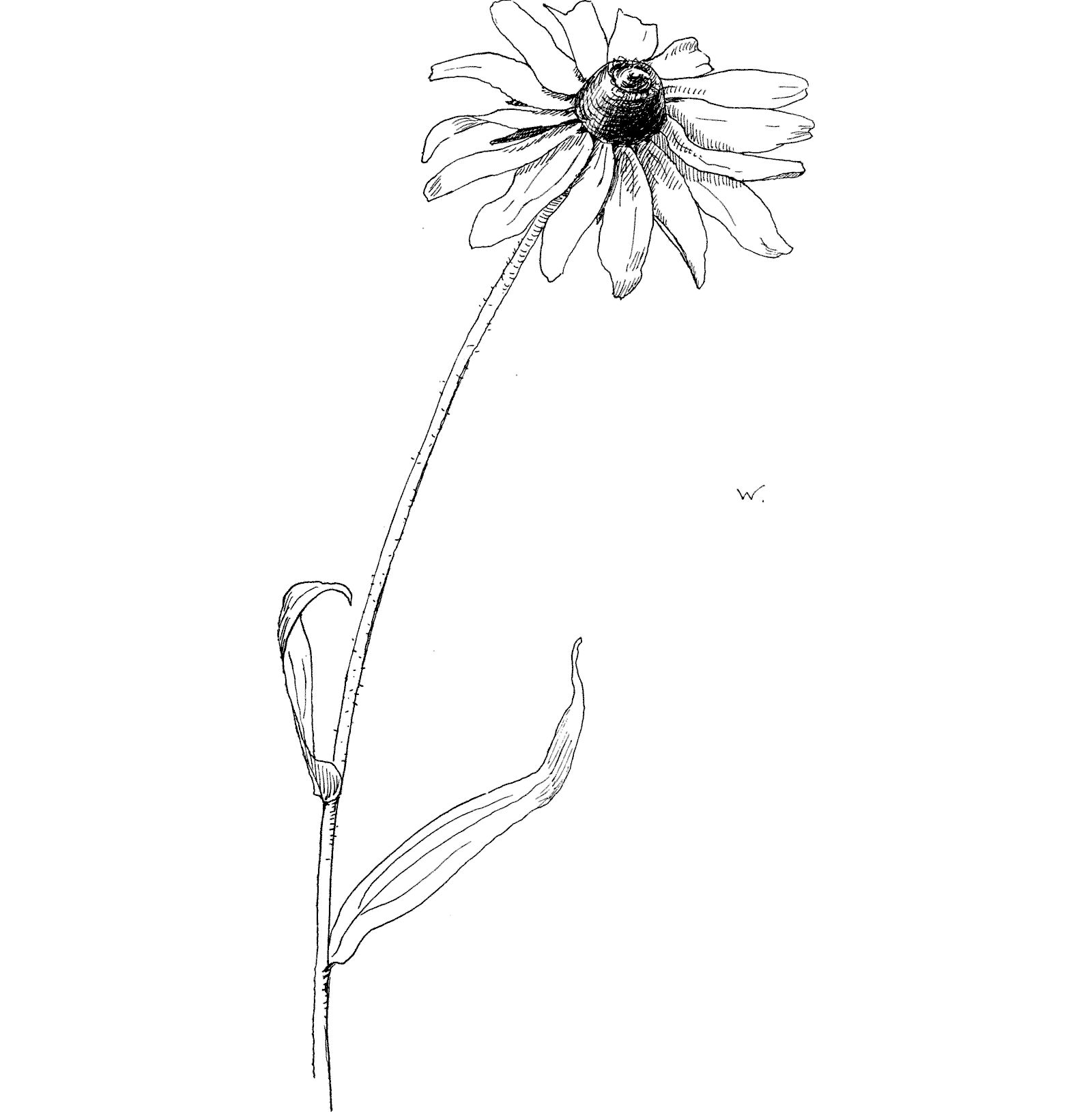
Thoroughwort.Eupatorium perfoliatum.
Boneset.
Found in roadside thickets, and the borders of copses, during July and August.
The simple stalk, commonly about 2 feet high, sometimes grows to the height of 4 feet; it is large, strong-fibred, round, and hairy to the touch. In color pale green.
The leaf is lance-shaped, with a long fine-pointed tip, and united at the base to the opposite leaf, completely encircling the stalk as though strung upon it; the margin is finely notched, the midrib stout, with many veins showing; the upper surface is rough, the underside is hairy. The color is a strong green. The pairs of leaves are set at right angles with each other, and at a considerable space apart.
The flowers are small and feathery; greenish white. They are gathered in small tuft-like heads, and arranged in loose, leafy, terminal clusters, on short, stout, pale stems.
A charming kink in the outline marks the joining of the leaves. The pleasant perfume of the blossoms is proclaimed by the frequent visits of the bees. Sometimes the flower-cluster spreads to an unexpected size; personal measurement has discovered a plant, but 18 inches in height, whose clustered bloom was fully a foot across.
THOROUGHWORT: Eupatorium perfoliatum.
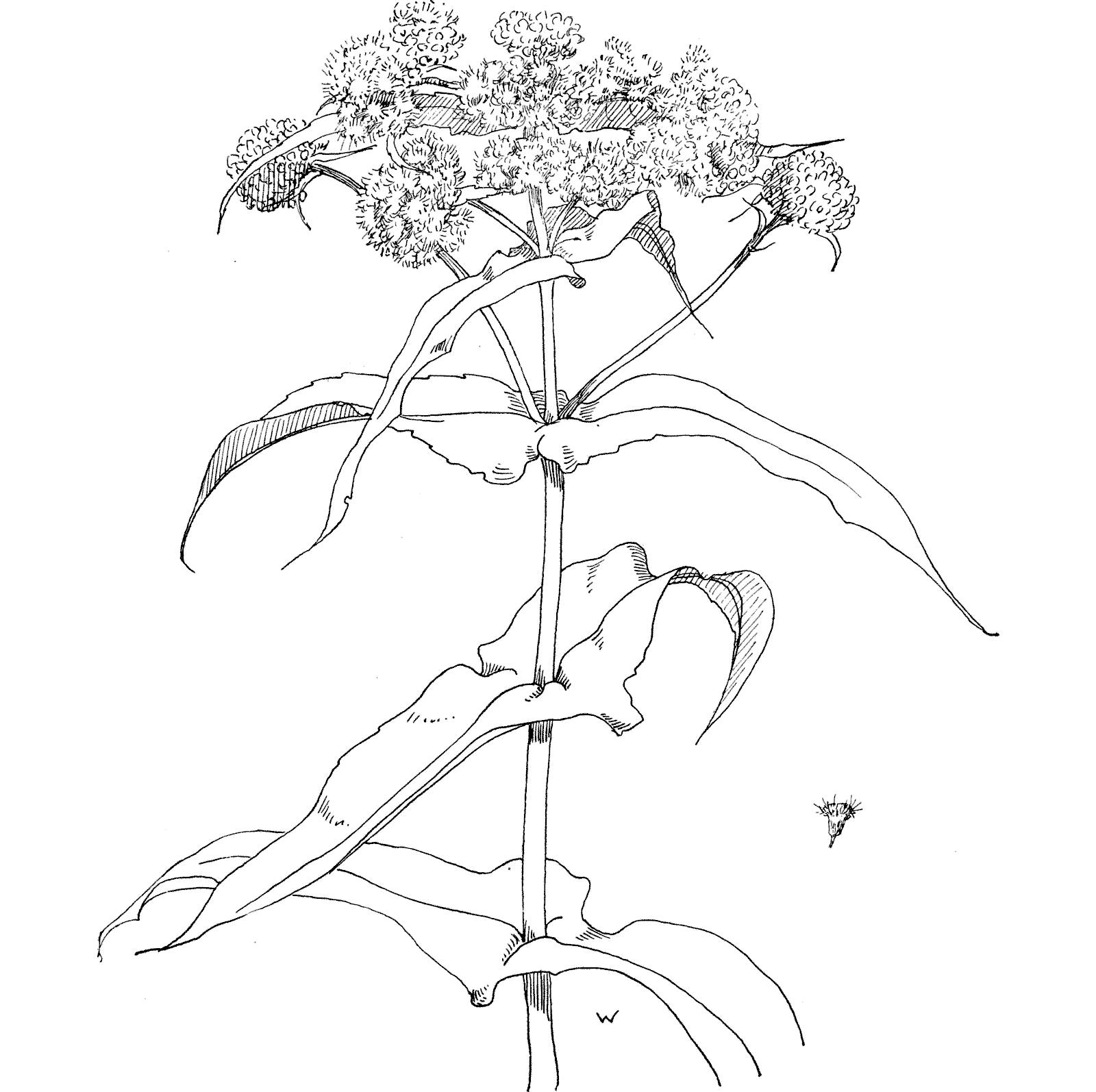
Eupatorium.Eupatorium ageratoides.
White Snake-root.
Found in rich moist soil, along the edges of woods and shaded roads, in August and September.
The stalk (from 2 to 4 feet high) branches a little, and is leafy; it is large, strong, fine-fibred, and smooth. In color, pale green, tinged with dull purple.
The leaf is large, broadly oval, taper-pointed, and widest at the base, with 3 marked ribs, a coarsely toothed margin, a thin texture, and smooth surface. The leaves are set on short stems, and are placed opposite each other on the stalk. The color is green.
The minute flowers, and projecting pistils, are white; and grouped in small heads, enclosed in vase-shaped cups of green, on short stems. The heads are arranged in close, rather flat-topped clusters on the top of the stalk, and springing from the angles of the upper leaves.
This plant comes into bloom in company with its next of kin, Joe Pye and Boneset; it thrives well under cultivation, and certainly is worthy of a better name than “Snake-root,”—which is, perhaps, the reason it is so generally known by “Eupatorium,” the generic name it shares with so many others. It is much frequented by some small creature who leaves a pale labyrinthine trail etched on the broad surface of its leaves.
EUPATORIUM: E. ageratoides.
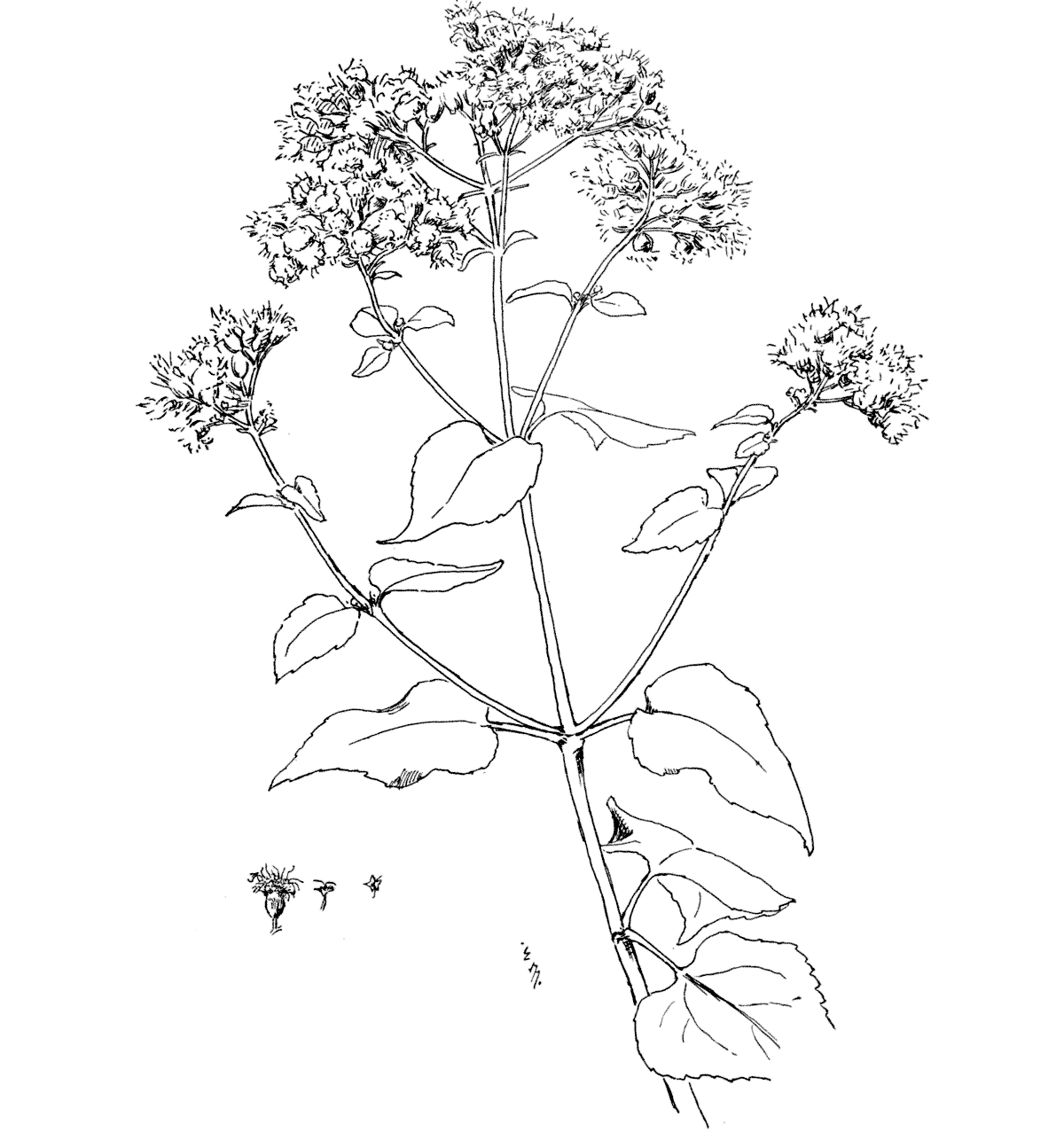
Joe Pye Weed.Eupatorium purpureum.
Trumpet Weed.
Found in moist grounds, ditches, and meadows, during August and September.
The erect, single, and leafy stalk varies from 4 to 8, or even sometimes 9, feet in height; it is large, and stout, and roughish to the touch. The color is a dull pinkish-purple.
The leaf is large, and oblong, tapering at both ends, the tip becoming a long slender point; the margin is notched, the ribs form a stout netted framework, the texture is coarse, and the surface is roughened. The leaves are set on very short stems, and arranged in whorls, of 3 to 6, about the stalk, at regular intervals. In color they are a strong vigorous green, the ribs often tinged with purplish-pink.
The small tubular flowers, and projecting thread-like pistils, are, in color, a light pinky purple; they are grouped in small heads, whose cups, and short foot-stems, are of the same color. The heads are arranged in thickly branching, large, more or less flat-topped, terminal clusters.
Joe Pye is a striking plant, of vigorous growth, whose large whorls of leaves are full of sweeping curves. Out of the sunlight and close at hand the flowers seem a little dingy in color, but by the wayside it is pleasing in tone. Why “Joe Pye”?
JOE PYE WEED: E. purpureum.
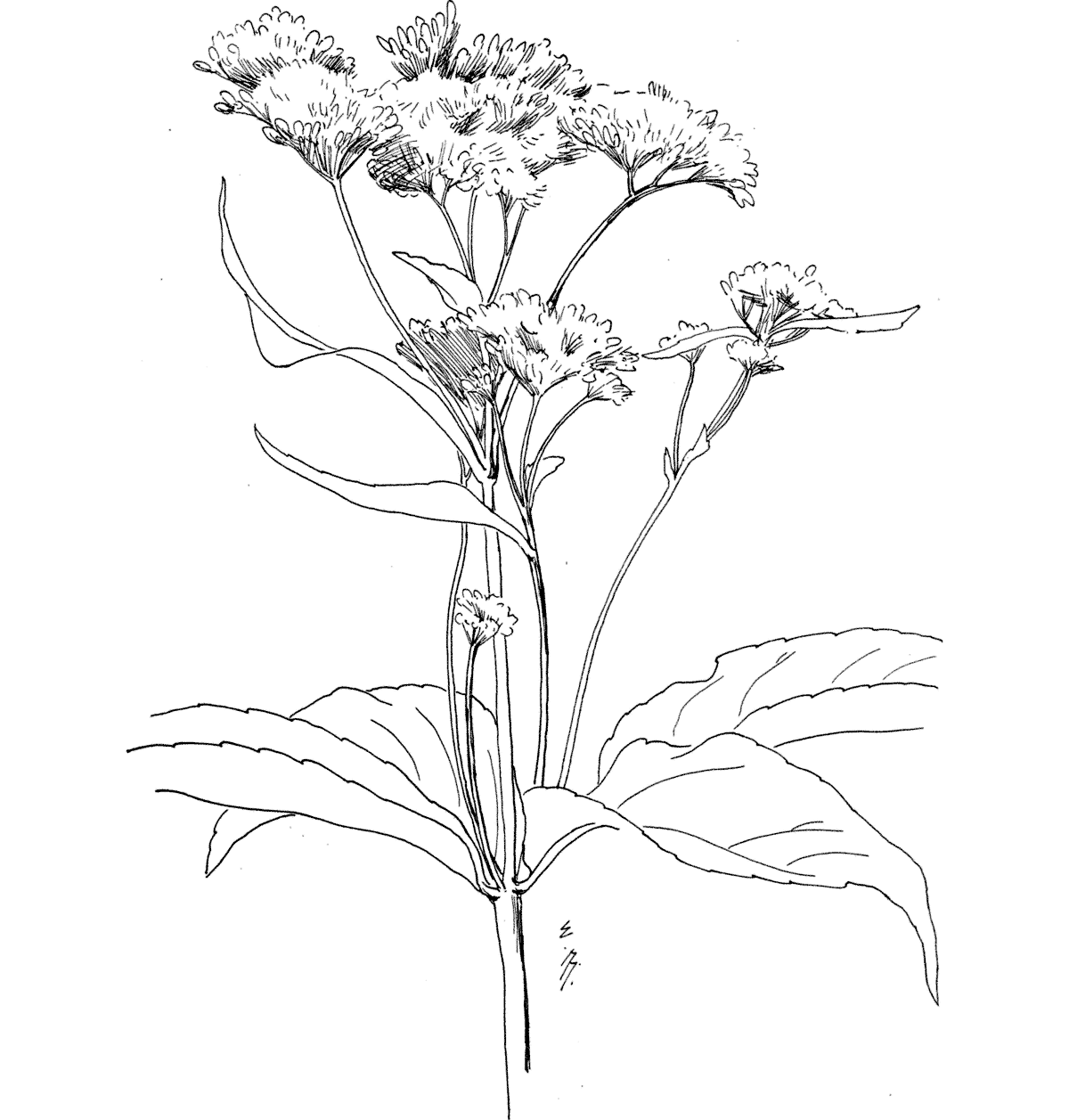
Common Thistle.Cnicus lanceolatus.
Found in pastures during July and August.
The branching, leafy stalk is 1 or 2 feet high; large, round, and tough-fibred; covered with white wool. In color, green.
The leaf is long, and narrow, tapering to a long point, with a large, stout, and curling midrib; the margin is deeply, and often cut, and armed at every point by strong, stiff, thorn-like spines. The texture is tough, and the upper surface is prickly, while the under is woolly with web-like hairs. The leaf clasps the stalk, and hugs it for a full inch or more before it springs away with a free curve; the lobes are ruffled, and flaring, as they lie along the stalk. The arrangement is alternate, and rather near together. The color is green, lighter at the midrib.
The flowers are small and silky; in color a beautiful deep crimson, tending toward violet. Many flowers are gathered into a large round-topped head, that is held in an admirably shaped green cup, which is protected by many, long, needle-pointed, white spines. One or two flower-heads occur together on the summit of the stalk, or branch. Their perfume is delicious.
This might well be named the Warrior Thistle, being armed cap-a-pie for conflict with cows and boys, and nearly impregnable against them. It loves to sit beside a boulder in the midst of cow-path, or bye-lane, and defy intercourse with any, save the bumble-bees, who sleep upon the silken flower o’ nights. Special observation should be given to the classic vase-shape of the cup.
COMMON THISTLE: Cnicus lanceolatus.
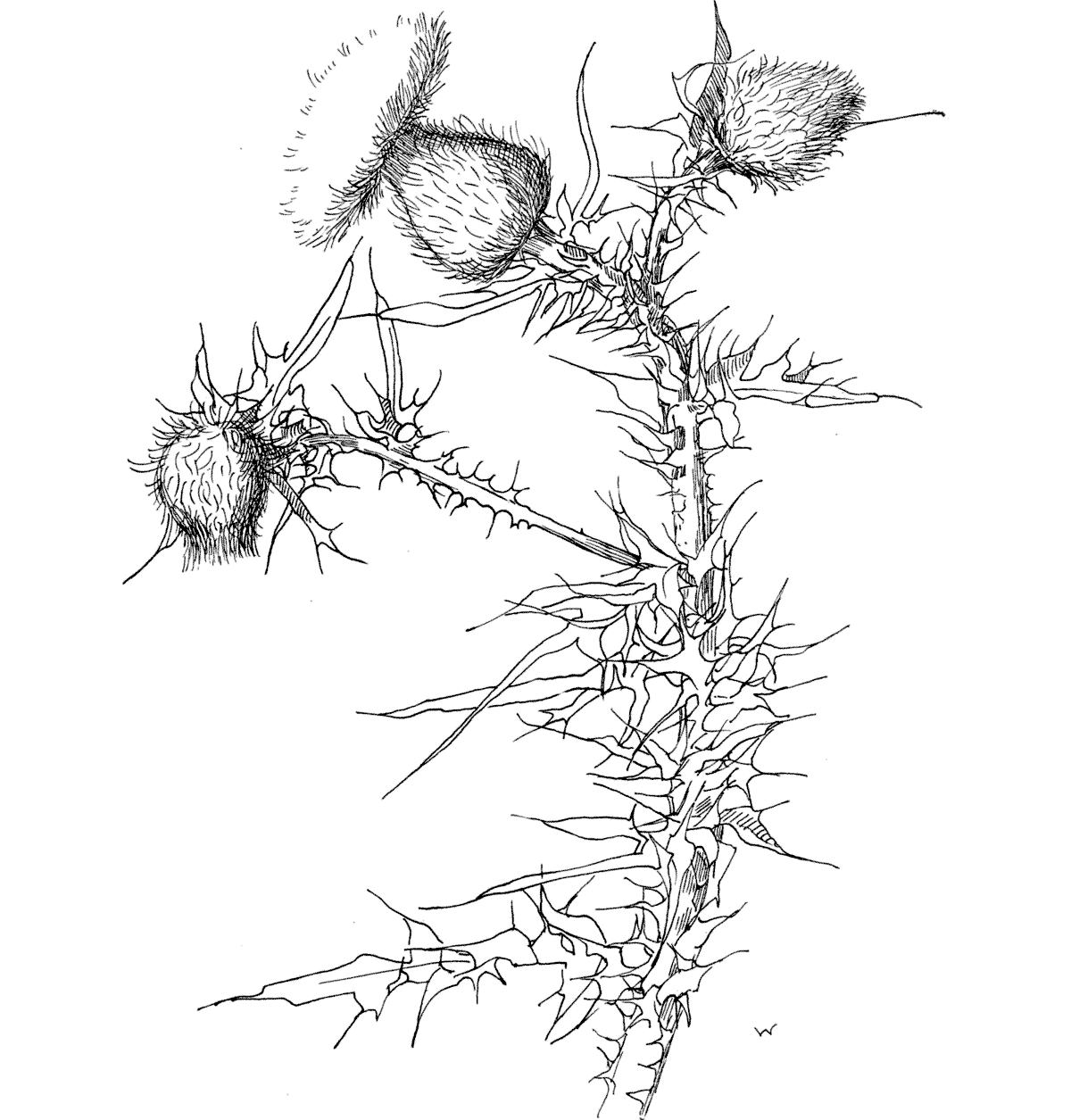
Pasture Thistle.Cnicus pumilus.
Bull Thistle.
Found in dry pastures, uplands, roadsides, during July and August.
The erect, and somewhat branching, stalk varies from 1 to 3 feet in height; it is sparingly leafy, very large, and stout of fibre, and round; hairy to the touch. Color, green.
The leaf is long, and narrow, with a stout midrib; the margin is cut frequently but not deeply, each joint being tipped with a spine that is not so long as those of the Common Thistle; the texture is strong-fibred, the upper surface rather smooth, the underside covered with cobwebby hairs. The color, green. The leaf somewhat clasps the stalk; and the arrangment is alternate, at some distance apart.
The silky flowers are crimson-purple, less strong in tone than the Common Thistle; spreading softly, in a large, rounded, downy head, from the large cup. The cup is a fine urn-shape, closely covered with short prickles; green in color; with a few small leaves at the base. One to three flower heads rise from the summit of the stalk, or branches.
Larger (the flower-head is often nearly two inches across), but less ferociously equipped than the Warrior Thistle, this carries a sweeter perfume, and is the beloved of the bees. Especially is the flower-head lovely in color.
PASTURE THISTLE: C. pumilus.
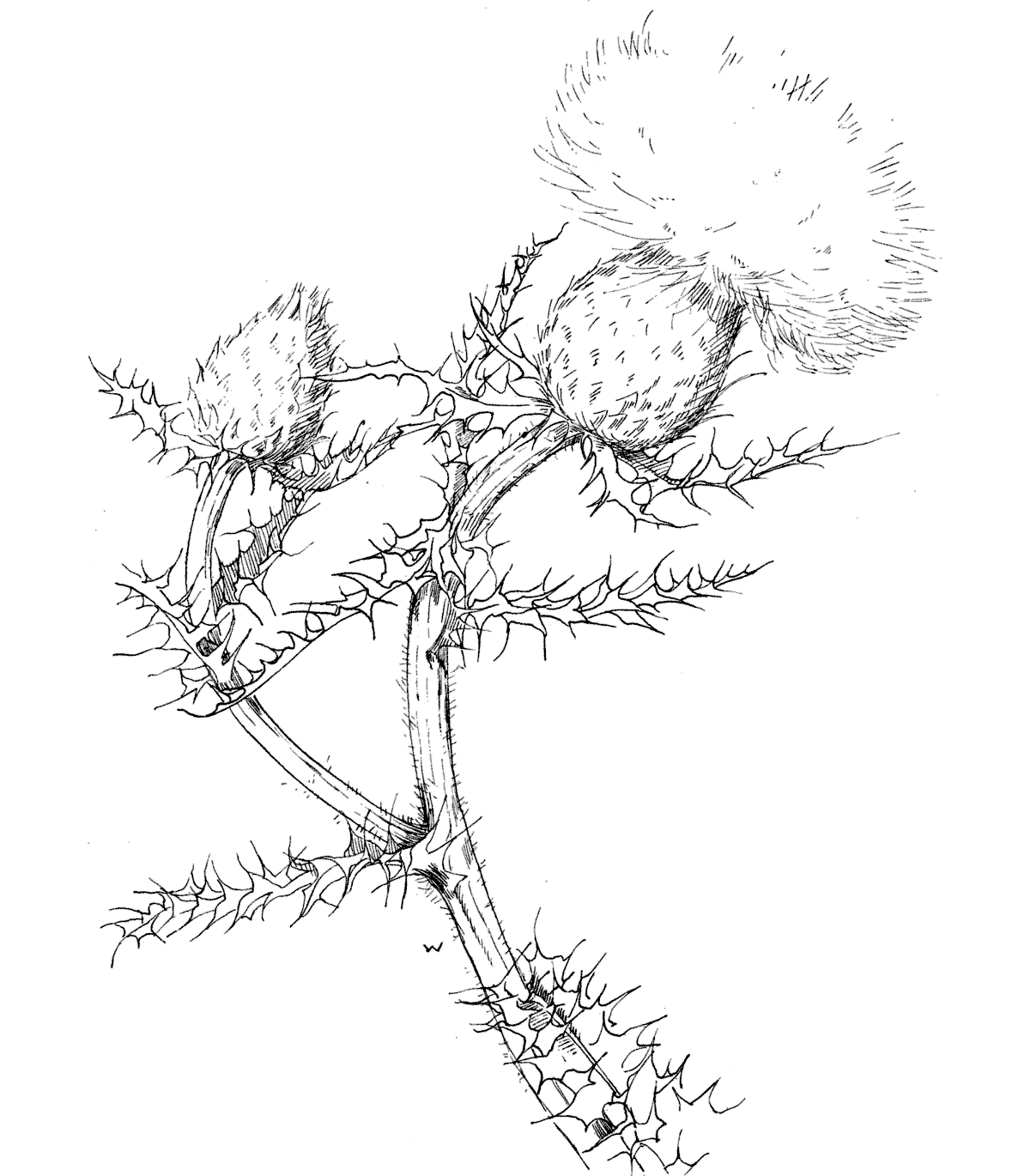
Canada Thistle.Cnicus arvensis.
Found, during July and August, in lanes and fields.
The stalk is branching, and leafy, and from 2 to 3 feet in height; it is large, tough in fibre, and grooved. Its color is grayish-green.
The leaf is narrow, and sharp-pointed, the margin deeply notched, and much ruffled, and bristling in all directions and from every notch with short, sharp spines; the strong midrib is lighter in color than the grayish-green leaf. The leaves, set immediately upon the stalk, are alternately placed.
The small tubular flowers are 5-pointed, and the thread-like stamens and pistils are prominent; their color is lavender, while the stamens and pistils are white. They are gathered into tufted heads, enclosed in a gray-green vase-shaped cup, that is protected by short weak prickles; they grow in loose, branching clusters on the top of the plant.
This Thistle grows in great communities, spreading rapidly, and justly considered a pest by the farmer. The mass of its lavender colored bloom in its prime is pleasing to the eye, but later it develops an unkempt and weedy aspect, more befitting its character of an unwelcome tramp. Its flowers are sweet scented, and much sought by bees and butterflies.
CANADA THISTLE: C. arvensis.
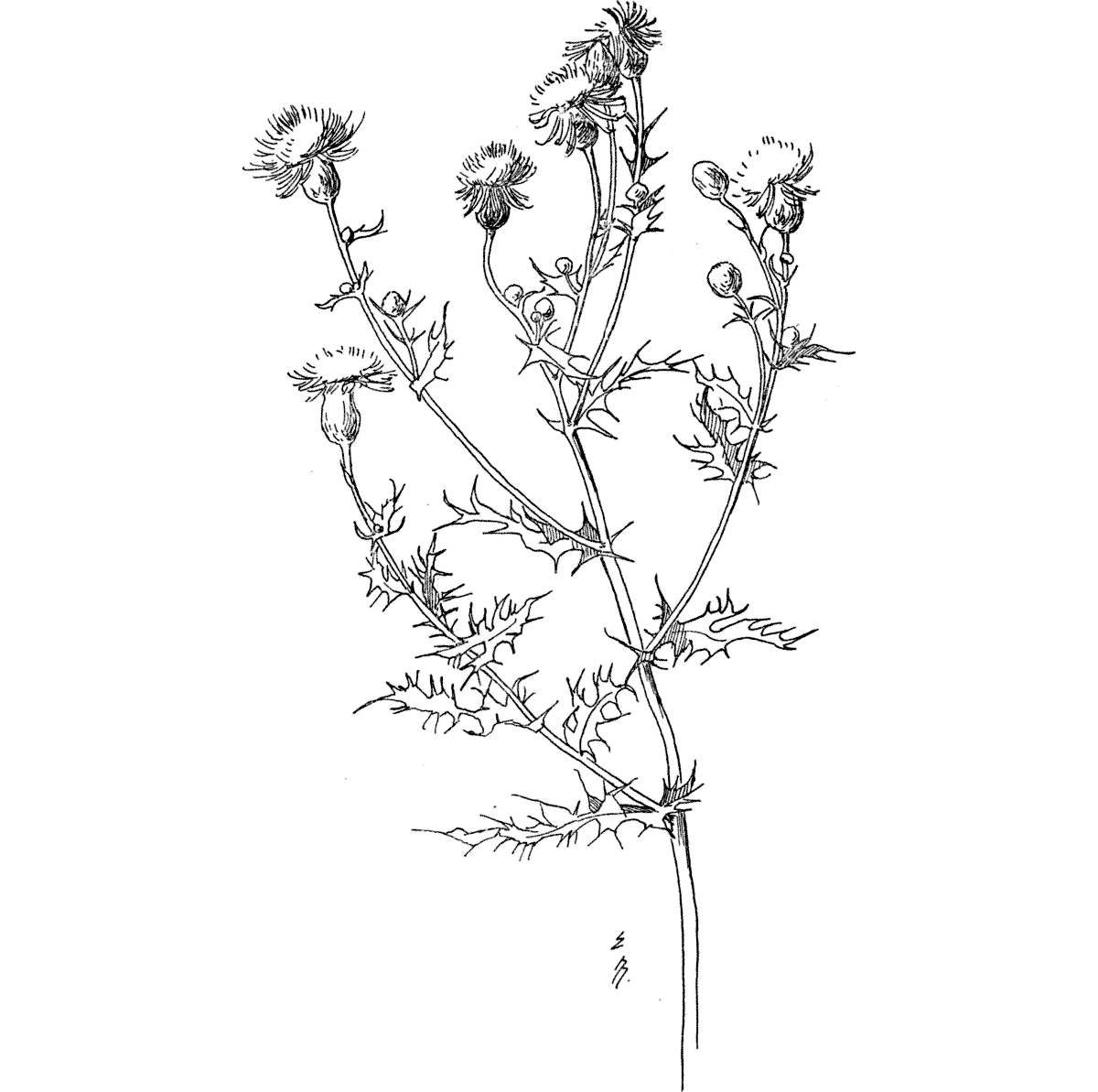
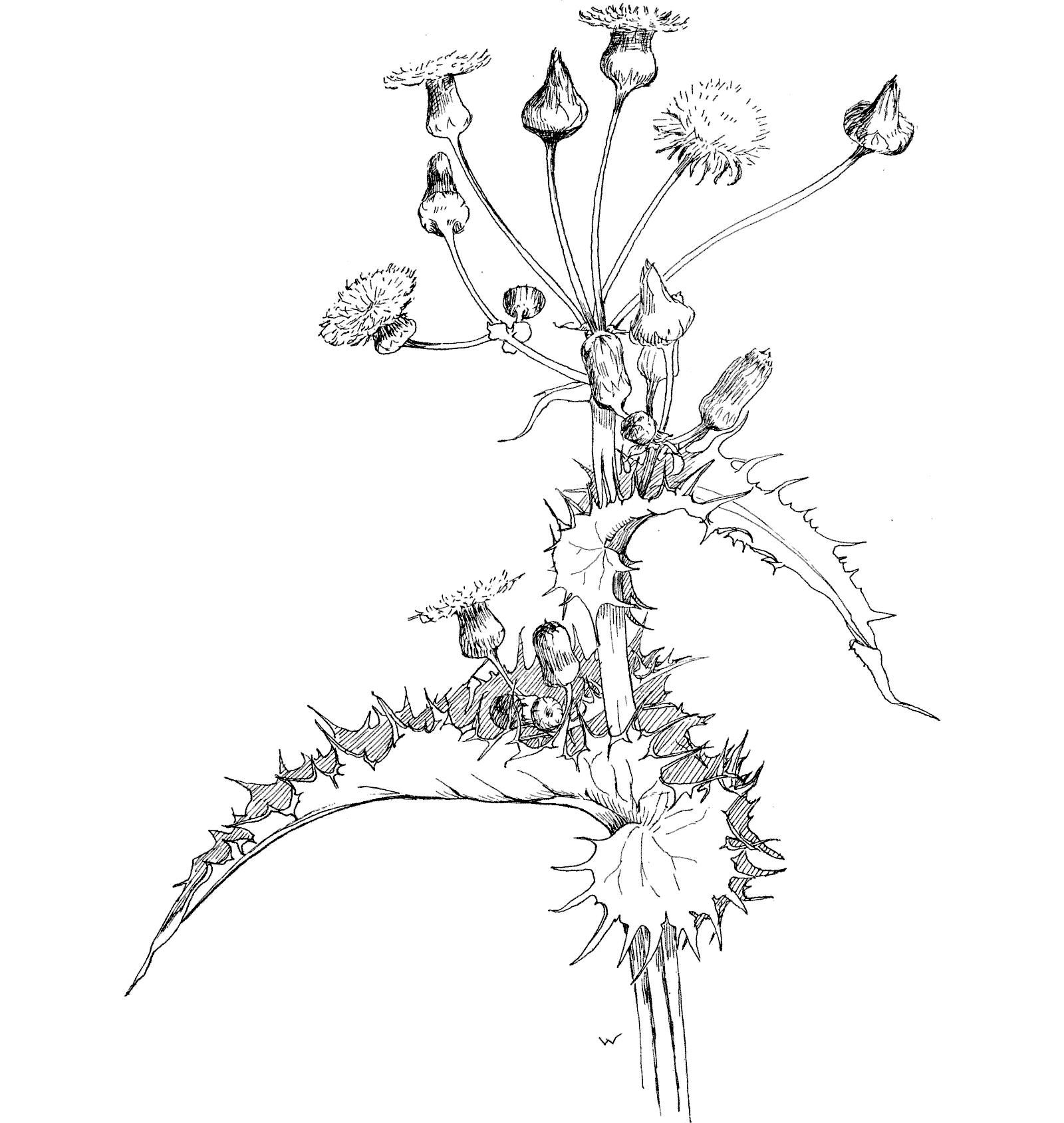
Spiny-leaved Sow Thistle.Sonchus asper.
Found in cultivated fields, and along roadsides, in August.
The stalk is either simple, or branching near the top, from 2 to 3 or 4 feet high, large, round, and very hollow like a tube, and juicy; it is grooved, and smooth to the touch. The color is green, sometimes streaked with red near the foot.
The leaf is very long (sometimes 10 inches), lance-shaped with a tapering point, and noticeable rounded wing-like bases; the margin is deeply and irregularly toothed, and the edge is rolled under, thus making the teeth sharp-pointed, and stiff, like little spines; the midrib is prominent beneath, wide, flat, and pale above; underneath many veins show; the texture is thin, and the surface is smooth. The upper side is a cool clear green, the underside silvery, with a pale bloom. It is clasping, the prolonged bases flaring like wings on either side of the stalk.
The flowers are tiny and downy; light yellow in color; gathered in a flat-topped head (which is less than an inch across), enclosed in a small vase-shaped, green, and leafy cup. The heads are set on slender stems, in loose terminal groups, or singly on short leafy stems from the angles of the leaves; at the junction of these foot-stems small, oval leaves occur.
Nothing could be more suggestive of decorative design than the fine arch and spring of this leaf, with its ornamental winged clasps; and its refinement of color is an added excellence. The highly inappropriate folk-name (it is said to be a favorite article of diet among the English swine) should be abolished, and the plant called instead The Gothic Thistle in memory of a school who could appreciate its sculptural significance better than the moderns.
SPINY-LEAVED SOW THISTLE: Sonchus asper.
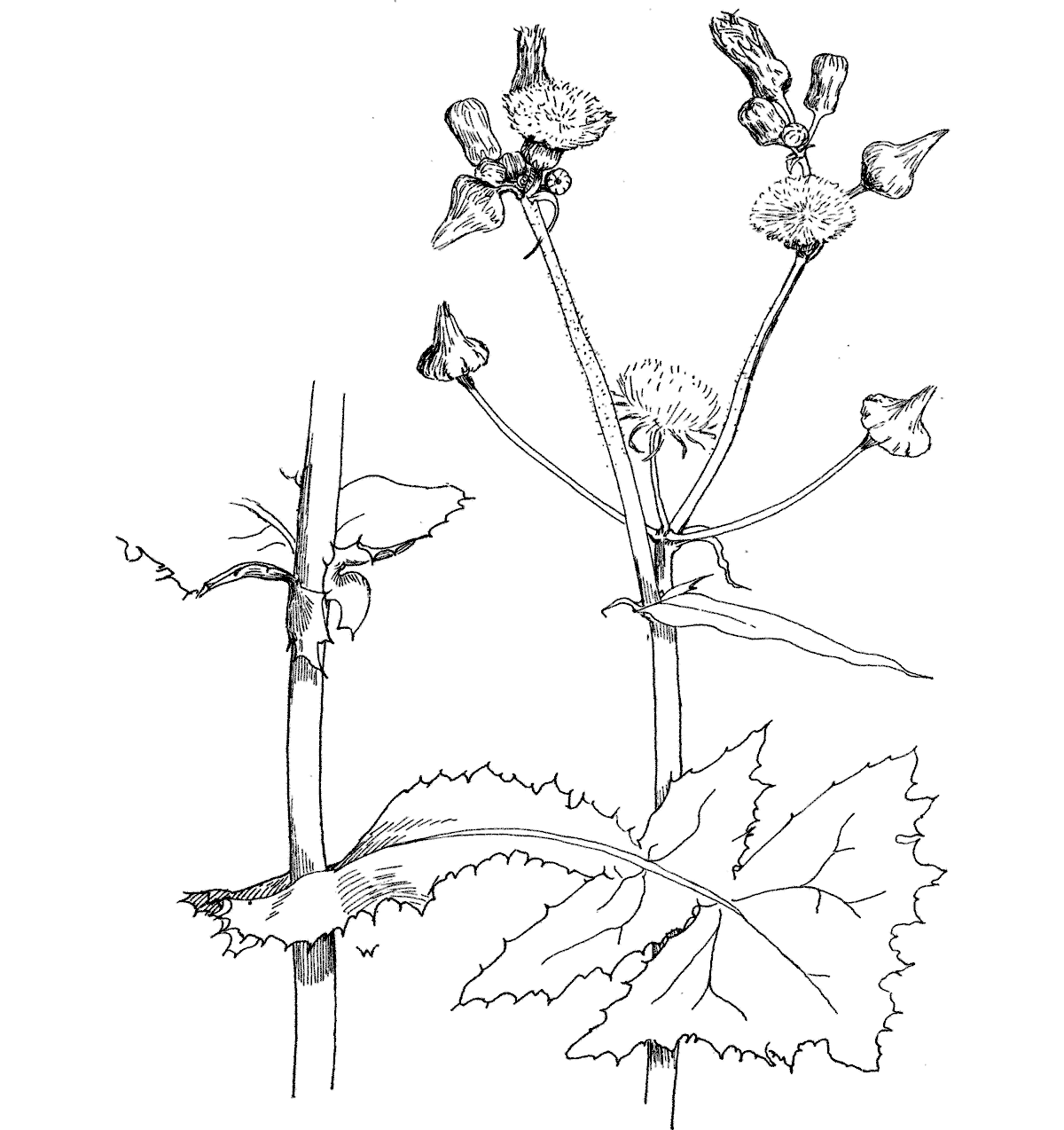
Common Sow Thistle.Sonchus oleraceus.
Found in fields, and cultivated lands in August.
The stalk varies in height from 1 to 4 feet; it is single, and leafy, somewhat twisting, tougher in fibre than S. asper, hollow, with a milky juice, and smooth. Color, a cool green.
The curiously cut leaf (about 6 inches long) is divided into a large triangular tip, a pair of acute-angled flaring side divisions, and narrow long-pointed bases which project like sharp-pointed wings beyond the stalk they clasp. Occasional leaves are not cut, and are merely lance-shaped. The midrib is flat above, and round beneath; the margin is toothed, with fine, weak spines; the texture is firm, and the surface is smooth and shining. Color, a fine cool green, the underside silvery with bloom. The arrangement is alternate.
The flowers are similar in color, size, and arrangement to S. asper. The foot-stems are sometimes bristly with short hairs, and at their junction occurs a long-pointed, small leaf, whose margin is entire. Below the flower-cluster the stalk is bare for a considerable space; single flower-heads spring from the angles of the leaves the greater part of its height.
The immature flower-heads are wrapped in a woolly blanket. The leaf is something like a Dandelion’s in shape, and interesting from a decorative point of view. These plants are said to be common to many countries,—Europe, Africa, and New Zealand. In the last-named region an old traveller says the parrots “of beauteous dyes, but odious accents” feed upon it.
COMMON SOW THISTLE: S. oleraceus.
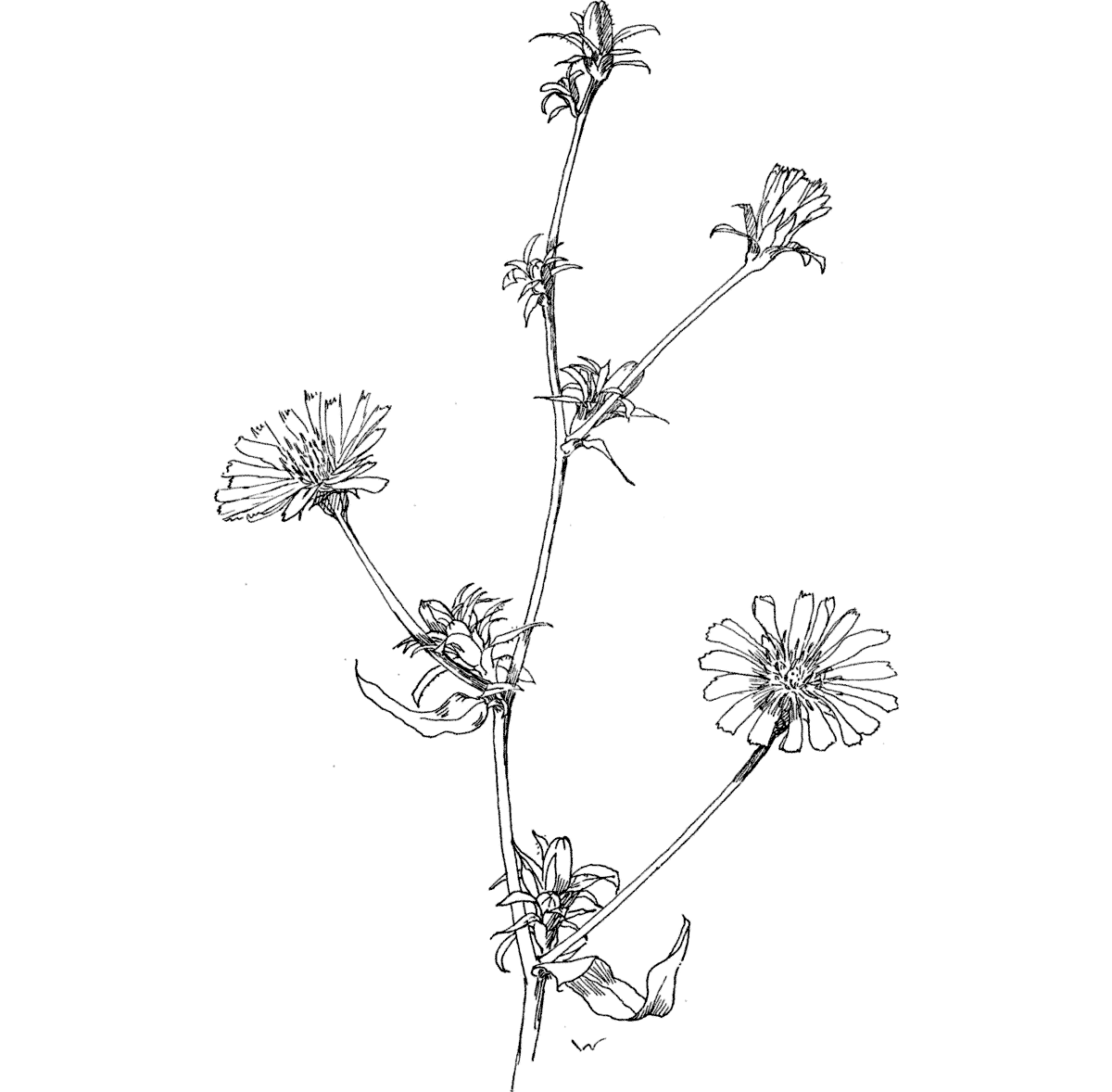
Chicory.Cichorium Intybus.
Succory.
Blue Sailors.
Found, from July to September, growing in dry waste places.
The stalk, which varies from 2 to 4 feet in height, is branching, and leafy, rather large, stout and tough of fibre, and rigid in growth; it is grooved and hairy. The color is gray-green.
The leaf is not large, oblong in shape, with a sharp tip; the margin is slightly notched, with spreading hairs along the edge; the midrib is strong and the surface is hairy; the gesture curving, or wavy. In color, gray-green. The lower leaves are sharply cut at the base. The arrangement is alternate, and the leaves clasp the stalk.
The flower is “strap-shaped,” rather broad, with a finely notched lip; the texture is very fine and thin, and the surface is shining and smooth. The color is an exquisite gray-blue or lavender, sometimes inclining to lilac, or even to pink. The flowers are arranged in heads, composed of several rows, spreading from a leafy green cup, which is closely surrounded by 4 or 6 little leaves (or “bracts”): all these parts being hairy. The heads are set close to the stalk in groups of twos and threes, in the angles of leaves, or singly on short stout stems.
These charmingly colored blossoms are scattered all along the stalks and branches, beginning near the foot, where they first open, not more than a few being in perfection at once. This scantiness of bloom and the stiff weediness of its growth make the Chicory plant less loved than it deserves for the peculiar beauty of its blue flowers. It grows most profusely near the seaboard, and in vacant city lots or neglected door-yards it bravely tries to hide the ugly remnants of civilization thrown aside by man.
CHICORY: Cichorium Intybus.
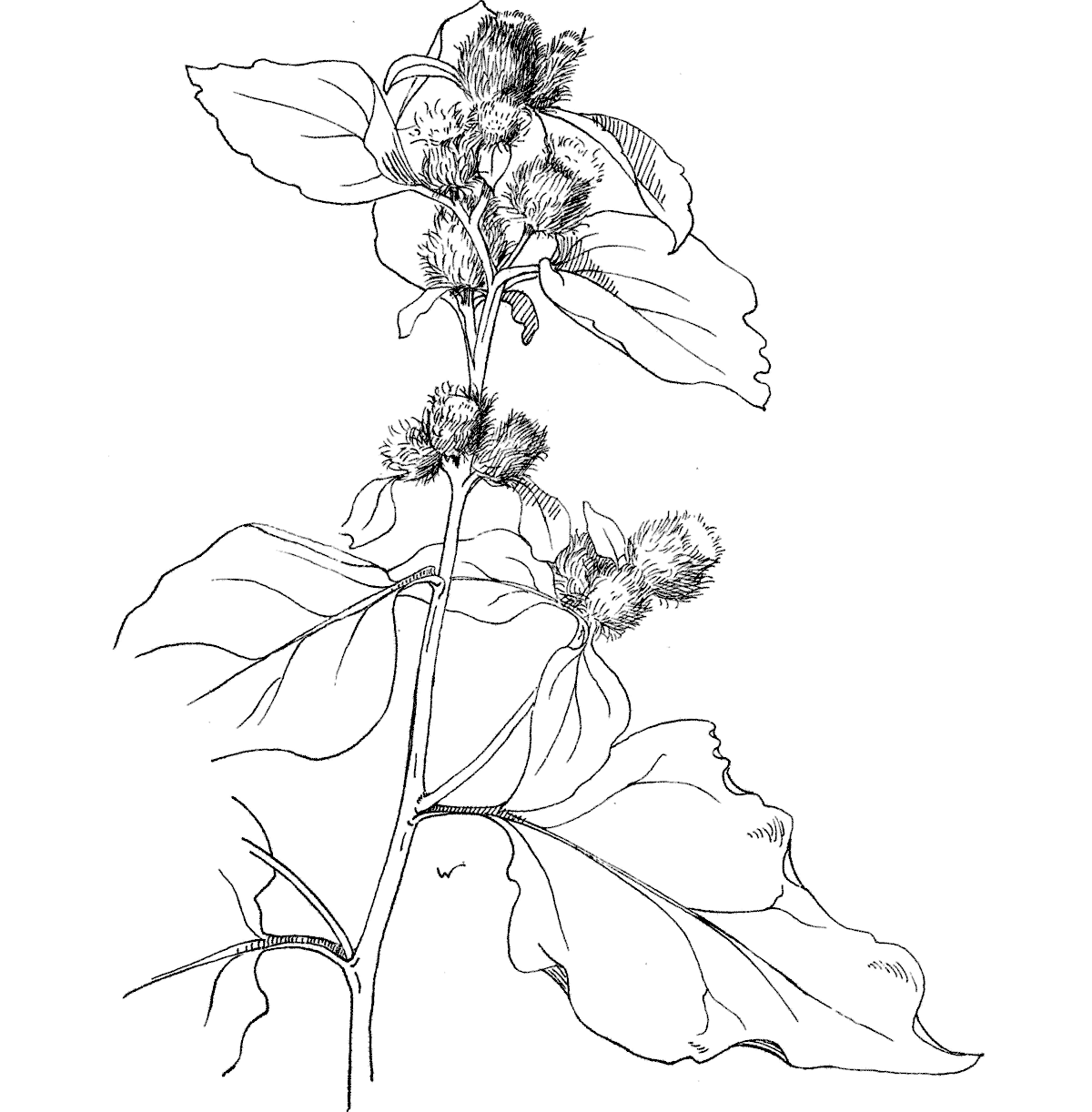
Burdock.Arctium Lappa.
Found, during August and September, along roads and in barren fields.
The stalk branches much, and is very leafy, with a bushy habit of growth, between 2 and 4 feet in height; it is large, stout-fibred, round, grooved, and rough to the touch. The color is light green, showing the red-purple tints of the flowers in streaks, especially at the junction of the stems.
The leaf is very large; the foot-leaves (often over 12 inches long) are rudely heart-shaped, and much puckered or fulled on the midrib, the upper leaves are smaller, and oval; the ribs show underneath in bold relief, the veins being like a strong network; the margin is entire, the texture coarse, and the surface rough. The color is gray-green, lighter underneath, while the midrib is pink above, and paler beneath. The leaves are set on stout, trough-like, reddish stems, which clasp the stalk; the arrangement is alternate.
The flower is very small and silky, crowded into a soft tuft, enclosed in an urn-shaped burr, which is armed with row upon row of sharp out-spreading spines, long, hooked, and sticky. The color of the heads varies, from nearly white, to a deep rose-purple, or blue-purple; the burr is green, or purple. The heads are set on short stems in irregular terminal groups, or on the short branches.
As the flowers mature thread-like white pistils push forth; they open first on the rim of the head. Ranking a pest among flowers, the Burdock is loved by children for its sticky burrs from which they fashion variegated toys. Designers would do well to study its bold finely arching leaves. “So if you please we will take a leaf of burdock, the principal business of that plant being clearly to grow leaves, wherewith to adorn foregrounds.”—-Ruskin.
BURDOCK: Arctium Lappa.
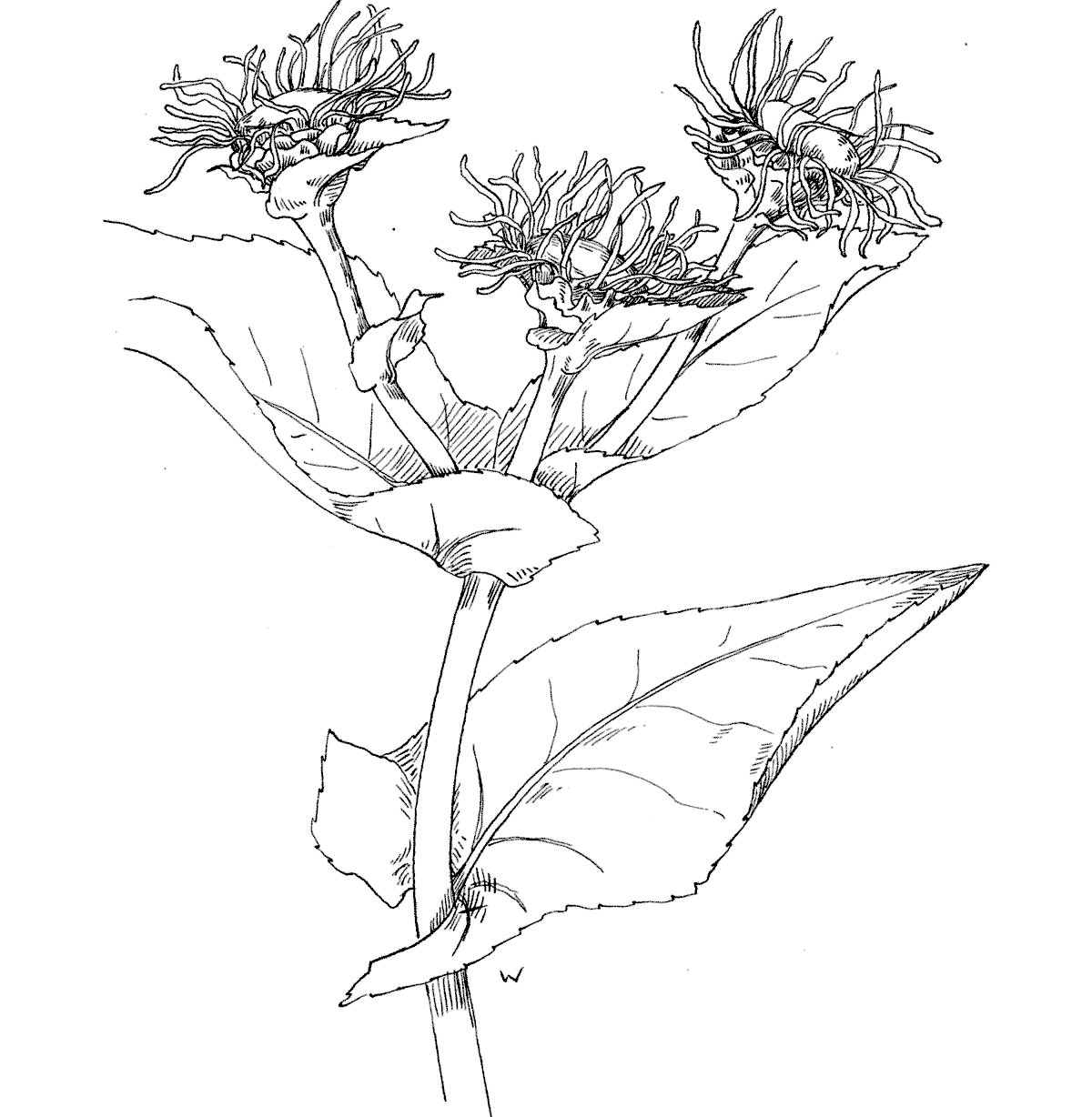
Elecampane.Inula Helenium.
Found along roadsides in August.
Growing to the good height of 5 feet sometimes, this very large, and stout stalk is single and leafy, tough-fibred, but smooth to the touch. Colored green, with a beautiful purple-gray bloom.
The leaf is large; its heart-shaped base has prolonged points, and its tip tapers very much; the margin is irregularly scalloped, its ribs are many and strong, the midrib being large and prominent beneath, and so taut it puckers and pulls the blade; the texture is thick, and the underside is slightly woolly. The root-leaves are oval, and on long stems; the upper leaves are clasping, and alternately placed. Their color is a strong grayish-green, of a peculiarly fine, cool quality.
The flowers are small, and yellow, soon turning to tawny. They are set in a large disc, surrounded by many, narrow, bright yellow rays. The cup which holds the head is shallow and composed of many broad, curling or wavy, light green parts, which overlap each other in several rows; close beneath the cup occurs a small leaf. The head is set on a stem which bears a single leaf midway its length; two or three flower-heads are grouped together; they are placed terminally, and in the angles of the upper leaves.
Growing in large settlements, by the stone wall or Virginia-rail fence, Elecampane commands attention by its splendid vigor of growth, and the free curves of its fine leafage. In color too, it is highly suggestive of decorative purposes, for the excellence of its green, and the plum-gray bloom upon its stout stalk.
ELECAMPANE: Inula Helenium.
Life Everlasting.Anaphalis margaritacea.
Pearly Everlasting.
Moonshine (Vt.)
Found in July, August, and September, in roadside tangles, dry pastures and uplands.
The stalk which varies from 12 to 18 inches in height is branching, and leafy, round, woody-fibred, and covered with silky wool. Of a light green color, much modified by the gray-white wool, which is often tinged with brown near the ground.
The leaf is very long and narrow, with a pointed tip, the midrib is noticeably strong, and the margin entire; it is soft and agreeable to the touch, because of the silky wool which covers both upper and lower surfaces, and tempers its color to a light gray-green, somewhat darker than the stalk. The arrangement is clasping, alternate, and frequent.
The flower is very small and fuzzy; yellow, or tawny-brown, according to the stage of its maturity; it is arranged in small tufts, enclosed by many rows of tiny, dry, gray-white sheath-like husks, that enfold and guard it closely. The head is set on a short, downy, white foot-stem. Several (4 to 12) heads are gathered together upon a longer stem, and a few, or many, of these groups are arranged in a loose terminal cluster. Sometimes these clusters are very large,—measuring 6, or even 8 inches across.
A peculiar dry odorousness pervades the blossoms, and forms an essential feature of the charm this Everlasting possesses for its friends, a charm as undefinable as that which abides in the New England pastures, where it loves to dwell in thrifty fellowship with the Hardhack and Huckleberry bushes.
LIFE EVERLASTING: Anaphalis margaritacea.
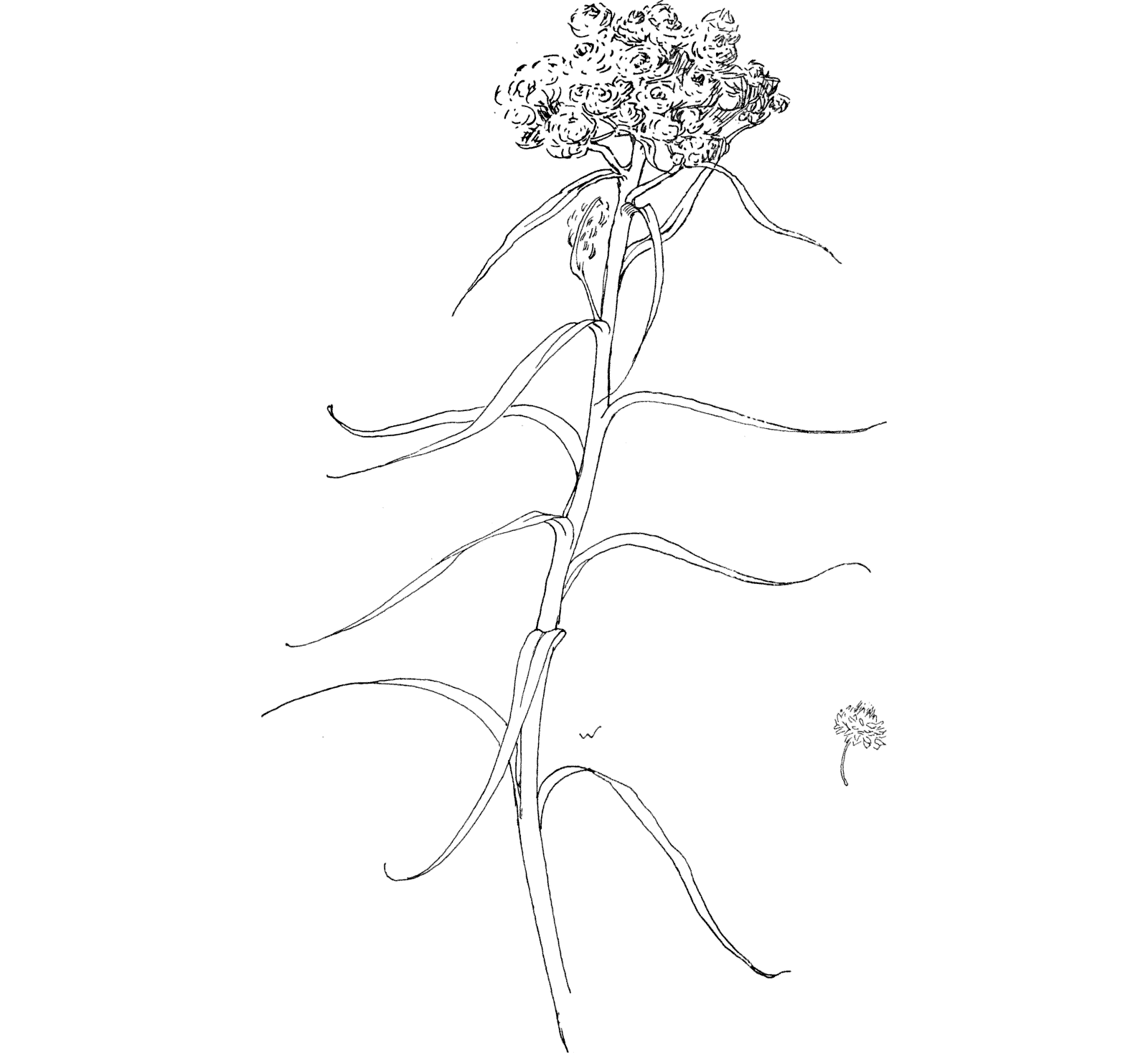
Everlasting.Gnaphalium polycephalum.
Cudweed.
Found in August and September, in dry fields, and open roadsides.
The stalk grows from 1 to 2 feet in height; it branches near the top, and is leafy all the way, of a stiff fibre, with a woolly surface. The color is green, the wool whitish.
The leaf is long, and narrow, with a strong midrib, and entire, or slightly irregular, margin; the under surface is woolly. In color gray-green, whitish underneath, because of the wool. The arrangement is clasping, and slightly hugging the stalk; alternate.
The tubular flower is small, and gathered into a close tuft; of a dull, light, tawny color, which turns darker with age. The tufted head is held tightly within a deep cup, composed of many shining white sheaths. The heads are set on foot-stems, in groups of 2 to 8, and arranged in terminal clusters.
When the ripened downy seed is ready to fly away, the closely folded little cups open wide. A full pleasant fragrance belongs to the blossoms.
EVERLASTING: Gnaphalium polycephalum.
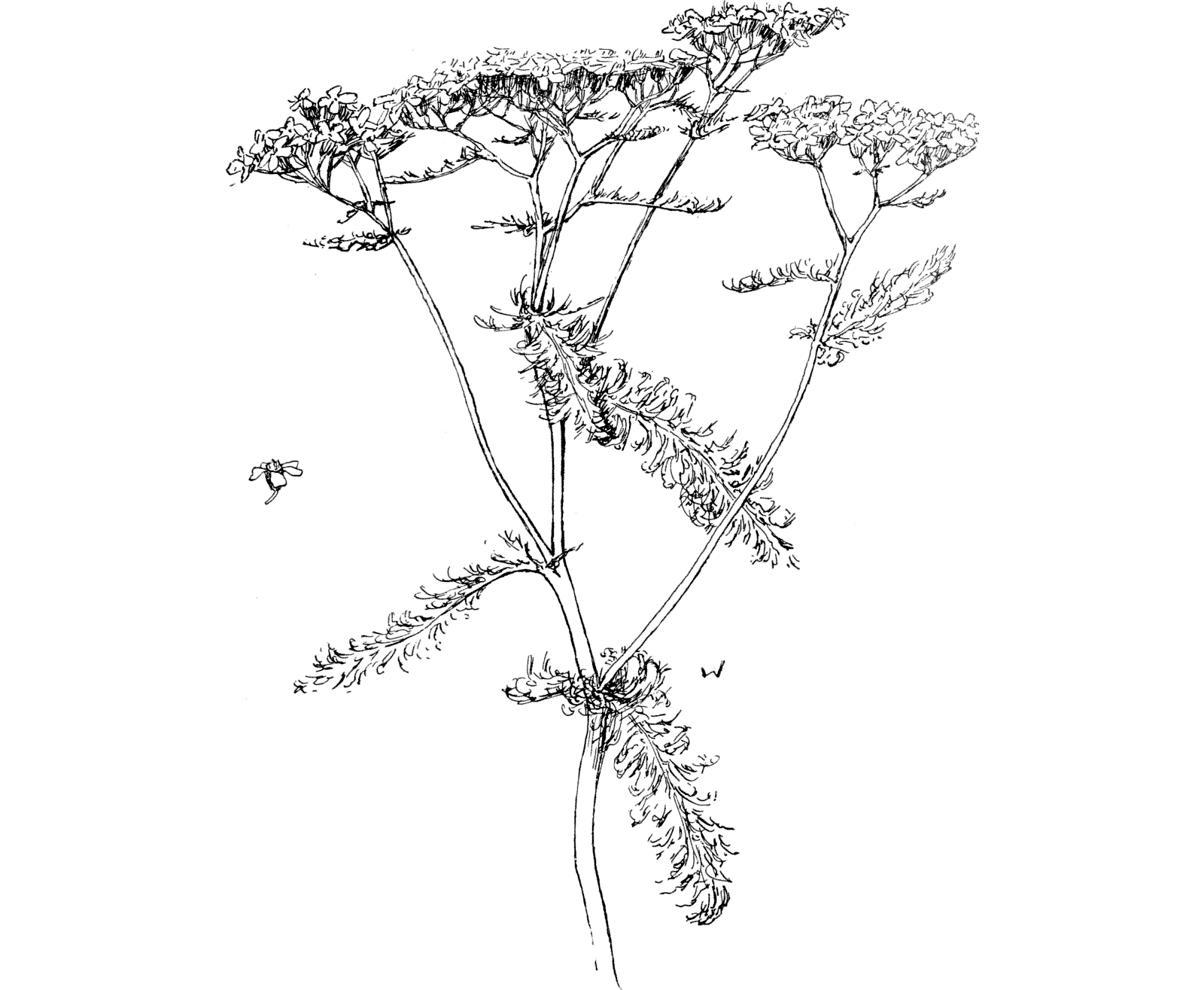
Yarrow.Achillea Millefolium.
Milfoil.
Found from July to September, in dry fields and roadsides.
The stalk, which is very erect in bearing, grows to be about 2 feet high usually; it is single, or branches near the top, and leafy; of a stout fibre difficult to pluck, round and grooved, and covered with wool which causes the green color to look whitish.
The leaf is long and narrow, deeply and finely cut into slender line-like divisions, these being also cleft 3 or 5 times which gives it a fringy appearance; with a strong midrib, and covered with white wool on the underside. The color is gray-green. It is clasping, and the arrangement is alternate, and often crowded into little tufts along the stems.
The flower is very small; pale brown, or bright cheese-colored yellow; crowded into a small thimble-topped head, and surrounded by 3 to 5 small, oblong, white rays, with finely notched tips. The head is held in a deep, pale green, or nearly white, cup, and set on a slender, leafy, white, or pale green stem. The heads are arranged in terminal clusters.
Generally the flower-cluster is noticeably flat-topped, even the small groups of the side branches strive to reach a uniform level with the central cluster. A friar-like gravity of hue shows this plant to be a typical New Englander, thriving with sturdy content on sterile soil, and sending forth a wholesome aromatic odor. In certain localities the rays are tinted pink, almost crimson.
YARROW: Achillea Millefolium.
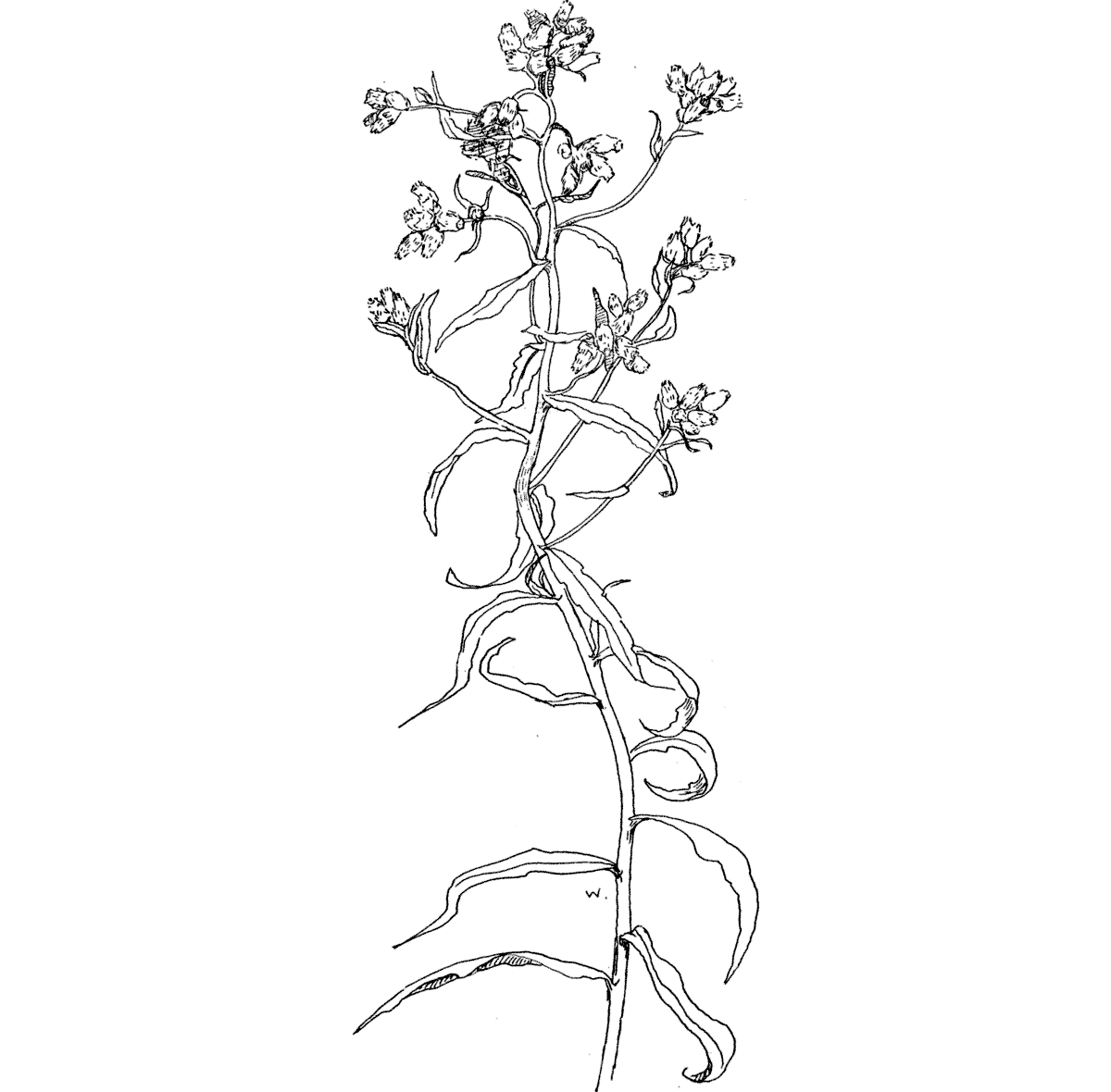
White Lettuce.Prenanthes alba.
Rattlesnake-root.
Found on the borders of rich woods in August and September.
The erect stalk, from 2 to 4 feet high, branches near the summit, and is leafy all the way; it is large, round, and smooth. Color, green, or frequently a dark, rich, purplish-red, with a bloom upon it.
The leaves are variable in shape and size; the root-leaves are large, often and deeply cleft, and set on a 3- to 5-inch stem; the lower leaves of the stalk are broad, faintly notched or 3-cleft; while the upper leaves are long and narrow, with entire margins. Their texture is thin (when dried, like paper in quality), and their surface smooth. In color, a dark cool green.
The flower-head is composed of 8 or 12 small “strap-shaped” blossoms hanging from a cup; they are cream colored, tinged with lilac; the cup is composed of 8 narrow, pinkish-gray parts; the stamens are noticeable because their tips split and curl spirally,—they are cream colored also. A few small bracts occur at the base of the flower-head, which droops on a small stem. The heads are arranged in little clusters springing from the angles of the branches and leaves.
As the flower-head matures, there may be found within its nodding cup a bunch of fine reddish hairs, like a sable paint brush,—later this opens into a downy seed tassel. The fine stalk gives the plant a distinguished appearance.
WHITE LETTUCE: Prenanthes alba.
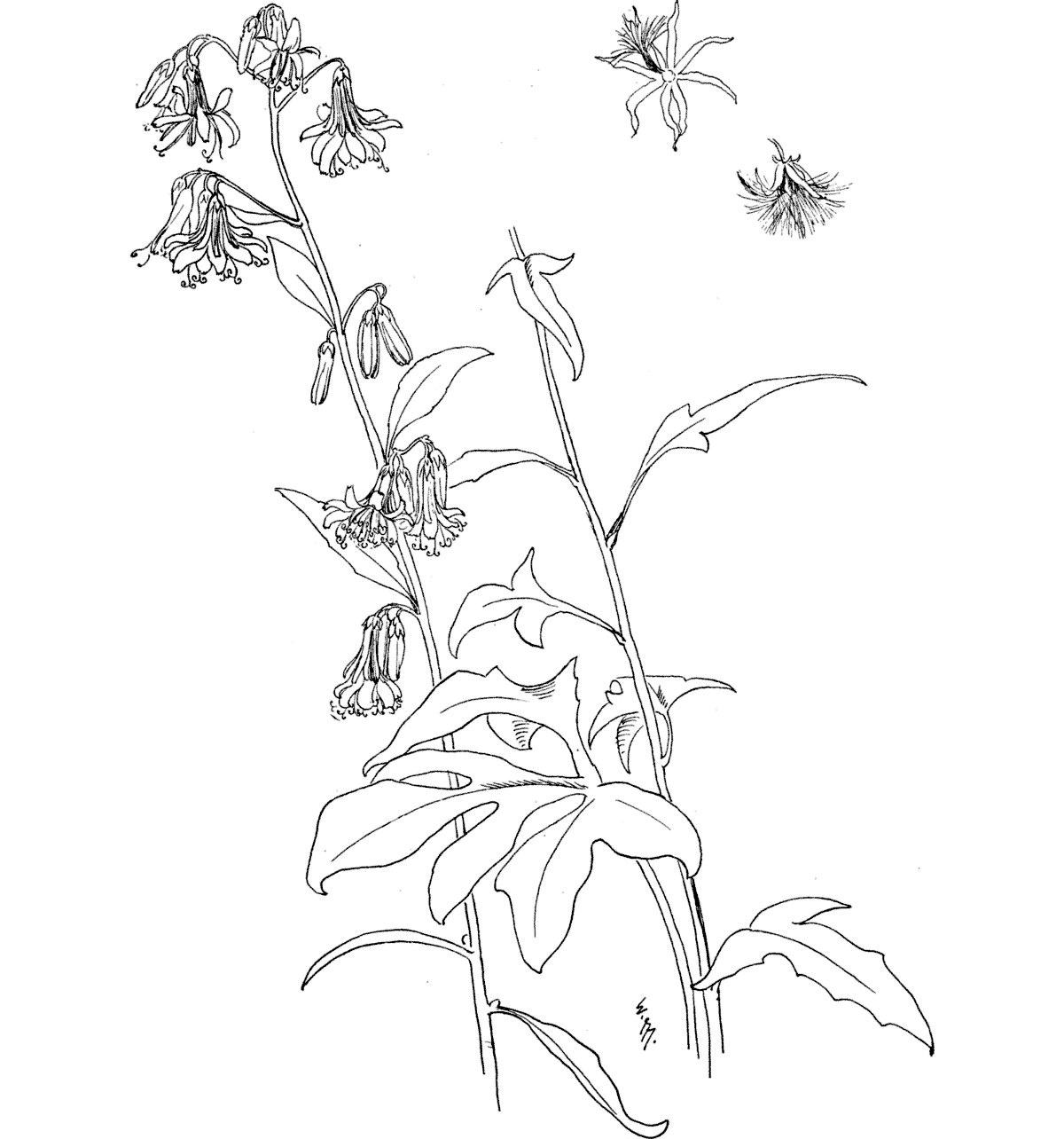
Rattlesnake-root.Prenanthes altissima.
Found during August and September on the edge of dark woods, and in damp places, that are shaded.
The stalk, often about 3 feet high, sometimes attains to more than man’s stature; it is very erect, branches only for flowers, is leafy, round, firm-fibred, and smooth. Green in color.
The root-leaves are large (2 or 3 inches in length), wedge-shaped, or 3- to 5-divided; the upper leaves are smaller, varying from a wedge or heart-shape to a long-pointed oval. They all have entire, or faintly notched margins, and the midribs, shining above, are rough beneath. They are set on stems, which are sometimes provided with narrow spreading margins; the arrangement is alternate, with a certain interval between.
The flower is small, “strap-shaped,” with a square notched tip; cream-white in color. 5 or 6 are included in a tubular cup, composed of a close-folded row of narrow, green or purplish, pale, leafy parts; these cups are set nodding on slight foot-stems, and arranged in small irregular groups, on short branches, which form a long, irregularly arranged terminal spike.
The blossoms are so small they are quite out of proportion to the height and strength of the stalk; their habit is scattering, and only a few heads open at the same time. The plant is most effective when all its stiff little downy seeds are spreading themselves for flight.
RATTLESNAKE-ROOT: P. altissima.
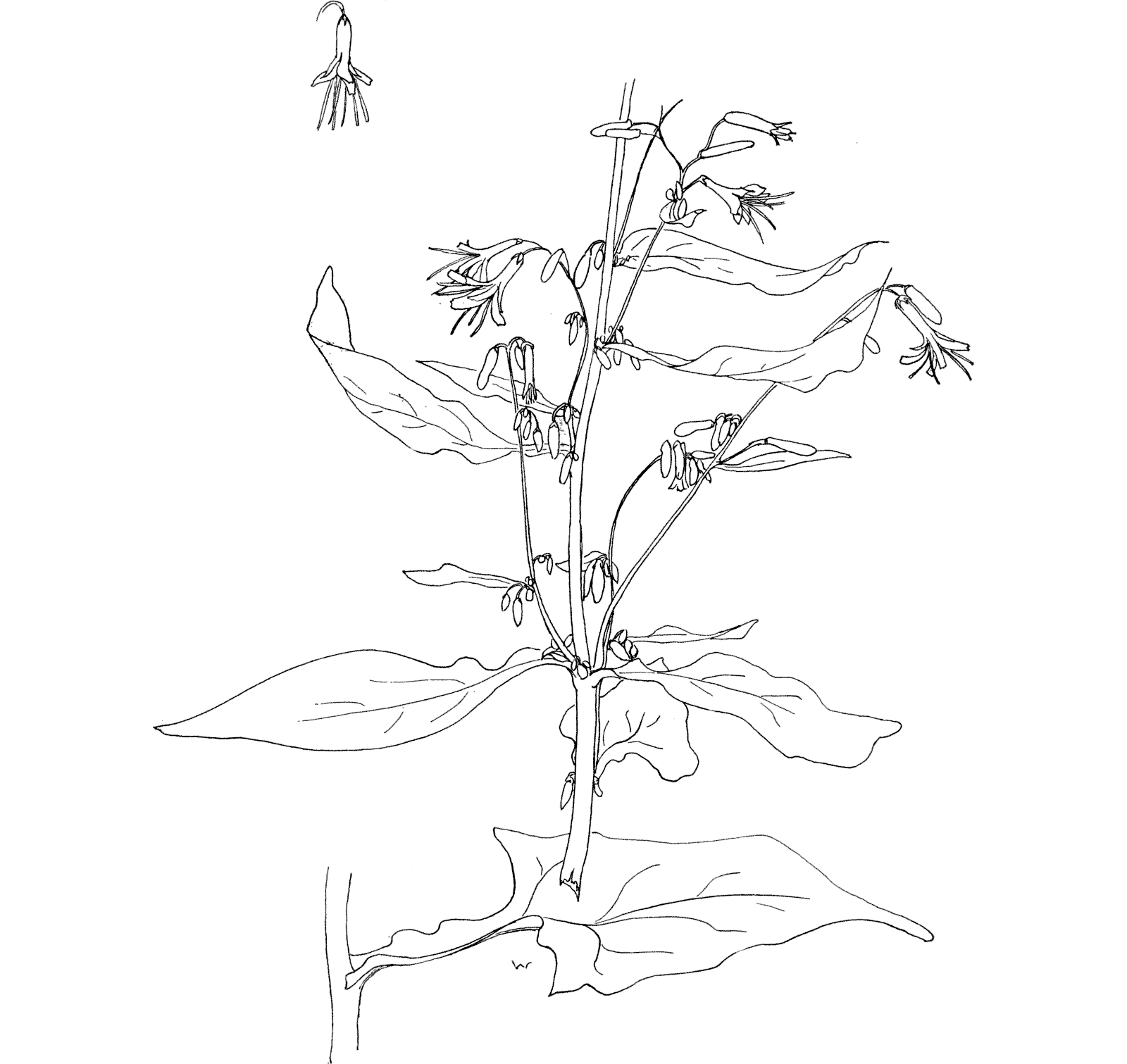
Bur Marigold.Bidens cernua.
Found through August and September in swampy grounds. It is very common, and grows from 1 to 5 feet in height.
The stalk is leafy and branching, large and tough-fibred, smooth, but grooved from the joints. The color is light yellow-green.
The long leaf is narrow, and tapering to a slender point; it is somewhat fulled upon the taut midrib, and the margin is irregularly notched, while the surface is smooth. The color is a strong yellow-green, lighter on the wide midrib. The leaves are opposite each other, and partly grown together about the stalk.
The small, tubular disc flower is dull tawny in color; the rays, usually 8 in number, are broad, and of a bright golden-yellow color. The large flower-heads are encircled by two rows of green, or greenish, bracts, the outer row being slightly twisted; they are somewhat nodding on short stems of equal length, and spring from the angles of the leaves.
The seed, armed with 4 stout prongs, and plentifully set with backward-pointing bristles, is familiarly known as “beggars’ tick” or “stick-tight,”—it never loses a chance to catch a ride on the clothes of the unwary passer-by. Its smooth grooved stem, swelling at the joint, is an interesting feature of this otherwise rather coarse plant.
BUR MARIGOLD: Bidens cernua.
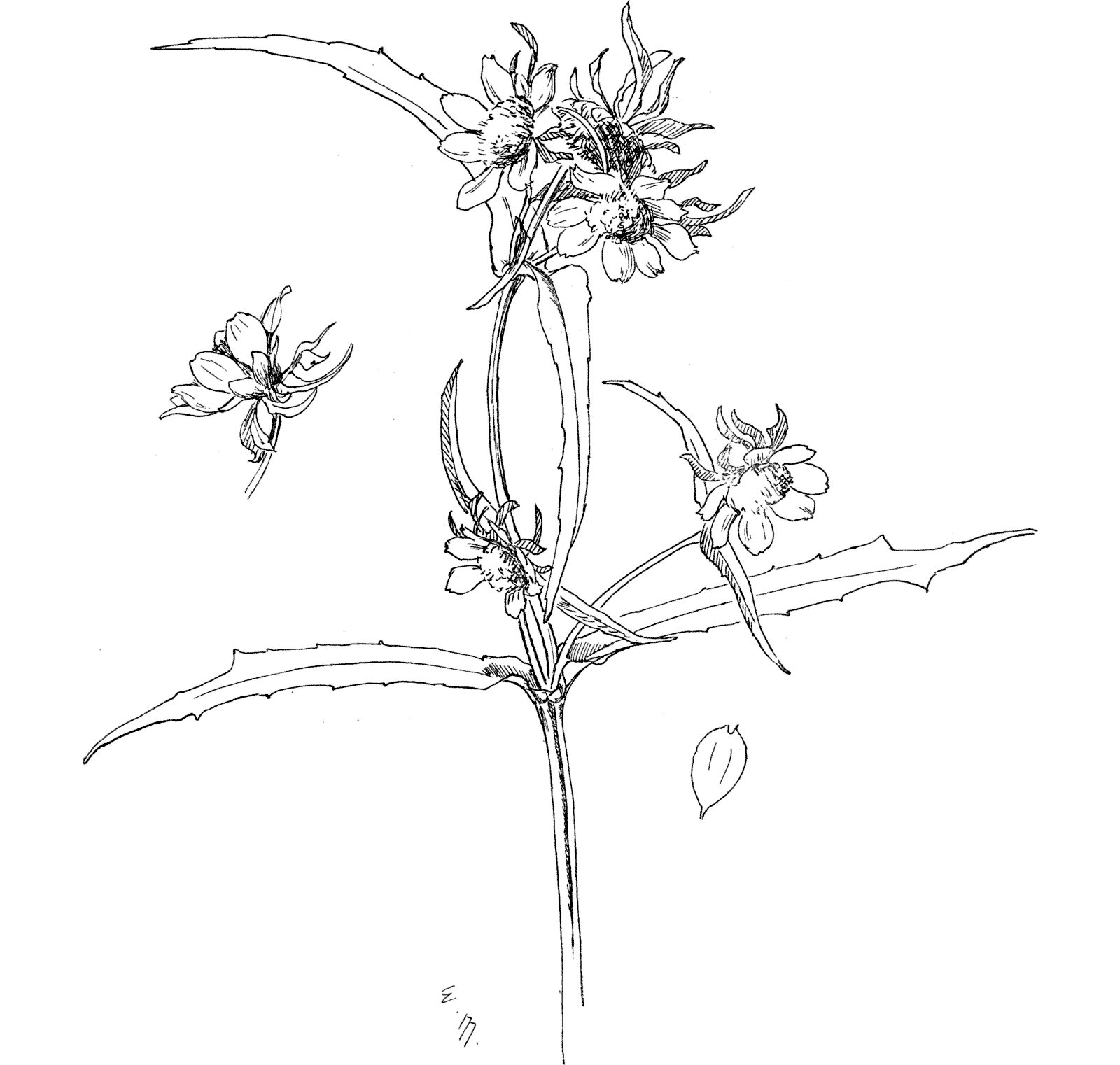
Rayless Marigold.Bidens frondosa.
Found in August and September, lying in wait for travellers along roadside ditches and in wet fields.
The stalk, which grows any height from 2 to 6 feet, bears branches in pairs; is very leafy, and stout, round, coarse-fibred, and slightly shining. In color, purplish green.
The leaf is divided into 3 or 5 lance-shaped parts; the margin is toothed, and the texture is coarse; it is set on short, ribbed-stems, and springs from a noticeable joint, in pairs, at regular intervals along the stalk, and branches. It is dull green in color.
The flowers are very small, and ragged, of a dull tawny orange; they are crumpled tightly into a flat head, and sometimes partly surrounded by 1 to 3 inconspicuous, little, dull yellow, rays. The head is encircled by small, narrow, green, leaf-like parts of irregular lengths; it is set on a short green stem. Two or three heads are gathered in a terminal group.
The cup-like joint of the leaf-stems is worth careful consideration, it is so neatly finished. The seed is dark and shining, and oppressively civil in its attentions to heedless wayfarers.
RAYLESS MARIGOLD: B. frondosa.
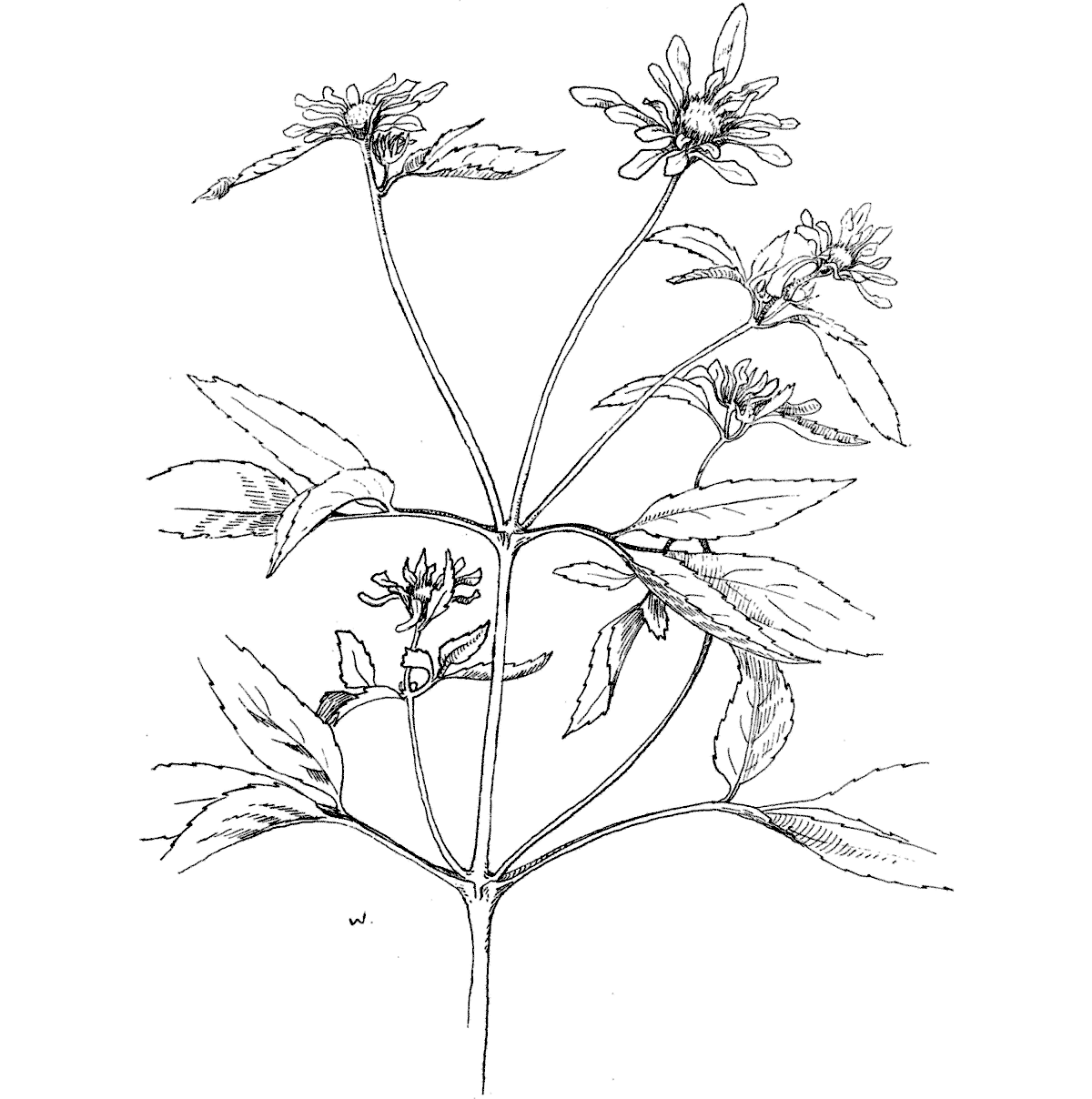
Wild Sunflower.Helianthus tuberosus.
Jerusalem Artichoke.
Found through September and October, in cultivated fields, and along thicket borders.
The stalk branches for flowers near the top; it is leafy, large, from 3 to 7 or 8 feet, very stout, and rough with short hairs. Its color is light green.
The leaf is large, and oval, with a pointed tip and widest at the base, where it tapers into a short stem; the margin is somewhat obscurely notched, the texture is coarse, showing 3 strong ribs, and the surface is rough. The color is a full, strong green. In growth, the leaves are generally opposite, though the upper leaves are often alternate.
The disc flowers are small, tubular, and 5-pointed, of a dull yellow color; the stamens are protruding, spirally curled, and brownish; the rays, from 8 to 15 in number, are long, and broad, and colored a brilliant orange-yellow. The leafy cup, which encloses the head, is composed of several rows of green parts; the heads grow singly from the summit of the stalk, or by twos and threes, on stems, from the angles of the leaves. This is a towering plant, whose brilliant flowers and vigorous leafage render it an effective feature of the wild hedgerow. Its tuberous root is sometimes cooked as a vegetable, and in a raw state is eaten by men and boys.
WILD SUNFLOWER: Helianthus tuberosus.
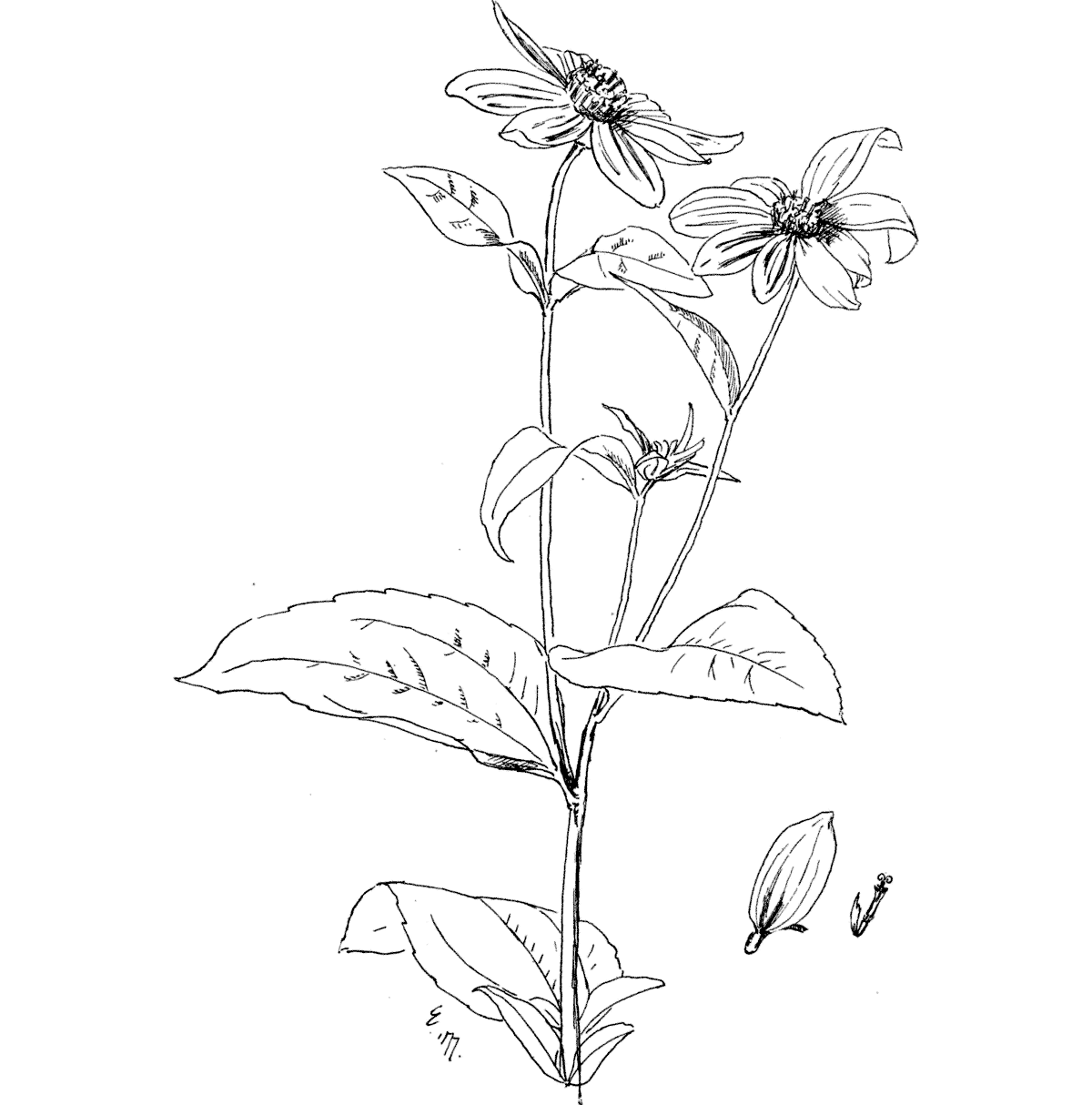
Bushy Goldenrod.Solidago lanceolata.
Found during August, growing in open, dry fields, and waysides.
The stalk reaches about 3 feet in height; it is leafy, and branching widely, slender, and rough to the touch. Color, green.
The leaf is like a grass blade, very narrow and long, pointed at both ends, with an entire margin, and parallel veins; the texture is thin, the edge and midrib slightly rough. In color gray-green.
The disc flowers are few, the ray flowers very short, from 10 to 18 in number. The heads are arranged in small flat-topped clusters.
The branches are so nicely graduated in length that they form a large-topped flowery summit to the slender stalk, the buds opening in the center first. The green is tempered to a more perfect harmony with the yellow bloom than is usual among the Goldenrods, and the cup is of so yellow a hue it scarcely shows a trace of green.
BUSHY GOLDENROD: Solidago lanceolata.
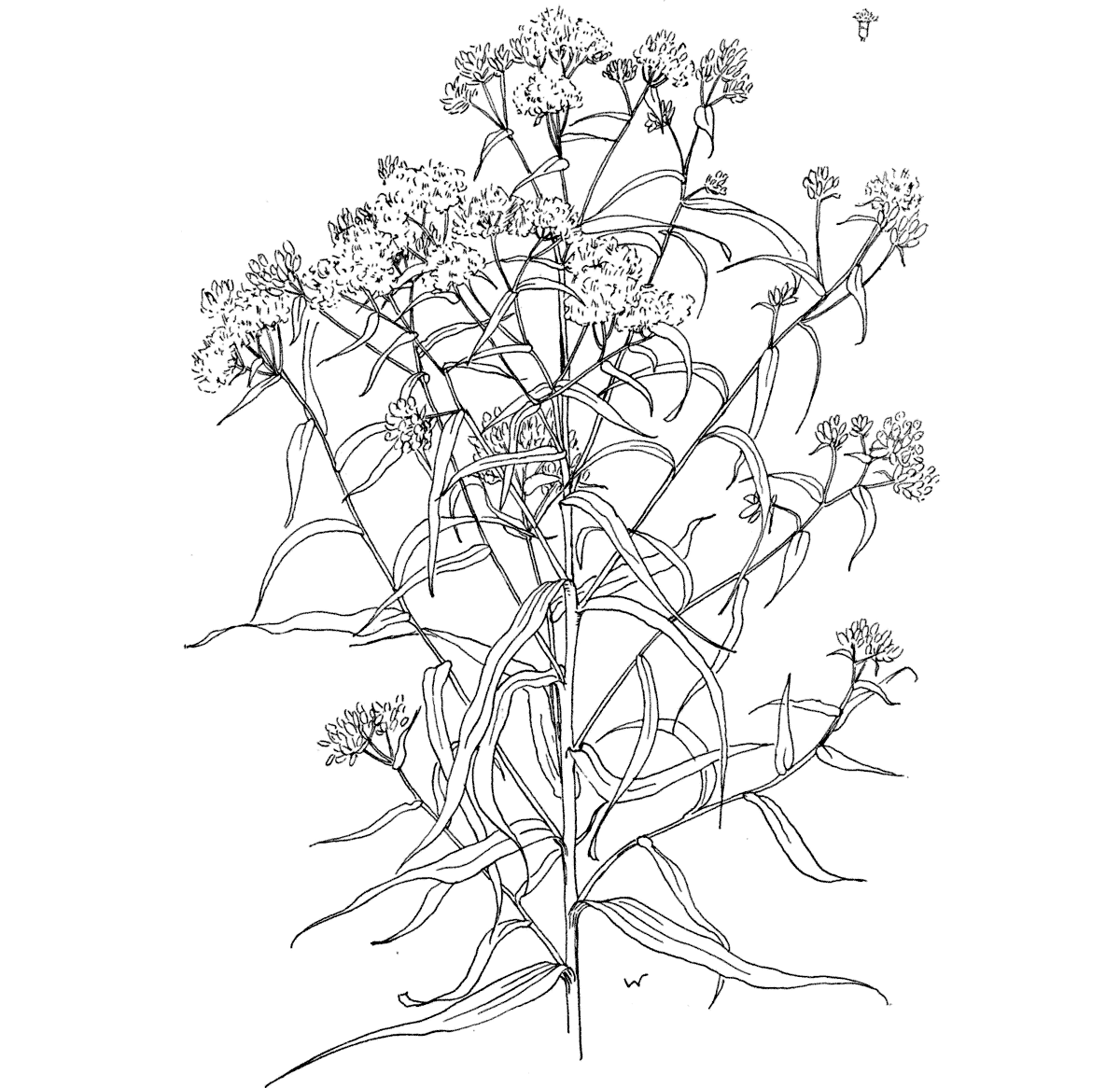
White Goldenrod.Solidago bicolor.
Silver-rod.
Found in August and September growing in dry soil, often in light shade.
The stalk is noticeably erect, and usually single, of coarse fibre, and rough to the touch; 1 or 2 feet high. Green.
The leaf is narrow, and tapering to a point at both ends, with a sharp tip. The margin of the lower leaves is notched, the upper leaves are entire. They sit close upon the stalk in alternate arrangement. The color is a homely green.
The rays are from 4 to 12 in number; and cream colored, like the disc flowers. The small heads are gathered in crowded groups, set in the angles of the small, pale, upper leaves, forming a long club-shaped spike.
Sometimes the plant is slightly hairy, and occasionally the lower leaves are oval in shape, and furnished with stems. The bloom begins at the tip of the spike, whose gesture deserves the name of “rod” more nearly than its more graceful sisters. If not well-nourished the blossoms are apt to be ragged, and dingy in color.
WHITE GOLDENROD: S. bicolor.
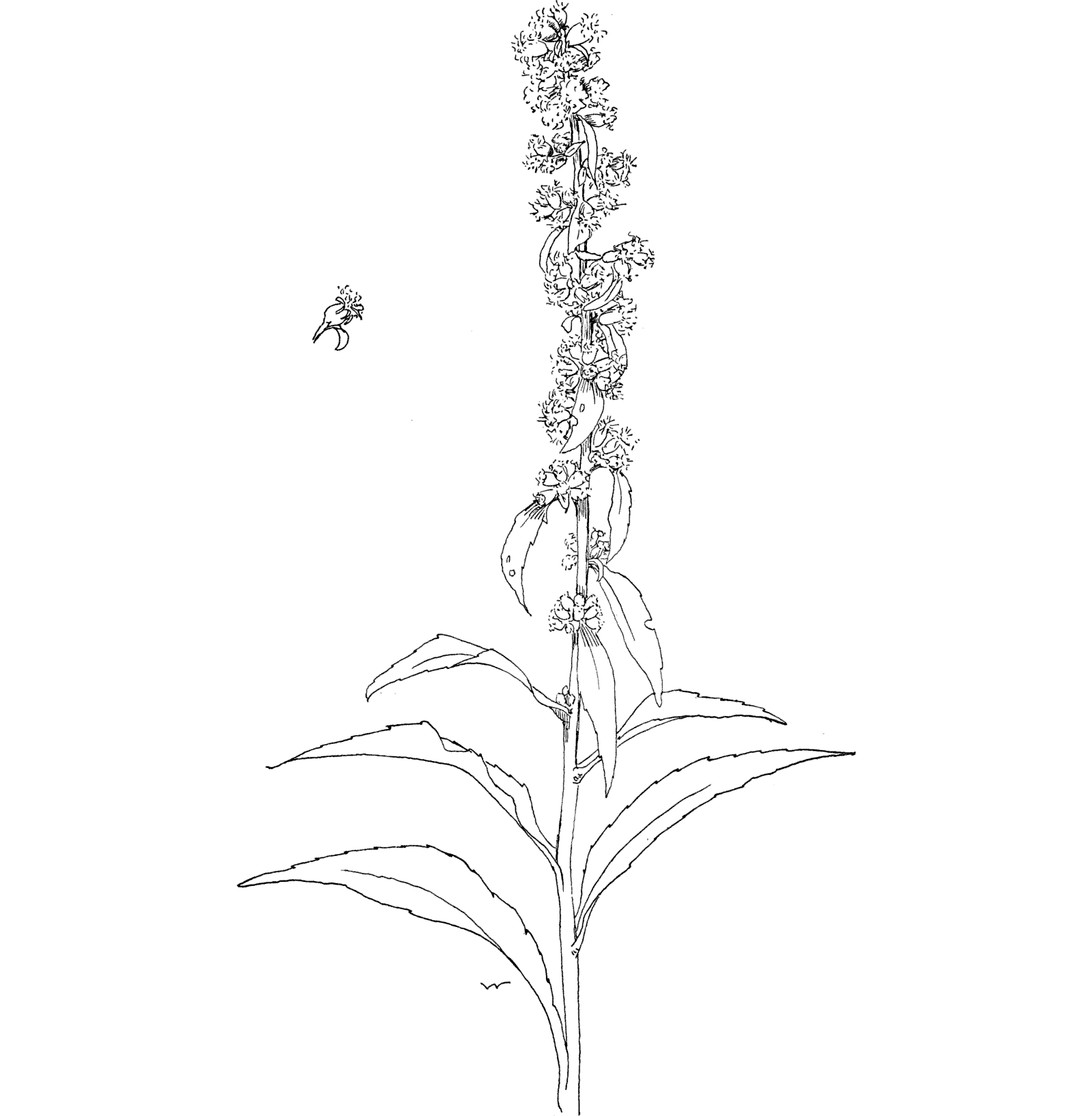
Plume Goldenrod.Solidago juncea.
Found in August and September, in grassy fields, growing to the height of 2 or 3 feet.
The graceful and elegant stalk is smooth, round, and shining. Color, light yellow-green.
The upper leaves are lance-shaped, long-pointed at either end, with entire margins; they spring from the stalk with a noticeable arch. The lower leaves are larger, more nearly oval, lengthening to a margined base or stem; they are sometimes sparingly notched. In arrangement alternate, with small leaves putting forth from the angles. Color, a yellowish-green.
The ray flowers are from 8 to 12 in number. The heads are arranged, in little spires, along the upper sides of slender stems, which form a long, spreading, curving plume.
This is perhaps the handsomest of the clan in growth. It dries well for winter decoration.
PLUME GOLDENROD: S. juncea.
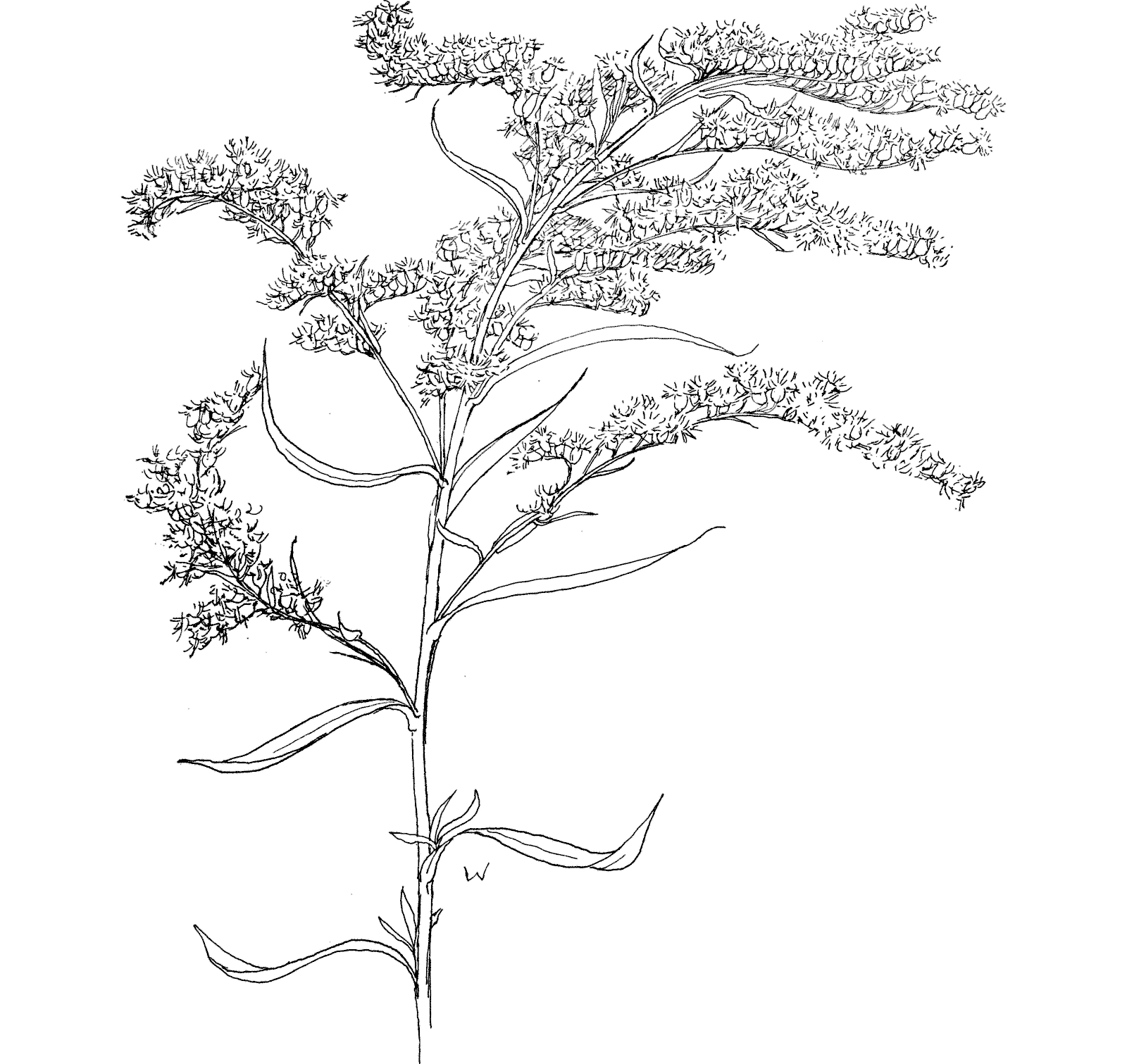
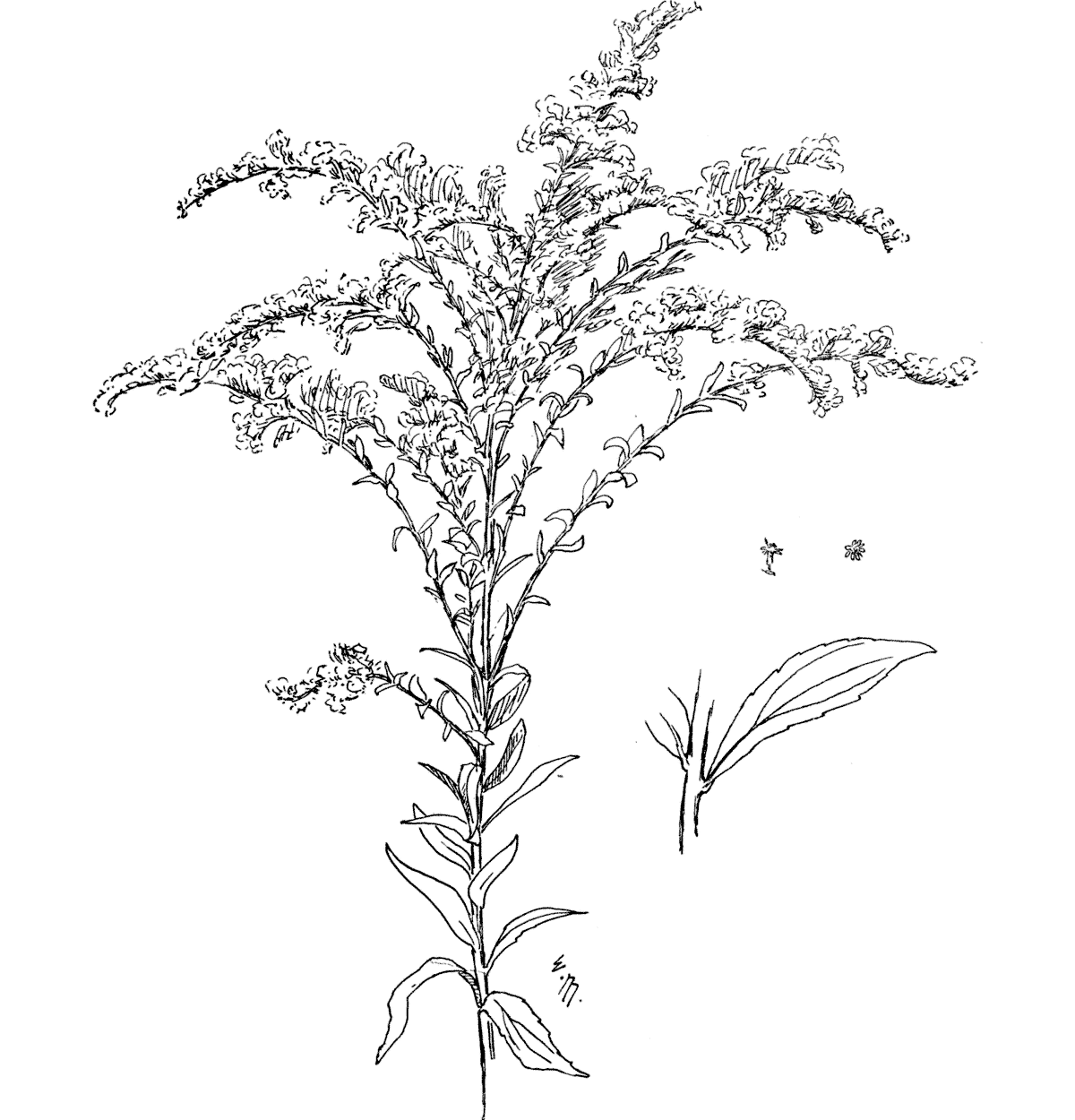
Common Goldenrod.Solidago Canadensis.
Tall Goldenrod.
Found by the wayside, hedgerows, thickets and fields, everywhere; common: blossoming in August and September.
The round, leafy stem is stout and tall, sometimes reaching to the height of 6 feet; it is rough-downy, or hairy, to the touch, and of a light yellowish-gray color.
The oval leaf is long, tapering at both ends; usually notched on the edge, slightly rough above, and downy beneath; it is coarse in texture, and in the quality of its green color.
The flower-heads are small, and bright yellow; they grow on curving branchlets in a many-sided plume, on the top of the stalk.
COMMON GOLDENROD: S. Canadensis—⅔ life size.
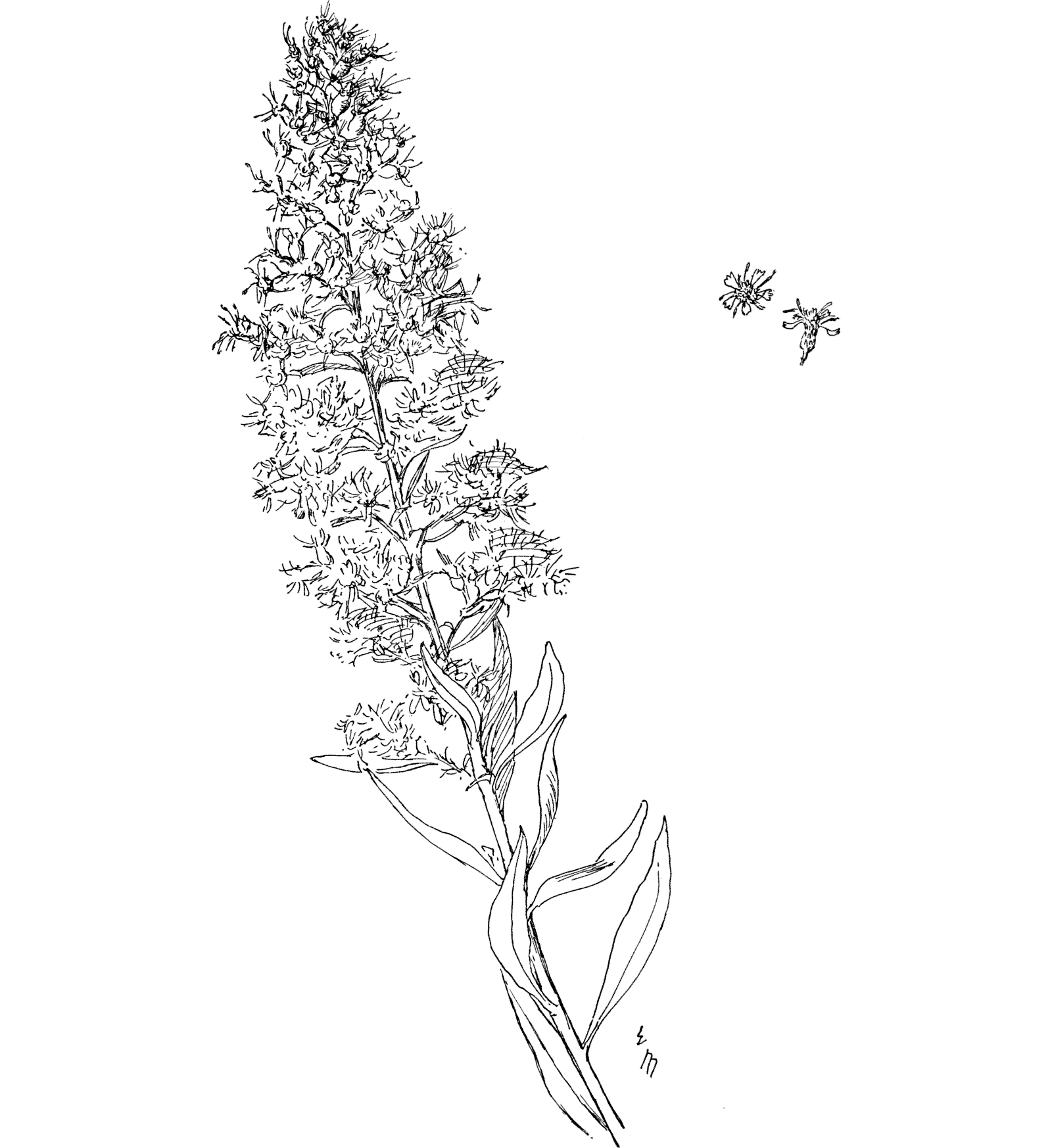
Noble Goldenrod.Solidago speciosa.
Found during September growing in dry soil, near the woods often.
The smooth, round, single stalk varies from 3 to 6 feet in height. Its color is a fine dark red.
The leaf is long and narrow, and tapers at both ends; its margin is entire, the edge being a little rough, and the midrib is strong and curving, and a trifle taut, which fulls the blade; the texture is fine and thick, and the surface is smooth. The color is yellow-green. The leaves are set alternately upon the stalk.
The stamens of the disc flowers are long; the rays 5 or 6 in number; full-toned yellow in color. The heads are rather large, and are arranged in a large pyramid-shaped terminal spike.
A strikingly handsome plant, with its strong red stems, which color also tempers the green of its foliage into an excellent harmony with the numerous flowers. Its manner of growth in circular settlements of many plants together is a very individual trait.
NOBLE GOLDENROD: S. speciosa.
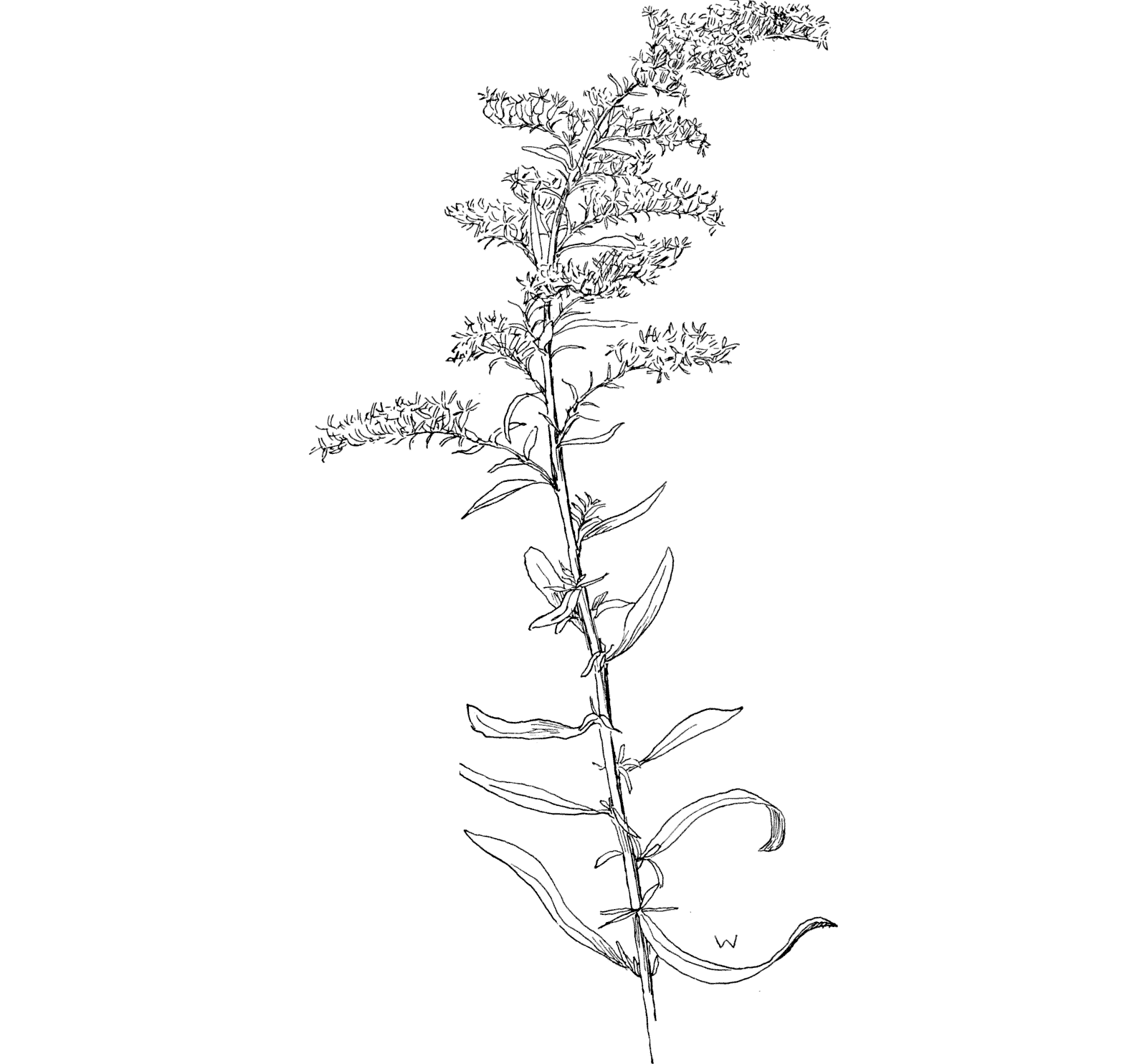
Small Spike Goldenrod.Solidago nemoralis.
Found in September along dry roadsides and in sandy fields.
The stalk, which seldom grows higher than 2 feet, is single, and very leafy, of a strong fibre, and slightly rough, or not quite smooth to the touch. It is grayish green in color.
Disc flowers are few, the rays are seldom more than 8 in number, arranged in little one-sided spires to form a close, leafy, spike-like plume. The color is very clear in hue.
Common to all localities favorable to the Goldenrods, and, as observed, reaching its fullness of bloom in September rather than in August.
SMALL SPIKE GOLDENROD: S. nemoralis.
Broad-leaved Goldenrod.Solidago latifolia.
Found in September and October on the edges of woods, and moist copses.
The stalk grows from 1 to 3 feet high; it is often zigzag in gesture or angular, is leafy, smooth to the touch, and woody-fibred. Its color is green.
The broadly-oval leaf tapers at both ends, the margin is cut in sharp slender teeth, ribs are marked, and the surface is rough to the touch. Color, yellowish green.
The disc flowers are small, and the ray flowers are few, from 4 to 6 in number; in color they are clear yellow. The cups are pale green, and the heads are gathered, in small clusters, on the end of the stalk, and in the angles of the upper leaves.
This is a pleasing variation from the common types of the Goldenrods; its prolonged leafy stem, slender in growth, and strung with small clusters of yellow flowers, is less showy, but more refined in general bearing than many others.
BROAD-LEAVED GOLDENROD: S. latifolia.
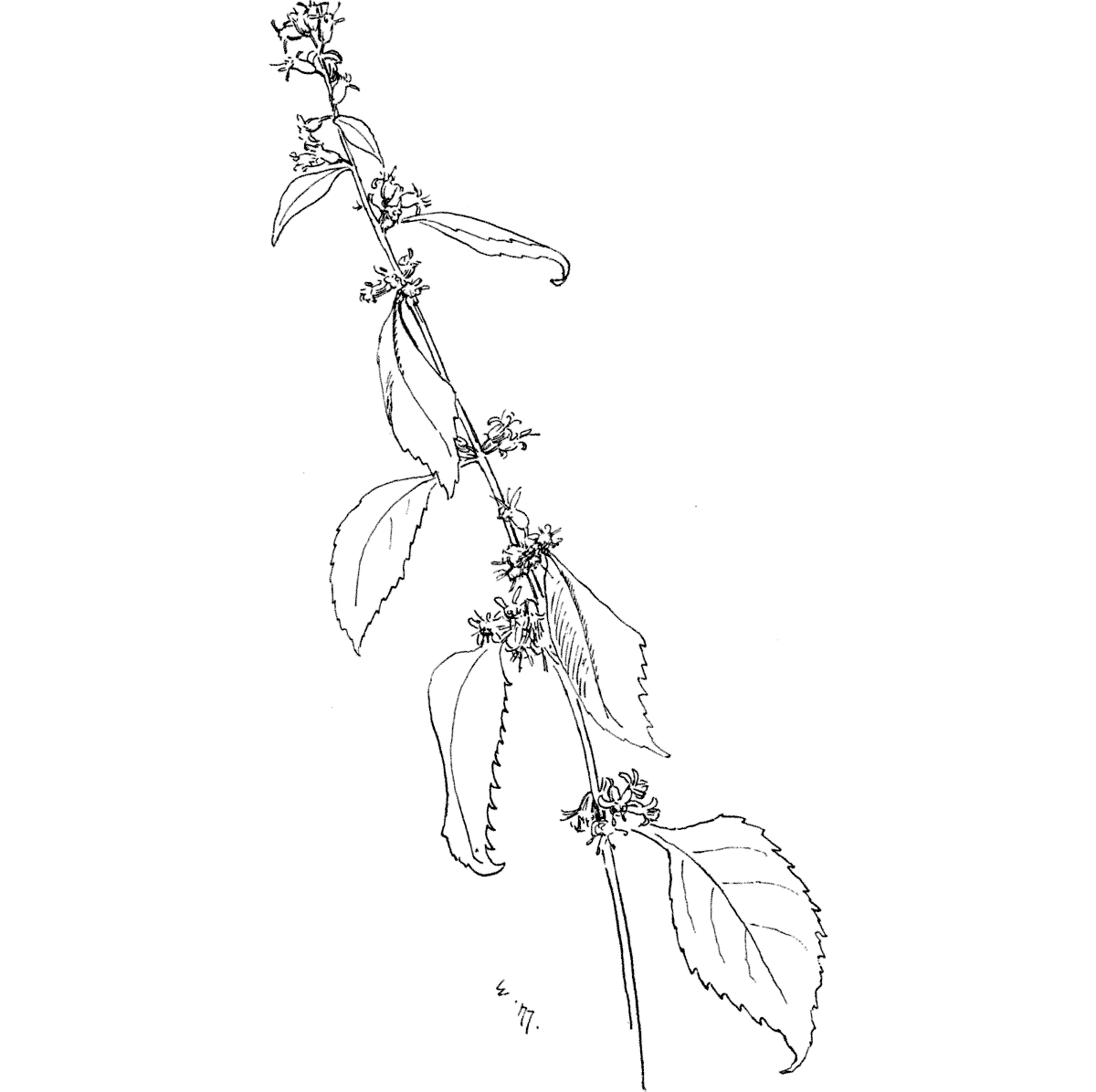
Wreath Goldenrod.Solidago cæsia.
Found, during September and October, growing in rich woods or on the borders of thickets.
The very slender, curving, stalk varies from 10 to 18 inches, or more, in height; it often branches near the end, and is leafy all the way; smooth. Clear green in color.
The leaf is long-oval in shape, tapering at both ends, with a sharp tip; it has a strong midrib, the margin is notched with sharp teeth, the texture is thin, and surface smooth. Green in color. The arrangement is alternate, the leaves being set on the stalk near together.
The ray flowers, 4 or 5 in number, are small; the little heads are clustered upon the stalk in the angles of the leaves for a considerable part of its length. The color is a pleasing yellow.
These slender, swaying, golden wreaths of bloom love best a shady wood road, though they bear transplanting into gardens fairly well.
WREATH GOLDENROD: S. cæsia.
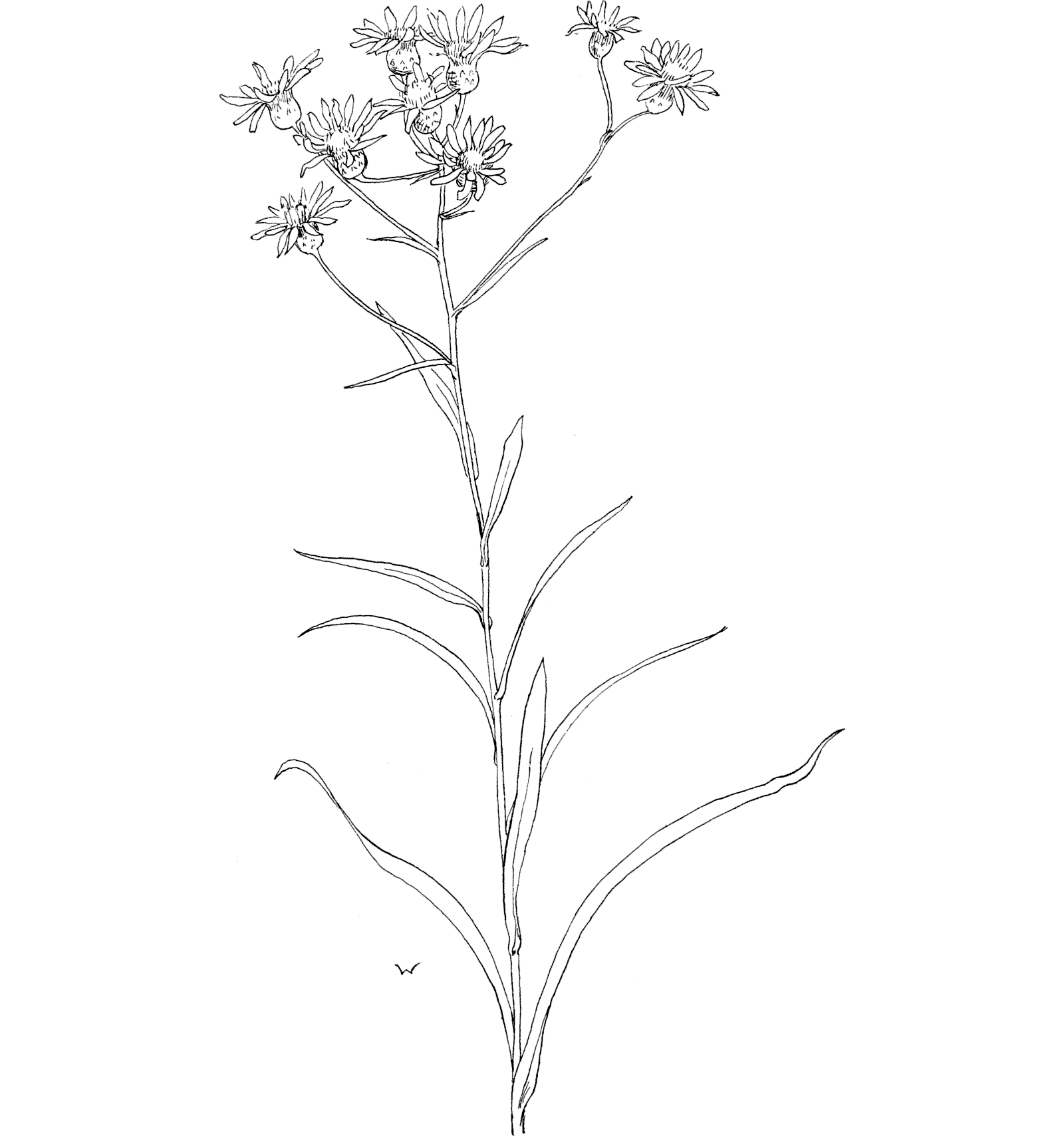
Upland White Aster.Aster ptarmicoides.
Found among rocks, in dry soil, in August.
The stalk, erect in bearing, from 1 to 2 feet in height, is single, and very slender; smooth at the foot, though rough above. Of a gray-green color.
The leaf is like a grass blade, long, and narrow, with an entire margin, and noticeable midrib; the upper surface is rough, the edge being harsh to the touch, the under surface is shining. Color, gray-green. Arranged alternately, and clasping the stalk with an upward curve.
The disc flowers are small; of a pale yellow-green. The ray flowers, 15 or 20 in number, are short, pointed; pure white. The heads are arranged in a flat-topped loose cluster.
When the disc flowers mature they turn to a light brown color; at one period of development the pale pistils are prominent. There is an individual excellence about this Aster, existing especially in the curve of its leaf.
UPLAND WHITE ASTER: Aster ptarmicoides.
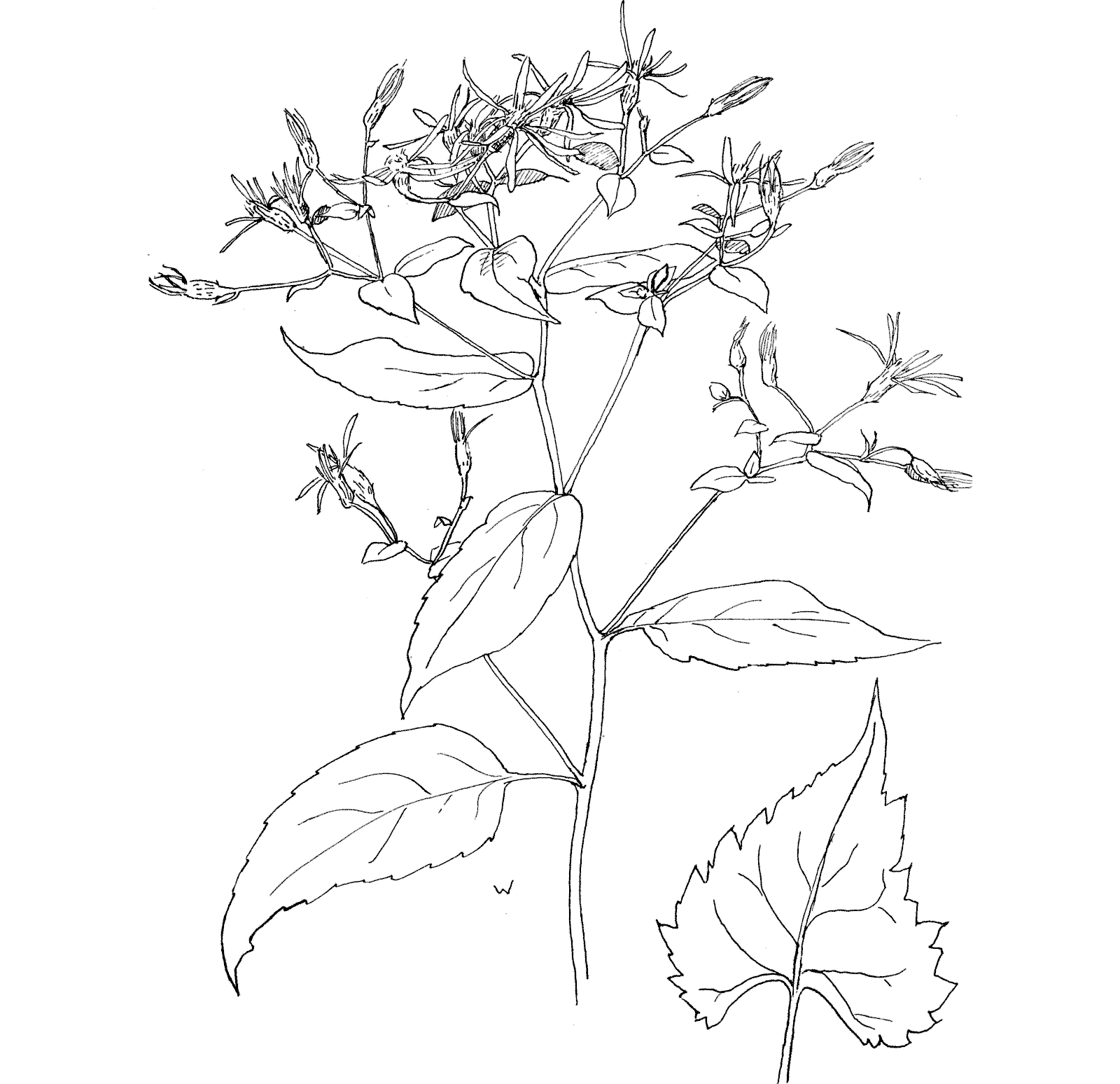
White Wood Aster.Aster corymbosus.
Found in moist woods during July and August.
The stalk, 12 or 15 inches high, branches near the top, and is sometimes zigzag in growth; slender, and smooth. In color a strong rich purple, or green, streaked with red or purple.
The lower leaves are heart-shaped, the upper long-oval, with tapering points; the margin notched, and the texture thin. Color green, lighter underneath. Set on short stems, and arranged alternately.
The disc flowers are few, and yellow; the 4 to 8 ray flowers are about a half inch long, narrow, delicate in texture, arranged in a scattering row, and pure white in color. The cups are small; the heads grouped in loose, leafy terminal clusters.
Perhaps the most daintily finished of the white Asters, it is also the most shy, loving shady nooks and lonely places amongst trees.
WHITE WOOD ASTER: A. corymbosus.
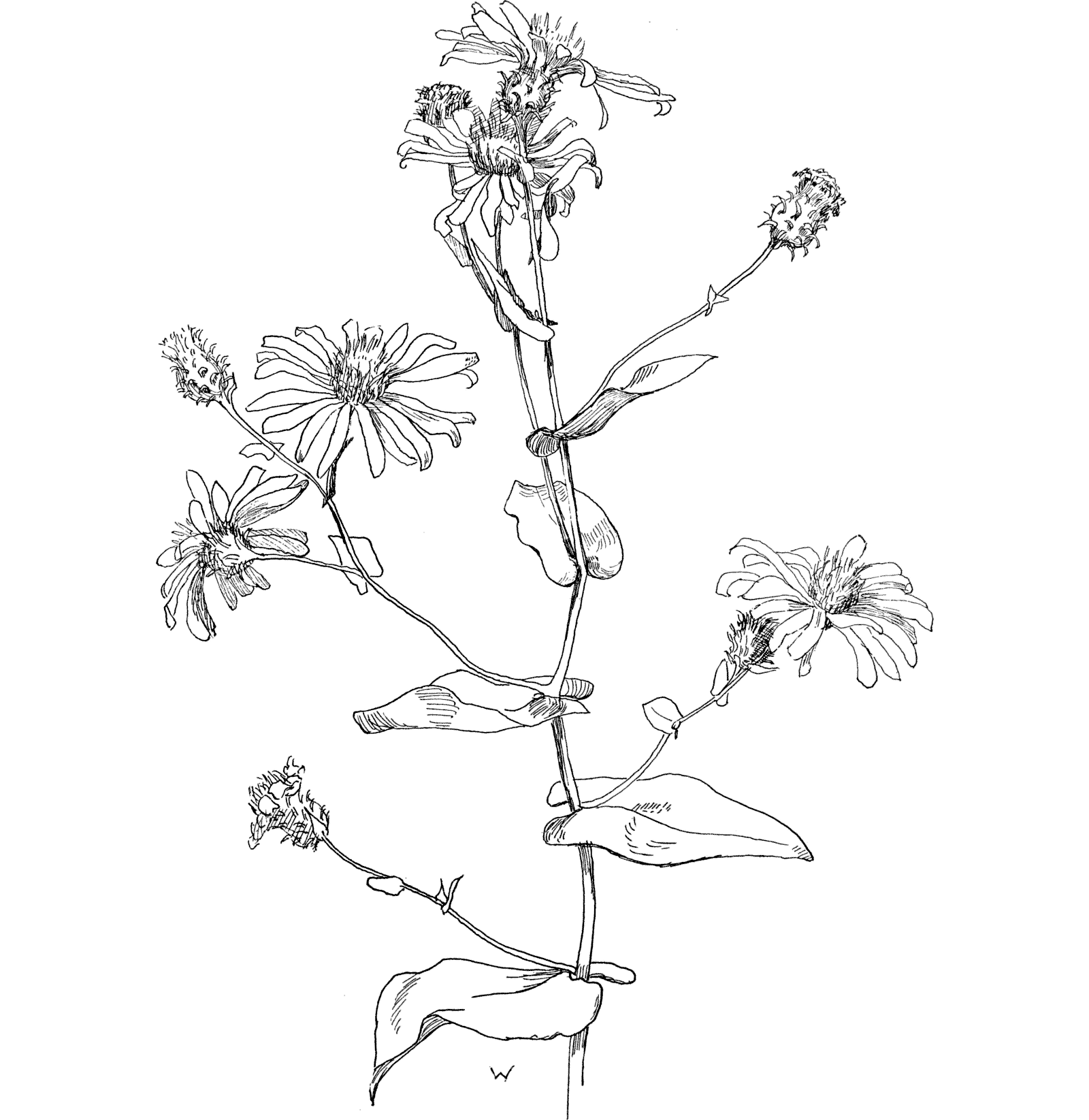
New England Aster.Aster Novæ-Angliæ.
Found in September in moist fields and waysides.
The strong stalk varies much in height (from 3 to 7 or 8 feet); it branches somewhat at the summit and bears many leaves, and is hairy to the touch. In color green, or purplish.
The leaf is lance-shaped, with a pointed tip, and a heart-shaped base, an entire margin, and hairy surface. The color is a fine, cool green. The leaves clasp the stalk closely, and are arranged alternately, and near together.
The disc flowers are yellow, inclining to purplish, gathered in a large, noticeable tuft; the ray flowers are large and long (15 to 20 in number), of fine texture, and of a rich deep violet or almost royal purple color. The cup is large, sticky, and its many tips turn abruptly outward; green in color. The heads are set on short, sometimes leafy, stems in small terminal groups.
A singularly handsome Aster, with a fine, free gesture, and admirable color harmony.
NEW ENGLAND ASTER: A. Novæ-Angliæ.
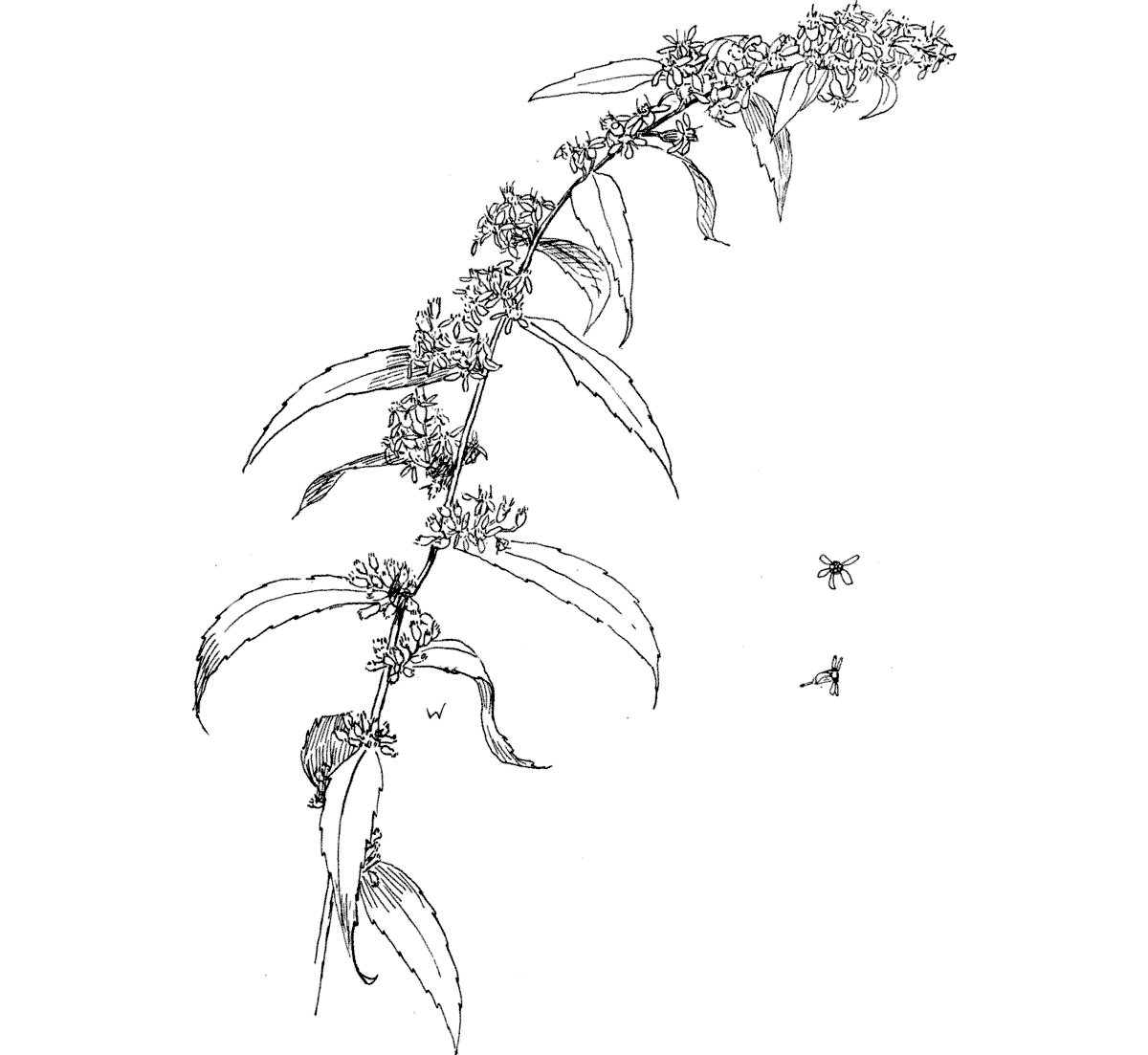
Starry White Aster.Aster multiflorus.
Found in August and September, in dry open fields, and waste places.
The stalk (from 1 to 2 feet in height) is leafy and shrubby in growth, and the branches are long and curving; it is slender, and rough to the touch. Green.
The lowest leaves are broad lance-shaped, pointed at each end, the margin sometimes notched; the upper leaves are long, and narrow, with an entire margin, and diminishing in size till they become line-like near the top of the stalk. The midrib shows plainly, the texture is firm. The color is gray-green, rather dark. The leaves are set immediately upon the stalk, closely and irregularly, and generally alternate.
The disc flowers are few; yellow, changing to brown. The ray flowers are fine and small, 10 to 15 in number; white. The cups very small; silvery green. The heads are arranged in profusion along the leafy branches.
The feathery prettiness of these curving spires of green and white loses nothing of its attraction because of its plentiful growth in barren places amidst the one-toned monotony of the Goldenrods. The quality of its green deserves especial regard.
STARRY WHITE ASTER: A. multiflorus.
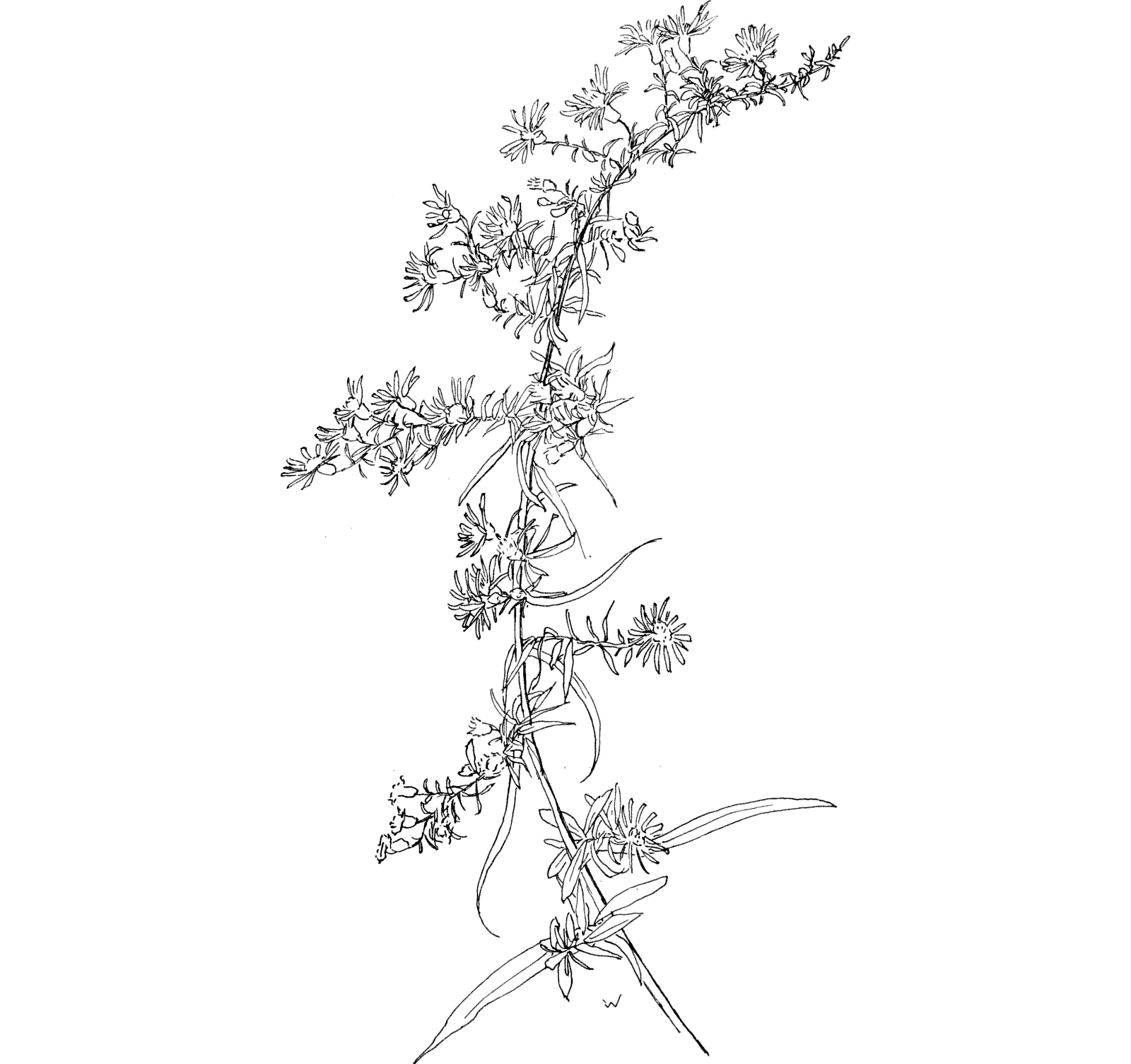
Early Purple Aster.Aster puniceus.
Found in August in damp or swampy places.
The stalk varies from 3 to 5 feet in height, and is widely branching; the fibre is coarse, and it is roughened by hairs. The color is green, very often becoming purple near the foot.
The leaf is a long oval (near the foot sometimes fully 3 inches long), with strong and hairy midrib, and a slightly notched margin; the edge and upper surface are disagreeably rough to the touch. In color light green, the midrib sometimes purple. The arrangement is alternate.
The disc flowers are yellow, turning to tawny; the ray flowers (20 to 30 in number) are long, and of a delicate light purple. The cups are composed of several rows of long, fine, spreading green parts. The heads are arranged in small groups, set on short stems, which rise from the angles of the leaves.
Though somewhat awkward in manner of growth the blossoms of this early Aster are very pretty and profuse. The rays, as they lie folded in the bud, are silvery pale.
EARLY PURPLE ASTER: A. puniceus.
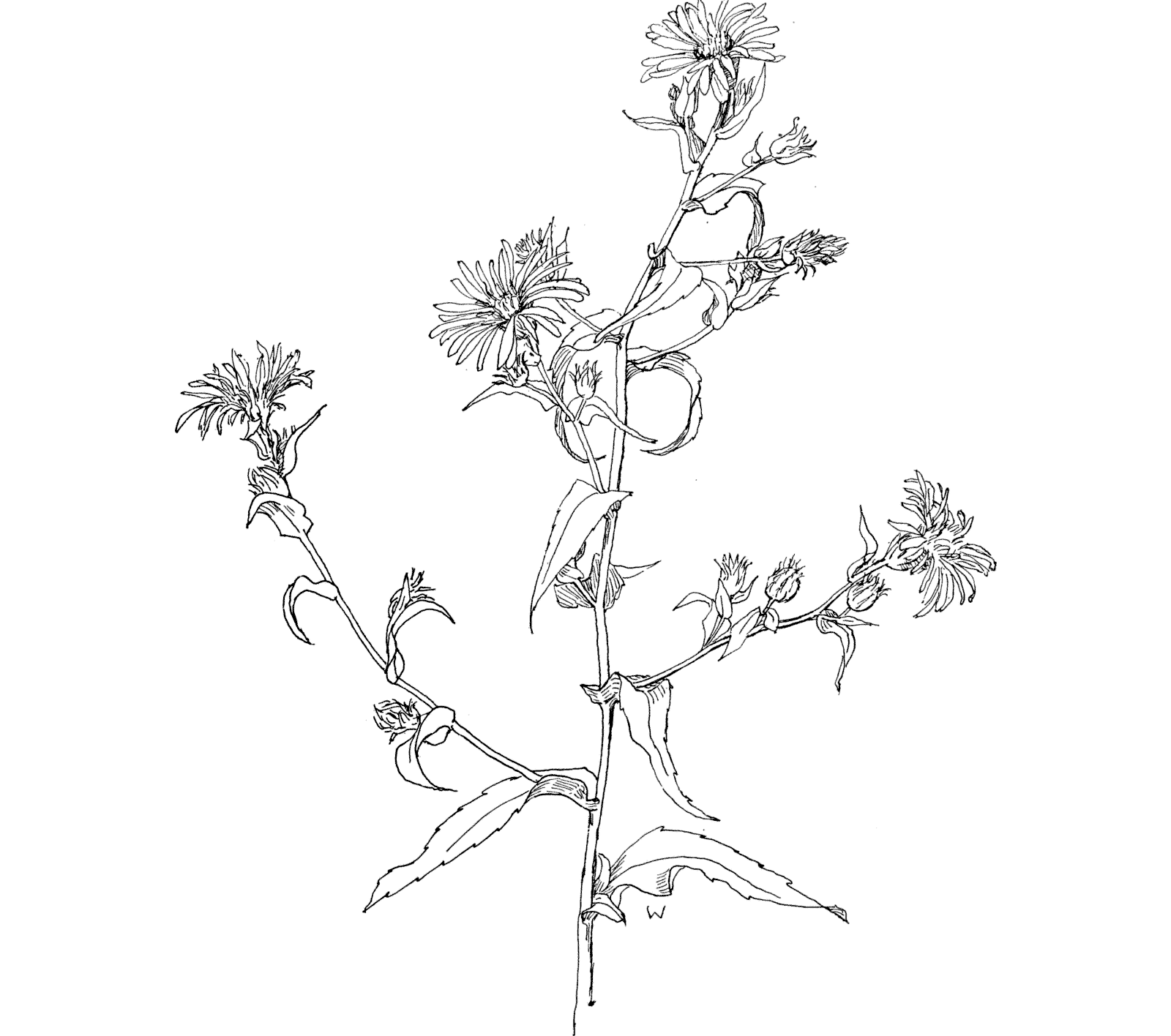
Pointed-leaved Aster.Aster acuminatus.
Found in August in rich woods (Mountains of Vermont).
It grows about 1 foot high, and has a slender, sometimes zigzag stalk, which is slightly rough, and bears the leaves and flowers clustered at the top.
The leaf, from 2 to 4 inches long, tapers at tip and base, and is coarsely toothed on the edge; the surface is a little hairy, and the texture is thin; the leaves, set directly on the stalk, are alternate at short distances, giving the effect of a whorl of leaves. Color green.
The flower-head has from 12 to 18 long, narrow, rays, white or faintly tinted with violet, while the disc flowers are dull yellow. The flower-heads are apt to be few, on slender stems in a branching cluster, on the top of the stalk.
This Aster lacks richness of color, but has a certain charm of slender growth peculiar to wood Asters; its few pale flowers set above the full cluster of the broad pale leaves have an air of selection, unknown to its more luxuriant relatives.
POINTED-LEAVED ASTER: A. acuminatus.
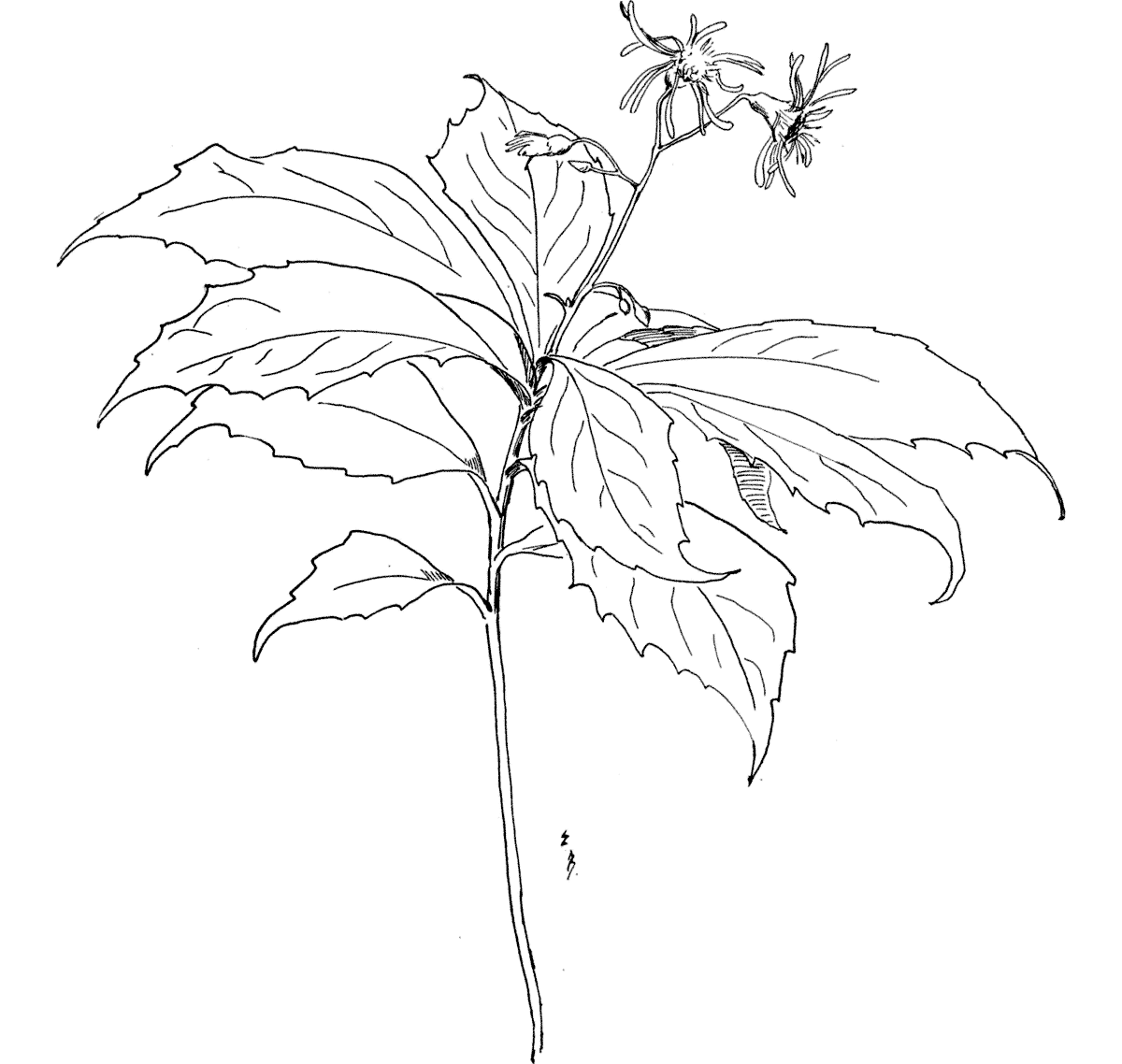
Broad-leaved Aster.Aster macrophyllus.
Found in the woods in September, generally in upland regions.
The single, very stout growing, stalk is between 1 and 2 feet in height; it is slightly rough to the touch. In color light green.
The lowest leaves (generally 3 in number) are very conspicuous, being especially large, and nearly round, with a heart-shaped base, and a suddenly sharp tip; with many ribs, and the margins prettily cut in rounding scallops, with tiny sharp teeth; these leaves are set on long trough-like stems that clasp the stalk. The upper leaves become, very abruptly, quite small; with fine-pointed tips, entire, slightly and irregularly notched margins, and showing only the midrib; they are set on very short stems, or, near the flowers, are placed immediately upon the stalk. All the foliage is exceptionally thin in texture, and rough on both surfaces; the arrangement is alternate. The color is a fine gray-toned green.
The disc flower is small; yellow turning to brown; the rays, 12 to 16 in number, are long and slender, of a very delicate texture, and pale lilac (sometimes nearly white it is asserted) in color. The cup is cylindrical, and slightly sticky, as are the foot-stems. The heads are arranged in a loose, terminal cluster.
An odor of camphor mingles with the sweet scent of these flowers, and is distinctly perceptible at a distance. The decorative quality of the leafage is of unique excellence.
BROAD-LEAVED ASTER: A. macrophyllus.
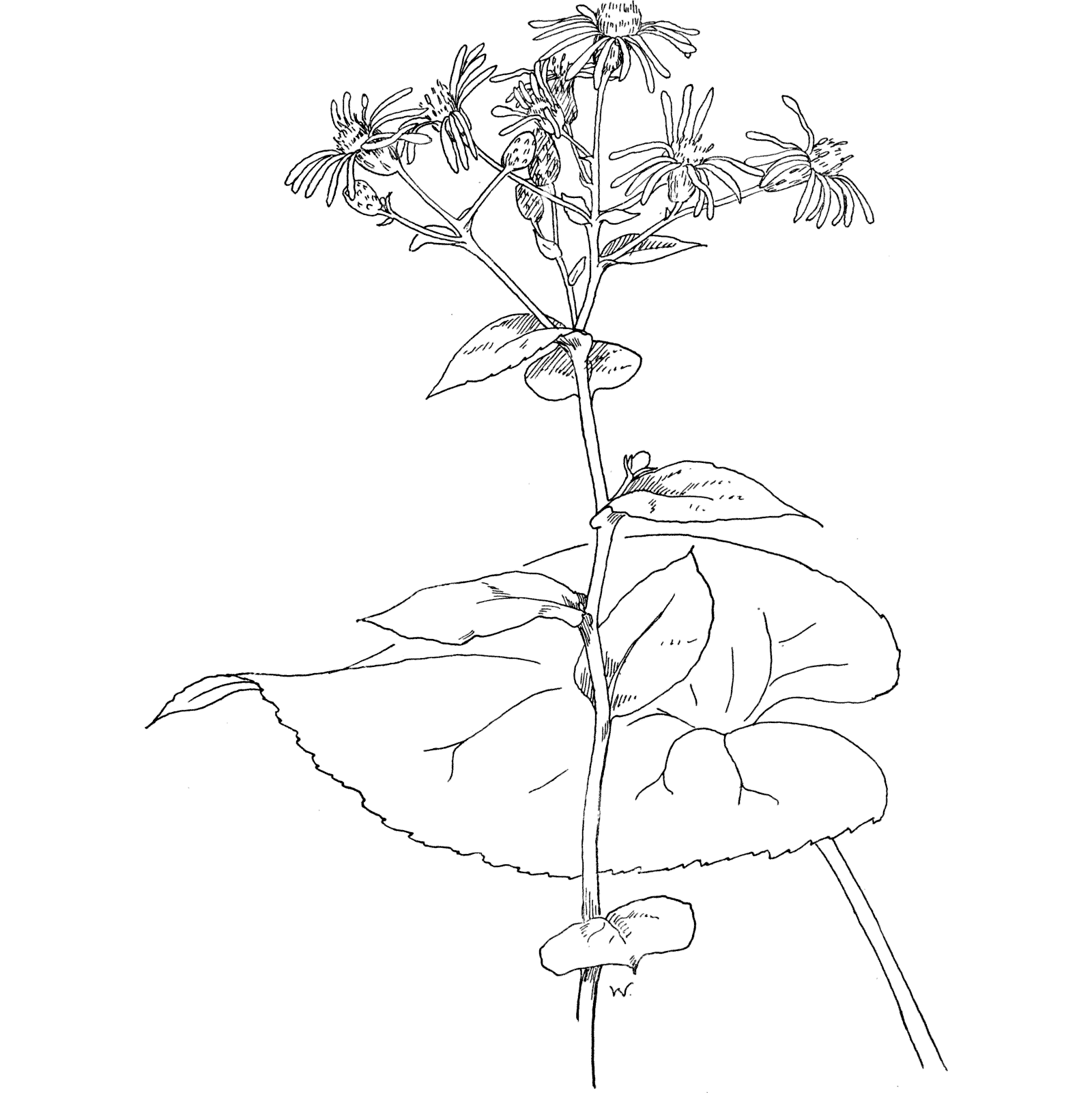
Pine Aster.Aster linariifolius.
Found chiefly on the edges of pine woods in September.
The stalk reaches from 1 to 2 feet in height; it is single, leafy, slender, and rough to the touch. In color, pale green, tinged with red.
The leaf is long, and narrow, with an entire margin; the surface covered with a minute down that is harsh to the touch; the fibre is stiff. The color is green. The leaves are set upon the stalk, irregularly, alternating, and numerous.
The disc flowers are yellow; the ray flowers, 12 to 20 in number, are long and slender, and pale bluish-lavender in color. The heads are few, and grow, on slender stems, either singly, or in a terminal flat-topped cluster.
The stiff edges of the leaves and their rigid bearing are not unlike the needles which carpet the favorite haunts this Aster loves. Though not pleasant to pluck, on account of its harsh texture, this is a very attractive plant to look upon.
PINE ASTER: A. linariifolius.
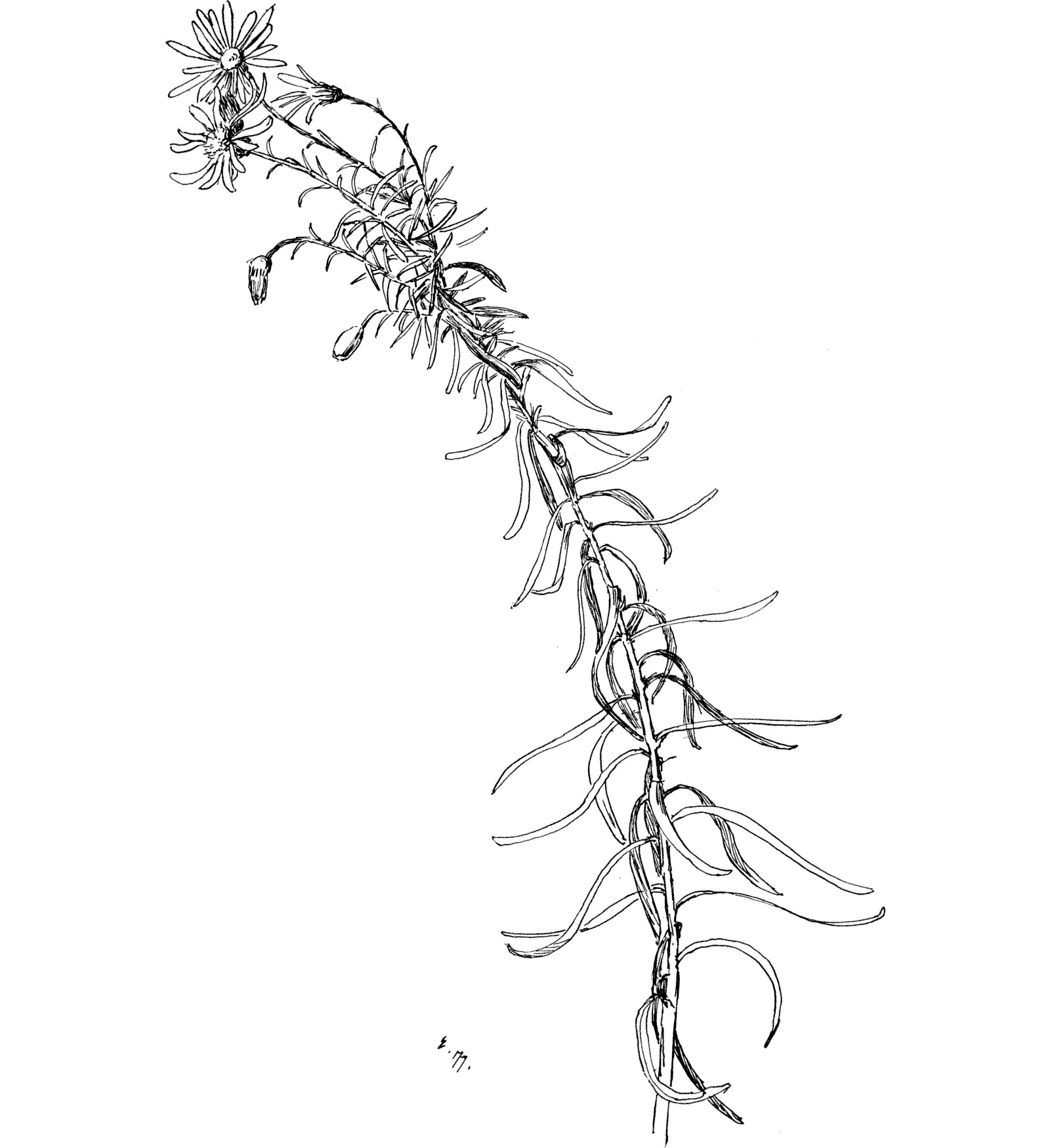
Variable-leaved Aster.Aster undulatus.
Found in dry woods, and thickets, during September.
The slender, branching stalk (2 to 3 feet high) is soft, with down, to the touch. Light green in color. Leaning and swaying in gesture.
The leaves are very variable in shape, the lowest being decidedly heart-shaped, and set on long margined stems (these margins somewhat notched) that clasp the stalk with shallow wings; above, the leaves are somewhat heart-shaped, and are set on short stems, that clasp the stalk with broad wings; while the upper leaves are set immediately upon the stalk, and clasp it by their prolonged bases. All the leaves have tapering tips, entire, or very slightly, notched margins, with a rough upper surface, while underneath it they are soft-hairy to the touch; they are placed alternately. The color is cool green.
The disc flowers are pale yellow at first, but become reddish-brown in maturity. The ray flowers, 10 to 20 in number, are pale lavender or lilac. The heads are arranged in loose clusters.
The color of this leafage, and its shapes, are very pleasing. Gray’s Manual states the color of its rays as “bright blue”!
VARIABLE-LEAVED ASTER: A. undulatus.
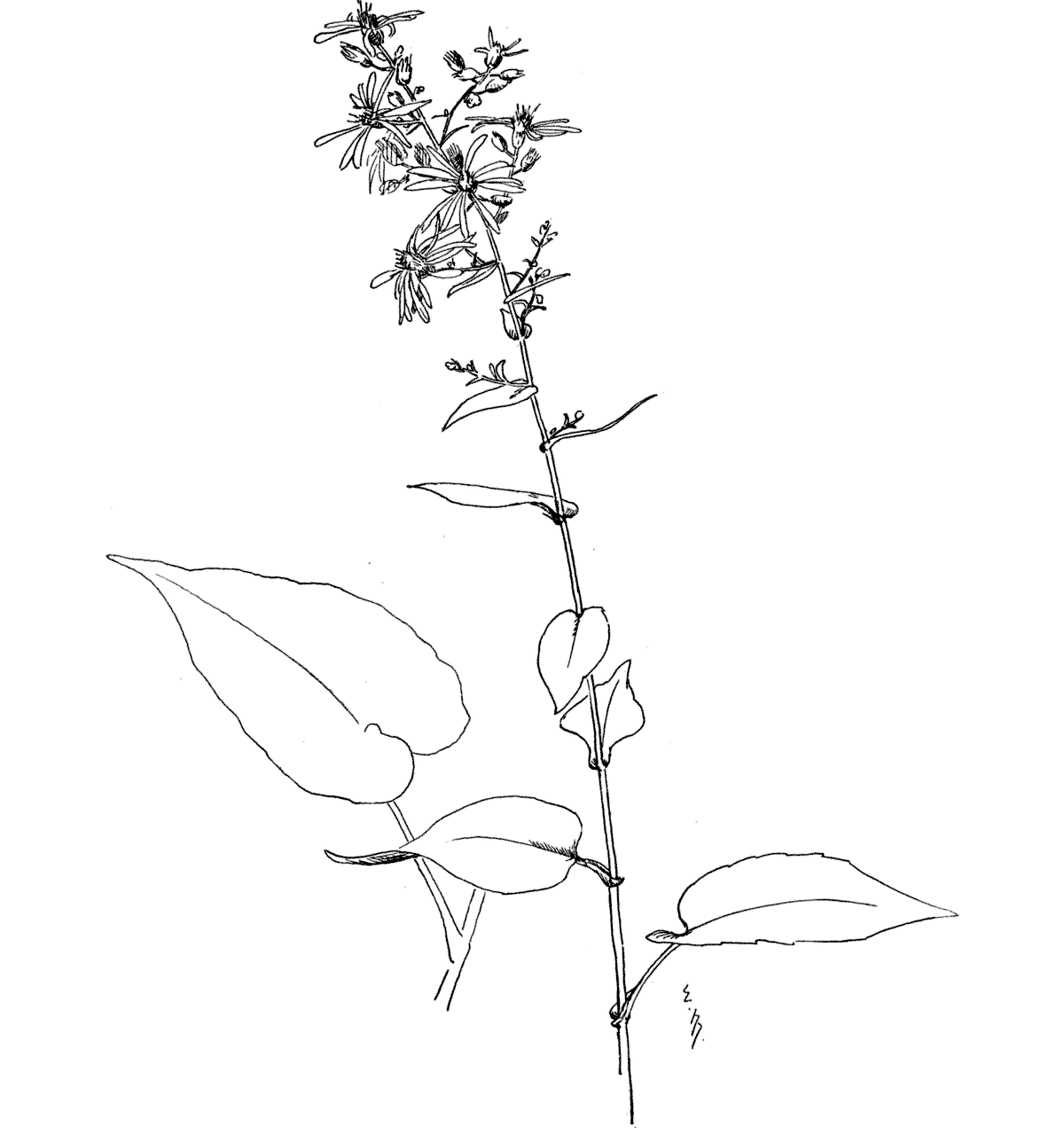
Later Purple Aster.Aster patens.
Found during September and October along the borders of dry woods and thickets.
The stalk (from 1 to 2 and ½ feet high) is branching, and leafy, with a fine texture, and smooth surface; slender and swaying in growth. Its color is sometimes green, often a dull reddish-purple.
The leaf is long, and narrow, tapering at the tip, and partly clasping the stalk at the base; the margin is slightly rough to the touch, the texture is firm and thick, and the surface is smooth to the touch. Color, a cool dark grayish-green. The arrangement is alternate.
The disc flowers are sometimes yellow, or often reddish-violet; the rays, from 20 to 30, are a deep rich violet. The heads are set in vase-shaped green cups, whose parts are overlapping; they are numerous in large terminal clusters.
As the flowers mature, the rays curl inward around the disc, and dry thus on the plant; its leafage is very fine in quality, and in beautiful harmony with the rich brilliance of the blossoms.
LATER PURPLE ASTER: A. patens.
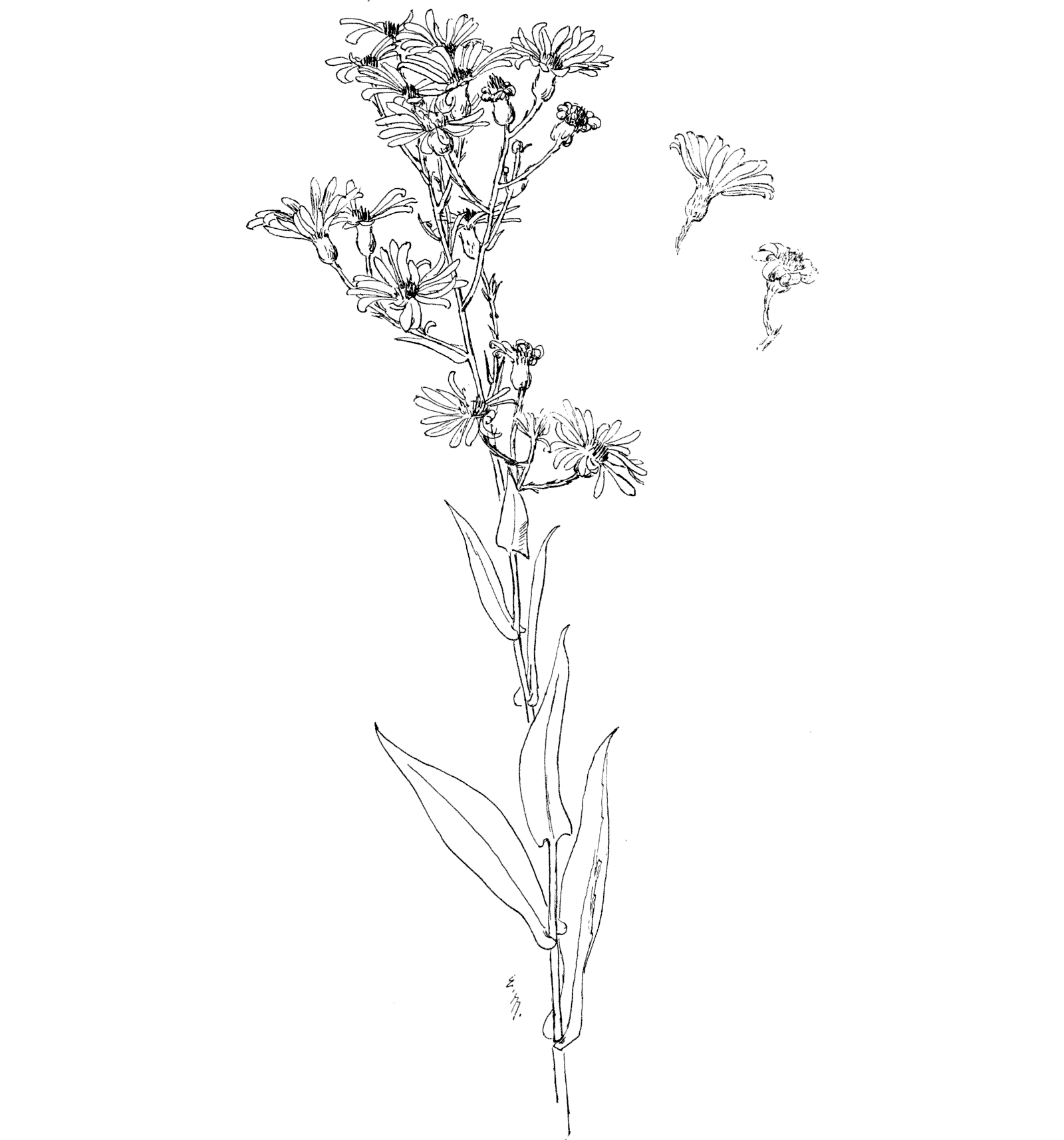
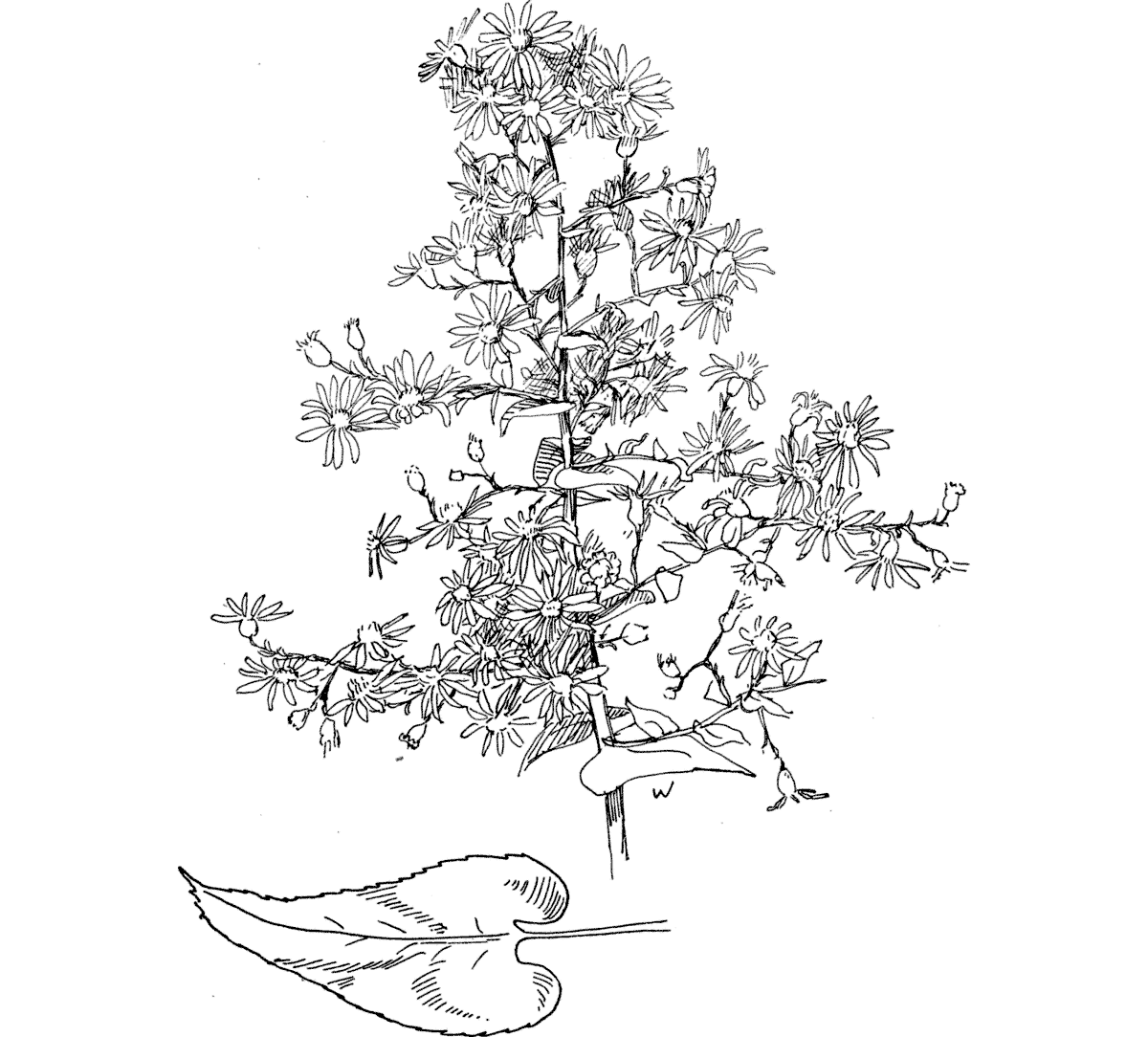
Branching Aster.Aster cordifolius.
Found in the latter part of September in shaded thickets and on dry banks.
The stalk is often about 4 feet high, very widely branching, leafy, and bearing a profusion of flowers; it has a coarse, very rough surface usually. In color reddish.
The leaf has a heart-shaped base, and pointed tip, a slightly notched or entire margin, and a coarse texture, the surface generally being rough above and also on the underside of the midrib; the upper leaves clasp the stalk, while the lower, and larger, leaves are set on short hairy stems. In color, a rather dull green. They are numerous all the way from foot to tip.
The many flower-heads, are small, with 14 to 20 delicate, short, pale-lavender rays; the cups are smooth and shining, and are set on leafy foot-stems, in large loose clusters.
Coming just as its purple and white sisters are departing, and as though desiring to atone for their cessation, this delightful late Aster fills the country roads and lanes with the generous abundance of its misty gray-lavender bloom.
BRANCHING ASTER: A. cordifolius.