Part V—The Indian Jungle.
Reading edition
A Tête-à-Tête Dinner—Letters from Home—The Journey Junglewards—The Camp and Scenery around it—A Sportsman’s Paradise—Lost in the Forest.
In a large and beautiful room in one of the upper storeys of a Club, on the outskirts of Bombay, four gentlemen are seated at dinner one evening, not long after the events related in the last chapter. It is evidently quite a tête-à-tête affair, for they are all by themselves in a corner, at the extreme end of the spacious apartment, close to the great windows that lead on to the verandah. The balmy evening air, laden with the scent of a thousand flowers, steals in, and is put in motion by an immense punkah which hangs above them, and kept moving by a little nigger-boy, dressed in a jacket of snow apparently, who squats in a far corner like a monkey, and requires the united efforts of the three servants who wait at table to keep him awake. No matter what these men are carrying, they always stop as they pass to give Jumlah a kick, making some such remark as—“Jumlah, you asleep again, you black rascal! I kick ebery bit of skin off you presently?” Or, “Jumlah, you young dog, suppose you go asleep just one oder time, den I break ebery bone in your black body!”
The jalousies are wide open, for the day has been hot, and every breath of air is precious. Although the waiters indignantly refer to the colour of poor Jumlah’s skin, they themselves are black, though dressed in cool white linen.
You have guessed already who the gentlemen are. Let us follow them out to the verandah, where they have gone to sip their fragrant coffee. Stars are twinkling in the bright sky, fireflies flit from bush to bush in the gardens beneath, the distant sound of music falls upon their ear, mingling with the far-off city’s hum, the beating of tom-toms, and shrill screams and yells, which may mean anything from mirth to murder.
Conversation during dinner had been very animated indeed; but sitting out here on the cool verandah no one seemed much inclined to speak. Frank had received letters from home, Fred had received letters from Russia; and very pleasant letters, I ween, they were, for they bore reading over and over and over again. Chisholm’s letters were what he called “jolly enough,” only as soon as he had read them, and laughed over them, he just tore them up and pitched them into the basket.
“Hallo, you fellows!” cried Chisholm suddenly. “Awake from your slumbers.”
“I wasn’t asleep,” said Frank.
“No; but you were dreaming, you young rascal.”
“Do you know how I feel?” said Lyell. “I’m feeling sad at the thoughts of parting with you fellows and going back to England.”
“Then, my dear fellow, don’t go,” said matter-of-fact Chisholm O’Grahame.
“By George, then,” cried Lyell, “and I won’t. I’ll apply for more leave; and while the application is going home, and the reply coming back, I’ll run off with you boys into the jungles. I know a deal more about the country than either of you.”
“Lyell,” said Chisholm, “I knew you were a brick the very first day I clapped eyes upon you.”
They were indeed lucky to have made the acquaintance of such a man as Lyell. He had been pretty much at home in Africa; but in India he was more so; and as soon as he had made up his mind to go with our heroes, he commenced forthwith making preparations for the campaign against big beasts.
He explained everything he did to his three friends, and told them his reasons for acting as he did. Tents were bought in Bombay, and additional rifles—he was very learned on the subject of rifles and rifle-bullets—and Chisholm, being the biggest man, was furnished with a regular bone-smasher. Twenty servants were hired, and a boat was chartered to take their little expedition on to Madras. Just three days were spent in that city.
“If we stay any longer,” Chisholm said to Lyell, “my young confrères will be starting lotus-eating again. Let us be off as soon as we can.”
And so the very next day the journey up country was commenced: by train at first, for a long long way; nobody was sorry when this part of the cruise came to an end at a station near a tall forest, with a name that was worse than Welsh to every one save Captain Lyell and a few of the attendants. By seven o’clock next morning, a start was made in the direction of the south and east.
By the evening of the third day they had left civilisation a long way behind them; they had journeyed on and on through vast tracts of jangle lands, and mighty forests clad in all the rich and varied luxuriance of a tropical summer. They had passed many a strange romantic hamlet; from the doors of the huts of grass and clay, little innocent naked children had waddled forth to stare in wonder at the cavalcade, while the simple owners offered them fruits of many kinds to eat, and water to drink. They were often tempted to get down and spend a few hours shooting, for they came to places where feathered game of many kinds abounded, especially duck and peafowl. But Lyell’s counsel was always taken, and his advice was, “Let us go on as speedily as possible towards the mountain forests, and there encamp.” And so, as the last rays of the setting sun shimmered down through the trees on them, they reached a spot which Lyell thought would do excellently well as a camping-ground.
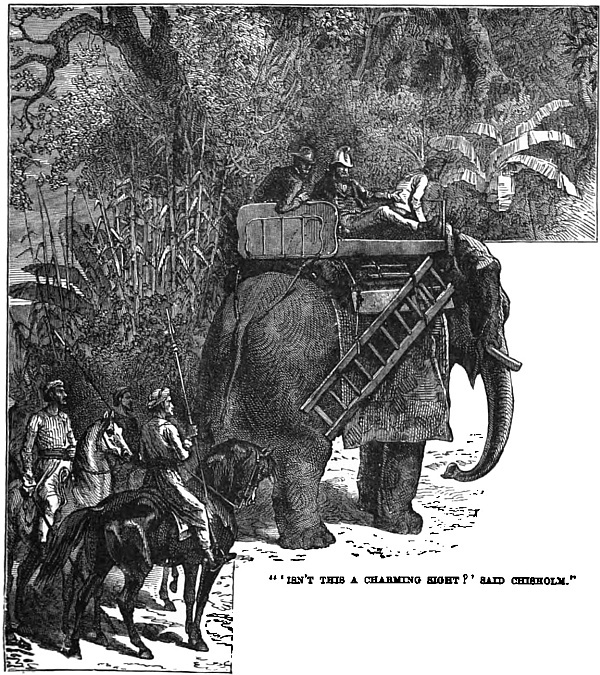
“Oh, isn’t this a charming sight?” said Chisholm, addressing Frank, who lounged on the howdah by his side.
They were a long way behind the others. They did not mind that, however; indeed, the elephant on which they were seated, pleased the two friends far better than any other could have done. He was slow, but wondrous sure. No fears of Jowser, as Frank baptised him, taking sudden fright and dashing suddenly off and away over the jungle, as elephants sometimes do, and ending by dashing their brains out, or tumbling over some mighty precipice with them. Jowser was somewhat more than a hundred years old—a very experienced matter-of-fact old fellow, who knew better than to hurry himself. He required but little guidance—a gentle touch with a cane on his left ear or his right, as the case might be, was quite enough for him. When he stopped short sometimes, to reach above him for a few leaves to munch, his attendant would gently goad him; but Jowser would turn up the tip of his trunk to him as much as to say, “Put a handful of rice into that. That’s what Jowser wants. Jowser is hungry.”
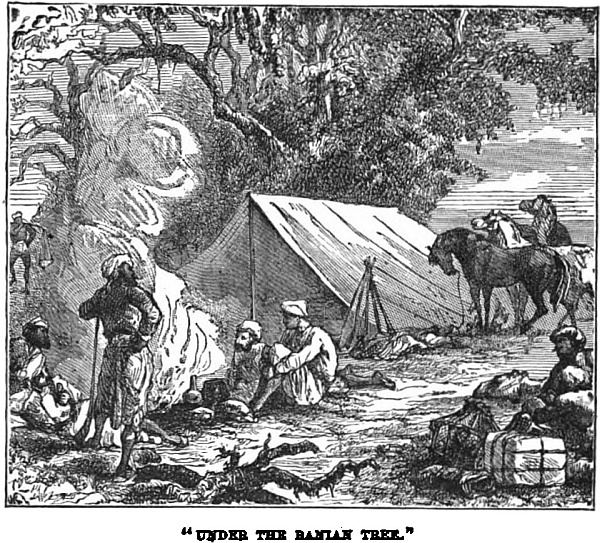
But it suited Frank and Chisholm to be a little late of an evening, because they found their friends already encamped, probably under the banian-tree, and, better than all, supper ready—a curry of such fragrance, that even a sniff at it would have made them hungry, if they had not, as they always did have, the appetite of hunters.
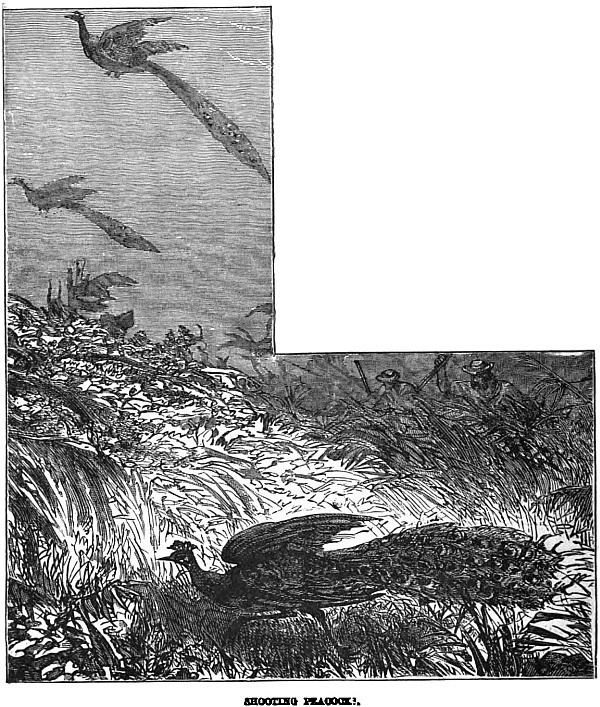
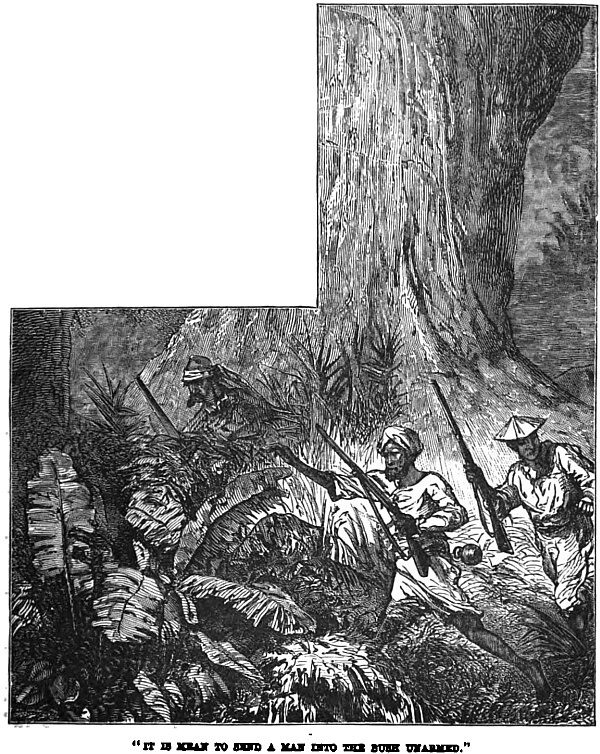
The master of ceremonies did allow them one day, however, among the peafowl. In a piece of jungle—which Chisholm as usual persisted in calling a moor—they found these beautiful birds in great abundance: they were early astir that morning. They had their own beaters, who were principally Mahratta men, whom they had engaged in Bombay, and whom Lyell had armed with rifles as well as spears. “It is a mean thing,” this gallant officer said to our heroes, “to send a man into the bush unarmed; yet Englishmen constantly do it.”
Independently of these they had volunteers from among the simple Hindoo folks in whose country they were. Brave, fool-hardy in fact, but as a rule indolent, these men would work all day, for the sake of earning a morsel of tobacco.
It was a glorious day’s shooting our sportsmen, had, and it was but one of many such days they enjoyed, after their encampment at the foot of the mountains had been fairly formed. Neither of them were fond of what is called battue shooting, deeming it, as every true sportsman must, somewhat unjust to the birds; but here there were very many mouths to fill, and four guns to do all the work of filling them. So they had to make good bags.
And they did too. It was always their custom to be early astir, but they did not start on an empty stomach you may be well sure; and they were quite ready for luncheon at twelve. Then would come the hour for siesta; for during the time of day when the sun is at its highest and its hottest, it is neither pleasant nor safe to be out of the shade in India.
“Why, Lyell,” Fred Freeman said on the evening of the first day’s big shoot, “you have brought us to a perfect paradise, and a sportsman’s paradise too.”
A sportsman’s paradise? Yes, surely the contents of those lordly bags testified to that. And what was it that was wanting in that bag, I wonder? Nothing you could wish to see. Here were pigeons by the dozen, and peafowls and jungle-fowls, to shoot which they had threaded the dark mazes of the forest. Here were ducks and geese, ay, and snipe and teal, which they had waded neck-deep in paddy fields to find, to say nothing of big fat bustards, and grouse and red-legged partridge, that had fallen to their guns while crossing the moor; and last, but certainly not least, a hare or two as well.
Now, when I say that there were growing around them, everywhere, the most luscious fruits that can be imagined; when I say that the earth yielded its turmeric (the basis of curry powder), and its deliciously esculent roots; that spices of all kinds could be had for the gathering, that the cocoa-nut palms held high aloft their tempting fruits, and that the river abounded with fish, will you wonder when I tell you that our friends lived like fighting-cocks. Would they not have been fools if they hadn’t?
Chisholm and Frank occupied one sleeping tent, Fred Freeman and Captain Lyell another. Very comfortably too those tents were furnished, and each canvas bed had its own mosquito curtain. One night, however, Frank found it impossible to sleep, so he got up quietly, dressed, and went out. What a heavenly night! Never, except in the far-off sea of ice, had he seen stars so bright and large. There was light enough almost to read by. He could see everything around him—the men lying asleep at the foot of the snow-white dining tent, the elephants and the picketed horses, and, farther away, jungle and plain, forest and hills, all bathed in starlight. Frank could hear, high over the loud hum of insect life, the distant yelp of the jackal, the gibber of the striped hyaena, and the unearthly yell of the jungle cat.
“If there is nothing more terrible than that about,” he said to himself, “I shall go for a walk, just a little way. Jooma,” he continued, addressing the sentinel, “I’m going to the banks of the river.”
“Take care, sahib, take care,” was the sentinel’s warning.
When two whole hours passed away, and there were no signs of Frank’s return, Jooma became alarmed, and roused Chisholm, and Chisholm aroused the whole camp. Frank must be found, and that right speedily; but where were they to seek him? While they were deliberating which way to go, the report of a rifle fell on their ears, coming from the forest behind the camp. Meanwhile clouds had banked up and obscured a great portion of the sky.
“Now, hurry men, hurry, get your torches and come, there isn’t a moment to be lost if you would save my friend.”
In ten minutes more they were on his track: by bent grass by a single footprint, by a broken twig, and a hundred little signs that the eye of a European would never have noticed, these men followed the trail by torchlight, till far into the deepest and darkest part of the great forest. But now a pause ensued. The trackers were puzzled. The truth is, that it was just at this spot that the disagreeable truth flashed upon poor Frank that he was lost. He had felt sure he could easily retrace his steps, but trying to do so only led to a series of useless wanderings up and down and round and round, often coming back again to the same spot, though he knew it not, until the starlight forsook him, and he found himself at last in the terrible position presently to be described.
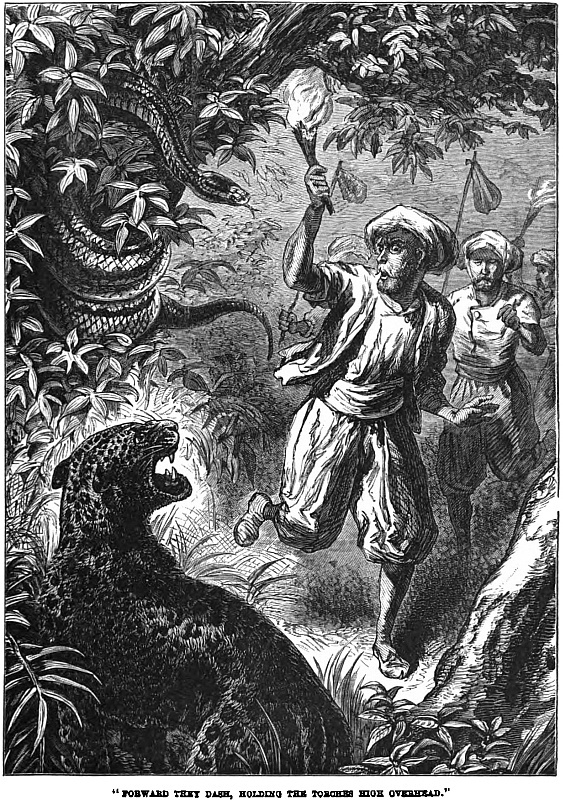
The trackers are at fault, and no wonder, yet not three hundred yards away Frank lies at the bottom of a pit, into which he had stumbled, and pulled after him the large withered branch of a mango-tree, and his rifle had gone off as he fell. He hears his friends firing to attract his attention, he cannot reach his rifle to reply. But there adown the wind at last comes a thrice-welcome shout, “Coo-ee-ee!” He tries to answer, but the branch lies across his chest, and he can hardly breathe. “Coo-ee-ee! Coo-ee-ee!” They hear his muffled tones at last; they look no more for track nor trail. Forward they dash, holding the torches high over head. “Coo-oo-ee!” A gigantic leopard rises from his lair, but with a startled yell disappears in a moment in the darkness. Was that a huge python coiled round the tree? If it was he had no time to strike, so quickly do they speed along. “Coo-ee-ee!” They are close at hand now, and now they are at the very mouth of the pit, and Frank can talk to them and tell them how he is trapped.
Chisholm was so glad to see his friend once more safe and alive, that he forgot entirely that he had resolved to scold him properly for his rashness and folly. But Frank never afterwards cared to have any allusion made to his night ramble, and resented almost warmly Fred Freeman’s attempt to dub him the “somnambulist.”
Chapter Fourteen.
Adventure with a Python—Moondah’s House—“The Tiger! The Tiger!”—Panthers—Hunting with the Cheetah—The Panther and the Boar.
“Do you really think there are pythons or boa constrictors in the forest?” asked Frank next day at dinner.
“I haven’t a doubt of it,” replied Lyell. “At the same time I cannot quite swallow all the tracker says about the enormity of the serpent he saw when following up your trail in the woods.”
“No,” said Chisholm, “fifty feet of snake is rather more than most men can swallow; but had you seen the tracker’s eyes when he saw the tiger, you’d have been willing to admit that they were big enough to accommodate a very large amount of boa constrictor.”
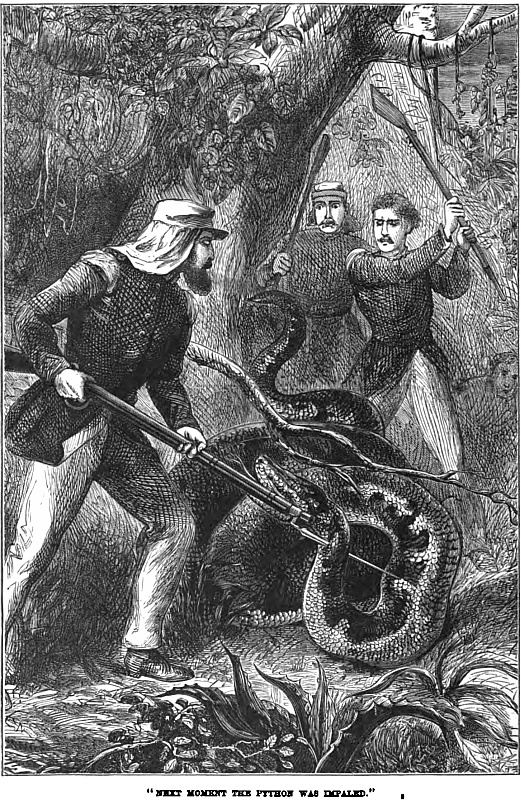
“It puts me in mind of an adventure I once had in South Africa,” said Lyell. “One doesn’t like speaking much of one’s self, but I think, on the occasion I refer to, I exhibited a fair amount of firmness and presence of mind in a moment of deadly peril to one of my men. I had been out for a fortnight’s shoot, beyond and to the nor’ard of the Natal provinces. There were four of us—our doctor, our purser, marine officer, and myself. Our sport was good, and the fun we had fairish. We were seated at lunch one day in an open glade in the forest, when suddenly we were startled by hearing the most terrific yells; and on looking up beheld one of our Caffres speeding towards us, pursued by an enormous python. There was no time for escape, had escape been honourable, which it was not. I seized the rifle and bayonet from one of our attendant marines, and next moment the python was impaled. Oh, don’t think for a moment that that would have killed him! In half a second he had almost wriggled clear; but in doing so he turned the rifle round so that the muzzle pointed almost down his throat. It was a terrible moment—thank Heaven that rifle was loaded, and that I had the presence of mind to pull the trigger! It was a case of ‘all hands stand clear’ now. The python’s head was shattered, but the convulsions of his body, ere death closed the scene, were fearful to witness. I don’t want to see the like again. His body measured five-and-thirty feet; the gape of his jaws measured over a yard. I can understand a monster like this swallowing a goat or even a deer itself.”
A day or two after this the camp was struck, and a move made nearer to the mountains, the tents being erected close to the river as before, but still on elevated ground. Here they were, then, in the very centre of what might be called the home of the wild beasts, and both sport and adventure might reasonably be expected in any quantity. Herds of elephants roamed in the deep forests, tigers and wild pigs were in the thickets; bears, too, would be found, and birds everywhere. They formed no particular plan of attack upon the denizens of this wilderness; they were bold hunters every one of them; they carried their lives in their hands, but they omitted no precaution to defend and protect them. They always went abroad prepared for anything.
Chisholm called the spot where the camp was now fixed—and where it remained until the commencement of the south-west monsoon warned them it was time for departure—his Highland home. It was indeed a Highland home, and the scenery all around was charming. And yet a walk of some eight or nine miles brought them to what might be called the lowlands. Here were great stretches of open country, interspersed with lakes and streams, immense green fields of rice or paddy and maize, with groves of cocoa-nut palms, and gardens where grew the orange-tree and the citron, and where the giant mango-trees hid completely from view the primitive huts of the villagers.
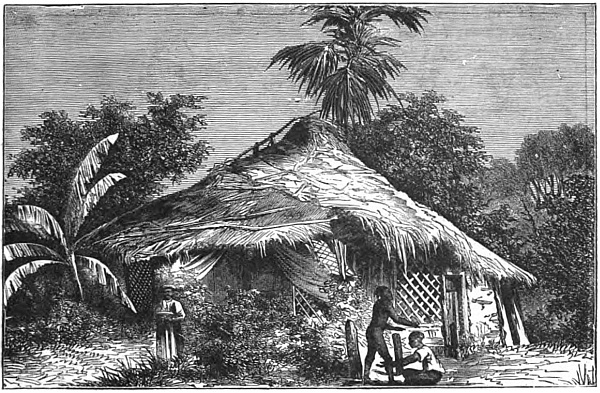
Moondah was head-man of one of these villages, and our heroes, while returning home after a day’s promiscuous shooting, used to stop to refresh themselves at his house. Moondah was a kind of a feudal lord among his people. He had built himself a house on the outskirts of his village, just under the shadow of a vast precipice. Indeed, it was quite a castle compared to the frail huts of mud and wood in which the villagers dwelt. Moondah’s castle was built of solid stone and lime, the walls were of great thickness, and the roof was flat and surrounded by embattlements; and it was very pleasant to sit here for half an hour, while the sun was declining in the west, and sip the fragrant coffee, which nobody could make so well as Moondah, and which he always presented to them with his own hands. The five miles that intervened between his house and their encampment, seemed a trifle to them after that.
It was, strange to say, at this head-man’s house, and not in the jungle, that they formed their first acquaintance with a tiger. Close by the walls ran a rapid stream, by no means large at the time of which I write, but in the rainy season it mast have been swollen into quite a broad and mighty river. The day had been unusually warm, and the sport very exciting. Moondah was extremely pleased to see them; perhaps the contents of Jowser’s howdah, which had been left at Moondah’s garden gate, had something to do with his delight, for they seldom called upon him without leaving a souvenir of some kind. Moondah was in no wise particular, so long as it was not buffalo or cow’s flesh; but pigs and deer pleased him much, and neither wild-cat, jackal, nor iguana lizards, came wrong to him.
“Well, Moondah?” said Lyell.
“Salaam Sahib,” replied Moondah, leading the way up-stairs to his darkest and coolest room. “I dessay you tired after your ’xertions; you squat dere on de skins, and munch de fruit my little boy bring you. I fetch de coffee quick enough, you see. Hallo! what is de matter now?”
This was addressed to the above-mentioned little boy, who had just rushed in with the fruit-tray, which he dropped at his master’s feet.
“Hooli! hooli!” was all the boy could gasp. “The tiger! the tiger!”
“What!” cried Lyell, starting up, “a tiger in the very village?”
But it was easily explained: a dead bullock lay in a bit of bush only a stone’s throw up the stream, and on this the beast had doubtless come to regale himself. He was there now; and it was resolved to wait quietly on the top of Moondah’s house, and watch.
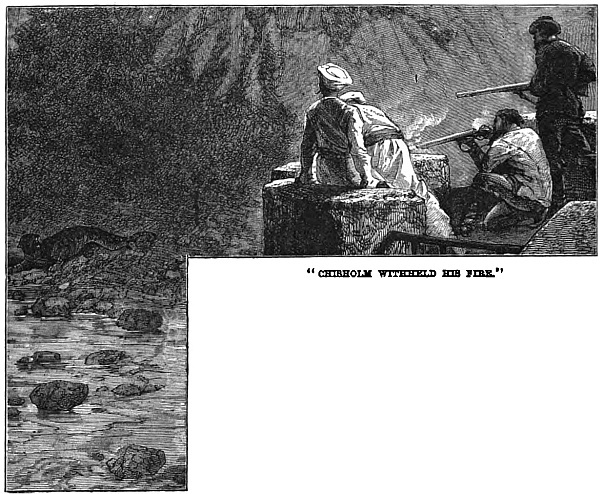
It was a long watch. Daylight faded away, twilight faded into darkness; the stars shone out; a great red round moon rose slowly up from behind the trees, paling as it went, till at last it shone out high above them, bright, and white, and clear. But still no tiger made his appearance. At last though, there was a crackling noise amongst the bushes, then a stealthy footstep, and out into the open stalked the majestic beast. He stood for a moment as if to listen, then moved onwards to the river to drink. He presented a splendid shot. Seeing Lyell’s rifle at the shoulder, Chisholm, who was of a chivalrous nature, withheld his fire. But Lyell only wounded the brute in the leg. He was staggered, and emitted a roaring cough that seemed to shake Moondah’s house to its very foundation. Now it was Chisholm’s chance; he had knelt, and ere the crack of his rifle had ceased to reverberate among the rocks the tiger was stretched lifeless on the river’s brink.
One day Moondah came to the camp. It was evident he had something on his mind, for he never came without good news of some kind.
“Twenty mile from here,” he began, “lives a man who married two or tree of my sister.”
“Well done,” said Lyell, laughing.
“But that is nothing,” continued Moondah; “in the scrub around his village are antelope plenty; and my brodder he keep cheetah. There are also panther in the scrub; and dere are,”—here Moondah’s eyes sparkled, and his mouth seemed to water—“dere are wild pigs in de woods.”
“Oh, bother the pigs!” said Lyell. “Let us go to the village and see the cheetahs hunting. Let us go for two or three days, and make a regular big shoot of it.”
Accordingly, next day they set out, and Moondah and his merrie men went too. The camp was not broken up, but elephants were taken—Jowser among others—and horses, with plenty of ammunition and plenty of the good things of this life, both to eat and to drink. Their road led through jungle, scrub, and moorland, and just skirted the great forests. At noonday they stopped for luncheon, and the usual siesta. Chisholm and Frank strolled off together, while it was getting ready; they walked with caution, as usual, for there was cover enough about for anything. They soon discovered that there was some one not far off who did not belong to their party at all, and that he too was going in for a siesta. An immense tiger! Stretched on the grass by the river side, what a lovely picture he made. Chivalrous Chisholm O’Grahame! he would not have fired at the beast thus for the world. He admired him fully a minute in silence, then—
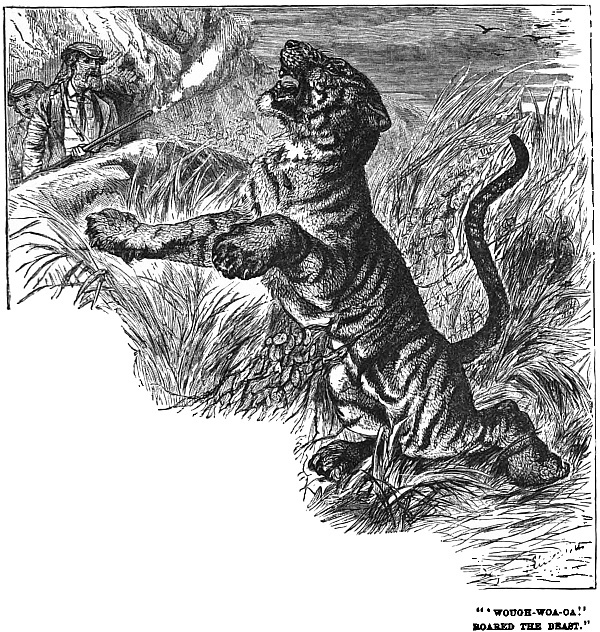
“Pitch a cartridge at him,” he whispered to Frank.
The result may easily be guessed.
“Wough, woa, oa!” roared the beast, springing up. Chisholm gave him both barrels. He was quiet enough after that. But had Chisholm only wounded the creature, it might have interfered materially with the continuation of my story, for Frank had no arms.
That evening found them encamped near the village of Chowdrah. They were duly introduced to Moondah’s much-married brother-in-law, and to the cheetahs. Frank was a little afraid of these animals at first, especially when one of them made a kind of a playful spring at him and brought him down, but this the much-married man assured Frank was all in fun. Next minute the same cheetah sat down by Frank’s side, and purred to him, like a monster cat. In shape of body they were not unlike a mastiff, long-tailed, spotted, loose in the loins and leggy; they had none of the grace and beauty of the panther.
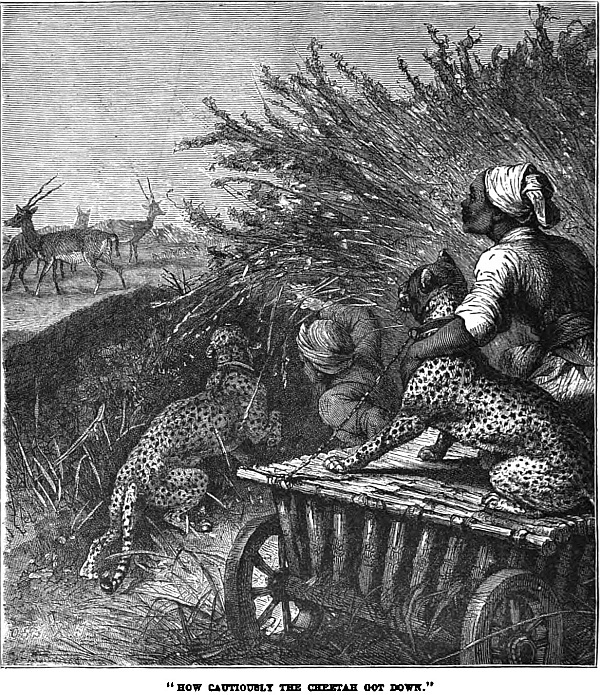
Next day and for several days our heroes enjoyed the sport of antelope hunting, and the enjoyment was very real. They did not always find, but when they did it was interesting to watch the movements of the now-unhooded cheetah. How lightly and cautiously he springs to the ground, flopping at once behind a bit of cover; how slowly but carefully he crawls towards the herd. Ah! but they see him now, and off they bound. Frank strikes spurs into his charger, and, wild horseman that he is, follows the chase. Chisholm and Lyell and Fred are not very far behind.
But that bounding antelope and that fleet-footed cheetah distanced them all. They were never once in at the death. Moondah and his men used to go wild with joy when the antelopes were brought in. They could do nothing but clap their hands and sing, “Hoolay-kara! Hoolay-kara!” till they were tired.
Frank so set his heart upon those cheetahs, that he determined to beg for a young one. Ay, and he got one too; but for the life of him he could not make up his mind whether to term it “kitten” or “puppy.”
Greatly to the joy of Moondah they managed to kill not a few wild pigs.
In a bit of scrub or bush about an acre in extent they were told one day that a panther was hid. This was a chance not to be missed. Stake nets were planted at the side next to the hill where doubtless the beast’s cave lay, the guns were well positioned, and the beaters began their work. Mr Panther, however, did not see the fun of going into that net. Disturbed at last, he quitted cover by making a wild rush at the beaters themselves; two were rolled over, and one severely lacerated in the leg. Fred was the nearest gun, and he wounded the panther in the shoulder, without stopping his way however. Well, a wounded panther must attack whatever with life in it happens to come his way. In this instance it was an old grey boar, who was coming round a corner, wondering to himself what all the row meant. The panther repented his rashness next minute, when the boar’s tusks were fleshed in his neck. It was a curious battle, brought to a speedy termination by Chisholm’s bone-crusher. His monster bullet whizzed through the panther’s body, and pierced the breast of the huge boar, and they fell as they fought.
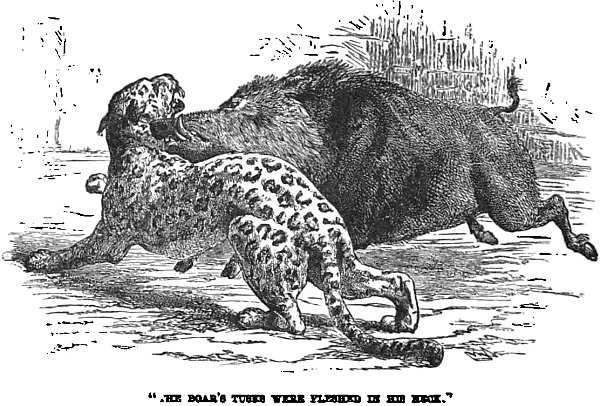
“Now,” said Lyell, “I do call that a good shot. Bravo! Chisholm.”
Chapter Fifteen.
Elephant Hunting—The Elephant and Tiger—The Tusker’s Charge—The Runaway Elephant—The Man-eating Tigress.
Those of my readers who have followed me so far in my history of the wanderings and adventures of our heroes cannot but have observed that in the character of Frank Willoughby there was a certain amount of what, to give it the right name, must be called foolhardiness. But poor Frank’s last adventure in the Indian jungle taught him a lesson which he is not likely to forget while life lasts.
Elephant shooting seemed at first, to Frank and Fred at least, very cruel and unnecessary sport. Elephants are so sagacious and wise.
“Just think, for instance,” said Frank, “of shooting a noble beast like poor old Jowser!”
“Ah, but,” Lyell explained, “it isn’t every elephant you’ll find equal to Jowser. Moondah there will tell you of the immense destruction elephants cause to the maize and rice crops.”
“Yes, yes, dat is so,” said Moondah; “if they are not kill, and plenty kill too, they soon conquer all de country worse dan de Breetish.”
Well, apart from the apparent cruelty of killing the elephant, which Sir Samuel Baker calls the “lord of all created animals,” there is no sport in the world so exciting and dangerous as this, and none that requires greater hardihood or daring. No wonder then that our heroes spent over a month at it, meeting of course with many other wild adventures, but seeking none other. Moondah it was who organised for them their army of beaters and trackers, and the scenery through which these men led them, was oftentimes grand and beautiful in the extreme; not that they had much time during the chase to admire the loveliness of nature, it was while riding homewards to their temporary camp in the cool of the evening, or stretched beneath the trees when dinner was over, that they could thoroughly enjoy quietly gazing on all things around them. This was indeed the dolce far niente.
Our heroes one day had an opportunity of witnessing a curious encounter, between an elephant and a tiger. They themselves were within fifty yards of the herd when it took place, and under cover; the elephants were quietly browsing on the plain, and evidently not suspecting that danger lurked on either hand. One young calf had strayed some little distance from the parent.
“So capital a chance as this,” said a tiger to himself, “is seldom to be found; I would be a fool to miss it.”
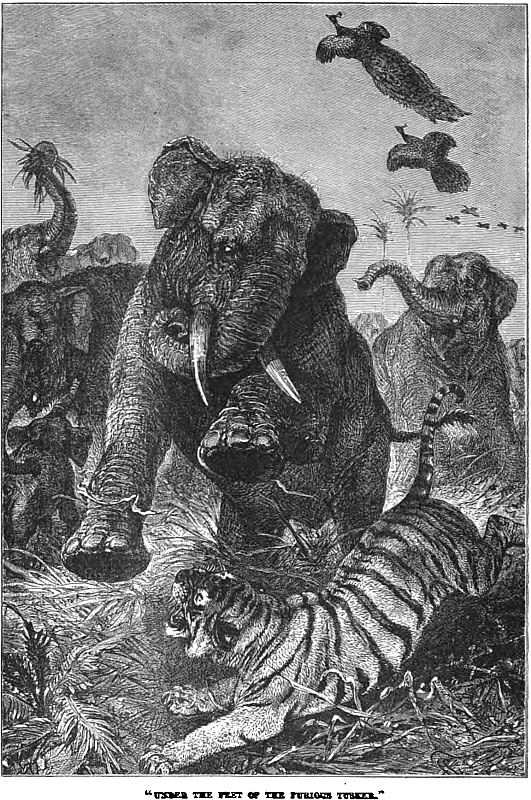
There was a scream from an elephant in the rear, and a wild rush from one in the van. The tiger seemed quite unable to check his speed in time, and next moment he was crushed to atoms under the terrible feet of the furious tusker. There was a crash and a scream, and a cloud of dust. Then the elephant could be seen gathering himself up from where he had literally fallen upon his foe.
Fred Freeman used to chaff Chisholm O’Grahame about the immensity of his rifle.
“I wouldn’t carry such a tool as that for the world,” Fred said one day.
“No,” said Chisholm, laughing, “for, my dear boy, you couldn’t. Besides, its kicking would kill you.”
Now, early next morning a rogue elephant was to be tracked, and if possible bagged. He was a wily old rascal this, who seldom cared to go with the other herds; he doubtless thought he fared better when all by himself. He was a murderous old rascal too; for on two separate occasions he had attacked men, and more than one death could be laid at his door. It was not the first time that some or other of our heroes had gone out against this Goliath. But though he had been wounded several times, he did not seem to mind it; it evidently did not spoil his appetite, for on this particular morning they tracked him for miles through a bamboo brake, and at last could hear him on ahead, browsing on the branches as he marched.
“Now give me this shot,” cried Fred, “all to myself.”
“Have a care, then,” said Lyell.
“Never fear for me,” said Fred, and next minute he had crept into the bush and was out of sight; and his companions with a portion of the people sat down near a pool, left by some recent rain, to wait. Presently the ring of a rifle was heard, then a shout, then back rushed Fred, faster far than he had gone away, and far less buoyant too, for behind him was the monster tusker, eyes aflame and ears erect, bent on revenge—bent on doing some one to death. Yes, but the pen has never yet been dipped in ink that can describe the fury of an angry tusker’s charge.
Lyell fired quickly. Lyell missed. Now Chisholm’s mighty rifle made the welkin ring, and down rolled the elephant on his head, raising a sheet of water that drenched every one of the party as a green sea would have done on ship-board.
“I took a temple shot at him,” said Fred.
Lyell roared with laughter. “Yes,” he said, “and you hit him through the nose. Ha! ha! ha! that accounts for the beggar charging with trunk in air, instead of curled close.” (As they almost invariably do.)
“What do you think of my rifle now?” said Chisholm, quietly.
Fred smiled, but said nothing.
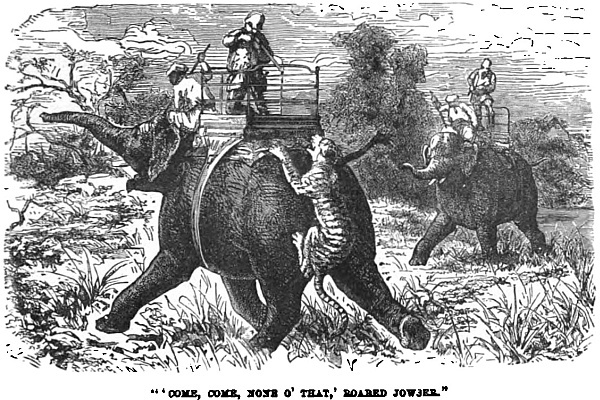
Tiger-shooting from howdahs they found excellent sport—just a little slow for Frank though, who would rather have been on horseback. But one day he had a ride he little expected; he was all by himself in Jowser’s howdah. The grass was long and rough, but there were bushes about. From one of these an enormous tiger tried to steal away. Chisholm, handy though he was in times of danger, wounded but didn’t kill. Next moment the beast had settled on Jowser. “Come, come, none o’ that,” roared Jowser, setting off at the gallop. The tiger fell next moment, with a bullet from Frank’s Express through his head. But Jowser was off; fairly off. Who would have thought it of Jowser? Two hours of that wild ride, ere Jowser brought up to rub his rump against a tree, and for a week after Frank felt as if he had no more bones than a jelly-fish.
A tigress had been fired at by a party of horsemen, and wounded; but man and horse went down before that fearful charge. Next moment she had seized the rider, and borne him away into the bush. It was her first taste of human blood; but not the last, for long after this she was known and feared by the natives as the most daring man-eater ever known. She would even enter villages by night and carry people away.
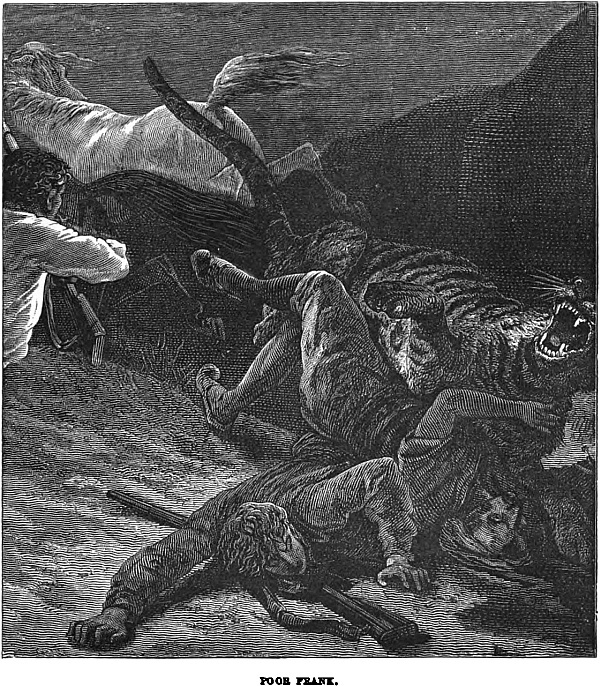
Poor Frank! he seemed destined, although the youngest of the three, to have all the hard knocks and blows. He was one night asleep beneath a banian-tree when the man-eater entered, and attempted to seize a man. Frank, with unloaded rifle, rushed to the rescue. Well it was for him that Fred Freeman was close at hand: that man-eating tigress drank no more blood. But Frank, how frightfully still he lay! Was he dead? All but, reader.
This was, indeed, a sad ending to their adventures in India; but life cannot be all sunshine. When camp was broken up a week after, and our heroes turned their faces once more seaward—Frank on a litter—one sorrowing heart at least was left behind. It beat in the breast of honest Moondah.