Part VI—Australia.
Reading edition
Convalescent at last—A Run to Australia—Set out for the Interior—The Scenery—A Queer Mistake—Frank’s Cousins.
Poor Frank Willoughby—for two long weeks his spirit hovered ’twixt life and death. It was a happy hour for his friends when he was pronounced out of danger; and for Frank himself, when he was told that he had nothing now to do in the world but just to get well again. For many weeks longer he had to lie on his back, however. But he was in that weak, dreamy kind of a state, that he did not mind the confinement. Every morning Chisholm brought him all the news, and read to him for hours. But how shall I describe the joy he felt the first day he went out for exercise? This getting well after a long illness in a foreign land is a pleasure that few ever know; but the joys of convalescence are sufficient reward to the invalid for all he has previously suffered.
Frank was borne about in a palanquin. He wondered whether he would ever again bestride a fiery steed, and go bounding along over the plains, as had been his wont. But he grew so rapidly strong and well, after he began to walk, that he ceased to wonder at anything; and when he and his friends embarked on board a saucy clipper bound for distant Australia, he felt nearly as strong as ever he was in his life.
Frank had cousins in Australia. They farmed sheep or something, Frank was not quite sure it mightn’t be kangaroos; but they were good people, and had ornithorynchus soup and cockatoo pie for dinner as often as not, with cold black swan on the sideboard. So one of the boys had written him to say. Frank had the letter in his portfolio, and showed it to Lyell, and there was a deal of laughing over it. If I had that letter now I would just print it in extenso, to save myself the trouble of writing this chapter. Such a glowing account of Australian life was surely never penned before; and, if it could only be credited, what a life of wild adventure Frank’s cousins must have led! Here were wonderful stories about emigrants and convicts, and settlers and savages, serpents and snakes, mixed up with emus, and kangaroos, and cockatoos, and any amount of other oos. And here were tales about bushrangers, and bush-riding, and buck-jumpers, and bullock-hunters; and the allusions to woomeras, and spears, and boomerangs, were as numerous as though they had been sprinkled in from a pepper-box.
Frank was himself again long ere the clipper reached Sydney, but he felt doubly himself when, a few days afterwards, mounted on a goodly horse, with valise strapped on the saddle, he and his friends, with guides and guards, left the smoke of Sydney far behind them, and cantered merrily away bushwards.
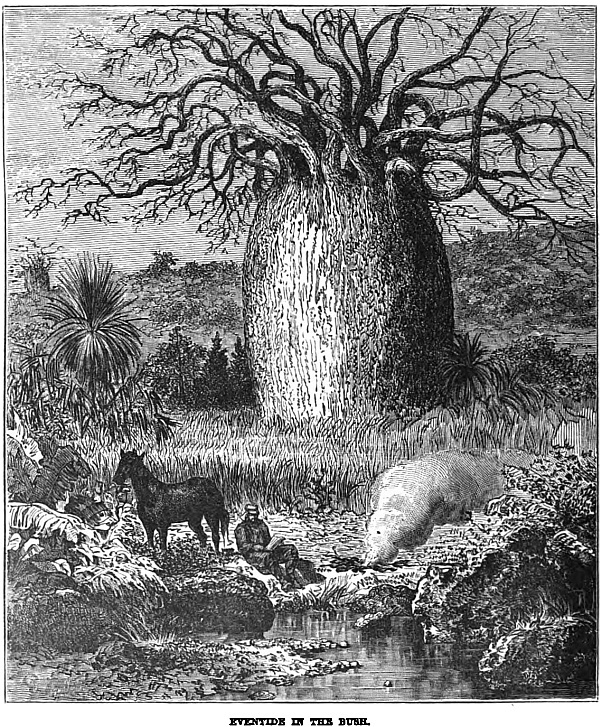
It was a long journey to the station or village where Frank’s cousins lived. It took them quite a week to get there. They travelled principally in the morning, and again at eventide, resting in the shade near their hobbled horses, during the time the sun was high.
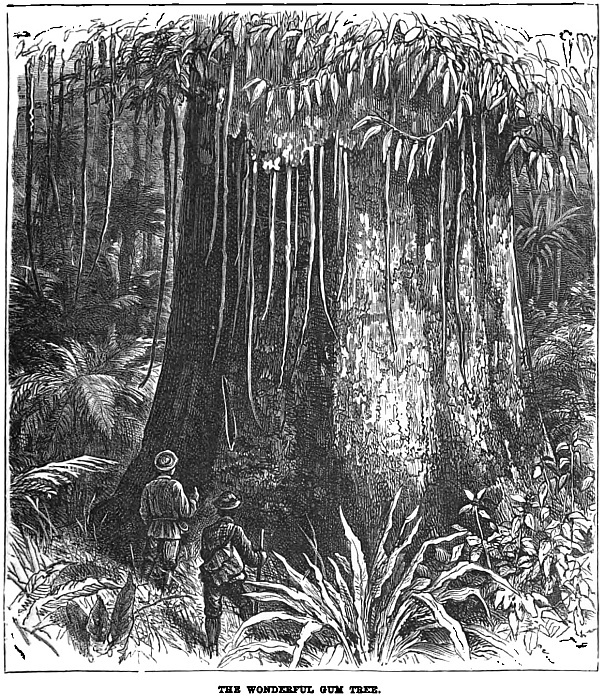
They had not gone far from the capital ere they plunged into a deep, dark, silent forest—silent save for the strangely monotonous song of the cicala, and so for miles, and so for many leagues. Our heroes felt they would have given anything to listen, sometimes, to the cry of a bird, or even the howl of a wild beast. The inns at which they stayed at nights were rough in the extreme, but they soon got worse, then they gave them up, and preferred camping out, and whenever of an evening they reached some open glade, there they took up their abode. But forests grew less dense at last, and the scenery most charming. The blue gum-trees, with stripes of pendent bark, that Fred and Frank used to admire and marvel at, gave place to lighter timber. By night the whole air was alive with strange sounds and strange sights, especially when the camp was near the water. The snoring sound of the bull-frog, the cry of the flying fox and opossum, mingled with the cooing of wild birds.
But now they were nearing the home of Frank’s cousins. They inquired one day at an inn if the Thompsons lived near.
“Certainly,” said the man. “Jack,” calling to an old black, “show these gentlemen where the Thompsons live.”
“I’ll go and prepare dem,” said Jack.
And off he went. He was back again in half an hour, and then led the way through the wood.
“What sort of people are they?” asked Frank of Jack, the guide.
“Oh! ever so nice, beautiful people, b-be-beautiful?”
“The old gentleman is my uncle,” continued Frank.
“Oh!” said the guide, “he is a beautiful old man. Bea-utiful!”
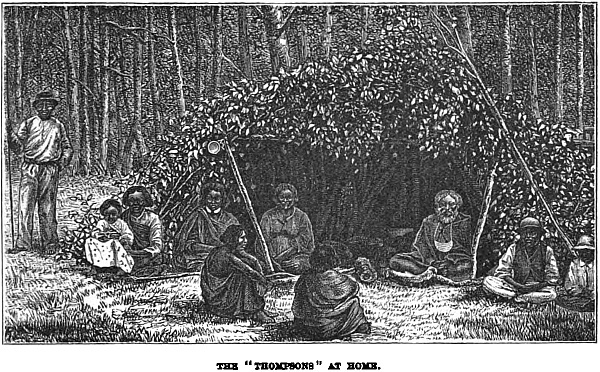
Now there were two families named Thompson, one white and the other black; the family old Jack took them to was the black; but judge of the amusement of Frank’s friends when old Jack, standing stick in hand on the right of the group, introduced them to the Thompsons at home. Of course Chisholm, on the spot, demanded an introduction to Frank’s prettiest cousin, who was nursing a pickaninny (a baby), and Fred must go up and shake hands with the old man and call him uncle, and Lyell, not to be outdone in politeness, squatted down beside the old “jin,” his wife, and got into conversation right pleasantly. Poor Frank hardly knew what to do, but when Jack said the old couple liked grogs, he sent for some, and Jack shared it with the Thompsons, and there was such laughing and merriment, and talking and fun, that it isn’t any wonder that after they had left, Lyell laughingly declared he never remembered spending such a pleasant time in his life.
Frank found the right Thompsons next day, and nicer nor braver boys never lived.
Chapter Seventeen.
The Corobory—Native Arms—Quiet Life in the Australian Bush—Chisholm and Eros—A Day with the Kangaroo Hounds.
A corobory is a war dance by native savages. Our heroes had the pleasure of gazing at more than one, before they finally left Australia in search of new adventures. But very terrible those savages look, dancing madly round the fire in the depths of the gloomy forest, and wildly brandishing their war weapons, their boomerangs, their woomeras, their waddies, and their spears, while the flickering flames light up their naked painted bodies, and their yells and cries re-echo through the woods.
Very expert are these New Hollanders with the use of the few weapons they carry. They can hurl their spears with terrible effect for a hundred yards or more, with the assistance of the woomera, a piece of wood which is retained in the hand, and acts as a lever. The boomerang is apparently a magical instrument. Its actions, when thrown by the hand of a native, are marvellous; the thing does his bidding as if it were one of the fabled genii under the control of a magician.
The uncle and cousins of Frank were right glad to see him and his friends. They did not know how kind to be to them.
“You see,” said Mr Thompson, “you find us all in the rough.”
“But I’ll be bound all in the right as well,” said Lyell.
“Well, well, well,” he said to Frank, “who would have thought of seeing you out here, and do you know, my boy, I would hardly have known you, you are wonderfully changed.”
“Well,” replied Frank, laughing heartily at his uncle’s pleasantry, “seeing that I was only a year and a half old when you left England, you cannot wonder there is a little change.”
“How do you like your welcome?” Frank asked of Chisholm on the morning of the second day.
“It’s a Highland welcome, Frank; a Highland welcome.”
Chisholm thought he could not say more than that.
Old Mr Thompson was greatly amused at the mistake of Jack, the native guide, and their adventure with the other Thompsons, but he added he really believed Jack had done it on purpose, for the humour of the Australian native is of a very strange order, but none the less genuine for all that.
The house where our heroes now found themselves billeted was somewhat after the bungalow stamp—a widely-spread comfortable house, all on one flat, but it was altogether pleasant to live in. The gardens around it formed one of its principal charms; so cool they were, so green, so shady and scented.
Frank and Lyell and Fred went everywhere about the great farm; a farm so big, so wide, and wild, that it not only took days and days to ride across; but when they went out of a morning, with their horses and kangaroo hounds, they never knew what might turn up before they returned. It might be a warragh hunt (the wild dog of the interior), or a scamper after the emu or kangaroo, or they might settle down to hours and hours of quiet fishing, or try to shoot the ornithorynchus paradoxus. Then there were wild-fowl in abundance, quails and snipe and pigeons, and all were just tame enough to afford what might be called decent sport.
I have not mentioned Chisholm as taking much part in these sporting adventures, and must I tell you why? “Well, he was very fond of a game of whist, and also of smoking under the honeysuckles and the green mimosa trees; and Frank’s uncle was such a genuine old fellow, and Frank’s aunt such a delightful, and kindly, thoroughly English lady. Oh! but I feel that I am only beating about the bush, so I must confess the truth at once, though for Chisholm’s sake I’d rather have concealed it. One of Frank’s cousins there was a young and charming girl; and—and—and Chisholm had fallen over head and ears in love. It is with much reluctance I tell it; and it is strange, too, that one by one my heroes, my mighty hunters, whose hearts, like their sinewy arms, ought to have been hearts of oak or steel, should fall into the power of the saucy little god Eros. But it is the truth, and there is no getting away from it. As soon, however, as Chisholm knew and felt he was conquered at last, he confessed the same to his companions.
“But I’m not going to make any engagement, you know,” he added. “I’ve never been in love before, so I don’t know much about it; but if I’m not cured by the time we get back to old England, why then I’ll return to this lovely place just to see if Edith will know me again.”
Sly Chisholm! He felt sure that he would not be forgotten.
Many, many miles from the farm where lived the Thompsons, on a certain day there was to be a grand meet, and thitherwards went our heroes with Frank’s cousins, starting on the day before. What a difference, they thought, from an English meet, where after an early breakfast one can mount his horse and ride leisurely away, along well-paved roads and green lanes to the appointed rendezvous, and after a scamper of hours return to a comfortable dinner. Here there were no roads; their way lay across the plains, through the deep dark forest, over lofty mountains, and through rivers; and it was very late ere they arrived at their camping-ground. Then their saddles were their pillows, a blanket the bed, and the star-spangled dome of heaven their roof-tree.
But they were none the less fresh next morning, and were early astir; it would be a delightful day, they felt sure of that, for the sun was already up, and there was hardly a cloud in all the mild blue sky. Neither too hot nor too cold: it was quite a hunter’s morning. The scenery, too, through which they rode all day was ever varying, but ever beautiful. Frank said when the day was done, and they once more stretched their tired limbs around the camp-fire, that he had never enjoyed himself so much in his life.
“What, not down in Wales?” said Fred, quietly.
“Circumstances alter cases,” said Frank.
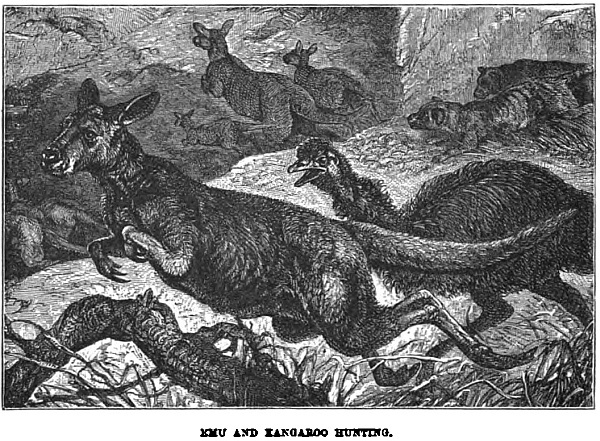
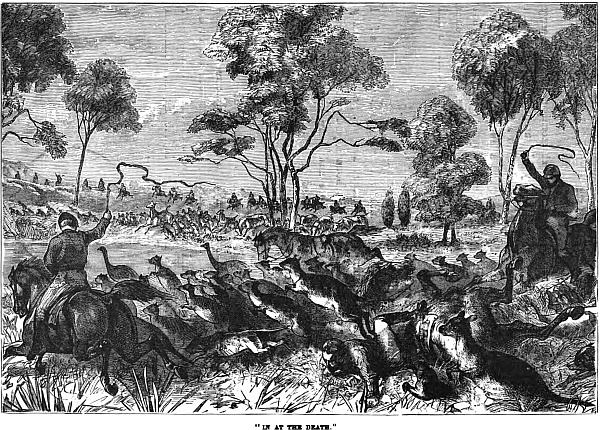
The hunters on this occasion mustered strongly, there being a field of little under fifty, principally settlers and settlers’ sons. They brought their own dogs—strong-built hounds, just suited for the wild work they have to accomplish. More and more exciting grew the chase as the day wore on; and it ended in such a finale as can only be witnessed in one country in the world, and that is Australia. Kangaroos, wild horses, bullocks, emus, hounds and men, mixed in apparently inextricable confusion.
Now it was all very well for Frank to boast about the grand day he had enjoyed. He had been lucky: his horse and he seemed made for each other. He was in at the death. Fred was not; but Fred’s horse was. Chisholm and his horse were both there; but, alas for glory! Chisholm’s horse’s heels were all in the air, and Chisholm himself—why, he was down under somewhere.