Part II—The Polar Ice-Fields.
Reading edition
Outward bound—Night in the Pack—The Aurora—The awful Silence of the Ice-fields—Seals! Seals!—The Battle with the Bladder-noses—Jack in the Box with a Vengeance—A Fight with Walruses.
The good ship Grampus slipped away from her moorings on the 13th of February, 18—, and steamed slowly seaward from the port of Peterhead, North Britain, hound for the wild and desolate regions that surround the pole. She steamed slowly away in the very teeth of a breeze of winds that might have frightened a man of less daring and pluck than Captain Anderson, for the sea was grey and stormy, the sky was leaden and threatening, and the very sea-birds that screamed around the vessel’s bows seemed to warn him that there was danger on the deep. But the Captain heeded them not. He had said he would sail on this day, and he did, for well he knew what his vessel could now do, and had done before; besides, he was a true sailor, and had all a sailor’s impatience to begin the voyage.
“It looks a bit squally,” he said to the pilot as he bade him adieu, “and we may have a dirty day or two, but the Grampus can stand it, and I’m not the man to linger in the harbour one half-hour after I’m ready to start. Good-bye, old man.”
The Grampus was a steam brig of some three hundred and fifty tons, fitted with powerful engines, and a screw that could be hoisted up out of the water when sail was on her. Built of wood, she was as stout and strong a ship as ever clove the waves. And she needed all her strength too—there was a wide and stormy ocean to cross, and there was ice to plough through that no fragile ship dare ever face. The captain was the owner of the vessel; and many a voyage, and not unsuccessful ones either, had he made to the polar ice-fields, but the present one was fated to be the most eventful of all.
From the very commencement of the cruise, until the first ice was sighted, the wind kept steadily ahead, and the seas kept washing over the brave brig from stem to stern. But she was not to be daunted, so steadily she steamed on northwards, ever northwards.
A week after the last of the lonely isles of Shetland had sunk like a little cloud beneath the southern horizon they were far away at sea—indeed, there was nothing to be seen from the masthead, only the great tumbling seas that dashed their sprays high over the funnel. Even the birds had left them, all save that strange mysterious creature that is ever seen wheeling around ships sailing over the broad Atlantic, or crossing the northern seas, and which naturalists call the stormy petrel, and mariners Mother Carey’s chicken. No wonder sailors look upon this bird with something akin to superstition and awe, so dark and dusky is the creature, the very little white about it serving but to make its blackness visible; it flits from stormy wave to stormy wave like a veritable evil spirit.
Our friend Frank, in his voyage to the polar ice-fields, suffered somewhat from mal de mer—it sounds far nicer in French than in English—but he bravely stuck to the deck. He was more than once washed into the lee scuppers, but he had on an oilskin suit of fear-nothing dimensions; so he just scrambled up again, or in other words, like the cork leg of the merchant of Rotterdam, he got up “and went on as before.”
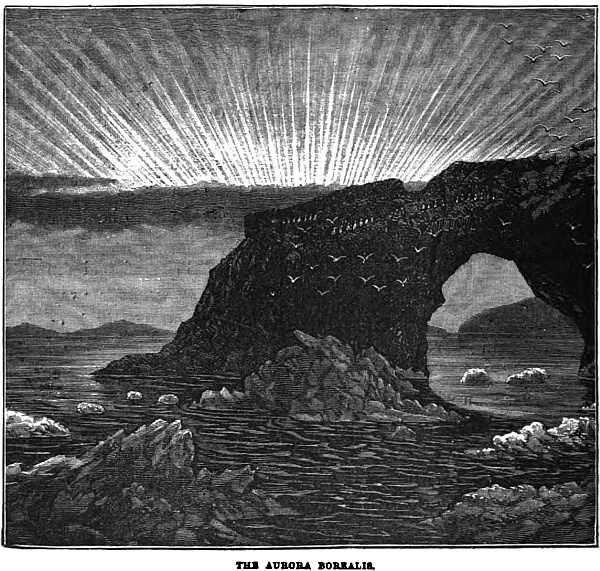
The farther north the Grampus got, the shorter grew the days. Indeed, they seemed to be sailing into the home of eternal night, only it must be remembered that the season was yet early, and that in the polar regions for three months of the year the sun never appears above the horizon. If the nights were long, however, it cannot be said they were dark; they were lighted up with a magnificence never seen in more southern latitudes. The sky itself was at times of a deep and indescribably dark-blue colour, and the stars were great wheels of sparkling light. This was in itself a beautiful sight, and our heroes used to linger on deck till far on in the night, as if under some pleasant spell. But what pen can describe the gorgeous splendour of the northern lights, or Aurora. Imagine if you can a vast and broad bow, or arc of a circle, stretched athwart the heavens, twenty times as broad as any rainbow, and seeming to be ever so much farther away; imagine this bow to be composed of spears or needles of light—green, blue, crimson, and yellow—and imagine these spears in constant motion, shooting upwards and downwards, changing places incessantly, changing colours constantly, and this too with inconceivable rapidity, and you will be able to form some faint notion of the wonderful sight the Aurora presented to the eyes of our astonished travellers.
Reader, I have been alone in the ice-fields by night, while the Aurora was playing in the heavens above. You cannot conceive of the solitude and lonesomeness of such a situation, nor can you form any conception of the deep, the indescribable silence that reigns in the frozen ocean. Well, upwards as I gazed at the northern lights, I have heard sounds emanating from them. That I do not remember having ever read of anywhere. A line of spears would advance from the east and another from the west; they would meet and commingle with a subdued clashing and hissing noise, such as you might make by rubbing the palms of the hands rapidly together. What this strange sound can be is a mystery that may never be revealed.
Captain Anderson told our heroes that he never thought the voyage had begun until the crow’s-nest, or out-look barrel, was hoisted to the mainmast head.
One morning our travellers were awakened by the sound of singing and shouting, and on going on deck they found the brave skipper rubbing his hands with glee, as he gazed up at the ascending nest.
“Cheerily does it!” he was crying. “Heave, lads! heave, heave, and she goes. Now, young gentlemen,” he continued, “are your rifles in order? In two days more, if all goes well, I’ll show you such sport as you couldn’t even have dreamt of before.”
And sure enough, in two days’ time they had made “the country,” as the ice-fields are termed. If, however, any one on board had expected to find wealth, in the shape of plump seals, lying thereon ready for the gathering, he was much mistaken. There was the ice, to be sure, but never a seal in sight, neither in the water nor out of it, for it seemed that the country was unusually open that year.
“Well,” said Anderson, one day, “I’m tired of this north Greenland work; I’ll bear away for the west land.”
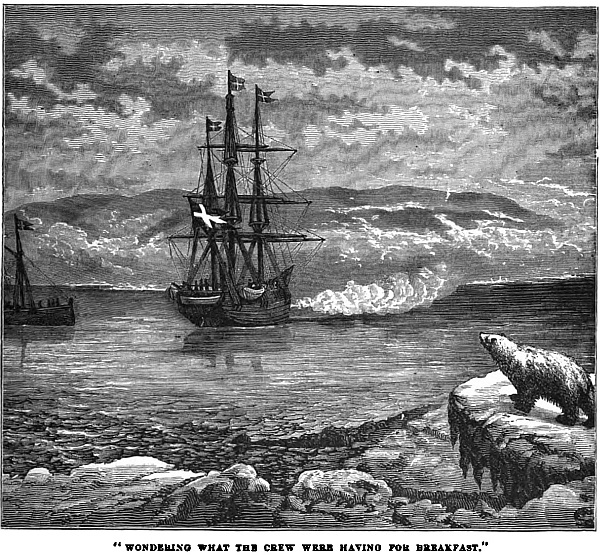
A week’s steaming through fields of slushy ice and floating snow, and streams of flat snow-clad bergs, brought them into open water, and they sighted the lofty and desolate shores of Greenland West, and much to their surprise, found a large three-masted Dutchman quietly lying at anchor in a bay, sails all clewed up, and men away on the ice. It was not long ere the Grampus had followed her example, so far as letting go the anchor went, and making all snug and ready for action. A great bear—always a sign seals are about—stood sniffing on the edge of a floe. Perhaps he had never seen a steamship before, or perhaps he was wondering what the crew were having for breakfast. Frank got his Henri-Martini up, and began potting at him with a long-range sight, and presently Master Bruin remembered an appointment he had, and made tracks to keep it.
It was a glorious morning when the boats were called away. All hands were half frantic with joy at the thought they would soon be among the seals. In they trundle, and down go the boats with a splash into the water, and next moment they are off. Frank and Chisholm are in one boat, Fred Freeman in another, and there is a grand race between the two to see who shall first touch the ice and fire the first shot. The boats seemed to fly over the water, and when they at last ran alongside the floe and the crew jumped on shore, there was hardly a yard’s length between them; but Fred was declared winner.
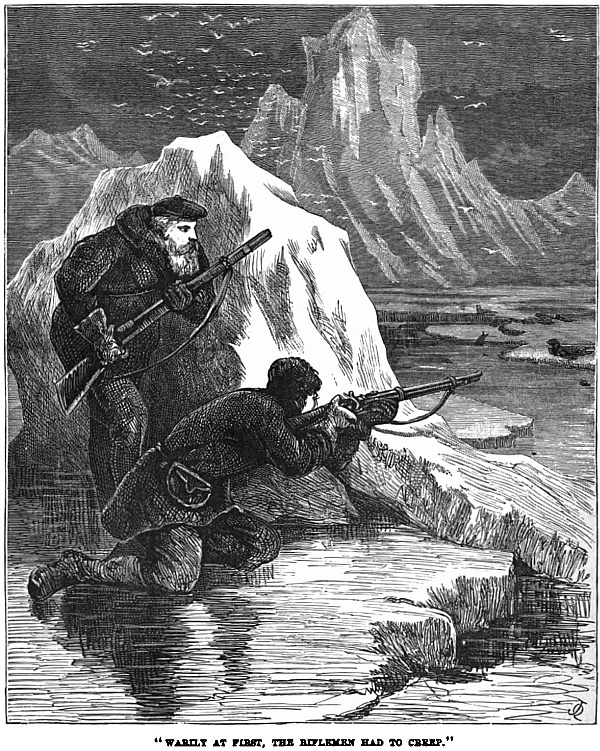
And now the day’s work was begun. Warily at first, the riflemen had to creep towards their prey on hands and knees, taking advantage of every hummock or boulder to screen themselves from view. On each piece of ice some forty or fifty seals lay, and each “patch” had a sentry set. When they succeeded in killing him, the others were very much at their mercy; but oftentimes the seal on watch would succeed, even before his eyes closed in death, in giving his companions warning. Then, almost ere another bullet could reach them, they had leapt helter-skelter into the water. But when the sun got higher, the seals seemed to get almost too lazy to move; they could then be approached very much more closely, and the work of death was carried on with an earnestness and energy that was terrible to behold. Indeed, a kind of madness to shed blood seemed to take possession of every man on the ice. There was no thought but to slay. The excitement was intense—awful in its intensity. The sun went slowly round and down, and as he set behind the rugged hills, his disc seemed to reflect the blood on the ice. Even his parting beams had borrowed the self-same hue, and the tops of the highest icebergs looked as if dipped in gore.
When the shadows fell, tired and weary enough now, our heroes went slowly back towards the boats.
“Oh! boys,” cried Fred, “don’t you remember how bright and lovely the snow was in the morning? Behold it now!”
“Ay, behold it now,” said Chisholm. “Indeed, Fred, this is murder. I don’t feel I can call it by any other name, and I’m half ashamed of myself.”
“So am I,” said Frank, “for a seal can’t defend itself.”
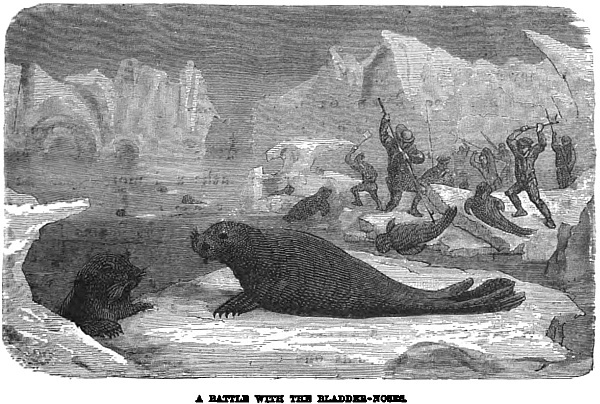
“But the bladder-nosed seals can,” said the first mate, who had just joined the trio. “They are terrible beasts to deal with. I’d rather fight a bear single-handed than I would one of these. Once they fill that kettle-pot-like bladder over their noses, they mean mischief, I can tell you. A rifle bullet has no more effect on it than a pea from a pea-shooter.”
“Is that so?” said Fred.
“Five years ago,” continued the mate, “I was one of the crew of a boat, of ten men in all, that were attacked by these monsters of the deep. They seemed mad with rage and fury; they swarmed up from the sea to the ice where we stood, with blazing eyes and flashing teeth, by the dozen and by the score. We all fought like fiends; we fought with spears and axes and our rifles clubbed, but the faster we killed them the faster—they came. Our shouts brought assistance from the ship, but not before a whole hour was spent in this battle with the bladder-noses, and not until we were quite exhausted, with three of our number lying dead on the ice.”
They were walking over a floe of thick bay ice as the mate told his story. No sooner had he spoken the last words than—
“Down, men, down!” he cried; “the ice is rising ahead.”
They followed the mate’s advice, and threw themselves on their faces.
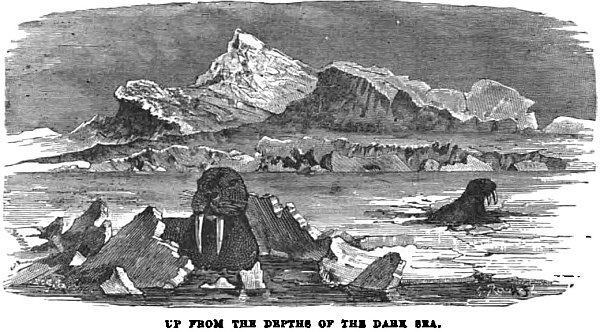
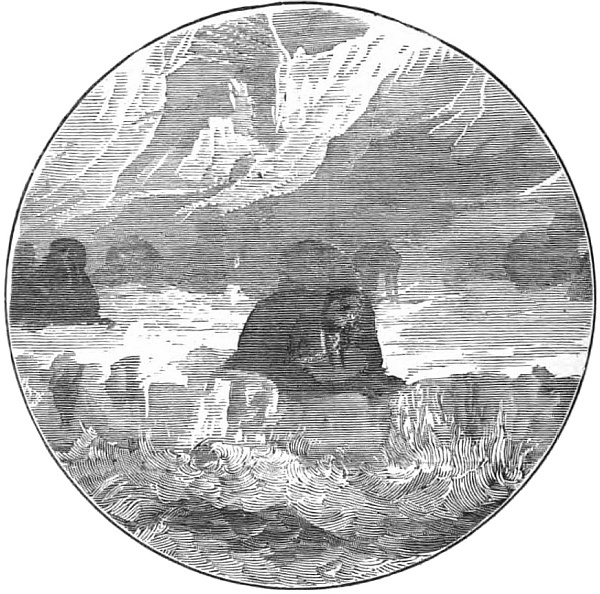
In two places the ice was heaving and rising. Then all at once it gave way, with a noise like the firing of great guns, and up from the depths of the dark sea rose two gigantic forms, with wild eyes and yard-long tusks, and of such fearful aspect that Frank’s heart almost stood still with dread.
“By George!” cried Chisholm, “this is playing at Jack in the box with a vengeance.”
Bang, bang, bang went the rifles, and down sank the apparitions, leaving the broken ice all red with blood.
“They are only wounded,” said the mate; “they’ll have revenge if it is a month hence, depend on that.”
The Grampus, sealing intent, steamed farther and farther north, and the nearer to the pole they got, the heavier grew the ice. There was shooting every day now for three months and more—seals and bears, and sometimes a fox—and, when there was nothing else to go for, they brought down gulls for their feathers, and looms for the sake of fresh meat. Sometimes they were rewarded by the sight of the lonely narwhal, or giant unicorn of the sea—a creature which always makes direct for a boat as soon as it spies one, and has been known to attack and sink a whaler or gig.
They were after the looms one day, Chisholm and Frank being as usual in one boat, with the first mate steering.
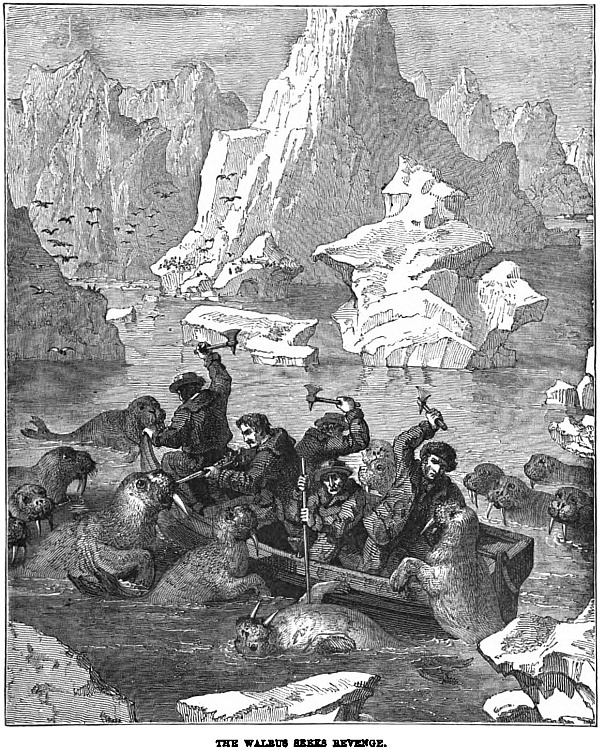
Suddenly, “Stand by your clubs and guns, men!” cried the mate; “Here they come. Now we’re in for it. I knew they’d seek revenge.”
The sea around them seemed alive with the great tusked heads of walruses, coming from all directions and making straight for the boat.
“In oars, and keep cool, lads,” said the mate, seizing an axe; “but for mercy’s sake keep the boat trimmed. If she capsizes we are all dead men.”
How long they fought with those desperate brutes Frank could never tell; but it seemed to him an age ere the other boats came to their relief, and poured volley after volley into the midst of the pack of walruses. Then they disappeared, and but for the sea around them, all reddened with blood, and the floating corpses—which, however, speedily sank—there was not a sign of the fearful hand-to-hand and all-unequal contest.
Chapter Five.
The West Land of Greenland—A Fall! a Fall!—Danger on all Sides—“Man the Ice-saws”—Working for Life—Beset in the Dreary Pack.
“I feel,” said the captain one day, at breakfast, “that I am making a dangerous experiment. I am keeping far in to the west land; I am all but hugging the shore; and if it were to come on to blow from seawards, we would—Steward, I’ll have another cup of coffee.”
“You think,” said Chisholm, “our chances of further cups of coffee wouldn’t be very great, eh?”
“I don’t think they would,” said the captain. “Well, lads, I’ve shown you a bit of sport, haven’t I? And if we had only a little more blubber in her, troth, I’d bear up for bonnie Scotland. I’ve just come down from the crow’s-nest, and what do you think I’ve spied? Why, open water for miles ahead, stretching away to the north as far as eyes can reach. There are whales there, boys, if we can but wait for them.”
After breakfast it was, “All hands assist ship!”
Up sprang the men, and ere one could wink, so to speak, half the crew were at the side with poles, pressing on the ice to make room for the Grampus. It was strange work, and it seemed at first impossible that twenty men with a spar could move a floe. But they did, and three hours afterwards they were in this mysterious open sea.
“Why,” cried Frank, “I declare there is the Dutchman dodging yonder with foreyard aback. A sailing ship beat a steamer!”
“Ay, she’s got the pull on us, boys,” the captain said. “And see, she is flenshing (skinning) a whale; the crang (the skinned corpse) lies beside her. She has met with a lane of open water, and taken advantage of it.”
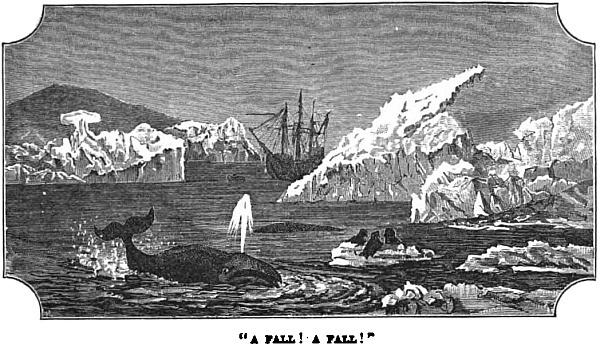
Just at that moment came the cry, “A fall! a fall! on the weather quarter!”
“A fall! a fall!” Surely never was excitement seen like this before, thought Frank.
There was no waiting for orders. The ship seemed to stop of her own accord, and the escaping steam roared uselessly through the funnel.
“A fall! a fall!” Up tumble the men, many undressed, with their clothes in a bundle. They spring to the boats, our heroes follow the example, and in three minutes more are tearing through the water towards the coveted leviathan. The Dutchman has spied the monster too, and her boats are soon afloat. Who shall be first?
(The origin of this cry is this, I think. “Whaol” is the ordinary Scotch for “whale,” but Aberdonians use the “f” instead of the “wh” in such words as “what,” “where,” etc, which they pronounce “fat” and “far.” Hence “whale” would become “faul,” or “fall.”)
“Pull, lads, pull! Hurrah, lads, hurrah! We’ll never let a Dutchman beat us!”
Is the whale asleep, that she lies so quietly? Nay, for now she scents the danger, and, lashing her tail madly skywards, is off; but not before the roar of the harpoon gun from the foremost boat has awakened the echoes of the Greenland sea.
“A fall! a fall! She is struck! she is struck!” Vainly now she dashes through the surging sea; another boat pulls around to intercept her, and again she is struck; the lines whirl over the gunwale of Frank’s boat till it smokes again. There is blood now in the great beast’s wake, and her way is not so swift; she dives and dives again, but she is breathless now. Dreadful her wound must be—for see, she is spouting water mingled with blood; and now she lies still on the surface of the ocean.
“In line, men!” cries the mate, springing up and seizing his long lance, and standing bravely up in the bows. “Pull gently alongside, and stand by to back water the moment I spear the fall.”
“How bold and daring he looks!” thinks Frank; all thought of danger swallowed up in admiration of the man who stands, spear in hand, in the boat’s bows.
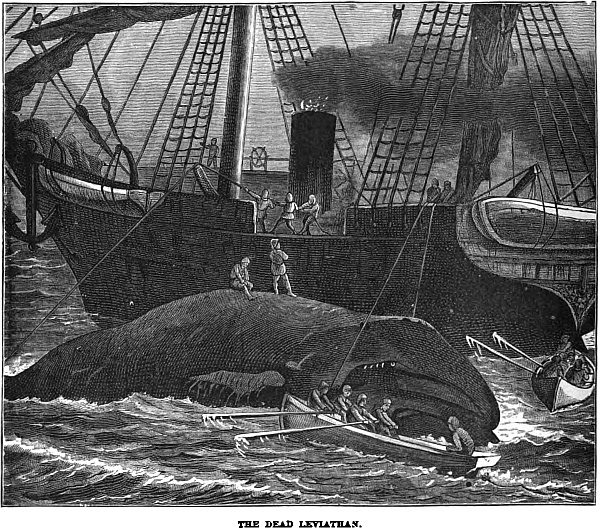
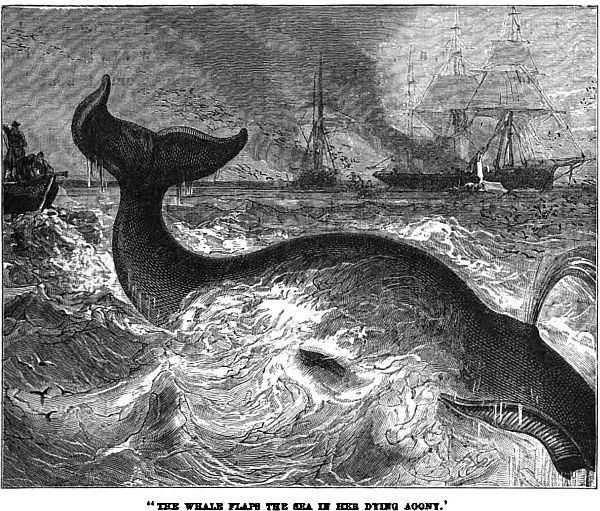
They are close now. Swish! Quick as lightning the spear is sent home; quickly it is turned, to sever the carotid; next moment the backing boat is almost swamped in blood. But not quickly enough can they back, I fear, to save the boat from destruction, themselves from speedy death. High, high in air is raised that dreadful tail; half the animal seems out of the water; they are under the shadow of it; and now it descends, and every oar on the port-side of the boat is broken off close to the rowlocks. But the boat is saved. For fully half an hour the whale flaps the sea in her dying agony, and the noise may be heard for miles around, while the waters around her are churned into crimson foam. Then there is one more terrible convulsion; her great jaw opens and shuts again. The leviathan is dead. The men of the brig and the men in the boats answer each other with boisterous cheers; but the Dutchman fills her sails, puts about, and bears sullenly up for the south.
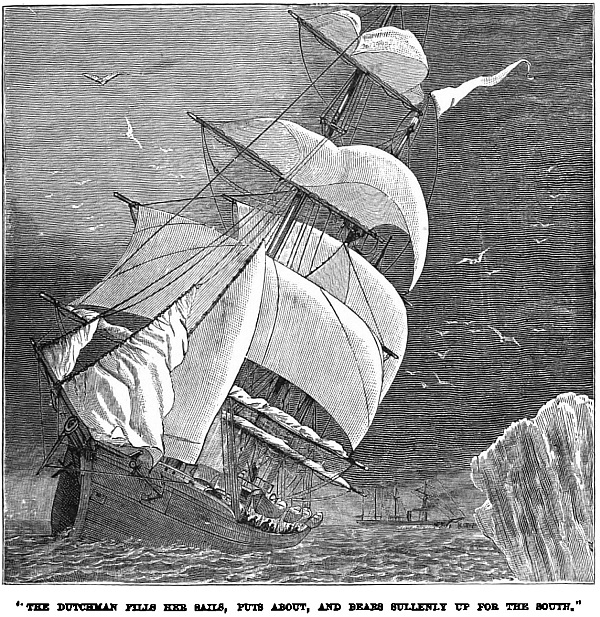
Well would it have been for the Grampus had Captain Anderson followed her example; but he would not.
“She can go,” he said; “she is a full ship, and only a sailing ship. Now let us get but two other ‘fish,’ then hey for the sunny south, boys.”
For a whole month they remained dodging about in that open sea, but without seeing another whale. All their good luck seemed to have gone with the Dutchman, and the captain was about to bear up, and force his way once more out through the southern ice to the open sea beyond, when suddenly a change came o’er the spirit of the scene. To their surprise, if not to their horror, the ice began to close in around them in all directions. Nearer and nearer came the mighty floes. They came from the north; they came from the south and the east; they even deployed into two long lines, or horns, that crept along the land until they met. At the same time a heavy swell began to roll in from seawards.
“There is a gale of wind outside,” the captain said to Chisholm, “and this is the result; but come, I don’t mean to be caught like a mouse in a trap.” Then, addressing the mate, “Call all hands, Mr Lewis. Get out the ice-saws and anchors.”
“Ay, ay, sir,” replied the mate.
“Now, my lads,” continued the captain, when the men came aft in a body, “you’ve all been to Greenland before, and you know the danger we are in as well as I can tell you. If we are caught between two floes in that heaving pack, we’ll be crunched like a walnut-shell. So we’ll have to work to make a harbour. That alone can save us. Call the steward. Steward! we’ll splice the main brace.”
The men gave a cheer; they stripped off coats and jackets, and even their gloves. They meant business, and looked it. Meanwhile the Grampus was going ahead at full speed, straight towards the ice in shore. Why, it looked to our heroes as if the captain was positively courting destruction; for he was steering for the very largest berg he could find, and presently he was alongside it. The ship was stopped, and every man that could be spared sent over the side. The anchors were got out speedily, and made fast to the berg. Then the men began to work.
The iceberg against which they directed their operations was indeed a mighty one. Although not very high close to the edge, it towered above them many hundreds of feet, a snow-clad mountain of ice, its green and rugged sides glittering in the beams of the mid-day sun. It was soon evident to Chisholm O’Grahame that the captain’s object was to hollow out a temporary harbour in the side of the berg, sufficiently wide to enable the ship to fit into it, so that she might be safe from being ground into matchwood when the whole pack was joined.
“Come,” he cried, to his comrades, “three hands of us here idle! We can work too, captain. Only tell us what to do, and we’ll do it.”
“Bravo! my lads,” said the captain, cheerily. “Over the side with you then, and help with the ice-saws.”
Those great ice-saws were about twenty feet long, and had four cross handles at the top, so that when let down, on the perpendicular, against the piece, four men standing above could work one saw. Frank and his two friends, with Mr Lewis, the mate, took charge of a saw, and the work went on cheerily. The men sang as they laboured, and there was as much laughing and joking as if they had been husbandmen working together in the harvest-field, instead of men working for their dear lives. By eight o’clock the harbour was complete.
By eight o’clock the ice had almost closed upon them.
And now to get the ship into this portus salutis. There was so little time; other giant bergs were close aboard of them, rising and falling on the swelling waves with a noise that was simply appalling. The captain had to give his orders through the speaking-trumpet, and even then his voice was often drowned by the grinding, shrieking din of the heaving floes. But at last they have worked her in, and now for a time at least she is safe, for she rises and falls with the ice; and, though hemmed in on all sides, has nothing to fear.
The Grampus was “beset;” and from that very hour began one of the dreariest seasons of imprisonment that ever a beleaguered ship’s crew experienced. They were far away from aid of any kind that they knew of, the ice was terribly heavy, and, worse than all, the summer season was far advanced, and already the sun dipped very close to the northern horizon at midnight.
The storm abated; in twelve hours the ice had ceased to rise and fall, and a silence, deep as death, reigned once more over the frozen sea.
“We must do the best we can,” said brave Captain Anderson, “to amuse ourselves and each other. God only knows when we may get clear, but we can trust in Him who rules the sea as well as the dry land.”
“Amen!” said Chisholm, in a quiet and earnest voice.
“We’ll make off skins now for a week or two,” said the captain; “that will help to pass the time.”
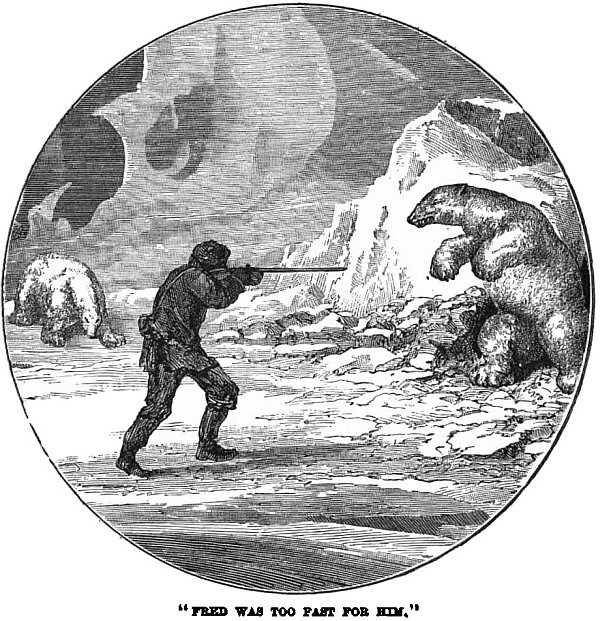
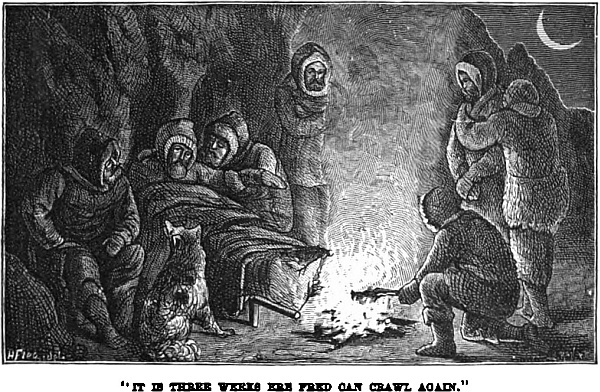
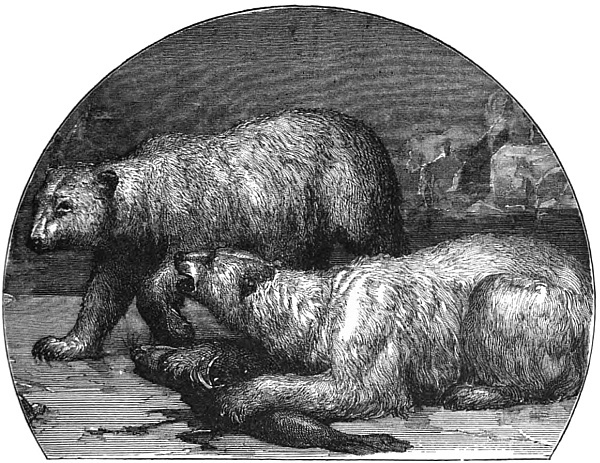
So it did, reader, and it also brought the birds around them in millions. These, as usual, they shot for feathers and fresh meat. Bears in twos, and sometimes in threes, prowled round the ship to pick up the offal. Ugly customers they looked, and ugly customers they were. Poor Tom Reid, the cooper’s mate, sat on a bit of ice one day smoking, not far from the ship. A monster bear crept round a corner and clawed his heart and lungs out with one stroke of his mighty paw. The carpenter and captain were both on the ice one day, when they were suddenly confronted with the man-eater. They had no arms, and would have been instantly killed had not the danger been perceived by Fred Freeman; he fired from the deck of the Grampus, wounded the bear, and saved their lives. After this it was determined to hunt and kill the bears, and many good skins were thus procured. One day Fred surprised the man-eater in a corner, licking his wounded foot. The bear bellowed like a bull, and prepared to spring. Fred was too fast for him, and rolled him over at ten paces distance. Poor Fred! he did not see that this bear had a companion within hail, and that he was coming up fast and furiously and intent on revenge, not fifty yards away. Men are behind him, but they fear to fire, lest they kill Fred. Chisholm is on an adjoining floe, but the warning he shouts comes all too late; for next moment his poor friend lies helpless and bleeding in the talons of the terrible ice-king. Chisholm kneels to fire. It is a fearful risk, but it is Fred’s only chance. The sound of the rifle rings out on the silent air, the bear quits his victim, springs upwards with a convulsive start, then falls dead beside the man he would have slain. It is three weeks ere Fred can crawl again.
Meanwhile the whole of the skins have been “made off.” (The seal-skins, with blubber about three inches thick, are spread on boards on idle days in Greenland ships, and the fat pared off. The skins are then rubbed in salt and stowed away in a tank; the blubber also is put in tanks by itself. This is called “off.”) There are no more bits of flesh and fat thrown overboard, so the birds all leave them, then the bears; and, except that a wondering seal sometimes lifts its black head for a moment out of a pool of water to stare at the ship, there is no sign or sound of animal life on all the dreary pack. They feel more lonely now than ever, but they play games on the ice and games on board, and they read much and talk a great deal about home. This last makes them feel the time still more long and monotonous, but one day—
“Happy thought!” says Fred, “let us get up theatricals.”
Well, this passed the time away pleasantly enough for a whole month, but they tired at last even of theatricals; and then a dense fog rolled in from the south and the west, and enveloped the whole pack as with a dark pall. They saw no more of the sun for two weary months, but they knew he set now, and that the order of day and night had been restored; but alas! they knew likewise that it would, in a few weeks more, be all one long night, and their hearts sank at the very thoughts of it.
The mist rolled away at last, but shorter and shorter grew the days and colder and colder the weather. I hesitated before I wrote that last word “weather,” for really in that ice-pack there was no weather. Never a cloud in the blue vault of heaven, and never a breath of wind—not even as much as would suffice to raise one feathery flake of the starry snow. But the silence—it was a silence that was felt at the heart; you could have heard a whisper almost a mile away, there was nothing to break it. Nature seemed asleep, and all things seemed to fear to wake her. No wonder that poor Frank said one day, as he closed his book—
“Heigho! boys, it is such a treat to hear the clock tick.”
Night was the most trying, cheerless time; for after they had turned into their box-like bunks, they would lie for hours before it was possible to get warm. Then in the morning each bunk looked like a little cave of snow, the breath of the occupant during the night having been frozen into hoar-frost, which covered the sides and the top, and lay half-an-inch thick on the coverlet. It was, indeed, a dreary time.
Chapter Six.
Winter in the Ice-fields—The Ice breaks up—Sailing South—A Sledge Adventure—The Storm and Shipwreck—Afloat on an Iceberg—Land! land!—A terrible Journey—Cronstadt.
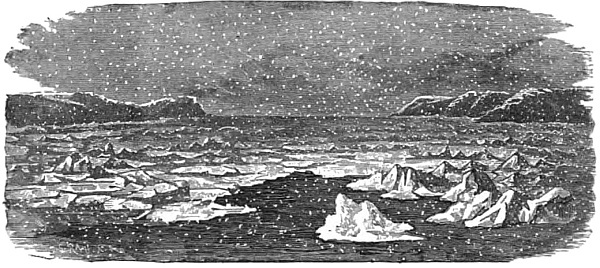
Was it always so silent and still in that lonely ice-pack as I have tried to describe it? Not always: there were times when the floes around the ship began to move slowly up and down, telling of a swell beneath them; then the rending, shrieking, and groaning noises were indescribable. But only twice during the months of darkness did a breeze blow, and, when it did, snow fell, or rather was borne along on the wings of the wind, with a fierce bitterness that no living being could be exposed to for an hour and live. A snow-house was built over the decks, and this served in some slight measure to mitigate the terrible cold.
And so the winter wore away, for the longest time has an end. Our heroes had borne their privations and their deprivations nobly. They did not even let down their hearts when the captain told them they would have to go on “short commons,” and only laughed when the steward reported the eggs finished, and the last potato vanished. The biscuits held out, however, and the soup in bouilli, so they rejoiced accordingly, and were thankful.
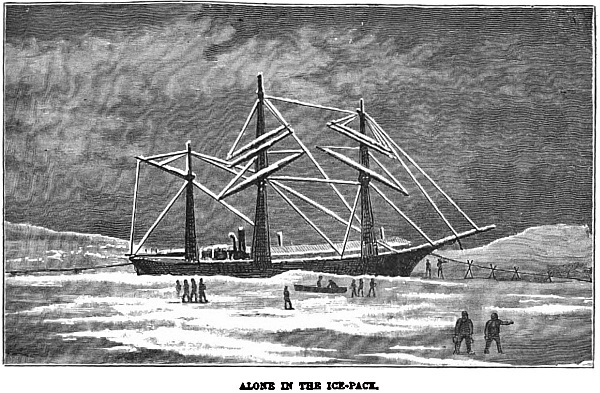
But when the sun showed face one day, there were no bounds to the joy that every one on board manifested. They even manned the rigging, and gave him three times three heartfelt cheers. Even Rouskia, the ship’s dog, seemed glad to see the light of day again, and joined in the cheering with a kind of half hysterical bark, as if the tears were in his throat and partially stopped his utterance. The sun did not stop to look at them long, but, like an invalid in the stage of convalescence, he stayed up longer and longer every day, and his presence soon began to work a change in the appearance of the ice; the snow on the top of it became less dry, and the cold to a large extent left the air. Then the ice began to float farther apart, and, on taking the reckoning one day, the captain found, to his joy, that the whole pack was moving slowly southwards.
After many days the Grampus left her harbour, and began “boring” her way through the ice. It was slow, tedious work; but slow as it was they were homeward bound, so there was happiness at the hearts of all on board. But their hopes of escape were doomed to be blighted; for once again the light wind which had begun to blow from the gentle south fell to a dead calm, winter once more resumed his sway, and the good ship Grampus was beset a second time. Although the ice was not heavy, but hummock-covered or flat, it was dangerous enough in all conscience.
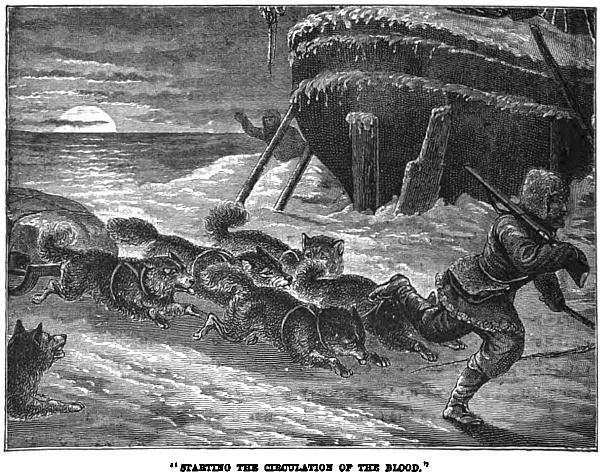
One day they were surprised by a visit from some natives, with sledges drawn by dogs. They brought fish with them, and the carcase of a reindeer, and begged, in their strange but musical labial language, for blankets and tobacco. They came from land that was visible on the starboard bow, and this country, or island, or whatever it was, Chisholm begged leave of the captain to be allowed, with his friends, to visit.
“It must be at your own risk, then, gentlemen,” the captain replied; “for, although we are most likely to lie here for six weeks to come, the ice may break up at any moment.”
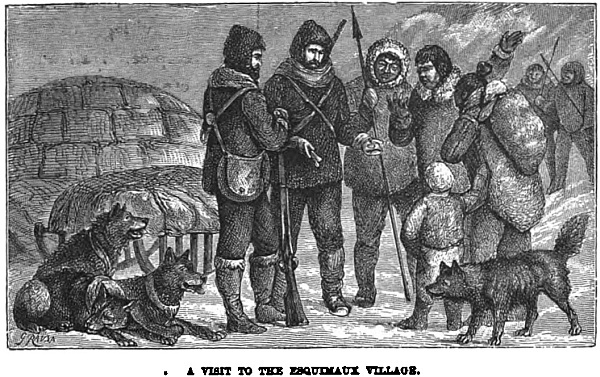
But our heroes did risk it. They packed a sledge with many things which they knew the natives would appreciate, and off they started, the captain waving his hand and wishing them luck. It was more pleasant to run for a little way on first starting; but having by this means succeeded in starting the circulation of the blood, as Chisholm phrased it, they handed the whips to the natives, and squatted on the tops of the curious and primitive sledges.
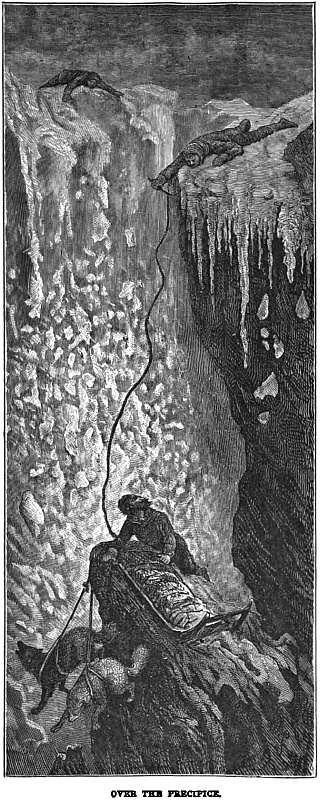
They found the Esquimaux very friendly, and willing to barter. Their huts were mere mole-hills, and far from cleanly inside, and were built with no attempt at architecture; but they were strong, nevertheless. The only kind of religion these people had was a kind of sun worship. They were expert in hunting and fishing, and very brave and daring. Chisholm soon found that he could accomplish the journey from the ship to the village of Redinvolsk in an hour; so he started a sledge, drawn by two dogs, and, great though the risk was, went on shore almost every day. But these little trips of his had a sad and all but fatal ending. His team one day took fright, and, instead of running directly for the village, dashed over a precipice. Half-way down the crevasse the sledge was brought up by a snow-covered shelf of rock. But kindly aid was at hand, a rope was lowered by some friendly natives, and a sheathed knife. With the latter he cut the poor plunging dogs adrift, sorry in his manly heart that he had to leave them to their fate. He was then drawn to bank much bruised and shaken, but thankful to escape with life.
One morning clouds began to bank up in the sky, and that very day the ice broke up, steam was got up, and, more quickly than before, the Grampus headed homewards.
There was an air of greater gravity about the captain, as he came below to dinner that day, than ever Frank and his friends had seen.
“I hope there is nothing serious the matter, captain?” Chisholm inquired.
“Not as yet, gentlemen,” replied the captain, with an uneasy kind of a smile, “but the glass is going tumbling down, and the ice grows heavier and more dangerous the nearer to the open sea we get. I fear we’re going to have a blow.”
He soon after went on deck, whither our heroes followed him. The floes were of great size, heavy, mischievous-looking pieces, covered with snow on the top, but with a deal of hard green stuff under water. Against these the ship was constantly bumping, with a violence that made every one on deck stagger and reel. The captain himself was on the bridge giving constant orders, for the ship was being steered by the ice; the object being to strike the pieces stem on, and so save the more vulnerable bows or quarters.
The day wore gloomily away, and the night closed in dark and stormy. No one cared to lie down or seek for rest; there was a cloud on the heart of every one on board—a strange foreboding of evil to come. The wind soon increased to all the fury of a gale; the waves dashed over the ship with such violence that when struck you couldn’t have told whether it was with a piece of ice or a green sea.
It was just two bells in the morning watch, and the night was at its darkest, when the good ship was caught with tremendous force between two mighty floes, which, as soon as they had done the mischief, began to part and leave the sinking ship to her sad fate. The next moment the engineer had rushed on deck to say the engines had stopped. All was now confusion on board, for there was a strange steadiness about the vessel that told she was sinking fast.
Boats were of no use in that terrible tempest-tossed ocean, so orders were given to get ready the ice-anchors. By dint of courage and strength, the anchors were thrown, and the ship made fast for a time, to the nearest berg. It was but for a time, alas! And now commenced all the hurry and horror of this pitiful disembarkation. The waves washed over both ship and berg, making the former quiver all over like some creature in the throes of death, and causing the berg itself to heel over like a great raft.
Morning broke grey and cold and dismal; but hours before, the Grampus had slipped her ice-anchors, and gone down head foremost; and, out of all her crew of fifty men, fifteen only were alive to see the sunrise, and thank the God who had spared their lives—fifteen, and the ship’s dog. Our heroes were saved, or this story would not be written; but, with the exception of Captain Anderson, every other officer met with a watery grave.
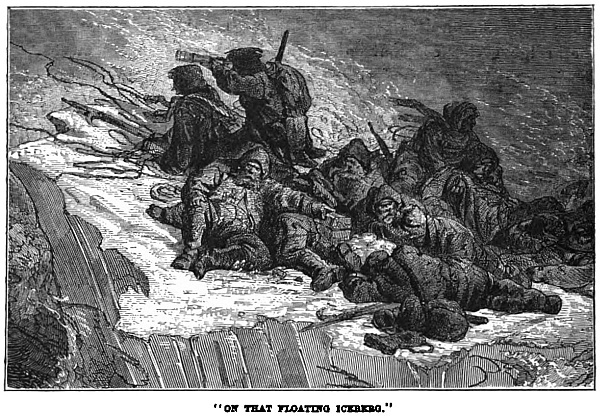
I have not the heart to harrow the feelings of my youthful readers with a relation of the horrors the survivors of the foundered ship had to endure on that floating iceberg. For a whole week they were tossed about among the stormy waves of that cold ocean, drifting before an eastern gale that blew with almost the force of a hurricane. But if their half-frozen hearts were still capable of feeling one atom of joy, they must surely have beat faster when the captain, glass in hand, but half buried in spray, shouted—“Land, land! I see it, I see it!”
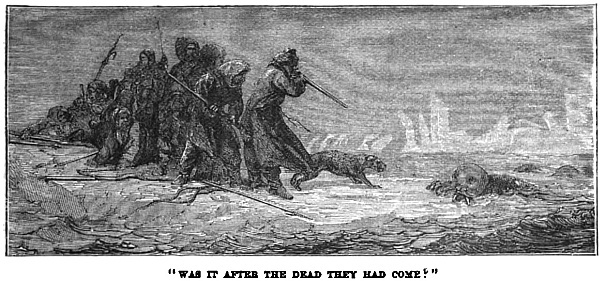
Ah! there were hearts on that berg that would never beat again, for at that moment six of the original fifteen lay dead on the berg.
The storm now abated, and the sea went down; but yet another danger had to be encountered, for strange black monsters, with fierce eyes, rose up from the depth of ocean and sought to scale the berg. Was it after the dead they had come?
Boats at last!—only the boats of native Indians, but they came with friendly intentions.
So they committed the bodies of their late comrades to the deep, and, embarking with the Indians, were rowed on shore to a new land. Frank was in a sad way: he was carried to the hut of a chief; medicine men were sent for to look upon him and administer to him herbs strangely compounded, and wise old squaws uttered their spells over his prostrate form; but it was the nursing he received, after all, from Chisholm and Fred that at last brought him round.
Their fare while they lived among the Indians was very poor of its kind; but then, a gift-horse should not be looked in the mouth. These poor people gave them a portion of all they possessed, and they gave it, too, with right good will. Captain Anderson could speak their language—a kind of Yack patois—and held many long conversations with the chief—a great man in the estimation of the tribe, and in reality a true man, although only a savage. Anderson held him spell-bound, as he told of some of the strange cities and countries there were in the world. He liked to hear the captain talk, and still, from the sinister look and incredulous smile on his face as he listened, you could see that he thought the narrator was drawing largely on his imagination.
It was very kind of this chief to invite the captain, our heroes, and the survivors of the melancholy shipwreck to stay with him for the rest of their lives.
“Blubber,” he said, “would never fail them; salt fish and seal’s flesh could always be had in abundance, with now and then a bit of a whale as a treat. Then they could take them wives from the daughters of his people, and the smoke from their wigwams would ascend for ever.”
It was a pretty picture, Anderson allowed; but—there is no accounting for taste; he loved his own home in England better.
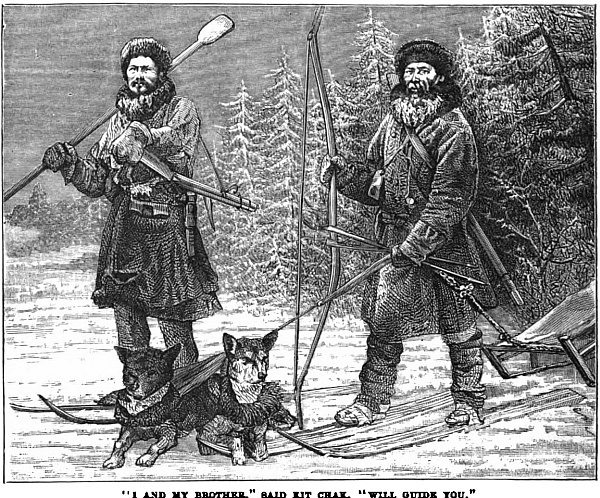
“Then in that case,” said Kit Chak—and here spoke the noble savage—“I and my brother will guide you through the great forest to Inchboon, where lies a Danish whaler. The journey will take us one moon.”
One moon!—nearly thirty days. It was a fearful undertaking; but what will not men do for home and country? So all preparations were made for the march, and in three days they were ready to start.
“You do well to wrap up, Frank, my boy,” said Chisholm to his young friend; “but, beside the captain, you do look odd.”
In twenty-five days, after sufferings and hardships that they never forgot, they arrived at Inchboon, and sure enough they found the Danish ship. She was bound to Russia, though; if that would suit them, said the captain, his vessel was at their service.
They gladly accepted his offer, bade brave Kit Chak and his brother adieu (not without well rewarding them), and in six weeks’ time they were landed at Cronstadt.
Our travellers now were as happy as kings; but where, they wondered, would they turn up next?