SKETCHES OF THE LIVES OF NOTED RED MEN AND WOMEN WHO HAVE APPEARED ON THE WESTERN CONTINENT.
Reading edition
CONFESSIONS OF CATHERINE OGEE WYAN AKWUT OKWA; OR THE WOMAN OF THE BLUE-ROBED CLOUD, THE PROPHETESS OF CHEGOIMEGON.
[These confessions of the Western Pythoness were made after she had relinquished the prophetic office, discarded all the ceremonies of the Indian Medáwin and Jesukeéwin, and united herself to the Methodist Episcopal church, of which, up to our latest dates, she remained a consistent member. They are narrated in her own words.]
When I was a girl of about twelve or thirteen years of age, my mother told me to look out for something that would happen to me. Accordingly, one morning early, in the middle of winter, I found an unusual sign, and ran off, as far from the lodge as I could, and remained there until my mother came and found me out. She knew what was the matter, and brought me nearer to the family lodge, and bade me help her in making a small lodge of branches of the spruce tree. She told me to remain there, and keep away from every one, and as a diversion, to keep myself employed in chopping wood, and that she would bring me plenty of prepared bass wood bark to twist into twine. She told me she would come to see me, in two days, and that in the meantime I must not even taste snow.
I did as directed; at the end of two days she came to see me. I thought she would surely bring me something to eat, but to my disappointment she brought nothing. I suffered more from thirst, than hunger, though I felt my stomach gnawing. My mother sat quietly down and said (after ascertaining that I had not tasted anything, as she directed), “My child, you are the youngest of your sisters, and none are now left me of all my sons and children, but you four” (alluding to her two elder sisters, herself and a little son, still a mere lad). “Who,” she continued, “will take care of us poor women? Now, my daughter, listen to me, and try to obey. Blacken your face and fast really, that the Master of Life may have pity on you and me, and on us all. Do not, in the least, deviate from my counsels, and in two days more, I will come to you. He will help you, if you are determined to do what is right, and tell me, whether you are favored or not, by the true Great Spirit; and if your visions are not good, reject them.” So saying, she departed.
I took my little hatchet and cut plenty of wood, and twisted the cord that was to be used in sewing ap puk way oon un, or mats, for the use of the family. Gradually, I began to feel less appetite, but my thirst continued; still I was fearful of touching the snow to allay it, by sucking it, as my mother had told me that if I did so, though secretly, the Great Spirit would see me, and the lesser spirits also, and that my fasting would be of no use. So I continued to fast till the fourth day, when my mother came with a little tin dish, and filling it with snow, she came to my lodge, and was well pleased to find that I had followed her injunctions. She melted the snow, and told me to drink it. I did so, and felt refreshed, but had a desire for more, which she told me would not do, and I contented myself with what she had given me. She again told me to get and follow a good vision—a vision that might not only do us good, but also benefit mankind, if I could. She then left me, and for two days she did not come near me, nor any human being, and I was left to my own reflections. The night of the sixth day, I fancied a voice called to me, and said: “Poor child! I pity your condition; come, you are invited this way;” and I thought the voice proceeded from a certain distance from my lodge. I obeyed the summons, and going to the spot from which the voice came, found a thin shining path, like a silver cord, which I followed. It led straight forward, and, it seemed, upward. No. 3. After going a short distance I stood still, and saw on my right hand the new moon, with a flame rising from the top like a candle, which threw around a broad light. No. 4. On the left appeared the sun, near the point of its setting. No. 11. I went on, and I beheld on my right the face of Kau ge gag be qua, or the everlasting woman, No. 5, who told me her name, and said to me, “I give you my name, and you may give it to another. I also give you that which I have, life everlasting. I give you long life on the earth, and skill in saving life in others. Go, you are called on high.”
I went on, and saw a man standing with a large circular body, and rays from his head, like horns. No. 6. He said, “Fear not, my name is Monedo Wininees, or the Little man Spirit. I give this name to your first son. It is my life. Go to the place you are called to visit.” I followed the path till I could see that it led up to an opening in the sky, when I heard a voice, and standing still, saw the figure of a man standing near the path, whose head was surrounded with a brilliant halo, and his breast was covered with squares. No. 7. He said to me: “Look at me, my name is O Shau wau e geeghick, or the Bright Blue Sky. I am the veil that covers the opening into the sky. Stand and listen to me. Do not be afraid. I am going to endow you with gifts of life, and put you in array that you may withstand and endure.” Immediately I saw myself encircled with bright points which rested against me like needles, but gave me no pain, and they fell at my feet. No. 9. This was repeated several times, and at each time they fell to the ground. He said, “wait and do not fear, till I have said and done all I am about to do.” I then felt different instruments, first like awls, and then like nails stuck into my flesh, but neither did they give me pain, but like the needles, fell at my feet, as often as they appeared. He then said, “that is good,” meaning my trial by these points. “You will see length of days. Advance a little farther,” said he. I did so, and stood at the commencement of the opening. “You have arrived,” said he, “at the limit you cannot pass. I give you my name, you can give it to another. Now, return! Look around you. There is a conveyance for you. No. 10. Do not be afraid to get on its back, and when you get to your lodge, you must take that which sustains the human body.” I turned, and saw a kind of fish swimming in the air, and getting upon it as directed, was carried back with celerity, my hair floating behind me in the air. And as soon as I got back, my vision ceased.
In the morning, being the sixth day of my fast, my mother came with a little bit of dried trout. But such was my sensitiveness to all sounds, and my increased power of scent, produced by fasting, that before she came in sight I heard her, while a great way off, and when she came in, I could not bear the smell of the fish or herself either. She said, “I have brought something for you to eat, only a mouthful, to prevent your dying.” She prepared to cook it, but I said, “Mother, forbear, I do not wish to eat it—the smell is offensive to me.” She accordingly left off preparing to cook the fish, and again encouraged me to persevere, and try to become a comfort to her in her old age and bereaved state, and left me.
I attempted to cut wood, as usual, but in the effort I fell back on the snow, from weariness, and lay some time; at last I made an effort and rose, and went to my lodge and lay down. I again saw the vision, and each person who had before spoken to me, and heard the promises of different kinds made to me, and the songs. I went the same path which I had pursued before, and met with the same reception. I also had another vision, or celestial visit, which I shall presently relate. My mother came again on the seventh day, and brought me some pounded corn boiled in snow water, for she said I must not drink water from lake or river. After taking it, I related my vision to her. She said it was good, and spoke to me to continue my fast three days longer. I did so; at the end of which she took me home, and made a feast in honor of my success, and invited a great many guests. I was told to eat sparingly, and to take nothing too hearty or substantial; but this was unnecessary, for my abstinence had made my senses so acute, that all animal food had a gross and disagreeable odor.
After the seventh day of my fast (she continued), while I was lying in my lodge, I saw a dark round object descending from the sky like a round stone, and enter my lodge. As it came near, I saw that it had small feet and hands like a human body. It spoke to me and said, “I give you the gift of seeing into futurity, that you may use it, for the benefit of yourself and the Indians—your relations and tribes-people.” It then departed, but as it went away, it assumed wings, and looked to me like the red-headed woodpecker.
In consequence of being thus favored, I assumed the arts of a medicine woman and a prophetess; but never those of a Wabeno. The first time I exercised the prophetical art, was at the strong and repeated solicitations of my friends. It was in the winter season, and they were then encamped west of the Wisacoda, or Brule river of Lake Superior, and between it and the plains west. There were, besides my mother’s family and relatives, a considerable number of families. They had been some time at the place, and were near starving, as they could find no game. One evening the chief of the party came into my mother’s lodge. I had lain down, and was supposed to be asleep, and he requested of my mother that she would allow me to try my skill to relieve them. My mother spoke to me, and after some conversation, she gave her consent. I told them to build the Jee suk aun, or prophet’s lodge, strong, and gave particular directions for it. I directed that it should consist of ten posts or saplings, each of a different kind of wood, which I named. When it was finished, and tightly wound with skins, the entire population of the encampment assembled around it and I went in, taking only a small drum. I immediately knelt down, and holding my head near the ground, in a position as near as may be prostrate, began beating my drum, and reciting my songs or incantations. The lodge commenced shaking violently, by supernatural means. I knew this, by the compressed current of air above, and the noise of motion. This being regarded by me, and by all without, as a proof of the presence of the spirits I consulted, I ceased beating and singing, and lay still, waiting for questions, in the position I had at first assumed.
The first question put to me, was in relation to the game, and where it was to be found. The response was given by the orbicular spirit, who had appeared to me. He said, “How short-sighted you are! If you will go in a west direction, you will find game in abundance.” Next day the camp was broken up, and they all moved westward, the hunters, as usual, going far ahead. They had not proceeded far beyond the bounds of their former hunting circle, when they came upon tracks of moose, and that day, they killed a female and two young moose, nearly full-grown. They pitched their encampment anew, and had abundance of animal food in this new position.
My reputation was established by this success, and I was afterwards noted in the tribe, in the art of a medicine woman, and sung the songs which I have given to you. About four years after, I was married to O Mush Kow Egeezhick, or the Strong Sky, who was a very active and successful hunter, and kept his lodge well supplied with food; and we lived happy. After I had had two children, a girl and a boy, we went out, as is the custom of the Indians in the spring, to visit the white settlements. One night, while we were encamped at the head of the portage at Pauwating (the Falls of St. Mary’s), angry words passed between my husband and a half Frenchman named Gaultier, who, with his two cousins, in the course of the dispute, drew their knives and a tomahawk, and stabbed and cut him in four or five places, in his body, head and thighs. This happened the first year that the Americans came to that place (1822). He had gone out at a late hour in the evening, to visit the tent of Gaultier. Having been urged by one of the trader’s men to take liquor that evening, and it being already late, I desired him not to go, but to defer his visit till next day; and after he had left the lodge, I felt a sudden presentiment of evil, and I went after him, and renewed my efforts in vain. He told me to return, and as I had two children in the lodge, the youngest of whom, a boy, was still in his cradle, and then ill, I sat up with him late, and waited and waited, till a late hour, and then fell asleep from exhaustion. I slept very sound. The first I knew, was a violent shaking from a girl, a niece of Gaultier’s, who told me my husband and Gaultier were all the time quarrelling. I arose, and went up the stream to Gaultier’s camp fire. It was nearly out, and I tried in vain to make it blaze. I looked into his tent, but all was dark and not a soul there. They had suddenly fled, although I did not at the moment know the cause. I tried to make a light to find my husband, but could find nothing dry, for it had rained very hard the day before. After being out a while my vision became clearer, and turning toward the river side, I saw a dark object lying near the shore, on a grassy opening. I was attracted by something glistening, which turned out to be his ear-rings. I thought he was asleep, and in stooping to awake him, I slipped and fell on my knees. I had slipped in his blood on the grass, and putting my hand on his face, found him dead. In the morning the Indian agent came with soldiers from the fort, to see what had happened, but the murderer and all his bloody gang of relatives had fled. The agent gave orders to have the body buried in the old Indian burial ground, below the Falls.
My aged mother was encamped about a mile off, at this time. I took my two children in the morning, and fled to her lodge. She had just heard of the murder, and was crying as I entered. I reminded her that it was an act of providence, to which we must submit. She said it was for me and my poor helpless children that she was crying—that I was left as she had been, years before, with nobody to provide for us. With her I returned to my native country at Chegoimegon on Lake Superior.
Thus far, her own narrative. We hope, in a future number, to give further particulars of her varied, and rather eventful life; together with specimens of her medicine, and prophetic songs.
RULING CHIEF OF THE MIAMIS.
Died, on the 13th inst. (August, 1841), at his residence on the St. Mary’s, four and a half miles south-west of this city, John B. Richardville, principal chief of the Miami nation of Indians, aged about eighty years.
Chief Richardville, or “Piskewah” (which is an Indian name, meaning in English “wild-cat”), was born on the point across the Maumee river, opposite this city, under or near a large apple tree, on the farm of the late Colonel Coles; and at a very early age, by succession, became the chief of the tribe, his mother being chieftainess at the time of his birth. His situation soon brought him in contact with the whites, and he was in several engagements, the most important of which was the celebrated slaughter on the St. Joseph River, one mile north of this city, designated as “Harmar’s Defeat,” where several hundred whites, under General Harmar, were cut off in attempting to ford the river, by the Indians, who lay in ambush on the opposite shore, by firing upon the whites when in the act of crossing; which slaughter crimsoned the river a number of days for several miles below with the blood of the unfortunate victims.
The Chief is universally spoken of as having been kind and humane to prisoners—far more so than most of his race; and as soon as peace was restored, became a worthy citizen, and enjoyed the confidence of the whites to the fullest extent. He spoke good French and English, as well as his native tongue; and for many years his house, which is pleasantly situated on the banks of the St. Mary’s, and which was always open for the reception of friends—was a place of resort for parties of pleasure, who always partook of the hospitality of his house.
The old man was strictly honest, but remarkably watchful of his interest, and amassed a fortune exceeding probably a million of dollars, consisting of nearly $200,000 in specie on hand, and the balance in the most valuable kind of real estate, which he has distributed by “will” among his numerous relations with “even-handed justice.” He had always expressed a great anxiety to live, but when he became conscious that the time of his departure was near at hand, he resigned himself with perfect composure, saying that it was ordered that all must die, and he was then ready and willing to answer the call of the “Great Spirit.” His remains were deposited in the Catholic burying-ground with religious ceremonies.—Fort Wayne (Ind.) Sentinel.
THE MAGICIAN OF LAKE HURON.
AN OTTOWA TALE RELATED BY NABUNWA IN THE INDIAN TONGUE, TO MR. GEORGE JOHNSTON.
At the time that the Ottowas inhabited the Manatoline Islands, in Lake Huron, there was a famous magician living amongst them whose name was Masswäwëinini, or the Living Statue. It happened, by the fortune of war, that the Ottowa tribe were driven off that chain of islands by the Iroquois, and obliged to flee away to the country lying between Lake Superior and the Upper Mississippi, to the banks of a lake which is still called, by the French, and in memory of this migration, Lac Courtorielle, or the lake of the Cut-ears, a term which is their nom de guerre for this tribe. But the magician Masswäwëinini remained behind on the wide-stretching and picturesque Manatoulins, a group of islands which had been deemed, from the earliest times, a favorite residence of the manitoes or spirits. His object was to act as a sentinel to his countrymen, and keep a close watch on their enemies, the Iroquois, that he might give timely information of their movements. He had with him two boys; with their aid he paddled stealthily around the shores, kept himself secreted in nooks and bays, and hauled up his canoe every night, into thick woods, and carefully obliterated his tracks upon the sand.
One day he rose very early, and started on a hunting excursion, leaving the boys asleep, and limiting himself to the thick woods, lest he should be discovered. At length he came unexpectedly to the borders of an extensive open plain. After gazing around him, and seeing no one, he directed his steps across it, intending to strike the opposite side of it; while travelling, he discovered a man of small stature, who appeared suddenly on the plain before him, and advanced to meet him. He wore a red feather on his head, and coming up with a familiar air, accosted Masswäwëinini by name, and said gaily, “Where are you going?” He then took out his smoking apparatus, and invited him to smoke. “Pray,” said he, while thus engaged, “wherein does your strength lie.” “My strength,” answered Masswäwëinini, “is similar to the human race, and common to the strength given to them, and no stronger.” “We must wrestle,” said the man of the red feather. “If you should make me fall, you will say to me, I have thrown you, Wa ge me na.”
As soon as they had finished smoking and put up their pipe, the wrestling began. For a long time the strife was doubtful. The strength of Masswäwëinini was every moment growing fainter. The man of the red feather, though small of stature, proved himself very active, but at length he was foiled and thrown to the ground. Immediately his adversary cried out, “I have thrown you: wa ge me na;” and in an instant his antagonist had vanished. On looking to the spot where he had fallen, he discovered a crooked ear of mondamin, or Indian corn, lying on the ground, with the usual red hairy tassel at the top. While he was gazing at this strange sight, and wondering what it could mean, a voice addressed him from the ground. “Now,” said the speaking ear, for the voice came from it, “divest me of my covering—leave nothing to hide my body from your eyes. You must then separate me into parts, pulling off my body from the spine upon which I grow. Throw me into different parts of the plain. Then break my spine and scatter it in small pieces near the edge of the woods, and return to visit the place, after one moon.”
Masswäwëinini obeyed these directions, and immediately set out on his return to his lodge. On the way he killed a deer, and on reaching his canoe, he found the boys still asleep. He awoke them and told them to cook his venison, but he carefully concealed from them his adventure. At the expiration of the moon he again, alone, visited his wrestling ground, and to his surprise, found the plain filled with the spikes and blades of new grown corn. In the place where he had thrown the pieces of cob, he found pumpkin vines growing in great luxuriance. He concealed this discovery also, carefully from the young lads, and after his return busied himself as usual, in watching the movements of his enemies along the coasts of the island. This he continued, till summer drew near its close. He then directed his canoe to the coast of that part of the island where he had wrestled with the Red Plume, drew up his canoe, bid the lads stay by it, and again visited his wrestling ground. He found the corn in full ear, and pumpkins of an immense size. He plucked ears of corn, and gathered some of the pumpkins, when a voice again addressed him from the cornfield. “Masswäwëinini, you have conquered me. Had you not done so, your existence would have been forfeited. Victory has crowned your strength, and from henceforth you shall never be in want of my body. It will be nourishment for the human race.” Thus his ancestors received the gift of corn.
Masswäwëinini now returned to his canoe, and informed the young men of his discovery, and showed them specimens. They were astonished and delighted with the novelty.
There were, in those days, many wonderful things done on these islands. One night, while Masswäwëinini was lying down, he heard voices speaking, but he still kept his head covered, as if he had not heard them. One voice said, “This is Masswäwëinini, and we must get his heart.” “In what way can we get it?” said another voice. “You must put your hand in his mouth,” replied the first voice, “and draw it out that way.” Masswäwëinini still kept quiet, and did not stir. He soon felt the hand of a person thrust in his mouth. When sufficiently far in, he bit off the fingers, and thus escaped the danger. The voices then retired, and he was no further molested. On examining the fingers in the morning, what was his surprise to find them long wampum beads, which are held in such high estimation by all the Indian tribes. He had slept, as was his custom, in the thick woods. On going out to the open shore, at a very early hour, he saw a canoe at a small distance, temporarily drawn up on the beach; on coming closer, he found a man in the bows and another in the stern, with their arms and hands extended in a fixed position. One of them had lost its fingers: it was evidently the man who had attempted to thrust his arm down his throat. They were two Pukwudjininees, or fairies. But on looking closer, they were found to be transformed into statues of stone. He took these stone images on shore, and set them up in the woods.
Their canoe was one of the most beautiful structures which it is possible to imagine, four fathoms in length, and filled with bags of treasures of every description and of the most exquisite workmanship. These bags were of different weight, according to their contents. He busied himself in quickly carrying them into the woods, together with the canoe, which he concealed in a cave. One of the fairy images then spoke to him and said: “In this manner, the Ottowa canoes will hereafter be loaded, when they pass along this coast, although your nation are driven away by their cruel enemies the Iroquois.” The day now began to dawn fully, when he returned to his two young companions, who were still asleep. He awoke them, and exultingly bid them cook, for he had brought abundance of meat and fish, and other viands, the gifts of the fairies.
After this display of good fortune, he bethought him of his aged father and mother, who were in exile at the Ottowa lake. To wish, and to accomplish his wish, were but the work of an instant with Masswäwëinini.
One night as he lay awake, reflecting on their condition, far away from their native fields, and in exile, he resolved to visit them, and bring them back to behold and to participate in his abundance. To a common traveller, it would be a journey of twenty or thirty days, but Masswäwëinini was at their lodge before daylight. He found them asleep, and took them up softly in his arms and flew away with them through the air, and brought them to his camp on the Manatolines, or Spirit’s Islands. When they awoke, their astonishment was at its highest pitch; and was only equalled by their delight in finding themselves in their son’s lodge, in their native country, and surrounded with abundance.
Masswäwëinini went and built them a lodge, near the corn and wrestling plain. He then plucked some ears of the corn, and taking some of the pumpkins, brought them to his father and mother. He then told them how he had obtained the precious gift, by wrestling with a spirit in red plumes, and that there was a great abundance of it in his fields. He also told them of the precious canoe of the fairies, loaded with sacks of the most costly and valuable articles. But one thing seemed necessary to complete the happiness of his father, which he observed by seeing him repeatedly at night looking into his smoking pouch. He comprehended his meaning in a moment. “It is tobacco, my father, that you want. You shall also have this comfort in two days.” “But where,” replied the old man, “can you get it—away from all supplies, and surrounded by your enemies?” “My enemies,” he answered, “shall supply it—I will go over to the Nadowas of the Bear totem, living at Penetanguishine.”
The old man endeavored to dissuade him from the journey, knowing their blood-thirsty character, but in vain. Masswäwëinini determined immediately to go. It was now winter weather, the lake was frozen over, but he set out on the ice, and although it is forty leagues, he reached Penetanguishine the same evening. The Nadowas discerned him coming—they were amazed at the swiftness of his motions, and thinking him somewhat supernatural, feared him, and invited him to rest in their lodges, but he thanked them, saying that he preferred making a fire near the shore. In the evening they visited him, and were anxious to know the object of his journey, at so inclement a season. He said it was merely to get some tobacco for his father. They immediately made a contribution of the article and gave it to him. During the night they however laid a plot to kill him. Some of the old men rushed into his lodge, their leader crying out to him, “You are a dead man.” “No, I am not,” said Masswäwëinini, “but you are,” accompanying his words with a blow of his tomahawk, which laid the Nadowa dead at his feet. Another and another came, to supply the place of their fallen comrade, but he despatched them in like manner, as quickly as they came, until he had killed six. He then took all the tobacco from their smoking pouches. By this time, the day began to dawn, when he set out for his father’s lodge, which he reached with incredible speed, and before twilight, spread out his trophies before the old man.
When spring returned, his cornfield grew up, without planting, or any care on his part, and thus the maize was introduced among his people and their descendants, who have ever been noted, and are at this day, for their fine crops of this grain, and their industry in its cultivation. It is from their custom of trading in this article, that this tribe are called Ottowas.
CORN-PLANTING, AND ITS INCIDENTS.
The zea, mais, originally furnished the principal article of subsistence among all the tribes of this race, north and south. It laid at the foundation of the Mexican and Peruvian types of civilization, as well as the incipient gleamings of it, among the more warlike tribes of the Iroquois, Natchez, Lenapees, and others, of northern latitudes. They esteem it so important and divine a grain, that their story-tellers invented various tales, in which this idea is symbolized under the form of a special gift from the Great Spirit. The Odjibwa-Algonquins, who call it Mon-dá-min, that is, the Spirit’s grain or berry, have a pretty story of this kind, in which the stalk in full tassel, is represented as descending from the sky, under the guise of a handsome youth, in answer to the prayers of a young man at his fast of virility, or coming to manhood.
It is well known that corn-planting, and corn-gathering, at least among all the still uncolonized tribes, are left entirely to the females and children, and a few superannuated old men. It is not generally known, perhaps, that this labour is not compulsory, and that it is assumed by the females as a just equivalent, in their view, for the onerous and continuous labour of the other sex, in providing meats, and skins for clothing, by the chase, and in defending their villages against their enemies, and keeping intruders off their territories. A good Indian housewife deems this a part of her prerogative, and prides herself to have a store of corn to exercise her hospitality, or duly honour her husband’s hospitality, in the entertainment of the lodge guests.
The area of ground planted is not, comparatively, large. This matter is essentially regulated by the number of the family, and other circumstances. Spring is a leisure season with them, and by its genial and reviving influence, invites to labour. An Indian female has no cows to milk, no flax to spin, no yarn to reel. Even those labours, which, at other seasons fall to her share, are now intermitted. She has apukwas to gather to make mats. Sugar-making has ended. She has no skins to dress, for the hunt has ended, the animals being out of season. It is at this time that the pelt grows bad, the hair becomes loose and falls off, and nature itself teaches the hunter, that the species must have repose, and be allowed a little time to replenish. Under these circumstances the mistress of the lodge and her train, sally out of the lodge into the cornfield, and with the light pemidge-ag akwut, or small hoe, open up the soft ground and deposit their treasured mondamin.
The Indian is emphatically a superstitious being, believing in all sorts of magical, and secret, and wonderful influences. Woman, herself, comes in for no small share of these supposed influences. I shrewdly suspect that one half of the credit we have been in the habit of giving the warrior, on the score of virtue, in his treatment of captives, is due alone to his superstitions. He is afraid, at all times, to spoil his luck, cross his fate, and do some untoward act, by which he might, perchance, fall under a bad spiritual influence.
To the wéwun, or wife—the equá, or woman, to the guh or mother,—to the equázas, or girl, and to the dánis, or daughter, and shéma, or sister, he looks, as wielding, in their several capacities, whether kindred or not, these mystic influences over his luck. In consequence of this, the female never walks in the path before him. It is an unpropitious sign. If she cross his track, when he is about to set out on a hunting, or war excursion, his luck is gone. If she is ill, from natural causes, she cannot even stay in the same wigwam. She cannot use a cup or a bowl without rendering it, in his view, unclean.
A singular proof of this belief, in both sexes, of the mysterious influence of the steps of a woman on the vegetable and insect creation, is found in an ancient custom, which was related to me, respecting corn-planting. It was the practice of the hunter’s wife, when the field of corn had been planted, to choose the first dark or overclouded evening, to perform a secret circuit, sans habilement, around the field. For this purpose she slipt out of the lodge in the evening, unobserved, to some obscure nook, where she completely disrobed. Then taking her matchecota, or principal garment in one hand, she dragged it around the field. This was thought to ensure a prolific crop, and to prevent the assaults of insects and worms upon the grain. It was supposed they could not creep over the charmed line.
But if corn-planting be done in a lively and satisfied, and not a slavish spirit, corn-gathering and husking is a season of decided thankfulness and merriment. At these gatherings, the chiefs and old men are mere spectators, although they are pleased spectators, the young only sharing in the sport. Who has not seen, the sedate ogema in such a vicinage, smoking a dignified pipe with senatorial ease. On the other hand, turning to the group of nature’s red daughters and their young cohorts, it may be safely affirmed that laughter and garrulity constitute no part of the characteristics of civilization. Whatever else custom has bound fast, in the domestic female circle of forest life, the tongue is left loose. Nor does it require, our observation leads us to think, one tenth part of the wit or drollery of ancient Athens, to set their risible faculties in motion.
If one of the young female huskers finds a red ear of corn, it is typical of a brave admirer, and is regarded as a fitting present to some young warrior. But if the ear be crooked, and tapering to a point, no matter what colour, the whole circle is set in a roar, and wa ge min is the word shouted aloud. It is the symbol of a thief in the cornfield. It is considered as the image of an old man stooping as he enters the lot. Had the chisel of Praxitiles been employed to produce this image, it could not more vividly bring to the minds of the merry group, the idea of a pilferer of their favourite mondámin. Nor is there any doubt on these occasions, that the occurrence truly reveals the fact that the cornfield has actually been thus depredated on.
The term wagemin, which unfolds all these ideas, and reveals, as by a talisman, all this information, is derived in part, from the tri-literal term Waweau, that which is bent or crooked. The termination in g, is the animate plural, and denotes not only that there is more than one object, but that the subject is noble or invested with the importance of animated beings. The last member of the compound, min, is a shortened sound of the generic meen, a grain, or berry. To make these coalesce, agreeably to the native laws of euphony, the short vowel i, is thrown in, between the verbal root and substantive, as a connective. The literal meaning of the term is, a mass, or crooked ear of grain; but the ear of corn so called, is a conventional type of a little old man pilfering ears of corn in a cornfield. It is in this manner, that a single word or term, in these curious languages, becomes the fruitful parent of many ideas. And we can thus perceive why it is that the word wagemin is alone competent to excite merriment in the husking circle.
This term is taken as the basis of the cereal chorus or corn song, as sung by the northern Algonquin tribes. It is coupled with the phrase Paimosaid,—a permutative form of the Indian substantive made from the verb, pim-o-sa, to walk. Its literal meaning is, he who walks, or the walker; but the ideas conveyed by it, are, he who walks at night to pilfer corn. It offers, therefore, a kind of parallelism in expression, to the preceding term. The chorus is entirely composed of these two terms, variously repeated, and may be set down as follows:
Wagemin, Wagemin, Paimosaid. Wagemin, Wagemin, Paimosaid.
When this chant has been sung, there is a pause, during which some one who is expert in these things, and has a turn for the comic or ironic, utters a short speech, in the manner of a recitative, in which a peculiar intonation is given, and generally interrogates the supposed pilferer, as if he were present to answer questions, or accusations. There can be no pretence, that this recitative part of the song is always the same, at different times and places, or even that the same person should not vary his phraseology. On the contrary, it is often an object to vary it. It is a perfect improvisation, and it may be supposed that the native composer is always actuated by a desire to please, as much as possible by novelty. The whole object indeed is, to keep up the existing merriment, and excite fun and laughter.
The following may be taken as one of these recitative songs, written out, on the plan of preserving the train of thought, and some of those peculiar interjections in which these languages so much abound. The chorus alone, it is to be observed, is fixed in its words and metre, however transposed or repeated, and, unlike an English song, precedes the stanza or narrative.
CORN SONG.
Cereal chorus. Wagemin! wagemin! Thief in the blade, Blight of the cornfield Paimosaid. Recitative. See you not traces, while pulling the leaf, Plainly depicting the TAKER and thief? See you not signs by the ring and the spot, How the man crouched as he crept in the lot? Is it not plain by this mark on the stalk, That he was heavily bent in his walk? Old man be nimble! the old should be good, But thou art a cowardly thief of the wood. Cereal chorus. Wagemin! wagemin! Thief in the blade, Blight of the cornfield Paimosaid. Recitative. Where, little TAKER of things not your own— Where is your rattle, your drum, and your bone? Surely a Walker so nimble of speed, Surely he must be a Meta[13] indeed. See how he stoops, as he breaks off the ear, Nushka![14] he seems for a moment in fear; Walker, be nimble—oh! walker be brief, Hooh![15] it is plain the old man is the thief. Cereal chorus. Wagemin! wagemin! Thief in the blade, Blight of the cornfield Paimosaid. Recitative. Wabuma![16] corn-taker, why do you lag? None but the stars see you—fill up your bag! Why do you linger to gaze as you pull, Tell me, my little man, is it most full? A-tia![17] see, a red spot on the leaf, Surely a warrior cannot be a thief! Ah, little night-thief, be deer your pursuit, And leave here no print of your dastardly foot.
FOOTNOTES:
TO HEALTH.
BY THE LATE JOHN JOHNSTON, ESQ.
Health! dearest of the heavenly powers, With thee to pass my evening hours, Ah! deign to hear my prayer; For what can wealth or beauty give, If still in anguish doomed to live A slave to pain and care. Not sovereign power, nor charms of love, Nor social joys the heart can move, If thou refuse thy aid; E’en friendship, sympathy divine! Does, in thy absence, faintly shine, Thou all-inspiring maid. Return then, to my longing soul, Which sighs to feel thy sweet control Transfused through every pore; My muse, enraptured, then shall sing Thee—gift of heaven’s all bounteous king, And gratefully adore. February 4, 1807.
DOMESTIC AND SOCIAL MANNERS OF THE INDIANS, WHILE ON THEIR WINTERING GROUNDS.
The Indian, who takes his position as an orator, in front of his people, and before a mixed assemblage of white men, is to be regarded, in a measure, as an actor, who has assumed a part to perform. He regards himself as occupying a position in which all eyes are directed upon him, in scrutiny, and he fortifies himself for the occasion, by redoubled efforts in cautiousness and studied stoicism. Rigid of muscle, and suspicious of mind by nature, he brings to his aid the advantages of practised art, to bear him out in speaking for his tribe, and to quit him manfully of his task by uttering sentiments worthy of them and of himself. This is the statue-like and artistic phasis of the man. It is here that he is, truly
“A man without a fear—a stoic of the wood.”
All this is laid aside, so far as it is assumed, when he returns from the presence of the “pale-faces,” and rejoins his friends and kindred, in his own village, far away from all public gaze, in the deep recesses of the forest. Let us follow the man to this retreat, and see what are his domestic manners, habits, amusements, and opinions.
I have myself visited an Indian camp, in the far-off area of the North-west, in the dead of winter, under circumstances suited to allay his suspicions, and inspire confidence, and have been struck with the marked change there is in his social temper, character, and feelings. And I have received the same testimony from Indian traders, who have spent years among them in these secluded positions, and been received by them as friends and kindred. All indeed, who have had frequent and full opportunities of witnessing the red man on his hunting grounds, concur in bearing evidence to his social, hospitable, and friendly habits and manners. Viewed in such positions, the most perfect sincerity and cheerfulness prevail; and their intercourse is marked with the broadest principles of charity and neighborly feeling. The restraint and ever watchful suspicion which they evince at the frontier post, or in other situations exposed to the scrutiny and cupidity of white men, is thrown aside and gives way to ease, sociability and pleasantry. They feel while thus ensconced in the shades of their native forests, a security unknown to their breasts in any other situations. The strife seems to be, who shall excel in offices of friendship and charity, or in spreading the festive board. If one is more fortunate than the other, in taking meat, or wielding the arrow or spear, the spoil is set apart for a feast, to which all the adults, without distinction, are invited. When the set time of the feast arrives, each one, according to ancient custom, takes his dish and spoon, and proceeds to the entertainer’s lodge. The victuals are served up with scrupulous attention that each receives a portion of the best parts. While at the meal, which is prolonged by cheerful conversation, anecdote, and little narrations of personal adventure, the females are generally listeners; and none, except the aged, ever obtrude a remark. The young women and girls show that they partake in the festivity by smiles, and are scrupulous to evince their attention to the elder part of the company. Conversation is chiefly engrossed by the old men and chiefs, and middle-aged men. Young men, who are desirous to acquire a standing, seldom offer a remark, and when they do, it is with modesty. The topics discussed at these public meals relate generally to the chace, to the news they have heard, or to personal occurrences about the village; or to deeds, “real or fabulous,” of “old lang syne;” but the matters are discussed in a lively, and not in a grave style. Business, if we may be allowed that term for what concerns their trade and government intercourse, is never introduced except in formal councils, convened specially, and opened formally by smoking the pipe. It seems to be the drift of conversation, in these sober festivities (for it must be recollected that we are speaking of the Indians on their wintering grounds and beyond the reach, certainly beyond the free or ordinary use of ardent spirits), to extract from their hunts and adventures, whatever will admit of a pleasant turn, draw forth a joke, or excite a laugh. Ridiculous misadventures, or comical situations, are sure to be applauded in the recital. Whatever is anti-social, or untoward, is passed over, or if referred to by another, is parried off, by some allusion to the scene before them.
Religion (we use this term for what concerns the great spirit, sacred dreams, and the ceremonies of the Meda or medicine dance), like business, is reserved for its proper occasion. It does not form, as with us, a free topic of remark, at least among those who are professors of the dance. Thus they cheat away the hours in pleasantry, free, but not tumultuous in their mirth, but as ardently bent on the enjoyment of the present moment, as if the sum of life were contained in these three words, “eat, drink, and be merry.” When the feast is over, the women return to their lodges, and leave the men to smoke. On their return, they commence a conversation on what they have heard the men advance, and thus amuse themselves till their husbands return. The end of all is generally some good advice to the children.
The company in these ordinary feasts is as general, with respect to the rank, age or standing of the guests, as the most unlimited equality of rights can make it. All the aged and many of the young are invited. There is, however, another feast instituted, at certain times during the season, to which young persons only are invited, or admitted, except the entertainer and his wife, and generally two other aged persons, who preside over the feast and administer its rites. The object of this feast seems to be instruction, to which the young and thoughtless are induced to listen for the anticipated pleasure of the feast. Before this feast commences, the entertainer, or some person fluent in speech, whom he has selected for the purpose, gets up and addresses the youth of both sexes on the subject of their course through life. He admonishes them to be attentive and respectful to the aged and to adhere to their counsels: never to scoff at the decrepid, deformed, or blind: to obey their parents: to be modest in their conduct: to be charitable and hospitable: to fear and love the great Spirit, who is the giver of life and every good gift. These precepts are dwelt upon at great length, and generally enforced by examples of a good man and woman and a bad man and woman, and after drawing the latter, it is ever the custom to say, “you will be like one of these.” At the end of every sentence, the listeners make a general cry of haá. When the advice is finished, an address, or kind of prayer to the great Spirit is made, in which he is thanked for the food before them, and for the continuance of life. The speaker then says, “Thus the great Spirit supplies us with food; act justly, and conduct well, and you will ever be thus bountifully supplied.” The feast then commences, and the elders relax their manner and mix with the rest, but are still careful to preserve order, and a decent, respectful behavior among the guests.
Let it not be supposed, however, that the Indian’s life, while on his wintering grounds, is a round of feasting. Quite the contrary; and his feasts are often followed by long and painful fasts, and the severity of the seasons, and scarcity of game and fish, often reduce himself and family to the verge of starvation, and even death. When the failure of game, or any other causes, induce the hunter to remove to a new circle of country, the labor of the removal falls upon the female part of the family. The lodge, utensils and fixtures of every kind, are borne upon the women’s backs, sustained by a strap of leather around the forehead. On reaching the intended place of encampment, the snow is cleared away, cedar branches brought and spread for a flooring, the lodge set up, the moveables stowed away, wood collected, and a fire built, and then, and not until then, can the females sit down and warm their feet and dry their moccasins. If there be any provisions, a supper is cooked. If there be none, all studiously strive to conceal the exhibition of the least concern on this account, and seek to divert their thoughts by conversation quite foreign to the subject. The little children are the only part of the family who complain, and who are privileged to complain, but even they are taught at an early age to suffer and be silent. Generally, something is reserved by the mother, when food becomes scarce, to satisfy their clamors, and they are satisfied with little. On such occasions, if the family have gone supperless to rest, the father and elder sons rise early in the morning in search of something. If one has the luck to kill even a partridge or a squirrel, it is immediately carried to the lodge, cooked, and divided into as many parts as there are members of the family. On these occasions, the elder ones often make a merit of relinquishing their portions to the women and children. If nothing rewards the search, the whole day is spent by the father upon his snow-shoes, with his gun in his hands, and he returns at night, fatigued, to his couch of cedar branches and rush mats. But he does not return to complain, either of his want of success, or his fatigue. On the following day the same routine is observed, and days and weeks are often thus consumed without being rewarded with anything capable of sustaining life. Instances have been well authenticated, when this state of wretchedness has been endured by the head of a family until he has become so weak as to fall in his path, and freeze to death. When all other means of sustaining life are gone, the skins he has collected to pay his credits, or purchase new supplies of clothing or ammunition, are eaten. They are prepared by removing the pelt, and roasting the skin until it acquires a certain degree of crispness. Under all their sufferings, the pipe of the hunter is his chief solace, and is a solace often resorted to. Smoking parties are frequently formed, when there is a scarcity of food not tending, as might be supposed, to destroy social feeling and render the temper sour. On these occasions the entertainer sends a message to this effect: “Come and smoke with me. I have no food; but we can pass away the evening very well without it.” All acknowledge their lives to be in the hand of the great Spirit; feel a conviction that all comes from him, and that although he allows them to suffer, he will again supply them. This tends to quiet their apprehensions; they are fatalists, however, under long reverses, and submit patiently and silently to what they believe to be their destiny. When hunger and misery are past, they are soon forgotten, and their minds are too eagerly intent on the enjoyment of the present good, to feel any depression of spirits from the recollection of the past, or to hoard up anything to provide against want for the future. No people are more easy, or less clamorous under sufferings of the deepest dye, and none more happy, or more prone to evince their happiness, when prosperous in their affairs.
October 29th, 1826.
PUGASAING; OR, THE GAME OF THE BOWL.
This is the principal game of hazard among the northern tribes. It is played with thirteen pieces, hustled in a vessel called onágun, which is a kind of wooden bowl. They are represented, and named, as follows.
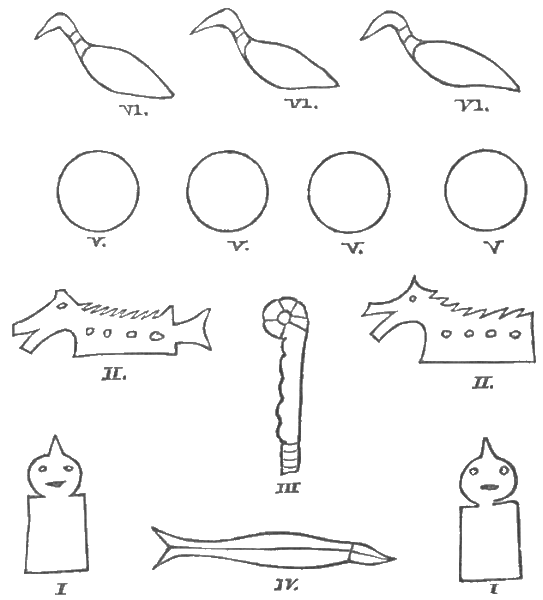
The pieces marked No. 1, in this cut, of which there are two, are called Ininewug, or men. They are made tapering, or wedge-shaped in thickness, so as to make it possible, in throwing them, that they may stand on their base. Number 2, is called Gitshee Kenabik, or the Great Serpent. It consists of two pieces, one of which is fin-tailed, or a water-serpent, the other truncated, and is probably designed as terrestrial. They are formed wedge-shaped, so as to be capable of standing on their bases lengthwise. Each has four dots. Number 3, is called Pugamágun, or the war club. It has six marks on the handle, on the red side, and four radiating from the orifice of the club end; and four marks on the handle of the white side; and six radiating marks from the orifice on the club-end, making ten on each side. Number 4 is called Keego, which is the generic name for a fish. The four circular pieces of brass, slightly concave, with a flat surface on the apex, are called Ozawábiks. The three bird-shaped pieces, Sheshebwug, or ducks.
All but the circular pieces are made out of a fine kind of bone. One side of the piece is white, of the natural colour of the bones, and polished, the other red. The brass pieces have the convex side bright, the concave black. They are all shaken together, and thrown out of the onágun, as dice. The term pugasaing denotes this act of throwing. It is the participial form of the verb.—The following rules govern the game:
1. When the pieces are turned on the red side, and one of the Ininewugs stands upright on the bright side of one of the brass pieces, it counts 158.
2. When all the pieces turn red side up, and the Gitshee Kenabik with the tail stands on the bright side of the brass piece, it counts 138.
3. When all turn up red, it counts 58 whether the brass pieces be bright or black side up.
4. When the Gitshee Kenabik and his associate, and the two Ininewugs turn up white side, and the other pieces red, it counts 58, irrespective of the concave or convex position of the brass pieces.
5. When all the pieces turn up white, it counts 38, whether the Ozawábiks, be bright or black.
6. When the Gitshee Kenabik and his associate turn up red, and the other white, it counts 38, the brass pieces immaterial.
7. When one of the Ininewugs stands up, it counts 50, without regard to the position of all the rest
8. When either of the Gitshee Kenabiks stands upright, it counts 40, irrespective of the position of the others.
9. When all the pieces turn up white, excepting one, and the Ozawábiks dark, it counts 20.
10. When all turn up red, except one, and the brass pieces bright, it counts 15.
11. When the whole of the pieces turn up white, but one, with the Ozawábiks bright, it counts 10.
12. When a brass piece turns up dark, the two Gitshee Kenabiks and the two men red, and the remaining pieces white, it counts 8.
13. When the brass piece turns up bright, the two Gitshee Kenabiks and one of the men red, and all the rest white, it is 6.
14. When the Gitshee Kenabik in chief, and one of the men turn up red, the Ozawábiks, bright, and all the others white, it is 4.
15. When both the Kenabiks, and both men, and the three ducks, turn up red, the brass piece black, and either the Keego, or a duck white, it is 5.
16. When all the pieces turn up red, but one of the Ininewugs, and the brass piece black, it counts 2.
The limit of the game is stipulated. The parties throw up for the play.
This game is very fascinating to some portions of the Indians. They stake at it their ornaments, weapons, clothing, canoes, horses, every thing in fact they possess; and have been known, it is said, to set up their wives and children, and even to forfeit their own liberty. Of such desperate stakes, I have seen no examples, nor do I think the game itself in common use. It is rather confined to certain persons, who hold the relative rank of gamblers in Indian society—men who are not noted as hunters or warriors, or steady providers for their families. Among these are persons who bear the term of Ienadizze-wug, that is, wanderers about the country, braggadocios, or fops. It can hardly be classed with the popular games of amusement, by which skill and dexterity are acquired. I have generally found the chiefs and graver men of the tribes, who encouraged the young men to play ball, and are sure to be present at the customary sports, to witness, and sanction, and applaud them, speak lightly and disparagingly of this game of hazard. Yet, it cannot be denied, that some of the chiefs, distinguished in war and the chase, at the west, can be referred to, as lending their example to its fascinating power.
An analysis of this game, to show its arithmetical principles and powers might be gone into; but it is no part of the present design to take up such considerations here, far less to pursue the comparison and extension of customs of this kind among the modern western tribes. It may be sufficient to say, from the foregoing rules, that there seems to be no unit in the throw, and that the count proceeds by decimals, for all numbers over 8. Doubtless these rules, are but a part of the whole series, known to experienced players. They comprise, however, all that have been revealed to me.
“Gambling is not peculiar to our race The Indian gambles with as fixed a face.”
Herodotus says of the ancient Thracians—that “the most honourable life, with them, is a life of war and plunder; the most contemptible that of a husbandman. Their supreme delight is war and plunder.” Who might not suppose, were the name withheld, that this had been said by some modern writer of the Pawnees, or the Camanches?
REVERENCE AND AFFECTION FOR PARENTS.
There lived a noted chief at Michilimackinac, in days past, called Gitshe Naygow, or the Great-Sand-Dune, a name, or rather nick-name, which he had, probably, derived from his birth and early residence at a spot of very imposing appearance, so called, on the southern shore of Lake Superior, which is east of the range of the Pictured Rocks. He was a Chippewa, a warrior and a counsellor, of that tribe, and had mingled freely in the stirring scenes of war and border foray, which marked the closing years of French domination in the Canadas. He lived to be very old, and became so feeble at last, that he could not travel by land, when Spring came on and his people prepared to move their lodges, from their sugar-camp in the forest, to the open lake shore. They were then inland, on the waters of the Manistee river, a stream which enters the northern shores of Lake Michigan. It was his last winter on earth; his heart was gladdened by once more feeling the genial rays of Spring, and he desired to go with them, to behold, for the last time, the expanded lake and inhale its pure breezes. He must needs be conveyed by hand. This act of piety was performed by his daughter, then a young woman. She carried him on her back from their camp to the lake shore, where they erected their lodge and passed their spring, and where he eventually died and was buried.
This relation I had from her own lips, at the agency of Michilimackinac, in 1833. I asked her how she had carried him. She replied, with the Indian apekun, or head-strap. When tired she rested, and again pursued her way, on-wa-be-win by on-wa-be-win, or rest by rest, in the manner practised in carrying heavy packages over the portages. Her name was Nadowákwa, or the female Iroquois. She was then, perhaps, about fifty-five years of age, and the wife of a chief called Saganosh, whose home and jurisdiction were in the group of the St. Martin’s Islands, north of Michilimackinac.
The incident was not voluntarily told, but came out, incidentally, in some inquiries I was making respecting historical events, in the vicinity. One such incident goes far to vindicate the affections of this people, and should teach us, that they are of the same general lineage with ourselves, and only require letters and Christianity, to exalt them in the scale of being.
The first words of men, says Harris in his Hermes, like their first ideas, had an immediate reference to sensible objects; in after days, when they began to discern with their intellect, they took those words which they found already made, and transferred them by metaphor, to intellectual conceptions.
ANDAIG WEOS, OR CROWS-FLESH.
Many persons among the Indian race, have attracted notice from their exploits on the war-path. Andaig Weos was not among the number of these, or if he had mingled in such events, his deeds of daring are now lost amid the remembrance of better qualities. He was a chief of the once prominent and reigning band of Odjibwa Algonquins, who are called Chippewas, located at Chegoimegon, on Lake Superior, where his name is cherished in local tradition, for the noble and disinterested deeds which he performed in former days. He lived in the latter part of the 18th century.
It was perhaps forty years ago—said my informant, it was while the late Mr. Nolin, of Sault Ste. Marie was a trader in the Chippewa country, between lake Superior and the Mississippi, that he wintered one year low down on the Chippewa river. On his way down this stream, and while he was still on one of its sources, cold weather set in suddenly, the ice formed, and he was unable to get on with his goods. He consequently put them en cache, according to the custom of the country, and proceeded on foot, with his men to the lower part of the river, to the spot at which he had determined to winter. Here he felled trees, and built his house, and having made all things ready, he set out with his men on his return, to his cache, in order to bring down his goods.
On the way he fell in with an Indian hunter and his wife, who followed him to the place where he had secreted his goods. On reaching this, he filled a bottle with spirits and gave a glass to each of his men, took one himself, and then filling the glass presented it to the Indian. This was done after the camp had been made for the night. It so happened that the Indian was taken suddenly ill that night, and before day light died. Nolin and his men buried him, and then proceeded back to his wintering house below, each man carrying a pack of goods; and the widow rejoined her friends.
After the Indians had taken their credits, and dispersed to their several wintering grounds, it was rumoured amongst them, that the trader had administered poison to the Indian who died so suddenly after taking the glass of spirits. And this opinion gained ground, although the widow woman repeatedly told the Indians, that the liquor given to her deceased husband was from the same bottle and glass, that all the French people had drank from. But it was of no avail; the rumour grew, and Mr. Nolin began to be apprehensive, as he had already learnt that the Indians meant to kill him. To confirm this suspicion a party of forty men, soon after, entered his house, all armed, painted black, and with war dresses on. They were all presented with a piece of tobacco, as was customary, when each of them threw it into the fire. No alternative now appeared to remain to avert the blow, which he was convinced must soon follow. Almost at the same instant, his men intimated that another party, of six men more, were arriving.
It proved to be the chief Andaig Weos, from near Lac du Flambeau, in search of a trader, for a supply of tobacco and ammunition. On entering, the chief eyed the warriors, and asked Mr. N. whether he had given them tobacco. He replied that he had, and that they had all, to a man, thrown it in the fire, and, he added, that they intended to kill him. The chief asked for some tobacco, which he threw down before the warriors, telling them to smoke it, adding in an authoritative voice, that when Indians visited traders, it was with an intention of getting tobacco from them to smoke and and not to throw into the fire; and that, for his part, he had been a long time without smoking, and was very happy to find a trader to supply him with that article. This present from him, with the rebuke, was received with silent acquiescence,—no one venturing a reply.
The chief next demanded liquor of the trader, saying, “that he intended to make them drink.” The politic Frenchman remonstrated, saying, “that if this was done, he should surely be killed.” “Fear not, Frenchman,” replied the chief, boldly. “These are not men who want to kill you: they are children. I, and my warriors will guard you.” On these assurances, a keg of liquor was given, but with the greatest reluctance. The chief immediately presented it to the war-party, but cautioned them to drink it at a distance, and not to come nigh the trader during the night. They obeyed him. They took it a short distance and drank it, and kept up a dreadful yelling all night, but did not molest the house.
The next morning Andaig Weos demanded tobacco of the still uneasy marchand voyageur, and ordered one of his young men to distribute it to the Indians in the war-dress. He then rose and addressed them in an energetic and authoritative speech, telling them to march off, without tasting food; that they were warriors, and needed not any thing of the kind; and if they did, they were hunters,—they had guns, and might hunt, and kill and eat. “You get nothing more here,” he added. “This trader has come here to supply your wants, and you seek to kill him—a poor reward for the trouble and the anxiety he has undergone! This is no way of requiting white people.” They all, to a man started, and went off, and gave the trader no farther molestation while he remained in the country.
On another occasion Andaig Weos was placed in a situation which afforded a very different species of testimony to his principles and integrity. A French trader had entered lake Superior so late in the season, that with every effort, he could get no farther than Pointe La Petite Fille, before the ice arrested his progress. Here he was obliged to build his wintering house, but he soon ran short of provisions, and was obliged to visit La Pointe, with his men, in order to obtain fish—leaving his house and storeroom locked, with his goods, ammunition, and liquors, and resolving to return immediately. But the weather came on so bad, that there was no possibility of his immediate return, and the winter proved so unfavourable that he was obliged to spend two months at that post.
During this time, the chief Andaig Weos,with fifteen of his men, came out from the interior, to the shores of the lake, for the purpose of trading, each carrying a pack of beaver, or other furs. On arriving at the point La Petite Fille, they found the trader’s house locked and no one there. The chief said to his followers.—It is customary for traders to invite Indians into their house, and to receive them politely; but as there is no one to receive us, we must act according to circumstances. He then ordered the door to be opened, with as little injury as possible, walked in, with his party, and caused a good fire to be built in the chimney. On opening the store-door he found they could be supplied with all they wanted. He told his party, on no account to touch, or take away any thing, but shut up the door, and said, “that he would, on the morrow, act the trader’s part.”
They spent the night in the house. Early the next morning, he arose and addressed them, telling them, that he would now commence trading with them. This he accordingly did, and when all was finished, he carefully packed the furs, and piled the packs, and covered them with an oilcloth. He then again addressed them, saying that it was customary for a trader to give tobacco and a keg of spirits, when Indians had traded handsomely. He, therefore, thought himself authorized to observe this rule, and accordingly gave a keg of spirits and some tobacco. “The spirits,” he said, “must not be drank here. We must take it to our hunting camp,” and gave orders for returning immediately. He then caused the doors to be shut, in the best manner possible, and the outer door to be barricaded with logs, and departed.
When the trader returned, and found his house had been broken open, he began to bewail his fate, being sure he had been robbed; but on entering his store room and beholding the furs, his fears were turned to joy. On examining his inventory, and comparing it with the amount of his furs, he declared, that had he been present, he could not have traded to better advantage, nor have made such a profit on his goods.
These traits are not solitary and accidental. It happened at another time, that a Mr. Lamotte, who had wintered in the Folle-avoine country, unfortunately had a quarrel with the Indians, at the close of the season, just when he was about to embark on his return with his furs. In the heat of their passion the Indians broke all his canoes in pieces, and confined him a prisoner, by ordering him to encamp on an island in the St. Croix river.
In this situation he remained, closely watched by the Indians, till all the other traders had departed and gone out of the country to renew their supplies, when the chief Andaig Weos arrived. He comprehended the case in an instant, and having found that the matter of offence was one of no importance, he immediately went to the Indian village, and in a loud and authoritative tone of voice, so as to be heard by all, commanded suitable canoes to be taken to the imprisoned trader—a summons which was promptly obeyed. He then went to Mr. Lamotte and told him to embark fearlessly, and that he himself would see that he was not further hindered, at the same time lamenting the lateness of his return.
The general conduct of this chief was marked by kindness and urbanity. When traders arrived at Chagoimegon, where he lived, it was his custom to order his young men to cover and protect their baggage lest any thing should be injured or stolen. He was of the lineage of the noted war-chief, Abojeeg, or Wab Ojeeg. He lived to be very old, so that he walked nearly bent double—using a cane. The present ruling chief of that place, called Pezhickee, is his grandson. These anecdotes were related by Mr. Cadotte, of Lapointe, in the year 1829, and are believed to be entitled to full confidence.
The Tartars cannot pronounce the letter b. Those of Bulgaria pronounce the word blacks as if written ilacs. It is noticeable, that the Odjibwas and their cognate tribes at the north, not only make great use of the letter b, in native words, but when they come to pronounce English words, in which the letter v occurs, they invariably substitute the b for it, as in village, and vinegar.
There are three letters in the English alphabet which the above tribes do not pronounce. They are f, r, and l. For f, they substitute, in their attempts to pronounce foreign words, p. The sound of r, they change to broad a, or drop. L is changed to n.
Singing and dancing are applied to political and to religious purposes by the Indians. When they wish to raise a war-party, they meet to sing and dance: when they wish to supplicate the divine mercy on a sick person, they assemble in a lodge, to sing and dance. No grave act is performed without singing and dancing.