LANGUAGE.
Reading edition
LECTURES ON THE GRAMMATICAL STRUCTURE OF THE INDIAN LANGUAGE.
The course of lectures, of which the following are part, were delivered before the St. Mary’s committee of the Algic Society. Two of them only have been published. They are here continued from the article “Indian Languages,” at page 202 of the “Narrative of the Discovery of the actual Source of the Mississippi, in Itasca Lake,” published by the Harpers, in 1834. The family of languages selected as the topic of inquiry, is the Algonquin. All the examples employed are drawn from that particular type of it which is called Chippewa, in our transactions with them, but which they uniformly pronounce themselves, Od-jib-wa. These terms are employed as perfect synonyms. The phrase “Odjibwa-Algonquin,” wherever it occurs, is intended to link, in the mind of the inquirer, the species and the genus (if we may borrow a term from natural history) of the language, but is not fraught with, or intended to convey, any additional idea. The three terms relate to one and the same people.
LECTURE III.
Observations on the Adjective—Its distinction into two classes denoted by the presence or absence of vitality—Examples of the animates and inanimates—Mode of their conversion into substantives—How pronouns are applied to these derivatives, and the manner of forming compound terms from adjective bases, to describe the various natural phenomena—The application of these principles in common conversation, and in the description of natural and artificial objects—Adjectives always preserve the distinction of number—Numerals—Arithmetical capacity of the language—The unit exists in duplicate.
1. It has been remarked that the distinction of words into animates and inanimates, is a principle intimately interwoven throughout the structure of the language. It is, in fact, so deeply imprinted upon its grammatical forms, and is so perpetually recurring, that it may be looked upon, not only as forming a striking peculiarity of the language, but as constituting the fundamental principle of its structure, from which all other rules have derived their limits, and to which they have been made to conform. No class of words appears to have escaped its impress. Whatever concords other laws impose, they all agree, and are made subservient in the establishment of this.
It might appear to be a useless distinction in the adjective, when the substantive is thus marked; but it will be recollected that it is in the plural of the substantive only, that the distinction is marked. And we shall presently have occasion to show, that redundancy of forms, are, to considerable extent, obviated in practice.
For the origin of the principle itself, we need look only to nature, which endows animate bodies with animate properties and qualities, and vice versa. But it is due to the tribes who speak this language, to have invented one set of adjective symbols to express the ideas peculiarly appropriate to the former, and another set applicable, exclusively, to the latter; and to have given the words good and bad, black and white, great and small, handsome and ugly, such modifications as are practically competent to indicate the general nature of the objects referred to, whether provided with, or destitute of the vital principle. And not only so, but by the figurative use of these forms, to exalt inanimate masses into the class of living beings, or to strip the latter of the properties of life—a principle of much importance to their public speakers.
This distinction is shown in the following examples, in which it will be observed, that the inflection izzi, generally denotes the personal, and au, un, or wud, the impersonal forms.
Adj:Inanimate.Adj:Animate.
BadMonaududMonaudizzi.
UglyGushkoonaugwudGushkoonaugoozzi.
Beautiful BishegaindaugwudBishegaindaugoozzi.
StrongSöngunSöngizzi.
SoftNökunNökizzi.
HardMushkowauMushkowizzi.
SmoothShoiskwauShoiskwoozzi.
BlackMukkuddäwauMukkuddäwizzi.
WhiteWaubishkauWaubishkizzi.
YellowOzahwauOzahwizzi.
RedMiskwauMiskwizzi.
BlueOzhahwushkwauOzhahwushkwizzi.
SourSheewunSheewizzi.
SweetWeeshkobunWeeshkobizzi.
LightNaungunNaungizzi.
It is not, however, in all cases, by mere modifications of the adjective that these distinctions are expressed. Words totally different in sound, and evidently derived from radically different roots, are, in some few instances, employed, as in the following examples:
Adj: Inanimate. Adj: Animate.
GoodOnisheshinMinno.
BadMonaududMudjee.
LargeMitshauMindiddo.
SmallPungeeUggaushi.
OldGeekauGitizzi.
It may be remarked of these forms, that although the impersonal will, in some instances, take the personal inflections, the rule is not reciprocated, and minno, and mindiddo, and gitizzi, and all words similarly situated, remain unchangeably animates. The word pungee, is limited to the expression of quantity, and its correspondent uggaushi, to size, or quality. Kishedä, (hot) is restricted to the heat of a fire; keezhautä, to the heat of the sun. There is still a third term to indicate the natural heat of the body, Kizzizoo. Mitshau (large) is generally applied to countries, lakes, rivers, &c. Mindiddo, to the body, and gitshee, indiscriminately. Onishishin, and its correspondent onishishsha, signify, handsome or fair, as well as good. Kwonaudj a. a. and kwonaudj ewun a. i. mean, strictly, handsome, and imply nothing further. Minno, is the appropriate personal form for good. Mudgee and monaudud, may reciprocally change genders, the first by the addition of i-e-e, and the second by altering ud to izzi.
Distinctions of this kind are of considerable importance in a practical point of view, and their observance or neglect, are noticed with scrupulous exactness by the Indians. The want of inanimate forms to such words as happy, sorrowful, brave, sick &c. creates no confusion, as inanimate nouns cannot, strictly speaking, take upon themselves such qualities, and when they do—as they sometimes do, by one of those extravagant figures of speech, which are used in their tales of transformations, the animate forms answer all purposes. For in these tales the whole material creation may be clothed with animation. The rule, as exhibited in practice, is limited, with sufficient accuracy, to the boundaries prescribed by nature.
To avoid a repetition of forms, were the noun and the adjective both to be employed in their usual relation, the latter is endowed with a pronominal, or substantive inflection. And the use of the noun, in its separate form, is thus wholly superceded. Thus onishishin, a. i. and onishishsha, a. a. become Wanishishing, that which is good, or fair, and Wanishishid, he who is good or fair. The following examples will exhibit this rule, under each of its forms.
Compound or Noun-Adjective Animate.
BlackMukkuddaw izzi Makuddaw izzid.
WhiteWaubishkizziWyaubishkizzid.
Yellow OzahwizziWazauwizzid.
RedMiskwizziMashkoozzid.
StrongSongizziSongizzid.
Noun-Adjective Inanimate.
BlackMukkuddäw au Mukkuddäw aug.
WhiteWaubishkauWyaubishkaug.
Yellow OzahwauWäzhauwaug.
RedMishkwauMishkwaug.
The animate forms in these examples will be recognized, as exhibiting a further extension of the rule, mentioned in the preceding chapter, by which substantives are formed from the indicative of the verb by a permutation of the vowels. And these forms are likewise rendered plural in the manner there mentioned. They also undergo changes to indicate the various persons. For instance onishisha is thus declined to mark the person.
Wänishish-eyaun I (am) good, or fair.
Wänishish-eyunThou (art) good, or fair.
Wänishish-idHe (is) good or fair.
Wänishish-eyangWe (are) good or fair (ex.)
Wänishish-eyungWe (are) good a fair (in.)
Wänishish-eyaigYe (are) good or fair.
Wänishish-idigjThey (are) good or fair.
The inanimate forms, being without person, are simply rendered plural by in, changing maiskwaug, to maiskwaug-in. &c. &c. The verbal signification which these forms assume, as indicated in the words am, art, is, are, is to be sought in the permutative change of the first syllable. Thus o is changed to wä, muk to mäk, waub to wy-aub, ozau to wäzau, misk to maisk, &c. The pronoun, as is usual in the double compounds, is formed wholly by the inflections eyaun, eyun, &c.
The strong tendency of the adjective to assume a personal, or pronomico-substantive form, leads to the employment of many words in a particular, or exclusive sense. And in any future practical attempts with the language, it will be found greatly to facilitate its acquisition if the adjectives are arranged in distinct classes, separated by this characteristic principle of their application. The examples we have given are chiefly those which may be considered strictly animate, or inanimate, admit of double forms, and are of general use. Many of the examples recorded in the original manuscripts employed in these lectures, are of a more concrete character, and, at the same time, a more limited use. Thus shaugwewe, is a weak person, nökaugumme, a weak drink, nokaugwud, a weak, or soft piece of wood. Sussägau, is fine, but can only be applied to personal appearance: beesau, indicates fine grains. Keewushkwa is giddy, and keewushkwäbee, giddy with drink, both being restricted to the third person. Söngun and songizzi, are the personal and impersonal forms of strong, as given above. But Mushkowaugumme, is strong drink. In like manner the two words for hard, as above, are restricted to solid substances. Sunnuhgud is hard (to endure,) waindud, is easy (to perform.) Söngedää is brave, Shaugedää cowardly, keezhinzhowizzi, active, kizhekau, swift, onaunegoozzi lively, minwaindum happy, gushkwaindum, sorrowful, but all these forms are confined to the third person of the indicative, singular. Pibbigwau, is a rough or knotted substance. Pubbiggoozzi, a rough person. Keenwau is long, or tall, (any solid mass.) Kaynozid is a tall person. Tahkozid a short person. Wassayau is light; wassaubizzoo, the light of the eye; wasshauzhä, the light of a star, or any luminous body. Keenau is sharp, keenaubikud, a sharp knife, or stone. Keezhaubikeday, is hot metal, a hot stove, &c. Keezhaugummeda, is hot water. Aubudgeetön, is useful,—a useful thing. Wauweeug is frivolous, any thing frivolous in word, or deed. Tubbushish, appears to be a general term for low. Ishpimming is high in the air. Ishpau, is applied to any high fixture, as a house, &c. Ishpaubikau is a high rock. Taushkaubikau, a split rock.
These combinations and limitations meet the inquirer at every step. They are the current phrases of the language. They present short, ready, and often beautiful modes of expression. But as they shed light, both upon the idiom and genius of the language, I shall not scruple to add further examples and illustrations. Ask a Chippewa, the name for rock, and he will answer awzhebik. The generic import of aubik, has been explained. Ask him the name for red rock, and he will answer miskwaubik,—for white rock, and he will answer waubaubik, for black rock mukkuddäwaubik,—for yellow rock, ozahwaubik,—for green rock, ozhahwushkwaubik,—for bright rock, wassayaubik, for smooth rock, shoishkwaubik, &c. compounds in which the words red, white, black, yellow, &c. unite with aubik. Pursue this inquiry and the following forms will be elicited.
Impersonal.
Miskwaubik-ud.It (is) a red rock.
Waubaubik-ud.It (is) a white rock.
Mukkuddäwaubik-ud. It (is) a black rock.
Ozahwaubik-ud.It (is) a yellow rock.
Wassayaubik-ud.It (is) a bright rock.
Shoiskwaubik-ud.It (is) a smooth rock.
Personal.
Miskwaubik-izzi.He (is) a red rock.
Waubaubik-izzi.He (is) a white rock.
Mukkuddäwaubik-izzi. He (is) a black rock.
Ozahwaubik-izzi.He (is) a yellow rock.
Wassayaubik-izzi.He (is) a bright rock.
Shoiskwaubik-izzi.He (is) a smooth rock.
Add bun to these terms, and they are made to have passed away,—prefix tah to them, and their future appearance is indicated. The word “is” in the translations, although marked with brackets, is not deemed wholly gratuitous. There is, strictly speaking, an idea of existence given to these compounds, by the particle au in aubic, which seems to be indirectly a derivative from that great and fundamental root of the language iau. Bik, is, apparently, the radix of the expression for “rock.”
Let this mode of interrogation be continued, and extended to other adjectives, or the same adjectives applied to other objects, and results equally regular and numerous will be obtained. Minnis, we shall be told, is an island: miskominnis, a red island; mukkaddäminnis, a black island; waubeminnis, a white island, &c. Annokwut, is a cloud; miskwaunakwut, a red cloud; mukkuddawukwut, a black cloud; waubahnokwut, a white cloud; ozahwushkwahnokwut, a blue cloud, &c. Neebe is the specific term for water; but is not generally used in combination with the adjective. The word guma, like aubo, appears to be a generic term for water, or potable liquids. Hence the following terms:—
Gitshee,Great.Gitshiguma,Great water.
Nokun,Weak.Nokauguma,Weak drink.
Mushkowau,Strong. Mushkowauguma,Strong drink.
Weeshkobun, Sweet.Weeshkobauguma, Sweet drink.
Sheewun,Sour.Sheewauguma,Sour drink.
Weesugun,Bitter.Weesugauguma,Bitter drink.
Minno,Good.Minwauguma,Good drink.
Monaudud,Bad.Mahnauguma,Bad drink.
Miskwau,Red.Miskwauguma,Red drink.
Ozahwau,Yellow.Ozahwauguma,Yellow drink.
Weenun,Dirty.Weenauguma,Dirty water.
Peenud,Clear.Peenauguma,Clear Water.
From minno, and from monaudud, good and bad, are derived the following terms. Minnopogwud, it tastes well; minnopogoozzi, he tastes well. Mauzhepogwud, it tastes bad; mawzhepogoozzi, he tastes bad. Minnomaugwud, it smells good; minnomaugoozzi, he smells good; magghemaugawud, it smells bad; mawhemaugoozzi, he smells bad. The inflections gwud, and izzi, here employed, are clearly indicative, as in other combinations, of the words it and him.
Baimwa is sound. Baimwäwa, the passing sound. Minwäwa, a pleasant sound. Maunwawa, a disagreeable sound. Mudwayaushkau, the sound of waves dashing on the shore. Mudwayaunnemud, the sound of winds. Mudway au kooskau, the sound of falling trees. Mudwäkumigishin, the sound of a person falling upon the earth. Mudwaysin, the sound of any inanimate mass falling on the earth. These examples might be continued ad infinitum. Every modification of circumstances—almost every peculiarity of thought is expressed by some modification of the orthography. Enough has been given to prove that the adjective combines itself with the substantive, the verb and the pronoun—that the combinations thus produced are numerous, afford concentrated modes of conveying ideas, and oftentimes happy terms of expression. Numerous and prevalent as these forms are, they do not, however, preclude the use of adjectives in their simple forms. The use of the one, or of the other appears to be generally at the option of the speaker. In most cases brevity or euphony dictates the choice. Usage results from the application of these principles. There may be rules resting upon a broader basis, but if so, they do not appear to be very obvious. Perhaps the simple adjectives are oftenest employed before verbs and nouns, in the first and second persons singular.
Ningee minno neebau-nabun,I have slept well.
Ningee minno weesin,I have eaten a good meal.
Ningee minno pimmoossay,I have walked well, or a good distance.
Kägät minno geeghigud,It (is) a very pleasant day.
Kwunaudj ningödahs,I have a handsome garment.
Ke minno iau nuh?Are you well?
Auneende ain deyun?What ails you?
Keezhamonedo aupädushshäwainenik,God prosper you.
Aupädush Shäwaindaugoozzeyun,Good luck attend you.
Aupädush nau kinwainzh pimmaudizziyun,May you live long.
Onauneegoozzin,Be (thou) cheerful.
Ne miuwaindum waubumaun,I (am) glad to see you.
Kwanaudj Kweeweezains,A pretty boy.
Kägät Söngeedää,He (is) a brave man.
Kägät onishishsha,She (is) handsome.
Gitshee kinözee,He (is) very tall.
Uggausau bäwizzi,She (is) slender.
Gitshee sussaigau,He (is) fine dressed.
Bishegaindaugooziwug meegwunug,They (are) beautiful feathers.
Ke daukoozzinuh?Are you sick?
Monaudud maundun muskeekee,This (is) bad medicine.
Monaudud aindauyun,My place of dwelling (is) bad.
Aindauyaun mitshau,My place of dwelling is large.
Ne mittigwaub onishishsha,My bow (is) good.
Ne bikwukön monaududön,But my arrows (are) bad.
Ne minwaindaun appaukoozzegun,I love mild, or mixed, tobacco.
Kauweekau neezhikay ussämau ne sugguswaunausee,But I never smoke pure tobacco.
Monaudud maishkowaugumig,Strong drink (is) bad.
Keeguhgee baudjeëgonaun,It makes us foolish.
Gitshee Monedo nebee ogee ozhetön,The Great Spirit made water.
Inineewug dush ween ishkädäwaubo ogeo ozhetönahwaun,But man made whiskey.
These expressions are put down promiscuously, embracing verbs and nouns as they presented themselves; and without any effort to support the opinion—which may, or may not be correct—that the elementary forms of the adjectives are most commonly required before verbs and nouns in the first and second persons. The English expression is thrown into Indian in the most natural manner, and of course, without always giving adjective for adjective, or noun for noun. Thus, God is rendered, not “Monedo,” but, “Geezha Monedo,” Merciful Spirit. Good luck, is rendered by the compound phrase “Shäwaindaugoozzeyun,” indicating, in a very general sense the influence of kindness or benevolence on success in life. “Söngedää” is alone, a brave man; and the word ”Kägät,” prefixed, is an adverb. In the expression “mild tobacco,” the adjective is entirely dispensed with in the Indian, the sense being sufficiently rendered by the compound noun “appaukoozzegun,” which always means the Indian weed, or smoking mixture. “Ussamau,” on the contrary, without the adjective, signifies, “pure tobacco.” “Bikwakön,” signifies blunt, or lumpy-headed arrows. Assowaun is the barbed arrow. Kwonaudj kweeweezains, means, not simply “pretty boy,” but pretty little boy; and there is no mode of using the word boy but in this diminutive form—the the word itself being a derivative, from kewewe, conjugal with the regular diminutive in ains. “Onaunegoozzin” embraces the pronoun, verb and adjective, be thou cheerful. In the last phrase of the examples, “man,” is rendered men (inineewug) in the translation, as the term man cannot be employed in the general plural sense it conveys in this connection, in the original. The word “whiskey,” is rendered by the compound phrase ishködawaubo, literally, fine-liquor; a generic for all kinds of ardent spirits.
These aberrations from the literal term, will convey some conceptions of the difference of the two idioms, although, from the limited nature and object of the examples, they will not indicate the full extent of this difference. In giving anything like the spirit of the original, much greater deviations, in the written forms, must appear. And in fact, not only the structure of the language, but the mode and order of thought of the Indians is so essentially different, that any attempts to preserve the English idiom—to give letter for letter, and word for word, must go far to render the translation pure nonsense.
2. Varied as the adjective is, in its changes it has no comparative inflection. A Chippewa cannot say that one substance is hotter or colder than another; or of two or more substances unequally heated, that this, or that is the hottest or coldest, without employing adverbs, or accessory adjectives. And it is accordingly by adverbs, and accessory adjectives, that the degrees of comparison are expressed.
Pimmaudizziwin, is a very general substantive expression, in indicating the tenor of being or life. Izzhewäbizziwin, is a term near akin to it, but more appropriately applied to the acts, conduct, manner, or personal deportment of life. Hence the expressions:
Nin bimmaudizziwin,My tenor of life.
Ke bimmaudizziwin,Thy tenor of life.
O Pimmaudizziwin,His tenor of life, &c.
Nin dizekewäbizziwin, My personal deportment.
Ke dizhewäbizziwin,Thy personal deportment.
O Izzhewäbizziwin,His personal deportment, &c.
To form the positive degree of comparison for these terms minno, good, and mudjee, bad, are introduced between the pronoun and verb, giving rise to some permutations of the vowels and consonants, which affect the sound only. Thus:—
Ne minno pimmaudizziwin,My good tenor of life.
Ke minno pimmaudizziwin,Thy good tenor of life.
Minno pimmaudizziwin,His good tenor of life.
Ne mudjee pimmaudizziwin, My bad tenor of life.
Ke mudjee pimmaudizziwin,Thy bad tenor of life.
Mudjee pimmaudizziwin,His bad tenor of life.
To place these forms in the comparative degree, nahwudj, more, is prefixed to the adjective; and the superlative is denoted by mahmowee, an adverb, or an adjective as it is variously applied, but the meaning of which, is, in this connexion, most. The degrees of comparison may be therefore set down as follows:—
Positive,Kishedä,Hot, (restricted to the heat of a fire.)
Comp.Nahwudj Kishedä,More hot.
Super.Mahmowee Kishedä, Most hot.
Your manner of life is good,Ke dizzihewäbizziwin onishishin.
Your manner of life is better, Ke dizzhewäbizziwin nahwudj onishishin.
Your manner of life is best,Ke dizzhewäbizziwin mahmoweé onishishin.
His manner of life is best,Odizzhewabizziwin mahmowee onishishinine.
Little Turtle was brave,Mikkenoköns söngedääbun.
Tecumseh was braver,Tecumseh nahwidj söngedääbun.
Pontiac was bravest,Pontiac mahmowee söngedääbun.
3. The adjective assumes a negative form when it is preceded by the adverb. Thus the phrase söngedää, he is brave, is changed to, Kahween söngedääsee, he is not brave.
Positive.Negative.
Neebwaukah,Kahween neebwaukah-see,
He is wise.He is not wise.
Kwonaudjewe,Kahween kwonaudjewe-see,
She is handsome. She is not handsome.
Oskineegee,Kahween oskineegee-see,
He is young. He is not young.
Shaugweewee,Kahween Shaugweewee-see,
He is feeble.He is not feeble.
Geekkau,Kahween Geekkau-see,
He is old. He is not old.
Mushkowizzi,Kahween Mushkowizzi-see,
He is strong.He is not strong.
From this rule the indeclinable adjectives—by which is meant those adjectives which do not put on the personal and impersonal forms by inflection, but consist of radically different roots—form exceptions.
Are you sick?Ke dahkoozzi nuh?
You are not sick!Kahween ke dahkoozzi-see!
I am happy.Ne minwaindum.
I am unhappy.Kahween ne minwuinduz-see.
His manner of life is bad.Mudjee izzhewabizzi.
His manner of life is not bad. Kahween mudjee a izzhewabizzi-see.
It is large.Mitshau muggud.
It is not large.Kahween mitshau-seenön.
In these examples the declinable adjectives are rendered negative in see. The indeclinable, remain as simple adjuncts to the verbs, and the latter put on the negative form.
4. In the hints and remarks which have now been furnished respecting the Chippewa adjective, its powers and inflections have been shown to run parallel with those of the substantive, in its separation into animates and inanimates,—in having the pronominal inflections,—in taking an inflection for tense—(a topic, which, by the way, has been very cursorily passed over,) and in the numerous modifications to form the compounds. This parallelism has also been intimated to hold good with respect to number—a subject deeply interesting in itself, as it has its analogy only in the ancient languages, and it was therefore deemed best to defer giving examples till they could be introduced without abstracting the attention from other points of discussion.
Minno and mudjee, good and bad, being of the limited number of personal adjectives, which modern usage permits being applied, although often improperly applied, to inanimate objects, they as well as a few other adjectives, form exceptions to the use of number. Whether we say a good man or a bad man, good men or bad men, the words minno and mudjee, remain the same. But all the declinable and coalescing adjectives—adjectives which join on, and, as it were, melt into the body of the substantive, take the usual plural inflections, and are governed by the same rules in regard to their use, as the substantive, personal adjectives requiring personal plurals, &c.
Adjectives Animate.
Singular.
Onishishewe mishemin,Good apple.
Kwonaudjewe eekwä,Handsome woman.
Songedää inine,Brave man.
Bishegaindaugoozzi peenasee, Beautiful bird.
Ozahwizzi ahmo,Yellow bee.
Plural.
Onishishewe-wug mishemin-ug,Good apples.
Kwonaudjewe-wug eekwä-wug,Handsome women.
Songedää-wug inine-wug,Brave men.
Bishegaindaugoozzi-wug peenasee-wug, Beautiful birds.
Ozahwizzi-wug ahm-ög,Yellow bees.
Adjectives Inanimate.
Singular.
Onishishin mittig,Good tree.
Kwonaudj tshemaun,Handsome canoe.
Monaudud ishkoda,Bad fire.
Weeshkobun aidetaig, Sweet fruit.
Plural.
Onishishin-ön mittig-ön,Good trees.
Kwonaudjewun-ön tshemaun-un, Handsome canoes.
Monaudud-ön ishkod-än,Bad fires.
Weeshkobun-ön aidetaig-in,Sweet fruits.
Peculiar circumstances are supposed to exist, in order to render the use of the adjective, in this connexion with the noun, necessary and proper. But in ordinary instances, as the narration of events, the noun would precede the adjective, and oftentimes, particularly where a second allusion to objects previously named became necessary, the compound expressions would be used. Thus instead of saying the yellow bee, wäyzahwizzid, would distinctly convey the idea of that insect, had the species been before named. Under similar circumstances kainwaukoozzid, agausheid söngaunemud, mushkowaunemud, would respectively signify, a tall tree, a small fly, a strong wind, a hard wind. And these terms would become plural in jig, which, as before mentioned, is a mere modification of ig, one of the five general animate plural inflections of the language.
Kägat wahwinaudj abbenöjeeug, is an expression indicating they are very handsome children. Bubbeeweezheewug monetösug, denotes small insects. Minno neewugizzi, is good tempered, he is good tempered. Mawshininewugizzi, is bad tempered, both having their plural in wug. Nin nuneenahwaindum, I am lonesome. Nin nuneenahwaindaumin, we (excluding you) are lonesome. Waweea, is a term generally used to express the adjective sense of round. Kwy, is the scalp. (Weenikwy his scalp.) Hence Weewukwon, hat; Wayweewukwonid, a wearer of the hat; and its plural Wayeewukwonidjig, wearers of the hats—the usual term applied to Europeans, or white men generally. These examples go to prove, that under every form in which the adjective can be traced, whether in its simplest or most compound state, it is susceptible of number.
The numerals of the language are converted into adverbs, by the inflection ing, making one, once, &c. The unit exists in duplicate.
Päzhik, One, general unit } Ingoot, One, numerical unitAubeding, Once.
Neesh, Two.Neeshing, Twice.
Niswee, Three.Nissing, Thrice.
Neewin, Four.Neewing, Four-times.
Naunun, Five.Nauning, Five-times.
N’goodwaswä, Six.N’goodwautshing, Six-times.
Neeshwauswä, Seven.Neeshwautshing, Seven-times.
Shwauswe, Eight.Shwautshing, Eight-times.
Shongusswe, Nine.Shongutshing, Nine-times.
Meetauswee, Ten.Meetaushing, Ten-times.
These inflections can be carried as high as they can compute numbers. They count decimally. After reaching ten, they repeat, ten and one, ten and two, &c. to twenty. Twenty is a compound signifying two tens, thirty, three tens, &c., a mode which is carried up to one hundred n’goodwak. Wak, then becomes the word of denomination, combining with the names of the digits, until they reach a thousand, meetauswauk, literally, ten hundred. Here a new compound term is introduced made by prefixing twenty to the last denomination, neshtonnah duswak, which doubles the last term, thirty triples it, forty quadruples it, &c., till the computation reaches to ten thousand, n’goodwak dushing n’goodwak, one hundred times one hundred. This is the probable extent of all certain computation. The term Gitshee, (great,) prefixed to the last denomination, leaves the number indefinite.
There is no form of the numerals corresponding to second, third, fourth, &c. They can only further say, nittum first, and ishkwaudj, last.
LECTURE IV.
Nature and principles of the pronoun—Its distinction into preformative and subformative classes—Personal pronouns—The distinction of an inclusive and exclusive form in the number of the first person plural—Modifications of the personal pronouns to imply existence, individuality, possession, ownership, position and other accidents—Declension of pronouns to answer the purpose of the auxiliary verbs—Subformatives, how employed, to mark the persons—Relative pronouns considered—Their application to the causative verbs—Demonstrative pronouns—their separation into two classes, animates and inanimates—Example of their use.
Pronouns are buried, if we may so say, in the structure of the verb. In tracing them back to their primitive forms, through the almost infinite variety of modifications which they assume, in connexion with the verb, substantive and adjective, it will facilitate analysis, to group them into preformative and subformative, which include the pronominal prefixes and suffixes, and which admit of the further distinction of separable and inseparable. By separable is intended those forms, which have a meaning by themselves, and are thus distinguished from the inflective and subformative pronouns, and pronominal particles significant only, in connection with another word.
1. Of the first class, are the personal pronouns Neen (I,) Keen (thou,) and Ween or O (he or she.) They are declined to form the plural persons in the following manner:
I,Neen.WeKeen owind (in.)
WeNeen owind (ex.)
Thou,Keen.YeKeen owau.
He or She, Ween or O.TheyWeen owau.
Here the plural persons are formed by a numerical inflection of the singular. The double plural of the first person, of which both the rule and examples have been incidentally given in the remarks on the substantive, is one of those peculiarities of the language, which may, perhaps, serve to aid in a comparison of it, with other dialects, kindred and foreign. As a mere conventional agreement, for denoting whether the person addressed, be included, or excluded, it may be regarded as an advantage to the language. It enables the speaker, by the change of a single consonant, to make a full and clear discrimination, and relieves the narration from doubts and ambiguity, where doubts and ambiguity would otherwise often exist. On the other hand, by accumulating distinctions, it loads the memory with grammatical forms, and opens a door for improprieties of speech. We are not aware of any inconveniencies in the use of a general plural. But in the Indian it would produce confusion. And it is perhaps to that cautious desire of personal discrimination, which is so apparent in the structure of the language, that we should look for the reason of the duplicate forms of this word. Once established, however, and both the distinction, and the necessity of a constant and strict attention to it, are very obvious and striking. How shall he address the Deity? If he say—“Our father who art in heaven,” the inclusive form of “our” makes the Almighty one of the suppliants, or family. If he use the exclusive form, it throws him out of the family, and may embrace every living being but the Deity. Yet, neither of these forms can be used well in prayer, as they cannot be applied directly to the object addressed. It is only when speaking of the Deity, under the name of father, to other persons, that the inclusive and exclusive forms of the word “our” can be used. The dilemma may be obviated, by the use of a compound descriptive phrase—Wä ö se mig o yun, signifying—THOU WHO ART THE FATHER OF ALL. Or, universal father.
In practice, however, the question is cut short, by those persons who have embraced Christianity. It has seemed to them, that by the use of either of the foregoing terms, the Deity would be thrown into too remote a relation to them, and I have observed, that, in prayer, they invariably address Him, by the term used by children for the father of a family, that is, Nosa, my father.
The other personal pronouns undergo some peculiar changes, when employed as preformatives before nouns and verbs, which it is important to remark. Thus neen, is sometimes rendered ne or nin, and sometimes nim. Keen, is rendered ke or kin. In compound words the mere signs of the first and second pronouns, N and K, are employed. The use of ween is limited; and the third person, singular and plural, is generally indicated by the sign, O.
The particle suh added to the complete forms of the disjunctive pronouns, imparts a verbal sense to them; and appears in this instance, to be a succedaneum for the substantive verb. Thus Neen, I, becomes Neensuh, it is I. Keen, thou, becomes Keensuh, it is thou, and Ween, he or she, Weensuh, it is he or she. This particle may also be added to the plural forms.
Keenowind suh.It is we (in.)
Neenowind suh.It is we (ex.)
Keenowa suh.It is ye, or you.
Weenowau suh.It is they.
If the word aittah be substituted for suh, a set of adverbial phrases are formed.
Neen aittah, I only.Neen aittah wind, We &c. (ex.)
Keen aittah wind, We &c. (in.)
Keen aittah, Thou only.Keen aittah wau,You &c.
Ween aittah, He or she only.Ween aittah wau,They &c.
In like manner nittum first, and ishkwaudj last, give rise to the following arrangement of the pronoun:
Neen nittum,I first.
Keen nittum,You or thou first.
Ween nittum,He or she first.
Keen nittum ewind,We first. (in.)
Neen nittum ewind,We first. (ex.)
Keen nittum ewau,Ye or you first.
Ween nittum ewau,They first.
ISHKWAUDJ.
Neen ishkwaudj,I last.
Keen ishkwaudj,Thou last.
Ween ishkwandj,He or she last.
Keenowind ishkwaudj, We last (in.)
Neenowind ishkwaudj,We last (ex.)
Keenowau ishkwaudj,Ye or you last.
Weenowau ishkwaudj,They last.
The disjunctive forms of the pronoun are also sometimes preserved before verbs and adjectives.
NEEZHIKA. Alone. (an.)
Neen neezhika,I alone.
Keen neezhika,Thou alone.
Ween neezhika,He or she alone.
Keenowind neezhika, We alone (in.)
Neenowind neezhika,We alone (ex.)
Keenowau neezhika,Ye or you alone.
Weenowau neezhika,They alone.
To give these expressions a verbal form, the substantive verb, with its pronominal modifications, must be superadded. For instance, I am alone, &c., is thus rendered:
Neen neezhika nindyau,I am alone, ᙭ aumin.
Keen neezhika keedyau,Thou art alone, ᙭ aum.
Ween neezhika Iyau,He or she is alone, &c. ᙭ wug.
In the subjoined examples the noun ow, body, is changed to a verb, by the permutation of the vowel, changing ow to auw, which last takes the letter d before it, when the pronoun is prefixed.
I am a man,Neen nin dauw.
Thou art a man,Keen ke dauw.
He is a man,Ween ah weeh.
We are men, (in.)Ke dauw we min.
We are men, (ex.)Ne dauw we min.
Ye are men,Ke dauw min.
They are men,Weenowau ah weeh wug.
In the translation of these expressions “man” is used as synonymous with person. If the specific term inine, had been introduced in the original, the meaning thereby conveyed would be, in this particular connexion, I am a man with respect to courage &c., in opposition to effeminacy. It would not be simply declarative of corporeal existence, but of existence in a particular state or condition.
In the following phrases, the modified forms, or the signs only, of the pronouns are used:
N’ debaindaun,I own it.
Ke debaindaun,Thou ownest it.
O debaindaun,He or she owns it.
N’ debaindaun-in,We own it (ex.)
Ke debaindaun-in,We own it (in.)
Ke debaindaun-ewau,Ye own it.
O debaindaun-ewau,They own it.
These examples are cited as exhibiting the manner in which the prefixed and preformative pronouns are employed, both in their full and contracted forms. To denote possession, nouns specifying the things possessed, are required; and, what would not be anticipated, had not full examples of this species of declension been given in another place, the purposes of distinction are not effected by a simple change of the pronoun, as I to mine, &c., but by a subformative inflection of the noun, which is thus made to have a reflective operation upon the pronoun-speaker. It is believed that sufficient examples of this rule, in all the modifications of inflection, have been given under the head of the substantive. But as the substantives employed to elicit these modifications were exclusively specific in their meaning, it may be proper here, in further illustration of an important principle, to present a generic substantive under their compound forms.
I have selected for this purpose one of the primitives. Ie-aú, is the abstract term for existing matter. It is in the animate form and declarative. Its inanimate correspondent is IE-EÉ. These are two important roots. And they are found in combination, in a very great number of derivative words. It will be sufficient here, to show their connexion with the pronoun, in the production of a class of terms in very general use.
Animate Forms.
Singular.Plural.
Nin dyë aum, Mine.Nin dyë auminaun,Ours. (ex.)
Poss. { Ke dyë auminaun,Ours. (in.)
Ke dyë aum,Thine.Ke dyë aumewau,Yours.
Obj.O dyë aum-un,His or Hers.O dyë aumewaun,Theirs.
Inanimate Forms.
Singular.Plural.
Nin dyë eem,Mine.Nin dyë eeminaun,Ours. (ex.)
Poss. { Ke dyë eeminaun,Ours. (in.)
Ke dyë eem,Thine.Ke dyë eemewau,Yours.
Obj.O dyë eem-un,His or Hers.O dyë eemewaun,Theirs. Poss. in.
In these forms the noun is singular throughout. To render it plural, as well as the pronoun, the appropriate general plurals ug and un or ig and in, must be superadded. But it must be borne in mind, in making these additions, “that the plural inflection to inanimate nouns (which have no objective case,) forms the objective case to animates, which have no number in the third person,” [p. 30.] The particle un, therefore, which is the appropriate plural for the inanimate nouns in these examples, is only the objective mark of the animate.
The plural of I, is naun, the plural of thou and he, wau. But as these inflections would not coalesce smoothly with the possessive inflections, the connective vowels i. and e. are prefixed, making the plural of I, inaun, and of thou, &c. ewau.
If we strike from these declensions the root IE, leaving its animate and inanimate forms AU, and EE, and adding the plural of the noun, we shall then,—taking the animate declension as an instance, have the following formula of the pronominal declensions.
Pron. Sing. Place of the Noun. Possessive inflection. Obj. inflec. to the noun sing. Connect. vowel. Plu inflec. of the pronoun. Obj. inflect. n. plu.Plural of the Noun.
Ne aum – i –– naun – ig.
Ke aum – e –– wau – g.
O aumun
O aum – e –– wau– n
To render this formula of general use, six variations, (five in addition to the above) of the possessive inflection, are required, corresponding to the six classes of substantives, whereby aum would be changed to am, eem, im, öm, and oom, conformably to the examples heretofore given in treating of the substantive. The objective inflection, would also be sometimes changed to een and sometimes to oan.
Having thus indicated the mode of distinguishing the person, number, relation, and gender—or what is deemed its technical equivalent, the mutation words undergo, not to mark the distinctions of sex, but the presence or absence of vitality, I shall now advert to the inflections which the pronouns take for tense, or rather, to form the auxiliary verbs, have, had, shall, will, may, &c. A very curious and important principle, and one, which clearly demonstrates that no part of speech has escaped the transforming genius of the language. Not only are the three great modifications of time accurately marked in the verbal forms of the Chippewas, but by the inflection of the pronoun they are enabled to indicate some of the oblique tenses, and thereby to conjugate their verbs with accuracy and precision.
The particle gee added to the first, second, and third persons singular of the present tense, changes them to the perfect past, rendering I, thou, He, I did—have—or had. Thou didst,—hast—or hadst, He, or she did—have, or had. If gah, be substituted for gee, the first future tense is formed, and the perfect past added to the first future, forms the conditional future. As the eye may prove an auxiliary in the comprehension of forms, which are not familiar, the following tabular arrangement of them, is presented.
First Person, I.
Nin gee,I did—have—had.
Nin gah,I shall—will.
Nin gah gee,I shall have—will have.
Second Person, Thou.
Ke gee,Thou didst—hast—hadst.
Ke gah,Thou shalt—wilt.
Ke gah gee,Thou shall have—wilt have.
Third Person, He, or She.
O gee,He or she did—has—had.
O gah,He or she did—has—had.
O gah gee,He or she shall have—will have.
The present and imperfect tense of the potential mood, is formed by dau, and the perfect by gee, suffixed as in other instances.
First Person, I.
Nin dau,I may—can, &c.
Nin dau gee,I may have—can have, &c.
Second Person, Thou.
Ke dau,Thou mayst—canst, &c.
Ke dau gee,Thou mayst have—canst have, &c.
Third Person, He, or She.
O dau,He or she may—can, &c.
O dau gee,He or she may have—can have, &c.
In conjugating the verbs through the plural persons, the singular terms for the pronoun remain, and they are rendered plural by a retrospective action of the pronominal inflections of the verb. In this manner the pronoun-verb auxiliary, has a general application, and the necessity of double forms is avoided.
The preceding observations are confined to the formative or prefixed pronouns. The inseparable suffixed or subformative are as follows—
Yaun,My.
Yun,Thy.
Id, or d,His, or hers.
Yaung,Our. (ex.)
Yung,Our. (in.)
Yaig,Your.
Waud,Their.
These pronouns are exclusively employed as suffixes,—and as suffixes to the descriptive compound substantives, adjectives and verbs. Both the rule and examples have been stated under the head of the substantive, p. 43. and adjective, p. 81. Their application to the verb will be shown, as we proceed.
2. Relative Pronouns. In a language which provides for the distinctions of person by particles prefixed or suffixed to the verb, it will scarcely be expected, that separate and independent relative pronouns should exist, or if such are to be found, their use, as separate parts of speech, must, it will have been anticipated, be quite limited—limited to simple interrogatory forms of expression, and not applicable to the indicative, or declaratory. Such will be found to be the fact in the language under review; and it will be perceived, from the subjoined examples, that in all instances, requiring the relative pronoun who, other than the simple interrogatory forms, this relation is indicated by the inflections of the verb, or adjective, &c. Nor does there appear to be any declension of the separate pronoun, corresponding to whose, and whom.
The word Ahwaynain, may be said to be uniformly employed in the sense of who, under the limitations we have mentioned. For instance.
Who is there?Ahwaynain e-mah ai-aud?
Who spoke?Ahwaynain kau keegœdood?
Who told you?Ahwaynain kau ween dumoak?
Who are you?Ahwaynain iau we yun?
Who sent you?Ahwaynain waynönik?
Who is your father?Ahwaynain kös?
Who did it?Ahwaynain kau tödung?
Whose dog is it?Ahwaynain way dyid?
Whose pipe is that?Ahwaynain döpwaugunid en-eu?
Whose lodge is it?Ahwaynain way weegewomid?
Whom do you seek?Ahwaynain nain dau wau bumud?
Whom have you here?Ahwaynain oh omau ai auwaud?
Not the slightest variation is made in these phrases, between who, whose, and whom.
Should we wish to change the interrogative, and to say, he who is there; he who spoke; he who told you, &c., the separable personal pronoun ween (he) must be used in lieu of the relative, and the following forms will be elicited.
Ween, kau unnönik,He (who) sent you.
Ween, kau geedood,He (who) spoke.
Ween, ai-aud e-mah,He (who) is there.
Ween, kau weendumoak,He (who) told you.
Ween, kau tö dung,He (who) did it, &c.
If we object that, that in these forms, there is no longer the relative pronoun who, the sense being simply, he sent you, he spoke, &c., it is replied that if it be intended only to say, he sent you, &c., and not he who sent you, &c., the following forms are used.
Ke gee unnönig.He (sent) you.
Ainnözhid,He (sent) me.
Ainnönaud,He (sent) him, &c.
Iau e-mau,He is there.
Ke geedo,He (spoke.)
Kegeeweendumaug,He (told) you.
Ke to dum,He did it.
We reply, to this answer of the native speaker, that the particle kau prefixed to a verb denotes the past tense,—that in the former series of terms, in which this particle appears, the verbs are in the perfect indicative,—and in the latter, they are in the present indicative, marking the difference only between sent and send, spoke and speak, &c. And that there is absolutely no relative pronoun, in either series of terms. We further observe, that the personal pronoun ween, prefixed to the first set of terms, may be prefixed with equal propriety, to the second set, and that its use or disuse, is perfectly optional with the speaker, as he may wish to give additional energy or emphasis to the expression. To these positions, after reflection, discussion and examination, we receive an assent, and thus the uncertainty is terminated.
We now wish to apply the principle thus elicited to verbs causative, and other compound terms—to the adjective verbs, for instance—and to the other verbal compound expressions, in which the objective and the nominative persons, are incorporated as a part of the verb, and are not prefixes to it. This may be shown in the causative verb, To make Happy.
Mainwaindumëid,He (who) makes me happy.
Mainwaindumëik,He (who) makes thee happy.
Mainwaindumëaud,He (who) makes him happy.
Mainwaindumëinung,He (who) makes us happy. (inclusive.)
Mainwaindumëyaug,He (who) makes us happy. (exclusive.)
Mainwaindumëinnaig,He (who) makes ye or you happy.
Mainwaindumëigowaud,He (who) makes them happy.
And so the forms might be continued, throughout all the objective persons.—
Mainwaindumëyun,Thou (who) makest me happy, &c.
The basis of these compounds is minno, good, and aindum, the mind. Hence minwaindum, he happy. The adjective in this connexion, cannot be translated “good,” but its effect upon the noun, is to denote that state of the mind, which is at rest with itself. The first change from this simple compound, is to give the adjective a verbal form; and this is effected by a permutation of the vowels of the first syllable—a rule of very extensive application—and by which, in the present instance, the phrase he happy, is changed to he makes happy, (mainwaindum.) The next step is to add the suffix personal pronouns, id, ik, aud, &c., rendering the expressions, he makes me happy, &c. But in adding these increments, the vowel e, is thrown between the adjective-verb, and the pronoun suffixed, making the expression, not mainwaindum-yun, but mainwaindumëyun. Generally the vowel e in this situation, is a connective, or introduced merely for the sake of euphony. And those who maintain that it is here employed as a personal pronoun, and that the relative who, is implied by the final inflection; overlook the inevitable inference, that if the marked e, stands for me in the first phrase, it must stand for thee in the second, he in the third, us in the fourth, &c. As to the meaning and office of the final inflections id, ik, &c.—whatever they may, in an involuted sense imply, it is quite clear, by turning to the list of suffixed personal pronouns and animate plurals, that they mark the persons, I, thou, he, &c., we, ye, they, &c.
Take for example, minwaindumëigowaud. He (who) makes them happy. Of this compound, minwaindum, as before shown, signifies he makes happy. But as the verb is in the singular number, it implies that but one person is made happy, and the suffixed personal pronouns singular, mark the distinctions between me, thee, and he, or him.
Minwaindum-e-ig is the verb plural, and implies that several persons are made happy, and, in like manner, the suffixed personal pronouns plural, mark the distinctions between we, ye, they, &c. For it is a rule of the language, that a strict concordance must exist between the number of the verb, and the number of the pronoun. The termination of the verb consequently always indicates, whether there be one or many objects, to which its energy is directed. And as animate verbs can be applied only to animate objects, the numerical inflections of the verb, are understood to mark the number of persons. But this number is indiscriminate, and leaves the sense vague, until the pronominal suffixes are superadded. Those who, therefore, contend for the sense of the relative pronoun “who,” being given in the last mentioned phrase, and all phrases similarly formed, by a succedaneum, contend for something like the following form of translation:—He makes them happy—him! or Him—he (meaning who) makes them happy.
The equivalent for what, is Waygonain.
What do you want?Waygonain wau iauyun?
What have you lost?Waygonain kau wonetöyun?
What do you look for?Waygonain nain dahwaubundamun?
What is this?Waygonain ewinain maundun?
What will you have?Waygonain kau iauyun?
What detained you?Waygonain kau oon dahme egöyun?
What are you making?Waygonain wayzhetöyun?
What have you there?Waygonain e-mau iauyun?
The use of this pronoun, like the preceding, appears to be confined to simple interrogative forms. The word auneen, which sometimes supplies its place, or is used for want of the pronoun which, is an adverb, and has considerable latitude of meaning. Most commonly it may be considered as the equivalent for how, in what manner, or at what time.
What do you say?Auneen akeedöyun?
What do you call this?Auneen aizheneekaudahmun maundun?(i.)
What ails you?Auneen aindeeyun?
What is your name?Auneen aizheekauzoyun?
Which do you mean; this or that?(an.)Auneen ah-owainud, woh-ow gämau ewidde?
Which do you mean; this or that?(in.)Auneen eh-eu ewaidumun oh-oo gãmau ewaidde?
Which boy do you mean?Auneen ah-ow-ainud?
By adding to this word, the particle de, it is converted into an adverb of place, and may be rendered where.
Where do you dwell?Auneende aindauyun?
Where is your son?Auneende ke gwiss?
Where did you see him?Auneende ke waubumud?
becomes quite necessary in writing the language. And in the following sentences, the substantive is properly employed after the pronoun.
This dog is very lean,Gitshee bukaukdoozo woh-ow annemoosh.
These dogs are very lean,Gitshee bukauddoozowug o-goo annemooshug.
Those dogs are fat,Ig-eu annemooshug ween-in-oawug.
That dog is fat,Ah-ow annemoosh ween-in-ao.
This is a handsome knife,Gagait onishishin maundun mokomahn.
These are handsome knives,Gagait wahwinaudj o-noo mokomahnun.
Those are bad knives,Monaududön in-euwaidde mokomahnun.
Give me that spear,Meezhishin eh-eu ahnitt.
Give me those spears,Meezhishin in-eu unnewaidde ahnitteen.
That is a fine boy,Gagait kwonaudj ah-ow kweewezains.
Those are fine boys,Gagait wahwinaudj ig-euwaidde kweewezainsug.
This boy is larger than that,Nahwudj mindiddo woh-ow kweewezains ewaidde dush.
That is what I wanted,Meeh-eu wau iauyaumbaun.
This is the very thing I wanted,Mee-suh oh-oo wau iauyaumbaun.
In some of these expressions, the pronoun combines with an adjective, as in the compound words, ineuwaidde, and igeuwaidde, those yonder, (in.) and those yonder (an.) Compounds which exhibit the full pronoun in coalescence with the word Ewaidde yonder.
CHRONOLOGY.
Columbus discovered the West Indies Oct. 12, 1492.
Americo Vespucio, discovered the coast of South America, 1497.
Cabot discovered the North American coast 1497.
De Leon discovered Florida 1512.
Cortes, enters the city of Mexico, after a siege, Aug. 13, 1521.
Verrizani, is said to have entered the bay of New York, 1524.
Cartier discovered the St. Lawrence, 1534.
Jamestown, in Virginia, is founded, 1608.
Acknowledged date of the settlement of Canada, 1608.
Hudson discovers the river bearing his name, 1609.
The Dutch build a fort near Albany, 1614.
The Pilgrims land at Plymouth Dec. 22, 1620.
New Amsterdam taken from the Dutch by the Duke of York and Albany and named New York 1664.
La Salle discovers the Illinois in upper Louisiana 1678.
discovers Lower Louisiana, and is killed 1685.
THE ERA OF THE ARRIVAL OF THE FRENCH IN THE UPPER LAKES.
Ke-wa-kons, a chief of the straits of St. Mary’s, told me, during an interview, in 1827, that but seven generations of red men had passed away, since the French first appeared on those straits. If we take the date of Cartier’s first visit to the St. Lawrence, as the era of their acquaintance with this nation, A. D. 1534, we should have 56 years as the period of an Indian generation. Should we take, instead of this, the time of La Salle’s first arrival on the upper lakes, 1778, there would, on the contrary, be but a fraction over 22 years for a generation. But neither of these periods, can be truly said to coincide with the probable era of the chief’s historical reminiscences. The first is too early, the last too late. An average of the two, which is required to apply the observation properly, gives 38 years as the Indian generation. This nearly assimilates it to the results among Europeans, leaving 8 years excess. Further data would probably reduce this; but it is a department in which we have so little material, that we must leave it till these be accumulated. It may be supposed that the period of Indian longevity, before the introduction of ardent spirits, was equal, perhaps, a little superior, to that of the European; but it did not exceed it, we think, by 8 years.
Ke-wa-kons, whom I knew very well, was a man of shrewd sense, and respectable powers of observation. He stated, at the same interview, that his tribe, who were of the Odjibwa type of the Algonquins, laid aside their Akeeks, or clay cooking-vessels, at that time, and adopted in lieu of them, the light brass kettle, which was more portable and permanent. And from that time, their skill in pottery declined, until, in our day, it is entirely lost. It is curious to reflect, that within the brief period of 150 years, a living branch of coarse manufacture among them, has thus been transferred into an object of antiquarian research. This fact, should make historians cautious in assigning very remote periods of antiquity to the monumental evidences of by-gone generations.
It is by such considerations that we get a glimpse of some of the general principles which attended the early periods of discovery and settlement, in all parts of the continent. Adventurers came to find gold, or furs, to amass wealth, get power, or to perform mere exploits. Nobody cared much for the native race, beyond the fact of their being the medium to lead to these specified objects. There were none, to record accurately, their arts, and other peculiarities, which now excite intense interest. They died away very fast, whole tribes becoming extinct within a generation or two. The European fabrics, then introduced, were so much superior to their own, that they, at once, discontinued such rude arts as they practised, at least in our northern latitudes. New adventurers followed in the track of Columbus, Amerigo, Cabot, and their compeers and followers, who, in the lapse of time, picked up, from the soil, pieces of coarse pottery, pestles and such like things, and holding them up, said,—“See these!—here are evidences of very great skill, and very high antiquity.”
It is not the intention by any means, to assert, that there were not antiquities of a far higher era, and nobler caste, but merely to impress upon inquirers, the necessity of discriminating the different eras in the chronology of our antiquities. All Indian pottery, north of the capes of Florida and the Gulf of Mexico, is of, or preceding the era of the discovery; but there is found in graves, a species of pottery, and vitrified ware, which was introduced, in the early stages of traffic, by Europeans. Of this transition era between the dying away of the Indian arts, and the introduction of the European, are the rude pastes, enamel and glass beads, and short clay pipes of coarse texture, found in Indian cemeteries, but not in the tumuli. In place of these, our ancient Indians used wrought and unwrought sea shells of various species, and pipes carved out of seatites and other soft materials.
Mr. Anderson remarks in his biography of Catharine Brown, that “the Cherokees are said to possess a language, which is more precise and powerful than any into which learning has poured richness of thought, or genius breathed the enchantments of fancy and eloquence.”
David Brown, in one of his letters, in the same volume, terms his people the Tsallakee, of which we must therefore take “Cherokee,” to be a corruption. It is seen by the Cherokee alphabet, that the sound of r does not occur in that language.
FAITH.
When Chusco was converted to Christianity at the mission of Michilinackinac, he had planted a field of potatoes on one of the neighbouring islands in lake Huron. In the fall he went over in his canoe, with his aged wife, to dig them—a labour which the old woman set unceremoniously about, as soon as they got into the field. “Stop!” cried the little old man, who had a small tenor voice and was bent nearly double by age,—“dare you begin to dig, till we have thanked the Lord for their growth.” They then both knelt down in the field, while he lifted up his voice, in his native language, in thanks.
SHINGABA-WOSSINS, OR IMAGE STONES.
The native tribes who occupy the borders of the great lakes, are very ingenious in converting to the uses of superstition, such masses of loose rock, or boulder stones, as have been fretted by the action of water into shapes resembling the trunks of human bodies, or other organic forms.
There appears, at all times, to have been a ready disposition to turn such masses of rude natural sculpture, so to call them, to an idolatrous use; as well as a most ingenious tact, in aiding the effect of the natural resemblance, by dots or dabs of paint, to denote eyes, and other features, or by rings of red ochre, around their circumference, by way of ornament.
In the following figures, 1, 2, 3, 4, 5, some of these masses are represented.
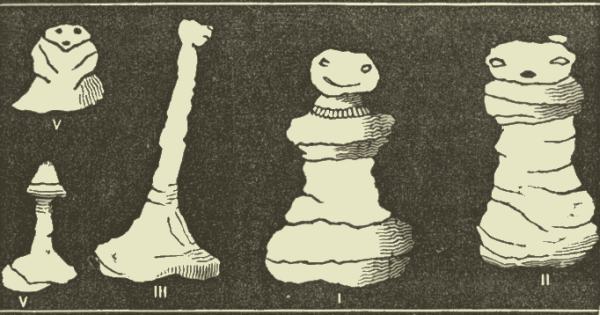
Number 3. was brought to the office of the Indian Agent at Michilimackinac in 1839, and placed among objects of analagous interest to visitors. It consisted of a portion of a vein or mass of gneiss or granite, from which both mica and feldspar were nearly absent, existing only in trace, while the quartzy portion predominated, and had, by its superior hardness, resisted the elemental action. The mode of the formation of such masses is very well known to geologists, resulting, in almost every case, from the unequal degree of hardness of various parts of a mass, submitted to an equal force of attrition, such as is ordinarily given by the upheaving and rolling force of waves on a lake, or ocean beach. To the natives, who are not prone to reason from cause to effect, such productions appear wonderful. All that is past comprehension, or wonderful, is attributed by them to the supernatural agency of spirits. The hunter or warrior, who is travelling along the coast, and finds one of these self-sculptured stones, is not sure that it is not a direct interposition of his God, or guardian Manito, in his favour. He is habitually a believer in the most subtle forms of mysterious power, which he acknowledges to be often delegated to the native priests, or necromancers. He is not staggered by the most extraordinary stretch of fancy, in the theory of the change or transformation of animate into inanimate objects, and vice versa. All things, “in heaven and earth,” he believes to be subject to this subtle power of metamorphosis. But, whatever be the precise operating cause of the respect he pays to the imitative rolled stones, which he calls Shingaba-wossins, and also by the general phrase of Muz-in-in-a-wun, or images, he is not at liberty to pass them without hazarding something, in his opinion, of his chance of success in life, or the fortune of the enterprize in hand.
If the image be small, it is generally taken with him and secreted in the neighborhood of his lodge. If large and too heavy for this purpose, it is set up on the shore, generally in some obscure nook, where an offering of tobacco, or something else of less value, may be made to it, or rather through it, to the spirit.
In 1820 one of these stones (No. 2.) was met by an expedition of the government sent north, that year, for the purpose of interior discovery and observation, at the inner Thunder Bay island, in Lake Huron. It was a massy stone, rounded, with a comparatively broad base and entablature but not otherwise remarkable. It was set up, under a tree on the island, which was small, with the wide and clear expanse of the lake in plain view. The island was one of those which were regarded as desert, and was probably but seldom stopped at. It was, indeed, little more than a few acres of boulders and pebbles, accumulated on a limestone reef, and bearing a few stunted trees and shrubs. The water of the lake must, in high storms, have thrown its spray over this imaged stone. It was, in fine, one of those private places which an Indian might be supposed to have selected for his secret worship.
In No. 3. is figured an object of this kind, which was found in 1832, in the final ascent to the source of the Mississippi, on the right cape, in ascending this stream into lac Traverse—at the distance of about 1000 miles above the falls of St. Anthony. I landed at the point to see it, having heard, from my interpreter, that such an object was set up and dedicated to some unknown Manito there. It was a pleasant level point of land shaded with trees, and bearing luxuriant grass and wild shrubbery and flowers. In the middle of this natural parterre the stone was placed, and was overtopped by this growth, and thus concealed by it. A ring of red paint encircled it, at the first narrowed point of its circumference, to give it the resemblance of a human neck; and there were some rude dabs to denote other features. The Indian is not precise in the matter of proportion, either in his drawing, or in his attempts at statuary. He seizes upon some minute and characteristic trait, which is at once sufficient to denote the species, and he is easily satisfied about the rest. Thus a simple cross, with a strait line from shoulder to shoulder, and a dot, or circle above, to serve for a head, is the symbol of the human frame; and without any adjunct of feet, or hands, it could not have been mistaken for any thing else—certainly for any other object in the animal creation.
MNEMONIC SYMBOLS OF THE NORTH AMERICAN INDIANS.
CHAPTER I.
PRELIMINARY REMARKS.—SYMBOLICAL REPRESENTATIONS AND HIEROGLYPHICS, ONE OF THE EARLIEST OBSERVED TRAITS IN THE CUSTOMS AND ARTS OF THE AMERICAN ABORIGINES; BUT THIS ART NOT SUSPECTED TO HAVE A SYSTEMATIC FORM AMONG THE RUDE HUNTER TRIBES OF NORTH AMERICA, UNTIL THE YEAR 1820, WHEN IT WAS DISCOVERED ON THE SOURCE OF THE MISSISSIPPI. THIS INSTANCE GIVEN, WITH A DRAWING; THE HINT PURSUED.
The practice of the North American tribes, of drawing figures and pictures on skins, trees, and various other substances, has been noticed by travellers and writers from the earliest times. Among the more northerly tribes, these figures are often observed on that common substitute for the ancient papyrus, among these nations, the bark of the betula papyracea, or white birch: a substance possessing a smooth surface, easily impressed, very flexible, and capable of being preserved in rolls. Often these devices are cut, or drawn in colours on the trunks of trees, more rarely on rocks or boulders. According to Colden and Lafitou records of this rude character were formerly to be seen on the blazed surface of trees, along some of the ancient paths and portages leading from the sources of the Atlantic rivers into the interior, or in the valley of the St. Lawrence; but these, after satisfying a transient curiosity, have long since yielded to the general fate of these simple and unenduring monuments. Pictures and symbols of this kind are now to be found only on the unreclaimed borders of the great area west of the Alleghanies and the Lakes, in the wide prairies of the west, or along the Missouri and the upper Mississippi. It is known that such devices were in use, to some extent, at the era of the discovery, among most of the tribes, situated between the latitudes of the capes of Florida, and Hudson’s Bay, although they have been considered as more particularly characteristic of the tribes of the Algonquin type. In a few instances, these pictorial inscriptions have been found to be painted or stained on the faces of rocks, or on loose boulders, and still more rarely, devices were scratched or pecked into the surface, as is found to be the case still at Dighton and Venango. Those who are intent on observations of this kind, will find figures and rude hieroglyphics invariably at the present time, on the grave posts which mark the places of Indian sepulchre at the west and north. The nations who rove over the western prairies, inscribe them on the skins of the buffalo. North of latitude 42°, the bark of the birch, which furnishes at once the material of canoes, tents, boxes, water-dippers, and paper, constitutes the common medium of their exhibition. Tablets of hard wood are confined to such devices as are employed by their priests and prophets, and medicine-men; and these characters uniformly assume a more mystical or sacred import. But the recent discovery, on one of the tributaries of the Susquehanna, of an Indian map, drawn on stone, with intermixed devices, a copy of which appears in the 1st volume of the collections of the Historical Committee of the American Philosophical Society, proves that stone was also employed in that branch of inscription. This discovery was on the area occupied by the Lenapees.
Colden, in his history of the Five Nations,[23] informs us that when, in 1696, the Count de Frontenac marched a well appointed army into the Iroquois country, with artillery and all other means of regular military offence, he found, on the banks of the Onondaga, now called Oswego river, a tree, on the trunk of which the Indians had depicted the French army, and deposited two bundles of cut rushes at its foot, consisting of 1434 pieces—an act of defiance on their part, which was intended to inform their invaders, that they would have to encounter this number of warriors. In speaking in another passage of the general traits of the Five Nations, he mentions the general custom prevalent among the Mohawks going to war, of painting, with red paint, on the trunk of a tree, such symbols, as might serve to denote the object of their expedition. Among the devices was a canoe pointed towards the enemies’ country. On their return, it was their practice to visit the same tree, or precinct, and denote the result: the canoe being, in this case, drawn with its bows in the opposite direction. Lafitou, in his account of the nations of Canada, makes observations on this subject to which we shall more particularly refer hereafter, which denote the general prevalence of the custom in that quarter. Other writers, dating as far back as Smith and de Bre, bear a passing testimony to the existence of this trait among the northern tribes. Few have however done more than notice it, and none are known to have furnished any amount of connected details.
A single element in the system attracted early notice. I allude to the institution of the Totem, which has been well known among the Algonquin tribes from the settlement of Canada. By this device, the early missionaries observed, that the natives marked their division of a tribe into clans, and of a clan into families, and the distinction was thus very clearly preserved. Affinities were denoted and kept up, long after tradition had failed in its testimony. This distinction, which is marked with much of the certainty of heraldic bearings in the feudal system, was seen to mark the arms, the lodge, and the trophies of the chief and warrior. It was likewise employed to give identity to the clan of which he was a member, on his ad-je-da-teg or grave-post. This record went but little farther; a few strokes or geometric devices were drawn on these simple monuments, to denote the number of men he had slain in battle.
It has not been suspected in any notices to which I have had access, that there was a pictorial alphabet, or a series of homophonous figures, in which, by the juxtaposition of symbols representing acts, as well as objects of action, and by the introduction of simple adjunct signs, a series of disjunctive, yet generally connected ideas, were denoted; or that the most prominent incidents of life and death could be recorded so as to be transmitted from one generation to another, as long at least as the monument and the people endured. Above all, it was not anticipated that there should have been found, as will be observed in the subsequent details, a system of symbolic notation for the songs and incantations of the Indian metas and priests, making an appeal to the memory for the preservation of language.
Persons familiar with the state of the western tribes of this continent, particularly in the higher northern latitudes, have long been aware that the songs of the Indian priesthood, and wabenoes, were sung from a kind of pictorial notation, made on bark. It is a fact which has often come to the observation of military officers performing duties on those frontiers, and of persons exercising occasional duties in civil life, who have passed through their territories. But there is no class of persons to whom the fact of such notations being made, is so well known, as the class of Indian traders and interpreters who visit or reside a part of the season at the Indian villages. I have never conversed with any of this latter class of persons to whom the fact of such inscriptions, made in various ways, was not so familiar as in their view to excite no surprise or even demand remark.
My attention was first called to the subject in 1820. In the summer of that year I was on an exploring journey through the lake country. At the mouth of the small river Huron, on the banks of Lake Superior, there was an Indian grave fenced around with saplings, and protected with much care. At its head stood a post, or tabular stick, upon which was drawn the figure of the animal which was the symbol of the clan to which the deceased chief belonged. Strokes of red paint were added to denote, either the number of war parties in which he had been engaged, or the number of scalps which he had actually taken from the enemy. The interpreter who accompanied us, and who was himself tinctured with Indian blood, gave the latter, as the true import of these marks.
On quitting the river St. Louis, which flows into the head of the lake at the Fond du Lac, to cross the summit dividing its waters from those of the Mississippi, the way led through heavy and dense woods and swamps and the weather proved dark and rainy, so that, for a couple of days together, we had scarcely a glimpse of the sun.
The party consisted of sixteen persons, with two Indian guides; but the latter, with all their adroitness in threading the maze, were completely at fault for nearly an entire day. At night we lay down on ground elevated but a few inches above the level of the swamp. The next morning as we prepared to leave the camp, a small sheet of birch bark containing devices was observed elevated on the top of a sapling, some 8 or 10 feet high. One end of this pole was thrust firmly into the ground leaning in the direction we were to go. On going up to this object, it was found, with the aid of the interpreter, to be a symbolic record of the circumstances of our crossing this summit, and of the night’s encampment at this spot. Each person was appropriately depicted, distinguishing the soldiers from the officer in command, and the latter from the scavans of the party. The Indians themselves were depicted without hats, this being, as we noticed, the general symbol for a white man or European. The entire record, of which a figure is annexed, accurately symbolized the circumstances, and they were so clearly drawn, according to their conventional rules, that the intelligence would be communicated thereby to any of their people who might chance to travel or wander this way. This was the object of the inscription.
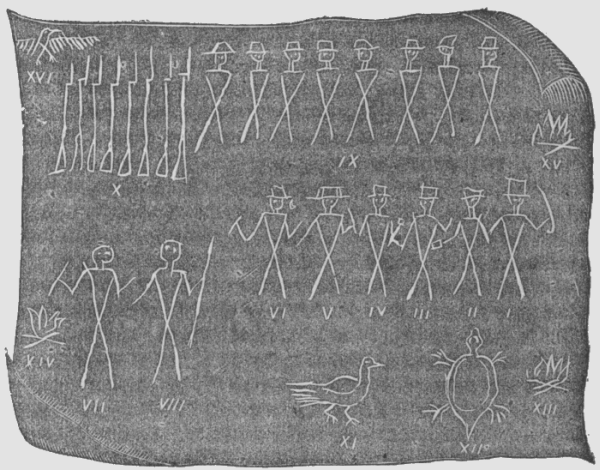
Fig. No 1. represents the subaltern officer in command of the party of the U. S. troops. He is drawn with a sword to denote his official rank. No. 2 denotes the person who officiated in quality of Secretary. He is represented holding a book. No. 3 denotes the geologist and mineralogist of the party. He is drawn with a hammer. Nos. 4 and 5 are attachés; No. 6, the interpreter.
The group of figures marked 9 represents eight infantry soldiers, each of whom, as shown in group No. 10, was armed with a musket. No. 15 denotes that they had a separate fire, and constituted a separate mess. Figures 7 and 8 are the two Chippewa guides, the principal of whom, called Chamees, or the Pouncing-hawk, led the way over this dreary summit. These are the only human figures on this unique bark letter, who are drawn without a hat. This was the characteristic seized on, by them, and generally employed by the tribes, to distinguish the Red from the white race. Figures 11 and 12 represent a prairie hen, and a green tortoise, which constituted the sum of the preceding day’s chase, and were eaten at the encampment. The inclination of the pole, was designed to show the course pursued from that particular spot: there were three hacks in it, below the scroll of bark, to indicate the estimated length of this part of the journey, computing from water to water, that is to say, from the head of the portage Aux Couteaux on the St. Louis river, to the open shores of Sandy lake, the Ka-ma-ton-go-gom-ag of the Odjibwas.
The story was thus briefly and simply told; and this memorial was set up by the guides, to advertise any of their countrymen, who might chance to wander in that direction, of the adventure—for it was evident, both from this token, and from the dubiousness which had marked the prior day’s wanderings, that they regarded the passage in this light, and were willing to take some credit for the successful execution of it.
Before we had penetrated quite to this summit, we came to another evidence of their skill in this species of knowledge, consisting of one of those contrivances which they denominate Man-i-to-wa-teg, or Manito Poles. On reaching this our guides shouted, whether from a superstitious impulse, or the joy of having found a spot they certainly could recognize, we could not tell. We judged the latter. It consisted of eight poles, of equal length, shaved smooth and round, painted with yellow ochre, and set so as to enclose a square area. It appeared to have been one of those rude temples, or places of incantation or worship, known to the metas, or priests, where certain rites and ceremonies are performed. But it was not an ordinary medicine lodge. There had been far more care in its construction.
On reaching the village of Sandy lake, on the upper Mississippi, the figures of animals, birds, and other devices were found, on the rude coffins, or wrappings of their dead, which were scaffolded around the precincts of the fort, and upon the open shores of the lake. Similar devices were also observed, here, as at other points in this region, upon their arms, war-clubs, canoes, and other pieces of moveable property, as well as upon their grave posts.
In the descent of the Mississippi, we observed such devices painted on a rock, below and near the mouth of Elk river, and at a rocky island in the river, at the Little Falls. In the course of our descent to the Falls at St. Anthony, we observed another bark letter, as the party now began to call these inscriptions, suspended on a high pole, on an elevated bank of the river, on its west shore. At this spot, where we encamped for the night, and which is just opposite a point of highly crystalized hornblende rock, called the Peace Rock, rising up through the prairie, there were left standing the poles or skeletons of a great number of Sioux lodges. It is near and a little west of the territorial boundary of the Sioux nation; and on inspecting this scroll of bark, we found it had reference to a negociation for bringing about a permanent peace between the Sioux and Chippewas. A large party of the former, from St. Peter’s, headed by their chief, had proceeded thus far, in the hope of meeting the Chippewa hunters, on their summer hunt. They had been countenanced, or directed in this step, by Col. Leavenworth, the commanding officer of the new post, just then about to be erected. The inscription, which was read off at once, by the Chippewa Chief Babesacundabee, who was with us, told all this; it gave the name of the Chief who had led the party, and the number of his followers, and gave that chief the first assurance he had, that his mission for the same purpose, would be favourably received.
After our arrival at St. Anthony’s Falls, it was found that this system of picture writing was as familiar to the Dacotah, as we had found it among the Algonquin race. At Prairie du Chien, and at Green Bay, the same evidences were observed among the Monomonees, and the Winnebagoes, at Chicago among the Pottowottomies, and at Michilimakinac, among the Chippewas and Ottawas who resort, in such numbers, to that Island. While at the latter place, on my return, I went to visit the grave of a noted chief of the Monomonee tribe, who had been known by his French name of Toma, i.e. Thomas. He had been buried on the hill west of the village; and on looking at his Ad-je-da-tig or grave post, it bore a pictorial inscription, commemorating some of the prominent achievements of his life.
These hints served to direct my attention to the subject when I returned to the country in 1822. The figures of a deer, a bear, a turtle, and a crane, according to this system, stand respectively for the names of men, and preserve the language very well, by yielding to the person conversant with it, the corresponding words, of Addick, Muckwa, Mickenock, and Adjeejauk. Marks, circles, or dots, of various kinds, may symbolize the number of warlike deeds. Adjunct devices may typify or explain adjunct acts. If the system went no farther, the record would yield a kind of information both gratifying and useful to one of his countrymen who had no letters and was expert in the use of symbols; and the interpretation of it, would be easy and precise in proportion as the signs were general, conventional, and well understood. There was abundant evidence in my first year’s observation, to denote that this mode of communication was in vogue, and well understood by the northern tribes; but it hardly seemed susceptible of a farther or extended use. It was not till I had made a personal acquaintance with one of their Medas—a man of much intelligence, and well versed in their customs, religion, and history, that a more enlarged application of it appeared to be practicable. I observed in the hands of this man a tabular piece of wood, covered over on both sides, with a series of devices cut between parallel lines, which he referred to, as if they were the notes of his medicine and mystical songs. I heard him sing these songs, and observed that their succession was fixed and uniform. By cultivating his acquaintance, and by suitable attention and presents, such as the occasion rendered proper, he consented to explain the meaning of each figure, the object symbolized, and the words attached to each symbol. By this revelation, which was made with closed doors, I became a member or initiate of the Medicine Society, and also of the Wabeno Society. Care was taken to write each sentence of the songs and chants in the Indian language, with its appropriate devices, and to subjoin a literal translation in English. When this had been done, and the system considered, it was very clear that the devices were mnemonic—that any person could sing from these devices, very accurately, what he had previously committed to memory, and that the system revealed a curious scheme of symbolic notation.
All the figures thus employed, as the initiatory points of study, related exclusively to either the medicine dance, or the wabeno dance; and each section of figures, related exclusively to one or the other. There was no intermixture or commingling of characters, although the class of subjects were sometimes common to each. It was perceived, subsequently, that this classification of symbols extended to the songs devoted to war, to hunting, and to other specific topics. The entire inscriptive system, reaching from its first, rudimental characters, in the ad-je-da-tig, or grave board, to the extended roll of bark covered with the incriptions of their magicians and prophets, derived a new interest from this feature. It was easy to perceive that much comparative precision was imparted to interpretations in the hands of the initiated, which before, or to others, had very little. An interest was thus cast over it distinct from its novelty. And in truth, the entire pictorial system was thus invested with the character of a subject of accurate investigation, which promised both interest and instruction.
It has been thought that a simple statement of these circumstances, would best answer the end in view, and might well occupy the place of a more formal or profound introduction. In bringing forward the elements of the system, after much reflection, it is thought, however, that a few remarks on the general character of this art may not be out of place. For, simple as it is, we perceive in it the native succedaneum for letters. It is not only the sole graphic mode they have for communicating ideas, but it is the mode of communicating all classes of ideas commonly entertained by them—such as their ideas of war, of hunting, of religion, and of magic and necromancy. So considered, it reveals a new and unsuspected mode of obtaining light on their opinions of a deity, of the structure or cosmogony of the globe, of astronomy, the various classes of natural objects, their ideas of immortality and a future state, and the prevalent notions of the union of spiritual and material matter. So wide and varied, indeed, is the range opened by the subject, that we may consider the Indian system of picture writing as the thread which ties up the scroll of the Red man’s views of life and death, reveals the true theory of his hopes and fears, and denotes the relation he bears, in the secret chambers of his own thoughts, to his Maker. What a stoic and suspicious temper would often hold him back from uttering to another, and what a limited language would sometimes prevent his fully revealing, if he wished, symbols and figures can be made to represent and express. The Indian is not a man prone to describe his god, but he is ready to depict him, by a symbol. He may conceal under the figures of a serpent, a turtle, or a wolf, wisdom, strength, or malignity, or convey under the picture of the sun, the idea of a supreme, all-seeing intelligence. But he is not prepared to discourse upon these things. What he believes on this head, he will not declare to a white man or a stranger. His happiness and success in life, are thought to depend upon the secrecy of that knowledge of the Creator and his system in the Indian view of benign and malignant agents. To reveal this to others, even to his own people, is, he believes, to expose himself to the counteracting influence of other agents known to his subtle scheme of necromancy and superstition, and to hazard success and life itself. This conduces to make the Red man eminently a man of fear, suspicion, and secrecy. But he cannot avoid some of these disclosures in his pictures and figures. These figures represent ideas—whole ideas, and their juxtaposition or relation on a roll of bark, a tree, or a rock, discloses a continuity of ideas. This is the basis of the system.
Picture writing is indeed the literature of the Indians. It cannot be interpreted, however rudely, without letting one know what the Red man thinks and believes. It shadows forth the Indian intellect, it stands in the place of letters for the Unishinaba.[24] It shows the Red man in all periods of our history, both as he was, and as he is; for there is nothing more true than that, save and except the comparatively few instances where they have truly embraced experimental christianity, there has not
FOOTNOTES:
GRAVE CREEK MOUND.
This gigantic tumulus, the largest in the Ohio valley, was opened some four or five years ago, and found to contain some articles of high antiquarian value, in addition to the ordinary discoveries of human bones, &c. A rotunda was built under its centre, walled with brick, and roofed over, and having a long gallery leading into it, at the base of the mound. Around this circular wall, in the centre of this heavy and damp mass of earth, with its atmosphere of peculiar and pungent character, the skeletons and other disinterred articles, are hung up for the gratification of visiters, the whole lighted up with candles, which have the effect to give a strikingly sepulchral air to the whole scene. But what adds most to this effect, is a kind of exuded flaky matter, very white and soft, and rendered brilliant by dependent drops of water, which hangs in rude festoons from the ceiling.
To this rotunda, it is said, a delegation of Indians paid a visit a year or two since. In the “Wheeling Times and Advertiser” of the 30th August 1843, the following communication, respecting this visit, introducing a short dramatic poem, was published.
“An aged Cherokee chief who, on his way to the west, visited the rotunda excavated in this gigantic tumulus, with its skeletons and other relics arranged around the walls, became so indignant at the desecration and display of sepulchral secrets to the white race, that his companions and interpreter found it difficult to restrain him from assassinating the guide. His language assumed the tone of fury, and he brandished his knife, as they forced him out of the passage. Soon after, he was found prostrated, with his senses steeped in the influence of alcohol.
“’Tis not enough! that hated race Should hunt us out, from grove and place And consecrated shore—where long Our fathers raised the lance and song— Tis not enough!—that we must go Where streams and rushing fountains flow Whose murmurs, heard amid our fears, Fall only on a stranger’s ears— ’Tis not enough!—that with a wand, They sweep away our pleasant land, And bid us, as some giant-foe, Or willing, or unwilling go! But they must ope our very graves To tell the dead—they too, are slaves.”
NAMES OF THE AMERICAN LAKES.
Ontario, is a word from the Wyandot, or, as called by the Iroquois, Quatoghie language. This tribe, prior to the outbreak of the war against them, by their kindred the Iroquois, lived on a bay, near Kingston, which was the ancient point of embarkation and debarkation, or, in other words, at once the commencement and the terminus of the portage, according to the point of destination for all, who passed into or out of the lake. From such a point it was natural that a term so euphonous, should prevail among Europeans, over the other Indian names in use. The Mohawks and their confederates, generally, called it Cadaracqui—which was also their name for the St. Lawrence. The Onondagas, it is believed, knew it, in early times, by the name of Oswego.[25] Of the meaning of Ontario, we are left in the dark by commentators on the Indian. Philology casts some light on the subject. The first syllable, on, it may be observed, appears to be the notarial increment or syllable of Onondio, a hill. Tarak, is clearly, the same phrase, written darac, by the French, in the Mohawk compound of Cadaracqui; and denotes rocks, i.e. rocks standing in the water. In the final vowels io, we have the same term, with the same meaning which they carry in the Seneca, or old Mingo word Ohio.[26] It is descriptive of an extended and beautiful water prospect, or landscape. It possesses all the properties of an exclamation, in other languages, but according to the unique principles of the Indian grammar, it is an exclamation-substantive. How beautiful! [the prospect, scene present.]
Erie is the name of a tribe conquered or extinguished by the Iroquois. We cannot stop to inquire into this fact historically, farther than to say, that it was the policy of this people to adopt into their different tribes of the confederacy, the remnants of nations whom they conquered, and that it was not probable, therefore, that the Eries were annihilated. Nor is it probable that they were a people very remote in kindred and language from the ancient Sinondowans, or Senecas, who, it may be supposed, by crushing them, destroyed and exterminated their name only, while they strengthened their numbers by this inter-adoption. In many old maps, this lake bears the name of Erie or “Oskwago.”
Huron, is the nom de guerre of the French, for the “Yendats,” as they are called in some old authors, or the Wyandots. Charlevoix tells us that it is a term derived from the French word hure, [a wild boar,] and was applied to this nation from the mode of wearing their hair. “Quelles Hures!” said the first visiters, when they saw them, and hence, according to this respectable author, the word Huron.
When this nation, with their confederates, the Algonquins, or Adirondaks, as the Iroquois called them, were overthrown in several decisive battles on the St. Lawrence, between Montreal and Quebec, and compelled to fly west; they at first took shelter in this lake, and thus transferred their name to it. With them, or at least, at the same general era, came some others of the tribes who made a part of the people called by the French, Algonquins, or Nipercineans, and who thus constituted the several tribes, speaking a closely cognate language, whose descendants are regarded by philologists, as the modern Lake-Algonquins.
The French sometimes called this lake Mer douce, or the Placid sea. The Odjibwas and some other northern tribes of that stock, call it Ottowa lake. No term has been found for it in the Iroquois language, unless it be that by which they distinguished its principal seat of trade, negociation and early rendezvous, the island of Michilimackinac, which they called Tiedonderaghie.
Michigan is a derivative from two Odjibwa-Algonquin words, signifying large, i.e. large in relation to masses in the inorganic kingdom, and a lake. The French called it, generally, during the earlier periods of their transactions, the lake of the Illinese, or Illinois.
Superior, the most north-westerly, and the largest of the series, is a term which appears to have come into general use, at a comparatively early era, after the planting of the English colonies. The French bestowed upon it, unsuccessfully, one or two names, the last of which was Traci, after the French minister of this name. By the Odjibwa-Algonquins, who at the period of the French discovery, and who still occupy its borders, it is called Gitch-Igomee, or The Big Sea-water; from Gitchee, great, and guma, a generic term for bodies of water. The term IGOMA, is an abbreviated form of this, suggested for adoption.
The poetry of the Indians, is the poetry of naked thought. They have neither rhyme nor metre to adorn it.
Tales and traditions occupy the place of books, with the Red Race.—They make up a kind of oral literature, which is resorted to, on long winter evenings, for the amusement of the lodge.
The love of independence is so great with these tribes, that they have never been willing to load their political system with the forms of a regular government, for fear it might prove oppressive.
To be governed and to be enslaved, are ideas which have been confounded by the Indians.
FOOTNOTES:
GEOGRAPHICAL TERMINOLOGY OF THE U. STATES, DERIVED FROM THE INDIAN LANGUAGE.
These Extracts are made from “Cyclopædia Indiaensis” a MS. work in preparation.
No. I.
Hudson River.—By the tribes who inhabited the area of the present County of Dutchess, and other portions of its eastern banks, as low down as Tappan, this river was called Shatemuc—which is believed to be a derivative from Shata, a pelican. The Minisi, who inhabited the west banks, below the point denoted, extending indeed over all the east half of New Jersey, to the falls of the Raritan, where they joined their kindred the Lenni Lenape, or Delawares proper, called it Mohicanittuck—that is to say, River of the Mohicans. The Mohawks, and probably the other branches of the Iroquois, called it Cahohatatea—a term of which the interpreters who have furnished the word, do not give an explanation. The prefixed term Caho, it may be observed, is their name for the lower and principal falls of the Mohawk. Sometimes this prefix was doubled, with the particle ha, thrown in between. Hatatea is clearly one of those descriptive and affirmative phrases representing objects in the vegetable and mineral kingdoms, which admitted as we see, in other instances of their compounds, a very wide range. By some of the more westerly Iroquois, the river was called Sanataty.
Albany.—The name by which this place was known to the Iroquois, at an early day, was Schenectady, a term which, as recently pronounced by a daughter of Brant, yet living in Canada, has the still harsher sound of Skoh-nek-ta-ti, with a stress on the first, and the accent strongly on the second syllable, the third and fourth being pronounced rapidly and short. The transference of this name, to its present location, by the English, on the bestowal on the place by Col. Nichols, of a new name, derived from the Duke of York’s Scottish title, is well known, and is stated, with some connected traditions, by Judge Benson, in his eccentric memoir before the New York Historical Society. The meaning of this name, as derived from the authority above quoted, is Beyond the Pines, having been applied exclusively in ancient times, to the southern end of the ancient portage path, from the Mohawk to the Hudson. By the Minci, who did not live here, but extended, however, on the west shore above Coxackie, and even Coeymans, it appears to have been called Gaishtinic. The Mohegans, who long continued to occupy the present area of Rensselear and Columbia counties, called it Pempotawuthut, that is to say, the City or Place of the Council Fire. None of these terms appear to have found favour with the European settlers, and, together with their prior names of Beaverwyck and Fort Orange, they at once gave way, in 1664, to the present name. A once noted eminence, three miles west, on the plains, i.e. Trader’s Hill, was called Isutchera, or by prefixing the name for a hill, Yonondio Isutchera. It means the hill of oil. Norman’s Kill, which enters the Hudson a little below, the Mohawks called Towasentha, a term which is translated by Dr. Yates, to mean, a place of many dead.
Niagara.—It is not in unison, perhaps, with general expectation, to find that the exact translation of this name does not entirely fulfil poetic preconception. By the term O-ne-aw-ga-ra, the Mohawks and their co-tribes described on the return of their war excursions, the neck of water which connects lake Erie with Ontario. The term is derived from their name for the human neck. Whether this term was designed to have, as many of their names do, a symbolic import, and to denote the importance of this communication in geography, as connecting the head and heart of the country, can only be conjectured. Nor is it, in this instance, probable. When Europeans came to see the gigantic falls which marked the strait, it was natural that they should have supposed the name descriptive of that particular feature, rather than the entire river and portage. We have been assured, however, that it is not their original name for the water-fall, although with them, as with us, it may have absorbed this meaning.
Buffalo.—The name of this place in the Seneca, is Te-ho-sa-ro-ro. Its import is not stated.
Detroit.—By the Wyandots, this place is called Teuchsagrondie; by the Lake tribes of the Algic type, Wa-we-á-tun-ong: both terms signify the Place of the turning or Turned Channel. It has been remarked by visiters who reach this place at night, or in dark weather, or are otherwise inattentive to the courses, that owing to the extraordinary involutions of the current the sun appears to rise in the wrong place.
Chicago.—This name, in the Lake Algonquin dialects, to preserve the same mode of orthography, is derived from Chicagowunzh, the wild onion or leek. The orthography is French, as they were the discoverers and early settlers of this part of the west. Kaug, in these dialects is a porcupine, and She kaug a polecat. The analogies in these words are apparent, but whether the onion was named before or after the animal, must be judged if the age of the derivation be sought for.
Tuscaloosa, a river of Alabama. From the Chacta words tushka, a warrior, and lusa black.—[Gallatin.]
Aragiske, the Iroquois name for Virginia.
Assarigoa, the name of the Six Nations for the Governor of Virginia.
Owenagungas, a general name of the Iroquois for the New England Indians.
Oteseonteo, a spring which is the head of the river Delaware.
Ontonagon; a considerable river of lake Superior, noted from early times, for the large mass of native copper found on its banks. This name is said to have been derived from the following incident. It is known that there is a small bay and dead water for some distance within its mouth. In and out of this embayed water, the lake alternately flows, according to the influence of the winds, and other causes, upon its level. An Indian woman had left her wooden dish, or Onagon, on the sands, at the shore of this little bay, where she had been engaged. On coming back from her lodge, the outflowing current had carried off her valued utensil. Nia Nin-do-nau-gon! she exclaimed, for it was a curious piece of workmanship. That is to say—Alas! my dish!