LANGUAGE. (continued 3)
Reading edition
Donnacona himself opposed the projected visit, by argument, by artifice, and finally, by the extraordinary resource of human gifts. His aversion to it first evinced itself by keeping aloof, and adopting a shy and suspicious demeanour. Cartier finding this chief, with T. and D. and a numerous retinue in his vicinity, “under a point or nook of land,” ordered a part of his men to follow him, and suddenly presented himself in the midst of them. After mutual salutations, Taignoagny got up and addressed him, in behalf of Donnacona, complaining that they came armed, to which Cartier replied that, it was the custom of his country, and a custom he could not dispense with. The bustle and heat of the introduction being over, Cartier played the part of a politic diplomatist, and was met by Donnacona and his counsellors on his own grounds, and the whole interview, though it resulted in what is called “a marvellous steadfast league of friendship” can only be looked upon, as a strife, in which it is the object of both parties to observe the most profound dissimulation. This “league” was ratified by the natives, with three loud cries, “a most horrible thing to hear” says the narrator.
On the very next day Donnacona, attended with T. and D. and 10 or 12 “of the chiefest of the country, with more than 500 persons, men, women and children,” came on board of the vessels, at their moorings, to protest against the intended voyage of exploration. Taignoagny opened the conference, by saying to Cartier, that Donnacona regretted his design of visiting Hochelaga, and had forbid any of his people from accompanying him, because the river itself “was of no importance.” Cartier replied that his decision was made, and urged the speaker to go with him, as he had promised, offering to make the voyage every way advantageous to him. A prompt refusal, on the part of T. and the sudden withdrawal of the whole collected multitude, terminated this interview.
On the next day Donnacona re-appeared with all his followers, bringing presents of fish, singing and dancing. He then caused all his people to pass to one side, and drawing a circle in the sand, requested Cartier and his followers, to enter into it. This arrangement concluded, he began an address, “holding in one of his hands a maiden child ten or twelve years old,” whom he presented to Cartier, the multitude at the same time giving three shouts. He then brought forward two male children, separately, presenting them in the same manner, and his people at each presentation, expressing their assent by shouts. Taignoagny, who by this time had drawn upon himself the epithet of “crafty knave” told the “captain” (as Cartier is all along termed,) that one of the children was his own brother, and that the girl was a daughter of Donnacona’s “own sister,” and that this presentation, was made to him, solely with a view of dissuading him from his expedition. Cartier persisted in saying, that his mind was made up, and could not be altered. Here, Domaigaia interposed, and said, that the children were offered as “a sign and token of good will and security,” and not with any specific purpose of dissuading him from the expedition. High words passed between the two liberated captives, from which it was evident that one, or the other, had either misconceived or misrepresented the object of the gift. Cartier however, took the children, and gave Donnacona “two swords and two copper basins,” for which he returned thanks, and “commanded all his people to sing and dance,” and requested the captain to cause a piece of artillery to be discharged for his gratification. Cartier readily improved this hint, to show them the destructive effects of European artillery, and at a signal, ordered twelve pieces, charged with ball, to be fired into the contiguous forest, by which they were so astounded that they “put themselves to flight, howling, crying, and shrieking, so that it seemed hell was broke loose.”
These attempts to frustrate the purposed voyage, having failed, the natives endeavoured to put the captain’s credulity to the test, and operate upon his fears. For this purpose three natives were disguised to play the part of “devils,” wrapped in skins, besmeared, and provided with horns. Thus equipped they took advantage of the tide, to drop down along side Cartier’s vessels, uttering words of unintelligible import as they passed, but keeping their faces steadfastly directed toward the wood. At the same time Donnacona, and his people rushed out of the wood to the shore,—attracting the attention of the ships’ crews in various ways, and finally seized the mock “devils” at the moment of their landing, and carried them into the woods, where their revelations were uttered.
The result of this clumsy trick, was announced by Taignoagny and Domaigaia, who said, that their god “Cudruaigny had spoken in Hochelaga”—importing ill tidings to the French, and that he had sent these three men to inform them that, there was so much ice and snow in the country, that whoever entered it, must die. After some interrogatives pro and con, in the course of which the power of “his Priests” was oddly contrasted by the French commander with that of the “devils,” both Taignoagny and Domaigaia coincided in finally declaring that Donnacona, “would by no means permit that any of them should go with him to Hochelaga,” unless he would leave hostages in his hands.
All these artifices appear to have had but little effect on Cartier’s plan. He told his freed interpreters, that if they would not go willingly, they might stay, and he would prosecute the voyage without them. Accordingly, having finished mooring his vessels, on the 19th September he set out to explore the upper portions of the river, taking his smallest vessel and two boats with fifty mariners, and the supernumerary gentlemen of his party. A voyage of ten days brought him to an expansion of the river, which he named the lake of Angolesme, but which is now known under the name of St. Peter. Here the shallowness of the water, and rapidity of the current above, induced him to leave the “Hermerillon,” and he proceeded with the two boats and twenty-eight armed men. The fertility of the shore, the beauty and luxuriance of the forest trees, mantled as they often were, with the vine loaded with clusters of grapes, the variety of water fowl, and above all the friendly treatment they every where received from the Indians, excited unmingled admiration. One of the chiefs whom they encountered presented Cartier with two children, his son and daughter, the latter of whom, being 7 or 8 years old, he accepted. On another occasion he was carried ashore by one of a party of hunters, as “lightly and easily as if he had been a child of five years old.” Presents of fish were made, at every point, where he came in contact with the natives, who seemed to vie with each other in acts of hospitality.
These marks of welcome and respect continued to be manifested during the remainder of the journey to Hochelaga, where he arrived on the 2d of October. A multitude of both sexes and all ages had collected on the shore to witness his approach, and welcome his arrival. They expressed their joy by dancing, “clustering about us, making much of us, bringing their young children in their arms only to have our captain and his company touch them.” Cartier landed, and spent half an hour in receiving their caresses, and distributed tin beads to the women, and knives to some of the men, and then “returned to the boats to supper.” The natives built large fires on the beach, and continued dancing, and merry making all night, frequently exclaiming Aguiaze, which is said to signify “mirth and safety.”
Early the next morning Cartier having “very gorgeously attired himself,” and taking 20 mariners, with his officers and supernumeraries, landed for the purpose of visiting the town, taking some of the natives for guides. After following a well beaten path, leading through an oak forest, for four or five miles, he was met by a chief, accompanied by a retinue, sent out to meet him, who by signs gave him to understand, that he was desired to rest at that spot, where a fire had been kindled, a piece of civility, which it may be supposed, was something more than an empty compliment on an October morning. The chief here made “a long discourse,” which, of course, was not understood, but they inferred it was expressive of “mirth and friendship.” In return Cartier gave him 2 hatchets, 2 knives and a cross, which he made him kiss, and then put it around his neck.
This done the procession advanced, without further interruption, to the “city of Hochelaga,” which is described as seated in the midst of cultivated fields, at the distance of a league from the mountain. It was secured by three ramparts “one within another,” about 2 rods in height, “cunningly joined together after their fashion,” with a single gate “shut with piles and stakes and bars.” This entrance, and other parts of the walls, had platforms above, provided with stones for defensive operations. The ascent to these platforms was by ladders.
As the French approached, great numbers came out to meet them. They were conducted by the guides, to a large square enclosure in the centre of the town, “being from side to side a good stone’s cast.” They were first greeted by the female part of the population, who brought their children in their arms, and rushed eagerly to touch or rub the faces and arms of the strangers, or whatever parts of their bodies they could approach. The men now caused the females to retire, and seated themselves formally in circles upon the ground; as if, says the narrator, “some comedy or show” was about to be rehearsed. Mats were then brought in by the women, and spread upon the ground, for the visitors to sit upon. Last came the “Lord and King” Agouhanna, a palsied old man, borne upon the shoulders of 9 or 10 attendants, sitting on a “great stag skin.” They placed him near the mats occupied by Cartier and his party. This simple potentate “was no whit better apparelled than any of the rest, only excepted, that he had a certain thing made of the skins of hedgehogs, like a red wreath, and that was instead of his crown.”
After a salutation, in which gesticulation awkwardly supplied the place of language, the old chief exhibited his palsied limbs, for the purpose of being touched, by the supposed celestial visitants. Cartier, although he appeared to be a man of sense and decision, on other occasions, was not proof against the homage to his imputed divinity; but quite seriously fell to rubbing the credulous chiefs legs and arms. For this act, the chief presented him his fretful “crown.” The blind, lame, and impotent, of the town were now brought in, and laid before him, “some so old that the hair of their eyelids came down and covered their cheeks,” all of whom he touched, manifesting his own seriousness by reading the Gospel of St. John, and “praying to God that it would please him to open the hearts of this poor people, and to make them know his holy word, and that they might receive baptism and christendom.” He then read a portion of the catholic service, with a loud voice, during which the natives were “marvellously attentive, looking up to heaven and imitating us in gestures.” Some presents of cutlery and trinkets were then distributed, trumpets sounded, and the party prepared to return to their boats. When about to leave their place, the women interposed, inviting them to partake of the victuals they had prepared—a compliment which was declined, “because the meats had no savour at all of salt.” They were followed out of the town by “divers men and women,” who conducted the whole party to the top of the mountain, commanding a wide prospect of the plain, the river and its islands, and the distant mountains. Transported with a scene, which has continued to afford delight to the visitors of all after times, Cartier bestowed the name of “Mount Royal” upon this eminence—a name which has descended, with some modifications, to the modern city. Having satisfied their curiosity, and obtained such information respecting the adjoining regions, as their imperfect knowledge of the Indian language would permit, they returned to their boats, accompanied by a promiscuous throng of the natives.
Thus ended, on the 3rd Oct. 1535, the first formal meeting between the French and the Indians of the interior of Canada, or what now began to be denominated New France. As respects those incidents in it, in which the Indians are represented as looking upon Cartier in the light of a divinity, clothed with power to heal the sick and restore sight to the blind, every one will yield the degree of faith, which his credulity permits. The whole proceeding bears so striking a resemblance to “Christ healing the sick,” that it is probable the narrator drew more largely upon his New Testament, than any certain knowledge of the faith and belief of a savage people whose traditions do not reach far, and whose language, granting the most, he but imperfectly understood. As respects the description of a city with triple walls, those who know the manner in which our Indian villages are built, will be best enabled to judge how far the narrator supplied by fancy, what was wanting in fact. A “walled city” was somewhere expected to be found, and the writer found no better place to locate it. Cartier no sooner reached his boats, than he hoisted sail and began his descent, much to the disappointment of the Indians. Favoured by the wind and tide, he rejoined his “Pinnace” on the following day. Finding all well, he continued the descent, without meeting much entitled to notice, and reached the “port of the Holy Cross,” on the 11th of the month. During his absence the ships’ crews had erected a breastwork before the vessels, and mounted several pieces of ships’ cannon for their defence. Donnacona renewed his acquaintance on the following day, attended by Taignoagny, Domaiga, and others, who were treated with an appearance of friendship, which it could hardly be expected Cartier could sincerely feel. He, in return visited their village of Stadacona, and friendly relations being thus restored, the French prepared for the approach of winter.
Winter came in all its severity. From the middle of Nov. to the middle of March, the vessels were environed with ice “two fathoms thick,” and snow upwards of four feet deep, reaching above the sides of the vessels. And the weather is represented as being “extremely raw and bitter.” In the midst of this severity, the crews were infected with “a strange and cruel disease,” the natural consequence of a too licentious intercourse with the natives. The virulence of this disorder exceeded any thing that they had before witnessed, though it is manifest, from the journal, that it was in its virulence only, that the disease itself presented any new features. A complete prostration of strength marked its commencement, the legs swelled, the “sinews shrunk as black as any coal.” The infection became general, and excited the greatest alarm. Not more than 10 persons out of 110 were in a condition to afford assistance to the sick by the middle of February. Eight had already died, and 50 were supposed to be past recovery.
Cartier, to prevent his weakness being known, as well as to stop further infection, interdicted all intercourse with the natives. He caused that “every one should devoutly prepare himself by prayer, and in remembrance of Christ, caused his image to be set upon a tree, about a flight shot from the fort, amid the ice and snow, giving all men to understand that on the Sunday following, service should be said there, and that whosoever could go, sick or whole, should go thither in procession, singing the seven psalms of David, and other Litanies, praying, &c.”
The disorder, however, continued to spread till there were not “above three sound men in the ships, and none was able to go under hatches to draw drink for himself, nor for his fellows.” Sometimes they were constrained to bury the dead under the snow, owing to their weakness and the severity of the frost, which rendered it an almost incredible labour to penetrate the ground. Every artifice was resorted to by Cartier, to keep the true state of his crews from the Indians, and he sought unremittingly for a remedy against the disorder.
In this his efforts were at last crowned with success, but not till he had lost 25 of his men. By using a decoction of the bark and leaves of a certain tree, which is stated to be “the Sassafras tree,”[33] the remainder of his crews were completely recovered. The decoction was drank freely, and the dregs applied externally, agreeably to the directions of Domaigaia, to whom he was indebted for the information, and who caused women to bring branches of it, and “therewithal shewed the way how to use it.”
The other incidents of the winter were not of a character to require notice. Mutual distrust existed. Cartier was in constant apprehension of some stratagem, which the character and movements of his savage neighbours gave some grounds for. He was detained at the bay of the Holy Cross till the 6th May, 1536. The narrator takes the opportunity of this long season of inaction to give descriptions of the manners and customs, ceremonies and occupations of the Indians, and to detail the information derived from them, and from personal observations respecting the geographical features and the productions of the country.
Touching the faith of the Indians, it is said, they believed no whit in God, but in one whom they call “Cudruiagni,” to whom, they say, they are often indebted for a foreknowledge of the weather. And when he is angry, his displeasure is manifested by casting dust in their eyes. They believe that, after death, they go into the stars, descending by degrees towards the horizon, and are finally received into certain green fields, abounding in fruits and flowers.
They are represented as possessing all property in common, and as being “indifferently well stored” with the useful “commodities” of the country—clothing themselves imperfectly in skins, wearing hose and shoes of skins in winter, and going barefooted in summer. The men labour little, and are much addicted to smoking. The condition of the women is one of drudgery and servitude. On them the labour of tilling the grounds, &c., principally devolves. The young women live a dissolute life, until marriage, and married women, after the death of their husbands, are condemned to a state of perpetual widowhood. Polygamy is tolerated. Both sexes are represented as very hardy, and capable of enduring the most intense degree of cold. In this there is little to distinguish the native of 1536 from that of the present day, if we substitute the blanket for the muttatos,[34] and except the remark respecting the condition of widows, the accuracy of which, as it was made upon slight acquaintance, may be reasonably doubted. It may also be remarked, that the condition of young women, as described by Cartier, was more degraded and vitiated than it is now known to be among any of the North American tribes.
The geographical information recorded respecting the St. Lawrence and its tributaries is generally vague and confused. But may be referred to as containing the first notice published by the French of the Great Lakes. Cartier was told by Donnacona and others that the river originated so far in the interior, that “there was never man heard of that found out the end thereof,” that it passed through “two or three great lakes,” and that there is “a sea of fresh water,” alluding, probably, to Superior.
At what time the ice broke up, is not distinctly told. It is stated that “that year the winter was very long,” and a scarcity of food was felt among the Indians, so much so, that they put a high price upon their venison, &c., and sometimes took it back to their camps, rather than part with it “any thing cheap.” Donnacona and many of his people withdrew themselves to their hunting grounds, under a pretence of being absent a fortnight, but were absent two months. Cartier attributed this long absence to a design of raising the country, and attacking him in his fortified positions—a design which no cordiality of friendship on the part of D. would prevent his entertaining, and which the latter gave some colour to by neglecting to visit Cartier on his return with great numbers of natives not before seen, and by evading the attempts made to renew an intercourse, by feigning sickness as the cause of his neglect. Cartier felt his own weakness, from the death of so many of his crew and the sickness of others, and has recorded for his government on this occasion the proverb, that “he that takes heed and shields himself from all men, may hope to escape from some.” He determined to abandon one of his vessels, that he might completely man and re-fit the others, and appears to have been diligent in making early preparations to return. While thus engaged, Donnacona (April 22,) appeared with a great number of men at Stadacona, and John Powlet, “who being best believed of those people,” he sent to reconnoitre them in their principal villages, reported that he saw so many people, that “one could not stir for another, and such men as they were never wont to see.” Taignoagny, whom he saw on this occasion, requested him to beseech Cartier to take off “a lord of the country,” called Agonna, who probably stood in the way of his own advancement. Cartier availed himself of this request to bring on an interview with Taignoagny, and by flattering his hopes, finally succeeded in the execution of a project he appears to have previously entertained. This was nothing less than the seizure of Donnacona, Taignoagny, Domaigaia, (his previous captives,) and “two more of the chiefest men,” whom, with the children before received, making ten persons in all, he conveyed to France.
This seizure was made on the 3d of May, being “Holyrood day,” at a time when Cartier had completed his preparations for sailing. He took formal possession of the country, under the name of New France, by erecting a cross “thirty-five feet in height,” bearing a shield with the arms of France, and the following inscription:
“Franciscus primum dei gratia Francorum Rex regnat,”
a sentence upon which this unjustifiable outrage formed a practical comment. Three days afterwards he sailed from the port of the Holy Cross, leaving crowds of the natives to bewail the loss of their chiefs. And whose kindness led them to send on board a supply of provisions, when they found they could not effect their liberation. Finding the current of the St. Lawrence much swoln, he came to anchor at the isle of Filberds, near the entrance of the Sagnenay, where he was detained nine days. In the meantime many of the natives of Sagnenay visited the ships, and finding Donnacona a prisoner, they presented him three packs of beaver. On the 17th May, he made an unsuccessful attempt to proceed, but was forced back and detained four days longer, waiting “till the fierceness of the waters” were past. He entered and passed out of the gulph on the 21st, but encountering adverse winds, did not take his final departure from the Newfoundland coast till the 19th June. He then took advantage of a favorable wind, and performed the homeward voyage in 17 days. He entered the port of St. Malo, July 6, 1536, having been absent less than 14 months, 8 of which had been passed in the St. Lawrence.
THIRD VOYAGE.
The reports and discoveries of Cartier were so well received by the King of France (Francis I), that he determined to colonize the newly discovered country, and named John Francis de la Roche, Lord of Roberval, his “Lieutenant and Governor in the countries of Canada and Hochelaga.” Cartier retained his former situation as “Captain General and leader of the ships,” and to him was entrusted the further prosecution of discoveries. Five vessels were ordered to be prepared at St. Malo, and measures appear to have been taken to carry out settlers, cattle, seeds, and agricultural implements. Much delay, however, seems to have attended the preparations, and before they were completed, Donnacona and his companions, who had been baptized, paid the debt of nature. A little girl, ten years old, was the only person surviving out of the whole number of captives.
It is seldom that a perfect harmony has prevailed between the leaders of naval and land forces, in the execution of great enterprises. And though but little is said to guide the reader in forming a satisfactory opinion on the subject, the result in this instance proved that there was a settled dissatisfaction in the mind of Cartier respecting the general arrangements for the contemplated voyage. Whether he thought himself neglected in not being invested with the government of the country he had discovered, or felt unwilling that another should share in the honors of future discoveries, cannot now be determined. It should be recollected that the conquest of Mexico had then but recently been accomplished (1520), and it is not improbable that Cartier, who had taken some pains to exalt Donnacona into another Montezuma, thought himself entitled to receive from Francis, rewards and emoluments in some measure corresponding to those which his great rival, Charles, had finally bestowed upon Cortez.
Whatever were the causes, four years elapsed before the ships were prepared, and M. La Roche, on visiting the vessels in the road of St. Malo, ready for sea, then informed Cartier that his artillery, munitions, and “other necessary things” which he had prepared, were not yet arrived from Champaigne and Normandy. Cartier, in the meantime, had received positive orders from the King to set sail. In this exigency, it was determined that Cartier should proceed, while the King’s Lieutenant should remain “to prepare a ship or two at Honfleur, whither he thought his things were come.”
This arrangement concluded, La Roche invested Cartier with full powers to act until his arrival, and the latter set sail with five ships, “well furnished and victualled for two years,” on the 23d of May, 1540. Storms and contrary winds attended the passage. The ships parted company, and were kept so long at sea, that they were compelled to water the cattle, &c., they took out for breed, with cider. At length, the vessels re-assembled in the harbor of Carpunt in Newfoundland, and after taking in wood and water, proceeded on the voyage, Cartier not deeming it advisable to wait longer for the coming of La Roche. He reached the little haven of Saincte Croix (where he wintered in the former voyage), on the 23d of August. His arrival was welcomed by the natives, who crowded around his vessels, with Agona at their head, making inquiries after Donnacona and his companions in captivity. Cartier replied, that Donnacona was dead, and his bones rested in the ground—that the other persons had become great lords, and were married, and settled in France. No displeasure was evinced by the intelligence of Donnacona’s death. Agona, on the contrary, seemed to be well pleased with it, probably, as the journalist thinks, because it left him to rule in his stead. He took off his head-dress and bracelets, both being of yellow leather edged with wampum, and presented them to Cartier. The latter made a suitable return to him and his attendants in small presents, intimating that he had brought many new things, which were intended for them. He returned the chieftain’s simple “crown.” They then ate, drank, and departed.
Having thus formally renewed intercourse with the natives, Cartier sent his boats to explore a more suitable harbor and place of landing. They reported in favor of a small river, about four leagues above, where the vessels were accordingly moored, and their cargoes discharged. Of the spot thus selected for a fort and harbor, as it was destined afterwards to become celebrated in the history of Canada, it may be proper to give a more detailed notice of Cartier’s original description. The river is stated to be fifty paces broad, having three fathoms water at full tide, and but a foot at the ebb, having its entrance towards the south, and its course very serpentine. The beauty and fertility of the lands bordering it, the vigorous growth of trees, and the rapidity of vegetation, are highly and (I believe) very justly extolled. Near it, there is said to be “a high and steep cliff,” which it was necessary to ascend by “a way in manner of a pair of stairs,” and below it, and between it and the river, an interval sufficiently extensive to accommodate a fort. A work of defence was also built upon the cliff, for the purpose of keeping the “nether fort and the ships, and all things that might pass, as well by the great, as by this small river.” Upon the cliff a spring of pure water was discovered near the fort, “adjoining whereunto,” says the narrator, “we found good store of stones, which we esteemed to the diamonds” (limpid quartz). At the foot of the cliff, facing the St. Lawrence, they found iron, and at the water’s edge “certain leaves of fine gold (mica) as thick as a man’s nail.”
The ground was so favorable for tillage, that twenty men labored at an acre and a half in one day. Cabbage, turnip, and lettuce seed, sprung up the eighth day. A luxurious meadow was found along the river, and the woods were clustered with a species of the native grape. Such were the natural appearance and advantages of a spot which was destined to be the future site of the city and fortress of Quebec,[35] “but to which he gave the name of ‘Charlesbourg Royal.’”
Cartier lost no time in despatching two of his vessels to France, under command of Mace Jollobert and Stephen Noel, his brother-in-law and nephew, with letters to the king, containing an account of his voyage and proceedings, accompanied with specimens of the mineral treasures he supposed himself to have discovered; and taking care to add “how Mons. Roberval had not yet come, and that he feared that by occasion of contrary winds and tempests, he was driven back again into France.” These vessels left the newly discovered town and fort of “Charlesbourg Royal” on the 2d of September. And they were no sooner despatched, than Cartier determined to explore the “Saults” or rapids of the St. Lawrence, which had been described to him, and partly pointed out, during his ascent to the mountain of Montreal. Leaving the fort under the command of the Viscount Beaupre, he embarked in two boats on the 7th of September, accompanied by Martine de Painpont and other “gentlemen,” with a suitable complement of mariners. The only incident recorded of the passage up, is his visit to “the Lord of Hochelay”—a chief who had presented him a little girl, on his former visit, and evinced a friendship during his stay in the river, which he was now anxious to show that he preserved the recollection of. He presented the chief a cloak “of Paris red,” garnished with buttons and bells, with two basins of “Laton” (pewter), and some knives and hatchets. He also left with this chief two boys to acquire the Indian language.
Continuing the ascent, he reached the lower “Sault” on the 11th of the month, and, on trial, found it impossible to ascend it with the force of oars. He determined to proceed by land, and found a well-beaten path leading in the desired course. This path soon conducted him to an Indian village, where he was well received, and furnished with guides to visit the second “Sault.” Here he was informed that there was another Sault at some distance, and that the river was not navigable—a piece of information that meant either that it was not navigable by the craft Cartier had entered the river with, or was intended to repress his further advance into the country. The day being far spent, he returned to his boats, where four hundred natives awaited his arrival. He appeased their curiosity, by interchanging civilities, and distributing small presents, and made all speed to return to Charlesbourg Royal, where he learned that the natives, alarmed by the formidable defences going on, had intermitted their customary visits, and evinced signs of hostility. This inference was confirmed by his own observations on the downward passage, and he determined to use the utmost diligence and precaution to sustain himself in his new position.
The rest of this voyage is wanting. Hackluyt has, however, preserved two letters of Jacques Noel, a relative of Cartier, written at St. Malo in 1587, with the observations of latitude, courses, and distances, made by “John Alphonso of Xanctoigne,” who carried out La Roche, Lord of Roberval, to Canada, in 1542, and a fragment of Roberval’s narrative, which indicated the sequel of Cartier’s third and last voyage. From the latter, it appears that Roberval entered the harbor of Belle Isle in Newfoundland, on the 8th of June, 1542, on his way to Canada; and while there, Cartier unexpectedly entered the same harbor, on his return to France. He reported that he was unable “with his small company” to maintain a footing in the country, owing to the incessant hostility of the natives, and had resolved to return to France. He presented the limpid quartz, and gold yellow mica, which he had carefully cherished, under a belief that he had discovered in these resplendent minerals, the repositories of gold and diamonds. An experiment was made the next day, upon what is denominated “gold ore,” by which term the journalist does not probably refer to the “mica,” considered, in an age in which mineralogy had not assumed the rank of a science, as “leaves of gold,” but to pieces of yellow pyrites of iron, which it is mentioned in the description of the environs of “Charlesbourg Royal” Cartier had discovered in the slate rock. And the ore was pronounced “good”—a proof either of gross deception, or gross ignorance in the experimenter. Cartier spoke highly of the advantages the country presented for settlement, in point of fertility. He had, however, determined to leave it. He disobeyed Roberval’s order to return, and “both he and his company” secretly left the harbor, and made the best of their way to France, being “moved,” as the journalist adds, “with ambition, because they would have all the glory of the discovery of these parts to themselves.”
January 21st, 1829.
FOOTNOTES:
THE INFLUENCE OF ARDENT SPIRITS ON THE CONDITION OF THE NORTH AMERICAN INDIANS.
AN ADDRESS READ BEFORE THE CHIPPEWA COUNTY TEMPERANCE SOCIETY, AT SAULT STE-MARIE, MAY 8th, 1832.
The effects of intemperance on the character of nations and individuals have been often depicted, within a few years, in faithful colors, and by gifted minds. “Thoughts that breathe and words that burn” were once supposed to be confined, exclusively, to give melody to the lyre, and life to the canvass. But the conceptions of modern benevolence have dispelled the illusion, and taught us that genius has no higher objects than the promotion of the greatest amount of good to man—that these objects come home to the “business and bosoms” of men in their every day avocations—that they lie level to every capacity, and never assume so exalted a character, as when they are directed to increase the sum of domestic happiness and fire-side enjoyment—
“To mend the morals and improve the heart.”
It is this consideration that gives to the temperance effort in our day, a refined and expansive character—
“Above all Greek, above all Roman fame”—
which has enlisted in its cause sound heads and glowing hearts, in all parts of our country—which is daily augmenting the sphere of its influence, and which has already carried its precepts and examples from the little seaboard village,[36] where it originated, to the foot of Lake Superior. And I have now the pleasure of seeing before me a society, assembled on their first public meeting, who have “banded together,” not with such mistaken zeal as dictated the killing of Paul, or assassinating Cæsar, but for giving their aid in staying the tide of intemperance which has been rolling westward for more than three centuries, sweeping away thousands of white and red men in its course—which has grown with the growth of the nation, and strengthened with its strength, and which threatens with an overwhelming moral desolation all who do not adopt the rigid maxim—
“Touch not, taste not, handle not.”
The British critic of the last century little thought, while moralizing upon some of the weaknesses of individual genius, that he was uttering maxims which would encourage the exertions of voluntary associations of men to put a stop to intemperance. It was as true then as now, that “in the bottle, discontent seeks for comfort, cowardice for courage, and bashfulness for confidence.” It was as true then, as now, that the “negligence and irregularity” which are the fruits of this habit, “if long continued, will render knowledge useless, wit ridiculous, and genius contemptible.” “Who,” he exclaims, “that ever asked succors from Bacchus, was able to preserve himself from being enslaved by his auxiliary?”[37] And is there a species of servitude more pernicious in its influence, more degrading in its character, more destructive of all physical and intellectual power, than the slavery of inebriation? The rage of the conflagration—the devastation of the flood—the fury of the tempest, are emblematic of the moral fury of the mind under the influence of alcohol. It is equally ungovernable in its power, and destructive in its effects. But its devastations are more to be deplored, because they are the devastations of human faculties—of intellectual power—of animal energy—of moral dignity—of social happiness—of temporal health—of eternal felicity.
Intemperance is emphatically the parent of disease, mental and physical. Its direct effects are to blunt the faculty of correct thinking, and to paralyze the power of vigorous action. Nothing more effectually takes away from the human mind, its ordinary practical powers of discrimination and decision, without which man is like a leaf upon the tempest, or the chaff before the wind. Dr. Darwin has aptly compared the effects of spirituous liquors upon the lungs to the ancient fable of Prometheus stealing fire from heaven, who was punished for the theft by a vulture gnawing on the liver.[38] A striking allegory: but one which is not inaptly applied to characterize the painful and acute diseases which are visited upon the inebriate. Dr. Rush was an early advocate of the cause. He likened the effects of the various degrees of alcohol, in spirituous drinks, to the artificial mensuration of heat by the thermometer, and took a decided stand in pointing out its poisonous effects upon the system, in the generation of a numerous class of diseases, acute and chronic.
If unhealthy food had been the cause of such disorders, the article would be rigidly shunned. No man would choose to eat twice of the cicuta; to use bread having a portion of lime in it; or to drink frequently of a preparation of sugar of lead. Even the intemperate would fear to drink of alcohol, in its state of chemical purity, for its effects would certainly be to arrest the functions of life. Yet he will drink of this powerful drug, if diluted with acids, saccharine and coloring matter, water and various impurities, under the disguised names of wine, brandy, rum, malt liquors, whisky, cordials, and mixed potations, which all tend to pamper the natural depravity of the human heart, and poison its powers of healthful action.
Alcohol is one of the preparations which were brought to light in the age of the Alchemysts—when the human mind had run mad in a philosophic research after two substances which were not found in nature—the philosopher’s stone, and the universal panacea. One, it was believed, was to transmute all substances it touched into gold, and the other, to cure all diseases. The two great desires of the world—wealth and long life, were thus to be secured in a way which Moses and the Prophets had never declared. A degree of patient ascetic research was devoted to the investigation of natural phenomena, which the world had not before witnessed; and modern science is indebted to the mistaken labors of this race of chemical monks, for many valuable discoveries, which were, for the most part, stumbled on. So far as relates to the discovery of the alcoholic principle of grains, a singular reversal of their high anticipations has ensued. They sought for a substance to enrich mankind, but found a substance to impoverish them: they sought a power to cure all diseases, but they found one to cause them. Alcohol is thus invested with great talismanic power: and this power is not to create, but to destroy—not to elevate, but to prostrate—not to impart life, but death.
How extensive its uses are, as a re-agent and solvent, in medicine and the arts—or if its place could be supplied, in any instances, by other substances—are questions to be answered by physicians and chemists. But admitting, what is probable to my own mind, that its properties and uses in pharmacy and the arts are indispensable in several operations, in the present state of our knowledge—does this furnish a just plea for its ordinary use, as a beverage, in a state of health? No more than it would, that because the lancet and the probe are useful in a state of disease, they should be continued in a state of health. And do not every class of men who continue the use of ardent spirits, waste their blood by a diurnal exhaustion of its strength and healthy properties, more injurious than a daily depletion; and probe their flesh with a fluid too subtle for the physician to extract?
The transition from temperate to intemperate drinking, is very easy. And those who advocate the moderate use of distilled spirits are indeed the real advocates of intemperance. No man ever existed, perhaps, who thought himself in danger of being enslaved by a practice, which he, at first, indulged in moderation. A habit of relying upon it is imperceptibly formed. Nature is soon led to expect the adventitious aid, as a hale man, accustomed to wear a staff, may imagine he cannot do without it, until he has thrown it aside. If it communicates a partial energy, it is the energy of a convulsion. Its joy is a phrenzy. Its hope is a phantom. And all its exhibitions of changing passion, so many melancholy proofs of
“the reasonable soul run mad.”
Angelic beings are probably exalted above all human weaknesses.—But if there be anything in their survey of our actions which causes them to weep, it is the sight of a drunken father in the domestic circle.
Instructed reason, and sound piety, have united their voices in decrying the evils of intemperance. Physicians have described its effects in deranging the absorbent vessels of the stomach, and changing the healthy organization of the system. Moralists have portrayed its fatal influence on the intellectual faculties. Divines have pointed out its destructive powers on the soul. Poetry, philosophy and science, have mourned the numbers who have been cut down by it. Common sense has raised up its voice against it. It is indeed—
“——a monster of so frightful mien, That to be hated, needs but to be seen.”
Like the genie of Arabic fable, it has risen up, where it was least expected, and stalked through the most secret and the most public apartments. And wherever it has appeared, it has prostrated the human mind. It has silenced the voice of eloquence in the halls of justice and legislation. It has absorbed the brain of the scientific lecturer. It has caused the sword to drop from the hand of the military leader. It has stupefied the author in his study, and the pastor in his desk. It has made the wife a widow in her youth, and caused the innocent child to weep upon a father’s grave. We dare not look beyond it. Hope, who has attended the victim of intemperance through all the changes of his downward fortune, and not forsaken him in any other exigency, has forsaken here. Earth had its vanities to solace him, but eternity has none.
“Wounds of the heart—care, disappointment, loss, Love, joy, and friendship’s fame, and fortune’s cross, The wound that mars the flesh—the instant pain That racks the palsied limb, or fever’d brain, All—all the woes that life can feel or miss, All have their hopes, cures, palliatives, but this— This only—mortal canker of the mind, Grim Belial’s last attempt on human kind.”
If such, then, are the effects of ardent spirits upon the condition of civilized man, who has the precepts of instructed reason to enlighten him, and the consolations of Christianity to support him, what must be the influence of intemperate habits upon the aboriginal tribes? I propose to offer a few considerations upon this subject. And in so doing I disclaim all intention of imputing to one nation of the European stock, more than the other, the national crime of having introduced ardent spirits among the American Indians. Spaniards, Portuguese, Swedes, Dutch, Italians, Russians, Germans, French and English, all come in for a share of the obloquy. They each brought ardent spirits to the New World—a proof, it may be inferred, of their general use, as a drink in Europe, at the era of the discovery. Whatever other articles the first adventurers took to operate upon the hopes and fears of the new found people, distilled or fermented liquor appears to have been, in no instance, overlooked or forgotten. It would be easy to show the use made of them in the West Indies, and in the southern part of our hemisphere. But our object is confined to the colonies planted in the North. And in this portion of the continent the English and French have been the predominating powers. It had been well, if they had predominated in everything else—if they had only been rivals for courage, wisdom and dominion. If they had only fought to acquire civil power—conquered to spread Christianity—negotiated to perpetuate peace. But we have too many facts on record to show, that they were also rivals in spreading the reign of intemperance among the Indians; in gleaning, with avaricious hand, the furs from their lodges; in stimulating them to fight in their battles, and in leaving them to their own fate, when the battles were ended.
Nor do we, as Americans, affect to have suddenly succeeded to a better state of feelings respecting the natives than our English ancestry possessed. They were men of sterling enterprise; of undaunted resolution; of high sentiments of religious and political liberty. And we owe to them and to the peculiar circumstances in which Providence placed us, all that we are, as a free and a prosperous people. But while they bequeathed to us these sentiments as the preparatives of our own national destiny, they also bequeathed to us their peculiar opinions respecting the Indian tribes. And these opinions have been cherished with obstinacy, even down to our own times. The noble sentiments of benevolence of the 19th century had not dawned, when we assumed our station in the family of nations. If they were felt by gifted individuals, they were not felt by the body of the nation. Other duties—the imperious duties of self-existence, national poverty, wasted resources, a doubtful public credit, a feeble population, harassing frontier wars, pressed heavily upon us. But we have seen all these causes of national depression passing away, in less than half a century. With them, it may be hoped, have passed away, every obstacle to the exercise of the most enlarged charity, and enlightened philanthropy, respecting the native tribes.
Nationality is sometimes as well characterized by small as by great things—by names, as by customs. And this may be observed in the treatment of the Indians, so far as respects the subject of ardent spirits. Under the French government they were liberally supplied with brandy. Under the English, with Jamaica rum. Under the Americans, with whisky. These constitute the fire, the gall, and the poison ages of Indian history. Under this triple curse they have maintained an existence in the face of a white population. But it has been an existence merely. Other nations are said to have had a golden age. But there has been no golden age for them. If there ever was a state of prosperity among them, which may be likened to it, it was when their camps were crowned with temporal abundance—when the races of animals, furred and unfurred, placed food and clothing within the reach of all—and when they knew no intoxicating drink. To counterbalance these advantages, they were, however, subject to many evils. They were then, as they are now, indolent, improvident, revengeful, warlike. Bravery, manual strength, and eloquence, were the cardinal virtues. And their own feuds kept them in a state of perpetual insecurity and alarm. The increased value given to furs, by the arrival of Europeans, created a new era in their history, and accelerated their downfall. It gave an increased energy and new object to the chase. To reward their activity in this employment, ardent spirits became the bounty, rather than the price. A twofold injury ensued. The animals upon whose flesh they had subsisted became scarce, and their own constitutions were undermined with the subtle stimulant.
Historical writers do not always agree: but they coincide in their testimony respecting the absence of any intoxicating drink among the northern Indians, at the time of the discovery. It is well attested that the Azteeks, and other Mexican and Southern tribes, had their pulque, and other intoxicating drinks, which they possessed the art of making from various native grains and fruits. But the art itself was confined, with the plants employed, to those latitudes. And there is no historical evidence to prove that it was ever known or practised by the tribes situated north and east of the Gulf of Mexico. Dr. Robertson, an able and faithful describer of Indian manners, fully concurs with the Jesuit authors, in saying that no such beverage was known in the north, until Europeans found it for their pecuniary interest to supply it. After which, intoxication became as common among the northern as the southern tribes.[39]
Three hundred and forty years ago there was not a white man in America. Columbus discovered the West India Islands; but Cabot and Verrizani were the discoverers of North America. Cartier and Hudson followed in the track. The first interview of Hudson with the Mohegan tribes, took place at the mouth of the river which now bears his name. It is remarkable as the scene of the first Indian intoxication among them. He had no sooner cast anchor, and landed from his boat, and passed a friendly salutation with the natives, than he ordered a bottle of ardent spirits to be brought. To show that he did not intend to offer them what he would not himself taste, an attendant poured him out a cup of the liquor, which he drank off. The cup was then filled and passed to the Indians. But they merely smelled of it and passed it on. It had nearly gone round the circle untasted, when one of the chiefs, bolder than the rest, made a short harangue, saying it would be disrespectful to return it untasted, and declaring his intention to drink off the potion, if he should be killed in the attempt. He drank it off. Dizziness and stupor immediately ensued. He sank down and fell into a sleep—the sleep of death, as his companions thought. But in due time he awoke—declared the happiness he had experienced from its effects—asked again for the cup, and the whole assembly followed his example.[40]
Nor was the first meeting with the New England tribes very dissimilar. It took place at Plymouth, in 1620. Massasoit, the celebrated chief of the Pokanokets, came to visit the new settlers, not long after their landing. He was received by the English governor with military music and the discharge of some muskets. After which, the Governor kissed his hand. Massasoit then kissed him, and they both sat down together. “A pot of strong water,” as the early writers expressed it, was then ordered, from which both drank. The chief, in his simplicity, drank so great a draught that it threw him into a violent perspiration during the remainder of the interview.[41]
The first formal interview of the French with the Indians of the St. Lawrence is also worthy of being referred to, as it appears to have been the initial step in vitiating the taste of the Indians, by the introduction of a foreign drink. It took place in 1535, on board one of Cartier’s ships, lying at anchor near the Island of Orleans, forty-nine years before the arrival of Amidas and Barlow on the coast of Virginia. Donnaconna, a chief who is courteously styled the “Lord of Agouhanna,” visited the ship with twelve canoes. Ten of these he had stationed at a distance, and with the other two, containing sixteen men, he approached the vessels. When he drew near the headmost vessel, he began to utter an earnest address, accompanied with violent gesticulation. Cartier hailed his approach in a friendly manner. He had, the year before, captured two Indians on the Gulf of St. Lawrence, and he now addressed the chief through their interpretation. Donnaconna listened to his native language with delight, and was so much pleased with the recital they gave, that he requested Cartier to reach his arm over the side of the vessel, that he might kiss it. He was not content with this act of salutation, but fondled it, by drawing the arm gently around his neck. His watchful caution did not, however, permit him to venture on board. Cartier, willing to give him a proof of his confidence, then descended into the chief’s canoe, and ordered bread and wine to be brought. They ate and drank together, all the Indians present participating in the banquet, which appears to have been terminated in a temperate manner.[42]
But like most temperate beginnings in the use of spirits, it soon led to intemperance in its most repulsive forms. The taste enkindled by wine, was soon fed with brandy, and spread among the native bands like a wildfire. It gave birth to disease, discord, and crime, in their most shocking forms. Too late the government and the clergy saw their error, and attempted to arrest it; but it was too deeply seated among their own countrymen, as well as among the Indians. Every effort proved unsuccessful; and the evil went on until the Canadas were finally transferred to the British crown, with this “mortal canker” burning upon the northern tribes. Those who have leisure and curiosity to turn to the early writers, will see abundant evidence of its deep and wide-spread influence. It became the ready means of rousing to action a people averse to long continued exertion of any kind. It was the reward of the chase. It was the price of blood. It was the great bar to the successful introduction of Christianity. It is impossible that the Indian should both drink and pray. It was impossible then, and it is impossible now: and the missionary who entered the forest, with the Bible and crucifix in one hand, and the bottle in the other, might say, with the Roman soliloquist, who deliberated on self-murder,
“My bane and antidote are both before me: While this informs me I shall never die, This in a moment brings me to my end.”
National rivalry, between the English and French governments, gave a character of extreme bitterness to the feelings of the Indians, and served to promote the passion for strong drink. It added to the horrors of war, and accumulated the miseries of peace. It was always a struggle between these nations which should wield the Indian power; and, so far as religion went, it was a struggle between the Catholic and Protestant tenets. It was a power which both had, in a measure, the means of putting into motion: but neither had the complete means of controlling it, if we concede to them the perfect will. It would have mitigated the evil, if this struggle for mastering the Indian mind had terminated with a state of war, but it was kept up during the feverish intermissions of peace. Political influence was the ever-present weight in each side of the scale. Religion threw in her aid; but it was trade, the possession of the fur trade, that gave the preponderating weight. And there is nothing in the history of this rivalry, from the arrival of Roberval to the death of Montcalm, that had so permanently pernicious an influence as the sanction which this trade gave to the use of ardent spirits.
We can but glance at this subject; but it is a glance at the track of a tornado. Destruction lies in its course. The history of the fur trade is closely interwoven with the history of intemperance among the Indians. We know not how to effect the separation. Look at it in what era you will, the barter in ardent spirits constitutes a prominent feature. From Jamestown to Plymouth—from the island of Manhattan to the Lake of the Hills, the traffic was introduced at the earliest periods. And we cannot now put our finger on the map, to indicate a spot where ardent spirits is not known to the natives. Is it at the mouth of the Columbia, the sources of the Multnomah, or the Rio del Norde—the passes of the Rocky Mountains on Peace River, or the shores of the Arctic Sea? it is known at all these places. The natives can call it by name, and they place a value on its possession. We do not wish to convey the idea that it is abundant at these remote places. We have reason to believe it is seldom seen. But we also believe that in proportion as it is scarce—in proportion as the quantity is small, and the occasion of its issue rare, so is the price of it in sale, and the value of it in gift, enhanced. And just so far as it is used, it is pernicious in effect, unnecessary in practice, unwise in policy.
The French, who have endeared themselves so much in the affections of the Indians, were earlier in Canada than the English upon the United States’ coast. Cartier’s treat of wine and bread to the Iroquois of the St. Lawrence, happened eighty-five years before the landing of the Pilgrims. They were also earlier to perceive the evils of an unrestrained trade, in which nothing was stipulated, and nothing prohibited. To prevent its irregularities, licenses were granted by the French government to individuals, on the payment of a price. It was a boon to superannuated officers, and the number was limited. In 1685, the number was twenty-five. But the remedy proved worse than the disease. These licenses became negotiable paper. They were sold from hand to hand, and gave birth to a traffic, which assumed the same character in temporal affairs, that “indulgences” did in spiritual. They were, in effect, licenses to commit every species of wrong, for those who got them at last, were generally persons under the government of no high standard of moral responsibility; and as they may be supposed to have paid well for them, they were sure to make it up by excessive exactions upon the Indians. Courier du bois, was the term first applied to them. Merchant voyageur, was the appellation at a subsequent period. But whatever they were called, one spirit actuated them—the spirit of acquiring wealth by driving a gainful traffic with an ignorant people, and for this purpose ardent spirits was but too well adapted. They transported it, along with articles of necessity, up long rivers, and over difficult portages. And when they had reached the borders of the Upper Lakes, or the banks of the Sasketchawine, they were too far removed from the influence of courts, both judicial and ecclesiastical, to be in much dread of them. Feuds, strifes, and murders ensued. Crime strode unchecked through the land. Every Indian trader became a legislator and a judge. His word was not only a law, but it was a law which possessed the property of undergoing as many repeals and mutations as the interest, the pride, or the passion of the individual rendered expedient. If wealth was accumulated, it is not intended to infer that the pressing wants of the Indians were not relieved—that the trade was not a very acceptable and important one to them, and that great peril and expense were not encountered, and a high degree of enterprise displayed in its prosecution. But it is contended, that if real wants were relieved, artificial ones were created—that if it substituted the gun for the bow, and shrouds and blankets in the place of the more expensive clothing of beaver skins, it also substituted ardent spirits for water—intoxication for sobriety—disease for health.
Those who entertain the opinion that the fall of Quebec, celebrated in England and America as a high military achievement, and the consequent surrender of Canada, produced any very important improvement in this state of things, forget that the leading principles and desires of the human heart are alike in all nations, acting under like circumstances. The desire of amassing wealth—the thirst for exercising power—the pride of information over ignorance—the power of vicious over virtuous principles, are not confined to particular eras, nations, or latitudes. They belong to mankind, and they will be pursued with a zeal as irrespective of equal and exact justice, wherever they are not restrained by the ennobling maxims of Christianity.
Whoever feels interested in looking back into this period of our commercial Indian affairs, is recommended to peruse the published statistical and controversial volumes, growing out of the Earl of Selkirk’s schemes of colonization, and to the proceedings of the North West Company. This iron monopoly grew up out of private adventure. Such golden accounts were brought out of the country by the Tods, the Frobishers, and the M’Tavishes, and M’Gillvrays, who first visited it, that every bold man, who had either talents or money, rushed to the theatre of action. The boundary which had been left to the French, as the limit of trade, was soon passed. The Missinipi, Athabasca, Fort Chipewyan, Slave lake, Mackenzie’s and Copper Mine Rivers, the Unjigah and the Oregon, were reached in a few years. All Arctic America was penetrated. The British government is much indebted to Scottish enterprise for the extension of its power and resources in this quarter. But while we admire the zeal and boldness with which the limits of the trade were extended, we regret that a belief in the necessity of using ardent spirits caused them to be introduced, in any quantity, among the North West tribes.
Other regions have been explored to spread the light of the gospel. This was traversed to extend the reign of intemperance, and to prove that the love of gain was so strongly implanted in the breast of the white man, as to carry him over regions of ice and snow, woods and waters, where the natives had only been intruded on by the Musk Ox and the Polar bear. Nobody will deem it too much to say, that wherever the current of the fur trade set, the nations were intoxicated, demoralized, depopulated. The terrible scourge of the small pox, which broke out in the country north-west of Lake Superior in 1782, was scarcely more fatal to the natives, though more rapid and striking in its effects, than the power of ardent spirits. Nor did it produce so great a moral affliction. For those who died of the varioloid, were spared the death of ebriety. Furs were gleaned with an iron hand, and rum was given out with an iron heart. There was no remedy for the rigors of the trade; and there was no appeal. Beaver was sought with a thirst of gain as great as that which carried Cortez to Mexico, and Pizarro to Peru. It had deadened the ties of humanity, and cut asunder the cords of private faith.[43] Like the Spaniard in his treatment of Capolicon, when the latter had given him the house full of gold for his ransom, he was himself basely executed. So the northern chief, when he had given his all, gave himself as the victim at last. He was not, however, consumed at the stake, but at the bottle. The sword of his executioner was spirits—his gold, beaver skins. And no mines of the precious metals, which the world has ever produced, have probably been more productive of wealth, than the fur-yielding regions of North America.
But while the products of the chase have yielded wealth to the white man, they have produced misery to the Indian. The latter, suffering for the means of subsistence, like the child in the parable, had asked for bread, and he received it; but, with it, he received a scorpion. And it is the sting of the scorpion, that has been raging among the tribes for more than two centuries, causing sickness, death, and depopulation in its track. It is the venom of this sting, that has proved emphatically
“——the blight of human bliss! Curse to all states of man, but most to this.”
Let me not be mistaken, in ascribing effects disproportionate to their cause, or in overlooking advantages which have brought along in their train, a striking evil. I am no admirer of that sickly philosophy, which looks back upon a state of nature as a state of innocence, and which cannot appreciate the benefits the Indian race have derived from the discovery of this portion of the world by civilized and Christian nations. But while I would not, on the one hand, conceal my sense of the advantages, temporal and spiritual, which hinge upon this discovery, I would not, on the other, disguise the evils which intemperance has caused among them; nor cease to hold it up, to the public, as a great and destroying evil, which was early introduced—which has spread extensively—which is in active operation, and which threatens yet more disastrous consequences to this unfortunate race.
Writers have not been wanting, who are prone to lay but little stress upon the destructive influence of ardent spirits, in diminishing the native population, and who have considered its effects as trifling in comparison to the want of food, and the enhanced price created by this want.[44] The abundance or scarcity of food is a principle in political economy, which is assumed as the primary cause of depopulation. And, as such, we see no reason to question its soundness. If the value of labor, the price of clothing and other necessary commodities, can be referred to the varying prices of vegetable and animal food, we do not see that the fact of a people’s being civilized or uncivilized, should invalidate the principle; and when we turn our eyes upon the forest we see that it does not. A pound of beaver, which in 1730, when animal food was abundant, was worth here about a French crown, is now, when food is scarce and dear, worth from five to six dollars; and consequently, one pound of beaver now will procure as much food and clothing as five pounds of the like quality of beaver then. It is the failure of the race of furred animals, and the want of industry in hunting them, that operate to produce depopulation. And what, we may ask, has so powerful an effect in destroying the energies of the hunter, as the vice of intemperance? Stupefying his mind, and enervating his body, it leaves him neither the vigor to provide for his temporary wants, nor the disposition to inquire into those which regard eternity. His natural affections are blunted, and all the sterner and nobler qualities of the Indian mind prostrated. His family are neglected. They first become objects of pity to our citizens, and then of disgust. The want of wholesome food and comfortable clothing produce disease. He falls at last himself, the victim of disease, superinduced from drinking.
Such is no exaggerated picture of the Indian, who is in a situation to contract the habit of intemperance. And it is only within the last year or eighteen months—it is only since the operation of Temperance principles has been felt in this remote place, that scenes of this kind have become unfrequent, and have almost ceased in our village, and in our settlement. And when we look abroad to other places, and observe the spread of temperance in the wide area from Louisiana to Maine, we may almost fancy we behold the accomplishment of Indian fable. It is related, on the best authority, that among the extravagances of Spanish enterprise, which characterized the era of the discovery of America, the natives had reported the existence of a fountain in the interior of one of the islands, possessed of such magical virtues, that whoever bathed in its waters would be restored to the bloom of youth and the vigor of manhood. In search of this wonderful fountain historians affirm, that Ponce de Leon and his followers ranged the island. They only, however, drew upon themselves the charge of credulity. May we not suppose this tale of the salutary fountain to be an Indian allegory of temperance? It will, at least, admit of this application. And let us rejoice that, in the era of temperance, we have found the spring which will restore bloom to the cheeks of the young man, and the panacea that will remove disease from the old.
When we consider the effects which our own humble efforts as inhabitants of a distant post have produced in this labor of humanity, have we not every encouragement to persevere? Is it not an effort sanctioned by the noblest affections of our nature—by the soundest principles of philanthropy—by the highest aspirations of Christian benevolence? Is it not the work of patriots as well as Christians? of good citizens as well as good neighbors? Is it not a high and imperious duty to rid our land of the foul stain of intemperance? Is it a duty too hard for us to accomplish? Is there anything unreasonable in the voluntary obligations by which we are bound? Shall we lose property or reputation by laboring in the cause of temperance? Will the debtor be less able to pay his debts, or the creditor less able to collect them? Shall we injure man, woman or child, by dashing away the cup of intoxication? Shall we incur the charge of being denominated fools or madmen? Shall we violate any principles of morality, or any of the maxims of Christianity? Shall we run the risk of diminishing the happiness of others, or putting our own in jeopardy? Finally, shall we injure man—shall we offend God?
If neither of these evils will result—if the highest principles of virtue and happiness sanction the measure—if learning applauds it, and religion approves it—if good must result from its success, and injury cannot accrue from its failure, what further motive need we to impel us onward, to devote our best faculties in the cause, and neither to faint nor rest till the modern hydra of intemperance be expelled from our country?
FOOTNOTES:
VENERABLE INDIAN CHIEF.
The Cattaraugus (N. Y.) Whig, of a late date, mentions that Gov. Blacksnake, the Grand Sachem of the Indian nation, was recently in that place. He resides on the Allegheny Reservation, about twenty miles from the village; is the successor of Corn Planter, as chief of the Six Nations—a nephew of Joseph Brant, and uncle of the celebrated Red Jacket. He was born near Cayuga Lake in 1749, being now ninety-six years of age. He was in the battle of Fort Stanwix, Wyoming, &c., and was a warm friend of Gen. Washington during the Revolution. He was in Washington’s camp forty days at the close of the Revolution—was appointed chief by him, and now wears suspended from his neck a beautiful silver medal presented to him by Gen. Washington, bearing date 1796.
FATE OF THE RED RACE IN AMERICA:
THE POLICY PURSUED TOWARDS THEM BY GOVERNMENT, AND THE PRESENT CONDITION OF THE TRIBES WHO HAVE REMOVED WEST OF THE MISSISSIPPI.[45]
The removal of the Indian Tribes within our State boundaries, to the west of the Mississippi, and their present condition and probable ultimate fate, have been the topic of such frequent speculation, misunderstanding, and may we not add, misrepresentation, within a few years past, both at home and abroad, that we suppose some notice of them, and particularly of the territory they occupy, and the result, thus far, of their experiment in self-government, drawn from authentic sources, may prove not unacceptable to the public.
The nomadic and hunter states of society never embraced within themselves the elements of perpetuity. They have ever existed, indeed, like a vacuum in the system of nature, which is at every moment in peril, and subject to be filled up and destroyed by the in-rushing of the surrounding element. Civilisation is that element, in relation to non-agricultural and barbaric tribes, and the only question with respect to their continuance as distinct communities has been, how long they could resist its influence, and at what particular era this influence should change, improve, undermine, or destroy them. It is proved by history, that two essentially different states of society, with regard to art and civilisation, cannot both prosperously exist together, at the same time. The one which is in the ascendant will absorb and destroy the other. A wolf and a lamb are not more antagonistical in the system of organic being, than civilisation and barbarism, in the great ethnological impulse of man’s diffusion over the globe. In this impulse, barbarism may temporarily triumph, as we see it has done by many striking examples in the history of Asia and Europe. But such triumphs have been attended with this remarkable result, that they have, in the end, reproduced the civilisation which they destroyed. Such, to quote no other example, was the effect of the prostration of the Roman type of civilisation by the warlike and predatory tribes of Northern Europe. Letters and Christianity were both borne down, for a while, by this irresistible on-rush; but they were thereby only the more deeply implanted in the stratum of preparing civilisation; and in due time, like the grain that rots before it reproduces, sprang up with a vigor and freshness, which is calculated to be enduring, and to fill the globe.
SAUKIE AND FOX INDIANS.
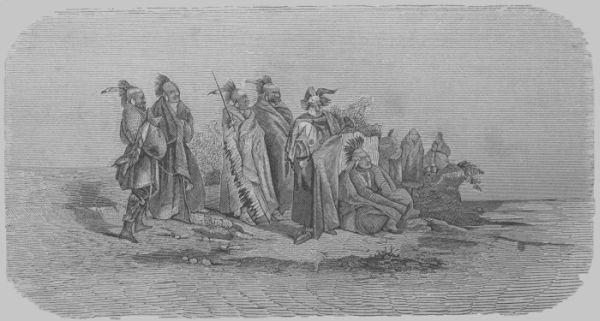
Civilisation may be likened to an absorbent body, placed in contact with an anti-absorbent, for some of the properties of which it has strong affinities. It will draw these latter so completely out, that, to use a strong phrase, it may be said to eat them up. Civilisation is found to derive some of the means of its perfect development from letters and the arts, but it cannot permanently exist without the cultivation of the soil. It seems to have been the fundamental principle on which the species were originally created, that they should derive their sustenance and means of perpetuation from this industrial labor. Wherever agricultural tribes have placed themselves in juxtaposition to hunters and erratic races, they have been found to withdraw from the latter the means of their support, by narrowing the limits of the forest and plains, upon the wild animals of which, both carnivorous and herbivorous, hunters subsist. When these have been destroyed, the grand resources of these hunters and pursuers have disappeared. Wars, the introduction of foreign articles or habits of injurious tendency, may accelerate the period of their decline—a result which is still further helped forward by internal dissensions, and the want of that political foresight by which civil nations exist. But without these, and by the gradual process of the narrowing down of their hunting grounds, and the conversion of the dominions of the bow and arrow to those of the plough, this result must inevitably ensue. There is no principle of either permanency or prosperity in the savage state.
It is a question of curious and philosophic interest, however, to observe the varying and very unequal effects, which different types of civilisation have had upon the wild hordes of men with whom it has come into contact. And still more, perhaps, to trace the original efficiency, or effeminacy of the civil type, in the blood of predominating races, who have been characterized by it. In some of the European stocks this type has remained nearly stationary since it reached the chivalric era. In others, it had assumed a deeply commercial tone, and confined itself greatly to the drawing forth, from the resources of new countries, those objects which invigorate trade. There is no stock, having claims to a generic nationality, in which the principle of progress has, from the outset, been so strongly marked, as in those hardy, brave and athletic tribes in the north of Europe, for whom the name of Teutons conveys, perhaps, a more comprehensive meaning, than the comparatively later one of Saxons. The object of this race appears continually to be, and to have been, to do more than has previously been done; to give diffusion and comprehension to designs of improvement, and thus, by perpetually putting forth new efforts, on the globe, to carry on man to his highest destiny. The same impulsive aspirations of the spirit of progress, the same energetic onwardness of principle which overthrew Rome, overthrew, at another period, the simple institutions of the woad-stained Britons; and, whatever other aspect it bears, we must attribute to the same national energy the modern introduction of European civilisation into Asia.
When these principles come to be applied to America, and to be tested by its native tribes, we shall clearly perceive their appropriate and distinctive effects. In South America, where the type of chivalry marked the discoverers, barbarism has lingered among the natives, without being destroyed, for three centuries. In Canada, which drew its early colonists exclusively from the feudal towns and seaports, whose inhabitants had it for a maxim, that they had done all that was required of good citizens, when they had done all that had been previously done, the native tribes have remained perfectly stationary. With the exception of slight changes in dress, and an absolute depreciation in morals, they are essentially at this day what they were in the respective eras of Cartier and Champlain. In the native monarchies of Mexico and Peru, Spain overthrew the gross objects of idolatrous worship, and intercalated among these tribes the arts and some of the customs of the 16th century. With a very large proportion of the tribes but little was attempted beyond military subjugation, and less accomplished. The seaboard tribes received the ritual of the Romish church. Many of those in the interior, comprehending the higher ranges of the Andes and Cordilleras, remain to this day in the undisturbed practice of their ancient superstitions and modes of subsistence. It is seen from recent discoveries, that there are vast portions of the interior of the country, unknown, unexplored and undescribed. We are just, indeed, beginning to comprehend the true character of the indigenous Indian civilisation of the era of the discovery. These remarks are sufficient to show how feebly the obligations of letters and Christianity have been performed, with respect to the red men, by the colonists of those types of the early European civilisation, who rested themselves on feudal tenures, military renown, and an ecclesiastical system of empty ceremonies.
It was with very different plans and principles that North America was colonized. We consider the Pilgrims as the embodiment of the true ancient Teutonic type. Their Alaric and Brennus were found in the pulpit and in the school-room. They came with high and severe notions of civil and religious liberty. It was their prime object to sustain themselves, not by conquest, but by cultivating the soil. To escape an ecclesiastical tyranny at home, they were willing to venture themselves in new climes. But they meant to triumph in the arts of peace. They embarked with the Bible as their shield and sword, and they laid its principles at the foundation of all their institutions, civil, literary, industrial, and ecclesiastic. They were pious and industrious themselves, and they designed to make the Indian tribes so. They bought their lands and paid for them, and proceeded to establish friendly neighborhoods among the tribes. Religious truth, as it is declared in the Gospel, was the fundamental principle of all their acts. In its exposition and daily use, they followed no interpretations of councils at variance with its plain import. This every one was at liberty to read.
Placed side by side with such an enlightened and purposed race, what had the priests of the system of native rites and superstitions to expect? There could be no compromise of rites—no partial conformity—no giving up a part to retain the rest—as had been done in the plains of Central America, Mexico and Yucatan. No toleration of pseudo-paganism, as had been done on the waters of the Orinoco, the Parana and the Paraguay. They must abandon the system at once. The error was gross and total. They must abjure it. They had mistaken darkness for light; and they were now offered the light. They had worshipped Lucifer instead of Immanuel. This the tribes who spread along the shores of the North Atlantic were told, and nothing was held back. They founded churches and established schools among them. They translated the entire Bible, and the version of David’s Psalms, and the Hymns of Dr. Watts, into one of their languages. Two types of the human race, more fully and completely antagonistical, in all respects, never came in contact on the globe. They were the alpha and omega of the ethnological chain. If, therefore, the Red Race declined, and the white increased, it was because civilisation had more of the principles of endurance and progress than barbarism; because Christianity was superior to paganism; industry to idleness; agriculture to hunting; letters to hieroglyphics; truth to error. Here lie the true secrets of the Red Men’s decline.
There are but three principal results which, we think, the civilized world could have anticipated for the race, at the era of the discovery. 1. They might be supposed to be subject to early extermination on the coasts, where they were found. A thousand things would lead to this, which need not be mentioned. Intemperance and idleness alone were adequate causes. 2. Philanthropists and Christians might hope to reclaim them, either in their original positions on the coasts, or in agricultural communities in adjacent parts. 3. Experience and forecast might indicate a third result, in which full success should attend neither of the foregoing plans, nor yet complete failure. There was nothing, exactly, in the known history of mankind, to guide opinion. A mixed condition of things was the most probable result. And this, it might be anticipated, would be greatly modified by times and seasons, circumstances and localities, acting on particular tribes. Nothing less could have been expected but the decline and extinction of some tribe, whilst the removal of others, to less exposed positions, would be found to tell upon their improvement. The effects of letters and Christianity would necessarily be slow; but they were effects, which the history of discovery and civilisation, in other parts of the world, proved to be effective and practical. What was this mixed condition to eventuate in?—how long was it to continue? Were the tribes to exercise sovereign political jurisdiction over the tracts they lived on? Were they to submit to the civilized code, and if so, to the penal code only, or also to the civil? Or, if not, were they to exist by amalgamation with the European stocks, and thus contribute the elements of a new race? These, and many other questions, early arose, and were often not a little perplexing to magistrates, legislatures, and governors. It was evident the aboriginal race possessed distinctive general rights, but these existed contemporaneously, or intermixed with the rights of the discoverers. How were these separate rights to be defined? How were the weak to be protected, and the strong to be restrained, at points beyond the ordinary pale of the civil law? If a red man killed a white, without the ordinary jurisdiction of the courts, could he be seized as a criminal? And if so, were civil offences, committed without the jurisdiction of either territory, cognizable in either, or neither? Could there be a supremacy within a supremacy? And what was the limit between State and United States laws? Such were among the topics entering into the Indian policy. It was altogether a mixed system, and like most mixed systems, it worked awkwardly, confusedly, and sometimes badly. Precedents were to be established for new cases, and these were perpetually subject to variation. Legislators, judges, and executive officers were often in doubt, and it required the wisest, shrewdest, and best men in the land to resolve these doubts, and to lay down rules, or advice, for future proceeding in relation to the Red Race. It will be sufficient to bear out the latter remark, to say, that among the sages who deemed this subject important, were a Roger Williams, a Penn, a Franklin, a Washington, a Jefferson, a Monroe, a Crawford, and a Calhoun.
It must needs have happened, that where the Saxon race went, the principles of law, justice, and freedom, must prevail. These principles, as they existed in England at the beginning of the sixteenth century, were transferred to America, with the Cavaliers, the Pilgrims, and the Quakers, precisely, as to the two first topics, as they existed at home. Private rights were, as well secured, and public justice as well awarded here, as there. But they also brought over the aristocratic system, which was upheld by the royal governors, who were the immediate representatives of the crown. The doctrine was imprescriptible, that the fee of all public or unpatented lands was in the crown, and all inhabitants of the realm owed allegiance and fealty to the crown. This doctrine, when applied to the native tribes of America, left them neither fee-simple in the soil, nor political sovereignty over it. It cut them down to vassals, but, by a legal solecism, they were regarded as a sort of free vassals. So long as the royal governments remained, they had the usufruct of the public domain—the right of fishing, and hunting, and planting upon it, and of doing certain other acts of occupancy; but this right ceased just as soon, and as fast, as patents were granted, or the public exigency required the domain. The native chiefs were quieted with presents from the throne, through the local officers, and their ideas of independence and control were answered by the public councils, in which friendships were established, and the public tranquillity looked after. Private purchases were made from the outset, but the idea of a public treaty of purchase of the soil under the proprietary and royal governors, was not entertained before the era of William Penn.
It remained for the patriots of 1775, who set up the frame of our present government, by an appeal to arms, to award the aboriginal tribes the full proprietary right to the soil they respectively occupied, and to guarantee to them its full and free use, until such right was relinquished by treaty stipulations. So far, they were acknowledged as sovereigns. This is the first step in their political exaltation, and dates, in our records, from the respective treaties of Fort Pitt, September 17, 1778, and of Fort Stanwix, of October 22, 1784. The latter was as early after the establishment of our independence, as these tribes—the Six nations, who, with the exception of the Oneidas, sided with the parent country—could be brought to listen to the terms of peace. They were followed by the Wyandots, Delawares, and Chippewas, and Ottowas, in January, 1785; by the Cherokees, in November of the same year; and by the Choctaws and Shawnees, in January, 1786. Other western nations followed in 1789; the Creeks did not treat till 1790. And from this era, the system has been continued up to the present moment. It may be affirmed, that there is not an acre of land of the public domain of the United States, sold at the land offices, from the days of General Washington, but what has been acquired in this manner. War, in which we and they have been frequently involved, since that period, has conveyed no territorial right. We have conquered them, on the field, not to usurp territory, but to place them in a condition to observe how much more their interests and permanent prosperity would be, and have ever been, promoted by the plough than the sword. And there has been a prompt recurrence, at every mutation from war to peace, punctually, to that fine sentiment embraced in the first article of the first treaty ever made between the American government and the Indian tribes, namely, that all offences and animosities “shall be mutually forgiven, and buried in deep oblivion, and never more be had in remembrance.”[46]
The first step to advance the aboriginal man to his natural and just political rights, namely, the acknowledgment of his right to the soil, we have mentioned; but those that were to succeed it were more difficult and complex in their bearings. Congress, from the earliest traces of their action, as they appear in their journals and public acts, confined the operation of the civil code to the territory actually acquired by negotiation, and treaties duly ratified by the Senate, and proclaimed, agreeably to the Constitution, by the President. So much of this public territory as fell within the respective State lines, fell, by the terms of our political compact, under State laws, and the jurisdiction of the State courts; and as soon as new tracts of the Indian territory, thus within State boundaries, were acquired, the State laws had an exact corresponding extension until the whole of such Indian lands had been acquired. This provided a definite and clear mode of action, and if it were sometimes the subject of doubt or confliction, such perplexity arose from the great extension of the country, its sparsely settled condition, and the haste or ignorance of local magistrates. And these difficulties were invariably removed whenever the cases came into the Supreme Court of the United States.
Without regard to the area of the States, but including and having respect only to the territories, and to the vast and unincorporated wilderness, called the “Indian country,” Congress provided a special code of laws, and from the first, held over this part of the Union, and holds over it now, full and complete jurisdiction. This code was designed chiefly to regulate the trade carried on at those remote points between the white and red men, to preserve the public tranquillity, and to provide for the adjudication of offences. Citizens of the United States, carrying the passport, license, or authority of their government, are protected by their papers thus legally obtained; and the tribes are held answerable for their good treatment, and if violence occur, for their lives. No civil process, however, has efficacy in such positions; and there is no compulsory legal collection of debts, were it indeed practicable, on the Indian territories. The customs and usages of the trade and intercourse, as established from early times, prevail there. These customs are chiefly founded on the patriarchal system, which was found in vogue on the settlement of the country, and they admit of compensations and privileges founded on natural principles of equity and right. The Indian criminal code, whatever that is, also prevails there. The only exception to it arises from cases of Americans, maliciously killed within the “Indian country,” the laws of Congress providing, that the aggressors should be surrendered into the hands of justice, and tried by the nearest United States courts.
These preliminary facts will exhibit some of the leading features of the mixed system alluded to. Its workings were better calculated for the early stages of society, while population was sparse and the two races, as bodies, kept far apart, than for its maturer periods. As the intervening lands became ceded, and sold, and settled, and the tribes themselves began to put on aspects of civilisation, the discrepancies of the system, and its want of homogeneousness and harmony, became more apparent. Throughout the whole period of the administrations of Washington, and John Adams, and Jefferson, a period of twenty years, the low state of our population, and the great extent and unreclaimed character of the public domain, left the Indians undisturbed, and no questions of much importance occurred to test the permanency of the system as regards the welfare of the Indians. Mr. Jefferson foresaw, however, the effect of encroachments beyond the Ohio, and with an enlightened regard for the race and their civilisation, prepared a new and consolidated code of all prior acts, with some salutary new provisions, which had the effect to systematize the trade and intercourse, and more fully to protect the rights of the Indians. This code served, with occasional amendments, through the succeeding administrations of Madison, Monroe, and John Quincy Adams, into that of General Jackson, when, in 1834, the greatly advanced line of the frontiers, the multiplied population, and necessarily increased force of the Indian department, and the large amount of Indian annuities to be paid, called for its thorough revision, and a new general enactment was made.
Previously, however, to this time, during the administration of Mr. Monroe, it was perceived that the Indian tribes, as separate communities, living in, and surrounded by, people of European descent, and governed by a widely different system of laws, arts, and customs, could not be expected to arrive at a state of permanent prosperity while thus locally situated. The tendency of the Saxon institutions, laws, and jurisprudence, was to sweep over them. The greater must needs absorb the less. And there appeared, on wise and mature reflection, no reasonable hope to the true friends of the native race, that they could sustain themselves in independency or success as foreign elements in the midst of the State communities. It was impossible that two systems of governments, so diverse as the Indian and American, should co-exist on the same territory. All history proved this. The most rational hope of success for this race, the only one which indeed appeared practical on a scale commensurate with the object, was to remove them, with their own consent, to a position entirely without the boundaries of the State jurisdictions, where they might assert their political sovereignty, and live and develope their true national character, under their own laws.