BIRDS OF THE ROCKIES AND WEST TO THE PACIFIC
Reading edition
[9]
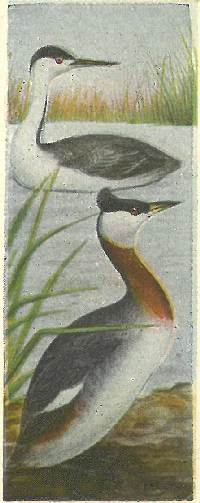
DIVING BIRDS—Order Pygopodes. GREBES—Family Colymbidæ.
WESTERN GREBE.
1. Æchmophorus occidentalis. 25 to 29 inches.
This is the largest of the grebe family. In summer the back of the neck is black, but in winter it is gray like the back.
Nest.—A floating mass of decayed rushes, sometimes attached to the upright stalks; 2 to 5 pale bluish white eggs are laid, usually much nest stained (2.40 × 1.55). Breeding in colonies.
Range.—Western North America, from the Dakotas and Manitoba to the Pacific, and north to southern Alaska.
HOLBOELL GREBE.
2. Colymbus Holboelli. 19 inches.
This is next to the Western Grebe in size, both being larger than any of the others. In summer, they are very handsomely marked, as shown in the illustration, but in winter have the usual dress of gray and white.
Nest.—Similar to above, the eggs averaging smaller (2.35 × 1.25).
Range.—North America, breeding from northwestern Alaska, in the interior of Canada and North Dakota. Winters usually on the coasts.
[10]
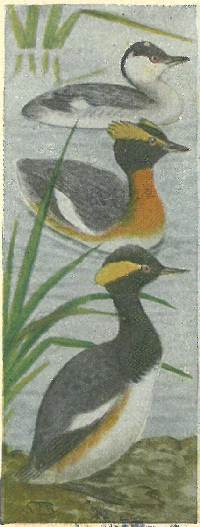
HORNED GREBE.
3. Colymbus auritus. 14 inches.
In winter this Grebe is one of the plainest in its dress of gray and white, but summer brings a great change, making it one of the most attractive, with its black, puffy head, and buffy white ear tufts, the front of the neck a rich chestnut color. Their food consists almost wholly of small fish.
Nest.—Is a loosely built mass of vegetation floating in the bog and water holes of the western prairies. The eggs, 3 to 7 in number, are brownish yellow (1.70 × 1.15).
Range.—Breeds from Dakota and Illinois northward; winters to the Gulf of Mexico.
EARED GREBE.
4. Colymbus nigricollis californicus. 13 inches.
This species is rarely found as far east as the Mississippi River. In summer the neck is black, lacking the chestnut color of the former. It can always be distinguished from the Horned by the upper mandible being straight on the top.
Nest.—In colonies similar to the above, laying from 3 to 8 eggs, which are usually nest stained to a brownish cream color.
Range.—From the Mississippi to the Pacific, nesting from Texas to British Columbia.
[11]
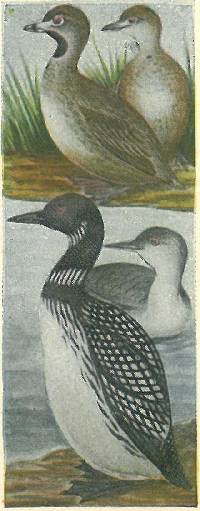
PIED-BILLED GREBE.
6. Podilymbus podiceps. 13½ inches.
This species cannot be mistaken for any others of the grebes in any plumage, because of its stout compressed bill and brown eyes, all the others having red eyes. In summer the bill is nearly white, with a black band encircling it; the throat is black; breast and sides brownish-gray; the eye encircled with a white ring.
Nest.—Made of a mass of decayed weeds and rushes, floating in shallow ponds or on the edges of lakes among the rushes. Five to 8 brownish white eggs are laid (1.70 × 1.18).
Range.—Whole of N. A., breeding in small colonies or pairs.
LOON; GREAT NORTHERN DIVER.
7. Gavia immer. 31 to 35 inches.
In shape and motions the loons very much resemble the grebes, except in size, being much larger. The common loon is the most beautiful of them all, having a velvety black iridescent head with slashes of white on the throat and neck and spots of white on the wings and back.
Nest.—Usually built under some shelter of bushes or rushes on the edge of some of the larger ponds or lakes. The two eggs are a yellowish brown, with black spots (3.50 × 2.25).
[12]
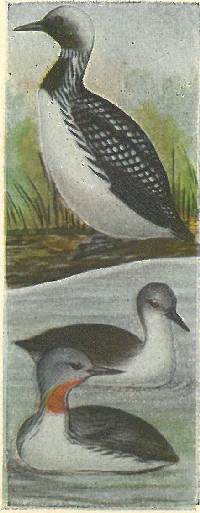
PACIFIC LOON.
10. Gavia pacifica. 30 to 32 inches.
This species differs from the Loon in having the crown gray, and white streaks down the back of the neck, and in the color reflections of the black on the head. It is a trifle smaller also.
Nest.—Similar to the former, the eggs being more of a greenish brown, with the black spots mostly on the larger end (3.10 × 2).
Range.—Western N. A., breeding in Alaska and British Columbia; winters along the Pacific coast to Mexico.
RED-THROATED LOON.
11. Gavia stellata. 25 inches.
The smallest of the Loon family. The back and head are gray, there is a large patch of chestnut on the fore-neck; under parts white. Owing to the straight top to the upper mandible the bill has a slightly up-turned appearance.
Nest.—Similar to the other Loons, placed within a few feet of the water. The eggs are an olive brown with more markings usually than the others, and mostly on the larger end (2.90 × 1.75).
Range.—Along the western coast of North America.
[13]
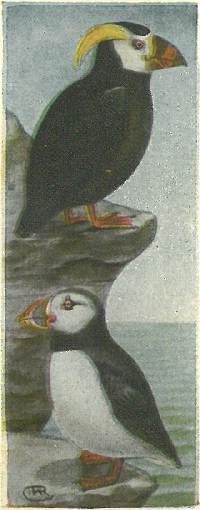
AUKS, MURRES AND PUFFINS—Family Alcidæ.
TUFTED PUFFIN; SEA PARROT.
12. Lunda cirrhata. 13 inches.
This is the largest of the family, they are odd looking birds, with short legs, stout bodies and very large, thin bills, highly colored with red and yellow, the feet are red and the eyes are white. They stand erect upon their feet and walk with ease.
Nest.—They breed commonly on the islands of the Pacific coast, laying their single white egg in burrows or crevices of the rocks. In some sections two or three broods are raised in a season (2.80 × 1.90).
Range.—Pacific coast from southern California to Alaska.
HORNED PUFFIN.
14. Fratercula corniculata. 11 inches.
This Puffin is similar to the common Puffin of the east, excepting that the blackish band across the throat extends upwards in a point to the bill.
Nest.—The same as the above, the single egg averaging smaller (2.65 × 1.80).
Range.—Islands of the northern Pacific to the Arctic ocean.
[14]
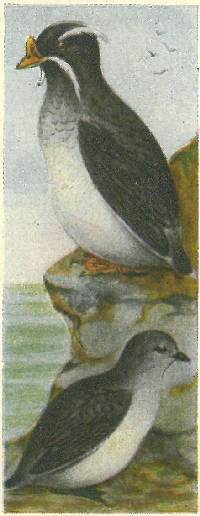
RHINOCEROS AUKLET.
15. Cerorhinca monocerata. 11 inches.
These birds have a much smaller bill than the Puffins; in the summer plumage there is a small horn at the base of the bill from which it is given its name. These birds do not stand upright as do the Puffins; but sit upon their tarsus.
Nest.—A single egg is laid in either burrows or in crevices of the rocks, usually without any attempt at nest making (2.70 × 1.80).
Range.—Coast and islands of the northern Pacific. Breeds from Oregon to northern Alaska.
CASSIN AUKLET.
16. Ptychoramphus aleuticus. 9 inches.
A plain appearing bird, breast and throat grayish and belly white with blackish upper-parts relieved only by a small white spot over the eye. This Auklet is fairly abundant on the Farallones and islands off the Lower California coast.
Nest.—A single egg, dull white, the inside of the shell being a pale green when held to the light. These are laid in burrows or tunnels under the rocks, at times three or four feet long (1.80 × 1.30).
Range.—Pacific coast of N. A., Alaska to Lower California.
[15]
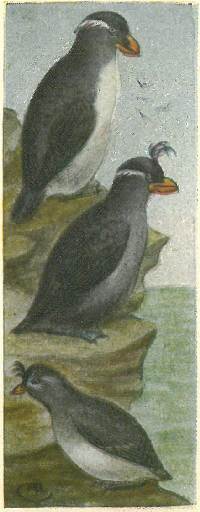
PAROQUET AUKLET.
17. Phaleris psittacula. 10 inches.
This bird is much like Cassin Auklet, but lacking the white spot over the eye and having a white breast. The bill is very peculiar, being quite deep and rounded and having an upward tendency. It is orange red in color.
Range.—The Alaskan coast, usually farther south in winter. Nesting in the Aleutian Islands, a single white egg is laid (2.25 × 1.40).
WHISKERED AUKLET.
19. Æthia pygmæa. 7½ inches.
Breeds quite abundantly on some of the Aleutian Islands. The single white egg is laid in burrows or crevices of the rocks (2.00 × 1.25).
CRESTED AUKLET.
18. Æthia cristatella. 8 to 9 inches.
Similar in form and plumage to the Paroquet Auklet, except the whole under parts are gray.
Nest and Range.—On the islands and main land of the Alaskan coast, laying only one chalky white egg in crevices or burrows under the rocks.
[16]
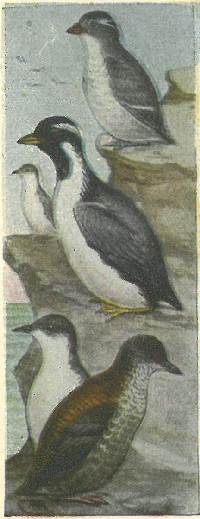
LEAST AUKLET.
20. Æthia pusilla. 6½ inches.
This is the smallest of the Auklets, and in habits are the same as others of the same family. They are one of the most abundant of the water birds of the extreme Northwest.
Nest.—Only one single white egg is laid upon the bare rocks or in crevices, on the islands of the Alaskan coast (1.50 × 1.10).
ANCIENT MURRELET.
21. Synthliboramphus antiquus. 11 inches.
The Murrelets have no crests or plumes and the bills are more slender than the Auklets and are not highly colored.
Nest.—One or two eggs are laid either in burrows or crevices of the rocks, buffy white in color, with faint markings of light brown.
Range.—Pacific coast from southern California to Alaska, breeding north of the United States.
MARBLED MURRELET.
23. Brachyramphus marmoratus. 10 inches.
Nesting habits and eggs are similar to the Ancient Murrelet (2.20 × 1.40) and range is same as above, possibly breeding a little farther south.
[17]
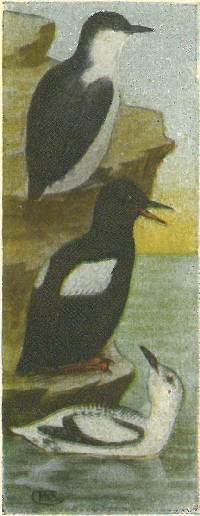
XANTHUS MURRELET.
25. Brachyramphus hypoleucus.
This bird is a dull black above, and entirely white below, including the sides of the head below the eye. The under-surface of the wing is also white.
Nest.—The single egg is laid at the end of burrows or under the rocks in dark places similar to the other Murrelets. It is a pale buffy white, and thickly but finely dotted with brown over the entire surface, heaviest on the larger end (2.05 × 1.40).
Range.—Resident along the coast of southern and Lower California, where it breeds on many of the islands.
PIGEON GUILLEMOT.
29. Cepphus columba. 13 inches.
This bird is very similar to the Black Guillemot except that the under-surfaces of the wings are dark. The nearly straight and slender bill is black, feathered to the upper edge of nostrils. Feet and inside of mouth bright red.
Nest.—Their two eggs are laid on the bare rocks in dark places under the rocks, are pale blue or green in color with black or brown markings and paler spots of lilac.
Range.—Pacific coast of North America.
[18]
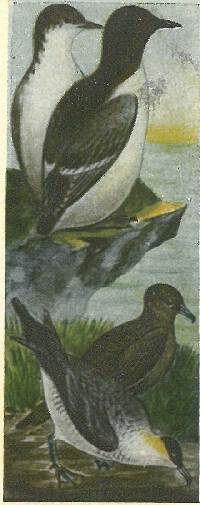
CALIFORNIA MURRE.
30. Uria troille californica. 15 to 16 inches.
This is one of the most abundant birds breeding on the Farallones. Large numbers of their eggs are taken yearly to the San Francisco and other market places and disposed of as a food product, and as yet the birds do not seem to diminish to any great extent.
Nest.—But a single white egg is laid on the bare ledges. They vary greatly in color, from nearly white without markings to a deep greenish blue with an endless variety of patterns in light and dark brown (3.40 × 2.00).
Range.—Pacific coast, breeding from the Farallones north to Alaska.
POMARINE JAEGER.
36. Stercorarius pomarinus. 21 inches.
These birds are slender and graceful in form and flight, but are the real pirates of bird life, especially among the terns and gulls. This species has two color phases regardless of sex or age. In the light plumage the top of the head is black, rest of the bird brownish. Easily identified by the lengthened central tail-feathers.
Nest.—Two olive brown eggs spotted with black (2.20 × 1.70).
[19]
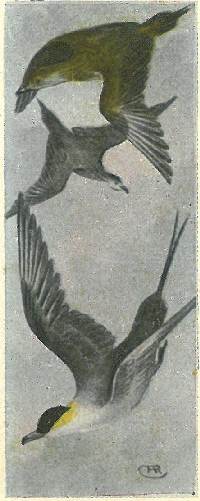
PARASITIC JAEGER.
37. Stercorarius parasiticus. 17 inches.
This bird has the two phases of color similar to the last. The two central tail-feathers are longer and more pointed, projecting about four inches beyond the others. All of the Jaegers have grayish blue legs with black feet, and brown eyes.
Nest.—A slight hollow in the marshy ground in which the two brownish eggs are laid (2.15 × 1.65).
Range.—Northern part of North America, south in winter to southern California, breeding in the Arctic regions.
LONG-TAILED JAEGER.
38. Stercorarius longicaudus. 20 inches.
This is the most swift and graceful of this family in flight. Similar to the last species, but the central pointed tail-feathers extend eight or ten inches beyond the others. It is more often found in the lighter phase.
Nest.—Their eggs are either laid on the bare ground or in a slight depression, scantily lined with grass (2.10 × 1.50).
Range.—Arctic America; south in winter to South America.
[20]
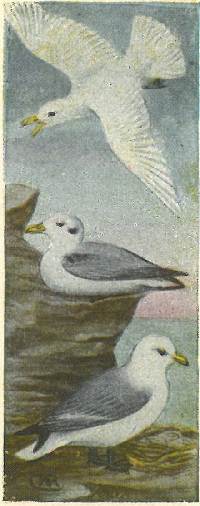
GULLS AND TERNS—Family Laridæ.
IVORY GULL.
39. Pagophila alba. 17 inches.
The little Snow Gull, as it is often called, in the breeding season is entirely white; the bill is tipped with yellow and there is a red ring about the eye.
Nest.—Of grasses and seaweed, on the cliffs in the Arctic regions. Three grayish buff eggs are laid marked with brown and black (2.30 × 1.70).
Range.—North of the Arctic Circle, and winters south to British Columbia.
PACIFIC KITTIWAKE.
40a. Rissa tridactyla pollicaris. 16 inches.
These birds breed in immense rookeries on some of the islands in the Bering Sea.
Nest.—On almost inaccessible cliffs, made of sticks, moss and seaweed, making the interior cup-shaped, to hold the two or three eggs, which are buffy brown or grayish, spotted with darker shades of brown (2.20 × 4.70).
Range.—Coast of the North Pacific, wintering as far south as Lower California.
[21]
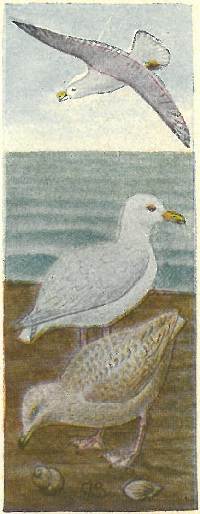
RED-LEGGED KITTIWAKE.
41. Rissa brevirostris. 16 inches.
This Kittiwake is very much like the former, excepting that the legs are bright red, the mantle is darker and the bill shorter. They usually nest in separate colonies from the former, and can be readily identified when in flight by the red legs.
Nest.—They have been found abundantly on the islands of the Bering Sea, nesting on the higher ledges and cliffs. The color of the eggs is buffy or brownish, blotched and spotted with lilac and shades of brown.
Range.—Northwestern coast and islands of Bering Sea.
GLAUCOUS GULL.
42. Larus hyperboreus. 28 inches.
This is one of the largest of the Gulls; mantle light gray; it is distinguished by its size and the primaries, which are white to the tips. It is a powerful bird that preys upon the smaller Gulls, eating both the eggs and young.
Nest.—Of seaweed on ledge of sea cliff, eggs three in number, in shades of light drab to brown, spotted with brown and black.
Range.—Arctic regions, in winter south to San Francisco Bay.
[22]
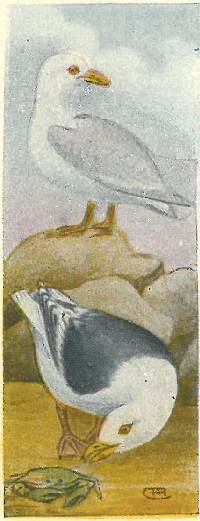
GLAUCOUS-WINGED GULL.
44. Larus glaucescens. 25 to 27 inches.
The primaries are the same color as the mantle on this gull except that the primaries are tipped with white. They breed in large numbers both on the rocky cliffs and on the low sandy islands of the Aleutians. On the cliffs large nests of seaweed are built, while on the low sandy islands no attempt is made at nest building.
Nest.—Two or three eggs are the usual complement, of a greenish brown ground color with various shades of brown spots, most thickly covered on the larger end (2.75 × 2.05).
Range.—North Pacific coast, breeding from British Columbia northwards, and wintering to southern California.
SLATY-BACKED GULL.
48. Larus schistisagus. 27 inches.
This large gull, with its almost pure white head and neck and slaty colored back, is one of the prettiest. They often nest in colonies with other gulls, building their small mounds of seaweed on the higher parts of the islands.
Nest.—Usually contains sets of two or three grayish colored eggs, spotted with dark brown and lavender (2.90 × 2.00).
Range.—Northern Pacific and Arctic oceans.
[23]
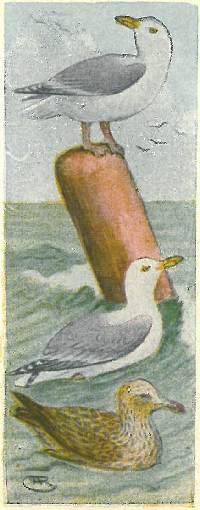
WESTERN GULL.
49. Larus occidentalis. 26 inches.
This bird is the most southerly distributed of any of the large Gulls, and can be seen about the harbors of California at all seasons of the year. They are great thieves, robbing the Murres and Terns wherever eggs are left unprotected, and are the greatest enemy that the Murres have to contend with.
Nest.—Their nests are made up of weeds and grass, and the full set contains three eggs of grayish brown spotted with dark brown, showing the usual variation found in color in the Gulls’ eggs (2.75 × 1.90).
Range.—Pacific coast, breeding from southern California to British Columbia.
HERRING GULL.
51. Larus argentatus. 24 inches.
These Gulls nest in colonies in favorable localities, usually on the ground, sometimes making a bulky nest of seaweed quite a distance from the water. A few pair nest on the islands of some of the inland lakes and it is not uncommon to see nests built in low trees ten or fifteen feet from the ground.
Nest.—They lay three eggs of a grayish brown color spotted with black and brown.
[24]
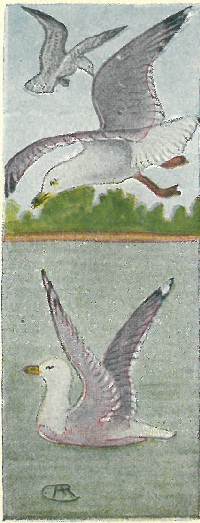
RING-BILLED GULL.
54. Larus delawarensis. 18 inches.
A small Gull with light gray mantle, black primaries with white tips and always to be identified in the breeding season by the black band around the middle of the greenish yellow bill. They nest in large colonies on the islands in the interior of the country. They frequent lakes and ponds at high altitudes in Colorado. Thousands of them breed about the lakes of the Dakotas and northward.
Nest.—Commonly lay three eggs, placing them in a slight hollow on the ground generally on the grassy portion of some island (2.80 × 1.75).
Range.—North America. On the Pacific coast from Lower California to British Columbia.
CALIFORNIA GULL.
53. Larus californicus. 23 inches.
This is a slightly smaller Gull than the Cal. Herring Gull and the primaries are grayish instead of black. Bill yellow, with red spot near end of lower mandible; feet greenish yellow.
Nest.—Abundantly around Great Salt Lake, placing their nests generally upon the bare ground. Three or four eggs constitute a set, and they are the usual color of the Gulls’.
[25]
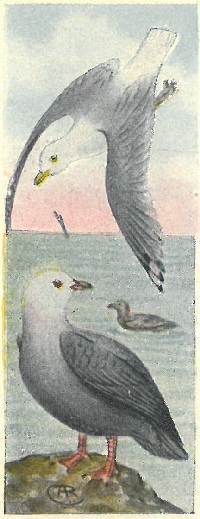
SHORT-BILLED GULL.
55. Larus brachyrhynchus. 17 inches.
The short-billed Gull or American Mew Gull is much like the European variety. Adults in breeding plumage; mantle pearly gray; rest of white; outer primary nearly black with a white spot at the end. Bill, feet and legs greenish.
Nest.—On islands in the lakes and rivers of Alaska. The nest is generally made of moss, grass and weeds and placed on the ground.
Range.—Breeds from the interior of British Columbia to Alaska. Winters in the south to Lower California.
HEERMANN GULL.
57. Larus heermanni. 17 inches.
A handsome little species, often called the White-headed Gull. In summer the entire head, neck and throat are white, with a red bill and legs. The body color shades abruptly from the neck into slaty, both the upper and under parts. The primaries and tail are black.
Nest.—Similar to others of the Gull family, with three eggs greenish drab in color marked with brown, black and lilac (2.45 × 1.50).
Range.—Pacific coast of North America.
[26]
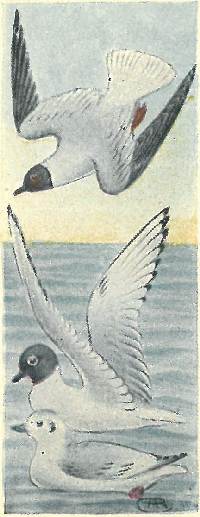
BONAPARTE GULL.
60. Larus philadelphia. 14 inches.
In summer, tip and outer web of outer primaries black; inner web and shaft white, with a black bill. The head and neck are gray; while in winter the head is white with gray spots back of the eyes. Young birds have the back mixed with brownish and the tail with a band of black near the tip. They are rarely found in the U. S. with the black hood.
Nest.—They nest in great numbers in the marshes of the northwest. The nests of sticks and grass are placed on the higher parts of the marshes and the usual complement of three eggs is laid. The eggs are grayish to greenish brown, marked with dark brown spots (1.90 × 1.30).
SABINE GULL.
62. Xema sabini. 13 inches.
A handsome bird, having the slaty hood bordered behind with a black ring; the primaries black, white tipped, and the tail slightly forked. In winter the head and throat white with the back of the neck dusky.
Nest.—They breed abundantly on the marshes of northern Alaska and Greenland. The two or three eggs are greenish brown in color and marked with dark brown (1.75 × 1.25).
[27]
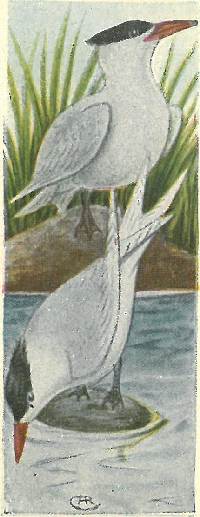
CASPIAN TERN.
64. Sterna caspia. 21 inches.
The largest and most beautiful of the Tern family. The bill is large, heavy and bright red. The crest with which this species is adorned is black. The mantle is pearl color and the breast is white. Winter birds have the crown mixed with white, and the young are blotched with blackish in the wings and tail.
Nest.—They sometimes nest in large colonies and then again only a few pair will be found on an island. Eggs vary from gray to greenish buff, marked with brown and lilac. The two eggs usually being laid in a hollow in the sand.
Range.—North America, breeding from the Gulf Coast and Lower California to the Arctic regions.
ELEGANT TERN.
66. Sterna elegans. 17 inches.
In the breeding plumage the under parts of the Terns are tinged with rosy, which probably first gave the birds their name.
Nest.—They lay but a single egg, in a slight depression in the sand, creamy brown with light brown markings (2.40 × 1.40).
Range.—Central and South America, in summer to California.
[28]
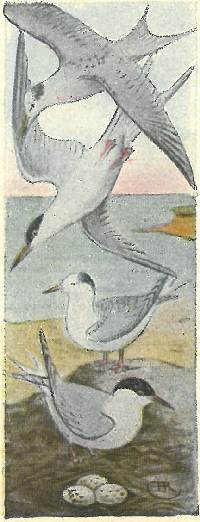
FORSTERS TERN.
69. Sterna forsteri. 15 inches.
These beautiful birds are often known as “Sea Swallows,” because of their similarity in flight to those well-known land birds. They are the picture of grace as they dart about high in the air, bill pointed downward, alert and ready to dart down upon any small fish that may take their fancy.
Nest.—A slight depression in the sand, rarely lined with grass, in which are laid three, sometimes four, eggs varying in color from almost white to brownish, thickly spotted with brown and lavender (1.80 × 1.30).
Range.—Throughout North America; breeding from Manitoba to the Gulf Coast.
COMMON TERN.
70. Sterna hirundo. 15 inches.
This bird differs from the above in the red of the bill being more blackish at the tip, and the under parts being a pearly gray in place of white, tail not quite as much forked, and shorter; edge of outer primaries and outer tail-feathers blackish.
Nest.—These breed much more abundantly on the Atlantic coast. Their eggs are more rounded (1.75 × 1.40).
[29]
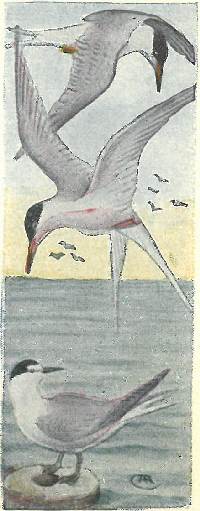
ARCTIC TERN.
71. Sterna paradisæ. 15 inches.
A similar bird to the last; more northern in its distribution; and the pearly gray mantle somewhat darker both above and below. Bill quite red and feet much smaller and bright red. When their nesting colonies are approached they will rise in clouds, circling about high in the air, uttering at times their peculiar cry.
Nest.—Similar to the others, with very little if any attempt at nest building. Usually placing the two or three eggs on the bare sand or gravel just above the water line. There is no difference in the color or markings of the eggs from the others (1.75 × 1.40).
Range.—More northerly than the preceding, to the Arctic Regions and wintering from California to the Gulf States.
ALEUTIAN TERN.
73. Sterna aleutica. 15 inches.
This handsome Tern is of the same form and size as the Common Tern, but has a darker mantle, and the forehead is white, with a black line extending from the bill to the eye.
Nest.—Is much the same as the Arctic, but the eggs are somewhat smaller and narrower (1.70 × 1.15).
[30]
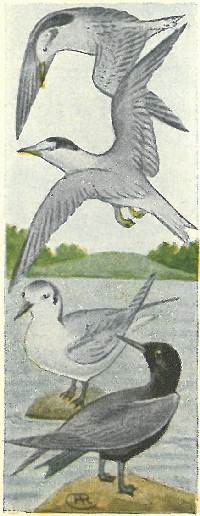
LEAST TERN.
74. Sterna antillarum. 9 inches.
This is the smallest of our Terns; not much larger than a swallow and in flight are much the same, darting through the air, taking insects the same as swallows, or dipping into the water for small minnows that are showing themselves near the surface.
Nest.—Simply a depression in the sand or gravel just above the water line, with two to four creamy white eggs beautifully marked with different shades of brown and lilac (1.25 × .95).
Range.—Throughout the United States to northern South America, breeding abundantly on the coast of southern California.
BLACK TERN.
77. Hydrochelidon nigra surinamensis. 10 inches.
We always think of the Terns as light colored birds, either white or pearly; but here we have one nearly black. Adults in summer having the head, neck and under parts black, with the back, wings and tail gray.
Nest.—Their nesting habits vary also as much as their color. Nests are of weeds and grass in the sloughs on the prairies. Two to four eggs are a dark greenish brown with black spots (1.35 × .95).
[31]
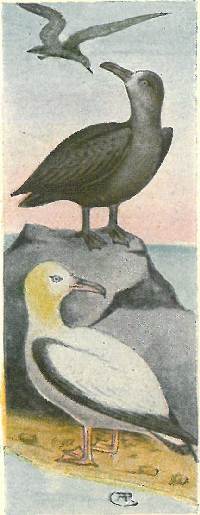
ALBATROSSES—Family Diomedeidæ.
BLACK-FOOTED ALBATROSS.
81. Diomedea nigripes. 32 to 36 inches.
This bird is of a uniform sooty brown color shading into whitish at the base of the bill, which is rounded. It is noted for its extended flights, following vessels day after day without any apparent period of rest.
Nest.—They lay a single white egg upon the ground (4.00 × 2.40).
SHORT-TAILED ALBATROSS.
82. Diomedea albatrus. 36 inches.
This bird is much more shy than the former, and when following a vessel will keep a long distance behind in its search for food. With the exception of the primaries, which are black, as are also the shoulders and tail, the entire plumage is white, tinged with yellow on the back of the head.
Nest.—They breed on the islands in the North Pacific off the coast of Alaska. A single white egg is laid upon the bare ground or rocks.
Range.—Northern Pacific ocean in summer from Lower California to Alaska; most common in northern part of the range.
[32]
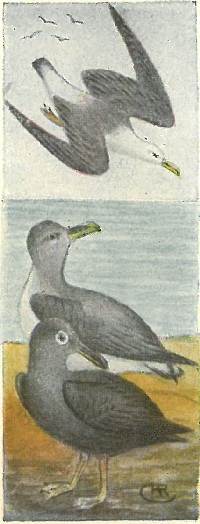
LAYSAN ALBATROSS.
82.1. Diomedea immutabilis. 32 inches.
These birds are white with the exception of the back, wings and tail, which are black; bill and feet yellow.
Nest.—Their single white egg is laid upon the ground or rocks (4.00 × 2.35).
Range.—This species breeds in large numbers on the island from which it takes its name—Layson Island, of the Hawaiian Group—appearing rarely off the coast of California.
YELLOW-NOSED ALBATROSS.
83. Thalassogeron culminatus. 36 inches.
This is a species which inhabits the South Pacific and Indian oceans and is said to occur rarely on the California coast. An egg in the collection of Col. John E. Thayer, Lancaster, Mass., was taken on Gough Island Sept. 1st, 1888. The nest was a mound of mud and grass about two feet high. The single white egg measured 3.75 × 2.25.
SOOTY ALBATROSS.
84. Phœbetria palpebrata. 36 inches.
This species is entirely sooty brown except the white rim around the eyelids. One white egg is laid (4.10 × 2.75).
[33]
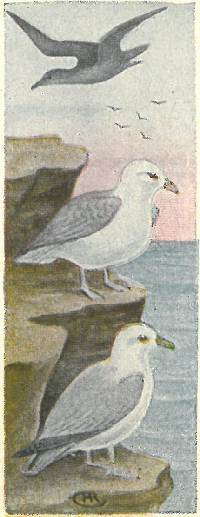
FULMARS AND SHEARWATERS. Family Procellariidæ.
PACIFIC FULMAR.
86b. Fulmarus glacialis glupischa. 18 inches.
In markings these birds closely resemble the Gulls. Bill is shorter and stouter, strongly hooked at the tip, and with the nostrils opening out of a single tube, prominently located on top of the bill. Their flight is graceful like that of the Gulls.
Nest.—On the islands and cliffs of the mainland of the Northern Pacific they nest in large colonies. Every crevice in the rocks having its tenant. They lay but a single white egg on the bare rocks (2.90 × 2.00).
Range.—Northern Pacific, southerly to Lower California.
SLENDER-BILLED FULMAR.
87. Priocella glacialoides. 18 inches.
This species has a paler mantle than others of the family, and the primaries are black.
Range.—Southern seas, appearing on the Pacific coast of the United States in the summer. They probably breed in the far south during our winter, although we have no definite record relative to their nesting habits.
[34]
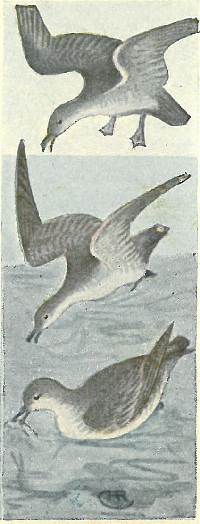
PINK-FOOTED SHEARWATER.
91. Puffinus creatopus. 19 inches.
Very little is known of the breeding habits of this bird. Upper parts and under-tail coverts are a pale brownish color, darkest on the wings; top of head dark, with throat and breast white, with yellowish bill and pink colored feet.
Range.—From Monterey, California, to South America.
BLACK-VENTED SHEARWATER.
93. Puffinus opisthomelas. 14 inches.
Similar to the previous, only smaller and somewhat lighter in color. Quite common in southern California and much more so in Lower California.
Range.—From northern United States to Lower California. A single white egg is laid (2.00 × 1.30).
TOWNSEND SHEARWATER.
93.1. Puffinus auricularis. 14 inches.
A more southern species; occurs occasionally on the lower California coast and islands.
[35]
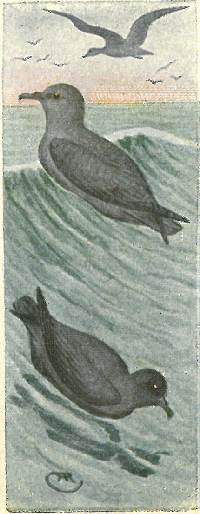
DARK-BODIED SHEARWATER.
95. Puffinus griseus. 17 inches.
This is a southern species which, after nesting on the islands in the far south during our winter months, comes north and appears off the Pacific coast of the United States during our summer months, as far north as Alaska. They are a dark sooty gray, except for the under-coverts, which are whitish.
Nest.—Habits are the same as the others of the family. The single white egg is laid at the end of the burrows or in crevices under rocks (2.40 × 1.65).
SLENDER-BILLED SHEARWATER.
96. Puffinus tenuirostris. 14 inches.
This is much smaller than the preceding, otherwise resembling it in color and markings, being a little lighter under the throat, and the bill more slender in proportion to the size of the bird. Bill and feet nearly black, as is also the one above.
Nest.—Nesting habits and range of the bird are the same as the Dark-bodied Shearwater; it is not found on the N. A. coast as commonly as the other.
[36]
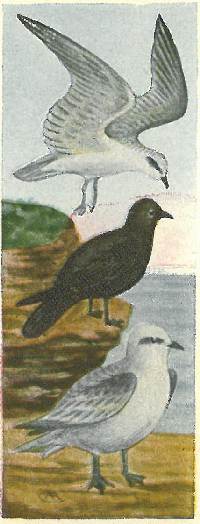
FISHER PETREL.
100. Æstrelata fisheri. 7 inches.
This is a handsome bird known only from the type specimen taken off Kadiak Island, Alaska, by Mr. Fisher.
LEAST PETREL.
103. Halocyptena microsoma. 5½ inches.
This is the smallest of the family. Their plumage is entirely dark sooty.
Nest.—They have been found breeding on the islands of Lower California, and they probably do on others farther south. The single egg of this bird is white with a wreath of tiny brown specks about the larger end.
FORK-TAILED PETREL.
105. Oceanodroma furcata. 8 inches.
These birds have a plumage of bluish gray, the wings being darker and the under parts lightest.
Nest.—Single egg is laid at the end of a burrow on the ground. Egg white with a fine wreath of purplish black specks about the larger end. Found breeding on the islands of Alaska.
[37]
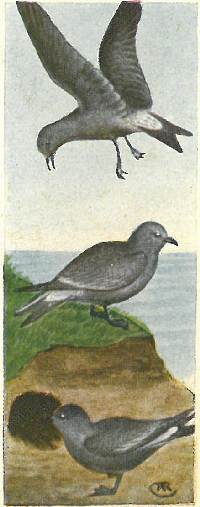
KAEDING PETREL.
105.2. Oceanodroma kaedingi. 7½ inches.
This bird is similar to the following, but a trifle smaller and the tail less deeply forked. Its range is from northern California to Mexico, breeding in the southern part of its range.
LEACH PETREL.
106. Oceanodroma leucorhoa. 8 inches.
These are quite common on both the eastern and western coasts, breeding from the Farallones northward to the Aleutians. They are of a sooty brown color, upper tail-coverts and side of under-coverts white. They burrow in the ground for two or three feet, but make no attempt at nest building; placing their single white egg on the bare ground at end of burrow. These birds generally take turns in the task of incubation, one remaining at sea during the day and returning at night. They are rarely seen in the vicinity of their nests during the day.
GUADALUPE PETREL.
106.1. Oceanodroma macrodactyla.
Very similar to the preceding, having more of a forked tail and somewhat longer. Breed on the islands of Lower California.
Nest.—Same as above with one white egg, usually much nest stained.
[38]
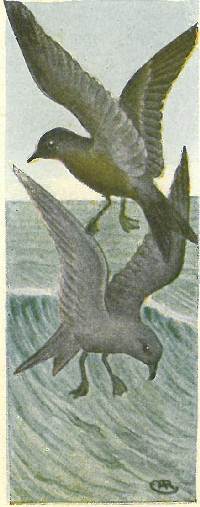
BLACK PETREL.
107. Oceanodroma melania. 7½ inches.
These birds are sooty black all over, lacking the white rump of the two or three preceding. All of the Petrels have a very offensive musky odor, which is always noticeable about an island inhabited by them. The skins and eggs of the birds always retain this odor.
Nest.—Made in burrows similar to the others, but sometimes containing a small amount of nesting material; grass and roots.
Range.—Southern California southward to Mexico.
ASHY PETREL.
108. Oceanodroma homochroa. 7 inches.
This species breeds most abundantly on the Farallone Islands, sooty gray in color, their plumage matching their surroundings so closely that, unless one is looking for them, they will easily be overlooked.
They sit very close when nesting, and will even allow themselves to be removed from the nest by hand, so tame are they. They build in burrows or in any crevice of the rocks, laying their single white egg on the ground or rock without much, if any, lining to the nest.
[39]
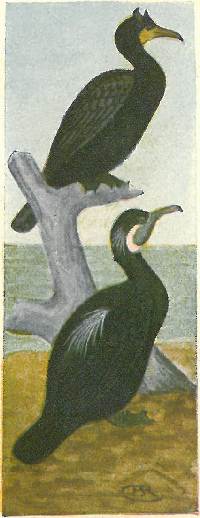
CORMORANTS—Family Phalacrocoracidæ.
FARALLONE CORMORANT.
120c. Phalacrocorax auritus albociliatus. 30 inches.
Plumage glossy greenish black, with back and wings slaty. These birds breed in large numbers on the Farallones, placing their nests well up on the higher ridges and also in the trees on some of the inland islands, or near large ponds or lakes. They build large nests of sticks and roots, lined with grass, seaweed and moss.
Nest.—Three to five chalky, greenish white eggs are laid (2.40 × 1.50).
BRANDT CORMORANT.
122. Phalacrocorax penicillatus. 35 inches.
Plumage, under parts are same as above. Bill more slender and nearly straight. The young are hatched without feathers or down and the skin is nearly black. The young for two or three months are the food supply for the larger Gulls. Like the other Cormorants breeding on these islands, they stay closely by their nests to protect them from the Gulls that are always on the watch for either the eggs or young.
Range.—Pacific coast, breeding along the whole coast of the United States.
[40]
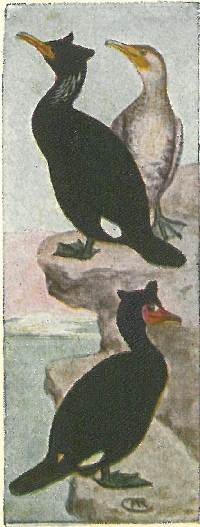
BAIRD CORMORANTS.
123b. Phalacrocorax pelagicus resplendens. 28 inches.
This smaller Cormorant breeds on the Pacific coast from Washington south to Mexico. It is not nearly as common as the former species and not inclined to breed in colonies with the others, but is more secluded.
Nest.—Their nest building is very similar, using the rocks and cliffs on which to place their nests mostly, and very seldom building in trees. Their eggs are much smaller, averaging 2.20 × 1.40.
RED-FACED CORMORANT.
124. Phalacrocorax urile. 32 inches.
The plumage of this species differs from the above chiefly in having the forehead bare. Their breeding habits are the same as other members of the family. That the Cormorants are expert fishermen may be seen from the fact that the Chinese tame them to catch fish for them, placing a ring about their necks to prevent their swallowing the fish.
Nest.—The nesting places of these as well as other members of this family are very filthy, being covered with excrement and the remains of fish that are strewn about their nests (2.50 × 1.50).
[41]
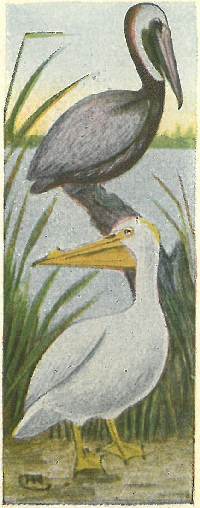
PELICANS.—Family Pelecanidæ.
WHITE PELICAN.
125. Pelecanus erythrorhynchos. 60 inches.
Plumage mostly white, with black primaries; eyes white; bill and feet yellow, the former in the breeding season having a thin upright knob about midway on the top of the upper mandible. They get their food by approaching a school of small fish and suddenly dipping their head beneath the surface, sometimes scooping a large number of fish at a time; they contract the pouch, allowing the water to run out of the sides of the mouth, and then swallow the fish.
Nest.—On the ground made of sticks and weeds, generally only a lining about the outer edge; the eggs being placed upon the ground. Two or three eggs are laid, pure chalky white (3.45 × 2.30).
CALIFORNIA BROWN PELICAN.
127. Pelecanus californicus. 55 inches.
Upper parts gray; lower brownish streaked with white; back of neck rich velvety brown; head and throat white.
Nest.—On the ground or in small trees, composed of sticks and weeds. Three or four chalky white eggs (3.10 × 1.95).
[42]
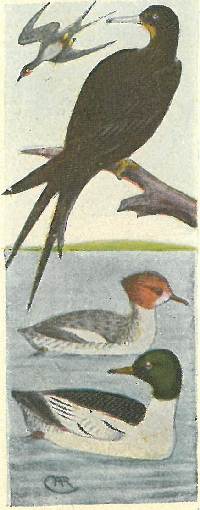
MAN-O’-WAR BIRDS—Family Fregatidæ.
FRIGATE BIRD.
128. Fregata aquila. 40 inches.
In comparison with their weight, these birds have the largest expanse of wing of any known bird. Weighing only about four pounds they have an extent of from seven to eight feet. The length of the bird is about 40 inches, of which the tail comprises about 18, more than half of this being forked. They can walk only with difficulty and are very poor swimmers, owing to their small feet and long tail, but they are complete masters of the air and delight to soar at great heights. Their food of small fish is secured by plunging, or preying upon other sea birds.
Nest.—A frail platform of sticks in the tops of bushes or low trees. A single white egg (2.80 × 1.90).
AMERICAN MERGANSER. ORDER ANSERES.
129. Mergus americanus. 25 inches.
These birds have the bill long, not flattened, but edged with sharp teeth to grasp the fish, upon which they live to a great extent.
Nest.—In holes of trees, cavities among the rocks, or on the ground; 6 to 9 creamy buff eggs are laid (2.70 × 1.75).
[43]
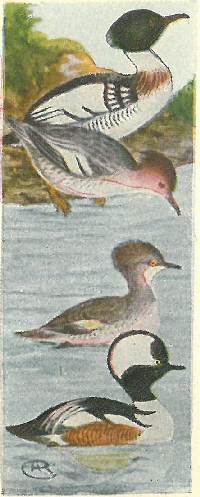
RED-BREASTED MERGANSER.
130. Mergus serrator. 22 inches.
This species is more abundant than the preceding, and is found commonly on our large ponds, lakes and rivers, more than on the coast. The male has the head, neck, and crest iridescent greenish black, breast brownish with black spots. The female has the head, neck and crown a deep chestnut color and the upper parts and tail a gray in place of the black found on the males.
Nest.—They lay from seven to ten eggs of a creamy buff color, making their nest of moss and grasses, placed under or in tufts of grass or in crevices of rocks; usually lining the nest with feathers (2.50 × 1.70).
Range.—Whole of North America, breeding from central United States to British America.
HOODED MERGANSER.
131. Lophodytes cucullatus. 17 inches.
Bill short, compared with the preceding. The large crest with which both sexes are adorned will easily distinguish this from the others. The male having the crest black with a large white patch, and that of the female plain brown.
Nest.—In holes of trees; 8 to 12 eggs, grayish white (2.15 × 1.70).
[44]
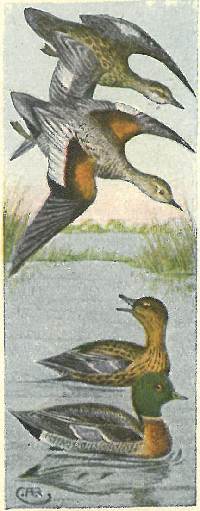
GADWALL.
135. Chaulelasmus streperus. 20 inches.
Male with chestnut wing coverts and white speculum; the female is similar but the back and wings are brownish-gray. As is usual with many of the ducks these do most of their feeding early in the morning or after dusk, and spend the greater part of the day in sleeping. They are one of the most noisy and active of the ducks.
Nest.—They nest on the ground among the reeds of marshes or in the long grass of bordering fields. They lay from 7 to 12 eggs of a creamy buff color (2.10 × 1.60).
Range.—Includes the whole of North America, breeds from British Columbia to southern California.
MALLARD.
132. Anas platyrhynchos. 23 inches.
These are regarded as one of the best table birds. They feed on mollusks and marine insects which they generally reach by tipping in shallow water.
Nest.—In close proximity to ponds or lakes, placing their nests in the tall grasses of which it is made and lined with feathers. Breed from Alaska to southern California (2.25 × 1.25).
[45]
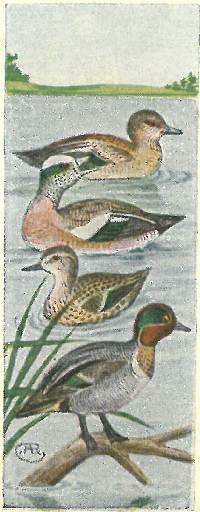
BALDPATE—AMERICAN WIDGEON.
137. Mareca Americana. 19 inches.
These are common and well-known birds throughout North America, where they are called by a great variety of names, most of which refer to the bald appearance of the top of the head, owing to the white feathers. They can usually be identified at a distance by the absence of any dark markings, and when in flight by the whiteness of the under parts.
Nest.—Made of grass and weeds neatly lined with feathers, on the ground or in marshes. 6 to 12 cream colored eggs are laid (2.15 × 1.20).
GREEN-WINGED TEAL.
139. Nettion carolinense. 14 inches.
These are the smallest of the Duck family, and are eagerly sought for by sportsmen, both for their beauty and the excellence of their flesh. The male may be easily identified by the reddish brown head and neck, with the large green patch behind each ear.
Nest.—On the ground under the shelter of tall grasses, it is made of weeds and grass and lined with feathers. 5 to 9 buffy eggs are laid (1.85 × 1.25). Breeds abundantly in California and Oregon.
[46]
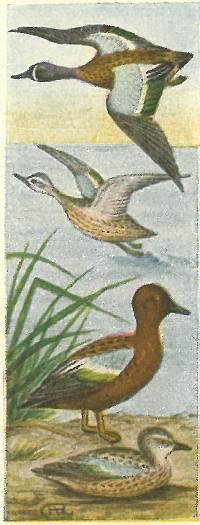
BLUE-WINGED TEAL.
140. Querquedula discors. 15 inches.
Male has the head a dark gray with white crescent in front of the eye; under parts chestnut heavily spotted with black; wing coverts bright blue. Female similar to female Green-wing, but has the blue wing coverts. In flight can be easily separated from the Green-wing by its darker under parts. Their flight is very rapid, and usually in compact lines. This is more common east of the Rockies than the other.
Nest.—Made of grass and nicely lined with feathers placed in the reeds bordering marshes. 8 to 12 creamy colored eggs are laid.
Range.—North America, breeding more abundantly than the former farther north in its range.
CINNAMON TEAL.
141. Querquedula cyanoptera. 16 inches.
This is the most abundant of the Teal family west of the Rockies. It is on the male a bright cinnamon color on the under parts; also the head and neck, being darkest near the bill and lightest on the back. Wing coverts blue; speculum green, divided by a line of white.
Nest.—Made same as above with 6 to 14 eggs (1.85 × 1.35).
[47]
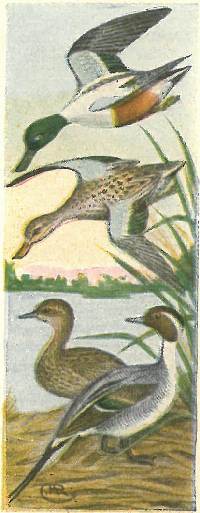
SHOVELLER.
142. Spatula clypeata. 20 inches.
Easily recognized in any plumage by the large broad bill, which is out of all proportion to the size of the bird. Head, neck and speculum dark green, under parts reddish brown, breast and back white, wing coverts blue. If it were not for the large ungainly bill, this duck would be classed as one of our most beautiful during the breeding season.
Nest.—It makes its nest on the ground in marshy places of grass, weeds and lined with feathers; laying from 6 to 10 grayish white eggs (2.10 × 1.50).
Range.—North America; breeding most abundant on the western coast from southern California to northwest Alaska.
PINTAIL.
143. Dafila acuta. 30 inches.
A long-necked duck and with a long pointed tail. Male with head and stripe down the back of neck, brownish; back and sides barred with white and black wavy lines.
Nest.—On the ground like the other ducks, well-lined with feathers generally placed near the water, laying from 6 to 12 eggs of a dull olive color (2.20 × 1.50).
Range.—North America.
[48]
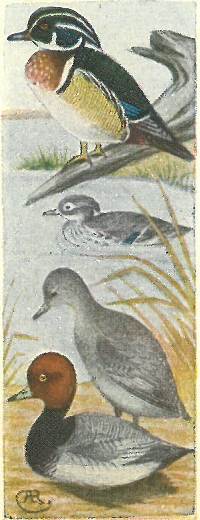
WOOD DUCK.
144. Aix sponsa. 19 inches.
This bird, without doubt, is by far the most beautiful of any of the duck family. Both the male and female have a long crest; that of the male of the most beautiful shades of blue and iridescent green colors, with stripes of white, the throat and under parts also white, breast chestnut with white arrow head marking, sides buff with black and white line markings.
Nest.—In the hollow of a tree, usually near the water. The birds are said to carry the young from the nest to the water in their bills. 6 to 10 eggs, buffy in color (2.25 × 1.60).
Range.—Temperate North America, breeding from Canada to the Gulf of Mexico.
REDHEAD.
146. Marila americana. 19 inches.
This bird, the preceding and the one following are considered as the best table birds of the duck family.
Nest.—Placed on the ground in marshes. Eggs 6 to 14 in number, buffy white in color (2.40 × 1.70).
Range.—North America, breeding from Minnesota northward.
[49]
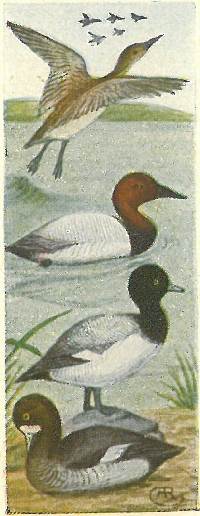
CANVAS-BACK.
147. Marila valisineria. 21 inches.
Differs from the Redhead in the shape of its black bill, its blackish forehead, very light colored back and red eyes, the Redhead having yellow eyes. Like the last species, these birds are excellent swimmers and divers, and secure their food from deeper water than many of the ducks. Their food consists of various fresh water plants and small fish; shell fish and frogs. These usually command the highest market price, and are much sought after by gunners.
Nest.—On the ground in marshes or sloughs, lined with grass and feathers. 6 to 10 eggs of a pale olive (2.40 × 1.70).
Range.—North America; breeding from central British Columbia south to Oregon and Minnesota.
SCAUP DUCK OR BLUE-BILL.
148. Marila marila. 18 inches.
This and the following are widely known as Blue-bills owing to the slaty blue color of that member. Head, neck and breast are black; speculum and under parts white, and eyes yellow.
Nest.—In marshes about many of the ponds in the interior of British Columbia. 6 to 10 eggs pale greenish gray (2.50 × 1.70).
[50]
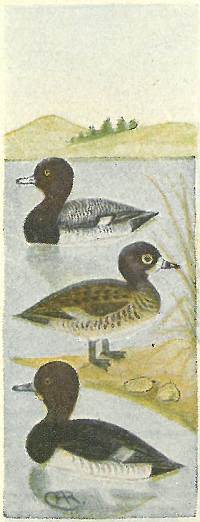
LESSER SCAUP DUCK.
149. Marila affinis. 17 inches.
Slightly smaller than the last, and with the head of the male glossed purple instead of green on the black. They are one of the most abundant migrants, and are one of the most active of the family, diving at the flash of a gun. The immense flocks generally keep out in the open waters of the lakes or rivers; where they feed by diving.
Nest.—Is made of marsh grasses and neatly lined with feathers from the breast of the female. 6 to 9 eggs of a pale gray color (2.25 × 1.55).
RING-NECKED DUCK.
150. Marila collaris. 17 inches.
In appearance and general habits this duck is much the same as the two preceding. Male with head, neck and breast black with purple shades, having a ring of chestnut about the neck, which at a little distance is not noticeable. Bill blackish, with a bluish band near the end; eye yellow.
Nest.—Same in every way as above, and general distribution the same, breeding from Oregon and Minnesota northward.
[51]
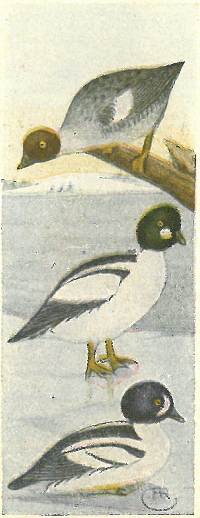
AMERICAN GOLDEN-EYE.
151. Clangula clangula americana. 20 inches.
These are handsome ducks, known as “Whistlers,” from the noise of their wings when flying, and also “Great-heads,” because of the puffy crest. The head is greenish black with a large round white spot in front of and a little below the eye. The rest of the plumage is black and white.
Nest.—Built in the hollows of trees near the water, lining the cavity with fine grasses, moss or leaves and then lining the nest with feathers, in which they place from 6 to 10 eggs of a grayish color (2.30 × 1.70).
Range.—North America, breeding from Alaska south to the most northern of United States. Winters to southern California and the Gulf Coast.
BARROW GOLDEN-EYE.
152. Clangula islandica. 20 inches.
Head of this species a bluish black, with a crescent white spot between the bill and eye; which is yellow as also is the preceding.
Nest.—The range and nesting habits are the same as above, possibly breeding a little farther south on the Pacific coast.
[52]
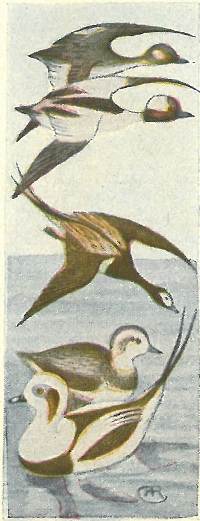
BUFFLE-HEAD.
153. Charitonetta albeola. 14 inches.
This handsome little duck is also known as “Butter-ball” and “Dipper-duck,” the latter name given to them on account of the ease with which they can disappear under the water. They are always on the alert and will dive at the flash of a gun. Head iridescent blue, green and purple, and with a large white patch extending from eye to eye, across the back of the puffy crest. Their flight is very rapid, and they can take wing from the water easier than the majority of ducks.
Nest.—In holes of tree stumps or in the banks along the sides of rivers, 8 to 14 eggs of a light grayish color (2.00 × 1.40).
OLD-SQUAW—LONG-TAILED DUCK.
154. Harelda hyemalis. 21 inches.
One of the very few ducks that change their plumage in summer and winter. Both sexes are marked similarly, but the female is somewhat duller and lacks the long tail feathers of the male. They are excellent swimmers and dive to great depths in search of their food.
Nest.—Generally concealed in the long grass near the water, made of grass and lined with feathers. 6 to 10 eggs (2.00 × 1.50).
[53]
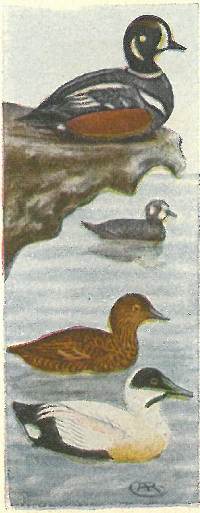
HARLEQUIN DUCK.
155. Histrionicus histrionicus. 17 inches.
A beautiful and most attractive bird as shown in the illustration. It is not the colors alone that make them so attractive, but the way the colors are placed. The white being in long stripes, crescents or large spots, with black, gray and chestnut. They are usually found only in pairs among the swiftly running streams, or in the winter in small flocks on the coasts.
Nest.—Is nicely woven of weeds and grasses and lined with down placed on the ground in crevices of rocks or sometimes in the hollow of a tree. 5 to 8 greenish buff eggs (2.30 × 1.60).
Range.—Northern North America, breeding from Alaska to the central part of California among the mountain streams.
PACIFIC EIDER.
161. Somateria v-nigra. 23 inches.
This bird is in plumage like the Northern Eider, except that it has a black V-shaped mark on the throat. They nest sparingly on the Aleutian Islands, but in great numbers farther north.
Nest.—They make their nests of seaweed and grass, warmly lining same with down from their breasts. 6 to 8 eggs (3.00 × 2.00).
[54]
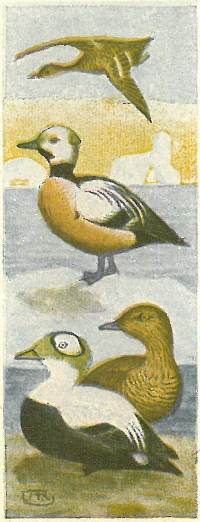
STELLER EIDER.
157. Polysticta stelleri. 18 inches.
A very beautiful species; head white, washed with greenish on the forehead and nape; chin, throat, neck, back, tail and crissum, black; under parts chestnut; wing coverts white, the long scapulars black and white.
Nest.—Are made of grasses and heavily lined with down. It breeds on the rocky coast and islands of Bering Sea. The six to nine eggs are pale olive green in color (2.25 × 1.60).
Range.—Arctic regions in America, chiefly on the Aleutian Islands and northwest coast of Alaska.
SPECTACLED EIDER.
158. Arctonetta fischeri. 21 inches.
This species is black on the under parts and mostly white above. The head is largely washed with sea green, leaving a large patch of white, narrowly bordered with black around each eye, thus resembling a pair of spectacles and giving it the name it has.
Nest.—Is made of seaweed, grass and lined with down from their breast; they are placed upon the ground under overhanging stones or clumps of grass. 5 to 9 eggs (2.70 × 1.85).
[55]
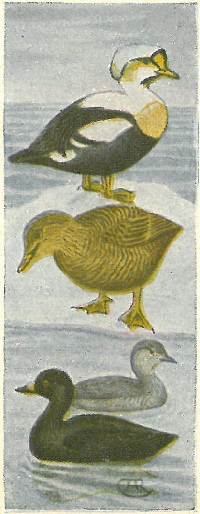
KING EIDER.
162. Somateria spectabilis. 23 inches.
This species is very different from any of the preceding, the crown being of an ashy blue, and the long scapulars black in place of the white of the others. It also has a broad V-shaped mark on the throat and a black crescent between the eye and bill. Like all of the other Eiders the females are mottled brown and black, the different species being very difficult to separate.
Nest.—These are usually a depression in the ground lined with the down from the breast, and contain from 6 to 10 eggs of a greenish color (3.00 × 2.00).
Range.—Northern North America, breeding along the coast of Siberia, Bering Sea and Arctic coast of America.
SCOTER.
163. Oidemia americana. 19 inches.
Scoters or “Coots,” as they are generally called, are Sea Ducks whose plumage is almost wholly black; base of the bill is yellow and orange. This species nest similar to the Eiders, concealing it under overhanging rocks or in tufts of grass. 6 to 10 eggs of a dull buff color (2.50 × 1.70).
[56]
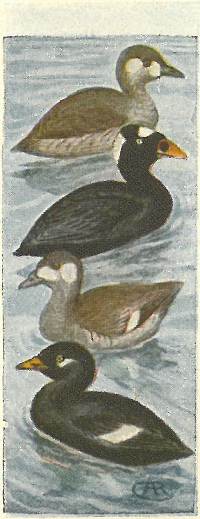
WHITE-WINGED SCOTER.
165. Oidemia deglandi. 22 inches.
This is the largest of the Scoters, and may easily be distinguished from the others by the white speculum on the wing and a white comet extending from the eye backwards. It also has a yellow eye.
This species often feeds in very deep water, like others of the family.
Nest.—They nest on the ground, generally in long grass or under low bushes, making a coarse nest of grasses, and sometimes twigs, lined with feathers; 6 to 8 pale buff eggs (2.75 × 1.70).
Range.—North America, breeding in British Columbia and Alaska.
SURF SCOTER.
166. Oidemia perspicillata. 20 inches.
The male of this species is entirely black, excepting a white spot on top of the head and another on the nape; eye white; bill red, white and yellow with a large black spot near the base. The female is a grayish brown, lighter below; also with a spot of dull white in front of the eye and the same in back.
[57]
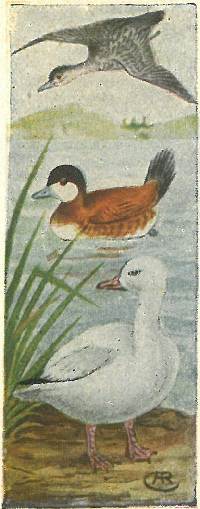
RUDDY DUCK.
167. Erismatura jamaicensis. 15 inches.
This species may always be recognized by the reddish brown upper parts; blackish head, with white cheeks and chin and under parts silvery white with grayish wash next to the ruddy. Bill is very stout and broad at the end, and the tail feathers are very stiff and pointed. Females have back, crown and sides grayish, cheeks showing traces of white as on the male. These ducks are very quick either in the water, on land, or in flight.
Nest.—They are usually made of grass and rushes and generally lined with down in which are placed their eggs to the number of from 8 to 12 of a grayish white color (2.40 × 1.75) unusually large for the size of the bird.
Range.—The whole of North America, breeding from Central British Columbia southward as far as Lower California.
SNOW GOOSE.
169. Chen hyperboreus hyperboreus. 26 inches.
Plumage entirely white with primaries tipped with black. This is the smallest species of the Snow Goose, the eastern variety being some ten inches longer, found in N. A., west of the Mississippi River.
[58]
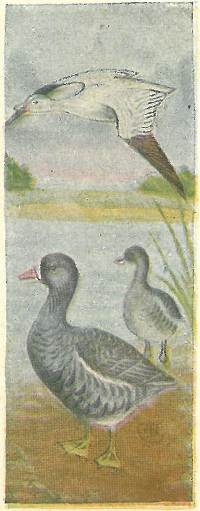
ROSS GOOSE.
170. Chen rossi. 23 inches.
This beautiful species, with its breeding range unknown, winters in California and as far south as the Gulf of Mexico, and is the smallest of the family.
WHITE-FRONTED GOOSE.
171a. Anser albifrons gambeli. 27 inches.
These birds may be recognized by their mottled plumage, dark head and white forehead; bill and feet orange. They are the most common on the western coast and large numbers of them are sold in the markets.
Their food consists mostly of vegetable matter, frogs, snails, and insects.
Nest.—These are placed upon the ground in a slight depression and made of dried grasses, feathers and down. Eggs are from four to nine in number, of a dull buff color (3.00 × 2.05).
Range.—Western and central North America, breeds on the Arctic coast south to the lower Yukon Valley, winters from British Columbia to southern California. During the spring flight immense flocks of these birds pass through Oregon and follow down the west coast.
[59]
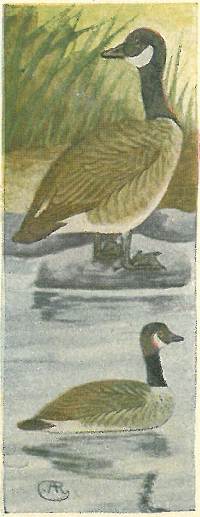
CANADA GOOSE.
172. Branta canadensis canadensis. 38 inches.
This species is the most widely known of the family, and is the most numerous. Its familiar “honk” has long been the signal of the coming spring, and the V-shaped formation in which the flocks migrate is always an object of interest to every one; large birds, with long necks outstretched, wings beating the air in unison, and all following the leadership of one bird in their journey over their invisible path.
Nest.—Of grasses and feathers lined with down, placed on the ground in marshes or near lakes or ponds; four to nine eggs of a buff or drab color are laid (3.50 × 2.50).
Range.—The whole of North America, breeding from northern United States northward, and wintering in the southern part of U. S. to Lower California.
CACKLING GOOSE.
172c. Branta canadensis minima. 24 inches.
This is a perfect miniature of the above, the difference being only in the size. It breeds in Alaska and along the Arctic coast and migrates in winter along the western coast south to southern California. Eggs are buff color; 4 to 9 (2.90 × 1.95).
[60]
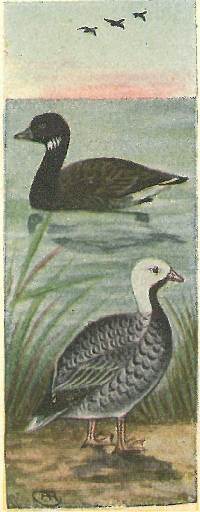
BLACK BRANT.
174. Branta nigricans. 26 inches.
Head, neck and breast black with a broad white collar nearly encircling the black neck, back a grayish brown; under parts mostly white. They are very inquisitive and easily come to decoys, and consequently large numbers of them are shot each year for the markets. They are a noisy bird especially when in large flocks. They get most of their food by tipping up in the shallow waters, where they feed upon the tender water plants and roots gathered from the bottom.
Nest.—A depression in the ground lined with grass and feathers and the down from their breasts; four to eight eggs are laid of a grayish color (2.80 × 1.75).
Range.—Western North America, breeding abundantly in northern Alaska and wintering on the Pacific coast from British Columbia to Lower California.
EMPEROR GOOSE.
176. Philacte canagica. 26 inches.
This handsome species may be known by the mottled or scaly appearance of the feathers; the head is white with a black chin and throat. Their 3 to 7 eggs are a dull buff color (3.10 × 2.15).
[61]
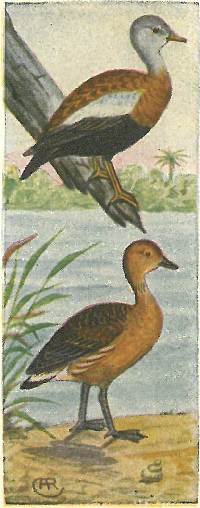
BLACK-BELLIED TREE-DUCK.
177. Dendrocygna autumnalis. 22 inches.
These odd-shaped ducks, with their long legs and neck, are very common in southern Texas and along the Rio Grande. They are not timid and are frequently caught and domesticated. They can walk and run gracefully, and feed in grain fields at considerable distance from the water. They usually raise two broods in a season, each brood having from ten to as many as twenty.
Nest.—They build their nests in hollow trees, oftentimes at a great distance from the water. The nest is lined with a few feathers and down. The eggs are a creamy white (2.05 × 1.50).
FULVOUS TREE-DUCK.
178. Dendrocygna bicolor. 22 inches.
In form this duck is much like the last, but in color is more of a rufous all over, being darkest on the upper parts. It has no white markings. It is fully as abundant as the preceding and is found farther north and west to the Pacific coast in southern California.
Nest.—Their nesting habits; their eggs and the size of them are identical with the former. As many as 32 eggs have been found in one nest, but these were probably laid by two birds.
[62]
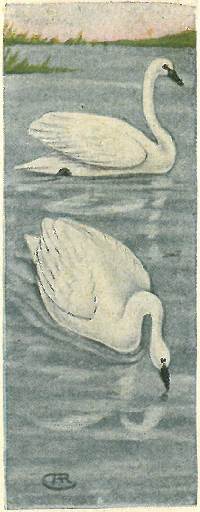
WHISTLING SWAN.
180. Olor columbianus. 58 inches.
These large birds are snow white, with the exception of their bill and feet, which are black. The nostril is situated nearer the end of the bill than it is to the eye. It is distinguished from the next by the small yellow spot on either side of the bill near its base.
Nest.—Are made of a large mass of rubbish, weeds, moss, grass, feathers and a few sticks, generally placed in marshy places near ponds or lakes. Three to six greenish or brownish buff eggs are laid (4.00 × 2.75).
Range.—North America, more common in the east, breeding in Alaska and the Arctic islands, wintering from British Columbia to the central part of California.
TRUMPETER SWAN.
181. Olor buccinator. 65 inches.
This magnificent bird, over five feet in length, with a spread of wing nearly ten feet, is found more in the interior than on the coast. Its plumage is the same as above, except that the bill is entirely black and the nostril is located nearer the eye. Their nesting habits are the same as above, the eggs averaging a trifle larger.
[63]
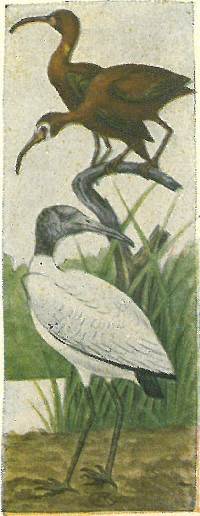
GLOSSY IBIS—Family Ibididæ.
186. Plegadis autumnalis. 25 inches.
The neck and body of this bird is a rich dark chestnut color, glossy with purplish on the head; wings and tail glossy greenish black; bill, legs and feet carmine red, bill much curved downward.
This bird is just the same as the White-faced Glossy Ibis which is occasionally found in southern California, with the exception that the latter has the forehead and feathers, bordering the bill, white.
Nest.—Strongly and compactly woven of dead rushes attached to living stalks, and well cupped. Eggs 3 or 4 deep greenish blue color (1.95 × 1.35).
WOOD IBIS—Family Ciconiæ.
188. Mycteria americana. 45 inches.
Head and neck unfeathered and covered with scales, which are pale bluish in color as are also the legs. Plumage entirely white except for the primaries and tail, which are glossy purplish black. This is the only true Stork which occurs in North America, and is found only in the southern part of California and the most southern states near the Gulf of Mexico. They lay 3 or 4 white eggs (2.75 × 1.75).
[64]
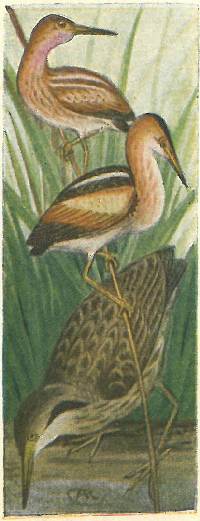
LEAST BITTERN.
191. Ixobrychus exilis. 13 inches.
This small variety of Bittern is very common in the southern portions of the United States. They are very quiet and sly birds, and their presence is often unsuspected when they are really quite abundant. Their nests are made of rushes woven about the upright stalks; 3 to 5 eggs, bluish white (1.20 × .90).
BITTERN—Family Herodii.
190. Botaurus lentiginosus. 28 inches.
These are birds of the bogs and marshes, and will keep concealed so closely that one may pass within a few feet of them and they not take flight. They are known by a variety of names, nearly all of which have reference to their “booming” sound while in the bogs. The most common name given them being “Stake Driver” and again “Thunder Pumper.” They are much variegated with brown and yellowish brown; adults with a long, broad black stripe on either side of the white throat; eye is yellow; bill and legs, greenish yellow.
Nest.—They build in swamps or marshy places, placing their nest usually in a tussock of grass on some bog surrounded by water. They lay from three to five brownish colored eggs (1.95 × 1.50).
[65]
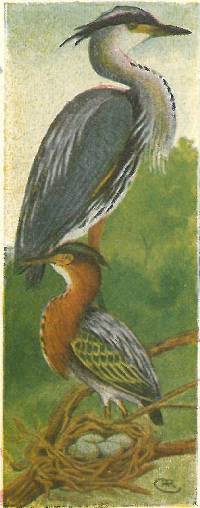
GREAT BLUE HERON.
194. Ardea herodias herodias. 48 inches.
This handsome Heron in general color in the adult stage is bluish gray, relieved by a black crest, and black primaries and patches on the sides and a white crown. Young birds are much duller colored and lack the crest of the old birds. It takes several years for them to obtain their perfect plumage. In the South they breed in large colonies, often in company with many other species.
Nest.—Is usually built of sticks, making a rude platform in the trees near swamps or wet woods. In some localities as many as 40 nests have been found in a single tree. Three to five eggs of a greenish blue color (2.50 × 1.50).
Range.—North America except the extreme northern part, breeds from British Columbia to southern Lower California.
GREEN HERON.
201. Butorides virescens virescens. 17 inches.
This is the smallest of our Herons, and is well known all over the country. In most sections of the country they will be found nesting, one of two pairs together, along the border of some swamp or stream; 3 to 5 pale greenish blue eggs (1.45 × 1.10).
[66]
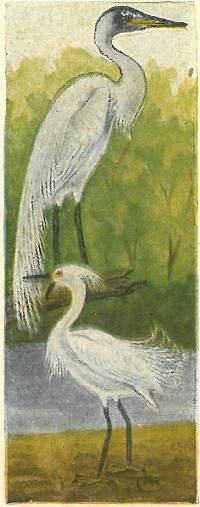
EGRET.
196. Herodias egretta. 41 inches.
This is our most beautiful pure white Heron; one which has persistently been hunted for its beautiful plumes for millinery purposes. They usually breed in colonies with several others of the Heron family.
Nest.—Is generally a frail platform in small trees or bushes over the water in which they lay three or four light bluish green colored eggs (2.25 × 1.45). Breeds in Oregon and California.
SNOWY EGRET.
197. Egretta candidissima. 24 inches.
Plumage white; in breeding season with numerous recurved plumes growing from the middle of the back; long crest of plumes on back of the head, and on the breast. Bill black, greenish at the base; legs black and feet yellow. With the protection which has been placed on these birds and the large breeding places in their favorite locations made into Government reservations we hope to see these become more abundant within a few years. Their nesting habits are the same as above, only the eggs are smaller (1.80 × 1.25).
[67]
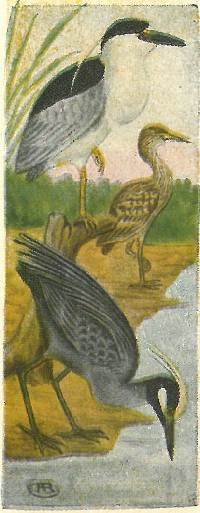
BLACK-CROWNED NIGHT HERON.
202. Nycticorax nycticorax nævius. 24 inches.
A well-known bird often called “quawk” from the note which it makes during its evening flights. They are usually found nesting in large colonies, while in some places a few secluded pairs nest; a favorite place being among pine trees on the edge of muddy ponds.
Nest.—Is built of sticks, with no lining, and placed in the higher limbs of the trees, not unusual to find a dozen or more in each tree. Eggs are pale greenish color (2.00 × 1.40).
YELLOW-CROWNED NIGHT HERON.
203. Nyctanassa violacea. 23 inches.
The head of this species is adorned with three long, rounded white plumes; in life these plumes are rarely separated, but are nested together so that they appear to be as one. On the back they also have long lanceolate gray plumes; crown and a comet shaped patch under the eye of a yellowish white. As dusk approaches, these birds start out from their roosting places, and, with slow, measured flaps, wing their way to their feeding grounds, which are fresh water bogs, their food consisting of insects, frogs, snails and small fish.
[68]
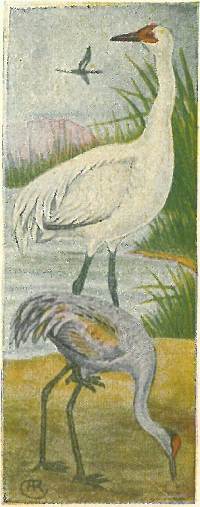
WHOOPING CRANE—Family Gruidæ.
204. Grus americana. 50 inches.
This is the largest of the family in America. The plumage of the adults is pure white, with black primaries; the bare parts of the head and face are carmine; eyes yellow; bill and feet black. These great birds are not uncommon on the prairies of the interior of America.
Nest.—Either upon the solid earth or marshy places on the bogs, the nest being very bulky, a mass of grass and weeds two or three feet in diameter. They lay two eggs of a brownish buff color blotched with shades of brown and gray (3.75 × 2.50).
Range.—Interior of North America, breeding to the Arctic regions and wintering to the Gulf states and southward.
LITTLE BROWN CRANE.
205. Grus canadensis. 36 inches.
This smaller variety is very much like the Sandhill Crane, but more brown, especially on the wings. When in flight this family always carry the neck fully extended, while the Herons draw the neck back between the wings. Unlike herons the young birds are born covered with down, and can run about as soon as they appear.
Range.—In northern Canada, where it breeds.
[69]
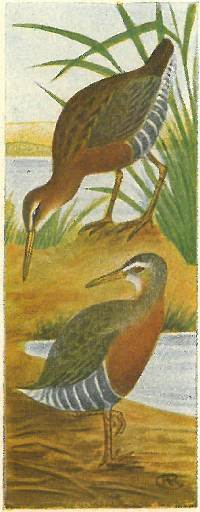
LIGHT-FOOTED RAIL.—Family Rallidæ.
210.1. Rallus levipes. 10 inches.
They inhabit the grassy marshes, and keep closely concealed if any danger is lurking about the locality where they are. They are very quick to get away in the tall grass if startled, and rarely take to the wing for protection. This species is found about the marshes in southern California.
CALIFORNIA CLAPPER RAIL.
210. Rallus obsoletus. 15 inches.
Color above olive-grayish, with no strong black markings; cinnamon colored breast. It is an abundant species on nearly all of the marshes along the coast. They are excellent runners, and are very difficult to start from the marsh grass in which they are concealed. Its nest is built on the ground on the higher parts of the marsh, where it is comparatively dry, building it of grass and strips of rushes.
Nest.—They lay from four to nine eggs of a light buff color, spotted and blotched with brown and lilac (1.75 × 1.25). The young of this family are born covered with a shining black down, and remain in the nest but a few hours.
[70]
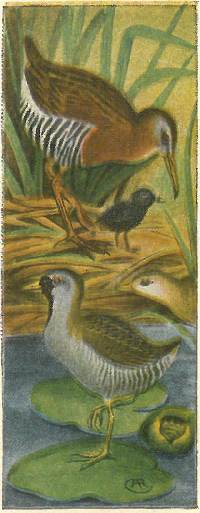
VIRGINIA RAIL.
212. Rallus virginianus. 10 inches.
Back handsomely patterned with black, olive-brown and gray; wing coverts grayish brown, neck and breast cinnamon brown, brightest on the breast. Sides sharply barred with black and white; chin and line over the eye white, side of head slaty color. Like others of this species, it is found in either the fresh or salt marshes, but more abundant in the fresh.
Nest.—Of grasses on the ground or in tufts of rushes; eggs of a creamy white spotted and blotched with brown and lilac; six to ten are the number laid (1.25 × .90).
Range.—North America, breeding from British Columbia to southern California and the Gulf of Mexico.
SORA RAIL.
214. Porzana carolina. 9 inches.
Adults with throat and face black; young with no black on the head. Unless disturbed they pass the greater part of the day in quiet and do most of their feeding after dusk, when their clucking notes may be heard all over the marshes.
Nest.—A rude structure of grass in the rushes; 6 to 16 eggs, buff colored with reddish-brown specks (1.25 × .90).
[71]
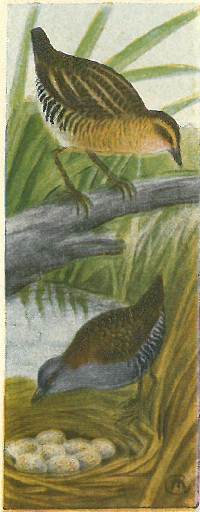
YELLOW RAIL.
215. Coturnicops noveboracensis. 7 inches.
This is a very handsome species, with plumage of glossy brown, yellowish buff; black and white barred side feathers. The back is blackish with the feathers edged with white. These small Rails are like field mice, hard to locate or obtain sight of when in the marsh grass. They object to flying unless forced to do so, and trust to their small size and their agility to get through rushes to avoid being seen.
Nest.—Is placed on the ground and made of grass woven and twisted together; the six to twelve eggs are rich buff color, specked with reddish brown in a wreath about the larger end (1.10 × .80).
Range.—Locally distributed in temperate America from southern California to British Columbia.
BLACK RAIL.
216. Creciscus coturniculus. 5 inches.
This is the smallest of the Rails. A dark slaty colored bird, with back a dark brown thickly spotted with white, gray feathers on the sides and flank spotted and barred with white.
Nest.—These are woven of strips of rushes and grass, nicely cupped to hold the eggs, which number from six to twelve; creamy white, specked all over with reddish brown (1.03 × .75).
[72]
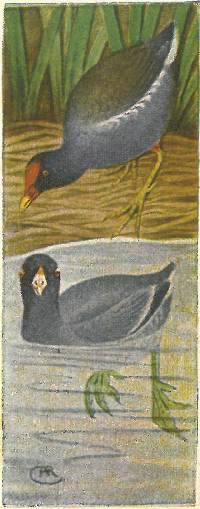
FLORIDA GALLINULE.
219. Gallinula galeata. 13 inches.
Plumage gray, changing to blackish about the head; the back a brownish color. Bill and frontal plate bright red, the former being tipped with yellow, legs greenish with a red ring about the top. The grayish side feathers tipped with white at the wing and lower ones with black. They have an almost endless variety of notes; all of them harsh and explosive.
Nest.—They build in colonies in the marshes, making their nests of rushes and grasses woven together and attached to stalks of rushes quite often over the water. They lay from six to ten eggs of a creamy buff color (1.60 × 1.15).
AMERICAN COOT.
221. Fulica americana. 15 inches.
Head and neck nearly black, shading into a gray over the whole bird. Toes lobed and scalloped along the edge; bill white with a blackish band near the tip; shield narrow and brownish, ending in a point.
Nest.—This is placed in the same localities as are the Rails, and they have the same retiring habits. Six to fifteen eggs of a grayish color finely specked all over with black or brown (1.80 × 1.30).
[73]
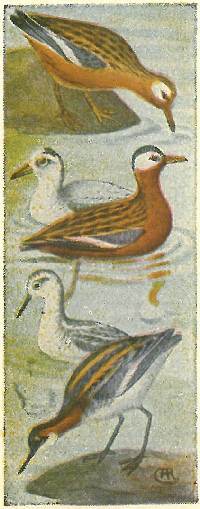
RED PHALAROPE.—Family Phalaropodidæ.
222. Phalaropus fulicarius. 8 inches.
These birds are very rarely seen in the United States in their breeding plumage; when they come in the fall nearly all have changed to their winter dress, and they retain this until after they leave us in the spring. In summer the under parts and neck a reddish brown; sides of the head white; top of head blackish; wings bluish gray crossed by a white band. The female is the larger and brighter plumaged bird.
Nest.—A hollow in the ground, lined with a few grasses. Three or four eggs greenish buff color, spotted and blotched with brown or black (1.20 × .80).
Range.—Northern hemisphere, breeding in the far north, and in winter migrating to middle portions of United States on both coasts.
NORTHERN PHALAROPE.
223. Lobipes lobatus. 8 inches.
This is a maritime species that nests in the far north, and appears on the coasts a short time during migration. Like the last they are expert swimmers, and pass most of their time when not breeding upon the surface of the water. They feed upon minute insects secured from beds of floating kelp. Nest and eggs similar to above.
[74]
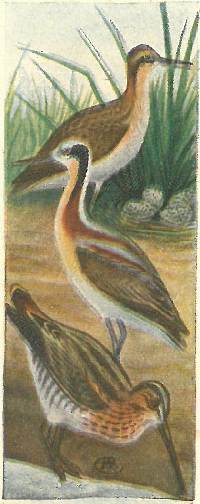
WILSON PHALAROPE.
224. Steganopus tricolor. 9 inches.
This is the most handsome species of the family, being of a very graceful form, of a grayish and white color, with a broad black stripe through the eye and down the side of the neck, where it changes gradually into a rich chestnut color. Bill is long and slender. It is a bird of the interior, and is only rarely met with on the coasts. It does not congregate in large flocks, as the two preceding, and is not as often seen upon the water, although a good swimmer.
Nest.—Made of grasses on the ground, usually concealed in a tuft of grass near the border of a marsh or pond. Three or four greenish-buff eggs with black markings (1.30 × .90).
Range.—Interior of North America, breeding from Canada to southern California and inland to Colorado and Dakota.
WILSON SNIPE.
230. Gallinago delicata. 11 inches.
This species to a great extent frequents the open marshy meadows with its winding brooks. They procure their food by boring in the muddy banks of the meadows, the tip of the bill being flexible.
Nest.—On grassy edge of ponds or marshes; 4 eggs (1.50 × 1.10).
[75]
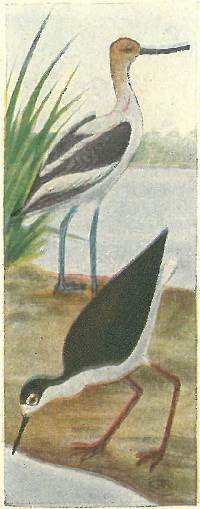
AVOCET—Family Recurvirostridæ.
225. Recurvirostra americana. 17 inches.
In summer the head and neck are pale cinnamon color; young birds and winter adults have the head and neck white. Feathers on the under part white and very thick and, duck-like, being impervious to water. Bill slender and recurved; feet webbed. Large patches of white on the wings, making them very conspicuous at all times. During the breeding season, if not molested, they become very tame.
Nest.—Is simply a lining of grass in a slight depression in the ground. They lay three or four eggs of a dark greenish or brownish buff color, spotted and blotched with brown and black (1.90 × 1.30).
BLACK-NECKED STILT.
226. Himantopus mexicanus. 15 inches.
Legs extremely long and bright red; neck and bill moderately long and slender. Male black and white as shown; female and young with back brownish. They are strong and swift upon the wing.
Nest.—On the ground, made of weeds, twigs and grass. Three or four eggs, greenish buff, with numerous markings of brown and black about the larger end.
[76]
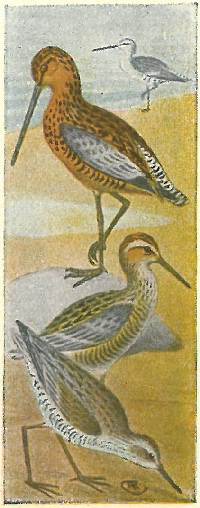
DOWITCHER.
231. Macrorhamphus griseus. 11 inches.
Bill very long like that of the Snipe. In summer these birds are reddish brown below; more or less specked with black on the breast and barred with black on the sides; above mottled with brown and black, lighter or even white on the rump, crossed with wavy lines of black.
In winter they are gray above and white below. By the gunners known as “Red-breasted Snipe” in the spring and summer and as “Graybacks” in the winter months.
Nest.—Placed in a slight hollow on the ground and lined with grass and leaves; three or four eggs of a greenish buff color boldly marked with brown most heavily about the larger end (1.75 × 1.15).
STILT SANDPIPER.
233. Micropalama himantopus. 9 inches.
These seem to be one of the least abundant of our shore birds, single individuals being found in flocks of other species rather than in flocks by themselves. Bill slender and only moderately long. In summer the entire under parts are a rusty white, closely barred with blackish. In winter they are gray above and white below.
[77]
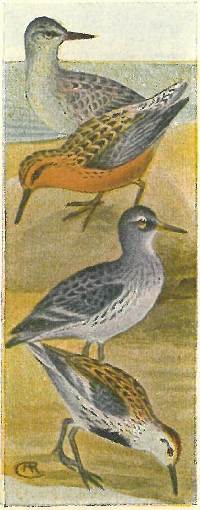
KNOT.
234. Tringa canutus. 11 inches.
This is one of the birds that feed along the ocean beaches, following out each wave as it rolls away and eagerly picking the small insects from the sand, and hurrying back to get clear from the next wave. Bill moderately long and quite stout; form more robust than most of the shore birds. Adults in summer mixed with brown and grayish above and of a reddish uniform brown below. In winter plain gray above and white below.
Nest.—They are supposed to breed in Arctic America, but no eggs are known as yet in any collections.
Range.—Arctic regions in summer; in winter south through the United States to South America.
PRIBILOF SANDPIPER.
235b. Arquatella maritima ptilocnemis. 9 inches.
This bird has the feathers of the upper parts edged with rusty and the under parts light, with a distinguishing patch of black on the breast. Three or four eggs of a grayish buff color, spotted and blotched with brown, laid on the ground in a depression with a light lining of grass (1.50 × 1.05).
[78]
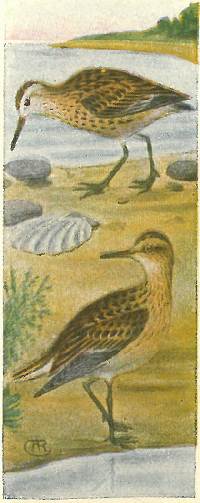
SHARP-TAILED SANDPIPER.
238. Pisobia aurita. 9 inches.
This species is blackish-brown above, feathers strongly edged with reddish brown, white below except the breast, which is reddish brown. Fairly common in summer on the coast of Alaska; in winter supposed to migrate south wholly on the Asiatic side of the Pacific.
PECTORAL SANDPIPER.
239. Pisobia maculata. 9 inches.
A peculiar species, having the power during the mating season of inflating the throat to a great extent. They have more the habits of the Snipe than do most of the Sandpipers, frequenting grassy meadows or marshes, and feeding along the muddy flats in place of the sandy beaches. They are very dark brown above, with much lighter brown edging the feathers, and are white below and on the throat; the breast is brownish. These are well-known birds, and are called by gunners “Grass Snipe” or “Jack Snipe” as a more common name.
Nest.—Are grass-lined depressions, in which are laid three or four grayish or greenish buff eggs (1.45 × 1.00).
Range.—Whole of North America, breeding in the Arctic regions and wintering south of the United States.
[79]
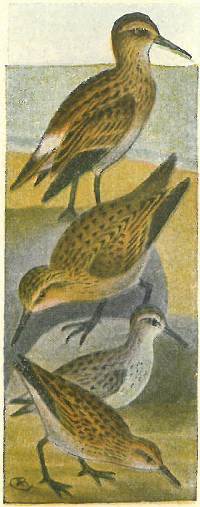
WHITE-RUMPED SANDPIPER.
240. Pisobia fuscicollis. 7 inches.
Back, wings and top of head brownish streaked with black, below white, but with the breast and throat streaked; primaries black; upper tail coverts white. Nesting habits the same as those of the majority of the family, breeding from Labrador northward, and wintering to Central America. Eggs 1.30 × .90.
BAIRD SANDPIPER.
241. Pisobia bairdi. 7½ inches.
Very similar to the preceding, but without the white rump, being of a blackish color instead.
Nest.—In the grass bordering fresh water ponds rather than near the seashore. Their nest is a slight hollow in the ground lined with grasses and usually concealed in a bunch of grass. Three to four eggs of a grayish white marked with shades of brown and lilac (1.30 × .90).
LEAST SANDPIPER.
242. Pisobia minutilla. 6 inches.
This is the smallest of the family; except for size they are the same in color and markings as the preceding. Found more on the seashore. Nesting habits and eggs are the same as the two above.
[80]
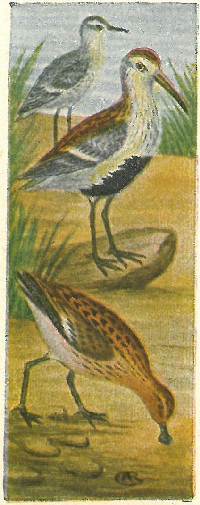
RED-BACKED SANDPIPER.
243a. Pelidna alpina sakhalina. 8 inches.
Bill slightly decurved and rather stout. Adults in summer, with the upper parts largely bright chestnut, spotted with black; belly black; head, throat, breast and sides strongly streaked with black.
In winter, dull brownish-gray above and white below, with the breast washed with grayish and slightly streaked with dusky. These small birds are found in large flocks both on the Atlantic and Pacific coasts, during migrations, but rarely in the interior. Their flight is very rapid and performed in compact flocks, that act as if governed by one impulse.
Nest.—Usually built on dry grassy knolls, a hollow in the earth being lined with a few dried grasses; they lay three or four eggs with a greenish or brownish buff color, heavily spotted and blotched with shades of brown and chestnut (1.40 × 1.00).
SPOONBILL SANDPIPER.
245. Eurynorhynchus pygmeus. 7 inches.
A very rare Asiatic species, which is taken in Alaska. It is a very peculiar bird, having the end of the bill broadened and flattened into a sort of spoon shape.
[81]
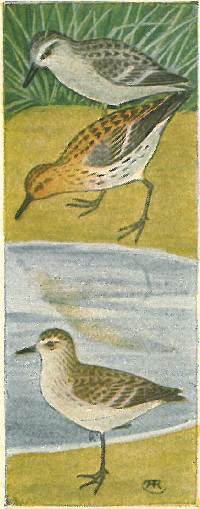
SANDERLING.
248. Calidris leucophæa. 8 inches.
These are a handsome and abundant species, found during migrations by thousands. On the coast it is one of the boldest of the shore birds, feeding on the edge of the outer beach, often under the combing crest of the incoming waves, retreating just as the wave breaks and is dashed to foam on the beach. They are usually very shy, and will not allow a close approach. Toes are short and stout; no hind toe. Adults in summer, variegated above with bright reddish brown and black. In winter, plain grayish above and white below.
Nest.—The three or four greenish buff eggs, spotted and blotched with brown, are laid in nests that differ but little from others of this family (1.45 × .90).
Range.—Found in all parts of North America, breeding within the Arctic Circle, and wintering to southern California.
WESTERN SANDPIPER.
247. Ereunetes mauri. 6½ inches.
Their appearance is very similar to the Least Sandpiper, but they are slightly larger and the feet are partially webbed. Their nesting habits are the same, and eggs are very much alike.
[82]
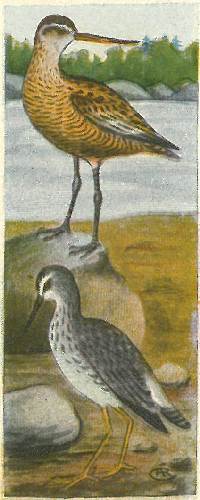
MARBLED GODWIT.
249. Limosa fedoa. 19 inches.
These large waders are found in moderately large flocks both in the interior and on the coast in the fall. They are like large Plovers, with long, slightly upcurved bills. Back, wings and tail rufous barred with black; rump white.
Nest.—Their eggs are laid upon the ground, sometimes there is no lining to the nest, and again a few grasses may be twisted about the depression. Three or four eggs with a ground color of grayish buff, sometimes quite dark, are blotched with dark brown (2.25 × 1.60).
GREATER YELLOW-LEGS.
254. Totanus melanoleucus. 14 inches.
Head and neck streaked with gray and white; back dark gray margined with white; rump white; tail barred black and white; primaries black; bill long and rather slender; legs long and yellow.
Nest.—The eggs are laid in a depression on the ground with very little attempt at nest building. Three or four eggs, grayish white, heavily blotched with shades of brown and lilac (1.65 × 1.25).
Range.—North America, breeding in the British Provinces.
[83]
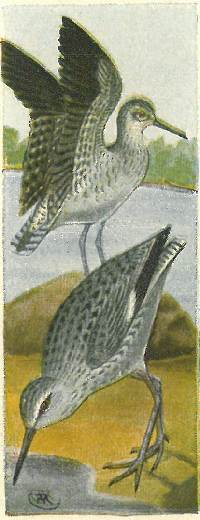
WESTERN SOLITARY SANDPIPER.
256a. Helodromas solitarius cinnamomeus. 9 inches.
A bird with a greenish gray back, barred with buff, and white below. These are almost always met with in pairs or singly, and are very rarely seen even in small flocks. They prefer small ponds or streams in wet woods or open meadows, rather than marshes, which are frequented by other species. As their name signifies they are inclined to be alone.
Nest.—Is usually well concealed in a clump of grass, near some small piece of water, and is only a slight hollow with very little lining of grasses. Three to five eggs are clay colored, spotted with dark shades of brown (1.30 × 1.00).
WESTERN WILLET.
258a. Catoptrophorus semipalmatus inoratus. 16 inches.
These breed in small colonies in the marshes in central Oregon and northern California, and are quite abundant in many localities. Upper parts a brownish gray, specked with black; under parts lighter gray, with lighter streaks of darker gray. Primaries white at the base and black on the outer end.
Nest.—Is placed upon the ground secreted in clumps of grass just barely out of reach of the water. Three or four eggs; buff blotched with umber (2.00 × 1.50).
[84]
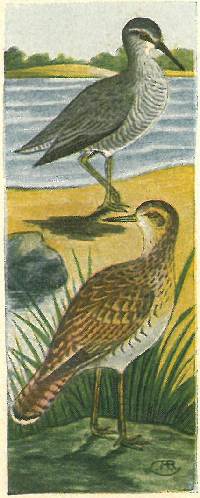
WANDERING TATTLER.
259. Heteractitis incanus. 11 inches.
This is a handsome species, uniform gray above and white below, closely barred (in summer) with blackish, the bars becoming broken on the throat, forming spots. In winter the under parts and throat are white. During the breeding season it is found on the coast and islands of Alaska, building its nest along the marshy shores and banks of streams.
UPLAND PLOVER—BARTRAMIAN SANDPIPER.
261. Bartramia longicauda. 12 inches.
This is a bird of the hillsides or prairies, seldom being found near the water, their food consisting more of insects and worms than is usual with others of the Plover or Sandpiper families. They are quite shy, and are one of the birds much hunted for the table. Upper parts almost black, with feathers all edged with buff, giving them a very mottled appearance. Black on top of the head; neck light buff, streaked with black; under parts white.
Nest.—Usually placed in fields of grass, in slight hollows of the ground, lined with grass. They are frequently made and eggs deposited in good mowing fields just about the time for cutting the grass, and many nests are destroyed at this time.
[85]
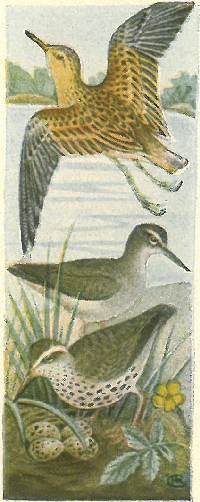
BUFF-BREASTED SANDPIPER.
262. Tryngites subruficollis. 8 inches.
Above, brownish black; each feather edged with buff; under parts buff, as are also the neck and head; blackish spots on the sides extending up the back of the neck and top of the head; primaries black.
Nest.—Placed in tufts of grass or in open fields; nest scantily lined with grass, in which three or four eggs, having a grayish white ground color, spotted with rich brown and chestnut, are placed.
Range.—Interior of North America, breeding from the Hudson Bay region to the Arctic coast. During migration, casual on the Pacific coast, and abundant in the interior, to South America.
SPOTTED SANDPIPER.
263. Actitis macularia. 8 inches.
This is one of the most abundant of all the shore birds, covering the whole United States. Its note, “peet-weet,” is a familiar sound to every bird observer. It has a peculiar habit of continually moving its tail up and down when at rest or when running along the shore, which has given it the name of “Teeter-tail” or “Tip-up.”
[86]
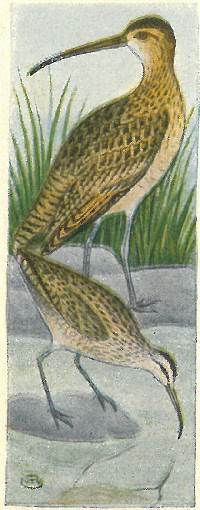
LONG-BILLED CURLEW.
264. Numenius americanus. 23 inches.
These birds, “Sickle-bills” as they are often called, are one of the largest of our shore birds. They are very conspicuous when in flight, or walking on the marshes or sandbars, their size appearing gigantic when in company with a flock of smaller birds, as sometimes happens. They feed both on the marshes and in shallow water, their food consisting of insects and small crustaceans, the latter which they pull from their holes in the sand with their long curved bill. They fly in compact flocks, evidently led by one leader, for they wheel and circle in perfect unison.
Nest.—Their nests are placed upon the ground, in meadows or on the prairies, and three or four eggs are laid of a greenish buff color, covered with numerous spots of dark brown (2.50 × 1.80).
HUDSONIAN CURLEW.
265. Numenius hudsonicus. 17 inches.
This is more grayish than the above; primaries black; a white stripe along the top of the head; is fairly common, winters in California. Three or four eggs, same color as above, only smaller (2.25 × 1.60).
[87]
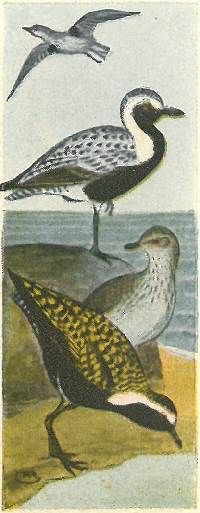
BLACK-BELLIED PLOVER—Family Charadriidæ.
270. Squatarola squatarola. 12 inches.
A remarkably handsome species when in their summer dress. The upper parts are largely white, with black spots and bars on the back, wings and tail; the sides of head, throat, breast and fore under parts are black. This species has a small hind toe. In winter they are brownish-black, somewhat mottled above; below, dull white. This is a very familiar bird to sportsmen, and is known better by the name of “Beetle-head” or “Bull-head.” They are very numerous in the fall.
Nest.—Is made as usual with the Plover, without much lining and placed in a tuft of grass; three or four eggs, brownish-buff in color and boldly marked with black (2.00 × 1.40).
GOLDEN PLOVER.
272. Charadrius dominicus. 10 inches.
The black of the under parts extends to the lower tail coverts, and the upper parts are variegated with black, golden yellow and white. These are often found in large flocks with the above, especially in the fall, during migration. The habits are also the same.
Nest.—Abundantly along the coast of the Arctic ocean, on the mainland and also on the islands. Three to four eggs (1.90 × 1.30).
[88]
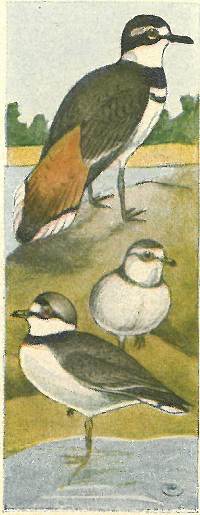
KILLDEER.
273. Oxyechus vociferus. 11 inches.
Next to the Spotted Sandpiper this is one of the most commonly known of the shore birds throughout the United States. They are very noisy, continually uttering their note of “Kil-deer—kil-deer,” from which they take their name. Rump and base of tail reddish brown; with a black line across the tail near the end; the two central feathers black to the end, the others white at the end. Breast crossed by two bands of black; a white forehead, and white streak back of the eye.
Nest.—Is placed on the open ground, with a few pieces of grass for lining. The four drab-colored eggs covered with dark brown spots are usually placed in the nest with the small ends in the center (1.50 × 1.10).
SEMIPALMATED PLOVER.
274. Ægialitis semipalmata. 7 inches.
The “ringed” plover is smaller than the above but one black band across the breast; black line from base of bill to eye and up over the top of the head. Forehead white. Abundant along the shores.
[89]
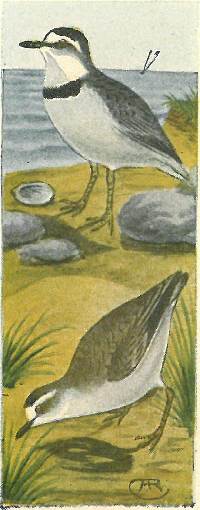
WILSON PLOVER.
280. Ochthodromus wilsonius. 7½ inches.
A very common Plover, which may be distinguished from the preceding by the much heavier bill; it has no black on top of the head and white on the forehead extends back behind the eye; the black band across the breast is heavier and does not extend around the back of the neck.
Nest.—Is usually placed on pebbly “shingle” or back in the marsh grass on the bare ground; eggs are olive gray, scratched all over with markings of brown and gray (1.40 × 1.05).
Range.—Abundant on the Gulf Coast and of Lower and southern California.
MOUNTAIN PLOVER.
281. Podasocys montanus. 9 inches.
A peculiar species, inhabiting even the driest portions of the western prairies and plains even at high altitudes. It is more quiet, and seems to be less aquatic than any of the Plovers, and is rarely found in the vicinity of the water.
Nest.—Placed on the bare ground in a simple hollow are four eggs, brownish gray, spotted and blotched with shades of brown (1.50 × 1.10).
[90]
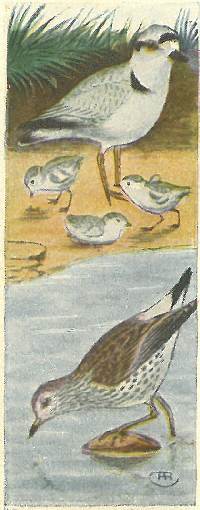
SNOWY PLOVER.
278. Ægialitis nivosa. 6½ inches.
This is the palest of the Plovers, and one of the smallest. A small black crescent-shaped patch on either side of the breast; a black spot under and back of the eye, and one also on top of the head. They are about the color of the dry sands of the beach, and the young when hatched and running about resemble a small bunch of cotton being blown about on the beach.
Nest.—A simple hollow in the sand placed just above high water, lined with pieces of broken shells. The eggs are about the color of the sand and it is almost impossible to see them a few feet away. Four eggs, clay colored; very lightly marked with fine dots (1.20 × .90).
Range.—Breeds along the Pacific coast of the United States. Winters from California to South America.
SURF-BIRD—Family Aphrizinæ.
282. Aphriza virgata. 10 inches.
This species, which is found on the Pacific coast, from Alaska to South America, seems to be the connecting link between the Plovers and Turnstones, having the habits of the latter combined with the bill of the former.
[91]
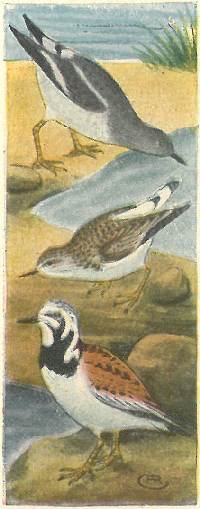
BLACK TURNSTONE.
284. Arenaria melanocephala. 9 inches.
Upper parts a greenish black color; head, neck, breast and throat black; a white spot in front of eye and on forehead; under parts white.
Nest.—In the far north on the shores of Alaska and more northern islands, laying their sets of four eggs in hollows with a few grasses for lining; the eggs are light gray, marked with various shades of brown and lilac (1.60 × 1.10).
Range.—Pacific coast of North America, wintering to Lower California.
RUDDY TURNSTONE.
283a. Arenaria interpres morinella. 10 inches.
This species has the upper parts variegated with reddish brown, black and white; the under parts are pure white with a wide black band across the breast, as in illustration. It has a peculiar, slightly upturned bill, which is used, as the name implies, for turning over pebbles and stones in their search for food. From the coloring the bird is known as “Calico-bird,” “Checkered Snipe,” etc.
Nest.—About Hudson Bay and Alaska; eggs laid in a hollow in the ground near water. Four eggs (1.65 × 1.10).
[92]
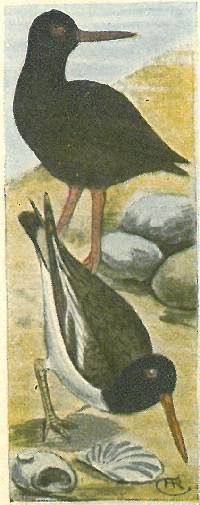
BLACK OYSTER-CATCHER—Family Hæmatopodidæ.
287. Hæmatopus bachmani. 17 inches.
The plumage on this bird is entirely black, with a bluish wash on the upper parts, and brownish black below. They are found upon the rocky coasts and islands more frequently than on the sandy beaches. Their eggs are laid upon the rocks or small pebbles with no attempt at nest building; three or four eggs are laid of an olive buff color spotted and blotched with shades of black and brown (2.20 × 1.55). Found on the Pacific coast of North America, from Lower California to Alaska.
FRAZAR OYSTER-CATCHER.
286.1. Hæmatopus frazari. 18 inches.
This is very similar to the American Oyster-catcher; possibly having the colors a little darker on the back. Bill very long, heavy, compressed, and thin and chisel-like at the tip. Bill and eyes red; legs flesh color; under parts white, and a white wing bar. These are large, awkward looking birds, and are not uncommon in their somewhat restricted range in Lower California.
[93]
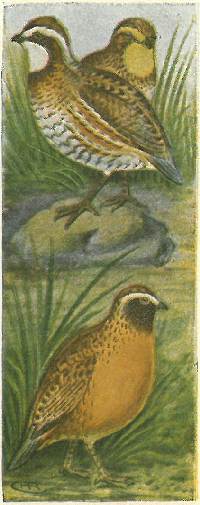
Order GALLINÆ.
BOB-WHITE—Family Odontophoridæ.
289. Colinus virginianus. 10 inches.
This is one of the most celebrated of the “Game Birds,” or best known. Throughout New England it has been so persistently hunted that it is getting to be a rare bird; it gets to be more common as we go south as far as Florida, and through the middle west. It has been introduced in many places on the Pacific coast, and now is fairly abundant in parts of California, Oregon and Washington. They feed largely upon insects and grain, and about the grain fields is where they are mostly found.
Nest.—These are built along the roadsides or beside stone walls or any dry locality affording good shelter. It is concealed in the tall grass or weeds, and arched over with grass. They lay from ten to twenty pure white eggs. Often two broods are reared in a season (1.20 × .95).
MASKED BOB-WHITE.
291. Colinus ridgwayi. 10 inches.
This handsome species is marked similar to the “Bob-white” on the upper parts, but has a black throat, and the rest of the under parts are of a reddish brown.
[94]
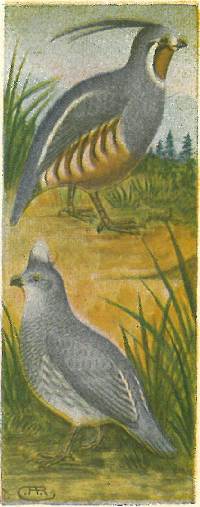
MOUNTAIN QUAIL.
292. Oreortyx picta. 11 inches.
This is a beautiful bird, with its long black crest and rich coloring. Upper parts an olive brown; the top of the head a rich gray. Throat and sides a beautiful shade of chestnut, with wide bands of black and white on the sides; breast a clear gray. Female very similar to the male, but not as brightly marked and with a shorter crest.
Nest.—These birds nest abundantly in the mountainous region of northern California, and in Oregon, and gradually increasing more northerly. The nest is placed on the ground under bush or grass for protection. Eight to fifteen eggs of a pale reddish buff color are laid (1.35 × 1.05).
SCALED QUAIL.
293. Callipepla squamata. 10 inches.
This is a bluish gray colored bird nearly all over. The feathers on the neck and under parts have narrow dark borders, which give the appearance of scales, from which the bird is given its name. They have a small tuft of whitish or buffy feathers on the top of the head.
It is especially abundant in the dry arid portions of its range, being found often many miles from water.
[95]
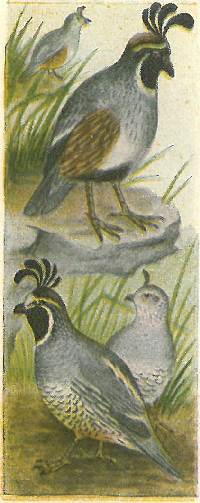
CALIFORNIA QUAIL.
294. Lophortyx californica. 10 inches.
With its crest of black feathers rising from the crown and curving forward so that the broadened ends hang directly over the bill, this is one of the most beautiful of the family. Upper parts a grayish brown, with buff stripes along the sides of the back; throat black, bordered with white; under parts white, with feathers edged with black, making a shell marking, and having a chestnut patch in the center; breast gray.
Nest.—Usually concealed in a brush pile or in the grass; ten to twenty eggs; of a creamy white or buffy ground color, handsomely blotched with brown of varying shades (1.20 × .93).
GAMBEL QUAIL.
295. Lophortyx gambeli. 10 inches.
Head with an elegant recurved crest of six or seven feathers; normally these are carried as one feather, so closely do they nest together, but when excited or during the mating season, they may separate the feathers, or sometimes curve them forward so as to touch the bill. Hindhead and sides chestnut, the sides with white or buff streaks; the middle of belly black.
[96]
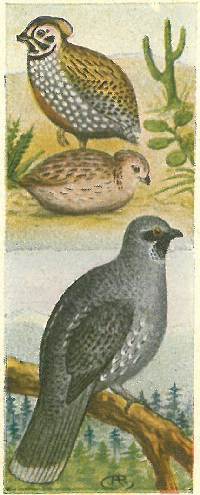
MEARNS QUAIL OR MASSENA PARTRIDGE.
296. Cyrtonyx montezumæ mearnsi. 9 inches.
These strange birds are very local in their distribution in the southwest, rare in some localities and quite abundant in others. They are so confiding in their disposition, that this, in connection with their clownish plumage, has given them the name of “Fool Quail.” The bill is very stout and compressed; crest large, puffy and flat. They frequent dry deserts, valleys or mountains to quite a high altitude. Their eggs, which are pure white, are not distinguishable with certainty from the Bob-white, possibly average a little longer (1.25 × .90).
DUSKY GROUSE—Family Tetraonidæ.
297. Dendragapus obscurus. 20 inches.
Plumage gray, white and black; darkest on the back and tail, which is margined with a light gray. Female smaller, browner and more barred above. Like the Ruffed Grouse, during the mating season, the males of this species strut with tail fully spread over the back, and head thrown back until it nearly touches the tail.
Nest.—They build their nests under fallen trees or at the base of standing ones. They lay from six to ten eggs of a buff color, spotted and blotched with shades of brown (2.00 × 1.40).
[97]
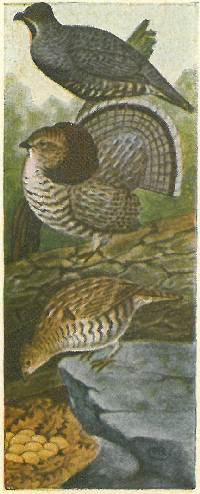
FRANKLIN GROUSE.
299. Canachites franklini. 16 inches.
Upper parts dark gray, marked with black bands, and narrower bands of lighter gray; tail feathers black to the tip, with the upper tail coverts strongly barred with white; tail having sixteen feathers. Like the preceding these birds are at home in the dense evergreen forests. It is very similar to the eastern bird, the Canada Grouse, and has the same local name given it from its unsuspicious nature, of “Fool-hen.”