BIRDS OF THE ROCKIES AND WEST TO THE PACIFIC (continued 2)
Reading edition
Nest.—Is placed on the ground under logs or low branching fir trees, and from eight to fifteen eggs are laid. These are brownish buff in color, spotted and blotched with rich brown (1.75 × 1.30).
CANADIAN RUFFED GROUSE.
300a. Bonasa umbellus togata. 17 inches.
A darker form of the eastern variety, the under parts being more heavily marked with brown. Found in the northern United States and southern British Provinces, from Maine and Nova Scotia west to Oregon and British Columbia. Eight to fourteen eggs of a brownish buff color (1.55 × 1.15).
[98]
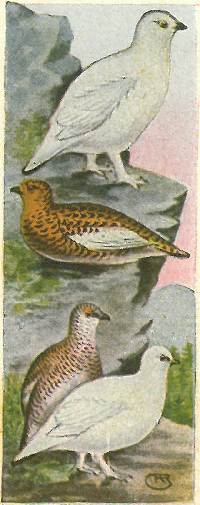
WILLOW PTARMIGAN.
301. Lagopus lagopus. 15 inches.
These are Grouse-like birds, feathered to the toe-nails; they have many changes of plumage, in winter being nearly pure white and in summer largely reddish brown, mottled and barred with black. This bird has a black tail and bill, the latter very stout. In the breeding plumage they have a bright red bare spot over the eye.
Nest.—They nest on the ground in hollows of the rocks filled with moss, lining the nest with leaves and grass, and sometimes a few feathers. They lay from six to sixteen eggs, which have a ground color of buff, heavily speckled, blotched and marbled with blackish brown (1.75 × 1.25).
ROCK PTARMIGAN.
302. Lagopus rupestris. 14 inches.
This is somewhat smaller than the above, with a smaller bill, and in summer the plumage is more gray than brown. Its nesting habits are the same as the others; eggs slightly smaller (1.70 × 1.20).
[99]
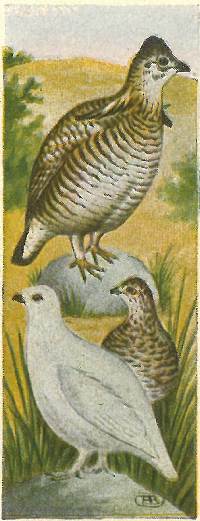
PRAIRIE HEN.
305. Tympanuchus americanus. 18 inches.
This is the most familiar game bird of the West; brownish above and white or buff below, with broad black bands on the back and finer black lines on the under parts. In place of the ruffs on a grouse are long tufts of rounded or square ended feathers, and below these a peculiar sac; bright orange in the breeding season, and capable of being inflated to the size of a small orange; this is done when the bird makes its familiar “booming” noise. They are one of the best “table birds,” being of good size and excellent flavor.
Nest.—In hollows on the ground in the cover of tufts of grass; they lay from eight to fifteen eggs, having a buffy ground color, finely sprinkled with brown spots (1.70 × 1.25).
WHITE-TAILED PTARMIGAN.
304. Lagopus leucurus. 13 inches.
Found in the higher ranges of the Rocky Mountains, from Colorado north to Alaska. This species differs from any of the preceding in having at all seasons of the year a white tail; it is also somewhat smaller than the Rock Ptarmigan. From six to twelve creamy white eggs; speckled and blotched with chestnut brown (1.70 × 1.15).
[100]
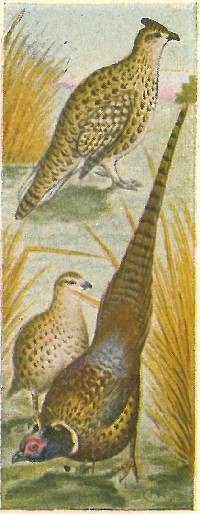
COLUMBIAN SHARP-TAILED GROUSE.
308a. Pediœcetes phasianellus columbianus. 18 inches.
These have no pinnates or ruffs on the neck, but the head is a little more crested than that of the Prairie Hen. The tail has the central feathers nearly two inches longer than the others, which are also graduated so that the outside ones are much the shortest, and are lighter in color than the central ones. It is not barred like the former, but the black markings on the back and under parts are more in the form of crescents. It is also much lighter in general color.
Nest.—They are usually concealed in thickets or tufts of grass and contain from six to fourteen eggs of a drab color, finely dotted all over with dark brown (1.70 × 1.25).
Range.—Northwestern United States and British Columbia to central Alaska.
RING-NECKED PHEASANT.
*** Phasianus torquatus. 32 inches.
The male of this beautiful Pheasant varies greatly in length according to the development of the tail, it sometimes being 36 inches long. These birds have been introduced in Oregon and Washington, as well as in many places in the East, and are becoming very abundant.
[101]
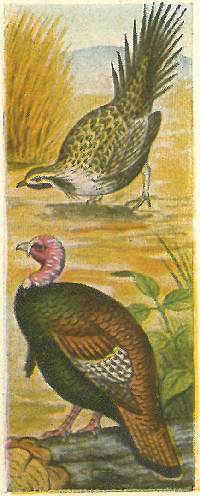
SAGE GROUSE.
309. Centrocercus urophasianus. 29 inches.
The female of this large and interesting Grouse differs from the male only in its smaller size and paler plumage. They are found in abundance on the dry sagebrush covered plains about the Rocky Mountains and to the westward. In fall and winter their food consists almost entirely of the leaves of the sagebrush, their flesh being unfit to eat at this season. In the mating season they indulge in the usual antics of the grouse family. They have the same peculiar sacs on the sides of the neck which they inflate so that the whole neck is a small orange colored balloon, at the same time spreading their long pointed tail feathers to their fullest extent, and strutting about after the manner of the turkey.
Nest.—Are shallow hollows in the ground, under, generally, a sagebush or some protection to cover the nest; six to twelve eggs of a greenish drab color, spotted with brown (2.15 × 1.50).
MERRIAM TURKEY.
310. Meleagris gallopavo merriami. 48 inches.
Female much duller and smaller than the male. The plumage is a coppery bronze color and their upper tail coverts are a dusty color with no white edges. 8 to 16 eggs; buff spotted with brownish (2.55 × 1.90).
[102]
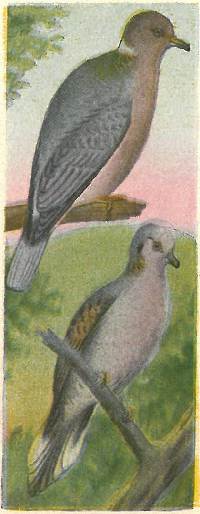
BAND-TAILED PIGEON—Family Columbidæ.
312. Columba fasciata. 16 inches.
This large species may be recognized by the white crescent on the back of the neck, by the broad gray band; bordered with black at the end of tail. Back, near the neck, brownish shading into a gray nearer the tail. Head and neck of iridescent colors, very changeable in different positions. They are very abundant on the mountain ranges, sometimes in immense flocks. They feed on grain, wild berries and acorns, and are found mostly in the oak and pine woods.
Nest.—Is a rude platform of sticks, just enough to barely keep in place the single white egg (rarely two) which they lay (1.55 × 1.10).
Range.—The Rocky Mountains and westward to the Pacific, from British Columbia to Mexico.
MOURNING DOVE.
316. Zenaidura macroura carolinensis. 12 inches.
Now that the Passenger Pigeon has become extinct, this is the only one to be found nearly all over the United States, and is common in the southern, central and western parts. Nests are placed at low elevations in the trees. Two white eggs (1.15 × .80).
[103]
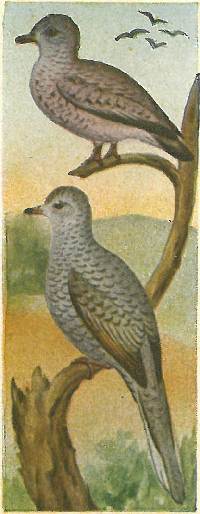
MEXICAN GROUND DOVE.
320a. Chæmepelia passerina pallescens. 7 inches.
Size very small; tail short and nearly square; back of head and under parts with breast a pinkish gray, with feathers tipped with black, giving a scaly appearance; back brownish gray, faintly barred; several black spots on wing coverts.
Nest.—Is made of weeds and twigs, placing the flat, frail structure either in bushes or on the ground, in which are placed the two white eggs (.85 × .65).
Range.—Border of the United States, from Texas and southern California southward.
INCA DOVE.
321. Scardafella inca. 8 inches.
Tail is longer than preceding and more rounded, and the outer feathers are tipped with white. Head, neck and whole body of a pinkish gray; scaled as is the former. These are very tame, and are to be met with in the roads, barnyards, and seem to be almost domesticated in their habits, even feeding with the poultry about the farmhouse.
Nest.—These are rather more compactly made, of twigs, rootlets and weeds, and placed near the ground in low bushes; only two white eggs are laid (.85 × .65). Not as common as the previous.
[104]
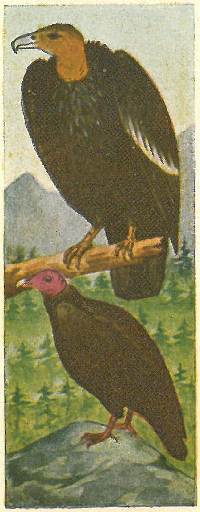
CALIFORNIA VULTURE—Family Cathartidæ.
324. Gymnogyps californianus. 50 inches.
The largest of the Vultures, with an extent of about ten feet, and weighing twenty pounds or more. Its plumage is blackish, with lengthened lanceolate feathers about the neck. Head and neck without feathers and of an orange color. Wing coverts grayish, tipped with white in adult birds. The birds are very rare in their restricted range, and becoming more so each year, owing to their being shot and the nests robbed. While the eggs are but rarely found, and obtained at great risk, they are not as unobtainable as many suppose.
Nest.—They lay but a single egg, placing it generally in caves or recesses of the rocks in the face of cliffs, hundreds of feet from the ground; ashy gray in color (4.45 × 2.55).
TURKEY VULTURE.
325. Cathartes aura septentrionalis. 30 inches.
The plumage of this bird is darkish brown, the naked head being red. It is very common in the southern and central portion of its range, where it may be seen about the streets and dooryards picking up any refuse that may be edible. It is a graceful bird upon the wing, and can readily be identified at a distance by the upturned ends of the wings.
[105]
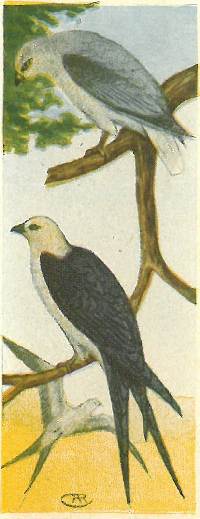
WHITE-TAILED KITE.
328. Elanus leucurus. 16 inches.
This species may be recognized by its light bluish gray mantle, black shoulders and white tail. It is a very active and graceful bird, feeding upon insects and reptiles, and small birds and mammals.
Nest.—Is usually made of sticks, weeds and leaves, placed well up in oaks or in willows beside the rivers. The eggs are creamy white, profusely blotched and spotted with reddish brown (1.65 × 1.25).
SWALLOW-TAIL KITE.
327. Elanoides forficatus. 24 inches.
This most beautiful Kite can never be mistaken for any other; its whole head, neck and under parts are snowy white, while the back, wings and tail are a glossy blue black, the tail being long and deeply forked; feet short, but stout; bill black, with cere and feet bluish gray.
Nest.—As a rule is placed in the tallest trees, live oaks or pines, and is made of twigs which it picks from the ground while in flight, lining the nest with rootlets and moss; two, or rarely three eggs, bluish white, spotted with brown (1.80 × 1.50).
[106]
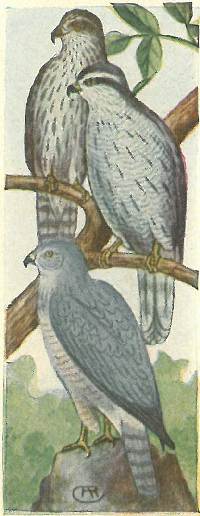
WESTERN GOSHAWK.
334a. Astur atricapillus striatulus. 22 inches.
This is one of the largest, strongest, and most audacious of the American hawks, frequently carrying off grouse and poultry, the latter often in the presence of the owner. It is a handsome bird, in the adult stage, and as graceful in flight as in appearance. Adults, above, bluish gray, darkest on the crown; a white line over the eye; below, white streaked with blackish brown; tail with four black bands, and very long.
Nest.—Is usually placed in the tallest trees in deep forests, and is made of sticks, lined with twigs, leaves and grass; three or four eggs, bluish white, usually unmarked (2.30 × 1.70).
MARSH HAWK.
331. Circus hudsonius. 19 inches.
The adults of this species are very light colored; bluish gray above and white beneath. Young birds of the first two years are brown, much lighter on the under parts. In both the old and young they have a large white patch at the base of the tail. Nest is made in and on swampy ground; four to seven eggs; white (1.80 × 1.40).
[107]
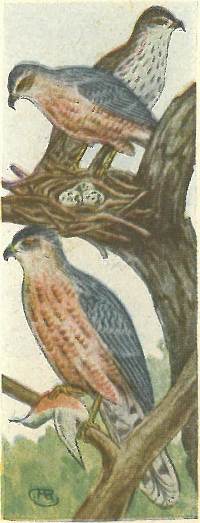
SHARP-SHINNED HAWK.
332. Accipiter velox. 12 inches.
This little hawk is one of the most active of the family, and from this fact it gets its name (Velox), meaning swift. It is often seen in woods, orchards or even in large cities, in which latter place it does good service in catching English sparrows. They also eat a great many mice and meadow moles. It is one of the most daring as well as beautiful of the small hawks.
Nest.—It is a rude and very frail platform of twigs and leaves placed in the crotch of a tree, usually at about fifteen feet from the ground, sometimes higher. Three white eggs, blotched with brown.
COOPER HAWK.
333. Accipiter cooperi. 16 inches.
The markings of this bird are the same as the preceding and its larger size is the only difference. Also like the last this is a very destructive species to the small birds and chickens. Their nests are placed in taller trees at higher elevation from the ground than the former, and built in the same manner. Three bluish white eggs unmarked or faintly specked with brown (1.90 × 1.45).
[108]
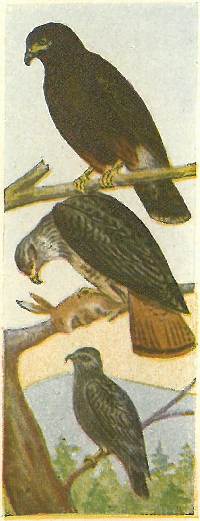
HARRIS HAWK.
335. Parabuteo unicinctus harrisi. 20 inches.
This is a peculiar dark colored species; black under parts; lighter on the back; shoulders, thigh and under-wing coverts reddish brown; tail coverts, base and end of tail white. Bare space in front of eye, except for stiff hair like bristles, yellow, as is also the cere.
Nest.—Are made of twigs and weeds and placed usually in low trees. The three or four eggs are a dull white in color, faintly specked with a few spots of brownish (2.10 × 1.65).
Range.—Southern California, Arizona, Texas and New Mexico.
WESTERN RED-TAIL.
337b. Buteo borealis calurus. 21 inches.
This bird varies greatly in its coloration; from the same as the eastern form to a sooty color above and below, with the dark red tail crossed by several bands, where the eastern bird has only one broad band.
Nest.—Placed for choice in evergreen trees at heights from the ground varying from 30 to 50 feet. Two to four eggs, white, usually spotted and blotched with different shades of brown (2.35 × 1.80).
[109]
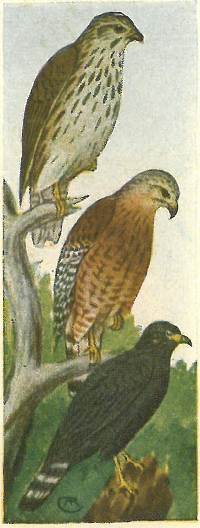
RED-BELLIED HAWK.
339b. Buteo lineatus elegans. 19 inches.
These birds are darker in color than the Red-shouldered Hawk of the East, and in their habits very much resemble the Red-tail; for food they prefer the large variety of small rodents and rarely disturb poultry or birds. The under parts are a bright reddish brown, without bars. They may be found covering the same territory as the Red-tail on the Pacific Coast west of the Rockies from British Columbia south to Lower California.
Nest.—Is made of twigs lined with rootlets and leaves and feathers. They lay from two to four eggs of a white color spotted and blotched all over with a light shade of brown and lilac (2.15 × 1.75).
ZONE-TAILED HAWK.
340. Buteo abbreviatus. 19 inches.
This whole bird is black, with the exception of the tail, which has three wide bands of white and the ends of the tail feathers tipped with white. Like others of the Buteo family they feed almost entirely on the small rodents, which they find in abundance in the marsh and prairie, or in the low brush. Eggs, two to four, white, faintly spotted with light chestnut (2.15 × 1.75).
[110]
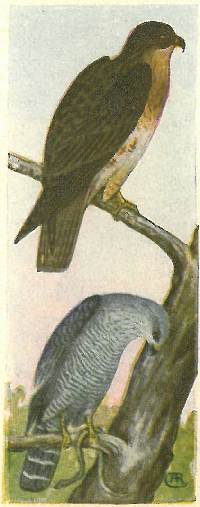
SWAINSON HAWK.
342. Buteo swainsoni. 20 inches.
Their plumage is extremely variable, having all of the intergradations from a sooty blackish to the typical bluish gray above, and white below, with breast a rich chestnut color. Their habits are nearly as variable as their plumage. In some localities they nest wholly in trees; in others upon the ground or on rocky ledges. They seem to prefer, though, the low open lands covered with sage bush, where their food consists almost wholly of the small rodents; squirrels; mice and grasshoppers, the latter being eaten in large numbers.
Nest.—Is made similar to others of the family, laying two to four white eggs, splashed and spotted with various shades of brown, usually more about the larger end (2.20 × 1.70).
Range.—Western North America, from the Mississippi to the Pacific Ocean, and Hudson Bay to southern California.
MEXICAN GOSHAWK.
346. Asturina plagiata. 17 inches.
Found in the southern borders of the United States and Mexico. These are graceful and active birds, feeding largely on small rodents.
[111]
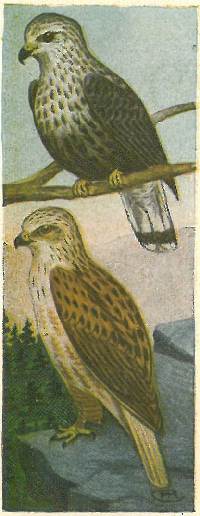
ROUGH-LEGGED HAWK.
347a. Archibuteo lagopus sancti-johannis. 21 inches.
These are large, heavily built birds of prey, specially characterized by the completely feathered legs to the feet; in the normal plumage has a whitish head, neck, breast and tail, the former being streaked and the latter barred with blackish; remainder of upper and under parts, blackish brown. Eyes brown. In the dark phase they are blackish brown, more or less mixed with rusty, the tail remaining the same as in the light plumage.
Nest.—Is made of sticks and smaller twigs, lined with leaves and moss, placed in trees or more often on ledges. They lay three or four bluish white eggs, boldly blotched with different shades of brown, oftener about the larger end (2.25 × 1.75).
FERRUGINOUS ROUGH-LEGGED HAWK.
348. Archibuteo ferrugineus. 23 inches.
These are very much more of a reddish brown color than the last, on the back; head and breast is whiter, with fewer markings. Legs the same, feathered to the feet. It is much more abundant than the last and is a western bird wholly, breeding on the ledges, where its eggs are laid.
[112]
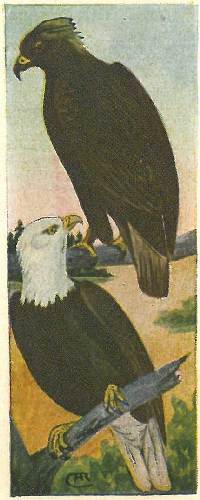
GOLDEN EAGLE.
349. Aquila chrysætos. 35 inches.
These may be distinguished from the Bald Eagle in all plumages by the completely feathered tarsus. Plumage blackish brown, adults having the lanceolate feathers on the neck of a golden brown color, and the tail more or less mixed with white.
Nest.—These are made up of large sticks, lined with smaller ones and moss, leaves and weeds, building quite a bulky affair. Their two or three eggs are very handsome, being white, speckled and spotted with shades of brown, and clouded with gray and lilac. They vary greatly in their markings (2.90 × 2.50).
Range.—West of the Mississippi, being most abundant in the Rockies and along the Pacific coast ranges.
BALD EAGLE.
352. Haliætus leucocephalus. 34 inches.
In the adult birds, the white head and tail will always identify them, but in the first and second year they are a brownish black, the second year showing traces of the white on head and tail. They are found throughout the United States. Their food consists largely of fish.
[113]
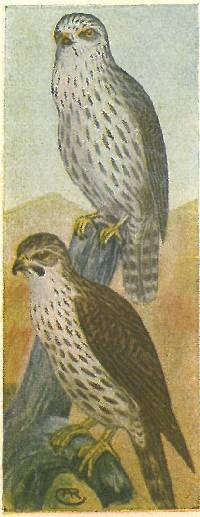
GRAY GYRFALCON.
354. Falco rusticolus. 23 inches.
These are birds of the Arctic regions and are rarely taken in the United States even in winter.
Nest.—They build upon the ledges of high cliffs, laying three or four eggs of a buffy color, marked with fine spots and blotches of shades of brown.
PRAIRIE FALCON.
355. Falco mexicanus. 18 inches.
This is quite an abundant species in some localities, and like the Duck Hawk in many ways is one of the most graceful, fearless and swiftest of the Falcons. A blackish patch on the sides of the throat; upper parts brownish with darker markings; under parts white, streaked with brown, much heavier on the flanks. Throat, clear white.
Nest.—Is generally placed on rocky ledges and cliffs, and sometimes in trees. Their nests are made of sticks lined with weeds and grass; three or four eggs of a reddish buff color, thickly blotched and sprinkled all over with reddish brown (2.05 × 1.60).
Range.—West of the Mississippi and from Dakota and Washington south to Mexico. Their food is mostly rodents secured on the prairies.
[114]
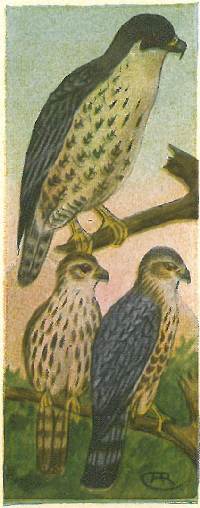
DUCK HAWK.
356a. Falco peregrinus anatum. 17 inches.
A most beautiful species, with a black patch, or moustache, on side of the throat from the bill; head and upper parts bluish gray with darker markings; under parts white, tinged with huffy on the lower part, and lightly barred with black, with the throat pure white. Their food consists mostly of ducks, which they always take while on the wing. It breeds abundantly on the Pacific coast and in some parts of Dakota on the rocky ledges.
Nest.—They are not home builders as a general thing, but lay their three or four eggs on the gravel or bare rocks of ledges or cliffs. The eggs are a reddish buff color, completely blotched and dotted with reddish brown. These are the darkest, brightest and the most beautiful of the Falcon eggs (2.05 × 1.55).
PIGEON HAWK.
357. Falco columbarius. 12 inches.
A small Falcon, similar to the Sharp-shinned Hawk, but a much darker and stouter built bird. It is a daring little fellow, and will attack birds much larger than itself. It feeds on small birds and mice.
[115]
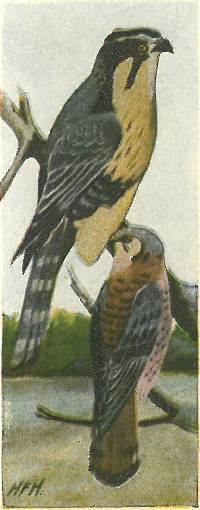
APLOMADO FALCON.
359. Falco fusco-cœrulescens. 14 inches.
Found in some of the more southerly states, Texas, Arizona, New Mexico and Central America. In habits it is very much the same as the following, getting its supply of food, consisting of small birds and insects, on the plains covered with the cactus and yucca, in which they build their nest of twigs, lining it with roots and grass, in which they lay three or four eggs, creamy white, strongly marked with shades of brown (1.75 × 1.30).
DESERT SPARROW HAWK.
360a. Falco sparverius phalæna. 11 inches.
This is next to the smallest of the Falcons, the Eastern form being a trifle smaller. They cannot be mistaken for any other species, because of their bright color and markings as illustrated. Their flight will almost of a certainty identify them at a long distance, a few rapid wing beats, then a short sail, alternately. Their food consists of grasshoppers, mice and an occasional small bird.
Nest.—Is built in the cavity of some tree, either in the woods or open field. The eggs are placed on the decayed wood without any lining.
[116]
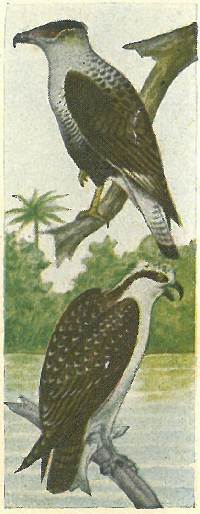
AUDUBON CARACARA.
362. Polyborus cheriway. 22 inches.
A strongly marked bird; black wings, back and under parts with neck pure white, excepting on the lower part, with many short bar-like markings. Upper part of head black, with feathers elongated, making a slight crest.
Nest.—Is a bulky affair, shabbily built of sticks, weeds and grass, piled into a promiscuous heap, generally located in bushes or low trees. Two or three eggs; brownish buff, with spots and patches of shades of brown nearly covering the under color. They vary very much in the coloration and markings from light to dark.
Range.—Southern borders of the United States.
AMERICAN OSPREY; FISH HAWK.
364. Pandion haliætus carolinensis. 23 inches.
Probably no fisherman in the United States is so well known as is this bird. It is one of the pleasantest sights along the coast to watch a number of these great birds as they soar at an elevation above the water, watching for a fish to come near the surface, when, with folded wings, the bird speeds downward and plunges into the water, rarely missing his prey. Three or four creamy white eggs, with spots of brown of different shades (2.40 × 1.80).
[117]
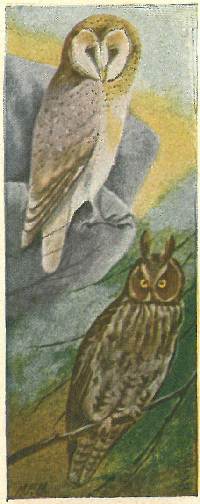
BARN OWL—Family Aluconidæ.
365. Aluco pratincola. 18 inches.
This is one of the lightest colored of the owls; it has a long peculiarly hooded face, from which it gets the name of “Monkey-faced Owl.” Its plumage is yellowish buff, with black spots over the breast and under parts.
Nest.—In most any situation out of sight, such as hollows in old trees, or in ledges, in barns or bell towers. It lays from four to six white eggs (1.70 × 1.30).
Range.—North America, but most common in the Gulf States and on the western coast.
LONG-EARED OWL—Family Strigidæ.
366. Asio wilsonianus. 15 inches.
This species has unusually long ear tufts, from which it is given its name; the face is brown, the under parts white and buff, with streaks and bars of brownish black; back is brown, with almost black markings; wings and tail brown; barred with black.
Nest.—Usually in trees, frequently using a crow’s nest instead of building for themselves. They are in great disfavor with the crows. They lay from four to seven pure white eggs (1.55 × 1.35).
[118]
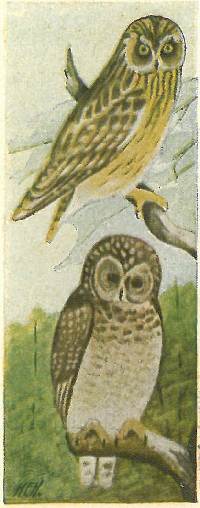
SHORT-EARED OWL.
367. Asio flammeus. 16 inches.
About the same size as the preceding, but readily identified from it by the short ear tufts and rounded head, and also lighter color. It is streaked on under parts and not barred. Tail is barred. Their flight is perfectly silent, which aids them in securing their prey of field mice and moles, which they usually get without stopping in their flight, just swooping down, and extending their long legs, armed with wicked little sharp claws, and it is all over with the little rodent, he being carried to a nearby stump and devoured, fur, bones and all.
Nest.—Is usually built upon the ground in marshy places, sometimes of grass and weeds, under some bush or near or under some log or stump. Four to seven pure white eggs (1.55 × 1.25).
SPOTTED OWL.
369. Strix occidentalis. 20 inches.
This is very similar to the Barred Owl of the Eastern and Southern States, but spotted, instead of barred, on the back of the head and neck, and much more extensively barred on the under parts.
[119]
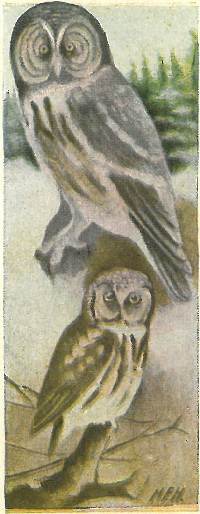
GREAT GRAY OWL.
370. Scotiaptex nebulosa. 27 inches.
This owl in appearance is the largest of the family, but it is mostly in feathers, which are long and very fluffy. They do not weigh nearly as much as either the Horned or Snowy Owls. The plumage is dark gray above, mottled with white, and below is white with heavy streaks of brown. The facial disc is very large, and the eyes are small and yellow, while in the Barred Owl of similar appearance the face is much smaller, the eyes are larger and are bluish black in color.
Nest.—Is made of sticks and twigs, lined with leaves and moss. Two to four eggs; pure white (2.15 × 1.70).
Range.—In winter they are found quite abundantly in Minnesota and North Dakota, and occasionally in northern California and Oregon.
RICHARDSON OWL.
371. Cryptoglaux funerea richardsoni. 10 inches.
This bird is dark grayish and white, without ear tufts. Back and wings brownish, spotted with white; facial disc very light, with faint gray lines, and under parts light gray with brown streaks.
[120]
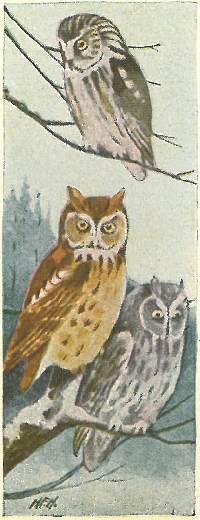
SAW-WHET OWL.
372. Cryptoglaux acadica. 8 inches.
This species is similar to the preceding, but is smaller and more of a brownish color all over. It has no ear tufts. They are very quiet little birds, nocturnal in their habits, and cannot see well in the strong light, a fact that has allowed them to be captured by hand from their roosting places in the trees.
Nest.—They will usually select the hole of a woodpecker, in which to lay their four white eggs. Their eggs are laid and the young are hatched and out of the nests before the breeding time for woodpeckers, so that the same home may be occupied later by another family (1.20 × 1.00).
Range.—North America, breeding in the northern part of the United States and British Columbia, and wintering to southern California.
SCREECH OWL.
373. Otus asio asio. 10 inches.
These may be found in two color phases, the red or gray with black and white markings. It is frequently called the “Little Horned Owl,” because of its ear tufts. They are easily tamed and become great pets, and about a barn are as good as a cat for catching mice.
[121]
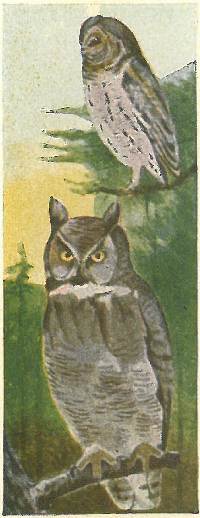
FLAMULATED SCREECH OWL.
374. Otus flammeolus. 9 inches.
This is a trifle smaller than the two preceding, has shorter ear tufts, and the plumage is much streaked and edged with rusty. The toes are unfeathered to the base. The number of eggs and nesting habits are practically the same as the preceding, as are also the five or six sub-species between this and the last, all of which occur in the southwestern part of the United States.
WESTERN HORNED OWL.
375a. Bubo virginianus pallescens. 22 inches.
These large birds are the most fierce and destructive of the family. They are powerfully built, and their size and strength allow them to attack and secure some of the larger animals, such as skunks, woodchucks, rabbits, grouse and poultry. They seem to be especially fond of skunks, and more than half of them that are killed will have unmistakable evidence of their recent and close association with this animal.
Nest.—Is usually in some large deserted nest, or in hollow cavities of large trees. Three or four white eggs, almost round (2.20 × 1.85).
[122]
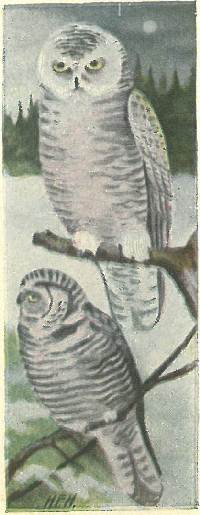
SNOWY OWL.
376. Nyctea nyctea. 25 inches.
Like the Horned Owls they are strong, fearless and rapacious birds, feeding upon hares, squirrels and smaller mammals, as well as Grouse, Ptarmigan and many of the smaller birds. They are locally abundant in the far north, preferring low marshy land to the more heavily timbered districts.
Nest.—Placed on the ground, on mossy hummocks on the dry portions of marshes, made of moss with a few feathers. Three to eight eggs, pure white, and the shell very smooth (2.25 × 1.75).
Range.—Arctic Regions of North America, and in winter casually as far south as California.
HAWK OWL.
377a. Surnia ulula caparoch. 15 inches.
This owl, mottled and barred, gray and black, might readily be taken for a Hawk, because of his hawk-like appearance, and long rounded tail. They are very active birds especially in the day time, and they do most of their hunting in daylight rather than at night. Their food consists of small rodents and many small birds.
Nest.—In hollow trees or upon the ground. Four to eight white eggs (1.50 × 1.20).
[123]
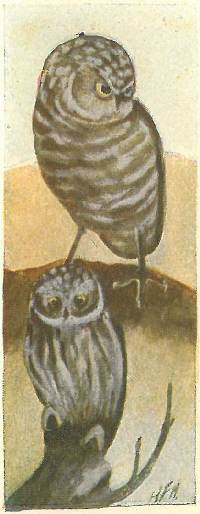
BURROWING OWL.
378. Speotyto cunicularia hypogæa. 10 inches.
These birds are wholly different in plumage, form and habits from any other American Owls. Easily identified by their long, slender and scantily feathered legs. They are brownish above, spotted with white, and under parts are white spotted with brown. Tail dark brown, with five white bars across it. They are an abundant and useful species west of the Mississippi. They live in the same regions as the Prairie Dogs are found, and use the deserted burrows of these animals, or take them by force, for they are more than a match for these curious animals.
Nest.—Generally in quite large communities in burrows in the ground, usually lining them with grass and feathers. They may often be seen sitting at the opening of their burrows during the day time. Six to ten white eggs are laid (1.25 × 1.00).
PYGMY OWL.
379. Glaucidium gnoma. 7 inches.
These interesting little Owls, which are found in the Rocky Mountains, westward from British Columbia to Mexico, feed in the day time upon insects, mice and occasionally small birds. They are to be seen in the wooded districts. Nest in holes of trees. Four eggs (1.00 × .90).
[124]
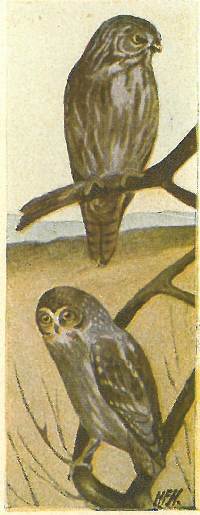
FERRUGINOUS PYGMY OWL.
380. Glaucidium phalænoides. 7 inches.
This is very similar to the last, but in color is much more rufous on the upper parts, and the tail is of a bright chestnut color crossed by several bands of black. They live largely on the small rodents and birds which they secure during the daytime. They nest in hollow cavities of trees, from ten to forty feet from the ground, laying four glossy white eggs (1.10 × .90).
ELF OWL.
381. Micropallas whitneyi. 6 inches.
This odd little bird is the smallest of the family found in America. In plumage it may be described as being very like a small Screech Owl, without the ear tufts, only with the pattern of the markings much finer. They are quite abundant in central Mexico and in southern Arizona, where they build their nests in deserted Woodpecker holes, or perhaps more frequently in the giant cactus. It differs from the preceding in being a bird of the night, rarely flying in daylight. They feed almost exclusively upon insects, and rarely a mole or field mouse. They lay from three to five white eggs, having a slight gloss (1.02 × .90).
[125]
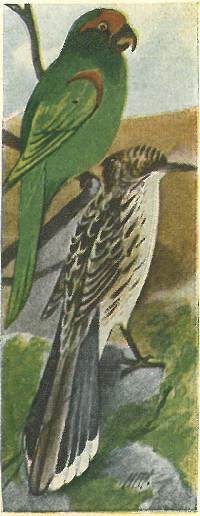
THICK-BILLED PARROT—Family Psittacidæ.
382.1. Rhynchopsitta pachyrhyncha. 16 inches.
A Mexican bird, casually found north to the Mexican borders of the United States. It has a heavy, thick bill; black; and the plumage is entirely green, except for the deep red forehead and wings at the shoulder; under-coverts of wings yellowish. Their eggs are white and laid in natural cavities of trees in the deep forests.
Order—COCCYGES.
ROADRUNNER.
385. Geococcyx californicus. 22 inches.
This curious species is known as the “Chaparral Cock,” “Ground Cuckoo,” “Snake Killer,” etc. Its upper parts are a glossy greenish brown, each feather being edged or fringed with white. The tail is very long, broad and graduated, the central feathers being much the longest; the feathers being tipped with white. They are noted for their swiftness of foot, getting over the ground at an astonishing rate, aided by their outstretched wings and spread tail, which act as aeroplanes. Their legs are long, and they have two toes in front and two back. Their food consists of caterpillars, lizards and small snakes.
[126]
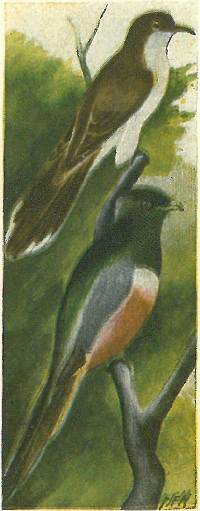
CALIFORNIA CUCKOO.
387a. Coccyzus americanus occidentalis. 13 inches.
This bird is the same as the eastern variety, except being a little larger and the bill more stout. It may be distinguished by its blackish, long tail, tipped with white, and its yellow under-bill. Reddish brown patch on the wings.
Nest.—Is made of twigs loosely put together, and lined with grass, or shreds of grape vine bark. The nests are generally very shabbily built and so nearly flat on top that the eggs will frequently roll out. They are located near the ground in low bushes or trees; three or four eggs are deposited at intervals of several days, and frequently young birds and eggs are found in the nest at the same time. Like the Flicker this bird will continue laying if one egg is removed at a time, and as many as twelve have been taken from the same nest by this means. Eggs are a pale greenish blue (1.20 × .90).
COPPERY-TAILED TROGAN—Family Trogonidæ.
389. Trogon ambiguus. 12 inches.
This is the only member of this family of beautiful birds that reaches our borders. They nest in cavities of trees, usually in Woodpecker holes. Three or four white eggs (1.10 × .85).
[127]
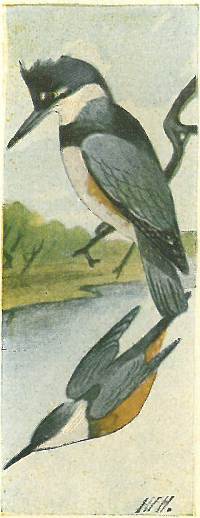
BELTED KINGFISHER—Family Alcedinidæ.
390. Ceryle alcyon. 13 inches.
The rattling note of this well known bird is familiar in almost all localities in the neighborhood of ponds or rivers where small fish are common, throughout North America. Their food consists almost entirely of small fish, which they catch by plunging upon from high in the air, where they will hover over the water similar to the Osprey, or they will spend their time sitting upon an overhanging limb, and, when a fish is seen, drop from that upon the fish, usually taking it back to the limb to be eaten.
Nest.—Is located at the end of burrows, which they dig out of the sand banks or the banks of creeks and rivers, sometimes extending back from six to eight feet, usually with a little rise in the tunnel for the purpose of keeping it dry. They lay from five to eight glossy white eggs (1.35 × 1.05).
RINGED KINGFISHER.
390.1. Ceryle torquata. 8½ inches.
This is somewhat larger than the above, and found only on the most southern borders of the United States. Eggs white (1.45 × 1.10).
[128]
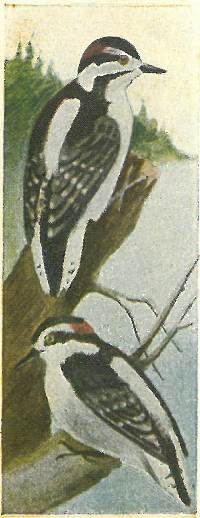
Order PICI—WOODPECKERS.
HARRIS WOODPECKER—Family Picidæ.
393c. Dryobates villosus harrisi. 10 inches.
This species is similar in every way to its eastern relatives and for coloring is as illustrated. The nesting habits of this and the sub-species are the same, and the eggs cannot be identified as being different. Four pure white eggs are placed at the bottom of some cavity, in tall trees usually (.95 × .70).
CABANIS WOODPECKER.
393d. Dryobates villosus hyloscopus. 10 inches.
Some lighter on the under parts than preceding (not illustrated).
ROCKY MOUNTAIN HAIRY WOODPECKER.
393e. Dryobates villosus monticola. 10½ inches.
A trifle larger, and white below (not illustrated).
GAIRDNER WOODPECKER.
394a. Dryobates pubescens gairdneri. 7 inches.
A smaller bird than any of the preceding, similar in coloring, as illustrated. It is a more sociable bird and is found about the dwellings in country places, and even in the larger cities about the parks.
[129]
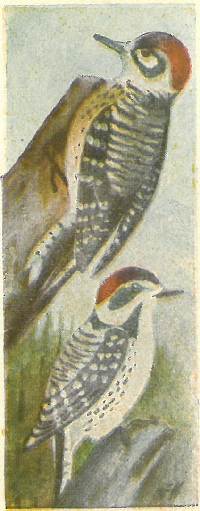
TEXAS WOODPECKER.
396. Dryobates scalaris bairdi. 7½ inches.
This species is brownish white below, has the back barred with black and white, on account of which it is often known as the “Ladder-back Woodpecker.” The male has the whole crown red, shading into mixed black and whitish on the forehead. Its habits and eggs are the same as the previous species.
NUTTALL WOODPECKER.
397. Dryobates nuttalli. 7 inches.
Where the two former have red crowns, this one has a crown of black and a small red patch on the back of nape. Outer tail feathers nearly all white, while in the former they are barred with black and white. They are pugnacious little birds and will drive many of the larger Woodpeckers from their locality.
Nest.—In holes of trees, either in dead stumps or growing trees at no great elevation from the ground. Four pure white eggs are laid at the bottom of the cavity, on the decayed wood (.85 × .65). Their food is gathered from under the bark, consisting of larvæ, ants and small insects.
[130]
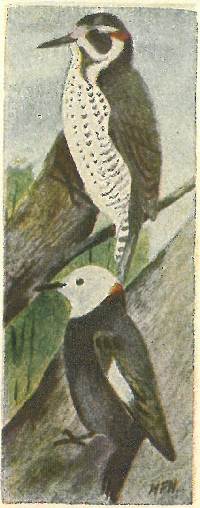
ARIZONA WOODPECKER.
398. Dryobates arizonæ. 8 inches.
This is an entirely different looking bird from any of the others of the Woodpecker family, being uniform brownish above and a grayish white below, with black spots. The male having a crescent shaped patch of red on the back of the head, outlined mostly with white. It is locally common at the higher altitudes in the mountains of Arizona.
Nest.—Is practically the same in habits as others mentioned, nesting in holes of trees, and laying four white eggs (.85 × .60).
WHITE-HEADED WOODPECKER.
399. Xenopicus albolarvatus. 9 inches.
This odd species is wholly a dull black color, except for the white head and neck, and basal half of the primaries. It also has on the male a small red spot on the back of the neck. They are said to be more silent than other members of the Woodpecker family, and rarely make the familiar tapping and never the drumming sound. They secure their food by scaling the bark from the trees, prying it off, instead of drilling a hole. They nest at any height, but the greater number seem to prefer near the ground (20 feet), and in old dead pine stubs. They lay from four to six glossy white eggs (.95 × .70).
[131]
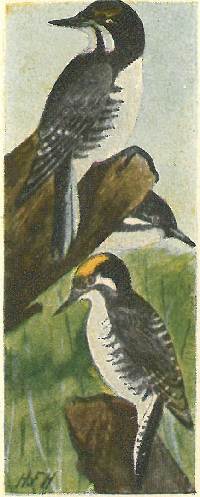
ARCTIC THREE-TOED WOODPECKER.
400. Picoides arcticus. 9½ inches.
As implied by the name, members of this genus have but three toes, two in front and one behind. The plumage of this species is entirely black above, and whitish below, with the flanks barred with blackish. The male has a yellow patch on the crown. They breed abundantly in coniferous forests in mountain regions throughout their range, laying their four or five pure white eggs in decayed tree stumps (.95 × .70). They do more boring for their insect food, and, during mating season, are very persistent in their roll call on dead limbs of trees.
AMERICAN THREE-TOED WOODPECKER.
401. Picoides americanus. 9 inches.
The greatest difference between this bird and the last is on the back, it having several narrow bars of white near the neck or a patch of white in place of the bars. Breeding habits are the same.
ALASKA THREE-TOED WOODPECKER.
401a. Picoides americanus fasciatus. 9 inches.
In every particular similar to the last, with the patch of white on the back possibly a little larger. Habits just the same (not illustrated).
[132]
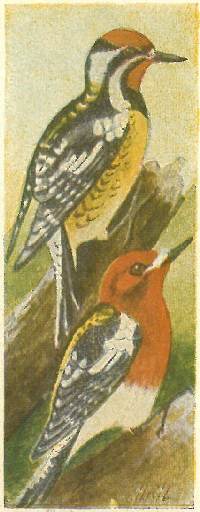
YELLOW-BELLIED SAPSUCKER.
402. Sphyrapicus varius. 8½ inches.
This is one of the most handsomely marked of the family; they may be identified easily by the red crown and throat (female having white on the throat), each bordered by black, forming a wide breast band, with a band of white, black and white back of it. The under parts yellow. This species and the two following are the only real sapsuckers, a crime that is often attributed to the most useful of the family. While they without doubt will take some of the sap from trees, their food consists more of insect life, ants in particular.
Nest.—Is placed in a cavity of decayed trees. Four to seven glossy white eggs (.85 × .60).
RED-BREASTED SAPSUCKER.
403. Sphyrapicus ruber. 8½ inches.
A Pacific coast bird from Lower California to Oregon. The entire head, neck and breast of this species is red, of varying shades in different individuals, from carmine to nearly a scarlet. The remainder of their plumage is similar to the above. Nesting habits the same.
[133]
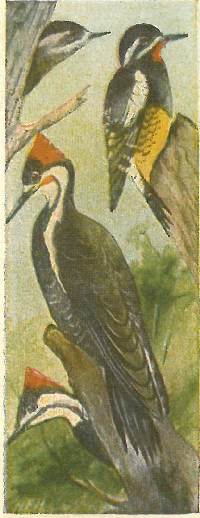
WILLIAMSON SAPSUCKER.
404. Sphyrapicus thyroideus. 9 inches.
A great variation in the plumage of this oddly marked bird is found. The male is mostly black on the back and breast, with a white rump, and with only a narrow patch of red on the throat; the under parts are bright yellow. The female is entirely different, being brownish in place of the black on the male, has no red on the throat, and on the back is barred with black and white.
Their nesting habits are the same as those of the family previously mentioned. Four to seven white eggs (.97 × .67).
NORTHERN PILEATED WOODPECKER.
405a. Phlœotomus pileatus albieticola. 17 inches.
This is one of the largest and strongest of the Woodpeckers; they are a sooty black on the upper parts and breast; the crest is long and bright red, and the male has a red line back of the eye; sides of the neck pure white, and patch of white on the wings. Female is more of a grayish black color than the male. As the large trees are being cut away in many localities where these birds were to be found, they are gradually driven farther north or into the mountain regions, where they can find the heavy timber in which they make their homes.
[134]
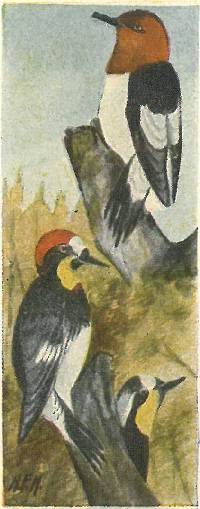
RED-HEADED WOODPECKER.
406. Melanerpes erythrocephalus. 9½ inches.
In flight, this is one of the most conspicuous of the woodpeckers. It has a bright red head, neck and breast, glossy blue-black on the back and tail, white rump, under parts and secondaries. It is more abundant in the east and middle United States, but occurs fairly common in Arizona and Texas to Colorado. It nests in any kind of trees, telegraph poles or will even drill a hole under the eaves of the barn or house in some localities. They are the most pugnacious of the woodpeckers, and often are seen chasing one another or driving away some other bird. They feed also upon ants, larvæ of insects, and small fruits and berries.
They lay from four to eight pure white eggs (1.00 × .75).
CALIFORNIA WOODPECKER.
407a. Melanerpes formicivorus bairdi. 9½ inches.
A common and attractive woodpecker throughout California and Oregon. With its red cap and white forehead, and back or upper parts black tinged with green, a solid black band across the breast, white under parts and rump, and, above all, their continual talking among themselves. Nest, eggs, food, same as above, with the addition to its diet of acorns in great numbers.
[135]
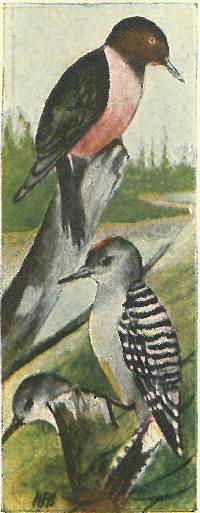
LEWIS WOODPECKER.
408. Asyndesmus lewisi. 10½ inches.
An oddly colored species, with a crimson red face, under parts streaked with crimson and white, a gray breast, and upper parts a glossy greenish black. They are more common in the mountain ranges among the tall pines from the eastern Rockies to the Pacific coast range, breeding high up in the trees. Their food consisting of insect life mostly, and acorns, which they gather and store away for future use. Four to eight eggs are pure white (1.05 × .80).
RED-BELLIED WOODPECKERS.
409. Centurus carolinus. 9½ inches.
Found on the eastern slope of the Rockies and south to central Texas. It is an attractive bird, frequently called the “Zebra Woodpecker,” on account of the black and white markings on the back, wings and tail. Nests in live trees; three to five white eggs (1.00 × .75). Not illustrated.
GILA WOODPECKER.
411. Centurus uropygialis. 9½ inches.
This is also one of the “Zebra Woodpeckers” to be found in Arizona and the Mexican borders of the United States. Its preference for nesting site is the Giant Cactus. Eggs same as above.
[136]
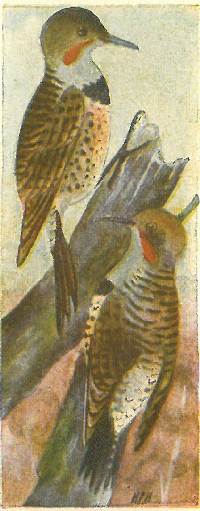
RED-SHAFTED WOODPECKER.
413. Colaptes cafer collaris. 13 inches.
These birds are not inclined to search for their food among the trees as are most of the woodpeckers, but may often be found on the ground on the edges of the woods or in open fields, where they secure ants as their principal article of food. The top of the head is brownish instead of gray, and the under parts of the wings, tail and the quills are reddish orange and not yellow as on the eastern varieties. The male has a bright red streak from the bill extending back and below the eye, the female does not have this. The throat is a gray, with a black crescent on the breast, under parts light gray with numerous black spots, rump is white and tail is mostly black above.
Nest.—Is placed in holes of trees in the woods, or in any locality where they make or find a suitable hole.
Four to eight white eggs (1.10 × .90).
GILDED FLICKER.
414. Colaptes chrysoides. 13 inches.
Very similar to above, with the under side of wings and tail yellow. Found only in southern California and Arizona southward.
[137]
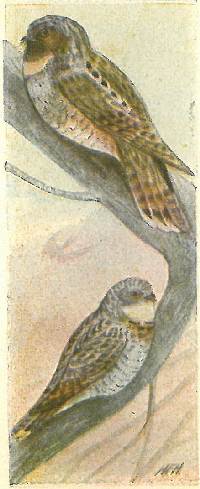
STEPHENS WHIP-POOR-WILL—Family Caprimulgidæ.
417a. Antrostomus vociferus macromystax. 10 inches.
One of the birds that are heard much more often than seen, and in their habits they are very secluded, keeping in the dark woods the greater part of the time, rarely leaving its place of concealment before dark. In pursuit of insects, they are swift and noiseless, their soft plumage giving forth no sound, as their wings cleave the air.
Nest.—Is on the ground among the leaves, usually in dense woods. Their two eggs of a grayish or creamy white are very faintly marbled or marked with pale brown and gray. These birds are only found in southern Arizona, Texas and New Mexico.
POOR-WILL.
418. Phalænoptilus nuttalli. 8 inches.
The smallest of the family. A handsome species, with plumage mottled black, white and gray, beautifully blended together. To be found west of the Mississippi from British Columbia to southern California. Eggs are a pure white (1.00 × .75).
[138]
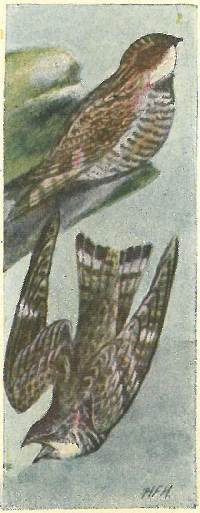
WESTERN NIGHTHAWK.
420a. Chordeiles virginianus henryi. 10 inches.
The nighthawk may be distinguished from the Whip-poor-wills by its forked tail in place of the rounded tail of the “Poor-wills.” It also has a white band near the end of the tail, and across the primaries, the latter making a very conspicuous mark when in flight.
Nest.—They lay their eggs upon the ground or on a ledge with no attempt at nest building. The two eggs are a grayish white color, marbled, blotched and spotted with darker shades of gray and brown (1.20 × .95). Found from the plains to the Pacific and from British Columbia to Mexico.
SENNETT NIGHTHAWK.
420c. Chordeiles virginianus sennetti. 10 inches.
A paler and more of a grayish color than preceding. Habits the same.
TEXAS NIGHTHAWK.
421. Chordeiles acutipennis texensis. 10 inches.
The markings of this species are much finer and more mottled with a reddish brown color than the preceding. They are very abundant in Arizona, southern Texas and quite common in southern California.
[139]
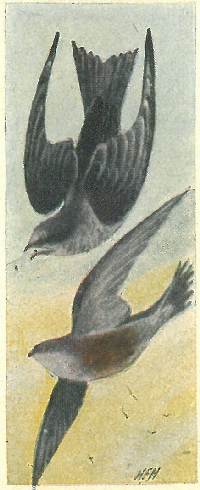
BLACK SWIFT.—Family Micropodidæ.
422. Cypseloides niger borealis. 7 inches.
The plumage of the Swift is a dull sooty black, somewhat lighter on the under parts. The tail is slightly forked and does not have the spines which are usual with this family. Although the general habits of this species are well known, but little is known of their nesting; they are seen during the breeding season about the higher ranges of their United States range, and are supposed to nest in the crevices of cliffs at high altitudes.
VAUX SWIFT.
424. Chætura vauxi. 4½ inches.
This small Swift is not nearly as common as the preceding, is much paler in color and white on the under parts and throat. Their habits are much like the last, only that they make use of hollow trees in which to place their nests, which are made of twigs glued to the tree with the glutinous saliva of the birds, forming a very shallow platform in which they deposit three or four pure white eggs. They are on the wing much of the time during the day catching insects, or several pairs seemingly at play in the air, generally at quite high elevations, toward dusk returning to their nesting places.
[140]
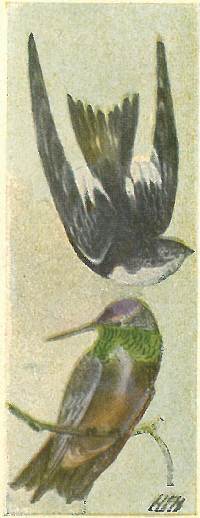
WHITE-THROATED SWIFT.
425. Aeronautes melanoleucus. 6½ inches.
A handsome bird, in fact, the most beautiful and graceful of this family. Its flight is very rapid, and they congregate in thousands about the tops of inaccessible cliffs, where in small burrows in the earth or under the sods, or in crevices they build their nests, which are generally made of roots and grasses and lined with feathers. Four or five dull white eggs are laid (.85 × .50).
Range.—Western United States, mostly in the Rocky Mountains, and in California ranges north to Canada borders.
RIVOLI HUMMINGBIRD.—Family Trochilidæ.
426. Eugenes fulgens. 5 inches.
This is one of the most gorgeous of the Hummers, having the crown a violet purple color, and the throat a changeable brilliant green. Upper parts a bronze green, the under parts almost a black. Female lacks all the brilliant colors of the male. Upper parts dull green, under parts greenish gray, top of head brownish with a small white spot back of the eye. This species saddles its nest upon the branches, generally for its favorite tree selecting a maple or sycamore, and usually at from twenty to thirty feet from the ground.
[141]
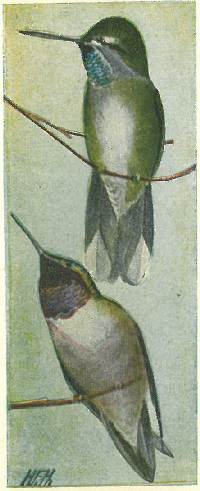
BLUE-THROATED HUMMINGBIRD.
427. Cyanolæmus clemenciae. 5 inches.
This bird is a trifle larger than the preceding, and, as the name implies, it has an iridescent bright blue throat, with a streak of white extending from the bill to back of the eye, the upper parts of a uniform greenish color, under parts are a greenish gray. Tail dark with outer tail feathers broadly tipped with white.
Nest.—Is built similar to above, but placed at lower elevations, at times very near the ground. They are to be found only in Arizona and the southern borders of the United States.
BLACK-CHINNED HUMMINGBIRD.
429. Archilochus alexandri. 3½ inches.
This is similar in size and appearance to the “Ruby-Throat,” but has the chin and upper throat black, the rest of the throat being violet or amethyst, as seen in different lights. It is a very common bird in the southern part of its range. It nests low, rarely above ten feet from the ground. Nest made of plant fiber, not covered with lichens, but resembles a small piece of sponge.
[142]
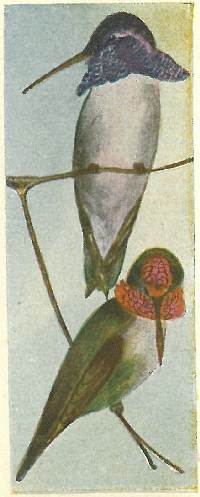
COSTA HUMMINGBIRD.
430. Calypte costæ. 3 inches.
A slightly smaller bird than the last, with the crown and the lengthened feathers of the neck which form a ruff of the most brilliant violet or amethyst, back and rump of a greenish bronze color, under parts whitish with a green cast on the sides. Female lacks the brilliant colors of the male on the head and neck and shows no sign of a ruff.
Nest.—Is usually placed in the forks of small shrubs near the ground, seldom above six feet from it, and made of plant down, with shreds of weeds, bark and lichens worked into the outside portion, and lined with a few soft feathers. Two pure white eggs (.48 × .32).
ANNA HUMMINGBIRD.
431. Calypte anna. 3 inches.
This bird is marked much like the preceding, but varying greatly in the colors. The crown and lengthened feathers of the neck are a beautiful iridescent purplish pink. Upper parts are the usual metallic green, under parts light gray, with sides greenish. Tail is more forked and has no brown or white like the former. They are very abundant in their restricted range, and frequently raise two broods in a season.
[143]
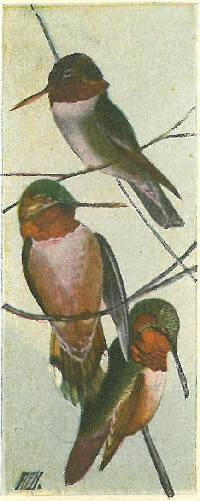
BROAD-TAILED HUMMINGBIRD.
432. Selasphorus platycercus. 4 inches.
The crown, back and central tail feathers are a metallic green. They do not have the elongated feathers on the throat and no ruff. Under parts dull white, shading into light green on the sides, the throat is a bright lilac. They are very abundant in Arizona and Colorado, where they nest much as does the “Ruby-Throat” in the east.
RUFOUS HUMMINGBIRD.
433. Selasphorus rufus. 3½ inches.
A beautiful little bird, with the back and tail reddish brown and with a throat of orange red, the feathers being lengthened into a ruff on the sides of the neck. Their nests are made of vegetable fibers covered with lichens and cobwebs, and placed near the ground on vines or low-hanging bushes. Two white eggs.
ALLEN’S HUMMINGBIRD.
434. Selasphorus alleni. 3¼ inches.
This is very much like the last, with the back more greenish and the tail being a reddish brown. They are found on the Pacific Coast from British Columbia southward, breeding most abundantly in southern California.
[144]
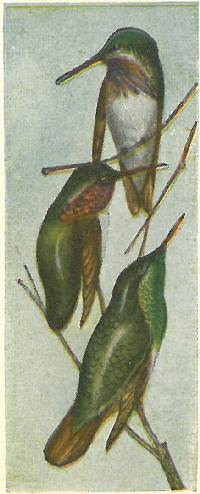
CALLIOPE HUMMINGBIRD.
436. Stellula calliope. 3 inches.
This is the smallest of the family of North American Hummers. It is greenish on the upper parts, growing darker toward the tail, the end of which is a light brown. The throat is a rich violet, showing white at the base of the feathers. They are found from British Columbia southward and from the Rockies westward, most common during breeding in California and Oregon. They build their nests in all manner of locations, from high up in tall pines to within a foot of the ground in low bushes. They are made of plant down and shreds of bark and lichens, breeding high up on the mountains.
LUCIFER HUMMINGBIRD.
437. Calothorax lucifer. 3½ inches.
Found only on the southern borders of the United States, but is quite common in Central Mexico. Throat is a metallic purple, with feathers elongated on the sides.
RIEFFER HUMMINGBIRD.
438. Amizilis tzacatl. 4 inches.
Found only on the southern borders like above. Upper parts a dark bluish green, tail and rump light brown.
[145]
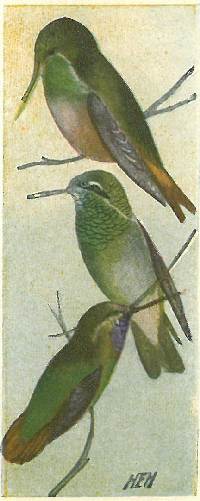
BUFF-BELLIED HUMMINGBIRD.
439. Amisilis cerviniventris chalconota. 4 inches.
These birds are very similar to the last, but the under parts are of a pale brownish buff color, throat, back and tail coverts metallic green. Breeds in low bushes near the ground.
XANTUS HUMMINGBIRD.
440. Basilinna xantusi. 4 inches.
Found in Lower California, where it breeds and builds very much as does the preceding near the ground. (Not illustrated.)
WHITE-EARED HUMMINGBIRD.
440.1. Basilinna leucotis. 3¼ inches.
These birds are of a bright metallic green above and also on the breast, the forehead, sides of head and throat are an iridescent blue, and a white line extends back from the eye. Found in the southern parts of Arizona and Texas into Central America. Nesting habits same as above.
BROAD-BILLED HUMMINGBIRD
441. Cyanthus latirostris. 3½ inches.
Markings are in every way very similar to the above, being brighter on the throat, showing a more brilliant blue. Found in the southern borders of Arizona and Texas, where it breeds in the lower lands and near the ground. Nests similar to above.
[146]
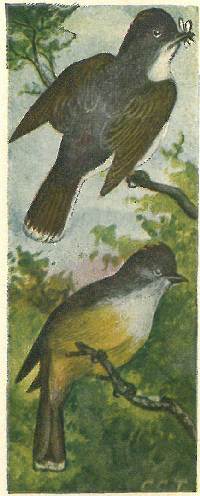
KINGBIRD.—Family Tyrannidæ.
444. Tyrannus tyrannus. 8½ inches.
From the time of their arrival Kingbirds are much in evidence about farmyards and orchards. They are very noisy birds, ready for a quarrel at any time and usually come off victorious in whatever they undertake. They seem to delight in driving away crows, and may frequently be seen to alight on the back of one when chasing them. These are found only on the eastern slope of the Rockies and eastward, where they are very common.
Nest.—Is placed in almost any kind of trees in open fields or woods. Nearly every orchard will have one or more pairs breeding. Their nests are made of twigs, roots, or strips of fiber from vines and lined with the down from catkins and horsehair. Three to five creamy white eggs, mottled and streaked with brown and lilac, are laid (.95 × .70).
ARKANSAS KINGBIRD.
447. Tyrannus verticalis. 9 inches.
A more western variety, lighter in color and with a bright yellow breast and under parts. Its habits are much the same as the above in its home building or in trying to find a neighbor to quarrel with. The eggs are the same in size and color.
[147]
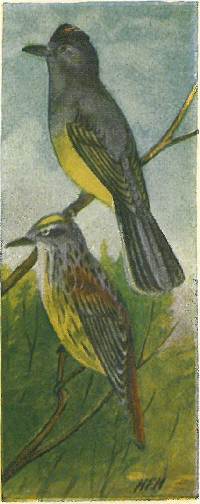
CASSIN KINGBIRD.
448. Tyrannus vociferans. 9 inches.
These birds are very much like the last, except that the throat and breast are darker.
DERBY FLYCATCHER.
449. Pitangus sulphuratus derbianus. 10½ inches.
This is one of the largest and most handsome of the family. With its bright yellow crown, surrounded with a black border and this by white and another band of black, with the under parts a bright yellow makes him one of the most attractive. They are found, though, only on the southern borders of Texas into Central America. (Not illustrated.)
SULPHUR-BELLIED FLYCATCHER.
451. Myiodynastes luteiventris. 8 inches.
Unlike any of the previous, and only found breeding in the mountains of Arizona south to Panama. The back is grayish streaked with black, the tail a dull reddish brown, and the under parts yellow, streaked on the sides with dusky; a white throat patch, bordered with black; the crown with a concealed yellow spot bordered with dusky and a narrow white stripe over the eye. They place their nests in the cavity of some tree, and lay from three to five buff colored eggs spotted and blotched with brown and lavender (1.05 × .75).
[148]
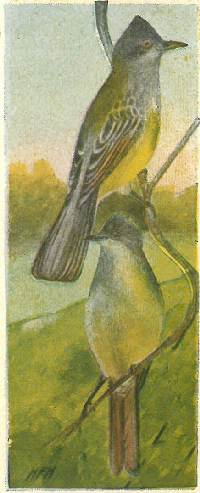
CRESTED FLYCATCHER.
452. Myiarchus crinitus. 9 inches.
This is more an eastern bird, but is found in Texas and down through Central America. They nest in cavities of trees, it being made of twigs, weeds, grasses, and invariably a piece of snake skin. They lay from four to six eggs of a buff color scratched and spotted with rich shades of brown and lavender (.85 × .65). (Not illustrated.)
ARIZONA CRESTED FLYCATCHER.
453. Myiarchus magister magister. 9½ inches.
The throat and breast are lighter than the previous bird, and the under parts are paler yellow. Its nesting habits are the same as above even to including the piece of snakeskin, or in place of it part of a lizard skin will answer their purpose.
ASH-THROATED FLYCATCHER.
454. Myiarchus cinerascens. 8½ inches.
A much more quiet bird than either of the above, in looks as well as in actions. The upper parts are grayish brown, while the under parts, breast and throat are almost white. They build their nests in the giant cactus or in holes of stumps, lining the cavity with roots and grass or bits of rubbish of almost any kind, and generally include the piece of snake skin as do the ones above.
[149]
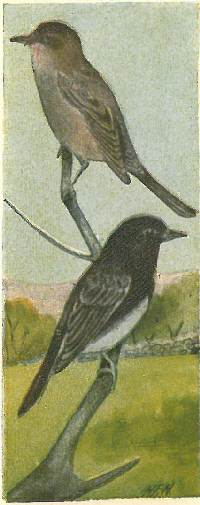
SAY PHŒBE.
457. Sayornis sayus. 8 inches.
The Phoebe is a bird that will select for its nesting place the heavy beam of some old bridge, or in some old mill where the timbers are falling down, and place its nest in some dark corner, building it of mud, moss and grasses lined with feathers, or in some localities the nests may be placed in the crevice of some cliff or ledge where they lay four or five white eggs, rarely dotted with brown.
It is slightly larger than the eastern variety, with the under parts showing more of a brownish color, and is found breeding from the Arctic to Lower California.
BLACK PHŒBE.
458. Sayornis nigricans. 7 inches.
Slightly smaller than the above, and much darker, almost black on the head and back with white under parts. Their habits are very much the same as above, frequenting old buildings in villages where a stream is near by, or in localities where insect life abounds. Their nest is made the same as above, and eggs are the same.
[150]
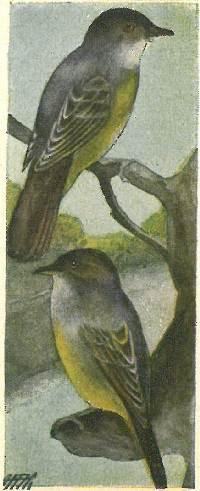
OLIVE-SIDED FLYCATCHER.
459. Nuttallornis borealis. 7½ inches.
These are nowhere abundant, and in some parts of the country, especially in the central portions, they are very rare. In the western range, they may be found from Alaska to southern California; for breeding places they seem to prefer swampy land, covered with many dead coniferous trees, mixed in with the green trees; their nests are placed well up in the trees and are made of twigs, loosely put together, and lined with small roots and moss. The three or four creamy white eggs are spotted with brown and lilac, forming about the larger end (.85 × .65).
WESTERN WOOD PEWEE.
462. Myiochanes richardsoni. 6½ inches.
Very much like the eastern variety in looks and habits. To be found breeding from Alaska to Lower California. Their nests are placed on horizontal branches, made of plant down, grass and fibers; very compact, and much resembling a knot on the branch. Three or four white eggs with small spots about the larger end (.80 × .55).
[151]
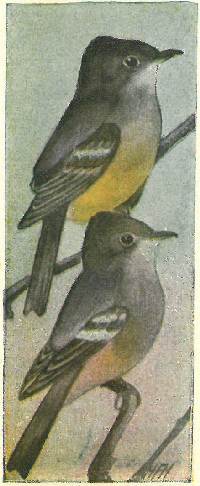
WESTERN FLYCATCHER.
464. Empidonax difficilis. 6 inches.
Very much like the last, but having more of the yellow cast on the under parts; it may be found breeding from Alaska to southern California. Its favorite nesting place is along some stream, bordered with willows or alders, and the nest is placed on the lower branches near the ground; it is nicely made of fibers and plant down; three or four white eggs, spotted with brown (.80 × .55).
TRAILL FLYCATCHER.
466. Empidonax trailli. 6 inches.
Upper parts an olive brown, becoming darker on the head; under parts white, and also a white ring about the eye; two wing-bars a pale buff color, and the breast a light gray. They seem to prefer much the same localities for their nesting site as do the “Western.”
Nest.—Is usually built very low in willows or alders, bordering brooks or ponds, and is made of plant fibers, lined with the down, and sometimes horsehair; three or four creamy white eggs are marked with blotches of brown about the larger end (.70 × .54).
[152]
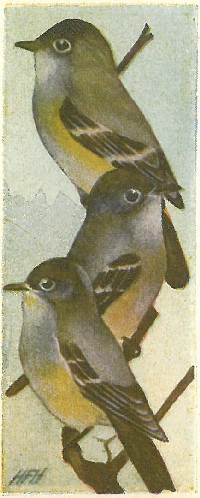
HAMMOND FLYCATCHER.
468. Empidonax hammondi. 5½ inches.
A western form of the “Least Flycatcher” of the east, differing but very little in appearance or habits from its eastern relative. Upper parts an olive gray color, with the breast the same, but a little lighter. Their nesting place is usually a fork of some small tree, or upon some horizontal branch at low elevation, and is a nicely woven, compact structure, made of plant fibers, strings, hair and cobwebs. Three to five pale creamy white eggs (.65 × .50).
WRIGHT FLYCATCHER.
469. Empidonax wrighti. 6 inches.
Similar to the last, but much lighter below. They are much more abundant than the last, and are found from Oregon to Mexico, where they breed more in open woods and thickets. Their nests and eggs are practically the same in every way.
GRAY FLYCATCHER.
469.1. Empidonax griseus. 6½ inches.
This slightly larger species is more grayish above, and lighter below. It is found in Arizona and Mexico, into southern California. No record of its nesting habits or eggs can be given.
[153]
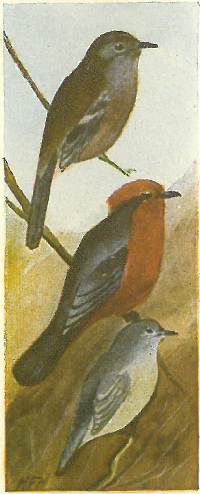
BUFF-BREASTED FLYCATCHER.
470a. Empidonax fulvifrons pygmæus. 5 inches.
This small variety is not at all common in any locality, but is found in Arizona, Mexico and Lower California, to southern California. It is brownish gray above and of a buff color below. The nests are placed similar to the preceding, but more in the mountain regions; eggs are the same, being a trifle larger.
VERMILION FLYCATCHER.
471. Pyrocephalus rubinus mexicanus. 6 inches.
This is one of the most brilliant colored of the Flycatcher family, as shown in the illustration. The female is almost of an entirely light gray color, barely tinged with pink on the under parts. They are very common in southern Texas, Arizona and New Mexico.
Nest.—This is one of the prettiest nests made, generally of twigs and plant fiber, lined with down, wool and feathers, and frequently covered with lichens, held in place by a winding of cobwebs; three or four buff eggs, boldly blotched with brown and lavender (.70 × .50).
BEARDLESS FLYCATCHER.
472. Camptostoma imberbe. 5 inches.
A light gray bird, found in Texas and south, into Central America.
[154]
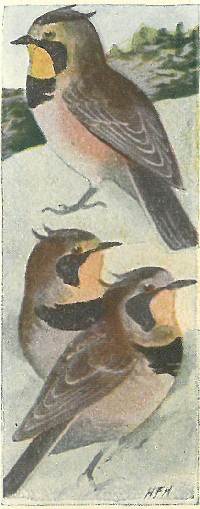
PALLID HORNED LARK—Family Alaudidæ.
474a. Otocoris alpestris arcticola. 8½ inches.
This is the largest of the Larks. It has the throat white, with no trace of yellow; the horned tufts are black, and curve upwards. Found in Alaska, south to Oregon (not illustrated).
DESERT HORNED LARK.
474c. Otocoris alpestris leucolæma. 8 inches.
Found from British Columbia south, in winter to southern California, Texas and New Mexico. They are one of our handsome winter birds, with horn-like tufts of black on either side of the head; forehead, patch under the eye and band on the breast black; yellow throat, and white under parts; upper parts, a light pinkish shade of brown. Three or four eggs, white, marked with shades of brown, are placed in their nest of grasses and rootlets, on the ground, usually concealed under a tuft of grass (.92 × .65).
CALIFORNIA HORNED LARK.
474e. Otocoris alpestris actia. 8 inches.
Similar, but back deeper brown. Southern and Lower California.
RUDDY HORNED LARK.
474f. Otocoris alpestris rubea. 8 inches.
The same as above, but still more rufous. Central California.
[155]
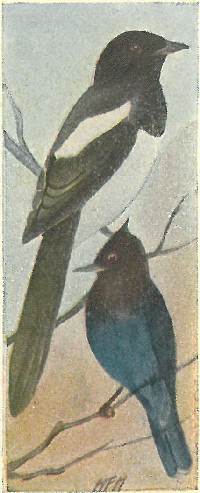
Family CORVIDÆ—CROWS, JAYS
AMERICAN MAGPIE.
475. Pica pica hudsonia. 20 inches.
Like the “Blue Jays,” the Magpies are great talkers, and are usually found in colonies where they can carry on conversation in their own way with each other. They are a large handsome bird, with pure white under parts and wing coverts, and the upper parts, head, tail and breast are a bronzy black, with iridescent changes. Tail very long, and graduated. They are very bold birds, inquisitive, and great thieves. Their food consists of small rodents, a large variety of insect life, and the eggs and young of small birds.
Nest.—Is a bulky affair, placed at almost any elevation, composed of sticks and small twigs, with an opening on the side; the inside of the nest is lined with finer materials, grass and plant fiber. Four to eight grayish white eggs, spotted with brown and drab (1.25 × .90).
STELLER JAY.
478. Cyanocitta stelleri. 13 inches.
Range.—From Alaska south to central California. Nests are quite bulky; three to six greenish eggs, spotted with shades of brown (1.25 × .90).
[156]
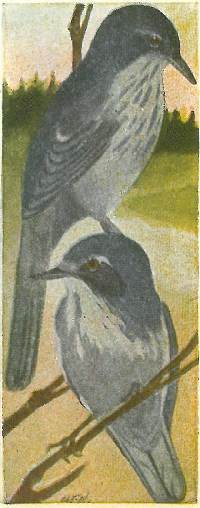
WOODHOUSE JAY.
480. Aphelocoma woodhousei. 12 inches.
These birds are abundant in the Great Basin between the Rockies and the Sierra Nevadas, breeding in scrubby trees or bushes at low elevations and usually near some stream. They have the crown and forehead bluish, and the under parts are gray, streaked with a darker shade on the breast. Their food consists of acorns and a variety of insects.
Nest.—This is usually of small sticks, loosely arranged, with smaller twigs and roots for a lining. Four to six eggs, of a pale green, faintly spotted with shades of brown (1.20 × .90).
CALIFORNIA JAY.
481. Aphelocoma californica. 12 inches.
These are the most common of the Jays on the Pacific coast of California, Oregon and Washington. They are more tame or fearless than most of the family, and frequent the trees about houses, and are given the bad name of robbing the nests of other birds of their eggs and young. In color these are just the reverse of the previous one, being brownish below, and gray above.
[157]
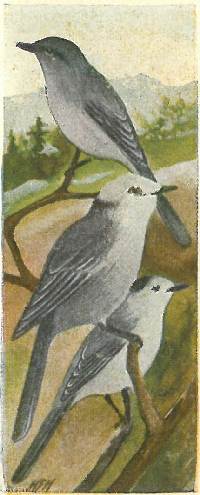
ARIZONA JAY.
482. Aphelocoma sieberi arizonæ. 13 inches.
A common bird in Arizona and south into Mexico. The upper parts are a bluish gray, shading into a brownish gray on the head; under parts are a pale gray. They are a very sociable bird during the breeding season, and often several pairs will nest in the same clump of trees, usually placing their nests at low elevations.
Nest.—Is made similar to the preceding, but the four eggs are more of a bluish color, without markings (1.20 × .85).
ROCKY MOUNTAIN JAY.
484a. Perisoreus canadensis capitalis. 12 inches.
This is almost the counterpart of the Canada Jay of the east, with the exception of having more white on the head, and only a small space on the back of the neck. He is the same “old coon” as the eastern bird about camps, and is rightfully called “Camp Robber.” Their nesting habits are the same as above, but their eggs are drab, spotted and blotched with brown, of varying shades (1.15 × .80).
OREGON JAY.
485. Perisoreus obscurus. 11 inches.
Like the last in every way, but with a blacker head, forehead white.
[158]
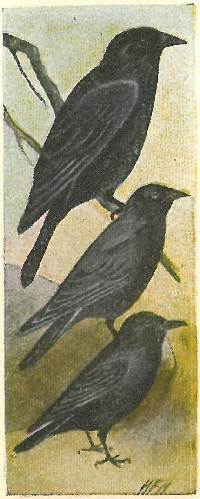
AMERICAN RAVEN.
486. Corvus corax sinuatus. 24 inches.
This is a large edition of the Crow, and is found west of the Rockies from British Columbia southward. Their plumage is a bluish black, with lengthened and stiffened feathers on the neck. Their general habits are much the same as the Crow. Their food consists principally of carrion, fish, and eggs and young of smaller birds. They nest on the high cliffs in almost inaccessible places, building large nests of sticks, in which they deposit four eggs of a pale greenish white, spotted and blotched with shades of brown and drab (1.95 × 1.25).
WHITE-NECKED RAVEN.
487. Corvus cryptoleucus. 21 inches.
A smaller bird than the above, and has the base of the neck feathers white. It is a more southern variety, and is found in Arizona and on the Mexican borders. They build at low elevations, making their nests of sticks and twigs. Four pale blue eggs, spotted with dark brown (1.75 × 1.20).
NORTHWESTERN CROW.
489. Corvus caurinus. 17 inches.
This is one of the smaller Crows, found only on the coasts of Oregon to Alaska, where it feeds almost wholly upon fish.
[159]
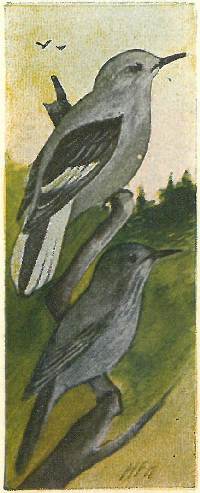
CLARKE NUTCRACKER,
491. Nucifraga columbiana. 12 inches.
Found in the mountains of western North America, from Mexico to Alaska. In habits they much resemble the Crow or some of the Jays. Their food consisting largely of seeds from the pine cones, insects of many varieties, larvæ and berries. They seem to prefer the tops of the higher mountain ranges, coming down into the valleys for their supply of food. Their nesting sites are well up in the mountains, where they build their nests in the coniferous trees, of twigs, weeds, strips of bark and plant fibers, making a deep cup-shaped nest in which they lay from three to five greenish gray eggs, spotted over the whole surface with brown and lavender (1.30 × .90).
PINON JAY.
492. Cyanocephalus cyanocephalus. 11 inches.
To be found in the pine regions of the Rockies and west, and from British Columbia to southern California. They are very sociable birds, keeping in colonies, and always have much to talk about among themselves; after the breeding season they may be seen in large flocks. Three to five bluish gray eggs, are spotted with different shades of brown (1.20 × .85).
[160]
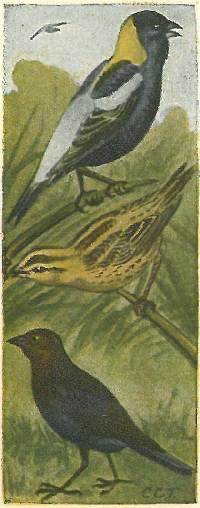
BOBOLINK—Family Icteridæ.
494. Dolichonyx oryzivorus. 7 inches.
This bird is found over most of North America from the southern parts of Canada south, and has been gradually extending westward as far as California. During mating season it is hard to find any other bird so completely filled with music as are these birds. They are also quite sociable birds, and several pairs of them may be found nesting in the same piece of meadow land, and filling the air with their sweet, wild music. They place their nest in a shallow hollow on the ground; it is lined with grass and frequently so covered as to be almost arched over to conceal the eggs. Four or five eggs of a grayish white, thickly blotched and spotted with brown of different shades and lilac, generally covered with ground color on the larger end (.84 × .62).
COWBIRD.
495. Molothrus ater. 7½ inches.
It is to be found throughout the United States and the southern portion of Canada. They are the only birds which we have that neither make a nest of their own nor care for their young. They will deposit a single egg (sometimes two) in the nest of some other bird, usually of a smaller variety.
[161]
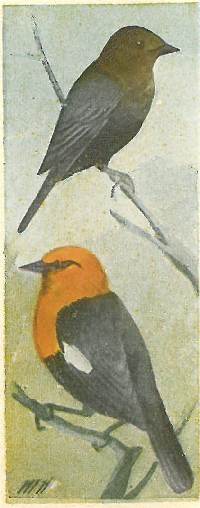
BRONZED COWBIRD.
496a. Tangavius æneus. 7 inches.
The same as above, being more of a bronze color, found in Arizona and Mexico.
RED-EYED COWBIRD.
496. Tangavius æneus involucratus. 8½ inches.
Habits as above. Plumage is glossy black, with brassy reflections. They are abundant in southern Texas, and in Mexico (not illustrated).
YELLOW-HEADED BLACKBIRD.
497. Xanthocephalus xanthocephalus. 10 inches.
A large and handsome bird, with bright yellow head and breast; body black, with a white patch on the wing. They are a western bird, being found from the central United States to California. They breed abundantly in suitable marshes throughout their range. Their nests are made of strips of rushes, interwoven and fastened to the upright rushes only a few inches above the water. The four to six grayish white eggs are spotted with shades of brown and gray (1.00 × .70).
[162]
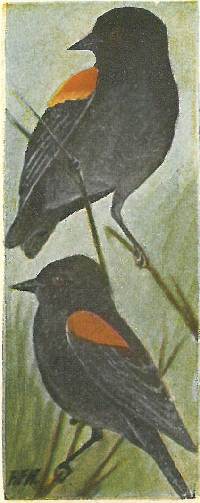
RED-WINGED BLACKBIRD.
498. Agelaius phœniceus. 9 inches.
An eastern bird, found as far west as the eastern part of the Rockies. Very common in many parts of the east, where it builds much the same as does the previous, laying four or five eggs, bluish white, spotted, blotched and scratched with shades of brown (1.00 × .70).
SONORA RED-WING BLACKBIRD.
498a. Agelaius phœniceus sonoriensis. 9 inches.
Similar, but with more of a buff in place of the white on the wing. In southern California and Arizona (not illustrated).
BICOLORED RED-WING.
499. Agelaius gubernator californicus. 8½ inches.
The male of this species do not have the light margins to the red on the shoulders, as do the others. They are found on the Pacific coast from Washington to southern California. Eggs and nests the same.
[163]
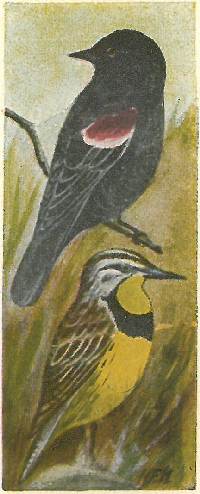
TRICOLORED RED-WING.
500. Agelaius tricolor. 9 inches.
This species is a much deeper red on the shoulders, and the buff color on the preceding is white on this bird. They are restricted to a small range, the Pacific coast of California and Oregon, and are not nearly as common as the eastern variety. Their nesting habits are the same, and the eggs are indistinguishable.
WESTERN MEADOWLARK.
501.1. Sturnella neglecta. 9 inches.
This variety is somewhat paler than the eastern bird. In habits it is the same. The nests and eggs cannot be separated from the eastern. There seems to be one great distinguishing quality between the two, and that is in their song or notes. The first one that I had the pleasure of hearing was in Oregon, and my first thought was of our eastern Bobolink, but on seeing the bird in flight, I at once knew that it was a new song, sung by our eastern Meadowlark in appearance. They feed on insect life, beetles, etc. They lay from four to seven eggs, spotted with shades of brown (1.10 × .80).
[164]
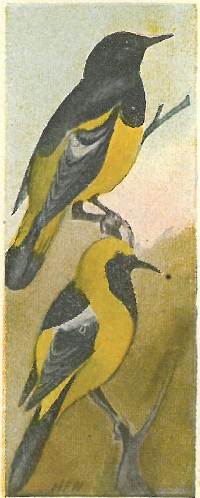
SCOTT ORIOLE.
504. Icterus parisorum. 8 inches.
This is not a common species in any part of its range, from southern California to Texas, and in Mexico. It is a handsomely marked bird, with its clear black and yellow. They build a hanging nest, usually suspended from the under sides of the leaves of the yucca palm, or from small branches of low trees. Three to four bluish white eggs, specked and blotched with brown about the larger end (.95 × .65).
SENNETT ORIOLE.
505. Icterus cucullatus sennetti. 7½ inches.
This is a deeper yellow; the face, throat, back, wings and tail being black, the wings with two white bars. Found in Texas and south into Mexico. Nests are made of hanging moss (not illustrated).
ARIZONA HOODED ORIOLE.
505a. Icterus cucullatus nelsoni. 7½ inches.
This is very much like the last, but lighter, and is found common in Arizona, New Mexico and southern California. Its favorite nesting place seems to be a bunch of Spanish moss, looping up the ends and weaving it closely together, and forming a pocket inside, which they line with dried grasses and yucca fibers.
[165]
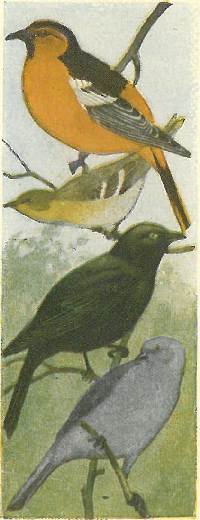
BULLOCK ORIOLE.
508. Icterus bullocki. 7½ inches.
This is a western representative of our eastern bird, the Baltimore Oriole, and their ranges overlap each other on the eastern slope of the Rockies. They build a hanging nest, and in the southern part of their range use the Spanish moss and mistletoe for the foundation of the nest, lining the opening with grasses, hair and small fiber. Three or four white eggs, spotted and streaked with shades of brown (.94 × .62). These birds are of great benefit to the small fruit growers in eating the many injurious insects.
RUSTY BLACKBIRD.
509. Euphagus carolinus. 9 inches.
This is a bird of the east, but is found on the eastern slope of the Rockies, and straying into southern California to the Gulf of Mexico. Breeds along the northern borders of the United States, northwest to Alaska. The female is very much lighter than the male, and of a brownish drab color. They build large substantial nests of moss, twigs and grass, lined with finer material of the same, and placed in low bushes or trees only a few feet from the ground. Three to five eggs, pale bluish green, blotched and spotted with brown (.96 × .71).
[166]
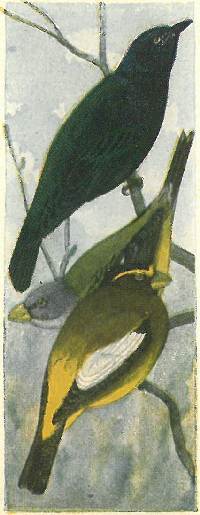
BREWER BLACKBIRD.
510. Euphagus cyanocephalus. 10 inches.
Found throughout western North America, breeding from Alaska to southern California. They differ from the preceding in having a purplish reflection on the head and upper parts, and greenish black body. They nest abundantly throughout their range, either in bushes or trees at low elevations, or upon the ground; the nests are made of sticks, roots and grasses, lined with finer grass. Three to five eggs are laid, which are very variable in marking, a dull white, spotted and blotched all over thickly with brown of different shades (1.00 × .75).
WESTERN EVENING GROSBEAK.
514a. Hesperiphona vespertina montana. 8 inches.
Western North America, and breeding from British Columbia to central California. They build in the evergreen trees upon the mountain side or along some stream in the willows; they are always frail structures made up of a few loosely put together twigs and roots. Three or four pale greenish eggs, spotted sparingly with brown, are the usual complement (.90 × .65).
[167]
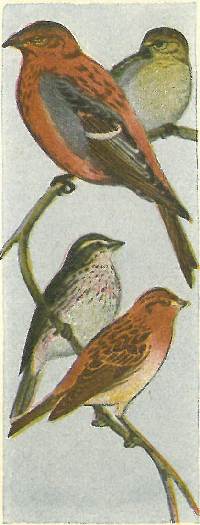
CALIFORNIA PINE GROSBEAK.
515b. Pinicola enucleator californica. 8 inches.
These are one of the most unsuspicious birds that we have, and can be approached to within a few feet. The male is a bright red above and an ashy gray below, having much less of the red than his eastern relative. The female is a dull ashy gray, with a yellowish brown on the top of head and rump. They like the cooler places in which to live, and are found about the snow lines on the mountain, where they feed largely upon the seeds of the coniferous trees, in which they place their nests, making them of fine twigs and rootlets, and lining with grass and moss. They lay three or four eggs, light greenish blue, with splashes of brown and fainter markings of lilac (1.00 × .70).
CALIFORNIA PURPLE FINCH.
517a. Carpodacus purpureus californicus. 6 inches.
This is found from British Columbia to southern California. It breeds well up in the mountains, usually in evergreens. Three or four eggs of a greenish blue, spotted with brown (.85 × .65).
[168]
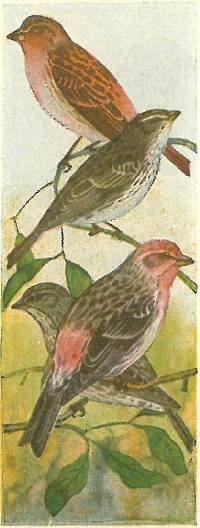
CASSIN PURPLE FINCH.
518. Carpodacus cassini. 6 inches.
It is found west of the Rockies, breeding from British Columbia south to New Mexico, well up in the mountain regions, as far as the timber line extends. The back, wings and tail of this are darker than the preceding species; the purple color being more of a rosy tint. Their nests are made of twigs and rootlets, loosely put together, and almost flat; they lay three or four eggs not to be recognized from the last.
HOUSE FINCH.
519. Carpodacus mexicanus frontalis. 6 inches.
This is one of the most familiar birds on the Pacific coast. With his bright colors, and the more quiet colors of his mate, and the habit they have of keeping close to civilization, building their nests in the vines about the porches of the houses, both in the country and even in the cities, they are great favorites with every one. Their clear and pleasant song is kept up continually during the day, and where two or three pairs are nesting nearby, there is no lack for bird music. Their nests are made of fine rootlets and grass placed in almost any bush, tree or vine, if near some dwelling.
[169]
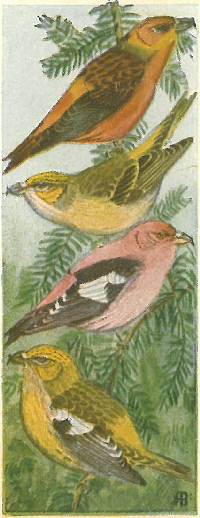
CROSSBILL.
521. Loxia curvirostra minor. 6 inches.
Found throughout the greater part of North America, and breeds in suitable locations on the mountain sides among the coniferous trees. On the Pacific coast, breeding from Alaska to southern California. In abundance they vary each year greatly, according to the food supply of cones in the evergreen trees from which they secure their seed supply; their twisted bill quickly opening up the cones and cleaning out the small seeds. Their nests are made of fine roots and grasses, and three or four eggs, greenish white, spotted and lined with shades of brown, are laid (.75 × .55).
WHITE-WINGED CROSSBILL.
522. Loxia leucoptera. 6½ inches.
These are of a lighter and more rosy color than the preceding, and also have a large white patch on the wings. The female is marked the same, with grayish and buff in place of the red on the males. Nesting habits and locations are the same as above. The eggs average a little larger and heavier marked (.80 × .55).
[170]
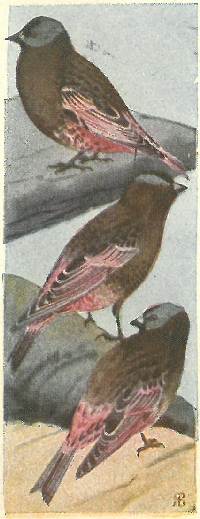
ALEUTIAN ROSY FINCH.
523. Leucosticte griseonucha. 6½ inches.
This is the largest of the family; they are pretty birds, with dark chestnut back and breast, and with the rump, wings and tail with a rosy tint. These are birds of the mountains and high altitudes, above or near the snow line. They are found breeding on the islands of Bering Sea, and in the western part of Alaska. They nest in crevices of the rocks or under ledges, making their nests of grasses and roots. Their four or five eggs are pure white (.97 × .67).
GRAY-CROWNED ROSY FINCH.
524. Leucosticte tephrocotis. 6½ inches.
This is a lighter colored bird than the above. It is found on the eastern slope of the Rockies and has been found breeding in the Sierra Nevadas, in crevices of the rocks, after the same manner as the above. The eggs cannot be distinguished from the above.
HEPBURN ROSY FINCH.
524a. Leucosticte tephrocotis littoralis. 6½ inches.
These have more gray on the back of the head; otherwise the same as preceding in habits and nesting.
[171]
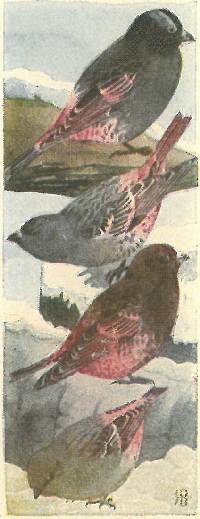
BLACK ROSY FINCH.
525. Leucosticte atrata. 6½ inches.
This species is the same in markings as the Gray-crowned, excepting that the brown is replaced with almost black on the back and breast. The females of this family are much the same as the males, only not as bright in markings, and the young are the same as the females. Found in the northern Rocky Mountains, breeding in the mountains south to Colorado. They are all restless birds, seldom making a long stop in one place, but flitting from one locality to another. After the breeding season, they congregate in large flocks and keep together about the snow line, getting their supply of seed and insect food. Their nesting habits and their eggs are the same as the Gray-crowned.
BROWN-CAPPED ROSY FINCH.
526. Leucosticte australis. 6½ inches.
These are to be found more southerly in the Rocky Mountains than any of the others, breeding in Colorado, and wintering in New Mexico. Their nesting habits and eggs are the same. Most of this family keep above the timber line during the summer, and only come down into the valleys as the heavy snow comes.
[172]
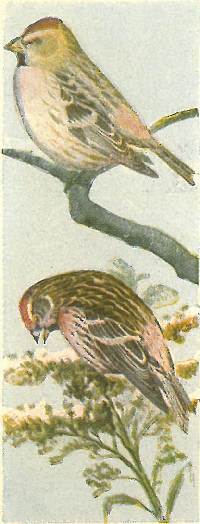
HOARY REDPOLL.
527a. Acanthis hornemanni exilipes. 5 inches.
These pretty little birds, with their caps of bright crimson and rosy breasts, are birds of the coldest regions, breeding in the Arctic regions, and wintering to the northern parts of the United States.
Nest.—They build very large nests, mostly of small sticks and grass, and lined with fine grass and feathers, which are placed usually within a foot or two of the ground in scrub bushes. Their three to five eggs are a light bluish green, with specks of brown, mostly about the larger end (.65 × .50).
REDPOLL.
528. Acanthis linaria. 5 inches.
Its range is the northern part of North America, breeding in Alaska, and wintering as far south as southern Oregon, or into California on the western coast, in the mountain regions above the timber line. In Colorado, they have been seen at 10,000 feet, and with the temperature far below zero. Their nesting habits are the same as the above, and eggs are the same.
[173]
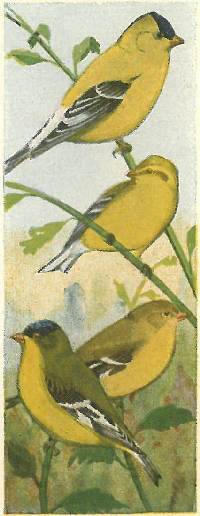
PALE GOLDFINCH.
529a. Astragalinus tristis pallidus. 5 inches.
A paler form, found in the Rockies, south to Colorado (not illustrated).
WILLOW GOLDFINCH.
529b. Astragalinus t. salicamara. 5 inches.
A western form of the eastern bird, rarely reaching the five inches in length, and of a paler color, both the black and the yellow. It is common on the Pacific coast, from Washington to southern California, breeding in willows and low bushes. Nest is made of plant down, very compactly built, usually in a crotch. Four to five eggs, plain bluish white (.60 × .45).
ARKANSAS GOLDFINCH.
530. Astragalinus psaltria. 5 inches.
Found from Colorado to Mexico in the Rockies (not illustrated).
GREEN-BACKED GOLDFINCH.
530a. Astragalinus p. hesperophilus. 5 inches.
In southwestern United States from Central California to Mexico.
[174]
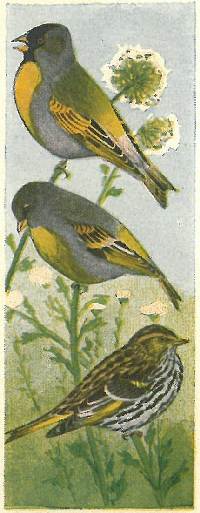
LAWRENCE GOLDFINCH.
531. Astragalinus lawrencei. 4½ inches.
This bird differs from the others of this family in being mostly gray in place of the yellow, having the head and throat black. They are found quite commonly on the Pacific coast of California, and south to Mexico. Their nests are nicely made, cup-like structures of plant down, in which they deposit four white eggs.
PINE SISKIN.
533. Spinus pinus. 5 inches.
These are a more northern bird, breeding mostly to the Canadian zone, and in the Rockies and higher mountains to the west. They feed largely upon weed seeds and seeds from the different coniferous trees, the latter of which they most often frequent, building their nests in these trees of twigs and rootlets loosely put together and placed on the crotch of a horizontal limb; usually four eggs, of a greenish white color, spotted finely with reddish brown (.65 × .45). They have a habit, while feeding, of clinging to the under side of a branch or cone, similar to the Chickadee, and, if disturbed when on some favorite tree, will make a short flight and circle back to the same tree.
[175]
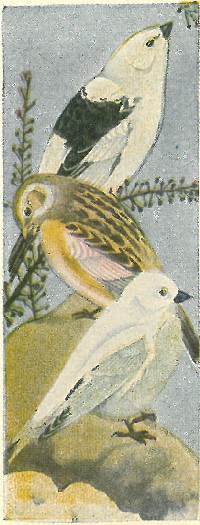
SNOW BUNTING OR SNOWFLAKE.
534. Plectrophenax nivalis. 7 inches.
To be found in the whole of the northern hemisphere, breeding within the Arctic Circle and wintering south to the central portions of the United States. They are one of the birds that change their dress completely from winter to summer, in color. In winter they are a clear black and white, while in summer the black is changed for a coat of chestnut or brownish. They are to be found in the winters, on the hillsides and in fields where the weeds are showing through, feeding upon the small seeds, and at this time they are as restless and uncertain as the snowflake itself, from which it is called. They nest on the ground, making it of dried grasses and lining with finer grass and feathers; the four or five eggs are a dull white, spotted and splashed with shades of brown, mostly on the larger end (.90 × .65).
McKAY SNOW BUNTING.
535. Plectrophenax hyperboreus. 7 inches.
This species is still more white than the preceding, having only a few specks of black on the tips of the primaries, and the central tail feather. They build, in crevices of the rocks on the ground, a nest of grass, lined with moss and feathers.
[176]
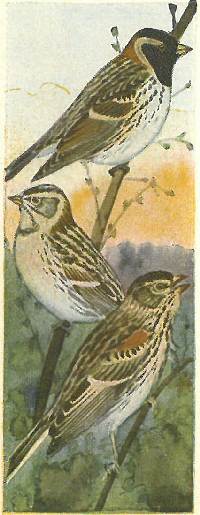
ALASKAN LONGSPUR.
536a. Calcarius lapponicus alascensis. 6½ inches.
Their breeding grounds are in the northern part of Alaska in summer, and in winter coming as far south as Oregon and Colorado, when they may be frequently found in with flocks of Snow Buntings, and, like the Snowflakes, they breed on the ground in a depression in the moss or under some boulder, making their nest of grass and lining it with feathers. Their four to six eggs are grayish, nearly covered with spots and blotches of shades of dark brown (.80 × .60).
WESTERN VESPER SPARROW.
540a. Poœcetes gramineus confinis. 6 inches.
The chestnut shoulders and outer white tail-feather will distinguish this from any others of the sparrows, and the sides are more of a gray color than the eastern variety. Its habit of singing later in the evening gave it the name of “Vesper.” Found on the Pacific coast, from British Columbia to Mexico. Nest is made of grass, placed in a depression on the ground. Four dull white eggs, blotched with brown (.80 × .60).
[177]
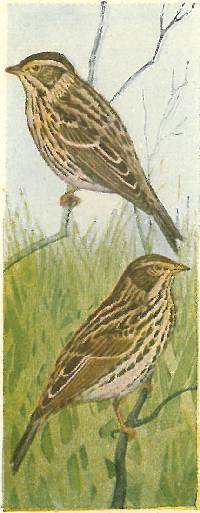
WESTERN SAVANNAH SPARROW.
542b. Passerculus s. alaudinus. 5½ inches.
This is a slightly paler form of the preceding, and is very common in the fields and meadows, from northern Alaska to Mexico. They are birds but very little seen, keeping in the grass the greater part of the time. Their nests are hollows in the ground lined with fine grass and concealed by tufts of grass. They usually deposit four eggs, grayish white, blotched heavily with brown (.75 × .55).
BRYANT SPARROW.
542c. Passerculus s. bryanti. 5½ inches.
Found on the salt marshes of California to Lower California. It is a darker and brighter bird than the preceding (not illustrated).
BELDING SPARROW.
543. Passerculus beldingi. 5½ inches.
Found on the marshes of southern and Lower California. Is darker and more streaked below. Nesting habits the same; eggs darker.
[178]
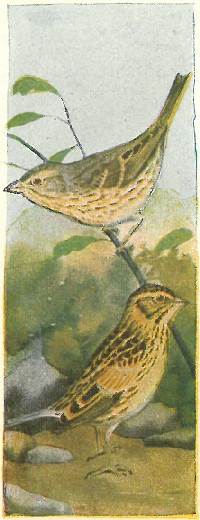
LARGE-BILLED SPARROW.
544. Passerculus rostratus. 5½ inches.
The large and stouter bill, paler, and more of a grayish brown color, will distinguish this from any of the preceding. They are fairly common in the salt marshes of southern and Lower California. Their nesting habits and eggs are practically the same as those mentioned previously.
SAN BENITO SPARROW.
544c. Passerculus r. sanctorum. 5½ inches.
Breeds on San Benito Islands, winters in southern Lower California. Nesting habits are identical (not illustrated).
BAIRD SPARROW.
545. Ammodramus bairdi. 5¼ inches.
These sparrows breed abundantly in parts of the Dakotas on the plains, and winter in eastern Colorado, through Arizona to New Mexico. The tail-feathers of this species are much more pointed than on any of the preceding.
Nest.—This is placed on the ground in clumps of grass, and is made of fine dried grass. Usually four eggs are laid of a dull white, blotched and spotted with shades of brown and lilac (.80 × .60).
[179]
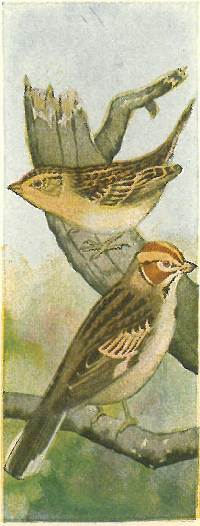
WESTERN GRASSHOPPER SPARROW.
546a. Ammodramus s. bimaculatus. 5 inches.
These birds are common in dry fields and pastures, where their faint lisping song is heard throughout the day. Nest is usually a deep structure in a hollow in some dry field, and usually placed near some rock or suitable place where they can watch the locality for danger. Four eggs are laid; white, finely dotted with chestnut (.72 × .55).
LECONTE SPARROW.
548. Passerherbulus lecontei. 5 inches.
More slender in form than the preceding; breeding above the line and winters through eastern Colorado to southern Texas. Nesting habits and eggs similar to above (not illustrated).
WESTERN LARK SPARROW.
552a. Chondestes grammacus strigatus. 6½ inches.
One of the most common, as well as the most handsome of the sparrow family on the western coast; with its bright chestnut on the sides of the head, and black and white on the crown. They nest in low bushes, or on the ground in a clump of grass; four eggs are laid; white with dark brown markings, mostly about the larger end (.80 × .60).
[180]
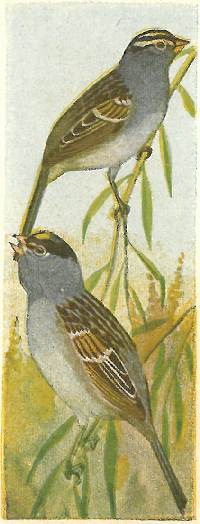
GAMBEL SPARROW.
554a. Zonotrichia leucophrys gambelt. 6½ inches.
This bird, a favorite with the people of the northwest, has been rightly called the “Northern Nightingale.” Their sweet song may be heard all during the day about dwellings or remote from them, or even in the night they have a habit of awakening and giving out the same sweet notes. In habits they much resemble the above, feeding upon the ground among the dead leaves in search of seed and insect food.
Nest.—This is placed on the ground in a clump of grass, and is made of fine grasses; four to six eggs of a pale greenish blue color, spotted and splashed with shades of brown (.90 × .65).
GOLDEN-CROWNED SPARROW.
557. Zonotrichia coronata. 7 inches.
The crown of white in the above is replaced with a golden color. These are common birds about the cities of California during the winter months. Habits the same as above, and also their eggs.
[181]
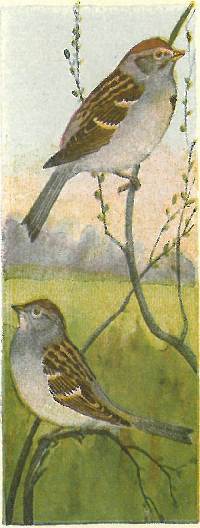
WESTERN TREE SPARROW.
559a. Spizella monticola ochracea. 6 inches.
Somewhat resembling the “Chippy Sparrow,” but is larger and has a dark spot on the breast as an identification mark. It breeds in the far north, above the northern borders of the United States, and in winter is common through Oregon, California, into Arizona and Texas.
Nest.—This is usually placed in low trees or bushes or on the ground made of grasses and lined with feathers. They lay three to five greenish white eggs, spotted with different shades of brown (.80 × .55).
WESTERN CHIPPING SPARROW.
560a. Spizella passerina arizonæ. 5 inches.
This is one of the most helpful birds to our gardens, living upon insects injurious to vegetation and on the seeds from the garden weeds. They will nest in trees and shrubs, or vines about the house, making a small compact nest, mostly of rootlets and horsehair. They lay from three to five greenish blue eggs, with few spots of brown, mostly about the larger end (.70 × .52).
[182]
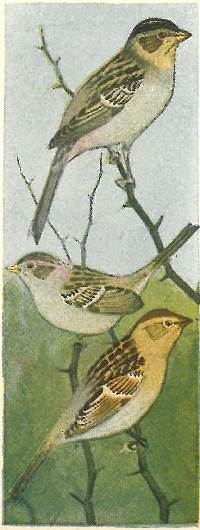
CLAY-COLORED SPARROW.
561. Spizella pallida. 5¼ inches.
These are much like the Chipping Sparrow in every way, with the exception of color, the brown being replaced by the clay-color. Breeds in the Northern United States and into Canada; winters south to Texas and Mexico, rarely in eastern Colorado. Their nest is usually placed on the ground, but may be found in low shrubs in some localities; four eggs are the usual complement, of a light greenish blue, with spots of brown about the larger end (.65 × .50).
BREWER SPARROW.
562. Spizella breweri. 5 inches.
This is very similar to above, but much more streaked with dark above. It is to be found from British Columbia south to Mexico, especially in sections where the sage brush is found, and in southern California near the coast. Its nesting habits are much the same as the above, and the eggs are indistinguishable.
WORTHEN SPARROW.
564. Spizella wortheni. 5 inches.
This is a southern form of the Chipping Sparrow, and is found in New Mexico and Mexico.
[183]
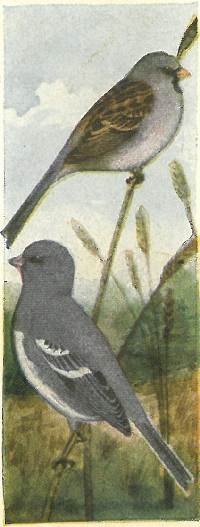
BLACK-CHINNED SPARROW.
565. Spizella atrogularis. 5½ inches.
This is easily identified by the black chin, throat and forehead. It is quite common in parts of southern California, and south into Arizona and New Mexico. The habits are similar to those of the Field Sparrow, their eggs differing in being unspotted and are a bluish green (.65 × .50).
WHITE-WINGED JUNCO.
566. Junco aikeni. 6½ inches.
This is slightly larger than the common “Black and White Snowbird” (Hyemalis). It is also a paler bird and the wings are crossed by two white bars. It is found in the central Rocky Mountain regions, where it breeds in the northern part, and winters to eastern Colorado.
SLATE-COLORED JUNCO.
567. Junco hyemalis. 6 inches.
This is common “Black and White Snowbird” of the east, and is the same as above, but darker and does not have any white wing bars. They breed mostly north of the United States, nesting on the ground, often under some boulder, making their nest of roots and grass in which they lay four greenish white eggs, spotted with brown about the larger end (not illustrated).
[184]
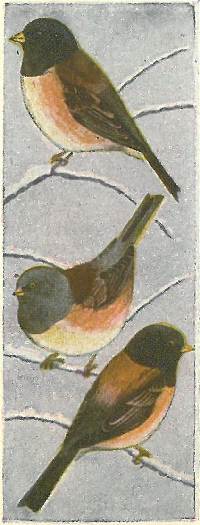
OREGON JUNCO.
567a. Junco hyemalis oreganus. 6 inches.
There are several of the sub-species of “Hyemalis,” all of which are very much alike in habits; varying in color and location. The Oregon Junco is found from British Columbia to southern California, breeding on the mountains of Oregon and northward. In color, this differs much from the preceding, with more black, and on the back a brownish color. The nesting habits and eggs are very much the same as the preceding.