BIRDS OF THE ROCKIES AND WEST TO THE PACIFIC (continued 3)
Reading edition
PINK-SIDED JUNCO.
567g. Junco hyemalis mearnsi. 6 inches.
These breed at high altitudes in the mountains of Montana, Wyoming and Idaho, and winter south to Mexico.
THURBER JUNCO.
567c. Junco hyemalis thurberi. 6 inches.
Found most commonly in the Sierra Nevadas from Oregon to southern California. The difference in coloring is shown in the illustrations of this and the two preceding.
[185]
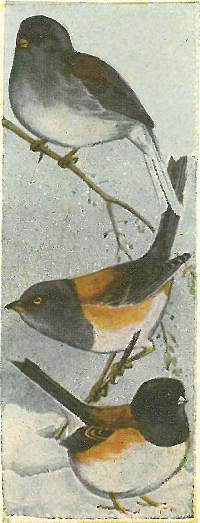
GRAY-HEADED JUNCO.
570b. Junco phœonotus caniceps. 6 inches.
The same as the Slate-colored, with the exception of having the back a reddish brown. The nests of all the Juncos are placed on the ground, and the markings of their eggs vary but little.
BAIRD JUNCO.
571. Junco bairdi. 6 inches.
Found in the mountains of southern and Lower California. This is a gray-headed variety with brown on the back and sides.
GUADALUPE JUNCO.
572. Junco insularis. 5½ inches.
One of the smallest of the family, and found locally only on the Guadalupe Islands off the lower California coast, where they nest commonly in the pine groves, among the needles on the ground, or frequently protected by some overhanging stone. Their nest and eggs are the same as the others. Eggs bluish white, with fine dots of brown about the larger end (.77 × .60).
[186]
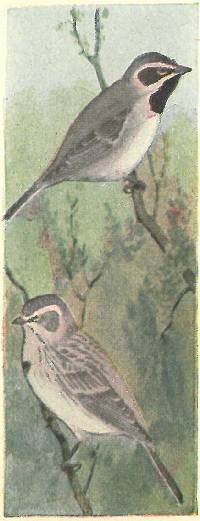
DESERT SPARROW.
573a. Amphispiza bilineata deserticola. 5¼ inches.
This is an abundant bird among the foothills of southwestern United States, in Texas, New Mexico and southern California. It is found in the hot desert plains, where it builds its nest in low bushes, of the sagebrush or cactus, within two or three feet of the ground. It is made up of twigs, roots and fine grass, and lined with feathers and horsehair. They lay three or four bluish white eggs (.72 × .55).
BELL SPARROW.
574. Amphispiza belli. 5¼ inches.
In the hot valleys and foothills of the southern half of California and in the Colorado Desert, south to Lower California, these grayish, black and white sparrows are found abundantly in localities where the sagebrush is common. They build their nests of roots and twigs, loosely put together, and usually lined with grass, feathers and horsehair, in the low sagebrush within two feet of the ground, or quite often placed on the ground under the cover of one of these bushes. They lay three or four pale greenish eggs, heavily blotched and spotted with shades of brown (.75 × .60).
[187]
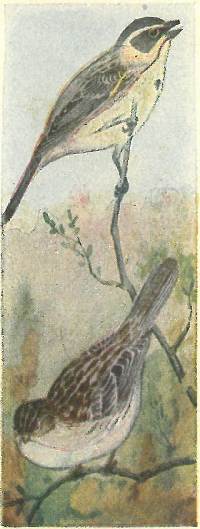
SAGE SPARROW.
574.1. Amphispiza nevadensis. 6 inches.
These are a very quiet and shy sparrow, rarely singing except at their breeding season, and to be found commonly throughout the sage deserts of the Great Basin, from Oregon and Montana to Lower California and New Mexico. They nest either in small sagebrush or upon the ground, making their nests of shred from the sage and grasses, lining it with feathers and hair. They lay from three to four grayish eggs, with heavy markings of shades of brown about the larger end (.75 × .60).
CALIFORNIA SAGE SPARROW.
574.1b. Amphispiza n. canescens. 5½ inches.
Somewhat smaller than the last, and found from eastern California east to Nevada (not illustrated).
BOTTERI SPARROW.
576. Peucæa botterii. 6¼ inches.
A larger gray sparrow, streaked with brown, and black spots. A southern bird, found in Arizona, Texas and Mexico (not illustrated).
[188]
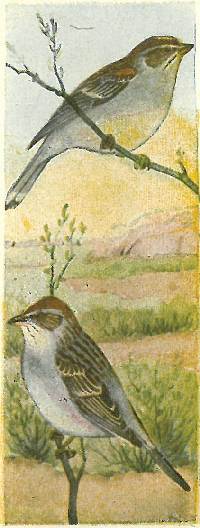
CASSIN SPARROW.
578. Peucæa cassini. 5½ inches.
Found on the arid plains from Texas to Kansas, where it breeds much the same as does the Sage Sparrow.
RUFOUS-WINGED SPARROW.
579. Aimophila carpalis. 5¼ inches.
This small and paler sparrow is found on the plains of Mexico and north to Arizona. In appearance and habits it is similar to the Chipping Sparrow, and the two are frequently found in the same locality. They nest in low bushes, making them of coarse grass and lined with down and hair, in which they place four sunmarked, bluish white eggs (.70 × .60).
RUFOUS-CROWNED SPARROW.
580. Aimophila ruficeps. 5½ inches.
Slightly larger than the former, and the color more of a brown streaked with darker, and still more of a reddish brown on the crown. It is found throughout California along the coast to Lower California. They build on the ground, concealing their nest in a clump of grass or under some bush. They lay from three to five pale bluish white, unmarked eggs (.80 × .60).
[189]
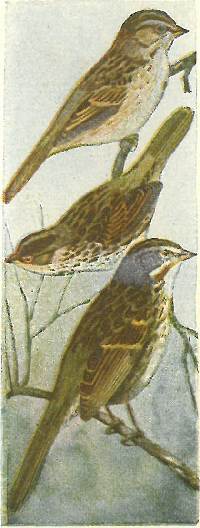
SONG SPARROW.
581. Melospiza melodia. 6¼ inches.
A bird of song, as the name indicates, and their song can be heard in every state of the Union and in Canada. This is the most subdivided of any of the bird family; more than twenty sub-species are listed, all having about the same song and general appearance. In some localities they will be a darker brown, and in the light desert sands they are very light in color. It is almost impossible to distinguish one from another even when in the hand. Their eggs also have the same variation, and cannot be positively identified one from another. They all build either in low bushes or upon the ground. Usually four eggs, greenish white, blotched and spotted with all shades and patterns of brown (.80 × .60).
HEERMANN SONG SPARROW.
581c. Melospiza m. heermanni. 6¼ inches.
Found in the central valleys of California, casually to Nevada.
RUSTY SONG SPARROW.
581e. Melospiza m. morphna. 6¼ inches.
In the Pacific Coast belt from Alaska to southern California.
[190]
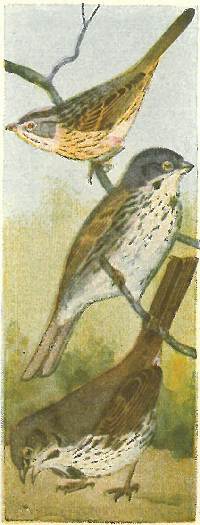
LINCOLN SPARROW.
583. Melospiza lincolni. 5½ inches.
To be found most commonly in the central and western parts of North America, rare in the eastern part. In appearance they are very much like the Song Sparrow, but in their habits are more retiring, and keep more closely in the grass, and out of sight. They nest in tufts of grass within a few inches of the ground, or in a slight depression in the ground. The nest is made of twigs, roots and grasses. Their eggs are similar to the Song Sparrows; three or four in number, greenish white, heavily marked with brown (.80 × .58).
SHUMAGIN FOX SPARROW.
585a. Passerella iliaca unalaschcensis. 6½ inches.
These are large reddish brown sparrows, thickly marked with spots of darker brown on the back and under parts. They are to be found from Alaska to southern California.
Nest.—In low bushes near the ground. Four pale greenish eggs, marked with brown (.94 × .68).
THICK-BILLED FOX SPARROW.
585b. Passerella i. megarhyncha. 7¼ inches.
This is quite a little larger than the above, has a much thicker bill, and is to be found throughout California in the mountains.
[191]
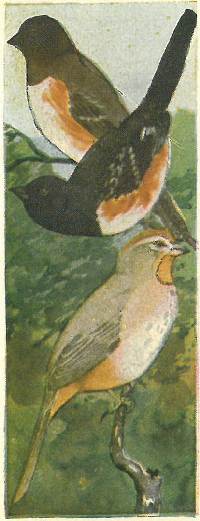
OREGON TOWHEE.
588b. Pipilo maculatus oregonus. 8 inches.
This family are all ground birds, and are usually found scratching among the leaves for their food supply of seeds and insects. This is a much darker bird than his eastern relative. The females are marked much the same as the males, replacing the black with a brown. They build their nest on or near the ground, of twigs, grass and with a finer lining of grass, and usually it is well concealed in bunches of grass or under some brush pile. They lay four or five eggs of a pale gray or white, much spotted with brown (.95 × .75).
SAN DIEGO TOWHEE.
588d. Pipilo maculatus megolonyx. 8 inches.
Darker and with few white markings. Southern California (not illustrated).
CANON TOWHEE.
591. Pipilo fuscus mesoleucus. 8½ inches.
These birds have more brown, and nest in bushes or trees and not so much on the ground. Their eggs are more strongly marked. They range from Colorado to Texas and Arizona.
[192]
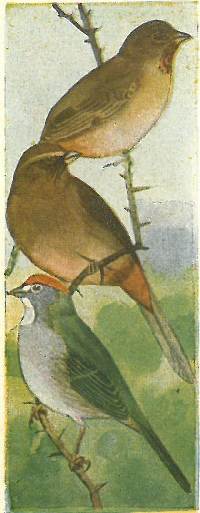
CALIFORNIA TOWHEE.
591.1. Pipilo crissalis. 9½ inches.
A larger and still darker variety, with but very little white if any. It is found in California, from Shasta County to the southern part of the state. They are not as shy as the Towhee family generally are, and frequently come about habitations, where they will scratch about barnyards like chickens. They nest within a few feet of the ground, building much the same as other members of this family. The eggs are also very similar to the others.
ABERT TOWHEE.
592. Pipilo aberti. 9 inches.
More of a reddish brown. Found in Arizona, New Mexico and southern California, where it breeds on the coast range.
GREEN-TAILED TOWHEE.
592.1. Oreospiza chlorura. 7 inches.
This member of the family has characteristics of his own entirely different from any of the others. They are birds of the brush, and rarely appear above the shrubbery in which they nest.
[193]
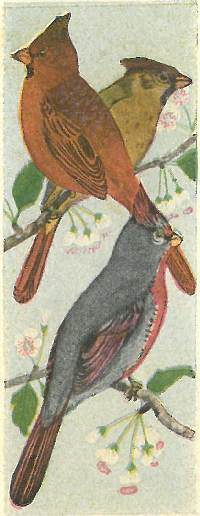
ARIZONA CARDINAL.
593a. Cardinalis c. superbus. 9 inches.
These are birds of vine grown gardens and thickets, where, with their beautiful song, brilliant plumage, and quiet disposition, they make themselves the favorites of mankind. The bill is very large and stout, but the general makeup of the bird, with its long crest, is much to be admired. They build their nest of twigs, roots and grasses, loosely put together, which is placed in bushes, vines or low trees. Their three or four eggs are a pale bluish white, with varied markings or spots of shades of brown, mostly about the larger end (1.00 × .70). Found in Arizona and into Mexico.
ARIZONA PYRRHULOXIA.
594. Pyrrhuloxia sinuata. 8½ inches.
The bill of these birds is more hooked, short and stout like the parrots. Their crest, which is not as heavy as the Cardinals, they have the habit of raising and lowering often, changing the whole appearance of the bird. Their nesting habits and eggs are similar to the last.
[194]
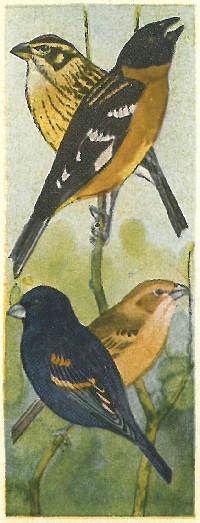
BLACK-HEADED GROSBEAK.
596. Zamelodia melanocephala. 7½ inches.
This species similar in size to the Rose-breasted Grosbeak of the eastern sections (which is sometimes found west to Colorado), does not have the bright colors of his eastern brother. In habits they appear to be much the same, their song is wonderfully sweet and clear. They are very quiet birds, and when nesting will almost allow one to touch them before leaving. Their nests are simply a few straws and sticks, loosely laid on the forks of some horizontal branch of a bush or low tree, so frail that frequently their eggs can be seen from beneath. They lay four eggs of a bluish green, spotted and blotched with different shades of brown (1.00 × .70).
WESTERN BLUE GROSBEAK.
597a. Guiraca cærulea lazula. 7 inches.
Found more in the open woods, in small groves and along the roadside in the small brush. It seems out of place to have three members of the same family with such a difference of plumage. One with rose, white and black; the next with black, brown and yellow; and this bird, a blue and black. Their nesting habits and also their eggs are much the same as above, the eggs being a little smaller (.85 × .62).
[195]
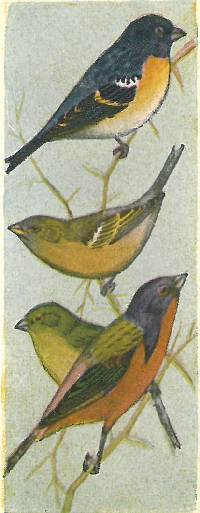
INDIGO BUNTING.
598. Passerina cyanea. 5 inches.
An eastern form, of an indigo blue on the head, shading to lighter on the under parts and towards the rump. It is found as far west as Colorado and into Texas (not illustrated).
LAZULI BUNTING.
599. Passerina amœna. 5½ inches.
Similar to the above, but lighter, while the under parts and breast are brownish. The wings are barred with two bands of white. It is found from British Columbia to Lower California and from the western coast to eastern Colorado. The nesting habits and eggs of the two are identical. They build in bushes or lower branches of trees, only a few feet from the ground, three or four eggs of a pale bluish white, unmarked (.75 × .58).
BEAUTIFUL BUNTING.
600a. Passerina versicolor pulchra. 5½ inches.
These are the most varied in color markings of any of our North American birds, having bright colors. Found in southern and Lower California, Arizona and into Mexico. Like the above they are to be found in thickets and hedges, where they build their nests within a few feet of the ground.
[196]
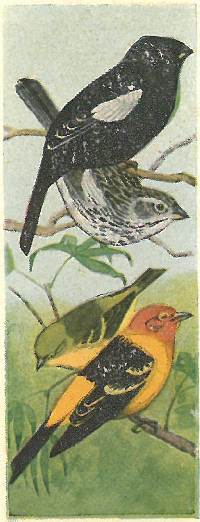
DICKCISSEL.
604. Spiza americana. 6¼ inches.
The male is a prettily marked bird with a yellow line over the eye, on the side of the throat, edge of wing and front under parts; black patch on the breast, white throat and a bright chestnut patch on the wing. It is found rarely in Colorado and into southern California (not illustrated).
LARK BUNTING.
605. Calamospiza melanocorys. 7 inches.
Bill very short and thick, and light color. The male in summer is a dull black all over, with the exception of white wing-coverts. Their habits are similar to the above. They have a fine song, which they often give while on the wing, after the manner of the Bobolink. The female is a sparrow-like looking bird, mottled brown and white. They are birds of the plains, from Canada to Texas, occasionally in California and Colorado. Nest on the ground, laying four pale blue eggs (.85 × .65).
WESTERN TANAGER.
607. Piranga ludoviciana. 6½ inches.
Found from British Columbia to southern California, breeding in mountains. Three or four eggs, bluish green, spotted with brown (.95 × .75).
[197]
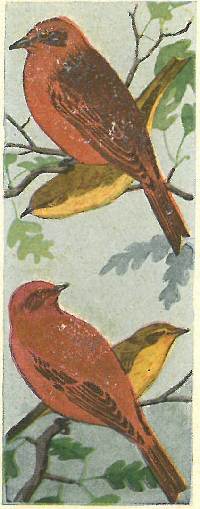
HEPATIC TANAGER.
609. Piranga hepatica. 7½ inches.
A pale colored bird as compared with the Scarlet Tanager of the east, lacking also the black wings of its eastern brother. The female is a pale yellow on the under parts and an olive above. Their range is throughout Arizona and into Mexico. The nest is built upon horizontal branches of trees at varying heights from the ground, and is made of twigs, grass and hair, usually a frail structure, in which they lay four eggs of a greenish blue, spotted with shades of brown (.92 × .64).
COOPER TANAGER.
610a. Piranga rubra cooperi. 7 inches.
Western United States, breeding from Central California to Texas and the borders of Mexico. Their breeding habits are the same and the eggs are not distinguishable from the others, all of them varying in the markings, but practically of the same size and general color.
[198]
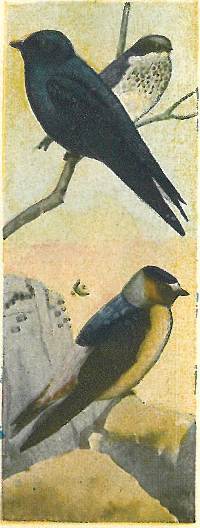
WESTERN MARTIN.
611a. Progne subis hesperia. 8½ inches.
The male of this is not to be distinguished from the eastern Purple Martin, and in the female a lighter gray on the forehead is the only difference. They nest in cavities of trees or in boxes provided for them in the cities and towns, both in the east and west, as they are to be found breeding throughout the United States and into British Columbia. They make their nests of twigs, roots and mud, usually lined with feathers, and lay from four to six white eggs (.95 × .65).
CLIFF SWALLOW.
612. Petrochelidon lunifrons. 5½ inches.
Their range is throughout the whole of North America; they can easily be recognized by their brownish throat and breast, white forehead and black cap. Their nests or homes are built of mud, securely cemented to the face of cliffs, or under the eaves of buildings. They make them round or gourd-shaped, with a small opening in the side, and lining the inside with grass and feathers. They lay four eggs, creamy white, spotted with shades of brown (.80 × .55).
[199]
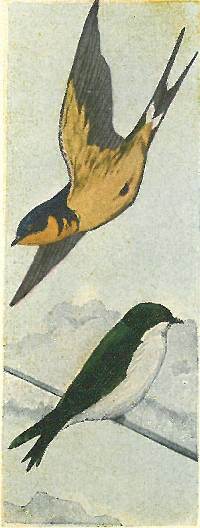
BARN SWALLOW.
613. Hirundo erythrogastra. 7½ inches.
Their range is throughout North America, breeding generally from Alaska to southern California, and over the eastern part of the United States. They nest in barns, sheds or in any buildings where they are not likely to be disturbed, building their nests of mud on the rafters or beams near the roof, and lining it with feathers. They are a familiar bird in all parts of the country, and one of the most graceful while on the wing, skimming over the ponds and meadows in search of the insect life which constitutes their food. Their eggs are similar to the Cliff Swallow, creamy white, spotted with shades of brown and chestnut (.80 × .55).
TREE SWALLOW.
614. Iridoprocne bicolor. 6 inches.
Perhaps this is more commonly known as the White-bellied Swallow, and it is found in the whole of temperate North America, breeding from the middle United States northward. They nest in holes of trees and stumps naturally, but accept the bird houses that are put up for them in suitable locations near ponds or wet marshes. Their eggs are the same as above, both in number and markings.
[200]
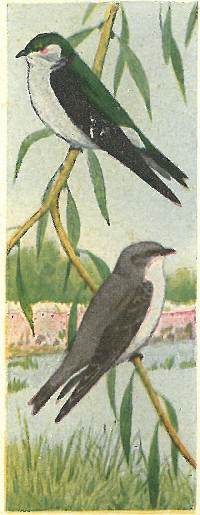
NORTHERN VIOLET-GREEN SWALLOW.
615. Tachycineta thalassina lepida. 5¼ inches.
In the Rocky Mountain regions of the United States and west to the Pacific, breeding throughout its range. A most beautiful species with its blue, green and purple back and white under parts. They are abundant in favorable localities in California, building their nests in holes of trees, at times well up in the mountains, in the tops of some of the largest redwoods and pines, using woodpecker holes, and at times placing their nest in a crevice of the cliffs. Their nests are made of grass and fine roots, and nicely lined with feathers. Their four to six eggs are pure white (.72 × .50).
BANK SWALLOW.
616. Riparia riparia. 5½ inches.
The whole of North America north to the limit of trees, and south to the Gulf of Mexico, breeding from the middle portion of the United States northward. These birds build their nests in sand banks in almost all sections of the country, digging a small tunnel from one to three feet in length, enlarged and lined with grass at the end. They lay from four to six pure white eggs (.70 × .50).
[201]
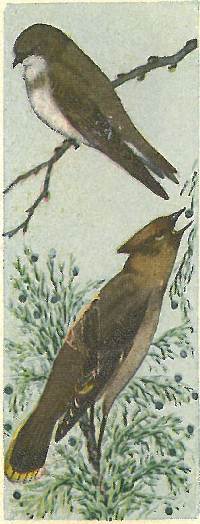
ROUGH-WINGED SPARROW.
617. Stelgidopteryx serripennis. 5½ inches.
This species is about the same size as the last, and similar, but with the throat and breast grayish in place of the white. The outer webs of the outer primaries are recurved, forming a series of hooks. It nests in holes of embankments or in the crevices of cliffs, or among the stones of bridges and buildings. Their eggs are four in number and are pure white (.75 × .52). The range of these birds covers the whole of the United States, breeding from Mexico to British Columbia.
BOHEMIAN WAXWING.
618. Bombycilla garrula. 8½ inches.
A northern variety, breeding in Alaska and northward, winters to California and the northern states of the United States. It may be identified from the following by the markings on the wings of white and yellow, and the larger band of yellow at the end of the tail. The wax-like appendages on the wings and tail may be found on both species.
Their nests are made of rootlets, grass and moss, and placed in bushes or trees at a few feet from the ground. Usually four eggs are laid, of a grayish color, sharply spotted with brown (.95 × .70).
[202]
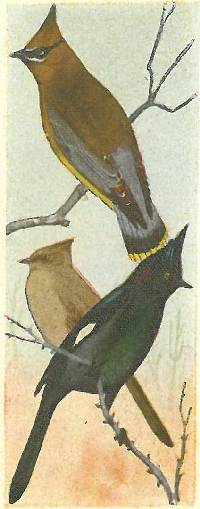
CEDAR WAXWING.
619. Bombycilla cedrorum. 7½ inches.
These are a North American bird, and great travelers in large flocks all over the country, separating at breeding time, and mating up, with a pair or two selecting some orchard or suitable locality to remain during nesting time. They breed throughout the northern United States and north into Canada. Their nests are placed in almost any kind of tree, on horizontal limbs, made of twigs, rootlets, string and grass, in which they lay usually four eggs of a dull grayish color, spotted with dark brown, mostly about the larger end (.85 × .60).
PHAINOPEPLA.
620. Phainopepla nitens. 7½ inches.
These are found from central California to Texas and into Mexico. In habits they are very much like the preceding, and the female is quite similar in looks, while the male is a rich shining blue black, with a long pointed crest, and a white patch on the wings. Their food consists of insects and small berries. They build loosely constructed nests, with a more compact lining of plant down. They lay two or three eggs of a light gray, spotted with brown (.88 × .65).
[203]
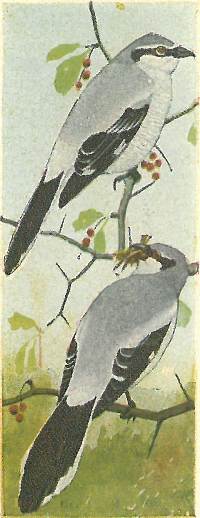
NORTHERN SHRIKE.
621. Lanius borealis. 10 inches.
One of the largest of the family in the United States, the breast being barred with wavy lines of gray above the paler gray, with the wings and tail having much white, showing especially in flight. They are bold birds; carnivorous in their habits, living upon other small birds, insects and small rodents. In winter they have been known frequently to live about cities, catching the English Sparrows in the parks and city streets. They tear their food to pieces with their bill, which is shaped similar to that of a hawk’s, while their feet are small and weak, not at all resembling the hawk’s feet. Their nests are placed in thickets or thorny bushes, and are made of shreds of vines, grasses and plant down. Four to six grayish white eggs are laid, these being spotted and blotched with shades of brown (1.05 × .75).
CALIFORNIA SHRIKE.
622b. Lanius ludovicianus gambeli. 8 inches.
In size the same as the White-rumped Shrike, and in habits and general appearance much the same, being somewhat darker, more on the under parts and sides. Eggs similar but smaller.
[204]
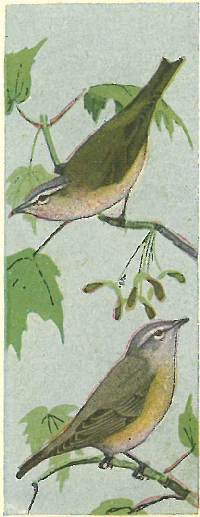
RED-EYED VIREO.
624. Vireosylva olivacea. 6 inches.
One of the most common of the family throughout its range, from the eastern slope of the Rockies over the United States. Wherever they may be found, their song is heard continuously during the day, from early morning until late in the evening, it consisting only of two or three notes, first a rising inflection, then a falling, and repeated over and over, even while they are feeding. The nests are placed within a few feet of the ground on an overhanging limb, suspended from a fork, and made of strips of bark, plant fiber and often with pieces of string and paper included in its construction. Three or four eggs are white, specked sparingly with brown (.85 × .55). This is one of the favorite nests in which the Cowbird deposits its eggs.
WARBLING VIREO.
627. Vireosylva gilva. 5½ inches.
These are nearly as common as the above, but probably not as well known, as they keep well up in the tops of the taller trees, where they also build their nests, very much the same as the Red-eye. Their song is much more pleasant. Four eggs, like above (.72 × .52).
[205]
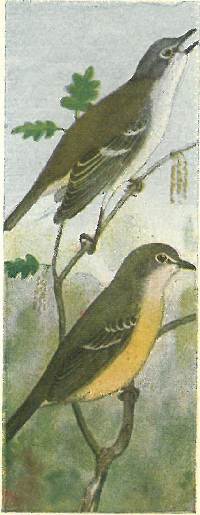
CASSIN VIREO.
629a. Lanivireo solitarius cassini. 5 inches.
To be found west of the Rockies from British Columbia south to Lower California and Mexico. In southern California, it is found breeding much more commonly than the Western Warbling Vireo, placing its nest high in the oaks and coniferous trees. It belongs to the same musical family, keeping up its song from morning until night. The nest is made of similar material to the previous, and the eggs are the same, except in size (.75 × .58).
BLACK-CAPPED VIREO.
630. Vireo atricapillus. 4½ inches.
A smaller variety, the male marked with a black cap. Breeds in Texas, north to Kansas. Winters in Mexico (not illustrated).
HUTTON VIREO.
632. Vireo huttoni. 4½ inches.
Similar to last, without the black cap. Found in central and southern California. Nesting habits similar to others of the family. Eggs white with a few spots of brown about the larger end (.70 × .50).
[206]
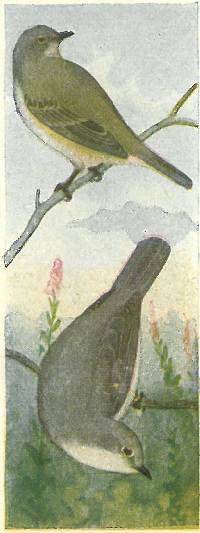
ANTHONY VIREO.
632c. Vireo huttoni obscurus. 4¼ inches.
Like Hutton, but a trifle smaller and darker. Found from British Columbia to southern California, breeding in Oregon (not illustrated).
LEAST VIREO.
633a. Vireo belli pusillus. 4¼ inches.
Much like the last, and found nesting in southern California, Texas and Arizona. Their nest is a neat, compact, cup-shaped structure, made of shreds of vines and fine roots, and lined with fine grass. The four eggs are white, spotted finely with brown about the larger end (.70 × .80).
GRAY VIREO.
634. Vireo vicinior. 5½ inches.
Found in the southwestern United States, from western Texas, and southern California, into Mexico. They are not uncommon birds in the mountains of Arizona, where they nest in low bushes or trees, building their nest similar to the Red-eyed vireo in the horizontal fork of some overhanging limb, within a few feet from the ground. Usually four white eggs, which are finely spotted with brown about the larger end (.72 × .53).
[207]
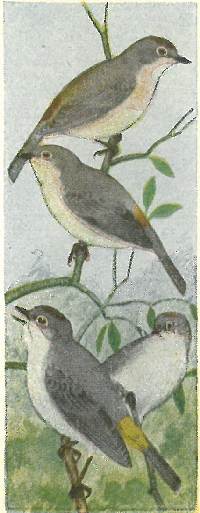
Family MNIOTILTIDÆ—WOOD WARBLERS.
BLACK-AND-WHITE WARBLER.
636. Mniotilta varia. 5¼ inches.
This eastern bird, with its black and white markings, is found in southern Texas, and has been seen accidental in California and Washington (not illustrated).
LUCY WARBLER.
643. Vermivora luciæ. 4 inches.
Range.—Southwestern United States and Mexico. It breeds quite commonly in Arizona, where it builds in almost any situation, in the loose bark on tree trunks, in deserted woodpecker holes, in the cactus or in small bushes near the ground. The nest is made of fine grass, leaves and feathers, in which they lay usually four white eggs, spotted and wreathed with brown about the larger end (.60 × .50).
VIRGINIA WARBLER.
644. Vermivora virginiæ. 4¼ inches.
Range.—Rocky Mountains, from Colorado to Arizona, and winters in Mexico. They are much like the last, but have a patch of yellow on the rump and breast. Their nest on the ground, beside some rock or stump, is made of shreds of vines and grass. Three or four white eggs, specked and wreathed with brown (.62 × .50).
[208]
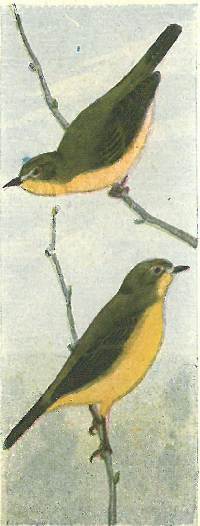
CALAVERAS WARBLER.
645a. Vermivora rubricapilla gutturalis. 4½ inches.
Found in the Pacific coast regions, breeding from central California north to British Columbia. Winters south to Mexico. In Oregon and California, these birds are quite common in favorable localities on the mountain sides. They build their nest on the ground in a slight depression, making it of twigs and grasses, and usually well concealed with overhanging grass or brush. Their four eggs are a creamy white, with fine spots of brown and lavender, forming a wreath about the larger end (.60 × .45).
ORANGE-CROWNED WARBLER.
646. Vermivora celata. 4½ inches.
Range.—Central North America, breeding in the Rockies locally, from Alaska to Mexico. Crown with a concealed, dull orange patch. Nesting habits and eggs same as above (not illustrated).
LUTESCENT WARBLER.
646a. Vermivora celata lutescens. 4¼ inches.
This bird is found breeding from Alaska along the Pacific coast to southern California. Nest placed in similar locations, and the eggs are the same as above (.60 × .45).
[209]
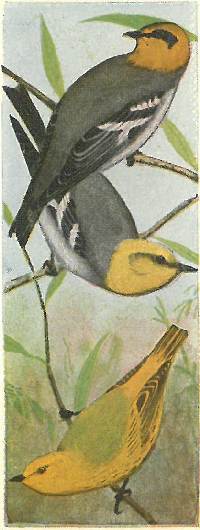
OLIVE WARBLER.
651. Peucedramus olivaceus. 5 inches.
Range.—In the mountains of Arizona and New Mexico, southward. They may be easily identified by their orange-brown head and neck, with a broad black band through the eyes. Their nests are placed at high elevations in coniferous trees on the mountain sides. They build a very compact nest, saddled upon a horizontal limb, the nest having a resemblance to a knot; it is made of moss, lichens, etc., and lined with fine rootlets and down from plants. Their four eggs are a pale gray, completely covered with spots of dark brown, the heaviest at the larger end (.64 × .48).
YELLOW WARBLER.
652. Dendroica æstiva. 4 inches.
Range.—The whole of North America, breeding throughout its range. They are active little bunches of yellow, as they gather in their many insects for food, all the while singing their happy song. They place their nests in almost any kind of trees, but seem to prefer willows and alders near some brook or pond, where insect life is abundant. Their nest is a compact, cup-shaped structure, made of fibers and grasses, lined with plant down or cotton.
[210]
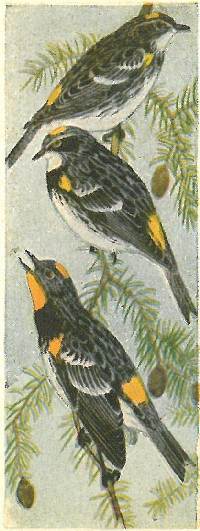
MYRTLE WARBLER.
655. Dendroica coronata. 5½ inches.
Range.—Most of North America. On the Pacific coast, it is found from central Oregon to southern California. It is quite commonly known as the Yellow-rumped Warbler, both in the east and west. They differ from the following, mostly in the throat markings, this one having a white throat and much more black on the head and breast, while on the following the throat is yellow. They nest in the lower branches of coniferous trees, making it of grasses, rootlets and fiber, in which they lay usually four eggs, white, spotted with shades of brown and lilac, more heavily about the larger end (.70 × .50).
AUDUBON WARBLER.
656. Dendroica auduboni. 5½ inches.
This species is found in the western United States from British Columbia to Mexico, and rarely east of the Rockies. They are more of a dull-colored bird than the preceding. Their nesting habits and eggs are identical with the last (.68 × .52).
[211]
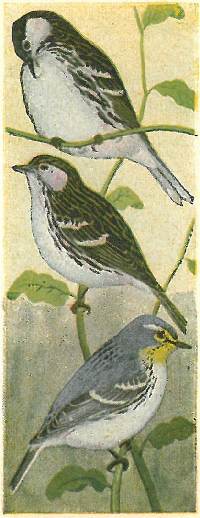
MAGNOLIA WARBLER.
657. Dendroica magnolia. 5 inches.
Range.—This is an eastern bird, found west to the Rockies and accidental in California. The white over the eye, white wing patch, and the band of white across the tail will identify this species (not illustrated).
BLACK-POLL WARBLER.
661. Dendroica striata. 5½ inches.
Range.—North America, mostly east of the Rockies, but found in the Rockies from Alaska to Colorado. They nest on the lower branches of coniferous trees, made of roots and strips of vine, and lined with feathers and lichens. Four dull white eggs, spotted with brown (.72 × .50).
GRACE WARBLER.
664. Dendroica graciæ. 4½ inches.
Range.—Western North America, British Columbia to Lower California and Arizona. Nest usually in pines near the tops of the trees, made of roots, fibers and lined with plant down. Eggs white, with light spots of brown (.65 × .45).
[212]
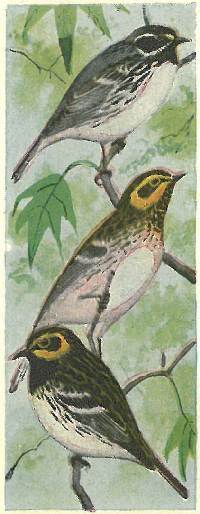
BLACK-THROATED GRAY WARBLER.
665. Dendroica nigrescens. 4½ inches.
Range.—Western North America, British Columbia to Lower California. A small bird, with a black throat and breast, forming a circle about the neck, and black on top of the head. They are found mostly in the woodlands, bordered with thickets, in which they will place their nests, within a few feet of the ground. It much resembles that of the Yellow Bird, being compact and made of the same materials. Three or four eggs are creamy white, spotted with brown, forming a wreath about the larger end (.65 × .52).
BLACK-THROATED GREEN WARBLER.
667. Dendroica virens. 5 inches.
Range.—Mostly in the eastern part of North America, but occasionally in the southern Rockies, Texas and Arizona. Black throat and breast, with bright yellow cheeks and olive head and back (not illustrated).
TOWNSEND WARBLER.
668. Dendroica townsendi. 5 inches.
Range.—Western United States. A similar bird to the above, with black on top of the head in place of the olive. Nesting habits are practically the same, as are also the eggs.
[213]
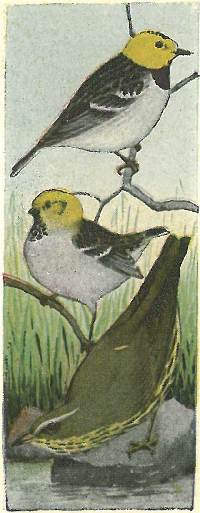
HERMIT WARBLER.
669. Dendroica occidentalis. 5 inches.
Range.—Western North America, from British Columbia to southern California, Texas and Arizona. These are to be found in the high, mountainous regions among the coniferous trees, where they build their nests on the outer limbs of tall pines, almost impossible to find. Their nests are made of grass, and the needles from the pine, and not much of a nest as compared with some of this same family. They lay four white eggs, spotted and wreathed with shades of brown (.68 × .52).
GRINNELL WATER THRUSH.
675a. Seiurus noveboracensis. 5½ inches.
Range.—From Alaska to Mexico, breeding in the northern portions. They are a quiet bird, solitary in habits, nesting in stumps near the ground or among roots of fallen trees. Four white eggs, spotted and blotched with brown and lilac (.80 × .60).
[214]
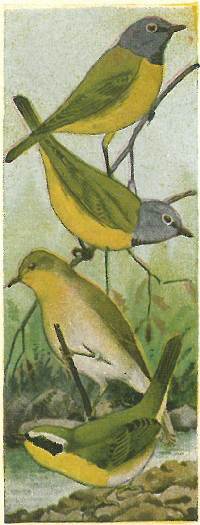
MACGILLIVRAY WARBLER.
680. Oporornis tolmiei. 5½ inches.
Range.—Western North America, from British Columbia to southern California, breeding throughout its range. They are common warblers of the Pacific coast, to be found on or near the ground in thick shrubbery, where they build their nests within a few feet of the ground. This is made of grasses and shreds of vines, and lined with finer grasses and hair. Four eggs are laid, white, spotted and quite heavily marked with shades of brown (.72 × .52).
WESTERN YELLOW-THROAT.
681a. Geothlypis trichas occidentalis. 5¼ inches.
Range.—Western North America, from British Columbia south to Arizona, but not near the Pacific coast. It is one of the seven or eight forms of the Maryland Yellow-throat, the greatest difference in them being in the locality in which they are found. They place their nest in a clump of grass, well concealed, laying usually four white eggs, with few spots of brown (.70 × .50).
PACIFIC YELLOW-THROAT.
681c. Geothlypis trichas arizela. 5¼ inches.
Range.—The Pacific coast. Habits, nest and eggs same as above.
[215]
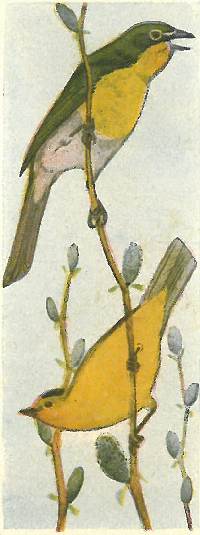
LONG-TAILED CHAT.
683a. Icteria virens longicauda. 7½ inches.
Range.—Western United States, breeding from British Columbia to Mexico. They are an attractive bird both in looks and habits. They are great singers, but nature seemed to give them no special song of their own, and they make good attempts to mimic the song of any bird in their locality, and keep continually at it. They like the bramble and vine-covered hillsides, where it is hard to obtain a sight of the bird. They build their nests in the thickest of such places a few feet from the ground, made up of shreds of vines, leaves and twigs, lined with grass. Four white eggs, spotted with fine dots of shades of brown (.90 × .70).
PILEOLATED WARBLER.
685a. Wilsonia pusilla pileolata. 5 inches.
Range.—Western North America, breeding in Oregon, Washington and California to Mexican borders. These little birds, with their deep yellow under parts and breast, and little cap of jet black, are quite common about many of the orchards and gardens when the trees are in full blossom, taking insects that abound at that time. They nest in moist grounds in a slight depression or in low bushes, made of fibers and grass.
[216]
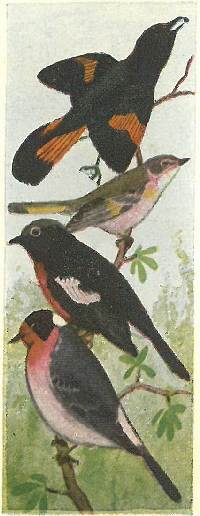
REDSTART
687. Setophaga ruticilla. 5½ inches.
Range.—North America, found more commonly east of the Rockies, but less common in Oregon, California and to Arizona. These birds are always the most conspicuous when in flight, at that time showing off to the best advantage their bright orange markings on the wings and tail of the males, and the bright yellow of the females. They build a neat, cup-shaped nest of plant fibers and down, which is placed in the crotch of small trees, in which they lay four white eggs, spotted with different shades of chestnut and black (.65 × .50). They are very active, and constantly flying from place to place, taking insects while on the wing, which constitute their food.
PAINTED REDSTART.
688. Setophaga picta. 5½ inches.
Range.—New Mexico and Arizona. These have much the same habits as the above, except that they build their homes in cavities of rocks or on the ground in swampy places.
RED-FACED WARBLER.
690. Cardellina rubrifrons. 5¼ inches.
Range.—Arizona and New Mexico.
[217]
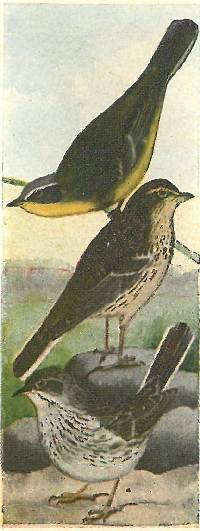
ALASKAN YELLOW TAIL.
696. Budytes flavus alascensis. 6½ inches.
Range.—Alaska and Bering Sea in summer, where they are fairly common on the islands and coast. They nest on the ground, under or beside stones and in bunches of grass; it is made of roots and grasses, lined with moss and animal fur. They lay from four to six white eggs, thickly covered with spots of brown (.75 × .55).
PIPIT, OR TITLARK.
697. Anthus rubescens. 6½ inches.
Range.—It breeds on the high mountains of Colorado, California, Alaska, north to the Arctic Zone. During migration they may be found over most of the United States in quite large flocks. Their nests are placed on the ground in tufts of grass, and are made of fine grass and moss, lined with feathers and hair. Four to six eggs are grayish, heavily blotched with brown (.75 × .55).
SPRAGUE PIPIT.
700. Anthus spraguei. 6½ inches.
Range.—Breeds from Manitoba to Montana and Dakota, and west to the Rockies. Habits, nest and eggs are similar to preceding.
[218]
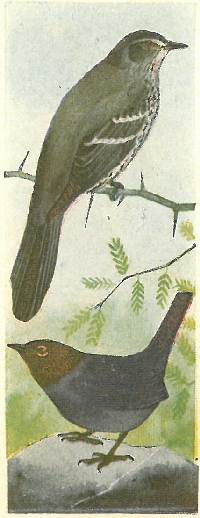
Family MIMIDÆ.—SAGE THRASHER.
702. Oreoscoptes montanus. 8½ inches.
Range.—From Lower California and Mexico on the plains to Montana. This is an abundant bird in the sage regions of the plains throughout its range, and are frequently called the Mockingbird, on account of the varied song which they give from the top of some sagebrush or cactus, in which they nest. Four eggs, greenish, spotted with brown (.60 × .55).
Family CINCLIDÆ.
DIPPER, OR WATER OUZEL.
701. Cinclus mexicanus unicolor. 8 inches.
Range.—Mountains of western North America from Alaska to Mexico. Among the rapid streams that are falling down the mountain side, these gray birds are to be found. They are strange members of bird life; they do not have webbed feet, and yet they swim on, or under the water, using their wings as paddles. They have a thrush-like bill, the habit of teetering similar to the sandpiper, and a song that is not to be forgotten if once heard. They nest on the rocks of these rapid streams, making their nest of moss, a bulky affair with an opening in the side, in which they deposit their four or five eggs of pure white (1.00 × .70).
[219]
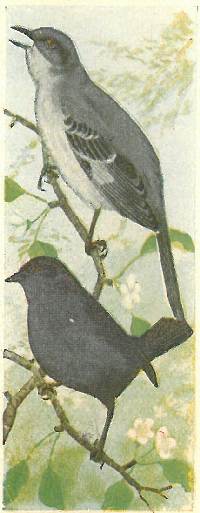
WESTERN MOCKINGBIRD
703a. Mimus polyglottos leucopterus. 10 inches.
Range.—Texas to California and southward, breeding commonly from central California southward. These birds not only have a song of their own which puts them in the opera class, but, as their name implies, they can mimic or mock nearly anything in the bird line for song or bird notes. They are not satisfied with a few notes early in the morning and evening, but will keep their song in full play all day, without hardly seeming to take time to hunt up a few worms or insects, as if eating was not to be considered when he could sing.
They nest usually low down in bushes and thickets, and construct a bulky nest of sticks, roots and grass. Three to five eggs are of a greenish color, spotted and blotched all over in many patterns with shades of brown (.95 × .72).
CATBIRD.
704. Dumetella carolinensis. 9 inches.
Range.—Mostly eastern North America, but extends over the Rockies, occasionally to the Pacific coast. It is a fine songster and almost as much of a mimic as the Mockingbird. Breeding habits are much the same, but eggs are bluish green (.95 × .70).
[220]
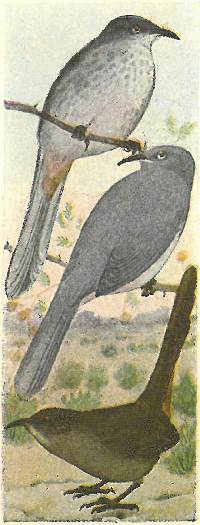
PALMER THRASHER.
707a. Toxostoma curvirostre palmeri. 11 inches.
Range.—Arizona to Mexico, breeding abundantly in the desert regions of Arizona, where the cactus is mostly to be found. They all seem to belong to the happy family of songsters, and there is no lack of bird music in localities where these birds are in any numbers. Their nests are usually placed in cactus, or on the ground under them, and are made up of twigs, dried grass and moss. Usually four eggs are laid, bluish green, spotted with brown very finely all over (1.00 × .80).
BENDIRE THRASHER.
708. Toxostoma bendirei. 10 inches.
Range.—Arizona and Mexico to southern Colorado. It breeds in Arizona and southern California. General habits are the same as above. While it may not be as common as the above, it is possibly a better singer. Eggs are the same, spots larger (1.00 × .72)
CALIFORNIA THRASHER.
710. Toxostoma redivivum. 12 inches.
Range.—California, from Shasta county to Lower California. The habits and song, as are also the nest and eggs, much like the above (1.12 × .82).
[221]
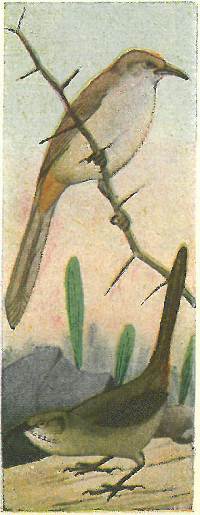
LECONTE THRASHER.
711. Toxostoma lecontei. 10½ inches.
Range.—Southern and Lower California to Mexico. This is the lightest in color of any of the family, and has taken on the color of the sand of the low hot deserts in which it lives. Where it is so hot and dry that even the cactus and thornbush are stunted in their growth, where the ground is covered with the small varieties of cacti, with spines like needles. In such a place one cannot imagine that a bird would be as full of song as in a shaded piece of woodland, yet this bird has the same qualifications, and morning and night his voice may be heard, pouring out as rich a song as his brother of the north. Their nest, composed of twigs, weeds and lined with grass, is usually very bulky, and placed in low mesquite trees or cactus. The eggs are lighter in color than above, and with fewer and finer spots of brown (1.10 × .75).
CRISSAL THRASHER.
712. Toxostoma crissale. 11 inches.
Range.—From Utah and Nevada to southern and Lower California and Texas. This species is somewhat darker, and more rufous on the under tail coverts than the above.
[222]
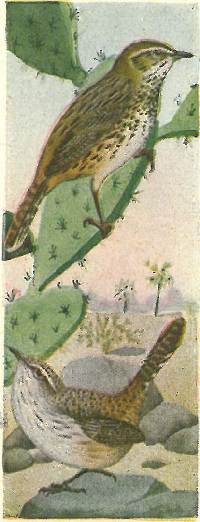
CACTUS WREN.
713. Heleodytes brunneicapillus. 8½ inches.
Range.—Southern part of California, to Texas, and north to Nevada and Utah. They are the largest of the Wrens, and look the least like that family of any of them. They are a common bird in the desert lands, where the cactus abounds, but lacks the sweet song of some of the smaller members of the family. Their nests are bulky, ball-shaped structures, made up of sticks, moss, grass, and lined with feathers. There is an opening on the side for an entrance, and it is usually placed in a thorn bush or cactus. Their four to seven eggs are creamy white, dotted thickly with chestnut (.95 × .65).
ROCK WREN.
715. Salpinctes obsoletus. 6 inches.
Range.—Western coasts from British America to Mexico. These bird are equally at home on the mountain sides or in the deep canyons, building their nests in the crevices of rocks or stumps, where they lay from five to eight white eggs, with fine spots of brown about the larger end (.72 × .50).
[223]
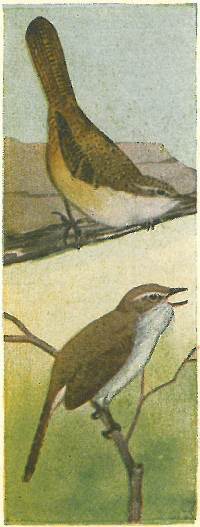
CAÑON WREN.
717a. Catherpes mexicanus conspersus. 5½ inches.
Range.—Rocky Mountain ranges, from Colorado to Mexico, breeding throughout its range. As he is gathering his supply of food among the huge boulders and in the large rocky canyons, where he makes his home, you will, at short intervals, hear his loud joyous song, a song that puts to shame that of his largest relative of the plains. They build their nest of small sticks, leaves, grass and feathers, which is placed in the crevice of some rock, either down near some swiftly running mountain stream or high up in the cliffs above. Their three to five eggs are white, with spots of brown and lilac well covering the under color (.72 × .52).
VIGOR WREN.
719a. Thryomanes bewicki spilurus. 5 inches.
Range.—Coast regions of California. These are active and restless little birds. Eating and singing, and singing and eating is all this life holds for them. Nesting in bird boxes, holes in trees, in sheds, or almost any locality in which to place their six eggs (.65 × .50).
[224]
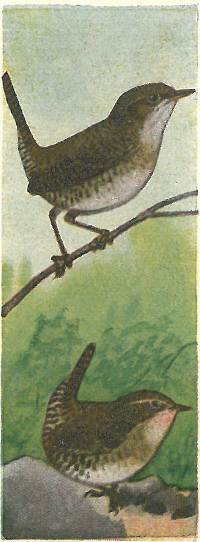
WESTERN HOUSE WREN.
721a. Troglodytes aedon parkmani. 5 inches.
Range.—Pacific coast, from British Columbia southward to Lower California. These happy little songsters are to be met with more about civilization, and seem to prefer the cultivated lands to the wild. They build in bird houses or holes of trees, and no matter how large the tenement may be they will keep busy until it is filled, leaving only space enough for their nest. They lay from five to seven eggs of a pinkish color, with a wreath of brown dots about the larger end (.65 × .52).
WESTERN WINTER WREN.
722a. Nannus hiemalis pacificus. 4 inches.
Range.—From Alaska to New Mexico, through North America. This is the smallest of the family, and is also one of the most quiet in song. They are active little fellows, just a bunch of feathers, with a short stub of a tail up over their backs when observed, and getting about the brush heaps and stone walls like little mice. They nest in walls or crevices of rocks, and stumps, building of twigs, leaves, grass and feathers, in which usually six or seven eggs, creamy white, finely specked with brown, are laid (.60 × .48).
[225]
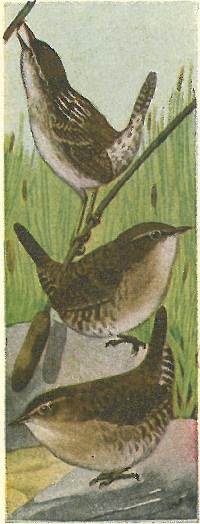
ALASKA WREN.
723. Nannus alascensis. 4½ inches.
Range.—Aleutian Islands and Alaska. This is a somewhat larger variety of the preceding, and is found only in the far north. Its breeding habits are the same, as are also the eggs, which average a little larger (.65 × .51).
ALEUTIAN WREN.
723.1. Nannus meliger. 4½ inches.
Range.—Western Aleutian Islands to Alaska. Very similar to the above, both in song and general habits. They nest in the crevices of rocks or between boulders, making their nests of rootlets and grass, lining it with hair and feathers. Usually six eggs are laid, white with a few specks of brown (.58 × .46).
TULE WREN.
725a. Telmatodytes p. paludicola. 5½ inches.
Range.—Pacific coast, from British Columbia to southern California. This is a western form of the Long-billed Marsh Wren, found more east of the Rockies. They build a globular-shaped nest of grass and rushes, attached to upright rushes just above the water. Five eggs are laid, of a pale chestnut color, with darker markings (.64 × .45).
[226]
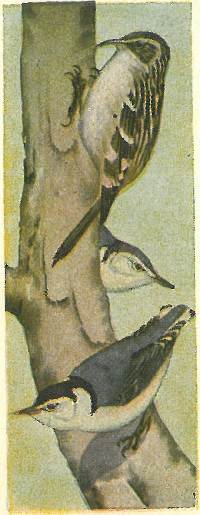
ROCKY MOUNTAIN CREEPER.
726b. Certhia familiaris montana. 5½ inches.
Range.—From Alaska, in the Rocky Mountains, to southern California and Mexico, breeding throughout its range. A quiet, small, brown colored bird of the deep woods, where its lisping note may be heard, if the air is very quiet, and one is looking for bird life. When found, it will generally be climbing up the trunk of some tall tree, searching the crevices of the bark for the small insect life on which it feeds; when near the top, a downward flight to the base of another tree. Always flying down, and climbing up. Their nest is placed in the loose bark, and is made of fiber, moss and grass. They lay from four to seven white eggs, spotted with chestnut (.58 × .48).
SLENDER-BILLED NUTHATCH.
727a. Sitta carolinensis aculeata. 6 inches.
Range.—Pacific coast region, from British Columbia to southern California. These are similar to the White-breasted bird of the east. Unlike the above, although these are tree climbers, they are as often found coming down the tree as climbing up. They build in cavities of various kinds of trees, laying five or six white eggs, quite heavily marked with brown and lilac (.80 × .60).
[227]
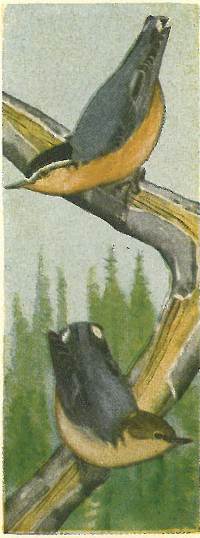
RED-BREASTED NUTHATCH.
728. Sitta canadensis. 4½ inches.
Range.—North America, breeding in the northern part of the United States and northward. Like the former, these are great acrobats, looking into every crevice of the bark in search of their supply of food, caring little whether they are going up or down in their search. After the breeding season these birds are often found in flocks about the coniferous trees, and appear to be very sociable, keeping up a continuous “yank, yank,” among themselves. They have no other song.
Their nest is usually placed in a cavity of some tree at quite an elevation from the ground, being lined with strips of bark and feathers. They lay from four to six white eggs, thickly spotted with shades of brown (.60 × .50).
PYGMY NUTHATCH.
730. Sitta pygmæa. 4 inches.
Range.—West of the Rockies, from British Columbia to southern California and Mexico, breeding throughout its range. These are the smallest of the family, and their habits and nest and eggs are the same as the preceding. Their eggs being slightly smaller.
[228]
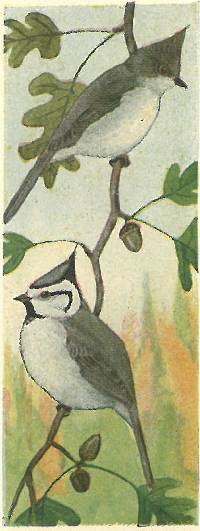
PLAIN TITMOUSE.
733. Bæolophus inornatus. 5½ inches.
Range.—California and Oregon, west of the Sierra Nevadas. These are quite common throughout their range; they are quite a little bird, with only a few “quit, quit” like notes, and in color they are as quiet as in habits. They build in cavities of trees or old stumps, their nest lined with grasses, hair and feathers. Their five to eight eggs are white, rarely with a few specks of brown (.70 × .50).
BLACK-CRESTED TITMOUSE.
732. Bæolophus astricristatus. 5½ inches.
Range.—Texas, south into Mexico. Similar to above, but darker and with the crest black and forehead white. Nesting habits same as the above (not illustrated).
BRIDLED TITMOUSE.
734. Bæolophus wollweberi. 5 inches.
Range.—Arizona and Texas into Mexico. This plain colored “tit,” with the only markings about the head, black crest and breast, with white above and below the eyes, is common in parts of Arizona, where it builds within a few feet of the ground in cavities of trees. Nest and eggs the same as the Plain Titmouse (.70 × .50).
[229]
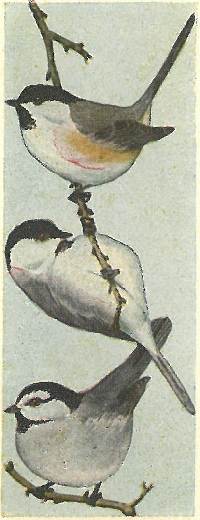
OREGON CHICKADEE.
735b. Penthestes atricapillus occidentalis. 5 inches.
Range.—Northwest coast, from British Columbia to Oregon. These lively little birds are willing to make friends with almost anyone, and will get so tame that they will take pieces of suet from the hand. Their well known call of “dee, dee, dee” often repeated, is a cheerful sound, but their other note of “phoe-be,” or, as it seems to me they say “great-way,” is rather mournful and suggests that they are tired and have a “great-way” yet to go. They build in old stumps, usually near the ground, lining the cavity with grass, hair and plant down, in which they deposit from five to eight white eggs, spotted with brown (.60 × .45).
MEXICAN CHICKADEE.
737. Penthestes sclateri. 5 inches.
Range.—Arizona into Mexico. Has more black on the throat. Habits and their nest and eggs are much the same.
MOUNTAIN CHICKADEE.
738. Penthestes gambeli. 5½ inches.
Range.—Western North America, Rocky Mountains west. Habits same as the preceding.
[230]
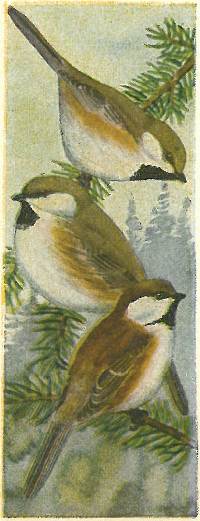
ALASKA CHICKADEE.
739. Penthestes cinctus alascensis. 5 inches.
Range.—Alaska and eastern Siberia. One would naturally think that these little animated bunches of feathers would freeze in the far north where they make their homes. But they are the same sprightly little “chick-a-dee-dee-dee” that we have farther south, and do not seem to mind the severe cold at all. In habits, nest and eggs, these birds are so near alike that it is impossible to identify them.
HUDSONIAN CHICKADEE.
740. Penthestes hudsonicus. 5 inches.
Range.—Western half of British America. Habits the same as above.
CHESTNUT-BACKED CHICKADEE.
741. Penthestes rufescens. 5 inches.
Range.—Alaska to Oregon on the Pacific coast, and occasionally to central California. Habits the same as preceding.
CALIFORNIA CHICKADEE.
741a. Penthestes r. neglectus. 5 inches.
Range.—Middle section of California, near the coast (not illustrated).
[231]
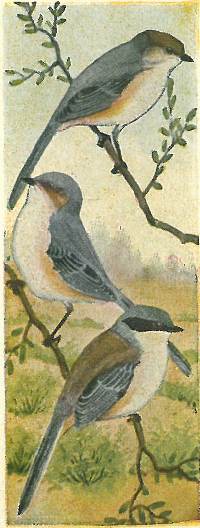
BUSH-TIT.
743. Psaltriparus minimus. 4½ inches.
Range.—Pacific coast of California, Oregon and Washington. In habits all of these birds are similar to the Chickadees. They are full of life, and in searching for insects are as much at home when upside down on the outer end of a bunch of pine needles as are the Chickadees. For nest building they have no superiors, making long gourd-like structures of fibers, moss, and grass, woven closely together, lined with feathers and wool, suspended from twigs at a low elevation or woven into some thick brush; they have a small opening near the top for the doorway. They lay from four to nine pure white eggs (.54 × .40).
LEAD-COLORED BUSH-TIT.
744. Psaltriparus plumbeus. 4½ inches.
Range.—Oregon, Colorado, to southern California and Texas. The habits are identical with above. Nests are made the same, and from eight to twelve inches long.
LLOYD BUSH-TIT.
745. Psaltriparus melanotis lloydi. 4½ inches.
Range.—Arizona, Texas and New Mexico. Habits the same as above.
[232]
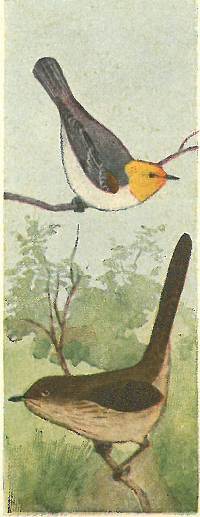
VERDIN.
746. Auriparus flaviceps. 4½ inches.
Range.—Colorado and southern California to Mexico. This bird is simply nothing more than a Bush-tit with his Sunday clothes on, or not a full suit, but a bright yellow head and neck dress. They are abundant and active little fellows in the thick chaparral brush, where they build a nest more bulky than the “tit” but not as artistic or compact. They are placed in thorn or other bushes within a few feet of the ground, made of twigs and weeds, and lined with fur and feathers. Their eggs, four to six, are white. For amusement, they construct one or two additional nests, in which they remain at night.
WREN-TIT.
742. Chamæa fasciata. 5 inches.
Range.—From southern California north to Oregon along the coast. These are much like the Chickadee in habits, only much more secluded, frequenting the deep ravines along the mountain sides, where they build their nests of twigs, fibers of vines, grasses and feathers, in bushes near the ground. Four or five greenish blue, unmarked eggs are their complement (.70 × .50).
[233]
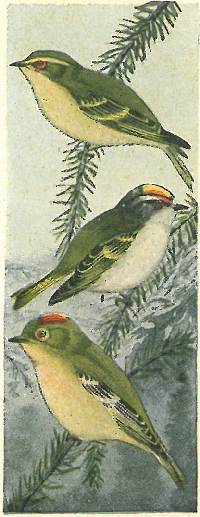
KENNICOTT WARBLER.
747. Acanthopneuste borealis. 5 inches.
Range.—In Alaska casually. Breeds in the extreme northern part of Asia. Their nest and eggs have not been found on this continent as far as we know at present. They build on the ground in a tussock of grass, laying from three to five white eggs finely spotted with chestnut (.70 × .50).
WESTERN GOLDEN-CROWNED KINGLET.
748a. Regulus satrapa olivaceus. 4½ inches.
Range.—Alaska to southern California, on the Pacific coast. These little birds are found commonly in company with small flocks of the Chickadee, and like them may be seen hanging on the under side of the outer ends of the coniferous trees in search of their insect food. They nest in the northern part of their range, building large, comfortable-looking structures of needles from the pines, strips of vines and grass, nicely lined with feathers. Four to eight eggs, dull white, spotted with brown and lilac (.55 × .42).
RUBY-CROWNED KINGLET.
749. Regulus calendula. 5 inches.
Range.—North America, breeding mostly north of the United States or in the Rocky Mountain regions farther south.
[234]
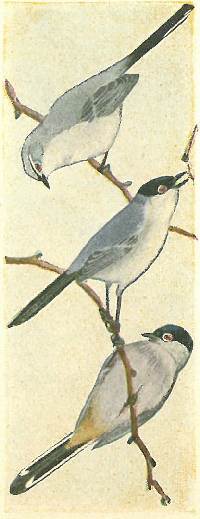
WESTERN GNATCATCHER.
751a. Polioptila cærulea obscura. 5 inches.
Range.—Western United States, breeding in northern Colorado and California. These birds in their actions somewhat resemble the Redstart, with their long tail, and quick flights into the air for insects and back again to the same twig, possibly near where their nest is placed. They build one of the prettiest of nests, very deep and cup-shaped, and on the top of some moss-covered limb at twenty to forty feet from the ground. Making the nest from plant down and moss, completely covered with lichens, so that it resembles a large knot on the limb, much like the nest of the Ruby-throated Hummingbird. Four or five dull white eggs, spotted with brown (.58 × .45).
PLUMBEOUS GNATCATCHER.
752. Polioptila plumbea. 4½ inches.
Range.—Southern California, Texas into Mexico. Breeds like the above quite commonly in southern Texas; eggs a little smaller.
BLACK-TAILED GNATCATCHER.
753. Polioptila californica. 4½ inches.
Range.—Southern and Lower California, on the Pacific coast.
[235]
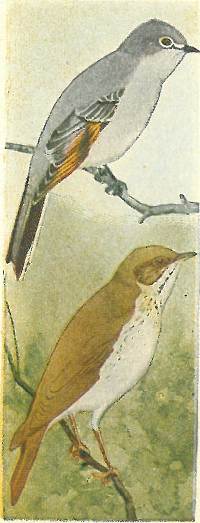
TOWNSEND SOLITAIRE.
754. Myadestes townsendi. 9 inches.
Range.—From British Columbia to southern California, through the western United States. They nest at high altitudes among the mountain tops, placing their nest upon the ground, among the rocks along the mountain streams. They build a large, loosely constructed nest of roots and twigs, lined with pine needles and moss, in which they lay their four or five white eggs, spotted with shades of brown more about the larger end (.96 × .70).
WILLOW THRUSH.
756a. Hylocichla fuscescens salicicola. 7½ inches.
Range.—Western United States from British Columbia to southern California. It breeds and is quite abundant in the foothills and canyons of the mountain ranges. It is a western form of the common eastern “Veery,” and its breeding habits are the same, nesting in an old stump on or near the ground, making the nest of grasses and leaves, usually quite bulky. They lay four unspotted bluish green eggs (.90 × .65). Their song is peculiar and not as attractive as others of the Thrush family.
[236]
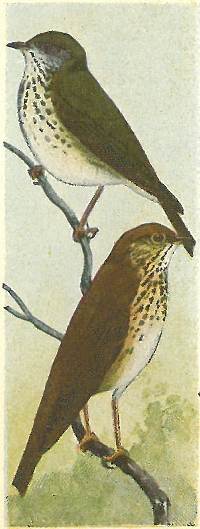
GRAY-CHEEKED THRUSH.
757. Hylocichla alicæ. 7½ inches.
Range.—From British Columbia northward, and winters south to Mexico. Their nests are placed on or near the ground in a stump or tussock, usually in very moist places, and are composed largely of leaves and mosses. Their three or four eggs are a bluish green, spotted and blotched with reddish brown (.88 × .64).
RUSSET-BACKED THRUSH.
758. Hylocichla ustulata. 7½ inches.
Range.—From Alaska to Central America, breeding in the northern part, in Oregon and Alaska. Their nests are made and placed usually the same as the above, the eggs being of the same size, but of a lighter color. The Thrushes feed on small insect life and many of the small fruits and berries.
OLIVED-BACKED THRUSH.
758a. Hylocichla u. swainsoni. 7½ inches.
Range.—North America, breeding on the western coast in Alaska, Oregon, California and Colorado. Their nesting habits, eggs and song are the same as the Russet-backed (not illustrated).
[237]
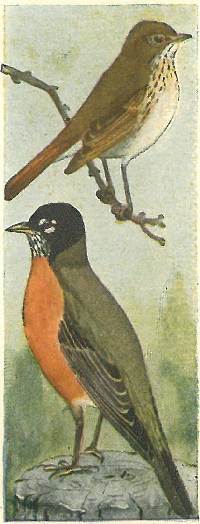
ALASKA HERMIT THRUSH.
759. Hylocichla guttata. 6½ inches.
Range.—Alaska to Mexico, breeding in its extreme northern range. These birds are noted for their sweet and musical song, which may be heard from the swamps and thickets in which they make their home. They nest either on or near the ground, building it of shreds of vines, leaves and grasses. Four bluish green eggs, unmarked, are usually laid (.85 × .65).
AUDUBON HERMIT THRUSH.
759a. Hylocichla g. auduboni. 7½ inches.
Range.—Rocky Mountain region, from British Columbia to Arizona. Tail is much lighter than above, and bird larger. Their habits in home life are the same, this bird having the stronger and sweeter voice of the two (not illustrated).
WESTERN ROBIN.
761a. Planesticus migratorius propinquus. 10½ inches.
Range.—West of the Rockies, from British Columbia to Mexico. This is not the familiar bird that is found in the east, but is very secluded, and its song is seldom heard. Nest is made of leaves, grass and twigs, plastered with mud. Four greenish blue eggs (1.15 × .80).
[238]
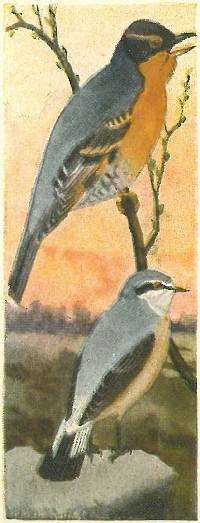
VARIED THRUSH.
763. Ixoreus nævius. 9½ inches.
Range.—Pacific coast, from Alaska to Mexico, breeding in Oregon, Washington and California. They breed quite abundantly in the northern ranges in California and north to Alaska. Their nest is placed in small trees and bushes, usually near the ground, and is made of twigs, weeds and grass, lined with moss. Their eggs, usually four in number, are greenish blue, sharply spotted with few spots of dark brown (1.12 × .80). They have a pleasing song, which is rarely heard in their southern range.
WHEATEAR.
765. Saxicola ænanthe. 6 inches.
Range.—Alaska and accidental in Colorado, breeding in Asia. They nest in crevices of cliffs or in stone walls, building a rude nest of sticks and weeds, lined with hair and feathers. Their four or five eggs are a pale greenish blue (.90 × .60).
[239]
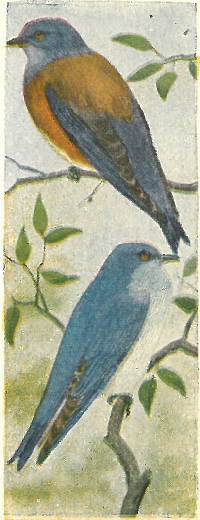
WESTERN BLUEBIRD.
767. Sialia mexicana occidentalis. 7 inches.
Range.—British Columbia to Lower California, along the Pacific coast. These familiar birds build in cavities in trees, or in bird houses, and make themselves at home near dwellings, especially if in the vicinity of orchards of any kind. The note of the western bird has the same familiar warble as their eastern relative. They live on small insects and caterpillars, and some of the small berries. Their four eggs are a pale bluish white (.80 × .60).
CHESTNUT-BACKED BLUEBIRD.
767a. Sialia mexicana bairdi. 7 inches.
Range.—Rocky Mountains from Colorado to Texas (not illustrated).
MOUNTAIN BLUEBIRD.
768. Sialia currucoides. 7½ inches.
Range.—Rocky Mountain regions from Canada to Mexico. Their habits are just the same, eggs averaging slightly larger.
[240]