WATERLOO: (continued 5)
Reading edition
But while we were all rejoicing over our success, and the officers, soldiers, drummers, and trumpeters were all in confusion, amongst the ruins, thinking of nothing but stretching our legs and getting breath, the rumor suddenly reached us that the Prussians were coming, that they were going to fall on our flank, and that we were about to have two battles, one in front and the other on our right, and that we ran the risk of being surrounded by a force double our own.
This was terrible news, but several hot-headed fellows exclaimed:
"So much the better, let the Prussians come! we will crush them all at once."
Those who were cool saw at once what a mistake we had made by not making the most of our victory at Ligny, and in allowing the Prussians quietly to leave in the night without being pursued by our cavalry, as is always done.
We may boldly say that this great fault was the cause of our defeat at Waterloo. It is true, the Emperor sent Marshal Grouchy the next day at noon, with thirty-two thousand men to look after the enemy, but then it was quite too late. In those fifteen hours they had time to re-form, to communicate with the English, and to act on the defensive.
The next day after Ligny, the Prussians still had ninety thousand men, of whom thirty thousand were fresh troops, and two hundred and seventy-five cannon. With such an army they could do what they pleased; they could have even fought a second battle with the Emperor, but they preferred falling on our flank, while we were engaged with the English in front. That is so plain and clear, that I cannot imagine how any one can think the movement of the Prussians surprising.
Blücher had already played us the same trick at Leipzig—and he repeated it now in drawing Grouchy on to pursue him so far. Grouchy could not force him to return, and he could not prevent him from leaving thirty or forty thousand men to stop his pursuers, while he pushed on to the relief of Wellington.
Our only hope was that Grouchy had been ordered to return and join us, and that he would come up in the rear of the Prussians; but the Emperor sent no such order.
It was not we, the common soldiers, as you may well think, who had these ideas; it was the officers and generals; we knew nothing of it; we were like children, utterly unconscious that their hour is near.
But now having told you what I think, I will give you the history of the rest of the battle just as I saw it myself, so that each one of you will know as much about it as I do.
XXI
Almost immediately after the news of the arrival of the Prussians, the assembly began to beat, the soldiers of the different battalions formed their ranks, and ours, with another from Quiot's brigade, was left to guard Haie-Sainte, and all the others went on to join General d'Erlon's corps, which had advanced again into the valley, and was endeavoring to flank the enemy on the left.
The two battalions went to work at once to barricade the doors and the breaches in the walls with timbers and paving stones, and men were stationed in ambush at all the holes which the enemy had made in the wall on the side toward the orchard and on that next the highway.
Buche and I, with the remainder of our company, were posted over a stable in a corner of the barn, about ten or twelve hundred paces from Hougoumont. I can still see the row of holes which the Germans had knocked in the wall, about as high as a man's head, in order to defend the orchard. As we went up into this stable, we looked through these holes, and we could see our line of battle, the high-road to Brussels and Charleroi, the little farms of Belle-Alliance, Rossomme, and Gros-Caillou, which lie along this road at little distances from each other; the Old Guard which was stationed across it, with their shouldered arms, and the staff on a little eminence at the left, and farther away in the same direction, in the rear of the ravine of Planchenois, we could see the white smoke rising continually above the trees. This was the attack of the first Prussian corps.
We heard afterward that the Emperor had sent Lobau with ten thousand men to turn them back. The battle had begun, but the Old and the Young Guard, the cuirassiers of Milhaud and of Kellerman, and the chasseurs of Lefebvre-Desnoëttes; in fact the whole of our magnificent cavalry remained in position. The great, the real battle was with the English.
What a crowd of thoughts must have been suggested, by that grand spectacle and that immense plain, to the Emperor, who could see it all mentally better than we could with our own eyes.
We might have stayed there for hours, if Captain Florentin had not come up suddenly, and exclaimed, "What are you doing here? Are we going to dispute the passage with the Guard? Come! hurry! Knock a hole in that wall on the side toward the enemy!"
We picked up the sledges and pickaxes which the Germans had dropped on the floor, and made holes through the wall of the gable.
This did not take fifteen minutes, and then we could see the fight at Hougoumont; the blazing buildings, the bursting of the bombs from second to second among the ruins, and the Scotch chasseurs in ambuscade in the road in the rear of the place, and on our right about two gunshots distant, the first line of the English artillery, falling back on their centre, and stationing their cannon, which our gunners had begun to dismount, higher up the hill. But the remainder of their line did not change; they had squares of red and squares of black touching each other at the corners like the squares of a chess-board, in the rear of the deep road; and in attacking them we would come under their crossfire. Their artillery was in position on the brow of the hill, and in the hollow on the hill-side toward Mont-St.-Jean their cavalry was waiting.
The position of the English seemed to me still stronger than it was in the morning; and as we had already failed in our attack on their left wing, and the Prussians had fallen on our flank, the idea occurred to me, for the first time, that we were not sure of gaining the battle.
I imagined the horrible rout that would follow in case we lost the battle—shut in between two armies, one in front and the other on our flank, and then the invasion which would follow; the forced contributions, the towns besieged, the return of the émigrés, and the reign of vengeance.
I felt that my apprehension had made me grow pale.
At that moment the shouts of "Vive l'Empereur" broke from thousands of throats behind us. Buche, who stood near me in a corner of the loft, shouted with all the rest of his comrades, "Vive l'Empereur!"
I leaned over his shoulder and saw all the cavalry of our right wing; the cuirassiers of Milhaud, the lancers and the chasseurs of the Guard, more than five thousand men—advancing at a trot. They crossed the road obliquely and went down into the valley between Hougoumont and Haie-Sainte. I saw that they were going to attack the squares of the English, and that our fate was to be decided.
We could hear the voices of the English artillery officers, giving their orders, above the tumult and the innumerable shouts of "Vive l'Empereur."
It was a terrible moment when our cuirassiers crossed the valley; it made me think of a torrent formed by the melting snows, when millions of flakes of snow and ice sparkle in the sunshine. The horses, with the great blue portmanteaux fastened to their croups, stretched their haunches like deer and tore up the earth with their feet, the trumpets blew their savage blasts amidst the dull roar as they passed into the valley, and the first discharge of grape and canister made even our old shed tremble. The wind blew from the direction of Hougoumont, and drove the smoke through all the openings; we leaned out to breathe, and the second and third discharges followed each other instantly.
I could see through the smoke that the English, gunners had abandoned their cannon and were running away with their horses, and that our cuirassiers had immediately fallen upon the squares, which were marked out on the hill-side by the zig-zag line of their fire.
Nothing could be heard but a grand uproar of cries, incessant clashing of arms and neighing of horses, varied with the discharge from time to time, and then new shouts, new tumult and fresh groans. A score of horses with their manes erect, rushed through the thick smoke which settled around us, like shadows; some of them dragging their riders with one foot caught in the stirrup.
And this lasted more than an hour.
After Milhaud's cuirassiers, came the lancers of Lefebvre-Desnoëttes, after them the cuirassiers of Kellerman, followed by the grenadiers of the Guard, and after the grenadiers came the dragoons. They all mounted the hill at a trot, and rushed upon the squares with drawn sabres, shouting, "Vive l'Empereur!" in tones which reached the clouds. At each new charge it seemed as if the squares must be overthrown; but when the trumpets sounded the signal for rallying and the squadrons rushed pell-mell back to the edge of the plateau to re-form, pursued by the showers of shot, there were the great red lines, steadfast as walls, in the smoke.
Those Englishmen are good soldiers, but then they knew that Blücher was coming to their assistance with sixty thousand men, and no doubt this inspired them with great courage.
In spite of everything, at six o'clock we had destroyed half their squares, but the horses of our cuirassiers were exhausted by twenty charges over the ground soaked with rain. They could no longer advance over the heaps of dead.
As night approached, the great battle-field in our rear began to be deserted; at last the great plain where we had encamped the night before was tenantless, only the Old Guard remained across the road with shouldered arms, all had gone—on the right against the Prussians, on the left against the English. We looked at each other in terror.
It was already growing dark, when Captain Florentin appeared at the top of the ladder, and placing both hands on the floor, he said in a grave voice, "Men, the time has come to conquer or die!"
I remembered that these words were in the proclamation of the Emperor, and we all filed down the ladder. It was still twilight, but all was gray in the devastated court; the dead were lying stiff on the dung-heap and along the walls.
The captain formed our men on the right side of the court, and the commandant of the other battalion ranged his on the left; our drums resounded through the old building for the last time, and we filed out of the little rear door into the garden, stooping one after the other as we went through.
The walls of the garden outside had been knocked down, and all along the rubbish, men were binding up their wounds—one his head, another his arm or his leg. A cantinière with her donkey and cart, and with a great straw hat flattened on her back—was there too in a corner. I do not know what had brought the wretched creature there. Several sorry-looking horses were standing there, exhausted with fatigue, with their heads hanging down, and covered with blood and mud.
What a difference between them now, and in the morning. Then the companies were half destroyed, but still they were companies. Confusion was coming. It had taken only three hours to reduce us to the same condition we were in at Leipzig at the end of a year. The remains of the two battalions still formed only one line, in good order, and I must admit that we began to be anxious.
When men have tasted nothing for twenty-four hours, and have exhausted all their strength by fighting all day, the pangs of hunger seize them at night, fear comes also, and the most courageous lose hope. All our great retreats, with their horrors, are traceable to the want of food.
For in spite of everything we were not conquered; the cuirassiers still held their position on the plateau, and from all sides over the thunder of cannon, over all the tumult, the cry was heard, "The Guard is coming!" Yes, the Guard was coming at last! We could see them in the distance on the highway, with their high bear-skin caps, advancing in good order.
Those who have never witnessed the arrival of the Guard on the battle-field, can never know the confidence which is inspired by a body of tried soldiers; the kind of respect paid to courage and force.
The soldiers of the Old Guard were nearly all old peasants, born before the Republic; men five feet and six inches in height, thin and well built, who had held the plough for convent and chateau; afterward they were levied with all the rest of the people, and went to Germany, Holland, Italy, Egypt, Poland, Spain, and Russia, under Kleber, Hoche, and Marceau first, and under Napoleon afterward. He took special care of them and paid them liberally. They regarded themselves as the proprietors of an immense farm, which they must defend and enlarge more and more. This gained them consideration; they were defending their own property. They no longer knew parents, relatives, or compatriots; they only knew the Emperor; he was their God. And lastly they had adopted the King of Rome, who was to inherit all with them, and to support and honor them in their old age. Nothing like them was ever seen, they were so accustomed to march, to dress their lines, to load, and fire, and cross bayonets, that it was done mechanically in a measure, whenever there was a necessity. When they advanced, carrying arms, with their great caps, their white waistcoats and gaiters, they all looked just alike; you could plainly see that it was the right arm of the Emperor which was coming. When it was said in the ranks, "The Guard is going to move," it was as if they had said, "The battle is gained."
But now, after this terrible massacre, after the repulse of these furious attacks, on seeing the Prussians fall on our flank, we said, "This is the decisive blow."
And we thought, "If it fails, all is lost."
This was why we all looked at the Guard as they marched steadily up on the road.
It was Ney who commanded them, as he had commanded the cuirassiers. The Emperor knew that nobody could lead them like Ney, only he should have ordered them up an hour sooner, when our cuirassiers were in the squares; then we should have gained all.
But the Emperor looked upon his Guard as upon his own flesh and blood; if he had had them at Paris five days later, Lafayette and the rest of them would not have remained long in their chamber to depose him, but he had them no longer.
This was why he waited so long before sending them; he hoped that Ney would succeed in overwhelming the enemy with the cavalry, or that the thirty-two thousand men under Grouchy would return, attracted by the sound of the cannon, and then he could send them in place of his Guard; because he could always replace thirty or forty thousand by conscription; but to have another such Guard, he must commence at twenty-five, and gain fifty victories, and what remained of the best, most solid, and the toughest would be the Guard.
It came, and we could see it. Ney, old Friant, and several other generals, marched in front. We could see nothing but the Guard—the roaring cannon, the musketry, the cries of the wounded, all were forgotten.
But the lull did not last long; the English perceived as well as we, that this was to be the decisive blow, and hastened to rally all their forces to receive it.
That part of our field at our left was nearly deserted; there was no more firing, either because their ammunition was exhausted, or the enemy were forming in a new order.
On the right, on the contrary, the cannonade was redoubled; the struggle seemed to have been transferred to that side, but nobody dared to say, "The Prussians are attacking us; another army has come to crush us."
No! the very idea was too horrible; when suddenly a staff officer rushed past like lightning, shouting:
"Grouchy, Marshal Grouchy is coming!"
This was just at the moment when the four battalions of the Guard took the left of the highway in order to go up in the rear of the orchard, and commence the attack.
How many times during the last fifty years I have seen it over again at night, and how many times I have heard the story related by others. In listening to these accounts you would think that only the Guard took part in the attack, that it moved forward like ranks of palisades; and that it was the Guard alone which received the showers of shot.
But in truth this terrible attack took place in the greatest confusion; our whole army joined in it; all the remnant of the left wing and centre, all that was left of the cavalry exhausted by six hours of fighting; every one who could stand or lift an arm. The infantry of Reille which concentrated on the left, we who remained at Haie-Sainte, all who were alive and did not wish to be massacred.
And when they say we were in a panic of terror and tried to run away like cowards, it is not true. When the news arrived that Grouchy was coming, even the wounded rose up and took their places in the ranks; it seemed as if a breath had raised the dead; and all those poor fellows in the rear of Haie-Sainte with their bandaged heads and arms and legs, with their clothes in tatters and soaked with blood, every one who could put one foot before the other, joined the Guard when it passed before the breaches in the wall of the garden, and every one tore open his last cartridge.
The attack sounded, and our cannon began again to thunder. All was quiet on the hill-side, the rows of English cannon were deserted, and we might have thought they were all gone, only as the bear-skin caps of the Guard rose above the plateau, five or six volleys of shot warned us that they were waiting for us.
Then we knew that all those Englishmen, Germans, Belgians, and Hanoverians, whom we had been sabring and shooting since morning, had reformed in the rear, and that we must encounter them. Many of the wounded retired at this moment, and the Guard, upon which the heaviest part of the enemy's fire had fallen, advanced through the showers of shot almost alone, sweeping everything before it, but it closed up more and more, and diminished every moment. In twenty minutes every officer was dismounted, and the Guard halted before such a terrible fire of musketry, that even we, two hundred paces in the rear, could not hear our own guns; we seemed to be only exploding our priming. At last the whole army, in front, on the right and on the left, with the cavalry on the flanks, fell upon us.
The four battalions of the Guard, reduced from three thousand to twelve hundred men, could not withstand the charge, they fell back slowly, and we fell back also, defending ourselves with musket and bayonet.
We had seen other battles more terrible, but this was the last.
When we reached the edge of the plateau, all the plain below was enveloped in darkness and in the confusion of the defeat. The disbanded troops were flying, some on foot and some on horseback.
A single battalion of the Guard in a square near the farm-house, and three other battalions farther on, with another square of the Guard at the junction of the route at Planchenois, stood motionless as some firm structure in the midst of an inundation which sweeps away everything else.
They all went—hussars, chasseurs, cuirassiers, artillery, and infantry—pell-mell along the road, across the fields, like an army of savages.
Along the ravine of Planchenois the dark sky was lighted up by the discharges of musketry; the one square of the Guard still held out against Bulow, and prevented him from cutting off our retreat, but nearer us the Prussian cavalry poured down into the valley like a flood breaking over its barriers. Old Blücher had just arrived with forty thousand men: he doubled our right wing and dispersed it.
What can I say more! It was dissolution—we were surrounded. The English pushed us into the valley, and it was through this valley that Blücher was coming. The generals and officers and even the Emperor himself were compelled to take refuge in a square, and they say that we poor wretches were panic-stricken! Such an injustice was never seen.
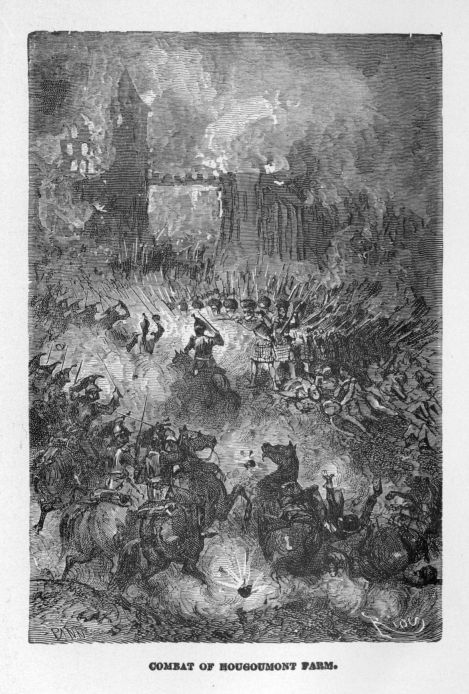
Combat of Hougoumont Farm.
Buche and I with five or six of our comrades ran toward the farm-house—the bombs were bursting all around us, we reached the road in our wild flight just as the English cavalry passed at full gallop, shouting, "No quarter! no quarter!"
At this moment the square of the Guard began to retreat, firing from all sides in order to keep off the wretches who sought safety within it. Only the officers and generals might save themselves.
I shall never forget, even if I should live a thousand years, the immeasurable, unceasing cries which filled the valley for more than a league; and in the distance the grenadière was sounding like an alarm-bell in the midst of a conflagration. But this was much more terrible; it was the last appeal of France, of a proud and courageous nation; it was the voice of the country saying, "Help, my children! I perish!"
This rolling of the drums of the Old Guard in the midst of disaster, had in it something touching and horrible. I sobbed like a child;—Buche hurried me along, but I cried, "Jean, leave me—we are lost, everything is lost!"
The thought of Catherine, and Mr. Goulden, and Pfalzbourg, did not enter my mind. What astonishes me to-day is, that we were not massacred a hundred times on the road, where files of English and Prussians were passing. But perhaps they mistook us for Germans, or they were running after the Emperor, for they were all hoping to see him.
Opposite the little farm of Rossomme, we were obliged to turn off the road to the right, into the field; it was here that the last square of the Guard still held out against the attack of the Prussians; they soon gave way, for twenty minutes afterward the enemy poured over the road, and the Prussian chasseurs separated into bands to arrest all those who straggled or remained behind. This road was like a bridge; all who did not keep on it fell into the abyss.
At the slope of the ravine in the rear of the inn "Passe-Avant," some Prussian hussars rushed upon us: there were not more than five or six of them, and they called out to us to surrender; but if we had raised the butts of our muskets, they would have sabred us. We aimed at them, and seeing that we were not wounded, they passed on.
This forced us to return to the road, where the uproar could be heard for at least two leagues; cavalry, infantry, artillery, ambulances, and baggage-wagons, were creeping along the road pell-mell, howling, beating, neighing, and weeping. The retreat at Leipzig furnished no such spectacle as this.
The moon rose above the wood behind Planchenois, and lighted up this crowd of shapskas,[1] bear-skin caps, helmets, sabres, bayonets, broken caissons, and abandoned cannon; the crowd and confusion increased every moment, plaintive howls were heard from one end of the line to the other, rolling up and down the hill-side and dying away in the distance like a sigh.
But the saddest of all, were the cries of the women, those unhappy creatures who follow armies. When they were knocked down or crowded out on to the slope with their carts, their screams could be heard above all the uproar, but no one turned his head, not a man stretched out a hand to help them: "Every one for himself!—I shall crush you,—so much the worse for you,—I am the stronger—you scream, but it is all the same to me!—take care,—take care—I am on horseback—I shall hit you!—room—let me get away—the others do just the same—room for the Emperor! room for the marshal!" The strong crush the weak—the only thing in the world is strength! On! on! Let the cannons crush everything, if we can only save them!
But the cannon can move no farther,—unhitch them, cut the traces, and the horses will carry us off. Make them go as fast as possible, and if they break down—then let them go? If we were not the stronger our turn would come to be crushed—we should cry out and everybody would mock at our complaints. Save himself who can—and "Vive l'Empereur!"
"But the Emperor is dead!"
Everybody thought the Emperor had died with, the Old Guard; that seemed perfectly natural.
The Prussian cavalry passed us in files with drawn sabres, shouting, "Hurrah!" They seemed to be escorting us, but they sabred every one who straggled from the road, and took no prisoners, neither did they attack the column; a few musket-shots passed over us from the right and left.
Far in the rear we could see a red light: this was the farm-house at Caillou.
We hastened onward, borne down with fatigue, hunger, and despair; we were ready to die, but still the hope of escape sustained us. Buche said to me as we went along, "Joseph, let us help each other."
"I will never abandon you," I replied. "We will die together. I can hold out no longer, it is too terrible,—we might better lie down at once."
"No, let us keep on," said he. "The Prussians make no prisoners. Look! they kill without mercy, just as we did at Ligny."
We kept on in the same direction with thousands of others, sullen and discouraged, and yet we would turn round all at once and close our ranks and fire, when a squadron of Prussians came too near. We were still firm, still the stronger from time to time; we found abandoned gun-carriages, caissons, and cannons, and the ditches on either side were full of knapsacks, cartridge-boxes, guns, and sabres, which had been thrown away by the men to facilitate their flight.
But the most terrible thing of all was the great ambulances in the middle of the road filled with the wounded. The drivers had cut the traces and fled with the horses for fear of being taken prisoners. The poor half-dead wretches, with their arms hanging down, looked at us as we passed with despairing eyes.
When I think of all this now, it reminds me of the tufts of straw and hay which lodge among the bushes after an inundation. We say "That is our harvest, this is our crop, that is what the tempest has left us."
Ah! I have had many such reflections during fifty years!
What grieved me most and made my heart bleed in the midst of this rout was that I could not discover a single man of our battalion besides ourselves. I said to myself, "They cannot all be dead;" and I said to Buche:
"If I could only find Zébédé it would give me back my courage."
But he replied: "Let us try to save ourselves, Joseph. As for me, if I ever see Harberg again, I will not complain because I have to eat potatoes. No, no. God has punished me. I shall be contented to work and go into the woods with my axe on my shoulder. If only I do not go home maimed, and if I am not compelled to hold out my hand at the roadside in order to live, like so many others. Let us try to get home safe and sound."
I thought he showed great good sense.
At about half-past ten, as we reached the environs of Genappe, terrible cries were heard in the distance. Fires of straw had been lighted in the middle of the principal street to give light to the multitude, and we could see from where we were, that the houses were full of people and the streets so full of horses and baggage that they could not move a step. We knew that the Prussians might come at any moment, and that they would have cannon; and that it would be better for us if we went round the village than to be taken prisoners altogether. This was why we turned to the left across the grain fields with a great many others. We crossed the Thy in water up to our waists, and toward midnight we reached Quatre-Bras.
We had done well not to stop at Genappe, for we already heard the roar of the Prussian cannon and musketry near the village. Great numbers of fugitives came along the road, cuirassiers, lancers, and chasseurs. Not one of them stopped.
We began to be terribly hungry. We knew very well that everything in these houses must have been eaten long ago, but still we went into the one on the left. The floor was covered with straw, on which the wounded were lying. We had hardly opened the door when they all began to cry out at once; to tell the truth, the stench was so horrible that we left immediately and took the road to Charleroi. The moon shone beautifully, and we could see on the right amongst the grain a quantity of dead men, who had not yet been buried.
Buche followed a furrow about twenty-five paces, to where three or four Englishmen were lying one on the top of the other. I asked him what he was going to do amongst the dead.
He came back with a tin bottle, and shaking it at his ear, he said, "Joseph, it is full."
He dipped it in the water of the ditch before opening it, and then took out the cork and drank, saying, "It is brandy!"
He passed it to me, and I drank also. I felt my life returning, and I gave him back the bottle half full, thanking God for the good idea that he had given us.
We looked on all sides to see if we could not find some bread in the haversacks of the dead, but the uproar increased, and as we could not resist the Prussians if they should surround us, we set off again full of strength and courage. The brandy made us look at everything on the bright side already, and I said to Buche:
"Jean, now the worst is over and we shall see Pfalzbourg and Harberg again. We are on a good road which will take us back to France. If we had gained the battle, we should have been forced to go still farther into Germany, and we should have been obliged to fight the Austrians and the Russians, and if we had had the good fortune to escape with our lives, we should have returned old gray-haired veterans, and should have been compelled to keep garrison at 'Petite Pierre,' or somewhere else."
These miserable thoughts ran through my head, but I marched on with more courage, and Buche said:
"The English are right in having their bottles made of tin, for if I had not seen this shining in the moonlight, I should never have thought of going to look for it."
Every moment while we were talking in this way men were riding by, their horses almost ready to drop, but by beating and spurring, they kept them trotting just the same.
The noise of the retreating army began to reach our ears again in the distance, but fortunately we had the advance.
It might have been about one o'clock in the morning, and we thought ourselves safe, when suddenly Buche said to me:
"Joseph, here are the Prussians!"
And looking behind us, I saw in the moonlight five bronzed hussars from the same regiment as those who, the year before, had cut poor Klipfel to pieces. I thought this was a bad sign.
"Is your gun loaded?" I asked Buche.
"Yes."
"Well! let us wait, we must defend ourselves, I will not surrender."
"Nor I either," said he, "I had rather die than to be taken prisoner."
At the same moment the Prussian officer shouted arrogantly, "Lay down your arms."
Instead of waiting, as I did, Buche discharged the contents of his musket full in the officer's breast. Then the other four fell upon us. Buche received a blow from a sabre which cut his shako down to the visor, but with one thrust with his bayonet he killed his antagonist. Three of them still remained. My musket was loaded. Buche planted himself with his back against a nut-tree, and every time the Prussians, who had fallen back, approached us, I took aim. Neither of them wanted to be the first to die! As we waited, Buche with his bayonet fixed and I with my musket at my shoulder, we heard a galloping on the road. This frightened us, for we thought more Prussians were coming, but they were our lancers. The hussars then turned off into the grain, and Buche hastened to re-load his gun.
Our lancers passed and we followed them on the run.
An officer who joined us, said that the Emperor had set out for Paris, and that King Jerome had just taken command of the army.
Buche's scalp was laid completely open, but the bone was not injured, and the blood ran down his cheeks. He bound up his head with his handkerchief.
After that we saw no more Prussians.
About two o'clock in the morning, we were so weary we could hardly take another step. About two hundred paces to the left of the road there was a little beech grove. Buche said: "Look, Joseph, let us go in there and lie down and sleep."
It was just what I wanted.
We went down across the oat-field to the wood, and entered a close thicket of young trees.
We had both kept our guns and knapsacks and cartridge-boxes. We laid our knapsacks on the ground for a pillow, and it had long been broad daylight, and the retreating crowd had been passing for hours, when we awoke and quietly pursued our journey.
XXII
Numbers of our comrades and of the wounded remained behind at Gosselies, but the larger part of the army kept on their way, and about nine o'clock we began to see the spires of Charleroi in the distance, when suddenly we heard shouts, cries, complaints, and shots intermingled, half a league before us.
The whole immense column of miserable wretches halted, shouting: "The city closes its doors against us! we are stopped here!"
Consternation and despair were stamped on every face.
But a moment after, the news came that the convoys of provisions were coming and that they would not distribute them.
"Let us fall upon them! Kill the rascals who are starving us! We are betrayed!"
The most fearful and the most exhausted quickened their pace, and drew their sabres or loaded their muskets.
It was plain that there would be a veritable butchery if the guards did not give way. Buche himself shouted:
"They ought all to be murdered, we are betrayed. Come, Joseph, let us be revenged."
But I held him back by the collar and exclaimed:
"No, Jean, no! We have had murders enough already, and we have escaped all, and we do not want to be killed here by Frenchmen. Come!"
He struggled still, but at last I showed him a village on the left of the road and said:
"Look! there is the road to Harberg, and there are houses like those at Quatre Vents; let us go there and ask for bread; I have money, and we shall certainly find some. That will be better than to attack the convoys like a pack of wolves."
He allowed himself to be persuaded at last, and we set off once more through the grain. If hunger had not urged us on, we should have sat down on the side of the path at every step. But at the end of half an hour, thanks to God, we reached a sort of farm-house; it was abandoned, with the windows broken out, and the door wide open, and great heaps of black earth lying about. We went in and shouted, "Is there no one here?"
We knocked against the furniture with the butts of our muskets, but not a soul answered. Our fury increased, because we saw several wretches, following the route by which we had come, and we thought, "They are coming to eat up our bread."
Ah! those who have never suffered these privations cannot comprehend the fury which possessed us. It was horrible—horrible!
We had already broken open the door of a cupboard filled with linen, and were turning over everything with our bayonets, when an old woman came out from behind a table, which hid the passage to the cellar. She sobbed and exclaimed:
"My God, my God! have mercy upon us."
The house had been pillaged early in the morning; they had taken away the horses, the master had disappeared and the servants had fled.
In spite of our fury the sight of the poor old woman made us ashamed of ourselves, and I said to her:
"Do not be afraid, we are not monsters, only give us some bread, we are starving."
She was sitting on an old chair with her withered hands crossed over her knee, and she said:
"I no longer have any, they have taken all. My God! all! all!"
Her gray hair was hanging down over her face, and I felt like weeping for her and for ourselves. "Well!" I said, "we must look for ourselves, Buche." We went into all the rooms and the stables, there was nothing to be seen, everything had been stolen and broken.
I was going out, when in the shadow behind the old door, I saw something whitish against the wall. I stopped, and stretched out my hand. It was a linen bag with a strap, I took it down, trembling in my hurry. Buche looked at me—the bag was heavy—I opened it, there were two great black radishes, half of a small loaf of bread, dry and hard as stone, a large pair of shears for trimming hedges, and quite in the bottom some onions and some gray salt in a paper.
On seeing these we made an exclamation of joy, but the fear of seeing the others come in, made us run out in the rear, far into the rye-field, skulking and hiding like thieves.
We had regained all our strength, and we went and sat down on the edge of a little brook. Buche said:
"Look here! I must have my part."
"Yes,—half of all," I replied. "You let me drink from your bottle, I will divide with you."
Then he was calm again. I cut the bread in two with my sabre and said: "Choose, Jean; that is your radish, and there are half the onions, and we will share the salt between us." We ate the bread without soaking it in the water, we ate our radishes, our onions and the salt. We should have kept on eating still, if we had had more to eat, but yet we were satisfied.
We knelt down with our hands in the water and we drank.
"Now let us go," said Buche, "and leave the bag."
In spite of our weary legs, which were ready to give out, we went on again toward the left; while on the right behind us, toward Charleroi, the shouts and shots redoubled, and all along the road we could see nothing but the men fighting, but they were already far away.
We looked back from time to time, and Buche said:
"Joseph, you did well to bring me away, had it not been for you, I might have been stretched out over there by the road-side, killed by a Frenchman. I was too hungry. But where shall we go now?"
I answered, "Follow me!"
We passed through a large and beautiful village, pillaged and abandoned also.
Farther on we met some peasants, who scowled at us from the road-side. We must have had ill-looking faces, especially Buche with his head bound up, and his beard eight days old, thick and hard as the bristles of a boar.
About one o'clock in the afternoon we re-crossed the Sambre, by the bridge of Chatelet, but as the Prussians were still in pursuit we did not halt there. I was quite at ease, thinking:
"If they are still pursuing us, they will follow the bulk of the army, in order to take more prisoners and pick up the cannon, caissons, and baggage."
This was the manner in which we were compelled to reason, we, who three days before had made the world tremble.
I recollect that when we reached a small village about three o'clock in the afternoon, we stopped at a blacksmith's shop to ask for water. The country people immediately began to gather round, and the smith, a large, dark man, asked us to go to the little inn, opposite, saying he would join us and take a glass of beer with us.
Naturally enough this pleased us, for we were afraid of being arrested, and we saw that these people were on our side.
I remembered that I had some money in my knapsack, and that now it would be useful.
We went into the inn, which was only a little shop, with two small windows on the street, and a round door opening in the middle, as is common in our country villages.
When we were seated the room was so full of men and women, who had come to hear the news, that we could hardly breathe.
The smith came. He had taken off his leather apron and put on a little blue blouse, and we saw at once that he had five or six men with him. They were the mayor and his assistant, and the municipal councillors of the place.
They sat down on the benches opposite, and ordered the favorite sour beer of the country for us to drink. Buche asked for some bread; the innkeeper's wife brought us a whole loaf and a large piece of beef in a porringer.
All urged us to "Eat, eat!" When one or another would ask us a question about the battle, the smith or the mayor would say:
"Let the men finish, you can see plainly that they have come a long way."
And it was only when we had finished eating, that they questioned us, asking if it was true that the French had lost a great battle. The first report was that we were the victors, but afterward they heard a rumor that we were defeated.
We understood that they were speaking of Ligny, and that their ideas were confused. I was ashamed to tell that we were overthrown; I looked at Buche, and he said:
"We have been betrayed. The traitors revealed our plans. The army was full of traitors, who cried, 'Sauve qui peut!' How was it possible for us not to lose, under such circumstances?"
It was the first time I had heard treason spoken of; some of the wounded, it is true, had said, "We are betrayed," but I had paid no attention to their words, and when Buche relieved us from our embarrassment by this means, I was glad of it, though I was astonished.
The people sympathized with us in our indignation against the traitors.
Then we were obliged to explain the battle and the treason. Buche said the Prussians had fallen upon us through the treason of Marshal Grouchy.
This seemed to me to be going too far, but the peasants in their pity for us had made us drink again and again, and had given us pipes and tobacco, and at last I said the same as Buche. It was not till after we had left the place that the recollection of our shameful falsehoods made me ashamed of myself, and I said to Buche:
"Do you know, Jean, that our lies about the traitors were not right? If every one tells as many, we shall all be traitors, and the Emperor will be the only true man amongst us. It is a disgrace to the country to say that we have so many traitors; it is not true."
"Bah! bah!" said he. "We have been betrayed; if we had not, the English and Prussians could never have forced us to retreat."
We did nothing but dispute this point till eight o'clock in the evening. By this time we had reached a village called Bouvigny.
We were so tired that our legs were as stiff as stakes, and for a long while we had needed a great deal of courage to take a single step.
We were certain that the Prussians were no longer near, and as I had money we went into an inn and asked for a bed.
I took out a six-franc piece in order to let them see that we could pay. I had resolved to change my uniform the next day, to leave my gun and knapsack and cartridge-box here and to go home, for I believed that the war was over, and I rejoiced in the midst of my misfortunes that I had escaped with my arms and legs.
Buche and I slept that night in a little room, with a Holy Virgin and infant Jesus in a niche between the curtains over our heads, and we rested like the blessed in heaven.
The next morning, instead of keeping on our way, we were so glad to sit on a comfortable chair in the kitchen, to stretch our legs and smoke our pipes as we watched the kettles boiling, that we said, "Let us stay quietly here. To-morrow we shall be well rested, and we will buy two pairs of linen pantaloons, and two blouses, we will cut two good sticks from a hedge, and go home by easy stages."
The thought of these pleasant plans touched us. And it was from this inn that I wrote to Catherine and Aunt Grédel and Mr. Goulden. I wrote only a word:
"I have escaped, let us thank God, I am coming, I embrace you a thousand times with all my heart. "JOSEPH BERTHA."
I thanked God as I wrote, but a great many things were to happen before I should mount our staircase at the corner of the rue Fouquet opposite the "Red Ox." When one has been taken by conscription he must not be in a hurry to write that he is released. That happiness does not depend upon us, and the best will in the world helps nothing.
I sent off my letter by the post, and we stayed all that day at the inn of the "Golden Sheep."
After we had eaten a good supper, we went up to our beds, and I said to Buche, "Ha! Jean, to do what you please is quite a different thing from being forced to respond to the roll-call."
We both laughed in spite of the misfortunes of the country, of course without thinking, otherwise we should have been veritable rascals.
For the second time we went to sleep in our good bed, when about one o'clock in the morning we were wakened in a most extraordinary manner: the drums were beating and we heard men marching all over the village.
I pushed Jean, and he said, "I hear it, the Prussians are outside."
You cannot imagine our terror, but it was much worse a moment after; some one knocked at the door of the inn, and it opened; in a moment the great hall was full of people. Some one came up the stairs. We had both got up, and Buche said, "I shall defend myself if they try to take me."
I dared not think what I was going to do.
We were almost dressed, and I was hoping to escape in the darkness without being recognized, when suddenly there was a knock at the door and a shout, "Open."
We were obliged to open it.
An infantry officer, wet through by the rain, with his great blue cloak thrown over his epaulettes, followed by an old sergeant with a lantern, came in.
We recognized them as Frenchmen, and the officer asked brusquely, "Where do you come from?"
"From Mont-St.-Jean, lieutenant," I replied.
"From what regiment are you?"
"From the Sixth light infantry," I answered.
He looked at the number on my shako, which was lying on the table, and at the same time I saw that his number was also the Sixth.
"From which battalion are you?" said he, knitting his brows.
"The third."
Buche, pale as ashes, did not say a word. The officer looked at our guns and knapsacks and cartridge-boxes behind the bed in the corner.
"You have deserted," said he.
"No, lieutenant, we left, the last ones, at eight o'clock, from Mont-St.-Jean."
"Go downstairs, we will see if that is true."
We went downstairs. The officer followed us, and the sergeant went before with his lantern.
The great hall below was full of officers of the 12th mounted chasseurs, and of the 6th light infantry. The commandant of the 4th battalion of the 6th was promenading up and down, smoking a little wooden pipe. They were all of them wet through and covered with mud.
The officers said a few words to the commandant, who stopped, and fixed his black eyes upon us, while his crooked nose turned down into his gray mustache.
His manner was not very gentle as he asked us half a dozen questions about our departure from Ligny, the road to Quatre-Bras, and the battle. He winked and compressed his lips. The others walked up and down dragging their sabres without listening to us. At last the commandant said, "Sergeant, these men will join the second company; go!"
He took his pipe again from the edge of the mantel, and we went out with the sergeant, happy enough to get off so easily, for they might have shot us as deserters before the enemy.
We followed the sergeant for two hundred paces to the other end of the village to a shed. Fires had been lighted farther on in the fields; men were sleeping under the shed, leaning against the doors of the stables, and the posts.
A fine rain was falling and the puddles quivered in the gray uncertain moonlight. We stood up under a part of the roof at the corner of the old house thinking of our troubles.
At the end of an hour, the drums began to beat with a dull sound; the men shook the straw from their clothes and we resumed our march. It was still dark—but we could hear the chasseurs sounding their signal to mount, behind us.
Between three and four in the morning, at dawn, we saw a great many other regiments, cavalry, infantry, and artillery, on the march like ourselves by different roads, all the corps of Marshal Grouchy in retreat! The wet weather, the leaden sky, the long files of weary men, the disappointment of being retaken, and the thought that so many efforts and so much bloodshed had only terminated a second time in an invasion, all this made us hang down our heads. Nothing was heard but the sound of our own footsteps in the mud.
I could not shake off my sadness for a long time, when a voice near me said:
"Good-morning, Joseph."
I was awakened, and looking at the man who spoke to me, I recognized the son of Martin the tanner, our neighbor at Pfalzbourg; he was corporal of the Sixth, and the file-closer, marching with arms at will. We shook hands. It was a real consolation for me to see some one from our own place.
In spite of the rain which continued to fall and our great fatigue, we could talk of nothing but this terrible campaign.
I related the story of the battle of Waterloo, and he told me that the 4th battalion on leaving Fleurus had taken the route toward Wavre with the whole of Grouchy's corps, and that in the afternoon of the next day, the 18th, they heard the cannon on their left and that they all wanted to go in that direction, even the generals, but the marshal having received positive orders, had continued on the route to Wavre. It was between six and seven o'clock, before they were convinced that the Prussians had escaped; then they changed their course to the left in order to rejoin the Emperor, but unfortunately, it was too late, and toward midnight they were obliged to take a position in the fields.
Each battalion formed in a square. At three o'clock in the morning the cannon of the Prussians had awakened the bivouacs, and they had skirmished until two o'clock in the afternoon, when the order to retreat reached them.
Again, Martin said they were too late, for a part of the enemy's force which had been engaged with that of the Emperor, was in their rear, and they were obliged to march all the rest of that day and the night following in order to escape from their pursuers.
At six o'clock the battalion had taken a position near the village of Temploux, and at ten the Prussians came up in superior force. They opposed them in the most vigorous manner in order to give the baggage and artillery time to get over the bridge at Namur.
Fortunately the whole army corps had escaped from the village except the 4th battalion which, through a mistake of the commandant, had turned off the road at the left, and was obliged to throw itself into the Sambre in order to escape being cut off. Some of the men were taken prisoners and some were drowned in trying to swim across the river.
This was all that Martin told me; he had no news from home.
That same day we passed through Givet; the battalion bivouacked near the village of Hierches half a league farther on. The next day we passed through Fumay and Rocroy, and slept at Bourg-Fidèles, the 23d of June at Blombay, the 24th at Saulsse-Lenoy—where we heard of the abdication of the Emperor—and the days following at Vitry, near Rheims, at Jonchery, and at Soissons. From there the battalion took the route toward Ville-Cotterets, but the enemy was already before us, and we changed our course to Ferté-Milon, and bivouacked at Neuchelles, a village destroyed by the invasion of 1814, and which had not yet been rebuilt. We left that place on the 29th, about one o'clock in the morning, passing through Meaux.
Here we were obliged to take the road to Laguy, because the Prussians occupied that which led to Claye. We marched all that day and the night following.
On the 30th, at five in the morning, we were at the bridge of Saint-Maur.
The same day we passed outside of Paris and bivouacked in a place rich in everything, called Vaugirard.
The 1st of July we reached Meudon, a superb place. We could see by the walled gardens and orchards, and by the size and good condition of the houses, that we were in the suburbs of the most beautiful city in the world, and yet we were in the midst of the greatest danger and suffering, and our hearts bled in consequence.
The people were kind and friendly to the soldiers, and called us the defenders of the country, and even the poorest were willing to go to battle with us.
We left our position at eleven o'clock in the evening of the 1st of July, and went to St. Cloud, which is nothing but palace upon palace, and garden upon garden, with great trees, and magnificent alleys, and everything that is beautiful. At six o'clock we quitted St. Cloud to go back to our position at Vaugirard.
The most startling rumors filled the city. The Emperor had gone to Rochefort—they said; the King was coming back—Louis the XVIII. was en route—and so forth.
They knew nothing certain in the city, where they should soonest know everything.
The enemy attacked us in the suburbs of Issy about one o'clock in the afternoon, and we fought till midnight for our capital.
The people aided as much as possible; they carried off the wounded from under the enemy's fire; even the women took pity on us.
What we suffered from being driven to this, I cannot describe. I have seen Buche himself cry because we were in one sense dishonored. I wished I had never seen that time. Twelve days before I did not know that France was so beautiful. But on seeing Paris with its towers and its innumerable palaces extending as far as the horizon, I thought, "This is France, these are the treasures that our fathers have amassed during century after century. What a misfortune that the English and Prussians should ever come here."
At four in the morning we attacked the Prussians with new fury, and retook the positions we had lost the day before. Then it was that some generals came and announced a suspension of hostilities. This took place on the 3d of July, 1815.
We thought that this suspension was to give notice to the enemy, that if he did not quit our country, France would rise as one man, and crush them all as she did in '92. These were our opinions, and seeing that the people were on our side, I remembered the general levies which Mr. Goulden was always talking about.
But unhappily a great many were so tired of Napoleon and his soldiers, that they sacrificed the country itself, in order to be rid of him. They laid all the blame on the Emperor, and said, if it had not been for him, our enemies would never have had the force or the courage to attack us, that he had exhausted our resources, and that the Prussians themselves would give us more liberty than he had done.
The people talked like Mr. Goulden, but they had neither guns nor cartridges, their only weapons were pikes.
On the 4th, while we were thinking of these things, they announced to us the armistice, by which the Prussians and English were to occupy the barriers of Paris, and the French army was to retire beyond the Loire.
When we heard this, our indignation was so great that we were furious. Some of the soldiers broke their guns, and others tore off their uniforms, and everybody exclaimed, "We are betrayed, we are given up." The old officers were quiet, but they were pale as death, and the tears ran down their cheeks.
Nobody could pacify us, we had fallen below contempt, we were a conquered people.
For thousands of years it would be said, that Paris had been taken by the Prussians and the English. It was an everlasting disgrace, but the shame did not rest on us.
The battalion left Vaugirard at five o'clock in the afternoon to go to Montrouge. When we saw that the movement toward the Loire had commenced, each one said, "What are we then? Are we subjects to the Prussians? because they want to see us on the other side of the Loire, are we forced to gratify them? No, no! that cannot be. Since they have betrayed us, let us go! All this is none of our concern any longer. We have done our duty, but we will not obey Blücher!"
The desertion commenced that very night; all the soldiers went, some to the right and some to the left; men in blouses and poor old women tried to take us with them through the wilderness of streets, and endeavored to console us, but we did not need consolation. I said to Buche: "Let us leave the whole thing, and return to Pfalzbourg and Harberg, let us go back to our trades and live like honest people. If the Austrians and Russians come there, the mountaineers and villagers will know how to defend themselves. We shall need no great battles to destroy thousands of them, let us go!"
There were fifteen of us from Lorraine in the battalion, and we all left Montrouge, where the headquarters were, together; we passed through Ivry and Bercy, both places of great beauty, but our trouble prevented us from seeing a quarter of what we should have done. Some kept their uniforms, while others had only their cloaks, and the rest had bought blouses.
We found the road to Strasbourg at last, in the rear of St. Mandé, near a wood to the left of which we could see some high towers, which they told us was the fortress of Vincennes.
From this place, we regularly made our twelve leagues a day.
On the 8th of July we learned that Louis XVIII. was to be restored, and that Monseigneur le Comte d'Artois would secure his salvation. All the wagons and boats and diligences already carried the white flag, and they were singing "Te Deums" in all the villages through which we passed; the mayors and their assistants and the councillors all praised and glorified God for the return of "Louis the well-beloved."
The scoundrels called us "Bonapartists," as they saw us pass, and even set their dogs on us.
But I do not like to speak of them; such people are the disgrace of the human race.
We replied only by contemptuous glances, which made them still more insolent and furious.
Some of them flourished their sticks, as much as to say,—"If we had you in a corner, you would be as meek as lambs."
The gendarmes upheld these Pinacles and we were arrested in three or four places. They demanded our papers and took us before the mayor, and the rascals forced us to shout "Vive le Roi!"
It was shameful, and the old soldiers rather than do it allowed themselves to be taken to prison. Buche wanted to follow their example, but I said to him, "What harm will it do us to shout Vive Jean Claude, or Vive Jean Nicholas? All these kings and emperors, old and new, would not give a hair of their heads to save our lives, and shall we go and break our necks in order to shout one thing rather than another? No, it does not concern us, and if people will be so stupid, as long as we are not the strongest, we must satisfy them. By and by, they will shout something else, and afterward still something else. Everything changes—nothing but good sense and good will remain."
Buche did not want to understand this reasoning, but when the gendarmes came, he submitted notwithstanding.
As we went along, one after another of our little party would drop off in his own village, till at last no one was left but Toul, Buche, and I.
We saw the saddest sight of all, and this was the crowds of Germans and Russians in Lorraine and Alsace. They were drilling at Luneville, at Blamont, and at Sarrebourg, with oak branches in their wretched shakos. What vexation to see such savages living in luxury at the expense of our peasants.
Father Goulden was right when he said that military glory costs very dear. I only hope the Lord will save us from it for ages to come!
At last, on the 16th July, 1815, about eleven o'clock in the morning, we reached Mittelbronn, the last village on that side, before reaching Pfalzbourg. The siege was raised after the armistice, and the whole country was full of Cossacks, Landwehr,[1] and Kaiserlichs.[2] Their batteries were still in position around the town, though they no longer discharged them; the gates were open, and the people went out and in to secure their crops.
There was great need of the wheat and rye, and you can imagine the suffering it caused us, to feed so many thousands of useless beings, who denied themselves nothing, and who wanted bacon and schnapps every day.
Before every door and at every window there was nothing to be seen but their flat noses, their long filthy yellow beards, their white coats filled with vermin, and their low shakos, looking out at you, as they smoked their pipes in idleness and drunkenness. We were obliged to work for them, and at last honest people were compelled to give them two thousand millions of francs more to induce them to go away.
How many things I might say against these lazybones from Russia and Germany, if we had not done ten times worse in their country. You can each one make reflections for yourself, and imagine the rest.
At Heitz's inn I said to Buche, "Let's stop here. My legs are giving out."
Mother Heitz, who was then still a young woman, threw up her hands and exclaimed, "My God! there is Joseph Bertha! God in heaven! what a surprise for the town!"
I went in, sat down and leaned my head on a table and wept without restraint.
Mother Heitz ran down to the cellar to bring a bottle of wine, and I heard Buche sobbing in the corner. Neither of us could speak for thinking of the joy of our friends. The sight of our own country had upset us, and we rejoiced to think that our bones would one day rest peacefully in the village cemetery. Meanwhile we were going to embrace those we loved best in the world.
When we had recovered a little, I said to Buche:
"Jean, you must go on before me, so that my wife and Mr. Goulden may not be too much surprised. You will tell them that you saw me the day after the battle, and that I was not wounded, and then you must say, you met me again in the suburbs of Paris, and even on the way home, and at last, that you think I am not far behind, that I am coming—you understand."
"Yes, I understand," said he, getting up after having emptied his glass, "and I will do the same thing for grandmother, who loves me more than she does the other boys; I will send some one on before me."
He went out at once, and I waited a few minutes; Mother Heitz talked to me but I did not listen; I was thinking how far Buche had gone; I saw him near the ford, at the outworks, and at the gate. Suddenly I went out, saying to Mother Heitz, "I will pay you another time."
I began to run; I partly remember having met three or four persons, who said, "Ah! that is Joseph Bertha!" But I am not sure of that.
All at once, without knowing how, I sprang up the stairs, and then I heard a great cry—Catherine was in my arms.
My head swam—in a minute after I seemed to come out of a dream; I saw the room, Mr. Goulden, Jean Buche, and Catherine; and I began to sob so violently, that you would have thought some great misfortune had happened. I held Catherine on my knee and kissed her, and she cried too. After a long while I exclaimed:
"Ah! Mr. Goulden, pardon me! I ought to have embraced you, my father! whom I love as I do myself!"
"I know it, Joseph," said he with emotion, "I know it, I am not jealous." And he wiped his eyes. "Yes—yes—love—and family and then friends. It is quite natural, my child, do not trouble yourself about that."
I got up and pressed him to my heart.
The first word Catherine said to me was, "Joseph, I knew you would come back, I had put my trust in God! Now our worst troubles are over, and we shall always remain together."
She was still sitting on my knee with her arm on my shoulder, I looked at her, she dropped her eyes and was very pale. That which we had hoped for before my departure had come.
We were happy.
Mr. Goulden smiled as he sat at his workbench—Jean stood up near the door and said:
"Now I am going, Joseph, to Harberg. Father and grandmother are waiting for me."
"Stay, Jean, you will dine with us." Mr. Goulden and Catherine urged him also, but he would not wait. I embraced him on the stairs and felt that I loved him like a brother.
He came often after that, but never once for thirty years without stopping with me. Now he lies behind the church at Hommert. He was a brave man and had a good heart.
But what am I thinking of? I must finish my story, and I have not said a word of Aunt Grédel, who came an hour afterward. Ah! she threw up her hands, and she embraced me, exclaiming:
"Joseph! Joseph! you have then escaped everything! let them come now to take you again! let them come! oh! how I repented of letting you go away! how I cursed the conscription and all the rest! but here you are! how good it is! the Lord has had mercy upon us!"
Yes, all these old stories bring the tears to my eyes, when I think of them; it is like a long forgotten dream, and yet it is real. These joys and sorrows that we recall, attach us to earth, and though we are old and our strength is gone and our sight is dim, and we are only the shadows of ourselves; yet we are never ready to go, we never say, "It is enough!"
These old memories are always fresh; when we speak of past dangers we seem to be in the midst of them again; when we recall our old friends, we again press their hands in imagination, and our beloved is again seated on our knee, and we look in her face, thinking, "She is beautiful!" and that which seemed to us just and wise and right in those old days, seems right and wise and just still.
I remember—and I must here finish my long story—that for many months and even years there was great sorrow in many families, and nobody dared to speak openly, or wish for the glory of the country.
Zébédé came back with those who had been disbanded on the other side of the Loire, but even he had lost his courage. This came from the vengeance and the condemnations and shootings, massacres and revenge of every kind which followed our humiliation; from the hundred and fifty thousand Germans, English, and Russians, who garrisoned our fortresses, from the indemnities of war, from the thousands of émigrés, from the forced contributions, and especially from the laws against suspects, and against sacrilege, and the rights of primogeniture which they wished to be re-established.
All these things so contrary to reason and to the honor of the nation, together with the denunciations of the Pinacles and the outrages that the old revolutionists were made to suffer—altogether these things have made us melancholy, so that often when we were alone with Catherine and the little Joseph, whom God had sent to console us for so many misfortunes, Mr. Goulden would say, pensively:
"Joseph, our unhappy country has fallen very low. When Napoleon took France she was the greatest, the freest, and most powerful of nations, all the world admired and envied us, but to-day we are conquered, ruined, our fortresses are filled with our enemies, who have their feet on our necks; and what was never before seen since France existed, strangers are masters of our capital—twice we have seen this in two years. See what it costs to put liberty, fortune, and honor in the hands of an ambitious man. We are in a very sad condition, the great Revolution is believed to be dead, and the Rights of Man are annihilated. But we must not be discouraged, all this will pass away, those who oppose liberty and justice will be driven away, and those who wish to re-establish privileges and titles will be regarded as fools. The great nation is reposing, is reflecting upon her faults, is observing those who are leading her contrary to her own interests: she reads their hearts, and in spite of the Swiss, in spite of the royal guard, in spite of the Holy Alliance, when once she is weary of her sufferings she will cast them out some day or other. Then it will be finished, for France wants liberty, equality, and justice.
"The one thing which we lack is instruction, though the people are instructing themselves every day, they profit by our experiences, by our misfortunes.
"I shall not have the happiness, perhaps, of seeing the awakening of the country, I am too old to hope for it, but you will see it, and the sight will console you for all your sufferings; you will be proud to belong to that generous nation which has outstripped all others since '89; these slight checks are only moments of repose on a long journey."
This excellent man preserved to his last hour his calm confidence.
I have lived to see the accomplishment of his predictions, I have seen the return of the banner of liberty, I have seen the nation grow in wealth, in prosperity, and in education. I have seen those who obstructed justice and who wished to establish the old regime, compelled to leave. I have seen that mind always progresses, and that even the peasants are willing to part with their last sou for the good of their children.
Unfortunately we have not enough schoolmasters. If we had fewer soldiers and more teachers the work would go on much faster. But—patience—that will come.
The people begin to understand their rights, they know that war brings them nothing but increased contributions, and when they shall say, "Instead of sending our sons to perish by thousands under the sabre and cannon, we prefer that they should be taught to be men;" who will dare to oppose them? To-day the people are sovereign!
In this hope, my friends, I embrace you with my whole heart, and bid you, Adieu!