WATERLOO: (continued 2)
Reading edition
"No," said Catherine, "Joseph must stay with his friend to-day, and we will go home alone."
"Very well! so be it! on a day like this friends should be together," said Mr. Goulden.
We went out arm in arm, it was dark, and after embracing Catherine again at the Place d'Armes she and her aunt took their way home, and after having taken a few turns under the great lindens we went to the "Wild Man" and refreshed ourselves with some glasses of foaming beer. Mr. Goulden described the siege, the attack at Pernette, the sorties at Bigelberg, at the barracks above, and the bombardment. It was then that I learned for the first time that he had been captain of a gun, and that it was he who had first thought of breaking up the melting-pots in the foundry to make shot. These stories occupied us till after ten o'clock. At last Zébédé left us to go to the barracks, the old grave-digger went to the rue Capucin, and we to our beds, where we slept till eight o'clock the next morning.
VII
Two days afterward I was married to Catherine at Aunt Grédel's at Quatre Vents. Mr. Goulden represented my father. Zébédé was my best man, and some old comrades remaining from the battalion were also at the wedding. The next day we were installed in our two little rooms over the workshop at Father Goulden's, Catherine and I. Many years have rolled away since then! Mr. Goulden, Aunt Grédel, and the old comrades have all passed away, and Catherine's hair is as white as snow! Yet often, even now, when I look at her, those times come back again, and I see her as she was at twenty, fresh and rosy, I see her arrange the flower-pots in the chamber-window, I hear her singing to herself, I see the sun opposite, and then we descend the steep little staircase and say together, as we go into the workshop: "Good-morning, Mr. Goulden;" he turns, smiles, and answers, "Good-morning, my children, good-morning!" Then he kisses Catherine and she commences to sweep and rub the furniture and prepare the soup, while we examine the work we have to do during the day.
Ah, those beautiful days, that charming life. What joy in being young and in having a simple, good, and industrious wife! How our hearts rejoice, and the future spreads out so far—so far—before us! We shall never be old; we shall always love each other, and always keep those we love! We shall always be of good heart; we shall always take our Sunday walk arm in arm to Bonne-Fontaine; we shall always sit on the moss in the woods, and hear the bees and May bugs buzzing in the great trees filled with light; we shall always smile! What a life! what a life!
And at night we shall go softly home to the nest, as we silently look at the golden trains which spread over the sky from Wecham to the forests of Mittelbronn, we shall press each other's hand when we hear the little clock at Pfalzbourg ring out the "Angelus," and those of all the villages will respond through the twilight. Oh, youth! oh, life!
All is before me just as it was fifty years ago; but other sparrows and larks sing and build in the spring, other blossoms whiten the great apple-trees. And have we changed too, and grown old like the old people of those days? That alone makes me believe that we shall become young again, that we shall renew our loves and rejoin Father Goulden and Aunt Grédel and all our dear friends. Otherwise we should be too unhappy in growing old. God would not send us pain without hope. And Catherine believes it too. Well! at that time we were perfectly happy, everything was beautiful to us, nothing troubled our joy.
It was when the allies were passing through our city by hundreds of thousands on their way home. Cavalry, artillery, infantry, foot and horse, with oak leaves in their shakos, on their caps, and on the ends of their muskets and lances. They shouted so that you could hear them a league away. Just as you hear the chaffinches, thrushes, and blackbirds, and thousands of other birds in the autumn. At any other time this would have made me sad, because it was the sign of our defeat, but I consoled myself by thinking that they were going away, never to return. And when Zébédé came to tell me that every day the Russian, Austrian, Prussian, and Bavarian officers crossed the city to visit our new commandant, Mons. de la Faisanderie, who was an old émigré, and who covered them with honors—that such an officer of the battalion had provoked one of these strangers, and that such another half-pay officer had killed two or three in duels at the "Roulette," or the "Green Tree," or the "Flower Basket," for they were everywhere—our soldiers could not bear the sight of the foreigners, there were fights everywhere, and the litters of the hospital were constantly going and coming—when Zébédé told me all these things, and when he said that so many officers had been put upon half-pay in order to replace them by officers from Coblentz, and that the soldiers were to be compelled to go to mass in full uniform, that the priests were everything and epaulettes nothing any more; instead of being vexed, I only said, "Bah! all these things will get settled by and by. So long as we can have quiet, and can live and labor in peace, we will be satisfied."
I did not think that it is not enough that one is satisfied; to preserve peace and tranquillity, all must be so likewise. I was like Aunt Grédel, who found everything right now that we were married. She came very often to see us, with her basket full of fresh eggs, fruits, vegetables, and cakes for our housekeeping, and she would say:
"Oh! Mr. Goulden, there is no need to ask if the children are well, you have only to look at their faces."
And to me she would say: "There is some difference, Joseph, between being married, and trudging along under a knapsack and musket at Lutzen!"
"I believe you, Mamma Grédel," I would answer.
Then she would sit down, with her hands on her knees, and say: "All this comes from peace; peace makes everybody happy, and to think of that mob of barefoot beggars who shout against the King!"
At first Mr. Goulden, who was at work, would say nothing, but when she kept on he would say, "Come, Mother Grédel, a little moderation, you know that opinion is free now, we have two chambers and constitution, and each one has a voice."
"But it is also true," said aunt looking at me maliciously, "that one must hold his tongue from time to time, and that shows a difference too."
Mr. Goulden never went farther than this, for he looked upon aunt as a good woman, but who was not worth the trouble of converting. He would only laugh when she went too far, and matters went on without jarring until something new happened. At first there was an order from Nancy to compel the people to close all their shutters during service on Sunday—Jews, Lutherans, and all. There was no more noise in the inns and wine-shops, it was still as death in the city during mass and vespers. The people said nothing, but looked at each other as if they were afraid.
The first Sunday that our shutters were closed, Mr. Goulden seemed very sad, and said, as we were dining in the dark, "I had hoped, my children, that all this was over, and that people would have common-sense, and that we should be tranquil for years, but unhappily I see that these Bourbons are of the same race as Dagobert. Affairs are growing serious."
He did not say anything else on this Sunday, and went out in the afternoon to read the papers. Everybody who could read went, while the peasants were at mass, to read the papers after shutting their shops. The citizens and master-workmen then got in the habit of reading the papers, and a little later they wanted a Casino. I remember that everybody talked of Benjamin Constant and placed great confidence in him. Mr. Goulden liked him very much, and as he was accustomed to go every evening to Father Colin's, to read of what had taken place, we also heard the news. He told us that the Duke d'Angoulême was at Bordeaux, the Count d'Artois at Marseilles, they had promised this, and they had said that.
Catherine was more curious than I, she liked to hear all the news there was in the country, and when Mr. Goulden said anything, I could see in her eyes that she thought he was right. One evening he said, "The Duke de Berry is coming here."
We were greatly astonished. "What is he going to do here, Mr. Goulden?" asked Catherine.
"He is coming to review the regiment," he answered, "I have a great curiosity to see him. The papers say that he looks like Bonaparte, but that he has a great deal more mind. It is not astonishing for if a legitimate prince had no more sense than the son of a peasant it would be a great pity. But you have seen Bonaparte, Joseph, and you can judge of the matter."
You can imagine how this news excited the country. From that day nothing was thought of but erecting triumphal arches, and making white flags, and the people from all the villages kept coming with their carts covered with garlands. They raised a triumphal arch at Pfalzbourg and another near Saverne. Every evening after supper Catherine and I went out to see how the work progressed. It was between the hotel "de la Ville de Metz" and the shop of the confectioner Dürr, right across the street. The old carpenter Ulrich and his boys built it. It was like a great gate covered with garlands of oak leaves, and over the front were displayed magnificent white flags.
While they were doing this, Zébédé came to see us several times. The prince was to come from Metz, the regiment had received letters, which represented him as being as severe as if he had gained fifty battles. But what vexed Zébédé most was, that the prince called our old officers, "Soldiers of fortune."
He arrived the 1st of October, at six in the evening, we heard the cannon when he was at Gerberhoff. He alighted at the "Ville de Metz," without going under the arch. The square was crowded with officers in full uniform, and from all the windows the people shouted, "Long live the King, Long live the Duke de Berry," just as they cried in the time of Napoleon, "Long live the Emperor."
Mr. Goulden and Catherine and I could not get near because of the crowd, and we only saw the carriages and the hussars file past. A picket near our house cut off all communication. That same evening he received the corps of officers and condescended to accept a dinner offered to him by the Sixth, but he only invited Colonel Zaepfel. After the dinner, from which they did not rise till ten o'clock, the principal citizens gave a ball at the college. All the officers and all the friends of the Bourbons were present in black coats, and breeches and stockings of white silk, to meet the prince, and the young girls of good families were there in crowds, dressed in white. I still seem to hear the horses of the escort as they passed in the middle of the night amid the thousands shouting "Vive le Roi! Vive le Duc de Berry!"
All the windows were illuminated, and before those of the commandant there was a great shield of sky blue, and the crown and the three fleur-de-lis in gold, sparkled in the centre. The great hall of the college echoed with the music of the regimental band.
Mademoiselle Bremer, who had a very fine voice, was to sing the air of "Vive Henri IV." before the prince. But all the village knew the next day, that she had been so confused by the sight of the prince, that she could not utter a word, and everybody said, "Poor Mademoiselle Félicité, poor Mademoiselle Félicité."
The ball lasted all night. We—Mr. Goulden, Catherine, and I—were asleep, when about three in the morning we were wakened by the hussars going by and the shouts of "Vive le Duc de Berry." These princes must have excellent health to be able to go to all the balls and dinners which are offered to them on their journeys. And it must become very tiresome at last to be called "Your Majesty," "Your Excellence," "Your Goodness," and "Your Justice," and everything else that can be thought of, that is new and extraordinary, in order to make them believe that the people adore them and look upon them as gods. If they do despise the men at last it is not astonishing. If the same thing were done to us we might think ourselves eagles too.
What I have told you is exactly the truth. I have exaggerated nothing.
The next day they began again with new enthusiasm. The weather was very fine, but as the prince had slept badly, and the children who wished to imitate the court without succeeding, annoyed him, and he thought perhaps, that they had not done him sufficient honor and had not shouted "Vive le Roi, Vive le Duc de Berry" loud and long enough—for all the soldiers kept silent—he was in a very bad humor.
I saw him very well that day, while the review was taking place—the soldiers occupied the sides of the square, we were at Wittman's, the leather merchant, on the first floor—and also during the consecration of the flag and the Te Deum at the church, for we had the fourth pew in front of the choir. They said he looked like Napoleon, but it was not true; he was a good-looking fat fellow, short and thick, and pale with fatigue, and not at all lively, quite the contrary. During the service he did nothing but yawn and rock back and forth like a pendulum. I am telling you what I saw myself, and that shows how blind people are, they want to find resemblances everywhere.
During the review, too, I remembered that the Emperor always came on horseback, and so would discover at a glance if everything was in order; instead of this, the duke came along the ranks on foot, and two or three times he found fault with old soldiers, examining them from head to foot. That was the worst. Zébédé was one of these men, and he never could forgive him.
That was well enough for the review, but a more serious thing was the distribution of the crosses and the fleur-de-lis. When I tell you that all the mayors and their assistants, the councillors from the Baraques-d'en-Haut and the Baraques-du-bois-de-Chênes, from Holderloch and Hirschland, received the fleur-de-lis because they headed their village deputations with a white flag, and that Pinacle received the cross of honor, for having arrived first with the band of the Bohemian, Waldteufel, who played "Vive Henri IV.," and had five or six white flags larger than the others; when I tell you that, you will understand what reasonable people thought. It was a real scandal!
In the afternoon about four o'clock, the prince left for Strasbourg, accompanied by all the royalists in the country on horseback, some on good mounts, and others, like Pinacle, on old hacks.
One event the Pfalzbourgers of that day remember until this, and that is, that after the prince was seated in his carriage and was driving slowly away, one of the émigré officers with his head uncovered and in uniform, ran after him, crying in a pitiful voice, "Bread, my prince, bread for my children!" That made the people blush, and they ran away for shame.
We went home in silence, Father Goulden was lost in thought, when Aunt Grédel arrived.
"Well! Mother Grédel, you ought to be satisfied," said he.
"And why?"
"Because Pinacle has been decorated."
She turned quite livid, and said after a minute:
"That is the greatest trumpery that ever was seen. If the prince had known what he is, he would have hung him rather than decorate him with the cross of honor."
"That is just the trouble," said Mr. Goulden, "those people do many such things without knowing it, and when they do know, it is too late."
VIII
So it was that Monseigneur the Duke de Berry, visited the departments of the East. Every word he uttered was taken up and repeated again and again. Some praised his exceeding graciousness, and others kept silence. From that time I suspected that all these émigrés and officers on half-pay, these preachers with their processions and their expiations, would overturn everything again, and about the beginning of winter we heard that not only with us, but all over Alsace affairs were growing worse and worse in just the same way.
One morning between eleven and twelve Father Goulden and I were both at work, each one thinking after his own fashion, and Catherine was laying the cloth. I started to go out to wash my hands at the pump, as I always did before dinner, when I saw an old woman wiping her feet on the straw mat at the foot of the stairs and shaking her skirts which were covered with mud. She had a stout staff, and a large rosary hung from her neck. As I looked at her from the top of the stairs, she began to come up and I recognized her immediately by the folds about her eyes and the innumerable wrinkles round her little mouth, as Anna-Marie, the pilgrim of St. Witt. The poor old woman often brought us watches to mend, from pious people who had confidence in her, and Mr. Goulden was always delighted to see her.
"Ah!" he exclaimed, "it is Anne-Marie! now we shall have the news. And how is Mr. Such-an-one, the priest? How is the Vicar So-and-So? Does he still look as well as ever? and Mr. Jacob, of such a place. And the old sexton, Niclausse, does he still ring the bells at Dann, and at Hirschland, and Saint Jean? He must begin to look old?"
"Ah! Mr. Goulden, thanks for Mr. Jacob, you know that he lost Mademoiselle Christine last week."
"What! Mademoiselle Christine?"
"Yes, indeed?"
"What a misfortune! but we must remember that we are all mortal!"
"Yes, Mr. Goulden, and when one is so fortunate as to receive the holy consolations of the Church."
"Certainly—certainly, that is the principal thing."
So they talked on, Father Goulden laughing in his sleeve. She knew everything that happened within six leagues round the city. He looked mischievously at me from time to time. This same thing had happened a hundred times during my apprenticeship, but you will understand how much more curious he was now to learn all that was going on in the country.
"Ah! it is really Anna-Marie!" said he rising, "it is a long time since we have seen you."
"Three months, Mr. Goulden, three long months. I have made pilgrimages to Saint Witt, to Saint Odille, to Marienthal, to Hazlach, and I have vows for all the saints in Alsace, in Lorraine, and in the Vosges. But now I have nearly finished, only Saint Quirin remains."
"Ah! so much the better, your affairs go on well, and that gives me pleasure. Sit down, Anna-Marie, sit down and rest yourself."
I saw in his eyes how happy he was to have her unroll her budget of news. But it appeared she had other matters to attend to.
"Oh! Mr. Goulden," said she. "I cannot today. Others are before me, Mother Evig, Gaspard Rosenkranz, and Jacob Heilig. I must go to Saint Quirin, to-night. I only just came in to tell you that the clock at Dosenheim is out of order, and that they are expecting you to repair it."
"Pshaw! pshaw! stay a moment."
"No, I cannot, I am very sorry, Mr. Goulden, but I must finish my round."
She had already taken up her bundle, and Mr. Goulden seemed greatly disappointed; when Catherine put a great dish of cabbage on the table, and said, "What! are you going, Anna-Marie? you cannot think of it! here is your plate!"
She turned her head and saw the smoking soup and the cabbage, which exhaled a most delicious odor.
"I am in a great hurry," said she.
"Oh! pshaw! you have very good legs," said Catherine, glancing at Mr. Goulden.
"Yes, thank God, they are very good still."
"Well, sit down then and refresh yourself. It is hard work to be always walking."
"Yes, indeed, Madame Bertha, one earns the thirty sous that one gets."
I placed the chairs.
"Sit down, Anna-Marie, and give me your stick."
"Well, I must listen to you, I suppose, but I cannot stay long, I will only take a mouthful and then go."
"Yes, yes, that is settled, Anna-Marie," said Mr. Goulden; "we will not hinder you long."
We sat down, and Mr. Goulden served us at once. Catherine looked at me and smiled, and I said to myself, "Women are more ingenious than we," and I was very happy. What more could a man wish for than to have a wife with sense and spirit? It is a real treasure, and I have often seen that men are happy when they allow themselves to be guided by such a woman. You can easily believe that when once seated at the table near the fire, instead of being out in the mud, with the sharp November wind whistling in her thin skirts, she no longer thought of her journey. She was a good creature sixty years old, who still supported two children of her son who died some years before. To travel round the country at that age, with the sun and rain and snow on your back, to sleep in barns and stables on straw, and three-quarters of the time have only potatoes to eat and not enough of them, does not make one despise a plate of good hot soup, a piece of smoked bacon and cabbage, with two or three glasses of wine to warm the heart. No, you must look at things as they are, the life of these poor people is very hard, every one would do well to try a pilgrimage on his own account.
Anna-Marie understood the difference between being at table and on the road, she ate with a good appetite, and she took real pleasure in telling us what she had seen during her last round.
"Yes," said she, "everything is going on well now. All the processions and expiations which you have seen are nothing, they will grow larger and more imposing from day to day. And you know there are missionaries coming among us, as they used to do among the savages, to convert us. They are coming from Mr. de Forbin-Janson and Mr. de Ranzan, because the corruption of the times is so great. And the convents are to be rebuilt, and the gates along the roads restored, as they were before the twenty-five years' rebellion. And when the pilgrims arrive at the convents, they will only have to ring and they will be admitted at once, when the brothers who serve, will bring them porringers of rich soup with meat on ordinary days, and vegetable soup with fish on Fridays and Saturdays and during Lent. In that way piety will increase, and everybody will make pilgrimages. But the pious women of Bischoffsheim say, that only those who have been pilgrims from father to son, like us, ought to go; that each one ought to attend to his work, that the peasants should belong to the soil, and that the lords should have their chateaux again, and govern them. I heard this with my own ears from these pious women, who are to have their properties again because they have returned from exile, and that they must have their estates in order to build their chapels is very certain. Oh! if that were only done now, so I could profit by it in my old age! I have fasted long enough, and my little grandchildren also. I would take them with me, and the priests would teach them, and when I die I should have the consolation of seeing them in a good way."
On hearing her recount all these things so contrary to reason we were much moved, for she wept as she imagined her little girls begging at the door of the convent and the brother bringing them soup.
"And you know, too, that Mr. de Ranzan and the Reverend Father Tarin want the chateaux rebuilt, and the woods and meadows and fields given up to the nobles, and in the meantime that the ponds are to be put in good condition, because they belong to the reverend fathers, who have no time to plough or sow or reap. Everything must come to them of itself."
"But tell us, Anna-Marie, is all this quite certain? I can hardly believe that such great happiness is in store for us."
"It is quite certain, Mr. Goulden. The Count d'Artois wishes to secure his salvation, and in order to do that everything must be set in order. Mons. le Vicar Antoine of Marienthal said the same things last week. They come from above,—these things,—and the hearts of the people must be accustomed to them by the sermons and expiations. Those who will not submit, like the Jews and Lutherans, will be forced to do so, and the Jacobins"—in speaking of the Jacobins Anna-Marie looked suddenly at Mr. Goulden and blushed up to her ears, for he was smiling.
But she recovered herself, and went on:
"Among the Jacobins there are some very good people, but the poor must live. The Jacobins have taken the property of the poor and that is not right."
"When and where have they taken the property of the poor?"
"Listen, Mr. Goulden, the monks and the Capuchins had the estates of the poor, and the Jacobins have divided them amongst themselves."
"Ah! I understand, I understand, the monks and Capuchins had your property, Anna-Marie; I never should have guessed that."
Mr. Goulden was all the time in good-humor, and Anna-Marie said:
"We shall be in accord at last."
"Oh! yes, we are, we are," said he pleasantly.
I listened without saying anything, as I was naturally curious to hear what was coming. It was easy to see that this was what she had heard on her last journey.
She said also that miracles were coming again and that Saint Quirin, Saint Odille, and the others would not work miracles under the usurper, but that they had commenced already; that the little black St. John at Kortzeroth, on seeing the ancient prior return had shed tears.
"Yes, yes, I understand," said Mr. Goulden, "that does not astonish me in the least, after all these processions and atonements the saints must work miracles; and it is natural, Anna-Marie, quite natural."
"Without doubt, Mr. Goulden, and when we see miracles, faith will return. That is clear, that is certain."
The dinner was finished, and Anna-Marie seeing that nothing more was coming, remembered that she was late, and exclaimed:
"Oh! Lord, that is one o'clock striking. The others must be near Ercheviller; now I must leave you."
She rose and took her stick with a very important air.
"Well! bon voyage, Anna-Marie, don't make us wait so long next time."
"Ah! Mr. Goulden, if I do not sit every day at your table it is not my fault."
She laughed, and as she took up her bundle she said:
"Well, good-by, and for the kindness you have shown me I will pray the blessed Saint Quirin to send you a fine fat boy as fresh and rosy as a lady-apple. That is the best thing, Madame Bertha, that an old woman like me can do for you."
On hearing these good wishes, I said, "That old woman is a good soul. There is nothing I so much wish for in the world. May God hear her prayer!" I was touched by that good wish.
She went downstairs, and as she shut the door, Catherine began to laugh, and said:
"She emptied her budget this time."
"Yes, my children," replied Mr. Goulden, who was quite grave, "that is what we may call human ignorance. You would believe that poor creature had invented all that, but she has picked it up right and left, it is word for word what those émigrés think, and what they repeat every day in their journals, and what the preachers say every day openly in all the churches. Louis XVIII. troubles them, he has too much good sense for them, but the real king is Monseigneur the Duke d'Artois, who wants to secure his salvation, and in order that this may be done everything must be put back where it was before the 'rebellion of twenty-five years,' and all the national property must be given up to its ancient owners, and the nobles must have their rights and privileges as in 1788; they must occupy all the grades of the army, and the Catholic religion must be the only religion in the state. The Sabbath and fête days must be observed, and heretics driven from all the offices, and the priests alone have the right to instruct the children of the people, and this great and terrible country, which carried its ideas of Liberty, Equality, and Fraternity everywhere by means of its good sense and its victories, and which never would have been vanquished if the Emperor had not made an alliance with the kings at Tilsit, this nation, which in a few years produced so many more great captains and orators, learned men and geniuses of all kinds, than the noble races produced in a thousand years, must surrender everything and go back to tilling the earth, while the others, who are not one in a thousand, will go on from father to son, taking everything and gladdening their hearts at the expense of the people! Oh! no doubt the fields and meadows and ponds will be given up as Anna-Marie said, and that the convents will be rebuilt in order to please Mons. le Comte d'Artois and help him to gain his salvation—that is the least the country could do for so great a prince!"
Then Father Goulden, joining his hands, looked upward saying:
"Lord God, Lord God, who hast wrought so many miracles by the little black St. John of Kortzeroth, if thou wouldst permit even a single ray of reason to enter the heads of Monseigneur and his friends, I believe it would be more beautiful than the tears of the little saint! And that other one on his island, with his clear eyes like the sparrow-hawk who pretends to sleep as he watches the unconscious geese in a pool,—O Lord, a few strokes of his wing and he is upon them, the birds may escape, while we shall have all Europe at our heels again!"
He said all this very gravely, and I looked at Catherine to know whether I should laugh or cry.
Suddenly he sat down, saying:
"Come! Joseph, this is not at all cheerful, but what can we do? It is time to be at work. Look, and see what is the matter with Mr. Jacob's watch."
Catherine took off the cloth, and each one went to his work.
IX
It was winter. Rain fell constantly, mingled with snow. There were no gutters, and the wind blew the rain as it fell from the tiles quite into the middle of the street. We could hear it pattering all day while Catherine was running about, watching the fire, and lifting the covers of the saucepans, and sometimes singing quietly to herself as she sat down to her spinning. Father Goulden and I were so accustomed to this kind of life that we worked on without thinking. We troubled ourselves about nothing, the table was laid and the dinner served exactly on the stroke of noon. At night Mr. Goulden went out after supper to read the gazette at Hoffman's, with his old cloak wrapped closely round his shoulders and his big fox-skin cap pulled down over his neck.
But in spite of that, often when he came in at ten o'clock, after we had gone to bed, we heard him cough; he had dampened his feet. Then Catherine would say, "He is coughing again, he thinks he is as young as he was at twenty," and in the morning she did not hesitate to reproach him.
"Monsieur Goulden," she would say, "you are not reasonable; you have an ugly cold, and yet you go out every evening."
"Ah! my child, what would you have? I have got the habit of reading the gazette, and it is stronger than I. I want to know what Benjamin Constant and the rest of them say, it is like a second life to me and I often think 'they ought to have spoken further of such or such a thing. If Melchior Goulden had been there he would have opposed this or that, and it would not have failed to produce a great effect.'"
Then he would laugh and shake his head and say:
"Every one thinks he has more wit and good sense than the others, but Benjamin Constant always pleases me."
We could say nothing more, his desire to read the gazette was so great. One day Catherine said to him:
"If you wish to hear the news, that is no reason why you should make yourself sick, you have only to do as the old carpenter Carabin does, he arranged last week with Father Hoffman, and he sends him the journal every night at seven o'clock, after the others have read it, for which he pays him three francs a month. In this way, without any trouble to himself, Carabin knows everything that goes on, and his wife, old Bevel, also; they sit by the fire and talk about all these things and discuss them together, and that is what you should do."
"Ah! Catherine, that is an excellent idea, but—the three francs?"
"The three francs are nothing," said I, "the principal thing is not to be sick, you cough very badly and that cannot go on."
These words, far from offending, pleased him, as they proved our affection for him and that he ought to listen to us.
"Very well! we will try to arrange it as you wish, and the rather as the café is filled with half-pay officers from morning till night, and they pass the journals from one to the other so that sometimes we must wait two hours before we can catch one. Yes, Catherine is right."
He went that very day to see Father Hoffman, so that after that, Michel, one of the waiters at the café brought us the gazette every night at seven o'clock, just as we rose from the table. We were happy always when we heard him coming up the stairs, and we would say, "There comes the gazette."
Catherine would hurry off the cloth and I would put a big bullet of wood in the stove, and Mr. Goulden would draw his spectacles from their case, and while Catherine spun and I smoked my pipe like an old soldier, and watched the blaze as it danced in the stove, he would read us the news from Paris.
You cannot imagine the happiness and satisfaction we had in hearing Benjamin Constant and two or three others maintain the same opinions which we held ourselves. Sometimes Mr. Goulden was forced to stop to wipe his spectacles, and then Catherine would exclaim:
"How well these people talk. They are men of good sense. Yes, what they say is right—it is the simple truth."
And we all approved it. Sometimes Father Goulden thought that they ought to have spoken of this or that a little more, but that the rest was all very well. Then he would go on with his reading, which lasted till ten o'clock, and then we all went to bed, reflecting on what we had just heard. Outside the wind blew, as it only can blow at Pfalzbourg, and vanes creaked as they turned, and the rain beat against the walls, while we enjoyed the warmth and comfort, and thanked God till sleep came, and we forgot everything. Ah! how happily we sleep with peace in our souls, and when we have strength and health, and the love and respect of those whom we love.
Days, weeks, and months went by, and we became, after a manner, politicians, and when the ministers were going to speak, we thought:
"Now the beggars want to deceive us! the miserable race! they ought to be driven out, every one of them!"
Catherine above all could not endure them, and when Mother Grédel came and talked as before about our good King, Louis XVIII., we allowed her to talk out of respect, but we pitied her for being so blind to the real interests of the country.
It must be remembered, too, that these émigrés, ministers, and princes, conducted themselves in the most insolent manner possible toward us. If the Count d'Artois and his sons had put themselves at the head of the Vendéeans and Bretons, and marched on Paris and had been victorious, they would have had reason to say, "We are masters, and will make laws for you." But to be driven out at first, and to be brought back by the Prussians and the Russians, and then to come and humiliate us, that was contemptible, and the older I grow the more I am confirmed in that idea—it was shameful!
Zébédé came to see us from time to time, and he knew all that was in the gazette. It was from us that he first learned that the young émigrés had driven General Vandamme from the presence of the King. This old soldier, who had just returned from a Russian prison, and whom all the army respected in spite of his misfortune at Kulm, they conducted from the royal presence, and told him that was not his place. Vandamme had been colonel of a regiment at Pfalzbourg, and you cannot imagine the indignation of the people at this news.
And it was Zébédé who told us, that processes had been made out against the generals on half-pay, and that their letters were opened at the post, that they might appear like traitors. He told us a little afterward that they were going to send away the daughters of the old officers who were at the school of St. Denis and give them a pension of two hundred francs; and later still, that the émigrés alone would have the right to put their sons in the schools at "St. Cyr" and "la Flèche" to be educated as officers, while the people's sons would remain soldiers at five centimes (one cent) a day for centuries to come.
The gazettes told the same stories, but Zébédé knew a great many other details—the soldiers knew everything.
I could not describe Zébédé's face to you as he sat behind the stove, with the end of his black pipe between his teeth, recounting all these misfortunes. His great nose would turn pale, and the muscles would twitch around the corners of his light gray eyes, and he would pretend to laugh from time to time, and murmur, "It moves, it moves."
"And what do the other soldiers think of all this?" said Father Goulden.
"Ha! they think it is pretty well when they have given their blood to France for twenty years, when they have made ten, fifteen, and twenty campaigns, and wear three chevrons, and are riddled with wounds, to hear that their old chiefs are driven from their posts, their daughters turned out of the schools, and that the sons of those people are to be their officers forever—that delights them, Father Goulden!" and his face quivered even to his ears as he said this.
"That is terrible, certainly," said Father Goulden, "but discipline is always discipline there. The marshals obey the ministers, and the officers the marshals, and the soldiers the officers."
"You are right," said Zébédé, "but there, they are beating the assembly."
And he shook hands and hurried off to the barracks.
The winter passed in this way, while the indignation increased every day. The city was full of officers on half-pay, who dared not remain in Paris,—lieutenants, captains, commandants, and colonels of infantry and cavalry,—men who lived on a crust of bread and a glass of wine a day, and who were the more miserable because they were forced to keep up an appearance—think of such men with their hollow cheeks and their hair closely cropped, with sparkling eyes and their big mustaches and their old uniform cloaks, of which they had been forced to change the buttons, see them promenading by threes and sixes and tens on the square, with their sword-canes at their button-holes, and their three-cornered hats so old and worn, though still well brushed; you could not help thinking that they had not one quarter enough to eat.
And yet we were compelled to say to ourselves, these are the victors of Jemmapes, of Fleurus, of Zurich, of Hohenlinden, of Marengo, of Austerlitz, and of Friedland and Wagram. If we are proud of being Frenchmen, neither the Comte d'Artois nor the Duke de Berry can boast of being the cause; on the contrary, it is these men, and now they leave them to perish, they even refuse them bread and put the émigrés in their place. It does not need any extraordinary amount of common-sense, or heart, or of justice to discover that this is contrary to nature.
I never could look at these unhappy men; it made me miserable. If you have been a soldier for only six months, your respect for your old chiefs, for those whom you have seen in the very front under fire, always remains. I was ashamed of my country for permitting such indignities.
One circumstance I shall never forget: it was the last of January, 1815, when two of these half-pay officers—one was a large, austere, gray-haired man, known as Colonel Falconette, who appeared to have served in the infantry, the other was short and thick and they called him Commandant Margarot, and he still wore his hussar whiskers—came to us and proposed to sell a splendid watch. It might have been ten o'clock in the morning. I can see them now as they came gravely in, the colonel with his high collar, and the other one with his head down between his shoulders.
The watch was a gold one, with double case; a repeater which marked the seconds, and was wound up only once in eight days. I had never seen such a fine one.
While Mr. Goulden examined it I turned round on my chair and looked at the men, who seemed to be in great need of money, especially the hussar. His brown, bony face, his big red mustaches, and his little brown eyes, his broad shoulders and long arms, which hung down to his knees, inspired me with great respect. I thought that when he took his sabre his long arm would reach a good way, that his eyes would burn under his heavy brows, and that the parry and thrust would come like lightning. I imagined him in a charge, half hidden behind his horse's head, with the point advanced, and my admiration was greater still. I suddenly remembered that Colonel Falconette and Commandant Margarot had killed some Russian and Austrian officers in a duel in the rear of the "Green Tree," when the allies were passing through the town six months ago.
The large man too, without any shirt-collar, although he was thin, wrinkled, and pale, and his temples were gray and his manner cold, seemed respectable too.
I waited to hear what Father Goulden would say about the watch. He did not raise his eyes, but looked at it with profound admiration, while the men waited quietly like those who suffer from not being able to conceal their pain. At last he said:
"This, gentlemen, is a beautiful watch, fit for a prince?"
"Indeed it is," said the hussar, "and it was from a prince I received it after the battle of Rabbe," and he glanced at his companion, who said nothing.
Mr. Goulden saw that they were in great need. He took off his black silk bonnet, and said, as he rose slowly from his seat:
"Gentlemen, do not take offence at what I am going to say. I am like you an old soldier, I served France under the Republic, and I am sure it must be heart-breaking to be forced to sell such a thing as that, an object which recalls some noble action, the souvenir of a chief whom we revere."
I had never heard Father Goulden speak with such emotion, his bald head was bowed sadly, and his eyes were on the ground, so that he might not see the pain of those to whom he was speaking.
The commandant grew quite red, his eyes were dim, his great fingers worked, and the colonel was pale as death. I wished myself away.
Mr. Goulden went on, "This watch is worth more than a thousand francs, I have not so much money in hand, and besides you would doubtless regret to part with such a souvenir. I will make you this offer, leave the watch with me, I will hang it in my window—it shall always be yours—and I will advance you two hundred francs, which you shall repay me when you take it away."
On hearing this, the hussar extended his two great hairy hands, as if to embrace Father Goulden.
"You are a good patriot," he exclaimed, "Colin told us so. Ah! sir, I shall never forget the service you have rendered me. This watch I received from Prince Eugène for bravery in action, it is dear to me as my own blood, but poverty——"
"Commandant!" exclaimed the other, turning pale.
"Colonel, permit me! we are old comrades together. They are starving us, they treat us like Cossacks. They are too cowardly to shoot us outright."
He could be heard all over the house. Catherine and I ran into the kitchen in order not to see the sad spectacle. Mr. Goulden soothed him, and we heard him say:
"Yes, yes, gentlemen, I know all that, and I put myself in your place."
"Come! Margarot, be quiet," said the colonel. And this went on for a quarter of an hour.
At last we heard Mr. Goulden count out the money, and the hussar said:
"Thank you, sir, thank you! If ever you have occasion, remember the Commandant Margarot."
We were glad to hear the door open, and to hear them go downstairs, for Catherine and I were much pained by what we had heard and seen. We went back to the room, and Mr. Goulden, who had been to show the officers out, came back with his head bare. He was very much disturbed.
"These unhappy men are right," said he, "the conduct of the government toward them is horrible, but it will have to pay for it sooner or later."
We were sad all day, but Mr. Goulden showed me the watch and explained its beauties, and told me, we ought always to have such models before us, and then we hung it in our window.
From that moment the idea never left me that matters would end badly, and that even if the émigrés stopped here, they had done too much mischief already. I could still hear the commandant exclaiming, that they treated the army like Cossacks. All those processions and expiations and sermons about the rebellion of twenty-five years, seemed to me to be a terrible confusion, and I felt that the restoration of the national property and the rebuilding of the convents would be productive of no good.
X
It was about the beginning of March, when a rumor began to circulate that the Emperor had just landed at Cannes. This rumor was like the wind, nobody ever could tell where it came from. Pfalzbourg is two hundred leagues from the sea, and many a mountain and valley lies between them. An extraordinary circumstance, I remember, happened on the 6th of March. When I rose in the morning, I pushed open the window of our little chamber which was just under the eaves, and looked across the street at the old black chimneys of Spitz the baker, and saw that a little snow still remained behind them. The cold was sharp, though the sun was shining, and I thought, "What fine weather for a march!" Then I remembered how happy we used to be in Germany, as we put out our campfires and set off on such fine mornings as this, with our guns on our shoulders, listening to the footfalls of the battalion echoing from the hard frozen ground. I do not know how it was, but suddenly the Emperor came into my mind, and I saw him with his gray coat and round shoulders, with his hat drawn over his eyes, marching along with the Old Guard behind him.
Catherine was sweeping our little room, and I was almost dreaming as I leaned out into the dry, clear air, when we heard some one coming up the stairs. Catherine stopped her sweeping and said:
"It is Mr. Goulden."
I also recognized his step, and was surprised, as he seldom came into our chamber. He opened the door and said in a low voice:
"My children, the Emperor landed on the 1st of March at Cannes, near Toulon, and is marching upon Paris."
He said no more, but sat down to take breath. We looked at each other in astonishment, but a moment after Catherine asked:
"Is it in the gazette, Mr. Goulden?"
"No," he replied, "either they know nothing of it over there, or else they conceal it from us. But, in Heaven's name, not a word of all this, or we shall be arrested. This morning, about five o'clock, Zébédé, who mounted guard at the French gate, came to let me know of it; he knocked downstairs, did you hear him?"
"No! we were asleep, Mr. Goulden."
"Well! I opened the window to see what was the matter, and then I went down and unlocked the door. Zébédé told it to me as a fact, and says the soldiers are to be confined to the barracks till further orders. It seems they are afraid of the soldiers, but how can they stop Bonaparte without them? They cannot send the peasants, whom they have stripped of everything, against him, nor the bourgeoisie, whom they have treated like Jacobins. Now is a good time for the émigrés to show themselves. But silence, above all things, the most profound silence!"
He rose, and we all went down to the workshop. Catherine made a good fire, and everyone went about his work as usual.
That day everything was quiet, and the next day also. Some neighbors, Father Riboc and Offran, came in to see us, under pretence of having their watches cleaned.
"Anything new, neighbor?" they inquired.
"No, indeed!" replied Mr. Goulden. "Everything is quiet. Do you hear anything?"
"No."
But you could see by their eyes, that they had heard the news. Zébédé stayed at the barracks. The half-pay officers filled the café from morning till night, but not a word transpired, the affair was too serious. On the third day these officers, who were boiling over with impatience, were seen running back and forth, their very faces showing their terrible anxiety. If they had had horses or even arms, I am sure they would have attempted something. But the guards went and came also, with old Chancel at their head, and a courier was sent off hourly to Saarbourg. The excitement increased, nobody felt any interest in his work. We soon learned through the commercial travellers, who arrived at the "City of Basle," that the upper Rhine provinces and the Jura had risen, and that regiments of cavalry and infantry were following each other from Besançon, and that heavy forces had been sent against the usurper.
One of these travellers having spoken rather too freely, was ordered to quit the town at once, the brigadier in command having examined his passport and, fortunately for him, found it properly made out.
I have seen other revolutions since then, but never such excitement as reigned on the 8th of March between four and five in the evening, when the order arrived for the departure of the first and second battalions fully equipped for service for Lons-le-Saulnier. It was only then that the danger was fully realized, and every one thought, "It is not the Duke d'Angoulême nor the Duke de Berry that we need to arrest the progress of Bonaparte, but the whole of Europe."
The faces of the officers on half-pay lighted up as with a burst of sunshine, and they breathed freely again. About five o'clock the first roll of the drum was heard on the square, when suddenly Zébédé rushed in.
"Well!" said Father Goulden to him.
"The first two battalions are going away," he replied. He was very pale.
"They are sent to stop him," said Mr. Goulden.
"Yes," said Zébédé, winking, "they are going to stop him."
The drums still rolled. He went downstairs, four at a time. I followed him. At the foot of the stairs, and while he was on the first step, he seized me by the arm, and raising his shako, whispered in my ear:
"Look, Joseph, do you recognize that?"
I saw the old tri-colored cockade in the lining.
"That is ours," he said, "all the soldiers have it."
I hardly had time to glance at it when he shook my hand and, turning away, hurried to Fouquet's corner. I went upstairs, saying to myself, "Now for another breaking up, in which Europe will be involved; now for the conscription, Joseph, the abolition of all permits and all the other things that we read of in the gazettes. In the place of quiet, we must be plunged in confusion; instead of listening to the ticking of clocks, we must hear the thunder of cannon; instead of talking of convents, we must talk of arsenals; instead of smelling flowers and incense, we must smell powder. Great God! will this never come to an end? Everything would go prosperously without missionaries and émigrés. What a calamity! What a calamity! We who work and ask for nothing are always the ones who have to pay. All these crimes are committed for our happiness, while they mock us and treat us like brutes." A great many other ideas passed through my head, but what good did they do me? I was not the Comte d'Artois, nor was I the Duke de Berry; and one must be a prince in order that his ideas may be of consequence, and that every word he speaks may pass for a miracle.
Father Goulden could not keep still a moment that afternoon. He was just as impatient as I was when I was expecting my permit to marry. He would look out of the window every moment and say, "There will be great news to-day; the orders have been given, and there is no need of hiding anything from us any longer." And from time to time he would exclaim, "Hush! here is the mail coach!" We would listen, but it was Lanche's cart with his old horses, or Baptiste's boat at the bridge. It was quite dark and Catherine had laid the cloth, when for the twentieth time Mr. Goulden exclaimed, "Listen!"
This time we heard a distant rumbling, which came nearer every moment. Without waiting an instant, he ran to the alcove and slipped on his big waistcoat, crying:
"Joseph, it has come."
He rolled down the stairs, as it were, and from seeing him in such a hurry the desire to hear the news seized me, and I followed him. We had hardly reached the street when the coach came through the dark gateway, with its two red lanterns, and rushed past us like a thunder-bolt. We ran after it, but we were not alone; from all sides we heard the people running and shouting, "There it is, there it is!" The post-office was in the rue des Foins, near the German gate, and the coach went straight down to the college and turned there to the right. The farther we went the greater was the crowd; it poured from every door.
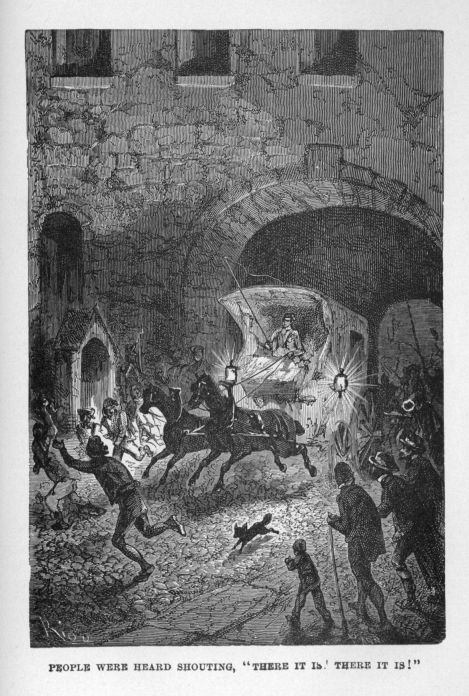
People were heard shouting, "There it is, there it is!"
The old mayor, Mr. Parmentier, his secretary, Eschbach, and Cauchois, the tax-gatherer, and many other notables were in the crowd, talking together and saying:
"The decisive moment has come."
When we turned into the Place d'Armes, we saw the crowd already gathered in front of the postoffice; innumerable faces were leaning over the iron balustrade, one trying to get before the other, and interrogating the courier, who did not answer a word.
The postmaster, Mr. Pernette, opened the window, which was lighted up from the inside, and the package of letters and papers flew from the coach through this window into the room; the window closed, and the crack of the postilion's whip warned the crowd to get out of the way.
"The papers, the papers!" shouted the crowd from every side. The coach set off again and disappeared through the German gate.
"Let us go to Hoffman's café," said Mr. Goulden. "Hurry! the papers will go there, and if we wait we shall not be able to get in."
As we crossed the square we heard some one running behind us, and the clear, strong voice of Margarot, saying:
"They have come, I have them."
All the half-pay officers were following him, and as the moon was shining we could see they were coming at a great pace. We rushed into the café and were hardly seated near the great stove of Delft ware, when the crowd at once poured in through both doors. You should have seen the faces of the half-pay officers at that moment. Their great three-cornered hats, defiling under the lamps, their thin faces with their long mustaches hanging down, their sparkling eyes peering into the darkness, made them look like savages in pursuit of something. Some of them squinted in their impatience and anxiety, and I think that they did not see anything at all, and that their thoughts were elsewhere with Bonaparte;—that was fearful.
The people kept coming and coming, till we were suffocating, and were obliged to open the windows. Outside in the street, where the cavalry barracks were, and on the Fountain Square, there was a great tumult.
"We did well to come at once," said Mr. Goulden, springing on a chair and steadying himself with his hand on the stove. Others were doing the same thing, and I followed his example. Nothing could be seen but the eager faces and the big hats of the officers, and the great crowd on the square outside in the moonlight. The tumult increased and a voice cried, "Silence." It was the Commandant Margarot, who had mounted upon a table. Behind him the gendarmes Keltz and Werner looked on, and at all the open windows people were leaning in to hear. On the square at the same instant somebody repeated, "Silence, silence." And it was at once so still that you would have said, there was not a soul there.
The commandant read the gazette, his clear voice pronouncing every word with a sort of quaver in it, resembling the tic-tac of our clock in the middle of the night, and it could be distinctly heard in the square. The reading lasted a long time, for the commandant omitted nothing. I remember it commenced by declaring that the one called Bonaparte, a public enemy, who for fifteen years had held France in despotic slavery, had escaped from his island, and had had the audacity to set his foot on the soil deluged with blood through his own crimes, but that the troops—faithful to the King and to the nation—were on the march to stop him, and that in view of the general horror, Bonaparte, with the handful of beggars that accompanied him, had fled into the mountains, but that he was surrounded on all sides and could not escape.
I remember too, according to that gazette all the marshals had hastened to place their glorious swords at the service of the King, the father of the people and of the nation, and that the illustrious Marshal Ney, Prince of Moscowa, had kissed the King's hand and promised to bring Bonaparte to Paris dead or alive. After that there were some Latin words which no doubt had been put there for the priests.
From time to time I heard some one behind me laughing and jeering at the journal. On turning round, I saw that it was Professor Burguet and two or three other noted men who had been taken after the "Hundred days," and had been forced to remain at Bourges because, as Father Goulden said, they had too much spirit. That shows plainly that it is better to keep still at such times, if one does not wish to fight on either side; for words are of no use, but to get us into difficulty.
But there was something worse still toward the end, when the commandant commenced to read the decrees.
The first indicated the movement of the troops, and the second, commanded all Frenchmen to fall upon Bonaparte, to arrest and deliver him dead or alive, because he had put himself out of the pale of law.
At that moment the commandant, who had until then only laughed when he read the name of Bonaparte, and whose bony face had only trembled a little as it was lighted up by the lamp—at that moment his aspect changed completely, I never saw anything more terrible; his face contracted, fold upon fold, his little eyes blazed like those of a cat, and his mustaches and whiskers stood on end; he seized the gazette and tore it into a thousand pieces, and then pale as death he raised himself to his full height, extended his long arms, and shouted in a voice so loud that it made our flesh creep, Vive l'Empereur! Immediately all the half-pay officers raised their three-cornered hats, some in their hands and some on the end of their sword-canes, and repeated with one voice, Vive l'Empereur!
You would have thought the roof was coming down. I felt just as if some one had thrown cold water down my back. I said to myself, "It is all over now. What is the use in preaching peace to such people?"
Outside among the groups of citizens, the soldiers of the post repeated the cry, Vive l'Empereur. And as I looked in great anxiety to see what the gendarmes would do, they retired without saying a word, being old soldiers also.
But it was not yet over. As the commandant was getting down from the table, an officer suggested that they should carry him in triumph. They seized him by the legs, and forcing the crowd aside, carried him around the room, screaming like madmen, Vive l'Empereur. He was so affected by the honor shown him by his comrades and by hearing them shout what he so much loved to hear, that he sat there with his long hairy hands on their shoulders, and his head above their great hats, and wept. No one would have believed that such a face could weep; that alone was sufficient to upset you and make you tremble. He said not a word; his eyes were closed and the tears ran down his nose and his long mustaches. I was looking on with all my eyes, as you can imagine, when Father Goulden got down from his chair and pulled me by the arm, saying: "Joseph, let us go, it is time."
Behind us the hall was already empty. Everybody had hurried out by the brewer Klein's alley for fear of being mixed up in a disagreeable affair, and we went that way also.
As we crossed the square, Father Goulden said, "There is danger that matters will take a bad turn. To-morrow the gendarmerie may commence to act, the Commandant Margarot and the others have not the air of men who will allow themselves to be arrested. The soldiers of the third battalion will take their part, if they have not already. The city is in their power."
He was talking to himself, and I thought as he did.
When we reached home, Catherine was waiting anxiously for us in the workshop. We told her all that had happened. The table was set, but nobody was inclined to eat. Mr. Goulden drank a glass of wine, and then as he took off his shoes he said to us:
"My children, after what we have just heard we may be sure that the Emperor will reach Paris; the soldiers wish it, and the peasants desire it, and if he has considered well since he has been on his island and will give up his ideas about war, and will respect the treaties, the bourgeoise will ask nothing better, especially if we have a good Constitution that will guarantee to everyone his liberty, which is the best of all good things. Let us wish it for ourselves and for him. Good-night."
XI
The next day was Friday and market day, and there was nothing talked of in the whole town but the great news. Great numbers of peasants from Alsace and Lorraine came filing into town on their carts, some in blouses, some in their waistcoats, some in three-cornered hats, and some in their cotton caps, under pretence of selling their grain, their barley and oats, but in reality to find out what was going on.
You could hear nothing but "Get up, Fox! gee ho, Gray!" and the rolling of the wheels and the cracking of the whips. And the women were not behindhand, they arrived from the Houpe, from Dagsberg, Ercheviller, and Baraques, with their scanty skirts and with great baskets on their heads, striding and hurrying along. Everybody passed under our windows, and Mr. Goulden said, "What an excitement there is, what a rush! It is easy to see that there is another spirit in the land. Nobody is marching now with candles in his hand and a surplice on his back."
He seemed to be satisfied, and that proved how much all these ceremonies had annoyed him. At last about eight o'clock it was necessary to set about our work again, and Catherine went out as usual to buy our butter and eggs and vegetables for the week. At ten o'clock she came back again.
"Oh! Heavens!" said she, "everything is topsy-turvy." And then she related how the half-pay officers were promenading with their sword-canes, with the Commandant Margarot in their midst, that on the square, in the market, in the church, and around the stands, everywhere the peasants and citizens were shaking hands and taking snuff together, and saying, "Ah! now trade is brisk again."
And she told us also that during the night proclamations had been posted up at the town-house and on the three doors of the church, and even against the pillars of the market, but that the gendarmes had torn them down early in the morning, in fact, that everything was in commotion. Father Goulden had risen from the counter in order to listen to her, and I turned round on my chair and thought:
"All that is good, very good, but at this rate your leave of absence will soon be recalled. Everything is moving and you must also move, Joseph! Instead of remaining here quietly with your wife, you will have to take your cartridge-box and knapsack and musket and two packages of cartridges on your back."
As I looked at Catherine, who did not think of the bad side of affairs, Weissenfels, Lutzen, and Leipzig passed through my mind, and I was quite melancholy. While we were all so sober, the door opened and Aunt Grédel walked in. At first you would have thought she was quite composed.
"Good-morning, Mr. Goulden; good-morning, my children," said she, putting down her basket behind the stove.
"Are you well too, Mother Grédel?" asked Mr. Goulden.
"Ah! well! well!" said she.
I saw that she had set her teeth, and that two red spots burned on her cheeks. She crammed her hair which was hanging down over her ears, with a single thrust into her cap, and looked at us one after the other with her gray eyes to see what we thought, and then she commenced.
"It seems that the rascal has escaped from his island."
"Of what rascal do you speak?" asked Mr. Goulden calmly.
"Oh! you know very well of whom I speak, I speak of your Bonaparte."
Mr. Goulden, seeing her anger, turned round to his counter to avoid a dispute. He seemed to be examining a watch, and I followed his example.
"Yes," said she, speaking still louder, "his evil deeds are commencing again; just as we thought all was finished! and he comes back again worse than ever! What a pest!"
I could hear her voice tremble. Mr. Goulden kept on with his work, and asked, without turning round, "Whose fault is it, Mother Grédel? Do you think that those processions, atonements, and the sermons in regard to the national domains and the 'rebellion of twenty-five years,' these continual menaces of establishing the old order of things, the order to close the shops during the service, do you think all that could continue? Did any one, let me ask, ever see since the world began, anything more calculated to rouse a nation against those who attempt to degrade it! You would have said that Bonaparte himself had whispered in the ears of those Bourbons, all the stupidities which would be likely to disgust the people. Tell me, might we not expect just what has come to pass?"
He kept on looking at the watch through his glass in order to keep calm. While he was speaking I had looked at Aunt Grédel out of the corner of my eye. She had changed color two or three times, and Catherine, who was behind us near the stove, made signs to her not to make trouble in our house, but the wilful woman disregarded all signs.
"You, too, are satisfied then, are you? you change from one day to another like the rest of them, you always bring out your republic when it suits you."
On hearing this, Mr. Goulden coughed softly, as if he had something in his throat, and for half a minute he seemed to be considering, while aunt looked on. He recovered himself at last and said slowly: "You are wrong, Madame Grédel, to reproach me, for if I had wished to change I should have begun sooner. Instead of being a clock-maker in Pfalzbourg I should have been a colonel or a general, like the others, but I always have been, I am now, and shall remain till I die, for the Republic and the Rights of Man."
Then he turned suddenly round, and looking at aunt from head to foot, and raising his voice; he went on: "And that is the reason why I like Bonaparte better than the Comte d'Artois, the émigrés, the missionaries, and the workers of miracles; at least he is forced to keep something of the Revolution, he is forced to respect the national domain, to guarantee to every one his property, his rank, and everything he has acquired under the new laws. Without that, what right would he have to be Emperor? If he had not maintained equality why should the nation wish to have him? The others, on the contrary, have attacked everything; they want to destroy everything that we have done. Now you understand why I like him better than the others.
"Ah!" said Mother Grédel, "that is new!" and she laughed contemptuously. I would have given anything if she had been at Quatre Vents.
"There was a time when you talked otherwise, when he re-established the bishops and the archbishops and the cardinals, when he had himself crowned by the Pope, and consecrated with oil from the holy ampoule,[1] when he recalled the émigrés, when he gave up the chateaux and forests to the great families, when he made princes and dukes and barons by the dozen; how many times have I heard you say that all that was atrocious, that he had betrayed the Revolution, that you would have preferred the Bourbons, because they did not know any other way, that they were like blackbirds, who only whistle one tune because they know no other, and because they think it the most beautiful air in the world. While he, the result of the Revolution, whose father had only a few dozens of goats on the mountains of Corsica, should have known that all men are equal, that courage and genius alone elevate them above their fellows,—that he should have despised all those old notions, and that he should have made war only to defend the new rights, the new ideas, which are just and which nothing can arrest: did you not say that, when you were talking with old Colin in the rear of our garden, for fear of being arrested—did you not say that between yourselves and before me?"
Father Goulden had grown quite pale. He looked down at his feet and turned his snuff-box round and round in his fingers as if he were thinking, and I saw his emotion in his face.
"Yes, I said it," he replied, "and I think so still—you have a good memory, Mother Grédel. It is true that for ten years Colin and I have been obliged to hide ourselves if we spoke of events that will certainly be accomplished, and it is the despotism of one man born among us, whom we have sustained with our own blood, which compelled us to do that. But to-day everything is changed. The man, to whom you cannot deny genius, has seen his sycophants abandon and betray him; he has seen that his strength lies in the people, and that those alliances of which he had the weakness to be so proud, were the cause of his ruin. He has come now to rid us of the others, and I am glad."
"Then you have no faith in yourself, eh? Have you any need of him?" exclaimed Aunt Grédel. "If the processions annoyed you, and if you were, as you say, 'the people,' why do you need him?"
Father Goulden smiled, and said, "If everybody had the courage to follow his own conscience, and if so many persons who joined the processions had not done so from vanity or to show their fine clothes, and if others had not joined from interest, from the hope of getting a good office, or to obtain permits, then Madame Grédel you would be right, and we should not have needed Bonaparte to overturn all that, and you would have seen that three-quarters of the people had common-sense, and perhaps even the Comte d'Artois himself would have cried, Hold! But as hypocrisy and interest hide and obscure everything and make night out of the broad day, unhappily we must have thunder-bolts to make us see clearly. It is you, and those who are like you, who have caused those who have never changed their opinions, to rejoice when fever takes the place of colic."
Father Goulden rose and walked up and down in great agitation, and as Aunt Grédel was going on again, he took his cap and went out, saying:
"I have given you my opinions. Now talk to Joseph; he thinks you are always right."
As soon as he had gone, Mother Grédel cried out:
"He is an old fool, and he has been, always! Now, as for you, if you do not go to Switzerland, I warn you, you will be obliged to go, God knows where. But we will talk about that another time, the principal thing is to warn you. We will wait and see what happens; perhaps Bonaparte will be arrested, but if he reaches Paris, we will go somewhere else."
She embraced us and took her basket and went away. A few minutes afterward, Father Goulden came in and we sat down to our work and said no more about these things. We were very sober, and at night I was more than ever surprised, when Catherine said:
"We will always listen to Mr. Goulden, he is right and will give us good counsel."
On hearing that, I thought that she agreed with Father Goulden because they read the gazette together. That gazette always says what just pleases them, but that does not prevent it being very terrible if we are obliged to take our guns and knapsacks again, and it would be better to be in Switzerland, either at Geneva, or at Father Rulle's manufactory or at Chaux-de-Fonds, than at Leipzig, and those other places. I did not wish to contradict Catherine, but her remarks annoyed me greatly.
XII
From that moment there was confusion everywhere, the half-pay officers shouted, "Vive l'Empereur." The commandant gave orders to arrest them, but the battalion did the same thing, and the gendarmes seemed to be deaf. Nobody was at work; the tax-gatherers and overseers, the mayor and his counsellors, grew gray with uncertainty, not knowing on which foot they should dance. Nobody dared to come out for Bonaparte, or for Louis XVIII., except the slaters and masons and knife-grinders, who could not lose their offices and who wished for nothing better than to see others in their places. With their hatchets stuck in their leather belts and a bag of chips on their shoulders, they did not hesitate to shout, "Down with the émigrés," they laughed at the troubles, which increased visibly.
One day the gazette said, the usurper is at Grenoble, the next he is at Lyons, the next at Mâcon, and the next at Auxerre, and so on. Father Goulden was in good-humor as he read the news at night, and he would say:
"They can see now that the Frenchmen are for the Revolution, and that the others cannot hold out. Everybody says, 'Down with the émigrés.' What a lesson for those who can see clearly! Those Bourbons wanted to make us all Vendéeans, they ought to rejoice that they have succeeded so well."
But one thing troubled him still, that was the great battle which was announced between Ney and Napoleon.
"Although Ney has kissed the hand of the King, yet he is an old soldier, and I will never believe that he will fight against the will of the people. No, it is not possible, he will remember the old cooper of Saar-Louis, who would break his head with his hammer, if he were still living, on learning that Michel had betrayed the country in order to please the King."
That was what Mr. Goulden said, but that did not prevent people from being uneasy, when suddenly the news arrived that he had followed the example of the army and the bourgeoisie and all those who wished to be rid of the atonements, and that he had rallied with them. Then there was greater confidence, but still prudent men were silent in view of what might happen.
On the 21st of March, between five and six in the evening, Mr. Goulden and I were at work; it had begun to grow dark, and Catherine was lighting the lamp, a gentle rain was falling on the panes, when Theodore Roeber, who had charge of the telegraph, passed under our windows, riding a big dapple-gray horse at the top of his speed, his blouse filled out by the air, he went so fast, and he was holding his great felt hat on with one hand, while he kept striking his horse with a whip which he held in the other, though he was galloping like the wind. Father Goulden wiped the glass and leaned over to see better, and said:
"That is Roeber, who is coming from the telegraph, some great news has arrived." His pale cheeks reddened, and I felt my heart beat violently. Catherine came and placed the lamp near us, and I opened the window to close the shutter. That took me some moments, as I was obliged to disarrange the glasses on the work-table, and take down the watches before I could do it. Mr. Goulden seemed lost in thought. Just as I had fastened the window, we heard the assembly beat from both sides of the city at once, from the bastion of the Mittelbronn and from Bigelberg, the echoes from the ramparts and from the target valley responded, and a dull rumbling filled the air, Mr. Goulden rose, saying:
"The matter is decided at last," in a tone which made me shudder. "Either they are fighting near Paris, or the Emperor is in his old palace as he was in 1809."
Catherine ran for his cloak, for she saw plainly he was going out in spite of the rain. He was speaking with his great gray eyes wide open, and took no notice as she slipped on the sleeves, and as he went out Catherine touched me on the shoulder—I was still sitting—and said:
"Go, Joseph, follow him."
We reached the square just as the battalion filed out of the broad street at the corner by the mayor's, behind the drummers, who had their drums over their shoulders. A great crowd followed them. When they reached the great lindens, the drums recommenced, and the soldiers hurriedly got into their ranks, and almost immediately the Commandant Gémeau, who was suffering from his wounds and had not been out for two months appeared on the steps of the "Minque." A sapper held his horse by the bridle, and gave him his shoulder to mount. Everybody was looking on, and the roll commenced. The commandant crossed the square, and the captains went quickly up to meet him; he said a few words to them, and then passed in front of the battalion, followed by a sergeant with three chevrons, who carried a flag in its oil-cloth case. The crowd increased every moment. Mr. Goulden had mounted on the stone posts in front of the arch of the guard-house. After the roll was called, the commandant waited a moment and then drew his sword and gave the order to form a square. I tell you these things in a simple way, because they were simple and terrible.
The commandant was very pale, and we could see, though it was almost night, that he had fever. The gray lines of soldiers in the square, the commandant on horseback, the officers around him in the rain, the listening citizens, the profound silence, the opening of the windows in the vicinity, all are present to my mind though fifty years have passed since then. Not a word was said, for we all felt that we were going to learn the fate of France.
"Carry arms! shoulder arms!"
After this nothing was heard but the voice of the commandant, that voice which I had heard on the other side of the Rhine at Lutzen and Leipzig, saying:
"Close the ranks."
The words went through my very marrow.
"Soldiers!" said he, "Louis XVIII. left Paris on the 20th of March, and the Emperor Napoleon made his entry into the capital the same day."
A sort of shiver went through the crowd, but it lasted for a moment only, and the commandant continued:
"Soldiers, the flag of France is the flag of Arcola, of Rivoli, of Alexandria, of Chébreisse, of the Pyramids, of Aboukir, of Marengo, of Austerlitz, and of Jena, of Eylau, of Friedland, of Sommo-Sierra, of Madrid, of Abensberg, of Eckmül, of Essling, of Wagram, of Smolensk, of Moscowa, of Weissenfels, of Lutzen, of Bautzen, of Wurtschen, of Dresden, of Bischofswarda, of Hanau, of Brienne, of Saint Dizier, of Champaubert, of Chateau-Thierry, of Joinvilliers, of Méry-sur-Seine, of Montereau, and of Montmirail. It is the flag which we have dyed with our blood, and it is that which makes it our glory."
The old sergeant had drawn the torn flag from its case, and the commandant continued:
"Here is the flag! you recognize it; it is the flag of the nation, it is that flag which the Russians and Austrians and Prussians took from us on the day of their first victory, because they feared it."
A great number of the old soldiers, on hearing these words, turned away their heads to hide their tears; while others, deathly pale, looked and listened with flashing eyes.
"I," said the commandant, raising his sword, "know no other. Vive la France! Vive l'Empereur!"
The words had hardly left his mouth when from every window, from the square, from the streets, rose the shouts, "Vive la France! Vive l'Empereur!" like the blast of a trumpet. The people and the soldiers embraced each other, you would have thought that everything was safe, that we had found all that France lost in 1814. It was almost dark, and the people went away in companies of threes, sixes, and twenties, shouting, "Vive l'Empereur!" When near the hospital a red flash lighted up the sky, the cannon thundered, another responded from the rear of the arsenal, and so they continued to roar from second to second.
Mr. Goulden and I left the square arm in arm, crying, "Vive l'Empereur!" also, and as at each discharge of cannon the flash lighted up the square, in one of them we saw Catherine, who was coming to meet us with old Madelon Schouler. She had put on her little cloak and hood, protecting her rosy little nose from the mist, and she exclaimed, on seeing us:
"There they are, Madelon! The Emperor is master, is he not, Mr. Goulden?"
"Yes, my child," he replied, "it is decided."
Catherine took my arm, and I kissed her two or three times as we were going home. Perhaps I felt that we should soon be forced to part, and that then, it would be long before I should kiss her again. Father Goulden and Madelon were before us, and he said:
"Come up, Madelon; I want to drink a good glass of wine with you." But she declined, and left us at the door. I can only say that the joy of the people was as great as on the return of Louis XVIII., and perhaps still greater.
Father Goulden took off his cloak and sat down in his place at table, as supper was waiting. Catherine ran down to the cellar and brought up a bottle of good wine, we laughed and drank while the cannon made our windows rattle. Sometimes people's heads are turned, even those who love nothing but peace. So the sound of the cannon made us happy, and we went back in a measure to our old habits.
"The commandant," said Mr. Goulden, "spoke well, but he might have kept on till to-morrow with his victories, commencing with Valmy, Hundschott, Wattignies, Fleurus, Neuwied, Ukerath, Fröeschwiller, Geisberg, to Zurich and Hohenlinden. These were also great victories, and even the most splendid of all, for they preserved liberty. He only spoke of the last ones, that was enough for the moment. Let those people come! let them dare to move! The nation wants peace, but if the allies commence war woe be unto them. Now we shall again talk of liberty, equality, and fraternity. All France will be roused by it, I warn you beforehand. There will be a national guard, and the old men like me and the married men will defend the towns, while the younger ones will march, but no one will cross the frontiers. The Emperor, taught by experience, will arm the artisans, the peasants, and the bourgeoisie, and when we are attacked, even if they are a million, not one shall escape. The day for soldiers is past, regular armies are for conquest, but a people who can defend themselves do not fear the best armies in the world. We proved that to the Prussians and Austrians, to the English and the Russians from 1792 to 1800, and since then the Spaniards have shown us the same thing, and even before that, the Americans demonstrated it to the English. The Emperor will speak to us of liberty, be sure of that; and if he will send his proclamations into Germany, many Germans will be with us; they were promised liberty in order to make them rise against France, and now the sovereigns in conference at Vienna mock at their own promises. Their plan is fixed. They divide the people among themselves as they would a flock of sheep. Those who have good sense will unite, and in that way peace will be established by force. The kings alone have any interest in war, the people do not need to conquer themselves, provided that they arrange for the freedom of commerce, that is the principal thing."
In his excitement everything looked bright to him. And all that he said seemed to me so natural, that I was sure that the Emperor would direct matters as we had supposed. Catherine believed it too. We thanked God for what had come, and about eleven o'clock, after having laughed and drank and shouted, we went to bed with the brightest hopes. All the city was illuminated, and we had put lamps in our windows also. Every moment we heard the crackers in the street and the children were shouting, "Vive l'Empereur!" and the soldiers were coming out of the inns, singing, "Down with the émigrés." This lasted till very late, and it was one o'clock before we slept.
XIII
This general satisfaction continued for five or six days. The old mayors and their assistants were replaced as well as the field-guards, and all those who had been displaced a few months before. The whole city, even the women, wore little tri-colored cockades, and all the seamstresses were busily at work making them, of red, white, and blue ribbon; and those who railed so bitterly against the "ogre of Corsica," never spoke of Louis XVIII. except as the "Panada King." On the 25th of March a Te Deum was sung, the garrison and all the civil authorities joining in the service with great ceremony. After the Te Deum, the authorities gave a grand dinner to the officers of the garrison at the "Ville de Metz." The weather was fine and the windows were open, and the hall was lighted by clusters of lamps hanging from the ceiling. Catherine and I went out in the evening to enjoy the spectacle. We could see the uniforms and the black coats sitting side by side around the long tables, and first the mayor would rise, and then his assistants, or the new commandant of the post, Mr. Brandon, to drink to the health of the Emperor or of his ministers, of France, to peace or to victory, etc., etc., and this they kept up till midnight.
Inside the glasses jingled, and outside the children fired crackers. They had erected a climbing pole before the church, and wooden horses and organ-grinders had come from Saverne, and there was a holiday at the college. In Klein's Court, at the "Ox," there was a fight between dogs and donkeys; in short, it was just as it was in 1830 and in 1848, and afterward. The people never invent anything new to glorify those who rise, or to express their contempt for those who fall.
But they soon found out that the Emperor had no time to lose in rejoicings. The gazette said that "his Majesty wished for peace, that he made no demands, that he was on good terms with his father-in-law the Emperor Francis, that Marie Louise and the King of Rome were to return, they were daily expected," etc.
But meanwhile the order arrived to arm the place. Two years before Pfalzbourg was a hundred leagues from the frontier. The ramparts were in ruins, the ditches filled up, and there was nothing in the arsenal but miserable old muskets of the time of Louis XIV., which were discharged with matches; and the guns were so unwieldy on their heavy carriages, that horses were required to move them. The arsenals were really at Dresden and Hamburg and Erfurt; but though we had not stirred, we were ten leagues from Rhenish Bavaria, and it was upon us that the first shower of bombs and bullets would fall. So, day after day, we received orders to restore the earthworks and to clear out the ditches and to put the old ordnance in good condition. At the beginning of April a great workshop was established at the arsenal for repairing the arms, and skilful engineers and artillerists arrived from Metz to repair the earthworks of the bastions and make terraces around the embrasures. The activity was very great—greater than in 1805 and in 1813, and I thought more than once that these extensive frontiers had their good side, because we might in the interior live in peace, while they took the blows and bombardments.
But we had great anxiety, for naturally when the palisades were newly planted on the glacis, and the half-moons filled with fascines, when cannon were placed in every nook and corner, we knew that there must be soldiers to guard and serve them.
Often as we heard these decrees read at night, Catherine and I looked at each other in mute apprehension. I felt beforehand that instead of remaining quietly at home, cleaning and mending clocks, I would be obliged to be again on the march, and that always made me sad; and this melancholy increased from day to day. Sometimes Father Goulden, seeing this, would say cheerfully:
"Come! Joseph, courage! all will come right at last."
He wished to raise my spirits, but I thought: "Yes, he says that to encourage me, but any one who is not blind can see what turn affairs will take."
Events followed each other so rapidly, that the decrees came like hail, always with sounding phrases and grand words to embellish them.
And we learned too that the regiments were to take their old numbers, "illustrious in so many glorious campaigns." Without being very malicious, we could understand that the old numbers which had no regiments would soon find them again. And not only that, but we learned that the skeletons of the third, fourth, and fifth battalions of infantry, the fourth and fifth squadrons of cavalry, and thirty battalions of artillery trains were to be filled up, and twenty regiments of the Young Guard, ten battalions of military equipages, and twenty regiments of marines were to be formed, ostensibly to give employment to all the half-pay officers of both arms of the service, land and naval. That was very well to say; but when they are created they are to be filled up, and when they are full the soldiers must go. When I saw that, my confidence vanished, but yet everybody cried, "Peace, peace, peace! We accept the treaty of Paris. The kings and emperors convened at Vienna are our friends. Marie Louise and the King of Rome are coming."