WATERLOO: (continued 3)
Reading edition
The more I heard of these things, the more my distrust increased. In vain Mr. Goulden would say, "He has taken Carnot into his counsels. Carnot is a good patriot; Carnot will prevent him from going to war, or if we are forced to go to war, he will show him that the enemy must come here to find us, the nation must be roused, declare the country in danger, etc."
In vain did he tell me these things, I always said to myself, "all these new regiments are to be filled; that is certain." We heard also that ten thousand picked men were to be added to the Old Guard, and that the light artillery was to be reorganized. Everybody knows that light artillery follows the army. To remain behind the ramparts or for defence at home, it is useless.
I came to this conclusion at once, and though I was generally careful to conceal my anxiety from Catherine, yet this night I could not help telling her so. She said nothing, which shows plainly that she had good sense and that she thought so too.
All these things diminished my enthusiasm for the Emperor very much indeed, and I sometimes said to myself as I was at work, "I would rather see processions going past my windows, than to go and fight against people whom I never saw." At least the sight would cost me neither leg nor arm, and if it annoyed me too much I could make an excursion to Quatre Vents. My vexation increased the more, as since the dispute with Mr. Goulden, Aunt Grédel did not come to see us. She was a very wilful woman and would not listen to reason, and would hold resentment against a person for years and years. But she was our mother, and it was our duty to yield something to her as she wished us only good. But how could we be reconciled to her ideas and those of Mr. Goulden?
This was what embarrassed us, for if we were bound to love Aunt Grédel, we owed also the most profound respect to him, who looked upon us as his own children, and who loaded us every day with his benefits.
These thoughts made us sad, and I had resolved to tell Mr. Goulden, that Catherine and I were Jacobins like himself, but without doing injustice to Jacobin ideas, or abandoning them, we ought to honor our mother, and go and inquire after her health.
I did not know how he would receive this declaration, when one Sunday morning, as we went down about eight o'clock, we found him dressed, and in excellent humor. He said to us, "Children, here it is more than a month since Aunt Grédel has been to see us. She is obstinate. I wish to show her that I can yield. Between friends like us, there should not be even a shadow of difference. After breakfast we will go to Quatre Vents, and tell her that she is prejudiced, and that we love her in spite of her faults. You will see how ashamed she will be." He laughed, but we were quite touched by his generosity.
"Ah! Mr. Goulden, how good and kind you are," said Catherine, "they who do not love you, must have very bad hearts."
"Ha!" he exclaimed, "is not what I have done quite natural? must we let a few words separate us? Thank God! age teaches us to be more reasonable and to be willing to take the first step,—that you know is one of the principles of the Rights of Man,—in order to maintain concord between reasonable persons."
Everything was summed up, when he had quoted the "Rights of Man." You can hardly imagine our satisfaction. Catherine could hardly wait till breakfast was over, she was here and there and everywhere, to bring his hat and cane and his shoes and the box which held his beautiful peruke. She helped him on with his brown coat, while he laughed as he watched her, and at last he kissed her saying, "I knew this would make you happy, so do not let us lose a minute, let us go."
We all set off together, Father Goulden gravely giving his arm to Catherine, as he always did in the street, and I marched on behind as happy as possible. Those I loved best in the world were here before my eyes, and as I went on I thought of what I should say to Aunt Grédel.
The weather was splendid, and on we went beyond the wall and the glacis, and in twenty minutes, without hurrying, we stood before Aunt Grédel's door. It might have been ten o'clock, and as I had gained a little on them at the "Roulette" I went in by the alley of elders that ran along the side of the house, and looked into the little window to see what aunt was doing. She was seated right opposite me near the fireplace, in which a little fire was smouldering, she had on her short skirt, striped with blue, with great pockets on the outside, and her linen corsage with shoulder-straps, and her old shoes. She was spinning away, with her eyes cast down, looking very sober, her great thin arms naked to the elbow, and her gray hair twisted up in her neck without any cap. "Poor Aunt Grédel," thought I, "she is thinking of us no doubt—and she is so obstinate in her vexation. It is sad though, all the same, to live alone and never see her children." It made me sad to see her.
At that moment the door opened on the side next the street, and Father Goulden walked in with Catherine, as happy as possible, exclaiming:
"Ha! Mother Grédel, you do not come to see us any more, therefore I have brought your children to see you, and have come myself to embrace you. You will have to get us a good dinner, do you hear? and that will teach you a lesson." He seemed a little grave with all his joy.
On seeing them, aunt sprang up and embraced Catherine, and then she fell into Mr. Goulden's arms and hung on his neck:
"Ah! Mr. Goulden, how happy I am to see you. You are a good man; you are worth a thousand of me."
Seeing that matters had taken a pleasant turn, I ran round to the door and found them both with their eyes full of tears. Father Goulden said:
"We will talk no more politics!"
"No! but whether one is Jacobin or anything else you will, the principal thing is to keep in good temper."
She then came and embraced me, and said:
"My poor Joseph! I have been thinking of you from morning till night. But all is well now and I am satisfied."
She ran into the kitchen and commenced bustling among the kettles to prepare something to regale us with, while Mr. Goulden placed his cane in a corner and hung his great hat upon it, and sat down with an air of contentment near the hearth.
"What fine weather!" he exclaimed, "how green and flourishing everything is! How happy I should be to live in the fields, to see the hedges and apple-trees and plum-trees from my windows, covered with their red and white blossoms!"
He was gay as a lark, and we all should have been except for the thoughts of the war which were constantly coming into our heads.
"Leave all that, mother," said Catherine, "I will get the dinner to-day as I used to do; go and sit down quietly with Mr. Goulden."
"But you do not know where anything is, I have disarranged everything," said aunt.
"Sit down, I beg you," said Catherine, "I shall find the butter and the eggs and the flour and everything that is necessary."
"Well, well! I am going to obey you," said she, as she went down to the cellar.
Catherine took off her pretty shawl and hung it on the back of my chair, then she put some wood on the fire and some butter in a saucepan and looked into the kettles to see that everything was in order. Aunt came in at that moment with a bottle of white wine.
"You will first refresh yourselves a little before dinner, and while Catherine looks after the kitchen I will go and put on my sacque and give my hair a touch with the comb, for certainly it needs it, and you—go into the orchard;—here, Joseph, take these glasses and the bottle and go and sit in the bee-house, the weather is fine, in an hour all will be in order and I will come and drink with you."
Father Goulden and I went out through the tall grass and the yellow dandelions which came up to our knees. It was very warm and the air was full of soft murmurs. We sat down in the shade and looked at the glorious sunshine.
Mr. Goulden took off his peruke in order to be more at his ease and hung it up behind him, and I opened the bottle and we drank some of the good white wine.
"Well! all goes on even though man does commit follies; the Lord God watches over all his works. Look at the grain, Joseph, how it grows! What a harvest there will be in three or four months. And those turnips and cabbages, and the shrubs, and the bees, how busy everything is, how they live and grow! what a pity it is that men do not follow so good an example! what a pity that some must labor to support the others in idleness. What a pity that there must be always idlers of every kind, who treat us like Jacobins because we wish for order and peace and justice!"
There was nothing he liked so much to see as industry, not only that of man but even of the smallest insect that runs about in the grass, as in an endless forest, which builds and pairs and covers its eggs, heaps them up in its places of deposit, exposes them to the sunshine, protects them from the chills of night, and defends them from its enemies; in short, all that great universe of life where everything sings, everything is in its place; from the lark which fills the air with his joyous music to the ant which goes and comes and runs and mows and saws and pulls and is master of all trades.
This was what pleased Mr. Goulden, but he never spoke of it except in the fields, when this grand spectacle was right under his eyes, and naturally he then spoke of God, whom he called the "Supreme Being," as in the time of the Republic, and he said, He was reason and wisdom and goodness and love; justice, order, and life. The ideas of the almanac-makers came back to him also, and it was splendid to hear him talk of the "Pluviose" the season of rains, of "Nivose" the season of snows, of "Ventose" season of winds, and "Floreal, Prairial, and Fructidor." He said the ideas of men in those times were more closely allied to God's, while July, September, and October meant nothing, and were only invented to confuse and obscure everything. Once on this subject it was plain that he could not exhaust it. Unfortunately I have not the learning that that good man had, otherwise it would give me real pleasure to recount his sayings to you. We were just here when Mother Grédel, well washed and combed and in her Sunday dress, came round the corner of the house toward us. He stopped instantly that she might not be disturbed.
"Here I am," she said, "all in order."
"Sit down," said Father Goulden, making a place for her beside him on the bench.
"Do you know what time it is?" said she. "Does it not seem long to you? Listen!" and we heard the city clock slowly strike twelve.
"What! is it noon already! I would not have believed that we had been here more than ten minutes."
"Yes, it is noon, and dinner is waiting."
"So much the better," said Mr. Goulden, offering his arm to her, "since you have told me the hour I find I have a good appetite."
They went along the alley arm in arm, and when we were at the door a most charming sight met our eyes, the great tureen with its red flowers was smoking on the table, a breast of stuffed veal filled the room with a delicious odor. A great plate of cinnamon cakes stood on the edge of the old oak buffet, two bottles of wine, and glasses clear as crystal, shone on the white cloth beside the plates. The very sight of it made you feel that it is the joy of the Lord to shower blessings on His children.
Catherine, with her rosy cheeks and white teeth, laughed to see our satisfaction, and during the whole dinner our anxiety for the future was forgotten. We laughed and were as happy as if the world were in the best condition possible. But as we were taking coffee our sadness returned, and without knowing why, we were all very grave. Nobody wished to speak of politics, when suddenly Aunt Grédel herself asked if there was anything new. Mr. Goulden then said that the Emperor desired peace, and that he wished to put himself in a condition of defence, in order to warn our enemies that we were not afraid. He said that in any case, in spite of the ill-feeling of the allies they would not dare to attack us, that the Emperor Francis, though he had not much heart, would not wish to overthrow his son-in-law and his own daughter and grandson a second time, that it would be contrary to nature, and besides that, the nation would rise en masse, that they would declare the country to be in danger, and that it would not be a war of soldiers alone, but of all Frenchmen against those who wished to oppress them, that this would make the allied sovereigns reflect, etc., etc.
He said many other things which I do not recall. Aunt Grédel listened without saying a word. She rose at last, and went to a closet and took a piece of paper from a porringer, and, giving it to Mr. Goulden, said, "Read this; such papers are all around the country; this came to me from the Vicar Diemer. You will see whether peace is so certain."
As Mr. Goulden had left his spectacles at home, I read the paper. I put all those old papers aside years and years ago, they have grown yellow and no one thinks of them or speaks of them, and still it is well to read them. How do we know what will happen? Those old kings and emperors died after doing us all the harm possible, but their sons and grandsons still live, and do not wish us overmuch good, and that which they said then they may say again now, and those who lent their aid to the fathers might incline to help their sons. Here is the paper.
"The Allied Powers which signed the treaty of Paris, assembled in Congress at Vienna, having been informed of the escape of Napoleon Bonaparte, and of his entrance into France with arms in his hands, owe it to their dignity and to the interest of social order to make a solemn declaration of the sentiments which this event has excited. In violating the terms of the convention which placed him at Elba, Bonaparte destroyed his only legal title to life; and in reappearing in France with projects for disturbing the public peace, he has deprived himself of the protection of the laws, and made it manifest to the universe that there can be neither truce nor peace with him."
And so they continued through two long pages, and those people who had nothing in common with us, who had no concern with our affairs, and who gave themselves the title of Defenders of the Peace, finished by declaring that they united themselves to maintain the treaty of Paris and replace Louis XVIII. on the throne.
When I had finished, aunt turned to Mr. Goulden and asked:
"What do you think of all that?"
"I think," said he, "that those sovereigns despise the people, and that they would exterminate the human race without shame or pity in order to maintain fifteen or twenty families in luxury. They look upon themselves as gods, and upon us as brutes."
"Doubtless," replied Aunt Grédel. "I do not deny it, but all that will not prevent Joseph from being compelled to go away."
I turned quite pale, for I saw that she was right.
"Yes," said Mr. Goulden, "I knew that some days ago, and this is what I have done. You have heard, no doubt, Mother Grédel, that great workshops have been built for repairing arms. There is an arsenal at Pfalzbourg, but they are in want of skilful workmen. Of course the good laborers render as much service to the state in repairing arms as those who go to battle; they have more to do, but they do not risk their lives, and they remain at home. Well! I went at once to the commandant of artillery, and asked him to accept Joseph as a workman. It is nothing for a good clock-maker to repair a gun-lock, and Mr. Montravel accepted him at once. Here is his order," said he, showing us a paper which he took from his pocket.
I felt as if I had returned to life, and I exclaimed, "Oh! Mr. Goulden, you are more than a father; you have saved my life."
Catherine, who had been overwhelmed with anxiety, got up and went out, and Aunt Grédel kissed Mr. Goulden twice over, and said, "Yes, you are the best of men, a man of sense and of a great spirit. If all Jacobins were like you, women would wish only for Jacobins."
"But it was the most simple thing in the world to do!"
"No, no; it is your good heart which gives you good thoughts."
Words failed me in my joy and astonishment, and while aunt was speaking I went out into the orchard to take the air. Catherine was there in a corner of the bake-house, weeping hot tears.
"Ah! now I can breathe again," she said, "now I can live."
I embraced her with deep emotion. I saw what she had suffered during the last month, but she was a brave woman, and had concealed her anxiety from me, knowing that I had enough on my own account. We stayed for ten minutes in the orchard to wipe away our tears, and then went in. Mr. Goulden said:
"Well, Joseph! you go to-morrow; you must set off early, and you will not lack work."
Oh! what joy to think I should not be compelled to go away, and then too I had other reasons for wishing to remain at home, for Catherine and I already had our hopes. Ah! those who have not suffered cannot realize our feelings, nor understand what a weight this good news lifted from our hearts. We stayed an hour longer at Quatre Vents, and as the people were coming from vespers, at nightfall, we set off for the town. Aunt Grédel went with us to where the post changes horses, and at seven o'clock we were at home again.
It was thus that peace was established between Aunt Grédel and Mr. Goulden, and now she came to see us as often as before. I went every day to the arsenal and worked at repairing the guns. When the clock struck twelve I went home to dinner, and at one returned to my work and stayed until seven o'clock. I was at once soldier and workman, excused from roll-call but overwhelmed with work. We hoped that I could remain in that position till the war was over, if unfortunately it commenced again, but we were sure of nothing.
XIV
Our confidence returned a little after I worked at the arsenal, but still we were anxious, for hundreds of men on furloughs for six months, conscripts, and old soldiers enlisted for one campaign, passed through the town in citizens' clothes but with knapsacks on their backs. They all shouted "Vive l'Empereur!" and seemed to be furious. In the great hall of the town-house they received one a cloak, another a shako, and others epaulettes and gaiters and shoes, at the expense of the department, and off they went, and I wished them a pleasant journey. All the tailors in town were making uniforms by contract, the gendarmes gave up their horses to mount the cavalry, and the mayor, Baron Parmentier, urged the young men of sixteen and seventeen to join the partisans of Colonel Bruce, who defended the defiles of the Zorne, the Zinselle, and the Saar.
The baron was going to the "Champ de Mai," and his enthusiasm redoubled. "Go!" cried he, "courage!" as he spoke to them of the Romans who fought for their country. I thought to myself as I listened to him, "If you think all that so beautiful why do you not go yourself."
You can imagine with what courage I worked at the arsenal; nothing was too much for me. I would have passed night and day in mending the guns and adjusting the bayonets and tightening the screws. When the commandant, Mr. Montravel, came to see us, he praised me.
"Excellent!" said he, "that is good! I am pleased with you, Bertha."
These words filled me with satisfaction, and I did not fail to report them to Catherine, in order to raise her spirits. We were almost certain that Mr. Montravel would keep me at Pfalzbourg.
The gazettes were full of the new constitution, which they called the "Additional Act," and the act of the "Champ de Mai." Mr. Goulden always had something to say, sometimes about one article and sometimes another, but I mixed no more in these affairs, and repented of having complained of the processions and expiations; I had had enough of politics.
This lasted till the 23d of May. That morning about ten o'clock I was in the great hall of the arsenal, filling the boxes with guns. The great door was wide open, and the men were waiting with their wagons before the bullet park, to load up the boxes. I had nailed the last one, when Robert, the guard, touched me on the shoulder and said in my ear:
"Bertha, the Commandant Montravel wishes to see you. He is in the pavilion."
"What does he want of me?"
"I do not know."
I was afraid directly, but I went at once. I crossed the grand court, near the sheds for the gun-carriages, mounted the stairs, and knocked softly at the door.
"Come in," said the commandant.
I opened the door all in a tremble, and stood with my cap in my hand. Mr. Montravel was a tall, brown, thin man, with a little stoop in his shoulders. He was walking hastily up and down his room, in the midst of his books and maps, and arms hung on the wall.
"Ah! Bertha, it is you, is it? I have disagreeable news to tell you, the third battalion to which you belong leaves for Metz."
On hearing this my heart sank, and I could not say a word. He looked at me, and after a moment he added:
"Do not be troubled, you have been married for several months, and you are a good workman, and that deserves consideration. You will give this letter to Colonel Desmichels at the arsenal at Metz; he is one of my friends, and will find employment in some of his workshops for you, you may be certain."
I took the letter which he handed me, thanked him, and went home filled with alarm. Zébédé, Mr. Goulden, and Catherine were talking together in the shop, distress was written on every face. They knew everything. "The third battalion is going," I said as I entered, "but Mr. Montravel has just given me a letter to the director of the arsenal at Metz. Do not be anxious, I shall not make the campaign."
I was almost choking. Mr. Goulden took the letter and said, "It is open; we can read it."
Then he read the letter, in which Mr. Montravel recommended me to his friend, saying that I was married, a good workman, industrious, and that I could render real service at the arsenal. He could have said nothing better.
"Now the matter is certain," said Zébédé.
"Yes, you will be retained in the arsenal at Metz," said Father Goulden.
Catherine was very pale, she kissed me and said, "What happiness, Joseph!"
They all pretended to believe that I should remain at Metz, and I tried to hide my fears from them. But the effort almost suffocated me, and I could hardly avoid sobbing, when happily I thought I would go and announce the news to Aunt Grédel. So I said, "Although it will not be very long, and I shall stay in Metz, yet I must go and tell the good news to Aunt Grédel. I will be back between five and six, and Catherine will have time to prepare my haversack, and we will have supper."
"Yes, Joseph, go!" said Father Goulden. Catherine said not a word, for she could hardly restrain her tears. I set off like a madman. Zébédé, who was returning to the barracks, told me at the door, that the officer in charge at the town-house would give me my uniform, and that I must be there about five o'clock. I listened, as if in a dream, to his words, and ran till I was outside of the city. Once on the glacis I ran on without knowing where, in the trenches, and by the Trois-Châteaux and the Baraques-à-en-haut, and along the forest to Quatre Vents.
I cannot describe to you the thoughts that ran through my brain. I was bewildered, and wanted to run away to Switzerland. But the worst of all was when I approached Quatre Vents by the path along the Daun. It was about three o'clock. Aunt Grédel was putting up some poles for her beans, in the rear of the garden, and she saw me in the distance, and said to herself:
"Why it is Joseph! what is he doing in the grain?"
But when I got into the road, which was full of ruts and sand and which the sun made as hot as a furnace, I went on more slowly with my head bent down, thinking I should never dare to go in, when, suddenly aunt exclaimed from behind the hedge, "Is it you, Joseph?"
Then I shivered. "Yes, it is I."
She ran out into the little elder alley, and seeing me so pale she said, "I know why you have come, you are going away!"
"Yes," I replied, "the others are going, but I am to stay in Metz; it is very fortunate."
She said nothing, and we went into the kitchen, which was very cool compared with the heat outside. She sat down, and I read her the commandant's letter. She listened to it, and repeated, "Yes, it is very fortunate."
And we sat and looked at each other without speaking a word, and then she took my head between her hands and kissed me, and embraced me for a long time, and I could see she was crying, though she did not say a word.
"You weep," said I, "but since I am to stay in Metz!"
Still she did not speak, but went and brought some wine. I took a glass, and she asked, "What does Catherine say?"
"She is glad that I am to remain at the arsenal; and Mr. Goulden also."
"That is well; and are they preparing what you need?"
"Yes, Aunt Grédel, and I must be at the city hall before five o'clock to receive my uniform."
"Well! then you must go; kiss me, Joseph. I will not go with you. I do not wish to see the battalion leave—I will stay here. I must live a long while yet—Catherine has need of me—" here her restraint gave way.
Suddenly she checked herself, and said, "At what time do you leave?"
"To-morrow, at seven o'clock, Mamma Grédel."
"Well! at eight o'clock I will be there. You will be far away, but you will know that the mother of your wife is there, that she will take care of her daughter, that she loves you, that she has only you in the whole world."
The courageous woman sobbed aloud; she accompanied me to the door, and I left her. It seemed as if I had not a drop of blood left in my veins. Just as the clock struck five I reached the town-house. I went up and saw that hall again where I had lost, that cursed hall where everybody drew unlucky numbers. I received a cloak and coat, pantaloons, gaiters, and shoes. Zébédé, who was waiting for me, told one of the musketeers to take them to the mess-room.
"You will come early and put them on," said he; "your musket and knapsack have been in the rack since morning."
"Come with me," said I.
"No, I cannot, the sight of Catherine breaks my heart; and besides I must stay with my father. Who knows whether I shall find the old man alive at the end of a year? I promised to take supper with you, but I shall not go."
I was obliged to go home alone. My haversack was all ready; my old haversack, the only thing I had saved from Hanau, as my head rested on it in the wagon. Mr. Goulden was at work. He turned round without speaking, and I asked, "Where is Catherine?"
"She is upstairs."
I knew she was crying, and I wanted to go up, but my legs and my courage both failed me.
I told Mr. Goulden of my visit to Quatre-Vents, and then we sat and waited, thinking, without daring to look each other in the face. It was already dark when Catherine came down. She laid the table in the twilight, and then I took her hand, and made her sit down on my knee, and we remained so for half an hour.
Then Mr. Goulden asked:
"Is not Zébédé coming?"
"No, he cannot come."
"Well! let us take our supper then."
But no one was hungry. Catherine removed the table about nine o'clock, and we all retired. It was the most terrible night I ever passed in my life. Catherine was in a deathly swoon. I called her, but she did not answer. At midnight I wakened Mr. Goulden, and he dressed himself and came up to our chamber. We gave her some sugar-water, when she revived and got up. I cannot tell you everything; I only know that she sank at my feet and begged me not to abandon her, as if I did it voluntarily! but she was crazed. Mr. Goulden wanted to call a doctor, but I prevented him. Toward morning she recovered entirely, and after a long fit of weeping, she fell asleep in my arms. I did not even dare to embrace her, and we went out softly and left her.
When we feel all the miseries of life, we exclaim: "Why are we in the world? Why did we not sleep through the eternal ages? What have we done, that we must see those we love suffer, when we are not in fault? It is not God, but man, who breaks our hearts."
After we went downstairs Mr. Goulden said to me, "She is asleep, she knows nothing of it all, and that is a blessing; you will go before she wakes." I thanked God for His goodness, and we sat waiting for the least sound, till at last the drums beat the assembly. Then Mr. Goulden looked at me very gravely, we rose, and he buckled my knapsack on my shoulders in silence.
At last he said: "Joseph, go and see the commandant in Metz, but count upon nothing; the danger is so great that France has need of all her children for her defence, and this time it is not a question of acquiring from others, but of saving our own country. Remember that it is yourself and your wife and all that is dearest to you in the world that is at stake." We went down to the street in silence, embraced each other, and then I went to the barracks. Zébédé took me to the mess-room and I put on my uniform. All that I remember after so many years is, that Zébédé's father, who was there, took my clothes and made them into a bundle and said he would take them home after our departure; and the battalion filed out by the little rue de Lanche through the French gate. A few children ran after us, and the soldiers on guard presented arms; we were en route for Waterloo.
XV
At Sarrebourg we received tickets for lodgings. Mine was for the old printer Jârcisse, who knew Mr. Goulden and Aunt Grédel, and who made me dine at his table with my new comrade and bedfellow, Jean Buche, the son of a wood-cutter of Harberg, who had never eaten anything but potatoes before he was conscripted. He devoured everything, even to the bones that they set before us. But I was so melancholy, that to hear him crunch the bones made me nervous. Father Jârcisse tried to console me, but every word he said only increased my pain. We passed the remainder of that day and the following night at Sarrebourg. The next day we kept on our route to the village of Mézières, the next to the Vic, and on to Soigne, till on the fifth day we came to Metz. I do not need to tell you of our march, of the soldiers white with dust, how we passed one magazine after another, with our knapsacks on our backs, and our guns carried at will, talking, laughing, looking at the young girls as we passed through the villages, at the carts, the manure heaps, the sheds, the hills, and the valleys, without troubling ourselves about anything. And when one is sad and has left his wife at home, and dear friends too, whom he may never see again, all these pass before his eyes like shadows, and a hundred steps more and they too are unthought of. But yet the view of Metz, with its tall cathedral and its ancient dwellings, and its frowning ramparts awakened me. Two hours before we arrived, we kept thinking we should soon reach the earthworks, and hastened our steps in order the sooner to get into the shade. I thought of Colonel Desmichels, and had a little—very little, hope. "If fate wills!" I thought, and I felt for my letter.
Zébédé did not talk to me now, but from time to time he turned his head and looked back at me. It was not exactly as it was in the old campaign, he was sergeant, and I only a common soldier; we loved each other always, but that made a difference of course. Jean Buche marched along beside me, with his round shoulders and his feet turned in like a wolf. The only thing he said from time to time was, that his shoes hurt him on the march, and that they should only be worn on parade. During two months the drill-sergeant had not been able to make him turn out his toes, or to raise his shoulders, but for all that he could march terribly well in his own fashion, and without being fatigued. At last about five in the afternoon, we reached the outposts. They soon recognized us, and the captain of the guard himself exclaimed, "Pass!" The drums rolled, and we entered the oldest town I had ever seen.
Metz is at the confluence of the Seille and the Moselle. The houses are four or five stories high; their old walls are full of beams as at Saverne and Bouxviller, the windows round and square, great and small, on the same line, with shutters and without, some with glass and some without any. It is as old as the mountains and rivers. The roofs project about six feet, spreading their shadows over the black water, in which old shoes, rags, and dead dogs are floating. If you look upward you will be sure to see the face of some old Jew at the windows in the roof, with his gray beard and crooked nose, or a child who is risking his neck. Properly speaking, it is a city of Jews and soldiers. Poor people are not wanting either. It is much worse in this respect than at Mayence, or at Strasbourg, or even at Frankfort. If they have not changed since then, they love their ease now. In spite of my sadness I could not help looking at these lanes and alleys. The town swarmed with national guards; they were arriving from Longwy, from Sarrelouis and other places; the soldiers left and were replaced by these guards.
We came upon a square encumbered with beds and mattresses, bedding, etc., which the citizens had furnished for the troops. We stacked arms in front of the barracks, every window of which was open from top to bottom. We waited, thinking we should be lodged there, but at the end of twenty minutes the distribution commenced, and each man received twenty-five sous and a ticket for lodging. We broke rank, each one going his own way. Jean Buche, who had never seen any other town than Pfalzbourg, did not leave me for a moment. Our ticket was for Elias Meyer, butcher, in the rue St. Valery. When we reached the house the butcher was cutting meat in the arched and grated window, and was anything but pleased to see us, and received us very ungraciously. He was a fat, red, round-faced Jew, with silver rings on his fingers and in his ears. His thin, yellow-skinned wife came down exclaiming that they had "had lodgers for two nights before, that the mayor's secretary did it on purpose, that he sent soldiers every day, and that the neighbors did not have them," and so on.
But they allowed us to enter after all. The daughter came and stared at us, and behind her was a fat servant-woman, frizzled and very dirty. I seem to see those people before me still, in that old room with its oak wainscoting, and the great copper lamp hanging from the ceiling, and the grated window looking into the little court. The daughter, who was very pale and had very black eyes, said something to her mother and then the servant was ordered to show us to the garret, to the beggars' chamber, for all the Jews feed and shelter beggars on Friday. My comrade from Harberg did not complain, but I was indignant. We followed the servant up a winding stair slippery with filth, to the room. It was separated from the rest of the garret by slats, through which we could see the dirty linen. It was lighted by a little window like a lozenge in the roof. Even if I had not been so miserable I should have thought it abominable. There was only one chair and a straw mattress on the floor and one single coverlet for us both. The servant stood staring at us at the door, as if she expected thanks or compliments. I took off my knapsack, sad enough as you can imagine, and Jean Buche did the same. The servant turned to go downstairs when I cried out: "Wait a minute, we will go down too, we do not want to break our necks on those stairs." We changed our shoes and stockings and fastened the door and went down to the shop to buy some meat. Jean went to the baker opposite for some bread, and as our ticket gave us a place at the fire we went to the kitchen to make our soup. The butcher came to see us just as we were finishing our supper. He was smoking a big Ulm pipe. He asked where we were from. I was so indignant I would not answer him, but Jean Buche told him that I was a watch-maker from Pfalzbourg, upon which he treated me with more consideration. He said that his brother travelled in Alsace and Lorraine, with watches, rings, watch-chains, and other articles of silver and gold, and jewelry, and that his name was Samuel Meyer, and perhaps we had had business with him. I replied that I had seen his brother two or three times at Mr. Goulden's, which was true. Thereupon he ordered the servant to bring us a pillow, but he did nothing more for us and we went to bed.
We were very weary and were soon sound asleep. I thought to get up very early and go to the arsenal, but I was still asleep when my comrade shook me and said: "The assembly!"
I listened—it was the assembly! We only had time to dress, buckle on our knapsacks, take our guns, and run down. When we reached the barracks the roll-call had begun. When it was finished two wagons came up, and we received fifty ball-cartridges each. The Commandant Gémeau, the captains, and all the officers were there. I saw that all was over, that I had nothing to count on longer, and that my letter to Colonel Desmichels might be good after the campaign was over, if I escaped and should be obliged to serve out my seven years. Zébédé looked at me from a distance—I turned away my head. The order came:
"Carry arms! arms at will! by file! left! forward! march!"
The drums rolled, we marked step, and the roofs, the houses, the windows, the lanes, and the people seemed to glide past us. We crossed over the first bridge and the drawbridge. The drums ceased to beat and we went on toward Thionville. The other troops followed the same route, cavalry and infantry.
That night we reached the village of Beauregard, the next night we were at Vitry, near Thionville, where we were stationed till the 8th of June. Buche and I were lodged with a fat landlord named Pochon. He was a very good man and gave us excellent white wine to drink, and liked to talk politics like Mr. Goulden. During our stay in this village General Schoeffer came from Thionville, and we went to be reviewed with our arms at a large farm called "Silvange."
It is a woody country, and we often went, several of us together, to make excursions in the vicinity. One day Zébédé came and took me to see the great foundry at Moyeuvre where we saw then run bullets and bombs. We talked about Catherine and Mr. Goulden, and he told me to write to them, but somehow I was afraid to hear from home, and I turned my thoughts away from Pfalzbourg.
On the 8th of June we left this village very early in the morning, returning near to Metz but without entering the city. The city gates were shut and the cannon frowned on the walls as in time of war. We slept at Chatel, and the next day we were at Etain, the day following at Dannevoux, where I was lodged with a good patriot named Sebastian Perrin. He was a rich man, and wanted to know the details of everything.
As a great number of battalions had followed the same route before us, he said, "In a month perhaps we shall see great things, all the troops are marching into Belgium. The Emperor is going to fall upon the English and Prussians."
This was the last place where we had good supplies. The next day we arrived at Yong, which is in a miserable country. We slept on the 12th of June at Vivier, and the 13th at Cul-de-Sard. The farther we advanced the more troops we encountered, and as I had seen these things in Germany, I said to Jean Buche:
"Now we shall have hot work."
On all sides and in every direction, files of infantry, cavalry, and artillery, were seen as far as the eye could reach. The weather was as delightful as possible, and nothing could be more promising than the ripening grain. But it was very hot. What astonished me was, that neither before nor behind, on the right hand nor on the left could we discover any enemies. Nobody knew anything about them. The rumor circulated amongst us that we were to attack the English. I had seen the Russians, Prussians, Austrians, Bavarians and Wurtemburgers and the Swedes. I knew the people of all the countries in the world, and now I was going to make the acquaintance of the English also. If we must be exterminated, I thought, it might as well be done by them as by the Germans. We could not avoid our fate—if I was to escape, I should escape, but if I were doomed to leave my bones here, all I could do would avail nothing—but the more we destroyed of them the greater would be the chances for us. This was the way I reasoned with myself, and if it did me no good it caused me at least no harm.
XVI
We passed the Meuse on the 12th, and during the 13th and 14th we marched along the wretched roads, bordered with grain fields, barley, oats, and hemp, without end. The heat was extraordinary, the sweat ran down to our hips from under our knapsacks and cartridge-boxes. What a misfortune to be poor, and unable to buy a man to march and take the musket-shots in our place! After having gone through the rain, wind, and snow, and mud, in Germany, the turn of the sun and dust had come. And I saw too, that the destruction was approaching, you could hear the sound of the drum and the bugle in every direction, and whenever the battalion passed over an elevation long lines of helmets and lances and bayonets were seen as far as the eye could reach.
Zébédé, with his musket on his shoulder, would exclaim cheerfully, "Well, Joseph! we are going to see the whites of the Prussians' eyes again;" and I would force myself to reply, "Oh! yes, the weddings will soon begin again." As if I wanted to risk my life and leave Catherine a young widow for the sake of something which did not in the least concern me.
That same day at seven o'clock we reached Roly. The hussars occupied the town already, and we were obliged to bivouac in a deep road along the side of the hill. We had hardly stacked our arms when several general officers arrived. The Commandant Gémeau, who had just dismounted, sprang upon his horse and hurried to meet them. They conversed a moment together and came down into our road. Everybody looked on and said, "Something has happened." One of the officers, General Pechaux, whom we knew afterward, ordered the drums to beat, and shouted, "Form a circle." The road was too narrow, and some of the soldiers went up on the slope each side of the road, while the others remained on the road. All the battalion looked on while the general unrolled a paper, and said, "Proclamation from the Emperor."
When he had said that, the silence was so profound that you would have thought yourself alone in the midst of these great fields. Every one, from the last conscript to the Commandant Gémeau, listened, and, even to-day, when I think of it, after fifty years, it moves my heart; it was grand and terrible. This is what the general read:
"Soldiers! To-day is the anniversary of Marengo and of Friedland, which twice decided the fate of Europe! Then, as after Austerlitz and after Wagram, we were too generous, we believed the protestations and the oaths of princes, whom we left on their thrones. They have combined to attack the independence and even the most sacred rights of France. They have commenced the most unjust aggressions, let us meet them! They and we,—are we no longer of the same race?"
The whole battalion shouted, "Vive l'Empereur." The general raised his hand, and all were silent.
"Soldiers! at Jena, we were as one to three against these Prussians who are so arrogant to-day; at Montmirail we were as one against six! Let those among you who have been prisoners of the English tell the tale of their frightful sufferings in their prison ships. The Saxons, the Belgians, the Hanoverians, the soldiers of the Confederation of the Rhine, complain that they are compelled to lend their arms to princes who are enemies of justice and of the rights of all nations. They know that this coalition is insatiable. After having devoured twelve millions of Poles, twelve millions of Italians, one million of Saxons, six millions of Belgians, it will devour all the states of the second order in Germany. Madmen! a moment of prosperity has blinded them; the oppression and humiliation of the French people is beyond their power. If they enter France they will find their graves there. Soldiers, we have forced marches to make, battles to wage, and perils to encounter, but, if we are constant, victory will be ours. The rights of man and the happiness of our country will be reconquered. For all Frenchmen, who have hearts, the time has come to conquer or to perish.—NAPOLEON."
The shouts which arose were like thunder, it was as if the Emperor had breathed his war spirit into our hearts, and moved us as one man to destroy our enemies. The shouts continued long after the general had gone, and even I was satisfied. I saw that it was the truth, that the Prussians, Austrians, and Russians, who had talked so much of the deliverance of the people, had profited by the first opportunity to grasp everything, that those grand words about liberty, which had served to excite their young men against us in 1813, and all the promises of constitutions which they had made, had been set aside and broken. I looked upon them as beggars, as men who had not kept their word, who despised the people, and whose ideas were very narrow and limited, and consisted in always keeping the best place for themselves and their children and descendants whether they were good or bad, just or unjust, without any reference to God's law. That was the way I looked at it; the proclamation seemed to me very beautiful. I thought too, that Father Goulden would be pleased with it, because the Emperor had not forgotten the rights of man, which are liberty, equality, and justice, and all those grand ideas which distinguish men from brutes, causing them to respect themselves and the rights of their neighbors also. Our courage was greatly strengthened by these strong and just words. The old soldiers laughed and said, "We shall not be kept waiting this time. On the first march we shall fall upon the Prussians."
But the conscripts, who had never yet heard the bullets whistle, were the most excited of all. Buche's eyes sparkled like those of a cat, as he sat on the road-side, with his knapsack opened on the slope, slowly sharpening his sabre, and trying the edge on the toe of his shoe. Others were setting their bayonets and adjusting their flints, as they always do when on the eve of a battle. At those times their heads are full of thought, which makes them knit their brows, and compress their lips; giving them anything but pleasant faces.
The sun sank lower and lower behind the grain fields, several detachments of men went to the village for wood, and they brought back onions and leeks and salt, and even several quarters of beef were hung on long sticks over their shoulders. But it was when the men were around the fires, watching their kettles as they commenced to boil, and the smoke went curling up into the air, that their faces were happiest, one would talk of Lutzen, another of Wagram, of Austerlitz, of Jena, of Friedland, of Spain, of Portugal, and of all the countries in the world. They all talked at once, but only the old soldiers whose arms were covered with chevrons, were listened to. They were most interesting, as they marked the positions on the ground with their fingers, and explained them by a line on the right, and a line on the left. You seemed to see it all while listening to them. Each one had his pewter spoon at his button-hole, and kept thinking, "The soup will be capital, the meat is good and fat."
When we were stationed for the night, the order was given to extinguish the fires and not to beat the retreat, which indicated that the enemy was near, and that they feared to alarm them.
The moon was shining, and Buche and I were eating at the same mess; when we had finished, he talked to me more than two hours about his life at Harberg, how they were obliged to drag two or three cords of wood on great sleds at the risk of being run over and crushed, especially when the snow was melting. Compared with that, the life of a soldier, with his pleasant mess and good bread, regular rations, the neat warm uniform, the stout linen shirts, seemed to him delightful. He had never dreamed that he could be so comfortable, and his strongest desire was to let his two younger brothers, Gaspard and Jacob, know how delighted he was, in order that they might enlist as soon as they were old enough.
"Yes," said I, "that is all very well,—but the English and Prussians,—you do not think of that."
"I despise them," said he, "my sabre cuts like a butcher's knife, and my bayonet is sharp as a needle. It is they who should be afraid to encounter me."
We were the best friends in the world, and I liked him almost as well as my old comrades Klipfel, Furst, and Zébédé. And he liked me too. I believe he would have let himself be cut to pieces to save me from danger. Old comrades and bed-fellows never forget each other. In my time, old Harwig whom I knew in Pfalzbourg, always received a pension from his old comrade Bernadotte, King of Sweden. If I had been a king, Jean Buche should have had a pension, for if he had not a great mind he had a good heart, which is better still.
While we were talking, Zébédé came and tapped me on the shoulder.
"You do not smoke, Joseph?"
"I have no tobacco."
Then he gave me half of a package which he had and I saw that he loved me still, in spite of the difference in our rank, and that touched me. He was beside himself with delight at the thought of attacking the Prussians.
"We'll be revenged!" he cried. "No quarter! they shall pay for all, from Katzbach even to Soissons."
You would have thought that those English and Prussians were not going to defend themselves, and that we ran no risk of catching bullets and canister as at Lutzen and at Gross-Beren, at Leipzig and everywhere else. But what could you say to a man who remembered nothing and who always looked on the bright side?
I smoked my pipe quietly and replied, "Yes! yes! we'll settle the rascals, we'll push them! They'll see enough of us!"
I left Jean Buche with his pipe, and as we were on guard, Zébédé went about nine o'clock to relieve the sentinels at the head of the picket. I stepped a little out of the circle and stretched myself in a furrow a few steps in the rear with my knapsack under my head. The weather was warm, and we heard the crickets long after the sun went down. A few stars shone in the heavens. There was not a breath of air stirring over the plain, the ears of grain stood erect and motionless, and in the distance the village clocks struck nine, ten, and eleven, but at last I dropped asleep. This was the night of the 14th and 15th of June, 1815. Between two and three in the morning Zébédé came and shook me. "Up!" said he, "come!" Buche had stretched himself beside me also, and we rose at once. It was our turn to relieve the guard. It was still dark, but there was a line of light along the horizon at the edge of the grain fields. Thirty paces farther on, Lieutenant Bretonville was waiting for us, surrounded by the picket. It is hard to get up out of a sound sleep after a march of ten hours. But we buckled on our knapsacks as we went, and I relieved the sentinel behind the hedge opposite Roly. The countersign was "Jemmapes and Fleurus," this struck me at once, I had not heard this countersign since 1813. How memory sleeps sometimes for years! I seem to see the picket now as they turn into the road, while I renew the priming of my gun by the light of the stars, and I hear the other sentinels marching slowly back and forth, while the footsteps of the picket grew faint and fainter in the distance. I marched up and down the hedge with my gun on my arm. There was nothing to be seen but the village with its thatched roofs and the slated church spire a little farther on; and a mounted sentinel stationed in the road with his blunderbuss resting on his thigh looking out into the night. I walked up and down thinking and listening. Everything slept. The white line along the horizon grew broader. Another half hour and the distant country began to appear in the gray light of morning. Two or three quails called and answered each other across the plain. As I heard these sounds I stopped and thought sadly of Quatre Vents, Danne, the Baraques-du-bois-de-chênes, and of our grain fields, where the quails were calling from the edge of the forest of Bonne Fontaine. "Is Catherine asleep? and Aunt Grédel and Father Goulden and all the town? The national guard from Nancy has taken our place." I saw the sentinels of the two magazines and the guard at the two gates; in short, thoughts without number came and went, when I heard a horse galloping in the distance, but I could see nothing.
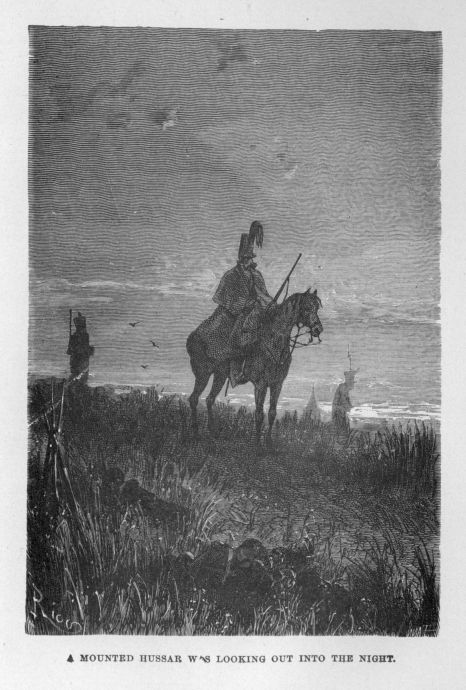
A mounted hussar was looking out into the night.
In a few minutes he entered the village, and all was still except a sort of confused tumult. In an instant after, the horseman came from Roly into our road at full gallop. I advanced to the edge of the hedge and presented my musket, and cried, "Who goes there?" "France!" "What regiment?" "Twelfth chasseurs! Staff." "Pass on!" He went on his way faster than before. I heard him stop in the midst of our encampment, and call "Commandant." I advanced to the top of the hill to see what was going on. There was a great excitement; the officers came running up, and the soldiers gathered round. The chasseur was speaking to Gémeau, I listened, but was too far away to hear. The courier went on again up the hill, and everything was in an uproar. They shouted and gesticulated. Suddenly the drums beat to mount guard, and the relief turned a corner in the road. I saw Zébédé in the distance looking pale as death; as he passed me he said, "Come!" the two other sentinels were in their places a little to the left. Talking is not allowed when under arms, but, notwithstanding, Zébédé said, "Joseph, we are betrayed. Bourmont, general of the division in advance, and five other brigands of the same sort, have just gone over to the enemy." His voice trembled.
My blood boiled, and looking at the other men on the picket, two old soldiers with chevrons, I saw their lips quiver under their gray mustaches, their eyes rolled fiercely as if they were meditating vengeance, but they said nothing. We hurried on to relieve the other two sentinels. Some minutes afterward, on returning to our bivouac, we found the battalion already under arms and ready to move. Fury and indignation were stamped on every face, the drums beat and we formed ranks, the commandant and the adjutant waited on horseback at the head of the battalion, pale as ashes.
I remember that the commandant suddenly drew his sword as a signal to stop the drums, and tried to speak, but the words would not come, and he began to shout like a madman: "Ah! the wretches! miserable villains! Vive l'Empereur! No quarter!" He stammered and did not know what he said, but the battalion thought he was eloquent, and began to shout as one man, "Forward! forward! to the enemy! no quarter!" We went through the village at quick step, and the meanest soldier was furious at not finding the Prussians.
It was an hour after, when having reflected a little, the men commenced swearing and threatening, secretly at first, but soon openly, and at last the battalion was almost in revolt. Some said that all the officers under Louis XVIII. must be exterminated, and others, that we were given up en masse, and several declared that the marshals were traitors, and ought to be court-martialed and shot.
At last the commandant ordered a halt, and riding down the line he told the men, that the traitors had left too late to do mischief, that we would make the attack that very day, and that the enemy would not have time to profit by the treason, and that he would be surprised and overwhelmed. This calmed the fury of a great proportion of the men, and we resumed our march, and all along the route, we heard repeatedly that the exposure of our plans had been made too late.
But our anger gave place to joy, when about ten o'clock we heard the thunder of cannon five or six leagues to the left, on the other side of the Sambre. The men raised their shakos on their bayonets and shouted: "Forward! Vive l'Empereur!"
Many of the old soldiers wept, and over all that great plain there was one immense shout; when one regiment had ceased another took it up. The cannon thundered incessantly. We quickened our steps. We had been marching on Charleroi since seven o'clock, when an order reached us by an orderly to support the right. I remember that in all the villages through which we passed, the doors and windows were full of eager friendly faces, waving their hands and shouting, "The French, the French!" We could see that they were friendly to us, and that they were of the same blood as ourselves; and in the two halts that we made, they came out with their loaves of excellent home-made bread, with a knife stuck in the crust, and great jugs of black beer, and offered them to us without asking any return. We had come to deliver them without knowing it, and nobody in their country knew it either, which shows the sagacity of the Emperor, for there were already in that corner of the Sambre et Meuse, more than one hundred thousand men, and not the slightest hint of it had reached the enemy.
The treason of Bourmont had prevented our surprising them as they were scattered about in their separate camps. We could then have annihilated them at a blow, but now it would be much more difficult.
We continued our march till after noon, in the intense heat and choking dust. The farther we advanced the greater the number of troops we saw, infantry and cavalry. They massed themselves more and more, so to speak, and behind us there were still other regiments.
Toward five o'clock we reached a village where the battalions and squadrons filed over a bridge built of brick. This village had been taken by our vanguard, and in going through it, we saw some of the Prussians stretched out in the little streets on the right and left, and I said to Jean Buche: "Those are Prussians, I saw them at Lutzen and Leipzig, and you are going to see them too, Jean."
"So much the better," he replied, "that is what I want."
This village was called Chatelet. It is on the river Sambre, the water is very deep, yellow, and clayey, and those who are so unfortunate as to fall into it, find it very difficult to get out of, for the banks are perpendicular, as we found out afterward. On the other side of the bridge we bivouacked along the river; we were not in the advance, as the hussars had passed over before us, but we were the first infantry of the corps of Gérard. All the rest of that day the Fourth corps were filing over the bridge, and we learned at night, that the whole army had passed the Sambre, and that there had been fighting near Charleroi, at Marchiennes, and Jumet.
XVII
On reaching the other bank of the river, we stacked our arms in an orchard, and lighted our pipes and took breath as we watched the hussars, the chasseurs, the artillery, and the infantry, file over the bridge hour after hour, and take their positions on the plain. In our front was a beech forest, about three leagues in length, which extended toward Fleurus. We could see great yellow spots, here and there in this wood; these were stubble, and great patches of grain, instead of being covered with bramble or heath and furze as in our country. About twenty old decrepit houses were on that side the bridge. Chatelet is a very large village, larger than the city of Saverne.
Between the battalions and squadrons, which were constantly moving onward, the men, women, and children would come out with jugs of sour beer, bread, and strong white brandy which they sold to the soldiers for a few sous. Buche and I broke a crust as we looked on and laughed with the girls, who are blonde and very pretty in that country.
Very near us was the little village Catelineau, and in the distance on our left, between the wood and the river, lay the village of Gilly. The sound of musketry, cannon, and platoon firing, was heard constantly in that direction. The news soon came that the Emperor had driven the Prussians out of Charleroi, and that they had re-formed in squares at the corner of the wood.
We expected every moment to be ordered to cut off their retreat, but between seven and eight o'clock, the sound of musketry ceased, the Prussians retired to Fleurus, after having lost one of their squares; and the others escaped into the wood. We saw two regiments of dragoons arrive and take up their position at our right, along the bank of the Sambre. There was a rumor a few minutes afterward that General Le Tort had been killed by a ball in the abdomen, very near the place where in his youth he had watched and tended the cattle of a farmer. What strange things happen in life! The general had fought all over Europe, since he was twenty years old, but death waited for him here!
It was about eight o'clock in the evening, and we were expecting to remain at Chatelet until our three divisions had crossed. An old bald peasant, in a blue blouse and a cotton cap and as lean as a goat, came into camp and told Captain Grégoire that on the side of the beech wood in a hollow, lay the village of Fleurus, and to the right of this, the little village of Lambusart; that the Prussians had been stationed in these towns more than three weeks, and that more of them had arrived the night before, and the night before that. He told us also that there was a broad road, bordered with trees, running two good leagues along our left; that the Belgians and Hanoverians had posts at Gosselies and at Quatre-Bras; that it was the high-road to Brussels, where the English and Hanoverians and Belgians had all their forces; while the Prussians, four or five leagues at our right, occupied the route to Namur, and that between them and the English, there was a good road running from the plateau of Quatre-Bras to the plateau of Ligny in the rear of Fleurus, over which their couriers went and came from morning till night, so that the Prussians and English were in perfect communication, and could support each other with men, guns, and supplies when necessary.
Naturally enough I thought at once, that the first thing to be done was to get possession of this road and so cut off their communication; and I was not the only one who thought so; but we said nothing for fear of interrupting the old man. In five minutes half the battalion had gathered round him in a circle. He was smoking a clay pipe and pointing out all the positions with the stem. He was a sort of commissioner between Chatelet, Fleurus, and Namur and knew every foot of the country and all that happened every day.
He complained greatly of the Prussians, said they were proud and insolent, that they corrupted the women and were never satisfied, and that the officers boasted of having driven us from Dresden to Paris, that they had made us run like hares.
I was indignant at that, for I knew they were two to one at Leipzig, and that the Russians, Austrians, Saxons, Bavarians, Wurtemburgers, Swedes, in fact all Europe had overwhelmed us, while three-quarters of our army were sick with typhus, cold, and famine, marching and countermarching; but that even all this had not prevented us from beating them at Hanau, and fifty other times when they were three to one, in Champagne, Alsace, in the Vosges, and everywhere.
Their boasting disgusted me, I had a horror of the whole race, and I thought, "those are the rascals who sour your blood." The old man said too, that the Prussians constantly declared that they would soon be enjoying themselves in Paris, drinking good French wines; and that the French army was only a band of brigands. When I heard that, I said to myself, "Joseph, that is too much! now you will show no more mercy, there is nothing but extermination."
The clocks of Chatelet struck nine and a half, and the hussars sounded the retreat, and each one was about to dispose himself behind a hedge or a bee-house or in a furrow for the night, when the general of the brigade, Schoeffer, ordered the battalion to take up their position on the other side of the wood, as the vanguard. I saw at once that our unlucky battalion was always to be in the van, just as it was in 1813.
It is a sad thing for a regiment to have a reputation; the men change, but the number remains the same. The Sixth light infantry had always been a distinguished number, and I knew what it cost. Those of us who were inclined to sleep, were wide awake now, for when you know that the enemy is at hand, and you say to yourself, "The Prussians are in ambush, perhaps in that wood, waiting for you," it makes you open your eyes.
Several hussars deployed as scouts on our right and left, in front of the column. We marched at the route step, with the captains between the companies, and the Commandant Gémeau, on his little gray mare, in the middle of the battalion. Before starting each man had received three pounds of bread and two pounds of rice, and this was the way in which the campaign opened for us.
The sky was without a cloud, and all the country and even the forest, which lay three-quarters of a league before us, shone in the moonlight like silver. I thought involuntarily of the wood at Leipzig, where I had slipped into a clay-pit with two Prussian hussars, when poor Klipfel was cut into a thousand pieces at a little distance from me. All this made me very watchful. No one spoke, even Buche raised his head and shut his teeth, and Zébédé, who was at the left of the company, did not look toward me, but right ahead into the shadow of the trees, like everybody else.
It took us nearly an hour to reach the forest, and when within two hundred paces the order came to "halt."
The hussars fell back on the flanks of the battalion, and one company deployed as scouts. We waited about five minutes, and as not the slightest noise or sound of any kind reached our ears, we resumed our march. The road which we followed through the wood was quite a wide cart-path. The column marked step in the shadows. At every moment great openings in the forest gave us light and air, and we could see the white piles of newly cut wood between their stakes, shining in the distance from time to time.
Besides this, nothing could be heard or seen. Buche said to me in a low voice, "I like the smell of the wood, it is like Harberg."
"I despise the smell of the wood," I thought; "and if we do not get a musket-shot, I shall be satisfied."
At the end of two hours the light appeared again through the underwood, and we reached the other side, fortunately without encountering either enemy or obstacle. The hussars who had accompanied us returned immediately, and the battalion stacked arms.
We were in a grain country, the like of which I had never seen. Some of the grain was in flower, a little green still, though the barley was almost ripe. The fields extended as far as the eye could reach. We looked around in perfect silence, and I saw that the old man had not deceived us. Two thousand paces in front of us, in a hollow, we saw the top of an old church spire and some slated gables, lighted up by the moon. That was Fleurus. Nearer to us on our right were some thatched cottages, and a few houses; this was without doubt Lambusart. At the end of the plain, more than a league distant and in the rear of Fleurus, the surface of the country was broken into little hills, and on these hills innumerable fires were burning. Three large villages were easily recognized extending over the heights from left to right. The one nearest to us, we afterward found, was St. Amand, Ligny in the middle, and two leagues beyond, was Sombref. We could see them more distinctly, even, than in the day-time, on account of the fires of the enemy. The Prussians were in the houses and the orchards and the fields; and beyond these three villages in a line, was another, lying still higher and farther away, where fires were burning also. This was Bry, where the rascals had their reserves.
As we looked at this grand spectacle, I understood the disposition and the plan, and saw too that it would be very difficult to take the position. On the plain at our left there were fires also, but it was the camp of the Third corps, which had turned the corner of the forest after having repulsed the Prussians, and had halted in some village this side of Fleurus. There were a few fires along the edge of the forest, on a line with us; these were the fires of our own soldiers. I believe there were some on both sides of us, but the great mass were at the left.
We posted our sentinels immediately, and without lighting our fires laid down at the border of the wood to wait for further orders. General Schoeffer came again during the night with several hussar officers, and talked a long time with our commandant, Gémeau, who was watching under arms. Their conversation was quite distinct at twenty paces from us. The general said that our army corps continued to arrive, but that they were very late, and would not all reach here the next day. I saw at once that he was right; for our fourth battalion, which should have joined us at Chatelet, did not come till the day after the battle, when we were almost exterminated by those rascals at Ligny, having only four hundred men left. If they had been there they would have had their share of the combat and of the glory.
As I had been on guard the night before, I quietly stretched myself at the foot of a tree by the side of Buche, with my comrades. It was about one o'clock in the morning of the day of the terrible battle of Ligny. Nearly half of those men who were sleeping around me left their bodies on the plain and in the villages which we saw, to be food for the grain, such as was growing so beautifully around us, for the oats and the barley for ages to come. If they had known that, there was more than one of them who would not have slept so well, for men cling to life, and it is a sad thing to think, "to-day I draw my last breath!"
XVIII
During the night the air was heavy, and I wakened every hour in spite of my great fatigue, but my comrades slept on, some talking in their sleep. Buche did not stir.
Close at hand, on the edge of the forest, our stacked muskets sparkled in the moonlight. In the distance on the left I could hear the "Qui vive,"[1] and on our front the "Wer da."[2] Nearer to us, our sentinels stood motionless, up to their waists in the standing grain.
I rose up softly and looked about me. In the vicinity of Sombref, two leagues to our right, I could hear a great tumult from time to time, which would increase and then cease entirely. It might have been little gusts of wind among the leaves, but there was not a breath of air and not a drop of dew fell, and I thought, "Those are the cannon and wagons of the Prussians, galloping over the Namur road; their battalions and squadrons, which are coming continually. What a position we shall be in to-morrow with that mass of men already before us, and re-enforcements arriving every moment."
They had extinguished their fires at St. Amand and at Ligny, but they burned brighter than ever at Sombref. The Prussians who had just arrived after forced marches were no doubt making their soup.
A thousand thoughts ran through my brain, and I said to myself from time to time, "You escaped from Lutzen and Leipzig and Hanau, why not escape this time also?"
But the hopes which I cherished did not prevent me from realizing that the battle would be a terrible one. I lay down, however, and slept soundly for half an hour, when the drum-major, Padoue himself, commenced to beat the reveille. He promenaded up and down the edge of the wood and turned off his rolls and double rolls with great satisfaction. The officers were standing in the grain on the hill-side in a group, looking toward Fleurus, and talking among themselves. Our reveille always commenced before that of the Austrians or Prussians or any of our enemies. It is like the song of the lark at dawn. They commence theirs on their big drums with a dismal roll which gives you the idea of a funeral. But, on the contrary, their buglers have pretty airs for sounding the reveille, while ours only give two or three blasts, as much as to say: "Come, let us be going! there is no time to lose." Everybody rose and the sun came up splendidly over the grain fields, and we could feel beforehand how hot it would be at noon.
Buche and all the detailed men set off with their canteens for water, while others were lighting handfuls of straw with tinder for their fires. There was no lack of wood, as each one took an armful from the piles that were already cut. Corporal Duhem and Sergeant Rabot and Zébédé came to have a talk with me. We were together in 1813, and they had been at my wedding, and in spite of the difference in our rank they had always continued their friendship for me.
"Well! Joseph," said Zébédé, "the dance is going to commence."
"Yes," I replied, and recalling the words of poor Sergeant Pinto the morning before Lutzen, I added with a wink, "this, Zébédé, will be a battle, as Sergeant Pinto said, where you will gain the cross between the thrusts of ramrod and bayonet, and if you do not have a chance now you need never expect it."
They all began to laugh, and Zébédé said:
"Yes, indeed, the poor old fellow richly deserved it, but it is harder to catch than the bouquet at the top of a climbing pole."
We all laughed, and as they had a flask of brandy, we took a crust of bread together as we watched the movements of the enemy which began to be perceptible. Buche had returned among the first with his canteen and now stood behind us with his ears wide open like a fox on the alert.
Files of cavalry came out of the woods and crossed the grain fields in the direction of St. Amand, the large village at the left of Fleurus.
"Those," said Zébédé, "are the light horse of Pajol who will deploy as scouts. These are Exelman's dragoons. When the others have ascertained the positions they will advance in line, that is the way they always do, and the cannon will come with the infantry. The cavalry will form on the right or the left and support the flanks, and the infantry will take the front rank. They will form their attacking columns on the good roads and in the fields, and the affair will begin with a cannonade for twenty minutes or half an hour, more or less, and when half the batteries are disabled, the Emperor will choose a favorable moment to put us in, but it is we who will catch the bullets and canister because we are nearest. We advance, carry arms, in readiness for a charge, at a quick step and in good order, but it always ends in a double quick, because the shot makes you impatient. I warn you, conscripts, beforehand, so that you may not be surprised." More than twenty conscripts had ranged themselves behind us to listen. The cavalry continued to pour out of the wood.
"I will bet," said Corporal Duhem, "that the Fourth cavalry has been on the march in our rear since daybreak."
And Rabot said they would have to take time to get into line, as it was so bad traversing the wood. We were discussing the matter like generals, and we scanned the position of the Prussians around the villages, in the orchards, and behind the hedges, which are six feet high in that country. A great number of their guns were grouped in batteries between Ligny and St. Amand, and we could plainly see the bronze shining in the sun, which inspired all sorts of reflections.
"I am sure," said Zébédé, "that they are all barricaded, and they have dug ditches and pierced the walls; we should have done well to push on yesterday, when their squares retreated to the first village on the heights. If we were on a level with them it would be very well, but to climb up across those hedges under the enemy's fire will cost a trifle, unless something should happen in the rear as is sometimes the case with the Emperor."
The old soldiers were talking in this fashion on all sides, and the conscripts were listening with open ears.
Meanwhile the camp-kettles were suspended over the fire, but they were expressly forbidden to use their bayonets for this purpose as it destroyed their temper. It was about seven o'clock, and we all thought that the battle would be at St. Amand. The village was surrounded by hedges and shrubbery, with a great tower in the centre, and higher up in the rear there were more houses and a winding road bordered with a stone wail. All the officers said: "That is where the struggle will be." As our troops came from Charleroi they spread over the plain below us, infantry and cavalry side by side; all the corps of Vandamme and Gérard's division. Thousands and thousands of helmets glittered in the sun, and Buche who stood beside me, exclaimed:
"Oh! oh! oh! look, Joseph, look! they come continually!"
And we could see innumerable bayonets in the same direction as far as the eye could reach.
The Prussians were spreading more and more over the hill-side near the windmills. This movement continued till eight o'clock. Nobody was hungry, but we ate all the same, so as not to reproach ourselves; for the battle, once begun, might last two days without giving us a chance to eat again.
Between eight and nine o'clock the first battalions of our division left the wood. The officers came to shake hands with their comrades, but the staff remained in the rear. Suddenly the hussars and chasseurs passed us, extending our line of battle toward the right. They were Morin's cavalry. Our idea was that when the Prussians should have become engaged in the attack on St. Amand, we would fall on their flank at Ligny. But the Prussians were on their guard, and from that moment they stopped at Ligny, instead of going on to St. Amand. They even came lower down, and we could see the officers posting the men among the hedges and in the gardens and behind the low walls and barracks. We thought their position very strong. They continued to come lower down in a sort of fold of the hill-side between Ligny and Fleurus, and that astonished us, for we did not yet know that a little brook divided the village into two parts, and that they were filling the houses on our side, and we did not know that if they were repulsed they could retreat up the hill and still hold us always under their fire.
If we knew everything about such affairs beforehand, we should never dare to commence such a dangerous enterprise, but the difficulties are discovered step by step. We were destined that day to find a great many things which we did not expect.
About half-past eight several of our regiments had left the wood, and very soon the drums beat the assembly and all the battalions took their arms. The general, Count Gérard, arrived with his staff, and passing us at a gallop, without any notice, went on to the hill below Fleurus. Almost immediately the firing commenced; the scouts of Vandamme approached the village on the left, and two pieces of cannon were sent off, with the artillerymen on horseback. After five or six discharges of cannon from the top of the hill the musketry ceased and our scouts were in Fleurus, and we saw three or four hundred Prussians mounting the hill in the distance, toward Ligny. General Gérard, after looking at this little engagement, came back with his staff and passed slowly down our front, inspecting us carefully, as if he wished to ascertain what sort of humor we were in. He was about forty-five years old, brown, with a large head, a round face, the lower part heavy, with a pointed chin. A great many peasants in our country resemble him, and they are not the most stupid. He said not a word to us, and when he had passed the whole length of our line, all the generals and colonels were grouped together. The command was given to order arms. The orderlies then set off like the wind; this engrossed the attention of all, but not a man stirred. The rumor spread that Grouchy was to be commander-in-chief, and that the Emperor had attacked the English four leagues away, on the route to Brussels.
This news put us in anything but a pleasant humor, and more than one said, "It is no wonder that we are here doing nothing since morning; if the Emperor was with us, we should have given battle long ago, and the Prussians would not have had time to know where they were."
This was the talk we indulged in, and it shows the injustice of men; for three hours afterward, in the midst of shouts of "Vive l'Empereur," Napoleon arrived. These shouts swept along the line like a tempest, and were continued even opposite Sombref. Now everything was right. That for which we had reproached Marshal Grouchy, was perfectly proper when done by the Emperor, since it was he.
Very soon the order reached us to advance our line five hundred paces to the right, and off we started through the rye, oats, and barley, which were swept down before us, but the principal line of battle on the left was not changed.
As we reached a broad road which we had not before seen and came in sight of Fleurus, with its little brook bordered with willows, the order was given to halt! A murmur ran through the whole division—"There he is!"
He was on horseback, and only accompanied by a few of the officers of his staff.
We could only recognize him in the distance by has gray coat and his hat; his carriage with its escort of lancers was in the rear. He entered Fleurus by the high road, and remained in the village more than an hour, while we were roasting in the grain fields.
At the end of this hour, which we thought interminable, files of staff officers set off, at a gallop, bent over their saddle-bows till their noses were between their horse's ears. Two of them stopped near General Gérard, one remained with him, and the other went on again. Still we waited, until suddenly the bands of all the regiments began to play; drums and trumpets all together; and that immense line which extended from the rear of St. Amand to the forest, swung round, with the right wing in the advance. As it reached beyond our division in the rear, we advanced our line still more obliquely, and again the order came, Halt! The road running out of Fleurus was opposite us, a blank wall on the left; behind which were trees and a large house, and in front a windmill of red brick, like a tower.
We had hardly halted, when the Emperor came out of this mill with three or four generals and two old peasants in blouses, holding their cotton caps in their hands. The whole division commenced to shout, "Vive l'Empereur!"
I saw him plainly as he came along a path in front of the battalion, with his head bent down and his hands behind his back listening to the old bald peasant. He took no notice of the shouts, but turned round twice and pointed toward Ligny. I saw him as plainly as I could see Father Goulden when we sat opposite each other at table. He had grown much stouter than when he was at Leipzig, and looked yellow. If it had not been for his gray coat and his hat, I should hardly have recognized him. His cheeks were sunken and he looked much older. All this came, I presume, from his troubles at Elba, and in thinking of the mistakes he had made; for he was a wise man, and could see his own faults. He had destroyed the revolution which had sustained him, he had recalled the émigrés who despised him, he had married an archduchess who preferred Vienna to Paris, and he had chosen his bitterest enemies for his counsellors.
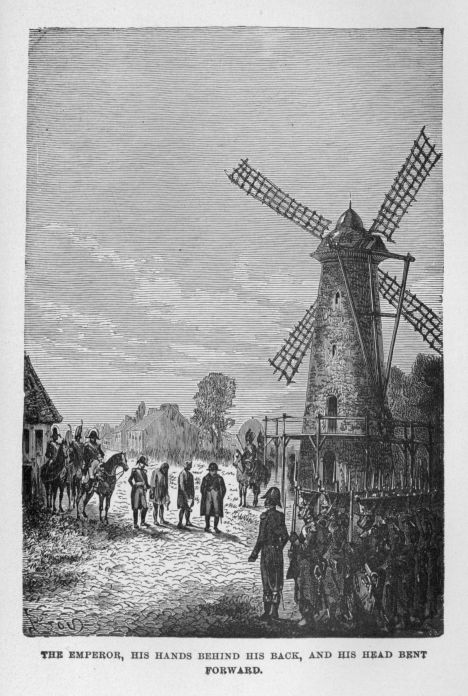
The Emperor, his hands behind his back, and his head bent forward.
In short he had put everything back where it was before the revolution, nothing was wanting but Louis XVIII., and then the kings had put Louis XVIII. on his throne again. Now he had come to overthrow the legitimate sovereign, and some called him a despot, and some a Jacobin. It was unfortunate for him that he had done everything possible to facilitate the return of the Bourbons. Nothing remained to him but his army, if he lost that, he lost everything, for many of the people wanted liberty like Father Goulden, others wanted tranquillity and peace like Mother Grédel, and like me and all those who were forced into the war.
These things made him terribly anxious, he had lost the confidence of the whole world. The old soldiers alone preserved their attachment to him, and asked only to conquer or die. With such notions you cannot fail of one or the other, all is plain and clear; but a great many people do not have these ideas, and for my part I loved Catherine a thousand times more than the Emperor.
On reaching a turn in the wall, where the hussars were waiting for him, he mounted his horse, and General Gérard who had recognized him came up at a gallop. He turned round for two seconds to listen to him, and then both went into Fleurus.
Still we waited! About two o'clock General Gérard returned, and our line was obliqued a third time more to the right, and then the whole division broke into columns, and we followed the road to Fleurus with the cannon and caissons at intervals between the brigades. The dust enveloped us completely.
Buche said to me:
"Cost what it may, I must drink at the first puddle we come to."
But we did not find any water. The music did not cease, and masses of cavalry kept coming up behind us, principally dragoons. We were still on the march when suddenly the roar of musketry and cannon broke on our ears as when water breaking over its barriers sweeps all before it.
I knew what it was, but Buche turned pale and looked at me in mute astonishment.
"Yes, indeed, Jean," said I, "those over there are attacking St. Amand, but our turn will come presently."
The music had ceased but the thunder of the guns had redoubled, and we heard the order on all sides, "Halt!"