YEI THEODORA OZAKI (continued 4)
Reading edition
A year passed by and the stepmother gave birth to a child. Jealousy for her own infant daughter now made her hate her stepchild more and more. It was her great desire to see her own daughter first in Prince Minetaka's affection, and in order to attain her utterly selfish end she knew she must oust her stepchild from the house. To begin with, she determined to estrange the father from the little Princess by telling him unfavourable stories of her behaviour and her character. It is needless to say that she invented these stories.
The Bowl-Wearing Princess soon understood that her stepmother hated her. Her grief and anxiety seemed to her more than she could bear. There was no one in the house in whom she could confide, and she knew that to complain of her stepmother to any one, even to her father, would be undutiful. What was she to do in her trouble? To whom could she go but to her own mother? So as often as she could she went to her grave. Here she would kneel and pour out the woe that filled her heart.
"O mother, why must I live on in the world with this ugly bowl on my head? My stepmother truly has a reason for hating such a child about the house. Now that she has a daughter of her own, all the more must she want to get rid of me! And my father, who used to love me so much, he too will surely soon give all his love to his new daughter and forget me! Alas! Alas! the only place that is left to me to come to without fear of dislike is the side of my own dead mother. O mother, sitting upon the lotus leaves in Paradise, receive me now upon the same leaf. Oh! that I might thus escape the sorrow of this world and enter upon the way of Buddha!"
But the Boundary of Life and Death separated the mother and child, and though she prayed earnestly and with tears, lifting her whole heart and soul up in her despair, no answer came to her eagerly listening ear. As she knelt in the little graveyard only the sound of the wind sighing in the pine trees answered her. But the thought that she had told her mother everything comforted her as she returned home.
The stepmother was told of her stepdaughter's frequent visits to the graveyard, and instead of being touched with pity for the motherless girl, she made use of the occasion still further to slander the child to her husband.
"I am told that the Bowl-Wearer, your daughter, goes to her mother's grave and curses me and my child because of her jealousy! What do you think of that? Hasn't she a wicked heart?"
Day by day she watched the little girl wend her way from the house to the graveyard and day by day she repeated in her husband's ear her pretended fears. In her heart she knew quite well that it was only love and unhappiness that sent her unfortunate stepchild to the grave of her mother. At last she said that she was afraid of the evil that might befall her and her child through the Bowl-Wearer's malice; she had decided that they could no longer live together in the same house.
The father, who had hitherto never listened much to his wife's tales, was at last persuaded by her importunity into believing them true. So in an evil hour he summoned his daughter and said: "What is this I hear, wicked daughter? Your deformity has long since been a source of irritation to me, but as long as you behaved well, I put up with it. Now I am told that you go every day to the grave of your mother to curse my wife and her innocent little child. It is impossible for me to keep under my roof any one who is so crippled not only in body but in mind as you are. Go wherever you will from to-day, but longer in this house you shall not stay!"
While the father was speaking these terrible words the stepmother sat behind him, smiling in derision at the poor little Princess and in triumph at the success of her wicked stratagem.
"Woe to the Bowl-Wearing Princess!"
The servants, at the command of her father, took off her silken robes and put on her a miserable common cotton gown, such as beggars wear, and drove her out into the road.
The Princess was altogether bewildered at the suddenness of her misfortune.
She felt like a wanderer in an unknown land, lost in the darkness of night. So distracted was she at first that she could only stand still in the middle of the street, not knowing which way to turn. But people, passing by, stared at her so that she soon realized that she must not stand like that all day, so she began to move whither her feet led her.
In this way she came to the bank of a large river. As she stood and looked at the flowing water, she could not help thinking that it would be far better for her to become the dust of the river-bed than endure the hardships of her present lot. Would it not be better to die and so join her mother than wander about like a beggar from place to place begging her rice? With this thought she made up her mind to drown herself. But the roar of the river was so great as it dashed over the boulders of its rocky bed that the maiden hesitated at first. Then, summoning up all her courage with a desperate effort, she jumped in.
Strange to say, however, the bowl, which had hitherto been such a curse to her, was now a blessing. It lifted her head clear above the water and would not let her sink. As she floated down the stream a fishing-boat came by. The fisherman, seeing a big bowl rising out of the water, lifted it up. His surprise was great when underneath the bowl he found a human being. Thinking it to be some strange monster, he threw it upon the bank.
The poor girl was at first stunned by her fall. When she came to herself, she said that it was a pity she could not die as she had wished. She got up from the ground and, in a miserable plight, for her clothes were dripping with water, began to walk on, and after some time she found herself in the streets of a town.
Here the people, as soon as they saw her, began to point the finger of scorn at her, and to jeer and laugh at the strange-looking bowl on her head.
"Oh! oh! do you see this queer creature with the bowl coming down from the mountains? Look! Look!" Then as some of them came nearer they said: "It is strange that a monster should have such beautiful hands and feet. What a pity this creature was not born a woman!"
Just then the lord of the district passed by on his way home from the hunt. Seeing the gathering of people, he stopped and inquired what was the matter. His retainers pointed out the Bowl-Wearer to him. From the grace of her slender form, and the modesty of her bearing, Lord Yamakage judged her to be a young woman, though he could not of course see her face, which was completely hidden by the bowl. He ordered the Bowl-Wearer to be brought to him. Two or three of his retainers went to execute his orders, and came back bringing the poor unhappy Princess with them.
"Tell me the truth," said Lord Yamakage to the girl; "who or what are you?"
"I am the daughter of one Minetaka by name, and my home is near Katano. My mother, when dying, placed this bowl on my head, and since her death it has become so firmly fixed there that no one can take it off, and I am obliged to wear it always, as you see me now. Because of the unsightliness of my appearance I have been driven away from my home. No one takes pity on me, and I am forced to wander from place to place without knowing where to lay my head at night."
"Well, well!" said the kind man. "Your story is truly a pitiful one. I will take the bowl off for you!"
When he had said these words, Lord Yamakage ordered his retainers to pull off the bowl from the girl's head. The men, one and all, tried to free the Princess from the obnoxious bowl, but it stuck so obstinately to her head that all their efforts were useless. It even uttered loud cries and groans of pain as they tugged at it. Every one was dumbfounded at the inexplicable mystery, and at last they all began to laugh.
When Lord Yamakage saw that there was nothing to be done to help her, he spoke to the Bowl-Wearer again. "Where are you going to spend to-night?"
"I am quite homeless," answered the Bowl-Wearer, in a heartbroken way, "and I do not know where I shall lay my head to-night. There is no one in the wide world to take pity on me, and every one who sees me either jeers or runs away because of the bowl on my head."
Lord Yamakage felt his heart fill with pity and said: "It may bring luck to have such a strange creature in my house!" Then he turned to the girl and said: "How would you like to come home with me for the present, Bowl-Wearer?"
And with these words he gave her in charge of his attendants, who took her with them to their lord's house.
It was an easy matter to take her to the house, but not so easy to find her a place there. His wife objected to her becoming a waiting-maid, saying that no one could bear the sight of so strange a creature about. So the servants at last took her to the bath-room, and told her that she must fetch and carry the water and look after the fire for heating the bath. This was to be her work!
As the little Princess had never done such rough work in the whole of her life, she suffered much in obeying these cruel orders; but she resigned herself to her fate and tried with all humility and patience to perform her hard task faultlessly.
But her lot was far from being a happy one, even though she had found the safe shelter of Lord Yamakage's home. The young and uncouth tradesmen, coming on errands to the house, made fun of her, some even trying to peep under the bowl to get a glimpse of the beautiful face beneath. While she was thus persecuted in the daytime, in the evening the servants gave her no rest with their peremptory orders. "Hot water here!" "Cold water there!" "Get the bath ready!" and so on.
The poor girl bore all this rude usage patiently; but as she went about her work she could not help remembering the old times of her happy childhood, spent under the loving care of her own dear mother, of the honoured place she had held in her father's household till within the last few days; and as she carried the hot water or stoked the bath-fire she pretended that those fast-falling tears of sadness were caused by the fumes of charcoal and the steam which rose from the hot water. When she crept weeping to bed at night it seemed to her as if the past day must be an evil dream.
Lord Yamakage had four sons. The three elder ones were married to daughters of three of the leading men of the province. The youngest son, Saisho, was still unmarried. He had been away for some time in the gay smart capital of Kyoto. But now he returned to his home.
Now every time he went to take his bath or called for hot water, he saw the Bowl-Wearing maiden, and, as he had a kind and compassionate heart, he could not but be touched by her unhappy appearance, and her modest and gentle behaviour and her quickness and diligence at her work.
Whenever he had an opportunity he spoke to the Bowl-Wearer, and to his surprise he found that she was no servant, that she spoke in the refined language of his class, and though so young she was well read in the literature and poetry of her country, and could answer a literary allusion wittily and to the point. When at last she told him something of her sad story, he knew, though she did not tell him, that she belonged to some family of high rank. From this time on he often spoke to the girl, and he found that the stolen conversations with her grew to be the chief pleasure of the day.
One day he managed to take a sly peep under the bowl. The face, even though overshadowed by the huge cover, was of such rare beauty that he fell madly in love with the Princess, and made up his mind that none other than the Bowl-Wearer should be his wife.
His mother soon heard of Saisho's friendship for her husband's protege, and when she learned that he had promised to marry her she forbade him to think of such a thing. She at first thought that her son could not be in earnest, but when she sent for Saisho and asked him seriously if what she had been told was true, he answered: "I really and truly intend to make the Bowl-Wearer my wife!"
His mother was not a little angry at his determined front. How could Saisho fall in love with a girl with a bowl on her head? Who ever heard of such ridiculous nonsense?
Then she sent for her son's nurse, the woman who had nursed him from the day he was born, and together they tried to deter him from his purpose.
Saisho was obliged to listen to all they had to say, but did not answer them. He could not say "Yes" to their demand that he should give up all idea of marrying the Bowl-Wearer, and he knew that if he firmly said "No" he would raise up such a storm of opposition that no one could tell how it would end. He knew that the life of the Bowl-Wearer was a truly pitiable one, and his determination to marry her and help her out of all her difficulties remained unchanged. His mother soon saw that her son would by no means listen to her persuasions, and her anger was great towards the Bowl-Wearer. She almost made up her mind to drive her from the house before her husband could know what happened.
Saisho, on hearing this, told her that if the girl was driven away he would go with her. The mother's distraction can be imagined, for she was thwarted in every way. She at last said that the Bowl-Wearer was a wicked witch who had thrown her spells over Saisho and would not leave him till she had compassed his death.
She determined if possible to separate them by fair means or foul. For a long time she pondered over the matter, and at last hit upon a stratagem which she trusted would rid the house of the presence of the obnoxious girl. Her plan she called "The Comparison of the Brides." She would hold in the house a family council of all the relations, and assemble the wives of her three elder sons, and before the whole gathering compare them with the Bowl-Wearer whom Saisho had elected to marry. If the Bowl-Wearer had any self-respect she would be too conscious of her deformity and her poverty, and too ashamed to make an appearance,—would leave the house to escape from the ordeal. What an excellent plan! Why had she never thought of this before?
So the mother sent messengers post-haste to all the family and relations, requesting their presence at a "Bride Comparing Ceremony" and a feast which would close the ceremony.
When Saisho heard of this he was greatly troubled, for he knew what it meant. His mother meant to drive the girl he loved from the house by comparing her with his brothers' rich and pretty wives. What was to be done? How could he help the poor Bowl-Wearer?
The little Princess saw how unhappy he was, and blamed herself, she was so sorry for him.
"It is all because of me that this trouble has come to you. Instead of happiness I have only brought you worry. Woe is me! It is better that I go away at once," said the girl.
Saisho told her at once that he would never let her go alone; that if she went he would go with her.
At last the day fixed for the ceremony of the "Comparison of the Brides" came round. Saisho and the unhappy little Bowl-Wearer rose before the dawn, and taking each other by the hand left the house together.
Notwithstanding his love for the Bowl-Wearer and his resolve to marry her at whatever cost, Saisho was very sad at the thought of leaving his parents in this way. He told himself that they would never forgive his obstinacy and probably would refuse to see him again, so this parting was probably forever. He felt at each step as if his heart was torn backwards. With slow steps he and the Bowl-Wearer, hand in hand, wended their way down the garden. No sooner, however, did they put their feet outside the gate than the bowl on the girl's head burst with a loud noise and fell in a thousand pieces upon the ground.
What untold joy for both of them! Saisho, too astonished to speak, looked for the first time full on the girl's face. The beauty of the damsel was so dazzling that he could compare it only to the glory of the full moon as it rides triumphantly above the clouds on the fifteenth night of September. Her figure, too, now that the dwarfing bowl had gone, was more graceful than anything he had ever seen. The young lovers, too happy for words at this unexpected deliverance, could do nothing but gaze at each other.
The mother's purpose in covering her daughter's head with the hideous bowl was at last made clear. Fearing that her daughter's beauty would prove to be a peril to her, with no mother to watch over her, she had hidden it thus, and the intensity of her wish had assumed supernatural power, so that all attempts to remove it were useless till the moment came when it was no longer needed; then it broke off of its own accord.
At last the lovers stooped to pick up the pieces of the bowl, when to their amazement they found the ground strewn with treasures and all that a bride could possibly need for her portion. There were many gold kanzashi (ornamental pins for the hair), silver wine-cups, many precious stones and gold coins, and a wedding-garment of twelve folded kimono, and a hakama of brilliant scarlet brocade.
"Oh, surely," said the Princess, "these treasures must be what my mother prepared for my marriage portion. Indeed a mother's tender love is above everything!"
She wept with mingled feelings of joy and pain,—pain of the remembrance of her mother and joy at her present unlooked-for deliverance and the certainty of future happiness.
Saisho told her that there was now no need for her to leave the house. She was not only a richly dowered bride, but now that her face was no longer hidden by the hideous bowl, so beautiful that even a king would be proud to wed her. She need no longer fear to be present at the coming ceremony and feast. So they both turned back, and hastened to prepare for the trial which awaited the Bowl-Wearer, but Bowl-Wearer now no longer.
As soon as day broke, the house was full of movement, servants hurrying to and fro to usher in and wait upon the relations, who now began to arrive. The murmur of their chattering was like the sound of breaking waves on a distant shore, and the object of all this talk was nothing else than the poor little Princess. The servants told every one that she was in her room getting ready for the approaching feast, and they all thought it strange that she had not fled away for shame. Little did they dream of all that had happened to her!
At last the hour of the "Bride Comparing Ceremony" arrived. The family and the relations all took their places at the upper end of the big guest-hall of thirty mats.
First entered the bride of the eldest son. She was only twenty-two years of age, and as it was the season of autumn, she wore a brightly coloured kimono and walked into the room in a stately fashion, with her scarlet hakama trailing over the cream mats behind her. Her costume was indeed beautiful to behold! To her parents-in-law she brought gifts of ten rolls of rich silk and two suits of the ceremonial gown called kosode (each kosode consisting of twelve long kimono folded one over the other), all of which she placed on a fine lacquer tray to present them.
Next came the bride of the second son. She was twenty years of age, and was of the aristocratic type of beauty, thin and slender, with a long pale oval face. She wore a heavy silk robe, and over this a flowing gown of gold brocade. Her hakama was embroidered profusely with crimson plum-blossoms. She came into the room quietly, with a gentle bearing, and offered as her gifts of presentation thirty suits of silk robes to her husband's parents.
Then came the bride of the third son. She was only eighteen years of age. Quite different from the first two proud beauties, she was very pretty and dainty, and though small had more sweetness and charm in her manner than her sisters. Her dress was of rich silk embroidered with cherry-blossoms. She presented thirty pieces of rare and handsome crape to her parents-in-law.
The three sat side by side in their conscious pride and prosperity, their beauty enhanced by the sheen and splendour of their silken gowns. As the father and mother, uncles and aunts and relations, all gazed upon them, no one could say who deserved the palm of superiority, for they were all lovely.
At the lower end of the room, far away from every one else, was placed a torn mat. It was the seat destined for the Bowl-Wearer.
"We have seen the three elder brides of the house, and they are all so handsome and so beautifully robed that we are sure there are no women to compare with them in the whole province," said the relations. "Now it is the turn of the Bowl-Wearer, who aspires to marry the youngest son of the house. When she comes in with that ridiculous bowl on her head, let us greet her with a burst of laughter!"
The roomful of people eagerly waited for the Bowl-Wearer to come, even as the birds sitting on the eaves of a house long for the morning. The three brides were also curious to see the cripple girl of whom they had heard so much. How dared such a creature aspire to become their sister? they haughtily asked each other.
But the mother felt differently. She in no wise wished to see the girl appear, for she had arranged this day's ceremony, hoping that the Bowl-Wearer, knowing herself to be a deformed beggar-maid, would be too ashamed to appear before such a grand company and would flee away rather than face the trial. On asking the servants, however, she was told that she was still in the house, and she wondered what the girl could be doing, and almost regretted what she had done.
Lord Yamakage and his wife at last grew impatient and sent word to the Bowl-Wearer that she was to hasten, as every one was waiting for her.
The servants went to the back of the house where the Bowl-Wearer had her little room of three mats, and gave her the message.
"I am coming now," she answered from within the paper screens.
The Princess now came out and entered the room of the "Bride Comparing Ceremony," where every one was waiting for her. She was only sixteen years of age, but so beautiful that she reminded them of the weeping cherry-blossoms in the dew of a spring morning. Her hair was as black as the sheen on a raven's wing, and her face was lovelier far than that of any human being they had ever seen. Her under-robes were of rich white silk, and her upper kimono was purple, embroidered with white and pink plum-blossoms. As the stars pale before the fuller glory of the moon, so the three elder brides shrank into insignificance beside the dazzling beauty of this maiden.
To all it seemed as if one of the Amatsu Otome (heavenly virgins) who wait upon the Goddess of Mercy had glided into the room. They had expected to see a poverty-stricken girl with a large bowl stuck upside down on the top of her head, and they were lost in astonishment when they beheld the Princess in all the radiance of her loveliness and the splendour of her rich clothes.
The Princess was about to sit down in the seat left for her, but Lord Yamakage made a place for her beside his wife, saying that he could not allow her to sit in such a lowly spot. She now presented to her father-in-law a silver wine-cup on a gold pedestal, with one hundred rye (old yen in gold), and thirty rolls of silk which she brought in on a beautiful tray. To his wife she presented the rarest and most delectable fruit of ancient Japan, Konan oranges and Kempo pears, and one hundred pieces of coloured cloth which she put upon a gold stand.
In her surpassing beauty, in the grace of her carriage, in the richness of her costume, in the sumptuousness of the gifts to her parents, she left the other brides far and away behind. Speechless with wonder and admiration, every one present could not but gaze at her. Before the Bowl-Wearer had appeared, the three elder brides had seemed beautiful enough, but now the difference was as marked as when a sparkling jewel is placed side by side with a crystal; and as the crystal suffers from the comparison, so did they.
Saisho's elder brothers were looking between the cracks of the sliding screens, and they were filled with envy at Saisho and his good fortune in becoming the husband of such a beautiful princess, for such they now felt she must be. Not even her rivals could deny that she was bewilderingly fair to look upon; but they whispered among themselves that unless she were skilled in all womanly accomplishments, for all her beauty she would be no better than a common man's daughter. She must play on the koto at once. No one could perform on that instrument without years of instruction. If they waited till the next day, who knows, she was so clever that she might get Saisho to teach her. So the jealous brides proposed aloud that they should all play a quartette; the eldest would play the biwa (lute), the second the sho (flute), the third the tsuzumi (a kind of a small drum beaten with the hand), and they asked the Bowl-Wearer to join them and play the koto (harp).
The Princess, who was very modest, at first refused; but on second thoughts, she said to herself: "They ask me to do this because they wish to try me, thinking me to be ignorant of such accomplishments. Well, then, I will play, for my mother taught me." She pulled the koto near her, and slipping the ivory tips on her fingers began to stroke chords. The astonishment of every one was great, for she played with great skill.
Saisho, who had hidden himself in the room behind a lacquer cabinet, and was watching with the utmost eagerness all that went on, could hardly keep in his hiding-place, he was so delighted.
The three brides, who were quite put out of countenance, for their performance could in no wise be compared to that of the little Princess, now proposed that she should write a poem.
"Write a poem, a tanka [a poem of thirty-one syllables], which shall describe the character of each season, such as the blooming of the peach and the cherry-blossom in the spring, the orange and wistaria in summer, and the beauty of the chrysanthemum in autumn."
"Oh," said the Bowl-Wearer, "this is indeed a task too difficult for me. Is there nothing else you will give me to do instead of this? I can take care of the bath-room, and pull up water from the well, and heat the bath. Since this is my daily occupation, how is it possible that I should even know how to write a poem, much less compose one?" She blushed as she spoke.
But her rivals insisted, and so at last she took up a poem card and a brush and wrote:—
Haru wa hana, Natsu wa tachibana, Aki wa kiku, Izure to wakete, Tsuyu ya okuran. The cherry-blossom of spring, The orange-flower of summer, The autumn chrysanthemum, Perplexed between them all, Alike on each the dew may fall.
She showed not the least hesitation in writing these lines, and her handwriting was so beautiful that even the famous Tofu[1] and her brush could not have surpassed it. The three brides retired from the room, grumbling and speaking evil of the Bowl-Wearer.
"She must be a witch," they said. "Probably the spirit of the ancient Tamamono Maye!"
Lord Yamakage, now quite pleased with her, handed her a cup of saké. He gave his full consent to her marrying his son Saisho, and bestowed upon them as a settlement twenty-three hundred cho of land, together with twenty-four servants to wait upon them, and for their bridal chamber he allotted them the Hall of Bamboos.
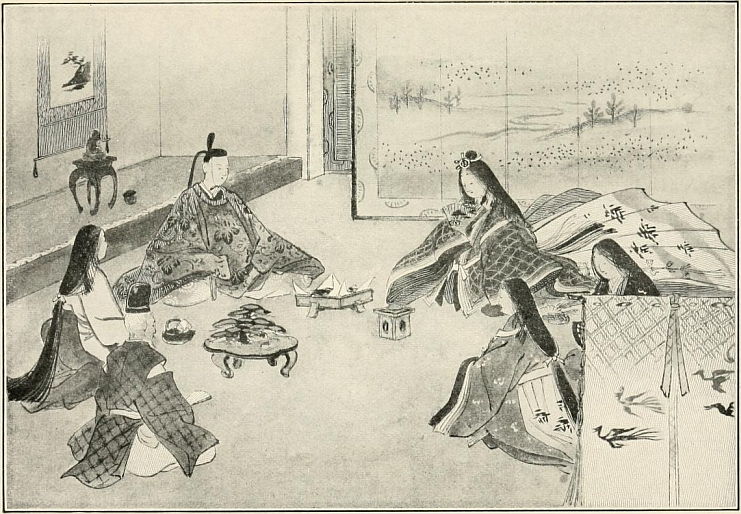
So Saisho and the Bowl-Wearer were at last married, and all their troubles ended. Never was there such a merry wedding, such a lovely bride, or such a happy bridegroom. The days flew into weeks, the weeks flew into months, for the flight of time is unnoticed when one is happy.
At last one day Saisho said to his wife: "I cannot believe you to be the daughter of a common man. Will you not tell me who your father is? I should like to know. Whatever wrong you have suffered, why hide your parentage any longer?"
The Princess knew that if she told her husband the truth, the name of her cruel stepmother would have to be mentioned, and it would be most unfilial to speak of the woman's cruelty, for she was her father's wife, so she decided not to tell Saisho to what family she belonged. She made some excuse, saying that he should know all in good time, and begged him to wait a little longer.
SAISHO AND THE BOWL-WEARER WERE AT LAST MARRIED
When they had been happily married for a year, she gave birth to a son. The bliss of the faithful young couple now seemed complete. Yet with her ever-growing happiness her thoughts turned more and more to her father. What had happened to him in these past years? How she longed to show him her little son! She said to herself that if this were granted she would be the happiest woman in the whole world.
Now let us turn back and see what happened to Lord Minetaka and his wicked wife. As time went on, her vicious disposition only became worse. At last it became so unbearable that all the servants took their leave. There was now no one left to care for her child or the house, and the fortunes of the family gradually declined. Lord Minetaka became poorer and poorer. Where once in the days of the first wife there had been sweet peace and harmony, discord now reigned in the house.
Lord Minetaka grew weary of his life. He decided to leave his home and set out on a pilgrimage. He started at last to wander on foot from province to province and from temple to temple, learning from the priests all he could of Buddhist lore. He had plenty of time for reflection; and no longer harassed by a scolding wife, he began to ponder over his past life. No words can tell how much he regretted having listened to her slanderous stories about his little daughter; and when he thought of how he had allowed her to be driven from her home, like an outcast or a beggar, his nights were sleepless.
He asked himself every day what could have happened to her all this time. He would search for her through the length and the breadth of the land, and if she were still alive, he told himself that he would surely meet with her again. In every temple he came to he prayed that he might find her, wheresoever she might be. On and on he wandered over the country, stopping for the night at the different villages he came to on his way.
At last he reached the famous Kwannon of the Hatsuse Temple, of the Yamato Province. Kwannon, the Goddess of Mercy, grants to mortals whatever they need the most, the greatest desire of their hearts. Here Minetaka ardently prayed for his lost daughter, prayed that she might be preserved from all ill, and that Kwannon would mercifully grant them a speedy meeting.
Saisho and his wife were devoted to this very temple, and often used to visit it to offer thanksgiving for their mutual happiness, and to pray for their children. Now this day, as was their wont, they had come with their three little sons and some of their retainers. The little boys were beautifully dressed in silk and crape, and the whole party had the appearance of a nobleman and his retinue.
The retainers went up the temple steps first to clear the way, and found a pilgrim before the temple shrine lost in earnest prayer.
"Oh, pilgrim!" they cried, "out of the way! Our lord comes to worship, make way instantly!"
The man, hearing himself spoken to in this way, got up and looked at the approaching party, moving aside at the same time to let them pass. He was travel-stained and worn out with fatigue, and it was easy to see that he was broken down by some sorrow. As the little boys passed him, he looked at them eagerly, and as he did so the tears fell from his eyes. One of the retainers, who thought his behaviour strange, asked the pilgrim why he wept.
"Those children," answered Lord Minetaka, for it was he, "remind me so much of my daughter, for whom I am searching, that when I looked at their faces the tears fell in spite of myself;" and he told the man all that had happened, glad for once to find a sympathetic listener on his lonely wanderings.
When the Princess heard the story, she told the retainers to bring the pilgrim to her. As soon as they led him to her a glance was enough for her to recognize that, aged and emaciated as he was, the pilgrim was none other than her father.
"I am the Bowl-Wearer!" she exclaimed quickly, catching hold of her father's sleeve and bursting into tears, overcome with joy and filial affection at this unexpected meeting.
Saisho congratulated his wife and her father on their happy reunion, and after many bows and salutations on both sides, he said: "I felt sure that my wife was of noble birth, though she always remained silent when I questioned her as to her parentage. Now I understand it all. So, after all, she is the daughter of Lord Minetaka of Katano."
He then insisted that his father-in-law should give up his wanderings and make his home with them for the rest of his days.
So Lord Minetaka at last found his good daughter married to one of his own rank, and so happy that even in dreams he could have wished for nothing better for her. What a joyous home-coming it was that day for the Bowl-Wearer, as she led her father back with her and presented her three little sons to him, and showed him her beautiful home, and told him how good and faithful her husband had been to her while she was only the unhappy and despised Bowl-Wearer!
They all felt that their cup of happiness was full, and lived together more harmoniously than ever, and in their mutual joy all past sorrow was forgotten.
Such is the story of the Bowl-Wearing Princess, which is told from grandmother to mother and from mother to daughter in all households in Japan.

THE STORY OF LAZY TARO
Long, long ago, in the province of Shinano there lived a lad called Monogusa Taro. Monogusa was not his surname. The word means "lazy," or "good-for-nothing," and he was so nicknamed because by nature he was so lazy that he would not even take the trouble to pick up anything that was lying in the way. When the neighbours asked him to do something for them, saying, "Do this," or "Do that," he would shrug his shoulders and say, "It is really too much bother," and go away without attempting to obey, or even wishing to be kind to those about him.
At last all turned their backs on him, and would have nothing to do with him. Strange to say, no one knew who his father or mother was, or from where he had come. He seemed to be a waif and stray that had drifted into the province of Shinano, and yet there was an air about him which excited interest and respect.
But this lazy lad, Monogusa Taro, had his dreams and ambitions. He wanted to live in a large house. In his imagination he pictured this house like a daimio's palace. It was to stand in its own grounds and be closed by four high walls, with large roofed gates opening out on three sides of it. In the park-like garden he would have four miniature lakes, laid out in the four directions, north, south, east, and west, and each pond was to have an island in its centre, and dainty arched bridges were to span the distances between the islands and the shores of the little lakes. And oh! how beautiful the garden should be, with its miniature hills and valleys, its tiny bamboo forests and dwarfed pine trees, its rivulets and dells with little cascades. And he would keep all kinds of singing-birds in the garden, the nightingale and the lark and the cuckoo. And the house itself was to be large, with spacious rooms hung with costly tapestries of brocade, and the ceilings were to be inlaid with rare wood of fine markings, and the pillars supporting the corridors must be adorned with silver and gold. And he would eat off costly trays of lacquer, and the dishes and bowls should be of the finest porcelain, and the servants who glided through the rooms to serve him should be beautiful maidens clothed in silk and crape and brocade, daughters of ancient families, glad to enter his house, so that they might learn the etiquette and manners of a princely house. Such were the day-dreams and visions of Lazy Taro. Once or twice he spoke of these things to a kind neighbour who brought him food and little gifts, but he was laughed to scorn for his pains, and so he kept silent henceforth and dreamed only for himself.
But he had to come down to stern reality. Instead of the grand palace that he dreamed of building, he had to content himself with a little shed by the roadside. Instead of the fine pillars of his visionary palace he put up four bamboo posts; and in place of the grand walls he hung up pieces of grass matting; and instead of the fine cream-white mats on which the foot glides softly and noiselessly, he spread a common straw mat. Here Lazy Taro lay day and night doing nothing, neither working nor begging for his living, only dreaming away the hours and building castles in the air of what he would do and have if only he were rich.
One day a near neighbour who felt sorry for the lad sent him by his servant a present of five rice-dumplings. Lazy Taro was delighted. He was in one of his dreamy moods and ate up four of them, without thinking what he was about. When he came to the last one, somehow he suddenly felt unwilling to part with it. He held it in his hand, and looked at it for some minutes. It took him a long time to make up his mind whether he would eat it or keep it. At last he decided to keep it until some one was kind enough to send him something else. Lazy Taro, having made up his mind on this point, lay down on his straw mat again to dream away the hours with his foolish visions of future grandeur and to play with the remaining rice-dumpling which he still held in his hand. He was tossing it up and down when it slipped from his hand and went rolling into the road.
"How tiresome!" said Taro, looking after it wistfully as it lay in the dusty road; but he was so terribly lazy that he would not stir out of his place to pick it up.
"It is too much trouble," said Lazy Taro; "some one is sure to come along and pick it up for me."
So he lay in his shed and watched the dumpling in the road. When a dog, however, came along or a crow flew down to steal it, he drove them away by making a noise or by flapping his sleeves at them.
On the third day after this, the Governor of the District passed by on his way home from hawking. He rode a fine horse and was followed by a number of retainers. Now as Lazy Taro lay in his shed he saw the Governor and his suite coming.
"Now this is lucky!" said Taro. He did not care whether the approaching man was the Governor of the Province or a daimio or not. When the Governor was opposite the door of the hut Taro raised his voice and called out to the rider, asking him to pick up his dumpling and bring it to him. No notice whatever was taken of him. The procession of riders went slowly by the hut. Then Taro called out still more loudly to make them hear.
"Ho, there!" he shouted, "will no one do what I ask? It can't be much trouble to get down from your horse and pick up that dumpling for me!"
Still no one heeded him.
Then Taro got angry and shouted still more loudly: "What a lazy person you must be!"
Thus Taro arrogantly found fault with others, entirely forgetful of his own laziness, and talked to those older and better than himself in this hateful way. Had the Governor, whose attention was now directed to the little shed by the roadside, been an ordinary man, he would have given orders to his men to kill the presumptuous fellow on the spot; for a samurai of high rank in old Japan, in his domain and along the road, possessed the power of life and death over the lower classes. When a lord or any great dignitary rode abroad, the peasants and the farmers bowed themselves in the dust as he passed by. They dared not lift up their heads on pain of death.
But this Governor was an unusual man, and renowned throughout the district for his goodness and mildness of disposition. His curiosity too was aroused at the queer proceeding. He had heard of the strange Monogusa Taro, and he concluded that the boy in the hut must be he. So the Governor got down from his horse, and sitting on a stool that one of his retainers placed for him opposite the hut, said: "Are you Monogusa Taro of whom the people talk?"
Taro, not in the least afraid, answered boldly that he was. He did not even move from his position on the mat to bow to the great man. He behaved just as indifferently as if he were a lord speaking to a servant.
"You are indeed an interesting fellow," said the Governor. "Now tell me what do you do to earn a living?"
"As my name tells you," answered Lazy Taro, "I do nothing. I lie in this shed night and day. I am Lazy Taro!"
"Then you must get little to eat!" said the Governor.
"It is exactly as you say!" answered Taro; "when the neighbours bring me food, I eat it; but when I get nothing I lie in this shed night and day just like this, sometimes for three and four and five days without eating!"
"I am very sorry for you," said the Governor. "Now if I give you a piece of ground, will you till it and grow your own rice and vegetables? What you do not want you might sell to the neighbours and so make a little money."
"You are very kind," answered Taro, "and I thank you; but it is too much trouble to till the ground to get my own rice. Why should I when I can get people to give me just enough to live upon? No, thank you, I beg to be excused."
"Well," said the Governor, "if you don't like the idea of tilling the ground, I will give you some money to start in business. What do you say to that?"
"That would be too much trouble too, so I will remain as I am," said Taro.
The kind-hearted Governor could not but be astonished at the good-for-nothing boy's answer, but he was a man of great patience, and he felt sorry for Monogusa Taro.
"You are," he said, "as everyone says, the laziest man in the whole of Japan. In all my experience of all sorts and conditions of men, never have I come across such a don't-care, happy-go-lucky creature as yourself—but as it is your nature, I suppose there is no help for it. Your condition is a pitiful one. I can't let you starve in my district —which you certainly will do if you go on like this."
Then the kind-hearted Governor took out a piece of paper from his sleeve, and on this paper with brush and Indian ink he wrote an order to the effect that the people of his dominion of Shinano were to provide Monogusa Taro twice daily with three go of rice and a little saké once a day to cheer his spirits. Whoever disobeyed the order must quit the district at once. This order the Governor had published and made known throughout the whole province.
To the people of the province it seemed a strange command, and they were lost in amazement; but however strange they thought it, they had to obey the Governor's order. So from that day on Taro was taken care of and fed by his neighbours with rice and saké daily.
Time slipped slowly by in the rustic place, and for three years Taro lived in ease and plenty, as free from care as the birds of the air. To all appearance he was perfectly satisfied with himself and his useless life, and he seemed to desire nothing better.
At the end of three years the feudal Daimio of Shinano, who always lived in the capital, advertised for a man-servant who was young and strong. One of Taro's kindest neighbours suggested that this was a good opportunity for Taro to make a beginning and that he ought to apply for the place. But others shook their heads and said that Taro was a good-for-nothing fellow, who would never do any good in the world—he would only be a trouble wherever he went.
"Look," they said, "how he behaved to the good Governor, how he dared—just think of it—to ask that great man to pick up the rice-dumpling he had dropped in the road, because he was too atrociously lazy to move out of his shed to get it for himself! Had the Governor been any one else, he would have had him sworded to death on the Spot."
But in spite of all the neighbours' croaking and grumbling, the first man persisted in his idea that the right thing for Taro to do was to try for the place, regardless of opposition. To every one who raised an objection, he answered wisely: "Don't you know the saying that 'Stupid people and scissors depend on the way they are used for their usefulness'; so even this Lazy Taro may change for the better if he is taken up to the capital and made to work. Let us all persuade him to go into service, and let him for pity's sake have a try at something or other. Who knows but this may prove the turning-point in his life? Taro may yet become a useful hard-working man in time, if he is given his proper chance."
When the proposal was first made to Taro, he was very unwilling to do as he was told. He said he knew nothing of the ways of a lord's house; and how could he work, seeing that he was Lazy Taro, who had never done a stroke of work in his life? But his neighbours and friends were determined to make him go. Every day they came to his shed, and talked to him, persuadingly, and at last Taro came round to reason and said that, to please them, he would at any rate go and try to do his best—if he failed, he couldn't help it. When Taro said this, his friends were delighted, and said they would help him get ready. They gave him decent clothes in which to make an appearance at the Daimio's house and then some money for the journey. In this way Lazy Taro left the rural province of Shinano, where he had lived for so many years, and started for the capital of Kyoto. Just as Tokyo is the seat of government nowadays, so Kyoto was in olden times. The Emperor—the Son of Heaven, as he was called—dwelt there in a magnificent palace, and all the great daimios lived near him in state, surrounded by their retainers. The streets of the Imperial City were beautifully built and spotlessly clean, and the houses were far grander than Taro had ever dreamed of—with great sloping roofs and picturesque gates and park-like gardens enclosing them. Very different indeed was the capital from the province of Shinano, from which Taro had come.
The Japanese have a saying, "As different as the moon and the turtle," and what can be more utterly different from the Queen of Night, riding above the clouds in her own bewitching radiance and beauty, attended by innumerable stars, than the mud-burrowing turtle, who may sometimes be seen crawling out from his slime to dry his back in the sunshine? As Taro walked through the streets of the city of Kyoto, he thought of the old proverb, and he said to himself that the Lady Moon was Kyoto and the turtle his old-fashioned Shinano.
Then he noticed how fair of skin the people he met were, for the citizens of Kyoto are famous for their white complexions; and some say it is the purity of the water that gives them such fair skins, while others say that they are of a different race from the yellow-skinned people of the rest of Japan. And how elegantly every one was dressed!
Taro looked down at himself, and saw how dark his skin was, how long his nails, and how rough his clothes were. For the first time in his life he felt ashamed of himself, and repented of his past laziness.
Now he remembered that one of his neighbours in Shinano, kinder and more thoughtful than the rest, had put in his bamboo basket a silken suit of clothes, saying that Taro would be sure to want it in the capital, and that when Taro got on, as he felt sure, somehow or other, that he would, he might pay him back. Recollecting this, Taro stopped at a teahouse and changed his rough cotton suit for the silken one. Then he inquired for the residence of Nijo-Dainagon, the Lord of Shinano, and having made his way there, he entered the large gate and presented himself at the porch, saying that he had come in answer to an advertisement of the Lord of Shinano for a servant, and he begged to be made use of.
When the lord of the house heard that a man had come from his own province to ask for the vacant place in his household, he came out himself to see Taro, and thanked him for his trouble in coming such a long way.
"Work well and diligently, and you will not find service in my house hard or bad!" said Lord Nijo.
Now, strange to relate, from the time that Lazy Taro was taken into the service of this Daimio, a great change came over him. He was from this time forth like another man. He showed great eagerness to please those set over him and worked with great industry. Before any one else was astir in the big household, he arose and swept the garden; he ran errands more quickly than the other servants, and sat up late at night to guard the gate. When Lord Nijo went out, Taro was the first to put his sandals ready, and the most eager to accompany him. So assiduous, so earnest was he in all he did, that his master was much impressed by his faithfulness and industry.
"How true is the proverb," said the Daimio, "that even the beautiful lotus blooms in the slime of the pond, and that precious gems are found in the sand. Who would have dreamt that this rustic would turn out to be such a jewel of a servant? This Monogusa Taro is a clever fellow, quite unlike any countryman I have ever seen."
In this way Lazy Taro won the favour of his master, who gradually promoted him from the position of a menial servant to the higher service of a retainer.
One day, soon after his promotion, Taro had been summoned to the inner apartments to wait upon O Hime San, or the Honourable Princess, the Daimio's daughter. As he moved across the room, he fell over the Princess's koto and broke it.
Now the Japanese have always considered it a virtue to repress their feelings, whether they be feelings of joy or feelings of sorrow. No matter what happens, one must learn to present an impassive countenance to the world, whether the heart be bounding with joy or withering with pain. Instead of making a display of your emotion, control it and compose a poem or a beautiful sentence. Such is the training and etiquette instilled by custom, and more especially amongst the upper classes are these rules rigidly observed.
Now the Princess was a very high-born damsel, so, though she was sorely grieved when she saw that Taro had broken her favourite koto, instead of betraying any anger or impatience, she expressed her grief in an impromptu verse and repeated aloud:—
Kiyo yori wa [Oh! from to-day] Waga nagusami ni [For my amusement] Nani ka sen? [What shall I do?]
Then Taro, who was very, very sorry for the accident and for the displeasure he knew he must have caused the Princess, was moved to the heart, and the words of apology and regret suddenly rose to his lips, in the form of the second half of the Princess's poem, and he said:—
Kotowari nareba Mono mo iwarezu.
This has two meanings, because of the play on the first word kotowari, which means either a broken koto or an excuse. So Taro's couplet meant first that there was indeed good reason for the Princess's sorrow, and that he had no excuse to offer; and secondly, that as the koto was broken, he had no words wherewith to excuse himself.
The Daimio was sitting in the adjoining room and heard Taro answer his daughter in verse. His astonishment at finding that Taro was a poet was great. "Certainly, appearances are deceptive," said the Daimio to himself.
Now the next time that the Daimio went to Court, thinking to amuse the Palace circles with Taro's story, he told them first how he had taken a "potato-digger" (Japanese expression for a country bumpkin) into his service, and then he told of the progress of the transformation of the rough rustic, who had proved himself to be such a jewel, into a valuable retainer, and last, and most astonishing of all, how Taro had turned out to be a poet. Every one in the Palace listened to the tale with much interest, and said that Taro's story was like a novel.
At last this story reached the ears of the Emperor, who felt interested in the poetical rustic, and he thought that he would like to see Taro; for literary and poetic talent has always been held in high esteem in Japan and has in a special manner enjoyed royal patronage. The Emperor sent word to Lord Nijo that he was to bring Taro to the Palace.
So the next time that Lord Nijo went up to the Palace he ordered Taro to accompany him. So Taro at last had the highest honour that could befall a mortal, for he was commanded to enter the august presence of the Son of Heaven.
The Emperor sat on a dais behind the closely slatted bamboo blinds, with cords and tassels of gold and purple, so that he could see and not be seen, for he was thought to be too sacred for the eyes of his subjects to fall on him.
The Daimio Nijo prostrated himself before the throne three times, and then presented Taro. The Emperor, from behind the screen that hid him from view, deigned at last to speak, and this is what he said:—
"I hear that you are a poet. Therefore compose a verse for me on the spot!"
Taro obeyed without any hesitation whatsoever. Looking about him for a moment for inspiration, he happened to glance into the garden, where he saw a nightingale alight on a blossoming plum tree, and begin to warble. So he made the nightingale and the plum tree the subject of his poem:—
Uguisu no Nuretaru koe no Kokoyuru wa Ume no hanagasa Moru ya harusame.
The meaning of this little poem of thirty-one syllables is that the nightingale's voice sounds tearful or moist because the flower-umbrella of the plum-blossoms lets through the spring rain, which damps the body of the bird sitting among the branches.
The Emperor was pleasingly impressed with Taro's talent and facility in expressing his graceful thoughts, and addressed him again, saying: "I hear you came from Shinano? How do you call plum-blossoms [ume-no-hana] there?"
Then Taro answered the royal question again, saying in verse:—
Shinano ni wa Baika to iu mo Ume no hana Miyako no koto wa Ikaga aruran.
"In Shinano we call the plum-blossom 'baika,' but of what they may call it in the capital I know nothing."
In this way Taro humbly confessed his ignorance of the ways of the capital.
"You are indeed a clever poet," said the Emperor, "and you must be descended from a good family. Tell me who was your father? Do you know?"
"I have no ancestors that I know of!" said Taro.
"Then I shall command that the Governor of Shinano make inquiries about you," said the Emperor; and therewith he commanded his courtiers to despatch a messenger to the far-away province of Shinano, with instructions to find out all he could about Lazy Taro and his parents.
After some time the Governor of Shinano learned through an old priest who Monogusa Taro really was, and the discovery was a startling one.
It appeared that many years before, a Prince of the Imperial House had been banished from Court circles and had come to the Temple of Zenkoji in Shinano. The Prince was accompanied by his consort. The royal young couple made this pilgrimage to pray Heaven for a child, for they were both sorrowful at being childless. Their prayers were answered by the birth of a son within the year. This son was Taro. When the infant was but three years old, his parents died and the child was left with no one but the old priest to take care of him. When Taro was only seven years old, he strayed away from his guardian and was lost.
The royal couple had kept their secret well, and the old priest had only discovered who Taro was by finding some letters hidden away behind the Buddhist altar. Taro was the grandson of the Emperor Kusabuka, the second son of the Emperor Nimmu, the fifty-third Emperor of Japan. Taro's father had been banished for some misdemeanour at Court, and had hidden himself in disgrace in the rustic province of Shinano in the heart of the country, far from the gay capital and all who knew him. Thus it was that no one knew where Monogusa Taro had come from, who he was, or anything about him at all, and he had grown up like a common peasant, ignorant of his high estate and the exalted circle to which he belonged.
You may imagine the surprise of the Emperor when he learned that Taro was descended from the Royal Family. It was no wonder that he had shown such noble qualities as faithful service to his lord and love of poetry. His Majesty now bestowed upon Taro the highest official rank, and made him Governor of the provinces of Shinano and Kai.
Now Monogusa Taro returned to Shinano, the old province which had harboured him in his days of poverty—in great state he returned. No longer as Lazy Taro, the good-for-nothing rascal who lived in a straw shed, content with living upon the charity of his neighbours and friends, or whoever chose to take pity upon him, but as the new Governor, the man who through industry and faithfulness had won the esteem of Lord Nijo, and who through him was presented at Court. Once at Court, his talent for writing verses had aroused the interest of the Emperor, whose inquiries had established his high birth.
And so, greater than all expectations and more wonderful than dreams, had the transformation of Lazy Taro been. No longer a despised beggar by the roadside, he was now an honoured man, created new Lord of the Province by the Emperor. Nor did he now forget in these changed circumstances the kindness that had been shown to him in former times. He repaid and rewarded all those who had ministered to his wants in the days of his vagrancy; he forgot no one—neither those who had given him rice, nor those who had interested themselves in his going to Kyoto, nor those who had prepared him for his journey. He paid a visit to his old friend and benefactor, the ex-Governor, now retired from active service, and took him many handsome gifts. His visions of a fine house were now realized, for he lived in just such a palace as he had seen in his day-dreams by the wayside. The palace had sloping roofs, just as you see in old Japanese pictures; it stood in the midst of beautiful gardens, surrounded by high walls and approached by three large gates. Lord Nijo gave him one of his daughters in marriage, and Monogusa Taro lived happily to the great age of one hundred and twenty years, and he left the world beloved, honoured, and lamented by all who knew him. Such is the wonderful and happy-ending story of Lazy Taro.