YEI THEODORA OZAKI (continued 3)
Reading edition
The noise of the combat and the triumphant shouts of the warriors awoke the other demons, who roused themselves as quickly as their stupefied senses allowed them. They were in a great fright, and without waiting to get their iron clubs, they made a rush upon Raiko. But they were too late. His five braves dashed in and attacked them right and left, until in a few minutes there was not one left to tell the tale of the destruction which had come down upon them like the autumn whirlwind upon the leaves of the forest glades.
The captive princesses, when they saw that their captors were all slain, jumped about with gladness, waving their long sleeves to and fro, as the tears of joy streamed down their pale faces. They ran to Raiko and caught hold of his sleeves and praised him, saying: "Oh! Raiko Sama, what a brave and noble knight you are! We are indeed grateful to you for having saved our lives. Never have we seen such a wonderful warrior." And with many such expressions of joy they gathered round the knight, and their merry voices were now heard, instead of the groans of the dying cannibals.
Now that Shutendoji was vanquished with all his horde, the way was quite open for Raiko and his men to take the fair captives away from the castle of horror and make their way back to the capital as soon as possible.
THE HEAD FLEW UP INTO THE AIR
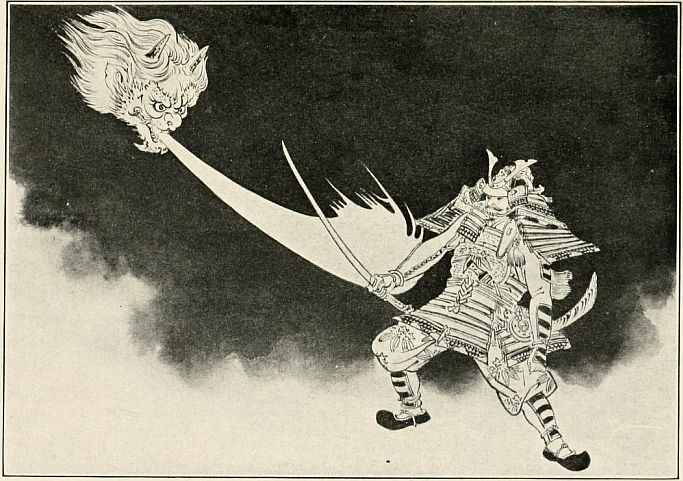
First of all Raiko tied up the head of Shutendoji with a strong rope and told the five brave knights to carry it. Then, followed by the princesses, the little band left Mount Oye forever and set out on the homeward journey. When they reached Kyoto the news of Raiko's return spread like fire, and the people came out in crowds to welcome the heroes.
When the parents of the long-lost damsels saw their daughters again, they felt as if they must be dreaming. It seemed too good to be true that the dear and cherished ones should be restored to them safe and well, and they overwhelmed Raiko with praise and with precious gifts.
Raiko took the head of Shutendoji to the Emperor and told him of all that had happened to him. You may be sure that when His Majesty heard of the success which had crowned Raiko and his expedition, he awarded him great praise and merit and bestowed upon him higher Court rank than ever.
In all the country, far and near, Raiko's name was in every one's mouth, and he was acknowledged to be the greatest warrior in the land. Even in the lonely country places there was not one poor farmer who did not know of the brave deeds of the great general.
Ever since then his portrait is familiar to the boys of Japan, for it is often painted on their kites.

KIDOMARU THE ROBBER, RAIKO THE BRAVE, AND THE GOBLIN SPIDER
You have just read of the brave knight Raiko's exploits at Oyeyama and how he rid the country of the demons who haunted the city of Kyoto and terrified the inhabitants of the Flower Capital (as that city was sometimes called) by their terrible deeds.
There are other interesting stories about him and his fearless warrior-retainers which you may like to hear.
It was not long after Raiko's exploits at Oyeyama that the country rang with the name of Kidomaru, a robber and highwayman, who, by his notorious deeds of cruelty and robbery, had caused his name to be feared and hated by all, both young and old.
One evening Raiko with his attendants was returning home from a day's hunting, when he happened to pass the house of his younger brother Yorinobu. The warrior had had a long day out; and having still a good distance to ride before he would reach his own house the thought of a good meal and friendly company, just then, when he was tired and very hungry, was pleasant to contemplate in the lonely hour of twilight. So he called a halt outside the house and sent in word to his brother that he, Raiko, was passing by, and that if Yorinobu had any refreshment to offer his brother, he would call in and stay the night there, as he was tired out on his way back from a day's hunt.
Now in Japan an elder brother or sister commands respect from the younger members of the family, and so Yorinobu was very pleased that Raiko, his elder brother, had condescended to call upon him.
The servant soon returned with the message that Yorinobu was only too pleased to receive Raiko; that he had ordered a feast to be prepared that evening in honour of an unusual event, and as he was alone, nothing could be more opportune or give him greater joy than that his elder brother should have chanced to come by. He humbly begged Raiko that he would deign to share the feast, such as it was, and to pardon the poorness of his hospitality.
Raiko was very pleased with his brother's gracious reception. He quickly flung the reins to his groom, dismounted from his horse, and entered the house, wondering what could be the occasion of Yorinobu's ordering a banquet for himself. When the warrior was shown into the room he found Yorinobu seated on the mats drinking saké, as the servants were bringing in the first dishes of the dinner. When the salutations were over, Yorinobu handed Raiko his wine-cup. Raiko took it, and having drained it, asked what his brother meant by the feast he had promised him and what was the occasion of it. Yorinobu laughed as if with triumph, and wheeling round on his cushion pointed out into the garden.
Raiko then looked in the direction indicated by his brother's hand, and saw, tied up to a large pine tree, a young man who could not be much over thirty and of extraordinary strength. The face of the captive expressed hate and ferocity, his body was of an enormous build, while his arms and legs were like trunks of pine trees, so large and brown and muscular were they. His hair was a rough and matted shock, and the eyes glared as if they would start from their sockets. Indeed to Raiko the wild creature looked more like a demon than a human being.
"Well, Yorinobu!" said Raiko, "the occasion of your feast is to say the least unusual; it must certainly have given you some sport to catch that wild creature; but tell me who he is that you have got tied up out there."
"Have you not heard of Kidomaru, the notorious robber?" answered Yorinobu. "There he is! One of my men captured him out on the hills; he found him asleep. The town has long been clamouring for him. He has a big score to settle at last. For to-night I intend to keep him tied up like that, and to-morrow I shall hand him over to the law! Come, let us be merry, for the dinner is served!"
Raiko clapped his hands when he heard of the great feat Yorinobu and his men had accomplished in catching the fearful robber, the terror of whose lawless deeds had long held the people of Kyoto trembling with fear and dread. The outlaw Kidomaru was caught at last and by his own brother Yorinobu! This was an event of rejoicing and congratulation for the family.
"You have certainly done a meritorious service to your country," said he, "but it is ridiculous to tie such a creature up with a rope only. You might just as well think of tying up a wild cow with a fine kite-string. It would be less dangerous. Take my advice, Yorinobu, put a strong iron chain round him, or the murderer will soon be at large again."
Yorinobu thought his brother's advice wise, so he clapped his hands. When the servant came to answer the summons, he ordered him to bring an iron chain. When this was brought, he went into the garden, followed by Raiko and his men, and wound it round Kidomaru's body several times, securing it at last to a post with a padlock.
Kidomaru up to this time had rejoiced at his light bonds. He was so strong that he knew he could easily break a rope, and he had waited but for the nightfall to make good his escape under cover of the darkness. You can imagine how great was his anger at Raiko's interference, which was the cause of his being treated with so much severity that his projected escape would now be difficult.
"Hateful man!" muttered Kidomaru to himself. "I will surely punish you for what you have done to me! Remember!" and he threw evil glances at Raiko.
But the brave warrior cared little for the wild robber's malignant glances; he only laughed when he noticed them, and, as the chain was drawn tighter round the robber, he said: "That's right! That chain will hold him sure enough! You must run no risk of his escaping this time!"
Then he and Yorinobu returned to the house, and dinner was served and the two brothers made merry the whole evening, talking over old times, and it was late before they retired to rest.
Now Kidomaru knew that Raiko slept in Yorinobu's house, and he made up his mind to try to slay him that night, for he was mad with wrath at what Raiko had done to him.
"He shall see what I can do!" growled Kidomaru to himself, shaking his rough and shaggy head like a big long-haired terrier. He waited quietly till every one in the house had gone to rest and all was silent. Then Kidomaru arose, cramped and stiff from sitting tied up so long. With a mighty effort he flung out his great arms, laughing defiance at the chain that bound him. So great was his strength that no second effort was needed; the chain broke and fell clanking to the ground at once, and Kidomaru, like a large hound, shook himself free from his bonds. Softly as a mouse he approached the house and climbed on to the roof, and with one tremendous blow from his huge fist, he broke through the tiles and the boards to the ceiling. His plan was to jump down upon Raiko while he lay sleeping, and taking him unawares suddenly to cut off his head. But the warrior had lain down to rest expecting such an attack, and he had slept but lightly. As soon as he heard the noise above him, he was wide awake in an instant, and to warn his enemy he coughed and cleared his throat. Kidomaru was a man of fierce and dauntless character, and he was not in the least thrown back in his purpose by finding that Raiko was awake. He went on with his work of making a hole large enough in the ceiling to let himself through to the room beneath.
Raiko now sat up and clapped his hands loudly to summon his men, who slept in an adjoining room. Watanabe, the chief man-at-arms, came out to see what his master wanted.
"Watanabe," said Raiko, "my sleep has been disturbed by something moving in the ceiling. It may be a weasel, for weasels are noisy creatures. It cannot be a rat, for a rat is not large enough to make so much noise. At any rate, it seems impossible to sleep to-night, so saddle the horses and get all the men ready to start. I will get up and ride out to the Temple of Mount Kurama. I want all the men to accompany me."
Perched between the roof and the ceiling, the robber heard all this, and said to himself: "What ho! Raiko goes to Kurama! That is good news! Instead of wasting my time here like a rat in a trap, I will set out for Kurama immediately and get there before those stupid men can, and I will waylay them and kill them all." So Kidomaru crawled out on the roof again, let himself down to the ground, and hurried with all the speed he could make to Kurama.
A large plain had to be crossed in going from the city to Kurama, and here a number of wild cattle had their home. When Kidomaru, on his way to Kurama, came to this spot, a plan flashed across his mind by which he could steal a march on Raiko. He soon caught one of the big oxen a blow on the head. Three blows one after the other, and the ox fell dead at the robber's feet. Kidomaru then proceeded to strip off its skin. It was very hard work, but he managed to do it quickly, so strong was he, and then throwing the hide over himself he lay down completely disguised, a man in a bull's hide, and waited for Raiko and his men to come.
He had not long to wait. Raiko, followed by his four braves, soon came in sight. The warrior reined in his horse when he came to the plain and saw the cattle. He turned to his men and said: "Here is a place where we may find some sport. Instead of going on to Kurama, let us stay here and have some hunting! Look at the wild cattle!"
The four retainers with one accord all gladly agreed to their chief's proposal, for they loved sport and adventure just as much as Raiko and were glad of an excuse to show their skill as huntsmen. The sun was just rising, and the prospect of a fine morning added zest to the pastime. Each man prepared his bow and arrows in readiness to begin the chase.
But the cattle, thus disturbed, did not enjoy the sport. Man's play was their death indeed. One of their number had been killed by Kidomaru, and now they were attacked by Raiko and his men, who came riding furiously into their midst, shooting at them with bows and arrows. With angry snorts, whisking their tails on high and butting with their horns, they ran to right and left. In the general stampede that followed their attack, the hunters noticed that one animal lay still in the tall grass. At first they thought it must be either lame or ill, so they took no notice of it, and left it alone till Raiko came riding up. He went up and looked at it carefully, and then ordered one of his men to shoot it.
The man obeyed, and taking his bow, shot an arrow at the recumbent animal. The arrow did not hit the mark; for, to the astonishment of the four hunters, the hide was flung aside and out stepped the robber Kidomaru.
"You, Raiko! It is you, is it?" exclaimed he. "Do you know that I have a spite against you?" and with these words he darted forward and attacked Raiko with a dagger. But Raiko did not even move in his saddle. He drew his sword and, adroitly guarding himself, exchanged two or three strokes with the robber, and then slashed off his head. But wonderful to relate, so strong was the will that animated Kidomaru that though his head was cut off, his body stood up straight and firm till his right arm, still holding the dagger, struck at Raiko's saddle. Then, and not till then, it collapsed. It is said that the warriors were all greatly impressed by the malevolent spirit of the robber, which was strong enough to stir the body to action even after the head had been severed from the shoulders.
Such was the death of the notorious robber Kidomaru, at the hands of the brave warrior Raiko who was awarded much praise for the clever way in which he drew Kidomaru out as far as Kurama to kill him. He had understood from Kidomaru's evil glances that the robber planned to kill him, and he thus avoided causing trouble in his brother's house. In this instance, as always, Raiko displayed wisdom and bravery.
No sooner, however, was Kidomaru killed, than news was brought to the capital that another man had arisen who imitated Kidomaru in his daily deeds of robbery and other wicked acts. This robber's name was Kakamadare.
One bright moonlight night, Kakamadare was waiting on the plain between Kyoto and Kurama for travellers to come that way, hoping that luck would bring some rich man into his clutches. Presently he heard some one coming towards him playing on a flute. Thinking this somewhat strange, he hid himself in the grass and waited to see who would appear. The sweet music drew nearer and nearer, and then the player came in view. The light of the moon made everything as clear as day, and the robber saw a handsome samurai of soldierly aspect, dressed in beautiful silken robes and wearing a long sword at his side.
"Now's my opportunity; I'm in luck to-night," thought the robber, as he rose from his hiding-place and stealthily followed the flute-player. As he kept step by step behind him, Kakamadare drew his sword in readiness several times to cut down his prey, and waited for the chance to strike.
All at once the samurai turned and looked steadily at the robber, who began to tremble. Then the knight calmly and coolly resumed his playing, as if utterly indifferent to the danger which threatened him. Once more the robber followed, with the intention of cutting the man down, but the opportunity for which he waited never came; each time his hand went up with his sword, it as quickly fell to his side. A spirit of high and noble purpose seemed to emanate from the knight, which cowed the man behind and made him weak. For so great is the virtue of the sword that in Japan it is an acknowledged fact that all noble swordsmen had this power of subduing lesser natures by the spiritual grace which went forth from them. Indeed the belief in the occult power of the sword was great, and it was said that no bad man could keep the possession of a fine blade.
Kakamadare could not strike. He could not tell the cause of his weakness. He thought that it might be the influence of the music. He found himself listening to the gentle strains of the flute, and admiring the skill with which the man played. He noticed the firm and fearless air of the knight as he walked and his great nerve. The man knew himself to be followed by a robber, yet he showed not the least concern. Kakamadare tried to turn back now, but he found that he could do nothing but follow the man in front of him. In this way the strange pair reached the town. Kakamadare now made a great effort to break the spell, and was on the point of turning back and trying to escape from the strange, compelling presence, when to his astonishment the samurai suddenly wheeled round upon him and said: "Kakamadare, I thank you for your trouble! You have given me a safe escort!"
At this the robber became so terrified that he fell down on his knees and was unable to move or speak for some moments. At last, so soon as his tongue found utterance, he said: "I know not who you are, but I beg you to forgive me! I would have killed you!"
He then confessed everything to the knight. He told him of his many deeds of robbery and violence which had made him feared and hated by the people, who thought that he must be a demon, for so cruel and relentless was he that he never showed mercy even to the poorest peasant. "I have never met any one like you," Kakamadare went on to say. "I promise to give up my life as a robber, and I beg you to take me into your service as one of the humblest of your retainers."
The knight led the man home, and gave him some good clothes, telling him that when he again got into straits and wanted money or clothes, he might come a second time to the house, but that it was unwise to show such contempt for others as to enter into an encounter where he himself might be the injured party.
This kindness and mercy touched the man's heart, and from that day he became a reformed man and a law-abiding citizen.
The knight was none other than Hirai, one of the warriors who accompanied Raiko in his successful expedition against the demons of Oyeyama. There is a saying that "Brave generals make brave soldiers," and it is quite true. Raiko was a man of great sagacity and courage, and his band of braves and the knight Hirai, of whom we have just read, were like their master. There were no men in the whole of Japan braver than they. This proves the truth of the old adage.
There is another story about the General Raiko which you may like to hear. The sword with which Raiko slew Kidomaru was called the Kumokiri, or Spider-cutting Sword, and about the naming of this blade there is an interesting story.
It happened at one time that Raiko was unwell and was obliged to keep his room. Every night at about twelve a little acolyte would come to his bedside, and in a kind and gentle way pour out and give him some medicine to take. Raiko noticed that he did not know the boy, but as there were many underlings in the servants' quarters whom he never saw, this did not strike him as strange. But Raiko, instead of recovering, found himself growing weaker and weaker, and especially after taking the medicine he always felt worse.
At last one day he spoke to his head servant and asked him who it was that brought him medicine every night, but the attendant answered that he knew nothing about the medicine and that there was no acolyte in the house.
Raiko now suspected some supernatural snare. "Some malevolent being is taking advantage of my illness and trying to bewitch me or to cause my death. When the boy comes again to-night I will find out his real form. He may be a fox or goblin in disguise!" said Raiko.
So he waited for the appearance of the acolyte, wondering what the strange incident could mean.
When midnight came, the boy, as usual, appeared, bringing with him the usual cup of medicine. The knight calmly took the cup from the boy and said, "Thank you for your trouble!" but instead of swallowing the false medicine, he threw it, cup and all, at the boy's head. Then jumping up he seized the sword that lay beside his bed and cut at the impostor. As the blade fell, the acolyte screamed with rage and pain, then, with a movement as quick as lightning, before he turned to escape from the room, he threw something at the knight, which, marvellous to relate, as he threw, spread outwards pyramidically into a large white sticky web which fell over Raiko and clung to him so that he could hardly move. Raiko whirled his sword round and cut the clinging meshes and freed himself; again the goblin threw a web over him, and again Raiko cut the enmeshing threads away; once more the huge spider's web—for such it was—was thrown over him, and then the goblin fled. Raiko called for his men and then sank exhausted on his bed.
His chief retainer, answering the summons, met the acolyte in the corridor, and thinking it strange that an unknown priest, however young, should come from his master's room at that hour of the night, stopped him with drawn sword.
The goblin answered not a word, but threw his entangling web over the man and mysteriously disappeared.
Now thoroughly alarmed, the retainer hastened to Raiko. Great was his consternation when he saw his master, with the meshes of the goblin's web still clinging to him.
"See!" exclaimed Raiko, pointing to the threads still clinging to his man and himself, "a goblin spider has been here!"
He then gave orders to hunt down the goblin, but the thing could nowhere be found. On the white mats and along the corridors they found as they searched red drops of blood, which showed that the creature had been wounded.
Raiko's men followed the red trail, out into the garden, across the city to the hills, till they came to a cave, and here the blood-drops ceased. Groans and cries of pain issued from the cave, so the warriors felt sure that they had come to the end of their hunt.
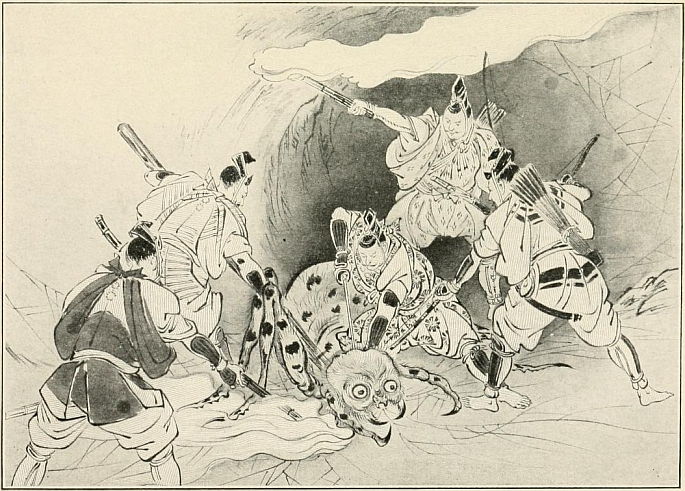
"The goblin is surely hiding in that cave!" they all said. Drawing their swords, they entered the cave and found a monster spider writhing with pain and bleeding from a deep sword-cut on the head. They at once killed the creature and carried it to Raiko.
The knight had often heard stories of these dreadful spiders, but had never seen one before.
"It was this goblin spider then that wanted to prey upon me! The net that was thrown over me was a spider's web! Of all my adventures this is the strangest!" said Raiko.
That night Raiko ordered a banquet to be prepared for all his retainers in honour of the event, and he drank to the health of his five brave men.
From that time the acolyte never appeared and Raiko recovered his health and strength at once.
Such is the story of the Kumokiri Sword. Kumo means "spider," and kiri means "cutting," and it was so named because it cut to death the goblin spider who haunted the brave knight Raiko.
THEY ENTERED THE CAVE AND FOUND A MONSTER SPIDER

THE STORY OF THE POTS OF PLUM, CHERRY, AND PINE
Long, long ago, in the reign of the Emperor Go-Fukakusa, there lived a famous Regent of the name of Saimyoji Tokiyori. Of all the Hojo Regents he was the wisest and justest, and was known far and wide among the people for his deeds of mercy. At the age of thirty, Tokiyori resigned the regency in favour of his son Tokimune, who was only six years old. He then retired to a monastery for several years. Sometimes stories reached his ears of the miscarriage of justice, of the cruelty of the officials under him, and of the suffering of the peasants, and he determined to find out for himself if all these things were true. It was the desire of his life to see the people governed wisely and justly and impartially, to deal reward and punishment fairly alike to the rich and the poor, to the great and the lowly. After much thought he decided that the best way to achieve his end would be to find out for himself the condition of the people, so he determined that he would disguise himself and travel about amongst them unknown. He had it given out that he was dead, and had a mock funeral performed with all the pomp and ceremony due to his exalted rank. He then left Kamakura disguised as a travelling priest unknown to any one.
After journeying from place to place, he came one day to Sano, in the province of Kozuki. It was in the depth of winter, and on this day he found himself overtaken by a heavy snowstorm. There were no houses near. Tokiyori then ascended a hill, but even from that height, search as he might, he could see no sign of any dwelling, near or far. Confused and lost, he wandered about for hours. The darkness began to fall when he found himself in a hilly district. Tired and hungry, he resigned himself to passing the night under the shelter of a tree, when suddenly he espied in the distance the brown line of a thatch-roofed cottage breaking the white slope at the foot of the nearest hill. He made his way quickly towards it and knocked at the closed storm-doors.
Tokiyori heard some one move within and then come to the porch. The storm-shutter was pushed aside and a beautiful woman looked out.
"I have lost my way in the storm, and know not what to do! Will you be so kind as to give me the shelter of your roof this night?" said Tokiyori.
The woman scanned the traveller from head to foot. Then she said: "I am very sorry for you. I would willingly give you shelter, but my husband being absent I must not let you in. You had better go on to the next village of Yamamoto, which is very near, and there you will find a good inn and accommodation for travellers!"
"You are right," answered Tokiyori; "but alas! I am so tired that I can walk no more. For pity's sake, let me sleep on the verandah or in your storehouse; for so much shelter I shall be grateful."
"I am indeed sorry to refuse you," answered the woman; "but in the absence of my husband I must not give shelter to a strange traveller. Were he at home, he would with pleasure take you in and give you lodging for the night. Try to make your way to the next village."
Tokiyori, greatly impressed by her virtuous and modest behaviour, bowed and said as he took his leave: "There is no help for it! I must try to reach Yamamoto, since you cannot shelter me to-night."
So the ex-Regent of Kamakura, spent and cold and hungry, turned once more to meet the inclement weather. He took the direction pointed out to him and plodded on through the snow. But alas! the storm had increased in violence, and the snow fell faster and faster, and the wind howled across the white drifts, whirling clouds of snow in his face till at last he found it impossible to go on. He stood still in the storm, not knowing what to do. Exerting all his strength, he found it difficult to put one foot before the other. Just as he began to give himself up for lost, he heard a voice calling him from behind.
"Stop! stop!" at first faintly, then gradually the cries grew nearer and more distinct.
Wondering who else could be out in such merciless weather, Tokiyori turned in the direction whence the cries came and saw a man beckoning to him to turn back.
"Are you calling me?" asked Tokiyori.
"Yes indeed," replied the man; "I am the husband of the woman who turned you away from that cottage just now. I regret that I was not at home to offer you the poor hospitality that is all I have to give. Please turn back with me. I can at least give you shelter for the night, though my house is only a small hut. You will be frozen to death if you go on in this storm."
The priest rejoiced when he heard these kind words, and as he turned back with his host he uttered many words of thanks. When they entered the porch, the woman whom he had already seen came forward and welcomed the stranger cordially, apologizing for her former behaviour.
"I pray you pardon me," she said, bowing to the ground, "for my rude words a short time ago; but now that my husband has returned I hope you will pass the night under our humble roof. I beg you not to be angry with me, knowing the custom of these times."
"Don't mention it, my good woman," replied the priest in disguise. "It was quite right of you to refuse me admittance in your husband's absence. I admire your prudent conduct."
While the priest and the hostess were thus exchanging civilities, her husband had entered the little sitting-room and arranged some cotton cushions on the mat. Having done this, he came out to usher in the guest.
"Thank you," answered the priest, taking off his snow-covered hat and rain-coat; and, slipping his feet out of the sandals, he entered the house.
The host turned again to his guest and said: "Now, as you see, I am a very poor man and I cannot give you a good dinner such as the rich can offer, but to our coarse, simple fare, such as it is, you are very welcome."
The priest bowed to the ground and said that he would be grateful for any food that would stay his hunger; he had walked all day in the cold and had eaten nothing since breaking his fast in the early morning.
Meanwhile the wife busied herself in the kitchen, and as it was now the hour of sunset, the meal was soon ready to be served. The priest noticed that millet instead of rice filled the bowls, and that there was not a sign of fish in the soup, which was made of vegetables only. The disguised ex-Regent had never eaten such coarse food in his life before, for millet is the poorest peasant's fare; but "Hunger needs no sauce," says the proverb, and so Tokiyori was surprised to find with how great a relish he could eat what was set before him, for he was ravenously hungry. Never had food tasted so sweet to him before. He long remembered the sensation of pleasant surprise as he partook of the first mouthful. The good wife waited on them during the meal, according to Japanese custom.
When supper was over, they all sat round the hearth, talking of the good old times and telling each other amusing stories to while away the time. The hours flew quickly by and it was midnight before the host and his guest knew it. The fire had burned very low without their noticing it, and they began to shiver with cold. The host turned to the fuel-box, but all the charcoal and wood had been burned up. Then the host arose, and, regardless of the falling snow and the bitter cold, went into the garden and brought thence three pots of dwarfed trees, for the training of which Japanese gardeners are famous all the world over.
"On such a winter's night a good fire is necessary for the entertainment of a traveller, but, alas! all the charcoal has been used up and I have no more in the house. To warm you before you retire I will therefore bum these trees!"
"What!" said the astonished guest, for he saw that the trees were of no common kind, but were of some value, for they were old, and their training showed the skill of an experienced gardener; "these pine, plum, and cherry trees are too good to be used as fuel—they are finely trained. No! no! you mustn't burn them for me—they are far too valuable!"
"Don't trouble yourself," said the host. "I loved them once when I was rich and had many more such valuable trees in my possession. But now that I am ruined and living in this miserable condition, of what use are such trees to me, pray tell me?" and with these words he began to break up the trees and to put the pieces on the fire. "If they could speak, I am sure they would say how pleased they were to be used for such a good purpose as your comfort!"
The disguised ex-Regent smiled as he watched the kind man break up his pet trees, and make up the fire. Since Tokiyori had first entered the house, small and poverty-stricken though it was, he had felt that his host was no common farmer as he pretended to be; that he must be a man in reduced circumstances.
"I feel sure," said the priest, "that you are no farmer by birth; indeed in you I recognize the a courtesy and breeding of a samurai [a knight]. Will you add one more favour to the rest you have shown me this night and tell me your real name?"
"Alas," answered the farmer in disguise, "I cannot do so without shame."
"Do not trifle with me," said the priest, "for I am very much in earnest. Tell me who you are. I should very much like to know."
Pressed so earnestly to reveal himself, the host could no longer refuse.
"Since you wish so earnestly to know, I will tell who I am, without reserve," he answered. "I am no farmer, as you rightly guessed. I am in reality a samurai, and my name is Sano Genzaemon Tsuneyo."
"Indeed? Are you Sano Genzaemon Tsuneyo? I have heard of you. You are a samurai of high rank, I know. But tell me, how is it that you are now in such reduced circumstances?"
"Oh, that is a long story," replied Sano. "It was through the dishonesty of an unworthy relation. He seized my property, little by little, without my knowing it, and one day I found that he had taken everything and that I was left with nothing except this farmhouse and the land on which it stands."
"I am sorry for you," said Tokiyori; "but why haven't you brought a lawsuit against your relation? Were you to do that, I am sure you would recover your lost property."
"Oh yes, I have thought of that," said the farmer; "but now that Tokiyori, the just Regent, has died, and as Tokimune his successor is very young, I felt that it was useless to present my petition, so that I determined to resign myself to poverty. But though I live and work like a farmer, in heart and soul I am still a samurai. Should war break out or even a call to arms be sounded, I shall be the first to go to Kamakura, wearing my armour, dilapidated and torn though it may be, carrying my halberd, rusty as it is, and riding my old horse, emaciated and unpresentable though he is, and I will do glorious deeds once more and die a knight's death. I never for one moment forget my ambition. This alone buoys me up through all my trouble and poverty," he added cheerfully, looking up at his listener with a smile.
"Your purpose is a good one, and worthy of a true samurai," said the priest, and he smiled and looked at the knight intently. "I prophesy that you will rise in life in the near future, and I feel sure that I shall see you and congratulate you at Kamakura on obtaining your heart's desire."
While they were talking, the night had passed and day began to break. The snow had ceased to fall, and as Sano and his guest rose to open the storm-doors, the sun rose bright and shining on a silvered world.
The priest went to put on his rain-coat and hat.
"Thank you," he said, "for all the kindness and hospitality you have shown me. I will say good-bye. Now that the storm has ceased, I need trespass no longer on your goodness; I will be getting on my way!"
"Oh," said the knight, "why need you hurry so? At least stay one more day with us, for you seem to me no longer a stranger but a friend, and I am loth to see you depart."
"Thank you," replied the priest, "but I must hurry on. I take my leave, however, with the firm conviction that fate will give us the pleasure of meeting again ere long. Remember my words. Good-bye!" And thus speaking, with several bows the priest turned from the porch and wended his way through the snow.
When he had gone the knight remembered that he had forgotten to ask the traveller's name, so he and his wife would probably never know who the sympathetic stranger was.
The next spring the Government at Kamakura issued a proclamation calling upon all knights to present themselves in battle-array before the Regent. When Sano Genzaemon heard of this, he thought that some extraordinary event must have taken place. What it was he could not imagine. But he was a knight and must answer the summons promptly. Here might be the chance of proving his knightly prowess, for which he had been waiting so long, hidden away in obscurity and the poverty of his circumstances. The only thing that weighed him down was the thought that he had no money either to buy a new suit of armour or a good horse. No hesitation, however, showed itself in the despatch with which he hastened to Kamakura, clothed only in his suit of shabby armour, a rusty halberd in hand, and riding an old broken-down horse, unattended by any servant.
When Sano reached Kamakura, he found the city crowded with warriors who were riding in from all parts of the country. There were thousands of great and eminent samurai clothed from head to foot in beautiful armour, their suits, their helmets, and their swords glittering with ornamentation of silver and gold. It was a goodly sight that the sun shone on that day, framed by the great pine trees against the background of the glimmering sea beyond. The pride of life and race were there, the hauteur of birth and rank, the glory and parade of war, the glinting of helmet and clanking of steel,—every knight's armour was composed of fine metal scales woven and held together by silken threads of ruby, emerald, scarlet, sapphire, and gold. Each knight wore his favourite colour, and as the ranks moved into the sunlight or fell into the shade the whole formed an army of moving splendour, the brilliant and variegated colouring of which was like a river of rich and magnificent brocade.
As Sano, clothed in his shabby armour and riding his broken-down horse, rode in amongst the bright phalanx of warriors, how they all jeered and scoffed at him and his horse! But Sano cared little for their scorn, the consciousness that he was a samurai as good as most of them bore him up, and he laughed to himself at their pride and swagger.
"These men wear fine armour, it is true," he said to himself, "but they have lost the true samurai spirit; their hearts are corrupt or they would not glory so in appearance; though my armour cannot compare with theirs, yet in loyalty I can never be outdone, even by them, braggers though they be."
As these thoughts passed through his mind, Sano saw a herald approaching the gay concourse of knights. He rode a richly caparisoned horse, and he held aloft a banner bearing the house-crest of the Regent. The warriors, their armour and their swords clanging as they moved, parted to the right and left, leaving a road for him to pass. As he rode up their lines he called aloud: "The Regent summons to his presence the knight who wears the shabbiest armour and who rides the most broken-down horse!"
When Sano heard these words he thought:
"There is no soldier here but myself clothed in old armour. Alas! the Governor will reprimand it me for daring to appear in such a state. It can't be helped; come what will, I obey the summons—such is my duty!"
So with a sinking heart Sano, the dilapidated knight, followed the herald to the Governor's house. Here the messenger announced that the knight Sano Genzaemon had come in answer to the proclamation summoning the poorest-clothed knight to the Regent.
"I am the poorest knight here, so the required man can be none other than myself," said Sano, as he bowed low to the retainers who came out to receive him at the porch.
Sano was then ushered along endless corridors and through spacious rooms. At last the ushering officer knelt on the polished wood outside a large room, and, pushing back the white paper screen, told him to enter. The knight found himself in the presence of the handsome young General Tokimune. On his head he wore a helmet with golden horns and the small plates of his armour were woven together with silken threads of scarlet.
The young General bowed to the knight in answer to his prostrations and said: "Are you the knight Sano Genzaemon Tsuneyo?"
"Yes, I am he," answered Sano.
"Then," answered the young man, "I have to present you to some one!" and he made a sign to an attendant.
Upon this the servant pushed open the screens of an inner room, and the Regent Saimyoji Tokiyori, who had been reported dead for a year, was revealed, magnificently dressed in his robes of office. Over his armour he wore a sacerdotal robe of rich brocade, and on his head a white head-dress.
Bewildered by all the strange things that were happening to him, and fearful of he knew not what, the knight had kept his face to the ground. He heard the rattle of armour and the swish of heavy silk moving towards him over the mats, and he wondered if it were not all a dream.
Then a voice said: "Oh, Sano Genzaemon—is it you? It is long since I saw you! Look up! Don't be afraid! Don't you know me?"
The poor knight knew at once that he had heard that voice before, and at last found courage to raise his head and to look at the resplendent figure that addressed him.
An exclamation of surprise burst from the lips of Sano, for he recognized in the personage who addressed him the priest whom he had sheltered on the night of the great snowstorm a year agone.
"You are surely," said Sano after a pause, "the travelling priest who passed that night of the great snowstorm under my roof last year, are you not?"
"Yes, I am that priest, and also I am the Regent Saimyoji Tokiyori."
"Oh!" exclaimed Sano, bowing to the ground, "pardon my rudeness to you that night, for I did not know who my august visitor was," and his heart filled with fear at the remembrance of his unceremonious behaviour on that occasion.
Then the ex-Regent spoke again, and this time solemnly: "Sir Sano, you have no need to apologize, far from that. Do you remember what you said to me that night when the snowstorm took me to your house? You told me that through unfortunate circumstances you were now obliged to work like a farmer, yet if ever the occasion arose that should sound the call of knights to arms, you would, regardless of your shabby accoutrements, answer the summons and come forth in the spirit of a samurai to do glorious deeds worthy of your sword once more before you died! Herewith I give you back the thirty villages in the district of Sano, of which you were robbed by your unworthy kinsman. And do you think I have forgotten your kind action when you burned your precious trees, the last relics of your prosperous past, to minister to my comfort during that terrible storm? The glow of that fire remains in my heart to this day. By way of expressing my thanks for your hospitality that cold and dreary night, in return for the Matsu [pine tree], I am going to give you the village of Matsu-ida, in the province of Kodzuke; in the place of the Ume [plum tree], the village of Umeda, in the province of Kaga; and for the Sakura [cherry tree], you shall have Sakurai, a village in the province of Etchiu."
As the knight listened to these golden words of fortune, which dropped like jewels from the mouth of the beneficent Regent, it seemed to him as if he must be dreaming, it was all so unexpected. He could not speak, for the tears rose to his eyes, and sobs of joy choked his utterance. When at last he looked up, he was alone. He made his way out of the mansion as in a trance, oblivious of all around him. The news of his promotion and of the favour he enjoyed in the estimation of the Regent had already spread outside, and the men who had laughed and jeered at him before now smiled graciously and bowed respectfully as he passed along the ranks.
So Sano Genzaemon returned to Kodzuke, not as a poor farmer, but as a lord under the special favour of the Regent, having won the esteem of all his countrymen by his knightly conduct in adversity.
All rejoiced that faithfulness, honesty, and kindness had received their just reward, and none more than the good Regent Tokiyori.

SHIRAGIKU, OR WHITE CHRYSANTHEMUM
On the outskirts of a remote village at the foot of Mount Aso, in Kiushiu, a bell was slowly pealing from a Buddhist temple. It was the season of autumn and the twilight was falling fast. Over the lonely place and the gloom of the deepening dusk of night the solemn music, reverberating across the hills, seemed to toll the transientness of all things earthly.
Not far from the temple was a small cottage. At the door stood a young girl anxiously waiting for her father to come home. From time to time she wiped away the tears which fell from her eyes, and her face and attitude expressed great sorrow. She was but fifteen years of age, and as she stood there, a young and slender figure, she looked like a cherry-blossom of spring in the falling rain.
She was alone, for her father had gone out to hunt some days before and had never returned, and she had had no tidings whatever of him since. She and her father were all in all to each other; her mother was dead and her elder brother was only a name to her; she could not remember him; he had run away from home when she was a small child, and no one knew what had become of him since.
As White Chrysanthemum, her heart full of sorrow and foreboding, watched and waited for her father's return, she started at everything,—at the leaves falling from the trees, at the sighing of the wind in their branches, at the dropping of the water from the bamboo pipe which brought the hill-stream to the house; as these different sounds from time to time caught her ear expectation made her hope that they might be the footsteps of her father coming home. But the hours passed by and still he did not return.
As the mists rose and the clouds began to close over the mountain, the loneliness of the scene was deepened by the plaint of insects chirruping in the grass, and by the slow pattering on the broad banana palm leaves of the rain just beginning to fall.
At last the dreariness and stillness of approaching night oppressed the girl so much that she could bear it no longer, and she made up her mind to go in search of her father.
It was a sad sight to see her as she ran out from the bamboo gate and turned to give a last look at the little home nestling in the shelter of the pine trees. Then resolutely she turned away and set her face towards the mountain path. On her head she wore a large mushroom-shaped rainhat, and with a stick in her hand she began to climb up the rough thorny pass into the depths of the mountains, as they towered range upon range one above the other and were lost in the distance and blackness of night.
The rain fell more and more heavily, and as the girl stumbled up the steep pass she had often to wring her sleeves, which were now wet with rain as well as with tears. So absorbed was White Chrysanthemum in the thought of finding her father, whom she had watched climb this very road three mornings before, that she hardly noticed that the storm gave signs of lifting. Suddenly the rain ceased, the clouds cleared, and the moon shone brightly. The change in the weather at last roused the girl to look about her, and she saw that the path now led her downward to the valley. With a sigh of relief she quickened her pace.
She had walked for about two hours when she saw at some distance in front of her a single yellow ray of light shining through the gloom. Had she come to a house where she might possibly hear tidings of her father? As this hope dawned upon her, she eagerly hastened towards the light.
She soon reached an old Buddhist temple standing in the shadow of a group of pines and cryptomerias. From within came a voice chanting the Buddhist scriptures. Who could it be studying in so remote a place at that hour of the night?
Shiragiku entered the gate and in the moonlight which made everything visible saw that the whole place was in a dilapidated condition; the fence was falling in many places, weeds grew all over the garden and between the flagstones, as if no one ever trod the path; even the posts which supported the gate shook in the wind.
White Chrysanthemum walked up to the porch and knocked on the heavy wooden door. Not until she had knocked and called several times did she hear any stir within; then some one answered in a subdued voice, the storm-shutters were pushed aside, and a young bonze appeared. He started when his eyes fell upon the girl, and he stared at her silently as if wondering who she could be or what had brought her there at that hour.
Shiragiku, seeing his scrutiny, drew near and said in a low sweet voice: "I am looking for my father. He went out hunting some days ago and has never come back. I am indeed sorry to trouble you, but will you be so kind as to tell me if any one has come to this temple either for rest or food within the last two or three days?"
The girl spoke so quietly and looked at him so gently that the young bonze was reassured in a moment. Her evident distress appealed to him, and when he looked at her again he saw that she was as beautiful as a flower; her skin was white as snow, her jet-black hair, disordered by the storm through which she had passed, fell like the graceful branches of a willow tree over her shoulders; her large almond eyes were sad and full of tears, and as he gazed upon her it seemed to him that she could not belong to the earth, that she must be a tennin—an angel from the Buddhist Heaven. He asked her to enter the temple and said: "Tell me who you are and whence you come, and what brings you out this stormy night. I will listen to your story if you will tell it to me."
The wind had risen again and was blowing in gusts round the temple and whistling through the chinks and crannies of the old building, while from the garden came the mournful cries of an owl. The desolation and strangeness of the place touched the girl's sorrow to the quick, and she burst into tears. As soon as she was able to speak, she wiped her eyes and said between her sobs: "I am the daughter of a certain samurai of Kumamoto City. Our house was once rich and prosperous, and our hearts were full of joy; we lived happily, knowing nothing whatever of care or sorrow. When the war[1] broke out all was changed; the grass round our house was stained with blood, and even the wind smelt of blood; families were scattered far and wide from the homes where they were born, and the air was rent with the cries of parents seeking their lost children and of children calling for their parents who could no longer hear them. Pity is no word to express the feeling which filled the heart at these sights. My father likewise went to the war, and my mother then escaped with me as far as Mount Aso. There she found a tiny cottage in the shadow of the temple, and with the money she had managed to bring with her we lived as best we could. As we were afterward told, my father fought with the rebels. When we heard that, we were greatly astonished, and our sleeves were never dry with wiping away our tears. Day by day, morning, noon, and night, we waited, hoping that my father would return—thus the summer passed. Autumn came and the wild geese flew across the sky in flocks toward the south, but there came no news of my father. My mother pined away with grief and anxiety, till at last she died. Thus before we knew whether my father was alive or dead, I was left alone in life. I felt as if I were dreaming in a dream. Whenever I think of that time my heart is pierced with sorrow. My days were passed in weeping at my misfortunes and in bemoaning my unhappy fate. Had it not been for the kindness of neighbours in the village, I should not have been able to live.
"Last spring my father came back and found me out. I told him of my mother's death. Since then he has never ceased to grieve. I tried to cheer him by telling him that it was the fate of all mortals to die, but my words brought him little comfort, and in this sad way we passed our time. The other day he went out hunting, and since then has never returned. Again, I was left alone with no one to look to for help. Unable to bear the loneliness any longer, I started out this evening to look for him and have come thus far. Our family name is Honda, my name is Shiragiku, my father's name is Akitoshi, my mother's name was Take, and my elder brother's Akihide. I can hardly remember Akihide, for when I was a small child he ran away, fearing my father's anger because of his bad conduct. But though he left us, my mother and I never forgot him. In the morning when it rained and in the winter evenings when the wind blew chill we longed for him to come again to the shelter of his home, but from that day to this we have heard nothing of him and know not what has become of him. My mother gave me many messages for him, firmly believing that one day we should meet again, and that he would yet fulfil his duty as a son and restore our house to its former prosperity and happiness. In this hope she died."
As Shiragiku proceeded with her story the young bonze listened with eager attention. At these words his face changed with sudden emotion, and the tears fell from his eyes. After some moments he said to her: "Poor, poor girl! Your story is a very sad one, and I feel for you in your many troubles. You can go no further to-night; rest here in peace until the dawn!"
As he spoke it seemed to Shiragiku that his voice was familiar to her, and though she could not remember having seen him before, yet for some unaccountable reason she felt that he was no stranger. His manner was so kind and gentle and sympathetic as he went and came bringing food for her supper and quilts for her to sleep upon, that memories of her early home and childhood stirred her heart. Her thoughts went out to the runaway brother; if he would only return he would be about the same age as the young bonze, and surely as good as he to any one in distress. Glad was she to have found a place of rest for the night. With many humble prostrations she thanked her host for his hospitality, and apologized for all the trouble she had given him.
When he withdrew, bidding her "good-night," she knelt in supplication before the shrine at the end of the room, where Amida Buddha and Kwannon, the Goddess of Mercy, reigned in peace above the lotus and the burning of incense. Only through the mercy of the gods could she hope to find her father, only through their help would her long-lost brother ever come back to those who waited for him year after year. For many minutes she knelt on, praying earnestly, then, worn out with grief and fatigue, she rose from her knees and lay down to fall fast asleep.
At the hour when the hush of night is deepest, Shiragiku saw her father enter the room and draw near her pillow. The tears stood in his eyes and in a sad voice he said: "Shiragiku, I have fallen over a precipice, and now I am at the bottom of a chasm many hundred feet deep. Here the brambles and bamboo grass grow so thick that I am unable to find my way out of the jungle. I may not live till the morrow, so I came to see you for the last time in this world."
As soon as he had finished speaking, White Chrysanthemum stretched out her hands and tried to catch hold of his sleeves to detain him, crying: "Father! father!" But with the sound of her own voice she awoke.
She sprang up expecting to see her father, but there was nothing in the room except the night-lantern glimmering faintly. While she was wondering whether the vision were a dream or a reality, the dawn began to break and the beating of a drum throbbed through the temple. White Chrysanthemum rose soon after sunrise, ate the simple breakfast of rice and bean-soup she found slipped into her room, and quickly left the temple. She did not wait to see the kind priest, though he had asked her to do so, saying that he would do what he could to help her; for she had remembered his diffidence the night before, and thought that very likely he belonged to a sect which forbade its priests to converse with the world, and she felt sorry that she had disturbed him.
Her dream was so vividly real to her that it seemed as if she heard her father calling to her for help; so making all possible speed she set but once more with the faith and simplicity of childhood to find him. Far off in the woods the bark of a fox could be heard, while along the path the cloudy tufts of the obana[2] rustled as she passed. Shiragiku shivered as the cold morning wind pierced through her body. As she pursued her way along the rough mountain pass wild creatures scuttled away, frightened, from before her into the woods, and overhead the birds sang to each other in the trees.
At last she reached the top of the pass, to find it covered with clouds, and it seemed to White Chrysanthemum as if they must carry her away with them in their onward sweep. She sat down on a stone to recover her breath, for the climb had been steep. In a few minutes the mists began to clear away. She stood up and looked about her, hoping that she might find some trace of her father, but as far as eye could reach nothing but mountains, range after range, could be seen riding one above the other in the blue sky.
Suddenly a noise in the bushes behind her made White Chrysanthemum start, and before she could flee a band of robbers rushed out upon her. They seized and bound her tightly. She cried out for help, but only the echoes answered her. Down the mountain they led her till they reached the valley; for a whole day they hurried her along till they came to a strange-looking house.
This was in such a neglected condition that moss covered the walls, and it was so closely shut up that the sunbeams never entered the rooms.
As they approached the place, a man who seemed to be the chief of the band came out, and as he caught sight of the maiden, said with an evil smile: "You've brought a good prize this time!"
The robbers now untied Shiragiku's hands and led her into the house and then into a room where dinner was prepared, with rice and fish and wine in great quantities. Then they all sat down, and as they began to eat, it seemed to her that they were a lot of demons. The chief passed some food to her and pressed her to eat. The long walk in the bracing air of the autumn day had made Shiragiku so hungry that in spite of her fear and distress she was glad of the food. At last, when she had finished her meal, he turned to her and said: "That you We been caught by my men and brought here must be the work of fate. So now you must look upon me as your husband and serve me all your life. I have a good koto [the Japanese harp] which I keep with great care, and to show your gratitude for this marriage you will have to play before me often and to cheer me with your songs, for I am fond of music. If you refuse to obey me, I will make your life as hard as climbing a mountain of swords or walking through a forest of needles."
Shiragiku felt that she would rather die than marry this man, but she could not refuse to play the koto for him. The koto was brought by one of the men at a word of command from the chief and placed before the girl, who began to strike the chords, her tears falling fast the while. She played so well that even those hard-hearted robbers were touched by her music, and one or two of them whispered together that hers was a hard fate and they wished that they could find some means of saving her.
Outside the house in the shadow of a large tree stood a young man, watching all that went on and listening to the music. By the voice of the singer as she sang, he knew that the player was she whom he sought. No sooner did the music stop than he rushed into the house and attacked the robbers with great fury. Anger gave strength to his onslaught, and the bandits were so taken by surprise that they were paralyzed with fear and offered no resistance. In a few minutes the chief was killed, while two others lay senseless on the mats, and the rest ran away.
Then the young man, who was dressed in the black vestments of a priest, took the trembling girl by the hand and led her to a window, through which the moonlight streamed. As Shiragiku gazed up in gratitude and wonder at her deliverer, she saw that he was none other than the young priest of the temple, who had been so kind to her the night before.
"Don't be afraid!" he said quietly and soothingly; "don't be afraid! I am no stranger, I am your brother Akihide. Now I will tell you my story, so listen to me. You cannot remember me, for you were only a little child of three when my bad conduct roused my father's anger and I ran away from home and started for the capital. I embarked on a small vessel and after sailing along for several days I reached Waka-no-ura, passing the island of Awaji on the way. From Waka-no-ura I proceeded on foot. It was the close of spring and the cherry-blossoms were falling, and the ground was covered with the pink snow of their petals; but there was nothing of the joy of spring in my heart, which was heavy at the thought of my parents' displeasure and the fearful step I had just taken. As soon as I reached the capital, I put myself under the charge of a priest and went through a severe course of study, for I had already repented of my idle ways and longed to do better. Under my good master's guidance I learned the way of virtue. My heart was softened by knowledge, and when I remembered the love of my parents, I regretted my evil past and never did the sun go down but I wept in secret over it. So the years went by. At last the pain of homesickness became so great that I determined to return home and beg my parents' forgiveness. I hoped and planned to devote myself to them in their old age and to make amends in the future for the shortcomings of the past. But insurmountable difficulties beset me in my new-formed purpose. War had broken out, and the face of the country was entirely changed. Cities were turned into wildernesses, weeds grew tall and thick all over the roads, and when I reached our province it was impossible to find either the old home or any one who could give me the slightest clue as to the whereabouts of you all. Life became a burden to me. You may imagine something of what I felt, but my tongue fails to describe my misery. I was desolate with no one belonging to me, so I resolved to forsake the world and become a priest, and after wandering about I took up my abode in that old temple where you found me. But even the religious life could not still my remorse. I was haunted by the fear of what had become of my father and mother and sister. Were they alive or were they dead? Should I ever see them again? These were the questions which tormented me ceaselessly. Morning and evening I prayed before the shrine in the room where you slept last night—prayed that I might have news of you all. Great is the mercy of Buddha! Imagine the mingled joy and sorrow I felt when you came yesterday and told me of all that had happened since I left home. I was about to make myself known to you, but I was too ashamed to do so. It was, however, harder for me to conceal my secret than it would have been to tell it, for I longed to do so with my whole heart and soul. In the morning when I came to the room and found you gone, I followed after you in fear lest you should fall into the hands of the bandits who haunt these hills and thus it was that I saved you. You can never know how glad I am to have done this for you, but alas! I am ashamed to meet my father because of the remembrance of the past! Had I done my duty as a son, had I never run away wickedly from home, how much suffering I might have saved my mother and you, poor Shiragiku! Terrible indeed is my sin!" And with these words the young man drew out a short sword and was about to take his own life.
When Shiragiku saw what he was going to do, she gave a loud cry, and springing to his side seized his hands with all her strength, and stopped him from doing the dread deed. With tender sisterly words she tried to comfort him, telling him that she knew his father had forgiven him, and was living in the daily hope of his return—that the happiness and solace he could now give him in his old age would more than atone for the past; she begged him to remember his mother's dying prayer that he would establish their house and keep up the ancestral rites before the family shrine when his parents were dead. As she spoke, he desisted from his desperate purpose. The peace of night and the stillness of the moonlit world around them brought balm to both their troubled hearts, and as they bade each other good-night the silence was unbroken save for the cry of the wild geese as they flew across the sky.
In the early morning the brother and sister left the house, hand in hand. They had not gone far when they heard pursuing footsteps, and looking back they saw two or three of the men who had escaped the night before coming after them. Akihide bade his sister run for her life, while he stayed behind and engaged the robbers in a fight and so gave her time to escape.
Shiragiku did as she was told and fled through the woods under cover of the trees. On and on she went, till at last she reached a place of safety out of sight. But her heart, beating wildly with fear, was behind with her brother, wondering what had happened to him, whether he had vanquished the bandits or had been killed by them. Who can describe her anxiety? She had found her brother only to lose him in this sad and uncertain way. Afraid to retrace her steps, yet anxious to know what had become of him, she climbed to the nearest hill-top to try if she could see anything of him, but around her there was nothing but hills and pine woods.
As she looked about her, she saw near by a little shrine, and, overcome with the terror of all that had befallen her within the last two days, she made her way towards it with trembling steps, and kneeling down offered up a fervent prayer for help and for her brother's and father's safety.
An old man who was cutting down trees in the forest saw her weeping there, and his heart filled with pity for the young girl. He drew near and asked her to tell him what was the matter. On hearing her sad story he led her to his home, saying that he would take care of her.
It was a quiet mountain place in the woods. The ground was covered with pine needles, the chrysanthemums round the humble cottage were fading, and the bell-insects were feebly tinkling in the grass, for the last days of autumn were passing.
Here in this retired spot Shiragiku lived in peace. The old wood-cutter and his wife, having no children of their own, loved her as a daughter, for such she seemed to them, so amiable, patient, and helpful in all her ways was she, and they told her that they hoped she would remain with them to the end of their days. Shiragiku did her utmost to show her gratitude to the old couple for their kindness to her, but she never ceased to think of her father and brother and to look forward to the time when they would once more be a united family. In spite of all discouragements she cherished this hope. Now and again she implored the old man to let her go and look for them; but he would not permit this, saying that it was not safe for an unprotected girl to roam the hills, that if she did so she would be sure to fall into the hands of robbers again, and that it was far wiser for her to wait till her father and brother found her than for her to seek them, not knowing where they were. Her reverence for old age made her obey him, and she waited in patience, hoping each day she rose that her father and brother would find her before the evening came.
During these quiet years she grew in beauty day by day and passed from girlhood into the bloom of early womanhood. The poor cotton robe—all that the wood-cutter could give her-in no wise hid her loveliness. She was like a fine chrysanthemum shining among the wild flowers of the plain.
She was soon the acknowledged beauty of the place, and one spring the village chief sought her in marriage. The wood-cutter, out of respect to the suitor's position, at once gave his consent.
When, however, the old man told Shiragiku of what he planned for her, her dismay was great. She begged him with tears to make excuses for her; she told him that she could not think of marriage till she had found her father. But he would not listen, saying that it was the best thing for her now to be settled in life.
That night the girl covered her face with her sleeves and wept long and bitterly when she lay down to rest.
"How can I obey the old man?" she sobbed to herself. "No, never-never! I remember now more vividly than ever what my mother told me when she was dying. 'You are not my own child, Shiragiku,' she said; 'one day many years ago I was returning from a visit to a temple. When passing through a field, I found a little baby crying in the midst of some white chrysanthemums. Who can have been so wicked as to forsake such a lovely child? I said to myself; there must be some reason for this! I carried the little one home and brought her up as my own child. You are that child. Praying for blessings on you, I named you Shira-Giku, because I found you in a bed of white chrysanthemums. There is also something else I must tell you before I die. There is some one in the world to whom you must look as your brother and husband; he is none other than our son, who ran away rather than meet the anger of his father. We have never heard of him since he left, but if he is still living I am sure he will come back to his family. Your father and I—your adopted parents—have always destined you for him; it is my last behest that you should refuse all other men and wait to marry our son, for come back I am sure he will one day; then live a happy life together in the old home, praying for our souls when we have left this world.' My mother's words are still in my ears. I hear them more clearly than ever," she sobbed to herself. "I owe her my life; how can I disobey her bidding? And yet how can I refuse to do as the old wood-cutter asks, for he has been as a parent to me these last three years? What shall I do? Oh! what shall I do?"
Day by day the old man pressed her to accept the suitor and day by day in great perplexity she put him off. At last, seeing no way of escape from being unfilial to the memory of her mother and from fulfilling the old man's wish, she made up her mind to die and put an end to the struggle.
At this time the nakodo (go-between) of the marriage came and presented her with a roll of brocade for the obi (wide sash) and of damask silk for the kimono, the betrothal gift of the bridegroom. The old man and his wife rejoiced at what they considered her good fortune and regarded the matter as settled, and the neighbours came to congratulate them and to catch a glimpse of the chosen bride of their chief.
Shiragiku, however, had made up her mind. That night during a rainstorm she stole out from the wood-cutter's cottage. She looked back wistfully many times at the place which had fed and sheltered her for so long; but she told herself that there was no other way than this, for she must hold as sacred law her mother's last behest. In the despair of the last few weeks, when this unexpected marriage was being forced upon her, she had lost the hope of finding her father and brother again; but she would die rather than marry a stranger against her foster mother's dying wish.
The night was dark, for the sky was clouded. Down the empty street of the village Shiragiku hurried with the tightly closed thatch-roofed cottages on either side. Out across the silent stretches of rice-fields she ran till she reached the blackness of a pine wood, seeking for some spot where she could die.
The roar of water at last reached her ears, and she knew that she had come to a river. The moaning of the wind in the pine trees sounded to her like the voices of pursuers. She stopped to look around, but there was no one to be seen. The path leading down to the river grew rougher and darker as she entered the shadow of the trees, but Shiragiku never faltered in her determination to reach its bank. At last the water glimmered like a wide white ribbon in the gloom of night.
"I will now die," said Shiragiku, weeping; "but alas! how sad my father and brother will be when they hear of my death. Forgive me," she cried aloud, "oh, my father, oh, elder brother, that I die first. I will await your coming beside my mother in Heaven."
Shiragiku now reached the edge of the bank and was about to dash down into the river with a prayer to Buddha on her lips when she found herself caught from behind and a familiar voice said to her: "Wait a moment! Tell me who you are and why you seek to take your life."
It was her brother Akihide. She gazed up at him in the dim light of the moon just coming forth from the clouds. They both clasped each other by the arms and burst into tears.
"Little sister!" "Elder brother!" cried the sister and brother both together in that shock of simultaneous recognition. In the speechless moments which followed they heard the sound of a flute from the village near by break the silence of the night—they watched the rain cease and the stars shine out one by one. Akihide led Shiragiku to a large stone; here they sat down and told each other all that had happened since they last parted.
SHIRAGIKU WAS ABOUT TO DASH DOWN INTO THE RIVER
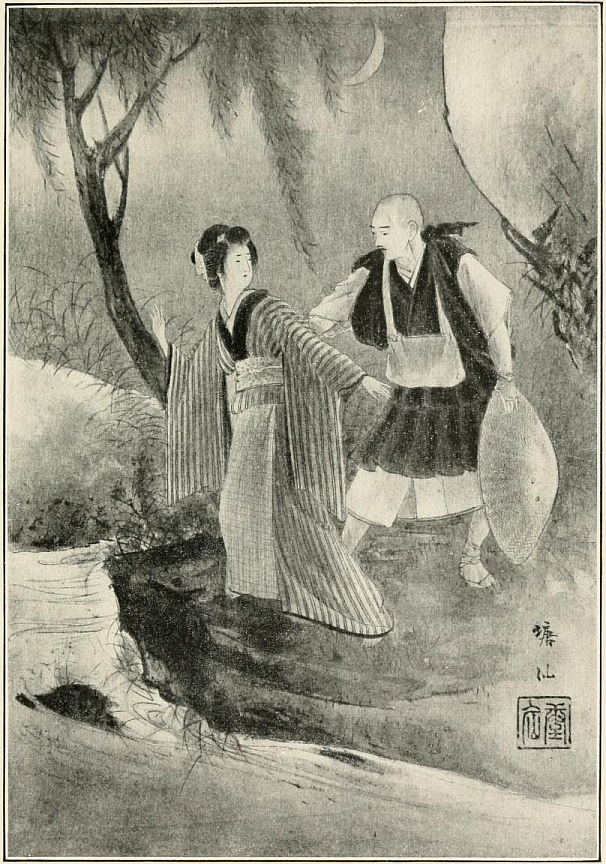
While they were talking the day broke; together they watched the sun rise in splendour and glisten and glow in thousands of rain-drops on the trees and grass around them.
"Let us go and tell the kind old wood-cutter and his wife all that has happened," said White Chrysanthemum, smiling through her tears; "I must bid him farewell and we must thank him, for indeed I owe him my life."
They walked to the village and went at once to the old man and told him their story. Shiragiku begged him to forgive her for not doing as he wished. Then Akihide told him that it had been his mother's dying wish that he should marry White Chrysanthemum and keep up the family name. With tears the brother and sister thanked the old couple for their ever-to-be-remembered kindness to White Chrysanthemum in her distress. They promised to come and see them whenever they could and to let them know all that happened to them in the future, a promise which they faithfully kept. They at last took leave with many gentle words on both sides.
Then Akihide and Shiragiku began a happy journey homewards, walking over the hills by day, and passing the night at some farmhouse or cottage they came to on their way.
When the brother and foster sister reached the little house in the valley at the foot of Mount Aso, it was early in the month of May; the cuckoos were singing, and the air was fragrant with the scent of orange-blossoms. In spite of the years of desertion and neglect, the tiny home still stood safe and firm as when Shiragiku had left it, though the grass had grown tall and thick in the garden and moss covered the roof. The sun was shining brightly over all, and the balm and gladness of the spring morning rested on their young souls.
For a moment White Chrysanthemum paused at the bamboo gate and said: "This is our home, elder brother!" Then quickly they ran down the garden, quickly they pushed back the paper screen of the entrance and entered. Were they waking or were they dreaming? Who should they see coming forward to meet them but their father, whom they had almost given up as dead. For a moment they were all silent. It seemed as if their hearts must burst with inexpressible joy.
"Father! Father!" cried Akihide and Shiragiku together, "is it really you? Are you safe and well?"
"Children, my children!" cried the astonished father, "have I found you at last?"
Then Akihide knelt before his father, and with his face bowed to the ground, confessed everything, and begged his father's forgiveness for the past. He told him all—how bitterly he had repented his behaviour, how hard he had tried to make a new life for himself, how long he had searched for his parents in vain, his one wish being to make amends, how wonderfully he had met Shiragiku when he had at last despaired of ever finding any one of his family again, of all that had happened since her coming to the temple.
The father listened gravely to the long sad story; then with gentle words he forgave his son; he bade him to cease all self-reproach, and as he spoke the kind words his eyes grew dark with unshed tears. When Shiragiku told her story he commended her filial piety, her courage, and her patience. Now that they had as by a miracle of the gods found each other again, nothing should ever separate them.
Thus the little family found again the vanished happiness of other years.
Shiragiku now busied herself preparing the evening meal, and as she filled her father's and her brother's wine-cup the father told them all that had happened to him.
"When I went out hunting three years ago, I fell over a precipice, and found myself at the bottom of a chasm a hundred or more feet deep. I was quite unable to get out, so I lived on wild fruits and stream water for many days.
"One morning I chanced to see a band of monkeys climbing the chasm by means of a large wistaria-vine which formed a bridge from side to side. I followed their example and soon found myself free on the hillside once more. I returned here with all haste, only to find that Shiragiku had disappeared. Imagine my distress. I inquired of every one in the village, but no one had seen her go away, and there was no one who could tell me anything about her. There was but one thing left for me to do and that was to try and find her. So I set out walking through province after province, looking for her, but all in vain. At last I gave up my quest as hopeless and returned here only yesterday."
The joy of the little family was great beyond all words. This unexpected meeting—the utmost desire of their souls—was a happiness which took away their breath and left them silent with wonder and thankfulness. Only one thing saddened them—that the good mother, who had died of grief and anxiety, could not be present to share in this joyous reunion, and to know that her prayer was answered and that the long-lost son had returned to his family. But she was not forgotten—they spoke of her and missed her. Shiragiku rose and opened the little shrine standing in a closed recess at the end of the room, and taking some sticks of incense set them burning before the name-tablet set up in memory of her mother; for though Shiragiku now knew that she was not really her own mother, yet she always thought of her as such, for she had known no other. Father and son and adopted daughter then knelt and with hands clasped and bowed heads prayed before the little altar.
Shiragiku now fetched and tuned her koto (harp) and sang the songs she knew her father liked to hear. This done, she accompanied her brother, while he paced through some stately measures of the classic dance. The father, calling Akihide and Shiragiku to his side, told them that he wished them to marry, as his wife had always planned.
He was now an old man, he said, and could not expect to live much longer, and before his death it was his ardent wish to see his house established.
He then named an early date for the wedding. Akihide, having only entered upon a religious novitiate, was able to obey his father without breaking any vows. He bowed his willingness and Shiragiku blushed happily. She was content in fulfilling her good foster mother's last behest.
Now the sun set, a crane cried on the hill at the back of the house, and the stars came out one by one in the soft and darkening turquoise of a May twilight, and peace and joy reigned in the home and the hearts of the three wanderers.

THE PRINCESS OF THE BOWL
Long, long ago, in old Japan, there lived near Katano, in the Kawachi Province, a prince named Bitchu-no-Kami Minetaka or Lord Minetaka, as we should say in English. He was not only a very wealthy man, but it was reported that his house was full of rare and wonderful treasures. He was also a learned man and the master of many accomplishments. His life was passed in the luxurious leisure of the rich, and he knew nothing of care or want—perhaps he hardly realized what such words meant.
But above all the treasures in his storehouse, beyond the wealth of his revenue which came pouring in year by year in bushels of rice, he prized his only child, his daughter. The prince and his wife brought this daughter up with great love and tenderness as if she were some rare flower or fragile butterfly. So beautiful indeed was the young girl that in looking at her their friends and relations wondered whether the Sun Goddess Amaterasu had not come to earth again in the form of the little Princess.
Nothing came to mar the happiness of this united little family till the daughter was fifteen years of age. Then suddenly the mother, who had never known a day's illness in her whole life, was taken ill. At first it seemed to be but a slight cold, but her health, instead of getting better, only grew worse and worse. She felt that she would never recover and that her end was very near, so she called her daughter beside her pillow, and, taking a large lacquer bowl from the bedside, she placed it on her daughter's head, saying: "My poor little child, I want you always to wear this bowl. At your innocent age you can understand nothing of the world in which I must leave you motherless. I pity you with all my heart; ah! if you were at least seventeen or eighteen years old I could die with more peace of mind. I am indeed loath to go, leaving you behind so young. Try to be a good daughter and never forget your mother."
The woman's tears fell fast as she spoke, and her voice was broken with sobs while she stroked her little girl's hand. But things are not as one wishes in this life. All the doctor's skill could not save the mother; she died and left her daughter behind motherless in the world.
Words cannot tell the grief of the bereaved father and child, it was so great. At last, after some time had passed and the ordinary routine of life in Prince Minetaka's household was resumed, the father noticed the bowl which his daughter wore on her head and which fell so low as completely to hide her face; and calling her to him tried to take off the unsightly head gear. But his efforts were in vain. All the retainers and then the servants were summoned to see what they could do, but no one could remove the bowl; it stuck fast to the child's head. No one could understand the mystery. The bowl had been put on most simply; why could it not be as easily taken off? This was the question which the whole household asked again and again.
And the young Princess, besides sorrowing for the loss of her mother, was greatly troubled at the knowledge that, though born physically perfect, she was now quite disfigured for life in having to wear the ugly bowl which her mother for some unknown reason had placed on her head. If no one succeeded in taking the bowl off, she might have to wear it her whole life. That would indeed be a terrible affliction. But in spite of all she never forgot her mother even for a moment, but carried in her heart the memory of her love and care through every hour of the livelong day. Every morning, as soon as she rose from her bed on the mats, she placed the little cup of tea and the bowl of rice before the tablet bearing her mother's name in the household shrine, and having set the incense burning she would kneel and pray for the happiness of her mother's soul.
The days passed into weeks, the weeks grew into months, yet the dutiful daughter never failed morning or evening thus to pray for her lost mother.
In the mean time the family relations often came to advise her father, Prince Minetaka, to marry again.
"It is not good for you to be alone," they said. "Marry a suitable woman and entrust her with the keeping of your house and the care of your young daughter, who is now of an age when she most needs a woman's care."
At first Prince Minetaka would not listen to them, the memory of his dead wife was too fresh and his sorrow too keen for him to be able to lend a willing ear to their persuasion. He felt that it was a reproach to her he had loved even to think of putting another woman in her place. But as the months went by he found himself much tried with the affairs of the household, and was often so perplexed that he thought perhaps it might be better to listen to the advice of his meddling relations. So without thinking much about the future he decided to take a second wife.
His friends were glad to find that their persuasions were of avail at last, and with the help of go-betweens they arranged that he should marry a certain lady of noble family whom they deemed worthy and suitable in all respects.
So the soothsayers were consulted and a lucky day chosen for the marriage, and the new wife was then installed in Prince Minetaka's home amidst the congratulations of both families. The little Princess alone was sorrowful in her inmost heart at seeing some one take her mother's place; but it would be unfilial to her father to show that for one instant she did not approve of his second marriage, so she hid her unhappiness and smiled.
On seeing the little Princess for the first time, the stepmother was shocked at the deformity of the bowl, and said to herself that never had she even dreamed that there could be any one in the world doomed to be such an ugly cripple. She not only despised but hated her stepchild from the moment that she saw her. This new wife was indeed a very different woman from her predecessor, whose heart was so good and kind towards all who came near her that the idea of disliking, much less hating any one was impossible to her.