YEI THEODORA OZAKI (continued 2)
Reading edition
Sometimes poor distressed Tokiwa sat down by the wayside to hush the wailing babe she carried in her bosom, or to rest the two little boys, who, tired and faint and famished, clung to her robes, crying for their usual rice. On and on she went, soothing and consoling them as best she could, till at last she reached Kyoto, weary, footsore, and almost heartbroken. But though she was well-nigh overcome with physical exhaustion, yet her purpose never flagged. She went at once to the enemy's camp and asked to be admitted to the presence of General Kiyomori.
When she was shown into the dread man's presence, she prostrated herself at his feet and said that she had come to give herself up and to release her mother.
"I am Tokiwa—the widow of Yoshitomo. I have come with my three children to beseech you to spare my mother's life and to set her free. My poor old mother has done nothing wrong. I am guilty of hiding myself and the little ones, yet I pray humbly for your august forgiveness."
She pleaded in such an agonizing way that Kiyomori, the Taira chieftain, was struck with admiration for her filial piety, a virtue more highly esteemed than any other in Japan. He felt sincerely sorry for Tokiwa in her woe, and her beauty and her tears melted his hard heart, and he promised her that if she would become his wife he would spare not only her mother's life, but her three children also.
For the sake of saving her children's lives the sad-hearted woman consented to Kiyomori's proposal. It must have been terrible to her to wed with her lord's enemy, the very man who had caused his death; but the thought that by so doing she saved the lives of his sons, who would one day surely arise to avenge their father's cruel death, must have been her consolation and her recompense for the sacrifice.
Kiyomori showed himself kinder to Tokiwa than he had ever shown himself to any one, for he allowed her to keep the babe Ushiwaka by her side. The two elder boys he sent to a temple to be trained as acolytes under the tutelage of priests.
By placing them out of the world in the seclusion of priesthood, Kiyomori felt that he would have little to fear from them when they attained manhood. How terribly and bitterly he was mistaken we learn from history, for two of Yoshitomo's sons, banished though they had been for years and years, arose like a rushing, mighty whirlwind from the obscurity of the monastery to avenge their father, and they wiped the Taira from off the face of the earth.
Time passed by, and when the little babe Ushiwaka at last reached the age of seven, Kiyomori likewise took him from his mother and sent him to the priests. The sorrow of Tokiwa, bereft of the last child of her beloved lord Yoshitomo, can better be imagined than described. But in her golden captivity even Kiyomori had not been able to deprive her of one iota of the incomparable power of motherhood, that of influencing the life of her child to the end of his days. As the little fellow had lain in her arms night and day, as she crooned him to sleep and taught him to walk, she forever whispered the name of Minamoto Yoshitomo in his ear.
At last one day her patience was rewarded and Ushiwaka lisped his father's name correctly. Then Tokiwa clasped him proudly to her breast, and wept tears of thankfulness and joy and of sorrowing remembrance, for she could never even for a day banish Yoshitomo from her mind. As Ushiwaka grew older and could understand better what she said, Tokiwa would daily whisper, "Remember thy father, Minamoto Yoshitomo! Grow strong and avenge his death, for he died at the hands of the Taira!" And day by day she told him stories of his great and good father—of his martial prowess in battle, and of his great strength and wonderful wielding of the sword, and she bade her little son remember and be like his father. And the mother's words and tears, sown in long years of patience and bitter endurance, bore fruit beyond all she had ever hoped or dreamed.
So Ushiwaka was taken from his mother at the age of seven, and was sent to the Tokobo Monastery, at Kuramayama, to be trained as a monk.
Even at that early age he showed great intelligence, read the Sacred Books with avidity, and surprised the priests by his diligence and quickness of memory. He was naturally a very high-spirited youth, and could brook no control and hated to yield to others in anything whatsoever. As the years passed by and he grew older, he came to hear from his teachers and school friends of how his father Yoshitomo and his clan the Minamoto had been overthrown by the Taira, and this filled him with such intense sorrow and bitterness that sleeping or waking he could never banish the subject from his mind. As he listened daily to these things the words of his mother, which she had whispered in his ear as a child, now came throbbing back to his mind, and he understood their full meaning for the first time. In the lonely nights he felt again her hot tears falling on his face, and heard her repeat as clearly as a bell in the silence of the darkness: "Remember thy father, Minamoto Yoshitomo! Avenge his death, for he died at the hands of the Taira!"
At last one night the lad dreamed that his mother, beautiful and sad as he remembered her in the days of his childhood, came to his bedside and said to him, while the tears streamed down her face: "Avenge thy father, Yoshitomo! Unless thou remember my last words, I cannot rest in my grave. I am dying, Ushiwaka, remember!"
And Ushiwaka awoke as he cried aloud in his agony: "I will! Honourable mother, I will!" From that night his heart burned within him and the fire and love of clan-race stirred his soul. Continual brooding over the wrongs of his clan generated in his heart a fierce desire for revenge, and he finally resolved to abandon the priesthood, become a great general like his father, and punish the Taira. And as his ambition was fired and exalted and his mind thrilled back to the days when his poor unhappy mother Tokiwa prayed and wept over him, daily whispering in his ear the name of his father, his will grew to purpose strong. Tokiwa had not suffered in vain. From this time on, Ushiwaka bided his time every night till all in the temple were fast asleep. When he heard the priests snoring, and knew himself safe from observation, he would steal out from the temple, and, making his way down the hillside into the valley, he would draw his wooden sword and practise fencing by himself, and, striking the trees and the stones imagine that they were his Taira foes. As he worked in this way night after night, he felt his muscles grow strong, and this practice taught him how to wield his sword with skill.
One night as usual Ushiwaka had gone out to the valley and was diligently brandishing about his wooden sword. His mind fully bent upon his self-taught lesson, he was marching up and down, chanting snatches of war-songs and striking the trees and the rocks, when suddenly a great cloud spread over the heavens, the rain fell, the thunder roared, and the lightning flashed, and a great noise went through the valley, as if all the trees were being torn up by the roots and their trunks were splitting.
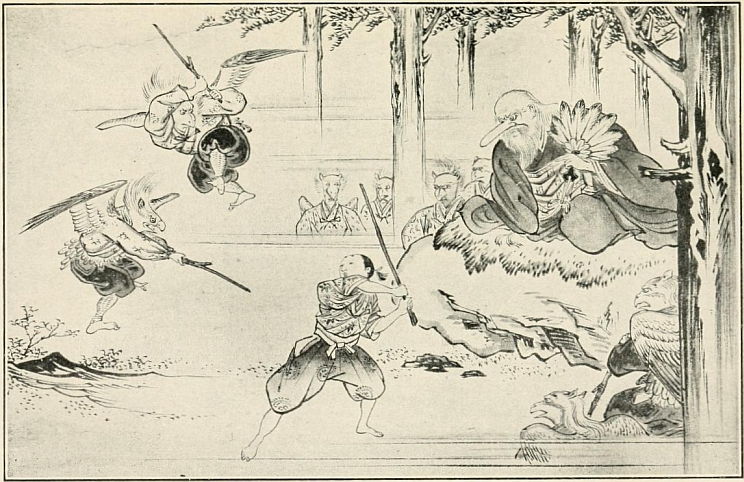
While Ushiwaka wondered what this could mean, a great giant over ten feet in height stood before him. He had large round glaring eyes that glinted like metal mirrors; his nose was bright red, and it must have been about a foot long; his hands were like the claws of a bird, and to each there were only two fingers. The feathers of long wings at each side peeped from under the creature's robes, and he looked like a gigantic goblin. Fearful indeed was this apparition. But Ushiwaka was a brave and spirited youth and the son of a soldier, and he was not to be daunted by anything. Without moving a muscle of his face he gripped his sword more tightly and simply asked: "Who are you, sirrah?"
The goblin laughed aloud and said: "I am the King of the Tengu,[1] the elves of the mountains, and I have made this valley my home for many a long year. I have admired your perseverance in coming to this place night after night for the purpose of practising fencing all by yourself, and I have come to meet you, with the intention of teaching you all I know of the art of the sword."
Ushiwaka was delighted when he heard this, for the Tengu have supernatural powers, and fortunate indeed are those whom they favour. He thanked the giant elf and expressed his readiness to begin at once. He then whirled up his sword and began to attack the Tengu, but the elf shifted his position with the quickness of lightning, and taking from his belt a fan made of seven feathers parried the showering blows right and left so cleverly that the young knight's interest became thoroughly aroused. Every night he came out for the lesson. He never missed once, summer or winter, and in this way he learned all the secrets of the art which the Tengu could teach him.
The Tengu was a great master and Ushiwaka an apt pupil. He became so proficient in fencing that he could overcome ten or twenty small Tengu in the twinkling of an eye, and he acquired extraordinary skill and dexterity in the use of the sword; and the Tengu also imparted to him the wonderful adroitness and agility which made him so famous in after-life.
Now Ushiwaka was about fifteen years old, a comely youth, and tall for his age. At this time there lived on Mount Hiei, just outside the capital, a wild bonze named Musashi Bo Benkei, who was such a lawless and turbulent fellow that he had become notorious for his deeds of violence. The city rang with the stories of his misdeeds, and so well known had he become that people could not hear his name without fear and trembling.
COULD OVERCOME TEN OR TWENTY SMALL TENGU IN THE TWINKLING OF AN EYE
Benkei suddenly made up his mind that it would be good sport to steal a thousand swords from various knights.
No sooner did the wild idea enter his head than he began to put it into practice. Every night he sauntered forth to the Gojo Bridge of Kyoto, and when a knight or any man carrying a sword passed by, Benkei would snatch the weapon from his girdle. If the owners yielded up their blades quietly, Benkei allowed them to pass unhurt, but if not, he would strike them dead with a single blow of the huge halberd he carried. So great was Benkei's strength that he always overcame his victim,—resistance was useless,—and night by night one and sometimes two men met death at his hands on the Gojo Bridge. In this way Benkei gained such a terrible reputation that everybody far and near feared to meet him, and after dark no one dared to pass near the bridge he was known to haunt, so fearful were the tales told of the dreaded robber of swords.
At last this story reached the ears of Ushiwaka, and he said to himself: "What an interesting man this must be! If it is true that he is a bonze, he must be a strange one indeed; but as he only robs people of their swords, he cannot be a common highwayman. If I could make such a strong man a retainer of mine, he would be of great assistance to me when I punish my enemies, the Taira clan. Good! To-night I will go to the Gojo Bridge and try the mettle of this Benkei!"
Ushiwaka, being a youth of great courage, had no sooner made up his mind to meet Benkei than he proceeded to put his plan into execution. He started out that same evening. It was a beautiful moonlight night, and taking with him his favourite flute he strolled forth through the streets of the sleeping city till he came to the Gojo Bridge. Then from the opposite direction came a tall figure which appeared to touch the clouds, so gigantic was its stature. The stranger was clad in a suit of coal-black armour and carried an immense halberd.
"This must be the sword-robber! He is indeed strong!" said Ushiwaka to himself, but he was not in the least daunted, and went on playing his flute quite calmly.
Presently the armed giant halted and gazed at Ushiwaka, but evidently thought him a mere youth, and decided to let him go unmolested, for he was about to pass him by without lifting a hand. This indifference on the part of Benkei not only disappointed but angered Ushiwaka. Having waited in vain for the stranger to offer violence, our hero approached Benkei, and, with the intention of picking a quarrel, suddenly kicked the latter's halberd out of his hand.
Benkei, who had first thought to spare Ushiwaka on account of his youth, became very angry when he found himself insulted by a lad to whom he had been intentionally kind. In a fury he exclaimed, "Miserable stripling!" and raising his halberd struck sideways at Ushiwaka, thinking to slice him in two at the waist and to see his body fall asunder. But the young knight nimbly avoided the blow which would have killed him, and springing back a few paces he flung his fan[2] at Benkei's head and uttered a loud cry of defiance. The fan struck Benkei on the forehead right between the eyes, making him mad with pain. In a transport of rage Benkei aimed a fearful blow at Ushiwaka, as if he were splitting a log of wood with an axe. This time Ushiwaka sprang up to the parapet of the bridge, clapped his hands, and laughed in derision, saying:
"Here I am! Don't you see? Here I am!" and Benkei was again thwarted thus.
Benkei, who had never known his strokes miss before, had now failed twice in catching this nimble opponent. Frantic with chagrin and baffled rage, he now rushed furiously to the attack, whirling his great halberd round in all directions till it looked like a water-wheel in motion, striking wildly and blindly at Ushiwaka. But the young knight had been taught tricks innumerable by the giant Tengu of Kuramayama, and he had profited so well by his lessons that the King Tengu had at last said that even he could teach him nothing more, and now, as it may well be imagined, he was too quick for the heavy Benkei. When Benkei struck in front, Ushiwaka was behind, and when Benkei aimed a blow behind, Ushiwaka darted in front. Nimble as a monkey and swift as a swallow, Ushiwaka avoided all the blows aimed at him, and, finding himself outmatched, even the redoubtable Benkei grew tired.
Ushiwaka saw that Benkei was played out. He kept up the game a little longer and then changed his tactics. Seizing his opportunity, he knocked Benkei's halberd out of his hand. When the giant stooped to pick his weapon up, Ushiwaka ran behind him and with a quick movement tripped him up. There lay the big man on all fours, while Ushiwaka nimbly strode across his back and pressing him down asked him how he liked this kind of play.
All this time Benkei had wondered at the courage of the youth in attacking and challenging a man so much larger than himself, but now he was filled with amazement at Ushiwaka's wonderful strength and adroitness.
"I am indeed astonished at what you have done," said Benkei. "Who in the world can you be? I have fought with many men on this bridge, but you are the first of my antagonists who has displayed such strength. Are you a god or a tengu? You certainly cannot be an ordinary human being!"
Ushiwaka laughed and said: "Are you afraid for the first time, then?"
"I am," answered Benkei.
"Will you from henceforth be my retainer?" demanded Ushiwaka.
"I will in very truth be your retainer, but may I know who you are?" asked Benkei meekly.
Ushiwaka now felt sure that Benkei was in earnest. He therefore allowed him to get up from the ground, and then said: "I have nothing to hide from you. I am the youngest son of Minamoto Yoshitomo and my name is Ushiwaka."
Benkei started with surprise when he heard these words and said: "What is this I hear? Are you in truth a son of the Lord Yoshitomo of the Minamoto clan? That is the reason I felt from the first moment of our encounter that your deeds were not those of a common person. No wonder that I thought this! I am only too happy to become the retainer of such a distinguished and spirited young knight. I will follow you as my lord and master from this very moment, if you will allow me. I can wish for no greater honour."
So there and then, on the Gojo Bridge in the silver moonlight, the bonze Benkei vowed to be the true and faithful vassal of the young knight Ushiwaka and to serve him loyally till death, and thus was the compact between lord and vassal made. From that time on, Benkei gave up his wild and lawless ways and devoted his life to the service of Ushiwaka, who was highly pleased at having won such a strong liegeman to his side.
Although Ushiwaka had now secured Benkei, it was impossible for only two men, however strong, to think of fighting the Taira clan, so they both decided that the cherished plan must wait till the Minamoto were stronger. While thus waiting they heard a report to the effect that a descendant of Tawara Toda Hidesato[3] named Hidehira was now a famous general in Kaiwai of the Ashu Province, and that he was so powerful that no one dared oppose him. Hearing this, Ushiwaka thought that it would be a good plan to pay the general a visit and try to interest him, if possible, in the fortunes of the House of Minamoto. He consulted with Benkei, who encouraged the young knight in his scheme of enlisting the General Hidehira as a partisan, and the two therefore left Kyoto secretly and journeyed as quickly as possible to Oshu on this errand.
On the way there, Ushiwaka and Benkei came to the Temple of Atsuta, and as they considered it important that the young knight should look older now, Ushiwaka performed the ceremony of Gembuku at the shrine. This was a rite performed in olden times when youths reached the age of manhood, They then had to shave off the front part of their hair and to change their names as a sign that they had left childhood behind. Ushiwaka now took the name of Yoshitsune. As he was the eighth son, it would have been more correct for him to have assumed the name of Hachiro, but as his uncle Tametomo the Archer, of whom you have already read, was named Hachiro, he purposely did not take this name. From this time forth our hero is known as Yoshitsune, and this name he has glorified forever by his wonderful bravery and many heroic exploits. In Japanese history he is the knight without fear and without reproach, the darling of the people, to them almost an incarnation of Hachiman, the popular God of War. And as for Benkei, never can you find in all history a vassal who was more true or loyal to his master than Benkei. He was Yoshitsune's right hand in everything, and his strength and wisdom carried them successfully through many a dire emergency.
From Kyoto to Oshu is a long journey of about three hundred miles, but at length Yoshitsune (as we must now call him) and Benkei reached their destination and craved the General Hidehira's assistance. They found that Hidehira was a warm adherent of the Minamoto cause, and under the late Lord Yoshitomo he and his family had enjoyed great favour. When the general learned, therefore, that Yoshitsune was the son of the illustrious Minamoto chief, his joy knew no bounds, and he made Yoshitsune and Benkei heartily welcome and treated them both as guests of honour and importance.
Just at this time Yoshitsune's eldest brother, Yoritomo, who had been banished to an island in Idzu, collected a great army and raised his standard against the Taira. When the news about Yoritomo reached Yoshitsune, he rejoiced, for he felt that the hour had at last come when the Minamoto would be revenged on the Taira for all the wrongs they had suffered at the hands of the latter.
With the help of Hidehira and the faithful Benkei, he collected a small army of warriors and at once marched over to his brother's camp in Idzu. He sent a messenger ahead to inform Yoritomo that his youngest brother, now named Yoshitsune, was coming to aid him in his fight against the Taira.
Yoritomo was exceedingly glad at this unexpected good news, for all that helped to swell his forces now brought nearer the day when he would be able to strike his long-planned blow at the power of the hated Taira. As soon as Yoshitsune reached Idzu, Yoritomo arranged for an immediate meeting. Although the two men were brothers, it must be remembered that their father had been killed, and the family utterly scattered, when they were mere children, Yoshitsune being at that time but an infant in his mother's arms. As this was therefore the first time they had met Yoritomo knew nothing of his young brother's character.
One of Yoshitsune's elder brothers had come with him, and Yoritomo being a shrewd general wished to test them both to see of what mettle they were made. He ordered his retainers to bring a brass basin full of boiling water. When it was brought, Yoritomo ordered Noriyori, the elder of the two, to carry it to him first. Now brass being a good conductor of heat, the basin was very hot and Noriyori stupidly let it fall. Yoritomo ordered it to be filled again and bade Yoshitsune bring it to him. Without moving a muscle of his handsome face Yoshitsune took hold of the almost unbearably hot vessel and carried it with due ceremony slowly across the room. This exhibition of nerve and endurance filled Yoritomo with admiration and he was favourably struck with Yoshitsune's character. As for Noriyori, who had been unable to hold a hot basin for a few moments, he had no use for him at all, except as a common soldier.
Yoritomo begged Yoshitsune to become his right-hand man and zealously to espouse his cause. Yoshitsune declared that this had been his lifelong ambition ever since he could remember,—as they both were sons of the same father, so was their cause and destiny one. Yoritomo made Yoshitsune a general of part of his army and ordered him in the name of his father Yoshitomo to chastise the Taira.
Delighted beyond all words at the wonderfully auspicious turn events were taking, Yoshitsune hastened his preparations for the march. The longed-for hour had come to which through his whole childhood and youth he had looked forward, and for which his whole being had thirsted for many years. He could now fulfil the last words of his unhappy mother, and punish the Taira for all the evil they had wrought against the Minamoto. All the wild restlessness of his youth, which had driven him forth to wield his wooden sword against the rocks in the Kuramayama Valley and to try his strength against Benkei on the Gojo Bridge, now found vent in action most dear to a born warrior's heart. With several thousands of troops under him, Yoshitsune marched up to Kyoto and waged war against the Taira, and defeated them in a series of brilliant engagements.
The stricken Taira multitudes fled before the avenger like autumn leaves before the blast, and Yoshitsune pursued them to the sea. At Dan-no-Ura the Taira made a last stand, but all in vain. Their lion leader, Kiyomori, was dead, and there was no great chieftain to rally them in the disordered retreat that now ensued. Yoshitsune came sweeping down upon them, and they and their fleet and their infant Emperor likewise, with their women and children, sank beneath the waves. Only a scattered few lived to tell the tale of the terrible destruction that overtook them on the sea.
Thus did Yoshitsune become a great warrior and general. Thus did he fulfil the ambitions of his youth and avenge his father Yoshitomo's death. He was without a rival in the whole country for his marvellous bravery and successive victories. He was adored by the people as their most popular hero and darling, and throughout the length and breadth of the land his praise was sung by every one.
Even to this day there is no one in Japan who has not heard the name of Yoshitsune. The next story, "The Story of Benkei," will tell you more of Yoshitsune, for the two lives are linked together in the fame and glory of noble deeds done, of dangers passed, of troubles and reverses borne, and of honours earned and joy and victory shared together—to be told and remembered forever.

THE STORY OF BENKEI
SEQUEL TO THE STORY OF YOSHITSUNE
Those who have read the story of the great warrior Yoshitsune will certainly remember that his retainer Benkei was a gigantic bonze as remarkable for his physical strength as he was for his original character. In the story of Yoshitsune very little was said about Benkei; you may therefore like to hear something more about the famous man who is so favourite a hero with Japanese children and so greatly respected in Japan for his faithfulness to his master.
Benkei was the son of a Buddhist priest named Bensho, High Steward of the Temple of Gongen at Kumano, a famous shrine from ancient times, and his mother was the daughter of a high Court official of the second rank.
Benkei was no ordinary mortal. Most children come into the world within ten months, but Benkei kept his mother waiting one year and six months for him; and when he was born he already had teeth and a luxuriant growth of hair, and was so strong and big that he could walk from the first as well as most children of two or three years of age.
Seeing how extraordinarily big and strong he was, the family were lost in amazement; but their wonder quickly changed to dismay, for the mother died soon after giving birth to her son. The father, Bensho, was very angry at this, and took an aversion to the child who had brought, he said, so great a misfortune upon him. He even wished to abandon the boy altogether, believing that, as Benkei's birth had cost his mother's life, he would in after years only prove a curse to the family.
Now the boy's aunt (who was married to a man named Yama-no-i), hearing this, pitied her little nephew Benkei, and going to her brother said: "If you are going to treat the child so cruelly as to cast him away, please give him to me. I have no children and will bring him up as my own child. He is not responsible for his mother's death. It is fate, and there is no help for it!"
Bensho consented to her taking the child, saying that he did not care what happened to him so long as he was kept out of his sight, for he could no longer bear to see him. So Benkei was adopted by his aunt, who took him away to the capital of Kyoto.
The child rewarded her care and grew to be a fine boy beyond all expectation. He was exceedingly strong and healthy; at five or six years of age he was equal in size and strength to boys of ten or twelve, and gave promise of unusual intelligence and cleverness.
Unfortunately his face was as fierce as that of a demon and he looked so truly savage and ugly that he gradually earned for himself the nickname of Oni-Waka, or Demon Youth.
In a few years his uncle thought that it was time to send the boy to school, and he accordingly sent Benkei to the monastery of Eizan and placed him under the tutorship of the famous priest Kwankei. In Japan as in England in those times all learning was in the hands of the priests, and the temples were the only schools.
When Benkei arrived at Kwankei's temple he was taught the reading and writing of Chinese characters, and as he was at first docile and diligent, and obedient to all set over him, he made rapid progress, and not only satisfied but pleased his teacher, who commended his industry; but after a time he chafed at the restraint of his new surroundings and began to give trouble. Not content with being unruly himself, he would lead the other novices away from their studies into the mountains and play all kinds of rough games with them, and, of course, being by nature much stronger and bigger than any of them, none of his companions could stand against him. It therefore happened that in every contest he invariably gained the victory, and this elated him so much that he thought of nothing but his sports and his triumphs, and, neglecting his lessons entirely, practised athletic games day after day, quite forgetting everything else.
Oni-Waka's teacher, Kwankei, hearing about the youth's wild doings, and considering them as unseemly, sent for him and told him that such behaviour not only grieved his guardians but brought disgrace upon the holy temple; but his rebuke fell upon deaf ears and did no good at all. While he was being scolded, Benkei listened respectfully enough; but as soon as the reverend teacher turned his back he would forthwith be as wild, if not wilder, than ever. His conduct grew worse and worse, till at last, losing all patience, the master priest forbade him to go out of the house, and then enforced his order by shutting him up in a monastery.
This punishment Oni-Waka deeply resented, and one night, eluding the vigilance of his gaolers, he stole out quietly, and picking up a great log of wood began to destroy everything he could. First he smashed the gateway; then the fences all round the temple; then he broke the shutters and the sliding screens inside; indeed everything he could reach, he wrecked. The bonzes, roused from their slumbers by the unexpected noise, which sounded as if a troop of robbers were at work, were all so frightened that they could do nothing to stop the whirlwind of destruction. When Oni-Waka had done all the mischief he could he felt that, after this last mad prank, the Temple of Eizan was no place for him, so he fled from the spot forever. He was now just seventeen years of age, and he called himself Musashi Bo Benkei.
Oni-Waka showed a sense of humour when he called himself Musashi Bo Benkei. In olden times there lived in Eizan a man named Musashi, who was turbulent and wild in his youth, and yet became a famous bonze and lived until the ripe age of sixty-one. Oni-Waka, having heard about this famous man, made up his mind to be like him, and therefore called himself Musashi Bo, or Musashi the Bonze. The first syllable—"Ben"—of Benkei was taken from the first character of his father's name (Bensho), and the second—"kei"—was the last syllable of his teacher's name (Kwankei). The name Benkei was therefore a combination of the names of his father and teacher.
Ashamed to return home to his uncle and aunt after his behaviour at the monastery, Benkei made up his mind to travel. This he did much after the fashion of German apprentices at about the same period in Europe. Leaving Kyoto, he came to Osaka; from Osaka he went to the province of Awa in the island of Shikoku; he then travelled all through that island, and thence wandered back to the mainland, where in the province of Harima he came at last to a monastery called Shosa. This monastery was as large as that of Eizan, and Benkei thought that he would like to stay there for a time as a student. With the consent of the abbot, Benkei was enrolled as an acolyte of this temple.
Among the numerous novices in the temple there was one named Kaien, who was nearly as fond of mischief as Benkei himself, and he was known in the neighbourhood for a troublesome fellow, no one young or old being safe from his foolish pranks. One day soon after Benkei's arrival, Kaien found the newcomer taking a nap, so for fun he wrote on Benkei's cheek the Chinese character for geta, or "clog."
When Benkei woke up and went into the courtyard he noticed that everybody he came near seemed to be laughing at him, though nobody would say why.
Thinking that there must be something strange in his appearance he glanced into a bowl of water and at once discovered the cause of the merriment. Angry at the trick played on him, he seized a thick stick and rushing into the midst of his fellow novices shouted: "You rogues! I suppose you thought that you were doing something clever when you scribbled on my face. Now just come here, one by one, and kneel down and beg my pardon. If you do not you will soon be sorry for yourselves."
Benkei looked so angry and spoke so fiercely that most of the acolytes were frightened. Four or five of the boldest, however, answered him back, saying: "What do you mean, you lazy fellow, by complaining about a trick played upon you while you were asleep in the middle of the day? If we hear any more of your grumbling, we will throw you out of the monastery."
In this way they tried to frighten Benkei, but he did not budge an inch, and his only reply was to lift his stick and knock down the four or five who had spoken.
Seeing this, Kaien, the author of all this trouble, rushed up, saying: "You are a coward to attack fellows half your size. Suppose for a change you fight with me!"
Then looking round for a weapon, and seeing a large log of wood on a fire close by, he picked it up and faced the enraged Benkei, adding: "It was I who scribbled on your face. If you are angry, come on and let us fight it out!"
The two closed at once and fought for some time; then Benkei grew impatient, and seizing Kaien by his collar and belt lifted him off his feet. The other novices, seeing this, cried out in alarm: "Kaien has been lifted off his feet. He can't fight now. He is helpless!"
Then they shouted to Kaien to apologize and save himself.
"Pardon! Pardon! Benkei! Mercy!" screamed the youth, now bitterly repenting his folly.
Benkei, however, did not hear Kaien's cry for mercy, for he was like a madman now. He hardly knew what he did or said, for his blood was fired by the taunts of the young men and by the fight.
"You shall die," screamed Benkei, "mannerless coward that you are; you shall die, I say, and your carcass shall be eaten by crows!" With these words he shook Kaien as mercilessly as a dog does a rat, and then flung him upon the tiled roof of the chapel, a height of some fourteen or fifteen feet. Kaien fell on the roof, rolled down the tiles, and at last, striking a rock in the garden, was killed on the spot. When the foolish and unfortunate lad was flung up on the roof by Benkei, he still held the smoking brand which he had all to no purpose used against his antagonist and this, falling on the building, flared up and set fire to the temple. Just then a breeze sprang up and fanned the flames into a fierce blaze; sparks from the roof dropped upon the curving tiers of the five-storied pagoda, and the main gateway, and the school and the houses of the bonzes, till the whole of the monastery was in a blaze. Seeing the conflagration, all the inmates were lost in consternation. Shouting "Fire! Fire!" some of them ran to draw water from the well, while others threw sand on the flames, and in the excitement and general confusion which followed, Benkei, the cause of the calamity, was forgotten.
In the midst of the tremendous tumult and disturbance Benkei laughed quietly to himself.
"Ha! ha!" he laughed; "look at the fire and the stir I have made! I have never seen the lazy bonzes know what it is to hurry before. It will do them good for once in a way!"
Then he slipped away from the temple and made his way back to Kyoto.
Benkei, wild and unruly as he was, cannot be judged by the standard of conduct of to-day. Those times were very different from these days of peace and order. Young men were encouraged to do rough violent deeds to show their strength and courage, and if they killed their antagonists in the fight, so much the more did this redound to their credit. It was the custom for a young samurai on obtaining a sword to go out into the highways to try the mettle of his blade. Woe to those who passed by; their blood must baptize the knight's sword. This training bred a martial spirit in the youth of Japan, and produced brave men of dauntless courage and resolution like Benkei, who became such a hero in after-life.
Benkei was, however, by this time tired of study and of living the dull life of a bonze, and he now made up his mind to rove about in search of adventures, determining that, should he find a stronger man than himself, he would become that man's vassal, turn from his wild ways and lead the life of a good samurai, faithful to his lord and a good patriot to his country. But first of all he must find the man stronger than he to whom he would bow his proud strong neck. He longed now to find a master worthy of respect, whom he could reverence as his superior. How was this to be done? At last an idea struck him. He had determined to be a soldier and enter the service of a samurai; he must therefore get a good sword. Violent and impetuous as ever, to this end he now vowed to take a thousand swords from the citizens of Kyoto. To carry out his wild scheme he went nightly to the Gojo Bridge, and when men passed along bearing swords in their girdles he would rush suddenly out, attack them furiously, and snatch away their swords. He never pursued those who ran away, for he deemed them cowards and would not waste his time or strength on such creatures; but those who opposed him he would mow down with a single sweep of his great halberd. In this way he had attacked nine hundred and ninety-nine men and taken away nine hundred and ninety-nine swords; each time he had hoped to meet his match in the numerous contests, but not one among the whole number proved a serious foe.
Accordingly the swords Benkei had thus collected were all poor weapons, for weak men have like swords; they were blunt and badly tempered and of not the slightest use to him. He was heartily disappointed, and began to think that perhaps he had better abandon the enterprise as a vain one. In desperation, however, he determined to get one more sword and thus complete the total of one thousand blades, the number he had first of all set his mind upon. In spite of discouragement, he told himself that it would be stupid to give up at this point.
As soon as he had decided to do this, his spirits revived, and for some unaccountable reason he felt that this time he would be lucky, and able to secure once for all a good weapon. He waited impatiently for the evening, and as soon as the twilight fell he made his preparations and went as usual to the Gojo Bridge. It happened to be the night of the fifteenth day of August, and the beautiful harvest moon sailed up into the serene heaven, above the hills and the tall dark velvety pines and cryptomerias, and the sleeping world was bathed in her soft silvery brilliance. For a long time Benkei stood leaning against the parapet of the bridge, entranced by the fair scene spread out before him in the moonlight and apparently quite forgetful for the time being of his purpose. Suddenly the stillness of the beautiful night was broken by the sound of a flute. Benkei started from his reverie. The music drew nearer and nearer, and then he saw a slight figure approaching from the other end of the bridge. The newcomer wore a kind of white veil and high black-lacquered clogs, and was playing on his flute as he strolled along. Benkei watched the approaching stranger and saw at once that this was no ordinary passer-by.
At first he thought that this must be a woman, for the moonlight revealed a slender grace in walking and then on nearer view a face of extreme youth and aristocratic beauty. He could not find the heart to attack the mysterious and gentle unknown, and decided to let him or her pass unmolested; but while he was wondering who the person, so unlike all the others he had met on the bridge, could be, the supposed lady all of a sudden stepped up to Benkei and kicked the latter's halberd out of his hand.
"What are you doing?" shouted Benkei, in a rage when he had recovered from his astonishment; and recovering his halberd he pulled off what he supposed to be the lady's veil. To his surprise he found that the adventurous stranger was a handsome youth who might easily be mistaken for a girl, and then Benkei's eyes fell upon a splendid gold-mounted sword which the lad carried in his girdle. He said to himself that he had not waited so long in vain, that he was verily in luck this night to have such a bird come into net. While these thoughts flashed through his mind, Benkei clutched at the sword, but the youth was far stronger than he looked, and the instant Benkei put forth his hand the young fellow flung a heavy fan in his face, saying: "How brave you think yourself, don't you?" and darted out of his reach.
This made Benkei more angry than ever, and with threatening exclamations he lifted his halberd to deal a smashing blow on the young knight. But the lad was far too quick for Benkei and sprang about with the nimbleness of a monkey, and no matter how Benkei aimed his blows, they never reached the mark. Never had Benkei seen such agility and adroitness. Sometimes the youth appeared in front and sometimes behind, now on one side and again on the other, and as often as Benkei turned he would find that his opponent had shifted his position like lightning. At length Benkei grew tired and a sense of awe began to take hold of his mind, for he now felt that the youth must be a supernatural being, or a tengu, and no common mortal, and this feeling grew upon him so strongly that he began to lose heart. He knew now that he was no longer invincible as he had hitherto been. Then the lad, who had hitherto acted on the defensive, began to push his advantage, and, attacking Benkei in good earnest, beat down the latter's guard and disarmed him.
When the redoubtable Benkei, who had never yet been beaten by any one in his whole life, found himself thus ignominiously defeated, he was astonished beyond words, and there and then, kneeling down on the bridge, bowed low before the young man and humbly said: "Will you condescend to tell me whose son you are, and your name? Something tells me that you are no common man!"
The handsome youth laughed and replied: "I am the eighth and youngest son of Minamoto Yoshitomo, and my name is Minamoto Ushiwaka," and with these words he allowed Benkei to rise.
"What do I hear?" exclaimed Benkei; "are you indeed the young knight Minamoto Ushiwaka of whom I have heard so much? I felt from the first that you were a person of distinction. As for myself, I am simply Musashi Bo Benkei. For a long time I have been looking for a man stronger than myself, to whom I could look up as my master. I have led a wild life for a long time, but if you will take me into your service I will be a good and faithful vassal."
Ushiwaka, who had heard of Benkei's remarkable strength, and who had come out that night to the Gojo Bridge for the purpose of meeting the notorious man with the hope of winning him to his side, was delighted at the turn events had taken and promised to take Benkei into his service, and in this way the brave youth and the giant priest became associated as lord and vassal.
From this hour Benkei was a completely changed character. He gave up his wild ways and became obedient to his young master, who was the only one he had found a match for his imposing strength and will. He served his new lord with the utmost devotion, and fought bravely in every battle which Yoshitsune (Ushiwaka's name when he came of age) waged against the Taira clan at the famous battles of Ichi-no-tani and Dan-no-Ura, of which you will have read in the story of Yoshitsune.
Yoshitsune won victory after victory, driving his Taira enemies to the sea, where they miserably perished at Dan-no-Ura, and it seemed to the wondering people that he must be the impersonation of Hachiman, the God of War.
So handsome and brave was he that they had never seen or heard of his like before, and throughout Japan every one praised and loved him. Now Yoritomo, when he saw his brother's popularity, became jealous, and Kajiwara, one of his generals, who hated Yoshitsune because the young knight had once openly reproved him for cowardice, seized the opportunity to poison Yoritomo's mind against his younger brother; he suggested that Yoshitsune's aim was to supplant Yoritomo in supreme authority. Sad to say, Yoritomo believed this wicked slander. Therefore, when Yoshitsune, covered with glory and honour, returned from the wars, bringing with him, as prisoners of war, Munemori, the Taira chieftain, and his son (Kiyomori was now dead), he found that Yoritomo had erected a barrier near Koshigoe, just outside Kamakura. Here he sent a guard to receive the prisoners, but on the ground that Yoshitsune was guilty of treachery, Yoritomo refused him admittance into Kamakura. In vain did Yoshitsune protest against the unjust accusation; in vain did he write a touching letter avowing his unaltered love and devotion to Yoritomo; in vain did he recount all the hardships endured on the campaigns which the young and chivalrous general had undertaken at the command of his brother. He was not believed, and ingratitude was the only reward he received for devotion to his brother's cause. At this crisis Yoshitsune found himself banished and every part of Japan rendered unsafe for his residence, for Yoritomo ordered him to be arrested. When this time of trouble came, Benkei was indefatigable in his efforts to guard Yoshitsune's person from danger. He followed him in his flight and exile and never left his master's side.
Yoshitsune now returned to Kyoto for a time. Soon after he arrived there Yoritomo sent a man named Tosabo to compass his death. This man, like Benkei, had formerly been a bonze, and he gave out that he had come to visit the temples of the capital.
Tosabo knew very well what a shrewd and clever warrior Yoshitsune was, and he doubted his own ability to cope with the task he had undertaken. He therefore decided that he would wait until Yoshitsune was completely off his guard, and then make a sudden attack upon the house where he was staying. He told his followers of his plan and secretly prepared for the raid.
Yoshitsune soon learned of Tosabo's coming, for the people of Kyoto and its neighbourhood, where he had lived as a boy, were devoted to him. The young general, knowing that Tosabo was in Yoritomo's service, regarded him with suspicion. He told Benkei of his fears, and Benkei at once volunteered to go and summon Tosabo to the house and question him.
Yoshitsune agreed to the plan, and Benkei immediately set off for Tosabo's house.
"Now, Tosabo," said he, "my Lord Yoshitsune desires to see you, so you are to come back with me at once!"
Benkei's manner was so fierce and determined that Tosabo felt alarmed and he therefore pretended to be ill; but Benkei was not to be balked in that stupid way, and shouting: "If you are not quick, I'll seize you and take you whether you will or not!" he grabbed Tosabo by his girdle and lifted him up as if he had been a child, tucked him under one arm, and, mounting his horse, carried him off.
There were several of Tosabo's retainers present at the interview, but they were all trembling with fear and did not dare to put forth a hand to help their master.
Benkei thus conducted Tosabo into the presence of Yoshitsune by force, and both master and vassal began to examine him strictly; but Tosabo was such an audacious rascal that, notwithstanding the fact that he had actually come from Yoritomo, hired as an assassin, he refused to confess anything. With great humility he feigned surprise at being suspected of entertaining designs against Yoshitsune's life, saying that he was but a poor bonze in Yoritomo's service, and as Yoshitsune was his master's brother, he (Tosabo) regarded him as his lord also. Nothing else but a religious fast and retreat had called him to Kyoto!
Now Yoshitsune and Benkei had no actual proof of his guilt, so they allowed Tosabo to go free, first making him sign a document declaring that he was not a hired assassin. In truth neither of them believed the crafty man, but thought him too despicable an enemy to fear, and made up their minds that, if he and his gang planned a night assault, the party could be easily repulsed and put to flight. Tosabo on his part congratulated himself on his cleverness, returned home, armed his men, and made an attack on Yoshitsune's residence.
Yoshitsune that night, thinking that at any rate for some time he was quite safe from attack, made merry with all his men. Drinking amber-coloured wine they sat up late, and when at last the young general retired to rest, having drunk much he slept a deep sleep. His beautiful young wife Shizuka, who accompanied him in all his wanderings, fearing she knew not what, that night alone kept watch beside her lord's couch. She was the first to hear the approach of Tosabo and his soldiers. Vainly she tried to rouse Yoshitsune; she called him, she shook him, but all in vain,—he slept on. Shizuka was frantic. She heard the enemy at the gate trying to batter it down. Suddenly the thought struck her, as if by inspiration, that the most thrilling call to arms to a warrior must be the sound of his armour. She rushed to the box in the hall, and heavy as it was for her slender strength, she lifted out the armour. She dragged it quickly into the room. Then over Yoshitsune's head she waved it to and fro. "Clang-clang," sounded the armour, "clang—clang." Up sprang the warrior, seized the suit of armour, and with Shizuka's help dressed himself for battle. All this took place without a single word. Benkei and the rest of his soldiers soon joined him and the enemy were put to flight. Tosabo managed to escape and hide himself in the mountains of Kurama, near Kyoto, but he was caught and put to death at last.
To have been able to thwart and punish the assassins from Kamakura was a source of great satisfaction to Yoshitsune and his men; but when the story reached Yoritomo he was very wroth, and issued another decree entirely disowning Yoshitsune and declaring him an enemy to the state.
Yoshitsune felt that Yoritomo was acting most unjustly towards him, for he knew himself to be entirely blameless of plotting against Yoritomo's supremacy; but as it was useless to contend against his elder brother, who as Shogun was the military ruler of Japan, he decided to leave Kyoto and escape to some other place. He therefore planned to cross from the province of Settsu to Saikoku in a ship; but when they reached Dan-no-Ura, where Yoshitsune had finally conquered and all but terminated the Taira clan, the fine weather they had hitherto experienced suddenly changed, the sky became overcast with black clouds, rain began to fall in torrents, the wind began to blow, and gradually the waves rose higher and higher, and shipwreck became imminent. As the darkness deepened about them, though they could see nothing, over the water there came weird sounds of the din of battle, the rushing of ships through the sea, the shouting and trampling of men, the whizzing of arrows in the air; all around them as the ship sped on, the tumult of the fight grew louder, till Yoshitsune felt that he was living again through that awful and never-to-be-forgotten battle.
THE PHANTOM HOST DREW NEARER TO THE BOAT
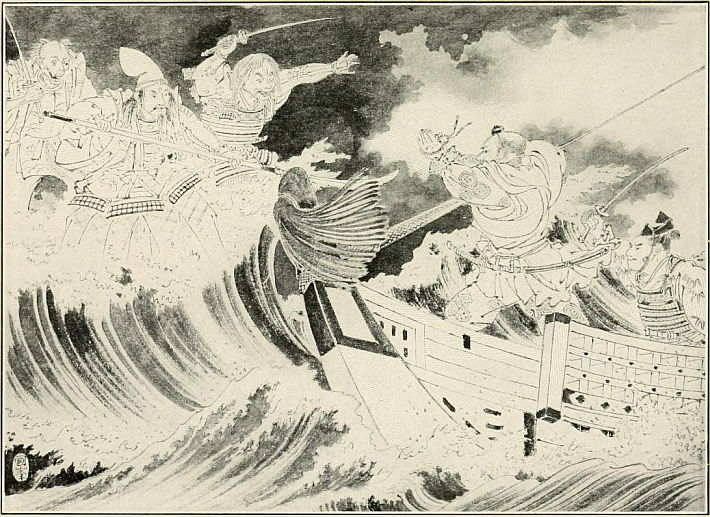
Then from amid the rolling waves, which every moment threatened to engulf the boat, arose pale, ghastly forms whose wan faces were terrible to see. Clad in blood-stained, battle-torn armour and ravaged with gaping wounds, these warrior ghosts raised threatening hands, as if to stop the progress of the boat, while meanings of despair and hollow sobs and shrieks burst from the spectre army. Among the foremost figures was one who brandished a huge halberd, and as he approached, he addressed Yoshitsune, saying: "Aha! Revenge! Revenge! Behold in me the ghost of Taira-no-Tomomori, general of the Taira clan, ruthlessly destroyed by you! Long have I waited here for you and now I will slay you all, for not until then will the slaughtered Taira rest in their watery graves."
Through the tossing, whirling waters, with the wind shrieking round them, and a weird blue phosphoric light making everything visible, the phantom host drew nearer and nearer to the boat. But Yoshitsune did not seem to be in the least alarmed. As dauntless as ever, he stood up in the prow and faced the ghosts of the men whom he had slain in that terrible battle, and flashing forth his keen blade, said: "So you are the spirits of the Taira clan, are you? And you have risen from the ocean-bed to haunt us, and to impede our progress, and to inflict evil upon us? Have you forgotten how I drove you before me as dust before the wind when you were alive? It is a pity you have not profited by past experiences! I should have thought that you would have had no wish to see me again!"
With these words he was about to brandish his sword and attack the spectres, but Benkei, the wise and faithful Benkei, stepped up to his young master and stayed his hand, saying: "Not so, my lord. Swords are useless against ghosts. It is not wise to anger these poor earth-bound phantoms. The best way of dealing with them is to pacify them, so that they may find peace and go to their own place."
Yoshitsune yielded to Benkei and allowed himself to be put aside. Then Benkei, who, you will remember, had formerly been a Buddhist priest, drew out a small rosary which he always carried with him, and telling his beads, and rubbing his hands together, palm to palm, began to recite prayers earnestly and reverently in a loud voice. The sacred words appointed by the Buddhist Church fell like a benediction upon the angry spirits, the wailing and the howling and the tumult of the phantom conflict ceased, and the wraiths gradually vanished into the sea from whence they had arisen; the storm ceased, and the weather cleared and became as fine and peaceful as it was before, and the travellers soon reached the land in safety.
Across the mountains Yoshitsune now fled, and after endless adventures and hairbreadth escapes, he determined to seek the help of his old friend and partisan, the General Hidehira, in the province of Oshu. On the way thither they came to a guard-house at Ataka, in Kaga Province. This guard-house was one of the principal frontier stations at which in those feudal times all travellers had to give an account of themselves. Yoritomo had by this time issued a proclamation ordering the arrest of Yoshitsune, so the young general and Benkei and the handful of faithful men still left to him disguised themselves as wandering priests, wearing loose caps on their heads, carrying wallets on their backs, and grasping pilgrim staves in their hands. Yoshitsune himself was disguised as a goriki, or coolie, attendant on the priests. They travelled slowly until they came to the barrier, consulting together as to how they should pass it, for they heard that the sentries suspected every one and were examining passers-by very strictly. Only the previous day three mendicants had been killed, owing to the suspicion of the guards having been excited.
All Yoshitsune's followers, among whom were many brave, loyal, though headstrong young fellows, wanted to storm the guard-house and cut their way through the soldiers, but Benkei was strongly opposed to this and said: "No, no, that will never do! A quarrel would cost some of our lives, and we have few enough as it is. Leave the matter to me to manage and I'll get you through."
No one ever gainsaid Benkei, when he spoke with authority like that, for they all knew what a mountain of strength and resource he was in time of need. So Benkei, as ever, had his way. He disguised Yoshitsune in the dress of a servant (goriki), and gave him a deep broad-brimmed hat of bamboo to wear, and made him tuck up his robe into his belt; then, advancing in front of the others, he leisurely approached the guard-house, and with an air of the utmost unconcern and nonchalance said: "We are mendicant priests who are travelling throughout the various provinces for the purpose of soliciting subscriptions for the rebuilding of the shrine of the Great Buddha at the Todaiji Temple, in Nara. We ask permission to pass the barrier."
Now the captain of the guard was a very clever man and a strict observer of rules, and he would not let Benkei pass without questioning him thoroughly.
"Well, as you say you are visiting the various provinces soliciting subscriptions for the purpose of rebuilding the Shrine of the Great Buddha, it is possible that I may allow you to pass, but you must show me positive proof of the truth of your story," said the captain of the guard.
Benkei was staggered for a moment when he heard these words. What should he do? But he was a quick-witted man, and without betraying any sign of being taken by surprise, he answered with composure: "Very good, then, I will read you my commission written by the High Priest himself in the first pages of the subscription-book."
With these words, speculating upon the ignorance of the guard, with great dignity he drew out a scroll, and pressing it with reverence to his forehead, began to improvise and read out an imaginary letter from the High Priest of the Todaiji Temple for the rebuilding of a shrine for the Daibutsu, at Nara. At the first mention of the name of the priest, so famous and so highly revered throughout the country, the captain of the guard, it is said, fell respectfully upon his knees and listened, face bent to the earth in humble awe, to the contents of the letter. So well did Benkei play his part that the sentry was convinced of the genuine character of the commission and said: "I am satisfied. There is no reason to detain you. You may pass!"
Benkei was overjoyed, and thought that at length all difficulties had been overcome. At the head of the fugitive band, with Yoshitsune disguised as an attendant in the rear, he was moving forward to pass through the barrier when the captain suddenly darted forward and stopped Yoshitsune, saying in a loud voice: "Wait a moment, you coolie! Wait a moment!"
"We are discovered," thought Benkei; and even he, dauntless and cool in the face of all danger hitherto, felt his heart beating violently in the intense excitement of this momentous crisis.
But it was no time for hesitation, and recognizing that the whole situation hung upon that very moment, Benkei, with his usual pluck and daring, pulled himself together and coolly asked: "Have you anything to say to this coolie whom you have stopped?"
"Of course I have, and that is why I have stopped him," replied the sentry.
"And may I ask what your business with him is?" inquired Benkei.
"This coolie," answered the captain, "is said by my soldiers to resemble Lord Yoshitsune, and I stopped him so that I might examine him."
"What!" shouted Benkei, pretending to be overcome with laughter at the idea, "this coolie resembles Lord Yoshitsune? Ha! ha! ha! Oh, this is indeed too comical for anything! I wondered why you arrested him, but never thought of his being stopped for such an absurd reason. But as a matter of fact he has been mistaken for Lord Yoshitsune over and over again by several people, and you are by no means the only one who has had his suspicions aroused. You see the fellow is handsome and has a very white skin like an aristocrat, and that's all the good there is about him, but on that account I have had an immense amount of trouble with him."
Then Benkei turned to Yoshitsune, saying: "Wretched creature! it is all your fault that we come under suspicion all the time. You shuffle along in such a cowardly manner and put on such strange airs that people naturally suspect you. In future be more careful, and walk along like a man and not in such a mincing way, you fool!"
Thus Benkei feigned to lose his temper, and after scolding Yoshitsune roughly, finally lifted his staff and gave him several blows across the back, telling him to fall upon his knees and not presume to remain standing in the presence of the guard.
The captain of the guard had been watching this scene for some moments, and when he saw Benkei start in and thrash Yoshitsune, his doubts were completely allayed; for he thought that if the apparent servant were really Yoshitsune and the mendicant priest the latter's retainer, the vassal would never dare to assault his master in this fashion.
"Ah! it was my fault and carelessness. Evidently it was an entire mistake on our part to think this coolie was Lord Yoshitsune, and it is not the poor fellow's fault, so pray do not beat him any more! Continue your journey at once and take him with you."
Benkei's trick thus succeeded completely. The captain reentered the guard-house and the young lord and his vassals passed at last unhindered through the strictly guarded gate, saved as ever by the quick-wittedness of Benkei.
Now some say that the captain of the guard was not deceived; that he knew that the disguised priests and attendant were Yoshitsune and his party, but his whole sympathy was with the hunted hero and his brave few and he allowed them to pass. For a samurai must ever show mercy and sympathy, especially to his fellows and to those in distress. The strict examination he insisted upon was a farce he played to satisfy the authorities at Kamakura.
Yoshitsune and his followers were filled with admiration at the wisdom of Benkei, and great were the praise and thanks they rendered him on this occasion; but Benkei, full of reverence and devotion to his master, never ceased to deplore the necessity which drove him to beat his own lord and apologized with great humility. Whenever the story was told, he would shed tears of sorrow and declare that he would rather have been beaten to death himself than have been obliged by circumstances to strike Yoshitsune.
Thus once by force of arms he put to flight the would-be assassins of Yoshitsune at Kyoto; by reciting Buddhist prayers he laid the ghosts of the Taira warriors in the sea at Dan-no-Ura; and by sheer wit and sagacity he brought his party across the dangerous frontier; and at length he managed to arrive safely with his beloved master at the Oshu residence of the famous General Hidehira.
He now thought that all troubles were over; but unfortunately this story soon reached Kamakura City, and Yoritomo, furious at Yoshitsune's daring, despatched a large army to chastise him.
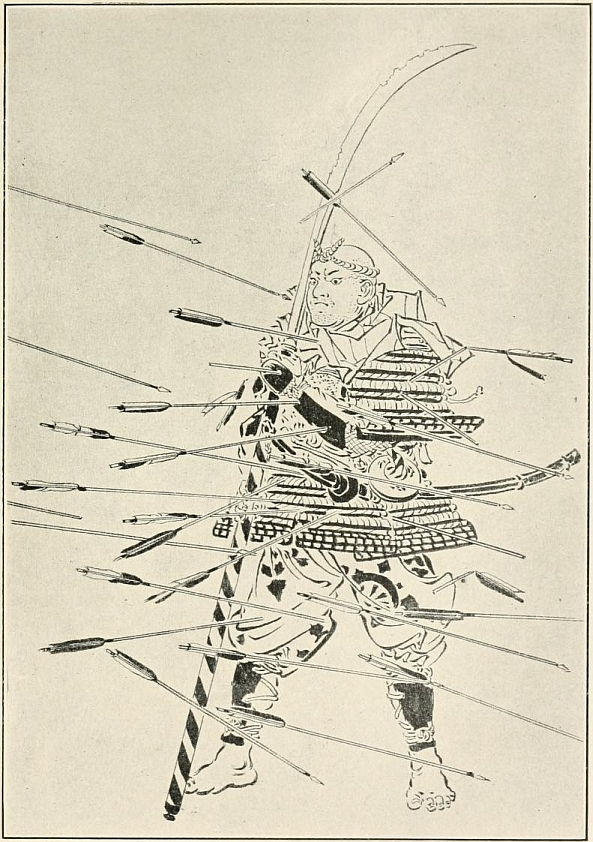
At this time Yoshitsune's camp was pitched beside the river Koromo, and the army from Kamakura, swarming up in countless thousands on the opposite bank, discharged volley after volley of arrows at the brave but ill-fated band. Yoshitsune's handful of men were entirely unable to face the overwhelming numbers, and fled in confusion, seeking shelter in the neighbouring woods and valleys or hiding themselves in the mountains. But Benkei, despising flight, refused to budge, and stood without moving while showers of arrows fell like rain around him. At length the enemy saw that Benkei stood immovable with his seven weapons on his back, grasping his great halberd in both hands. Wondering at the sight, they drew near for the purpose of solving the mystery. As they approached, the giant still remained standing; not an eyelid flinched, as his eyes, wide open, glared fiercely at the soldiers. No wonder that the giant did not stir, for arrows were sticking all over his body like quills on a porcupine, and it was evident that he had died standing with his face to the enemy.
This story is known far and wide throughout Japan, and you can imagine what a brave sturdy warrior he must have been to have died in this way, fighting to the last.
Another story tells how the enemy came up to the wonderful figure of Benkei and found it to be but a straw dummy, and that by this device Benkei gained time for his beloved lord, with whom he escaped into the North, leaving their enemies far behind. Such is the story of Benkei, and the story does not end here; for tradition relates with much circumstance, as traditions always do, that Benkei's master became the conqueror of Northern Asia, known to after ages as the famous Genghis Khan.
DIED STANDING WITH HIS FACE TO THE ENEMY

THE GOBLIN OF OYEYAMA
Long, long ago in Old Japan, in the reign of the Emperor Ichijo, the sixty-sixth Emperor, there lived a very brave general called Minamoto-no-Raiko. Minamoto was the name of the powerful clan to which he belonged, and in England it would be called his surname, and Raiko, or Yorimitsu,[1] was his own name.
In those times it was the custom for generals to keep as a body-guard four picked knights renowned for their daring spirit, their great strength, and their skill in wielding the sword. These four braves were called Shitenno, or Four Kings of Heaven, and they participated in all the exploits and martial expeditions of their chief, and vied with one another in excelling in bravery and dexterity.
Minamoto-no-Raiko was no exception to the general rule of those ancient leaders of Japan, and he had under him Usui-Sadamitsu, Sakata Kintoki, Urabe Suetake, and Watanabe Tsuna (the clan or surname comes first in Japan). Search the wide world from north to south and from east to west, and no braver warriors than the Shitenno of Minamoto-no-Raiko could you find. Each one of the four was said to be a match single-handed for a thousand men. They lived for adventure, and their delight was in war.
Now it happened about this time that Kyoto, the capital, was ringing with the stories of the doings of a frightful demon that lived in the fastnesses of a high mountain called Mount Oye, in the province of Tamba. This goblin or demon's name was Shutendoji. To look upon the creature was a horrible thing, and those who once caught sight of him never forgot the sight to their dying day. He sometimes took upon him the form of a human being, and leaving his den would steal into the capital and haunt the streets and carry off precious sons and beloved daughters of the Kyoto homes. Having seized these treasures and flowers of the people, he would drag them to his castle in the wilds of Mount Oye, and there he would make them work and wait upon him till he was ready to devour them, then he would tear them limb from limb.
For a long time the flower of the youth of the capital had been kidnapped in this way; many homes had been made desolate. For a long, long time no one had the least idea of what happened to the sons and daughters thus stolen, but at the period when this story begins, the dread news of the cannibal Shutendoji and his mountain den began to be noised abroad.
Now at the Court there was an official, Knight Kimitaka by name, who was thrice happy in the possession of a beautiful daughter. She was his only child, and upon her he and his wife doted. One day the darling of the family disappeared, and no trace whatsoever of the beautiful girl could be found. The household was plunged into the deepest grief and misery. The mother at last determined to consult a soothsayer, and, bidding an attendant follow her, she repaired to the house of a famous fortune-teller and diviner, who revealed to her that her daughter had been stolen away by the goblin of Mount Oye. The mother hastened home terror-stricken, and the father, when he was told the dire news, was dumb with grief. He gave up going on duty at the Palace, for he was so broken-hearted that he could do nothing but weep night and day over the loss of his only daughter. To lose her was bad enough, but the thought of the horrible hands into which she had fallen was unendurable, and all who loved the poor child, even her own father, were powerless to save her. Oh! the bitter, bitter grief!
At last the Emperor heard of the sorrow that had overtaken Kimitaka, and his wrath was great to think that the hateful goblin had dared to enter the precincts of the sacred capital without permission, and had dared to steal away his subjects in this manner. And in his royal indignation he sprang to his feet and threw down his tasselled fan and cried aloud: "Is there no one in my domains who will punish this goblin and destroy him utterly, and avenge the wrongs he has done my people and this city, and so set my heart at ease?"
Then the Emperor called his Council together, and put the matter before them and asked them what it were best to do, for the city must at all costs be rid of this terrible scourge.
"How dare he haunt my dominions and lay hands on my people in the very precincts of my Palace?" cried the distressed Emperor.
Then the Ministers respectfully answered the Emperor and said: "There are numbers of brave warriors in Your Majesty's realm, but there are none so able to do your bidding as Minamoto-no-Raiko. We would humbly advise our August Emperor, the Son of Heaven, to send for the knight and command him to slay the demon. Our poor counsel may not find favour in the Son of Heaven's sight, but at the present moment we can think of nothing else to suggest!"
This advice pleased the Emperor Ichijo, and he answered that he had often heard of Raiko as a valiant knight and true, who knew not what fear was, and he had no doubt that, as his Ministers said, he was just the man for the adventure. And so the Emperor summoned Raiko to the Palace at once.
The warrior, on receiving the royal and unexpected summons, hastened to the Palace, wondering what it could mean. When he was told what was wanted of him, he prostrated himself before the throne in humble acquiescence to the royal command. Indeed Raiko was right glad at the thought of the adventure in store for him, for it had been quiet for some time in Kyoto, and he and his braves had chafed at the enforced idleness.
The more he realized the awful difficulty of his task, the higher his courage and his spirits rose to face it and the more he determined to do it or die in the attempt.
He went home and thought out a plan of action.
As the enemy was no human being, but a formidable goblin, he thought that the wisest course would be to resort to stratagem instead of an open encounter, so he decided to take with him a few of his most trusted men rather than a great number of soldiers. He then called together his four braves, Kintoki, Sadamitsu, Suetake, and Tsuna, and besides these another knight, by name Hirai Yasumasa, nicknamed Hitori, which meant, as applied to him, "the only warrior."
Raiko told them of the expedition, and explained that, as the demon was no common foe, he thought it wise that they should go to his mountain in disguise; in this way they would the more likely and the more easily overcome the goblin. They all agreed to what their chief said and set about making their preparations with great joy. They polished up their armour and sharpened their long swords and tried on their helmets, rejoicing in the prospect of the action confronting them. Before starting on this dangerous enterprise, they thought it wise to seek the protection and blessing of the gods, so Raiko and Yasumasa went to pray for help at the Temple of Hachiman, the God of War, at Mount Otoko, while Tsuna and Kintoki went to the Sumiyoshi Shrine of the Goddess of Mercy, and Sadamitsu and Suetake to the Temple of Gongen at Kumano. At each shrine the six knights offered up the same prayer for divine help and strength, and on bended knees and with hands laid palm to palm they besought the gods to grant them success in their expedition and a safe return to the capital.
Then the brave band disguised themselves as mountain priests. They wore priests' caps and sacerdotal garments and stoles; they hid their armour and their helmets and their weapons in the knapsacks they carried on their backs; in their right hands they carried a pilgrim's staff, and in their left a rosary, and they wore rough straw sandals on their feet. No one meeting these dignified, solemn-looking priests would have thought that they were on the way to attack the goblin of Mount Oye, and no one would have dreamt that the leader of the band was the warrior Raiko, who for courage and strength had not his peer in the whole of the Island Empire.
In this way Raiko and his men travelled across the country till at last they reached the province of Tamba and came to the foot of the mountain of Oye. Now as the goblin had chosen Mount Oye as his place of abode, you can imagine how difficult of access it was! Raiko and his men had often travelled in mountainous districts, but they had never experienced anything like the steepness of Mount Oye. It was indescribable. Great rocks obstructed the way, and the branches of the trees were so thickly interlaced overhead that the light of day could not penetrate through the foliage even at midday, and the shadows were so black that the warriors would have been glad of lanterns. Sometimes the path led them over precipices where they could hear the water rushing along the deep ravines beneath. So deep were these chasms that as Raiko and his men passed them they were overcome with giddiness. For the first time they realized now the dangers and difficulties of the task they had undertaken, and they were somewhat disheartened. At times they rested themselves on the roots of trees to gain breath, sometimes they stopped to quench their thirst at some trickling spring, catching the water up in their hands. They did not, however, allow themselves to be discouraged long, but pushed their way deeper and deeper into the mountain, encouraging each other with brave words of cheer when they felt their spirits flagging. But the thought sometimes crossed their minds, though they one and all kept it to themselves, "What if Shutendoji, or some of his demons, should be lurking behind any of the rocks or cliffs?"
Suddenly from behind a rock three old men appeared. Now Raiko, who was as wise as he was brave, and who at that very moment had been thinking of what he should do were they to encounter the goblin unexpectedly, thought that sure enough here were some of the goblins, who had heard of his approach. They had simply disguised themselves as these venerable old men so as to deceive him and his men! But he was not to be outwitted by any such prank. He made signs with his eyes to the men behind him to be on their guard, and they in obedience to his gesture put themselves in attitudes of defence.
The three old men saw at once the mistake Raiko had made, for they smiled at him and then drawing nearer, they bowed before him, and the foremost one said: "Do not be afraid of us; we are not the goblins of this mountain. I am from the province of Settsu. My friend is from Kii, and the third lives near the capital. We have all been bereft of our beloved wives and daughters by Shutendoji the goblin. Because of our great age we can do nothing to help them, though our sorrow for their loss, instead of growing less, grows greater day by day. We have heard of your coming, and we have awaited you here, so that we might ask you to help us in our distress. It is a great favour we ask, but we entreat you if you encounter Shutendoji to show him no mercy, but to slay him and so avenge the wrongs of our wives and children and many others who have been torn away from their homes in the Flower Capital."
Raiko listened attentively to all the old man said, and then answered: "Now that you have told me so much, I need not reserve the truth from you"; and he went on to tell them of the order he had received from the Emperor to destroy Shutendoji and his den, and the warrior did his best to comfort the old men and to assure them that he would do all in his power to restore their kidnapped wives and daughters.
Then the old men expressed great joy; their faces beamed like the sun as they thanked Raiko warmly for his kind sympathy, and they presented him with ajar of saké, saying as they bowed low: "As a token of our gratitude we wish to present you with this magic wine. It is called Shimben-Kidoku-Shu.' The name means, 'a cordial for men but a poison to goblins.' Therefore if a demon drinks of this wine, all his strength will go from him, and he will be as one paralyzed. Before you attack Shutendoji, give him to drink of this wine, and for the rest you will find no difficulty."
And with these words the venerable spokesman handed the warrior a small white stone jar containing the wine. As soon as Raiko had taken the jar into his hands, a radiance like that of sunlight suddenly shone round the old men, and they vanished upwards from sight till their shining figures were lost in the clouds.
The warriors were struck with astonishment. They gazed upwards as if stupefied. But Raiko was the first to recover from his surprise. He clapped his hands and laughed as he said: "Be not afraid at what you have seen! Be sure that the three who thus appeared to us are none other than the gods of the shrines we visited before starting on this perilous enterprise. The old man who said he was from Settsu must have been the deity of Sumiyoshi, the one from the province of Kii was the divinity of Kumano, and the one from the capital the god Hachiman of Mount Otoko. This is a most propitious sign. The three deities have taken us under their special protection. This saké is their gift, and it will surely be of magic power in helping us to overcome the demons. We must, therefore, render thanks to Heaven for the protection vouchsafed to us."
Then Raiko and his five knights knelt down on the mountain pass and bowed themselves to the ground and prayed for some minutes in silence, overcome with awe at the thought that the three gods whose aid they had invoked had visited them. Raiko sprang to his feet and lifted the jar of saké reverently above his head, then he placed it with his armour and weapons in the box he carried on his back. Having done this, they all proceeded on their way, but oh! how safe and confident they now felt. Raiko with his magic wine felt more than a match for any demon now. There is a proverb which says, "A giant with an iron rod," which means strength added to strength, and this was fully illustrated in the case of Raiko. The goblin Shutendoji was now to be pitied; it would surely go hard with him!
As they sped on their way they came to a mountain stream, and here they found a damsel washing a blood-stained garment, and as she washed and beat the garment against the current, they saw that she often had to stop and wipe the tears away with her sleeve, for she was weeping bitterly. Raiko's heart was stirred with pity at her distress, and he went up to her and said: "This is a goblin-haunted mountain; how is it that I find a damsel such as you here?"
The Princess (for such she was) looked up in his face wonderingly and said: "It is indeed true that this is a goblin-haunted mountain, and hitherto inaccessible to mortals. How is it that you have managed to get here?" and she looked from Raiko to his men.
Then Raiko said: "I will tell you the truth quite frankly. The Emperor has commanded us to slay the demon; that is why we are here!"
Without waiting to hear any more, the Princess ran up to Raiko in her joy and clung to him, crying out in broken sentences: "Are you indeed the great Raiko of whom I have so often heard? How thankful I am that you have come. I will be your guide to the goblin's den. Hasten, Knight Raiko, and kill the demons! I already feel that I am saved!"
When they heard these words the warriors knew that she was one of the goblin's victims. The Princess turned and led the way up the hill. Presently they saw a large iron gate guarded by two demons. The demon on the right was red and the demon on the left was black, and each was armed with a great iron stick or club. The Princess whispered to Raiko: "Behold the home of the demon. Enter the gates, and you will find a beautiful palace, built of black iron from the foundations to the roof. It is therefore called the Palace of Black Iron or Kurogane. It is large, and the inside is as beautiful as a great Daimio's palace. Within the walls of the Palace of Black Iron, Shutendoji holds a feast night and day. He is waited upon by maidens such as I, whom he has carried off from the capital and from the provinces to be his slaves. The wine he drinks, poured out in crimson lacquer cups, is the blood of human beings, and the food of those feasts is the flesh of his victims who are slain in turn. What numbers have I seen disappear, alas! all murdered to supply the awful food and wine of those cannibal feasts. How I have prayed to Heaven to punish this monster! But when I saw the fate of my friends, how could I hope to live? I knew not when my turn would come. But since I have met you I feel that we shall all be saved and great is my joy and gratitude!"
By this time they had reached the gate, and the Princess went forward and said to the red and black demon sentinels: "These poor travellers have lost their way on this mountain. I took compassion on them and brought them here, so that they may rest for a while before going on their journey. I hope you will be kind to them."
When the Princess first began to speak the demons looked and saw Raiko and his fellow priests. Little dreaming who these men were, and that in admitting them they were letting in the bravest knights in the whole of Japan, and still less suspecting their purpose, the demons laughed in their hearts. Good prey had indeed fallen into their hands; they would surely be allowed a share in the feast that these fresh victims would furnish.
They grinned from ear to ear at the Princess and told her that she had done well, and bade her take the six travellers into the Palace and inform Shutendoji of their arrival. Thus the six warriors entered into the very stronghold of the demons as if they were invited guests. Triumphant glee at the success of their plan made them exchange lightning glances with each other. They passed through the great iron gate, up to the porch, and then the Princess led them through large spacious rooms and along great corridors till at last they reached the inner part of the Palace. Here they were shown into a large hall. At the upper end in the seat of honour sat the demon king Shutendoji. Never had the knights in their wildest dreams dreamt of such a hideous monster. He was ten feet in height, his skin was bright red and his wild shock of hair was like a broom. He wore a crimson hakama,[2] and he rested his huge arms on a stand. As the knights entered, he glared at them fiercely with eyes as big as a dish. The sight of this dread monster was enough to make any one tremble with fear, and had Raiko and his knights been weak they must have fainted away with horror.
Raiko could hardly restrain himself from flying at the monster then and there, but he controlled himself and bowed humbly so as not to awaken the enemy's suspicion in any way.
Shutendoji, glaring at him, said haughtily: "I do not know who you are in the least, or how you have found your way into this mountain, but make yourself at home!"
Then Raiko answered meekly: "We are only humble mountain priests from Mount Haguro of Dewa. We were on our way to the capital, having been on a pilgrimage to the shrine of Omine. In travelling across these mountains we have lost our way. While wandering about and wondering which was the right path to take, we were met by one of the inmates of your palace and kindly brought here. Please pardon us for trespassing on your domains and for all the trouble we are giving you!"
"Don't mention it," said Shutendoji; "I am sorry to hear of your plight. Do not stand on ceremony while you are here, and let us feast together." Then turning to the attendant demons he shouted orders for the dinner to be served, and clapped his red hands together.
At this the partitions between the rooms slid apart and beautiful damsels magnificently robed came gliding in, bearing aloft in their hands large wine-cups, jars of saké and dishes of fish of all kinds, which they placed before the ugly goblin and the guests. Raiko knew that all these lovely princesses had been snatched from the Flower Capital by Shutendoji, who, heedless of their tears and misery, kept them here to be his handmaidens. He said to himself fiercely that they should soon be free.
Now that the wine-cups were brought in, the warrior seized his opportunity. From his satchel he took out the jar containing the enchanted wine, Shimben-Kidoku-Shu, which he had received from the gods of the three shrines, and said to Shutendoji: "Here is some wine which we have brought from Mount Haguro. It is a poor wine and unworthy of your acceptance, but we have always found it of great benefit in refreshing us when we were weary from fatigue and in cheering our drooping spirits. It will give us much pleasure if you will try a little of our humble wine, though it may not please your taste!"
Shutendoji seemed pleased at this courtesy. He handed out a huge cup to be filled, saying: "Give me some of your wine. I should like to try it." The goblin drained it at one swallow and smacked his lips over it.
"I have never tasted such excellent wine," he said and held out his cup to be filled again.
You can imagine how delighted Raiko was, for he knew full well that the demon was given into his hand. But he dissembled cleverly and said as he filled the goblin's wine-cup: "I am delighted that the Honourable Host should deign to like our poor country wine. While you drink, I and my companions will venture to amuse you by our dancing."
Then Raiko made a sign to his men and they began to chant an accompaniment, while he himself danced.
Shutendoji was highly amused as well as his attendants. They had never seen men dance before, and they thought that the strangers were very entertaining.
The goblins now began to pass the magic wine round and to grow merry. Others meanwhile whispered among themselves, pitying the six travellers who, all unconscious of the horrible fate which was about to overtake them, were spending their last hours of liberty and probably of life in giving wine to their slayers and in dancing and singing for their amusement!
Already, however, the power of the enchanted wine had begun to work and Shutendoji grew drowsy. The wine in the jar never seemed to grow less, however much was taken from it, and by this time all the demons had helped themselves liberally. At last they all fell into a deep sleep, and stretching themselves out on the floor and on one another, some in one corner and some in another, they were soon snoring so loudly that the room shook, and were as insensible to all that was going on as logs of wood.
"The time has come!" said Raiko, springing to his feet, and motioning to his men to get to work. One and all hastily opened their knapsacks. Taking out their helmets, their armour, and their long swords, they armed themselves. When they were all ready they all knelt down, and, placing their hands palm to palm, they prayed fervently to their patron gods to help them now in their hour of greatest need and peril.
As they prayed, a shining light filled the room, and in a radiant cloud the three deities appeared again. "Fear not, Warrior Raiko," they said. "We have tied the hands and feet of the demon fast, so you have nothing to fear. While your knights cut off his limbs, do you cut off his head; then kill the rest of the oni and your work will be done." The three old men then disappeared as mysteriously as they had come.
Raiko rejoiced at the vision and worshipped with his heart full of gratitude the vanishing deities. The knights then rose from their knees, took their swords and wet the rivets with water, so as to fix the blade firmly in the hilt. Then they all stole stealthily and cautiously towards Shutendoji. No longer the timid mountain priests; clad in full armour, they were transformed into avenging warriors. With flashing eyes and dauntless mien they moved across the room.
The captive princesses standing round realized that these men were deliverers, from their beloved capital. Their joy and wonder cannot be put into words. Some cried aloud with joy; others covered their faces with their sleeves and burst into soft weeping; others raised their hands to Heaven and exclaimed, "A Buddha come to Hell! Surely these brave men will kill the demons and set us free"; and with clasped hands they entreated the knights to slay their captors and take them back to their homes.
Now Raiko stood over the sleeping Shutendoji with drawn sword, and raising it on high with a mighty sweep he aimed at the demon's neck, which was as big round as a barrel.
The head was severed from the body at one blow, but, horrible to relate, instead of falling to the ground, it flew up into the air in a great rage. It hung over Raiko for a moment snorting flames of fire, and then swooped down as if it would bite off the warrior's head, but it was daunted by the glittering star on his helmet, and drew back and gazed in surprise at the transformed man. Raiko was scorched by the demon's flaming breath. Once more he raised his long sword and striking the terrible head brought it to the ground at last.