VOYAGE TO THE SUN (continued 3)
Richard Aldington translation
"In the same Province the youthful Iphis had eaten of this fruit with the beautiful Ianthë, her companion, in all the circumstances necessary to cause a reciprocal friendship. Their eating was followed by the customary effect; but because Iphis found the fruit to be of a very agreeable taste she ate so many that her friendship, increasing with the number of apples of which she was insatiable, usurped all the functions of love and this love by increasing little by little became more masculine and more vigorous; for her whole body, imbued with this fruit, burned to form the movements which coincided with the enthusiasms of its will and moved its matter so powerfully that it fashioned itself much stronger organs, able to carry out its thought and to content its love wholly to the most virile extent; that is to say, Iphis became what is needed to espouse a woman.
"I should call this adventure a miracle if I had any other name to describe the following event:
"A very accomplished young man called Narcissus had deserved by his love the affection of a very beautiful girl, whom the poets have celebrated under the name of Echo. But, as you know, even more than those of our sex, women are never so beloved as they desire; and she, having heard the virtues of these apples of Orestes greatly commended, went about to collect them from several places; and because she was fearful and her love apprehended the apples of one tree might have less strength than those of the other, she willed him to taste of both; but he had scarcely eaten them when Echo's image was effaced from his memory, all his love turned towards the person who had digested the fruit, he was the lover and the beloved; for the substance derived from the apple of Pylades embraced within him that from the apple of Orestes. This twin fruit, extending through the whole of his blood, excited all the parts of his body to caress themselves. His heart, into which flowed their double virtue, darted its flames within; all his limbs animated by his passion desired to penetrate each other. Even his image, which burned in the coldness of pools, attracted his body to join with it; in short, poor Narcissus became madly in love with himself. I shall not be so tedious as to relate to you his deplorable catastrophe; past ages have already sufficiently spoken of it and I have still two adventures to tell you, which will better fill up the time.
"You must know that the beautiful Salmacis frequented the shepherd Hermaphrodite, but with no familiarity beyond that authorised by the vicinity of their homes, when Fortune, who delights to trouble the most peaceful lives, permitted that Hermaphrodite should win the prize for running and Salmacis that for beauty in a meeting for games, where the prizes for beauty and running were two of these apples. They had been plucked together, but from different boughs, because these amorous fruits mingle with such cunning that one from Pylades is always met with beside one from Orestes; and their appearing to be twins was the cause that they were usually plucked in pairs. The beautiful Salmacis ate her apple and the gentle Hermaphrodite placed his in his shepherd's scrip. Salmacis, inspired by the enthusiasms of her apple, and of the shepherd's apple, which began to grow warm in his scrip, felt attracted towards him by the sympathetic ebb and flow of her apple with the other.
"The shepherd's parents, perceiving the nymph's desires, tried to preserve and to increase them, because of the advantages they perceived in this alliance; and therefore, having heard these twin apples vaunted as a fruit whose juice inclines the mind to love, they distilled some of them and found means to cause their son and his mistress to drink the purest quintessence. They had sublimated its energy to the highest degree it could attain and thereby lighted in these lovers' hearts so vehement a desire of joining together that at first sight Hermaphrodite was absorbed in Salmacis and Salmacis melted away in the arms of Hermaphrodite. They passed into each other and they composed from two persons of different sex a double 'something', which was neither man nor woman. When Hermaphrodite desired to enjoy Salmacis he found he was the nymph herself; and when Salmacis desired to be embraced by Hermaphrodite she felt she was the shepherd. Yet this double 'something' retained its unity; it begat and conceived without being either man or woman. In short, Nature here produced a marvel, which she has never since been able to prevent from being unique.
"Well, are not these astonishing stories? They are; for to see a daughter lie with her father; a young princess satisfy the desires of a bull; a man yearn to enjoy a stone; another marry with himself; to see one celebrate as a girl a marriage she consummates as a boy, cease to be a man without beginning to be a woman, become double outside the mother's womb and twin of a person who is no relative; all these are very distant from the ordinary paths of Nature. And yet what I am about to tell you will surprise you even more.
"Among the sumptuous diversity of all sorts of fruits brought from the most distant climates for the wedding banquet of Cambyses, they presented him with a graft of Orestes, which he inserted in a plane-tree; and among other delicacies, at dessert they put before him apples of the same tree.
"The agreeable taste of the fruit led him to eat a great deal of it; and after the three digestions, which converted the substance of this fruit into a perfect germ, he formed from it in the queen's womb the embryo of his son Artaxerxes; for all the details of his life caused his doctors to conjecture that he must have been produced in this way.
"When this prince's youthful heart was of an age to merit Love's anger it was noticed that he did not sigh for his own kind; he loved only trees, orchards and woods; but above all those to which he appeared tender, the plane-tree on which his father Cambyses had formerly grafted the shoot of Orestes consumed him with love.
"His temperament followed so scrupulously the plane-tree's progress that he seemed to grow with the branches of that tree; every day he went to embrace it; in his sleep he dreamed of nothing else; and he transacted all his business under the curve of its green tapestry. It was perceived that the plane-tree, pierced by a reciprocal ardour, was ravished by his caresses; for suddenly, without any apparent reason, its leaves were seen to stir and as it were to thrill with joy, the branches curved down upon his head as if to make him a crown and descended so near his face that it was easy to perceive this was rather to kiss him than from a natural tendency to grow downwards. It was even noticed that the tree jealously ranged and pressed its leaves together for fear lest the rays of daylight as they glided through should also kiss him. The king for his part placed no limits to his love. He caused his bed to be made at the foot of the plane-tree and the plane-tree, not knowing how to repay such friendship, gave him the most precious thing trees have—honey and dew—which it distilled every morning upon him.
"Their caresses would have lasted longer if death, the enemy of all beautiful things, had not ended them. Artaxerxes expired of love in the embraces of his dear plane-tree; and all the Persians, afflicted at the loss of so good a prince, decreed (in order to give him some satisfaction after death) that his body should be burned with the branches of this tree, without any other wood being used to consume him.
"When the pyre was lighted its flame was seen to knit with that of the body's fat and their burning hair curled together and diminished in pyramid shape until it was out of sight.
"This pure and subtle fire did not divide; but when it reached the Sun, to which as you know all igneous matter tends, it formed the germ of the apple-tree of Orestes, which you see there on your right hand.
"Now the seed of this fruit is lost in your world and this misfortune happened as follows:
"Fathers and mothers, who, as you know, in directing their families, are governed only by interest, were angry that their children as soon as they had tasted these apples bestowed on their friend everything they possessed; and so the parents burned as many of these plants as they could discover. The extinction of the race is the reason why a true friend is no longer found.
"As these trees were consumed by fire the rains which fell on them calcined the ashes, so that the congealed juice petrified in the same way that the humour of burnt fern is metamorphosed into glass; and thus in all the countries of the Earth the ashes of these twin trees formed two metallic stones called to-day the iron and the loadstone, which, because of the sympathy of the fruits of Pylades and Orestes, whose virtue they have always preserved, aspire every day to embrace; and notice that if the piece of loadstone is larger it attracts the iron, but if the piece of iron exceeds the other in quantity it attracts the loadstone, as happened of old in the miraculous effect of the apples of Pylades and Orestes; for whoever had eaten more of one of them was the more beloved by him who had eaten of the other.
"Well, iron feeds upon the loadstone and the loadstone feeds upon iron so visibly that the one grows rusty and the other loses its strength unless they are brought together to repair what is lost of their substance.
"Have you never observed a piece of loadstone placed on iron filings? In a flash you see the loadstone covered with these metallic atoms; and they grip with such amorous ardour so suddenly and so impatiently that after they have embraced everywhere you would say there is not a grain of loadstone which does not desire to kiss a grain of iron, and not a grain of iron which does not wish to unite with a grain of loadstone; for the iron and the loadstone, when separated, continually send out from their bulk the most active small bodies in search of what they love, but when they have found it and have nothing more to desire, each terminates its travels; the loadstone spends its repose in the possession of the iron, as the iron collects all its being to enjoy the loadstone. It is therefore from the sap of these two trees that the moisture flowed from which these two metals were born. Before that they were unknown; and if you wish to know from what matter they manufactured weapons of war—Samson armed himself with the jaw-bone of an ass against the Philistines; Jupiter, King of Crete, with artificial fire by means of which he imitated thunder and overcame his enemies; and Hercules conquered tyrants and tamed monsters with a club. But these two metals have another much more specific relation to our two trees. You must know that although this lifeless couple of lovers turn towards the pole, they never do so except in each other's company; and I will discover to you the reason of this after I have discoursed to you a little about the poles.
"The poles are the mouths of the sky by which it takes in the light, heat and influences it has diffused upon the Earth; otherwise, if all the treasures of the Sun did not return to their source it would long ago be extinct (since its light is only a dust of burning atoms shed from its globe) and would shine no more or else this abundance of small igneous bodies heaped continually upon the Earth would already have consumed it. Therefore, as I have said, the sky must have vent-holes by which the repletions of the Earth are cast out and others by which the sky can repair its losses, so that the eternal circulation of these little bodies of life may successively penetrate all the globes of this great universe. Now the vent-holes of Heaven are the poles by means of which it feeds upon the souls of everything that dies in its worlds and all the planets are the mouths and pores by whose means its spirits are exhaled afresh. And to show you that this is not so novel a fancy, observe that when your ancient poets, to whom philosophy had discovered the most hidden secrets of Nature, were speaking of a hero and desired to say that his soul was gone to dwell with the Gods, they expressed themselves thus: 'He has risen to the pole; he is seated above the pole; he has passed the pole:' because they knew that the poles were the only entrances by which the sky receives all that has left it. If the authority of these great men does not fully satisfy you, the experience of those moderns who have travelled towards the north will perhaps content you. They have found that the nearer they approach the Bear during the six months of night, when it was thought this country was entirely black, the horizon was illuminated by a great light, which could only come from the pole, because the nearer they approached it, and consequently the farther they drew from the Sun, the larger the light became. It is therefore very probable that this light proceeds from rays of daylight and from a great heap of souls which, as you know, are made of luminous atoms alone, returning to the sky by their accustomed portals.
"After that it is not difficult to understand why iron rubbed with loadstone or loadstone rubbed with iron turns towards the pole; for since they are extracted from the bodies of Pylades and Orestes and have always preserved the propensities of the two trees, as the two trees preserved those of the two lovers, they must aspire to rejoin their soul, and so they strain towards the pole, whither they feel it has risen, with this proviso, that the iron does not turn unless it is rubbed by the loadstone nor the loadstone if it is not rubbed by the iron, because iron will not abandon a world without its friend, loadstone, nor loadstone without its friend, iron; and they cannot resolve to make this voyage without each other."
I think the voice was going to begin another discourse; but it was prevented by the noise of a loud alarm; the whole forest in disturbance echoed with the words: Beware the plague! and Pass it on!
I begged the tree, which had talked to me so long, to inform me what was the reason of this great disorder.
"My friend", it said, "in this district we have not yet received precise details of the misfortune; I can only tell you in three words that the plague by which we are menaced is what men call a conflagration; and we may well name it a plague, for among us no disease is so contagious. The remedy we shall apply to it is to hold our breath and then to blow all together on the place whence the conflagration is moving, in order to repulse this dangerous air. I think this burning fever has been brought to us by a Fire-Beast, which for some days has been wandering about these woods; for since these beasts never go without fire and cannot do without it, this one no doubt has set fire to one of our trees.
"We have sent for the Ice-Animal to come to our aid; but it has not yet arrived. But now farewell, I have no time to talk to you, I must think of the common safety; and you yourself should take to flight, otherwise you run the risk of being involved in our ruin."
I followed its advice, but without hurrying very much, because I knew my legs. However I was so ignorant of the plan of that country that at the end of ten hours' walking I found myself behind the forest I thought I was avoiding; and to increase my apprehension, a hundred terrible thunder-claps shook my brain, while the pale dismal light of a thousand flashes of lightning quenched my eye-balls.
From moment to moment they increased with such fury one would have said the foundations of the world were about to collapse; yet, in spite of it all, the sky never appeared clearer. I was unable to find reasons for this and my desire of knowing the cause of so extraordinary an event urged me to walk towards the place whence the noise seemed to come.
I walked for about four hundred stadia, at the end of which I perceived in the middle of a very large field what looked like two balls which, after moving round each other for a very long time with a humming noise, came together and then recoiled; and I observed that the moment of the shock was that when these great noises were heard. Drawing nearer I perceived that what at a distance had seemed to me to be two balls were two animals; one of them, although round at the base, formed a triangle from the middle, and its very high head with red hair streaming upwards narrowed off in a pyramid shape, while its body was filled with holes like a sieve and one could see through these hollow places, which served it as pores, little flames issuing forth which seemed to cover it with fiery plumage.
Walking round I met a most venerable old man looking at this wonderful combat with as much curiosity as I. He signed to me to approach; I obeyed and we sat down beside each other.
I was about to ask him what motive had brought him into this country, but he closed my mouth with these words:
"Well, you shall know the motive which brought me into this country."
And immediately he related to me at length all the details of his journey. I leave you to imagine whether or no I was astounded. But my amazement was increased, for just as I was burning to ask him what demon revealed my thoughts to him, he exclaimed:
"No, no, 'twas not a demon revealed your thoughts to me."
This new trick of divination caused me to observe him with more attention than before and I noticed he was imitating my carriage, my gestures, my appearance, placed all his limbs and disposed all the features of his face on the pattern of mine; in short, my shadow in relief would not have represented me better.
"I see", he went on, "you are anxious to know why I imitate you, and I am glad to tell you. Know then that in order to understand what goes on inside you, I arrange all the parts of my body in an order similar to yours; for, by arranging all parts of me like you, I excite in myself by this disposal of my matter the same thought that is produced in you by this same disposal of your matter.
"You will conceive this effect to be possible if you have ever before observed that twins resembling each other have generally similar minds, passions and wills; to such an extent that two doubles were met with in Paris who had always undergone the same illnesses and the same health, had married without knowing the other's intention at the same hour of the same day, wrote each other letters, whose sense, wording and construction were the same and who composed the same sort of verses on the same subject, with the same conceits, the same turn and the same order. But you must see that if the composition of the organs of their bodies were similar in all circumstances they could only act in a similar manner, just as two equal instruments equally struck must give forth an equal harmony; and so when I model my body on yours and become, as it were, your twin, the same movement of matter must cause us both the same movement of the mind."
After this he again settled himself to imitate me and went on thus: "You are now very anxious to know the origin of the battle of these two monsters, whereof I will inform you. Learn then that the trees of the forest behind us were not able to repulse the violent efforts of the Fire-Beast with their breath and therefore sought the aid of the Ice-Animal."
"I have only heard these animals spoken of", I said, "by an oak in this country, but this was in great haste, for it was only thinking of its safety; and so I beg you will inform me."
He spoke in this way: "In this globe where we are the woods would be very scattered, on account of the desolation caused them by the large number of Fire-Beasts, but for the Ice-Animals which every day at the request of their friends the forests come to heal these sick trees; I say heal, because as soon as their icy mouth breathes upon the coals of this plague they are extinguished.
"In the world of the Earth, whence you come and whence I come, the Fire-Beast is called a Salamander and the Ice-Animal is known by the name of Remora.[74] Well, you must know that the Remora dwells towards the extremity of the pole in the deepest part of the frozen sea, and it is the cold which evaporates from these fishes through their scales, which in those districts freezes the sea-water, although it is salt.
"The greater part of the pilots who have sailed to discover Greenland have noticed at one season of the year that the ice which stopped them at other seasons was no longer to be met with; but although this sea was free of ice at the time when winter is at its harshest they have not failed to attribute the cause to the melting of the ice by some secret warmth; but it is much more likely that the Remoræ, which feed on nothing but ice, had absorbed them at that time. You must know then that some months after they are filled this terrible digestion makes their bellies so cold that the mere breath they exhale freezes the whole Polar Sea again. When they come out on land (for they live in both elements) they feed on nothing but hemlock, aconite, opium, and mandragora.
"In our world people wonder whence come those chilly north winds, which always bring the frosts with them; but if our compatriots knew, as we do, that the Remoræ inhabit that climate, they would understand, as we do, that these winds come from the breath wherewith these fishes attempt to repulse the heat of the Sun as it approaches them.
"That Stygian water used to poison the great Alexander, whose cold petrified his entrails, was the piss of one of these animals. In short, the Remora contains so eminently all the principles of cold that when it passes under a ship, the ship is gripped by cold and remains so benumbed it cannot move from where it is. That is the reason why half of those who have sailed northward to discover the pole never returned, because it would be a miracle if the Remoræ, whose number is so great in that sea, did not stop their vessels. So much for the Ice-Animals.
"As to the Fire-Beasts, they dwell in the earth under mountains lighted by bitumen, such as Ætna, Vesuvius and the Red Cape. The pimples you see on this one's throat, which proceed from the inflammation of its liver, are...."[75]
After that we remained without speaking to watch this extraordinary duel.
The Salamander attacked with great ardour, but the Remora withstood him impenetrably. Each blow they exchanged caused a clap of thunder, as it happens in the worlds round about where the meeting of a warm with a cold cloud excites the same noise.
At every glance of anger cast by the Salamander upon its enemy there came from its eyes a red light, which seemed to burn the air as it flew along; the beast sweated boiling oil and pissed acid.
The Remora, on its side, fat, square, and heavy, showed a body all scaly with icicles. Its large eyes looked like two crystal plates, whose glances carried with them so benumbing a light that I felt winter shiver upon every limb of my body it looked at. If I put my hand before me, it was numbed; the very air about the beast, attacked by its rigour, grew thick with snow, the earth hardened under its feet; and I could trace the footprints of the beast by the chilblains which greeted me when I walked above them.
At the beginning of the fight the Salamander had made the Remora sweat by the vigorous attack of its first ardour; but at length this sweat growing cold enamelled the whole plain with so slippery a frost that the Salamander could not join battle with the Remora without falling. The philosopher and I could easily see it was tired from falling and rising up again so often; for the thunder-claps created by the shock as it struck its enemy, which were before so terrible, were now only the dull sound of those small rumbles which mark the end of a storm; and this dull sound, diminishing little by little, degenerated into a hissing like that of a red-hot iron plunged into cold water.
When the Remora perceived the combat was drawing to an end by the weakening of the shock which now scarcely shook it, it rose up on one angle of its cube and let itself fall with the whole of its weight on the Salamander's belly so successfully that the poor Salamander's heart, in which all the remainder of its heat was concentrated, made so horrible a noise in bursting that I know nothing in Nature to compare with it.
Thus died the Fire-Beast beneath the passive resistance of the Ice-Animal.[76]
Some time after the Remora had retired we approached the field of battle and the old man, having covered his hands with the earth on which it had walked as a preservative against burns, picked up the Salamander's corpse.
"With this animal's body", said he, "I shall need no fire in my kitchen; for as long as it is hung on the jack it will roast and boil everything I put on the hearth. As for the eyes, I shall keep them carefully; if they were cleansed from the shadows of death you would take them for two little suns. In our world the ancients knew how to make use of them; they called them Perpetual Lamps and they were only hung in the pompous sepulchres of illustrious persons. In excavating certain of these famous tombs our moderns have met with some of them, but broke them in their ignorant curiosity by thinking to discover behind the broken membranes the fire they had seen shining through."
The old man continued to walk and I followed him, listening to the marvels he told me. Now, as touching the combat, I must not forget the conversation we had concerning the Ice-Animal:
"I do not think", said he, "that you have ever seen a Remora[77]; for these fishes never rise to the surface of the water and hardly ever leave the Northern Ocean. But doubtless you have seen certain animals which to some extent might be said to be of their species. I told you a little while ago that the sea about the pole is filled with Remoræ, who cast their fry on the mud like other fishes. You must know that this seed, the extract of their whole mass, contains all its cold so eminently that if a ship sails over it, the vessel contracts one or several worms which become birds, whose cold blood causes them to be placed in the order of fishes, although they have wings; and therefore the Holy Father, who knows their origin, does not forbid them to be eaten in Lent. They are what you call barnacle-geese."[78]
I continued walking with no other purpose than that of following him, so delighted at having found a man that I dared not take my eyes from him, I was so afraid of losing him.
"Young mortal", said he, "(for I see you have not yet, like me, paid that tribute we all owe to Nature), as soon as I saw you I recognised in your face something which makes one anxious to pursue the acquaintance. If I am not mistaken, from the circumstances of your body's conformation you must be French, and a native of Paris. That town is the place where I ended my misfortunes after having carried them through all Europe.
"I am called Campanella and I am a Calabrian by birth. Since I came to the Sun I have spent my time in visiting the countries of this great globe to discover their wonders. It is divided into kingdoms, republics, states and principalities, like the Earth. Thus the quadrupeds, the birds, the plants, the stones, all have their own states; and although some of them do not allow animals of a different species to enter, particularly men, whom, above all, the birds hate with a deadly hatred, I can travel everywhere without running any risk, because a philosopher's soul is composed of particles much finer than the instruments they would use to torment him. Happily I was in the province of the trees when the Salamander's disturbances began; those great thunder-claps, you must have heard as well as I, guided me to their battlefield, where you arrived a moment afterwards. For the rest, I am returning to the province of philosophers...."
"What", said I, "are there philosophers in the Sun, too?"
"There are, indeed", replied the good man, "yes, they are the principal inhabitants of the Sun and the very same who so fill the mouth of fame in your world. You may soon converse with them, if you have the courage to follow me; for I hope to set foot in their town before three days have passed. I do not suppose you can conceive in what manner these great geniuses were transported here?"
"No, indeed", I exclaimed, "have so many other people had their eyes closed hitherto not to have found the way? Or after death do we fall into the hands of an Examiner of Spirits who, according to our capacity, grants or refuses us rights of citizenship in the Sun?"
"Nothing of the kind", replied the old man, "souls come to join this mass of light by a principle of similarity; for this world is formed of nothing but the spirits of all who die in the surrounding orbs, such as Mercury, Venus, the Earth, Mars, Jupiter and Saturn.
"Thus, as soon as a plant, a beast, a man, expire, their souls rise to its sphere, just as you see a candle flame fly there in a point, in spite of the soot which holds its feet. Now, when all these souls are united to the source of the day and purged of the gross matter which impeded them, they exercise functions far more noble than those of growing, feeling and reasoning; they are used to form the blood and vital spirits of the Sun, that vast and perfect animal. And therefore you should not doubt that the Sun works intellectually much more perfectly than you, since it is by means of the heat of a million of these rectified souls (whereof its own is an elixir, since it knows the secret of life), that it infuses into the matter of your world the power of procreation, renders bodies capable of consciousness and, in short, is visible and makes all things visible.
"I have now to explain to you why the souls of philosophers are not essentially joined to the mass of the Sun like those of other men.
"There are three orders of spirits in all the planets, that is in the little worlds which move around this one.
"The grossest merely serve to repair the Sun's mass. The subtle insinuate themselves in the place of its rays; but those of philosophers, having acquired nothing impure during their exile, arrive complete to inhabit the sphere of day. Now, they do not become like others an integral part of its mass, because the matter which composes them at the point of their begetting is so exactly mingled that nothing can separate it; like the matter which forms gold, diamonds and the stars, whose parts are so closely mingled and intertwined, the strongest dissolvent could not loosen their embrace.
"Now the souls of philosophers are in respect to other souls what gold, diamonds and the stars are in respect to other bodies, and Epicurus in the Sun is the same Epicurus who formerly lived on the Earth."
The pleasure I received in listening to this man shortened the road for me and I often led the conversation expressly towards learned and curious matters, upon which I solicited his thought for my better instruction. And truly I have never seen kindness so great as his; for although through the agility of his substance he could have reached the kingdom of philosophers by himself in a very few days, he preferred to delay with me rather than to abandon me in those vast solitudes.
However, he was in a hurry; for I remember I asked him why he was returning before he had visited all the regions of that great world and he replied that he was obliged to interrupt his voyage, because of his impatience to see one of his friends, who had recently arrived. From subsequent parts of his talk I perceived that this friend was that famous philosopher of our time, Monsieur Descartes, and that he was only hastening to join him.
When I asked him in what esteem he held his Physics, he replied that we should only read it with that respect we listen to the pronouncement of Oracles.
"The science of natural things", he added, "like other sciences, is forced to preoccupy our judgment with axioms it does not prove; but the principles of his are simple and so natural that, once granted, there are no others which more necessarily satisfy all appearances."
At this point I could not prevent myself from interrupting:
"But", said I, "it seems to me that this philosopher has always denied a void; and yet, although he was an Epicurean, in order to have the honour of giving a principle to the principles of Epicurus, that is to atoms, he established for the beginning of things a chaos of wholly solid matter, which God divided into an innumerable number of little squares, to each of which He imparted different movements. Now, he maintains that these cubes by rubbing against each other have become ground down into particles of all kinds of shapes; but how can he conceive that these square pieces could have begun to move separately without admitting that a void was formed between their angles? Must there not necessarily have been a void in those spaces which the angles of these squares were compelled to leave in order to move? And then, since these squares only occupied a certain space before moving, could they be changed into a circle without occupying in their circumference as much space? Geometry teaches us that this cannot be, that therefore half of this space must have remained void, since there were not enough atoms to fill it."
My philosopher replied that Monsieur Descartes would explain it himself and that since he was born as obliging as philosophical he would certainly be delighted to find in this world a mortal man to enlighten him on a hundred doubts, which the surprise of death had forced him to leave on the Earth from which he had departed[79]; that for his part he did not think there was so much difficulty in replying to it according to those principles which I had only examined as far as the weakness of my mind permitted me, "Because", said he, "the works of this great man are so full and so subtle that to understand them demands an attention which calls for the soul of a true and consummate philosopher; for which reason there is not a philosopher in the Sun but has veneration for him, to such an extent that no one would contest his occupying the first rank, did not his modesty cause him to shun it.
"To lighten the fatigue which the length of the way might bring you, we will discuss this matter according to his principles, which are assuredly so clear and seem to satisfy everything so well through the admirable light of this great genius, that it seems as if he took part in the lovely and magnificent structure of this universe.
"You remember he says our understanding is finite; and since matter is divisible to infinity it is past doubt that this is one of the things our understanding can neither comprehend nor imagine and is indeed too far above it for it to explain.
"But, although this cannot be perceived by the senses, we do not fail to conceive that this happens, through the knowledge we have of matter; and we should not, he says, hesitate to order our judgment on things whereof we conceive. Indeed can we imagine the way in which the soul acts upon the body? Yet that truth cannot be denied nor doubted; while it is a much greater absurdity to attribute to void an extension which is a property belonging to the body of space, seeing that here the idea of nothing is confounded with that of being and qualities are attributed to that which can produce nothing and cannot be the author of anything. But, poor mortal, I feel that these speculations tire you, because, as that excellent man says, 'You have never taken the trouble to purify your mind from the mass of your body, and because you have rendered it so lazy that it will no longer perform any of its functions without the help of the senses.'"
I was about to reply when he touched my arm to point out to me a valley of marvellous beauty.
"Do you perceive", said he, "that incline by which we are about to descend? It is as if the crests of the surrounding hills were expressly crowned with trees to invite passers-by to rest in the coolness of their shade.
"At the foot of one of those hills the Lake of Sleep has its source; it is made of the fluid of five springs alone. If it did not mingle with the three rivers and thicken their waters with its weight no animal in our world could sleep."
I cannot express the impatience I felt to question him about these three rivers, which I had never heard of before. But I was contented by his promising me that I should see everything.
We soon reached the valley and almost at the same time the carpet which borders this great lake.
"Truly", said Campanella, "you are fortunate to behold all the marvels of this world before you die; it is well for the inhabitants of your globe to have produced a man who can inform them of the Sun's marvels since without you they were in danger of living in gross ignorance and of enjoying a hundred agreeable things without knowing whence they come; for it is not to be imagined what liberalities the Sun pours upon all your little globes; this valley alone scatters an infinite number of gifts through all the universe, without which you could not live nor even see the light of day. It seems to me that to have seen this country is sufficient to make you admit that the Sun is your Father and the Author of all things.[80] The five rivulets which debouch here flow only fifteen or sixteen hours; and yet when they arrive they seem so tired they can scarcely move; but they show their weariness in very different ways. Sight narrows as it approaches the Pool of Sleep; Hearing as it debouches grows confused, wanders and is lost in the mud; Smell creates a murmur like that of a man snoring; Taste, deadened from the way, becomes wholly insipid, and Touch, formerly so powerful that it harboured all its companions, is reduced to hiding its dwelling-place. The Nymph of Peace, who lives in the midst of the Lake, receives her guests with open arms, lays them in her bed, and indulges them with such delicacy that she herself takes the trouble to cradle them to put them to sleep. Some time after they have been mingled in this vast round pond they are seen to divide again at the other end into five rivulets, which, as they leave, take up again the names they abandoned on entering. But the most impatient of the party (who worry their companions to set out again) are Hearing and Touch; as for the three others they wait for these two to arouse them, and Taste especially always lags behind the others.[81]
"The black concave of a grotto arches over the Lake of Sleep. Quantities of tortoises walk slowly on the bank; a thousand poppy flowers reflected in the water give it the power of putting to sleep; for fifty leagues round even the marmots come to drink of it and the whisper of the stream is so delightful that it seems to rustle over the pebbles in measure and to compose a sleepy music."
The wise Campanella no doubt saw that I should be affected by it to some extent and therefore advised me to increase my pace. I should have obeyed him, but the charms of this water had so enveloped my reason that I retained scarce enough to understand these last words:
"Sleep, then, sleep, and I will leave you; the dreams one has here are so perfect that some day you will be glad to remember what you are about to dream. I will amuse myself by visiting the rarities of the place and then I will rejoin you."
I do not think he spoke any more, or else the fumes of sleep had already placed me in a state where I was incapable of hearkening to him.
I was in the midst of the wisest and best conceived dream imaginable, when my philosopher awakened me. I will relate it to you later on, when it will not interrupt the thread of my discourse, for it is very important for you to know it, so that you may understand with what liberty the mind of an inhabitant of the Sun acts, while his senses are imprisoned by sleep.[82] For my part I think that this Lake exhales an air which has the property of purifying completely the mind from the embarrassment of the senses; for nothing is presented to your thought by it which does not seem to perfect and instruct you; for which reason I have the greatest respect in the world for those philosophers called Dreamers, whom our ignorant people mock at.
I opened my eyes with a start. It seems to me I heard him say:
"Mortal, you have slept enough; rise up, if you wish to see a rarity which would never even be imagined in your world. For an hour since I left you, in order not to disturb your repose, I have been walking alongside the five streams, which flow out of the Pool of Sleep. You may imagine how attentively I have observed them all; they bear the names of the five Senses and flow very close together. Sight seems a forked tube filled with powdered diamonds and little mirrors, which steal and restore the images of everything that comes near, and in its course it circles the Kingdom of the lynxes; Hearing is similarly double, it turns in as many windings as a maze and in the most hollow concaves of its bed can be heard an echo of every noise which sounds about it; I am very much deceived if I did not see foxes cleaning their ears beside it; Smell appears like the two preceding streams divided into two little hidden channels under a single arch; from everything it meets it extracts something invisible from which it composes a thousand kinds of smell, which occupy the place of water in it; on the banks of this stream may be seen many dogs purifying their noses; Taste flows in spurts, which usually only occur three or four times a day, and even then a large coral sluice-gate must be lifted up and underneath that a number of other very small ones, which are made of ivory; its fluid resembles saliva. But as to the fifth, the stream of Touch, it is so vast and so deep that it surrounds all its sisters, even lying full length in their bed, and its thick moisture is scattered far around on lawns completely green with sensitive plants.
"Now you must know that I was admiring, frozen with admiration, the mysterious turnings of all these streams when, as I walked on, I reached the place where they flow into the three rivers. But follow me, you will understand the arrangement of all these things far better by seeing them."
So potent a promise woke me completely; I held out my arm to him and we walked by the same way he had taken along the embankment which retained the five streams, each in its channel.
At the end of about a stadium something as shining as a lake reached our eyes. The wise Campanella had no sooner perceived it than he said to me:
"At last, my son, we are approaching. I see the three rivers distinctly."
At this news I felt myself transported with such an ardour that I felt as if I had become an eagle. I flew rather than walked, and rushed all about, with so eager a curiosity, that in less than an hour my guide and I had observed all that you are about to hear.
Three large rivers water the brilliant plains of this kindling world: the first and the widest is called Memory; the second, narrower but deeper, Imagination; the third, smaller than the others, is called Judgment.
On the banks of Memory there is heard night and day the importunate calling of Jays, Parrots, Magpies, Starlings, Linnets, Finches, and birds of all kinds, which twitter what they have learned. At night they say nothing, because they are then occupied in drinking the thick vapour exhaled from these aquatic places. But their feeble stomachs digest it so ill that in the morning when they think they have converted it into their own substance it is seen to flow from their bills as pure as if it were in the river. The water of this river seems viscous and flows noisily; the echoes formed in its caverns repeat its speech more than a thousand times; it engenders certain monsters, whose faces are like the face of Woman. Others yet more furious are seen with square horny heads very similar to those of our Pedants. These do nothing but exclaim, and yet say nothing but what they have heard other people say.
The river of Imagination flows more gently; its light brilliant fluid sparkles on all sides; when one looks at this water composed of a torrent of damp sparks they seem to observe no certain order as they fly along. When I had observed it more attentively I took notice that the humour that flowed in its bed was pure potable gold and its foam oil of talc. The fishes it breeds are Remoræ, Sirens, and Salamanders; instead of gravel there are to be found those pebbles of which Pliny speaks, which make one heavy when touched on one side and light when applied on the other side. I noticed others again, of which Gyges had a ring, which renders invisible; but above all a large number of philosopher's stones glittered in its sands. On its banks were numerous fruit-trees, principally those found by Mohammed in Paradise; the branches swarmed with phœnixes, and I noticed seedlings of that fruit-tree whence Discord plucked the apple she cast at the feet of the three Goddesses; they had grafted on it shoots from the garden of the Hesperides. Each of these two wide rivers separated into an infinity of interlacing arms; and I observed that when a large stream of Memory approached a smaller one of Imagination the former immediately exterminated the latter; but on the contrary, if the stream of Imagination were larger, it dried up that of Memory. Now, since these three streams always flow side by side, either in their main channel or in their branches, wherever Memory is strong, Imagination diminishes, and the one increases as the other sinks.
Near at hand the river of Judgment flows incredibly slowly; its channel is deep, its fluid seems cold, and when scattered on anything dries instead of moistens. In the mud of its bed grow plants of Hellebore,[83] whose roots spreading out in long filaments purify the water of its mouth. It nourishes serpents, and a million elephants repose on the soft grass which carpets its banks; like its two cousins it splits into an infinity of little branches; it increases as it flows and although it always gains ground turns and returns upon itself eternally.
The whole Sun is watered with the moisture of these three rivers; it serves to dilute the burning atoms of those who die in this great world; but this deserves to be treated more at length.
The life of animals in the Sun is very long; they only die by a natural death, which never occurs until the end of seven or eight thousand years, when from the continuous excesses of mind to which their fiery temperament inclines them, the order of their matter grows confused; for as soon as Nature feels in a body that more time is needed to repair the ruins of its being than to compose a new one, she tends to dissolve it; so that from day to day the animal is seen, not to rot, but to fall into particles like red ashes.
Death only happens in this way. When he has expired, or rather, is extinguished, the small igneous bodies which composed his substance enter the gross matter of this lighted world until chance has watered them with the fluid of these three rivers; for then, becoming mobile through their fluidity, with the purpose of exercising quickly the faculties which this water has impressed upon their obscure comprehension, they attach themselves in long threads, and, by a flood of luminous points sharpen into rays and are scattered upon the surrounding spheres, where they are no sooner enveloped than they arrange the matter as far as they can in the shape proper to exercise all the functions, whose instinct they acquired in the water of the three rivers, the five fountains and the Pool; and so they allow themselves to be attracted to plants to vegetate; plants allow themselves to be cropped by animals to feel, and animals allow themselves to be eaten by men in order that by passing into their substance they may repair those three faculties of Memory, Imagination and Judgment, whose power they presaged in the rivers of the Sun.
Now, according to whether the atoms have been more or less soaked in the moisture of these three rivers, they bring the animals more or less Memory, Imagination or Judgment; and according to whether, while they were in the three rivers, they absorbed more or less of the liquid of the five fountains and of the little Lake, they elaborate in them more or less perfect senses and produce more or less sleepy souls.
This is approximately what we observed, as touching the nature of these three rivers. Their little veins are to be met with scattered here and there; but the principal arms all debouch in the province of the philosophers; and so we returned to the highway without going farther from the stream than was necessary to get on to the road. We could see the whole time the three large rivers flowing beside us; but we watched from above the five streams winding below us through the meadows. This road, although solitary, is very agreeable; one breathes a free subtle air there, which feeds the soul and causes it to reign over the passions.
At the end of five or six days' journey, while we were delighting our eyes in considering the different rich aspects of the landscape, a languishing voice like a sick person moaning reached our ears. We approached the place from which we imagined it might come and on the bank of the river Imagination we found an old man, who had fallen backwards and was uttering loud cries. Tears of compassion came into my eyes and the pity I felt for this wretch's misfortune compelled me to ask the reason.
"This man", replied Campanella, turning towards me, "is a philosopher in the death agony; for we die more than once, and since we are merely parts of this Universe we change our shape in order to take up our lives again elsewhere; and this is not an evil, but a method of perfecting one's being and of acquiring an infinite amount of knowledge. His malady is that which causes the death of nearly all great men."
His discourse made me observe the sick man more attentively and at the first glance I perceived that his head was as large as a butt and open in various places.
"Come", said Campanella, drawing me by the arm, "all the help we should think we were giving this dying man would be useless and would merely serve to disturb him. Let us go on, since his disease is incurable. The swelling of his head comes from his having over-exercised his mind; for although the elements with which he has filled the three organs or the three ventricles of his brain are very small images, they are corporeal and consequently occupy a large space when they are very numerous. Now you must know that this philosopher so swelled up his brain by piling into it image upon image that, unable to contain them any longer, it burst. This manner of dying is that of great geniuses, and is called Bursting with Wit."
We walked on as we talked and the first things which presented themselves to us furnished us with subjects of conversation. I should have liked to leave the opaque regions of the Sun and to return to those which are luminous; for the reader knows that all its countries are not diaphanous: some are obscure as in our world and but for the light of a Sun, which is seen there, would be enveloped in darkness. Now, in proportion as one enters these opaque regions one gradually becomes opaque and on approaching the transparent regions one sheds that dark obscurity under the vigorous irradiation of the climate.
I remember that, apropos this desire which consumed me, I asked Campanella whether the province of the philosophers were brilliant or shadowy.
"It is more shadowy than brilliant", he replied, "for since we still sympathize greatly with the Earth, our native land, which is opaque by nature, we have not been able to settle in the brightest regions of this globe. Nevertheless, when we so desire we can render ourselves diaphanous by a vigorous effort of will; and the greater part of the philosophers do not even speak with the tongue but, when they desire to communicate their thought, they purge themselves by a sally of their fantasy of a dark vapour under which their conceptions are generally hidden; and as soon as they have caused this darkness of the spleen, which darkened them, to return to its seat, their body becomes diaphanous and there can be perceived through their brain what they remember, what they imagine, what they judge; and in their liver and their heart what they desire and what they resolve; for although these little portraits are more imperceptible than anything we can imagine, yet in this world our eyes are sharp enough to distinguish easily the smallest ideas.
"Thus, when one of us desires to show his friend the affection he bears to him, his heart is seen to throw its rays as far as his memory upon the image of the person he loves; and when on the contrary he desires to show his aversion, his heart is seen to project swirls of burning sparks against the image of the person he hates and to retire as far as possible from it: similarly, when he speaks to himself the elements, that is to say, the character of everything he is meditating upon, are clearly seen either impressed or in relief, presenting before the eyes of the onlooker not an articulated speech, but a pictured story of all his thoughts."
My guide would have continued, but he was interrupted by an accident hitherto unheard of: and this was that we suddenly perceived the earth grow dark beneath our feet and the burning rays of the sky grow faint above our heads, as if a canopy four leagues square had been spread betwixt us and the Sun.
It would be difficult to tell you what we imagined at this occurrence; we were assailed by all manner of terrors, even by that of the end of the world, and none of these terrors seemed to us beyond all likelihood; for, to see night in the Sun or the air darkened with clouds, is a miracle which never happens there. But this was not all; immediately afterwards a sharp squealing noise, like the sound of a pulley turning rapidly, struck our ears and at the same time we saw a cage fall at our feet. Scarcely had it touched the sand when it opened and was delivered of a man and a woman; they dragged out an anchor, which they hooked in the roots of a rock; after which we saw them coming towards us. The woman led the man and dragged him along with menaces. When she was near us she said in a slightly excited voice:
"Gentlemen, is not this the province of philosophers?"
I answered that it was not, but that we hoped to arrive there in twenty-four hours, that the old man, who suffered me to remain in his company, was one of the principal officers of that monarchy.
"Since you are a philosopher", replied this woman, addressing Campanella, "I must unburden my heart here before going any further.[84]
"To tell you in a few words the matter which brings me here, you must know that I come to complain of a murder committed upon the person of my youngest child; this barbarian I am holding has killed it twice, although he was its father."
We were mightily embarrassed by this discourse and so I desired to know what she meant by a child that was killed twice.
"Know, then", replied the woman, "that in our country among other statutes of Love there is a law to regulate how often a husband shall pay his debt to his wife; therefore every evening each doctor goes through all the houses of the district and, having examined the husband and the wife, he allots them so many embraces for that night, according to their good or bad health. My husband here was allotted seven; however, piqued at some rather disdainful words I said to him as we were undressing, he did not approach me all the time we were in bed. But God, who avenges the cause of the afflicted, permitted this wretch (tickled by the thought of the kisses he had withheld from me) to waste a man in a dream. I told you that his father killed him twice, because by preventing him from existing he caused him not to exist, which was his first murder; and he caused him never to have existed, which was the second; while an ordinary murderer knows that the person he deprives of the daylight ceases to exist, but he cannot cause him not to have existed at all. Our magistrates would have made short work of him; but he cunningly excused himself by saying he would have performed his conjugal duty if he had not feared that by embracing me in the height of the anger I had put him into he would beget a frantic man.
"The senate, embarrassed by this justification, ordered us to go to the philosophers and to plead our cause before them. As soon as we received the order to go we entered a cage hung on the neck of the great bird you see there, from which we lower ourselves to the ground and hoist ourselves into the air by means of a pulley attached to it. In our province there are persons expressly employed in taming them when young and in training them for the tasks which render them useful to us. They are principally urged to yield themselves to discipline contrary to their ferocious natures, by their hunger, which is almost always unsatisfied; and so we abandon to them the bodies of all beasts which die. For the rest, when we desire to sleep (for, on account of the too continuous excesses of love which weaken us, we need repose) we send up from the country at regular intervals twenty or thirty of these birds, each attached to a cord and, as they fly up, their vast wings spread in the sky a shadow wider than the horizon."
I was very attentive to her discourse and observed in an ecstasy the enormous height of this giant bird; but as soon as Campanella had looked at it a little he exclaimed:
"Ha! Truly, it is one of those feathered monsters called condors which are seen in the island of Mandragora in our world and throughout the torrid zone; they cover an acre of ground with their wings; but since these animals become larger in proportion as the Sun, which saw their birth, is more heated, it cannot be but that they are of a fearful size in the world of the Sun.
"However", he added, turning towards the woman, "you must necessarily continue your voyage since you have to be judged by Socrates, to whom the supervision of morals has been allotted. But I beg you to tell us of what country you are, because I have only been three or four years in this world and do not yet know the map."
"We are", she replied, "from the Kingdom of Lovers; this great state is bounded on one side by the republic of Peace and on the other by that of the Just. In the country whence I come the boys at the age of sixteen enter the novitiate of Love: this is a most sumptuous palace which covers nearly a quarter of the city. As for the girls, they enter it at thirteen. There they spend a year of probation, during which the boys are only occupied in deserving the affection of the girls and the girls in making themselves worthy of the friendship of the boys. At the end of twelve months the Faculty of Medicine visits this Seminary of Lovers in a body; they examine them all one after another, down to the most secret parts of their persons, and cause them to couple before their eyes; and then in proportion as the male is found by experiment to be vigorous and suitable, he is given as his wives ten, twenty, thirty or forty girls from among those who affect him, provided the affection be reciprocal.[85] The husband, however, may only lie with two at once and he is not allowed to embrace any of them while she is pregnant. Those women who are found to be sterile are employed as menials and impotent men are made slaves and can mingle carnally with the sterile women.[86] For the rest, when a family has more children than it can feed the republic looks after them; but this is a misfortune which never happens, because as soon as a woman is delivered in the city, the treasury furnishes an annual sum for the education of the child according to its rank, and the treasurers of the state themselves carry the money to the father's house on a given day. But if you wish to know more, come into our basket, it is large enough for four. Since we are going the same road we will deceive the length of the way by talk."
Campanella was of the opinion that we should accept the offer. I, too, was very glad to avoid the fatigue; but when I came to help them weigh the anchor I was very surprised to find that instead of a large cable to hold it, it was hung on a thread of silk as fine as a hair. I asked Campanella how it could be that a heavy mass, such as this anchor was, did not break so frail a thing with its weight; and the good man replied that this cord did not break, because it had been spun equally throughout and therefore had no reason to break at one point more than at another. We crowded into the basket and then pulleyed[87] ourselves up to the bird's throat, where we seemed like a bell hung round his neck. When we found ourselves touching the pulley we fastened the cable to which our cage was hung round one of the lightest feathers of its down, which nevertheless was as thick as a thumb; and as soon as the woman had signed to the bird to start we felt ourselves cleaving the sky with violent rapidity. The condor diminished or increased its flight, rose or sank, at the will of its mistress, whose voice served it as a bridle. We had not flown two hundred leagues, when on our left hand we saw upon the ground a shadow similar to that produced underneath us by our living parasol. We asked the strange woman what she thought it was.
"It is another malefactor on his way to be judged in the province whither we are going; his bird is no doubt stronger than ours or else we have wasted a good deal of time, since he left after me."
I asked her of what crime this wretch was accused.
"He is not merely accused", she replied, "he is condemned to die, because he is already convicted of not fearing death."
"What", said Campanella, "do the laws of your country order that death should be feared?"
"Yes", replied the woman, "they enjoin it upon all except those who have been received into the College of Wise Men; for our magistrates have proved from disastrous experience that he who does not fear to lose his life is capable of taking the life of anyone also."
After some more conversation resulting from this, Campanella desired to know at more length the manners of her country. He asked her what were the laws and customs of the Kingdom of Lovers, but she excused herself from speaking of them, because she had not been born there and only half knew it; for which reason she was afraid of saying either too much or too little.
"I come indeed from that province", continued the woman, "but I and all my ancestors were inhabitants of the Kingdom of Truth; my mother was delivered of me there and had no other child. She brought me up in that country until I was thirteen, when the king, by the doctor's advice, ordered her to take me to the Kingdom of Lovers whence I come, so that by being bred up in the place of Love, a softer and more joyous education than that of our country would render me more fertile than she. My mother took me there and placed me in the House of Pleasure.
"I had great difficulty in growing used to their customs. At first they appeared to me very uncivilised; for, as you know, the opinions we have sucked in with our milk always appear to us the most reasonable and I had only just arrived from my native land, the Kingdom of Truth.
"I did indeed perceive that this Nation of Lovers lived with much more gentleness and indulgence than ours; for although everyone averred that the sight of me wounded him dangerously, that my looks were mortal, and that my eyes sent out a flame which consumed all hearts, yet the kindness of everybody and principally of the young men was so great that they caressed me, kissed me, and embraced me, instead of avenging upon me the ill I had done them. I even grew angry with myself for the disorders of which I was the cause; and, moved by compassion, I one day revealed to them the resolution I had taken of running away. 'But, alas! how will you escape', they all cried, throwing themselves on my neck and kissing my hands, 'your house is besieged by water on all sides and the danger appears so great that without a miracle you and we shall inevitably be drowned'."
"What", I interrupted, "is the country of Lovers liable to inundations?"[88]
"It must be so", she replied, "for one of my lovers (and this man would not have deceived me, since he loved me) wrote to me that his regret at my departure had caused him to shed an ocean of tears. I saw another who assured me that for three days his eye-balls had distilled a river of tears; and as I was cursing (out of love for them) the fatal hour when they saw me, one of those who was numbered among my slaves sent to tell me that the night before his over-flowing eyes had made a flood. I was about to take myself off from the world, so that I might no longer be the cause of so many misfortunes, but the messenger added that his master had bidden him assure me there was nothing to fear, because the furnace of his bosom had dried up the flood. You may easily conjecture that the Kingdom of Lovers must be very aquatic, since with them it is but half-weeping, unless streams, fountains and torrents flow from beneath their eyelids.
"I was greatly troubled to know by what machine I could escape all the waters flowing in upon me. But one of my lovers, who was known as the Jealous, advised me to tear out my heart and then to embark in it; he added that I should not fear it would fail to hold me, because it held so many others, nor that it would sink, because it was too light, and that all I had to fear would be burning, because the matter of such a vessel was very liable to fire; and that I should set out upon the sea of his tears, that the bandage of his love would serve me as a sail and that the favourable wind of his sighs would carry me safe to port in spite of the tempest of his rivals.
"For a long time I meditated how I could put this enterprise into execution. The natural timidity of my sex prevented me from daring it; but at last the opinion I had that no man would be so foolish as to advise it if the thing were impossible, still less a lover to his mistress, gave me courage.
"I grasped a knife, I pierced my breast; already my two hands were groping in the wound and with an intrepid gaze I sought my heart to tear it out, when a man who loved me arrived. He wrested the steel away from me against my will and then asked me the motive of an action, which he called despairing. I related what had happened; but I was very surprised when a quarter of an hour later I learned that he had handed the Jealous over to justice. But the magistrates, who feared perhaps to attach too much importance to the example or the novelty of the incident, sent the case to the parliament of the Kingdom of the Just. There he was condemned to banishment for life and to end his days as a slave in the territories of the Republic of Truth, with a prohibition to all his descendants down to the fourth generation to set foot in the Province of Lovers; moreover, he was enjoined never to use hyperboles on pain of death.
"From that time on I conceived a great affection for the young man who had preserved me; and either on account of this service or because of the passion he had shown me I did not refuse him when, on the completion of his novitiate and mine, he asked me to be one of his wives.
"We have always lived comfortably together and we should still have done so had he not, as I have informed you, killed one of my children twice, for which I am about to implore vengeance in the Kingdom of Philosophers."
Campanella and I were vastly astonished at this man's complete silence; and I was about to try to console him, judging that so profound a silence was the daughter of a most profound grief, when his wife prevented me.
"'Tis not excess of grief closes his mouth, but our laws, which forbid every criminal awaiting his trial to speak except before his judges."
During this conversation the bird continued to advance, when I was astonished to hear Campanella exclaim, with a face filled with joy and delight:
"Welcome, dearest of all my friends; come, gentlemen, come", continued this good man, "let us meet Monsieur Descartes; let us descend, there he is not three leagues from here."
For my part I was greatly surprised by this sally, for I could not understand how he could know of the arrival of a person of whom we had received no news.
"Assuredly", said I, "you have just seen him in a dream."
"If you call a dream", said he, "that which your soul can see as certainly as your eyes the day when it shines, I confess it."
"But", I cried, "is it not a dream to think that Monsieur Descartes, whom you have not seen since you left the world of the Earth, is three leagues from here, because you have imagined it?"
As I spoke the last syllable we saw Descartes arrive. Campanella at once ran to embrace him. They talked together at length, but I could not attend to their mutual expressions of regard, so much did I burn to learn from Campanella the secret of his divination. That philosopher, reading my passion upon my face, related the incident to his friend and begged him to agree to his informing me. M. Descartes replied with a smile and my learned preceptor discoursed to this effect:
"There are exhaled from all bodies elements, that is to say, corporeal images which fly in the air. Now, in spite of their movement, these images always preserve the shape, the colour and all the other proportions of the object whereof they speak; but since they are very subtle and very fine they pass through our organs without causing any sensation there; they go straight to the soul, where they make an impression, because its substance is so delicate, and thus they cause it to see very distant things, which the senses cannot perceive; and this is an ordinary occurrence here, where the mind is not involved in a body formed of gross matter, as in your world. We will tell you how this happens, when we have had leisure fully to satisfy the desire we both have to converse together; for, assuredly, you fully deserve that we should show you the greatest favour."[89]
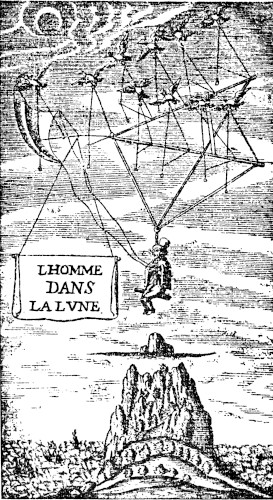
Gonsales' Voyage to the Moon
APPENDICES
1. Extracts From Godwin, D'urfey and Swift
2. Bibliography
3. Genealogy
4. Coat of Arms