VOYAGE TO THE MOON (continued 3)
Richard Aldington translation
He was still talking when a man came in completely naked. I immediately sat down and put on my hat to do him honour, for in that country these are marks of the greatest respect one can show a man.
"The Kingdom", said he, "desires that you will advertise the magistrates before leaving for your country because a mathematician has just promised the council that if, when you reach your world, you will construct a certain machine which he will show you corresponding to another which he will have ready here, he will draw your world to him and join it to our globe."
As soon as he was gone I asked the young host: "I beg you will tell me what is meant by that bronze, shaped like our parts of shame, which hung from that man's belt? During the time that I lived at the court in a cage I saw quantities of them, but as I was almost always surrounded by the Queen's waiting-women I feared I should be lacking in respect to their sex and rank if I directed the conversation to so homely a matter in their presence."
He replied: "Here the females no more than the males would be so ungrateful as to blush at the sight of that which made them; the virgins are not ashamed to respect upon us, in memory of their mother Nature, the one thing which bears her name. Know then that the scarf with which this man is honoured and upon which hangs like a medal the shape of a virile member, is the symbol of a gentleman and the mark which distinguishes a noble from a commoner."
I protest this paradox seemed to me so extravagant that I could not keep from laughing.
"This seems to me a most extraordinary custom", said I to my young host, "since in our world to wear a sword is the mark of nobility."
He was not moved by this but exclaimed: "My little man, the nobles in your world are mad to parade an instrument which is the mark of a hangman, which is only forged for our destruction and is indeed the sworn enemy of everything that lives! And just as mad on the contrary to hide a member without which we should be in the category of things that are not, the Prometheus of every animal and the indefatigable repairer of Nature's weaknesses! Woe to the country where the marks of generation are ignominious and where those of destruction are honourable! You call that member, 'the parts of shame', as if there were anything more glorious than to give life and anything more infamous than to take it away."
During this discourse we continued to dine and as soon as we arose from our beds we went into the garden to take the air. The diversity and the beauty of the place delayed our conversation for some time. But since the noblest desire which then moved me was to convert to our religion a soul so uplifted above the vulgar mob, I exhorted him a thousand times not to smirch with matter the fair genius with which Heaven had endowed him, to draw out of the throng of animals a spirit capable of the Beatific Vision, in fine, to think seriously of uniting some day his immortality with pleasure rather than with pain.
"What!" replied he, with a peal of laughter, "you think your soul immortal to the exclusion of that of beasts? My dear friend, without exaggeration your pride is very insolent! And, I beseech you, whence do you deduce this immortality to the prejudice of the Beasts? Is it because we are gifted with reason and they not? To begin with, I deny that and whenever you please I will prove to you that they reason like ourselves. But even if it were true that reason has been granted us as a prerogative and that it was a privilege reserved to our species alone, does that mean that God must enrich man with immortality when He has already squandered reason upon him? I suppose I should give, in that case, a pistole to a beggar because I gave him a crown yesterday? You yourself see the falsity of the argument and that, on the contrary, if I am just, I ought to give a crown to another rather than a pistole to the first, since the other has had nothing from me. We must conclude from this, my dear friend, that God, who is a thousand times more just than we are, will not have given everything to some and nothing to others. To allege as an example the case of the eldest sons in your world, whose share engulfs almost all the property of the family, is simply a weakness of fathers, who are desirous of perpetuating their names and fear they may be lost or dissipated by poverty. But God is not capable of error, and has been careful not to commit one so great; then, since there is neither before nor after in God's eternity, with him the younger sons are no younger than the elder."
I do not dissimulate that this reason shook me.
"Permit me", said I, "to break off upon this matter, for I do not feel myself strong enough to reply to you. I shall go seek a solution of this difficulty from our mutual Instructor."
Without waiting for his reply I immediately went to the room of this able demon, and waiving any preliminaries I put before him the objections to the immortality of our souls which I had just heard, and this is what he replied:
"My son, this young hot-head is desirous of persuading you that it is unlikely man's soul should be immortal because God, who has called Himself the common Father of all beings, would be unjust if He had favoured one species and abandoned generally all the others to annihilation or misfortune. It is true these reasons glitter a little at a distance. Although I might ask him how he knows that what is just to us is also just to God, how he knows that God measures with our measuring-rod, how he knows that our laws and customs, instituted only to remedy our own disorders, serve also to cut out pieces from the omnipotence of God; I will pass over all these things together with all that has been so divinely answered on this point by the fathers of your Church and I will discover to you a mystery not yet revealed.
"My son, you know that a tree is made from earth, a pig from a tree and a man from a pig. May we not then believe, since all creatures in Nature tend to become more perfect, that they aspire to become men, whose essence is the result of the finest and best imagined mixture in the world and the sole link between the life of brutes and of angels? Only a pedant would deny that these metamorphoses occur. Do we not see that an apple-tree sucks up and digests the surrounding turf by means of the heat of its germ as if through its mouth; that a pig devours its fruit and thereby converts it into a part of itself; and that a man by eating this pig reheats this dead flesh, joins it to himself, and so causes this animal to live again in a more noble species? Thus the Great Pontiff upon whose head you see a tiara was a bunch of grass in my garden sixty years ago. Since God is the common Father of all His creatures and should love them all equally, is it not most credible that by a metempsychosis more reasonable than that of the Pythagoreans all sensible life, all vegetable life, in fine, all matter, will pass through man and then the great day of Judgment will come, to which the prophets direct the secrets of their philosophy?"
Fully satisfied I returned to the garden and began to repeat to my companion what our Master had taught me, when the Physionome arrived to take us to dinner and to the dormitory. I shall not particularize these, because I ate and went to bed as on the preceding day.
The next morning as soon as I was awake I went to arouse my antagonist. "'Tis as great a miracle", said I when I reached him, "to find a great wit like yours buried in sleep, as to see fire without movement."
He was annoyed by this clumsy compliment. "But", cried he in a passionate rage, "will you never free your mouth as well as your reason from these fabulous expressions of miracles? Such words disgrace the name of philosopher. Since the wise man sees nothing in the world which he does not understand or which he considers incapable of being understood, he ought to abominate all these expressions like miracles, prodigies, supernatural events, invented by the stupid to excuse the weaknesses of their minds."
I then felt conscientiously obliged to say something to disabuse him.
"Although you do not believe in miracles", I replied, "they do not cease to occur, and many of them. I have seen them with my own eyes. I have seen more than twenty sick people miraculously cured."
"You say", he interrupted, "that these people were cured miraculously, but you do not know that the power of the imagination is able to combat all maladies, because there is a certain natural balsam extended through our bodies containing all the qualities contrary to all those of every disease that attacks us. Our imagination is warmed by the pain and seeks in its place the specific remedy to oppose the venom, and so cures us. For this reason the ablest doctor in our world advises a patient rather to take an ignorant doctor whom he thinks very skilful than to take a very skilful doctor whom he thinks ignorant, because he believes that our imagination works for our health and when only slightly aided by remedies is capable of curing us, but that the most powerful remedies are too weak when not applied by the imagination! You are surprised that the first men in your world lived so many centuries without having any knowledge of medicine? Their constitution was strong and this universal balm had not been dissipated by the drugs with which your doctors undermine you. To become convalescent they had only to desire strongly and to imagine they were cured; immediately their clear, vigorous and taut imagination plunged into this vital oil, applied the active to the passive and almost in a twinkling they were as well as formerly. Even to-day these astonishing cures continue, but the populace attributes them to a miracle. For my part, I do not believe in a miracle at all and my reason is that it is more easy for all these talkers to be wrong than for the thing to happen. Let me ask them this: A man has a fever and he has been cured. It is clear that during his illness he wished very ardently to recover his health and so made vows; it necessarily followed, since he was ill, that he should die, that he should remain ill or that he should get better. If he had died they would have said God had rewarded him for his pains; they might have maliciously equivocated by saying that He had cured the sick man of all his ills according to his prayers. If his infirmity had persisted they would have said he lacked faith; but because he recovered it is a visible miracle! Is it not far more likely that his fantasy, excited by a violent desire for health, achieved this end? I admit that many of these gentlemen who make vows recover; but how many more do we see who have perished miserably with their vows?"
"But at least", I replied, "if what you say of this balsam is true, it is a proof that our soul is reasonable, since without making use of our reason and without leaning on the support of our will it knows of itself how to apply the active to the passive as if it were outside us. Well, if it is reasonable when it is separated from us we must necessarily conclude that it is spiritual; and if you admit it is spiritual I conclude that it is immortal, since death only happens to animals through those changes of form whereof matter alone is capable."
The young man then sat up in bed and making me sit down also, spoke in much these terms:
"I am not surprised that the souls of beasts (which are corporeal) should die, since they are probably only a harmony of the four qualities, the strength of the blood, a relationship of well-proportioned organs; but I am very surprised that our incorporeal, intellectual and immortal soul should be constrained to leave us for the same reasons that make an ox perish. Has the soul made an agreement with our body that, when the body receives a sword thrust in the heart, a leaden bullet in the brain, a musket shot through the trunk, it will abandon immediately its ruined house? But the soul often breaks this contract, for some die of a wound which others escape; and so every soul must make a separate bargain with its body. Truly this soul which, as they make us believe, is so clever, is very foolish to leave its lodging when it sees that by leaving this place it will find its apartment marked out for it in Hell. And if this soul were spiritual and reasonable by itself, as they say, if it were as capable of intelligence when separated from our body as it is when invested by the body, how is it that those born blind, with all the advantages of this intellectual soul, are not able to imagine what sight is? Why do the deaf not hear? Is it because they are not yet deprived of all their senses by death? What! I cannot then make use of my right hand because I have a left as well? To prove that the soul cannot act without senses although it is spiritual, they allege the case of a painter who cannot make a picture without brushes. Yes, but that is not to say that when a painter, who cannot work without brushes, has lost his colours, his pencils, and his canvases as well, he can then do better. On the contrary, the more obstacles are opposed to his work the more impossible it will be for him to paint. However, they maintain that this soul, which can only act imperfectly when it has lost one of its tools in the course of life, can work perfectly when it has lost them all after our death. If they repeat to us that the soul does not need these instruments, I shall repeat to them that they ought to whip the blind who pretend they cannot see."
"But", said I, "if our soul dies, as I see you wish to deduce, the resurrection you expect would be only a chimera, for God would have to recreate our souls and that would not be resurrection."
He interrupted me and shook his head.
"Hey! Faith!" cried he, "who has deluded you with that fairy-tale? What! You? What! I? What! My maid-servant be resurrected?"
"This is not an amusing tale", I replied, "it is an indubitable truth which I will prove to you."
"And I", said he, "will prove to you the contrary. To begin with, suppose that you ate a Mohammedan; you convert him consequently into your own substance! Is it not true that when you have digested this Mohammedan he is changed partly into flesh, partly into blood, partly into seed? You embrace your wife and with the seed drawn entirely from this Mohammedan's body you cast the mould of a pretty little Christian. I ask; will the Mohammedan have his body at the resurrection? If the earth yields it up to him, the little Christian will not have his body, since it is only a part of the Mohammedan's. If you tell me that the Christian will have his, God will have to take from the Mohammedan that which the little Christian only received from the Mohammedan's body. And so inevitably one or the other will be without a body! You will reply perhaps that God will reproduce from matter a body to furnish the one who is without a body? Yes, but another difficulty stops us. Suppose the damned Mohammedan is resurrected and God gives him a new body, because the Christian has stolen his old one, since the body alone does not make the man, any more than the soul alone, but the two joined together in one person, and since the soul and the body each departed from the man whole, if God then makes the Mohammedan another body, it is no longer the same individual. So God damns a man who is not the man who has merited Hell. One body has whored, it has criminally abused all the senses and, to punish this body, God casts into the fire another, which is virgin and pure, and has never lent its organs to the performance of the slightest crime. And what is even more ridiculous is that this body will have deserved both Hell and Paradise; for, in so far as it is Mohammedan, it must be damned, and in so far as it is Christian, it must be saved. Thus God cannot put it in Paradise without being unjust and rewarding with glory instead of with the damnation it deserved as Mohammedan; and He cannot cast it into Hell without being unjust and rewarding with eternal death instead of the blessedness it deserved as Christian. Then, if He wishes to be just, He must both save and damn this man eternally."
"I have nothing to reply", I answered, "to your sophistic arguments against the resurrection; God has said it and God cannot lie."
"Not so fast", he retorted, "you are still at 'God has said'; you must first prove there is a God, which for my part I wholly deny."
"I shall not waste my time", said I, "by repeating to you the obvious demonstrations used by philosophers to prove it; I should have to reiterate all that has ever been written by reasonable men. I simply ask you what harm there is in believing it; I am assured you cannot discover any. Then if nothing can be derived from it but what is useful, why do you not accept it? If there is a God, and you do not believe in Him, you will not only be mistaken but you will have disobeyed the precept which bids you believe in Him; and if there is no God, you will be no better off than we!"
"On the contrary", he replied, "I shall be better off than you, for if there is no God, you and I will be equal. But if, on the contrary, there is a God, I shall not have offended against something which I believed did not exist, since to sin one must either know or will. Do you not see that even a rather foolish man would not think that a porter had injured him if the porter had done it accidentally, or had taken him for someone else, or if he had been drunk? How much more then should God, who is wholly steadfast, forbear to grow angry with us for not having known Him since He Himself has refused us the means of knowing Him. On your honour now, little animal, if belief in God were so necessary to us, if it were a matter of our eternity, would not God Himself have inculcated in us all a light as clear as that of the Sun which hides itself from no one? To feign that He plays hide-and-seek with men, says like children, 'Cuckoo, there he is!' that is to say sometimes hides Himself, sometimes shows Himself, disguises Himself to some and reveals Himself to others—that is to make oneself a God who is either silly or malicious, for if I have come to know Him through the strength of my genius, the merit is His and not mine, since He might have given me an imbecile soul or imbecile organs which would have made me incapable of knowing Him. And, on the contrary, if He gave me a mind incapable of understanding Him, it is not my fault but His, since He could have given me a mind so keen that I should have comprehended Him."
These ridiculous and devilish opinions made me shudder from head to foot. I began to look at this man with a little more attention and I was startled to notice in his face something indefinably frightful which I had not yet perceived. His eyes were small and deep-set, his complexion swarthy, his mouth large, his chin hairy, his nails black. O God! thought I at once, this wretch will be damned after this life and he may even be the anti-Christ so much spoken of in our World.
I did not wish to let him know what I thought, because of the esteem I had for his wit, and truly the favourable aspects of Nature towards his cradle had made me conceive some friendship for him. Yet I could not so wholly contain myself but that I broke out into imprecations which menaced him with a bad end. But, throwing back my anger at me, he exclaimed: "Yes, by death...." I do not know what he meant to say but at this moment there was a knock at the door of our room and a large, black, hairy man came in. He approached us, seized the blasphemer by the middle and carried him off up the chimney. My pity for this wretch's fate obliged me to clasp him in order to drag him from the Ethiopian's claws, but he was so powerful that he carried us off both and in a moment we were up among the clouds. I was obliged to grasp him tightly now, not from love of my neighbour but from fear of falling. After passing I know not how many days in travelling through the sky, without knowing what would become of me, I saw I was approaching our world. Already I could distinguish Asia from Europe and Europe from Africa. And now I was so near that I could not lift my eyes beyond Italy, when my heart told me that this Devil was no doubt carrying my host to Hell, body and soul, and that he was passing by way of our earth, because Hell is in its centre. I wholly forgot this thought and all that had happened to me since the Devil had been our carriage, through the fear I was cast into by the sight of a flaming mountain which I almost touched. The sight of this burning spectacle made me cry out "Jesus Maria!" I had scarcely finished the last letter when I found myself lying upon the grass at the top of a little hill with two or three shepherds around me reciting litanies and speaking to me in Italian.
"Oh!" cried I, "praised be God! At last I have found Christians in the world of the Moon. Tell me, my friends, in what province of your world I am now?"
"In Italy", they replied.
"What", I interrupted, "is there an Italy in the world of the Moon also?"
I had still reflected so little on this accident that I had not yet perceived they were speaking to me in Italian and that I was replying in the same tongue.
When I was altogether disabused and nothing further prevented me from recognising that I was once more in this world, I let myself be taken where these peasants wished to lead me. But I had not arrived at the gates of ——, when all the dogs in the town came rushing upon me and had not my fear caused me to rush into a house and shut the door against them I should infallibly have been devoured.
A quarter of an hour afterwards, while I was resting in this house, all the dogs of the Kingdom I verily believe could be heard in a turmoil outside. All kinds from the bulldog to the lapdog could be seen howling with a most terrible fury as if they were keeping the anniversary of their first Adam.
This adventure caused no little surprise to all people who saw it; but as soon as I had directed my reflections upon this circumstance, I imagined at once that these animals were infuriated with me because of the world whence I came. "For", said I to myself, "since they are accustomed to bay the Moon on account of the pain she causes them from so far, no doubt they would have thrown themselves upon me because I smell of the Moon, whose odour annoys them."
I exposed myself to the Sun stark-naked on a terrace, to cleanse myself from this bad air. I dried myself some four or five hours, at the end of which I went down and the dogs no longer smelling the influence which had made me their enemy all returned home.
At the port I inquired when a ship would leave for France and when I was embarked my mind was wholly occupied in ruminating on the wonders of my voyage. A thousand times I admired the providence of God, which had placed those naturally impious men in a situation where they could not corrupt His chosen, and had punished them for their pride by giving them up to their own self-conceit. And I do not doubt that so far He has put off sending someone who preached them the Gospel, because He knew they would abuse the occasion and that this resistance would only serve to make them merit a harsher punishment in the next world.
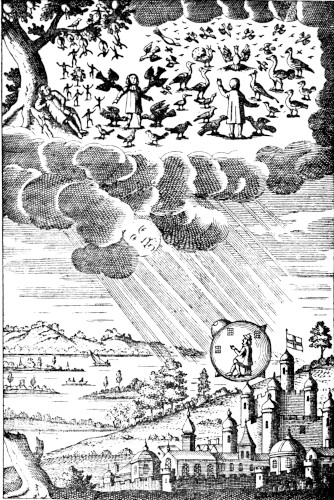
Frontispiece to Lovell's expurgated edition.