VOYAGE TO THE SUN (continued 2)
Richard Aldington translation
I never think of the malicious caprices of Fortune, who continued to oppose the success of my enterprise with such obstinacy, but I wonder how it was my brain was not turned. But hearken now a miracle, which future ages will find it difficult to believe. Shut up in a transparent box, of which I had lost sight, with my movement so slackened that I did well not to fall back, in a state where all that the whole machine of the world encloses was powerless to aid me, I was reduced to the height of extreme misfortune; yet, just as when we are dying we are inwardly moved to desire to embrace those who gave us our being, so did I lift my eyes to the Sun, our common father. This ardour of my will not only bore up my body, but hurled it toward the thing which it desired to embrace. My body thrust on my box and in this fashion I continued my journey. As soon as I perceived this I stiffened all the faculties of my soul with more attention than ever to attach them in the imagination to what attracted me, but the efforts of my will forced me against the roof in spite of myself and the weight of my cabin on my head so incommoded me that finally the burden forced me to grope for its invisible door. Fortunately I found it, opened it and threw myself outside; but that natural apprehension of falling, which all animals have when they find themselves supported by nothing, made me stretch out my arm suddenly to catch hold of it. I was only guided by Nature, which cannot reason, and therefore Fortune, her enemy, maliciously thrust my hand against the crystal roof. Alas! What a thunder-clap it was in my ears when I heard the noise of the icosahedron breaking into fragments! So great a disorder, so great a misfortune, so great a terror are beyond all expression. The mirrors attracted no more air, for there was no more vacuum; the air ceased to become a wind by hastening to fill it; the wind ceased to urge my box upwards; in short, soon after this breakage I saw it falling far across the vast fields of the world and in that region it regained the opaque darkness it had exhaled. Since the energetic strength of the light diminished there, the box eagerly rejoined the dark density which was, as it were, essential to it, just as we see souls long after their separation return to seek their bodies, and, in trying to rejoin them, wander about their sepulchres for a hundred years. I surmise that it lost its transparency in this way, for I saw it afterwards in Poland in the same state as it was when I first entered it. I have since learned that it fell in the Kingdom of Borneo, under the equinoctial line; that a Portuguese merchant bought it from the islander who found it and that, passing from hand to hand, it came into the possession of the Polish engineer who now flies in it.[59]
Thus suspended in the airy regions of the sky, filled with consternation at the death I expected by my fall, I turned my sad eyes to the Sun, as I have already told you. My sight carried my thought with it and my looks fixedly attached to its globe marked out a way whose traces were followed by my will to lift my body there. This vigorous bound of my soul will not be incomprehensible to any one who will consider the most simple effects of our will; it is well known, for example, that when I wish to leap, my will, borne up by my fantasy, raises the whole microcosm and tries to carry it to the point desired, and if it does not always reach this, the reason is that the principles of Nature, which are universal, prevail over individuals, and, since the power of will is peculiar to sentient things and that of falling to the centre is common to all matter, my leap is forced to end when its mass, having conquered the insolence of the will which surprised it, draws near the point to which it tends.
I shall say nothing more of what happened on the rest of my journey for fear of taking as long to tell it as to make it; let it suffice that at the end of twenty-two months I landed very happily upon the great plains of the day. This land is like burning snow-flakes, so luminous is it. Yet it is an incredible thing which I have never been able to understand whether, after my box fell, I rose to or descended upon the Sun. I only remember that when I arrived there I walked lightly upon it; I only touched the ground by a point and I often rolled like a ball without finding it any more uncomfortable to walk with my head than with my feet. Although my legs were sometimes turned towards the sky and my shoulders towards the ground, I felt as naturally placed in this position as if my legs had been upon the ground and my shoulders towards the sky. On whatever part of my body I placed myself, on the belly, on the back, on an elbow, on an ear, I found myself upright. By this I perceived that the Sun is a world which has no centre and that, since I was far outside the active sphere of our world and all those I had met with, it was consequently impossible that I should still weigh, since weight is only the attraction of a centre within the sphere of its activity.
The respect with which I printed my steps upon this luminous country suspended for a time my burning ardour to continue my voyage. I felt myself ashamed to walk upon the daylight; my astonished body was desirous of support from my eyes and since this transparent land which they penetrated could not support them, my instinct, having mastered my thought in spite of me, drew me to the most hollow part of a depthless light. Little by little, however, my reason undeceived my instinct; I pressed assured and not trembling steps upon the plain and I counted my strides so proudly that if men could have perceived me from their world they would have taken me for the great God who walks upon the clouds. After I had walked about fifteen days, as I believe, I reached a district of the Sun less resplendent than that from which I came. I felt deeply moved by joy and I imagined that this joy was assuredly the result of a secret sympathy for its opacity retained by my being. The knowledge I had of it did not make me desist from my enterprise; for I was like those sleeping old men who, although they know that sleep is bad for them and that they have ordered their servants to deprive them of it, are nevertheless very annoyed at the time they are awakened. So, as my body grew darker when I reached more shaded provinces, it re-contracted the weaknesses brought by this infirmity of matter; I grew weary and sleep grasped me.
Those pleasing languors which possess us at the approach of sleep poured so much pleasure into my senses that, captured by pleasure, my senses forced my soul to thank the tyrant who chains his slaves; for sleep, that old tyrant of one half our days, who, on account of his old age, cannot endure the light or look upon it without swooning, had been forced to abandon me when I entered the brilliant climates of the Sun and had come to wait for me upon the borders of the shaded region of which I speak, where he caught me, arrested me his prisoner, and shut up his declared enemies, my eyes, under the dark vault of my eyelids; and, fearing lest my other senses should betray him as they had betrayed me and trouble him in the peaceable possession of his conquest, he tied down all of them to their beds. All this means in two words that I lay down very weary upon the sand. It was a flat plain, so bare that as far as I could see my sight did not even meet a bush; and yet when I woke up I found myself under a tree, in comparison with which the tallest cedars would seem like grass. Its trunk was of massive gold, its branches of silver and its leaves of emeralds, which, underneath the glittering green of their precious surface, reflected as in a mirror the images of the fruit which hung round about. But judge whether the fruit owed anything to the leaves: the burning scarlet of a large carbuncle formed one half of each and the other half was uncertain whether its material came from chrysolite or from a piece of golden amber; the open flowers were roses of very large diamonds and the buds were big, pear-shaped pearls. A nightingale, whose smooth plumage rendered him excellently beautiful, was perched on the summit and seemed with his melody desirous of forcing the eyes to confess to the ears that he was not unworthy of the throne upon which he was seated.
For a long time I remained amazed at the sight of so rich a spectacle and I could not be satiated with looking at it; but as I was occupying all my thoughts in contemplating among the other fruits an extraordinarily beautiful pomegranate, whose pulp was a cluster of several large rubies, I perceived the little crown which took the place of its head was moving and stretching out until it formed a neck. Then I saw something white seething above it which, by thickening, growing, advancing and retiring the matter in different places, at last appeared as the face of a small bust of flesh. This small bust ended in a circle about the waist; that is to say, its lower parts still kept the shape of an apple. Little by little it stretched out, its stem became two legs, and each of its legs split into five toes. This humanised pomegranate loosened itself from its stem and with a light bound fell exactly at my feet. Certainly I must admit I was impressed with veneration when I saw this little reasonable apple, this little piece of a dwarf no larger than my thumb, but strong enough to create itself, walking before me proudly.
"Human animal", he said in that mother-tongue, whereof I have formerly spoken, "after I had observed you for a long time from the branch on which I was hanging I thought I read in your face that you were not an inhabitant of this world, and for that reason I have descended to be enlightened by the truth."
When I had satisfied his curiosity about all the matters concerning which he questioned me, I said to him:
"But tell me who you are; what I have just seen is so very astonishing that I despair of ever knowing the cause unless you instruct me. What! a huge tree all of pure gold, whose leaves are emeralds, the flowers diamonds, the buds pearls, and, among all this, fruits which make themselves into men in the twinkling of an eye? For my part I admit that the comprehension of such a miracle passes my capacity."
I was awaiting his reply to this explanation, when he said:
"As I am the king of the nation which makes up this tree, you will not take it ill if I call them to follow me."
When he had spoken thus I noticed that he collected himself in meditation. I do not know if he wound up the interior springs of his will and thus excited outside himself the movement, which was the cause of what you are about to hear, but it is certain that immediately afterwards all the fruits, all the flowers, all the leaves, all the branches, in short, the whole tree, fell apart into little seeing, feeling and walking men, who began to dance around me as if to celebrate their birthday at the very moment of their birth. The nightingale alone retained its shape and was not metamorphosed; it came and perched on the shoulder of the little monarch, where it sang an air so melancholy and so amorous that the whole assembly, including the prince himself, were moved by the gentle languors of its dying voice and shed a few tears. My curiosity to learn whence this bird came caused me so extraordinary a longing to speak that I could not contain it.
"Seigneur", said I, addressing myself to the king, "if I did not fear to importune your majesty I should ask you why among so many metamorphoses the nightingale alone has kept its being?"
The little prince listened to me with a benevolence which showed his natural kindness; and, understanding my curiosity, he replied:
"The nightingale has not changed its form like us, because it could not. It is a real bird and is no more than it appears to be. But let us walk towards the opaque regions and on the way I will relate to you who I am, together with the story of the nightingale."
I had scarcely showed the satisfaction I received from his offer, when he bounded lightly on to one of my shoulders. He raised himself on his little toes to bring his mouth level with my ear; and sometimes hanging by my hair and sometimes sliding down it, he said:
"By my faith, you must excuse a person who is already out of breath. I have crowded lungs in a little body and my voice is consequently so weak that I am forced to strain to make myself heard. I hope the nightingale will speak for himself. Let him sing if he wishes, and we shall at least have the pleasure of hearing his story in music."
I replied that I was not yet sufficiently practised in the language of birds; that, indeed, a certain philosopher whom I had met on my way to the Sun had given me some general principles to understand that of the beasts, but that they were not enough to understand all words in general, nor enough for me to be moved by all the delicate points which would be met with in an adventure such as this must be.
"Well", said he, "since you will have it so, your ears shall be deprived not only of the nightingale's beautiful songs, but of almost all its adventure, whereof I can only tell you that part which has come to my knowledge; however, you must be content with this fragment, because, even if I knew it all, the brevity of our journey to its country, whither I am about to conduct you, would not permit me to take my story further."
Having spoken thus, he jumped from my shoulder to the ground. He then gave his hand to his little subjects and began to dance with them in a kind of movement which I cannot describe, because nothing like it has ever been seen. But hearken, nations of the Earth, to that which I do not compel you to believe, because it passed for a miracle in a world where your miracles are only natural effects! As soon as these little men began to dance I seemed to feel their motion in myself and my motion in them. I could not look upon this dance without being distinctly moved from where I was, as if a whirlwind agitated all the parts of my body with the same dance and the particular movement of each one; and I felt the same joy expanding upon my face which a similar movement had spread upon theirs. As the dance drew closer, the dancers became confused with a much more rapid and more imperceptible motion; it seemed that the object of the ballet was to represent an enormous giant; for as they drew nearer each other and redoubled the swiftness of their movement they became so closely mingled that I perceived nothing but a great, open and almost transparent colossus; and yet my eyes perceived them interlinked with each other. At this moment I began to be unable to distinguish any more the diversity of the movements of each, on account of their extreme rapidity and also because this rapidity shrank as it approached the centre, and thus each vortex at last occupied so little space that it escaped my sight. Yet I think these parts drew still closer together; for this once unwieldy human mass gradually reduced itself until it formed a young man of moderate height, all of whose limbs were proportioned with a symmetry to which perfection at its strongest idea could never have flown. He was beautiful beyond everything to which all painters have raised their fantasy; but what I thought very marvellous was that the connection of all the parts which completed this perfect microcosm took place within the twinkling of an eye. The most agile of our little dancers leaped up with a flourish to the height and into the position needed to form a head; others hotter and not so loose formed the heart; and others much heavier only supplied the bones, the flesh and the plumpness.
When this large, beautiful young man was entirely finished, although his rapid construction had scarcely allowed me any time to notice an interval in its progress, I saw the king of the whole people enter by the mouth, yet it seemed to me he was attracted into this body by the breathing of the body itself. All this mass of little men had not yet given any sign of life; but as soon as it had swallowed its little king, it felt itself one. He remained some time looking at me and then, as if he were grown familiar by looking, he approached me, caressed me, and giving me his hand said:
"And now without damaging the delicacy of my lungs I can converse with you about the things which you long to know; but it is reasonable to reveal to you first of all the hidden secrets of our origin. Learn then that we are animals inhabiting the luminous regions of the Sun; the most general and the most useful of our occupations is to travel through the vast countries of this great world. We note carefully the habits of the nations, the peculiarity of climates and the nature of all things that can merit our attention, from which we build up an exact science of what exists. You must know that my vassals travelled under my guidance and, in order to have leisure to observe things more curiously, we did not keep the conformation particular to our body (which your senses could not perceive), whose subtlety would have caused us to move too quickly; but we made ourselves into birds. All my subjects became eagles by my command; and for fear they should grow weary I transformed myself into a nightingale to soothe their fatigue by the charms of music. I followed the rapid flight of my people without flying, for I was perched on the head of one of my vassals. We were following our road when a nightingale, dwelling in a province of the opaque country, through which we were then travelling, astonished to see me in the power of an eagle (it could only take us for what it saw us to be), began to commiserate my misfortune. I caused my followers to halt and we descended on the tops of some trees where sighed this charitable bird. I took so much pleasure in the sweetness of its mournful songs that I would not undeceive it, in order that I might enjoy them longer and more at my ease. On the spur of the moment I invented a story, in which I related to it imaginary misfortunes which had caused me to fall into the hands of the eagle; I mixed with it such surprising adventures, wherein the passions were so skilfully aroused and the music so well suited to the words, that the nightingale was beside itself.
"One after the other we sang to each other in music the story of our mutual loves. In my airs I sang that I was not only consoled for, but that I even rejoiced in, my misfortune, since it had procured me the glory of being lamented in such beautiful songs; and this inconsolable little creature replied in its airs that it would gladly accept all my esteem for it, if it knew that this could make it merit the honour of dying in my place, but that, since Fortune had not reserved so much glory for so unfortunate a creature, it would only accept of that esteem sufficiently to prevent me from blushing for my friendship. In my turn I replied again with all the transports, all the tenderness and all the caresses of so touching a passion that twice or thrice I perceived it ready to die of love on its branch. In truth, I mingled such skill with the softness of my voice and I surprised its ear with such masterly strokes and with paths so little frequented by those of its kind, that I carried off its fair soul into all the passions by which I desired to dominate it.
"We passed twenty-four hours in this exercise and I think we should never have been tired of making love if our throats had not refused us voices. This was the only obstacle which prevented us from proceeding, but feeling that the labour was beginning to hurt my throat and that I could not go further without falling into a swoon, I made it a sign to come near me. The peril in which it thought I was in the midst of so many eagles convinced it that I was calling it to my help. It flew immediately to my aid and, wishing to give a glorious proof that it dared to brave death even to his throne for a friend's sake, it came and sat proudly on the great curved beak of the eagle on which I was perched. So great a courage in so weak an animal moved me to veneration; for, even if I had called to it as it supposed and although there is a law among animals of the same kind to help another in misfortune, yet the instinct of its timid nature ought to have made it hesitate. But it did not hesitate. On the contrary, it started so hastily that I do not know which flew the first, my signal or the nightingale. Proud at seeing the tyrant's head under its feet, happy to think that it was about to be sacrificed for love of me almost within my wings and that perhaps some fortunate drops of its blood might be sprinkled on my feathers, it looked gently towards me and, having as it were said farewell by a look, which seemed to ask my permission to die, it thrust its little beak so sharply into the eagle's eyes that I saw they were crushed rather than struck. When my bird felt it was blind it made itself new sight at once. I remonstrated gently with the nightingale on its too precipitate action and, judging that it would be dangerous to hide from it any longer our real existence, I revealed myself to it and told it what we were; but the poor little creature, convinced that these barbarians, whose prisoner I was, forced me to feign this fable, would give no faith to anything I could say. When I perceived that all the reasons by which I tried to convince it were mere waste of breath, I whispered some orders to ten or twelve thousand of my subjects and immediately the nightingale perceived at its feet a river flowing under a boat and the boat floating upon the river. It was just large enough to hold me twice over. At the first signal I made to them my eagles flew off and I threw myself into the boat, whence I cried to the nightingale to embark with me if it could not yet resolve to abandon me so soon. As soon as it came in I commanded the river to flow towards the region where my people were flying; but since the fluidity of the water was less than that of the air and consequently the rapidity of their flight greater than that of our sailing, we remained a little behind.
"All the way I tried to undeceive my little guest; I pointed out to it that it could hope for no fruit from its passion, since we were not of the same species; that it ought to have perceived this when the eagle whose eyes it had crushed had made new eyes in its presence, and when at my command ten thousand of my vassals had metamorphosed themselves into this river and the boat in which we were sailing. My arguments were unsuccessful. The nightingale replied that as to the eagle making itself eyes as I asserted, there had been no need, because it was not blinded, since the beak had not pierced its eye-balls; and as to the river and the boat, which I said had only been created by a metamorphosis of my people, they had been in the wood since the creation of the world, only no one had noticed them. Seeing it was so ingenious in deceiving itself I agreed with it that my vassals and I would metamorphose ourselves into whatever it liked before its eyes, on condition that afterwards it would return to its own country. Sometimes it asked that this should be a tree; sometimes it wished this to be a flower, sometimes a fruit, sometimes a metal, sometimes a stone. At last to satisfy all its desires at once, when we had reached my court at the place where I had ordered it to await me, we metamorphosed ourselves before the nightingale's eyes into that precious tree, whose shape we have just abandoned, which you met with on your road.
"Now I see this little bird resolved to return into its own country, my subjects and I will renew our shape and continue our journey. But first of all it is reasonable to tell you who we are: animals, natives of the Sun in its luminous part, for there is a very remarkable difference between the nations produced by the luminous region and the nations of the opaque region. In the world of the Earth you call us Spirits and your presumptuous stupidity gave us this name because you could not imagine any animals more perfect than man, and yet you saw certain creatures perform acts above human power, and so you thought these animals were Spirits. But you are mistaken, nevertheless; we are animals like you. Although, as you have just seen, we give our matter the shape and essential form of those things into which we desire to metamorphose ourselves, whenever we please, that does not mean that we are Spirits. But hearken, and I will discover to you why it is that all these metamorphoses which seem to you so many miracles are purely natural processes. You must know that since we were born inhabitants of the bright part of this great world, where the principle of matter is action, our imagination is necessarily much more active than that of the inhabitants of the opaque regions and the substance of our bodies is also much finer. Granted this, it inevitably follows that since our imagination meets with no obstacle in the matter which composes us, it arranges that matter as it desires and since it is mistress of our whole mass it causes this mass to pass, by moving all its particles, into the order necessary to create on a large scale the thing it has formed in little. Thus each of us imagined the place and part of that precious tree into which he desired to change, and by this effort of imagination we excited our matter to the movements necessary to produce them, and therefore we became metamorphosed into them. Thus, when my eagle's eyes were crushed, to re-establish them he had only to imagine himself a clear-sighted eagle, since all our transformations occur by means of movement; for this reason, when we transmuted ourselves out of leaves, flowers and fruits into men, you saw we still danced some time after, because we had not yet recovered from the movement we had to give our matter to make ourselves into men: like bells which vibrate after they stop and continue in muffled tones the same sounds which the clapper caused by striking them. For the same reason you saw us dance before we made a large man because, in order to produce it, we had to give ourselves all the general and particular movements necessary to constitute it; so that this motion, bringing our bodies little by little closer to each other and absorbing them one with another through its movement, should create in each part the specific movement it ought to have. You men cannot do the same things on account of the weight of your mass and the coldness of your imaginations."
He continued his proof and supported it with examples so palpable that finally I threw off a large number of badly proved opinions by means of which our pig-headed men of learning prejudice weak people's understanding. Then I began to comprehend that in very truth the imagination of these Solar people, which on account of the climate must be hotter, while for the same reason their bodies must be lighter and their entities more mobile (since in that world, unlike ours, there is no attraction from the centre to turn matter away from the movement imprinted upon it by the imagination) I conceived, I say, that without a miracle this imagination could produce all the miracles it had recently done. A thousand examples of almost similar events, witnessed by the nations of our globe, completed my conviction: Cippus, King of Italy, having witnessed a bull-fight, so filled his imagination with horns all that night that the next morning he found his forehead horned; Gallus Vitius, bending up his soul and exciting it vigorously to conceive the essence of madness, by an effort of imagination gave his matter the same movements this matter should have to constitute madness, and so became mad; King Codrus, the consumptive, fixing his eyes and his thought on the freshness of a young face and upon that flourishing happiness which the boy's youth overflowed with almost to him, and giving his body the movement by which he imagined the young man's health, became convalescent; and lastly several pregnant women made monsters of the children already formed in their wombs, because their imagination was not strong enough to give them themselves the shape of the monsters they imagined, but was strong enough to arrange the much hotter and more mobile matter of the fœtus in the order necessary for the production of these monsters. I am even convinced that, when that famous hypochondriac of antiquity imagined himself a pitcher, if his matter had not been too compact and too heavy to follow the emotion of his fantasy it would have formed a perfect pitcher out of his body, and he would really have appeared a pitcher to everyone as he appeared to himself.
So many other satisfactory examples convinced me to such an extent that I did not doubt any of the marvels related to me by the Man-Spirit. He asked me if I desired anything more of him; I thanked him with all my heart. Afterwards he had still the kindness to advise me, since I was an inhabitant of the earth, to follow the nightingale into the opaque regions of the Sun, because they were more apt for the pleasures desired by human nature. Scarcely had he finished speaking when he opened his mouth very wide and I saw the king of these little animals fly out of his throat in the shape of a nightingale. The large man fell down at once and at the same time all his limbs flew away piecemeal in the shape of eagles. This nightingale, creator of himself, perched on the head of the most beautiful of them, whence he sang an admirable air, by which I fancy he bade me farewell. The real nightingale flew away also, but not in their direction nor so high as they. I did not lose sight of it and we travelled on at about the same pace; for since I had no idea of visiting one country rather than another I was very glad to accompany it, especially since the opaque regions of the birds were more suitable to my temperament and I hoped there to meet with adventures more answerable to my humour.
With this hope I journeyed on for at least three weeks with every sort of pleasure, if I had had only my ears to satisfy, since the nightingale did not let me lack music; when it was weary it came and rested upon my shoulder and when I stopped it waited for me. At last I reached a district in the region of this little singer, which then did not trouble to accompany me further. Having lost sight of it, I sought for it and called it; but at last I grew so weary of vainly pursuing it that I resolved to rest. For this purpose I lay down upon a lawn of soft grass which carpeted the roots of a tall rock. This rock was covered with several green leafy saplings, whose shadow charmed my tired senses most delightfully and forced me to abandon them to sleep, to repair in safety my strength in so calm and cool a place.
STORY OF THE BIRDS[60]
I began to grow sleepy in the shade, when I perceived a marvellous bird gliding in the air above my head; it sustained itself with so light and so imperceptible a movement that I wondered several times if it were not a little universe balanced by its own centre. Nevertheless it descended little by little and at last arrived so near me that my eyes were happily filled with its image. Its tail appeared to be green, its belly of enamelled azure, its wings carnation colour and its purple head glittered, when moved, with a golden crown whose rays sprang from its eyes. For a long time it flew in the air and I was so attentive to everything it did that my soul, being as it were folded and shortened down to the single operation of seeing, scarcely reached to that of hearing for me to perceive that the bird talked by singing.
Released little by little from my ecstasy, I noticed distinctly syllables, words and the speech it articulated. Here then, to the best of my memory, are the terms in which he arranged the fabric of his song:
"You are a stranger", sang the bird very agreeably, "and you were born in a world where I was born too. That secret inclination which draws us to our compatriots is the instinct urging me to desire that you should know my life.
"I see that your mind is trying to understand how it is possible that I can express myself to you in coherent speech, seeing that although birds imitate your words they do not understand them; but when you in turn imitate the barking of a dog or the song of a nightingale you do not understand what the dog or the nightingale means. From that you may deduce that neither birds nor men are any the less reasonable on this account.
"However, just as among you there have been found men so enlightened that they understood and spoke our language, such as Apollonius Tianeus, Anaximander, Æsop[61] and several others, whose names I will not repeat, since you have never heard of them; so among us there are individuals who understand and speak your language. Some, indeed, only know the language of one nation; but just as there are some birds which say nothing, others which twitter, others which talk, so there are still more perfect birds able to use all sorts of idioms. For my part I have the honour to belong to that small number.
"For the rest, you must know that in every world Nature has imprinted in the birds the secret desire to fly here, and it may be that this emotion of our will is the reason for our growing wings, as pregnant women produce upon their children the shape of things they have desired; or rather, like those who, passionately desiring to swim, have been seen while they were asleep to plunge in the current of streams and to cross, with more skill than an experienced swimmer, perils which they would not even have dared to look upon when awake; or like that son of King Crœsus who, by a vehement desire to speak to save his father, suddenly learned a language; or briefly like that ancient, pursued by his enemy and surprised without arms, who felt the horns of a bull growing on his forehead through the desire inspired in him by a fury similar to that of this animal.
"When birds reach the Sun they rejoin the republic of their race. I see that you are impatient to learn who I am. Among you I am called the phœnix; in each world there is only one at a time which lives there during the space of a hundred years; for at the end of a century, when upon some mountain of Arabia it has brought forth a large egg in the midst of the embers of its pyre, whose composition it has culled from the boughs of aloes, from cinnamon and incense, it takes wing and directs its flight toward the Sun, as a country to which its heart has long aspired. Before this it has made every effort to accomplish this voyage, but the weight of its egg, whose shell is so thick it needs a century to hatch, always delayed the attempt.
"I am sure it will be difficult for you to understand this miraculous production, and therefore I will explain it to you. The phœnix is a hermaphrodite but, among hermaphrodites there is still another very extraordinary phœnix, for...."[62]
He remained a half-quarter of an hour without speaking and then added:
"I see that you suspect what I have just told you is false; but if I do not speak the truth may I never reach your globe without an eagle swooping down upon me."
For some time it still remained hovering in the sky and then flew away. The surprise caused me by its recital gave me the curiosity to follow it; and since it cleft the air of the heavens with a flight which was not rapid I accompanied it easily enough with my eyes and gait.
At the end of about fifty leagues I reached a land so filled with birds that their numbers almost equalled those of the leaves protecting them. I was still more surprised that these birds, instead of taking fright at meeting me flew all about me; one sang in my ear, another spread out its tail on my head, and at last, after my attention had been occupied a long time by their little gambols I suddenly felt my arms held down by more than a million of all kinds, weighing so heavily that I could not move them.
They held me in this way until four large eagles arrived, two of which grasped me by the legs in their claws, the two others by the arms, and carried me high up.
Among the crowd I noticed a magpie flying hither and thither, backwards and forwards with great alacrity. I heard it tell me to make no resistance, because its companions were already debating about plucking out my eyes. This warning prevented any resistance I might have made, and so the eagles carried me more than a thousand leagues thence to a large wood, which (according to what I was told by my magpie), was the town where their king lived.
The first thing they did was to imprison me in the hollow trunk of a large oak, while a number of the strongest birds perched on the branches, where they carried out the functions of a company of soldiers under arms. At the end of about twenty-four hours others came on guard to relieve them. While I was awaiting with a good deal of melancholy the manner in which it would please Fortune to dispose of my disasters, my charitable magpie informed me of what was happening. Among other things I remember it warned me that the bird-populace had strongly protested against keeping me so long before eating me, and they had pointed out that I was growing so thin there would be nothing on me but the bones to gnaw. The rumour very nearly caused a rebellion. My magpie had ventured to point out that it was a barbarous proceeding to put to death without trial an animal which to some extent approached their reasoning; they were ready to tear it to pieces, alleging that it would be very ridiculous to think that a completely naked animal, whom Nature herself had taken no care to furnish at its birth with the things necessary to preserve it, should be capable of reason like themselves.
"It might be different", they added, "if he were an animal approaching a little nearer to our shape, but he is the most dissimilar and the most horrible, a bald beast, a plucked bird, a chimera built up of all kinds of natures, terrifying to everyone: Man, I say, so foolish and so vain that he convinces himself we were only created for him; Man who with his marvellously clear-sighted soul cannot distinguish sugar from arsenic and who will swallow the hemlock his wonderful judgment causes him to take for parsley; Man who maintains that we only reason by means of the senses and who has the weakest, slowest and falsest senses of any creature; Man whom Nature made like a monster, in order to create all things, but in whom she inspired the ambition of commanding all animals and exterminating them."
This is what the wisest said; as to the rabble, they exclaimed that it was horrible to believe a beast whose face was not made like theirs could possess reason.[63]
"What!" they murmured to each other; "he has neither beak, claws nor feathers, and yet his soul is spiritual? Gods! What impertinence!"
The pity felt for me by the most generous did not prevent my being subjected to a criminal prosecution. They drew up all the documents on the bark of a cypress tree, and then, after some days, I was carried before the Tribunal of the Birds. The solicitors, counsel and judges at the sitting were magpies, jays and starlings. Only those who understood my language had been chosen.
Instead of interrogating me in the dock they set me astride a stump of rotten wood; then the president of the bench, after clapping his beak twice or thrice and ruffling up his feathers majestically, asked me whence I was, of what nation and of what species? My charitable magpie had given me certain instructions beforehand, which were very useful to me, one of which was to be careful not to admit I was a man. I replied that I came from the little world called the Earth, whereof the phœnix and several others I saw in the assembly might have spoken to them, that the climate in which I was born was situated in the temperate zone of the northern hemisphere in that end of Europe called France. As touching my species, I was not a man as they supposed but a monkey; certain men had taken me from my cradle when I was very young and fed me; their evil education had thus rendered my skin delicate; they had caused me to forget my natural tongue and had instructed me in theirs; to please these ferocious animals I had accustomed myself to walk only upon two feet; in fine, since it is easier to fall than to rise in the scale of animals, the opinions, the habits and the food of these dirty beasts had acquired so much power over me that even my parents, who are monkeys of honour, would hardly recognize me now. I added in support of what I said that I was ready to be searched by experts and if they should decide I was a man I submitted myself to be obliterated as a monster.[64]
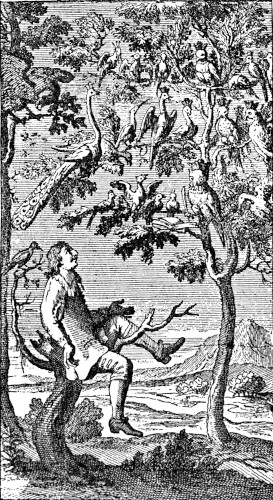
The Parliament of Birds.
"Gentlemen", cried a swallow in the assembly as soon as I had ceased speaking, "I hold him convicted. You have not forgotten he said the country in which he was born was France; but you know that monkeys do not breed in France; after that, judge if he is what he boasts to be."
I replied to my accuser that I had been taken from the bosom of my parents and transported to France when I was so young that I had a perfect right to call that my native country to which my earliest memories were attached. Although this reason was specious, it was insufficient. But the greater part of them, charmed to hear that I was not a man, were very glad to believe it; for those who had never seen one could not but persuade themselves that a man was something much more horrible than I appeared to be, while the most sensible of them added that a man was something so abominable it was useful to believe he was only an imaginary being.[65]
The whole assembly clapped their wings with joy and I was immediately handed over to the Syndics for examination, with orders to produce me next day and to make a report to the committee at the opening of the Chambers. They took charge of me then and carried me off to a retired wood. While they kept me there they did nothing but gesticulate about me with a hundred different kinds of somersaults and walk about in processions with nutshells on their heads. Sometimes they clapped their feet together, sometimes they dug little ditches and filled them up again; and all this time I was surprised not to see anyone else.
The day and the night were passed in these trifles until the prescribed hour arrived next day; I was carried back at once to appear before my judges and, when the Syndics were bidden to speak the truth, they replied that upon their consciences they felt themselves bound to inform the court I was assuredly not a monkey as I boasted.
"For", they said, "we leaped, walked, pirouetted and invented a hundred tricks in his presence, whereby we meant to urge him to do the same, according to the habit of monkeys. Now, even when brought up by men, a monkey is always a monkey, and if he had been one we maintain it would not have been in his power to forbear imitating our monkey-tricks. That is our report, gentlemen."
The judges drew together to hear each other's opinion; but it was noticed that the sky was cloudy and seemed charged with rain; and this made them postpone the sitting. I imagined that this had happened on account of the appearance of bad weather, when the solicitor-general came to tell me by order of the court that I should not receive sentence that day; that they never end a criminal prosecution when the sky is not clear, because they fear lest the bad temperature of the air might influence the good constitution of the judges' minds; lest that ill humour which comes over birds during rain should be discharged upon the case; or lest the court should visit its depression upon the prisoner. And so my sentence was put off until finer weather. I was taken back to prison and I remember that my charitable magpie did not abandon me on the way; it flew continually beside me and I think it would not have left me if its companions had not approached us.
At last I arrived at my prison, where during my captivity I had nothing to eat but the "king's bread"[66]; by this they meant fifty worms and as many cheese-worms,[67] which they brought me to eat every seven hours.
I thought I should be brought up again the next day and everyone thought so too; but after five or six days one of my guards told me the whole of the time had been taken up by the plea of a community of goldfinches, who demanded justice against one of their companions. I asked my guard of what crime this wretch was accused.
"Of the most enormous crime", replied the guard, "by which a bird can be blackened. He is accused.... Can you believe it? He is accused.... But, good Gods! When I only think of it, the feathers stand up on my head. He is accused of not having merited a friend for the last six years; so they have condemned him to be a king, and king of a people of another species. If his subjects had been of his kind, he might have dipped into their pleasures, at least with his eyes and his desire; but since the pleasures of one species have no relation at all to the pleasures of another species, he will undergo all the fatigues and will drink all the bitterness of royalty, without being able to taste any of its compensations. He was sent off this morning surrounded by a number of doctors, who have to watch that he does not poison himself on the journey."
Although my guard was naturally a great talker, he dared not converse with me alone any longer for fear he should be suspected of a compact with me.
At the end of about a week I was again brought before my judges. I was placed upon the fork of a small leafless tree. The learned birds, solicitors, counsel and judges, were perched in rows according to their rank on the summit of a large cedar. The others, who were only present at the assembly from curiosity, were placed pell-mell so that all the seats were filled, that is to say, so that the cedar branches were covered with birds' feet.
The magpie, who, as I had noticed, had always been filled with compassion for me, came and perched on my tree, where it feigned to amuse itself by pecking the moss.
"It is impossible for you to know", it said, "how much your misfortune moves me; for although I am not ignorant that a man among living beings is a pest of which every civilized state ought to purge itself, yet when I remember I was brought up by them from the cradle, that I learned their language so perfectly I almost forgot my own, and that I ate such excellent soft cheeses from their hands, I cannot think of it without water coming into my eyes and mouth; I feel for you a tenderness which prevents me from inclining towards the juster party."
It had finished speaking when we were interrupted by the arrival of an eagle, which came and perched on the boughs of a tree near mine. I should have risen to get on my knees before it, thinking it was the king, if my magpie had not kept me in my former position with its foot.
"Do you suppose", it said, "that this large eagle is our sovereign? That is a supposition of men who, because they allow themselves to be commanded by the largest, strongest and most cruel of their companions, and judge all things from themselves, foolishly imagine that the eagle must command us. But our policy is very different. We choose only the weakest, the gentlest and the most peaceful for our kings; moreover, we change them every six months and we choose them weak so that the humblest individual they have wronged may be avenged upon them. We choose them gentle so that they may neither hate nor be hated by anybody. And we desire them to be of a peaceful temper in order to avoid war, the channel of all injustices.
"Every week a parliament is held, where anyone may complain of him. If there are only three birds dissatisfied with his government he is dethroned and they proceed to a new election. During the day the parliament is held, our king is placed on the top of a tall yew on the edge of a pond, with his feet and wings bound. All the birds one after another pass in front of him, and if any one of them knows he deserves the last punishment, it may cast him into the water; but it must at once justify itself for what it has done, otherwise it is condemned to a sad death."
I could not forbear interrupting him to ask what he meant by a sad death; and this is what he replied:
"When a bird is judged culpable of a crime so enormous that death is too small an expiation, they try to choose a death which contains the pain of several; and they proceed as follows: those among us whose voices are the most melancholy and the most funereal are attached to the guilty person, who is carried to a sad cypress. There these sad musicians gather around him and fill his soul through his ears with such lugubrious and tragical songs that the bitterness of his grief disorders the economy of his organs and so presses upon his heart that he pines visibly and dies suffocated with sadness. However, such a spectacle never happens; for since our kings are very gentle they never provide anyone with the opportunity of desiring to risk so cruel a death for the sake of vengeance. The reigning monarch at present is a dove, whose temper is so peaceful that the other day when two sparrows had to be reconciled there was all the difficulty in the world to make him understand what enmity is."
My magpie could not continue so lengthy a discourse without being noticed by several of those present; and since it was already suspected of some understanding with me, the chiefs of the assembly sent an eagle of the guard to arrest him. King Dove arrived at this moment; everyone was silent and the first thing which broke this silence was the plea of the chief censor of the birds against the magpie. The King, fully informed of the scandal it had caused, asked its name and how it knew me.
"Sire", it replied in astonishment, "I am called Margot; there are many birds of quality here who will answer for me. One day in the world of the Earth of which I am a native I learned from Coughing-Chirper there (who, hearing me calling in my cage, came to visit me at the window where I was hung) that my father was Short-Tail and my mother Crack-Nuts. I should not have known it but for him; for I had been taken from beneath my parent's wing when I was in the cradle, very young. Some time after my mother died of grief and my father, now too old to beget other children and in despair at finding himself without an heir, went off to the Jays' war, where he was killed by a beak-wound in the brain. Those who seized me were certain savage animals called swine-herds, who took me to a castle to sell, and there I saw this man whom you are now prosecuting. I do not know if he conceived good-will for me, but he took the trouble to order the servants to cut up food for me. Sometimes he had the kindness to bring me the food himself. If in the winter I was perishing with cold he carried me near the fire and lined my cage or bade the gardener warm me inside his shirt. The servants dared not tease me in his presence and I remember one day he saved me from the cat that had me in its claws, to which I had been exposed by my lady's little lackey. But it will not be inopportune to acquaint you with the cause of that barbarity. To please Verdelet (that was the little lackey's name) I was repeating one day the foolish things he had taught me. It unfortunately happened, although I always repeated my quirks in the same order, that just as he came in to deliver a false message I said: 'Silence, whoreson, you have lied.' The accused man here, knowing the rogue's lying disposition, imagined that I might have spoken prophetically and sent to the place to inquire if Verdelet had been there. Verdelet was convicted of deceit, Verdelet was whipped, and to avenge himself Verdelet would have had me eaten by the cat had it not been for this man."
The King, bowing his head, showed that he was pleased with the pity it had had for my misfortunes, but yet forbade it to speak to me again in secret. He then asked counsel if he were ready with his plea, who made a sign with his foot that he was about to speak; and here are the points upon which he insisted against me.
Pleading made in the Parliament of Birds, the Chambers Assembled, Against an Animal accused of being a Man.
Gentlemen,
The complainant against this criminal is Guillemette the Plump, a partridge by birth, newly arrived from the world of the Earth with its throat still open from a lead bullet shot at it by men, a suitor against the human race, and, consequently, against an animal whom I claim to be a member of that great body. It would not be difficult for us to prevent the violence he might do by killing him. However, since the safety or the loss of every living thing concerns the republic of the living, it seems to me we should deserve to be born men, that is to say degraded from the reason and the immortality we possess above them, if we resembled them in any of their injustices. Let us then examine, gentlemen, the difficulties of this case with all the keenness of which our divine minds are capable.
The main point of the case consists in discovering whether this animal is a man; and then, if we declare he is, whether he deserves death on that account.
For my part, I make no difficulty in declaring he is: first, from a feeling of horror which we all felt ourselves seized with at his sight without being able to declare the reasons; secondly, because he laughs like a madman; thirdly, because he weeps like a fool; fourthly, because he blows his nose like a vagabond; fifthly, because he is plucked of feathers like one that is mangy; sixthly, because he carries his tail in front; seventhly, because he has always a quantity of little square stones in his mouth and has not the wit to spit them out or to swallow them; and eighthly, and lastly, because every morning he lifts up his eyes, his nose and his large beak, sticks together his open hands with their flat parts together pointing to the sky and makes of them one attachment as if he were tired of having two free ones, breaks his legs in the middle so that he falls on his shanks, and then hums magic words, after which I have noticed his broken legs join up and he rises as gay as he was before. You know, gentlemen, that of all animals man alone has a soul sufficiently black to give himself up to magic and, consequently, he must be a man. We must now examine whether he deserves death for being a man.
I think, gentlemen, that it has never been doubted that all creatures were produced by our common Mother to live together sociably. Then if I prove that man seems only to have been born to disturb this, shall I not prove that by going contrary to the end for which he was created he deserves that Nature should repent of her work? The first and fundamental law for the maintenance of a republic is equality; but man could not endure this eternally; he rushes upon us to devour us, he convinces himself that we were only made for his use. As an argument of his pretended superiority he cites the barbarity with which he massacres us and the little resistance he finds in overcoming our weakness, and yet he will not admit as his masters the eagles, condors, and griffins, by whom the strongest of them are overcome. But why should this size and position of limbs mark a diversity of species, since even among them dwarfs and giants are found?
Moreover this empire on which they flatter themselves is an imaginary right. On the contrary they are so inclined to servitude that for fear of failing to serve, they sell their liberty to each other. Thus the young are slaves of the old, the poor of the rich, the peasants of the gentlemen, princes of monarchs, and even monarchs of the laws they have established. But with all this the poor serfs are so afraid of lacking masters that, as if they feared that liberty should come to them from some unexpected quarter, they make themselves Gods everywhere, in the water, in air, in fire, under the earth. They would rather make them of wood than lack them; and I even think they caress themselves with false hopes of immortality not so much because they are terrified by the horror of annihilation as because of the fear they have of not being commanded after death. This is the wonderful effect of that fantastic monarchy and natural empire of man over the animals and ourselves; for his insolence reaches even to that point. Nevertheless, as a consequence of this ridiculous chieftainship, he pleasantly arrogates to himself the right of life and death over us; he lies in ambush for us, he binds us, he throws us into prison, he cuts our throats, he eats us; and the power to kill those of us who remain free is made a privilege of the Nobility; he thinks the Sun was lighted to enable him to make war upon us; he thinks Nature allows us to make excursions through the sky simply for him to draw favourable or unfavourable auspices from our flight, and that when God put entrails into our bodies His only purpose was to make a book from which man might learn the science of future things.
Is not this pride utterly insupportable? Could one who entertained such a conception deserve a punishment less than that of being born a man? Yet it is not on this account that I urge you to condemn this man; since the poor beast has not the use of reason like ourselves, I excuse his errors in so far as they are produced by lack of understanding; but I ask justice on account of those which are daughters of his will. As, for example, that he kills us without being attacked by us; that he eats us when he might satisfy his hunger with more suitable food; and, which I consider the most cowardly of all, that he debauches the natural disposition of hawks, falcons and vultures, by teaching them to massacre their kind, to feed upon their like or to deliver us into his hands.
This consideration alone is so heinous that I ask the court to condemn him to extermination by a sad death.[68]
The whole Bar shivered with horror at the idea of so great a torture; and, with the purpose of moderating it, the King made a sign to my counsel to reply. It was a starling, a great jurisconsult, who, striking his foot thrice upon the branch which supported him, spoke to the assembly as follows:
"It is true, gentlemen, that moved by pity I undertook the case of this wretched beast; but, at the moment of pleading, remorse of conscience has come to me and a kind of secret voice forbidding me to undertake so detestable an action. Thus, gentlemen, I declare to you and to the court that for the sake of my soul's salvation I will not contribute in any fashion towards the duration of such a monster as man."
The whole populace clapped their beaks as a sign of rejoicing and to congratulate the sincerity of so worthy a bird.
My magpie presented itself to plead in his place, but silence was imposed upon it because, since it had been brought up by men and was perhaps infected by their morals, there was some fear it would approach my case with a prejudiced mind; for the Court of Birds will not hear an advocate who is more interested on behalf of one client than another, unless he can show that this preference comes from the party's right.
When my judges saw that nobody came forward to defend me they stretched out their wings, shook them and flew immediately to consultation.
I learned afterwards that the greater part insisted strongly that I should be exterminated by a sad death; but yet, when they perceived the King inclined to milder measures, they revised their opinions; thus my judges moderated themselves and instead of a sad death, which they remitted, they thought meet to fit my punishment to one of my crimes. To annihilate me by a punishment which would serve to undeceive me by challenging the pretended empire of men over birds, they ordered that I should be given up to the anger of the weakest among them; which meant that they condemned me to be eaten by flies.
At that moment the assembly rose and I heard a murmur go round that the circumstances of my suffering had not been gone into in detail, because of an accident to a bird of the party, which had fallen in a swoon just as it was about to speak to the King. They thought this had happened from the horror caused it by looking too fixedly at a man; and so the order was given for me to be taken away.
Sentence was pronounced upon me; and as soon as the osprey who filled the office of clerk of the court had finished reading it to me, I perceived the sky about me black with flies, humble-bees, midges, gnats, and fleas, buzzing with impatience. I expected to be carried off by my eagles as before, but in their place I saw a great black ostrich, which set me shamefully astride its back; for with them this position is the most ignominious in which a criminal can be placed, and whatever offence a bird has committed it cannot be condemned to this.
The archers who took me to execution consisted of fifty condors and as many griffins; before and behind them flew very slowly a procession of ravens croaking something lugubriously and I thought I heard in the distance responses from screech-owls.
When we left the place where judgment had been pronounced upon me, two birds of paradise who had been ordered to be present at my death came and perched on my shoulders. Although my soul was greatly troubled by horror at the step I was about to take, I yet remember almost all the reasonings by which they tried to console me.
"Death", said they, with their beaks in my ear, "is certainly not a great evil, because our good mother Nature subjects all her children to it; and it cannot be an affair of great consequence, because it happens at any moment and from so small a cause; for if life were so excellent it would not be in our power to withhold it from offspring; or if death brought with it consequences so important as you persuade yourself, it would not be in our power to give it: on the contrary, there is every probability that since every animal begins in play, it ends similarly. I speak to you in this way because, since your soul is not immortal like ours, you may well suppose when you die that everything dies with you. Do not be troubled then at undergoing what some of your companions will undergo later. Their condition is more deplorable than yours; for if death is an evil, it is only an evil to those who are condemned to die; compared with you, who have only an hour between here and there, they will be fifty or sixty years a-dying. Then, you know, he who is not yet born is not unhappy. Well, you are about to resemble him who is not yet born; a twinkling of an eye after life, you will be what you were a twinkling of an eye before; and immediately after that twinkling of an eye you will be dead as long as he who died a thousand centuries ago. But in any case, granted that life is a good, the same chance which in the infinity of time made you what you are may some day cause you to exist again. May not that matter, which by constant mixing finally reached that number, that disposition and that order necessary to the construction of your being, once more by remixing reach the state required to cause you to feel again? Yes, but, you will say, I do not remember to have existed. Why! my dear brother, what do you care so long as you are conscious of existing? And then may it not be that to console you for the loss of your life you will imagine the same reasons which I now put before you?
"These are considerations sufficiently strong to oblige you to drink this bitter cup with patience; but I have others still more urgent, which doubtless will bring you to desire it. My dear brother, you must convince yourself that, since you and other brutes are material, and since death instead of annihilating matter simply alters its economy you must, I say, believe with certainty that when you cease to be what you were you will begin to be something else. Suppose you become a clod of earth or a stone, well, you will be something less wicked than man. But I have a secret to discover to you, which I should not like any of your companions to hear from my mouth; and that is, when you are eaten, as you will be, by our little birds, you will pass into their substance: yes, you will have the honour of contributing (even though blindly) to the intellectual operations of flies, and though you do not reason yourself, you will at least share in the glory of making them reason."
At about this point of their exhortation we reached the place fixed upon for my execution.
There were four trees very close to each other and about the same distance apart, on each of which at the same height was perched a large heron. I was taken down from the black ostrich and a number of cormorants carried me to the place where the four herons were waiting for me. These birds, firmly seated each on its tree opposite each other, wound their prodigiously long necks about my legs and arms as though they were ropes, and bound me so tightly that although each of my limbs was only tied by the neck of one bird I had not the power to move it at all.
They were to remain a long time in this position; for I heard orders given to the cormorants who had lifted me to catch fish for the herons and to slide their food into their beaks. They were still waiting for the flies, because they cleft the air with a flight less rapid than ours; nevertheless we were never out of hearing of them. The first thing they undertook was to apportion my body, and this arrangement was made so cunningly that they assigned my eyes to the bees, so that I should have them stung out as they ate them; my ears to the humble-bees, so that I should have them deafened and devoured at the same time; and my shoulders to the fleas, in order that I should have them pierced by itching bites; and so on for the rest. Scarcely had I heard these orders arranged, when suddenly I saw the insects approaching. It seemed as if all the atoms of which the air is composed had been changed into flies; for only two or three weak rays of light reached me, and these appeared to slip through to get at me, so closely were these battalions drawn up and so near my flesh were they.
But just as each one of them was choosing the place it desired to bite me, I saw them suddenly retreat; and among the confusion of a vast number of shouts, which re-echoed to the clouds, I several times made out the words: Pardon, pardon, pardon.
Two turtle-doves then came up to me. At their arrival all the dismal apparatus of my death disappeared; I felt my herons loose the circles of the long necks which bound me; and my body, stretched out like a Saint Andrew's cross, slipped from the top of the four trees to the foot of their roots. I expected from this fall to be shattered on the ground against a rock; but at the height of my terror I was very surprised to find myself seated on a white ostrich, which set off at a gallop as soon as it felt me on its back.
I was taken by a road different from that by which I had come; for I remember passing through a large wood of myrtles and another of terebinth trees leading to a huge forest of olive trees, where King Dove was awaiting me in the midst of all his court.
As soon as he saw me, he signed for me to be helped down. Immediately two eagles of the guard extended their feet and carried me to the Prince. I respectfully attempted to embrace and to kiss his Majesty's little spurs, but he evaded me.
"I ask you", said he, "whether you know this bird."
At these words they showed me a parrot, which began to strut and flap its wings, when it perceived I was looking at it.
"It seems to me", I exclaimed to the King, "that I have seen it somewhere, but I am so confused by fear and joy that I cannot yet tell precisely where it was."
At these words the parrot came to me, embraced my face with its two wings and said:
"What! You do not recognise Cæsar, your cousin's parrot, on whose account you have so often maintained that birds reason? Just now, during your trial, it was I who tried to declare after the session what obligations I have to you, but the pain of seeing you in so great a peril made me fall into a swoon."
His speech completed the unsealing of my sight. Having recognised him I embraced and kissed him; he embraced and kissed me.
"'Tis you, then, my poor Cæsar", said I, "whose cage I opened to return you the liberty taken from you by the tyrannical custom of our world?"
The King interrupted our caresses and spoke to me to this effect:
"Man, with us a good action is never lost; for this reason, although as a man you deserve to die simply because you were born, the Senate pardons you your life. This act of recognition may well accompany that intelligence with which Nature enlightened your instinct, when she made you suspect in us that faculty of reasoning you were incapable of comprehending. Go then in peace and live happily."
He whispered some orders and my white ostrich, led by the two turtle-doves, carried me away from the assembly. After galloping me for about half a day, the ostrich left me near a forest, into which I plunged as soon as it had gone. There I began to taste the pleasure of liberty and of eating the honey which flowed down the bark of the trees. If my body could have resisted the exertion I think I should never have finished my walk, for the agreeable diversity of the place made me continually discover something more beautiful; but when at last I found myself worn out with fatigue I sank down upon the grass. Stretched out thus under the shadow of the trees I felt invited to sleep by the soft coolness and the silence of solitude, when an indistinct noise of confused voices, which I seemed to hear fluttering about me, woke me with a start.
The ground appeared very flat and did not bristle with any bush to interrupt the sight, and mine therefore ranged far afield among the forest trees; yet the murmur which reached my ear could only have come from close beside me. Listening more intently, I distinctly heard a sequence of Greek words, and among the conversation of a number of people I heard one expressing himself as follows:
"Doctor, one of my relatives, the three-headed Elm, informs me by a Finch, which he sends me, that he is sick of a hectic fever and of a moss disease, which covers him from head to foot. I beseech you, by your friendship for me, to prescribe something for him."
I remained a little time without hearing anything, but after a short space it seemed to me I heard this reply:
"Even if the three-headed Elm were not your relative, and even if this request were made me by the most outlandish of our species, instead of by you, who are my friend, my profession would nevertheless oblige me to help him. Tell the three-headed Elm that to cure his illness he must suck up as much damp and as little dry as possible; for this purpose he must send the small threads of his roots towards the wettest parts of his soil, converse only of cheerful matters, and every day listen to the music of a few excellent Nightingales. He will then let you know how he feels after this regime; and then, according to the development of his illness, when we have prepared his humours, some Stork among my friends will give him a clyster, which will set him fairly on the road to convalescence."
After these words I did not hear the least sound, but a quarter of an hour later a voice, which I think I had not before noticed, reached my ear; this is what it said:
"Are you asleep, forked tree?"
I heard another voice reply thus: "No, fresh bark, why?"
"Because", replied the voice which had first broken the silence, "I feel disturbed in the manner we are accustomed to be when those animals called Men approach us and I should like to ask if you feel the same thing."
Some time passed before the other replied, as if he were concentrating his most secret senses upon this investigation. Then he exclaimed: "By heaven! you are right, and I swear my organs are so filled with the presence of a man that I am very much deceived if there is not one very close at hand."
Several voices then exclaimed together that assuredly they perceived a man. However much I gazed about me on all sides I could not discover whence this speech came. At last, when I had a little recovered from the horror into which this event had cast me, I replied to that voice, which I thought I had noticed asking if there were a man there, that there was one.
"But I beg you", I went on immediately, "whoever you are speaking to me, to tell me where you are."
A moment after I heard these words: "We are in your presence, your eyes behold us and you do not see us! Behold the oaks upon which we feel your sight is resting, it is we who speak to you, and if you are surprised that we should speak a language used in the world whence you come, know that our first fathers were born there; they dwelt in Epirus in the forest of Dodona,[69] where their natural kindness caused them to render oracles to those who consulted them in trouble. For this purpose they learned the Greek language, at that time the most universal, in order to be understood; and because we descend from them, from father to son, the gift of prophecy has come down to us. Well, you must know that a large eagle who was sheltered by our fathers in Dodona could not go hunting because it had broken one of its hands and therefore fed upon the acorns furnished it by their branches, when, one day, tired of living in a world where it suffered, it took flight towards the Sun and continued its voyage so happily that at last it reached the luminous globe where we are now; but the heat of the climate on its arrival made it vomit; it threw up a number of undigested acorns; these acorns germinated and from them grew the oaks which were our ancestors.
"In this way we changed our dwelling-place. But although you hear us speak a human language, it does not mean that other trees express themselves in the same way; only those oaks issued from the forest of Dodona speak as you do. As to other plants, this is how they express themselves: have you never noticed that fine gentle breeze which never fails to breathe on the outskirts of woods? That is the breath of their speech, and the little murmur or the delicate noise by which they break the silence of their solitude is actually their language. But although the sound of forests always seems the same, it is really so different that every kind of plant has its own; the birch does not speak like the maple, nor the beech like the cherry-tree. If the silly people of your world heard me as I am now speaking, they would think there was a devil imprisoned under my bark; for, far from believing that we can reason, they do not even suppose that we have a sentient soul, although every day they see that at the first blow given a tree by the wood-cutter the wedge enters four times deeper into the flesh than at the second blow; from which they ought to conjecture that the first blow assuredly surprised the tree and struck it unexpectedly, then that, immediately it was warned by the pain, it collected itself, united its forces to resist and became as it were petrified to combat the hardness of its enemy's weapon. But my intention is not to make the blind understand light; to me an individual is the whole race and the whole race is but an individual when that individual is not infected by the errors of the race; be attentive therefore, since when I speak to you I imagine I am speaking to the whole human race.
"In the first place you must know that almost all the concerts at which the birds make music are composed in praise of trees; moreover, to repay the care they take in celebrating our worthy actions, we are careful to hide their loves; for you must not imagine when you find so much difficulty in discovering one of their nests that this is the result of the prudence with which they have hidden it; it is the tree itself which folds its boughs all around the nest to protect its guest's family from the cruelties of man. To prove that this is so, observe the nests of those which are either born for the destruction of the birds, their fellow-citizens, like sparrow-hawks, hobbies, merlins, falcons, or of those which only speak to quarrel like jays and magpies, or of those which delight to terrify us, like owls and night-jars; you will notice that their nests are exposed to everybody's sight,[70] because the tree holds its branches away from them in order that they may be taken.
"But it is unnecessary to mention so many details to prove that trees exercise all your functions both of the body and of the soul. Is there any one among you who has not noticed in the spring, when the Sun has delighted our bark with fertile sap, that we lengthen our boughs and spread them out, covered with fruit, on the breast of the earth whereof we are amorous? The earth, on its side, opens and is warmed with the same ardour; and as if each of our boughs were a male organ she draws near to join with them; and our boughs transported with pleasure discharge into her lap the seed with which she burns to conceive. She is nine months in forming this embryo before she brings it forth; but the tree, her husband, fearing the winter cold may harm her pregnancy, casts off his green robe to cover her, while to hide a little of his own nudity he is content with an old cloak of dead leaves.
"Well, you men eternally see these things and never perceive them; still more convincing things pass before your eyes and your stupidity is not even disturbed."
My attention was closely directed to the speech I heard from this arboreal voice and I was awaiting the remainder when it suddenly ceased speaking in a tone similar to that of a person who is prevented from speaking by short breath.
When I found it altogether obstinate in its silence I conjured it by everything I thought might move it to deign to instruct a person who had risked the perils of so great a voyage only for the purpose of learning. At the same time I heard two or three voices making the same supplication for love of me and then I distinguished one, saying to it as if it had been annoyed:
"Well, since you complain so much of your lungs, take a rest, and I will tell him the 'Story of the Lover-Trees'."
"Oh you, whoever you may be", cried I, throwing myself upon my knees, "the wisest of all the oaks of Dodona, who deign to take the trouble to instruct me, know that your lesson is not wasted upon one who is ungrateful; if ever I return to my native globe I make a vow that I will publish the marvels which you do me the honour to let me witness."
As I finished this protestation I heard the same voice continue thus: "Little man, look twelve or fifteen paces to your right hand, you will see two twin trees of moderate height intertwining their branches and their roots and trying in a thousand ways to make themselves one."
I turned my eyes towards these love-plants and I noticed that the leaves of both were lightly agitated by a half-voluntary emotion, while their rustling created a murmur so delicate that it scarcely reached the ear; and yet one would have said that by this means they were trying to question and answer each other.
When the time necessary for me to notice this double plant had passed, my good friend the oak took up the thread of his discourse thus:
"You cannot have lived so long without the famous friendship of Pylades and Orestes coming to your knowledge?
"I would describe to you all the joys of a gentle passion and I would relate to you all the miracles with which these lovers have astonished their age, did I not fear that so much light would dazzle the eyes of your reason, and therefore I will only paint these two young Suns in their eclipse.
"It will suffice you then to know that one day in battle the brave Orestes sought his dear Pylades, to taste the pleasure of conquering or dying in his presence. When he perceived him in the midst of a hundred arms of iron lifted above his head, alas! what did he become? He rushed despairingly through a forest of pikes, he shouted, he howled, he foamed; but how badly I express the horror of his movements in his despair! He pulled out his hair, he gnawed his hands, he tore his wounds; and at the end of this description I am obliged to say that the means of expressing his grief died with him. When he thought to cut a path with his sword to rescue Pylades, a mountain of men opposed his passage. Yet he cut through them; and after trampling long over the bloody trophies of his victory, little by little he approached Pylades; but Pylades seemed to him so near death that he scarcely dared ward off his enemies any more for fear of surviving the thing for which he lived: to see his eyes filled already with the shadows of death one would even have said he tried to poison the murderers of his friend with his looks. At last Pylades fell lifeless; and the amorous Orestes, feeling his own life ready to leave his lips, yet retained it until his wandering sight sought and found Pylades among the dead, when, kissing his mouth, he seemed as if he would throw his soul into his friend's body.[71]
"The younger of these heroes died of grief on the body of his friend; and you must know that from their rotting flesh (which doubtless had fertilised the earth) there sprang up among the whitening bones of their skeletons two young saplings, whose trunks and branches mingled together and seemed to hasten their growth only to twine more closely together. It was apparent they had changed their being without forgetting what they had been; for their perfumed buds leaned one upon the other and warmed each other with their breath as if to make them open more quickly. But what shall I say of the loving portioning maintained by their fraternity? Never was the juice in which nourishment resides offered to their stock but that they shared it with ceremony. Never was one of them ill-nourished but that the other was sick with weariness; both drew from the breasts of their nurse within as you suckle them from without. Finally these happy lovers produced apples, and such miraculous apples that they performed even more miracles than their Fathers. Those who ate the apples of one tree immediately became passionately in love with anyone who had eaten the fruit of the other. And this happened almost every day, because the shoots of Pylades surrounded, or were surrounded by, those of Orestes, and their almost twin fruits could not resolve to part from each other.
"Nature, however, had differentiated the energy of their double essence so carefully that when the fruit of one of the trees was eaten by a man and the fruit of the other tree by another man, this caused a reciprocal friendship and when the same thing happened to two persons of different sex it caused love, but a vigorous love which retained the character of its cause; for although this fruit proportioned its effect to the eater's capacity, softening its virtue in a woman, it still preserved something masculine.
"It must also be noticed that he who ate more of the fruit was the more beloved. This fruit failed not to be very sweet and very beautiful, since nothing is so beautiful and so sweet as friendship; and these two qualities of beauty and goodness which are never met with in one person caused them to be in such repute. How many times have its miraculous virtues multiplied the copies of Orestes and Pylades! Since that time have been seen Hercules and Theseus, Achilles and Patroclus, Nisus and Euryalus; in short, an innumerable number, who by more than human friendships have consecrated their memory in the temple of eternity. Cuttings were taken to Peloponnesus and the drill-ground, where the Thebans trained their youth, was ornamented with them. These twin trees were planted in lines and at that season of the year when the fruit hangs upon the boughs, the young men, who went to the park every day, were tempted by the beauty of the fruit and did not abstain from eating it: usually their courage felt the effect at once. They were seen to exchange souls pell-mell; each of them became the half of the other, lived less in himself than in his friend, while the most cowardly would attempt dangerous things for his friend's sake.
"This heavenly malady warmed their blood with so noble an ardour that by the advice of the wisest men this band of lovers was enrolled for war in the same company. Since that time, on account of the noble deeds they performed, they have been called the Sacred Band.[72] Its exploits went far beyond anything Thebes had imagined; for in battle each of these brave men dared such incredible efforts to protect his lover or to deserve his love that Antiquity saw nothing like it; and as long as that company of lovers existed, the Thebans, who before that time were considered the worst soldiers of all Greece, fought and always overcame the most warlike peoples of the earth, from even the Lacedemonians downwards.
"But among an infinite number of praiseworthy actions produced by these apples they innocently caused some which were very shameful.
"Myrrha,[73] a young lady of quality, ate of them with Cinyrus, her father; unhappily one ate of Pylades and the other of Orestes. Love immediately swallowed up Nature and confused it to such an extent that Cinyrus could swear 'I am my son-in-law' and Myrrha 'I am my stepmother'. In short, I think it sufficient to tell you, in order that you should understand the whole crime, that at the end of nine months the father became the grandfather of those he begat and the daughter brought forth her brothers.
"But chance was not content with this crime alone; it willed that a bull, having entered the gardens of King Minos, unhappily found some apples under a tree of Orestes and devoured them; I say unhappily, because Queen Pasiphaë ate this fruit every day. They became madly in love with each other. I shall not explain their enormous pleasure; suffice it to say that Pasiphaë was plunged in a crime which hitherto had no example.
"The famous sculptor Pygmalion precisely at that time was carving a marble Venus in the palace. The Queen, who delighted in good workmen, presented him with a couple of these apples; he ate the finest; and because he chanced to lack water, which, as you know, is necessary to the cutting of marble, he moistened his statue with the juice. The marble penetrated at the same time by this juice, little by little grew soft; and the energetic virtue of the apple carrying on its labour according to the workman's plan followed within the image the features it had met with on the surface, for it dilated, warmed and coloured in natural proportions the parts it met with in its passage. Finally the marble became living and touched by the apple's passion embraced Pygmalion with all the strength of her heart; and Pygmalion, transported by reciprocal love, received her for his wife.